/














































Text
                    2

FIFTH EDITION

Mental Health Concepts and Techniques

3

for the Occupational Therapy Assistant

4

FIFTH EDITION

Mental Health Concepts and Techniques

5

for the Occupational Therapy Assistant

Mary Beth Early, MS, OTR
Professor Emeritus
Occupational Therapy Assistant Program
LaGuardia Community College
City University of New York
New York, New York

6

Executive Editor: Michael Nobel
Senior Product Development Editor: Amy Millholen
Editorial Assistant: Tish Rogers
Marketing Manager: Shauna Kelley
Production Project Manager: David Saltzberg
Design Coordinator: Stephen Druding
Manufacturing Coordinator: Margie Orzech
Prepress Vendor: SPi Global
5th edition
Copyright © 2017 Wolters Kluwer
Copyright © 2009, 2000, 1993, 1987 Lippincott Williams & Wilkins, a Wolters Kluwer business.
All rights reserved. This book is protected by copyright. No part of this book may be reproduced or transmitted in any
form or by any means, including as photocopies or scanned-in or other electronic copies, or utilized by any information
storage and retrieval system without written permission from the copyright owner, except for brief quotations embodied
in critical articles and reviews. Materials appearing in this book prepared by individuals as part of their official duties as
U.S. government employees are not covered by the above-mentioned copyright. To request permission, please contact
Wolters Kluwer at Two Commerce Square, 2001 Market Street, Philadelphia, PA 19103, via email at
permissions@lww.com, or via our website at lww.com (products and services).
987654321
Printed in China
Library of Congress Cataloging-in-Publication Data
Names: Early, Mary Beth, author.
Title: Mental health concepts and techniques for the occupational therapy assistant / Mary Beth Early.
Description: Fifth edition. | Philadelphia : Wolters Kluwer, [2017] | Includes bibliographical references and index.
Identifiers: LCCN 2015046043 | ISBN 9781496309624
Subjects: | MESH: Occupational Therapy—methods | Mental Disorders—rehabilitation | Allied Health Personnel
Classification: LCC RC437 | NLM WM 450.5.O2 | DDC 616.89/165—dc23 LC record available at
http://lccn.loc.gov/2015046043
This work is provided “as is,” and the publisher disclaims any and all warranties, express or implied, including any
warranties as to accuracy, comprehensiveness, or currency of the content of this work.

This work is no substitute for individual patient assessment based upon healthcare
professionals’ examination of each patient and consideration of, among other things, age,
weight, gender, current or prior medical conditions, medication history, laboratory data
and other factors unique to the patient. The publisher does not provide medical advice or
guidance and this work is merely a reference tool. Healthcare professionals, and not the
publisher, are solely responsible for the use of this work including all medical judgments
and for any resulting diagnosis and treatments.
Given continuous, rapid advances in medical science and health information,
independent professional verification of medical diagnoses, indications, appropriate
pharmaceutical selections and dosages, and treatment options should be made and
healthcare professionals should consult a variety of sources. When prescribing medication,
healthcare professionals are advised to consult the product information sheet (the
7

manufacturer’s package insert) accompanying each drug to verify, among other things,
conditions of use, warnings and side effects and identify any changes in dosage schedule or
contradictions, particularly if the medication to be administered is new, infrequently used
or has a narrow therapeutic range. To the maximum extent permitted under applicable law,
no responsibility is assumed by the publisher for any injury and/or damage to persons or
property, as a matter of products liability, negligence law or otherwise, or from any
reference to or use by any person of this work.
LWW.com

8

Reviewers
Diane Anderson, PhD, MPH, OTR/L
Coordinator
Occupational Therapy Assistant Program
St. Catherine University
Saint Paul, Minnesota
Janice Bacon, MED, OTR/L
Program Director/Lecturer
Allied Health Occupational Therapy Assistant Program
Washburn University
Topeka, Kansas
Lynnette Dagrosa, MA, OTR/L
Occupational Therapist
The Mary McDowell Friends School
Brooklyn, New York
Marianne Dahl, MBA, OTR/L
Program Director Occupational Therapy Assistant Studies
School of Continuing and Professional Studies
Philadelphia University
Philadelphia, Pennsylvania
Bridget DiMercurio, OTR/L
Instructor
Occupational Therapy Assistant Program
St. Louis College of Health Careers
Saint Louis, Missouri
Connie Dollens, OTR/L
Occupational Therapist
Hillcrest Hospital Claremore
Claremore, Oklahoma

9

Nancy Dooley, OTR/L, MA, PhD
Program Director
Occupational Therapy and Occupational Therapy Assistant Programs
New England Institute of Technology in Warwick
East Greenwich, Rhode Island
Lisa HodginsOT Reg.(Ont.) ,
Instructor and Placement Advisor
OTA & PTA Program
School of Health and Wellness
Georgian College, Barrie Campus
Barrie, Ontario, Canada
Terrie King, OT (BS) and LPC (MA)
Fieldwork Coordinator
Occupational Therapy Assistant Program
Panola College
Carthage, Texas
Arlene Kinney, MED, OTR/L
Program Director/Chair
Occupational Therapy Assistant Program
Keiser University
Fort Lauderdale, Florida
Shirish Lala, MHS, BOT
Occupational Therapy Assistant Academic Clinical Coordinator
School of Health Careers
Daytona State College
Daytona, Florida
Myrl Ray Stephen Manley, MD
Clinical Associate Professor of Psychiatry
NYU School of Medicine
New York, New York
Private Practice, Psychiatry
Brooklyn, New York

10

Maureen Matthews, BS, OTR/L
Occupational Therapist III
Behavioral Health
Good Samaritan Hospital
San Jose, California
Kristi McLeod, BBA, COTA
Associate Professor
Certified Occupational Therapy Assistant Program
Navarro College
Corsicana, Texas
Christine Vicino, OTA/L
Occupational Therapy Assistant
Program Director
Grossmont College
El Cajon, California

11

Preface
The fifth edition of Mental Health Concepts and Techniques aims to provide the
occupational therapy assistant (OTA) student with a comprehensive and contemporary
foundation for the practice of occupational therapy for persons with mental health
problems. The book may also be useful to experienced occupational therapy assistants
entering or reentering mental health practice. Occupational therapists with supervisory and
administrative roles with an interest in exploring the delineation and relationships between
the professional and technical levels of responsibility may use the book as a resource. It is
assumed that readers of this text have a background in human growth and development,
general psychology, group process, and activities used in occupational therapy.
Much has changed in mental health care since the first edition. New medications may
better target specific disorders, making improved functioning possible and reducing adverse
effects. Many people with mental disorders have become more assertive about their rights,
alert and proactive as consumers of services. Recovery is the dominant paradigm in
interventions for persons with mental disorders, and the text reflects this. The terms used to
refer to “recipients of services” in the fifth edition correspond to current usage. Box 7-1
identifies some of the names given to the recipient of occupational therapy services in a
range of settings: patient, client, consumer, member, inmate, resident, service user,
survivor, and so on. The student and reader are encouraged to appreciate the ambiguity and
subtle distinctions of these terms, and to be alert to new ones. It is important to develop a
sense for which is the best term for a specific situation, and to cultivate an empathic feel for
the stigma that attaches to labels of any kind.
The text has been updated to reflect the Occupational Therapy Practice Framework, 3rd
edition (OTPF-3E), and the Diagnostic and Statistical Manual of Mental Disorders, Fifth
Edition (DSM-5).

12

Overall Changes in the Text
Some chapters from the previous edition have been deleted, on the recommendation of
reviewers of the proposal for this new edition. Their argument was that information from
those chapters (the OTPF-3E, the OT process, documentation, supervision, and personal
organization) is accessible in textbook and online resources that have been developed for
occupational therapy assistants over the past 15 years. This was not the case when the first
three editions of the book published.
The sequence of the remaining chapters has been revised (consumers placed before
contexts, and the activity analysis chapter moved earlier in the book). It is the individual
instructor’s prerogative to determine the optimal sequence for assigning the chapters,
depending on the desired content of a course of study.
Evidence-based practice (EBP) content has been enhanced. Boxes within chapters, and
a new Appendix C, invite the curiosity of the reader. It is assumed that the student will
encounter a thorough exposition of EBP elsewhere in the curriculum. In this text the
purpose is to pose questions that suggest a need for thoughtful answers. The answers may
be multiple, argumentative, and sometimes contradictory. In many cases, no one answer is
correct (to the exclusion of others). Our profession is developing its body of evidence
despite some challenges, explained further in Appendix C.
Other changes include the following:
Key terms, formerly italicized, are now in bold font.
Some tables and large features have been relocated to the ends of some chapters to
improve reading flow. The chapter on medication is an example.
Challenge and reflection questions have been added to some chapters.
In the medication chapter and elsewhere, the reader is encouraged to consult online
resources to obtain the latest information, as textbook information can become
obsolete.

13

Organization of Content
The content is arranged into five sections. Section I (Chapters 1 to 4) establishes a
framework, discussing the historical origins of psychiatric occupational therapy and the past
and current theoretical foundations on which mental health practice is based. Case
examples are included to illustrate how each theory can be applied.
Section II (Chapters 5 to 8) addresses the context of the occupational therapy
intervention process and includes chapters on psychiatric diagnosis (DSM-5), settings,
medications, and consumers. Content on practice with children, adolescents, families,
veterans, victims of trauma, and other groups has been increased. The purpose of gathering
chapters on such disparate topics under the heading “context” is to suggest the effects of
these factors on the occupational therapy process.
Section III (Chapters 9 to 12) focuses on relationships with patients/clients/consumers.
The therapeutic relationship with the mental health worker is a primary force in motivating
recovery, restoring the patient’s sense of direction, and supporting ability to function.
Logically this material should precede any discipline-specific content. In addition, past
students have expressed a desire to know what to do with the clients whom they meet on
level I fieldwork, which may run concurrently with the mental health coursework in some
curricula. A chapter on safety is included in this section, as is the chapter on groups.
Section IV (Chapters 13 and 14) describes the evaluation, planning, and intervention,
stages of the occupational therapy process. Some information on clinical reasoning (from
the deleted OT process chapter) has been integrated with the evaluation and intervention
chapters. Evaluation instruments cited have been updated to reflect current practice,
consistent with reasonable expectations of service competency for the OTA. The chapters
in this section correspond to the terminology and concepts of the OTPF-3E and official
documents of the American Occupational Therapy Association, at the time of this writing.
Occupational therapy methods and activities are the focus of Section V (Chapters 15 to
20). At the suggestion of reviewers, the chapter on activity analysis has been relocated and
appears as the first in this section. The other five chapters detail specific activities and
methods in the areas of daily living skills, education and work, leisure and social
participation, emotional regulation and management of emotional needs, and cognitive and
sensory and motor factors and skills.
Appendix A contains case examples, some of which are referred to in the text.
Additional case examples appear within the chapters. Appendix B gives sample group
protocols to supplement Chapter 12. Appendix C provides a brief introduction to
evidence-based practice (EBP) in mental health occupational therapy, and EBP boxes can
be found in many chapters. The end papers list abbreviations that students and
practitioners may encounter in mental health settings and medical records.
Popular text features are retained. Chapter objectives direct readers to the learning goals
14

for the chapter, and chapter review questions test the readers’ comprehension. Point-ofview boxes in selected chapters provide perspectives of consumers and other stakeholders.
Additional retained features include concepts summary and vocabulary review (found
throughout selected chapters in Section I) that reinforce important concepts and provide
definitions for key terms.
With each edition, we (author and publisher) try to move more perfectly toward
gender-neutral language. However, the third person plural is not always appropriate and in
such cases masculine or feminine names or pronouns have been employed.

15

Acknowledgments
No project of this size is ever the work of one person. Many people have helped in direct
and indirect ways throughout the five editions. I remain deeply grateful to Professor JoAnn
Romeo Anderson, Dean Irwin Feifer, and former Dean of Faculty Martin Moed for their
encouragement and mentorship during the T.A.R. project at LaGuardia Community
College in 1980 and 1981; participation in that project enabled me to develop the course
manual from which the first edition evolved. I am grateful to my colleagues and students at
LaGuardia Community College for their companionship and inspiration.
I am most appreciative of the careful suggestions and collegial encouragement of past
and present reviewers. Those for previous editions included Claudia Allen, Linda Barnes,
Alfred Blake, Jody Bortone, Terry Brittell, Anne Brown, Leita Chalfin, Phyllis Clements,
Carol Endebrock-Lee, Edith Fenton, Gloria Graham, Yvette Hachtel, Florence Hannes,
Diane Harlowe, Noel Hepler, Carlotta Kip, Lorna Jean King, Tom Lawton, Siri Marken,
Maureen Matthews, Ann Neville-Jan, Elizabeth Nyberg, Gertrude Pinto, Hermine D.
Plotnick, Margaret D. Rerek, Anne Hiller Scott, Esther Simon, Scott Trudeau, Susan
Voorhies, and Marla Wonser.
I am greatly indebted to the reviewers of the present edition. Their commitment to the
project and their willingness to share their expertise were invaluable. The present text is
very much a collaboration with them. I thank especially the following three individuals who
gave many hours of thoughtful reading and commentary: Myrl Manley, MD; Lynnette
Dagrosa, MA OTR/L; and Maureen Matthews, OTR/L. All the reviewers of the present
edition are listed on page v.
I am grateful to the staff at Wolters Kluwer Health, Lippincott Williams & Wilkins,
and their predecessor, Raven Press, for editorial and other support over the years. Vickie
Thaw was especially encouraging in her stewardship of the project during the development
of the second edition. For the third edition, Margaret Biblis, Linda Napora, Amy Amico,
Lisa Franko, and Mario Fernandez created wonderful text features and a beautiful design,
which live on in altered form in the current edition. For the fourth edition, Elizabeth
Connolly provided careful and thoughtful guidance as managing editor. I am also indebted
to Kim Battista (artist) and Jennifer Clements (art director) for enhancing the look of the
book and the images within it.
The development of the current edition was managed with great patience and care by
Amy Millholen. Her receptivity, flexibility, creativity, and concern were immensely helpful.
Mike Nobel met with me and discussed the project via phone and e-mail for what seemed
like several years, and encouraged me in countless ways. This project would not have
happened without his and Amy’s support. Others in the publication process who
contributed their labors to this edition included Shauna Kelley, Marketing Manager; David
16

Saltzberg, Production Product Manager; and Stephen Druding, Design Coordinator.
My husband, Bob, always assured me that I would manage to complete this edition just
as I have completed others. To that end, he did not let me waste away but frequently
offered treats and nurturance of all kinds, insisted that I go for a walk when I was tired, and
distracted me appropriately (and sometimes inappropriately but hilariously) when I needed
a break. He read passages for clarity and for student readability, a job for which he is well
suited given his decades of teaching high school English. Most of all, he was there for me
when I needed him. What more can one ask? Thank you, Bob.

17

Contents
Reviewers
Preface
Acknowledgments

section one History and Theory
1 History and Basic Concepts
Mental Health and Mental Illness
Relation of Occupation to Mental Health
A Few Words About Language
Historical Understanding
The Role of the Occupational Therapy Assistant

2 Medical and Psychological Models of Mental Health and
Illness
Theory of Object Relations
Developmental Theory
Behavioral Theories
Cognitive–Behavioral Therapy
Client-Centered Therapy
Neuroscience Theories
Psychiatric and Psychosocial Rehabilitation
Explanatory Models from Other Cultures

3 Selected Practice Models for Occupational Therapy in
Mental Health
Development of Adaptive Skills
Role Acquisition and Social Skills Training
Psychoeducation
Sensory Integration
Sensory Processing
Cognitive Disabilities
The Model of Human Occupation
Person–Environment–Occupation Model

18

4 Human Occupation and Mental Health Throughout the
Life Span
Motivation Toward Occupation
Changes in Occupation over the Life Span
Mental Health Factors Throughout the Life Span

section two Context
5 Understanding Psychiatric Diagnosis: The DSM-5
Psychiatric Diagnosis: An Evolving Science
The Diagnostic Categories of the DSM-5
Applications of Diagnoses to Occupational Therapy
Comorbidity
Conditions for Further Study

6 Who is the Consumer?
Populations by Age Group
Veterans
Family Members
Caregivers
Cultural Difference
Populations in Economic Distress
Social Problems—Ending the Cycle of Violence
Medical Problems and Physical Disabilities

7 Contexts of Intervention, Service, and Care
The Scope of Patients, Clients, Consumers, and Survivors
Understanding and Supporting Recovery
Trauma-Informed Care
The Scope of Settings and Services
Inpatient Settings
Outpatient and Community Settings and Services
Consumer-Operated Programs
Other Community Programs
Home Health Care
Community Residences
Settings for Children and Adolescents
Environmental Concepts

19

8 Psychotropic Medications and Other Biological Treatments
Psychotropic Medications
Consumer Concerns Related to Medications
Other Biological Treatments
Herbal and Alternative Therapies
Concerns Related to the Internet

section three Interacting with Patients and Consumers
9 Therapeutic Use of Self
The Therapeutic Relationship
Stages in the Therapeutic Relationship
Roles in the Therapeutic Relationship
Therapeutic Qualities
Developing Therapeutic Qualities
Techniques for Relating to Patients
Issues That Arise in Therapeutic Relationships
Ethics
Ending the Therapeutic Relationship

10 Responding to Symptoms and Behaviors
A Framework of Concepts About Symptoms
Response Variables
Response Strategies
Self-Monitoring for Self-Mastery of Symptoms

11 Safety Techniques
Universal Precautions
Controlling the Clinic Environment
Medical Emergencies and First Aid
Psychiatric Emergencies
Addressing Safety in the Community

12 Group Concepts and Techniques
Definition and Purpose of Group Treatment
Group Dynamics: Review of Basic Concepts
Development of Group Skills
How Therapy Groups Are Different from Other Groups
Role of the Leader in an Activity Group
Program Development
20

Starting a New Group
Adaptations of Groups for Low-Functioning Individuals
Other Models for Groups
Program Evaluation

section four Occupational Therapy Process
13 Evaluation and Data Collection
A Holistic Perspective: A Dynamic Process
Definition and Purpose of Evaluation
Understanding Behavioral Strengths and Barriers in the Context of
Occupational Performance
Concepts Central to the Evaluation Process
Roles of the OT and the OTA
The OTA’s Methods of Data Collection
Concepts Related to Assessment and Measurement
Some Assessments Suitable for OTA Administration
The Performance Context for Evaluation
Documentation and Communication of Evaluation Data

14 Intervention: Planning, Clinical Reasoning,
Implementation, and Review
Roles of the Occupational Therapist and Occupational Therapy Assistant
Intervention Planning in Psychiatry
Theory and the Occupational Therapy Process
Clinical Reasoning
Using Practice Models to Apply Clinical Reasoning in Planning
Steps in Intervention Planning
General Goals of Psychiatric Occupational Therapy
How to Write an Intervention Goal
Selecting Appropriate Intervention Principles
Selecting Intervention Methods
Outcome Assessment
Continuity of Care Across Settings
Quality Assurance
Continuous Quality Improvement

section five Occupational Therapy Methods
15 Analyzing, Adapting, and Grading Activities
21

Selection of Activities
Analysis of Activities
Adaptation of Activity
Gradation of Activity
Activity Analysis Based on Theory: Cognitive Disabilities
Dynamic Performance Analysis
Analysis for a Task-Oriented or Task-Specific Approach
Analysis: An Ongoing Process

16 Activities of Daily Living
Factors in Learning and Using Skills
Practice, Repetition, and Habit Development
Daily Living Activities (Personal and Instrumental)

17 Education and Work
Education
Work

18 Leisure and Social Participation
Leisure Exploration
Leisure Performance
Leisure Activities
Social Participation

19 Emotion Regulation, Self-Management, Communication
and Interaction
Occupational Therapy’s Domain of Concern
Emotions Defined
Key Aspects of Emotion Regulation
Emotion Regulation and Needs
Issues Related to Engagement in Occupation
Self-Management Skills

20 Cognitive, Sensory, and Motor Factors and Skills
Cognitive or Mental Functions
Sensory and Motor Factors

Appendix A: Case Examples

22

Appendix B: Sample Group Protocols
Appendix C: Understanding and Using Best Evidence
Index

23

List of Figures
1.1 Timeline.
3.1 Some people find social behavior very hard to understand.
3.2 Task checklist.
3.3 Allen’s level 3.
3.4 The process of occupational adaptation.
3.5 Person–Environment–Occupation Model.
4.1 The balance and interrelationship of work and play during the life span.
6.1 Marine Gunnery Sgt. Aaron Tam (Ret.), holding the mask he made to illustrate his
feelings about his traumatic brain injury.
6.2 Homeless persons may establish encampments under highway overpasses.
6.3 Visual analog scale.
7.1 OT client drawing reflecting on obstacles to changing behavior.
7.2 Townhouses such as these in Brooklyn, NY, may contain supported apartments.
7.3 A drawing by a child showing how different body parts feel when she is angry.
7.4 Three levels of environment.
8.1 Aging individuals and those with arthritis or diminished sensation will have difficulty
opening medication containers.
8.2 Storing several medications in the same container makes it difficult to remember the
name, purpose, dosage, and schedule for each one.
9.1 Eye contact, leaning forward, and facial expression convey empathy, sensitivity,
respect, and warmth.
10.1 Postural habits associated with depression (left) and anxiety (right).
10.2 A. Cluttered environment. B. Clarified environment.
11.1 Always use a stairway to evacuate during a fire or smoke condition.
11.2 Hunting is a valued occupation for many individuals and families across the United
States.
12.1 Interaction patterns in groups showing leader and members.
12.2 Group interaction skills survey.
12.3 Typical elements of a group protocol.
12.4 Sample group protocol: self-care group.
12.5 Sample group protocol: caregiver education and support group.
12.6 Sample group protocol: therapeutic activities (acute care unit).
13.1 Empathy and pacing help the client trust the therapy practitioner.
24

13.2 Occupational Performance History Interview version-II.
13.3 Comprehensive Occupational Therapy Evaluation scale.
13.4 Definitions for the Comprehensive Occupational Therapy Evaluation scale.
13.5 The Allen Cognitive Level screening test.
14.1 Reasoning with the model of human occupation.
14.2 Working with plants requires basic task skills and provides a link with nature, a sense
of responsibility, and hope.
14.3 Assembling a wood project provides feedback about the effectiveness of actions and the
sequence of steps, and is adaptable to many goals.
14.4

A guided discussion after a group activity helps the members process what has
occurred.
14.5 Examples of questionnaire statements related to patients’ satisfaction with the delivery
of occupational therapy care.
15.1 Gradation of decision-making.
15.2 Dynamic performance analysis decision tree.
15.3 Making a simple sandwich is a task-specific activity.
16.1 Proposed sequential adherence process.
16.2 Using an umbrella and wearing a well-fitting coat suitable for rain creates a positive
impression.
16.3 Preparing a grocery list and using it help save time and money.
16.4 The immense size, bright lights, and visual stimulation of a large store may be
overwhelming to someone with sensory issues or a cognitive disability.
17.1 Stocking shelves in a supermarket or health aids store requires skills that are within the
range of high school students and persons with mental disabilities who are
beginning to explore the world of work.
17.2 Working alone and at night or other time when few workers are present may be an
effective accommodation from someone with social anxiety or high distractibility.
18.1 Here, a woman instructs her granddaughter in knitting, a leisure activity that she
enjoys, and a social participation experience for both of them.
18.2 Many people enjoy spending their leisure time experiencing nature directly.
18.3 A. Solitary computer gaming activity may interfere with social participation and with
success in school. B. Enjoying an Internet activity with others is different from
doing it alone. In this case, each person has the social proximity of friends.
18.4 Social participation may include pets and other animals.
19.1 The modal model of emotion.
19.2 The process model of emotion regulation.
19.3 Maslow’s hierarchy of needs.
20.1 Postures associated with chronic schizophrenia.
25

20.2 Volleyball elicits spinal extension and open postures.
20.3 Multisensory room.

26

List of Tables
2.1 Selected Defense Mechanisms
2.2 Erikson’s Eight Stages of Psychosocial Development
2.3 Steps in a Behavioral Treatment Program
2.4 Cognitive–Behavioral Model Based on Rational–Emotive Therapy of Ellis
3.1 Stages in Development of Selected Adaptive Skills
3.2 Cognitive Levels: Motor Actions and Associated Sensory Cues
4.1 Some Aspects of Development of Human Occupation and Risks of Mental Disorders
by Age Group
5.1 Stages of Dementia, Associated Changes, and Family Caregiver Needs
7.1 Focus and Examples of Occupational Therapy at Three Levels of Environment
8.1 Therapeutic and Adverse Effects of Antipsychotic Drugs
8.2 Therapeutic and Adverse Effects of Antiparkinsonian Medications
8.3 Therapeutic and Adverse Effects of Antidepressant Drugs
8.4 Therapeutic and Adverse Effects of Mood-Stabilizing Drugs
8.5 Therapeutic and Adverse Effects of Antianxiety (Anxiolytic) Drugs
8.6 Therapeutic and Adverse Effects of Medications for Attention Deficit Disorders
8.7

Drug Side Effects and Recommended Occupational Therapy Adaptations and
Interventions
9.1 Taylor’s Six Therapeutic Modes
10.1 Flexible Responses to Anxious Behaviors
12.1 Roles of Group Members
12.2 Role of the Therapist in Developmental Groups
12.3 Identifying a Focus for the Group
12.4 Five-Stage Group—Sensory Integrative Model
14.1 Some General Goals of Occupational Therapy in Mental Health
14.2 Goal Attainment Scale for Two Goals
14.3 Quality Assurance Examples for Occupational Therapy Mental Health Patients
15.1 Activity Analysis Outline
15.2 Task Analysis for Allen’s Cognitive Levels
16.1 Lesson Plan for 12 Sessions: Money Management
17.1 Learning Styles and Preferred Learning Experiences
17.2 Potential Adaptive Benefits of Engagement in Work

27

17.3 Examples of Accommodations that Have Been Considered Reasonable
19.1 Emotion Regulation Processes and Foundation Skills
19.2 Stress Management Techniques
20.1 Examples of Cognitive Impairments
20.2 Sensory Room Equipment Considerations

28

List of Boxes
2.1 Six Dimensions of Rehabilitation Readiness
2.2 Three Examples of Cultural Syndromes
3.1 Mode 4.2: Engaging Abilities and Following Safety Precautions When the Person
Can Differentiate the Parts of the Activity
4.1 Sample Statements of Persons Anticipating Retirement
5.1 ICD-9 and ICD-10 Codes for Schizophrenia
5.2 DSM-5 Diagnosis, “Ozone Layer”
5.3 Brief Occupational Therapy Interventions Related to Substance Use (For the OTA)
6.1 Children with Psychosocial Problems: Focus of Intervention
6.2 Adolescents with Psychosocial Problems: Focus of Intervention
6.3 Elders with Psychosocial Problems: Focus of Intervention
6.4 Veterans with Psychosocial Problems: Focus of Intervention
6.5 Questions for Effective Liaisons with Caregivers
6.6 Four Types of Interactions with Caregivers
6.7 Examples of Cultural Norms for Behavior in the United States
6.8 Behaviors That May Indicate Low Levels of Literacy or Health Literacy
6.9 Homeless Persons: Goals and Areas of Intervention
7.1 The Recipient of Mental Health Services: What’s in a Name?
7.2 Ten Guiding Principles of Recovery
7.3 Guidelines and Strategies for Supporting Recovery
7.4 Short-Term Inpatient Programs: Focus of Intervention
7.5 Longer-Term Inpatient Programs: Focus of Intervention
7.6 Community Programs: Focus of Intervention
7.7 Psychosocial Clubhouse: Focus of Services
7.8 The Nuclear Task Approach to Crisis Intervention
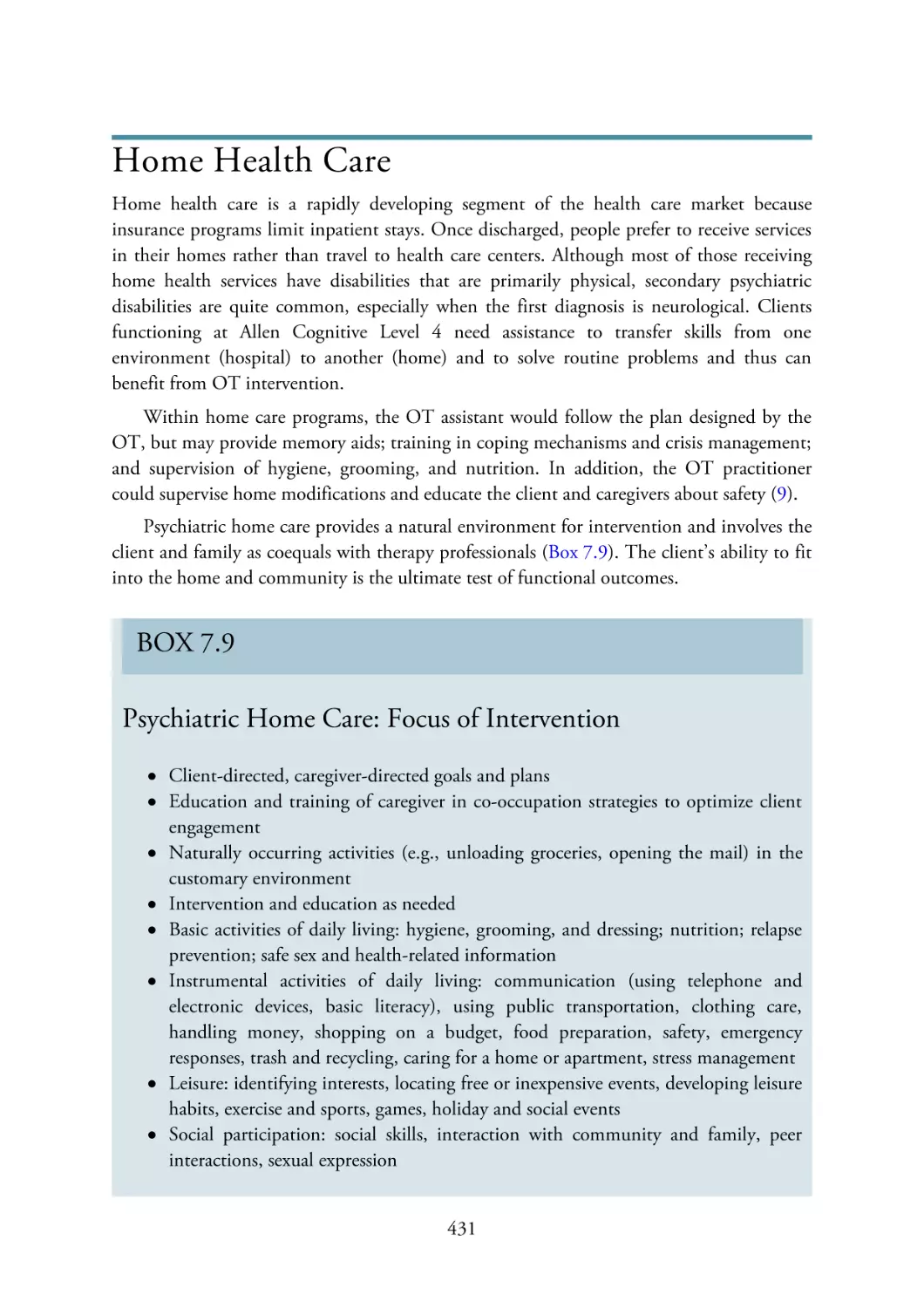
7.9 Psychiatric Home Care: Focus of Intervention
8.1 Recommended Internet Sources for Drug Information
9.1 A 21st-Century Definition of Therapeutic Relationship
9.2 Improving Understanding of Self and Others Through ALOR
9.3 Communication Techniques
9.4 The Six Guiding Principles of the Occupational Therapy Code of Ethics
10.1 Anxiety: Examples of Appropriate Activities
10.2 Depression: Examples of Appropriate Activities
29

10.3 Mania: Examples of Appropriate Activities
10.4 Hallucinations: Examples of Appropriate Activities
10.5 Delusions: Examples of Appropriate Activities
10.6 Paranoia: Examples of Appropriate Activities
10.7 Anger, Hostility, and Aggression: Examples of Appropriate Activities
10.8 Seductive Behavior and Sexual Acting Out: Examples of Appropriate Activities
10.9 Cognitive Deficits: Examples of Appropriate Activities
10.10 Attention Deficits and Disorganization: Examples of Appropriate Activities
11.1 Hand Washing: The First Defense Against Infection
11.2 Some Risk Factors for Suicide
11.3 Signs of Suicidal Intent
11.4 Recommended Home Modifications for Consumer Safety
11.5 NAMI’s Position on Violence, Mental Illness, and Gun Reporting Laws
12.1 Techniques to Promote Interaction in a Group
12.2 Sample Group Session Plan: Grocery Shopping
12.3A Sample Notes from a Project-Level Group
12.3B Sample Notes from a Project-Level Group, Reflecting on Goals of Individuals
13.1 Guide to Observing and Describing Behavior
14.1 The Focus of Clinical Inquiry
14.2 Steps in Planning Intervention
14.3 Making Goals Measurable and Time Limited
15.1 Activity Analysis Following the Model of Human Occupation
16.1 Activities of Daily Living
16.2 Instrumental Activities of Daily Living
16.3 Focus: Relapse Prevention
17.1 Education
17.2 Structures for Homework Success
17.3 Work

30

SECTION One
History and Theory

31

History and Basic Concepts 1
Occupational therapy has a great deal to learn from its history. The profession was founded on
the visionary idea that human beings need, and are nurtured by, their activity as by food and
drink and that every human being possesses potential that can be achieved through engagement
in occupation.
ELIZABETH YERXA (68)
CHAPTER OBJECTIVES
After studying this chapter, the reader will be able to:
1. Contrast mental health and mental illness and discuss the relationship of occupational
functioning to mental health.
2. Explain the unique value of occupational therapy in addressing the occupational
needs of persons with mental disorders.
3. Recognize key events and figures in the history of mental health treatment.
4. Identify and describe key events in the history of occupational therapy in mental
health.
5. List and discuss historical events and figures in occupational therapy practice in
mental health.
6. Identify possible future trends for occupational therapy practice in mental health.
7. Describe the roles of the occupational therapy assistant in mental health practice.
The popular view is that people with mental health problems have trouble controlling
their feelings, thoughts, and behavior. What is less obvious is that many people with mental
disorders also have trouble doing everyday activities, things the rest of us take for granted.
Occupational therapy practitioners address this part of human life—how people carry out
the tasks that are important to them, how well they do these tasks, and how satisfied they
feel about them. Occupation has been defined as “man’s goal-directed use of time, interest,
energy, and attention” (5). Occupation is activity with a purpose, with a meaning unique to
the person performing it (6). Occupational therapy views engagement in occupation as
essential to both physical and mental health. Occupational therapy practitioners evaluate
occupational functioning; work with consumers and caregivers (patients, clients, families)
to identify goals; and intervene to help troubled individuals, families, and communities
learn new skills, engage in occupation, maintain successful and adaptive habits and
routines, explore their feelings and interests, and control their lives and destinies.

32

Mental Health and Mental Illness
Before we look at how occupational therapy approaches the intervention process for
persons with mental health problems, it is useful to examine what we mean by the terms
mental health and mental illness. The World Health Organization has defined mental
health as “a state of well-being in which every individual realizes his or her own potential,
can cope with the normal stresses of life, can work productively and fruitfully, and is able to
make a contribution to her or his community” (67). The mentally healthy person can
manage daily affairs despite the stresses of the real external world and is able to respond
constructively and creatively to the changing demands and opportunities of real life.
If mental health is relative, defined in relation to changing life conditions, at what
point can we say that someone has mental health problems? Throughout recorded history,
mental illness has been defined and redefined, reflecting increases in knowledge and
understanding and changes in cultural beliefs and values. The American Psychiatric
Association has defined mental disorder as follows:
…a syndrome characterized by clinically significant disturbance in an individual’s
cognition, emotion regulation, or behavior that reflects a dysfunction in the psychological
biological, or developmental processes underlying mental functioning. Mental disorders are
usually associated with significant distress or disability in social, occupational or other
important activities (8, p. 20).
A mental disorder (mental illness) typically causes problems in thinking, as well as
significant emotional discomfort (extreme anxiety, sadness or rage, for example) and/or
impairment in the ability to function, such as to hold a job. We learn that the causes of the
disorder may be psychological, biological, or developmental. There is sometimes a risk to
oneself, such as the risk of being imprisoned, or of dying by suicide or as a result of
carelessness and failure to use “common sense.”
Important for occupational therapy is the recognition of disability or impairment in
important areas of life activities: caring for oneself, working or being productive, engaging
in effective or satisfying relationships with others, and pursuing valued leisure activities.
Occupational therapy is an appropriate intervention for such problems because
performance in human occupation and daily life activities is its main concern. Also, because
occupational therapy uses occupation as a means of intervention as well as an outcome,
patients must act and perform and thus prove to themselves and to others that indeed they
can function.

33

Relation of Occupation to Mental Health
The notion that involvement in occupation can improve mental health is not new; it
appears in records of ancient civilizations from China to Rome. It is such an excellent idea
that it is continually rediscovered and acclaimed. At the 1961 annual conference of the
American Occupational Therapy Association, Mary Reilly expressed it this way: “That
man, through the use of his hands as they are energized by mind and will, can influence the
state of his own health” (54, p. 1).
Every person is born with a drive to act on the environment, to change things, to
produce things, to work, to be engaged with life, and to use hands and mind. The
satisfaction of having an effect and the challenge and pleasure of solving problems give life
meaning and purpose. We know that both the unemployed and those employed in routine
jobs experience stress and may develop mental disorders because they lack the stimulation
of challenging activity. Their drive to act is denied, frustrated, and weakened. We know too
that those diagnosed with mental disorders grieve because they cannot do what they once
did; disease and social stigma have obstructed their capacity to engage in valued
occupations as they would like. Unhappiness and inactivity reinforce each other; those who
fail to act become less able to do so.
Occupational therapy uses occupation to reverse the negative cycle of inactivity and
disease. Occupation requires attention and energy; it has a unique meaning to the person
performing it (33). Activity that engages the entire human being—heart, mind, and body
—is powerful therapy. Not every activity is therapeutic, only those that ignite the person’s
interest and empower the will, that strengthen skills, and improve the ability to act.
Helping the client explore, discover, master, and manage the occupations that give that
individual’s life purpose and direction is the essence of psychiatric occupational therapy.

34

A Few Words About Language
In this chapter, we will use the phrase “persons with mental disorders” to refer to the
patients and consumers we encounter in mental health practice. This “person-first” phrase
limits the stigma associated with having a psychiatric diagnosis. It puts the person first, and
the disorder second. Historically, however, different words were used that would be highly
stigmatizing today:
Moron, imbecile, idiot—these were historical descriptors through the 1970s with
specific meanings for persons who today would be diagnosed with intellectual
disabilities
Mad, lunatic, crazy—now used casually, but once had specific meanings
Of unsound mind, mentally ill—terms that were historically accurate in their eras
This is not an exhaustive list. To avoid confusing the reader and generating more stigma,
we have not used any of these terms in the history that follows.

35

Historical Understanding
The history of the occupational therapy profession is intertwined with that of psychiatry. It
is useful to look back and consider the important threads that tie the two professions
together. Furthermore, reviewing the history of occupational therapy in mental health can
reveal the core values and interests of the profession—values and interests that are still
strong today. The moral treatment movement, discussed in the next section, fueled the
growth of both professions.

36

The Moral Treatment Era
Moral treatment was a pivotal stage in the development of psychiatry as a separate medical
discipline. It was based on ideas developed in France by Pinel and in England by Tuke (53)
and was first practiced in the United States at McLean Hospital in Massachusetts and at
Frankford Asylum in Pennsylvania in the early 19th century (11). Tuke (53) wrote that
insanity could originate in the body as well as in the mind and further believed that persons
with mental disorders, despite some impairment of “intellectual powers,” were nonetheless
capable of autonomy and the exercise of choice. The philosophy of moral treatment
included respect for the individual and a belief that patients would benefit most from a
regular daily routine and the opportunity to contribute productively to their own care and
to the welfare of society in general through involvement in occupation. Before the advent of
moral treatment, such individuals were housed in large asylums where they were neglected;
observers noted that they were ill-fed, unclothed, and often found lying in their own body
wastes. It was not unusual for persons with mental disorders to be subjected to restraint and
torture.
In contrast, early moral treatment hospitals provided a prescribed routine of daily
hygiene, regular meals sometimes prepared by the inmates from crops grown on the
hospital grounds, and craft work and recreation. Efforts were made to engage as many
inmates as possible in regular employment or occupation, such as kitchen, laundry, general
cleaning, grounds work, or building repair within the hospital. The effect of such
employment was described by Adolph Meyer, a physician and one of the founders of
occupational therapy:
It had long been interesting to see how groups of a few excited patients can be seated in a
corner in a small circle of two or three settees and kept wonderfully contented picking the
hair of mattresses, or doing simple tasks not too readily arousing the desire for big
movements and uncontrollable excitement and yet not too taxing to their patience. Groups
of patients with raffia and basket work, or with various kinds of handwork and weaving and
bookbinding and metal and leather work, took the place of the bored wall flowers and of
mischief makers. A pleasure in achievement, a real pleasure in the use and activity of one’s
hands and muscles and a happy appreciation of time began to be used as incentives in the
management of our patients, instead of abstract exhortations to cheer up and to behave
according to abstract or repressive rules (48, p. 81).
Moral treatment, as described by Tuke (53 and Makari), was founded on three principles:
1. Development of “self-restraint” through the use of rewards, which aimed to increase
patient’s self-esteem and confidence. By complying with the rules and contributing
through productive occupations, patients earned the right to privileges and more
comfortable conditions.
2. Elimination of the use of force.
37

3. Provision of a comfortable and humane environment to all.
Occupational therapy arose out of the moral treatment movement. Early occupational
therapy practitioners based their work on moral treatment principles and used a variety of
occupations, such as arts and crafts, classroom instruction, manual labor, games, sports,
social activities, and self-care activities. These were designed to provide a balanced daily
program that incorporated work, rest, and leisure. Occupations were planned and graded
for the needs and abilities of individuals. Formation of habits and the development of skills
and attention were emphasized. The personality of the occupational therapist (OT) was
important; kindliness, modeling of correct habits, and the ability to analyze and adjust
occupations to suit the interests and capacities of patients were valued traits (46).
Ever since the beginning of occupational therapy in mental health, the profession has
been greatly influenced and restrained by physician referral and the practice of psychiatry.
For this reason, we will look at the history of American psychiatry before returning to the
development of occupational therapy later in the chapter.

38

Psychiatry in the 20th and 21st Centuries
The medical specialty of psychiatry has shifted its techniques and interests several times
since the moral treatment era. Early in the 20th century, the theories of Sigmund Freud
(see Chapter 2) and other psychoanalytic theoreticians dominated the field. But
psychoanalysis, which relies on talking, was not practical for those with severe disorders.
Patients were simply too ill and symptomatic. A number of pseudoscientific methods were
used to try to limit the severity and effects of psychotic symptoms. Some of these methods,
such as ice water baths and confinement in wooden restraints, were efforts to compel
patients to submit to the rules of the institutions in which they were housed.
Through the 1950s, physicians’ treatments of major mental disorders aimed at
changing the brain by changing the biology of the body. Some treatments included the
following:
Prefrontal lobotomy (a kind of brain surgery, often crudely executed)
Insulin shock treatment (inducement of coma by lowering blood sugar with
injections of insulin)
Electroconvulsive (shock) therapy (ECT)
A critical development during the 1950s was the discovery and introduction of the major
tranquilizers. It seemed that finally a way had been found to control and diminish
psychotic symptoms and extreme behaviors. The discovery and use of the tranquilizing
drugs led indirectly to the passage in 1963 of the Community Mental Health Act (also
known as the Community Mental Health Centers Construction Act) (Public Law 88–164).
This law was designed to establish community-based treatment facilities and to move the
patients from institutional settings to community living, now that their more extreme
symptoms were controlled by medications. Unfortunately, inadequate planning and
funding resulted in large numbers of deinstitutionalized mental patients being released into
communities lacking resources to meet their needs.
Historians later suggested that persons with chronic psychiatric disorders were not
really deinstitutionalized by the 1963 legislation but rather were transinstitutionalized. In
other words, they were moved from one kind of institution (psychiatric hospitals) into
other kinds of institutions (jails, prisons, and nursing homes) and not into the community
at all (62, 64). To complicate matters, the enactment of Medicaid and Medicare legislation
in 1965 changed the incentives for the states. Mental health care had been, up to 1965, a
state responsibility, but the new legislation made it possible to shift responsibility to the
federal government once patients were discharged from the state hospitals (62). Thus, many
were transferred to nursing homes (64).
The social and political climate of the 1960s and 1970s generated increased interest in
and funding for mental health research, but much of this was directed toward those with
mild conditions (thus, away from those with the most severe disorders). With increased
39

attention on those with less serious problems, mental health professionals, including OTs,
used newer theories (gestalt therapy, milieu therapy, behavioral therapy, and family
therapy) during those years.
The 1960s and 1970s saw an explosion of interest in and studies of the biological
foundations of mental disorders. There had long been an interest in the genetics of the
major brain disorders (schizophrenia, depression, manic depression). Research on diagnosed
individuals and their families and the study of the human genome have enabled a better
understanding of the link between genetics and the development of mental disorders. Since
the beginning of the 21st century, there has been additional recognition of the role of
epigenetics. Although a gene for a given condition (e.g., schizophrenia) may be present in
the genotype of an individual, this does not invariably lead to the development of
schizophrenia. Epigenetics is the study of the events and circumstances that mediate gene
expression. Events and circumstance may be prenatal, or may occur after birth through
disease, stress, or trauma, and possibly also exposure to chemicals in the environment. The
consensus at present is that a genetic predisposition often results in disease in vulnerable
individuals, but that environmental factors, including viruses and stressors, are also
involved (23).
The medical specialty of psychiatry remains oriented strongly toward biological and
biochemical research and pharmacological (drug) interventions. Imaging studies, conducted
since the 1990s using positron emission tomography (PET), computed tomography (CT),
and magnetic resonance imaging (MRI), have shown changes in the cerebral cortex,
ventricles, and other brain structures (and brain activity) of persons with major mental
disorders. The fMRI (functional magnetic resonance imaging) can detect brain activation
patterns. Pharmaceutical companies fund major research to demonstrate the effectiveness of
competing drugs aimed at the considerable market represented by people with psychiatric
disorders. Furthermore, drug companies now advertise and market directly to consumers.
The volume of studies published requires physicians to review results constantly and to
adjust their interventions according to published evidence. Many studies suggest that the
medications used in psychiatry may themselves be responsible for altering the brain, causing
an increase in receptors for specific neurotransmitters. Over time, the brain adapts to
medication, which then is needed on a long-term basis (64). Concern has been raised that
the rise in the percentage of persons with mental illness in the population receiving
Supplemental Security Income (SSI) and Social Security Disability Income (SSDI) may be
attributed, at least in part, to the long-term use of these drugs (64).
Other than medications, the most prevalent form of intervention for persons with
serious mental disorders is associated with the psychiatric rehabilitation movement (9).
Psychiatric rehabilitation (also known as psychosocial rehabilitation or psych rehab)
shows strong research evidence of effectiveness. Psych rehab has introduced rehabilitation
counselors, social workers, and many allied health paraprofessionals to methods of
intervention that are very similar to the traditional methods of occupational therapy and
that in many ways echo the principles of moral treatment. Psychiatric rehabilitation has
40

been adopted by some states, including New York, as the model for treatment within all
units of the state mental health system, under the name intensive psychiatric rehabilitation
treatment (IPRT). Psychiatric and/or psychosocial, rehabilitation, discussed further in
Chapter 2, defines its goal as helping persons with mental disorders to function at their best
in the environments of their choice. Methods include skill development, provision of
supports and resources, and the use of external structures to enable more community
engagement.

41

Consumers, Families, and Mental Health Parity
One of the most important forces at work on behalf of persons with mental illness is the
combined political effort of consumers (persons with mental disorders), their families, and
concerned professionals. Represented most prominently by the National Alliance on
Mental Illness (NAMI), founded in 1979, the consumer movement has helped reduce
stigma associated with mental illness and improve the quality of life for persons with mental
disorders. Consumers see themselves not as outcasts but rather as members of the
community with a voice and with a vision for their future. With NAMI and similar
organizations, consumers, families, and professionals together advocate for appropriate
housing, community care, supported employment, and other services. In addition, families
and consumers provide peer and family support and education (49).
Associated with the consumer movement is the recovery movement, which promotes
the idea that people can recover from mental disorders, given sufficient time and support.
Some within the recovery movement accept the necessity of psychiatric medications but
question whether they must be taken over the long term. The more radical elements of the
movement are vocal in their distrust of medications and the profession of psychiatry. These
members prefer the term “survivor” to that of “consumer,” alleging that they have endured
psychiatric interventions but survived.
Mental health parity has been an important focus of consumer vision. In 1996, the
Mental Health Parity Act (MHPA) was signed into law in the United States, requiring
insurance companies to reimburse for mental health care to the same extent as for physical
health care. In 2008, the Mental Health Parity and Addiction Act was enacted to curb
abuses associated with loopholes in the 1996 MHPA. More recently, in 2010, the
Affordable Care Act (ACA) includes coverage for substance abuse treatment for those
receiving services under that law.

42

Occupational Therapy in Mental Health: History
and Trends
Returning to the early history of occupational therapy, in the beginning the profession, was
very dependent on physicians. From 1917 to the 1950s, psychiatric OTs provided
comprehensive programs of occupation based loosely on principles of moral treatment
within institutional settings. The physician prescribed occupational therapy, often ordering
specific activities for patients, and the OT carried out the treatment. After World War II,
interest in rehabilitating veterans led to an emphasis on workmanship and vocational
readiness (27).
During the 1940s and 1950s, occupational therapy was attacked by the medical
profession for failing to have a “scientific basis” (39, 57). In response to that criticism,
occupational therapy adopted the vocabulary, concepts, and some techniques of
psychoanalysis, the prevailing psychiatric theory. Although OTs continued to work under
the prescription of physicians, Gail Fidler, Jay Fidler, and others began to use activities to
evaluate their patients’ psychodynamics (emotions and psychological defenses) (24). They
analyzed activities for their capacity to meet patients’ unconscious needs. Activities were
matched symbolically to psychic content—for example, clay resembles feces and may
symbolize anal stage concerns (see “Theory of Object Relations” in Chapter 2). This
psychoanalytic application of occupational therapy in mental health followed the trend of
using occupation to enhance medical outcomes (27) after World War II.
With the introduction of the major tranquilizers in the 1950s, OTs were able to work
with hospitalized patients whose behavior without medication had been so psychotic and
bizarre that treatment was difficult or impossible. At first, the main emphasis continued to
be psychoanalytic. The theories developed by other disciplines, primarily psychology,
during the 1960s and 1970s did not always include a focus on occupation. Of these new
therapies, the behavioral approach was the favored by OTs. OTs applied the techniques of
behavioral therapy in their work with persons diagnosed with mental disorders and
intellectual disabilities to diminish acting out and to promote healthy behaviors. By
reinforcing desired behavior through carefully selected rewards and by enforcing limits on
undesirable behavior, therapists thought they could improve their patients’ functioning.
Behavioral approaches are discussed in detail in Chapters 2 and 3.
During the 1970s, OT Lorna Jean King applied sensory integration (SI) theory and
methods developed by A. Jean Ayres, also an OT, to the treatment of patients with chronic
psychiatric disorders. King proposed that poor functioning and grossly abnormal posture in
chronic schizophrenia could be attributed to errors in sensory processing, which might be
corrected or at least ameliorated by carefully designed sensorimotor programs. SI is rarely
used today for this population. Instead, the focus in the 21st century is on sensory
processing or sensory modulation, the ways that individuals perceive and respond to
sensation. OTs Dunn, Champagne, and Brown have contributed to the development of
43

this area of intervention (17, 18) (see Chapters 3 and 20).
During the 1980s, Claudia Allen outlined and developed her theory of cognitive
disabilities. Allen proposed that a person’s performance in a task indicates the quality of his
or her thought. She identified six levels of cognitive functioning, which can be evaluated
through performance of unfamiliar small crafts, such as leather lacing or mosaics. The six
levels were later elaborated and expanded. Diagnosis of cognitive level can contribute to the
psychiatric diagnosis and can be used to predict future functioning and to identify
interventions and supports that may be effective (1). Allen’s theory is described further in
Chapter 3.
Sensory modulation and cognitive disabilities attribute the problems in occupational
functioning of persons with severe and persistent mental illness to defects of the structure
or function of the nervous system. The questions for therapists are to what extent can these
defects be corrected or remediated and to what extent can the person work around the
defects. Correction is termed remediation, and working around the deficit is termed
compensation (alternately, adaptation). Defects that cannot be remediated must be
compensated for if the person is to function. The sensory modulation approach can be
either remedial or compensatory; Allen’s is almost entirely compensatory; the activities are
modified and/or social support from others is provided to allow for performance.
Both sensory modulation and cognitive disabilities emphasize activity or occupation as
a focus for evaluation and intervention. The theories applied in the 1950s and 1960s were
criticized for the absence of this focus. In addition, they were considered reductionistic
(reducing the patient’s problems to isolated elements such as insight or behavior). During
the 1960s and 1970s, Mary Reilly (54) and others attacked these approaches, arguing for a
more comprehensive theory of occupational therapy practice that would focus primarily on
the occupational nature of human beings. Since the 1980s, Kielhofner (39–41), Kielhofner
and Burke (42), and others built on Reilly’s work with the model of human occupation
(MOHO). This model organized research findings and traditional occupational therapy
beliefs to create a comprehensive theory for use in all practice areas, including physical
medicine, developmental disabilities, and psychiatry. The model proposes that human
response to the environment occurs as a result of an interaction among three systems: (a)
volition (motivation), (b) habituation (roles and habits), and (c) performance (skills of the
mind, brain, and body). The interactions among the three are dynamic, each affecting the
other two. The MOHO is discussed in Chapter 3.
Some OTs during the 1980s began to apply cognitive–behavioral principles (36). This
approach, discussed in Chapter 2, investigates the events and associated feelings and
thoughts that drive behavior. The patient is taught to recall the chain of events and feelings
and ideas and to challenge erroneous ideas. Once the ideas are proven false, there is an
opportunity to change the behavior. Cognitive–behavioral therapy and dialectical
behavioral therapy, which is derived from it, show strong research evidence of effectiveness.
Also, since the 1980s, Florence Clark (16) and others (35) have been developing a new
44

scientific discipline, occupational science, for systematic study of the occupational nature of
humans. Research in occupational science is beginning to generate data that help us
understand the nature of occupation and that validate the effectiveness of occupational
therapy.
In 1996, a group of Canadian therapists published the foundation article about the
Person–Environment–Occupation Model (PEO), which considers transactions between the
person, the environment, and the occupation. This model relates to occupational science
research and is similar to MOHO in many respects. PEO is discussed further in Chapter 3
(44).
Around the turn of the 21st century, as discussed previously, sensory processing with
regard to mental health began to show up in the occupational therapy literature (13, 14,
17, 18). Brown developed an evaluation instrument to help identify sensory sensitivities
and differences in adults and adolescents and has also documented strategies to compensate
for these. This is important for persons with serious mental disorders, some of whom are
acutely sensitive to environmental factors such as noise or odors. Others may be very
insensitive and unaware of sensations from the environment, which causes them to miss
cues from other people. And yet others may seek extreme sensations.
The consumer movement has fueled an interest in exploring the phenomenology of
illness or how the person views what is happening. The telling of a personal story and the
appreciation of this story by the therapist are the foci of narrative reasoning. Narrative
reasoning is a way to study how people understand and tell the stories of their lives; it has
enriched our appreciation and analysis of occupation and its relation to individuals (47).
While OTs have been striving to clarify the theoretical understanding of occupation
and refine their assessment and intervention techniques, they have also been concerned
about the proliferation and growth of other activity-oriented mental health therapies, all of
which share to some extent occupational therapy techniques and theories. Vocational
rehabilitation counseling and dance, art, music, and poetry therapies focus on activities that
once concerned only OTs. Increasingly, nursing, social work, psychology, psychiatry, and
even physical therapy are addressing the daily life activities and occupational functioning of
persons with mental illness. This sounds so similar to occupational therapy that it can be
hard for the uninformed to see the difference. Occupational therapy practitioners employed
in psychiatric or psychosocial rehabilitation programs have a unique scope of practice and a
skill set in activity analysis (see Chapter 15) that is not part of the preparation of members
of other professions.
The passage of the Americans with Disabilities Act of 1990 (ADA) (Public Law 101–
468) allowed for new opportunities in mental health occupational therapy, working with
consumers trying to gain access to employment, supported housing, community mobility,
and other opportunities. The ADA mandates that qualified persons not be excluded from
employment and work activities because of disability owing to physical or mental
impairments. OTs and assistants can help prepare persons with mental impairments for the
45

world of work through training in work, self-advocacy, and attitudinal and behavioral skills
and by collaborating with employers to analyze job functions and to determine reasonable
accommodations (20, 26, 50). Stigma is still present, and discrimination (subtle or not)
occurs. Advocacy from consumers and from professions such as occupational therapy can
increase social and political awareness. Occupational therapy practitioners have the training
and background to assist employers and persons with disabilities to interpret and apply the
law in a cost-effective and reasonable fashion.
In 2013, after years of political action by the profession, occupational therapy became a
mandated mental health service for community mental health centers that provide
Medicare partial hospitalization services. This affirms the place of occupational therapy in
community mental health (52). Other legislation, both federal and state, continues to
expand the licensure and scope of practice for all OT practitioners.
The future of occupational therapy in psychiatry cannot be foretold; some even
question whether it will maintain a presence in mental health service delivery as the 21st
century progresses (51, 63). Continuing shortages of therapists in mental health have been
attributed to lower salaries and lower perceived status than in other practice areas, such as
physical medicine and pediatrics. The therapist shortage has led to a decline in available
fieldwork placements in mental health (37). Practice acts in some states, such as New York,
have restricted the practice of occupational therapy to physician referrals, obstructing the
profession from moving independently into community positions outside the medical
model. New York therapists have joined with consumers of mental health services to
combine resources (61, 65). In other states, including Wisconsin and California and New
Jersey, occupational therapy practitioners have developed innovative community programs
and have secured recognition for the profession by advocating with consumers for
improved service delivery (22, 55, 60).
Leaders in occupational therapy mental health practice remind us, however, that the
coming years provide many opportunities for occupational therapy in mental health under
the ACA (32, 58). In particular, skills are needed for prevention interventions in the
community and within the wellness and recovery models. Fine (25) in 1999 wrote that the
21st century will test the profession with bottom-line economics and frequent
reengineering of staff configurations in mental health practice. Hospital-based practice has
declined because of decreased patient populations and length of stay, staff shortages, and
reduced reimbursement. Managed care has limited hospital stays and benefits for mental
health care. Occupational therapy practitioners are advised to develop and maintain
awareness of political change in regard to mental health parity and to help advocate on
behalf of consumers (28).
Despite reduced reimbursement and the movement away from hospital practice,
persons with mental disorders will continue to need and benefit from occupational therapy.
We increasingly see these consumers in their homes, workplaces, and communities. The
OT frequently serves as consultant or manager rather than as provider of direct service.
Practitioners teach consumers and families to manage symptoms and maximize
46

occupational functioning. Opportunities for the occupational therapy assistant (OTA) are
likely to expand. These opportunities have been and will continue to be found primarily in
the community as well as in long-term care facilities. The reader is encouraged to consider
ideas such as:
Wellness and health promotion for persons with mental disorders and also for the
general population (4, 29, 45, 59)
Direct interventions and prevention programs to address the occupational problems
of victims of domestic violence (31, 34, 38)
Interventions in the schools and in community after-school programs for school-aged
children with mental health problems (10)
Services for people with mental disorders who have become inmates and parolees of
the prison system (56)
Life coaching and motivational services on a fee-for-service basis (43)
Outreach and community integration for the homeless (15, 30)
Occupational therapy’s greatest challenges are to maintain its professional visibility, claim
its unique expertise in occupation (21, 66), and communicate effectively to make
consumers, insurance companies, and federal agencies aware of its special skills in
evaluating and intervening effectively to address mental health problems. Figure 1.1 gives a
view of the parallel histories of psychiatry and occupational therapy.

47

48

FIGURE 1.1 • Timeline. Selected key events in the history of psychiatry, medicine, law,
and occupational therapy in mental health. Photo credit and info: U.S. Public Health
Service Hospital, St. Louis, MO—1921. A garden (practical OT). (Photo courtesy of
Archives of the American Occupational Therapy Association, Inc. Bethesda, MD.)

49

The Role
Assistant

of

the

Occupational

Therapy

OTA students sometimes question how the OT differs from the OTA because they appear
at first glance to perform similar job tasks. Comments such as “Why are OTs paid more?
They do the same things we do” and “The OT only does paperwork and doesn’t even treat
patients” are heard frequently. Some professional-level occupational therapy students and
therapists also express confusion about the difference between the professional and the
technical levels. Understanding the difference is essential for both if they are to work
together effectively.
Since 1958, when the American Occupational Therapy Association (AOTA) began to
plan for OTAs, their role in mental health treatment has expanded tremendously. Among
the many factors affecting the role of the OTA in the 21st century are the official
educational standards and role descriptions provided by the AOTA (2); the licensing and
certification guidelines of the various states; and the local market availability of OTs,
baccalaureate-level activities therapists, and other mental health practitioners. In addition,
the regulations and needs within mental health treatment facilities and community agencies
and the experience and skills of individual OTAs influence their roles.
To clarify the role of the OTA, the AOTA has in the past conducted several projects on
role delineation. The purpose of these projects was to outline precisely, or to delineate, the
roles of entry-level OTAs and OTs. Entry level refers to new graduates of training programs
as differentiated from experienced practitioners. The AOTA has consequently published
role guidelines to help practitioners structure job tasks in a way that reflects the preparation
of the OT or OTA to perform these tasks. The most recent of the role documents affecting
OTAs was approved by the AOTA’s representative assembly in 2009 (3). The Standards for
Occupational Therapy Education are periodically reviewed and revised, the most recent
version having been adopted in 2011 (2). In 2010, the AOTA’s representative assembly
redefined the Standards of Practice for Occupational Therapy (7). These documents provide a
framework for discussing the role of the OTA in a mental health setting.
As a starting point, the entry-level OTA is educated to collaborate with a supervising
OT to provide occupational therapy services. The OT and the OTA are prepared to
perform complementary job functions. Both are involved in all stages of the intervention
process from screening and evaluation to discharge planning, but their roles and the areas
for which each is responsible are distinct, with the OT taking the leadership role. Differing
educational experiences prepare the OTA and the OT.
The education and fieldwork training of the OTA and the OT prepare them to work
in a complementary fashion, as the following situation illustrates:

50

CASE EXAMPLE
The setting is a community day treatment center. The clients range in age from 25 to 65
years. Many are inactive and, if left to their own devices, would spend their days sitting
unoccupied in the lounge. Two OTAs work at the center, leading a variety of groups such
as lunch preparation, horticulture, exercise, diet management, and crafts. The supervising
OT, who works 8 hours per week at this facility, has a strong interest in supported
employment and has persuaded the director of the agency to fund the development of a
program to help clients prepare for some level of work in the community. One of the
OTAs has an interest in this area and has recruited two community businesses, a fast-food
restaurant and a chain drug store, to hire clients part time.
Through evaluations done by the OT, with parts administered by the OTA, the OT
and OTA have identified six clients who may be ready for this program. The OTA now
runs a job skills group 5 days a week for 1 hour, geared to prepare clients to begin the
specific available jobs. The group employs a psychoeducational approach, focusing on social
interaction in situations members may encounter on the job (e.g., responding to a request
for assistance). Other topics include proper dress and hygiene, expectations, and
responsibilities (to be on time, to work the arranged hours, to ask questions when one
needs help) in the world of work. The OTA meets with the OT once a week to review
clients’ progress. The OTA is concerned that clients may need a staff member with them
on the job, at least for the first few days. The OT agrees and has helped the OTA lay out a
schedule to place the clients into the jobs one at a time, with the OTA attending work with
the clients initially as a job coach. The long-term plan is to train peer counselors (clients
who know the jobs well and are reliable) to take over as job coaches.

The collaboration between OT and OTA in this situation makes use of their different
skills. The OT and the OTA have evaluated the clients, the OTA performing parts of the
evaluation as directed by the OT supervisor. From the evaluation results, the OT has
matched clients’ capabilities and interests with the requirements of the job program. The
OTA is carrying out a psychoeducational training regimen designed by both the OT and
the OTA. The OTA makes good use of supervision to explore questions related to client
progress. The specifics reported by the OTA are useful to the OT when conferring with the
director about the need for more occupational therapy lines (e.g., to provide side-by-side
coaching and to train peer counselors). This sort of complementary relationship is only one
example of the ways in which OTA and OT work together.
By education, the OTA’s area of greatest expertise is performance in areas of
occupation. These include work, play, leisure, activities of daily living and instrumental
activities of daily living, education, and social participation. Although the OT is educated
in these areas, the professional level of education is oriented more toward assessment and
evaluation and interventions in client factors and specific performance skills. The OTA is
trained in some of the routine and structured techniques used to evaluate and address
51

problems in performance skills and patterns. The OTA is thus able to carry out large
segments of the occupational therapy program with supervision from the OT, who is better
prepared to design the overall program and to evaluate and plan interventions for complex
problems involving a combination of performance skill deficits and problems in client
factors.
What the OTA working in a mental health setting actually does on a day-to-day basis
varies widely, depending on the experience of the OTA, state law, and the setting or facility
and its reimbursement structure. Hypothetically, the OTA could plan and carry out a
complete program of independent living skills, grooming and hygiene, cooking and food
management skills, money management, use of public and private transportation,
shopping, care and selection of clothing, use of telephone and postal services, homemaking,
child care, work skills, and play and leisure skills. The OTA may teach coping skills and
self-identity skills or may assist the OT in assessing and providing interventions for
performance skills such as communication and interaction or cognitive processes. Consider
another example of an OTA in mental health practice:

CASE EXAMPLE
The setting is a large community service agency. The consumers who attend its programs
have serious and persistent mental illnesses such as schizophrenia and bipolar disorder.
Many have substance abuse histories as well. Among the many programs provided here are
a psychosocial clubhouse, a supported employment program, and a transitional
employment program. One OT serves as consultant to the agency 6 hours per week.
An experienced OTA has recently been hired for the psychosocial clubhouse program.
This is a new position; the four OTAs working in the employment programs have not had
the time to provide any services in the clubhouse. The new OTA began by sitting down
with members of the club and formulating a plan; the OT sat in on the first meeting as an
observer. In accordance with suggestions from the members, the OTA helps the member
leader with the lunch program 5 days a week, providing information and guidance on
nutrition and smart shopping. Another major responsibility is facilitating a photography
workshop and gallery; members expressed a strong interest in taking digital photographs
and editing them, with the possible goal of having a gallery with rotating shows. The OTA
also meets with individual members to address specific needs such as selecting and caring
for clothes appropriate for work, finding leisure opportunities for interests such as weight
training, looking up new medications on the Internet, and locating 12-step groups near
members’ residences. One day a week, the OTA accompanies members on a trip to a
community resource, such as the YWCA, to learn what additional programs are available.
The OTA meets with the OT once a week to review progress, discuss concerns, and prepare
for the Level I OTA fieldwork student who will start the next month. Just the past week,
the OT commented that the OTA had such a full program that it was hard to believe that
52

the position didn’t even exist 6 months ago.

This OTA is far more independent than the one in the previous example. This is
appropriate for someone with several years of experience and established service
competency. Professional development and continuing education amplify the possibilities
(19). The OT continues to provide guidance and general supervision and to direct the
overall program.

53

Summary
The histories of psychiatry and occupational therapy share a common origin in the moral
treatment era. Throughout the 20th century, occupational therapy mental health
practitioners worked mainly in medical settings and consequently were greatly influenced
by events in medicine and psychiatry. Even as occupational therapy has reembraced its
unique professional scope of practice, the profession continues to respond to developments
in psychiatry and medicine. Thus, OTs and OTAs monitor effects of medication, provide
interventions to improve cognitive functioning, and in many states must obtain a physician
referral to provide services to a person with a mental health diagnosis. However, with the
increased political activity of mental health consumers and their families, many OTs and
assistants have responded by moving their practices to community settings, providing
consumer-focused services. Outside of the medical model, however, these services may not
be identified as occupational therapy.
The relationship between the OT and OTA in mental health practice provides greater
opportunities for the OTA than in some other practice areas. The OTA carries out major
portions of the total occupational therapy program, usually under the supervision of an
OT. How much supervision is required depends on state regulations and on administrative
patterns within treatment facilities. For example, in New York State, the licensing law for
OTs provides specific direction on how the OT and the OTA shall work together.
According to this law, a practicing OTA must be under the direct supervision of an OT or
a licensed physician. Direct supervision is defined variously to mean anything from full-time
on-site supervision to monthly cosignature of notes. Other states are less restrictive. OTAs
are cautioned to stay current with state and federal regulations and their most recent
interpretations.
In each situation, the need for supervision varies with the skills and experience of OTA
and OT (3). Experienced OTAs may need only general supervision and may be asked to
help supervise OT students, as suggested by the three levels of OTAs (generalist, skilled
clinician, and master clinician) outlined by Terry Brittell (12). When patients’ conditions
are complex or change rapidly, the OTA is likely to require and want more supervision.
The need for supervision, the number of hours needed, and the depth of supervision can be
determined only after considering guidelines and the characteristics of the particular
situation.
The future of occupational therapy in providing quality services to persons with mental
health problems depends on the ability of OTs and OTAs to work together and to develop
staffing patterns that provide quality services at a reasonable cost. Shortages of qualified
applicants for OT-level positions in mental health settings were reported across the country
for many years; the majority of these positions were released to be filled by other activity
therapists. However, OTAs are ideally suited to work with persons with mental disorders,
especially those in chronic care settings. The OT who has never worked with an OTA and
54

who has limited understanding of the OTA’s training and role may be uncertain of what
the OTA can do. By openly and optimistically discussing the possibilities for a
complementary and supportive role, OTAs can do much to create and nurture their own
future. With increasing required content on OTA and OT roles in occupational therapy
educational programs, future graduates from professional-level programs should be
appropriately prepared to appreciate and employ the skills and contributions of the OTA
(2).

55

REVIEW QUESTIONS AND ACTIVITIES
1.

Differentiate mental health and mental illness; highlight the differences between
these two states.

2. What effect(s) might involvement in occupation have on mental health?
3. What effect(s) might being diagnosed with a mental disorder have on occupational
functioning?
4.

Describe how occupational therapy can help the occupational functioning of
persons with mental disorders.

5.

Discuss the following events/eras in the history of psychiatry: moral treatment,
discovery of major tranquilizers, deinstitutionalization, consumer movement, brain
imaging, human genome, and biological and pharmacological orientation.

6.

List five people who were important historically for mental health occupational
therapy and describe the contributions of each.

7.

Name and discuss three major events in the history of occupational therapy in
mental health practice.

8. List five areas related to mental health in which occupational therapy might have a
role in the future.
9. Describe the roles of the occupational therapy assistant in mental health practice.

56

Reflection Questions
1. Compare the principles of moral treatment to the principles of behavioral therapy.
What are the similarities, and what are the differences?
2. Consider the stigmatizing language referenced at the beginning of the chapter. How
would using such language make you feel differently about persons with mental
disorders?

57

References
1. Allen C. Occupational Therapy for Psychiatric Diseases: Measurement and Management of Cognitive Disabilities.
Boston, MA: Little, Brown and Company, 1985.
2. American Occupational Therapy Association. Accreditation Council for Occupational Therapy Education
(ACOTE) Standards and Interpretative Guidelines, 2011. Available at: http://www.aota.org/en/EducationCareers/Accreditation/StandardsReview.aspx. Accessed July 9, 2014.
3. American Occupational Therapy Association. Guidelines for supervision, roles, and responsibilities during the
delivery of occupational therapy services. Am J Occup Ther 2009; supplement, online only at
http://www.aota.org//media/Corporate/Files/Practice/OTAs/Supervision/Guidelines%20for%20Supervision%20Roles%20and%20Responsibilities.pdf
Accessed July 9, 2014.
4. American Occupational Therapy Association. Occupational therapy in the promotion of health and the prevention
of disease and disability statement. Am J Occup Ther 2001;55:656–660.
5. American Occupational Therapy Association. Occupational Therapy: Its Definition and Functions. Rockville,
MD: AOTA, 1972.
6. American Occupational Therapy Association. Occupational Therapy Practice Framework: Domain and Process.
3rd ed. Bethesda, MD: AOTA Press, 2014.
7. American Occupational Therapy Association. Standards of practice for occupational therapy. Am J Occup Ther
2010;64:6; supplement, online at http://ajot.aotapress.net/content/64/6_Supplement
8. American Psychiatric Association. Diagnostic and Statistical Manual of Mental Disorders. 5th ed. Washington,
DC: APA, 2013.
9. Anthony WA, Cohen M, Farkas M. Psychiatric Rehabilitation. Boston, MA: Center for Psychiatric Rehabilitation,
Boston University, Sargent College of Allied Health Professions, 1990.
10. Barnes KJ, Beck AJ, Vogel KA, et al. Perceptions regarding school-based occupational therapy for children with
emotional disturbances. Am J Occup Ther 2003;57:337–341.
11. Bockoven JS. Legacy of moral treatment: 1880’s to 1910. Am J Occup Ther 1971;5:223–225.
12. Brittell T. Future concepts of the COTA role. Part 2. Am Occup Ther Assoc Ment Health Special Sect Q
Newslett 1981;4:1–4.
13. Brown C. What is the best environment for me? A sensory processing perspective. Occup Ther Ment Health
2001;17(3–4):115–125.
14. Brown C, Tollefson N, Dunn W, et al. The adult sensory profile: Measuring patterns of sensory processing. Am J
Occup Ther 2001;55:75–82.
15. Chapleau A, Seroczynski AD, Meyers S, et al. The effectiveness of a consultation model in community mental
health. Occup Ther Ment Health 2012;28(4):379–395.
16. Clark FA, Parham D, Carlson ME, et al. Occupational science: Academic innovation in the service of occupational
therapy’s future. Am J Occup Ther 1991;45:300–310.
17. Champagne T. Expanding the focus: Addressing sensory discrimination concerns in mental health. Am Occup
Ther Assoc Ment Health Special Sect Q Newslett 2011;34:1, 1–4.
18. Champagne T. Expanding the role of sensory approaches in acute psychiatric settings. Am Occup Ther Assoc
Ment Health Special Sect Q Newslett 2005;28:1, 1–4.
19. Cottrell RF. COTA education and professional development: An historical review. Am J Occup Ther
2000;54:407–412.
20. Crist PAH, Stoffel VC. The Americans with Disabilities Act of 1990 and employees with mental impairments:
Personal efficacy and the environment. Am J Occup Ther 1992;46;434–443.
21. Darnell JL, Heater SL. The issue is: Occupational therapist or activity therapist—Which do you choose to be? Am
J Occup Ther 1994;48:467–468.
22. Dressler J, MacRae A. Advocacy, partnerships and client centered practice in California. In: Scott AH, ed. New
Frontiers in Mental Health. Binghamton, NY: Haworth Press, 1999.
23. Dupont C, Armant DR, Brenner CA. Epigenetics: Definition, mechanisms and clinical perspective. Semin Reprod
Med 2009;27(5):351–357. http://www.ncbi.nlm.nih.gov/pmc/articles/PMC2791696/. Accessed July 9, 2014.

58

Fidler GS, Fidler JW. Occupational Therapy—A Communication Process in Psychiatry. New York, NY:
24. Macmillan, 1963.
25. Fine SB. Surviving the health care revolution: Rediscovering the meaning of “good work.” In: Scott AH, ed. New
Frontiers in Mental Health. Binghamton, NY: Haworth Press, 1999.
26. Frieden L. The issue is: The Americans with Disabilities Act of 1990: Will it work? (pro). Am J Occup Ther
1992;46:468–469.
27. Friedland J. Occupational therapy and rehabilitation: An awkward alliance. Am J Occup Ther 1998;52:372–380.
28. Gallew HA, Haltiwanger E, Sowers J, et al. Political action and critical analysis: Mental health parity. Occup Ther
Ment Health 2004;20(1):1–25.
29. Gitlin L. Questions and answers. OT Pract 2012;17 (12):32.
30. Griner KR. Helping the homeless: An occupational therapy perspective. Occup Ther Ment Health
2006;22(1):49–61.
31. Helfrich CA, Lafata MJ, MacDonald SL, et al. Domestic abuse across the lifespan: Definitions, identification and
risk factors for occupational therapists. Am J Occup Ther Ment Health 2001;16(3–4):5–34.
32. Hildenbrand WC, Lamb AJ. Occupational therapy in prevention and wellness: Retaining relevance in a new
health care world. Am J Occup Ther 2013;67(3):266–271.
33. Hinojosa J, Sabari J, Pedretti L. Position paper: Purposeful activity. Am J Occup Ther 1993;47: 1081–1082.
34. Humbert TK, Bess JL, Mowery AM. Exploring women’s perspectives of overcoming intimate partner violence: A
phenomenological study. Occup Ther Ment Health 2013;29(3):246–265.
35. Jackson J, Carlson M, Mandel D, et al. Occupation in lifestyle redesign: The Well Elderly Study Occupational
Therapy Program. Am J Occup Ther 1998;52:326–336.
36. Johnson MT. Occupational therapists and the teaching of cognitive behavioral skills. Occup Ther Ment Health
1987;7(3):69–81.
37. Kautzmann LN. Alternatives to psychosocial fieldwork: Part of the solution or part of the problem? Am J Occup
Ther 1995;49:266–268.
38. Kessler A. Addressing the consequences of domestic violence. OT Pract 2012;17(3):6.
39. Kielhofner G. A Model of Human Occupation: Theory and Application. Baltimore, MD: Lippincott Williams &
Wilkins, 1985.
40. Kielhofner G. A Model of Human Occupation: Theory and Application. 4th ed. Baltimore, MD: Lippincott
Williams & Wilkins, 2008.
41. Kielhofner G. Conceptual Foundations of Occupational Therapy. Philadelphia, PA: Davis, 1992.
42. Kielhofner G, Burke J. A model of human occupation. Part 1: Conceptual framework and content. Am J Occup
Ther 1980;34:572–581.
43. Klippel L. A horse of a different color: Mental health occupational therapy and coaching. Am Occup Ther Assoc
Ment Health Special Sect Q Newslett 2006;29:1–4.
44. Law M, Cooper B, Strong S, et al. The Person–Environment–Occupation Model: A transactive approach to
occupational performance. Can J Occup Ther 1996;63:9–23.
45. Letts L, Edwards M, Berenyi J, et al. Using occupations to improve quality of life, health and wellness, and client
and caregiver satisfaction for people with Alzheimer’s disease and related dementias. Am J Occup Ther
2011;65(5):497–504.
46. Licht S. The early history of occupational therapy: An outline. Occup Ther Ment Health 1983;3:1:67–88.
47. Mallinson T, Kielhofner G, Mattingly C. Metaphor and meaning in a clinical interview. Am J Occup Ther
1996;50:338–346.
48. Meyer A. The philosophy of occupational therapy. Occup Ther Ment Health 1982;2:3:79–86.
49. National Alliance on Mental Illness. Home page. Available at: www.nami.org. Accessed July 2014.
50. Nosek MA. The issue is: The Americans with Disabilities Act of 1990: Will it work? (Con). Am J Occup Ther
1992;46:466–467.
51. O’Neill EH. Health Professions Education for the Future: Schools in Service to the Nation. San Francisco, CA:
Pew Health Professions Commission, 1993.
52. POTAC. News, posted January 26, 2014. The psychiatric occupational therapy action coalition. Online at
http://www.potac.org/category/news. Accessed July 23, 2014.
53. Raad R, Makari G. Samuel Tuke’s description of the retreat. Am J Psychiatry 2010;167:898–898.
http://ajp.psychiatryonline.org/article.aspx?articleID=102395. Accessed July 9, 2014.
54. Reilly M. The 1961 Eleanor Clarke Slagle lecture: Occupational therapy can be one of the great ideas of 20th

59

century medicine. Am J Occup Ther 1962;16:1.
55. Samuels L. Responsive changes in mental health in Wisconsin. In: Scott AH, ed. New Frontiers in Mental Health.
Binghamton, NY: Haworth Press, 1999.
56. Schindler VP. Occupational therapy in forensic psychiatry: Role development and schizophrenia. Occup Ther
Ment Health 2005;20(3–4):1–171.
57. Serrett KD. Another look at occupational therapy’s history. Occup Ther Ment Health 1985;5(3):1–31.
58. Stoffel VC. Opportunities for occupational therapy behavioral health: A call to action. Am J Occup Ther
2013;67(2):140–145.
59. Swarbrick M. A wellness and recovery model for state psychiatric hospitals. Occup Ther Mental Health
2009;25(3–4):343–351.
60. Swarbrick M, Stahl P. Wellness and recovery through asset building services. Occup Ther Ment Health
2009;25(3–4):335–342.
61. Tewfik D, Precin P. The New York experience: The remodeling of mental health practice. In: Scott AH, ed. New
Frontiers in Mental Health. Binghamton, NY: Haworth Press, 1999.
62. Torrey EF. Out of the Shadows. New York, NY: Wiley, 1997.
63. Walens D, Wittman P, Dickie VA, et al. Current and future education and practice: Issues for occupational
therapy practitioners in mental health settings. In: Scott AH, ed. New Frontiers in Mental Health. Binghamton,
NY: Haworth Press, 1999.
64. Whitaker R. Anatomy of an Epidemic: Magic Bullets, Psychiatric Drugs, and the Astonishing Rise of Mental
Illness in America. New York, NY: Broadway Books, 2011.
65. White S, Anderson A, Roberts A. OTs walk with NAMI: Promoting community health and wellness by building
alliance and advocacy. MHSIS Quart 2013;36(2):1–3.
66. Wood W. Legitimizing occupational therapy’s knowledge. Am J Occup Ther 1996;50:626–634.
67. World
Health
Organization.
Mental
health,
a
state
of
well-being.
http://www.who.int/features/factfiles/mental_health/en/. Accessed October 28, 2013.
68. Yerxa EJ. Some implications of occupational therapy’s history for its epistemology, values, and relation to
medicine. Am J Occup Ther 1992;46: 79–83.

60

Suggested Readings
American Occupational Therapy Association. Occupational therapy in the promotion of health and the prevention
of disease and disability statement. Am J Occup Ther 2001;55:656–660.
American Occupational Therapy Association. Psychosocial aspects of occupational therapy. Am J Occup Ther
2004;58:669–672.
Bonder BR. Occupational therapy in mental health: Crisis or opportunity? Am J Occup Ther 1987;41:495–499.
Cottrell RF. COTA education and professional development: An historical review. Am J Occup Ther
2000;54:407–412.
Fidler GS. The challenge of change to occupational therapy practice. Occup Ther Ment Health 1991;11(1):1–11.
Fine SB. Working the system: A perspective for managing change. Am J Occup Ther 1988;42:417–419.
Hemphill-Pearson BJ, Hunter M. Holism in mental health practice. Occup Ther Ment Health 1997;13(2):35–49.
Kleinman BL. The challenge of providing occupational therapy in mental health. Am J Occup Ther
1992;46:555–557.
Peloquin SM. Moral treatment: How a caring practice lost its rationale. Am J Occup Ther 1994;48:167–173.
Stoffel VC. Opportunities for occupational therapy behavioral health: A call to action. Am J Occup Ther
2013;67(2):140–145.

61

Medical and Psychological Models of
Mental Health and Illness 2
For every perceivable phenomenon, devise at least six explanations that indeed explain the
phenomenon. There are probably sixty, but if you devise six, this will sensitize you to the
complexity of the Universe, the variability of perception. It will prevent you from fixing on the
first plausible explanation as The Truth.
PAULA UNDERWOOD (63, P. 13)
CHAPTER OBJECTIVES
After studying this chapter, the reader will be able to:
1. Explain why theories are used in mental health practice.
2. Identify and briefly describe seven theories or models used in mental health practice.
3. Define terms associated with each of these theories.
4. State major concepts associated with these theories.
5. Name and describe some explanatory models of mental disorders used in other
cultures.
Theories attempt to explain how mental health problems develop and how a therapist may
help someone deal with them. Historically, occupational therapists (OTs) have used
theories originally developed by psychologists or psychiatrists.1 Although many of these
theories are used less widely today, techniques based on them are still in use. Also, OTs and
occupational therapy assistants (OTAs) often work in settings in which some of the staff
employ one or more of the theories discussed in this chapter. Chapter 3 explores theories
developed specifically for use in occupational therapy practice.
1Much

of the material in this chapter derives from Early (29).

First, however, why use a theory at all? One very good reason is that a theory provides
ideas about what to do in a situation with a patient. Imagine the following scenario:

CASE EXAMPLE
Your supervisor on level 1 fieldwork has asked you to cover her cooking group while
she goes to a meeting. Because you are comfortable with cooking, you agree to do it.
Everything seems to be going fine. All eight members are busy on their tasks. Suddenly one
62

teenage girl starts drawing a knife across her wrist. She isn’t actually cutting herself, but just
dragging the knife across her skin.

What would you do? Are you finding it hard to think of an answer? Maybe you would
like to think about it for a while; but in a real situation, you would not have much time.
You would have to respond quickly, and it might help if you had a theory to give you some
ideas.
A theory is one way of looking at something, and because there are many ways of
looking at how the mind works, we have many theories about it. A theory provides a set of
principles that can be used to organize, explain, and predict observable phenomena—in this
case, behavior and other aspects of mental health. A theory is one explanation, but there is
not yet any one “correct” theory that explains all we want to know about the human mind.
Consequently, many theories try to explain the same thing. As an OTA, you will use
techniques based on these theories; therefore, you need to know something about them.
Techniques are methods or approaches for working with patients or clients.
Six major medical and psychological theories used in mental health treatment are
covered in this chapter. You will learn about the main ideas, special vocabulary, and some
of the basic techniques of each theory. A seventh popular model for mental health
treatment is atheoretical (without theory); this model (psychiatric rehabilitation, PsyR) is
also presented in this chapter.

63

Theory of Object Relations
The theory of object relations is a psychoanalytic theory based on the work of Sigmund
Freud and his followers, who believed that mental health and mental illness are determined
by our relations with objects in our environment. These objects may be physical
(nonhuman) or human. Our abilities to love and respond to other people and to take
interest in the things in our environment are seen as expressions of object relations. The
way a person relates to things and people gives clues about his or her lifelong pattern of
object relations, which is believed to develop through relationships in very early childhood.
According to object relations theory, the infant develops relationships with objects in
the environment to satisfy needs, such as hunger and thirst. Humans have inborn
tendencies, or drives, to try actively to satisfy needs. It is believed that humans are born with
drives for self-preservation, pleasure, and exploration and that these inborn drives originate
in the most primitive part of the self, the id. The id is not concerned about other people’s
feelings but only with satisfying its own needs. At birth, the personality is dominated by the
id. It is only through experiences of and relationships with human and nonhuman objects
that other parts of the personality develop.
As an example, when very young infants are hungry, they cry. This is their way of
expressing their drive for food and their terrible frustration at not being fed. As children
develop, they are expected to express their needs in ways that are more socially acceptable.
They are put under pressure to adapt to the rules of society. For instance, they must learn
to talk about their feelings instead of just striking out. If they cry, they may be sent to their
rooms. In the beginning, children’s parents actively teach them to follow the rules of
society, but gradually these rules become part of the children’s personalities. Freud called
this the superego. The superego acts as the conscience or moralizer and tells the person
what is right and wrong.
As you might imagine, the id and the superego are often in conflict. For example, a
woman who is dieting may pass a bakery window and see a chocolate cake. Her id prompts
her to eat that chocolate cake. The superego says, in effect, “You shouldn’t do that.” The
conflict between what the id wants and what the superego will allow can generate anxiety.
The woman may feel confused and tense, not knowing what to do. Fortunately, a third
part of the personality, the ego, controls anxiety by compromising between the warring id
and superego.
The word ego, as it is used in object relations theory, refers to something quite
different from the everyday meaning (“He has a big ego.”). The ego, the third main part of
the personality, performs many mental functions that deal with reality and with the
conflicting desires of id and superego. Memory and perception are two important functions
of the ego. Another is reality testing, or the ability to tell the difference between reality and
fantasy and to share the same general ideas about reality that most people do. For example,
a student may say that a particular teacher doesn’t like her, citing as evidence that the
64

teacher frowns. Is it true that the teacher dislikes the student? Reality testing is needed; the
student may gather evidence from other incidents or from feedback from fellow students.
Willingness to consider other points of view (e.g., that the teacher keeps saying he can’t
hear her when the student speaks so softly or that the teacher said he had a headache)
indicates good reality testing. Persistence in beliefs despite evidence to the contrary
indicates denial of reality and suggests poor reality testing. Learning about reality and
comparing or testing assumptions about reality consumes much of the ego’s time and
attention.
The ego also helps control impulses and organize actions. In addition, the ego makes
use of many defense mechanisms, which compromise among the id, the superego, and the
demands of reality. Defense mechanisms ward off or defend against anxiety and other
uncomfortable feelings.
One defense mechanism is displacement, or the transfer of the id drive to another
object. In the case of the woman looking in the bakery window, the ego might substitute
another object, so that the woman finds herself thinking of a bathing suit she saw the other
day. All of this happens without the woman being aware of it because all defense mechanisms
operate unconsciously. Some other defense mechanisms are listed in Table 2.1.
Understanding the various defense mechanisms helps the OTA speculate on why someone
is behaving in a certain way and then helps provide an effective response.

TABLE 2.1 Selected Defense Mechanismsa

65

aAll

defense mechanisms operate unconsciously and should not be confused with other
mental mechanisms, such as suppression, that are conscious.
Most mental operations, like defense mechanisms, operate unconsciously. Even so, they
may dominate behavior. The conflicting demands of the id and superego create anxiety,
which the ego attempts to control, usually by unconscious defense mechanisms. Sometimes
the ego consciously tries to control the anxiety through suppression, but whether conscious
or unconscious defenses are used, occasionally the ego is overwhelmed and unable to resolve
the conflict. According to object relations theory, the extreme anxiety that results can cause
a breakdown of ego functions—in other words, mental illness. Mental illness occurs when the
ego is unable to achieve a successful compromise among the id, the superego, and the demands of
reality. In mental illness, a person’s behavior is dominated by tremendous anxiety and by
unconscious processes that are out of control.
The supposition that mental illness is caused by unconscious processes creates problems
for therapists. How do you help someone deal with something he or she is unaware of?
Object relations theory proposes that to change a person’s mental illness, the therapist must
bring unconscious conflicts to consciousness and make the person aware of them. Freud
discovered that the analysis of symbols in patients’ dreams provided clues to their
unconscious feelings and that by talking with patients about their dreams he could
sometimes make them conscious of these feelings. Freud believed that once this
consciousness was achieved, the symptoms would be relieved.
Analysis of symbols relies on the fact that many symbols are universal, at least within a
particular culture. A symbol is something that stands for something else. Some examples of
symbols in American culture are the Statue of Liberty, which symbolizes freedom, and the
color red, which symbolizes passion or anger. Red in Chinese culture, however, symbolizes
weddings and celebrations, and white (which in Western culture symbolizes purity and is
used for weddings) is associated with death. Some symbols seem universal across cultures;
the circle, for example, symbolizes unity.
In object relations theory, many symbols are used as keys to the meaning of
unconscious conflicts. For example, food symbolizes the relationship with the mother, who
is the first object to satisfy the hunger need. Thus, in our minds, food is often associated
with love and trust. Most of us occasionally overeat, even when we are not hungry. Because
food symbolizes comfort and mother love, overeating may be a symbolic way to meet
unconscious needs for love and comfort. Tall slender objects such as skyscrapers and fire
hydrants may symbolize the phallus (penis) and may be associated with the phallic stage of
development, in which the child explores his own genitalia and is curious about the
genitalia of the opposite sex.
OTs who apply object relations theory use symbols in arts, crafts, and everyday
activities (30, 35, 36). As an example, ceramics can provide an opportunity to explore issues
of self-control versus control by others. Because wet clay is so similar to feces in color and
texture, it can symbolize the anal period, during which the child learns to control the
66

bowels and to cooperate with his or her parents through self-control. People have widely
varying reactions to ceramics. Some cannot wait to handle the clay; others shrink back and
may try to avoid it altogether, as the following situation illustrates:

CASE EXAMPLE
The occupational therapist is working alone with a 35-year-old woman, Paula, in the
ceramics shop. Paula is rolling out small beads, measuring each against the others. She
avoids touching the clay with her hands, using tools and plastic gloves instead. When she
finishes with each bead, she places it neatly in line with the others.
The therapist comments, “The beads are very neat and precise.”
Paula answers, “They have to match.”
“Why is that?”
“It would look like a mess if they didn’t.”
The therapist thinks for a few seconds and then responds, “I have seen some necklaces
with beads of all different sizes.”
“People who wear those are slobs.”
“Oh?”
“They don’t care about doing things right.”

As this brief dialogue illustrates, there are many ways in which someone can relate to a
symbol. A patient’s behavior toward an activity may reveal his or her attitudes and feelings
about issues that that activity symbolizes. Because people have their own personal histories,
they may also have individual or idiosyncratic symbols that are theirs alone. For example,
beads may mean something to Paula because of some previous experience of hers, and
although clay is a powerful symbol of anal issues, it may not mean this to everyone.
Another person may use it to sculpt tall towers (possibly related to the phallic stage of
development). Clay has many other uses in occupational therapy.
Therapists who employ the object relations approach successfully must understand the
theories behind it. This requires years of study and communication with a supervisor who
knows the theory well. By focusing on the unconscious meaning of symbols in activities,
object relations theory suggests that patients do not need to develop conscious real-life
skills. Many OTs think the theory has limited usefulness for this reason. In addition,
because this approach attempts to analyze and change unconscious processes, it can take a
very long time to achieve results. Consequently, it has been used most often in long-term
settings, where patients are expected to remain in treatment for many years. Insurance
companies today generally do not reimburse for this kind of treatment, and few modern
67

inpatient clinics use this theory exclusively.
Another criticism frequently leveled at object relations theory is that it was developed
by men and is based on a gender-specific view. In other words, it does not adequately
address the psychosexual and psychosocial development of women. Writers Carol Tavris
and Carol Gilligan, among others, summarized and elaborated some theories and principles
more applicable to women and girls.
Kielhofner (40) argued that object relations theory is inadequate as a basis for practice
in psychiatric occupational therapy, because it ignores the essential therapeutic value of
individually chosen productive activity and instead exploits the symbolic elements of
activities that are not linked to functional participation in real life. Furthermore, object
relations theory does not address the neurological impairments associated with
schizophrenia and other major mental disorders. Despite these defects, object relations
theory provides a structure for thinking about how the mind works. Though not the
dominant theory it once was, object relations theory continues to be studied and used today
by other professionals working with people who have psychiatric problems, and for this
reason, it should be known by OTAs working in mental health.

Concepts Summary
1. Humans are born with drives for self-preservation and pleasure. These drives reside
in the id, the most primitive and childish part of the personality.
2. Children develop control over the id drives by learning the moral standards of
society from their parents. These standards form the superego, a second part of the
personality.
3. The id and the superego often conflict because they desire different things: the id
wants to satisfy its own needs, and the superego wants to follow the rules. Beyond
this, reality may not permit either desire to be satisfied, adding to the conflict.
4. The ego, a third part of the personality, attempts to resolve the conflicting demands
of the id, the superego, and reality. It does this through ego functions such as
memory, perception, reality testing, and defense mechanisms.
5. The id, ego, and superego operate unconsciously. We are not normally aware of
their functioning.
6. When the ego cannot resolve unconscious conflict, anxiety becomes overwhelming
and the ego cannot operate normally. This breakdown of ego functions is
recognized as mental illness.
7. Ego functions can be strengthened or restored if the person can become conscious of
the unconscious conflict that is causing the anxiety.
8. One method of identifying unconscious processes is by the analysis of symbols.

68

Vocabulary Review
id The part of the personality that contains the drives to self-preservation and pleasure.
The id is present from birth or before and operates unconsciously.
object Anything toward which the id directs its energies to satisfy a drive. Objects may be
human (people) or nonhuman (animals and things).
superego The part of the personality that contains standards for behavior. The superego is
thought to be a representation of rules learned from parents and other authorities. It
operates unconsciously.
ego The part of the personality that regulates behavior by compromising among the
demands of the id, the superego, and reality. The ego contains many functions, such as
memory, perception, reality testing, and defense mechanisms. These work together in a
continuous process of adapting to reality. Many ego functions operate unconsciously.
reality testing The ability to tell the difference between reality and fantasy and to share
the same general ideas about reality as everyone else. Reality testing is an ego function.
defense mechanism Any of several methods used by the ego to control anxiety and
conflict. All defense mechanisms operate unconsciously (Table 2.1).
conscious Mental functions of which we are aware. Suppression is one example.
unconscious Mental functions of which we normally are not aware. These include the id,
the superego, and the defense mechanisms.
conflict Opposition between simultaneous demands, such as those of the id and the
superego or the self and reality.
anxiety An uncomfortable feeling of tension that may arise from unconscious conflict.
symbol Something that represents something else. Symbols may be universal, cultural, or
idiosyncratic.
analysis of symbols One of the methods used in object relations therapy. The therapist
analyzes symbols in the patient’s dreams or artwork to discover their unconscious
meanings.
suppression An attempt to control anxiety and conflict by consciously controlling or
denying it. Suppression is conscious, unlike the defense mechanisms, but it may serve the
same purpose in regard to anxiety.

69

Developmental Theory
There are several versions of developmental theory. The best known are those of Erikson,
Piaget, and Gesell. This section outlines the main concepts common to all developmental
theories and then explores Erikson’s theory of psychosocial development.
The first developmental concept is that a person matures through a series of stages that
occur in a fixed sequence. At each stage, the person encounters specific developmental tasks
that, when mastered, provide a foundation for later development. For example, a child
learns to stand before learning to walk. The standing stage must come before the walking
stage. Physical, social, and intellectual growth happen simultaneously, but each in a fixed
sequence. In other words, children can develop social skills as they are learning to walk, but
they cannot walk before they stand. In the normal growth process, development is gradual
and spontaneous and eventually results in a mature and functional adult.
However, many factors can interrupt the growth process. Physical disease, poverty,
malnutrition, trauma, or emotional or social deprivation can keep a person from mastering
the developmental tasks of a particular stage. When this happens, a developmental lag may
result. A developmental lag is a discrepancy (difference) between a person’s behavior and
the behavior one would expect of a person of that age. In other words, a person who has a
developmental lag has fallen behind in development and is not as mature as his or her
peers. Take, for example, the case of David:

CASE EXAMPLE
David is a 29-year-old man who has attended several colleges, majoring in a variety of
subjects but never graduating. He has had a succession of jobs that seem unrelated:
dishwasher, produce clerk, busboy, crewman on a sailboat, handyman, horse groom, waiter,
messenger, house painter. David has acquired a lot of skills over the years but doesn’t stick
to anything, and he doesn’t know what to do about it. He sees that friends his own age are
establishing themselves in careers and settling down with marriage and family life. David
feels increasingly distant from his friends. He is extremely depressed and has twice
attempted suicide.

A therapist using Erikson’s theory of psychosocial development would first analyze where
David was lagging in development. According to Erikson, around 3 years of age the child
enters a developmental stage termed initiative versus guilt. In this stage, the developmental
task is for the child to establish a sense of purpose and direction (initiative) in activities.
The child feels pleasure and power at the ability to affect the world around him or her. This
stage lays a foundation for setting goals and working to accomplish them in later life, but
70

this can happen only if the child is permitted to follow his or her own direction.
However, the child’s direction may be unacceptable to the parents, who may have their
own ideas about what the child should be doing. For example, David’s history revealed that
his parents pushed him to read at an early age and constantly compared him with his older
brother, who could read before he was age 3. David was an active child and good at sports
and games, but his parents discouraged these interests and stressed reading as the preferred
activity.
Because David was not permitted to pursue his own interests as a child, his sense of
purpose (initiative) remained confused and vague. During adolescence, this confusion was
reactivated when he attempted to choose a career. Because he had little previous experience
in setting his own direction and following it through to success, he was unsure of himself
and uncertain of his direction and of how to proceed. This pattern repeated itself over the
years. For example, David felt guilty when he enjoyed crewing on the sailboat; he thought
he should be doing something “more important” with his life and went back to college but
dropped out after one semester.
According to Erikson’s theory, mental health problems occur when developmental
tasks are not successfully mastered. Failure at one stage of development does not prevent
the person from continuing to develop, but problems may result because the foundation is
weak. To help a person who has problems because of a developmental lag, the therapist
designs situations that will facilitate growth in the deficient area. In other words, if a person
has failed to develop adequately in a given area, the therapist can make it easier for the
development to occur by creating conditions that encourage growth. For example, in
David’s case, an occupational therapist might expose him to a variety of activities that fit
his skills and interests, helping him choose and get involved in an activity that needs fairly
consistent effort over a fairly long time (e.g., woodworking). The therapist would
encourage David when he became disheartened and would try to sustain his interest in the
activity by showing him new challenges or problems to solve. The therapist might help him
find new ways to use his skills by producing objects for sale or by having him instruct
others. The therapist would be careful not to push him too hard; after all, it is David’s sense
of purpose that has to be developed, not the therapist’s.
This example focuses on one of the eight stages of psychosocial development proposed
in Erikson’s theory. The word psychosocial refers to the interaction between the self
(psyche) and society, an interaction that Erikson believed was the core of successful human
functioning. Table 2.2 lists and explains the eight stages. Erikson suggested that each stage
is organized around a central crisis that has two possible but totally opposite resolutions.
For example, the crisis of purpose and self-direction can be resolved as either initiative or
guilt. Erikson argued that there is a continuum of resolutions between these two extremes
at any stage and cautioned students not to think of the outcome in good–bad, either–or
terms. He also noted that human development is continuous and that anyone facing a
problem in the present must rely on the interconnected matrix or network of feelings about
earlier developmental events. When a new crisis arises, a person may regress and
71

reexperience the conflicts of earlier developmental stages.

TABLE 2.2 Erikson’s Eight Stages of Psychosocial Development

Erikson’s and other developmental theories are consistent with many of the basic ideas of
occupational therapy. The concept of gradation, of learning through successively more
challenging and complex stages, and the focus on solving problems and acquiring skills
make developmental theory an appealing choice for working with persons who have poor
social relationships and weak skills (73). Similarly, occupational therapists have long
attempted to meet the patient at his or her own level, matching tasks to abilities and
interests.
There are three major difficulties with this approach. The first is that some persons
with major mental disorders (e.g., those diagnosed in childhood or early adolescence)
appear to lag in the earliest stage of psychosocial development; they have always had
problems trusting others, as their histories show. To change fundamental and lifelong
mistrust is a serious challenge. Second, like approaches based on object relations theory,
which itself has a developmental orientation,2 application of developmental theory to
treatment is possible only over the long term because developmental change is a gradual
process. Third, human development involves many complex and interrelated issues that can
be understood only through rigorous study, and therapists must be exceptionally well
trained to use developmental theory well. One model used in psychiatric occupational
72

therapy that is related to developmental theory is development of adaptive skills. This
practice model is described in Chapter 3.
2The

alert reader may have noticed that Erikson’s developmental theory is in some respects
similar to object relations theory. Erikson’s training and background were psychoanalytic;
therefore, much of his work is based on the writings of Freud. Freud’s work focused on
psychosexual rather than psychosocial development.

Concepts Summary
1. Human beings mature through a series of stages that occur in a fixed sequence.
Specific developmental tasks arise at each stage; the person’s experience with these
tasks provides a foundation for later development.
2. Problems occur when developmental tasks are not mastered sufficiently well. This
causes a lag in development that can interfere with a person’s attempts to master
other developmental tasks in future stages.
3. A developmental lag can be corrected by exposing the person to a situation that will
encourage growth in the deficient area. If the proper conditions are created and the
therapist provides corrective guidance, the developmental task can be mastered.

Vocabulary Review
development A process of maturation occurring throughout life.
developmental stage A specific level of development, generally believed to occur at a
specific time in a human being’s life. Various developmental psychologists postulate
different theories, each containing a number of developmental stages. Erikson proposed
eight stages of psychosocial development. Piaget proposed four stages of cognitive
development. Regardless of the particular theory, the stages always occur in a fixed
sequence.
developmental task A problem or crisis that arises during a developmental stage. Solving
the problem shows mastery of the task. An example is choosing a career, traditionally a
developmental task of adolescence.
developmental lag A delay in development demonstrated by failure to master a
developmental task.
psychosocial development The ongoing process in which the person resolves conflicts
between personal needs and what society demands and permits.

73

Behavioral Theories
The behavioral theories are derived from the work of Pavlov, a Russian physiologist who
experimented with dogs, and Skinner, an American psychologist who studied how animals
responded to stimulation. The central concept of these theories is that all behavior is
learned. Behaviors that have pleasurable results tend to be repeated. For example:

CASE EXAMPLE
You are in a new class. The professor says something you do not understand, so you ask
a question. He says he is glad you asked that question and gives you an answer that helps
you understand. The next time you have a question, you raise your hand.

It seems almost common sense that people repeat actions that result in pleasure or rewards.
Imagine what might happen if the professor gave a confusing answer or had in some way
made you feel embarrassed for asking the question. You might feel that you should never
ask another question. This illustrates a complementary concept: Actions that have negative or
unpleasant consequences tend not to be repeated.
According to behavioral theories, each person develops through a process of learning
from the results of his or her behavior. If adaptive behaviors are rewarded and maladaptive
behaviors punished or ignored, the result should be a mature and responsible human being.
Sometimes, however, ineffective behaviors are learned. Mental disorders, in this theory, are
defined by abnormal behavior that results because normal or adaptive behavior was not
rewarded or did not have pleasurable consequences. In some cases, abnormal behavior
occurs because maladaptive behavior was reinforced.
As an example, take the case of a 2-year-old boy who screams and cries when his
mother goes out for an evening. Every time he cries, the babysitter gives him a piece of
candy. The undesirable behavior (screaming) has had a pleasurable consequence (candy).
Very quickly the child learns that screaming is an effective way of getting candy. In later
life, he may carry on the pattern, screaming at other people to get what he wants. More
effective ways of managing this behavior might be to give a “time-out” until the behavior
stops. Or the babysitter could just wait it out, and “withhold reinforcement” by not
providing a pleasurable reward.
Occupational therapists use a variety of techniques based on behavioral theory.
Sometimes this is called an action–consequence approach because the therapist tries to
change the person’s behavior (action) by changing the consequences of the behavior. The
therapist may reward new adaptive behaviors or ignore or not reward the maladaptive
behavior (withhold reinforcement). Some therapists use both methods. An example is the
74

case of Eric, who repeatedly interrupts while the therapist is working with other patients.
He constantly asks for her opinion of his project. Using the action–consequence approach,
the therapist directs him to work on his own for 5 minutes, after which time she will talk to
him. During the 5-minute work period she ignores his disruptive behavior, but after this
she will “reward” him with some time and attention.
Identification of terminal behavior is the first step in a behavioral treatment program.
Terminal behavior is the normal or adaptive behavior that the therapist wants the person to
perform. In the case of Eric, this might be working on his own for half an hour. Once the
terminal behavior has been identified, the therapist determines a baseline by counting and
recording the person’s behavior. For example, she might count how often Eric tries to
interrupt her during a half-hour period. The baseline is a known standard or record of how
the person behaved before the treatment was started. Records of the patient’s behavior after
treatment can be compared with this baseline to determine to what extent the treatment
was effective.
Next the therapist selects a reinforcement. Reinforcement is the name given to the
therapist’s response (consequence) to the client’s performance of the desired behavior
(action). In Eric’s case, the therapist already knows that attention from her will be an
effective reinforcement. The therapist then decides how often the reinforcement will be
given (this is called the schedule). The therapist may decide to reward Eric every time he
works for 5 minutes without interrupting her. This would be a continuous schedule of
reinforcement, because a reward is given every time the action is performed. Usually
continuous schedules are used at the beginning of the intervention period, when the
therapist is trying to get the person to do the desired action. Later, when the behavior is
established, the reinforcement might be scheduled intermittently, not every time the action
is performed but only now and then. Intermittent schedules are more effective than
continuous schedules once the behavior has been learned.
Often the terminal behavior seems very far from the way the person is acting now. For
example, for Eric to sit still and work by himself for half an hour appears to be a distant
goal. To help Eric reach it, the therapist might use shaping. Shaping is a method of
working toward a terminal behavior through successive approximations, or small steps. In
Eric’s case, the therapist might start by expecting him to work on his own for 5 minutes, at
the end of which time she talks to him. Once the 5-minute period of independent work has
been established, it can be extended to 10 minutes. Then, Eric would have to work for 10
minutes to be rewarded. Gradually the half-hour goal would be reached through a series of
steps or approximations, each one closer to the goal than the one before.
When the terminal behavior involves learning a complicated routine with several steps,
the technique of chaining can be used. Chaining is teaching a multistep activity one step at
a time. The person does the steps he or she knows, and the therapist does the rest.
Gradually the person learns the whole activity. Chaining can begin with the first step
(forward chaining) or the last step (backward chaining). An example of backward
chaining is having a person fold the laundry (last step) that someone else has washed. After
75

learning to fold, the person learns how to use the dryer. Gradually, by working backward in
this way, he or she learns the entire sequence of washing clothes. Adults with an intellectual
disability (DSM-5 term for “mental retardation”) appear to learn faster with backward
chaining than with forward chaining (66), and this approach can also be effective with
other learners who have cognitive disabilities or who lack experience or confidence in a task.
Other strategies that can be used include systematic desensitization. This is a
technique for reducing fear (desensitizing) by guiding the person to relax, and then
gradually increasing exposure to the fear-provoking stimulus. For example, if a child is
afraid of dogs, the therapist might first show pictures of dogs, or videos, and in another
session have a dog brought to the door of the therapy room. It would take several more
steps to reduce the child’s fear sufficiently that the child could tolerate being close to the
dog and perhaps playing with the dog.
Occupational therapists have used behavioral techniques to treat hyperactive (20)
children, children with severe intellectual disability (67), and children with autism and
related developmental disorders (65). Unlike therapies based on object relations or
developmental concepts, behavioral therapies give quick results, as the following example of
a child with hyperactivity described by Cermak et al. illustrates:

CASE EXAMPLE
Tom spent a great deal of time lying on the floor kicking his legs and thrashing around.
His behavior was disruptive to the group. In the classroom, this conduct disturbed the
other children and made it difficult for Tom to sit long enough to finish his schoolwork.
The therapists decided to give him the attention he wanted. When he was sitting on the
bench, the leader or another member of the group sat next to him and put his or her arm
around him. Surprisingly, after one play session of being on the floor 30 times, Tom was
on the floor only twice the next session (20, p. 315).

Like many human efforts, a behavior modification program is only as effective as the
thinking and planning behind it, and the consistency of its implementation (48). Table 2.3
shows the steps in designing a behavioral treatment program in occupational therapy as
identified by Sieg (54) and gives examples. Sieg’s model is strictly behavioral. Occupational
therapy treatment approaches based on modified behavioral concepts include Mosey’s (47)
activities therapy and the use of social skills training (17). Because these approaches are so
widely used today, they will be discussed in more detail in “Role Acquisition and Social
Skills Training” in Chapter 3.

TABLE 2.3 Steps in a Behavioral Treatment Programa
76

aAdapted

with permission from Sieg KW. Applying the behavioral model to the
occupational therapy model. Am J Occup Ther 1974;28:421–428. Copyright © 1974 by
the American Occupational Therapy Association, Inc.
Behavior therapies have been criticized for treating people like machines; for using
unhealthful reinforcers, such as candy, coffee, and cigarettes; and for using aversive
reinforcement (punishment). Although the idea that people will respond the way a therapist
“programs” them to is repugnant, it is also unrealistic. Therapists who set goals with, rather
than for, their patients and who explain the treatment program to them can hardly be
accused of treating patients like machines. Although therapists at times have used
unhealthful reinforcers to get clients to respond, other rewards, such as weekend passes and
other privileges, are selected wherever possible. Finally, therapists do not use punishment
unless there is no other way to stop patients from harming themselves.
In summary, behavioral theories consist of a group of approaches that have in common
the idea that people learn from the consequences of their behavior. Understanding how
people learn is important to occupational therapy practitioners who want to help people get
rid of maladaptive behaviors and acquire new skills.

Concepts Summary
1. All behavior is learned.
2. Actions that have had pleasurable consequences tend to be repeated.
3. Normal behavior is learned if appropriate behaviors are rewarded and maladaptive
behaviors are punished or ignored.
4. Abnormal behavior is learned if maladaptive behavior is reinforced or if adaptive
behavior is punished or ignored.
5. Abnormal behavior can be changed if the therapist changes the consequences of the
behavior.

77

Vocabulary Review
behavior Any observable action.
reinforcement Consequences of behavior that either encourage or discourage the
repetition of the behavior.
terminal behavior The treatment goal, the behavior the person will show at the end of a
successful treatment program.
shaping A method of approaching the terminal behavior gradually, using a series of steps
(successive approximations) that lead to the goal.
chaining A method of teaching a complex activity a step at a time, starting with either the
first or the last step. The therapist performs the remaining steps until the person masters
the entire sequence.
backward chaining Chaining that starts with the last step. It may be faster to learn than
forward chaining.
forward chaining Chaining that starts with the first step.
schedule of reinforcement The timing of reinforcement. Schedules may be continuous
(reinforcement follows every performance of the desired behavior) or intermittent
(reinforcement is given only occasionally).
extinction Discouraging an undesired behavior by removing any reinforcement. An
example might be a therapist’s ignoring a child’s temper tantrum instead of responding
to it. This technique is called planned ignoring.

78

Cognitive–Behavioral Therapy
Cognitive–behavioral treatment is based on the work of the psychiatrist Aaron Beck
(12–14) and others (11, 31, 70). The many variations on cognitive–behavioral theories all
share an underlying assumption: human behavior is based on what we think and believe.
To put this another way, what we think (cognition) determines how we act (behavior).
This theory proposes that people with mental health problems have maladaptive patterns of
thinking (cognitions) that lead to unsuccessful behaviors. Cognitive–behavioral therapy
helps the person understand and change negative cognitions, and this process brings about
a change in behavior.
Negative cognitions include automatic thoughts that occur without the person
recognizing them or challenging their logic. For example, someone who says hello to a
neighbor and gets little or no response may think, “She doesn’t like me. Nobody likes me.
I’m just not someone that people like.” The negative thought triggers negative feelings
(anxiety or depression) and maladaptive behaviors (avoidance of social situations, poor eye
contact, and dysfunctional interactions with others).
Cognitive–behavioral approaches link a precipitating event to a person’s thoughts
about the event and then to the feelings these thoughts evoke. Events are in themselves
neutral; they receive their value from our thoughts about them. When an event occurs, a
person has thoughts about it, although these thoughts may occur below the level of
conscious awareness. These thoughts are evaluative, attaching an attribution or meaning to
the event. For example, a raise in pay to most people is a positive event. When informed of
a raise in pay, most people think, “That means they think I’m doing a good job.” However,
some attach a negative evaluation to a pay raise; a person might think “Uh oh, now they’re
going to expect me to work even harder. I’ll never be able to meet their expectations.”
Thoughts lead to feelings. In the first example, interpreting the raise to mean that
others think one is doing a good job can lead to feelings of positive self-evaluation (“I feel
really competent and successful”), contentment, excitement, and increased motivation.
Ultimately, these feelings stimulate associated behaviors, such as confident posture, efforts
to solve problems on the job, and pleasant and assertive interactions with coworkers.
In the second example, thinking that a raise indicates unreachable expectations can
provoke feelings of anxiety, negative self-evaluation, and hopelessness. The person may
elaborate and ruminate on the negative thoughts and associated negative feelings (“Once
they find out I can’t really handle it, they’ll fire me for sure”) and then act on these feelings
—for example, by failing to concentrate because of ruminations, procrastinating or
avoiding assignments, or coming in late. Again, thoughts provoke feelings that affect the
person’s behavior, in this case adversely.
Cognitive–behavioral treatment focuses on both cognition and behavior and on the
relationship between them. Cognitive techniques involve challenging and modifying
79

negative automatic thoughts and their underlying assumptions. Behavioral techniques focus
on identifying behaviors, investigating their consequences, and evaluating their
effectiveness. Traditional behavioral techniques such as systematic desensitization are also
used.
Of all cognitive–behavioral approaches, Beck’s variation is the most widely recognized
and practiced. The therapist (any psychotherapist trained in this approach) works one on
one with the person to identify negative or distorted thoughts and examine their validity.
Therapist and patient also monitor the patient’s behavior and evaluate its effectiveness.
Homework assignments are designed by the therapist with input from the patient, are
carried out by the patient, and are reported to the therapist. Beck discusses this approach as
a sort of joint scientific effort of collecting data and testing hypotheses. Homework
assignments in this approach include bibliotherapy (assigned reading), graded task
assignments, and activity scheduling (12). These are familiar to occupational therapy
practitioners, as they have been traditional occupational therapy techniques since the
beginnings of our profession.
Other techniques used by Beck include cognitive rehearsal, self-monitoring, and
reattribution. Cognitive rehearsal is employed with patients who have difficulty carrying
out tasks, even when they know them well. The person is asked to imagine carrying out
each successive step in the task. This helps the person attend to details that might otherwise
escape attention and lead to task failure (e.g., forgetting to bring exercise clothing to the
gym). Self-monitoring requires that the patient notice and record negative cognitions and
their associated events with an aim to discovering the frequency of the problem and
understanding the chain of events, thoughts, feelings, and behaviors. The person may
utilize a diary, a structured record sheet, a smartphone or tablet, a portable computer, or
even a wrist counter to collect data. Reattribution is used to challenge the patient’s belief
that his or her personal shortcomings are responsible for negative external events. This is
particularly helpful with individuals who are depressed, as they may think that they are
responsible for things that are clearly outside their control.
The following is an example of Beck’s treatment of a woman who was afraid of being in
crowded places. This example shows the use of self-monitoring and desensitization.3

CASE EXAMPLE
Therapist: What are you afraid of when you’re in a crowded place?
Patient: I’m afraid I won’t be able to catch my breath.…
Therapist: And?
Patient: …I’ll pass out.
Therapist: Just pass out?
80

Patient: All right, I know it sounds silly but I’m afraid I will just stop breathing … and
die.
Therapist: Right now, what do you think are the probabilities that you will suffocate
and die?
Patient: Right now, it seems like one chance in a thousand.

3From

Beck (9, p. 253). Used with permission of International Universities Press.

Beck asked this patient to visit a crowded store and to write down her estimates of the
probability of dying at various steps on the way to the store. The patient’s notations and
consequent interactions with the therapist were as follows4:

CASE EXAMPLE (Continued)
1. Leaving my house—chances of dying in store: 1 in 1,000
2. Driving into town—chances of dying in store: 1 in 100
3. Parking car in lot—chances of dying in store: 1 in 50
4. Walking to store—chances of dying in store: 1 in 10
5. Entering store—chances of dying in store: 2 to 1
6. In middle of crowd—chances of dying in store: 10 to 1
4From

Beck (9, pp. 253–254). Used with permission of International Universities Press.

Therapist: So when you were in the crowd you thought you had a 10 to 1 chance of dying.
Patient: It was crowded and stuffy and I couldn’t catch my breath. I felt I was passing
out. I really panicked and got out of there.
Therapist: What do you think—right now—were the actual probabilities that you
would have died if you stayed in the store?
Patient: Probably one in a million.

With continued treatment the patient learned to remind herself that she had already
thought about this rationally and that she was as safe in the store as she was elsewhere.
Eventually, she was able to visit stores and crowded places with only minimal discomfort.
In addition to Beck, other leaders in the development of cognitive–behavioral
treatment include Albert Ellis and Albert Bandura. Ellis (31) is the founder of rational–
emotive therapy (RET), which works with the ABCs of human experience. An activating
event (A) has cognitive, emotional, and behavioral consequences (C). People view or
81

experience A in terms of their beliefs (B). The focus of therapy is on the beliefs (B), which
Ellis divides into rational and irrational beliefs. Rational beliefs express personal desires or
preferences (“I would like people to like me.”) in contrast with irrational beliefs (“People
must like me or I will not be able to go on.”). Irrational beliefs typically begin with the
words should, ought, must, and so on. Ellis linked these irrational beliefs to cognitive
distortions such as all-or-none thinking, personalizing, fortune telling, and
overgeneralization.
The aim of RET is for the patient to realize that we create our world through the way
we interpret experience. Thus, one’s own psychological experience is self-created and can be
changed. The RET therapist helps the patient to dispute (D) the irrational beliefs to bring
about a corrective emotional (E) experience (Table 2.4). The therapist using this approach
directly challenges the person’s spoken or even unspoken irrational beliefs. The aim is to
dispute this thinking and replace it with more rational ideas. Ellis encouraged therapists
following his technique to use an active, highly directive, and confrontational approach.
Indeed, transcripts of Ellis’ therapy sessions reveal techniques that may seem brutal, such as
poking fun at the patient and using profanity and insults. According to Ellis, such methods
are necessary to challenge and disrupt irrational thinking.

TABLE 2.4 Cognitive–Behavioral Model Based on Rational–
Emotive Therapy of Ellis

What’s the Evidence?
Cognitive–behavioral therapy (CBT) has been found to be useful in interventions for
a variety of mental health disorders.
The article referenced below is a literature review that cites other studies, some of them
systematic reviews and some of them studies of treatment programs that applied CBT
along with other interventions. Is a literature review a high level of evidence? Why would
a literature review be useful in considering options for intervention?
Sullivan A, Dowdy T, Haddad J, et al. Occupational therapy interventions in adult mental health across settings: A
literature review. Ment Health SIS Quart Newsl 2013;36(1):1–3.

Bandura (11) investigated the effects of social modeling, which uses a skilled model to teach
82

behavior. The model, which may be a person, a video, or a cartoon, demonstrates the
behavior, which is copied by the subject. Learning occurs through imitation. This training
method is more effective for humans than is trial-and-error learning with external
reinforcement (rewards and punishments). Originally Bandura was trying to show that
modeling is a more powerful training method than trial and error or operant conditioning
(behavioral techniques). Bandura’s work explained why children imitate adults even when
the behavior they are copying is not appropriate for their age. He also argued convincingly
that television violence, even with symbolic models such as cartoon characters, is a potent
teacher of violent behavior. He attacked the cathartic (release of emotion) methods used in
psychoanalytic approaches, stating that it made no sense to encourage angry people to act
out their anger because this increases rather than decreases their anger. Bandura’s work is
especially relevant to occupational therapy because modeling techniques are used
extensively in teaching skills to patients (see “Role Acquisition and Social Skills Training”
and “Psychoeducation” in Chapter 3).
Cognitive–behavioral therapy has been applied in occupational therapy by Johnston
(39) and Taylor (60) and others (50, 58, 61, 71). Johnston described the teaching of
communication skills, assertive training, problem solving, and feeling management in a day
treatment setting. These skills were taught in groups and individually. Interventions
included role-playing; teaching of behaviors; and monitoring of beliefs, assumptions, and
self-talk (automatic thoughts).
Taylor’s work (60) focused on anger intervention. From a cognitive–behavioral
perspective, the link between anger and aggression is learned. One can be angry and act
aggressively—or not. Anger intervention teaches nonaggressive management of anger. The
major techniques used are (a) monitoring physiological arousal, (b) practice in arousal
control methods, (c) monitoring escalating self-talk (angry automatic thoughts), (d)
promotion of neutral or calming self-talk via humor and diversional activities, (e)
identification of anger-arousing stimuli, and (f) learning strategies to avoid these
conditions.
In Taylor’s approach, the client first learns to identify and contain arousal. Only after
arousal has been controlled to some extent are the cognitions behind the arousal addressed.
Clients are exposed to activities that induce high and low states of arousal (e.g., physical
exercise is generally energizing while listening to soothing music is generally calming).
Clients are taught to use both high- and low-arousal activities for reducing anger. Although
Taylor employed crafts and other traditional activities in her approach, she molded them to
the goals of cognitive–behavioral therapy. For example, if physical exercise or wedging clay
is used, the client is cautioned not to dwell on angry thoughts because these will perpetuate
and accelerate angry arousal. The therapist teaches more appropriate self-talk so that the
client can learn to use the activity to promote a calm state.
Once arousal has been controlled, the client explores the cognitive components of
anger and learns to change anger-producing cognitions. The emphasis is on problem
solving, stress management, and positive and neutral self-talk.
83

Babiss (9) reported her work using cognitive–behavioral methods and dialectical
behavior therapy (DBT). The DBT approach, developed by Marsha Linehan for borderline
personality disorder patients (43), helps the patient acknowledge and tolerate unpleasant
thoughts and self-destructive impulses and not act on the impulse, even though it may be
strong. Controlled studies demonstrate that DBT may be more effective than other
approaches (26). In the group described by Babiss, an emotion is the focus of a particular
session. Participants identify precipitating events that may bring on that emotion; they then
list the behaviors that they use to respond to that emotion. The group helps participants
identify constructive or neutral ways of behaving (taking a walk, calling a friend), to
substitute for negative and self-destructive ways (drinking, shouting, cutting self).

Concepts Summary
1. Thinking and behavior are linked.
2. Automatic thoughts and their associated feelings generate behavior.
3. Identifying automatic thoughts and challenging their validity allows us to consider
and learn alternative patterns of thinking and behavior.
4. We create our own experience of the world and can change it by becoming aware of
how we think and feel.
5. Social models (parents, peers, the media) are powerful teachers of what we think,
believe, and feel.

Vocabulary Review
assumptions The unarticulated rules by which a person orders and organizes experience.
These assumptions are arbitrary and are learned or acquired during development.
Assumptions may be adaptive, maladaptive, depressogenic (leading to depression), and so
on.
attribution The meaning attached by the person to an event. Attributions may be either
positive or negative.
automatic thoughts Thinking that occurs involuntarily and that is provoked by specific
events and situations. For persons with psychiatric disorders, these thoughts are often
negative and based on faulty assumptions or errors in reasoning.
cognitions Thoughts, both rational and irrational.
cognitive distortions or cognitive errors Mistakes in reasoning such as overgeneralization,
all-or-nothing thinking, and personalization.
self-talk One’s personal cognitions or internal thoughts. See also automatic thoughts. One

84

of the goals of cognitive–behavior therapy is to identify negative, maladaptive self-talk
and replace it with positive, adaptive self-talk.
activity schedule Used to describe a written self-report of how the person is spending
time. Alternatively, a planned or projected schedule the person is assigned to follow as
homework.
bibliotherapy A homework assignment to read books and articles that reinforce material
covered in therapy sessions.
cognitive rehearsal The technique of carrying out a task in one’s imagination.
graded task assignment A stepwise series of tasks graded from simple to complex, the
purpose of which is to promote engagement in activities, realistic self-assessment, and
positive self-evaluation of ability to reach a goal.
homework Assignment for the person to work on between therapy contacts. Ideally,
homework is designed collaboratively by patient and therapist. Homework is most
effective when the therapist shows a genuine interest and reviews it regularly.
reattribution A technique used by Beck to challenge the self-blaming thoughts of
depressed persons. The purpose is to show that events perceived as negative may not be
the person’s fault.
self-monitoring Noting and recording negative cognitions and the events that precede
them.

85

Client-Centered Therapy
One of several humanistic therapies, client-centered therapy was developed by psychologist
Carl Rogers. Humanistic therapies are concerned with the individual’s view of life and with
helping people find satisfaction in whatever way makes most sense for them. Rogers used
the word client to convey a greater sense of self-determination than does the word patient,
which suggests a dependent role in a medical relationship. He believed that the client’s
personal development is best fostered by a relationship with a warm, nondirective therapist
who accepts the client as the client wishes to be accepted.
A central concept of client-centered therapy is that human beings possess the potential
for directing their own growth and development. No matter how psychotic or disorganized
the behavior may appear, the client is capable of self-understanding and ultimately of
changing behavior.
Another concept is that people direct their own lives. The therapist does not tell the
client what to do; the client must determine what action to take. By being nondirective, the
therapist allows the client to take an individual direction. The therapist does help the client,
however, by making the client more aware of feelings and by helping explore the possible
consequences of contemplated action. Rogers believes that only when clients are aware of
how they feel and of what is likely to happen are they truly free to choose what to do (52).
For example, a high school student, Karen, may plan to go to college because that is
what her family expects her to do, even though she is confused and not particularly
interested in college. She has suppressed these feelings and is not really aware of them. A
client-centered therapist would listen to her and reflect back the hidden feelings that he or
she hears. The student, now aware of the feelings, might feel more free to choose not to go
to college or at least to explore other possibilities.
A third and related concept is that mental health problems occur when a person is not
aware of feelings and of the available choices. In other words, people who do not know how
they feel about the people and events in their lives are likely to act in disorganized,
confused, or maladaptive ways.
A fourth concept is that a person can become more aware of feelings and choices by
experiencing them in a relationship with a therapist who genuinely accepts himself or
herself and the client. Therapists must be aware of their own feelings and attitudes and be
comfortable expressing them. They must be able to provide unconditional positive regard
—that is, they must continue to like the client no matter what the client does. By accepting
the client as is, no matter how bizarre the attitudes or behaviors, the therapist helps the
client accept himself or herself. Gradually, the client’s self-perception changes, and his or
her behavior becomes more organized and more consistent with feelings. The client adapts
better to new situations; in short, his or her mental health improves.
The client’s relationship with a warm, empathic therapist is the key to the client86

centered approach. Accurate empathy involves constantly being in the moment so that one
can “feel with” the client, sensitively tuning in to the client’s feelings and thoughts (21).
Client-centered therapists use several techniques that facilitate clients’ awareness and
expression of feelings. Because occupational therapists use some of these techniques when
interviewing and conversing with clients or patients, five are discussed here (37).
One technique is the open invitation to talk. This invitation to talk is conveyed
through open questions, questions that are designed to require more than a one-word
answer. They encourage the client to talk freely and at length. Two examples are “What
were your feelings when that happened?” and “Tell me about your family.”
The opposite is closed questions, such as “Are you married?” and “Were you angry
when that happened?” Sometimes closed questions are the quickest way to get specific
details from a client. However, closed questions require only one- or two-word answers and
limit self-expression because the person is likely to stop after that; they are not a clientcentered technique.
A second technique used by client-centered therapists is the minimal response, which
shows that the therapist is listening to the client and that the client should go on talking.
Some examples are nodding the head, or saying “Uh-huh” or “Go on.” These responses let
the client know that the therapist is tuned in to what he or she is saying.
A third technique is reflection of feeling. Through this technique, the therapist puts
the client’s feelings into words and helps him or her experience the emotional content. For
example:

CASE EXAMPLE
Client: My husband doesn’t mean anything by it, by the things he does that, well, you
know. [Client looks down at her hands and sighs deeply.] It’s just that I feel a certain way
that he just can’t see. Maybe he doesn’t want to. But he’s really too busy with his work and
everything. He works so hard.
Therapist: You’re sad that your husband is too busy to see how you feel. You feel that
maybe he works so hard so that he doesn’t have to see.

Just as reflection of feeling focuses on the emotional aspect of the client’s words, a fourth
technique focuses on the narrative content or story. Using paraphrasing, the therapist
restates in different words what the client has said. This lets the client know that the
therapist has been listening and helps the therapist check out whether he or she understood
what the client meant. As an example:

87

CASE EXAMPLE
Client: So then Jack said he would take care of it, but he never did. You’d think he
would do what he said, but no. So I had to take time off from work to go to Con Edison
and pay the bill.
Therapist: Because Jack let you down, you had to lose time from work.

Paraphrasing can help the therapist sort out what the client has been saying, which is
particularly valuable when the client speaks for a long time or in a disorganized fashion.
A fifth technique is withholding judgment. The therapist refrains from giving an
opinion about the client’s remarks or behaviors. Clients often look to the therapist for
advice, praise, approval, or rejection. The following is an example:

CASE EXAMPLE
Client: My mother says I dress too sexy; that’s why I have so much trouble. It’s none of
her business. My clothes are okay, don’t you think?
Therapist: What do you think?

Here, the therapist is not only withholding judgment but also encouraging the client to
evaluate the situation herself. If the therapist had said, “Your clothes are okay,” or “You
dress nicely,” or “Maybe your mother has a point there,” the client might react to the
comment instead of thinking out the problem on her own. The therapist is letting her
know that she has to decide for herself.
All five of these techniques are derived from similar techniques used in object relations
therapy. Like object relations therapy, client-centered therapy requires many sessions and is
most practical in long-term treatment. Client-centered therapy, because it relies on clients’
ability to direct themselves, seems inappropriate for persons with severe intellectual
disabilities, who may not use words and may appear incapable of making simple decisions.
This issue is at the heart of the persistent debate over the use of the word client in
occupational therapy practice and literature. Sharrott and Yerxa (55) argue that a client
would be capable of choosing and securing occupational therapy services; in contrast, some
of the persons served by occupational therapy are so disabled that they are incapable of
acting in their own best interests and for that reason should be called patients. On the other
hand, since the 1990s, persons with mental health problems have organized politically and
prefer (when living in the community) to be called consumers.
88

Despite these concerns, although it is unusual for an occupational therapist to embrace
the entirety of client-centered therapy, psychiatric occupational therapy practitioners
continue to use client-centered techniques, which are effective for getting people with
mental health problems to express themselves and for establishing a solid therapeutic
relationship. They are often combined with other approaches, such as behavioral
techniques, which may give faster results in changing a person’s behavior (28).
Chapter 10, “Therapeutic Use of Self,” describes and illustrates further how Rogers’
techniques can be applied by the OTA.

Concepts Summary
1. Each human being has the potential to direct his or her own growth and
development.
2. Each person is free to choose his or her own course of action.
3. Mental health problems can occur when a person is not aware of his or her own
feelings and of the available choices.
4. A person can become more aware of feelings and choices by exploring them in a
relationship with a warm, empathic therapist who genuinely accepts himself or
herself and the client.

Vocabulary Review
accurate empathy Understanding the feelings and actions of another person, staying
attuned to the person’s thoughts and feelings. This is contrasted with sympathy, which
includes a sense of feeling what the other feels.
warmth A sense conveyed by the therapist that the therapist feels concerned about the
client’s well-being.
genuineness A sense conveyed by the therapist that the therapist is really the way he or she
appears and is not just putting on an act for the client’s benefit.
unconditional positive regard A sense conveyed by the therapist that he or she accepts,
likes, and respects the client regardless of the client’s feelings or actions.
nondirective behavior A behavior of the therapist in which he or she refrains from giving
an opinion on anything the client says or does.
open invitation to talk An interviewing technique in which questions are worded to
require a response longer than one or two words. This encourages the client to talk.
minimal response A brief verbal or nonverbal action of the therapist that gives the message
that he or she is listening and wants the client to keep talking. Examples are nodding,
89

saying “Go on,” and leaning forward in the chair.
reflection of feeling The therapist’s restatement of the feeling conveyed by the client’s
words or nonverbal expression.
paraphrasing The therapist’s restatement of the story or narrative content conveyed by the
client’s words.
withholding judgment The therapist’s deliberate abstinence from giving opinions on the
client’s behavior, feelings, or intention.

90

Neuroscience Theories
Neuroscience refers to the entire body of information about the nervous system—how it is
organized, what it looks like, and how it operates. Use of neuroscience theories to plan
treatment requires detailed knowledge of the anatomy and physiology of the nervous
system, content not covered in depth in OTA programs. However, a basic understanding of
neuroscience theory is helpful to the OTA. Much of current medical practice in psychiatry
is based on neuroscience; the physician may determine the diagnosis and choose
medications based on brain imaging studies of the patient or on blood tests. And some
occupational therapy practice models in mental health reflect a neuroscience foundation.
How much of our mental and emotional experience results from physical, biological,
and chemical events in the brain? Freud himself explored this possibility during his earliest
years in medicine, when he worked on the neuroanatomy of the medulla (69). Research
since that time has demonstrated many associations between behavior and brain activity.
The central concept of the neuroscience theories is that the phenomena we think of as
mind and emotion are explained by biochemical and electrical activity in the brain.
Neuroscience theories are based on the assumption that normal human functioning
requires a brain that is anatomically normal, with normal neurophysiology and brain
chemicals in the proper proportions. Neuroscientists are finding that some mental disorders
are associated with variations from these normal conditions. This is particularly obvious in
the case of schizophrenia and other severe and persistent mental disorders. Ventricular
enlargement has been found in the brains of persons with schizophrenia, and abnormalities
of brain anatomy and neurotransmitter mechanisms are suspected of contributing to the
symptoms of the disease (5, 15, 23, 42). Brain imaging techniques provide views of deep
brain structures in sufficient detail to show atrophy and reduced blood flow in the brains of
persons with Alzheimer’s disease (46, 74). Other techniques measure the magnetic fields
produced by electrical activity in the brain. Still another measures blood oxygenation by
shining near-infrared light (not visible to humans) through the skull (25). The research
evidence has been so plentiful and convincing that some leading research psychiatrists have
proposed regrouping the major mental disorders with other disorders of the central nervous
system (i.e., multiple sclerosis, Parkinson’s disease)—in other words, reclassifying these
conditions as medical problems rather than problems of mental health (62). The National
Alliance for the Mentally Ill (NAMI, today renamed the National Alliance on Mental
Illness) designated the 1990s as the decade of the brain, but research since then has been so
active, productive, and promising that perhaps the 21st century will be the century of the
brain (72). The fifth edition of the Diagnostic and Statistical Manual of Mental Disorders
(DSM-5) provides increased information derived from neuroscience research (4).
If mental disorders are caused by brain defects, then intervention must be directed at
the brain itself. Treatment of mental disorders, according to the neuroscience model,
involves changing the abnormal somatic (bodily) conditions through somatic intervention.
91

These interventions include pharmacotherapy (drugs), psychosurgery, and electroconvulsive
therapy (ECT). Despite their negative side effects, drugs have been useful in controlling
psychotic and affective (mood) symptoms that might otherwise prevent people from
participating in rehabilitation. However, there is evidence that use of antipsychotic
medications may be associated with brain atrophy and other changes (44, 68).
Psychosurgery (stereotactic and laser surgery on the brain) has been used successfully to
stop abnormal rage in persons with temporal lobe epilepsy. In addition, ECT (sometimes
incorrectly called “shock treatment”) is effective in reversing extreme suicidal depressions
that fail to respond to drugs (59). All of these treatments were discovered serendipitously
(by fortunate accident) and were used for years with little understanding of how they
worked; one of the major contributions of recent neuroscience is to demonstrate some of
the mechanisms behind them (38). In patients with treatment-resistant depression,
psychiatrists have found success in stimulating brain centers using technology such as
transcranial magnetic stimulation (TMS), vagus nerve stimulation (VNS), and deep brain
stimulation (DBS) (24, 25, 45, 64).
Only physicians can prescribe or provide drugs, surgery, and brain stimulation. The
traditional role of occupational therapy in the neuroscience approach has been to monitor
the effects on functional performance of the somatic treatments prescribed by the
physician. By observing how the person performs in activities, the OT or OTA can collect
information to help the doctor determine or verify the diagnosis and later decide whether
the treatment is working and whether it should be increased, decreased, or modified.
Occupational therapy personnel also help patients adjust their approach to activities to cope
with the side effects of drugs and ECT (56). This topic is discussed in Chapter 8.
Among the exciting new hypotheses in neuroscience are those relating to
neuroimmunomodulation (32) and psychoneuroimmunology (PNI) (16, 57). Research
indicates an interaction between the central nervous system and the immune system; it is
this interaction that regulates the immune response of the body. Depression as a diagnosis
often occurs with diagnosed medical illnesses such as cardiovascular disease (57). Farber
(32) suggested that occupational therapy may strengthen the immune response by reducing
helplessness and hopelessness and helping the person establish positive attitudes.
Techniques may include stress management education and mindfulness meditation.
Several occupational therapy treatment approaches have ties to neuroscience theory.
One is Lorna Jean King’s sensory integration approach to the treatment of schizophrenia.
King (41) proposed that games and postural exercises can bring about changes in the
sensorimotor functioning of persons with certain types of chronic schizophrenia. She
argued that these activities stimulate the part of the central nervous system that processes
and organizes sensory information.
A second occupational therapy approach related to neuroscience was developed by
Allen (1), who proposed that the problems psychiatric patients have functioning in daily
life originate in physical and chemical abnormalities of the brain. She argued that the role
92

of occupational therapy should be to define the person’s functional level very precisely and
to modify the environment to help the person function as well as possible. She believes that
occupational therapy cannot change the patient’s level of function and should instead work
on adapting the environment to the disability.
More recently, Brown and coworkers (18, 19), building on the work of Dunn and
Westman (27), developed an evaluation of sensory processing for adults and adolescents.
These writers offer strategies for modifying the environment and one’s behavior to
compensate for sensory differences. Two key notions for this approach are neurological
threshold and behavioral response. The neurological threshold may be high or low and is
a measure of how easily a person registers sensation from the environment. The person with
a low threshold notices sensations very easily, and someone with a high threshold does not
notice sensations that are very obvious to almost everyone else.
The behavioral response is the kind of action taken in regard to sensory information.
For example, one person may be very sensitive to odors (low threshold) and another quite
insensitive (high threshold). The behavioral response for the person with low threshold may
take the form of avoiding department store perfume and cosmetic counters. The person
with high threshold may not be aware of his or her own bodily odors or of the need to
bathe regularly, with a behavioral response of low registration, or not noticing unpleasant
odors. Although olfactory sensation (smell) is the example here, Brown also addresses other
sensory systems (vision, taste, hearing, touch). The sensory processing and modulation
approaches now in use also may promote helpful changes in behaviors associated with the
autonomic nervous system (excitation vs. relaxation).
All three of these approaches are discussed further in Chapter 3.

Concepts Summary
1. All mental processes, including behavior and emotion, originate in biochemical and
electrical activity in the brain.
2. Abnormal behavior and abnormal emotional states (mental disorders) are caused by
defects either in the anatomy or in the level of chemicals in the brain.
3. Abnormal mental conditions can be controlled by changing either the anatomy or
the chemical and electrical activity of the brain. Treatments include surgery, drugs,
and ECT.

Vocabulary Review

93

neurotransmitter A chemical that transmits nerve impulses from one neuron to another
within the central nervous system. Examples are serotonin, dopamine, norepinephrine,
and acetylcholine.
organic Referring to the brain, the organ of mind and emotion.
electroconvulsive therapy (ECT) A treatment in which an electrical current applied to the
brain causes a brief seizure. ECT is used most commonly to treat severe depression that
does not respond to medication.
chemotherapy A treatment in which chemical substances (drugs) are introduced into the
body in an effort to cure a disease or control its symptoms.
psychosurgery Surgery on the brain in which nerve fibers are cut or destroyed to control
abnormal behavior or mood disturbances.
neuroimmunomodulation The proposed interactive regulation of immune responses
through the combined actions of the neurological, endocrine, and immune systems.
psychoneuroimmunology The study of the interaction of the immune system and the
central nervous system.
neurological threshold The degree to which the person’s nervous system registers sensation
from the environment.
behavioral response Action taken by a person in reaction to sensory information.

94

Psychiatric and Psychosocial Rehabilitation
PsyR and psychosocial rehabilitation are competing names for what is essentially the same
approach. PsyR is an approach documented by William Anthony and others (6–8) and
Farkas and others (33, 34) at the Sargent College of Allied Health Professions, Boston
University. It combines principles and concepts from the fields of physical rehabilitation,
client-centered therapy, behavioral psychology, and psychosocial rehabilitation (7, 51).
Unlike the other models described in this chapter, PsyR is eclectic (drawing on many
sources for techniques). As such, it is atheoretical (without theory), although it uses
techniques associated with several theories. It is not a treatment theory and does not
attempt to explain why or how mental disorders occur. Rather, it is a rehabilitation
approach that focuses on how best to help the person with a mental disorder function
optimally in his or her life situation.
“Psychosocial rehabilitation” is a term preferred by many health professionals who are
not psychiatrists (psychologists, nurses, occupational therapists). Since many of the
methods and principles have a social emphasis, this term does seem more descriptive.
However, the literature for PsyR is much more extensive than for psychosocial
rehabilitation. A search in August 2014 across multiple medical and psychological databases
yielded 1,962 articles that contained one term or the other or both. Of these 1,233 (63%)
concerned “psychiatric rehabilitation,” 686 (35%) concerned “psychosocial rehabilitation,”
and 42 (2%) included both terms. The literature for psychosocial rehabilitation appears to
contain many articles about adjustments to physical disorders or disabilities (cancer, burns,
traumatic brain injury), while the literature for PsyR seems exclusively concerned with
mental disorders. For the purposes of this chapter, we will continue to use the term PsyR.
In later chapters concerning rehabilitation, we will use either or both terms, depending on
context.
PsyR is uncannily similar to occupational therapy in that it is oriented to the present
and future, focuses on the development of skills and resources, and uses activities and
environmental adaptations as a base for intervention. For decades, occupational therapists
had an approach that was highly effective but also undocumented and unpublished; it is
not surprising that during the 1970s and 1980s other mental health professionals noticed
this and took the opportunity to publish and to develop it further. Pratt et al. (51) note
that many PsyR techniques have been stolen (from other people), adopted, and improved
on. Ironically, a position paper from the American Occupational Therapy Association
states: “Occupational therapists and occupational therapy assistants working with
[occupationally impaired] individuals use PsyR principles and techniques to help them set
and achieve personally meaningful occupational goals” (3, p. 670).
PsyR is included in this text because it has become a popular model for design of
programs, because it has a developing research base, and because the occupational therapy
practitioner is likely to encounter the model in settings that serve persons with mental
95

health problems. Some states in the United States have adopted PsyR as the model for
mental health service delivery statewide (6, 49).
Because PsyR is not allied with or based on any theory, we cannot examine its
theoretical underpinnings so will instead look at goals, values, and guiding principles (33,
51). Instead of addressing how clients came to be ill, PsyR focuses on aiding them in
achieving a better quality of life, in recovering and integrating themselves in their
communities. The goals are recovery, community integration, and quality of life (51). The
values of PsyR are strongly oriented toward client self-direction (self-determination, dignity,
and hope). The guiding principles include the following:
Client-centered, individual approach
Services that emphasize normal functioning in the community
Focus on the strengths of the client
Assessment based on the clients’ situations
Coordination of services accessible to clients
Focus on work
Focus on skills development
Environmental modifications and supports
Family involvement
Research and outcome orientation
Competencies are achieved by two methods: developing the client’s skills and/or improving
environmental supports and resources. Many intervention techniques, including
psychotropic medication, are considered compatible with this approach; but interventions
must be individualized. The client is expected to participate actively in his or her own
rehabilitation, with appropriate support from the mental health system and the
environment. Because work is a significant organizing theme of adult life, the client’s
participation and satisfaction in a vocational role are targeted for major intervention.
PsyR is conducted in a three-stage process of rehabilitation diagnosis, rehabilitation
planning, and rehabilitation intervention. The rehabilitation diagnosis is a statement of the
environment in which the client—say, Phil—would like to function and the resources and
skills he will need for this environment. The rehabilitation diagnosis disregards the
symptoms and pathology of disease and thus differs from a medical or psychiatric diagnosis.
It is situation specific and individualized.
In the rehabilitation diagnosis stage, on first meeting the client, the PsyR practitioner
sets the stage for collaboration by explaining to the client how he or she can participate in
evaluation and planning. The first step in a PsyR diagnosis is setting the overall
rehabilitation goal (ORG), a statement of the environment and role in which the client
would like to live, work, study, and so on. An example is, “Phil would like to live at
Livingston Arms, a supported residence.” The therapist and the client jointly determine the
ORG.
96

Once the ORG is chosen, the focus shifts to evaluating the client’s functional skills.
The question to be answered in this phase is, Which of the skills needed in this
environment can the client perform and which can he not perform? Practitioner and client
work together to list specific skills that correspond to the behavioral requirements of the
chosen role and environment. One example might be speaking in turn at community
meetings. Client and practitioner can then assess Phil’s skill level and evaluate the level
needed in the supportive living environment. If Phil has the needed level of skill, this is
listed as a strength. If he lacks it or does not perform it with sufficient frequency or
accuracy, it is listed as a deficit.
Because community supports are needed for successful functioning in any
environment, a resource assessment is also performed. Again, client and practitioner
together list the elements needed for the client to function successfully in the chosen
environment. These might include things (spending money, clothing, medication), people
(sponsor, buddy, home group), and activities (day treatment, evening leisure program).
Again, resources that are available at the required level are listed as strengths and those that
are less than adequate are listed as deficits. Thus, the rehabilitation diagnosis yields a list of
skill strengths and deficits and resource strengths and deficits in relation to an ORG.
The next stage is the formulation of the rehabilitation plan. The typical diagnosis yields
many deficit areas; here, the practitioner and client must determine which ones are to be
the priorities for intervention. They might select, for example, “Phil will say what he thinks
in community meeting” and “Phil will wait until his turn to speak at community
meetings.” Practitioner and client then discuss and select appropriate interventions, such as
direct skills teaching.
The third stage, rehabilitation intervention, is the enactment of the plan. Here the
client may, for example, attend a class or individual session to learn a new skill and do
homework or other assignments to practice or reinforce the skill. The client may enter a
new environment and practice using a skill that he or she understands but does not
consistently use. The practitioner works on resource development with the client in this
stage, which may mean helping the client find an exercise class in the community, secure
spending money from parents, or obtain food stamps.
One of the most important concepts of PsyR is that evaluation and intervention make
sense only in relation to the environment in which the client is functioning or intends to be
functioning. A client may be “lacking in social skills,” but the only social skills that matter
are those that are relevant to the particular environment in which he or she interacts.
Defining the environment establishes a context in which further evaluation of the client’s
skills and resources makes sense.
The two main areas of intervention in PsyR are (a) developing the client’s functional
skills and (b) modifying the environment to maximize functional use of skills (6). These
interventions occur after assessment and are targeted at moving the client toward the
established ORG. PsyR practitioners also assess the client’s rehabilitation readiness, defined
97

as “a reflection of consumers’ interest in rehabilitation and their self-confidence, not of
their capacity to complete a rehabilitation program” (22). The six dimensions of
rehabilitation readiness are shown in Box 2.1.

BOX 2.1
Six Dimensions of Rehabilitation Readiness
The consumer will
1. Perceive a need for rehabilitation
2. View change as desirable
3. Be open to establishing relationships
4. Have sufficient self-understanding
5. Be aware of and able to interact meaningfully with the environment
6. Have significant others who support his or her participation in rehabilitation
Adapted with permission from Cohen MR, Anthony WA, Farkas MD. Assessing and developing readiness for
psychiatric rehabilitation. Psychiatr Serv 1997;48:644–646.

Although PsyR is atheoretical, it does make certain identifiable assumptions. The first is
functioning adequately in the environment of one’s choice is possible for everyone. By analogy
with physical rehabilitation, the bilateral upper extremity (BUE) amputee can live in the
community, can hold a job, and can enjoy leisure activities.
The second is to function successfully, one must possess the needed skills and resources.
Again, by analogy with physical rehabilitation, to dress oneself, the BUE amputee must
learn a new motor pattern (skill) and may need certain adaptive equipment and the
assistance of another person (resources) to don the prostheses and the harness that supports
them. To live in a supported living situation, the person with a psychiatric disability may
have to learn when and how to care for his or her clothing (skill); will need money to
purchase laundry products, services, and dry-cleaning; and may need support and
reminders from a case manager (resources).
The third is skills that are lacking can be developed through training, and skills that are
present but that are weak can be strengthened through practice. For skills to make sense, they
should be learned and practiced in the environment in which they will be used or one as
similar to it as possible. For example, to learn to speak in turn in a group meeting, the
client should attend such meetings and practice the skill while there.
The fourth is environmental supports and resources enable and facilitate successful
functioning. Just as grab bars and a tub-transfer seat make bathing easier for a person with
physical weakness and limited standing tolerance, so too can environmental supports make
things easier for the person with a psychiatric disability. For example, the support of a case
98

manager can make it easier for the client to avoid relapse and rehospitalization by enabling
the client to obtain a prescription for medication or by assisting the client to join a self-help
group. In addition to providing supports, the case manager can help the client learn to use
them. The client who can recognize that he or she is at risk for a relapse and who knows
how to obtain medication or to reach out to a support network is better able to remain in
the community.
The fifth assumption is belief in and hope for the future facilitate rehabilitation outcomes.
In other words, a sense of motivation and personal investment is necessary; the client must
have a positive expectation that he or she can indeed function.
PsyR is compatible with the recovery movement, a model of behavioral health
promoted by the Substance Abuse and Mental Health Services Administration (SAMHSA)
(53). SAMHSA promotes prevention programs and is a clearinghouse for government
programs related to behavioral health. The Canadian government also recognizes PsyR as
one of two models compatible with the recovery movement (the other is the Empowerment
Model).
As stated previously, occupational therapy has a natural fit with PsyR, which is a
multidisciplinary approach. Regardless of professional credentials or certification, all
practitioners provide similar services. Anthony (6) indicates that an activities-oriented
background is desirable. As a PsyR practitioner, the OTA would work with the client to
develop the rehabilitation diagnosis and rehabilitation plan. OTAs may provide many
different rehabilitation interventions, including skills instruction and training, general
programming, and development and adaptation of environment supports.

Concepts Summary
1. Functioning adequately in the environment of one’s choice is possible for everyone.
2. To function successfully, one must possess both the skills and the resources needed
to do so. The selection of skills and resources is highly individual, depending on the
person and the immediate context. Persons with chronic psychiatric disorders often
lack the necessary skills and resources for functioning in their chosen environments.
3. Skills that are lacking can be developed through training. Skills that are present but
weak can be strengthened through practice. Both practice and training make sense
only in the environment of choice.
4. Environmental supports and resources enable and facilitate successful functioning.
Persons with psychiatric illness can function better when such supports are available
and they know how to use them.
5. Belief in and hope for the future facilitate rehabilitation outcomes.

99

Vocabulary Review
overall rehabilitation goal (ORG) An agreement between the client and practitioner about
the environment and roles the client would like to occupy (where the client intends to
live, learn, or work).
rehabilitation diagnosis A process to identify the client’s ORG. The ORG becomes the
basis for evaluating the client’s skills (functional assessment), resource strengths, and
deficits (resource assessment), in relation to this goal.
rehabilitation planning A process that identifies and prescribes high-priority skill and
resource goals, the interventions for achieving them, and the personnel responsible.
rehabilitation intervention Processes for developing client skills and environmental
resources specified in the client’s rehabilitation plan. This may include direct skills
teaching, skill refinement and practice, coordination and linking of existing resources,
and development of new resources.
rehabilitation readiness “a reflection of consumers’ interest in rehabilitation and their selfconfidence, not of their capacity to complete a rehabilitation program” (19).

100

Explanatory Models from Other Cultures
The seven models presented thus far originated within the context of Western (European
and American) culture and developed countries. But, only 15% of the planet’s population
lives in developed countries. Approximately 85% of humans live in elsewhere. In addition,
within the developed countries exist ethnic and cultural groups that do not share in the
ideas and beliefs of Western culture. The United States is a nation of immigrants, and the
OTA may encounter individuals from other cultures in a variety of settings, including
mental health. Recognizing that the patient or client may not agree with the views of
mental health professionals is a critical element in learning how the patient views his or her
symptoms or behavior. It is important for the health professional to accept that the
individual (and his culture) truly believe the cultural explanation, just as someone from the
West with a neuroscience orientation may believe that brain chemistry is a reasonable
explanation.
According to the American Psychiatric Association, culture “refers to systems of
knowledge, concepts, rules, and practices that are learned and transmitted across
generations.” (4, p. 749) The American Occupational Therapy Association defines cultural
context as “customs, beliefs, behavioral standards, and expectations accepted by the society
of which a client is a member.”(2, p. 542) How are mental disorders explained in other
cultures and in other parts of the world?
Some of the reasons given for emotional distress and abnormal behavior in different
countries and cultures are (4, 10) as follows:
Possession by spiritual forces, ghosts, animals, evil spirits
Sorcery and witchcraft
Loss of semen (real or imagined)
Belief that one’s genitals are shrinking or withdrawing into the body
Wind in the body or the head
Thinking too much
Sickness sent by others
Constitutional vulnerability to stress
Departure of the soul from the body
Fear that one is offensive to others, particularly in body odors
Three examples of cultural syndromes of distress are shown in Box 2.2. Many of the
specific syndromes share aspects with diagnoses used in the DSM-5. But, some do not.
Since culture is a shared experience, the patient experiencing mental or emotional distress
would expect to be understood by others within a given cultural community. And likely
not so much by a psychiatrist or mental health professional from outside that culture. The
DSM-5 includes a framework for assessing cultural aspects of an individual from the view
of their culture, as well as some specific culture-bound concepts of distress (4). The OTA
101

would not be directly involved in assessing cultural beliefs of an individual but may learn of
the person’s beliefs while conducting routine interventions.

BOX 2.2
Three Examples of Cultural Syndromes
Dhat syndrome—anxiety or upset due to loss of semen, one of the seven essential
bodily fluids in Ayurvedic (Hindu) medical system—South Asia, India, Pakistan
(syndrome also recognized historically in other cultures)
Kufungisisa—anxiety and depression caused by thinking too much, which
damages the mind—Zimbabwe, Nigeria
Susto—a fright or trauma causes the soul to leave the body, causing multiple
forms of mental, emotional, and physical distress—Mexico, Central America,
South America
Source: American Psychiatric Association. Diagnostic and Statistical Manual of Mental Disorders. 5th ed.
Washington, DC: APA, 2013, pp. 833–837.

102

Summary
Seven models have been presented in this chapter. Six are based on theory: object relations,
developmental, behavioral, cognitive–behavioral, client-centered, and neuroscience. The
seventh model, PsyR, is atheoretical, based on established traditions of intervention from
occupational therapy and other rehabilitation professions. The student and OTA may
expect to encounter most of these models in some form in mental health settings. The
reader is encouraged to observe other occupational therapy practitioners and other mental
health professionals, to study their techniques and approaches, and to discuss with them the
theories and models they use. This will help clarify the differences among the different
models. Comparative research data and outcome studies provide the reader with an
appreciation for which approaches are most likely to be effective with particular clients.
Now, consider again the scenario from the beginning of the chapter. How would you
respond to the girl in the cooking group? Using each of the seven models in turn,
determine what response each model would suggest. What response would be the most
successful in your view? Or do you feel that none is quite right? Of course, none of these
models, except PsyR, is particularly relevant to occupational therapy. Chapter 3 explores
models developed by occupational therapists specifically for occupational therapy.

103

REVIEW QUESTIONS AND ACTIVITIES
1. Why are theories used in practice? Of what value are they?
2. Read the quote from Paula Underwood at the beginning of the chapter. Why do you
think this quote was chosen? What does it have to do with theories of mental health?
Consider some of the cultural explanations of mental disorders presented at the end of
the chapter.
3. Briefly describe each of the following theories or models of practice and discuss how
they differ from each other: object relations, developmental, behavioral, cognitive–
behavioral, client-centered, neuroscience, psychiatric rehabilitation
4. Review the vocabulary from each section of the chapter. Test yourself on your ability
to write definitions for the terms.
5.

Review the concepts for each theory. Then, for each theory, write a brief paragraph
explaining the major concepts.

6.

Using the material from this chapter, write 10 multiple choice questions, each with
four possible answers. Make the questions reasonably difficult, so that someone who
has not read and studied the chapter would not be able to select the correct answer.
Share your questions with your instructor and your classmates. Some ideas for
questions are: identify techniques or concepts that match a model; given a concise case
description, choose the response that matches a particular model; select term that
matches a definition given.

7. Choose two theories that seem different from each other. Write an essay contrasting
them.
8. Select one of the case vignettes that illustrate theories within the chapter and describe
how one would approach the case using a different theory or model.
9. Select and research a “culture-bound syndrome,” using one of the three examples in
Box 2.2 or another found by online research. Be sure to include how the culture
explains the phenomenon. In other words, what causes the problem, according to the
culture?

104

References
1. Allen CK. Occupational Therapy for Psychiatric Disorders: Measurement and Management of Cognitive
Disabilities. Boston, MA: Little, Brown and Company, 1985.
2. American Occupational Therapy Association. Occupational Therapy Practice Framework: Domain and Process.
3rd ed. Bethesda, MD: AOTA Press, 2014.
3. American Occupational Therapy Association. Psychosocial aspects of occupational therapy. Am J Occup Ther
2004;58:669–672.
4. American Psychiatric Association. Diagnostic and Statistical Manual of Mental Disorders. 5th ed. Washington,
DC: APA, 2013.
5. Andreason NC. Cognitive dysmetria as an integrative theory of schizophrenia: A dysfunction in corticalsubcortical-cerebellar circuitry? Schizophr Bull 1998;24:203–218.
6. Anthony W. Explaining “psychiatric rehabilitation” by analogy to “physical rehabilitation”. Psychosoc Rehabil J
1982;5(1):61–65.
7. Anthony W, Cohen M, Farkas M. Psychiatric Rehabilitation. Boston, MA: Center for Psychiatric Rehabilitation,
Boston University, 1990.
8. Anthony W, Cohen M, Farkas M. A psychiatric rehabilitation treatment program: Can I recognize one if I see
one? Community Ment Health J 1982;18(2):83–96.
9. Babiss F. An ethnographic study of mental health treatment and outcomes: Doing what works. Occup Ther Ment
Health 2002;18(3–4):1–146.
10. Balhara YPS. Culture-bound syndrome: Has it found its right niche? Indian J Psychol Med 2011;33(2):210–215.
Online at http://www.ncbi.nlm.nih.gov/pmc/articles/PMC3271505/. Accessed September 4, 2014.
11. Bandura A. Behavioral modifications through modeling procedures. In: Krasner L, Ullmann LP, eds. Research in
Behavior Modification: New Developments and Implications. New York, NY: Holt, Rinehart & Winston, 1965.
12. Beck AT. Cognitive Therapy and the Emotional Disorders. New York, NY: Meridian, 1976.
13. Beck AT. Love is Never Enough. New York, NY: Harper & Row, 1988.
14. Beck AT, Rush JA, Shaw BF, et al. Cognitive Therapy of Depression. New York, NY: Guilford, 1979.
15. Benes FM. Model generation and testing to probe neural circuitry in the cingulate cortex of postmortem
schizophrenic brain. Schizophr Bull 1998;24:219–230.
16. Black PH. Psychoneuroimmunology: Brain and immunity. Sci Am 1995:16–25.
17. Brady JP. Social skills training for psychiatric patients. 1: Concepts, methods, and clinical results. Occup Ther
Ment Health 1984;4(4):51–68.
18. Brown C. What is the best environment for me? A sensory processing perspective. Occup Ther Ment Health
2001;17(3–4):115–125.
19. Brown C, Tollefson N, Dunn W, et al. The adult sensory profile: Measuring patterns of sensory processing. Am J
Occup Ther 2001;55:75–82.
20. Cermak S, Stein F, Abelson C. Hyperactive children and an activity group therapy model. Am J Occup Ther
1973;27:311–315.
21. Client-centered therapy. Harv Ment Health Lett 2006;22(7):1–3.
22. Cohen MR, Antony WA, Farkas MD. Assessing and developing readiness for psychiatric rehabilitation. Psychiatr
Serv 1997;48:644–646.
23. Csernansky JG, Grace AA. New models of the pathophysiology of schizophrenia. Schizophr Bull
1998;24:185–188.
24. Deep brain stimulation. Harv Ment Health Lett 2006;22(10):3–4.
25. Demitri M. Types of brain imaging techniques. Psych Central 2007, http://psychcentral.com/lib/types-of-brainimaging-techniques/0001057. Accessed July 29, 2014.
26. Dialectical behavior therapy. Harv Ment Health Lett 2002;19(2):1–3.
27. Dunn W, Westman K. The sensory profile: The performance of a national sample of children without disabilities.
Am J Occup Ther 1997;51:25–34.
28. Dunning RE. The occupational therapist as counselor. Am J Occup Ther 1973;27:473–476.
29. Early MB. T.A.R. Introductory Course Workbook. Occupational Therapy: Psychosocial Dysfunction. Long

105

Island City, NY: LaGuardia Community College, 1981.
30. Eklund M. Applying object relations theory to psychosocial occupational therapy: Empirical and theoretical
considerations. Occup Ther Ment Health 2000;15(1):1–26.
31. Ellis A. Reason and Emotion in Psychotherapy. New York, NY: Birch Lane, 1994.
32. Farber SD. Neuroscience and occupational therapy: Vital connections [1989 Eleanor Clarke Slagle Lecture]. Am J
Occup Ther 1989;43:637–646.
33. Farkas M, Anthony WA. Psychiatric rehabilitation interventions: A review. Int Rev Psychiatry
2010;22(2):114–129.
34. Farkas MD, Cohen MR, Nemec PB. Psychiatric rehabilitation programs: Putting concepts into practice?
Community Ment Health J 1988;24(1):7–22.
35. Fidler G, Fidler J. Occupational Therapy: A Communication Process in Psychiatry. New York, NY: Macmillan,
1963.
36. Fidler GS, Velde BP. Activities: Reality and Symbol. Thorofare, NJ: Slack, 1999.
37. Hays JS, Larson K. Interacting with Patients. New York, NY: Macmillan, 1963.
38. Hedaya RJ. Understanding Biological Psychiatry. New York, NY: Norton, 1995.
39. Johnston MT. Occupational therapists and the teaching of cognitive-behavioral skills. Occup Ther Ment Health
1987;7(3):69–81.
40. Kielhofner G. Conceptual Foundations of Occupational Therapy. Philadelphia, PA: Davis, 1992.
41. King L-J. A sensory-integrative approach to schizophrenia. Am J Occup Ther 1974;28:529–536.
42. Kyriakopoulos M, Frangou S. Pathophysiology of early onset schizophrenia. Int Rev Psychiatry 2007;19(4):
315–324. Database: MEDLINE with Full Text.
43. Linehan M. The Cognitive-Behavioral Treatment of Borderline Personality Disorder. New York, NY: Guilford
Press, 1993.
44. Madsen AL, Keidling N, Karle A, et al. Neuroleptics in progressive structural brain abnormalities in psychiatric
illness. Lancet 1998;352(9130):784–785. Database: MEDLINE with Full Text. Accessed July 29, 2014.
45. Magnetic stimulation of the brain: An update. Harv Ment Health Lett 2005;22(2):4–6.
46. McNeil C. Alzheimer’s Disease: Unraveling the Mystery. Washington, DC: National Institutes of Health, 1995.
47. Mosey AC. Activities Therapy. New York, NY: Raven, 1973.
48. Norman CW. Behavior modification: A perspective. Am J Occup Ther 1976;30:491–497.
49. Office of Mental Health, New York State. 2004, Data book for behavioral health carve-in and health and recovery
plans (HARP), draft, January 21, 2014. http://www.omh.ny.gov/omhweb/bho/data-book.pdf. Accessed July 30,
2014.
50. Phillips ME, Bruehl S, Harden RN. Work-related post traumatic stress disorder: Use of exposure therapy in work
simulation activities. Am J Occup Ther 1997;51:696–700.
51. Pratt CW, Gill KJ, Barrett NM, et al. Psychiatric Rehabilitation. 2nd ed. Burlington, MA: Elsevier Academic,
2007.
52. Rogers C. On Becoming a Person: A Therapist’s View of Psychotherapy. Boston, MA: Houghton Mifflin, 1961.
53. SAMHSA. Programs and Campaigns: Recovery Month. Substance abuse and mental health services
administration. http://beta.samhsa.gov/recovery-month?from=carousel&position=2&date=08292014. Accessed
September 9, 2014.
54. Sieg KW. Applying the behavioral model to the occupational therapy model. Am J Occup Ther
1974;28:421–428.
55. Sharrott GW, Yerxa EJ. The issue is: Promises to keep: Implications of the referent “patient” versus “client” for
those served by occupational therapy. Am J Occup Ther 1985;39:401–405.
56. Smith DA. Effects of psychotropic drugs on the occupational therapy process. Am Occup Ther Assoc Ment
Health Special Sect Q Newslett 1981;4(1):1–3.
57. Spollen JJ, Gutman DA. The interaction of depression and medical illness. Available at:
www.medscape.com/viewarticle/457165. Accessed November 2006.
58. Sullivan A, Dowdy T, Haddad J, et al. Occupational therapy interventions in adult mental health across settings:
A literature review. Ment Health SIS Quart Newsl 2013;36(1):1–3.
59. Tartakovsky M. What you need to know about treatment-resistant depression. Psych Central 2012,
http://psychcentral.com/lib/what-you-need-to-know-about-treatment-resistant-depression/00010949.
Accessed
July 29, 2014.
60. Taylor E. Anger intervention. Am J Occup Ther 1988;42:147–155.

106

61. Toal-Sullivan D, Henderson PR. Client-oriented role evaluation (CORE): The development of a clinical
rehabilitation instrument to assess role change associated with disability. Am J Occup Ther 2004;58:211–220.
62. Torrey EF. Out of the Shadows. New York, NY: Wiley, 1997.
63. Underwood P. Three Strands in the Braid: A Guide for Enablers of Learning. San Anselmo, CA: Tribe of Two,
1991.
64. Vagus nerve stimulation. Harv Ment Health Lett 2002;19(6):3–4.
65. Watling R, Schwartz IS. Understanding and implementing positive reinforcement as an intervention strategy for
children with disabilities. Am J Occup Ther 2004;58: 113–116.
66. Weber NJ. Chaining strategies for teaching sequenced motor tasks to mentally retarded adults. Am J Occup Ther
1978;32:385–389.
67. Wehman P, Marchant J. Improving the free play skills of severely retarded children. Am J Occup Ther
1978;32:100–104.
68. Whitaker R. Anatomy of an Epidemic: Magic Bullets, Psychiatric Drugs, and the Astonishing Rise of Mental
Illness in America. New York, NY: Broadway Books, 2011.
69. Winson J. Brain and Psyche. Garden City, NY: Anchor Doubleday, 1985.
70. Wright JH, Beck AT. Cognitive therapy. In: Hales RE, Yudofsky SE, Talbott JA, eds. American Psychiatric Press
Textbook of Psychiatry. 2nd ed. Washington, DC: APA, 1995.
71. Yakobina S, Yakobina S, Tallant BK. I came, I thought, I conquered: Cognitive behaviour approach applied in
occupational therapy for the treatment of depressed (dysthymic) females. Occup Ther Ment Health
1997;13(4):59–73.
72. Yuste R, Church GM. The new century of the brain. Sci Am 2014;310(3):38–45.
73. Zemke R, Gratz RR. The role of theory: Erikson and occupational therapy. Occup Ther Ment Health
1982;2(3):45–64.
74. Zubenko GZ. Molecular neurobiology of Alzheimer’s disease (syndrome?). Harv Rev Psychiatry 1997;5:177–213.

107

Suggested Readings
Cognitive behavioral therapy for schizophrenia. Harv Ment Health Lett 2003;20(4):5–6.
Dialectical behavior therapy. Harv Ment Health Lett 2002;19(2):1–3.
Giroux Bruce MA, Borg B. Psychosocial Frames of Reference Core for Occupation-Based Practice. 3rd ed.
Thorofare, NJ: Slack, 2002.
Pratt CW, Gill KJ, Barrett NM, Roberts MM. Psychiatric Rehabilitation. 3rd ed. Burlington, MA: Elsevier
Academic, 2007.
Watling R, Schwartz IS. Understanding and implementing positive reinforcement as an intervention strategy for
children with disabilities. Am J Occup Ther 2004;58: 113–116.
Whitaker R. Anatomy of an Epidemic: Magic Bullets, Psychiatric Drugs, and the Astonishing Rise of Mental
Illness in America. New York, NY: Broadway Books, 2011.
Yuste R, Church GM. The new century of the brain. Sci Am 2014;310(3):38–45.

108

Selected Practice Models for Occupational
Therapy in Mental Health 3
There are no whole truths; all truths are half truths. It is trying to treat them as whole truths
that plays the devil.
ALFRED NORTH WHITEHEAD (105)
CHAPTER OBJECTIVES
After studying this chapter, the reader will be able to:
1. Name and describe eight practice models used in psychosocial occupational therapy.
2. Identify medical or psychological theories or models that are compatible with each
occupational therapy practice model.
3. Recognize concepts associated with each model.
4. Define terms associated with each model.
5. Discuss, in general terms, which practice model might best address the needs of a
particular client and situation.
Chapter 2 presented some of the many theories of how the mind works. Each theory gives
us one way of looking at mental health and mental illness—one way to organize, explain,
predict, and intervene in behavior. We can think of theories as being similar to eyeglasses
with a variety of colored lenses. The world looks different through each color, and we
respond differently to what we see when we wear them. Theories are like this; when we
look at a client or patient through the lens of a particular theory, we pay attention to the
things that that theory says are important and we ignore everything else, just as red lenses
make green things prominent and make red things fade away. It can be fascinating to try on
these different points of view, but we must ultimately decide which one gives us the most
useful view of the person and his or her problems and how to address them through
occupational therapy. As service providers, we must consider which one is most consistent
with what we know of the individual and his or her goals and problems and which one is
best supported by research. At the same time, we must appreciate that no one theory is
sufficient and that each forces us to ignore some aspects that might be important.
Because participation in occupation is the chief concern of occupational therapy, any
theory useful to occupational therapy practitioners must explain how people’s performance
of occupations affects their mental health and how their mental health affects their
performance of occupations. None of the theories discussed in Chapter 2 addresses
occupation specifically, although their ideas can be applied in occupation-centered
109

intervention. Object relations theory focuses on the symbolic content of activities as a
mirror of unconscious processes. Sharrott (96) and others have criticized this approach for
disregarding the person’s conscious motivation to choose and participate in the activities of
human life. This approach works best with those who have good insight and good verbal
skills—only a fraction of the clients seen in psychiatric occupational therapy.1 Finally,
object relations and psychoanalytic theory have been criticized for being overly subjective
(not providing observable results), sexist, and unproved through research (14, 19, 32).
1For

further discussion of this point, see Bruce MAG, Borg B. Frames of Reference in
Psychosocial Occupational Therapy. Thorofare, NJ: Slack, 1987:79.
As an occupational therapy approach, client-centered therapy has been criticized for
being a talking therapy, not a doing therapy, and for lacking the activity core on which
occupational therapy is based. Similar to and derived from psychoanalytic therapy, clientcentered therapy also works best with those who are articulate and whose cognitive
functions are not greatly disturbed. Thus, it cannot be applied effectively with many of the
clients seen in occupational therapy mental health practice (14, 32). However, occupational
therapy is a client-centered profession, and for this reason, many of the techniques of clientcentered therapy are reflected in the occupational therapy practitioner’s therapeutic use of
self (74).
Like client-centered therapy, developmental theories, such as Erikson’s, used in mental
health are derived from psychoanalytic foundations. They emphasize social and sexual
development. Because some of these theories address the development of the motivation,
skills, habits, and attitudes that enable full participation in occupation and activity,
occupational therapy practitioners have used developmental concepts in their practice.
Later in this chapter, we look at this more closely, with Mosey’s model for development of
adaptive skills.
Although the behavioral approach has been used in occupational therapy with the
persons with intellectual disabilities, conduct disorders, and cognitive impairment, it
focuses on learning as a consequence of external rewards. In this, behaviorism conflicts with
one of the central assumptions of occupational therapy—the internal reward implicit in the
intrinsic motivation for activity. Behaviorism has also been criticized for being superficial
and for failing to establish permanent changes in behavior (14, 19). Nonetheless, many of
the techniques used in behavioral approaches (role modeling, shaping, chaining) have been
applied successfully by occupational therapists (OTs) and occupational therapy assistants
(OTAs). We consider these later in the chapter, when we look at social skills training and
Mosey’s role acquisition model, which include concepts and techniques aligned with
behavioral and cognitive–behavioral theory.
Neuroscience theories focus on brain anatomy and chemistry. There is much to be
learned about the effects of the brain’s structure and metabolism on participation and
performance of human activity. Because OTs and OTAs are not trained to perform surgery
110

or prescribe drugs, our contribution to this theory is our skill in observing and describing
the patient’s functional behavior as it may be affected by neurosurgical or neurochemical
interventions. Another aspect of neuroscience theory proposed by occupational therapy
leaders since the time of Adolph Meyer is that participation in activity may affect brain
metabolism, changing the patient’s behavior and emotion. We look at both of these aspects
later in this chapter, with Allen’s theory of cognitive disabilities, King’s application of
sensory integration (SI) for persons with chronic schizophrenia, and the sensory processing
model developed by Brown and others.
Although none of the theories considered in Chapter 2 focuses on the relationship of
occupation to mental health, some of them have been adapted by occupational therapy
practitioners for use in psychiatry. (As we know, the psychiatric rehabilitation [PsyR]
model, which does not have a specific theory base, closely resembles traditional
occupational therapy.) This chapter describes eight occupational therapy practice models
that have been used successfully with persons with psychiatric disorders. These practice
models are as follows:
Development of adaptive skills (also called recapitulation of ontogenesis), based on
developmental concepts
Role acquisition, based on developmental and behavioral concepts used together
with social skills training, which is based primarily on behavioral concepts
Psychoeducation, based on educational principles and techniques
Sensory integration (SI), based on neuroscience foundations
Sensory processing, based on neuroscience foundations
Cognitive disabilities, also based on neuroscience foundations
Model of human occupation (MOHO), based on occupational behavior theory
Person–Environment–Occupation Model (PEO) based on occupational behavior
theory
Each of these models uses occupation or activity in interventions, and each considers
functional performance in occupation and daily life activities to be important to mental
health. However, most of these models have features that limit their application to only
some of the clients seen in mental health settings. The exceptions are the last two (MOHO
and PEO).
We call these practice models rather than theories because they are ways to organize our
thinking about problems in clinical practice, just as a cardboard or plastic model helps
architects organize thoughts about the design of a physical space. As OTAs, you will need
to know the evaluation (while not responsible for evaluation, the OTA is often asked to
administer assessments) and intervention techniques, or what to do with the client under
each practice model (7). A brief discussion of intervention principles and a case example is
given for each model. Because the primary role of the OTA in psychiatry is to carry out
treatment, detailed description of clinical techniques will follow in Chapters 9 through 20.
Although the technical aspects of treatment (intervention) are most important to the OTA,
111

I hope that you will also appreciate the power of each practice model as a lens giving a
unique view of the patient.

112

Development of Adaptive Skills
The development of adaptive skills model, which was conceived by Anne Cronin Mosey
(73, 74) and is also called recapitulation of ontogenesis, means the stage-by-stage
progression of development. Mosey (73) identifies six areas of adaptive skills and lists stages
of development within each skill. The skills are as follows2:
2These

skills are paraphrased from Mosey (74). Mosey’s earlier work included a seventh
skill, drive-object skill. For a discussion of this skill, see Mosey AC. Three Frames of
Reference for Mental Health. Thorofare, NJ: Slack, 1970.
Sensory integration skill. The ability to receive, select, combine, and use
information from the balance (vestibular), touch (tactile), and position
(proprioceptive) senses to perform functional activities
Cognitive skill. The ability to perceive, represent, and organize sensory information
for thinking and problem solving
Dyadic interaction skill. The ability to participate in a variety of relationships
involving one other person
Group interaction skill. The ability to participate successfully in a variety of groups;
generally this means being able to act as a productive member of the group
Self-identity skill. The ability to recognize one’s own assets and limitations and to
perceive the self as worthwhile, self-directed, consistent, and reliable
Sexual identity skill. The ability to accept one’s sexual nature as natural and
pleasurable and to participate in a relatively long-term sexual relationship that
considers the needs of both partners
Each of these skills is acquired in a series of stages that follows a developmental sequence. In
normal development and in therapy, stages are encountered and mastered in order, and no
stage can be skipped.
Table 3.1 gives the breakdown of stages for Mosey’s developmental skills. Mosey gives
much detail on cognitive skills. However, her terms and descriptions differ from those in
the American Occupational Therapy Association’s (AOTA’s) Occupational Therapy Practice
Framework (OTPF-3E) (8) and for this reason are likely to be unfamiliar to technical-level
students. A key to some terms used by Mosey is provided in Table 3.1.

TABLE 3.1 Stages in Development of Selected Adaptive Skills

113

Exoceptual representation, memory of stimuli as an action or motor response; egocentric
causality, belief that one’s own actions are completely responsible for object response;
endoceptual representation, memory of stimuli in terms of felt experience; denotative
representation, memory of stimuli in terms of words that stand for or name objects;
connotative representation, memory of stimuli in terms of a more complex set of associations
that are associated with an object; decenter: distinguish several features or characteristics of
an object (be flexible enough to see it from several perspectives). Adapted with permission
from Mosey AC. Psychosocial Components of Occupational Therapy. New York, NY:
Raven, 1987:416–431.
According to Mosey, development of adaptive skills is a suitable practice model for clients
114

who have not mastered all of the stages of development appropriate for their chronological
age. Mosey specifically states, however, that this model does not directly address
performance in occupation. The focus is instead on the general skills and behaviors needed
to negotiate one’s environment successfully (73); these skills in turn support performance in
occupation. The aim of this model is to help the person master, step-by-step, occupationsupporting skills not yet acquired. Four basic concepts guide the use of this model3:
3

Mosey lists these as three concepts, combining the second and third into one.
1. The therapist must provide an environment that facilitates growth. The details and
features of the environment depend on the particular subskill. For example, if the
subskill of perceiving the self as self-directed is the focus, the clients must be given
freedom to make their own decisions and to explore a variety of options. This is best
practiced outside the treatment setting, where the options of real life can be found in
ample supply. A simulated experience, such as an arts and crafts group, is less likely to
develop this skill, regardless of the variety of crafts available.
2. The subskills are mastered in order. This follows from item 1; unless clients have already
come to recognize and appreciate their assets and limitations, they have great difficulty
making choices in an unstructured environment. One cannot develop a sense of selfdirection until one understands one’s own capacities and limitations.
3. Subskills from different areas may be addressed at the same time, provided they are normally
acquired at the same chronological age. Thus, the person needing to develop a sense of
his or her own assets and limitations might also work on cooperative group skills but
not as easily on mature group skills, which depend on learning both self-assessment
and cooperative skills.
4. The patient’s intrinsic motivation or desire for mastery of the subskills must be engaged.
Mosey cautions therapists to be exquisitely sensitive to evidence of the client’s
motivation or lack thereof. For example, anxiety and frustration may suggest that the
environment and activities are not motivating or suitable for the person at this time.
When the proper environment, activities, and subskill behaviors are present, the
person appears engaged, involved, and interested.

Judi
Judi has been a client at a suburban community day treatment center for 2 months.
She is a 27-year-old unemployed high school graduate who has taken some courses at a
local community college but has not declared a major. She has worked in the past, but
never for more than a few weeks at a time, and has held many kinds of jobs—shop clerk,
supermarket checker, lifeguard, assembly line worker, and office clerk. She has been
hospitalized twice for suicide attempts and has attended several different outpatient
programs. She lives at home with her widowed mother; they are financially comfortable
115

with the pension and life insurance income from Judi’s father, who was a business
executive.
Judi’s physical appearance is clean but not very attractive. Her hair is well brushed but
not attractively cut. Her clothing is new and stylish but not well coordinated, and the
colors do not flatter her. Judi appears to relate well to other clients in social situations but
often says that she feels left out and that others dislike her. She reports alternately that she
feels superior to everyone else and totally inadequate. She has had problems relating to staff
members also. Often she seems to agree with a staff suggestion but fails to follow through.
At other times, she argues with staff over every detail and has several times left the center
very abruptly and angrily.
After interviewing Judi and her mother, reviewing her record, and administering a task
skills evaluation (done by the OTA), the OT summarizes the findings on the Adaptive
Skills Developmental Chart (73). The following subskills are targeted for development in
occupational therapy:
Dyadic interaction skill. Subskill 3, the ability to interact in an authority
relationship
Group interaction skill. Subskill 3, the ability to participate in an egocentriccooperative group
Self-identity skill. Subskill 2, the ability to perceive the assets and limitations of the
self
Because the first two of these are normally learned at the same chronological age, 5 to 7
years, they were the first to be addressed. Judi was placed in the jewelry production group,
an egocentric-cooperative group that meets three afternoons a week for 2.5 hours each
time. She was also to meet weekly with Paulette, the OTA, to review progress in the group
and to discuss expectations and goals. She was expected to sign in each day in Paulette’s
office on her arrival at the treatment center.
The activity purpose of the jewelry group was to produce items for sale in the treatment
center gift shop. The goal was to help the members develop egocentric-cooperative skills.
Design and production decisions were delegated to the group members, who needed some
assistance to get started. Evelyn, an OTA assigned to lead this group, provided suggestions
and guided the group in making their decisions and generating new ideas. Because group
members lacked experience in estimating needs, ordering supplies, and pricing items for
sale, Evelyn shared resources and experiences with them and encouraged them to look
online at prices for similar items. As the group became more confident and as members
learned more skills, Evelyn began to step back from the group and let them work things out
by themselves. As needed, she intervened in a nonauthoritarian way to help group members
recognize each other’s needs for approval and for respect from other group members. For
example, when Judi complained that she never got a chance to participate in design work,
Evelyn helped her problem solve and practice how to ask for it from the group. Judi was
116

surprised and pleased when they agreed to give her a turn.
In her weekly sessions with Judi, Paulette’s first goal was to have Judi trust her and
want to be with her. Accordingly, Judi was allowed to take candy from a dish on the desk
when she signed in each morning, and Paulette was careful to stop what she was doing and
pass a few pleasantries with Judi each day. When Judi wore something becoming, Paulette
was sure to compliment her. Judi was often late, both for individual sessions and for
attendance at the center, but Paulette made little mention of this at first. Once Judi seemed
genuinely to look forward to her meetings with Paulette, Paulette introduced the
expectation that Judi be more punctual. Initially resentful, Judi gradually accepted this and
other demands placed on her. She asked to be placed in a second group, the clerical
production group, so that she could work on computer and office skills. Paulette
considered it reasonable for Judi at the time and thought it would give her the experience of
working with another authority figure. She recommended it to the OT.

The case example of Judi shows how the development of adaptive skills model can be
applied by the OTA in both individual meetings and group activities to promote
development of adaptive skills. The example takes place in a long-term community setting,
where a client could comfortably attend for many months and even years. This lengthy
period is necessary for the development of these adaptive skills, which are ideally learned
over quite a long period in the child’s life. Therefore, this developmental approach may not
be as effective in short-term settings.
The development of adaptive skills model targets client functions and performance
skills as described in the OTPF-3E (8).
In settings using the development of adaptive skills model, the OTA can be highly
instrumental in providing interventions that help clients progress. Assistants wishing to
apply this practice model should obtain regular supervision and would benefit from further
study of Mosey’s work (73–75).

Concepts Summary
1. The therapists must provide an environment that facilitates growth as defined by the
subskill or subskills to be developed.
2. Subskills are mastered in order.
3. Subskills from different areas may be addressed at the same time, provided they are
normally acquired at the same chronological age.
4. The patient’s intrinsic motivation, or desire for mastery of the subskills, must be
engaged.

117

Vocabulary Review
recapitulation of ontogenesis Mosey’s title for this practice model; refers to the return to or
review of early stages of development.
sensory integration skill The ability to receive, select, combine, and use information from
the balance (vestibular), touch (tactile), and position (proprioceptive) senses to perform
functional activities.
cognitive skill The ability to perceive, represent, and organize sensory information for
thinking and solving problems.
dyadic interaction skill The ability to participate in a variety of relationships involving one
other person.
group interaction skill The ability to participate successfully in a variety of groups;
generally, this means being able to act as a productive member of the group.
self-identity skill The ability to recognize one’s own assets and limitations and to perceive
the self as worthwhile, self-directed, consistent, and reliable.
sexual identity skill The ability to accept one’s sexual nature as natural and pleasurable
and to participate in a relatively long-term sexual relationship that considers the needs of
both partners.
4Mosey’s

levels of group interaction are further explained in Chapter 12.

118

Role Acquisition and Social Skills Training
Role acquisition, a term coined by Mosey (73–75), is the learning of the daily life, work,
and leisure skills that enable one to participate in roles that are social and/or productive.
Examples are student, worker, family member, leisure participant, and many others.
Success in roles depends to some extent on social skills. Social skills training refers to
the teaching of interpersonal skills needed to relate to other people effectively in situations
as varied as dating and applying for a job (15). Role acquisition and social skills training
focus on here-and-now behaviors—how the person is functioning in the present. For
example, Mark, a 52-year-old man, has been in institutions for much of his life. In
institutions, his needs for food, clothing, and shelter are taken care of by the staff. To live
in the community successfully, Mark must acquire daily living skills, such as doing the
laundry and shopping for food, and social skills, such as how to talk to shopkeepers and
neighbors.
Because both role acquisition and social skills training use techniques derived from
behavioral and especially from cognitive–behavioral theory, the reader may find it helpful
to review those sections of Chapter 2 before proceeding further. Role acquisition and social
skills training view behavior as motivated from within. The client’s needs, wants, and goals
are seen as a starting point for clinical intervention. Role acquisition is based on
developmental concepts to explain the sequence and methods by which skills are acquired
(73).

119

Role Acquisition
The aim of intervention under the role acquisition model is to help the person gain the
specific skills needed to function in the occupational and social roles he or she has chosen.
Clients need also to develop an awareness of what they are doing and why. This awareness
must extend to the environmental context, with an understanding of what is expected and
appropriate for that context. To continue with the example of Mark, although he needs to
learn ways to care for his clothing, he also has to develop a sense that caring for his clothing
will affect how other people see him as a neighbor and member of the community. What
Mark believes and understands about what he is doing is just as important as his physical
actions. (The reader may note here a similarity to cognitive–behavioral theory.)
Role acquisition is based at least in part on the idea that all behavior is learned. By
extension, what has been learned can be unlearned, and new behaviors can be learned to
take their place. What has not been learned previously can be learned for the first time.
OTs have long been concerned with how best to help people learn and with discovering
under what circumstances learning is most likely to occur. Their collected experience and
wisdom can be translated into the following set of 10 principles for planning and providing
treatment (12, 74, 86).

Principle 1: Client Participation
The person should participate in identifying problems and goals for treatment and in evaluating
his or her own progress (12, 74). This conveys the idea that clients are ultimately responsible
for themselves and that their ideas about what they need are important. Not all clients can
participate equally in this. Some can tell the therapist exactly what their problems and goals
are and spontaneously evaluate their own progress during treatment, but this is rare. Others
have such limited awareness of their own deficiencies and needs that developing this
awareness itself is a goal of treatment. An example is a individual with severe and chronic
schizophrenia who has been living on the street and who has adopted a bizarre costume of
twisted and knotted rags held together with duct tape. Persuading this person to give up the
outfit can be quite difficult. Improving basic hygiene and grooming is a goal the therapist
chooses because it is necessary for community living and the person appears unable to meet
this need. Obviously, the therapist should try to explain it and to engage the person’s
interest and motivation.
Involving clients in identifying problems and setting goals can be structured into the
first meetings with them. From the start, the assistant should try to learn the client’s view of
the situation and what he or she wants out of the treatment. Checklists and questionnaires
that the client can complete and score independently are useful. Also, the therapist or
assistant can present the results of the evaluation to the client and incorporate the client’s
responses into the intervention plan. An example is sharing the results of an unemployed
man’s vocational interest evaluation with him and discussing the need for further
120

evaluation of skills and aptitudes before a training program is selected. If the client wants to
try a training program before the evaluation is finished, a compromise plan can be
arranged.
Some clients have a general view of what they want to achieve but little sense of the
steps they must take to get there. An example is a woman in her early 20s with a mild
intellectual disability who wants to have a boyfriend. Although she can identify this goal,
she needs the OTA to help her understand that some intermediate steps might include
learning to dress appropriately and make conversation. Once she appreciates how these
skills are connected to her goal of having a boyfriend, she may be more interested in
learning them.
Some clients are preoccupied with an idealized role. An example is the harried mother
of three preschool children who wants to have a perfect home, picture-perfect children, a
trim athletic figure, and dinner on the table at exactly 6:30 every evening. Nothing less will
satisfy her image of what a mother should be; consequently, she is frequently tense and
depressed. In this situation, the therapist or assistant helps the client examine her goals and
reason through their implications, perhaps in a discussion group with others.
Occasionally, a person is too apathetic and unmotivated to identify any goals at all or
chooses ones that present no challenge. An example is a 34-year-old man who wants to live
with his parents and collect public assistance rather than return to his own apartment and
his job as a clerk in a law office. If the person cannot imagine suitable goals, the therapist
must. Furthermore, the therapist may have to cajole and persuade the person to become
involved in activities at all. Helping clients take the first steps toward involvement in
occupation when they feel hopeless and incompetent can dramatically improve the quality
of the person’s life and his or her motivation for rehabilitation. It is important that
occupational therapy practitioners recognize this responsibility and be willing to be assertive
with the client in such a situation.
Getting clients to assess their own progress or lack thereof is equally important. For
decades, the treating professional was seen as all-powerful and the patient as a passive
receiver of treatment. This view has gradually shifted and given way to a more consumerdriven health care model. Still, older clients and those with cognitive disabilities may still
depend on the psychiatric system to make their decisions for them. In occupational
therapy, the client, by engaging in occupation, is carrying out his or her own treatment.
The therapist is responsible for making sure clients know what they are supposed to be
doing and why. But clients benefit from developing attention to their performance and
their feelings about the activities in which they participate. Being able to assess one’s own
reaction and to reflect on how an activity feels, how competent one feels doing it, and
whether it achieves what one set out to do are skills that help one maintain a balanced,
flexible, and satisfying life.

Principle 2: Personalized Goals
121

Choose goals and activities that reflect the client’s interests, personal and cultural values, and
present and future life roles (12, 74). No two people are alike, and the OTA or OT must not
assume that he or she can predict what is best for the client. Information about the client’s
interests and values can be obtained through interview or evaluation (such as the Interest
Checklist) and sometimes from the medical record or from family members.
Clients’ values may be shaped in part by their ethnicity, social class, and culture.
Ethnicity refers to race and national origin, for example, Native American, Uzbek, Polish,
Jamaican, Korean, Mexican, and Brazilian. Social class refers to the person’s rank or status
within the larger society. This rank is based in part on educational level and family
background and in part on occupation and personal wealth. For example, those whose
earnings fall below the poverty level are generally considered to be in the lowest social class,
but a Harvard-educated farm worker from a wealthy family would be considered upper
class even though his earnings fall in the poverty range.
Culture is a complex and constantly changing concept that includes the customs,
beliefs, and objects associated with specific groups of people (64). Each ethnic group has
many cultural variations, because family traditions and new customs acquired from
association with members of other cultural groups are often quite individual. Consider, for
example, the situation of American Jews, who may be Orthodox, Conservative, or Reform
in their religious practices; some are so distant from Jewish tradition that they have a
Christmas tree in their homes, exchange Christmas gifts, and go to work on Jewish holidays
such as Yom Kippur. Likewise, Black men from the West Indies have expectations of their
wives that are different from those of African American men born in the United States.
In addition to the specific cultural group to which the client belongs, the values and
trends of the larger culture have to be considered. The best contemporary occupational
therapy practice reflects this by involving clients in occupations that are meaningful today
and in particular that are meaningful to that person. Weaving, basketry, and copper
enameling were adopted by OTs when the practice of these crafts by artisans was
diminishing and when home use of crafts was advocated to preserve them. Arts and crafts
have risen and fallen in popularity over the years. Scrapbooking, quilting, friendship
bracelets, and cooking are popular in the second decade of the 21st century—aided by
videos and other resources available through the Internet.
Nonetheless, crafts will not be the primary modality for many clients. Instead, the
occupational therapy practitioner must identify and help the client engage in occupations
that are personally meaningful, whether these be gardening, using a computer, caring for
pets, or managing time and a schedule.
The person’s present and future life roles also influence the choice of activity. Activities
used in occupational therapy should be geared to helping clients acquire needed skills and
making them competent at something they need to do in real life. The best activities are
those that will enable the person to handle the everyday demands of life. For example, a
high school student hospitalized for a brief period will probably benefit most from keeping
122

up with schoolwork and learning better note-taking and study skills.

Principle 3: Ability-Based Goals
Choose goals and activities that provide a realistic challenge but are consistent with the client’s
present level of ability (12, 74). Some people who have psychiatric disorders are unable to
perform their usual occupations as effectively as they once did. Their thinking may be slow
or confused; they may hallucinate (see or hear things that are not there); they may have to
make a conscious effort to perform simple motions; and they may have incorrect ideas
(delusions) and be so preoccupied with their own concerns that they have trouble attending
to what is going on around them. Nonetheless, they may expect themselves to accomplish
tasks that are beyond their capability at the moment; they may see less-demanding tasks
presented by the OTA as a sign that others think very little of them. The assistant should
express hope and optimism that the person will recover and will be able to accomplish more
in the future. At the same time, he or she should explain the purpose of the activity and its
relation to the client’s condition and goals.
Activities should require some effort from clients; otherwise they may just go through
the motions without becoming involved. The activities should not be so simple and routine
that clients do not have to pay attention to what they are doing. On the other hand, they
should not require such intense effort that the person quickly becomes tired or frustrated.

Principle 4: Increasing Challenges
Increase challenges and demands as the person’s capacity increases. At the beginning, many
clients can work for only short periods or at only simple activities. Positive support from
the therapist or assistant may be needed to encourage their first efforts. After a person feels
comfortable and reasonably successful, he or she generally is willing and ready to try more
difficult tasks. Some improve only slowly, whereas others improve so rapidly that they get
bored or tune out unless given new challenges.

Principle 5: Natural Progression
Present skills in their natural developmental sequence (12). All skills are developed in a
predictable direction from simple to complex. This is true of motor skills, which begin as
gross, generalized motions and progress gradually to finely coordinated movements.
Similarly, the ability to interact in a group starts with being able to tolerate other people
and only gradually develops into a varied repertoire of ways of actually relating to those
people. In both cases, there are many steps along the way to full mastery of the skill. It is
important to keep this principle in mind when teaching skills to clients. Moving from
simple to complex and following a natural, step-by-step sequence strengthens learning
because the skills are built on a solidly developed foundation.

Principle 6: Client Knowledge
123

Clients should always know what they are supposed to be learning and why. The assistant
should orient the person to each new activity, never assuming that the person sees the
connection between the immediate activity and the treatment goal. Orientation should
include an explanation of why the activity is being done, what steps are involved, how long
the activity will take, and what is required for successful performance. Someone who has
never had a job and who is placed in a prevocational setting may have little idea of what
behaviors are expected on the job. Unless the importance of being on time for work is
explained, the person may resist or ignore the assistant’s emphasis on punctuality. In
addition, if asked to perform unfamiliar tasks, such as entering data in a spreadsheet, the
person must be told exactly how to go about it.

Principle 7: Client Awareness
Clients should be made aware of the effects of their actions (12). Many clients lack the skill or
perspective necessary to evaluate their own performance; if so, the therapist or assistant
must do so for them. As Mosey (74) states, “The consequence of an action is important.”
You can appreciate this yourself just by thinking of how eagerly you await the results of
tests, especially those in which you are uncertain of your performance. Similarly, clients
need to know whether they have achieved, to what extent, and how they can improve. If
the person seems at loose ends about what to do next and does not comment on his or her
own success or failure, the assistant has ample evidence that the client needs feedback and
guidance from someone else.
Persons with severe disabilities often make slow progress, and improvements may be so
slight as to be barely perceptible. Here the assistant must be especially alert to small changes
in behavior so that they can be rewarded immediately. Consider, for example, the person
whose social anxiety is such that he or she keeps eyes downcast and fails to make eye
contact with others. To increase this person’s eye contact, the assistant should respond
positively to even the briefest and most glancing look.
There are many ways of responding to a client’s efforts and giving feedback. One is
through the systematic use of reinforcement, as discussed in Chapter 2. Occupational
therapy practitioners need to be aware of their emotional reactions to the client and of the
verbal and nonverbal responses they communicate. Tolerance, acceptance, positive support,
and a sense of humor are extremely important in motivating people. At the same time, the
assistant must remain in control of the situation and not allow the client to abuse the
relationship. Because of the powerful effects of the assistant’s reaction on the client’s
motivation and future behavior, it will be discussed separately in Chapter 9.

Principle 8: Practice Makes Perfect
Skills must be practiced repeatedly and then applied to new situations (12, 74). There is truth
to the old saying, “Practice makes perfect”; and although we do not expect our clients to
achieve perfection in everything they attempt, we do want to make sure they know a skill
124

well enough to use it in the future. To ensure this, the assistant must provide opportunities
for clients to practice until they are comfortable. A single correct performance cannot be
taken as evidence that someone has learned a skill; if Mark does the laundry correctly today,
this does not guarantee that he can do so next week. Performing a skill repeatedly
strengthens learning and helps transform skills into habits.
Once a skill or habit is well established through practice, variations and shortcuts can
be attempted. It is crucial that the client be encouraged to practice new skills and habits in
his or her own environment and that someone monitor the efforts there. When, for
example, Mark attempts to do the laundry at home, he may discover that the machines in
his local coin laundry business operate differently from the one on which he learned. If
Mark has trouble asking others for help and is unable to solve problems on his own, he may
give up on doing his laundry altogether.
Practicing a skill in a variety of situations helps the client see that what works in one
situation can work in others. This is called generalization. For example, assembling the
necessary supplies before beginning an activity is a skill that works just as well in studying
for a test as in doing the laundry. People can be helped to apply learning from one situation
to another similar situation by being involved in varied activities and environments. In
addition, this variety can help the person learn that a given behavior or skill does not work
in all situations. This ability to recognize what behavior is appropriate or effective for a
given situation is called discrimination. For example, sneakers and sweats should be worn
for athletic activities and not for a job interview.

Principle 9: Parts of the Whole
If a task is too complex or time consuming to learn all at one time, teach one part at a time, but
always do or show the whole activity. Many tasks that clients need to learn are long,
complicated multistep operations. Doing the laundry is an example. The major steps are
sorting the clothes by color and type of fabric, assembling laundry supplies (including
knowing which laundry products to use and in which order) and money, getting to the
laundry shop or room, loading the clothes in the washer, inserting the coins or card, adding
the detergent and perhaps bleach, running the machine, unloading the washer, loading the
dryer, inserting the payment and turning on the dryer after selecting the appropriate
settings, removing the dry clothes, and folding and/or ironing them. Further refinements
include using spot removers and fabric softeners, using net bags for lingerie, adjusting water
and dryer temperature, and using special cycles on the washer. The client must also learn
which clothes can be washed in a machine and which must be dry-cleaned or washed by
hand.
The most effective way to help someone learn a complex task like this is to go through
the entire process with the person many times. However, because of other demands on an
assistant’s time, this is not often possible, and a complex task can seem overwhelming if
presented all at once. The recommended approach is to teach only what can be learned in a
125

single session—for example, folding clothes immediately after removing them from the
dryer. Taught in isolation, this step may not make much sense to the client, but connecting
this step to the rest of the activity will demonstrate why it is important. This may be done
in a variety of ways.
One method for showing how a step or subskill relates to the larger complex activity of
which it is a part is to talk it through. In this example, it would necessitate a brief verbal
overview of the whole process of doing the laundry, emphasizing why, when, and how the
clothes should be folded. It is important to keep the overview brief and to the point to
maintain the person’s interest and attention. Because some people have trouble following
spoken descriptions and directions, other learning aids such as posters, printed handouts,
samples of how a project looks at various stages, photos, or videotapes can also be used.
Chaining, as described in Chapter 2, can be incorporated with these techniques.
Another technique is to simplify the activity by removing all but the most basic steps.
For example, starting with a load of mixed-color wash-and-wear items in a washer with
only one temperature setting, using only detergent (omitting all other laundry products),
and using a dryer with a single temperature setting focuses attention on the essential key
steps of the activity and reduces confusion.
Activities make most sense when they are presented in context. Barris et al. (12) give
the example that a makeup class for adolescent girls becomes more motivating if it is
followed by a dance or other activity for which makeup is appropriate. Similarly, an actual
trip to a real destination enhances learning how to use the bus or subway, and doing the
laundry when the client’s clothes are dirty makes more sense than just washing things to
show how it is done.

Principle 10: Imitation
People learn how to do things by imitating others. It is easy to see this in small children, who
mimic their parents’ actions, words, and even intonations. The tendency to learn through
imitation continues throughout life; watching how someone does something and then
trying to do the same thing is familiar to all of us. This is no less true for people with
psychiatric disorders, but with an important difference: in some cases, their experience may
have included few good role models. Consider the case of a woman who was abused by her
parents when she was a child; this is the only behavior she is familiar with, and one which
she is likely to repeat when she has children herself. To learn other ways of managing her
children, she has to be exposed to better role models. In a child-care skills group, she can
learn how to manage her own feelings, reduce stress, and communicate effectively by
watching other mothers and imitating what they do.
Clients often look to staff for role models. Being a good role model is demanding. It
requires that the assistant or therapist actually embody the qualities he or she is trying to get
the client to develop. A tense therapist cannot help someone relax, and a nonassertive
therapist is likely to have trouble developing assertiveness in her clients because she lacks it
126

herself. This is discussed further in Chapter 9.
Fellow clients can also serve as models for imitation. Encouraging a person to observe
and copy the behavior of another client reaps a double reward because it increases the
confidence of the one being imitated. Clients can also be taught to imitate role models
from their past. For example, a childhood teacher or a favorite uncle may possess
characteristics useful in the present; in that case, the assistant helps the person remember
and focus on the model while attempting the activity.

127

Social Skills Training
As mentioned previously, social skills training refers to the teaching of interpersonal skills
needed to relate effectively to other people. Some persons with psychiatric disorders,
particularly those with serious mental illness, have problems in this area. They may fail to
make eye contact or to respond to questions asked of them, or they may speak too loudly or
stand too close or say bizarre things. Such behavior is a serious handicap when applying for
(and keeping) a job, asking someone for a date, meeting new people, or just shopping for
food or clothing. Figure 3.1 illustrates someone who strongly desires relationships with
others but does not understand the rules of social conduct that lead to mutually positive
interactions.

128

FIGURE 3.1 • Some people find social behavior very hard to understand.
Kelly (44) defines social skills as “those identifiable, learned behaviors that individuals use
in interpersonal situations to obtain or to maintain reinforcement from their environment.”
In other words, social skills help us get what we want from others. Others respond to the
way we act, and the more awareness and control a person has over his or her social
behavior, the more success he or she is likely to have in dealing with other people.
Social skills have been classified in many ways. One way is to group the behaviors that
are needed in a given situation. For example, in a job interview, the necessary skills include
eye contact, emotional expression appropriate to the situation, clear speech at an
appropriate volume, listening, responding, sticking to the topic under discussion, stating
one’s qualifications positively, showing interest, and asking relevant questions.
Another way of grouping skills is by content or purpose. This approach recognizes that
129

the same social skills may apply in a variety of situations; showing interest is important in
friendship and dating as well as on the job. Generically, social skills can be classified into
four groups (99): self-expressive skills, other-enhancing skills, assertive skills, and
communication skills. Among the many self-expressive skills are stating feelings and
opinions, stating positive things about oneself, and stating one’s values and beliefs. Otherenhancing skills include giving compliments, smiling and expressing interest, and giving
support and encouragement. Assertive skills are varied. Making requests, disagreeing with
another’s opinion or statement of fact, refusing requests, questioning another’s behavior,
and setting limits on another’s aggressiveness are examples. Communication skills include
controlling the tone and quality of one’s voice, articulating words clearly, and choosing the
proper words for a situation. There are many skills in each category besides those listed.
The OTA is unlikely to be involved in the evaluation of clients’ social skills. Evaluation
is performed by an OT, a social worker, or a psychologist. However, the assistant has many
opportunities to observe the client and can contribute to a discussion of the person’s social
skills. The OTA may also be asked to participate in or even take a lead role in social skills
training (intervention to remedy social skills deficits) and so should know the methods and
techniques.
A social skills training session usually consists of four distinct phases: motivation,
demonstration, practice, and feedback. These phases are probably already quite familiar to
OTA students, as they are similar to those used in the traditional occupational therapy
method of instructing someone in an activity (97). Motivation consists of identifying the
behavior to be learned and explaining why it is important. The therapist should give
examples of the desired behavior and discuss why it is relevant to the person’s goals. If the
patient can state reasons it is important, so much the better.
In the demonstration phase, the therapist shows the person how the behavior is
performed. Methods include modeling by the therapist, role-playing by the therapist and
another person, and film or videotape models. Regardless of the method, during this phase
the person watches and observes but does not attempt the behavior until the practice phase.
Practice can be structured to improve learning. One way is to ask the person to
rehearse the desired behavior by talking it through. This can reduce anxiety before the
actual performance. For example, if the target behavior is asking relevant questions on a job
interview, the person would be asked to identify some questions first. Then he or she might
try them out in role-playing with another client.
Feedback is given at the end of the treatment session and summarizes what the person
has learned. Feedback also may focus attention on what is to be learned next. Throughout
the session, the therapist should also provide immediate feedback on the client’s
performance. It is important that the feedback be immediate and specific, emphasizing
positive aspects of the person’s performance and providing concrete details about how to
improve it. To illustrate, following the client’s role-playing of interviewing for a job, the
therapist might say, “That’s a big improvement from yesterday. You looked me right in the
130

eye while you were talking. Your answers to the questions were brief and to the point. Now
let’s work on showing more enthusiasm. How much do you want this job? Convince me.”
Training in social skills should involve not only learning the appropriate behaviors but
also learning to perceive when and where they are appropriate (19). Social perception
requires reading subtle variations in others’ behavior and in the immediate environment.
For example, if two people are seated in a room conversing with each other and a third
person comes in, several things can happen, depending on the situation and who is
involved. One of the seated people might look at the entering person, stand up, and greet
him. This would be good manners in many situations, especially if the entering person has
authority (e.g., is the boss or an older person). However, if the scene is a student lounge
and all three people are students who know each other well and have spent all day together,
it may appear rude or strange for one person to stand up, in effect ending the conversation.

What’s the Evidence?
Social skills training strengthens the effectiveness of individualized job placement.
This statement is based on information reported in the article cited here, a
systematic review. What level of evidence is this? If you wanted more information about
the studies reviewed by the authors of the article, how would you find it?
Arbesman M, Logsdon DW. Occupational therapy interventions for employment and education for adults with
serious mental illness: A systematic review. Am J Occup Ther 2011;65:238–246.

To summarize, social skills training is a structured approach for teaching interpersonal
behaviors. It fits within the general framework of role acquisition and uses behavioral
concepts and techniques. Both role acquisition and social skills training can be used as
treatment approaches within the MOHO; both approaches recognize that the therapist
must first motivate the client and that skills and habits are acquired through learning
within a social environment. Both approaches assume that if the input from the
environment is changed, the client’s behavior will change. The case example of Howard
illustrates the application of both role acquisition and social skills training.

CASE EXAMPLE
Howard
Howard is a 45-year-old single man who lives with his widowed mother in a twobedroom apartment in a rundown neighborhood of a large city. Howard was first
hospitalized at age 14 and has been in and out of the hospital many times in the
intervening years. He has received a dual diagnosis of schizophrenia (chronic) and mild
intellectual disability.
131

Until 3 weeks ago, Howard was employed for 25 years by a messenger service. His job
was to pick up and deliver packages via the subway and bus system. He got this job
following successful vocational rehabilitation during one of his hospitalizations. Recently,
however, the old manager, who was fond of Howard, retired, and his replacement found
Howard’s hygiene “unbearable.” This was given as the reason for dismissal. After being
fired, Howard began to hallucinate and became afraid to leave his apartment. His mother
took him to the emergency room; and after an overnight stay, he was referred to the
outpatient day hospital program.
On meeting Howard, the OTA, Gloria, immediately observed that his hygiene was
quite poor. His clothes fit badly, his pants were buttoned but unzipped, he had several
days’ growth of beard, and his hair was uncombed. He wore a dirty yarmulke, which was
lopsided despite three bobby pins. He had noticeable body odor and visible food particles
stuck in his teeth. He walked with a shuffling gait and kept his eyes downcast. He did
answer Gloria’s questions, although his answers were often long, rambling, and difficult to
follow. At the end of the interview, Howard followed Gloria to the door and continued
talking and asking her questions even though she had three times told him that she had to
leave to run a group.
During the evaluation of daily living skills, it became evident that Howard knew how
to perform basic hygiene and grooming routines but did not always remember to do them
and had trouble keeping his attention on what he was doing. He was easily distracted by
the presence of other people and would interrupt whatever he was doing to talk to them.
An evaluation of task skills revealed similar patterns: Once instructed, Howard was able to
perform simple tasks, such as stuffing envelopes, but often stopped in the middle to talk to
others and had to be reminded to return to his task. The content of his speech was
egocentric and tangential; he talked mostly about himself, TV shows he had seen, and
things he had done. He frequently sought approval of his task performance from staff
members.
After receiving written permission from Howard to do so, Ben, Gloria’s supervisor,
interviewed by telephone both Howard’s mother and his former employer. The employer
said that he felt bad about firing Howard but didn’t know how to deal with his poor
hygiene and incessant talking. He agreed to take Howard back on a trial basis if these
problems were resolved. He also stated that the company’s insurance policy, under which
Howard was still covered, provided for 14 days annually of inpatient psychiatric
hospitalization and up to 6 months of outpatient treatment. No new information was
obtained from Howard’s mother.
Ben evaluated Howard’s social skills during a social skills group, using structured roleplaying in which other clients played the parts of Howard’s employer and various
customers. The following problem behaviors were noted: interrupting others who are
speaking, failing to make eye contact, introducing inappropriate topics, and failing to
perceive and act on the other’s desire to end the interaction.

132

Ben and Gloria discussed the evaluation results with Howard. Howard was most
interested in returning to work and agreed to the following goals:
To perform daily hygiene and grooming routines
To learn conversational skills appropriate for a job situation
Because social contact was so important to Howard, one-on-one meetings with Gloria were
selected as the main reinforcer. Gloria also thought this would provide opportunities for
her to explore other aspects of Howard’s social behavior in various environments, such as
the hospital coffee shop and local stores and parks.
Specific training included a day-long job skills group run by Marlene, another OTA,
and a daily morning hygiene group run by Gloria and Paul, a nurse’s aide. Howard was also
scheduled for evening recreation groups. All staff were directed to give Howard feedback on
incorrect behaviors and to praise and support any improvements.
The first target behavior in the job skills group was learning not to interrupt others.
Marlene explained this to Howard, giving several examples and indicating other clients who
had already mastered this skill and whom Howard could watch as role models. During
discussion periods at the end of each day’s work, Howard reviewed and assessed his
behavior that day and listened to feedback from Marlene and the group members. Other
behaviors were taught in the same fashion.
In the daily hygiene skills group, Howard practiced his hygiene and grooming under
supervision. He gradually relearned the entire sequence of brushing his teeth, showering,
shaving, using deodorant, and combing his hair. After Howard had practiced the routine
daily for several weeks, he no longer needed reminders.
Howard was able to return to his job after a month, first 2 days/week, gradually
increasing to 5 days/week. Gloria visited him twice at work to observe and give him
feedback on his behavior at the job. She also coached Howard’s employer on how to give
constructive feedback. On discharge from day hospital, Howard was enrolled in the
evening aftercare program, which he continued to attend for 3 months, at which point he
made a successful transition to an evening psychosocial club program near his home.

Throughout his treatment, Howard participated in selecting his own goals and evaluating
his own progress. Because his role as a worker was so important to him, this became the
focus of the treatment plan. New skills and behaviors were taught sequentially, allowing
Howard to succeed first at easy tasks before attempting more difficult ones. Each task was
explained to Howard, and role models were provided. Finally, the newly acquired skills
were carried over to the job, with staff support and supervision.
This example also shows how various levels of occupational therapy staff can work
together and with nursing staff to carry out a treatment plan. Both role acquisition and
social skills training are approaches well suited to team effort because the goals and methods
133

are easily understood and carried out by all levels of staff.
Both social skills training and role acquisition are consistent with the OTPF-3E (8).
They address the development and maintenance of occupational roles, social participation,
and performance skills and patterns.
Social skills training has been criticized as having limited effectiveness. It appears that
behavioral change transfers best to environments similar to those used for training (34, 36).
Therefore, skills should be taught either in the environment in which they will be used or
in an environment carefully designed to mimic the final environment of action. Social skills
training may be more motivating in the context of job placement and training. Arbesman
and Logsdon (9), in a systematic review of the literature, reported that social skills training
strengthens the effectiveness of individualized job placement.
Schindler (92, 93) has provided extensive guidelines for role development, a model based
on role acquisition. Schindler applied the role development model for clients with
schizophrenia in forensics (prison settings). Schindler’s specific examples and explanations
of methods may be helpful to practitioners using the models discussed in this section.

Concepts Summary
1. The person should be involved in selecting problems and goals for treatment and in
evaluating his or her own progress.
2. Choose goals and activities that reflect the client’s interests, personal and cultural
values, and present and future life roles.
3. Choose goals and activities that provide a realistic challenge but are consistent with
the client’s present level of ability.
4. Increase challenges and demands as the person’s capacity increases.
5. Present skills in their natural developmental sequence.
6. Clients should always know what they are supposed to be learning and why.
7. Clients should be made aware of the effects of their actions.
8. Skills should be practiced repeatedly and then applied to new situations.
9. If a task is too complex or time consuming to learn all at one time, one part should
be taught at a time, always doing or showing the whole activity.
10. People learn to do things by imitating other people.
11. Skills should be taught in a four-stage process consisting of motivation,
demonstration, practice, and feedback.
12. Feedback should be given throughout the learning process and should be
immediate, specific, positive, concrete, and directive.

134

Vocabulary Review
behavior Any observable action.
chaining A method of teaching a complex activity a step at a time, starting with either the
first or the last step. The therapist performs the remaining steps until the person masters
the entire sequence.
reinforcement Consequences of behavior that either encourage or discourage the
repetition of the behavior.
extinction Discouraging an undesired behavior by removing any reinforcement. An
example might be a therapist’s ignoring a child’s temper tantrum instead of responding
to it. This technique is called planned ignoring.
shaping A method of approaching the terminal behavior gradually, using a series of steps
(successive approximations) that lead to the goal.
skills Basic action patterns that can be combined into a variety of more complex actions.
social skills Those skills that are used to relate to other people in a variety of situations.
generalization The ability to apply a skill or behavior to new situations that are similar to
the one in which it was learned.
discrimination The ability to recognize differences in situations that call for a change in
behavior.
imitation A method of learning by copying or mimicking the behavior of another person.
target behavior The new behavior to be learned in the immediate treatment situation.
The target behavior is a short-term goal, which is distinguished from the long-term goal
known as the terminal behavior, a desired behavior that will be mastered by the
completion of the treatment program.
motivation The first stage in the cycle of skills training, in which the target behavior is
identified and its importance explained.
demonstration The second stage in the cycle of skills training, in which the target
behavior is demonstrated to the person via role play, videotape, or other example.
practice The third stage in the cycle of skills training, in which the person attempts the
target behavior and repeats it until he or she becomes comfortable.
feedback This word has several meanings. In the cycle of skills training, it is the fourth
stage, in which the person’s performance of the target behavior is reviewed and
summarized. More generally, however, feedback means information from the
environment about the effects of one’s action. When given by a person, feedback is most
effective when it occurs immediately after the behavior is performed, includes positive
aspects of the performance, and gives specific information on what can be done to
improve it.

135

Psychoeducation
Psychoeducation is not, strictly speaking, an occupational therapy practice model. Rather,
it is an educational approach used by many service providers to improve the skills of
persons with mental disorders. The PsyR model (83) regularly employs psychoeducation.
PsyR and psychoeducation both affirm that problem behaviors shown by persons with
chronic mental disorders reflect deficient living skills. Psychoeducation aims to remedy
such skill deficits by direct teaching and training. The therapist acts as an educator,
providing lessons similar to classroom courses, with objectives, learning activities, and
homework. Behavioral techniques such as reinforcement are also sometimes used.
Bruce and Borg (19) suggest that psychoeducational approaches exemplify cognitive–
behavioral theory. This may appear so because homework and educational assignments are
used in both. Psychoeducation, however, focuses primarily on training and development of
skills, on functional performance of everyday activities, and to a much lesser degree on
faulty cognitions. Psychoeducation draws on the social learning theories of Bandura (see
“Cognitive–Behavioral Theory” in Chapter 2). The techniques and general form of
psychoeducation come more directly from educational theory. Psychoeducation also shares
an emphasis with role acquisition and social skills training, in that it has similar goals. The
difference in psychoeducation is in the emphasis on the educational nature of the behavioral
change.
A psychoeducation setting is viewed as an educational environment, a place for
learning; it is not a clinic or a place for healing or treatment. For a psychoeducation course,
the therapy practitioner typically prepares a syllabus containing the course description,
rationale, goals, objectives, methods, daily lesson plans, homework assignments, and
evaluation or assessment methods (62). The students, as clients are termed to encourage
them to adopt this role, take notes in notebooks, keep and use handouts, and do
homework. Students who would benefit from increased concentration on a given topic may
be directed to use an individualized study method.
Lillie and Armstrong (62) were among the first to apply the psychoeducational model
in occupational therapy in their life skills program (LSP). They used a hierarchical model of
skill development adapted from Hewett (40). Educational goals increase at each level,
reflecting that skill development at earlier levels must be achieved before success can occur
at higher levels. A task checklist (TCL) highlights the key behaviors pertaining to each level.
Figure 3.2 shows a TCL for a middle-aged woman in her first psychiatric hospitalization
for bipolar disorder. The client, who previously functioned normally in the community, felt
unsure of herself. It was difficult for her to explore new situations and make decisions. The
therapist enrolled her in the exploring community course, which required her to call
businesses and bus companies for information, arrange an outing to an unfamiliar site, and
so on. This and other psychoeducation experiences increased her confidence to the point
that she eventually obtained a volunteer job and moved into her own apartment.
136

FIGURE 3.2 • Task checklist. This example has been completed for a 55-year-old divorced
mother of six in her first psychiatric hospitalization for bipolar disease. (Reprinted with
permission from Lillie MD, Armstrong HE. Contributions to the development of
psychoeducational approaches to mental health service. Am J Occup Ther
1982;36:438–443. Used with permission of the American Occupational Therapy
Association.)
Evaluation of outcome is important in psychoeducation. To what extent do clients actually
learn new skills, and, more important, to what extent do they generalize or carry them over
into other environments and situations? Hayes and Halford (35), in a review of the
literature, noted that many of the techniques (e.g., homework assignments) used in
psychoeducation are useful for generalization. However, generalization is usually not stated
as a goal and is rarely evaluated. Any psychoeducation program should, therefore, include a
post-program assessment (posttest) to measure the extent to which students actually learn
and apply in their everyday environments the skills taught in the psychoeducation course.
The psychoeducational model has been applied in the rehabilitation of adults with
multiple handicaps. Courses have focused on functional life skills (cooking, shopping) and

137

appropriate role acquisition (self-advocacy, participation in community recreation).
Classroom teaching, homework assignments, and quizzes and examinations involved the
clients in their roles as students. Praise and other social reinforcers were used in responses
by classroom teachers and in feedback on homework. Outcome was evaluated by pretest
and posttest scores and by successful placements in community living.
OTs have also used the psychoeducation approach to improve skills of persons with
codependency problems (78), to teach life skills to persons with chronic psychiatric
disorders in a university setting (25), and to instruct psychiatric patients in a maximumsecurity forensic hospital about human immunodeficiency virus (HIV) and high-risk
behaviors (94). Steed (98) developed a client-centered model for psychoeducation
interventions in OT. This is a more individualized approach that considers the person and
the environment. Gutman et al. (31) used a psychoeducation approach to improve
academic skills, social skills, and professional behaviors for persons with psychiatric
disabilities. The aim was to assist in the return to school or work. The program was found
to be effective.
Typically, the psychoeducation setting is multidisciplinary. Working in a role similar to
that of other professionals but using unique occupational therapy skills and perspectives,
the occupational therapy practitioner may serve as case manager or as educator. As case
manager, the OT or OTA is responsible for assisting the learner in planning a program of
study. This includes evaluation, identification of goals, selection of learning opportunities,
and measurement of outcomes. The case manager acts as liaison to other services, for
example, to the physician or social worker, and helps with community transitions and
bureaucratic issues. The case manager may serve functions similar to those of homeroom
teacher and guidance counselor. The case manager must have service competencies beyond
entry level for the OTA.
As educator, the OT or OTA may teach individuals or groups. Padilla (79) elaborates
on the many activities of an educator: lecturing; guiding role-playing, discussions, and
other in-class activities; one-on-one instruction; social modeling; designing and responding
to homework assignments; and creating, administering, and evaluating various outcome
measures such as pretests and posttests. Pretests and posttests, which document the effects
of interventions, may be used in outcome studies and would be helpful in research.
The focus of evaluation is identification of deficient areas and of goals that are
important to the student. The student is seen as a consumer of an educational service and is
expected to participate in self-evaluation and goal setting. The following are some of the
methods that have been used for evaluation:
Semistructured interview. With a focus on occupational performance, this identifies
areas in which therapist and student may jointly establish goals (78).
Task checklist. Developed by Lillie and Armstrong (62), this is a checklist for
assessing student competencies and setting treatment goals.
Kohlman Evaluation of Living Skills. This instrument, which takes only a short
138

time to administer, measures basic skills in literacy, money management, self-care,
and other areas (102).
Pretest and posttest. These may be used to assess the student’s mastery of the
content of various learning modules both before and after instruction.
In this approach, goals for intervention are identified by the case manager and the student–
client jointly (69). Goals should focus on specific behavioral objectives or outcomes. The
primary environment for psychoeducation is a classroom setting, with educational courses
or modules about various life skills. These may include activities of daily living (medication
management, shopping, cooking), recreation and leisure, school- and work-related
activities, coping skills and management of feelings, relapse prevention and symptom
management, decision making and problem solving, public speaking, use of the library,
computer skills, use of the Internet, time management, and community exploration.
Methods of instruction include classroom lectures, guest lectures by experts, films, roleplaying and group exercises, videotaping and video feedback, hands-on activities, assigned
reading, homework assignments, and individual study. Social modeling by the therapist–
educator or a peer is often used. Separate one-on-one instruction may focus on needs of
individuals.
Psychoeducation makes use of both in vivo or naturalistic (real-life) and simulated
training environments. Students may take a trip to a museum or shopping mall (in vivo).
Or, they may simulate a community environment using props in the classroom, where they
can role-play experiences and interactions before risking themselves in vivo.

CASE EXAMPLE
Eloise
Eloise, a 31-year-old single woman who lives alone, is employed as a legal secretary. She
began to abuse alcohol at age 11 but decided to stop drinking 5 months ago at the
suggestion of her therapist, whom she had begun seeing because of feelings of emptiness
and loneliness. A month ago she attempted suicide and was admitted to the hospital,
medicated with fluvoxamine maleate (Luvox), and discharged 6 days later to the continuing
day treatment program. She is worried about being out of work but is afraid that she will
become suicidal again if she returns to her job too soon. Her diagnoses are major depressive
episode and dependent personality disorder.
History in the chart revealed that Eloise’s parents both abused alcohol; her father is
deceased, and her relationship with her mother, who continues to drink heavily, is poor.
Eloise has had many sexual relationships, most recently with her boss, who is married.
According to psychological testing, Eloise possesses exceptional verbal intelligence.
Deshawn, the OT, interviewed Eloise with the Occupational Case Analysis Interview
139

and Rating Scale (OCAIRS) (43). Eloise said that she worked long hours at her job, staying
late because she wanted to “be there” for her boss. At home, she had few leisure interests,
attended AA meetings daily in the mornings before work, and talked with her mother on
the phone every night. The phone conversations were invariably argumentative and abusive
and left Eloise feeling terrible about herself. Eloise could not identify any friends; women
from AA would invite her to have coffee or go to a movie, but she did not accept, fearing
rejection. At work, she felt she did a very good job but sometimes became paralyzed with
not knowing what to do if a problem arose. Eloise was a good student in school, worked
hard, and earned high grades. She completed 2 years of college but, at her mother’s
insistence that she become financially independent, went to work rather than continue.
Eloise identified the following goals for herself: (a) to return to work, (b) to go back to
school to get a better job, and (c) to have friends.
Based on observations from Eloise’s first week in the program, Deshawn and Anita, the
OTA, independently completed the TCL (Fig. 3.2). They thought perhaps their ratings
might change as they came to know Eloise better but estimated that although Eloise had
mastered some subskills at the exploratory level, she needed to learn many of the skills at
this level (e.g., seeking new situations and trying new behaviors, revealing feelings,
initiating activities) and at the two higher levels.
Eloise enrolled in the following psychoeducational modules: managing leisure time,
women’s sexuality, exploring careers, and assertiveness training. Before attending the
classes, she completed the pretest for each curriculum of instruction. In addition to group
instruction, Eloise was scheduled for one-on-one practice sessions (15 minutes weekly) with
Anita to reinforce learned skills and to provide feedback privately, which Eloise found less
threatening. Within 2 weeks, as Eloise became more comfortable with her classmates, the
one-on-one sessions were discontinued. In the assertiveness training class, with Anita’s
encouragement, Eloise role-played saying no to her boss and carried out simulated
conversations with her mother. She completed many worksheet activities and in-class and
homework exercises for the other classes. She kept a diary to monitor her thoughts and
actions when interacting with male staff, fellow students, and community members.
A month later, Eloise returned to work, having requested and obtained a transfer to the
rotating pool of secretaries. At Anita’s encouragement, she contacted her women AA
acquaintances and set up weekly movie dates with them. Posttests indicated significant
learning in all four educational areas. Eloise’s TCL ratings showed consistent performance
of exploratory-level subskills (score of 20) and development of many mastery-level skills
(score of 17). At the exit interview, Eloise said, “I see now that I have been afraid of people
and would do anything to earn their approval. I don’t have to sleep with guys to make
them like me. My job now is to figure out who I am and who I want to be. I’m still scared
but not as much as before.” Eloise was discharged to the evening and weekend program to
continue with vocational exploration.

140

This case example illustrates how deficient interpersonal and intrapersonal skills (in this
case, from growing up in an abusive alcoholic family) can undermine a person’s adult life.
Prior to treatment, Eloise was unable to say no to her mother or to men, and she evaluated
her own worth primarily by how others responded to her. Consequently, she felt depressed
and empty. Initially, she had difficulty participating in the classes and discussions, but the
one-on-one sessions with the OTA helped her become more comfortable. In her classes in
assertiveness training, she learned to say no and to ask for what she wanted. She was able to
practice these skills with her classmates. She was encouraged to generalize these skills to life
situations (in vivo). She developed a strategy of ending phone conversations with her
mother as soon as they turned abusive. She was able to ask for a transfer at work, which
extricated her from the abusive relationship with her boss. And she identified and began to
work toward the goal of returning to college.
Psychoeducation addresses primarily the performance skills area of the OTPF-3E.

Concepts Summary
1. Many of the problems of people with psychiatric disorders are caused by deficits in
skills needed for living.
2. These skill deficits represent faulty learning or failure to learn appropriate and
successful strategies.
3. Deficits can be remedied and skills taught via an educational program that includes
instruction and opportunity to practice skills.
4. Adoption of a classroom setting and an educational framework encourages clients to
adopt the role of student, a valued and functional social role.
5. While instruction may occur in groups, each student has an individualized
educational plan and objectives.
6. Practice in vivo is used to promote generalization.
7. Measurement of outcomes through posttests reinforces the standards of an
educational environment and allows assessment of the student’s progress.

Vocabulary Review
generalization Defined in “Role Acquisition and Social Skills Training” in this chapter.
social modeling Defined in “Cognitive–Behavioral Therapy” in Chapter 2.
syllabus A written plan for a course of study, typically including a description, a list of
learning objectives, reading and homework assignments, evaluation plan, and a calendar
or schedule of instructional events.
141

lesson plan A plan for a session of instruction.
social reinforcer Behaviors shown by one person to another that tend to promote the
frequency of the desired behavior. Praise is one example.
behavioral objective A statement in highly specific and objective terms of the actions that
will be seen when a given competency is achieved: “For 3 weeks the student will take her
medication as scheduled and will independently arrange for refill of prescriptions.”
pretest An instrument (quiz or test) used to evaluate a student’s level of mastery of
specific material before instruction is given.
posttest An instrument (quiz or test) used to evaluate a student’s level of mastery of
specific material following instruction.

142

Sensory Integration
SI is a theory and practice model initially developed by the OT A. Jean Ayres (10) for the
treatment of learning disorders in children. It was later applied by Lorna Jean King (54),
another OT, to the treatment of adult patients with schizophrenia of long duration. SI
theory is based on neuroscience concepts of how the brain operates. Although the
underlying neuroanatomy and neurophysiology are not in the educational requirements for
the entry-level OTA, the basic concepts and assumptions of SI theory are easy to grasp.
Sensory integration (SI) is the smooth working together of all of the senses to provide
information needed for accurate perception and motor action. We will explore this concept
one step at a time. First, the senses include not only the five that are commonly recognized
(sight, hearing, taste, smell, and touch) but also proprioception and vestibular awareness.
Proprioception is the sense that helps us identify where parts of our bodies are even if
we cannot see them. For example, you don’t have to look under your desk to know where
your feet are; you have a built-in sense, proprioception, that keeps you informed of their
location and position. And, when you walk through the snow (or, more pleasantly, through
shallow water), your brain is aware of the work involved, which muscles are working, and
how to compensate for the changes in resistance. This is something that happens
automatically; you do not have to think about it.
Vestibular awareness is the sense that detects motion and the pull of gravity during
movement. For instance, when you fall while learning to roller skate or ride a bicycle, you
sense that you have gotten off balance and you have a feeling for what speed you are going
and in what direction you are likely to fall. You get this information from your vestibular
system, which coordinates sensations of balance, velocity, and acceleration.
SI combines all of the information from the five basic senses and from proprioception
and vestibular awareness so that you can accurately interpret what is going on around you
and act on it. For example, suppose you are about to cross a busy street. You see the traffic
and the lights; hear the cars, trucks, and perhaps sirens; smell the fumes. In addition, you
feel the pressure of your feet on the concrete and sense where your body weight is centered.
You have a sense of how fast you are moving forward and of whether the surface under
your feet is level and smooth. To cross the street safely, you have to receive all of this
information, interpret it correctly, and act on it accordingly. This occurs at a largely
unconscious level. If a siren gets louder, you instinctively look for the source of it to assess
whether you can cross safely when the light is with you.
We do not usually give much thought to the complex neurological, sensory, and
perceptual processing that supports everyday actions like this. This is not the case, however,
with learning-disabled children and some persons with schizophrenia. King (54)
hypothesized that persons diagnosed as having the chronic type of schizophrenia suffer
from a proprioceptive deficit, a disturbance in the sense of where the body is in space. She
143

further suggested that this proprioceptive disturbance causes other observable symptoms,
such as difficulties in perception, problems with body image, and motor incoordination.
Before discussing the physical signs and symptoms of this proprioceptive deficit one
must appreciate some of the difficulties faced by the person with chronic schizophrenia.
Corbett (24) vividly describes how he imagines the person with schizophrenia experiences
the world when he talks about a patient who walked hunched over with his hands holding
his head because he sensed that the ceiling was only 2 inches away.
Imagine for yourself, then, what it would be like to live in a world where sensation and
perception are unreliable. All of a sudden, things feel very strange. Your clothing hurts. The
sidewalk seems to be rising up at you. Ordinary smells seem overpowering. Your fork feels
like it’s made of some spongy material, and it gets bigger and bigger when you bring it to
your mouth. Your tongue feels so large you can’t believe it fits inside your mouth. The
world moves up and down with every step you take. Memories and ideas come charging at
you and feel more real than what is going on around you. When you try to study, the
words on the page turn squiggly and you can’t make sense of them. Not only that but the
sound of the air conditioner is as loud as a jet plane, and you become fascinated by the
texture of the paint on the walls and can’t concentrate on anything else. You can see that
this would be very unpleasant, and it’s easy to understand why the symptoms of
schizophrenia may interfere with even simple activities.5
5Based

on descriptions given by Corbett (24).

In addition to these hallucinations and perceptual inconsistencies, persons in a
psychotic episode may have problems moving about in the environment, partly because
they cannot tell where things are but also because they have to plan every movement
consciously. Nothing seems to happen automatically; every action requires conscious effort.
For instance, to climb a flight of stairs, the person may have to lift each knee deliberately to
raise the foot for each step. This phenomenon is known as decomposition of movement,
because previously automatic motor behaviors become decomposed, or broken up out of
their pattern. General slowing of movement, known as psychomotor retardation, is also
common.
King (54) speculated that some persons diagnosed with schizophrenia have
impairments in their reception or processing of proprioceptive and vestibular information
and that these sensory integrative deficits contribute to or perhaps even cause their
psychotic symptoms. On the basis of several research studies demonstrating poor vestibular
reactions in persons with schizophrenia, she hypothesized that an impairment in the
vestibular or balance system might be the cause of hallucinations and perceptual
disturbances. King identified six postural and movement patterns commonly observed in
chronic schizophrenia after many years of illness.
An S-curve posture, in which the head and neck are flexed, the shoulders rounded,
144

the abdomen protruding, and the pelvis tipped forward.
A shuffling gait, a style of walking with the feet constantly in flat contact with the
floor.
Difficulty raising the arms above the head.
Inflexibility of the neck and shoulder joints, which prevents the head from rotating or
tipping back.
A resting posture in which the shoulders and hips are flexed, adducted, and internally
rotated.
Various changes in the hand, including weakness of grip, ulnar deviation, and loss of
tone and bulk in the muscles acting on the thumb.
King attributed these features to an underlying problem in the central nervous system and
demonstrated that a treatment program of gross motor activities could improve mobility.
At the same time, she noted that the patients receiving the treatment also spoke more often
and more freely, expressed emotion more spontaneously, and attended better to their
grooming. From this, she concluded that activities designed to stimulate the proprioceptive
and vestibular systems might be useful in the treatment of certain types of schizophrenia.
King stated that the improvements gained from sensory integrative treatment are
permanent because they change the way the central nervous system operates; research has
not supported this view, however.
Before we explore the treatment principles and activities that King and others have
recommended, it should be noted that sensory integrative treatment has not generally been
found effective in mental health treatment, in research studies. However, therapists
continue to use it and study its effects. King recommended its use with all schizophrenias
except the paranoid type (a diagnosis no longer in use, but involving delusions that are
grandiose and sometimes persecutory—see Chapter 5 for explanations of these delusions).
She used it with depressed adolescents but did not think it suitable for persons with mania
(82). It has been attempted with clients who have dementia with no evidence of significant
therapeutic benefit (89). Because of the powerful and occasionally unpredictable effects on
the central nervous system, SI treatment programs must be designed and monitored by an
OT. Assistants can help by carrying out the treatment once it is designed. At present, there
is no conclusive research evidence to support the use of this model with the psychiatric
population, although it seems to show positive effects with children with learning
disabilities (104). SI techniques applied as part of a hatha yoga program for military
veterans with posttraumatic stress disorder (PTSD) were found to be helpful in reducing
anxiety (100). Finally, SI ideas and techniques are used within the sensory processing
practice model, discussed in the next section (23).
Two major treatment principles should be kept in mind when choosing activities and
carrying out SI programs. First, attention should be focused on the outcome of the activity or on
the objects used in it rather than on the movements. In other words, the person must move
without having to think about it. For example, if a ball is thrown at someone, he moves.
145

He may try to catch it or just dodge it, but in either case, he moves quickly and without
much conscious deliberation (54). In contrast, to learn tap dancing, a person must
consciously observe, think out, and imitate a motor pattern demonstrated by the teacher.
Some activities that focus attention on objects or outcomes include stepping or jumping
over ropes placed close to the ground, playing with a parachute or balloons, tossing a large
ball overhead, walking a balance beam, spinning in a desk chair, noncompetitive ball
games, and obstacle courses (54, 88). These and other activities are discussed in more detail
in Chapter 20.
Second, the activity must be pleasurable. The person should have fun doing it, as
evidenced by smiles, laughter, or playful behavior (54). When staff members themselves
show pleasure in the activity, it facilitates the clients’ engagement. People who have had a
long-term diagnosis of schizophrenia may have failed at many things in their lives and
consequently may have fragile self-esteem. Staff should avoid criticizing or trying to
improve clients’ performance and should focus instead on having a good time themselves
and helping the clients enjoy themselves, while praising their efforts (rather than their
performance).
The goal of any SI program depends on the needs of the clients. In general, however,
these programs are directed at five main areas: balance, posture, range of motion,
spontaneity of motion, and correction of abnormal hip and shoulder positions. The
following are examples of activities that are suitable for or that can be adapted to meet these
goals:
Balance. Activities that incorporate hopping, skipping, or standing on one foot.
Where available, bicycle riding, cross-country skiing, and roller skating can also be
effective provided the clients are capable of attempting them safely.
Posture. Activities that require straightening the back and lifting the head, such as
holding up a parachute or throwing a ball into the air.
Increased range of motion. Many ball games and housework activities (e.g., sweeping)
can be adapted to improve range of motion.
Spontaneity of movement. Activities that are varied and not entirely predictable and
that incorporate chance and surprise, such as follow-the-leader. Clients can be
instructed to take turns being the leader or to make up their own variations.
Correction of abnormal adduction, flexion, and internal rotation. Activities that use the
opposite motions are needed. Abduction, extension, and external rotation of the
shoulder occur when the parachute is lifted over the head and increase if the hands
are held apart from each other. Shaking out bedclothes and throwing a beach ball
also involve these motions.
To summarize, SI aims to improve the reception and processing of sensory information
within the central nervous system. Vestibular stimulation and gross motor activities are the
preferred techniques. To be effective, activities must be pleasurable and not require
conscious attention to body movement. Although appealing, SI has very limited research to
146

support its use in mental health, and addresses only some of the needs of persons with
schizophrenia, who also often need improvement in daily living, recreational, and
vocational skills (82). The following case example illustrates sensory integrative treatment.

CASE EXAMPLE
Richard
Richard, 18 years old, is an inpatient in a state psychiatric hospital. His diagnosis is
psychotic disorder not otherwise specified (NOS). He has been hospitalized repeatedly
since age 14 because his violent temper tantrums cannot be controlled with medication.
Because of this, he could not remain in the community residence for emotionally disturbed
children where he had lived since age 8. Richard’s mother placed him there because she
could not control him; he was physically abusive and frequently threw things. He twice bit
her so badly that she needed emergency treatment. She says that he was always a difficult
child; even as an infant, he was floppy and unresponsive and had trouble sucking.
Richard’s behavior in the hospital has been erratic. At times, he is fairly calm but
unresponsive to people around him; he says he is dead and appears to be hallucinating. At
other times, he makes wild animal noises and attempts to bite and claw staff and patients.
His hygiene is very poor; nursing staff are somewhat afraid of him and reluctant to help
him with bathing and grooming. Forward flexion of the neck as well as protraction,
internal rotation, and limited flexion of the shoulder all combine to limit his ability to raise
his arms to carry out grooming and hygiene of the head, neck, and back.
Paulo, the OT in charge of rehabilitation services for Richard’s unit, thought he might
benefit from SI treatment. A behavior modification program attempted over 8 months had
produced no improvement. Richard was not cooperative during the evaluation, which
consisted of a test of postrotatory nystagmus, gait analysis, drawing double circles on a
chalkboard, and imitation of postures. Evaluation took several sessions. Results showed
deficits in bilateral motor coordination, a flat-footed gait, and rigidity and limited range of
motion in the neck, trunk, hip, and shoulder joints. Richard refused to complete the test of
postrotatory nystagmus or the imitation of postures. At times, he appeared tactile defensive,
jumping when touched. On the basis of the evaluation, Paulo selected the following
treatment goals:
Increase range of motion in the neck, trunk, hips, and shoulders so that Richard
gains enough functional range of motion to bathe, dress, and groom himself
independently.
Increase tolerance of others, as evidenced by staying in a group of three (including
therapist) for 15 minutes without violent behaviors, so that Richard can be placed in
groups to address his other rehabilitation needs.
Develop other behaviors needed for discharge and community placement.
147

Paulo instructed Alan, the OTA, in the specific treatment activities, approaches, and
techniques for Richard’s program. With this supervision and direction, Alan carried out the
program, which included mirror play, rolling in a parachute and blankets, tossing a ball
overhead and later into a hoop, kickball, and swimming. Treatment, which was one on
one, occurred daily for 30 to 45 minutes. Activities were rotated; some (e.g., swimming)
occurred only once a week, whereas others (e.g., rolling in blankets) were done almost daily.
After 3 weeks of treatment, Richard appeared more alert and seemed calm enough to
be placed in a low-level task skills group. Although he had one serious violent outburst, he
was able to tolerate the group. He began to bathe at least every other day and was able to
dress himself, shave, and comb his hair. He continued his individual treatment with Alan
for 2 more months, during which time sessions were gradually tapered off and replaced
with a sensorimotor activities group. In this group, Richard is learning to play various
noncompetitive games with the other 20 patients and the staff.
Richard’s social worker now believes that community placement is a realistic goal and is
trying to find an appropriate facility. Paulo has placed Richard in a prevocational training
group with the goal of preparing him for employment in a sheltered workshop.

Although this example shows the dramatic improvement sensory integrative treatment can
achieve for some, not all patients react so positively or improve so quickly. Some clients do
not respond at all for several months but begin to change slowly if treatment is continued
(55). Some patients do not improve at all.
The effectiveness of SI for persons with schizophrenia has little research support. In a
review of the literature, Hayes and coworkers (36) conclude that little evidence has been
found to show improvement in patients’ conditions. However, Reisman and Blakeney (87),
in a study of only five patients, demonstrated significant improvement in measures of ward
behavior (social interest and reduction of psychopathology) following SI treatment of just a
few weeks’ duration. Additional research is needed.
Occupational therapy for SI dysfunction requires extensive evaluation, which must be
selected by the OT and carried out by an OT or by an OTA under an OT’s supervision. In
addition, the AOTA has taken the position that therapists desiring to use SI techniques
should receive advanced training, because SI is based on more advanced knowledge than is
provided in entry-level professional education programs (90).
The role of the OTA within SI treatment will vary with location, availability of OTs,
and the results of future research within existing treatment programs. Certainly, the
assistant is not qualified to initiate a program but may be trained by a skilled and
appropriately trained therapist to carry out treatment activities and to perform structured
parts of evaluations.
In relation to the OTPF-3E, SI addresses client factors in several categories: mental, and
neuromusculoskeletal and movement related. In addition, SI may promote many of the
148

performance skills.

Concepts Summary
1. Successful motor output depends on accurate reception and interpretation of sensory
input.
2. Persons diagnosed with schizophrenia and other types of chronic psychiatric illness
may suffer from an impairment in reception or processing of proprioceptive and
vestibular input.
3. This SI impairment may cause or contribute to other psychiatric symptoms, such as
hallucinations, lack of perceptual constancy, psychomotor retardation, and
decomposition of movement.
4. Some persons with chronic schizophrenia have visible postural and movement
abnormalities such as poor balance, shuffling gait, an S-curved posture, weakness of
grip and atrophy of hand muscles, immobility of the neck and trunk, difficulty
raising the arms overhead, and a tendency to hold the hips and shoulders in a
flexed, adducted, and internally rotated position.
5. Activities that provide increased vestibular, tactile, and proprioceptive input can help
reorganize the way the central nervous system organizes and interprets sensory
input.
6. Activities selected for SI treatment programs should not involve conscious attention
to movement but should focus instead on the objects used or on the outcome.
7. Activities selected for SI treatment programs should be pleasurable and should be
presented in a noncompetitive, unpressured, and cheerful manner.
8. Improvements gained from SI treatment are permanent because they involve a
change in the way the central nervous system operates.

Vocabulary Review
sensory integration (SI) The process of receiving and organizing sensory information
within the central nervous system.
proprioception The sensory mechanism for locating body parts in space without visual
clues and for integrating our relationships to gravity and resistance during movement.
vestibular awareness The sensory mechanism for receiving information about balance,
velocity, and acceleration of the body.
body image An internalized image of oneself, one’s physical size and attractiveness, and
other qualities, such as coordination.
149

perceptual constancy Learned ability to recognize different objects regardless of their
position or context. In other words, the ability to see the world and the objects in it as
relatively predictable, based on experience.
decomposition of movement A symptom associated with psychotic illness in which
complex movements are no longer performed automatically but are broken up into their
parts.
corticalization of movement A symptom associated with psychotic illnesses in which
movement requires conscious effort and deliberate planning rather than being automatic
or involuntary.
psychomotor retardation A general slowing of movement seen in some psychotic illnesses.
vestibular stimulation Sensory input to the balance system. Such input may include
rocking, spinning, and other movement.
postrotatory nystagmus Rapid eye movements normally occurring immediately after
vestibular stimulation that includes rotation.
bilateral motor coordination The ability to perform activities that involve the use of both
sides of the body, particularly when the two sides perform different motions, as in
swimming or tying one’s shoes.
tactile defensiveness A syndrome in which the person has an aversive response to being
touched. Touch is perceived as unpleasant (91).

150

Sensory Processing
The sensory processing model may appear similar to the SI model, but the focus is
different. Where SI focuses on the largely unconscious use of all the senses in activity, the
model of sensory processing aims to make the person more conscious of how sensation
affects activity behavior. Sensory processing refers to the coordinated activities of multiple
sensory receptors and neurological centers that are responsible for:
Receiving and conducting—taking in information from the environment through
sensory receptors and conducting this information via neural pathways of to the brain
Registering—unconscious neurological activity of “noticing” and relaying of sensory
information
Recognizing—a more conscious awareness of sensory information by the individual
Discriminating—a conscious and deliberate attention to the qualities of the sensory
information
Modulating—controlling sensory information and its effects
Sensory processing concepts, as applied in occupational therapy, have a long history. The
work of Ayres (10), King (54, 55), and many pediatric OTs contributed. More recently,
Brown (16), Brown and Dunn (17), Champagne (22), and others have applied sensory
processing concepts in mental health treatment.
Sensory processing, as conceived by these authors (16, 17, 22), can be measured in two
areas: sensory sensitivity and behaviors responding to sensation. Sensory sensitivity is the
extent to which a person registers sensory information. There is a continuum of sensitivity.
The two extremes are high registration and low registration. High registration is an
unusually subtle and fine-tuned awareness of sensation. Low registration is an unusual lack
of recognition of sensation.
One student, for example, may find it difficult to concentrate when television or other
noise is present (high registration of sound), while a classmate says he or she can study only
when the television is on (low registration of sound). You may recall an incident in which
you or someone else said “what’s that smell?” (high registration for odors) but others
present didn’t smell anything unusual. Compare the person who sleeps through an
earthquake (low registration) to someone else who startles when a heavy truck goes by (high
registration). Sensory sensitivity is an indicator of neurological threshold, or the point at
which a sensation registers and is recognized.
As the previous examples suggest, the sensory processing model includes all seven senses
(the five basic ones and proprioception and vestibular awareness.) A given individual may
be highly sensitive in one area, and not in others. For example, the student who can only
study when the television is on may be very irritated by tags, zippers, and seams in clothing
(low registration for sound, high registration for tactile sensation).
151

The second area concerns behavior in response to sensation. Again, at the ends of a
continuum exist two extremes: sensation seeking versus sensation avoiding. This
continuum differentiates those who actively look for more stimulation (sensation seeking)
versus those who act to get away from it (sensation avoiding). Consider the person who
enjoys spending time in a perfumery experiencing the different intense scents (sensation
seeking for odors), versus the person who will cross the street to get away from the aromas
that waft through the door of the perfume store (sensation avoiding for odors). Another
example is the person whose idea of fun is riding a huge roller coaster (vestibular sensation
seeking), and his friend who avoids anything that moves too much (vestibular sensation
avoiding). Sensation seeking and avoiding are measures of behavior or how a person
responds to sensation.
How is sensory processing measured? Brown and Dunn (17) developed an evaluation
instrument, the Adolescent/Adult Sensory Profile (A/ASP), a paper and pencil test that can be
administered and scored in less than 1 hour. It is based on Dunn’s (28) theories. The
A/ASP uses the individual’s or the caregiver’s responses concerning the individual’s sensory
processing and behaviors in response to sensation. Information is gathered about each of
the senses, and the results are organized into four quadrants (high registration, low
registration, sensation seeking, sensation avoiding) that reflect the two different continua of
sensory processing. More detail on the A/ASP can be found in Chapter 13.
Individuals in the population will vary tremendously in neurological threshold for
sensation and in behavioral response to stimulation. You need only consider your
classmates, family, and friends to recognize a range of normal differences. However, the
A/ASP yields information about the extent to which someone differs from the general
population.
Many people with psychiatric disabilities fall outside the normal range in one or more
of the four quadrants of high or low registration, sensation seeking, and sensation avoiding.
Brown (16) gives several very interesting examples of personal narratives of people with
schizophrenia or other disorders describing their distractibility (sensitivity or high
registration), slowness to understand things (low registration), etc. Another study suggests
that people with posttraumatic stress symptoms may experience problems with sensory
sensitivity and with both sensation seeking and sensation avoiding (30).
In general, sensory sensitivity (high registration) is expressed in the behavior of
sensation avoiding; the person attempts to not experience the offending sensation. High
registration may also lead to overresponding to sensation, general irritability, and arousal.
Low registration, on the other hand, may lead to sensation seeking. The person does not
get enough sensation to register and is looking for more.
In some cases, low registration can provoke an avoiding response. Problems with
registration may cause anxiety, for example, a fear of falling in someone with low
registration of vestibular sensation. Fear of falling may lead to less moving around, thus less
vestibular sensation, and therefore reduced exposure to activities that challenge balance. In
152

this case, avoiding the sensation reinforces or exacerbates the already low registration.
A sensory processing intervention is designed to improve awareness and develop
effective and appropriate behavioral responses to sensation. The results of the A/ASP are
shared with consumers, and the therapist can help the client to develop an individualized
plan.
The plan may aim to compensate for sensory sensitivity problems and attempt to
normalize the level of registration. Or therapy may be targeted at changing the behaviors
associated with seeking or avoiding. If a client has low registration of (for example) odors,
then the therapist will suggest ways to increase or enhance these sensations and to improve
discrimination of a variety of odors. The ability to notice and identify different smells is
critical for safety in the community; one must be able to identify the smells of smoke,
natural gas, and spoiled food.
On the other hand, if a client has high registration, the therapist would guide the client
in selecting environments and situations that are not so overwhelming in sensation. The
goal is to help the client modulate (moderate or control) the sensation that is being
received and the behavioral response. Sensory modulation is the regulation (control or
moderation) of sensation itself or of behavioral responses to sensory stimulation (56).
It is often the case that people who have high registration of sensation become
overaroused by too much stimulation and may react emotionally. Existing in a constant
state of feeling overwhelmed by sensation can be exhausting. The effort to avoid
encountering excessive stimulation may cause the person to remain isolated, which leads to
problems in community living and social participation. Or, the person may become angry
when over-stimulated. Too much stimulation feels threatening when no escape seems
possible.
Specific strategies used to normalize both sensory discrimination and sensory
modulation are outlined in the manual for the Adolescent/Adult Sensory Profile (17) and
some are discussed in Chapter 20.
Many consumers express interest in finding nonmedical and nonpharmacological (no
drugs) strategies for relieving their symptoms and helping them pursue the things they
enjoy doing. It helps to develop self-awareness about one’s own sensory threshold and learn
how to control behavioral responses. Working within the sensory processing model, the
therapist would evaluate the client, and the two would plan a program together. The OTA
might be asked to administer and score the A/ASP; the therapist would then interpret it
and share the results with the consumer. The OTA might be involved in a meeting in
which the results are discussed. This is especially helpful when the OTA is charged with
carrying out any part of the plan.
What kinds of interventions are used in the sensory processing model? Several options
exist. One is an educational process, in which the OT practitioners help the consumer learn
about his or her sensory registration and sensation-related behavior. As part of this
education, the therapist and assistant may teach the client strategies for modifying the
153

environment, seeking support from others, and controlling sensory input. Here are some
examples:
For low registration of odors, the therapist may introduce an array of scented items
and engage the client in identifying differences and naming the scents. The aim here
is to increase awareness, registration, and discrimination of odor.
For a client with low registration for tactile and proprioceptive input, the therapist
may teach self-massage techniques, application of lotion, and playing with different
textures and objects that vary in weight (72).
For a client with high registration of sound, the therapist may discuss options for
limiting sound in the environment and for communicating one’s own needs to others
in a respectful but assertive way (16).
Education and exploration about the effect of environment on personal level of arousal is
another very important aspect of a sensory processing intervention. Sensory rooms (see
Chapter 20) can provide a safe place in which the individual can select from multiple
sensory options to create an environment that is comforting and secure (68). The client can
request, actively choose, and arrange preferred colors, textures, aromas, music, weighted
blankets, and activities that provide the desired modulation of sensation. Exploring options
within a sensory room will increase self-awareness of preferences. Therapist and client can
discuss the experience and consider how preferences might be met in the home
environment or out in the community. For example, the client might paint her bedroom a
different color, purchase bed linens of a specific weight or texture, use a white noise or
sound machine, reduce or increase the level of lighting, etc. Or the client might experiment
with going outside at a time of day when fewer people and less traffic are present, if these
things are overstimulating.
What is the relationship between sensory processing and SI? Some authors have stated
that sensory processing is the larger construct and that SI is a part of sensory processing
rather than something separate or different. In other words, therapists may use SI ideas and
methods as part of a sensory processing program (18).

CASE EXAMPLE
Amanda
Amanda is 32 years old, the youngest of five siblings. Her family has a military
background, and all of her siblings have served in the armed forces. She has a history of
learning disabilities since middle school, with difficulty reading and concentrating. Despite
this, after graduating from high school, she enlisted in the Army, completed basic training,
and served 3 years, mostly stateside. She was briefly deployed in Iraq but was returned to
stateside duty after manifesting extreme symptoms of PTSD after witnessing a suicide
154

bombing attack. She was not injured physically, but several members of her unit were killed
and others seriously injured. She helped evacuate the dead and wounded. At present, she is
in a day program at a veterans’ hospital, for treatment of her PTSD.
Occupational therapy is part of the day program. Janice, the OT, met with Amanda to
discuss her concerns and goals. She noted that Amanda’s eyes and body alerted to the
smallest sound in the environment and that it was difficult to keep her focused. She
appeared highly distractible. Marge, the OTA, administered the Adolescent/Adult Sensory
Profile to Amanda individually, rather than in a group as is customary in this outpatient
setting. Amanda took more time than is usual to finish the A/ASP, as she got up several
times to get a drink of water and look out of the window.
After Marge scored the A/ASP, Janice studied the results and shared them with
Amanda in a meeting also attended by Marge. They discussed the general purpose of the
evaluation, and laid out the results. Amanda’s A/ASP showed the following:
Higher sensory sensitivity to all stimuli compared to most people, with greatest
registration of tactile sensation, sounds, and smells.
Greater than average sensation seeking and sensation avoiding than most people, but
these scored just outside the normal range.
Janice shared with Amanda that these same patterns were noted in a research study of
veterans with PTSD (30). She then explained each pattern in more detail. Amanda agreed
that she has “always been super-sensitive” and that this seems involved with the attention
deficit disorder (ADD) that she has had since childhood. She admitted that she does at
times “shut down” when there is too much going on (sensation avoiding). She said that she
doesn’t seek sensation so that she can explore it; she doesn’t really enjoy too much
stimulation. Rather, she is always on the alert for signs of trouble; the world feels dangerous
to her. In this sense, her hypervigilance leads her to seek out sensations that worry her.
Her goals, she said, are to gain admission to a training program for emergency medical
technicians (EMTs), to complete the program, and to get a job with an ambulance service.
She is concerned about not being able to concentrate and about how this will affect her
schoolwork and job prospects.
Janice explained the purpose of sensory processing interventions and gave some
examples. Amanda said she was interested, especially if the therapy could help diminish her
anxiety and help her concentrate. Together with Amanda, the OT practitioners laid out a
plan of activities. Marge was responsible for carrying out these interventions with Amanda.
Some of the goals and activities included the following:
To reduce sensory sensitivity—explore options for environmental control, using
items in the sensory room; explore the use of weighted blankets and self-massage to
dampen tactile oversensitivity; possibly use noise-dampening drapes, soundcancelling headphones, and a white noise machine to filter out extraneous sound;
155

consider gradual safe immersion in normal stimulating environments, to desensitize
to these environments, thus permitting more access to life in the community.
To reduce fear-linked sensation seeking, learn and use mindfulness meditation
techniques, and controlled breathing for self-calming.
To reduce both sensation seeking and sensation avoiding, keep a personal journal of
sensory experiences and behavioral responses.
To reduce “shutting down,” begin to identify the sequence of events that leads to
sensation avoiding. Learn socially acceptable ways to avoid sensation.
After Marge introduced Amanda to the sensory room and its contents, she was able to selfschedule personal use of the room three times a week for 30 minutes. Amanda met twice
weekly in a discussion group with other veterans with PTSD, focusing on strategies for
managing stress and dealing with overstimulation. She attended a mindfulness meditation
class twice a week. She met once a week for an individual session with either Marge or
Janice, to review her sensory experiences of the previous week and to learn new techniques.
Six weeks later, Amanda had established regular habits of daily meditation and personal
journaling. She found that she enjoyed certain scents, such as lavender, and that white noise
was essential for her to sleep soundly. Consequently, she purchased a sleep machine (to
generate white noise) and lavender-scented toiletries.
In her meetings with Janice and Marge, she began to examine whether EMT was the
right career choice for her. She expressed that she was worried that the sirens and noise, and
the experience of being at scenes of trauma, were perhaps too much and that she would not
be able to cope. She was worried about flashbacks. At this point, she is considering a career
in massage therapy, since she is finding self-massage to be calming, and would like a career
where she serves other people.

This brief example illustrates the roles of OT and OTA in the sensory processing model. As
in other models, the OT has overall responsibility for designing and directing the
interventions. The OTA plays a supporting role and can contribute by administering
evaluations, by carrying out the intervention plan, and by collaborating with the client and
the OT.
Research studies give some support for the effectiveness of sensory processing
interventions; however, there is a great need for controlled studies with large sample sizes,
as the existing studies target varied approaches that are not easily compared to each other
(81).
In relation to the OTPF-3E, the sensory processing model addresses not only client
factors (sensory being the most obvious) but also performance skills in that it aims to
change behaviors responding to sensation.
More details about the A/ASP and evaluation of sensory processing can be found in
Chapter 13. Further examples of interventions can be found in Chapter 20. The reader is
156

encouraged to look at the manual for the A/ASP for additional intervention ideas.

Concepts Summary
1. Individuals differ in neurological threshold for sensation and in behavioral response.
2. Neurological threshold may be described on a continuum from low registration to
high registration.
3. Behavioral response may be described on a continuum from sensation avoiding to
sensation seeking.
4. Some persons diagnosed with mental disorders experience extremes of these two
continua of neurological threshold and behavioral response.
5. Extremes of neurological threshold may cause the person to feel out of control and
lead to behavior that appears to others to be antisocial, disorganized, overly
emotional, or isolating.
6. Extremes of behavioral response may cause problems living in the community and
participating in occupations.
7. Meeting sensory needs can help a person who feels out of control regain a sense of
control.
8. Developing awareness of one’s own sensitivities and behavioral responses enables a
person to better meet sensory needs and preferences.
9. Self-regulation of behavioral responses to sensation can be learned.

Vocabulary Review
sensory processing The process of receiving and organizing sensory information within the
central nervous system and responding to this information through behavior. Receiving
and conducting, registering, recognizing, discriminating, and modulating are aspects of
sensory processing.
sensory sensitivity The extent to which a person registers sensory information. (Within the
A/ASP, used synonymously with high registration.)
low registration A low level of awareness of sensory information.
high registration A high level of awareness of sensory information.
neurological threshold The point at which the nervous system registers a sensation.
sensation seeking versus sensation avoiding A continuum of behavioral responses to
sensation.
sensation seeking Taking action to experience sensation.
sensation avoiding Taking action to prevent experiencing sensation.
157

sensory discrimination The ability to recognize and identify different sensations; the
ability to notice a difference between different sensations.
sensory modulation Taking action to control and moderate the amount and kind of
sensation experienced, as well as one’s behavioral response.
self-regulation Client factor relating to the control of emotional responses, including
intensity experienced and appropriate match of behavior and expression to the situation.

158

Cognitive Disabilities
The theory of cognitive disabilities, developed by OT Claudia Kay Allen, focuses on the
effect of impaired cognition—a frequent symptom of psychiatric disorders—on task
performance (1–4, 6). The central concept is that some people with psychiatric and
neurological disorders suffer from a disturbance in the mental functions that guide motor
actions. (We have already discussed some of the perceptual disturbances that accompany
schizophrenia.) Allen states: “just as physical disabilities restrict the physical ability to do a
voluntary motion action, a cognitive disability restricts the cognitive ability to do a
voluntary motor action” (2). In other words, a person’s mental disorganization can impair
performance of tasks such as leather lacing and getting dressed.
Allen believes that the reason some persons with psychiatric diagnoses cannot perform
these activities correctly is that they have a cognitive disability. She further states that
cognitive disabilities may prevent some people from successfully adapting to life outside a
hospital or supervised living situation. She argues that task performance, even of seemingly
unrelated tasks such as crafts, reflects ability to function and to take ordinary care in the
community. Persons who demonstrate impaired task performance may be at risk of injury
to self or others because they do not understand cause and effect and do not anticipate
ordinary dangers, such as fire danger from storing too many flammable objects in the home
(6). One might question whether crafts provide the best tasks to test performance; why not
use ordinary familiar activities, such as dressing or cooking? Allen uses crafts precisely
because they are unfamiliar to many people. Familiar tasks may have been overlearned—
that is, practiced so frequently that they have become habits. An unfamiliar task, such as a
craft, gives a better measure of how well the person can solve problems and process new
information.
To appreciate the subjective experience of a cognitive disability, think of how you feel
when you have a fever. Everything seems extraordinarily difficult; it is hard to make sense
of what people are saying; studying for a test may be impossible; even following the
dialogue on a television show can be a challenge. This is the sort of experience people with
cognitive disabilities have all the time. Cognitive disability can occur to various degrees
with diagnoses such as schizophrenia, affective disorders, dementia, substance abuse,
traumatic brain injury, and cerebral vascular accidents.
Allen (2) originally defined six cognitive levels (of ability and disability) related to task
performance. These range from level 1 (severe impairment) to level 6 (no impairment).
These have been further expanded into 26 modes, permitting greater sensitivity in rating
task performance. A decimal system organizes the modes within the original six levels (e.g.,
level 4.4, level 5.0) (5). For simplicity’s sake, the following discussion is limited to the
original six levels. Readers who wish more information may consult Allen’s publications on
the cognitive performance modes (3, 5).
Persons functioning at levels 1 through 4 have difficulty living unassisted in the
159

community because they cannot perform the necessary routine tasks, such as paying bills,
obtaining adequate nourishment, and finding their way to an unfamiliar place. The lower
the cognitive level, the more difficulty the person has and the more assistance he or she
requires.
Cognitive level is assessed by observing the motor actions the person performs during a
task and by inferring the sensory cue that the person was paying attention to at the time. In
other words, the therapist watches what the person does (motor action) and tries to identify
what sensory information provoked or started that action. The sensory cues progress from
internal at the lowest cognitive levels to external and more complex and abstract at the
higher levels. Motor actions are automatic at the lowest level and become more refined at
higher levels. Table 3.2 outlines the motor actions and associated sensory cues for the six
levels.

TABLE 3.2 Cognitive Levels: Motor Actions and Associated
Sensory Cues

Adapted with permission from Allen CK. Occupational Therapy for Psychiatric Diseases:
Measurement and Management of Cognitive Disabilities. Boston, MA: Little, Brown and
Company, 1985:34.
Identification of a person’s cognitive level requires careful evaluation, which must be
directed and interpreted by an OT, although the OTA may assist by performing some parts
of the evaluation. Instruments used in this model include the Routine Task InventoryExpanded (RTI-E) (42), the Cognitive Performance Test (CPT) (20), the Allen Cognitive
Level Screen-5 (ACLS-5) test, the Large Allen Cognitive Level Screen-5 (LACLS-5), and
the Allen Diagnostic Module, 2nd Edition (ADM-2). The RTI-E is a screening instrument
that includes tasks in four areas (physical activities of daily living [ADL], community
instrumental activities of daily living [IADL], communication, and work readiness). The
160

person’s performance is observed or reported. The RTI-E may be completed by any of
three methods: patient’s self-report, caregiver’s report, or observation of performance.
Alternately, the RTI-E may be completed by a team. The RTI-E may not provide an
accurate assessment of cognitive level because daily practice and habitual performance make
many tasks routine and habitual. For each of the tasks, the behaviors typical of the
cognitive levels are described. For example, using a map is typical of level 6 and not
knowing one’s destination is characteristic of level 3. The RTI-E may yield a falsely high
score because performance of activities of daily living does not involve new learning. The
RTI-E, which can be administered by a service-competent OTA, is discussed further in
Chapter 13.
Individuals scoring at or estimated to be capable of scoring at levels 3 through 5 on the
RTI-E may be evaluated with the ACLS-5. The person is asked to imitate the therapist’s
demonstration of leather lacing stitches, graded in complexity from the running stitch (level
3) to the single cordovan stitch (level 5). A person’s performance on this test must be
interpreted cautiously because visual deficits and drug side effects can impair performance
(2). An enlarged version, the LACLS-5, with larger, more widely spaced holes and larger
lacing material that is more easily grasped is also available to be used with older persons and
with persons with poor vision. An OTA who has established service competency may
administer any of these tests.
The CPT (20) evaluates cognitive level by observing the patient’s performance in seven
structured tasks, such as dressing for wet weather, shopping, sorting medications, and
making toast. Although it is recommended that the OT administer the CPT, the OTA may
develop service competency after sufficient supervised practice.
The ADM was developed to provide alternative tasks to evaluate and reevaluate
cognitive levels and to avoid the practice effect (tendency to perform better as the task is
practiced) of repeated use of the ACLS and LACLS (29). The ADM-2 includes 14 craft
projects that have been analyzed and clinic tested against the 52 modes (29). An ADM-2
task such as placing mosaic tiles can be used to verify an ACL score obtained by one of the
other instruments, and the variety of ADM-2 tasks allows for introducing different tasks to
track changes in cognitive level (e.g., when medications take effect). The ADM-2 is
discussed in more detail in Chapter 13.
Allen describes each of the levels in great detail. Only an OT can use this model to
evaluate the person and plan interventions. The assistant who has service competency may
conduct parts of the evaluation under the direction of a supervising therapist (29) and may
carry out the interventions. The following descriptions, which are brief, summarize and
illustrate only the six original levels (2, 6):
Level 1. The person seems mostly unaware of what is going on and may be in bed
with the side rails up. The person pays attention for only a few seconds but carries
out automatic habitual motor routines, such as self-feeding when food is presented.
The patient is very slow to respond to the therapist’s request or cue but may respond
161

by rolling over or holding up a hand, for example.
Level 2. The person seems to be aware of movement and position and of the effects of
gravity. The person sits and initiates some gross motor actions. Someone at this level
is not aware of social context and may wander off. The person may assume bizarre
positions or perform strange-looking movements.
Level 3. At this level, the person is interested in what is going on. Easily distracted by
objects in the environment, the person enjoys touching them and manipulating
them. The person engages in a simple repetitive craft or other activity but is likely to
be surprised to see that something has been produced. The person has difficulty
understanding cause and effect except in his or her own simple actions. The person
may be easily disoriented and may get lost. Figure 3.3 illustrates the repetitive actions
of a person at level 3, who would not stay focused on the task of setting the table and
would instead enjoy repeating the placing of utensils in a line.
Level 4. The person is able to copy demonstrated directions presented one step at a
time; can visualize the goal of making something; and is interested in doing simple
two-dimensional projects, such as mosaic tile trays with a checkerboard pattern.
However, the person does not plan for such details as spacing between the tiles. The
person tends to rely on prior learning and finds it easier to imitate a sample than to
follow a diagram or picture. The person cannot recognize errors and may not be able
to correct them when they are pointed out. The person does not understand that
objects can be hidden from view (e.g., may not look under the bed for shoes).
Similarly, the person does not notice glue sticking to the bottom of a tile tray.
Level 5. The person shows interest in the relationships between objects. However, the
relationships must be concrete and obvious. Some examples are overlapping edges in
paper folding or woodwork, space between tiles, and matching colors in makeup or
clothing. The person is interested in the effects that can be produced using the hands
and may vary the pressure or the speed of hand motions. The person can generally
perform a task involving three familiar steps and one new one. New steps must be
demonstrated. The person at level 5 may appear careless because of inability to
anticipate the possible consequences of actions. For example, the person may damage
a garment when removing the price tag or label by pulling too hard or cutting
through the fabric. The person who functions at level 5 may benefit from social skills
training to improve attention to the nuances of expected social behavior. Allen
believes that level 5 is sufficient for a person of lower educational and occupational
background to function in the community, although she warns that the level 5
person may not take ordinary and reasonable care regarding the rights of others.
Level 6. The person appreciates the relationships between objects even when they are
not obvious. Some examples are anticipating that a dark-colored, hand-dyed garment
may bleed when washed and planning ahead to have enough money for infrequent
expenses, such as car repairs or doctor bills. At level 6, the person is able to anticipate
errors, reason why they may occur, and plan ways to avoid them. Level 6 is associated
with higher levels of education, occupational background, and socioeconomic status.
162

FIGURE 3.3 • Allen’s level 3. A repetitive action with disregard for a goal. (Adapted with
permission from Allen CK. Occupational Therapy for Psychiatric Diseases: Measurement
and Management of Cognitive Disabilities. Boston, MA: Little, Brown and Company,
1985:88.)
Since first publishing in 1985, Allen and colleagues have elaborated the six levels, creating
sublevels within them. These sublevels are termed modes. Modes are defined in the
following format: “. . . pays attention to [_______], motor control of [_______], and
verbal communication by [_______]” (5). An example of a mode is given in Box 3.1. The
mode shown, 4.2, is the level at which Allen judges a person sufficiently competent for
discharge to the street, since the person is able to ask for help.

163

BOX 3.1
Mode 4.2: Engaging Abilities and Following Safety
Precautions When the Person Can Differentiate the Parts of
the Activity
Abilities
The person’s best ability to function at this time has been observed in the following
behaviors:
Pays attention to part of a single activity, For example, aware of objects in plain sight and
within 24 inches.
Motor control of matching one striking cue, For example, matches the sample one feature at
a time.
Verbal communication by following social rituals inflexibly, For example, recognizes the rules
of give and take.
Adapted and condensed with permission from Allen CK, Blue T, Earhart CA. Understanding Cognitive
Performance Modes. Ormond Beach, FL: Allen Conferences, 1995:77.

Allen suggests that cognitive levels cannot easily be changed by occupational therapy
intervention. However, over the long term (years), environmental change and time may
enable a person to function at a higher level; this may result in a measurable change in
cognitive level. Allen maintains that the proper roles of occupational therapy are to (a)
identify the cognitive level through evaluation, (b) monitor changes in cognitive level that
may result from other treatments such as medications, and (c) adapt the environment to
help the person compensate for or accommodate to his or her disability. This may include
caregiver instruction and training.
To illustrate the effect of medication on cognitive level, consider a person who on
admission to an inpatient service is overactive, has trouble concentrating even for brief
periods, is distracted by objects in the environment, and has little awareness of his or her
own effect on others but is able to do repetitive manual tasks like stringing beads. Such
behavior, which is characteristic of level 3, is typical of a person with mania. Someone with
this diagnosis may be given lithium carbonate; when this drug reaches therapeutic levels,
the person’s cognitive level returns to the premorbid level (whatever it was before the manic
episode, perhaps level 5 or 6). Occupational therapy staff can observe improvements in task
performance, which should be reported to the physician as evidence that the drug is taking
effect (2).
As an example of how an environment must be modified to allow a person functioning
at a lower cognitive level to succeed, many persons diagnosed with schizophrenia need
164

supervised living situations because at their best they function only at level 4. They may
dress oddly because they do not coordinate clothing colors and styles, and they do not
always recognize what clothing is appropriate for a given situation. Similarly, although they
can wash and groom themselves, they may neglect hidden parts such as the underarms,
neck, and back of the head. They may burn themselves on hot cooking equipment and
cannot budget money and pay bills. They may not be able to manage their own
medication, forgetting to take pills or to get prescriptions refilled. For all of these and many
other reasons, they need assistance and supervision. Depending on what is available, the
person may live with family, in a group home or supervised residence, or in an apartment
with other clients. In the latter case, daily visits from a supervisor are advisable.
Another example of environmental modification or compensation is setting up supplies
and tools for activities in a manner that allows for the person’s disability. At levels 3 and 4,
patients are easily distracted by anything visible. Consequently, supplies that are not needed
for the current stage of an activity should be placed out of sight on a separate table. Also,
patients should have individual sets of their own tools and supplies. By contrast, at level 5,
a person can be expected to share tools and to focus only on the supplies needed for the
current step, although supplies for other steps may be present. An extended discussion of
how to modify activities, the task environment, and the manner of presentation for patients
using the Allen Cognitive Level system appears in Chapter 15.
Allen’s theory of cognitive disabilities is summarized in nine propositions (2):
1. “The observed routine task behavior of disabled patients will differ from the observed
behavior of nondisabled populations.” Persons with cognitive disabilities perform less
well than others in activities needed for independent community living.
2. “Limitations in task behavior can be hierarchically described by the cognitive levels.” In
other words, the degree of disability is more severe at level 4 than at level 5, at level 3
than at level 4, and so on.
3. “The choice of task content is influenced by the diagnosis and the disability.” Although
people functioning at level 6 typically prefer some balance of work, self-care, and
leisure activities, those functioning at lower levels may find work too difficult and
prefer crafts instead. Crafts allow lower-functioning persons to produce something
tangible as a result of their efforts; these tangible products may compensate in some
way for the loss of self-esteem from not being able to work in competitive
employment.
4. “The task environment may have a positive or a negative effect on a patient’s ability to
regulate his or her own behavior.” In general, tasks that are unstructured and creative
tend to make lower-functioning persons feel worse. Because the directions are not
clear, those who lack good internal organization have no way to organize their efforts
and may become confused and distressed. An example is asking someone like Richard
(previous case example) to draw a picture of himself. He is likely to reject the task
totally, to perform it in a perfunctory fashion (e.g., by drawing a stick figure), or to

165

produce something bizarre that reflects his hallucinations and other symptoms (e.g.,
drawing a huge mouth with jagged teeth). When someone appears uncomfortable
with a task because it is beyond his or her capabilities, the therapy practitioner should
adjust the directions or the steps involved and sometimes should substitute a different
task altogether.
5. “People with cognitive disabilities attend to those elements of the task environment
that are within their range of ability.” This is another way of saying that persons
ignore whatever they do not understand or cannot make sense of. For example, those
functioning at level 4 or 5 cannot be expected to construct a project from a threedimensional plan, such as a working drawing or mechanical diagram; they have not
the slightest idea of how to proceed from such directions, although this would be a
reasonable task for someone at level 6. Similarly, persons at level 4 may not recognize
that they can get up and look in a closet or ask the therapist for a tool; because they
cannot see the tool, they assume it does not exist or is unavailable.
6. “Therapists can select and modify a task so that it is within the person’s range of ability
through the application of task analysis.” In other words, the therapist can restructure
the directions, materials, or nature of the activity so that the person can perform it. As
an example, when teaching the sanding of wooden kits, the therapist can expect
persons at level 6 to sand with the grain once the concept of grain is explained.
Persons at level 5 can be told to sand up and down, the long way or other similar
wording; after a few experiences of sanding and more verbal instruction, they should
be able to understand and apply the concept of grain. Persons at level 4, on the other
hand, because they can follow only demonstrated directions presented one at a time,
have to be shown the motion to use with the sandpaper. They have to be instructed to
turn the project over and sand the other side. Persons functioning at level 3 can sand
once the motion is demonstrated but may sand back and forth as well as up and down
and have difficulty learning to sand in just one direction. Similarly, unless the
therapist or assistant intervenes, they may continue sanding until they have reduced
the project to toothpicks, because they do not recognize the purpose of the sanding or
that they should stop at a given point.
7. “An effective outcome of occupational therapy services occurs when successful task
performance is accompanied by a pleasant task experience.” In other words, the
therapist or assistant should help patients feel good about what they have done, both
during the process and afterward. In part, this is achieved by presenting only
achievable tasks. A person faced with a task that is too difficult is likely to feel
overwhelmed, ashamed, frustrated, or angry. Sometimes, it is helpful to select an
activity that the person has performed well in the past and feels good about. When a
new task is introduced, it should be analyzed and presented at the person’s level of
comprehension (see proposition 5).
8. “Steps in task procedures that require abilities above a person’s level of ability will be
refused or ignored.” This is self-explanatory. Someone who cannot do something will
166

find a way to avoid it. For example, a person at level 4, when shown how to braid the
upper edge of a basket, instead substitutes a less involved finishing method, such as
making simple loops. He or she cannot follow the over/under multistrand
demonstration of braiding.
9. “The assessment of the cognitive level can contribute to the legal determination of
competency.” Because persons functioning at level 4 or below have identifiable
problems that prevent them making sound judgments about their own welfare,
assessment of a person’s cognitive level may be useful in a court of law. Persons at
levels 1 and 2 typically behave in ways that make their disabilities obvious, but the
person functioning at level 3 or 4 may appear reasonably intact, especially if he or she
has good verbal skills. At these levels of disability, there is serious question about a
person’s competence to manage financial affairs or to stand trial for a crime.
In summary, the theory of cognitive disabilities provides a system for classifying a person’s
ability to carry out routine tasks needed for successful community adjustment. The theory
provides instruments for evaluation of cognitive level and prescriptions for how to modify
tasks, environment, levels of assistance, and therapeutic approach for those with levels of
disability that are incompatible with independent functioning. The following case example
illustrates the theory of cognitive disabilities:

CASE EXAMPLE
Marvin6
6This

case is adapted from case example 17 in Allen (2).

Marvin has been hospitalized twice in the past month. On the last admission, his
diagnosis was adjustment disorder, based on his report of a recent separation from his wife.
During the current admission, it was learned that Marvin and his wife have been separated
for 5 years, that his wife lives out of state, and that Marvin is concerned about his two
children. He has threatened to harm his wife. The social worker has been unable to locate
Marvin’s wife or anyone else who can verify his story.
Marvin is 45 years old, tall, overweight, and sloppily dressed. He needs a shave. He says
that he knows eight foreign languages, which he learned in his 20 years as a business
consultant. He is able to speak some of them, according to staff fluent in foreign languages.
His diagnosis is major depressive episode with suicidal ideation. On the ward, he has shown
a good appetite at meals, has slept soundly, and does not appear depressed. Marvin scored
at level 3 on the Allen Cognitive Level test. He was placed in a basic skills group. During
his first week in this group, the following behaviors were observed:
When asked to cut apart strips of mailing labels, he held the scissors upside down but
167

was able to perform the task.
When asked to cut rags into 7-inch squares, given a sample, he cut pieces of varying
sizes ranging from 10 to 18 inches. None of the pieces was square. When this error
was pointed out to him, Marvin apologized and his eyes appeared wet. He then tried
to correct his error by trimming the edges but did not attempt to trace the sample
size on to the squares or otherwise measure them.
After satisfactorily completing a decoupage project, Marvin attempted to attach the
hanger to the front of the plaque but had the attachment prongs facing up and was
using the round end of a ball-peen hammer.
Having observed the misuse of scissors and hammer and the failure to recognize the proper
positioning of the hanger, the OT recommended that the patient be evaluated for organic
brain syndrome. Misuse of common tools is not usually seen in depression but is often a
feature of organic mental disorders. Marvin’s teary-eyed apology for cutting the rags
incorrectly was seen as evidence to support the diagnosis of depression. The therapist also
recommended that Marvin be placed in supervised living because he was indeed
functioning at mode 3.4.

As this case example illustrates, assessment of cognitive level is very useful for diagnostic
and discharge planning purposes. With training, the OTA may attain service competency
to administer many of the evaluation instruments of the Allen model and can participate in
intervention planning and implementation, and outcome assessment.
In relation to the OTPF-3E, the model of cognitive disabilities addresses occupational
performance skills, client factors, and the physical and social environments. Performance
skills include ADL, IADL, work, and social participation. Mental functions such as
attention and perception are important in the explanation for how this model may be
applied.
In the three decades since Allen first published her theory, research and development
have supported and expanded some aspects of this practice model (21, 26, 27, 41, 70, 80,
84, 95, 101). In addition, Allen and colleagues have provided detailed and specific
treatment guidelines for persons at each level (3, 5, 6, 65–67); the model seems most often
used with people diagnosed with cognitive impairments.
The Allen Cognitive Level model has been criticized by some clinicians for
inadequately considering the capacity of the severely impaired to improve in function over
time. The brain is remarkably plastic (able to reshape itself and to recover functions after
injury) even in adult life. It appears that functional abilities and cognitive levels do increase
for many persons in the months and years following injury and that these increases are not
owing to medication or other somatic intervention. This is true of persons with traumatic
brain injury and also for some of those with severe and persistent mental illness (37). Many
people are uncomfortable with the characterization of persons at levels 5 and 6 and consider
168

that social class and culture account for some behaviors, which may be appropriate in the
sociocultural context in which they were acquired.

Concepts Summary
1. The observed routine task behavior of disabled persons differs from the observed
behavior of nondisabled populations.
2. Limitations in task behavior can be hierarchically described by the cognitive levels.
3. The choice of task content is influenced by the diagnosis and the disability.
4. The task environment may have a positive or a negative effect on a person’s ability
to regulate his or her own behavior.
5. Persons with cognitive disabilities attend to the elements of the task environment
that are within their range of ability.
6. Therapists can select and modify a task so that it is within the person’s range of
ability through the application of task analysis.
7. An effective outcome of occupational therapy services occurs when successful task
performance is accompanied by a pleasant task experience.
8. Steps in task procedures that are above a person’s level of ability will be refused or
ignored.
9. The assessment of the cognitive level can contribute to the legal determination of
competency.

Vocabulary Review
cognitive disability Lack or impairment of ability to carry out motor actions, caused by a
disturbance in the thinking processes that direct motor acts. Cognitive disability can be
observed in the way a person performs routine tasks.
cognitive level The degree to which the mind is capable of responding to task demands.
Allen identifies six cognitive levels, ranging from level 1 (severe impairment) to level 6
(no impairment).
routine tasks Activities of daily living, such as grooming, dressing, bathing, walking,
feeding, toileting, housekeeping, preparing food, spending money, taking medication,
doing laundry, traveling, shopping, and telephoning.
task demands The degree of complexity present in the materials, tools, and skills needed
to perform a task. Task demands vary from simple (eating a sandwich) to complex
(providing for adequate income at retirement).
task abilities What the person can do successfully; the tasks or parts of tasks that the
169

person can complete adequately in the present state.
task environment The people, objects, and spaces in which the person performs a task.
Psychological and emotional aspects of the environment must be considered along with
physical aspects.
task directions Oral, written, or demonstrated instruction about how to perform a task.
environmental compensation Modification of the environment to permit successful
completion of a task. An example is seating a distractible person away from other people.
Routine Task Inventory-Expanded (RTI-E) A checklist of task behaviors in 32 specified
and 8 unspecified categories, used as a guide for observing and classifying a person’s task
abilities and cognitive level.
Allen Cognitive Level (ACL) test An evaluation in which the person is asked to imitate the
therapist’s demonstration of leather lacing stitches graded in complexity from the
running stitch to the single cordovan stitch.
competence A legal term meaning having sufficient mental ability to manage one’s own
financial affairs, safeguard one’s own interests, and understand right and wrong.
practice effect The tendency to perform better as a task is practiced.

170

The Model of Human Occupation
The model of human occupation, developed by Gary Kielhofner and his colleagues beginning
in 1976 (14, 47–49), provides a broad view of human occupation in relation to health.
Based on concepts introduced by Mary Reilly and others in the 1960s and 1970s, this
model analyzes and describes the development of occupational behavior. It considers the
roles of culture and of environment in shaping occupation and addresses specifically the
health-maintaining and health-restoring aspects of activity. It emphasizes the effects of
choice, interest, motivation, and habits on human activity. The model is particularly useful
because it can be applied in all areas of occupational therapy practice and used with other
models (49). In addition, because it is an occupational performance model, it overlaps with
all of the domains in the OTPF-3E.
The central organizing principle of the human occupation model is that humans have
an innate (inborn) drive to explore and master their environments. A related idea is that
doing, exploring, and taking action help organize and maintain us in the world. This
process of exploring, creating, and controlling the environment is termed human
occupation. The natural human tendency to engage in activity and the ways in which this
tendency can be nourished or thwarted are what the human occupation model seeks to
understand and explain.
This model views the individual as an open system. An open system can be affected by
things around it (the environment) and can also affect things around it. A pond is an open
system: It makes the land around it green with vegetation but can be damaged by chemicals
in the runoff from the land. In contrast, a closed system cannot affect or be affected by its
environment. As an open system, a human acts on the environment, takes in information
from the environment, and ignores other information.
By continually acting and receiving information, people change their actions and adapt
to their environment. For example, to open a new bottle of prescription medication, a
woman might try to turn the cap and discover that this does not work. A family member
might suggest that she push down while turning; she may find that this does not work
either. Then she might read the directions and take in the information printed on the cap.
By carrying out the series of actions described in the directions, she can finally open the
bottle. This sequence of taking action, reflecting on information received, and then altering
the action to be more effective is essential for developing occupational adaptation, which is
defined by Kielhofner as “the construction of a positive occupational identity and achieving
occupational competence over time in the context of one’s environment” (48, p. 121).
Any single occupational performance will differ from countless similar performances by
the same person at other times and may include innovative outcomes and new occupational
behaviors. Humans bring to each occupational performance the full depth and complexity
of their experience, and the performance changes as a result. In the cap-opening example,
the woman might get someone else to open the bottle and then, having had the bottle
171

opened, transfer its contents to a more convenient container. Or she might write a letter to
the manufacturer or sit down and sketch a better design idea. In each of these responses,
new occupational behaviors emerge. These behaviors are entirely new and not an obvious
outcome of the interaction of individual, task, and environment. Occupational behavior is
thus continually created.
We are used to thinking of ourselves as actors and as the originators and source of our
own occupational behavior. The MOHO conceptualizes this somewhat differently:
Occupational behavior is the outcome of an interaction among the person, the occupational task,
and the environment. The person brings to the situation his or her own capacities and
inclinations for action, but the task itself and the environment provide opportunities,
demands, and constraints that also shape behavior. So, in this sense, the behavior is not our
behavior but a product that results from the interaction of the self, the task, and the
environment. Minor changes in any of the three variables may result in major changes in
occupational behavior. An example is the shift from walking fast to running when trying to
catch a bus; a minor change in the speed of the bus (or a change in a traffic light from green
to red) will motivate the person to start to run.
Engaging in occupation changes the physical and mental structures of the person who
engages in it. For example, over time, the fingers of someone who plays the piano become
opened and appear more elongated, smoothly muscled, and sensitive; they look totally
different from those of the mechanic, whose hands express years of tool use and appear
more heavily muscled, compact, square, and knobbed. Similarly, the experience of writing a
research paper in middle school—with its subtasks of reading, taking notes, categorizing,
organizing, and writing—becomes part of the mental structure of the student. This first
experience of studying and reorganizing a body of information becomes the foundation for
performing related tasks in the future; and, with repetition, the process becomes highly
elaborated and efficient. Here is another example: when relating to other people, the art of
listening and responding is acquired and refined by experience and repeated practice, so
that over time it becomes part of an organized and flexible repertoire of conversational and
social behavior. All of these examples show the following:
Experiencing a given occupation increases one’s capacity for engaging in it in the
future.
Repeated experience imprints itself into occupational behavior so that it becomes
organized in particular patterns.
In other words, we become what we do, and what we do becomes part of us. But how is
action or occupational behavior organized? Kielhofner conceptualizes three interrelated
components (Fig. 3.4) that interact to produce occupational acts (48). These are volition,
habituation, and performance capacity.

172

FIGURE 3.4 • The process of occupational adaptation. (Adapted with permission from
Kielhofner G, ed. A Model of Human Occupation: Theory and Application. 3rd ed.
Baltimore, MD: Lippincott Williams & Wilkins, 2002:121.)
People do things because on some level they choose to do so. Volition, relates to this aspect
of choosing and the reasons for choosing one occupation over another. People also do
things because they have established patterns of doing them, and so they do them again and
again; habituation addresses this aspect. Finally, in order to act, people must have the
capacity to do so, the physical and mental skills that enable performance; this aspect is
expressed in performance capacity. The three components interact with each other and
with the task and the environment to produce occupational behavior.

173

Volition
Volition is similar to motivation. It contains the desire to act, and the ideas the person
holds about the possibilities and effectiveness of that action. Kielhofner conceptualizes
volition as consisting of three elements: personal causation, values, and interests. Personal
causation refers to a person’s knowledge and beliefs about his or her ability to have an effect
on the world. Does he or she expect to do things well? Control his or her own destiny?
Succeed when trying new things?
Values are internalized images of what is important and meaningful (49). Values are
guides to action; they clarify what is important in life.
Interests are what people like (49, 51). Interests attract a person to new activities and
help broaden and diversify the person’s occupational pattern. When people choose an
activity that makes them feel good, they feel energized and ready to try other activities. The
ability to take pleasure in doing things is just as important to human volition as is the belief
in one’s own competence (personal causation) and the sense of the meaning of one’s own
efforts (values).

174

Habituation
Habituation is the repeated behavior we almost automatically perform in familiar
situations (49). Habituation is expressed in habits and internalized roles. Habits are
“acquired tendencies to automatically respond and perform in certain, consistent ways in
familiar environments or situations” (49, p. 16). Examples are brushing your teeth and
making coffee. Because they are so ingrained, habits can be hard to change even when life
situations demand it. Just think of how difficult it can be to remember to brush your teeth
the way the dentist tells you to if it is different from the way you have done it your whole
life. Habits help organize time by maintaining day-to-day behaviors (50). This frees time
and energy for more complex activities and decisions.
Despite an appearance of automaticity, habits are flexible, and each performance of a
habitual act is to some degree different from all others. When carrying out a morning
routine of grooming, dressing, and eating breakfast, we are cued to these activities by the
time of day and our familiar home environment. We can carry out the various tasks
without much concentration and yet can alter them, stop them, and resume them as
circumstances require, as when we are interrupted by a phone call or find that the clothing
we had planned to wear needs repair. Habits are maintained even when conditions change;
for example, brushing one’s teeth is a morning habit whether at home, at a conference
hotel, or at a wooded campsite.
Internalized roles represent the “incorporation of a socially and/or personally defined
status and a related cluster of attitudes and actions” (49, p. 17). Some examples of
occupational roles are worker, student, and homemaker. Each role has certain expected
behaviors that go with it; this helps the person construct the behaviors appropriate for the
situation. The individual’s beliefs and perceptions about these behaviors are the internalized
role, which like habits, helps organize daily activities. Internalized roles involve more active
choice and decision making than do habits. As a student, you have certain tasks you want
to accomplish every day, but the timing and order in which you do them and how you do
them are a matter of choice and planning. Consider, for example, studying for a test
scheduled 2 weeks from today. When, how, and the number of hours you study are
personal choices in the enactment of your internalized role of student.
Roles are cued by routine times and environments. At work, the role may be student
(or professor). At home, the role might be parent, sibling, family member.
Life transitions from one role to another, for example, from high school student to
college student or from homemaker to college student, can be difficult and complicated.
Role change entails replacing established habits and skills with new ones needed for the new
role. Although role change is exciting, it is also stressful and occasionally stressful enough to
cause the person to seek counseling or therapy. Consider the depression and aimlessness
that affect some parents (more often women) when their children grow up and leave home.
And, as rehabilitation professionals often find, sometimes a handicapping condition may
175

force a role change on someone who might otherwise have continued in an accustomed
role.
We have seen that habituation consists of habits and internalized roles that organize
actions into daily patterns. When behavior is organized in this way, a person’s relationship
with the social and nonhuman environment is relatively predictable and requires little
conscious effort. Not having to think and decide about every aspect of daily activity frees
energy for other tasks and involvements.

176

Performance Capacity
Performance capacity consists of “the abilities for doing things” (48, p. 81) based on
underlying mental and physical capacities and the person’s subjective experience of those
capacities. In other words, how the person feels about his or her performance affects his or
her capacity to perform.
Kielhofner adds to this the concept of the lived body, which is the personal experience
of understanding and knowing the world through a particular human body. Each person’s
body is different, with unique talents and capacities and with a history of body experiences.
Events, both positive and negative, can affect the body. Examples of such events are athletic
training, a traumatic accident, sudden onset of a psychiatric disorder, or a successful
experience when attempting something one has never done before (assembling a piece of
furniture from a kit). The lived body accumulates experiences and contributes to beliefs
about the self.
In summary, performance capacity consists of both objective capacity to do things and
the subjective experience of that capacity.

177

Interaction Among the Components
In earlier development of the MOHO, the three components were viewed as hierarchical,
with the volition component governing the other two (46). In the present model, any of
the three can take the lead, depending on circumstances. For example, volition is often the
controlling factor; whether or not a person desires to enact a behavior may be the starting
point. However, desire may be constrained by limitations in the other performance capacity
or habituation. For example, a person with a high-level spinal cord injury cannot perform
grooming and dressing despite the desire to do so and the existence of prior habits. Each of
the three interacts with and responds to changes in the others, so that an injury to the
performance capacity component can impair volition and habits; the person with a spinal
cord injury may feel negative and unmotivated because he or she cannot perform customary
activities in the habitual way (45).
Similarly, a challenge to volition can impair habituation and performance capacity. A
woman who has devoted herself to her husband and has lived her life through his may on
his death become very disorganized because her primary motivation is gone.

178

The Environment
The environment also influences human occupation. Minor changes in the environment
can affect the way a person acts—for example, substituting a round table for a long, narrow
one increases communication in a group. For optimum occupational performance, the
environment should provide the “just-right” level of stimulation. Too little stimulation
leads to apathy and mechanical performance; too much causes anxiety and withdrawal.
People, objects, noise, color, texture, air quality, and temperature are some examples of
environmental features that influence occupational performance. To understand how
environment affects performance, you need only reflect on the many courses you have
taken in school. The teacher, the other students, the furniture, the design and layout of the
room, the maps and models and learning aids, and the presence of windows and daylight all
influenced your work, although not to an equal extent. Perhaps from your own experience
of how environment affected your learning, you can gather some ideas about how you
might change a person’s environment to improve occupational performance.
Improving occupational performance and satisfaction with that performance is the goal
of occupational therapy. Although many specific recommendations for evaluation and
intervention are discussed in later chapters, none is as important as the underlying principle
that unites them. The principle is this: In an open system, changes in any of the parts change
the whole. In other words, when working with a client who has problems in occupational
performance, the therapist and the assistant must be aware that the environment and each
of the components is influencing what is going on (52). If the intervention is to have a
positive effect, it has to stimulate a change in the direction of occupational adaptation,
behavior that helps the person meet needs and succeed in life situations. How to create this
change is a complex question that requires careful analysis; it is best answered by an OT,
who has the educational background to evaluate and analyze the components and their
relationship to the person’s present functioning. The OTA can contribute by carrying out
selected portions of the evaluation, participating in the analysis and planning, and
performing much of the intervention.
Healthy human occupation occurs in a dynamic relationship with the environment,
which ideally should match the interests, skills, and capabilities of the individual. The
importance of the environment in shaping behavior is fundamental. Kielhofner and
colleagues (47, p. 261) emphatically argue that “the only tool which therapists have at their
disposal is to change the relevant environment to support or precipitate a change in the
human system.” We will discuss specific recommendations for changing the environment
in later chapters.

CASE EXAMPLE

179

Rose
Rose, a 20-year-old mother of two, was admitted to the inpatient psychiatric unit with
a diagnosis of depression following a suicide attempt. Over the past 3 weeks, she had begun
to neglect the housework and the children. She spent long periods sitting around
“thinking.” She was able to feed and clothe her two children, a boy aged 4 and a girl aged
2; but she paid little attention to her own grooming. Her husband, Larry, took her to the
emergency room. Staff documented that her hair was oily and dirty and her clothes were
food stained. She admitted to feeling depressed.
Larry and Rose married almost 5 years ago, when she was pregnant with their first
child. Because both were still in high school, they lived with Larry’s parents until Larry got
his diploma; they then moved to a one-bedroom apartment nearby. Since then, Larry has
been working for his uncle, who installs aluminum siding, and since the birth of the second
child, he has had a second job pumping gas at night. Rose, who is a year younger than
Larry, did not complete high school.
Rose’s parents, who are extremely religious, disapprove of Rose and Larry and the outof-wedlock pregnancy. They have not seen Rose since she left their home on her marriage;
they have never seen their grandchildren.
During the first day of her hospitalization, Rose was quiet and subdued. She isolated
herself from other patients but responded when spoken to by them or by staff. After several
reminders from nursing, she carried out her morning grooming in a superficial and
inattentive manner. She ate little, pushing the food listlessly around on the plate.
The supervising OT, Raquel, assigned James (an OTA) to collect background
information. James reviewed Rose’s chart, looking through the admitting information, the
history, and the nursing notes for any information about Rose’s feelings about herself, her
interests, past and present roles, habits, and skills. He then introduced himself to Rose,
briefly explained what occupational therapy is and how it might help her, and asked her a
series of questions from the Occupational History Interview about her childhood, her
schooling, and her present life at home. Rose spoke softly, sometimes hesitating, but
answered all the questions. She said she was willing to fill out some questionnaires. James
left her with the Role Checklist to complete on her own. He also gave her a schedule of
general activity groups and scheduled a meeting for the following day to collect and review
the questionnaires.
Later that same day, after reviewing James’s interview notes, Raquel met with Rose and
explained that she would be working with James to plan the occupational therapy program.
She followed up on some points from James’s notes and discussed the Role Checklist. She
encouraged Rose to talk about her child care and homemaking responsibilities and asked
her about her goals for the hospitalization. The next day, Raquel and James went over the
results of all of the evaluations and arrived at the following conclusions:
Volition. Rose feels that she has no control over her life. She is overwhelmed by the
180

responsibilities of caring for her home and family; she loves her children, but feels she
cannot handle them. She checked several group sports activities and computer
programming on the interest checklist but says she has no time for these things. On
the Role Checklist, she listed religious participant, friend, and hobbyist as past and
future but not present roles.
Habituation. Rose is having difficulty with her homemaker and child care roles. She
wanted to study computer science in college and to become a computer programmer
but now sees this as impossible. She performed well in the student role, completing
her junior year in high school despite her advanced pregnancy. She manages her time
poorly, not completing household chores before beginning others, does not have a
routine schedule for housework, and has trouble managing money (pays bills late,
buys unnecessary items).
Performance capacity. Rose seems to have adequate motor skills but has trouble
sequencing and continuing with tasks. She complains that she cannot concentrate.
She seems not to plan things before she does them. She is personable and pleasant to
others but waits for them to approach her rather than taking the first step (does not
initiate or assert). She evaluates her own performance negatively.
Environment. According to Rose and Larry, home life is very disorganized. Although
Rose rarely leaves home, the small apartment is crowded with furniture, dirty clothes
and dishes, unanswered mail, and children’s toys. The disorder increased when Rose
started to become ill 3 weeks ago. Larry’s parents visit about twice a week, and Larry’s
mother tries to help out but has recently been frustrated with Rose, who does not
follow her advice to keep things organized. Rose and Larry both had friends during
high school but have not seen any of them in the past 6 months.
Because Rose’s hospitalization insurance allows for only a 1-week stay, Raquel and James
arranged for continued care with a community mental health agency that provides
occupational therapy services. They contacted a local agency and scheduled an appointment
for Rose to visit the center and meet the therapist. James and Rose together outlined a series
of goals on which Rose could begin to work while still in the hospital and that she would
continue and complete at home:
1. Require that Rose complete self-care routines adequately and on time each day.
Increase Rose’s sense of self-control by allowing her to choose, with guidance, the
occupational therapy groups she will attend during the next few days. Encourage her
to try out games and word processing on the occupational therapy department’s
computer. Encourage her to discuss her situation with other patients, especially those
who are parents, in social groups.
2. Establish a daily routine for self-care, housekeeping, and child care at home, scheduling
only necessary tasks and leaving time for leisure.
3. Review Rose’s plans for the future. Explore options for her to resume friendships, to
return to church activities, and to complete school and help her consider how she

181

might approach these goals.
4. Recommend that the community OT visit Rose and Larry at home after discharge to
evaluate the home environment and discuss ways it could be reorganized. Recommend
community follow-up, a parent support group, and a play group for the children.
Recommend that Rose be taught streamlined routines for housework and self-care and
that she be helped to establish a weekly and seasonal housekeeping and child care
schedule.
5. Support Rose’s interest in group sports by helping her explore opportunities for
volleyball and softball at the local YWCA and community center.
On the day of discharge, Rose smiled as she said to James, “It seemed so hopeless to me
before. Nothing is really different yet, but now I feel like I can make it different. Maybe
that’s what matters.”

This case example illustrates some principles for using the MOHO. First, in an open
system, all parts affect the others. Requiring Rose to demonstrate adequate self-care
routines activates habituation and performance capacity. Engaging in these customary
occupational routines can support more normal functioning and engagement in other tasks.
Second, change in the relevant environment can support or precipitate a change in the
human system. Rose’s home environment is critical to her ability to get and stay organized;
the home visit will provide information so that the therapist can suggest ways to make it
more manageable and supportive for Rose. Furthermore, learning simplified housework
routines will help her establish efficient habits and will free her time for other pursuits, such
as sports or finishing school.
The example also shows the role of the OTA in this model. The assistant carries out the
structured parts of the evaluation, gathers data from the medical record, and collaborates
with the OT to develop the treatment plan. The OTA works closely with the patient to set
goals and schedule activities. Either in the hospital or in the community, the OTA could
provide training in household management or leisure planning, could teach child care and
self-care skills, and could help Rose reorganize her home environment.
The MOHO gives us a good basic design for understanding the occupational nature of
human beings. The description of the model as presented here has been brief and basic and
is intended to help the OTA obtain a general sense of the clinical reasoning a therapist
might apply to a person’s problems. The model itself is much more complex; an entire text
has been written to explain it (46–49). In addition, much research has explored the
effectiveness of the model and has attempted to develop it further (38, 39, 53, 57, 77, 103)
and analyze its value (33, 57, 60, 61). We expect further changes and growth in this model.

Concepts Summary
182

1. Human beings have a natural, inborn tendency to act on the environment, to
explore and master it.
2. The human being is an open system. Human beings interact with their
environments, affect their environments, and are affected by their environments.
3. Human action in the environment is called human occupation. Human occupation
is organized into three components, each of which affects and is affected by the
others.
4. Volition, or motivation, initiates action.
5. Habituation organizes actions into predictable routines and patterns.
6. Performance capacity is the ability to act, consisting of objective physical and mental
capacities for action and the subjective experience of this capacity.
7. Because it is an open system, the system of human occupation is vulnerable to effects
from the human and nonhuman environments, which may damage or impair the
function of any of the components. These can affect the entire system and can
result in problems in occupation. Such problems will benefit from occupational
therapy intervention.

Vocabulary Review
human occupation A fundamental aspect of being human, this is the process of exploring,
responding to, and mastering the environment through activity. Interactions among the
human, the task, and the environment contribute to occupational behavior.
open system Any system that is capable of influencing and being influenced by its
environment.
closed system A system that cannot influence and be influenced by its environment.
environment The human and nonhuman object world in which human occupation is
carried out.
volition Motivation; the thoughts and feelings that are involved with selecting, enacting,
and continuing an occupation or activity.
personal causation The individual’s sense of his or her own competence and ability to be
effective.
values Internalized images of what is good, right, and important.
interests Personal preferences in activity or people. Interests are pleasurable and motivate
actions accordingly.
habituation Within the model of human occupation, the component that contains
patterns and routines for organizing actions; these are called habits and internalized roles.
habits Automatic or preconscious routines, actions carried out so frequently that they can
be done without any conscious effort.
183

occupational role A pattern for carrying out productive activity, such as child at play,
homemaker, worker, or retiree.
performance capacity Abilities to do things, to perform actions.
lived body The personal experience of living and doing through a particular human body.

184

Person–Environment–Occupation Model
The PEO model is, like MOHO, an occupational performance model. Developed in
Canada by Mary Law and colleagues beginning in the 1990s (59), PEO has much in
common with MOHO. But, it has fewer elements. It is a person-centered model that
focuses on the occupational performance that results from transactions between the person
and the environment as the person engages in occupation. We will define these terms.
PEO views the person in a holistic way, including motivations, performance capacities,
and client factors. Performance skills are considered part of the person, as are acquired
culture, values, and life experiences. The person is viewed as dynamic and changing
through time and experience.
Within PEO, the environment includes physical, social, and cultural aspects.
Environment is fundamental to occupational performance. As in MOHO, the “same”
occupation performed in a different environment results in a different occupational
performance. (Remember the example of brushing teeth at home, in a hotel, or at a
campsite?) The environment suggests how one may behave, what one may do, and in this
way cues behavior (59).
Within PEO, occupation represents “groups of self-directed functional tasks and
activities in which a person engages over the lifespan” (59, p. 16). Occupations are
composed of tasks. Tasks are sets of activities. Activities are the basic unit. An example is
the activity of searching for evidence in a database. This is one activity in the task of
producing a research paper. The occupation of student requires production of research
papers, and other tasks such as passing a test.
Occupational performance is the point at which the person, the environment, and the
occupation intersect (11) (see Fig. 3.5). Occupational performance may be very limited or
very expansive. The extent of occupational performance is a reflection of the compatibility
between the person, the environment, and the occupation. For example, a person who is
depressed, like Rose in the previous example, may be little motivated to engage in self-care.
And a disorganized environment presents many obstacles to performing self-care and
homemaker tasks. At one point in her life, perhaps when she was living at home before she
met Larry, Rose may have engaged easily and competently in self-care. Figure 3.5 shows the
variability of occupational performance through the life span. At one point, it may be very
full, and at another time, very restricted. Later (or earlier) in life (the example in the figure
shows), occupational performance may become easier and fuller.

185

FIGURE 3.5 • Person–Environment–Occupation Model. (Reprinted with permission from
Law M, Cooper B, Strong S, et al. The Person–Environment–Occupation Model: A
transactive approach to occupational performance. Canadian J Occup Ther 1996:63:9–23
(Figure 1b, p.15).
Transactions, as described before, are the ongoing adjustments and changes that occur
during occupational performance, as the person and the environment act and react to each
other. A transaction is more than an interaction. It includes changes that continually occur
as the person and the environment adjust to each other. In contrast, an interaction is timelimited, not considered to be ongoing and dynamic. As these transactions occur, the effect
is to modify the occupational performance.
The PEO model is concerned with person–environment fit or the extent to which the
environment is a good match for the person’s interests and abilities. The better the fit, the
better the occupational performance. The poorer the match, the less satisfactory is the
occupational performance.

186

Basic Assumptions of the PEO Model
The person is complex and continually developing (59, p. 17). The unique characteristics of
the person influence the ways in which that person performs occupations and the way that
person interacts with the environment. The cultural background of the person is one of the
unique characteristics, and will always be present in that person although the person may
modify behavior in a new cultural environment. To illustrate, Leila, a Syrian college
student who came to the United States 2 years ago, wears a headscarf at all times and avoids
eye contact with men outside her family. Her modesty comes from her cultural background
but may be at odds with an American college environment in which professors (some of
whom are males) value social interaction with students. As Leila remains in college and
learns from her peers what is expected in class discussions, she gradually adjusts her eye
contact so that she can take part in classroom discussions.
The person’s occupational performance takes place within the context of the environment,
which can facilitate or restrict performance (59, p. 17). For example, consider that getting
around in one’s community in a wheelchair is easier where sidewalks exist, are level, and
have curb cuts at street crossings. Another environment, with unpaved gravel roads, and no
sidewalk, restricts community mobility for someone in a wheelchair. Similarly, as we
discussed about Rose, a complex environment may be overwhelming to someone who is
depressed and has low energy. Simplifying the environment may facilitate transactions that
improve performance.
The environment is more easily changed than is the person (59, p. 17). This may mean a
change to a totally other environment. In the example of the person in a wheelchair, a
move into town may be necessary so that shops and services can be accessed and so that the
wheelchair can be operated easily on smoother surfaces. It is easier to move to a new
environment than to get the person who needs a wheelchair to somehow not need it
anymore. Or a person with depression to have more energy and ability to concentrate and
plan.
Occupations meet basic human needs, and occur in the context of roles and environment
(59, p. 17). Many occupations exist, with tasks and activities within them. A person may
engage in multiple occupations in the course of a day or a lifetime.
Occupational performance occurs in time and space and is continually changing. Changes
occur as a result of transactions between person and environment (59, p. 17). Many factors are
involved in occupational performance, among these:
Time of day, year, development
Physical, social, and cultural aspects of the environment
A person notes and responds to particulars of a given environment. In the ongoing
transactions between person and environment, the person may make or demand changes in
187

the environment. Also, the person’s view of self is responsive to what happens during
occupational performance in an environment.
For example, consider Mike, who has had multiple orthopedic injuries and surgeries
involving both upper extremities. Mike enjoyed many manual activities prior to his injuries.
He had the idea to resuming playing piano, something he had once done daily. But now he
is frustrated by pain and incoordination and has begun to blame himself for not being able
to get past these challenges and make it work. He becomes depressed each time he attempts
playing the piano, because his fingers and wrists no longer respond as they once did. At a
previous time in his life, Mike’s available range of occupational performance was broad and
diverse. Now, though he has lots of time, he finds little to do that he wants to do and has a
very restricted range of occupational performance.
The better the fit between person and environment, the better the occupational performance
(59, p. 17). Fitting the environment to the person may involve minor adjustments or major
ones. For example, an older person whose vision is more limited than when she was
younger may find it very challenging and frustrating to read or use a computer in a home
office that was perfectly fine at an earlier point in her life. Purchasing a floor lamp with a
higher light output might be all that is needed to enable performance.
PEO is a person-centered model. A large variety of evaluation instruments are used
within PEO, examining aspects of the person, the environment, and the occupation. Many
evaluations were not designed by OTs. One of the appeals of the model is that OTs can use
existing evaluations, with documented reliability and validity (see Chapter 13 for
explanation of these terms).
The Canadian Occupational Performance Measure (COPM) (58) is a basic PEO
evaluation, designed by Canadian OTs for use with the PEO model. It is a client-centered
subjective assessment that documents the client’s own perception of his or her occupational
performance, over time. In the initial meeting, the therapist engages the client in a
discussion of self-care, leisure, and productivity (work or student role primarily). The client
names and describes tasks or activities he or she normally does.
The therapist engages the client to select five problems as most important to him or
her.
The client is then asked to assign a rating from 1 to 10, indicating how well he does the
activity and how satisfied he is with the performance. It is possible to see yourself as doing
an activity in an average way (rating of 5) and at the same time feel that the performance is
adequate (rating of 10). Alternately, one can see performance as close to excellent (rating of
9) and feel highly dissatisfied (rating of 2).
The results of the COPM are used to determine goals for intervention. The client
chooses which goals have highest priority. Interventions may address person factors,
environmental factors, or occupation factors, and sometimes more than one of these. A
variety of methods may be used.

188

CASE EXAMPLE
Evangeline
Evangeline lives in a supported housing in a metropolitan area. She is single, never
married, is 47 years old, and has a history of mental illness since age 30. She is unable to
work due to multiple disabling conditions, including asthma and arthritis. Currently
diagnosed with bipolar disorder and borderline personality disorder, she has had difficulty
sustaining stable relationships with friends and family. She has a history of polysubstance
abuse (alcohol and cocaine) and is at present taking a large number of prescription
medications. These include two narcotic painkillers and many psychiatric drugs (two
antidepressants, an anti-seizure drug, an antipsychotic, and a stimulant). She has been
enrolled in a grant-funded program that provides occupational therapy services to
unemployed persons living in supported housing.
Evangeline met three times with the OT, Shawn, to complete the COPM. The goals
she identified were to develop social relationships with other people, maintain her sobriety,
decrease her use of medication, and get a job.
Evangeline’s education and work history up to the first psychotic episode showed a
bachelor’s degree in psychology, and steady employment in a variety of social service and
human resources positions. She has not worked in a full-time paid position in the past 17
years but has attempted a variety of part-time office and retail jobs. She was terminated for
cause from every one of these jobs, most typically because of disagreements with
management and failure to adhere to workplace rules and schedule. She states that she is
generally the smartest person around and that it is tiresome to deal with people who “won’t
get out of their own way.”
Given Evangeline’s stated interest in sobriety, and her polydrug use, Shawn explored
with her how she might achieve and maintain sobriety. Since she has done this in the past,
she agreed to resume attending Alcoholics Anonymous (AA) and/or Narcotics Anonymous
(NA) meetings daily, to have a full medical workup, and to cooperate with medical doctors
and the psychiatrist regarding medication reduction. She was motivated by her desire to
maintain her position in the supported housing program. She risked losing her housing if
she continued to use drugs the way she had been.
Shawn recommended that Evangeline enroll in a living skills program (LSP) for
sobriety management and stress management. The program was coordinated by the OTA,
Crystal, who conducted sessions jointly with a peer counselor (person who has a mental
health diagnosis who is now helping others). Before beginning the program, Evangeline
expressed impatience about getting a job and said she didn’t see how this was going to help
her. She said she wanted to work as a volunteer peer-counselor herself.
After 6 weeks, Evangeline had made progress in reducing her use of prescription pain
medications to one pill per day at bedtime and was using over-the-counter anti189

inflammatories instead. Crystal observed that Evangeline had several outbursts during the
living skills program classes, often criticized the peer counselor within the group, and was
making it difficult for other students to progress. She seemed uncomfortable with the group
and with the content of the program. Shawn thought that a dialectical behavior therapy
(DBT) group to work on coping skills might be a better fit, given the diagnosis of
borderline personality disorder. With Evangeline’s consent, he contacted a clinic nearby
that offered DBT groups, and she enrolled there. The DBT groups there were limited to
four people, whereas the life skills classes accommodated up to 12. She continued to meet
with Shawn, to attend AA/NA, and to work on reducing further her medication use.
A year later, Evangeline has remained sober and has been able to develop and continue
a few friendly relationships with other women she has met. She got involved in a sexual
relationship with a man she met at an NA meeting and went through a difficult time as he
began to abuse her. It almost cost her sobriety and her place in supported housing. After
discussing the situation with Shawn, Crystal, who had herself been a victim of domestic
abuse, reached out to Evangeline, who decided to break off the abusive relationship.
Evangeline says she is not interested in men at present.
She has begun to attend the life skills classes on a limited basis as she still finds the
group size too large to tolerate more frequently. She has been volunteering at an animal
rescue shelter three mornings a week and would like to get a job working with animals,
perhaps as a veterinary technician. She says the animals make her feel peaceful. She says she
loves stroking their fur, grooming them, taking them for walks, and playing with them. She
is particularly fond of several pit bull mix dogs that were rescued from a dog-fighting arena.
Her current goals are to continue to maintain sobriety, to continue her social life, to
continue her volunteer animal rescue work, and to apply to school. She is still attending the
DBT group, and says it is hard work to manage her feelings, and even to feel her feelings.
She recognizes the importance of learning to do this if she is to succeed in school and in her
volunteer work, and eventually to get a job.

This case example demonstrates how the PEO model starts intervention from the client’s
stated goals. If Evangeline had not identified sobriety as a goal, the medication problem
would not have been addressed as it was. The model is compatible with other occupational
therapy and mental health models and techniques. The “living skills group” aims to help
the client learn or acquire basic life skills (76). Such a group might be based on role
acquisition or psychoeducation. The DBT group is a cognitive–behavioral method, and
occupational therapy practitioners can be trained to do this work (63).
The case shows how powerful the motivation for a productive life can be in prompting
a person to change self-destructive behaviors. Movement toward this goal may be impaired
by client factors that need to be addressed first. In this case, Evangeline’s substance use and
her volatile emotionality were impediments to successful engagement in school or volunteer
work.
190

Another aspect of the case is the importance of Crystal’s therapeutic use of self. It is not
always appropriate to share one’s personal challenges with clients. But, in this case, Crystal’s
own history of domestic abuse caused her to feel protective of Evangeline and to reach out
and help her get assistance to end the relationship with her abuser. Involving Shawn in the
decision as to whether to share her own experience with Evangeline shows Crystal’s
maturity and her understanding of teamwork and the supervisory relationship.
Evangeline was uncomfortable in the living skills group (a poor fit of environment to
person). She was unable to learn there, so Shawn identified another environment that
would be a better fit. Despite this environmental change, much of the intervention
addressed aspects of the person. In the main, client factors impeded Evangeline’s pursuit of
sobriety, social interaction, and productive activity. Thus, changing these client factors was
the main focus.
The setting here is long term and in the community. The PEO model can be used in
hospital and in the community, both long term and short term, depending on the person’s
goals and available resources.
The PEO model has been applied in occupational therapy mental health practice
primarily in Canada, but it is used internationally, and in the United States, and has been
the subject of many research studies (13, 71, 85). An OT program for the homeless to
promote involvement in productive roles such as student, volunteer, or worker is one recent
example in the United States (76).

Concepts Summary
1. The person is complex and continually developing.
2. Occupations meet basic human needs and are basic to being human.
3. The person’s occupational performance takes place within the context of the
environment, which can facilitate or restrict performance. It occurs in time and
space and is continually changing.
4. The purpose of any intervention is to improve occupational performance.
5. Interventions may be targeted at the level of the person, the environment, and/or the
occupation.
6. The better the fit of the environment to the person, the better the occupational
performance.
7. The environment is more easily changed than is the person.

Vocabulary Review
191

person “A unique being who assumes a number of roles simultaneously” (58, p. 15). The
person embodies motivations, performance capacities, and client functions. Performance
skills are considered part of the person, as are acquired culture, values, and life
experiences. The person is viewed as dynamic and changing through time and
experience.
environment Includes physical, social, and cultural aspects. Environment is fundamental
to occupational performance.
occupation “Groups of self-directed functional tasks and activities in which a person
engages over the lifespan” (59, p. 16). Occupations are composed of tasks. Tasks are sets
of activities. Activities are the basic unit.
occupational performance “The outcome of the transactions of the person, environment
and occupation.” (59, p. 17)
transaction The ongoing and dynamic relationship that occurs during multiple
interactions that have mutual effects on the person and the environment as occupational
performance occurs.
person–environment fit The degree to which the environment is compatible with the
person and supportive of the best level of occupational performance for that person.

192

Summary
This chapter introduces eight practice models used by occupational therapy practitioners
for interventions with persons who have mental health problems:
Development of adaptive skills
Role acquisition and social skills training
Psychoeducation
Sensory integration
Sensory processing
Cognitive disabilities
Model of human occupation
Person environment occupation
The two last (MOHO and PEO) are occupational performance models compatible with
use of the other six models. The student or OTA encountering these models in practice
may find that occupational therapy practitioners refer to some of these as frames of
reference and to others as treatment techniques. These distinctions have meaning to
educators and to developers of occupational therapy theory but may be confusing to the
entry-level practitioner. What is important, however, is to employ a practice model (or
treatment technique or frame of reference) that complements the client’s situation.
Selection of an appropriate practice model is the responsibility of the OT; the OTA gains
service competency and depth of understanding by observation and discussion with the OT
and by continuing education and study.

193

REVIEW QUESTIONS AND ACTIVITIES
1. Name and briefly describe each of the eight practice models covered in the chapter.
2.

For each practice model, state which of the theories in Chapter 2 would be
compatible.

3. With a classmate, create scenarios or situations that illustrate the concepts of each
model.
4. Create flash cards for the terms used in each model. Learn the definitions.
5.

Use the flash cards for a matching game. Match each term to the practice model
with which it belongs.

6.

For each case example in the chapter (Judi, Howard, Eloise, Richard, Amanda,
Marvin, Rose, Evangeline), identify one other practice model that might address the
client’s needs. Explain your choice.

7. Write multiple choice examination questions, each with four possible answers but
only one correct one. Write one question for each practice model. Share your
questions with your teacher and classmates.
8.

Consider which practice model you would be most comfortable with and which
would make you least comfortable. Explain your choices.

194

References
1. Allen CK. Independence through activity: The practice of occupational therapy (psychiatry). Am J Occup Ther
1982;36:731–739.
2. Allen CK. Occupational Therapy for Psychiatric Diseases: Measurement and Management of Cognitive
Disabilities. Boston, MA: Little, Brown and Company, 1985.
3. Allen CK. Structures of Cognitive Performance Modes. Colchester, CT: S&S Worldwide, 2014.
4. Allen CK, Allen RE. Cognitive disabilities: Measuring the consequences of mental disorders. J Clin Psychiatry
1987;48:185–191.
5. Allen CK, Blue T, Earhart CA. Understanding Cognitive Performance Modes. Ormond Beach, FL: Allen
Conferences, 1995.
6. Allen CK, Earhart CA, Blue T. Occupational Therapy Treatment Goals for the Physically and Cognitively
Disabled. Rockville, MD: American Occupational Therapy Association, 1992.
7. American Occupational Therapy Association. Guidelines for supervision, roles, and responsibilities during the
delivery of occupational therapy services. Am J Occup Ther 2009; Supplement, online only at
http://www.aota.org//media/Corporate/Files/Practice/OTAs/Supervision/Guidelines%20for%20Supervision%20Roles%20and%20Responsibilities.pdf
accessed July 9, 2014.
8. American Occupational Therapy Association. Occupational Therapy Practice Framework: Domain and Process.
3rd ed. Bethesda, MD: AOTA Press, 2014.
9. Arbesman M, Logsdon DW. Occupational therapy interventions for employment and education for adults with
serious mental illness: A systematic review. Am J Occup Ther 2011;65:238–246.
10. Ayres AJ. Sensory Integration and Learning Disorders. Los Angeles, CA: Western Psychological Services, 1972.
11. Baum C, Law M. Occupational therapy practice: Focusing on occupational performance. Am J Occup Ther
1997:61: 277–287.
12. Barris R, Kielhofner G, Watts JH. Bodies of Knowledge in Psychosocial Practice. Thorofare, NJ: Slack, 1988.
13. Bejerholm J, Ekland M. Engagement in occupational therapy among men and women with schizophrenia. Occup
Ther Int 2006;13(2);100–121.
14. Barris R, Kielhofner G, Watts JH. Psychosocial Occupational Therapy: Practice in a Pluralistic Arena. Laurel,
MD: Ramsco, 1983.
15. Brady JP. Social skills training for psychiatric patients. 1: Concepts, methods and clinical results. Occup Ther
Ment Health 1984;4:51–68.
16. Brown C. What is the best environment for me? A sensory processing perspective. Occup Ther Ment Health
2001;17(3–4):115–125.
17. Brown C, Dunn W. Adolescent/Adult Sensory Profile. San Antonio, TX: Psychological Corp, 2002.
18. Brown C, Nicholson R. Sensory skills, Chapter 20. In: Brown C, Stoffel VC, eds. Occupational Therapy in
Mental Health. Philadelphia, PA: FA Davis, 2011.
19. Bruce MAG, Borg B. Psychosocial Frames of Reference Core for Occupational Based Practice. 3rd ed. Thorofare,
NJ: Slack, 2002.
20. Burns T. Cognitive Performance Test. Wayne, NJ: Maddak Inc., 2013.
21. Cairns A, Hill C, Dark F, et al. The Large Allen Cognitive Level Screen as an indicator for medication adherence
among adults accessing community mental health services. Br J Occup Ther 2013;76(3):137–143.
22. Champagne T. Expanding the role of sensory approaches in acute psychiatric settings. Am Occup Ther Assoc
Ment Health Special Sect Q Newslett 2005;28(1):1–4.
23. Champagne T, Koomar J. Expanding the focus: Addressing sensory discrimination concerns in mental health. Am
Occup Ther Assoc Ment Health Special Sect Q Newslett 2011;34(1):1–4.
24. Corbett L. Perceptual changes in schizophrenia. Paper presented at the Neuropsychological Perspective of Sensory
Integration in Psychiatry Symposium, Chicago, IL, Nov 12, 1981.
25. Crist PH. Community living skills: A psychoeducational community-based program. Occup Ther Ment Health
1986;6(2):51–64.
26. David SK, Riley WT. The relationship of the Allen Cognitive Level Test to cognitive abilities and

195

psychopathology. Am J Occup Ther 1990;44:493–497.
27. Decker MD. Evaluating the client with dementia. Am Occup Ther Assoc Ment Health Spec Sect Q Newslett
1996;18(4):1–2.
28. Dunn W. The impact of sensory processing abilities on the daily lives of young children and their families: A
conceptual model. Infants Young Child 1997;9(4):23–25.
29. Earhart CA. Using Allen diagnostic modules—2nd edition assessments. 2014. PDF file available online from
ssww.com, http://www.ssww.com/pages/?page_id=227, accessed September 18, 2014.
30. Engel-Yeger B, Palgy-Levin D, Lev-Wiesel R. The sensory profile of people with post-traumatic stress symptoms.
Occup Ther Mental Health 2013;3:266–278.
31. Gutman SA, Kerner R, Zombek I, et al. Supported education for adults with psychiatric disabilities: Effectiveness
of an occupational therapy program. Am J Occup Ther 2009;63:245–254.
32. Hagedorn R. Occupational Therapy: Foundations for Practice—Models, Frames of Reference and Core Skills.
Edinburgh, UK: Churchill Livingstone, 1992.
33. Hagulund L, Kjelberg A. A critical analysis of the model of human occupation. Can J Occup Ther
1999;66:102–108.
34. Hayes R. Occupational therapy in the treatment of schizophrenia. Occup Ther Ment Health 1989;9(3):51–68.
35. Hayes RL, Halford WK. Generalization of occupational therapy effects in psychiatric rehabilitation. Am J Occup
Ther 1993;47:161–167.
36. Hayes R, Halford WK, Varghese FN. Generalization of the effects of activity therapy and social skills training on
the social behavior of low functioning schizophrenic patients. Occup Ther Ment Health 1991;11(4):3–20.
37. Helfrich CA, Chan DV, Sabol P. Cognitive predictors of life skill intervention outcomes for adults with mental
illness at risk for homelessness. Am J Occup Ther 2011;65:277–286.
38. Helfrich C, Kielhofner G, Mattingly C. Volition as narrative: Understanding motivation in chronic illness. Am J
Occup Ther 1994;48:311–317.
39. Henry AD, Coster WJ. Competency beliefs and occupational role behavior among adolescents: Explication of the
personal causation construct. Am J Occup Ther 1997;51:267–276.
40. Hewett FM. A hierarchy of educational tasks for children with learning disorders. Except Child 1964;34:459–467.
41. Josman N, Bar-Tal Y. The introduction of a temporal variable to the Allen Cognitive Level (ACL) test in adult
psychosocial patients. Occup Ther Ment Health 1997;13(2):25–34.
42. Katz N. Manual for the Routine Task Inventory—Expanded. 2006. Allen Cognitive Network. Available online at:
http://www.allen-cognitive-network.org/pdf_files/RTIManual2006.pdf, accessed September 30. 2014.
43. Kaplan K, Kielhofner G. Occupational Case Analysis Interview and Rating Scale. Thorofare, NJ: Slack, 1988.
44. Kelly JA. Social-Skills Training: A Practical Guide for Interventions. New York, NY: Springer, 1982.
45. Kielhofner G. A model of human occupation. 3: Benign and vicious cycles. Am J Occup Ther 1980;34:731–737.
46. Kielhofner G, ed. A Model of Human Occupation: Theory and Application. Baltimore, MD: Lippincott Williams
& Wilkins, 1985.
47. Kielhofner G, ed. A Model of Human Occupation: Theory and Application. 2nd ed. Baltimore, MD: Lippincott
Williams & Wilkins, 1995.
48. Kielhofner G, ed. A Model of Human Occupation: Theory and Application. 3rd ed. Baltimore, MD: Lippincott
Williams & Wilkins, 2002.
49. Kielhofner G, ed. A Model of Human Occupation: Theory and Application. 4th ed. Baltimore, MD: Lippincott
Williams & Wilkins, 2008.
50. Kielhofner G, Barris R, Watts JH. Habits and habit dysfunction: A clinical perspective for psychosocial
occupational therapy. Occup Ther Ment Health 1982;2(2):1–21.
51. Kielhofner G, Burke JP. A model of human occupation. 1: Conceptual framework and content. Am J Occup Ther
1980;34:572–891.
52. Kielhofner G, Burke JP, Igi CH. A model of human occupation. 4: Assessment and intervention. Am J Occup
Ther 1980;34:777–788.
53. Kielhofner G, Forsyth K. The model of human occupation: An overview of current concepts. Br J Occup Ther
1997;63:103–110.
54. King LJ. A sensory-integrative approach to schizophrenia. Am J Occup Ther 1974;28:529–536.
55. King LJ. Sensory integration as a broad spectrum treatment approach. Paper presented at the Continuing
Education Programs of America symposium, Philadelphia, PA, 1978.
56. Kinnealey M, Koenig KP, Smith S. Relationships between sensory modulation and social supports and health-

196

related quality of life. Am J Occup Ther 2011;65:320–327.
57. Kramer J, Kielhofner G, Lee SW, et al. Utility of the model of human screening tool for detecting client change.
Am J Occup Ther 2009;25(2):181–191.
58. Law M, Baptiste S, Carswell A, et al. The Canadian Occupational Performance Measure. 4th ed. Ottawa, ON:
CAOT Publications, 2005.
59. Law M, Cooper B, Strong S, et al. The person-environment-occupation model: A transactive approach to
occupational performance. Can J Occup Ther 1996;63:9–23.
60. Lee J. Achieving best practice: A review of evidence linked to occupation-focused practice models. Occup Ther
Health Care 2010;24(3):206–222.
61. Lee SW, Taylor R, Kielhofner G, et al. Theory use in practice: A national survey of therapists who use the model
of human occupation. Am J Occup Ther 2008;62(1):106–117.
62. Lillie MD, Armstrong HE. Contributions to the development of psychoeducational approaches to mental health
service. Am J Occup Ther 1982;36:438–443.
63. Linehan MM. Skills Training Manual for Treating Borderline Personality Disorder. New York, NY: Guilford
Press, 1993.
64. Litterst TAE. A reappraisal of anthropological fieldwork methods and the concept of culture in occupational
therapy research. Am J Occup Ther 1985;39:602–604.
65. Levy LL. Activity, social role retention, and the multiply disabled aged: Strategies for intervention. Occup Ther
Ment Health 1990;10(3):2–30.
66. Levy LL. Psychosocial intervention and dementia. II: The cognitive disability perspective. Occup Ther Ment
Health 1987;7(4):13–36.
67. Levy LL, Burns T. Cognitive disabilities reconsidered—Rehabilitation of older adults with dementia. In: Katz N,
ed. Cognition and Occupation Across the Life Span. Bethesda, MD: American Occupational Therapy Association,
2005.
68. Loukas KM. Occupational placemaking: Facilitating self-organization through use of a sensory room. Am Occup
Ther Assoc Mental Health Spec Interest Sect Q 2011;34(2):1–4.
69. Luboshitzky D, Gaber LB. Collaborative therapeutic homework model in occupational therapy. Occup Ther
Ment Health 2000;15(1):43–60.
70. Mayer MA. Analysis of information processing and cognitive disability theory. Am J Occup Ther 1988;42:
176–183.
71. McWha JL, Pachana NA, Alpass F. Exploring the therapeutic environment for older women with late-life
depression: An examination of the benefits of an activity group for older people suffering from depression. Aust J
Occup Ther 2003;50(3):158–169.
72. Moro CA. A comprehensive literature review defining self-mutilation and occupational therapy intervention
approaches: Dialectical behavior therapy and sensory integration. Occup Ther Mental Health 2007;23(1):55–67.
73. Mosey AC. Activities Therapy. New York, NY: Raven, 1973.
74. Mosey AC. Psychosocial Components of Occupational Therapy. New York, NY: Raven, 1987.
75. Mosey AC. Three Frames of Reference for Mental Health. Thorofare, NJ: Slack, 1970.
76. Muñoz JP, Dix S, Reichenbach D. Building productive roles: Occupational therapy in a homeless shelter. Occup
Ther Health Care 2006;20(3–4):167–187.
77. Neville-Jan A. The relationship of volition to adaptive occupational behavior among individuals with varying
degrees of depression. Occup Ther Ment Health 1994;12(4):1–18.
78. Neville-Jan A, Bradley M, Bunn C, et al. The model of human occupation and individuals with co-dependency
problems. Occup Ther Ment Health 1991;11(2–3):73–97.
79. Padilla R. Teaching approaches and occupational therapy psychoeducation. Occup Ther Ment Health 2001;17(3–
4):81–95.
80. Penny NH, Mueser KT, North CT. The Allen Cognitive Level test and social competence in adult psychiatric
patients. Am J Occup Ther 1995;49:420–427.
81. Polatajko HJ, Cantin N. Exploring the effectiveness of occupational therapy interventions, other than the sensory
integration approach, with children and adolescents experiencing difficulty processing and integrating sensory
information. Am J Occup Ther 2010;64(3):415–429.
82. Posthuma BW. Sensory integration in mental health: Dialogue with Lorna Jean King. Occup Ther Ment Health
1983;3(4):1–10.
83. Pratt CW, Gill KJ, Barrett NM, et al. Psychiatric Rehabilitation. 2nd ed. Burlington, MA: Elsevier Academic,

197

2007.
84. Raweh DV, Katz N. Treatment effectiveness of Allen’s cognitive disabilities model with adult schizophrenic
outpatients: A pilot study. Occup Ther Ment Health 1999;14(4):65–77.
85. Rebeiro KL. Enabling occupation: The importance of an affirming environment. Can J Occup Ther
2001;68(2):80–89.
86. Reed K. Models of Practice in Occupational Therapy. Baltimore, MD: Lippincott Williams & Wilkins, 1984.
87. Reisman JE, Blakeney AB. Exploring sensory integrative treatment in chronic schizophrenia. Occup Ther Ment
Health 1991;11(1):25–43.
88. Rider BA. Sensorimotor treatment of chronic schizophrenics. Am J Occup Ther 1978;32:451–455.
89. Robichaud L, Hébert R, Desrosiers J. Efficacy of a sensory integration program on behaviors of inpatients with
dementia. Am J Occup Ther 1994;48:355–360.
90. Roley SS, Bissell J, Clark GF, for the Commission on Practice of the American Occupational Therapy Association.
Providing occupational therapy using sensory integration theory and methods in school-based practice. February
2009,
accessed
online
at
http://www.aota.org//media/Corporate/Files/Secure/Practice/OfficialDocs/Statements/Providing%20Occupational%20Therapy%20Using%20Sensory%20
Based%20Practice.pdf., on September 29, 2014.
91. Royeen CB. Domain specifications of the construct tactile defensiveness. Am J Occup Ther 1985;39:596–599.
92. Schindler VP. Developing roles and skills in community-living adults with severe and persistent mental illness.
Occup Ther Ment Health 2008;24(2):135–153.
93. Schindler VP. Occupational therapy in forensic psychiatry: Role development and schizophrenia. Occup Ther
Ment Health 2005;20(3–4):1–175.
94. Schindler VP, Ferguson S. An education program on acquired immunodeficiency syndrome for patients with
mental illness. Am J Occup Ther 1995;49(4):359–361.
95. Secrest L, Wood AE, Tapp A. A comparison of the Allen Cognitive Level test and the Wisconsin Card Sorting test
in adults with schizophrenia. Am J Occup Ther 1999;54:129–136.
96. Sharrott GW. An analysis of occupational therapy theoretical approaches for mental health: Are the profession’s
major treatment approaches truly occupational therapy? Occup Ther Ment Health 1985;5(4):304–312.
97. Spackman CS. Methods of instruction. In: Willard HS, Spackman CS, eds. Occupational Therapy. 4th ed.
Philadelphia, PA: Lippincott, 1981.
98. Steed R. A client-centered model of instructional design for psychoeducation interventions in occupational
therapy. Occup Ther Ment Health 2014;30(2):126–143.
99. Stein F. A current review of the behavioral frame of reference and its application to occupational therapy. Occup
Ther Ment Health 1982;2:35–62.
100. Stoller CC, Greul JH, Cimini LS, et al. Effects of sensory-enhanced yoga on symptoms of combat stress in
deployed military personnel. Am J Occup Ther 2012;66:59–68.
101. Su C-Y, Tsai P-C, Su W-L, et al. Cognitive profile difference between Allen cognitive levels 4 and 5 in
schizophrenia. Am J Occup Ther 2011;65:453–461.
102. Thomson LK. The Kohlman Evaluation of Living Skills. Bethesda, MD: American Occupational Therapy
Association, 1992.
103. Turner N, Lydon C. Psychosocial programming in Ireland based on the model of human occupation: A program
evaluation study. Occup Ther Health Care 2008;22(2/3):105–114.
104. Vargas S, Camilli G. A meta-analysis of research on sensory integration treatment. Am J Occup Ther
1999;53:189–198.
105. Whitehead AN. Dialogues with Alfred North Whitehead [Prologue]. In: Bartlett J, ed. Familiar Quotations. 15th
ed. Boston, MA: Little, Brown and Company, 1980:697.

198

Suggested Readings
General
Giroux Bruce MA, Borg B. Psychosocial Frames of Reference Core for Occupational Based Practice. 3rd ed.
Thorofare, NJ: Slack, 2002.

199

Development of Adaptive Skills
Mosey AC. Psychosocial Components of Occupational Therapy. New York, NY: Raven, 1987.
Mosey AC. Three Frames of Reference for Mental Health. Thorofare, NJ: Slack, 1970.

200

Role Acquisition and Social Skills Training
Brady JP. Social skills training for psychiatric patients. 1: Concepts, methods and clinical results. Occup Ther
Ment Health 1984;4(4):51–68.
Gutman SA. Brain injury and gender role strain: Rebuilding adult lifestyles after injury. Occup Ther Ment Health
2000;15(3–4):1–147.
Gutman SA, Leger DL. Enhancement of one-to-one interpersonal skills necessary to initiate and maintain intimate
relationships: A frame of reference for adults having sustained traumatic brain injury. Occup Ther Ment Health
1997;13(2):51–67.
Mosey AC. Activities Therapy. New York, NY: Raven, 1973.
Schindler VP. Developing roles and skills in community-living adults with severe and persistent mental illness.
Occup Ther Ment Health 2008;24(2):135–153.
Schindler VP. Occupational therapy in forensic psychiatry: Role development and schizophrenia. Occup Ther
Ment Health 2005;20(3–4):1–175.

201

Psychoeducation
Luboshitzky D, Gaber LB. Collaborative therapeutic homework model in occupational therapy. Occup Ther
Ment Health 2000;15(1):43–60.

202

Sensory Integration
Gorman PA. Sensory dysfunction in dual diagnosis: Mental retardation/mental illness and autism. Occup Ther
Ment Health 1997;13(1):3–22.
King LJ. A sensory-integrative approach to schizophrenia. Am J Occup Ther 1974;28:529–536.
Simpson LD. Seeing the forest for the trees: Treating adults with mental retardation through structurally based
manual therapy. OT Pract 1996;1(11):40–45.

203

Sensory Processing
Brown C. What is the best environment for me? A sensory processing perspective. Occup Ther Ment Health
2001;17(3–4):115–125.
Champagne T. Expanding the role of sensory approaches in acute psychiatric settings. Am Occup Ther Assoc
Ment Health Spec Sect Q Newslett 2005;28(1):1–4.

204

Cognitive Disabilities
Allen CK. Occupational Therapy for Psychiatric Diseases: Measurement and Management of Cognitive
Disabilities. Boston, MA: Little, Brown and Company, 1985.
Allen CK, Earhart CA, Blue T. Occupational therapy treatment goals for the physically and cognitively disabled.
Rockville, MD: American Occupational Therapy Association, 1992.
Earhart CA. Using Allen diagnostic modules—2nd edition assessments. PDF file available online from ssww.com,
http://www.ssww.com/pages/?page_id=227, accessed September 18, 2014.
Levy LL, Burns T. Cognitive disabilities reconsidered—Rehabilitation of older adults with dementia. In: Katz N,
ed. Cognition and Occupation across the Life Span. Bethesda, MD: American Occupational Therapy Association,
2005.

205

The Model of Human Occupation
Helfrich C, Kielhofner G, Mattingly C. Volition as narrative: Understanding motivation in chronic illness. Am J
Occup Ther 1994;48:311–317.
Johnson H, Kielhofner G, Borell L. Anticipating retirement: The formation of narratives concerning an
occupational transition. Am J Occup Ther 1997;51:49–56.
Kielhofner G, ed. A Model of Human Occupation: Theory and Application. 3rd ed. Baltimore, MD: Lippincott
Williams & Wilkins, 2002.

206

Person-Environment-Occupation
Law M, Cooper B, Strong S, et al. The person-environment-occupation model: A transactive approach to
occupational performance. Can J Occup Ther 1996;63:9–23.
Letts L, Rigby P. Using Environments to Enable Occupational Performance. Thorofare, NJ: Slack, 2003.
Rebeiro KL. Enabling occupation: The importance of an affirming environment. Can J Occup Ther
2001;68(2);80–89.

207

Human Occupation and Mental Health
Throughout the Life Span 4
Most people live, whether physically, intellectually, or morally, in a very restricted circle of their
potential being. They make use of a very small portion of their possible consciousness, and of their
soul’s resources in general, much like a man who, out of his whole bodily organism, should get
into a habit of using and moving only his little finger. Great emergencies and crises show us how
much greater our vital resources are than we had supposed.
WILLIAM JAMES (23)
CHAPTER OBJECTIVES
After studying this chapter, the reader will be able to:
1. Analyze the motivations for performance of occupation.
2. Outline changes in occupational performance from childhood through late life.
3. Contrast involvement in productive activities, activities of daily living, and
play/leisure activities at different ages.
4. Define co-occupation, and discuss its role in the development of occupational
performance.
5. Identify important achievements in occupational development at various life stages.
6. Recognize psychiatric disorders that typically appear in childhood, adolescence,
adulthood, and later life.
7. Describe the effects of mental disorders on performance of occupation at different
stages of life.
The desire to act upon the environment and to have an effect is a force that drives and
shapes human behavior from birth to death. Occupation, or the expression of this urge
through purposeful activity, is essential for human growth and development. The focus and
specifics of occupation change throughout life as the playing child matures into the
working adult, who later retires and is occupied with nonwork activities. The foundation of
occupation-related habits and skills formed in childhood profoundly influences all later
development. Without participation in occupation, growth is frustrated and impaired.
This chapter considers how participation in occupation develops and changes as the
person matures and ages. We will also look at some of the common mental health problems
that arise in different life stages, with particular emphasis on the occupational aspects of
these disorders and the role of occupational therapy in evaluation and treatment. It is
important to remember that mental health problems do not always impair the ability to
208

engage in occupation or to use occupation to further growth and development.

209

Motivation Toward Occupation
To understand how occupation develops and changes throughout life, we must first
consider why humans engage in occupation at all. What are the reasons? And are the
reasons always the same? Reilly (38) identified a sequence of three levels of motivation for
occupation or action: exploration, competency, and achievement.
Exploration motivation is the desire to act, to explore, for the pure pleasure of it. This
is the primary, or first, motivation for action. Infants and small children do things
because they are exploring what will happen, but adults do the same thing when they
encounter new situations that arouse their interest.
Competency motivation is the desire to influence the environment in a specific way
and to get better at it. When motivated by competency, the individual will practice
the action over and over again and seek feedback from the environment, including
other people, about the effects of the action. Competency is the second level of
motivation; it helps sustain actions that were initially motivated only by exploration.
Achievement motivation is the desire to attain, compete with, or surpass a standard of
excellence. The standard may be an external one or may be generated by the
individual. Achievement is the third and highest level of motivation for occupation.
When competent at the action, the person continues to perform it to achieve success
according to a standard.
Exploration, competency, and achievement form a continuum that gradually transforms
playful exploration into competent performance and ultimately into achievement and
excellence. The skills that the child learns through play are gradually practiced and refined
and finally polished and combined with other skills to enable more sophisticated and
complex behavior to emerge.
Whenever the individual encounters novelty in the environment, these three levels of
motivation are reexperienced in sequence. New situations and unfamiliar environments
bring out the urge to explore, then to become competent, and then to achieve. This is as
true of the working adult and the retiree as of the preschool child.
Kielhofner (25, 26) argued also that different levels of motivation predominate at
different stages in life. He suggested that the child engages in occupation primarily because
of a motive to explore, the adolescent does so to become competent, and the adult, to
achieve. He states that older adults are motivated by an urge to explore the past and their
own life’s accomplishments and to explore their present capabilities through leisure. Let’s
now take a closer look at this view of how occupation evolves as the individual grows and
matures.

210

Changes in Occupation over the Life Span
Human occupation traditionally has been divided into two main categories: work and play.
Play consists of activities engaged in for pleasure, relaxation, self-exploration, or selfexpression. Work includes all activities through which humans provide for their own
welfare and contribute to the welfare of the social groups to which they belong.
Occupational therapy practitioners recognize additional categories of occupation beyond
work and play. Even so, these may be clustered into three main groups:
1. Activities of daily living (ADLs) and those instrumental activities of daily living
(IADLs) that are for self-maintenance
2. Productive activities (work, education, and those IADLs that are for care of others or of
common environments)
3. Play/leisure/social activities (play, leisure, social participation)
The first group provides for personal bodily needs, the second contributes to the
community or has the potential to do so, and the third allows for restoration of energies.
We will use these categories elsewhere in the text, but for now will return to the traditional
complementary occupations of “work” and “play.”
For the child, play is the dominant form of occupation; for the adult, work is the
dominant form. The balance and relationship between work and play change throughout
life in certain predictable ways (Fig. 4.1).

211

Figure 4.1 • The balance and interrelationship of work and play during the life span.
(Modified with permission from Kielhofner G. A model of human of occupation: 2.
Ontogenesis for the perspective of temporal adaptation. Am J Occup Ther 1980;34:661.
Copyright © 1980 by the American Occupational Therapy Association, Inc.)
The patterns of work and play illustrated in Figure 4.1 are based on an American notion of
normal human life and activity. Although anthropological studies show many similarities in
patterns of work and play across different cultures, persons who come from other cultural
backgrounds may have expectations and experiences that differ from those illustrated.
Keeping this possibility in mind, let us now look at the different life stages.

212

Childhood
Play is the main occupation of the child. Figure 4.1 shows that in early childhood, the child
performs no work at all. Gradually, as children are assigned chores and other
responsibilities at home and in school, they spend some of their time in activities that must
be classified as work. The purpose of play and work in childhood is distinctive. As children
play, they explore their environments, learn about reality, and develop rules that are used to
guide actions. For example, the child learns that objects fall to the floor when dropped, that
a stove is sometimes hot, and that a favorite uncle will allow things that Mother will not.
These rules about motions, objects, and people (39) are tools that the child uses to guide
future action and to develop skills. This childhood learning about how the world works is a
foundation upon which later accomplishments are built. Thus, the playing child acquires
knowledge and develops rules and skills that underlie and support the work of the student
and the adult worker.
Research confirms that play is essential for later development (3). Studies of many
species show that important neurological connections are formed in their greatest numbers
during the period when play is most vigorous in the young animal. These connections
establish a foundation for skillful, responsive motor actions. Another important function of
play for young animals is to practice and rehearse the subtle social behaviors they will need
as adults (3). Thus, imitation and exploration of future occupational roles are enacted in
play. Through fantasy and imitation, the child investigates and experiences various adult
roles (mommy, doctor, teacher, and so on). This experience, known as the fantasy period of
occupational choice, is the first step in a three-stage process of choosing a career or adult
occupation (17).
During play, the child also learns the joy of having an effect on the world and on other
people. This helps form an image of the self as personally effective and powerful, thus
developing and enhancing a sense of personal causation. The pleasure that the child takes in
one activity over another helps form interests that will motivate life choices.
Although the child is not expected to do much work, the productive activities of the
child are very important for later development. Studies have shown that industriousness in
childhood is associated with job success and personal adjustment in adult life (47). Chores
and schoolwork are the major productive activities of childhood. By engaging in these tasks
over time, the child acquires habits of industry and responsibility and learns to schedule
activities so that time also remains for play. Some tasks, such as handwriting, have clear
associations with work. Even very young children can describe the difference between work
and play and may describe their time in school as “work” (29). Although play remains the
major occupation throughout childhood, the maturing child spends increasing amounts of
time in activities that lay a foundation for the future role of adult worker. Habits and
routines are developed and established.

213

Adolescence
Adolescents, like children, continue to spend more time in play than in work. However,
now motivated more by the desire to become competent than by the urge to explore, they
choose activities in which practice and the habits of sportsmanship and craftsmanship make
the difference between success and failure. Whether the activity is the track team, the chess
club, social media, photography, or video gaming, the adolescent approaches it with
determination to master and succeed. The biological changes of puberty interact with the
adolescent’s use of occupation to motivate a growing interest in social activities that provide
opportunities to explore and practice social and sexual behaviors.
The work of the adolescent, like the work of the child, consists of school and chores.
School work becomes more rigorous and more time consuming, in keeping with the
adolescent’s growing cognitive capacity and discipline. Depending on the parents and the
family situation, the chores may also be increasingly challenging. Many adolescents take on
part-time jobs, which provide important experiences of what life is like in the adult
working world and give feedback about the adolescent’s readiness for work.
Adolescents are concerned about what they will do with their lives as adults, and
occupational choice is generally viewed as one of the most important developmental tasks
of adolescence. The process that began in the fantasy period of childhood enters a new
stage, known as the tentative period. During this time, the adolescent considers possible
adult occupations in the light of interests and likelihood of success. Finally, the adolescent
weighs any choice in terms of personal values and achieved or expected place in the social
system. From this overwhelming mass of factors, the adolescent must finally choose a job or
career path but is likely to remake this decision several times throughout life.
Once the decision is made, the adolescent begins to work toward it, for example by
enrolling in a training program or looking for a job. This begins the realistic period, in
which the choice of career is examined in light of personal needs for achievement,
satisfaction, status, and economic security. For example, if the chosen career is one in which
jobs are scarce (e.g., acting) or the pay is low, the person may reconsider this decision and
then must come up with alternatives and choose among them.
Thus, occupational choice is crystallized and acted upon during adolescence, although
for adolescent children of affluent parents the choice may be delayed into early adulthood.
By contrast, adolescents from disadvantaged backgrounds may encounter overwhelming
obstacles to realizing their occupational choice. In times of high unemployment, the
adolescent with few skills may be denied employment or forced into a job that is
experienced as demeaning and unsatisfying. The adult who decides or is forced to change
careers later in life will need to repeat the process of occupational choice.

214

Adulthood
The adult spends many hours in work, leaving little time for play. The work of the adult
centers on the occupational role selected through the process of occupational choice. This
work, which is not necessarily salaried (consider the homemaker), consumes much time and
energy and allows for expression and gratification of the urge to achieve. For many adults,
there is the additional work of parenthood.
Adults work to provide for their own needs and those of their families. Beyond this,
they work to produce something of value to the rest of society. Having a productive work
role is important for the self-esteem of the adult; it bestows a sense of identity, a place in
the social hierarchy, and a reason for being. Adults who are unemployed or underemployed
(working at jobs that are beneath their capacities) may hold negative views of their own
abilities and worth. They may see themselves as incompetent and helpless rather than as
competent and achieving members of society.
Despite the fact that working adults have little time for play, the time they spend in
leisure and recreation serves an important function: It restores and refreshes their energies
to work again. The word recreation actually means “the creation (again) of the laboring
capacity.” Different people feel different degrees of need for recreation; some people spend
almost all of their time working, leaving only negligible amounts for play, and appear to be
quite satisfied and happy. Others limit their working hours precisely because they want to
make time for leisure pursuits.
In middle and later adulthood, the individual looks toward the future and retirement
and begins to explore and plan for this next stage. The major issue is the replacement of
work with some other occupation that will fill the hours and compensate for the loss of the
worker role and of the social relationships with coworkers. Jonsson and colleagues (24)
analyzed statements of people anticipating retirement and classified them as belonging to
three types:
Regressive (anxious and uncertain, dreading the future)
Stable (expecting little change—may be either positive or negative)
Progressive (may be either positive, focusing on new activities, or negative, focusing
on getting rid of unpleasant work situation)
Examples of statements reflecting these three styles of response to retirement are shown in
Box 4.1. Successful adjustment to retirement may require a reassessment of interests and
the development of new hobbies and goals. Without this preparation, the transition from
full-time work to retirement can be stressful, even devastating.

BOX 4.1
215

Sample Statements of Persons Anticipating Retirement
Regressive: “I can’t imagine not going to work. I don’t have a plan for how to spend the
time.”
Stable (positive): “I do so many things now that I will be continuing [golf, volunteer
at church], that I think very little will change except maybe I’ll have more time.”
Stable (negative): “Well, you know, I can’t say that life will be different. Just more of
the same. The same old, dreary routine.”
Progressive (positive): “I have just been waiting so long for this. I’ll have more time for
the botanical garden and the arthritis group and travel and just everything that I want to
do more of.”
Progressive (negative): “Definitely retirement will be an improvement for me. My
whole body aches after a long day at work, and frankly, I’m a little tired of the whole
situation. It will be a relief.”
Fictional composites, with acknowledgment to Jonsson H, Kielhofner G, Borell L. Anticipating retirement: The
formation of narratives concerning an occupational transition. Am J Occup Ther 1997;51:49–56.

216

Later Adulthood
During the latter part of life and certainly after retirement, the number of hours spent in
work typically decreases fairly dramatically. More time suddenly becomes available, and
decisions must be made about how to fill the hours. Leisure may replace work as the
primary occupation, although many retirees who have the means to not work at all
continue to serve productive social roles (e.g., as volunteers) that can only be classified as
work.
At present, a significant number of adults of retirement age continue to work for
economic or other reasons; in 2012, the number was double that of 15 years earlier (19).
Some continue in their life careers, fulltime or with reduced hours. Others are employed in
retail or other fields different from their past experience. Reason cited include the increase
in life expectancy, the deferred age of eligibility to receive Social Security benefits, the
economic recession that began in 2008, insufficient retirement savings, and anxiety about
the stock market and about the security of savings.
Many continue to work because they have always done so, and they cannot imagine a
different kind of life. For those who do stop working, the loss of a work role or of the role
of parent and homemaker represents not just the loss of activities that once filled one’s day
but also of status, social identity, and customary avenues for social participation. To adjust,
the older adult needs goals and occupations that provide satisfaction and opportunities for
success and social contact and that support a sense of self-worth. Older adults find
particular meaning in maintaining leisure activities that have been lifelong interests (22).
Each older person lives in a particular environment, has a particular occupational history,
and has specific interests. The ability to continue living with maximum independence in
the community is highly individual and requires client-centered support (21).
In the words of the 18th-century poet William Cowper, “Absence of occupation is not
rest,/A mind quite vacant is a mind distressed.” Thus one of the important tasks of this
stage of adult life is to identify and develop interests and challenges that will sustain one’s
sense of independence and self-worth after retirement.

217

Occupational Development
Because occupational therapy practitioners are concerned primarily with a person’s ability
to develop and maintain satisfying occupational patterns, it is helpful to understand the
functions, typical patterns, and development of occupation during the major life stages.
The child samples and learns about the world through playful exploration, laying a
foundation of motor and social skills. The adolescent, acting on the drive to become
competent, practices and refines these skills and consolidates them into habits and roles.
The adult, wishing to achieve and contribute, makes choices about career and life goals and
selectively continues to develop and elaborate the skills and habits cultivated earlier in life.
In later life, once career patterns are established and especially after retirement, the older
adult may wish to integrate the long-abandoned interests of a younger self. Thus, favored
activities may be rediscovered and pursued again in later life. New occupations can be
discovered and old interests reexplored.

218

The Role of Co-Occupations Throughout the Life
Span
Co-occupations are those that involve two or more people and are by nature highly
interactive and transactional (36). They are characterized by a back-and-forth involvement
in which the actions of each participant shape the actions of another (36). A range of cooccupations exists, with varying degrees of sharing of physical space, emotions, and
intentions (35). Solitary occupations are done alone, perhaps in the presence of others, but
without the necessity of interaction. Co-occupations provide opportunities for learning and
change though the dynamic exchanges among the persons involved (37). Occupation
throughout life comprises a mixture of co-occupation and solitary occupation.
At the beginning of life, the infant depends upon the parents for everything. Giving
care to the child is a major occupation for parents. What has been the parents’ solitary
occupation or co-occupation with each other evolves into co-occupation with the child. As
the baby develops, the parents engage him or her to participate as possible in feeding,
communication, bathing, dressing, toileting, etc. These are occupations shared jointly by
infant and caregiver, with the caregiver ideally serving in a teaching, assisting, and coaching
role, allowing more participation as the child becomes capable. Studies show that cooccupation increases cognitive and emotional capacities, identity and awareness of self, and
social interaction (37). Co-occupation is believed to foster brain growth and an increase in
behavioral repertoire and expressed emotional range (37).
For the maturing child, co-occupations with peers and siblings include play and
eventually chores, and as the child develops more ability and independence may expand to
care of pets or the home, religious activities, shopping, etc.
The occupational life of the adolescent includes many co-occupations, generally with
peers. School projects, clubs and sports, parties, and social life are some examples.
Nonetheless, the adolescent also engages in some solitary occupations, such as study. The
same is true of the adult, whose work may involve others or may be done alone, and who
may become involved in a great variety of social and leisure and community activities.
As people age, and particularly as their performance skills diminish due to age-related
factors, co-occupations become more common. The older adult may require assistance with
housework, meal preparation, mobility, personal care, etc. Thus, often but not always, the
older adult depends upon others to perform some part of occupations that were once done
alone. If the person becomes more dependent due to deteriorating health and reduced
capacities, the person may need others to perform some occupations on his or her behalf.
Thus, an older adult may delegate to someone else the responsibility for paying bills (as an
example).

219

ADL and IADL
What about the occupations that cannot be classified as either work or play? Certainly,
personal care activities and independent ADL consume a significant portion of one’s time
and attention. As discussed above under co-occupations, these ADLs and IADLs are
learned as a part of family life first, and it is in the context of the family that independent
performance is acquired.
Able-bodied adolescents and adults are capable of independent performance of ADLs
and IADLs. As discussed above, with aging and particularly with disability, it becomes
necessary for these tasks to be done as co-occupations, and perhaps in the end by another
person (48).
We have said that the ability to engage in occupation is one of the signs of mental
health and that mental disorders can interfere with a person’s ability to carry out daily life
activities and to fulfill occupational roles. Let’s look now at other significant factors in
mental health at various ages and the kinds of mental health disorders that tend to occur at
different stages of life.

220

Mental Health Factors Throughout the Life
Span
This section is an overview of the mental health needs of clients of various ages and the
ways in which occupational therapy intervenes to help them. The section is divided
according to six major life stages: infancy and early childhood, middle childhood,
adolescence, early adulthood, midlife, and late adulthood and aging. For each stage, normal
development and the kinds of mental health problems that sometimes arise are briefly
described. The general goals and methods of occupational therapy are identified, and,
where relevant, special intervention settings and evaluation and treatment methods are
discussed. More detail on specific diagnoses and settings can be found in Chapters 5, 6, and
7.
While reading this section and after finishing the chapter, the reader should examine
Table 4.1, which summarizes aspects of human occupation for each age group and lists
major mental disorders that typically make their first appearance in the respective age
groups. A case example later in the chapter illustrates the interactions among developmental
tasks (14), the development of human occupation, environmental risk factors, and agespecific vulnerabilities to mental illness.

TABLE 4.1 Some Aspects of Development of Human
Occupation and Risks of Mental Disorders by Age Group

221

ADHD, attention-deficit hyperactivity disorder; ASD, autism spectrum disorder; OCD,
obsessive–compulsive disorder; ODD, oppositional defiant disorder.
Data from Kielhofner G. A Model of Human Occupation: Theory and Application. 4th
ed. Baltimore, MD: Lippincott Williams & Wilkins, 2008.

222

Infancy and Early Childhood
Babies start life with enormous needs and wants and absolutely no ability to satisfy them on
their own. Parents have to be able to figure out what babies want—whether the infant is
hungry or thirsty or needs to be burped or cuddled or changed—and then provide it. To be
able to relate to other people later on and to engage in activities that involve others, infants
and small children need to learn to trust their parents and then people in general. In
addition, they need to learn to communicate their needs and feelings and to control their
impulses. Thoughtful interaction and consistent discipline by the parents help the child
acquire these skills. A stable, secure, and predictable environment is one of the most
important factors in helping the child at any age to develop trust in self, other people, and
the world in general.
While all of this psychosocial development is going on, the child is developing in other
ways too. Sensory abilities are becoming more refined, motor skills better coordinated, and
perceptual and cognitive abilities more complex. The child constantly uses and refines
developing abilities to learn more about the world and how to interact with it.
It is unusual for mental health problems to be diagnosed in infancy and the preschool
years. Often problems that are brought to the attention of psychiatric professionals are
quite severe. Some of these problems are believed to have biological causes, meaning that
the behavioral or emotional disorder is caused at least in part by something physical within
the body or the brain.
Intellectual disability, attention deficit disorder (ADD), attention-deficit hyperactivity
disorder (ADHD), and autism spectrum disorder (ASD) are in this category.
Intellectual disability is characterized by lower than average intelligence. Forms vary
from mild to profound. At the most disabled level, the child would not be capable of
speech and may be totally dependent on others for physical care. Depending on the
severity, the diagnosis may be made in infancy or during the school years.
The child with ADD or ADHD has a shorter attention span than is normal for a child
of similar age. Jumping from activity to activity, often with a high level of energy
(hyperactivity) but with an apparent inability to concentrate long enough to finish many of
the tasks attempted, the child leaves a trail of chaos and confusion. It is not hard to imagine
how this can interfere with learning.
ASD is a cluster of disorders occurring in very early childhood and impairing
development of social communication and interaction. Restricted or repetitive motor
behavior may also be present. Development is affected in many areas. Autism is believed to
have an underlying biological component. Children with autism differ from other children
in the way they process and understand sensation (49). The child is usually slow to develop
language skills, the learning of which seems to rely upon interactions with others. In
addition, children with autism may exhibit strange mannerisms, such as wiggling their
223

fingers in front of their eyes, and ususual interests, for example in bright lights or spinning
objects.
Occupational therapy for children with these disorders presenting in early childhood
often focuses on sensorimotor, sensory integrative, or sensory processing treatment
approaches, which are believed to affect the underlying biological problem. Occupational
therapy assistants (OTAs) may carry out such treatment only under the direct supervision
of occupational therapists (OTs) with special training in these approaches. A behaviorally
oriented treatment approach focuses on the development of self-care skills (e.g., shoe tying)
through direct instruction and reinforcement.
Building a trusting relationship and modifying the environment to enable success are
often the twin foundations of intervention with children. Baron (6) presented a case study
of a 4-year-old boy who had oppositional defiant disorder (ODD). A structured play
experience with the OT over many weeks helped this child give up his resentful and
argumentative behavior and develop a more spontaneous and genuine approach to play.
Key elements of this treatment included a slow and careful building of trust through brief,
frequent, one-on-one play with activities selected by the child from a limited choice given
by the therapist; modification of the social play environment so that competition was
reduced; and teaching and reinforcement of social skills such as taking turns.

What’s the Evidence?
Children on the autism spectrum may respond well to hippotherapy (horseback
therapy).
This statement is based on information reported in the article cited below, a study
involving six children who rode horses for 1 hour once a week for 12 weeks. They were
assessed before intervention, and after, using the same measures of postural control and
adaptive behavior. What level of evidence is this? How would you search for other
studies about the effectiveness of hippotherapy for this population?
Ajzenman HF, Standeven JW, Shurtleff TL. Effect of hippotherapy on motor control, adaptive behaviors, and
participation in children with autism spectrum disorder. Am J Occup Ther 2013;67(6):653–663.

Another serious mental health problem of early childhood is reactive attachment disorder,
in which the child stops responding to other people because he or she has been neglected or
ignored; this sometimes leads to failure to thrive, a condition in which the child may stop
eating and withdraw totally. In such cases, the most intensive work is with the parents or
other caregivers, teaching them how to provide more affection and better care. It is easy to
understand how the absence of normal co-occupation in early childhood would impair
development and social attachment.
Very small children with mental health problems are seldom treated as inpatients.
Because of the important role of parents and family life in a child’s development, the
224

philosophy is to keep the child with the family whenever possible. Therefore, children may
attend day treatment centers, special preschools, or programs at community mental health
centers or may be treated at home, often with the parents participating. Chapter 6 contains
more information on this topic.
Occupational therapy for infants and small children with mental health problems is
considered a very demanding and complex area of practice (11). In addition to emotional
and social deficits, it seems that children with mental health problems are more likely than
are other children to have developmental motor delays (28). The OT uses special
developmental assessments and data collection instruments, such as the play history (7, 44),
to evaluate the child’s abilities, interests, and needs. Intervention is usually highly
individualized, although some may take place in groups. Groups provide an experience of
co-occupation, of working with others, sharing, waiting, and taking turns—skills that
prepare the child to succeed during the school years to come.
Some of the goals of treatment with this very young population are developing trust
and social interactions, increasing gross and fine motor coordination, improving sensory
processing and perceptual skills, and facilitating spontaneous play. In addition to
sensorimotor and sensory integrative methods, play therapy and expressive art activities are
sometimes used to help children develop and express their fantasies. OTAs who wish to
work in this area need training beyond their basic education and should receive extensive
supervision from a qualified OT.

225

Middle Childhood
During the grade school years, the child refines growing abilities in many areas. The roles
of student and contributing family member are gradually adopted. The child develops a
more sophisticated awareness of social norms and expectations and of the needs of others,
learning to delay gratification for increasingly long periods. In addition, the child becomes
physically better coordinated and more intellectually sophisticated. Vast amounts of
knowledge and increasingly complex skills are acquired through schoolwork and peer
relationships. Habits and routines are developed.
The child continues to need the love, support, and encouragement of parents and
family to feel secure enough to attempt new challenges. Some mental health professionals
have suggested that the family has such an effect on the mental health of the child that it
may be the cause of emotional and behavioral problems. Others believe that the family is a
factor but that biological predisposition and experiences at school and elsewhere are also
involved. Yet others suggest that the peer group is the most influential factor (20).
Fortunately, mental health problems in middle childhood are infrequent, although
more common than in early childhood. Only 1 in 20 parents believe their child aged 4 to
17 years to have severe emotional or behavioral disorders (15). Some of the problems that
are first identified in children during these years are the disruptive, impulse control, and
conduct disorders, in which the child behaves in an antisocial fashion (e.g., stealing,
skipping school). Other disorders may show up in physical behaviors (eating problems,
stuttering, bedwetting, and so on). Oppositional behaviors and tantrums may merit a
diagnosis of ODD. Boys are diagnosed with conduct disorders more often than are girls.
Children with conduct disorders may benefit from activities that promote social
participation, physical exertion, and rest (50). In particular, activities that are structured
and guided by adults (such as scouting, clubs, team sports, church groups, group lessons
such as swimming or martial arts) may reduce behavioral problems (50).
Depression may first appear in the middle school years. Drug and alcohol problems
may also begin at this age. ADHD often continues into middle childhood or makes its first
appearance at this time. Some children have difficulty learning in school and may be
diagnosed with specific or unspecified learning disabilities.
Symptoms of anxiety disorders and obsessive–compulsive disorder (OCD) may appear
in middle childhood. The child with OCD may be fearful and anxious and may use ritual
behaviors (such as ordering, checking, or touching things) to cope with these feelings. The
ritual behaviors interfere with success in school and may prevent the child from making
friends. This disorder is generally treated with medication.
ASD in children who function well in school may be first diagnosed in middle
childhood (2). The child demonstrates high intelligence but presents with socially awkward
behaviors. The child has great difficulty learning how to communicate with others, does
not understand how other people feel, and does not notice or understand social cues.
226

Figure 3.1 illustrates this disorder in an adult. The good to excellent academic skills and
high level of analytical intelligence are assets for the person. Children with this disorder can
achieve success in school, and on the job, provided they learn to compensate for their
difficulties with social cues. These children show clear sensory processing deficits (13).
Children on the autism spectrum may respond well to hippotherapy (horseback therapy)
(1).
Regardless of diagnosis, it is common for children with mental health disorders to have
deficits in executive functions, the skills used to plan, prioritize, make connections, and
remember information (10). Children may be misperceived as lazy or unmotivated when
the real problem is that they lack the thinking skills needed for a specific task, or for many
tasks. The negative and lasting consequences may be poor performance in school and
lifelong difficulties with work. Thus, when providing interventions, occupational therapy
practitioners should incorporate an awareness of how executive functions (or the lack
thereof) may be affecting a child’s occupational performance.
Children of school age receive therapy in the community or on an outpatient basis and
are hospitalized only when they are so out of control that they may harm themselves or
someone else. They may be seen in school settings, in the home, in day treatment settings,
or in after-school programs. The Occupational Therapy Psychosocial Assessment of Learning
(OT PAL) may be used to observe and measure the child’s ability to function appropriately
for his or her age in the classroom (33, 46). Parents may be involved, and asked to
complete a sensory profile, or the COPM, or history assessments. Typically, the
occupational therapy staff works with other professionals, such as the special education
teacher, the speech therapist, the child life specialist, and the school psychologist. The goals
of treatment may include increasing trust and social relatedness; developing cooperation;
improving self-esteem and self-awareness; enhancing self-control; developing body
awareness and sensorimotor skills; and improving coordination, perceptual skills, and
cognitive abilities.
Occupational therapy assessment and intervention for school age children logically
should first address the occupational roles of the child: family member, friend, player,
student, and so on (9). Children and their families can learn how to better use the
environment to make it easier for the student to do homework and chores successfully.
Segal and Hinojosa (40) point out that families and situations require individual analysis
and individualized support.
Occupational therapy treatment models vary with the setting and its philosophy but
may involve sensory integrative, behavioral, psychoanalytic, and environmental approaches.
Children with ADD or learning disabilities may be taught progressive relaxation and stress
management techniques. Programs focusing on social and emotional learning, activitybased social skills, bullying prevention, performing arts, and life skills may also be included
(4). For school-aged children, the major occupational role is that of student. Within a
school setting, student skills such as keyboarding and cursive handwriting (enough to sign
one’s name) may be reinforced within occupational therapy, using special techniques and
227

adapted equipment and seating as needed. The occupational therapy practitioner may work
with parents around homework and school-related tasks in the home environment (40). As
with the treatment of small children, occupational therapy intervention in middle
childhood is considered a complex specialization, and one in which the OTA will benefit
from additional training and supervision.

228

Adolescence
The most important task of adolescence is to develop an identity separate from one’s
parents—a social and sexual identity that will support an independent life. Occupational
choice (discussed earlier) is a process that contributes to the development of identity in
adolescence. Other important experiences center around the peer group of other
adolescents. Through a variety of interactions and relationships with others of similar age,
the adolescent explores values and interests and develops social skills. It is not unusual for
an adolescent to experience insecurity, mood swings, loneliness, depression, and anxiety in
response to hormonal and physical changes and the increasingly demanding expectations of
others, or to experiment with smoking, alcohol, sex, and drugs. These are within the range
of normal responses to a challenging life adjustment. Sometimes, however, the problems are
severe.
Major psychiatric disorders such as schizophrenia and bipolar disorders and depression
often make their first appearance in adolescence. Schizophrenia (see Chapters 3 and 5) is a
disorder that is poorly understood but that manifests itself in extreme personal
disorganization. Its psychotic symptoms, hallucinations, and delusions can usually be
controlled only with medications. But even with medication, many people who have
schizophrenia have difficulty setting goals or structuring their time; their sense of selfidentity is frequently compromised. When schizophrenia occurs as early as adolescence, it
interferes with further psychosocial development. In other words, the developmental task of
forming a separate identity is extraordinarily difficult for someone with schizophrenia, and
later development suffers as a consequence.
Bipolar disorders (mania with or without episodes of depression) may also first appear
in adolescence. There is a better prognosis, or predicted outcome, than for schizophrenia.
Nonetheless, these are serious disorders, and suicide is a growing risk among adolescents,
especially those with bipolar disorders or depression.
Substance-related and addictive disorders are mental health problems that are
characterized by frequent use or excessive use of drugs, alcohol, inhalants, or other mindaltering substances. Adolescents may fall into substance abuse after experimenting with
drugs or alcohol to be accepted by their peers. Some adolescents who have other mental
health problems use these substances as self-medication to deaden their feelings of anxiety
or depression.
Because forging a personal identity is the major task of the adolescent, gender identity
may be a source of confusion. Experimentation with various sexual roles can be an
expression of personal preference but may also be a way of acting out against one’s parents.
Adolescents who are homosexual or who do not identify with their biological gender face
special challenges and may feel socially isolated. Suicide rates are higher in these groups.
Eating disorders affect some adolescents. Anorexia nervosa (abnormal restraint of food
intake leading to extreme thinness) and bulimia nervosa (vomiting after binging) are more
229

common in girls than boys. Real or perceived social pressure to look thin is a contributing
factor. These conditions are discussed in Chapter 5.
Although adolescents may be treated in outpatient or community settings, it is not
unusual for them to be hospitalized, especially when they are psychotic and in need of
medication. Separate wards or adolescent services are provided wherever there are sufficient
numbers of adolescent clients to justify the expense. Most adolescent inpatient services use
milieu therapy (see Chapter 7). The adolescent who is trying to develop a separate identity
will often act out or rebel against authorities (e.g., treatment staff). If the staff is too
permissive or inconsistent, the adolescent fails to grasp the boundaries of reasonable
behavior; on the other hand, if the staff is too punitive and restrictive, the adolescent may
become withdrawn and confused. Health professionals who work with adolescents are
usually trained on the job to provide structure to support the adolescent’s independence
while setting firm limits on unacceptable behavior.
Occupational therapy for adolescents is a specialized practice area. In addition to the
occupational profile, the therapist may use specialized evaluation instruments such as the
Adolescent Role Assessment (8) to learn how the adolescent is adjusting to school, family life,
and friendship. Goals of treatment may include development of self-esteem and selfidentity skills, development of occupational choice, training in daily living skills,
development of sensorimotor skills (especially in relation to body image), and acquisition of
school and prevocational and leisure behaviors.
In selecting activities for adolescents, occupational therapy staff must keep up with
current fashions in activities and technology. Franklin (16), for example, in the 1980s
reported that adolescents responded more favorably to a computer-based values clarification
program than to a traditional paper-and-pencil version. This was the era in which
computers were first becoming available to the public. Baron (5) (also in the 1980s)
incorporated computers for word processing and graphics design into the tasks available to
adolescent members of a newspaper treatment group. In this group, the variety of job tasks
and the structure and rules helped members acquire and develop a sense of internal control
and direction. In the 21st century, smartphones, tablets, and social media are more popular
and common. As technology continues to evolve, OT must keep pace.
In working with adolescents who have mental health problems, the OTA may lead selfcare and other ADL groups, provide sessions on sex education and birth control, or run
vocational programs such as work groups and assembly lines. Because adolescents are still in
school most of the day, occupational therapy and other clinical services are scheduled to
accommodate school hours. Students with mental health problems may present behavior
problems in school; occupational therapy practitioners can help identify the cognitive
deficits and other factors responsible and can work with the student to develop lessdisruptive and more appropriate ways of coping (12). As discussed previously, executive
functions may be weak, and activities such as calendar planning may be used to assess and
address this (45).

230

In general, the OT or OTA working with the child or adolescent who has a mental
disorder will focus on the young person’s “occupations and interests of choice rather than
the disorder” (18, p. 2). This is a client-centered practice in which the occupational therapy
practitioner asks the young person to identify goals that are personally important. The OT
or OTA then creates strategies and interventions to work toward those goals; the young
person is continually involved in evaluating whether the plan is working and in
determining future goals of interest.

231

Early Adulthood
The years from 18 to approximately 40 are filled with challenges and opportunities. Young
adults, having engaged in the process of occupational choice, strive to obtain employment
and succeed in their chosen careers. Having attained a sense of identity as a separate person,
the young adult is able and eager to develop friendships and intimacies with others. The
search for a marital or intimate partner is a primary task of this age group. Young adults
with children are faced with the new role responsibilities of parenthood. Thus, early
adulthood is a period characterized by a search for intimacy with others and a desire to
achieve and contribute to the future in some way, whether through a career, raising
children, or both.
Many of the clients seen in mental health settings are in this age range. Young
adulthood is the period during which many of the major psychiatric disorders of adult life
are first noted. It is a period in which alcohol or substance abuse may appear. Also, for
those who are insecure in their jobs or in their personal and sexual or family lives, this can
be a period of severe stress and difficult adjustment. Varying levels of
employment/unemployment and uncertain job security can impede occupational success.
The fact that there are more women than men in the population means that more women
who desire male partners cannot find them. The process of choosing a partner is
compounded by fears of infection by sexually transmitted diseases (STDs). The rise in
infertility problems, some a consequence of prior STD infection, in this age group means
that many couples cannot have their own biological children. Persons who have hepatitis C
or HIV may fear discrimination on the job and in society. All of these factors are
potentially stressful and may lead to mental health problems. Individuals with limited
coping skills and limited exposure to effective role models may act out their stress and
anxiety through domestic abuse and violence, substance abuse, or road rage (aggressive
driving or cycling).
Among the mental health problems and psychiatric disorders often seen in young
adults are adjustment reactions, alcohol and drug abuse, schizophrenia, mood disorders,
eating disorders, anxiety disorders, and various personality disorders (see Chapter 5 for
more information on diagnoses). Adjustment reactions or disorders are maladaptive or
ineffective reactions to life stress; instead of dealing with the stress in a positive way (i.e., by
trying to solve problems and rise above the situation), the individual may feel overwhelmed
by depression or anxiety, causing him or her to function poorly at work or in social
situations. Along a continuum, some people may be reacting to stress; others may have
mental disorders. Occupational therapy intervention for people who have adjustment
disorders focuses on helping them identify and work toward specific goals, generally
occupational goals. Interventions should be client centered and activity centered. A crisis
intervention approach (described in Chapter 7) may be used.
Alcohol and drug abuse is more prevalent among young adults than among adolescents.
232

Alcoholism is a disease that has many definitions; what all of these definitions have in
common is excessive or uncontrolled use of alcohol, whether daily or episodically.
Alcoholics may deny that they have a drinking problem; denial prevents them from seeking
help or accepting it when it is offered, and this is considered part of the disease. Another
problem alcoholics generally experience concerns their use of time; they spend their leisure
hours drinking and often have no other consistent leisure pursuits. Alcoholics tend to
become increasingly dependent on alcohol and are likely to have job problems and end up
losing their jobs and relationships. Alcohol is not the only abused substance. Prescription
drug dependence (opioids, sedatives or anxiety drugs, sleep medications, stimulants) and
dependence on cannabis or street drugs are also epidemic.
The goals of occupational therapy for alcohol and drug problems usually include
development of self-awareness and self-responsibility, identification of personal goals,
vocational assessment and work adjustment, and development of time management and
leisure planning skills. In particular, recovering alcoholics need to learn new activities and
routines for their spare time to replace the empty hours once filled with drinking.
Frequently, the OT and assistant work with a treatment team that may include medical
staff, creative arts therapists, psychologists, and certified alcohol and substance abuse
counselors. Programs and occupational therapy approaches to persons with alcoholism and
other substance abuse disorders are discussed in more detail in Chapters 5 and 6.
Eating disorders include anorexia and bulimia. Anorexia is a disorder in which the
person (usually female) restricts food intake too a dangerous degree, believing that she is fat
even though she is emaciated. Bulimia, also mainly affecting women and girls, is a disorder
in which the person goes on eating binges and then makes herself vomit. It is believed that
anxiety about self-control versus control by others is one of the factors in both of these
conditions. Occupational therapy usually includes assessment and modification of the
person’s habits and beliefs related to eating and food, education in nutrition and cooking,
sensorimotor and expressive activities for development of a more positive body image, and
training in daily living skills. Chapter 5 contains more information on these disorders and
on occupational therapy approaches to treatment.
Many of the young adults seen in mental health settings have a diagnosis of either
schizophrenia or mood disorder. For some, this is a continuation of a disease first diagnosed
in adolescence, with multiple hospitalizations since then. Others have their first episode
during their 20s or 30s. Some individuals are able to manage their condition with
medication, so that the person leads a life free of severe episodes that require
hospitalization. However, many cases of schizophrenia and mood disorders become
classified as chronic, meaning that the disease continues throughout life. These conditions
are commonly viewed as serious and persistent mental illness (SPMI).
Clients with SPMI have complicated and difficult lives and may be very challenging to
work with effectively. Some have alcohol and drug disorders and borderline and other
personality disorders in addition to schizophrenia or an affective disorder. This is termed
comorbidity (the presence of more than one clinical condition at the same time). Although
233

such individuals may have limited skills for independent living, they are usually street
smart, able to survive on their own in a marginal way. Some are homeless. Many of these
people reject the stigma or label of mental illness, refuse to identify themselves as ill, and
move in and out of treatment on personal whim. Involvement in criminal activities is not
unusual; these clients may as easily be imprisoned as hospitalized (41).
Obviously, not all young adults with SPMIs share these characteristics. Some respond
well to a structured environment and appreciate health care interventions. The challenges
they face are real and very frustrating.
Other clients can be very difficult to manage and hard to keep in a program. These
clients decide what to do based on what they want at the moment. If the therapist will not
give in right now, the client is likely to walk out and not come back until no other option
remains.
But, on a hopeful note, many persons with SPMI become independent as they develop
skills to manage their own conditions, and move on to call themselves “consumers” and to
advocate for disability rights.
High-functioning young adults with SPMIs are more receptive to help as long as it is
provided in a manner that meets self-esteem needs and aspirations. The person is likely to
be well educated and to hold very specific career goals. Such individuals will actively
participate in a treatment program if it is provided somewhere that is not identified as a
hospital or part of the mental health system, A psychoeducational approach is often used
with these consumers. When skills are presented in this format, the person can perceive
them as education rather than therapy, thus supporting the identity of self as a person or
student rather than a patient (41).
Occupational therapy goals for young adults focus on the development of adult life
skills and the fulfillment of personal aspirations. Typical goals include completing one’s
education, identifying vocational interests and aptitudes, acquiring prevocational and
vocational skills, obtaining and maintaining employment, developing daily living skills,
improving social skills, developing coping skills, identifying and developing leisure
interests, and structuring leisure time. The therapist performs the evaluations and
formulates the treatment goals and plan, working closely with the client. Cognitive
behavioral therapy and cognitive remediation may also be used (43).
The OTA may provide assistance with learning the student role while the person works
toward a general equivalency diploma (GED) or other educational goal. The OTA may
lead classes or training programs for daily living skills, social skills, leisure skills, and job
search skills and day-to-day supervision of work-oriented programs. The OTA may also
assist in carrying out occupation-based interventions using cognitive remediation or
environmental cues (43).

234

Midlife
Ferol Menks (32), an occupational therapist, defines midlife as “the point in the life cycle
when the individual realizes that time is limited and that he or she cannot accomplish
everything hoped and planned for.” The goals that were selected and pursued during the
early adult years may have been reached or may seem unattainable. Around age 40, the
adult begins to reevaluate life’s direction, feeling that this might be the last chance to make
major changes. The midlife phase does not have a fixed end point, as many older adults
continue to be active and employed after age 65.
Erikson (14) conceptualizes the major task of the middle adult years somewhat
differently, terming it the crisis of generativity versus stagnation. Generativity is a “concern in
establishing and guiding the next generation.” Adults in the middle years who are unable to
direct this energy successfully will feel stagnant or purposeless, cut off from the stream of
human achievement that extends into the future.
One obvious avenue for achieving generativity is through one’s children, but this path
is not open to everyone. For those who are working, this need may be transformed into a
concern with nurturing the careers of younger workers. Some adults seek out ways to
contribute their expertise and energies through church or community organizations,
through tutoring, scouting leadership, and other activities.
The adult at midlife assesses whether work has been satisfying and worthwhile. If the
work is found lacking either in opportunities for further achievement or in personal
satisfaction, the individual may move into a second (or third or fourth) job path. This may
necessitate a return to school, a transition that some find stressful.
Additional developmental stresses center around the process of aging. During this
period, the adult undergoes a decline in physical capacities, a diminution in sexual energies,
and cosmetic deterioration (wrinkles and so on). Women go through menopause, and
men’s sexual potency declines. All of these changes signify that one is no longer young.
Different people react differently to this. Some seek cosmetic surgery, subject themselves to
intense exercise programs, look for younger sexual partners, and attempt to stay the forces
of time. Others accept these changes gracefully as a condition of life and move on to other
concerns.
Typically, the children of adults in this age group are teenagers or young adults.
Dealing with the rebellion and turmoil of adolescent children can be a challenge and joy or
a significant stress, depending upon the adult’s coping skills. Eventually, these children
mature, leave home, and create lives and families of their own; some adults find this
prospect alarming because it means the end of their own roles as parents. Midlife adults also
are frequently faced with the needs of their own aging parents, who may be dependent in
some way on their care and whose deterioration is a reminder of the inescapability of death.
Adults caught between the demands of their aging parents and demands of their own
children have been named “the sandwich generation.”
235

Thus, the stresses on the midlife adult are multiple. Successful negotiation of this stage
entails understanding and accepting the aging process and identifying and pursuing goals in
work or family or community life that enable one to contribute to the future in a way that
feels significant to the individual.
It is helpful to categorize midlife adults who have mental disorders into three groups.
The first group consists of those who have had mental health problems for many years—
problems that have continued and often worsened as they aged. The second group
comprises persons with various adjustment disorders, those who have difficulty managing
the crises and stresses of adult life and who resort to maladaptive behaviors such as drug and
alcohol abuse, overeating, or withdrawal. The third group consists of individuals who are
developing neurocognitive disorders such as Alzheimer’s disease (although these conditions
more typically appear in late adulthood). Each of these groups has different needs in terms
of occupational therapy and mental health services.
Some of the middle-aged adults who have had mental health problems for many years
are somewhat burned out. This means that they have little energy and seem passive and
almost indifferent to what goes on around them. They will go along with treatment
programs but do not seem to have much invested in their own progress; getting through
each day seems enough of a challenge. Not every person in this category is burned out,
however. Some have come to identify themselves in the patient role; they use the mental
health system to meet their needs for physical safety, food, shelter, and economic assistance.
Others may view themselves as “consumers” of mental health services and feel that they
have an important role in mentoring younger people with similar conditions. Occupational
therapy interventions for adults with chronic disorders of long standing focus on improving
and maintaining daily living skills, providing opportunities for productive work in a
supported environment, and facilitating as much independent function as the person can
manage.
The second group, those with adjustment reactions to the crises and stresses of adult
life, needs assistance in identifying and resolving the issues that confront them. As was
mentioned earlier, crisis intervention is a widely used approach. Menks (31) has described a
conflict resolution model in which the OT guides the client through five steps that begin
with identifying the problem and end with implementing a plan of action. The problems
addressed are varied, ranging from how to use leisure time to how to compensate for a
career that feels demeaning and pointless to how to cope with divorce or the death of a
spouse. Occupational therapy interventions should be occupation focused and client
centered.
In the third category are people with neurocognitive disorders, a kind of organic brain
syndrome that is progressive and may be due to a variety of causes. Alzheimer’s disease,
which is in this category, may show its first signs as early as age 40. Memory impairment or
forgetfulness is usually the first symptom; the person first has trouble remembering details
(dates, names, facts), and the memory loss becomes more profound as the disease
progresses. Gradually so much of the memory is lost that the person cannot complete
236

simple activities, not remembering that they were even started. There are personality
changes as well; though these are not always noticeable in the early stages, the behavior of
persons with such disorders becomes less social and more inappropriate over time.
Ultimately, they lose physical neuromotor control over their bodies, become incontinent
and less mobile, and eventually die.
Because the symptoms of neurocognitive disorders may progress slowly at first, the
person in the early stages of the illness can usually continue customary activities with a few
minor adjustments. For example, at work, the person may have to be supervised more
closely than before or switch to duties that require less attention to detail. Similarly, family
members have to compensate for cognitive deficits in the home. The patient who is the
cook in the family needs supervision to make sure he or she does not cause a fire. OTs and
assistants work with these early-stage individuals and their families in the home wherever
possible. The goals of intervention are to assess what areas and activities are causing
difficulty for the person, to evaluate current strengths and deficits, and to help the family
adapt the environment and provide the social support the person needs.
It is important that persons with neurocognitive disorders remain at home or in the
accustomed environment for as long as possible, because they are better able to function in
familiar environments than in new ones (30). In the later stages of their illness, these
individuals cannot remain in the community because they need either medical care or
round-the-clock supervision. They may be placed in nursing homes; less commonly, some
are hospitalized in large public institutions. OTs and assistants provide services that help
them remain alert and function to the best of their present capacities. These might include
sensory stimulation (e.g., olfactory and tactile stimulation) and physical activities (exercise,
ball play, dancing). Memory training is sometimes used with those who are higher
functioning—that is, are in the early or middle stage of the disease.

237

Late Adulthood and Aging
The most important psychosocial task of older adults is believed by many experts to be the
development of an understanding and appreciation for what they have accomplished during
their lives. Erikson (14) has called this the crisis of ego integrity versus despair. Erikson
believed that in order to feel that life has been worthwhile, the older adult needs to see the
self as only a small part of the human community, which will endure beyond one’s own
death.
In addition to this major developmental task, the older adult often must deal with
significant life stress. One’s aging body, retirement and the loss of a career role, the deaths
of spouses and cherished friends, economic worries, and the loss of one’s home are just a
few of the stresses that may press on the older adult’s diminished energies. New hobbies,
new friendships, and new roles as volunteer or grandparent may compensate for some of
these losses, but many older adults find it difficult to make these adjustments.
Shimp (42) reminds us that many of our cherished “truths” about older people are in
fact myths. While many retirees are satisfied and relieved to give up their productive roles,
many others happily undertake volunteer and paid jobs into their 90s. Also, the notion that
the aged cannot adapt to life stresses needs careful examination in each case. Even a severe
stress such as acute care hospitalization can be endured and managed successfully, given
sufficient motivation and hope.
Depression is the most common psychiatric diagnosis in the elderly population. A
person in a very deep or severe depression can become so withdrawn and self-involved as to
appear demented (cognitively impaired); for this reason, the condition is sometimes
misdiagnosed as an organic mental disorder. In some cases, the depression is masked by
multiple physical complaints—aches and pains, stomach problems, and so on—that may
cause physicians to completely miss the underlying depression. When the depression is
finally recognized and properly treated, usually with medication, the person’s attention and
cognitive functions return to normal. After depression, Alzheimer’s disease and other
neurocognitive disorders are the psychiatric conditions most commonly diagnosed in the
aged population. Coincidentally and confusingly from a diagnostic point of view,
depression is often a symptom of neurocognitive disorder. Even mild levels of depression
and mild levels of cognitive impairment are associated with lower levels of occupational
participation (34).
Occupational therapy may be provided to the older adult in the home, in a geriatric
day center, or in a hospital or nursing home. The purpose of occupational therapy is to
help the older adult maintain or achieve a feeling of competence or self-reliance and to
prevent further deterioration in functioning. Environmental adaptations made by the
occupational therapy practitioner can allow higher-functioning individuals to continue
living in their own homes; this is very important for maintaining their sense of self-identity
and a personal daily routine. In addition, the therapist or assistant may provide leisure
238

counseling, assist in the development of hobbies, and facilitate social involvement.
Occupational therapy interventions for the older adult in a nursing home or
geropsychiatric unit are similar to those described earlier for the midlife adult with
Alzheimer’s disease. The OTA may use guidelines for environmental and social supports
based on the Allen model (Chapter 3) or instruct nursing staff and volunteers to do so.
Other aspects of occupational therapy intervention for this group are described in Chapter
6.
Because not all residents with psychiatric diagnoses in a nursing home function at such
a low level, the OT must plan programs that allow people with different capacities to
participate and that provide challenges to each person at his or her own level. The therapist
begins by assessing how well each person functions in terms of social, physical, and
cognitive functioning and self-care skills. Intervention approaches and supports are often
based on the Allen approach to cognitive disabilities (Chapter 3). Activity groups may
provide many different craft, leisure, and social activities that can be customized for
individual members (27). As needed, occupational therapy practitioners may provide or
devise adaptive equipment to allow participation for those with physical impairments.
The OTA who works with the geriatric population must be receptive to the needs and
concerns of the older individual. It is important to respect and accommodate the habits and
beliefs that the person has built up over a lifetime. Because they have lost so many of the
things that were once important to them, older people often fear the loss of their identity
and self-direction and may feel threatened when a health professional pushes them too far
too fast. Also, because of a general slowing of physical capacities, older people may respond
less quickly and usually need more time to answer questions and learn new things. Finally,
the older individual thinks often and deeply about the past and enjoys telling stories about
it; this recounting is an important psychological process for establishing a sense of ego
integrity. It is important for the OTA to recognize the value of this reminiscence and
encourage it.

239

Summary
We can think of life as a puzzle or a project that can be worked out only by traveling down
a path that is not always clear. A turn in the road may bring us face to face with obstacles
that must be dealt with before we can proceed. As the quotation from William James at the
beginning of this chapter suggests, obstacles and crises often stimulate us to reach deeper
into ourselves and thus grow and develop. We each have our own tools (our native talents
and acquired skills) to help us work out the puzzle and to clear the path. Sometimes,
though, the obstacle seems unconquerable, and this is when mental health problems arise.
Problems can occur at any age at any point along the path; some individuals are more
vulnerable to these problems than are others. The role of the mental health professional is
not to solve the problem or clear the path but to enable people to tackle and master their
own obstacles so that they can clear their own way and proceed. To do this well, we must
know as much as we can about human development, because this forms the underlying
structure of each person’s path; knowledge of major developmental milestones and tasks
helps us predict a person’s capabilities at each point in the life span and alerts us to possible
stresses and vulnerabilities.
We must also know as much as possible about occupation and its development in the
human being, and we must value it highly. Occupation is an essentially human tool for
tackling the puzzles of life. It gives us a sense of purpose and competence, channels our
energies, and sustains our forward movement. Without occupation, there is no progress;
everything stops. When occupation is disordered and when occupational roles are poorly
grasped and weakly lived, life becomes chaotic. Disability or disease may impair the ability
to participate in occupation, depriving the individual of a vital link to living ordinary life.
The role of occupational therapy is to restore this ability, to enable and support each
person’s ability to use this powerful tool to solve life’s puzzles, to master stresses and
obstacles, and to propel the self on the path to the future. The following case example
illustrates the interactions among developmental tasks, the development of human
occupation, environmental risk factors, and age-specific vulnerabilities to mental illness and
provides an opportunity for the reader to explore these issues further.

Ericka
Ericka is a 17-year-old African American, single student in a large city high school. She
was recently arrested for a felony, charged with putting a younger girl in a choke hold while
two others tore the gold chains from the victim’s neck.
Ericka is the 6th of 14 children of an unmarried drug-addicted mother. Ericka was
born addicted to crack cocaine. She received therapy in the neonatal intensive care unit
(NICU) and later through several early intervention (EI) programs. At one time, Ericka
240

attended a school for emotionally disturbed (ED) children; but at age 11 and in the fifth
grade, she was mainstreamed into a public school, where she received special services
outside the regular classroom in which she was placed. At present, she is in 10th grade in a
special education classroom. She is a poor student but attends school consistently. Teachers
report that she does not sit still easily and that she is quickly distracted. She has limited
social skills (has trouble negotiating, enters situations without trying to understand them
first, interrupts, and so on) and has no close friends. The female police officer who arrested
her said that Ericka indicated that the girls from the gang were her “friends” but that Ericka
also said they had been friends for just a couple of weeks, during which time the other girls
encouraged Ericka to bully and overpower victims for them.
Ericka is tall for her age (5 feet, 11 inches). She lives with her great-grandmother
because both her parents are now deceased. The great-grandmother, aged 62, says she has
tried to keep Ericka under control and that she is afraid Ericka has begun, with her new
friends, to use marijuana and drink beer.

241

Case Study Questions
Discuss the developmental task(s) of Ericka’s age group.
Identify the environmental risk factors for Ericka.
For what mental disorder(s) does Ericka seem to be at risk?
Based on the information provided, discuss Ericka’s mastery of the occupational roles
that are customary at her age.
Following from the model of human occupation, what else would you like to know
about Ericka?
How would you begin to engage Ericka in a discussion of goals she might value or
want to work toward?

242

REVIEW QUESTIONS AND ACTIVITIES
1. Contrast the motivations for exploration, achievement, and competency.
2. Define work–play balance, and discuss the amount of time spent in work and play at
different stages of life.
3. Briefly describe the occupations of the child, the adolescent, the young adult, the
adult, and the late-life adult.
4.

Identify important achievements in occupational development at each of the
following life stages: childhood, adolescence, early adulthood, adulthood, and late
adulthood.

5. Trace the development of the worker role from childhood through retirement.
6.

Contrast co-occupation with solitary occupation, and give examples of cooccupations.

7.

For each of the major life stages identified in the chapter, list the psychiatric
diagnoses that are common to that stage. For each diagnosis on your list, write
down the effects of the disorder on the ability to participate in occupations of play,
work, education, leisure, ADLs, instrumental activities of daily living (IADLs), and
social participation. Where the information is provided, also note the occupational
therapy intervention that is recommended.

8. Ericka, introduced in the case study, is now 17 years old. Write a description of her
as you imagine she might be at 27, 47, 67, or 87 years of age. Emphasize her
functioning in occupational performance. Write a best-case and a worst-case
scenario. (This may be done as a class project, with different groups taking different
ages.)

243

References
1. Ajzenman HF, Standeven JW, Shurtleff TL. Effect of hippotherapy on motor control, adaptive behaviors, and
participation in children with autism spectrum disorder. Am J Occup Ther 2013;67(6):653–663.
2. American Psychiatric Association. Diagnostic and Statistical Manual of Mental Disorders. 5th ed. Washington,
DC: APA, 2013.
3. Angier N. The purpose of playful frolics: Training for adulthood. New York Times, October 20, 1992:C1–C8.
4. Arbesman M, Bayzk S, Nochajski SM. Systematic review of occupational therapy and mental health promotion,
prevention, and intervention for children and youth. Am J Occup Ther 2013;67:e120–e130. doi:
10.5014/ajot.2013.008359. Accessed October 15, 2014.
5. Baron KB. The model of human occupation: A newspaper treatment group for adolescents with a diagnosis of
conduct disorder. Occup Ther Ment Health 1987;7(2):89–104.
6. Baron KB. The use of play in child psychiatry: Reframing the therapeutic environment. Occup Ther Ment Health
1991;11(2–3):37–56.
7. Behnke CJ, Fetkovich MM. Examining the reliability and validity of the play history. Am J Occup Ther
1984;38:94–100.
8. Black MM. Adolescent role assessment. Am J Occup Ther 1976;30:73–79.
9. Coster W. Occupation-centered assessment of children. Am J Occup Ther 1998;52:337–344.
10. Cramm H, Krupa T, Missiuna C, et al. Broadening the occupational therapy toolkit: An executive functioning
lens for occupational therapy with children and youth. Am J Occup Ther 2013;67:e139–e147. doi:
10.5014/ajot.2013.008607. Accessed October 15, 2014.
11. DeLany JV. Children and adolescents with psychosocial, emotional, and behavioral challenges. In: DeLany JV,
Pendzick MJ, eds. Working with Children and Adolescents—A guide for the Occupational Therapy Assistant.
Upper Saddle River, NJ: Pearson Prentice Hall, 2009.
12. Dirette D, Kolak L. Occupational performance needs of adolescents in alternative education programs. Am J
Occup Ther 2004;58:337–341.
13. Dunn W, Myles BS, Orr S. Sensory processing issues associated with Asperger syndrome: A preliminary
investigation. Am J Occup Ther 2002;56:97–102.
14. Erikson E. Childhood and Society. New York, NY: Norton, 1963.
15. Federal Interagency Forum on Child and Family Statistics. America’s Children: Key National Indicators of WellBeing. Washington, DC: US Government Printing Office, 2013.
16. Franklin DA. Comparison of the effectiveness of values clarification presented as a personal computer program
versus a traditional therapy group: A pilot study. Occup Ther Ment Health 1986;6(3):39–52.
17. Ginzburg E. Toward a theory of occupational choice. In: Peters HC, Hansen JC, eds. Vocational Guidance and
Career Development. New York, NY: Macmillan, 1971.
18. Gray K. Mental illness in children and adolescents: A place for occupational therapy. Am J Occup Ther Ment
Health Special Interest Section Q 2005;28(2):1–3.
19. Greenhouse S. Working late, by choice or not. The New York Times. May 9, 2012.
http://www.nytimes.com/2012/05/10/business/retirementspecial/for-many-reasons-older-americans-remain-atwork.html?
pagewanted=all&module=Search&mabReward=relbias%3Aw%2C%7B%221%22%3A%22RI%3A11%22%7D&_r=0
Accessed October 8, 2014.
20. Harris JR. The Nurture Assumption: Why Children Turn Out the Way They Do. New York, NY: Free Press,
1998.
21. Horowitz BP. Occupational therapy home assessments: Supporting community living through client-center
practice. Occup Ther Ment Health 2002;18(1):1–17.
22. Howie L, Coulter M, Feldman S. Crafting the self: Older person’s narratives of occupational identity. Am J Occup
Ther 2004;58:446–454.
23. James W. Letter to W. Lutoslawski, May 6, 1906. In: Beck EM, ed. Bartlett’s Familiar Quotations. 15th ed.
Boston, MA: Little, Brown and Company, 1980.
24. Jonsson H, Kielhofner G, Borell L. Anticipating retirement: The formation of narratives concerning an

244

occupational transition. Am J Occup Ther 1997;51:49–56.
25. Kielhofner G. A Model of Human Occupation: Theory and Application. 4th ed. Baltimore, MD: Lippincott
Williams & Wilkins, 2008.
26. Kielhofner G. A model of human occupation: 2. Ontogenesis from the perspective of temporal adaptation. Am J
Occup Ther 1980;34:657–663.
27. Kimball-Carpenter A, Smith M. An occupational therapist’s interdisciplinary approach to a geriatric psychiatry
activity group: A case study. Occup Ther Mental Health 2013;29(3):293–298.
28. Kramer LA, Deitz JC, Crowe TK. A comparison of motor performance of preschoolers enrolled in mental health
programs and non-mental health programs. Am J Occup Ther 1988;42:520–525.
29. Larson EA. Children’s work: The less considered childhood occupation. Am J Occup Ther 2004;58: 369–379.
30. Liu L, Gauthier L, Gauthier S. Spatial disorientation in persons with early senile dementia of the Alzheimer type.
Am J Occup Ther 1991;45:67–74.
31. Menks F. Challenges of mid life: An occupational therapy conflict resolution model. Occup Ther Ment Health
1980;1(4):23–32.
32. Menks F. Changes and challenges of mid life: 1. A review of the literature. Occup Ther Ment Health
1980;1(3):15–28.
33. Nave J, Helfrich CA, Aviles A. Child witnesses of domestic violence: A case study using the OT PAL. Occup Ther
Ment Health 2001;16(3–4):127–135.
34. Perlmutter MS, Bhorade A, Gordon M, et al. Cognitive, visual, auditory, and emotional factors that affect
participation in older adults. Am J Occup Ther 2010;64(4):570–579.
35. Pickens ND, Pizur-Barnekow K. Co-occupation: Extending the dialogue. J Occup Sci 2009;16(3):151–156.
36. Pierce D. Co-occupation: The challenges of defining concepts original to occupational science. J Occup Sci
2009;16(3):203–207.
37. Pizur-Barnekow K, Knutson J. A comparison of the personality dimensions and behavior changes that occur
during solitary and co-occupation. J Occup Sci 2009;16(3):157–162.
38. Reilly M. Play as Exploratory Learning. Beverly Hills, CA: Sage, 1974.
39. Robinson AL. Play: The area for acquisition of rules for competent behavior. Am J Occup Ther
1977;31:248–253.
40. Segal R, Hinojosa J. The activity setting of homework: An analysis of three cases and implications for occupational
therapy. Am J Occup Ther 2006;60:50–59.
41. Sheets JL, Prevost JA, Reihman J. Young adult chronic patients: Three hypothesized subgroups. In: Hospital and
Community Psychiatry Service of the American Psychiatric Association. The Young Adult Chronic Patient:
Collected Articles from H&CP. Washington, DC: APA, 1983.
42. Shimp S. Debunking the myths of aging. Occup Ther Ment Health 1990;10:101–111.
43. Sullivan A, Dowdy T, Haddad J, et al. Occupational therapy interventions in adult mental health across settings:
A literature review. Am Occup Ther Assoc Ment Health Special Interest Section Q 2013;36(1):1–3.
44. Takata N. The play history. Am J Occup Ther 1969;23(3): 314–318.
45. Toglia J, Berg C. Performance-based measure of executive function: Comparison of community and at-risk youth.
Am J Occup Ther 2013;67(5):515–523.
46. Townsend S, Carey P, Hollins N, et al. The Occupational Therapy Psychosocial Assessment of Learning. Chicago,
IL: Model of Human Occupation Clearinghouse, University of Illinois at Chicago, 2000.
47. Vaillant GE, Vaillant CO. Natural history of male psychological health: 10. Work as a predictor of positive mental
health. Am J Psychiatry 1981;138:1433–1440.
48. Van Nes F, Runge U, Jonsson H. One body, three hands and two minds: A case study of the intertwined
occupations of an older couple after a stroke. J Occup Sci 2009;16(3):194–202.
49. Watling RL, Deitz J, White O. Comparison of sensory profile scores of young children with and without autism
spectrum disorders. Am J Occup Ther 2001;55:416–423.
50. Yu M-L, Desha L, Ziviani J. Aspects of activity participation as risk factors for conduct problems in children and
adolescents: A literature review using ecological systems theory. Occup Ther Mental Health 2013;29(4):395–415.

245

Suggested Readings
Arbesman M, Bayzk S, Nochajski SM. Systematic review of occupational therapy and mental health promotion,
prevention, and intervention for children and youth. Am J Occup Ther 2013;67:e120–e130.
doi:10.5014/ajot.2013.008359. Accessed October 15, 2014.
Fazio LS. Tell me a story: The therapeutic metaphor in the practice of pediatric occupational therapy. Am J Occup
Ther 1992;46:112–119.
Glogoski-Williams C. Recognition of depression in the older adult. Occup Ther Ment Health 2000;15(2): 17–34.
Gray K. Mental illness in children and adolescents: A place for occupational therapy. Am J Occup Ther Ment
Health Special Interest Section Q 2005;28(2):1–3.
Jackson J, Carlson M, Mandel D, et al. Occupation in lifestyle redesign: The well elderly study occupational
therapy program. Am J Occup Ther 1998;52:326–344.
Jamison KR. An Unquiet Mind. New York, NY: Vintage, 1995.
Kaysen S. Girl, Interrupted. New York, NY: Vintage, 1993.
Larson EA. Children’s work: The less considered childhood occupation. Am J Occup Ther 2004;58: 369–379.
Levinson DJ. The Seasons of a Man’s Life. New York, NY: Ballantine Books, 1978.
Maloney SM. College student high-risk drinking as a maladaptive serious leisure hobby. Occup Ther Mental
Health 2011;27(2):155–177.
Mallinson T, Kielhofner G, Mattingly C. Metaphor and meaning in a clinical interview. Am J Occup Ther
1996;50:338–346.
Sheehy G. Passages: Predictable Crises of Adult Life. New York, NY: Bantam, 1978.
Sullivan A, Dowdy T, Haddad J, et al. Occupational therapy interventions in adult mental health across settings:
A literature review. Am Occup Ther Assoc Ment Health Special Interest Section Q 2013;36(1):1–3.

246

SECTION Two
Context

247

Understanding Psychiatric Diagnosis: The
DSM-5 5
The diagnosis of disease is often easy, often difficult, and often impossible.
PETER MERE LATHAM (51, p. 463)
CHAPTER OBJECTIVES
After studying this chapter, the reader will be able to:
1. Identify the purpose of the Diagnostic and Statistical Manual of Mental Disorders, 5th
edition (DSM-5).
2. Describe the organization of the DSM-5, and contrast it with its predecessor, DSMIV-TR.
3. Understand the DSM as an evolving system.
4. Explain how the information in the DSM-5 can be useful to the occupational
therapy practitioner.
5. Describe the ICD system and its relationship to the DSM system.
6. Name and describe major mental disorders affecting clients seen in occupational
therapy.
7. For each major mental disorder, state the interventions employed by psychiatrists
and other primary mental health providers.
8. For each mental disorder, briefly describe the effects on occupational performance,
the typical problems addressed by occupational therapy, and the interventions used.
9. Explain what is meant by comorbidity, and discuss how comorbidity affects
occupational therapy intervention.
The occupational therapy assistant (OTA) in a mental health setting will encounter clients
who have received a psychiatric diagnosis. Understanding how such diagnoses are reached
can help the OTA appreciate how members of other professions view these clients. While
occupational therapy (OT) practitioners are concerned with clients’ ability to function in
everyday life and major occupational roles, other professionals may be more focused on
clients’ symptoms and expressed feelings and other signs of illness. To understand how OT
fits within the treatment team in a mental health setting, one must first appreciate the
larger framework of psychiatric diagnosis.
The American Psychiatric Association has defined diagnosis as “the process of
determining, through examination and analysis, the nature of a patient’s illness” (32, p.
62). This definition implies that diagnosis is an ongoing process rather than a final verdict.
248

As was suggested in Chapters 2 and 3, the behaviors and complaints that are grouped
together as mental disorders are poorly understood, despite efforts to provide valid scientific
explanations. Advances in brain imaging, brain chemistry, genetics, and neuroscience reveal
that abnormalities in the chemistry and structure of the brain are present in some disorders.
Epigenetics (the study of nongenetic heritable traits) reveals that circumstances such as
extreme stress in the mother during pregnancy may result in more anxiety in the child after
birth. Environmental triggers and the social environment, particularly during development,
seem to play a role in triggering epigenetic expression that may lead to the emergence of
mental disorders. Stress and life circumstances may also trigger or contribute to mental
illness.
Clients entering the mental health system in the United States are usually assigned a
diagnosis from the DSM-5. The present chapter introduces the major concepts and overall
structure of the DSM-5. The reader will learn some of the underlying assumptions of
psychiatric diagnosis. We will explore the structure and organization of the DSM-5 and the
features of some major diagnostic categories commonly encountered in OT practice in
mental health. For each diagnostic category, we will briefly outline some of the problems
typically addressed by OT and the kinds of interventions used.
Throughout this chapter, we will refer to the diagnostician—the individual responsible
for the psychiatric diagnosis. Depending on the practice setting, this may be a psychiatrist,
a physician with another practice specialty, a psychologist, a psychiatric nurse practitioner,
or a psychiatric social worker.

249

Psychiatric Diagnosis: An Evolving Science
From the 1800s, when all mental disease was categorized as idiocy, to the mid-20th
century, when a few diagnostic categories were listed in the International Classification of
Disease (ICD), very little information was available to guide the diagnostician in
determining the cause and nature of a person’s mental distress or abnormal behavior. The
Diagnostic and Statistical Manual, Mental Disorders (DSM), published in 1952, was an
attempt to offer more guidance. Since that time, the DSM has undergone many revisions in
an effort to improve the accuracy and usefulness of each diagnosis. The DSM-III added
four new dimensions, or axes, to the main diagnosis (Axis I). The DSM-IV was published
in 1994. A revision, the DSM-IV-TR, was published in 2000 (4, 5).
The DSM-5, published in 2013 and the current manual at this writing (6), eliminated
the axial system of DSM-III, DSM-IV, and DSM-IV-TR. It retains the categorical approach
of previous DSMs. The categories are the different diagnoses and their subtypes.
The DSM categories include severity scales in which the presenting symptoms are rated
from very strong evidence that the person’s illness matches a particular diagnosis to limited
or very weak evidence. So, for example, one person may match the criteria for
schizophrenia very well, and another hardly at all, and they would be at opposite ends of
that “spectrum” or severity scale (35).
Some DSM-5 authors argued that similar signs and symptoms of individual mental
disorders are found in different diagnoses, and for that reason the categorical approach is
too restrictive. To allow for research of these similar signs and symptoms, the DSM-5
includes in a separate section a measurement of these “crosscutting” symptoms. Depression,
anger, sleep disturbance, and substance use are examples of crosscutting symptoms.
(Crosscutting refers to cutting across diagnostic lines.)
The DSM system is used in the United States, but the international standard is the
World Health Organization’s International Classification of Diseases (ICD). Because mental
disorders occur around the world, the DSM-5 provides appendixes with keyed codes to
align with the diagnostic codes of the ICD-9 and the ICD-10-CM (which went into effect
in the United States in October 2015) (6, 19), after several delays. The World Health
Organization is currently developing ICD-11. International agreement on diagnostic
criteria is essential for shared research. And medical billing is tied to ICD codes. The ICD-9
codes are numeric and are identical to those in the present DSM. The ICD-10-CM codes
will be alphanumeric. See Box 5.1 for an example.

BOX 5.1
ICD-9 and ICD-10 Codes for Schizophrenia
250

Because the reader may encounter medical records that list previous diagnoses from DSMIV, the axial approach is described below. This is background information and not
necessary for current practice. In the axial system, diagnosis included five different aspects
or axes, which were thought to interact with each other. Axis I was the main psychiatric
diagnosis (e.g., schizophrenia, depression). Axis II applied to personality disorders or
mental retardation (now known as intellectual disability) in the absence of any other major
psychiatric disorder. Such Axis II conditions were believed to be different from the disease
entities of Axis I. They were considered to be characteristic styles of adaptation that occur
in a maladaptive personality. Axis III referred to general medical disorders, using codes
from ICD-9-CM, derived from the World Health Organization’s ICD-9 (72). Axis IV
described problems in the environment, in life circumstances, or in relationships with
others. Axis V provided for the coding of the person’s level of functioning at the time of
evaluation, using a measure called the Global Assessment of Functioning (GAF) Scale and a
rating scale from 0 to 100. A rating of 90 indicated good functioning overall; a rating of 10
was associated with persistent danger to self and others.

251

Changes from DSM-IV-TR to DSM-5
DSM-5 combines the first three axes of DSM-IV into one large group of conditions. Thus,
all the psychiatric diagnoses are in one group. The authors of DSM-5 argue that symptoms
are shared across multiple disorders and that the previous system was unnecessarily narrow
and strict. The factors previously scored on Axes IV (psychosocial and environmental
factors) and V (disability and functioning) are combined and noted as V codes (see
examples at the end of Box 5.2).

BOX 5.2
DSM-5 Diagnosis, “Ozone Layer”
A 27-year-old white Jewish male named Matthew was admitted through a city hospital
emergency room to Garden of Eden State Psychiatric Center in New York City 2 days
after the police found him wandering on the street in a neighborhood known for its
illegal drug trade. When the police apprehended him, he was naked, shouting, “The
ozone layer is gone! God is burning us up for our sins!” and “I am the son of God. I can
heal the ozone layer by my touch.”
Matthew was restless and required restraint during the initial examination to prevent
injury to self and others. He was 40 pounds underweight, poorly nourished, and
unkempt, with open sores on his feet and hands and track marks on his arms and feet
(suggesting intravenous drug use).
A family history revealed a paternal uncle who had been hospitalized for mental
disease in late adolescence and who never subsequently lived outside the hospital. A
cousin on his mother’s side has had several acute schizophrenic episodes. Matthew’s
parents and older sister are all professionals. He has had 17 admissions to both public
and private psychiatric and drug rehab centers; although the family has been concerned,
they have not always followed through with treatment recommendations.
Previous records indicate that Matthew was a difficult child who argued and fought
with playmates from an early age. By the time Matthew entered kindergarten, his
pediatrician had recommended a psychiatric consultation because of concern about bedwetting, playing with matches, and the near torturing of the family dog. Matthew said he
heard voices that told him to do these things. His parents observed him talking “to
himself.” The psychiatrist told the parents that their son had an above-average IQ (133),
possessed an ability to take apart and reassemble mechanical devices (clocks, radios)—
remarkable in a child of his age—and was developing a severe and chronic behavioral
disorder. Various therapies during childhood had poor results; Matthew was first

252

hospitalized at age 13 when he tore the house apart after a teacher asked him to rewrite a
composition. His parents agreed to inpatient treatment. On discharge after 90 days
(extent of insurance coverage), the hospital recommended that treatment be continued at
a public hospital. The family rejected this recommendation because they found the
public facility frightening.
This was the first instance in a repeating pattern of treatment followed by lack of
cooperation with treatment recommendations. Matthew began to experiment with
alcohol and marijuana at 15, moved into the hard-drug scene in late adolescence,
dropped out of school in 10th grade, and ran away from home many times. He would
come home and ask for food, a bath, and money. When refused money, he would try to
steal from his parents and sister.
When Matthew was 19 years old, the family told him that he could not come home
again after their parents-of-addicts support group confronted them about their enabling
behaviors that allowed their son to continue his drug abuse. Matthew has been living on
the street for much of the 8 years since. He tried five community residential
rehabilitation programs for drug abusers and for people who are mentally ill chemical
abusers (MICAs), but because he was unwilling or unable to comply with the rules, the
programs were unsuccessful each time. He has since been rejected for treatment by five
other residential programs. At times, Matthew has been detoxified and appropriately
medicated, which reduced his symptoms. He states that his problems are really simple:
“People should just be allowed to do whatever they want as long as they don’t hurt
others. I could do just fine if the police would mind their own business.”
Matthew’s Social Security benefits have been discontinued because he failed to
report for an annual evaluation. His parents refuse to allow him to return to their home.
DSM-5 Diagnosis
295.90 Schizophrenia
305.02 Alcohol use disorder
305.22 Cannabis use, moderate
R/O 305.50 Opioid use disorder
V Codes
V15.81 Nonadherence to medical treatment
V40.31 Wandering associated with mental disorder
V60.0 Homelessness
Adapted from a case example contributed by Hermine D. Plotnick and Margaret D. Rerek.

The GAF Scale was eliminated. Those ratings were seen as not helpful in making a
psychiatric diagnosis, because of the wide variability. In addition, lower levels of function
253

may not cause distress to the person and may be due to factors other than psychiatric
disorder. Though not required, the DSM-5 includes in a separate section the World Health
Organization Disability Assessment Scale (WHODAS 2.0), which is compatible with the
International Classification of Functioning, Disability and Health (ICF) also developed by
the World Health Organization (6). The purpose of the WHODAS is to provide a measure
of disability even when a mental disorder is mild or not able to be diagnosed (6). A given
diagnosis (in most cases) does not by itself indicate the extent of disability, and a separate
measure of disability and functioning helps to document need for services. The WHODAS
2.0 is a 36-item self-administered assessment that can be scored by hand, and is available
online (93). The WHODAS 2.0 contains many items about occupational performance
(self-care, mobility, social interaction, functioning in school and work and household tasks)
and may alert diagnosticians that OT services are warranted.
As stated previously, description of the structure of DSM-IV and the changes from that
version to DSM-5 have been provided as background information, in the event the reader
encounters older medical records for a patient or client. This information is not otherwise
pertinent to current practice.
The case example of Matthew, given in Box 5.2, shows how DSM-5 diagnosis might be
made. It illustrates how psychiatric disorders may be compounded by chemical abuse, social
conditions, and physical disorders.
As the ongoing revision of successive editions of the DSM suggests, psychiatric
diagnosis continues to evolve. Despite research efforts, almost no biological markers exist to
help in diagnosis. In contrast, with physical conditions, biological markers (such as blood
pressure readings or lab tests) can help in diagnosis. However, some physical conditions
such as migraine do not have biological markers either. Experts continue to debate the
specific classification of the variety of mental disturbances that affect humanity (categorical
vs. dimensional approaches, for example) and to search for biological markers.

254

The Diagnostic Categories of the DSM-5
Information in this section follows the organization of the DSM-5. Selected disorders or
categories are summarized. Inclusion in this textbook is based on the prevalence of the
disorder and the likelihood that it will be encountered by the entry-level OTA working in a
clinical or community setting. Not every DSM-5 diagnosis is included here. Details and
descriptive illustrations are used as needed to provide a clearer picture. Typical problems
addressed by OT are indicated. For a more scholarly and exact discussion, the reader may
consult the references.
1Unless

otherwise noted, all information in this section is summarized from the DSM-5 (6).

The summaries are brief. The reader is cautioned that duration and frequency of
symptoms are considered by the diagnostician and are part of the operational criteria for
each diagnostic entity. Duration refers to “how long” the symptoms have been present.
Frequency refers to “how often” the symptoms are felt. Also, although some of the
operational criteria are described for each diagnosis, space does not permit a full listing. The
reader should consult the current DSM for detail when needed.
The first groups of disorders we will consider occur early in life. As stated in the preface
and elsewhere, this is not a pediatric textbook. Readers who wish more detail on pediatric
OT practice for children with diagnosed mental disorders should consult other sources (27,
90).

255

Neurodevelopmental Disorders
These disorders first appear in early in life, have a profound effect, and may lead to lifelong
disability. Manifesting in infancy or childhood, conditions such as autism spectrum
disorders and learning disorders impair the growing child’s ability to perceive and respond
effectively to the environment. Thus, these conditions significantly affect learning and skill
development. There are six categories in this group:
Intellectual disability
Communication disorders
Autism spectrum disorders
Attention-deficit hyperactivity disorder
Specific learning disorder
Motor disorders
Intellectual disability is characterized by (a) intellectual functioning that is below average
as confirmed by intelligence testing, (b) deficits in adaptive functioning (in daily life
activities and roles), and (c) onset before age 18. The more severe the disability, the greater
is the impairment in ability to function. Those with severe and profound intellectual
disability are likely to have significant impairment in motor functions and skills and
physical development and may not be able to walk or self-toilet. Typical problems
addressed by OT for a person with this condition may include the following:
Deficits in self-care
Impaired social functioning
Impaired or absent vocational functioning
Perceptual–motor deficits
The OTA may encounter individuals with intellectual disabilities in various settings,
including physical medicine facilities and nursing homes as well as in the community. As
people age, they are more at risk for medical problems that require a move to a nursing
home. People with intellectual disabilities generally have difficulty with this kind of change.
Because of the nature of the disability, these clients may be slow to understand expectations
or adapt to situations (25).
Additionally, those with intellectual disabilities may have sensory processing problems
and other health impairments that have not been addressed previously. The OTA should
exercise therapeutic use of self (Chapter 9) in developing and maintaining communication,
and activity analysis (Chapter 15) in designing suitable occupations. Environmental
modifications and education of staff will be helpful. Behavior management can be
challenging; see Chapter 10 for responses to specific problems.
A communication disorder is diagnosed when impairment of speech or language is
256

significant enough to interfere with academic or daily life functioning. Children with these
diagnoses may not be seen by OT unless they have other concurrent diagnoses. OT may
have a role with children whose communication disorder is nonverbal. When the OTA is
working with these children, it may be helpful to face them and get their attention when
giving instruction and feedback.
Autism spectrum disorder ranges from high to low functioning and from mild to
severe disability. It is characterized by (a) impairment in social communication and
relationships, generally including lack of awareness of others; (b) restricted and repetitive
interests and activities, such as rituals and motor mannerisms; (c) evidence of these
problems early in life even if not diagnosed until later; (d) significant impairment in social
and occupational functioning; and (e) problems distinct from intellectual disability (which
may be diagnosed at the same time). Persons with autism spectrum disorder sometimes
show stereotyped movements, such as flapping the hands. It may be extremely difficult to
obtain and maintain eye contact with them or to interest them in new activities or features
of the environment. Autism spectrum disorder is widely believed to be a neurological
condition with underlying organic brain disease. Areas addressed by OT include the
following:
Impaired sensory processing and sensory integration
Perceptual–motor deficits such as in posture or coordination
Deficits in social interaction
Self-care deficits
Independent living skills such as community mobility
School behavior skills such as attention and following rules and routines
Emotion regulation
Occupational functioning
Sensory integrative, developmental, and behavioral approaches are generally used. Applied
behavioral analysis (ABA) is also a popular method. Other methods include performing arts
therapy, role-play, hippotherapy, and skill-specific training (e.g., for travel in the
community).
A mild autism spectrum disorder (formerly known as Asperger’s disorder) may be
diagnosed in someone who functions fairly well (33). There may be only mild language
delay; misinterpretation of what is being said may be the only cognitive impairment. The
social deficit is the primary feature. Individuals like these at the high functioning end of the
autism spectrum possess good to excellent verbal abilities but experience difficulty
interacting with others. Typically, they have specific interests that they pursue to the
exclusion of all others. These interests become preoccupations that dominate behavior. The
disorder may not be apparent in early childhood but becomes a problem when the child
enters school and is unable to relate effectively to peers and teachers. Typically, the older
child or adolescent will desire friendships but will be unable to make friends. The child may
be victimized or openly shunned, leading to depression and anxiety.
257

Even at the high functioning end, autism spectrum disorder is a lifelong condition that
may cause significant impairment in performance of work occupations in addition to the
impairment of social interaction. Sensory processing deficits may be responsible (31, 78).
Brown and coworkers’ Adult Sensory Profile (17) and strategies for modulating sensory
reactions by modifying the environment (16) could be helpful. Pfeiffer et al. (78) suggest
that sensory-based treatment may help alleviate anxiety and depression. Certainly, social
skills training seems appropriate; however, the sensory deficits and lack of awareness of
social cues and nonverbal communication are barriers to understanding how social behavior
works.
Attention-deficit hyperactivity disorder (ADHD) may be diagnosed in children who
have problems with attention and/or hyperactivity; approximately 5% of school-age
children and 2.5% of adults are estimated to have this condition (6). The disorder is about
twice as prevalent in males than females. Three forms are recognized:
1. Inattention
2. Hyperactivity and impulsivity
3. A combination of these
Children who have the inattentive form may seem not to listen, not to be attending. They
may lose things or become distracted easily. They have trouble staying organized and may
forget chores or appointments. They fail to persist in tasks and have trouble staying
focused.
Hyperactivity means being more active than is normal, particularly when it is not
appropriate to the situation. Fidgeting, talking, and being restless are examples. Impulsivity
refers to acting quickly without regard for consequences, taking action that may be harmful
to self without thinking through what will result. Behaviors may include interrupting
others frequently and intrusively, making rash purchases, and jumping to decisions without
investigating the situation carefully.
The behavior must be sustained for at least 6 months to merit a diagnosis. Some typical
problems addressed in OT include the following:
Limited or unreliable attention span and problems with organization
Poor impulse control
Deficient age-appropriate skills for academic, social, and occupational roles
Social skills deficits
Adolescents with these diagnoses may have deficiencies in pre-driving functions such as
visual–motor integration and selective attention and may benefit from assessment by a
driving specialist (21).
ADHD for many continues into adult life, causing difficulties not just in school but
also in the workplace. OT should focus on occupational performance, appropriate for the
age and goals of the individual. Sample interventions include the following:
258

Scaffolding and structure to compensate for deficient internal controls
Signage and reminders
Use of portable electronic devices to cue behavior
Parent and teacher education about the need for scheduled breaks and gross motor
activities
Sensory integrative activities and sensory processing education
Modifications to home or classroom or workplace
Psychotropic medications may be prescribed for children with ADHD and are quite
effective in controlling symptoms and permitting better function. Some controversy exists,
as the developing brain is especially sensitive to chemical disturbance; however, in the case
of ADHD, the medications have been proven effective and are almost always prescribed. A
variety of mental health professionals may provide play therapy or other psychotherapy
appropriate to children. Therapy may occur in the school setting or in private offices or
public clinics. It is not unusual for children with ADHD and also those with specific
learning disorders to receive their education in private schools designed to meet their needs,
if the public school system is not able to provide a “least restrictive environment.”
Specific learning disabilities are disorders that negatively affect the learning process.
The disorder may be related to language, to reading, to visual spatial organization, to
mathematics, or to writing. Some children have a combination of these. Children with
these problems are educated in the least restrictive setting that can meet their needs.
Sometimes this is a public school with additional supports; often, however, the child does
better in a special school.
OT interventions for these children should address the major occupational roles of the
child, particularly functional student performance throughout the school day. OT may also
provide services related to family and home life and peer relationships.
Disruptive, impulse control, and conduct disorders can be diagnosed first in
childhood. These may be considered together as regulatory disorders, meaning that the
person is not able to control or regulate behaviors that are socially disruptive or destructive.
Within this category are oppositional defiant disorder (ODD), intermittent explosive
disorder, conduct disorder, and several others.
Children diagnosed with ODD are hard to handle because of their argumentative
and resentful behavior, irritability, and refusal to follow rules or instruction.
Those diagnosed with intermittent explosive disorder are prone to frequent tantrums
and may destroy property or become aggressive toward people or pets.
Children diagnosed with conduct disorder have a pattern of violating the rights of
others. This may include aggression, destruction of property, theft, deceitfulness, and
other deviant and antisocial behavior.
These disorders are more often diagnosed in males than in females, and tend to continue
into adulthood. Diagnoses in this category require a pattern of behavior that is sustained for
259

at least 6 months.
A psychiatrist may prescribe medication, and children may receive individual or group
psychotherapy. Some children may enter the juvenile justice system, and some may be
placed in foster care.
Typical areas addressed in OT include the following:
Sensory processing
Executive functions and impulse control
Skill development and compensatory measures for academic, social, and occupational
roles
Emotional identification and regulation
Social skills
Behavioral approaches, sensory integration, and sensory processing education/management
may be used. Cognitive–behavioral methods may be used with older children. Children in
the middle school years (ages 11 through 13) may benefit from assertiveness training and
social skills training.
Gutman et al. (40) provide OT guidelines for interventions in children with regulatory
disorders, which include conduct disorders, ASD, and ADHD. Regulatory disorders share
the common quality of difficulty in modulating or controlling one’s response or reaction to
sensation in order to interact effectively with the environment. The child may overreact to
stimulation or fail to notice things that are important. Moods may fluctuate wildly. The
guidelines given include the following:
Building a trusting and accepting relationship with the child. The child may be slow to
trust because of previous experiences. Accepting the child as a unique being and
showing an interest in the child’s perspective is a good start.
Helping the child recognize which behaviors are a problem. It is essential for the child to
hear that the behavior is not working, rather than that he or she is “bad.”
Giving the child a vocabulary with which to describe what he or she is feeling. Typically,
the child feels uncomfortable in some way and immediately reacts with a behavior
that gets him or her in trouble. If the child can learn to say, for example, “I feel mad
—Woody’s standing too close,” then it becomes possible to ask Woody to move or
have the child move to a less crowded space. Similarly, if the child can recognize that
her heart is racing, she can learn to wait for it to slow down, indicating she is calmer.
Helping the child identify situations that will cause problems. For example, the child can
learn that he doesn’t like the feeling of zippers in pants or of labels in the necks of
shirts and sweaters. The parent can be advised to purchase pants with elastic waists
and to remove the offending labels.
Building impulse control and frustration tolerance. When the child feels pushed and
doesn’t see any alternative, he or she will act out. Teaching the child what is required
in different situations (school, church) and helping with gradual building of self260

control are important. The OTA might coach the child to “say it another way” or
“use other words.”
Building the ability to tolerate change. Change is part of life, but transitioning from
one activity to another is very difficult for these children. Similarly, a change in the
environment (a new piece of furniture) may be greeted with a tantrum. Telling the
child in advance can be helpful so that the change is anticipated. Also, the child can
be rewarded for any successful attempt to control negative behavioral expressions in
regard to change.
Helping the child acquire social interaction skills. Taking turns, asking rather than
grabbing, and making eye contact are just some of the skills that can be taught.
Children need to learn to “use your words” instead of acting out.
The reader is encouraged to consult the original article (40).
All of the disorders first seen in childhood and adolescence shape how the individual
grows and develops. Some disorders such as simple phobias (fears of, e.g., spiders) or night
terrors (nightmares that wake the child from sleep and are persistent) may diminish as the
child develops. With other disorders, the effects can be profound and lifelong. For example,
learning disorders create stresses in school, may result in poor self-esteem and feelings of
inadequacy and depression, and interfere with acquiring life skills. Persons with ADHD as
children may be inclined toward substance abuse and other disorders of impulse control in
adolescence. They may engage in promiscuous behavior and acquire sexually transmitted
diseases (STDs). Low educational achievement, low socioeconomic status, and criminal acts
are possible. In other words, in many cases, a psychiatric disorder in childhood may place
the person at risk throughout life. The case example of Matthew illustrates the relation
between childhood psychiatric history (bed-wetting, conduct disorder) and functioning in
later life.

261

Schizophrenia Spectrum
Although the word “schizophrenic” is sometimes incorrectly applied as a catchall for bizarre
behavior, a diagnosis of schizophrenia must meet specific criteria. Not every person with
psychotic symptoms receives a diagnosis of schizophrenia. In many cases, an initial
diagnosis of schizophrenia is later revised to another with less serious implications for
prolonged dysfunction. In the DSM-5, schizophrenia and related (some less severe)
diagnoses are grouped together in a spectrum.
Schizophrenia is characterized by specific psychotic symptoms, deterioration in
functioning from a previously higher level, and duration of illness of at least 6 months.
Among the psychotic symptoms are hallucinations and delusions. Hallucinations are
experiences of sensation that occur without any external stimulus being present. The person
may, for example, hear voices, see people or objects that no one else can see, or feel insects
crawling on the skin. In schizophrenia, auditory hallucinations (typically heard as voices)
are the most common.
Delusions are “fixed beliefs that are not amenable to change in light of conflicting
evidence” (6, p. 87). Some delusions are bizarre, meaning they are not possible in reality
(e.g., a belief that one’s thoughts are being controlled by a microchip implanted by aliens).
Others are about events that could be real, but do not fit with the person’s life
circumstances. For example, a person may claim that the CIA is monitoring her e-mail and
telephone and has inserted listening devices in her apartment. For most people, this doesn’t
make any sense. However, for select individuals (such as family members of drug
smugglers), this may in fact be true. Delusions are discussed later under the diagnosis of
delusional disorder.
If a mood disorder is present, the diagnosis of schizophrenia is not made; instead, the
diagnosis may be schizoaffective disorder or a bipolar or depressive disorder with psychotic
symptoms.
Some of the psychotic symptoms common to schizophrenia include disturbances in the
form and content of thought. The person’s thoughts, evidenced by what he or she says, are
disorganized and unusual, sometimes with the idea that others are inserting and removing
one’s thoughts or that one’s thoughts are being broadcast or controlled by some external
force. The person may shift from one subject to another, linking them with transitions that
are not logical to others. As stated above, hallucinations are common, auditory
hallucinations being most typical. The person may report voices commanding him or her
to perform certain actions. Affect, or expressed feeling, is often flat (unresponsive) or
inappropriate to the situation. Motivation to participate in daily life typically is impaired, as
is the ability to interact with others. As discussed in Chapter 3, psychomotor disturbances
may also be seen.

Progression
262

The progression of schizophrenia falls into three phases: prodromal, active, and residual. In
the prodromal phase, the level of functioning deteriorates. Usually, this can be seen in a
decline in hygiene and grooming, interaction with others, and overall participation in life.
In the active phase, the psychotic symptoms become apparent. Sometimes, a psychosocial
stressor appears to precipitate, or bring on, the active phase. Following the active phase, the
residual phase consists of the remission of the psychotic symptoms that are most disturbing
to others (the person may still hear voices but may no longer act so excited about it) and of
a continuation and, in many cases, worsening of impaired functioning.

Positive and Negative Symptoms
Symptoms of schizophrenia have been divided into two classes: negative and positive.
Positive symptoms include hallucinations, delusions, loosening of associations, and grossly
disorganized speech and behavior. These symptoms are seen in the active phase of the
illness. Though they may be present in the other two phases, they are not severe or
prominent. These symptoms respond to the oldest type of antipsychotic drugs, such as
chlorpromazine (Thorazine) or trifluoperazine (Stelazine) as well as to the newer atypical
antipsychotics (see below and Chapter 8).
Negative symptoms include apathy and generally unexpressive mood (affective
flattening), lack of goal-directed behavior (avolition), deterioration of hygiene, diminished
functioning and participation in daily life, social isolation, and psychomotor slowing. These
are seen in both the prodromal and the residual phases, and they appear to be related to
physical changes in the brain. Negative symptoms are treated with a newer type of
antipsychotic drugs, referred to as “atypicals.” Examples include olanzapine (Zyprexa),
aripiprazole (Abilify), and risperidone (Risperdal).

Subtypes and Other Disorders on the Schizophrenia Spectrum
Catatonia is manifested in extreme psychomotor disturbance. This may be either lack of
movement, rigidity of movement, resistance to movement, an excited and apparently
purposeless style of movement or catatonic posturing in which bizarre postures are held.
Repeated (perseverative) movement or speech may also be observed. This condition may be
seen in combination with schizophrenia, or separately, or with other disorders.
Delusional disorder may be of several types:
Erotomanic type is characterized by delusions about another person being in love
with the individual.
Grandiose type involves delusions that one is special or talented in some way or has
made an important discovery.
Jealous type has delusions that his or her spouse or partner is unfaithful.
Persecutory type centers around beliefs that the person is being watched, conspired
against, poisoned, etc.

263

Somatic type centers on body sensations and functions, with delusions.
Mixed type may involve several of the above.
The grandiose and persecutory types typically show organized delusional thinking around
themes of persecution or specialness. Other aspects of thinking are usually unaffected.
Affect and behavior are also more normal. Persons with these kinds of delusional disorders
typically function better than those with other types, and most are able to live
independently. They may participate effectively in many aspects of community life, all the
while harboring systematized ideas that others are out to get them.
Two important disorders on the spectrum are similar to schizophrenia:
schizophreniform disorder and schizoaffective disorder. Schizophreniform disorder is the
classification for conditions lasting 1 month or more but less than 6 months that
nonetheless have the form or characteristics of schizophrenia. Schizoaffective disorder
designates conditions that have characteristics of both schizophrenia and mood disorders
(disorganized thinking and behavior and a disturbance of mood). Another diagnosis,
schizotypal personality disorder, is given when the person displays deficits similar to those
seen in schizophrenia, but in a less severe form that would not merit a diagnosis of
schizophrenia.

Diagnosis, Medical Management, and Drug Treatment
Diagnosis and medical management of schizophrenia and disorders on the spectrum has
improved. However, these are among the most limiting conditions because of the
functional deficits. The authors of the DSM-5 appear to view schizophrenia as a disorder of
both the structure and function of the brain, while stating that no test is available that can
confirm a diagnosis of schizophrenia. Nonetheless, many studies have shown differences
between the brains of healthy volunteers and persons with schizophrenia. These changes
may account for some of the information-processing and executive function difficulties seen
in persons with schizophrenia, who find it difficult to stay organized or on task when
distraction is present (13). In addition, many persons with schizophrenia show
neurological soft signs that indicate some sort of nonspecific brain dysfunction. The term
“neurological soft signs” refers to motor and sensory deficits that may be subtle. Sensory
integration problems have already been discussed in Chapter 3, but motor difficulties with
coordination, left–right differentiation, and sequencing may also be present.
Research studies suggesting that schizophrenia is a brain disorder have fueled the search
for more effective drug treatments aimed specifically at the malfunctioning parts of the
brain. The older class of antipsychotic drugs (see Chapter 8) suppressed the positive
symptoms of schizophrenia but had little effect on the negative symptoms. Even when
patients took their medications as prescribed, they had difficulty performing the normal
tasks of daily life and work. These drugs also had undesirable side effects, some of which
could become permanent, and so patients also had to cope with drowsiness and blurred
vision and, in some cases, with abnormal body movements (tardive dyskinesia).
264

Newer drugs, termed second-generation or atypical antipsychotics, appeared to have
fewer side effects and seemed at first to be more effective in reducing negative symptoms
and cognitive deficiencies. These drugs also have side effects of varying severity but may be
preferred by both patients and physicians. The newer drugs act more selectively on the
brain receptors than did the older drugs. None of the medications is without risk.
Psychiatrists have shifted in the medications they prescribe, a trend that is predicted to
continue as effects become better known. In addition, lawsuits against manufacturers have
caused physicians to be more cautious in prescribing drugs with known adverse effects (14).
See Chapter 8 for further discussion of these and other medications.
Current understanding suggests that early aggressive drug treatment may reduce the
risk of the severe and persistent deterioration of function seen today in older individuals
diagnosed when they were younger. Thus, experts urge early detection and treatment with
appropriate medications. Too often, persons with schizophrenia are prescribed inadequate
amounts of medication and receive ineffective or insufficient treatment and for these
reasons cannot achieve their optimal level of health and functioning (53).
Mental health professionals use interventions in addition to medication to address the
problems of persons with schizophrenia. Cognitive–behavioral therapy for psychosis
(CBTp) is a talking therapy that engages the person in dealing realistically and
constructively with both the positive and negative symptoms. Originally used to treat
delusions and hallucinations that continued despite medication, CBTp has been expanded
to also address negative symptoms (94). The therapist encourages the person to reflect on
and to question delusional beliefs and to strategize about how to deal with problems.
Cognitive remediation has been attempted for persons diagnosed with schizophrenia.
This therapy is directed at neurocognitive deficits (problems in attention, reasoning,
problem solving) and sociocognitive deficits (problems of expressed emotion, perception of
social cues, relating to others, etc.) (76). Cognitive remediation may take the form of “drill
and practice,” in which repetition is used to enforce learning. Alternately, it may take the
form of “drill and strategy,” in which the person is taught to think through which learned
skill works best in a particular situation (76).

Occupational Therapy
The OT practitioner may encounter the client in inpatient or outpatient psychiatric care, in
the community, or in a physical dysfunction environment. Intervention depends on the
person’s level of functioning and specific deficit areas and on recent events in the person’s
life. When approaching a person diagnosed with schizophrenia, or any other mental
disorder, it is essential to focus on the person’s strengths as well as the deficits. Every person
has strengths that can provide support in recovery. Some persons with schizophrenia
already function quite well. In such cases, intervention is directed at the problems that
interfere with specific areas of functioning or with dyadic or group interaction skills.

Social Interaction, Communication and Interaction, Behavioral, and Daily Living
265

Skills
Sociocognitive skills such as social competence (skill in interacting with others) and social
presence (behaving appropriately in the presence of others) are often deficient in patients
with schizophrenia, particularly in those with early-onset disease (29). A person whose first
psychotic episode occurs in adolescence will not yet have developed a good foundation of
communication and interaction skills. Social skills training (see Chapter 3) may improve
specific behaviors such as making eye contact, initiating a conversation, and responding to
questions. Behavioral coaching and cognitive–behavioral strategies can help the person
identify and change problem behaviors. Activity-oriented and task-focused groups can
provide a milieu for practicing social behavior in a less pressured environment.
Persons with severe and long-term schizophrenia may perform poorly in basic and
instrumental activities of daily living. Hygiene, dressing, and grooming can be coached and
retaught; behavioral and cognitive–behavioral methods are generally used. Nutrition,
weight loss, and exercise are critical for the large number of patients who have gained
weight due to medication effects. To succeed in living in the community, some people need
specific instruction in homemaking, housekeeping and cleaning, laundry, money
management, and community mobility skills. Because of the cognitive impairment and
deficient attention that often accompany schizophrenia, safety behaviors and emergency
management skills are particularly important. See Chapters 9, 11, and 16 for a more
detailed discussion.

Leisure
Many persons with schizophrenia also benefit from structuring and guidance in use of
leisure time. Early onset of disease and recurring episodes may have prevented the
development of specific leisure interests. Low economic status may mean little disposable
income for leisure; persons in this situation may be unaware of free events in the
community and will benefit from being shown how to look at local newspapers and
bulletin boards for this information. Other options include membership in a psychosocial
clubhouse and development of specific low-cost leisure interests and hobbies.

Work and Productive Activity
Many persons with schizophrenia never attain or regain the ability to function in a job, but
others can work for a limited number of hours per week at a job that matches their
competencies and does not demand skills that are absent or impaired. Volunteering as a
peer counselor or mentor in a clubhouse or advocacy group is one way to begin. Other
volunteer positions and supported employment are other options. When possible, the
person should be placed as quickly as possible in a real job with long-term follow-up
support; this seems to work better than simulated employment in hospital settings. The key
is to avoid placing the person with schizophrenia in situations that will cause
decompensation (impaired coping due to stress)—for example, a noisy or argumentative
office with high levels of expressed emotion will interfere with the person’s concentration.
266

A better choice is a clerical position in a quiet cubicle or in an office with a quiet and lowkey staff. Working off-hours when fewer people are present in the workplace can be helpful
in reducing stress.

Parenting
For the person with schizophrenia, participation in family life may also be challenging.
Because social and cognitive skills are compromised, it is difficult for the person with
schizophrenia to provide a safe and nurturing environment for children. Thus, the
individual often needs regular intervention and support from mental health professionals.

Cognitive Functions
Executive functions such as attention, concentration, problem solving, working memory,
and judgment are impaired in schizophrenia. The OT practitioner may use remedial or
compensatory approaches to help improve the patient’s overall performance, especially as it
affects daily life (6, 62). Compensations may involve new technology such as smartphones,
tablets, and electronic environmental systems. The remedial approach involves direct
teaching or improvement of specific skills, as described earlier for activities of daily living
and social skills. Computer games, for example, can simulate problem-solving dilemmas
and permit the person to practice and gain skill in areas such as attention to detail and
speed and accuracy of response (63). The remedial approach may also employ sensory
stimulation, sensory integration activities, tabletop games, and simulations. Use of the
remedial approach implies that missing or impaired cognitive skills can be learned.
Research suggests that generalization of such training to real-life situations may be weak.
Katz and Keren (44) used a method termed occupational goal intervention (OGI) with
a group of 18 adults with schizophrenia diagnoses. OGI is a remedial program that
addresses executive function deficits as these are expressed directly in daily living activities
and community integration. Navigation or topographical orientation is an example. This
skill is sometimes practiced with a make-believe map or a computer simulation. In the OGI
method, the map used would be specific to the area in which the person lives or desires to
travel. In an OGI program, participants identify problems in performing daily life activities;
these serve as the basis for the intervention, which is evaluated by outcomes in actual
occupational performance. Although the study was very small, the idea is promising.
The compensatory approach substitutes other abilities or provides external supports to
compensate for impaired skills. This approach can be used in all cases, both for the person
who may in future be able to improve cognitive skills and for the person who may not. The
person might use a notebook to record information that would otherwise be forgotten or
may rely on another person for reminders, cues, or assistance with specific tasks. A variety
of other approaches are proposed that may prove useful (30, 43, 52).
The Allen Cognitive Disabilities model endorses the compensatory approach, with
social supports, environment modification, and adaptation of activity as the main
interventions (2). Persons diagnosed with schizophrenia who score at Allen Level 4
267

demonstrate measurably poorer performance in executive functions such as working
memory and processing speed (than do those scoring at Level 5) (86). The person at Level
5 is more able to store and retrieve information, to remember sequences, and to complete
tasks without error. Allen postulates that a person must function at Level 5 or above to be
safe and successful in independent community living. Persons functioning below Level 5
thus would benefit from the support of other people to structure their activities and would
function better in simplified environments with reduced distractions.

Point-of-View
Routines were important to me, especially in the early years of my recovery. Sometimes when
everything was falling apart inside of me, it was good to be able to rely on routines that would
give form and structure to the chaos I was experiencing.
—Patricia Deegan (26, p. 13).
What routines are important to you?
Can you describe a difficult time in your life when routines were particularly
helpful to you?

Patterns and Routines, Development, and Maintenance of Habits
The structure provided by the patterns of habits, routines, and roles helps maintain a sense
of continuity and occupational engagement. Schizophrenia disrupts habit and role patterns
in several ways: by distraction through hallucinations and delusions and through apathy
and other negative symptoms. The less routine, the less personal satisfaction the person is
likely to experience (41).
Time itself becomes disorganized if the person does not have places to go and things to
do (work, school, or other organizing occupations and environments). A time-use diary can
encourage the person to keep track of how time is spent, particularly if followed by an
interview with the therapist (11). Also, reshaping the environment to provide more cues
that stimulate the person’s familiar habits and patterns is appropriate. Haertl and Minato
write that clients desire an environment that “reinforces expectations for active engagement
in daily life yet promotes free time to make personal decisions about time use” (41, p. 26).
Challenging and normal occupations should be available and encouraged; these reduce
stigma and provide a source of positive self-evaluation. This means that rather than crafts or
sheltered “make-work” situations, the client should be offered and expected to engage in
activities of daily living (ADL), work, leisure, and educational occupations. Living in a
group apartment or other peer environment can provide social pressure to participate in
housework and other instrumental activities of daily living (IADL).

268

What is the best way to collect evidence?
A time-use diary can encourage the person to keep track of how time is spent,
particularly if followed by an interview with the therapist. This statement describes the
way evidence was collected in the study cited below, which involved 10 participants. The
authors chose a 24-hour diary based on their review of seven other studies, which they
cite. The authors found that the participants spent most time in passive activity with
little routine or structure. The participants reported feelings of emptiness and
meaninglessness, and the authors observe that changes in their environments and
opportunities to interact more with others would be helpful in establishing active
occupational performance.
What level of evidence is this? How would understanding how a person spends her
time be useful in designing and implementing interventions?
Bejerholm U, Eklund M. Time use and occupational performance among persons with schizophrenia. Occup Ther
Ment Health 2004;20(1):27–47.

Chronicity of Illness
Schizophrenia follows a course of relapsing and remitting over time; periods of illness
alternate with periods of better functioning and fewer symptoms. The person with a
diagnosis of schizophrenia is likely to be a long-term recipient of mental health services,
seen in both inpatient and outpatient settings for the remainder of his or her life. Enabling
the person to remain in the community, functioning at the best possible, should be the
goal. Persons with severe and persistent mental illness tend to require many social and
environment supports; it is particularly important to identify potential crises and relapses
before they occur and to reinforce and support self-management of medication and medical
aspects of the disorder. Assertive community treatment (ACT) is considered highly effective
in preventing relapse and hospitalization.
Occupational deprivation (not having meaningful occupation) is the norm for persons
with serious and persistent mental illness. The patient may be unable to participate in work
or school or may do so only sporadically. Leisure and social/community engagement may
be entirely lacking or very weak. OT interventions should provide structure and realistic
opportunities to participate in valued roles and occupations wherever possible. Close
supervision and side-by-side instruction can clarify the desired behaviors and effectively
model coping skills and social interactions (15, 45). Detailed suggestions for specific
problem areas (e.g., ADLs; work, parenting, and cognitive skills) may be found in chapters
on those subjects.

269

Bipolar and Related Disorders
Bipolar disorders, formerly known as manic–depressive disorder, are characterized by
extremes of mood and in some cases by psychotic symptoms (delusions, hallucinations).
The word “bipolar” refers to the two poles or extremes: mania and depression. The person
may be depressed, or manic (high), or alternate between the two.
Mania describes a mood that is elevated (high), expansive (including everyone and
everything), and/or irritable. Sleep is typically disturbed, but the person feels rested despite
the sleep deficit. The person may undertake many activities that are inconsistent with his or
her prior behavior (e.g., spending sprees, travel, attention seeking). Cognitive functions are
impaired and the person shows poor judgment. Mania typically occurs in episodes, with
periods of improved functioning alternating with manic episodes. There may also be
depressive episodes and episodes of hypomania. Hypomania refers to a less severe or lasting
episode of manic-like behavior. Mania or hypomania may be present in conditions other
than the bipolar disorders. Substance use may produce manic or bipolar symptoms, for
example. Strategies for responding to the behaviors associated with mania are found in
Chapter 10.
Depression refers to a mood that is low spirited, with loss of interest in activities that
were previously pleasurable. As with mania, sleep is often disturbed. Appetite may be
diminished or increased. Associated symptoms include low energy, suicidal thoughts,
feelings of worthlessness, and restlessness or torpor (inactivity). Energy and initiative are
low, cognitive functions are slowed, and participation in ADLs and other occupations
typically diminishes. Responding to depression as a symptom, with its associated behaviors,
is discussed in Chapter 10.
Two main types of bipolar disorder are recognized: bipolar I and bipolar II. Bipolar I is
distinguished by episodes of mania. Bipolar II is characterized by hypomania alternating
with depression. Bipolar I is considered more serious, and the functional deficits are
typically worse than in bipolar II. The up and down moods interfere with occupational
functioning. Cognitive functions are impaired in bipolar I, which contributes to problems
in school and work. Bipolar disorders are lifelong conditions.
The bipolar disorders are thought to exist on a spectrum, with a strong genetic
component. Members of a sibling group are at increased risk if one member has a diagnosis
of bipolar disorder. At the less severe end of the spectrum are conditions with milder
symptoms. Thus, in a sibling group of five, two sisters may be diagnosed with bipolar I and
a brother with hypomania, and two siblings may have no diagnosed mood disorder
(although one of these is described by friends as very upbeat and chatty).

Point-of-View

270

College is a struggle for me. I have to sit in the back of the classroom to avoid being
overstimulated. It’s hard for me to concentrate and I have episodes of depression that mark me
as an outcast in comparison to my chipper colleagues who love to go to …. . . football games,
drink cheer with friends and travel to sunny beaches during semester breaks.
—Suzette (Susan) Mack (58, p. 47)
What challenges would Susan have faced as an occupational therapy student?
How would you, as a classmate, have felt about her situation?

Medical Management and Drug Treatment
Physicians treat bipolar disorders with medication. The commonly prescribed drugs to
stabilize moods include lithium and various anticonvulsants. The medications used for
depression include selective serotonin reuptake inhibitors (SSRIs), tricyclic amines, and
monoamine oxidase inhibitors (MAOIs) (see Chapter 8). Typically, several medications
must be tried before one is found that is effective for a particular person. Sometimes a
combination of medications is needed. Antipsychotic drugs are typically prescribed for
psychotic symptoms.

Occupational Therapy
During hospitalization, OT services are primarily directed at the following:
Assessing cognitive level
Observing and reporting on how medication affects ability to function
Managing behavior and helping reduce expression of symptoms
In community settings, the OT and OTA emphasize a return to function in desired
occupational roles, with compensations and environmental modifications to reduce stress
and improve attention and focus.
Chapter 10 gives more detail on how the OTA might approach and manage the client
who has active depressive or manic symptoms. Following a major episode of either mania
or depression, once the symptoms have been reduced, the individual may benefit from OT
directed at reestablishing life routines in self-care, work, and social and family life. Some
persons, particularly those with a chronic and lengthy history of illness, benefit from
training in specific skills needed for life roles (e.g., parenting, work behaviors). Slow
gradation of the demands of activity is necessary especially for those clients who have longstanding illness. These clients may have become accustomed to the “patient role,” relying
on medical professionals to make choices for them. Or they may depend on family
members. For this reason, they have difficulty transitioning to greater independence even
when their symptoms have been alleviated by effective medications (22). They will need
271

extended periods of support from others and gentle encouragement to assume a more
involved role in their own life choices.
For the person with bipolar disorder, it is important to address social and vocational
functioning and cognitive skills, particularly judgment and planning. The person may feel
shame and loss of self-esteem after a manic episode, recalling impulsive behaviors that
would not have occurred during a time of normal mood. The OTA should help the
consumer understand these behaviors as part of the disease process and not as personal
failings.

272

Depressive Disorders
Depressive disorders, as suggested by their name, have low or sad or irritable mood as the
primary feature. In DSM-IV, these disorders had been grouped with the bipolar disorders
in a single chapter. Depression may be mixed with anxiety or with hypomania that is not so
severe or frequent as to merit a diagnosis of bipolar II. Depressive disorders may be
associated with substance use or medical conditions.
One depressive diagnosis, disruptive mood dysregulation disorder, has onset before
10 years of age, but is less extreme in its symptoms than pediatric bipolar disorder. It is
distinguished by outbursts of temper at an age when the child should have learned to
regulate emotions better.
Major depressive disorder has long been recognized in the DSM series. The diagnosis
is given when the person has had one or more major depressive episodes lasting 2 weeks or
more. Symptoms include depressed mood most of the day, nearly every day, with associated
depressive changes such as those discussed previously in the bipolar disorder section. The
person with this diagnosis may have significant impairment of social and occupational
functioning, lacking energy or interest to bathe or care for personal needs. But this is highly
individual, and many persons with major depressive disorder report extended and severe
sadness and yet function well enough that other people have no idea they are depressed.

Medical Management and Drug Treatment
Medications for depression have been discussed previously in the bipolar disorder section.
Recently, ketamine (an anesthetic) has shown promise for patients with very severe
depression that does not respond to other treatments. Several interventions other than
drugs have been attempted. The oldest of these is electroconvulsive therapy (ECT). Brain
stimulation through repetitive transcranial magnetic stimulation (rTMS) is another medical
intervention using magnetic pulses. Bright light therapy (BLT) has been effective for some
people; the person sits in front of a bright light box that emits intense illumination similar
to sunlight, for an hour or more each day, usually in the morning. BLT is particularly
helpful for individuals with seasonal affective disorder (SAD), whose depression is linked
to the seasons and to the changes in the amount of daylight.
Persons with disorders on the depression continuum can benefit from cognitive–
behavioral interventions aimed at helping them reassess their beliefs about themselves,
about their choices in life, and about the causes of their distress.

Occupational Therapy
For those with severe and chronic depression, ADL and IADL may be a focus of OT
intervention. Bathing, dressing, eating, and personal hygiene and grooming will seem
extremely difficult and unimportant to a person with a deep depression. Reducing choices,
273

simplifying routines, and beginning with easier or more motivating tasks are recommended.
Gentle reminders about a single task sometimes motivate the person enough to perform
more ADL. Since these activities are linked habits and routines, once the person has started
it is much easier to continue.
Performance in school, work, and productive activities may be diminished or impaired.
These occupations require energy and drive that may be lacking when a person is depressed.
Interest in other people is diminished, which interferes with interpersonal relationships in
the workplace.
Leisure and social participation may be especially problematic, with an inability to take
pleasure in things a key feature of depression. Sleep and rest may be impaired, which
rebounds on all other areas of occupational functioning.
Social participation is sometimes difficult for persons with depression, who may feel
shy or awkward. Social skills training, role-play, and individual coaching may be used.
Many adults with depressive disorders recover their ability to function once the
depression is adequately treated with medication (or resolves on its own with time). Habits,
routines, roles, and occupational patterns may fall apart during depressive episodes but can
generally be reassembled when the depressive mood lifts.

274

Anxiety Disorders
The major symptom of the anxiety disorders is anxiety, a feeling of worry, fear, and dread.
The category includes panic disorder and phobias. In panic disorder, the patient has
repeated and unexpected panic attacks characterized by such symptoms as shortness of
breath, racing pulse, dizziness, and nausea. After many such attacks, the person becomes
fearful of further attacks and for this reason is generally anxious. In agoraphobia, which
sometimes accompanies panic disorder, the patient fears being in strange places (where a
panic attack might occur). This can become so severe that the person is unable to leave
home.
Phobias are characterized by fears in response to a specific stimulus. In social phobia,
the patient fears situations that the patient imagines might lead to ridicule or critique by
other people (e.g., public speaking). Other common phobias are of snakes, airplanes,
school, and heights. Phobias, agoraphobia, and panic attacks all impair functioning by
interfering with the performance of tasks related to occupational roles. The degree of
impairment may be more or less severe, depending on the extent of the phobia. For
example, a severe fear of school may prevent a child from attending, but if less severe, it
may just cause anxiety in specific situations at school, such as reading aloud.
Generalized anxiety disorder is diagnosed when the patient is anxious about two or
more unrelated situations and no other diagnosis can account for the anxiety. Subjective
symptoms must have been present for at least 6 months.

Medical Management
Anxiety disorders are treated by a combination of medication and psychotherapy.
Medications are anxiolytic (anxiety reducing). Behavioral and cognitive–behavioral
methods are used to help the person diminish anxiety.

Occupational Therapy
OT for anxiety disorders may focus on managing anxiety in life occupations. One method
is to teach the person to recognize and engage in activities that are relaxing, both at times of
stress and on a regular basis. An effort is made to teach the patient the relaxation response
and how to achieve it. Individual assessment is used to identify activities that are relaxing
for that person. For example, exhausting physical exercise may be beneficial for some, while
others prefer yoga or a stretch and relax approach. Also, some people may find it helpful to
release fears through drawing or other expressive media, while this may frighten others.
When the anxiety is stimulus-specific and impairs function, as in agoraphobia, systematic
desensitization and/or cognitive–behavioral programs may be used to neutralize the anxiety
response. This intervention method requires additional training.

275

Obsessive–Compulsive and Related Disorders
These disorders in DSM-5 merit a separate chapter but in the previous DSM were described
together with anxiety disorders. Obsessive–compulsive disorder (OCD) is characterized
by obsessions and/or compulsions, which are time-consuming and distressing to the patient
and which interfere with functioning. An obsession is an unwanted intrusive thought or
impulse (e.g., to drive into a wall, to have sex with a stranger). The person attempts to get
rid of the obsession but often cannot do so. A compulsion is a repetitive behavior
performed in response to an obsession. Hand washing and checking or touching things are
examples.
Related disorders that the OTA may encounter are
Body dysmorphic disorder
Hoarding disorder
Trichotillomania (hair pulling disorder)
Excoriation (skin picking) disorder
In body dysmorphic disorder, the person focuses on imagined or minor bodily
imperfections, to the point of obsession. Suicide is a risk. Eating disorders may be present
as well.
In hoarding disorder, the person has difficulty discarding possessions (including those
that are broken or useless) and may actively acquire more than can possibly be needed. This
leads to clutter and may pose a danger to self and others.
Trichotillomania and skin excoriation disorder may begin in adolescence or before.
The person pulls out body hair (trichotillomania) or picks at or peels the skin (excoriation
disorder). Sensory processing deficits may be part of the picture.

Medical Management
Psychotherapy and medication are used to treat obsessive–compulsive and related disorders.
Behavioral and cognitive–behavioral therapies (CBTs) are seen as more effective than other
approaches. For hoarding disorder, CBT may address the thoughts and fears that motivate
the acts of acquiring and hoarding (70).

Occupational Therapy
Occupational performance is the main agenda of any OT intervention. Compulsive
behaviors may be minimal and not much of a problem. In other cases, these behaviors may
be extremely time-consuming and disruptive to occupational routines. Systematic
desensitization and a cognitive–behavioral approach may be used. The reader is reminded
that Chapter 10 describes strategies for helping the person with the anxiety that is a part of
the condition.
276

For hoarding disorder, the focus would be the home and the dangerous clutter. It is
difficult to engage the hoarder in disposing of accumulated items; the OT practitioner
works as part of the team and is more available to visit the home than are office-based
professionals.
Trichotillomania and excoriation disorder may be responsive to sensory integrative or
sensory processing interventions.

277

Trauma and Stressor-Related Disorders
These disorders were listed within the anxiety disorders chapter in the previous DSM. What
differentiates these disorders from the anxiety disorders is that they are caused or
precipitated by a stressful event. For example, reactive attachment disorder occurs in some
children who have been neglected or separated from their caregiver.
Posttraumatic stress disorder (PTSD) is a condition that follows the experience of an
event so stressful that it would upset almost anyone who experienced it. Such traumatic
events include war (especially combat), natural disasters, and personal violence. Many
returning veterans have been diagnosed with PTSD. This condition affects family and
loved ones as well as the person diagnosed with PTSD. The anxiety and other negative
emotions provoked by the original trauma are reexperienced in the form of intrusive
memories, dreams, and flashbacks. An avoidance response characterized by withdrawal,
isolation, psychological numbing, constricted expression of feelings, and lack of interest in
previously enjoyed activities reduces contact with the world and psychologically wards off
the distressing feelings. Other associated symptoms may include hypervigilance (tense
alertness), disturbed sleep, impaired concentration, and feelings of guilt. Those with PTSD
may self-medicate with alcohol and drugs.
Emotional regulation is impaired because the traumatic memory triggers feelings (and
associated actions) that are not warranted by the real-life situation. An example would be
overreacting to a car backfiring and ordering everyone nearby to “duck and cover.”
Cognitive functions are also affected. Sensory processing may also be abnormal.

Medical Management
Among the methods used are medication, individual and group psychotherapy, and
cognitive–behavioral therapy. Rehabilitation centers, teams, and systems (such as the justice
department or police force) may adopt the principles of trauma-informed care. This
approach aims to eliminate the negative practices of blaming, stigmatizing, secluding, and
restraining of persons who have experienced trauma. More information can be found on
the website of the National Center for Trauma-Informed Care (73). The intention is to
avoid engaging in practices that frighten or humiliate. Such practices retraumatize the
person. Instead, the staff is trained to support the traumatized individual, to encourage
personal choice, and to provide experiences that will redirect attention or soothe (8).

Occupational Therapy
OT practitioners may provide interventions to normalize sensory processing, may work on
altering routines and the environment to diminish experience of triggering events, and may
provide graded interventions to reintroduce performance of valued occupations. The OT
practitioner may also support in relapse prevention for those with history of substance use
and provide various complementary and alternative therapies such as yoga. The OT
278

practitioner may work within a trauma-informed care model, providing sensory comfort
rooms and general support (8).
Persons with PTSD may benefit from wilderness experiences and rituals such as the
Native American sweat lodge; talking with others who have shared the experience is a
particularly helpful aspect of these activities. Yet another approach that can be helpful for
the PTSD patient is involvement in an activity that is socially productive and involves
giving help to others (92).
Trauma on a large scale became a reality in the United States on September 11, 2001.
While millions watched on television, those who lived or worked near the sites of the
attacks witnessed them in person. Occupational therapists responded creatively and
supportively to help clients and students, using occupational interventions. Accounts of
these interventions can be found in the references (79, 80). OT practitioners have provided
trauma-related interventions in other disasters such as Hurricanes Rita and Katrina.

279

Feeding and Eating Disorders
Feeding and eating disorders are characterized by abnormal behavior in the consumption
and retention of food (and in some cases nonfood items). Infants and young children use
their mouths to explore the world and may put nonfood items in their mouths. Pica is a
diagnosis that would apply only after this developmental stage. In pica, a person older than
2 years of age eats soil, soap, hair, paint, or other materials that are not food. This behavior
may be seen in some persons with intellectual disability or autism spectrum disorders.
Anorexia nervosa is characterized by abnormally low body weight, with refusal to take
in food or to gain weight, a fear of gaining weight, and a disturbed body image. Bulimia
nervosa is characterized by binge eating followed by self-induced vomiting or other drastic
measures to reduce body size (fasting, use of laxatives). These two conditions occur mainly
in women and girls; diagnosis in men and boys is less common.
Anorexia has been recognized as a clinical disorder for more than 300 years (91). Many
approaches have been attempted, including behavioral (61) and psychoanalytic (83). Some
patients may have had childhood trauma, including sexual abuse. Restricting food intake
may be an attempt to control themselves and others (84). The eating disorder patient may
have been restricted or dominated in childhood by an overprotective or intrusive parent
who did not permit her to acquire the normal experiences that lead to self-assessment and
the development of healthy reality-based self-esteem. Instead, the young girl adopts a false
ideal of low weight, behind which she hides her chronic feelings of emptiness and low selfesteem.
To a significant degree, our culture contributes to the development of eating disorders.
The popular press and broadcast media represent the ideal female as muscular,
underweight, and unrealistically thin. Dieting, powdered and canned food substitutes, and
aggressive exercise are all marketed as desirable for reducing weight to keep up with the
popular ideals, themselves highly unrealistic.

Medical Management
The first goal for eating disorders to is restore physical health. Nutritional supplements are
given to stabilize the body chemistry; the person may be hospitalized. The patient is
engaged in a program of behavioral or cognitive–behavioral therapy and may be given
medications.

Occupational Therapy
OT focuses on the development of behaviors that support role performance as an adult
(cooking and menu planning, reasonable exercise routines, and acquiring and caring for a
wardrobe). In addition, OT must address underlying problems related to distorted body
image, deficient self-esteem, and limited assertiveness. Sensory approaches may also be
280

used. In a review of the literature, Rockwell (83) found that the following types of activities
were preferred by occupational therapists working with eating disorder patients: art therapy,
cooking and menu planning, crafts, stress management training, and group discussion and
activities. Elliot (33) reported using humor and comedy to reduce stress in adolescents with
eating disorders.
Art therapy facilitates the identification and expression of feelings and beliefs about the
self. This can help the person with low self-esteem explore the reasons for feeling so
inadequate. Body image issues can also be expressed and examined. McColl et al. (60)
suggest, however, that such an activity should not be forced on the patient.
Cooking and menu planning are important activities for this group. The eating
disorder patient may know the calorie content of foods but not other aspects, such as
vitamins and nutritive value (9). A cooking group supports the experience of preparing and
consuming normal-sized portions of food. For patients with bulimia, cooking groups
provide an opportunity to experience foods that might previously have led to bingeing (36).
The patient can bake a cake and share it with the group, having only one portion herself.
Meyers (64) reported on a case study of one 27-year-old mother of two who had a
diagnosis of anorexia and bulimia. This patient felt that crafts gave her positive control. She
could use her hands for something more productive and useful than putting them down
her throat to force vomiting of food. She saw the craft experience as a “microcosm of real
life with many different people working side by side.” The patient found the body image
group a struggle and had difficulty letting go of her ideal of a smaller size. As she gained
weight, she found it painful to accept the change in body shape and the need for larger new
clothes.
In the therapeutic relationship with an eating disorder patient, Meyers (64) indicates
that unconditional caring must be accompanied by the expectation for change. In other
words, while accepting the patient for where she is and valuing her for who she is, all staff
must convey the attitude that they expect the patient to work toward a normal weight and
to cease self-destructive eating behaviors. Follow-up and contact after discharge from
treatment are needed to help the person maintain weight, respond effectively to stressors,
and continue to function in occupational roles (46).
Eating disorder patients present a clinical challenge. Good supervision is a must.
Medical monitoring may be needed because of the risk of death and physical illness from
inadequate nutrition.

Sleep–Wake Disorders
These disorders are related to the ability to obtain restful sleep in a regular pattern that is
restorative and allows for participation in daily life. Ten disorders or disorder groups are
recognized. Depending on the disorder, a physician may prescribe a breathing apparatus,
sleep hygiene measures, medication, or bright light therapy.

281

If encountering someone diagnosed with a sleep–wake disorder, the reader is
encouraged to consult the DSM-5 concerning the particular type of disorder and to work
with the physician and the OT. Sleep and rest affect other occupations and are themselves
recognized as occupations in the OTPF-3 (3). The OTA may provide interventions, either
in groups or individually, to assist those with sleep–wake disorders in establishing a more
normal sleep pattern that supports performance in desired occupations.

Substance-Related and Addictive Disorders
The substance-related and addictive disorders involve the misuse of mild-altering
substances. Some of these are sold legally in stores (alcohol and in some states marijuana);
others are medications that might be used under a doctor’s prescription (e.g., pain killers).
Still, others are street drugs with no legal uses (e.g., hallucinogens and cocaine). The nine
kinds of substances named in DSM-5 are:
Alcohol
Caffeine
Cannabis
Hallucinogens
Inhalants
Opioids
Sedatives, hypnotics, anxiolytics
Stimulants, including cocaine
Tobacco
The diagnostician attempts to differentiate levels of use, from mild to severe. This is based
on the number of symptoms or signs that are present. Another aspect considered is whether
the condition is acute or chronic.
Each substance has a pattern of use and a particular group of associated behavioral
features. Many individuals who use a given substance are dependent on others as well
(polysubstance use). Substance-related disorders are considered lifelong conditions as
recurrence and relapse are common; brain changes associated with addictive responses are
believed responsible (39).
Substance-related disorders merit an extended discussion for several reasons. First,
persons with such disorders typically behave in characteristic maladaptive patterns, which
are often reinforced or enabled by those with whom the abuser associates (family,
employer). Second, in recovery, persons with these disorders may commit to a 12-step
program such as Alcoholics Anonymous (AA). Third, substance abusers have a higher than
average incidence of other medical and psychiatric problems. Comorbidity (two or more
disorders at the same time) is common; the DSM-5 includes a table that shows psychiatric
diagnoses associated with specific substances (6, p. 482). In addition, substance users may
have conditions that cause chronic pain.
282

The OTA will certainly encounter persons with these disorders frequently, in settings
as diverse as burn units, general medical services, trauma units, physical rehabilitation
centers, and mental health settings. Finally, OT has a specific focus with this group; thus,
the OTA can assume a significant role.
In this section, we describe the various abused substances, their effects, the mental and
social characteristics of substance use, and OT interventions. We also discuss the various
12-step groups.

Abused Substances and Their Effects
Alcohol consumption is a fact of life in American society and in many other cultures
worldwide. Alcohol use is epidemic but socially sanctioned and not considered a disorder
until certain conditions are met. In small quantities, alcohol has been promoted as
beneficial by the medical profession. Research has shown that a glass of wine a day may
protect against premature cardiac and vascular disease. Nonetheless, in the United States,
alcohol causes approximately 88,000 deaths per year, according to the Centers for Disease
Control (18). In addition, lives may be shortened by up to 30 years (18). In terms of
comorbidity, alcohol is the substance most often involved.
There are varying degrees of unhealthy involvement with alcohol. Generally, alcoholics
begin drinking in their teens or 20s, and the disease becomes progressive, leading to regular
and excessive use. More males than females are heavy drinkers. There is a familial pattern of
alcoholism, which may have a genetic component. However, one cannot discount the effect
of observing, as a young child, the drinking behavior of family members.
Three patterns of alcohol use are recognized: regular daily drinking, heavy weekend
drinking, and periodic or episodic binge drinking. A person who uses alcohol excessively
but who is not yet dependent on it can go for days, weeks, and even months of abstinence
without suffering withdrawal symptoms. Once the disease has reached the dependence
stage, however, the individual undergoes withdrawal when alcohol is withheld. Symptoms
may include delirium tremens (the DTs), characterized by fever, tremors, ataxia, and even
hallucinations. Sweating and high blood pressure are other symptoms of withdrawal.
Chronic excessive alcohol use may lead to lasting neurological damage and dementia.
Medical disorders caused by alcohol include liver damage; gastric damage; premature aging;
impotence and infertility; and increased risk of heart disease, respiratory disease, and
neurological disorders (18). Depression, which is associated with alcohol abuse, may be
either a contributing factor or result of alcoholism. Physicians (unaware of the alcohol use
problem) may prescribe psychotropic medications (antidepressants such as fluoxetine
[Prozac] or anxiolytic drugs such as alprazolam [Xanax]) to patients with alcohol use
disorders. Children born to alcoholic mothers may have fetal alcohol syndrome,
characterized by facial abnormalities, mental retardation, and pervasive developmental
defects (7).
Marijuana is now legal in many states and in addition is the most widely available
283

illegal drug in the United States. It is often used in combination with alcohol or other
drugs. Marijuana impairs a variety of cognitive and perceptual–motor functions, including
concentration, judgment, short-term memory, perception, and motor skills. Marijuana may
adversely affect reproduction and may exacerbate preexisting heart conditions. Because it is
smoked and because it contains many known carcinogens, it may be more damaging to the
lungs than tobacco. It has been linked to depression and is suspected as the primary cause
of amotivational syndrome in adolescents. This syndrome is characterized by loss of interest
and initiative, difficulty concentrating, and diminished functional performance at school
and work. It may also be associated with development of psychosis.
Among the stimulants that may be abused are cocaine and amphetamines and
methamphetamine. Cocaine is derived from the leaves of the South American coca plant.
As a white powder, it can be inhaled (snorted) through the nose or dissolved and injected.
Crack, a smokable form of cocaine, produces a rapid high. Crack is more addicting than
other forms of cocaine because the low that follows rapidly from the high increases the
desire for the drug. As with alcohol, cocaine use may follow either an episodic or a chronic
daily pattern. Cocaine use may lead to serious medical problems, including frequent and
tenacious upper respiratory infections, heart failure, reproductive problems (e.g.,
miscarriage), stroke, seizures, personality changes, and violent psychosis. Newborns exposed
to cocaine in utero may have the same physical problems as the abusing mother and may
have serious birth defects and deformities. Furthermore, they may be irritable and have
difficulty bonding to the mother or accepting nourishment (7).
Opioid narcotics, which may be either natural or synthetic, include heroin, morphine,
and meperidine (Demerol). Illicit use of these drugs leads to addiction in about 50% of
cases. Associated medical disorders include heart problems. Those who inject the drug run
the risk of acquiring hepatitis C, HIV, or other infections from contaminated needles.
Children born to opioid-addicted mothers have withdrawal symptoms and may die of them
(7).
Synthetic opioids such as oxycodone (Percocet), hydrocodone (Vicodin), and
oxycontin are prescribed for the treatment of severe pain, following surgery, for example.
The number of prescriptions written for these medications has increased in recent years and
has been followed by an increase in addiction to them. Drug seekers may visit many doctors
to obtain more medication. Users may engage in criminal behavior, including prostitution,
robberies, and violence in an effort to get a supply of their drugs. When prescription
opioids are in short supply or too expensive, users may turn to heroin.
Other commonly abused drugs include phencyclidine (PCP, also called angel dust),
lysergic acid diethylamide (LSD), amyl nitrite (poppers) and other inhalants, and various
prescription drugs.

Psychological Characteristics and Social Factors
According to some experts, alcohol and substance use problems may evolve from patterns
284

learned in childhood. Children of substance-abusing parents generally do not have a
normal nurturing environment. In some cases, the child is rejected and/or physically or
sexually abused by the drinking parent and ignored or smothered by the nondrinking
parent. In other cases, the child reverses roles with the parent, providing care for the parents
and siblings and taking on cooking and other household chores. Another pattern leading to
adult alcohol abuse is having been overprotected in childhood, which restricts risk taking,
thus reducing mastery experiences, and limiting the development of necessary social skills
(67, 68). These patterns are not shared by all alcoholics, but are common to many.
Substance users as a group tend to employ a characteristic set of defense mechanisms.
Moyers (67) summarized the literature on the preferred defensive structure (PDS) of
alcoholics. The PDS is a group of strategies for achieving one’s goals. Denial is the first line
of defense, allowing the user to ignore the disease and to escape accountability for its
consequences. In sobriety, this defense may be employed to avoid dealing with the
consequences of one’s actions. Projection, or the transfer onto others of one’s own feelings,
is also used to disguise one’s unacceptable negative feelings. For example, the alcoholic who
is quite angry but can’t face the fact believes a neighbor is angry with him or her, and this
“makes” the person drink. Rationalization, or giving reasons for drinking, helps the user
distance self from the compulsion to use by blaming it on, for example, a spouse or
employer. Chapters 9 and 10 give more detail on appropriate and helpful responses to these
elements of the PDS.
Another characteristic defense is a preference for dichotomous thinking. This either–or,
black–white reasoning may have been a way of managing unpredictable experiences in
childhood. Dichotomous thinking leads to wild variability in behavior. For example,
extreme perfectionism and attention to detail may alternate with sloppy indifference.
Another example is swinging from overdependence on staff to withdrawal and aloof
independence. Moyers (67, 68) recommends that the person be involved in experiences
carefully designed to explore a middle ground between the two extremes. For example, the
person who alternates between being overdependent and overindependent needs to
recognize which situations call for more or less dependence on others.
Social factors include codependency, enabling behaviors, and social and leisure deficits.
Codependency refers to the unhealthy involvement of someone else in controlling or being
controlled by a substance abuser. Codependent behavior is most common in spouses and
immediate family members but may occur in others with whom the alcoholic associates.
Enabling is a codependent behavior in another person characterized by making it easier for
the substance user to continue to drink and/or take drugs. Examples of enabling include
picking up the slack by taking care of the user’s responsibilities (calling in sick for him or
her) and providing money and other forms of material support.
While the alcoholic may risk losing a job because of alcoholic behavior, in some cases
the employer is an enabler. Certain occupations provide numerous job-related drinking
occasions, and excessive consumption is condoned—hangovers may be accepted as normal
and tardiness overlooked. Richert and Bergland (82) reported an association between
285

evening or night shifts and alcohol consumption.
After years of spending most leisure hours in drinking-related pursuits, the typical
alcoholic has a network of drinking companions, a set of familiar drinking locations, and
sometimes a repertoire of drinking-related activities (watching sporting events, gambling or
playing cards, and so on). These habits related to the use of leisure time are a major
problem for the recovering alcoholic, who must relearn how to enjoy leisure in a sober way.

Alcoholics Anonymous
AA is a self-help group whose purpose is to help its members achieve and maintain sobriety.
Founded in 1935, AA is funded by voluntary member contributions. Membership in AA is
based on AA’s third tradition, that “the only requirement for membership is a desire to stop
drinking” (1). AA is commonly accepted as the most successful program for maintaining
sobriety, and professionals who work with alcoholics encourage involvement with it.
The foundation of the AA program is the 12 steps. The first three steps engage the
alcoholic in admitting powerlessness over alcohol and promote willingness to seek help
from AA and from other sources. The remaining nine steps provide a structure for
understanding the consequences of one’s actions, for mending impaired social relations, for
maintaining a sober lifestyle, and for carrying the message of hope and strength to other
alcoholics. Every day, all over the world, countless AA groups meet in church basements,
hospitals, detention centers, detoxification units, schools, and other public places. The
atmosphere in a typical AA meeting is warm and accepting, welcoming of all regardless of
social status, and nurturing to newcomers and to returning members who have slipped
(relapsed).
In the decades since the founding of AA, other 12-step groups have sprung up on this
model. These include Narcotics Anonymous (NA), Cocaine Anonymous (CA), Debtors
Anonymous (DA), Overeaters Anonymous (OA), and Al-Anon and Al-A-Teen for families
affected by an alcoholic member.

Medical Management
Persons with substance-related disorders may be treated by internists or other physicians for
medical conditions associated with the substance they have used (e.g., liver or lung
problems). A psychiatrist may prescribe medication to ease withdrawal and may later treat
an underlying or comorbid condition with medication. A trained mental health
professional may provide cognitive–behavioral therapy or supportive psychotherapy. Group
therapy is often used.

Occupational Therapy
OT for the substance-related disorders should be practical and focused on the occupational
performance deficits that characterize these conditions. Stoffel and Moyers (85) have
286

reviewed the literature and given specific recommendations for OT interventions for
persons with substance-related disorders. These are shown in Box 5.3. Prevention and early
intervention aim to reduce impairment in occupational functioning. Clearly, the sooner the
problem is recognized and addressed, the greater the likelihood of a positive outcome. The
OTA is encouraged to consider that many persons have abuse and dependence problems
with substances and that these persons will be seen in all kinds of practice settings, not just
psychiatric ones.

BOX 5.3
Brief Occupational Therapy
Substance Use (For the OTA)

Interventions

Related

to

Occupational profile (evaluation) of all clients
Routinely include alcohol and drug use quantity and frequency questions
Inquire about effects of substance use on occupational performance and
satisfaction
May assist in administering portions of the occupational profile
Evaluation and interventions for at-risk individuals
Across all practice areas, be alert to behaviors that may indicate problems related to
substance use (e.g., violence either as victim or perpetrator, drunk driving or
driving under the influence [DUI] convictions, multiple fractures or fall history,
use of high volume of prescription pain medications).
Alert occupational therapist to client history or behavior that suggests substance
use problems.
Wellness, prevention, and community health
Provide information about substance use disorders in health and wellness
brochures and programming.
Discuss effects on occupational performance and satisfaction; include coping
strategies and information on alternative uses of leisure time.
Adapted with permission from Stoffel VC, Moyers PA. An evidence-based and occupational perspective of
interventions for persons with substance-use disorders. Am J Occup Ther 2004;58:570–586.

In general, OT intervention aims to improve functioning and provide skill development in
specific areas. Evaluation and intervention focus on these aspects:

287

Performance patterns
Use of time, especially leisure time
Relapse prevention
Cognitive and perceptual functions and skill development
Social interaction, social skills, and self- expression
Daily living skills
Acquisition, development, and maintenance of valued occupational and social roles

Performance Patterns
For substance users in recovery, the existing patterns (habits, routines, rituals, and roles)
represent a major challenge. Habits with regard to safety, nutrition, and ADL generally may
be impoverished. Also, the substance use represents a dominating habit (3). “Persons,
places, and things” may remind the person of the pleasures of using, and for this reason, the
12-step programs recommend avoiding situations that may cue a relapse. Prior associates
who continue to use will not be supportive of recovery. Familiar hangouts and previously
enjoyed places are likely to trigger thoughts of using. Rituals associated with time of day,
objects used, and preparation for use all are potential risks. But what is to replace the old
patterns? OT can help in guiding the person to recognize personal interests and to develop
new activities and habit patterns that are healthy and that are self-chosen and engaging; this
is a highly individual process. It also requires diligence and application to the development
and maintenance of healthy routines. Relapse is common even among those who eventually
attain a long period of sobriety.
Productive roles may never have been developed or acquired. Parenting behaviors may
be ineffective or inconsistent, for example. Many people with substance use disorders have
themselves experienced neglectful or abusive upbringings and have no good experience on
which to draw in parenting their own children (47).

Point-of-View
“I want to tell my kids that I wake up every day and think about how I am going to make
myself a better person. I am learning the value of truly being honest with myself. Recovery is a
wonderful and powerful thing. If only I could stop getting into so much trouble at this
program, then I could start focusing on myself and eventually looking for my children.”
—Tony (47, p. 239)
Tony is a drug addict who has two children he has not seen in several years. What
occupational challenges might he face before resuming a parenting role?
What behaviors might lead to being in trouble at a drug program?
What activities can you think of that might help Tony focus on himself?

288

Time Management and Leisure
Substance use may be the most valued activity or hobby for the user. Maloney (59), for
example, reported on high-risk drinking as a serious leisure hobby for some college
students. Viik et al. (89) found clear differences in occupational functioning between newly
sober inpatient alcoholics and those with a year or more of sobriety. Newly sober alcoholics
preferred activities associated with alcohol, whereas alcoholics with longer recovery
preferred activities associated with sobriety. The Barth Time Construction (a simple time use
evaluation) has also been used to obtain information about the alcoholic’s use of time
generally and of leisure time specifically.
Once in recovery, the substance abuser has little experience and few resources for
spending the large amounts of leisure time now available. Some newly sober alcoholics use
their leisure time attending several AA meetings per day. This may in turn lead to leisure
activities such as an AA softball team or tennis league. OT can help by assessment through
the Interest Checklist or similar inventory (see Chapter 13) and by providing opportunities
to plan and experience sober leisure activities.

Relapse Prevention
As stated previously, the general rule of relapse prevention is the avoidance of people,
places, and things associated with the abused substance. The person must learn healthy
substitutes for situations that would trigger relapse. Furthermore, the person must identify
his or her triggers.
Corvinelli (23, 24) states that boredom and apathy are linked to relapse. To prevent
relapse, the OT practitioner must help the person engage with interest in activities. Often,
the person’s concentration is low, and the OT or OTA must find a way to make the task
sufficiently challenging to engage attention. In addition, the person must be engaged in a
program to increase skills so that more challenging tasks are possible. At times, boredom
may be a sign of mental fatigue and the person may benefit from learning to recognize this
and then rest (24).
Peloquin and Ciro (77) reported on the use of self-development groups that employed
crafts to engage women recovering from substance abuse. The themes of self-discovery, selfexpression, and self-mastery seemed to be satisfying and engaging for the participants.

Perceptual and Cognitive Functions
Perceptual and cognitive functions (tactile perception, figure–ground discrimination, and
visual–spatial relations) may be impaired by alcohol and substance abuse and are sometimes
evaluated and treated by OT (88). The causes of perceptual–motor dysfunction in
alcoholics are not clearly established. In many cases, the deficits disappear or diminish after
a period of recovery and abstinence. It is not clear whether rehabilitation has an effect; the
evidence suggests that younger persons with shorter time in active alcoholism fare better
than older alcoholics in recovering a more normal level of perceptual–motor skill.
289

Computer-based games may help, but engagement in real-life occupational situations
provides more generalization.

Social Interaction, Social Skills, and Communication Skills
In the areas of social skills and self-expression, substance abusers benefit from learning new
ways to cope with feelings rather than resorting to the drug of choice. Expressive activities
(art, clay, poetry, drama) may assist recovering alcoholics to recognize and convey emotions
that they have become accustomed to blocking out by drinking and/or by defense
mechanisms such as denial and projection.
Assertiveness training may provide the recovering substance abuser with appropriate
skills and successful strategies for interacting with others. Stress management and relaxation
skills training encourage understanding of what the individual finds stressful and teaches
activities that can promote relaxation. In particular, recovering alcoholics and substance
abusers may need skills and interventions to rebuild their relationships with their families
(69).

Daily Living Skills
Many persons in recovery benefit from money management activities. Often, a large
portion of disposable income has been used for the drug of choice; the person in recovery
may have limited ideas about how to budget money and control spending (81). Time
management, parenting skills, nutrition and meal planning, food preparation,
housekeeping, and use of community resources may also need attention.

Work
Various work-related behaviors can be targeted for intervention, depending on the person’s
functional level. Some higher-functioning substance abusers have had great success in their
careers; despite alcohol or drug use, they were reliable and in many cases ambitious and
conscientious workers. This group may need information and assistance in planning leisure
activities, in developing a social network, and in managing work time so that it does not
become obsessive. Another group of recovering individuals may have had successful work
experiences that did not last because they were fired because of alcohol-related or drugrelated behavior. This group needs help in redeveloping work habits and skills so that they
can reenter the workforce. Résumé writing and job search skills are also appropriate for this
group. Yet another group of much lower-functioning users has little or no experience of
success in the role of worker. This group may require a full range of vocational and
prevocational assessment and training. OT can address the basic task skills and work-related
social behaviors through work groups, volunteer positions, and supported employment. In
some parts of the United States, alcoholics with several months of sobriety can obtain
vocational testing and training from the Employment Program for Recovering Alcoholics
(EPRA), which is associated with AA.

290

Comorbidity of Substance Use and Other Psychiatric Disorders
Psychiatric comorbidity is the diagnosis of two or more psychiatric disorders in the same
person. A high percentage of persons treated for a substance-related disorder are also
diagnosed with another psychiatric disorder. This has been called dual diagnosis, but use of
this term is discouraged because it implies only two diagnoses (and often there are more).
The person may also be termed a mentally ill chemical abuser (MICA). People experiencing
symptoms of mental disorder (e.g., anxiety, depression, hallucinations) may use substances
to “self-medicate.”
Some persons with substance-related disorders also have been given diagnoses of
schizophrenia or bipolar disorder. In general, substance users with comorbid conditions
have fewer skills and correspondingly greater functional impairment than do those who
have only the diagnosis of substance use disorder. Individuals diagnosed with a serious
mental disorder and substance use are more prone to relapse and require more structure
than those with a single diagnosis. OT interventions for these patients should be training
oriented, teaching daily living skills and task skills and reinforcing appropriate behavior.

291

Neurocognitive Disorders
In DSM-IV, these disorders were referred to as “dementia, delirium, amnestic, and other
cognitive disorders.” These terms may be more familiar to the reader than the term
neurocognitive disorder. Neurocognitive disorders have as a primary feature a disturbance
in cognition with a reduction from a previous level. These disorders are acquired later in
life, after development to adulthood is completed. Another feature of these disorders is that
the pathology is clearly related to the brain and the central nervous system.
A significant decline in cognition (specifically memory) is the main characteristic of
disorders in this category. Other cognitive functions that may be affected, depending on the
disorder and its severity, include attention, executive function, learning, language, and
social cognition. All of these disorders involve temporary or permanent disruptions in the
functioning of the brain.
Delirium, the first disorder listed in this chapter of DSM-5, is characterized by reduced
alertness and awareness, disorganized thinking (impaired memory, incoherent speech),
probable physiological cause (e.g., fever, head injury, or recent ingestion of toxic substance),
and rapid onset of symptoms. Delirium is often associated with substance use. Delirium
may last for only a few hours or for several weeks; patients are generally not seen in OT
until the delirium has passed.
Major and mild neurocognitive disorders encompass a very large group of conditions
that become increasingly common with advancing age. Among these are Alzheimer’s disease
and similar disorders with different causes:
Frontotemporal lobe atrophy
Lewy bodies
Vascular abnormalities
Traumatic brain injury
HIV infection
Prion disease
Parkinson’s disease
Huntington’s disease
Other medical conditions
Multiple causes
These conditions are marked by the absence of delirium but a decline in cognitive function
from a previous level, to the degree that independence in ADL or other occupations is
impaired. A mild neurocognitive disorder is diagnosed when evidence of cognitive decline
exists but independence in daily life is still possible even for complex activities (although
compensation or external support may be needed). For example, the person may be able to
pay bills but might benefit from some oversight or assistance from another person. The
person experiences these activities as more difficult or stressful than they were previously,
292

but is still able to do them, for the most part.
Major neurocognitive disorder is the name now given to what in DSM-IV was termed
dementia. Dementia (a term that is still in use) is marked by a severe impairment of shortand long-term memory as documented by the mental status examination. Additional
criteria include evidence of impaired thinking or judgment, social or occupational
impairment, absence of delirium, and probable organic cause. Individuals with major
neurocognitive disorder are seen in OT in mental health settings, physical medicine
settings, skilled nursing facilities, assisted living, adult day care, and in the home.
Neurocognitive disorder due to Alzheimer’s disease manifests in progressive and
significant deterioration of intellectual, social, and occupational functioning. The person
gradually is less and less able to function in daily life as the disease progresses. Alzheimer’s
disease can be diagnosed from genetic testing or family history (6). On autopsy, the brains
of patients with this type of dementia have shown clear and characteristic changes both on
the gross level (e.g., atrophy of the cerebral cortex) and the microscopic level (e.g.,
neurofibrillary tangles). Individuals may live with the disease for as long as 20 years after
first diagnosis, with 10 years the average (6). The typical age at first diagnosis is after age
70. The progression of the disease is gradual, with increasing loss of function. At the final
stages, the person loses the ability to speak or walk and stays in bed. Death generally results
from medical causes such as aspiration of food or liquid.
Frontotemporal neurocognitive disorder may be diagnosed on the basis of behavioral
change, or decline in language ability, or both. The behavioral changes include behavioral
disinhibition (lack of control over behavior) and personality change. The person declines
in ability to empathize, loses interest in things, and may engage in compulsive behaviors.
Also affected are social cognition and executive functions (6). If language ability is affected,
the signs are a decline in the use of speech, in naming of objects, and in understanding
words. The person may put inappropriate objects in the mouth (hyperorality). The average
age at first diagnosis is age 50 to 59, but may be as early as age 20 or as late as age 80 or
more. Frontotemporal neurocognitive disorder progresses more quickly than does
Alzheimer’s disease, with average survival of 6 to 11 years (6). Family history and genetic
testing may aid in diagnosis (6). Work and family life are affected. The behavioral changes
associated with this condition may make it impossible for the person to remain at home.
For example, the person may wander, may masturbate or urinate in public, may shoplift,
etc.
Neurocognitive disorder with Lewy bodies is characterized by impaired cognition
that fluctuates, and by visual hallucinations, as well as parkinsonism (motor problems such
tremor, stiffness, and slow movement). Lewy bodies are clumps of protein in the brain and
can be diagnosed only on autopsy. Various brain imaging techniques such as positive
emissions tomography (PET) and magnetic resonance imaging (MRI) may aid in diagnosis.
Cognitive testing is needed in most cases. The cognitive impairment appears early in the
disease, with the motor symptoms appearing later. This condition may also be called
dementia with Lewy bodies (DLB) (6). Persons with this disorder may faint frequently
293

(syncope) and are at risk for falls. This is a progressive condition with both cognitive and
motor symptoms.
Vascular neurocognitive disorder results from damage to the cerebrovascular system
(blood vessels of the brain), usually caused by multiple small strokes or transient ischemic
attacks (TIA). The presence of cerebrovascular disease is established by history,
examination, or neuroimaging (via MRI). Complex attention is the function most typically
affected, but this depends on which brain areas have been injured. Executive functions and
information processing may be impaired. In many but not all cases, the deterioration in
function is stepwise or patchy rather than steadily progressive. Functioning varies from day
to day, and although there may be significant problems in one area (e.g., memory of
names), other areas are relatively intact. The progression can sometimes be slowed by
treating the underlying cause (e.g., high blood pressure, high cholesterol).
As stated previously, neurocognitive disorder may also result from other conditions,
such as infection with the human immunodeficiency virus (HIV), head trauma, Parkinson’s
disease, and Huntington’s disease. Substance ingestion (usually alcohol, but also inhalants,
sedatives, and others) may also cause the disorder. Some of these disorders result in
permanent memory loss.

Medical Management
Early diagnosis allows for treatment of the underlying condition in the first stages of the
disorder. Depending on the particular condition, medication may be used to target the
memory loss or to correct abnormal metabolism. Vitamin therapy and changes in diet may
also help. Sufficient restful sleep supports better functioning and may be a focus of therapy.
Supportive psychotherapy is helpful for persons who are aware of the diagnosis and have
sad or anxious feelings as a result. Environmental and structural supports will help to
maintain independent function as long as possible.

Occupational Therapy
Neurocognitive disorders affect all areas of occupation. OT interventions for persons with
neurocognitive disorders address the following:
Prevention of further decline
Roles, routines, and habits
Decline in occupational performance in specific areas
Memory deficits
Limitations in judgment and other cognitive functions
Deficits in social skills
Emotional reaction to one’s deteriorating mental state
A variety of occupations involving ADL, IADL, leisure, and social participation may be
helpful, particularly when they are chosen by the patient and embraced by the caregiver
294

(54). Caregivers may enjoy recommendations of craft kits or other activities to do together
with the patient (54). Attention should be given to fall prevention and environmental
design to accommodate perceptual difficulties (55). Individual strength training and
balance exercises provided by physical therapy in a day program were shown in one study to
be ineffective (42). What seem to be effective are the following:
Individualized exercise programs for persons with moderate dementia
Group exercise including balance, gait training, range of motion, and strengthening
Physical training embedded in occupation-based interventions (i.e., while performing
other tasks)
Close supervision, higher numbers of staff, and team coordination
Documentation of any falls that may occur (42)
Depending on the severity of the neurocognitive disorder, certain approaches will be more
appropriate than others. For example, individualized exercise is possible for persons with
moderate dementia, while more staff involvement is needed for persons with more severe
dementia. The Allen Cognitive Levels model describes in detail how to structure supports
as function declines (2). See also Chapter 3.
Cognitive activity and aerobic exercise in the early stages of these disorders are thought
to slow the rate of decline. Engaging in mentally challenging activities such as learning a
new language or doing complex puzzles is often recommended, but the evidence is weak
that such activities make much difference. Sensory interventions such as aromatherapy,
music, nature sounds, and sensory rooms may help in reducing agitation. People have
different reactions to these modalities and so they must be individualized (74).
There is a temptation to imagine that forgotten skills can be drilled and practiced so
that they can be retained. But research studies show that the effectiveness of such training is
very weak. Ciro (20) argues convincingly, however, that training of specific tasks that are
part of valued roles (cook, homemaker, etc.) can be effective because it draws on established
procedural memory. Procedural memory (how to perform actions and routines) is
generally better preserved in dementia than is declarative memory (the names of things,
facts to be recalled, for example). Tasks must be embedded in an occupation that is
meaningful to and desired by the patient. Each training session for a given task must be
identical to the one before; variation in presentation will interfere with learning. This
training method is recommended only at the mild stage of neurocognitive disorder.
Because improvement is not generally expected, therapy seeks to maintain maximum
functioning for as long as possible through the teaching of compensatory strategies and by
careful environmental management (2, 37). An example of a compensatory strategy is to
perform a simpler version of the desired activity (e.g., using a microwave to reheat prepared
foods rather than cooking on a stovetop). Labeling drawers with their contents is a memory
aid and an example of environmental management. When function declines so far that
independence is no longer possible, the OT approach shifts to working with the family or
295

other caregivers to assist them in dealing with the person while encouraging as much
independent function as possible (65). The evidence is strong that individualized
interventions are effective in improving and maintaining occupational performance in
leisure and self-care. Simple clear cues, client-centered environmental modifications, and
caregiver training and involvement are necessary (75).
Gitlin and Corcoran (37) give practical and detailed explanations of how to work with
individuals and families to modify the environment and provide effective care to person
with dementia. Four aspects or layers of the environment are considered: objects, tasks,
social groups, and culture. In the object layer, the emphasis is on clarifying the
environment by removing distracting objects and by organizing and drawing attention to
the objects the person is expected to use. In the task layer, the directions for the task are
reduced to two steps or one step, depending on the needs of the person. Tasks are
simplified and made into a consistent routine. In the social layer, family members are
respected, treated as collaborators in intervention planning, and are helped to meet their
own needs. In the culture layer, the OT observes, asks about, and learns family norms so
that these can be incorporated in the plan of care. The reader is highly encouraged to
consult Gitlin and Corcoran (37) for further information. Table 5.1 shows the stages of
dementia, the behavioral and functional characteristics, and the caregiving issues.

TABLE 5.1 Stages of Dementia, Associated Changes, and
Family Caregiver Needs

296

Reprinted with permission from Gitlin LN, Corcoran MA, eds. Occupational Therapy and
Dementia Care: The Home Environmental Skills-Building Program for Individuals and
Families. Bethesda, MD: American Occupational Therapy Association, 2005.
Joint training of caregiver and patient in the home environment is more effective than
working with only the patient (87). Occupational therapists may educate the caregiver
alone or with the patient in stress management and behavioral management in the home
(87). DiZazzo-Miller et al. (28) report that caregivers benefited from a hands-on, manually
based, training program that addressed communication, feeding and eating, toileting, and
other areas. Rather than telling the caregiver what to do via lectures or written materials,
professional trainers (an occupational therapist among them) worked directly with the
caregivers, using return demonstration as evidence that the strategies had been learned.
297

Caregiving is exhausting and often heartbreaking. Stress on caregivers can be reduced
through use of adult day programs and respite care. Caregiver support groups and
supportive psychotherapy for the caregiver may also help.
Further details about related interventions can be found in Chapters 9 to 11 and
Chapters 15, 19, and 20.

298

Personality Disorders
The authors of DSM-5 distinguish between personality traits and personality disorders. The
physician may list personality traits for someone who does not fully qualify for a diagnosis
of personality disorder. Personality traits are enduring patterns of perceiving, relating to,
and thinking about the environment and oneself that are exhibited in a wide range of social
and personal contexts. Only when personality traits are inflexible and maladaptive and
cause significant functional impairment or subjective distress do they merit a diagnosis of
personality disorder (6). A continuum exists between personality traits as expressed in
average individuals and the distressing conditions of personality disorder. In other words, a
person may have a specific kind of personality that does not cause any dysfunction or
distress or may have the same kind of personality in a more fixed and extreme way such
that a diagnosis of personality disorder is made. A person may also experience an
intensification of personality traits in the context of a specific event. This is referred to as
state rather than trait disorder.
To merit a diagnosis of personality disorder, the traits must be stable and longstanding; in other words, a state disorder would not qualify because the symptoms or
behaviors would not last beyond the experience of the causative event. For example, a child
may be avoidant, fearful, and anxious around an event such as the death or illness of a
parent. So long as the avoidant behaviors do not become a lifelong pattern, this would not
be a disorder. The reader is cautioned that the personality, whether seen as “traits,” a
“state,” or a “disorder,” has traditionally been viewed as not easily changed.
Because of great controversy and absence of agreement among experts, the DSM-5
includes an alternative model for personality disorders (6, p. 761). In this model, the focus
is on the maladaptive functioning and the more pathological (more socially destructive)
personality traits (such as antagonism).
The DSM-5 classifies the personality disorders into three clusters—A, B, and C.
Cluster A disorders include paranoid, schizoid, and schizotypal types. Persons with these
disorders may appear odd, eccentric, different, or bizarre to others. Bonder (12) suggests
that these disorders may have a central nervous system component. Cluster B disorders
include antisocial, borderline, histrionic, and narcissistic personality types. The common
ground in these disorders is dramatic, erratic, emotional, self-centered behavior. Cluster C
includes avoidant, dependent, and obsessive–compulsive personality disorders. The
common feature is a fearful, anxious, or avoidant approach to life. The personality disorders
have been criticized as having a sexist orientation. In particular, the histrionic and
dependent labels are more often assigned to female patients than to male ones. The
behaviors associated with these labels are expected and accepted aspects of the social
conditioning of women in some cultures.
2For

an extended discussion of this point, see Nahmias and Froelich (71, p. 36).
299

The authors of DSM-5 recognize that many individuals diagnosed with personality
disorders also display traits associated with other personality disorders. For example,
someone who fits the criteria for borderline personality disorder may also report behaviors
that are dependent or avoidant and are consistent with the Cluster C disorders. For this
reason, the DSM-5 allows for the listing of traits that cross the categories (49). In addition,
significant comorbidity with other psychiatric or medical disorders may be present. The
reader is encouraged to ask questions and listen with regard to persons diagnosed with a
given personality disorder, so that the most troubling symptoms and behaviors and the
important goals for that person are understood.
Cluster A Disorders.

Paranoid personality disorder is characterized by a tendency to interpret the actions of
others as deliberately harmful to the self. Suspiciousness of others, including spouses and
others who would normally be trusted, is common. Disturbances in routine may be seen as
threatening. For example, rerouting of a bus may be taken personally. Persons with this
disorder may have problems functioning at work because of their suspicions of the
intentions of managers and coworkers. OT practitioners may assist the person to learn and
use new strategies to deal with problems at work. However, no overall change in attitude
should be expected, as the paranoid stance is part of the person’s adaptation to life.
Bonder (12) suggests that persons with paranoid personality disorder may experience
late life depression due to the failure of personal relationships. Social skills training or
similar interventions aimed at improving social participation may be appropriate.
A diagnosis of schizoid personality disorder is sometimes given to persons who have
very limited social involvement with others. They live alone, avoid social contact, and seem
uninterested in the social relations on which most people thrive. OT treatment of persons
with this diagnosis may be directed at assisting them to find and fit into a niche in life that
is compatible with their personality structure. For example, a job with limited need for
interpersonal relatedness and a high opportunity for independence may permit the schizoid
individual to be socially productive and attain a sense of personal competence while
avoiding the threatening experience of being with other people. Persons with this diagnosis
may be slovenly in appearance and housekeeping and may benefit from education and
training in ADL and IADL.
Schizotypal personality disorder is characterized by the indifference to social
involvement seen in schizoid personality disorder, coupled with peculiarities of behavior
that are similar to those seen in schizophrenia. The OT approach is similar to that for the
schizoid personality, with additional attention to improvement in self-care and the minimal
social skills needed for community survival.
Cluster B Disorders.

300

Antisocial personality disorder is diagnosed for those who have evidence of conduct
disorder since before age 15 and who show a continuing pattern of antisocial acts after age
18. Acts may include various crimes, deliberate cruelty to animals and people, failure to
honor debts, lying, neglect of duties as a parent, and a pattern of impulsivity, among others.
Persons with this diagnosis may be encountered in the criminal justice system or in the
forensic units of hospitals, but also in other practice settings. Because of the developmental
aspect of this disorder, they never really have the opportunity to acquire the behaviors,
skills, and attitudes needed to succeed in life. Little has been written about OT treatment
approaches to this population. Bonder (12) suggests that milieu therapy (see Chapter 7)
and a behavioral approach are best suited for use with this group and with other Cluster B
personality disorders. Trauma-informed care may be appropriate, especially in the juvenile
justice system.
Borderline personality disorder (BPD) is characterized by unstable and erratic
relationships and a fluctuating sense of personal identity; the person has persistent fear of
abandonment by others. Moodiness and chronic feelings of emptiness are common. The
moodiness is often acted out in impulsive behavior such as overspending, substance use,
sexual relations, and self-mutilation. Interpersonal relationships are highly intense and
dramatic, with the partner in the relationship viewed as alternatively all good or all bad. OT
treatment is usually directed at reducing the symptoms with the aim of increasing the
person’s self-esteem and self-identity.
A program of dialectical behavioral therapy (DBT) developed by psychologist Marsha
Linehan (56, 57) has a good record of research evidence to support effectiveness with
persons with BPD. The program includes individual psychotherapy with someone trained
in the DBT method, combined with skills training in groups. The DBT model combines
support for the person’s experience of intolerable feelings with an expectation that the
person not act on these feelings. The skills groups provide training in mindfulness,
interpersonal effectiveness, and emotion regulation. Mindfulness is a technique for training
the mind to observe and restrain or redirect its own activities. Interpersonal effectiveness
techniques help the person communicate with other people in order to meet needs while
maintaining a two-way positive relationship. Emotion regulation training educates the
person about the nature of emotions and provides practical ways of recognizing and
responding to emotions. Use of the DBT model requires special training, but if service
competent, the OTA could be effective in leading DBT skills groups.
Another approach suggested for BPD is sensory stimulation following the Wilbarger
protocol, which involves deep pressure brushing, joint compression, and activities that
provide rich stimulation (vigorous exercise, yoga) (66). The OTA might assist in providing
this program under the direct guidance of the OT.
Persons diagnosed with BPD are typically proficient at ADL, self-care, and work
activities. Yet, their impulsive behaviors impair their overall performance. Falklof and
Haglund (34), in a small study involving nine females with BPD, identified extensive
problems with occupational satisfaction, involvement, and performance. The participants
301

stated that strong interests and the opportunity to pursue them gave meaning to life. At the
same time, they expressed shame and low self-esteem associated with their sense of poor
self-organization and difficulty with routine. This suggests that programming directed at
increasing awareness and mindfulness of performance patterns might be useful.
The central pattern of histrionic personality disorder is attention seeking and extreme
emotionality. This diagnosis is more commonly given to women than to men. Typically,
the individual with this diagnosis self-dramatizes, seeks center stage in all situations, and is
uncomfortable when not the center of attention. While the person may express very strong
emotions, these seem overexaggerated to others. Also, the histrionic person expresses global
approval or disapproval without the usual details, for example, stating that a colleague is “a
sadistic predator” but not providing any examples of incidents that led to this evaluation.
This disorder may interfere with functioning in work, especially in positions of any
responsibility, because impaired judgment is common. This disorder may be confused with
borderline and narcissistic personality disorders. Feminist scholars have viewed this
diagnosis as a sexist label.
Narcissistic personality disorder is characterized by extreme self-centeredness, shown
in lack of understanding of other people’s feelings, exploitation of others, grandiosity, and
preoccupation with success. Fantasies of success may lead the person with this disorder to
undertake unrealistic goals. Little has been written about OT treatment, but one focus
might be to identify realistic goals by analyzing and modifying the unrealistic goals
previously chosen. However, because a sense of special uniqueness is central to this
condition, the person will resist relinquishing the fantasy, however far-fetched. Forcing a
confrontation with reality before the person is ready is counterproductive. OT staff should
use a gentle and consistent manner with firm limits and expectations.
A group of Canadian researchers led by an occupational therapist (50) examined the
occupational performance satisfaction of persons with Cluster B personality disorders.
Social participation was the main focus. Although generally satisfied with their own
performance in personal care and selected independent activities of daily living, the
individuals in the study reported dissatisfaction with leisure, work and school, and social
participation. Traditionally, social behaviors have been targeted individually. Examples of
social behaviors include how to get along better with people generally, how to regulate
emotional expression, etc. The recommendation is to address social participation in the
context of other occupations, such as leisure or work.
Cluster C Disorders.

The essential feature of avoidant personality disorder is fear and avoidance of social
contact with others. This is an exaggerated form of the shyness or discomfort many people
feel in unfamiliar social situations. Typically, the person has no close friends, is easily hurt
by the mildest criticism, and avoids being evaluated (however briefly or fairly) by others.
Understandably, this interferes with functioning in the work world and in social situations.
302

OT treatment for this and other Cluster C personality disorders may be directed at social
skills training and realistic self-appraisal.
Dependent personality disorder is more commonly diagnosed in women than men. It
is characterized by a pattern of submission to the wishes of others and apparent inability to
make decisions on one’s own. Persons with this disorder seek guidance, reassurance, and
support out of proportion to the situation. For example, an adult might let her spouse
decide what she will eat when they are dining out and will permit or even seek
recommendations as to what hobbies or social interests should be pursued. These
individuals function well on the job, except when independent decision making is needed.
Persons with this diagnosis are not usually seen in OT in the absence of another psychiatric
diagnosis. This is another diagnosis criticized as sexist.
Obsessive–compulsive personality disorder is characterized by perfectionism and is
more often diagnosed in men than in women. Typical patterns of behavior include a
preoccupation with details, inflexible insistence that others do things a certain way,
overvaluing of productivity and undervaluing of social relations, miserliness, and
overconscientiousness. These patterns can interfere with functioning at work because of the
overall tendency to miss the main point, being sidetracked by the details. OT approaches to
working with persons showing obsessive–compulsive behaviors are described in Chapter 10.

Medical Management
The widespread use of the newer antidepressants such as fluoxetine suggests that some
improvement may be made through the use of medication. Kramer (48) discusses the
difference between temperament (inborn behavioral predispositions) and character
(acquired behavioral patterns), making the point that persons diagnosed with personality
disorders often show marked changes in behavior and “personality” when they are
medicated with an antidepressant such as fluoxetine. This raises many moral, philosophical,
ethical, and diagnostic questions and suggests that characteristic styles of behavior might be
attributed to underlying biological factors (errors of neurotransmitter mechanisms) rather
than to problems in character development.
Many persons who might reasonably merit a personality disorder diagnosis do not seek
psychiatric help. When and if they do, the typical interventions include medication and
some form of psychotherapy. Supportive psychotherapy, behavioral therapy, and cognitive–
behavioral therapy are common methods.

Occupational Therapy
Interventions that are particular to specific personality disorders have been described
previously. Psychoeducation may be appropriate in all cases. DBT may be used with many
disorders besides BPD. Social skills training and interventions such as role-play, aimed at
increasing understanding and skill in social participation, may also be used. Long and
intense activity in a work-related program may decrease aggressiveness in some personality
303

disorders in Clusters A and B (10).

304

Applications of Diagnoses to Occupational
Therapy
Occupational therapists and assistants practicing in mental health settings must appreciate
the reality of psychiatric diagnosis and its relationship to reimbursement. Without a DSM5/ICD-10 diagnosis of sufficient severity, neither public nor private insurers will pay for
OT intervention, which makes the psychiatric diagnosis an inescapable fact of practice
today. The diagnosis provides some information that is useful to OT staff. Each diagnosis
has functional implications, and this helps practitioners in targeting the areas that might
need attention (e.g., work, social skills). Scores on the WHODAS 2.0 should provide clear
information concerning the occupations affected and the degree of difficulty the patient is
experiencing. These scores can justify the need for OT intervention.
Many psychiatric diagnoses share similar presenting symptoms, particularly in the acute
phase of illness, before medication has taken effect. Since reduction of symptoms and
problem behaviors is a primary concern of all of the professions in acute care settings, the
information in Chapter 10 provides detail on responding to some of these. However, once
the symptoms have remitted, the residual disability becomes the focus of treatment. In
some psychiatric disorders, occupational functioning is unimpaired, and it is hard to justify
giving OT treatment to these patients. For most, however, occupational functioning is
disturbed or unsatisfactory in some objective and describable way. To focus on the
rehabilitation of these patients, we need clear problem and goal statements that are within
our scope of practice.
Working on multidisciplinary teams, too often, OT practitioners become sidetracked
by the theoretical orientation and focus of the treatment team leader. The team leader may
be a physician, psychologist, or social worker and may emphasize intrapsychic functioning,
family relationships, or social adjustment. OTs and OTAs who lack a clear sense of their
role may find themselves undertaking tasks that are outside their scope of practice
(scheduling clinic visits and accompanying the patient to appointments at social service
agencies). Worse, the OT staff may provide a directionless range of activities from which
the patient may choose, as in a summer camp or activity center. While diverting and clearly
helpful for patients with large amounts of unstructured leisure time, this is not enough.
Each patient must have clearly written goals that can be met through OT, and a program of
treatment must be designed to meet these goals. The goals and the program must be
reevaluated at intervals.
In conclusion, while all staff working with psychiatric patients should be acquainted
with the DSM system, each profession must focus its energy on its own areas of expertise.
With our growing appreciation of occupational performance and satisfaction as the core of
our profession, we are well positioned to reaffirm and develop further our role in mental
health practice.
305

Comorbidity
Mentioned earlier in the chapter, comorbidity refers to the simultaneous existence of two
or more disorders in the same individual. The reader will encounter many combinations of
conditions in the clients seen in OT. Some examples that occur commonly are the
following:
Bipolar disorder and substance-related disorder
Bipolar disorder and personality disorder
Schizophrenia and alcohol abuse
Eating disorder and other personality disorder
Anxiety disorder and substance-related disorder
Borderline personality disorder and other personality disorder
It is not at all uncommon to encounter a patient record that lists three, four, or even more
psychiatric diagnoses simultaneously.
Medical diagnoses are often seen in combination with psychiatric diagnoses,
particularly depression and substance abuse or dependence. Patients with coronary artery
disease and other cardiovascular conditions, diabetes, gastrointestinal disease, and cancer
may experience depression (38). It has been argued that depression predisposes the person
to develop these conditions, but it can also be argued that depression is an understandable
emotional response to such a diagnosis. Clinicians working in general medical and
rehabilitation settings must be alert to signs of depression in order to respond supportively.
Comorbidity presents challenges for mental health professionals working with the
client. Prioritizing goals and determining the sequence in which to tackle problems can be
difficult. Clearly, if medical problems pose a threat to physical health, these require
immediate intervention. But there should also be a place for recognizing, discussing, and
formulating a plan to help the individual with psychosocial distress so as to provide comfort
and optimize occupational functioning.

306

Conditions for Further Study
The DSM-5 includes a section on disorders for research and study. These are not official
diagnoses. Examples of these conditions proposed for study are Internet gaming disorder
and nonsuicidal self-injury.

307

Summary
This chapter is a brief overview of the structure and contents of the DSM-5, the current
version of the American Psychiatric Association’s diagnostic manual for psychiatric
disorders, as well as a brief history of prior versions of the manual. The focus of OT
intervention for selected diagnoses has been given. This chapter provides guidance and
direction to the use of psychiatric diagnosis in the development of OT problem and goal
statements.

308

REVIEW QUESTIONS AND ACTIVITIES
1. What is the purpose of the DSM-5? How is it used?
2. What is the relationship between the DSM system and the ICD system?
3. Describe the categorical approach used in the DSM-5.
4. Why and how has the DSM system changed over the years? Give examples. Should
we expect it to change in the future? Why or why not?
5.

Go online and look at the WHODAS. Using specific items on the assessment,
discuss the relevance to occupational therapy.

6. What information can the OTA learn from the DSM-5 diagnosis?
7.

Go through the chapter and make a list of the major mental disorders affecting
clients seen in occupational therapy.
Describe each disorder.
For each, state the treatments used by psychiatrists (and/or other members of the
multidisciplinary team).
For each, describe the effects of the disorder on performance of occupation.
For each, list typical problems addressed by occupational therapy.
For each typical problem, state in general terms the type of occupational therapy
intervention.

8. Explain what is meant by comorbidity. How does comorbidity affect occupational
therapy intervention?
9. Find three Web sites that provide objective information about psychiatric diagnosis.
Discuss and compare with those found by classmates.

309

References
1. Alcoholics Anonymous World Services. Twelve Steps and Twelve Traditions. 3rd ed. New York, NY: Alcoholics
Anonymous World Services, 1953.
2. Allen CK, Earhardt CA, Blue T. Treatment Goals for the Physically and Cognitively Disabled. Rockville, MD:
American Occupational Therapy Association, 1992.
3. American Occupational Therapy Association. Occupational Therapy Practice Framework: Domain and Process.
3rd ed. Bethesda, MD: AOTA Press, 2014.
4. American Psychiatric Association. Diagnostic and Statistical Manual of Mental Disorders. 4th ed. Washington,
DC: APA, 1994.
5. American Psychiatric Association. Diagnostic and Statistical Manual of Mental Disorders. 4th ed. Text revision.
Washington, DC: APA, 2000.
6. American Psychiatric Association. Diagnostic and Statistical Manual of Mental Disorders. 5th ed. Washington,
DC: APA, 2013.
7. American Psychiatric Association. Let’s Talk Facts about Substance Abuse and Addiction. Washington, DC: APA,
2007.
8. Azeem MW, Aujla A, Rammerth M, et al. Effectiveness of six core strategies based on trauma informed care in
reducing seclusions and restraints at a child and adolescent psychiatric hospital. J Child Adolesc Psychiatr Nurs
2011;24:11–15.
9. Bailey MK. Occupational therapy for patients with eating disorders. Occup Ther Ment Health 1986;6(1):89–116.
10. Becir K. Psychiatric comorbidity of heroin dependence and personality disorders and treatment within workoccupational therapy. Eur Psychiatr 2012;27:1.
11. Bejerholm U, Eklund M. Time use and occupational performance among persons with schizophrenia. Occup
Ther Ment Health 2004;20(1):27–47.
12. Bonder BR. Psychopathology and Function. 4th ed. Thorofare, NJ: Slack, 2010.
13. Braff DL. Information processing and attention dysfunctions in schizophrenia. Schizophr Bull 1993;19:223–259.
14. Brooks M. ‘Striking’ Changes in Psychiatrists’ Antipsychotic Prescribing Practices. Medscape News, Psychiatry,
December
27,
2013.
http://www.medscape.com/viewarticle/818370?
nlid=43051_2051&src=wnl_edit_medn_psyc&uac=19886HN&spon=12. Accessed November 10, 2014.
15. Brown C. Occupational Therapy Practice Guidelines for Adults with Serious Mental Illness. Bethesda, MD:
AOTA Press, 2012.
16. Brown C. What is the best environment for me? A sensory processing perspective. Occup Ther Ment Health
2001;17(3–4):115–125.
17. Brown C, Tollefson N, Dunn W, et al. The adult sensory profile: Measuring patterns of sensory processing. Am J
Occup Ther 2001;55:75–82.
18. Centers for Disease Control and Prevention. Fact sheets—Alcohol use and your health, 2014.
http://www.cdc.gov/alcohol/fact-sheets/alcohol-use.htm. Accessed November 17, 2014.
19. Centers for Medicare and Medicaid Services. New ICD-10 Compliance Date: October 1, 2015.
http://www.cms.gov/Medicare/Coding/ICD10/index.html?redirect=/icd10. Accessed October 21, 2014.
20. Ciro C. Second nature—Improving occupational performance in people with dementia through role-based, taskspecific learning. OT Practice 2013;18(3):9–12.
21. Classen S, Monahan M, Wang Y. Driving characteristics of teens with attention deficit hyperactivity and autism
spectrum disorder. Am J Occup Ther 2013;67(6):664–673.
22. Clewes J, Shivamurthy S, Wrigley S. Brightening his days: A reflective single case-study of social integration and
recovery. Occup Ther Ment Health 2013;29(2):159–180.
23. Corvinelli A. Alleviating boredom in adult males recovering from substance use disorder. Occup Ther Ment
Health 2005;21(2):1–11.
24. Corvinelli A. Boredom in recovery for adult substance users with HIV/AIDS attending an urban day treatment
program. Occup Ther Ment Health 2012;28(3):201–319.
25. Cronin AF. Adults with developmental and intellectual disabilities in nursing home settings (continuing education
article). OT Practice 2013;18(15):CE1–CE8.

310

Deegan PE. Recovery as a self-directed process of healing and transformation. Occup Ther Ment Health
26. 2001;17(3–4):5–21.
27. Delany JV. Chapter 17: Children and adolescents with psychosocial, emotional, and behavioral challenges. In:
Delany JV, Pendzick MJ, eds. Working with Children and Adolescents—A Guide for the Occupational Therapy
Assistant. Upper Saddle River, NJ: Pearson Prentice Hall, 2009.
28. DiZazzo-Miller R, Samuel PS, Barnas JM, et al. Addressing everyday challenges: Feasibility of a family caregiver
training program for people with dementia. Am J Occup Ther 2014;68:212–220.
29. Donohue MV, Lieberman H. Social competence of male and female psychiatric patients: Sociability, social
presence, socialization and age of onset of psychosis. Occup Ther Ment Health 1992;12(1):25–46.
30. Duncombe L. The cognitive-behavioral model in mental health. In: Katz N, ed. Cognition and Occupation across
the Life Span—Models for Intervention in Occupational Therapy. Bethesda, MD: American Occupational
Therapy Association, 2005.
31. Dunn W, Myles BS, Orr S. Sensory processing issues associated with Asperger syndrome: A preliminary
investigation. Am J Occup Ther 2002;56:97–102.
32. Edgerton J, Campbell RJ, eds. American Psychiatric Glossary. 7th ed. Washington, DC: American Psychiatric
Association, 1994.
33. Elliot ML. Finding the fun in daily occupation: an investigation of humor. Occup Ther Ment Health
2013;29(3):201–214.
34. Falklof I, Haglund L. Daily occupations and adaptation to daily life described by women suffering from borderline
personality disorder. Occup Ther Ment Health 2010;26:354–374.
35. First M. (Interview) The Leonard Lopate Show: Please Explain: The Diagnostic and Statistical Manual of Mental
Disorders. 5th ed. 2013. http://www.wnyc.org/story/297467-please-explain-diagnostic-and-statistical-manualmental-disorders-fifth-edition/. Accessed October 21, 2014.
36. Gills GM, Allen ME. Occupational therapy in the rehabilitation of the patient with anorexia nervosa. Occup Ther
Ment Health 1986;6(1):47–66.
37. Gitlin LN, Corcoran MA, eds. Occupational Therapy and Dementia Care: The Home Environmental SkillsBuilding Program for Individuals and Families. Bethesda, MD: American Occupational Therapy Association,
2005.
38. Gutman SA. Unipolar depression: A literature review of the most current epidemiological theories. Occup Ther
Ment Health 2002;18(2):45–79.
39. Gutman SA. Why addiction has a chronic, relapsing course. The neurobiology of addiction: Implications for
occupational therapy practice. Occup Ther Ment Health 2006;22(2):1–29.
40. Gutman SA, McCreedy P, Heisler P. The psychosocial deficits of children with regulatory disorders: Identification
and treatment. Occup Ther Ment Health 2004;20(2):1–32.
41. Haertl K, Minato M. Daily occupations of persons with mental illness: Themes from Japan and America. Occup
Ther Ment Health 2006;20(1):19–32.
42. Jensen LE, Padilla R. Effectiveness of interventions to prevent falls in people with Alzheimer’s disease and related
dementias. Am J Occup Ther 2011;65:532–540.
43. Josman N. The dynamic interactional model in schizophrenia. In: Katz N, ed. Cognition and Occupation across
the Life Span—Models for Intervention in Occupational Therapy. Bethesda, MD: American Occupational
Therapy Association, 2005.
44. Katz N, Keren N. Effectiveness of occupational goal intervention for clients with schizophrenia. Am J Occup Ther
2011;65:287–296.
45. Kautzmann LN. Schizophrenia. Part 2. Am Occup Ther Assoc Ment Health Special Sect Q Newslett
1996;19(2):1–4.
46. Kloczko E, Ikiugi MN. The role of occupational therapy in the treatment of adolescents with eating disorders as
perceived by mental health therapists. Occup Ther Ment Health 2006;22(1):63–83.
47. Knis-Matthews L. The destructive path of addiction: Experiences of six parents who are substance dependent.
Occup Ther Ment Health 2010;26(3):201–340.
48. Kramer PD. Listening to Prozac. New York, NY: Penguin, 1997.
49. Krueger RF. The alternative DSM-5 model for personality disorders. Medscape Psychiatry and Mental Health,
2014. http://www.medscape.com/viewarticle/826986_2. Accessed November 24, 2014.
50. Lariviére N, Desrosiers J, Rousignant M, et al. Exploring social participation of people with cluster B personality
disorders. Occup Ther Ment Health 2010;26:375–386.

311

51. Latham PM. Collected Works. Book 1. In: Bartlett J, ed. Familiar Quotations. 15th ed. Boston, MA: Little,
Brown and Company, 1980.
52. Lazzarini I. A nonlinear approach to cognition: A web of ability and disability. In: Katz N, ed. Cognition and
Occupation across the Life Span—Models for Intervention in Occupational Therapy. Bethesda, MD: American
Occupational Therapy Association, 2005.
53. Lehman AF. Schizophrenia PORT: Call to consumers and families to take charge of system that fails to provide
effective treatments and supports. NAMI Advocate 1998;19(6):1–8.
54. Letts L, Edwards M, Berenyi J, et al. Using occupations to improve quality of life, health and wellness, and client
and caregiver satisfaction for people with Alzheimer’s disease and related dementias. Am J Occup Ther
2011;65:497–504.
55. Letts L, Minezes J, Edwards M, et al. Effectiveness of interventions designed to modify and maintain perceptual
abilities in people with Alzheimer’s disease and related dementias. Am J Occup Ther 2011;65:505–513.
56. Linehan MM. Cognitive-Behavioral Treatment of Borderline Personality Disorders. New York, NY: Guilford,
1993.
57. Linehan MM. Skills Training Manual for Treating Borderline Personality Disorder. New York, NY: Guilford,
1993.
58. Mack S. Where the rainbow speaks and catches the sun: An occupational therapist discovers her true colors.
Occup Ther Ment Health 2001;17(3–4):43–58.
59. Maloney SM. College student high-risk drinking as a maladaptive serious leisure hobby. Occup Ther Ment Health
2011;27(2):155–177.
60. McColl MA, Friedland J, Kerr A. When doing is not enough: The relationship between activity and effectiveness
in anorexia nervosa. Occup Ther Ment Health 1986;6:137–150.
61. McGee KT, McGee JP. Behavioral treatment of eating disorders. Occup Ther Ment Health 1986;6(1):15–25.
62. Medalia A, Revheim N. Dealing with Cognitive Dysfunction Associated with Psychiatric Disabilities—A Handbook for
Families
and
Friends
of
Individuals
with
Psychiatric
Disorders.
Available
at
www.omh.state.ny.us/omhweb/cogdys_manual/CogDysHndbk.htm. Accessed January 2007.
63. Medalia A, Revheim N. Using computers in cognitive rehabilitation with psychiatric patients. Paper presented at
Institute 08, the American Occupational Therapy Association annual conference, Baltimore, April 3, 1998.
64. Meyers SK. Occupational therapy treatment of an adult with an eating disorder: One woman’s experience. Occup
Ther Ment Health 1989;9(1):33–47.
65. Miller PA, Butin D. The role of occupational therapy in dementia—C.O.P.E. (caregiver options for practical
experiences). Int J Geriatr Psychiatry 2000;15(1):86–89.
66. Moore KM, Henry AD. Treatment of adult psychiatric patients using the Wilbarger protocol. Occup Ther Ment
Health 2002;18(1):43–63.
67. Moyers PA. An organizational framework for occupational therapy in the treatment of alcoholism. Occup Ther
Ment Health 1988;8(2):27–46.
68. Moyers PA. Substance Abuse: A Multidimensional Assessment and Treatment Approach. 2nd ed. Thorofare, NJ:
Slack, 1992.
69. Moyers PA. Treating the alcoholic’s family. Am Occup Ther Assoc Ment Health Special Sect Q Newslett
1990;13(3):2–4.
70. Muroff J, Bratiotis C, Steketee G. Treatment for hoarding behaviors: A review of the evidence. Clin Soc Work J
2011;39:406–423.
71. Nahmias R, Froelich J. Women’s mental health: Implications for occupational therapy. Am J Occup Ther
1993;47:35–41.
72. National Center for Health Statistics, Centers for Disease Control and Prevention. International Classification of
Disease. 9th ed. Clinical Modification. Available at: www.cdc.gov/nchs/about/otheract/icd9/abticd9.htm. Accessed
January 2007.
73. National Center for Trauma-Informed Care. http://www.samhsa.gov/nctic. Accessed November 14, 2014.
74. Padilla R. Effectiveness of environment-based interventions for people with Alzheimer’s disease and related
dementias. Am J Occup Ther 2011;65:514–522.
75. Padilla R. Effectiveness of interventions designed to modify the activity demands of the occupations of self-care
and leisure for people with Alzheimer’s disease and related dementias. Am J Occup Ther 2011;65:523–531.
76. Paquin K, Wilson AL, Cellard C, et al. A systematic review on improving cognition in schizophrenia. BMC
Psychiatry
2014;14(139).
Accessed
online
at
http://www.medscape.com/viewarticle/827546?

312

nlid=63426_424&src=wnl_edit_medp_psyc&uac=19886HN&spon=12, November 7, 2014.
77. Peloquin SM, Ciro CA. Self-development groups among women in recovery: Client perceptions of satisfaction and
engagement. Am J Occup Ther 2013;67(1):82–90.
78. Pfeiffer B, Kinnealey M, Reed C, et al. Sensory modulation and affective disorders in children and adolescents
with Asperger’s disorder. Am J Occup Ther 2005;59:335–345.
79. Precin P, ed. Healing 9/11: Creative programming by occupational therapists [Special issue]. Occup Ther Ment
Health 2006;21(3–4).
80. Precin P, ed. Surviving 9/11: Impact and experiences of occupational therapy practitioners [Special issue]. Occup
Ther Ment Health 2003;19(3–4).
81. Raymond M. Life skills and substance abuse. Am Occup Ther Assoc Ment Health Special Sect Q Newslett
1990;13(3):1–2.
82. Richert GZ, Bergland C. Treatment choices: Rehabilitation services used by patients with multiple personality
disorders. Am J Occup Ther 1992;46:644–638.
83. Rockwell LE. Frames of reference and modalities used by occupational therapists in the treatment of patients with
eating disorders. Occup Ther Ment Health 1990;10(2):47–63.
84. Roth D. Treatment of the hospitalized eating disorder patient. Occup Ther Ment Health 1986;6(1):67–87.
85. Stoffel VC, Moyers PA. An evidence-based and occupational perspective of interventions for persons with
substance-use disorders. Am J Occup Ther 2004;58:570–586.
86. Su C-Y, Tsai P-C, Su W-L, et al. Cognitive profile difference between Allen cognitive levels 4 and 5 in
schizophrenia. Am J Occup Ther 2011;65:453–461.
87. Thinnes A, Padilla R. Effect of educational and supportive strategies on the ability of caregivers of people with
dementia to maintain participation in that role. Am J Occup Ther 2011;65:541–549.
88. Van Deusen J. Alcohol abuse and perceptual-motor dysfunction: The occupational therapist’s role. Am J Occup
Ther 1989;43:384–390.
89. Viik MK, Watts JH, Madigan MJ, et al. Preliminary validation of the assessment of occupational functioning with
an alcoholic population. Occup Ther Ment Health 1990;10(2):19–33.
90. Wagenfeld A, Kaldenberg J. Foundations of Pediatric Practice for the Occupational Therapy Assistant. Thorofare,
NJ: Slack, 2005.
91. Waltos DL. Historical perspectives and diagnostic considerations. Occup Ther Ment Health 1986;6(1):1–13.
92. Wilson JP. Trauma, Transformation and Healing: An Integrative Approach to Theory, Research and PostTraumatic Therapy. New York, NY: Brunner Mazel, 1989.
93. World Health Organization. WHODAS 2.0, World Health Organization Disability Assessment Schedule 2.0.
http://www.who.int/classifications/icf/WHODAS2.0_36itemsINTERVIEW.pdf. Accessed October 22, 2014.
94. Wykes T. Cognitive-behaviour therapy and schizophrenia. Evid Based Ment Health 2014;17(3):67–68. Accessed
online
at
http://www.medscape.com/viewarticle/828927?
nlid=68783_424&src=wnl_edit_medp_psyc&uac=19886HN&spon=12, November 7, 2014.

313

Suggested Readings
Bonder BR. Psychopathology and Function. 4th ed. Thorofare, NJ: Slack, 2010.
Brown C. Occupational Therapy Practice Guidelines for Adults with Serious Mental Illness. Bethesda, MD:
AOTA Press, 2012.
Brown C. What is the best environment for me? A sensory processing perspective. Occup Ther Ment Health
2001;17(3–4):115–125.
Ciro C. Second nature—Improving occupational performance in people with dementia through role-based, taskspecific learning. OT Practice 2013;18(3):9–12.
Gitlin LN, Corcoran MA, eds. Occupational Therapy and Dementia Care: The Home Environmental SkillsBuilding Program for Individuals and Families. Bethesda, MD: American Occupational Therapy Association,
2005.
Gutman SA. Unipolar depression: A literature review of the most current epidemiological theories. Occup Ther
Ment Health 2002;18(2):45–79.
Gutman SA. Why addiction has a chronic, relapsing course. The neurobiology of addiction: Implications for
occupational therapy practice. Occup Ther Ment Health 2006;22(2):1–29.
Knis-Matthews L. The destructive path of addiction: Experiences of six parents who are substance dependent.
Occup Ther Ment Health 2010;26(3):201–340.
Medalia A, Revheim N. Dealing with Cognitive Dysfunction Associated with Psychiatric Disabilities—A
Handbook for Families and Friends of Individuals with Psychiatric Disorders. Albany, NY: New York State Office
of Mental Health, 2002.
Miller PA, Butin D. The role of occupational therapy in dementia—C.O.P.E. (caregiver options for practical
experiences). Int J Geriatr Psychiatry 2000;15(1):86–89.
Spitzer RL, Gibbon M, Skodol AE, et al. DSM-IV Case Book. Washington, DC: American Psychiatric
Association, 1994.
Stoffel VC, Moyers PA. An evidence-based and occupational perspective of interventions for persons with
substance-use disorders. Am J Occup Ther 2004;58:570–586.

314

Who is the Consumer? 6
No people are uninteresting. Their fate is like the chronicle of planets.
YEVGENY YEVTUSHENKO (104, p. 85)
CHAPTER OBJECTIVES
After studying this chapter, the reader will be able to:
1. Appreciate the range of persons and groups served by occupational therapy in
mental health.
2. Identify differences of approach to children, adolescents, adults, and the older adult.
3. Recognize the role of the family and of family support.
4. Discuss the needs and responsibilities of family caregivers.
5. Discuss the special needs of veterans.
6. Appreciate the ways in which cultural difference can affect care.
7. Recognize the effects of economic and housing deprivation on mental health.
8. Discuss the psychosocial issues affecting persons whose primary diagnosis is not
psychiatric.
9. Recognize the psychosocial consequences of chronic pain.
This chapter, which may be read before or after the one that follows, addresses
occupational therapy (OT) intervention for diverse individuals and groups. It considers
age groups that often receive separate services—children, adolescents, and the aged. It
also addresses the needs of family members (parents, siblings, partners, spouses, and
children) of persons with severe and persistent mental illness, especially family caregivers
(family members who provide care to the identified patient). The chapter includes the
needs of veterans with mental disorders. Because culture affects so deeply our notions of
what is normal and not normal and because cultural transition is considered stressful,
this chapter considers cultural differences and the immigration experience. Also included
are the poor and the homeless, among whose numbers are found disproportionate
numbers of persons with mental disorders. And finally, the chapter addresses the
psychosocial needs of persons diagnosed with conditions that are primarily physical—
physical disabilities, chronic degenerative conditions such as multiple sclerosis (MS), and
chronic pain.

315

Populations by Age Group
Children, adolescents, and the aged may be encountered in separate facilities or programs
designed to meet their particular developmental needs. These include outpatient and
inpatient programs, community-based programs, schools, and residential facilities. OT
interventions for these groups focus on age-appropriate occupational roles and the skills
that support them. The aim always is to promote participation in occupational
performance to the extent possible.

316

Children
Children are most often seen in the community—that is, at home or at school. Children
with psychotic disorders or severe behavior problems may need to be hospitalized, usually
in a children’s hospital or a children’s ward. These facilities have their own staff, which may
include one or more OT practitioners as well as teachers, child psychologists, speech and
language pathologists, and the usual medical staff. Children who have serious problems
require intensive treatment and benefit from OT intervention to improve social
engagement and emotional regulation (6). Interventions directed at sensory processing and
sensory modulation may also be appropriate.
Children who have enough control over their behavior to live in the community may
reside with their families or in special residences and attend a school for children with
special needs. Depending on the child’s age and specific occupational deficits, OT
programs may focus on life skills; social engagement, leisure, school-related skills; and/or
sensory processing and modulation (6).
Children with milder problems may be enrolled in regular public or private schools and
receive OT interventions in the school and/or in after-school programs on an outpatient
basis. Many children receiving OT services in the schools for other reasons (e.g., learning
disability, intellectual disability) can benefit from attention to their psychosocial and
psychological needs (6, 11, 87). OT services may address learning of social and emotional
regulation skills, as well as stress management training, bullying prevention, and expressive
arts (6).
Emotional regulation interventions aim to improve the child’s ability to recognize,
control, and appropriately express feelings. Children with autism spectrum disorder (ASD)
typically have problems with emotional regulation. But so do other children and
adolescents with mental disorders. Traditional methods have focused on identification of
emotions as shown in faces on a printed page and on coaching and behavioral methods.
Olson (77) suggested that smartphones and tablets provide a great deal of versatility to
customize for the problems of the individual. For example, apps that coach breathing or
calming behaviors can be instantly available and used independently.
Executive functions may also be a focus. Executive functions refer to the complex of
abilities involved in planning, decision-making, organizing, remembering, and problem
solving. Deficits in executive functions are common in children and adolescents with
diagnosed mental disorders, and particularly with attention-deficit hyperactivity disorder
(ADHD) (25). Children who have these deficits may be perceived as lazy or behaving badly
on purpose (25). This is incorrect: the problem is rather that they just don’t know what to
do, how to decide, or even what to decide about. This impairs occupational functioning in
school, in the home, and in social situations. Engaging the child in occupational
performance, whether in school or in the home or the community, provides opportunities
to observe difficulties with executive functions (25).
317

Working with children requires broad and detailed knowledge of child development
and the roles of activities and play in the child’s life. Understanding of sensory integration
theories and methods is useful, along with training in applied behavioral analysis (ABA).
ABA targets specific behaviors (e.g., sitting down) with a highly structured training
regimen. In an ABA program, several helpers and the family work with the child
intensively, repeating the same instructions and giving the same reinforcements for at least
8 hours a day. Newer methods include functional behavioral analysis (FBA) and positive
behavioral support (PBS). FBA looks at the student’s behavior, what purposes it may serve,
and how best to intervene. PBS considers how the environment may be used to strengthen
and support the student. The aim is to recognize a potential problem situation and prevent
problem behavior by intervening early. Clearly communicating group rules, appropriately
praising, and redirecting the student’s focus are some examples of supports (19, 89). The
reader is encouraged to consult the references for further details.
Another sensory-based intervention is the Alert Program (87, 103), in which students
are taught to identify their level of excitement or arousal and to manipulate it through
sensory input. This is especially important for middle school students who are sometimes in
trouble in school because they are either inattentive or so keyed up that they are disruptive
to the class. A poster with a thermometer measuring level of excitement can be used as a
visual aid, and the child asked to point to where he or she is on the scale at that moment.
Children who have no friends and limited social skills benefit from the opportunity to
interact with peers in groups, with leadership from a skilled therapy practitioner. Activitybased group treatment closely simulates the normal play groups of childhood and can help
these children learn and practice effective social skills (11).
OT programs for children may focus on consultation to parents or teachers to help
them provide play and self-care experiences that will interest the child and facilitate
development of specific skills (Box 6.1). Practitioners may work in the home, in early
intervention (EI) programs, or in the schools in programs mandated by the Individuals
with Disabilities Education Act (IDEA). In the schools, interventions must be
“educationally relevant”; OT is but one of several disciplines working together with a
special educator to develop a complete individualized education plan (IEP) for each child.
In the schools, OT can support the child’s performance in the student role by providing
environmental modifications and supports, by providing opportunities for gross motor play
and release of energy, by improving sensory modulation, and by working with teachers and
parents. In the past, OT had become identified strongly with fine motor interventions such
as handwriting and scissor use. OT practitioners can provide valuable services in all areas of
school function. Handwriting is still of value, especially signing one’s name. Increasingly,
keyboarding is a critical skill. With smart technology, voice dictation is another option.

BOX 6.1
318

Children with Psychosocial Problems: Focus of Intervention
Child-centered, occupation-based assessment and intervention, focusing on ageappropriate roles (player, friend, self-maintainer, family member, student)
Mutual collaborative goal setting, including child, family, and (when relevant)
teacher
As needed, group programming for development of social skills and play behaviors
Child-centered positive supports: environmental strategies to promote success,
sensory regulation such as Alert, and intervention and redirection to prevent
disruptions
As needed, special interventions (applied behavioral analysis, sensory integration)
Education of and consultation with parents regarding appropriate expectations,
behavior management, and so on
Scheduling compatible with school schedule and needs of family
When identified as needs in the IEP, coping, communication skills, sensory regulation, and
social skills for group and interpersonal interaction should be addressed. OT groups and
individual sessions are usually worked in around the school schedule; another model is for
the practitioner to consult with the teacher or carry out the program in the classroom with
the assistance of the teacher. Evaluation and intervention should focus on the occupational
experience and functioning of the child in the roles of student, player, friend, family
member, and so on.
Children whose mental disorders are so severe as to require hospitalization need a
different approach. The OT would assess for problems in occupational functioning and
then discuss with the team the interaction of the illness with the ability to function in selfcare, work (school, chores), and play. Sensory processing evaluation would be included.
The occupational therapy assistant (OTA) can carry out evaluations as directed by the OT,
contribute to discussion of the child’s occupational functioning, and help formulate
discharge recommendations.
OT practitioners may work in the community with parents of children who have been
discharged from the hospital after a stay for treatment of a psychiatric disorder.
Development of age-appropriate skills may lag because of the disorder, and parents may not
know what to expect from their child or how to help. Expectations may be set too high or
too low. OT practitioners can identify the child’s skill level and suggest and model
appropriate play, as well as help the parent engage in problem solving around cooccupations. Another approach is the multifamily parent–child activity-based therapy
group, which gives an opportunity for children with mental disorders and their parents to
do activities with other children and parents in the same situation. Activities suggested by
the therapist are simple but require some assistance from parents. Parents can get support
from others, engage their children in a spontaneous and natural way, and learn techniques
319

for responding positively and effectively to their children (76). Olson (75) stated that
parents can learn positive and supportive parenting in occupation-based groups with their
children but that this requires vigilance and persistence from the group leaders because
families may have long-term negative expectations and behavior patterns.
A common problem among children and adolescents with major psychiatric disorders
is sensory sensitivity (misperception of normal tactile stimulation, such as finding tickling
unpleasant). Because so much handling and touching occur in the parent–child relationship
and because the parent is in a better position to control and limit sensory input than is the
child, the OT practitioner can teach the parent about compensatory techniques (e.g., not to
tickle, to remove labels from the necks of garments, to reduce environmental stimulation).
Leading psychoeducation groups on this and similar topics is a possible role for the OTA.
The child or adolescent also needs to develop awareness of his or her own sensory
preferences, and practice self-management and self-advocacy.

320

Adolescents
Adolescents may be seen by the occupational therapist in the schools or may need inpatient
treatment for schizophrenia spectrum or depressive disorders (for which adolescence is
often the age of onset), for substance-related problems, for eating disorders, for ongoing
problems originating in childhood psychiatric disorders, or for transient disturbances
brought on by life events. Adolescents who have psychiatric problems also must deal with
the biological and emotional upheaval of puberty and the identity conflicts of the
adolescent period. Staff members may act as surrogates for parents or may be viewed by
adolescents as parent-like authorities. Adolescents may have to work through many
challenges as they attempt to exercise more freedom and take increasing responsibility for
their own lives. Milieu therapy (see Chapter 7) may be applied in adolescent inpatient and
residential settings.
The role of the occupational therapist in an adolescent program usually includes
evaluation of current and premorbid occupational functioning (Box 6.2). The therapist
may delegate selected evaluation tasks to the OTA. The OTA may be involved in providing
a meaningful range of structured therapeutic activities that approximate occupations
enjoyed by adolescents in the community at large. Ideally, these should be activities
identified by the adolescent as important, but often the person is unable to identify
interests even with the aid of an Interest Checklist. The person may lack confidence and
fear failure. With limited social skills and little history of success, this should not seem
surprising. By attending to preferences of the adolescent, the therapist may gradually
introduce new activities and encourage development of communication and social skills. A
study by Oxer and Miller (79) showed that providing choices of activities and objects
facilitates participation.

BOX 6.2
Adolescents with Psychosocial Problems: Focus of Intervention
Occupation-based assessment and intervention, focusing on age-appropriate roles
(player, friend, self-maintainer, family member, student, worker)
Mutual collaborative goal setting, empowering adolescent to set goals for self,
including family and (when relevant) teacher
Attention to the development of occupational choice for education, training, and
career
As needed, group programming for development of communication and social
skills
Use of social media and technology as well as virtual communities, as appropriate
321

Education in special needs of this age group (sexuality, gender identity, prevention
of substance abuse)
Education of and consultation with parents regarding appropriate expectations,
coaching techniques, behavior management, and so on
As appropriate, sensory regulation programming such as Alert
Scheduling compatible with school schedule and needs of family
Education and career-related activities, and training in social skills and daily living skills
may also be relevant. Evidence exists that social skills programming in particular is effective
for adolescents with severe disorders (6). Sensory regulation (Alert) and cognitive
treatments for learning disabilities may be used with some groups. Leisure and physical
education activities are essential. To promote free exchange of feelings and ideas about body
image and self-esteem, it is recommended that boys and girls be seen, at least some of the
time, in separate groups for physical activities such as weight training, aerobics, or yoga.
Information about human sexuality and universal precautions may fall under the scope of
OT in some settings.
Social media and online behavior should not be neglected. Adolescents diagnosed with
mental disorders may require education and practice in skills such as texting, use of
Facebook, awareness of sexual predation online, and identity theft. Teens have specific
texting etiquette rules, for example, and these may not be obvious to someone who has
difficulties with impulse control.
Many adolescents benefit tremendously from role modeling and direct training in
simple household tasks such as cleaning, cooking, home maintenance, and clothing care.
Working in groups to plan and carry out meals, clean and decorate rooms, create seasonal
decoration, and the like allows them to learn and practice skills and habits in a realistic
situation but with normal time pressures and performance expectations individually
tailored to their capacities. Meeting social expectations on an individual level is also
important. The adolescent should be expected to organize his or her own room and care for
his or her own clothing and personal hygiene at a socially acceptable level. This is
fundamental to establishing regular routines and habits.
Adolescents experiencing the first onset of schizophrenia will generally have difficulty
functioning in school and peer situations owing to sensory distractions from hallucinations
and other perceptual distortions. When the teenager was previously functioning well, others
may believe that he or she is simply not trying hard enough. Educating teachers, classmates,
and family about the nature of the specific mental disorder can help adjust unrealistic
expectations (28). These adolescents may benefit from accommodations such as a shorter
school day with a later start, a distraction-free setting for study hall, a smaller classroom,
and one-on-one tutoring. Stress management training, sensory regulation programs, and
strategies from Allen’s cognitive disabilities approach may be useful.
Erickson stated that the developmental task of adolescence is establishing personal
322

identity and avoiding role confusion. Adolescents are highly responsive to peer pressure and
may be resistant to adult instruction. Working on an adolescent service requires the ability
to tolerate and set limits on provocative and rebellious behavior while supporting
reasonable attempts at independence. This is sometimes difficult for younger students and
staff, who may identify too closely with issues teenagers are confronting.
Adolescents can be quite skillful at manipulating adults and creating conflict though a
defense mechanism known as splitting or triangulating. Splitting is a kind of thinking that
is all or none, good or bad, and all or nothing. Instead of seeing people and situations as
having good and bad parts, the person sees some people as all good and others as all bad.
But these are not stable views: the person who is good one day may be viewed as bad on
another day. Splitting is common in adolescence, but most people grow out of it as they
come to understand the complexities of themselves and others.
Triangulation occurs when the person won’t communicate directly with one person
(the “bad one”) but only with someone who is viewed as “good.” Students and new staff
may be flattered by the attention when seen as “the good one.” But this is destructive to the
team and to the patient’s welfare. It’s important that staff communicate well with each
other so that they can serve the needs of adolescents effectively. The key personal qualities
needed to work well with adolescents are firmness, patience, flexibility, persistence, and a
sense of humor.

323

Adults
As discussed in Chapter 4, the normal occupations of adults include work, family and
home activities, and leisure. Adults who have mental disorders may have difficulties with all
of these. The adult with a serious mental disorder may be single, living alone, and relying
on SSI and Medicaid, depending on the extent of the disability.
Depending on the age at which the mental disorder first occurs, an adult may already
be working. Many are able to continue working, and may require accommodations, but are
unable or unwilling to share their situations with their employers. Because work is such an
important occupation, it is addressed separately in Chapter 17.
Adults with mental disorders may be married and may have children. Or they may not.
Mental disorders that impair social participation are a barrier to establishing relationships.
As a spouse and parent, the adult with a mental disorder may present problem behaviors
that are disruptive and distressing to the rest of the family.

324

The Aged
Older persons with mental health problems may be seen in their own homes, in
community senior centers, in assisted living facilities, in nursing homes, or in other
inpatient settings. Neurocognitive disorders and depression are the most common
psychiatric diagnoses. Substance misuse may also be present, involving prescribed
medication with or without alcohol or other drug use. As people age, they experience many
losses of people close to them and of the performance capacity for previously enjoyed
occupations. Community geriatric centers may provide activity programs, counseling, and
meals; most participants do not have major mental disorders (e.g., schizophrenia) but rather
periodic or chronic depression or anxiety because of losses associated with aging. The
centers may be housed in their own facilities or more typically within another community
agency, such as a YMCA or church.
Some larger settings provide continuity of services from psychiatric inpatient to
community aftercare. Such a comprehensive array of services, if well coordinated,
maximizes independent functioning and permits each person to be served in the least
restrictive and most supportive environment (Box 6.3). The patient may be admitted first
for acute care and at this level be introduced to unit-level groups that address specific needs
such as decreasing anxiety, promoting understanding of and adjustment to the hospital
environment, and providing information and skills needed for successful community
functioning (e.g., obtaining benefits). At the next level, the person is encouraged to attend
activities at a senior center on the hospital grounds. The third level is placement as an
outpatient in the geriatric day center. Finally, at the fourth level, the consumer living in the
community visits the center periodically and receives limited services at home.

BOX 6.3
Elders with Psychosocial Problems: Focus of Intervention
Occupation-based assessment and intervention focusing on relevant ageappropriate roles (self-maintainer, leisure participant, friend, family member,
homemaker, volunteer)
Mutual collaborative goal setting, encouraging elder to identify valued goals,
including family or other caregiver when relevant
Collaborative approach to intervention (e.g., elder asked to consider whether a
suggested intervention is acceptable)
Education in special needs of this age group (e.g., safety, fall prevention, nutrition)
Wellness and lifestyle redesign
Reconnection with previously enjoyed leisure activities
325

Education of and consultation with caregiver regarding appropriate expectations,
behavior management, and so on
Some centers offer evening and night respite care, for example, from 7:00 pm to 7:00 am,
giving families a chance to get a good night’s sleep while the family member stays overnight
at a fully staffed program that can accommodate the nighttime restlessness common in
persons with dementia. The patient can sleep, of course, but if awake can participate in
activities such as horticulture, card games, or listening to music.
Adult day care (26, 74) is a community-based, long-term service model for the elderly.
Adult day care provides a group setting for leisure activities, avocational skills development,
and social activities. Adaptive equipment and environmental modifications are provided to
maximize functioning for clients who have physical and mental impairments. In adult day
care, depending on state and local regulations, the OTA with sufficient service competency
may take on a managerial role; as director of programs and services, the OTA may direct
the activities of other activity therapy personnel and can create an occupation-oriented
activity model. The preferences and interests of clients should lead the choice of activities,
so that clients can participate to the greatest extent possible (31).
Older persons who have mental disorders with extensive functional losses (e.g.,
schizophrenia or neurocognitive disorders) and who are unable to live in the community
typically reside in nursing homes and the geriatric wards of large public institutions, where
they can receive medical services. OT is often provided by OTAs, with the therapist serving
as part-time consultant; services may include orientation to the facility, reality orientation,
memory training and assistance, sensory awareness, environmental modification, and
training in daily living skills and use of assistive devices. An activity program, including
social and recreational programming, music activities, and exercise and craft programs may
be provided by OT practitioners or by recreational therapists or activity leaders.
One of the challenges of nursing home care is creating an atmosphere in which
expectations and opportunities for independence are matched to the capabilities of the
residents. Too often, tasks that the resident is able to do (slowly perhaps, or only with
supervision and cuing) are done for the resident because the staff is unaware, unwilling, or
unable to take the time to allow the resident to contribute. An OT practitioner can educate
and train care personnel in the facility to help them meet a resident’s needs and maximize
the resident’s participation and engagement. Working as an activity director, the OTA can
promote maximum independent performance in residents and can communicate to other
staff the resident’s real capabilities.
Older persons will experience age-related declines in memory functions and a general
slowing of responsiveness, particularly in short-term memory. The OTA should give the
person time to respond and should anticipate that the person may have some difficulty
recalling recent information (59). Reassurance that these are normal effects of aging, and
providing training in mnemonics (such as acronyms or other memory tricks) and the use of
326

smartphones and other technology can help these clients function more comfortably.
Adaptations to the environment to organize tasks and make objects easier to find also help.
However, any changes must be agreeable to the person and not forced on him or her by the
therapy provider.

327

Veterans
The OTA will encounter veterans across a variety of settings. The mental health problems
of veterans, especially combat veterans, are of special interest. A traumatic reaction to battle
is common. In World War I, this was known as “shell shock,” which involved emotional
numbing, fear, flight reaction, and problems sleeping. It is unclear whether shell shock was
the result of brain injury or of psychological trauma. In World War II, a similar condition
was termed “combat fatigue.” Today, these conditions would likely be diagnosed as
posttraumatic stress disorder (PTSD) or traumatic brain injury (TBI) or both.
Veterans are, as a whole, intensely proud of their military service and identify strongly
with the branch of the armed forces in which they served. They may look back on their
years of service as a very important time of life. But those who experienced combat may be
unable or unwilling to talk about what happened or express their feelings.
In the second decade of the 21st century, the US population includes veterans of
several different foreign wars. (The last survivor of World War I died in 2011 at the age of
110.) Still living are veterans of World War II, the war in Korea, the war in Vietnam and
Southeast Asia, the two wars in Iraq, and the war in Afghanistan. The OTA may come into
contact with veterans diagnosed with mental disorders in hospitals (including military
hospitals and Veterans Administration hospitals), in skilled nursing facilities, and in the
community.
Veterans of World War II and Korea are in late old age, while those from Vietnam are
in young old age. Vietnam differed from other conflicts in several important ways. Over
time, the Vietnam War became unpopular with much of the US population.
Demonstrations opposing US involvement in Vietnam were frequent during the late 1960s
and the 1970s. On returning from service in Vietnam, many veterans (including the twothirds that enlisted) felt ostracized and scorned for having participated in an unpopular war.
This is in contrast to veterans of earlier wars, who were seen as having made a contribution
to their country. The social stigma felt by Vietnam veterans is important to consider when
meeting them.

328

PTSD and Suicide Risk
As a group, veterans who experienced combat in “the global war on terror” in Iraq and
Afghanistan have high rates of PTSD, substance-related disorders, and major depressive
disorders (MDDs). In addition, they may have sustained TBI, as well as physical
impairments such as amputations and spinal cord injury. In these wars, violence often
occurs at a distance (drones, improvised explosive devices [IEDs]), and the person
responsible for the violence may not observe the results of his or her actions.
Suicide is a serious risk for veterans. Approximately 8,000 veterans per year die as a
result of suicide (78). In 2013, the suicide rate for veterans was 30 per 100,000 (10). In
contrast, for the general population, the rate was 14 per 100,000 (3). Preventing suicide
and social isolation is a primary emphasis for intervention.

329

Occupational Engagement
According to Plach and Sells (82), veterans returning from Iraq and Afghanistan may face
problems in occupational engagement. The top five challenges are in forming/maintaining
leisure and social relationships, transitioning to the student or worker role, dealing with
physical health issues, resolving problems with sleep and rest, and controlling risky or
distracted behaviors while driving.
Reintegration into civilian life may be difficult. Because of the young age at which
many service members enlist, development of personal identity may occur within the
context of service. Thus, the young person may become identified with the military role,
which is unlike most roles required in civilian life. The veteran may thus feel distanced
from the skills needed to participate in community activities and family life. The veteran
may feel pressure to enroll in an educational program and yet be unprepared to choose or
participate in a program because of the gap since last being in the student role.
Employment opportunities may be limited if the veteran has no college degree. On the
other hand, military service may provide veterans with special qualities and performance
skills such as intense focus, loyalty, discipline, planning and organization, initiative, and
ability to work with a team and within a structure or system. These are assets that may be
attractive to employers. The OT practitioner can help the person explore skills that may be
transferrable to the civilian workplace.

330

The Military Culture
The culture of military service values athleticism and feats of physical and psychological
courage. In contrast, civilian life affords little opportunity to experience the level of intense
engagement required in a combat zone (86). High-intensity sports are an exception. Rogers
et al. (86) reported on an “ocean therapy” program in which veterans learned surfing over 5
weeks, five times per week, and 4 hours per session. Surfing occurs in the natural
environment (highly valued by veterans) and carries a sense of danger and significant risk.
While education and practice of surfing techniques and skills were part of each session, the
program also included group activities on land. These incorporated themes of role identity,
leadership and trust, community building, problem solving, and transition or generalization
of learning into the context of daily life.
Another activity that incorporates the natural environment is horticulture or gardening.
Involvement in a horticultural therapy group may benefit the veteran in several areas:
immersion in nature, community reintegration, development of new skills that may be
transferred to employment, and practice in social interaction and group dynamics (100).
Some returning veterans have sustained TBI as a result of blasts from IEDs or other
causes. Significant comorbidity exists between TBI and PTSD and MDD. TBI may result
in permanent deficits in memory or in behavioral problems. Veterans with TBI may receive
extended inpatient or residential care and yet continue to have problems in occupational
performance (94).
Art and expressive activities permit nonverbal communication of feelings that might
otherwise remain unexpressed. A program led by an art therapist at Walter Reed Army
Medical Center involved veterans with TBI in making masks to illustrate hidden feelings.
The masks created in the program are powerful icons of themes such as death and
mutilation, blinding, emotional numbing, patriotism, physical pain, inability to speak or
express oneself, etc. (2) (Fig. 6.1).

331

FIGURE 6.1 • Marine Gunnery Sgt. Aaron Tam (Ret.), holding the mask he made to
illustrate his feelings about his traumatic brain injury. (Reprinted with permission from
National Geographic. Photographer: Lynn Johnson.)

332

Families of Veterans
Families of veterans have higher rates of diagnosed mental disorders and experience
multiple difficulties (psychological, emotional, and financial) related to the deployment of
their family member (23). Long and frequent separations disrupt family life and
relationships. When the service member returns from deployment, the reintegration into
civilian life may be highly stressful. Veterans with PTSD will be prone to reliving the
trauma. They may feel emotionally numb and may be hyperalert and vigilant (23).
Children may exhibit attention or behavior problems in school that are related to the
parent’s deployment or return.
While the information presented here may suggest that all or most veterans experience
difficulty on returning from service, this is incorrect. Many veterans never see combat and
may welcome the release from service and the new freedom of living in the community.
However, particularly for those who have seen combat, the “broken hero” stereotype is an
obstacle to community reintegration. Veterans may face discrimination from employers
who fear workplace violence, as well as fear and stigma from the community at large (81).
The portrayals of service members in movies and other media create an impression that
these are violent, drug or alcohol-addicted, socially isolated individuals who might be
dangerous. Chris Marvin, a retired veteran who was seriously wounded but who
subsequently earned a business degree at a prestigious graduate program, advocates that
veterans become involved in community service. He further recommends that communities
see veterans as assets, with the capacity to make great contributions, even with diagnoses of
(for example) PTSD (81).
See Box 6.4 for a summary of recommended interventions for veterans with
psychosocial problems.

BOX 6.4
Veterans with Psychosocial Problems: Focus of Intervention
Transition to community and family life
Reengagement, development, and maintenance of leisure skills and social
relationships
Transitioning to worker or student role
Where relevant, identification of desired education or occupational training
Sleep hygiene
Analysis and management of risky driving behaviors
Where desired, engagement in activities that incorporate valued qualities, such as
immersion in the natural environment, and high risk
333

Activities that permit or encourage appropriate verbal or nonverbal emotional
expression, following recommendations of physician as well as preference of
veteran
Reduction of substance-related problems
Suicide prevention
Opportunities for altruism and community service

334

Family Members
The medical model focuses on the patient as the recipient of services and the center of
intervention efforts. In a systems model, such as the model of human occupation, the
perspective enlarges to include the person’s environment, hence the family and the social
support system. OT practitioners increase their effectiveness when they include the family
in their clinical thinking and intervention efforts. While family involvement is common for
OT practitioners in the practice areas of physical disabilities and developmental disabilities,
it has been rare in mental health practice (50). The social worker is the mental health
professional traditionally and most often designated to work with the family. In today’s
health care environment, team treatment necessitates significant transdisciplinary
interdependence; thus, all team members must be sensitive to and ready to respond to
family needs and issues. Working with families requires commitment and flexibility to
schedule meetings when they are convenient for the family, sometimes in evenings and on
weekends.
This can seem overwhelming to the entry-level practitioner, who may reason, “It’s hard
enough to concentrate on the patient’s problems; how can I include the family too?”
Billing, documentation, and justifying the communication with the family as real work are
related concerns (23, 57). It takes time for new practitioners to become skilled at
communicating with families and to recognize that family members can yield useful
information about the patient, help support and maintain the person at optimum
functioning, provide care in the home, and in other ways reinforce the treatment. An OT
practitioner’s involvement with the family may take many forms, ranging from no
involvement, to family as informant, to family as assistant therapist, to family as
collaborator or team member or even as director of therapy. Each of these forms of family
participation requires specific skills and knowledge from the practitioner.
Families need help from mental health professionals because they must adjust to the
situation of having a mentally ill family member, because they carry the greatest burden of
care, and because they can be the most important and positive support in helping the
person function. Families need to be partners in the planning and intervention process.
Family involvement can be hampered by Health Insurance Portability and Accountability
Act (HIPAA) regulations, in that the consent of the identified patient is required, unless the
person is a minor. Family members can serve as advocates and case managers and care
providers; to perform these roles, they need education about the disease process and about
any compensations or modifications they can provide that will make things better. With
sufficient information and guidance about possible options, family members will devote
time and energy to securing reimbursement, housing, supported employment, and other
supports for the ill member. But this will happen only if they are involved in a systematic
and collaborative manner (54).
Before we consider how OT practitioners can work effectively with the family or even
335

the specifics of how family members can aid in interventions, we must first acknowledge
that relatives of a person with a mental disorder face significant challenges and stresses. It is
disturbing and difficult to accept that one’s loved one has a lifelong mental illness that may
result in chronic disability. Among the many issues faced are the following:
Guilt and fear
Grief and feelings of loss over the relationship
Uncertainty about setting limits
Uncertainty about personal responsibilities and boundaries
Fear of becoming sick oneself (if a genetic relative)
Fear of having children who may develop the illness (91)
Fear that the family member will wander off or become homeless (97)

336

Parents
The parents of a mentally ill person, whether the identified patient is a child, an adolescent,
or an adult, may feel tremendous guilt and responsibility. Mothers especially may feel
guilty, wondering if their own health habits during pregnancy contributed to the illness in
utero. Some parents may deny that there is any problem. It is important to understand and
to reassure parents that the major mental disorders (schizophrenia, affective disorders,
attention-deficit hyperactivity disorder) are biological, not caused by upbringing.
Parents may feel intense sadness when their child is compared with peers who do not
have a mental disorder; the child’s inability to proceed on a normal life course
(relationships, career, children) is an ongoing loss. Parents may have difficulty setting
realistic limits and expectations because it is hard to differentiate between disease-driven
behaviors, for which the person is not responsible, and voluntary actions, which can be
controlled.

337

Siblings
Siblings react differently, depending on their age at the time of the patient’s onset of illness
and their own resources. Feelings may include confusion over the ill sibling’s behavior, fear
of possible violence, anger and resentment over the preferential treatment and parental
attention given the ill sibling, sadness over the loss of the relationship, worries that one
might become ill oneself, concerns about future liability and custodianship for the ill
sibling, and worries about genetic risks to one’s own offspring. One sibling may hide
another’s psychotic symptoms or strange behavior from the rest of the family, for fear of
getting the ill sibling in trouble. As already discussed, siblings may take on a lifelong
custodial responsibility, which in itself becomes a major occupational role (see “Family
Caregivers,” later in this chapter). A disproportionate number of siblings of persons with
mental disorders enter helping professions, working specifically in mental health; their
childhood may have prepared them to tolerate strange behaviors and to read cues
exceptionally well (91). On the other hand, siblings and children may have difficulty with
assertiveness or with setting boundaries on inappropriate behavior, having experienced so
much of it.

338

Spouses and Partners
Spouses and partners of persons who develop mental disorders may wonder whether they
have made a bad choice and whether they should leave the relationship. Guilt, fears of
personal responsibility in causing the breakdown, grief over the lost relationship, and
concerns about any children are common. Spouses may have difficulty setting limits and
expectations for the diagnosed spouse, not understanding which behaviors are the result of
illness and which are not.

339

Children
Children react differently, depending on their age and level of cognitive development. Very
young children may not recognize that the diagnosed parent’s behavior is abnormal,
because it is the only thing they know. Older children recognize more clearly the absence of
nurture and the loss of a nurturing relationship. Some may wonder if they caused the
parent’s illness by their own misbehavior; indeed, some parents accuse them of this. Others
step into the role of custodian (or “parentified child”), caring for the ill parent and fulfilling
that person’s household responsibilities. Children may be afraid of a parent who threatens
or who is violent or unpredictable.
Children in families with a parent or sibling with a mental disorder may take on roles
of custodian, bystander, or adversary (91). The custodian serves as a miniparent, is
superresponsible, and fills in for the ill or preoccupied parent. The bystander is more
detached; less central to meeting the needs of the family, he or she can coolly analyze the
situation or may just try to stay out of the way. The adversary acts out the unexpressed
tensions of the family; those in this role may be seen as troublemakers. It is not surprising
that the adversary may be the one to bring the family to the attention of those who can
help; by getting in trouble in school or with the law, adversaries attract intervention.

340

Caregivers
The caregiver is the person in the home who provides physical and emotional care to the
person identified as ill or disabled. The person may be a family member, someone from an
agency, or a community resident who enjoys this work. Typically, the caregiver is female—
based on the general social expectation of the nurturing role of women—but men also serve
as caregivers, typically for spouses or partners with neurocognitive disorders. Perceived
value of caregiving as a role varies by culture. There may be more than one caregiver, with
responsibilities shared by a split schedule or by a division of responsibilities. The health
professional cannot assume that someone within the family wants to take on this job, which
carries significant stresses and requires great personal sacrifice. Caregivers can feel neglected
and burdened; with limited skills and energy, the caregiver can feel overwhelmed. Other
family members may resent the caregiver’s control of the situation or may expect as a
matter of course that the caregiver will remain in the role willingly and indefinitely. On the
other hand, many caregivers take on their responsibilities gradually, without relinquishing
other roles within the family and the community; they may not even consciously label
themselves as caregivers (70).
The OT practitioner can offer the caregiver information, support, and advice.
Specifically, the occupational therapist can acknowledge the importance of the caregiver
role; encourage caregivers to take care of themselves via support groups, outside activities,
and respite care; and assist in finding resources to help with some tasks (70). To do this
effectively, the OT or OTA must learn from the caregiver what the family and the patient
consider important and what compensatory strategies the caregiver has already attempted.
Too often, families reject recommendations from therapists because the recommendations
do not address what the family considers important (36). Box 6.5 contains questions that
may be useful in revealing how the family views the situation.

BOX 6.5
Questions for Effective Liaisons with Caregivers
To learn what is meaningful, ask the caregiver the following:
What is a typical day like for you?
What most worries or concerns you?
How is it now versus before?
How do you manage your day?
What are your feelings about the future?
What are some of your successes here?
341

To verify what is meaningful, ask or say to the caregiver the following:
Is this how you see it?
So you are saying that when [_____] happens, you get frustrated.
It sounds as though that really upset you.
To think reflectively, ask yourself the following:
What do I see happening in this home?
Do I understand the perspective of the family members?
Are my views the same as those of the family caregiver(s)?
In what way are my values in this care situation the same or different from those of
the family caregiver(s)?
To plan intervention, ask yourself the following:
What does the disability or impairment mean to the patient and family member?
How does the family member experience the caregiving activity?
On the basis of an understanding of meaning, what is an appropriate treatment
strategy to support the efforts of this family?
Adapted with permission from Gitlin LN, Corcoran M, Leinmiller-Eckhardt S. Understanding the family
perspective: An ethnographic framework for providing occupational therapy in the home. Am J Occup Ther
1995;49:802–809.

Clark et al. (22) identified four primary types of interactions engaged in by OT
practitioners with caregivers: caring, partnering, informing, and directing. Caring
demonstrates friendliness and support for the caregiver and interest in the caregiver’s wellbeing. Partnering engages caregivers in decision-making; this includes seeking input from
the caregiver and acknowledging and praising independent problem solving by the
caregiver. Informing focuses on giving, obtaining, or clarifying information. Directing aims
to engage the caregiver in carrying out the treatment; this may include giving instruction or
advice. Box 6.6 provides examples of interactions of each type. Caregivers may perceive
directing and informing as bossy; this is most likely when the health care practitioner comes
from or uses a medical model (22). Each type of interaction has its place in therapist–
caregiver relations, and each is made more effective when the practitioner aims for a
collaborative relationship that acknowledges and embraces the commitment, expertise, and
skills of the caregiver.

BOX 6.6
Four Types of Interactions with Caregivers
342

Caring: building rapport and alliance with the caregiver
You are putting a lot of effort into making this work.
I like the way you’ve arranged the living room.
It’s a lot of work to care for someone like [_______].
Partnering: involving caregivers in decision-making
What would you like [_______] to be able to do for herself?
I notice that today you have really solved a lot of problems so that [_______] can
be safe here while you are at work. That’s really good.
Informing: gathering information, explaining rationales or treatment procedures,
and clarifying information
In what ways does [_______] contribute to chores around the house?
Have you considered taking the knobs off the stove burners when you are not
using the stove? This will help keep [_______] from trying to use the stove.
He might accidentally start a fire or burn himself.
Directing: instructing and advising the caregiver
I think he can dress himself if you lay out the clothes and remind him to put each
item on. Just saying the name of the garment, like undershorts, can remind him.
Would you like to try that?
If you ask him to do his chores sometimes but let him not do them at others, it
will be hard to get him to do them when you are pressed for time and really need
him to. Do you see why?
Adapted with permission from Gitlin LN, Corcoran M, Leinmiller-Eckhardt S. Understanding the family
perspective: An ethnographic framework for providing occupational therapy in the home. Am J Occup Ther
1995;49:802–809.

One role of the therapy practitioner is to educate the caregiver. Thinnes and Padilla (96)
state that responding to a specific concern voiced by the caregiver (of a person with a
neurocognitive disorder) is more likely to be effective than a more general approach. The
OT and OTA may provide support in various ways: suggesting home modifications,
explaining difficult behaviors of the patient and offering behavior management tips,
providing specific strategies based on cognitive level, and problem solving. The therapist
can also help caregivers identify ways to engage the patient in co-occupations such as doing
laundry, carrying out personal hygiene, etc.
Another approach to educating family caregivers is to provide formal instruction in
what to expect from the disease process (of neurocognitive disorders). The OT or OTA can
also offer tips on how to simplify communication, break down a task, create a safer
343

environment, and engage the person in activities (27, 80). Caregivers especially value
hands-on training and practical advice on how to respond to specific problems (80).
With regard to communication, McKay and Hanzaker (67) suggest that caregivers
learn to maximize the effectiveness of cues they use when interacting with the patient. They
advocate a Positive Physical Approach (PPA), which follows a three-step sequence: a visual
cue, a short verbal cue, and a touch cue (given in that order). Detailed instructions can be
found in the reference.
Corcoran (24) has developed an online resource called C-TIPS (Customized Toolkits
of Information and Practical Solutions), where caregivers can access a wide range of
information, which includes videos, to help caregivers individualize care for persons with
neurocognitive disorders. The reader is encouraged to explore this valuable resource.
Many of these recommendations apply also to hired caregivers, who may or may not
have received training specific to their responsibilities (80, 101). Some home health aides
and other paid caregivers are eager to learn new skills and very receptive to direction from
the family, the patient, and the OT practitioner. Others may be more resistant to training.
It is generally the family’s choice as to whether to seek another caregiver to replace one who
does not seem to work well in the situation. The OT practitioner can support the family by
providing a realistic outside appraisal. This would include finding ways to work more
collaboratively with a caregiver who is resistant.

344

Cultural Difference
Increasingly, OT practitioners encounter patients, clients, and consumers from a variety of
cultures. Culture can be confused with race, ethnicity, religion, and other things but it is
none of these. Culture is the combination of the learned patterns of interactions and the
shared beliefs of a particular group. For example, North Americans as a group have a shared
belief in personal freedom as a right. Box 6.7 shows examples of culturally derived patterns
of interaction shared in the dominant culture of the United States. All of these patterns are
learned behaviors that belong to a particular culture. These behaviors may cause discomfort
to persons from other cultures, as McGruder (66) points out. In East Africa, for example,
anything less than beckoning with the whole hand in a large and generous gesture is
considered insulting. Someone who is accustomed to averting eyes and maintaining a
neutral expression feels quite uncomfortable with being smiled at constantly and looked
directly in the eye. A person whose cultural experience of business greetings is a hug or a
kiss on each cheek, or a bow with hands in prayer position, may find a handshake to be an
odd practice.

BOX 6.7
Examples of Cultural Norms for Behavior in the United States
Business greeting: Make eye contact; shake hands firmly and briefly while
standing 1 to 2 feet away.
Communicating “come with me:” Make eye contact; arch eyebrows; beckon with
flexed index finger with palm up (supinated).
General social behavior to strangers: Smile; be pleasant; say “Have a nice day” or
“Have a good one.”
Relating effectively to people who have a different set of expectations for social behavior is a
skill that can be learned. When a health care practitioner meets with a client of a different
culture, the main objectives should be to make the person comfortable, to communicate
effectively, and to engage the person in working on a program of care. Yet because of
cultural differences, practitioners may inadvertently behave in ways that confuse, embarrass,
or offend the client. Thus, it is essential for the OTA student (like other health care
practitioners) to observe carefully, to ask questions tactfully and humbly, and to learn the
cultures and customs of their clients and colleagues. Even before this, the student may take
some time to consider the dominant European American culture and the assumptions it
carries.

345

Bonder and Gurley (13) point out that older adults are more likely to retain cultural
traditions. Thus, to improve health outcomes, it is important to find out what traditions
and values are important to the consumer. Because of differences in the way health and
health care are conceptualized in the culture of origin, older adults in particular may not
receive optimum care. Furthermore, cultural misunderstandings may interfere with the
person following instructions or returning for visits. For example, in Puerto Rican and
other Hispanic cultures, the extended family is valued and involved in all aspects of life.
Insisting on interviewing an older person of Puerto Rican background in the absence of
family members is almost certainly a recipe for disaster. This is only one example. Bonder
and Gurley note that an attitude of “cultural curiosity” is essential and that developing
specific expertise regarding cultures in one’s community of care is useful.
Luedtke et al. (62) identify additional issues. Low levels of literacy and health literacy
can adversely affect outcomes. Health literacy is a set of abilities required to understand
health information and to make informed decisions. If the person cannot read, or cannot
read English, or can only read at an elementary level in any language, then written
instructions are likely to be disregarded. Even highly educated people can struggle with
health literacy because the language and concepts are unfamiliar to them. They may be
hesitant to ask for help because they believe they should be able to understand the material.
People who have a low level of health literacy may not recognize the importance of basic
things like scheduling of taking medication, or even infection control measures. Once
again, it is most useful to observe carefully for body language or behaviors that indicate
inadequate understanding of instruction (62). Box 6.8 lists some of those behaviors.

BOX 6.8
Behaviors That May Indicate Low Levels of Literacy or Health
Literacy
Bringing another person to an appointment and indicating that the health
professional should address that person
Asking for written or illustrated instructions to take home
Forgetting eyeglasses or hearing aids
Failing to follow home exercise program or other recommended intervention
Asking to take forms home to fill out
Looking around for cues and clues in the environment
Watching and copying others

346

The Immigration Experience
The population of the United States has increased dramatically through immigration. In
2013, the proportion of foreign-born persons living in New York City was 37%, the largest
population of ethnically varied immigrants in its history (9). Foreign-born individuals make
up approximately 13% of the population of the United States (98), with illegal immigrants
making up an estimated 3.7% of the US population (84). In Canada, in 2011, the
percentage of foreign-born was 20.6% of the total population (37), with an unknown
number of those there illegally.
Immigration status (legal or illegal) affects health behavior. Those with no legal status
may be cautious of engaging with the health care system or any other organization for fear
of being identified and deported. Immigrants who have experience stress or violence may
experience PTSD. As of 2015, except for clear emergencies, undocumented immigrants
were not eligible for federally funded health insurance and health care (41) in the United
States.
How do immigrants “fit in” with their adopted country? At one extreme, some new
immigrants resist assimilation, clinging to their native languages, customs, and cuisines; at
the other extreme are those who are eager to become American in every way. Most
immigrants seem to tread a middle path. The technology of the information age and the
availability of air transportation have made it possible for them to maintain an ongoing
relationship with their countries of origin via social media, phone, text message, Skype, email, international money wiring, and frequent visits.
The immigration of successive generations to the United States may span several
decades, with periods of residence alternating between the two countries. It is common for
parents to send their children “home” (e.g., to India, Trinidad, Mexico) to learn “proper”
behavior or for rigorous schooling. Important life events, such as weddings, births, deaths,
and burials, may take place in the country of origin. In other words, an ongoing
identification with one’s native country may coexist with an American lifestyle. Sending
remittances (money) to family “at home” in the native country is a common practice.
The children of first-generation immigrants may undergo stress from the conflicting
demands of their parents (and the traditions of the original culture) and the expectations of
American peers. This stress is compounded in adolescence, a time for questioning and
confirming one’s identity. Immigrant parents, in reaction to their offspring’s interest in and
attempts to adopt American culture and behaviors, may also suffer distress. At one extreme
of the generations, the oldest members may stubbornly adhere to native traditions; at the
other, the youngest are likely to be listening to popular music and wearing the latest
fashions.
Blending and adopting dual or multiple cultures is one way some immigrants cope
with this. For example, young people from traditional Indian families may tolerate or even
seek arranged marriages for themselves, sometimes marrying a person who is still living in
347

India. A young Indian American woman may wear a designer suit to work in an investment
firm yet wear a salwar kameez (long loose tunic over pants) at home. Furthermore, she may
live across the hall from her mother-in-law, for whom she prepares traditional Indian foods
and to whom she defers in decisions relating to home and family (93).

348

Cultural Differences in Diagnosis
Mental disorders (indeed physical disorders also) are not thought of in all cultures in the
same way as in the United States. Fadiman (33), in a fascinating and award-winning
account, tells the story of a Hmong refugee family, living in central California, with a
young child who had epilepsy. Because epilepsy is regarded in the Hmong culture as a
mystical and sacred trance state, the family was inconsistent in applying the remedies
provided by the doctors, nurses, and health care team. Problems of language translation,
cultural mistrust, and other factors (on both sides) resulted in a frustrating experience for
the medical team. Although the child eventually sustained severe brain damage from high
fevers and prolonged seizures, the family did not seem unhappy with the outcome and
continued to dress, bathe, clothe, and feed the girl in the highest standard of their culture.
She held a place of honor in the household.
The Diagnostic and Statistical Manual of Mental Disorders, fifth edition (DSM-5),
contains in the appendix a glossary of terms for mental conditions that occur only in
certain cultures (5). For example, the term nervios is a general term for “emotional
vulnerability” used by Latinos. Susto, another Latino term, defined as “soul loss,” may cause
symptoms similar to MDD.
The OT practitioner working with immigrants should appreciate that there is much to
be learned—and that little can be assumed—about the values, customs, and life situations
of these clients. In many countries and cultures, the concept of mental disorders as we
know it does not exist; therefore, to speak about it with the patient and the family as such is
counterproductive. Skilled clinicians instead learn to phrase their expectations for the
patient and families in ways that can be understood and appreciated by them. For example,
a psychiatrist, himself Chinese, speaking with the parents of a bright Chinese high school
student who was hallucinating and punching walls, never mentions the possibility of
schizophrenia or antipsychotic medication. He instead directs them to have their son take
“these little pills every day for a week to help his motivation” (60).

349

Populations in Economic Distress
Too often ignored is the effect of low socioeconomic status and limited financial means.
People who do not have much money or education have a different experience and view of
the world from those of the more privileged. This difference in experience and perspective
affects their participation in therapy.

350

Economic Marginalization and Poverty
Health care practitioners, most of whom come from middle-class backgrounds, may have
difficulty appreciating the role of economics in the health care of poor people. This is true
even for practitioners who share a racial or ethnic identification with their patients;
differences in social class and economic power inevitably lead to disparities in services (12).
Not having enough money may mean any or all of the following:
Missing appointments when there’s not enough money for carfare
Not making telephone calls as requested because of not having a phone or cell phone
Living in a place where it’s not safe to be out after dark
Using a single sink for both kitchen work and bathing
Doing laundry infrequently and by hand
Eating for economy rather than for nutrition
OT practitioners working with people who are living in or near poverty should carefully
consider the effects of limited financial means on the consumer’s and family’s response to
the treatment. Often, what looks like uncooperative behavior is instead a combination of
inability to follow through for financial reasons and reluctance to ask for help.
Low-income families may look very different from the generic nuclear family, with
members of the extended family assuming major roles in nurturing and leadership.
Sometimes the key family member is an aunt, grandparent, or cousin because parents may
be absent or unable to fulfill their roles; this can be confusing to health care practitioners
from more traditional backgrounds, who may wonder where the family is and who may
have trouble identifying key people with whom to collaborate (57).
Yet another effect of poverty, especially long-term poverty over more than one
generation of the family, is a pervasive sense of helplessness and the expectation that things
will never change. Fatalism of this sort causes clients to view as silly or meaningless any
attempt to set goals or take action. In this situation, the practitioner must carefully observe
the consumer’s circumstances and encourage the person to participate in setting goals; even
so, the person may continue to feel like an outsider to the situation and may fail to connect
to the idea of making an improvement (56).

351

Homeless Adults
Homelessness, an extreme form of economic marginalization, is a way of life for many
persons with long-term mental disorders, who would have been confined to public
psychiatric institutions 50 years ago. In 1963, deinstitutionalization released psychiatric
patients from the restrictive environment of the state mental hospital without providing
appropriate community supports. Immediately after deinstitutionalization, released patients
moved into the least desirable community housing. Owing to the real estate boom and
speculation since the 1970s, older low-cost housing has been and is being destroyed to
make room for more profitable, more expensive homes. Lacking both financial resources
and cognitive skills, displaced persons have difficulty finding affordable housing. Thus,
though “free,” many persons with mental illness are materially worse off in the community,
where they lack shelter and structure, than they were in public institutions (see Fig. 6.2).

FIGURE 6.2 • Homeless persons may establish encampments under highway overpasses.
(Image from Shutterstock.)
Many other factors compound the lack of housing: unemployment, poverty, lack of
education, spotty work history, inadequate or discontinuous health care, and a history of
domestic violence (72). Having no stable base or environment, persons who are homeless
experience multiple barriers to occupational performance. Establishing habit and routine in
the absence of a secure environment is challenging. The fact that the person has no stable,
nurturing environment cannot be ignored or wished away.
352

Many of the homeless persons with mental disorders are dual-diagnosis patients, having
both psychiatric and substance-related disorders. In New York City, it is not unusual to
encounter the homeless Vietnam War veteran who has multiple comorbid conditions
(diagnoses of personality disorder, PTSD, human immunodeficiency virus [HIV] infection,
Hep C, and substance-related problems). Compounding their multiple diagnoses and
homelessness, many in this population have serious physical problems such as diabetes,
have been convicted of crimes, or have spent time in jail when no other placement was
available. Depending on state and local laws, the homeless person who resists assistance and
refuses shelter may “have the right” to remain on the streets even in freezing and inclement
weather.
Homelessness as a lifestyle requires ingenuity. Finding shelter in woods or culverts or
overhangs of buildings, scavenging return-deposit bottles, begging, and busking (playing
music for tips) all are occupations of the homeless. Those who have had some success at
these occupations may find it difficult to accept health care interventions, preferring life on
the streets to unpredictable expectations from mental health providers. The homeless
person understands and has adjusted to street life. Getting involved with the mental health
system risks disruption of established patterns without providing anything better in the
long term.
Obtaining housing usually requires that the person be clean and sober and abstain from
substance use. However, one approach has been to provide supported housing without
necessarily requiring abstinence from substances (65). The aim is to reduce client stress
while providing stable housing and allowing for increased participation in normal daily
occupations. In such a setting, the OT practitioner can provide information and training in
practical skills based on client priorities. Muñoz et al. (72) recommend the Canadian
Occupational Performance Measure (COPM) be used in a culturally responsive way to
elicit client preferences. With the COPM, homeless individuals may self-identify problems
in self-care, such as dressing, grooming, and hygiene, and obstacles to achieving and
maintaining any productive role (72).
The Practical Skills Test (PST) is an assessment developed specifically for the homeless
population, to measure knowledge of basic life skills required to live independently in the
community. Four areas are assessed via a written test, which has true–false, multiple choice,
and open-ended short answer questions. The four areas are food management, money
management, home and self-care, and safe community participation (20). The OTA would
be able to administer this test under supervision.
A range of programs and settings exist to serve the homeless: drop-in centers,
emergency housing programs (EHP), shelters, and single room occupancy hotels (SRO).
OT services do not exist everywhere and vary by setting and program. Topics covered in
one drop-in center OT program might include diabetes management, life skills, exercise,
and relaxation (21). OT practitioners might use activity analysis and task breakdown to
facilitate development of specific life skills. For example, breaking grocery shopping down
into its embedded activities (making a list, using coupons and advertisements to
353

comparison shop, money management skills) is necessary for someone who has never done
this task (21).
Pritchett (83) believes that the success of interventions for the homeless depends on
tapping into the values of the clients, many of whom would like to work, have a home, and
be a “regular” person with a social life and a family. Viewed from the model of human
occupation, many of the mentally ill homeless have developed a work identity as
entrepreneurs, with a focus of panhandling, collecting and redeeming bottles, and other
marginal but materially productive activities. To attract such clients, the outreach program
must offer something that meets the same esteem needs. Barth (8) pointed out that honesty
is the key to working with the homeless substance user.
Another factor in providing interventions to the homeless is the question of cognitive
level and executive functions. Persons scoring at lower levels on the Allen Cognitive Level
Screen might be predicted to have more difficulty learning new life skills or be unable to do
so. However, it is possible that the stresses associated with not having stable housing
interfere with executive functions and that even those who score at lower ACLS levels
benefit from group education and individual training in areas such as those shown in Box
6.9. While information can be provided in a group psychoeducational format, each client
will need individual instruction and hands-on practice (44).

BOX 6.9
Homeless Persons: Goals and Areas of Intervention
Stable housing situation and skills needed to maintain housing
Management of substance-related problems, medication management
ADL: personal hygiene and grooming, health, food safety, nutrition
IADL: money management, budgeting, shopping, home cleaning, garbage and
sanitation, obtaining clothing, laundry and clothing care, appointments and
calendars
Education: basic literacy and numeracy, computer and information technology
Work and productivity: possibilities for supported employment, temporary
employment, volunteer work
Personal and public safety: money, first aid, consumer protection
The practitioner must be focused on the homeless person’s concerns and perceptions to
learn how the client sees the world and to understand what the client feels is important.
Issues of particular importance are how the person feels about medication; which ones are
working and which are not; whether the person has or is using substances, and if so, what it
does for him or her; and what the person is afraid of and hopes for. Obtaining answers to
354

such questions requires listening. Often, the truth is revealed only after the practitioner
establishes a solid relationship with the person.
As OT practitioners, our goal is to help people achieve and maintain the highest level
of occupational functioning possible for them. Thus, we must be creative, compassionate,
and flexible in our understanding of the customs and culture of the homeless, and we must
adapt our interventions so that homeless persons with mental disorders learn something
that will actually be useful to them. A major role for OT with the homeless mentally ill is in
helping them recognize and resolve problems of everyday living, such as obtaining and
taking prescription medications, finding and caring for clothing, and managing money. In
every case, the skills taught must be targeted to the specific person’s situation (38).
For example, skills related to safety, problem solving, and obtaining food are valued by
homeless clients, whereas instruction in doing laundry using a domestic washer and dryer
may seem irrelevant. Barth (8) described her work with a group of homeless substance
abusers in a men’s shelter in New York City. One activity especially valued by the group
was the preparation in the shelter kitchen of simple food for an Alcoholics Anonymous
(AA) meeting. The AA group, in which these men previously felt inadequate, welcomed
their contribution, and the result for the homeless men was an instant increase in status and
recognition. Another opportunity for status is provided through access to computers and
information technology, using guided learning to encourage participants to engage with
devices that may seem difficult and intimidating (69).

355

Homeless Families
Homeless families experience extreme disruption of routines and patterns (90). Relations
between parents and children are strained when the parent is powerless to provide basic
shelter, food, and clothing. Children may attend school sporadically or move from school
to school as the shelter residence changes. Women heads of household may lack skills and
resources for obtaining work and childcare, for parenting their children, and simply for
understanding how to think about goals for themselves (47).
The context of a homeless shelter is challenging for the therapy provider. It is common
for residents to have multiple medical and sensory problems that have not been addressed.
Physical disabilities may be present. Illiteracy may be a problem. Dental, optical, and
audiology care may be needed. In addition, the staff of the shelter need to maintain order
and safety; and for this reason, many rules exist that interfere with spontaneity and family
authority. Children may be required to be much quieter than they would be in a home
environment. Timing of meals and of lights out is institutionalized and not under the
family’s control (34).
Some OT interventions offered to homeless families include parenting skills training,
parenting skills discussion groups, organizational skills, journaling and self-expression
activities, sensory soothing techniques for children who are upset or disruptive, volunteer
and paid jobs with part-time and flexible hours, and youth development programs (38, 47,
79).
People who have been through a natural or other disaster may find themselves
homeless. Survivors of disasters experience anxiety and extreme emotional distress while
struggling to resume a normal life. Appropriate roles for OT with this population include
(95):
Assisting with housing transition and daily living needs such as clothing, sanitation,
food and nutrition
Providing children and families opportunities to engage in recreation and play
Involving people in problem solving and active doing, and encouraging engagement
in daily routines

356

Social Problems—Ending the Cycle of Violence
It is sad that violence has become a daily feature of modern life, as the television news
informs us all too frequently. To imagine a more peaceful world, free of shootings,
bombings, beatings, and war is a beginning. But we can also work for peace in many ways
in our practice of OT.

357

Domestic Violence
Domestic violence is a complex social problem involving women, men, and families. The
Injury Prevention and Control Center of the Centers for Disease Control and Prevention
(16) classifies violence into the following categories: child maltreatment, elder abuse, global
violence, intimate partner violence (IPV), sexual violence, youth violence, and suicide.
Addressing domestic violence demands persistent and skillful attention to the dynamics
that perpetuate violence.
The American Occupational Therapy Association prefers the word “survivor” to the
word “victim” to identify persons who have been or who currently are in abusive
relationships, because “survivor” conveys better the power and courage needed (4). In this
section, we will use both terms, because a person cannot become a survivor without having
first been a victim. Women are most often the victims of abuse, but men may also be
victims. Violence may occur between same sex partners and between different generations.
The victim, the abuser, and the witnesses (often children) are all affected (73). Contrary to
popular belief, domestic violence is not restricted to persons of lower socioeconomic status
or lower educational levels. Six types of domestic abuse are recognized: physical, emotional,
sexual, economic, destruction of property or pets, and stalking (45). When the abuser is the
caregiver of a dependent, other forms of abuse are possible: rough handling, neglect,
abandonment, violation of rights, infantilization, inappropriate touching, and isolation
(45).
The cycle of violence, described by Walker (102), consists of three phases that are
repeated: (a) buildup of tension, (b) violent actions, and (c) contrition and appeasement of
the victim. The cycle then starts again. Escalation of violence is likely, unless the victim
receives appropriate intervention, which almost always involves separation from the abuser,
at least for a period of time.
The victim of violence is vulnerable to depression and PTSD. She (most victims are
women) is likely to feel terrorized and hypervigilant, always alert to the possibility of
another attack. It is quite common for the victim to identify with the abuser or to blame
herself. Self-help groups are effective for opening discussion and understanding and for
building a sense of community.
OT interventions should begin with client-centered and occupation-based assessment
by the occupational therapist. Assessments may focus on roles and habits, safety and
support in the environment, the person’s sense of volition, and specific skills (4, 43, 52,
55). Interventions may address life skills, daily routines and organization, goal setting and
task management, budgeting, parenting, assertiveness, anger management, emotion
identification, and many other aspects of occupational functioning (45, 55).
IPV causes long-lasting emotional effects (48, 49). Survivors of IPV need to acquire
skills that will allow them to be employed and self-sufficient and thus able to move
themselves and their children into a safe and productive lifestyle. They may identify
358

challenges with daily routines, self-care, parenting, financial management, and obtaining
and maintaining employment. Interventions include specific skills training and assistance
with supported and competitive employment (46).
Gutman et al. (39) described programming for women victims of domestic violence
who possibly had brain injury. The program addressed the areas of safety planning,
community safety, safe sex practices, assertiveness and advocacy training, anger
management, stress management, boundary establishment and limit setting,
vocational/educational skills, money management, housing application, leisure exploration,
hygiene, medication routine, and nutrition. Practical daily living skills such as banking,
driving a car, using public transportation, using a budget, or finding leisure opportunities
are also important (52). Any of these interventions may be provided by the OTA.
Frequently, victims of abuse will not come forward unless asked specifically about such
abuse. If the OTA suspects that a client is a victim of violence, based on physical injury or
other evidence, the client should be asked. Proper and complete documentation of the
situation is essential, as is referral to a supervisor or other mental health professional.
Victims should be provided with information about local and national hotlines and about
shelters. State laws require OT personnel to act on reported abuse (4, 45). For more
detailed information on violence prevention programs generally and on OT interventions,
the reader is highly encouraged to consult the references (4, 43–46, 48, 49, 73).

What is Phenomenological Evidence and What is its Value?
Survivors of intimate partner violence may identify challenges with daily routines, self-care,
parenting, financial management, and obtaining and maintaining employment. The study
cited below is one of several that identified these problems for this group. The study of
eight participants was conducted using a semistructured interview and related activity
and focused on their experiences and feelings about them. The study authors combined
the participant statements and analyzed them into themes.
Phenomenology focuses on the point of view of the individual in interpreting
experience. Because words are used to express feelings, often in complex language,
phenomenology is difficult to quantify (measure as numerical data might be measured).
What is the value of such information? What level of evidence is this?
Humbert TK, Engleman K, Miller CE. Exploring women's expectations of recovery from intimate partner violence:
A phenomenological study. Occup Ther Ment Health 2014;30(4):358–380.

359

Youth and School Violence
Homicide is the leading cause of death for African Americans aged 10 to 24, the second
leading cause of death for Hispanic youth, and the third for American Indians and Alaskan
Natives (17). The leading cause of death for white males in this age group is automobile
accidents (a different form of violence). Males are more frequently involved in violence
than are females. Youth and school violence may be connected to domestic violence.
Children who act violently may have witnessed violence in the home. Other factors have
been implicated, including authoritarian child-rearing, peer associations, and community
factors. Programs for prevention of school violence use techniques of peer mediation and
conflict resolution, attempting to reduce risk by increasing respect and facilitating
communication. OT could be a very effective addition to youth violence prevention, by
introducing alternative healthy occupations for leisure time and by assessing for individual
factors (such as sensory or cognitive problems or impaired volition) that may predispose
youth to violence. Another emphasis might involve teaching emotion identification,
assertiveness, anger management, and other specific coping skills.
Champagne (18) reported on an OT group program for children and youth in a
community mental health center. The children had experienced mental health problems,
some as a result of bullying and others as a result of child maltreatment. Groups were
divided by age: 4 to 6 year olds, 7 to 12 year olds, and 13 to 18 year olds. Focusing on
building strengths and resiliency, and on fostering a sense of safety, the groups aimed to
develop emotion regulation and social skills. Sensory and motor activities were included to
help the children acquire the ability to recognize and control reactions to sensation.
Cyberbullying is a form of violence that is carried out through technology, such as
social media or texting. Examples of this behavior include mean texts or e-mails, rumors
sent to others or posted on social media sites, and posting of embarrassing photographs or
videos. Adolescents benefit from education about how to recognize, prevent, and report
cyberbullying. Unreported cyberbullying can lead to suicide.

360

Medical Problems and Physical Disabilities
There are several reasons we are including physical disabilities in a text on mental health.
First, psychosocial factors may be contributing factors in physical disabilities. Second, some
physical conditions such as TBI result in behavioral symptoms. Third, any physical
disability or disease changes a person’s life and requires coping. Because OT practitioners
are concerned with the occupational life of the person, we take a holistic view, accounting
for psychosocial and cognitive responses even when the major presenting problems appear
to be physical.

361

Psychosocial Factors
As stated earlier, psychosocial factors may contribute to disability. This is obvious in cases
of substance abuse that leads to physical trauma and prolonged disability (e.g., falls,
automobile accidents). Consumers benefit from attention to their substance abuse problems
and from frank discussion of the risks associated with continued use. Because the abused
substance may be central to the person’s coping behaviors, resistance to this message is
expected. Underlying psychosocial problems (including major mental illnesses for which
the person was self-medicating) may also be present. See Chapter 5 for more discussion of
substance abuse.
Inadequate psychosocial skills, limited awareness or insight, or poor judgment may
contribute to disability. For example, Aja (1) described a case of overuse syndrome in which
the worker continued to injure herself because she lacked the coping skills to negotiate a
better situation for herself. The patient was a lonely woman who perceived her only social
support to be at her part-time job in a print shop. From her perspective, she had to
continue her self-injurious work because otherwise she would lose her friends. This is a case
in which the major intervention for a physical disability was instructing the patient in
coping skills, a psychosocial component.

362

Psychosocial Consequences
The second reason we are including physical disabilities is that some have associated
psychosocial consequences. The most prominent such diagnosis is TBI, in which behavioral
problems frequently result. Depending on the area or areas of the brain affected, the TBI
patient may be aggressive or demanding; seductive; inappropriate in communications;
impulsive; or inattentive to grooming, hygiene, and basic good manners. The Allen
cognitive disabilities model can be employed to assess functional level. The occupational
therapist must try to determine which of the patient’s behaviors are likely to be changed
and which ones are relatively fixed and require compensation. Compensatory strategies are
used to limit confusing or irrelevant environmental stimuli and to focus the patient on the
desired task or goal. The neurobehavioral approach can be used to change behavior;
positive behavior is reinforced and negative behavior is ignored so long as it is not a danger
to the patient or to others (92).
Memory impairment can interfere with the person’s ability to benefit from a behavioral
approach if the person cannot recognize that a specific behavior led to specific
consequences. Alternative techniques such as antecedent management, in which a consistent
sequence of environmental events or cues is used to initiate and shape behavior, are
described by Yuen (105).
Depression and anxiety are common reactions to many physical conditions. Motivation
can be reduced, and quality of life impaired. Ikiugu (51) cites the example of a corn farmer
who was depressed and feeling without value following a heart attack. Helping the farmer
explore how his various occupations could be approached differently through
environmental modification, time management, and delegation to others is a way to
address the negative feelings and sense of worthlessness.

363

Transformative Life Challenges
The third reason for considering psychosocial aspects of physical disability is that the
knowledge of illness and physical disability changes a person’s life. The first reaction may
be denial, with more complex and intense feelings following. The emotional response to
disability and the process of adjustment are described elsewhere (15, 30, 88). In addition to
the psychological adjustment, the person experiences grief at loss of functions and faces an
adjustment in occupational roles. Sanford (88) writes eloquently of the internal
transformations that lead to acceptance and movement toward a new sense of self.
Reading Sanford’s words, and learning his history, one is struck by the power of the
lived body and the mind to create a future that to many may seem impractical or fantastic.
As therapists, we must remember that we can serve best as partners and collaborators on our
patients’ journeys to wholeness and that we must encourage and help them to lead the way.

Point-of-View
Then there are the quiet deaths. How about the day you realized that you weren’t going to be
an astronaut or the queen of Sheba? Feel the silent distance between yourself and how you felt
as a child, between yourself and those feelings of wonder and splendor and trust. Feel your
mature fondness for who you once were, and your current need to protect innocence wherever
you might find it. The silence that surrounds the loss of innocence is a most serious death, and
yet it is necessary for the onset of maturity.
—Matthew Sanford (88), yoga teacher, paraplegic since age 13
What does Matthew’s story say about loss and resilience?
Does knowing of his story change your view of what is possible for people with
disabilities?
If his disability were psychiatric, would you have a different opinion of his job as a
yoga teacher?

364

Medical/Surgical and Acute Care Occupational
Therapy
Medical/surgical OT was a recognized specialty within the field until the mid-1970s.
Psychiatric OT practitioners have much to offer medical/surgical patients. Cognitive
behavioral strategies and cognitive pain control techniques may help patients with low back
pain or with burns (7). Other appropriate interventions for general medical/surgical
patients may include use of expressive activities such as collage (particularly useful for
patients who cannot speak and for those experiencing emotional reactions to their
conditions) and production of small craft items as gifts. Activities chosen should be
appropriate for bedside and not create a housekeeping problem for nursing staff. When
possible, therapy staff should help patients renew connections to valued life occupations
and roles (or explore new ones). Leslie (58) reported on an opera singer hospitalized for a
liver transplant, who found his way back to health and to his career. The therapist brought
a recording of the patient’s favorite opera to his room. This led to spontaneous singing (at
first very weak and with lots of coughing) but ultimately to requests from nursing staff for
songs. Other therapy for the patient included cognitive activities, memory training, and
crafts.
MS is a chronic disease of the central nervous system that causes gradual physical
impairment as well as mental health problems such as depression, mood changes, and
cognitive impairment. Interventions to support the mental health of persons with MS and
other chronic and degenerative diseases of the central nervous system may focus on
education about the disease process, fatigue management, support for appropriate social
engagement and emotion regulation, and learning new strategies to cope with a progressive
condition (68).
OT for persons living with chronic disease may provide good outcomes but needs more
research (40). Working with survivors in groups should be balanced with client-centered
goals and should provide strategies for following through when not in the therapy setting.
OT may promote exercise as well as instruct in coping strategies such as meditation, stress
management, and relaxation (40).
Physical disability may mean a change in social roles and difficulties with social and
community integration. A disfiguring condition involving the face may lead to social
isolation. More than anything, the person with a physical disability desires to be accepted
and to be a member of the community, treated as normally as possible. But the stigma and
associated compensations by others may be tiresome. As one adolescent with a spinal cord
injury said, “It sounds so simple, but just have a place for them in the class. It makes it
easier to just have a place to go and sit like a normal person, and even aisles, where you can
go up and bring your paper up to the desk. It sounds little, but it’s not” (71, p. 311).
Community integration is even more difficult for persons with behavioral and cognitive
365

deficits. For example, persons with TBI are often poorly accepted by the community
because of their disinhibited sexual behavior, odd manners, difficulty controlling and
expressing emotions appropriately, and so on. Poor social skills may prevent the
development of new relationships, and the person can become increasingly isolated and
more prone to depression. This trend tends to become more pronounced over time (14).
Clearly, these patients would benefit from increased rehabilitation efforts in cognitive and
social skills.

366

Coping Strategies
Disabilities

for

Persons

with

Physical

How does a person respond to and cope with a physical disability? And how can coping be
improved? Gage (35) described the appraisal method of coping, or how the person appraises
and evaluates the experience. Appraisal consists of evaluating first the event or experience in
terms of whether it is positive or negative (primary appraisal). The next step is evaluating
the resources available for coping with the event (secondary appraisal). Resources may be
personal, social, financial, and so on.
Coping response may be emotion focused, problem focused, and/or perception
focused. Emotion-focused responses are used to control the emotional reaction. Problemfocused responses emphasize changing the environment or the interaction with the
environment to reduce stress. Perception-focused responses work on changing the person’s
perception of the event. This cognitive–behavioral analysis (see Chapter 2) is useful for
understanding how patients respond to therapy and for predicting how well they will carry
over or generalize skills to the community. For example, avoidant emotion-focused
responses, such as denial, wishful thinking, and self-blaming, are associated with high levels
of stress and poor adjustment (35). This suggests a role for OT mental health practitioners
in teaching coping strategies that facilitate generalization of skills and community
adjustment for persons with physical disabilities and/or chronic disease.
A related concern is the patient’s motivation for treatment; with rehabilitation dollars
rationed, therapists must quickly evaluate the physically disabled person’s rehabilitation
potential and estimate achievable functional outcomes. The client’s goals must be
considered a priority. Interviewing the patient about goals or conducting a client-centered
assessment such as the COPM can yield this information; the OTA may be asked to assist.
In addition, OT practitioners should cultivate an ongoing dialogue in which the patient
can be heard.

367

Chronic Pain
The OT literature contains relatively little about the patient who has chronic pain. Longterm pain, which may last for decades and vary in intensity, is associated with a range of
diagnoses, including birth defects, back injury, spinal cord injury, arthritis, fibromyalgia,
and cancer. Commonly and unfortunately, pain is often undermedicated; patients could be
much more comfortable if appropriate doses of pain medication were given at closer
intervals (53). On the other extreme, recovering substance abusers and others who avoid
drugs and alcohol (e.g., for religious reasons) may reject prescribed pain medication (61).
From a psychosocial perspective, chronic pain may lead to depression, fatigue, inactivity,
isolation, loss of valued occupations, failure to participate in daily life, a sense of
helplessness, and so on.
The experience of pain is not well understood; spiritual beliefs and emotional
temperament seem to affect pain perception (61). Research and personal reports have
suggested that involvement in valued purposeful activity related to chosen life roles or
hobbies may make pain easier to endure (42, 63, 64, 88). However, long-term pain may
cause the person to believe that action and involvement will be painful and impractical.
Having patients monitor their pain levels at specific intervals and write down what they are
doing at that time may help create an awareness that activity is possible and may be
beneficial. A smartphone alarm beeper can be used to signal the intervals at which to record
these perceptions (53). Perhaps the simplest method is a visual analog scale (Fig. 6.3);
patients are asked to mark the line at the point corresponding to their perception of the
pain at that moment.

FIGURE 6.3 • Visual analog scale. (Reprinted with permission from Engel J. Treatment
for psychosocial components: Pain management. In: Neistadt ME, Crepeau EB, eds.
Willard and Spackman’s Occupational Therapy. 9th ed. Philadelphia, PA: LippincottRaven, 1998.)
Engel (32) suggested that OT practitioners intervene with the patient who has pain by
using the following methods, among others:
Teaching and reinforcing socially appropriate pain expression (e.g., to involved health
practitioners rather than to anyone who will listen)
Praising and reinforcing social interaction about issues other than pain
Encouraging appropriate physical activity
Introducing the patient to support groups
368

Teaching distraction as a method of pain management
Using distraction, the pain patient may focus within the self (e.g., meditation, memory) or
on a diverting activity (reading, doing a puzzle). Cognitive restructuring, a cognitive–
behavioral method for challenging negative automatic thoughts (see Chapter 2), is also
recommended. Other approaches to management of pain include progressive muscle
relaxation, biofeedback, massage, use of heat packs or cold packs or electrical stimulation,
and various stress management techniques.
People who experience chronic pain distinguish between usual or expected pain and
unexpected pain (29). It is possible to plan activities around expected pain, because it is
predictable. Unexpected pain, on the other hand, comes without warning and disrupts
planned activities. People who have ongoing pain problems develop strategies to deal with
the two types of pain, according to Dudgeon et al. (29). For usual pain, the common
strategies are prevention, planning ahead, and making practical decisions. For unexpected
pain, the strategies are mind–body dissociation (focusing one’s mind elsewhere), relief
safety nets (medication and social supports), and reviewing priorities and being persistent.
Work simplification, energy conservation, and environmental adaptations may also
help. An often-neglected aspect of energy conservation is the person’s ongoing reflection on
how much energy they have at a given time or on a given day, as this can vary greatly. With
practice, a person gains awareness of to what extent energy levels vary and becomes attuned
to sensing how much is available at a given time. Accurate assessment of one’s energy level
helps in planning what one might accomplish on a particular day.
Fear or expectation of pain may become an impediment to engaging in occupation.
This is termed fear avoidance. As an example, fear of falling may lead to reduced activity,
which then reduces balance and strength thereby increasing the risks associated with falling.
And fear of upper extremity pain following trauma may interfere with return to work and
to valued activities. Only by engaging in the feared activity in a thoughtful way can the
person explore to what extent the fear is realistic. Graded exposure to the feared situation,
along with systematic appraisal at each step, is a cognitive–behavioral approach that may
allow a person to resume real-life activities (85). Participation in new or familiar
occupations may result in a decrease in perceived pain (99).

369

Summary
This chapter presents a brief overview of some special populations that may be encountered
by the OTA. It considers children, adolescents, adults, the aged, veterans, family members,
family caregivers, immigrants and persons from other cultures, the poor, the homeless,
victims and survivors of violence and disaster, and persons with diagnoses that are primarily
physical. Effective intervention with each of these populations requires additional
knowledge that can be found in the suggested readings that follow the references at the end
of the chapter. OTAs who wish to work intensively with these special populations are
encouraged to seek supervision and continuing education.

370

REVIEW QUESTIONS AND ACTIVITIES
1.

Make an outline from this chapter, listing the persons and groups served by
occupational therapy in mental health.

2. Identify differences of approach to children, adolescents, adults, and the aged.
3.

Describe some effects on the family of a psychiatric illness in a member of the
family.

4. Why does the family need support from health care providers? What kinds of things
are helpful?
5. What are the special needs of veterans in general, and specifically those with mental
disorders?
6. Discuss the needs and responsibilities of family caregivers. How can the OTA help
and support the family caregiver?
7.

Name specific actions the OTA can take to learn about cultural difference and
improve the quality of care.

8.

How does poverty affect mental health? How does it affect the person’s
participation in health care?

9. How does absence of stable housing affect occupational performance?
10.

State three reasons why the OTA should consider psychosocial issues affecting
persons whose primary diagnosis is not psychiatric.

11.

What kinds of problems and goals might occupational therapy address in a
medical or surgical hospital?

12.

What might be the effect of physical disability on engagement in occupational
roles?

13. How does chronic pain affect a person psychosocially and in terms of occupational
engagement?
14.

What strategies can the pain patient use to deal with pain and engage in
occupation?

371

Learning Activities
1. Go to the Web site of the National Center for Telehealth and Technology and review
some of the apps that are available. Describe one or two apps and analyze which
populations might benefit from using the app(s).
2. Watch a popular film that depicts returning veterans or the psychological stresses on
soldiers in combat. Examples include but are not limited to The Best Years of Our
Lives (1946), M.A.S.H. (1970), Coming Home (1978), Platoon (1986), Born on the
Fourth of July (1989), Jarhead (2005), and American Sniper (2014). Describe how
your understanding of veterans is affected by the movie.

372

References
1. Aja D. Occupational therapy intervention for overuse syndrome [Case Report]. Am J Occup Ther
1991;45:746–750.
2. Alexander C. The invisible war on the brain. Natl Geogr 2015;227(2):30–53.
3. American Foundation for Suicide Prevention. Facts and figures. Available at: https://www.afsp.org/understandingsuicide/facts-and-figures. Accessed February 6, 2015.
4. American Occupational Therapy Association. Occupational therapy services for individuals who have experienced
domestic violence. Am J Occup Ther 2011;65:S32–S45. Available at: http://www.aota.org//media/Corporate/Files/Secure/Practice/OfficialDocs/Statements/OT-for-Domestic-Violence.PDF.
Accessed
February 12, 2015.
5. American Psychiatric Association. Cultural formulation. In: Diagnostic and Statistical Manual of Mental
Disorders. 5th ed. Washington, DC: APA, 2013.
6. Arbesman M, Bayzk S, Nochajski SM. Systematic review of occupational therapy and mental health promotion,
prevention, and intervention for children and youth. Am J Occup Ther 2013;67(6):701; (online only). Available
at: http://ajot.aota.org/article.aspx?articleid=1863086&resultClick=3. Accessed January 21, 2015.
7. Arbesman M, Lieberman D, Thomas VJ. Methodology for the systematic reviews on occupational therapy for
individuals with work-related injuries and illnesses. Am J Occup Ther 2011;65:10–15.
8. Barth T. Occupational therapy interventions at a shelter for homeless, addicted adults with mental illness. Am
Occup Ther Assoc Ment Health Spec Sect Q Newslett 1994;17(1):7–8.
9. Baruch College, The Weissman Center for International Business, Zicklin School of Business. NYCdata: It’s all
here!: Table 2.I.H, New York City native and foreign born population. 2013 estimates. Available at:
http://www.baruch.cuny.edu/nycdata/population-geography/pop-native_foreign.htm. Accessed February 10,
2015.
10. Basu M. Why suicide rate among veterans may be as much as 22 a day. CNN Online. Available at:
http://www.cnn.com/2013/09/21/us/22-veteran-suicides-a-day/. Accessed February 9, 2015.
11. Bazyk S. Creating occupation-based social skills groups in after-school care. OT Pract 2006;11(17):13–18.
12. Blanche EI. Alma: Coping with culture, poverty, and disability. Am J Occup Ther 1996;50:265–276.
13. Bonder B, Gurley D. Culture and aging—Working with older adults from diverse backgrounds. OT Pract
2005;4(7):CE1–CE8.
14. Burleigh SA, Farber RS, Gillard M. Community integration and life satisfaction after traumatic brain injury:
Long-term findings. Am J Occup Ther 1998;52:45–52.
15. Burnett SB. Personal and social contexts of disability: Implications for occupational therapists. In: Pendleton HM,
Schultz-Krohn W, eds. Pedretti’s Occupational Therapy Practice Skills for Physical Dysfunction. 6th ed. St. Louis,
MO: Mosby, 2006.
16. Centers for Disease Control and Prevention, Injury Prevention and Control Center. Violence prevention.
Available at: http://www.cdc.gov/injury/. Accessed February 12, 2015.
17. Centers for Disease Control and Prevention, Injury Prevention and Control Center. Youth violence: Facts at a
glance. 2012. Available at: http://www.cdc.gov/violenceprevention/pdf/YV-DataSheet-a.pdf. Accessed February
12, 2015.
18. Champagne T. Creating occupational therapy groups for children and youth in community-based mental health
practice. OT Pract 2012;17(14):13–18.
19. Chandler BE. Hidden in plain sight—Working with students with emotional disturbance in the schools. OT Pract
2007;12(1):CE1–CE8.
20. Chang F-H, Helfrich CA, Coster WJ. Psychometric properties of the practical skills test (PST). Am J Occup Ther
2013;67:246–253.
21. Chapleau A, Seroczynski AD, Meyers S, et al. The effectiveness of a consultation model in community mental
health. Occup Ther Mental Health 2012;28(4):379–395.
22. Clark CA, Corcoran M, Gitlin LN. An exploratory study of how occupational therapists develop therapeutic
relationships with family caregivers. Am J Occup Ther 1995;49:587–593.
23. Cogan AM. Supporting our military families: A case for a larger role for occupational therapy in prevention and

373

mental health care. Am J Occup Ther 2014;68:478–483.
24. Corcoran M. C-TIPS: Customized toolkits of information and practical solutions. Available at: http://c-tips.com.
Accessed February 9, 2015.
25. Cramm H, Krupa T, Missiuna C, et al. Broadening the occupational therapy toolkit: An executive functioning
lens for occupational therapy with children and youth. Am J Occup Ther 2013;67:e139–e147 (online only).
Available at: http://dx.doi.org/10.5014/ajot.2013.008607. Accessed February 4, 2015.
26. Dickerson AE, Oakley F. Comparing the roles of community-living persons and patient populations. Am J Occup
Ther 1995;49:221–228.
27. DiZazzo-Miller R, Samuel PS, Barnas JM, et al. Addressing everyday challenges: Feasibility of a family caregiver
training program for people with dementia. Am J Occup Ther 2014;68:212–220.
28. Downing DT. The impact of early psychosis on learning. OT Pract 2006;11(12):7–10.
29. Dudgeon BJ, Tyler EJ, Rhodes LA, et al. Managing usual and unexpected pain with physical disability: A
qualitative analysis. Am J Occup Ther 2006;60:92–103.
30. Early MB. The disability experience and the therapeutic process. In: Early MB, ed. Physical Dysfunction Practice
Skills for the Occupational Therapy Assistant. 3rd ed. St. Louis, MO: Mosby, 2013.
31. Easton L, Herge EA. Adult day care: Promoting meaningful and purposeful leisure. OT Pract 2011;16(1):20–23,
26.
32. Engel J. Treatment for psychosocial components: Pain management. In: Neistadt ME, Crepeau EB, eds. Willard
and Spackman’s Occupational Therapy. 9th ed. Philadelphia, PA: Lippincott-Raven, 1998.
33. Fadiman A. The Spirit Catches You and You Fall Down. New York, NY: Farrar Straus & Giroux, 1998.
34. Finlayson M, Baker M, Rodman L, et al. The process and outcomes of a multimethod needs assessment at a
homeless shelter. Am J Occup Ther 2002;56:313–321.
35. Gage M. The appraisal model of coping: An assessment and intervention model for occupational therapy. Am J
Occup Ther 1992;42:353–362.
36. Gitlin LN, Corcoran M, Leinmiller-Eckhardt S. Understanding the family perspective: An ethnographic
framework for providing occupational therapy in the home. Am J Occup Ther 1995;49:802–809.
37. Government of Canada. National household survey, 2011, immigration and ethnocultural diversity in Canada.
Available at: http://www12.statcan.gc.ca/nhs-enm/2011/as-sa/99-010-x/99-010-x2011001-eng.cfm. Accessed
February 10, 2015.
38. Griner KR. Helping the homeless: An occupational therapy perspective. Occup Ther Ment Health
2006;22(1):49–61.
39. Gutman SA, Diamond H, Holnes-Parchment SA, et al. Enhancing independence in women experiencing
domestic violence and possible brain injury: An assessment of an occupational therapy intervention. Occup Ther
Ment Health 2004;20(1):49–79.
40. Hand C, Law M, McColl MA. Occupational therapy interventions for chronic diseases: A scoping review. Am J
Occup Ther 2011;65:428–436.
41. The Hastings Center. Undocumented patients: Undocumented immigrants and access to health care. Available at:
http://www.undocumentedpatients.org. Accessed February 10, 2015.
42. Heck SA. The effect of purposeful activity on pain tolerance. Am J Occup Ther 1988;42:577–581.
43. Helfrich CA, Aviles A. Occupational therapy’s role with victims of domestic violence: Assessment and
intervention. Occup Ther Ment Health 2001;16(3–4):53–70.
44. Helfrich CA, Chan DV, Sabol P. Cognitive predictors of life skill intervention outcomes for adults with mental
illness at risk for homelessness. Am J Occup Ther 2011;65:277–286.
45. Helfrich CA, Lafata MJ, MacDonald SL, et al. Domestic abuse across the lifespan: Definitions, identification and
risk factors for occupational therapists. Occup Ther Ment Health 2001;16(3–4):5–34.
46. Helfrich CA, Rivera Y. Employment skills and domestic violence survivors: A shelter-based intervention. Occup
Ther Ment Health 2006;22(1):33–48.
47. Hotchkiss A, Fisher GS. Community practice for the homeless—OT education at the Mercy Center for Women.
OT Pract 2004;14(7):17–21.
48. Humbert TK, Bess JL, Mowery AM. Exploring women’s perspectives of overcoming intimate partner violence: A
phenomenological study. Occup Ther Ment Health 2013;29(3):246–265.
49. Humbert TK, Engleman K, Miller CE. Exploring women’s expectations of recovery from intimate partner
violence: A phenomenological study. Occup Ther Ment Health 2014;30(4):358–380.
50. Humphry R, Gonzalez S, Taylor E. Family involvement in practice: Issues and attitudes. Am J Occup Ther

374

1993;47:587–593.
51. Ikiugu MN. The new occupational therapy paradigm: Implications for integration of the psychosocial core of
occupational therapy in all disciplines. Occup Ther Mental Health 2010;26(4):343–353.
52. Javaherian H. Helping survivors of domestic violence. OT Pract 2006;11(10):12–16.
53. Joe BE. Managing chronic pain and fatigue. OT Week July 16, 1998, 12–13.
54. Keller J. Helping families to help their loved ones with serious mental illness: A white paper of the National
Alliance on Mental Illness of New York State. Available at: www.naminys.org/famserwp.pdf. Accessed February
2007.
55. Kessler A. Addressing the consequences of domestic violence. OT Pract 2012;17(3):6.
56. Kielhofner G, Barrett L. Meaning and misunderstanding in occupational forms: A study of therapeutic goal
setting. Am J Occup Ther 1998;52:345–353.
57. Lawlor MC, Mattingly CF. The complexities embedded in family-centered care. Am J Occup Ther
1998;52:259–267.
58. Leslie CA. Psychiatric occupational therapy—Finding a place in the medical/surgical arena. OT Pract
2001;6(7):10–14.
59. Levy LL. Memory processing and the older adult: What practitioners need to know. OT Pract
2001;6(7):CE1–CE8.
60. Lipsyte R. Coping: The two ways of Dr. Hu. New York Times, August 30, 1998.
61. Low JF. Religious orientation and pain management. Am J Occup Ther 1997;50:215–219.
62. Luedtke T, Goldammer K, Fox L. Overcoming communication barriers—Navigating client linguistic, literacy,
and cultural differences. OT Pract 2012;17(4):15–18.
63. Lyons M, Orozovic N, Davis J, et al. Doing-being-becoming: Occupational experiences of persons with lifethreatening illnesses. Am J Occup Ther 2002;56:285–295.
64. McCormack G. Pain management by occupational therapists. HVD. Am J Occup Ther 1988;42:577–581.
65. McElroy A. Housing first meets harm reduction—Adapting existing social services models to help people with
addictions. OT Pract 2012;17(15):6–8.
66. McGruder J. Culture and other forms of human diversity in occupational therapy. In: Neistadt ME, Crepeau EB,
eds. Willard and Spackman’s Occupational Therapy. 9th ed. Philadelphia, PA: Lippincott-Raven, 1998.
67. McKay H, Hanzaker MM. Dementia care communication: A toolbox for professionals and families. OT Pract
2013;18(3):CE1–CE8.
68. Mesa A, Anderson KH, Askey-Jones S, et al. The mental health needs of individuals with multiple sclerosis:
Implications for occupational therapy practice and research. Am Occup Ther Assoc Ment Health Spec Interest
Sect Q 2012;35(2):1–4.
69. Miller KS, Bunch-Harrison S, Brumbaugh B, et al. The meaning of computers to a group of men who are
homeless. Am J Occup Ther 2005;59:191–197.
70. Morris AL, Gainer F. Helping the caregiver: Occupational therapy opportunities. OT Pract 1997;2(1): 36–40.
71. Mulcahey MJ. Returning to school after a spinal cord injury: Perspectives from four adolescents. Am J Occup
Ther 1992;46:305–312.
72. Muñoz JP, Garcia T, Lisak J, et al. Assessing the occupational performance priorities of people who are homeless.
Occup Ther Health Care 2006;20(3/4):135–146.
73. Nave J, Helfrich CA, Aviles A. Child witnesses of domestic violence: A case study using the OT PAL. Occup Ther
Ment Health 2001;16(3–4):127–135.
74. Norman AN, Crosby PM. Meeting the challenge: Role of occupational therapy in a geriatric day hospital. Occup
Ther Ment Health 1990;10(3):65–78.
75. Olson L. Activity groups in family-centered treatment: Psychiatric occupational therapy approaches for parents
and children. Occup Ther Ment Health 2006;22(3–4):1–156.
76. Olson L. Parent–child activity-based therapy. Am Occup Ther Assoc Ment Health Special Sect Q Newslett
1992;15(3):3–4.
77. Olson MR. Tech support for the emotional regulation needs of children and adolescents with autism. OT Pract
2012;17(21):20–21.
78. Oppel RA. Preventing suicides by veterans is at center of bill passed by Senate. New York Times. February 3,
2015. Available at: http://www.nytimes.com/2015/02/04/us/bill-aimed-at-improving-mental-health-treatmentfor-veterans-passes-senate.html. Accessed February 4, 2015.
79. Oxer SS, Miller BK. Effects of choice in an art occupation with adolescents living in residential treatment facilities.

375

Occup Ther Ment Health 2001;17(1):39–49.
80. Piersol CV, Earland TV, Herge EA. Meeting the needs of caregivers of persons with dementia. OT Pract
2012;17(5):8–12.
81. Philipps D. A veteran works to break the ‘broken hero’ stereotype. The New York Times. February 5, 2015.
Available at: http://www.nytimes.com/2015/02/06/us/a-veteran-works-to-break-the-broken-hero-stereotype.html.
Accessed February 5, 2015.
82. Plach HL, Sells CH. Occupational performance needs of young veterans. Am J Occup Ther 2013;67:73–81.
83. Pritchett J. Address given to the Mental Health Special Interest Group of the Metropolitan New York
Occupational Therapy Association, December 9, 1992.
84. ProCon.org. Demographics of immigrants in the United States illegally. Available at:
http://immigration.procon.org/view.resource.php?resourceID=000845. Accessed February 10, 2015.
85. Robinson K, Kennedy N, Harmon D. Is occupational therapy adequately meeting the needs of people with
chronic pain? Am J Occup Ther 2011;65:106–113.
86. Rogers CM, Mallinson T, Peppers D. High-intensity sports for posttraumatic stress disorder and depression:
Feasibility study of ocean therapy with veterans of Operation Enduring Freedom and Operation Iraqi Freedom.
Am J Occup Ther 2014;68:395–404.
87. Salls J, Bucey JC. Self-regulation strategies for middle school students. OT Pract 2003;5(8):11–16.
88. Sanford M. Waking: A Memoir of Trauma and Transcendence. New York, NY: Rodale, 2006.
89. Schultz S. Psychosocial occupational therapy in schools—Identify challenges and clarify the role of occupational
therapy in promoting adaptive functioning. OT Pract 2003;8(17):CE1–CE8.
90. Schultz-Krohn W. The meaning of family routines in a homeless shelter. Am J Occup Ther 2004;58: 531–542.
91. Secunda V. When Madness Comes Home. New York, NY: Hyperion, 1997.
92. Sladyk K. Traumatic brain injury, behavioral disorder, and group treatment [Case Report]. Am J Occup Ther
1992;46:267–269.
93. Sontag D, Dugger CW. The new immigrant tide: A shuttle between two worlds. New York Times, July 19, 1998,
A1, A28–30.
94. Speicher SM, Walterr KH, Chard KM. Interdisciplinary residential treatment of posttraumatic stress disorder and
traumatic brain injury: Effects on symptom severity and occupational performance. Am J Occup Ther
2014;68:412–421.
95. Taylor E, Jacobs R, Marsh ED. First year post-Katrina: Changes in occupational performance and emotional
responses. Occup Ther Mental Health 2011;27(1):3–25.
96. Thinnes A, Padilla R. Effect of educational and supportive strategies on the ability of caregivers of people with
dementia to maintain participation in that role. Am J Occup Ther 2011;65:541–549.
97. Tryssenaar J, Tremblay M, Handy I, et al. Aging with a serious mental illness: Family members’ experience.
Occup Ther Ment Health 2002;18(1):19–42.
98. United States Census Bureau. Quick facts beta. Available at: http://www.census.gov/quickfacts/. Accessed
February 10, 2015.
99. Vaughn P. Chronic pain. In: Schell BAB, Gillen G, Scaffa ME, eds. Willard & Spackman’s Occupational
Therapy. 12th ed. Philadelphia, PA: Lippincott Williams & Wilkins, 2014.
100. Wagenfeld A. Nature—An environment for health. OT Pract August 26, 2013;18(15):15–18.
101. Waite A. Helping the helpers—Caregiver training and occupational therapy. OT Pract 2012;17(5):14–17.
102. Walker L. The Battered Woman. New York, NY: Harper & Row, 1979.
103. Williams MS, Shellenberger S. How Does Your Engine Run? A Leader’s Guide to The Alert Program for SelfRegulation. Albuquerque, NM: Therapy Works, 1996.
104. Yevtushenko Y. People: Selected Poems. Baltimore, MD: Penguin, 1962.
105. Yuen HK. Neurofunctional approach to improve self-care skills in adults with brain damage. Occup Ther Mental
Health 1994;12(2):31–45.

376

Suggested Readings
Children
Arbesman M, Bayzk S, Nochajski SM. Systematic review of occupational therapy and mental health promotion,
prevention, and intervention for children and youth. Am J Occup Ther 2013;67(6):701 (online only).
Chandler BE. Hidden in plain sight—Working with students with emotional disturbance in the schools. OT Pract
2007;12(1):CE1–CE8.
Champagne T. Creating occupational therapy groups for children and youth in community-based mental health
practice. OT Pract 2012;17(14):13–18.
Cramm H, Krupa T, Missiuna C, Lysaght RM, Parker KCH. Broadening the occupational therapy toolkit: An
executive functioning lens for occupational therapy with children and youth. Am J Occup Ther
2013;67:e139–e147 (online only). http://dx.doi.org/10.5014/ajot.2013.008607. Accessed February 4, 2015.
Olson MR. Tech support for the emotional regulation needs of children and adolescents with autism. OT Pract
2012;17(21):20–21.
Schmelzer L. An occupation-based camp for healthier children. OT Pract 2006;11(16):18–23.

377

Adolescents
Arbesman M, Bayzk S, Nochajski SM. Systematic review of occupational therapy and mental health promotion,
prevention, and intervention for children and youth. Am J Occup Ther 2013;67(6):701 (online only).
Downing DT. The impact of early psychosis on learning. OT Pract 2006;11(12):7–10.
Olson L. Engaging psychiatrically hospitalized teens with their parents through a parent–adolescent activity group.
Occup Ther Ment Health 2006;22(3–4):121–133.

378

Elders
Bonder B, Gurley D. Culture and aging—Working with older adults from diverse backgrounds. OT Pract
2005;4(7):CE1–CE8.
Easton L, Herge EA. Adult day care: Promoting meaningful and purposeful leisure. OT Pract 2011;16(1):20–23,
26.
Levy LL. Memory processing and the older adult: What practitioners need to know. OT Pract
2001;6(7):CE1–CE8.

379

Veterans
Philipps D. A veteran works to break the ‘broken hero’ stereotype. The New York Times. February 5, 2015.
Available at: http://www.nytimes.com/2015/02/06/us/a-veteran-works-to-break-the-broken-hero-stereotype.html.
Accessed February 5, 2015.
Plach HL, Sells CH. Occupational performance needs of young veterans. Am J Occup Ther 2013;67:73–81.
Rogers CM, Mallinson T, Peppers D. High-intensity sports for posttraumatic stress disorder and depression:
Feasibility study of ocean therapy with veterans of Operation Enduring Freedom and Operation Iraqi Freedom.
Am J Occup Ther 2014;68:395–404.

380

Families
Abelenda J, Helfrich CA. Family resilience and mental illness: The role of occupational therapy. Occup Ther
Ment Health 2003;19(1):25–39.
Olson L. Activity groups in family-centered treatment: Psychiatric occupational therapy approaches for parents
and children. Occup Ther Ment Health 2006;22(3–4):1–156.

381

Caregivers
Corcoran M. C-TIPS: Customized toolkits of information and practical solutions. Available at: http://c-tips.com.
Accessed February 9, 2015.
McKay H, Hanzaker MM. Dementia care communication: A toolbox for professionals and families. OT Pract
2013;18(3):CE1–CE8.
Piersol CV, Earland TV, Herge EA. Meeting the needs of caregivers of persons with dementia. OT Pract
2012;17(5):8–12.
Waite A. Helping the helpers—Caregiver training and occupational therapy. OT Pract 2012;17(5):14–17.

382

Culture
American Psychiatric Association. Outline for cultural formulation and glossary of culture-bound syndromes
[Appendix]. In: Diagnostic and Statistical Manual of Mental Disorders. 5th ed. Washington, DC: APA, 2013.
Black RM. Culture, race, and ethnicity and the impact on occupation and occupational performance. In: Schell
BAB, Gillen G, Scaffa ME, eds. Willard and Spackman’s Occupational Therapy. 12th ed. Philadelphia, PA:
Lippincott-Raven, 2014.
Bonder B, Gurley D. Culture and aging—Working with older adults from diverse backgrounds. OT Pract
2005;4(7):CE1–CE8.
Fadiman A. The Spirit Catches You and You Fall Down. New York, NY: Farrar Straus and Giroux.
Luedtke T, Goldammer K, Fox L. Overcoming communication barriers—Navigating client linguistic, literacy,
and cultural differences. OT Pract. 2012;17(4):15–18.

383

Homeless Persons
Helfrich CA, Chan DV, Sabol P. Cognitive predictors of life skill intervention outcomes for adults with mental
illness at risk for homelessness. Am J Occup Ther 2011;65:277–286.
McElroy A. Housing first meets harm reduction—Adapting existing social services models to help people with
addictions. OT Pract 2012;17(15):6–8.
Muñoz JP, Garcia T, Lisak J, et al. Assessing the occupational performance priorities of people who are homeless.
Occup Ther Health Care 2006;20(3/4):135–146.
Schultz-Krohn W. Working with homeless families. OT Pract 2009;14(5):19–20.
Torrey EF. Out of the Shadows: Confronting America’s Mental Illness Crisis. New York, NY: Wiley, 1997.

384

Violence Issues
American Occupational Therapy Association. Occupational therapy services for individuals who have experienced
domestic violence. Am J Occup Ther 2011;65:S32–S45. Available at: http://www.aota.org//media/Corporate/Files/Secure/Practice/OfficialDocs/Statements/OT-for-Domestic-Violence.PDF.
Accessed
February 12, 2015.
Centers for Disease Control and Prevention, Injury Center. Violence Prevention. Available at:
http://www.cdc.gov/violenceprevention/. Accessed February 13, 2015.
Champagne T. Creating occupational therapy groups for children and youth in community-based mental health
practice. OT Pract 2012;17(14):13–18.
Humbert TK, Engleman K, Miller CE. Exploring women’s expectations of recovery from intimate partner
violence: A phenomenological study. Occup Ther Ment Health 2014;30(4):358–380.
National Domestic Violence Hotline. 800-799-SAFE (800-799-7233). Available at: http://www.thehotline.org.
Accessed February 13, 2015.

385

Medical Conditions and Physical Disabilities
Early MB. The disability experience and the therapeutic process. In: Early MB, ed. Physical Dysfunction Practice
Skills for the Occupational Therapy Assistant. 3rd ed. St. Louis, MO: Mosby, 2013.
Fine SB. Resilience and human adaptability: Who rises above adversity? [1990 Eleanor Clarke Slagle Lecture]. Am
J Occup Ther 1991;45:493–503.
Ikiugu MN. The new occupational therapy paradigm: Implications for integration of the psychosocial core of
occupational therapy in all disciplines. Occup Ther Mental Health 2010;26(4):343–353.
Sanford M. Waking: A Memoir of Trauma and Transcendence. New York, NY: Rodale, 2006.

386

Chronic Pain
Neville-Jan A. Encounters in a world of pain: An autoethnography. Am J Occup Ther 2003;57:88–98.
Robinson K, Kennedy N, Harmon D. Is occupational therapy adequately meeting the needs of people with
chronic pain? Am J Occup Ther 2011;65:106–113.
Vaughn P. Chronic pain. In: Schell BAB, Gillen G, Scaffa ME, eds. Willard & Spackman’s Occupational
Therapy. 12th ed. Philadelphia, PA: Lippincott Williams & Wilkins, 2014.

387

Contexts of Intervention, Service, and Care
7
I was being admitted to a locked unit of a long-term psychiatric clinic. My belongings were
searched, then locked away, and I was stripped and dressed in bed clothes—those horrible green
hospital-issued “smock things” that tie in the back with two ill-spaced and sometimes nonexistent
ties. Thus clad and dehumanized, I was sent to “mingle with the other patients.”
IRENE M. TURNER (73)
CHAPTER OBJECTIVES
After studying this chapter, the reader will be able to:
1. Name and describe settings in which occupational therapy services may be provided
to persons with mental health problems.
2. Describe possible roles for the occupational therapist (OT) and occupational
therapist assistant (OTA) in each setting.
3. Differentiate between care, intervention, service, and treatment and the messages these
terms impart.
4. Contrast differing contexts of service and intervention, including the recovery
movement, the empowerment model, and trauma-informed care.
5. Discuss in general terms the effects of different contexts on consumers or service
users.
6. Contrast the role of the OT or OTA in a recovery-oriented setting versus a setting
that uses the traditional medical model.
7. Discuss the role of the occupational therapy practitioner in settings employing each
of the following models: milieu therapy, family therapy, psychiatric rehabilitation
(PsyR), and psychosocial rehabilitation.
Occupational therapy practitioners work with people diagnosed with mental disorders in
numerous settings, each with its own mission, intervention philosophy, funding pattern,
and population. Some settings, such as the locked unit described in the quotation that
opens this chapter, are highly restrictive, aiming to reduce the risk of harm to the patient,
other patients, and staff. While such units still exist, the standard today is that persons with
mental disorders receive services in the least restrictive environment, such as community
housing and supported employment (SE). Individuals whose first diagnosis is other than
psychiatric and who experience psychosocial problems receive services in still other settings.
Each setting or environment influences the behavior of its occupants, be they consumers of

388

mental health services or the professionals that provide these services. The roles of OT and
OTA and the ranges of services provided vary accordingly.
Beyond the question of physical setting is the context of care, the culture of health care
intervention. The medical model is familiar, and still dominant in settings associated with
hospitals (whether inpatient or outpatient). In this chapter, the reader will learn about
other models such as intensive psychiatric rehabilitation, the recovery movement, the
empowerment model, and trauma-informed care.
This chapter gives an overview of the major types of settings and contexts of care in
which services are provided to persons with psychiatric problems. Some possible roles and
responsibilities of the OTA within each setting or context of care are addressed. Concepts
from Occupational Therapy Practice Framework, Third Edition (OTPF-3E) (3) and the
model of human occupation (MOHO) about the effect of the environment on engagement
in occupation are examined to suggest how particular settings or contexts may affect
behavior of mental health consumers and staff. Because some settings use theories or
practice models other than those described in Chapters 2 and 3, several additional models
will be described briefly. And additional information will be provided on some models
introduced in earlier chapters (such as PsyR).

389

The Scope of Patients, Clients, Consumers, and
Survivors
As discussed in Chapter 5, mental health problems range from transient situational
disturbances to severe and persistent illnesses. For mild depression and anxiety brought on
by life circumstances, people typically seek help from their family physicians and may be
referred to treatment with a psychiatrist, psychologist, or social worker. Mild problems are
rarely treated by OTs, except in case of sustained difficulty in carrying out daily life
activities; even then, verbal therapy with another mental health professional may be the
only treatment provided. Most mild mental health problems resolve themselves more or less
satisfactorily as the person learns to cope or when life circumstances change. Depending on
the funding and programs available in a local area, some occupational therapy services may
be available to people with mild mental health problems through community mental health
centers (CMHC), home health services, and prevention programs.
People with more serious and persistent mental illness (SPMI) do not always seek
treatment and may resist it; in many states, they cannot be forced to accept treatment
unless they are a danger to themselves or others. Because public psychiatric beds have been
in short supply since deinstitutionalization in 1963 and because some people with serious
mental disorders may create a public nuisance, they may be taken by the police to the local
jail or may be sentenced to long prison terms. Approximately 50% of prison inmates
nationwide have a serious mental disorder, and 30% to 60% have substance-related
problems (5, 59). Children with mental illness, particularly boys, are especially likely to be
housed in the prison system. It is estimated that two-thirds of children and youth in the
criminal justice system in the United States have serious mental disorders (44). In general,
psychiatric services in prison settings are minimal; inmates may experience physical and
sexual abuse and receive only limited psychiatric care. Only a handful of OTs and OTAs
work in such settings, although interesting program ideas have been and continue to be
reported (11, 19, 53, 58, 60, 75).
Persons with SPMI may be hospitalized or referred to an outpatient department, day
hospital, partial hospitalization program, or CMHC where occupational therapy personnel
work with them as part of a team of professionals. Some of the people seen in these settings,
such as victims or survivors of abuse, children with mental disorders, homeless persons, and
the frail elderly, must deal with social and economic problems as well as mental disorders.
Persons with substance-related disorders, persons with personality disorders and eating
disorders, and persons with mild intellectual disorders may also be seen.
OTs and assistants who work in psychiatric hospitals and mental health community
settings most often provide services to persons with severely disabling psychiatric disorders
(e.g., schizophrenia, bipolar disorder). Serious mental health problems are often first
recognized when the person becomes so symptomatic or disorganized as to require
390

hospitalization or, in the case of substance-related disorder, admission for detoxification.
Often, but not always, this initial hospitalization is the first of many.
Schizophrenia and bipolar disorder (see Chapters 4 and 5) may be severe and
progressive, with an expectation of decreased ability to function in the community and, in
some cases, of lifelong association with the mental health system. Increasingly, professionals
have come to understand that many persons with these serious mental disorders are
interested in and capable of engaging in a program of recovery. Advances in medication and
improved understanding of effective interventions and supports have made it possible for
many to function well enough to attend school and hold jobs.
Many labels (patient, client, consumer, member, inmate, resident, and others) are applied
to the people served in mental health programs. What do these terms mean, and which
ones are appropriate in which situations? Box 7.1 gives terms in use at this writing. Terms
change with time and custom. Stigma attaches to labels of any kind; the effective and
compassionate practitioner is alert and attuned to the preferences and sensitivities of the
recipient of services, regardless of the setting.

BOX 7.1
The Recipient of Mental Health Services: What’s in a Name?
patient Suggests a dependent relationship to professional staff; most appropriate when
applied to a person who is hospitalized or receiving hospital services as an outpatient
care recipient Suggests that the person requires substantial supervision or personal
assistance with activities of daily living (ADL)
client Suggests that the person is hiring the clinician to perform a service, much as one
might hire a lawyer; sometimes used in day treatment programs
consumer Preferred by persons with severe and persistent mental illness because it
suggests freedom of choice and voluntary use of mental health services
member or club member Preferred by persons who belong to a psychosocial club program
guest Used for attendees at adult day care
inmate Connotes that the person has been jailed; correctly used only in forensic
environments
resident Used when a person with mental illness lives in a nursing home or other
supervised living environment
service user An alternative term for “consumer,” this suggests that the person is using
mental health services voluntarily and selectively
survivor A term used by persons with diagnoses of serious mental disorders to connote
their commitment to recovery. Implies also the threat of relapse (similar to cancer
survivor)

391

Understanding and Supporting Recovery
A shift of perspective about psychiatric illness has occurred since 1990, with consumers
increasingly embracing a view of themselves as in recovery (not sick, but in recovery from a
serious illness). Recovery is a way of life that acknowledges the reality of illness and
disability while maintaining hope and working toward meaningful realistic goals and a
satisfying life (50). Important to recovery are stable housing, supported education, and
employment (24, 64, 67).
Recovery is a person-centered, person-directed perspective that demands that therapists
take a back seat and allow the individual to direct and manage his or her own recovery (65).
SAMHSA, the Substance Abuse and Mental Health Services Administration, recognizes
“four major dimensions that support recovery” (61).
Health—overcoming or managing one’s disease(s) or symptoms—for example,
abstaining from use of alcohol, illicit drugs, and nonprescribed medications if one has
an addiction problem—and, for everyone in recovery, making informed, healthy
choices that support physical and emotional well-being
Home—having a stable and safe place to live
Purpose—conducting meaningful daily activities, such as a job, school volunteerism,
family caretaking, or creative endeavors, and the independence, income, and
resources to participate in society
Community—having relationships and social networks that provide support,
friendship, love, and hope (61)
Further, SAMHSA recognizes ten guiding principles of recovery, shown in Box 7.2 (63).
Occupational therapy practitioners working in a recovery-oriented program employ these
principles as a foundation of their work. Pitts (50) suggests that OTs and OTAs employ
specific strategies to support clients in recovery (Box 7.3).

BOX 7.2
Ten Guiding Principles of Recovery
1. Hope—people are motivated to face obstacles and overcome them when they are
hopeful they can recover, and when those around them also express hope.
2. Person driven—recovery is self-directed and self-determined. Autonomy and
independence are valued and fostered.
3. Many pathways—more than one way exists to reach recovery. Recovery is an
individual process, is not linear, and is different for each person.
392

4. Holistic—all is included; nothing is left out. Body, mind, spirit, housing, education,
employment, clinical services, social networks, the environment, and the
community are all needed for recovery.
5. Peer support—sharing of knowledge and skills among peers increases support. Peers
“have been there.” Professionals may contribute by connecting peers together, as,
for example, parents of children with behavior problems.
6. Relational—social involvement and participation with others increases a feeling of
having support and provides opportunities to develop social interaction skills.
7. Culture—the individual’s culture and cultural background are part of the unique
nature of that person. Culturally sensitive care is essential.
8. Addresses trauma—services should be “trauma informed” so that the underlying
events and circumstances that contributed to the illness can be understood.
9. Strengths/responsibility—both individuals and communities have strengths and
responsibilities.
10. Respect—recognizing the courage required to pursue recovery provides the person
with a sense of being valued and increases confidence.
Condensed and adapted from SAMHSA. Working definition of recovery, ten guiding
principles
of
recovery,
2012.
http://store.samhsa.gov/shin/content//PEP12RECDEF/PEP12-RECDEF.pdf

BOX 7.3
Guidelines and Strategies for Supporting Recovery
Maintain a hopeful perspective, believing in the possibility of recovery for every
client.
Tolerate uncertainty about the future.
Tolerate slow movement toward goals.
Remember and take note of successes.
Understand that courage and risk taking are required for growth.
See the client as a survivor or hero, not as a patient or victim.

What’s the Evidence?
Important to recovery are stable housing, supported education, and employment.
In the study of supportive housing cited below, 134 service users were interviewed one393

on-one using the Quality of Life Interview. The interviewees were asked to rate 86 items
on a scale of terrible (1) to delighted (7). The items are related to housing satisfaction,
financial status, leisure, family relationships, social participation, safety, emotional wellbeing, and other areas. Would you be interested in reading this study to learn more
about the responses of the participants? Of what value would this information be for an
occupational therapy assistant? Do you think this study would be classified as
quantitative or qualitative? Where would it be classified in the levels of evidence?
Swarbrick M. Does supportive housing impact quality of life? Occup Ther Mental Health 2009;25(3–4):352–366.

Clients may benefit from concrete help in setting goals, taking control of their health
matters, accessing community services, and recognizing their own strengths (72). Decision
making within the recovery movement takes many forms. Olson (49) discusses four major
types of decision making within health care, the implications of each, and the best options
for the occupational therapy practitioner using a client-centered approach.
1. Physician decision (medical model)—the physician makes all decisions about patient
care.
2. Informed choice—the physician offers choices and provides information but does not
recommend a particular choice. The patient chooses.
3. Shared decision making—both the physician and the patient share information and
discuss possible courses of action.
4. Refusal of care under a psychiatric advance directive (PAD). Similar to other medical
advance directives, the patient develops a plan to communicate the patient’s wishes in
the event that he or she becomes too incapacitated to voice them directly. Patients
may also use the PAD to designate a family member or friend to make decisions for
them.
Self-determination for persons with major mental disorders is complicated by the varying
course of the illness and by cognitive or other impairments that alter executive functions. A
person may be quite psychotic at one time and at another time (when using medication)
show no signs of the illness. Self-determination requires that the person be able to
understand and retain information related to health care, and some individuals with SPMI
seem unable to do so. Olson suggests that the appropriate model for occupational therapy
intervention is shared decision making, because it is collaborative and client centered (49).
Within the recovery process, experts in PsyR recognize that medical model decision
making is essential in times of crisis and when someone is first ill (51). Later, when the
person is actually recovering, a gradual movement to greater self-determination would be
appropriate.
Occupational therapy has much to offer within a recovery-oriented context. All of the
guiding principles of recovery are consistent with occupational therapy concepts and
process (15). OT practitioners promote recovery and a sense of identity by engaging
consumers in individually determined purposeful activity and helping them to acquire
394

routines and structure (15). Life skills such as medication management, laundry and
clothing care, cleaning and household management, meal preparation, and grocery
shopping all increase confidence and self-respect (71). Encouraging the client and
stimulating dialogue and self-reflection help the person become more self-aware, confident,
and empowered (15, 76). Consistent with the MOHO model, the person’s sense of
personal agency is increased by repeated experiences of using self-help strategies, problem
solving, and making decisions (71).

395

Empowerment Model
The empowerment model is consumer driven, person centered, and political. In this model,
recovery is “a manifestation of personal empowerment” (21, p. 61). Professional help
(including medication) is secondary to the individual’s efforts. While the empowerment
model can be seen as a part of the recovery movement, it also has a political side. While not
antipsychiatry, this model views the stigma associated with a psychiatric diagnosis as
disabling in itself. So too, a diagnosis that is permanent or lifelong is viewed as detrimental
to recovery. The person should not be defined by the diagnosis (21, 46).

396

Psychiatric Rehabilitation
Previously addressed in Chapter 2, PsyR is an approach that is compatible with recovery. It
affirms the collaboration between the identified patient and the various health care
providers. It is client centered, based on an atmosphere of hope, and uses an individualized
approach (51). The PsyR model, in contrast to the empowerment model, strongly endorses
the use of hospitalization and medication to stabilize individuals in crisis, particularly in the
early stages of illness (51). The PsyR model views recovery as an individual process.
However, PsyR recognizes the serious nature of the major mental disorders and assumes
that medical/psychiatric services are necessary at times.

397

Wellness Model
Within the recovery model, Swarbrick (66, 68, 69) has developed a psychoeducational
wellness model to promote self-management of illness and a positive attitude toward health
among persons with mental illness. Clients learn self-management skills in groups. The
presentation of information is designed to compensate for cognitive deficits; environmental
distractors are controlled. Clients direct the selection of content, ensuring relevance and
increasing participation. Specific topics include smoking cessation, AIDS education,
substance abuse awareness, nutrition, dealing with stress, and dealing with boredom.
Individual direction is fostered by programs that encourage clients to create their own
definitions of wellness and to identify personal barriers to wellness (57). Other wellness
models include aromatherapy, gentle yoga, addictions counseling, Reiki, and tai chi (42).

398

Trauma-Informed Care
Trauma-informed care, previously introduced in Chapter 5, is a relatively new model
recommended for intervention with populations that have experienced trauma (45). These
populations may include prisoners and inmates in the justice system and juvenile justice
system, as well as victims and survivors of violence (6, 45). Persons diagnosed with
borderline and other personality disorders may also have experienced trauma as children
(11). Treatment during prior hospitalizations and encounters with the psychiatric system
can also be part of a history of trauma.
According to SAMHSA, a trauma-informed approach follows the following four
guidelines:
1. A realization of the impact of trauma
2. A recognition of the signs and symptoms of trauma
3. A response or intervention that incorporates an understanding of trauma into all
policies and practices
4. An ongoing effort to avoid retraumatization (62)
Trauma-informed care fits within the recovery model. OTs in Massachusetts have
employed sensory approaches to normalize bodily reactions to trauma. Some of the
strategies used were breathing exercises, weighted vests and blankets, and the use of aromas
and temperatures to control the level of nervous system arousal (36, 37). Sensory
approaches are addressed in Chapter 20.

399

The Scope of Settings and Services
It is helpful to see the settings in terms of their purposes and the services offered. At one
time, every setting was a treatment setting; but with increased sensitivity to the needs of
those served and of what therapy personnel do to help them, the names of settings and their
services are better differentiated.
Treatment is generally considered to refer to medical care for disease, injury, or other
medically treatable condition. This term is a poor description for services given in
community settings and those that are related to housing, employment, or engagement in
occupation. It does make sense when the person is ill and is receiving services designed to
heal.
Intervention is a broad term describing actions taken on behalf of another and has come
to suggest also the prevention of undesirable outcomes (as in drug or alcohol intervention
by a family). The term intervention may include many of the services provided by OTs and
OTAs, but in the mind of the layperson, it may imply that something bad might happen if
the intervention does not occur. It also suggests that the person for whom the intervention
is given does not participate in the decisions.
Service refers to doing work for another person, and may be voluntary, obligatory, or
done for an hourly wage, salary, or contract rate. This term suggests that the person
receiving the service has some control over what is being provided. Service is a useful term
to apply to settings in which consumers contract with professionals or in which clients
choose goals or outcomes. Consumers may decide to refer to themselves as service users.
Care is a term that suggests tending to or supervising someone, as in child care and
elder care. The implication is that the person needs the ministrations and supervisions of
one or more other persons. This term makes sense when applied to settings serving those
with advanced neurocognitive disorders, severe intellectual disabilities, and similarly
disabling conditions.
The reader is encouraged to keep an open mind about the settings in which
occupational therapy personnel work and to think creatively about which of the terms
defined here is most accurate for each setting.
Outpatient settings include aftercare clinics, day hospitals, and partial hospitalization
programs attached to hospitals with inpatient services. Other community settings include
walk-in programs in CMHCs, psychosocial clubhouses, and social and community
agencies. Children and adolescents may be seen in schools, in private offices, or in afterschool programs at community centers such as libraries, YMCAs, or YWCAs. Children
who are very ill may be hospitalized or incarcerated in long-term treatment centers, but this
is uncommon (except in the juvenile justice system). Home health agencies sometimes
provide occupational therapy services in the home to persons with functional limitations
due to mental disorders.
400

OTs and assistants also work in employment-oriented settings, such as SE programs,
workshops, and vocational evaluation and rehabilitation centers.
Some occupational therapy practitioners provide services that are housing related, such
as group and individual supported housing in the community, single room occupancy
hotels (SRO), and homeless shelters.

401

Inpatient Settings
Inpatient settings, such as hospital and skilled nursing facilities, provide nursing and
medical care around the clock. Persons who need supervision because they are violent or so
disorganized that they cannot meet their own needs for food, clothing, and shelter can be
protected only in this type of setting.
Inpatient settings are generally divided into two subcategories: short term (sometimes
termed acute) and long term (sometimes termed chronic).

402

Acute Care Inpatient Units
Short-term care inpatient units offer a secure environment in which persons who are
seriously ill can be evaluated and treated for a short time; typically, this means stabilization
and reduction of positive symptoms by medication. Suicide attempts or threats of suicide
are a common reason for admission. Patients are then discharged with or without an
outpatient treatment plan or in rare cases transferred to a long-term unit or other facility
such as a state hospital. Short-term care units may be housed in a general hospital, a large
private hospital, or a public institution; they are usually locked for the protection of the
patients and the general population. Goals in the short-term care setting include observing
and reporting patients’ performance and response to medication, improving patients’
performance in preparation for return to the community, assisting in discharge planning,
and helping stabilize behavior.
To aid in return to the community, the emphasis is on evaluation and discharge
planning. Evaluation may focus on cognitive level, self-care skills, and independent living
skills. Lengthy evaluation is impractical when quick results are needed for discharge
planning.
Note writing and documentation require much staff time because initial and treatment
session notes must be written for every patient; with 10 to 20 admissions a week (in some
acute care settings), this means that 20 to 40 notes are written every week. Meetings to
communicate observations and findings about patients and plan for discharge occur daily;
up to half of the staff’s time may be given to meetings. Therapists are sometimes frustrated
when patients fail to attend groups or must leave in the middle of a group to attend an
interview or have a test done.
Many short-term, acute care, settings are locked, so that patients are prevented from
leaving and harming themselves or others. Patients are discharged as soon as they are
medically stable, usually 3 to 21 days after admission. Unfortunately, the recidivism rate is
high, with many patients becoming very ill again and returning multiple times, usually
because of failure to follow through with medication and appointments. Insurance benefits
may restrict length of stay or frequency of admission. Box 7.4 outlines the focus of
intervention in short-term inpatient settings.

BOX 7.4
Short-Term Inpatient Programs: Focus of Intervention
Rapid individual functional assessment, mutual collaborative goal setting
Group programming necessitated by short stay and rapid turnover

403

Mixed level occupational therapy groups focused on assessment and monitoring of
change
Normal daily routine: mix of activities of daily living, productive activities, and
leisure activities
Social participation: social skills, interaction with community and family
Self-expression and self-awareness activities
Psychosocial skills: stress management, coping skills, problem solving
Discharge planning: relapse prevention, symptom identification and reduction,
medication management
Therapeutic social milieu that gives a message of ability and empowerment

404

Long-Term Care Inpatient Units
Long-term inpatient settings, such as state hospitals, provide supervision and services for
persons who have severe and persistent mental illness and serious disabilities that impair
community living (generally schizophrenia, bipolar disorder, or neurocognitive disorder).
In the past, these patients would remain in an inpatient environment for decades, but today
inpatient stays are limited (except in forensic settings). Long-term care settings for very
disorganized patients are usually locked.
Inpatient care is a last resort if the person cannot be managed in the community.
Hospitalization is common for persons experiencing first episodes of major mental
disorders or significant crises. Most inpatient psychiatric settings have some OTs and/or
OTAs on staff; these settings may be large public institutions, nonprofit voluntary
psychiatric hospitals, general hospitals, or proprietary hospitals. The aged and those with
neurocognitive disorders may be treated in long-term care settings such as skilled nursing
facilities, assisted living environments, and the person’s home. People who have been
convicted of violent crimes but found to be not guilty by reason of mental disease or defect
may be treated on forensic units of large state hospitals.
OTs and assistants in inpatient settings may also work with special groups, such as
victims of domestic violence, sex offenders, abusive parents, persons with substance-related
disorders, and persons with selected personality disorders or eating disorders. It is believed
that the special needs of these groups are best met when peers with similar problems are
treated together. Separate units exist also for substance detoxification, geriatric psychiatry,
and research into the effectiveness of medications and other treatments for persons with a
particular diagnosis (e.g., schizophrenia, eating disorders, borderline personality disorder).
Box 7.5 outlines the focus of intervention for long-term inpatient settings.

BOX 7.5
Longer-Term Inpatient Programs: Focus of Intervention
Protective environment
Individual functional assessment for clients with strong rehabilitation potential,
mutual collaborative goal setting
Individual programming (mix of group activities and individual activities)
Emphasis on establishing and maintaining habits and routines
Behavior management
Compensatory treatment for cognitive deficits
Basic activities of daily living: personal presentation; hygiene, grooming, and

405

dressing; basic communication and information technology; wellness; nutrition;
safe sex and other health information; exercise
Instrumental activities of daily living: communication (using telephone, basic
literacy, information searches), using public transportation, clothing care, handling
money, shopping on a budget, food preparation, safety, responses to emergencies,
trash and recycling, caring for a home or apartment, stress management
Leisure: identifying interests, finding free or inexpensive events, developing leisure
habits, exercise and sports, games, holiday and social events
Work: opportunities for exploration, supported employment, transitional
placement, meaningful productive employment, volunteer and part-time jobs
Social participation: social skills, peer interactions
Other age-related and/or gender-specific support groups, parenting skills, and so
on
Therapeutic social milieu that gives a message of ability and empowerment

406

Large State Hospitals and Other Public Institutions
Public institutions include federal, municipal, state, and county hospitals. Funding comes
from local, state, and federal governments. Most such facilities have inpatient and
outpatient services, and many have specialized units for forensic (criminal) cases, alcoholand substance-related disorders, and the aged, children, and adolescents. A few are in urban
centers. Most are very large, consisting of several buildings on a sprawling campus, often in
rural areas. Inconvenient locations may make it difficult for family members to visit.
The deinstitutionalization of psychiatric patients, compelled by the Community
Mental Health Act of 1963 (PL 88–164), resulted in the discharge of many persons who
were previously locked up in large state psychiatric hospitals. The original mission of
deinstitutionalization (to liberate patients from confinement and enable them to integrate
into community housing and employment) has not been realized; many of those discharged
or not hospitalized today are found in correctional facilities, in shelters for the homeless, or
on the street. An estimated 10 million US residents have serious mental disorders (59).
Only 45,000 inpatient psychiatric beds exist today, in contrast with more than 560,000 in
the 1950s (59).
At this time, the small inpatient population of public psychiatric centers consists of
three main categories: those who are too violent or suicidal to be released, those who have
intact families or social support systems but who are so severely impaired and disorganized
that they cannot live in the community even with this support, and those who lack social
support from family or others and who despite apparently adequate skills have shown on
repeated discharges that they cannot succeed in the community without support and
structure. Political pressure and limitations on insurance coverage may force premature
discharge of these patients, leading to repeated readmission and a revolving-door pattern.
Yet another group of patients, although competent to remain for long periods in the
community, may be admitted for occasional brief hospitalization, often precipitated by
stressful life events.
Public hospitals receive admissions on a geographical basis, in which a region is divided
into catchment areas; the person is sent to the particular state, county, or municipal
hospital with the catchment area that includes his or her place of residence. Large public
institutions are typically understaffed, not only in occupational therapy and other activity
programs but also in basic medical and nursing services. Funding is erratic, and hiring
freezes and shortages of supplies are common. Cyclical fluctuations in budget and staff
follow election of liberal or conservative politicians.
Despite these drawbacks, such facilities provide many opportunities and challenges for
OTs and OTAs. The variety of diagnoses seen and the possibilities for working with
individuals of different ages and severity of illness are challenging. Also, because patients
tend to remain for long periods or are frequently readmitted, practitioners can develop
long-term therapeutic relationships, can observe the progression of the disease, can
407

participate in the person’s recovery process, and can watch the effect of their interventions
over time. Also, after a few years of employment, OTs or OTAs may rise to administrative
or management positions and influence practice on a larger scale.
A continuum of care concept has recently been introduced at the Worcester Recovery
Center and Hospital in Massachusetts (41). This state hospital is designed to accommodate
patients for the long term within a context of recovery and rehabilitation. Some experts see
this as a model for a “new asylum” and an opportunity to provide respectful and
appropriate recovery-oriented care to persons with severe mental disorders (59).
Occupational therapy services provided in these settings are comprehensive, hence
difficult to describe completely. Hemphill and Werner (27) in 1990 lamented that all too
often the OT role had been degraded to that of “activity provider.” The activities—crafts,
indoor sports, and games—might divert the person’s attention but did not develop skills
needed to leave the hospital and survive in the community. Today, OTs and OTAs focus
on rehabilitation with the aim of independent living; appropriate practice models for these
settings and populations include the MOHO and the psychiatric rehabilitation model (18,
51). For example, therapists at Manhattan State Psychiatric Center provide services to
groups in a “treatment mall.” All patients from a given unit attend simultaneously, on the
same schedule, and may choose from programs that address functional living skills,
wellness, and other topics. A psychoeducation model is used within a larger framework of
intensive psychiatric rehabilitation. In the past, services would have been provided on the
residential units, and were more limited in scope and variety. Patients would not have the
experience of going to a different environment.
Because of the emphasis on returning persons with serious mental disorders to
community living wherever possible, occupational therapy on inpatient settings emphasizes
evaluation of and training in functional life skills and daily living skills. Ideally, after
discharge, the patient is directed to a community center or satellite clinic to obtain
continuing services.

Intensive Psychiatric Rehabilitation Services Units
Some states, including New York, have adopted the psychiatric rehabilitation model (see
Chapter 2). State hospitals and their affiliated outpatient clinics offer intensive psychiatric
rehabilitation treatment (IPRT) units to clients who are medically stable and who might be
expected to benefit from more intensive environment-specific training. Occupational
therapy practitioners may manage rehabilitation programs or may provide direct services
under this model. Interventions focus on developing specific skills needed for the person’s
target environment, identifying and supplying environmental supports, and providing
social supports, such as supervised housing and SE.

Behavioral Units
Hays and Baxley (26) describe a special unit for patients who have persistent behavioral
408

deficits. Diagnoses may be schizophrenia, other psychoses, and traumatic brain injury
(TBI). Behavioral or cognitive–behavioral treatment aims to reduce problem behaviors and
enhance coping strategies. Thus, for example, the person who constantly makes
inappropriate sexual advances is helped to curb the behavior, understand the feelings that
precipitate the impulse, learn appropriate boundaries for sexual expression, and substitute
coping strategies such as distraction or deep breathing.

Transitional Services
Transitional services prepare patients to move from the hospital to the community. Some
state psychiatric hospitals have quarterway houses on or near the hospital grounds. These
live-in settings allow residents to explore the experience of more freedom in the community
while receiving direct supervision from trained staff. Once they have demonstrated that
they can function under these conditions, residents are discharged to independent
community living.

409

Proprietary Hospitals
Proprietary hospitals are private hospitals run for profit; because of their profit orientation,
these hospitals may exclude those who do not belong to their sponsoring insurance group
or who do not have private insurance and adequate funds. Often, only the private patients
of doctors on staff are admitted; sometimes these doctors are themselves part owners of the
hospital. The treatment team approach, as described in “Acute Care Inpatient Units” in
this chapter, is less often used in proprietary hospitals; instead, the individual physicians
write orders for their own patients, which they intend other staff to carry out. Patients may
be treated with a combination of psychotropic medication, electroconvulsive therapy, and
various verbal therapies. Physicians’ attitudes toward occupational therapy vary from
indifferent to enthusiastic. Departments may provide a range of diversional and therapeutic
activities, including discussion groups, games, sports, gardening, task groups, and leisure
and socialization experiences. Work-oriented and rehabilitative services may be included if
the physicians understand and endorse this approach.

410

Veterans Administration Hospitals and Services
The US Department of Veterans Affairs (VA) offers mental health services to veterans and
their family members (74). Settings include residential programs, hospitals, outpatient care,
and specialized services for specific problems such as substance use, homelessness, suicide
prevention, and geriatric psychiatric disorders. Occupational therapy practitioners work
within the VA in a variety of mental health settings as well as in physical rehabilitation and
medicine.

411

Outpatient and Community Settings and
Services
Outpatient facilities provide services at a central facility for people who live at home. Some
outpatient settings, such as satellite clinics and aftercare clinics, are affiliated with hospitals;
others are privately administered and get their funding from a combination of private and
public sources. All share a philosophical orientation that the person can get better faster and
stay out of the hospital longer while living as independently as possible in the community.
Community settings match well with occupational therapy’s focus on natural and
normal engagement in occupation and are compatible with recovery principles.
Intervention can occur within the normal environment, can be tailored to the needs of the
individual, and can address the practical concerns of occupational participation. Box 7.6
summarizes the focus of community settings. To be effective in community settings, the
OT or OTA must be attuned to political and economic events affecting funding and the
direction of treatment. Careful attention to systemwide factors (e.g., reimbursement shifts,
grant application deadlines, and legislative constraints and mandates) helps identify
forthcoming changes and opportunities for program improvements.

BOX 7.6
Community Programs: Focus of Intervention
Careful individual functional assessment, mutual collaborative goal setting
Individual programming: mix of group activities and individual activities
Basic activities of daily living: personal presentation; hygiene, grooming, and
dressing; basic communication; nutrition; safe sex and other health-related
information; fitness goals; exercise
Instrumental activities of daily living: communication (using telephone and phone
book, basic literacy), using public transportation, clothing care, handling money,
shopping on a budget, food preparation, safety, emergency responses, trash and
recycling, caring for a home or apartment, stress management
Leisure: identifying interests, locating free or inexpensive events, developing leisure
habits, exercise and sports, games, holiday and social events
Work: opportunities for exploration, supported employment, transitional
placement, meaningful productive employment, volunteer and part-time jobs
Social participation: social skills, interaction with community and family, peer
interactions, sexual expression and safe sex
Other age-related and/or gender-specific support groups, parenting skills, and so
412

on
Therapeutic social milieu that gives a message of ability and empowerment

413

Community Mental Health Centers
CMHCs are large agencies that provide a wide range of services within residential
communities; some have inpatient services for brief hospitalization. Historically, they have
been chronically underfunded, thus limiting their capacity to meet the needs of persons
with serious mental disorders. OTs and assistants may be employed by the agencies
themselves or by specific programs or services within these agencies, such as vocational
rehabilitation, transitional living programs, PsyR programs, and day treatment centers.
OT practitioners may work with ex-offenders and persons recovering from substancerelated disorders (54) and might create training materials on topics important to these and
other clients. Parenting, employment, money management, sleep hygiene, leisure skills with
limited income, dressing for a work environment or for a job interview, and shopping for
clothing on a budget are helpful topics for these groups (54).
CMHCs traditionally have been and continue to be dependent on public funding. The
Community Mental Health Act of 1963 spurred widespread development of CMHCs.
CMHCs were intended to provide for the treatment and rehabilitation of the seriously
mentally ill within the community. Under amendments passed between 1965 and 1979,
the centers were expected to provide inpatient and outpatient services, partial
hospitalization, round-the-clock emergency services, and consultation as well as services to
children, the elderly, and alcohol and drug users. During those years, federal funding was
allotted by service categories, ensuring that a variety of services were available and that
special groups such as the elderly and children received attention. In 2014, the Centers for
Medicare & Medicaid Services included occupational therapy as a service that must be
available to all clients (2).

414

Community Rehabilitation Programs
Community rehabilitation programs (CRPs) offer life skills training and SE or vocational
skills training in daytime programs. Patients sent to CRPs from inpatient units may have
difficulty making the transition from the dependent role of inpatient to the more
independent role of member of the community. Repeated rehospitalization is a frequent
result. The OT or OTA can help ease the transition by analyzing and breaking down tasks,
training staff, and making the expectations and demands of this new setting explicit to
patients. Individualizing the program to meet needs and interests of particular clients is
essential. By serving in the role of consultant, liaison, or case manager, the OT or OTA can
ensure that patients receive services appropriate to their individual needs and abilities.

415

Partial Hospitalization, Day Hospitals, and Day
Programs
Partial hospitalization provides a less costly alternative to inpatient treatment and a
transition to community life. Rather than living day and night in a hospital, the patient
resides in the community and visits the hospital to receive treatment. Day treatment allows
clients to receive training in daily living skills and to develop social interaction skills while
they remain in the community where they will ultimately need these skills. This approach is
cost-effective and less restrictive than an overnight stay hospital. Day hospitals may be
designed to serve specific populations, such as older people (geriatric) or adolescents.
The term day hospital is synonymous with partial hospitalization and more easily
understood. Depending on local practices, patients may be referred to day treatment
directly from inpatient settings or by therapists or outpatient centers as an alternative to
hospitalization.
The goals of partial hospitalization include management of short-term problems,
rehabilitation for independent living, treatment of mental disabilities, and support services.
The staff is interdisciplinary but varies tremendously with availability of trained personnel.
The roles and scope of practice of occupational therapy within a partial hospitalization
program depend on the mix of professional staff. For example, while a nurse may be better
trained to provide information on the uses and effects of medication, the OTA may lead a
group about medication management and side effects if no nurse is available. Other roles
include provision of rehabilitation groups and individual programming for independent
living skills and teaching of problem-solving skills, symptom management, stress
management, and coping skills.
The therapeutic program within a day hospital may consist of a mix of community
meetings, small group learning sessions, and individual case management. Community
meetings encourage patients to take an active voice in deciding program policies, field trips,
and other special activities and thus promote leadership and self-assertion. Small group
sessions facilitate the development of skills such as money management, basic hygiene,
work habits, health and safety, nutrition and basic cooking, home management,
communication, and self-expression. Patients are scheduled for groups according to need
and whether they possess prerequisite skills. Groups may be run by OTs or assistants, other
activity therapists, social workers, or nurses.
Case management is a method of tracking each patient’s progress by assigning specific
staff members to be responsible for the overall program of a few patients. Thus, every staff
member from the psychologist to the mental health therapy aide may coordinate the
treatment of one to five patients; this includes setting treatment goals and methods in
collaboration with the patient and various administrative duties such as making sure the
patient has enough medication, attends medical appointments, and applies for and receives
416

appropriate public assistance. Where permitted by law, OTAs may serve as case managers.
A typical focus for occupational therapy is vocational services. One such program
described by Richert and Merryman (56) was organized around Mosey’s levels of group
interaction skills (see Chapter 3) and Allen’s cognitive levels (see Chapter 3). The authors
reported that approximately 90% of the recipients of these services were functioning at
cognitive levels 4 to 6. This program provided for actual work experience within the
hospital setting (a form of SE). Level 4 patients were found to function at the prevocational
level, needing structured, concrete, well-supervised assignments. Level 5 patients were in
general more capable of independent functioning, with 24% engaged in volunteer work.
Volunteer work was used extensively in this program for several reasons. It met the selfesteem needs of those who previously worked at more responsible jobs, and it offered a
gradual transition to paid employment. Volunteer work also safeguards the patients’ benefit
programs, which may terminate if the person works too many hours of paid employment.
A day program may fit well within the recovery model. Such a program keeps the
patient at home and in a community environment, while encouraging gradual development
of life skills.

417

Consumer-Operated Programs
Persons diagnosed with mental disorders have founded organizations and programs for
their own advocacy and self-help. The consumer movement advocates for consumer
involvement in decision making and program development. In historical terms, this is a
natural outcome of consumer dissatisfaction with the stigma attached to medically based
programs and the poor level of community services following deinstitutionalization.
Consumer organizations may provide a range of services, possibly including
employment services, case management, crisis counseling, drop-in or self-help centers, peer
counseling, financial services, consumer-run business, and housing projects (70). Swarbrick
and Duffy (70) describe occupational therapy involvement in a consumer-operated selfhelp center. The self-help center provides a place for consumers to help themselves and
each other through peer counseling, to socialize and enjoy leisure activities, to learn about
mental health issues, and to plan and engage in advocacy and networking activities. The
OT serves as a consultant and collaborator.
Rebiero (55), a Canadian therapist, gives advice for OTs and OTAs considering
partnering with consumer-operated programs and organizations, identifying specific
qualities that are helpful in establishing effective relationships:
Advocacy. Including advocating for individual clients, advocating for groups of
clients, and teaching clients to advocate for themselves
Client centeredness. Placing the needs and goals of the clients first
Risk taking. Being willing to expand into uncharted territory and to give up the
unequal power relationship of therapist and client
Establishing common ground. Finding ways to make connections and help clients see
their goals as shared ones rather than individual ones
Nontraditional. Accepting the absence of the kinds of structure found in medical
settings and understanding that documentation may mean keeping research notes or
writing advocacy letters (rather than progress notes)
Redefining professional. Keeping to the values and ethics of the profession while
relating on a human-to-human level

418

Psychosocial Rehabilitation: The Psychosocial Club
Psychosocial rehabilitation which began in 1948 with the founding of Fountain House, is
an environmental approach designed to improve the ability of persons with severe and
persistent mental illness to maintain themselves in the community by providing support,
meaningful work experience, and the opportunity to associate with others. It has been
defined as “a therapeutic approach that encourages a mentally ill person to develop his or
her fullest capacities through learning and environmental supports” (7). In keeping with the
philosophy that people with chronic mental illness can direct their own affairs, the persons
who attend these programs are called “members.” Members participate equally with staff in
running essential functions such as meal preparation and culinary arts, education,
communication, horticulture, and other areas. A multidisciplinary approach may involve
professionals as well as paraprofessionals trained on the job, peer mentors (members), and
volunteers. Because of the similarity of terms, psychosocial rehabilitation may be confused
with psychiatric rehabilitation. Although some overlap exists, these are separate movements
that are sometimes conflated (blended or mixed together), as discussed previously in
Chapter 2. Psychosocial rehabilitation in its original form, has more in common with
consumer-operated organizations and the recovery movement than with the medical model
or psychiatry. Box 7.7 provides the focus of clubhouse settings.

BOX 7.7
Psychosocial Clubhouse: Focus of Services
Strong recovery orientation
Clients called “members”
Empowering social milieu (members and staff are equals)
Staff as resources rather than authorities
Peer counseling and mentoring
Client-directed goals and plans
Individual programming: mix of group activities and individual activities
Basic activities of daily living: personal presentation; hygiene, grooming, and
dressing; basic communication; nutrition; exercise
Instrumental activities of daily living: communication (using telephone and
information technology, basic literacy), using public transportation, clothing care,
handling money, shopping on a budget, food preparation, safety, emergency
responses, trash and recycling, caring for a home or apartment, stress management
Leisure: identifying interests, locating free or inexpensive events, developing leisure
habits, exercise and sports, games, holiday and social events
419

Work: opportunities for exploration, supported employment, transitional
placement, meaningful productive employment, volunteer and part-time jobs
Social participation: social skills, interaction with community and family, peer
interactions, sexual expression and safe sex
Other age-related and/or gender-specific support groups, parenting skills, and so
on
This model focuses on the social rather than medical aspects of mental illness. Thus,
although psychotropic medications and consultation with the psychiatrist may be available,
these are seen as adjunctive rather than essential services. Comprehensive centers, such as
Fountain House in New York City, typically provide five basic categories of service:
socialization programs; daily living skills counseling and training; vocational rehabilitation,
transitional employment, and SE; transitional living arrangements; and case management.
Socialization programs are at the heart of this model. By participating in organized
activities and casual lounge programs, members acquire and maintain social and leisure
skills and meet others with similar needs and interests. Informal activities such as playing
pool or cards, watching television, reading, and chatting are typical of lounge programs.
Organized activities may include cooking, sewing, home repair, crafts, and theater trips.
Depending on facilities and funding, other activities such as swimming, skiing, camping,
farming, animal husbandry, and hiking may be available. Programs that provide only
socialization and not the other elements (described later) are sometimes called psychosocial
clubs or clubhouse programs, but these names are also used for the more comprehensive
programs as well. Membership is seen as voluntary.
Daily living skills programs may include opportunities for self-assessment, counseling
with particular problems, and training in desired skills. After many years of illness, with
several hospitalizations, the person with SPMI may have no habits or routines for
performing the chores and tasks the rest of us take for granted. By providing information,
advice, and opportunities to learn and practice new skills, the daily living skills counselor
enables members to acquire such skills as using public transportation, caring for an
apartment, shopping for and caring for clothing, and shopping for and cooking food. This
is a role for which the OTA is particularly well prepared.
Prevocational rehabilitation and transitional and SE are services aimed at helping
members acquire job-related skills and obtain jobs in the community. Prevocational
rehabilitation helps members become acculturated to basic work habits and the social rules
typical of community work settings. Members attend work groups where they perform jobs
needed by the center or contracted for by the center with businesses in the community.
They are expected to behave in a businesslike, productive, work-oriented manner and are
counseled about behaviors they need to change. Clerical groups, janitorial and maintenance
groups, thrift shops, art and photo galleries (20), food preparation and service, and simple
assembly line work are typical activities. After successful performance in a prevocational
420

program, members may seek entry-level jobs in the community through the transitional
employment program. These jobs give members a chance to be productive in a real-life
setting; they are not usually meant to become full-time jobs but are seen rather as stepping
stones to other permanent positions. The OTA’s strong background in task analysis is well
suited to preparing members for these transitional employment placements (TEP).
Transitional living encompasses a range of supervised residential arrangements. The
quarterway or halfway house or supervised community residence may be the first step; here
members can receive room and board and round-the-clock supervision from trained staff,
often paraprofessional house parents or residential counselors. Members are expected to be out
of the house during the day, working, looking for work, or attending a day treatment
program. During the evening and on weekends, they may be supervised as they help
prepare their own meals; do the shopping, laundry, housecleaning, and other chores; and
organize and carry out leisure and social activities. Supervised apartment programs are the
next step; the apartments are usually leased or, less commonly, owned by the program,
which sublets them to members. Several members live together in an apartment, sharing
housework and other responsibilities. Staff visit periodically to provide counseling and
support and to oversee cleanliness and other basic issues.
OTs and assistants may be disturbed by the role blurring among staff in these settings.
They may fear that their professional identity will be lost as they take on responsibilities
like case management, which are typically part of other disciplines, and as members of
other disciplines become leaders of activity groups. To work successfully in these settings,
OT practitioners must be firmly grounded in the core of our profession and flexible in
applying occupational therapy skills to individuals, groups, and populations.
Psychosocial rehabilitation embodies concepts from moral treatment (see Chapter 1)
that guided the early development of occupational therapy. OTs and OTAs may find the
model a natural fit for their skills. Although other professionals and nonprofessionals may
lead activity and programs that meet the interests of the members, OTs and OTAs possess
unique training and skills in task analysis and adaptation and environmental management.
The OT or OTA can, therefore, serve in a consulting role to assist others in increasing the
effectiveness of their groups and interventions.

421

Fairweather Lodge Program
The Fairweather Lodge (community lodge) Program was begun by Dr. George Fairweather
in 1963 in California with the goals of providing emotional support, housing, and
employment for members (16). This is a group model in which four to eight people who
have been patients share a house and a small business. Each lodge has access to
professionals, although there is no live-in staff. The members are responsible for
maintaining the home and running the business. With more than 90 lodges in 16 states in
the United States, this is a model that OTAs may wish to participate in. The model offers a
strong message of recovery, wellness, and normal engagement in occupation including
school and work.

422

Other Community Programs
Various programs in the community are administered by private nonprofit agencies. They
have been developed with the aim of helping persons with serious mental disorders survive
and succeed in the community after discharge from the hospital. Programs administered by
independent agencies may concentrate on just one aspect of continuing care, such as leisure
and recreation or vocational rehabilitation. Others provide rehabilitative living
arrangements, including supportive housing through halfway houses and supervised
apartments; members gradually learn the skills, habits, and attitudes they need to live on
their own in the community by practicing them under the supervision and direction of
staff.
The specific job functions of OTs and assistants employed by these independent
agencies vary. The theoretical orientation or practice model of the facility constrains and
molds the behavior of staff and clients. At one extreme is the psychoanalysis-oriented
program, in which the staff assumes an authoritarian (paternalistic) role, with the attendees
being seen as dependent (child-like) patients. Although uncommon, such programs still
exist. At the other extreme is the psychosocial clubhouse model (described previously), with
member clients directing the program, relying on mental health professionals as resources.
Occupational therapy practitioners may fill a variety of roles.

423

Program for Assertive Community Treatment
The Program for Assertive Community Treatment (PACT) serves persons with severe
mental disorders within the community. PACT began in Wisconsin and has functioned
continuously since 1972. Round-the-clock services are provided in the person’s natural
living environment (at home, school, or work) as needed, by a team of mental health care
providers. Services include treatment (e.g., medication, psychotherapy, crisis intervention),
rehabilitation (e.g., skill teaching in areas such as daily living skills, SE), and support services
(e.g., education of family members, assistance with housing and legal problems). Thus, the
client remains in the least restrictive environment, preferably the client’s environment of
choice.
Ideally, within the PACT model, the clients are equal members of the team, and they
direct and coordinate their own care. As discussed previously, several forms of decision
making permit varying levels of self-determination. PACT offers an opportunity for OTs
and OTAs to make a significant contribution in both rehabilitation and support services.
Some consumers have objected to PACT, arguing that it is too medically driven and
that it forces them into a sick role. An alternative, called Personal Assistance in Community
Existence (PACE) attempts to replace the illness model with an empowerment model,
aiming to energize consumers and validate their sense of being able to recover from mental
disorders (1). To work in this model, therapists must be willing to give up the idea of
“mental illness” and instead focus on helping consumers who are in recovery from “severe
emotional distress.”

424

Prevention Programs
Prevention programs have been described in the occupational therapy literature. For
example, Knis-Matthews (35) designed and operated a parenting program for substancedependent women. The program taught basic and traditional games, ways to play with
children, ways to match the game or activity to the child, and how to use community
resources such as parks effectively.
A major emphasis in work with the seriously mentally ill is relapse prevention.
Copeland (17) provides suggestions for helping consumers develop a personal action guide
to help identify uncomfortable physical sensations and emotional states that might trigger a
relapse. Precin (52) gives exercises and worksheets that could be used in relapse prevention
programs to identify stressors and acquire coping skills.
Additional models in prevention are in employee assistance programs (EAPs), smoking
cessation, and diabetes prevention. Use of cigarettes and other tobacco products is epidemic
among persons with severe and persistent mental illness. Besides endangering the health
and welfare of the smoker, this habit pollutes the treatment environment and creates a
health hazard for nonsmoking patients, staff, and family members. Affirming a positive
health attitude by enabling patients to reduce, limit, or eliminate smoking can be one facet
of a wellness program (discussed later in this chapter). Certain psychotropic medications
(see Chapter 8) predispose the consumer to gain weight and to be at risk for metabolic
syndrome, a condition that can lead to diabetes. Thus, diet and nutrition and exercise are
included in a wellness program.
The field of lifestyle medicine uses lifestyle to change health outcomes. Using the
lifestyle medicine model, the OT practitioner would engage the client in considering the
effects of lifestyle on health and on ability to engage in desired occupations. Figure 7.1 is a
drawing made by a client who was morbidly obese. The drawing, meant to illustrate one’s
journey through life, shows a river with two boulders in it, with the river flowing freely
around it. Through discussion with the OT, the client came to recognize that his life was
not flowing so smoothly and that the two boulders represented his obesity and his pain
(40).

425

FIGURE 7.1 • OT client drawing reflecting on obstacles to changing behavior. (Used with
permission from Mann DP, Javaherian-Dysinger H, Hewitt L. Ounce of prevention—
Using the power of lifestyle to improve health outcomes. OT Practice 2013;18(7):16–21.
Page 19.)
The procedure for drawing is based on the Kawa model, developed by Iwama, to cultivate
awareness of values and beliefs (31). The Kawa model views the person as inseparable from
his or her environment. The Kawa model incorporates the person’s culture. Also, it views
what has happened to the individual as a combination of circumstances within the
environment. Personal agency, the sense that one is responsible for what has already
happened, is not emphasized. The Kawa model is viewed as more in keeping with Eastern
ideas rather than traditional Western rational thought. It has been used with victims of
intimate partner violence (29, 30).
In addition to obesity and smoking, other lifestyle concerns that relate to mental health
practice include reducing risk of relapse and minimizing symptom expression. Suggested
topics include relaxation, self-monitoring, sleep hygiene, physical activity, and a balance of
work and play (10).
Working in prevention programs requires a tolerance for role blurring and an
appreciation of the diffuse structure of community programs. Successful workers must be
able to create their own programs, sometimes despite community indifference, and provide
426

services flexibly, adapting to the wishes of the people in the community. This is an exciting
area of practice in which the OTA could serve in a leadership role. The American
Occupational Therapy Association has catalogued knowledge and skills that are needed for
the practitioner to provide effective prevention programming (10). Hildenbrand and Lamb
(28) state that OT practitioners should
Recognize a larger role in promoting health in individuals and populations
Be creative about funding sources for prevention programming
Collaborate with other professional groups and with service users
Participate in health care policy discussions

427

Supported Employment
TEP and SE are designed to move clients into the work world at a pace that can be
matched to their own rate of progress. TEP provides temporary part-time paid jobs;
counselors and job coaches help clients adjust to jobs and may also help adjust job factors
to fit individual clients. The goal is to provide a successful experience of work and to
prepare the person to move into community employment as possible. Research evidence
shows that SE is highly effective for persons with serious mental illness, and employment is
an important factor in recovery (4). Many models of SE exist, but the common elements
are individualized placement and support from coaches and other professionals (22).
In the past, persons with intellectual disabilities were thought to be unable to enter
competitive employment and therefore were placed in sheltered workshops. Sheltered
workshops employed persons whose rate of production was slow; they were often paid on
the basis of how much work (how many pieces) they produced. Tasks one might have seen
in a sheltered workshop included sorting, counting, and bagging plastic tableware;
assembling ball-point pens; and counting and packaging envelopes. The present trend is to
assist every person with a disability to enter the workforce through SE or job coaching.
Work-related and SE programs may be found in both inpatient and outpatient settings
and as independent community programs. Often, these programs are staffed by
paraprofessionals and by certified rehabilitation counselors (CRCs). OTs and assistants may
administer such programs or serve as consultants or group leaders. The abilities to evaluate
an individual’s occupational performance and to analyze, grade, and adapt activities to
enable performance are essential skills.

428

Crisis Intervention
Crisis intervention is a practice model that aims to help people cope in the midst of crisis.
The client can walk in during clinic hours and receive advice, support, and resources to
solve the immediate problem. Alternately, the person can telephone or text. People in crisis
tend to be overwhelmed by feelings and sometimes are confused, passive, and unable to act.
They may abandon their usual activities and develop maladaptive behaviors such as denying
reality, complaining rather than acting, or giving up entirely.
Rosenfeld (57) developed an approach using nuclear tasks and a cognitive–behavioral
model to help people in crisis; his approach includes the steps shown in Box 7.8. This
model seeks to restore normal occupational behavior patterns by engaging the client in
nuclear tasks. A nuclear task is a purposeful activity that requires the person in crisis to
marshal his or her resources and get on with life. Rosenfeld identified three types of nuclear
task: remotivating tasks, skills and coping tasks, and symbolic tasks. Remotivating tasks help
the person get started doing something; doing something lets the person move beyond
feeling helpless. An example is a woman cleaning out a closet even though she is
preoccupied about having lost her job. Skills and coping tasks help the person acquire the
skills needed to resolve or work on the crisis—for instance, the woman may need to
practice interviewing skills or work on her wardrobe and personal presentation before
looking for another job. Symbolic tasks are activities, usually chosen by the person, that
show resolution of the crisis—for example, a couple whose infant died suddenly might,
after some time, decide to have a party and include friends who have young children.

BOX 7.8
The Nuclear Task Approach to Crisis Intervention
To identify nuclear tasks through evaluation
Use expressive activities when indicated to promote expression of affect.
Seek evidence of task failures and functional deficits that contribute to the crisis.
Identify uncompleted tasks that disturb and/or motivate the client. Assess the
symbolic and realistic value of these tasks for resolving the crisis.
Assess the client’s functional resources. Identify patterns of attribution and activity
that tend to promote or diminish effective coping responses.
To promote performance of nuclear tasks in treatment
Help the client see and accept the challenge inherent in the crisis.
Promote reasonable attributions to counteract the client’s negative, harsh, and
429

hopeless self-estimates.
Undertake graded remotivating activities designed to yield rapid success in
affecting uncompleted task elements of the crisis.
Teach new functional skills and coping behaviors necessary to surmount the crisis.
Discuss and implement activities that test or signify progress toward recovery.
Plan daily activity routines that promote a sense of order, control, and certainty,
thereby creating islands of comfort and enjoyment in the client’s sea of troubles.
Reprinted with permission from Rosenfeld MS. Crisis intervention: The nuclear task approach. Am J Occup Ther
1984;38:382–385. Copyright © 1984 by American Occupational Therapy Association, Inc.

Whereas the nuclear task approach is an occupational therapy practice model, other crisis
intervention methods are used by other mental health professionals in psychiatric
emergency rooms, in hospitals and CMHCs, in satellite and aftercare clinics, and in some
home health programs and community agencies. A crisis hotline is one example that may
be familiar. Less familiar but very successful is the texting model (23). The Crisis Text Line
(CTL) is easy to access by inputting an easy six digit number into a smartphone.
Counselors review messages and respond within 5 minutes.

430

Home Health Care
Home health care is a rapidly developing segment of the health care market because
insurance programs limit inpatient stays. Once discharged, people prefer to receive services
in their homes rather than travel to health care centers. Although most of those receiving
home health services have disabilities that are primarily physical, secondary psychiatric
disabilities are quite common, especially when the first diagnosis is neurological. Clients
functioning at Allen Cognitive Level 4 need assistance to transfer skills from one
environment (hospital) to another (home) and to solve routine problems and thus can
benefit from OT intervention.
Within home care programs, the OT assistant would follow the plan designed by the
OT, but may provide memory aids; training in coping mechanisms and crisis management;
and supervision of hygiene, grooming, and nutrition. In addition, the OT practitioner
could supervise home modifications and educate the client and caregivers about safety (9).
Psychiatric home care provides a natural environment for intervention and involves the
client and family as coequals with therapy professionals (Box 7.9). The client’s ability to fit
into the home and community is the ultimate test of functional outcomes.

BOX 7.9
Psychiatric Home Care: Focus of Intervention
Client-directed, caregiver-directed goals and plans
Education and training of caregiver in co-occupation strategies to optimize client
engagement
Naturally occurring activities (e.g., unloading groceries, opening the mail) in the
customary environment
Intervention and education as needed
Basic activities of daily living: hygiene, grooming, and dressing; nutrition; relapse
prevention; safe sex and health-related information
Instrumental activities of daily living: communication (using telephone and
electronic devices, basic literacy), using public transportation, clothing care,
handling money, shopping on a budget, food preparation, safety, emergency
responses, trash and recycling, caring for a home or apartment, stress management
Leisure: identifying interests, locating free or inexpensive events, developing leisure
habits, exercise and sports, games, holiday and social events
Social participation: social skills, interaction with community and family, peer
interactions, sexual expression
431

Education of family and caregivers about the person’s occupational performance
abilities

432

Community Residences
Community residences constitute a broad category that includes all of the places other than
the family home where a person with mental illness may live in the community.
Adult homes provide long-term residential care, including personal care and
supervision. Adult homes operated privately for profit in New York State may be
termed private proprietary homes for adults (PPHA) (47). This kind of facility may be
known by other names in other states.
Group homes provide a place for residents to live together in a long-term residence in
the community, with varying levels of supervision from staff. Sometimes each
resident has his or her own room and bathroom; in other facilities, residents may
have their own bedrooms but share all other living areas. Some group homes have
live-in managers or house parents, and many provide other services through their
affiliation with hospitals or CMHCs.
Enriched housing programs provide services such as housekeeping, personal care, and
supervision (47).
Therapeutic home settings give the client a place to live in the home of a counselor or a
member of the therapeutic community; sometimes the placements are with families.
Persons with SPMI who reside in large cities are sometimes housed in SROs or in welfare
hotels or shelters for the homeless; these settings are typically bleak and often very
dangerous. And with the continuing housing shortage and destruction of older housing to
make room for new development, many former patients are now homeless. Working with
the homeless mentally ill on the streets or in shelters is discussed in Chapter 6.
Some community residences are designed to expose the resident to a natural living
experience and to provide opportunities to acquire and practice independent living skills. A
halfway house is a transitional residence, not a permanent home. It is designed for people
with disabilities who are not yet ready to live in the community but who do not need to be
confined to an institution. Halfway houses are often associated with hospitals, and some are
on hospital grounds, but many others are freestanding or associated with community
mental health agencies. The overall program in a halfway house aims to promote
independence in the residents.
OTs and assistants working in community residences may provide services such as
functional skills assessment and training, environmental consultation, recreational
programming, leisure skills training, socialization activities, and case management.

433

Supported Housing
Supported housing (also known as supportive housing) is an umbrella name for programs
that provide support so that persons with disabilities can reside in the community. The
housing units themselves are in SROs, single family homes, group apartments, or others as
described previously. The aim is to provide housing that is stable and mainstream, located
within community residential neighborhoods rather than segregated into marginal areas.
See Figure 7.2. Government grants assist in covering the costs of the supports, which may
include reduced rents or subsidized housing vouchers, on-site drop-in centers, and
professional guidance and training in skills needed to live in the community. Nolan and
Swarbrick (48) developed a supportive housing home management program to train
persons with mental illness in housecleaning and care, safety, repairs, decorating, and use of
community resources. They identify common obstacles to success in supported housing.
Working with clients in these settings can be rewarding but requires creativity, persistence,
and patience. Another option is to include caregivers so that client goals can be addressed
when the OT practitioner is not present (14).

434

435

FIGURE 7.2 • Townhouses such as these in Brooklyn, NY, may contain supported
apartments. (Image from Shutterstock.)

436

Assisted Living
Assisted living is a special sort of residence designed for those who need help with
instrumental ADL (clothing care, housekeeping, transportation) but who do not require
skilled nursing in a 24-hour setting. Residents who require assistance with basic ADL
(dressing, bathing, grooming) may contract to pay for those services. The primary
population for assisted living is older adults with physical and/or cognitive impairments.
The largest assisted living environments have round-the-clock staffing and on-site nursing.
Most assisted living residents reside in large buildings (or groups of buildings on a single
campus) with a hotel or apartment atmosphere. Many assisted living facilities offer
continuum of care, with the option for the resident to move to a more care-intensive part
of the facility as required.

437

Settings for Children and Adolescents
Children with mental health problems are sometimes hospitalized, but the aim is to keep
them with their families and in the community. The three typical settings in which the
OTA may meet them are home, school, and camp.
Schools are oriented to providing education to large numbers of children. The child
with a mental disorder will have an individualized education program (IEP), like other
children designated as in need of special services. The child will be seen either in the
classroom (push in model) or in a separate therapy area (pull out model). Goals may be
educational (such as improving handwriting or keyboarding skills) or cognitive (such as
improving focus, attention, organization). Additional goals could address peer group
relationships and improving skills for identifying feelings and managing emotional distress.
Beck et al. (8) in a study of 373 school-based therapists found confusion about appropriate
OT roles and gave specific suggestions for improving psychosocial services. Recently,
classroom modification strategies have been used. These can be as simple as increasing the
level of lighting and reducing sound by using insulating materials (33). Noise-cancelling
headphones are another option. Privacy shields can reduce or block distractions. Children
with a high energy level may benefit from movement breaks to work off excess energy and
improve ability to concentrate.
Emotional regulation programs aim to help children who are prone to angry outbursts.
The goals are to help children recognize and identify their feelings, to educate them about
the body’s response to anger, and to teach them coping skills and sensory strategies (13,
39). See Figure 7.3.

438

FIGURE 7.3 • A drawing by a child showing how different body parts feel when she is
angry. (Reprinted with permission from Maas C, Mason R, Candler C. When I get mad.
OT Practice 2008;13(19): 9–14.)
In New York City, occupational therapy services in the schools have expanded as the
population of children diagnosed with autism spectrum disorders has increased (25). OTs
have used sensory strategies and vigorous motor activities to increase focus and attention.
They also consult with teachers, collaborating on how best to meet the child’s needs within
439

the classroom and other school environments such as the lunchroom or play area.
In the home setting, the family and the culture affect the services provided by
occupational therapy. Being observant and asking questions with a sense of curiosity and
respect can help the OT or OTA appreciate the unique, clue-filled, complex home
environment. The focus of intervention may be homework, chores, play, or other.
Summer camp provides an exciting context for occupational therapy intervention
because it represents a vacation from the routines of the school year and an opportunity for
the child to explore and reinvent himself or herself. Camp is a time off from ordinary life
and provides opportunities to experiment with new activities, friendships, and experiences.
The OT practitioner may also serve children in a CMHC, providing age-appropriate
interventions related to emotion regulation, sensory processing, and social skills (12).
Many excellent pediatric reference texts exist for occupational therapy, and the reader is
encouraged to consult these if working with children.

440

Environmental Concepts
The relationship between the organism and its environment fascinates scholars in the life
sciences and social sciences. Basic questions of evolution and development and health and
disease may be answered in part by environmental influences. What is the effect of the
environment on the human engaged in occupation?

441

Concepts from Occupational Therapy
The MOHO and other occupational therapy practice models propose that all human
activity arises from the human being’s basic urge to explore and master the environment.
Contexts of intervention and service are different from the natural and man-made
environments in which most people spend their time and hence have different effects on
the activity behaviors of the people who inhabit them. Before we discuss these effects, it is
important to review some of the basic concepts of person–environment interaction from
occupational therapy models.
All occupational behavior occurs in the context of environment. The person intends to
act within the environment. In general, the more complexity and novelty in the
environment, the greater the person’s urge to explore it. However, if there are too many
new, different, and complicated things in the environment, the person may feel
overwhelmed and become unable to act purposefully.
The OTPF-3E classifies environment into two types: physical and social (3). These are
viewed as surrounding the client and creating conditions in which occupational
performance can occur. The Person–Environment–Occupation Model (PEO; see Chapter
3) similarly views the environment as a context in which occupational performance
happens.
The MOHO recognizes that the environment places demands and constraints on the
individual. Demands elicit behaviors by asking the person to act, as, for example, the sight
of bread and other ingredients might provoke a person to begin making a sandwich.
Constraints limit behavior, by sending a message that certain actions are permitted, and
others are not. Kielhofner uses the example of a security line at an airport (32). MOHO
also recognizes that because of individual differences, not everyone reacts in the same way
to a given environment. Environmental impact, in MOHO, refers to the effects of an
environment on a particular person (32).
Consistent with Eastern traditions such as Zen Buddhism, the Kawa model sees the
person as inseparable from the environment. It is not so much that the person acts within
or on the environment, but rather that the person and the environment act together (31).
Harmony and balance are achieved when the person acts in a manner consistent with and
respectful of the environment. This applies both to the physical and the social
environment.
Let’s consider health care environments and their effects on occupational performance.
Inpatient and residential settings seem remarkably dull compared with typical home, work,
and leisure settings. The space typically has fewer interesting objects in it; because of safety
precautions, the setting may seem bare. Curtains, carpets, and stuffed furniture may be
absent, which creates an atmosphere more like an airport lounge in an underdeveloped
nation than any room in an American home. Patients or residents may be prohibited from
placing decorations on the walls. The lighting is likely to come from fluorescent ceiling
442

fixtures rather than incandescent floor and table lamps. Overall, the space may feel barren,
sterile, and somewhat depressing—even to staff members.
Although there are usually a lot of people around, many of these are staff. It is clear to
everyone that the staff intends to perform almost all of the necessary tasks in the setting,
including preparing and serving meals, caring for laundry and housekeeping, and preparing
and cleaning up after activities. Patients or residents may be involved to a limited extent in
any or all of these tasks, but usually under the supervision of staff.
The environmental characteristics of inpatient settings communicate an expectation
that patients need to do very little and that they probably will not be able to do even that
very well. Many outpatient settings also fail to communicate an expectation that the
consumer perform at anything like a normal level.
To help the person with a mental disorder develop and maintain the skills and
behaviors needed to function independently, the OTA may alter some features of the
context. Furniture can be rearranged, folding screens placed to eliminate distractions, and
walls painted or wall coverings added to the extent permitted. Clients (consumers or
members) should participate in these decisions and do the work when practical. The OT or
OTA can control the effect of the social environment by modifying the role of group leader
and the roles of volunteers and students in groups. The less the staff does, the more
consumers will do themselves. Making tasks available to consumers often requires working
with administrators to change policies; there is no reason consumers should not be allowed
or required to do their own laundry, but administrators may feel that this would be
inconvenient or inefficient or interfere with routine.
Seeing consumers in their homes presents different opportunities to apply
environmental concepts. A person’s home or any environment (e.g., office) that he or she
creates for the self communicates the person’s interests and habits to the careful observer.
The objects present, the care given to different rooms or parts of rooms, the age of the
furnishings, and the amount of use they seem to have received all indicate their relative
importance to the individual. For example, Levine (38) describes a home in which the
furniture in all of the rooms but the kitchen was 40 years old and quite worn, but the
kitchen was freshly painted and had new appliances. Levine inferred that the kitchen was
the center of the family’s activities.
Usually a person has more control of the environment at home than in the hospital;
this increases the sense of personal causation. The therapist is the guest and relinquishes
control naturally to the consumer, supporting the person’s motivation to control and
master the environment.
Another situation that may call for a different application of environmental concepts
occurs when the consumer travels with the OTA out into the community. Observing how
the person reacts to the different stimulation presented by shops, bus stops, and public
agencies may reveal hitherto unsuspected skills and may help the OTA identify what kinds
of environmental changes will facilitate independent behaviors.
443

In summary, demands and opportunities in the environment have a profound effect on
human occupational behavior. Inpatient units and many outpatient programs convey only
limited expectations for patients to participate and be competent in daily life tasks and
occupational roles; OTs and OTAs may increase performance expectations for persons with
mental illness by selectively altering features of the environment. Working with consumers
in their homes or in various community environments may provide information about
which environmental features best facilitate independent functioning for a particular
person.

444

Many Environments, Many Roles: The Consumer’s
Perspective
Considering the many environments through which consumers move, it is not surprising
that they acquire strategies and roles particular to each. For example, as “patient” in an
inpatient setting, the person is expected to be dependent and compliant, to accept a
schedule set by others, to take medications, and to perform hygiene tasks on demand. The
patient may use coping strategies such as isolation, triangulation (pitting staff members
against each other), and overcompliance to maintain a sense of self-direction within a
controlling environment.
Once discharged to home, the same person as “family member” is expected to be the
spouse, child, sibling, or parent, with all of the history and attendant feelings, modified
somewhat by an expectation that the person is not quite well. Many behaviors that appear
dysfunctional, such as getting a spouse to make excuses for the nonperformance of the sick
person to reduce demands by others, may instead be survival strategies.
As “inmate” in a correctional facility, the same person might be expected to stand at
attention for guards, to respond quickly and accurately to directives from persons in
authority, and to accede to the bullying of more powerful inmates; in addition, the person
must maintain an attitude of alertness and vigilance to avoid victimization. The mentally ill
prisoner may forge alliances with stronger inmates, curry favor with guards, or submit to
sexual abuse to avoid painful experiences.
Living homeless on the street or in a shelter exposes the person to the risk of violence
(including rape), disease (such as hepatitis or HIV infection), theft, malnutrition,
hypothermia, and so on. Survival strategies include wearing multiple layers of clothing (to
stay warm, to guard one’s belongings, and to prevent rape), carrying weapons, eating from
bulk trash containers and trash barrels, and sleeping in storm sewers. Begging, busking
(playing a musical instrument or singing), and street preaching are customary daily
activities for some people living on the street.
These are only a few of the environments in which patients and consumers live and
survive. The roles and strategies they adopt are specialized to these environments. Because
cognitive deficits often accompany severe and persistent mental illness, clients may not
recognize which behaviors or roles pertain to a particular environment or may have
difficulty responding to unfamiliar environmental demands, such as may occur in a
progressive treatment environment (e.g., demands to set their own goals, to dress and
behave in ways that are closer to the social norm). As rehabilitation specialists, we must be
sensitive to the histories of our patients/clients and appreciate their considerable skills and
life experience. When we engage them in treatment and ask them to function in
community programs and housing, we are at the same time asking them to abandon roles
that have served them well. Listening carefully to the person’s experiences and dreams
445

should be the starting point for setting small mutual goals toward greater community
integration.

446

Promoting Change at Many Levels
McColl (43) delineates three levels of environmental intervention: the microenvironment,
the mesoenvironment, and the macroenvironment. The microenvironment is at the clientcentered level, the simple person–environment interactions already described; this is the
level at which most occupational therapy intervention occurs. The mesoenvironment is at
the community level and includes community barriers to employment, housing,
transportation, and accessibility; this is the level at which consultants and program
developers can improve occupational functioning conditions for clients. The
macroenvironment occurs at the political and social level, at which consumer advocates
and their professional supporters have struggled for social policy changes, such as the
Americans with Disabilities Act (ADA).
Figure 7.4 demonstrates the intermeshed nature of these three levels of environmental
analysis. Appreciation for and the ability to act at all three levels are essential for OTs and
OTAs working in the community. Table 7.1 gives examples of interventions. Note that the
creation of opportunities at the macrolevel (such as legislated requirements for fair housing
and equal payment or parity for mental health services) will provide more freedom at the
mesolevel (such as to develop local housing or employment sites) and at the microlevel
(such as for the individual client to obtain a specific job or housing placement).

447

FIGURE 7.4 • Three levels of environment. (Data from McColl MA. What do we need to
know to practice occupational therapy in the community? Am J Occup Ther
1998;52:11–18.)

TABLE 7.1 Focus and Examples of Occupational Therapy at
Three Levels of Environment

448

Data from McColl MA. What do we need to know to practice occupational therapy in the
community? Am J Occup Ther 1998;52:11–18.
Developing community resources at a program level (e.g., for housing or employment) and
acting politically to influence policy development are new roles for the OTA. These roles
can promote large-scale change and benefit large numbers of persons with severe and
persistent mental illness. Many occupational therapy assistant students enter college with
extraordinary life experience and job histories that prepare them well to practice at this
level. Kluge, a certified occupational therapy assistant (COTA) and a supervisor of several
mental health programs in Wisconsin, describes her work over the years as “everything
from finding a site for the homes, notifying neighbors, forming advisory committees,
rehabilitating and furbishing the homes, hiring, training and supervising staff, students and
volunteers, and ensuring compliance with all codes and ordinances” (34, p. 33).

449

Milieu Therapy
Milieu therapy and a related practice model called the therapeutic community are based
on the assumption that the treatment unit or day treatment center is a social system. Like
other social systems, it has rules, hierarchies, and roles that must be filled if the system is to
function. Milieu therapy attempts to create a healing environment that gives patients as
much responsibility as they can possibly handle and enables them to take charge of their
own decisions and day-to-day environment. Because milieu therapy shifts responsibility for
decision making to patients, health care professionals who are used to having more
authority have to adjust their expectations and behavior.
Community meetings and patient government are methods used in milieu therapy.
Community meetings are scheduled gatherings of all staff and patients that may occur
once a week or more frequently. Recent events affecting the patients or staff and plans for
the future are typical topics for discussion; disagreements between patients or between
patients and staff are often aired and sometimes resolved at these meetings.
Patient government is a method for giving patients more control over conditions that
affect them in the treatment facility; officers or an executive committee of patients are
elected by the patients themselves. The officers or committee then set or implement policies
desired by the patients. Realistically, however, some policy changes sought by patients
cannot be implemented, particularly in inpatient settings, because rules about locked doors,
scheduled mealtimes, and the like are set by hospital administration. Thus, patient
government has limited power.
Resident council is a similar patient government system sometimes used in nursing
homes and large community residences. Ironically, these various methods of patient
government are frequently included in inpatient units whose overall approach is clearly
medical and authoritarian and therefore incompatible with self-determination by patients;
this is the very opposite of milieu therapy and is probably confusing for everyone
concerned.
The underlying philosophy of milieu therapy holds that each person in the community
is capable of contributing in some way to general community life. Therefore, patients are
assigned housekeeping and other tasks wherever possible; again, because of bureaucratic and
legal restrictions on unpaid labor, it is not possible to enforce a consistent milieu in
inpatient settings. The psychosocial rehabilitation approach is based on milieu therapy
concepts and demonstrates that these concepts are workable in community settings.

450

Summary
OTs and assistants may be employed in many kinds of settings to provide services to
persons with mental health problems. Each setting has its own philosophy, and several
alternative practice models that might be used in these settings have been discussed. Each
setting presents opportunities and demands that affect both staff and patients/consumers
and that shape the roles of everyone involved. Recipients of services may be identified as
patients, clients, residents, members, inmates, survivors, or consumers, with each name
designating a different role and level of responsibility for one’s own health care.
Correspondingly, the role of the helping professional shifts from total direction of patient
care to availability as a resource and skilled adviser.
Recognizing that no setting is ideal and that some are more challenging than others,
OTs and assistants can make their service contexts more effective by applying concepts of
occupation and occupational engagement. Knowledge about how humans interact with
their environments can be used to understand the effects of each type of setting on clients
and staff. By manipulating some of the variables known to affect human performance, such
as environmental demands and availability of interesting objects, OTs and OTAs can
facilitate exploratory behavior and competence in consumers, empowering greater
independence and confidence.

451

REVIEW QUESTIONS AND ACTIVITIES
1.

How does the recovery perspective differ from the medical view of psychiatric
illness?

2. What can the OTA do to support recovery?
3. Make a list of the settings described in this chapter, and write a brief definition or
description for each.
4.

Why do the roles for the OT and OTA change in the different settings? What
features of the settings or what factors in the environment make different roles
possible or necessary? (Hint: consider roles of other people.)

5. Write a short explanation of the differences between care, intervention, service, and
treatment.
6. What message or behavioral expectation does each type of context or setting send?
How is the service recipient expected to behave in each type of context?
7. What are the expectations for staff in each type of context?
8. If your family member had a serious mental disorder, what kind of context would
you think best? Why?
9. How would the role of the OT or OTA in a consumer-operated organization differ
from the role in a psychiatric or medical setting?
10. What would the OTA be doing (job tasks) in a setting that uses milieu therapy?
Psychosocial rehabilitation? Clubhouse? Discuss each separately.

452

Reflection Question
1. Consider the names for service recipients listed in Box 7.1. Imagine that you or a
family member had a mental disorder. What names seem more respectful? What
names would you find difficult? Explain why.

453

References
1. Ahern L, Fisher D. Personal Assistance in Community Existence—A recovery guide. National Empowerment
Center, Inc. Available as pdf manual at http://homeless.samhsa.gov/resource/personal-assistance-in-communityexistence-recovery-guide-21992.aspx. Accessed February 24, 2015.
2. American Occupational Therapy Association. Mile markers on the road to the centennial vision.
http://www.aota.org/-/media/Corporate/Files/AboutAOTA/2014-Annual-Report.pdf. Accessed February 23,
2015.
3. American Occupational Therapy Association. Occupational Therapy Practice Framework: Domain and Process.
3rd ed. Bethesda, MD: AOTA Press, 2014.
4. Arbesman M, Logsdon DW. Occupational therapy interventions for employment and education for adults with
serious mental illness: A systematic review. Am J Occup Ther 2011;65:238–246.
5. Aufderheide D. Mental illness in America’s jails and prisons: Toward a public safety/public health model. Health
Affairs Blog April 1, 2014. http://healthaffairs.org/blog/2014/04/01/mental-illness-in-americas-jails-and-prisonstoward-a-public-safetypublic-health-model/. Accessed February 17, 2015.
6. Azeem MW, Aujla A, Rammerth M, et al. Effectiveness of six core strategies based on trauma informed care in
reducing seclusions and restraints at a child and adolescent psychiatric hospital. J Child Adolesc Psychiatr Nurs
2011;24:11–15.
7. Bachrach LL. Psychosocial rehabilitation and psychiatry: What are the boundaries? Can J Psychiatry 1996;41:
28–35.
8. Beck AJ, Barnes KJ, Vogel KA, et al. The dilemma of psychosocial occupational therapy in public schools: The
therapists’ perception. Occup Ther Ment Health 2006;22(1):1–17.
9. Bridges AE, Szanton SL, Evelyn-Gustave AI, et al. Home sweet home—Interprofessional team helps older adults
age in place safely. OT Practice 2013;18(16):9–13.
10. Burson KA, Barrows C, Clark C, et al. Specialized knowledge and skills in mental health promotion, prevention,
and intervention in occupational therapy practice. Commission on Practice. The American Occupational Therapy
Association,
2010.
http://www.aota.org//media/Corporate/Files/Secure/Practice/OfficialDocs/Skills/MH%20K%20and%20S%20FINAL.pdf. Accessed
February 24, 2015.
11. Castaneda R. Therapeutic relationships in difficult contexts: involuntary commitment, forensic settings, and
violence. In: Scheinholtz MK, ed. Occupational Therapy in Mental Health. Bethesda, MD: American
Occupational Therapy Association, 2010.
12. Champagne T. Creating occupational therapy groups for children and youth in community-based mental health
practice. OT Practice 2012;17(14):13–18.
13. Chandler BE. Hidden in plain sight: Working with students with emotional disturbance in the schools. OT
Practice 2007;12(1):CE1–CE8.
14. Chapleau A, Seroczynski AD, Meyers S, et al. The effectiveness of a consultation model in community mental
health. Occup Ther Ment Health 2012;28(4):379–395.
15. Clay P. Shared principles: The recovery model and occupational therapy. Am Occup Ther Assoc Ment Health
Special Sect Q Newslett 2013;36(4):1–3.
16. The Coalition for Community Living. Fairweather Lodge—Frequently Asked Questions. Available at:
http://www.theccl.org/FairweatherLodge.aspx. Accessed February 24, 2015.
17. Copeland ME. Wellness recovery action plan: A system for monitoring, reducing and eliminating uncomfortable
dangerous physical symptoms and emotional feelings. Occup Ther Ment Health 2000;17(3–4):127–150.
18. De las Heras CG, Dion GL, Walsh D. Application of rehabilitation models in a state psychiatric hospital. Occup
Ther Ment Health 1993;12(3):1–32.
19. Eggers M, Sciulli J, Gaguzis K, et al. Enrichment through occupation: The Allegheny County jail project. Am
Occup Ther Assoc Ment Health Special Sect Q Newslett 2003;26(2):1–4.
20. Fountain Gallery. http://www.fountaingallerynyc.com/index.cfm. Accessed February 24, 2015.
21. Government of Canada. The Standing Senate Committee on Social Affairs, Science and Technology. Out of the
Shadows at Last: Transforming Mental Health, Mental Illness and Addiction Services in Canada. May 2006.

454

Available online in pdf. Accessed February 17, 2015.
22. Gray K. Evidenced-based employment services for persons with serious mental illness. Am Occup Ther Assoc
Ment Health Special Sect Q Newslett 2005;28(3):1–2.
23. Gregory A. R U there?—A new counseling service harnesses the power of the text message. The New Yorker.
February 9, 2015. http://www.newyorker.com/magazine/2015/02/09/r-u. Accessed February 26, 2015.
24. Gutman SA, Kerner R, Zombek I, et al. Supported education for adults with psychiatric disabilities: Effectiveness
of an occupational therapy program. Am J Occup Ther 2009;63:245–254.
25. Harris EA. New York City Schools See a Sharp Increase in Occupational Therapy Cases. The New York Times
February 17, 2015. http://www.nytimes.com/2015/02/18/nyregion/new-york-city-schools-see-a-sharp-increase-inoccupational-therapy-cases.html?hp&action=click&pgtype=Homepage&module=second-column-region®ion=topnews&WT.nav=top-news&_r=0. Accessed February 17, 2015.
26. Hays C, Baxley S. The roles of the state psychiatric hospital and the occupational therapy practitioner. Am Occup
Ther Assoc Ment Health Special Sect Q Newslett 1998;21(1):3–4.
27. Hemphill BJ, Werner PC. Deinstitutionalization: A role for occupational therapy in the state hospital. Occup
Ther Ment Health 1990;10(2):85–99.
28. Hildenbrand WC, Lamb AJ. Occupational therapy in prevention and wellness: Retaining relevance in a new
health care world. Am J Occup Ther 2013;67:266–271.
29. Humbert TK, Bess JL, Mowery AM. Exploring women's perspectives of overcoming intimate partner violence: a
phenomenological study. Occup Ther Ment Health 2013;29(3):246–265.
30. Humbert TK, Engleman K, Miller CE. Exploring women's expectations of recovery from intimate partner
violence: A phenomenological study. Occup Ther Ment Health 2014;30(4):358–380.
31. Iwama MK. The Kawa Model: Culturally Relevant Occupational Therapy. New York, NY: Elsevier, 2006.
32. Kielhofner G, ed. A Model of Human Occupation: Theory and Application. 4th ed. Baltimore, MA: Lippincott
Williams & Wilkins, 2008.
33. Kinnealey M, Pfeiffer B, Miller J, et al. Effect of classroom modification on attention and engagement of students
with autism or dyspraxia. Am J Occup Ther 2012;66(5):511–519.
34. Kluge N. Breaking the glass ceiling: How an OTA degree aided this multi-program supervisor. Adv Occup Ther
Practice 1998:14;22–23.
35. Knis-Matthews L. A parenting program for women who are substance dependent. Am Occup Ther Assoc Ment
Health Special Sect Q Newslett 2003;26(1):1–4.
36. LaBel J, Champagne T. Integrating sensory and trauma-informed interventions: A Massachusetts state initiative,
Part 2. AOTA Ment Health SIS Q 2010;33(2):1–4.
37. LeBel J, Champagne T, Stromberg N, et al. Integrating sensory and trauma-informed interventions: A
Massachusetts state initiative, Part I. AOTA Ment Health SIS Q 2010;33(1):1–4.
38. Levine R. The cultural aspects of home delivery. Am J Occup Ther 1984;38:734–735.
39. Maas C, Mason R, Candler C. “When I get mad.” OT Practice 2008;13(19):9–14.
40. Mann DP, Javaherian-Dysinger H, Hewitt L. Ounce of prevention—Using the power of lifestyle to improve
health outcomes. OT Practice 2013;18(7):16–21.
41. Massachusetts
Department
of
Health.
Worcester
Recovery
Center
and
Hospital.
http://www.mass.gov/eohhs/gov/departments/dmh/worcester-recovery-center-and-hospital-.html.
Accessed
February 18, 2015.
42. McClintock AM. An OT’s venture into wellness practice. Am Occup Ther Assoc Ment Health Special Sect Q
Newslett 2001;24(2):1–3.
43. McColl MA. What do we need to know to practice occupational therapy in the community? Am J Occup Ther
1998;52:11–18.
44. Moore S. Mentally ill offenders strain juvenile justice system. The New York Times. August 9, 2006.
http://www.nytimes.com/2009/08/10/us/10juvenile.html?pagewanted=all. Accessed February 17, 2015.
45. National Center for Trauma-Informed Care. http://www.samhsa.gov/nctic. Accessed November 14, 2014.
46. National Empowerment Center. http://nationalempowermentcenter.com/index.html. Accessed February 23,
2015.
47. New
York
State
Department
of
Health. About
the
adult
care
facility
directory.
https://www.health.ny.gov/facilities/adult_care/about.htm. Accessed February 25, 2015.
48. Nolan C, Swarbrick P. Supportive housing occupational therapy home management program. Am Occup Ther
Assoc Ment Health Special Sect Q Newslett 2002;25(2):1–3.

455

49. Olson LM. Self-determination and mental illness. Am Occup Ther Assoc Ment Health Special Sect Q Newslett
2012;35(1):1–4.
50. Pitts DB. Understanding the experience of recovery for persons labeled with psychiatric disabilities. OT Practice
2004;9:CE1–CE8.
51. Pratt CW, Gill KJ, Barrett NM, et al. Psychiatric Rehabilitation. Boston: Center for Psychiatric Rehabilitation.
3rd ed. Burlington, MA: Academic Press, 2013.
52. Precin P. Living Skills Recovery Workbook. Brattleboro, VT: Echo Point Books and Media, 2015.
53. Provident IM, Joyce-Gaguzis K. Creating an occupational therapy level II fieldwork experience in a county jail
setting. Am J Occup Ther 2005;59:101–106.
54. Quake-Rapp C, Strickland LS, Cecil AM, et al. Mental health in underserved communities—Engaging students to
promote the value of occupational therapy. OT Practice 2014;19(18):18–20
55. Rebiero KL. Partnerships for participation in occupation. Am Occup Ther Assoc Ment Health Special Sect Q
Newslett 2002;25(3):1–3.
56. Richert GZ, Merryman MB. The vocational continuum: A model for providing vocational services in a partial
hospitalization program. Occup Ther Ment Health 1987;7(3):1–20.
57. Rosenfeld MS. Crisis intervention: The nuclear task approach. Am J Occup Ther 1984;38:382–385.
58. Shea C-K, Wu R. Finding the key—Sensory profiles of youths involved in the justice system. OT Practice
2013;18(18):9–13.
59. Sisti DA, Segal AG, Emanuel EJ. Improving long-term psychiatric care: bring back the asylum. JAMA
2015;313(3):243–244. doi: 10.1001/jama.2014.16088. Accessed February 18, 2015.
60. Stelter L, Whisner SM. Building responsibility for self through meaningful roles. Occup Ther Ment Health
2007;23(1):69–84.
61. Substance Abuse and Mental Health Services Administration (SAMHSA). Recovery and recovery support.
http://www.samhsa.gov/recovery. Accessed February 23, 2015.
62. Substance Abuse and Mental Health Services Administration (SAMHSA). Trauma-informed care and alternatives
to seclusion and restraint. http://www.samhsa.gov/nctic/trauma-interventions. Accessed February 23, 2015.
63. Substance Abuse and Mental Health Services Administration (SAMHSA). Working definition of recovery, ten
guiding principles of recovery, 2012. http://store.samhsa.gov/shin/content//PEP12-RECDEF/PEP12RECDEF.pdf. Accessed February 23, 2015.
64. Swarbrick M. Does supportive housing impact quality of life? Occup Ther Ment Health 2009;25(3–4):352–366.
65. Swarbrick M. Historical perspective—from institution to community. Occup Ther Ment Health 2009;25(3–
4):201–223.
66. Swarbrick M. Occupation-focused community health and wellness programs. In: Scheinholtz MK, ed.
Occupational Therapy in Mental Health. Bethesda, MD: American Occupational Therapy Association, 2010.
67. Swarbrick M, Bates F, Roberts M. Peer employment support (PES): A model created through collaboration
between a peer-operated service and university. Occup Ther Ment Health 2009;25(3–4):325–334.
68. Swarbrick M, Roe D, Yudof J, et al. Participant perceptions of a peer wellness and recovery education program.
Occup Ther Ment Health 2006;25(3–4):312–324.
69. Swarbrick P. Wellness model for clients. Am Occup Ther Assoc Ment Health Special Sect Q Newslett
1997;20(1):1–4.
70. Swarbrick P, Duffy M. Consumer-operated organization and programs: A role for occupational therapy
practitioners. Am Occup Ther Assoc Ment Health Special Sect Q Newslett 2000;23(1):1–4.
71. Synovec C. Utilizing the recovery model in occupational therapy practice. Am Occup Ther Assoc Ment Health
Special Sect Q Newslett 2014;37(3):1–3.
72. Taylor RR. Extending client-centered practice: The use of participatory methods to empower clients. Occup Ther
Ment Health 2003;19(2):57–75.
73. Turner IM. The healing power of respect: A personal journey. Occup Ther Ment Health 1989;9(1):17–32.
74. US
Department
of
Veterans
Affairs.
Mental
health
care.
http://www.va.gov/healthbenefits/access/mental_health_care.asp. Accessed February 26, 2015.
75. Waite A. Researchers in action: John A White. OT Practice 2012;17(3):14–17.
76. Werner J. Occupation and recovery: Identity, routines, and social support. Am Occup Ther Assoc Ment Health
Special Sect Q Newslett 2012;35(4):1–3.

456

Suggested Readings
Champagne T. Creating occupational therapy groups for children and youth in community-based mental health
practice. OT Practice 2012;17(14):13–18.
Chandler BE. Hidden in plain sight: Working with students with emotional disturbance in the schools. OT
Practice 2007;12(1):CE1–CE8.
Clay P. Shared principles: The recovery model and occupational therapy. Am Occup Ther Assoc Ment Health
Special Sect Q Newslett 2013;36(4):1–3.
Eggers M, Sciulli J, Gaguzis K, Munoz JP. Enrichment through occupation: The Allegheny County jail project.
Am Occup Ther Assoc Ment Health Special Sect Q Newslett 2003;26(2):1–4.
Fazio LS. Developing Occupation-Centered Programs for the Community: A Workbook for Students and
Professionals. 2nd ed. Upper Saddle River, NJ: Prentice Hall, 2007.
Gutman SA, Kerner R, Zombek I, et al. Supported education for adults with psychiatric disabilities: Effectiveness
of an occupational therapy program. Am J Occup Ther 2009;63:245–254.
Knis-Matthews L. A parenting program for women who are substance dependent. Am Occup Ther Assoc Ment
Health Special Sect Q Newslett 2003;26(1):1–4.
Pitts DB. Assertive community treatment: A brief introduction. Am Occup Ther Assoc Ment Health Special Sect
Q Newslett 2001;24(4):1–2.
Sheehan S. Is There No Place on Earth for Me? Boston, MA: Houghton Mifflin, 1982.
Swarbrick M. Does supportive housing impact quality of life? Occup Ther Ment Health 2009;25(3–4):352–366.
Swarbrick P, Duffy M. Consumer-operated organization and programs: A role for occupational therapy
practitioners. Am Occup Ther Assoc Ment Health Special Sect Q Newslett 2000;23(1):1–4.
Synovec C. Utilizing the recovery model in occupational therapy practice. Am Occup Ther Assoc Ment Health
Special Sect Q Newslett 2014;37(3):1–3.
Werner J. Occupation and recovery: Identity, routines, and social support. Am Occup Ther Assoc Ment Health
Special Sect Q Newslett 2012;35(4):1–3.
Wollenberg JL. Recovery and occupational therapy in the community mental health setting. Occup Ther Ment
Health 2001;17(3–4):97–114.

457

Psychotropic Medications and Other
Biological Treatments 8
Some griefs are med’cinable.
WILLIAM SHAKESPEARE (8)
CHAPTER OBJECTIVES
After studying this chapter, the reader will be able to:
1. Identify the major categories of medications used to treat mental disorders.
2. Recognize common side effects of psychotropic medications.
3. Describe appropriate strategies to assist consumers dealing with adverse effects of
psychotropic medications.
4. Name and describe somatic and alternative therapies used in psychiatry.
5. List responsibilities of occupational therapy personnel in regard to consumers and
their medications.
6. Discuss some reasons why consumers may have trouble with adherence (to taking
medication).
7. Identify safety issues related to medication, and strategies the OTA can teach the
consumer.
8. Name at least four ways to obtain current and accurate information about a specific
medication. Discuss how to assess the authority and accuracy of various sources and
how to help consumers acquire this skill.
Until the middle of the 20th century, severe mental disorders could not be effectively
treated in a medical sense. The introduction in the 1950s of drugs that could control
hallucinations and other symptoms of psychosis brought new hope. Suddenly, patients who
had been unapproachable, out of control, and out of touch with reality were calm and
could engage in occupational therapy (OT) and other rehabilitative treatments. In the
decades since, many more psychotropic (mind-changing) drugs have been discovered and
introduced. These drugs are effective in reducing symptoms and returning people to their
premorbid level of functioning. This chapter presents information on the major types or
classes of drugs used in psychiatric practice today, their therapeutic uses, and their side
effects. It also describes specific OT interventions to help clients understand how
medications influence their ability to function in purposeful activities. The use of
electroconvulsive therapy (ECT) and other somatic (body-oriented) treatments is discussed.
The reader is reminded that the effectiveness of drug therapy and somatic treatments is
458

attributed to neuroscience concepts described in Chapter 2.

459

Psychotropic Medications
Psychotropic means “mind changing.” Thus, psychotropic medications are drugs that alter,
or change, the way the brain works. Many drugs have psychotropic qualities. These include
medications prescribed for mental disorders, medications that are prescribed for physical
disorders but that produce mind-altering side effects, and other mind-changing but illegal
drugs (e.g., phencyclidine [PCP] and lysergic acid diethylamide [LSD]).
This chapter considers only the first of these three groups: the psychotropic
medications that physicians prescribe to treat the symptoms of mental illness. Occupational
therapy assistants (OTAs) must know about these drugs because they work directly with
consumers and are in a position to observe the effects of medications on the person’s
symptoms, engagement in occupation, and performance of everyday activities. OT
practitioners can see firsthand whether a person is able to function better today than
yesterday or whether side effects such as tremors are interfering with the ability to perform
routine tasks. The physician relies on OT and nursing staff and patients’ self-reports to
monitor how well a medication is working, whether it should be changed, and whether the
dosage should be increased or reduced. In addition, physicians rely on staff to support their
medical decisions, to encourage clients to comply with taking the medication, and to help
clients understand that some side effects are temporary. For these reasons, it is important
for the OTA to know the classes of drugs, the problems for which they are prescribed, and
the common side effects.
Research and development of psychotropic medication is ongoing. By the time this
book goes to press, new drugs will be on the market. Studies will have demonstrated more
clearly the effects of existing drugs. Some will perhaps have been removed from the market.
Therefore, this chapter provides a basic foundation for approaching the subject and is not
an exhaustive guide. The reader must take responsibility for keeping informed about
changes in medications, so as to provide appropriate support to consumers. Additional
references and suggestions for staying up-to-date are provided at the end of the chapter.

460

How Psychotropic Drugs Work
Psychotropic drugs affect neurotransmitters in the brain, altering levels of key brain
chemicals (dopamine, norepinephrine, serotonin). Drugs for schizophrenia (sometimes
called neuroleptics) work primarily on the dopamine system (Table 8.1)*, and different
antipsychotic medications target specific dopamine receptors (e.g., D2, D3, D4). The newer
medications (termed second-generation and also “atypical antipsychotic”) have selective
effects restricted to parts of the brain (e.g., the frontal lobes and the limbic system) and
fewer side effects from unwanted actions on other parts of the brain. Antidepressants work
by altering levels of serotonin and other neurotransmitters; each antidepressant has a
slightly different action.

TABLE 8.1 Therapeutic and Adverse Effects of Antipsychotic
Drugs

Both therapeutic and adverse effects vary. Different drugs in these classes behave differently.
TD, tardive dyskinesia; NMS, neuroleptic malignant syndrome; EPS, extrapyramidal
syndrome.
461

Data from Bezchlibnyk KZ, Jeffries JJ, eds. Clinical Handbook of Psychotropic Drugs.
16th rev ed. Ashland, OH: Hogrefe, 2006; Diamond RJ. Instant Psychopharmacology. 3rd
ed. New York, NY: Norton, 2009; and Rappa L, Viola J. Condensed Psychopharmacology
2013: A Pocket Reference for Psychiatry and Psychotropic Medications. Lauderdale, FL:
RXPSYCH LLC, 2012.
Most psychotropic drugs are manufactured for oral administration via tablets, capsules, or
extended-release capsules. Some are available in liquid form, and some can be given by
injection. Some injectable drugs come in a depot formulation, which is long lasting; the
patient is administered the medication only every few weeks. This helps with adherence
(following the plan) in patients who have trouble remembering to take oral medications.

462

The Psychotropic Drugs and Their Side Effects
Tables 8.1 through 8.6 summarize six major categories of drugs: antipsychotic drugs,
antiparkinsonian drugs, antidepressant drugs, antimanic drugs, antianxiety drugs, and
psychostimulants. For each category, the generic name and some of the brand names of
individual drugs are listed in the tables. Drugs in Tables 8.1, 8.3, and 8.6 are grouped by
class. The last column in each table lists some of the side effects. Side effects shown in
boldface type are medically dangerous, either life threatening or indicators of possible
permanent damage. These side effects must be reported to the nurse or doctor immediately,
and the OTA must also record in the patient’s chart the symptom and the person to whom
it was reported.

TABLE 8.2 Therapeutic and
Antiparkinsonian Medicationsa

aBoth

Adverse

Effects

of

therapeutic and adverse effects vary. Different drugs in this class behave differently.

EPS, extrapyramidal symptoms.
Data from Bezchlibnyk KZ, Jeffries JJ, eds. Clinical Handbook of Psychotropic Drugs.
16th rev ed. Ashland, OH: Hogrefe, 2006; Diamond RJ. Instant Psychopharmacology. 3rd
ed. New York, NY: Norton, 2009; and Rappa L, Viola J. Condensed Psychopharmacology
2013: A Pocket Reference for Psychiatry and Psychotropic Medications. Lauderdale, FL:
RXPSYCH LLC, 2012.

TABLE 8.3 Therapeutic and Adverse Effects of Antidepressant
Drugsa,b

463

464

aBoth
bAll
cA

therapeutic and adverse effects vary. Different drugs in this class behave differently.

drugs in this table may increase suicide risk in persons younger than age 25.

reversible inhibitor of monoamine oxidase A. Not marketed in the United States.

ADHD, attention-deficit hyperactivity disorder; RIMA, reversible inhibitor of monoamine
oxidase A; MAOIs, monoamine oxidase inhibitors.
Data from Bezchlibnyk KZ, Jeffries JJ, eds. Clinical Handbook of Psychotropic Drugs.
16th rev ed. Ashland, OH: Hogrefe, 2006; Diamond RJ. Instant Psychopharmacology. 3rd
ed. New York, NY: Norton, 2009; and Rappa L, Viola J. Condensed Psychopharmacology
2013: A Pocket Reference for Psychiatry and Psychotropic Medications. Lauderdale, FL:
RXPSYCH LLC, 2012.
465

TABLE 8.4 Therapeutic and Adverse Effects of MoodStabilizing Drugs

aRefers

to all medications below in this table. Most of these medications were originally
used to control seizures, but are now used for bipolar disorders to reduce mood swings and
reduce episodes of mania and depression.
Data from Bezchlibnyk KZ, Jeffries JJ, eds. Clinical Handbook of Psychotropic Drugs.
16th rev ed. Ashland, OH: Hogrefe, 2006; Diamond RJ. Instant Psychopharmacology. 3rd
ed. New York, NY: Norton, 2009; and Rappa L, Viola J. Condensed Psychopharmacology
2013: A Pocket Reference for Psychiatry and Psychotropic Medications. Lauderdale, FL:
RXPSYCH LLC, 2012.

TABLE 8.5 Therapeutic and Adverse Effects of Antianxiety
(Anxiolytic) Drugs

466

aDiamond

RJ. Instant Psychopharmacology. 3rd ed. New York, NY: Norton, 2009.

Data from Bezchlibnyk KZ, Jeffries JJ, eds. Clinical Handbook of Psychotropic Drugs.
16th rev ed. Ashland, OH: Hogrefe, 2006; Rappa L, Viola J. Condensed
Psychopharmacology 2013. Ft. Lauderdale, FL: RXPSYCH LLC, 2012.

TABLE 8.6 Therapeutic and Adverse Effects of Medications for
Attention Deficit Disorders

Data from Bezchlibnyk KZ, Jeffries JJ, eds. Clinical Handbook of Psychotropic Drugs.
16th rev ed. Ashland, OH: Hogrefe, 2006; Diamond RJ. Instant Psychopharmacology. 3rd
ed. New York, NY: Norton, 2009; and Rappa L, Viola J. Condensed Psychopharmacology
2013. Ft. Lauderdale, FL: RXPSYCH LLC, 2012.
The author has attempted to provide accurate and useful information, based on the sources
referenced. The reader is cautioned that the writing of this chapter took place at a given
time, and that information changes as time moves forward. It is always advisable to consult
current sources, including trustworthy Internet sites and the prescribing physician, to verify
accuracy and to obtain current information.

Antipsychotic Drugs
Antipsychotic drugs are prescribed most often for persons with schizophrenia and other
psychotic disorders (Table 8.1). These drugs control psychotic symptoms, such as
hallucinations and delusions, and generally bring the person into better contact with reality.
These medications are also used to reduce violent or possibly dangerous behaviors in
persons having manic episodes and in drug abusers. Some of the second-generation
antipsychotics are useful in mood disorders, even when no psychotic symptoms are present.
The older medications have no beneficial effect on the so-called negative symptoms of
schizophrenia (apathy, lack of interest in other people and one’s environment, selfabsorption, and lack of motivation). Examples of these traditional medications, called firstgeneration, are chlorpromazine (Thorazine), trifluoperazine (Stelazine), and haloperidol
(Haldol). The second-generation antipsychotics were initially marketed as much more
effective in reducing negative symptoms, but this does not seem to be the case. However,
467

the side effects are, in general, more easily tolerated. Among these atypical or secondgeneration drugs are clozapine (Clozaril), risperidone (Risperdal), olanzapine (Zyprexa),
and aripiprazole (Abilify). Among the side effects of some of the second-generation drugs is
the stimulation of lactation (secretion of milk from the breast) and breast development. In
boys and men, the breast development is termed gynecomastia; surgical breast reduction
may be needed to restore a less feminine-appearing chest. These conditions can also occur
with the older medications, though less commonly.
The atypical antipsychotics have some disadvantages. They are more expensive, and
some are not available in generic form. Some require frequent blood monitoring to detect
potentially fatal side effects. Weight gain is common. A frequent dangerous side effect of
many atypicals is metabolic syndrome, which increases the risk of heart disease, diabetes,
and stroke. Because of the side effects of the atypicals, persons diagnosed with mental
disorders may still be prescribed one of the older medications such as Haldol. Individuals
receiving any antipsychotic medication are very much in need of OT and other
rehabilitative services to help them function better in daily life. Even with the secondgeneration medications, the person who has had a major mental disorder for a number of
years may be at a disadvantage in functional skills for getting along in the world.

Point-of-View
I am happy with this medication now. It allows me to be creative and do more, and to
take more on board. It keeps me stable.
—Mark, diagnosed with bipolar depression, commenting on the switch to olanzapine (1,
p. 160).
All medications have some adverse effects, side effects that are undesirable. Some of those
that may occur with antipsychotic medications are movement disorders (extrapyramidal
side effects [EPS]), a tendency to sunburn very easily (photosensitivity), dry mouth, and
blurred vision.
The EPS are of four types: parkinsonian movements, dystonia, akathisia, and tardive
dyskinesia (TD). Signs and symptoms of Parkinsonism include tremor, slowed movement,
muscular rigidity, and impaired balance (among others). Dystonia is manifested in painful
muscle spasms, often of the face, neck, and jaw. Akathisia shows itself as extreme motor
restlessness, the need to move around, and inability to sit still. TD is described separately
below. Akathisia and dystonia should be reported to the physician, as they are very
distressing, and treatable. While they persist, the OTA can help the patient with managing
the effects (see Table 8.7).

TABLE 8.7 Drug Side Effects and Recommended Occupational
468

Therapy Adaptations and Interventions

469

The second-generation drugs have a lower incidence of motor side effects. Postural
hypotension may also occur; the person’s blood pressure drops on rising—from lying to
sitting or from sitting to standing—causing dizziness or fainting. Side effects are most
unpleasant during the first 10 days of treatment. After this time, movement disorders tend
to diminish, although the cholinergic effects (dry mouth and blurred vision) may remain.
The general public has a low opinion of antipsychotic medication and its side effects; this
may cause problems for consumers who listen to friends or family and who then stop
taking their medication. Thus the OTA and all other staff need to support the consumer to
maintain medication adherence.
TD is the most serious side effect of the antipsychotic drugs and is primarily (but not
exclusively) associated with the older, first-generation, drugs. TD does not happen right
away; it may occur after a person has been taking an antipsychotic for a long period, often
470

years. It is a movement disorder that may become permanent unless the patient stops
taking the medication. The initial signs include facial movements, writhing motions of the
tongue, and small writhing motions of the fingers. Any suspected signs of TD should be
reported to the physician immediately. Some persons develop permanent TD if their
medication is not discontinued soon enough. This movement disorder is disfiguring and
embarrassing, causing social rejection, impairments at work, and depression. Despite this,
some persons may be quite unconcerned. If you notice someone who is receiving
antipsychotic medication displaying any behaviors that seem similar to those described
here, you should contact the doctor or nurse immediately and document your report in the
chart.
Neuroleptic malignant syndrome (NMS) is a rare but life-threatening effect of
antipsychotic medication. Signs of NMS are extreme rigidity (sometimes mistaken for a
worsening of the psychotic disorder), fever around 104°F and higher, and mental
obtundation (mental blurring, reduced alertness, and diminished reaction to pain). Any
patient taking antipsychotics who suddenly becomes rigid or unresponsive requires medical
evaluation for NMS.

Antiparkinsonian Drugs
Because EPS is a frequent but unwelcome side effect of antipsychotic medication,
antiparkinsonian drugs are often prescribed along with first-generation drugs (Table 8.2).
Examples of drugs to treat medication-related movement disorders are benztropine
(Cogentin), biperiden (Akineton), and amantadine (Symmetrel). These drugs reduce the
EPS, enabling the person to engage more easily in activities in which physical coordination
is a factor. Unfortunately, these drugs may exacerbate dry mouth, blurred vision, dizziness,
and nausea.

Antidepressant Drugs
The major therapeutic value of antidepressant drugs is relief from depression and the risk of
suicide and social withdrawal associated with it (Table 8.3). However, the FDA requires a
black-box warning for all antidepressants, because of an increased risk of suicide in persons
under age 25. Often the physician prescribes brief trials of different drugs before the one
that produces the desired effect for a particular person is identified. Unfortunately, no one
has yet found a way to predict which drug will be effective for a given person. In addition,
an antidepressant that is effective initially may become less effective over time. Again, the
reasons for this are unknown. The physician may recommend a larger dose or a switch to
another medication.
Chemically, antidepressants can be classified by their effects on neurotransmitters. Five
classes are recognized by their actions (2):
1. Blocking reuptake of norepinephrine (and some other neurotransmitters in a
nonselective manner). These are the tricyclics such as desipramine (Norpramin) and
471

the heterocyclics such as amoxapine (Asendin).
2. Blocking the action of monoamine oxidase. These are the monoamine oxidase
inhibitors (MAOIs), such as phenelzine (Nardil).
3. Affecting the dopamine system, as well as norepinephrine. Bupropion (Wellbutrin) is
the only example.
4. Blocking presynaptic receptors for norepinephrine and serotonin. Mirtazapine
(Remeron) is the only drug in this class.
5. Blocking the reuptake of serotonin alone. Fluoxetine (Prozac) is one SSRI or selective
serotonin reuptake inhibitor. Or blocking the reuptake of both serotonin and
norepinephrine. Duloxetine (Cymbalta) is a serotonin and norepinephrine reuptake
inhibitor (SNRI).
The tricyclics and the MAOIs are older medications and are used less often today, but may
still be prescribed. Common side effects of tricyclic antidepressants include dry mouth,
blurred vision, and constipation (these can be relieved with lemon drops, magnifying
glasses, and bran, respectively). Epileptic seizures may also be precipitated in susceptible
individuals. When stopped, all antidepressants produce withdrawal symptoms; therefore,
the drug should be tapered off gradually under physician supervision. The tricyclics were
the first antidepressants to be prescribed for most cases (2). However, a significant danger
of overdose exists, as taking a large quantity at one time may be fatal. Also, they create a
feeling of being drugged or sleepy.
MAOIs produce an antidepressant effect by interfering with the breakdown of certain
brain chemicals. These drugs may be prescribed for people who have shown a poor
response to tricyclics. MAOIs also take up to 3 weeks to reach their full effect, and they are
appropriate only for those who are willing to follow a strict dietary regimen. The amino
acid tyramine interacts with MAOIs to cause a hypertensive crisis (sudden increase in blood
pressure), which may lead to cerebral hemorrhage and death. Tyramine is found in aged
cheese, wine, beer, yogurt, tea, coffee, avocados, bananas, soy sauce, pickled herring, yeast,
protein extract, raisins, dates, and other foods. Persons who are taking MAOIs must avoid
these foods. OT practitioners who work with clients in food preparation should avoid foods
that contain tyramine when persons taking MAOIs are participating and should obtain a
complete list of forbidden foods from a physician, nurse, or clinical dietician.
Bupropion (Wellbutrin) increases the transmission of dopamine and norepinephrine.
Advantages include that it does not cause sexual side effects (as do the other
antidepressants). In addition, it has an alerting quality, while most of the other
antidepressants are sedating. This may interfere with sleep and may cause anxiety in
susceptible individuals.
Remeron (mirtazapine) acts by increasing the release of serotonin and norepinephrine
in the presynaptic gap. Like bupropion, its sexual side effects are minimal. It may cause
weight gain, sedation, and dizziness. It may be prescribed with other antidepressants as it
does not have significant interactions with other drugs due to its unusual action.
472

The SSRIs produce fewer side effects than do the tricyclics or MAOIs. However, sexual
dysfunction (reduced interest, difficulty reaching orgasm) commonly affects people taking
these drugs. Furthermore, sometimes the SSRIs become less effective over time, and the
person again becomes depressed, requiring a switch to a different medication.
One very serious side effect of the SSRIs is serotonin syndrome. It can occur when the
person is taking an SSRI and other medications. These medications might be lithium, other
antidepressants, and many others. It can also occur in those taking an SSRI alone. Signs of
this syndrome are confusion, agitation, shivering, fever, sweating, myoclonus (jerky
movements), and incoordination. This is an emergency, and such symptoms should be
reported to medical staff for evaluation (2).
The SNRIs are thought by some to be more effective in achieving complete remission
of depression, as opposed to moderate relief. They may cause high blood pressure and have
sexual side effects similar to the SSRIs. With some of these drugs, there may be withdrawal
problems and risk of overdose (2).
All antidepressants take time to become effective; most do not begin to take effect until
at least 7 to 10 days after they are first ingested, and they reach full effectiveness only after 3
weeks. As the medication begins to take effect, the OTA will notice a gradual increase in
the depressed person’s ability to function. The physician will be interested in reports about
functional level, since this indicates whether or not a given medication is effective.

Antimanic Drugs
Mood-stabilizing drugs reduce intensity of mood swings and control the symptoms of
mania (Table 8.4). They are prescribed for bipolar disorder with manic symptoms. The
first group of drugs in Table 8.4 (e.g., Eskalith, Lithonate) contains lithium carbonate, a
common metal salt. Lithium is toxic; frequent blood tests are performed to ascertain the
level of lithium in the blood. During the first 2 or 3 weeks of receiving lithium, many
people have uncomfortable side effects such as diarrhea, dry mouth, frequent urination,
drowsiness, and fatigue. These side effects usually diminish with time, and clients should be
encouraged to stick it out until this happens. The only lasting side effect seems to be a fine
hand tremor, which is sometimes controlled by having the client take another drug,
propranolol, simultaneously. Gross bilateral hand tremors and ataxia, jaundice (yellowing
of the skin or eyes), diarrhea, and vomiting are signs of possible overdose and should be
reported to the physician immediately and documented.
The other major group of medications used for bipolar disorder are the
anticonvulsants, also shown in Table 8.4. The mechanism by which anticonvulsants
control moods is not clear. Often, the patient is also prescribed an antipsychotic drug at the
same time.

Antianxiety Drugs
Antianxiety drugs are used to control anxiety in disorders that are not psychotic (e.g.,
473

anxiety disorder, personality disorder) (Table 8.5). These medications are sometimes called
the minor tranquilizers to differentiate them from the major tranquilizers, or
antipsychotics. The benzodiazepines (Valium, Xanax) can be addicting.
Other drugs in a related group are the sleep medications such as zolpidem (Ambien).
Sleep medications and the antianxiety drugs may impair alertness and negatively affect
ability to drive and operate machinery safely.

Psychostimulant Drugs
Medications prescribed for attention deficit disorder (ADD) and attention-deficit
hyperactivity disorder (ADHD) are shown in Table 8.6. Psychostimulants are drugs that
stimulate and increase mental and physical activity. Paradoxically, they have the opposite
effect in children. Their most common clinical application is control of hyperactivity in
children with ADD. Side effects, which include impaired growth, tics, and insomnia, must
be carefully monitored.
The older traditional psychostimulants such as amphetamine (Dexedrine) and
methylphenidate (Ritalin) may become drugs of abuse because they affect the dopamine
system and cause a sense of euphoria. Adderall is a mix of amphetamine salts and is
available in extended release form. All amphetamines can become drugs of abuse. A side
effect of amphetamines is weight loss due to reduced appetite. For some individuals, this
may be unacceptable and may lead to nonadherence. For example, adolescent boys prefer to
“bulk up” and not look skinny, and so may not take their medication as directed.
Atomoxetine (Strattera), a norepinephrine reuptake inhibitor, does not act on the
dopamine system and seems to control the distractibility of ADHD without having severe
adverse effects.

474

Consumer Concerns Related to Medications
It is common to experience problems with medication. These are complex chemicals that
affect the brain and the body. Generic forms may not be as effective as brand name
versions. The consumer may not tolerate some inactive ingredients (US Food, Drug, and
Cosmetic [FD&C] colors, filling agents). Time-release versions of medication will not be
absorbed by the digestive system in the same way in different individuals (3).
Adherence (taking medications as prescribed) can be difficult to achieve, for several
reasons. Taking medication feels unnatural; it is inconvenient. Consumers may complain
that the medication is toxic or that it makes them less healthy (4). Side effects are
unpleasant. Often, the side effects are obvious long before any therapeutic effect is
achieved. Medications may not reach effective levels for some time, up to several weeks.
Complicated dosing regimens that involve taking pills at different times of the day are hard
to follow. Taking several medications, some to counteract the effects of others, may feel
overwhelming. The cost of medication or the insurance co-pays may be an unacceptable
financial burden. The person may decide to buy the drugs at a lower cost over the Internet
and then receive something that is not what was prescribed (3). The person may be taking
other substances (including street drugs) and prefer those. The person may be feeling better
(because the drug is working) and decide it isn’t needed. The rate of nonadherence (not
taking prescribed medication) is estimated at more than 50% within 1 year, which is
similar to what happens with medications prescribed for physical conditions such as high
blood pressure (2, 4, 6).
The prescribing physician may require some time and a few attempts to determine the
best medication(s) for an individual. Not everyone responds in the same way. And the
initial diagnosis may prove incorrect. Some medications may require 6 weeks to become
effective (or to be shown as ineffective). And the half-life (amount of time for the drug to
fall to one half of its initial level) may be prolonged. A person may be coming off of one
medication, and starting another, or waiting until one gets out of the body before
beginning something else. A medication at a given dosage level may be effective for a period
of time, and then stop working, or need to be increased in dosage to regain the same effect.
This can feel tiresome, and the person may begin to think there is no hope.
Adherence to a medication schedule may fail for reasons related to client factors, such
as physical or cognitive deficits. Older persons, those with arthritis, and those with sensory
deficits or problems in fingertip dexterity may find it difficult to open the containers, or to
close them. Deficits in fingertip dexterity or sensation can interfere with handling the pills
(Fig. 8.1). Swallowing may be a problem. Vision deficits may cause the person to take the
wrong medicine by accident. The prescribing pharmacy may switch to a different generic
that has a different color than the one the person was used to. The person may not
remember to take the medication at the correct time, and then double up to make up for a
missed dose, or may not recall which medication is which. Some individuals may mix
475

several different kinds of medication together in one container, and then not recall which
one is to be taken at what time (Fig. 8.2).

476

477

FIGURE 8.1 • Aging individuals and those with arthritis or diminished sensation will have
difficulty opening medication containers. (image from Shutterstock.)

478

479

FIGURE 8.2 • Storing several medications in the same container makes it difficult to
remember the name, purpose, dosage, and schedule for each one. (image from
Shutterstock.)
Family and caregivers may deliberately or inadvertently undermine the medication plan. A
spouse whose partner has lost interest in sex because of a medication may advise the person
to stop taking it. Families may feel that the person is too medicated. Caregivers may change
the time the medication is given because the dosing schedule is inconvenient for them (3).
Families and caregivers need education and support to guide them in following the plan.
Nonadherence used to be called noncompliance, which suggested that the patient was
being uncooperative by refusing to comply with (obey) medical orders. The recovery
movement has brought about a new understanding in which the consumer is more
involved, and is empowered to ask questions, to state preferences, and to share in decision
making. Collaboration between consumers and their physicians is a better starting place for
achieving adherence than is a top-down medical model. Decision-making models,
including informed choice and shared decision making, were described in Chapter 7. In an
inpatient setting, and in times of crisis, consumer participation in making decisions about
medication may not be possible or advisable. Equally, children and persons with
neurocognitive disorders, will have less ability to participate in making decisions.

Point-of-View
Reasons for Adherence
“I started to get my life back and have some degree of normality.”
“Meds keep my head just above water.”
“My psychiatrist is fantastic with e-mail access and I have her mobile number.”
Selected service user comments concerning reasons for adherence to medication plan (4).

Point-of-View
Reasons for Nonadherence
“Didn’t like the sedative side effects.”
“I was working nights and needed to feel alert during the night.”
“I had a meeting at work the next day, so I skipped my evening dose.”
“I was once very active and went to the gym four times a week; now I have become
lethargic and fatigued from my medication.”
Selected service user comments concerning reasons for nonadherence (4).
480

481

The Roles of the Occupational Therapy Practitioner
Since the OT and OTA do not themselves prescribe medication, how can they be helpful
to the client and to the physician? OT practitioners (especially OTAs) may interact
regularly with the patient or consumer, in contrast to the psychiatrist who sees the person
once a week or less frequently. Thus, OT practitioners may become aware of information
and behavioral change of which the psychiatrist may be unaware.

Observing and Reporting Functional Level
Psychotropic medications affect the client’s occupational performance and functional skills.
By providing a baseline evaluation of the person’s functional skills before the medication is
started, the occupational therapist establishes a point for comparison. The OT and OTA
can follow the patient’s progress, and report improvements or problems to the physician.
This is helpful in determining whether a medication is likely to be beneficial. When
medication is working as it is intended, the client should be more able to engage in daily
life routines and avoid episodes that may lead to hospitalization or crisis. Sometimes clients
do not focus on the positive effects, and it helps to remind them of how well they are doing
now, in contrast to before taking medication.

Issues Related to Adherence, and to Use of Other Medications
and Substances
Clients may stray from their treatment plans to achieve balance and manage side effects in
relation to the demands of everyday life. It is not uncommon for someone to take a little
more medication, or a little less, or at a different time of day. Individuals may communicate
these changes to the physician, or they may not. The OT practitioner should coach the
person to report these changes to the doctor. If the person will not, the OT or OTA should
reach out to the doctor.
Negative effects contribute to nonadherence and place the person at risk of relapse.
Among the adverse effects are tremors, mental slowing, diminished alertness, excessive
sedation, weight gain, and lethargy. Clients diagnosed with bipolar disorder who previously
enjoyed high energy levels during manic episodes may feel diminished and unable to be
productive and creative. People may also get busy and forget to take a medication at the
scheduled time. People who have been physically active may stop going to the gym and
working out because they feel fatigued or sedated (4). Motor and vision effects such as
incoordination or blurred vision may interfere with the use of machines and tools, as well as
with driving (5). The OT practitioner can be helpful to the client by observing medicationrelated changes that affect functional skills and by inviting the client to discuss them. In
addition, the OT practitioner should communicate these changes to the physician.
Another area in which an OT practitioner can be helpful is in detecting and reporting
482

the use of other medications or substances. Clients are often prescribed more than one type
of medication. For example, an antipsychotic may be used with lithium to reduce acute
psychotic symptoms of mania. Not only are different psychotropic drugs used in
combination with each other but clients who have medical problems are generally taking
other medications as well, including perhaps over-the-counter (OTC) drugs and herbal
preparations. Because drugs interact with each other, the physician is especially careful to
prescribe only medications that are compatible with the ones the person is already taking.
Use of drugs that are not prescribed or not documented in the medical record (e.g., street
drugs, or drugs prescribed by the family physician for a medical problem, or herbal
supplements such as St. John’s wort and valerian) should be reported to the psychiatrist in
charge of the case. Ideally, the OT practitioner would encourage the client to report this, as
it is much more empowering for the person to self-manage medication as much as possible.

What’s the Evidence?
Nonadherence used to be called noncompliance, which suggested that the patient
was being uncooperative by refusing to comply with (obey) medical orders.
In the cited study, from a psychiatry journal, a relatively small number of participants
(41) responded to a questionnaire on the phone or in person. Some of their responses are
shown in the point-of-view boxes on p. 9. In the conclusion to their article, the authors
state: “Whilst medication nonadherence carries serious risks for service users, more than
half of service users taking medication for either schizophrenia or bipolar disorder do
something different to their treatment recommendations.”
Based on the information presented, is this study primarily quantitative or
qualitative? Of what value is the information to the OT practitioner? Explain.
Gibson S, Brand SL, Burt S, et al. Understanding treatment non-adherence in schizophrenia and bipolar disorder: A
survey of what service users do and why. BMC Psychiatry 2013;13(153). Available at:
http://www.medscape.com/viewarticle/808437_4. Accessed March 4, 2015.

Management of Side Effects
Although OTAs cannot prescribe medications or reduce their undesirable side effects, they
can help clients learn to identify, tolerate, and adapt to the way their bodies respond to
these side effects. Table 8.7 lists selected side effects and provides strategies the OTA can
employ to help clients deal with them and function better.
Like anyone prescribed a drug with unwelcome effects, the person with a mental
disorder may find the cure worse than the disease. Feeling like a zombie, feeling restless and
wound up, or having no sex life is not pleasant. Even though a medication may be
controlling the symptoms of a mental disorder, the person may consider the overall effect
not worth it. Furthermore, as discussed previously, family members may be opposed to the

483

person’s taking medication. The OTA can help by gentle guidance and by engaging the
client in discussion and reflection about the day-to-day benefits of the drug, and the
dangers of relapse and what that would be like. The person who complains about side
effects deserves a listening ear and a sympathetic response.

Driving and Other Safety Concerns
Because psychotropic medications can be sedating, it is important to consider the effect on
driving. Rouleau and colleagues (7) conducted a survey of mental health therapists in
Canada and learned that driving-related services were offered to only 30% of consumers
they surveyed. Some people stop driving voluntarily, but others who continue to drive may
need assessment and interventions related to driving fitness and behaviors.

Medication Education and Management
In a recovery model, the aim is for the client or consumer to be in charge of his or her own
recovery. Knowledge of medication is part of this. Integrating medication habits into daily
routines is another. Being able to talk to one’s doctor about medication and finding a
doctor who is willing to collaborate in such discussion is yet another. Psychoeducation
groups on medication management may cover topics such as the names of medications and
their side effects, how to respond to problems in obtaining medication, when to take
medication and how to remember to do so, etc. Important life skills include maintaining a
record of drugs taken (including OTC) and reasons for each; reading prescription labels
and understanding information; informing physicians when multiple pharmacies are used;
and informing the pharmacies about drugs dispensed elsewhere.
Keeping drugs out of the reach of children is critical, as is remembering to take the
medications as directed. A variety of pill sorting boxes can be found in drug stores.
Automated pill dispensing systems are also available. Many apps exist for smartphones,
tablets, and wearable technology such as watches that can help the consumer with
medication-related issues.
The OT and OTA must support consumers by encouraging them to communicate
directly with their doctors, to ask questions, to voice concerns, and to share in decision
making as much as possible.

484

Other Biological Treatments
Biological, or somatic, treatments are those that act on the body to produce an effect on the
mind. These include ECT and psychosurgery. ECT is sometimes incorrectly called “shock
therapy.” The person is given general anesthesia, after which an electrical current is briefly
applied to the temples, causing a convulsion. Some medical risk exists due to the anesthesia.
No one is certain why this treatment is effective, but it does relieve severe depression and
reduce the life-threatening risk of suicide in 80% to 90% of depressed individuals who fail
to respond to drug therapies. Usually 8 to 12 ECT treatments are given, every other day
over several weeks. The only side effects are occasional headache immediately after a
treatment and short-term memory loss lasting a few weeks. Typically, the person does not
remember the treatment at all, and the only permanent memory loss may be of events in
the few days before the treatment. Clients receiving ECT are often confused and may not
remember (for example) who the OTA is or that they were working on a particular project
in OT. Guidelines for responding to this type of confusion and memory loss are described
in Chapter 10.
Psychosurgery was a common treatment in previous decades, when it was erroneously
believed that surgically cutting the connections between the prefrontal cortex and the
hypothalamic area of the brain would relieve mental symptoms. This procedure, called a
prefrontal lobotomy, often left the patient with impaired judgment and a complete lack of
motivation. Psychosurgical techniques are occasionally practiced today for relief of seizures
and of intractable depression or violence. Gamma radiation surgery is being considered as a
treatment for symptoms of obsessive–compulsive disorder (OCD), and is currently in
development.
1For

a detailed and sobering discussion of the history of psychosurgery, see Valenstein (9).

Recent additions to somatic therapies for mental disorders include vagus nerve
stimulation (VNS), transcranial magnetic stimulation (TMS), and magnetic seizure
therapy. VNS was originally approved to treat seizures. A stimulator is implanted in the
chest to stimulate the vagus nerve, a part of the autonomic nervous system. In TMS, an
electrical magnetic impulse is applied in short bursts to the patient’s forehead or scalp; this
is considered a more mild form of ECT. The same apparatus is used for magnetic seizure
therapy, but higher frequencies are used to cause seizures.
Bright light therapy (BLT) uses timed exposure to ultraviolet filtered light (similar to
sunlight) to treat depression. The patient sits in front of a light box at a specific time of day
for 30 to 45 minutes. Eye irritation and skin irritation may occur if the light is not filtered.
Patients cannot use this therapy if they are taking medications that make them
photosensitive.

485

Herbal and Alternative Therapies
A variety of herbs, vitamins, and other naturally occurring substances have been used to
treat mental disorders. Kava kava (a root from the Pacific Islands) may have some effects in
reducing anxiety. St. John’s wort (an herb) has been used in Europe for depression. A
compound called S-adenosylmethionine (SAMe), a substance that occurs naturally in the
brain, also seems to be effective in relieving depression. Valerian (an herb) shows positive
effects in patients with insomnia. These and other substances should be used cautiously
because dosage and quality control vary by manufacturer and batch. Consumers who are
interested in using alternative therapies should be advised to consult with their physician
and to follow medical advice.

486

Concerns Related to the Internet
You, as a trained health care provider or student, should be highly skilled at using the
Internet to obtain information. Some of the consumers you work with may be just as
skilled, or more so. However, some patients or service users are not. Erroneous information
and marketing may cause consumers to abandon their medication regimens in favor of
some other remedy, to order medications from external sources that may not be legitimate,
or to try out herbs and vitamins that are advertised as helpful for their symptoms. Be
attentive to consumer comments about what they find on the Internet, and encourage them
to report their concerns or changes to their physician. In medication management
psychoeducation groups, a session or two on how to evaluate Internet sources can be
helpful to those consumers who do not already have this skill (Box 8.1).

BOX 8.1
Recommended Internet Sources for Drug Information
National Institutes of Health—http://www.nimh.nih.gov/health/publications/mentalhealth-medications/index.shtml
Physicians’ Desk Reference—http://www.pdrhealth.com/drugs

487

Summary
Psychotropic medications affect the way the mind works. Physicians prescribe these drugs
and other somatic treatments, such as ECT, for people with mental disorders. Although
psychotropic medications have great value in reducing or controlling symptoms, unpleasant
side effects may also occur. For many persons with mental disorders, the choice is between
side effects on the one hand and symptoms of a mental disorder on the other. Either may
interfere with their ability to carry out everyday activities. The OTA must be aware of the
different kinds of medication and their effects, both therapeutic and adverse. By observing
the client closely day after day, the OTA can notice the effects of medication on functional
level; this information, when communicated to the physician, aids in the proper adjustment
of dosage level. In addition, the OTA can adapt activities to enable clients to succeed
despite side effects, can educate clients to the effects of medications, can listen
sympathetically to complaints about side effects while encouraging adherence to drug
regimens, and can provide recommendations for adjustments in daily routine and
environment.
Any information on psychotropic medications may rapidly become obsolete. New
drugs are under development, and unsuspected adverse effects of drugs recently released to
the market are sometimes reported. Keeping current with psychopharmacology requires
regular review of the literature and use of research and Internet sources to obtain current
information.

488

Review Questions
1. Make a list of the major categories of medications used to treat mental disorders.
2. For each major category of psychotropic medication, list the common side effects.
3. For each side effect listed in Table 8.7, identify an appropriate response or action.
4. List the somatic therapies used in psychiatry, and describe them briefly.
5.

Name some herbs and other nutritional substances used as alternative therapies;
explain what they are used for.

6.

Briefly list the responsibilities of occupational therapy personnel in regard to
consumers and their medications.

7. Identify safety issues related to use of psychiatric medications. Suggest strategies for
consumers and caregivers.
8. Challenge question: If a consumer told you that he was going to stop his prescribed
medications and instead take kava kava, how would you respond? What additional
actions would you take? Would it make a difference if the consumer were someone
recently discharged after a first psychotic break? What would be the difference (if
any) in your actions? Explain your thinking process.

489

LEARNING ACTIVITIES
1.

Search for apps that provide information about medications or assistance with
medication adherence, such as how to identify the name of the medication from
information on a pill; how to find side effects and drug interactions for a specific
medication; and how to create visual cues or other prompts as reminders. Rate
the usefulness of each app, and describe to whom you would recommend it and
under what circumstances. With your classmates, compile a list of recommended
apps.

2. Refer back to Chapter 3. What would Allen say is the minimum cognitive level
for managing one’s own medication? Explain your answer.
3.

Some recommended Internet sites are shown in Box 8.1. Consult these sites.
Then search for others. Select one that seems accurate and reliable and one that
does not. Describe the differences. What is reliable about one and not the other?
How would you respond to a consumer who presented you with information
from a site that seems unreliable? Compare your information and ideas with
those of your classmates.

490

References
1. Clewes J, Shivamurthy S, Wrigley S. Brightening his days: A reflective single case-study of social integration and
recovery. Occup Ther Ment Health 2013;29(2):159–180. doi:10.1080/0164212X.2013.788978.
2. Diamond RJ. Instant Psychopharmacology: A Guide for the Nonmedical Mental Health Professional. 3rd ed.
New York, NY: Norton, 2009.
3. Dziegielewski SF. Psychopharmacology Handbook for the Non-Medically Trained. New York, NY: Norton,
2006.
4. Gibson S, Brand SL, Burt S, et al. Understanding treatment non-adherence in schizophrenia and bipolar disorder
—A survey of what service users do and why. BMC Psychiatry 2013;13(153). Available at:
http://www.medscape.com/viewarticle/808437_4. Accessed March 4, 2015.
5. Howland RH. Psychopharmacology (Chapter 11). In: Bonder BR, ed. Psychopathology and Function. 4th ed.
Thorofare, NJ: Slack, 2010.
6. Rappa L, Viola J. Condensed Psychopharmacology 2013: A Pocket Reference for Psychiatry and Psychotropic
Medications. Lauderdale, FL: RXPSYCH LLC, 2012.
7. Rouleau S, Mazer B, Ménard I, et al. A survey on driving in clients with mental disorders. Occup Ther Ment
Health 2011;26(1):85–95. doi:10.1080/01642120903515318.
8. Shakespeare W. Cymbeline. In: Barlett J, ed. Familiar Quotations. 15th ed. Boston, MA: Little, Brown and
Company, 1980.
9. Valenstein ES. Great and Desperate Cures. New York, NY: Basic Books, 1986.

491

Suggested Readings
Diamond RJ. Instant Psychopharmacology: A Guide for the Nonmedical Mental Health Professional. 2nd ed.
New York, NY: Norton, 2002.

492

SECTION three
Interacting with Patients and Consumers

493

Section three Interacting with Patients and
Consumers
Therapeutic Use of Self 9
Without the caring elements that ground the therapist–patient relationship and the dialogue that
grounds collaborative treatment planning, occupational therapy would be reduced to a sterile
science of occupation.
SUZANNE M. PELOQUIN (13)
CHAPTER OBJECTIVES
After studying this chapter, the reader will be able to:
1. Define therapeutic use of self.
2. Recognize and give examples of therapeutic qualities.
3. List and contrast Taylor’s six therapeutic modes.
4. Give examples of techniques useful for relating to patients or consumers.
5. Define and give examples of transference and countertransference.
6. Differentiate among types of dependence.
7. State methods to deal with stigma and with uncomfortable feelings toward patients
and consumers.
8. Relate the Occupational Therapy Code of Ethics to the OTAs relationship with
persons with mental health problems.
9. Discuss helpful ways to end a therapeutic relationship.
Wanting to help other people is one reason students choose to enter a field like
occupational therapy. Although occupational therapists and assistants help people primarily
by occupations and activities, they also help them by the way they relate to them, by
encouraging them to become more aware of their own abilities and more confident about
using them. Relating to people is a skill used by all health professionals and by lawyers,
clergymen, and others whose work involves dealing with people. In all of these fields, the
abilities to listen and to communicate are essential. Relating to people who have psychiatric
disorders requires even greater skill than does relating to other people. People with
psychiatric disorders may have had bad experiences relating to other people; this is no less
true when they identify themselves as consumers rather than patients. They may be fearful
and have trouble expressing themselves. The way we relate to them, what we say and what
494

we do not say in words or in actions, affects them (sometimes deeply), whether or not we
are aware of it.
Being aware of oneself and of the patient and being able to control what one
communicates is called therapeutic use of self. It is different from other ways of relating to
people because the purpose of the relationship is different. Patients expect that the health
care worker, in this case the occupational therapy assistant (OTA), will be able to help them
with their problems, to make them feel better; the assistant, on the other hand, expects to
be able to help patients. The purpose of their relationship is to help consumers identify
their problems, set reasonable goals, and work toward accomplishing those goals.

495

The Therapeutic Relationship
To understand the special nature of the therapeutic relationship, it is helpful to consider
two important differences between that relationship and a relationship one might have with
a friend. The first is that in a friendship, each person expects something from the other. By
contrast, in the therapeutic relationship, the patient expects to receive help and the
therapist or assistant expects to give it, but neither expects the help to be returned. The
second is that in a friendship, both people are responsible for making sure the relationship
is rewarding and mutually satisfying. In a therapeutic relationship, the therapist is
responsible for developing and maintaining a good relationship with the patient.
The consumer movement has changed the way therapists and patients think of
themselves in the therapeutic relationship. The relationship has evolved to one of
collaboration and working together (4, 25). Box 9.1 shows a definition that incorporates
the consumer perspective. The definition is based on a survey conducted by Cole and
McLean (4). The survey also found that therapists tied the therapeutic relationship to
functional outcomes, implying that time spent in developing (and being in) the relationship
with the consumer positively influences the outcome of therapy.

BOX 9.1
A 21st-Century Definition of Therapeutic Relationship
A trusting connection and rapport established between therapist and client through
collaboration, communication, therapist empathy, and mutual respect.
Cole M, McLean V. Therapeutic relationships re-defined. Occup Ther Ment Health 2003;19(2):49.

A study in 2009, about therapeutic use of self, showed that over 82% of 1,000 American
Occupational Therapy Association (AOTA) members and practitioners agreed that the
relationship with the client is the most important factor in the outcome of therapy (19). An
even higher percentage agreed that therapeutic use of self is the most important skill for an
OT practitioner. Practitioners in mental health settings reported more difficult
interpersonal behavior from clients (than did practitioners in other settings). But the study
authors cited evidence that this may have meant that mental health practitioners have
higher skill levels and are therefore more sensitive to client emotions and behavior (19).
Practitioners felt that they had not received as much training as they would have liked,
during their education. Clearly, therapeutic use of self is an important tool for the OTA.
Relating to patients and consumers effectively, like other skills, comes more easily to
some people than to others. Fortunately, it is a skill, which like any other skill can be
developed through effort and practice. Reading about it is only the beginning; like learning
496

to ride a bicycle, it is mastered only through experience. Still, before attempting to relate to
consumers, it is helpful to know something about what is expected. This chapter examines
the role(s) that occupational therapy staff typically take toward patients, explores some of
the qualities that patients find helpful in therapists, and discusses some techniques the OTA
can use to relate to the patient or consumer effectively. It also looks at some of the ways
both the patient and the assistant may react to each other. Finally, this chapter considers
some of the legal and moral aspects of the therapeutic relationship and discusses how to end
a therapeutic relationship. Note that the words patient, consumer, and client are all used in
the chapter; the reader is encouraged to review Box 7.1 to recall when these different terms
may apply.

What is the Role of Evidence in the Therapeutic
Relationship?
“How can research evidence be used over the course of a therapeutic relationship in a
manner that contributes to the formation and maintenance of rapport and the working
alliance?” (cited reference, p. 470)
When we consider therapeutic use of self, what kinds of evidence matter? And how can
the therapy practitioner introduce research evidence during intervention? Tickle-Degnen
reviewed more than 30 sources. Among them were books, systematic reviews, theoretical
articles, small research studies, and articles with expert opinion from occupational
therapy practitioners. She concluded that different kinds of communication should be
used in three overlapping stages of therapeutic relationship, and provides suggestions
about using research to improve the relationship and the outcomes of intervention. See
further information in the section of this chapter titled “Stages in the Therapeutic
Relationship” (p. 4–5).
What kind of article is this? Where might it be ranked in the levels of evidence?
Would you find the information helpful? Would you trust it? Explain.
Tickle-Degnen L. Client-centered practice, therapeutic relationship, and the use of research evidence. Am J Occup
Ther 2002;56:470–474.

497

Stages in the Therapeutic Relationship
Tickle-Degnen (20) in a review of the literature noted that the therapeutic relationship
consists of three overlapping stages: (a) the development of rapport, (b) the development of
a working relationship, and (c) the maintenance of a working relationship through goal
achievement. Different kinds of communication are appropriate to each stage.
In the rapport-building stage, it is important to gather information, which also means
that the patient will learn about the therapist. It is next important to engage with the
patient, to collaborate, and to understand how the patient sees this collaboration. Another
aspect of this period is learning how to share information with the patient and how the
patient is likely to react.
In the second stage, a working relationship is built by choosing the therapy goals and
tasks carefully and collaboratively. It is important to create a method for responding to
success and failure in a way that allows the patient to take control of the information by, for
example, keeping a log or record. In this stage, there is also a customizing or individualizing
of the working relationship between therapist and patient, so that the patient is comfortable
and knows what to expect.
The third period, the ongoing working relationship, consists of hard work and is the
longest period in the relationship. The relationship will have ups and downs, frustrating
moments and triumphant ones. Emotions may be extreme and difficult. It is important for
therapist and patient to continue to share information, to use humor and other strategies to
deal with feelings, and to adapt goals and strategies to the new realities that begin to
emerge. Consumers can manage and tailor their progress by monitoring methods that work
and those that do not, and by sharing this with the therapist.

498

Roles in the Therapeutic Relationship
Occupational therapy (OT) practitioners help patients most often by doing things with
them and helping them do things by themselves. The OTA must take on a variety of
special roles, at the same time engaging patients in occupation. These roles include
instructor, coach, supervisor, role model, problem solver, environmental manager, and
group member (3, 10, 24).
When teaching an activity, the assistant is in the role of instructor. He or she analyzes
what the clients have to learn, what they already know, their ability to learn, and how they
learn best (e.g., demonstration, oral direction). The OTA creates activities and materials
that will help clients experience what they need to learn. He or she presents the instructions
so that clients can understand them, encourages them to practice, and corrects errors as
they make them. The assistant is especially careful to present the “just-right” challenge. By
creating conditions in which clients can experience personal accomplishment, the
practitioner increases the person’s belief in the self as competent and capable (6).
The learning style of the patient is important to the OTA in the instructor role. Some
people learn best by listening, others by watching demonstrations, and others by doing and
practicing. Each OT practitioner has his or her own learning style, and the natural
tendency is to assume that what works for the practitioner will also work for a client. Often,
this is not the case. The health professional may easily handle written instructions. A given
consumer may not. When instructing, the OTA should endeavor to present information in
the style that is most natural and comfortable for the consumer (7).
As coach, the OT practitioner coaxes clients, supports their efforts, and urges them to
do even better. As supervisor, the OTA oversees their efforts, checks the quality of their
work, monitors their progress, and supplies them with new tasks and new challenges.
People learn by imitating others. Watching another person is a natural way to learn
something new or difficult. Because clients do not always have the skill to serve as role
models for each other, the OTA frequently takes on this responsibility. When serving as a
role model, the assistant must not only identify what is to be learned but also be able to
explain why. He or she must be able to make the person believe that this new skill is
important. Finally, the assistant must demonstrate the appropriate skill or behavior and
help the person imitate it.
Occasionally, the OTA is asked to model behaviors he or she does not already know
and feel comfortable with. For example, an assistant who has little experience with or
interest in group sports may be asked to run a volleyball game. If this happens, it might be
better to arrange with the supervisor for someone more experienced to lead the game and to
learn by assisting the leader. In so doing, the assistant can also serve as a role model who is
not afraid to try something new.
The assistant steps into the role of problem solver when he or she helps someone
499

identify problems, set goals, and choose methods. In this role, the assistant helps the person
understand the results of the evaluation. The OT will have already explained the results,
but often clients require repeated explanations. The assistant helps the client choose
something to work on first. The assistant also explains why he or she is recommending a
particular occupational task or method of doing it; this sets an example for problem solving
that the client can later imitate. The assistant tries to involve the client in the process of
solving his or her own problems. This may require asking questions rather than making
statements; the assistant may already have identified a solution to the problem but does not
share it. Instead, the OTA consciously encourages the person to solve the problem by
allowing time to do so. The same approach can be used whenever problems arise during the
course of an activity.
The assistant also manages the environment and may change the nature of the task, the
tools and materials involved, or the social or physical context in which the activity occurs.
He or she recognizes that the client’s ability to participate in and succeed at the activity is a
function of the environment. The OTA observes the environment carefully to see what
changes will help the person perform better. In the role of environmental manager, the
assistant also tries to show how the environment affects the client and how the client may
change it. For example, the assistant may observe that the rock music playing in the
background seems to distract the person; the assistant might select instead instrumental
music with a slower tempo and softer sounds (e.g., classical guitar or electronic music) and
then urge the client to consider how he or she feels and performs the activity with the two
types of music. The OTA might share with the patient the information that people
generally feel more capable when they are more relaxed physiologically, when their heart
rate is lower, for example (6).
Finally, the assistant who is running a group often must take on a variety of roles
within the group; this is because clients do not always have the skills necessary to perform
these roles themselves. For example, the assistant may have to settle disputes between two
group members if neither they nor the other members are able to do so. The assistant in
doing this is also modeling the appropriate behavior for this role and should follow the
guidelines for serving as a role model. Group roles and the role of the assistant as leader of a
group are discussed in detail in Chapter 12.
Taylor (17, 18) formalized the ways that OT practitioners relate to patients as
therapeutic modes. The six modes are patterns in which the practitioner applies different
styles of interaction in different kinds of situations with clients. The six therapeutic modes
are advocating, collaborating, empathizing, encouraging, instructing, and problem solving.
These are similar to the information discussed previously. Taylor describes why and how
the practitioner might choose or use a specific mode. See Table 9.1, which explains the
modes and gives some guidance in their application.

TABLE 9.1 Taylor’s Six Therapeutic Modes (5, 17, 18)
500

In summary, the OTA is required to assume many different roles when helping clients
engage in occupations and activities, individually or in a group. The OTA’s success will
depend very much on the ability to recognize and step into whatever role is required for
each situation. Regardless of the particular role, the OTA should try to embody the
therapeutic qualities that have been identified over the years as helpful. As you read about
these qualities, try to recall a wonderful relationship from your past and identify specific
events that illustrate them. A relative, family friend, counselor, or teacher who listened to
you carefully and made you feel special probably demonstrated most of these qualities.

501

Therapeutic Qualities
In this section, you will learn to recognize some essential qualities of the therapeutic
relationship: empathy, sensitivity, respect, warmth, genuineness, self-disclosure, specificity,
and immediacy.

502

Empathy
Empathy is the ability to understand how the other person feels. The OTA not only should
try to see the world from the patient’s point of view but should also convey this to the
patient. Listening to what the patient says and encouraging him or her to say more about it
helps the assistant understand how the patient feels. A patient who believes that the
therapist truly understands his or her point of view is likely to communicate more and
work harder in therapy. For empathy to be effective, it must be genuine—that is, the
practitioner must fully enter into the world of the patient. Empathy requires a kind of
experiential bonding, or “being with” the patient (11).

503

Sensitivity
In the therapeutic relationship, sensitivity is alertness to the patient’s needs and awareness
of your effect on him or her. The effective therapist is acutely attuned to the patient’s
behavior, especially facial expressions and nonverbal behavior. The movements of people’s
face and body often give a more accurate picture of their true feelings than do the words
they use. For example, the OTA might suspect that the patient who claims to be looking
forward to being discharged has other feelings as well if the patient bites his or her lip and
looks at the floor. These behaviors convey mixed feelings, perhaps fear, sadness, or anxiety.
By recognizing this, the assistant can give the person the opportunity to discuss his or her
true feelings. If the assistant had taken the patient’s words at face value, this might not have
happened.
When the client is nonverbal or has impairments in cognition, vision, hearing, or
movement, it is especially important to be sensitive to body language, facial expression, eye
contact, etc. (8, 15). Persons diagnosed with autism or with intellectual disability or
neurocognitive disorders may need extra time to respond (8, 15). Facial expression and
body language may indicate whether the person has understood, or is thinking of
something else, for example.
Weinstein (23) describes “the Zen of therapy,” or the experience of powerful moments
that are mysterious and magical and not easily analyzed. The practitioner who is so
involved in the moment as to be truly unconcerned with the self may affect the patient
simply by genuineness of concern. In this “being in the moment,” spontaneous
interchanges with great healing power may occur.

504

Respect
The patient requires respect and recognition as a unique individual with personal interests
and values that may be quite different from those of the OTA. A man may not, for
example, think it particularly important to learn to cook. Perhaps, in his culture, cooking is
seen as woman’s work, or maybe his wife or mother cooks for him and he has no interest in
it or desire to do it for himself. The assistant should help this patient select a more
meaningful activity, unless he really needs to learn to cook because, for example, he must
live on his own.
Similarly, patients often choose and enjoy with great pleasure activities that staff may
find nonproductive or unhealthful. For example, the OTA may identify overspending as a
problem for a patient who has trouble staying within a budget, although the patient is quite
happy with the situation (9). Being “in relationship” with a patient requires that the
therapy practitioner willingly look at things from the patient’s point of view.
Different cultures have different expectations for what should happen between a
patient and a mental health worker. To engage patients from different cultures, the assistant
must understand and appreciate the values and traditions to which the person is
accustomed. Someone coming from a culture that views health professionals as authorities
may be puzzled when asked to participate in goal planning, for example. This means that
every time the OTA encounters a patient from a new culture, the OTA has to learn what
that culture expects. Cultural differences were introduced in Chapter 6.

505

Warmth
Warmth is the sense of friendliness, interest, and enthusiasm the therapist conveys.
Warmth spreads outward from a person as loving and positive regard. Smiling, eye contact,
leaning forward, touching, and other nonverbal behaviors communicate warmth. See
Figure 9.1. These behaviors should be genuine, but must be used selectively, depending
upon the situation and the patient’s ability to tolerate the therapist’s warmth. Some people
are very uncomfortable about being touched, and the therapist must be alert to this. The
way the therapist displays warmth must vary with the situation; smiling is often appropriate
when praising someone’s efforts but perhaps not when listening to a tearful recitation of
problems or when confronting a client who has broken the rules of the group. In the latter
two situations, the therapist’s warmth is conveyed through eye contact, body position, and
tone of voice.

FIGURE 9.1 • Eye contact, leaning forward, and facial expression convey empathy,
sensitivity, respect, and warmth. (Image from Shutterstock.)

506

Genuineness
Genuineness is the ability to be oneself openly. To do this, therapists must first be aware of
themselves and be comfortable with who they are. Therapists who have mastered this can
say and do what they really mean; their verbal and nonverbal messages say the same thing.
They are not afraid of making mistakes or not knowing the answer to every question and
are willing to admit it. They are comfortable saying “I don’t know. I can try to find out.”
They do not need to distance themselves from consumers with an artificially professional
authoritative role; they find it easy to be in the role of therapist without being phony or
defensive.

507

Self-Disclosure
Self-disclosure is the practice of revealing things about oneself. In a therapeutic relationship,
the patient is asked to unveil many private facts and feelings. Indeed, patients may be
required to reveal so much that at times, they feel like specimens under a microscope. By
letting the patient know some facts about themselves, OTAs can even the score a little and
make the relationship seem more equal. It is important, however, to reveal only as much as
is needed to make the person more comfortable. Timing is very important; self-disclosure is
most helpful when the patient has asked for it (verbally or nonverbally) and very
detrimental when it interrupts the patient in the midst of expressing himself or herself.
Also, patients from some cultures may see a therapist’s self-disclosure as unprofessional and
offensive.
In addition, it is important to know what not to disclose. This includes details about
one’s personal life, such as one’s address and phone number. Unfortunately, some patients
want to seek out staff after they are discharged, and this can be difficult (and occasionally
dangerous) for the staff member and his or her family. Finally, whatever is disclosed should
be for the patient’s benefit; the assistant should never burden the patient with his or her
own problems.

508

Specificity
Specificity is the art of stating things simply, directly, and concretely, focusing only on
what is relevant. The effective therapist points out what is happening without labeling it or
turning it into an abstract principle or a value judgment. For example, the therapist says,
“When you walk away while I am talking to you, I get the feeling you don’t want to hear
what I have to say,” rather than “You’re being hostile.” When giving directions, the
therapist states them in language simple enough to be understood—for instance, telling the
patient, “Find the center of the block of wood by drawing lines across from corner to
corner” rather than “Find where the hypotenuses of the right angles meet.”
Similarly, when helping a patient understand what is happening during an activity, the
therapist should identify relevant details and help the person see them. For example, when
the patient makes a mistake, becomes upset, and wants to quit the activity, the therapist
should help him or her see exactly what has to be done to correct the error.

509

Immediacy
Immediacy is the practice of giving feedback right after the event to which it relates.
Patients benefit from learning about their successes and their mistakes while they are
happening, rather than later, when they or the therapist may have forgotten important
details. Immediacy also includes the idea of focusing the patient’s attention on the here and
now. Patients sometimes become preoccupied with things over which they have no control,
like what they will do if they win the lottery or what Dr. Jones said to one of the nurses.
The more someone ruminates on things that are not happening and that probably will not
happen, the more distanced they become from the here and now, from making real-life
decisions and carrying them out. These patients need to become involved in something that
is really happening.
To sum up, the OTA should try to cultivate the therapeutic qualities discussed. This is
a lifelong project; these qualities cannot be developed overnight. Nor can they be developed
by a piecemeal study and practice of their separate parts (e.g., listening, leaning forward,
trying to maintain eye contact) (12). Rather, these qualities are acquired only by the
struggle to genuinely understand. Once developed, they need constant nurturing,
evaluation, and refinement. Research studies have documented that regardless of the health
professional’s training or theoretical orientation, patients get better sooner and with more
lasting results when they are treated by health professionals who possess these traits.

510

Developing Therapeutic Qualities
Students and new practitioners may be perplexed by the expectation that they acquire or
refine these therapeutic qualities in themselves. From the student’s perspective, there may
not seem to be a problem. However, we are not always accurate in our assessments of how
we seem to others. A gesture or comment that we mean to be warm and understanding may
be perceived as pushy, intrusive, and insensitive. How can one resolve this confusion and
move toward developing a therapeutic self that is reliable and effective? One key is to
improve one’s awareness of self. Another is constant examination of one’s motives and
expectations in relationships with patients.
Many roads lead to increased awareness of self. Some therapy practitioners seek therapy
or counseling for themselves, to learn about how they are perceived by others and to
understand more about their own ways of being in the world. Another way to learn about
the self is to ask trusted and honest colleagues to give feedback; these may be fellow
students or teachers or supervisors. An acronym for processing feedback is ALOR (ask,
listen, observe, reflect), illustrated in Box 9.2. After the fourth step (reflect), one may circle
back and begin with the first step (ask) again. Peer supervision is an especially valuable
source of feedback; it is easier for many people to hear the message when it comes from a
peer (someone of equal status) than from a supervisor. Keeping a journal of reflections on
interactions can also be helpful.

BOX 9.2
Improving Understanding of Self and Others Through ALOR

Examining one’s motives and expectations is part of self-awareness. People who choose a
helping profession do so for many reasons (motives). Some motives are a desire to heal
others and possibly a desire to heal the self; sometimes, a desire to be seen as an expert is
part of the motivation (9, 23). Additional motives are added in the training process and in
511

the clinic; these may be a desire to maintain detachment and distance to protect oneself
from uncomfortable feelings, a desire to satisfy the requirements of insurance companies
and health care facilities, a wish to impress one’s colleagues, a desire to prove that a
particular approach or technique is effective, and so on. Which of these motives belongs in
a therapeutic relationship? Which motives are genuine caring responses to another human
being?
In regard to expectations, the self-aware therapist is equally vigilant. Whenever we see a
patient or provide a therapy service, we have one or more expectations. Do we know what
we expect? And are we fully conscious of what we expect? We may expect patients to
benefit from whatever we do for them or that a particular patient who fits a particular
stereotype cannot be reached because the patient is “unmotivated.” We may feel
disappointed or angry or otherwise negative when our expectations are not met. If we are
not conscious of this, we may act it out in ways that are harmful to patients. Thus,
therapists keep careful watch over their expectations. In summary, therapeutic qualities are
developed by seeking and accepting feedback, by learning about oneself, and by
maintaining awareness of one’s motives and expectations.

512

Techniques for Relating to Patients
Although self-knowledge and a genuine willingness to enter the patient’s world are the
foundations of successful therapeutic relationships, it also may help the new practitioner to
know some of the specific techniques used by experienced therapists. These are detailed
next and rephrased in Box 9.3. Note that these techniques are successful only when applied
in the context of a genuinely caring response (12).
1. When trying to develop a relationship with a new patient, try to make the first contacts
brief. Introduce yourself, explain your purpose for getting to know the patient, briefly
describe what the patient may gain from occupational therapy, and set a time for your
next meeting. If you place yourself for a moment in the patient’s position, you will
understand why he or she may feel overwhelmed by meeting so many new people at
one time, all of them eager to ask questions. Instead, promote trust by orienting the
patient to occupational therapy and providing a schedule for the first few days.
2. Use language that conveys what you mean and that will accomplish your purpose. When
attempting to get patients to explore their feelings or to give general information
about themselves, open questions should be used. Remember that an open question
asks for an answer longer than a few words. For example, “What have you been doing
today?” is likely to produce a lengthier reply than “Did you go to the exercise group?”
On the other hand, a closed question, of which the latter is an example, is more useful
when you want to know something specific, like whether the patient has finally gone
to the exercise group that he or she has been avoiding. Similarly, avoid suggesting that
a choice exists when there really is none. If occupational therapy is a required activity
for all patients, asking “Would you like to come to occupational therapy now?” risks
angering patients once they learn they have to come. Instead, say “It’s time for
occupational therapy. We will be meeting in the day room.” This gives patients time
to collect their thoughts and get ready for the group and makes clear that they are
expected to attend.
3. Be comfortable with occasional silences, your own and the patient’s. Everyone needs time
to collect his or her thoughts, and patients may need more time because their thinking
is slowed by the disease process or the drugs they are taking. While you are waiting for
the patient to answer, observe his or her nonverbal behavior to determine whether the
patient is confused by the question, has not heard it, or is merely trying to compose an
answer. In any case, avoid showing that you are impatient or in a hurry by tapping
your feet or looking at your watch or the door.
4. Use minimal responses such as “go on” or “uh-huh” to show that you have been listening
and to encourage the patient to keep talking. At times, patients find it hard to express
themselves or to believe that you are interested, and your encouragement will help
them. Remember that minimal responses can also be nonverbal, as with leaning
forward or making eye contact.
513

5. Actively listen to what the patient is communicating. Words are not everything. Much is
conveyed by gesture, by eye movement, and by a tilt of the head or a tightening or
softening or trembling around the mouth. Watch the patient carefully (without
staring) and feel with the person. Pay attention to nonverbal clues as well as to the
words used. What is the message in the nonverbal body language? What else is going
on? Be ready to tolerate the patient’s struggle with uncomfortable feelings. Verbalize
what you see. If the patient is fidgeting, say, “I notice you’re tapping your nails and
twirling your hair.” This allows the patient to say “I always do that when I’m nervous”
and thus helps the patient interpret and understand the behavior. Saying to the
patient “You seem nervous” makes the therapist seem the authority and the patient a
laboratory specimen. It also deprives the person of the opportunity to increase selfawareness by reflecting on these behaviors and the associated feelings.
6. Try to get the patient to focus on one thing at a time. Patients may have trouble
concentrating and may skip from topic to topic or gloss over something painful to
avoid dealing with it. By saying “I’d like to go back to what you said about banks
making you angry because I think it might have something to do with the problem
you said you have sticking to a budget,” the therapist opens an important topic for a
more thorough discussion. Some patients resist this at first or are too anxious to stay
on the topic; if so, the therapist should drop the subject and bring it up at another
time.
7. Ask for clarification when you do not understand something the patient has said or done.
Because your purpose is to get the patient to explain further, your request should be
phrased so as not to put the patient on the defensive. For example, “Would you repeat
that? I didn’t hear it” is much easier for the patient to take (and more polite) than
“You really have to talk louder if you expect me to answer you.” Likewise, when
commenting on something a patient has done in an activity, it is better to say “You’ve
glued the pictures so that they face in different directions. I’m not sure I see why. Can
you tell me about it?” than “Why did you do that?” It is helpful to give specifics and
to state your observations in neutral language.
8. Promise only what you can deliver. Patients will take at his or her word any staff member
who makes a promise and will be hurt and perhaps angry if the promise is not kept.
OTAs, like other staff, are often so busy that they forget or run out of time to do
things they sincerely meant to do. The artful therapist will leave a way out by saying,
for example, “I’ll try to bring you some purple yarn this afternoon if I get out of the
meeting in time.” The therapist who cannot keep a promise should go to the patient
and briefly explain why, indicating whether and when he or she will be able to do it—
for example, “I can’t find the purple yarn, but I’ll ask my supervisor about it
tomorrow morning and let you know.”

BOX 9.3
514

Communication Techniques
Make initial contacts brief.
Choose words carefully.
Be comfortable with silence.
Encourage by minimal response.
Listen and observe.
Summarize and focus.
Ask for clarification.
Follow through on promises.

515

Issues That Arise in Therapeutic Relationships
In certain respects, relationships between patients and staff are no different from other
human relationships. Human beings bring to their associations with each other an array of
experiences, emotions, and predispositions. To pretend otherwise is silly. Becoming familiar
with the most common emotional issues prepares the OTA to deal with them when they
arise.

516

Transference and Countertransference
Transference occurs when one person, usually the patient, unconsciously relates to the other,
usually the therapist, as if that person were someone else, usually an important person in
the patient’s life. For example, a woman patient may begin to act as if the therapist were her
older brother who always took care of her and mediated her conflicts with her friends.
Countertransference occurs when the other person, usually the therapist, unconsciously
falls into that role. In the example discussed, if the therapist began to do special favors for
the patient and step into her quarrels with her peers, this would be countertransference. It
would be easy for this therapist to fall into the role unconsciously if he had a younger
relative or friend for whom he had played this role in the past.
It is crucial to recognize that transference and countertransference occur on an
unconscious level; this makes them very difficult to bring to awareness and manage. If
patient and therapist continue to act out the roles prescribed by the transference, the
patient in our example will not learn that there are other ways of relating to people who
remind her of her brother. The relationship with this therapist will not benefit the patient.
If, on the other hand, the therapist can recognize what is going on, he can observe the
patient’s transference to find out more about how the patient expects other people to act.
Once he learns, for example, that one of the things she expects from men is to defend her
in conflicts with others, he can bring this up for discussion. He can also, by refraining from
entering into conflicts between the patient and her peers, help her explore other ways of
relating to people and help her learn to solve problems and conflicts by herself.
There are two ways to identify a transference. The first is to observe your own behavior
and study how you relate to patients, especially noting it if you relate differently to (or feel
differently about) different patients. The second is to learn from your supervisor and other
staff, who have more objectivity because they are not involved in the immediate situation.
Students, beginning therapists, assistants, and even experienced staff are sometimes amazed
to learn that they have gotten involved in a countertransferential relationship with a
patient. Certainly, there is no reason to be surprised and even less reason to be ashamed to
find out that you have become enmeshed in a patient’s transference. The patterns and
feelings we have developed over many years of dealing with our families and others close to
us are so much a part of us that it is natural for them to be set in motion by patients who
remind us of important people from our own lives.

517

Dependence
It is quite common for patients to depend on staff members, whom they perceive as having
more knowledge, skill, and power than they do themselves. The degree to which patients
are allowed or encouraged to depend on staff must be carefully monitored if the patient is
ever to learn to be self-reliant. Purtilo and Haddad (14) differentiate three types of
dependence: detrimental, constructive, and self. Only two of these belong in the
therapeutic relationship.
Detrimental dependence is excessive dependence by the patient on the health
professional. In other words, the patient is capable of doing more, but the patient and the
therapist have become entangled in a relationship in which the therapist does things for the
patient that the patient could and should do independently. Detrimental dependence
undermines the therapeutic relationship, the purpose of which is to help the patient
identify and work on his or her problems.
Constructive dependence is more productive. The constructively dependent patient
relies on the health professional to provide something that the patient cannot manage. For
example, a patient with poor daily living skills may need the therapist to say whether or not
the patient’s clothing is appropriate for a given occasion, such as a party or a job interview.
Initially, a patient may be resistant to becoming dependent in any way on the OTA or
other staff members. This is to be expected. Patience, empathy, and openness to the
patient’s concerns are appropriate at this stage.
Self-dependence is the ability to depend on oneself, to identify and solve one’s own
problems. It is synonymous with independence. Some patients have trouble seeing their
own abilities and strengths and believe they need more assistance from the therapist than
perhaps they really do. Others have an exaggerated view of their own capacities or are afraid
of depending on another person and for this reason may not ask for help or may decline
assistance when it is offered. The OTA should help patients become aware of the extent of
their abilities and encourage them to rely on their own resources whenever they can and to
ask for help when they cannot.

518

Stigma
Stigma is social disapproval. Historically, stigma has been the common response to mental
disorders, because of the unusual behaviors associated with these disorders. Animal
behaviorists and anthropologists point out that genetic preference may be behind the
stigma reaction. In other words, the person who looks and behaves differently from the
norm is a poor risk for a mate and not a good prospect for a parent for ones future children.
Consequently, the person is shunned and excluded from normal social interactions.
There is an aspect to stigma that is almost involuntary, to gasp when one sees someone
with a disfigurement, for example. One learns through upbringing not to stare, not to make
fun of, and to be nice to people who are different. Professional education aims to help the
OTA student learn to respect and work together with people who may be stigmatized by
the general population. It is never acceptable for an OTA to shun or otherwise stigmatize a
patient. Still, the student will surely have feelings when encountering people who look,
behave, and in other respects are different from the normative group. How can one begin
to work with these feelings?
Begin first with an absolute conviction that every consumer or patient is a person, first
and foremost. Everyone had a mother and father, who cared for them as best as they could
and (in most cases) who loved or still love them deeply. Can you see the consumer with the
same love and hope that a parent might have for a child? Can you imagine what the
consumer’s parent would want for him? Can you see in the consumer the same hopes and
dreams and human feelings that you have in yourself? Can you imagine that the consumer
is your brother or sister?
Next, be honest about your feelings. What are they exactly? Not that you would share
them with the consumer, but you might share them with your supervisor. Are you
frightened or repulsed? Are you confused? Are you frustrated and angry? Learn to tolerate
the discomfort of these feelings and to explore them and recognize them for what they are.
Finally, learn to transcend the discomfort of working with someone who is other (a
social sciences term for “different” and therefore devalued). See that we are joined together
in a common humanity, that we is much bigger than me. Work on building alliances with
consumers and learning from them. Consider what they have to contribute, that they are
experts on their own situations, and that they will surely have insights that you would find
valuable or important (16).

519

Helplessness, Anger, and Depression
Students entering fields such as occupational therapy may fantasize that they will “save the
world” by making a big difference in the lives of their patients. However, when they finally
begin to work with patients, OTAs are likely to learn that some persons served by
occupational therapy are so severely disabled that no amount of intervention can improve
their ability to function. Instead, such patients need large amounts of time and attention
from staff merely to maintain the few skills they already possess. In addition, patients may
have unrealistic hopes and expectations that occupational therapy will help them
accomplish things that are simply beyond their capacity at the moment (or possibly ever).
Both patients and therapists occasionally feel helpless, frustrated, and angry about this.
The patient may feel that the OTA is not doing enough. The assistant may feel that he or
she is doing everything possible but that it is not good enough. If these feelings are allowed
to fester, they become open sores that contaminate the treatment relationship. Rather than
getting angry at the patient or feeling bad, the assistant should take positive steps to
understand and change the situation. One way is to share feelings with other staff; more
experienced staff are likely to have a perspective that the student or new therapist does not;
also, a fellow student or junior staff member may be in the midst of a similar crisis and have
a lot to share. Another way is to join a support group in the local occupational therapy
association.
A third way is to enter therapy or counseling. This is the traditional way for new
therapists to learn more about themselves, to release and deal with the troublesome feelings
patients can arouse, and to learn firsthand about the therapeutic relationship from the
patient’s point of view.
Remember always that consumers benefit from open and collaborative relationships
with staff, that hope is an essential ingredient in recovery, but that progress can be slow and
setbacks many. The OTA can maintain a sense of perspective by focusing on strengths and
small achievements, setting realistic goals in a manageable time frame, and keeping an open
mind about how one defines success.

520

Sexual Feelings
It is quite common for patients to develop sexual feelings toward staff. They may confuse
the closeness and warmth of a therapeutic relationship with the intimacy of a sexual one.
Dealing with the patient’s subtle or not so subtle expressions of sexual needs can be very
difficult for students and beginning therapists. The therapist may have to explain firmly but
warmly that it is not appropriate to become sexually involved with a patient. The therapist
can explain that it is impossible to help a patient work on problems if they are sexually or
emotionally involved. If the patient resists this reasoning, the therapist can always simply
say, “It’s hospital policy.”
Dating patients is never a good idea, even after they are discharged. Consider a
situation in which a student from a distant state became sexually involved with a patient
with a spinal cord injury during a physical disabilities internship. When the student ended
her fieldwork and returned home, the patient fell into a deep depression, refused to attend
occupational or physical therapy, and developed a lingering respiratory infection.
Several lessons can be learned from this example. One is that therapists must be aware
of their own needs when they are working with patients. It can be tempting to get involved
with a patient who seems attractive, especially when one’s social life is not particularly
satisfying or perhaps is nonexistent. Being away from home, friends, and family may make
the student particularly vulnerable to becoming involved.
The second lesson is that sexual relationships with patients can have unpleasant
consequences for the student or therapist. The student who became involved with the
spinal cord–injured patient was abruptly terminated from her fieldwork. A working
therapist would probably have been fired or severely disciplined. When reported to the
American Occupational Therapy Association’s Ethics Commission, the therapist’s behavior
might have led to public censure, even revocation of association membership (1). Therapy
practitioners can also be censured by the National Board for Certification in Occupational
Therapy and by licensure boards in individual states and jurisdictions, which may result in
revocation of license. There are other sound reasons for being cautious with patients with
mental disorders; every year, there are accounts (although rare) of mental health workers
being harmed by patients with whom they are too closely involved.
The third and most important lesson is that no matter how pleasurable the relationship
was at the time, in the end the patient suffered. Causing unnecessary pain to a patient
violates his or her rights, betrays the Occupational Therapy Code of Ethics (2), and places
the student and the facility at risk for a malpractice lawsuit.

521

Fear and Revulsion
Contact with some persons with mental disorders can bring up extremely difficult feelings
of fear and revulsion or contempt. One fear arises from the risk of contagion from patients
who have a communicable disease such as hepatitis or tuberculosis. Any fear of catching a
disease from a patient should be discussed with one’s supervisor. Application of universal
precautions against infection (see Chapter 11) is necessary to protect both patients and
staff. However, the fear may still remain. The logical way to become more comfortable is to
learn all there is to know about the routes of transmission of the disease in question.
Another kind of fear is the fear of the unknown, the unfamiliar, and the different.
Again, education and information about differences, be they in cultural practices or sexual
preference, can bring the therapist or assistant closer to understanding the patient’s view of
the world.
One may naturally feel repulsed by a patient who has committed an act of violence
against another person. Sometimes, one may feel distanced even from the patient who has
seen or been the subject of a violent act. When patients confront us with scary experiences,
it is natural to want to avoid the feelings they evoke. An honest talk with a supervisor or
with another professional who works closely with the patient can help the beginning
therapist understand these feelings and develop strategies to keep them from contaminating
the therapeutic relationship. The reader might consider the information on traumainformed care discussed in previous chapters.

522

Ethics
A code of ethics is a set of principles that guide the practice of a profession. It consists of
rules and guidelines about what is considered proper conduct for the professional in his or
her relationship with the general public and with the person receiving his or her services. In
occupational therapy, the patient is the person to whom the professional has the greatest
obligation, one based on the trust implied by the patient’s willingness to be placed under
the occupational therapy practitioner’s care. The guiding principles of the Occupational
Therapy Code of Ethics (2) are listed in Box 9.4. A less formal and more specific discussion
of the obligations of occupational therapy staff toward the patients in their care follows.

BOX 9.4
The Six Guiding Principles of the Occupational Therapy Code
of Ethics

Reprinted in condensed form with permission from American Occupational Therapy Association Ethics
Commission. Occupational therapy code of ethics. Am J Occup Ther 2015;69(Suppl. 3).

523

Patient-Centered Focus
Place the patient’s interests above your own. The patient always comes first. In a fire or other
emergency, patients should be helped to leave the building before any staff member sees to
his or her own welfare. Likewise, in less dramatic situations, OTAs should attend to
consumer’s needs even if this means they must defer their own. For example, helping a
patient to the bathroom is more important than talking to another staff member or to a
friend on the phone.

524

Goal-Oriented Treatment
Direct your energies toward accomplishing the treatment goals. Every encounter with a patient
should be related to that patient’s problems and goals. An evaluation should be performed
and a treatment plan developed and documented as soon as possible, so that the patient can
be made aware of the purpose and direction of treatment.

525

Patient’s Rights
Respect the patient’s rights, including the right to refuse treatment. The right to refuse
treatment is based on the individual’s right to determine what is best for his or her own
welfare as written in the U.S. Constitution. A patient can be forced to accept treatment
only if he or she has been involuntarily admitted to the hospital or declared legally
incompetent. Treatment in each of these situations requires a special court order that must
be renewed periodically. Patients also have a right to receive treatment regardless of their
race, creed, or national origin and regardless of the personal likes or dislikes of the
occupational therapy practitioner.

526

Confidentiality
Respect the confidentiality of the therapeutic relationship. The patient has the right, both
morally and legally, to expect that information about his or her condition, personal life, and
treatment will be shared only with those directly concerned with his or her care. It is never
appropriate to discuss this information with anyone outside the treatment facility.
One should refrain from talking about patients, even to another professional, in public
places like the elevator, the bus, or the cafeteria. Students and beginning therapists often
wonder whether they should share with other staff secrets a patient has told them. Usually
they should. Some exceptions are obvious—for example, if the patient is planning a party
or a treat for a staff member. In general, however, there should be no secrets from the
treatment team. The therapy practitioner must actively support the staff in providing the
patient with the best possible care. Reporting a patient’s confidence is absolutely necessary
when the patient threatens to harm himself, herself, or someone else; such threats should
never be taken lightly.
The patient’s right to privacy of personal medical information is protected by the
Health Insurance Portability and Accountability Act of 1996 (HIPAA) (21). In practical
terms, this means that copies of hospital records may not be shared with teachers or
classmates, even if all of the apparent identifying information is removed, unless the patient
has given express written consent for the one-time use. When writing about a patient for a
class assignment or when discussing the patient in a class or seminar, the student must
disguise all identifying information so that it is impossible for another person to guess the
patient’s identity. This means changing details such as name, date of birth, place of birth,
and perhaps also the national origin, date of immigration, number of children, and so on.
When the person is well known (an entertainer or sports figure), the occupation must also
be changed.
When working with an adolescent who is 18 years of age or older, HIPAA rules apply
because the person is considered an adult. Before the 18th birthday, information about the
child or adolescent may be shared with the parent or guardian; however, to maintain a
trusting and genuine relationship with the young person, the therapy provider must advise
the patient that the information can (must) legally be shared.
In regard to persons with mental retardation and other cognitive disabilities, HIPAA
law permits them to control access to their health information to whatever extent state or
local law permits them to act on their own behalf. When in doubt, the OTA should consult
a supervisor or more senior health care practitioner in the agency about this and other
questions related to HIPAA. The HIPAA Web site provides extensive information as well
as answers to frequently asked questions (22). The reader is highly encouraged to view the
site and read the questions and answers.

527

Patient Welfare
Safeguard the welfare of patients under your care. Although this principle applies equally to
all recipients of occupational therapy services, special precautions are necessary when
working with persons with mental disorders because they may harm themselves or others
because of confusion, incoordination, impaired thinking, or inability to control their
impulses. In inpatient settings, OTAs must be consistently alert as to where their patients
are and what they are doing. They must take care to account for tools, sharp objects, and
other materials that could be used in a suicide attempt or an assault. They must make sure
that confused patients do not get lost or hurt themselves accidentally. Safety procedures are
covered in Chapter 11.

528

Continuing Education
Maintain your own competence to provide occupational therapy. The patient has every right to
expect that the occupational therapy practitioner will provide skillful interventions based on
current knowledge in occupational therapy. Consequently, the OTA has an obligation to
keep up to date on advances in his or her area of practice. For continuing certification and
renewal of certification by the National Board for Certification in Occupational Therapy
(NBCOT), all occupational therapy providers must complete units toward certification of
competency. In some states, occupational therapy personnel must show evidence of
continuing education courses to renew their state licenses or certificates. Competence is
not synonymous with “years of experience” but is acquired by study and application.
Excellent resources for developing and maintaining competency are available at AOTA and
NBCOT Web sites.

529

Standard of Care
Protect the patient from negligence, abuse, and substandard care. Most malpractice suits
involve situations in which patients were harmed because a health professional failed to
attend to their needs or caused them injury directly or indirectly. For example, the OTA
could be sued if he or she was responsible for leading or coleading an activity from which
an inpatient from a locked unit slipped away and later committed suicide. Similarly, if a
patient who was confused as a side effect of receiving electroconvulsive therapy was injured
while using a power tool in the workshop, the staff member in charge would be held
accountable.
A patient has the right to a reasonable standard of care. This does not necessarily mean
the absolute latest in experimental medical technology but rather the kind of care that is
usual and considered adequate and customary by most professionals in the field. The
patient also has a right to receive treatment only from those who are qualified to give it.
OTAs should know and follow their own job descriptions and AOTA and legal guidelines
and should refuse to perform tasks for which they are not qualified or trained. Even when
following orders, OTAs are still legally responsible for their own actions.

530

Ending the Therapeutic Relationship
Saying good-bye is hard, especially when we have been close to someone. This is no less
true of the therapeutic relationship; new therapists are often surprised not only by the
strength of their patients’ feelings but by their own feelings as well. Many circumstances
can bring an end to the relationship between patient and therapist: the patient’s discharge,
the client’s successful accomplishment of goals, a change of job or living situation for
consumer or therapist, or a recognition that the client cannot benefit from further
interventions. Completion of fieldwork may be the student’s first experience of saying
goodbye to patients. Ending a relationship can be uncomfortable and difficult, but ending
it well can resolve unfinished issues and strengthen the person’s confidence to deal with the
real demands and opportunities that life brings.
OTAs can help consumers learn and grow even at the end of the relationship. One way
is to ask clients to take some time to think about what they have gained from the treatment
and to have them talk about it. Another is to ask them how they feel about leaving or about
the therapist’s leaving. If someone is leaving a group or the group is breaking up, the
members should each be given time and encouragement to talk about their feelings, to
express what they have gotten out of the group, and to say good-bye to each other.
Sometimes, new practitioners are concerned that saying good-bye takes too much
valuable time away from other therapy activities or from the main business of a group. The
end of a therapeutic relationship is at least as important as the beginning. The end gives an
opportunity for closure and to reinforce whatever gains have been made. In addition, it can
help prepare the individual (both consumer and practitioner) to deal with natural losses and
terminations in the future.

531

Summary
The relationship with the occupational therapy practitioner strongly influences the way
patients see themselves and their abilities. At its best, the therapeutic relationship increases
patients’ confidence and strengthens their will to try new things and become more fully
themselves. Such a relationship requires that the occupational therapy practitioner
genuinely and unconditionally experience the world through the client’s perspective. While
specific therapeutic qualities can be listed and individual communication techniques can be
taught, these by themselves are insufficient. To make a connection with another person
that is authentic and powerful requires that practitioners be conscious of their feelings and
actions and that they take the risk to learn and accept and change themselves. By self-study
through counseling and/or supervision and by thoughtful application of ethical principles,
the OTA can begin to understand and learn to master this complex and powerful element
of practice.

532

REVIEW QUESTIONS AND ACTIVITIES
1. Write your own definition of therapeutic use of self.
2.

List the roles the OTA may perform in the therapeutic relationship and the
situations in which each role is appropriate.

3. Name and describe Taylor’s six therapeutic modes. Identify the kind of situation in
which each is useful.
4.

List, define, and give an example of each of the therapeutic qualities discussed in
this chapter.

5. How do you plan to develop your own therapeutic qualities? Be specific.
6. Which of the techniques for relating to patients discussed in the chapter do you find
easy? Which is difficult? Discuss.
7.

With a classmate, create a scenario that illustrates transference and
countertransference.

8.

Name the three types of dependence and contrast them with each other. Relate
these to Taylor’s six therapeutic modes.

9. Define stigma. How will you combat stigma in yourself?
10. In regard to helplessness, anger, and depression, what are some constructive aspects
of these negative feelings? How can you deal with these feelings in yourself and in
consumers?
11. Explain why sexual and other intimate relationships between therapist and patient
are forbidden by codes of ethics.
12.

What can one do if one is afraid of a patient? Explain the kinds of fear and the
ways to cope.

13. Relate the Occupational Therapy Code of Ethics to the OTA’s relationship with
persons with mental health problems.
14. List and describe helpful ways to end a therapeutic relationship.
15. Challenge question for fieldwork: Think about a situation with a client that required
533

you to use one of Taylor’s therapeutic modes. Describe the client and situation, the
mode and the reason you chose it, and what you expected or were trying to achieve.
Describe how the client responded and evaluate whether or not this approach was
useful in this situation (this activity is based on one described in reference 5).
16. Challenge question: (This is based on an actual situation reported to the author by a
student after the September 11, 2001, terrorist attacks in New York City.) Imagine
that you are an OTA working in a community mental health setting. A federal
agent approaches you, shows you his identification, and then shows you a picture
and asks you if you know the patient. The agent says that the patient, a woman
from another country, is wanted for questioning about two of her sons who are
suspected of terrorism. The patient is well known to you. The agent presses you to
say whether you know her and where he might find her. How do you respond?
Explain.

534

References
1. American Occupational Therapy Association Commission on Standards and Ethics. Enforcement procedure for
the occupational therapy code of ethics and ethics standards. Am J Occup Ther 2014;68(6):online supplement.
http://www.aota.org//media/Corporate/Files/AboutAOTA/OfficialDocs/Ethics/Enforcement%20Procedures%20w%20complaint%20form.PDF
Accessed April 22, 2015.
2. American Occupational Therapy Association Ethics Commission. Occupational therapy code of ethics (2015). Am
J Occup Ther 2015;69(6 Suppl. 3). Online at http://www.aota.org/-/media/Corporate/Files/Practice/Ethics/Codeof-Ethics.pdf. Accessed November 23, 2015.
3. Barris R, Kielhofner G, Watts JH. Psychosocial Occupational Therapy: Practice in a Pluralistic Arena. Laurel,
MD: Ramsco, 1983.
4. Cole M, McLean V. Therapeutic relationships re-defined. Occup Ther Ment Health 2003;19(2):24–31.
5. Dorenberg MD, Taylor RR. The intentional relationship model: A framework for teaching therapeutic use of self.
OT Practice 2014;19(17):CE1–CE8.
6. Gage M, Polatajko H. Enhancing occupational performance through an understanding of perceived self-efficacy.
Am J Occup Ther 1994;48:452–461.
7. Lofland S. Determining learning styles to increase client participation. OT Practice 2009;14(15):13–17.
8. Luedtke T, Goldammer K, Fox L. Overcoming communication barriers—Navigating client linguistic, literacy,
and cultural differences. OT Practice 2012;17(4):15–18.
9. Lyons M. Understanding professional behavior: Experiences of occupational therapy students in mental health
settings. Am J Occup Ther 1997;51:686–692.
10. Mosey AC. Activities Therapy. New York, NY: Raven, 1973.
11. Peloquin SM. The fullness of empathy: Reflections and illustrations. Am J Occup Ther 1995;49:24–31.
12. Peloquin SM. Communication skills: Why not turn to a skills training model [The Issue Is]. Am J Occup Ther
1995;49:721–723.
13. Peloquin SM. Sustaining the art of practice in occupational therapy. Am J Occup Ther 1989;43:219–226.
14. Purtilo R, Haddad A, Doherty R. Health Professional/Patient Interaction. 8th ed. Philadelphia, PA: Saunders,
2003.
15. Shoener RF, Kinnealey M, Koenig KP. You can know me now if you listen: Sensory, motor, and communication
issues in a nonverbal person with autism. Am J Occup Ther 2008;62:547–553.
16. Swarbrick P, Burkhardt A. Spiritual health: Implications for the occupational therapy process. Am Occup Ther
Assoc Ment Health Special Sect Q Newslett 2000;23(2):1–3.
17. Taylor RR. The Intentional Relationship: Occupational Therapy and Use of Self. Philadelphia, PA: FA Davis,
2008.
18. Taylor RR. Pain, Fear and Avoidance: Therapeutic Use of Self with Difficult Occupational Therapy Populations
(Continuing Education on CD). Bethesda, MD: AOTA, 2008.
19. Taylor RR, Lee SW, Kielhofner G, et al. Therapeutic use of self: A nationwide survey of practitioners’ attitudes
and experiences. Am J Occup Ther 2009;63:198–207.
20. Tickle-Degnen L. Client-centered practice, therapeutic relationship, and the use of research evidence. Am J Occup
Ther 2002;56:470–474.
21. U.S. Congress. Public Law 104-91—Health Insurance Portability and Accountability Act of 1996. Available at:
aspe.hhs.gov/admnsimp/pl104191.htm. Accessed April 22, 2015.
22. U.S. Department of Health and Human Services, Office for Civil Rights. Medical privacy—National standards to
protect the privacy of personal health information. Available at: www.hhs.gov/ocr/hipaa. Accessed April 22, 2015.
23. Weinstein E. Elements of the art of practice in mental health. Am J Occup Ther 1998;52:579–585.
24. Willson M. Occupational Therapy in Long-Term Psychiatry. Edinburgh, UK: Churchill Livingstone, 1983.
25. Wright CV, Rebeiro KL. Exploration of a single case in a consumer-governed mental health organization. Occup
Ther Ment Health 2003;19(2):19–32.

535

Suggested Readings
Abreu BC. Accentuate the positive: Reflections on empathic interpersonal interactions. Am J Occup Ther
2011;65:623–634.
Burke JP. What’s going on here? Deconstructing the interactive encounter. Am J Occup Ther 2010;64:855–868.
Peloquin SM. The depersonalization of patients: A profile gleaned from narratives. Am J Occup Ther
1993;47:830–837.
Peloquin SM. The fullness of empathy: Reflections and illustrations. Am J Occup Ther 1995;49:24–31.
Peloquin SM. The patient–therapist relationship in occupational therapy: Understanding visions and images. Am J
Occup Ther 1990;44:13–21.
Tickle-Degnen L. Client-centered practice, therapeutic relationship, and the use of research evidence. Am J Occup
Ther 2002;56:470–474.
Weinstein E. Elements of the art of practice in mental health. Am J Occup Ther 1998;52:579–585.

536

Responding to Symptoms and Behaviors 10
The staff members were very patient with me. I resented their intrusions and their restrictions,
but, at the same time, I dimly recognized their actions as evidence of caring and support.
Someone sat with me when I could concentrate on a project, such as an embroidery sampler,
which I enjoyed although I was not allowed to keep the needle or scissors. I began to feel less like
a prisoner because I was given some freedom and because the staff seemed to respect me and care
about my getting well.
IRENE M. TURNER (63)
CHAPTER OBJECTIVES
After studying this chapter, the reader will be able to:
1. Define symptom, and explain why symptoms are useful guides to understanding
patient behavior and feelings.
2. Identify the three tools used by occupational therapy practitioners to help consumers
experiencing psychiatric symptoms function as best they can and engage in
occupation.
3. Describe the following symptoms: anxiety; depression; mania; hallucinations;
delusions; paranoia; anger, hostility, and aggression; seductive behavior and sexual
acting out; negative behaviors associated with neurocognitive disorders; cognitive
deficits; and attention deficits.
4. For each symptom, identify the diagnoses associated with it.
5. For each symptom, discuss how the occupational therapy assistant (OTA) can use
self, environment, and activity to facilitate better functioning for the patient.
6. Identify characteristics of appropriate activities for a person experiencing each
symptom and contrast unsuitable activities and explain what makes them
unsuitable.
7. Discuss the role of the OTA in promoting wellness and consumer self-management
of symptoms.
Imagine that you are entering a locked psychiatric ward to start your first occupational
therapy fieldwork in psychosocial dysfunction. An agitated young person approaches you
and asks you one question after another: “Who are you? What’s your name? Are you the
new patient? Are you a volunteer? Did you see the football game last night? Do you like
football? I’ve got season tickets. Wanna go with me tonight?” At the same time, you can see
two or three other people standing and sitting around the halls, heads hanging, eyes
downcast. Another is pacing the hall, touching and trying every doorknob. Meanwhile,
537

your supervisor is right behind you; and while you are grateful for the support, you are also
worried that you will say or do the wrong thing to the patients.
1Much

of the material in this chapter derives from Early (14).

Do you think you could handle yourself in this situation? If you are like most people
when they begin working with persons with mental disorders, you would probably feel
anxious and uncomfortable. At times, it seems not only that you don’t know what to do
but also that you haven’t the vaguest idea how to prepare yourself for this experience. You
don’t even know what questions to ask your supervisor. The purpose of this chapter is to
give you a way of thinking about how people with mental health problems act and about
how best to respond to them. We first examine why patients (clients, members, consumers)
act the way they do, because this helps us understand how to approach them. Then we will
discuss some responses you can make to them.

538

A Framework of Concepts About Symptoms
When people who have mental disorders say and do bizarre things, our first reaction may
be to label them as “crazy.” In doing so, all we have accomplished is to protect ourselves by
saying that those people are somehow different from us, that the way they act is not the
way normal people act, that their actions make no sense, and that there is no way to
understand them. However, if we step back from this reaction and examine the reasons
behind it, we may see that we already know a great deal about why patients act as they do.
In most important ways, people with mental health problems are exactly like other
people. All people have emotional needs, such as the need to belong and to be accepted by
other people, the need to be loved and approved of by those around them, and the need to
explore and master their environments. With most people we encounter, it is usually pretty
easy to understand what they want from us and how to make them comfortable with us
and with themselves. People with serious mental health problems may not be so easy to
understand. They still have basic needs to be loved and accepted, but the way they express
these needs may cause other people to reject them. Other people cannot understand what
they want, and they themselves do not always know. Consider the following dialogue
between an OTA and a client in a community day program:
OTA [observing that client is applying the modeling clay to the front rather than the back
of the copper tooling]: Wait. It goes on the other side, like this. [Demonstrates on sample.]
Client [shouting]: You don’t know what you’re doing. Bogus, bogus, BOGUS! You
aren’t a therapist! You’re so out of it yourself that it’s pathetic. Where’s a supervisor? I’ll get
you fired. Out of my way! [Storms off to a corner of the room and begins picking and
pulling at his sweater.]
What went wrong here? Why is the client reacting this way? What is he feeling? What
should the OTA do about it? One possible interpretation of this client’s behavior is that he
felt ashamed at not recognizing that he was doing the project incorrectly. After all, it looked
simple to him. He interpreted the OTA’s comment as a criticism not just of his error but of
his entire being. He wanted to feel competent; that is why he chose such a simple project.
He felt as if he were falling apart, that there was nothing he could do right, not even a very
simple thing like copper tooling. Indeed, it seemed to him that he was completely
worthless, that he would never be able to leave the hospital and return to his family and his
job. So he displaced all of his frustration with himself onto the OTA. He blamed her for his
failure because it was too painful for him to face. And all of this happened unconsciously;
the client’s unconscious protected him from awareness of the (to him) intolerable truth:
that he had made the mistake himself.
Do you see that in some ways his reaction seems perfectly natural? Yes, it might be
immature or angry or rude, but it is a reaction we can understand, a reaction that we have
539

perhaps had ourselves in similar situations. We all use defense mechanisms to keep from
facing facts that we find threatening. Perhaps you interpreted this client’s behavior
differently. Many interpretations are possible. The point is that if we take the time and
make the effort to grapple with what clients are really feeling and why, we can often see that
their reactions make sense, that their behavior does not just come from nowhere, and that
in many ways, they are no different from us. This may be a scary idea. It raises questions
about how sane we are and how safe we are from going “crazy.”
Whereas some clients become verbally abusive, as this man did, others withdraw and
still others become suspicious. Some may burst into tears and apologize for ruining the
project. Such reactions, while understandable, may nonetheless seem extreme or peculiar.
Behaviors like these are termed symptoms because they show that some disease or abnormal
state is causing the person to act this way. Symptoms may be visible behaviors, such as
these, that show underlying problems, or they may be subjective feelings reported by the
person, such as a feeling of extreme sadness or a feeling of seeing things as if they were very
small and far away.

540

Expressing Unmet Needs or Conflicts
To understand the role of symptoms in psychiatric disorders, it may be helpful to recall the
concepts of object relations theory (Chapter 2). According to this theory, the ego mediates
the conflicts among the id (needs and primitive drives), the superego (moral principles),
and external reality (real-life demands and obstacles). When the ego is not able to solve
these conflicts, anxiety results. Anxiety is the most common symptom in psychiatric
disorders, and it occurs in a wide range of diagnoses. Anxiety is a state of tension and
uneasiness caused by conflicts that the ego is unable to resolve.
Other common symptoms, such as depression, withdrawal, and hostility, are
sometimes just the way the person deals with anxiety. It may be helpful to think of these
symptoms as maladaptive ego defenses (see Table 2.1). In other words, the person
(consciously perhaps, but most often unconsciously) uses the symptom to reduce his or her
anxiety. For example, a man who is angry at his boss and frustrated with his job may
develop low back pain; this lets him get out of unpleasant situations without having to
express his anger directly.
Although symptoms are sometimes effective for avoiding anxiety, they create other
problems and may actually increase anxiety. A teenage girl who feels depressed and insecure
about her social skills and appearance may withdraw from her peers, eliminating a potential
source of anxiety. As she continues to withdraw, however, her peers may consider her less
and less socially acceptable, making it harder for her to approach them, hence increasing
her anxiety.
Whatever symptom the individual displays, it can help us identify what the person
needs and what he or she is compensating for by acting this way. For example, a woman
consumer who identifies with a staff member, copying her clothing and hairstyle or
mannerisms, may be compensating for a feeling that she herself is inadequate or inferior.
Clients who make excuses for (rationalize) their own behavior may be having trouble
accepting themselves and their own responsibilities. And clients who deny feelings or facts
that are unpleasant may be protecting themselves from these painful thoughts.

541

Symptoms Are Not the Disease
Remember, the symptoms are not the disease. They are only the behavioral evidence of the
disease. Most of the symptoms discussed in this chapter occur in many mental disorders.
The disorder, or diagnosis, is associated with a group of symptoms that commonly occur
together. This is similar to the way a physical diagnosis is made. For example, the patient
who has a fever, a cough, and red spots on his or her chest is diagnosed as having measles
because of the symptoms occurring together. Any one of these symptoms by itself or in a
different combination of symptoms may lead to a different diagnosis.
A psychiatrist, when evaluating a person and assigning a diagnosis, considers the
person’s history and presenting symptoms. Although this is similar to the way a doctor
might diagnose measles, there is an important difference. Our understanding of mental
disorders is not as advanced as that of physical disorders. A psychiatrist can describe how a
patient is behaving and can recognize important clues in his history but does not always, at
least at first, reach a diagnosis that another psychiatrist would agree with. Indeed, on the
next admission, the psychiatrist may reevaluate his or her own diagnosis and assign a
different one. It is not uncommon for someone to have had different diagnoses on different
admissions, especially to different hospitals. You may be wondering whether psychiatric
diagnoses are of any use at all. Psychiatrists use diagnoses to select what drugs or other
treatment they will use to help the patient.
For your purposes, as an OTA, you may find that a person’s diagnosis is not
particularly helpful. Instead, you might find that the individual’s behavior and/or reported
symptoms give you more of a handle on the situation because they give you clues about
what the person needs. Also, because symptoms impair functioning in predictable ways,
they give you clues to where the person may be having difficulty. After all, the purpose of
occupational therapy is to help individuals meet their needs, carry on their life activities,
and engage in meaningful occupation. By identifying the symptom and deciphering the
underlying need, we take the first step toward helping the person satisfy it.

542

Responses to Events
It can be useful to look at the behavior as a response to what is going on, or as an
expression of needs. Behavior management approaches of this type have been developed for
children with autism and emotional disabilities (43, 50), persons with Alzheimer’s disease
or other dementia, and those with traumatic brain injury. Comprehensive behavior support
(CBS) analyzes a child’s tantrums to determine what needs are being expressed and to meet
those needs before the behavior manifests again. For example, a child may scream and bite
when she is tired and needs to take a break. When the therapist recognizes the early signs of
distress and provides an alternate relaxing activity, the screaming and biting can be averted
(43). Because it sometimes happens that the child uses the behavior to avoid a necessary
learning activity, it may be more effective to switch to another productive activity that is
less demanding but that still fits the therapy goals (50). A similar approach for persons with
dementia examines behaviors to determine their antecedent cause (event that provokes the
behavior). By eliminating the cause, the behavior can be avoided (24). The therapy staff
must especially identify items in the environment that stimulate challenging behaviors so
that these items can be removed (47).

543

Personality and Personal Experiences
Often, the particular symptoms displayed are more characteristic of the individual’s
personality than of his or her diagnosis. To illustrate, someone with a diagnosis of
schizophrenia may show obsessive–compulsive behavior, such as bizarre rituals (touching
doorknobs) and obsessive tidiness. Another person, also diagnosed with schizophrenia, may
show a different symptom—for example, repeated assaults on others. Although everyone
observing the person can identify the symptom or behavior that is maladaptive,
psychiatrists often have difficulty agreeing on why someone has that particular symptom
and what the underlying process is.

544

Individual Strengths
It is important to remember also that any individual is much more than the bundle of
presenting symptoms. Although much behavior may appear to be unreasonable or bizarre,
the person also has some behaviors or qualities that are fairly healthy. The person may be
able to do crossword puzzles or play basketball well or may spontaneously help others when
they have difficulty. An individual’s strengths are just as important as his or her symptoms.
In fact, they are more important because they can help the person control and master the
symptoms. For example, when a depressed, withdrawn woman helps another person do a
needlework stitch, she has done something useful and likely will feel better about herself.
She may be able to stop thinking about her problems for a little while. If she is able to
continue doing something at which she feels competent, she will feel more in control, more
able to cope with her problems.
As you continue in your reading of this chapter, it is important to remember the
concepts we have covered so far:
Identifying the symptoms and deciphering the underlying need, antecedent event, or
environmental stimulus can help in planning interventions.
Symptoms may be seen as an expression of unmet needs (e.g., for love and
belongingness) or of unresolved conflicts.
Symptoms are not diagnoses. The same symptom may occur in a variety of diagnoses.
Symptoms are the behavioral or self-reported evidence of underlying psychological or
physiological problems.
Symptoms may be a response to an event or something in the environment.
Symptoms are sometimes more related to a person’s upbringing and underlying
personality than to a particular diagnosis.
Activities selected in response to symptoms should reflect the individual’s strengths,
interests, goals, occupational roles, and present level of functioning.

545

Response Variables
The OTA, faced with someone who is behaving oddly and who seems very uncomfortable,
has three tools available. We will call these tools response variables because we can change
them to meet the individual’s needs. The three response variables are self, environment, and
activity.

546

Self
Self is the assistant’s own personality, the way he or she talks to and acts toward the persons
in his or her care. It is synonymous with therapeutic use of self. The way OTAs adapt their
personalities to meet the client’s needs significantly affects clients’ self-perception and the
occupational therapy process. As specific symptoms are discussed, guidelines will be given
for how to approach (modify your interpersonal behavior for) clients with those symptoms.
These guidelines are merely suggestions; they should not be thought of as rules or demands
for you to change your personality. In general, your relationships with all clients will
depend on a warm, interested, and open-minded approach to them and to their needs. You
must be comfortable with yourself and with your own behavior if you wish to reach out
effectively to others. Any modifications that you make in your own behavior must feel right
to you. To feel comfortable in a therapeutic role, it is important not to make unrealistic
demands on yourself. No one is perfect or perfectly in control of his or her responses at all
times. You will put yourself in the best frame of mind for helping your clients by trying to
do the best you can and accepting the fact that you, like everyone else, will make mistakes.

547

Environment
Environment is the context in which your interaction with the client takes place. It
includes the presence or absence of other people, the general noise level, the amount of
visual stimulation, the quality of the lighting, the arrangement of the furniture, the
ventilation and temperature, and the presence of objects. Whereas some features of the
environment are beyond your control (e.g., central air conditioning, absence of windows),
others may be changed to meet the needs of the client. Sometimes, the person needs more
stimulation, sometimes less. Sometimes, the level of stimulation is good but the type of
stimulation should be changed.

548

Activity
Activity is the thing that you and the client (and often the group) are doing together. It can
range from copper tooling to writing a résumé to organizing materials to prepare a meal to
looking at listings for apartments. The possibilities are endless. In selecting activities, it is
important that they be based in occupations valuable to the person. Consider the person’s
goals, interests, occupational roles, previous skills, and present level of functioning. At
times, familiar activities offer security by giving someone an opportunity to demonstrate
that he or she can do something well. At other times, such as when a client is confused and
disorganized, familiar activities can make him or her feel worse because the client either
cannot do them at all or cannot do them as well as in the past. The most effective activities
are those that the person has chosen, that mean something to him or her, and that support
his or her goals and occupational roles. The assistant should encourage clients to choose
their own activities, even if the choice is only among two or three options.

549

Response Strategies
The rest of this chapter presents information to help you respond effectively to clients
showing particular symptoms. For each symptom, you will find discussion of the following:
Definition of the symptom and a discussion of what it may mean for different
individuals (i.e., what unmet needs it may be disguising)
Diagnosis or diagnoses in which the symptom commonly occurs
Therapeutic use of self to help the person feel more comfortable and function better
Environmental modifications to meet the person’s needs
Characteristics of suitable activities and recommended modifications in activities
Examples of specific activities
These ideas are culled from many oral and written sources in occupational therapy; they do
not work with everyone, and they should not be used mechanically. Do not think of these
strategies as a cookbook. We cannot approach every person with depression in the same
way, no matter what the guidelines say. Every person is unique. Just as when preparing a
meal, it is wise to look in the refrigerator before looking in the cookbook; when working
with clients, it is important to see what they bring to the situation.
Remember also that the most powerful intervention is to educate the consumer about
symptom management, so that he or she can monitor symptoms and reduce or eliminate
discomforting feelings (13). This essential aspect of wellness and health management will be
discussed further at the end of the chapter.

550

Anxiety
Anxiety is a state of tension and uneasiness caused by conflicts that the ego is unable to resolve. It
is one of the most common symptoms seen in psychiatric illness. It is normal for every
person to feel some anxiety, particularly when faced with frightening, challenging, or
unpredictable situations. The healthy person controls anxiety through the unconscious
operation of the various defense mechanisms (see Table 2.1), the purpose of which is to
avoid any unpleasant conflicts and the anxiety associated with them. To a certain degree,
we can think of anxiety as a positive force. It motivates us to attempt new things—for
example, your anxiety on first encountering a new client may prod you to approach and try
to talk to him or her.
Although everyone feels some anxiety, it becomes pathological (causing illness) only
when it is so extreme and so long lasting that it interferes with effective functioning in daily
life. Anxiety may occur alone, as the primary symptom, or with other symptoms.
Sometimes, it causes other symptoms, just as a fever causes malaise, chills, and aches. For
example, remember the client dialogue presented earlier in this chapter: We may conclude
that the client became angry and hostile because he was anxious about his perceived failure
in copper tooling.
We can recognize when someone is anxious by observing body language and listening
to what the person says (see Fig. 10.1). Some people worry aloud; they talk incessantly
about things that may never happen. Others fidget; they tap their feet, jiggle their legs, bite
their nails, pull their hair, tug at their faces, drum the tabletop, and pace the halls. Others
express fears about certain places or objects. They may be afraid to go outside or to use the
toilet. Regardless of the behaviors through which a person expresses anxiety, the therapeutic
objective is generally the same: to control or reduce the experience of anxiety so that the
person can function.

551

FIGURE 10.1 • Postural habits associated with depression (left) and anxiety (right).

552

Diagnoses in Which Anxiety Is a Common Symptom
As a symptom, anxiety may be found in almost every diagnostic category. The only
recognized exception is in cases of social deviancy (antisocial personality). It was once
believed that criminals, psychopaths, and other deviant individuals experience no anxiety at
all. Current understanding, based on reports from such clients that they feel tense, is that
they do feel uncomfortable because they know they are different from other people (5).

Strategy for Therapeutic Use of Self
Encourage clients to talk about what is bothering them and to express how they feel.
Answer their questions if you can but avoid being drawn into extended discussions of
physical symptoms and their possible causes. It helps to focus first on what clients are
concerned about, listen to their fears, and then gradually redirect their attention to a
neutral topic or something more constructive. Different responses are needed for
individuals who express their anxiety through rituals, phobias, or constantly demanding
attention (Table 10.1). It is not unusual for people who are anxious to have trouble
focusing. The OT practitioner may need to gently and repeatedly redirect their attention to
the activity (65). Inattention may also signal that the activity is too difficult or not of
interest, in which case alternative activities should be explored.

TABLE 10.1 Flexible Responses to Anxious Behaviorsfl

Strategy for Modifying the Environment
In general, the environment should be calm, comfortable, and familiar. People who are
disposed to be anxious often become more so when overstimulated by too much noise or
too many people. Persons with sensory processing difficulties may first reveal their
sensitivities through anxiety or withdrawal. A context that is different from what the person
553

is used to may be frightening. Giving such clients a brief tour of the occupational therapy
area and a schedule for activities can help them feel more secure and in control.

Strategy for Selecting Activities
Guide clients to choose their own activity; ask clients what things they find relaxing or
what things take their minds off their worries. Help the client select activities that produce
a successful result without excessive attention to detail. A project that the person can work
on for a while, get up and move about, and come back to later is ideal. Some anxious
persons respond well to activities involving a single motor sequence that is repeated (e.g.,
quick point, sanding, bead stringing, crocheting); they seem to use the regular pace of the
activity to control and calm their own pace. But an activity that is too simple may allow
rumination on anxiety-provoking subjects. Gross motor activities, such as aerobic exercise
or stretching and relaxation, can focus the mind and body and thus reduce the
uncomfortable physical symptoms that go with anxiety (e.g., tense muscles, neck and back
aches, racing pulse). Yoga, tai chi, qigong, and other Eastern practices are beneficial.
Meditation, relaxation tapes, or biofeedback can also be used. Stress management
techniques such as progressive relaxation, time management, and leisure skills may help the
person identify stressors and learn self-management strategies to prevent or reduce anxiety
(52). Social support such as a conversation with a friend or a social gathering can also help.
Cognitive–behavioral approaches to reduce cognitive distortions (see Chapter 2) help put
worries in perspective. Scrapbooking, journal writing, nature walks, multisensory rooms,
and other sensory approaches are additional possibilities (9, 42) (Box 10.1).

BOX 10.1
Anxiety: Examples of Appropriate Activities
Small woodworking kits. Those with a small number of pieces (three) are best until
you are certain the person can handle more. An exception is the heart basketa
(shown here), in which many pieces are identical and assembly is obvious if a
finished model is provided.

554

Heart basket. The assembly is simple and straightforward; the kit may be sanded and
finished over several sessions. The kit requires the help of another person to position and
glue the second side of the basket. (Photo courtesy of S&S Arts and Crafts, Colchester,
ct.)
Simple cooking tasks. For example, making chocolate chip cookies. There are lots of
opportunities for the client to move around while cleaning up or waiting for a
batch to be done.
Stress management, cognitive–behavioral training, and coping skills training. These
can give the person resources to better manage situations that provoke anxiety.
Yoga. This will need physician approval and should be taught by someone who
knows the correct body dynamics and techniques. Alternatively, the person can be
helped to relax by doing tai chi or qigong, taking a walk, raking leaves, or doing
housework.
aAvailable from S&S Arts and Crafts, Colchester, CT, and other vendors.

Anxiety is a normal response to disaster or personal disruption. In such situations, the OT
practitioner should help clients reestablish normal routines and patterns as much as
555

possible. OT may also address needs for self-care, leisure activities, education about stress
management, and training in coping skills (55).

556

Depression
Depression is a feeling of intense sadness, despair, and hopelessness. Like anxiety, depression
occasionally affects most people. Sadness is an appropriate response to painful losses, such
as the death of a loved one, being fired from a job, or being rebuffed by a friend. Most
people recover from these sad feelings and are able to carry on with their lives. Depression
becomes pathological when it lasts longer than most people would consider reasonable and
when it interferes with ordinary activities.
The depressed person typically shows a cluster of symptoms related to the depression.
The most striking is the depressed mood, often accompanied by crying or irritability.
People who are depressed also tend to have bleak views of themselves and of the world in
general and to see the future as hopeless. They feel helpless, despairing, and possibly
worthless and guilty. They typically lose interest in people and activities that previously
brought pleasure. Such clients’ statements in occupational therapy often betray their low
opinion of themselves: “I’m stupid,” “Don’t bother with me; the other guys need you
more,” “I can’t even do this right.” They are easily frustrated and tend to blame themselves
for whatever goes wrong.
Other associated symptoms, termed vegetative signs, include changes in activity level
and biological functioning. Sleeping too much or not being able to sleep, losing one’s
appetite or overeating, neglect of personal hygiene and grooming, and diminished energy
are common. Movements and speech may be slowed down (psychomotor retardation) or
speeded up (psychomotor agitation). Mental functions may be dull. The person who is
depressed may have trouble concentrating or making decisions and may be slow to respond
to questions. He or she may be easily distracted and unable to pay attention long enough to
complete simple hygiene and grooming tasks. Depression is often evident in a slumped
posture (see Fig. 10.1).
Many theories address the causes of depression. Evidence suggests that a biochemical
element may be responsible—for example, low levels of serotonin, a neurotransmitter
(brain chemical), have been found in suicidal individuals. It is also possible that the loss of a
parent or similar serious loss in early childhood may predispose certain individuals to
depression in adulthood. Another theory is that the person with depression has a less stable
and secure sense of self than other people and so reacts strongly to even mild criticism and
setbacks.
The cognitive therapists Ellis (15) and Beck (6) have argued that people become
depressed because they think illogical thoughts. For example, a woman who forgets to pick
up her husband’s shirts from the laundry may think this is just another example of her
inadequacy as a wife and may believe that her husband will divorce her or at least criticize
her. Cognitive–behavioral therapy (see Chapter 2) attempts to help clients identify
irrational negative beliefs and to substitute more logical and positive ideas.
Yet another theory argues that depression operates like the defense mechanisms to
557

protect people from feelings that they fear are even more painful. For example, the “anger
turned inward” argument is that instead of becoming angry at the cause of the loss (the
person who left, died, or rejected the patient), depressed individuals turn the anger against
themselves. Because they unconsciously feel it is bad to be angry, they punish themselves by
being depressed. Nonetheless, they may still feel guilty or ashamed about being angry, and
this contributes to self-hatred and a sense of worthlessness.
In still another theory, Seligman (54) suggests that depressed individuals may have
learned to feel helpless as a result of repeated failures in which nothing they did seemed to
change what happened. They have “learned” that they cannot control their own lives and
have decided to give up trying. They attempt to withdraw from other people, seeking
physical isolation by sitting alone, wandering off, or staying in bed all day. In this way, they
can retreat from a reality that they perceive as threatening, hostile, and unmanageable. The
passive and negative behavior of some persons who are unemployed, homeless, and/or
economically disadvantaged becomes quite understandable when viewed from this
perspective.
Seligman concludes that activities that produce an experience of success and selfcontrol will relieve depression. Neville (45) noted that volition is impaired in the depressed
client, as evidenced by a belief that one’s life is not in one’s control and that the future is
hopeless. Neville, like Seligman, recommends that individuals with depression be exposed
to experiences that reinforce their sense of responsibility and self-control.

Diagnoses in Which Depression Is a Common Symptom
Depression occurs in a wide range of disorders. It is the primary symptom in bipolar
disorder and major depressive disorders. Depression is common in organic mental
disorders. It is frequently seen in schizophrenia, in almost all of the personality disorders,
and in substance-related disorders. As previously discussed, it is a normal response to
personal loss and so is a common symptom of the various adjustment reactions. Persons
who have serious physical conditions (stroke, cardiac conditions, multiple sclerosis) may
also become depressed (19, 41, 64). The same may be true of aging individuals who have
experienced multiple losses (of spouse, friends, home, physical functions) (10, 46).

What’s the Evidence?
How does congestive heart failure (CHF) affect participation in daily activity? What
is the role of depression and impaired cognitive functioning?
“The extent of restricted participation in our sample was surprising.” (cited
reference, p. 310)
“…we found that people with CHF experience drastic reductions in participation
across all activity domains and that these participation restrictions may, in part, result
558

from executive dysfunction and depressive symptoms.” (cited reference, p. 311)
The sample included only 27 participants, 21 males and 6 females. Of these, 15 were
white and 12 black. The age range was 24 to 64 years, and the mean age was 49.1.
Among the results of the study was an apparent relationship between executive
dysfunction and depressive symptoms and reduced participation in a range of life
activities including social and family activities, ADL and IADL, and work. Memory and
attention did not seem to affect participation. The authors used multiple assessment
measures and had access to others, as the study is part of a much larger longitudinal (over
time) study of the effects of heart transplantation.
Is the sample large enough? Where might a study like this be ranked in the levels of
evidence? How might you use the information with a client who has CHF? How would
you search for other articles addressing similar problems for people with different
physical conditions?
Foster ER, Cunnane KB, Edwards DF, et al. Executive dysfunction and depressive symptoms associated with
reduced participation of people with severe congestive heart failure. Am J Occup Ther 2011;65:306–313.

Strategy for Therapeutic Use of Self
Allow depressed clients to talk about what is bothering them; discussion should focus on
exactly how they feel and why. The more they understand about their own contributing
factors, the more likely they are to be able to do something about it. Engel (17) suggests
that the therapist avoid being overprotective and helpful; a matter of fact, even-tempered
acceptance seems best. The assistant should listen and reflect back what he or she hears such
clients saying but should never agree that the situation seems hopeless. Instead, the assistant
should provide direction and help with selection of realistic short-term goals and activities
that the client can accomplish. The assistant should reinforce good hygiene and grooming
and encourage clients to keep up their personal appearance. Therapy practitioners should
facilitate the acquisition of habits, routines, and rituals so that clients accomplish certain
tasks regularly and can take satisfaction in that. If clients review what they have done each
day, either in the evening or the next morning, this can become a ritual that reminds them
of success and habit (65).
Clients who are silent and withdrawn present a special challenge. They may try to
discourage staff contact by becoming more withdrawn or hostile and then fleeing.
Assistants should not be deterred by these maneuvers into neglecting withdrawn clients. By
approaching them many times, each time for only a brief period, OTAs show that they
accept these clients’ feelings. As clients become more comfortable, they eventually respond.
For example, the OTA may visit the client in the client’s customary spot and sit quietly,
perhaps commenting occasionally about current events or things that have happened in the
neighborhood or the clinic. After several visits, the client may be willing to attempt a
simple activity on a one-on-one basis. Later, group activities can be attempted while the
one-on-one activity is continued.
559

In general, therapists should match their tempo to that of the client, whether the client
is slow moving or agitated. Therapists should be quite clear when giving any directions to
clients and avoid giving them more choices than they can handle. It is better to present
only two activity choices at first. Therapists should avoid praising what clients accomplish,
rather acknowledging their efforts with a simple comment: “It looks like you’ve finished
that. Is there anything more you’d like to do with it?” Depressed clients are usually well
aware of the difference between their present level of functioning and their past abilities;
excessive praise may make them think they must be in very bad shape. Assistants should
accept whatever their clients can do at the moment and not pressure them into doing more.
It is not unusual for people who are depressed not to want to keep projects they have made.
The project may be poorly executed, showing the person’s low energy level and limited
attention to detail. The OTA should accept the client’s decision to reject the project and
should refrain from commenting on it further.
When the depressed individual talks about bad feelings, the assistant should not change
the subject or try to cheer up the client. These approaches deny the importance of the
person’s feelings and indicate that the assistant does not accept the client or want to deal
with his or her real concerns.
Clients who are receiving medication may be expected to show a decrease in depressive
symptoms (symptom remission) within the first 3 weeks of treatment. At this time, clients
may have more energy but still feel depressed, and there is a real risk of suicide; the risk is
greater for those who have previously attempted suicide. On the other hand, two-thirds of
suicide attempts are successful the first time (49). Some of the signs that a person may be
thinking of suicide include obvious ones like talking about it or wondering aloud what it
would be like to be dead. Others that are less obvious are the appearance of feeling much
better for no clear reason or giving away personal possessions. For example, the client may
present the assistant with an item of personal property. Without rebuffing the client, the
OTA should encourage the client to talk about why he or she is doing this.
The OTA who suspects that a client is contemplating suicide must notify medical staff
(nurse, doctor, or primary therapist). Otherwise, the OTA may hear in the Mondaymorning staff meeting that the client jumped off a roof during the weekend. If the client is
being seen on an outpatient basis, the assistant should contact his or her own supervisor
and the client’s primary therapist so that a more skilled person can evaluate whether the
client needs to be hospitalized.

Strategy for Modifying the Environment
The environment should be safe and subdued. In general, the more severe the depression,
the less stimulation should be present. It may be necessary to reduce the lighting and the
noise level and work one on one to get the client to focus on an activity. Too much
stimulation may cause the client to retreat further. This is particularly true for withdrawn
clients, who may not be able to tolerate the others in a group. As the client becomes more
560

comfortable, the amount of stimulation should be increased gradually; having more
materials, supplies, and sample projects visible will increase opportunities for decision
making.
The structure in an inpatient setting limits opportunities for patients to make choices
about even simple things. For example, meals consist of whatever is served when the staff
says it is mealtime. Patients on a locked unit who are suicidal may not be permitted to wear
their own clothing so that staff will know not to let them out of the door. Showering and
shaving may be scheduled at the staff’s convenience. These factors can further weaken a
fragile sense of self-control that is common to many people with depression. Therefore,
choices should be presented whenever possible. Merely deciding to rearrange the furniture
or hang up a picture can increase the patient’s sense of responsibility and competence and
personal agency.

Strategy for Selecting Activities
Start with simple, structured, short-term, familiar activities. Unstructured activities should
be avoided because depression leaves people with little energy to make the necessary
decisions. The activities must be short-term ones because the individual who is depressed
typically lacks the attention span for a longer activity and works only slowly and
intermittently. For the same reason, activities that require rapid responses at particular
moments (e.g., slip casting) should be avoided unless a staff member or volunteer is
available to assist the person. Repetitive activities allow the individual to succeed with
minimal new learning because the motions are learned only once and then repeated.
Although familiar activities are generally more comfortable, there is a risk that the client
will compare present performance with past performance, further damaging his or her selfesteem. Therefore, simple, unfamiliar activities are sometimes preferred, at least initially.
The first activities used should be ones at which the person is guaranteed to succeed.
Even a simple task like making a phone call or brushing one’s hair can be a first step.
Activities are then graded to include more complexity and require more effort as the person
becomes more confident and energetic.
In the beginning, the activities should be ones that can be done alone, without the need
to interact or share tools or materials with others. Thereafter, opportunities for minimal
socialization should be presented as soon as the person seems comfortable. Those who are
agitated benefit from activities in which they use their hands; this substitutes productive
actions for nonproductive ones like hand wringing and fidgeting. Gross motor activities
that permit moving about are also beneficial for persons who are agitated.
People who are depressed may avoid crafts, games, and exercise because they seem too
pleasurable or too exhausting. Clients with depression may be more able to accept an
activity that is useful to other people than to themselves. Staff should try to accept offers of
help from depressed clients to reinforce the client’s active choice. Some clients respond well
to activities that are tedious, menial, and repetitive (peeling potatoes, mopping the floor);
561

the client may be using these activities to work off feelings of guilt or shame. Although
clients should be permitted to do these activities when they choose, other activities should
be introduced gradually.
Gross motor activities can help to release tension, promote the intake of oxygen, and
increase blood flow to the brain. Exercising outdoors in daytime may increase certain
neurotransmitters (dopamine and serotonin) because of the effect of light on the brain.
There is ample evidence that activity can relieve depression (66), but the real problem is
motivating the depressed individual to attempt it. The person’s low energy level is a serious
obstacle, but it can sometimes be overcome by simply telling the client that it’s time for the
activity (e.g., “We are going to the gym now.” Or “It’s time for our walk. Have you got
your jacket?”).
Precautions against suicide and self-abuse should be observed at all times. Although
depressed clients may feel more in control if they can use sharp tools without harming
themselves, the assistant must stay alert to this possibility. Even seemingly innocuous
objects can be used in a suicide attempt—for example, a patient might use a leather belt or
macramé project in an attempt at hanging. Particularly in inpatient settings, tools and
supplies should be accounted for at the beginning and end of every session and before any
patient leaves the room, even to go to the bathroom. Similarly, when working with clients
outdoors or in open or unfamiliar settings, the assistant must stay aware of all clients;
persons who are depressed may leave the group and harm themselves.
Activities that teach people with depression to manage stress and advocate for
themselves are important. Such activities include leisure skills, assertiveness training, and
role-oriented treatment focusing on the roles important to the person. These experiences
help clients to unlearn helplessness. Some individuals who are depressed may feel that their
lives are routine, too dull, too much the same from day to day. In these cases, the OTA
should be alert to any behaviors (verbal or nonverbal) that may indicate interest in
something new.
Selection of activities depends on treatment goals (Box 10.2). For persons with
depression, goals may include improving role balance, increasing coping skills, and
improving social skills. Engel (17) suggests specific additional activities. Gutman (27)
recommends teaching the consumer to monitor herself and her moods and to regulate
moods through activity that is arousing or calming (depending on need). Clients can feel
discouraged when depression recurs, and psychoeducation about the up and down patterns
of mood disorders gives them needed information. Keeping to routines to comply with
medication is also important.

BOX 10.2
Depression: Examples of Appropriate Activities
562

Some simple, structured, short-term, familiar activities include housework, organizing
papers or books, tidying up and dusting, folding laundry, simple cooking, sanding,
ironing, and sewing. The person’s previous interests and occupational roles will
guide the OTA in selecting the particular activity.
Craft activities that may be less familiar but are still highly structured include
mosaics, copper tooling, leatherwork, ceramics hand-building (coil or pinch pot),
and woodworking. These must be graded down to a fairly simple, short-term level
at first. Kits are useful, but the OTA should try the kit first, as many have one or
two steps that are not obvious or that require dexterity or timing.
Gross motor activities include aerobic exercise, dance therapy, yoga (shown here),
running, swimming, ball games, and walking (especially outdoors). Gardening,
whether indoors or out, can help the person focus on other living things and
increase feelings of self-worth (62).

Exercise and fitness. Physical health and fitness facilitate wellness and help with
regulation of moods. Downward-facing dog (adho mukha svanasana) and other yoga
poses (asanas) help pacify emotions and increase self-awareness and self-control. (Photo
courtesy of the Iyengar Yoga Association of Greater New York.)
Values clarification, stress management, coping skills training, and assertiveness
training may provide resources for addressing specific problems.

563

Mania
Mania is a disturbance of mood characterized by excessive happiness (euphoria), generosity
(expansiveness), irritability, distractibility, impulsivity, and increased activity level. The manic
individual appears to be operating at highway speed in a 25-mile-per-hour zone. Everything
is speeded up. People who are manic may be hyperactive or agitated. They may speak very
rapidly (pressured speech) and skip from topic to topic (flight of ideas). They find it hard to
concentrate on any one thing, instead flitting from one to another; they are often involved
in many different activities simultaneously. They may express an unrealistic view of their
own abilities, believing they can accomplish almost anything (grandiosity). They may get
involved in very risky enterprises and endanger themselves or their families by spending
money frivolously, taking expensive trips, extorting money from others, and so on. They
seem unaware of or indifferent to the consequences of such actions.
People in manic states typically have very poor judgment, which reveals itself in almost
everything they attempt. Their style of dress may be eccentric or downright bizarre. They
may wear several hats or belts simultaneously or cover their clothing with emblems,
buttons, or other decorations. Females (and some males) may wear excessive and poorly
blended makeup.
One of the most disturbing qualities of persons in manic states is their attitude toward
and effect on other people. They have a lot of energy and commonly flatter others and give
them gifts. Because of this, an unsuspecting staff member can be drawn into a relationship
in which the staff member enjoys the client’s mania because it fuels the staff member’s own
self-esteem.
People with mania are very sensitive to others’ vulnerabilities—for example, they may
say that they cannot be helped by a certain new therapist because that person just got out of
school and does not have enough experience. If the therapist really feels insecure about this,
the person may be able to drive the therapist away and manipulate the self-esteem of other
staff members who may feel superior because they have more experience. Using this
maneuver (known as splitting) can create staff conflict, which takes the pressure off the
client.
Another tactic used by individuals in the manic state is upping the ante. The client
starts by making what seems like a reasonable request (e.g., to go out to the hall to smoke a
cigarette). Once the request is granted, the person asks for something else, and then
something else, until he or she finally makes a request that is completely unreasonable (e.g.,
to have everyone stop working and take a break). When the therapist refuses to grant the
final request, the person becomes angry and abusive, arguing that the therapist is uptight
and rigid.
What purposes do these tactics serve? Why is the person who is manic so ready to
manipulate others? Some (30) have argued that such individuals are very ambivalent about
their need to be taken care of. They need other people but are frightened of depending on
564

them. So they arrange to control and manipulate their caregivers. When such a client
finally exhausts the patience of the caregivers and the caregivers take control over the
client’s behavior, the client has the satisfaction of being taken care of without having to ask
for it.

Diagnoses in Which Mania Is a Common Symptom
Mania is the primary symptom of a manic episode in a bipolar disorder, but it can occur in
other disorders as well. These include organic conditions caused by substance use,
schizophrenia, and some personality disorders. Jamison (29), a psychiatrist, has written an
interesting and highly readable first-person account of mania.

Strategy for Therapeutic Use of Self
The manic person’s ambivalence about relying on other people raises specific issues for the
therapeutic relationship. It is easy to be manipulated by someone who makes you feel
special, and the OTA should be aware of flattery. Similarly, criticisms of other staff by the
client are often the opening gambit in a game of “You’re the only one who can help me.”
These clients may demand almost constant attention, praise, and approval from staff
members. At the same time, their behavior, for which they are seeking approval, is often so
bizarre and self-centered that others avoid them. The OTA should be cautious in giving
any praise or approval to the person who is in a manic state and should instead firmly and
gently focus on how to make the behavior more appropriate. However, it is also essential to
avoid criticizing someone who is manic because the person is very vulnerable and may easily
feel rejected. Some psychologists argue that mania is the flip side of depression. In other
words, the low self-esteem and feelings of despair and hopelessness that characterize
depression are often just under the surface of the manic behavior.
It is important to be calm, matter of fact, firm, and consistent with the individual who
is manic. Setting and enforcing limits on what the person can do shows the client that
someone is in control, even if he or she is not. Such clients may also interpret limit setting as
a message that the staff cares enough about them to stop them from hurting themselves.
As medication begins to take effect and symptoms diminish, the person who has been
manic may become frightened, remembering the bizarre and impulsive behaviors they have
engaged in. Reassuring such clients that these behaviors were caused by the illness can make
them feel more comfortable. It is important to recognize, though, that people coming out
of a manic episode may face legal or financial problems as a result of their actions during
the manic phase.
Getting a person who is manic to focus on just one activity is a challenge. Typical
responses are grandiose or unrealistic statements (e.g., “I’m very creative. I know weaving
and beading and fashion design. I’m going to weave my own fabric and make a beaded
evening gown.”). The OTA should not go along with these schemes and should suggest
other more realistic activities. The assistant must set firm limits on the use of supplies and
565

materials and not permit the person to overrun the clinic. This requires constant alertness
and patience; the OTA will have to remind and redirect the client many times over. As the
person’s mood becomes more stable, expectations for attention span and decision making
should be increased (16).
The person is likely to resist rules and expectations for performance, saying in effect,
“My way is much more creative. Don’t be a drag.” It is important to avoid getting
emotionally involved in discussing why a project should be done a certain way; instead,
firmly and briefly explain what has to be done and show the patient a sample. If the person
insists on doing it differently, there is no point in arguing about it as long as no one is
endangered. A sense of humor and perspective is very helpful in getting along with manic
individuals. Because they are so distractible and have such poor judgment, these clients
should be carefully watched around electrical equipment and other objects that might
accidentally cause injury.

Strategy for Modifying the Environment
Controlling the environment to help the manic patient function is based on a single
principle: Manic patients respond to every bit of stimulation present. Therefore, the OTA
should eliminate or reduce distractions in the environment to the greatest possible extent.
For example, an occupational therapy shop decorated with many finished projects and
interesting materials is likely to provoke intense interest in doing everything at once. To
avoid this, the assistant should strip the environment of everything but what is essential to
the activity. Tools and supplies needed for later steps in a project should be kept out of
sight until such time as they are needed.
Remember that anything can distract the manic individual. Music, other people, the
telephone, and the view from the window can all invite the most intense curiosity and
involvement. Distractions should be minimized. If possible, have the person work alone,
facing a blank wall. Accept that the person is likely to move away from that location.

Strategy for Selecting Activities
Because of the high energy level, activities that permit the person to get up and move
around are ideal. Short-term activities provide immediate gratification to the person with
poor frustration tolerance and inability to wait for results. Allen (2) recommends that craft
activities be portable because the client is likely to carry projects around.
Activities should be structured and have three or fewer steps. Activities that are
unfocused or creative or that require decisions (e.g., oil painting) should be avoided.
Similarly, activities should not require fine coordination or attention to detail. Materials
should be controllable, not floppy or unpredictable (e.g., leather or wood rather than clay).
Because the person who is manic needs to develop a longer attention span, provide
activities that involve carryover of skills from one day to the next. For example, whipstitch
can be done first on leather and later as an embroidery stitch (fabric is floppier and
566

therefore less controllable than leather).
Clients in a manic state may benefit from gross motor exercise because it allows them
to move around and use up excess energy. However, it is difficult for the OTA (or anyone)
to deal with more than three or four members in an exercise group if one is acutely manic;
more staff members are needed for larger groups. In later stages, as medication becomes
effective, the person coming out of a manic episode can benefit from exploring ways to
create and maintain a balanced daily schedule, including ample time for rest and sleep (16)
(Box 10.3).

BOX 10.3
Mania: Examples of Appropriate Activities
As with any other client, it is best to let the patient choose the activity. The assistant
should present only two or, at most, three choices. Ideas about what activities might be
appropriate can be obtained from the person’s history or the evaluation.
Crafts that might be used are copper tooling, stringing beads, and sanding and
finishing prefabricated wooden projects. Some clients respond well to small leather
projects (e.g., wristbands, coin purses with hardware already attached), such as the
one shown. The assistant may need to perform one or more of the steps, especially
if they involve fine coordination (e.g., ending the lacing, applying a snap). Projects
in which the person’s name can be part of the decoration appeal to some
individuals when they are manic.

Small leather wristband. This is a suitable project for someone in a manic episode or
567

with a short attention span. (Photo courtesy of S&S Arts and Crafts, Colchester, CT.)
Semistructured activities can be used with caution. For example, magazine picture
collage will invite chaos unless it is structured; by providing only a few magazines
and a pair of scissors at first, then supplying the backing paper after the pictures
have been selected and cut out, and the glue only after the pictures have been
arranged, the assistant will help the client stay in control of what he or she is doing
and obtain a better result.
Gross motor activities such as dance, exercise, and volleyball can help the clients
work off energy and use their hyperactivity productively. Sometimes, it is easier to
work one on one in an exercise activity with the person instead of in a group.
Time management, stress management, and money management activities may be of
use to persons who have recently experienced a manic episode or who have a
history of such episodes.

568

Hallucinations
A hallucination is a sensory experience that does not correspond to external reality. A person
who is hallucinating sees, hears, feels, smells, or tastes things that are not there. Some
common hallucinations are hearing voices, seeing animals or people or lights, and feeling
burning or crawling sensations on the skin.
Hallucinations arise from a temporary or permanent defect in the way the brain
functions. It is as though a connection is loose or a circuit is overloaded. There is a
malfunction in the part of the brain that interprets external sensation and that differentiates
between what is happening and what is imagined. Changes in several brain structures and
imbalances in several brain chemicals have been suggested as the causes of hallucinations
(36).
Auditory (sound) hallucinations occur most often. People who are hallucinating may
hear voices telling them to do things (command hallucinations) or criticizing them or may
hear music or strange sounds or someone calling their name. They may perceive a sound as
much louder or softer than it really is. Visual hallucinations are also common and may
involve seeing walls move, having one’s face look strange in the mirror, or thinking that
people look transparent or flat. Gustatory (taste) and olfactory (smell) hallucinations, which
are less common, affect patients with temporal lobe epilepsy; usually, the hallucinated taste
or smell is very unpleasant. Tactile (touch) hallucinations may be of itching or burning or a
feeling that insects are crawling on or biting one’s skin.
Clients usually find hallucinations troubling, frightening, and uncomfortable. It is not
hard to understand this reaction to voices saying awful, threatening things or spiders
crawling over one’s clothes. However, the client may enjoy hallucinations of voices that
praise the client or say he or she has special powers. Similarly, hallucinations that enhance
reality are usually perceived as very pleasant. For example, the person may become
transfixed by the glittering crystal patterns in an ordinary city sidewalk or by the varied
textures and colors on a brick wall. It has been suggested that some individuals rely on their
“voices” as a substitute for human relationships; this seems more likely when the voices say
reassuring or flattering things.

Diagnoses in Which Hallucinations Are a Common Symptom
Hallucinations can occur in a wide range of psychiatric disorders and may also accompany a
high fever. Some of the psychiatric disorders include schizophrenia (see discussion of
perceptual distortions in Chapter 3), manic and depressive psychoses, organic mental
disorders, and substance-related disorders.
In each of these conditions, the type of hallucination may differ. For example, auditory
hallucinations are common in schizophrenia; voices may comment on the client’s behavior,
usually in an insulting way. In schizophrenia, the hallucinations seem unrelated to the
569

person’s mood. In manic and depressive disorders, auditory hallucinations may also be
present, but they are mood congruent. This means that the voices say things that are
consistent with the person’s mood (e.g., telling the depressed person that he or she is bad or
to commit suicide).

Strategy for Therapeutic Use of Self
Therapy staff should try to reassure clients and help them understand what is happening to
them, saying for example, “I believe that you see rats in the corners, but they are not really
there. It’s your disease that makes you see them.” Or “I believe that what you are
experiencing is very frightening.” (53)
Talking in a calm, firm, natural, rhythmic, soothing manner may comfort the person.
Assistants should point out any real sensory stimulus that the person seems to misinterpret
(“That sound was the central air conditioning coming on.”). They should avoid sarcastic
comments, no matter how tempting. For example, when a client says he or she has visitors
from another planet, the assistant should not say, “Oh, really? Which one?” Frese (20, 21,
51), a psychologist and a consumer himself, suggests that a helpful reply might be, “How
very interesting. Tell me more about it.”
At the same time, however, OTAs should refrain from arguing about whether or not
the hallucinations are real. Instead, they might redirect a client’s attention to some neutral
topic or activity and try to draw the person back to reality. They can acknowledge how the
hallucination makes the client feel without agreeing that it is real. Because it is impossible
to know a person’s emotional reaction to a hallucination, the OTA should not assume that
the person feels any particular way about it. However, clients who are hallucinating often
react aversively to being touched by other people; therefore, the person should be given lots
of room.
One report indicates that having the client who is hallucinating repeat a word or phrase
that is comforting and positive may help reduce the length, frequency, and intrusiveness of
hallucinations (36). For example, the person might say, “I am safe here,” or “I have done
the best I can and it is good enough.” Other strategies include either increasing or
decreasing external stimulation, depending on what works; clients are very interested in
exploring these strategies once they trust the practitioner and believe that the strategies may
work. The key is for the client to identify simple and successful strategies, practice them,
and remember to implement them (35).
Reports (7, 35) have suggested that cognitive therapy and other educational approaches
may help some hallucinating individuals understand how the hallucinations arise. Persons
with paranoid schizophrenia, for example, may be taught to identify “voices” as signals
from their own brains; furthermore, they can learn to diminish or block them by wearing a
radio headset, for example (7). The OTA who is interested in applying these strategies
should read the literature and seek additional supervision and direction.

570

Strategy for Modifying the Environment
Many of those who hallucinate do so when they are under stress, especially in environments
that are too stimulating for them. Sometimes, just moving the person to a quieter, less
overwhelming area will make the hallucinations diminish or go away altogether. Therefore,
in general, the environment should be calm, quiet, and nondistracting.
On the other hand, clients should not be permitted to isolate themselves from other
people entirely because hallucinations may increase in the absence of any other stimulation.
In fact, associating with other people, especially conversing with them, tends to block
auditory hallucinations and increase focus on reality. MacRae (36) reported that a client
successfully limited his hallucinations by going on a planned walk as soon as the voices
began.

Strategy for Selecting Activities
Simple, highly structured activities that encourage involvement and interaction with a few
other trusted people are recommended. The structure prevents clients from drifting away
into a private world, and the presence of other people tends to focus them on reality. If
possible, the activity should require some minimal interaction with others, if only to ask for
a tool. The person who is hallucinating should not be permitted to work alone, apart from
the group. Activities should not demand attention to detail or fine coordination because the
person may still be distracted occasionally by the hallucinations.
Some therapists advocate activities that strongly stimulate the senses. They argue that
flooding the person’s auditory channels with music or a sing-along may block auditory
hallucinations. Allen (1) has observed that hallucinating individuals prefer to work with
bright colors, and she believes these somehow interfere with the hallucinations. However, it
is also apparent that hallucinations in some persons seem to get worse when other
stimulation is increased, as if the hallucination were trying to compete for the person’s
attention. The most useful information about how a given activity affects a particular
individual is obtained from that person. By watching how someone reacts and listening to
what he or she says, the OTA can usually learn enough about the effects of the activity to
determine whether it is working or how it needs to be changed (Box 10.4).

BOX 10.4
Hallucinations: Examples of Appropriate Activities
Simple, structured, short-term activities might include coloring “stained-glass”
(nonreligious) pictures, discussing specific current events, preparing lunch, and
assembling wood kits. Familiar, necessary life tasks, such as doing laundry or
571

housework, can also be used when relevant to the individual’s interests and
occupational roles.
Activities with strong sensory stimulation include those involving music or dance,
watching films or television, and cooking and eating. Falk-Kessler and Froschauer
(18) described a group activity in which clients watched and discussed soap operas
with the staff. Because many people with mental disorders tend to watch many
hours of television daily anyway, this seemed a way to control hallucinations and
create a bridge from their imaginary worlds to reality.

572

Delusions
A delusion is a belief that is contrary to reality as experienced by others in one’s cultural group.
A delusion is a belief that may or may be not based on reality. Delusional people may
believe, for example, that television shows and newspaper stories have special messages for
them or that automobile license plates contain a secret code that they must decipher to save
the world. These beliefs are called ideas of reference. Or a woman may believe that the FBI
(United States Federal Bureau of Investigation) is taking thoughts out of her brain
(thought withdrawal) or putting strange ones in (thought insertion). She may feel as if she
were being followed (delusions of persecution) or that she had special powers
(megalomania or delusions of grandeur). Other common delusions include erotomania
(the delusion that someone is in love with you) and somatic delusions (belief that
something horrible is wrong with one’s body).
Some delusions may appear to have some basis in reality. As an example, consider a
woman (with a family history of cancer) who believes she has cancer despite multiple
physical exams and tests and reassurance from her doctors.
A delusion is a false belief that is peculiar to the individual. It thus differs from a
cultural belief, which although odd may be embraced by an entire nation or ethnic group.
For example, people in some Caribbean countries believe that pulling on babies’ limbs
when they are bathed will make them taller, stronger, and better coordinated when they
grow up. As another example, Australian aborigines believe that the “real” world that we
experience while awake is less powerful and in a sense less real than the dream world of
sleep and drugged states.
Students sometimes find it hard to remember the difference between a delusion and a
hallucination. A delusion is an inaccurate thought or idea. (Hint: delusion is a wrong idea.)
By contrast, a hallucination is a false perception, sensory experience, or feeling. A person
does not have to hear or see something that is not there to have a delusional idea; a delusion
may be based on real-life events; it is the interpretation of these events that is odd. For
example, the person may think that the newscaster on television who seems to look him or
her right in the eye while summarizing a story knows all about the person and is sending a
special message. What the person actually sees and hears is no different from what any
viewer would see; it is the interpretation that is different.
The content and quality of delusions can give clues about the person’s needs. For
example, delusions in which one is special are thought to be a defense against feelings of
inferiority and inadequacy. Being a target of persecution also conveys a sense of being
special that may mask poor self-esteem, but because other people are viewed as dangerous,
it also allows such a person to distance himself or herself from others, thereby avoiding
possible rejection.

Diagnoses in Which Delusions Are a Common Symptom
573

Delusions may be present in any of the psychotic disorders: schizophrenia, bipolar disorder
(both manic and depressive phases), and neurocognitive disorders. They may occur in
certain personality disorders (schizotypal personality, paranoid personality), in eating
disorders (anorexia nervosa, bulimia), and in persons who have no other known
psychopathology.

Strategy for Therapeutic Use of Self
As a rule, it is best to avoid discussing the person’s delusions because discussion tends to
reinforce them. Sometimes, it cannot be avoided, however. Whenever possible, try to
redirect the person’s attention to an activity or something else that is reality based. It is
pointless to try to convince delusional people that their delusions are not true; doing so will
only alienate and anger them. So listen with interest but keep the focus on what you are
doing.
Developing and organizing delusions that, although odd, make a certain bizarre sense
requires a fair degree of intelligence and cognitive skill. Relate to the delusional individual
as an intelligent adult. Avoid the appearance of being patronizing or frustrated.

Strategy for Modifying the Environment
The environment should be relatively stimulating and provide opportunities for the person
to get involved in real-life activities.

Strategy for Selecting Activities
All activities should be suited to the person’s intellectual level. Because people who develop
delusions may have better than average verbal and cognitive skills, activities that use these
skills are recommended. Of course, the activities should be appropriate to the person’s
occupational roles and reflect his or her interests, and the person should be helped to select
his or her own activity.
Activities that are in any way related to the person’s delusions should be avoided. For
example, making wire jewelry might not be the best choice for a woman who believes that
part of her brain was replaced by a complicated electrical device during a recent
hysterectomy (Box 10.5).

BOX 10.5
Delusions: Examples of Appropriate Activities
Some intellectually challenging verbal activities include board games, current events
discussion, crossword puzzles, and word games. Chess and computer games might also
574

be used. Aspects of the person’s usual occupations should be incorporated wherever
possible—for example, a real estate agent can take photographs of buildings and interiors
and develop presentation materials; or an office assistant can use a word-processing
program. Expressive activities such as dancing or writing poetry are recommended by
Frese (21). Care should be used with regard to Internet-based activities because of the
possibility of the person searching for material that supports the delusions.

575

Paranoia
Paranoia is a type of thinking in which persecutory and grandiose ideas predominate. General
suspiciousness is usually called paranoid ideation, whereas very extreme and unbelievable
ideas (such as that the attorney general and the police are out to get one) are termed
paranoid delusions.
Paranoid individuals feel suspicious of those around them; they are constantly alert and
concerned about whether others are harassing them, persecuting them, taking advantage of
them, or treating them unfairly. They keep themselves aloof and distant from others, often
subjecting family and would-be friends to repeated “tests” of loyalty.
One way to think about paranoia is as a defense against rejection. By believing that
others are out to get them, these people protect themselves from rejection. This keeps them
from developing relationships in which they fear they may get hurt.
Similarly, they avoid experiencing their low self-esteem by instead thinking that they
are special in some way. Paranoid individuals seem to need to believe that they are better,
more moral, and more self-sufficient than other ordinary people. They are afraid to lose
their independence and to have to rely on another person.

Diagnoses in Which Paranoia Is a Common Symptom
Paranoia is the predominant symptom in some forms of schizophrenia. It is also seen
sometimes in psychotic depressions and in paranoid personality disorder. It is also common
in neurocognitive disorders (53). The suspiciousness shown by persons with borderline and
narcissistic personality disorders can be considered a kind of paranoia.

Strategy for Therapeutic Use of Self
OTAs will understand how to approach paranoid persons once they try to look at the world
from their point of view. In their way of looking at things, everything is dangerous; anyone
or anything can threaten their uncertain sense of self. The OTA should avoid approaching
them suddenly, from behind, or in a manner that might be perceived as threatening. It is
important not to whisper in these patients’ presence because they will believe you are
talking about them. Instead, speak clearly and audibly.
Body language and nonverbal messages are important. It is recommended that the OT
practitioner avoid facing the person directly and instead sit to the side or at an angle.
Similarly, sustained eye contact may be frightening to the person and should be avoided
(53).
Any directions or statements made by the OTA should be clear, consistent, directive,
and unambiguous. Paranoid individuals should be approached as intellectual equals; they
are often extremely smart. Arguing with them is pointless; they always win. Or, more
correctly, another person will be unable to convince them that their paranoia has no basis
576

in reality. They often possess extraordinary memories; therefore, it is wise to be truthful and
not make promises unless you are certain you can keep them.
Frequently, a person in an activity group who is feeling paranoid will separate from
others and try to strike up a special relationship with a staff member. Some therapists
believe that allowing and encouraging this special relationship helps the person adjust faster
to the group. The person can be given a special role (passing out supplies, taking
attendance) that makes him or her feel important. The paranoid individual is threatened by
competition, so competitive games and situations in which one person is compared with
another should be avoided. These people should be given the message that they are
important and that they should focus on themselves and not worry about what other
people are doing.
The question of who is in control of a situation is a real concern for the person who is
feeling paranoid. OTAs must be careful to stay in charge of the situation and not let such
patients run away with the show. For example, the person may want the other patients to
sit in assigned seats (usually away from them); by refusing this request outright, the OTA
may alienate paranoid clients; but by giving in to them, the OTA suggests that these
patients have a great deal of power. In such a case, artful practitioners work out a
compromise that gratifies the paranoid person’s need to be alone while still affirming the
therapist’s own control of the situation—for example, the practitioner may seat the patient
at a separate table but let others sit wherever they wish.
The person who is paranoid may require extra time before engaging in activities.
Maintaining a good relationship with the person and repeatedly inviting them to join while
tolerating them not doing so may eventually result in success (37). The patient may change
his mind because he has begun to trust the therapist.

Strategy for Modifying the Environment
The person who is paranoid is easily threatened by changes in the environment; therefore,
the environment should be kept as stable and reliable as possible. When changes are
anticipated (e.g., a new paint job, a rearrangement of furniture for a special event), the
client should be prepared in advance.
Many paranoid individuals deliberately isolate themselves from other people. This is a
self-protective measure that the OTA should tolerate and support until the person feels
more comfortable. Social contact should never be forced on paranoid individuals. After an
initial period of isolation, they should be encouraged to join others in a group; usually, they
will first take on the role of a watchful observer or “special assistant” described earlier.
Gradually, after repeated exposure to the same people, the client who is paranoid may begin
to relate more spontaneously.
Because the person experiencing paranoia is easily threatened and frightened, there is
some potential for violence. Staff should follow the safety guidelines recommended for the
hostile and aggressive client.
577

Strategy for Selecting Activities
Activities must be ones the person can control. Structured activities involving controllable
materials (e.g., leather work) are recommended. Before presenting any activity, the OTA
should make sure that it is appropriate for the person’s intellectual level and sufficiently
complex to engage and maintain his or her interest. In the beginning, activities should be
individual and done independently without need for help or instructions. People with
neurocognitive disorders who are paranoid will have cognitive impairments; great care
should be taken in selecting activities of interest that the person can perform successfully.
Other than those with neurocognitive disorders, most people who are paranoid can follow
diagrams and written directions. Unless there is reason to suspect that the person is suicidal
or assaultive, it is best to hand over the tools at the beginning of the session rather than
requiring him or her to come and ask for each one individually (Box 10.6).

BOX 10.6
Paranoia: Examples of Appropriate Activities
Wood, leather, or metal projects constructed according to written instructions are
sufficiently complex to challenge the individual. The project shown is a good example.
Other possibilities include high-level clerical tasks (organizing files, using computerized
data bases), design tasks, jewelry making, photography, and puzzles. As with delusions,
care should be used with regard to Internet-based activities because of the possibility of
the person searching for material that supports or increases the paranoid ideation.

578

Wood bird feeder. This kit requires problem solving because the directions do not
include some details. The kit requires organizational skills for orienting the pieces and
ordering the assembly. This is a suitable project for someone with a high cognitive level
and good attention span. Prior woodworking experience is helpful. (Photo courtesy of
S&S Arts and Crafts, Colchester, CT.)

579

Anger, Hostility, and Aggression
Anger is a strong feeling of displeasure. Hostility is an unfriendly and threatening attitude
directed toward other people. Aggression is an attack on a person or object; aggression can be
verbal, physical, or both. Before discussing some of the reasons clients become angry, hostile,
or aggressive, it is important to distinguish aggression from assertiveness, with which it is
sometimes confused. Assertiveness is the direct expression of feelings and desires; it has
come to be synonymous with “sticking up for oneself.” There are situations in which a
person must be both assertive and aggressive. For example, in New York City, parking
spaces are at such a premium that it is quite common for two drivers to want the same
space. What should the driver who arrived first do? To secure the space, it may be necessary
to get out of the car and argue about it. Most New York City car owners consider this
assertiveness appropriate.
Another important consideration is that some cultural groups condone aggressiveness
by men, especially when avenging real or fancied insults to women. Although the degree of
aggressiveness displayed may seem extreme or silly to someone from a different social class
or cultural background, it is accepted and even expected in some cultures.
When the OTA is working with individuals who are verbally or physically aggressive, it
is important to distinguish between ordinary (culturally endorsed) self-assertiveness and
inappropriate aggression. Although almost everyone feels angry at times, sometimes with
good reason, most people can control their feelings and avoid acting them out. Those who
are unable to express their feelings in words may resort to violence; this is true especially if
the person has a history of being abused as a child or being violent as an adult.
Clients who become verbally abusive or physically violent may be expressing any of a
variety of unmet needs. They may feel threatened or hemmed in, physically or
psychologically. Psychiatric treatment settings are often crowded, and clients may find the
physical press of other people and the lack of privacy overwhelming; similarly, they may feel
confined and frustrated by the rules and restrictions. Some individuals use physical or
verbal violence as a way of venting frustration, of letting off steam; often, such people find
it difficult to identify their feelings or to express themselves in words and have not
developed any constructive channels for their feelings (e.g., sports, hobbies). Others use
hostility and aggression self-protectively; by keeping others at a distance, they make
rejection impossible.

Diagnoses in Which Anger, Hostility, or Aggression Is a Common
Symptom
Some persons with psychotic disorders (schizophrenia, bipolar disorder, major depressive
disorder, neurocognitive disorders) become hostile. Usually, something has happened to
provoke this response, but it is often hard to figure out exactly what. Substance users and
580

persons with antisocial personality disorders may also show hostility. Some neurocognitive
disorders are disinhibiting, meaning that the person no longer feels bound by customary
social taboos. Finally, any person may become angry, hostile, and even violent if sufficiently
provoked; anger can be a normal response to illness and disability (38, 56).

Strategy for Therapeutic Use of Self
Staff members should be sensitive to clients’ feelings generally and alert to signs that a client
is feeling tense, threatened, or suspicious. People’s body language gives clues to their mental
state. For example, stiffness or rigidity in the set of the mouth or the shoulders usually
signifies anger or anxiety. Threatening gestures and the destruction of objects, no matter
how small or insignificant, are other signs. The sooner the possibility of aggressiveness is
recognized, the sooner it can be dealt with.
The general approach is to get these people to talk about what is bothering them, to
identify their feelings, and to help them use words to express their feelings rather than just
acting them out. It is important not to respond in kind, no matter how insulting or
provocative the person’s behavior might be. If the person is very excited, it can help to say
the same calming words several times (broken record technique) (56). It is important to
avoid showing fear or weakness. This is hard to learn; observing experienced staff members
handle such situations can be helpful (37).
Try to speak to the person privately, avoiding a public display that may make her feel
more threatened or embarrassed. Encourage her to discuss her feelings. Tell her exactly
what must be corrected about how she is behaving in the situation, explain that her
behavior is affecting you and the other people present, and give her some alternatives for
handling it. Avoid punishing or criticizing; these approaches are humiliating and tend to
escalate aggressiveness.
It is important to be direct and clear about what is expected. Follow through by
enforcing any limits you set. To illustrate, if you have told Mr. Jones that he will have to
leave the group if he touches anyone again, you had better make sure you have other staff
available who can remove him if this happens. Otherwise, Mr. Jones may continue to test
your limits because you obviously have failed to set a clear and enforceable boundary.
Be especially cautious with clients who say that you or another staff member or client
remind them of someone they do not like. This should be considered a warning that the
person might attack when psychotic and out of control. Violent acts are more likely in
those who have a self-reported history of violence than in those without such a history (12).

Strategy for Modifying the Environment
Because of the potential for violence, hostile individuals may have to be isolated from
others who irritate them. While speaking to hostile or potentially violent persons, the OTA
should stand 4 or 5 feet away and to the side, not facing the person directly. This position
gives the person room and is not confrontational. It is not a good idea to be alone with
581

someone who may become violent. Similarly, when in any room, be sure that the door is
left open, and position yourself so that you are closer to the door than is the client. Do not
touch the client. Even what you intend as a comforting touch can be perceived as an attack.
Remove all sharp objects and other potential weapons from the area. Even brooms and
mops have been used to beat people to death, so think.

Strategy for Selecting Activities
Unfortunately, there is no handy formula for choosing activities for the person who is
experiencing anger or hostility. Therapists who follow object relations theory believe
activities that encourage sublimation of aggressive feelings are best. These need not be
openly aggressive activities. For example, symbolic activities like art and dance may permit
the person to express feelings in a socially acceptable way; this seems especially useful for
those with poor verbal skills. Activities that require large, forceful motions (e.g., wedging
clay) can also express aggressiveness, but reports have suggested that these may increase
anger and aggressiveness (38, 60). Avoid activities that require frustration tolerance and
attention to detail. For obvious reasons, eliminate activities that involve sharp tools or
small, heavy, throwable objects. Activities that use repetitive motions may help some people
organize and control their feelings.
Addressing the stress that is fueling the hostile, angry, or aggressive state is another
option. When angry, a person experiences a high level of physiological arousal (e.g.,
increased heart rate, respiration, energy) that interferes with rational thinking and problem
solving. Aggressive people may not understand that this is happening or may not know that
they can learn to monitor and control this arousal by relaxation and stress management
techniques (56). Furthermore, they may benefit from specific stress management strategies,
such as learning to monitor and reduce demands and to increase resources to deal with
situations. Training in assertiveness skills (learning to use words and reason) can replace the
habit of expressing rage (Box 10.7).

BOX 10.7
Anger, Hostility, and Aggression: Examples of Appropriate
Activities
Active sports and other gross motor activities such as dance are useful for releasing
tension.
Sanding a large wood project involves repetitive gross motor movements and is
mildly destructive; it is an example of an activity that might help reduce tension.
Preparing and painting a wall or a large surface is another activity with similar
qualities.
582

Peeling potatoes is also simultaneously destructive and constructive; the tool should
be a potato peeler with a rounded point (not a knife). Activities that involve sharp
or potentially dangerous tools (e.g., woodworking, metal hammering) should be
used only when both therapist and patient feel comfortable that the patient can
control himself or herself.
Anger management (25, 26, 28, 60) and conflict resolution training (22) may
benefit those who have problems managing, controlling, and expressing anger.
Such training gives the person the skills of preplanning a response to angry
feelings, identifying anger when it occurs, problem solving to handle anger, and
empathizing with and forgiving the other party (26).
Assertiveness training provides skills that use reason and verbal expression to meet
needs.
Social media should be avoided or supervised as the person may express anger,
hostility, etc. to someone online.

583

Seductive Behavior and Sexual Acting Out
Seductive behavior is any behavior that would normally be seen as explicitly (openly) sexual or
as provoking a sexual response from others. Examples are highly varied. They may be as subtle
as touching someone’s shoulder or loosening a tie or collar or as blatant as making sexual
remarks or asking a staff member for a date. Sexual acting out is openly sexual behavior in
response to unconscious feelings. This includes engaging in sexual acts with other clients.
Sometimes, the phrase sexual acting out is used to describe extreme behaviors of people
who have lost contact with reality while in a psychotic state. Such individuals may, for
example, masturbate openly, disrobe in public, tuck their shirts into their panties and dance
around, or fondle other patients.
Sexual needs do not disappear when a person becomes mentally ill; people with mental
disorders have the same needs as everyone else, but they sometimes have more difficulty
gratifying their sexual needs. Inpatients who may have been used to daily sexual activity
before hospitalization find that they can see their sexual partners only on weekend passes.
To add to their frustration, the lack of privacy may make masturbation difficult or
impossible. Individuals with severe and persistent mental disorders may not have developed
sufficient social skills to be able to form close relationships in which sexual needs can be
gratified. In addition, many medications have adverse sexual effects (usually diminished
libido) that make some people sad and frustrated. So it should not be surprising that some
clients seem preoccupied with sex.
Sometimes, what looks like seductive behavior is really a bid to get attention or to see
how a staff member will react. Clients who can make staff members sufficiently
uncomfortable can create a diversion so that no one will confront them about their real
problems. Similarly, people who feel unattractive or insecure may set up a sexual
confrontation so that a staff member will reject them, thus confirming their worst fears.
In addition, clients who are hallucinating may attempt to remove their clothes because
they feel insects crawling on them or because they hear voices commanding them to do so.
King (32) points out that sexual promiscuity may have its roots in “skin hunger,” or a need
for warmth and tactile input. So it is important to pinpoint the motivation behind the
person’s behavior before deciding what to do about it.

Diagnoses in Which Sexual Acting Out or Seductiveness Is a
Common Symptom
The most extreme forms of sexual acting out (disrobing, open masturbation) usually occur
only in people who are psychotic. Less commonly, these behaviors are associated with
psychosexual disorders (exhibitionism, sexual masochism). Inappropriate sexual behavior
may also occur in persons diagnosed with neurocognitive disorders who are experiencing
disinhibition. The other behaviors mentioned may be seen in any client (or indeed in
584

anyone anywhere).

Strategy for Therapeutic Use of Self
Clients who are behaving inappropriately should be told so in a calm, nonjudgmental
manner. Such clients should be stopped from doing things that will later embarrass them.
For example, if a woman will not stop her lewd dancing, she should be excused from the
dance activity for the day. The rules of the particular setting should be strictly enforced
(e.g., most inpatient settings forbid physical contact between patients).
Clients who try to involve staff in sexual relationships may be expressing needs that are
not directly sexual. For example, an adolescent boy who fears that he is homosexual may
behave seductively to a woman therapist to test his own sexual identity. Some clients may
confuse the closeness of the therapeutic relationship with the intimacy of a sexual one (see
Chapter 9).
When a client behaves seductively toward a staff member, the staff member should
reflect on the kind of behavior and its possible cause. If a patient makes one casual offhand
remark about, for example, wanting the therapist to wear a sexier outfit, the therapist might
make an equally offhand remark such as “I won’t be doing that.” (37). On the other hand,
if a pattern of repeated behavior exists, the therapist might carefully explain the nature of
the therapeutic relationship and discourage further overtures gently but firmly. The staff
member should avoid any physical contact and should not allow the person to talk about
the possibility of a sexual relationship between them. As a last resort, if the client is not able
to stop, the OTA should arrange for another person to work with the client.
Notify staff and document all sexually preoccupied behavior and remarks to prevent
incidents that may happen at night or when fewer staff are around. Encourage clients to
report others who abuse or harass them sexually or in other ways.

Strategy for Modifying the Environment
Crowded situations, in which physical contact is almost unavoidable, are not a good idea.
The client should have personal space and be protected from the sudden touch, smell, and
warmth of others.

Strategy for Selecting Activities
No one would dispute that sex is the best activity for gratifying sexual needs. If the person’s
religious beliefs permit and the assistant feels comfortable, masturbation can be suggested as
an alternative. Also, it is possible to release a great deal of tension, sexual and otherwise,
through forceful gross motor activities. Activities that involve other people, especially with
physical contact, should be used cautiously, depending on the person’s tolerance and selfcontrol. Social skills training and other activities that teach or reinforce appropriate social
behavior are also recommended (Box 10.8).
585

BOX 10.8
Seductive Behavior and Sexual Acting Out: Examples of
Appropriate Activities
Forceful gross motor activities that can be done alone or without physical contact
include exercise, running, wedging clay, and woodworking.
Activities involving others in nonsexual physical contact are sports, like volleyball,
basketball, and touch football, and dance.
Swimming, cycling, weight training and aerobics, tai chi, and yoga are example of
activities with limited or no physical contact that still permit release of tension.

586

Negative Behaviors Associated with Neurocognitive
Disorders: Wandering, Sundowning, and Arguing
Persons with neurocognitive disorders (see Chapter 5) may demonstrate some problem
behaviors that present challenges to families, caregivers, and staff. All of these behaviors are
signs that the person is feeling distressed. Wandering away from one’s home or from the
facility may be motivated by a desire to return home (perhaps to a childhood home).
Sundowning refers to a cluster of behaviors (drowsiness, disorientation, confusion,
aggression) that occur in the late afternoon that may have physiological causes (such as
exhaustion, reduced sunlight, reduced ability to see because of reduced illumination, or
hunger or thirst). Argumentative behavior may be a response to anything that is perceived
as a threat or to the perception that one is not being permitted to do what one wants.

Strategy for Therapeutic Use of Self
When the person is already upset, the OT practitioner needs to be especially careful.
Impulsive aggressive acting out and harm to the patient or to a staff member are possible,
because the person is in extreme distress. Empathy, simplicity, and a positive physical
approach (PPA, described in Chapter 6) provide a good strategy and one likely to succeed
in calming the person and/or reducing the negative behavior (39).
Approach the person within his or her own field of vision. Approach slowly. Speak
slowly and use simple language. Don’t say too much. Don’t give too much information.
Try to figure out what the person might be experiencing. Use reflection of feeling (a clientcentered technique described in Chapter 2) to identify or restate the feeling you are sensing
from the person (“You seem very upset,” or “You seem worried,” or “Something seems to
be making you angry. What is it?”) Make your body language consistent with a helpful,
listening attitude. Give the person ample time to respond and express himself. Do not rush.
When the person seems ready, attempt to redirect attention to another activity or topic of
interest to the person. Be prepared to step away and give the person more time if the
approach does not work the first time (39).

Strategy for Modifying the Environment
If the environment is unsafe in any way, correct this immediately (but using calm
movements to avoid startling the person). Remove anything in the environment that might
be cuing the undesired behavior. When the person seems calmer, introduce items that
might cue redirection of attention to a neutral or positive activity, preferably something of
interest to the person (24).

Strategy for Selecting Activities
Since your aim is to distract the person, the activity should be something positive or
587

functional, something that is within the person’s range of abilities, and something that is
either familiar or of interest. For example, the OTA might place a basket of colorful scarves
near the person and ask the resident if she would help you fold them. Another example is
asking the person to take a walk with you back to the day room or to the person’s room or
to put a plant on the windowsill.
An activity that is a co-occupation is preferable to a solitary activity, as it introduces
social interaction, makes the person feel useful, and invites conversation. Observe the
person at other times, to see if the person is attracted to particular objects; this may indicate
a valued former occupation or activity. Ridge and Robnett (48) give the example of a
patient who kept trying to enter the nursing station to take a pen. An OT student observed
this. While supervising the patient later, she gave him a pen, which he used skillfully. He
had been an animation artist.
Sensory stimulation of a calming variety in a multisensory room may also be helpful in
reducing negative behaviors (33). Sensory interventions are described in Chapter 20. Other
ideas can be found in the references (11, 33, 39, 48).

588

Cognitive
Memory

Deficits:

Confusion

and

Impaired

A cognitive deficit is an impairment or defect in one or more of the mental functions needed
for thinking. Some of these processes are orientation, alertness, concentration, attention
span, memory, comprehension, judgment, and problem solving.
Orientation is knowledge of where one is, what time it is (hour, day, date, season), and
who one is with. This is sometimes called orientation to time, place, and person and
abbreviated as orientation ×3 (meaning orientation in three spheres of information).
Problems in this area are described as disorientation or confusion. Generally,
disorientation to time alone is the least severe form; disorientation to place and time is
more severe; and disorientation to person, place, and time indicates the most impairment.
Alertness is awareness of the immediate environment. Problems in alertness may be
described generally as low arousal (seemingly unaware of stimulation), clouding of
consciousness (meaning literally that the person seems to be in a fog), or impairment of a
specific aspect of alertness. Concentration and attention span are aspects of alertness.
Concentration is the ability to focus one’s mental energies on the task at hand. The
intensity of focus is the primary concern. Attention span is the length of time that
concentration can be maintained. Impairment in attention span may be described as
distractibility (meaning a tendency to lose focus because another stimulus catches one’s
interest) or inattention (usually meaning the inability to pay attention even though no
competing external stimulus is present). Responses to these symptoms are discussed in the
next section.
Memory is the ability to recall past events and knowledge. Problems in remembering
important information are called, in general, memory impairment. Health professionals
commonly distinguish between short-term memory and long-term memory to indicate the
difference between memory of events from months or years ago (long-term memory) and
memory of more recent events (short-term memory). Thus, the ability to remember one’s
date of birth or the names of one’s children reflects long-term memory, and the ability to
remember whether one had lunch or where one’s eyeglasses are reflects short-term memory.
Working memory refers to short-term memory that is stored for a brief period, such as a
phone number or directions. To avoid confusion among treatment staff, make sure that
you understand which kind of memory is being discussed.
Comprehension is the ability to understand. Comprehension is composed of many
skills, including the ability to recognize words, to identify objects, to place things in order
by time or size or some other quality, to extract essential information from a spoken or
written passage, and to classify or sort or group objects in a logical fashion.
Comprehension depends upon the development of concepts. We can think of concepts
as containers for experiences—for example, our concept of dog includes many varieties and
589

sizes of dog; when we see a four-legged animal, we compare it to other items in the concept
dog to see if it belongs in this container. A person’s ability to comprehend depends on the
number of concepts available and the way they are organized. To illustrate, an
unsophisticated concept of muscle might refer just to physical strength (“he’s got muscles”).
A student of physical medicine or anatomy has a more sophisticated concept—in fact a
highly organized group of concepts—including striated muscle, voluntary muscle,
antagonist, and deep hip flexor.
Trouble comprehending may have other than psychological causes. Language skills,
prior education, and life experience all affect comprehension. Physiological changes from
brain damage or chemicals in the body can also impair comprehension. Problems in
comprehension are usually described as inability to comprehend.
Judgment is the ability to recognize and comply with established social norms and
standard procedures and to use what most people refer to as “common sense.” Like
comprehension, judgment may reflect background and social class. Using foul language
probably indicates bad judgment in an otherwise conservative businessman but may be the
social norm for someone working in manual heavy trades. Problems in judgment are
usually referred to as impaired judgment; some examples are urinating on the street,
making sexual innuendoes to coworkers, and sitting down on a bench marked with a sign
that says “Wet Paint.”
Problem solving is the ability to recognize, analyze, and ultimately figure out solutions
for problems that arise in the course of everyday activity. Some examples of problems that
most people have to solve are budgeting money and getting from place to place. Most
adults living independently need to figure out how to pay for things like repair of the water
heater or a new car. When the car breaks down or the train is delayed, an alternative way of
transporting oneself has to be found. Living on one’s own in the community depends on
the ability to solve problems such as these. Because cognitive impairments have such a
profound effect on a person’s ability to function independently, they are discussed several
times in this text (see Chapters 5, 15, and 20).
People who realize that their thinking is not as clear as it once was or that they have
forgotten and left a pot burning on the stove (for the fourth time) may become very
frightened and anxious. They may begin to check things many times over or engage in
ritualistic actions. Or they may become anxious, agitated, or even belligerent. Commonly,
long-term memory and recall of events from many years ago are excellent. Problems in
short-term memory are deeply disturbing, and the person may make up stories to cover
them up. This is called confabulation.
Many cognitively impaired individuals are also depressed; it is not always clear whether
the depression is the cause of the cognitive problems or the result. The depression and the
cognitive problems interact with each other in a negative way; the more severe the problems
in thinking and remembering, the more depressed a person becomes. Likewise, the more
depressed the person is, the more likely he is to forget things and have trouble
590

concentrating. Thus, the depression and the cognitive problems fuel each other, and a
person may become more depressed and more impaired as time goes by. Furthermore,
disturbed or insufficient sleep may contribute to cognitive deficits and depression; usually,
this is temporary, but it may require intervention in adhering to a daily schedule and
learning strategies to improve continuity of sleep. Sensory deprivation (from hearing or
vision loss) contributes to disorientation.
Some individuals with cognitive problems have very labile emotions. This means that
they rapidly shift from being calm and appearing comfortable to crying or laughing
uncontrollably. For example, an elderly nursing home resident who remembers the death of
a childhood pet may suddenly burst into tears.
People who are disoriented frequently get lost, especially in strange new environments,
such as hospitals and nursing homes. They need help finding their rooms and their way to
the bathroom.
Those with poor judgment usually do not recognize that their judgment is off; that
they are doing something inappropriate, like washing their hair in the water fountain; or
offensive, like fondling the assistant’s derriere. They may try to laugh it off or prevent
further criticism by arguing. Both of these behaviors can be considered defenses against the
anxiety and distress that would result if they recognized what they had done.
Problems in carrying out motor actions are often associated with cognitive deficits.
These may be more or less severe and can be analyzed according to Allen’s cognitive levels
(see Chapters 3, 13, and 15). Dressing apraxia is a severe form in which the person has
trouble carrying out the proper sequence of actions to get dressed and may, for example,
put her socks on over her shoes or wear two skirts.
To summarize, cognitive deficits can seriously impair a person’s ability to function.
The person with cognitive deficits may have a wide range of emotional reactions in
response to decreasing function. When working with cognitively impaired persons, it is
important to consider their emotional response and to evaluate whatever cognitive skills are
still intact.

Diagnoses in Which Cognitive Deficits Are Common
Cognitive deficits occur to varying degrees in many psychiatric disorders. They are always
found in neurocognitive disorders; in these disorders, which include Alzheimer’s disease,
the impairment is usually severe and progressive, meaning that it gets worse over time.
Cognitive deficits are associated with intellectual disabilities and can also result from
physical disease. Any disease that impairs circulation affects the brain, because less blood
and therefore less oxygen is available to the brain. Brain infections and trauma to the head
can result in cognitive problems that may be permanent or transient. In planning
interventions, it is important to differentiate permanent disabilities from those that are
temporary.

591

Drugs and alcohol affect brain chemistry and therefore can cause cognitive deficits.
Phencyclidine (PCP) use often results in impaired alertness, concentration, and attention
span. Prolonged or extensive alcohol use is associated with an organic mental disorder
characterized by permanent impairment of intellectual abilities. Some prescription
medications, including several used for treatment of psychiatric disorders, can cause
temporary cognitive deficits that disappear when the medication is discontinued.
Finally, patients receiving electroconvulsive therapy (ECT) as a treatment for
depression usually are disoriented and have short-term memory loss for several days after
receiving treatments. With time, these mental functions usually recover, although the
person may never be able to remember events that occurred around the time of the
treatments.

Strategy for Therapeutic Use of Self
General rules for approaching the person with cognitive deficits are difficult to prescribe.
Different individuals function at different levels; some forget only an occasional fact or
today’s date; others are so disoriented that they think Nixon is president or that they are in
a factory rather than a nursing home. It is important to approach each person as an
individual and to pitch your comments and directions to the person’s present level of
functioning. By doing this, you help the lower functioning individual feel more secure and
avoid insulting those who are higher functioning. Keeping this important precaution in
mind, the following guidelines should be used.
Because being disoriented can be very frightening, be sure to remind these patients of
where they are and who you are. For someone with severe memory impairment (this
includes those receiving ECT), it may be necessary to repeat information each time you see
the person. Wearing a nametag with your name and title in large print can help. Keep in
mind that disoriented clients may have trouble finding the bathroom; orient them to this
and any other important aspects of the environment. Other information that patients may
need to know includes the time of day, what is happening now, and what will be
happening next. Do not express impatience or irritation if the person still does not seem to
become oriented. Switch to an activity instead and don’t get preoccupied with who is right
and what the facts are.
Avoid startling the person, because this may further disorient the person and provoke
negative behaviors (39). If the person has trouble following or responding to verbal
direction, use demonstration and gesture instead. Presenting a person with an object (e.g., a
hairbrush) may be a more effective cue than telling the person to brush her hair.
Although people with cognitive impairment may do very inappropriate things because
of poor judgment or poor impulse control or limited control of bodily functions, the
assistant should consistently show a warm and accepting attitude. Keep the pitch of your
voice low (in a deeper range). Auditory processing is more accurate in the lower range (39).
Develop and maintain an awareness of your tone of voice and any emotion that it might
592

convey. Avoid being bossy or patronizing or condescending. Clients who cannot
understand your words are likely to read your body language accurately (39). No one
should be punished or threatened no matter how inconvenient or unpleasant their behavior
has been. Instead, the assistant should gently explain what is expected and then help clients
behave appropriately. Timeliness is essential; intervene immediately when clients do
something wrong and to help them correct it then and there. Otherwise, they may not
know what you are talking about when you mention it later.
McKay and Hanzaker (39) advise that the capabilities of the person with
neurocognitive disorder will vary by time of day (worse in the evening) and other factors. In
some disorders, there are setbacks on one day, and better behavior and functioning the
next. It can be unpredictable.
Whenever clients are given directions, whether on how to do an activity or how to get
to the cafeteria, the directions should reflect the five Cs: calm, clear, concise, concrete, and
consistent. Speak in a calm tone of voice, articulating the words clearly. You may have to
speak more slowly than you do usually, but your tone of voice should be respectful, not
patronizing or impatient. Whatever you have to say, make it brief; the person’s attention
span is short. Use common everyday language, not abstract or difficult words that are hard
to understand. Finally, use the same words every time you give the directions. Repeat the
directions as needed at the same speed and in the same respectful tone. Incorporating the
person’s own words can be helpful. To illustrate, if a man asks where you put his “specs,”
use this word rather than glasses or eyeglasses when you tell him where to find them. If you
expect the person to remember the directions and use them later, have him or her repeat
them to you. Better yet, write them down or make sure that the client writes them down
(assuming the client has adequate vision and sufficient cognitive level and literacy).
Finally, match your tempo to what the person seems able to handle. The person who is
cognitively impaired may take a while to respond; it just takes them longer to process ideas
and information.

Strategy for Modifying the Environment
Three main principles are used to modify the environment. First, control the environment
to maximize safety. Second, use the environment to cue desired behavior. Third, avoid
environmental cues that may trigger undesirable behavior (24).
Cognitively impaired persons, more than any other group of patients, need a consistent
and well-designed environment. Good lighting will help keep the person oriented. Even at
night, lighting should be kept fairly bright. Colored lines (whether tiled, taped, or painted)
on the floor leading to the bathroom and other frequently used areas are also good
orientation aids. Reflector tape is recommended.
Locations should be clearly marked with signs. Large print should be used. Pictographs
or pictorial symbols may be more easily recognized than words; an example is a picture of a
cup and saucer on the door of the cafeteria. Signs or symbols on residents’ doors may help
593

them find their rooms; making the sign can be a good project. Persons with cognitive
impairment may need a staff member to label, mark, or color-code objects in their rooms to
help them find them. In general, the environment should be simplified, and all needed
objects and locations should be clearly marked. Items that are often needed should be
visible. Items that are rarely used or that may distract should be hidden (Fig. 10.2).

A.Cluttered environment. Though the toothpaste and brush are present, they are hard to
find. The presence of other objects distracts from the task of toothbrushing. B.Clarified
environment. This setup clarifies the task and cues the person by providing only the
appropriate tools. Note: Persons with memory impairment may not recognize the upright
dispenser or associate it with toothpaste. Those with weak grip strength will find a
traditional tube of toothpaste easier to use than the upright dispenser shown here.
External memory aids such as a large clock, large calendar, and radio are valuable. These
help orient the patient to time and to current events. Patients who must remember to do
things at a certain time can use cuing devices such as programmable alarm watches and
timers. Many electronic devices store specific kinds of information; speed dialing on
telephones is one example. Sometimes, such devices are difficult for the patient to learn to
use, in which case they are of little value. We recommend that to stay current, clinicians
look online, consult AOTA and other resources, and visit electronics stores. Note, however,
that devices that require new learning will require training and may be unsuccessful for the
person with cognitive impairment.
Because people with cognitive impairments rely so much on structure and routine in
the external environment to help them stay organized, they are very sensitive to any
changes. Therefore, the environment should be kept the same from day to day; this is true
of the occupational therapy clinic as well as the person’s living area.
The question of how much stimulation should be available in the environment is
fascinating and much debated. Research has shown that environments with low amounts of
stimulation can impair cognition because they deprive the senses of necessary information.
However, it is also true that too much stimulation can aggravate cognitive impairments
because the person cannot process so much information at one time. Clinicians agree,
594

however, that any stimulation presented should be clear and unambiguous. For example,
when music is used, it should be played on a good sound system rather than through
speakers with poor sound quality.
Another factor to be considered in designing an environment for someone with
cognitive impairments is its similarity or dissimilarity to the person’s home environment.
Ideally, the person should remain at home as long as possible, using compensatory devices
and the support of other people. When entering the hospital or other facility, not only are
such patients often seriously ill and in psychological distress, but their distress is further
exacerbated by the strangeness of the environment. Residents’ discomfort can be lessened
somewhat if they are allowed to keep mementos of home in the room. They should also be
encouraged to set up their belongings in whatever way makes sense for them, as this will
encourage carryover of dressing and hygiene and grooming routines. Finally, when
someone is planning to return home or is to transfer to another facility, the future
environment must be considered. Teaching of new skills or reinforcement of old skills
should take place in an environment similar to this future one.
A large amount of research evidence and specific suggestions exist on environmental
management for cognitive impairments related to dementia, traumatic brain injury,
schizophrenia, and other brain disorders. The reader working with individual with
cognitive impairments is strongly encouraged to consult the references that give additional
details on modifying the environment (4, 23, 24, 31, 47).

Strategy for Selecting Activities
The person’s prognosis must be considered when selecting activities. Some cognitive
impairments are transitory, and the person is expected to regain full function (e.g., postECT memory impairment). These patients should be given simple, structured, short-term
activities that are relevant to their interests to help them maintain their abilities and
confidence until they recover. Activities that can be finished in 1 day are preferable; the
person may refuse to work on a project 2 days in a row if he or she does not remember it.
Once cognitive functions begin to return to normal, the person should be quickly
reintroduced to familiar activities and skills he or she needs in his or her occupational roles.
Other conditions (e.g., dementia associated with alcoholism) are permanent but stable;
the condition will not get better, nor will it get worse. For these individuals, the specific
cognitive deficits must be identified and analyzed in relation to previous occupational roles.
Then the person can be taught ways to adapt to the disability within these roles or to find
new occupational roles more appropriate to the present condition. The general approach is
to simplify known activities rather than introduce new ones.
A third group of conditions, unfortunately, are permanent and progressive; the person
will become less and less able to function and eventually will die. These patients need help
to maintain for as long as possible whatever skills remain. They should be encouraged to be
as independent as they can while they can. Activities should be restricted to those that are
595

familiar, relevant, and necessary. Participation in self-care is important to help them retain
a sense of dignity and self-esteem. Most of these individuals can learn new skills only by
rote practice and as applied to very specific situations. Gitlin and Corcoran (23) provide
specific suggestions to modify objects and tasks to improve performance. Ciro (11) explains
how to analyze the person’s occupational performance and teach tasks that are specific to
valued roles. In general, the idea is to reduce complexity and make the task clear and
doable.
Some general guidelines apply to all three groups. First, unfamiliar and complex
activities should be avoided because they will add to confusion. Activities that require
independent decision making may overwhelm someone with limited judgment; activities
that involve simple choices (e.g., between two colors or two food items) can build
confidence, however. The OTA should help these patients carry out activities they value.
Touring around the halls and practicing travel within the treatment facility is
appropriate for severely disoriented patients.
Some of those who have confusion or impaired memory find it helpful to write things
down. They should be encouraged to carry a notebook with them at all times; designing
and organizing the notebook can be an ongoing activity. Taking an excursion to town to
select an appointment book at the stationery or office supply stores can be a way to assess
travel and orientation skills (Box 10.9).

BOX 10.9
Cognitive Deficits: Examples of Appropriate Activities
Current events discussion and patient government or resident council are designed to
help the person stay oriented and involved.
Life tasks should emphasize self-care and whatever other tasks may be needed for a
particular individual (e.g., cooking, housework, laundry, shopping).
Familiar crafts and hobbies can help bolster self-confidence when the ability to do
more complex tasks has been lost.
Short walks or shopping excursions provide variety, exercise, and a sense of added
purpose.

596

Attention Deficits and Disorganization
Attention deficits are problems in directing attention to a task or in sustaining attention for a
reasonable length of time. Disorganization is a lack of planning and order or an apparent
inability to follow a plan. Disorganization interferes with successful completion of activities.
Attention deficits and disorganization are often associated with the other cognitive deficits
already described. However, because the general management of these symptoms is
different, they are discussed separately.
Clients may have trouble concentrating on a task or paying attention to it over time for
several reasons. They may be distracted by hallucinations, memories, physical pain, or other
internally generated stimuli or by things around them in the external environment.
Individuals with neurocognitive disorders or intellectual disabilities may process
information more slowly than other people; by the time they figure out what is happening,
something else is going on, and they have trouble keeping up.
Clients who have trouble paying attention are likely to have trouble with organization
as well. However, another possible cause of disorganization is overstimulation; they have
difficulty focusing on one thing at a time because there is so much that catches their
attention (this is common in mania). Still, another is poor judgment, evidenced by trying
to do too many things at one time. Also, someone may appear disorganized simply if he or
she lacks the skills or knowledge to perform the activity. To illustrate, someone who has
done little cooking will have trouble assembling the necessary ingredients and implements
and carrying out the steps efficiently and will perform the activity more slowly than
someone who is accustomed to doing it.

Diagnoses in Which Attention Deficits and Disorganization Are
Common
Both attention deficits and disorganization occur in neurocognitive disorders, in PCP and
alcohol use disorders, and in schizophrenia and bipolar and depressive disorders. Persons
with learning disabilities often have these problems. Healthy individuals are likely to have
impaired attention and to be disorganized when they are under stress or otherwise
preoccupied and sometimes when they are in an unfamiliar environment.

Strategy for Therapeutic Use of Self
It may be difficult to get the attention of someone with severe cognitive impairment. If so,
say the person’s name loudly. If necessary, shout; although this may feel uncomfortable to
you at first, it may be the only way to get the attention of some individuals. Those who do
not respond to what you say to them may respond to being touched firmly but gently on
the arm or shoulder. However, be careful not to startle them. As discussed previously in
relation to negative behaviors, be sure to approach from the front, and make sure that the
597

person has seen you before touching him or her. Eye contact is not necessary, but the
person should be able to see your body. Lonergan (34) describes therapeutic and benevolent
touch as especially effective for persons with dementia.
Be alert to nonverbal behavior. Gestures and grunts may indicate pain or interest. Body
positioning, restlessness, and facial expression may give clues as to the person’s mental and
physical state.
Clients who are disorganized or having trouble paying attention to a task may simply
not be capable of doing that particular task at this time; if so, their attention should be
directed to another, simpler activity. The new activity should be introduced matter of
factly, so as to avoid making the person feel incompetent (e.g., “I think that we should save
this for another day; I need to work out some of the details. Try this instead.”) The goal is
to help the client feel comfortable and competent within the limits of his or her present
abilities.
Glantz and Richman (24) point out that many behaviors that look like a problem or
deficit can be seen as strengths if rephrased and looked at positively. For example, the
person who has limited attention span may be able to attend to a task for 3 minutes.
Similarly, the person who works in an unsafe manner may be able to work safely if a safe
structured environment is provided. Therefore, speak positively to clients and confirm that
they are able to do many things; this enhances independence.

Strategy for Modifying the Environment
Distractions can be reduced by having the person work alone, facing a blank wall. Limit the
tools and supplies to those needed for the immediate step or task. If the person is distracted
by internally generated stimuli (e.g., hallucinations), vigorous stimulation may be necessary
to get his or her attention. In this case, social interaction and co-occupations can be helpful.
Casby and Holm (8) reported that classical and/or favorite music played in the
background may reduce stereotypical and disruptive behaviors in persons with dementia. In
using music, careful observation of the effects on clients’ functional performance is
essential, since it is also possible for music to be distracting, confusing, and overstimulating.

Strategy for Selecting Activities
Simple, well-delineated activities that have a definite sequence consisting of very few steps
are recommended. The assistant may need to do the more difficult steps for the person.
Activities that are creative or that have flexible standards or goals should be avoided; they
will only increase disorganization.
For persons who have been evaluated with the Allen Cognitive Level Test or Allen
Diagnostic Module, activities should be matched to cognitive level. Observation of
performance will guide the OTA in determining whether to increase or to decrease the level
of difficulty. Allen (3, 4) recommends that tasks be within the person’s current ability; the
598

practitioner should intervene rapidly to provide a less demanding activity if the person
shows signs of confusion, frustration, or discomfort.
For persons with dementia, adaptations and environmental modifications (e.g.,
enlarged telephone buttons, compartmentalized medicine boxes, posted signs) to enable
performance of activities of daily living can be very helpful. In addition, the person can
learn to rely on other people or on purchased services (takeout food, housekeeper, or home
attendant) to supplement for lost function (61).
For persons who have fluctuating levels of attention, meditation or another focused
activity that involves the body (yoga, tai chi) can help develop the ability to sustain
attention over time (52). Meditation can be used as a preparatory activity before beginning
an activity that requires focus.
Evaluation and intervention related to safety and emergency management are very
important (Box 10.10).

BOX 10.10
Attention Deficits and
Appropriate Activities

Disorganization:

Examples

of

Simple craft projects such as mosaic tile trivets (shown here), leather coin purses,
plastic dip flowers, sewing kits, and copper tooling can all be used, although some
steps may have to be modified. For instance, oxidizing the copper might be
skipped altogether or done by the assistant or a volunteer.

A.Frame trivet. B.Wood coaster. These projects use mosaic tile and offer options for
grading the activity to accommodate different levels of energy and cognitive ability. The
trivet requires a longer attention span to complete because it has a larger tiled surface. To
finish the coaster, one must glue the backing to the frame, which may be done by a
volunteer or the OTA. (Photo courtesy of S&S Arts and Crafts, Colchester, CT.)
Self-care and life tasks needed in the person’s occupational roles are most important.
599

Helping a housewife organize her kitchen or do the laundry more efficiently will
probably be more important to her than learning copper tooling.
Training in safety and emergency procedures may make the difference in allowing the
person to remain in the community.
Coping skills and stress management can be modified to suit the level of the person’s
understanding. These skills can help her control anxiety and emotional arousal
that further interfere with cognition.
Computer games that reinforce specific cognitive skills may also be used. Medalia
and Revheim (40) recommend that the target deficits (e.g., linear sequencing,
organization) be identified and that the client’s interests and level of functioning
be considered when selecting software. Nakano (44) reports that computer-based
programs are effective only when therapists also encourage and support the client.
Meditation and focused activities that have a meditative quality, such as yoga or tai
chi, can help the person develop an attitude of attention, as well as calm.

600

Self-Monitoring for Self-Mastery of Symptoms
Major psychiatric disorders are lifelong chronic conditions. To have a good quality of life,
consumers need to manage their illnesses. Proper diet and nutrition, medication adherence,
fitness and exercise, use of social support, and avoidance of triggers and situations that may
cause distress are important skills and habits that enhance recovery. Copeland (13) reported
on the wellness recovery action plan (WRAP), in which consumers create a “wellness
toolbox” to recognize, reduce, and, if possible, eliminate troubling symptoms. The toolbox
has the following elements:
A daily maintenance list (of routines and activities that maintain health)
A list of personal triggers (events or things that tend to provoke symptoms or relapse)
and ways to respond to these
A list of personal early warning signs and the best ways to respond
Ways to recognize when symptoms are worsening and ways to respond to this
A crisis plan or advance directive
Although intended originally for consumers with emotional symptoms, these strategies can
be used by anyone for any kind of disruptive illness or situation. Detailed information is
given in the article (13). Frese (20, 21) also gives useful suggestions specific to
schizophrenia.
Swarbrick (57), an occupational therapist, has written extensively on wellness and adds
to the wellness menu the following additional elements that emphasize the important
connection between occupation and health:
Productivity
Participation in meaningful activity
Recovery from mental illness is a process. The consumer does not consider herself “cured.”
Instead, he or she cultivates behaviors and skills to manage the illness and its effects. The
role of the health care provider is to help the person in recovery develop and maintain a
lifestyle of physical and psychological balance in which symptoms are reduced. Swarbrick’s
work in the Institute for Wellness and Recovery in New Jersey has been described
extensively (57–59). Peer mentors, persons who are living with mental disorders
themselves, run groups and education programs to promote wellness. Some behaviors and
skills that are taught (59) are:
Eliminating negative self-talk and refocusing on the positive
Developing personal coping skills
Understanding and preparing for possible relapse
Awareness of signs that symptoms are increasing
Self-regulation skills
601

Summary
Symptoms are the behavioral or reported subjective evidence of underlying psychological
and physiological problems. They give us clues about what clients or residents may be
experiencing, what they seem to be having trouble with, and what we can do to make them
more comfortable. This chapter presents some ideas about how to respond to those who
exhibit specific behaviors or report specific internal experiences, such as hallucinations. The
OTA’s response is shaped around three variables: therapeutic use of self, modification of
the environment, and selection of activities.
The information in this chapter is intended as a general guide and not as a rigid system
of rules. It cannot substitute for a proper intervention plan but can be useful for refining
the plan once the general goals and methods have been identified. Every person is unique
and needs an individualized approach. Occupational therapists and assistants cannot treat
the patient’s symptoms because symptoms are evidence of the underlying disease process.
However, the OTA can help the person function better by modifying the environment so
that he or she can manage it and by selecting and modifying activities that allow the person
to use his or her remaining capabilities.

602

REVIEW QUESTIONS AND ACTIVITIES
1.

Define symptom, and explain why symptoms are useful guides to understanding
patient behavior and feelings.

2.

Identify the three tools used by occupational therapy practitioners to help
consumers experiencing psychiatric symptoms function as best they can and engage
in occupation. Explain why we call these tools “response variables.”

3.

Describe the following symptoms: anxiety; depression; mania; hallucinations;
delusions; paranoia; anger, hostility, and aggression; seductive behavior and sexual
acting out; negative behaviors associated with neurocognitive disorders; cognitive
deficits; and attention deficits.
For each symptom, identify the diagnoses associated with it.
For each symptom, discuss how the OTA can use self, environment, and activity
to facilitate better functioning for the patient.
Identify the characteristics of appropriate activities for a person experiencing each
symptom.
For each symptom, describe one or more unsuitable activities and explain what
makes them unsuitable.

4.

Cognitive deficits may be temporary or permanent. How does this affect the
interventions used and the goals for the person?

5. Discuss the role of the OTA in promoting wellness and consumer self-management
of symptoms.
6.

Challenge activity: Give a detailed description of how you would set up the work
area for someone in a manic state to make the project shown in Box 10.3.

7.

Challenge activity: Review the dialogue between OTA and client on p. 306.
(beginning of chapter). Consider how the OTA phrased the feedback. How else
could this have been phrased so that the client would be less likely to feel attacked?

8. Challenge activity: Examine Figure 10.2. What safety problems are present in part A
that have been removed in part B?
9. Challenge activity: Look at the projects shown in Box 10.10. Write an analysis of
how you would use one or the other of these projects for persons with the different
symptoms described in the chapter. How would you set up the work area? What
603

adaptations or modifications would be appropriate? How can you make the activity
easier or more difficult?
10. Challenge activity: Research the effectiveness of computer and online activities for
persons with cognitive impairments. Discuss whether these are effective
interventions, for whom, and under what conditions.
11.

Classroom activity: Write each symptom described in this chapter on a separate
piece of paper and put the papers in a container. Each of 10 students draws a slip of
paper and, taking turns, acts as a patient who has the symptom he or she drew. For
each “patient,” a second student acts as an OTA who is meeting the patient for the
first time. The OTA student must use the three response variables to help the
patient. The rest of the class helps guess the symptom and then discusses the
therapeutic response. (Additional students can act as other patients or staff, as
needed.)

604

References
1. Allen CK. Cognitive Disabilities: Part One: Measurement and Management [Workshop]. New York, NY:
Advanced Rehabilitation Institutes, 1985.
2. Allen CK. Occupational Therapy for Psychiatric Diseases: Measurement and Management of Cognitive
Disabilities. Boston, MA: Little, Brown and Company, 1985.
3. Allen CK. Professional judgment. In: Allen CK, Earhardt CA, Blue T, eds. Treatment Goals for the Physically and
Cognitively Disabled. Rockville, MD: American Occupational Therapy Association, 1992.
4. Allen CK, Blue T, Earhardt CA. Understanding Cognitive Performance Modes. Ormond Beach, FL: Allen
Conferences, Inc., 1997.
5. American Psychiatric Association. Diagnostic and Statistical Manual of Mental Disorders. 4th ed. Text rev.
Washington, DC: APA, 2000.
6. Beck AT. Cognitive Therapy and the Emotional Disorders. New York, NY: International Universities, 1976.
7. Beck AT, Rector NA. Cognitive therapy for schizophrenic patients. Harv Ment Health Lett 1998;15(6):4–6.
8. Casby JA, Holm MB. The effect of music on repetitive disruptive vocalizations of persons with dementia. Am J
Occup Ther 1994;48:883–889.
9. Champagne T. Expanding the role of sensory approaches in acute psychiatric settings. Am Occup Ther Assoc
Ment Health Spec Sect Q Newslett 2005;28(1):1–4.
10. Chippendale T, Bear-Lehman J. Effect of life review writing on depressive symptoms in older adults: A
randomized controlled trial. Am J Occup Ther 2012;66: 438–446.
11. Ciro C. Second nature—Improving occupational performance in people with dementia through role-based, taskspecific learning. OT Practice 2013;18(3):9–12.
12. Convit A, Jaeger J, Lin SP, et al. Predicting assaultiveness in psychiatric inpatients: A pilot study. Hosp
Community Psychiatry 1988;39:429–438.
13. Copeland ME. Wellness recovery action plan: A system for monitoring, reducing and eliminating uncomfortable
or dangerous physical symptoms and emotional feelings. Occup Ther Ment Health 2001;17(3–4):127–150.
14. Early MB. T.A.R. Introductory Course Workbook: Occupational Therapy: Psychosocial Dysfunction. Long
Island City, NY: La Guardia Community College, 1981.
15. Ellis A. Humanistic Psychology: The Rational-Emotive Approach. New York, NY: McGraw-Hill, 1974.
16. Engel JM. Bipolar disorders: The “moody blues”. Am Occup Ther Assoc Ment Health Spec Sect Q Newslett
1995;18(4):1–3.
17. Engel JM. Evaluation and treatment of persons with major depressive disorder. Am Occup Ther Assoc Ment
Health Spec Sect Q Newslett 1995;18(3):1–3.
18. Falk-Kessler J, Froschauer KH. The soap opera: A dynamic group approach for psychiatric patients. Am J Occup
Ther 1978;32:317–321.
19. Foster ER, Cunnane KB, Edwards DF, et al. Executive dysfunction and depressive symptoms associated with
reduced participation of people with severe congestive heart failure. Am J Occup Ther 2011;65:306–313.
20. Frese FJ. Schizophrenia: Surviving in the World of Normals [Video]. Beachwood, OH: Wellness Reproductions,
1991.
21. Frese FJ. 12 aspects of coping for persons with schizophrenia. http://www.fredfrese.com/12-aspects-copingpersons-schizophrenia/. Accessed April 30, 2015.
22. Gibson D. Theory and strategies for resolving conflict. Occup Ther Ment Health 1986;5(4):47–62.
23. Gitlin LN, Corcoran MA. Appendix B: Examples of environmental strategies for targeted management areas. In:
Gitlin LN, Corcoran MA, eds. Occupational Therapy and Dementia Care: The Home Environmental SkillBuilding Program for Individuals and Families. Bethesda, MD: American Occupational Therapy Association
Press, 2005.
24. Glantz C, Richman N. Occupation-based, ability-centered care for people with dementia. OT Practice
2007;12(2):10–16.
25. Grogan G. Anger management: Part 1. A perspective for occupational therapy. Occup Ther Ment Health
1991;11(2–3):135–148.
26. Grogan G. Anger management: Part 2. Clinical applications for occupational therapy. Occup Ther Ment Health

605

1991; 11(2–3):149–171.
27. Gutman SA. Understanding suicide: What therapists should know. Occup Ther Ment Health 2005;21(2): 55–77.
28. Harborview Anger Management Program. Helping angry and violent people manage their emotions. Hosp
Community Psychiatry 1987;38:1207–1210.
29. Jamison KR. An Unquiet Mind: A Memoir of Moods and Madness. New York, NY: Vintage, 1995.
30. Janowsky DS, Leff M, Epstein RS. Playing the manic game: Interpersonal maneuvers of the acutely manic patient.
Arch Gen Psychiatry 1970;22:252–261.
31. Katz N, ed. Cognition and Occupation across the Life Span. 2nd ed. Bethesda, MD: American Occupational
Therapy Association Press, 2005.
32. King LJ. Sensory Integration as a Broad Spectrum Treatment Approach. Philadelphia, PA: Continuing Education
Programs of America, 1978.
33. Lape JE. Using a multisensory environment to decrease negative behaviors in clients with dementia. OT Practice
2009;14(9):9–13.
34. Lonergan E. Benevolent touch: Use for persons with Alzheimer’s disease and related dementias. Am Occup Ther
Assoc Ment Health Spec Sect Q Newslett 1996;19(4):3, 6.
35. MacRae A. The model of functional deficits associated with hallucinations. Am J Occup Ther 1997;51:57–63.
36. MacRae A. An overview of theory and research on hallucinations: Implications for occupational therapy
intervention. Occup Ther Ment Health 1991;11(4):41–60.
37. Maloney SM, Griffith K. Occupational therapy students’ development of therapeutic communication skills during
a service-learning experience. Occup Ther Ment Health 2013;29(1):10–26.
38. Managing and averting anger. Harv Ment Health Lett 2002;18(12):1–4.
39. McKay H, Hanzaker MM. Dementia care communication: A toolbox for professionals and families. OT Practice
2013;18(3):CE1–CE8.
40. Medalia A, Revheim N. Using computers in cognitive rehabilitation with psychiatric patients. Paper presented at
Institute 08, the AOTA Annual Conference. Baltimore, MD, April 3, 1998.
41. Mesa A, Anderson KH, Askey-Jones S, et al. The mental health needs of individuals with multiple sclerosis:
Implications for occupational therapy practice and research. AOTA MHSIS Q 2012;35(2):1–4.
42. Mouradian LE, DeGrace BW, Thompson DM. Art-based occupation group reduces parent anxiety in the
neonatal intensive care unit. Am J Occup Ther 2013;67:692–700.
43. Mu K, Gabriel L. Comprehensive behavior support—Strategies to cope with severe challenging behavior. OT
Practice 2001;6(2):12–16.
44. Nakano M. Treatment approaches for attention deficits in schizophrenia. Occup Ther Ment Health
2004;17(2):35–47.
45. Neville A. The model of human occupation and depression. Am Occup Ther Assoc Ment Health Spec Sect Q
Newslett 1985;8(1):1–4.
46. Olson LM. BRIGHTEN: An interdisciplinary approach to address depression in older adults. AOTA MHSIS Q
2014;37(2):1–3.
47. Painter J. Enhancing function for persons with Alzheimer’s disease. OT Practice 1998;3(1):24–29.
48. Ridge E, Robnett R. In their own words—The emotional experience of individuals with Alzheimer’s disease. OT
Practice 2009;14(8):16–21.
49. Rihmer Z. Suicide risk in mood disorders. Curr Opin Psychiatry 2007;20(1):17–22.
50. Rosen S, Scott JB. Behavior management strategies for students with autism. OT Practice 2003;8(11):16–20.
51. Roth M. Mysteries of the Mind: Frederick Frese, Elyn Saks discuss the stigma of their schizophrenia. Pittsburg
Post-Gazette, January 28, 2013. http://www.post-gazette.com/news/health/2013/01/28/Mysteries-of-the-MindFrederick-Frese-Elyn-Saks-discuss-the-stigma-of-their-schizophrenia/stories/201301280167. Accessed April 24,
2015.
52. Sabel R, Gallagher R. Meditation—A mindful approach to promoting occupational performance. OT Practice
2012;17(11):17–18.
53. Sadock BJ, Sadock VA, Ruiz P. Kaplan & Sadock’s Synopsis of Psychiatry. 11th ed. Philadelphia, PA: Lippincott
Williams & Wilkins, 2015.
54. Seligman ME. Helplessness: On Depression, Development and Death. San Francisco, CA: Freeman, 1975.
55. Speicher S. Disaster response after-action report—Occupational therapy in the wake of hurricane Isaac. OT
Practice 2013;18(3):13–17.
56. Stancliff BL. Anger: How this emotion affects your patient, you, and the rehab process. OT Practice

606

1996;1(8):36–45.
57. Swarbrick M. A wellness and recovery model for state psychiatric hospitals. Occup Ther Ment Health 2009;25(3–
4):343–351.
58. Swarbrick M. Collaborative support systems of New Jersey. Occup Ther Ment Health 2009;25(3–4): 224–238.
59. Swarbrick M, Roe D, Yudof J, et al. Participant perceptions of a peer wellness and recovery education program.
Occup Ther Ment Health 2009;25(3–4):312–324.
60. Taylor E. Anger intervention. Am J Occup Ther 1988;42:147–155.
61. Trace S, Howell T. Occupational therapy in geriatric mental health. Am J Occup Ther 1991;45:833–838.
62. Tubbs CC, Drake M. Crafts and Creative Media in Therapy. 4th ed. Thorofare, NJ: Slack Inc., 2012.
63. Turner IM. The healing power of respect: A personal journey. Occup Ther Ment Health 1989;9(1):17–32.
64. Weaver LL, Page SJ, Sheffler L, et al. Minimal depression: How does it relate to upper-extremity impairment and
function in stroke? Am J Occup Ther 2013;67:550–555.
65. Weinstein EC. Three views of artful practice in psychosocial occupational therapy. Occup Ther Ment Health
2013;29(4):299–360.
66. Working off depression. Harv Ment Health Lett 2005;22(6):6–7.

607

Suggested Readings
Ciro C. Second nature—Improving occupational performance in people with dementia through role-based, taskspecific learning. OT Practice 2013;18(3):9–12.
Copeland ME. Wellness recovery action plan: A system for monitoring, reducing and eliminating uncomfortable
or dangerous physical symptoms and emotional feelings. Occup Ther Ment Health 2001;17(3–4):127–150.
Frese FJ. 12 aspects of coping for persons with schizophrenia. http://www.fredfrese.com/12-aspects-copingpersons-schizophrenia/. Accessed April 30, 2015.
Gitlin LN, Corcoran MA. Appendix B: Examples of environmental strategies for targeted management areas. In:
Gitlin LN, Corcoran MA, eds. Occupational Therapy and Dementia Care: The Home Environmental SkillBuilding Program for Individuals and Families. Bethesda, MD: American Occupational Therapy Association
Press, 2005.
Glantz C, Richman N. Occupation-based, ability-centered care for people with dementia. OT Practice
2007;12(2):10–16.
Gutman SA. Understanding suicide: What therapists should know. Occup Ther Ment Health 2005;21(2):55–77.
Kautzmann LN. Schizophrenia, part 1. Am Occup Ther Assoc Ment Health Spec Sect Q Newslett
1996;19(1):1–4.
Kautzmann LN. Schizophrenia, part 2. Am Occup Ther Assoc Ment Health Spec Sect Q Newslett
1996;19(2):1–4.
Mace NL, Rabins PV. The 36-Hour Day: A Family Guide to Caring for Persons with Alzheimer’s Disease,
Related Dementing Illness, and Memory Loss in Later Life. 5th ed. New York, NY: Grand Central Life and Style,
2012.
Managing and averting anger. Harv Ment Health Lett 2002;18(12):1–4.
McKay H, Hanzaker MM. Dementia care communication: A toolbox for professionals and families. OT Practice
2013;18(3):CE1–CE8.
Mu K, Gabriel L. Comprehensive behavior support—Strategies to cope with severe challenging behavior. OT
Practice 2001;6(2):12–16.
Ridge E, Robnett R. In their own words—The emotional experience of individuals with Alzheimer’s disease. OT
Practice 2009;14(8):16–21.
Swarbrick M. A wellness and recovery model for state psychiatric hospitals. Occup Ther Ment Health 2009;25(3–
4):343–351.
Swarbrick M. Collaborative support systems of New Jersey. Occup Ther Ment Health 2009;25(3–4):224–238.
Swarbrick M, Roe D, Yudof J, Zisman Y. Participant perceptions of a peer wellness and recovery education
program. Occup Ther Ment Health 2009;25(3–4):312–324.

608

Safety Techniques 11
The cautious seldom err.
Confucius (7)
CHAPTER OBJECTIVES
After studying this chapter, the reader will be able to:
1. Explain why safety must be considered in all interactions with consumers.
2. Explain the rationale (reasons) for universal precautions.
3. Wash hands using the protocol for universal precautions.
4. List recommendations for infection control in occupational therapy.
5. List and explain 15 recommendations for safety in the clinic.
6. Recognize the occupational therapy assistant’s responsibility to maintain certification
in first aid and cardiopulmonary resuscitation.
7. Discuss the psychiatric emergencies of suicide, elopement, and assault, and explain
how to prevent and respond to these emergencies.
8. Describe the role of the occupational therapy assistant in teaching consumers about
safety.
9. Discuss safety issues related to medications, firearms, Internet use, and identity theft.
10. List home modifications that will increase safety for the cognitively impaired
consumer.
11. Give examples of methods and activities to educate consumers about safety.
Occupational therapy assistants (OTAs) must put safety first so that they can protect
consumers and themselves. Some persons with mental disorders are at risk for harming
themselves, either by accident or on purpose. Some are suicidal or self-mutilating; others
have histories of violence; and others are just confused or careless and are likely to get lost,
have accidents, or expose themselves to infection or environmental dangers. It is important
to recognize that suicide is a risk for patients whose diagnoses are other than psychiatric. A
person may think of suicide after sustaining a spinal cord injury or head injury or being
diagnosed with a chronic or terminal disease.
Persons hospitalized for psychiatric reasons often require the protection of physical
boundaries (locked doors) and attentive staff. Locked units restrict the use of sharps and
other objects that can be used self-destructively or violently, and some have padded
seclusion rooms for separating out-of-control patients from others. When patients leave a
locked inpatient unit to come to occupational therapy or when occupational therapy is
609

conducted on the unit, special precautions are needed to reduce the risk of harm.
Occupational therapy personnel are legally liable for negligence if a person under their care
is injured because staff failed to follow proper procedures.
But consumers may also be seen in their own homes, in an outpatient clinic, in a
clubhouse or other community setting, or in a homeless shelter. Safety education and
training in responding to emergencies can improve a consumer’s functional independence
in the community. No matter what the setting or service recipient, it is sensible to follow
standard general safety, public health, and fire code regulations and to teach clients about
them so that they can follow them at home.
This chapter presents guidelines for general safety in the occupational therapy
department. This chapter is not meant to substitute for training in state-of-the-art disease
prevention methods or basic first aid. The author assumes that the reader will maintain
certification in first aid and cardiopulmonary resuscitation (CPR), including training for an
automatic electronic defibrillator (AED). Universal precautions for the prevention of
disease transmission will be addressed, however. Infection control and similar information
can be found on the Centers for Disease Control and Prevention’s (CDC) Web site
(www.cdc.gov).
The chapter also introduces special safety precautions for working in hospitals with
clients who are at risk for elopement, suicide, or assault and discusses ways to teach
consumers about safety.

610

Universal Precautions
Universal precautions refers to the set of procedures recommended by various governmental
and health agencies to prevent the spread of infection. The precautions particularly target
infections that are caused by disease agents that may be found in blood and other bodily
fluids. The hepatitis B virus and the human immunodeficiency virus (HIV) are two
examples.
Health care students and workers should be aware that it is possible to contract an
infection or other disease from those in their care. For occupational therapists (OTs) and
OTAs, the risk is much smaller than for members of some other professions, who are more
likely to come in contact with bodily fluids. Many disease-causing agents can be
transmitted from person to person, whether through direct contact or through the spread of
germs in the environment. Remember that infection can travel both ways; the patient can
contract a disease from the health care worker as well. For these reasons, it is important that
health care workers observe basic infection control procedures and universal precautions at
all times and with all other persons in the work environment.
Since 1992, employers (e.g., hospitals) have been required to have an exposure control
plan and to provide adequate hand-washing facilities (including single-use towels or hot-air
blowers) and protective barriers such as gloves for the use of employees who may come in
contact with blood or other bodily fluids (16, 24). Because many individuals are allergic to
latex or to the talc used with some gloves, more than one type of glove should be available.
Small community-based programs may not reliably provide these controls and supplies, so
the obligation falls on the OTA to learn and to follow the current federal guidelines.

611

Hand Washing
The first and most effective method of disease prevention is regular and thorough hand
washing. Box 11.1 provides details about when and how hands should be washed. The
times suggested are based on Marcil’s (13) work with AIDS patients but apply equally to
other patient care situations.

BOX 11.1
Hand Washing: The First Defense Against Infection
When to wash
Before starting work
Before and after treating patients or consumers if physical contact is involved
Before donning and after removing gloves
During performance of normal duties
Before and after handling food
After personal use of the toilet or toileting of a patient
After sneezing, coughing, or contact with oral and nasal areas
Before eating or preparing food
Before leaving the room of a patient on isolation or precautions
On completion of duty
How to wash (follow steps in order)
1. Bring at least three paper towels to the sink.
2. Remove hand jewelry, including watch.
3. Turn on water to good stream of tolerable but hot water.
4. Using soap, make a good lather.
5. Using one hand, wash the other up to and including the wrist, taking care to clean
between fingers and under fingernails.
6. Repeat procedure for other hand.
7. Dry the hands, using one towel and a patting motion. Follow with a second and, if
needed, a third towel.
8. Use the last towel to turn off the faucets.
9. Use the last towel to turn the doorknob or open door of sink area.
10. Discard the towels in the trash container.
11. Apply hand lotion to prevent cracking of skin (a route for infection to enter).
612

The key points of any hand-washing sequence are to clean all hand surfaces and crevices, to
use soap and reasonably hot water, to avoid recontamination from sink or faucets or other
surfaces, and to use clean disposable towels or hot air to dry the hands.

613

Protective Barriers
Because persons in the later stages of dementia may not have control over their bodily
functions, because some patients have poor habits of personal hygiene, and because
medications may cause vomiting, the occupational therapy worker may occasionally
encounter a patient’s bodily fluids. Thus, protective barriers (primarily gloves) must be
worn when cleaning areas that have been or may have been contaminated. Adhesive
bandages should be used to cover tiny cuts and even hangnails at all times and should be
changed whenever hands are washed.

614

Infection Control in Common Areas
The occupational therapy clinic in mental health settings typically appears less medical than
the physical disabilities clinic. A home-like appearance and informal atmosphere should not
be taken as an opportunity to relax and ignore proper infection control. Tables, counters,
and other surfaces should be washed and disinfected daily and any time contamination is
suspected. Adequate supplies of cleaning materials such as hand soap, paper towels, trash
bin, a pail and mop, sponges, detergents, and disinfectants should be maintained.
Disposable gloves, utility gloves, adhesive bandages, and a first aid kit should be kept in
each occupational therapy area.
Linens used in homemaking groups should be replaced or laundered after each use.
Cosmetics and personal hygiene items (combs, toothbrushes) should never be shared. For
personal hygiene sessions, consumers should bring their own supplies or the therapy
assistant should provide brand new items for each person. Some cosmetic companies
provide samples on request for this purpose.
By federal regulations, eating, drinking, smoking, applying cosmetics or lip balm, and
handling contact lenses are prohibited when there is a likelihood of occupational exposure
to blood or bodily fluids (16, 24).

615

Universal Means Universal
It is tempting to believe that certain clients, especially those similar to oneself or one’s
family and friends, could not possibly be a source of infection. With this feeling comes the
impulse to relax and omit or tone down infection control procedures. It is not possible to
tell from appearances whether someone has an infection. Using universal precautions
universally limits the spread of infection from person to person. And if the precautions are
always used, mental energy is not wasted on figuring out whether or not to use them. A
habit of consistent, universal application of the procedures is the only responsible and
ethical course of action for the health care worker.

616

Controlling the Clinic Environment
Consumers often say that they enjoy coming to occupational therapy because the clinic has
so many interesting things in it. Unfortunately, some of these “interesting things” are not
very safe unless handled properly. The safety of clients and staff can largely be protected by
organizing the occupational therapy clinic properly and by having all staff follow certain
procedures.
1. Keep track of your keys. In some settings, occupational therapy practitioners attach their
keys to their clothing with a metal or plastic clip, a leather thong, or a spiral cord. Do
not set your keys down and turn around to do something else. Remember that even in
community settings, staff members have keys to areas from which consumers are
restricted. When using keypad entry codes, be alert to the presence of others, and
make sure they are not able to view the code.
2. Make sure restricted items are not taken onto inpatient units. Depending on the setting,
patients may not be permitted to have certain objects on the unit. Some examples are
razors, belts, anything in a glass container, hair lifts, hair picks or rattail combs, plastic
bags that are head size or larger, wire hangers, and anything breakable (2). In practical
terms, this means that a client may not be able to take some finished projects and
supplies to his or her room. Examples are ceramic pieces, leather lace, yarn and cord,
macramé, and cosmetics in glass containers. Any questionable items should be
discussed with nursing staff before they are brought onto the unit.
3. Have everything ready before patients arrive in the clinic or treatment area. The assistant
who has to run around finding supplies and tools and getting people started cannot at
the same time pay attention to where all the patients are and what they are doing. For
the same reason, any tools or supplies that may be needed in the course of the group
should be available in the same room, in neat and accessible storage. If staff is busy
rummaging through the supply cabinet, patients have ample opportunity to get in
trouble. Never leave patients from a locked unit alone and unattended.
4. Use shatterproof mirrors. This solves the problem of any one being harmed by pieces of
a broken mirror, but this precaution may not be needed in every setting, depending
on the population.
5. Use good judgment about who comes to occupational therapy. Inpatients on suicidal or
elopement observation may not be permitted to leave the unit. Even if they are
allowed to come to occupational therapy, the assistant or therapist running the activity
should carefully consider the risks before permitting the person to attend the group. Is
this person going to take so much energy and attention that others will be neglected?
Is this a safe activity for this particular person? Will other staff be close by in case there
is a problem?
6. Organize tool and supply cabinets to permit a fast, accurate count of all potentially
dangerous items. There are several ways to achieve this. Many clinics use a shadow
617

board, in which every tool has a shadow or outline marking its place. Any tool that is
missing can be identified immediately. The shadows can be cut out from brightly
colored contact paper or painted on. Having consumers return tools to the rack at the
end of the session helps them develop good work habits and feel responsible and in
control (10). Allen (1) recommends using transparent plastic containers for small
items; these containers are available as flat, compartmentalized boxes or as small
standing chests of drawers. Knives and other sharp objects must be kept in locked
storage.
7. Alert consumers to potential dangers in activities. You should inform them about any
materials that may cause injury and teach them how to prevent it. For example, paper,
foil, glazed ceramics, and even sandpaper may cut. A reed, dowel, or wire can cause
eye injuries. Wood has splinters.
8. Follow safety precautions for toxins. Some of the substances used in occupational therapy
activities can be harmful or fatal if ingested; a few have been classified as carcinogens.
The OTA should read the label of every spray can and every bottle and jar in the clinic
and follow the precautions indicated. Breathing even small amounts of the mist from
hair spray, silicone spray used on tiles, and spray paint or lacquer is harmful. The
fumes from magic markers and plastic dipping from films and resins can cause
dizziness. Some leather dyes and wood finishes are toxic. Exposure to wood dust can
cause allergic reactions, and prolonged or repeated exposure is associated with
increased incidence of nasal cancer. Some glues and their vapors are toxic. Ceramic
glazes that contain lead should not be used in occupational therapy, nor should any
paint containing lead (e.g., flake white oil color) or cadmium (e.g., cadmium red).
Anything that might irritate the eyes or lungs (e.g., grout powder) should be used
cautiously. Provide adequate ventilation whenever solvents or aerosol sprays are used.
All users, clients and staff alike, should wash their hands thoroughly after handling
toxic materials; the room should be damp mopped rather than swept to avoid sending
particles into the air (18). Do not transfer dangerous materials to unmarked
containers. Keep them in their original containers wherever possible. If a small
amount is poured out for patients to use, it should be put in an appropriate container,
not paper, plastic, or foam plastic, and discarded after the session. Never use any
container that might be mistaken for a food or drink or medication container. Place jars
and containers of all liquids near the center of the table, where they are less likely to be
knocked over. Because of the danger from accidental ingestion of toxins or
carcinogens, eating, drinking, and smoking must be prohibited in areas where these
supplies are used.
9. Know and use proper safety equipment. Safety goggles, appropriate clothing, and
sometimes dust masks should be worn by patients and staff using any power tool.
Long hair and long sleeves should be fastened back so that they do not drop into tools,
fluids, or heat sources. Neoprene gloves should be worn when handling alcohols and
solvents. Vapor masks should be worn when solvents are used in large quantities or for
618

a long time, as in furniture stripping and refinishing. Eyewash kits should be available.
Those who are in a hurry may be tempted to do without safety equipment “just this
once.” Just this once may be one time too many; we all pick up lots of carcinogens in
other ways, and it is the cumulative effect that matters; every little bit just adds to it.
Remember that toxin exposure (e.g., lead) can cause cognitive deficits. An important
consideration is that some individuals may have allergies to foods, fibers (e.g., wool),
and animals. The dust from plaster and clay can be very irritating to the lungs, skin,
and eyes.
10. Observe the local fire code. Flammables should be kept in a separate cabinet designed
for that purpose. Fire extinguishers and fire blankets should be mounted in easily
accessible places wherever fire or flammables are used. The OTA should know how to
use them. “No Smoking” and “No Eating and Drinking” signs and signs indicating
the location of safety equipment should be clearly visible. Doorways and fire exits
should be kept clear, unlocked, and unobstructed. Fire drills should be scheduled
regularly to acquaint staff and consumers with evacuation routes and procedures.
Clients should not be permitted near the ceramic kiln when it is operating. The door
to the kiln should be padlocked so that no one will open it while it is on. Remember
to use a stairway (not an elevator) during a fire (Fig. 11.1).
11. Pay attention to the condition of the floor. Clean up spills immediately. Highly waxed
floors are slippery and dangerous for shop and kitchen areas. Sweep up sawdust and
debris in the workshop frequently; this means every half hour or even more often,
depending on level of use.
12. Eliminate electrical hazards. Be sure that the current is sufficient for the demand; do
not overload a circuit or use multiple-outlet plugs. Appliances with a three-prong plug
have to be grounded; if there is no three-prong outlet available, do not use the
appliance unless the green grounding wire is screwed into the switch plate. Make sure
that electricity and water cannot come in contact with each other in the clinic. Have
electrical outlets near sinks or other water sources disconnected if necessary. Arrange
for damaged cords (including cords that get hot) and plugs to be repaired or replaced
immediately. Be sure that electrical equipment is unplugged or switched off before
you leave the clinic. This is especially important for devices that have a heating
element (irons and curling irons, copper enameling kilns, and coffee makers). It is
often a good idea to have a central power cutoff installed for shop areas or kitchens.
13. Observe food safety guidelines and fire safety precautions in the kitchen. The occupational
therapy kitchen may be used by many staff and clients; things can get out of hand
fairly quickly unless all involved take responsibility for keeping it clean and safe.
Generally, one person is designated to have final responsibility, and this is often the
OTA. The refrigerator and freezer should be kept at the proper temperatures. Leftover
canned food should be transferred to another container and clearly marked, including
the date. The refrigerator should be cleaned out once a week to discard items at risk
for spoiling. The occupational therapy kitchen should be equipped with good, thick
619

pot holders and mitts. The oven should be well insulated to prevent accidental burns.
Consumers and staff must learn to tie back long hair and roll up their sleeves and wear
aprons while working at the stove. Handles of pots should be turned so that they do
not stick out past the edge of the stove.
Consumers need to be observed closely; it is not at all unusual for a person with a mild
cognitive impairment to try to pick up something hot with a bare hand or reach into
boiling water. Because medication may cause poor coordination, have consumers set
containers away from the edge on a firm surface before pouring liquids into them.
This is most important when the liquids are hot.
14. Apply techniques for proper positioning, energy conservation, and work simplification, and
teach these to consumers. OTAs generally learn these techniques in relation to persons
with physical disabilities, but they apply to everyone. Observe and correct the
consumer’s body and hand position to prevent repetitive strain injuries; teach the
person positioning to prevent deformity and reduce strain. Provide rest breaks and
explain their importance. Teach consumers how to be organized in their approach to a
task. Refer to physical disabilities texts for particulars if you are unfamiliar with these
ideas.
15. Provide increased structure for those functioning at lower cognitive levels. Be alert to
varying functional levels, especially in persons undergoing changes in medications. A
patient may approach a familiar task with confidence and yet be a danger to self
because of a cognitive impairment. Trace and Howell (23) analyze the preparation of a
cup of instant coffee, citing numerous risks for unsafe behavior.

620

FIGURE 11.1 • Always use a stairway to evacuate during a fire or smoke condition. (Image
from Shutterstock.)
1A

summary of the health effects of common wood finishes and solvents is presented in
Mustoe (14).
2Safety

equipment appropriate for shops in which solvents, carcinogens, and flammables
are used can be obtained from Lab Safety Supply, Janesville, WI 53567-1368.
3These

fire safety items are available from Lab Safety Supply, Janesville, WI 53567-1368.

621

Medical Emergencies and First Aid
OTAs need to know how to respond to medical emergencies whether they work in
inpatient or outpatient settings. Fainting; seizures; and minor cuts, burns, and contusions
are the most common medical emergencies. Serious burns and wounds, fractures,
poisoning, choking, cardiac arrest, and strokes are less common but still occur. The
outcome of these serious conditions depends heavily upon the ability of the person nearest
the scene to respond quickly and correctly. The general rules for responding to a medical
emergency are covered in any basic first aid course.

622

Seizures
Some of the medications used to treat psychiatric disorders are associated with an increased
risk of seizures. The OTA should know what a seizure looks like and what to do if a patient
has one. The usual pattern in a seizure is for the person to become rigid and statue-like for
a few seconds and then begin to move with an allover jerking motion. The person may void
urine or feces or stop breathing and will probably turn bluish. The procedure for
responding if someone starts having a seizure is covered in first aid courses.

623

Bleeding
Bleeding can range from relatively minor to quite serious and even fatal. Because sharp
objects and power tools are used in occupational therapy, it is important for all staff to
know how to respond to a bleeding emergency. The first goal is to stop the bleeding; it may
be necessary to send someone else for help, and sometimes, the only person available will be
another patient. Be sure the person summoning help knows whom to contact and what to
say. It is also important to avoid contaminating the wound. Again, basic first aid courses
cover this information.

624

Burns
Most of the burns that occur in occupational therapy are relatively minor first-degree burns
and can be treated with basic first aid. Second- and third-degree burns require immediate
medical attention. Because second- and third-degree burns are treated differently and it can
be difficult to tell which is which unless you have seen them before, the OTA should
summon help when the burn has any blistering or when skin is missing or charred.
Scalding with boiling water is a hazard in the kitchen. If boiling water is poured on the
person’s clothes, the first step is to remove the clothing. If boiling water has gotten into the
shoes, remove them first.

625

Sunburn
Photosensitivity, or increased sensitivity to the sun’s rays, is a side effect of some
medications used to treat psychiatric disorders and of some other common prescription
medications (e.g., tetracycline). Because occupational therapy activities may be conducted
out of doors, the OTA must know what medications patients are taking. Sunburn can be
prevented. Make sure that the person wears an effective sunblock, a hat, and (if necessary)
long pants and long sleeves. Be sure the person applies sunblock to all exposed surfaces,
especially to the shoulders, neck, ears, the top of the head (bald men), and the tops of the
feet and backs of the hands if these are bare. Sunglasses are recommended because the eyes
are also affected by the medications.

626

Strains, Sprains, Bruises, and Contusions
Strains, sprains, bruises, and contusions are common types of soft tissue damage; blood
vessels under the skin are broken and bleed into surrounding areas, but there is no external
bleeding. Pain, discoloration, and swelling result if these injuries are not treated promptly.
The protocol is RICE (rest, ice, compression, elevation), which is explained in basic first aid
courses.

627

Psychiatric Emergencies
Psychiatric emergencies can occur in any setting. We tend to associate them with inpatient
environments because locked units and hospitalization suggest that the residents are more
impaired. But with shorter hospital stays and more rigorous admissions criteria, seriously ill
consumers are now seen in outpatient and community settings. Furthermore, suicide is a
risk also for persons who are seen in outpatient physical medicine settings and who have no
acknowledged mental health problems. It is important for the OTA to be able to recognize
and respond to the suicidal client.

628

Suicide
Some of the basic precautions for dealing with the suicidal person are covered in the section
on depression in Chapter 10. In inpatient settings, the OTA must be alert to the possibility
that the depressed and suicidal individual will try to elope from the treatment facility or to
remove objects from the occupational therapy clinic to use them in a later suicide attempt.
Suicidal persons who succeed in eloping from a locked inpatient unit may try to
commit suicide immediately by the first means possible (jumping in front of a moving car
or train, off the roof, or out of a high window). Therefore, the OTA should take
precautions to prevent the patient from eloping. The patient must be escorted from the
unit to occupational therapy alone or in a small group; no one can be expected to keep
track of more than four patients when any of them are on suicide observation. Depending
on the setting and the complexity of the physical layout, it may be safe to escort only two or
three patients at a time. Similarly, such patients should be excluded from community field
trips. Occasionally, staff from other disciplines may put pressure on the occupational
therapy staff to take suicidal patients on trips; this seems to occur more when the patient
appears to be getting better. The occupational therapy practitioner should report any
suspicion at all that the person may be suicidal and advise the physician or team leader that
the trip poses too great a risk to consider.
The OTA needs to be especially alert to ways in which tools and supplies can be used
in a suicide attempt. The list of dangers is extensive: toxins (leather dyes), flammables
(turpentine), sharps (needles, pins, scissors, knives), matches, objects that can be used in
hanging (belts, yarn, leather, lace), and so forth. The person who is intent on suicide will
use anything at hand: break a mirror or a light bulb, stick a fork in an electrical socket, or
try to drown in the toilet. The fact that suicide can be achieved with objects that appear to
be harmless poses a real problem in occupational therapy. Inpatients who are intensely
suicidal should not be permitted off the unit or admitted to the occupational therapy clinic.
But because individuals may be more impulsive and suicidal than they appear, precautions
should be taken with any person who has any history of suicidal ideation or actual suicide
attempts. Consumers who are receiving antidepressant medications and who show an
increase in activity level may be at risk, as explained in Chapter 8.
In locked inpatient settings, all supplies and tools should be kept under lock and key;
tools (and needles, pins, matches, flammables and toxins, and items in glass containers)
should be counted before patients enter the clinic and before any of them leave. When
patients have to leave the room to go to the bathroom or get a drink of water, a staff
member must accompany them; likewise, any sharps should be accounted for because with
some wounds, it takes only a few minutes to bleed to death.
In outpatient settings, the OTA needs to be aware of the potential for suicide. Box
11.2, based on Rihmer (19) and Stoudemire (21), lists some of the factors that may
increase the risk of suicide. The OTA, while not trained to assess suicidal intent, should be
629

alert to possible signs (Box 11.3). The OTA must use good judgment, discretion, and speed
in seeking psychiatric evaluation of any person who expresses suicidal intent or who shows
other signs that they may be considering or planning suicide (8).

BOX 11.2
Some Risk Factors for Suicide
Current diagnosis of major mental disorder.
Past suicide attempts.
Lethal methods (e.g., use of gun) in the past increase risk.
Low likelihood of rescue increases the risk.
Comorbidity with other disorders.
Family history of suicide.
Adverse childhood experiences (loss of parents, abuse).
Sexual abuse.
Unemployment.
Poor physical health.
Alcohol- or substance-related disorder.
Cigarette smoking.
Sudden life changes.
Physical illness or impairment.
Living alone.
Gender, race, and age (older white men, adolescent males most likely).
Bisexual or homosexual gender identity.
Psychosocial problems (family tension, school problems, breakup with girlfriend or
boyfriend, or separation or divorce from spouse).
Lack of future plans and goals
Data from Rihmer Z. Suicide risk in mood disorders. Curr Opin Psychiatry 2007;20(1):17–22; Sadock BJ, Sadock
VA, Ruiz P. Kaplan & Sadock’s Synopsis of Psychiatry. 11th ed. Philadelphia, PA: Lippincott Williams & Wilkins,
2015; Stoudemire A. Clinical Psychiatry for Medical Students. 3rd ed. Philadelphia, PA: Lippincott-Raven, 1998.

BOX 11.3
Signs of Suicidal Intent
Talking about killing oneself or wanting to die
Making if/then statements about the future (e.g., “I’m going to give it a year and if
630

it’s not better, I’m outta here.”)
Recent acquisition of the means to die (e.g., stockpiling medication, buying a gun)
Making a will or taking out life insurance
Giving away personal belongings
Seeking promises that someone else will take care of pets and children “if anything
happens to me”
Passive suicidal behavior (not eating, drinking too much, engaging in unsafe
behaviors)

631

Assault
In the hospital setting, assaultive individuals should not be seen in occupational therapy
until they are properly sedated with medications; there is simply no reason to risk the safety
of others. However, occasionally, a person becomes assaultive while in occupational
therapy. Often, this is an escalation of general anger or hostility; sometimes the assaultive
behavior could have been contained if staff had noticed the situation and responded to it
more quickly (see “Anger, Hostility, and Aggression” in Chapter 10). At other times, the
assault occurs without warning, seemingly unprovoked, and the person may have no
memory of the incident after it occurs; clients who have abused phencyclidine (PCP) are
especially prone to this (1). If by any chance the situation does get out of control and the
person strikes out or appears ready to do so, the OTA should take the following steps, in
order:
1. Call for more staff.
2. Remove other patients from the area.
3. Attempt to calm the patient.
If you need more staff, yell or scream if you must. Ask a higher-functioning consumer to
telephone or go for help. Similarly, a relatively competent consumer can be in charge of
escorting the others to a safe area.
Talking to the disturbed person in a calm, soothing tone may help him or her calm
down; if you can get the person to talk, he or she will usually feel more comfortable and
become more manageable. More staff members will be needed to calm and subdue the
person who actually gets out of control. Under no circumstances should the OTA attempt
to overpower the person by physical force. Someone in a psychotic rage is extremely strong;
all energy is channeled into striking out. A small person who is having a violent episode
may require as many as six men to restrain her effectively and safely. There are two
exceptions to this general rule: the OTA who is trained in safe restraint may be able to
restrain a child younger than 8 years of age; and the assistant may feel compelled to step in
if others are in danger. In either case, the assistant should first call for more staff.
The use of restraint and force is a last resort; every attempt to calm the person by other
means should be exhausted first. Because the correct use of restraint is more easily learned
by demonstration and practice than by reading about it, it is not covered in this text.
Students should expect to learn restraint techniques during their fieldwork, if such
techniques are needed in the setting.
In an outpatient setting or in the community, incidents of personal violence usually
necessitate calling the police or ambulance service. Assaultive persons should not be allowed
to remain in the community because they are likely to commit further violent acts. If a
violent incident occurs, the assistant should follow the employer’s procedure for reporting
and documenting such incidents. Once the incident is over and the person is calmed or
632

removed from the scene, the OTA should encourage other consumers who may have been
present to express their feelings about what has happened.

633

Elopement
Psychiatric elopement refers to leaving an inpatient (mental health) treatment facility without
being discharged in the customary way. Patients may elope for many reasons: because of
concerns about their own homes and belongings, because they just don’t want to be in the
hospital, because they don’t want to receive medication or treatment, or because they have
something specific they want to do—like use drugs or alcohol, commit suicide, or hurt
someone else. A hospital and its staff may be sued for consequences that occur after a
patient elopes.
Preventing elopement starts with securing doors and windows. Doors should be locked
except when in use. Keys should never be left unattended. Windows should be kept closed
or, if opened, should have gates or window guards. Some window locks that use a circular
key can be opened with another object that matches the size of the circle (such as caps of
some magic markers); occupational therapy staff should be alert to this possibility when
ordering supplies.
When escorting patients to and from a locked unit, the OTA should be especially
careful; it is easy to lose a patient if your back is turned. Similarly, patients who want to
escape from a locked unit may loiter by the door, waiting for an unsuspecting staff member
to unlock it. Sometimes, these patients are disoriented and confused and won’t know where
to go once they do get out; others have a definite plan. Always look behind you to see who
is nearby when you are opening a locked door; and continue to watch the door until it
closes behind you. Always notify nursing staff when you take patients off a locked unit.
Trips from a locked unit into the community present special concerns. Sometimes it is
hard to determine in advance just who is likely to try to run away during a trip. Two staff
members should always accompany patients from a locked unit if there are four or more
patients in the group; it is best to have two staff members even with smaller groups because
one can stay with the group if the other has to go after someone who is running away. If
you are alone with a group and a patient elopes, return the other patients to the unit or to
the care of a responsible staff member before attempting to reach the one who ran away.
Brumbles and Meister (4) indicate that elopement may be prevented or reduced by
reducing conflict between patients and staff and by careful analysis of which patients are
likely to elope and why.

634

Addressing Safety in the Community
Increasingly, consumers are seen in their homes or in community settings. The following
section will highlight some issues of concern with regard to safety. Some examples of
programming for safety education and injury prevention will be described. These are only
examples. The occupational therapy practitioner must use common sense and clinical
judgment as well as supervision and networking with other mental health practitioners to
determine best practices for a given situation.

635

Household and Community Safety
Independent living in the community requires knowledge and application of household
and personal safety precautions, personal hygiene, basic first aid, and emergency
procedures. The OTA can help consumers master these skills. Ogren (17) suggests that
health and safety skills for community living should include knowledge of emergency
phone numbers, simple first aid, household safety hazards, and how and where to obtain
medical care. Kartin and Van Schroeder (9) advocate instruction in personal safety (use of
locks, how to deal with strangers) and earthquake procedures in addition. They list sample
activities for safety instruction, including making photographs or cartoons of common
safety hazards, having guest speakers from fire or police departments or from the hospital or
the Red Cross, and having consumers list emergency numbers on an index card to keep by
the telephone. Because people with low cognitive levels lack knowledge and judgment,
education about safe sex techniques is also important. Reproducible activity sheets for
reinforcing safety precautions can be found in Korb and associates (11).
Medication safety has already been discussed in Chapter 8. Persons with poor impulse
control or poor judgment may leave prescription medications out in plain view, on a
kitchen or bathroom counter or in an unlocked area accessible to children and visitors. The
OTA visiting the consumer in the home should make note of this and also provide safety
information. If the OTA has doubts about the situation, he should consult his supervisor or
another health professional involved with the case.
With regard to use of electronics, the following additional ideas apply:
Store important phone numbers on the phone itself, or on a computer or tablet.
Follow precautions to avoid identify theft.
Observe Internet safety precautions with regard to password creation and storage.
Do not text when driving or in other situations where multitasking creates a risk
(e.g., when crossing the street).
Avoid conducting personal conversations in hearing range by others.
We cannot anticipate every emergency or bizarre situation that someone may encounter in
the community. Rote learning of specific safety procedures is not sufficient preparation for
safe independent living (25). Safety instruction must also incorporate activities that require
the person to identify problems and generate alternative responses. The OTA should
develop the habit of clipping newspaper articles and collecting stories and anecdotes about
health and safety situations a consumer might encounter. These can be turned into a file of
paper and pencil activities or discussion topics. Videos from YouTube and Internet news
outlets are also useful.
Experts from the community may be helpful in providing specific safety education to a
consumer or group of consumers.

636

Modifying Environments to Enhance Safety
Particularly with increased age, consumers are at risk from unsafe conditions in their homes
and communities. Barrows (3) notes that medication-related obesity and diabetes, smoking,
and cardiac conditions increase risks. Some consumers have cognitive impairments, some
have vision impairments, and some have mobility and strength impairments that further
compromise their safety. Consumers may be resistant to changes in their home
environments. As with any other intervention, home safety modifications should represent
a collaboration between therapy practitioner and consumer. Recommended home
modifications, mostly from Barrows, are shown in Box 11.4.

BOX 11.4
Recommended Home Modifications for Consumer Safety
Provide railings for balance.
Remove tripping hazards such as throw rugs.
Arrange furniture for easy movement.
Reduce clutter.
Change multiple locks to single key.
Replace switched lights in public areas with motion-sensitive lighting.
Provide task lighting under cabinets and other dark spots.
Organize storage and match to consumer’s cognitive level.
Consider safety and storage of sharps, tools, and potentially harmful objects.
Use transparent storage boxes if consumer can tolerate this much stimulation.
Clear nonessential items from areas next to cooktops and sinks.
Install ground fault interrupter (GFI) switches for all outlets near water.
Install temperature guard for tub, shower, and water heater.
Replace oven-top tea kettle with electric version with automatic shutoff.
Purchase auto shut-off versions of other appliances such as electric irons.
Replace batteries on smoke alarms and carbon monoxide detectors twice yearly;
have these checked regularly by someone other than the consumer if cognitive
deficits are a problem.
Check that the consumer has sufficient strength and mobility to use bathroom
appliances, small tools, and other items in the home; if indicated, replace with
modified versions.
Provide adequate storage space so that consumers do not store items on the back of
the toilet (where they may fall in).
Provide grab bars for clients who may otherwise reach for a less sturdy support like
637

a towel rod.
Insulate exposed pipes.
Label liquids clearly to avoid misuse (e.g., drain cleaner and cleaning products vs.
shampoo and personal hygiene products).

638

Firearms
Hunting and the use of firearms have a long tradition in the United States (Fig. 11.2).
Firearm safety is extremely important in preventing death and accidental injury. Depending
on the state, the OTA might wish to consider firearm safety as an issue for communityliving consumers. In addition, the OTA might assess any personal risk to self if the
consumer seems impaired by drugs or alcohol or untreated mental disorder.

FIGURE 11.2 • Hunting is a valued occupation for many individuals and families across
the United States. Nonetheless, weapons in the home present a safety risk. (Image from
Shutterstock.)
Suicide is the primary risk for someone with a mental disorder who possesses or has access
to firearms. According to the CDC, more than half of all suicides in the United States in
2011 involved firearms. In 2011, 65% of gun-related deaths were from suicide. Firearm
suicides consistently outnumber firearm homicides (5, 6). Mass shootings account for an
extremely small proportion of gun-related deaths (486 over the 13 years from 2000 to
2013) (22). Approximately 400 people per week commit suicide by firearm.
The presence of firearms in the home is a safety risk, even for persons with no history
of mental disorder. Children and persons with cognitive disorders may cause death or
accidental injury. In some homes, however, weapons may be out in the open, loaded, and
accessible.
639

Individual states have jurisdiction over gun laws in the United States. A few states, such
as New York, Colorado, and Connecticut, have established restrictive gun laws. These
states require certain categories of mental health professionals (generally physicians, nurses,
social workers, and psychologists) to report to the state when a person is likely to cause
harm to self or others; this information is then cross-checked with the criminal justice
department to determine if the person has a firearms license. The license can be revoked,
and the person must surrender all weapons to the authorities (or have the weapons removed
by law officers).
Other states have taken the opposite position. Some have attempted or are in the
process of attempting to enact laws that prohibit mental health professionals from asking if
a patient owns a weapon and intends to use it for harm to self or others (12). As of this
writing, only Montana has actually enacted such a law (12).
The National Alliance on Mental Illness (NAMI) has taken a policy position that
people with mental illness should not be treated differently with regard to guns because of
their diagnosis or condition (see Box 11.5) (15).

BOX 11.5
NAMI’s Position on Violence, Mental Illness, and Gun
Reporting Laws
NAMI’s public policy platform recognizes that most acts of violence or dangerous acts by
people affected by mental illness are the result of mental health systems’ treatment
failures. Public policies and programs that provide access to early diagnosis, crisis
intervention, appropriate treatment and support, including integrated treatment when
there is co-occurring substance abuse, must be available and accessible. In addition,
family support and education must be available and promoted.
It is recognized that it is currently easier for individuals to gain access to guns than it
is for an individual to access mental health treatment and services. Firearms regulations
and safety as well as widespread access to mental health crisis intervention, support, and
treatment should be promoted. People with mental illness should not be treated
differently with respect to guns and firearms due to their condition (15).
What is the role of the occupational therapy practitioner? The first rule is to use common
sense and avoid being in unsafe situations. If the OTA enters a home and sees a weapon out
in the open, this might be reason for concern. But in many jurisdictions, it is perfectly
legal.
If it appears the consumer has been drinking or using drugs, there is more reason for
concern. To protect oneself, the OTA may need to ask if the weapon is loaded and then
640

explain that it is unsafe for his or her personal safety to treat the consumer at this time in
this environment, because of the presence of a loaded weapon. In all such situations, the
OTA must report and seek guidance from a supervisor.
A primary responsibility is to promote gun safety. Another responsibility is to be aware
of and sensitive to statements from consumers that may indicate suicidal intention. To be
clear, patients who intend (and succeed in committing) suicide are found across practice
settings. A person with a spinal cord injury may have suicidal intent but have no psychiatric
diagnosis. The obvious victim of a suicide is the person who dies. But the survivors often
suffer intense guilt and in that sense are also victims.
If the OTA becomes aware that a consumer possesses a weapon, and the OTA feels
there is a question of safety or risk of violence, he should consult as soon as possible with
his supervisor. Alternately, the OTA should share the concern with another mental health
professional, or personal physician, who knows the patient. In case of actual emergency
when consultation is not practical, call 911.
Since laws vary by state, the OTA must be culturally sensitive and seek information
applicable to the individual state and jurisdiction. Weapons used for hunting or personal
protection will be found in many areas. Encourage the consumer to protect self and others
by following gun safety rules.
It should be understood that the OTA is neither promoting nor discouraging gun
ownership but rather helping to make sure that safety guidelines are followed.

641

Summary
All occupational therapy staff have a legal and professional obligation to ensure the health
and safety of their patients and clients, their coworkers, and themselves. Because situations
are not always predictable, the OTA needs to cultivate a habitual attitude of alertness,
attention, and common sense. The goal of occupational therapy is to help people enjoy and
master the activities and skills they need to function in their lives. We need to teach
consumers that pleasure, comfort, and satisfaction in performing many everyday activities
rely on reducing the potential for injury or infection by using appropriate safety measures.

642

REVIEW QUESTIONS AND ACTIVITIES
1.

Why is safety a particular concern when working with persons with mental
disorders?

2. What are the reasons for universal precautions?
3. Practice washing your hands using universal precautions for infection control. Then
teach this to someone else.
4. How can one prevent infections from spreading in the occupational therapy clinic?
5. Write each of the recommendations for safety in the clinic on an index card. Use
the cards to test yourself on your ability to describe these recommendations in
detail.
6. Why is it important for the OTA to maintain certification in first aid and CPR?
7. What are some of the signs of possible suicide intent? What precautions should the
OTA take?
8. How should one respond if a patient or consumer seems to be more agitated than
usual? What should the OTA do if the patient or consumer becomes assaultive?
9.

Define elopement as the term is used in mental health settings. Identify specific
strategies staff can use to prevent elopement.

10. Why is it important for consumers to know about safety?
11.

Why are persons with psychiatric disorders possibly at risk for injury in their
homes?

12. List some home modifications that will increase safety for the cognitively impaired
consumer.
13.

Discuss the challenges, and the legal and ethical issues, associated with firearm
safety.

14. Challenge activity: Search online for videos about safety that would be appropriate
for an audience of consumers in your community. Explain why you have chosen
each video. Discuss and share ideas with classmates.

643

15.

Challenge activity: Design a series of safety education activities, for a group,
targeting one of the areas mentioned in the text. Include a variety of methods to
accommodate different learning styles and cognitive levels.

644

References
1. Allen CK. Cognitive Disabilities: Part One: Measurement and Management [Workshop]. New York, NY:
Advanced Rehabilitation Institutes, 1985.
2. Bailey DS, Cooper SO, Bailey DR. Therapeutic Approaches to the Care of the Mentally Ill. 2nd ed. Philadelphia,
PA: Davis, 1984.
3. Barrows C. Home adaptations—Creating safe environments for individuals with psychiatric disabilities. OT Pract
2006;11(18):12–16.
4. Brumbles D, Meister A. Psychiatric elopement: using evidence to examine causative factors and preventative
measures. Arch Psychiatr Nurs 2013;27(1):3–9. http://www.psychiatricnursing.org/article/S0883-9417(12)00129X/fulltext. Accessed May 21, 2015.
5. Centers
for
Disease
Control
and
Prevention.
Fast
Stats—Assault
or
homicide.
http://www.cdc.gov/nchs/fastats/homicide.htm. Accessed May 18, 2015.
6. Centers for Disease Control and Prevention. Fast Stats—Suicide and self-inflicted injury.
http://www.cdc.gov/nchs/fastats/suicide.htm. Accessed May 18, 2015.
7. Confucius. The Confucian Analects, 4:23. In: Bartlett J, ed. Familiar Quotations. 15th ed. Boston, MA: Little,
Brown and Company, 1980.
8. Gutman SA. Understanding suicide: What therapists should know. Occup Ther Ment Health 2005;21(2):55–77.
9. Kartin NJ, Van Schroeder C. Adult Psychiatric Living Skills Manual. Kailua, HI: Schroeder, 1982.
10. Kidner TB. The hospital pre-industrial shop. Occup Ther Ment Health 1982;2(4):63–69.
11. Korb KL, Azok AD, Leutenberg EA. Life Management Skills. 2: Reproducible Activity Handouts Created for
Facilitators. Beachwood, OH: Wellness Reproductions, 1991.
12. Law Center for Gun Violence. Gun safety and public health: Policy recommendations for a more secure America.
2012.
http://smartgunlaws.org/gun-safety-public-health-policy-recommendations-for-a-more-secureamerica/#Access. Accessed May 15, 2015.
13. Marcil WM. AIDS facts and implications for occupational therapy. In: Marcil WM, Tigges KN, eds. The Person
with AIDS: A Personal and Professional Perspective. Thorofare, NJ: Slack, 1992.
14. Mustoe G. Respiratory hazards: Choosing the right protection. Fine Woodworking 1983;41:36–39.
15. National Alliance on Mental Illness. Where we stand—Violence, mental illness, and gun reporting laws. 2013. Pdf
from www.nami.org. Accessed June 2, 2015.
16. Occupational Safety and Health Administration. Hospital eTool: Healthcare Wide Hazards—(Lack of) Universal
Precautions. https://www.osha.gov/SLTC/etools/hospital/hazards/univprec/univ.html. Accessed May 19, 2015.
17. Ogren K. A living skills program in an acute psychiatric setting. Am Occup Ther Assoc Ment Health Special Sect
Q Newslett 1983;6(4):1–2.
18. Reid C. Craft activity precautions. OT Pract 1996;1(8): 48–49.
19. Rihmer Z. Suicide risk in mood disorders. Curr Opin Psychiatry 2007;20(1):17–22.
20. Sadock BJ, Sadock VA, Ruiz P. Kaplan & Sadock’s Synopsis of Psychiatry. 11th ed. Philadelphia, PA: Lippincott
Williams & Wilkins, 2015.
21. Stoudemire A. Clinical Psychiatry for Medical Students. 3rd ed. Philadelphia, PA: Lippincott-Raven, 1998.
22. Swanson JW, McGinty EE, Fazel S, et al. Mental illness and the reduction of gun violence and suicide: Bringing
epidemiological
evidence
to
policy.
Ann
Epidemiol
2015;25(5):366–376.
http://www.annalsofepidemiology.org/article/S1047-2797(14)00147-1/fulltext, accessed May 18, 2015.
23. Trace S, Howell T. Occupational therapy in geriatric mental health. Am J Occup Ther 1991;45:833–837.
24. U.S. Department of Labor. Universal Precautions: Department of Labor Final Rule on Bloodborne Pathogens.
Washington, DC: USDL, 1992.
25. Willson M. Occupational Therapy in Long-Term Psychiatry. Edinburgh, UK: Churchill Livingstone, 1983.

645

Suggested Readings
Bertorelli P. Keeping ten fingers: Injury survey pinpoints hazards in the shop. Fine Woodworking 1983;42:76–78.

646

Group Concepts and Techniques 12
Our humanity rests upon a series of learned behaviors, woven together into patterns that are
infinitely fragile and never directly inherited.
Margaret Mead (22, p. 40)
CHAPTER OBJECTIVES
After studying this chapter, the reader will be able to:
1. Describe the advantages of using groups in occupational therapy.
2. Differentiate therapy groups from other groups that may occur naturally.
3. Recognize cohesiveness and other qualities that increase group effectiveness.
4. Identify and describe roles that members may take within a group.
5. Classify group skills according to Mosey’s developmental levels of group skills.
6. Discuss the role of the leader in a therapy group.
7. Outline the responsibilities of the leader in preparing for the group, beginning the
group, maintaining the group, and ending the group session.
8. Recognize a group protocol and differentiate the elements of the protocol.
9. Describe the five-stage group and the situations in which this group is appropriate.
10. Relate program evaluation to assessment of outcomes of therapy groups.
11. Learn and apply vocabulary pertinent to therapy groups.
12. Discuss ways to address the goals of individuals within a group and how to track
individual progress.
Much of occupational therapy (OT) for persons with mental health problems occurs in
groups. A 1983 survey showed that all occupational therapists working in psychiatric
hospitals and community mental health centers at that time used groups with their patients
and that groups were applied across a wide variety of settings for the physically disabled and
for geriatric patients (10). The study was repeated in 1993, and findings were that groups
were still used extensively in psychiatric and other settings; furthermore, the authors
suggested that insurers and reimbursement sources may pressure OT practitioners to
increase their use of groups because of the cost savings of group treatment as compared
with one-on-one treatment (9).
This chapter explains why and how group treatment is conducted in OT in mental
health settings. Although some review of group dynamics is included, we assume that the
reader possesses a basic knowledge of groups and how people behave in them. People live
and work in groups; relating to others effectively is essential for everyday functioning.
647

Because persons with mental disorders may have trouble relating to others, both
individually and in groups, it is important to consider how people generally develop these
skills.
The ability to lead groups effectively is one of the most valuable skills the occupational
therapy assistant (OTA) can bring to psychiatric work. An understanding of how therapy
groups differ from other kinds of groups and of the role of the leader in the group is
essential. These topics, as well as a procedure for designing group session plans and a
protocol for new group, are covered in some detail. The chapter includes a discussion of
how to analyze, intervene in, and create group environments so as to maximize the
individual’s ability to relate to others. As with so many other clinical skills, however, the
ability to run a group increases with practice and studious self-examination. The material
presented in this chapter should prepare the reader to begin this process.

648

Definition and Purpose of Group Treatment
What is a group? We all participate in groups in work, school, social, and family situations.
A group is three or more people who are together for some period to accomplish a common
goal or share a common purpose. If this seems a little vague, it is only because the
definition must include many kinds of groups. One important point, however, is that a
group, in our definition, is not just a collection of people; it is a collection of people who
have a shared purpose in being together. This makes a group different from other collections
of people, such as those waiting in line in supermarkets or riding in an elevator or subway
car (although groups may arise spontaneously in these situations).
What, then, is group therapy? A previous chapter states that OT is a planned process for
creating change so that the person can carry out his or her chosen daily life activities as
independently and comfortably as possible. If we add this concept to our definition of a
group, we come up with the following: Group therapy is a planned process for creating changes
in individuals by bringing them together for this purpose.
Groups permit several individuals to receive therapy simultaneously. This is usually less
expensive than having the therapist treat each person individually, one at a time. Therefore,
group treatment is considered cost-effective. However, cost-effectiveness alone is not a good
enough reason for choosing a group intervention; it must also meet the needs of the
individual. In most cases, group therapy offers more opportunities for learning, and,
therefore, for change, than does one-on-one therapy. The reason should be obvious: in a
group, there are more people from whom to learn. Furthermore, peer learning (learning
from those one perceives as equals rather than from those one perceives as authorities) feels
more comfortable to many people. There are possibilities for different kinds of interactions,
greater potential for problem solving and creativity, and more opportunities for reality
testing, trying out new roles, and so on. Consumers who could benefit from the advantages
offered by a group and who have adequate trust in other human beings are good candidates
for group therapy.

649

Group Dynamics: Review of Basic Concepts
We have all participated in groups that worked well, that reached their goals through the
combined efforts of all the members, in a way that was relatively satisfying to the members.
Likewise, we have all known groups that never seemed to get off the ground, that failed to
reach their goals because the members could not work together; such groups are dreary for
all concerned. What accounts for the difference between these two kinds of groups? Why
do some groups succeed where others fail? What ingredients are necessary for a group to be
successful?

650

Cohesiveness and Other Therapeutic Factors
Group cohesiveness is the sense of solidarity the members feel toward each other and the
group; it is based on a sense of closeness and identification with each other or with the
group itself. Cohesiveness serves the same purpose in a group that trust and rapport serve in
the individual patient–therapist relationship; it ties people to each other with a sense of
“we-ness” or belonging together. Group members feel accepted by each other and accepting
toward each other.
Cohesiveness gives the group strength to face its tasks. Individual members feel safe
trying out new and unfamiliar roles because they trust that the group will not reject them if
they fail. Similarly, people find it easier to share feelings and concerns in a cohesive
atmosphere. Members of cohesive groups are willing to be influenced by the group and
willing to take the risk of trying something new or disagreeing with the group (41). Because
many people will not take risks in situations they perceive to be uncertain, the OTA must
consider the cohesiveness of a particular group before implementing any activities that
require self-disclosure or performance of unfamiliar tasks. Cohesiveness is considered a
prerequisite for work in any group (41). Questions to consider: Do the group members seem
to trust one another? Do they work together? Do they support and encourage each other?
How much do they reveal about themselves to the other members?
Although cohesiveness occurs spontaneously in many groups, it often must be
facilitated. Cohesiveness can be encouraged by adjusting the length and frequency of
meetings and by enhancing perceptions of intermember similarity. Length refers to the
amount of time group meetings run, and frequency refers to how often they occur. The
more hours a group spends together, the more cohesive it is likely to be; you can verify this
by thinking about the amount of time you spend with other OTA students and how you
feel about this group as differentiated from the rest of the students in your school.
Intermember similarity is the degree to which group members believe they are like each
other or share a sense of purpose or reason for being together in the group. The more
similar to others in the group the members feel, the more cohesive the group will be. Again,
you can verify this from your own experience. In therapeutic groups, the leader may have to
point out to the members the ways in which they are like each other; similarities may be
based on cultural background, common experiences, shared interests, shared goals, or other
factors. A study by Banning and Nelson (2) suggests that activities that elicit humor and
laughter may also promote cohesiveness through the shared experience of pleasure.
A study by Falk-Kessler and associates (13) examined the therapeutic factors in OT
groups through a survey of outpatients in day treatment centers affiliated with a state
hospital. According to the survey, the factors rated most helpful by patients were group
cohesiveness, interpersonal learning output, instillation of hope, and universality. These
factors were previously identified and analyzed by Yalom (41, 42) in relation to verbal
therapy groups. Group cohesiveness, which was rated by patients as the single most
651

important factor, has already been discussed. Interpersonal learning output refers to learning
successful ways to relate to others. Instillation of hope is based on an increased sense of
hopefulness from seeing that other group members improve. Universality provides a shared
experience as the person learns that others are in the same boat.
Other factors seen as important by those responding to this survey included guidance
(accepting advice), family reenactment (experiencing the group as similar to the family in
which the person grew up), and altruism (giving to others). In a study by Webster and
Schwartzberg (38), consumers ranked altruism as the third most valued factor in therapy
groups, suggesting that the opportunity to give to others is very important to them.

652

Group Goals and Norms
Group goals are the purposes for which the group meets. They establish a commonality that
supports cohesiveness. Examples range from neighbors who organize to fight crime in their
area to clients who come together to learn money management or cooking. Without clear
goals and a good reason for being together, many groups fall apart. In therapy groups, the
participants need to know why they are meeting and what they can expect to accomplish.
Activities should be chosen for their potential to meet the declared goals of the group; these
goals must have meaning to the members.
Group norms are the rules or standards for behavior that are expected in the group.
They define the limits of permissible and acceptable behavior. Group norms are to a group
what laws and etiquette are to a society; they enable social interaction to proceed safely
because the range of things that can happen is predictable. New members may not be aware
of the norms; if so, the rest of the group will teach or tell the new member what kind of
behavior is expected. This process, called socialization, may take some time; usually, the
new member is permitted a grace period to learn the ropes. To preserve their own integrity,
groups, like societies, enforce their norms by punishing members who violate them. This
punishment, often called a sanction, may be as severe as expulsion from the group or as
mild as a verbal chastisement.
In therapeutic groups, the leader has the major responsibility for enforcing norms,
although group members should do so wherever possible. It is a good idea to choose norms
for the group that reflect the social norms of its community counterpart. For example, in a
work group, paying attention to the task rather than to one’s emotional needs and those of
the other group members is a norm that mirrors work behavior expected on the job.
The clarity of norms and goals affects cohesiveness. If they are unclear or inconsistent
or not honored by all of the members, cohesiveness suffers. On the other hand, if all of the
members of the group know why they are in the group and what behavior is expected of
them, they are likely to work together and feel cohesive with the rest of the group. Many
people have been in a class in which the instructor failed to provide written objectives or
assignments or grading criteria and did not communicate what or how students were
expected to learn or a class in which some students were allowed to do extra assignments
and take makeup examinations and others were not, for no apparent reason. Boredom,
anxiety, and rebelliousness are typical reactions to such situations. This illustrates what can
happen when the goals and norms are not clearly stated and consistently enforced. Making
sure that the goals and norms are clear to all the group members and that they are enforced
in a consistent and fair manner is the responsibility of the group leader; when new members
enter the group, the leader must restate the goals and norms. Sometimes group members
with strong group interaction skills do this.

653

Functional Roles within a Group
If you watch any small group interact for an hour or so, you will see that the individuals in
the group behave in very different ways. For example, five students may be studying
together for a biology examination. Angie suggests that they ask each other questions;
Robert says it would be better to go over the notes. After a few minutes, Tanya asks if a
compromise might be going over the notes and then asking questions. Meanwhile, Mario
has gotten coffee for everyone, and Sandra is not really paying much attention because she
has been copying Angie’s notes from a class she missed. Each student is playing a different
role in the group. As the study group progresses, they may switch roles or take on new ones;
for instance, when the group gets cranky and tired, Angie may suggest taking a break to get
something to eat, or Sandra may give a pep talk about how important this test is.
Whenever people interact in groups, individual members take on different functional
roles (4). These roles, which help the group work toward its goals and satisfy the needs of
the members, are spelled out in Table 12.1. Examples illustrate how an individual may act
in each role. The examples are based on interactions within a student group that is
planning a fund-raiser. The roles fall into three categories: task roles, group maintenance
roles, and antigroup or egocentric roles. Task roles develop in relationship to the group’s
goals and the problems it must solve to reach them. Group maintenance roles are needed to
promote and maintain cohesiveness and closeness among group members; the leader is
likely to take on several of these roles, depending on the changing needs of the group. For
example, the leader may act as gatekeeper and encourager to get the group started and the
participants talking to each other and later perform the roles of harmonizer and group
observer.

TABLE 12.1 Roles of Group Members

654

655

Adapted with permission from Benne KD, Sheats P. Functional roles of group members. J
Social Issues 1948;4(2):42–47.
Some roles taken by members of groups impair the functioning of the group. Antigroup or
egocentric roles serve the needs of individuals but interfere with the group’s progress. Some
individuals adopt these destructive roles in almost any group, and they need support and
training to develop more positive group behaviors. But even people with the ability to take
on productive group roles sometimes enact these destructive and negative roles. This may
happen if a group is given a task that is not relevant or at the right skill level or if the leader
is too dominant or too permissive. For instance, men may take on antigroup roles if they
are given a task that they perceive as feminine or childish (e.g., fabric collage).
The OTA helps group members gain awareness and group skill by analyzing with them
the functional group roles they habitually take and supporting them in their exploration of
new roles. The central purpose of OT groups is to help the person succeed in personally
valued occupational roles (worker, student, and so on). To do this, the OTA identifies
which functional group roles are needed for the person’s occupational role. For example, a
superintendent of a large staff in an apartment building must be able to act as orienter and
energizer. The OTA analyzes which of the essential roles the person is able to assume and
656

which ones the person needs to develop further. The OTA then designs and assigns roles in
groups that enable the person to practice and become skilled at the targeted functional
roles. In addition, the OTA, like any group leader, must be able to recognize what
functional roles he or she may have to assume or delegate when group members do not
have the skill to do so. Getting new groups started may also necessitate the leader’s taking a
more active role.
Which functional roles are taken by individuals depends on the roles that are necessary
for the group to accomplish its goals; not every situation calls for every possible role.
Groups in the early stages of development may crumble if severe standards are set, but more
mature groups can use the same standards as a spur for growth. The roles that individuals
undertake in a group depend also on their experience. Someone who is used to the role of
procedural technician and who has taken on other group roles may feel threatened and
overwhelmed if pushed into a leadership position. The highest level of group skill is
flexibility and responsiveness in taking on any task role and group maintenance role as the
situation demands (24).

657

Group Process
Many relationships develop within a group; these relationships shift and change in response
to many factors. The term group dynamics expresses the constantly evolving, never static
quality of groups. What factors contribute to this dynamism?
One factor is the individual member. Personality, experience, and the current
emotional state of the member interact with the group process. For example, sibling rivalry
(shown by competition with other group members for the leader’s attention and approval)
and other transferential reactions have their origins in past family relationships. A second
factor is the reactions of the participants to each other; complementary or mutually
destructive patterns can develop. Subgroups form as members make alliances with each
other; these subgroups may exclude others or reinforce the status of their members or
compete with other subgroups. Sometimes, the entire group gangs up against one member,
blaming that person for the group’s failure to achieve its goals; this is called scapegoating.
1Discussed

as transference and countertransference in Chapter 9.

The following questions may help an observer discover the relationships within the
group: Who talks to whom? Who arrives and leaves together? Who seems left out? Do the
members talk to each other or only to the leader? Who talks the most? Who sits where?
Which people always sit together? Which people never sit together?
Accurate assessment of group process requires sophisticated analysis based on extensive
knowledge and experience of group therapy and group dynamics. Entry-level OTAs are not
expected to possess this skill but may develop it through continuing education and
supervised clinical practice.

658

Development of Group Skills
Everyone knows one or two people who are exquisitely skillful in group situations; these
rare individuals circulate gracefully at parties, bring strangers together, and make lonely
people feel comfortable. On the job or in community groups such as the Parent–Teachers
Association (PTA), they can get people organized, give them motivation and direction, take
care of uninteresting details, and then step back to let others shine. These people are worth
emulating; they have a high level of group skill. If you look around you, it is very likely you
will find different degrees of group skill among otherwise mature individuals such as your
colleagues, classmates, and peers.
How do human beings develop this ability to interact effectively with others? Anne
Mosey (23–25), an occupational therapist, analyzed the development of group interaction
skill. Mosey defines group interaction skill as
the ability to be a productive member of a variety of primary groups. Through acquisition
of the various group interaction subskills, the individual learns to take appropriate group
membership roles, engage in decision-making, communicate effectively, recognize group
norms and interact in accordance with these norms, contribute to goal attainment, work
toward group cohesiveness, and assist in resolving group conflict (25, p. 201)
Recognizing that we are not just born with these skills and that people with mental
disorders may need help to develop them, Mosey identified five levels of group interaction
skill: parallel, project, egocentric–cooperative, cooperative, and mature. She described the
subskills learned at each level and estimated the age at which most people learn these skills.
She also described what a group leader or parent or teacher may do to help people at each
level acquire the subskills needed for the next level. The following sections summarize
Mosey’s ideas regarding group interaction skills.

659

Parallel Level
The skill needed at the parallel level is the ability to work and play in the presence of others,
comfortably and with an awareness of their presence. This skill is usually learned between
the ages of 18 months and 2 years, when the child becomes gradually more comfortable
playing around other children. Most of the play is solitary, although the children interact
briefly from time to time—for example, to show one another something. For this parallel
play to continue for long, however, there must be at least one adult available to give each of
the children support, encouragement, and attention when they need it. Problems such as
taking toys from the other child or throwing a temper tantrum because one cannot
immediately have one’s own way are common but must be discouraged if the child is to
progress to the next level.

660

Project Level
The skill learned at the project level is the ability to share a short-term task with one or two
other people. This skill develops somewhere between ages 2 and 4 years. The child is
interested in the task or the game and recognizes that he or she needs other people to do it;
therefore, the child is willing to take turns, to share materials, to cooperate, to ask for help,
and to give it. Children in this stage are not so much interested in the other people as in the
task. The activities shared at this level last for only a short time, usually not more than half
an hour, and the child may engage in a number of activities in succession; each may have
different participants. A parent, teacher, or other adult is needed to provide individual
attention and to intervene when children have difficulty sharing.

661

Egocentric–Cooperative Level
The skill at the egocentric–cooperative level is awareness of the group’s goals and norms and
willingness to abide by them. This skill is based on sensitivity to the rules of the group and
the rights of self and others in the group. Because children at this stage feel a sense of
belonging to and being accepted by the group, they can carry out long-term activities that
allow them to experiment with different roles and levels of participation. Differences
among group members become apparent as each tries on functional task roles needed for
the achievement of the various stages of activities (Table 12.1); this provides an opportunity
to recognize and reward the achievement of others and to seek recognition for oneself. In
theory, these skills are normally acquired somewhere between 5 and 7 years of age.
Supervising adults still must provide support and encouragement to meet the esteem needs
of group members.

662

Cooperative Level
The skill at the cooperative level is the ability to express feelings within a group and to be
aware of and respond to the feelings of others. Thus, individuals at this level can assume
group maintenance roles, which support the emotional well-being of the group. This skill
usually develops between ages 9 and 12, through participation in groups whose members
are of the same sex and approximate age. Adults are usually excluded from these groups,
which seem to function better on their own. Groups may form spontaneously, with
members selected on the basis of their similarity to each other. The group’s activities or
tasks are not viewed as important; instead, the feelings, both positive and negative, of each
member on a variety of subjects are the main agenda.

663

Mature Level
The skill at the mature level is the ability to take on a variety of group roles, both task roles
and group maintenance roles, as needed in response to changing conditions in a group.
This skill is synonymous with the upper end of the continuum of group interaction skill as
defined by Mosey earlier in this chapter. Mosey stated that this skill is learned between ages
15 and 18 years, as the adolescent participates in various clubs and groups whose members
are of both sexes, come from different backgrounds, and have different interests and skills.
It must be acknowledged, however, that exposure to this experience does not in itself
guarantee that the adolescent will develop a mature level of group interaction skill; there are
many adults whose behavior in groups is restricted to the few membership roles with which
they feel comfortable. The development of group interaction skill may continue into
middle and even late adulthood, provided the individual is willing to risk trying out new
roles.
Mosey shows us that skill in interacting within a group develops gradually throughout
childhood and adolescence. Some people with mental disorders function at a level of group
interaction skill that is lower than one would expect for someone their age. It is not clear
exactly why this is so; one can speculate that the mental disorder may have interfered with
the acquisition of these skills during childhood and adolescence. Donohue and Lieberman
(8), in a report of a study of social competence among persons with major mental disorders
(bipolar disorder and schizophrenia), suggest that persons with schizophrenia (in particular)
may need help developing sociability (interest and enjoyment in being with others) and
social presence (tolerance and ability to assert oneself effectively). They further suggest that
sociability is learned in parallel and project level experiences and that social presence is
acquired in project, egocentric–cooperative, and cooperative group experiences.
When encountering the person with weak or poorly developed group skills, it is wisest
to assume that such an individual is doing the best he or she can and that the person will
not be able to cope with demands for higher-level group interaction. The OTA can
structure groups to meet the needs of people at various levels by changing the tasks and by
delegating or assuming functional group roles. In this way, the OT practitioner can provide
a learning environment for both high- and low-functioning members.

664

How Therapy Groups Are Different From
Other Groups
We have just discussed the developmental process by which people learn to interact
effectively in group situations. Daily life presents many opportunities for developing and
applying group interaction skills; work, family, school, and social life all involve
participation in groups. To lead a therapy group successfully, the OTA needs to understand
the difference between a therapy group and other groups that occur naturally.
First of all, therapy groups are artificial situations designed to help clients acquire new
skills or practice old ones. Second, the group leader is responsible for making sure that
learning occurs. In a sense, this makes the therapy group similar to a class in school.
Another important difference is that regardless of the specific activity used or skills taught,
the group also acknowledges and values the emotional experience of each member. In other
words, each person’s feelings about what he or she is doing and what is going on in the
group are considered important. For example, in a work group, the focus is on acquiring
work skills. Therefore, behaviors that would not be acceptable on the job are discouraged.
Although discussion of feelings is frowned on during the work activity, time for such
discussion is set aside at the end of each session. In this way, someone who feels that she is
always given dull and boring jobs can air her feelings, and the group can help her explore
them.

665

Role of the Leader in an Activity Group
Activity groups differ from other therapy groups in that doing, or activity, is the medium
through which the group members achieve their goals. Thus, activity groups become
laboratories designed so that members can experiment with the occupational roles relevant
to their daily lives. In this model, the most important function of the group leader is to
assign members specific tasks and roles similar to those they may have to assume in real life.
For example, in a newspaper group, the leader may assign members to roles as chief editor,
copy assistant, photographer, and reporter. Role assignment for each member takes into
account the job responsibilities of the person’s real-life occupational role; assigned roles
should be similar to these.
The leader is also responsible for making sure that group members feel safe during the
group’s activities and that the group focuses its energies on its goals. The group leader may
take a very active role, selecting tasks for individual members and intervening in disputes,
or the more distant and observing role of a consultant, or the leader may participate as an
equal member in the group—this depends on the group interaction skills of individual
members and the purpose for which the group is designed.
The leader must assume only the roles that members are not able to assume (because of
insufficient group interaction skill) and must delegate to members the roles they are able to
assume. In addition, the leader must recognize and delegate the role functions that
members need to develop to increase their group interaction skill to the next level. For
example, if one of the goals of the group is to help members learn to make decisions on
their own, the leader cannot assign tasks and responsibilities, as this defeats the entire
purpose. On the other hand, individuals with very poor attention spans and only parallellevel group skills cannot be expected to carry on a discussion of what activity they should
choose.
The relationship between a member’s level of group skill and the role of the therapist or
group leader is shown in Table 12.2, which lists the things a therapist or group leader
should do to help members develop group skills at each level. It is unusual to find a group
whose members are all at a single level. Sometimes, for example in acute short-term
settings, there may be individuals at all five levels within the same group. Even in such
situations, the information in the table can guide you to help individuals relate to each
other and the group. You, as the leader, may step into various roles to meet the needs of the
members.

TABLE 12.2 Role of the Therapist in Developmental Groups

666

aGroups

are designed to help members acquire the named level of group interaction skill—
for example, those in the project-level group do not have project-level skills but are working
to develop them.
Adapted with permission from Mosey AC. Activities Therapy. New York, NY: Raven,
1973.
When working with individuals of any diagnosis, including in settings other than
psychiatry, it is important to recognize each person’s level of group skill and to understand
what it means in terms of his or her abilities with group situations. For example, it is
pointless to ask a person who has only parallel-level group skills to take a leadership role in
community meetings; on the other hand, it is reasonable to ask the person to remain in the
meeting and not be disruptive.

667

Leader Behavior
In addition to understanding the relationship between the members’ group skill levels and
the therapist’s behavior, there are several other factors to which the group leader should be
sensitive. As indicated in the section on cohesiveness (earlier in this chapter), an atmosphere
in which the members feel accepted and valued is essential if people are to risk themselves
by trying new things. New learning is unlikely unless such an atmosphere exists. Leaders
can promote cohesiveness and create a climate that encourages learning and risk taking by
orienting the group to its goals and activities, by spelling out the norms, and by paying
attention to their own behavior. Behaviors of the leader with respect to consistency,
autonomy, nurturing, and interpersonal learning have particularly strong effects on the
group.

668

Consistency
The first of the behaviors of the leader, consistency, is the foundation of successful groups.
The leader must show the same degree of respect, interest, and authority toward every
group member. Also, the leader should try as much as possible to behave similarly in each
meeting of the group. In other words, the leader’s behavior should be dependable. The
group members should know what to expect from the leader. Some aspects of leader
behavior that appear quite subtle can have a profound influence on the group. For example,
if the leader one day is preoccupied with personal problems and is thus more subdued than
usual, group members may wonder why or feel uneasy, as though the leader were a
different person. If the leader shows favoritism toward one member, others may feel
wronged. The leader who wears jeans one day and a business suit the next should not be
surprised if members respond to the change in appearance and message, and so on.

Autonomy
The second aspect of leader behavior to consider is the degree of autonomy the leader permits
among the members. In other words, how much opportunity for independence and
decision making does the leader give the group? As a general rule, members should be given
as much independence as they can handle and no more. One way to figure out how much
independence is appropriate is to observe. If members seem confused and unable to act,
they may have been given too much responsibility and too much independence. If, on the
other hand, they refuse to act responsibly or repeatedly argue with the group leader or seem
not to work to capacity, they probably are not being given enough responsibility.
Determining the appropriate level is sometimes a problem for new group leaders and is an
area in which a supervisor who is experienced in working with therapy groups can help. A
good supervisor will also be able to help the new group leader learn how to analyze and
respond to problems within the group process (interaction among members). The entrylevel practitioner cannot be expected to be able to do this independently but should be able
to develop skills in analyzing group process after several years of supervised group leadership
experience.

Nurturing
The third aspect of leader behavior that affects the group is nurturing behavior, defined here
as any behavior by the leader that supports and promotes the growth of the individual
members. Encouragement and praise are the most common examples, but nurturing can
take many other forms. It should always be matched to the maturity of the group or its
members. A young mother who is highly skilled at housework but who is depressed for
other reasons will probably not be convinced or encouraged by the group leader praising
her homemaking skills. It may be more nurturing for the leader to help her find a way to
teach these skills to others. This also activates altruism, one of the most valued elements of
669

the therapy group.

Interpersonal Learning
The fourth important aspect of leader behavior is the leader’s skill at promoting
interpersonal learning. Interpersonal learning consists of all of the processes or relationships
among individuals that result in a change in behavior, knowledge, or attitude on the part of
any one or more of the people involved. In simpler words, interpersonal learning includes
everything a person learns from interactions with other people. Examples of this are
Learning how one is perceived by others
Taking on unfamiliar group membership roles
Asking for and receiving attention
Becoming more aware of how others feel
Learning new skills from another person
The leader should be able to use the resources of the group to help each member learn more
about himself or herself and about the others. The resources of the group are all of the
possibilities for different kinds of interactions and learning among group members, each of
whom has different knowledge, skills, feelings, and beliefs to share with the others. The
leader cannot assume, however, that these resources will be shared automatically; often, the
leader has to take charge of the communication process in the group to encourage each
member to interact with every other member.
Interactive groups are those in which every member communicates with every other
member and with the group leader. By contrast, in leader-mediated groups, members
communicate only with or through the group leader (41). Opportunities for interpersonal
learning are greatest with a pattern of interactive communication. However, in groups that
include persons at lower levels of group interaction skill (parallel or project), the members
cannot be expected to interact so freely. Instead, the leader mediates the conversation,
asking members for their feelings or for a reaction to what another member has said, for
example. Box 12.1 shows some techniques that leaders use to stimulate members to
interact.

BOX 12.1
Techniques to Promote Interaction in a Group
Environmental
Arrange the group in a circle so that all the participants (including leader) are at
same level and can see each other.
670

Position talkative members so that they are next to less talkative members.
Consider sitting next to members who tend to monopolize or who act out and
explain privately to those members that you will help them with this.
Leader Behaviors
Tolerate silence; let time work for you. Some people take a while to think and
respond. Give everyone a chance.
Avoid responding directly to a member question or comment; instead, redirect the
question to the entire group or a specific group member.
When a member has been talking for a while, break eye contact and scan the
group; this leads the talker to make eye contact with others and encourages other
members to respond.
Vary your emotional tone depending on what is being said. Use voice dynamics,
pacing, and volume to keep the group focused. Let your voice be soft when trying
to draw people out.
Observe the members and be aware of those whose attention may be wandering or
whose nonverbal behavior indicates discomfort. Try to draw them in if they appear
able to tolerate it.
Specific questions or comments leader can use
“James, what did you think about what Brenda just said?”
“lliana, do you agree with what Mira said?”
“Hmmmn, I wonder if anyone else has something to share on that topic.”
“Helen, you’ve had a lot to say. Let’s see what the others are thinking.”
At higher-level groups (egocentric–cooperative and above), the pattern and direction of
communication should be monitored. Novice group leaders tend to fall into the pattern of
addressing one member, who then responds; then, the leader addresses another, who
responds again to the leader; and the pattern repeats itself, with members responding to the
leader rather than to each other (Fig. 12.1A). This pattern results in a series of dialogues
between the leader and individual members. To encourage members to respond to each
other, the leader refrains from answering a member directly, and redirects the question to
the group or to a specific member. This may be done verbally (“Vinh, what do you think of
that?”) or nonverbally (looking at another member, raising eyebrows and widening eyes, or
nodding to prompt a response). This leads quickly to a pattern of member-to-member
communication, with only occasional mediation from the leader (Fig. 12.1B).

671

672

FIGURE 12.1 • Interaction patterns in groups showing leader and members. A. Series of
leader–member dialogues. B. Leader initiates discussion by redirection to a member–
member pattern.
The pattern of communication within the group is only one factor in interpersonal
learning, which also depends on each member’s learning style or preferred way of learning.
The leader facilitates whatever method of learning is most effective for each person. Some
of the learning methods that can be used are feedback, reinforcement, trial and error, and
imitation or role modeling. These methods are discussed in Chapters 2 and 3. Typically,
several methods are used simultaneously. For example, one person imitates the behavior of
another. Other members give feedback about how well this worked. If the behavior worked
well, they also reinforce it. The group leader facilitates this process by asking what the
group thinks of the way John is dressed today or what they think about how Ann is dealing
with her shyness.
In summary, the group leader should promote interaction and interpersonal learning
among the group members. The group interaction skills of each of the members will define
how much interpersonal learning is possible or practical. It is often difficult for students
and new therapists to put these elementary principles into practice while running a group.
There is always a strong temptation to step in and give one’s own opinion or provide
information or show someone how to do something. It may feel strange to sit back and
wait for a member to respond to another member. Likewise, it may feel awkward to ask
members to share their feelings or opinions, especially when it takes them a long time to
respond. Nevertheless, this is what running a group involves. When members learn from
other members, they learn more than the information or skill imparted. They learn how to
talk to other people and how to listen; they learn that they themselves have value and that it
is possible to learn from many different people, not just those in authority. Skillful group
leaders know when to sit on their hands and let the members do the work.
Novice group leaders, or even experienced leaders who are uncertain, are advised to
seek skillful supervision. An outside observer or another therapy practitioner will often be
able to pinpoint areas of difficulty and help the leader develop and improve leadership
skills.

673

Preparation for the Group
The success of any group session depends very much on what kind of preparation the leader
has made. Four areas demand particular attention: knowledge, space, materials, and
paperwork (12).
Knowledge refers to how well the leader understands and can analyze the various factors
in groups and how they affect the functioning of the members and the group. Knowledge
and awareness of oneself and one’s influence on others are critical. Equally important is the
leader’s knowledge of the task or medium that will be the main group activity; it goes
without saying that you cannot teach what you do not know. Skills that the group leader
has not practiced recently may have to be rehearsed before presenting them to the group.
Space refers to the preparation of the area in which the group will meet. In general, the
leader should take care of any special arrangements of furniture or equipment before the
group arrives. However, having clients participate in or take charge of preparing the space is
appropriate for those who are at a higher level of functioning.
Materials are any tools, supplies, books, handouts, audiovisual materials, sample
projects, and so on that will be needed during the course of the group. These should be
prepared in advance by the group leader or someone else, perhaps a volunteer or a higherfunctioning member. The specific requirements depend on the type of group and the
functional level of the participants. For example, with lower-functioning groups, it is
necessary to prepare separate materials for each person and to set these up so that each has a
separate and defined work area, although several people may sit at one table. In higherfunctioning groups, it may make sense to have the members take out their own projects or
materials and obtain and return tools as they need them.
Paperwork is the final item; it consists of attendance sheets, the group protocol and
session plan, the group leader’s notebook, and any other forms or documents that the
leader may need during the group. With the exception of taking attendance, the leader
should avoid writing during the group session but should do so as soon as it is over. Having
a notebook handy in which the behavior of each group member can be briefly noted makes
it easy to keep track of each person’s progress.
Despite preparation, surprises will occur. Nonetheless, the leader will find it easier to
cope with a minor crisis when everything else has been prepared. The situation to be
avoided is the members arriving at the same time as the group leader, who then must
unlock cabinets, hunt for missing items, take attendance, and so forth, all at once.
Writing a session plan for each group meeting helps the leader be prepared. A sample
plan is shown in Box 12.2. At a minimum, such a plan should include the following:
A clear statement of the goals for the session
A list of needed materials and supplies

674

Mention of environment or setting for session
A plan for introducing the group meeting (e.g., leader, members, purpose)
A plan for conducting the activity (can be point by point and may include exact
wording of your statement)
A plan for ending the group with a discussion and summary

BOX 12.2
Sample Group Session Plan: Grocery Shopping
Goals
Members will learn to:
Use coupons and advertising circulars
Compare prices
Compose a shopping list based on a menu
Supplies
Menu from yesterday’s group meeting
Newspapers
Advertising circulars
Paper
Pencils
Calculator
Environment
For this session, meet in the kitchen.
Have one member write the menu on flip chart using large letters so all members
can see.
Introduction
Reintroduce self and the name of the group.
As needed, introduce new members to the group.
Explain why the group is meeting (e.g., “You all want to live independently and
this is part of community living.”).
Ask a member to describe what was done yesterday (planning a menu for Friday’s
lunch, which they will be cooking).
As needed, restate the rules.
675

Activities
1. “Friday, this group will prepare a lunch for staff and members of the club. There
will be 35 people. The budget is $. The menu you developed yesterday is posted.
Today, we need to plan our shopping. How do you think we should go about this?”
2. Call on members as needed to get discussion going. Focus on member experiences.
Give supportive responses and encourage this behavior in members. Then have
members list needed ingredients and calculate quantities.
3. “We have only $. What shall we do?” Get members to discuss. If members do not
come up with ideas, facilitate discussion of prices, coupons, in-store specials, and so
on.
4. Explain the concept of comparison shopping (ideally, get a member to do this).
Distribute newspapers and advertising circulars.
5. Help members develop a plan for when to shop (Thursday) and what to buy at each
store.
6. When this is done, ask members to clean up the papers in preparation for
discussion. Leave sufficient time for sharing of feelings and of process.
Processing and Discussion
Get the members to talk about what they have learned and about how they feel
about what has happened in the group. Allow time for discussion and feedback
among members.
As needed, focus on behaviors of the members (maintain a constructive and
positive attitude even when addressing disruptive behaviors).
Ask members to consider how what they did here might be of use in their own
lives.
Preview the next group meeting.
Remind members to bring their bus passes for Thursday because the group will be
going shopping.

676

Beginning and Ending a Group Session
The leader can increase the therapeutic value of a group by paying particular attention to
the beginning and end of each session. The beginning of the session prepares participants
for what is to follow. New group members should be introduced, or all members should
introduce themselves again; this is especially important when the members do not know
each other or the group meets infrequently. The leader should state the purpose of the
group or ask a member to do so and describe the activity for the day; this may not be
necessary in long-running groups whose activities are continuous. The leader may also
suggest what the members might get out of the group experience; setting expectations in
advance helps members meet them.
Cole (7) lists six important elements for the introduction of a group:
1. Introduction of members and leader.
2. Warm-up, which may take the form of a casual conversation or an “icebreaking”
exercise to put members at ease.
3. Setting the mood, which includes the physical environment, the arrangement of
seating, the control of clutter and distractions, and the therapist’s manner and
emotional expression.
4. Reflecting expectations, which the therapist models for the group members by
presenting information directly and professionally.
5. Explaining the purpose clearly, adjusting the explanation of purpose to suit the
cognitive level of individual members.
6. Outlining the session, briefly and concisely. Members will want to know what is
supposed to happen, and what will be done with any work they create during the
session.
At the end of the group, after participants have enjoyed themselves or have been involved
with an activity and with each other, they need time to reflect on the experience before
moving on to the next thing on their schedules. Having members clean up the room and
put things away gives them time to chat informally with each other about what has
occurred. A discussion at the end allows them to reflect on what has taken place, share their
feelings, and consider how what has been learned in the group may be applied elsewhere in
“real life.” It is very important to the members and the group that sufficient time remains
to express feelings; Cole (7) states that students and new therapists find this difficult. The
leader may encourage individuals to share their emotional responses and other members to
respond. The leader should model a curious and accepting attitude to all members and
explore any barriers or obstacles that they may have encountered. The leader may
summarize the day’s activities or ask a member to do so. The leader can ask participants to
reflect on the activities and share their thoughts. In a higher-functioning group, the
therapist may ask a member to lead most of the discussion. In groups whose members have

677

lower levels of group skills, the leader takes more responsibility for summarizing and ending
the group. Peloquin (29, p. 780), working with patients who had cognitive problems, used
the following four-step approach:
1. Remind members of the purpose of the group.
2. Set the stage for discussion. Give members time to think about their experience before
asking them to speak.
3. Help members discuss the skills they have used. Be sure to link the tasks or activities
performed by the members to their individual goals.
4. Summarize what was accomplished and encourage members to return for the next
session.
At the very end of the session, the leader reminds members of the time and day of the next
meeting and briefly describes the activity and goals for that session. This establishes a flow
between sessions. It takes time to carry out these steps at the beginning and end of the
group, but it is time well spent.

678

Record Keeping
As mentioned earlier, it is important to keep track of how members are progressing in the
group; keeping a notebook is one way to do so. A very small notebook or a few pages in one
used for other purposes will do. Some observations that should be noted are any progress
toward goals, changes in interactions with others, new problems or behaviors seen, and
possible side effects of medication. Even though there may be only a few minutes between
the end of the group and the next meeting or group that the leader must attend, it is very
important to note observations while they are fresh. Writing one or two words about each
group member takes little time, but reviewing several days of such notes can yield valuable
insights into the process of the group and the progress of its members (37) (Box 12.3A).

BOX 12.3ASample Notes from a Project-Level Group
Clerical Group 11/1
Clark, Angela: Stuffed envelopes together, set up task and worked well, chatting, much
progress!!!!
Marshall, Lamar: Collating, took 15 minutes to decide how; a lot of laughing about this
Martin: New member; took papers off to the side to fold them; wouldn’t join partner
(Margaret); finally did so but continued to work as if she weren’t there
Margaret: Cried; said Martin didn’t trust her; wants to work with Angela and Clark; I
worked with Martin and Margaret as a team of three. Martin still solitary. Does
he belong in this group?
Keeping track of the goals of individual members and reflecting on their progress toward
their own goals in the group provides detail that can be incorporated into progress notes.
The OTA must first be clear about each person’s goals and write them down if it is difficult
to remember because of the number of patients. A tablet or similar device can be used
provided it is approved by the facility and has a strong security code to unlock it. See Box
12.3B for an example of how the goals change your understanding of the information in
Box 12.3A.

BOX 12.3BSample Notes from a Project-Level Group,
Reflecting on Goals of Individuals
Clerical Group 11/1

679

680

Program Development
Starting up a new OT program for persons with mental health problems requires
knowledge, skill, and experience. Therefore, program development is typically the
responsibility of the OT, generally one with several years experience in mental health and
administration. Mature and experienced OTAs may also find tremendous satisfaction in
program development. The entry-level assistant can collaborate in program development by
planning individual activity groups, which become part of the overall program.

681

Planning an Activity Group
One of the biggest challenges new group leaders encounter in their clinical work is planning
and running a new activity group (12). There seem to be so many possibilities that it is
hard to focus on just one. Fortunately, there is a logical, step-by-step way of approaching
this:
1. Identify the patients or consumers who need a group.
2. Assess their specific needs and general level of group skills.
3. Identify rules and resources in your setting.
4. Narrow the focus and outline the main goals.
5. Write a group protocol.

Members
The first step in developing a new group is to identify some people who seem to need one.
This involves thinking about the people you are servicing and the kind of groups that
already exist. You may notice individuals who are not in any OT groups or who have gaps
in their schedules. Or you may perceive that a particular need is not being met by existing
groups—for example, patients on a locked unit may not be able to attend sports and
exercise groups off the unit and may benefit from a yoga or calisthenics group. Or in an
outpatient rehabilitation setting, members with arthritis may find a group on body
mechanics and energy conservation helpful. A supervisor or coworker may identify a
particular need or suggest individuals for you to work with.

Needs and Skill Level
The second step is to assess the specific needs and general level of group skills of the
prospective participants. You may have already begun this during the first step. In other
words, you may have noticed a particular need (e.g., exercise, nutrition, wellness). But what
if you have identified some individuals who seem to need a group, but you don’t know
what kind of group they need? In a mental health setting, it may be helpful to think about
the general goals of psychiatric OT, as delineated in Chapter 14; this may give you some
ideas. For example, you may have decided that the consumers who really need a group are
the ones who sit around all day and do not function well enough to participate in task
groups or current events and other verbal groups. You observe that they have marginal
grooming and hygiene and show little interest in anything but television. From these
observations, you may guess that they could benefit from a group focusing on self-care or
leisure skills. Another way to identify their needs is to review the goals for each potential
member.
Besides identifying the needs of prospective members, you need to learn how well they
can function within a group. Because of other demands, it is not always possible to set up a
682

separate evaluation session for this, and you can instead observe each person informally or
interview other staff who know the person well. Figure 12.2 presents a checklist developed
by Mosey. It lists behaviors for each of the five developmental levels of group interaction
skill. The observer checks off any behaviors the person shows. The level that has the most
behaviors checked is probably that individual’s current level, although it is common for a
person to exhibit a few behaviors at the next higher level. Assessing group interaction skill
informs you as to what each person will be capable of—for example, those at the project
level of skill are not capable of mutual problem solving through discussion and will find it
easier to learn from short-term, concrete activities in pairs or small subgroups.

683

FIGURE 12.2 • Group interaction skills survey.
(Adapted with permission from Mosey AC. Activities Therapy. New York, NY: Raven,
1973.)
Other factors that should be considered in addition to group interaction skills include the
physical and cognitive capacities of the participants, in particular their attention span,
memory, and capacity for new learning. If these skills are limited, you will have to conduct
the group and structure the activities in a way that facilitates performance for every
member. This may involve compensatory strategies (activity analysis and adaptation are
covered in Chapter 15).

Rules and Resources
The third step is to identify the rules and resources of your setting. These limit what is
684

possible. Included are the equipment and materials available, the rooms or other
environments that can be used as settings for groups, the role of OT in the setting, and the
rules of the particular facility or agency.
If you want to run a group that needs special equipment or materials, you must allow
sufficient time to budget and order and receive what you need. You may have to work in a
room that does not suit your purposes, simply because it is the only room available. The
roles of OT, other activity therapies, and other professional disciplines in your setting may
also constrain what kinds of groups you can run. For example, there may be a recreation
therapy department that provides all sports and exercise. Or nursing may be responsible for
all medication management groups.
Finally, you will have to observe the rules of the agency; there may be rules about what
patients or members can and cannot do and other rules governing staff. For instance, two
staff members may be required to accompany inpatients on field trips. If you are planning
field trips, you will have to make sure another staff member can come. You should,
therefore, think about these things before you design the group, to save yourself time and
duplication of effort later on. In general, you will have to work within these boundaries; if
you decide that certain rules are unreasonable and should be changed (and you may be
right), remember that changing them can consume time and energy and so prepare yourself
for what may be a long (and not necessarily victorious) struggle.

Focus and Goals
The fourth step is to narrow the focus of the group and outline your main goals for it. You
may feel that the patients or consumers have needs in several areas, and you may have a
number of ideas for activities. You will now have to narrow your focus despite these
tantalizing choices. This is perhaps the most difficult decision in designing a group. The
new leader may be tempted to try to meet several different needs in one group, thinking
that the group could have 15 minutes of self-care activities, followed by 15 minutes of
leisure activities, followed by a 30-minute work activity. Or perhaps the group could do a
different activity every time it meets. These examples are rather absurd, but they illustrate
that trying to meet too many needs at the same time results in a confusing blur of unrelated
and, therefore, meaningless activities. It is best to address only one area at a time, although
incidental learning in other areas may occur simultaneously; for example, self-care groups
may provide opportunities for some socialization and learning of communication skills.
Once you have chosen the focus of the group, you can begin to outline the goals. These
goals should be developed from evaluation results and individual treatment goals of the
participants in the group. They should express in general behavioral terms what you hope
the members will achieve, goals that these individuals feel are important and that are
possible for them to reach. Table 12.3 presents an example of how the OTA may follow the
first four steps in developing a new group. The fifth step is to write a group protocol.

685

TABLE 12.3 Identifying a Focus for the Group

OT, occupational therapy.
Modified from Early MB. T.A.R. Introductory Course Workbook: Occupational Therapy:
Psychosocial Dysfunction. Long Island City, NY: LaGuardia Community College, 1981,
with permission.

686

Writing a Group Protocol
A group protocol is a written plan that describes the goals of a group and the methods by
which these goals will be achieved. It is an outline of what will be happening in the group.
It is, practically speaking, a treatment plan for the group.

Purpose
Writing a group protocol has several purposes. The first is to communicate with other staff
to help them more easily decide whether or not a particular person is suited for, or may
benefit from, the group.
The second purpose is to describe the type of individual who may benefit from the
group. This helps screen out those whose needs and group skills are not a good match for
the group.
The third purpose is to clarify your goals, your methods, and your own role as leader of
the group. Thinking these issues through on paper before you actually start the group helps
you be clearer and more effective in your leadership once the group actually begins.
A fourth purpose of writing the group protocol is that it helps you identify how you
will know when a member has achieved the goals you have set. In other words, it helps you
describe what someone will be able to do when he or she is ready to graduate from the
group.

Format
Many formats are used for writing group protocols, but most contain similar information.
The elements typically written into a group protocol are shown in Figure 12.3. These
elements may be combined and may have different titles, depending on the style of the
treatment center, but all of the information is generally included. The name of the group
should reflect the main goals of the group. Alternatively, it may reflect the task or activity
and general level of the group. However, naming the group after the activity may have
undesirable consequences. If the group is given the name of the activity (e.g., basic
woodworking group), people may think of the group as “arts and crafts.” However, the
therapist running the group may actually be teaching work skills and habits. It is usually
easier for staff and members to understand the purpose of the group if the name reflects its
goals rather than the task or activity. The group could instead be named “Task Skills
Development (Woodworking).” Examples of names for groups that reflect the goals are
independent living skills group and community socialization group. Earhart (11) contends
that members are concerned about what they will be doing in the group and that including
the task content or the name of the activity in the title meets this need (as above, including
woodworking in the group name, along with its purpose).

687

FIGURE 12.3 Typical elements of a group protocol.
The description of the group should include its purpose and a brief and clearly written
statement of what happens in the group. Technical language should be avoided unless
essential to the description. Acronyms and abbreviations should be avoided because they
may not be generally understood.
The section on the structure of the group is used to convey information about the time,
place, and size of the group. For example, a meal-planning group may include four to six
members and meet four mornings a week for 1.5 hours in the community room. The
qualifications (e.g., OTA) or professional or social characteristics (a male Spanish-speaking
staff member) of the group leader can be stated in this section.
The goals or behavioral objectives of the group should be stated in clear behavioral terms
and with as much specificity as possible. They should be relevant to the members’ needs
and should be set at a level that members can achieve. Some examples of behavioral
objectives that meet these requirements are the following:
To tolerate the presence of others while working on a task as evidenced by staying in
the room and refraining from disruptive behavior or disrespectful speech
To initiate social conversation with others
To perform simple assembly tasks accurately using written or demonstrated two-step
instructions
688

To learn basic house-cleaning skills
Some groups have goals that involve changes in awareness or attitudes or values; such goals
are very difficult to state in behavioral terms because they focus not on behavior but on
internal psychological or cognitive states. Nevertheless, if these are among the main
purposes of the group, they should be included. Examples of such goals are the following:
To increase awareness of one’s own safety and that of others, as evidenced by
following shop rules and reminding others to do so
To develop a feeling of personal competence, as evidenced by spontaneous or elicited
comments about one’s achievements or skills
To improve awareness of one’s effect on others, as evidenced by cooperation in
cleanup and sharing of space
Referral criteria describe the characteristics of people who should be referred to the group.
The description may include specific skill deficits and prerequisite behaviors. Skill deficits
identify the kinds of problems that will be addressed (e.g., poor hygiene and grooming).
Prerequisite behaviors state minimum skills or behaviors needed to participate successfully
in the group (e.g., able to tolerate the presence of others or not actively assaultive or
suicidal). Other entrance criteria may restrict the group by age, sex, cultural background, or
special interest; this is appropriate in most grooming groups and in groups that focus on
cultural identity (e.g., Caribbean cooking group) or special interest. In some settings and
for some groups, each person might be interviewed before entering the group. This may be
done by the group leader or by the occupational therapist or assistant who is managing the
person’s OT program. These intake procedures can help determine how well the individual
meets the referral criteria and at the same time provide an opportunity to introduce the
purpose of the group and to engage the person’s commitment or interest. The referral
criteria should spell out the intake procedure if one is required.
Often, several referral criteria are used to define the population for which a group is
designed. Writing clear criteria allows you to define the limits of the group. The following
is an example of how such criteria may be written for a low-level task skills group:
Males and females
Ages 17 to 65+
Able to attend to a task for 5 to 15 minutes
In need of task skill development (e.g., concentration, attention to detail, rate of
production)
Not actively assaultive or suicidal
A potential member must meet all of the stated criteria to join the group. This ensures that
all of the group members have similar needs and skill levels, which generally makes the
group easier to run.

689

The methodology section is one of the most important sections, giving detail on how the
time of the group will be used to achieve the stated objectives. Within this section are
commonly included both the media (activities) and method (how the activity or medium is
used). Media refers to the activities or tasks that will be used to help the members meet
their goals within the group. Sometimes only one activity, or medium, is used. For our
purposes, medium means the same thing as activity. Almost any activity can be used in
groups (e.g., gardening, collating papers, shopping for clothes for work). The theoretical
approach or frame of reference will be part of this section, if appropriate (e.g., cognitive–
behavioral).
Method describes how the medium or media will be used to work toward the goals. The
method includes the general plan of what will happen in the group. The following excerpt
illustrates one way the method section for a low-level task skills group may be written:
The group will be making small leather projects. The therapist will assign a specific job to
each member. Jobs will be graded from simple to complex, depending upon the
individual’s current level of functioning or need for challenge. Members will be encouraged
to move from completing a simple task to completing a more complex one.
Members will relate primarily to the therapist. Interaction with other group members
may also occur. This, however, is not the primary focus of the group. The therapist will be
supportive and set standards for each member.
When a member is able to work consistently, maintain set work standards, and show
some initiative and minimal interaction with peers, he or she will be referred to another
group.
Some groups, such as independent living skills or men’s sexual identity group, lend
themselves to multiple topics or units of instruction. Independent living skills may include
the use of public transportation, basic cooking and nutrition, care of clothing, and so on.
Men’s sexual identity may include topics such as men’s roles in society, sexual orientation
and homosexuality, meeting and dating women, developing nonsexual relationships with
women, and so on. A section on curriculum or agenda and topics for such groups can
elaborate the specific items of instruction to be covered in each of a number of successive
sessions.
It is also a good idea to develop session plans, which spell out in detail what will happen
in each meeting of the group. A session plan identifies the goals for the session (Box 12.2),
the sequence of activities, and the materials needed. Several books give such session plans
(also called lesson plans or modules of instruction) for consecutive group meetings. These
can help the group leader set the sequence of instruction in (for example) independent
living skills (17) or work skills (19).
The role of the leader may be stated within the method section or separately. Wherever
it is addressed, the role of the leader should spell out the functional group roles (task roles
and group maintenance roles, as detailed in Table 12.1) that the leader will assume in order
690

to support the group. This section may be brief or highly detailed, depending on the nature
of the group. Two examples follow:
For a parallel-level task group: The therapist will assign specific tasks to each person.
The therapist will support and encourage task completion and will set standards for
each individual.
For a community safety discussion group: The therapist will open the discussion and
will facilitate participation by members. The therapist will not offer opinions but will
encourage members to reach their own.
Defining the role of the leader in the group protocol helps the OT practitioner analyze and
plan how best to relate to the members of the group. People at different levels of group
interaction skill require different levels of involvement from the group leader. Members at
the parallel and project levels need much more assistance and supervision than do those at
higher levels. Table 12.2 gives more detail on this point.
The evaluation section is not always included but should be. This section provides for
measuring the achievement of the stated purposes of the group. To what extent does it
“improve self-esteem” or “increase consistent application of safety procedures”? The choice
of evaluation procedure depends on the content of the group, the skills of the members,
and the overall quality management plan of the facility or of the OT department.
Evaluation may be done by surveying the participants’ satisfaction with the group or by
having a peer therapist make independent ratings of members’ behavior. Ideally, the
evaluation used should be an accepted and standardized instrument, and each member will
be evaluated before joining the group and at some specific point later. See “Program
Evaluation,” later in this chapter, for more detail on this element of the group protocol.
Sections not listed in Figure 12.3 but occasionally included in a group protocol are exit
criteria, reasons for discontinuation, and resources and references.
Exit criteria describe the demonstrated behaviors or skills of a person who has achieved
the goals of the group. These should be quite specific and stated in behavioral terms. In
fact, the exit criteria actually restate the goals of the group in an observable or measurable
form. The exit criteria should be so clear that any observer could determine whether or not
a particular person has met them. Possible exit criteria for a low-level task skills group are
the following:
The person works consistently for 40 minutes.
The person works at an acceptable rate.
The person maintains given work standards.
The person shows minimal initiative by asking the therapist questions and
spontaneously interacting with peers.
Reasons for discontinuation are the various factors that may cause the leader to discharge a
member from the group before he or she has achieved the goals set in the exit criteria.
691

There are many reasons a particular person may be eliminated from a group; for example:
The person has been discharged from the treatment setting.
The person displays uncontrollable assaultive or suicidal behavior.
The person fails to attend the group on a regular basis.
Resources and references refer to items that may be used to help the group reach its goals
(these may alternately be listed under materials for the group, as in Box 12.2). For example,
if the main purpose of the group is to teach safe sex practices, resources may include
condom samples, videos on acquired immune deficiency syndrome (AIDS) and other
sexually transmitted diseases (STDs), and a list of guest speakers. References may include
written material to be used as background information by the group leader and for
distribution to group members. Materials in the first language of the members (if other
than English) should be included. Listing the resources and references in some detail makes
it easy for another staff member to take over the group in the absence of the original leader.
Storing the resources and materials for a specific group in one place keeps everything
organized, saves time in setup, and allows for someone else to cover the group in the
leader’s absence. An accordion file can be used for handouts and other papers, and clear
plastic storage bins might be used for other bulkier materials.
In summary, writing the group protocol is the final step in designing a group. The
protocol describes the goals of the group and the methods by which these goals will be
achieved. Figure 12.4 illustrates how the elements of the group protocol can be combined
into a clear description of a group. It describes a self-care group for male inpatients on a
locked unit in a state hospital; it is a continuation of the example begun in Figure 12.3. A
protocol for a group to educate and support caregivers of persons with neurocognitive
disorders is shown in Figure 12.5. A therapeutic activities group for an acute care
psychiatric setting is shown in Figure 12.6. Other group protocols can be found in
Appendix B.

692

FIGURE 12.4 • Sample group protocol: self-care group.

693

FIGURE 12.5 • Sample group protocol: caregiver education and support group.

694

FIGURE 12.6 • Sample group protocol: therapeutic activities (acute care unit).
Other group protocol formats and procedures exist, in addition to the one used here. The
reader may wish to look at other examples in Arbesman and associates (1), Gibson and
coworkers (14), and Cole (7). Some of the elements in the group protocol can be combined
so that a protocol may include, at a minimum, name, goals, methods, and referral
information. In a sense, however, writing the group protocol is only the beginning; getting
the group off to a good start and keeping it running are the real challenges.

695

Starting a New Group
Getting a new group started can be more difficult than picking up a group that has already
been running for some time. The first challenge is that all of the members are new to the
group. They may not know each other; and, if so, several sessions may be needed just to
help them feel comfortable. They are not in the habit of coming to the group, so the leader
may have to round them up and remind or encourage them to attend.
The second challenge is that because the group is new, its goals and activities and
methods have not been tested; only the experience of trying the activities with the group
will reveal whether the goals are achievable and whether the activities and method are
effective. The group leader needs to keep objective records of what happens in each group,
and analyze these observations thoughtfully. “Inkshedding,” or reflecting on experience by
writing journal entries, is faster and less formal and can yield surprising insights. Be sure to
follow Health Insurance Portability and Accountability Act (HIPAA) guidelines when
using a personal journal for this purpose. Where possible, the leader might invite another
therapist to join as an observer to aid in assessment of the group.

696

Adaptations of Groups for Low-Functioning
Individuals
Occupational therapists and assistants provide treatment to a range of individuals, some of
whom have very severe psychiatric disabilities. These individuals may be mute, sit for long
hours in one position, have postural and sensory-integrative deficits (described in Chapter
3), and appear unresponsive to most efforts of staff. Attempting to meet the needs of these
patients in the kinds of groups described thus far in this chapter is inappropriate and
frustrating for all concerned.
Ross and Burdick (32) developed a group approach for persons who have significant
cognitive impairment owing to mental disorder or neurological condition. The approach is
based on principles from sensory integration. A central assumption is that cognitively
impaired persons can learn by receiving, processing, and responding to sensory stimulation.
The approach uses a system of five stages or components that are included in every session.
These stages and some sample activities for each stage are presented in Table 12.4.

TABLE 12.4 Five-Stage Group—Sensory Integrative Model

ROM, range of motion. Data from Ross M. Integrative Group Therapy-Mobilizing
Coping Abilities with the Five-Stage Group. Bethesda, MD: American Occupational
Therapy Association, 1997.

697

Because of their limited attention spans, low-functioning individuals may tolerate a group
situation for only half an hour or so. Therefore, the group leader must be very active to
create and maintain the momentum to move the group through the five stages. In addition,
the leader must use touch, eye contact, voice control, and sometimes hand-over-hand
techniques to get individuals with low arousal to respond. Not all the stages need be of
equal length—for example, the leader may need to spend half of the session in stage 1 to
arouse some individuals.
The five-stage group is appropriate for people who function at lower cognitive levels.
These individuals may be nonverbal, have intellectual disabilities or cognitive deficits, and
may be unable to express themselves or to demonstrate appropriate social behavior.
Interested readers are referred to Ross (31).
Kaplan (15, 16) advocates the use of directive groups with people with severe functional
impairments. These individuals cannot generally be scheduled into existing groups, as they
are disruptive to the other members and obtain little benefit themselves. The purpose of the
directive group is to prepare them to function in other groups that are more readily
available but that require a higher level of task and social functioning than the person can
demonstrate at present. The “directive” aspect of the group refers to the group leaders’
active involvement in nurturing, supporting, and facilitating behaviors that lead to
understanding the purpose of the group, attending the group for 45 minutes, concentrating
enough to participate, and tolerating the presence of others. The protocols and procedures
for such directive groups have been well outlined by Kaplan (15).

698

Other Models for Groups
OT practitioners use groups as an intervention method across all practice settings, with
families (27), with persons young and old (6, 36), with those who have physical disabilities
(20, 35), with those who have mental disorders, and with community populations. Groups
may follow a specific practice model or frame of reference, such as cognitive–behavioral
(40), sensory-integrative (31), biomechanical, or psychoeducational. When leading a group
that is designed for a specific practice model, the protocol should reflect this. The role of
the leader, the interventions used, the choice of activities, and other aspects would
correspond to the practice model.
For example, a group using a cognitive–behavioral model would emphasize identifying
and disputing unreasonable beliefs that impair the ability to engage in occupations and
achieve satisfaction in occupational roles. The leader would, therefore, ask group members
to help a member dispute self-defeating ideas. Other members would be encouraged to
provide another perspective. Feedback from one’s peers is more likely to be accepted than
that of the leader. For example, in a cooking group, if a member begins to criticize her own
cooking, the leader may ask other members to respond (40).
Groups using the sensory-integrative model have already been discussed (see
“Adaptations of Groups for Low-Functioning Individuals,” earlier in this chapter). Scott
(34) describes a contract-based wellness group along a behavioral model. Perrins-Margalis
et al. (30) report on a horticulture (gardening) group in a clubhouse setting. Wagenfeld
(36) offers other ideas for groups that use horticulture. Olson (27) describes a variety of
groups designed for children, adolescents, parents, and families using developmental and
cognitive–behavioral concepts. Cole (7) provides an introduction to the use of groups
within several practice models.
OT interventions, including groups, should address occupational performance in one
way or another. While some groups may be limited to discussion, this is not the most
effective method to address occupational performance as no “doing” is involved. An
occupational component or activity should be included (39).
Kimball-Carpenter and Smith (18) reported on an all-male activity group in a geriatric
psychiatry setting. The group included some individuals who also had physical disabilities.
The leadership of the group was interdisciplinary (an occupational therapist, a manual arts
therapist, and a nurse practitioner.) The nurse practitioner learned the craft skills from the
other two therapists; by sharing leadership, the leaders were able to offer the group twice a
week and to cover for each other when schedules demanded.
Novel group interventions reported recently include an educational support group for
parents of children with autism spectrum disorders (21), a sensory modulation education
group (28), and a scrap-booking group for parents of infants in a neonatal intensive care
unit (26).
699

Program Evaluation
Program evaluation is a procedure for measuring whether a program is achieving its
objectives. Program evaluation is part of the total quality management (TQM) approach,
which includes quality assurance (QA) and continuous quality improvement (CQI),
discussed elsewhere in the text. Although program evaluation may be applied to any part of
the OT program, it is discussed here because the assistant may encounter it in the context
of measuring the effectiveness of a given group. In the case of a therapy group, evaluation
focuses on whether the members’ participation in the group has resulted in the behavioral
changes specified in the goals. Designing or selecting appropriate program evaluation
instruments requires knowledge of evaluation procedures and methodology and is,
therefore, the responsibility of the OT. However, the assistant who is the group leader may
administer or participate in the selection and development of the evaluations and should
thus understand their purpose.
Program evaluation is designed to examine the effect of an intervention on those who
received it. One method is to collect evaluation data before patients receive the intervention
and then repeat the evaluation after they have received the intervention for some time. This
is called a pretest–posttest design. For this design to be meaningful, the particular evaluation
must be free of practice effects, meaning that it should not be possible for someone to
perform better the second time because of having done it the first time. Evaluations used in
physical medicine (e.g., measures of hand strength or range of motion) are usually free of
practice effects, but this is not always true of evaluations of social interaction and
psychological factors.
Another method of program evaluation is the posttest design. Participants are evaluated
after they have received the intervention, and the results are compared with what normally
might have been expected without it. This is a less effective measure, since there is no
baseline assessment for comparison.
Another method is to collect data from hospital records. For example, in an outpatient
program, the criterion may be length of time between hospitalizations or total number of
days without hospitalization per year. Other measures used to evaluate the effectiveness of
OT groups include surveys of patients’ satisfaction (what patients say about what they got
out of the group) and evaluation checklists, in which patients’ performance can be rated. A
staff member not directly involved with the group would be less biased than the group
leader.
A significant problem with all program evaluation in mental health is that it is often
difficult to demonstrate conclusively that the improvement in a person’s condition is the
result of a particular intervention and not some other factor. These other factors, known as
intervening variables, may include medication, other therapies, and other life experiences.
Outcomes assessment for group interventions in OT in mental health settings is a complex
subject. Schwartzberg, Trudeau, and Vega (33) provide a detailed analysis and description
700

of appropriate assessment measures, and the reader is directed to this article for more
information.
A 2011 review of the literature seeking to determine the effectiveness of activity-based
groups in community mental health found that only 3 of 136 articles met the minimum
criteria for inclusion in their analysis. The question posed was this: “Is activity-based group
work effective in helping people with severe and enduring mental illness in community
settings improve their functional ability and/or reduce their mental health symptoms?” The
authors make the point that “lack of evidence is not evidence of no effect,” meaning by this
that the activity-based group may be effective but the studies thus far do not provide
evidence that is research based. They recommend that future studies address the
deficiencies in research design they describe (5). Among the recommendations for future
studies attempting to show effectiveness of activity- or occupation-based groups are the
following:
1. Define member characteristics clearly. Use standardized evaluations to establish
baseline status.
2. Provide for a control group and assign members to groups randomly (preferably
blindly).
3. Describe clearly the intervention to be received by the control group. The intervention
should be based in occupation and activity, rather than discussion or other verbal
methods.
4. Establish and maintain a clear and consistent intervention schedule.
5. Involve service users in design.
6. Use standardized outcome measures for both groups. These should where possible be
the same instruments used for baseline.
7. Create a design that can be replicated by others. Alternately, replicate a published
design that meets research guidelines.
The above information is provided so that the OTA can participate in generating outcomes
data that demonstrates the effectiveness of occupation-based treatment. All too often, OT
practitioners develop a program based on inspiration, without regard to demonstrable
outcome. It is not that these groups are ineffective or a bad idea; they may be highly
beneficial. If a pilot program or group shows promise, the OT practitioners responsible
should attend to the creation of a research design that will provide evidence of outcome
effectiveness. Program evaluation and the publication of the results in the form of outcomes
data are absolutely essential if OT is to retain its position in the mental health field. It is
certainly much more difficult to show that a patient’s behavior has been changed by an OT
group than it is to show that the same patient has improved because of a particular
medication. Our immediate and pressing challenge is to design and carry out careful
program evaluations that demonstrate the effectiveness of our interventions.

Point-of-View
701

Patient outcomes are the true north of health care. …But we need also to be honest
about the limitations of outcomes measurement. We need very large numbers of patients
to get reliable data.
Margaret O’Kane, founder and president of the National Committee for Quality
Assurance (3)

702

Summary
This chapter provides the entry-level OTA or student with the basic concepts and methods
for developing a new group or leading one that has already been developed. Groups are
used in OT not only because they are cost effective but also because they provide more
varied and extensive learning opportunities than are available in individual interventions.
Effective group leadership consists of being able to identify and help members make use of
the opportunities available in the group.

703

REVIEW QUESTIONS AND ACTIVITIES
1. Why are groups used in occupational therapy for persons with mental disorders?
2. State several ways in which treatment groups are different from other groups that
may occur naturally.
3.

List ways in which the leader can improve group cohesiveness. Why is this
important?

4. What other therapeutic factors are important in groups?
5. What is the difference between group goals and group norms? How group norms
enforced by a group?
6. Name and describe each of the task roles, group maintenance roles, and antigroup
roles (Table 12.1).
7. List in order and then describe each of Mosey’s five developmental levels of group
skills.
8.

To develop a higher level of group skill, the person must be placed in a group
operating one level above his or her present level of skill. Why?

9.

Discuss the role of the leader in a therapy group. Write a short essay about the
various roles the leader may fill.

10. How can a leader get members to interact more? Give specific examples.
11. Outline the responsibilities of the leader in preparing for the group, beginning the
group, maintaining the group, and ending the group session.
12. How can you remember what happened in a group so that you can report on it
later?
13. Outline steps in planning a new group.
14. What is a group protocol? What elements would be included?
15. What kind of group is appropriate for cognitively impaired individuals who have
very low arousal?

704

16.

List the stages of the five-stage group and name activities appropriate for each
stage.

17.

In some settings using a specific practice model, the groups may be designed to
agree with the model. Why would this matter?

18. What is the relationship between program evaluation and pretest–posttest or other
methods of assessing outcomes of groups?
19. Study activity: Make flash cards of all the key terms in this chapter; place the term
on one side and the definition on the reverse side. Use the cards when studying.
20.

Study and exam review activity: Write multiple-choice test questions based on
information from this chapter. Use vocabulary and examples within the text as
sources. (As an incentive, the instructor may decide to include student-authored
questions on a real exam.)

21. Classroom activity: List all roles in Table 12.1 on separate slips of paper and place
them in a container. Each student should draw one or two pieces of paper. Act out
scenarios in which members of the class take on different task, group maintenance,
and antigroup roles. The rest of the class can name the roles and discuss them.
22. Clinical or lab activity: Write a session plan for a real or simulated group and then
carry it out. Compare what actually happens to what you planned.
23. Clinical or lab activity: Write a protocol for a new group.
24.

Clinic or lab activity: Take any group activity described in an article from OT
Practice. Generate ideas about how this activity could be used for outcome
assessment. Give specific details as to what is needed besides the information in the
article.

705

References
1. Arbesman F, Armacost P, Hays C, et al., eds. Occupational Therapy: Protocols in Mental Health. Baltimore, MD:
Cox Associates, 1984.
2. Banning MR, Nelson DL. The effects of activity-elicited humor and group structure on group cohesion and
affective responses. Am J Occup Ther 1987;41:510–514.
3. Beck M. What quality measures should be used to evaluate health-care providers? Wall St Journal. Monday March
23,
2015;R6.
http://www.wsj.com/articles/what-quality-measures-should-be-used-to-evaluate-health-careproviders-1427079654. Accessed March 24, 2015.
4. Benne KD, Sheats P. Functional roles of group members. J Social Issues 1948;4(2):42–47.
5. Bullock A, Bannigan K. Effectiveness of activity-based group work in community mental health: A systematic
review. Am J Occup Ther 2011;65:257–266.
6. Champagne T. Creating occupational therapy groups for children and youth in community-based mental health
practice. OT Pract 2012;17:13–18.
7. Cole MB. Group Dynamics in Occupational Therapy: The Theoretical Basis and Practice Application of Group
Treatment. 4th ed. Thorofare, NJ: Slack, 2012.
8. Donohue MV, Lieberman H. Social competence of male and female psychiatric patients: Sociability, social
presence, socialization and age of onset of psychosis. Occup Ther Ment Health 1992;12(1):25–46.
9. Duncombe LW, Howe MC. Group treatment: Goals, tasks and economic implications. Am J Occup Ther
1995;49:199–205.
10. Duncombe LW, Howe MC. Group work in occupational therapy: A survey of practice. Am J Occup Ther
1985;39:163–170.
11. Earhart CA. Occupational therapy groups. In: Allen CA, ed. Occupational Therapy for Psychiatric Diseases:
Measurement and Management of Cognitive Disabilities. Boston, MA: Little, Brown and Company, 1985.
12. Early MB. T.A.R. Introductory Course Workbook: Occupational Therapy: Psychosocial Dysfunction. Long
Island City, NY: LaGuardia Community College, 1981.
13. Falk-Kessler J, Momich C, Perel S. Therapeutic factors in occupational therapy groups. Am J Occup Ther
1991;45:59–96.
14. Gibson D, ed. Group protocols: A psychosocial compendium. Occup Ther Mental Health 1990;9(4):15–136.
15. Kaplan KL. Directive Group Therapy. Thorofare, NJ: Slack, 1988.
16. Kaplan KL. The directive group: Short-term treatment for psychiatric patients with a minimal level of functioning.
Am J Occup Ther 1986;40:474–481.
17. Kartin NJ, Van Schroeder C. Adult Psychiatric Life Skills Manual. Kailua, HI: Schroeder, 1982.
18. Kimball-Carpenter A, Smith M. An occupational therapist's interdisciplinary approach to a geriatric psychiatry
activity group: A case study. Occup Ther Mental Health 2013;29(3):293–298.
19. Kramer LW. SCORE: Solving community obstacles and restoring employment. Occup Ther Ment Health
1984;4(1):1–135.
20. Littleton AG. In the kitchen—Promoting confidence, and independent living skills as part of a food preparation
group. OT Pract 2013;18:6–8.
21. Martino, EM. Group effort: Educational support groups for parents of children with autism spectrum disorders.
OT
Pract
2013;18(2):14–18.
http://dx.doi.org/10.7138/otp.2013.182f2—See
more
at:
http://www.aota.org/Publications-News/otp/Archive/2013/2-11-13/Feature-AutismParents.aspx#sthash.ObfGCIkv.dpuf. Accessed March 23, 2015.
22. Mead M. Male and female. In: Maggio R, compiler. The Beacon Book of Quotations by Women. Boston, MA:
Beacon, 1992.
23. Mosey AC. Activities Therapy. New York, NY: Raven, 1973.
24. Mosey AC. The concept and use of developmental groups. Am J Occup Ther 1970;24:272–275.
25. Mosey AC. Three Frames of Reference for Mental Health. Thorofare, NJ: Slack, 1970.
26. Mouradian LE, DeGrace BW, Thompson DM. Art-based occupation group reduces parent anxiety in the
neonatal intensive care unit. Am J Occup Ther 2013;67:692–700
27. Olson L. Activity groups in family-centered treatment: Psychiatric occupational therapy approaches for parents

706

and children. Occup Ther Ment Health 2006;22(3–4):1–156.
28. Ostrove B, Hartman R. Sound minds: Establishing a sensory modulation education group at a mental health
hospital. OT Pract 2013;18(18):14–18.
29. Peloquin SM. Linking purpose to procedure during interactions with patients. Am J Occup Ther
1988;42:775–781.
30. Perrins-Margalis NM, Rugletic J, Schepis NM, et al. The immediate effects of a group-based horticulture
experience on the quality of life of persons with chronic mental illness. Occup Ther Ment Health 2000;16(1):
15–32.
31. Ross M. Integrative Group Therapy: Mobilizing Coping Abilities with the Five-Stage Group. Bethesda, MD:
American Occupational Therapy Association, 1997.
32. Ross M, Burdick D. Sensory Integration: A Training Manual for Therapists and Teachers for Regressed
Psychiatric and Geriatric Patient Groups. Thorofare, NJ: Slack, 1981.
33. Schwartzberg SL, Trudeau SA, Vega V. Principles of occupational therapy group outcome assessment in mental
health. Occup Ther Mental Health 2013;29(2): 134–138.
34. Scott AH. Wellness works: Community service health promotion groups led by occupational therapy students. Am
J Occup Ther 1999;53(6):566–574.
35. Sladyk K. Traumatic brain injury, behavioral disorder, and group treatment. Am J Occup Ther 1992;46:267–269.
36. Wagenfeld A. Nature, an environment for health. OT Pract 2013;18:15–18.
37. Ward JD. The nature of clinical reasoning with groups: A phenomenological study of an occupational therapist in
community mental health. Occup Ther Ment Health 2003;57(6):625–634.
38. Webster D, Schwartzberg SL. Patients’ perception of curative factors in occupational therapy groups. Occup Ther
Ment Health 1992;12(1):3–24.
39. Whisner SM, Stelter LD, Schultz S. Influence of three interventions on group participation in an acute psychiatric
facility. Occup Ther Mental Health 2014; 30(1):26–42.
40. Yakobina S, Yakobina S, Tallant BK. I came, I thought, I conquered: Cognitive behavior approach applied in
occupational therapy for the treatment of depressed (dysthymic) females. Occup Ther Ment Health
1997;13(4):59–73.
41. Yalom ID. The Theory and Practice of Group Psychotherapy. New York, NY: Basic Books, 1970.
42. Yalom I. The Theory and Practice of Group Psychotherapy. 3rd ed. New York, NY: Basic Books, 1985.

707

Suggested Readings
Cole MB. Group Dynamics in Occupational Therapy: The Theoretical Basis and Practice Application of Group
Treatment. 4th ed. Thorofare, NJ: Slack, 2012.
Fidler GS. The task-oriented group as a context for treatment. Am J Occup Ther 1969;23:43–48.
Gibson D, ed. Group Protocols: A Psychosocial Compendium. Binghamton, NY: Haworth, 1989.
Hasselkus BR. The meaning of activity: Day care for persons with Alzheimer’s disease. Am J Occup Ther
1992;46:199–206.
Howe MC, Schwartzberg SL. A Functional Approach to Group Work in Occupational Therapy. 3rd ed.
Philadelphia, PA: Lippincott Williams & Wilkins, 2001.
Kaplan KL. Directive Group Therapy: Innovative Mental Health Treatment. Thorofare, NJ: Slack, 1988.
Remocker AJ, Sherwood ET. Action Speaks Louder: A Handbook of Nonverbal Group Techniques. 6th ed.
Edinburgh, UK: Churchill Livingstone, 1998.
Ross M. Integrative Group Therapy: Mobilizing Coping Abilities with the Five-Stage Group. Bethesda, MD:
American Occupational Therapy Association, 1997.

708

SECTION four
Occupational Therapy Process

709

Evaluation and Data Collection 13
It is not only by the questions we have answered that progress may be measured but also by those
we are still asking. The passionate controversies of one era are viewed as sterile preoccupations by
another, for knowledge alters what we seek as well as what we find.
FRIEDA ADLER (1)
CHAPTER OBJECTIVES
After studying this chapter, the reader will be able to:
1. State the purpose of evaluation and explain why evaluation is important.
2. Differentiate between the occupational profile and the assessment of occupational
performance aspects of evaluation.
3. State the ways the client’s goals relate to the evaluation process.
4. Define strengths, supports, resources, and barriers and in relation to occupational
performance.
5. Relate contexts and environments to evaluation of occupational performance.
6. Differentiate the responsibilities of the occupational therapist and occupational
therapy assistant in evaluation.
7. Describe ways in which information for the occupational profile and the analysis of
occupational performance can be obtained.
8. Describe appropriate practices when obtaining information from the medical record
and when conducting interviews, observations, and assessments.
9. Differentiate between observation and interpretation. Give an example.
10. Define concepts related to measurement and standardization.
11. Discuss how one might determine what is an appropriate environment for
conducting an assessment or observation.
12. Identify and describe some assessments appropriate for OTA administration.
Evaluation is the foundation of intervention; it supplies the information on which the plan
is built. Occupational therapy (OT) practitioners evaluate occupational performance and
goals and factors related to occupational performance. They are concerned with how clients
are functioning now and how they have functioned in the past. They are interested in what
the client wants to do but is having trouble with. Only when we have this information can
we begin to consider how we might help someone function better in the future. We strive
to identify and understand the problems our clients are facing, the goals they envision for
themselves, and the resources they possess that might help them. We also consider the
contexts of their occupational lives and the constraints and opportunities afforded by these
710

contexts. Our clients are our partners in intervention. Their goals must be a starting point
(7).
This chapter describes the kinds of information OTs and occupational therapy
assistants (OTAs) collect about persons with mental health problems. The purpose of
evaluation and the concepts used to select and organize information will be explored. The
roles of the professional practitioner (OT) and technical practitioner (OTA) are outlined
and contrasted. This chapter explains how to collect data by looking at medical records,
observing patients, administering assessments, and interviewing clients and family
members. Methods for recording and reporting information are also discussed. Selected OT
interviews and assessments are described in detail, including the purpose of each assessment
and how to administer it. Some standardized tests and other less commonly used
assessments the OTA might be asked to administer are also described.

711

A Holistic Perspective: A Dynamic Process
The stages in the intervention process form a unified whole. Though evaluation is discussed
here as a separate topic, in the mind of the experienced therapist, all the stages of
intervention are linked. From the moment the referral is received, the therapist accepts the
client or patient as a partner in therapy and begins to sort and analyze information and
ideas and to weigh alternative plans for treatment and continuity of care. For example, a
therapist in an acute care setting will consider transition options on first meeting the
patient, simply because patients’ stays are so short in such settings. The patient will be
concerned about whether and when he or she can return home. Thus, screening and
evaluation will focus on transition planning and readiness to return rather than on
intervention. In some settings, evaluation may be ongoing; the therapist in a long-term
setting may identify a need for further evaluation of a patient as new information comes to
light or as the patient’s health status changes in response to intervention or deteriorates as a
result of the disease process.
OT evaluation and intervention is a client-centered, occupation-centered, and
outcome-oriented process (7). It is holistic in that all aspects of the individual and his or her
contexts and environments are considered, with the understanding that everything is
related to everything else. It is dynamic in that plans are adjusted as new information comes
to light, as the client’s ability to perform in occupation evolves, and as environmental
circumstances change. For example, a thorough evaluation may be deferred so that
immediate medical needs can be addressed (7). And, at any point during intervention, the
need for an evaluation of a new area may be recognized.

712

Client Centered
Evaluation focuses on “what is currently important and meaningful to the client” (7).
Evaluation also considers the client’s past experiences as these may help in understanding
the present situation (7). The patient or client should be involved at every step; involving
the client demonstrates respect for the person’s priorities and values. Recognizing the client
as a partner in the intervention process, the therapy practitioner uses collaborative
communication skills to invite maximum client participation. The client contributes
valuable information and should be encouraged to ask questions and give opinions.

713

Occupation Centered
The purpose of OT intervention is for the client to achieve maximum engagement in
occupation, in accordance with goals the client values. Therapy practitioners use actual
occupations and occupational tasks, and therapeutic activities, with the aim of improving
or maintaining the client’s ability to engage in occupations. While some methods that are
not activities or occupations may be used, these preparatory methods are always connected
to occupational functioning and goals.

714

Outcome Oriented
Outcomes are the results of interventions. The most important result or outcome is
improved ability to engage in occupation, but many other outcomes can be stated under
this main idea. Remember that intervention may target an individual, a group, or a
population. Some examples of outcomes: reduced fatigue in persons with multiple sclerosis
(as a result of energy conservation techniques), increased time on task for a child with
attention-deficit hyperactivity disorder (ADHD) as a result of sensory training, increased
number of job placements in supported employment for persons with serious mental
disorders, and increased tenure in employment for these patients.
Outcomes may be used in many ways, and for this reason, the wording should be
carefully considered. Some of the uses of outcomes are:
To compare some aspect of the client’s occupational functioning before intervention
and after intervention
To communicate to the client the achievements in therapy
To establish an understandable and measurable desired result
As a basis for program evaluation
To provide evidence for research
To document effectiveness to ensure reim- bursement
The OTA is responsible for “being knowledgeable about the client’s targeted OT outcomes
and for providing information and documentation related to outcome achievement” (6).
The OTA may also be involved in the collection of outcomes data. The OT may select a
single valid and reliable evaluation measure before intervention and during intervention
review to ensure that results are measurable and comparable. Data from many clients can be
considered together if the same evaluation measures are used. These collected data become
more powerful and useful the larger the number of cases that are included. Collection of
outcomes data and outcomes research contributes to the body of evidence that supports our
profession.

715

Definition and Purpose of Evaluation
Evaluation is the planned process of collecting, interpreting, and documenting information
needed to plan intervention (8). Methods may include observation, interview, review of
medical records, and testing. The word assessment is used to identify specific tests,
instruments, interviews, and other measures used in evaluation (8).
Through evaluation, the occupational therapist hopes to identify client goals and
priorities as well as strengths, supports, resources, and barriers that impact occupational
performance. Let us expand on what these terms mean:
Strengths are factors in the person that contribute to success in occupational
performance. Examples are the qualities of persistence, optimism, and good judgment
as well as acquired prior knowledge. Areas in which the person feels successful also are
strengths.
Supports are factors external to the person that contribute to success in occupational
performance. Examples are social support from family and friends, the presence of
trained caregivers, community support, and stable housing. Supports are a part of the
social and physical environments (7) of the person.
Resources are other factors external to the person that may be called upon to
contribute to success in occupational performance. Resources may be available but
not in current use. They can be called upon as needed. Examples include financial
assets, other health professionals, political representation, social benefits, legal
representation, and community agencies. Resources are external to the person and are
part of the context or environment (7).
Barriers are factors that limit, impede, impair, or prevent success in occupational
performance. Barriers may be internal to the person, or they may be external, part of
the environment. Some examples of internal factors are impaired client factors such
as poor working memory, limited experience of the work environment, low
educational level or low income, impaired performance skills such as difficulty
locating items when searching for them, and inefficient or dominating habits such as
the need to check things repeatedly. Internal barriers may be within the client factors,
the performance skills, the patterns, or the personal cultural context (as classified in
the Occupational Therapy Practice Framework, Third Edition [OTPF-3E] [7]).
External barriers are aspects of the physical and social environments, such as a
cluttered and chaotic home environment, lack of access to a computer or
smartphone, a family member who argues against medication, absence of affordable
transportation, and architectural barriers such as stairs and doorways that don’t allow
mobility.
To review, the main purpose of evaluation is to identify clients’ goals (what they want to be
able to do) and their abilities within the relevant performance contexts. If they cannot do
716

the things they need and want to do, the occupational therapist wants to know why not;
furthermore, the therapist hopes to identify changes or interventions that might make
doing possible. Although procedures vary with the setting, the kinds of diagnoses treated,
and other factors; in general, evaluation seeks to answer questions such as (7):
Why is the client seeking OT services?
What activities and occupational roles does the person identify as important?
What is interfering with the client’s engagement in these activities and roles?
To what extent is it possible for this person to develop new skills or redevelop past
skills?
What aspects of the environment facilitate or interfere with the person’s ability to
function?
What environmental modifications, resources, or supports can improve this person’s
ability to function?
What has been the effect of the person’s illness on engagement in occupation? What
is the person’s view of the illness and the medications as they affect ability to
function? What is the prognosis?
More questions are listed in the OTPF-3E (7, p. S13), but the above summarize keypoints.
It may be helpful to return to this list later, when you actually participate in an evaluation.

717

Understanding Behavioral Strengths and
Barriers in the Context of Occupational
Performance
It is difficult to discern whether a given behavior is a strength or a barrier until we know
more about the person’s situation. To appreciate this point, look at the following
descriptions of behavior. Try to decide whether each behavior is a strength or a barrier. A
strength is a useful, adaptive behavior, one that helps the client get what he or she needs
and carry out daily life activities. A barrier is anything that interferes with the client’s
occupational performance. The barrier may be a poor fit of person to environment, or it
may be a behavior that interferes with meeting the client’s needs and doing the things he or
she needs and wants to do.
1. He didn’t listen to the directions. He just went ahead on his own.
2. She stared out the window during the lecture.
3. She always wears tailored suits to work.
4. He praised each child who finished the block design puzzles.
How did you classify these behaviors, as strengths or as barriers? At first consideration,
many people would say that the first two are barriers and the second two are strengths. But
is this always true?
In the first example, the man may have already known the directions; in that case,
didn’t it show initiative for him to proceed on his own? In the second example, isn’t it
possible that the woman already knew the information in the lecture or that she was
thinking over a point the lecturer had made? A woman who wears tailored suits (the third
example) would be appropriately dressed for many jobs. That is the way a lawyer, banker,
or sales executive is expected to dress. However, dressing this way would make doing the
job difficult for a special education teacher or an OTA working with children with multiple
handicaps. Similarly, praising a child who has done something well (the fourth example)
encourages the child to keep trying and to do new things and is a useful behavior in a
teacher or therapist. However, when testing a child’s intelligence, a psychologist is supposed
to follow the test instructions exactly and should not add to them or alter them. Praising
the child may change the results of the test.
As all of these examples illustrate, a given behavior may be a strength or a barrier,
depending upon a person’s life situation and occupational and social roles. Of course, some
behaviors are almost always barriers, regardless of context. Very poor hygiene and grooming
can only interfere with getting along with other people socially and on the job. Other
behaviors are almost always strengths—for example, cooperating with others. In general,
however, OT practitioners need additional information about the person before
determining which behaviors are strengths and which are barriers.
718

Some facts that can help us understand whether a behavior is a strength or a barrier are
the person’s age, sex, family situation, education, occupation, work history, leisure habits
and history, self-care habits, social relationships, and cultural background. Information
about the person’s interests, goals, and values clarifies what is important to that person.
Diagnosis, prognosis, and prescribed medications must also be known, because they may
affect future abilities.

719

Concepts Central to the Evaluation Process
All of the information we have listed so far consists of many small and interrelated facts,
which are sometimes better understood and organized by applying our understanding of
aspects of occupational performance identified in the OTPF-3E (7): contexts and patterns.
We will begin with contexts.

720

Contexts
Context or contexts describe the conditions that surround and give meaning to occupational
functioning (7). Seven aspects of context are recognized: cultural, physical, social, personal,
spiritual, temporal, and virtual. The reader’s familiarity with these is assumed; readers who
require more information should consult the OTPF-3E (7).

Understanding and Applying Contexts
While the seven contexts named in the OTPF-3E have been categorized as discrete and
separate from each other, in reality, they overlap and intermix. All aspects of the person’s
context(s) and their psychological message(s) are considered. This includes all of the
environments the person passes through or is exposed to in daily life activities.
Where does the person live? In the city or the country, alone or with other people, in
a house or an apartment?
On a psychological level, is the neighborhood clean, safe, and pleasant or dirty,
dangerous, noisy, and frightening?
Are parks and recreation facilities nearby?
Does the person live near friends and family or in isolation?
How much of the neighborhood does the person know and use?
If the person has a job, what is the work environment like?
What kinds of environments does the person pass through on the way to and from
work?
Does the person spend a large part of the day in a virtual context (either at work or in
leisure hours)?
How accessible is a spiritual context that is meaningful to that person?
It is important to know the individual’s cultural group, because each group has its own
values and heritage of “normal” behavior affecting engagement in occupation. For example,
a 28-year-old mother of two may be expected to behave differently depending on whether
her background is Cuban, Jamaican, Italian, Norwegian, Jewish, or Hindu. Her cultural
group membership may dictate whether it is acceptable for her to have a career outside the
home, to wear pants, or to go shopping on Saturdays or Sundays. An individual’s interests
and values may reflect the cultural group or conflict with it. Sometimes, the person’s family
or cultural group pressures him or her into abandoning personal interests and values. We
saw this in the case of David (Chapter 2), whose childhood interest in sports and games was
discouraged by his parents.
OT practitioners consider how contexts affect functional performance in terms of the
opportunities they provide and the demands or constraints they place on the person. For
example, a family caregiver may help the person function by setting up a cold meal to be
eaten at midday or may interfere by limiting opportunities for the person to perform
721

independently. Legal, political, and economic factors can constrain a person’s efforts to
function if, for example, eligibility for public medical benefits ends after the person has
worked for a while.
The effects of context on ability to function or engage in occupation cannot be
overstated. One way to understand this is to consider how your life would be different if
your contexts changed. What if you moved your home to a different location? How would
you travel to school? What would you do in your spare time, with whom and where? How
far would you have to walk to the grocery store, dry cleaner, handball court, swimming
pool, park, museum, or church? Would you be able to keep in touch with your old friends
other than through social media, text, or phone? Where and how would you meet new
friends?
Context influences what you are able to do and what you have to do. For example,
some people who live in cities prefer not to own automobiles, arguing that cars use energy,
emit air pollution, and contribute to global warming. But if they lived elsewhere, they
might have to buy a car just to get around. If the nearest supermarket is 8 miles away and
there is no public transportation, there really is not much choice. Valuing the environment
so much that you refuse to drive a car would be a barrier. Many behaviors that are strengths
in one situation are barriers in another and vice versa.
Watanabe (59) points out that OT practitioners should consider the extent to which
the person makes use of available opportunities. For example, the person who stays indoors,
watching television, using social media and playing computer games most of the time while
venturing out only to do routine and predictable chores, is using very little of the available
contexts. The person’s world becomes small; nearby social and recreational opportunities
are ignored. Similarly, someone who has a computer but does not learn to use it will miss
the chance to have real-time online video chat with grandchildren in a distant state.

722

Patterns
Along with the performance context, OT practitioners are interested in the person’s
performance patterns. What are the person’s habits, routines, roles, and rituals? How does
the person budget time among different activities? How much does he or she sleep or watch
television? Does he or she schedule time for leisure and play activities? How much time
does he or she spend on self-care and homemaking? The way time is allocated among
activities is only one aspect of patterns. How and why the person pursues each activity are
equally important, as the following example illustrates:

Case Example
Ms. F., an architect, is at the top of her field. Her designs have won top honors in
major competitions. Ms. F.’s major leisure interest is tennis. She is an excellent player and
frequently wins local tournaments. She follows a daily exercise program to train and
develop her muscles for tennis. She says she wishes she could see more of her friends and
family, but her schedule won’t permit it.

Ms. F. seems to work as hard in her “leisure” as she does in her job. Both are highly
competitive and stressful. She appears to thrive on this, and Ms. F.’s drive and discipline are
strengths in both areas. There isn’t much variety in her activities, however. Everything
seems to revolve around work and tennis. Ms. F. would probably feel a failure in either area
very deeply, because she has nothing to balance them. Consider, for example, how Ms. F.
might react to an automobile injury that leaves her dominant side partially paralyzed.
Remember that habits can be classified as useful, impoverished, or dominating. Persons
with severe chronic mental illness generally have some habits that are impoverished, often
in the areas of routine activities of daily living (ADL) and time use. Poor housing and
limited finances contribute to impoverishment of habits. But in Ms. F’s case, her use of
tennis might be seen as a dominating habit because it interferes with other aspects of daily
life, such as seeing friends.

723

Expected Environment
In addition to general background information, occupational roles, performance context,
and performance patterns, it is very important to know where an inpatient will be going
after discharge. This is sometimes called the expected environment (46). Only a few
inpatients are transferred to another inpatient facility. Others go home or to halfway
houses, board and care homes, single room occupancy hotels, community residences, or
supervised apartments. When the expected environment is different from the most recent
previous environment, the contexts for performance will be different. For this reason, the
person may need to develop new skills or refine or modify the way everyday activities are
done. Someone who will be living independently for the first time, even in a supervised
apartment, will need to be able to care for clothing, budget money, and manage other selfcare tasks.
To summarize, the main purpose of evaluation is to determine what a person needs and
wants to do and what is helping and hindering him. Strengths and the barriers can be
determined only in relation to desired occupations, contexts, performance patterns, and
expected environment.

724

Roles of the OT and the OTA
The roles of the OT and the OTA during evaluation are interrelated and complementary.
The occupational therapist manages, directs, and documents the evaluation process. The
OT delegates aspects of evaluation to the OTA, as appropriate. The American
Occupational Therapy Association (AOTA) (6) defines the role of the OTA in the
evaluation process as follows: “The OTA contributes to the evaluation process by
implementing delegated assessments and by providing verbal and written reports of
observations, assessments, and client capacities to the occupational therapist” (6, p. S19).
The OT interprets the information that the OTA provides and incorporates it into the
intervention process. The AOTA further states that: “The OTA is responsible for being
knowledgeable about evaluation results, and for providing input into the intervention plan,
based on client needs and priorities.”

725

The Evaluation Process
Although the OTPF-3E (7) suggests that evaluation should begin with the occupational
profile and the analysis of occupational performance, in many situations, the OT will begin
elsewhere. Several OT scholars have argued that a bottom-up or environment-first
evaluation is appropriate in many situations (31, 35, 60). This is in contrast to the
occupational profile and analysis of occupational performance, which are top-down. What
do these terms mean?
Top-down evaluation begins with the client’s goals. No other data are collected until the
client’s perspective is understood. The occupational profile exemplifies this principle.
Bottom-up evaluation begins with the factors that appear to impede occupational
engagement. An example in a burn unit is the assessment of wounds and the need for
specific splinting to prevent contractures. In this case, the medical necessity cannot wait for
an interview to learn the client’s goals. In a psychiatric setting, the assessment of cognitive
level would represent a bottom-up evaluation.
Environment-first evaluation is appropriate when safety is a factor, as, for example, when
assessing the home environment for an elderly client to reduce risk of falls.
The therapist using a top-down approach will first obtain information to complete the
occupational profile. Interviews, questionnaires, and casual conversation can provide
background on the person’s occupational history and interests, experiences, goals, and
priorities. The analysis of occupational performance would be done once the therapist has a
sense of the person’s goals and problems. Analysis of occupational performance may require
the therapist to observe the client repeatedly or to use one or more assessments to obtain
more information about the client’s ability to engage in performance of occupation related
to, for example, schoolwork, homemaking, cooking, dressing, hygiene, community
mobility, etc.
If warranted, the top-down approach would then proceed to assessment of performance
skills, performance patterns, and contexts and environments as well as client factors. Some
performance skills that are particularly relevant in psychiatric practice are process skills and
social interaction skills (SIS). Adverse effects of medications may impair motor skills. In
some cases, the therapist would look at client factors related to mental functions (e.g.,
attention span, memory, sequencing, emotional regulation), sensory functions, and
movement functions. Other areas may be assessed, depending on the theory or practice
model the therapist is following.
Changing regulations from government agencies and insurers are external factors that
affect the way in which the OT approaches evaluation. OTs and OTAs must stay current as
regulations change, in order to optimize the quality of patient care and maintain
reimbursement of services.
The OT chooses the methods to be used in evaluation and explains the evaluation plan
726

to the client, to the family (when relevant), and to other health professionals involved with
the client. In short-term acute settings (and in many community settings), only a short time
is available for evaluation. Caseloads may be so high (34 patients per therapist) that
extensive evaluation is not possible. Thus, the evaluation will be brief and not
comprehensive. At a later time, the OT may determine the need for additional information.
The OT may conduct all assessments or may assign some to the OTA. Before assigning
any part of the evaluation to the OTA, the therapist must feel confident that the OTA is
skilled in the particular assessment and would obtain the same or very similar results to
what the OT would obtain with that instrument. This is known as establishing service
competency (6). Service competency can be established by using standardized or criterionreferenced tests. The results obtained by the OTA are compared with those obtained by the
OT. (A criterion-referenced test provides clear descriptions of performance for each rating.)
Another way to establish service competency is to have raters view and rate a videotaped
performance. The OT is responsible for the evaluation and for assisting the OTA to
develop service competency in areas that will be delegated. The OTA is responsible for
acquiring service competency in a given instrument before undertaking independent use of
the instrument. The OTA may help the OT to identify instruments that are needed in the
situation and for which he or she would like to develop service competency.
When the evaluation is complete, the OT organizes, analyzes, and interprets the
information. Summarizing the person’s occupational performance goals and priorities and
making note of particular strengths, supports, and barriers, the OT writes an initial
evaluation note, which becomes part of the medical record.

727

The OTA Assists in Evaluation
The OTA collects data as directed by the OT (6, 8). The OT determines the methods and
procedures to be used. Experienced OTAs with established service competency may be
delegated more responsibility for specific assessments of occupation, such as ADL.
Assessments delegated to the OTA should be structured; each should have a definite
procedure and be performed the same way each time it is administered. The OTA collects
information, administers assessments and interviews, and records observations and results.
The OTA then organizes this information and reports it to the OT, who is responsible for
analyzing and interpreting the information. The report may be oral or written, depending
on the requirements of the setting. The OT writes the evaluation report. Occasionally, the
OTA may be assigned to record some information in the medical chart or report it to other
professionals working with the client. The OTA is ethically obliged to not accept
responsibility for any part of the OT process that goes beyond the scope of the OTA (6).

728

The OTA’s Methods of Data Collection
The OTA may gather information by review of medical records, by interview, by
administering checklists or questionnaires, by observation, or by administering tests and
assessments.

729

Review of Medical Records
The OT may ask the OTA to use the medical record to collect some or all of the following
information about a person: age, gender, family situation, education, occupation, work
history, leisure habits and history, self-care habits, social relationships, cultural background,
diagnosis, medical history, psychiatric history, current medications, and medication history.
In inpatient settings, the chart is kept at the nursing station. Many people use the
charts, and so they are not always available, especially in acute and short-term settings. The
OTA also has to cooperate in sharing charts with other staff. Charts should not be removed
from the designated location unless the nurse in charge gives permission.
Medical charts are divided into sections; this aids in locating facts because the reader
can review just the pertinent sections. The information an assistant is assigned to collect is
often found in the admitting note and the social worker’s history. Written by the person
who admits the patient to the hospital or outpatient clinic, the admitting note summarizes
the details about why the person was admitted, his or her behavior and symptoms at the
time of admission, the tentative diagnosis, any known medical or psychiatric history, and
age, sex, occupation, and family background. The social worker’s history will include more
details about the patient’s family and occupation, education, cultural background, financial
situation, and habits. In inpatient and residential care settings, the nurses’ notes over the
past few days give information about how the person has functioned and adjusted (such as
whether the patient is sleeping, eating, and socializing with others). The doctor’s notes may
indicate changes in diagnosis or medication. Records from past encounters with the
medical system, including hospitalizations, if available, often yield more detail about the
person’s history and previous interventions. Reports on psychological and neurological
testing, if available, can be valuable also and are generally read by the OT rather than the
OTA. Any OT notes or goals or evaluation information from previous admissions may
provide details of past goals, interventions, and outcomes.
The OT who assigns the assistant to gather data from the patient’s chart will specify
what information is needed. For example, the OT might want to know only the education,
work history, and previous living situation. In general, when assigned to find specific
information, the assistant should focus on relevant clinical information. Much in the chart
will not pertain to OT. However, the OTA should stay alert for information that might
help the OT with the patient’s evaluation and intervention plan (e.g., that the patient’s four
most recent admissions occurred after he ran out of his medication). Any information
about precautions (dietary, medical, suicide, or elopement risk) should always be noted.

730

Interviewing
Besides looking in the medical record, the OT practitioner may collect information by
interviewing the patient or a family member or other person who is close to the patient. An
interview is a conversation, the purpose of which is to find out more about the patient.
Various types of information may be sought, including the person’s self-care habits and
skills, academic history, vocational history, play history, social skills, interpersonal
relationships, occupational roles, and leisure interests and experiences.
Interviewing cannot be learned by reading a book. The best ways to learn interviewing
are to watch someone who is good at it, analyze the process, and try it yourself. Practice in
school with classmates and friends, listen to feedback from others, and have yourself
videotaped so that you can see how you come across. Basic concepts of communication in
the therapeutic relationship were discussed in Chapter 9. These are meant to be a
foundation for all phases of the intervention process, starting with screening and evaluation.
It will help to review these concepts before attempting your first interview (Fig. 13.1).

FIGURE 13.1 • Empathy and pacing help the client trust the therapy practitioner. (Image
from Shutterstock).
The OT, as stated previously, is responsible for the occupational profile and performs the
initial interview, before assigning any assessments to the OTA (6). All of the interviews the
assistant will be assigned to conduct are structured or semistructured. Both types of
731

interviews consist of sets of questions to be asked in a given order. In a structured interview,
the interviewer is supposed to ask questions in the exact order they are given. In a
semistructured interview, the questions may be rephrased or skipped and more questions
added. During the training phase in which you establish service competency, you will learn
whether and when you can change the wording or add or skip questions.
You may be asked to interview someone other than the patient (e.g., the operator of the
community residence where the person lives). Some consumers may not give accurate
information, may not be able to assess their own behavior objectively, may not remember
necessary facts, or may not be willing to tell the truth. Someone else may be a more reliable
informant. A reliable informant is someone who knows the situation, can think and
communicate, and is willing to talk.

Preparing for the Interview
Prepare for the interview by selecting a comfortable environment. The room should be
private, quiet, and well ventilated; have comfortable seating; and be free of distracting
stimuli. Remember to consider general safety precautions about being alone with clients
and having help available. The interviewer should have the interview form, pencils or pens,
and a watch or clock and should set aside enough time to cover the information in the
interview. The amount of time needed depends on the number of questions and the
attention span of the person being interviewed. The interviewer should review the medical
record to find any facts that pertain to the interview. The person should not be asked to
provide the same information twice unless there is a good reason for it.

Making the Client Comfortable
The interviewer should pay attention to what the person is saying. The interviewer’s
behavior and body language should communicate this listening attitude. The interviewer
who is physically relaxed, seated comfortably, and able to move freely will be more
comfortable and appear more receptive to the interviewee. Making eye contact with the
person and leaning forward to show interest also convey receptivity. Eye contact should be
varied, and one should avoid staring. The OTA should express interest and try to
understand cultural preferences and meanings of nonverbal behavior. For example, some
people are made uncomfortable by direct face-to-face orientation and are more at ease when
the interviewer is seated at an angle or at the side. Similarly, sustained eye contact may be
viewed as intrusive, rude, or disrespectful. And, in some cultures, having members of the
extended family present is necessary.
One of the most sensitive interviewing skills is correct perception of when to comment
and what to say. If you think of the client as telling a story that really interests you, then
your comments and questions will flow naturally. Try not to change the subject or
interrupt while the person is speaking. Remember that periods of silence (perhaps longer
than feel comfortable for you) may help the client collect his or her thoughts.
732

Being aware of yourself helps you be a better interviewer. Try to be in touch with what
you are communicating and what you are feeling about the client. Any prejudices you have
about the person will impair your ability to listen. If, for example, you believe that the
person is unmotivated or difficult, you may not be open to focusing on the person’s
strengths. Or if you think the client is too smart or too rich or too good looking to have
any problems, you may miss some real problems that interfere with functioning.

Beginning the Interview
Start any interview by saying hello and introducing yourself if you do not already know the
person. Always explain the purpose of the interview. Think of it from the interviewee’s
point of view. It is difficult to share some things, especially with a stranger. Make the
person comfortable before you start asking questions. Shaw (53) presents the following
contrasting situations at the beginning of an interview:
The client enters the office; you remain seated, waving the client to a chair. You then
begin to question him about his work history.
The client is waiting in the clinic; the therapist approaches and introduces herself.
The therapist invites the client into the office and suggests that he might be
comfortable in a particular chair. The therapist opens by explaining the purpose of
the interview (64, p. 28).
Obviously, the second situation is more likely to make people comfortable and help them
talk. Imagining yourself in the client’s position can help you figure out what to do.

Obtaining and Remembering Information
The next stage in the interview is to ask for specific information. This part of the interview
is most productive of information if the interviewer embodies the techniques and qualities
described in Chapter 9. One should be especially observant of the client’s behavior, facial
expression, tone of voice, and body language. More detail on what and how to observe is
given later in this chapter.
During the interview, you will need to take notes. Discuss with the client the fact that
you have to take notes to be accurate about important details. Try to jot down only key
facts and phrases. Allot some time for yourself after the interview to go back and fill in the
missing information; be sure to complete the information as soon as possible after the
interview so that details are not forgotten.
Peloquin (49) recommends that the interviewer use part of the time to help the patient
develop a therapy set, an understanding of OT generally, and how it will benefit the patient
specifically. For example, the depressed homemaker who has had difficulty getting things
done might be told that the activity program in the hospital will help her become
accustomed to a routine and give her opportunities to learn new ways of doing things or to
practice old ones. The OTA should follow the direction of the therapist in regard to
733

helping patients develop a therapy set.

Ending the Interview
End the interview by indicating that the time is up or that the interview is complete; this
will go more smoothly if you prepare the person at the beginning of the interview by
explaining how long the interview will take. It is not always easy to bring an interview to a
close; the person may keep talking and you don’t want to be rude and interrupt. You can
say that you have enjoyed talking with them, but that you have another meeting to get to.
Let the person know that you appreciate the information that has been provided.
Encourage the person to ask you questions and try to answer them. Do not try to interpret
or analyze the interview; tell the person that the OT needs time to review the information.
Set a time for your next meeting, if there is to be one, or inform the person about what will
happen next (e.g., the patient will see the OT or attend an evaluation group).

734

Questionnaires and Checklists
Another type of structured assessment is a questionnaire or checklist that the client
completes independently and later discusses with the therapist. The OTA is often assigned
to give out questionnaires and collect completed ones. The assistant should treat
questionnaires just like any other structured assessment and should not add to or change
the directions or help the client interpret them, unless this is part of the standard
procedure.

735

Observation
Observation is a method of collecting information by watching what a person does. It goes
on throughout the intervention process; we are constantly watching and listening to the
client, from the moment we first meet him or her. Of all of the skills the OTA needs,
observation is perhaps the most critical. We base our ideas and plans on what we observe;
therefore, we must learn to observe accurately and dispassionately.
To observe clearly, one must distinguish between observation and interpretation or
inference. Observation is the process of taking note of behavior or anything else we can
take in through our senses. We see what the client does, we hear what he or she says; these
are observations. Interpretation or inference is the process of giving meaning to what we
have observed. Why the client did something, how what the client said relates to other
things we know about him or her—these are inferences and interpretations.
One quick way to differentiate between an observation and an inference or
interpretation is to examine the words that are used. Observations usually include action
words (verbs) that describe what the person did. Inferences and interpretations usually
contain opinion or value words. Keeping this distinction in mind, identify whether the
following descriptions are observations:
She traced the pattern after lifting it up several times and looking underneath.
She was hostile to the patient who passed her the glue.
She didn’t want to finish the project.
If you paid attention to the words, you probably realized that only the first is an
observation; it describes what the patient did. Another person watching the patient would
be able to agree that this is what happened. The second description contains an opinion
word: hostile. This is an interpretation. We cannot tell from this description what the
patient actually did. Did she glare, clench her teeth, or snatch the bottle away? Can we be
sure that the patient was indeed hostile? Or was she perhaps indifferent, frightened, or
suspicious? Can you think of specific behaviors that would be conclusive evidence of
hostility?
You can probably recognize what is wrong with the third “observation”; it presumes
that we can see inside the person’s mind. It is an inference. How do we know she did not
want to finish the project? Did she say so? If so, this behavior should be part of the
description. “The patient said she didn’t want to finish the project” is an observation,
because it reports behavior without interpreting it. It is also perfectly accurate to state as an
observation that the patient did not finish the project, if that is the case.
Beginners frequently find observation difficult because there is so much to observe and
they do not know what to focus on. This feeling is even more overwhelming when the
observation is supposed to be unstructured or naturalistic; this means that the client is
736

observed while doing something that he or she would be doing anyway—that is, the person
is not asked to do something in particular. Box 13.1 provides some categories, descriptive
words, and group roles (13) to help guide such unstructured observations. The list is by no
means comprehensive or exhaustive. The careful reader will note that opinion words occur
on the list; these should be used cautiously, only when the observer is certain they are valid.

BOX 13.1
Guide to Observing and Describing Behavior

737

738

List adapted with permission from Buffalo Psychiatric Center, Buffalo, NY. Roles based on Benne KD, Sheats P.
Functional roles of group members. J Social Issues 1948;4(2):42–47.

Whether to take notes while observing has long been debated. Notes can capture details
that might otherwise be forgotten, but other details may be missed while the observer is
writing. The role of the observer during an observation is to observe: to watch, listen, and
sense what is going on. Preparation, paperwork, and note taking should be done before or
after the observation, not during it. It is impossible to observe well when your attention is
elsewhere.
It is wise to write brief notes for yourself as soon as the observation is over. These notes
need not be grammatical or even make sense to anyone but you; their purpose is to jog your
memory when you record or report them formally later on.

739

Tests and Assessments
Many tests and assessments are used throughout OT practice, and some examples will be
presented later in the chapter. As a general rule, each test will include a procedural manual
with a detailed guide as to how the test is to be administered. Frequently, the test also
includes materials, scoring sheets, and other items. The OTA should study the test well in
advance of using it and work with someone experienced, so that service competency is
ensured. Also, before each use of an assessment, it’s prudent to check that no parts are
missing and that all forms and other items are ready to use.
Have everything prepared before the client arrives. This conveys to the client the
professional standards of OT. Make sure you have recorded all necessary identifying
information (e.g., time and date) and that you and/or the client fills out any required
information (e.g., age, sex, medical records number).
The OTA should participate in the evaluation process in a way that is consistent with
AOTA guidelines (6) and those of governmental and other authorities that regulate OT
practice. While many assessments are appropriate for OTA administration, this does not
mean in all settings and all situations. Nor does the OTA have the authority to initiate an
evaluation if not delegated to do so by the OT. The individual OTA should take on only
those tasks in which he or she is service competent and that fall within the scope of OTA
practice in the particular setting (6). If you have questions about whether a certain
assessment should be an OTA responsibility, be sure to get clarification before proceeding.

740

Concepts Related
Measurement

to

Assessment

and

The purpose of assessment is to measure. In this section, we will look briefly at some
measurement-related factors. The first regards standardization.
Standardization is a way of ensuring accuracy and consistency. In regard to
assessments, standardization is generally achieved in relation to normative data or to
criteria. Normative data are collected from many administrations of the test or assessment.
This means that many people have been given the assessment and their scores recorded.
Working from the scores of this large group, the developers of the assessment predict what
the normal range of scores is like. Once the normal range has been identified, the score of a
particular individual can be compared with it. An assessment that is norm referenced will
provide tables of normative data. These data are sometimes skewed by cultural or other bias
—for example, if the test has been given only in English or only to literate persons or only
to men. Normative populations that are dissimilar to the person being assessed may be a
poor standard against which to compare that person’s results.
The other common method of standardization is by criteria. A criterion (singular form
of criteria) is a standard against which an individual’s performance is measured. Tests of
reading level, for example, are criterion referenced. To appreciate the differences between
norm-referenced and criterion-referenced measures, the reader might consider the way
grades are awarded in a course. If the course is graded on a curve, then the professor has
used a norm-referenced standard, aiming to distribute the scores in a normal distribution. If
the professor grades students on their achievement of specific competencies, this is a
criterion-referenced standard.
Perhaps, the two most important concepts in measurement are reliability and validity.
Reliability represents the consistency of the results when the test is repeated. Test–retest
reliability shows the degree of sameness of scores when a test is repeated. Interrater
reliability shows the degree to which two people giving the test will obtain similar results.
Both kinds of validity are useful. Test–retest reliability shows that the test is stable, that
what it is measuring and the way in which it is measuring can be trusted to some extent.
Interrater reliability allows different evaluators to use the same test and compare results,
combine data, and so on.
Validity shows the degree to which the test measures what it says it is measuring. Some
tests have fairly obvious validity, known as face validity—for example, a test of range of
motion seems to be a valid measure of the degree to which motion occurs at different joints
in an individual. Other tests, such as the Allen Cognitive Level Screen (ACLS), discussed later
in the chapter, claim to measure something that is not so obvious. The ACLS test measures
cognitive level through performance of leather-lacing tasks. The face validity of the ACLS
tests raises questions: It doesn’t “look like” a test of cognitive level. Nonetheless, research
741

suggests that it is a valid measure of some construct related to cognition or to a particular
form of cognition that also involves motor behavior and spatial relations (17, 52).
The OTA assigned to administer standardized assessments and tests must take care to
follow directions and adhere to the procedures set forth in the manual (8). The instructions
are spelled out, and the person administering the assessment is expected to follow them
exactly. When directions are not followed consistently, the person’s score cannot be
compared reliably to the norms or criteria. A simple analogy illustrates this point: An oral
thermometer does not give an accurate reading when the person has been outside, or
exercising, or had anything to eat or drink within the past half hour. A reading of 101°F
obtained immediately after the subject drinks a cup of tea is meaningless.
The reader who is interested in learning more about measurement theory as applied in
OT is encouraged to consult evaluation references (9, 35).

742

Some Assessments
Administration

Suitable

for

OTA

The following discussion focuses on assessments that are appropriate for the OTA to
administer, when delegated to do so, at entry level.

743

Occupational History and Performance Interviews
As discussed earlier in the chapter, interviewing is a skill that develops over time, with
practice. The entry-level OTA will find that the following interview instruments provide a
good foundation.

Occupational Performance History Interview
One of the semistructured interviews the assistant might be asked to conduct is the
Occupational Performance History Interview, Version 2.0, known as the OPHI-II (40). It is
used to obtain an occupational history, determine how well the person is functioning in
occupational roles, and estimate the balance between occupational and leisure activities.
The OPHI-II has three parts: a semistructured interview about the client’s occupational
history, rating scales, and a life history narrative (33, 40). The interview itself has five
sections: Occupational Roles, Daily Routine, Occupational Settings, Activity/Occupational
Choices, and Critical Life Events (40). The questions that make up the Occupational Roles
section are presented in Figure 13.2. The Daily Routine section asks about how the person
uses time. The Occupational Settings section asks about the kinds of environments in
which occupations occur. The Activity/Occupational Choices section asks about how a
person chose the occupations he or she now does and looks at the person’s sense of control
and volition regarding occupation. The Critical Life Events section asks about turning
points that may have changed the person’s life’s direction. The entire interview takes about
an hour and can be divided into two sessions. The OT may delegate only a portion of the
interview to the OTA.

744

745

FIGURE 13.2 • Occupational Performance History Interview version-II. Occupational
Roles section. (Reprinted with permission from Kielhofner G, Mallinson T, Crawford C, et
al. The User’s Manual for The Occupational Performance History Interview. Version-II.
Chicago, IL: MOHO Clearinghouse, University of Illinois at Chicago, 2004. Used with
permission of the Model of Human Occupation Clearinghouse.)
The OPHI-II is highly flexible, allowing the interviewer to rephrase questions and probe for
more information to obtain sufficiently detailed answers. Flowcharts in the manual guide
the interviewer to move to different sections or questions, depending on how the person
answered a previous question. For example, if the person says that he has never worked, the
questions about work are skipped, and the interviewer asks: “Why do you think it is that
you have not worked?” (40). After completing the interview, the interviewer uses a 4-point
rating system to rate the person’s occupational functioning. Three separate scales are used:
Occupational Identity, Occupational Competence, and Occupational Settings. The reader
is referred to the OPHI-II manual for the rest of the interview questions, the rating system,
and other components (40).
The OPHI-II is a well-developed assessment with strong research evidence and a large
and readable manual (39). Kielhofner (39) has stated that the OPHI-II could be
administered by an OTA with established service competency. With careful study of the
manual and supervised training with someone experienced with the OPHI-II, the
motivated OTA can master this useful interview.

The Canadian Occupational Performance Measure
The Canadian Occupational Performance Measure (COPM) is a structured interview that
746

measures a client’s own perceptions about his or her own occupational performance (43).
This is an excellent foundation for establishing priorities for intervention because it elicits
from the client the goals that the client deems most important. In most cases, the OT
administers the COPM, but the advanced technical-level practitioner might find the
COPM useful in case management in the community. Use of the COPM by the OTA
should not be undertaken independently; it requires establishment of service competency
and supervision by an OT.

Other Interviews
Many other structured and semistructured interviews exist. Some are used only for research;
others are used only in certain types of hospitals or parts of the country. Regardless of the
particular interview instruments, the OTA will have many opportunities to practice and
develop interviewing skills. Students and new graduates may find that some of their first
interviews do not go well or that clients will not give them certain information. By thinking
about the attitudes you expressed and the questions you asked and how you asked them,
you can become more sensitive to the needs and feelings of the person and more skillful at
interviewing. Seeking supervision and coming prepared with specific areas of concern can
also help the student and OTA develop skill. With attention and practice, it is easy to
become a competent interviewer.

747

Observation Checklists
A checklist or other structured format may be used to record observations. Of these, the
Comprehensive Occupational Therapy Evaluation (COTE) scale (15, 16) has been widely
used. The COTE scale may be used for a single observation or a series of observations of a
client performing a task (Fig. 13.3). It lists 25 behaviors and provides a scale for rating
them. Behaviors are divided into three areas: General Behavior (7 items), Interpersonal
Behavior (6 items), and Task Behaviors (12 items). Each can be rated on a scale of 0
(normal) to 4 (extreme or grossly abnormal). Some items, activity level (1C), for example,
have two rating scales, reflecting the possibility of abnormal behaviors in either direction.
The observer chooses either hyperactive (overactive) or hypoactive (underactive), depending
on the client’s behavior. Figure 13.4 presents the definitions used in rating the 25
behaviors.

748

FIGURE 13.3 • Comprehensive Occupational Therapy Evaluation Scale. (Reprinted with
permission from Brayman SJ, Kirby TF, Misenheimer AM, et al. Comprehensive
Occupational Therapy Evaluation scale. Am J Occup Ther 1976;30:94–100. Copyright ©
1976 by the American Occupational Therapy Association, Inc.)

749

750

751

FIGURE 13.4 •
Scale. (Reprinted
Comprehensive
1976;30:94–100.
Inc.)

Definitions for the Comprehensive Occupational Therapy Evaluation
with permission from Brayman SJ, Kirby TF, Misenheimer AM, et al.
Occupational Therapy Evaluation scale. Am J Occup Ther
Copyright © 1976 by the American Occupational Therapy Association,

The COTE scale contains 15 columns, so that the client’s behavior during up to 15 sessions
can be noted on the same page; this is helpful in measuring progress and documenting
effects of medication and electroconvulsive therapy (ECT). Some therapists use the 15
752

columns in a different way, to rate several clients during the same group session; each
person is rated in a different column. The ratings can then be transferred to each client’s
individual form.
Whether the COTE or another observational scale is used, when observing a client for
purposes of evaluation, the assistant must remain an observer and not interfere with what
the client is doing. The OTA must not give help, advice, or encouragement; recommend
that the client try a different technique; or even smile approvingly. All of these behaviors
may change what the person does, and what then ends up on the rating form is how the
client performs with advice and support rather than how he or she performs independently.
Administering an assessment and providing interventions are different tasks that require
different behaviors from the occupational therapist or assistant.
Notwithstanding the importance of strictly following the assessment protocol, there are
instances when dynamic assessment is used. The person giving the assessment adjusts the
demands to accommodate the person’s perceived difficulties. In this way, one gets a sense of
whether compensatory methods may improve occupational performance. Dynamic
assessment is an advanced skill but within the OTA scope of practice.

753

Assessments of Daily Living Skills
Several structured assessments are designed to assess self-care and independent living skills
(9, 58). Persons with severe chronic psychiatric disorders may have problems with such
areas as hygiene and grooming, housekeeping, money management, and other skills basic to
independent community living. Because OTAs are often given major responsibility for
assessing the self-care and daily living skills of such individuals, several assessments for this
area are discussed.

The Kohlman Evaluation of Living Skills
The Kohlman Evaluation of Living Skills, 3rd edition (KELS-3E) (58), assesses several skills
in the areas of personal care, safety and health, money management, transportation, use of
the telephone, and work and leisure. The client must perform a task or respond to
questions from the evaluator. As an example, for the task on making change, the evaluator
presents the client with an item (magazine or bar of soap) marked with a price. The client
must pretend to purchase the item with play money and is scored on whether he or she is
able to identify whether the evaluator has given the correct change. The client is rated as
“independent” or “needs assistance.” There is a brief reading and writing test intended to
supplement the rest of the assessment. The KELS is appropriate for screening; it does not
measure skills in natural environment and thus may not accurately indicate the person’s
ability to function in the community (19, 25).

The Test of Grocery Shopping Skills
This test was designed specifically for persons with serious mental disorders, to assess their
ability to locate items in a grocery store accurately and in an efficient manner (20, 32). The
test takes a little more than 1 hour to administer. This is an assessment that the OTA could
perform, if delegated and trained. The manual is very clear. The procedure is as follows:
1. The client completes a self-evaluation of anxiety level for this task as well as a rating of
personal sense of own ability to perform the task.
2. The therapist and client visit a grocery store, and the client is given a list of 10 items.
3. The therapist observes the client performance and, using a map of the store, marks the
route taken by the client. Multiple trips to the same aisle are also noted.
4. Client performance is rated on redundancy (excess visits to aisles in relation to aisles in
the store).
5. Client performance is rated on accuracy (items obtained correctly).
The therapist then interprets the client’s scores. Higher accuracy, faster performance, and
low redundancy are associated with greater independence. The therapist uses the
information to develop interventions to improve client performance in the task of grocery
shopping (9).
754

Assessment of Patterns: Habits, Routines, Roles, and
Rituals
Patterns of occupation can be assessed in a number of ways. One method is to have the
client complete a grid (in half-hour or one hour units) showing use of time over the past
week. The Occupational Questionnaire (described below) is an abbreviated example,
focusing on only one day. Completing such paper and pencil tasks requires attention span
and a good memory for recent events.

Occupational Questionnaire
The Occupational Questionnaire (56) seeks information about how an individual spends
time. The person is asked to fill out a grid of time blocks for each 30-minute period from
5:00 am to 11:30 pm, and to list the major activity for each time period for a typical
weekday. After listing the activities, the person then answers four questions about each
activity:
1. I consider this activity to be work, daily living work, recreation, rest.
2. I think that I do this very well, well, about average, poorly, very poorly.
3. For me, this activity is extremely important, important, take it or leave it, rather not do
it, total waste of time.
4. How much do you enjoy this activity? like it very much, like it, neither like it nor
dislike it, dislike it, or strongly dislike it.
One drawback of this and similar written questionnaires is that the person completing it
must be able to read and write. Some persons with mental disorders cannot read and write
well enough to complete this kind of form (14, 24).
Other assessments in this section are designed to be completed more quickly and focus
instead on the occupational roles and activities the client engages in and has engaged in
previously.

The Role Checklist
The Role Checklist (RC), developed by Oakley (47) and Oakley et al. (48) and described by
Asher (9) and by Barris et al. (10), provides information on occupational roles as perceived
by the client. The RC is a short written inventory that can be completed by people who
have basic literacy and intact cognition. It lists 10 major life roles and an unspecified
eleventh that can be added by the client. The client is asked to indicate which roles have
been performed in the past, are performed in the present, or will be performed in the
future. In the second part of the checklist, the client is asked to rate the value attached to
each role. Service competency for administration of the RC can easily be developed because
the directions are simple. This checklist is valuable for quickly assessing roles important to
755

the client so that priorities for intervention can be established. This assessment has been
subject to a large number of studies, which verify its quality (38).

The Activity Card Sort
The Activity Card Sort (ACS), developed by Baum and Edwards (11) seeks information on
client’s instrumental, leisure, and social activities. The assessment has different versions so
that information can be obtained at admission, during recovery, or when the client is living
in the community. The client sorts 89 photograph cards showing occupations being
performed into four categories:
1. Instrumental (IADL) activities
2. Leisure activities with low physical demands
3. Leisure activities with high physical demands
4. Social activities
Depending on the version selected, the client is asked to label the activities as to whether
they have been performed in the past, are being performed in the present, have been given
up due to illness, are done at a lower level than previously, etc. Since this is a visual sorting
task, it is less reliant on literacy. The photos remind the client of specific activities, and each
photograph is labeled with the name of the activity (e.g., home maintenance is the label on
a card showing exterior household cleaning). When a client does not understand the
picture, the examiner explains.
The results can be used in many ways. Similar to the COPM, the client may be asked
to select five high-priority activities. These priorities become a starting point for identifying
intervention goals.

756

Assessment of Social Supports
Serious mental disorders present many difficulties for the client. Social supports from
family, friends, spouse or significant others (SO), and the community greatly affect desire
and opportunities to engage in desired occupations. The elderly, in particular, may
experience significant loss of social support as spouses and lifelong friends pass away, as
mobility decreases, and as driving is no longer possible. Persons never before diagnosed
with a mental disorder may experience a situational depression in response to these losses.
Evaluation of social support may be done by a social worker or nurse or by an OT
practitioner.

The Medical Outcomes Study: Survey of Social Support
The Medical Outcomes Study: Survey of Social Support (MOS Social Support) is a brief, selfadministered survey originally developed for use with patients with chronic conditions (50,
54). It takes only a few minutes to administer. Available online (50), it can be given to
patients to complete on their own or done in the presence of the OT practitioner. There
are 19 brief descriptions of different kinds of social support (e.g., “someone you can count
on to listen to you when you need to talk”). The items are grouped by kind of support:
Emotional/social support
Tangible support (e.g., help with personal care or food preparation)
Affectionate support
Positive social interaction
The person taking the survey rates each item on a 5-point scale ranging from “none of the
time” to “all of the time.” The higher the score, the higher the social support as perceived
by the client. The results can be used as a starting point for discussion of how social support
or lack thereof may be affecting engagement in occupation.

Multidimensional Scale of Perceived Social Support
The Multidimensional Scale of Perceived Social Support (MSPSS) (9, 61) is shorter than the
MOS Social Support, with only 12 items. These items are identified in relation to the likely
source of social support: SO, family (Fam), or friends (Fri). The items are stated in simple
declarative sentences, for example: “There is a special person who is around when I am in
need.” The person taking the survey rates each item on a 7-point scale from 1 (strongly
disagree) to 7 (strongly agree). Higher scores are associated with higher levels of perceived
social support. Like the MOS Social Support, it can be completed in a short time, about 5
minutes, and can be factored into discussions about support for engaging in desired
occupations. The survey is available online (61).

757

Assessments of Process Skills and Mental Functions
Process skills and mental functions are the cognitive, affective, and perceptual skills and
abilities that allow people to manage complex information and goals. The reader should
consult the OTPF-3E for details if unfamiliar with these terms (7). Almost always, it will be
the OT who performs assessments for these areas. However, the OTA may be asked to
administer certain select instruments such as parts of the Bay Area Functional Performance
Evaluation (BaFPE) and the Allen assessments, in whole or in part.

The Bay Area Functional Performance Evaluation
The BaFPE, 2nd edition (36, 42), is a standardized instrument that assesses some of the
general skills needed for independent functioning. It begins with a brief interview to orient
the person to the purpose of the assessment and to collect basic information. This is
followed by a task-oriented assessment (TOA) consisting of five tasks: sorting shells, a
money and marketing task, drawing a house floor plan, constructing nine block designs
from memory, and drawing a person. The evaluator rates the person’s performance of these
tasks using a rating guide included in the assessment. Decision-making, motivation, and
organization of time and materials are some of the items rated. The evaluator also observes
and records perceptual–motor behaviors such as use of both hands in sorting shells. Finally,
the way the client relates to other people is rated on a separate Social Interaction Scale (SIS).
Normative data are available for the BaFPE, and research seems to show that it is
reliable (gives comparable results every time it is given) and has construct validity (measures
what it says it measures).

Allen Cognitive Level Screen
In situations where the Allen Cognitive Level model is used, the OTA may be asked to
administer the ACLS-5 test (2, 4, 17, 26, 34, 52) (Fig. 13.5). The OTA should practice to
achieve proficiency and service competency before administering the ACLS-5. Directions
for materials, administration, and scoring of the ACLS-5 are given in the manual (3).

758

FIGURE 13.5•
13.5 The Allen Cognitive Level screening test. (Courtesy S&S Worldwide, Colchester,
CT.)
The ACLS-5 uses the client’s performance of progressively more difficult leather-lacing
stitches to assess cognitive level. The test includes the running stitch, the whip stitch, and
the single cordovan stitch. Allen (2) stated that women might do better than men on the
test because of experience with sewing; the running stitch and the whip stitch are sewing
stitches, and the single cordovan is similar to the blanket stitch. She also warns that visual
problems, blurred vision as a side effect of medication, and hand impairment or motor
incoordination can result in a score that is lower than the person’s real cognitive abilities.
On the other hand, experience doing leather lacing may falsely raise a person’s score.
Allen recommends that the leather-lacing material be replaced after several
administrations of the test because it twists more easily as it becomes worn. It is important
not to add to or change the directions; telling the client to stop and think may falsely raise a
level 5 to a level 6, for example.
759

A vegan version is available for situations in which the client chooses not to use animal
products such as leather (55). However, this may change the activity demands (and affect
the score) because of the different handling properties of a vinyl picture frame and plastic
lacing.

Allen Diagnostic Module, 2nd Edition
The OTA who has established service competency may be directed to use the Allen
Diagnostic Module, 2nd edition (ADM-2) (5, 9, 27, 28). The ADM consists of 35
standardized craft project kits that are used to verify ACL scores from the ACLS and to
monitor progress as medication takes effect or as symptoms diminish and cognitive level
improves. Cognitive level may improve as a result of medication changes, clearing of
delirium from illness or substance use, and return of memory following a series of ECT
treatments. The projects are rated in difficulty from level 3.0 to level 5.8. The manual (27)
includes the range of ratings for each project according to appropriate cognitive level. Craft
projects require use of basic activity skills such as drawing a line, placing, gluing, sanding,
and sewing (28). Many motor and process performance skills can be observed, for example,
placing, stabilizing, sequencing, and handling. Client factors such as working memory,
short-term memory, attention, and concentration can also be observed. The manual is clear
and detailed. The OTA should practice to achieve proficiency and service competency
before administering the ADM. Introductions to the projects, administration, and scoring
of the ADM are available online (5, 28).
One potential challenge in using the ADM kits is that other staff may assume that the
craft materials can be used for other purposes, being unaware of their specificity for
assessment. It is important for the OT practitioner to establish a protocol for securing the
materials when not in use and explaining the rationale to other staff.

Routine Task Inventory Expanded
The Routine Task Inventory Expanded (RTI-E) is a measure of cognitive impairment in
relation to performance of daily living activities (2, 37). Katz describes the RTI-E as “an
activity analysis and a functional evaluation” (37). Asher (9) classifies it as a cognitive
assessment. Allen (2) views it as a measure of cognitive level, while acknowledging that a
falsely high score may result due to familiarity with the tasks, most of which are part of
daily life.
Four categories of activities are assessed:
1. Physical ADL
2. Community IADL
3. Communication
4. Work readiness
The RTI-E is a paper and pencil questionnaire that may be administered on its own or as
760

part of an interview. Administration may require as much as 90 minutes, not including the
performance of the tasks. The OT may ask the client to complete the RTI-E, although
persons with cognitive impairments do not generally give reliable self-reports. Alternately, if
the client is not able, a family member or caregiver familiar with the client’s usual
performance of the tasks can fill out the RTI-E; here too, a falsely high score may result
since those who spend a lot of time with the client may remember better past performance
or may overestimate skills. If the client or caregiver does not have sufficient literacy to read
and understand the RTI-E, the OT practitioner can read the items and fill out the form
according to the person’s responses. Katz (37) recommends that an OT practitioner
complete the RTI-E after observing client performance on numerous occasions. The
administration manual and forms are available online (37).

Saint Louis University Mental Status Examination
The Saint Louis University Mental Status Examination (SLUMS) is a quick screening
assessment of mental functions. It takes about 15 minutes to administer. Some research
shows it may be more sensitive to mild neurocognitive impairment than older similar
assessments such as the Mini–Mental Status Examination, 2nd Edition (MMSE®-2TM). The
11 items on the SLUMS are designed to test long-term memory, short-term memory,
working memory, and other cognitive functions. The maximum score is 30. The test is
scored differently depending on the level of the person’s education.
While it is more typical for a psychologist or psychiatrist to administer mental status
examinations, they may also be administered by an occupational therapist (9, 29). The
person giving the SLUMS must be trained to administer this assessment. A version is
available online (57). The directions and an alternate version in Spanish are available
elsewhere online (29). The Montreal Cognitive Assessment (MoCA) is another assessment
similar to the SLUMS and the MMSE®-2TM.
Many other assessments of mental process functions exist. Generally, these are not
appropriate for delegation to the OTA. For example, the OT may conduct functional
assessments that require special training, such as the Assessment of Motor and Process Skills
(AMPS), which measures a person’s motor skills and organizational abilities as revealed in
familiar household tasks (30).

761

Assessments of Sensory Functions
The Adolescent/Adult Sensory Profile is a paper and pencil form that asks the client to
indicate his or her reaction to a range of sensory statements, such as “I’m afraid of heights”
and “I dislike having my back rubbed” (18, 21). The results from the 60 items are then
coded onto a scoring sheet and transferred to a profile page. The profile shows the degree to
which the person is similar to “most people” in four aspects of sensory functioning, overall.
The results are shared with the client.
This assessment takes approximately 15 to 20 minutes to administer, not including
time to score it. The manual gives useful suggestions to help clients manage sensory
reactions by modifying the environment, changing activities, and getting support from
others. However, to identify how the client is reacting to specific types of sensations, the
examiner must go through the individual items.

762

Assessments of
Participation

Leisure

Interests

and

Social

For a range of clients who have mental disorders, engagement with others (social
participation) and use of leisure time can be challenging and problematic. Persons in
recovery from substance abuse disorders, individuals with chronic schizophrenia and other
persistent mental illnesses, and people experiencing depression are just a few of the groups
for whom evaluation and assessment of leisure time and social participation is appropriate.

Modified Interest Checklist
Interest checklists have been present in the OT assessment literature since 1969, when
Matsutsuyu (45) published the Neuropsychiatric Institute (NPI) Interest Checklist. The client
was asked to respond to a list of 80 activities by checking off whether his or her interest in
each activity was casual, strong, or nonexistent. The 80 activities were sorted into categories
of manual skills, physical sports, social recreation, ADL, and cultural and educational
pursuits. Over the years, different versions of the interest checklist were developed and used
informally in psychiatric settings. Because of the variety of checklists, it was impossible to
gather data and outcomes. Despite these problems, many OT practitioners continue to use
some version of interest checklist as a starting point for a discussion of how the person
spends leisure time, how much enjoyment leisure provides, and what past activities might
be renewed or new ones developed.
The version that seems to have the most research support at present is based on the
original NPI version and is now modified to include information about participation and
future interest in the activities. It is the Modified Interest Checklist (41). The advantage of
using this version is that several studies have already been published demonstrating its
usefulness with different populations, including adolescent males, adults with alcoholism,
new mothers, and persons recovering from stroke (38). The form can be accessed via the
MOHO web, but you must register on MOHO web to access it (22).

763

Nonstandardized Assessments
Many nonstandardized assessment instruments have been and continue to be used in
mental health clinics. Some of these involve tasks like constructing a mosaic tile ashtray or a
paper mobile or a collage (44); some are paper and pencil tasks that require measuring or
following directions; still others are questionnaires about the client’s occupational history
and interests. The OTA may expect to encounter others in the clinic and to observe the
OT administering still others.
Royeen et al. (51) provide an extended discussion of the value of nonstandardized
individual assessments that can be repeated for the same person at different times. These
individual assessments may reveal more about the quality of the person’s occupational life
(than would an assessment with only quantitative data). Nonstandardized assessments may
also yield some quantitative information.
It is definitely true that nonstandardized assessments require strong clinical reasoning
skills (51). Establishing service competency depends upon the individual OT practitioner’s
reasoning abilities, supervision opportunities, and other factors. Nonstandardized
assessments can be tailored to assess the occupational performance of an individual in a
specific situation, something that is not practical with standardized instruments. For
example, a secretary or administrative assistant could be given a battery of standardized tests
to aid in determining readiness to return to work after a major depressive episode and ECT.
Or the OT could use a simple informal assessment that can be made specific and sensitive
to the person’s job (such as the use of colored tab stickers in a medical office, the ability to
locate information via computer, or to enter appointments in a calendar).

764

The Performance Context for Evaluation
We have suggested but not specifically addressed the question of the appropriate
environment in which to evaluate or measure a person’s ability to function. When meeting
the client or consumer in the treatment or rehabilitation setting, the OT practitioner must
recognize that the person’s occupational life occurs in a range of settings that are quite
different from the clinic. When assessing a person’s ability to perform a task that is
customarily performed at home or at work, it is preferred that the assessment occurs in the
actual performance environment rather than in the treatment setting (22, 25).
As an example, the Kitchen Task Assessment (KTA) (12), an assessment of planning and
organizational skills for persons with dementia, might best be conducted in the person’s
kitchen at home. The KTA requires the person to prepare pudding from a mix. The
utensils and materials are specified, as is the setup. The person is expected to wash hands, to
light the stove, and so on. Findings from the KTA are used to predict the person’s level of
functional independence and the need for caregiver assistance. When the KTA is conducted
in the clinic environment, the consumer may be flustered by the unfamiliarity of the
specific appliances and room layout. Alternatively, the person may find the task easier
because the room is less cluttered or organized more logically than the kitchen at home.
Thus, unreliable results may occur. In contrast, at home, the consumer is more likely to
perform the tasks in a manner similar to that which would naturally occur (i.e., with no
observer present).
Chisholm (23) provides an extended discussion of the practical aspects of administering
assessments. While much of her material is intended for the OT, she also gives details that
the OTA may find useful.

765

Documentation
Evaluation Data

and

Communication

of

Once the assistant has observed or assessed the client, there yet remains a final step in the
data gathering and evaluation process: that of reporting the information to those who need
to know it. This may be done in two ways, by writing in the medical record or by making
an oral report. The two processes are discussed separately.
An evaluation note is written into the chart, generally by the OT. The OTA may
contribute written or oral information to the OT, which the OT then incorporates. The
OTA should also be prepared to present observations orally to the OT supervisor, to other
members of the OT department, and to other staff. The OTA defers to the OT in
reporting and does not interpret data unless directed and trained to do so.
Sometimes, the presentation happens spontaneously, in the hallway or the nursing
station. These presentations are casual and informal but must respect patients’
confidentiality; the OTA must seek privacy when discussing any information that would be
considered confidential. Other more formal presentations are made in team meetings,
rounds, and department meetings.
The most important thing to consider when making any presentation is one’s audience.
Who are these people? What do they want to hear about? Doctors, for example, may want
to know about how the medication is affecting the person. What terminology and
vocabulary do they understand? As discussed previously, OT jargon, although appropriate
for department meetings, will probably not be understood by other staff. Choose words
that your listener will understand.
Students and new graduates often suffer perfectly normal fears about speaking to other
professionals, particularly in groups. Public speaking, like many other professional skills
(e.g., interviewing), is mastered only by doing. Practice helps.

766

Summary
Data gathering and evaluation are the foundation of the treatment process, providing
essential information about who clients are, what their lives are like, the kinds of things
they want and need to do, and the problems that stand in their way. The OTA works
under the direction and management of the OT in regard to data collection and evaluation.
The OTA contributes by collecting information from medical records and interviews and
by performing observations and structured assessments as directed by the OT. The assistant
also records and reports observations to the therapist and to other professionals working
with the client.
The ability to observe dispassionately, free from personal bias or preconceived ideas, is
essential. The observations and assessments performed by the assistant and others form the
foundation of the intervention plan. For this reason, service competency must be
established before the OTA assesses the client. Wherever possible, assessment should be
done in the environment that is customary for the individual. Being involved in any part of
a client’s evaluation is a serious responsibility but also a wonderful opportunity to explore
and better understand the unique and sometimes perplexing world of another human
being.
Obviously, because of space limitations, only some of the assessments that may be used
in mental health practice are presented here. We have selected those that the OTA is likely
to encounter and have indicated others for which the OTA might be asked at entry level to
develop service competency in administration and scoring.

767

REVIEW QUESTIONS AND ACTIVITIES
1. Why is evaluation important to the occupational therapy process?
2. State the purpose of evaluation.
3.

What do the following terms mean in relation to occupational functioning:
strength, support, resource, and barrier?

4.

In what ways is context important in the evaluation of a client’s occupational
performance and goals?

5.

What are the roles of the OT and the OTA with regard to evaluation and
assessment?

6. Define the following terms and give examples to illustrate: reliability, validity, norm
referenced, and criterion referenced.
7. What is the difference between observation and interpretation?
8. What is meant by an impoverished habit? A dominating habit?
9. What is an expected environment, and why should it be considered?
10. How does a standardized assessment differ from one that is nonstandardized?
11.

Contrast the top-down, bottom-up, and environment-first approaches to
evaluation.

12. How can the information for the occupational profile be obtained?
13.

How can the information for the analysis of occupational performance be
obtained?

14.

Give an example of a government or insurance regulation that affects the way
occupational therapy practitioners evaluate patients. Explain.

15. What is service competency? How does the OTA establish service competency?
16. Describe the kinds of information relevant to occupational therapy that the OTA
might find in the medical record. In what sections of the chart can information
important for OT be located?
768

17. What is the purpose of interviewing the client or consumer?
18. What is meant by the term reliable informant?
19. How should one prepare for an interview?
20. Why should standardized assessments be administered according to the procedures
in the manual?
21. Describe how the OTA should prepare to administer an unfamiliar assessment.
22. What is the best environment for assessment?
Does it matter? Why?
Give an example.
23. Review activity: After you have studied the extensive list of areas for data collection,
what areas do you have questions about? How can you learn more?
24. Review and study activity: Make flash cards with the names (and abbreviations) of
assessments/interviews on one side and a description on the other.
25. Clinical lab activity: Take turns interviewing and being interviewed by classmates.
(If available, videotape each other.) Give and receive feedback about interviewing
skills.
26. Clinical lab activity: Go online and obtain the forms and manuals for assessments
in this chapter such as the RTI-E, Modified Interest Checklist, and SLUMS. Study
them and discuss with classmates.
27.

Clinical lab activity: With classmates, taking turns as test administrators and
simulated clients, practice administering available assessments and interviews. Write
up the results of an interview or assessment in a form suitable for an oral report or a
note in the chart.

28.

Computer activity: Visit the website of the Centers for Medicare and Medicaid
Services (CMS) and search for the most current regulations affecting occupational
therapy evaluation. Share this information in an oral or written report.

769

References

1. Adler F. Sisters in crime. In: Maggio R, compiler. The Beacon Book of Quotations by Women. Boston, MA:
Beacon, 1992.
2. Allen CK. Occupational Therapy for Psychiatric Diseases: Measurement and Management of Cognitive
Disabilities. Boston, MA: Little, Brown, 1985.
3. Allen CK, Austin SL, Earhart CA, et al. Manual for the Allen Cognitive Level Screen (ACLS-5) and Large Allen
Cognitive Level Screen-5 (LACLS-5). Camarillo, CA: ACLS and LACLS Committee, 2007.
4. Allen CK, Earhart CA, Blue T. Occupational Therapy Treatment Goals for the Physically and Cognitively
Disabled. Rockville, MD: American Occupational Therapy Association, 1992.
5. Allen CK, Reyner A, Earhart CA. How to start using the Allen Diagnostic Module. 9th ed. Colchester, CT: S&S
Worldwide, 2008. http://www.ssww.com/docs/resources/S52.pdf. Accessed March 31, 2015.
6. American Occupational Therapy Association. Guidelines for supervision, roles, and responsibilities during the
delivery of occupational therapy services. Am J Occup Ther 2014;68:S16–S22. Online supplement:
http://ajot.aota.org/article.aspx?articleid=1934863. Accessed March 27, 2015.
7. American Occupational Therapy Association. Occupational therapy practice framework: Domain and process. 3rd
ed. Bethesda, MD: AOTA Press, 2014.
8. American Occupational Therapy Association. Standards of practice for occupational therapy. Am J Occup Ther
2010;64.
http://www.aota.org//media/Corporate/Files/Practice/OTAs/ScopeandStandards/Standards%20of%20Practice%20for%20Occupational%20Therapy%20F
Accessed March 27, 2015.
9. Asher IE. Occupational Therapy Assessment Tools: An Annotated Index. 4th ed. Bethesda, MD: American
Occupational Therapy Association, 2014.
10. Barris R, Oakley F, Kielhofner G. The role checklist. In: Hemphill BJ, ed. Mental Health Assessment in
Occupational Therapy: An Integrative Approach to the Evaluative Process. Thorofare, NJ: Slack, 1988.
11. Baum C, Edwards DF. Activity Card Sort. 2nd ed. Bethesda, MD: AOTA Press, 2008.
12. Baum C, Edwards DF. Cognitive performance in senile dementia of the Alzheimers type: The Kitchen Task
Assessment. Am J Occup Ther 1993;47:431–436.
13. Benne KD, Sheats P. Functional roles of group members. J Social Issues 1948;4(2):42–47.
14. Berg A, Hammitt KB. Assessing the psychiatric patient’s ability to meet the literacy demands of hospitalization.
Hosp Commun Psychiatry 1980;31:266–268.
15. Brayman SJ. The comprehensive occupational therapy evaluation (COTE). In: Hemphill-Pearson BJ, ed.
Assessments in Occupational Therapy Mental Health—An Integrative Approach. 2nd ed. Thorofare, NJ: Slack,
2008.
16. Brayman SJ, Kirby TF, Misenheimer AM, et al. Comprehensive Occupational Therapy Evaluation scale. Am J
Occup Ther 1976;30:94–100.
17. Brown C. Clinical interpretation of “A comparison of the Allen Cognitive Level test and the Wisconsin Card
Sorting test in adults with schizophrenia.” Am J Occup Ther 2000;54:134–136.
18. Brown C, Dunn W. Adolescent/Adult Sensory Profile. San Antonio, TX: Psychological Corporation, 2002.
19. Brown C, Moore WP, Hemman D, et al. Influence of instrumental activities of daily living assessment method on
judgments of independence. Am J Occup Ther 1996;50:202–206.
20. Brown C, Rempfer M, Hamera E. The Test of Grocery Shopping Skills. Bethesda, MD: AOTA Press, 2009.
21. Brown C, Tollefson N, Dunn W, et al. The adult sensory profile: Measuring patterns of sensory processing. Am J
Occup Ther 2001;55:75–82.
22. Center for the Advancement of Distance Education, University of Illinois at Chicago, MOHO Web. Modified
interest checklist. http://www.cade.uic.edu/moho/resources/files/Modified%20Interest%20Checklist.pdf. Accessed
April 7, 2015.
23. Chisholm D. Practical aspects of the evaluation process. In: Hinojosa J, Kramer P, eds. Evaluation: Obtaining and
Interpreting Data. 4th ed. Bethesda, MD: American Occupational Therapy Association Press, 2014.
24. Coles GS, Roth L, Pollack IW. Literacy skills of long-term hospitalized mental patients. Hosp Commun
Psychiatry 1978;29:512–516.

770

Davis J, Kutter CJ. Independent living skills and posttraumatic stress disorder in women who are homeless:
25. Implications for future practice. Am J Occup Ther 1998;52:39–44.
26. Decker MC. Evaluating the client with dementia. Am Occup Ther Assoc Ment Health Special Sect Q Newslett
1996;19(4):1–2.
27. Earhart CA. Allen Diagnostic Module Instruction Manual. 2nd ed. Colchester, CT: S&S Worldwide, 2015.
28. Earhart CA. Using Allen Diagnostic Module-2nd Edition Assessments. Colchester, CT: S&S Worldwide, 2015.
Downloadable as pdf from http://www.ssww.com/pages/?page_id=227. Accessed April 1, 2015.
29. Family Health Center, University of Texas Science Center at San Antonio. VAMC Saint Louis University Mental
Status Examination Form Details, September 3, 2009. http://familymed.uthscsa.edu/geriatrics/tools/SLUMS.pdf.
Accessed April 7, 2015.
30. Fisher AG. Assessment of Motor and Process Skills. Fort Collins, CO: Three Star, 1995.
31. Gutman SA, Mortera MH, Hinojosa J, et al. Revision of the Occupational Therapy Practice Framework [The
Issue Is]. Am J Occup Ther 2007;62:119–126.
32. Hamera E, Brown C. Developing a context-based performance measure for persons with schizophrenia: The test
of grocery shopping skills. Am J Occup Ther 2000;54:20–25.
33. Henry AD, Mallinson T. The Occupational Performance History Interview. In: Hemphill-Pearson BJ, ed.
Assessments in Occupational Therapy Mental Health—An Integrative Approach. Thorofare, NJ: Slack, 1999.
34. Henry AD, Moore K, Quinlivan M, et al. The relationship of the Allen Cognitive Level test to demographics,
diagnosis, and disposition among psychiatric patients. Am J Occup Ther 1998;52:638–643.
35. Hinojosa J, Kramer P. Evaluation: Obtaining and Interpreting Data. 4th ed. Bethesda, MD: American
Occupational Therapy Association Press, 2014.
36. Houston D, Williams SL, Bloomer J, et al. The Bay Area Functional Performance Evaluation: Development and
standardization. Am J Occup Ther 1989;43:170–183.
37. Katz N. Routine Task Inventory—Expanded. 2006, downloadable as pdf from http://www.allen-cognitivenetwork.org/index.php/allen-cognitive-model/routine-task-inventory-expanded-rti-e. Accessed April 1, 2015.
38. Kielhofner G, ed. A Model of Human Occupation: Theory and Application. 4th ed. Baltimore, MD: Lippincott
Williams & Wilkins, 2008.
39. Kielhofner G. Personal communication. March 14, 2007.
40. Kielhofner G, Mallinson T, Crawford C, et al. The User’s Manual for The Occupational Performance History
Interview. Version 2.0. Chicago, IL: MOHO Clearinghouse, University of Illinois at Chicago, 2004.
41. Kielhofner G, Neville A. The Modified Interest Checklist. Available at: http://www.cade.uic.edu/moho/. Accessed
April 7, 2015.
42. Klyczek JP, Stanton E. The Bay Area Functional Performance Evaluation. In: Hemphill-Pearson BJ, ed.
Assessments in Occupational Therapy Mental Health—An Integrative Approach. 2nd ed. Thorofare, NJ: Slack,
2008.
43. Law M, Baptiste S, Carswell A, et al. Canadian Occupational Performance Measure. 2nd ed. Toronto, ON:
Canadian Association of Occupational Therapists, 1994.
44. Lerner C. The magazine picture collage. In: Hemphill BJ, ed. The Evaluative Process in Psychiatric Occupational
Therapy. Thorofare, NJ: SLACK, 1982.
45. Matsutsuyu JS. The Interest Checklist. Am J Occup Ther 1969;23:323–328.
46. Mosey AC. Three Frames of Reference for Mental Health. Thorofare, NJ: Slack, 1970.
47. Oakley F. Role Checklist, parts 1 and 2. In: Hemphill BJ, ed. Mental Health Assessment in Occupational
Therapy: An Integrative Approach to the Evaluative Process. Thorofare, NJ: Slack, 1988.
48. Oakley F, Kielhofner G, Barris R, et al. The Role Checklist: Development and empirical assessment of reliability.
Occup Ther J Res 1986;6(3):157–170.
49. Peloquin SM. The development of an occupational therapy interview/therapy set procedure. Am J Occup Ther
1983;37:457–461.
50. Rand
Health.
Medical
outcomes
study:
social
support
survey.
1994–2015.
http://www.rand.org/health/surveys_tools/mos/mos_socialsupport_survey.html. Accessed March 31, 2015.
51. Royeen CB, Grajo LC, Luebben AJ. Nonstandardized assessments. In: Hinojosa J, Kramer P, eds. Evaluation:
Obtaining and Interpreting Data. 4th ed. Bethesda, MD: American Occupational Therapy Association Press,
2014.
52. Secrest L, Wood AE, Tapp A. A comparison of the Allen Cognitive Level test and the Wisconsin Card Sorting test
in adults with schizophrenia. Am J Occup Ther 2000;54:129–133.

771

53. Shaw C. The interview process. In: Hemphill BJ, ed. The Evaluative Process in Psychiatric Occupational Therapy.
Thorofare, NJ: Slack, 1982.
54. Sherbourne CD, Stewart AL. The MOS social support survey. Soc Sci Med 1991;32(6):705–714.
55. Sladyk K. A vegan version of the Allen cognitive level screen. OT Practice 2013;18(10):18.
56. Smith NR, Kielhofner G, Watts JH. The Occupational Questionnaire. Available at:
http://www.moho.uic.edu/mohorelatedrsrcs.html#OtherInstrumentsBasedonMOHO. Accessed March 2007.
57. Tariq SH, Tumosa N, Chibnall JT, et al. The Saint Louis University Mental Status (SLUMS) Examination for
Detecting Mild Cognitive Impairment and Dementia is more sensitive than the Mini-Mental Status Examination
(MMSE)—A
pilot
study.
J
Am
Geriatric
Psychiatry.
(in
press).
http://www.medschool.slu.edu/agingsuccessfully/pdfsurveys/slumsexam_05.pdf. Accessed April 6, 2015.
58. Thomson LK. Kohlman Evaluation of Living Skills (KELS-3E). 3rd ed. Bethesda, MD: AOTA Press, 1992.
59. Watanabe S. Four concepts basic to the occupational therapy process. Am J Occup Ther 1968;23:439–445.
60. Weinstock-Zlotnick G, Hinojosa J. Bottom-up or top-down evaluation: Is one better than the other? [The Issue
Is]. Am J Occup Ther 2004;58:594–599.
61. Zimet GD, Dahlem NW, Zimet SG, et al. The Multidimensional Scale of Perceived Social Support. J Pers Assess
1988;52:30–41. Available at: http://www.yorku.ca/rokada/psyctest/socsupp.pdf. Accessed March 31, 2015.

772

Suggested Readings
Asher IE. Occupational Therapy Assessment Tools: An Annwotated Index. 4th ed. Bethesda, MD: American
Occupational Therapy Association, 2014.
Hemphill-Pearson BJ, ed. Assessments in Occupational Therapy Mental Health—An Integrative Approach. 2nd
ed. Thorofare, NJ: Slack, 2008.
Hinojosa J, Kramer P. Evaluation: Obtaining and Interpreting Data. 4th ed. Bethesda, MD: American
Occupational Therapy Association, 2014.

773

Intervention: Planning, Clinical Reasoning,
Implementation, and Review 14
The art of practice includes the ability to establish rapport, to empathize, and to facilitate choices
about occupational and human potential within a community of others. Engaging in the art of
practice commits the therapist to an encounter with an individual who is a collaborator in his or
her plan for treatment.
SUZANNE M. PELOQUIN (21)
CHAPTER OBJECTIVES
After studying this chapter, the reader will be able to:
1. Identify and discuss the complementary roles of the occupational therapist (OT) and
occupational therapy assistant (OTA) in intervention planning, implementation,
review, modification, and outcome assessment.
2. Differentiate among different programs of intervention, such as rehabilitation and
prevention.
3. Relate the development of outcomes to the intervention planning process.
4. Identify appropriate goal statements for problems related to mental disorders.
5. Identify the qualities of an effective goal statement.
6. Identify the components of an effective goal statement.
7. Relate long-term goals and short-term goals to each other, giving examples.
8. Define clinical reasoning, name different types, and give examples.
9. Explain how activity, environment, and therapeutic use of self can be used as
methods for intervention.
10. Relate theory to implementation.
11. Explain why it is important for clients to notice and appreciate their own success in
reaching goals.
12. Discuss the value of quality assurance and continuous quality improvement for the
intervention process.
Occupational therapy intervention is the “process and skilled actions taken by occupational
therapy practitioners in collaboration with the client to facilitate engagement in occupation
related to health and participation. The intervention process includes the plan,
implementation, and review” (4, p. 2). Intervention is built upon information from
evaluation.

774

This chapter presents an overview of the intervention process, from planning to
implementation, and review. It starts by discussing some of the problems occupational
therapy practitioners encounter in planning intervention for clients with mental disorders
that they do not encounter as often in planning intervention for patients with other
diagnoses. It considers the role of clinical reasoning in intervention planning and examines
strategies for involving the client or consumer in developing the plan. The chapter describes
how evaluation results are used to select goals and considers several ways to go about
writing a goal. Because OTAs work directly with patients and clients, carrying out
intervention, this chapter explains how methods and activities are selected (how we
determine what to do to move toward the goal) and how to carry plans over into the next
setting. Finally, it describes how to monitor the success of intervention and when and how
to modify the plan.

775

Roles of the Occupational Therapist and
Occupational Therapy Assistant
The occupational therapist (OT) is responsible for the intervention plan (2, 4). The OT
discusses the plan with the occupational therapy assistant (OTA), who may provide
additional information or ideas. The OT may delegate implementation of the plan to the
OTA, who may contribute to decisions about which methods to employ (4). With
experience, the assistant may become more practiced and make significant contributions,
but the final responsibility for intervention planning and management still rests with the
OT. In practice, this most often means that the therapist will determine a general
intervention goal and the major steps within it and will choose the overall intervention
approach and methods. The assistant contributes to the plan as it is being developed by
sharing observations of the client, making suggestions about what the person needs and is
capable of, and suggesting intervention methods. The OTA assists in carrying out the plan.

776

Intervention Planning in Psychiatry
Planning intervention for a person with a psychiatric disorder may feel like trying to
assemble a complex puzzle without having all of the pieces. Our scientific and clinical
understanding of mental disorders is not yet sufficiently well developed for us to be certain
of the real cause of the person’s problems, and because of this, it is hard to identify the best
solution. To appreciate what a serious obstacle this can be, let us look first at the situation
of someone with a physical disability.

Case Example
Mark is an 18-year-old high school senior who sustained a severe crushing injury to his
right (dominant) hand as a result of a motorcycle accident. His index, middle, and ring
fingers were amputated just distal to the proximal interphalangeal (PIP) joint. When the
cast was removed, it was noted that all motions of the thumb and fingers were severely
limited. There is severe pain on movement. Mark has a girlfriend and several close friends.
He belongs to the math and science club, the computer club, and the track team. Before
the accident, he planned to attend college and major in computer science.

We believe we know enough about this patient to think about what might be an
appropriate plan. First, we can anticipate that because of his injury, he will have problems
performing bilateral (two-handed) activities such as dressing, grooming, texting on his
phone, and using a computer keyboard. We know that the immediate causes of Mark’s
difficulty are limited motion, weakness, and pain, and we know what caused them: a
crushing injury. We can see the effects of the injury physically by examining the patient
and looking at his radiographs. We know methods that will increase range of motion and
strength in the hand, and we know ways to reduce pain. We can suggest adaptive
equipment and adapted methods for performing activities. In short, we know that once
Mark tells us what goals are most important to him, occupational therapy interventions can
help him learn new ways to do the things he needs to do. We have ways to help him regain
his physical functions and previous level of activity.
Contrast Mark’s situation with the following case of someone of similar age and
background diagnosed with a mental disorder:

Case Example
Drew is a 19-year-old college freshman, living at home with his parents while attending
777

school. During Thanksgiving weekend, his parents found his room empty one morning
and Drew could not be reached on his cell phone; after 24 hours, his parents notified the
police. He was found 2 days later wandering on the street, wearing only his underwear. He
had not eaten since he left home. His parents reported that he had been growing more
isolated over the past 18 months, staying in his room for days at a time and refusing to
come downstairs even for meals. He had been a good student, earning As and Bs in his
courses for the first 3 years of high school, but his grades fell to Cs and Ds in his senior
year. He says he needs to be left alone because voices tell him that he “ruins other people’s
lives.” Drew’s diagnosis is schizophrenia.

What exactly do we know about Drew? We know he has a diagnosis of schizophrenia and
has been having increasing difficulty functioning in his role as a student over the past year
and a half. His grooming and hygiene habits have deteriorated; his ability to obtain a
proper diet seems questionable; he is socially isolated. What can we do to help him? Where
should we begin? Unlike physical disabilities, the causes of which can be seen on
radiographs, physical examinations, and laboratory tests, the causes of the psychiatric
disability associated with schizophrenia elude us. Sophisticated imaging technology has
identified abnormalities in the brains of individuals with schizophrenia but not the reasons
for these anomalies. Psychiatrists can prescribe medications that help relieve the symptoms
for some consumers, but they are still trying to understand why and how these medications
work.
In the meantime, however, how are we to help Drew? It is not clear what his
immediate- and long-term goals might be, although we can identify areas that will likely
need attention: self-care, other independent daily living skills, nutrition, academic and
study skills, leisure, and social skills. But which one shall we work on first, and why?
Once the goals are chosen, how shall we address them? As occupational therapy
practitioners, we are proficient in analyzing, teaching, and adapting activities of daily living
and a wide range of work, education, leisure, and social interaction activities. We know
how to break new learning into manageable small steps so that a person can master a
complex skill one step at a time. We have many techniques and methods at our disposal.
But how shall we choose which ones to use?
Part of our uncertainty stems from our ignorance of exactly how schizophrenia works
to undermine a person’s ability to function in daily life. Another source of uncertainty for
beginners (students and new therapists) is inexperience with clients such as this one and the
lack of a “mental case file” of intervention attempts and outcomes with persons with similar
difficulties.

778

Theory and the Occupational Therapy Process
Theory (Chapters 2 and 3) can be helpful in understanding the client’s situation. For
example, the person with very poor hygiene and grooming at first glance seems to need
some sort of intervention in ADL. The skilled occupational therapy practitioner will want
to know, however, why this person’s ADL are so poor. Is it the result of dementia or part of
a lifelong mental illness? Has there been a sudden and abrupt decompensation after a
lifetime of normal functioning? Is substance use involved? Is the person unconsciously
using this behavior to avoid a situation that feels psychologically overwhelming? Each of
these possibilities suggests a different theoretical model, and each model in turn suggests a
line of inquiry and a focus of evaluation and intervention. The therapist will be conversant
with several models appropriate to the setting and the population. Then, on meeting the
client or reviewing the medical record, the therapist can rapidly formulate hypotheses and
sort and discard potential courses of action before determining where to start. As the
process continues and the client becomes better known, the therapist may change course,
using a model that better fits this new understanding of the person.

779

Clinical Reasoning
Faced with the task of developing an evaluation and intervention plan that the client will
find meaningful and empowering, the OT needs a logical approach to gathering
information and using it to generate intervention goals and methods. Although many
approaches to organizing data and planning intervention have been presented over the years
in the occupational therapy literature, until the 1990s, little had been written about how
experienced and skillful clinicians approach the process. How does the therapist know
which practice model to select, which evaluations to administer, which problems to target,
and which approaches to use?

780

Asking the Right Questions
Clinical reasoning is a complex cognitive and affective process—in other words, a process of
analysis using thinking and feeling. The therapist must consider and select theories and
methods that best apply to the situation. At the same time, the therapist must feel for the
patient and the patient’s dilemma—that is, the therapist must learn and appreciate the
patient’s story. The therapist must come to understand how the person’s life looks from the
inside. In her Eleanor Clarke Slagle lecture in 1983, Rogers (24) identified three crucial
questions on which the therapist should focus (Box 14.1). These questions form the core
concerns of the clinical reasoning process and are still current today.

BOX 14.1
The Focus of Clinical Inquiry
First question: What is the patient’s status?
What is the patient’s occupational role status?
What problems does he or she have?
What strengths does he or she possess?
What is he or she motivated to try?
Second question: What are the available options?
What approaches are available?
What outcomes are predicted for each of these? What results can we expect?
How much time is needed to reach the objectives using each of these approaches?
Third question: What ought to be done?
Which options are consistent with this patient’s values?
Has the patient been informed of the consequences of different treatment options
and been allowed to choose among them?
Adapted from Rogers JC. Clinical reasoning: The ethics, science, and art [Eleanor
Clarke Slagle Lecture]. Am J Occup Ther 1983;37:601–616, with permission.
The first question What is the person’s status? is evaluative. Before the therapist begins to
think about intervention goals and outcomes and methods, he or she must develop an
understanding of who the patient is, what the patient’s problems and strengths are, and
how strongly motivated for treatment the person is. The therapist considers the person’s
781

engagement in occupation, his or her performance skills and performance patterns, the
contexts in which the occupations occur, and any pertinent client factors that may be
obstacles or supports. The therapist manages and coordinates data gathering and evaluation
to create an occupational profile and obtain information to answer questions about the
client’s occupational performance. The therapist selects from among the many assessments
available the ones most likely to yield useful results.
To arrive at an answer to the second question, What are the available options?, the
therapist must search his or her memory for knowledge and experience that relates in any
way to the patient’s problem. This includes thoughts about occupational therapy theory
and techniques acquired through basic or continuing education or in clinical practice or
through reading journal articles or talking with or observing other professionals. The
therapist thinks about previous patients who were similar to this one, considers the
outcome of the interventions they received, and tries to imagine how those interventions
might work with this person. The therapist also takes into account the person’s
environmental and social context. What supports are available? How might they help or
hinder the person’s ability to function? Ultimately, the therapist generates an internal list of
interventions that might address this patient’s goals and needs.
The third question, What ought to be done?, focuses on the ethical aspects of the
occupational therapy process. As Rogers (24) states: “Simply because a goal appears
technically feasible for the patient does not mean that it should be set as a goal.” The
patient has a right to choose. The notion that through human occupation each person
becomes what he or she does and by doing shapes his or her own identity has always been
at the core of occupational therapy (6). The patient should select his or her own goals,
although these may differ from those the therapist might have chosen. Professional ethics
oblige the therapist to try to persuade the patient to accept an intervention that the
therapist knows or suspects will improve the person’s condition or without which the
patient’s condition will deteriorate. This does not mean that the patient will accept the plan
or can be made to do so. Whatever we may feel about society’s obligation to persons with
mental illness, legal and constitutional protections guarantee them the right to refuse
interventions when they are not an immediate danger to themselves or others.

782

Using Multiple Reasoning Tracks
Fleming (7) suggested that experienced therapists shift easily among three reasoning tracks:
procedural, interactive, and conditional. Procedural reasoning concerns the disability and
the options for intervention. For example, thoughts about the patient’s diagnosis of
schizophrenia, its long-term implications of diminished functioning, and the possible
interventions (e.g., sensory integration, psychosocial club) are considered procedural.
Interactive reasoning applies to understanding and relating to the patient as an
individual. This reasoning track focuses on the relationship with the patient, with
communicating receptivity, and with acceptance of his or her needs and concerns.
Conditional reasoning includes the larger context, the “what if” brainstorming of
events that might change the current conditions and the need for the patient to participate.
This involves the use of imagination to create mental scenarios of what might happen if a
given approach were tried, to create a picture of what the patient’s life might have been like
before the onset of illness, and to see a future vision of what is possible.
Creating a vision includes sharing the vision. Hope motivates patients, and part of the
therapist’s job is to cultivate hope. Mattingly (17) describes the use of narrative reasoning,
which involves telling a story that will capture interest and spark confidence in the patient.
This may require the creation of a context in which boring and repetitive tasks can be put
into a meaningful context in terms of a life story, for example. Another way to nurture
optimism and motivation is to link the present task specifically and concretely to a future
vision of the person’s life.
Schell and Cervero (25) described pragmatic reasoning, which is about getting things
done, thinking through problems that might arise, and finding efficient strategies to take
care of details. An example is the OTA keeping a pad of sticky notes in her pocket so that
she can leave a note on the mirror in a resident’s room to advise morning nursing staff that
the resident should be encouraged to dress herself (15).
Clinical reasoning is an ongoing process. The therapist is constantly generating ideas
about what should be assessed and how, what intervention methods are possible, and which
ones to choose, which interventions are working, and which not. This continues from the
moment the person is first referred until discharge. The OTA collaborates with the
therapist in this process of clinical inquiry by helping to gather data, generate intervention
alternatives, and recommend intervention choices based on knowledge of the person’s
needs and values. The depth and breadth of clinical reasoning expands when OT and OTA
collaborate. Although not ultimately responsible for the intervention plan, the assistant
attempts, like the therapist, to observe the patient carefully and objectively, to formulate
questions and hypotheses, and to develop intervention options.

783

Role of the OT Assistant
In a single case report on the activities of an OTA with 16 years in mental health practice,
the authors found that the OTA engaged in exactly the same kinds of reasoning just
described: procedural, interactive, conditional, narrative, and pragmatic (15). The OTA
often has access to information not available to staff who spend less time with the patient.
The assistant is most likely to have a different, perhaps more complete or authentic, version
of the patient’s story based on numerous meetings and much time spent together. Often,
the patient sees the assistant as less threatening and on a more nearly equal level in contrast
to the authoritative positions accorded the OT and the physician. This perceived
equalization of status may engage the patient to share information he or she might
withhold (intentionally or not) from the therapist, doctor, or social worker. For the same
reason, suggestions made by the assistant are taken a little differently by the patient and
may be more easily accepted and enacted. OTAs should recognize, cultivate, and tap their
power to clarify and contribute to the clinical reasoning process.

784

Using Practice Models to Apply Clinical
Reasoning in Planning
In planning interventions, a practice model organizes our thinking. Let’s look at the
questions the OT might derive from the model of human occupation. Figure 14.1 shows
assessment questions to be considered (10). The questions are determined by the elements
and subsystems within the model. Using the diagram, OTAs can appreciate the multiple
perspectives considered in an overall plan designed by the OT under the model of human
occupation. Practitioners using other practice models follow a similar process to generate
assessment questions based on the design of the chosen model. For example, the OT and
OTA using the cognitive disabilities model ask questions such as these:

785

FIGURE 14.1 • Reasoning with the model of human occupation. (Adapted from
Kielhofner G, ed. A Model of Human Occupation: Theory and Application. 3rd ed.
Baltimore, MD: Lippincott Williams & Wilkins, 2002, with permission.)
Which sensory cues are disregarded by the person? To which sensory cues does he or
she attend?
Is the client able to follow a two-step direction?
The answers, according to the cognitive disabilities model, guide the construction of an
intervention plan to adapt the client’s life situation and to bring the task demands within
the person’s range of ability.
In the cognitive–behavioral model, to take a different example, some of the questions
might be these:
What are this person’s beliefs and assumptions about life?
What does this person say are the causes of any life problems?
What errors in thinking are behind the client’s beliefs?
The answers to these questions would guide the development of an intervention plan to
786

challenge and refute the erroneous thinking. Thus, using a specific practice model or frame
of reference is helpful in generating assessment questions and obtaining data on which to
base the plan.

787

Steps in Intervention Planning
Let us break down this clinical reasoning process into discrete steps. Using these steps, the
OTA can help formulate intervention plans in areas such as independent daily living skills.
Box 14.2 highlights the steps in intervention planning.

BOX 14.2
Steps in Planning Intervention
1. Review the results of the evaluation and discuss them with the client.
2. Identify problems and, if possible, their causes.
3. Identify the person’s strengths and assess/estimate the person’s readiness and
motivation for intervention.
4. Collaborate with the client to set goals (long and short term, in order of priority).
5. Identify intervention principles using the practice model.
6. Select methods appropriate to the practice model.

788

Intervention Planning Follows from Evaluation
Results
The first step, reviewing the results of the evaluation or evaluations, should be executed
with an open mind but with a clear idea of what kinds of information one is seeking.
Intervention planning is based on the results of the evaluation: the occupational profile and
analysis of occupational performance. Planning entails identifying the client’s strengths and
barriers and personal goals, choosing outcomes, and selecting reasonable goals and methods
to achieve them. The outcomes and priorities tentatively identified by the client and the
therapist are fundamental. The OT tries to evaluate the person’s potential to benefit from
intervention on the basis of prognosis and history. The person’s prognosis is the degree to
which we can predict recovery from disability and the ability to resume a normal life. It is
often difficult to judge whether a particular person with a given diagnosis and history is
likely to achieve a specific intervention goal. Similarly, it is difficult to estimate time frames
for goal achievement, particularly in short-term settings. Therapy practitioners in a shortterm setting will be more concerned with evaluation and with helping the person make a
transition to the next level of care than with long-term planning.
The purpose of reviewing the evaluation is to obtain the answers to the second and
third steps and to learn as much as you can about the client’s problems (barriers), strengths
(and supports and resources), and readiness or motivation for change. This requires
combining information from many sources in order to learn the causes of the client’s
problems as well as the problems themselves. An understanding of the causes is often the
key to the most effective approach to intervention.
For example, a patient may have very poor hygiene—as evidenced by greasy hair,
stained teeth, and body odor—for a variety of reasons: He or she may never have developed
good hygiene skills, he or she may have gotten out of the habit of using those skills, or his
or her usual environment may make it difficult to perform hygiene and grooming tasks
(e.g., because of homelessness). There may be cultural reasons: Daily bathing and frequent
shampooing are Western values; personal hygiene standards elsewhere vary. There may be
reasons that derive from the disease process: The person may not remember to bathe and
care for his or her body, the sense of time may be distorted, or the person may be so
frightened of other people that he or she ignores hygiene to drive others away. Sensory
processing issues may be present. You can see that these various causes for the person’s poor
hygiene will lead to very different ideas about what kind of intervention is needed and
where it should begin. Thinking through the causes in this way helps the OT practitioner
determine whether a given practice model is appropriate to the client’s situation.
The OTA might be assigned a specific area of occupation in which to plan
intervention; basic and instrumental daily living skills are examples. Obviously, evaluation
results that relate directly to the area in question would be the most important, but other
information may also be valuable. For example, the client’s relationship with other family
789

members in the household may give some clues about why he or she shows deficits in
independent living skills. It is important not to confine your investigation to what you
expect to find and to maintain a curious and alert perspective. Try not to be too strongly
influenced by the person’s diagnosis or by the opinions of other staff. Openness to the
person as an individual is the surest route to learning the client’s strengths and potential.

790

Partnership with the Client or Consumer
A relationship with the consumer or client should be established before the therapist begins
to plan intervention. Assessments such as the Canadian Occupational Performance Measure
(COPM) (13), discussed in Chapter 13, provide a clear picture of the goals valued by the
client and suggest areas for intervention. If the evaluation phase has gone well, the OT and
OTA should be able to use information to make a tentative plan to address specific goals.
The therapist (usually the OT) then discusses these with the client to verify their
importance. The therapist continues to adjust the plan as the relationships of the OTA and
OT with the client develop and the client’s goals become better known. Thus, clinical
reasoning is continually focused and refined by the client’s contributions (29).
The client can often tell you what is wrong and help define the problem. Involving the
client in planning intervention to the extent the person is capable ensures that the client
understands and agrees with the plan, a first step in securing motivation to work on goals.
Even clients who have limited ability to verbalize their concerns can be guided to
participate. In such cases, the clinician may have to present limited choices from which the
client can make a selection. For example, the client might choose which goal or area to
tackle first.
The person’s strengths must be considered even though the main focus of our energies
appears to be on finding solutions to the client’s problems. The skills and habits the client
has developed and maintained and the client’s resolve to work hard and succeed can only be
strengthened by our recognition and support. Furthermore, we should consider the
supports and resources present in the environment, such as helpful family members and the
social support of friends.
Questions sometimes arise about a client’s motivation for change. The person who fails
to work toward goals that the therapist considers appropriate and necessary may be labeled
as unmotivated. This may indicate that the goals do not reflect the person’s real concerns.
An example is the 27-year-old legal secretary with a diagnosis of bipolar disorder who says
she would rather collect public assistance and watch television than go back to work. Rather
than force acceptance of a work adjustment training program, the occupational therapy
practitioner might do better to explore the thinking behind this decision. The intervention
cannot succeed unless the client is actively involved.
If the staff has identified problems that they believe the client should address, they
must explain them so that the client understands them. They must listen and respond to
the client’s questions, concerns, and preferences. In presenting recommendations, the staff
stresses the tangible benefits that will result. Client and staff must reach agreement about
what should be done.
In inpatient settings with acutely ill persons, it is not always possible to obtain the
patient’s cooperation and participation in planning intervention. Engaging the attention of
someone who is psychotic and out of touch with reality is difficult. Therefore, in acute care
791

settings, the staff may develop an intervention plan on behalf of the patient, sometimes in
consultation with members of the patient’s family.
Once the staff and the client or family have agreed on a general direction for
intervention, the next step is to set specific goals. A goal is a statement about what the client
will achieve. Goals can be classified as long term or short term. A long-term goal states the
functional outcome or destination of the intervention. This is the ultimate aim; examples
are “to get a job” and “to have my own apartment.”
Short-term goals can be understood as small steps to achieve a long-term goal. A shortterm goal considers the length of time available for treatment as well as the client’s sense of
time and ability to visualize the future; short-term goals are those that can be accomplished
in a few weeks or less. Breaking down long-term goals into a series of short-term goals can
make it easier for the client to tackle them. It has become common, particularly in settings
that use the psychiatric rehabilitation model, to use the term objective when referring to
short-term goals (12, 18, 22). Thus, we advise the reader that the terms short-term goal
and short-term objective for all practical purposes may be synonymous.
Goals should be organized in order of priority. Priority means the importance or
urgency of the goal. In many cases, especially with persons who have severe and persistent
mental illness, it is possible to come up with a list of 5 or 6 long-term goals and 20 or more
short-term goals (or objectives). Not all of them will be equally important, however, and
the client together with the therapist must decide which ones are to be tackled first. Some
goals by their nature must be achieved before others; for example, someone who needs to
learn basic cooking to live independently must first learn elementary kitchen safety.
Usually, only a few (not more than 3 or 4) goals are attempted at one time; sometimes,
only 1 goal is selected at first. The number of goals should be based on the client’s ability to
divide his or her energies effectively among the different goals and on the amount of effort
needed to reach a particular goal.
In choosing short-term objectives, it is important (especially at first) to select specific
and objective goals that the client can achieve in a relatively short period of time.
Recognizing that a goal has been reached inspires confidence and encourages the person to
move forward to gradually more challenging goals.
An overall plan that describes the long-term goals of the client’s program should be
established. Although it may take months or years to reach these long-term goals, having a
clear final aim helps unify the smaller goals. In other words, short-term goals, such as
“learning to follow a schedule” or “arriving on time for activity groups,” should be part of a
larger plan, the ultimate goal of which might be, for example, “to get a job and be
financially independent.”
These first steps in intervention planning (identification of problems, strengths, and
motivation and setting of intervention priorities) should be done in consultation with other
clinical personnel who are working with the client. Plans that the client, the family, and the
staff agree on have the best chance of success, because everyone will work toward them.
792

General Goals of Psychiatric Occupational
Therapy
Let us start with the understanding that the overall aim of occupational therapy, regardless
of area of specialization, is to help individuals engage in occupation, to function as
independently as possible within the limits of their disabilities, in the contexts of their
choice. Thus, whether the OTA is helping the person who has arthritis apply energy
conservation and joint protection techniques in cooking or the OT is providing tactile
stimulation to the tactilely defensive child, the final purpose is the same, to make it possible
for that person to function optimally within his or her chosen activities and occupational
roles. Thus, all goals should address functional occupation-centered outcomes.

793

Categories of Intervention
Occupational therapy intervention follows five main approaches: health promotion,
remediation or restoration, maintenance of function, modification or adaptation or
compensation, and prevention (3). The focus of intervention differs with the category.
Health promotion applies to all populations, including those with no present
disability. Its aim is to enrich or enhance occupational engagement for all people. Examples
include falls prevention education for the well elderly and homework management for high
school students (3).
Remediation or restoration aims to restore or establish a skill or ability, such as upper
extremity mobility, or ability to cope with stress at work (3). Within this general category
are the specialized areas of rehabilitation and habilitation.
Rehabilitation focuses on restoring the person’s ability to function after the disease
process has been medically treated. The client has lost the ability to function as a
result of the disease; this loss of function is termed a residual disability. Even though
the disease has been cured (or more typically in psychiatry, stabilized with
medication), the person still may not perform daily activities and carry out valued
occupational roles with the same level of efficiency or success as before the illness.
Habilitation is used to distinguish intervention for clients (such as those with
intellectual disabilities) who never developed these functional abilities because they
became ill at a young age. Rehabilitation and habilitation are a major focus of
psychiatric occupational therapy.
Maintenance of function is aimed at assisting the person to use his or her remaining
capabilities by providing supports (3). In this approach, the occupational therapy
practitioner works at creating an environment that supports and encourages individuals to
care for their own needs and to take charge of their own lives in whatever way they can for
as long as possible. Despite the best efforts of client and therapist, the long-term outlook
for some conditions is that the person will function less and less well as time goes by.
Without occupational therapy, however, the person will more rapidly lose the ability to
function.
Prevention aims to intervene before dysfunction occurs. It is usually applied with
populations at risk, for whom a future problem is predicted. A supportive activity group for
children of alcoholic parents is one example.

What’s the Evidence?
How does one find evidence relevant to interventions for a specific patient problem?

794

P.I.C.O. is a model for writing search questions to help locate pertinent articles
in the clinical literature. P.I.C.O. stands for:
P—population, patient, problem
I—intervention
C—comparison (another intervention, or no treatment, or treatment as usual, etc.)
O—outcome (what kind of improvement can be expected)
Example: Your patient is Drew (p. 445), 19 years old, and recently admitted to an
inpatient acute care facility diagnosed with a first episode of schizophrenia. Your
supervisor wants you to research the best occupational therapy intervention to enable
your patient to become functional and independent and able to return to school and
remain in the community.
Your initial question: “For a 19-year-old male college student with a first episode of
schizophrenia, what occupational therapy intervention is recommended for improving
independence?”
You would likely use the key terms of “schizophrenia” (patient) and “occupational
therapy” (intervention) and “independence” or “function” (outcome) when searching an
electronic database. You might also add key terms for first episode, male, college student,
and age. If no results are found, you can eliminate some of the key terms. Each key term
narrows the search and reduces the number of likely results.
Although such a search may yield some results that seem promising, remember that
factors such as age, sex, race or culture, etiology, severity, and chronicity must be
considered in weighing interventions. If your patient is similar to the study participants,
it is more likely that the intervention will provide similar results for your patient. Also
relevant are the size of the research sample, whether the intervention provided is possible
in your setting, and other factors.
Recommended sources for more information:
Clinical Sciences Team, University of Wisconsin, Madison, Health Sciences Team.
PICO questions in depth. http://ebling.library.wisc.edu/portals/ebhc/pico.php, Accessed
September 1, 2015.
Purdue
University.
Evidence
based
practice:
PICO
method.
http://guides.lib.purdue.edu/c.php?g=352904&p=2378098, Accessed September 2,
2015.

795

Matching Goal Statements to the Category of
Intervention
Keeping these important categories in mind, look at the goals listed in Table 14.1. These
are selected general goals, derived from the Occupational Therapy Practice Framework:
Domain and Process, Third Edition (OTPF-3E) (3), Mosey’s adaptive skills, and other
practice models. Several goals are listed for some skill areas; each goal may be phrased in
such a way as to focus on rehabilitation or habilitation, maintenance of function, or
prevention. Beginning the goal statement with verbs such as to develop, to restore, and to
improve indicates an emphasis on restoration, remediation, rehabilitation, or habilitation.
Maintenance of function is the indicated focus of goals that begin with the words to
maintain ability to, and prevention is the focus of goals that begin with the words to prevent
deterioration of ability to.

TABLE 14.1 Some General Goals of Occupational Therapy in
Mental Health

796

797

798

ADL, activities of daily living; IADL, instrumental activities of daily living.
Terms based on American Occupational Therapy Association. Occupational therapy
practice framework: Domain and process. 3rd ed. Bethesda MD: AOTA Press, 2014.
The list in Table 14.1 is by no means exhaustive, and the reader should remember three
important cautions in using this list. First, not every possible goal is listed; do not be
discouraged if a goal you think is important is missing from the list. Second, other
occupational therapy goals, such as those that relate to movement functions, may have to
be addressed even for clients whose primary diagnosis is psychiatric—for example, the
person who has depression and is recovering from a tendon repair following a wrist slashing
will need physical restoration as well. Third, many of the listed goals themselves depend on
smaller goals or objectives.
The goals listed in Table 14.1 are an overview of the general objectives of psychiatric
occupational therapy; they are only a reference point and are not meant to substitute for the
highly specific goals that are developed for each client. Writing more specific,
individualized, and measurable goals derived from these general goals is the subject of the
next section.

799

How to Write an Intervention Goal
Goals in an intervention plan should be written so that they describe very clearly what the
person will do and what action the person will perform. Goals should follow logically from
problems that have been identified by assessment and selected by the client and staff as
important. The more specific the description of the problem, the easier it is to write the
corresponding goal. Consider the following:
Mr. Peters has low self-esteem.
Ms. Danford has poor reality testing.
These problem statements are confusing because they describe not the person’s behavior or
indeed anything measurable or observable but rather some unverifiable internal state. Each
could be converted into a statement of a specific behavioral problem by the addition of
some observable evidence. For example, “Mr. Peters demonstrates behaviors suggesting
poor self-esteem, as evidenced by greasy hair, rumpled clothing, and stained teeth” is a
specific observation of behavior. However, one is left with questions about whether these
behaviors reflect poor self-esteem or perhaps something else. Therefore, problem statements
that contain observable behaviors are preferred. Here are some problem statements that
meet this criterion:
Ms. Flint exhibits poor hygiene as evidenced by greasy hair, stained teeth, and body
odor.
Mr. Mills reports no regular leisure interests except watching television and drinking.
Ms. Woolworth has been fired from many jobs as a result of arguments with
supervisors.
Once the problems have been adequately described, the goals that correspond to them can
be written. Goals also must be phrased in terms of how the client will behave or what the
client will do once the goal is reached. Examples of goals for these three problems are as
follows:
Ms. Flint will wash her hair twice a week, bathe daily, and brush her teeth twice every
day.
Mr. Mills will attend the activity center two evenings a week and will have dinner
with a friend once a week.
For 3 weeks, Ms. Woolworth will not argue with the therapists and group leaders in
her activity programs.
These goals have been written in behavioral terms so that all concerned (therapist, client,
and other staff) will know when the goal has been reached. By contrast, it is impossible to
agree on when or whether a goal such as “Mr. Peters will have increased self-esteem” has
800

been reached; there is no way to measure success.

801

RUMBA
Some therapists use the mnemonic RUMBA to evaluate the goal statements they write.
RUMBA stands for these points:
Relevant
Understandable
Measurable
Behavioral
Achievable
A goal is relevant if it reflects the individual’s life situation and future goals. As discussed
previously, both client and therapist should agree that the goal is important. Other team
members such as the social worker, the psychiatrist, and the nurse should support these
goals. Family and significant others should support the goals. A 24-year-old man may
describe his most relevant goal as having a girlfriend. The therapist or assistant might
explain that socialization groups at the day treatment center will help the person learn how
to meet people and develop relationships with them.
A goal is understandable when it is stated in plain language and observable terms.
Professional jargon is to be avoided, and the goal should be phrased so that the client and
the family can understand it.
A goal is measurable when it contains one or more criteria for success. It is best if each
criterion is stated in quantifiable terms (numbers) rather than qualitative ones. For
example, “bathing once a day” is more easily measured than “having adequate hygiene.”
Similarly, it is important to include an estimated date of completion, a time by which the
goal should be reached. Thus, the measurable criteria should include any of the measures
shown in Box 14.3 as well as a time frame, or time limit, by which the goal is to be
achieved.

BOX 14.3
Making Goals Measurable and Time Limited
Measure
Frequency, or how often (e.g., twice daily)
Duration, or how long (e.g., for 30 minutes)
Level of accuracy (e.g., with 50% accuracy)
Number of times (e.g., six times)
Level of assistance needed (e.g., with standby assistance)
802

Time frame
By specific date (e.g., by March 27, 2017)
By end of specific unit of time (e.g., by 30 days)
After a specified number of sessions (e.g., after five sessions)
By a known milestone (e.g., by discharge)
A goal is behavioral when it focuses on what the client must do to accomplish the goal. It is
achievable when it is something that the person is likely to be able to accomplish within a
reasonably short period as defined by the client and the therapist together. For instance,
assume the client is a very isolated 24-year-old man who has always lived with his parents
and who has never held a job. Getting a job and moving into his own apartment might be
future goals but certainly not immediate ones; achievable goals with which to begin might
be limited to traveling back and forth to the day treatment center on his own and arriving
on time.
The following are some goals, developed from those in Table 14.1, using the RUMBA
criteria:
Performance patterns: roles
The client will identify the primary functions and tasks of her role as mother of a
preschooler by the end of 1 week.
The client will identify at least two ways in which her disability interferes with her
functioning effectively in the role of mother of a preschooler and will identify ways to
compensate within 2 weeks.
The client will go with her child to a play date at another parent’s home, twice within
the next 3 weeks.
Play and leisure: exploration
The member will identify and discuss at least three interests that are important to
him by the end of 2 weeks.
The client will identify at least three ways to pursue his interest in watercolor
painting by the end of the next session.
Instrumental activities of daily living (IADL): health management
The client will use the telephone directory or the Internet to locate the telephone
number and address of a pharmacy near her home by the end of the next session.
The client will visit the pharmacy near her home and locate the prescription counter
within the next week.
The client will telephone the pharmacy to make sure the pharmacy has received the
doctor’s prescription.
803

The client will pick up her prescription medication at the pharmacy, within 2 days.
Communication and interaction performance skills (physicality)
The member will consistently stand no closer than 3 feet from another person when
engaged in a work-related conversation by the end of 4 weeks.
The member will maintain eye contact with the waitress for at least 3 seconds while
ordering coffee at the local cafe.

804

How to Write About Goals That Seem Difficult to
Measure
Despite application of the RUMBA criteria, the OT practitioner may find that some goals
appropriate for persons with psychiatric disabilities are difficult to measure. Abilities such as
self-assertion, self-control, and independence (unlike range of motion or muscle strength)
cannot be physically measured and quantified. There are at least two ways around this
problem. The first is to include behavioral indicators of the desired goal in the criteria (18).
For example, in the case of self-control:
The client’s family will report no violent behaviors during a visit of the client with
her family for a meal over the weekend.
The client will describe at least one constructive way in which she coped with her
feelings during the visit with her family over the weekend.
The second way is to develop a rating scale for each goal. Goal attainment scaling (GAS) (8,
11, 16) identifies five levels of achievement for a goal. Two of the levels are higher than
what is expected, two are lower than what is expected, and the middle level defines the
expected outcome. Table 14.2 gives two examples of how this might be done. GAS
provides the consumer, the team, and the insurance company with a clear understanding of
what the person is expected to achieve.

TABLE 14.2 Goal Attainment Scale for Two Goals

Modified with permission from Ottenbacher KJ, Cusick A. Goal attainment scaling as a
method of clinical service evaluation. Am J Occup Ther 1990;44:519–525. Copyright
©1990 by American Occupational Therapy Association, Inc.
805

Scott and Haggerty (26) used GAS concepts in a partial hospitalization (outpatient) setting
to help clients set their own goals and define their own criteria for success in meeting them.
With the use of a paper and pencil form, the client was asked to select a goal based on
problems identified through evaluation. Next, the client was encouraged to explore and
discuss why he or she chose that particular goal and how it related to the client’s immediate
and future concerns. Then, the client was asked to state what outcome he or she would
expect to achieve. (Scott and Haggerty give the example of a person who is chronically 15
minutes late; the expected outcome is that the person will be 10 minutes late.) Working
from this expected outcome, the person then describes a least favorable outcome and a most
favorable one. Finally, outcomes intermediate between the expected one and the extreme
ones are described (less favorable, more favorable). Of course, it is not necessary to identify
five different points on the rating scale; three points (expected, more than expected, and less
than expected) are sufficient.

806

Involving Clients in Setting Their Own Goals
Involving clients directly in selecting goals and measuring success is desirable whenever
possible. Setting and achieving personal goals contributes to a sense of independence and
empowerment. Clients who are not experienced at setting goals will need some assistance in
the beginning, especially in choosing achievable and realistic short-term objectives. This is
all part of the intervention process. It is worth taking the time to discuss goals with clients
and help them identify their own.
Scott and Haggerty (26) point out that not all clients are capable of generating their
own goals and attainment scales and that persons with severe disorders and cognitive
disabilities need assistance from the therapist. Those who are acutely ill seem to have more
difficulty monitoring themselves once they have set up the attainment scales, and this may
be owing to their fluctuating symptoms; the approach seems to work better with those who
are more stable medically.
To summarize, goals may be written by the OT or the supervised OTA in
collaboration with the client and family. A particular client’s involvement in selecting and
refining goals may be limited to varying degrees by cognitive impairments or psychotic
symptoms, but the OT practitioner must involve the person as much as possible. Goals
must address functional outcomes related to occupational performance. Goals should be
relevant to the client’s needs and values and stated in terms that the client can understand.
Goals should contain some criterion against which success can be measured, and they must
indicate the behavior the person is to demonstrate. They must include a time frame that is
reasonable and that corresponds to the reimbursement guidelines applicable to the
situation. Finally, they must be achievable—that is, realistic for this person at this time in
his or her life.

807

Selecting Appropriate Intervention Principles
Once the goals are written, the next task is to figure out how to reach them. At the
beginning of this chapter, we emphasized the importance of identifying the causes of the
client’s problems as well as the problems themselves. In other words, OT practitioners
choose a theory or principle or a practice model that best explains the client’s problems, as a
guide in selecting methods of intervention. To return to the example presented earlier in
the chapter (p. 446), a person may have poor hygiene for any of many reasons.
If the reason for the person’s poor hygiene is that he or she never learned proper
grooming and hygiene, the most logical approach would be to teach the client the skills.
The development of adaptive skills model would be appropriate in this case.
If the reason is that he or she forgets, we need to know more about why (organic
memory loss, disorganization, depression and lack of focus, having too many things to do,
or lack of a reinforcing environment are just a few possible reasons), and then, we can
figure out a way to help the person remember. Perhaps, memory aids or the assistance of
another person is necessary. The therapist might apply the cognitive disabilities model in
such a situation.
If the reason is that the client’s skin “feels funny,” then we might suspect a sensory
processing problem, which the OT could evaluate. The point is that the more we know
about the cause of the person’s problem, the easier it is to select a practice model and
intervention methods.
The different theories and practice models discussed in Chapters 2 and 3 contain
principles for organizing our thinking. Allen’s theory of cognitive disabilities is useful for
evaluating how well a person with long-term schizophrenia can function in an independent
living situation and for detailing how to modify the environment so that it better supports
the person’s functioning. However, this theory helps little in designing a work adjustment
program for an intelligent but depressed middle-aged woman whose children have grown
up and left home. The model of human occupation or the role acquisition model might be
a better guide for planning in this case. No one theory is adequate to address every
problem, and so it is important to choose the best one for the particular situation.
Intangible factors such as self-esteem can and often should be considered in this stage
of intervention planning. Several of the theories covered in this text are based at least in
part on ideas about the client’s feelings and internal psychodynamics. The client’s sense of
personal causation (model of human occupation) or narcissistic needs (object relations) may
provide clues about what principles we might follow. Although these intangibles cannot be
directly measured and so should not be written into the goals, they can guide our selection
of intervention methods. If we believe, for example, that the person is neglecting hygiene
because self-esteem is low as a result of being laid off from work for the second time in 18
months, we will direct our energies toward raising self-esteem and procuring work
808

opportunities, assuming that the hygiene will follow.

809

Selecting Intervention Methods
Once we have chosen the theory and the principles we believe best explain the client’s
problems, we can choose methods based on them. The method specifies the activity to be
used, the environment in which it will be performed, and the approach the therapist will
use to present the activity. Each of these—activity, environment, and therapeutic approach
—is examined separately.

810

Activity
Activities are chosen on the basis of the stated principles identified in the plan. Activities are
selected primarily for their ability to address the intervention goal. We determine this
through activity analysis. Analysis and adaptation of activities for psychosocial problems is
the subject of Chapter 15. Knowledgeable analysis must be the basis of activity selection if
we expect to produce the desired therapeutic effect. For example, if we suspect that the
person has trouble making decisions because other people have always decided for him or
her, we will look for an activity that involves making choices rather than one that requires
absolute adherence to a sequence of rules or directions; cooking, gardening, shopping,
home repair, and many crafts could be adapted to fit this principle. On the other hand, if
the person has been fired from many jobs because he or she did not follow procedures,
perhaps an activity with lots of rules and restrictions and serious consequences for ignoring
them will help the client explore this issue. Working in wood, a notoriously unforgiving
medium, or with slip casting in ceramics might be appropriate for this. Baking also requires
accurate measurement and following directions. Many activities, such as horticulture (Fig.
14.2), can be structured to meet a variety of goals and needs.

FIGURE 14.2 • Working with plants requires basic task skills and provides a link with
nature, a sense of responsibility, and hope. (Image from Shutterstock.)
Although occupational therapy practitioners use other therapeutic tools (such as counseling
and environmental modification), activity or engagement in occupation should always be
811

included. Activity and occupation have the power to create change in a way that verbal
therapies simply cannot. When a person actually does something, he or she explores and
experiences his or her own effect on the world; when a person talks, he or she only imagines
it (6). By participating in activities, people learn about themselves, about their abilities to
use tools and materials, about the pleasure of working directly with their hands and bodies
and minds, and about the reactions of others to what they have done. They discover, refine,
and shape their images of themselves; they discover what they can and cannot do. And they
become better at the things they desire to do; see Figure 14.3.

FIGURE 14.3 • Assembling a wood project provides feedback about the effectiveness of
actions and the sequence of steps, and is adaptable to many goals. (Image from
Shutterstock.)
It is essential that the activities and occupational forms chosen for therapy provide the
person with experiences that are pleasurable and that reinforce and enhance a sense of
competence and mastery (1, 5). This does not mean that these should be easy; to engage
the person’s interest and drive toward competency, they must provide a reasonable
challenge. Activities, occupational tasks, and occupations themselves will be discussed in
detail in Chapters 16 to 20.

812

Environment
The conditions under which the activity takes place influence the client’s response. An
individual’s home environment and performance contexts (see Chapter 13) and the setting
for intervention (see Chapter 7) must be considered. Environments communicate demands
but also provide supports for activity performance. An environmental demand is an
expectation for a certain kind of behavior or action that is evoked by something in the
environment. Allen (1) gives the example of the American flag stimulating a person to
salute. Another environmental demand might be a family member who expects specific
behaviors from the client (e.g., the parent who requires the child to obtain straight As).
An environmental support is a feature of the environment that encourages and assists
the individual to perform a particular behavior. A machine that dispenses premeasured
packets of detergent and fabric softeners is an example of an environmental support in a
self-service laundry. Environmental supports may also be social, such as a case manager who
regularly calls on clients to make sure they have taken their medication. OTs and assistants
can alter the demands and supports within the environment by adding or removing objects
or people, by changing the arrangement of the furniture or the lighting, or by other factors.
The purpose of this environmental manipulation is to stimulate clients to perform
activities, to engage in occupations, to develop skills, to acquire habits, and to enhance their
sense of personal causation by providing opportunities for success. How to modify the
environment and choose the proper level of stimulation is discussed within the context of
activity analysis and adaptation in Chapter 15.

813

Therapeutic Approach
The principles of the therapeutic approach are covered in considerable detail in Chapters 3,
9, 10, and 12. When selecting which approach to use with a particular individual, the
therapist must consider the client’s values, learning style and preferences, and motivation
for change.

814

Intervention Implementation
Intervention implementation is the enactment of the methods and activities outlined in
the intervention plan. The OT has overall responsibility for implementation (2, 4). With
increasing pressures to reduce costs and employ the least expensive personnel, the OTA
may be given responsibility for much of the actual intervention, which may be done
individually or in groups and which may use a wide variety of therapeutic media and other
resources. The OT must provide proper supervision (2, 4). Pelland (19) noted that students
or novice therapists occasionally fail to use the documented plan and may have difficulty
determining which of the documented goals should be pursued first. Lack of experience
with timing and with the clinical environment may also cause confusion and poor
implementation. Supervision and working with experienced colleagues are essential at this
stage. The OTA is responsible for asking for supervision as needed and for following
supervisor directives.
Regardless of the specific activity or approach employed, intervention should be
executed thoughtfully, with careful attention to the client’s interest in and understanding of
the intervention. The OTA must be certain that the person is aware of the purpose of the
intervention and must help him or her understand why it is important. Sometimes, clients
with cognitive impairments or serious mental disorders forget why therapy is important.
Peloquin (20) gives suggestions for how to help the patient link the activities used with
their purposes:
1. Explain the purpose of the group or activity.
2. Encourage the patient to think about the purpose and ask him or her to share this
view.
3. Discuss the skills used and link them to the activities or tasks performed.
4. Summarize what has transpired.
This four-step process ensures that the clinician has verbalized the purposes to the patient
and has engaged the patient in understanding the purpose of the occupational therapy
intervention. Let’s apply this to the case of Drew from the beginning of the chapter.

Case Example
Drew has been stabilized on medication and is in an outpatient day program that
includes occupational therapy. Michelle, an OTA, has been assigned to implement Drew’s
treatment plan, which has the following goals that Jim (the OT) and Drew selected
together:
1. To return to college
2. To live in a dorm rather than at home
815

3. To have friends
Based on these goals, the OT and OTA have identified some short-term objectives and
discussed them with Drew. These are listed as a, b for the numbered goals to which they
correspond:
Sustain attention for 45 minutes in an activity group setting by 2 weeks.
Bathe and groom self daily so as to be acceptable to others in the group by 2 weeks.
Demonstrate ability to make a bed and dust/vacuum a room by 2 weeks.
Clean up after self, cleaning own area, during and after activity group by 2 weeks.
Tolerate the presence of others in the group by 3 days.
Interact with others by sharing and passing materials and tools by 2 weeks.
Drew will be attending an activity group with four other people. Here, he will work on all
objectives except 2a. He will attend a community living group, in a simulated apartment
environment, to work on goal 2a.
At the beginning, Michelle orients Drew to the plan and the activities, encouraging
him to ask questions. At first, he doesn’t see how attending the activity group has anything
to do with returning to college. Michelle asks him whether he has to pay attention in
college. He then says he continues to have trouble with the voices that distract him, even
though the medication has helped “calm them down.” With more discussion, Drew agrees
that maybe this small group is a good place to practice directing attention to a task and
away from the voices. For each of the other objectives, Michelle spends time with Drew
helping him see the connection of the methods to his short- and long-term goals. Michelle
sets aside an additional 20 minutes at the end of each group session for members to express
what they did in the group and how it might relate to their goals. She encourages members
to give each other feedback (both positive and constructive). She models this kind of
feedback herself. See Figure 14.4.
Drew improved in his personal hygiene, but this area continued to need work. Some
days, Drew smelled unwashed and seemed not to have brushed his teeth or combed his
hair. Most of the other group members refused to sit near him. This became a focus of
private discussion between Michelle and Drew, and smaller more specific objectives were
set: to brush teeth daily before coming to group, to bathe daily including underarms and
genitals and buttocks, to wash hair once a week, to comb hair daily, and to dress in clean
clothing.
Michelle used the power of the group, especially Mark (the most tolerant and highest
functioning group member) to reinforce Drew’s improvement in grooming and hygiene.
She would ask, for example: “Mark, do you notice anything different about Drew today?”
encouraging Mark to comment on how Drew was looking better, more put together, than
he had last week.

816

This case illustration describes only a small portion of the very beginning of an extended
intervention program. As Drew continued to improve (quickly in some areas, more slowly
in others), Michelle reported changes to Jim, and together, they adjusted the plan. Both
OT practitioners continued to encourage and validate Drew’s progress, to note his
achievements, and to facilitate peer feedback. At the end of 3 months, Drew enrolled in one
college course and continued to attend the day program on a reduced schedule while still
living at home.
As shown in the case example, providing individual intervention in the context of a
group session is “considered the standard in most mental health settings” (28). Another
aspect shown in the case study is the effort to encourage Drew to reflect on his own
experience and identify issues that interfere with achieving his goals. This may be called an
insight-based intervention. The therapy practitioner coaches Drew in taking control of his
situation and in recognizing that he can take actions to deal with symptoms (30). Other
approaches that might be used to help someone like Drew include the following:
Individual daily grooming sessions with a male therapy practitioner or aide. This
might be appropriate if Drew showed problems associated with Allen Cognitive Level
4, such as failing to tend to body parts not in sight (not washing the back body or
combing the back of the hair).
Provision of environmental supports at home (such as a checklist on the bathroom
window to remind Drew of hygiene routines).
Mindfulness meditation to help him relax and refocus and ignore the intrusive voices
(23).
Providing information about clubhouse programs and other community resources
where Drew might meet peers with similar challenges (23).
Occupational and vocational exploration so that Drew can identify specific interests
for education and work.

817

FIGURE 14.4 • A guided discussion after a group activity helps the members process what
has occurred. (Image from Shutterstock.)

818

Monitoring and Modifying the Intervention Plan
The case study of Drew has already illustrated the importance of monitoring the
treatment/intervention to determine effectiveness. This is relatively straightforward when
clearly stated objectives exist. If the objectives have not been stated in terms of what is
observable and what is realistic to achieve during the time provided, measuring success is
next to impossible. Effectiveness is monitored by informal observation and formal
evaluation.
Informal observations are made almost automatically, as the assistant or therapist
notes the client’s reaction to the intervention. The person’s behavior and remarks will
provide clues if the task is too easy, too difficult, or just off the mark for the client’s needs.
On noting that the person can easily accomplish the activity, the OTA should consult with
the therapist about how to change the plan; similarly, if the person is observed leaving early,
not coming on time, or finding excuses to avoid treatment, the OTA should consult with
the therapist, as these behaviors may signify a need to change the plan. And if the person
appears to be struggling, confused, or otherwise unable to engage in treatment, this also
must be reported. The therapist can then advise whether to continue with the plan or how
to modify it. Implementation review and modification are natural and frequent aspects of
the intervention process.
With some experience, the OTA will learn how to modify the plan by renegotiating
with the client during the intervention process (as Michelle did with Drew). For example, if
a client is having difficulty sustaining interest and energy, the OTA might ask if the person
is tired or if something else is going on. This may lead to a discussion of energy
conservation, of time management, of how to redirect attention away from intrusive
thoughts, or of something else. It is impossible to say exactly how the OTA might respond
or direct the conversation because everything depends on what the client says and does.
The OTA should report to the OT any modifications and renegotiations of this sort.
Formal reevaluation is the responsibility of the OT. The progress of an individual
client is best measured by readministering the assessments that were used in the original
evaluation. Improvements in the person’s performance since the time of the initial
evaluation may be considered evidence of treatment effectiveness. However, other factors
such as medications, or spontaneous remission of symptoms, can also account for these
changes. Depending on the results of the formal evaluation, the therapist may decide to
continue with the plan, to change it in some way, or to discharge the client from therapy.
Several chapters in this text are devoted to describing specific intervention approaches
and activities, so only the most general aspects of intervention implementation have been
discussed in this chapter. See Chapters 10 and 15 through 20 for further information.

819

Intervention Review
Intervention review, usually performed after some of the intervention has occurred, is a
process for determining the effectiveness of the plan (3). The client is involved in the review
process, as possible depending on cognitive level. Review may lead to modification of the
plan or discontinuation of the plan. The OT has overall responsibility for the review (2, 4).
Reevaluation may be a part of the review. The OTA follows the direction of the OT in
carrying out reevaluation, which in all respects, except timing, is identical to the initial
evaluation. As stated earlier, use of standardized assessments that yield quantifiable data
help to document effectiveness of therapy. Data can help in decisions about upgrading or
downgrading goals and activities in response to the client’s changed level of functioning.
Furthermore, the data obtained through reevaluation also provide information about the
person’s readiness for transition to the next level of care.

820

Outcome Assessment
Outcomes are the changes that are brought about by occupational therapy intervention.
The core of any outcome for occupational therapy should be engagement in occupation.
The ideal is for the outcome measure to be selected at the evaluation phase (3, 4). The OT
is responsible for outcome assessment; the OTA must be aware of the client’s goals and
targeted outcomes and report on outcomes to the OT (2).

821

Continuity of Care Across Settings
In addition to planning interventions for the client within the current setting, occupational
therapy practitioners must also consider the person’s future needs and possible future
environments. It is in making the transition from one setting to another that consumers are
at risk of falling through the cracks in the mental health system. Continuity of care
necessitates that clinicians anticipate how the individual client will respond to the
transition. The practitioner should obtain permission from the client to speak directly with
the OT or other service provider in the next setting about the client’s needs. The
occupational therapy practitioner can then follow up after transition via phone calls to the
client and to the service provider to check that the transition has been made and to answer
any questions.

822

Quality Assurance
Measuring the effectiveness of the occupational therapy program or of intervention
activities or groups within the program is also the responsibility of the therapist and is
usually designed and guided by the manager of the occupational therapy program. Often,
this is part of a larger quality assurance program, involving services other than OT. Quality
assurance (QA) is a “systematic approach to the evaluation of patient care that enables the
identification, assessment, and resolution of problems in order to improve health care
benefits for patients” (14). In other words, QA is a way of measuring how well we are doing
so that we can improve what we are doing for our clients. Rather than focusing on an
individual, QA looks at the entire program, seeking to identify problems in patient care and
to resolve them. It is a system review, rather than an individual review.
Therapy practitioners looking to strengthen or expand their practice may employ QA
strategies. For example, Smith (27), a therapist at a community mental health agency, used
a referral log as a QA tool to determine why the rate of referrals was low. She found that
only her immediate coworkers were referring clients. Having this information, she
developed a brochure and embarked on an education campaign to reach out to other
professionals in the agency. At 6 months, her referral rate had increased by 110%.
One of the obstacles to implementing QA in psychiatric settings has been the
subjective nature of mental disorders and the difficulty of measuring improvements in
mental health. Nonetheless, very specific and measurable criteria can be established to assess
some aspects of occupational therapy patient care in mental health settings (Table 14.3).

TABLE 14.3 Quality Assurance Examples for Occupational
Therapy Mental Health Patients

COTE, Comprehensive Occupational Therapy Evaluation; Kohlman Evaluation of Living
Skills, 3rd edition (KELS-3E).
823

Modified and reprinted with permission from Joe BE, ed. Quality Assurance in
Occupational Therapy. Rockville, MD: American Occupational Therapy Association,
1991. Copyright © 1991 by American Occupational Therapy Association, Inc.
Thien (30) notes three major areas that should be assessed in QA programs for mental
health occupational therapy: progress toward goals, patients’ satisfaction with care, and
behavior rating scores. Progress toward goals is most easily measured when the goals are
behaviorally observable and measurable. In other words, a criterion that is a five-point
improvement on the Kohlman Evaluation of Living Skills, 3rd edition (KELS-3E), (31) is far
easier to measure than “the patient will improve in recognition of common safety hazards.”
Consumers’ satisfaction with care can be measured through exit interviews, but the most
objective and easily assessed measures are surveys with rating scales. Figure 14.5 gives an
example of such a scale. Behavior rating can be achieved by using numerical rating scales
such as the Comprehensive Occupational Therapy Evaluation scale (see Chapter 13).

FIGURE 14.5 • Examples of questionnaire statements related to patients’ satisfaction with
the delivery of occupational therapy care.
(Reprinted with permission from Thien M. Assessing occupational therapy care in mental
health. In: Joe BE, ed. Quality Assurance in Occupational Therapy. Rockville, MD:
American Occupational Therapy Association, 1991. Ref. (9). Copyright © 1991 by the
American Occupational Therapy Association, Inc.).
While not responsible for designing a QA program, the OTA will be involved. The OTA
might collect data for QA by reviewing medical records. The assistant might be directed to
search the charts of all clients who participated in a given program (e.g., independent living
skills) and to compile a list of ratings (e.g., on the Kohlman Evaluation of Living Skills) for
824

these clients before and after participation in the program. Data collection must be done
accurately and completely if it is to have meaning. All of the charts must be reviewed,
including those that seem deficient. Another area for the OTA’s participation in QA is as a
member of the occupational therapy staff selecting measures for QA and developing action
plans to respond to areas that need improvement. The assistant often brings a unique
practical perspective to the planning process.
Staff are sometimes concerned that QA may have negative repercussions for themselves
or fellow workers. Staff may suspect that if a program is found lacking, someone will be
blamed for it. But QA is not about fault finding and blaming; it is about improving systems
of service. Only by examining what has happened can improvements be made. Senior staff
will recognize their own responsibility for improvement of care. Other reasons for avoiding
QA activities include fears of increased documentation and demands on already limited
time. It is important to trust and believe that in the long run, QA leads to better time use
and decreased documentation. Time spent on learning how to write measurable objectives
and criteria pays off in time saved documenting the effectiveness of care.

825

Continuous Quality Improvement
Continuous quality improvement (CQI) is another quality management process. CQI
monitoring is ongoing (constant) rather than retrospective (looking back). It is more
interdisciplinary than QA, and it looks at outcomes (results) rather than problems. It is also
more client centered than system centered. For example, a CQI program might monitor
clients’ satisfaction through daily response surveys. If clients’ satisfaction is lower than
expected, CQI would seek to identify the sources and correct them. If, for example, clients
said that what they learned in the clinic was not carried over into their lives in the
community, the staff might plan more client education or community outreach activities.
CQI can give feedback to intervention planning by providing more immediate information
about the results of interventions. Interventions that are ineffective can be more quickly
identified, and adjustments can be made.

826

Summary
Intervention planning, implementation, and review require clinical reasoning and good
judgment. It is often difficult to figure out exactly how to help persons with mental
disorders function better in life and feel better about themselves and what they can do.
Intervention planning involves identifying specific problems and functional goals that
the client believes are important. Both problems and goals must be stated in terms that are
relevant to the client’s needs, understandable, measurable, behavioral, and achievable.
Above all, goals should be observable and reachable within the time allotted. There are
many ways to approach a given goal; various theories and practice models contain
principles for selecting and modifying intervention methods. Methods must take into
account the activity used, the environment, and the therapeutic approach that will be most
effective for engaging the client. Once intervention has begun, it should be monitored to
determine whether it is effective or should be changed. This may be done by informal
observation or formal reevaluation. It is helpful to identify measurable outcomes early in
the process so that change can be monitored and progress assessed. A QA program may be
used to monitor and improve the effectiveness of systems of patient care within a setting or
service.

827

REVIEW QUESTIONS AND ACTIVITIES
1. Why is planning intervention for persons with mental disorders more difficult than
planning for persons with physical disorders?
2. Explain how looking at the causes and contributing factors for the client’s problems
can help in planning intervention.
3. What is the role of theory and practice models in intervention planning?
4. What should be done when the client appears unmotivated for treatment?
5. At what point in the process are the outcomes first considered? Why at this time?
6. What period of time differentiates a short-term goal from a long-term goal?
7. In what ways are short-term goals related to long-term goals?
8. At what point should the occupational therapy practitioners communicate with the
rest of the team about the OT plan?
9. Define remediation or restoration. Give an example.
10. Define maintenance. Give an example.
11. Define rehabilitation. Give an example. By contrast, what is habilitation?
12. Define prevention. Give an example.
13. Explain and give an example to illustrate each of the following attributes of a good
goal: relevant, understandable, measurable, behavioral, and achievable.
14. Describe goal attainment scaling.
15. Contrast the roles of the OT and the OTA in implementation of intervention.
16. How does activity analysis contribute to planning intervention?
17.

Contrast the roles of the OT and the OTA in review and modification of
intervention.

18. Give some examples of the kind of situations in which the OTA should notify the
828

OT that the plan may need to be modified.
19. Contrast the roles of the OT and the OTA in outcome assessment.
20. Define quality assurance and state its purpose.
21.

What is the difference between quality assurance and continuous quality
improvement?

22. Review activity: Look at Table 14.1 and read it carefully. Of the listed goals, are
there any about which you have questions? Write down your questions to share in
class.
23.

Review and practice activity: Look at Box 14.2 and read it carefully. Then, try
writing goals that have both a measurement and a time frame. Share any questions
in class.

24.

Challenge question: Create a goal attainment scale using a goal other than those
given as examples in this book.

25. Challenge activity: Choose any of the goals listed in the chapter and show how it
can be addressed in two entirely different ways, using different intervention
principles and methods.
26. Challenge activity: Use any of the cases in this book (from Chapters 2, 3, 4 or the
Appendix) and
Write long-term goals.
Write short-term objectives derived from them.
Describe the activity, environment, and therapeutic use of self you would use to
address these objectives.

829

References

1. Allen CK. Occupational Therapy for Psychiatric Diseases: Measurement and Management of Cognitive
Disabilities. Boston, MA: Little, Brown and Company, 1985.
2. American Occupational Therapy Association. Guidelines for supervision, roles, and responsibilities during the
delivery of occupational therapy services. Am J Occup Ther 2014;68:S16–S22. Online supplement:
http://ajot.aota.org/article.aspx?articleid=1934863, Accessed March 27, 2015.
3. American Occupational Therapy Association. Occupational Therapy Practice Framework: Domain and Process.
3rd ed. Bethesda, MD: AOTA Press, 2014.
4. American Occupational Therapy Association. Standards of practice for occupational therapy. Am J Occup Ther
2010;64.
http://www.aota.org//media/Corporate/Files/Practice/OTAs/ScopeandStandards/Standards%20of%20Practice%20for%20Occupational%20Therapy%20F
Accessed March 27, 2015.
5. Barris R, Kielhofner G, Watts JH. Psychosocial Occupational Therapy: Practice in a Pluralistic Arena. Laurel,
MD: Ramsco, 1983.
6. Fidler GS, Fidler JW. Doing and becoming: Purposeful action and self-actualization. Am J Occup Ther
1978;32:305–310.
7. Fleming MH. The therapist with the three-track mind. Am J Occup Ther 1991;45:1007–1014.
8. Gaines BJ. Goal-oriented treatment plans and behavioral analysis. Am J Occup Ther 1978;32:512–516.
9. Joe BE, ed. Quality Assurance in Occupational Therapy. Rockville, MD: American Occupational Therapy
Association, 1991.
10. Kielhofner G, ed. A Model of Human Occupation: Theory and Application. 3rd ed. Baltimore, MD: Lippincott
Williams & Wilkins, 2002.
11. Kiresuk TJ, Sherman RE. Goal attainment scaling: A general method for evaluation of comprehensive mental
health programs. Community Ment Health J 1968;4:443–453.
12. Lancaster J, Mitchell M. Occupational therapy treatment goals, objectives and activities for improving self-esteem
in adolescents with behavioral disorders. Occup Ther Ment Health 1991;11(2–3):3–22.
13. Law M, Baptiste S, Carswell A, et al. Canadian Occupational Performance Measure. 2nd ed. Toronto, ON:
Canadian Association of Occupational Therapists, 1994.
14. Lawlor MC. A conceptual framework for quality assurance. In: Joe BE, ed. Quality Assurance in Occupational
Therapy. Rockville, MD: American Occupational Therapy Association, 1991.
15. Lyons KD, Crepeau EB. The clinical reasoning of an occupational therapy assistant [Case Report]. Am J Occup
Ther 2001;55:577–581.
16. Maloney FP, Mirrett P, Brooks C, et al. Use of the goal attainment scale in the treatment and ongoing evaluation
of neurologically handicapped children. Am J Occup Ther 1978;32:505–510.
17. Mattingly C. The narrative nature of clinical reasoning. Am J Occup Ther 1991;45:998–1005.
18. McLeod K, Robnett R. Psychosocial documentation: Are your objectives functional, measurable and reimbursable?
Occup Ther Ment Health 1998;14(3):21–31.
19. Pelland MJ. A conceptual model for the instruction and supervision of treatment planning. Am J Occup Ther
1987;41:351–359.
20. Peloquin SM. Linking purpose to procedure during interactions with patients. Am J Occup Ther
1988;42:775–781.
21. Peloquin SM. Sustaining the art of practice in occupational therapy. Am J Occup Ther 1989;43:219–226.
22. Pratt CW, Gill KJ, Barrett NM, et al. Psychiatric Rehabilitation. 3rd ed. San Diego, CA: Elsevier Academic, 2014.
23. Ramsey R, Swarbrick P. Providing occupational therapy services for persons with psychiatric disabilities—
promoting recovery and wellness. In: Schell BAB, Gillen G, Scaffa MA. Willard & Spackman’s Occupational
Therapy, 12th ed. Baltimore, MD: Lippincott Williams & Wilkins, 2014.
24. Rogers JC. Clinical reasoning: The ethics, science, and art [Eleanor Clarke Slagle Lecture]. Am J Occup Ther
1983;37:601–616.
25. Schell BA, Cervero RM. Clinical reasoning in occupational therapy: An integrative view. Am J Occup Ther
1993;47:605–610.

830

Scott AH, Haggerty EJ. Structuring goals via goal attainment scaling in occupational therapy groups in a partial
26. hospitalization setting. Occup Ther Ment Health 1984;4(2):39–58.
27. Smith K. States move forward with assisted living regulation. OT Practice Online, Apr. 16, 2001. Available at:
www.aota.org/featured/area3/links/f-041601.asp Accessed Mar 2007.
28. Sullivan A, Dowdy T, Haddad J, et al. Occupational therapy interventions in adult mental health across settings:
A literature review. AOTA MHSIS Q 2013;36(1):1–3.
29. Synovec C. Utilizing the recovery model in occupational therapy practice. AOTA MHSIS Q 2014;37(3):1–4.
30. Thien M. Assessing occupational therapy care in mental health. In: Joe BE, ed. Quality Assurance in Occupational
Therapy. Rockville, MD: American Occupational Therapy Association, 1991.
31. Thomson LK. Kohlman Evaluation of Living Skills, 3rd edition. (KELS-3E). Bethesda MD: AOTA Press, 1992.

831

Suggested Readings
Allen CK, Earhart C, Blue T. Occupational Therapy Treatment Goals for the Physically and Cognitively
Disabled.
Allen
Network,
2015.
Available
at:
http://www.ssww.com/search/index.php?
q=occupational+therapy+treatment+goals
Forsyth K, Kielhofner G. Section II Therapeutic reasoning table (pp.204-213). In: Kielhofner G, ed. Model of
Human Occupation: Theory and Application. 4th ed. Baltimore, MD: Lippincott Williams & Wilkins, 2008.
Ramsey R, Swarbrick P. Providing occupational therapy services for persons with psychiatric disabilities—
promoting recovery and wellness. In: Schell BAB, Gillen G, Scaffa MA, eds. Willard & Spackman’s Occupational
Therapy. 12th ed. Baltimore, MD: Lippincott Williams & Wilkins, 2014.
Sullivan A, Dowdy T, Haddad J, et al. Occupational therapy interventions in adult mental health across settings:
A literature review. AOTA MHSIS Q 2013;36(1):1–3.
Synovec C. Utilizing the recovery model in occupational therapy practice. AOTA MHSIS Q 2014;37(3):1–4.

832

SECTION five
Occupational Therapy Methods

833

Section five none Occupational Therapy
Methods
Analyzing, Adapting, and Grading
Activities 15
Seemingly small changes in the … materials or instructions can cause large changes in
performance.
DAVID L. NELSON (22)
CHAPTER OBJECTIVES
After studying this chapter, the reader will be able to:
1. Characterize activity analysis as a skill unique to occupational therapy.
2. Understand the purpose of activity analysis and identify a variety of formats for
analyzing activities.
3. Relate activity analysis to theory and practice models.
4. Employ the concepts of adaptation and gradation in analyzing and modifying
activities to address intervention goals.
5. Identify and define terms used in Allen’s model of task analysis.
6. Understand how to apply dynamic performance analysis while a client is engaged in
performing an activity.
To the casual and uninformed observer, psychiatric occupational therapy may appear
deceptively natural and easy. What could be more elementary than doing everyday activities
or arts and crafts with clients? Despite appearances, these seemingly natural activities are
possible only because the occupational therapist (OT) or occupational therapy assistant
(OTA) has spent many hours in mental and physical preparation. That clients are willing
and able to do an activity that cannot be taken for granted. Only by selecting activities
carefully, analyzing them thoroughly, and adapting and preparing them to match the needs
and interests of the clients can OT practitioners create a task environment that motivates
clients and enables them to succeed.
1Leaders

in our profession periodically urge that we use the word occupation instead of
activity (5, 23, 34). We acknowledge that occupational analysis is perhaps more accurate in

834

conveying the occupational nature of ordinary and familiar everyday activities as studied
and used by our profession. However, we analyze not just occupations (work, leisure, selfcare) but also the purposeful activities that we employ as therapeutic agents; thus, for the
purposes of this text, activity analysis is the more accurate term.
This chapter discusses how to select, analyze, adapt, and grade activities to meet
intervention goals for clients with mental health problems. Several methods of activity
analysis are described, along with the rationale for choosing one over the others in a
particular situation. General principles for adapting activities are outlined, and examples are
given. Finally, the chapter discusses the concept of gradation and considers some traditional
methods for grading activities to promote a variety of skills and behaviors.

835

Selection of Activities
Whose job is it to select activities, the OT or the OTA? The answer is both, in
collaboration with the client. Although OTs may reserve this responsibility to themselves in
some practice models (e.g., sensory integration), more often, the therapist calls upon the
OTA to propose activities or to work together in discussing which activities could and
should be used for a particular client or group.
Two major factors are considered when selecting an activity. The first is how well it
suits its purpose in the OT intervention process. In some cases, the activity must be
modified or structured by the practitioner to suit the situation. Unless the activity is going
to help provide assessment data or help the client reach intervention goals, there is no
reason to consider it further.
The second factor is the match or fit between the activity and the client. Is this client
interested in this activity? Is it consistent with the client’s values and personal goals? How
does the client feel about doing the activity? Is it compatible with the person’s age, sex, and
sociocultural background? How does it help the client develop or maintain chosen or
predicted occupational roles? Can the client do the activity at his or her current functional
level?
Only activities that are well matched to the client should be considered. Although it is
often possible to alter the way an activity is performed or the materials that are used to do
it, these changes cannot be expected to compensate for the client finding the activity
irrelevant or uninteresting. There is one clear exception: interventions related to work and
productive activities sometimes include tasks that a client may find boring or tedious.

836

Analysis of Activities
To judge whether an activity will meet goals and be acceptable to the client, one must first
analyze the activity. To do this, the OT practitioner must take the activity apart, examining
each piece against concepts and theories drawn from professional and technical education
and clinical experience. Every step of the activity, every tool and material used, and every
social interaction it entails, all of these and many other aspects must be examined to
determine whether the activity can do what it is meant to do for the client. (Obviously, the
client must also be evaluated in the same scrupulous fashion.) An activity analysis,
therefore, is the systematic breakdown of something complex (the activity) into its smaller,
simpler parts.
Many formats and procedures have been used by occupational therapists to analyze
activities for mental health practice. Some of these are based on particular theories or
practice models; these activity analysis formats emphasize specific aspects of the activity that
are relevant to a particular theory. For example, an activity analysis based on object
relations theory would examine the unconscious meanings associated with the motions and
materials used in the activity. An activity analysis based on sensory integration theory
would stress tactile and kinesthetic stimulation and neuromuscular involvement. Thus,
wedging clay can be analyzed in relation to anal conflicts (object relations) or in terms of its
tactile properties and its motions of shoulder retraction, abduction, rotation, and forward
flexion (sensory integration). When a particular theory or practice model is used to plan
intervention, the activity must be analyzed from the same perspective.
2For

examples of an outline based on concepts of object relations and psychodynamic
theories, see Fidler and Fidler (11) and Fidler and Velde (12).
If an activity is to be used for assessment rather than intervention, the analysis will
determine how well it can measure whatever is to be assessed. For instance, if the activity
will be used to assess decision-making skills, it must provide choices and decision points. In
addition, the OT practitioner must anticipate what outcomes and responses are possible
and what these different outcomes suggest about the client’s ability to make decisions. The
analysis of activities to be used as assessment is always the responsibility of the OT.
Another type of activity analysis explores all of the possibilities and potentials of an
activity without reference to a particular intervention goal or client. This useful exercise can
help students appreciate the multiple facets of activity and develop a habit of thinking of
how activities might be used, but it is not sufficiently specific to be useful in a clinical
situation (20).

837

Adaptation of Activity
The OTA will most often analyze activities so as to adapt them to help a particular client
reach an identified intervention goal. Adaptation is a change that facilitates performance.
Adaptation may entail a change in the task or the environment. To analyze the possibilities
for adaptation of an activity, the OTA must start by identifying and describing the activity
as exactly as possible. To illustrate, making a leather belt might mean weaving a precut link
belt, stamping designs on a precut belt strip, or cutting a strip from a side of cowhide and
carving and tooling it. These are three different activities. Thus, the first step in analysis is a
complete description of the materials, tools, and procedures used in the activity. Any
equipment needed and the kind of environment where the activity will be performed must
also be identified.
The second step is to clarify the relationship between the activity and the intervention
goals for the client. Why is this a good activity for this client? What purposes does it serve?
What functional outcomes does it address?
The third step is to analyze further all aspects of the activity that might affect the
client’s performance and to consider how one could modify or design them to better meet
the client’s needs. For example, repairing ripped hems and seams might be selected for a
client who is learning to live on his or her own in the community. How might this activity
be taught and over how many sessions? Should samples or photographs be used to
demonstrate what has to be done? Is it better for the OT practitioner to teach the activity
to the client individually or in a small group? These are only a few of the questions to be
considered.
Table 15.1 gives a general structure for analyzing and designing an activity to address
specific goals of a particular client. This is a situation the OTA will frequently encounter in
clinical practice. The outline in Table 15.1 can be used as a foundation, and other analyses
can be added when needed (e.g., if a specific practice model is used). For those using the
model of human occupation, the activity must be analyzed for its environmental and
personal factors, as shown in Box 15.1.

TABLE 15.1 Activity Analysis Outline

838

839

BOX 15.1
Activity Analysis Following the Model of Human Occupation
Environment. How does the environment affect the person performing the activity?
What are the social and cultural meanings of the activity? What objects are used?
What tasks are involved and what is their meaning?
Volition
Personal causation. What is the relationship between the activity and the
person’s sense of personal causation? Does the activity increase or support
feelings of personal competence?
Values. What values are implied in the performance of the activity? How do
these values reflect those of the person doing the activity?
Interests. In what way does the activity reflect or expand the interests of the
840

individual?
Habituation
Habits. In what way do habits organize performance of this activity? What
habit maps trigger and sustain performance?
Internalized roles. With what important life roles is the activity associated?
What is the relationship between these roles and the performer of the
activity? What role scripts does the person follow?
Performance capacity
The lived body. How does the activity fit with the person’s experience of
being and knowing the world through his/her body?
Musculoskeletal. Which bones, joints, and muscles are typically used in the
activity? What possibilities exist for alternate motions?
Neurological. What sensory and perceptual skills are needed?
Cardiopulmonary. What are the energy demands of the activity? In which
stages?
Communication and interaction skills. Are communication skills required?
What kinds of skills? And with whom?
Adapted with permission from Kielhofner G. A Model of Human Occupation: Theory and Application. 1st ed.
Baltimore, MD: Lippincott Williams & Wilkins, 1985; 2nd ed., 1995; 3rd ed., 2002; 4th ed., 2008 Refs. (15–18).

To use any activity analysis format effectively, the assistant must understand and know how
to apply the principles of adaptation and gradation. Adaptation has many meanings. As
discussed previously, for our purposes, it means “the modification of the activity to
facilitate performance,” generally by modifying the task or the environment. Modifications
to the task may include changing the tools, materials, directions, procedures, or rules. For
instance, basket weaving is traditionally done with reed, but other materials, such as plastic
tubing, which is easier to manipulate, can be substituted. Projects may be made smaller or
larger. Adaptation of the environment may focus on physical aspects (the room, the
lighting, the furniture) or social demands and social support (number of people involved,
their demands on the client, the type and degree of assistance they provide). A game that is
usually played by two people might be played by two teams instead. Or a person with
cognitive disabilities might participate in meal preparation by peeling and cutting carrots as
a part of a group rather than cooking independently.
The OTA may adapt an activity to enable performance. The client who cannot do the
activity in the usual way may be able to do it with modifications. For example, a client with
a neurocognitive disorder and poor postural balance might not be able to execute
traditional calisthenics but might be capable of less rigorous exercise while seated in a chair.
Or someone with hand tremors, a side effect of some medications, might not be able to
paint glaze with a brush on a ceramic project but might instead dip the project in glaze.
Another very common example is that some clients with cognitive deficits find it difficult
or impossible to start a stitch in leather lacing or knitting or sewing; however, if the OTA

841

or a volunteer starts the stitch for them, they can continue it.
Another reason the OTA might adapt an activity is to change its demands to make it
more effective as an intervention. For instance, if the goal is for the client to assert himself
or herself, the OTA might provide fewer supplies and tools so that people have to share. In
this task environment, the client must ask for what he or she needs.
Of course, activities are not infinitely adaptable. It is hard to change a crossword puzzle
into something that can be done by a large group. One might argue that you could project
the puzzle onto a screen so that everyone can see it or give each person a copy of the same
puzzle or that partners could work in teams, but these adaptations may feel false.
Adaptations should appear reasonable to the client and should support personal dignity and
competence. If a group activity is required, an activity designed to be shared should be
selected.
OT practitioners must possess both flexibility and good judgment to use the principle
of adaptation effectively. They have to envision the versatility of the activity and imagine
how it could be changed. At the same time, however, they need enough common sense to
recognize when the adaptation is excessive, impractical, or unacceptable to the client.

842

Gradation of Activity
Gradation is defined in the Oxford English Dictionary as “the process of advancing step by
step; the course of gradual progress.” In other words, a goal that is out of reach today can be
attained by steady, stepwise movement, as shown in Figure 15.1. Gradation has been
employed by occupational therapists since the beginnings of the profession (10). The OTA
or OT designs a graded activity program so that clients begin where they are capable and
make progress as rapidly as possible. Over time, the assistant gradually adds new challenges
so that clients can develop new abilities by building on what they have already done. Figure
15.1 demonstrates some of the ways that activities might be structured to provide
increasing opportunities to make decisions; although 5 steps are shown, as many as 20 or
30 might actually be needed. In addition, choices other than those shown could be used to
stimulate decision- making.

843

FIGURE 15.1 • Gradation of decision-making. An example of gradation toward a goal.
It requires imagination and logic to design a graded program of activities for many of the
intervention goals common to psychiatric OT. Range of motion or strength or other typical
intervention goals of physical rehabilitation are concrete, visible, and easy to measure; they
can be graded by performing simple physical procedures such as changing the position of
the activity in relation to the client or adding weights, not so with some goals of psychiatric
rehabilitation; as discussed several times throughout this text, many important psychiatric
goals are intangible and difficult to measure. This imposes a certain uncertainty about how
to approach them and how to grade activities to make them easier to reach.
The following sections address some of the ways in which activities can be graded to
help clients work toward goals typical of psychiatric OT programs. These include increased
ability and performance in the following areas: attention span, decision-making, problem
solving, self-awareness, awareness of others, interaction with others, and independence and
self-responsibility.

844

Attention Span
Attention span may also be called sustained attention and may be classified as a mental
function or as a performance skill. It is the ability to keep attention focused on a task. A
person can be required to work for increasingly long periods. For example, if the client can
work for only 15 minutes without being distracted, the program should begin with 15minute work periods. Gradually, the client would be asked to work for longer times
without taking a break: 20 minutes, 30 minutes, 45 minutes, and so on. The amount by
which the period increases and the rate at which the program progresses are based on the
client’s ability to tolerate increased demands. As a general rule, the clients should be
expected to do as much as they can as quickly as they can. One has to assume that clients
are eager to reach a goal of increased attention span and that they will work toward it.
However, the program should also be designed to accommodate day-to-day variations in
ability and motivation that may occur because of medication, stress, or other factors.
If a program is designed to help a client increase attention span, other factors that may
interfere with this goal should be eliminated. The task should be one that is meaningful,
one that the client is capable of doing, and one that really does require constant attention
over time. If the client feels the task is meaningless, it is not reasonable to expect him or her
to pay much attention to it. If the task is too difficult, the client may be too frustrated or
anxious to try to do it for very long. Finally, tasks that take only a short time (e.g., making
coffee) or that people generally approach casually (picking them up and then stopping them
to do something else, as knitting and many other crafts) are not suitable activities for
increasing attention span.

845

Decision-Making
Someone accustomed to having other people take care of life’s important details may find
making decisions an unfamiliar and difficult process. Two kinds of clients who may find it
hard to make even simple decisions are those who have been hospitalized for years and
those whose families have controlled their environment and activities. A program to help
someone improve the ability to make decisions must logically include many opportunities
to face real choices and decide among them. It must also take into account family members’
resistance to change and must provide ways to deal with it.
It is easy to structure the number and kinds of choices presented to a client in a craft
activity. Most crafts can be approached on a very simple level and then made increasingly
complex. The assistant can limit or expand choices and possibilities in regard to color,
design, tools, size, and amount of detail. For example, clients can be given no choice
(“Make a coaster exactly like this one”) or can make a mosaic tile coaster in which they
choose only the color of the tile (the OTA would provide squares of tiles prespaced and
mounted on mesh and cut to the exact size of the tray). At the other extreme, by providing
a choice of different kinds of tile and mounting surfaces, grout colors, tile nippers, and
reproductions of elaborate mosaic work from Italy and Greece, the assistant can make the
same activity very complex, requiring many choices and decisions. Tubbs and Drake (33)
give a similar example with candle-making progressing from a simple poured container
model to one that uses layers and multiple colors.
Although a craft activity may be a safe place to begin helping a client learn to make
decisions, other real-life decisions that are important to the client and functionally relevant
should also be included. Clients should participate in selecting their goals and prioritizing
them. But the OT practitioner must often supply examples and concrete suggestions as part
of a graded program to help the client participate in decision-making.
If the problem is that the person is really inexperienced and does not know how to
make decisions, instruction about how to generate alternatives and predict outcomes can be
combined with simulations and real practice. In the beginning, the client will not
necessarily make sound decisions; but with encouragement to try again, discussion of what
happened, and acceptance of the outcome, the client will have the support to refine this
skill. Decision-making is an aspect of performance skills (5).

846

Problem Solving
Problem solving is an aspect of process skills and can be graded in a similar fashion. One
can begin with activities that have minor problems with relatively obvious solutions and
little chance of failure (e.g., leather stamping, with varying force of the mallet required to
obtain even depth for stamps of different sizes). Gradually, more problematic activities and
situations (e.g., attaching buckles, rivets, and snaps) can be introduced. As with decisionmaking, it is important to work with problems that clients face in their lives (e.g., what to
do when a family member asks for money or how to get into one’s apartment when the
keys are locked inside). Again, specific instruction about how to analyze a problem and
generate solutions should be interwoven with opportunities to practice these skills both in
simulations and in real life.

847

Self-Awareness
This skill is associated with mental functions and performance skills (5). Self-awareness is a
skill that has many developmental layers. At its most basic, it is the awareness of the body
and its effects on the environment. Clients who have severe deficits may need to begin with
sensorimotor activities. Usually, however, when we say that someone needs to develop
greater self-awareness, we mean that the person is not in touch with personal interests,
talents, attributes, behaviors, and reactions to life events.
A graded program to develop a person’s self-awareness and self-concept (ideas about
the self) must include both experiences that allow an exploration of one’s effect on the
world and opportunities to discuss these experiences with other people. The choice of
activities should be based on the interests and experience of the client. Almost any activity
can be used, although most people agree that you can learn more about yourself through an
art activity or a game played with other people than you can from doing a crossword puzzle
or typing a manuscript. This suggests that suitable activities must provide either an
expressive medium or interaction with others (or if possible, both). The essential
ingredient, however, is the opportunity to verbalize one’s ideas and feelings and to receive
feedback from others in a safe setting. Thus, it is not the activities that are graded but the
way the OT practitioner structures the activities to encourage self-reflection and feedback.

848

Social Conduct and Interpersonal Skills
When we say that someone needs to develop skills in social conduct and interpersonal
skills, we usually mean that the person disregards the needs or rights of other people. For
the client to develop in this area, the therapist provides activities that require interaction
with other people and that include opportunities to discuss and analyze what happens
between them. Thus, as with awareness of self, a program to develop social conduct and
interpersonal skills is graded in its demands for reflection, discussion, and analysis. Social
conduct and interpersonal skills are associated with emotional regulation (a client factor)
and with performance skills.
Clients who are socially isolated or who rely on a few rigid patterns of relating to other
people can improve their social skills and comfort through a graded program to increase
their level of social interaction. Activities are graded on the basis of how much involvement
with other people is required and on the nature of the involvement. Box 15.1 suggests ways
to grade activities to increase interactions with others. As discussed in Chapter 12, the OTA
must be careful not to make excessive demands for clients to become involved with other
people. Interaction skills take a long time to develop and can improve only when the
person is reasonably comfortable. Among the many factors the OT practitioner can vary to
accommodate the client’s needs are the frequency, length, and intensity of involvement
with others.

What’s the Evidence?
What are the effects of project group versus parallel group on social interactions and
affective expression of healthy seniors?
A study demonstrated that for the well elderly, socialization and enjoyment were
greater in a project group format than in a parallel group format.
Nelson and colleagues recruited 41 healthy subjects (32 women and 9 men) and
randomly assigned them to groups using either the parallel (individual projects) or
project (shared products) group level structure. The task was collage making, and the
procedures and materials and directions were the same for both groups, excepting that
those in the project level groups were asked to work together. Accordingly, the
background board on which the collage was to be constructed was six times larger for
that group, to allow for all members to participate. Researchers observed and noted
participant behaviors using a computer.
In the project group, the researchers observed more talking and looking at others
(than in the parallel group). This finding confirms basic suppositions about these two
kinds of group structure. The authors point out that parallel might be a preferred
structure if different outcomes were desired, for example, to decrease demands for
849

interaction for individuals who experience interpersonal stress.
Participants in the project level groups appeared more lively and animated, moved
more quickly, and were noisier than those in the parallel group structure.
How does the content of this article relate to analysis of activities? What kind of
article is it? Where might it be ranked in the traditional levels of evidence? Refer to
Appendix C and the Research Pyramid model (Figure C.1). Can results obtained from
healthy participants be applied to persons with mental disorders?
Nelson DL, Peterson C, Smith DA, et al. Effects of project versus parallel groups on social interaction and affective
responses in senior citizens. Am J Occup Ther 1988;42:23–29.

850

Independence and Self-Direction
Programs to help clients develop a greater sense of independence and self-direction require
activities that can be graded in terms of how much the client must rely on the OT
practitioner or other people for help. In other words, the program begins with an activity in
which the client requires instruction from the therapist. Gradually, as clients acquire more
skills and knowledge, they will need the therapist less. This does not necessarily mean that
the client will ask for less help than at the beginning; often, the therapist must initiate a
discussion of what the client is able to do without assistance. Clients who are not
accustomed to doing things on their own may not recognize that they are able to do so or
that they have done so. In this case, the therapist encourages clients to reflect on what they
have done and to think about how little assistance they received. Activities that can be
graded to increase independence and self-direction must be ones that require some
instruction in the beginning, allow for increased mastery with practice over time, and are
complex enough that they include opportunities to develop new skills and to make multiple
decisions. Woodworking, leathercraft, and cooking meet these criteria.

851

Activity Analysis Based on Theory: Cognitive
Disabilities
We have discussed in a broad and general way how the principles of adaptation and
gradation can be used to tailor an activity to meet the needs of clients of varying skill levels.
Within a given practice model, OT practitioners employ theory-based activity analysis.
Claudia Allen’s theory of cognitive disabilities is one example. Table 15.2 delineates the
factors that are assessed to determine whether an activity is one that the client can perform
successfully at a given level of functioning. Using the same method of analysis, the therapist
can make an activity less demanding or more demanding. To use this method of task
analysis, it is essential to understand what the various terms in Table 15.2 mean and what
they imply about the activity.

TABLE 15.2 Task Analysis for Allen’s Cognitive Levels

852

853

Adapted with permission from Allen CK. Occupational Therapy for Psychiatric Diseases:
Measurement and Management of Cognitive Disabilities. Boston, MA: Little, Brown and
Company, 1985.
Directions are instructions given by another person, most often the therapist or assistant.
Verbal directions use words; demonstrated directions instead use physical movements to
show what is to be done. The therapist may need to use hand-over-hand guidance or
otherwise touch the client to teach what is to be done.
Physical properties of material objects, which Allen calls “perceptibility,” are the kind
of sensory information that the client must respond to in order to perform the activity. The
client can act only upon what is known and perceived, so it is important to present the
activity in a way that allows the client to understand it and act on it. The therapist may
need to draw attention to the qualities of objects and tools.
Motor actions are behaviors exhibited by clients. The number of actions, both different
actions and repetitions of the same action, is considered. Tool use means whether or not
tools are used and what kind of tools are used to do the activity. Stimulus for motor action
refers to the kind of stimulation that will catch the client’s attention and interest and
motivate engagement in the activity. Because what we want is for the client to do
something (the activity), we need to know what kind of stimulation will get the client
started.
Allen (2) explains how to present each of these aspects of the task for each of the six
cognitive levels. We can use this information to design activities so that clients will be able
to understand and enjoy them.

854

Level 1
The person functioning at level 1 is aware only of what penetrates the threshold of
conscious awareness. Therefore, shouted one- or two-word directions and physical contact
are needed to start the action. The person can do only one action at a time and may not
repeat it unless prompted. For example, the OTA might get the person to stand up by
tugging on his or her hand and saying “Stand up!” in a loud voice. By contrast, the person
probably would not stand up just because everyone else did or because the assistant said
“Please stand up” in a normal tone of voice.

855

Level 2
Persons at level 2 are aware of their own movements and those of others and are able to
perform simple gross motor actions that have been demonstrated by the OTA. Calisthenics
and sensorimotor activities can be used. The person will not understand how to use tools
but will show interest in simple familiar objects, such as balls and jump ropes. The verbal
directions can include names of body parts, but the assistant must also demonstrate the
desired action. Each demonstration is limited to one action at a time; repetitions or
variations on the same action can be introduced.

856

Level 3
The person at level 3 is more aware of surroundings, particularly objects that can be seen
and touched. The person enjoys hand movements that are repeated and will participate in
activities that have a repetitive manual action. The person enjoys performing the action of
the activity but fails to comprehend the end product or goal. For example, the client will
string beads but not understand that a necklace or bracelet might be made this way. The
directions can include the names of objects used in the action, but the action must also be
demonstrated. The same action is repeated over and over.

857

Level 4
The person at level 4 is motivated by a desire to make the project rather than by an interest
in the motions involved. The person is interested in the color and shape of objects and
materials and prefers contrasting colors and clear shapes. The activity can have several steps,
but each must be demonstrated separately and then performed by the person before the
next step is demonstrated. The spoken directions can include adjectives and adverbs that
clarify the standards of performance. The person can use simple tools, such as scissors and
hammers, but may be confused by tools that hide part of the project, as when a stapler or
hole punch covers the pages.

858

Level 5
Individuals at level 5 can perform most activities that can be demonstrated, and the
demonstrations can include up to three steps at a time. Because the person at this level is
aware of space and depth and the relations between objects, the verbal directions can
include prepositions and terms about spatial relationships. Activities that require
understanding of a spatial pattern (e.g., mosaics) can be introduced. The person can use all
hand tools and will spontaneously experiment with different ways to use them to obtain
varying results. New learning may be self-initiated.

859

Level 6
At level 6, the individual can understand abstract ideas. Written directions and diagrams
can be used and demonstrations may not be required. The possible range of activities is
unlimited.
Allen’s task analysis methods can be used to select, adapt, and grade activities to make
it easier for the person to succeed. For example, arranging and spacing mosaic tiles is a poor
choice of activity for someone at level 4 but is perfectly suitable for someone at level 5. A
person at level 4 who says he or she is interested in making a mosaic tile trivet is probably
responding to how the project looks rather than the process used to make it. Therefore, the
OTA can substitute something that gives a similar appearance but requires less complex
thought (e.g., making a trivet but eliminating spacing and grouting from the process).
Allen’s work (3, 4) addresses the range of abilities (modes) in each of the six levels and
provides details on adapting and grading activities to meet individual task abilities.

860

Dynamic Performance Analysis
Analyzing an activity without the client present can introduce errors. The therapy
practitioner may assume the client possesses skills that he or she in fact does not have. A
mismatch between the analysis and the client’s actual capacity to perform will result in
frustration for the client. Our goal is always to facilitate accurate and engaged performance;
this means we must endeavor to reduce errors and prevent the client practicing things in an
ineffective or dangerous way.
Dynamic performance analysis (DPA) is a method for analyzing the activity during
client performance of the activity (26). Rather than estimating the client’s ability to engage
in the occupation or activity, the therapy practitioner observes and intervenes while the
client is doing the activity. Observation and therapist reflection provide opportunities to
reteach and otherwise adapt the activity to enable more effective performance. Figure 15.2
shows the DPA decision-making process of the therapist observing the client perform an
activity.

861

FIGURE 15.2 • Dynamic performance analysis decision tree. (Reprinted with permission
from Polatajko HJ, Mandich A, Martini R. Dynamic performance analysis: A framework
for understanding occupational performance. Am J Occup Ther 2000;54:65–72.)

862

Analysis for a Task-Oriented or Task-Specific
Approach
The task-oriented approach (27) or task-specific approach (8) may be used for clients
with severe cognitive limitations acquired as a result of a neurocognitive disorder. Because
procedural memory (remembering how to do things) may be retained even when
declarative memory (remembering facts) is lost, the person with dementia may be trained
to succeed in performing activities and occupations that are familiar and valued. An activity
is chosen that fits with client and family priorities. The therapy practitioner analyzes the
activity to determine if it might be possible for the client to perform. In Figure 15.3,
certain objects should be removed and the environment clarified to enable performance.

FIGURE 15.3 • Making a simple sandwich is a task-specific activity. (image from
Shutterstock.)
Analysis includes the client’s learning style (e.g., visual vs. auditory), tolerance for a period
of instruction, and possible external memory supports that would be helpful for this person
in this activity (such as the presence of others or the use of lists, alarm clocks, or signs).
Presentation of the activity is planned to incorporate errorless learning so that the client
does not experience failure or the confusion of unsuccessful attempts. The client is not
allowed to proceed with the task if an error occurs. The therapist intervenes and reinstructs.
Thus, every attempt is successful (with the therapist’s intervention) and is practiced
863

repeatedly until the client can perform the task on his own.

864

Analysis: An Ongoing Process
Tantalizing information about the surprisingly large effects of small adjustments in how
activities are presented has come from the research of Nelson and others (1, 6–9, 13, 14,
19, 21, 22, 24, 28–32, 35). Although the studies were performed with small groups of
people (often very different from persons with mental disorders), the results indicate, for
example, that having a real purpose or outcome enhances enjoyment (31), participation
(14), number of exercise repetitions (32), length of performance (30), and positive
perceptions of the experience (19). Being allowed to keep what one has made increases
positive feelings toward an activity (28) and increases performance (21). Another study (24)
demonstrated that for the well elderly, socialization and enjoyment were greater in a project
group format than in a parallel group format. Yet another study (29) showed that tool
scarcity appeared to increase engagement in the activity compared with the same activity
with sufficient tools for each member. A study (6) of college students demonstrated that
humorous and silly activities may increase cohesiveness. Having a choice of activities
increased efforts by adolescents (25). Middle school children preferred activities that were
creative, related to media production, and involving teamwork (13). Adult males in
recovery from substance abuse experienced less boredom, less anxiety, and an increased
sense of flow when activity challenges were matched to their capacities (9). These findings
should suggest to the OTA that much thoughtful planning and some experimentation with
how an activity is presented are necessary to create the best possible outcome.

865

Summary
The format used in Table 15.1, the questions asked in Box 15.1, the task analysis presented
in Table 15.2, and the decision tree shown in Figure 15.2 appear highly detailed and
complex. But this is the nature of activities, which are themselves very complicated, even
though we may feel that we do them almost as second nature. OT practitioners analyze an
activity in detail by considering the individual parts and steps. In clinical practice, we
generally begin with the client and the client’s goals and then analyze how the activity
might address these goals. OT practitioners use techniques of adaptation, changing the task
itself or the environment, to enable performance by the client. To assist clients to reach
goals that are more demanding than their current level of abilities, OTs and OTAs also
apply the principle of gradation, or gradual movement toward a goal by successive steps.
Adaptation and gradation, based on skillful and thorough activity analysis, permit a range
of possibilities for meeting intervention goals.

866

REVIEW QUESTIONS AND ACTIVITIES
1. What is the purpose of performing an activity analysis?
2. What are the two most important factors in selecting an activity?
3. Define activity analysis.
4. What is the relationship of activity analysis to theories and practice models?
5. What are some considerations in analyzing an activity to be used in assessment?
6. Why should one describe the activity in detail before beginning to analyze it?
7. List the three main steps in analyzing an activity.
8. Define adaptation as the term is used in activity analysis.
9. State two different reasons the OTA might adapt an activity, and give an example
that illustrates each.
10. Define gradation as the term is used in activity analysis.
11. Give an example of gradation other than those presented in this chapter.
12. Explain how the OTA would grade an activity to help someone increase attention
span.
13. If the person fails to increase his or her attention span, what aspects of the activity
should the OTA consider?
14. Explain how the OTA might grade an activity to help someone increase his or her
ability to make decisions.
15. State how to grade an activity to increase problem solving.
16.

Explain how to grade an activity to provide opportunities to increase selfawareness.

17. Explain how to grade an activity to increase awareness of others.
18. Explain how to grade an activity to increase independence and self-responsibility.
867

19.

In relation to Allen’s method of task analysis, define the following terms:
directions, physical properties of material objects, motor action, tool use, and
stimulus for motor action.

20. What is dynamic performance analysis?
21. What is a task-oriented or task-specific approach to analysis? And for what client
conditions is it appropriate?
22.

Challenge question: Using any of the case examples in the text, select an activity
that would address the intervention goals for that person. Analyze the activity using
any of the following: activity analysis (Table 15.1), model of human occupation
activity analysis (Box 15.1), or Allen’s task analysis (Table 15.2).

868

References
1. Adelstein LA, Nelson DL. Effects of sharing versus non-sharing on affective meaning in collage activities. Occup
Ther Ment Health 1985;5(2):29–45.
2. Allen CK. Occupational Therapy for Psychiatric Diseases: Measurement and Management of Cognitive
Disabilities. Boston, MA: Little, Brown and Company, 1985.
3. Allen CK, Blue T, Earhart CA. Understanding Cognitive Performance Modes. Ormond Beach, FL: Allen
Conferences, 1995.
4. Allen CK, Earhart CA, Blue T. Occupational Therapy Treatment Goals for the Physically and Cognitively
Disabled. Rockville, MD: American Occupational Therapy Association, 1992.
5. American Occupational Therapy Association. Occupational Therapy Practice Framework: Domain and Process.
3rd ed. Bethesda, MD: AOTA Press, 2014.
6. Banning MR, Nelson DL. The effects of activity-elicited humor and group structure on group cohesion and
affective responses. Am J Occup Ther 1987;41:510–514.
7. Boyer J, Colman W, Levy L, et al. Affective response to activities: A comparative study. Am J Occup Ther
1989;43:81–88.
8. Ciro C. Second nature—Improving occupational performance in people with dementia through role-based, taskspecific learning. OT Practice 2013;18(3):9–12.
9. Corvinelli A. Alleviating boredom in adult males recovering from substance use disorder. Occup Ther Ment
Health 2005;21(2):1–11.
10. Creighton C. Graded activity: Legacy of the sanatorium. Am J Occup Ther 1993;47:745–748.
11. Fidler G, Fidler J. Occupational Therapy: A Communication Process in Psychiatry. New York, NY: Macmillan,
1963.
12. Fidler G, Velde B. Activities: Reality and Symbol. Thorofare, NJ: Slack Inc., 1999.
13. Frank G, Fishman M, Crowley C, et al. The new stories/new cultures after-school enrichment program: A direct
cultural intervention. Am J Occup Ther 2001;55:501–508.
14. Hatter JK. Altruism and task participation in the elderly. Am J Occup Ther 1987;41:379–381.
15. Kielhofner G. A Model of Human Occupation: Theory and Application. Baltimore, MD: Lippincott Williams &
Wilkins, 1985.
16. Kielhofner G, ed. A Model of Human Occupation: Theory and Application. 2nd ed. Baltimore, MD: Lippincott
Williams & Wilkins, 1995.
17. Kielhofner G, ed. A Model of Human Occupation: Theory and Application. 3rd ed. Baltimore, MD: Lippincott
Williams & Wilkins, 2002.
18. Kielhofner G, ed. A Model of Human Occupation: Theory and Application. 4th ed. Baltimore, MD: Lippincott
Williams & Wilkins, 2008.
19. Miller L, Nelson DL. Dual-purpose activity versus single-purpose activity in terms of duration on task, exertion
level and affect. Occup Ther Ment Health 1987;7(1):55–67.
20. Mosey AC. Occupational Therapy: Configuration of a Profession. New York, NY: Raven, 1981.
21. Murphy S, Trombly C, Tickle-Degnen L, et al. The effect of keeping an end-product on intrinsic motivation. Am
J Occup Ther 1999;53:153–158.
22. Nelson DL. Occupation: Form and performance. Am J Occup Ther 1988;42:633–641.
23. Nelson DL. Why the profession of occupational therapy will flourish in the 21st century [Eleanor Clarke Slagle
Lecture]. Am J Occup Ther 1997;51:11–24.
24. Nelson DL, Peterson C, Smith DA, et al. Effects of project versus parallel groups on social interaction and affective
responses in senior citizens. Am J Occup Ther 1988;42:23–29.
25. Oxer SS, Miller BK. Effects of choice in an art occupation with adolescents living in residential treatment facilities.
Occup Ther Ment Health 2001;17(1):39–49.
26. Polatajko HJ. Mandich A, Martini R. Dynamic performance analysis: A framework for understanding
occupational performance. Am J Occup Ther 2000;54:65–72.
27. Preissner K. Use of the occupational therapy task-oriented approach to optimize the motor performance of a client
with cognitive limitations. Am J Occup Ther 2010;64:727–734.

869

Rocker JD, Nelson DL. Affective responses to keeping and not keeping an activity product. Am J Occup Ther
28. 1987;41:152–157.
29. Steffan JA, Nelson DL. The effects of tool scarcity on group climate and affective meaning within the context of a
stenciling activity. Am J Occup Ther 1987;41:449–453.
30. Steinbeck TM. Purposeful activity and performance. Am J Occup Ther 1986;40:529–534.
31. Thibodeaux CS, Ludwig FM. Intrinsic motivation in product-oriented and non-product-oriented activities. Am J
Occup Ther 1988;42:169–175.
32. Thomas JJ. Materials-based, imagery-based, and rote exercise occupational forms: Effect on repetitions, heart rate,
duration of performance, and self-perceived rest in well elderly women. Am J Occup Ther 1996;50:783–789.
33. Tubbs CC, Drake M. Crafts and Creative Media in Therapy. 4th ed. Thorofare, NJ: Slack, Inc., 2012
34. West WL. A reaffirmed philosophy and practice of occupational therapy for the 1980s. Am J Occup Ther
1984;38:15–23.
35. Zimmerer-Branum S, Nelson DL. Occupationally embedded exercise versus rote exercise: A choice between
occupational forms by elderly nursing home residents. Am J Occup Ther 1995;49:397–402.

870

Suggested Readings
Allen CK. Activity: Occupational therapy’s treatment method. Am J Occup Ther 1987;41:563–575.
Allen CK. Occupational Therapy for Psychiatric Diseases: Measurement and Management of Cognitive
Disabilities. Boston, MA: Little, Brown and Company, 1985.
Crepeau EB, Schell BAB, Gillen G, et al. Analyzing occupations and activity. In: Schell BA, Gillen G, Scaffa ME,
eds. Willard and Spackman’s Occupational Therapy. 12th ed. Philadelphia, PA: Lippincott Williams & Wilkins,
2014.
Friedland J. Diversional activity: Does it deserve its bad name? [The Issue Is]. Am J Occup Ther
1988;42:603–608.
Levy LL. Activity, social role retention, and the multiply disabled aged: Strategies for intervention. Occup Ther
Ment Health 1990;10(3):2–30.
Spackman CS. Methods of instruction. In: Hopkins HL, Smith HD, eds. Willard and Spackman’s Occupational
Therapy. 4th ed. Philadelphia, PA: Lippincott Williams & Wilkins, 1971.
Tubbs CC, Drake M. Crafts and Creative Media in Therapy. 4th ed. Thorofare, NJ: Slack Inc., 2012.

871

Activities of Daily Living 16
Caregivers must visit often to ensure that patients take their medication appropriately. Patients
frequently need help so that they clean their clothes and their living spaces and so that they have
an opportunity to socialize.
FREDERICK J. FRESE (8, P. 2)
CHAPTER OBJECTIVES
After studying this chapter, the reader will be able to:
1. Recognize that knowledge, skills, and attitudes are aspects of learning.
2. Identify and analyze the kinds of difficulties that persons with mental disorders may
have with daily living skills.
3. Differentiate between personal and instrumental activities of daily living.
4. Select appropriate contexts in which to train and practice daily living skills.
5. Identify cognitive and sensory reasons why clients may perform poorly in some
activities of daily living.
6. Discuss the effects of family background, social support, financial means, and
culture on performance of daily living skills.
7. Identify training activities and environmental compensations for a range of daily
living skills.
8. Discuss the roles of practice, repetition, and varying conditions on the development
of habits and routines.
The occupations and activities in which occupational therapy practitioners support clients,
and the methods they use, are presented in this chapter and the four that follow. This
chapter focuses on activities of daily living (ADL) and instrumental activities of daily living
(IADL) and on rest and sleep (1). Chapter 17 gives an overview of education and work.
Chapter 18 examines leisure and play and social interaction. Chapter 19 describes the role
of occupational therapy in developing the client’s self-regulation and communication skills.
Chapter 20 discusses cognitive, sensory, and motor factors and skills. Considerable overlap
exists among the topics in these chapters. Performance skills (to organize, to communicate,
to move self and objects) and mental and sensory functions (memory, sensory processing)
support one’s ability to function in the occupations of daily living skills, work, leisure,
social participation, and so on. Occupational therapy practitioners use activities,
holistically, as broad instruments of practice. Although we discuss activities within
categories, it is rarely useful to classify activities too rigidly.
In each category and when needed for individual activities within the category, the
872

following information is covered: general purposes of the activity, prerequisite skills,
environment and context factors, habits and patterns, and precautions and considerations
that apply to persons with mental disorders. The reader will find additional detail in the
references and other resources listed at the end of each chapter.

873

Factors in Learning and Using Skills
At first glance, it seems that all that is needed is for the therapist or assistant to teach
someone whatever skills are lacking and then gradually withdraw support to encourage the
person to function independently. However, although many clients need to learn specific
skills, others already possess the necessary skills but fail to use them for various reasons.
And, some people go through the motions of everyday life with a high degree of
competence in the activities they attempt but feel miserable and disconnected from any
meaning or purpose. To understand why these problems can exist, it is helpful to think
about the three basic categories of learning: knowledge, skills, and attitudes.
Knowledge is acquired information (facts about reality). For instance, individuals
preparing to live on their own for the first time may not understand the basic facts and
methods of homemaking. They may not know what tasks are involved, what tools and
supplies they will need, or how often and how thoroughly various tasks should be done. A
person who has spent the past 20 years in hospitals and supervised board-and-care homes or
living on the street may not know, for example, that bed sheets should be changed
regularly.
Skills are actions or behaviors that are learned. For example, some clients may not know
how to change a bed, perhaps not even how to make a bed. They may not know how to
wash sheets, wash dishes, wring out a mop, or clean a toilet. Skills are the “doing” part of
the activity.
Attitudes are learned feelings, values, and beliefs. Schwartzberg (31) suggests that clients
may have difficulty staying motivated to use skills they already possess because of various
intrapsychic (within the mind) and emotional factors. For instance, low self-esteem or a
feeling that one is a failure can undermine motivation and sabotage any chance of success.
In other words, the person lacks the energy even to get started, and previous failures have
convinced the person there is little point in trying. A related problem is that impaired
ability to express feelings may lead to anger and frustration. Schwartzberg quotes one
patient:
I have recently, since I got sick, for the first time been able to get angry. I have never been
able to get angry before. I know I have a lot of anger in me. When I let go of some of it I
usually get an anxiety attack after it. Perhaps, I feel, it is not the way one should act. You
should act nice. Anger is something that I feel is evil. I should be a good girl. ‘Cause of the
neck tightening and the phobias I can’t go to the store, I can’t buy groceries, I can’t do
anything to take care of myself. I’m not able to walk anywhere. (31, p. 15)
Schwartzberg also notes the positive effect of social contact on healthy occupational
behavior and maintenance of habits. She suggests that people who become socially isolated
are deprived of an important environmental stimulus and so may find normal activities
874

much less gratifying. In addition, whereas good habits depend on following a routine, too
much of the same thing can lead to boredom and diminished motivation. She quotes
another patient:
I’d get up at 8:30 in the morning, make the beds, and I’d do the dishes. This is all after I
ate breakfast, of course, and washed up, put on my makeup and put my dentures in. Then
I’d dust around, if it needed to be dusted, and then I’d spend most of my time watching
TV. I prepared breakfast and lunch for myself and I was always alone. That’s how I became
very depressed. When my husband came home from work I’d prepare his supper and then
he would go and listen to his C.B. while I went into the living room and watched TV.
Then around 8:00 or so I’d go in my room, I mean our room, and watch the colored TV in
there because I got tired of watching black and white all day. So I’d watch the colored TV
until around 10:00 and then shut the light off and go to bed. It became very depressing for
me. I was very lonely. I had anxiety attacks. I live in a younger neighborhood and they
work. They are in their thirties and I am left alone. There is no neighbor to come in and
talk to me or anything. I don’t even have anyone to talk to on the phone because my
children work too. I’d say, Oh God the same thing tomorrow and the next day and the
next day! (31, pp. 16–17)
In addition, roles and patterns and values learned from one’s parents can influence one’s
willingness to attempt and maintain certain skills. For instance, someone brought up in a
wealthy household would be accustomed to having personal and housekeeping needs taken
care of by paid servants and might have some negative feelings about being required to
learn and apply basic housekeeping skills. Similarly, a woman whose mother was obsessively
tidy in her housework may find it hard to break the habit of spending most of her waking
hours cleaning; indeed, she may not even recognize this as a habit and a choice.
Schwartzberg proposes that people may have difficulty sustaining activities that were not
approved of or just not done by their parents. Values and beliefs that arise in one’s cultural
and ethnic heritage may have a similar effect on motivation for activities.
In addition, personal learning preferences and habits can affect new learning. For
example, some individuals enact a lifelong pattern of helping or advising other people while
avoiding having to demonstrate their own ability. A difficulty in asking for and receiving
help can seriously interfere with learning new skills from a therapist or peers. Feeling
inadequate or unworthy of help and unwilling to reveal inadequacy are all possible reasons
for this kind of behavior. There may be a feeling that having to rely on another person is a
big risk, too frightening to attempt. Beliefs and feelings such as these can impair both the
ability to function and one’s general feeling of well-being and mental health.
Thus, a careful analysis of the knowledge, skills, and attitudes of a particular client is
necessary. The therapist or assistant must ask these questions:
Does the person think it is important to do this activity, and why is it important?
(What does it mean to him or her?)
875

What will it do for him or her?
Does the consumer know when, where, why, and with whom to use this activity?
Does the person know how to do it and has he or she practiced it enough to
remember how to do it independently? Has the person made it a habit or part of a
routine?

876

Practice, Repetition, and Habit Development
Effective performance of daily living occupations requires the cultivation of habit and
routine. Habit develops with repeated performance, so that the actions are fixed in
memory. Multiple opportunities to practice and refine skills must be part of any program.
When the basic skills are established, variations in conditions will promote mental
flexibility and the ability to solve problems. Again, many practice opportunities will ensure
better mastery. Always, skills should be practiced and refined in the contexts in which they
will be used. The occupational therapy assistant (OTA) must not rely on paper-and-pencil
activities or on clinic-based simulations. Actual practice, over and over again, in the client’s
environment, is essential.
Radomski (28) reminds therapy practitioners that collaboration and ongoing
communication with consumers are essential to promote adherence to a recommendation.
She proposes a plan with three stages:
1. The therapist selects and tailors a recommendation to the client.
2. The therapist works with the client to promote learning and self-initiation of the
activity.
3. The client commits to performing the activity and to develop a habit.
Each of these three stages has four steps (see Fig. 16.1). This may seem an elaborate process.
However, habit formation requires good fit between person, activity, and environment. In
addition, the person must understand the value and desire to perform the activity. And
finally, much practice is necessary (10, 28). Adaptive devices such as timers, lists, and other
environmental cues can help remind a client to perform a task or series of tasks.

877

FIGURE 16.1 • Proposed sequential adherence process. (Reprinted with permission from
Radomski MV. More than good intentions: advancing adherence to therapy
recommendations. Am J Occup Ther 2011;65:471–477.)
Nonproductive or dominating habits have a negative effect on accomplishing ADL. Having
to check the locks and appliances several times before going to bed or leaving the house
interferes with getting other things done. Such compulsive behaviors may not be within the
person’s ability to change (10).

878

Daily Living
Instrumental)

Activities

(Personal

and

Daily living activities include all of the tasks the average adult needs to perform to manage
life on a daily basis. These are divided into two groups. The first is called activities of daily
living (ADL) or personal or basic activities of daily living (PADL, BADL). Occupations
classified as ADL in the American Occupational Therapy Association’s (AOTA’s)
Occupational Therapy Practice Framework, 3rd edition (1), are listed in Box 16.1. The
second group, IADL, comprises more complex occupations requiring greater cognitive skill
and involvement with others in the community. IADL are listed in Box 16.2. Throughout
this chapter, we will combine activities from the two areas when appropriate. For example,
clothing selection is part of dressing (an ADL) and clothing maintenance and shopping for
clothing are classified as IADL. All three will be discussed together.

BOX 16.1
Activities of Daily Living
Bathing and showering
Toileting and toilet hygiene
Dressing
Swallowing and eating
Feeding
Functional mobility
Personal device care (e.g., contact lenses)
Personal hygiene and grooming
Sexual activity
Reprinted with permission from the American Occupational Therapy Association. Occupational Therapy Practice
Framework: Domain and Process. 3rd ed. Bethesda, MD: AOTA Press, 2014.

BOX 16.2
Instrumental Activities of Daily Living
Care of others (including selecting and supervising caregivers)
Care of pets
879

Child rearing
Communication management
Driving and community mobility
Financial management
Health management and maintenance
Home establishment and maintenance
Meal preparation and cleanup
Religious and spiritual activities and expression
Safety and emergency maintenance
Shopping
Reprinted with permission from the American Occupational Therapy Association. Occupational Therapy Practice
Framework: Domain and Process. 3rd ed. Bethesda, MD: AOTA Press, 2014.

Many persons diagnosed with mental disorders have adequate basic ADL skills and do not
require occupational therapy intervention for personal ADL. Higher-functioning
individuals frequently demonstrate adequate to excellent personal care and daily living
skills. However, persons with severe disorders may appear indifferent to their personal
hygiene; bathing so infrequently and toileting inattentively so that they have a strong body
odor; combing and washing their hair rarely, if at all; and dressing oddly in clothes that are
out of date, ill matched, or inappropriate for the season or the occasion. Clients who have
acceptable skills in grooming and hygiene may have other problems that are less
immediately obvious but that interfere greatly with carrying out a normal daily routine.
Inadequate knowledge of nutrition, poor eating habits, and excessive use of cigarettes, drugs
and alcohol, caffeinated beverages, and over-the-counter (OTC) medications (antacids, diet
pills, laxatives, sleeping pills) contribute to malnutrition and chemically induced anxiety.
Problems become more apparent in instrumental ADL. Persons with cognitive
disabilities may be unable to manage money successfully and will be caught short before
they have paid for basics like food, rent, and utilities. Without knowing how to get around
their communities on foot or on public transportation, many clients remain isolated in
impoverished environments. These are only a few of the problems encountered by those
whose daily living skills are deficient. Increasing skills in these areas can dramatically
enhance quality of life and in many instances prevent future hospitalizations.
Persons with borderline personality disorder or BPD may have difficulties with daily
living activities (7, 9). Because of unstable relationships and unstable sense of self, the
person with BPD may have difficulty getting organized and sticking to routines. Lack of
self-confidence can undermine efforts (7, 9). In general, personal ADL are intact, and
problems are related to instrumental ADL.
Those most likely to need help with daily living skills are persons diagnosed with
schizophrenia and neurocognitive disorders. In a review of the literature, Hayes (13)
indicated that living skills taught to such individuals carried over well to community life,
provided opportunity was given for transfer to the new situation and for generalization of
880

learning. Transfer and generalization of learning are not reliable when skills are taught in a
clinical environment; the person is not likely to use the skills in a home environment,
which is different. We will stress throughout this chapter that learning and habit are linked
to context—in other words, the skills should be evaluated, taught, and practiced in the reallife situation whenever possible.

881

Bathing, Showering, Hygiene and Grooming, and
Toilet Hygiene
Individuals requiring occupational therapy intervention in these basic ADL areas may be
further considered in terms of functional level, length of illness and hospitalization,
previous knowledge and skills, and social support available. At one extreme, the person with
a serious mental disorder who has been hospitalized for long periods may need training and
reinforcement in basic hygiene habits, such as proper use of the toilet, use of toilet tissue,
washing of hands and face, and so on, and may require ongoing assistance or cuing from a
caregiver (6, 30). Some individuals whose illnesses are equally severe but who come from
middle-class backgrounds may have adequate skills and/or strong social support from their
families, so that they always appear presentable (even though they may need reminders or
actual physical assistance from family members or paid caregivers). At another extreme,
some individuals who have reasonable personal care skills but low self-esteem may benefit
from the experience of pampering themselves in a grooming group, experimenting with
samples of new self-care products, and receiving praise from their peers.

Point-of-View
We fight about showers. I put a mark on the calendar, and I keep reminding her; then
after a couple days I have to insist. I’ll take her arm and lead her to the bathroom, and
I’m firm about it. After the shower, I take her in my arms. Sometimes she’ll actually say
“thank you.”
A caregiver of a spouse with a neurocognitive disorder, quoted by Hasselkus and
Murray (12, p. 14)
What does this story tell you about the patient and her husband?
What does his holding her after the shower communicate?
How might you (would you?) share this story with caregivers who are experiencing
problems in caring for their loved ones?
Personal hygiene and grooming may be taught on a one-on-one basis. This is appropriate
for individuals with very poor skills and those who wish or need to learn some aspect that is
private or not of general interest. Most commonly, however, hygiene and grooming are
taught in groups that may be restricted to clients of one sex or the other, depending upon
the specific skill content.
Activities that may be covered include bathing, toilet hygiene, skin care, use of
deodorant, hair care (including when to get a haircut), care of the teeth and use of
mouthwash, and shaving or use of depilatories. Following the principle that context
882

contributes to developing habits, all of these skills should be taught a room in which they
would ordinarily be done. Ideally, skills should be taught in the consumer’s home, using
the equipment and tools and products to which he or she is accustomed. Lowerfunctioning individuals may have to be reminded to pay attention to parts of the body that
are not immediately visible, such as the back of the head or body, the underarms, and the
soles of the feet. The use of a full-length mirror, a three-part folding mirror, and various
handheld mirrors is helpful. Shatterproof mirrors may be mandated in some clinical
settings and are safer generally, although the image in such mirrors is less clear than an
image in a glass mirror. Because health problems (bacterial, viral, parasitic) can be
transmitted via shared personal care products, each person should have his or her own items
or disposable sample sizes should be used.
In addition to these basic personal care skills, occupational therapy practitioners may
also teach the use of makeup and nail care. Some female patients use excessive amounts of
makeup or apply it in old-fashioned or peculiar ways; skill development may focus on
matching makeup color to complexion, choice of flattering shades, and methods of
application and removal. The goal is to help these women learn to use makeup in an
attractive and socially acceptable way. The use of mirrors, including magnifying mirrors,
and feedback from peers can reinforce what is appropriate and what is not. Fashion and
beauty magazines can be helpful, but those that picture extreme makeup styles sometimes
used in high-fashion modeling should be avoided.
Nail care at its simplest entails cleaning and trimming the nails wherever they need it
and pushing back the cuticles. Teaching clients these skills and reinforcing their continued
use will contribute greatly to their making a positive impression on other people. The use
of cuticle removers and colored nail polish, on the other hand, are optional practices that
are sometimes overused as activities in self-care groups. It seems a low priority to have
patients apply nail polish when they have other self-care problems that are more serious and
when their nails will be dirty again and the polish chipped within a day’s time. On the
other hand, applying nail polish can be useful for clients who have done this in the past or
who may get a needed boost to their self-esteem from doing it. The act of caring for one’s
body by cleaning and enhancing the appearance of one’s nails can stimulate increased
attention to other areas of self-care.
In working with clients around self-care tasks, the OTA should observe carefully for
sensory processing problems. Clients with sensory processing problems may react adversely
to the scents of deodorants and other toiletries. They may avoid bathing and may dislike
touching their own skin, simply because the sensation is unpleasant to them. Another
obstacle for clients who have experienced abuse in bathrooms is that they may avoid
bathing or showering because the context reminds them of the abuse. The OTA should
refer any concerns to the OT, for further evaluation. If indicated, the OTA may speak with
the client to try to find out what is behind the aversion and avoidance.

883

Selection and Maintenance of Clothing
A large part of the impression one makes on others depends on being dressed in clean, neat,
well-fitting clothes that are appropriate for the season and the occasion (see Fig. 16.2). A
brief glance at magazine covers on the supermarket checkout stand will testify that people
in general have a more than casual interest in how they look. Those with severe mental
disorders often lack the basic skills necessary to present a good personal appearance. Persons
who are indigent may be used to wearing clothes selected for them by others or donated to
charity; these clothes may not be in fashion and often appear bizarre because they are out of
date and cannot be coordinated with each other. Persons with cognitive disabilities or
limited life experience may wear ill-fitting clothes because they do not know what size they
wear or because they did not adjust their wardrobes when they gained or lost weight. They
may not know how to care for their clothing, with shrinkage, wrinkling, and run colors
being the result. They may not have the means or skill to repair ripped seams and missing
buttons.

FIGURE 16.2 • Using an umbrella and wearing a well-fitting coat suitable for rain creates a
positive impression. (image from Shutterstock.)
Clothing selection and maintenance activities focus on how to select clothes for a given
occasion, how to shop for clothing, and how to maintain it. Specific activities may start
with learning what clothes are appropriate and flattering. Clients may start by taking their
measurements and figuring out sizes. This may be followed by a trip to see what is available
884

locally in a clothing store or thrift shop, as a part of learning to budget and comparison
shop. Another approach is for members to bring in garments from their own wardrobes and
use a mannequin for the group to assemble and discuss appropriate outfits. Alternatively,
the assistant can create visual aids from photographs in magazines to illustrate appropriate
clothing for different occasions. Attention should be given to seasonal differences and to the
differences among casual, dressy, and work attire.
Dressing neatly and appropriately in a reasonably brief period of time requires skill and
practice. Clients may need assistance setting up combinations of clothes that work together.
They may benefit from developing routines of laying out clothing the night before,
laundering and ironing on a weekly basis, hanging up or folding clothes or placing them in
the hamper when they undress, and so on. Habit development in this area is essential.
Repeated practice with feedback under varying conditions will be necessary, particularly for
clients with cognitive disabilities.
Learning to shop for clothing requires that clients know their sizes for all garments,
including shoes and underwear. For example, being measured for a brassiere may seem
overwhelming to a person with depression or with cognitive or sensory problems.
Accompanying clients on shopping trips allows the OTA to provide support so that the
client learns what is customary, develops confidence, and obtains the correct size.
Instruction in how to recognize whether a garment is constructed well and is easy to care
for is especially important because people on disability assistance have limited funds to
replace damaged clothing. Clients may need help in planning their purchases to fit in with
other clothing they already own and in selecting flattering styles and colors.
In addition to being able to select and shop for clothing, one needs to know how to
maintain it, clean it, and repair it. Clothing care requires reading care labels and
recognizing when something needs special care such as washing by hand, dry cleaning, or
drip or flat drying as opposed to machine drying. The necessary laundry skills vary,
depending upon where the client lives, whether the client or someone else is responsible for
the client’s laundry, and whether the client has access to a home washing machine or must
use a commercial laundry. Knowing how to control water temperature and use various
laundry products is necessary. All clients should know the rudiments of mending if they are
to live on their own; being able to repair a hem or a ripped seam or sew on a button or a
snap can make the difference between looking relatively normal and looking odd or shabby.
Being able to iron, or knowing that one can remove wrinkles from a garment by hanging it
in a room with the shower running, are also useful skills.
Shoe care includes matching polish color to shoes, knowing when to polish shoes, and
knowing when and where to take them for repairs. All of these skills can be taught by a
combination of verbal instruction, demonstration, and actual practice; photographs and
written guidelines that can later be used as reminders may be helpful. Again, development
of habits of shoe care is critical. The OTA may help the client set up an area for shoes, with
racks or bags as preferred. Organizing shoes and other garments so that they can be located
helps in achieving a neat appearance.
885

It’s important for the OTA to bear in mind that clients may not have had the kinds of
experience and support we think of as “normal” for learning these tasks. Providing
information, giving demonstrations, allowing time for questions, and creating
opportunities to practice will support client achievement of these skills.
Cognitive disabilities compound problems with dressing. Disorganization and clutter
magnify the problems a person with a cognitive disability experiences. Environmental
compensations, such as using see-through organizers and pull-out shelves and color-coding
items, can help reduce disorder and improve performance. The client may need to obtain
additional dressers or other storage; alternately, the client may need support and
supervision to give away or discard or store elsewhere clothing items that no longer fit, are
no longer in fashion, don’t work with the rest of the wardrobe, and so on. Hanging onto
items that are not useful in the present creates confusion.

886

Nutrition and Weight Control
Basic nutrition and weight control are a concern for those who have eating disorders or
weight problems—anorexia, bulimia, and obesity—and for those whose eating habits result
in an unbalanced diet (9). These clients find it hard to change their behaviors and their
thinking. Pausing and reflecting on activities may be helpful in cultivating mindfulness.
Being aware and being able to discuss what is going on can be a first step in changing
behaviors (5).
In addition, some psychiatric medications predispose a person to weight gain and
metabolic syndrome (see Chapter 8).
Nutrition may be taught either as part of a cooking program or within the general area
of self-care. Methods of teaching may include the use of flash cards and worksheets (18)
and other commercially available educational aids (companies that supply primary and
secondary school teachers are good sources); therapist-created educational aids, such as
posters and collages; and group discussion. Another activity is making a file of recipes that
are nutritious, inexpensive, and uncomplicated. Most important is actual practice. Clients
can practice by planning and preparing a meal or by going out to eat and ordering a
balanced meal in a restaurant. Multiple practice sessions, with gradual introduction of
variations, will help clients achieve mastery.
The OTA who is able to visit the client’s home may additionally coach the client to
discard “junk food” and carbohydrate-laden snacks and to organize the kitchen so that
nutritious and appealing natural foods predominate. See also the later section on meal
preparation, which includes grocery shopping.
A nutrition program provides an opportunity to teach clients about the psychotropic
effects of caffeine and cigarette consumption. Both caffeine and nicotine are drugs,
classified as such by the American Medical Association. The Diagnostic and Statistical
Manual of Mental Disorders, fifth edition (DSM-5), category of substance-related disorders
includes both of these drugs (2). Ingestion of large amounts of caffeine in coffee, soft
drinks, and chocolate is associated with increased anxiety, irritability, aggression, and
psychomotor agitation and may interfere with the effects of prescribed sedative or anxiolytic
medication. Nicotine has similar stimulating effects, and the other negative health effects of
tobacco products are well known.
Weight control activities should inform patients about the relationships among calorie
consumption, exercise, and weight. Successful weight control requires strong habits of
calorie restriction and moderate exercise. Clients should be cautioned to avoid fad diets and
to consult with their physician and with a nutritionist for their own optimal guidelines. As
a general rule, unprocessed naturally occurring foods are preferred. A good educational
activity is planning a week of calorie-conscious menus within budget limitations. Skills can
be reinforced and monitored through weekly weigh-ins and by encouraging members to
keep daily records of food consumption and exercise.
887

Some psychotropic medications (e.g., olanzapine) are associated with significant weight
gain. Clients taking such medications may be frustrated by gaining weight and may cite this
as a reason to discontinue the drug. Other medications such as monoamine oxidase (MAO)
inhibitors require changes in diet and avoidance of specific foods. Grapefruit juice may alter
the effects of psychotropic medications if taken at the same time. The OTA should
encourage clients to learn more about their medications and to consult with the prescribing
physician before making any changes.
The issue of weight control is sensitive and difficult for many people. Weight control is
related to body image, which is one’s sense of one’s own body and how it looks to other
people. Body image includes feelings about physical coordination and sexual attractiveness.
It takes a very long time to change body image, which may remain constant despite weight
loss or weight gain. A change in the way one looks may mean that members of the opposite
sex suddenly become interested, and this unaccustomed social pressure may feel
threatening.

888

Medication Management and Health Maintenance
One of the least obvious but potentially most damaging problems faced by a person with a
psychiatric disorder who is living in the community is mismanagement of medication. One
reason some clients give for stopping deliberately is that the side effects of psychotropic
medication can be uncomfortable; these side effects and how to help patients manage them
are discussed in Chapter 8. Chapter 8 also contains ideas for adapting storage and the home
environment and for psychoeducation related to medication management.

Point-of-View
Sometimes they help, sometimes they don’t. Sometimes they make me feel like another
person, like not normal.
Paul Williams, quoted by Benedict Carey (4)
Paul’s reaction is similar to that of many clients, who find the effects of medication
unpleasant and fluctuating. What would you say to Paul if he said this to you?
What, if anything, would you document?
Related to medication management is the issue of relapse prevention. Clients feel (and are)
empowered when they learn to monitor the signs and symptoms of their own illnesses and
recognize and respond effectively to signals of impending relapse. Precin (27), Korb et al.
(20), and Linehan (23) provide worksheets to help clients analyze the triggers that may set
off a relapse and the measures that they can use to prevent a relapse (Box 16.3). Another
source for ideas is Linehan’s (23) manual for skills training in BPD.

BOX 16.3
Focus: Relapse Prevention
Clients can learn to monitor the course of their mental disorders and prevent relapse that
may lead to hospitalization. Help clients see this as a necessary health management
activity, just like monitoring blood sugar levels in diabetes.
Typical triggers include the following:
Life changes (e.g., getting a job, going back to school)
High levels of expressed emotion (e.g., family gatherings)

889

Measures to prevent relapse include the following:
Telephoning one’s physician or case manager
Seeking support from a peer or family member
Specific cognitive–behavioral strategies, such as thought stopping
Health maintenance also requires the ability to respond to the minor and major health
problems that occur in daily life. It includes the important skills of knowing where to go to
obtain medical care and how to respond to emergencies. Clients should be taught how to
deal with minor health problems such as splinters, blisters, colds, burns, cuts, fever,
indigestion, sprains, bruises, and headaches. Information should also be available on how
OTC medications can impair motor ability and judgment (important for driving) and
interact with prescribed medication. Also, clients need information about how to read
labels and consult with the pharmacist about, for example, the many OTC medicines that
should not be combined because they all contain acetaminophen.

890

Sexual Activity, Sexual Needs, and Hygiene
Skills related to sexuality include, for women, care of menstruation and breast selfexamination. For both sexes, knowledge of the basic mechanisms of sexual reproduction,
the use of contraception, methods for avoiding and recognizing sexually transmitted
diseases, the use of condoms, the dangers of unprotected sexual relations, and awareness of
socially acceptable behaviors are important. Strange as it may seem, women have
occasionally gotten pregnant because they did not know that sexual intercourse had
anything to do with having a baby; therefore, it is especially important for persons with
mental disorders (who may have more difficulty coping with raising a child than does the
average person) to learn the basic facts. Instruction is directed at the person’s level of
understanding, and the use of detailed anatomical vocabulary or elaborate diagrams is not
necessary.
Helping clients acquire knowledge about sexually transmitted diseases is critical. Some
disorders, such as substance-related disorders and impulse control personality disorders, are
associated with promiscuous or sexually impulsive behaviors. Some clients may be so
passive and submissive that they have sexual relations with anyone who asks. Topics to be
covered include what to look for and how to examine a potential sexual partner as well as
why, when, and how to use condoms. Concerns about gender identification may also be
addressed. Histories of sexual abuse may be an issue for persons with cognitive disabilities
and those who abuse alcohol or other substances; they may submit to sexual activities
unwittingly or may be threatened or abused (25). Therapists and assistants who feel
uncomfortable or unknowledgeable in these areas might seek the assistance of a nurse as a
coinstructor. In some settings, instruction in issues relating to sexuality is the responsibility
of the nurse or the social worker, not the occupational therapy practitioner.
Finally, individuals may need instruction and training in basic social standards such as
not exposing oneself or masturbating in public or talking in public about masturbation or
soliciting sexual acts from others. This can be very confusing for persons with cognitive
disabilities because the broadcast media (television, radio) feature so much sexually explicit
content. Ideas and worksheets for activities on relationships can be found in Korb et al.
(20) and Korb and Leutenberg (21).

891

Exercise
Exercise has many documented health benefits. It reduces the effects of stress and tension;
provides outlets for frustration, anxiety, and aggression; speeds up metabolism; burns
calories; reduces appetite; improves cardiovascular health; and increases strength, flexibility,
and endurance. It improves balance, coordination, and other sensory integrative functions.
Finally, it enhances self-satisfaction and creates a feeling of well-being. Persons with mental
disorders should be encouraged to learn about the benefits of exercise and to develop the
habit of regular exercise at least three to four times weekly.
A variety of approaches can help clients learn to meet their exercise needs. One is to
provide instruction in the basic facts of physical health and fitness; understanding the value
of exercise motivates some clients to attempt it. Another is to assist clients in working out a
schedule for exercise. Other approaches include actually providing instruction in a sport or
physical fitness activity, arranging for a volunteer or fitness instructor to teach an exercise
activity, and arranging for a visit to a community fitness center. Nonprofit organizations
such as the YMCA and YWCA may have inexpensive membership options that can
accommodate those who have financial needs.
Exercise and physical fitness activities must be selected carefully. The goal is for clients
to enjoy and value exercise sufficiently that they will follow through on it on their own and
make it a habit and part of their routine. The exercise must be inexpensive and convenient
enough for them to practice without turning their lives upside down. Running; doing
calisthenics or yoga; swimming at a public, YWCA, or YMCA pool; bicycling; and brisk
walking are examples of exercises that require little investment of money, equipment, or
space. Normal daily activities, if done consciously and deliberately, may provide significant
exercise benefits; clients can be encouraged to take the stairs rather than the elevator, to
walk rather than use motorized transportation, to consider housecleaning as an opportunity
for exercise, and so on. Selection of exercise must also take into account any medical
precautions or drug side effects that may impair a person’s ability to perform certain
exercises safely.

892

Communication Device Use
Clients may have some understanding of how to use the telephone system and the postal
system. Cell phones and computers may present challenges to consumers who have not
previously been exposed to them.
Answering the telephone and/or placing a phone call can be overwhelming and
disturbing to some people with mental disorders. Some may be concerned that the
government is recording their telephone calls. Those who have difficulty conversing with
others face to face are even more disconcerted by the prospect of carrying on a conversation
with a disembodied voice. Following and responding to recorded instructions and using
decision trees (e.g., “for sales press 1, for customer service press 2”) require attention and
memory and can be confusing and tedious. A person unfamiliar with telephone answering
machines and voice mail may begin speaking before hearing the beep and thus fail to have
the message recorded.
Receiving nuisance calls, such as telemarketing calls or calls intended to obtain personal
information, is annoying to the average person but may be confusing and alarming to
someone with a cognitive disability. Clients need instruction and practice with simulations
of these types of calls so that they develop ways to protect themselves from being exploited.
Consumers who have been hospitalized for long periods or whose lives have been
regulated by family members or professional staff may have limited experience. Basic
telephone skills needed for independent community living include answering and making
telephone calls, taking messages accurately, using the telephone book or online directory,
using a pay telephone, and knowing how to make an emergency call. Each of these skills
consists of several subskills; recognizing the differences among a dial tone, a busy signal,
and a fax tone is just one example. Several exercises that teach telephone communication
skills are included in Kartin and Van Schroeder (16). Examples of other exercises include
calling the telephone number for time, weather, or other information and reporting the
information to the group; calling a store and asking for information; and finding the
correct number and phoning for bus information. It is a good idea to create an index card
file of such exercises for consumer use.
Because using the telephone requires a combination of communication skills, process
skills, and manual skills, actual practice is essential. Although clients can try out their
telephone skills on any phone that is available in the treatment setting, this has some
problems. First, the occupational therapy practitioner working with the patient can hear
only half of the conversation and, therefore, may not be able to give accurate feedback.
Second, the person may feel anxious because the situation is a real one. Finally, phones in
treatment centers are used and needed by many people and cannot be monopolized by
telephone training. An alternative is to use disconnected telephones to practice dialing and
conversational skills. Clients may be eligible to receive cell phones for emergency use and
need instruction in their operation.
893

Clients may also need some instruction about various aspects of the postal system. In
particular, because they may receive registered or certified mail from various government
agencies or from their landlord, they need to know the legal implications. In addition, they
may need to purchase stamps and recognize when a letter needs extra postage. If they wish
to send packages, they need to know how to wrap and address them, whether to insure
them and for how much, and what options are available for sending them through the post
office or other package delivery services. They should be able to locate mailboxes and the
post office in their own neighborhoods. Finally, clients need to learn to refuse unsolicited
packages and to recognize and avoid solicitations and rip-offs in the mail and over the
phone.
Many clients have access to e-mail and are highly proficient in using a computer. Some
of these individuals need assistance in recognizing and ignoring unsolicited e-mail, in
practicing good body posture and ergonomics, and in limiting use of the Internet so as to
leave time and energy for other activities, such as face-to-face communication.

894

Mobility and Transportation
Being able to get around in one’s local community considerably enhances the range of
resources and experiences available. Without specific training, some clients may be
reluctant to venture beyond a one- or two-block radius of their homes. Depending on the
geographical area in which the person lives and the extent of the person’s disability,
transportation skills (also called functional mobility and community mobility skills) may
focus on either public or private transportation or a combination of the two. Many clients
can drive a car but benefit from practice in reading maps or a GPS device and planning
routes. Others who are unable to drive or who do not have a car available must use the
public bus or transit system or a private car service or taxi. Subskills that may be important
are knowing where the bus stop or train station is, how to obtain and read the bus schedule,
the correct fare and how to use bus transfers, and how long one must allow to reach the bus
stop from one’s home or the treatment center. Those with severe cognitive disabilities or
memory impairment will need repeated supervised practice to learn how to get from their
homes to some other location (e.g., the treatment center) and back. This should be
considered situation-specific training; in other words, the person learns only this one
destination and route. Those who cannot master this will have to use a private car service or
rely on rides from others.
Getting around on foot is important. Some people with long-standing disabilities have
no idea of what is available in their immediate neighborhoods. Activities that can be used to
develop awareness of the immediate environment include walking around and reading or
making maps (reading and making maps require higher cognitive levels). It is especially
important to include safety when walking at night. In rural and suburban areas where there
are no sidewalks, this means wearing light-colored clothing and walking facing the traffic;
in the city, it means being street smart and wary of unlit areas and possibly dangerous
people.

895

Financial and Money Management
Budgeting for expenses is a highly valued activity among persons with mental disorders who
are on limited income (26, 29). Budgeting and financial planning require the ability to
anticipate and plan for one’s needs.
Knowing how to use money to make purchases and provide for one’s basic needs is
absolutely essential if a person is to function independently in the community for any
length of time. Yet it is not unusual for someone with a chronic mental disorder to run out
of money long before the next disability check is due to arrive. Without money, the person
may become desperate, perhaps so anxious as to become psychotic and need to be
rehospitalized.
People with cognitive disabilities have many kinds of problems dealing with money.
They may lend it or give it away or be swindled out of it in con games. They may have no
concept of budgeting money and no awareness that overspending today will mean going
without tomorrow. They may make impulsive or extravagant purchases, take taxis instead
of public transportation, eat in restaurants too frequently, or gamble their money away.
Some people may demonstrate accurate arithmetic and computational skills and be able to
give correct answers on a written evaluation but fail to make or recognize the correct change
in a store.
Kaseman (17) stated that it may take as long as 3 to 6 months of supervised practice for
these clients to learn to budget their money to meet their needs. Individuals with memory
impairments or severe cognitive disabilities may never be able to handle their money
independently and will have to rely on family members or court-appointed custodians.
Earhart (6) provides a highly structured guide to money management skills using Allen’s
cognitive levels. Financial planning must be done by a caregiver for all clients below
cognitive level 4.
Kaseman (17) developed a program for training outpatients to manage their money.
The first step is assessment of the person’s cognitive and money management skills. The
program consists of a 12-week course of modular instruction (Table 16.1). Additional
money management activities can be found in Korb et al. (19) and Leutenberg and Liptak
(22).

TABLE 16.1 Lesson Plan for 12 Sessions: Money Management

896

Modified with permission from Kaseman BM. Teaching money management skills to
psychiatric outpatients. Occup Ther Ment Health 1980;1(3):66. Permission of The
Haworth Press.
Some of the issues that have to be addressed in a money management training program are
awareness of how much money is available, the priorities for spending it, and how it is
being spent. Once these basic facts are established, clients may need help to develop a
budget and stick to it; some individuals may not be able to adhere to a budget because they
become distracted or forget. Keeping a daily record of expenditures can help clients become
more aware of the need to conserve their funds. There are many levels at which budgeting
can be taught. Persons with severe disabilities may need to keep daily records, as discussed
earlier; those with good cognitive skills may benefit more from monthly or yearly or longrange planning. Paper-and-pencil exercises are more concrete and, therefore, more effective
for actual budgeting than are group discussions.
1Exercises

designed to develop awareness of spending habits and budget priorities can be
found in Hughes and Mullins (15) and Leutenberg and Liptak (22).
Although some persons with mental disorders may say that they would rather not keep
their money in a bank, they should be encouraged to do so because it is much safer. Savings
accounts have fewer procedures and do not generate transaction fees, so they require less
897

scrupulous bookkeeping than checking accounts and are thus easier to learn. Also, with
savings accounts, there is no danger of getting in trouble by bouncing checks. Clients will
need instruction in how to fill out various deposit, withdrawal, and application forms;
banks are usually quite willing to provide blank forms for practice. It helps to role-play
situations in which a client might interact with bank personnel, for instance, to open an
account or deposit or withdraw money. Obviously, trips to the bank and supervised
practice in a real situation should be included. With electronic transfers of benefits now
common, the OTA may devise activities to help clients use debit cards and become more
comfortable with the notion that their money will be deposited even if they cannot
physically hold a check in their hands.
2Additional

banking and budgeting exercises for patients at all levels can be found in Kartin
and Van Schroeder (16).
Another aspect of money management is concerned with the ability to judge where and
how to spend money; this includes awareness of comparison shopping and consumer rights
and understanding the pros and cons of using credit cards. Information about how and
where to shop for bargains and where and how to complain about a defective product
should be covered. Group discussions of how to handle difficult situations involving money
can help clients focus on why they sometimes have trouble sticking to their budgets. Some
of the situations that might be considered are as follows:
3Additional

discussion topics can be found in Hughes and Mullins (15).

You receive a circular in the mail that says you have been selected to receive a check
for $500 if you purchase a particular sewing machine by mail.
You have been invited to a dance and have nothing to wear. You are considering
buying a dress and shoes, but the ones you have chosen would use up all your
spending money for 2 months.
Your child is constantly begging you for a new bicycle. The old one was stolen.
A missionary comes to your door asking for a contribution for children starving in
Africa. He shows you pictures that make you want to cry.
You have always had trouble losing weight and are considering investing in a
reduction plan advertised in the newspaper. It costs only $39.98 and promises a 10pound weight loss in a week.
Depending on an individual’s judgment and experience, situations like these can present
real dilemmas and temptations. We cannot realistically expect to prepare clients for every
situation they may encounter, but that we can help them develop general skills in
identifying the real issues, generating alternatives, and selecting realistic solutions.

What Is the Evidence Value of a Small Phenomenological
898

Study?
Budgeting for expenses is a highly valued activity among persons with mental
disorders who are on limited income.
The researchers of the study cited below interviewed four participants using a
qualitative phenomenological design. The participants were formerly homeless and living
in supported housing. Each participant was interviewed twice for an hour each time. A
month later, participants took part in a check in session for 1 hour. Budgeting and home
maintenance were cited by participants as very valuable occupations. The article includes
first person statements to support this and other findings.
Do you find this a credible source and do you think the finding is valid? Why or
why not? What level of evidence is this? What elements in the description support your
choice of that level?
Raphael-Greenfield EI, Gutman SA. Understanding the lived experience of formerly homeless adults as they
transition to supportive housing. Occup Ther Ment Health 2015;31(1):35–49.

899

Home Management
Taking care of a home and family is as demanding as most paid employment. In fact, the
job of homemaker and caregiver is more difficult than many jobs, because the person has to
structure and organize the entire process; there is no one to tell the homemaker or caregiver
what to do and when. There are so many subtasks within the job and so many possibilities
about how to do them that the homemaker or caregiver can easily become overwhelmed or
discouraged. Programs that help clients learn, practice, and maintain their homemaking
and childcare skills are usually vocationally oriented, meaning that they view the job of
homemaker as a work role.
Activities covered in a home management training sequence include making and
changing beds, emptying of trash, sorting items to be recycled, airing of rooms and linens,
use of a broom and mop and dust rag and other household cleaning tools, storing
dangerous products out of reach of children, and procedures such as how to change a light
bulb and how to turn off the water if there is a leak. Clients with cognitive impairments
may have to be reminded to clean areas that are out of sight, for example, under the toilet
and the bed. Not everyone owns a vacuum cleaner, so its use should be taught judiciously.
Other topics that should be covered in housekeeping are how to decide when to repair
something yourself and when and where to get help from the superintendent, plumber, or
handyman.
Clients also need to learn which cleaning products, paper products, and other
housekeeping products provide the best value for the money. Popular reference books may
be kept in the clinic for clients to consult. Alternatively, the OTA may use these references
to develop materials for presenting psychoeducational programs in home management.
Videos on specific home management or home repair tasks may be borrowed from the
public library or found on the Internet.
In teaching or reinforcing homemaking skills, the OTA must respect the culture and
values of the client. Cuisine, home furnishings, habits, and routines vary enormously from
culture to culture. Recent immigrants may wish to continue to keep house in the manner
to which they are accustomed in their country of origin. This should be accepted as long as
the particular practices do not violate social norms in a manner that would infringe on the
rights of neighbors. Alternatively, immigrants from rural or poor areas may fail to
understand the purpose of technological aids and, for example (in a true case), attempt
unsuccessfully to use a dishwasher to do laundry.
Detailed objectives and goals for home management can be found in Hemphill et al.
(14). Barrows (3) gives suggestions for home adaptations for persons with severe mental or
cognitive disorders who may also have a sensory or physical disability. The compensations
suggested by Barrows, such as using a dark-colored hamper for dark clothing and a lightcolored hamper for light clothing, are simple and logical. By observing and listening to
clients, the OTA can learn of their particular obstacles, the first step toward finding
900

effective and inexpensive solutions.

901

Meal Preparation and Cleanup
A meal preparation training program may have an educational or classroom format.
Kitchen safety, food storage and handling, nutrition concepts, and meal planning are the
first skills taught. Basic cooking skills and use of convenience foods are taught next. Proper
mealtime manners and how to set a table and clean up afterward are practiced within the
context of actually consuming a meal. Grocery shopping and cost comparison skills and the
use of measures (cups, spoons) and weights are often also included. Clients are taught to
use a dishwasher and other kitchen appliances (e.g., microwave, food processor) only if they
will actually have these appliances at home. Obviously, it makes sense to teach these skills
in the appropriate environments (kitchen, dining area, grocery store). Electrical appliances,
knives, and other sharp implements should be used only under close supervision.
Littleton (24) reminds OT practitioners that the size of the group, the level of
instruction, the number of steps, and the amount of therapist supervision must be tailored
to the functional abilities of the clients. For those with a lower cognitive level:
Minimize distractions.
Breakdown the task to small units.
Provide a clear setup.
Instruct step by step.
Be present and available to monitor and supervise.
Cleanup after meals should include instruction about washing, drying, and putting away
for storage all of the implements used and safe storage of food leftovers. Hand washing and
either air drying or towel drying; use of a dishwasher, if the client will have one in the
home; and special techniques for washing glassware, flatware, sharp implements, and pots
and pans should be covered. The client should be given the opportunity to practice under
supervision. Wiping of counters and surfaces, sweeping, and mopping are additional
necessary skills. As with other ADL, repeated practice with gradual variations will promote
the development of effective habits and routines.
Clients with cognitive disabilities will need environmental compensations and, in some
cases, the ongoing supervision of another person to make sure that spoiled food is
discarded, that food is stored safely and labeled by date, and so on. Forgetting to turn off
the stove or walking away and losing track of cooking time are common problems and
require safe and permanent solutions. Clients who cannot remember or who do not
routinely use safe procedures will need in-home supervision; alternately, the knobs can be
removed from the stove.

902

Shopping
Shopping presents unique challenges to people with mental disorders. For some, it creates a
temptation to buy impulsively and beyond one’s means. For others, it overwhelms with
information and sensation to the point of being intolerable. Clients with cognitive or
sensory issues generally find big-box stores and crowded hours very difficult. Hamera and
Brown (11) address the problem of the overwhelming environment of the supermarket or
grocery store and the difficulties involved in remembering and locating items.
Clients need to learn (and they need support to practice) many aspects of shopping. A
short list of subtasks includes working within a budget, listing what you intend to buy,
choosing a store than you can tolerate, shopping at a time when the store is less crowded,
asking for assistance, reading and following signage, finding what you want, making choices
among competing items, paying for items with cash or debit card, and keeping receipts in
case of returns. Figure 16.3 shows a person with a list, which helps to focus a shopping
expedition. Figure 16.4 shows the overwhelming environment of a big-box store.

903

904

FIGURE 16.3 • Preparing a grocery list and using it help save time and money. (image
from Shutterstock.)

FIGURE 16.4 • The immense size, bright lights, and visual stimulation of a large store may
be overwhelming to someone with sensory issues or a cognitive disability.

905

Care of Others
Hiring and supervision of caregivers is included in this category. Caregiving and work with
caregivers has been covered in Chapter 6. The situation in which a person with a mental
disorder is also charged with the caregiving for another person requires special mention. A
family member who has a psychiatric diagnosis and is not able to work full time may have
more time than others in the family to care for an elderly or disabled relative. If the person
also has the interest and the skills, this can be a rewarding role. But it is a stressful role.
Consequently, ample social support, respite services, and skills training should be available.

906

Care of Pets
Pets and companion animals serve many needs, including comfort and physical touch.
Consumers need to know how to perform all routine care for their pet, how to recognize
when special care is needed, and where to obtain care. Consumers who have allergies should
receive guidance in avoiding the choice of a pet that will aggravate this condition.

907

Child Rearing
Supporting the developmental, physical, and emotional needs of children may be a
challenge for the parent who has a mental disorder. Parents need to know about children’s
basic needs and how to provide for them. Some parents have had inadequate parenting
themselves, having suffered from neglect, violence, or poverty, and need time and support
to learn new ways to behave. These parents may say, in effect, “My parents did okay by me,
and they loved me, so I’m going to do things the way they did.” Such parents may not
recognize that their abusive behavior and failure to provide appropriate nurturing may
result in developmental deficits in their children (16).
Others need to learn to talk to their children, how to praise and nurture them, how to
discipline them effectively, or how to help them structure their time. They may be unaware
of community resources from which they can receive guidance and ongoing support. Still,
others may have trouble thinking of things they can do with their children. These skills
may be taught through group discussion, paper-and-pencil exercises, review of videotaped
situations, role-playing, and actual practice with children. Suggested readings on these
topics are provided at the end of this chapter.
Some parents with severe psychiatric disabilities have trouble keeping their children
properly cleaned, clothed, and fed; these clients need supervision on a daily basis. With
enough practice and reinforcement, they may learn enough to function more
independently. A social worker usually works closely with the occupational therapist or
assistant in such cases, because of the real possibility that the child may be harmed by the
parent’s neglect.
A more common problem, shared by parents from all social classes and all levels of
disability, is how to communicate with children. Parents need to know what children of a
given age are capable of understanding, what they are likely to be interested in, and what
their emotional needs are. Discussion groups, augmented by printed reminders with
developmental issues listed for each age, are often used. This is also a good way to help
parents identify appropriate toys for their children and to help them think of activities they
and their children might do together.
Another problem many parents share is their concern over children’s behavior and
appropriate discipline. Discussion with other parents is extremely valuable in helping
parents develop a sense of what constitutes a reasonable punishment for a particular
misdeed committed by a child of a given age. This is especially important for parents with
adolescent children who have behavior problems. These parents may feel guilty, frustrated,
overwhelmed, and helpless in dealing with their child’s behavior.
Unfortunately, relatively few lesson plans and activities for developing childcare skills
have been described in the OT literature. Those that do exist (15, 16, 18, 21) provide only
a few exercises focusing on limited areas of need. Therefore, the occupational therapy
practitioner must create materials and activities from the available developmental literature
908

and other sources. The OTA should work under the supervision of, or at the very least in
consultation with, a registered occupational therapist with pediatric training and
experience. Consultation with a social worker or child behavior specialist may be helpful.
In working with parents, OTAs will be more successful when they appreciate that
parenting values and attitudes vary and that the parent and the OTA may hold different
views. Furthermore, practitioners who are themselves parents will be viewed as more
credible than those who are not.

909

Summary
This chapter presents activities in the broad categories of personal ADL and IADL. Many
of the topics discussed here overlap with work activities, leisure activities, and activities of
social interaction. Each activity has benefits and potentials besides the obvious ones.
Exercise, for example, is not only a health maintenance activity but can be a leisure or
socialization activity or a rehabilitative activity structured to develop motor or sensory
processing skills or even social skills. A simple daily living activity such as sweeping the floor
can be structured to promote postural balance or to develop concentration and attention
span (or to provide exercise). Thus, it is not so much the activity itself that is the therapy
but its skillful application by the occupational therapy practitioner. This will be explored
further in Chapters 17 through 20.

910

REVIEW QUESTIONS AND ACTIVITIES
1. What are three categories of learning? Give an example of each.
2.

Discuss the effect of roles and values learned from one’s parents on one’s
occupational functioning.

3. In what way does the ability to ask for and receive help affect the ability to function
in daily life occupations?
4.

What is needed for a learned skill to become a skillful habit? How can the OTA
assist the client to develop good habits?

5.

Contrast activities of daily living with instrumental activities of daily living. List
activities within the two groups.

6.

Describe the personal care problems that are often present in persons with severe
mental disorders.

7.

What are the effects of cognitive disability on performance of ADL? Give some
examples.

8.

Discuss the effect of social support on the personal care of someone with mental
illness.

9. Why does context matter? Describe the environments in which personal care skills
are most effectively practiced.
10. Identify some possible reasons why a person with a mental disorder may present a
poor personal appearance.
11. List some activities that could be included in a program to teach clothing selection
and maintenance. Place these skills in a logical order of presentation. Describe a
scenario in which it might be reasonable to deviate from this logical order (i.e.,
presenting something earlier than seems logical).
12.

What might be the effect of sensory processing impairments on personal care
behaviors?

13.

List some activities and topics that might be included in a program to teach
nutrition.

911

14. Define body image.
15. Discuss the relationship between body image and weight control.
16. What is relapse prevention? What kinds of topics should be included?
17.

List the benefits of exercise. List four approaches to helping clients meet their
needs for exercise.

18. How might you teach a client to use a telephone skillfully?
19. List some activities that might be part of a community mobility training program.
20. Analyze the factors that might contribute to poor money management.
21. Identify topics that should be included in a money management program.
22. Explain why group discussions about difficult problems in money management are
recommended.
23. List some of the skills and activities that should be included in a program about
meal preparation and cleanup.
24. State some topics and activities to help clients acquire shopping skills.
25.

What kinds of activities might be included in a childcare and parenting skills
program?

26. Why is repeated practice recommended in training clients in daily living skills?
27. Challenge activity: Choose one of the topics from this chapter (e.g., brushing and
flossing teeth, applying makeup, food preparation, etc.) and locate suitable online
videos that could be used for instruction of an individual or group of consumers.
Consider the cognitive level of the material, the quality of the presentation, budget
required, and general social acceptability. Present in class. Students may offer each
other feedback.

912

References
1. American Occupational Therapy Association. Occupational Therapy Practice Framework: Domain and Process.
3rd ed. Bethesda, MD: AOTA Press, 2014.
2. American Psychiatric Association. Diagnostic and Statistical Manual of Mental Disorders. 5th ed. Washington,
DC: APA, 2013.
3. Barrows C. Home adaptations—Creating safe environments for individuals with psychiatric disabilities. OT
Practice 2006;11(18):12–16.
4. Carey B. What’s wrong with a child? Psychiatrists often disagree. New York Times, November 11, 2006, A1, A11.
5. Costa DM. Eating disorders—Occupational therapy’s role. OT Practice 2009;14(11):13–16.
6. Earhart CA. Analysis of activities. In: Allen CK, Earhart CA, Blue T, eds. Occupational Therapy Treatment Goals
for the Physically and Cognitively Disabled. Rockville, MD: American Occupational Therapy Association, 1992.
7. Falklof I, Haglund L. Daily occupations and adaptation to daily life described by women suffering from borderline
personality disorder. Occup Ther Ment Health 2010;26(4):354–374.
8. Frese FJ. Occupational therapy and mental illness: A personal view. Am Occup Ther Assoc Ment Health Special
Sect Q Newslett 1998;21(3):1–3.
9. Giles GM. Anorexia nervosa and bulimia: An activity-oriented approach. Am J Occup Ther 1985;39:510–517.
10. Graybiel AM, Smith KS. Good habits, bad habits. Sci Am 2014;310(6):38–43.
11. Hamera E, Brown CE. Developing a context-based performance measure for persons with schizophrenia: The test
of grocery shopping skills. Am J Occup Ther 2000;54:20–25.
12. Hasselkus BR, Murray BJ. Everyday occupation, well-being, and identity: The experience of caregivers in families
with dementia. Am J Occup Ther 2007;61: 9–20.
13. Hayes R. Occupational therapy in the treatment of schizophrenia. Occup Ther Ment Health 1989;9(3):51–68.
14. Hemphill BJ, Peterson CQ, Werner PC. Rehabilitation in Mental Health: Goals and Objectives for Independent
Living. Thorofare, NJ: Slack, 1991.
15. Hughes PL, Mullins L. Acute Psychiatric Care: An Occupational Therapy Guide to Exercises in Daily Living
Skills. Thorofare, NJ: Slack, 1981.
16. Kartin NJ, Van Schroeder C. Adult Psychiatric Life Skills Manual. Kailua, HI: Schroeder Publishing, 1982.
17. Kaseman BM. Teaching money management skills to psychiatric outpatients. Occup Ther Ment Health
1980;1(3):59–71.
18. Korb KL, Azok AD, Leutenberg EA. Life Management Skills: Reproducible Activity Handouts Created for
Facilitators. Beachwood, OH: Wellness Reproductions, 1989.
19. Korb KL, Azok AD, Leutenberg EA. Life Management Skills: 2. Reproducible Activity Handouts Created for
Facilitators. Beachwood, OH: Wellness Reproductions, 1991.
20. Korb KL, Azok AD, Leutenberg EA. Life Management Skills: 3. Reproducible Activity Handouts Created for
Facilitators. Beachwood, OH: Wellness Reproductions, 1993.
21. Korb KL, Leutenberg EA. Life Management Skills: 4. Reproducible Activity Handouts Created for Facilitators.
Beachwood, OH: Wellness Reproductions, 1997.
22. Leutenberg EA, Liptak JJ. The Practical Life Skills Workbook. Duluth, MN: Whole Person Associates, 2009.
23. Linehan MM. Skills Training Manual for Treating Borderline Personality Disorder. New York, NY: Guilford,
1993.
24. Littleton AG. In the kitchen—Promoting socialization, confidence, and independent living skills as part of a food
preparation group. OT Practice 2013;18(9):7–11.
25. Neville-Jan A, Bradley M, Bunn C, et al. The model of human occupation and individuals with co-dependency
problems. Occup Ther Ment Health 1991;11(2–3):73–98.
26. Okon S, Webb D, Zehnder E, et al. Health and wellness outcomes for members in a psychosocial rehabilitation
clubhouse participating in a healthy lifestyle design program. Occup Ther Ment Health 2015;31(1):62–81.
27. Precin P. Living Skills Recovery Workbook. Boston, MA: Butterworth Heinemann, 1999.
28. Radomski MV. More than good intentions: Advancing adherence to therapy recommendations. Am J Occup Ther
2011;65:471–477.
29. Raphael-Greenfield EI, Gutman SA. Understanding the lived experience of formerly homeless adults as they

913

transition to supportive housing. Occup Ther Ment Health 2015;31(1):35–49.
30. Rogers JC, Salta JE. Case report: Documenting functional outcomes. Am J Occup Ther 1994;48:939–945.
31. Schwartzberg SL. Motivation for activities of daily living: A study of selected psychiatric patients’ self-reports.
Occup Ther Ment Health 1982;2(3):1–26.

914

Suggested Readings
General
Allen CK, Earhart CA, Blue T. Occupational Therapy Treatment goals for the Physically and Cognitively
Disabled. Rockville, MD: American Occupational Therapy Association, 1992.
Barrows C. Home adaptations—Creating safe environments for individuals with psychiatric disabilities. OT
Practice 2006;11(18):12–16.
Duhigg C. The Power of Habit. New York, NY: Random House, 2012.
Earhart CA. Occupational therapy groups. In: Allen CA, ed. Occupational Therapy for Psychiatric Diseases:
Measurement and Management of Cognitive Disabilities. Boston, MA: Little, Brown and Company, 1985.
Hasselkus BR. The meaning of daily activity in family care- giving for the elderly. Am J Occup Ther
1989;43:649–656.
Hemphill BJ, Peterson CQ, Werner PC. Rehabilitation in Mental Health: Goals and Objectives for Independent
Living. Thorofare, NJ: Slack, 1991.
Henry AD. The needs of parents with mental illness and their families. OT Practice 2005;10(20):8–12.
Kasl CD. Women, Sex, and Addiction. New York, NY: Harper Perennial, 1990.
Knis-Matthews L. A parenting program for women who are substance dependent. Am Occup Ther Assoc Ment
Health Special Sect Q Newslett 2003;26(1):1–4.
Maslen DM. Rehabilitation training for community living skills: Concepts and techniques. Occup Ther Ment
Health 1982;2(1):33–49.
Weissenberg R, Giladi N. Home economics day: A program for disturbed adolescents to promote acquisition of
habits and skills. Occup Ther Ment Health 1989;9(2):89–103.

915

Home Management, Meal Preparation, Nutrition,
Shopping
Graham AL, Wolfe NC. Identifying person-context factors in meal planning for persons with severe and persistent
mental illness. Am Occup Ther Assoc Ment Health Special Sect Q Newslett 2000;23(3):1–4.
Hamera E. Grocery shopping habits of persons with schizophrenia. Am Occup Ther Assoc Ment Health Special
Sect Q Newslett 2000;23(4):1–4.
Reader’s Digest. Household Hints and Handy Tips. Pleasantville, NY: Reader’s Digest, 1997.
Littleton AG. In the kitchen—Promoting socialization, confidence, and independent living skills as part of a food
preparation group. OT Practice 2013;18(9):7–11.
Pollan M. Food Rules: An Eater’s Manual. New York, NY: Penguin Books, 2009.
Primeau LA. A woman’s place: Unpaid work in the home. Am J Occup Ther 1992;46:981–988.
Schatzker M. The Dorito Effect: The Surprising New Truth about Food and Flavor. New York, NY: Simon &
Shuster, 2015.

916

Parenting
Bettleheim B. A Good Enough Parent. New York, NY: Vintage, 1987.
Crary E. Pick Up Your Socks . . . And Other Skills Growing Children Need. Seattle, WA: Parenting, 1990.
Crary E. Without Spanking or Spoiling: A Practical Approach to Toddler and Preschool Guidance. 2nd ed.
Seattle, WA: Parenting, 1993.
Faber A, Mazlish E. How to Talk so Kids Will Listen and Listen so Kids Will Talk. London, UK: Picadilly Press,
2001.
Gordon T. P.E.T.: Parent Effectiveness Training. New York, NY: Three Rivers Press, 2000.
Krueger CW. 1001 Things to Do with Your Kids. Galahad Books, 1999.
Loukas KM. Motherhood, occupational therapy, and feminism: Weaving or unraveling the fibers of our lives?
[The Issue Is]. Am J Occup Ther 1992;46:1039–1041.
Nelsen J. Positive Discipline. New York, NY: Ballantine, 2006.
Nelsen J. Positive discipline A to Z: 1001 Solutions to Everyday Parenting Problems. New York, NY: Three Rivers
Press, 2007.

917

Education and Work 17
To be successfully employed, one must view oneself as employable.
CRIST AND STOFFEL (7, P. 435)
CHAPTER OBJECTIVES
After studying this chapter, the reader will be able to:
1. Appreciate the ability to engage effectively in education and work as a
developmental process.
2. Recognize the place of habit and skill development in occupational engagement in
school and work.
3. Identify the challenges faced by children, adolescents, and adults with mental
disorders as they attempt to engage in the roles of student and worker.
4. Discuss context or environment as a factor in engagement in school and work.
5. Describe three approaches to supported education.
6. Understand the basic provisions, in regard to employment and education, of the
Americans with Disabilities Act of 1990.
7. Recognize and differentiate a variety of work-related programs.
8. Describe supported employment, and explain why it is considered best practice.
9. Discuss the value of worker cooperatives and volunteer work as alternatives to
competitive employment.
10. Describe appropriate roles for occupational therapy practitioners in assisting clients
to succeed in education and work and in the transition to retirement.
This chapter gives an overview of occupational therapy (OT) programming related to
education and work for persons with mental disorders. Overlap between the scope of
occupational therapy services and that of other disciplines is significant. In educational
settings, the special educator, the vocational counselor, and the other therapy services may
take lead roles. With work and job performance, the disciplines of vocational counseling,
drug and alcohol counseling, psychotherapy, social work, and psychiatric rehabilitation will
be involved. The challenge of delineating an appropriate focus for the occupational therapy
practitioner will be addressed. Typically, the occupational therapy assistant (OTA) provides
services under the supervision and guidance of the occupational therapist (OT) and should
expect to receive specific direction.

918

Education
The American Occupational Therapy Association (AOTA) in the Occupational Therapy
Practice Framework: Domain and Process, Third Edition (OTPF-3E) defines the
occupational performance area of education as “activities involved in learning and
participating in the educational environment” (1). The occupations nested within the
category of education are shown in Box 17.1. Before considering how the OTA may
contribute to programs to develop or maintain the client’s ability to participate in
educational activities, we will take a broader look at how children and adolescents acquire
the skills that support their participation in education and work. This information was
introduced in Chapters 4 and 6.

BOX 17.1
Education
Formal educational participation in academic, nonacademic, extracurricular, and
vocational educational activities
Informal personal educational needs or interests exploration (not related to
formal education), such as investigating and identifying topics and methods to
explore development of skills and knowledge
Informal personal education participation in classes and programs that provide
growth or training in areas of interest
Modified with permission from the American Occupational Therapy Association. Occupational Therapy Practice
Framework: Domain and Process. 3rd ed. Bethesda, MD: AOTA Press, 2014.

919

Acquiring Skills for Success in School and Work
As was discussed in Chapter 4, skills and habits learned during childhood and adolescence
lay a foundation for the roles of student and worker. Consequently, occupational therapy
programs for young people with mental health problems generally include activities that
provide opportunities to learn and practice these skills. Young children and grade school
students can acquire work habits by carrying out household chores and school assignments.
In a hospital setting, it is sometimes difficult to create opportunities for every child to
perform a task that contributes to the family or the community, but expecting children to
clean up after themselves, to put away toys and games and materials, and to wipe the tables
and sweep the floor after an activity is a start. Children also need opportunities to fantasize
about adult roles. These can be provided through unstructured costume play and childinitiated games that involve imitation of adult worker roles. Videos, field trips, and visits by
adults in different occupations also increase children’s awareness of the role of the adult
worker.
Adolescents consider important decisions about future occupational roles. To choose a
career that suits one’s interests and abilities, adolescents need to identify and appreciate
what these are; this knowledge can be developed through participation in a wide range of
activities. It is important to allow adolescents to explore areas that interest them and to
expose them to other activities of which they may not be aware, because they will choose
their careers on the basis of what they know.

920

Students with Mental, Emotional, and Cognitive
Disorders
Occupational therapy service supporting the role of student for children, adolescents, and
adults with mental health problems is an area for potential growth, but few therapy
practitioners actually work within school settings with this population (4, 20). What kinds
of services are needed? What are the problems these young students face?
Primary and secondary school students (kindergarten through grade 12) should be
developing and establishing skills and habits that will support them in college and in the
work world. Yet, habit and skill development typically lags behind in young people who
have mental and emotional disorders (EDs). Staff reports about students enrolled in
alternative educational environments showed that the students had multiple problems that
interfered with engagement in the role of the student and participation in the school setting
(8). The problems included the following (8):
Deficits in executive cognitive functioning (planning, organization, decision-making)
Difficulties with multitasking and following multistep directions
Unhealthy habits and lifestyle practices, such as poor nutrition and lack of
involvement in fitness or hobbies
Problems with attention span, memory, and coping
Inadequate or ineffective nonverbal behaviors and communication generally
A common complaint about students with EDs is their “bad” behavior, which disrupts the
educational process and makes the teacher’s job difficult. The first step in resolving this is
untangling the causes of the misbehavior. Some students have sensory processing factors
that make it hard for them to concentrate. Many students experience strong emotions that
they have no words for and that they can’t control (see Fig. 7.3, p. 250). Students with
mental disorders typically have little experience of successful self-determination. They have
been controlled or protected by adults and often restricted in their activities.
For the postsecondary student (college level and beyond), the challenges may be
different, especially if the person was normally developing until a first episode of a serious
mental disorder in his or her late teens or early 20s. Schizophrenia and bipolar disorder
typically first manifest in late adolescence. The young person with one of these conditions
may be intellectually ready for college, may have a good academic record from high school,
and may have established student habits and a strong motivation. However, the ups and
downs of mental illness interfere with management of the student role. The student may
experience exacerbations with psychotic features, such as hallucinations or preoccupations,
that make concentration difficult. Stress may provoke a relapse or an increase in symptoms.
The side effects of medications (such as sleepiness or motor restlessness) will affect the
student’s ability to be present (both physically and mentally) in the classroom when

921

required. Cognitive processing may be slowed by the illness or by the medications, making
it hard for the student to follow lectures or to complete examinations in the time typically
allotted.

922

Supporting and Developing Readiness for the
Student Role
We will consider first the problems of primary and secondary school students, whose need
is for skill development and acquisition of habits that support the student role.
Occupational therapy task groups (discussed later in the chapter) can reinforce basic task
skills and study habits. For example, a middle school student whose attention span is less
than 10 minutes will not be able to succeed in a regular school program. In a basic task
skills group, he or she can work on concentrating for longer periods while enjoying an
activity that is less stressful than school. At the same time, if hospitalized, he or she would
attend classes taught by special education teachers in the hospital; if an outpatient, he or she
might attend a regular public school but be in a special class, go to a resource room for
extra help during certain class periods each day, or have a reduced schedule.
In the elementary or secondary school, the student will have an individualized
education program (IEP), a plan with specific goals developed jointly by the special
educator, medical and therapy personnel, and the family. The IEP is required under the
Individuals with Disabilities Education Improvement Act (IDEA) of 2004 (48), which
covers children aged 3 through 21 who have disabilities. The IEP will identify educational
objectives. Psychosocial or emotional needs may not be addressed clearly but are intended
to be covered under the law. This is an area in which occupational therapy practitioners can
provide needed services.
In the United States, the current practice is to mainstream (place in regular classrooms)
students with special needs. Two models used in mainstreaming are pull-out, in which the
student leaves the class to go to the resource room, and push-in, in which the resource room
teacher or other specialist goes to the classroom to meet with the student. Using the pushin model allows the OT practitioner to observe and suggest interventions for the classroom
environment, a place in which peer and authority interactions occur repeatedly and
naturally. Because social skills are a frequent concern for students with psychiatric
disorders, it makes sense to work on these skills in their natural environment.
Effective occupational therapy services should support the student in the student role
and at the same time help the teacher manage the ED student in the classroom (6). For
students who behave in a way that disrupts the classroom, the functional behavioral analysis
(FBA) approach may be used. The OT analyses the behavior, the events leading up to it,
and the consequences that follow, attempting to answer the question: What function is this
behavior serving for the student? Next, the OT and the teacher identify other ways to meet
the student’s needs, using an approach called positive behavioral support (PBS) (6).
A similar program, using positive behavior interventions and supports (PBIS) is
described by Handley-More and Orentlicher (21). PBIS uses a school-wide intervention
plan, with classroom elements and an individualized intervention plan for each student.
923

Specific recommendations for adjusting the classroom environment to meet the needs
of students who have behavioral issues can be found in Haack and Haldy (19). Outside the
classroom, the OT practitioner may provide individual help by structuring an environment
in which the student can do homework and sometimes by teaching study, note-taking, and
test-taking skills. This may include work with the parents to improve understanding of the
environmental compensations that best support the student’s completion of homework (39,
40). Box 17.2 lists some strategies to help children diagnosed with attention deficit
hyperactivity disorder (ADHD) succeed with homework; many of these strategies are
appropriate, with minor adjustments, for children with EDs (40), and may also be helpful
to older students.

BOX 17.2
Structures for Homework Success
Match environment to student. The student may need to eliminate all distractions;
parents can provide quiet area, visual shields, and/or soundproof headphones;
alternately, the student may require specific auditory experience such as music in
order to focus.
Break homework tasks into manageable units. Plan ahead; divide long assignments
into sections or into tasks to be done in sequence with a time frame; work in
smaller units of time but increase time as the student is able.
Get help with nonessential tasks. For students with poor handwriting or poor
keyboarding, consider having someone else type the work (that person should take
care not to correct the student’s work).
Provide a model. When the student can’t figure out how to do a problem, the
parent or tutor can show this once, or even twice; then the student must be helped
to do the task by himself or herself.
Supervise and refocus. Parents must learn to redirect the student to the task, which
may require repeating instructions several times.
Use meaningful and relevant consequences. The naturally occurring negative
consequence is failing in school; because this consequence is long term and
harmful to the student, more immediate and less punitive consequences should be
chosen (e.g., not being able to do or have something that is desired, such as
watching a favorite TV show, unless the homework is completed; a positive
consequence is being able to do what one wants because the homework is done);
consequences should be adjusted to the attention span and impulse control of the
child.
Data from Segal R, Hinojosa J, Addonizio C, et al. Homework strategies for children with attention deficit
hyperactivity disorder. OT Practice 2005;10(17):9–12.

924

Supporting children in the student role requires individual programming and careful
attention to the child’s or adolescent’s capacities, needs, and goals. Segal et al. (40) give the
following example, involving the use of meaningful consequences (Box 17.2). For an older
student who has the concept of time and who can appreciate the value of finishing 20
algebra problems before watching TV, the promise of being able to watch a show makes
sense. For a younger child, the promise of being able to play with a toy may seem too far
away. To make this more real, the parent can place the toy on top of the refrigerator as a
reminder of the promised reward (40).
Students who have difficulties with sensory regulation require interventions that
address these problems. In other words, they must learn how to identify what they are
experiencing, how it is affecting them, and how to change the way they respond. The Alert
Program for Self-Regulation (also called How Does Your Engine Run?) helps students learn
about their level of arousal and alertness and change it using sensory strategies (53).
High school students who have autism spectrum disorders (ASD) benefit from services
to help them transition from the school environment to the world of work. Vocational
training is part of the curriculum at the Kennedy Krieger Institute School where
occupational therapists assist students in performing part-time work in local businesses
(51). Stocking shelves in a supermarket or other store is often an entry-level position for
these part-time workers, who will need job coaching and support (see Fig. 17.1).

FIGURE 17.1 • Stocking shelves in a supermarket or health aids store requires skills that
are within the range of high school students and persons with mental disabilities who are
925

beginning to explore the world of work. (image from Shutterstock.)

926

Communication Skills for Educational Success
Some children and adolescents with a diagnosed mental disorder do fairly well at academic
tasks and get good grades. But they experience great difficulty getting along with their peers
and communicating with adults. Students with ASD typically misread social cues and do
not understand nonverbal language or social customs. These individuals require intensive
instruction and remediation to learn and practice effective communication. Students who
have problems with impulse control will get into trouble when they ignore boundaries and
rules. A variety of approaches have been used and recommended for helping students with
these and other social and communication problems.
Salls and Bucey (36) reported on the Lifelong Communication Skills Lab designed for
middle school students. This psychoeducation program taught in a regular class period
focused on topics such as observing, listening, reading body language, and other
communication-related skills. Again, the needs of the individual student should guide what
is taught and how it is demonstrated and practiced.
Schultz (37) points out that students labeled as having an ED or emotional behavioral
disorder (EBD) may receive negative messages from the school environment—for example,
that the student will cause trouble, will not succeed, will break rules, or will be unreliable.
The student’s work is not hung on display; he or she is barred from certain activities;
classmates grimace and sigh and teachers frown when the student enters the room. The
student may develop a repertoire of behaviors that contribute to a vicious circle of mutual
negativity. When encountering a difficulty or entering a new situation, the student might
get angry or create a disruption or start telling jokes and acting silly. To help the student
succeed in the student role requires, Schultz believes, a change in the environment. By
providing students with tasks in which they can be successful, by responding realistically
and constructively, and by helping students explore the consequences of their actions, the
therapist can provide the conditions in which change is possible. This is a slow process
involving a great deal of patience.

927

The Importance of Learning Style
People learn in different ways, through different sensory channels, cognitive processes, and
motor experiences. The OT practitioner can assist the learner, of whatever age, in matching
the kind of instruction to the learner’s preferred style (11, 30). Although self-determination
and self-advocacy are important, learners who cannot self-advocate will benefit from the
therapist consulting with teachers and parents to optimize the learning environment and
experience (see Table 17.1).

TABLE 17.1
Experiences

Learning

Styles

and

Preferred

Learning

Information synthesized from Gonyea JS. Student: K through 12. In: Brown C, Stoffel
VC, eds. Occupational Therapy in Mental Health—A Vision for Participation.
Philadelphia, PA: FA Davis, 2011; Lofland S. Determining learning styles to increase client
participation. OT Practice 2001;14(15):13–17.
Presenting information to a learner in a style different from that person’s preferred style is
not likely to achieve good results. For example, kinesthetic and aural learners probably will
not consult handouts. The person will perhaps struggle to learn despite the difficulty, or
give up, or pretend to learn when no learning has occurred. The occupational therapist can
administer an evaluation of learning style, or designate the OTA to do so.

928

Supported Education
Adults with mental disorders often find college a difficult experience. They may have had
multiple experiences of failure in educational settings, due to their illness, their medications
and side effects, and gaps in their learning during periods of illness. Those diagnosed as
children or adolescents tend to experience more challenges than do those first diagnosed in
adulthood. Supported education (SEd) services are designed to assist these learners
throughout the postsecondary years.
For the college level student, practitioners should be aware that the Americans with
Disabilities Act (ADA) of 1990, discussed later in this chapter, applies to educational
settings as well as to work and community. Students younger than 22 years of age are
covered under the IDEA of 2004. Several types of approaches to assist the young adult to
succeed as a student have been attempted under the general rubric of SEd. The first type is
the self-contained classroom (17, 45). Gutman and colleagues (15, 16, 18) have provided
such a program, with occupational therapy students serving as instructors and mentors. The
program consisted of a 12-week curriculum, 3 hours per day, with a psychoeducational
orientation to prepare the participants to assume the role of college student. Modules of
instruction included time management, stress management, study skills, reading skills,
math skills, use of the Internet, computer skills, library skills, communication and public
speaking, writing skills, professional behaviors and social skills, and college exploration. The
self-contained classroom is an appropriate model for people who are not yet in school and
who need to acquire skills, habits, and confidence before entering the college environment.
A second type of SEd program is the on-site support model (17, 45). In this model,
professionals on the college campus help the student use services already available at the
college and help the student interface with faculty and administration to obtain necessary
supports. For example, under the ADA, the college student with a psychiatric disability
may approach a professor to request reasonable accommodations. The student should be
prepared to provide medical documentation. In the on-site support model, an office for
students with disabilities provides an interface between the student and the professors by
documenting the disability and providing support services. The following are examples of
reasonable accommodations for a college student with mental health problems:
A quiet environment in which to take examinations
Extra time on examinations
Extended time to complete assignments
Quinn et al. (33) have described an on-site support program (Unilink) in Ireland that is
staffed by OTs on a college campus and that serves persons with disabilities, including
those with ASD. Students placed high value on consistently meeting with the same
therapist. Therapeutic use of self and the development of rapport are critical to success with
these students. Program elements that students deemed important included, in addition:
929

goal setting, manageable targets with time frames, use of technology, time management,
overcoming procrastination, and organizational skills.
A third approach, the mobile support model, is often associated with the clubhouse
model described in Chapter 7. Here, peer counselors provide support on and off campus,
tailored to the needs of the individual student. Community mental health centers may also
provide mobile supports, with staff visiting students on campus and providing services such
as counseling, tutoring, and case management (17).
Gutman and Schindler (15) state that a person with a disabling mental disorder needs
to acquire skills in three areas: academic occupations, social occupations, and balancing
their academic efforts with health management. Academic occupations include attending
classes, participating, note-taking, and filing documents and keeping to a calendar and
schedule. Social occupations include understanding and following the norms of the
classroom, and getting along with peers and with teachers. Balancing academic life with
health management includes managing one’s medication, avoiding relapse, and maintaining
therapy appointments and other medical requirements.
Students with intellectual disabilities may be served in programs within university
settings. The student’s goals, functional abilities, and financial resources must be considered
(26). As these students may lag developmentally in relation to their chronological peers,
they require additional supports. The student may earn a certificate rather than a degree.
Occupational therapy services might focus on independent living skills, social skills, home
management, finances, transportation, time management, and many other practical topics.

What is the Level of Evidence?
The self-contained classroom is an appropriate model for people who are not yet in
school and who need to acquire skills, habits, and confidence before entering the
college environment.
The article cited below assigned adults with psychiatric disabilities randomly to an
experimental group (n = 21) that received the occupational therapy SEd intervention for
12 weeks and a control group (n = 17) that received treatment as usual at their regular
mental health programs. Of the experimental group, 16 completed the program. At
follow-up 6 months later, 10 of the experimental group “had enrolled in some form of
educational program or job training, had obtained employment, or were in the process of
applying to a specific program in the next year.” (p. 252) In contrast, in the control
group, one participant reported enrollment in school.
Achievement was also measured in 12 academic modules, by means of a pretest and
posttest designed for each module. The study authors cite three limitations of the study:
(1) the small sample size, (2) the lack of reliability and validity data on the 12 pre/posttest measures (of academics) used, and (3) the short follow-up time (6 months) that
930

did not allow for measurement of extent of gains maintained over the long term.
What level of evidence is this? What elements in the description support your choice
of that level? What do you think would be helpful in a future study to reduce the
limitations cited?
Gutman SA, Kerner R, Zombek I, et al. Supported education for adults with psychiatric disabilities: Effectiveness of
an occupational therapy program. Am J Occup Ther 2009;63:245–254.

931

Work
Work is a major life role for the average nondisabled adult. For most people, it consumes at
least half of waking hours and promotes self-worth, identity, and a place in the social
structure. By using time in ways that are valuable to others, workers affirm their
contributions to the world and their place within it. Spencer et al. (41) determined that
work provides benefits to self and to others. Benefits may be short term (e.g., enjoyment,
income) or long term (identity, social contribution). These benefits are shown in Table
17.2. People who are unable to work for whatever reason are deprived of a major life role
and potential source of personal satisfaction and social identity. AOTA identifies services to
facilitate work performance in its official documents (2). For persons with cognitive
disabilities and mental disorders, the services may include supported employment (SE)
strategies, discussed later in the chapter. The categories of occupation classified in the area
of work are presented in Box 17.3.

TABLE 17.2 Potential Adaptive Benefits of Engagement in
Work

Reprinted with permission from Spencer J, Daybell PJ, Eschenfelder V, et al. Contrasting
perspectives on work: An exploratory qualitative study based on the concept of adaptation.
Am J Occup Ther 1998;52:474–484.

BOX 17.3
Work
Employment interests and pursuits
Employment seeking and acquisition
Job performance
Retirement preparation and adjustment
Volunteer exploration
Volunteer participation
Modified with permission from the American Occupational Therapy Association. Occupational therapy practice
framework: Domain and process. 3rd ed. Bethesda, MD: AOTA Press, 2014.

932

Many individuals with mental disorders have problems with work. Those who have been ill
for a long time may have little or no experience of working and no real understanding of
the behaviors expected in a work setting. Nonetheless, even among those with mental
disorders that are severe and lifelong, the desires to work and to have an identity as a
worker are quite strong. Some individuals may have cognitive disabilities that prevent their
making sense of a typical work environment or of tasks that require executive functions
such as making decisions. Persons diagnosed with personality disorders or problems with
impulse control may fail repeatedly because they act without thinking, relate hostilely or
negatively to others, fail to organize their tasks, or do not take responsibility for their own
behavior.
Before providing work-related services to persons with mental disorders, it is important
for the therapy practitioner to understand their feelings about working and about
rehabilitation. Lannigan (29) identified four themes important in the life stories of five
individuals with severe mental illness in relation to work.
1. A feeling of chaos from living with disruptions, generally caused by the illness or
difficulties managing it. This created instability in relationships and work. Stigma,
disability, and dependence on others contributed to the feelings of chaos.
2. Ambivalent feelings about participating in vocational rehabilitation (interpreted as
mixed blessings). While clients appreciated the reduced pressure (compared to
competitive work) and the fact that they couldn’t be fired, they also felt embarrassed
and uncertain of how to explain their rehabilitation experience to a future employer.
3. Discrepancy, a sense that what they were doing did not match what they wanted to do.
They felt frustrated that they were not able to work at the kinds of jobs they felt they
were qualified to do, but were not confident that they were actually able to do
competitive work. Feelings of being overwhelmed or ashamed about having to ask for
help or work at menial jobs were common.
4. A search for order, a way to organize life and create routines, and a desire to be able to
engage in normal life without feeling depleted. They wanted to feel healthy and felt
that having a worker role was essential to that goal.
These themes summarize the main concerns that many persons with severe mental illness
experience in relation to work and occupational therapy and vocational rehabilitation
services. It is important to keep these in mind as you learn about the different kinds of
work-related services.
Work evaluation and interventions in occupational therapy are designed to:
Assess the client’s work potential
Assist the client in developing basic task skills and work behaviors
Help the client make the transition to a productive worker role or to further training
for a vocation
Such programs target the needs of clients who have a history of failure at work or no work
933

history at all or who need a different kind of work that is more suited to their interests and
current functional level.
Work-related programming typically involves other professionals and paraprofessionals.
Vocational counselors, rehabilitation counselors, job coaches, work adjustment specialists,
work evaluators, and job placement specialists all provide services that overlap those
provided by OT. The role of OT and of the OTA will be affected by the availability of
these specialized personnel, the needs of the client population, and the relevant local and
federal regulations affecting the service delivery agency. As in any other professional
situation, it is important to collaborate and cooperate with other staff, offering services in a
manner that is noncompetitive and in the best interests of those to be served.

934

Americans with Disabilities Act of 1990
Title I of the ADA (47) protects persons with physical and mental impairments from
discrimination in employment due to disability. Employers are required to provide
reasonable accommodations to disabled employees. A reasonable accommodation is a
change in the workplace environment or in the job itself that enables a person to work
despite a disability that would otherwise make the job difficult or impossible. Under the
law, the accommodation must be reasonable. The employee’s needs and the requested
accommodation must enable adequate functioning in the job. The person must be able to
perform the essential functions of the job, given the accommodation. Furthermore, the
accommodation should not result in undue expense or hardship to the employer. Also,
there should be no direct threat of substantial harm to the person or to others from
performing the job with the accommodations (52).
It is up to the employee to disclose the disability and make the request for
accommodation. The employer will ask for medical documentation, which the employee
must provide to claim protection under the ADA. Clients with mental disorders may be
reluctant to disclose a disability or to seek accommodations. Coworkers and managers may
resent the special provisions given the client or may stigmatize the disability. The client
may fear discrimination by coworkers because of the accommodations (Fig. 17.2).

935

FIGURE 17.2 • Working alone and at night or other time when few workers are present
may be an effective accommodation from someone with social anxiety or high
distractibility. (image from Shutterstock.)
What are some reasonable accommodations? An example of a reasonable accommodation is
a ramp for a person in a wheelchair. Table 17.3 provides examples of reasonable
accommodations for some of the problems associated with psychiatric disorders. Additional
suggestions can be found in Winstead (54).

TABLE 17.3 Examples of Accommodations that Have Been
Considered Reasonable

936

Point-of-View
People may look as though you are different, you know if they find out you have a
mental illness, oh, she’s crazy. Oh she takes crazy medicine, you know, that’s the stigma.
—A consumer quoted by Lannigan (29, p. 303)
What would your reaction be if a fellow student received an accommodation on
fieldwork, because of a mental disorder?
Or, in the workplace, how would you feel if another staff member was given a
highly desirable fixed daytime hours schedule as an accommodation?
Would you have concerns about sharing a work environment with someone who
takes psychiatric medications?
To advance ADA compliance, OTs and OTAs may be called upon to assist the individual
to fit the work environment or vice versa (14). Crist and Stoffel (7) described three tasks for
occupational therapy in assisting persons with mental disabilities to enter and remain in the
workforce. The first is to provide advocacy training for clients as well as for employers and
coworkers. Advocacy training promotes the acceptance of persons with disabilities,
encourages alliance with the value that work is a right for all, and teaches strategies that
assist the nondisabled to work effectively with persons with mental impairments. The
second is to increase, through training, the person’s sense of self-efficacy, or belief about
one’s own skills and competence. The third is to help employers with job analysis, to
identify essential functions of a particular job and work out accommodations to enable
performance by an individual with a disability.

Point-of-View
937

Recovered mentally ill persons often contact me about whether to reveal their condition
to others, especially employers. I usually encourage them to show their boss an article
about me or another recovered person as a way to gauge that person’s receptivity—and
then to be guided by the reaction they elicit.
—Fred Frese (9)
Why would it be useful to test an employer’s reaction before revealing a history of
mental health problems?
How might different people react to such a history?
We will now consider how OT practitioners assist individuals to enter the world of work.

938

Employment Interests and Pursuits
The AOTA, in OTPF-3E, defines employment interests and pursuits as “identifying and
selecting work opportunities based on assets, limitations, likes, and dislikes relative to
work” (1). The client is aided in exploring and choosing work-related opportunities that
match his or her capacities or that prepare for future employment within expected future
capacities. Commonly, vocational and rehabilitation counselors also perform this function
for clients. It is not unique to occupational therapy. However, occupational therapy
practitioners are skilled in activity analysis and for this reason can assess the match between
the client’s abilities and the demands of the work.

939

Work Potential Evaluation
The work potential evaluation is designed to assess the individual’s present work skills and
to estimate potential for work. The areas evaluated include such basic task skills as these:
Attendance, punctuality, and productivity (rate and quality of production)
Work attitudes and social and interpersonal behaviors, such as accepting responsibility
for oneself, accepting direction from a supervisor, and relating to peers
Cognitive factors, such as memory, organization, and sequencing of a task
Physical factors, such as tolerance for standing, stamina, and eye–hand coordination
(which may be impaired by disuse, drug side effects, or the disease process)
Work potential evaluation is different from vocational evaluation, which assesses the
individual’s interests, talents, and skills for a particular kind of work.
Evaluation methods include the use of aptitude tests, which assess the client’s talent or
capacity for different kinds of work. Job samples (also known as work samples) and work
simulation experiences may also be used. A job sample is a selected piece of the kind of
work that is done in a particular job—a job sample for an electrician might include cutting,
stripping, twisting, and taping wire connections. This work would be timed and compared
with the average time a working electrician would take. Several systems of prepared job
samples are commercially available. Such systems (Valpar is one example) are expensive, but
because they are standardized, they can provide a normed result. Job samples prepared ad
hoc by a therapist may give useful measures of a client’s work potential for an immediate
local situation (e.g., a sheltered workshop with specific jobs), but these may not help in
comparing the client’s work abilities with those of the nondisabled population. Work
simulation is a method of assessment that involves placing clients in a work-like setting
(work group) on the hospital grounds, in a sheltered workshop, or in the community to see
how they adapt to it; thus, the OT is able to predict whether the clients could succeed in a
job.
Work potential evaluation should be performed by an OT with specific training or
experience in selection and design of job samples and other evaluation methods. The OTA
may be designated to carry out parts of the evaluation. The purpose of the evaluation is to
arrive at a realistic assessment of the individual’s potential for work; it is important for any
evaluator to be objective and to follow standardized procedures exactly for the results to be
useful.
Owing to years of disability and relative inexperience, some clients have limited
understanding of possible vocational choices. For such individuals, intervention should
focus on vocational exploration and vocational decision-making.
Several important issues should be considered in any work potential evaluation or
work-related program. Is it realistic or feasible for a particular client to work in competitive
940

employment now or in the future? The determination of what is reasonable or feasible
should respect the client’s wishes while considering the client’s strengths and supports as
well as his or her disabilities and the general employment climate. When unemployment is
high, one must consider whether persons with mental disabilities will be able to compete
for jobs.
How motivated is the client to seek work? And what might be the effect on disability
benefits? Certainly, if the likelihood of a client’s obtaining and keeping a job seems
insecure, it is unethical for the therapist or assistant to recommend that the client seek
employment and thereby jeopardize rights to disability income. Depending on the answers
to these questions and the results of the evaluation, the client is referred to a service that
meets the client’s particular needs. If the person is eligible for assistance, services may be
funded and arranged by the state office of vocational rehabilitation.

941

Vocational Evaluation and Training
Clients may be referred for evaluation of their potential for different kinds of work. Clients
whose basic task skills and work behaviors are adequate but who have no marketable or
usable job skills may also enter vocational evaluation directly after prevocational evaluation.
Vocational evaluation may be performed by a certified rehabilitation counselor or
vocational evaluation specialist, by an occupational therapist, or sometimes by all three.
The client is given paper-and-pencil tests that measure interests, such as the Vocational
Research Interest Inventory; other evaluations that measure job behaviors and work habits
such as the Becker Work Adjustment Profile; and others that measure specific job-related
skills or overall achievement (32). The purpose is to assess the client’s potential for and
interest in various kinds of work, to explore these through discussion, and to select an area
for further training. Helping the client substitute more realistic choices for interests that are
unrealistic (e.g., astronaut, judge, neurologist) occurs at this step. Assessment of what is
realistic for a particular client must also consider the possible work environment. For
example, an environment that is noisy or full of distractions may be an impediment.
The next step is to arrange for the client to enter a training program—for example, in a
trade school or community college. Financial, administrative, and advisory support from
the state office of vocational rehabilitation is available in many cases.

942

Employment Seeking and Acquisition
OTPF-3E defines employment seeking and acquisition as “advocating for oneself;
completing, submitting, and reviewing appropriate application materials; preparing for
interviews; participating in interviews and following up afterward; discussing job benefits;
and finalizing negotiations” (1). Given the cognitive disabilities and impaired social
behaviors associated with some mental disorders, this is a daunting list of tasks.
Occupational therapy practitioners may assist clients to identify job opportunities that are a
suitable match for the individual and may coach clients on how to fill out job applications
and what to expect on a job interview. They may assist them in completing applications,
advise them on ADA-related concerns, help them understanding health benefits, and so on.
Clients who want to work and who have adequate and marketable job skills may be
referred to a job search skills group in which they work toward obtaining a job. Clients
with good job skills sometimes have trouble getting work because their social skills are poor
and they behave oddly during telephone inquiries or job interviews. Still others do not
know how to find job leads or write résumés or complete job application forms. Some may
be unfamiliar with Internet search and job application procedures. Another problem is the
difficulty many have in explaining why they have not worked for long periods during
hospitalization. (A client who does not wish to disclose a psychiatric disability might be
counseled to say that he or she was caring for a sick relative, for example.) All of these
problems are compounded by feelings of insecurity and anxiety.
There are several ways to approach the task of teaching clients job search skills.
Worksheets and activities are available (27, 28) and others can be improvised. Discussion
groups by themselves have limited value unless they include expectations and opportunities
to practice skills both within and outside of the group meeting. Groups that use an
educational (classroom) format seem more effective.

943

Job Performance
OTPF-3E describes job performance as “Performing the requirements of a job, including
work skills and patterns: time management; relationships with coworkers, managers, and
customers; leadership and supervision; creation, production, and distribution of products
and services; initiation, sustainment, and completion of work; and compliance with work
norms and procedures” (1). The OT practitioner may first assist the person to acquire basic
work behaviors and then help the person transition to some sort of meaningful productive
employment.

Task Groups
Groups in which participants work on simple tasks (task groups) have been used for
development of work behaviors and for work adjustment (31). The underlying assumption
is that basic task skills such as attention span, neatness, speed, and attention to detail are
needed for all kinds of jobs; in other words, these skills affect the quality of the work
whether the person is sewing a pincushion, keyboarding a letter, taking orders over the
telephone, or transplanting seedlings. Therefore, any task that is structured and that has
recognizable standards can be used to evaluate and teach these basic task skills. These
simple, humble activities may be less threatening initially for someone who would be
overwhelmed by the idea of having a real job or by being assessed for one.
Traditionally, task groups and work groups were different terms for the same kind of
group; today, however, it appears that therapists generally use the term task group to mean
a highly structured group in which very low-functioning clients learn basic task skills.
Among the basic task skills taught or reinforced in task groups are the abilities to do the
following:
Attend to a task long enough to complete it
Use tools and materials safely and without waste
Work at a consistent and productive rate
Recognize errors and problems
Work neatly and with attention to detail
Such task skills are basic to functional success across many life roles—student, worker,
homemaker, hobbyist, and so on. In such a group, each client works independently on his
or her own project and receives individual attention from the therapist or assistant leading
the group. Clients may all do similar projects or different ones; projects are selected that
can be completed in a relatively short period.
Although clients in such groups are encouraged to work on neatness, attention span,
and other basic skills, they are not expected to perform complex tasks, work for long
periods, or interact much with others. The task skills that they develop or relearn in these

944

groups are a foundation for more complex work behavior, just as the work habits acquired
by the preschool child are the skills needed later to succeed in school and ultimately on the
job.
Helping a client develop task skills requires careful observation and intense
concentration from the OTA. It is important first of all to analyze exactly what the client
needs to do to improve performance and to communicate this clearly. For example,
someone who fails to notice errors must be taught how to check for them and to
understand what an error looks like and how to correct it. Some clients become distracted,
confused, or overwhelmed if asked to work on more than one problem at a time, so the
OTA should design the learning experiences in steps or stages and limit distractions. Close
supervision and immediate feedback are essential. Positive feedback and praise encourage
learning and help to support development of task skills.

Work Groups
Work groups are designed to simulate a work environment; such groups actually produce a
product or provide a service. Clients should have at least parallel-level group interaction
skills and some basic task skills (31). Participants are assigned specific tasks and various
levels of responsibility. Behavior appropriate in a work setting is expected, and acting out is
discouraged. The group leader designs and analyzes the tasks the group will perform and
divides and assigns them to members. Clients are expected to do the jobs they are assigned
and to work during the entire period, just as they would in paid employment. These groups
generally meet at least three times a week and for relatively long periods, 2 hours or more.
Activities that are suitable for a work group are those that can be structured into clear tasks
and work roles. Some possible tasks are refinishing furniture, cleaning the treatment center,
preparing food for others, and doing office work.

Production Line
One popular format is the production line, in which a product is manufactured by
dividing the task into steps that are performed by different members. Each person does
only a part of the process and then passes the item along to the person who does the next
step. For example, in a jewelry production line, one member might design the beading
sequence for two or three styles of necklaces. Another client might be assigned to attach the
jump rings to the cords; others would actually string the beads, following the designed
samples; and one or two others would finish the necklaces by knotting the cords and
attaching the catches. Other jobs in this group might include acting as foreman or work
supervisor, counting supplies and finished necklaces, and boxing or packaging them. It is
also possible to structure a production line to teach the team, or group, a work style that is
becoming more common in the workplace. The group is responsible jointly to achieve a
task; responsibilities are fluid and are determined by the group. A problem that sometimes
arises in work groups is that many of the members want the glamorous jobs (designer or
foreman); discussion of this issue after the group’s work is finished for the day gives
945

members a chance to work through their feelings about this and about equivalent situations
in the work world.
Production lines may employ many media, including woodwork, ceramics, leathercraft,
horticulture, and printed matter as well as assembly, sorting, or packaging of items
produced elsewhere. Some production lines sell their products through hospital gift shops
or concessions or bazaars; others provide services through contracts with departments in the
treatment setting or with outside companies. Many are paid for their work. For a
production line to be effective, the jobs within it must be designed so that each worker has
enough work; it may be necessary to assign several jobs to one person or to give several
individuals the same job. Producing a salable product or one that is useful to others (e.g.,
assembling a mailing for the hospital) is also important. The staff member in charge of the
group is responsible for ordering and obtaining supplies, for maintaining the environment
and equipment used by the group, and for monitoring the quality of the product. At times,
a higher-functioning client may take over these duties, which are similar to those of an
administrator, supervisor, foreman, or manager.
Safety is a concern in production lines that employ power tools, heat, or toxic
substances. Safety equipment that complies with Occupational Safety and Health
Administration (OSHA) regulations should be used, and clients must be instructed in
safety guidelines and emergency procedures. Clients who have visual disturbances, seizures,
or motor incoordination should be watched closely and not assigned to work in which they
may injure themselves. Similar precautions should be taken for clients who have poor
judgment or other cognitive deficits or who may be violent or suicidal.

Clerical Groups
Clerical groups focus on office skills. They may be designed around a division of labor
similar to a production line and are sometimes called office production lines. The activity is
the production of printed matter; tasks might include word processing, taking dictation or
transcribing from an audio recording, using a computer for numerical entry or data base
work, using duplicating equipment, collating, stuffing envelopes, or sorting outgoing mail
by ZIP code. Reasonably current computers and other electronic devices are needed if
clients are actually to be trained to provide office services in the business world. Clients
who already have skills need opportunities to practice, maintain, and upgrade them with
current software. In competitive employment, a job in word processing or data base entry
can be scheduled for off hours and thus is suitable for the client who cannot tolerate the
interpersonal stresses of the nine-to-five shift.
A newspaper group is a variation on the clerical group, but it requires more initiative,
creativity, and decision-making from its members. The group’s major activity is to write,
edit, type, print, and distribute a newsletter or similar publication. Although many job
functions and levels of responsibility can be designated within the group, it is often left up
to the members to decide who does what on a day-to-day basis. In some senses, this type of
group may be more effective for teaching interpersonal skills than work behaviors.
946

Nonetheless, negotiations among members about what to report, what to print, and what
to censor provide opportunities to practice group interaction skills. This sort of group is
feasible only in long-term or community settings, where membership can remain constant
for some time, but can be operated within a peer support and recovery system (44).

Service Concessions
Service concessions for the treatment center or for the community are yet another type of
work group. A food service or coffee shop work group provides food and beverages,
usually for only a few hours a day. The staff member in charge is responsible for making
sure that proper health and sanitary precautions are followed in regard to food storage and
handling and maintenance of the equipment and the food preparation area. Accounting
and managing of the proceeds from sales is finally the group leader’s responsibility,
although clients may be assigned these tasks under supervision. Other work groups may be
based on the sale in a boutique or thrift shop of goods made in production lines or items
received through donations. These groups provide an opportunity for members to practice
interpersonal skills needed to relate to the public.
In summary, all of these different kinds of work groups provide a milieu in which
clients can practice behaviors appropriate for the work world. Although the same basic
work behaviors are reinforced in all of these groups, there are also opportunities for
different kinds of learning in different groups. Placement of clients in groups and
assignment of clients to particular jobs within groups should be based not on the client’s
preference for the particular medium or activity used in that group but on the group’s
ability to provide experience that will help contribute to the individual’s ability to perform
productive work. Detailed examples of goals and objectives for work behavior can be found
in Hemphill et al. (22).

Work Adjustment Programs
A work adjustment program (sometimes called personal adjustment training) helps clients
acquire basic work habits, work attitudes, and social skills. Such programs are designed for
the client who needs to reach a socially acceptable level of performance before competitive
employment can be a realistic option. Programs may include training in activities of daily
living (especially grooming and hygiene), social skills training, communication skills
development, and work behaviors. Work groups, including assembly lines and service
groups (e.g., to provide meals to the homebound or to clean the park), simulate a real work
environment and allow participants to practice work behaviors. Clients are assigned tasks
and job responsibilities and are expected to perform as they would be expected to on the
job. Behavioral methods such as feedback and reinforcement are widely used in these
programs. Videotape is very popular as a feedback medium; clients can critique themselves
and their peers at the end of the work period.
The OTA in a work adjustment program may lead discussion groups or work groups or
provide counseling and feedback on an individual case management basis. For example, the
947

assistant may coach an impulsive client to stop to think before acting; it may take many
conversations for this message to get across. Or the assistant might help someone with
limited work tolerance explore why he or she is so easily bored by the work and avoids work
by leaving early. There are many, many issues involved in successful work adjustment that
require sensitivity on the part of the assistant. A client’s problems with work may be based
on expectations learned from parents or cultural background, on personal beliefs, or simply
on lack of positive prior experience and lack of knowledge of what is expected. Persons
diagnosed with schizophrenia may have severe symptoms and significant cognitive deficits
and may benefit from cognitive computer training within the work program (35).
Successful intervention must be based on accurate assessment of the problem.

Sheltered Work Programs
Sheltered work programs provide a work-like experience for persons whose disabilities are
so limiting that they will never be able to enter competitive employment. Such programs
help clients achieve a sense of purpose and productivity by performing simple tasks in a
relatively stress-free environment. Long-term placement gives participants a social
environment at work and a feeling of being productive and making a contribution to the
extent they are capable; this is very important for a person’s sense of self-worth. Pay is
generally based on the amount of work or number of pieces completed, as a fraction of
what a nondisabled worker might complete in the same time. Sheltered workshops are not
a preferred type of programming for persons with serious mental illness because they are
stigmatizing and do not connect the client with the desired goal of paid employment in the
community (19).
Sheltered work programs are sometimes located within hospital settings, especially in
large public institutions, and also in the community; many are operated by charitable
organizations such as Goodwill Industries, the Lighthouse, and others. The work itself is
highly structured and divided into measurable units; assembly and packaging of small items
are typical activities. The rates at which workers are paid for their work vary across the
country; court decisions have interpreted the Fair Labor Standards Act of 1966 to mean
that working patients must be paid when their work benefits the hospital or agency. As
stated above, payment is below minimum wage and usually based on some measurable
criterion such as the number of pieces produced (as compared with workers in competitive
employment) or hours worked. Because the needs of clients in these programs remain
relatively constant, OTAs can administer sheltered work programs with only modest
amounts of supervision from an OT.
Some sheltered work programs are designed so that participants who qualify may
graduate into placement in community jobs. Howe et al. (25) created a program in which
the sheltered work component involved a choice of either house and grounds maintenance
work or food services. Classes in daily living skills and various work skills were also
included. Clients who consistently demonstrated strong basic task skills and cooperative
work attitudes were encouraged to join a transitional employment program (TEP), in
948

which they could work first on a volunteer basis and then as a paid employee in an entrylevel job, for example, at McDonald’s.

Trial Employment and Transitional Employment
One approach that has been used with some success is placing the client temporarily in a
job within the treatment setting or in a volunteer job in the community. Some community
employers have been willing to fill a part-time position with a series of clients, each of
whom rotates through it for a short period; once the client becomes comfortable with the
idea of working, he or she is encouraged to move on to a regular job.
TEPs provide time-limited job placements with the goal of enabling the client to hold
a regular job. The client can try out several TEPs in succession. For example, for 6 months
the client may work in a janitorial service and for the next 6 months, in a retail store as a
stock clerk. Urbaniak (49) points out that clients may have to try several placements before
they feel ready to consider competitive employment.
Negotiating with an employer to establish a TEP requires the OTA to learn and
understand the employer’s business and to teach the employer about the special
accommodations needed for the client to succeed. Serving as a placement manager, the
OTA would be responsible for learning the position, training the client, and providing
support and job coaching as needed (49).

Job Sharing
Another model is job sharing, in which several clients share the same job, possibly a TEP.
As a group they may work more total hours than does a nondisabled worker, but as a group
they are paid at the same rate. Their wages are divided according to the relative
contributions of each person sharing the job. Typically, a staff member serves as job coach
and learns the job, teaches it to the clients, and even fills in when the client is absent and
there is no one else to do the work.

Supported Employment
Many of the approaches previously above have been criticized by consumers and psychiatric
rehabilitation professionals. The criticisms focus on the prolonged period of time that
participants stay in make-work and prevocational settings and the delay in getting to
competitive employment. The current best practice acknowledged by professionals,
including occupational therapy practitioners, is supported employment (SE), which has
strong research evidence of effectiveness with persons with serious mental illness (3, 12,
23). A model of SE called Individual Placement and Support (IPS) is commonly used in
psychiatric rehabilitation and is considered particularly effective (3). The client is placed
directly into competitive employment. Services and accommodations are built around the
client and the job. Clients do not have to be “well” to participate. The SE program provides
supports similar to those of TEP (i.e., job coaching, clinical services) over the long term.
949

Occupational therapy practitioners are trained to analyze the transactions among the
person, the work environment, and the job task; this analysis of how to modify the
environment to suit the client is extremely helpful. They can provide specific suggestions
and concrete recommendations to help employers support the worker. Swarbrick et al. (43)
describe how peer mentors can provide support in lieu of professional staff.
Strong (42) points out that SE and other work experiences enable the client to
“negotiate a new sense of self.” A case study of a 41-year-old woman with severe mental
illness, reported by Chan et al. (5), describes how an SE program addressed interpersonal
behaviors in the workplace. The woman did not get along well with her supervisor or her
coworkers. The occupational therapist helped her acquire the skills and confidence to
discuss problems with her supervisor and to begin to have lunch with coworkers and in
other ways cultivate socially relevant behaviors.

Point-of-View
It is a pleasure to be and to feel needed. We get no personal financial profit. We have
social goals, like a Christmas buffet, a crayfish party, and then a trip once a year, and
when it is someone’s birthday, we’ll always have a cake.
—Unnamed worker cooperative member, quoted by Gahnstrom-Strandqvist et al. (10)
How do you reconcile this statement with the argument that SE is the best model
for persons with disabilities?
What needs are met by the worker cooperative model?
What needs might be better met in SE?

Worker Cooperatives
Worker cooperatives are owned by workers, who share in the profits and decide jointly how
to spend or invest what they have earned. A study in Sweden (10) of three working
cooperatives, each with 20 to 30 participants with mental illness, showed that the
cooperative model met the participants’ needs for meaningful occupation, productivity,
social support, belongingness, and self-determination. The tasks performed by the
cooperatives included catering, making and selling craft products, and packing and other
subcontracted jobs. Most of the supervisors were occupational therapists.

Volunteer Positions
Serving as a volunteer worker provides many of the benefits of competitive employment
while permitting significantly greater flexibility for someone with a psychiatric disorder.
House (24) cites the following specific advantages:
950

Volunteers can set their own schedules.
Volunteers are always appreciated.
Volunteers have more flexibility to respond to the changing symptoms of their
psychiatric disability.
Volunteer positions within mental health advocacy programs are particularly supportive for
the client because the nature of one’s condition can be freely discussed and accepted.
Furthermore, a volunteer job provides a way to begin exploring the possibility of
competitive employment while retaining medical and disability benefits that would be
discontinued if the client entered paid employment full-time.

951

Role Maintenance
Clients who are employed may find extended absences (whether as inpatient or outpatient)
disruptive to their work habits and skills; they can be helped to maintain their role
responsibilities and skills by participating in a role maintenance group (50). The purpose of
such a group is to help the client identify which responsibilities can be continued during a
period of illness and to assist the client in communicating and negotiating with the
employer and family (important for homemakers). The therapist and the group discuss
ways in which the worker’s tasks can be redesigned or if necessary delegated to others.
Later, the client and the therapist arrange for a gradual transition back to the worker
role by gradually increasing the amount of time the client spends working. For example, a
secretary might go back to work first on a part-time basis.
Richert (34) described a vocational transition group whose coleaders were an
occupational therapist and a vocational counselor. The purpose of this group was to assist
inpatients to make the transition back to work after discharge. Activities and focuses of this
group included identifying personal goals, discussing and problem-solving job stressors, and
exploring fears of stigma and prejudice from coworkers.

952

Older Workers: Continuing to Work and Transition
to Retirement
In the 20th century, it was common for persons past age 65 to be retired, but the data from
the United States Bureau of Labor Statistics show that increasing numbers of people remain
in the workforce after that age (46). Among the many reason for this change are the state of
the economy, increased life expectancy, reduction of pension benefits for some workers,
need for more income, and a desire to remain active and productive (13, 38). Older adults
may experience stressors in the workplace due to age-related changes in their own
capacities. Reduced vision and hearing, slowing of response times, and diminished
endurance may affect a person’s ability to perform job tasks (38). Many older workers seek
employers in areas other than the ones in which they traditionally worked.
Accommodations for older workers may be similar to those described earlier in Table 17.3.
Retirement may lead to mental health problems in persons who previously functioned
well. The loss of the social structure of work and of the benefits listed in Table 17.2 is
significant. However, the retiree may not think of retirement as a loss and thus may not
anticipate the psychosocial stresses. Depression and/or anxiety may result. The OT
practitioner may assist the retiree in the following ways:
Facilitating expression of the meaning of work and of the feelings of loss
Bringing closure to the work experience
Providing links to enable part-time, consultative, or volunteer work to continue the
experience of productivity

953

Summary
This chapter focuses on education and work. The ability to engage effectively in these
activities depends on a foundation of task skills and work habits that typically are acquired
in a developmental progression. School provides knowledge and additional skills to enable
work, through which a person can contribute to the human community. The adult’s selfesteem is deeply rooted in a sense of productivity and a belief about one’s own
contributions and achievements. Occupational therapists and assistants can enhance and
maintain their clients’ self-concept and ability to function by supporting them as they
engage in the work of a student, and in productive roles in supported or competitive
employment.

954

REVIEW QUESTIONS AND ACTIVITIES
1. Describe how children learn the skills to succeed in school and work.
2.

List some challenges faced by children and adolescents with mental disorders in
their attempts to engage in the role of student.

3.

In what ways do the problems of the student who develops mental illness in late
adolescence differ from those of students whose mental illness dates from
childhood?

4. What is an IEP?
5. What ages are covered under the IDEA?
6. Describe how occupational therapy services to children with mental disorders might
be provided in a school setting.
7.

Environmental management may be the key to success with school and with
homework. Discuss this statement, giving examples to illustrate your points.

8. What is supported education? What three models are used?
9. For which clients is the self-contained classroom recommended?
10. Discuss how the ADA may apply to college students with mental disorders.
11. Name some functions of work.
12.

What are some challenges encountered by persons with mental disorders in the
world of work?

13. What are the provisions of the ADA in regard to workers with mental disorders?
14.

Define the following in regard to the ADA: reasonable accommodation, essential
function, and direct threat.

15.

Describe how occupational therapy practitioners can assist persons who have a
mental disorder in obtaining accommodations under the ADA.

16.

Differentiate the following programs: work potential evaluation, vocational
evaluation, vocational training, employment seeking/acquisition, task group, work
955

group, work adjustment program, sheltered work, transitional employment, job
sharing, supported employment, and worker cooperatives. Identify the roles of the
OT or OTA in each.
17.

Why do consumers and psychiatric rehabilitation professionals embrace the
supported employment approach?

18. A role maintenance program is recommended for what clients and situations?
19. What are the challenges of being an older worker, and of retirement, and how can
the occupational therapy practitioner assist clients in making this transition?
20.

Challenge activity: Observe a classmate during class and study time and write a
summary of that person’s task skills. With the person, develop a plan for improving
skills. Share your experience with the class.

21.

Challenge activity: Imagine that you are working in a community mental health
center that serves a group of young adults who have serious mental disorders. You
have been asked to help transition the clients to jobs in the community. How would
you achieve this goal? Describe the specific steps you would take.

22. Challenge activity: Search the AOTA Web site for current official documents on
the topics of education, work, supported education, and supported employment.
Write a summary of what you learn from reviewing these documents.

956

References
1. American Occupational Therapy Association. Occupational Therapy Practice Framework: Domain and Process.
3rd ed. Bethesda, MD: AOTA Press, 2014.
2. American Occupational Therapy Association. Occupational therapy services in facilitating work performance.
November/December
2011.
http://www.aota.org//media/Corporate/Files/Secure/Practice/OfficialDocs/Statements/OT-Services-Facilitating-Work.PDF. Accessed
June 16, 2015.
3. Arbesman M, Logsdon DW. Occupational therapy interventions for employment and education for adults with
serious mental illness: A systematic review. Am J Occup Ther 2011;65:238–246.
4. Beck AJ, Barnes KJ, Vogel KA, et al. The dilemma of psychosocial occupational therapy in public schools: The
therapist’s perceptions. Occup Ther Ment Health 2006;22(1):1–17.
5. Chan ASM, Tsang HWH, Li SMY. Case report of integrated supported employment for a person with severe
mental illness. Am J Occup Ther 2009;63:238–244.
6. Chandler BE. Hidden in plain sight—Working with students with emotional disturbance in the schools. OT
Practice 2007;12(1):CE1–CE8.
7. Crist PAH, Stoffel VC. The Americans with Disabilities Act of 1990 and employees with mental impairments:
Personal efficacy and the environment. Am J Occup Ther 1992;46:434–443.
8. Dirette D, Kolak L. Occupational performance needs of adolescents in alternative education programs. Am J
Occup Ther 2004;58:357–341.
9. Frese
F.
Coping
with
schizophrenia
requires
effort.
Available
at:
fredfrese.com/?
q=node/view/2&PHPSESSID=6e4a85f28fd6311d15bde3d1433ffbca. Accessed July 2007.
10. Gahnstrom-Strandqvist K, Liukko A, Tham K. The meaning of the working cooperative for persons with longterm mental illness. Am J Occup Ther 2003;57:262–272.
11. Gonyea JS. Student: K through 12. In: Brown C, Stoffel VC, eds. Occupational Therapy in Mental Health—A
Vision for Participation. Philadelphia, PA: FA Davis, 2011.
12. Gray K. Evidence-based employment services for persons with serious mental illness. Am Occup Ther Assoc Ment
Health Special Sect Q Newslett 2005;28(3):1–2.
13. Gupta J. Maximizing occupational performance of older workers. OT Practice 2010;15(7):CE1–CE8.
14. Gupta J. Workplace accommodations—Challenges and opportunities. OT Practice 2006;11(11):9–14.
15. Gutman SA, Kerner R, Zombek I, et al. Supported education for adults with psychiatric disabilities: Effectiveness
of an occupational therapy program. Am J Occup Ther 2009;63:245–254.
16. Gutman SA, Schindler VP. The effectiveness of a supported education for adults with psychiatric disabilities: The
Bridge Program. Occup Ther Ment Health 2007;23(1):21–38.
17. Gutman SA, Schindler VP. Student: Adult education. In: Brown C, Stoffel VC, eds. Occupational Therapy in
Mental Health—A Vision for Participation. Philadelphia, PA: FA Davis, 2011.
18. Gutman SA, Schindler VP. Supported education for adults and adolescents with psychiatric disabilities:
Occupational therapy’s role. OT Practice 2007;12(5):CE1–CE8.
19. Haack L, Haldy M. Making it easy: Adapting home and school environments. OT Practice 1996;1(11):22–28.
20. Hahn C. Building mental health roles into school system practice. OT Practice 2000;5(21):14–16.
21. Handley-More D, Orentlicher M. Positive behavior interventions and supports: A role for occupational therapy in
schools. OT Practice 2013;18(21):CE1–CE8.
22. Hemphill BJ, Peterson CQ, Werner PC. Rehabilitation in Mental Health: Goals and Objectives for Independent
Living. Thorofare, NJ: Slack, 1991.
23. Henry AD. Employment for people with serious mental illness—Barriers and contemporary approaches to service.
OT Practice 2005;10(5):CE1–CE8.
24. House G. A consumer speaks out: The beneficial realities of volunteer employment. NAMI Advocate 1998–
1999;20(3):11.
25. Howe MC, Weaver CT, Dulay J. The development of a work-oriented day center program. Am J Occup Ther
1981;35:711–718.
26. Kertcher E. Postsecondary education for students with intellectual disabilities: An emerging practice area for

957

occupational therapy practitioners. OT Practice 2014;19(21):CE1–CE8.
27. Korb-Khalsa KL, Azok SD, Leutenberg EA. Life Management Skills. 3: Reproducible Activity Handouts Created
for Facilitators. Beachwood, OH: Wellness Reproductions, 1994.
28. Korb-Khalsa KL, Leutenberg EA. Life Management Skills. 4: Reproducible Activity Handouts Created for
Facilitators. Beachwood, OH: Wellness Reproductions, 1996.
29. Lannigan EG. Consumer perspectives of participation in vocational programs by individuals with serious mental
illness: Two phenomenological studies. Occup Ther Ment Health 2014;30(3):215–315.
30. Lofland S. Determining learning styles to increase client participation. OT Practice 2001;14(15):13–17.
31. Mosey AC. Activities Therapy. New York, NY: Raven, 1973.
32. Page JJ, Tuckwell NL. Chapter 9: Work assessments. In: Asher IE ed. Occupational Therapy Assessment Tools:
An Annotated Index. 4th ed. Bethesda, MD: American Occupational Therapy Association, 2014.
33. Quinn S, Gleeson CI, Nolan C. An occupational therapy support service for university students with Asperger’s
syndrome. Occup Ther Ment Health 2014;30(2):109–125.
34. Richert GZ. Vocational transition in acute care psychiatry. Occup Ther Ment Health 1990;10(4):43–61.
35. Rouleau S, Saint-Jean M, Stip E, Fortier. The impact of a pre-vocational program on cognition, symptoms, and
work re-integration in schizophrenia. Occup Ther Ment Health 2009;25(1):26–43.
36. Salls J, Bucey JC. Self-regulation strategies for middle school students. OT Practice 2003;8(5):11–16.
37. Schultz S. Psychosocial occupational therapy in schools. OT Practice 2003;8(17):CE1–CE8.
38. Searcey D, Gebeloff R. America’s seniors find middle-class ‘sweet spot’. The New York Times. June 14, 2015.
http://www.nytimes.com/2015/06/15/business/economy/american-seniors-enjoy-the-middle-class-life.html?_r=0.
Accessed June 18, 2015.
39. Segal R, Hinojosa J. The activity setting of homework: An analysis of three cases and implications for occupational
therapy. Am J Occup Ther 2006;60:50–59.
40. Segal R, Hinojosa J, Addonizio C, et al. Homework strategies for children with attention deficit hyperactivity
disorder. OT Practice 2005;10(17):9–12.
41. Spencer J, Daybell PJ, Eschenfelder V, et al. Contrasting perspectives on work: An exploratory qualitative study
based on the concept of adaptation. Am J Occup Ther 1998;52:474–484.
42. Strong S. Meaningful work in supportive environments: Experiences with the recovery process. Am J Occup Ther
1998;52:31–38.
43. Swarbrick M, Bates F, Roberts M. Peer employment support (PES): A model created through collaboration
between a peer-operated service and university. Occup Ther Ment Health 2009;25(3–4):325–334.
44. Swarbrick M, Yudof J. Words of wellness. Occup Ther Ment Health 2009;25(3–4):367–412.
45. Unger KV. Supported postsecondary education for people with mental illness. Am Rehabil 1990;16(2):10–15.
46. U.S. Bureau of Labor Statistics. Labor force statistics from the current population survey. February 12, 2015.
http://www.bls.gov/cps/cpsaat03.htm. Accessed June 18, 2015.
47. U.S. Congress. Americans with Disabilities Act of 1990 [Public Law 101–336]. Available at:
http://www.ada.gov/2010_regs.htm. Accessed June 19, 2015.
48. U.S. Congress. Individuals with Disabilities Education Improvement Act of 2004 [Public Law 108–446].
Available at: http://idea.ed.gov. Accessed June 19, 2015.
49. Urbaniak M. Yahara House: A community-based program using the Fountain-House model. Am Occup Ther
Assoc Ment Health Special Sect Q Newslett 1995;18(1):1–3.
50. Versluys HP. The remediation of role disorders through focused group work. Am J Occup Ther
1980;34:609–614.
51. Waite A. Workin’ on it—helping adults with autism ease into the work world. OT Practice 2013;18(2):9–13.
52. Wells SA. The Americans with Disabilities Act of 1990: Equalizing opportunities. OT Practice
2000;5(6):CE1–CE8.
53. Williams MS, Shellenberger S. How Does Your Engine Run? A Leader’s Guide to the Alert Program for Sensory
Regulation. Albuquerque, NM: Therapy Works, 1996.
54. Winstead S. Workplace accommodations for persons with mental illness. OT Practice 2009;14(4):15–17.

958

Suggested Readings
General
Allen CK, Earhart CA, Blue T. Occupational Therapy Treatment Goals for the Physically and Cognitively
Disabled. Rockville, MD: American Occupational Therapy Association, 1992.
Earhart CA. Occupational therapy groups. In: Allen CA, ed. Occupational Therapy for Psychiatric Diseases:
Measurement and Management of Cognitive Disabilities. Boston, MA: Little, Brown and Company, 1985.
Fidler G. The task-oriented group as a context for treatment. Am J Occup Ther 1969;23:43–48.

959

Education
Boston University Center for Psychiatric Rehabilitation. Frequently Asked Questions from Educators.
http://cpr.bu.edu/resources/reasonable-accommodations/frequently-asked-questions-from-educators.
Accessed
June 18, 2015.
Haack L, Haldy M. Making it easy: Adapting home and school environments. OT Practice 1996;1(11):22–28.
Waite A. Workin’ on it—Helping adults with autism ease into the work world. OT Practice 2013;18(2):9–13.

960

Work
Alexander CK. Work programs practice—Aiming for successful context management. OT Practice
2004;9(7):CE1–CE8.
Burson KA. Work as purposeful activity: The vocational program at Rock Creek Center. Am Occup Ther Assoc
Ment Health Special Sect Q Newslett 1992;15(4):2–4.
Chan ASM, Tsang HWH, Li SMY. Case report of integrated supported employment for a person with severe
mental illness. Am J Occup Ther 2009;63:238–244.
Gray K. Evidence-based employment services for persons with serious mental illness. Am Occup Ther Assoc Ment
Health Special Sect Q Newslett 2005;28(3):1–2.
Henry A. Employment services reference list. Am Occup Ther Assoc Ment Health Special Sect Q Newslett
2005;28(3):3.
Lannigan EG. Consumer perspectives of participation in vocational programs by individuals with serious mental
illness: Two phenomenological studies. Occup Ther Mental Health 2014;30(3):215–315.
Lucca AM, Henry AD. Barriers to employment and recommendations for change: What do consumers and
providers say? Am Occup Ther Assoc Ment Health Special Sect Q Newslett 2004;27(1):1–3.
Winstead S. Workplace accommodations for persons with mental illness. OT Practice 2009;14(4):15–17.

961

Leisure and Social Participation 18
The popular assumption is that no skills are involved in enjoying free time and that anybody can
do it. Yet the evidence suggests the opposite: free time is more difficult to enjoy than work.
Having leisure at one’s disposal does not improve the quality of life unless one knows how to use
it effectively, and it is by no means something one learns automatically.
MIHALY CSIKSZENTIMIHALYI (14, P. 65)
CHAPTER OBJECTIVES
After studying this chapter, the reader will be able to:
1. Examine obstacles to effective engagement in leisure and social participation for
persons with mental disorders.
2. Recognize general principles that guide interventions to assist clients with leisure and
social participation.
3. Guide clients in exploring and participating in leisure and social activities.
4. Analyze the benefits and disadvantages of a variety of leisure activities.
5. Identify ways to assist clients to improve and maintain their social participation with
friends, family, and community.
Leisure is the use of time for activities that are personally satisfying and, for most people,
not related to work. Play is spontaneous fun activity that we generally associate with
children (but that persons of all ages engage in). Social participation is the activity of
interacting with others in various social situations, including peer and family relationships
and community relations. These areas of occupation are recognized as distinct from each
other, according to the Occupational Therapy Practice Framework, Third Edition (OTPF-3E)
(1). Most people use some of their leisure time for pleasurable association with other
people, and so leisure and social participation may overlap. Play may be combined with
leisure and with social participation when, for example, adults play with children.
Leisure or recreation re-creates the capacity to work by restoring lost energy and
refreshing the spirit. Leisure activities reflect the personal preferences, values, and interests
of the individual. Therapy staff may be surprised that some consumers enjoy activities that
other people consider boring, childish, or unpleasant. You need only think about your own
family, friends, and acquaintances to realize that not everyone likes listening to hip-hop or
opera and that some people prefer playing bingo or bridge, collecting stamps, knitting,
taking solitary walks, or riding mountain bikes. It should be obvious that the key to
improving clients’ use of leisure time is to help them do the activities that they want to do.
The OTPF-3E defines leisure as “a nonobligatory activity that is intrinsically motivated
962

and engaged in during discretionary time, that is, time not committed to obligatory
occupations such as work, self-care, or sleep” (1). The AOTA recognizes that two
interrelated processes are involved in leisure activities. The first is exploration, defined as
“identifying interests, skills, opportunities, and appropriate leisure activities” (1). In other
words, to identify preferences in leisure activities, one must have some experience of the
different options. The second is performance, which includes the following three aspects:
Planning and participating in appropriate leisure activities
Maintaining a balance of leisure activities with other occupations
Obtaining, utilizing, and maintaining equipment and supplies (1)
We will consider exploration first.

963

Leisure Exploration
Leisure can be a source of personal identity and can provide a continuous thread of
meaning over a lifetime (11, 22). Exploration of leisure requires energy and initiative; it is
difficult to learn about (or to start, restart, and continue) other activities while spending
hours sitting staring into space or at the television. Leisure is a particular challenge for
persons who have psychiatric disorders, many of whom are unemployed or underemployed
and have large amounts of time on their hands. People who do not have major mental
disorders value leisure much more than do those who have mental disorders (13). Clients
with mental health problems may undervalue leisure and fail to recognize its importance
(13) or may describe it as not relevant to their lives (24). Some clients may not know or
cannot remember what they enjoy doing in their spare time. Mental slowing from
medication side effects, relapses and exacerbations of illness, fears of stigma, and difficulties
with transportation or finances are further obstacles.
A study of adolescents with criminal records showed that they spent significantly more
time in passive leisure (watching television, listening to music) than they did previously,
before becoming involved with drugs and crime (16). These adolescents mourned the loss
of activity and engagement but felt unconnected to their prior leisure selves and unable to
structure their own time to include formerly valued leisure activities. But, promisingly,
another study showed that low-income urban youth experiencing occupation-based groups
felt happier, more able to express themselves, and more comfortable talking about negative
feelings (8).
Another challenge occurs for older persons who have recently retired and whose
patterns of time use have changed dramatically. As people age and experience physical losses
and impairments, they may become depressed and disconnected from prior leisure activities
and opportunities for social engagement (2). Homemakers whose children are grown may
have difficulty filling the hours formerly spent in parenting and may have little idea of their
own interests.
The occupational therapy practitioner may take a two-step approach to assisting clients
with leisure exploration. The first step is a leisure evaluation, which may include one or
more assessments. The occupational therapist (OT) might use the Canadian Occupational
Performance Measure (COPM). The OT or the occupational therapy assistant (OTA) may
ask the client to complete a Modified Interest Checklist, described in Chapter 13. Through
interviewing, the OT or OTA may review the person’s history, perhaps even back to
childhood, or speak with family members to identify activities that the person used to
engage in. The Activity Card Sort, also described in Chapter 13, is another assessment that
yields information about leisure interests.
The second step is to involve the client in one or more leisure activities or in a group
designed to present leisure opportunities. Discussion can focus on which activities were
enjoyed and why. This is perhaps the best approach when clients are not familiar with
964

many activities and have no clear sense of their own preferences and competencies.
Alternatively, worksheets and exercises can provide a beginning point for planning and
selecting leisure activities (26, 28, 40).
Because different people have different needs for leisure, the preferred context and style
of activity should be explored extensively. For example, does this person want to be alone or
with others? Would it bring more pleasure to do the activity in one’s home, in a special
environment, or in both? Exercises and worksheets to develop these and other aspects can
be found in various sources (21, 23, 26, 27, 40).

965

Leisure Performance
Leisure exploration does not automatically result in sustained leisure performance.
Consumers experience many obstacles, both internally generated and external (from the
environment), that may interfere with successful use of leisure. The OTA must understand
the skills and abilities that support leisure performance, analyze the source of any difficulty,
and identify and provide appropriate interventions. The following discussion examines
some of these points.

966

Planning and Participating
Leisure planning and leisure counseling activities start with the client’s interests, but must
take into account clients’ ability to make decisions and follow through on them, their
financial and time resources, and the recreation and leisure opportunities available locally.
Clients who find it difficult to make decisions and to follow through on choices will benefit
from increased structure. A buddy system or group approach may help; the person may be
more committed to the activity with a companion (20). For some period of time, it may be
the therapy practitioner who provides the support and structure.
Clients may also have trouble initiating a search for leisure opportunities. One
approach is to engage consumers to generate a list of possible activities, including classes at
the YWCA or YMCA or the local community college, sports, crafts, games, expressive
activities, Internet activities, and domestic activities (cooking, gardening). This helps
identify leisure choices for people who have difficulty coming up with ideas; the list can be
abbreviated or expanded to suit the client’s age and ability to make decisions. However, a
large list can feel overwhelming. An alternate is to start from a specific interest and
brainstorm ways to explore it. Because limited income may be an issue, the list should
include some free or low-cost activities.
For clients who need or wish to develop new leisure pursuits or to explore scheduling
more time for leisure, intervention might focus on helping them identify pleasurable
activities, discover reasons why pleasurable activities have been avoided, and locate
community recreation resources. Even though it is possible and sometimes necessary to
counsel clients individually, group counseling is probably more effective because of the peer
support. Members can get ideas from each other, ask helpful questions, and provide
feedback.
Young veterans who are experiencing depression or who have been diagnosed with
posttraumatic stress disorder (PTSD) may benefit from occupational therapy services to
help them reconnect with activities that gave them feelings of pleasure and mastery prior to
their military service (39). Including the veteran’s family members or significant others may
be important in promoting and maintaining confidence and comfort in social participation.
Clients with neurocognitive disorders that have progressed to dementia present another
challenge. The goal here is to engage the person at whatever level is possible. This may
involve the caregiver. The activity may be a naturally occurring co-occupation such as
playing a game, or may be something often done alone that now requires the assistance of
another person. Leisure activities that involve social participation may be the most
successful and valued by both the client and the caregiver (30). Therefore, expensive
supplies and equipment such as activity kits are not needed.
Padilla (35) gives the following recommendations for engaging persons with
neurocognitive disorders:

967

1. Individualize the program to match the person’s interest and skill in the present
moment.
2. Provide brief and clear cues when giving direction (and teach caregivers to do so).
3. Individualize and match any adaptations or other compensatory measures to the
person’s capacities (while allowing for future decline in abilities).
4. Train and support the caregiver in order to maximize client participation (35).

968

Maintaining Balance in Life Activities
A related problem is that some people do not manage their time well and, therefore, appear
to have no leisure time even though in fact they have many hours available. On the other
hand, workaholics may spend so much time working that they eliminate any possibility of
leisure time. Although there is no magic formula or minimum weekly requirement that we
can apply equally to all individuals, it appears that each person should spend enough time
relaxing to feel restored and refreshed and able to work again. This is an area in which the
OTA must follow the lead of the client. Classifications of activity as work or leisure are
culturally bound and highly individual (41). Furthermore, women may be especially
reluctant to make time for leisure until they have met the needs of others and so need
particular support and encouragement to examine and meet their own needs (18, 33).
Activity configurations such as the Occupational Questionnaire (see Chapter 13) and the
Balance Your Life exercise by Korb et al. (27) are useful in promoting self-awareness of
leisure habits in that they give a clear picture of exactly how time is being used.
Passive activities present a special problem. Some persons diagnosed with depression
say they watch television and read in their leisure time. It may be helpful to supplement
these activities with others that provide social contact and the opportunity to express one’s
own competence through active doing. Active leisure (doing) provides more experience of
“flow” than does passive leisure (e.g., reading popular magazines, watching television).
Csikszentimihalyi (14) defines flow as a “sense of effortless action” and states that the flow
experience has three characteristics:
A clear set of goals that require appropriate responses
Provision of immediate feedback
Use of skills to meet a challenge that is just about manageable (p. 29–30)
The experience of flow is not restricted to leisure activities, and many people find their
greatest experience of flow in work (14). Nonetheless, clients can learn to increase their
experience of flow by changing the balance of leisure to include more active leisure
experiences that provide these three characteristics.

969

Obtaining and Maintaining Supplies and Equipment
Many leisure activities require some equipment or supplies. For the client on a limited
income, obtaining the necessary items may be a problem. Sometimes, vendors are willing to
make donations if the situation is explained to them, and last season’s unsold merchandise
is often steeply discounted. Supplies and equipment last longer if properly maintained;
clients may benefit from specific instructions and demonstrations (e.g., how to clean and
store a paintbrush) as well as written reminders.

970

Leisure Activities
We will now consider some activities that may provide a leisure experience. Trends in
leisure are constantly evolving. Traditional activities that have been ignored for decades
may suddenly be revived, and new activities appear frequently. For example, knitting and
other needlecrafts were popular through the 1960s and then fell out of favor but came back
into fashion after 2001. Scrapbooking as it has been practiced in recent years is quite
different from the ways scrapbooks were used in other eras. The new scrapbooking has
more tools and materials and is craft-like and highly demanding of manual skills and
organizational judgment. Thus, the OTA must stay alert to popular culture and fads and
fashions in leisure. Although we will discuss the teaching of leisure activities, it is more
common for the occupational therapy practitioner to connect the client with a leisure
opportunity than actually to instruct it.

971

Crafts
Crafts have been used in occupational therapy since the beginning of the profession.
However, some people actively dislike crafts; other leisure opportunities must be available
to meet their needs. Discussion here will focus on the use of crafts for leisure (the use of
crafts to develop task skills and work habits has been discussed in previous chapters).
Some factors that should be considered before using any craft as a leisure activity with a
client are the requirements in time and money, the traditional sexual orientation of the
craft, the level of expertise required in manual and cognitive skills, the length of time
needed to complete the activity, and the likelihood of successful completion. Some crafts,
such as needlework, have a strong feminine identification, and some men may be offended
by any suggestion that they might be interested in them. Leathercraft, woodwork,
electronics, electronic media, and metal crafts are more likely to be accepted by men.
Some activities require a greater degree of manual dexterity than is immediately
obvious—for example, threading a needle, knotting the thread, and making the first stitch
are more difficult than continuing a stitch that has already been started. The OTA should
analyze activities carefully before recommending them. If instructing a craft, the OTA
should practice each step, including completing a sample, before teaching it to clients; in
this way, problems can be identified in advance and adaptations made (e.g., prethreading
needles). Other activities require cognitive skills that the client may lack; using a ruler to
measure is one example. Again, modifications can be made once the problem is recognized;
the OTA might teach ruler and measurement skills or provide premeasured project pieces.
To enable clients to carry on with leisure activities in their expected or future
environments, the OTA should help them choose activities that are practical there as well as
in the clinic or hospital. This would eliminate crafts that require a special environment or
expensive tools or materials or that are successful only if the client uses therapist-prepared
materials.
Students and new graduates may wonder how best to respond in a leisure-focused
program to clients whose projects have errors. Remember that the focus is leisure, and not
development of task skills. The suggested approach is first to say something complimentary
about the project or the effort that went into it. Then, consider whether to offer a single
suggestion for improvement. Nonverbal behavior provides clues about how receptive or
interested a person may be. A person may be fiercely independent and proud of the work
and not interested in feedback. Even when the client seeks advice, it may be rejected. If so,
that’s fine. The therapy practitioner must help the consumer maintain a sense of control
over the process.
A client who ignores advice he has sought might be more receptive tomorrow or next
week. Other clients may be very active in seeking assistance and further instruction. The
important thing is that the experience should be pleasurable and successful in the client’s
view; too much criticism or advice from staff can sabotage self-determination and the value
972

of crafts as a leisure activity.

973

Hobbies
In addition to crafts, hobbies that entail collecting or creating appeal to many. Model
railroading, stamp and coin collecting, baseball card collecting, antiquing, doll collecting,
scrapbooking, miniatures, bird watching, photography, and other pastimes are not only
entertaining but also intellectually challenging. Some of these hobbies provide
opportunities to relate to others with similar interests through clubs, exhibitions,
competitions, and special events. Specialized magazines addressing these interests may be
found in local libraries and used to generate contacts and activities. Social media allows
many venues for posting photographs and text online to share with others. Teaching a
valued hobby or craft to another person is a form of social participation. See Figure 18.1.

FIGURE 18.1 • Here, a woman instructs her granddaughter in knitting, a leisure activity
that she enjoys, and a social participation experience for both of them. (Image from
Shutterstock.)

974

The Arts
Painting, music, and literature are major sources of personal pleasure for many. Whether
the involvement is receptive (viewing, listening, reading) or creative (making art by
painting, dramatizing, playing an instrument, singing, or writing), these pastimes are valued
for their capacity to create an alternative reality in which the created world of the artist
becomes the focal point of perception. In working with clients for whom these activities
have been a source of pleasure in the past, the OTA should first assess why these pastimes
have been abandoned. If the client has sustained a physical or neurological injury, or has an
aging-related sensory or motor deficit, the person may avoid an activity valued previously
because it cannot be performed as it was in the past. It may help the person to discuss or
explore this, in order to achieve closure. It is always possible to perform the activity
differently. The artist Henri Matisse moved from making art directly through manual
efforts to directing assistants to carry out his creative ideas. However, it is always the
individual’s choice, and the person may not want to do the activity any more.
Clients who are or have been depressed may feel they do not deserve to experience
beauty or may lack the energy to take the first step. The process of making art may invoke
fear and hesitation for a variety of reasons (7, 31, 34). The OTA may have to make
repeated invitations to persuade or entice the client to begin. Interest and willingness can
sometimes be facilitated by a trip to a museum, library, or musical performance. Clients
with multiple roles and time management problems may need assistance to structure time
for pleasure and will need support to make a personal commitment to the pursuit of such
activities.
During the 1990s, reading groups became popular with the general public. Reading
groups for clients with mental disorders may serve several purposes in addition to the
pleasure of reading:
Improved literacy skills
Increased concentration skills
Opportunity to explore first-person accounts of mental illness
Improved self-expression and group skills and social participation

975

Gardening and Horticulture
Working with plants and the earth is deeply fulfilling to many people. It is interesting that
gardening may be a more powerful aid to mental health than previously suspected; research
suggests that exposure to harmless soil microbes may alleviate depression (44). In inpatient
settings and in cities, the assistant must use ingenuity to provide gardening experiences. A
successful program requires that plants be chosen carefully, based on the available light and
the size of the pot or container. Gardening is an infinitely diverse activity with tremendous
therapeutic potential. It can provide physical exercise (spading, planting seedlings, weeding)
as well as intellectual stimulation (learning the names of plants, their needs for light and
water and fertilizer, control of pests, methods of propagation, and so on). Horticulture can
be structured as a prevocational experience, with assigned tasks such as transplanting
seedlings, cleaning pots, watering, and the like. Helping plants grow can also fulfill an
emotional and psychological need to nurture and create. It may also have a positive effect
on life satisfaction and general well-being (36, 46).

976

Other Connections to the Natural World
For clients who are not interested in gardening but who would like an experience of nature,
there are many possibilities, such as hiking, snowshoeing or cross-country skiing, trips to
the beach or zoo or botanical garden, activities in the park, and trips to the mountains. See
Figure 18.2.

FIGURE 18.2 • Many people enjoy spending their leisure time experiencing nature
directly. (Image from Shutterstock.)

977

Games
Like crafts, games have been used in occupational therapy since the beginning. They are
seen as a way to learn about the world and how to function in it. Games can provide
relaxation and opportunities for social participation and promote the development of
physical and cognitive skills. Which particular game might be selected for a particular client
and a particular purpose requires an analysis of the characteristics of the game and of the
client’s attitudes about play. It may be helpful to use Moore and Anderson’s (32) three
categories: games of chance, games of strategy, and puzzles. Moore and Anderson developed
these categories to classify play experiences through which the child acquires knowledge and
competency for real-life situations.
Games of chance provide experiences in which the outcome is based mostly on luck.
Bingo, which has long been popular with some client groups, is an example. Games of
chance give everyone an equal shot at winning, and those who lose know that it was not
their fault they lost; varying educational and functional levels among clients cannot
influence the outcome. Games of chance simulate real-life events that are random,
unpredictable, and beyond the control of the individual. Some games of chance involve an
element of skill or strategy—for example, the contestant can improve his or her chances to
succeed at the popular game show Wheel of Fortune by his or her knowledge of words and
spelling and by choosing the most common letters first.
Games of strategy rely on skill and planning to influence the outcome. Such games
have definite goals and rules, and the players each have a role. The outcome is determined
by how the players interact. In this way, games of strategy simulate real-life situations that
involve interactions with other people. These games can be used to teach such basic social
skills as following the rules, staying in one’s role, being aware of the roles of others,
negotiation, cooperation, and so on.
Two types of games of strategy appropriate for use in psychiatric settings are team
sports, such as volleyball, softball, and relay races, and simulation games. Simulation games
provide imaginary roles or situations to which the players try to respond. Commercially
available simulation games include The Ungame, which encourages sharing of opinions,
goals, and ideas; Roll-A-Role, in which players’ roles are determined by the roll of large dice
that have different roles on each side; and Scruples, in which players must respond to
situations requiring ethical choices.
Many computer games involve simulation. Some of these games are for single play and
for this reason are socially isolating, but some allow two or more players to play together,
generally taking consecutive turns. Alternately, people can sit together and work on a game
together. Interactive fiction games can be a team effort. The goal of these games is to solve a
puzzle, find treasure, or unravel a mystery. Some of them are so difficult that the help of
many people is a necessity. Online gaming communities are another option. Babiss (5, 6)
describes consumers with mental disorders enjoying Second Life, a 3D virtual world that
978

users create. Second Life is an online gaming community in which occupational expertise
and skills in making objects that others want can increase status and position. One does not
need to read social cues or facial expression to participate in Second Life, which makes it a
natural fit for persons with autism spectrum disorders (ASD) (7).
On the other hand, online gaming may create a distraction and obsession that leads to
unhealthy involvement to the exclusion of other activities. Compare Figure 18.3A, B. The
DSM-5 (3) has listed for further study a condition termed Internet gaming disorder, in
which the person (often an adolescent male) plays compulsively to the exclusion of all else,
leading sometimes to failure in work, school, and relationships. Turkle (45) cautions that
although technological activities (including the use of smartphones and social media) offer
many options for virtual social interaction, they may aggravate anxiety and depression.

A.Solitary computer gaming activity may interfere with social participation and with
success in school. (Image from Shutterstock.) B.Enjoying an Internet activity with others is
different from doing it alone. In this case, each person has the social proximity of friends.
(Image from Shutterstock.)
Several role simulation games that teach expressive and interpersonal skills and that require
little or no equipment have been published in the social science literature (37, 43). A game
like Balloon Debate (43), for example, can help develop communication and selfexpression; in this game, each player chooses to be a famous person and then must prove to
the others why he or she (rather than they) should be allowed to stay in the basket of a hot
air balloon that will crash unless everyone but one person jumps overboard.
Puzzles provide an experience of discovery, exploration, and problem solving. Unlike
games of strategy, puzzles have a definite outcome or solution that can be reached only by
following a correct procedure. Puzzles thus simulate real-life situations in which the
individual or group must analyze and deal with a problem such as changing a lock or
putting a child’s toy or piece of furniture or barbecue grill together. Many online games
have a puzzle aspect.
Regardless of which type of game is chosen, the therapy practitioner is focused on
creating a therapeutic experience. This may mean, for example, minimizing the importance
of winning and losing by emphasizing sportsmanship or team interaction or fun. In some
979

games, it is appropriate to discuss the concept of handicapping the more skilled players so
as to give everyone an equal chance. Games can teach skills that are needed for the real-life
situations they imitate. They can also increase a client’s sense of mastery and competence;
winning a game cannot make up for other losses, but it does provide a successful experience
that can balance minor disappointments and frustrations.

980

Sports and Exercise
In addition to team sports, discussed earlier, other physical activities may provide a leisure
experience. These activities—such as individual sports, yoga, tai chi, qigong, Pilates,
calisthenics, and aerobics—often have other purposes, such as developing body awareness
or sensory integrative or executive function skills or maintaining good physical and mental
health or achieving integration of body and mind. Activities may have to be adapted when
there are not sufficient numbers for a group (e.g., one-on-one basketball). For those who
need to explore exercise options or understand how to make a commitment to exercise, the
worksheets in Korb et al. (26) are useful. In some facilities, recreation therapists provide
physical activities. The use of physical and sports activities to develop cognitive, sensory,
and motor skills is discussed in Chapter 20.
For many, watching sporting events (normally a passive activity) provides opportunities
for release of tension and for social participation. The experience of rooting for one’s team
and sharing an event with friends gives vent to emotions, promotes social identification,
and provides material for discussion after the event.
Aerobic and strengthening exercises promote balance and better functioning in older
adults and in those with neurocognitive disorders (42).

981

Social Participation
According to the OTPF-3E, social participation consists in involvement in occupations
and activities that include social situations with other people (1). Social participation may
occur at the level of community, or family, or with peers and friends. It may be in person
or through technology, through telephone calls, or computer interaction with text or video.
As discussed previously, social participation may be combined with leisure or with work or
activities of daily living.
The obstacles to social participation for persons with mental disorders are several:
1. Lack of opportunity despite past experiences
2. Insufficient social participation experience during development
3. Environmental barriers such as a move to a nursing home and a break with prior social
communities
4. Social anxiety and lack of self-confidence
5. Inability to recognize or interpret social cues from others
Interventions to promote engagement in social participation must begin with assessment,
by the OT, of the reasons for the problem.
When a mental disorder develops in childhood or adolescence, normal acquisition of
social behaviors often does not occur. Thus, individuals with ASD, schizophrenia, and
cluster B personality disorders (to cite examples) are at a disadvantage compared to their
peers who do not have these disorders (29). Cluster B personality disorders include
borderline, narcissistic, and antisocial types. Successful social participation is highly
dependent on communication skills and emotional regulation behaviors, which will be
addressed in Chapter 19.

Point-of-View
People with schizophrenia tend not to look at the [other] person. … We’re more easily
distracted, and the other person’s facial expressions can make it difficult to focus on what we
are trying to say. Because we’re slower to process information our recognition of what the other
person says is often delayed.
—Fred Frese (17)
Dr. Frese recommends that consumers explain this and other cognitive and sensory
problems of schizophrenia to new acquaintances so they will understand the
peculiar behaviors that may occur. What do you think of this suggestion? Is it
helpful, neutral, or potentially problematic?

982

Persons with ASD appear to benefit from highly focused role-playing experiences (19).
Experiences selected for role-play should be relevant to the daily lives of the participants
and reflect their interests. Instruction and feedback may focus on verbal behaviors,
nonverbal behaviors, or both. Role-play should gradually move from simulation to practice
in real-life encounters.
Many people with mental health problems feel lonely yet are uncomfortable when they
are with other people; in some cases, they just do not know how to act or what is required
of them or how to express what they want. Occupational therapy group experiences can
help people to learn or regain social participation behaviors, especially when the OT or
OTA plans activities with interpersonal and group aspects in mind (15). Mosey’s levels of
group skills (see Chapter 3) provide guidelines for choosing activities. Besides games and
the social skills groups described in Chapter 3, many other activities, such as the leisure
options discussed above, can provide a social experience.
Other experiences for social participation include parties, topical discussions, and
community excursions. Planning a party requires the accomplishment of many small tasks
that give everyone a chance to participate. Skills in leadership, negotiation, and compromise
can also be exercised; this becomes educational and therapeutic when health care
professionals involve the group members in a discussion of the interactions that have
occurred. Relating to others during a party at the intervention setting or clubhouse can
serve as a rehearsal for life outside; it is important for staff to pay attention to clients’
behaviors so they can follow up or give feedback later. Peer specialists who can serve as
mentors can be helpful to those who are fearful of social interaction (2).
Discussion groups that focus on a general topic are a good way for clients to learn how
to converse with other people. Generally, such groups are organized around a theme such as
sports, current events, or music appreciation. The leader selects topics for each meeting or
arranges for members to bring in topics; appropriate conversational behavior is taught by
modeling and reinforcement during the discussion.
Some clients require a more structured and individualized approach. Basic skills for
social interaction and conversation can be taught by a four-step method: coaching
(motivation), behavior modeling (demonstration), behavior rehearsal (practice), and
feedback. This approach was discussed in Chapter 3. Instruction should focus on the basic
skills of starting and ending conversations, asking for or giving help, listening, and
responding (25). Clients may need instruction and feedback about the nuances of
nonverbal behavior, such as eye contact, minimal response, body language, and
maintaining appropriate body distance. Excellent resources are available for sequencing
instruction in social and conversational skills (9, 25, 47) and for developing nonverbal
communication skills (9, 37, 43). In any program that aims to develop clients’ social and
self-expressive skills, the OTA works under the supervision and guidance of the OT.
Individual support and encouragement can make a huge difference. Clewes et al. (12)
provide a case study of a man with bipolar disorder who in midlife felt isolated and unable
983

to connect with others. Two OTs worked with him, as well as a psychiatrist and other
health workers. The OT practitioners encouraged the client to identify his interests. And
then, the therapists slowly introduced situations in which he could experience them.
Through first an art group, then a cooking group, and then a fitness group, he felt more
comfortable around others. One of the OTs escorted him to situations in the community,
freeing him of his dependence on his mother for this. Although he experienced at least one
relapse, over the course of a few years he increased the amount of time he spent separate
from his mother (and she from him) and was able to engage in a wide variety of social
activities on his own.

What’s the Value of the Single Case Study?
… over the course of a few years he increased the amount of time he spent separate from his
mother (and she from him) and was able to engage in a wide variety of social activities on his
own.This is a finding from a single case study concerning a man who changed from an
older antipsychotic to a newer one. With the new medication, he believed he could
“recover” his life, and did this by using occupational therapy services. The article consists
of three parts (1): the patient’s story in his own words, from an interview with a
researcher, about the medication change and his work in occupational therapy; (2) an
outline of the case based on the medical record and the accounts of the OT(s); and (3) a
reflective analysis by the OT focused on identifying the key ingredients in the patient’s
recovery. The therapist, “Jane,” cites the individual relationship with the patient as one
of the eleven ingredients. Among the others were recognizing the patient’s potential,
engaging the patient at a less challenging level to secure involvement, and using a graded
approach.
What kind of evidence is this? Do you think its value would be more accurately
measured in the traditional EBP hierarchy or in the research pyramid?
Clewes J, Shivamurthy S, Wrigley S. Brightening his days: A reflective single case-study of social integration and
recovery. Occup Ther Ment Health 2013;29(2):159–180.

Social participation may also occur through online communities such as Second Life,
discussed previously. For consumers who are physically isolated from others, such as those
that live in remote locations, videoconferencing provides another option.
PhotoVoice (38) (a method in which users create photos and text on a specific topic)
has been used extensively in occupational therapy in the United States to allow consumers
to document through photos and narratives what they experience as persons with mental
illness (4, 10, 48). The PhotoVoice method can be designed to develop social and
community participation. Users take and edit their own photographs and write their own
stories, and then can share with each other and the community. Exhibiting the photos in a
gallery or other public space invites communication and interaction between consumers
with mental illness and the general public.
984

Pet ownership or interaction with animals may provide a special kind of kinship and
social participation (see Fig. 18.4). A person may derive satisfaction and a sense of
accomplishment from caring for a pet, and many people converse with their pets. Dogs, it
is said, are good listeners. Dogs require walking several times a day. In cities, walking a dog
means encountering other dogs and their owners, which leads to social participation
opportunities. Training rescue animals can provide meaningful occupation for adolescent
youth (48). In addition, pets of whatever species help clients to overcome stigma when
neighbors and passersby engage with the consumer about the companion animals (49). Pets
inform their owners when they want to be fed or walked, and in this way enforce a schedule
and a sense of continuity from day to day (49).

FIGURE 18.4 • Social participation may include pets and other animals. (Image from
Shutterstock.)

985

Summary
Being able to choose and enjoy leisure activities is essential to health. The ability and
opportunity to participate socially are also fundamental (2). People with mental health
problems sometimes have difficulty using their spare time to meet their leisure needs and/or
engage effectively in social participation. OTs and assistants can help them select
meaningful leisure activities, schedule time for leisure, explore new leisure experiences,
reconnect with valued social situations and transition to new ones, and improve abilities in
the area of social participation. Other mental health professionals may also provide
interventions in this area.

986

REVIEW QUESTIONS AND ACTIVITIES
1. Define leisure and describe its purpose.
2. Define social participation.
3.

In what ways do leisure and social participation overlap? In what ways are they
distinct from each other?

4. Identify three aspects of leisure.
5. Explain why it is important for the client to select his or her leisure activities rather
than allowing someone else to do this.
6.

How can the OTA facilitate the client to identify possible leisure interests to
explore?

7. Why might leisure be a problem area for someone with a mental disorder?
8. Give examples of active and passive activities and explain the effects of each type.
9.

Identify three factors that should be considered when counseling clients about
leisure.

10. What is “flow”? Give an example from your personal experience.
11. Discuss the advantages and disadvantages of crafts as leisure activities.
12. Explain what you would do if a client doing a craft for leisure enjoyment made an
error. What is the reasoning behind your action?
13. Define “hobby” and give an example (other than those in the book).
14.

Define “the arts” and give three different examples. Discuss the situation of
someone who excelled in the arts early in life, but whose performance is now altered
due to disease or disability.

15. Discuss the advantages and disadvantages of games as leisure activities.
16.

What factors would you consider in recommending or selecting a game for a
client?

987

17. What are the advantages and disadvantages of computer gaming for a person with
a mental disorder? How would you analyze a computer game to be used in
occupational therapy? What qualities would be important?
18. Discuss the advantages and disadvantages of gardening and horticulture as leisure
activities.
19.

Explain why social participation may be difficult for someone with a mental
disorder.

20.

Write a short essay detailing how you would help someone in the area of social
participation.

21. Discuss the advantages and disadvantages of sports and exercise as leisure activities.
22. Discuss obstacles to social participation encountered by some persons with mental
disorders.
23. Identify diagnoses associated with social participation challenges.
24.

Explain why role-play and imaginative activities are recommended to improve
social participation skills.

25. How would you grade an activity to encourage more social interaction over time?
26. What is PhotoVoice?
27. Challenge question: Imagine that your supervisor has asked you to develop a leisure
activity program for each of the following cases: Hilary Page (Appendix A, Case 1),
Mrs. Anderson (Appendix A, Case 2), Mr. Velasquez (Appendix A, Case 4), and
Howard (Chapter 3). Describe how you would go about designing such a program
for each client and what it might include.
28. Challenge question: Prepare a report and presentation about an online community,
focusing on the benefits as well as any possible adverse effects for someone who has
a mental disorder.

988

References
1. American Occupational Therapy Association. Occupational Therapy Practice Framework: Domain and Process.
3rd ed. Bethesda, MD: AOTA Press, 2014.
2. American Occupational Therapy Association. Occupational therapy services in the promotion of psychological and
social aspects of mental health. Am J Occup Ther 2010;64(6):S78–S91; (Online supplement). Available at:
http://ajot.aota.org/article.aspx?articleid=1865190&resultClick=3. Accessed June 22, 2015.
3. American Psychiatric Association. Diagnostic and Statistical Manual of Mental Disorders. 5th ed. Washington,
DC: APA, 2013.
4. Andonian L. Community participation of people with mental health issues within an urban environment. Occup
Ther Ment Health 2010;26(4):401–417.
5. Babiss F. Occupational therapists are invaluable. Occup Ther Ment Health 2013;29(2):103–105.
6. Babiss F. Through the OT lens. Occup Ther Ment Health 2008;24(1):1–3.
7. Bayles D, Orland T. Art & Fear—Observations on the Perils (and Rewards) of Artmaking. Santa Barbara, CA:
Capra Press, 1993.
8. Bazyk S, Bazyk J. Meaning of occupation-based groups for low-income urban youths attending after-school care.
Am J Occup Ther 2009;63(1):69–80.
9. Bellack AS, Mueser KT, Gingerich S, et al. Social Skills Training for Schizophrenia. New York, NY: Guilford,
1997.
10. Brown C, Stoffel VC, eds. Occupational Therapy in Mental Health—A Vision for Participation. Philadelphia, PA:
FA Davis, 2011.
11. Charmaz K. The self as habit: The reconstruction of self in chronic illness. Occup Ther J Res 2000;2:31S–41S.
12. Clewes J, Shivamurthy S, Wrigley S. Brightening his days: A reflective single case-study of social integration and
recovery. Occup Ther Ment Health 2013;29(2):159–180.
13. Crist P, Davis CG, Coffin PS. The effects of employment and mental health status on the balance of work,
play/leisure, self-care, and rest. Occup Ther Ment Health 2000;15(2):27–42.
14. Csikszentimihalyi M. Finding Flow: The Psychology of Engagement with Everyday Life. New York, NY: Basic
Books, 1997.
15. Donohue MV, Hanif H, Berns LW. An exploratory study of social participation in occupational therapy groups.
AOTA Ment Health Special Interest Quarterly 2011;34(4):1–3.
16. Farnworth L. Time use and leisure occupations of young offenders. Am J Occup Ther 2000;54:315–325.
17. Frese F. Coping with Schizophrenia Requires Effort. Available at: http://www.fredfrese.com/?
q=node/view/2&PHPSESSID=6e4a85f28fd6311d15bde3d1433ffbca. Accessed July 2007.
18. Good R, Stanger T, McNulty T. Perceived occupational concerns and sensory processing patterns of mothers in a
temporary assistance for needy families (TANF)-to-work program. Occup Ther Ment Health
2012;28(2):147–159.
19. Gutman SA, Raphael-Greenfield EI, Salvant S. The effect of an occupational therapy role-playing intervention on
the social skills of adolescents with Asperger’s syndrome: A pilot study. Occup Ther Ment Health
2012;28(1):20–35.
20. Haertl K, Minato M. Daily occupations of persons with mental illness: Themes from Japan and America. Occup
Ther Ment Health 2006;22(1):19–32.
21. Hemphill BJ, Peterson CQ, Werner PC. Rehabilitation in Mental Health: Goals and Objectives for Independent
Living. Thorofare, NJ: Slack, 1991.
22. Howie L, Coulter M, Feldman S. Crafting the self: Older persons’ narratives of occupational identity. Am J Occup
Ther 2004;58:446–454.
23. Hughes PL, Mullins L. Acute Psychiatric Care: An Occupational Therapy Guide to Exercises in Daily Living
Skills. Thorofare, NJ: Slack, 1981.
24. Ivarsson AB, Carlsson M, Sidenvall B. Performance of occupations in daily life among individuals with severe
mental disorders. Occup Ther Ment Health 2004;20(2):33–50.
25. Kartin NJ, Van Schroeder C. Adult Psychiatric Life Skills Manual. Kailua, HI: Schroeder Publishing, 1982.
26. Korb KL, Azok AD, Leutenberg EA. Life Management Skills: Reproducible Activity Handouts Created for

989

Facilitators. Beachwood, OH: Wellness Reproductions, 1989.
27. Korb KL, Azok AD, Leutenberg EA. Life Management Skills: 2. Reproducible Activity Handouts Created for
Facilitators. Beachwood, OH: Wellness Reproductions, 1991.
28. Korb-Khalsa KL, Leutenberg EA. Life Management Skills: 4. Reproducible Activity Handouts Created for
Facilitators. Beachwood, OH: Wellness Reproductions, 1996.
29. Lariviére N, Desrosiers J, Rousignant M, et al. Exploring social participation of people with cluster B personality
disorders. Occup Ther Ment Health 2010;26(4):375–386.
30. Letts L, Edwards M, Berenyi J, et al. Using occupations to improve quality of life, health and wellness, and client
and caregiver satisfaction for people with Alzheimer’s disease and related dementias. Am J Occup Ther
2011;65:497–504.
31. May R. The Courage to Create. New York, NY: WW Norton, 1994, p. 195.
32. Moore OK, Anderson AR. Some principles for the design of clarifying educational environments. In: Goslin DA,
ed. Handbook of Socialization Theory and Research. Chicago, IL: Rand McNally, 1969.
33. Nahmias R, Froelich J. Women’s mental health: Implications for occupational therapy. Am J Occup Ther
1993;47:35–41.
34. Orland T. The View from the Studio Door—How Artists Find Their Way in an Uncertain World. Santa Cruz,
CA: Image Continuum, 2006.
35. Padilla R. Effectiveness of interventions designed to modify the activity demands of the occupations of self-care
and leisure for people with Alzheimer’s disease and related dementias. Am J Occup Ther 2011;65:523–531.
36. Perrins-Margalis NM, Rugletic J, Schepis NM, et al. The immediate effects of a group-based horticulture
experience on the quality of life of persons with chronic mental illness. Occup Ther Ment Health 2000;16:15–32.
37. Pfeiffer JW, Jones JE, eds. A Handbook of Structured Experiences for Human Relations Training. Vols. 1–10. La
Jolla, CA: University Associates, 1977–1985.
38. PhotoVoice—reframing the world. Available at: http://www.photovoice.org. Accessed June 23, 2015.
39. Plach HL, Sells CH. Occupational performance needs of young veterans. Am J Occup Ther 2013;67:73–81.
40. Precin P. Living Skills Recovery Workbook. Brattlebore, VT: Echo Point Books, 2015.
41. Primeau LA. Work and leisure: Transcending the dichotomy. Am J Occup Ther 1996;50:569–577.
42. Rao EK, Chou A, Bursley B, et al. Systematic review of the effects of exercise on activities of daily living in people
with Alzheimer’s disease. Am J Occup Ther 2014;68:50–56.
43. Remocker AJ, Storch ET. Action Speaks Louder: A Handbook of Structured Group Techniques. 6th ed.
Edinburgh, UK: Churchill Livingstone, 1998.
44. Than K. Depressed? Go Play in the Dirt. Available at: http://www.livescience.com/7270-depressed-play-dirt.html.
Accessed June 22, 2015. Accessed May 2007.
45. Turkle S. Alone Together—Why We Expect More from Technology and Less from Each Other. New York, NY:
Basic Books, 2011.
46. Wagenfeld A. Nature—An environment for health. OT Practice 2013;18(15):15–18.
47. Weaver RL. Understanding Interpersonal Conversation. Glenview, IL: Scott, Foresman, 1981.
48. Williams RL, Metz AE. Examining the meaning of training animals: A photovoice study with at-risk youth.
Occup Ther Ment Health 2014;30(4):337–357.
49. Zimolag U, Krupa T. The occupation of pet ownership as an enabler of community integration in serious mental
illness: A single exploratory case study. Occup Ther Ment Health 2010;26(2):176–196.

990

Suggested Readings
American Occupational Therapy Association. Occupational therapy services in the promotion of psychological and
social aspects of mental health. Am J Occup Ther 2010;64(6):S78–S91. (Online supplement). Available at:
http://ajot.aota.org/article.aspx?articleid=1865190&resultClick=3. Accessed June 22, 2015.
Carlson J. Complementary Therapies and Wellness—Practice Essentials for Holistic Health Care. Upper Saddle
River, NJ: Prentice Hall, 2003.
Clewes J, Shivamurthy S, Wrigley S. Brightening his days: A reflective single case-study of social integration and
recovery. Occup Ther Ment Health 2012;29(2):159–180.
Turkle S. Alone Together—Why We Expect More from Technology and Less from Each Other. New York, NY:
Basic Books, 2011.

991

Emotion Regulation, Self-Management,
Communication and Interaction 19
There is an art to facing difficulties in ways that lead to effective solutions and to inner peace
and harmony.
JON KABAT-ZINN (22)
CHAPTER OBJECTIVES
After studying this chapter, the reader will be able to:
1. Discuss the relationship between emotion regulation and occupational performance.
2. Identify a unique role for occupational therapy in interventions related to
management of emotions as these affect occupational performance.
3. Describe the modal model of emotion, and match regulation strategies to modes
(points) on the model.
4. Define mindfulness and relate mindfulness to emotion regulation.
5. Give an example of mindfulness in performing an occupation.
6. Identify several emotion regulation programs that are used in occupational therapy.
7. Discuss the relationship between Maslow’s hierarchy of needs and emotion
regulation.
8. Identify occupational therapy approaches to managing and gratifying needs through
engagement in occupation.
9. Identify and define aspects of self-awareness.
10. Discuss communication and interaction skills in relation to emotion regulation.
11. Identify and describe a variety of approaches to management of emotional needs,
including self-expression, stress management, time management, assertiveness
training, coping skills, and anger management.
Occupational participation occurs as an ongoing dynamic transaction between the person,
the environment, and the occupation. The situations in which occupations are transacted
may give rise to intense feelings, or the person may come to the experience of occupation
with intense feelings that are unrelated to the occupation at hand. The ability to regulate or
control one’s feelings, and especially the expression of those feelings in behavior, is essential
for successful occupational performance. Emotion regulation may require the development
of coping skills and stress management techniques.
This chapter provides an overview of emotion regulation and self-management
(including coping skills and stress management) to support successful engagement in
992

occupation. Although not explicitly included in the Occupational Therapy Practice
Framework, Third Edition (OTPF-3E) (1), these areas have long been an accepted part of
occupational therapy practice in mental health. Within the OTPF-3E, the reader may find
related information in the client factors, classified within the subcategory of mental
functions as emotional functions. Some related information is also classified within
performance. And some is classified within contexts (cultural, personal, spiritual).
Communication and interaction skills will also be considered in this chapter, as these relate
to engagement in occupation and co-occupation.

993

Occupational Therapy’s Domain of Concern
Throughout this chapter, we will consider areas of intervention that overlap with those of
other professions. To avoid confusion in presenting our skills and expertise both to clients
and to other mental health practitioners, it is useful to review some of the differences
between occupational therapy and the other health professions. First, occupational therapy
practitioners are concerned primarily with how people function in their daily life activities
and occupations. Interventions we make related to psychological and psychosocial skills aim
to improve clients’ ability to function in work, home life, school, leisure, and other
occupational areas. Second, ours is a “doing” therapy more than a “talking” therapy. While
we do discuss with clients the problems in their lives, and while we do present much
information verbally, the main vehicle for therapeutic intervention in occupational therapy
is occupation or activities. Third, because of both historical and reimbursement-driven
factors, we often provide treatment for mental health problems in groups rather than
individually. Thus, techniques may be limited to those that can be presented in a group
format. Often, for specific skills such as time management or stress management, we
employ a psychoeducational approach (see Chapter 3), with a classroom style for delivering
information and engaging clients in classwork and homework to apply the information. We
generally do not, therefore, use techniques that require long-term one-on-one verbal
interaction. This is not to say that we do not take the individual into account; we
individualize therapy by fine-tuning our general approach to the person’s presenting
problems and occupational performance issues.
When occupational therapy practitioners provide interventions in these areas, there
should be a clear relationship to occupation and to the client’s goals. Emotion regulation
overlaps with the practice of other mental health professionals, and the participation of
occupational therapy is often part of a team effort. The occupational therapy assistant
(OTA) works under the guidance and supervision of the occupational therapist (OT) when
providing services in this area.

994

Emotions Defined
Many terms are used to describe emotions and emotional states: feeling, mood, affect, and
emotions. Each word has a slightly different meaning. When we speak of emotions, we
mean not just subjective feelings but also physiological arousal (activation of
neurotransmitters and the sympathetic nervous system) and the expression of this arousal
and feelings in behavior. Emotion arises from an internal evaluation of a situation and the
assessment of that situation in relation to one’s own needs and goals (19, 44, 45). For
example, a person may experience anger (a feeling) and a heightened state of arousal (racing
heart, physical agitation) when someone else cuts ahead in a line waiting at the airport. The
person wants to be on time for a flight (desired goal). Many behaviors might result, some
perhaps more effective than others.
The person might speak harshly to the line cutter. Or the person might yell and
scream. Alternately, the person might get the attention of airline personnel managing the
line. Or speak calmly to the person, saying, “I don’t know if you realize we are on line here
and the back of the line is there.” Some individuals might “stuff” the feeling, inwardly
being very angry but outwardly doing nothing. Others might engage in deep breathing or
meditation to reduce the physiological arousal. Success in meeting one’s goals and in social
participation is highly dependent on the ability to regulate or control emotions. Emotional
dysregulation, a difficulty controlling and modulating emotions and related behavior, may
be associated with many different mental disorders: borderline personality disorder (BPD),
posttraumatic stress disorder, substance-related disorders, bipolar disorder, disruptive
behavior disorders in children, autism spectrum disorder (ASD), and neurocognitive
disorders.
The reader is urged to review information on cognitive behavioral therapy (Chapter 2).
It is the foundation of Gross’s modal model (19), which is next discussed. The modal
model provides a view of emotion (and emotion regulation) that can be useful for planning
intervention in occupational therapy. See Figure 19.1. We begin on the left of the figure
with the situation, which may be external (someone cutting the line) or internal (the belief
that one is always being taken advantage of). The situation gets the person’s attention
because it is in some way related to personal goals and needs. The person begins the process
of appraisal, in which she assesses the meaning of the situation. The appraisal may be very
rapid and may not be conscious, but it gives rise to emotions. Emotions lead to behaviors
that then have an effect on the situation, and the cycle begins again. This all happens
relatively quickly.

995

FIGURE 19.1 • The modal model of emotion. (Reprinted with permission from Gross JJ.
Ch 1: Emotion regulation: Conceptual and empirical foundations. In: Gross JJ, ed.
Handbook of Emotion Regulation. 2nd ed. New York, NY: Guilford Press, 2013. Page 5,
Figure 1.2.)
Using the above example of someone cutting in line, let’s see how this plays out: The
situation of someone cutting the line is attended to because it is perceived to interfere with
the goals of getting to the gate on time, getting luggage checked, etc. If the person is already
feeling victimized and not respected, the situation may also be attended to because of the
underlying feeling that “I can never get this right. People always take advantage of me.”
The person may then appraise the situation in a variety of ways, ranging from “this is really
annoying” to “how dare that person disrespect me?” The emotions aroused may be
irritation, frustration, annoyance, anger, or rage (a spectrum of possibilities). The response
may be any of those previously described (yelling and verbal abuse, seeking help from
airline personnel, expressing oneself assertively, suppressing the feeling, or calming oneself
with meditation or breathing).
Accommodating emotionally challenging situations and altering one’s behavior to be
more effective in meeting one’s needs enhance success in occupational performance. In the
situation we are using as an example, the occupation is air travel, which might be for leisure
or for work. Various strategies can be used to regulate emotions and behavior. They can be
analyzed in relation to the point or mode in which they are employed. Figure 19.2
illustrates five emotion regulation processes that apply to different modes or points in the
process:

996

FIGURE 19.2 • The process model of emotion regulation. (Reprinted with permission
from Gross JJ. Ch 1: Emotion regulation: Conceptual and empirical foundations. In: Gross
JJ, ed. Handbook of Emotion Regulation. 2nd ed. New York, NY: Guilford Press, 2013.
Page 7, Figure 1.3.)
Situation selection
Situation modification
Attentional deployment
Cognitive change
Response modulation
The terms at first may appear technical and difficult; our aim is to demystify them for the
reader. Beginning again on the left, the first point is situation selection. Situation selection
is used before the situation occurs. It is in a sense a preventive strategy. For example,
knowing that air travel is personally stressful, a person might take the following actions,
among others: making an appointment to be certified for precheck by the TSA
(Transportation Safety Administration), leaving early for the airport to allow for possible
delays; bringing calming distractions along (e.g., a phone app or good book); and if
traveling with children, bringing along snacks and toys. Of course, not every eventuality
can be predicted or accounted for, but taking actions that make undesirable outcomes less
likely is often helpful.
Situation modification refers to deliberate changes in the situation as it is occurring.
These are changes to the external environment. For example, if the situation is stressful, the
person could sit down on the suitcase, or might take out a book, or give the children a
snack. Gross (19) states that it is often difficult to differentiate between situation selection
and situation modification. What is important for the reader to understand is that different
kinds of strategies are available. As stated previously, the person’s response alters the
situation.
Attentional deployment aims to direct attention away from an emotional situation. In
997

Chapter 10, we presented the concept of redirection, which is used to control someone
else’s behavior by directing their attention to something neutral or more pleasant, and away
from the distressing situation. This strategy may also be termed distraction. Attentional
deployment may be applied to the self, as, for example, turning one’s attention to
something else, playing a game on one’s phone, etc. Distancing or looking at the situation
dispassionately as if not personally involved is another way of deploying attention
elsewhere.
Cognitive change involves reappraisal of the situation in order to understand it and
reduce its emotional power. For example, the person might think about the delay caused by
the line cutter as relatively minor, or might consider that perhaps that person has an earlier
flight and therefore greater need, or the person might recognize that the internal stressor of
“people always take advantage of me” is a distortion that really doesn’t apply to the current
situation. This is sometimes referred to as reframing.
Response modulation refers to strategies to control or change the emotional response.
Sensory integration and sensory processing interventions, as well as exercise (see Chapter
20), may be long-term interventions aimed at reducing sensory responsiveness. But, in the
heat of the moment, the person might use suppression, which is an effort to keep feelings
and their expression under control by conscious effort, telling oneself to calm down, etc.
Substance use is another method sometimes used to reduce negative emotional states.
Suppression and substance use are considered maladaptive and ineffective (19). On the
other hand, using breathing techniques, meditative and mindful practices, and stress
management strategies (see later in this chapter) is considered more adaptive. See also Table
19.1, in which these regulation processes and their uses are summarized. The third column
of Table 19.1 shows the skills a person would need to employ each of the emotion
regulation processes. See also the section below on key aspects of emotion regulation.

TABLE 19.1 Emotion Regulation Processes and Foundation
Skills

998

Research regarding health outcomes for those who use different strategies is sparse, but
many studies have been done of suppression and reappraisal (19). Suppression appears to be
linked to worse health outcomes (e.g., high blood pressure) and seems to reduce positive
emotions but not be effective in reducing negative emotions. People who use suppression
tend to be more depressed, and have more negative feelings about themselves. Suppression
seems associated with impaired memory related to situations that are emotional (19).
On the other hand, reappraisal seems to improve memory about emotional situations
and to increase positive emotion while reducing negative emotion. Reappraisal is also
linked to better health outcomes in that it reduces or does not exacerbate the activity of the
sympathetic nervous system (19).

999

Key Aspects of Emotion Regulation
We have just introduced some emotion regulation processes. Programs, strategies, and
interventions for emotion regulation will be introduced shortly. To avoid confusion about
which programs work best, and when, and with whom, the reader is advised that:
1. Self-awareness is necessary, at some level, if the person is to develop the skills to
regulate his or her own emotions. If the person does not notice that he is having a
feeling, and simply acts it out, and afterward cannot explain why he did what he did,
then he would not be able to apply any techniques himself. In such a case, another
person might, from the outside, do something to alter the person’s reactions and
behavior.
2. Having the cognitive recognition that one is having feelings is not the same as being
able to name the feeling. Having words to attach to feelings states is helpful.
3. But, being able to name the feeling is not sufficient. The person must know regulatory
techniques that are personally useful and must be able to use those techniques.
4. Everything takes time. Emotion regulation and emotional intelligence are learned
through multiple experiences. Much practice is necessary, as is a habit of being
mindful.
5. Persons with cognitive impairments will have only limited ability to regulate their own
emotions. Another person may have to alter the environment or offer a distraction so
that negative feeling states are reduced and so that inappropriate behavior is avoided.

1000

The Importance of Mindfulness
The habit of being mindful is necessary for emotion regulation. What does it mean to be
mindful? Jon Kabat-Zinn (23) defines mindfulness as “paying attention in a particular way:
on purpose, in the present moment and nonjudgmentally” (p. 4). This is a discipline, in
which one learns to see dispassionately what is going on, including one’s own reactions, and
to withhold judgment, observe one’s feelings, and just be. Mindfulness brings one back to
the present and keeps one focused on the here and now. Practicing mindfulness reveals that
daydreaming and dwelling on the past are empty of meaning because they are not real.
Through mindfulness practice, one can appreciate that the way things are is the way that
they are and that this is okay. The practice of mindfulness helps reduce the compulsion to
change things, improves tolerance of discomfort, and cultivates a sense of contentment.
Mindfulness practices teach acceptance and self-restraint. Commonly recognized
mindfulness practices include meditation, yoga, and tai chi. Religious contemplation can be
another mindfulness practice if it does not include a sense of judgment.
Mindfulness has applications with psychiatric disorders and with adjusting to physical
pain, to loss, and to death. It helps quiet the urge to change things, helps contain the
impulses to act out feelings, and aids in acceptance. A simple and concise explanation of
mindfulness practice by Braza (5) is a good place for the interested reader to start. Books by
the American Buddhist nun, Pema Chodron, provide additional practice ideas (8, 9).
How can the occupational therapy practitioner utilize mindfulness practices for persons
with psychiatric disabilities? The most basic is to help the client to become and remain
present in the performance of a task. Being present allows for noticing, observing,
reflecting, being contented, and appreciating that doing is being. It takes the client away
from thoughts such as comparing self to others, comparing present self to past self,
worrying about future outcomes, and the like. Helping the client to be present requires that
the OTA attend to the client’s experience of the task and listen to what the client is saying
both in words and in body language. The OTA might ask, “What are you thinking about
now? Are you paying attention to what you are doing, or are you getting ahead of yourself
or thinking about something else?” The OTA may also redirect the client: “Focus all of
your mind on what you are doing. Try not to think about other things.” Preparing a
peanut butter sandwich while practicing mindfulness lets one truly see the bread, the jelly,
the peanut butter, the knife, the motions involved, and so on. One becomes receptive to
the quality of the air, the light, the cool smooth hardness of the knife, the softness of the
bread, the fluid spreading of the peanut butter, and all aspects of things as they really are.
Mindfulness opens a path to complete engagement in occupation.
Mindfulness is essential for emotion regulation in that it allows one to monitor the
feelings and behaviors associated with situation, attention, appraisal, and response.

1001

Specific Emotion Regulation Intervention Programs
Occupational therapy practitioners may work together with a team using specific identified
emotion regulation programs.

Cognitive–Behavioral Therapy
The reader will recognize this as the recurrent model in this chapter. As part of a team, the
OT or OTA may reinforce learning from individual and group sessions and apply the CBT
techniques in occupational engagement. The client’s work with an individual
psychotherapist is expanded by applications in occupational therapy.
However, individual cognitive behavior therapy may not be available in all locations.
Two computer programs have been developed in Australia in which the client answers
questions and performs exercises and homework online in a way that simulates CBT. These
are MoodGym (12) and MyCompass (4). Rosenberg, in the New York Times, suggests that
these programs might be particularly useful for people who live in remote areas with few
therapists or who otherwise need a more flexible format without travel time and
appointments (42). Good literacy skills (reading, writing, computer interface) and tolerance
for a lot of thinking and processing are needed to use these programs well. Other similar
programs are likely to be developed in future.

Dialectical Behavior Therapy
Dialectical behavior therapy (DBT) was originally developed by Linehan (34) to address
the impulse control and emotional dysregulation problems of persons with BPD but has
since been used with other populations. Linehan’s Skills Training Manual (35) contains
structured exercises and homework to develop mindfulness, interpersonal effectiveness,
emotion regulation, and distress tolerance. Occupational therapy is an appropriate venue
for this skills training because of its practical real-life orientation.
Linehan (34, 35) cites mindfulness skills as a core element. Like the other impulse
control disorders, BPD is characterized by acting on uncomfortable feelings without
exploring or understanding what the feelings are (the opposite of mindfulness). Persons
with BPD may cut and otherwise mutilate themselves and have a high risk of suicide.
When a person with BPD learns mindfulness, she is more equipped to identify her feelings
and to “sit with the feeling” than to act out in self-destructive behavior.

Point-of-View
So, now I know that when I’m really depressed I just tell myself, “I know that this is just my
mood right now,” and I know that I will get out of it. …[W]hen it starts to feel endless I have
to remind myself that it’s only going to last for a while.
1002

—Belinda, quoted by Fran Babiss (2, p. 81)
The consumer is describing a coping strategy she learned as part of DBT. What
would you call this strategy?
How could you help a client learn such a strategy?
What other kinds of problems could this strategy be helpful for?

The RULER Program
RULER is a comprehensive program developed by the Yale Center for Emotional
Intelligence for schools and school systems (51). The aim is to cultivate understanding and
intelligence in emotional expression and regulation. Teachers, staff, families, and students
are involved. RULER stands for:
R—recognizing emotions in self and others
U—understanding the causes and consequences of emotions
L—labeling emotions accurately
E—expressing emotions appropriately
R—regulating emotions effectively (51)
The program has a 2-year curriculum to develop skills and an ongoing program to maintain
skills over time. Workshops and a training program in RULER are available, as well as
extensive curriculum materials. The OTA may encounter RULER in a school for children
with learning disorders and specific mental disorders. Some elements of the RULER
program are the following:
Emotion identification and labeling via the Mood Meter, in which the degree of
emotion is considered and vocabulary to differentiate emotional states is developed
Processing a complex emotional situation through Meta-Moment, which is a step
back to appraise the situation and consider alternatives
Conflict management through Blueprint, which provides a protocol for considering
conflict from all sides of a dispute

Zones of Regulation
Developed by OT Leah Kuypers, Zones of Regulation has its roots in cognitive behavior
therapy (30). The zones are based on traffic signs, cuing to rest, go, slow down, or stop:
Blue Zone—REST AREA—a blue rectangle with white lettering—a zone that may
be lethargic or lacking in energy, and is a place to re-energize and regroup
Green Zone—GO—a green circle with white lettering—a zone characterized by
alertness and readiness, in which learning is possible
Yellow Zone—SLOW—a yellow diamond with black lettering— a zone in which
1003

negative emotions are present and perhaps increasing, and where it might be
appropriate to slow down and appraise
Red Zone—STOP—a red octagon with white letters—a zone in which feelings are
out of control, and where one needs to stop entirely.
Kuypers developed the zones after recognizing that her special needs students (attentiondeficit hyperactivity disorder [ADHD], ASD) would connect best with a concrete visual
representation of states of feeling and alertness. The program teaches students to selfmonitor and recognize what the different states feel like and to categorize and label their
emotional states.

Sensory Integration and Sensory Processing
These two approaches, presented in Chapter 3, are believed to assist in emotion regulation
through effects on the neurophysiological mechanisms of arousal (44). Sensory aspects will
be considered in more detail in Chapter 20.

1004

Emotion Regulation and Needs
Another useful perspective about emotion regulation is Maslow’s hierarchy of needs (36).
Many persons with psychiatric disorders have difficulty identifying and expressing their
needs. When unable to identify, express, or gratify needs, they may resort to impulsive
acting out of unrecognized feelings. Or they may feel deadness or dullness in their
attachment to reality, as if living out a sentence on earth rather than making a life for
oneself. Maslow’s hierarchy of needs has five levels, built upon each other so that the lower
levels must be satisfied before the higher levels (although the higher-level needs may at
times take precedence). The lowest level, physiological, refers to needs for food, shelter,
sleep, sex, exercise, light, and air. Safety needs are at the second level; these include
psychological as well as physical safety. At the third level are love and belongingness needs;
these are the needs to be accepted and loved as a unique human being, unconditionally for
what one is. The fourth level is for esteem needs, or the need to be recognized by others.
Self-actualization, or the need to accomplish personal goals, is at the fifth level (Fig. 19.3).

1005

FIGURE 19.3 • Maslow’s hierarchy of needs. (Reprinted with permission from Maslow A.
Toward a Psychology of Being. Princeton, NJ: Van Nostrand, 1962.)
White (50) identified an additional need for mastery or competence, which includes the
desire to explore and make sense of the world, to control one’s environment, and to make a
difference. This may be seen as an aspect of esteem needs or self-actualization needs or as
separate.
Emotions are intimately connected with needs. Frustration of needs leads to negative
emotions (anger, depression, fear, boredom, withdrawal, irritability). Need gratification
may result in positive emotions (happiness, elation, contentment, pride, relief) but may
generate mixed feelings (guilt, indecision, regret, confusion) when needs are in conflict.
Failure to monitor, recognize, accept, and examine one’s feelings and needs often
contributes to a negative cycle of acting out without understanding the reasons for one’s
actions.

1006

Earlier chapters present much information on activities related to physiological needs
(see Chapters 16, 17, 18). In addition, for clients experiencing difficulty in specific areas,
worksheets and exercises to examine sleep, exercise, healthy lifestyles, and other
physiological needs are available (26, 28, 29, 40).
Safety needs can be addressed through the information presented in Chapter 11 or
through worksheets (27). However, a person may feel a threat to safety for reasons that are
internally generated. For example, someone who has had a bad fall resulting in serious
injury may be fearful of falling in general and of venturing to locations similar to the one in
which the fall occurred. Reappraisal of this perception might be helpful, in combination
with actually performing the occupations associated with the fear of falling.
Some people with mental disorders, particularly those with cognitive disabilities, have
difficulty appropriately expressing and gratifying love and belongingness needs, which then
may be acted out in impulsive sexual behaviors or in offensive remarks. Because the major
mental disorders often manifest in adolescence or early adulthood, clients with these
disorders may lack successful dating and relationship experiences and thus have difficulty
forming intimate relationships. Social skills training (see Chapter 3) and role-play can help
illustrate the difference between behavior that is appropriate and likely to succeed and that
which is not.
Esteem needs are generally met through work and related activities (see Chapter 17).
However, other problems in gratifying esteem needs have to do with a mismatch between
the esteem desired and the source from which it is sought. For example, a woman may
desire respect from her family for her work as an artist. But if the family places low value on
artistic work, preferring scientific or academic or business careers, the desired esteem may
not be forthcoming from that source. Thus, sometimes people have to learn to look
elsewhere to satisfy esteem needs. Exercises to explore and bolster self-esteem can be found
in Korb et al. (27) and in Precin (40).
Self-actualization is realized through individually chosen leisure, expressive, and valuedriven activities. Leisure activities were discussed in Chapter 18; expressive activities are
presented later. Value-driven activities are selected because they relate to values chosen and
cherished by the individual.
Mastery needs are best met through experiences that permit practice, repetition, and
experimentation. Once a preferred activity has been identified, the client can be helped to
achieve a feeling of competence by participating in repeated and prolonged experiences,
assisted by someone who can provide feedback and suggestions. It is important for the staff
member to tailor the activity to maintain the experience of challenge without going beyond
the client’s limits and endurance to the point of failure. For those who evaluate experiences
in black-and-white, either–or terms, group discussion may help the person to put failure in
perspective and to accept occasional setbacks as an inevitable and educational aspect of the
journey toward competence.

1007

Self-Awareness
Self-awareness is self-knowledge. It is conscious understanding of internal motivations and
feelings, and a view of the self as separate from others. Three aspects of self-awareness will
be discussed (values, interests, and self-concept). Values and interests were addressed to
some extent in Chapters 17 and 18.

Values
Kielhofner (24) defines values as “what one finds important and meaningful” (p. 13).
While some people have clear understanding of their own values, this is not always the case.
Values clarification is an approach to helping individuals and groups understand their
values. Worksheet exercises (26, 29) can be completed individually but may be more
effective in a group format, as members can give and receive feedback. Another approach to
helping someone identify or clarify values might be a discussion of a theme or a videotape
or reading. Clients can be encouraged to enact their values by scheduling and participating
in an activity or event that represents those values.

Interests
Interests are “what one finds enjoyable or satisfying to do” (24, p. 13). Like values, interests
are developed through experience. The OTA can help clients to identify interests by using
interest checklists or the Activity Card Sort (see Chapter 13), but clients must recognize
and have some sense of the activities for this to be useful. Alternately, the OTA can
encourage and assist the client to identify and participate in activities in the community
and to gain experience and develop preferences in this way. Clients should be encouraged
to express what they liked or disliked about a given experience and to talk about the
activities so that they increase their understanding of their choices.

Self-Concept
Self-concept is “the composite of ideas, feelings, and attitudes that a person has about his
or her own identity, worth, capabilities, and limitations” (38). This includes ideas, beliefs,
feelings, and attitudes about the physical, emotional, and sexual self. Self-concept is
acquired through interactions with others and the environment. Childhood experiences and
the responses and opinions of family and peers contribute to the development of selfconcept. Thus, self-concept is deeply held and not easily changed.
People may not recognize their ideas and attitudes about themselves. Furthermore, the
self-concept may include both positive and negative valuations. Negative valuations tend to
undermine effective engagement in occupation because an expectation of failure can
become a self-fulfilling prophecy. The person internally believes, “I can’t do this; I’ve never
been any good at this,” and with this expectation, the person fails.
1008

Occupational therapy practitioners seek to enable successful engagement in occupation.
To do this, we sometimes must help the client recognize that a negative aspect of the selfconcept is undermining the ability to function. Once this is recognized, the client may be
able to change behavior simply because he or she recognizes how limiting and false the
negative valuation has been. However, the client may not appreciate that the negative
valuation is incorrect, and then, it is necessary to help the client challenge the negativity.
As should be clear, interventions related to self-concept must address both selfawareness (understanding the self) and self-esteem (valuing the self). Workbook exercises
(26–29, 40) can be used one-on-one or in groups. There is some danger that clients will
respond only superficially to a workbook exercise. Deeper and more lasting benefit can be
achieved if the OTA consciously and deliberately attends to the client’s performance of an
activity and to what the client says about that performance and then guides the client by
gentle questioning to consider whether the client’s statements are accurate.

1009

Issues Related to Engagement in Occupation
Effective participation in occupations of one’s choice is affected by habits and roles,
communication skills, and the ability to assert and express oneself.

1010

Patterns: Role Performance, Habits, and Routines
Roles are defined in the OTPF-3E as “a set of behaviors expected by society and shaped by
culture and context” (1, p. S27). Many ordinary people complain of role stress (a feeling
that one cannot meet the expectations of one’s roles) and role conflict (a feeling that
expectations for one’s roles are in conflict). Worksheets related to roles, role stress, and role
conflict are available (26, 28). A psychoeducational approach is effective. A group format
allows clients to see that others experience the same demands and feelings of inadequacy
and to recognize that steps can be taken to change or to accept the situation.
Habits and routines may be cultivated to support emotion regulation in occupational
performance. For example, a routine of setting up clothing and meals for the following day
before going to bed can engender feeling in control in the morning and support getting to
work on time. A habit of regular meditation or exercise or writing in a journal enhances
well-being and allows for regulation of emotional responses.

1011

Social Conduct: Communication and Interaction
Skills
The OTPF-3E (2) gives considerable detail that will assist the OTA in analyzing the social
behaviors that together make up communication and interaction. The concepts of
physicality (the body language of communication), information exchange (the delivery of
communication), and relations may seem abstract until you apply them to a client who is
having difficulty in this area. Social success requires complex interrelated semiautomatic
skills such as gesturing, use of physical space, listening and responding, and applying the
manners and social customs that match the situation. The social skills training section of
Chapter 3 and the social participation section of Chapter 18 consider several aspects of
social conduct. Gentle and specific feedback given immediately following a social
interaction is most effective.
It is important to analyze the performance of clients who demonstrate deficiencies in
social conduct. Sometimes, the client “knows about” the desired behavior but misreads
environmental cues and thus fails to select an effective behavior for achieving the desired
result. The OTA can discuss with the client what was happening and what the client
perceived. Only by repeated experience, with the OTA providing friendly observation and
feedback, will the client learn to differentiate the signs and contexts of different
environments and choose the effective behavioral response.
Communication may be verbal and/or nonverbal, clear or confusing, direct or oblique,
and effective or ineffective. Clients with mental health problems may need assistance to
learn to communicate effectively so others will help them meet their needs. Occupational
therapy should be concerned with these skills only where they directly affect the person’s
occupational performance and participation. More general treatment of need expression
falls under the scope of psychotherapy rather than occupational therapy.
A variety of media and approaches have been used. Role-play and small group
discussions are the most common. Video recording and review can facilitate self-expression
and personal awareness (18, 20). Video can also be used to teach social functioning. Clients
can watch videotaped models of effective social skills and discuss what is effective about
them. They can review and analyze their recorded behaviors to identify strengths and
weaknesses and select areas for change. Clients can create and record their own dramas; if
done as a group activity, communication and group interaction skills can be addressed
along with personal expression. Korb et al. (26) and Precin (40) provide worksheets for
understanding and communicating verbally and nonverbally. Regardless of the medium
used, it is most important to help clients analyze their own behavior, to understand what
worked and what didn’t, and to formulate a plan for the next social encounter.

1012

Assertiveness
Assertiveness is the ability to state one’s needs, thoughts, and feelings in an appropriate,
direct, and honest way (14). Repeated hospitalization and long involvement with the
mental health system may thwart personal assertiveness. Thus, clients may need to acquire
or relearn these skills. Assertiveness may be approached through a set of structured exercises
in assertiveness training using a psychoeducational approach (21, 26, 27, 40). The usual
sequence is to begin by defining assertiveness, usually by illustration, in a variety of social
encounters. The next step is to help clients identify their own assertiveness patterns. This
may be done through a questionnaire or a diary or log. Next, obstacles to assertiveness (fear,
shyness, self-doubt) are identified and tackled. Specific assertive behaviors are taught and
practiced in hypothetical role-play. Then, participants are asked to put these to use in their
own lives and to keep records in a diary. Experiences are reported to the group, which
engages the members in problem solving and feedback.

1013

Self-Expression
Self-expression is showing, demonstrating, or revealing one’s thoughts, feelings, and needs.
Self-expression assumes some awareness of self. For a variety of reasons, many clients need
help in this area. Some have experienced extreme emotional deprivation as children and,
therefore, habitually turn off or ignore their feelings. Others, because of the symptoms of
their disease, tend to extremes of emotion (euphoria and despair) and lack appreciation of
the subtle distinctions of emotions in the middle range (e.g., contentment, serenity,
satisfaction, confusion, mischievousness, shyness, boredom). Korb et al. (26) give some
paper and pencil exercises to develop and expand the ability to identify emotions.
Occupational therapy has always included creative activities that facilitate expression of
inner thoughts, feelings, beliefs, anxieties, and perceptions. Depending on their purpose
and the needs of the client, these activities may be used to teach basic communication skills
or leisure and social skills. More typically, however, they are used to develop the clients’
self-concept and self-identity, their awareness of themselves and of their own feelings and
needs (2). Activities from the arts may be employed, although communication games and
exercises can be used effectively also. Settings that have large numbers of staff may employ
creative arts therapists (who have special training in one or more of the arts, such as dance,
music, art, or poetry) to lead these expressive activities.
Graphic and fine arts media, such as drawing, painting, collage, and clay, are familiar to
most people from experiences in school and during childhood. These media are
unstructured and can feel overwhelming and complex unless the OTA imposes some
structure. The client may feel emotionally paralyzed if presented with numerous choices,
unfamiliar tools and materials, and a blank canvas or lump of clay. Adults may feel insecure
or anxious about engaging in art because they feel their work will be seen as childish or
unsophisticated or because they fear it will be analyzed for unconscious content.
Structured paired or group activities with a specific procedure, purpose, or theme may
reduce stress. For example, in Pass-A-Drawing (43), each participant draws something to
represent himself or herself; the drawings are passed around the room so that everyone has
an opportunity to add to everyone else’s drawing. Discussion focuses on why people
sometimes see each other differently from the way they see themselves. As another possible
activity, each person can trace his or her hands on a piece of paper, labeling one of them
“present” and the other “future”; the clients then draw or write in the hands the things that
they believe they have now and the things they would like to have in the future. Clients in
turn discuss their drawings with the group.
Creative writing and the study and appreciation of the written word may engage more
verbal clients. Clients can perform plays or write and act out plays they have written, thus
learning not only to express ideas but also to identify with the emotions of a particular role.
Those who feel too self-conscious to act out a role themselves may enjoy using puppets to
express their feelings and ideas (46). Groups that work with poetry may include both
1014

appreciation and writing; writing a poem can be an individual or group project. Keeping a
daily journal can give clients a structure to record and explore what happens in their lives
and how they react to situations and experiences; when clients later review what they have
written, they may see patterns that they otherwise might not have recognized. For example,
clients may learn that they get depressed around family holidays or that episodes of tension
and outbursts at home tend to follow disappointments at work.
1Ideas

on how to structure exercises for a poetry writing group can be adapted from those
in Koch (25).
Another valuable writing exercise is life review (7, 41). Most often used with older
adults, life review consists of the recording of a personal biography. Going over the events
of one’s past and thinking about the things one has done can help the older adult who is
depressed resolve the developmental crisis of ego integrity versus despair (see Chapter 2) by
considering that his or her life did indeed have meaning, purpose, and direction.
Volunteers can assist those who are unable to write. Alternatively, audio recording can be
used.
Playing musical instruments or moving to music through dance or exercise can help
those who have difficulty expressing themselves in words. Keeping the beat or creating
one’s own beat with a rhythm instrument is an example. But, one should not use
background music during all different kinds of occupational therapy groups. Not everyone
enjoys it, and some find it distracting. Music and dance are sometimes used in
sensorimotor activity groups, discussed in Chapter 20.

1015

Self-Management Skills
Coping skills, time management, and self-control help one balance one’s own needs and
feelings with the demands of life and within time constraints. These skills, once learned and
habitual, help to regulate emotions.

1016

Coping Skills
Coping is “a process by which a person deals with stress, solves problems, and makes
decisions” (38). A cognitive–behavioral approach typically is used to teach or enhance
coping skills. What matters is what the client believes and thinks about the situation and
how capable the client feels. In other words, whether one can cope or not depends very
much on how one evaluates or appraises the problem and one’s own resources (15, 16).
It is not enough to try to persuade clients that they are capable of dealing with
situations that challenge them. Direct experience in performing challenging activities or
dealing effectively with troubling situations is much more effective (16). The client who
steadfastly maintains that he or she is not ready to return to work is unlikely to be
convinced by the OTA’s repeated reassurances that the client has sufficient concentration
and skills to do so. It would be best for the OTA to help the client set up a trial experience
(e.g., for the client to go to work for half a day or a day only) so that the client can appraise
his or her own readiness.

1017

Stress Management
Most readers recognize the experience of stress, yet the condition is hard to define. Stress
occurs when a threat is perceived. The threat, or stressor, may be a life event (marriage,
birth of a child, death of a parent), an environmental factor (hurricane, economic
recession), a hassle or series of hassles (having to run out to buy milk, a child staying home
from school, a parking ticket, a challenging examination or school assignment), or the
individual personality style in reaction to normal events (e.g., a tendency to catastrophize or
to be hypervigilant). Stress that is not effectively managed in time leads to a variety of
problems—physical illnesses (such as cardiovascular disease and asthma and intestinal
disorders) and mental symptoms (such as irritability, depression, mood swings, and
impulsivity) (3).
Defined medically, stress is a condition that affects humans and other biological
organisms when equilibrium is disrupted by outside forces. These outside forces are called
stressors. A psychosocial stressor is an event or situation that the patient or client
experiences as emotionally or psychologically stressful—for instance, learning that one’s
electricity is about to be turned off for nonpayment of bills. Open systems theories, of
which the model of human occupation is one example, assume that biological organisms
require a certain amount of stimulation from stressors to develop and function. When the
demands from stressors are too great, however, the organism can be overwhelmed and
unable to function.
Stress management, in a psychoeducational format, teaches people about stressors and
the effects of stress and trains them in techniques for controlling psychological and
emotional stress. Most stress management programs begin with an assessment of recent
psychosocial stressors and reactions to them; positive events (e.g., getting married or getting
a promotion) as well as negative ones can be stressors. Participants are asked how they react
to each stressor; specific behaviors, such as overeating or sleeping too much, are identified.
Based on the participant’s needs as identified through evaluation, the individual is
instructed in skills and coping techniques. Some of these include meditation, relaxation
exercises, yoga, exercise, assertiveness training, relaxation, and time management.
Participants may attend groups in which they learn to explore and share feelings about
stressful life events. The specific value of occupational therapy in stress management
programs is its unique ability to assess dysfunctional patterns of occupational behavior and
aid in restoring more natural and adaptive patterns through purposeful activities. Cognitive
behavioral approaches that teach how to look at events more positively seem helpful (33).
Stress management programs may be administered by OTs or codirected by them with
professionals from other disciplines. One model provides for continuity between the
hospital and the community to ensure transfer of skills (11). OTs and OTAs may use stress
management techniques in combination with other methods—for example, training in
independent daily living skills can be enhanced when participants are taught to be
1018

reasonably assertive with shopkeepers and to use relaxation techniques to reduce stress when
frustrating things happen. Precin (40) has created worksheets that address stress
management.
Cotton (10) provides a thorough analysis and description of stress and techniques for
stress management. She divides these into techniques that are problem focused, that aim to
change the stressful situation, and those that are emotion focused, that aim to change the
stress response to the situation. For each of these two areas, she further delineates
techniques based on whether the focus of intervention is primarily physiological (aimed at
the body’s stress response), cognitive (aimed at the negative thoughts), or behavioral (aimed
at the actions taken by the patient). The attentive reader will immediately recognize that
occupational therapy, with its activity orientation, will most likely employ techniques that
are behavioral in their focus. Because activities are rarely simple or one-dimensional, we will
see that these techniques also affect the physiological and cognitive processes.
Some of these techniques have already been mentioned in this and earlier chapters.
Exercise, particularly aerobic exercise, seems to yield improved responses to stress.
Breathing and progressive muscle relaxation, yoga, meditation, and stretching exercises also
reduce stress (3). All of these techniques affect the physiological response and provide an
activity focus that diverts attention from cognitive ruminations over stressful events.
Assertiveness training and anger management training can also mediate stress by increasing
skills in recognizing and dealing with feelings and needs.
A format that has been popular in the occupational therapy literature is the
psychoeducational stress management group, in which patients are instructed in the
effects of stress and in personal stress analysis and stress management. This approach creates
step-by-step change by first helping individuals identify what they find stressful and how
their own stress response manifests itself. Then, techniques for changing one’s response to
stress in terms of how one thinks, feels, and acts can be presented one by one and can be
applied in homework assignments and reported in a diary or log. An outline for such a
group can be found in Cotton (10, p. 16), and a more detailed description is given in
Courtney and Escobedo (11). Exercises in Korb and associates (25, 26) and Korb-Khalsa
and Leutenberg (28, 29) provide structure for teaching and reinforcing specific aspects of
stress management, such as the use of diversional activity, problem solving, and putting
things in perspective. Stein (47) provides a short and practical guide. The popular press also
offers many books on this topic (6, 22, 23).
Perhaps the most widely available and effective stress management technique is in the
form of social supports, people and institutions that may help by providing feedback,
socialization, information, and material support. A single parent may, for example, benefit
from meeting with other parents, either formally in a group or self-help format or
informally at the playground or in the neighborhood. Interaction with other parents allows
the parent to confirm and validate feelings, to learn others’ parenting strategies, and to
work out play dates and child care swaps. An isolated elderly person may blossom if given
the opportunity to meet with peers in a social situation or to work as a volunteer. In
1019

addition, people in all sorts of situations may obtain relief from stressful situations by
investigating and using resources in their own communities, such as YMCA, YWCA, and
other organizations.
Brief descriptions of some stress management techniques are found in Table 19.2. The
reader is cautioned as follows in regard to some of these stress management techniques:

TABLE 19.2 Stress Management Techniques

Clients, depending on condition and diagnosis and medication, may require medical
clearance to engage in specific forms of exercise.
Any exercise done with closed eyes may exacerbate psychosis; do not use these
techniques with clients who are actively psychotic or who have a history of psychosis.
Yoga and tai chi are disciplines that improve with study and regular practice;
practitioners who wish to use these with clients should first obtain certification as a
practitioner and teacher of the discipline. Alternately, the OT practitioner can refer
clients to teachers of these disciplines.
Some yoga asanas (poses) are contraindicated for specific medical problems. Clients
should be advised to find a certified teacher and to share pertinent health
information.
Biofeedback requires knowledge of electrical machines and their operation; it is not
an entry-level technique. Use of biofeedback requires established service competency
and OT supervision.

Managing Grief and Loss
1020

Sometimes life deals a blow in the form of loss of something that we never expected to be
taken from us. Whether the loss is of a family member or friend, a pet, a job, the possibility
of future pregnancies, or a normal life span, the response is the same. Grief and loss derail
normal activities with turbulent and distracting emotions that demand attention and that
interfere with business as usual. One dysfunctional pattern of responding to grief is to deny
it, or stuff it. This does not remove the pain. Grief settles in the body and spirit and may
manifest as physical symptoms, cognitive deficits, and other impairments. Constructive,
honest, and self-respecting techniques for responding to loss must often be learned. Korb et
al. (27) give some exercises that can be useful. The life review activities suggested earlier in
this chapter can also be used to express and release feelings of loss.

1021

Time Management
It was Benjamin Franklin who penned the phrase “Time is money.” Although time may
not translate into money for patients who are unemployed, nonetheless, time is like money
in that there is a fixed amount of it in each day and in each person’s life. However we spend
it, once spent, it is gone forever. Understanding the value of time and making the best use
of it are important to mental health.
Time management requires that one recognize one’s values and priorities, structure a
daily routine, schedule one’s time, and organize tasks efficiently. Both skills and habits are
necessary. Clients may need help with time management for a variety of reasons. The first is
that the sense of time itself is sometimes distorted by having a mental disorder. Patients
may perceive time as long and stretched out, seemingly endless. The future may seem bleak,
empty, or incomprehensible. The second reason is that having one’s daily habits disrupted
by a long illness or hospitalization or retirement or the death of a spouse may make
previously familiar routines feel odd and awkward. Third, some clients have developed
ineffective time habits; they may be chronically late for things, never have time for leisure,
or spend long hours in unproductive activity (taking drugs, drinking, gambling, watching
television, playing online games, or otherwise being online).
When addressing clients’ use of time, it is critically important to remember that time
use should be in line with personal values and that the values of the client may be different
from those of the therapist. Another consideration is that some individuals with severe
cognitive disabilities will not be able to manage their own time. Any time management
program should begin with an assessment of how the person uses time. Other areas that
should be assessed include clients’ values and goals and how these are (or more frequently
are not) reflected in their use of time. Clients who have trouble identifying values and goals
might be asked to write a future biography, in which they describe what they will be doing
at some point in the future.
2Exercises

for this can be modified from those in Lakein (31).

One of the psychoeducational approaches described in Chapter 3 and in the stress
management section earlier in this chapter may be used to teach time management. A
multisession time management group might begin by defining time management and
analyzing each person’s time use patterns. Later sessions would focus on developing specific
skills such as setting priorities, using lists, and organizing one’s day. Gibson (17) gives a
protocol for a psychoeducational type of time management group.
Clients can be helped to structure their time using daily schedules, appointment books,
monthly calendars, smartphone apps (37), and flowcharts. Lower-functioning individuals
may need to post their daily schedules prominently in their homes; many ordinary people
find this is a relatively stress-free way of keeping family members informed of their
schedules. Monthly calendars should be chosen according to need; large wall calendars can
1022

serve as general reminders in the treatment setting or in the client’s home; those whose
daily activities require traveling to various locations may find a mobile device or small
appointment book more helpful.
Flowcharts are plans that show the steps that have to be taken to reach a goal and the
time frame for each step. For example, if one of your goals is to travel to South Africa, you
could make a flowchart showing the dates by which you expect to have saved enough
money, secured your passport and received your inoculations, made your plane and hotel
reservations, and so on. For a client with the goal of getting a job, the charted activities
might include writing a résumé, responding to advertisements, practicing interviewing,
planning what to wear to an interview, and so forth. Using a flowchart organizes time
around a desired goal while clarifying what has to be done to reach it. It is important to
remember that time management aids by themselves will not change a person’s time
behaviors; clients need to learn to use organizational tools and to develop the habit of
referring to them and updating them.
Edgelow and Krupa (13) reported on a recovery-oriented time use intervention. While
the study was small (24 participants), the program appeared to increase the amount of time
per day that participants spend in activity rather than inactive. The program used a
workbook and psychoeducation approach and the participants were persons with serious
mental disorders.
Worksheets and exercises on time management activities can be found in Korb and
associates (26, 27), Hughes and Mullins (21), and Precin (40).

What Kind of Evidence Can a Small, Randomized
Controlled Trial (RCT) Provide in Mental Health
Occupational Therapy?
While the study was small (24 participants), the program appeared to increase the
amount of time per day that participants spend in activity rather than inactive.
This study was designed as a pilot test of a time use intervention (designed by the
second author) called Action Over Inertia (AOI). Twenty-four participants with serious
mental illness were recruited from the community and were randomly assigned to one of
two groups: AOI intervention group or standard care–only group. (Throughout the 12
weeks of the study, both groups continued to receive assertive community treatment [see
Chapter 7], the standard care.)
The intervention consisted of educational information and workbook exercises and
was individualized for each participant in the intervention group. At the end of the 12
weeks, all participants completed 24-hour time use diaries for a 2-day period (today and
yesterday). The accuracy of recall of “yesterday” entries was verified by therapist visit and
interview.
1023

Excessive sleep is linked to poor health outcomes. At pretest, participants of both
groups were sleeping about 10.75 hours per day. By the end of the study, the
experimental group on average decreased their sleep time by 47 minutes per day while
the control group increased their sleep time by 22 minutes. The change for the
experimental group is significant at p = 0.05. (This means that obtaining such a result by
accident has only a 5% probability.)
Measures of time spent in ADL, productive activity, and leisure did not yield
statistically significant results.
Because the number of participants was small and the time frame short, the authors
report that this study is weak in statistical power. In other words, getting statistically
meaningful results about the effectiveness of the AOI intervention for time use in ADL,
work, and leisure requires a larger sample. Statistical power is increased with larger
numbers of participants and longer intervention time. Twelve weeks is a short time to
effect meaningful and lasting change in habits and patterns.
How would you rank this study in the two different research models shown in
Appendix C? How would you go about learning what is the optimal sample size and
intervention time to produce enough statistical power for such a study?
Edgelow M, Krupa T. Randomized controlled pilot study of an occupational time-use intervention for people with
serious mental illness. Am J Occup Ther 2011;65:267–276.

1024

Self-Control
Self-control means that one can “shape or contain emotions and thought and exercise
control over one’s actions” (24, p. 48). There are many levels at which one might consider
self-control. One example is to eat only until full or to consume only a reasonable amount
of food given the number of people present. Self-control is also required when one has a
strong emotional reaction but the time and place do not permit its expression. In both of
these examples, the ability to recognize the demands of the situation is critical. Thus, one of
the first questions one must ask when considering a client’s self-control or lack thereof is
whether the client recognizes the need for self-control. If not, intervention should begin
with a dialogue with the client about various features of the environment and how these
may send messages about appropriate behavior.

Anger Management
Of all self-control issues, anger has received the most attention, perhaps because it can be so
disturbing to others. Furthermore, clients may feel ashamed or embarrassed after expressing
anger in an inappropriate way.
Anger is a feeling that most people recognize. The problem for many is that the feeling
is recognized only when it is expressed. Recognizing that one is angry before the urge to
express it is acted out is essential to success in work and social situations. Difficulties in
identifying, managing, and appropriately expressing anger may arise for persons who had
poor role models in their own families or who were never expected to express it
appropriately because of their illness. Anger management can be taught in a step-by-step
format similar to that of assertiveness training (27). The first step is to define anger and
help the client to identify typical patterns of dealing with it (e.g., stuffing, escalating). Next,
strategies for managing anger through techniques such as visualization, empathizing,
relaxation, and conflict resolution are taught. Then, clients are asked to put the strategies to
use in their own lives and to report on the results, which are discussed.
Tang (48) describes an occupational therapy anger management program that includes
workbook exercises, role-play, homework, and relaxation methods. Taylor (49) also reports
on an anger intervention model in occupational therapy. This model, initially developed by
Novaco (39), begins with a very thorough individual assessment of anger as felt by the
client. Elements such as physiological reactions, specific thoughts, environmental factors
that provoke the client, and the client’s behaviors when angry must all be documented. The
treatment phase focuses on developing in the client an awareness of the relationship
between stress and anger and on increasing the client’s stress management skills and actual
use of those skills. Taylor advocates the use of activities to divert attention from negative,
anger-producing thoughts. Two elements are essential here. First, clients must recognize
that anger is being aroused and that they need to shift attention to something else. Second,
the activities chosen for this purpose must be pleasurable, not ones that will lead to other
1025

negative thoughts. Taylor specifically mentions that some activities that OTs have
traditionally expected to provide outlets for anger (e.g., woodworking, metal hammering)
may actually increase anger. Gardening, socializing, watching television, and other more
passive or less forceful activities may provide more relief, at least in some individuals. A
study by Larson (32), however, suggests that such passive occupations, particularly if
solitary and if used excessively, may bring on depression.

1026

Summary
Occupations are not just actions. They are actions driven by needs, feelings, and desires,
and they generate feelings as well. Being able to identify, express, and act on one’s feelings,
needs, and values contributes to a sense of personal identity and improves the quality of
one’s life. The abilities to assert oneself; manage one’s feelings with self-control and dignity;
and channel stress into successful outcomes are all useful skills. While many mental health
professionals teach these skills to clients, OTs and OTAs have a unique perspective in their
emphasis on functional outcomes in daily life activities. It is important, when addressing
these areas, to remain within the scope of occupational therapy practice. Even more
important, one should provide a good role model to clients by demonstrating the qualities
of self-control and self-expression, satisfaction of needs, and management of stress. Personal
experiences, especially those that are immediate and germane to the situation, can be shared
with clients to help them understand that we are people too and that these techniques really
do work.

1027

REVIEW QUESTIONS AND ACTIVITIES
1.

Define emotion regulation, and relate emotion regulation to occupational
performance.

2.

What is the appropriate role of occupational therapy in relation to emotion
regulation?

3. Name the points on the modal model of emotion.
4. Name and define emotion regulation processes in relation to the modes or points.
5. Define mindfulness.
6. Give examples of mindfulness in occupation. List some ways the OTA can promote
mindfulness in clients engaging in occupation.
7. Describe each of the following in relation to emotion regulation: CBT, DBT, the
RULER program, Zones of Regulation, and sensory integration and sensory
processing.
8. What are the five levels of Maslow’s hierarchy of needs? What is their relationship?
9.

List activities and interventions that address each of the five needs in Maslow’s
hierarchy.

10.

Contrast the role of occupational therapy with that of other professions in
interventions related to management of emotional needs.

11. What is self-awareness?
12. Explain how values, interests, and self-concept are related to self-awareness.
13. What is values clarification?
14. How does self-concept develop?
15. What is the relationship between role performance and habit and management of
emotional needs?
16. What is the relationship between self-awareness and social interaction skills?

1028

17. Describe assertiveness and assertiveness training.
18. What is self-expression?
19. What sorts of activities promote self-expression?
20. What are the special skills and training of a creative arts therapist?
21.

Discuss the advantages and disadvantages of unstructured graphic and fine arts
media as expressive activities.

22. Describe some ways to increase structure in these activities.
23.

Describe several ways in which writing can be used as a structured expressive
activity.

24. What is a life review?
25.

Discuss the advantages and disadvantages of music and dance as expressive
activities.

26. What is the relationship between expressive skills and mental well-being?
27. What are coping skills and how can the OTA assist the client to develop them?
28. Define these terms: stress and stress management.
29. Relate social support to stress management and name some strategies to help client
increase social support.
30.

Contrast the problem-focused with the emotion-focused method of stress
management.

31. Identify and contrast several stress management techniques.
32. What are precautions for the various stress management approaches?
33. Discuss the relationship between time management and stress management.
34. State some time management strategies that can be shared with clients.
35. Relate self-control and anger management to the ability to engage in occupation.

1029

36. Reflection question: Consider your own experiences of mindfulness. Do you engage
in a specific practice (such as meditation) that promotes mindfulness? How can one
fit time for mindfulness into a busy and demanding schedule?
37.

Reflection question: Recall a time or incident when you became emotionally
distressed. Analyze the events and your feelings and behavior using the modal
model.

1030

References
1. American Occupational Therapy Association. Occupational therapy practice framework: Domain and process. 3rd
ed. Bethesda, MD: AOTA Press, 2014.
2. Babiss F. An ethnographic study of mental health treatment and outcomes: Doing what works. Occup Ther Ment
Health 2002;18(3–4):1–146.
3. Benson H, ed. Stress Management—Techniques for Preventing and Managing Stress. Boston, MA: Harvard
Health Publications, 2006.
4. Black Dog Institute, Australia. MyCompass. https://www.mycompass.org.au/AboutUs.aspx. Accessed August 10,
2015.
5. Braza J. Moment by Moment—The Art and Practice of Mindfulness. Boston, MA: Tuttle, 1997.
6. Carlson RC. The Don’t Sweat the Small Stuff Workbook. New York, NY: Hyperion, 1998.
7. Chippendale T, Bear-Lehman J. Effect of life review writing on depressive symptoms in older adults: A
randomized controlled trial. Am J Occup Ther 2012;66:438–446. http://dx.doi.org/10.5014/ ajot.2012.004291
8. Chodron P. The Places That Scare You—A Guide to Fearlessness in Difficult Times. Boston, MA: Shambhala,
2005.
9. Chodron P. When Things Fall Apart—Heart Advice for Difficult Times. Boston, MA: Shambhala, 2005.
10. Cotton DHG. Stress Management: An Integrated Approach to Therapy. New York, NY: Brunner/Mazel, 1990.
11. Courtney C, Escobedo B. A stress management program: Inpatient to outpatient continuity. Am J Occup Ther
1990;44:306–310.
12. e-hub Mental Health, National Institute for Mental Health Research. https://moodgym.anu.edu.au/welcome.
Accessed August 10, 2015.
13. Edgelow M, Krupa T. Randomized controlled pilot study of an occupational time-use intervention for people with
serious mental illness. Am J Occup Ther 2011;65:267–276.
14. Edgerton JE, ed. American Psychiatric Glossary. 7th ed. Washington, DC: American Psychiatric Association,
1994.
15. Gage M. The appraisal model of coping: An assessment and intervention model for occupational therapy. Am J
Occup Ther 1992;46:353–362.
16. Gage M, Polatajko H. Enhancing occupational performance through an understanding of perceived self-efficacy.
Am J Occup Ther 1994;48:453–461.
17. Gibson D, ed. Group Protocols: A Psychosocial Compendium. Binghamton, NY: Haworth, 1989.
18. Goldstein N, Collins T. Making videotapes: An activity for hospitalized adolescents. Am J Occup Ther
1982;36:530–533.
19. Gross JJ. Ch 1: Emotion regulation: Conceptual and empirical foundations. In: Gross JJ, ed. Handbook of
Emotion Regulation. 2nd ed. New York, NY: Guilford Press, 2013.
20. Holm M. Video as a medium in occupational therapy. Am J Occup Ther 1983;37:531–534.
21. Hughes PL, Mullins L. Acute Psychiatric Care: An Occupational Therapy Guide to Exercises in Daily Living
Skills. Thorofare, NJ: Slack, 1981.
22. Kabat-Zinn J. Full Catastrophe Living. New York, NY: Dell (Delta), 1990.
23. Kabat-Zinn J. Wherever You Go, There You Are. New York, NY: Hyperion, 1994.
24. Kielhofner G, ed. A Model of Human Occupation: Theory and Application. 4th ed. Baltimore, MD: Lippincott
Williams & Wilkins, 2008.
25. Koch K. Wishes, Lies and Dreams: Teaching Children to Write Poetry. New York, NY: Random House, 1970.
26. Korb KL, Azok AD, Leutenberg EA. Life Management Skills: Reproducible Activity Handouts Created for
Facilitators. Beachwood, OH: Wellness Reproductions, 1989.
27. Korb KL, Azok AD, Leutenberg EA. Life Management Skills: 2. Reproducible Activity Handouts Created for
Facilitators. Beachwood, OH: Wellness Reproductions, 1991.
28. Korb-Khalsa KL, Leutenberg EA. Life Management Skills: 3. Reproducible Activity Handouts Created for
Facilitators. Beachwood, OH: Wellness Reproductions, 1994.
29. Korb-Khalsa KL, Leutenberg EA. Life Management Skills: 4. Reproducible Activity Handouts Created for
Facilitators. Beachwood, OH: Wellness Reproductions, 1996.

1031

30.
31.
32.
33.
34.
35.
36.
37.
38.
39.
40.
1.
1.

1.
1.
1.
1.
1.
1.
1.
1.
1.

Kuypers L. The Zones of Regulation. http://www.zonesofregulation.com. Accessed August 10, 2015.
Lakein A. How to Get Control of Your Time and Your Life. New York, NY: Wyden, 1973.
Larson KB. Activity patterns and life changes in people with depression. Am J Occup Ther 1990;44:902–906.
Lee H, Tan H, Ma H, et al. Effectiveness of a work-related stress management program in patients with chronic
schizophrenia. Am J Occup Ther 2006;60:435–441.
Linehan M. The Cognitive-Behavioral Treatment of Borderline Personality Disorder. New York, NY: Guilford
Press, 1993.
Linehan M. Skills Training Manual for Treating Borderline Personality Disorder. New York, NY: Guilford Press,
1993.
Maslow A. Toward a Psychology of Being. Princeton, NJ: Van Nostrand, 1962.
Moorman A, Stellato J, Egan B. Time management and smartphone applications. AOTA MHSIS Q
2015;38(2):1–4.
Mosby. Mosby’s Medical, Nursing, and Allied Health Dictionary. 9th ed. St. Louis, MO: Mosby, 2013.
Novaco R. The cognitive regulation of anger and stress. In: Kendall P, Hollen S, eds. Cognitive-Behavioral
Interventions: Theory, Research, and Procedures. New York, NY: Academic, 1979.
Precin P. Living Skills Recovery Workbook. Brattleboro, VT: Echo Point Books and Media, 2015.
Quigley P. Those Were the Days: Life Review Therapy for Elderly Residents in Long Term Care Facilities.
Buffalo, NY: Potentials Development for Health and Human Services, 1981.
Rosenberg T. Depressed? Try therapy without the therapist. The New York Times. June 19, 2015.
http://opinionator.blogs.nytimes.com/2015/06/19/depressed-try-therapy-without-the-therapist/?_r=0. Accessed
August 10, 2015.
Ryder B, Gramblin J. Activity Card File. Brookfield, IL: Sammons, 1981.
Scaffa ME. Ch 57 Emotion regulation. In: Schell BAB, Gillen G, Scaffa ME, eds. Willard & Spackman’s
Occupational Therapy. 12th ed. Philadelphia, PA: Lippincott Williams & Wilkins, 2014.
Scheinhholz M. Ch. 24. Emotion regulation. In: Brown C, Stoffel VC, eds. Occupational Therapy in Mental
Health—A Vision for Participation. Philadelphia, PA: FA Davis, 2011.
Schumann SH, Marcus D, Nesse D. Puppetry and the mentally ill. Am J Occup Ther 1973;27:484–486.
Stein F. Stress management. In: Carlson J, ed. Complementary Therapies and Wellness—Practice Essentials for
Holistic Health Care. Upper Saddle River, NJ: Prentice Hall, 2003.
Tang M. Clinical outcome and client satisfaction of an Anger Management Group Program. Can J Occup Ther
2001;68(4):228–236.
Taylor E. Anger intervention. Am J Occup Ther 1988;42:147–155.
White RW. Motivation reconsidered: The concept of competence. In: Rabkin L, Carr J, eds. Sourcebook in
Abnormal Psychology. Boston, MA: Houghton Mifflin, 1967.
Yale Center for Emotional Intelligence. RULER—Overview. Yale University, 2013. http://ei.yale.edu/ruler/ruleroverview/. Accessed August 10, 2015.

1032

Suggested Readings
Benson H, ed. Stress Management—Techniques for Preventing and Managing Stress. Boston, MA: Harvard
Health Publications, 2006.
Braza J. Moment by Moment—The Art and Practice of Mindfulness. Boston, MA: Tuttle, 1997.
Precin P. Living Skills Recovery Workbook. Brattleboro, VT: Echo Point Books and Media, 2015.

1033

Cognitive, Sensory, and Motor Factors and
Skills 20
Walking onto a ward of chronic, neurologically and psychiatrically impaired male patients who
had seen me often during the past six months, I started a ball throwing activity. Not only did I
introduce a large ball, but I requested that the patients stand to participate. Their usual
behavior was to sit throughout the group. What a lot I was asking!
MILDRED ROSS (43, P. 1)
CHAPTER OBJECTIVES
After studying this chapter, the reader will be able to:
1. Appreciate the effects of cognitive, motor, and sensory factors in performance of
skills needed for engagement in occupation.
2. Identify cognitive, sensory, and motor impairments that might be present in persons
with mental disorders.
3. Differentiate between remedial and compensatory approaches.
4. Identify compensatory strategies for specific cognitive impairments.
5. Discuss the relationship of cognitive, sensory, and motor functions to emotion
regulation.
6. Understand the purposes of sensorimotor activities in treatment of persons with
mental disorders.
7. Identify sensorimotor activities and approaches appropriate for specific sensory and
motor deficits.
8. State precautions for sensorimotor activities.
9. Recognize the uses of computers, electronic aids, and multisensory environments for
the psychiatric population.
10. Identify the complementary roles of the OT and the OTA in the provision of
interventions for cognitive, sensory, and motor problems.
Almost every activity requires cognitive, sensory, and motor functions of which we are
usually quite unaware. Taking notes in class depends on being able to hold the pen with
just the right amount of pressure (managed by our proprioceptive feedback mechanisms),
to maintain our balance without having to think about it, to understand the lecturer’s
words and emotional expression, and to concentrate despite distractions. And these are just
a few of the countless internal mechanisms that support our ability to perform everyday
activities successfully.
1034

These internal functions are impaired in many individuals with mental disorders.
Impairment is most severe in disorders with neurological symptoms. Psychotropic
medications may create additional sensory, motor, or cognitive problems.
1For

some interesting case examples, see Sacks (44).

Impairments of client factors in the cognitive, sensory, and motor areas undermine the
development of performance skills and engagement in occupation (2). Remember that in
the Occupational Therapy Practice Framework, Third Edition (OTPF-3E) (3), the
performance skills are categorized in three groups: motor, process, and social interaction.
Deficits or impairments in mental functions, sensory functions, or neuromuscular and
movement-related functions may affect any or all of the performance skills. Take, for
example, a motor skill such as calibrating (applying the correct amount of grip pressure to
hold on to an object in the hand so that the object is neither dropped nor crushed). The
client may demonstrate errors in calibration because grip strength is weak, because
proprioceptive feedback is inadequate, because the sensation in the hand is poor, or because
the client isn’t thinking clearly about the task. As another example, consider the
communication skill of gesturing (using body movements to indicate, demonstrate, or
otherwise give information). To gesture, one must have adequate motor function, adequate
sensory and proprioceptive functions, the ability to think through how to show something,
and some awareness of one’s effect on others. These examples illustrate the intricate and
interrelated effects of client factors on observable performance skills and behaviors. This
chapter explores some of the approaches and activities occupational therapists (OTs) and
occupational therapy assistants (OTAs) employ in their work with clients with mental
disorders who have deficits in cognitive (mental), sensory, and motor functions. We are
interested in reducing the effect of these deficits on performance skills and on engagement
in occupation.

1035

Cognitive or Mental Functions
While the OTPF-3E (3) refers to these as “mental functions,” in most sources, these
functions are designated as “cognitive.” We will primarily use the word “cognitive” in this
chapter. The reader is encouraged to review Table 2, Client Factors; Mental Functions, of
the OTPF-3E before proceeding.

1036

Roles of the OT and the OTA
In regard to occupational therapy services for deficits in cognitive factors, the OT performs
the evaluation and coordinates all interventions. The OT may assign the OTA to conduct
specific structured assessments. The OT may also direct the OTA to carry out planned
interventions to maintain, compensate for, or improve cognitive functioning. These
interventions may be conducted in groups or individually.

1037

Etiology of Cognitive Impairments
Cognitive impairments have many origins, among them substance abuse, trauma, brain
injury or disease, developmental disorders, and mental disorders, such as schizophrenia.
Many different cognitive deficits are recognized. When providing occupational therapy
services to persons with cognitive impairments, the practitioner is most concerned with the
effects of the impairment on ability to function in daily life. Table 20.1 lists examples of
functional deficits that may result from specific impairments.

TABLE 20.1 Examples of Cognitive Impairments

1038

Types of Interventions
Various theoretical models may guide intervention. Among these are Toglia’s Dynamic
Interactional Model, Allen’s Cognitive Disabilities Model, and the Environmental SkillBuilding Model (2). The OTA who works in the area of cognitive rehabilitation for persons
with mental disorders might consider seeking further education and training in a particular
model.
Interventions for cognitive deficits are classified as either remedial or compensatory.
Most commonly, because it is faster, therapists attempt to compensate for deficits, to help
the client learn strategies to enable better function. For clients with lower cognitive level,
the strategies are taught to the caregiver(s). Compensatory strategies aim to substitute
personal assets and environmental aids when cognitive skills are impaired. The purpose is to
provide enough structure and support to enable the person to perform a specific task. For
instance, a caregiver may leave a prepared cold lunch on a shelf in the refrigerator for a
person with dementia who lives at home; this compensates for the person’s inability to
prepare food safely and enables the person to eat lunch independently when the caregiver is
not home. For more examples, see the recommended strategies given in Chapter 10 for
helping clients cope with specific cognitive deficits. Allen and associates (1) provide a highly
detailed catalog of compensatory strategies for persons with cognitive disabilities. Medalia
and Revheim (35) give additional strategies in a handbook available online.
Toglia (46) further breaks down compensatory strategies into those in which the client
learns to use a particular strategy (such as a memory notebook to compensate for memory
loss) and those in which the task or environment is altered to enable performance. The
example given in the previous paragraph (the caregiver prepares a lunch in advance)
demonstrates the latter type, which Toglia refers to as adaptation.
As an example in which the client must learn the strategy, research is under way to
determine if smartphone apps such as the Planning and Execution Assistant and Trainer
(PEAT) can enable clients to be more independent. PEAT cues the client to stop and start
activities and can store a schedule as well as scripts (directions) to inform the client how to
do a task (4). It can be customized for individual needs. Although many clients with mental
disorders have cognitive disabilities, one study in 2011 revealed that OTs were more likely
to recommend mobility aids and magnification devices as assistive technology (AT)
solutions and not to recommend cognitive compensatory devices (21). This suggested a
need for OT practitioners to learn, select, and teach cognitive compensations using
electronic devices to persons with mental disorders. Use of computers in cognitive
remediation and rehabilitation will be discussed in a coming section.
Other common approaches to compensating for cognitive deficits involve adapting the
task or environment, by methods such as the following:
Reducing clutter and distractions
1039

Limiting choices
Color-coding items that are easily confused (such as house keys)
Simplifying instructions and breaking tasks down to essential elements presented one
at a time
Employing errorless learning methods (discussed elsewhere in this text), in which
mistakes are avoided, so that the person experiences only success, and the person
practices until the skill is “overlearned”
Auditory and visual cues (photos, signs, alarms) placed by caregiver or other person
to cue desired activity (47)
Remedial training seeks to enhance underlying abilities and support the reintegration of
cognitive functions. This approach is used less frequently than is the compensatory
approach, because it is time consuming and not necessarily effective. The
Neuropsychological Educational Approach to Rehabilitation (NEAR) for cognitive
remediation, which uses computer drills and exercises, shows some (limited) promise;
clients attended sessions twice a week. The best results were obtained with clients who
already had good work habits and a high level of motivation (37).
Other attempts to remediate cognitive deficits include computer games to improve
sequencing. Group and individual activities may be used to improve clients’ memory,
orientation, concentration, and attention span. A particular difficulty with remediation is
that some clients have difficulty carrying skills over from one situation to another (9, 22,
40). For this reason, each skill must be taught separately, and interventions must target one
task at a time. Because skills seem not to generalize to other situations, the efficacy of this
approach is questionable (9). Considerable resources in time, money, and personnel may be
needed, and they are not always available.

1040

Some Specific Interventions
Among the approaches that have been used are reality orientation, remotivation, and
computer software applications.

Reality Orientation
Reality orientation is an educational and environmental technique designed to reinforce
confused and disoriented individuals’ sense of personal identity and help them stay aware of
time and place, who they are with, and what they are doing. In a reality orientation
program, staff members interact with clients, asking them questions and encouraging them
to think about such things as what place this is, what time of year it is, what the next meal
will be, and so on. Reality orientation can be used to organize an entire therapeutic milieu;
in this case, the environment would be saturated with memory and orientation aids, such as
calendars, clocks, and signs, and every activity from bathing to eating would include reality
orientation. Personal mementos; items from home; and videos, audio recordings, and
photographs of family members all can enhance reality orientation (46).

Remotivation
Remotivation is a group discussion method for helping people who are depressed and
confused to organize and verbalize their thoughts and feelings. Topic selection is based on
clients’ interests, ages, cultural backgrounds, and personal histories. For example, topics
that might interest people born before 1950 include music from past decades, what they
remember of their first automobile ride, the first time they saw a television, historical events
such as the moon landing, and what it was like to go swimming when they were young.
The leader generally opens the group by showing and then passing around an object that is
related to the topic for the day’s discussion. The object should be immediately recognizable
and interesting. For a discussion of ocean swimming, suitable objects might be an old
photograph from a seaside resort or a seashell. For a discussion of music, a photograph of a
singer (of that past era) or a musical instrument (harmonica or tambourine) might be used.
The leader then asks a series of simple, prepared questions about the topic, calling on each
member by name and involving everyone in the discussion. Wherever possible, the leader
encourages individual contributions—for example, a participant who expresses interest may
be asked to demonstrate a dance step, sing a song, or imitate a famous person.
Remotivation topics typically draw on long-term memory, which may remain intact and
quite sharp despite deterioration of short-term memory and orientation.

Computers
Computers have sometimes been used for cognitive rehabilitation of persons with
psychiatric disabilities (36). This activity is attractive to clients for several reasons. First, the
computer is a modern device that is easily mastered. Second, computer games (if properly
1041

matched to the task abilities of the client) provide a success experience. Third, computer
activities give feedback about performance. And, fourth, computer activities have the look
and feel of something that is educational or diversional rather than medical or therapeutic.
Medalia and Revheim (36) suggest the following four Cs as a guide to selecting
software to be used for cognitive rehabilitation.
2The

wording has been adapted from Medalia and Revheim (36) to match more closely the
terminology of this text.
Cognitive. Which target impairments are addressed?
Client. What are the client’s task abilities and interests?
Computer. Will this software be compatible with the computer that is available?
Creativity. How versatile is the software? Are there options for adaptation, printing
out, changing level of difficulty, and so on?
Availability of computer-based cognitive training and retraining programs is increasing.
The Captain’s Log system, produced by Brain Train, first released in 1985, is one example.
The program has been expanded and revised over the years and claims to provide exercises
that improve more than 20 separate cognitive skills. The Captain’s Log is designed for
persons recovering from traumatic brain injury, but the company asserts that it may help
improve cognitive functioning for persons with schizophrenia and attention-deficit
hyperactivity disorder (ADHD) as well (8).
Another approach to improving brain functions such as memory, attention, and
concentration is educational kinesiology, specifically the Brain Gym system (6). The
underlying concept is that complex and demanding body movements that cross the midline
can reprogram brain centers to be more functional. In this approach, the learner is led
through a series of body movements intended to activate specific brain centers and
functions. Designed for and used primarily with persons who have learning disabilities, the
system has some supportive research (7). The reader is advised, however, that many other
kinesiological activities also very likely will have the effect of improving and maintaining
cognitive functions. Tai chi, qigong, martial arts, yoga, and dance are just a few examples.
Although reality orientation and remotivation discussion groups and computer
applications are the approaches the OTA is most likely to encounter on the job, many other
cognitive activities are used by OTs working in mental health settings. These include
puzzles, block designs, problem-solving discussions, and visual and auditory training
exercises (9). The OT may instruct the OTA in how to use such activities to help
individuals or members of small groups maintain or improve their cognitive functioning.
Alternatively, the therapist may evaluate the client and identify a specific cognitive deficit
and then work jointly with the OTA and the client to select an appropriate activity to build
skills.

1042

Mental Functions and Performance Context
When working to compensate for or to remediate cognitive impairments, the occupational
therapy practitioner must consider the performance context. Because the aim is to improve
functioning in daily life activities, the interventions should occur within this context
wherever possible. To take an example, sequencing may be the targeted skill. Computer
games that reward the player for putting a series of pictures into a sequence may appear an
easy and measurable way to teach the skill. But this does not necessarily translate into the
ability to sequence another activity. If the goal is for the client to be able to sequence
getting dressed or making a meal, the training should involve doing those activities within
the environment in which the client will be expected to perform them.

1043

Executive Functions and Emotion Regulation
Emotion regulation, the subject of the previous chapter, is intimately connected with the
ability to think. Emotional dysregulation adversely affects cognitive functioning. Executive
functions are higher-level mental functions that control other mental functions, much in
the same way that an executive might be the manager in an office. Many of these executive
functions (generally categorized as cognitive) have an emotion regulation component. Some
of the major executive functions include the following:
Impulse control
Emotional control
Decision-making
Initiating and maintaining action
Self-monitoring
Planning and prioritizing
Self-scheduling and organization
The previous chapter stated that mindfulness is key to emotion regulation. Similarly,
mindfulness supports all executive functions and cognitive factors. When a client is aware
of what he or she is experiencing, and is mindful of personal habits and tendencies, it is
easier to apply strategies that improve cognitive functioning in daily life. The OT
practitioner might instruct clients in strategies to improve cognitive or executive function
such as the following (47):
Previewing tasks—stepping back and assessing entire task before proceeding
Self-monitoring for fatigue and taking breaks as needed
Setting a timer to cue a time for a break
Checking self to be sure attention is still on the task
Self-monitoring for emotional reactions
Self-cuing by talking through steps out loud
Reviewing instructions periodically
Remembering to wait and proofread or check facts before proceeding

1044

Sensory and Motor Factors
Sensory functions and neuromusculoskeletal and movement-related functions are outlined
and defined in the OTPF-3E (3). We assume that these factors are covered in more detail
elsewhere in the OTA’s education and thus focus here only on those that are commonly
considered relevant for persons with mental disorders.
Interventions for sensory integration and sensory processing disorders are based on
theories from neuroscience, and on the sensory integration and sensory processing
approaches that were introduced in Chapter 3 (23, 28, 34, 39, 42, 45).

1045

Sensory and Motor Impairments and Mental
Disorders
Perceiving and responding to sensory stimulation are basic to all daily life activity. As
discussed in Chapters 3 and 5, abilities and performance in these areas may be impaired in
persons diagnosed with certain mental disorders. Individuals who are moderately to severely
depressed tend to move and respond slowly; those in manic episodes often move quickly
and respond rapidly and impulsively. Persons with intellectual disabilities that are moderate
to severe typically also have motor impairments. Clients with schizophrenia or
neurocognitive disorders sometimes have very specific sensory and motor problems, which
may include stereotyped movements, S-shaped posture, or shuffling gait (see Fig. 20.1).
Other observable deficits in motor functions are also associated with severe and persistent
mental illness; these deficits include reduced grip and pinch strength, impaired
coordination and fine motor control, and generally diminished hand function (20). Clients
with autism spectrum disorders (ASDs) and ADHD may also exhibit sensory differences
and motor abnormalities. Occupational therapy practitioners may use sensorimotor
activities (activities that provide sensory stimulation and a movement experience) to
improve clients’ perception of and response to sensory stimuli and to stimulate movement.

1046

FIGURE 20.1 • Postures associated with chronic schizophrenia. (Reprinted with
permission from King LJ. A sensory-integrative approach to schizophrenia. Am J Occup
Ther 1974;28:529–536. Ref. (24).)
Motor difficulties may have their origin in sensory discrimination problems (16).
Vestibular discrimination disorders, for example, may be associated with generalized anxiety
disorder and panic disorder. The person who does not have normal balance mechanisms
may be prone to panic attacks. Impairments in touch sensation may reveal themselves in
clumsy and uncoordinated movements, oral–motor deficits, and eye–hand coordination
problems (16).
Sensory processing and emotion regulation are interconnected. Sensory response
appears to affect mental health, quality of life, and social participation (25). As mentioned
1047

in Chapter 19, sensory processing interventions may be used to help a client with emotion
regulation. Clients whose processing and behavior related to sensation are abnormal are
likely also to have difficulties with emotion regulation. If the client can learn about his or
her sensory differences and preferences, this will support his or her ability to regulate
emotional behaviors.
Sensory integration and processing interventions can help to reduce the use of restraints
and seclusion for clients whose behavior might otherwise call for their use. This is helpful in
decreasing risk of trauma and injury to staff and clients (13). Negative behaviors that
provoke staff to employ restraints and seclusion may have their roots in sensory difficulties
and can be addressed by sensory calming measures (5, 26, 27).

1048

Roles of the OT and the OTA
Sensorimotor interventions are designed and supervised by an OT. The OTA can carry out
selected aspects of the program and can assist in other areas. Activities that an entry-level
OTA might be expected to perform with supervision are addressed here. The specific
sensorimotor skills that these activities are designed to develop are as follows:
Touch functions (tactile awareness and processing)
Taste and smell functions (olfactory and gustatory awareness and processing)
Proprioceptive functions (postural control, body and spatial awareness)
Control of voluntary movement (gross and fine coordination, bilateral integration,
crossing the midline)
Range of motion, endurance, and strength

Touch Functions
Touch functions occur with the perception and interpretation of sensation through skin
receptors. Activities that are used to enhance or normalize touch functions entail having the
skin in contact with objects that have various textures and temperatures. The OTA might
carry out activities designed and supervised by the OT. Examples include the following (19,
33):
Playing with shaving foam
Playing with silly putty, Flarp noise putty, or moon sand (all materials with
uncommon tactile properties that react in unusual ways)
Touching fabrics or materials with different textures (fur, bubble wrap, feathers)
Running one’s hands through cornmeal, rice, or beans to find hidden objects
Finger painting
Matching paired objects by texture while blindfolded
Some individuals may find these activities threatening and unpleasant. The client must be
willing and interested before the therapist introduces tactile stimulation. Tactile stimulation
has a disorganizing effect on some people, causing them to have trouble sleeping or paying
attention. Clients who are unwilling to have therapy staff touch them may be more willing
to apply the stimulation to themselves.

Smell and Taste Functions
Olfactory (smell) and gustatory (taste) awareness exercises may be a part of sensory
training. For gustatory awareness, the staff may pass around tidbits of food (e.g., olives,
raisins) and for olfactory awareness things to smell (lemon slices, cotton balls perfumed
with peppermint or scented oils). (Note that clients with swallowing difficulties require
physician approval to participate, and that clients with severe cognitive impairments may
1049

attempt to eat scented items.) The purpose of all of these activities is to alert and arouse
clients to take notice of their environment and participate in activity. These alerting
activities are generally used at the beginning of a sensorimotor treatment session and should
be done with the group seated or standing together in a circle. This allows for physical
contact and promotes a feeling of cohesiveness.
Olfactory stimulation may also be employed to calm persons who are agitated. Scents
such as lavender, chamomile, and vanilla are considered calming. Some individuals may be
allergic to some scents, and therefore staff must observe precautions.

Postural Control
Proprioceptive functions such as postural control rely on proprioceptors to provide
information as to balance, gravity, and movement. Proprioceptive functions allow for
balance and control of the body while moving. Without this, a person will feel insecure in
almost any activity. Dance, movement, and exercise are the ordinary activities most often
used to promote balance and improve proprioceptive and vestibular functions. Clients
generally enjoy these activities but may have difficulty getting started. Music affects the
nervous system at a level below conscious awareness and can be used to stimulate
movement or to change a person’s level of physical activity. If clients are reluctant to move,
begin with simple seated movements such as swaying from side to side, swaying back and
forth, rolling the neck, and raising and lowering the arms.
Because of its central nervous system effects, music should be used cautiously. Karen
Miller (38), an OT with a degree in music therapy, developed guidelines, summarized as
follows:
Match the tempo to the client’s ability to move. Start with a slow or moderate tempo
and adjust the speed up or down as needed. When clients are able to perform a
movement easily, gradually increase the tempo.
Use music with a clear, steady beat, and keep the movements in time with the
rhythm.
Adjust the volume so that everyone can hear both the music and the group leader’s
voice.
Use instrumental music rather than vocal music, as clients are sometimes distracted by
the words. Use vocal music to set a theme or to establish a mood.
Use good equipment and good recordings at an appropriate volume, because distortion
and feedback and poor sound quality interfere with comprehension of the tempo,
beat, and rhythm.
Choose music that is appropriate for the age, cultural background, and tastes of the
group members.
Plan your music—for example, make several playlists, using different ones for music
of different tempos. Continue to use the same music in successive sessions, in keeping
with the principle that practice and repetition enhance learning.
1050

Observe how clients respond to the music. Watch for signs of depression such as
indifferent posture and slowing of movement, which may indicate that the music is
not sufficiently stimulating. Likewise, agitation and uncontrolled movement may be
signs that the music and movements are too fast.
Movements and dance routines must be selected carefully so that they are within the
clients’ range of ability. With regressed or vegetative individuals, it may be necessary to start
by copying the way one person is moving—for example, the group leader might say, “Let’s
all rock back and forth in our chairs, like Sally is doing.” The next step would be to extend
the range of the movement (by rocking to a standing position) or to change the speed or
direction of the movement. Gradually, other simple movements can be added, always
retaining the original pattern. Unfamiliar movements may confuse some people or make
them anxious and should be avoided. Movements in which both sides of the body move the
same way at the same time are the easiest to imitate.
At times, it is appropriate to introduce specific clinical activities or therapeutic
modalities to address balance, postural control, and proprioceptive functions. The OT
would design a program and might direct the OTA to implement some interventions such
as the following (19, 33):
Deep pressure and calming equipment such as weighted blankets and vests, spandex
shoulder huggers, and weighted fabric tubes
BOSU® ball and therapy ball activities
Log rolling, crawling, and developmental patterning
Walking on uneven or unstable surfaces
Balance board activities
Visual saccades (an exercise to train the eyes to track independent of head movement)
Infinity walking (walking a figure-of-8 pattern while keeping vision connected to one
point)

Control of Voluntary Movement
Gross and fine coordination, range of motion, endurance, and strength can all be
developed through ordinary physical activities. Other activities can be designed around
specialized equipment like the parachute, the balance beam, and T-stools. Ordinary games
like volleyball (Fig. 20.2) elicit movements of spinal extension and openness that counteract
the flexed and constricted postures seen in Figure 20.1. Some adaptations might be needed
for people who are less flexible, such as the following:

1051

FIGURE 20.2 • Volleyball elicits spinal extension and open postures. (Image from
Shutterstock.)
Lowering the net
Changing the ball to one that is softer and more controllable
Increasing or reducing the number of participants
To obtain the greatest benefit from sensorimotor activities, the group leader should create
an atmosphere of fun, pleasure, and joy in movement. If the participants pay too much
attention to what they are doing, their movements will lose spontaneity. The leader should
obtain everyone’s attention before demonstrating a new movement and should repeat
movements several times, even using the same activities over and over in different treatment
sessions. The leader should accept the clients as they are and express a positive attitude
toward any improvement no matter how small. It is a good idea to end an activity by
bringing the participants together in a circle to say good-bye.
Sensorimotor activities can be overstimulating, and the OTA is cautioned to be alert to
clients’ condition and response. Signs such as nausea, dizziness, sweating, flushing or
blanching, fatigue, and cessation of activity indicate that the person has had too much
stimulation and that the person should stop doing the activity. People who are ill or who
are taking medication may fatigue quickly, and the pace of the activity should be adjusted
so that they can gradually participate for longer periods. Clients who have poor balance or
who appear uncoordinated or clumsy in their movements are liable to fall or injure
1052

themselves, and because of this, it is important to pay attention to the condition of the
equipment, the floor, the lighting, and the general environment. Some clients may feel
more secure if they stay near a wall or other firm support. The OT must obtain the
physician’s approval and advice on special precautions before initiating sensorimotor
activities with individuals who have medical conditions that might impair their ability to
participate safely (e.g., asthma, seizures, or cardiovascular problems).

Sensory Processing
Brown and associates (10–12) have developed assessment tools and intervention
recommendations for clients who have sensory processing disturbances. These were
described in Chapter 3, but we will present some key ideas again here:
Individuals differ in their sensitivity to sensation, on a continuum from low
registration to high registration.
Sensory sensitivity is an indicator of neurological threshold for recognizing sensation.
Individuals differ in their behaviors in response to sensation, on a continuum from
sensation avoiding to sensation seeking.
The Adolescent/Adult Sensory Profile (A/ASP) (11) is used to measure sensory
registration and behaviors.
Programs of intervention aim to normalize sensory registration and behavior, by
increasing client education and awareness, by changing behaviors, and by designing
environments to match the individual’s preferences (12).
The results of the A/ASP can be used as a guide for interventions. It is helpful for the OT
(or OTA, if well supervised and service competent) to go over the results of the A/ASP with
the client and to break down the data so that the person’s sensitivity and behaviors with
regard to the different senses are understood. This is a time-consuming and expensive
process, but worthwhile for the long-term benefit. One person, for example, may have a
high registration of auditory stimulation, but have a normal registration of all other senses.
Another may have a low registration of taste and smell, but be in the average range for the
other senses. Each person would benefit from a different kind of intervention.
Client insight and self-knowledge of sensory sensitivities and behavioral tendencies
with regard to sensation can be empowering. Knowing one’s preferences is a foundation for
self-advocacy (e.g., asking someone to turn down the music if it is too loud) and the
building of a sensory diet (see coming section) (34). The client who becomes mindful of
what she is experiencing and of her behavioral impulses, and knowledgeable about useful
environmental modifications, has the tools for self-control.
General guidelines for each type of sensory processing difference are as follows (12, 29):
1. For high registration (sensory sensitivity), the environment should eliminate or
reduce irrelevant stimuli and help to focus and organize relevant stimuli. For example,
someone with high registration for sound should sit closer to the instructor in the
1053

classroom and avoid sitting where auditory distraction is likely (such as next to an
open window).
2. Persons with low registration will benefit from increases in stimulation and from
variations in the particular stimuli to which the person has become habituated. For
example, if a person has low registration for taste and smell, a visit to a place with new
and stronger aromas (such as a spice store or body product shop) can shift awareness
so that the person is better able to recognize that food may be spoiled or that a bath or
housecleaning might be needed. The person may need an environmental
compensation such as a sign or alarm advising to check the dates on food or to shower
at a particular time.
3. For the person who tends toward sensation avoiding, the sensation will need to be
reduced in quantity and variety, so that it can become familiar and routine. This
person would be overwhelmed by a visit to a spice store. Having a safe and calm place
in which to retreat from overwhelming sensory input is helpful.
4. The sensation-seeking individual, on the other hand, will be frustrated by a lowstimulus environment. This person benefits from the opportunity to move around and
experience different things. For example, the person may find it easiest to concentrate
when the sensation in the environment is so strong that it would overwhelm other
people (e.g., studying in a room with a loud television). The person may perform
better if allowed to fidget and if provided with spicy mints, crunchy snacks, and
chewing gum (32).
Ostrove and Hartman (41) describe a sensory modulation group protocol that aims to
educate clients about their sensory preferences and to help them learn ways to soothe or
alert themselves through sensory stimulation (41).

Point-of-View
[I]n a busy restaurant … my senses would be overwhelmed and shut down. I had three
choices. I could sit in a corner of the restaurant with my back to the room, leave the restaurant
and go to another restaurant, or leave and come back at a less busy time.
—Richard Weingarten (48)
What would you think of someone sitting alone at a restaurant facing a corner?
In what ways do Mr. Weingarten’s solutions make sense? Can you think of other
solutions?

Sensory Diet
Wilbarger’s sensory diet is a program that is individually designed to help clients

1054

incorporate sensory strategies and methods into their daily routines (17, 23, 32, 49). The
focus is to change the environment, the task, or the materials, in order to increase or reduce
sensory stimulation. Clients who have completed the A/ASP and have been counseled
about the results will have a foundation for collaborating in designing appropriate sensory
diets for themselves. These might involve, for example, using aromatherapy candles, or
playing a white-noise machine, applying a weighted blanket, or reducing or increasing the
lighting. Children with ADHD or ASD may benefit from changing to a completely
different activity to modulate their level of arousal—a timeout for exercise in the gym or
schoolyard, for example, can burn up energy and allow the child to become calm enough to
focus on school tasks. The specific elements are determined based on the client’s sensory
processing difficulties and the nature of the task. Clients who are able to identify triggers
that are irritating and may cause them to lose focus may be ready to learn about their
preferred sensory diet. A sensory diet can also be taught to a caregiver to use with a
distressed individual in their care.

Multisensory Environments
Sensory-based treatments and the use of multisensory environments have become more
common in mental health settings. Sensory-based treatments use light, sound, smell, and
tactile stimuli to arouse, alert, calm, and redirect the attention of clients who are in distress.
The multisensory environment provides stimulation of many senses (Fig. 20.3). One
example is the Snoezelen (from the Dutch words for “sniff” and “snooze”) system. A
Snoezelen room might include fiberoptic light tubes and light strings with various color
filters, bubble tubes, aromatherapy, mats and comfortable beanbag chairs, patterned fabric
ceiling, and music. OTs have used multisensory environments to help clients who are
sensory defensive become aware of their reactions to different sensations and become able
to regulate their reactivity by changing the stimulation to which they are exposed (14–18,
30). The OTA would be able to use multisensory approaches under the direction and
supervision of the OT and might become responsible for equipping and maintaining the
sensory environment. Table 20.2 shows some of the equipment considerations for a sensory
room. When a sensory room is impractical, a sensory cart or mobile sensory suitcase can be
used (19). Clients can be encouraged to create their own sensory modulation environments
for their homes or offices (31).

1055

FIGURE 20.3 • Multisensory room. Equipment includes a bubble tube with triple mirrors,
beanbag chairs, leaf swing, fiberoptic light, music system, fiberoptic light spray, floor mat,
and illuminated parachute ceiling cover. (Reprinted with permission of the Central Nassau
Guidance & Counseling Services, Inc. and Donna Costa. Original source: Costa DM,
Morra J, Solomon D, et al. Snoezelen and sensory-based treatment for adults with
psychiatric disorders. OT Pract 2006;11(4):19–23.)

TABLE 20.2 Sensory Room Equipment Considerations

1056

aAll

experiences are multisensory, and there is much overlap in the categorizations and
equipment examples listed. This list is for introductory purposes and is not all inclusive.
Reprinted with permission from Champagne T. Creating sensory rooms: Environmental
enhancements for acute inpatient mental health settings. Am Occup Ther Assoc Ment
Health Special Sect Q Newslett 2006;29(4):1–4.

1057

Summary
Occupational therapy practitioners provide interventions to improve or maintain cognitive,
sensory, and motor functions for clients who have problems in thinking or moving or being
aware of their surroundings. The role of the OTA in such programs is to conduct
interventions and implement programs designed and directed by the OT.

1058

REVIEW QUESTIONS AND ACTIVITIES
1. Explain how cognitive, motor, and sensory deficits might affect a client’s ability to
function in desired occupations and activities.
2.

List some cognitive impairments that might be experienced by persons with
psychiatric disorders.

3. Contrast the remedial and the compensatory approaches for cognitive deficits.
4. Give some examples of compensatory strategies.
5. Why is the compensatory approach more often used than is the remedial approach?
6. Discuss the use of computers and electronic devices in both the compensatory and
the remedial approaches.
7. Define and describe reality orientation and remotivation.
8. In addition to computer applications, what other activities can be used to address
cognitive deficits?
9. Why is it recommended that cognitive interventions occur in the context in which
the skill will be used?
10. Define sensorimotor activities.
11.

Give examples of interventions to improve the following: tactile awareness and
processing, olfactory and gustatory awareness, postural control.

12. List some considerations for selecting music for sensorimotor activities.
13.

List some considerations for selecting movement patterns for sensorimotor
activities.

14. Why is a “fun atmosphere” important in sensorimotor activities? Why not focus
instead on precise and correct movements?
15. State some precautions for sensorimotor activities.
16.

Discuss the relationship of emotion regulation to cognitive, sensory, and motor
functions.
1059

17.

Give examples of appropriate interventions for each of the following: low
registration, high registration, sensation avoiding, sensation seeking.

18. What is the purpose of educating the client about his or her sensory preferences
and behaviors?
19. What is a sensory diet?
20. What is a multisensory environment? How might it be used?

1060

References
1. Allen CK, Blue T, Earhart CA. Understanding Cognitive Performance Modes. Ormond Beach, FL: Allen
Conferences, 1995.
2. American Occupational Therapy Association. Cognition, cognitive rehabilitation, and occupational performance.
Am J Occup Ther 2013;67:S9–S31. Available at: http://ajot.aota.org/article.aspx?articleid=1853068, for AOTA
members. Accessed August 25, 2015.
3. American Occupational Therapy Association. Occupational Therapy Practice Framework: Domain and Process.
3rd ed. Bethesda, MD: AOTA Press, 2014.
4. Attention Control Systems. PEAT—Planning and Execution Assistant and Trainer. Available at:
http://www.quadadapt.com/about.html. Accessed August 19, 2015.
5. Beins KM. From clinician to consultant: Use of a sensory processing framework in mental health. Am Occup Ther
Assoc Ment Health Special Sect Q 2009;32(4):1–4.
6. Brain Gym International/Educational Kinesiology Foundation. Brain Gym.
Available
at:
http://www.braingym.org. Accessed August 19, 2015.
7. Brain Gym Research. Available at: http://www.braingym.org/studies. Accessed August 19, 2015.
8. Brain Train. Cognitive training research. Available at: http://www.braintrain.com/cognitive-trainingresearch/#scp. Accessed August 20, 2015.
9. Brown C. Chapter 18: Cognitive skills. In: Brown C, Stoffel VC, eds. Occupational Therapy in Mental Health—
A Vision for Participation. Philadelphia, PA: FA Davis, 2011.
10. Brown C. What is the best environment for me? A sensory processing perspective. Occup Ther Ment Health
2001;17(3–4):115–125.
11. Brown C, Dunn W. Adolescent/Adult Sensory Profile. San Antonio, TX: Psychological Corp., 2002.
12. Brown C, Nicholson R. Chapter 20: Sensory skills. In: Brown C, Stoffel VC, eds. Occupational Therapy in
Mental Health. Philadelphia, PA: FA Davis, 2011.
13. Champagne T; for the American Occupational Therapy Association. AOTA Fact Sheet: Occupational therapy’s
role with restraint and seclusion reduction or elimination. Available at: http://www.aota.org//media/Corporate/Files/AboutOT/Professionals/WhatIsOT/MH/Facts/Restraint%20fact%20sheet.pdf. Accessed
August 25, 2015.
14. Champagne T. Creating sensory rooms: Environmental enhancements for acute inpatient mental health settings.
Am Occup Ther Assoc Ment Health Special Sect Q Newslett 2006;29(4):1–4.
15. Champagne T. Expanding the role of sensory approaches in acute psychiatric settings. Am Occup Ther Assoc
Ment Health Special Sect Q Newslett 2005;28(1):1–4.
16. Champagne T, Koomar J. Expanding the focus: Addressing sensory discrimination concerns in mental health. Am
Occup Ther Assoc Ment Health Special Sect Q 2011;34(1):1–4.
17. Champagne T, Koomar J, Olson L. Sensory processing evaluation and intervention in mental health. OT Pract
2010;15(5):CE1–CE8.
18. Costa DM, Morra J, Solomon D, et al. Snoezelen and sensory-based treatment for adults with psychiatric
disorders. OT Pract 2006;11(4):19–23.
19. Dorman C, Lehsten LN, Woodin M, et al. Using sensory tools for teens with behavioral and emotional problems.
OT Pract 2009;14(21):16–21.
20. Falk-Kessler J, Bear-Lehman J. Hand function in persons with chronic mental illness: A practice concern. Occup
Ther Ment Health 2003;19(1):61–67.
21. Gitlow L, Dininno D, Choate L, et al. The provision of assistive technology by occupational therapists who
practice in mental health. Occup Ther Mental Health 2011;27(2):178–190.
22. Jao HI, Lu S. The acquisition of problem-solving skills through the instruction in Siegel and Spivack’s problemsolving therapy for the chronic schizophrenic. Occup Ther Ment Health 1999;14(4):47–63.
23. Kimball JG, May-Benson TA. Complementary sensory-based interventions in occupational therapy using a
sensory integration approach. OT Pract 2013;18(22):CE1–CE8.
24. King LJ. A sensory-integrative approach to schizophrenia. Am J Occup Ther 1974;28:529–536.
25. Kinnealey M, Koenig KP, Smith S. Relationships between sensory modulation and social supports and health-

1061

related quality of life. Am J Occup Ther 2011;65:320–327.
26. LaBel J, Champagne T. Integrating sensory and trauma-informed interventions: A Massachusetts state initiative,
part 2. Am Occup Ther Assoc Ment Health Special Sect Q 2010;33(2):1–4.
27. LeBel J, Champagne T, Stromberg N, et al. Integrating sensory and trauma-informed interventions: A
Massachusetts state initiative, part I. Am Occup Ther Assoc Ment Health Special Sect Q 2010;33(1):1–4.
28. Lane SJ, Lynn JZ, Reynolds S. Sensory modulation: A neuroscience and behavioral overview. OT Pract
2010;15(21):CE1–CE8.
29. Lane SJ, Roley SS, Champagne T. Chapter 56: Sensory integration and processing. In: Schell BAB, Gillen G,
Scaffa ME, eds. Willard & Spackman’s Occupational Therapy. 12th ed. Philadelphia, PA: Lippincott Williams &
Wilkins, 2014.
30. Lape JE. Using a multisensory environment to decrease negative behaviors in clients with dementia. OT Pract
2009;14(9):9–13.
31. Loukas KM. Occupational placemaking: Facilitating self-organization through use of a sensory room. Am Occup
Ther Assoc Ment Health Special Sect Q 2011;34(2):1–4.
32. Lundsten C. Learning in a sensory rich environment. OT Pract 2013;18(18):33.
33. May-Benson TA. Occupational therapy for adults with sensory processing disorder. OT Pract 2009;14(10):15–20.
34. May-Benson TA, Kinnealey M. An approach to assessment of and intervention for adults with sensory processing
disorders. OT Pract 2012;17(17):CE1–CE8.
35. Medalia A, Revheim N. Dealing with Cognitive Dysfunction Associated with Psychiatric Disabilities. Albany, NY:
New
York
State
Office
of
Mental
Health,
2002.
Available
at:
www.omh.state.ny.us/omhweb/cogdys_manual/CogDysHndbk.pdf. Accessed May 2007.
36. Medalia A, Revheim N. Using computers in cognitive rehabilitation. Paper presented at Institute 08, the American
Occupational Therapy Association Annual Conference, Baltimore, MD, April 3, 1998.
37. Medalia A, Richardson R. What predicts a good response to cognitive remediation interventions? Schizophrenia
Bull 2005;31(4):942–953.
38. Miller KJ. Music for movement. Am Occup Ther Assoc Ment Health Special Sect Q Newslett 1983;6(1):1–2.
39. Mori AB; for the American Occupational Therapy Association. AOTA Fact Sheet—Addressing sensory
integration and sensory processing disorders across the lifespan: The role of occupational therapy. 2015. Available
at:
http://www.aota.org/-/media/Corporate/Files/AboutOT/Professionals/WhatIsOT/CY/FactSheets/FactSheet_SensoryIntegration.pdf. Accessed August 25, 2015.
40. Nakano M. Treatment approaches for attention deficits in schizophrenia. Occup Ther Ment Health
2000;17(2):35–47.
41. Ostrove B, Hartman R. Sound minds: Establishing a sensory modulation education group at a mental health
hospital. OT Pract 2013;18(18):14–18.
42. Roley SS, Mailloux Z, Miller-Kuhaneck H, et al. Understanding Ayre’s sensory integration. OT Pract
2007;12(17):CE1–CE8.
43. Ross M. Group Process: Using Therapeutic Activities in Chronic Care. Thorofare, NJ: Slack, 1987.
44. Sacks O. The Man Who Mistook His Wife for a Hat. New York: Summit, 1986.
45. Schaff RC, Lane SJ. Neuroscience foundations of vestibular, proprioceptive, and tactile sensory strategies. OT
Pract 2009;14(22):CE1–CE8.
46. Toglia JP. Cognitive-perceptual retraining and rehabilitation. In: Crepeau EB, Cohn ED, Schell BAB, eds. Willard
and Spackman’s Occupational Therapy. 10th ed. Philadelphia, PA: Lippincott-Raven, 2003.
47. Toglia JP, Golisz KM, Goverover Y. Chapter 55: Cognition, perception, and occupational performance. In: Schell
BAB, Gillen G, Scaffa ME, eds. Willard & Spackman’s Occupational Therapy. 12th ed. Philadelphia, PA:
Lippincott Williams & Wilkins, 2014.
48. Weingarten R. Calculated risk taking and other recovery processes for my psychiatric disability. Psychiatr Rehabil J
2005;29(1):77–80.
49. Wilbarger P. The sensory diet: Activity programs based upon sensory processing theory. Am Occup Ther Assoc
Ment Health Special Sect Q 1995;18(2):1–4.

1062

Suggested Readings
Allen CK, Blue T, Earhart CA. Understanding Cognitive Performance Modes. Ormond Beach, FL: Allen
Conferences, 1995.
American Occupational Therapy Association. Cognition, cognitive rehabilitation, and occupational performance.
Am J Occup Ther 2013;67:S9–S31. Available at: http://ajot.aota.org/article.aspx?articleid=1853068, for AOTA
members. Accessed August 25, 2015.
Champagne T, Koomar J. Expanding the focus: Addressing sensory discrimination concerns in mental health. Am
Occup Ther Assoc Ment Health Special Sect Q 2011;34(1):1–4.

1063

APPENDIX A
Case Examples
Case

1:

A

21-Year-Old

Woman

With

Depression1
H. Page Case #186302
1This case example is based on material contributed by Terry Brittell, COTA, ROH. Certain details have been altered
for teaching purposes, but it is essentially a real case. The patient’s name is fictitious.

1064

This 21-year-old single African American woman with a DSM-5 diagnosis of persistent
depressive disorder (300.4) was admitted to the acute admissions ward of a state psychiatric
hospital after a nearly fatal suicide attempt (pills) following several months of depression,
withdrawal, and refusal to leave her mother’s house (Table A.1). This is her first
hospitalization. Patient is medicated with fluvoxamine (Luvox) 100 mg h.s.

TABLE A.1 DSM-5 Diagnosis at Admission (Case 1)

Ms. Page is the oldest of three children who are living with their mother. The patient’s
father died when she was 13 years old. The patient states that she has no friends, her sole
girlfriend having moved to Florida. She has dated some but has never had a serious
relationship.
Ms. Page is a high school graduate and attended college for 2 years, majoring in
psychology; she enrolled briefly in a nursing school but quit to move to Florida with her
girlfriend. She stayed there only a few months and returned home, withdrawn and
depressed. She subsequently refused to leave her mother’s home, leading to this
hospitalization.
Ms. Page has worked as a babysitter and a housekeeper in a private residence, most
recently during her stay in Florida. At present, she has no income of her own, relying on
her mother for economic support. She was referred to occupational therapy for general
evaluation of task skills and work potential, leisure planning, and stress assessment.
The following evaluations were administered: informal structured activity assessment
for functional skills, Occupational Performance History Interview, Modified Interest
Checklist, and Stress Profile.

1065

Interview
The interview revealed little new information. Most of Ms. Page’s experience in
occupational roles has been as a student. She said she enjoyed school and did well there.
She expressed no interest in the world of work, stating that she is not interested in going to
school or getting a job. Patient appeared despondent throughout the interview. She was,
however, clean, neat, and appropriately groomed.

1066

Evaluation
In a mixed-level general crafts group in which functional skills were assessed, the patient
worked on a simple mosaic tile task. She completed the task easily, requesting instruction
from the therapist only twice. She did not interact with others, isolated herself, and did not
respond to casual conversation initiated by the therapist. She expressed indifference about
the task, saying she didn’t care whether she completed it or not. No problems in cognition,
memory, or coordination were noted.
Results of the Modified Interest Checklist indicated a strong interest in social
recreational activities (conversation, board games), athletic activities (volleyball, exercise,
swimming), and manual activities (mending, sewing, manual arts). Patient reported a
particular interest in rock collecting, a hobby she had pursued in childhood.
The Stress Profile and follow-up discussion revealed that the patient frequently
experiences severe stress occasioned by frustration over situations such as fighting (especially
among siblings), rules, financial worries, living conditions, and lack of activity. Ms. Page
finds leisure time depressing and feels she has no real accomplishments. She says living at
home is too strict and cites her relationship with her mother as particularly stressful. She
also reports a strong feeling of loss associated with the death of her father, her own
graduation from school, and her separation from her friend who moved to Florida. In
addition, Ms. Page discussed her asthma, allergies, and acne. She says she feels ugly. She
feels that others do not understand her.
She stated that she would like to have friends and would like to feel better about how
she looks. She continued to express that she is not interested in working or going to school.

1067

Questions for Case 1
1. Assume that you are the OTA on the case. What additional information would you
like to have, and how would you go about obtaining it?
2.

Identify goals for Ms. Page. Using goal attainment scaling, identify levels of
achievement for each goal. Formulate an intervention plan. Assume Ms. Page can
remain for 3 weeks more as an inpatient and can be discharged to a day treatment
center within the state hospital center. What are the areas of priority for future
occupational performance?

3. How will you coax Ms. Page into considering school and work? Assume that the Luvox
gradually becomes effective and that she has more energy. What kinds of goals and
activities related to school or work might be appropriate, given her lack of interest?

1068

Case 2: A 72-Year-Old
Alzheimer’s Disease

Woman

With

This case is based on clinical information, but names and other details have been changed
to protect the resident’s identity.
J. AndersonCase #9801
This 72-year-old married white woman was admitted to Green Manor, a skilled
nursing facility, with a DSM-5 diagnosis of probable neurocognitive disorder due to
Alzheimer’s disease (294.1). Depressed mood was noted (Table A.2). Mrs. Anderson, who
has cerebral atherosclerosis and congestive heart failure, was first diagnosed with
Alzheimer’s disease 3 years ago. Until admission, she was cared for at home by her husband
of 45 years. However, Mrs. Anderson has become weaker and incontinent, and Mr.
Anderson, who is 74 years old, is not strong enough to help his wife transfer from bed to
commode, so it was necessary to place her in a home.

TABLE A.2 DSM-5 and ICD-9 Diagnoses at Admission (Case
2)

Mrs. Anderson is of Norwegian ancestry; her religion is Lutheran. She was the fifth of nine
children and is the only one still living. She has a high school diploma and was employed
for 29 years as a bookkeeper in a local manufacturing business. The Andersons have one
son, aged 51, who lives in another state. According to Mr. Anderson, his wife used to enjoy
needlework, bridge, and gardening, activities that she slowly abandoned as her illness
became more severe. During the final 6 months that Mrs. Anderson remained at home, her
husband took care of all of the cooking, cleaning, and household management. According

1069

to him, she complained constantly that he wasn’t doing a good enough job, that she didn’t
like his cooking, and so on.
The following evaluations were attempted: structured interview and mental status
examination, functional range of motion examination, functional daily living skills
evaluation, and Parachek Geriatric Rating Scale.
A rating scale for physical capacities, self-care skills, and social interaction.

1070

Interview
At interview, Mrs. Anderson was found seated in a wheelchair in her room. The wheelchair
was the wrong size and the footrests too high. Her shoulders were elevated and protracted
due to poor positioning. Mrs. Anderson was well groomed and neatly dressed. Conference
with the nursing staff revealed that her husband comes in early every morning to help with
dressing and grooming. Mrs. Anderson was able to state her name and knew she was in
some sort of institution. She did not know the correct date, gave a month in a different
season, and said the year was 1996 (20 years ago). When asked how she came to be in the
home, she replied that she had come here for a job interview. (“They need someone to
straighten out the books.”) She then said that she decided not to take the job. (“Who’d
want to work in a place like this?”) Resident incorrectly answered 7 of 10 questions on the
mental status examination; recent memory and fund of general information seemed
particularly impaired. She could follow a one-step command but not two steps. Her speech
was clear and her hearing apparently unimpaired. Mrs. Anderson wears glasses.
Functional range of motion examination confirmed that Mrs. Anderson could not
walk, even with a walker, because of poor endurance and poor balance. She had full range
in most motions of the upper extremities but was unable to raise her arms above the level of
her shoulders; range was more impaired on the right than on the left. Grasp was very weak.
Range in the lower extremities was evaluated separately by a physical therapist, who noted
limitations in all motions.

1071

Functional Daily Living Skills Evaluation
Functional daily living skills evaluation showed that resident had sufficient pinch and
coordination to button and unbutton garments with front closures. She needed assistance
to don and doff clothing due to ROM impairments. She was unable to bathe or care for her
teeth and hair without assistance but seemed aware of the need for help and asked for it.
She complained that she could not see, which the staff understood to mean that her glasses
needed cleaning. She could feed herself if the tray was prepared (e.g., meat cut up). Sitting
balance was poor, and Mrs. Anderson could not perform transfers unassisted.
Resident scored 28 on the Parachek Geriatric Rating Scale. Breakdown of the scores was
as follows: physical condition, 10; general self-care, 11; social behaviors, 7.

1072

Questions for Case 2
1. Write an occupational therapy intervention plan, including goals and activities. Hint:
The plan should focus on maintaining rather than improving function and should
allow for deterioration in the resident’s condition. State which activities are to be
individual and which in a group. In your plan, consider the following areas: ADLs,
leisure, and social participation. Also consider possible gross motor or sensory
activities. Be specific and detailed in your plan.
2. Assuming the resident’s functional level declines, at what point would you recommend
that occupational therapy be discontinued? Identify specific behavioral and functional
impairments that would indicate that the resident cannot benefit from further
intervention. Write a discharge plan (discontinuance from occupational therapy),
including recommendations and directions for the nursing staff. (Note that this is an
OT responsibility, and not OTA, but that the OT may rely on the OTA to identify
parts of the plan.)

1073

Case 3: A 54-Year-Old
Schizophrenia

Woman

With

This case example is based on material contributed by Terry Brittell, COTA, ROH.
Certain details have been altered for teaching purposes, but it is essentially a real case. The
patient’s name is fictitious.
L. LammermoorCase #082751
This 54-year-old unmarried white woman was admitted to the acute admissions ward
on court certification following action by her neighbors. Commitment papers state that the
patient has been complaining of people doing things against her; she is suspicious of her
neighbors and has been breaking windows. Patient has had two previous psychiatric
hospitalizations, in 1997 for 3 months and in 2000 for 6 months. Diagnosis is
schizophrenia (295.90) (Table A.3). Patient also has chronic phlebitis in both legs.
Prescribed medication includes olanzapine (Zyprexa) 10 mg h.s., doxepin (Sinequan) 100
mg t.i.d., docusate (Colace) 100 mg h.s., and prune juice 8 oz h.s.

TABLE A.3 DSM-5 and ICD-9 Diagnoses at Admission (Case
3)

At admission, Ms. Lammermoor was groomed poorly and dressed in dirty clothing. She
appeared anxious, tense, and somewhat confused. Her speech was coherent but at times
irrelevant. She denied hearing voices and denied having said that her food was poisoned.
She said she had no idea why she was hospitalized other than the ill will of her neighbors.
Patient is the third child in a family of eight and was raised in a rural section of
northern New York State near the Canadian border. She has never married. She lives alone
in an apartment with two cats. She has a 10th-grade education and has held numerous jobs
as a domestic in private homes. She says she is now retired and living on Supplemental
Security Income (SSI).
Patient was referred to occupational therapy 2 weeks after admission for evaluation of
1074

functional living skills and assessment of needs in relation to discharge planning. Evaluation
instruments included a structured interview, the Comprehensive Occupational Therapy
Evaluation (COTE) scale, and a functional living skills evaluation.

1075

Interview
Ms. Lammermoor arrived on time for the interview and each of the subsequent evaluation
sessions. Though her hair was often slightly disheveled, she was otherwise clean and neat.
She was cooperative in the interview and spoke at length about her apartment, the “things”
(she refused to further define what she meant), and her two cats. She expressed sorrow over
the death of her mother 5 years ago and seemed to have some unresolved feelings. She
mentioned that she does not see her family; she feels positively about one of her brothers
who lives in California but expressed hostility toward another brother who lives nearby. She
spoke angrily of her neighbors, stating that she feels persecuted and that they pick on her,
are stealing from her, and say bad things about her. She also mentioned that the
neighborhood children harass her.
She said she neither has friends nor wants them. She said she is not interested in
learning anything new to fill leisure hours, although she does enjoy solitary activities. The
only group activity she expressed interest in was bingo. She was unaware of local resources
and activity programs for retired people and said she wasn’t interested in them.

1076

Comprehensive Occupational Therapy Evaluation
The COTE scale was used to rate the patient’s performance of a simple craft activity
(magazine picture collage). The patient worked at moderate speed and an acceptable level
of activity. She appeared oriented to place, person, and time. She expressed concern about
why certain other persons were not present or were late for the evaluation, which was
administered in a group.
Patient was responsive and appropriate in her conversation, but many interactions were
either dependent or impulsive. For example, she repeatedly asked for help, extra directions,
and materials that she could obtain herself. Other patients appeared to view this as an
attention-getting device, and several made negative remarks to the effect that she took
needed attention from them. Ms. Lammermoor also made comments that were unrelated
to the conversation.
Patient needed no encouragement to engage in the activity; and after receiving repeated
directions, which she requested, she was able to follow through and complete the task. She
worked neatly, in an organized fashion; coordination and concentration were more than
adequate for the task. She was able to make decisions and solve minor problems
encountered in the activity despite her requests for assistance in other less difficult areas.
She appeared highly motivated by the activity and expressed interest in other crafts
displayed in the occupational therapy room.

1077

Functional Living Skills Evaluation
Ms. Lammermoor demonstrated an ability to function independently in the following
areas: use of medication, use of her savings account, organization and cleaning of her home,
selection of clothing and laundry and clothing maintenance, and single-serving cooking.
She was unable to identify the correct response to several household emergencies, including
what to do if the lights went out or if she smelled gas. She was able to use a telephone book
to find emergency phone numbers, but she has limited reading and writing skills, which
prevent her from writing simple messages or reading a bus schedule. She does not have a
computer or a smartphone, and says she does not know how to use them. She does not
have a cell phone of any kind. She apparently relies on others to tell her when and where to
take the bus, and she has a good knowledge of the public transportation system. She states
that she does have a budget and could demonstrate how to break down her monthly
income into weekly budgets. However, she was unable to demonstrate or explain how to
make correct change from $5, and she could not figure the sales tax.

1078

Questions for Case 3
1. How do you interpret the patient’s interest in bingo? In what ways is this helpful in
developing social and interpersonal skills? Explain. What other activities are similar to
bingo but offer greater opportunities for social interaction? In what ways could the
OTA alter the environment or the activity to increase opportunity for social
interaction?
2. The physician wants to know whether Ms. Lammermoor can function well enough on
her own to return to her own apartment or should be placed in a supervised living
situation. Formulate a recommendation and justify it with evidence from the case
history. Indicate any further evaluations or information that you think are needed or
believe will help in making this determination. Document your recommendations in
the form of a note suitable for the patient’s chart.
3. The patient says she does not know how to use a computer. Would you include
computer skills in your interventions? Why or why not? How would this help her?
Consider whether she has deliberately avoided learning these skills.
4. The patient seems not to have worked in a while and says she is retired, at age 54.
What are the arguments for and against exploring whether she wants to begin some
sort of part-time employment?

1079

Case 4: A 22-Year-Old Man With
Schizophrenia and Intellectual Disability
This case example is loosely based on an actual case. The names and certain other facts have
been changed to protect the client’s identity.
J. VelasquezCase #085562
This 22-year-old Hispanic man with a diagnosis of schizophrenia (295.90) and mild
intellectual disability (Table A.4) was referred to a community day treatment center in a
large East Coast city. The referral originated at another mental health clinic in a different
part of the city. He had been attending that clinic for medication, and the staff there
believed he could benefit from a structured day program and family therapy.

TABLE A.4 DSM-5 Diagnosis at Admission (Case 4)

Mr. Velasquez was born in Colombia, South America. His parents were teenagers when he
was born and have subsequently divorced (the father is reported to have been a drug addict
and alcoholic). The client, who has four younger sisters and a younger brother, lived with
his maternal grandparents in Colombia while his mother emigrated to the United States
when he was 10. The rest of the family emigrated 6 years ago. Immediately after the move,
the client became ill but was never hospitalized. He was followed at an outpatient clinic and
stabilized on haloperidol (Haldol) and benztropine (Cogentin). Mr. Velasquez dropped out
of school at age 16, without completing his high school education.
On admission, the social worker obtained the following information from the family.
The mother is employed in a factory job. Mr. Velasquez, who speaks no English, stays
home and masturbates all day. He sees no one but family members and has not been able to
care for his own hygiene. His 14-year-old sister has been washing and dressing him. He
appears to be hallucinating, says he is in the space shuttle, and has frequent loud outbursts
of inappropriate laughter. Mr. Velasquez was also seen by the psychiatrist, who changed his
medication to Risperdal.
The occupational therapy evaluation was performed 3 days later by an occupational
therapy student under the supervision of the therapist. Evaluation instruments used were
1080

the Occupational Role History Interview and the Allen Cognitive Level Screening test.
Results were as follows.
An abbreviated version of the Occupational History Interview (see Chapter 13).

1081

Interview
Mr. Velasquez appeared for the interview neatly dressed but with the back of his hair
uncombed and his pants unzipped. He closed the zipper at the student’s reminder to do so.

1082

Occupational Role History Interview
In the Occupational Role History Interview, Mr. Velasquez often gave tangential and
irrelevant replies to questions asked by the student. He spoke of violent events, such as
being beaten by a man with a club in school and having been accused by a classmate of
killing her grandmother. When asked about school, he stated that he was good at drawing
but bad at biology and physics. Mr. Velasquez said emphatically that he had no friends and
could think of no one whom he had looked up to in the past as a role model.
Mr. Velasquez attended school in Colombia but had no further schooling since his
family moved to this country when he was 16. He has never had a job. He has very limited
understanding of English; the interview was conducted in Spanish.

1083

Allen Cognitive Level Screening Test
In the Allen Cognitive Level Screening test, the client was able to complete two running
stitches and then two whip stitches. He was unable to complete the single cordovan stitch,
and he recognized that he had made errors but did not attempt to correct them. The
student repeated the instructions (the client did not request this), and Mr. Velasquez was
not able to complete the stitch on his second attempt. This performance was scored at
cognitive level 4.

1084

Questions for Case 4
1.

What additional information would you like to have about this client and his
background? How would you obtain this?

2. What additional evaluations do you think might be useful?
3. From the available information, list the client’s strengths and resources. List his needs
and the factors that impair occupational participation. What are his occupational
performance limitations? Include a discussion of the environment. Plan a schedule of
daily activities at the treatment center. Choose one activity for each morning and
afternoon except Wednesday morning, which is for community meeting and
medication groups. Give reasons for each activity choice. List two goals for this client
in one of these groups, and explain what specific activity you would use and how you
would structure and present it. These are the available activities:
Tools for living (daily living skills)
Art workshop
Music workshop
Sewing workshop
Woodworking
Boutique sales
Cooking school
Work preparation (prevocational)
Messenger training
Scrapbooking
Tai chi
Adult basic education
Social skills development
Assertiveness training
Anger management
Aerobic dancing
Drama workshop
Basic sensorimotor skills (parachute and ball play)
4.

Use goal attainment scaling for five ADL goals for the patient. Describe the
intervention methods and approaches you would use, taking into account his cognitive
level and diagnosis of intellectual disability.

5. The client performed at level 4 on the Allen Cognitive Level Screening test. What
additional information in the report supports this? Do you think this assessment is
1085

accurate or that a different result might be obtained at a different time? Explain your
answer.
6. Consider the client’s lack of English speaking skills. Is this a problem? If so, how might
it be addressed?

1086

Case 5: A 30-Year-Old Man With Bipolar I
Disorder
This case material was contributed by Beatrice White, COTA, OT Division, Springfield
Hospital Center, Sykesville, MD. Certain details have been altered for teaching purposes,
but it is essentially a real case. The patient’s name is fictitious.
D. KennedyCase #291083
This 27-year-old white man has a diagnosis of bipolar I disorder (296.44), most recent
episode mixed, severe with psychotic features (Table A.5). He was referred to occupational
therapy for evaluation and development of skills needed to resume community living with
his wife of 4 months. The patient was admitted to a general hospital following an incident
on Valentine’s Day a little more than a year ago in which he stabbed and enucleated his
right eye. Mr. Kennedy cited a biblical passage as the reason for this self-mutilation. Patient
was subsequently transferred to an outpatient mental health clinic, but 4 months later, he
could not be maintained in the community and was admitted to a state hospital. This was
his first psychiatric hospitalization, although he had a history of psychiatric consultations
dating from adolescence; and since age 23, he has had difficulty functioning at work
because of emotional problems. Patient is medicated with lithium carbonate. In the past, he
was diagnosed as having schizophrenia, paranoid type (a DSM-IV-TR diagnosis), and was
given haloperidol (Haldol) and trihexyphenidyl (Artane). Patient has no history of drug or
alcohol abuse.

TABLE A.5 DSM-5 and ICD-9 Diagnoses at Admission (Case
5)

Matthew 5:28–30.
Patient’s family background is unclear; his parents separated when he was 6 years old,
shortly after a sister, his only sibling, was born. He moved with his mother and sister from
1087

Virginia to Maryland and has had no contact with his father since. Patient’s mother is
described as rigid and controlling and very religious; church affiliation is Baptist. Patient’s
emotional problems were recognized during his school years; he was described as a
“schizoid child” and received special education to compensate for his social isolation and
difficulty with interpersonal relationships. Patient has a high school diploma. Mr. Kennedy
worked for 5 years as a horse trainer and groomer at a race track and for 5 years at his
mother’s florist business.
Around his 24th birthday, patient became ill and could no longer function at work.
The precipitating incident occurred when a stranger knocked on the door of his home
asking for a man with the same name as the patient; patient then became suspicious and
concerned about men following him. He attended Bible class regularly with his mother,
met his future wife there, and became engaged to her. Subsequently, he became anxious
and indecisive about the pending marriage, and it was at this time that he mutilated his eye.
After 4 months in acute care in a general hospital, he was discharged and followed on
weekly outpatient visits. He then married despite advice from the clinic not to do so.
Patient was unable to consummate his marriage because of impotence, and he then became
incontinent of urine and feces and was considered unmanageable at home; he was admitted
to the state psychiatric hospital 4 months after his marriage. On admission, he was
withdrawn and rigid, showed blunted affect, and exhibited festinating gait. He was
delusional, expressing the idea that someone was gripping his mind and that Jesus was
Satan. His medication was reviewed and changed to lithium, which seemed effective and
has been continued since then.
Medical care of the right eye during the patient’s tenure as an outpatient and during
the first 2 months of his inpatient stay was extensive. Chronic infections, stretching of the
eye socket, and poor hygiene and grooming due to carelessness and poor cooperation by the
patient made it impossible for him to use a prosthesis. He has been wearing an eye patch.
The rehabilitation team in its initial treatment planning conference identified the
primary goal as helping the patient make an effective adjustment to resume community
living with his wife. Patient’s wife was interested in a possible switching of roles: She would
continue her work as a rental agent secretary in an apartment complex and he would take
care of the home. It was not clear initially whether this was the best arrangement or
whether patient should return to work at the race track and the florist’s shop.
Occupational therapy evaluation included the Kohlman Evaluation of Living Skills
(KELS), a sensory–perceptual–motor assessment, and a street survival questionnaire. All of
these were administered by the occupational therapist. A deficit in patient’s standing
balance was noted. In addition, patient was unable to perform basic household tasks; was
unfamiliar with household situations; did not know proper first aid; was unable to identify
household safety problems; had poor laundry skills; and was unfamiliar with budgeting,
grocery shopping, paying bills, and banking. Patient was withdrawn and showed poor social
skills. He was unable to identify leisure interests and showed no motivation for using leisure
time productively. The occupational therapist established the following immediate goals:
1088

Improve standing balance
Improve grooming, personal hygiene, and self-care
Assess and develop work skills in preparation for return to full-time employment
The therapist began a series of one-to-one sensorimotor sessions to improve standing
balance and arranged for patient to attend daily occupational therapy self-care sessions and
a work adjustment program for a 6-month work skills assessment and program in
horticulture (the area was selected because of the patient’s previous experience in a florist’s
shop). A 1-week trial in supported employment in a floral shop was unsuccessful.
Patient’s progress was reviewed prior to his completion of this program, at which time
it seemed that patient would not be able to return to work because of overwhelming
anxiety. Although Mr. Kennedy had participated actively in the work skills program, both
patient and his wife agreed that it would be best for him to take over the household
responsibilities rather than work full-time. Patient’s wife rented a suburban efficiency
apartment convenient to public transportation and shopping. Criteria for patient’s release
were based on his ability to maintain stability of mood and cooperate with daily treatment
programs. Because the ultimate objective was to enable Mr. Kennedy to function as a
homemaker in the community, he was referred to the home arts program for evaluation
and skills development.
A home arts program is designed to help participants develop and improve homemaking
skills in the following major areas: meal preparation, nutrition, housekeeping, self-care
skills, play and leisure skills, sewing, social skills, and community trips. A protocol can be
found in Fidler GS. Design of Rehabilitation Services in Psychiatric Hospital Settings.
Laurel, MD: Ramsco, 1984.
The OTA in the home arts program used the Milwaukee Evaluation of Daily Living
Skills (MEDLS) to obtain more detailed information on patient’s skills and needs. The
following additional deficits were noted: unstable and unsafe posture; failure to compensate
for loss of vision on the right; no knowledge of nutrition, menu planning, meal
preparation, or grocery shopping; and a tendency to panic under stress. The following
additional goals were established by the OTA and patient and approved by the OT:
Increase sense of comfort and confidence in ability to carry out the home
management role.
Improve ability to plan and execute basic household tasks.
Develop social skills in basic communication, ability to relate to others in small
groups, and appropriate self-assertion.
Teach techniques to compensate for the visual defect; teach hygiene and maintenance
for eye socket and patch.
Teach stress management techniques and establish a habit of using them.
Explore leisure interests and develop a habit of participating in leisure on a regular
1089

basis.
The schedule included attendance at the home arts program for 4 hours a day, four times a
week for 10 weeks. Patient completed a course of instruction in all areas of home
management. He became gradually more comfortable in social situations and showed
appropriate curiosity and interest in the program and in other patients. He learned stress
management techniques using music, progressive relaxation, and imagery, and he became
less suspicious and more spontaneous in his interactions with others.
Patient was discharged from the hospital in the spring, a little more than 1 year after
admission, following his successful completion of the home arts program. He
consummated his marriage and now lives with his wife in the apartment she rented. He
works part-time in a local greenhouse and nursery. He appears stable and is managing his
role as homemaker and part-time worker very well. Maintenance checkups in the
community mental health clinic in his neighborhood are continuing.

1090

Questions for Case 5
1. The patient was in the hospital for 1 year, which is highly unusual. Based on the
information provided, what other options could have been explored, considering his
recent eye injury and his history?
2. What occupational roles has the client acquired? What additional occupational skills
can you foresee he will need in the future?
3. The goals stated in this case are a mix of therapist goals (what the therapist would do)
and client goals (what the client would do). Restate the goals so that they follow the
RUMBA criteria discussed in Chapter 14. For the stress management goal, write your
methods and approach, and break the goal into smaller objectives.

1091

Case 6: A 22-Year-Old Woman With Substance
Use Disorder and Dependent Personality
Disorder
Adapted from a case contributed by Susan Voorhies, COTA/CAADAC, of HCA Regional
Hospital Rediscovery Unit, Jackson, TN, in consultation with Anne Brown, OTR, MS.
L. BalthasarCase # 112188
This 22-year-old Caucasian woman, self-admitted to a detoxification unit, stated she
sought treatment because she’s pregnant and abusing drugs (Table A.6). Her father and
maternal grandfather are alcoholics. Her parents were divorced when she was 13 years old,
and she began using alcohol at that time. She has used pot since age 15, and over the past 6
months, crack cocaine. She stated she’d tried speed and acid once in her midteens. Ms.
Balthasar’s pattern of substance use is to drink more than a six-pack daily, smoke one to
two joints daily, and use crack on weekends, anywhere from 10 rocks to two eight balls.
Client was transferred to rehabilitation after 5 days in detoxification.

TABLE A.6 DSM-5 Diagnosis at Admission (Case 6)

An eight ball is equivalent to 10 to 12 rocks.
Client has a 10th-grade education, having dropped out of school during early years of
drug use. She has been living with her mother, who works two jobs, and two younger
sisters until this past week, when she went on a binge and stayed at various places. Client
1092

participates minimally in household chores (e.g., washes dishes and folds clothes).

1093

Interview
On interview by the occupational therapy assistant, she appeared sad, had poor eye contact,
and said she has little self-confidence. She has no hobbies and no friends other than her
drug-using peers. She stated she would like to get her general equivalency diploma (GED),
have a job, live independently, and raise her baby. Client reported she’s uncertain who is
the father of her baby and so will be solely responsible for the child. She admitted that her
life lacks structure and that she has no healthy leisure involvements. She stated that she
values her family and sees her strengths in being a hard worker and straightforward and her
weaknesses in using drugs and alcohol and allowing others to take advantage of her.
Goals, objectives, and treatment are shown in the treatment summary for this case
(Table A.7).

TABLE A.7 Occupational Therapy Treatment Summary (Case
6)

GED, general equivalency diploma; CARE, Center for Adult Reading and Enrichment.

1094

Occupational Therapy Discharge Summary (1
Month After Admission)
Ms. Balthasar was initially reluctant to engage in occupational therapy, but as she
developed rapport with staff and interacted with peers, she began to participate and show
motivation. She completed at least one project per week (e.g., painted sweatshirt, wooden
carousel, stenciled teddy bear peg rack). In leisure education, she initially argued that she
could not have fun without using chemicals. After several community out-trips and
recreational activities (such as movies, cookouts, and swimming), she began identifying
with fulfilling leisure activities such as playing recreational games with peers from
Alcoholics Anonymous (AA) and Narcotics Anonymous (NA). She identified sweatshirt
painting as a possible hobby after discharge and plans to make clothing for herself and her
baby using inexpensive paints, sale items, and clothing from thrift stores.
She continued to have difficulty demonstrating assertive behavior spontaneously. In
structured role-playing, she was able to use assertive techniques effectively after they were
modeled for her. OTA encouraged client to continue working on assertive responses in
daily interactions. Pt. scheduled three meetings a week at the Center for Adult Reading and
Enrichment (CARE) program to prepare herself for her GED test. She will be discharged to
a halfway house, where she will continue to receive treatment for the remainder of her
pregnancy.
Ms. Balthasar has begun working on independent living skills, such as grocery
shopping, cooking from a recipe, planning and cooking a meal, developing a budget on her
allowance from her mother, and general house cleaning. She will continue working on this
at the halfway house. Ms. Balthasar will also be assigned part-time supported employment
and will be referred to vocational rehabilitation for job training after she receives her GED.
The halfway house will provide child care and a place for her to live while she continues her
education and job training. She is scheduled to attend parenting classes two nights per week
and will attend meetings of her 12-step programs nightly. This client has responded well to
treatment, particularly to structure and support. OTA will follow up on referrals post
discharge.

1095

Questions for Case 6
1. Identify the chief enabler in this client’s situation.
2. What occupational roles is the client acquiring? What occupational roles can you
foresee that she will need in the future? What are her challenges in occupational
performance?
3. In Table A.7, the OT treatment given is stated in general terms. Describe in detail the
methods and approaches you believe will be most helpful to the client.
4. What additional skills and social supports will the client require as her baby gets older?
Where might she try to find these? How could the OTA be of help?
5. The client’s mother would like her to return home to live with her once the baby is
born. What are the advantages and disadvantages in terms of Ms. Balthasar’s
maintaining and developing independent living skills and adult occupational roles?

1096

Case 7: A 37-Year-Old Man With Alcohol Use
Disorder
Adapted from a case contributed by Susan Voorhies, COTA/CAADAC, of HCA Regional
Hospital Rediscovery Unit, Jackson TN, in consultation with Anne Brown, OTR, MS.
B. JebsonCase #038947
Mr. Jebson is a 37-year-old married Caucasian man admitted to detox unit after his
employer confronted him about poor job performance and absenteeism owing to persistent
and heavy alcohol use (Table A.8). Client reported that his wife has been threatening to
leave him over the past year. Client was transferred to rehabilitation after 3 days in
detoxification.

TABLE A.8 DSM-5 Diagnosis at Admission (Case 7)

Client began drinking alcohol at age 15 and stated that it has been a problem in his life for
at least the past 5 years. He has been fired from two jobs during that time and is having
difficulty at a local factory job in which he’s been employed for almost 18 months. Client
was able to maintain one job for 11 years, but that ended 5 years ago. He and his wife have
been married for 10 years and have an 8-year-old daughter and 5-year-old son. Client
denied any marital problems other than drinking.
Mr. Jebson has two brothers and one sister and was raised by his parents on a farm. He
stated that he’s the only one in his immediate family who drinks, but he’s heard that his
maternal great-grandfather was alcoholic. Client completed high school and vocational
technical training, acquiring a welding certificate. He stated his pattern is to drink at least
six to eight beers after work, and on weekends in excess of a case of beer plus several halfpints of whisky. Client says he has mainly drunk alone at home in his tool shop. He does
very little individual or family leisure activity. He stated that he has difficulty expressing his
feelings and drinks especially when he feels angry. Client admitted to being violent when
drunk, throwing things and punching the wall on several occasions. He denies ever hitting
his wife or children. Client said that he used to go to the local Baptist church with his
family but quit because of his drinking. He had one DUI charge approximately 2 years ago
and after that quit going to bars to drink.
1097

Client identified his strengths as loving his family, being a skilled welder, and caring
about people. He named his weaknesses as drinking and holding in his feelings. He
identified his family and his job as most important to him. Client was verbal but tearful at
times during the interview. He appears motivated to get sober because of pressure from
employer and wife.
Goals, objectives, and treatment are shown in the treatment summary for this case
(Table A.9).

TABLE A.9 Occupational Therapy Treatment Summary (Case
7)

1098

Occupational Therapy Discharge Summary (3
Weeks After Admission)
Mr. Jebson has been a model patient, following through on all planned activities and
interventions. He made several projects in occupational therapy for his family and
identified woodcraft as a hobby he could pursue and teach to his children. He named the
following as family activities he would like to develop: cookouts, camping, movies,
vacations, and community park excursions. He named as additional activities for himself
hunting, fishing, boating, flea markets, and AA retreats. He has met several men from his
community through AA and has asked two of them to be his sponsors in the program.
Client had difficulty labeling his feelings in the log initially and was given a chart with
facial expressions to use as a guide. He began identifying feelings of anger and fear as
dominant in his experience. In assertiveness group, he identified himself as passive unless
intoxicated, when he would become aggressive. He talked openly about things he’s stuffed
his anger over and role-played effective expression. He reported using assertion in a marital
session with his wife with positive results. Client asked about becoming a volunteer after a
year of sobriety. He identified this as a long-term goal for aftercare. Family and employer
are expected to support and encourage client after discharge.
Such a chart can be found as exercise 7, "Emotions," In: Korb KL, Azok AD, Leutenberg
EA. Life Management Skills: Reproducible Activity Handouts Created for Facilitators.
Beachwood, OH: Wellness Reproductions, 1989.

1099

Questions for Case 7
1. What are this client’s occupational roles? How did his substance abuse affect his
functioning in each of these roles?
2. Which aspects of this client’s treatment as described fall specifically within the scope of
occupational therapy? Which aspects could be managed equally well by another
treatment discipline?
3. In Table A.9, the OT treatment given is stated in general terms. Describe in detail the
methods and approaches you believe will be most helpful to the client.
4. What are the elements of this client’s preferred defensive structure (PDS)? (PDS is
discussed in Chapter 5.)
5. Why was the emotions identification guide given to this client? What other activities
could assist this client to develop awareness in this area?
6. Client stated he is motivated to go along with treatment because of his wife and his
job. Do you think these reasons are strong enough to keep him sober over the long
term? Explain.

1100

Case 8: A 21-Year-Old Woman With Multiple
Substance Use Disorders, Bulimia, and
Borderline Personality Disorder
Adapted from a case contributed by Susan Voorhies, COTA/CAADAC, of HCA Regional
Hospital Rediscovery Unit, Jackson, TN, in consultation with Anne Brown, OTR, MS.
T. LittleCase #10391
Ms. Little is a 21-year-old African American woman who sought treatment after the
Department of Social Services threatened to take her two children, a boy aged 6 and a girl
aged 2. Client stated that her neighbor reported her for leaving her children alone. Client is
unemployed and on welfare. She said she can’t make enough money working to pay bills
and child care.
Client has drunk alcohol and used pot since age 11. She has tried speed and diazepam
(Valium) and has used cocaine by snorting, injection, and smoking (Table A.10).

TABLE A.10 DSM-5 Diagnosis at Admission (Case 8)

1101

Interview
Client stated she has used crack for the past 9 months and denies any other drugs since
then except an occasional beer. Client admitted to using her welfare check for drugs and
selling her food stamps to obtain money. She was never married and does not receive
financial support from the fathers of her children. Client, who is slightly overweight, was
observed purging food in the bathroom of the detoxification unit and admitted to episodic
purging to control weight.
Ms. Little described herself as a good student in high school until her drug use became
more important than studying. She has a high school diploma but did not attempt college,
as she felt she could not afford it. Client’s parents both drank and were physically abusive
to one another. Ms. Little denies physical or sexual abuse of self or siblings by parents.
Client reported she cooks, cleans, and takes care of all household chores independently. She
stated she has been “out of control” since she took up crack 9 months ago, smoking
approximately $200 worth 1 to 2 days per week at friends’ homes or crack houses. She
admitted to leaving the children alone twice over the last month and expressed great distress
that she would do such a thing. She admitted to having slept with crack dealers to obtain
drugs. Client stated that she knows she has to get clean or she will lose her children. She has
never obtained a driver’s license but does have a car of her mother’s that she drives. She has
no friends except other users, and other than drug use, her only leisure activity is renting a
movie for the children. Ms. Little stated that she feels depressed much of the time and has
no energy.
Goals, objectives, and interventions are shown in the treatment summary for this case
(Table A.11).

TABLE A.11 Occupational Therapy Treatment Summary (Case
8)

1102

1103

Occupational Therapy Discharge Summary (3
Weeks After Admission)
Ms. Little has been inconsistent with treatment recommendations throughout the 3 weeks.
She argued that she didn’t need a driver’s license but became willing to apply for one after
this issue was addressed repeatedly by OTA, along with treatment team. Client was
assigned specific study times and obtained her license 18 days after admission. She
expressed pride at this accomplishment.
Client initially refused to identify leisure activities for herself but after several
community out-trips, began to identify enjoyable leisure interests such as putt-putt golf,
swimming, movies, hiking, and eating out. Client selected as family interests board games,
making cookies, and going to parks and McDonald’s. She met with the vocational
rehabilitation counselor and completed the application. OTA sent all records to the
counselor, who has confirmed that client is eligible for assistance. One of her sisters has
committed to keeping her children for her so that she can attend school when the time
comes. Client appeared enthusiastic and stated that an opportunity for education and job
preparation gives her hope. She identified a list of job interests and strengths, which was
communicated to the counselor.
A goal to increase assertive behavior was added to treatment plan after client described
how much difficulty she has saying no to peers. She role-played situations, was initially too
aggressive, but, after practice, was able to express herself calmly but firmly. She introduced
herself to other women at 12-step meetings and spent time with two women volunteer
alumnae who shared recovery experiences with her.
Client participated in the exercise program only after much encouragement from staff.
Treatment team and OTA several times met with her to emphasize the importance of her
following directions and increasing exercise participation. This client will continue to meet
with OTA twice a week to work on leisure, assertiveness, and exercise adherence.

1104

Questions for Case 8
1. Compare this client with the client of similar age in case 6. What are the differences,
and what are the similarities?
2. What are this client’s occupational roles now? What occupational roles might this
client acquire for the future? What are her occupational performance strengths? In
what areas does she have difficulty?
3. In Table A.11, the OT treatment given is stated in general terms. Describe in detail the
methods and approaches you believe will be most helpful to the client.
4. What additional community supports or aftercare strategies would be helpful for this
client?

1105

Case 9: A 12-Year-Old Boy With AttentionDeficit
Hyperactivity
Disorder
and
Oppositional Defiant Disorder
Composite based on several clinical cases.
Danny B.Case #38–499
Danny is a 12-year-old boy who is in the fifth grade. He is being homeschooled by his
father, who is a freelance illustrator; his parents feel that he is too distracted by peers to
function in a school setting because of his behavioral problems (Table A.12). His school
history shows below-average academic achievement (he repeated fourth grade) despite
average verbal and mathematical intelligence in testing with the Wechsler Intelligence Scale
for Children, 4th ed. (WISC-IV). Since entering school, he has had difficulty getting along
with other children and has been picked on and ostracized. In kindergarten, he threw a
chair across the classroom. Teachers in second and third grades restrained him several times
when he struck out at classmates. He has been tested for learning disabilities, but none were
found. Danny is being medicated with divalproex (Depakote), methylphenidate (Ritalin),
and bupropion (Wellbutrin).

TABLE A.12 DSM-5 Diagnosis at Admission (Case 9)

Danny is the oldest of four children, with a younger sister aged 9 and twin brothers aged 18
months. He was a full-term baby, delivered by cesarean section after unsuccessful attempts
to move him from a breech presentation. Mother recalls that as an infant, Danny was fussy
and cried a lot in comparison with her other children. Developmental milestones were
within normal limits (WNL). At age 2, Danny began to have intense temper tantrums. He
seemed easily frustrated according to his parents. His parents assumed he would outgrow it,
but the behavior continued. He would, for example, refuse to join in family activities,
causing the entire family to miss planned events because he would kick anyone who
attempted to drag him along. Parents and teachers have described Danny as absentminded
and inattentive, demanding, argumentative, disruptive, loud, stubborn, withdrawn,
suspicious, and moody.
1106

Danny has no current peer friendships and no sustained peer relationships in the past.
Teachers and parents describe his behavior with peers as bullying and unaware, insensitive
to context, intense and needy, and in the words of one teacher “clueless about how to be a
member of a group.” Relationships with siblings are stormy, but Danny relies on his 9-yearold sister to be a friend and companion. He is jealous of his sister’s friends; when friends
visit his sister, Danny often disrupts their play, sometimes destroying toys and drawings.
Danny has few chores but does them if reminded several times. He enjoys taking in the
mail and sorting it. He takes out the trash sometimes. His mother complains that he
dawdles and takes forever to finish some chores, such as setting the table and taking out the
trash. He feeds the two cats and the rabbits and likes to pet the animals. The cats have
scratched him for being too rough. Danny’s mother says she doesn’t make him do too
many chores because he is impatient and has broken too many things.
Danny has been homeschooled for the past year. On a typical day, he and his father
work on the lessons for 2 hours, and then Danny has 4 to 6 hours of independent work.
Danny’s father says that Danny focuses well on his schoolwork and seems in particular to
enjoy math and reading. However, Danny’s father has to work longer hours to generate
more income and would like to have Danny back in school.
Danny has had 3 years of psychotherapy with a psychologist; his parents say they see
little change. They feel the medications have helped somewhat in curbing Danny’s
impulsivity and oppositional behaviors. The psychologist suggested occupational therapy
for evaluation of social skills and for interventions to enable him to develop relationships
with other children and to function in a public school classroom.

1107

Questions for Case 9
1. What challenges do you anticipate in forming a relationship with Danny?
2. Identify two major occupational roles appropriate to Danny’s chronological age. For
each, list the skills Danny already possesses. Then, based on the history, identify the
specific skills Danny needs to develop to function in these roles.
3. The OT would like you to involve Danny in an activity to observe and assess his task
skills and general approach to tasks. What activities would you consider? How would
you present this to Danny? How would you try to engage him?
4. Write a long-term goal and two related short-term objectives corresponding to one of
the problems you have identified. Explain why you think this goal and these objectives
are a priority. Then describe in detail the methods you would use to work on the
objectives.
5. What adaptations, compensations, and environmental supports would you suggest for
the school setting? For the home? For social situations?
6. Looking ahead, 2 or 3 years from now, what developmental issues will be important for
Danny? What risks do you predict? What preventive measures might help?

1108

APPENDIX B
Sample Group Protocols
Homemaker’s Management Group
Description
A psychoeducational group for homemakers, focused on management and delegation of
tasks and reduction of stress

1109

Structure
Meets one afternoon per week for 1 hour. Written homework assignments assist members
to practice outside of group meeting. Group is limited to six members. Leader: OT or
OTA who is also a homemaker.

1110

Goals
Through participation in this group, members will learn to
1. Analyze and set priorities for their own household and caregiving tasks
2. Identify and report areas of difficulty for self in homemaker role
3. Learn and apply various problem-solving techniques to get household work done with
less stress to self
4. Report results of problem-solving efforts to the group and receive feedback
5. Be able to state one’s needs and request assistance from others

1111

Referral Criteria
Clients who are
Homemakers
Able to tolerate verbal group for 1 hour
Able, with structure, to discuss their experience of homemaker role
Willing to do homework assignments outside of group time

1112

Methodology
The group will be structured around a lesson or worksheet. After a brief introduction of
members and of the group goals, leader will present the lesson or worksheet. Members will
work on the lesson for approximately 20 minutes. A group discussion will follow. The
meeting will end with an assignment to be done outside of group. The lesson or worksheet
will vary with the needs of individuals and the group. Topics may include analysis of time
use, time management strategies, problem identification, generation of alternatives,
assertiveness role-plays, finding social support, and so on.

1113

Role of the Leader
Leader will
Structure and present group exercises
Keep group on task and on time
Facilitate discussion, feedback, and problem solving
Elicit member experiences and encourage sharing
Contribute own experiences, serving as a role model
Perform evaluations and outcomes assessment

1114

Evaluation
Clients will complete a forced-choice questionnaire on attitudes toward homemaker role as
a pretest and posttest.

1115

Resources
Exercises on job stress, parenting, assertiveness, money management, role satisfaction, stress
management, time management, values clarification, goal setting, coping skills, support
systems, and so on are available from the following:
1. Korb KL, Azok SD, Leutenberg EA. Life Management Skills. Beachwood, OH:
Wellness Reproductions, 1989
2. Korb KL, Azok SD, Leutenberg EA. Life Management Skills: 2. Beachwood, OH:
Wellness Reproductions, 1991
3. Korb-Khalsa KL, Leutenberg EA, Azok SD. Life Management Skills: 3. Beachwood,
OH: Wellness Reproductions, 1994
4. Korb-Khalsa KL, Leutenberg EA. Life Management Skills: 4. Beachwood, OH:
Wellness Reproductions, 1996
5. Korb KL, Leutenberg EA, Brodsky AL. Life Management Skills: 5. Beachwood, OH:
Wellness Reproductions, 2001
6. Simmons PL, Mullins L. Acute Psychiatric Care. Thorofare, NJ: Slack, Inc., 1981

1116

Family Recreation Skills
1This

protocol is adapted with permission from one by Susan Voorhies, COTA, CSAC,
and Anne Brown, OTR, MS, of Rediscovery Unit, HCA Hospital, Jackson, TN.

1117

Description
A psychoeducational group for recovering substance abusers to assist the development or
rediscovery of leisure activities in the context of the family

1118

Structure
Group meets the first Monday of the month from 7:00 to 8:45 pm in the recreation room,
OT workshop, or lounge, depending on activity, led by OTA or OT technician.

1119

Goals
Through participation in this group, the client will learn to
1. Identify the effects of addiction and recovery on family leisure patterns
2. Interact pleasurably in a leisure situation with family members
3. Identify enjoyable leisure activities appropriate for families

1120

Referral Criteria
Clients who
Are newly sober or drug-free
Have family members who can attend the group

1121

Methodology
Leader will assist those present to introduce themselves (10 minutes). Leader will lecture
briefly on a leisure topic related to addiction, such as effects of addiction on family leisure,
healing effects of fun and play, and learning to enjoy each other again (10 to 15 minutes).
Activities are then introduced and distributed. Session ends with a summary and comments
from participants, facilitated by leader.

1122

Role of the Leader
Leader will
Provide information and learning opportunities
Facilitate pleasurable interaction in the group
Assist participants to explore new recreational options

1123

Evaluation
Pretest, posttest: Clients were asked to list recreational activities that they would like to do
with their families.

1124

Adolescent Cooking Group
2The

adolescent cooking group and the dementia cooking group use the same activity for
different populations and for different goals.

1125

Description
A role acquisition group for adolescents to develop more independence in meal preparation

1126

Structure
Meets after school four afternoons per week for 2 hours. Each session includes a brief lesson
followed by an activity such as shopping or cooking. Group makes meals two afternoons a
week and shops two afternoons a week. Group meets in the kitchen.

1127

Goals
Through participation in this group, members will learn to
1. Plan simple, nutritionally balanced dinners
2. Shop within a budget
3. Take advantage of sales, specials, and coupons
4. Prepare simple foods such as meat loaf, omelets, salads, puddings, and gelatin desserts

1128

Referral Criteria
Adolescent clients who
Wish to assume greater responsibility for meal preparation
Are single parents and have this responsibility
Desire placement in supervised group apartments
Do not already possess these skills

1129

Methodology
Each group session includes a lesson (e.g., food safety, nutrition, kitchen emergencies,
stretching a budget) and an activity (either shopping or cooking). On cooking days, the
members eat the meal and do the cleanup. Each session ends with discussion and planning
for the next session.

1130

Role of the Leader
Leader will
Provide structure and instruction
Keep group oriented to task and time
Encourage sharing among members
Guide discussion and planning sessions
Provide support to individuals to assist in skill development
Perform outcomes assessment

1131

Evaluation
Members will complete a pretest before joining the group and a posttest after 12 weeks.

1132

Resources
Books and videos on cooking, nutrition, home management, and safety. Advertising
circulars, newspapers, and coupons.

1133

Dementia Cooking Group
3The

adolescent cooking group and the dementia cooking group use the same activity for
different populations and for different goals.

1134

Description
A group for persons with dementia for whom cooking was a major life activity, either as
homemaker or as professional cook. Group is based on Allen’s Cognitive Levels with
accommodations for cognitive disabilities.

1135

Structure
Meets two mornings per week for 1 hour. Each session begins with sensory stimulation,
followed by a highly structured food preparation activity. Participants eat the food at the
end of the meeting and share their responses to the food and to the experience. Group
meets in the kitchen. Group is limited to six participants at a time. Group is led by OTA
with help from OT aides, students, and volunteers.

1136

Goals
Through participation in this group, members will
1. Identify specific scents, ingredients, and utensils
2. Recall pleasant experiences associated with cooking
3. Contribute to the completion of a task
4. Maintain awareness of environment
5. Watch and follow demonstrated directions

1137

Referral Criteria
Persons with dementia who
Function at ACL levels 2.8 through 4.6
Have previous experience of food preparation
Are able to travel on foot or in wheelchair, with or without assistance
Are not on dietary restrictions for sugar or salt

1138

Methodology
This is a highly structured group designed to permit maximum participation by persons
with moderate-to-severe cognitive disabilities. Meeting will begin with sensory stimulation
using food scents (e.g., vanilla, cinnamon, lime). Under leader’s direction, members will
prepare or assemble a food that requires no additional waiting time (i.e., does not require
long baking or chilling before consumption). Members will then enjoy the food and
participate in guided discussion of the experience and of any memories triggered by the
experience.

1139

Role of the Leader
Leader or leaders will
Provide structure, support, and environmental compensation commensurate with
each member’s task abilities
Provide for safety of all participants
Maintain appropriate hygiene of members during group (prevent contamination of
food)
Facilitate sharing by members of their responses to the experience

1140

Resources
Bottles, vials, and bags of scented oils and spices. Adapted utensils to prevent injury.

1141

Managing Work-Related Stress
Description
A cognitive–behavioral group for persons with serious mental illness who are currently
employed or placed in transitional or supported work

1142

Structure
Group meets in the conference room once a week on Wednesdays at noon for 1 hour. The
duration of the program is 12 weeks. The OTA leads the group.
4This

protocol is based on ideas from Lee H, Tan HK, Ma H, et al. Effectiveness of a
work-related stress management program in patients with chronic schizophrenia. Am J
Occup Ther 2006;60:435–441.

1143

Goals
Through participation in this group, the client will learn to
1. Monitor stress and stress-related symptoms
2. Recognize the effects of stress on work performance
3. Identify personal reactions to stress
4. Learn and practice alternative techniques for handling negative reactions and stress

1144

Referral Criteria
Clients who
Are employed, are in supported employment, or are in some other work placement.
Identify work-related stress as a problem.

1145

Methodology
Each session begins with a warm-up to engage participation and increase motivation. This
is followed by a lesson, which may include videos and demonstration. Clients then have the
opportunity to discuss, analyze, and practice what they have learned. Homework
assignments for the week are distributed. Session ends with a summary and comments from
participants, facilitated by leader. Topics included are stress and the stress reaction,
communication strategies, assertiveness training, problem-solving strategies, mindfulness
strategies, and stress reduction techniques.

1146

Role of the Leader
Leader will
Present information about stress and the stress reaction in the workplace
Assist clients to identify their own reactions to stress and to challenge the automatic
thoughts that accompany stressful situations
Assist members to identify personal goals related to stress reduction
Instruct and help clients practice techniques for stress management

1147

Evaluation
Pretest, posttest: Clients complete a quiz on stress and how they handle it as well as
knowledge of stress management.

1148

The Green Team (Horticulture–Clubhouse)
Group
5This

protocol is based on ideas from Perrins-Margalis NM, Rugletic J, Schepis NM, et al.
The immediate effects of a group-based horticulture experience on the quality of life of
persons with chronic mental illness. Occup Ther Ment Health 2000;16(1):15–32.

1149

Description
A horticulture group to give clubhouse members an experience of working with others,
through the media of plants and floral objects

1150

Structure
Group meets in a classroom or activity room once a week on Thursdays at 1 pm for 2
hours. During warm weather, the group also meets outside in the garden plot near the
parking lot. The OTA leads the group.

1151

Goals
Through participation in this group, members will learn to
1. Work together as a team, creating floral objects and planting and tending the garden
2. Learn to work with live and dried plant materials
3. Acquire work-related skills through plant culture and through making floral objects
4. Reflect on and explore feelings about the natural environment and plants

1152

Membership Criteria
Members must commit to staying with the group for 6 weeks.

1153

Methodology
This group has an object relations orientation and also addresses task skills and project-level
group skills. Session content varies with time of year. During colder weather, indoor
activities focus on using live and dried plant material to create objects such as terrariums,
wreaths, pressed flowers, and paper crafts with floral accents. During spring, seedling
cultivation is introduced. In summer, garden planting and tending are the main activities.
Members are encouraged to reflect on their experiences of nature and their reactions to
working with plants and with each other. Exploration and sharing of feelings are
encouraged through group discussion at the end of each session.

1154

Role of the Leader
To select and introduce activities that will be meaningful to members
To instruct members in techniques for working with plant materials
To facilitate exploration and reflection on feelings
To facilitate project-level group skills through short-term shared activities, as
appropriate for individual members

1155

APPENDIX C
Understanding and Using Best Evidence
Introduction
The Accreditation Standards for Occupational Therapy Educational Programs (1) stipulate
that the occupational therapy assistant (OTA) student be prepared to use the professional
literature to make evidence-based practice (EBP) decisions, in collaboration with the
occupational therapist. Since the OTA works under the supervision and direction of the
occupational therapist, the expectation is that the OTA will understand the basics of how
evidence is evaluated and applied. The following discussion is about the use of best
evidence in the mental health practice area. The main text of this book contains EBP boxes
in most chapters, which the reader can consult to expand understanding.
The information that follows is brief and does not give a full picture of evidence-based
medicine (EBM) or EBP. It is assumed that the reader will encounter this topic elsewhere
in the OTA curriculum. Terms will be introduced in this appendix with which the reader
most likely is unfamiliar. For present purposes, the reader should ignore these terms. It is
beyond the scope of this text to present a complete exposition of EBP for the student.
Rather, the intention is to introduce the topic, and some of the challenges and issues, and
to engage the reader in considering what kinds of evidence matter and why or why not.

1156

What is Evidence-Based Practice?
EBP has evolved from evidence-based medicine (EBM), which seeks to improve the
effectiveness and efficiency of care by using the current best evidence in making decisions
about treating patients (3). Occupational therapy and health care disciplines other than
medicine use EBP, though the ways evidence is ranked in the different professions may
vary.
The EBM model relies almost exclusively on numerical or quantitative data. Large
numbers of subjects and randomized controlled trials (RCTs) are highly valued.
Occupational therapy in mental health has a long history, throughout which many
practices have been accepted and continued without research confirmation of effectiveness.
Much of what we do is empirical (based on evidence at the time or in the moment of
intervention) and practical (aimed at real-world problems of individuals whose situations
are different one from the other). It has been challenging to assemble large enough numbers
to provide quantitative evidence through research.

1157

Levels of Evidence
The traditional model that is derived from EBM focuses on numerical data and statistical
methods. This model excludes studies that are qualitative or subjective or gives these very
low rankings. Table C.1 shows the kinds of evidence and their rankings, in the traditional
EBM model. Level 1 is the highest level. Evidence types are based on Sackett (6), Holm (5),
and Arbesman et al. (3).

Table C.1 Levels of Evidence in an EBP Model Derived from
EBM

An alternate model for ranking evidence for occupational therapy has been proposed by
Tomlin and Borgetto (7) and is shown in Figure C.1. This model includes qualitative
research. The highest levels of evidence are in the center of the figure (which would be the
top of the pyramid if it were three dimensional). A key to the levels of evidence in this
model is shown in Figure C.2. As stated previously, terms appear in Figures C.1 and C.2
that may be unfamiliar to the reader. For the purposes of this text, learning these terms is
not important. What is important is recognizing that one-third of Figure C.1 (the right
side) allows for the ranking of qualitative and phenomenological studies at all levels
including the highest.

1158

Figure C.1• Research pyramid (meta means meta-analysis). (From Tomlin G, Borgetto B.
Research pyramid: A new evidence-based practice model for occupational therapy. Am J
Occup Ther 2011;65:189–196.)

1159

Figure C.2• Research pyramid levels of evidence. (From Tomlin G, Borgetto B. Research
pyramid: A new evidence-based practice model for occupational therapy. Am J Occup Ther
2011;65:189–196.)

1160

The Uses of Evidence in Occupational Therapy
and in This Text
In this fifth edition (of a text originally published in 1987), consideration has been given to
evidence that may support (or fail to support) practices that are traditional in our
profession. The author has made use of systematic reviews, RCTs, and other highly rated
evidence, where available. Single case studies and qualitative research reports are also cited.
Some topics, such as King’s sensory integration model for schizophrenia (Chapter 3),
have been retained through all five editions, despite claims that this approach is ineffective.
Studies have shown that persons with schizophrenia do have problems with sensory
registration and responsiveness, as discussed elsewhere in the text. To study the effectiveness
of King’s approach with highest rigor, one would need a large sample, randomly assigned to
experimental and control groups. No such study has been performed. Practitioners
continue to apply techniques that King described, despite lack of clear research evidence to
support this. Practitioners appear to believe in the efficacy of the approach. More and better
study is needed. And in the meantime, we need interventions to address the client’s goals
and to ameliorate barriers to occupational performance.
Hinojosa (4) asks (in relation to a treatment for hemiplegia that seems to have been
shown to have limited effectiveness), “Should the therapist conclude that the evidence does
not support the use of [this treatment]? If so, she must find another intervention approach.
What is the possibility that the evidence supporting that alternative approach would be any
stronger?” These questions apply equally in mental health.
Mental health practice in our profession has long relied on expert opinion, received and
transmitted from skilled practitioner to novice practitioner, as well as common sense. In
any EBP hierarchy, these might be judged as very low level in terms of evidence. Yet, many
of the guidelines given in this text are based on this kind of information.
The task for our profession is to examine our techniques and approaches with a critical
eye and to design and carry out studies that will yield data that indicate what is most likely
to be effective in a given situation. This is an ongoing priority for the AOTA and the
American Occupational Therapy Foundation (AOTF). The reader is urged to remain
current with professional literature, to participate and collaborate with the OT in
considering best evidence, to ask questions, and to keep an open mind.

1161

Applications in This Text
No answer key is given for the questions posed in the EBP boxes in the text. The boxes are
meant as a starting point. It might be helpful to reread the quotation by Paula Underwood
that appears at the beginning of Chapter 2 (p. 21). What do our clients say about their
experiences? What does research data suggest? What do different experts have to say?
Which explanation is “the best”? On what evidence should we base our decisions? How
should we rank the evidence, in relation to clinical goals and the needs of our clients?
The opinions of services users matter tremendously in a client-centered model. How
then does one choose the best available evidence for making clinical decisions?

1162

To Increase Understanding
The reader is encouraged to consult with faculty, fieldwork supervisors, and peers about
areas that are not clear. In addition, the American Occupational Therapy Association
provides evidence-based practice resources on mental health. Among these resources are
papers on critically appraised topics (CATs). The CAT papers summarize the research in a
given area (such as what interventions are effective for improving occupational performance
for adults with severe mental illness). Also provided are links to AJOT articles and books
available for purchase. To locate these items, go to aota.org and search for “mental health”
and “EBP” (2).

1163

References
1. American Occupational Therapy Association. 2011 Accreditation Council for Occupational Therapy Education
(ACOTE) Standards and Interpretive Guide—December 2014 Interpretive Guide Version. http://www.aota.org//media/Corporate/Files/EducationCareers/Accredit/Standards/2011-Standards-and-Interpretive-Guide.pdf.
Accessed June 7, 2015.
2. American
Occupational
Therapy
Association.
Evidence-based
practice
(mental
health).
http://www.aota.org/Practice/Mental-Health/Evidence-based.aspx. Accessed July 10, 2015.
3. Arbesman M, Scheer J, Lieberman D. Using AOTA’s critically appraised topic (CAT) and critically appraised
paper (CAP) series to link evidence to practice. OT Pract 2008;13(5):18–22.
4. Hinojosa J. The evidence-based paradox. Am J Occup Ther 2013;67(2):e18–e23. Online only doi:
10.5014/ajot.2013.005587. Accessed July 7, 2015.
5. Holm MB. Our mandate for the new millennium: Evidence-based practice. Am J Occup Ther 2000;54: 575–585.
doi: 10.5014/ajot.54.6.575. Accessed July 7, 2015.
6. Sackett DL. Rules of evidence and clinical recommendations on use of antithrombotic agents. Chest
1986;89(Suppl. 2):2S–3S.
7. Tomlin G, Borgetto B. Research pyramid: A new evidence-based practice model for occupational therapy. Am J
Occup Ther 2011;65:189–196. doi: 10.5014/ajot.2011.000828. Accessed July 8, 2015.

1164

Index
Note: Page numbers followed by f, t, or b indicate figures, tables, or boxed text, respectively
A
AA. see Alcoholics Anonymous
ABA. see Applied behavioral analysis
Accurate empathy, in client-centered therapy
Achievement motivation
ACL test. see Allen Cognitive Level test
Action-consequence approach
Activities. See also Activities of daily living; Daily living skills; Instrumental activities of
daily living; Leisure
as activity group therapy medium
adaptation of
adjusted presentation greatly influencing
ADL v. IADL in daily living
analysis of
analyzing/adapting/grading
anger
anxiety
argumentative behavior
attention deficits
attention span
cognitive deficits
daily living
decision making
delusions
depression
DPA
gradation of
hallucinations
independence/self-direction
intervention planning
mania
1165

paranoia
problem solving
as response variable addressing symptoms
seductive behavior
selection of
self-concept/awareness
social conduct
sundowning
theory-based analysis of
wandering
Activities of daily living (ADL). See also Instrumental activities of daily living
clothing selection/maintenance in
hygiene-related
IADL
meal preparation/cleanup in
mental disorders and
mobility/transportation in
nutrition/weight control in
practice/repetition of
reasons/methods for client use of
sexual activity/needs/hygiene in
shopping in
Activity Card Sort (ACS)
Activity groups. See also Group protocols
beginning/ending sessions of
developing skills for interaction in
directive
focus/goals of
leader behavior in
leader’s role in
member identification for
needs/skills assessed for participants
other models for
preparation for leading
program development for
promoting interaction in
1166

record keeping for
regressed individuals
rules/resources of settings for
starting new
therapy through activities in
Acute care inpatient units
as occupational therapy settings
ADA. see Americans with Disabilities Act of 1990
Adaptation
Adaptive skills. see Development of adaptive skills
ADD. see Attention deficit disorder
ADHD. see Attention-deficit hyperactivity disorder
ADL. see Activities of daily living
ADM. see Allen Diagnostic Module
Adolescent(s)
group interaction skill development in
HIPAA privacy rules applying to
intervention by age group for
mental health factors in
occupational therapy settings for
play’s role for,
psychosocial skills treatment for
risks of mental disorders in
sample cooking group protocol for
work/play balance
work/school habits acquired by
Adolescent Role Assessment, in adolescent occupational therapy
Adolescent/Adult Sensory Profile,
Adult(s). See also Aging; WomenAdult(s). See also Aging; Women (Continued)
adjustment reactions
age group intervention for elderly
Alzheimer’s disease in middle-aged
cultural traditions retained by
ego identity v. despair in elderly
generativity v. stagnation in middleaged
mental disorders grouped in middle-aged
1167

mental disorders
mental health factors in elderly
mental health factors in middle-aged
mental health factors in young
myths concerning elderly
occupational therapy intervention
play,
psychosocial skills treatment for elderly
work/play balance
work/play balance for elderly
Adult Sensory Profile, autism spectrum disorder
Advocacy training
Affective disorders, cognitive disability in
Aggression. See also Anger
Aging
late adulthood’s mental health factors
middle-aged adults
Agoraphobia
Alcoholics Anonymous (AA)
homeless persons participating in
substance abuse-related programs exemplified by
Alcoholism. See also Substance-related disorders
case study
in early adulthood
patterns of alcohol abuse in
Alert Program
adolescents using
interventions with students using
student arousal/alertness
Alertness
Allen, Claudia Kay, developing theory of cognitive disabilities
Allen Cognitive Level (ACL) test
cognitive level assessed with
face validity
process skills/mental functions assessed with
in schizophrenia case study
1168

Allen Diagnostic Module (ADM)
Allen Diagnostic Module, 2nd edition (ADM-2E)
ALOR. see Ask, listen, observe, reflect
Alternative therapies
Altruism
Alzheimer’s disease
case study
in middle adulthood
American Occupational Therapy Association (AOTA)
in continuing education of OTAs
OTs/OTAs distinguished by
sensory integrative techniques
American Occupational Therapy Foundation (AOTF)
American Psychiatric Association (APA)
defining mental disorder
diagnosis defined by
mental health defined by
Americans with Disabilities Act of 1990 (ADA)
educational settings
as macroenvironmental intervention
occupational therapy opportunities opened by
reasonable accommodations required by
AMPS. see Assessment of Motor and Process Skills
Analysis
activities
task-oriented approach/task-specific approach
Analysis of occupational performance, in client evaluation by OT
Analysis of symbols, clues to unconscious feelings from
Anger
activity selection
diagnostic categories including
environmental modifications
management
response strategies addressing
therapeutic relationships
therapeutic use of self
1169

Anorexia
in adolescence
in DSM-5 diagnostic categories
in early adulthood
nutrition/weight control concerns
Antecedent causes
Antecedent management
Antianxiety drugs
therapeutic/adverse effects of
Anticonvulsant drugs
therapeutic/adverse effects of
Antidepressant drugs. See also Monoamine oxidase inhibitors
selective/nonselective cyclic
therapeutic/adverse effects of
Antimanic drugs
therapeutic/adverse effects of
Antiparkinsonian drugs
neuroleptics/EPS
therapeutic/adverse effects of
Antipsychotic drugs
antiparkinsonian drugs often prescribed with
causing EPS/TD/NMS
therapeutic/adverse effects of
Antisocial personality disorder
Anxiety. See also Antianxiety drugs
diagnostic categories including
response strategies addressing
selecting activities
therapeutic use of self
Anxiety disorders
in DSM-5 diagnostic categories
medical management of
occupational therapy
AOTA. see American Occupational Therapy Association
APA. see American Psychiatric Association
Applied behavioral analysis (ABA)
1170

Appraisal method of coping
Aptitude tests
Argumentative behavior
activity selection
environmental modifications
response strategies addressing
therapeutic use of self
Arousal, low
Arts
self-expression developed using
Ask, listen, observe, reflect (ALOR)
Asperger’s syndrome
appearing in middle childhood
communication/academic tasks
in DSM-5 diagnostic categories
Assault, safety precautions
Assertiveness
Assessment(s). See also specific assessments
activity analysis
in client evaluation
concepts related to
leisure evaluation including
leisure interest/social participation
nonstandardized assessments
for OTA administration
process skills/mental function
sensory function
Assessment of Motor and Process Skills (AMPS)
Assisted living homes, as occupational therapy settings
Attendance
Attention deficit disorder (ADD)
diagnosed in childhood
psychostimulant drugs treating
relaxation/stress management
Attention deficits
activity selection
1171

diagnostic categories including
environmental modifications
response strategies addressing
therapeutic use of self
Attention span
in activity analysis
activity gradation toward
Attentional deployment
Attention-deficit hyperactivity disorder (ADHD)
case study
computer software
diagnosed in childhood
in DSM-5 diagnostic categories
homework strategies for
in later childhood
psychostimulant drugs treating
Attitudes
Attributions, in cognitive-behavioral therapy
Autism spectrum disorder (ASD)
childhood diagnosis of
communication/academic tasks
in DSM-5 diagnostic categories
Automatic thoughts, in cognitive behavioral therapy
Autonomy
Avoidant personality disorder
Axes (DSM-IV)
Axis I, psychiatric diagnosis
Axis II, adaptation
Axis III, medical disorders
Axis IV, environmental problems
Axis IV, problems with
Axis V, level of functioning
Ayres, A. Jean, sensory integration theory developed by
B
Babiss, F.
1172

BaFPE. see Bay Area Functional Performance Evaluation, 2nd edition
Balance Your Life
Bandura, Albert
Barriers, evaluation
Barth Time Construction
Baselines, in behavioral treatment programs
Bay Area Functional Performance Evaluation, 2nd edition (BaFPE)
Beck, Aaron, cognitive-behavioral therapy influenced by
Behavior rating
Behavioral response
Behavioral theories
case study
concepts
criticisms of
learned behavior in
in mental health treatment
treatment programs based on
vocabulary
Behavioral therapies
criticisms of
in occupational therapy development
Behavioral units, for persons with persistent behavioral deficits
Behaviors. See also Evaluation
categories/descriptive words/group roles describing
needs expressed through
terminal
work potential evaluation of social/interpersonal
Bipolar disorder
appearing in adolescence
case study
in DSM-5 diagnostic categories
medical management/drug treatment of
mood-stabilizing drugs
occupational therapy for
point-of-view
student role
1173

Bleeding, first aid for
BLT. see Bright light therapy
Body image
Borderline personality disorder (BPD)
case study
mindfulness/DBT
Bottom-up evaluation
Bright light therapy (BLT)
depressive disorders
mood disorders
BTC. see Barth Time Construction
Bulimia
in adolescence
case study
in DSM-5 diagnostic categories
in early adulthood
nutrition/weight control concerns
Burns, first aid for
C
Caffeine
Canadian Occupational Performance Measure (COPM)
in assessing treatment priorities
in client assessments by OTAs
intervention planning using
Care
Caregivers
in domestic violence
in occupational therapy interventions
persons with mental disorders as
Case studiesCase studies (Continued)
ADHD/ODD
alcohol dependence disorder
Alzheimer’s disease
application of theories
behavioral theories
1174

bipolar disorder
client-centered therapy
cognitive disabilities
cognitive-behavioral therapy
depression
development of adaptive skills model
developmental theory
diagnostic
model of human occupation
object relations theory
occupation/mental health through life span
OT/OTA complementarity
PEO Model
performance patterns
physical disability treatment planning
polysubstance abuse/bulimia/BPD
polysubstance dependence/dependent personality disorder
psychoeducation
schizophrenia
sensory integration
social skills training
CBS. see Comprehensive behavior support
Cell phones
Certified rehabilitation counselors (CRCs)
Chaining, behavioral treatment programs using forward/backward
Children. See also Students
communicating with
in DSM-5 diagnostic categories
FBA, analyzing behavior of
IDEA mandating programs for
IEPs for
intervention by age group for
mental health factors in infants/young
mental health factors in older
occupational therapy settings for
parents with mental disorders rearing
1175

play’s importance to
psychosocial skills treatment for
reactions to interventions by
risks of mental disorders in
work/school habits acquired by
Clark, Florence
Clerical groups
interpersonal skills taught by
Client(s)
in activity selection
AMPS in evaluating
analysis of occupational performance, evaluation
assessment in evaluation of
comfort during interviews
context of occupational performance, strengths and barriers
contexts, evaluating
COPM in OTA assessments of
COTE Scale in OTA evaluation of
daily living skills in assessing
dynamic process
evaluation per OTPF-3E, expected environment
evaluation using OTPF-3E, performance patterns
goal setting with
intervention planning with
interviews in evaluating
knowledge in role acquisition
nonstandardized assessments
observation checklists in assessing
observation in evaluation/data collection
occupational profile in evaluating
OPHI-II in assessing
OTAs evaluating
OTAs interviewing
OTPF-3E, evaluating
OTs evaluating
participation in role acquisition
1176

patterns, assessment of
performance contexts in evaluating
performance patterns
performance skills supported by activity adaptation
reasons/methods for ADL use by
in recovery supported by OTs/OTAs
rehabilitation readiness assessment in PsyR
Role Checklist in OTA assessments of
roles maintained by working
satisfaction
social skills evaluated by OTAs
Client centered dynamic process
Client factors
OTPF-3E
performance skills/activities
Client-centered therapy
accurate empathy in
case study
concepts
criticisms of
in mental health treatment
nondirective approach in
object relations therapy
open/closed questions in
vocabulary
Clinical reasoning
multiple reasoning tracks
OT assistant, role of
practice models in intervention planning
three crucial questions
Clothing
Cocaine
Codependency, as social factor in alcoholism
Cognitions, in cognitive-behavioral therapy
Cognitive change
Cognitive deficits
1177

diagnostic categories including
environmental modifications
response strategies addressing
strategy for selecting activities
therapeutic use of self
Cognitive disabilities. See also Theory of cognitive disabilities
in affective disorders
case study
clothing selection
in dementia
diagnoses occurring with
dressing
HIPAA law, patients with
home adaptations for persons with
IADL, persons with
meal preparation/cleanup
money management
in occupational therapy development
OTs/OTAs evaluating levels of levels of
practice model
in schizophrenia
in substance abuse
time management
Cognitive disorders
DSM-5 diagnostic categories
students with
Cognitive factors
performance contexts influencing
performance skills/activities
Cognitive impairments
etiology of, 586, 586t
intervention types appropriate to
specific interventions targeting
Cognitive levels
activity analysis influenced by
in cognitive disability theory
1178

in day hospital programs
environmental modification accommodating
money management skills
occupational therapy treatment/medication
Cognitive Performance Test (CPT), cognitive level assessed with
Cognitive rehearsal
Cognitive skill
craft choice influenced by
Cognitive-behavioral theory
depression
psychoeducation exemplifying
self-concept
Cognitive–behavioral therapy (CBT)
attributions in
automatic thoughts in
Beck influencing
case study
cognitions in
concepts
effectiveness of
Ellis/Bandura contributing to
emotion regulation intervention programs
in mental health treatment
mental health
psychoeducation exemplifying theory of
reattribution in
RET in
self-monitoring in
social modeling in
vocabulary
Cognitive/mental functions
emotion regulation
executive functions
performance contexts influencing
performance skills/activities
Cohesiveness, group
1179

Communication devices
Communication disorder
in DSM-5 diagnostic categories
Communication skills
educational success influenced by
occupational engagement
schizophrenia
substance-related disorders
teaching
Communication techniques
Community meetings
Community mental health centers (CMHCs)
group homes affiliated with
as occupational therapy settings
Community Mental Health Centers Act (1963)
CMHC development spurred by
large state psychiatric hospitals
tranquilizer discovery/use leading to
Community mobility
Community rehabilitation programs (CRPs)
Community safety
Comorbidity
common in homeless persons
in substance abuse
Compensatory strategies
Competency motivation
Comprehension
Comprehensive behavior support (CBS), symptoms expressing needs analyzed using
Comprehensive Occupational Therapy Evaluation (COTE) Scale
in case study
in client assessments by OTAs
intervention planning QA using
in schizophrenia case study
Computed tomography (CT)
Computer
cognitive impairments
1180

selection for cognitive rehabilitation
Concentration
Conditional reasoning
Conduct disorder
Confabulation
Confidentiality
Conflict resolution model
Confusion
Consciousness, clouding of
Consistency, in group leadership
Constructive dependence
Consumer movement
consumer-operated programs influenced by
mental health parity as focus of
NAMI representing
therapeutic relationships influenced by
Consumer-operated programs
as occupational therapy settings
OTs/OTAs partnering with
psychosocial rehabilitation in
Consumers. See also Client(s)
interaction with
intervention planning in partnership with
political support for
safety techniques taught to
Contexts
in client evaluation
client evaluation, performance
cognitive factors influenced by
understanding/applying
Continuing education
Continuous quality improvement (CQI)
Convulsions. see Anticonvulsant drugs
Cooperative level skill
Coordination
in activity analysis
1181

Coping
COPM. see Canadian Occupational Performance Measure
COTE Scale. see Comprehensive Occupational Therapy Evaluation Scale
Countertransference
CPT. see Cognitive Performance Test
CQI. see Continuous quality improvement
Crafts, as leisure activities
CRCs. see Certified rehabilitation counselors
Crisis intervention
Criterion
Critically appraised topics (CATs)
CRPs. see Community rehabilitation programs
CT. see Computed tomography
Cultural context
Cultural syndromes
Culture
diagnosis, differences in
homemaking skills varying with
immigration as source of differences in
occupational therapy intervention, differences in
perceived value of caregiving
in personalized role acquisition goals
work/leisure classification bound to
D
Daily living skills. See also Activities of daily living; Instrumental activities of daily living
in Alzheimer’s disease case study
in client assessment by OTAs
in schizophrenia case study
DBT. see Dialectical behavior therapy
Decision making
activity gradation toward
Declarative memory
Decomposition of movement
Defense mechanisms
in interaction with patients
1182

substance abuse/characteristic
in theory of object relations
Delirium, in DSM-5 diagnostic categories
Delusional disorder
Delusions
diagnostic categories including
environmental modifications
of grandeur
paranoid
of persecution
response strategies addressing
somatic
strategy for selecting activities
therapeutic use of self
Dementia. See also Alzheimer’s disease
changes/caregiver needs associated with
cognitive disability in
cooking group protocol
in DSM-5 diagnostic categories
sensory integration
Dementia with Lewy bodies (DLB)
Demonstration, in social skills training
Denial, in alcoholics’ PDS
Dependence
Dependent personality disorder
case study
Depression. See also Antidepressant drugs
case study
cognitive-behavioral theory
diagnostic categories including
ECT
in elderly population
as issue in therapeutic relationships
MAOIs
medical management/drug treatment of
passive occupations
1183

response strategies addressing
selecting activities
sensorimotor impairment in
sensory integration
SSRIs
therapeutic use of self
victims of violence vulnerable to
Depressive disorders
in DSM-5 diagnostic categories
medical management and drug treatment
occupational therapy for
Descriptive research (Base)
Detrimental dependence
Development of adaptive skills. See also Developmental theory
case study
concepts
concepts guiding model of
developmental theory influencing
sequential stages in
skills in model of
terminology in Mosey, OTPF-3E
vocabulary
Developmental lags
in developmental theory
major mental illness
OTs addressing
Developmental tasks
Developmental theory
case study
concepts
development of adaptive skills model
Erikson’s psychosocial development theory in
in mental health treatment
occupational therapy
vocabulary
Diagnosis
1184

case study of multiaxial
comorbidity, dual
cultural differences
in DSM-5 multiaxial
in DSM-5, understanding
as evolving science
groups of symptoms associated with
of schizophrenia
symptoms’ duration/frequency
Diagnostic and Statistical Manual of Mental Disorders, 1st ed. (DSM-I)
Diagnostic and Statistical Manual of Mental Disorders, 3rd ed. (DSM-III)
Diagnostic and Statistical Manual of Mental Disorders, 4th ed. (DSM-IV)
Diagnostic and Statistical Manual of Mental Disorders, 5th ed. (DSM-5)
case study
cultural aspects/terms in
application in occupational therapy
diagnostic categories
increased neuroscience research information in
Diagnostic categories
Dialectical behavior therapy (DBT)
Babiss applying
BPD
emotion regulation intervention programs
evidence of effectiveness for
as mindfulness practice
Dichotomous thinking, as defense mechanism in alcoholism
Discharge reports
in alcohol dependence case study
Disorganization. See also Attention deficits
Disorientation
Displacement, as defense mechanism
Disruptive mood dysregulation disorder
Distractibility
Dressing apraxia
Drives, in theory of object relations
DSM-5. see Diagnostic and Statistical Manual of Mental Disorders, 5th ed.
1185

DSM-I. see Diagnostic and Statistical Manual of Mental Disorders, 1st ed.
DSM-III. see Diagnostic and Statistical Manual of Mental Disorders, 3rd ed.
DSM-IV. see Diagnostic and Statistical Manual of Mental Disorders, 4th ed.
Dyadic interaction skill
Dynamic performance analysis (DPA)
E
EAPs. see Employee assistance programs
EBDs. see Emotional behavioral disorders
ECT. see Electroconvulsive therapy
EDs. see Emotional disorders
Education
acquisition of skills for
communication skills, for success in
learning styles and preferred learning experiences
mental/emotional/cognitive disorders in
programming related to
pull-out/pull-in mainstreaming in
supporting/readying for student role in
Educational kinesiology
Ego
anxieties suppressed by
in theory of object relations
Ego integrity
life review resolving despair
recounting/reminiscence, maintaining
v. despair in older adults
Egocentric-cooperative level skill
Electroconvulsive therapy (ECT)
1950s psychiatry using
depression
depressive disorders
Ellis, Albert
Elopement
safety precautions
E-mail
1186

Emotion regulation
intervention programs
CBT
DBT
RULER
sensory integration
sensory processing
zones of regulation
mindfulness practices
programs
Emotional behavioral disorders (EBDs)
Emotional disorders (EDs)
communication/academic tasks
school environment students with
students with
Emotional distress
Emotional dysregulation
Emotional functions
Emotional needs
domain of concern with
engagement in occupation
managing
Maslow’s hierarchy in understanding
mastery/competence among
self-awareness in managing
self-management of
stress management
Emotion and emotional regulation
appraisal
attention
definition
regulation processes
response
1187

situation
Emotions, labile
Empathy
accurate
Employee assistance programs (EAPs)
Employment. see Work
Empowerment model
Enabling
Endurance
in activity analysis
Environment. See also Multisensory environments
anger
anxiety
argumentative behavior
attention deficits
behavioral issues, classroom
cognitive deficits
cognitive levels
compensatory strategies modifying
delusions
evaluation, expected
hallucinations
in human occupation model
humans engaged in occupation
intervention levels in
intervention planning
mania
paranoia
PEO Model
as response variable addressing symptoms
role
safety considerations for control of behavior
safety
seductive behavior
space/people/tasks as features of
students with EDs/EBDs
1188

sundowning
wandering
Environmental demand
Environmental support
Environment-first evaluation
EPS. see Extrapyramidal syndrome
Erikson, E.
on ego integrity v. despair
psychosocial development theory of
Erotomania
Establishing service competency
Esteem needs
occupational therapy addressing
Ethics
guiding principles of code of
Evaluation(s). See also specific evaluation instrumentsEvaluation(s). See also specific
evaluation instruments (Continued)
AMPS in
assessment in leisure
assessment/measurement concepts in
assessments in client
behavioral strengths and barriers
central concepts in
client centered
concepts related to
context influencing
data documentation/communication
definition/purpose of
dynamic process
expected environment influencing
interviewing in data collection for
medical records in data collection for
observation in data collection during
occupation centered
occupational performance analysis in
OT management of

1189

OTA assistance with
OTA’s data collection methods for
OT/OTA roles in
outcome oriented
performance context for
performance patterns influencing
questionnaires/checklists used in
tests/assessments in
top-down/bottom-up/environment first
vocational
Evidence-based medicine (EBM)
Evidence-based practice (EBP)
applications
CAT
level of
in OT
research pyramid
Exercise
in stress management
Experimental research (Side)
Explanatory models
abnormal behavior
cultural context
cultural syndromes
culture
DSM-5
emotional distress
Exploration motivation
External barriers, evaluation
Extrapyramidal syndrome (EPS), antipsychotic drugs causing
F
Face validity
Fair Labor Standards Act of 1966
Fairweather Lodge Program
Family reenactment
1190

Fear
Feedback, in social skills training
Feeding and eating disorders. See also Anorexia; Bulimia
in DSM-5 diagnostic categories
medical management of
occupational therapy
Feelings
Firearms
First aid
Flow
Formal reevaluation
Fountain House
Frankford Asylum
Freud, Sigmund
analysis of symbols
neuroscientific explorations of
psychiatry dominated by theories of
theory of object relations influenced by
Frontotemporal neurocognitive disorder
Functional behavioral analysis (FBA)
children’s behavior
disruptive students
Functional mobility
G
Games
of chance
interpersonal skills taught by
roles in simulation
of strategy
Gardening
GAS. see Goal attainment scaling
Generalized anxiety disorder
Generativity, midlife crisis of stagnation v.
Genetics
Genuineness
1191

Gilligan, Carol, object relations theory
Goal(s)
achievable
activities selected for treatment
activity adaptation supporting intervention
activity gradation toward
activity group
behavioral
clients involved in setting
culture in personalized role acquisition
some goals difficult to measure in intervention planning
intervention principles in reaching
maintenance as intervention
measurable
measuring progress toward
relevant
RUMBA in evaluating treatment plan
short-term/long-term
statements, intervention categories
understandable
writing intervention plan
Goal attainment scaling (GAS)
Goal-oriented treatment
Goodwill Industries
Gradation
of activities
attention span
decision making
independence/self-direction
interpersonal skills
problem solving
self-concept/awareness
social conduct
Grief
Grocery shopping skills, test of
Group dynamics
1192

basic concepts of
factors contributing to
Group homes
Group interaction skill
in day hospital programs
development of
Group leaders
beginning/ending sessions
behavior of
group session preparation by
role of
Group protocols
adolescent cooking
curriculum/agenda/topics described by
dementia cooking
describing group structure
evaluation section of
example
exit criteria described by
family recreation skills
format of
goals/behavioral objectives in
group description in
homemaker’s management
horticulture
leader’s role described in
managing work-related stress
media/activities/method documented in
methodology section of
purpose of
reasons for discontinuation in
referral criteria in
resources/references listed in
session plans in
writing
Group treatment
1193

Groups. See also Activity groups; Group dynamics; Group leaders; Group protocols
cohesiveness/other therapeutic factors
functional roles within
goals/norms of
hope instilled by
interactive, leader-mediated
in occupational therapy
process in
program evaluation
purpose of treating individuals in
resources of
therapy groups
Guidance
Gustatory awareness
H
Habits
development
in habituation subsystem
Habituation subsystem
in activity analysis
age group, development of
habits in
in human occupation model
internalized roles in
role scripts in
Hallucinations
diagnostic categories including
environmental modifications
response strategies addressing
strategy for selecting activities
therapeutic use of self
Hand washing
Health Insurance Portability and Accountability Act (HIPAA)
family involvement hampered by
privacy of medical information protected by
1194

Health maintenance
Helplessness
Herbal therapies
HIPAA. see Health Insurance Portability and Accountability Act
History
Histrionic personality disorder
Hobbies
Home health care
Home management
Homelessness
family relationships
occupational therapy intervention
Hope, groups instilling
Horticulture
sample group protocol
Hostility
Household safety
Human immunodeficiency virus (HIV)
young adults fearing
Hunting
Hygiene
I
IADL. see Instrumental activities of daily living
ICD. see International Classification of Disease
ICD-9. see International Classification of Disease, 9th ed.
ICF. see International Classification of Functioning, Disability, and Health
Id
IDEA. see Individuals with Disabilities Education Act
Ideas of reference
IEPs. see Individualized education programs
Immediacy
Immigration, cultural differences
Inattention
Independence
Individual Placement and Support (IPS)
1195

Individualized education programs (IEPs)
in children’s occupational therapy
disciplines interacting to develop
IDEA requiring
Individuals with Disabilities Education Act (IDEA)
children’s programs mandated by
IEPs required by
in SEd
Infections
control in common areas
hand washing targeting
protective barriers
universal precautions against
Information
Informed choice
Initiative v. guilt
Instrumental activities of daily living (IADL)
ADL
caregiving in
child rearing in
clothing selection/maintenance in
exercise in
home management in
intervention planning goals addressing
meal preparation/cleanup in
medication management/health maintenance in
mobility/transportation in
money management in
nutrition/weight control in
in persons with cognitive disabilities
pet care in
practice/repetition of
Insulin shock treatment, in 1950s psychiatry
Intellectual disability
in DSM-5 diagnostic categories
Intensive psychiatric rehabilitation treatment (IPRT)
1196

New York adopting psychiatric rehabilitation
units offered by state hospitals
wide use of
Interactive reasoning
Interests
in human occupation model’s volition subsystem
self-awareness of
Internal barriers, evaluation
Internalized roles, in habituation subsystem
International Classification of Disease (ICD), increased guidance for diagnosticians from
International Classification of Disease, 9th ed. (ICD-9), codes in DSM-5 axis III
International Classification of Functioning, Disability, and Health (ICF)
Internet gaming disorder
Interpersonal learning
group leaders promoting
Interpersonal learning-output
Interpersonal skills
clerical groups teaching
gradation of activities
role simulation games teaching
service concession work groups teaching
in social skills training
Interrater reliability
Intervention
categories of
clinical reasoning
multiple reasoning tracks
OT assistant, role of
three crucial questions
cognitive impairments
environment and levels of
goal statements matched to
methods
monitoring/modifying
1197

principles
theory and occupational therapy process
treatment
Intervention implementation
Intervention planning
case study
clinical reasoning practice models in
continuity of care in
CQI used in
intervention methods selected for
intervention principles selected for
occupational therapy goals in
outcome assessment in
partnership with client/consumer for
in psychiatry
QA in
schizophrenia
steps
writing goals for
Interviews
in Alzheimer’s disease case study
beginning
client comfort during
in client evaluation
ending
obtaining/remembering information from
OTAs assessing clients using
in polysubstance dependence case study
preparing for
in schizophrenia case study
service competency and supervision
J
Job analysis
Job coaches
1198

Job performance
Job samples
Job sharing
Johnston, M. T., cognitive-behavioral
therapy applied by
Judgment
K
KELS. see Kohlman Evaluation of Living Skills
Keyboards
Kielhofner, G.
model of human occupation developed by
motivation levels, life stages discussed by
object relations theory
King, Lorna Jean
applying sensory integration theory
hypothesizing proprioceptive deficit in schizophrenia
Kitchen Task Assessment (KTA)
Knowledge
Kohlman Evaluation of Living Skills (KELS)
in bipolar disorder case study
Kohlman Evaluation of Living Skills, 3rd edition (KELS-3E)
intervention planning QA using
L
Labels
Large Allen Cognitive Level Screening-5 (LACLS-5) test
Law, Mary
Leaders. see Group leaders
Learning
education
factors in ADL
Learning disorders, in DSM-5 diagnostic categories
Leisure. See also Activities; Daily living skills; Work
activities
connections with nature through
1199

exploration
games of chance/strategy in
performance
planning/counseling
supplies/equipment for
Life skills program (LSP)
Life span, changes in
throughout life span
Lifelong Communication Skills Lab
Lighthouse
Linehan, Marsha
Lived body
Lobotomy, 1950s psychiatry using prefrontal
Long-term inpatient settings
Love and belongingness needs
occupational therapy addressing
LSP. see Life Skills Program
M
Magnetic resonance imaging (MRI)
Mainstreaming
Maintenance, as intervention goal
Major depressive disorder
Mania. See also Antimanic drugs
diagnostic categories including
environmental modifications
mood-stabilizing drugs
response strategies addressing
sensory integration
strategy for selecting activities
therapeutic use of self
MAOIs. see Monoamine oxidase inhibitors
Marijuana
Maslow, Abraham
Maslow’s hierarchy of needs
Mastery needs
1200

occupational therapy addressing
Mature level skill
McLean Hospital
Meal preparation
Medical emergencies
Medical Outcomes Study: Survey of Social Support (MOS Social Support)
Medication management
Memory
in activity analysis
short-term/long-term
Mental disorders. See also Symptoms
ADL in persons with
age group v. risks of
APA defining
biological/somatic treatments
caregiving by persons with
child rearing
emotional dysregulation
herbal/alternative therapies
middle adulthood’s groups of
multiaxial dimensions of
object relations theory not addressing major
personal appearance
psychosurgery
psychotropic drugs
sensorimotor impairment in
students with
Mental health. See also Mental disorders; Mental illness; Occupational therapy
in adolescence
APA defining
case study in occupation through life span
cognitive–behavioral therapy
factors throughout life span
genetics linked to
infancy/early childhood
life span, occupation’s relationship with
1201

medical/psychological models of
mental illness
neuroscience theories in treatment of
occupational involvement
practice models for occupational therapy in
PsyR in treatment of
theories, occupation’s relationship with
treatment using behavioral theories
treatment using developmental theory
treatment using theory of object relations
treatment with client-centered therapy
Mental health parity, consumer movement focused on
Mental illness
as breakdown of ego functions
employers, revealing
medical/psychological models of
mental health
Mental retardation
Meta-analyses
Meyer, Adolph
Milieu therapy
in adolescent inpatient/residential settings
as basis for treatment settings
Milwaukee Evaluation of Daily Living Skills (MEDLS)
Mind-brain-body performance subsystem
in activity analysis
age group, development of
Mindfulness practices
Minimal response
Mini-Mental Status Examination, 2nd Edition (MMSE®-2TM)
Mobile support model
Model of human occupation (MOHO)
activity analysis based on
case study
concepts
interaction influencing behavior in
1202

interrelated components
in intervention planning
model seeing individual as open system
occupational adaptation in
practice model
in public institutions
reductionistic occupational therapy theories
vocabulary
Modes, elaborating cognitive levels
Modified Interest Checklist
in case study
MOHO. see Model of human occupation
Money management
Monoamine oxidase inhibitors (MAOIs)
depression
diet changes required by
hypertensive crises, tyramine interaction with
therapeutic/adverse effects of
Montreal Cognitive Assessment (MoCA)
Mood disorders
ECT
medical management/drug treatment of
occupational therapy for
point-of-view
Moral treatment
occupational therapy rising from
psychosocial rehabilitation embodying concepts from
Mosey, Anne Cronin
conceiving development of adaptive skills model
group interaction skills analyzed by
role acquisition and
Mosey’s adaptive skills terminology
Motivation
achievement
in social skills training
toward occupation
1203

MRI. see Magnetic resonance imaging
Multidimensional Scale of Perceived Social Support (MSPSS)
Multisensory environments
equipment for
Music
N
NAMI. see National Alliance on Mental Illness
Narcissistic personality disorder
Narrative reasoning
in phenomenology of illness
National Alliance on Mental Illness (NAMI)
consumer movement prominently represented by
National Board for Certification in Occupational Therapy (NBCOT)
in continuing education of OTAs
OTA
Neurocognitive disorders
in DSM-5 diagnostic categories
with Lewy bodies
medical management
occupational therapy
Neurodevelopmental disorders
in DSM-5 diagnostic categories
Neuroimmunomodulation
Neuroleptic malignant syndrome (NMS)
antipsychotic drugs causing
Neuroleptics. see Antipsychotic drugs
Neurological threshold
Neuropsychiatric Institute (NPI) Interest Checklist
Neuroscience
brain imaging techniques used in
research coverage increasing in DSM-5
Neuroscience theories
concepts in
in mental health treatment
occupational therapy approaches tied to
1204

somatic intervention in treatment using
vocabulary of
Newspaper groups
Nicotine
NMS. see Neuroleptic malignant syndrome
Nonstandardized assessments
Normative data
NPI Interest Checklist. see Neuropsychiatric Institute Interest Checklist
Nuclear tasks, in crisis intervention
Nurturing, by group leaders
Nutrition
in stress management
O
Object relations theory
activity analysis based on
case study
concepts
criticisms of
defense mechanisms in
in mental health treatment
vocabulary
Objectives
Observation
in client evaluation/data collection
informal
interpretation/inference in
unstructured/naturalistic
Obsessive–compulsive disorder (OCD)
appearing in middle childhood
in DSM-5 diagnostic categories
medical management
occupational therapy
Obsessive–compulsive personality disorder
Occupation
achievement motivation influencing
1205

assertiveness in
case study in life span
communication/interaction skills
issues related to engagement in
life span, changes in
mental health’s relationship to
role stress/conflict
self-expression, engagement in
theories, mental health’s relationship with
throughout life span
Occupation centered dynamic process
Occupational adaptation
Occupational performance
Occupational Performance History Interview, Version-II (OPHI-II)
in case study
in client assessments by OTAs
Occupational profile
in client evaluation
Occupational Questionnaire
leisure habit self-awareness from
pattern assessment
time use assessed using
Occupational Role History Interview, in schizophrenia case study
Occupational Safety and Health administration (OSHA)
production lines
Occupational science
Occupational therapists (OTs)
in activity selection
AOTA distinguishing OTAs from
case study illustrating work of
as consultants/managers
consumer-operated programs partnering with
human occupation model
intervention planning
levels of cognitive disability evaluated by
OTA work complementing
1206

PEO Model
psychoeducation applied by
public institutions
recovery
SAMHSA
sensorimotor impairments
social participation
symbols used by
Occupational therapy
activity groups, medium for
in acute care inpatient units
ADA opening practice opportunities in
adaptations/interventions, psychotropic drug effects
analyzing/adapting/grading activities in
anxiety disorders
applications of DSM-5 diagnoses to
approaches tied to neuroscience theory
bipolar disorders
for chronic pain
client evaluation in
cognitive behavioral principles effective in
cognitive/sensorimotor factor intervention in
community residences as settings for
context
criticism of reductionistic theories in
cultural differences, intervention in
depressive disorders
developmental theories consistent with ideas of
eating disorders
education programming
emotional needs
environmental concepts, settings for
ethics
evidence-based practice model
family caregivers in intervention by
general goals of
1207

groups in
history/basic concepts
history/theory
history/trends
homelessness
impaired function/mental disorder
inpatient settings in
interacting with patients/consumers of
intervention considering family members
intervention by age groups
intervention, levels of environment
interventions for older adults
intervention/service/care contexts in
leisure/recreation in
managing emotional needs in
medical problems/physical disabilities in
medical/surgical OT
mental health practice models for
methods
moral treatment giving rise to
needing practice guidelines for DSM diagnoses
neurocognitive disorders
nonprofits’ community programs as settings for
obsessive-compulsive disorder
outpatient settings in
physicians’ critical role in early
post-traumatic stress disorder
poverty
prevocational/vocational rehabilitation as setting for
program development
psychiatry intertwined with history of
psychoanalytic vocabulary/concepts adopted by
psychotropic medications/biological treatments in
PsyR basis provided by
randomized controlled trial
recovery addressed by
1208

for schizophrenia
scope of settings used in
settings for children’s/adolescents’
social participation in
for substance-related disorders
tranquilizers extending reach of
violence targeted by
work programming
Occupational therapy assistants (OTAs)
in activity selection
AOTA distinguishing OTs from
case study illustrating work of
in client evaluation
client social skills evaluation
consumer-operated programs partnering with
establishing service competency
evaluation data collection methods of
expanding opportunities for
human occupation model
intervention planning
levels of cognitive disability evaluated by
in monitoring treatment with psychotropic drugs
NBCOT certifying
OT work complementing
paperwork
psychoeducation applied by
as PsyR practitioners
public institutions
recovery
role of
SAMHSA
sensorimotor impairments
social participation
therapeutic relationship roles assumed by
Occupational Therapy Practice Framework: Domain and Process (OTPF-3E)
ADL/IADL in
1209

in client assessments by OTAs
client evaluation in
communication/interaction analyzed by
context influencing client evaluation per
education performance area defined
emotional needs in
employment interests/pursuits in
employment seeking/acquisition defined in
expected environment influencing client evaluation using
job performance in
leisure/social participation distinguished by
performance patterns, client evaluation using
skills in intervention planning goals
Occupational therapy practitioner (OTP)
driving and other safety concerns
medication education and management
motor and vision effects
negative effects
observing and reporting functional level
side effects, management of
Occupational Therapy Psychosocial Assessment of Learning (OTPAL), child’s ability to
function measured with
OCD. see Obsessive–compulsive disorder
Olfactory awareness
On-site support model
Open invitation to talk
Open systems
changes to parts v. changes to whole
human occupation model viewing individuals as
Opioid narcotics
Oppositional defiant disorder (ODD)
case study
diagnosed in childhood
in DSM-5 diagnostic categories
in middle childhood
Orientation

1210

OTAs. see Occupational therapy assistants
OTs. see Occupational therapists
Outcome oriented dynamic process
Outcome research (Side)
Outcomes assessment
Overall rehabilitation goal (ORG)
P
PACE. see Personal Assistance in Community Existence
PACT. see Program for Assertive Community Treatment
Pain, intervention for chronic
Parachek Geriatric Rating Scale in Alzheimer’s disease case study
Parallel level skill
Paranoia
diagnostic categories including
environmental modifications
response strategies addressing
strategy for selecting activities
therapeutic use of self
Paranoid ideation
Paranoid personality disorder
Paraphrasing
Parenting
Parents, in interventions
Parkinson’s disease (PD)
Partial hospitalization
day programs in
as occupational therapy setting
Patient(s)
government
interacting with
interests of
rights of
welfare of
PBS. see Positive behavioral support
PCP. see Phencyclidine
1211

PD. see Parkinson’s disease
PDS. see Preferred defensive structure
Performance capacity
in activity analysis
subsystem
Performance patterns
case study
client evaluation using OTPF-3E
intervention planning goals addressing
treatment planning goals addressing
Performance skills
activity adaptation supporting client
cognitive/mental functions influencing
factors influencing
intervention planning goals addressing
sensorimotor factors influencing
Person, in holistic way
Personal activities of daily living (PADL). see Activities of daily living
Personal adjustment training
Personal Assistance in Community Existence (PACE)
Personal causation
Personal context
Personality disorders
in DSM-5 diagnostic categories
medical management
occupational therapy
Personality, related to symptoms
Person–environment fit
Person–Environment–Occupation (PEO) Model
basic assumptions
case study
concepts
environment
Law developing
occupation
occupational performance
1212

OTs
person, in holistic way
person–environment fit
transactions
vocabulary review
Pervasive developmental defects
Pets
Phencyclidine (PCP)
Phobias
PhotoVoice method
Physical disabilities
case study
coping strategies for
emotional responses to
intervention planning
medical/surgical OT
occupational therapy intervention
psychosocial consequences of
psychosocial factors contributing to
Physical factors
Physician decision
Physicians, in early occupational therapy
Physiological needs
Planning and Execution Assistant and Trainer (PEAT)
Play
adolescents balancing work with
adults balancing work with
changing balance of work with
childhood development influenced by
intervention planning goals addressing
PNI. see Psychoneuroimmunology
Positive behavioral support (PBS)
Positive physical approach (PPA)
Postal system
Post-test design
Post-traumatic stress disorder (PTSD)
1213

in DSM-5 diagnostic categories
medical management
occupational therapy
victims of violence vulnerable to
Postural control
in activity analysis
Poverty
Practice, in social skills training
Practice models
for occupational therapy in mental health
Pragmatic reasoning
Preferred defensive structure (PDS)
alcoholics using
case study
Pretest-posttest design
Prevention, as intervention goal
Priorities
in time management
Problem solving
activity gradation toward
Procedural memory
Procedural reasoning
Production lines
Productivity
Program for Assertive Community Treatment (PACT)
as occupational therapy setting
Project level skill
Projection
Proprietary hospitals
Proprioception
hypothesized in chronic schizophrenia
Proprioceptive functions
Psychiatric advance directive (PAD)
Psychiatric comorbidity
Psychiatric emergencies
Psychiatric rehabilitation (PsyR). See also Intensive psychiatric rehabilitation treatment
1214

assessing client’s rehabilitation readiness in
concepts
developing occupational therapy approach
dimensions of rehabilitation readiness in
eclectic/atheoretical/rehabilitative nature of
goals/values/guiding principles of
identifiable assumptions made by
in mental health treatment
psychoeducation educational approach
psychosocial rehabilitation
rehabilitation
diagnosis/planning/intervention in
vocabulary
Psychiatry
in 20th/21st centuries
biological/biochemical research in
discovery/introduction of tranquilizers in
ECT in 1950s
history of occupational therapy intertwined with
insulin shock treatment in 1950s
intervention planning in
Psychoanalysis
occupational therapy adopting vocabulary/concepts of
severely mentally ill not helped by
Psychoeducation
case study
cognitive-behavioral theory exemplified by
concepts
deficiencies/goals evaluated in
as educational approach
LSP applying
OTs/OTAs using
PsyR employing
role performance
SPMIs
1215

time management taught using
vocabulary
Psychoeducational stress management groups
Psychoneuroimmunology (PNI)
Psychoses. see Antipsychotic drugs
Psychosocial development theory, Erikson’s
occupational therapy
stages of
Psychosocial rehabilitation
house parent/residential counselor paraprofessionals in
programs offered in
treatment focus
Psychostimulant drugs
therapeutic/adverse effects of
Psychosurgery
Psychotropic drugs
management of
mechanism of
medications
mental disorders
occupational therapy adaptations/interventions
weight gain associated with
PsyR. see Psychiatric rehabilitation
PTSD. see Post-traumatic stress disorder
Public institutions
Punctuality
Puzzles
Q
QA. see Quality assurance
Qualitative research
Quality assurance (QA)
medical records
occupational therapy program
R

1216

Randomized controlled trials (RCTs)
Range of motion
in activity analysis
Rapport-building stage
Rational–emotive therapy (RET)
Rationalization
RCTs. see Randomized controlled trials
Reading groups
Reality orientation
Reasonable accommodations
Reattribution
Recovery, clients in
Reflection of feeling
Regulation processes, emotion
attentional deployment
cognitive change
response modulation
situation modification
situation selection
Regulatory disorders, guidelines for
Rehabilitation, as intervention goal
Rehabilitation diagnosis
Rehabilitation intervention
Rehabilitation planning
Rehabilitation readiness
assessing client’s
dimensions of PsyR
Reilly, Mary
Relapse prevention
Reliability, test-retest/interrater
Remedial training
Remotivating tasks
Remotivation
Repetitive transcranial magnetic stimulation (rTMS)
Resident councils
Resources, evaluation
1217

Respect
Response modulation
Restoration
RET. see Rational–emotive therapy
Revulsion
Rogers, Carl
Role acquisition
ability-based goals in
client knowledge in
client participation in
imitating skills in
increasing challenges in
natural progression/developmental sequence in
parts of complex tasks taught in
personalized goals in
practice model
role development
skill practice/application used in
Role Checklist, in client assessments by OTAs
Role conflict
Role delineation
Role development
Role guidelines
Role scripts
Role stress
Roles
activity group leader
antigroup/egocentric
art activities, multiple
group interactions involving functional
habituation subsystem’s internalized
occupational engagement
in simulation games
supporting/developing readiness for student
working clients maintaining
Routine Task Inventory 2 (RTI-2)
1218

Routine Task Inventory Expanded (RTI-E)
RTMS. see Repetitive transcranial magnetic stimulation
RULER
RUMBA
GAS supplementing
intervention planning goals
S
Safety needs
occupational therapy addressing
Safety techniques Safety techniques (Continued)
community, addressing safety in
for controlling environment
environmental modifications incorporating
firearms
hand washing
for infection control in common areas
infection, universal precautions in
medical emergencies
proper safety equipment use in
protective barriers
psychiatric emergencies
universal application of
Saint Louis University Mental Status Examination (SLUMS)
Sanctions
Schedules
behavioral treatment programs using continuous/intermittent
Schizoaffective disorder
Schizoid personality disorder
Schizophrenia
adolescents experiencing first onset of
appearing in adolescence
case study
chronicity of
classified as chronic/SPMI
cognitive disability in
1219

cognitive functions in
communication skills
computer software
daily living skills chronic
diagnosis/medical management/drug treatment
in DSM-5 diagnostic categories
intervention planning
neuroleptics
occupational therapy
parenting intervention
patterns/routines/habits
prodromal/active/residual phases of
proprioceptive deficit hypothesized in
sensorimotor impairment in
sensory integration
sociability/social presence development
social interaction, social/communications skills in
social participation
student role
subtypes of
use of leisure time
work/productive activity
Schizophreniform disorder
Schizotypal personality disorder
SE. see Supported employment
Seasonal affective disorder (SAD)
SEd. see Supported education
Seductive behavior
diagnostic categories including
environmental modifications
response strategies addressing
strategy for selecting activities
therapeutic use of self
Seizures, first aid for
Selective serotonin reuptake inhibitors (SSRIs)
depression
1220

therapeutic/adverse effects of
Self-actualization
occupational therapy addressing
Self-awareness
activity gradation toward
in developing therapeutic qualities
emotion regulation
interests as aspect of
in managing emotional needs
self-concept interventions addressing
stigma
transference/countertransference
values in
Self-concept
activity gradation toward
Self-contained classrooms
Self-control
Self-dependence
Self-direction
gradation of activities
Self-disclosure
Self-efficacy
Self-expression
Self-identity skill
Self-management skills
coping skills as
emotional needs
grief/loss handled using
mindfulness practices in
self-control in
stress
time management addressing
Self-monitoring
in cognitive-behavioral therapy
for self-mastery of symptoms
Sensitivity
1221

Sensorimotor activities
Sensorimotor activity groups
Sensorimotor factors
Sensorimotor impairments
Sensory diet
Sensory integration
activity analysis based on
Ayres developing theory of
case study
concepts
depression/mania/dementia
example activities
five-stage group influenced by
King applying theory of
neuroscience theory
schizophrenia treated using
theory/practice model
treatment principles
vocabulary
Sensory integration skill
Sensory processing
assessment tools/intervention
point-of-view
Sensory-based treatments
Service
Service concessions
Severe and persistent mental illnesses (SPMIs)
sensorimotor impairment in
SROs as treatment settings for
in young adults
Sexual acting out. See also Seductive behavior
Sexual activity
in ADL
seductive behavior/sexual acting-out
Sexual feelings
Sexual identity skill
1222

Sexually transmitted diseases (STDs)
ADHD
avoiding/recognizing
young adults fearing
Shaping
Shared decision making
Sheltered work programs
Shock therapy. see Electroconvulsive therapy (ECT)
Shopping
comparison
grocery
Siblings
Single-room occupancy hotels (SROs), persons with SPMIs in
SIS. see Social interaction scale
Situation modification
Situation selection
Skills
acquisition of work/school
activities toward social conduct/interpersonal
assessment of mental functions/process
coping tasks and
culture, homemaking
factors in using ADL
practice/refinement of
work potential evaluations, basic task
Sleep–wake disorders, in DSM-5 diagnostic categories
Smell and taste functions
Snoezelen rooms. see Multisensory environments
Social conduct
gradation of activities
occupational engagement
social skills training
Social interaction scale (SIS)
Social interaction skills (SIS)
Social participation
Social skills
1223

Social skills training
case study
concepts
criticisms/limitations of
demonstration in
feedback in
interpersonal skills in
motivation in
phases in
practice in
practice model
role development
vocabulary
Social supports
Socialization
Somatic intervention
OTs/OTAs monitoring effects of
in treatment per neuroscience model
Specificity
Spiritual context
SPMIs. see Severe and persistent mental illnesses
Sports
Spouses, interventions
SSRIs. see Selective serotonin reuptake inhibitors
Standard of care
Standardization
norm-/criterion referenced
Standards of Practice for Occupational Therapy
STDs. see Sexually transmitted diseases
Stigma
Strains, first aid for
Strength
in activity analysis
evaluation
Stress
Stress management
1224

anxiety
emotional needs
group sample protocol
problem-focused/emotion-focused
social supports in
Stress Profile and follow-up
Students. See also Occupational therapy
Alert Program in interventions with
Alert Program, arousal/alertness of
FBA, disruptive
homework strategies for ADHD
mental/emotional/cognitive disorders in
school environment, EDs in
supporting/readying for roles of
Substance abuse
ADHD
case study
characteristic defense mechanisms in
cognitive disability in
cognitive impairment due to
comorbidity in
in early adulthood
enabling
Substance Abuse and Mental Health Services Administration (SAMHSA)
Substance-related disorders
appearing in adolescence
case study
daily living skills
dependence in
in DSM-5 diagnostic categories
occupational therapy
perceptual/cognitive functions in
psychological characteristics/social factors
relapse prevention
social interaction, social/communications skills in
substances/effects in
1225

time management/leisure in
work targeted for intervention in
Suicide, safety precautions
Sunburn, first aid for
Sundowning
activity selection
environmental modifications
response strategies addressing
therapeutic use of self
Superego
Supported education (SEd)
Supported employment (SE)
work skills acquired through
Supportive housing
Supports, evaluation
Suppression, ego controlling anxieties through
Symbolic tasks
Symbols
idiosyncratic
OTs using
unconscious feelings, analysis of
Symptoms
anxiety avoided/increased by
framework of concepts about
responding to
response strategies addressing
response variables in evaluating
self-monitoring for self-mastery of
strengths/assets among
unmet needs/conflicts expressed by
T
Tactile awareness and processing
Tardive dyskinesia (TD)
antipsychotic drugs causing
Task checklists (TCLs)
1226

in evaluating psychoeducational deficits/goals
in LSP
Task groups
Task-oriented approach
Task-oriented assessment (TOA)
Task-specific approach
Tavris, Carol
Taylor, E., cognitive-behavioral therapy applied by
TBI. see Traumatic brain injury
TCLs. see Task checklists
TD. see Tardive dyskinesia
Telephones
TEP. see Transitional employment placement
TEPs. see Transitional employment programs
Terminal behavior, identifying
Test–retest reliability
Theory of cognitive disabilities
activity analysis influenced by
Allen outlining/developing
cognitive levels in
concepts
criticism/support for
modes elaborating levels in
propositions summarizing
vocabulary
Therapeutic qualities
developing
Therapeutic relationships
communication techniques in
ending
ethics
issues arising in
relationships with friends
roles in
stages in
therapeutic qualities in
1227

Therapeutic use of self
anger
anxiety
argumentative behavior
attention deficits
cognitive deficits
delusions
depression
hallucinations
mania
paranoia
as response variable addressing symptoms
seductive behavior
sundowning
wandering
Therapy sets
Thought withdrawal/insertion
Time frames
Time management. See also Schedules
flowcharts assisting in
program beginning with assessment
psychoeducation teaching
as self-management skill
values/priorities in
TOA. see Task-oriented assessment
Top-down evaluation
Total quality management (TQM), program evaluation in
Touch functions
Training rescue animals
Tranquilizers
patient outreach extended by
psychiatry influenced by
Transactions
Transference
Transition planning
Transitional employment placement (TEP)
1228

Transitional employment programs (TEPs)
SE programs compared to
Transitional services
Transportation
Trauma-informed care
Traumatic brain injury (TBI)
cognitive impairment due to
computer software
poor acceptance of persons with
psychosocial consequences of
Treatment
Treatment plans
Tyramine, MAOI interaction with
U
Unconditional positive regard
Universality
V
Vagus nerve stimulation (VNS)
Validity, ACL test, face
Values
in human occupation model’s volition subsystem
self-awareness of
in time management
Vascular neurocognitive disorder
Vegetative signs
Vestibular awareness
Violence
occupational therapy intervention
Walker’s cycle of
youth/school
Virtual context
VNS. see Vagus nerve stimulation
Vocational evaluation
Volition subsystem
1229

in activity analysis
age group, development of
in human occupation model
Volunteer positions
Volunteers
W
Wandering
activity selection
environmental modifications
response strategies addressing
therapeutic use of self
Warmth
Weight control
Wellness model
Wellness Recover Action Plan (WRAP)
Withholding judgment
Women
in domestic violence
in relation to object relations theory
Work
acquisition of skills for
ADA essential functions of
adaptive benefits of
behaviors developed in task groups
clerical/newspaper groups office
employment interests/pursuits
environment simulated by work groups
experience from sheltered work programs
job performance in
job sharing, skills for
production lines, training for
programming related to
retirement transition from
role maintenance
seeking/acquiring
1230

service concessions training for
skills acquired through SE
skills from work adjustment programs
trial/transitional employment
vocational evaluation/training for
volunteering as preparation for
worker cooperatives, skills for
Work adjustment programs
Work attitudes
Work groups
Work potential evaluations
basic task skills
Work simulation
Worker cooperatives
Working relationships
building/ongoing
WRAP. see Wellness Recover Action Plan
Z
“Zen of therapy,”
Zones of regulation

1231