/
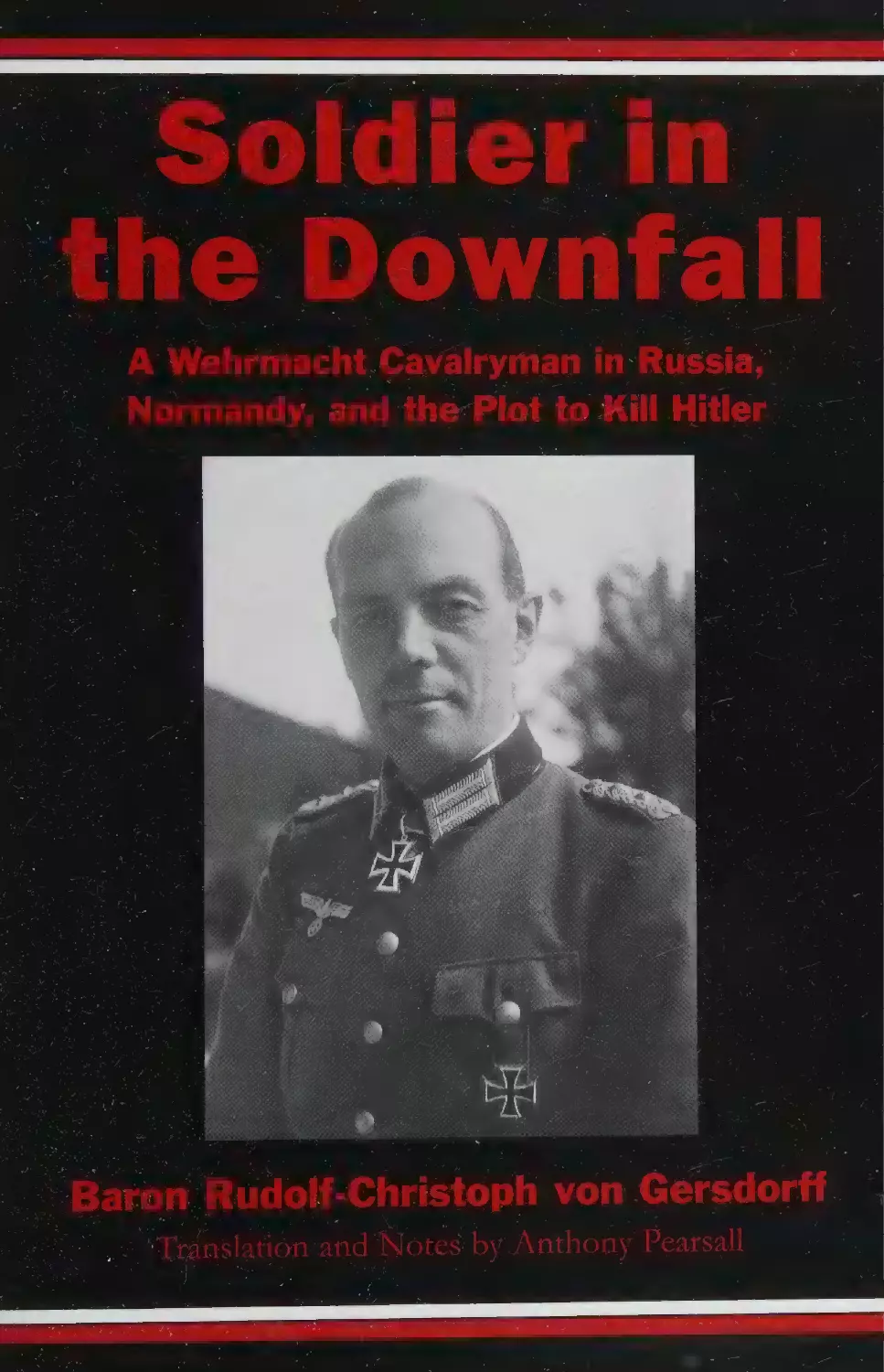


Author: Baron Rudolf-Christoph von Gersdorff
Tags: autobiography antifascism war literature resistance movement
ISBN: 978-0-9777563-4-6
Year: 2012




Text
                    Soldier in
the Downfall
A Wehrmacht Cavalryman in Russia,
Normandy, and the Plot to Kill Hitler
Baron Rudolf-Christoph von Gersdorff ~
< ‘•Tj#nslation and Notes- by Anthony Pearsall
Soldier In the Downfall
A Wehrmacht Cavafryman in Russia, Normandy,
and the Plot to Kill Hitler
By Baron Rudolf-Christoph von Gcrsdorff
Translation with Notes by Anthony Pearsall
With an Introduction by Lory Reinach. nee von Gersdorff
The Aberjona press
Bedford, Pennsylvania
Editor: Patricia К. Bonn
Copy Editor. Gayle Wurst, Princeton International Agency for the Arts, LLC
Cartographer: Torn Houlihan
Printer: Mercersburg Punting Mercersburg, Pennsylvania
The Aberjona Press is an imprint of Aegis Consulting Group Inc.,
Bedford, Pennsylvania 15522
©2012 Lory Reinach
English tianslation and endnotes © 2012 by Anthony Pearsall
All lights reserved
Printed in the United States of America
19 18 17 16 15 14 13 12	54321
ISBN 13: 978-0-9777563-4-6
Except as noted, all photos are from the National Archives, College Park Maryland, or the
Military History Institute, Carlisle, Pennsylvania. Photos from the author's collection are
noted in the caption with (Au.). Photos from the translator's collection are noted with (Tr.).
Special thanks to Editions Tallandier. publisher of Gersdorff’s upcoming French translation,
for providing digital photos from the author’s collection.
Cover photo Baron Rudolf-Christoph von Gersdortf, 1944. (Au.)
Contents
Translator's Notes by Anthony Pearsall vi
Introduction by Lory Reinach, nee von Gersdorff' viii
Foreword by Klemens von Klemperer xv
Preface by Baron Rudolf-Christoph von Gersdorff xvi
Maps xviii
Rank Equivalents and General Staff Positions xxiii
I.	Background and Education 1
II.	Soldier in the Reichswehr 14
III.	Soldier in Opposition 32
IV.	Soldier in the Resistance 56
V.	Soldier and Traitor 87
VI.	Soldier in the Downfall 112
VII.	Soldier in Captivity 143
VIII.	Epilogue 157
Appendix: The Truth About “Katyn”
by Brigadier General Rudolf-Christoph von Gersdorff 160
Notes J 65
Index 199
iii
He who survives a tragedy
was not its hero.
—Stanislav Jerzy Lee
In memory of
the most active men
in the German resistance
Hans Oster
Henning von Tresckow
Count Claus von Stauffenberg
Translator’s Notes
While praising the Prussian noblemen who plotted against Hitler’s life, essay-
ist Clive James made the necessary point that, after all, “Aristocratic recruits
to the SS were plentiful: promotion was rapid, and there were opportunities
to ride horses. (Funding an SS equestrian team was one of Himmler’s master
strokes.) Most of the young officers who developed douots about Hitler had
friends who never developed any doubts at all."’
This is the story of a man—an aristocratic professional soldier of impec-
cably Aryan lineage who would have certainly been welcomed as one of Him-
mler’s horsemen had he so chosen—who instead developed doubts and then
acted upon them, despite an oath he had pronounced, despite the likelihood of
failure and the contempt of those people he most valued, despite a training in
obedience and loyalty that would have begun, for him, at some point before
his own earliest memories
Memories are largely what Baron Rudolf-Christoph von Gersdorff had to
work with when he sat down to write his memoirs. He was by then a weary
paraplegic, aging and wheelchair-boutid, a dispossessed refugee from what
he emphatically regarded as his eastern Heimat (native land) along the lower
reaches of the Oder River, and limited in his research to such books and
papers as might have been available to him as a private citizen of limited
means and capacities, in the divided Germany of the mid-1970s. Fortunately
his power to recollect was strong, and his life as a German soldier through
1947 had provided him with more memorable experiences than most.
He wrote in memory of three of the uniformed anti-Hitler conspirators
whom he knew, namely Hans Oster, Henning von Tresckow, and Baron Claus
von Stauifenberg—the three men whom another rare survivor of the conspir-
acy, Baron Phillip von Boeselager (who will be met in the following pages)
described as being respectively “the mind, the heart, and the courageous arm”
of the plot that culminated on 20 July 1944.
“To save Germany was not granted to them; only to die for it; luck was not
with them, it was with Hitler. But they did not die in vain. Just as we need air
if we are to breathe, and light if we are to see, so we need noble people if we
are to live. ’ So wrote the German intellectual Ricarda Huch as she surveyed
vi
Translator’s Notes
vii
the ruins of her homeland in the spring of 1946. Clive James observed that
Huch ‘‘was well aware that there were other and less charismatic people in the
conspiracy арап from the glamorously uniformed [nobles]. . . . There were
obscure commoners who had seen through Hitler in the beginning. What she
meam by nobility was the sacrificial spirit that joined, in this one instance,
the beautiful young men from the Almanach de Gotha [the genealogical bible
of the German aristocracy] and the plodding minor bureaucrats from the local
council.”
In a much smaller way this book is the result of a similar collaboration, this
one between European aristocracy and American bourgeoisie: and I would
like to gratefully acknowledge Mme. Lory Reinach, nee Lory von Gersdorff,
the author’s friendly and gracious offspring; Professor Emeritus Klemens
von Klemperer, survivor and scholar of those violent times; Mrs. Patti Bonn,
owner of The Aberjona Press, for instantly taking a chance on this book;
and Gayle Wurst, Ph.D., the masterful editor of the English version, and all-
around inspiration. In addition my thanks are owed to the anonymous readers
who vetted the text and endnotes ar the publisher’s request It goes without
saying that I am responsible for any surviving errors. I am likewise grateful to
my wife and daughters for their patience while I sat hunched over books and
keyboards, engaged in this project.
This is a book by another man and not mine to dedicate; but if it were I
would inscribe it to all those in every time and place who have risked that
which they held most dear, up to and including their lives, out of what the
Germans call Zivilkourage—moral courage.
Anthony Pearsall
Pacific Grove, California, 2012
Editor’s Note: German military ranks from Generalmajor up are transposed
to United States usage; a German Generalmajor will be referred to as a Briga-
dier General, and so on.
Introductions
Memories of My Father
In order to describe my father, Rudolf-Christoph von Gersdorft, I must
nowadays reach far back into the past. Moreover it was our fate never to live
together under the same roof for longer than a few months at a time. Nonethe-
less, many events remain engraved in my memory.
On 9 February 1945—1 was seven years old at the time—I was forced to
leave Schloss Matzdorf in Silesia, together with four cousins, my uncle (my
father’s older brother), and my aunt. We were fleeing from the Russians. The
village of Mat/dorf (now known as Maciejowiec. in western Poland) lay in
what was then the Prussian province of Silesia, a few miles away from the
town of Hirschberg (now Jelenia Gora).
1 still remember that scene, over sixty years later. In front of the manor
house stood a black carriage drawn by Max and Moritz, two black horses
with cropped tails, wearing dark blinkers. The snow-covered estate park, from
which the Rtesengebirge mountain range could be glimpsed on the horizon,
was a white winter landscape. Even the chapel and the mausoleum were
mantled with a thick layer of snow. Our goal was to reach Schloss Thurnau.
in the Upper Franconia region in western Germany. Here there dwelled a dis-
tant aunt who was willing to take us in as Fliichtlinge (refugees). At the last
possible moment, my father was able to get us places in a German Red Cross
hospital train, a train that passed through Dresden less than a week before that
city was firebombed into ruins. After two days of traveling we arrived safely
at our destination.
Schloss Thurnau was a big castle, parts of which dated back to the thir-
teenth century, with two interior courtyards and many wings. Among the
other people taking shelter there were the famous concert pianist Wilhelm
Kempf and his family. Before long the castle and village were both overrun by
the U.S. Army. The American occupying troops, who were mostly black men,
made an enormous impression on us children. They chewed gum and had a
panicky fear of the castle ghost, who was known as “the little gray man."
I can only dimly recall my father from these years. Whenever I asked some-
body about him, I would be told that he was at the war, or later on, in Ameri-
can captivity as a prisoner of war. All the same, I have preserved a number of
viii
Introduction	jx
memories. I will never forget how one night, sometime after 7:00 p.m. —that
was my bedtime, and everyone must have assumed that 1 was sound asleep- I
became aware of uniformed- men standing next to my child-sized bed in our
Berlin apartment. They had crimson stripes running down the sides of their
trouser legs: as I learned only much later, this was one of the distinguishing
marks of army'officers on the General Staff. The crimson stripes, which I
noticed very markedly owing to the position I was in. lying down in my bed.
were the reason why I later asked my father who these gentlemen could have
been. He told me that every now and then he and his friends came into my
room in the evenings. Perhaps they were exchanging secret information.
There is another story to be told from this period: an odd childhood memo-
ry. a small thing in itself. Even as a little child. 1 shared my father's enormous
passion for the German candy called Lubeck marzipan, so whenever hunger
(I was known as a "poor eater") and the craving for sweets led me to do so. 1
would search m\ bedroom for candies. My nanny Gretel knew this weakness
of mine, although she nonetheless continued to serve me spinach and chopped
meat. She also knew that the hiding places for bonbons and chocolate in my
room were getting steadily easier for me to find, at the age of four or five. So
she simply put whatever 1 wasn't supposed to eat out of my reach.
At around 7:00 p.m. each night, after my dinner—which often went back
to the kitchen untouched, unless it was forcibly stuffed down my gullet—
Gretel would give me my bath and then put me to bed. After 1 said my eve-
ning prayers, she would leave me. and there 1 would lie on my back, my eyes
turned toward the ceiling. One evening, however, she wandered back in and
tidied up the dresser, on top of which there lay a packet all wrapped up in
paper. Little child that I was. all the imagination I possessed became fixed
upon this packet. Marzipan, pralines, bonbons, chocolate! But I couldn't get
al it, lor I was too small. This memory has never left me. It is engraved in
my mind.
Many years later when I was visiting my father one Christmas and brought
him a box of Lubeck marzipan. I told him about this childhood memory.
He gave me a long look and then said. "You know. Lory, those were bomb
fuses that I thought would be safe on the dresser in your room." These fuses
were captured English war materiel that had been dropped by parachute into
France. They had the very great advantage of not making any noise after
being set, and were considered especially suitable for the planned assassina-
tion attempt on Hitler. So it is that the fuses for the attempted bombings of 23
March 1943 and 20 July 1944 were for some time probably to be found in my
childhood bedroom in Breslau.
Berlin had been our home until early 1942. when my mother died. My
father's increasingly brief and rare home leaves had left her feeling very much
X
Introduction
alone, and news of the arrest and deportation of her Jewish friends in the
neighborhood filled her with grief. Her increasing loneliness and melancholy
eventually developed into a deep psychological depression. On 15 January
1942, after writing a despairing farewell note to my father, she hanged her-
self in the attic of a friend’s house in Rehberg. a small town not far from the
capital. I was barely four years old at the time and was told nothing about my
mother’s tragic passing.
My mother was regarded as a very beautiful woman who was in love with
life. When she married my father at Schloss Matzdorf in 1934, they were
thought of as the ideal couple. He was a successful young officer, a passion-
ate horseman, slender, elegant, six feet four inches tall, and a wonder on the
dance floor; she was young, gorgeous, and rich. He escorted my mother to
every significant event on the social calendar. They were welcome guests at
the Hotel Adlon, then (and now once more) the finest place in Berlin.
My mother came from a very well-to-do background. Her family owned
some large textile factories in Silesia, as well as a number of estates and
manor houses in the province. Schloss Matzdorf, where my Polish great-
grandmother then resided, was considered to be the jewel in the crown.
Alongside the centuries-old trees in the park were modem greenhouses filled
with ripening orchids, oranges, and lemons. There was an icehouse—a rarity
at the time—where champagne could be kept chilled all year round, and from
that little detail one can imagine that there were some fabulous festivities at
Matzdorf. By coincidence; Baron Magnus von Braun, a neighbor who was
the father of the famed rocket engineer Wemher von Braun, described life at
Matzdorf in that era in his book Von Preussen nach Texas (From Prussia to
Texas).
Between 1933 and 1939, my parents lived like two people in a fairy tale, an
intoxicating dream, or a movie. The things that my father subsequently had to
see and do while he was serving on the Russian front stood in grotesque con-
trast to this earlier life. He could scarcely even describe to my mother what he
had seen at the battlefront. And so she tumbled downward into her deep, dark
depression and was never really able to cope with me. Instead she entrusted
me to an ever-changing series of nannies
1 barely knew my father during those years; and I really began to get
acquainted with him, as a conscious matter, only when I visited him in the
American-run prison camp at Allendorf near Marburg, in 1947. By the time of
my visit I was about ten years old. There were hundreds of German generals
at Allendorf. locked up inside a barracks compound. I saw the men in their
threadbare old uniforms, sitting down or stretched out in “sleeping quarters”
that were for the most part nothing but bunk beds separated from one another
by dangling strips of fabric. The Americans were keeping all the generals
Introduction
xi
from the former Wehrmacht confined here. There wasn’t much to eat. I
remember my father showing me some worm-infested cheese and telling me,
“You see, we get this wormy cheese, but you can get used to anything.”
Later on I would realize that those months at Allendorf were among the
toughest of his life. As a resistance member—for that fact about him had
quickly spread around the POW camp, after an article on the subject appeared
in a newspaper—he was seen by many of the men, even some of his old
friends, as a traitor. A Prussian general who had attempted to kill Hnler was
an unimaginable thing for many of his fellow prisoners^and morally alien to
them as well. As I walked through the rows of bunks with my father, I also
felt the hostile stares.
My poor father! Once again, he was caught between two camps. He must
have had the same feeling at the Nuremberg trials. Brought there as a witness,
he was however treated from the start like a war criminal himself. My mother
had given him a gold cigarette case once; it turned out to be the last present
he ever received from her. He had managed to hang on to it through every-
thing, but an American soldier in the Nuremberg prison stole it from him. He
was so enraged by this that he even wrote in protest to General Eisenhower,
the Allied supreme commander. He never got a reply, and the cigarette case
never reappeared.
Incidents like this left my father feeling very downcast; but he was really
a sentimental fellow at heart. Underneath the hard shell that the war had
required him to grow, there hid a musically inclined person who showed his
feelings quite easily. He loved music very, very much. Whenever he listened
to Tchaikovsky’s Symphony No. 5, tears would fall from his eyes. On his night
table there were always books of verse by renowned poets.
He always seemed to be worried about me. “Whatever will I do about my
daughter? I have no home; I haven’t got any money; I can’t just have her liv-
ing with me.” Such concerns were his constant companions. So after primary
school, which I attended with my cousins in the village of Thurnau, I was
raised in various boarding schools.
When I was about seventeen, my father sent me away to Ashridge Col-
lege, at Berkhamsted in Hertfordshire, near London. The institution was well
known at that time as the site of Conservative Party congresses, and also as
the place where Princess Margaret, the younger sister of Queen Elizabeth П,
had held her “coming out” ball as a debutante. It was also a boarding school
for young ladies from all around the British Commonwealth, headed while I
was there by a woman named Miss Neville-Rolfe. When I first became a stu-
dent at Ashridge, she asked me what my father’s profession was. I answered
that my father was an army officer waiting to be recalled to military service,
and that he had played a role in the German Resistance as an assassination
xii
Introduction
planner. Miss Nevdle-Rolfe turned away from me with the words. "So your
lather was a traitor, then.”1 1 loved England very much, but it was as a result
of this exchange that I never married my future British fiance—her words just
stuck in my mind.
Events of this sort, whenever they occurred, saddened my father. He would
often repeat Henning von Tresckow's words. "The world will not forget this
about us tor hundreds of years.” I can remember him quoting this sentence
after I told him about what had happened to me in New York City. By then, in
1960, 1 was working for the United Nations in Nev. York and sharing a Park
Avenue apartment with two female colleagues. There was a delicatessen close
to our flat. After I had brought bagels and donuts home from there twice, one
of my girlfriends had to let me know that she had been told that "the German
woman” was not welcome in the shop.
During the 1950s I lived with my father in Cologne for brief periods, never
longer than a few months at a time. He was trying to start a new life. Every
day he hoped to be called back into military sen ice. Many influential people
in politics and business wanted to intercede on his behalf, but it was all to no
avail; his presence was not desired in the new armed forces.
So he got on with other things. He had rented a little apartment in
Cologne's city center. Here we lived together under one roof for the first time
since the war. and now 1 could see for myself just how successful my father
was with women. The telephone never stopped ringing. Despite his worn-out
flannel suits and his down-at-heel shoes, his height and lean physique caused
him to be regarded as quite elegant, and it was no wonder that he very rap-
idly became a highly prized bachelor guest in wealthy homes. Thus I made
the acquaintance of a whole series of potential stepmothers, until he married
again in 1953. The woman he married was not rich, but she was beautiful—
Eva von Waldenburg, another Silesian refugee. This marriage lasted for only-
three years, however.
I can still see my father in those days, sitting at his desk in a house on the
outskirts of Cologne. At the time he was writing reports for Reinhard Gehlen.
his wartime colleague, who had led the Wehrmacht's Foreign Armies East
intelligence section and was by then the chief of the West German intelli-
gence service. Arranged in a green leather frame on my father's writing table
were photographs oi the four men who were his role-models in life: Hans
Ostei, Fabian von Schlabrendorft, Ludwig Beck. and. of course. Henning von
Tresckow. "The best man 1 ever knew'." he said to me once of Tresckow.
My father earned his living by means of a great deal of hard work. Thanks
to his interest in German horse racing, he found a managerial position in the
League ot German Amateur Equestrians in Cologne. Even after the war. he
always remained a passionate horseman. He won over twenty races during his
Introduction	xjjj
lifetime, and he would proudly note that once in Breslau he had even won two
races in a single day. Each morning he arose at six o'clock and went canter-
ing around the Cologne track on several thoroughbreds. On the weekends he
spent most ot his time at various German racecourses. 1 will never forget how
important it was to him that 1 kissed the hands of older noblewomen whom
we met at this or that racetrack. He wanted his daughter to show her good
manners!
In 1963 he met the woman who would become his third wife: Irmgard.
another Silesian, with a son and a daughter from her first marriage. His choice
of wives showed very clearly that he could never give up the memory of his
Silesian homeland. Better a poor Silesian woman than a rich Rhinelander!
(As far as I can recall, such a choice was his to make.) They settled down in
Munich and remained there until their deaths. Despite the tragedy that would
so powerfully affect both their lives five years after the wedding, theirs was
a very happy union.
One day in 1967 as he rode a horse in the morning workout at the Munich
racetrack, my father was thrown from his saddle, and crippled for the last
dozen years of his life. That fateful morning he lost control of a horse when
it was "spooked" by a bystander's sudden movement. My father apparently
lost consciousness when he hit the ground, but one of his feet was caught in a
stirrup and the wildly galloping horse dragged him halfway around the track
before being stopped. At the hospital in Munich, the initial diagnosis was
"quadriplegia"—total paralysis. He wanted to die. His dreams turned into
nightmares—always the same thing. He dreamed about his friends who had
been hanged after 20 July from ropes tossed over those hooks in Plbtzensee
prison. Why not him as well? During his lifetime he never seemed free from
a sense of guilt for being one of the conspiracy's few survivors.
I visited him in Heidelberg at the special hospital tor paraplegics. While
standing at his bedside, 1 had only one thought in my mind: hopefully he'll
be able to die soon. The sight of him was so depressing. He couldn't mine a
single part of his body except for his lips, and so he was being fed through a
straw. It was horrible. But after several months his condition improved and he
was able to return to his home in Munich. Until the end of his life, this very
active man was a paraplegic, unable to walk, chained to his wheelchair —but
I had the chance to deeply regret my earlier wish. He lived another twelve
happy years, sustained by his wife's sell-sacrificing care, and before dying in
1980 he wrote the book you hold in your hands.
His Christian upbringing and his love for his fellow man lay al the roots
of my father’s character. This was evident from his long and often sell-sacri-
ficing work for the German Order of St. John. When Prince Oskai of Prussia
(a son of Kaiser Wilhelm II. and the Master of the Order), asked my father to
xiv
Introduction
take over the St. John Accident Assistance during the 1950s, my father viewed
this task as a moral obligation. A salary could scarcely be expected, for at that
time the Order's coffers were still empty
For years he spent his Christmas holidays out on the highways with his
youthful assistants, aiding travelers who had been in auto accidents. To lead
and guide young people was a true pleasure for him. He had an especially
good relationship with members of the younger generation. He shared his life
experiences with them, and listened to theirs as well. He thought of them as
“his people,” just as he had felt as an officer about recruits during the war,
when his troops would have run through fire for him.
My father was an aristocrat in the truest sense of the word. “Whatever you
inherit from your father, strive to make it your own”—many a time he would
quote these lines by Goethe to me. His passions were women and horses. He
saw loving his neighbor as his great task in life: both during the war, when
he attempted to free the world from its biggest criminal, and after it, when
he tried to help young people, to hear what they had to say. and (for the sake
of their futures) to transmit genuine values to them, in keeping with his own
passage through life. This final wish is reflected in the words he inscribed in
my personal copy of these memoirs.-
If you so desire, you can learn from your father’5 experiences—includ-
ing the mistakes he made. With love from your father. Rudolf-Christoph
Gersdorff. Munich, Christmas 1979.
Lory Reinach, nee von Gersdorff
Paris, 2012
Foreword
On 25 February 1947, the Allied Control Council in Berlin enacted “Law
Number 46” which decreed the abolition of the state of Prussia, “the bearer
of militarism and reaction in Germany.” Baron Rudolf-Christoph von Gers-
dorff was a Prussian soldier through and through, and a deeply conservative
aristocrat—yet he was neither a militarist nor a reactionary.
During the Second World War, he served in leading positions on the Ger-
man eastern and western fronts, yet he managed to translate his fundamental
rejection of Adolf Hitler and Nazism into action. In this memoir, he tells his
own story and that of his comrades in the Wehrmacht who had the courage to
plan the assassination of the tyrant.
The thesis of the “good” Wehrmacht and the “bad” Nazis has been over-
sold in the past. That is all the more reason for the story of the extraordinary
soldiers of the German Resistance to be told. The legacy of travailler pour le
roi de Prusse (“to labor for the King of Prussia”), had its distinctly positive
aspects, and must outlast the formal dissolution of Prussia in 1947.1
Dr. Klemens von Klemperer
L Clark Seely e Professor Emeritus of History,
Smith College, Northampton, Massachusetts
Author of German Resistance Against Hitler: The Search for Allies Abroad.
and German Incertitudes, 1914-1945
XV
Preface
A people that wishes to have no past will also have no future
—Wilhelm von Humboldt (1767—1835)
”A Prussian general dies, but he leaves no memoirs." With this reasoning
General Constantin von Alvensleben. the renowned arm) commander in the
Franco-Prussian War of 1870—1871. rejected all attempts to persuade him to
write about his military experiences and personal recollections.1 This austere
attitude was in keeping with the typically reserved behavior of the late nine-
teenth century officer corps, an officer corps that existed to protect the mon-
archist form of government, and considered itself responsible to the monarch
above all else. In addition, German military regulations, just as those of Aus-
tria, Russia, France, and England, ensured that all writings published by offi-
cers underwent prior censorship and could only appear in print w ith formal
permission. The transferal of such traditional mental fetters (as anachronistic
as they had become) to the Reichswehr, as well as the “depoliticizing" of the
military that was prescribed by the Military Code of the Weimar Republic,
had as a side-effect the creation of the "just-a-soldier" type of officer, who
in many instances—under the shield of obedience to the loyalty oath or to
the command authority of the National Socialist dictator—became witting or
unwitting accomplices to crime.
The epochal change that my generation experienced is a further reason for
holding on to important lessons and passing them along to succeeding genera-
tions. During the first quarter of the twentieth century. 1 was still being taught
to regard the lance as the queen of weapons, within a powerful horse cavalry.
Only twenty years later the first atomic bomb fell on Hiroshima, extinguish-
ing 260.000 human lives. Such an enormous advance in military technology
was necessarily accompanied by a process of mental readjustment, not only
w'ith regard to strategy and tactics but also fundamental ethical values. As a
result, the military and moral situation of modern armed forces has changed at
root level. While recognizing this tact, it must also be said that many human
xvi
Preface
xvii
and military fundamental principles remain intact, and coping with them can
be made easier with the assistance of past experience.
Such considerations have led me to write down my own experiences. With
few exceptions, I have limited myself in doing so to those events in which I
personally took part, and for whose faithful depiction I can give a guarantee.
This limitation in scale has consequences, for which I must beg the reader’s
understanding. First, it compels me to write more about myself than I would
prefer. Next, it results in some gaps in the depiction of political or military
situations with respect to prior events in which I had no role. Finally, in the
course of studying many postwar publications, I have run into some isolated
contradictions to my own version of the facts. With regard to this, I can only
offer my assurance that in every case, my depiction of events corresponds to
my own perceptions and judgments.
Because I was able to preserve only a few documents and notes as a man in
flight from the downfall of 1945. I must essentially rely upon my own recol-
lections m the following memoirs. Therefore, with only a few exceptions, I
cannot guarantee that the dialogues presented in the form of direct quota-
tions represent the exact form of the words used on that occasion. I can only
guarantee that the sense of the words that were actually spoken has not been
falsified in the least.
I have introduced the story of my army life with a chapter about my back-
ground and education. This seemed necessary to me. in order to give the
reader an insight into my mental attitudes. Only by this means can I hope for
understanding of my conduct with respect to the grave decisions that were
demanded of me
To all those who have helped me to review the accuracy of my information,
my hearty thanks are due.
Baron Rudolf-Christoph von Gersdorff
Munich, 197b
NORWAY
Tallinn ® f .1
SWEDEN
:30 ESTONIA^
NORTH SEA
DENMARK
Copenhagen^
(Ф) LATVIA I
Riga^C	«
BALTIC SEA "'LITHUANIA /
UNITED
KINGDOM
London
NETHERLANDS*
Berlin,
'?Viln^'
 < Z EAST |'\ z
(,/RUSSIA
Warsaw
J
Moscow
Europe, 1919-1937
SPAIN
Brussels'
UNION OF
SOVIET
SOCIALIST
REPUBLICS
BELGIUM^
PansLUX
GERMANY
POLAND
FRANCE
Bern 1^'
^SWITZERLANp^z
(
ITALY

CZECHOSLOVAKIA'
Vienna /	/'
AUSTRIA «7 ' Budapest;'
HUNGARY/'
ROMANIA
Rome
Belgrade
Bucharest
YUGOSLAVIA
BULGARIA
BLACK SEA
Tirana
Sofia
ALBANIA ;
MEDITERRANEAN
SEA
GREECE
Ankara
TURKEY


т
June-December 1941
Marshes
Approximate extent
of German advance
German Army Group
Di, ection of German
advance

Rank Equivalents and General Staff Positions
US Army	British Army'	German Army	German Waffen-SS
General	Field Marshal	Generalfeldmarschall
of the Army
General	General	Generaloberst	SS-Oberstgruppenfiihrer
Lieutenant	Lieutenant-	General (der Infanterie,	SS-Obergruppeiifiihrer
General	General	der Artillerie, etc.)
Major	Major-General	Generalleutnant	SS-Gruppenfiihrer
General
Brigadier	Brigadier	Gencralmajor	SS Brigadefuhrer
General
—	—	—	SS-Oberiuhrer
Colonel	Colonel	Oberst	SS-Standartentuhrer
Lieutenant	Lieutenant-	Oberstleutnant	SS-Obersturmbannfiihrer
Colonel	Colonel
Major	Major	Major	SS-Sturmbannfiihrer
Captain	Captain	Hauptmann/Rittmeister	SS Hauptsturmfiihrer
1st	Lieutenant	Oberleutnant	S S-Obersturmfiihrer
Lieutenant
2d	2d	Leutnant	SS-Untersturmfiihrer
Lieutenant	Lieutenant
German General Staff Officers
Chief of Staff (only at corps level and above)
la Chief of Operations (also: 1st General Staff Officer)
lb Quartermaster (Chief Supply Officer) (also: 2nd General Staff Officer)
Ic	Intelligence Officer (also: 3rd General Staff Officer)
Id	Director of Training (only at army level and above)
Ila Chief Personnel Officer (Adjutant) (also: 4th General Staff Officer)
lib Second Personnel Officer (subordinate to Ila)
III Chief Judge Advocate (subordinate to Ila)
IVa Chief Administrative Officer (subordinate to lb)
IVb Chief Medical Officer (subordinate to lb)
IVc Chief Veterinary Officer (subordinate to lb)
IVd Chaplain (subordinate to Ila)
V Motor Transport Officer (subordinate to lb)
Others: Chief of Artillery, Air Liaison Officer, Chief of Signals, etc.
Note: The la, lb, and Ic were almost always members of the armed forces General Staff
per se. Other positions, including but not limited to those involving technical or profes-
sional specialties such as law, medicine, or the chaplaincy, were typically held by non-GS
officers in staff assignments.

Background and Education
Noblesse oblige!
The breed of counts, barons, and gentlemen sharing the name of von Gers-
dorff may be traced, with a probability bordering on certainty, to certain men
by the name of Gero who belonged to the German dynastic aristocracy of the
ninth and tenth centuries. Their most important representative was Gero III
(890-965) who, as the Count of Oberlausitz (Upper Lusatia) under the Holy
Roman Emperor Otto I, conquered. Christianized, and defended the southern
portion of the Ostmark, early medieval Germany’s eastern borderlands. He
figures in history as one of the paladins of Emperor Otto the Great. He resided
southeast of Quedlinburg at Burg Gersdorf (Geros Dorf, Gero’s Village), a
fortress built by his father Gero II; its ruins have been preserved to this day.
The first bearer of my family name, Rudolf Gersdorff, is referred to in a
document from the year 965 as the lord of the castle and the heir of Count
Gero. He was expressly described as a cognatus (blood relation) of Gero III.
The fortress of Gersdorf remained in the family’s possession until the end of
the thirteenth century. Subsequently the family’s then-living members moved
on to Upper Lusatia as colonizers. There, a dominus Christianas advocatus
provinciae Gorlicenis dictus de Gerhardisdorf (the Christian lord advocate
of the province of Gbrlitz, called von Gerhardisdorf) appears in a document
dated 25 April 1301. In the fifteenth century the landholdings of the Gers-
dorffs were said to include 196 manorial estates in Upper Lusatia alone. On
4 June 15 72, two hundred Gersdorffs assembled in the town of Zittau for the
first family reunion.1
Many members of the family joined the Order of the Teutonic Knights,
to fight for Christendom in the Holy Land or in the Ostmark. The knight
Georg von Gersdorff fell in the battle of Tannenberg on 15 July 1410, as the
Order’s standard bearer.2 His statue stands—or stood—in the high tower of
the Order’s citadel at Marienburg tn East Prussia.
1
2
Background and Education
In the course of centuries, Gersdorffs also settled and acquired estates in
Silesia, the Baltic region, and Denmark. But it is a striking characteristic of
the family that its members were by no means limited merely to being estate
owners and landlords. Along with civil servants and military officers, the clan
has repeatedly produced scholars, scientists, authors, and artists. From the
sixteenth century, for example, one reads of Hans von Gersdorff, a celebrated
surgeon and specialist in wounds. At the end of the nineteenth century, Baron
Karl von Gersdorff (1844-1904) was a close friend of Friedrich Nietzsche;
their correspondence has become part of literary history.
Among the numerous distinguished men and women of my family, two
people stand out. The first was Karl Friedrich Wilhelm von Gersdorff (1746—
1829), Generalleutnant [equivalent to a major general; subequent occurrences
of this rank will use Major General] and chief of staff in the army of the
Kingdom of Saxony and a military historian; he was a friend of Napoleon I,
who made him a Grand Officer of the Legion of Honor. The other prominent
personality was Hermann Konstantin von Gersdorff (1809-1870), who fell in
the front line at the battle of Sedan as a Prussian major general and the deputy
commander of XI Army Corps. He was posthumously honored when the 80th
Fusilier Regiment, stationed in Wiesbaden and Bad Homburg, was granted
the name “von Gersdorff.” Thirteen Gersdorffs died defending their father-
land in World War I, and another twenty in World War II. From 1914 until
1917, Gersdorffs from the Baltic region also died fighting on the Russian side.
I was bom on 27 March 1905, at Liiben in the Prussian province of Sile-
sia, as the second son of Baron Ernst von Gersdorff. He was at the time a
Rittmeister (Cavalry Captain) and squadron commander in the 4th Dragoon
Regiment (1st Silesian), also known as the "von Bredow" Regiment. Later he
became a Generalmajor [equivalent to a brigadier general: subequent occur-
rences of this rank will use Brigadier General], My mother was by birth a
Countess von Dohna-Schlodien. She belonged to one of the oldest German
noble houses, one that had ruled the county of Meissen before it passed to the
Wettin dynasty in 1100, and whose members later settled for the most part in
East Prussia and in Silesia.3
For my siblings and me, our parents were and remain our most influen-
tial role models. Both of them were distinctive personalities, aristocrats in
the best sense of the word, people with a strong sense of political and social
responsibility. Together and separately, they performed their great tasks in life
with thoroughness. Universally cherished and highly regarded by people from
every walk of life, my father and mother died in 1926 and 1944. respectively.
As a result they did not have to endure the loss of their beloved eastern Ger-
man homeland. Their graves were cared for after the war by a German family
that remained behind in Liiben
Background and Education
3
Tolerance and a cosmopolitan outlook were as characteristic of my parents
as their love for and loyalty to their homeland and the hereditary reigning
dynasty. They were Prussian folk, in the philosophical sense of “Prussian-
ism ” Justice, charity, and responsibility toward God and man were combined
with a dutiful pride in their family traditions, a distinct historical conscious-
ness, and an inclination toward art and nature.
They were Lutheran Christians, ever humble before God but tolerant
toward members of other faiths, and full of respect for human worth. They
may not have been without human flaws, but I am not in a position to name
any that could cast a shadow upon the portrait of their characters.
My father was a suoerb soldier, but at the same time the exact opposite
of a militarist or a crude army man. It had been my grandfather’s desire, on
account of my father’s above-average intellectual gifts, that he should study
law and embark upon an academic career. But on 1 April 1884, after a few
semesters at the University of Leipzig, he joined the 1st Life Guard Cuiras-
siers Regiment “Great Elector” (1st Silesian) as an Avantageur (officer can-
didate). I assume that he was led to this decision by his love for a profession
in which he could be a leader of men, by his desire for soldierly camaraderie,
and, not least, by his love of horses and his passion for riding. How else could
he have been able to awaken and keep alive in me the same passion, despite
war and revolution? From my many discussions with him, I learned his opin-
ions about the military ethos and about the tremendous responsibility that is
placed upon the officer profession.
My father was regarded as an Anglophile by many of his acquaintances.
During my youth he was often in England for long stretches of time, and his
penchant for the British “way of life” certainly derived from this. In civilian
clothes, which he preferred, he looked more like an English aristocrat than a
Prussian officer. Above all, he expressed the “English gentleman” concept in
his personal behavior. He always knew just what he could do, and what he
could not do under any circumstances. He was far from desiring merely to
copy the English prototype externally. It was more a matter of this prototype
permeating his entire approach to living. Even while on horseback, he favored
the elegant British equestrian style over the Prussian military method—some-
thing that often brought irritation his way within the service. In his youth he
rode in horse races, and he was an excellent cross-country rider all his life.
My mother was extraordinarily beloved by everyone with whom she came
in contact. She was known as one of those tew originals who were already
becoming increasingly extinct. Her originality lay chiefly in her saying exact-
ly what she thought, always and to everyone. She did not concern herself
about whether anyone occasionally took this the wrong way. She was uncom-
monly bold, and mastered life’s trials the-same way that she did the toughest
4
Background and Education
jumps in the mounted hunts of East Prussia and Silesia. She rode the most
difficult horses—always on a side-saddle—and under her light hands they
quickly became, for the most part, excellent and obedient mounts.
It may surprise many readers that I highlight my mother’s riding abilities
in this description of her character. But to begin with, horseback riding was
to a remarkable extent an expression of her entire nature. And besides that,
my first real memory of my mother is one of riding by her side, on a pony
that she was guiding with a long lead. I must have been barely four years old.
For her whole life long, my mother was always “present” for other people.
1 have seldom seen love and charity toward one’s neighbor more ingrained
in anyone than it was in her. Her vitality and unbending courage in facing
life lifted her above her surroundings and always endowed her with a mighty
circle of friends. Her first name was Christine, and all of Silesia knew who
“Tina” was. The memory of her was still alive thirty years after her death. She
was especially loved and looked up to by the simple folk and all the inhabit-
ants of Liiben. When she left Liiben in 1932 in order to move to Breslau and
be near her sons, she was celebrated in the little town like an honorary citizen.
Although my mother was an enthusiastic Silesian, she never forgot her East
Prussian homeland, which was simply a part of her being. To her children
she passed along her fundamental Prussian attitude, and a certain toughness
in the face of life’s unavoidable setbacks. Later on I often found this to be a
great help.
If someone were to ask me whether my parents had raised me in an authori-
tarian or anti-authoritarian manner (to use a modem phrase). I wouldn't even
know how to answer. They were such strong personalities that their authority
went without saying. I can't recall ever being struck by my father, or hearing
harsh words from him. My parents’ effect on us was above all due to their
example, their image. They were always there for uPbut never pressured us.
My father shared with us his comprehensive learning in every subject,
but with rare exceptions it never occurred to our parents to help us with our
school homework From our earliest childhood it was made clear to us that
each of us had to do our own duty, and that was that. We were neither forced
into a template nor kept tied to apron strings by means of constant admoni-
tions. With our parents’ good example before our eyes, it was far more a
matter of our growing up with great personal freedom. We could seek out
our own playmates and friends from among the neighborhood children and
our schoolmates. But as much as our ages permitted our elders took us along
with them to social and sporting events, so as to present us with examples of
the way of life they found preferable. Since it was their practice to criticize
openly, we were also prompted to think critically, but without ever being per-
mitted to veer off into arrogance or being disrespectful to others. I can never
forget how my parents always taught us to be especially concerned for poor,
sick, and disabled people.
Background and Education
5
Our rearing was decidedly simple; in fact, Spartan. This was not only by
design but out of necessity, because our parents had to live on a fixed officer’s
salary. So we had neither costly toys nor expensive clothing We boys mostly
wore our father’s old clothes, altered to fit us. Money was scarcely mentioned
in our parents’ home, even if we sometimes observed very clearly how little
of it there was around. But because the value of money was never overempha-
sized, and other values were emphasized by contrast, we developed an inner
lack of dependence on cash and luxury that I have preserved for a lifetime.
The values our parents imparted to us were modesty and good conduct. My
spiritual and physical development bore the stamp of my parental home far
more fhan that of my school.
I progressed smoothly through elementary school and then the Liiben Real-
gymnasium [the modem-curriculum high school], all the way to my diploma.
Today I am grateful that my transfer to a boarding school was obviously never
a topic for consideration; for had that occurred, it would have affected my
development, above all where the spiritual and social atmosphere of our own
house and our family traditions were concerned.
Historical consciousness, and love of our homeland, of music, and of sport,
were the most important things for us and were the decisive factors in my own
life. I cannot remember ever reading a single Karl May western, or any simi-
lar adventure yam.4 By contrast I devoured history books for young people;
naturally those concerning the history of Prussia and the German Reich inter-
ested me the most.
My father’s universal learning and my parents’ tolerant attitudes were
enough to ensure that I did not develop into a one-sided nationalist. For one
thing, ever since my earliest childhood there had always been a French gov-
erness living with us. By design, French was frequently spoken in my parental
home, so that soon enough I knew it fluently. A young Belgian woman even
lived in our home during the entire First World War, and we all loved her very
much. Her national pride, which despite Belgium’s occupation by German
troops never permitted her to harbor any doubt about her king’s final victory,
impressed me greatly.
Very early on, I came to the decision to make my life as a soldier in the ser-
vice of my fatherland. My grandfather Gersdorff once said to my father that it
was not the duty, but rather the privilege, of the nobleman to fight and die for
his fatherland. This attitude of noblesse oblige—which even in my childhood
had become, for me, something that went without saying—had to a large
degree shaped my patriotic consciousness and my sense of responsibility.
Moreover, in my Silesian homeland I was constantly confronted by
Prussian-German history, within which the varied history of my own fam-
ily had the effect of forestalling any narrowly nationalistic type of thinking.
During the Silesian War between Prussia and Austria, Gersdorffs had fought
on both sides. Under the banner of Frederick the Great there was a “von
6
Background and Education
Gersdorff’ infantry regiment and a “von Gersdorff ’ hussar regiment, while
on the Austrian side yet another Gersdorff—then the commander of a regi-
ment of pandour cavalry—actually captured and burned down my birthplace
of Liiben.5
For me, Silesia was and still is Germany’s most beautiful and richest
region. The population, the culture, the landscape, and the local customs
were purely German; one could detect a healthy blend of Austrian charm and
Prussian discipline. The best of Prussians were the so-called “Water Poles”
of Upper Silesia, who also proved themselves to be the best of soldiers in war
and peace. As in all border regions, there also existed in this region—sur-
rounded as it was by Poland, Hungary, Austria, and Bohemia—family and
social connections to the neighboring countries. This was particularly the case
for the Catholic nobility in Upper Silesia.
But my Protestant family also had close ties to Poland. We spent almost
every holiday on the estates of my grandparents and my father’s siblings in
the former province of Posen [now Poznan in Poland], I never experienced
any kind of hostility toward us Germans, whether from the neighboring Polish
aristocrats, from the Polish townspeople, or from the farm workers. At Parsko
in the Schmiegl district, my grandfather’s estate, there was not a single other
German apart from my family. As children we played with the children of the
Polish employees. Close and warm friendships existed with the Polish own-
ers of the neighboring estates. My grandmother was by birth a Countess von
Strachwitz and a Catholic. The simple Polish folk regarded her as one of their
own: “Babuscha Catholic, Babuscha Polish." This identification of religion
with Polish nationality was widespread and is still not without significance
today.
I experienced the so-called “Warthegau” region both under German and—
following the Great War—under Polish administration, and could never have
imagined any essential change in the coexistence of the Germans and Poles
there.6 For German landlords the conditions of the 1920s in Poland were for
the most part better than in the German homeland, hard-pressed as it was by
its economic crises. For the Germans in the districts turned over to Poland
after 1918, life went on in the normal way, without any meaningful restric-
tions or even threats. The decisive worsening in German-Polish relations only
began when the National Socialists came to power in Germany.
Just as I never regarded the former province of Posen as being German
territory, the idea of a possible Polish claim on Silesia, apart from some
small border districts in eastern Upper Silesia, never even occurred to me.
Everything of an economic or cultural nature that had been developed in
Silesia over the centuries was the work of the Germans. There was nothing
Polish in this land, not even any Polish tradition. That fact cannot be altered
Background and Education
7
by the current Polonization of the German place-names. On the contrary.
Silesia had belonged for a long time to the kingdom of Bohemia. Since the
days of Emperor Barbarossa, the Piast dukes had been princes of the Ger-
man Reich, and it was they who had invited German settlers into the Silesian
region. ' The German farmers came into a thinly inhabited, underdeveloped
country, and with tenacious labor turned it into one of the most thoroughly
cultivated landscapes in Central Europe. That made the occasional reports in
the Silesian press, according to which hundreds of letters from the western
end of the Reich arrived each year in Breslau addressed to “Breslau, Poland,”
all the more shocking. Even then there was an imaginary “border” at the Elbe
River.
Music played a big role in my family home. My father, my mother, and all
of my grandparents were highly musical people, so it was no wonder that from
our earliest days w’e children also took pleasure in good music. My mother’s
salon was dominated by the big Bechstein grand piano. She could play the
piano bewitchingly, although without attempting really difficult pieces. From
his own youth my father had preserved the memory of a small repertoire of
Chopin’s compositions. My older brother Ernst-Carl and I took piano lessons
without ever really becoming proficient. The. reason we both increasingly sus-
pended our own musical exercises was my younger brother Hubertus—who
as early as his fourth year revealed himself to be a musical child prodigy He
had perfect pitch, and could play every melody that he heard with a lovely
touch and with as much technique as his little hands permitted. I have never
forgotten with how much skill and earnestness my father knew how to guide
and promote this natural-bom talent. My brother’s musical development raced
ahead so rapidly that even in his youth he was a successful concert pianist. We
family members were passionate listeners.8
Every good and experienced horseman knows that horses are musically
inclined, and that as a result there is a close connection between riding and
music.9 So it was for me: my equestrian and music-loving passions devel-
oped in tandem. My love of horses was something innate. The stables out in
the back were an organic part of my parental home, and three or four of my
father’s thoroughbreds were always stalled there. It was my favorite stopping-
place. A little brook called the “Cold Stream” ran directly past our house and
stables. The horses often stood for hours in the cold water, and I was proud to
be allowed to hold one or another of them there at the end of a long rein, under
the watchful eye of a guardian. At the racetrack my father often purchased
broken-down thoroughbreds for bargain prices, healed their injured tendons
chiefly by means of the massaging action of the flowing water, and then won
a whole string of races with a recovered convalescent. He trained his horses
at the military exercise grounds close to our home.
8
Background and Education
But at the beginning, my favorite horse was the little pony Taube (Dove) on
which I had first been mounted when I was four years old. In a sailor suit with
the trouser legs pushed up, stockings to my knees, and a big straw hat atop
my head, I sat on the pony saddle—which had no stirrups, but handles in the
front for clinging to. They were extremely necessary, for “Dove” did no honor
to his name. His spirits were particularly excessive when he first came out of
the stables, and so my brother and I were thrown off his back countless times.
But even when we were hurt, we had to get back in the saddle immediately.
Today I know how much this training helped us in life; helped us to endure
setbacks and failures and to stick things out.
Very soon, however, I felt secure on the pony’s back, and I was allowed
to accompany my mother when she went riding out in the countryside. She
would guide my pony at the end of a long leather lead, and in this fashion
I trotted alongside her big horse. When my mother wanted to ride faster or
to jump, she tossed the lead to me. Taube often used this opportunity to race
back to his home stables, certain of his direction even over great distances.
From 1914 on, my older brother and 1 took our riding lessons on full-sized
horses. Soon enough, Dragoon Sergeant Major Endorf became our instructor,
after being so badly wounded by Cossack lances in the early months of the
war that he was no longer capable of campaigning. This fundamental training
in horsemanship was completely supervised by my mother. After my father
sent his three thoroughbreds back from France to Liiben around the end of
1915, because he had taken over an infantry regiment and could no longer
give the horses sufficient attention due to the demands of trench warfare, we
were able to ride daily. A mare called Kvas became especially dear to my
heart. Before the wrar she had won six races.
From these equestrian beginnings grew my life spent on and with horses.
Until 16 August 1967, when a bad riding accident at the Munich racetrack
left me paralyzed from the waist down, there were not many days in my
life, including during the war years, when I failed to ride, usually on several
horses. They have truly given me "the greatest joy on Earth." Even now, in a
wheelchair, my love of horses and equestrian sports remains unchanged.
My youth as a soldier’s son in a little garrison town, my constant connec-
tion with soldiers and horses, and my early awakening love of nature and for
my homeland were the decisive factors in my life. Other notable experiences
during the first nine years of my life, however, left their lasting and decisive
impressions as well. Two events from before the outbreak of World War I may
be singled out here.
In the autumn of 1911, my father took my older brother and me for an
excursion in the Riesengebirge mountain range. From Krummhiibel we
ascended over the Riesenbaude to the Schneekoppe, where we spent the
Background end Education
9
night.10 The next day it was on to Spindelmiihl on the Bohemian side. From
there we went up the Elbgrund to the Schneegrubenbaude. On the third day
we wandered along the mountain crest back to Krummhiibel, from whence
we returned to Liiben by train. Besides the magnificent natural vistas (which
my father supplemented with talks about history and natural science), 1
remember the hard climbs up icy-smooth, zigzagging paths; the frozen water
in the washbasins of the Koppenbaude; an incomparable Kaiserschmarren—
the famous mountain dish of Austrian-style pancakes packed with sugar and
raisins, ripped to shreds and topped off with fruit compote—in Spindelmiihl;
and the strange impression that the deep snow-filled hollows made upon me.
Although I was but six years old, I could never forget our wandering
through this legend-shrouded region, the domain of the mountain-spirit
Riibezahl of whom so many tales were told. The experience of these three
days in the then-still-wild and therefore especially beautiful Riesengebirge,
our little adventure, and the togetherness with my father and my brother gave
a strong impetus to my personal development. My unchanging love for my
Silesian homeland, my joy in everything that nature gives us, and my drive
for a free and active lifestyle all go back to this youthful experience. 1 could
never have borne a life spent chained to a desk, an existence of physical
restrictions and spiritual dependency; and thus the cornerstone was laid for an
adventurous soldier’s life. In later years the beauty of the Silesian mountains
drew me back again and again. Once, as a young officer, I made a Riesenge-
birge expedition on horseback with my regimental comrades, during which
we ascended the “Корре” with great difficulty, and then rode along the crest
of the entire range
In 1913 we spent the Pentecost holiday with my Dohna grandparents in
Potsdam, the imperial residence-city of the Hohenzollems. 1 had my first
visit to a theatre during this trip. At the Royal Theatre in nearby Berlin we
saw Ernst von Wildenbruch’s impressive drama The Quitzows." The possi-
bility of resistance to authority was put before my eyes for the very first time
in my life My private sympathies lay with the rebel, Dietrich von Quitzow.
Incidentally, we sat in a court box which had been placed at our disposal by
my aunt and godmother Claire von Gersdorff, lady-in-waiting to Hei Majesty,
the Empress Augusta Viktoria.
Several days later I was allowed to visit my aunt in Potsdam at the New
Palace. When I entered the palace, I thought that the first uniformed footman
we met was the Kaiser himself. My disappointment at learning that he was
not was generously washed away with hot chocolate and cookies in my aunt’s
private salon
On Pentecost Sunday, however, we were supposed to be able to see the
imperial couple at point-blank range. The so-called Schrippenfesl took place
10
Background and Education
on the great parade ground in front of the New Palace. In accordance with an
old tradition, each year the Kaiser invited the members of the Infantry Train-
ing Battalion to a meal. Along with a grand entourage, the imperial couple
came from the New Palace to the tables and benches set up on the parade
grounds, where the long bread rolls that Berliners call Schrippen would be
served. We sat on a small platform reserved for guests of honor, and could see
everything well. I can still recall very well how jolly and expansive, without
losing his dignity, the Kaiser appeared, the way he sat down in the midst of
the soldiers and had a lively conversation with them. Simultaneously there
was a musical concert by the mounted trumpet corps of the Life Guard Hus-
sars, the only Prussian cavalry regiment to feature a “Moor,” a black man
from North Africa, as its kettle drummer. The whole magnificent sight—the
glittering, colorful uniforms, the splendid horses, and the musically so very
lovely cavalry march-tunes—made an indescribably beautiful impression on
me, one that reinforced my fundamentally monarchist beliefs.
We spent the summer vacation of 1914 on the Pomeranian estate of one of
my father’s sisters and at Danzig-Langfuhr on the Baltic coast, from whence
we went daily to bathe in the sea.12 In the town of Zoppot I witnessed our
mare Kvas’s last racing victory, which came in an officers' steeplechase.
In the course of a very stormy steamer voyage across Danzig Bay, I nearly
received my first slapping when I said to my father that it would be splendid,
all the same, if we were to be blown off-course all the way north to Bornholm
Island, which lies in the middle of the Baltic Sea near Sweden.
Then at the end of July we had to travel back to Liiben in all haste, because
World War I was standing outside the door. Even now. I can well remember
the mass enthusiasm when the Liiben Dragoons went marching off to the
front—an enthusiasm that stood in stark contrast to the seriousness at the
outbreak of World War II. My father, however—by that time a major on the
regimental staff, who did not move out along with the active-duty regiment
but only several days later, now as the commanding officer of the 3rd Reserve
Dragoon Regiment—told us on the day Great Britain declared war against
Germany that he considered the conflict to be lost. Able to judge the Brit-
ish Empire’s might better than many another person, he did not share in the
general euphoria.
In the first days of the war the famous "gold autos,” which were purport-
edly criss-crossing between Russia and France, played a big role for us chil-
dren. In the immediate vicinity of our house, sentries armed with carbines
and drawn sabers stood on the highway from Liiben to Polkwitz and Glogau,
assigned to halt and inspect each—then quite rare—automobile. In case an
auto did not halt, the sentries were first supposed to try to slash its tires with
their sabers. If this failed they were under instructions to use their firearms.
Background and Education
11
Officers in the Russian Army often wore uniforms with white coats. When
an acquaintance of my parents who was passing through Liiben while wearing
the white peacetime uniform of the Life Guard Cuirassiers was halted on the
road and treated with suspicion, he came into our house in order to request
my father’s assistance. On this basis the Landrat [local government adminis-
trator] who lived across the way from us was informed that a Russian agent
had entered our home. Due to this grotesque report the Landrat, who was a
friend of my parents, wanted to put both the alleged spy and my father under
arrest. Although naturally the whole business was quickly cleared up, the
rumor persisted in Liiben for many days that a Russian agent had been with
us, bearing an incredible fortune in gold. This anecdote shows the enormous
agitation that reigned among the people at that time, which in many places led
to shooting incidents that had serious consequences.
When my father got to come home on leave for the first time in May 1915,
we fetched him from the train station at Liegnitz.13 There we all waited in the
station restaurant for the train back to Liiben. I have never forgotten how my
father suddenly remarked that he marveled that artillery shells were not con-
stantly landing near us.
Immediately after the beginning of positional warfare in the fall of 1914,
my father was assigned to be the commander of the 6th Reserve Infantry Reg-
iment. This regiment was sent into action in all the flashpoints of the western
front: on the Verdun front for the longest period of time, then in Champagne,
on the Hartmannsweilcrkopf, in Flanders, and on the Somme.14 We heard
again and again about how calmly and resolutely, and with how much per-
sonal valor, my father led his regiment. He earned high decorations and was
regarded as a magnificent combat soldier.
My mother was active throughout the war in caring for the wounded at
the Liiben volunteer hospital. We were often allowed to accompany her. The
encounters with the honors of war that we experienced at the bedsides of
severely wounded, blinded, or crippled men left an indelible impression on
me
Then in the latter wartime years the war began to affect us children directly;
food-related hardships became greater and greater. We boys were frequently
sent out into the countryside on “scrounging” missions, and often enough we
came back empty-handed. In the early morning when we walked to school,
there were often some crows dangling from the knocker on our front door.
Wounded officers on garrison duty had shot them. Back then we devoured
crows prepared in every possible manner.
Although we had been prepared for it by my father (whose opinion of the
overall suuation had remained unalterably pessimistic through all the ups and
downs of the conflict), the end of the war in 1918 still hit us hard. In a single
12
Background and Education
day, the end of the monarchy yanked out from beneath the aristocracy and
the upper middle class the foundation upon which they had constructed their
entire prior lives. Not only my father’s professional career, but his very right
to receive rations, appeared to be at least endangered by the revolution. In
addition, the loss of the province of Posen caused us at first to be cut off from
the estates of our kinfolk there.
Thirteen years old at the time, I did not grasp the entire situation. Today it
is clear to me that November 1918 was an even bigger dividing line for my
parents’ generation than May 1945 was for us. Aside from the effects on indi-
vidual lives, the end of World War I set off revolutionary processes throughout
the world, processes which meant nothing less than an epochal change. I will
note here only the most important: the end of the great dynasties in Russia,
Austro-Hungary, and Germany; the founding of the first communist regime,
in the Soviet Union; the enhanced influence upon Europe of the United States
of America; the beginning of the dissolution of the great colonial empires,
and the related formation of a Third World; and the decisive impetus which
technology received as a result of the war, which significantly accelerated
progress in many areas, particularly air travel.
At the time, the abdication of the “Kaiser and King” made a bigger impres-
sion on me than the loss of the war, or the fact that my second homeland—the
province of Posen—now belonged to Poland. When an older student at my
high school founded a “Youth League of Kaiser Loyalists,” I enthusiastically
joined the organization. True, the League never attained a large membership
and was never able to wield any influence worth mentioning, but it molded
my own political position. My belief in monarchy and my love for the Ger-
man fatherland became the decisive factors in my life.
In the little city of Liiben, which had no industry aside from a small piano
factory, everything went along relatively quietly. Demonstrations and brawl-
ing only occurred, at the most, when revolutionary-minded workers from
neighboring places came into the town, which was the capital of the local
district. Socialist election rallies found little resonance in our town's middle
class. My mother, who attended such events many times, usually had the
laughter on her side as she wittily heckled the speakers.
With our hearts ablaze, we followed the news of the defense of Silesia’s
borders. My father was in action for a long time with the Grenzschutz, the
volunteer border-protection force. Many of our close relatives and family
friends took their stand in the battle for Upper Silesia, which was under threat
from Polish insurgents. Mostly they fought in self-contained units alongside
their own household servants and farmhands, as well as the farmers from their
villages. At that time, just after the loss of the war, the unifying idea of the
German nation lived on. an idea which everybody, most especially the young
Background and Education
13
people, supported even at the risk of their lives. In those days, in contrast to
the post-World War II era, longings for the satisfaction of material desires
took second place to love for- the fatherland
There was an evening incident during the Kapp Putsch.15 The top soldier
involved in this luckless enterprise, General Baron Walther von Liittwitz, was
a blood cousin of my father’s. In 1920 my father had just become the com-
mander of the Liiben-based 29th Cavalry Regiment, a Reichswehr unit pieced
together from squadrons of the 4th Dragoons and other old cavalry outfits.
After the collapse of the putsch a close relative, Richard John von Freyend,
turned up at our house. On the basis of the two cousins’ striking resemblance,
he asked for my father’s passport. He got it, and with this passport my Uncle
Liittwitz really did get away over the border to Slovakia unhindered. This
event was the final cause of my father’s retirement from the army, which coin-
cided with his promotion to brigadier general.
When I look back now on my early youth, 1 see that it was infinitely happy
in spite of war, revolution, and an outwardly modest lifestyle. My parents’
examples and the training they instilled in us left their mark on me to such an
extent that I was able to commence my professional life with well-founded
views and solid moral foundations. I have never had to alter them in principle.
п
Soldier in the Reichswehr
Don’t carp at the soldiers’ jolly ways; let them hug, let them kiss—
for who knows when they will have to die.
—Old military saying
After getting through my diploma exams with good results, I entered the
7th (Prussian) Cavalry Regiment on 1 April 1923. The regiment was head-
quartered in the Cuirassier Barracks in Breslau-Kleinburg, with its headquar-
ters-’staff, the signals platoon, a machine-gun platoon, and the 1st and 2nd
Squadrons; the 3rd and 4th Squadrons and another machine-gun platoon were
based in Liiben; and the 5th (Training) Squadron was in Breslau-Carlowitz.
The 1st Squadron carried on the traditions of the 1st Life Guard Cuirassiers
“Great Elector” (1st Silesian), in which my father had passed his lieutenant
years and which he always regarded as his military home. The 3rd Squad-
ron preserved the heritage of the 4th Dragoon Regiment "von Bredow” (1st
Silesian), to which my father had been transferred as a squadron commander
in 1900, and whose last commander he had been immediately after the war
ended.
Actually I should not have been allowed to become a soldier, for at my
induction physical I was marked down as unsuitable due to being severely
underweight. Just turned eighteen, I was already almost six feet three inches
tall, but weighed—like my father, who was still slightly taller at the time—
only about 125 pounds. The then-commander of the 3rd Squadron. Major
von Rcmersdorff, didn’t worry much about this, however, because he, too.
had been underweight when he entered the service. As a successful competi-
tive jockey before World War I, he had won a whole string of races, includ-
ing some on horses that belonged to my father. For me he became the riding
instructor from whom I learned the most by far.
In 1923, a high school graduate was still not an officer candidate when he
started his military service. He could be designated as such only after serv-
ing in the ranks for twelve months. Even then, he remained on the same level
14
Soldier in the Reichswehr
15
as the other recruits and enjoyed no special privileges at all. The only differ-
ence was that his training was harder and more multifaceted. Not until their
promotion to Gefreiter (private first class) were the officer candidates gener-
ally grouped together and provided with specialized training. In their third
service-year they attended the Infantry School as Fahnenjunker-Unteroffiziere
(cadet-corporals), and finally, attended the Cavalry School as Fahnriche
(ensigns). During this two-year period they needed to pass the cadet-corporal,
ensign, and officer examinations, as well as many intermediate tests, before
returning to the troops as Oberfdhnriche (senior ensigns). There they would
wail for their promotion to officer status, which was granted in accordance
with their numerical rank on the officer examination.
Four years of steady training before becoming an officer was a long time;
but still, it would be ideal if such a thorough, fundamental formation were
possible for the young officers of modern armed forces. This is unfortunately
not the case whenever the need for young officers is great. After our four-year
training period, nobody could put anything over on us. We had learned the
soldier’s life from the ground up. We could really put ourselves in the place
of the ordinary trooper, from our own experience. We also knew about every
possible form of harassment, and pointless grinding-down by commanders of
every rank.
I was able to grasp the great value of the prolonged training period as
soon as I became a recruit trainer myself, but I understood it even more later
on, when I was a squadron commander. In 1925 the then-current head of the
army, Generaloberst (Colonel General) von Seeckt, issued instructions pur-
suant to which the severity of the training of officer candidates was softened
somewhat.1 That may well have been justified, but for me, who no longer had
a personal stake in the matter by that point, becoming familiar with the sol-
dier’s hard life had not been harmful but helpful.
In every Reichswehr unit during the 1920s there were old Obergefreite,
lance corporals functioning as acting corporals, who had been through the
latter years of the war. The same was true for almost all of the officers and
NCOs. They were all typical war veterans, some of whom had never expe-
rienced any peacetime training. This was noticeable above all in the case of
the old lance corporals. As if they were Turkish pashas, they had themselves
waited on by the young recruits, and they took the slightest opportunity to
smash a mighty “signature” onto someone’s face. But then, by contrast,
they could also be extremely comradely and ready to help, the way they had
learned to be at the front during the war. Despite this other side, the senseless
grinding down of trainees is, in the final analysis, only a sign of the trainer’s
own incompetence. You can achieve the same toughness in military training
using sensible activities whose value for real-life situations can be explained.
16
Soldier in the Reichswehr
During the first half-year of my military service, I was in the 5th (Train-
ing) Squadron in Breslau-Carlowitz, along with all the regiment’s other new
recruits. Our training officer was Cavalry Captain Seel, a former sergeant in
the Life Guard Cuirassiers, who had been raised to officer’s estate for valor
in the face of the enemy. He was, in keeping with his name, an excellent soul
(Seele)„ even if he handed us no presents. The “ola man” in my barracks bay
was Corporal Artur Wanke, who in later years was promoted to officer rank,
and came back from World War II as a lieutenant colonel and a regimental
commander. We young soldiers owed much to his care for us and his good
instructions.
Two other memories remain unforgettable: one was my first night as a sol-
dier, when I lay on the blue-and-white-checked army cot, unable to sleep from
sheer excitement, and heard the sound of the “Cavalry Retreat” blown by a
bugler at the compound gate. This splendid trumpet signal from the Grand
Tattoo has accompanied me for a lifetime since then. I hope it will be played
one last time by my casket. The second thing was quite a different matter:
in 1923, we experienced the high point of the great postwar inflation. From
millions of marks, it became a matter of billions and trillions. We received
our pay weekly at first, then every few days, and at the end daily. You had to
move fast in order to still be able to get something for the monstrous sum of
paper money.
From 1 September 1923, I was stationed in Liiben with my permanent
squadron, the 3rd. There were about ten of us recruits, of whom I—the lone
high school graduate—was the only one who could hope for an officer’s
career. The next half-year was my hardest time as a soldier. Aside from our
actual duties, we young soldiers were thoroughly subject to the whims of
the old lance corporals. We instinctively banded together in strong comrade-
ship. This tight, loyal friendship would last for a lifetime. Today most of the
lads from back then are dead, but the few survivors are bound together in old
camaraderie, whether a man ended his military career as a staff corporal or,
like me, as a general. We still use the familial’ du and our first names when-
ever we talk to one another; we fall into one another’s arms whenever we
meet again.
The outdoor training was hard, the indoor training even harder; and when
we were done for the day, we cleaned the boots and gear of the old lance
corporals and the non-commissioned officers, scrubbed out the barracks bays
and the latrines as well, and were just happy whenever somebody let us go to
sleep. I made up for the strenuousness of the physical demands (to which I
was even less accustomed than my comrades) by eating enormously. I caused
vast quantities of army rye bread, margarine, and artificial honey to disappear,
together with every other kind of food that the older soldiers were happy to
Soldier in the Reichswehr
17
leave for me. The result was that I very rapidly lost the jockey weight that had
still been mine as an eighteen year old. Later 1 would often lament that fact.
All these adversities were compensated for by my joy in riding and in
being with horses. My squadron commander. Major von Reinersdorff, who
knew about my “pre-service” equestrian training, soon let me ride in the sec-
tion for young remounts, the newest cavalry horses. That caused a sensation
because this section contained the most talented riders in the entire squadron.
He put me on his own horse and rode with me through the countryside His
riding style resembled my father’s, so my equestrian concepts progressed and
developed along the same lines. This opportunity to do extra riding and there-
by receive enhanced training was the only advantage that 1 enjoyed. Even the
fact that my father, a retired brigadier general and a former commander of the
regiment, lived only a few hundred meters from the barracks earned me no
privileges.
The most enchanting thing besides the individual horseback riding was
squadron-level cavalry drill on the vast training grounds. Until 1927 these
exercises were still conducted just as they had been before World War I, that is
to say, in rigid mass formations. It was soon clear even to me that this method
of training for mounted combat simply made no sense in view of the steady
development of weapons technology. I’m glad to this day, however, that I was
able to experience the last five years of the real and genuine cavalryman’s
lifestyle. (Even if there were still several “swarming attacks” by cavalry dur-
ing the Second World War. above all during the Polish campaign, neverthe-
less after 1927 the horse was only a mode of transport for a weapons-carrying
soldier in an infantry-type assignment.)
Mounted drills in platoon and squadron columns and, better yet, in platoon
and squadron lines, gave everyone who was able to participate an indescrib-
able feeling of pleasure—especially when performed at full gallop. However,
in the course of such maneuvers, one could land in truly unpleasant situations.
Since the flanker-corporal had the task of pressing inward so that the closed
ranks of the formation could be perfectly preserved, he rode pressed up tightly
against the horse and rider to his side. The neighboring rider’s weapons dug
into his thigh and leg and could cause tremendous pain. Sometimes the flank-
er-corporal was lifted completely out of his saddle by the rider beside him,
and he felt as if he were hanging in the air. Then it was a matter of getting
oneself back down into the saddle, for in such circumstances a tumble could
put one’s very life in danger.
Each cavalryman carried a carbine in a leather holster at his side, and every
platoon carried a light machine gun along with it: but the “queen of weapons”
was still the lance. The long, heavy, sharp-ended iron rod—from whose upper
end the black-and-white pennon fluttered—was very difficult to handle, and it
18
Soldier in the Reichswehr
took a lot of practice to master the use of this already long-outmoded weapon.
But when young cavalrymen were veering off in the wrong direction, flankers
could use their lances to bash them on the steel helmet or in the gut, so as to
get their attenlion and correct them
As we galloped across Liiben Heath in those days, we had no idea that we
were riding over the richest copper deposits in eastern Europe. They were
discovered during World War II and are presently being exploited on a grand
scale by the Poles. The expanded Liiben cemetery now includes the area
where the trail once ran that we rode along to reach the training grounds.
That’s where the graves of my parents are.
With my promotion to private first class on 1 July 1924, my status changed
to officer-candidate and I was transferred to Breslau-Kleinburg where I met
up again with the four other candidates. First in the 2nd Squadron, then in the
1st Squadron, I experienced the same joys, fears, and trials that I had gone
through in Liiben. But now we were given more specialized training in sub-
jects such as heavy machine guns and the different types of signal equipment.
We were introduced to the armory and to the blacksmith shop. In the smithy
we also learned how to shoe horses.
During this time I was able to put my first riding successes on the books. I
finished in first place in the young remounts race at a regimental sports festi-
val, riding the East Prussian Cramon, out of Dankl XX.2 This horse Cramon
would play a special role later on m my equestrian life. On the occasion of a
big riding tournament in Breslau, riding Vielfrass (Big Eater). 1 was able to
win a fairly easy hunter-jumper event, coming out ahead of General Hasse,
the commander of 2nd Cavalry Division, who was mounted on General, a
then-famous jumper. General Hasse and I both got through the whole course
without incurring any penalties. He remarked that the oldest rider and the
youngest rider had done the best work.
After my next promotion on 1 November 1924, to cadet-corporal, like oth-
ers of my rank, I had to eat my lunches and dinners in the Kasino (officers’
club). Located in a wing of the old Life Guard Cuirassiers barracks, the club
was very beautifully furnished, largely with gifts from various Prussian mon-
archs to the officers of their cavalry guard regimerit. The most valuable items
were the paintings, some of which were by renowned masters like Antoine
Pesne, as well as the battle trophies accumulated during the long history of
the world’s oldest cavalry regiment.3 Included in the collection were the silver
kettle drums and silver trumpets captured from the French cuirassiers at the
battles of Oudenarde in 1708 and Malplaquet the following year.
Inside the Great Hall there hung nothing but a portrait of the Great Elec-
tor. Friedrich Wilhelm I (1620-1688), after whom the old regiment had been
named, and beneath it a painting of Kaiser Wilhelm II in his younger years.
Soldier in the Reichswehr
19
In addition to these paintings, the walls of the Gothic-style passageways and
Great Hall were bedecked with the coats of arms of all the officers who had
ever served in the regiment. Scarcely a single one of the emblems of the old
Silesian noble houses was missing. The arms of the Gersdorff and Dohna
clans were represented many times over.
Amid these surroundings, rich in tradition and almost luxurious as they
were, we lived with a notable modesty and simplicity. The officer corps of
that era dined from stoneware plates on the same lunches and dinners that the
mess hall served to the enlisted men, which was good, solid fare but naturally
included no delicacies. There was much less drinking than in the smaller pro-
vincial garrisons, since Breslau, with its rich cultural life, offered so much
variety that one seldom had to spend long nights in the Kasino. But when the
evening had gone on for an exceptionally long time—and of course we cadet-
corporals had to hold out until the last officer had departed—then our enlisted
comrades took care of us, making sure we didn’t sleep through morning stable
duty or our other assignments. Without too many words being spoken, let
alone any actual instructions, we were gradually schooled from the example
the regimental officers set for us in the style of thought and conduct appropri-
ate for the officer corps. We were given constant attention, without ever being
pressured or made to feel restricted in our personal freedom.
On 1 March 1925, the ensign training course began at the Infantry School.
This was located at the Ohrdruf training facility in Thuringia, and the course
took place after the so-called Hitler Putsch in Munich. Included in the class
were the infantry cadets who, for the most part, had been involved in the
Munich putsch [which has also been labeled the “Beer Hall Putsch” because
it began in the famous Munich Hofbrauhaus].
Soon after our arrival at Ohrdruf, the head of the Reichswehr, Colonel
General von Seeckt, visited the Infantry School. Beginning days before his
amval, there was a hubbub that could not have been exceeded for a visit
from the Kaiser prior to 1918. Uniform inspections, barracks inspections, and
practice drills followed hard upon each other. We experienced something of
the powerful influence that emanated from Seeckt’s personality. During his
speech, he turned toward the cadets with the words that became famous: “For
the first time in my life, I stand before common mutineers. . . .” Though I had
not been involved in the putsch, Seeckt’s talk made a huge impression on me.
I can still seem to hear it even now. There has probably never been another
Gemian general since Seeckt who enjoyed as much respect and who radiated
as much personal charisma.
My time at the Infantry School was less significant for the military training
than for the large number of friends I made outside of my regiment. Here at
Ohrdruf, one could really see what made the Reichswehr so unique up until
20
Soldier in the Reichswehr
1934: everyone knew everyone else, and with few exceptions, everyone was
bound together in a special spirit of camaraderie. In our limited free time,
we enjoyed the beauty of the Thuringian landscape, most of all in Oberhof,
Friedrichsroda, Gotha, and Eisenach.
The camaraderie grew even tighter around the beginning of November
1925, when after passing the ensign examination at the Infantry School, we
cavalrymen were transferred to the Cavalry School at Hanover. Many aspiring
officers had already been washed out by the intermediate tests or the ensign
exam. Even a fellow cadet-corporal from the 7th Cavalry had had to doff his
uniform early.
At the Cavalry School, so rich in tradition (it had been the Military Eques-
trian Institute in the imperial era), we felt the “cavalry spirit’' to a high degree,
and likewise the powerful sense of solidarity that had distinguished the cav-
alry for hundreds of years. As the direct descendants of the mounted knights
of the Middle Ages, we preserved the chivalry of former times even more than
did other branches of the service. This, however, altered nothing about our
professional training, which was modem and suited to our own times.
Our class supervisor and tactics instructor was the future Feldmarschall
(Field Marshal) von Kleist, who already displayed his brilliant abilities as
a major in the General Staff.41 am grateful to him for laying the foundation
for my own capabilities in staff work. He taught us the most current strategy
and tactics. He was therefore all the more shocked when, during the critique
session after a tactical field exercise conducted by the Hanover-based 13th
Cavalry, a highly experienced staff officer once called for the introduction of
a special attachment to be fitted over the end of a lance, with which snipers
in trees could be speared from below! Kleist simply told us to forget what we
had heard as quickly as possible. This rather amusing incident demonstrates,
however, just how strongly tactical and technological notions dating from the
turn of the century still endured.
The equestrian training at Hanover was a disappointment to me With my
passion for equestrian sports, 1 had hoped to experience everything that a
horseman's heart could dream of, here in the Mecca of riding, from the school
stables, which housed the finest dressage horses' in all of Germany, to the
renowned hunts on the Leinewiesen. However, the emphasis in our training
was (quite properly) on tactics and leadership. The riding instruction, while
good enough, was a secondary matter. We got to mount the dressage horses in
the school stables only once, in order to get a feel for the techniques of “High
School” riding, such as Piaffe and Passage.
In our off-duty hours we officer-candidates were in demand as dancers. In
this connection I experienced the obvious distinction between Welfs—people
of the former kingdom of Hanover—and Prussians, which still affected life
Soldier in the Reichswehr
21
even as late as the Weimar Republic.5 Only after much difficulty were we
Prussians allowed to attend Welf social events. Before leaving, we were
admonished not to display our “Prussianness” too much. But the city of
Hanover had such close ties to its Cavalry School that we were welcome
guests everywhere.
 ne conclusion of the Cavalry School course was the officer examina-
tion, which I passed near the top of the class. On 1 October 1926, we senior
ensigns returned to duty with the 7th Cavalry Regiment. I was assigned to the
1st Squadron, the “Life Guard Cuirassiers” squadron. This filled me with a
tremendous feeling of joy, because it was here in the banacks of the Breslau
Cuirassiers that my father had also begun his military career.
Everything was still the way it had been back in 1884. In the middle of the
barracks courtyard still stood the incomparable statue of the Great Elector,
crafted by the sculptor Christian David Rauch. (I shall return to its eventual
fate.) In the Kasino, I sat in a chair that had my family’s coat of arms carved
into the backrest, and I could dine with silver cutlery that my father had had
engraved with our crest. To clean and make up my modest bachelor officer’s
flat in the barracks, I hired the daughter of “old lady Feuerstein,” who had
served my father in the same capacity. This daughter, who was now sixty
years old herself and named Frau К ru ber, was a real character whose tales and
anecdotes could have filled another book.
My regimental commander was Oberstleutnant (Lieutenant Colonel) von
Felbert, former member of the old Krefeld Hussars. He was uncommonly
vital, energetic, and wiry: in short, a splendid soldier, who was loved and
feared in equal measure by his subordinates. When he asked me one day in
the club whether I had selected my own charger yet, I informed him that I was
still looking. Felbert replied, “Then go on over to the stables—your horse is
standing there.” And there I found the East Prussian Cramon, progeny of the
thoroughbred Dankl XX—the same Cramon I had ridden to win the prize in
the young remounts race while I was a cadet-corporal. The commander, who
had taken this horse as one of his own service mounts (considering him to be
one of the best in the regiment), had put him at my disposal.
On the day I was promoted to Leutnant (lieutenant)—20 December 1926—
my father died, completely unexpectedly, of an acute lung infection. At his
military funeral in Liiben, while wearing my lieutenant’s uniform for the very
first time, I carried the glass-topped display case that held his decorations.
In the midst of the greatest sorrow in my life up to that point, I had but one
thought: to try to follow in my father’s footsteps, and to attempt to be what he
had been, a cavalryman and a gentleman.
During the next few years my duties claimed me entirely My squadron
commander, Cavalry Captain von Obernitz, was a really excellent soldier
22
Soldier in the Reichswehr
who demanded a lot from his officers. At the latest, my service day began at
6:00 a.m. during the winter. It continued without interruption until the end of
the officers’ riding practice at 1.00 p.m.; but then my afternoon duties com-
menced immediately and went on until five or six o’clock. When the squad-
ron’s first lieutenant, Karl-Wilhelm von Schlieben (who stood almost six
and a half feet tall) noticed once that after the officers’ riding practice I only
bolted down a hasty sandwich, he went to Obemitz and asked him to give
me at least half an hour for lunch. When Obemitz observed in reply that as a
lieutenant in the old 10th Lancers at Ziillichau, he had never had time for the
noon meal. Schlieben, who incarnated the old-school Premierleutnant of the
Kaiser’s army, answered plainly and spiritedly, “By that hour of the day the
10th Lancers were probably always drunk!” Obemitz laughed and granted me
the half-hour.6
At this point, I will make several general observations about the Reichs-
wehr. After initial difficulties regarding its inner direction, which as a result
of the lost war were probably unavoidable, the Reichswehr developed under
Seeckt’s leadership into a superb military force. Despite the restrictions on
manpower and equipment imposed on it by the Treaty of Versailles, it is my
conviction that the Reichswehr, in its organization and esprit de corps, was
then the most modern, cohesive, and reliable army in the military history of
the entire world.
This bold claim is based on the following four points. It was clear from the
start to Reichsprasident Friedrich Ebert and his Reichswehr minister. Gustav
Noske, that they could “win the revolution only with the Reichswehr and its
officer corps.”7 They saw that they were dependent on the officers and non-
commissioned officers from the old royal armies of Prussia. Bavaria, Saxony,
and Wiirttemberg. Both men acted like statesmen, not like political party
functionaries, when they handed expansive authority over the army to Colonel
General von Seeckt.
Seeckt combined magnificent General Staff and organizational abili-
ties with the highest degree of practical leadership skills. He was himself a
political soldier, who saw his mission as the salvation of the values of the
Prussian-German soldierly tradition of a different era. He was so success-
ful at this that these values remained intact and are still in effect in our time,
even it not one of his successors down to the present day was so great a man.
Seeckt understood so well how to enhance his position and his prestige that he
was able to rule almost like an absolute monarch—but one who was always
distinguished by his elevated awareness of political responsibility. Because
it suited his reconstruction project, he mounted no resistance to the firmly
established depoliticizing of the Reichswehr in the Military Code. By this
means he warded off outside influences that would only have hindered the
Reichswehr’s development into a reliable and loyal force.
Soldier in the Reichswehr
23
Despite many who think otherwise, the royal armies of the German Reich
were already well in advance of the armed forces of other countries, in terms
of their training and spirit. Leadership deficiencies such as I observed in the
U.S. Army during World War II had long since been overcome and eliminated
in the German armed forces. Because the officer corps (as well as the non-
commissioned officer corps) of the Reichswehr had been formed by the most
severe selection of personnel from the enormous manpower pools of those
older armies, modem-style thinking and leadership were so pervasive as to
transform the Reichswehr into a true elite force. Nowadays every state that
can financially afford to do so prefers to maintain professional armed forces.
The Reichswehr showed that a professional army is superior in training and
mentality to all armies that are put together on the basis of universal military
service. A unit comprised of volunteer soldiers who remain together in the
same place for years on end can achieve far more than a conscript force that
is beset by constant personnel changes and never really manages to achieve
true cohesion.
With all of that having been said, a professional army of this type also has
its drawbacks. Above all, these lie in a certain isolation of the army inside
the society: the Reichswehr turned more and more into a state within a state.
However, this did not concern us too much at the time; basically, we were
scarcely even aware of it.
In fact we felt so good about everything, within our solid circle of com-
rades as well as in our off-duty private lives, that to this day I look back on
my period of soldiering from 1923 until 1933 as the happiest days of my life.
I admit that our regiment’s homogeneity and its Silesian locales were largely
responsible for this feeling. Our most important “heritage regiments.” the Life
Guard Cuirassiers and the Bredow Dragoons, had been so-called exclusive
regiments; they had only admitted aristocrats as officers.8 The natural result
was that the 7th Cavalry’s officers came almost entirely from Silesian noble
families and were to a very large extent actually related to one another. There
were times when 1 was serving alongside five of my Strachwitz cousins and
two of my Liittwitz cousins. This “cousin society” was often criticized from
the outside. I can only say that our sense of togetherness had positive pro-
fessional effects The feeling of kinship also gripped our non-commissioned
officers and enlisted men; not only the officer corps, but the entire regiment,
formed one big family.
An essential element for the regiment’s esprit de corps and its superior
standard of training was the fact that during all the years of its existence, each
commander was even better than the one before him. Colonels von Thaer and
von Roeder, who had built up the regiment and assembled its officer corps
at the beginning of the 1920s, were succeeded by Colonel von Felbert from
western Germany, who with his tremendous verve had elevated the training
24
Soldier in the Reichswehr
program to a state of near perfection Afterwards, Colonel Baron Kress von
Kressenstein and Colonel von Gossler particularly promoted the tactical and
equestrian programs. At the end, Colonel Count von Seherr-Thoss and Colo-
nel von Prittwitz knew how to preserve and improve upon the already high
standard of training. I owed an infinite amount to every single one of these
commanders.9
I also had the great good fortune to find within the regiment the best friend
I ever had. The Borussia (Latin for ‘’Prussia”) fraternity at Bonn University
sent us its members at regular intervals, so that after their fraternity time
they could spend several weeks absorbing some military training with us.10
As a result, the fraternity’s “Fox Major,” Count Adrian von Piickler, turned
up in our midst during the fall of 1926.11 He had actually intended to go into
business as a horse-breeder, but he was so enchanted by his brief stint of sol-
diering that he decided to become an active-duty officer. Even while I was
training him we became good friends, and after he returned from the Cavalry
School in 1930 and became an officer, we were almost inseparable. In Silesia
they called us “Castor and Pollux.” We lived together in an officer apartment
above the Kasino, had identical interests, and did everything together.
Adrian von Piickler was an extraordinary person in every respect. He was
much influenced by his parental home at Branitz near Cottbus, where his
ancestor Prince Hermann von Piickler had laid out what was probably his
most beautiful park and had spent the evening of his life. The spiiitual inheri-
tance of this man, who was as restless as he was spiritual, had definitely left
its traces on my friend. I have never since encountered a man who combined
the courage and strength for life with as much spirit and charm. Wherever
he arrived, the atmosphere turned electric. The degree to which people of
every class adored him, both old and young, women and men. was absolutely
unique. Whenever he entered a riding tournament to compete in a hunter-
jumper event, the promoters always highlighted him in their advertising. They
knew that if they did so, many more spectators would show up to cheer on
their favorite, even if he was already out of the running by the second or third
obstacle. The soldiers under his command would ride themselves to pieces
for his sake, because they knew that they could count on him in everything.
Despite so much spoiling and despite great success in both his professional
and private lives, Adrian von Piickler remained modest, serious, even intro-
verted at limes. He hated superficiality and banality, but he was able to over-
come every obstacle in his path because of his boundless lust for life. When
he was killed in action as a Panzer commander on the Eastern Front a few
months before the collapse in 1945, a great and joyous life came to an end.
The inception of Adrian von Prickler’s active officer career was person-
ally approved, in a most peculiar way, by the new chief of the Heeresleitung
Soldier in the Reichswehr
25
(Supreme Army Command). In mid-October 1926, Colonel General von
Seeckt, the creator of the Reichswehr, was replaced by Colonel General
Heye.12 The latter man visited my regiment on 14 January 1927, in the Cuir-
assier Barracks at Breslau. In Seeckt’s time, such a visit would have gone off
just like a parade for the Kaiser, but now we were exposed to the glaring dif-
ference between Seeckt and Heye.
In accordance with our precise preparations, the regiment stood in parade
formation in front of the Great Elector’s statue in the courtyard of the com-
pound. While the band played the “Presentation March,” the commander.
Colonel von Felbcrt, presented the regiment to the new chief of the Heeres-
leitung. Instead of the anticipated bawling of commands at the head of the
formation, a speech while we stood at parade rest, and a concluding parade,
Heye immediately halted the music and ordered “at ease!” and “ground your
weapons!” We stood around feeling completely at a loss, with no idea of what
was to follow.
What followed was unique. Heye immediately ordered that day’s birthday
boys to report to him. After prolonged hesitation two corporals stepped to the
front; one could see that they were plainly ill at ease. The chief of the Heeres-
leitung now had three glasses of schnapps brought from the canteen, and he
drank to their health. Finally he summoned up every possible combination of
soldiers: war veterans, married men, non-swimmers, eyeglass-wearers, and
so forth. Among these groups he had the officer candidates come forward,
and at this point he said to Piickler, “You may be a count, but all the same I’ll
approve your enlistment. But I won’t set you free again until you’re a gener-
al.” Someone exclaimed loudly and disrespectfully, “I’d make sure to get that
in writing!” When cadet-corporal Hans von Helfritz admitted in response to
questioning that he received a monthly allowance of fifty Reichsmarks from
his father, Heye said, “So, you’re quite the Farmer Moneybags!” The whole
thmg ended informally in a general discussion.
The year 1927 became a time of great military achievements for my regi-
ment. Inspections, maneuvers, and field training exercises, during which “the
regiment with all the aristocratic officers” was graded with particular sever-
ity, resulted in splendid successes thanks to the inspiring leadership of Colo-
nel von Felbert and to the fine training of the previous years. The regiment’s
inspection at the Jiiterbog training facility by the “cavalry-eater” General von
Tschischwitz, which was almost completely restricted to infantry-type com-
bat maneuvers, concluded with his enormous praise.14
That evening all the squadrons celebrated. Felbert, whom the troops had
long ago nicknamed Fritzchen, delivered a marvelous speech. When he
had finished, Senior Corporal Muller from the 1st Squadron—the so-called
“Black” Muller—leaped onto the table upon which Felbert stood, embraced
26
Soldier in the Reichswehr
him, and with the words “your pardon, Herr Oberst, I can do no other!”—
gave him a kiss.1,1 That was the signal for all the officers to be lifted high on
shoulders, and for the squadrons to form up and then parade past the beloved
commander “at the gallop.” These proceedings show, once again, some of the
spirit that reigned in the Reichswehr in general and the cavalry in particular.
But 1927 also saw our farewell to the lance. However justified this was, it
put the end of the old-time cavalry right before our eyes. As a result, discus-
sions about the lance were very controversial in this period. When, during the
course of a critique session after some training maneuver, Colonel General
Heye asked all the officers of our regiment for their opinions on the subject,
he received a variety of responses. At the very end he asked me, as the junior
lieutenant, whether I was in favor of abolishing the lance or preserving it.
When I spoke up loudly and clearly for its preservation, he smugly replied,
“You presumably learned all about lances in your schoolroom?” I retorted
proudly, “No, Herr Generaloberst, I’ve ridden with a lance for three years.”
Although I soon realized how stupidly I had reacted (with all my twenty-two
years!), I could then have had no idea that fifty years after the abolition of
the lance, I would be listening to discussions about the abolition of nuclear
weapons.
My attendance at a chemical weapons defense course in 1927 and a course
in smoke camouflage reminded me of the ceaseless progress of military tech-
nology. In the summer of ’28 I spent several weeks attached to a mechanized
smoke platoon, whose equipment, however, was still quite primitive. Despite
our observance of every precautionary measure, during a field exercise at the
Neuhammer training facility we came within a hair of setting an entire forest
ablaze.
During our training-area interludes and military maneuvers in those years,
we were often visited by delegations of Soviet officers. (Once one of these
guests was General Tukhachevsky, later executed by Stalin.)15 The following
experience was an unforgettable one for me: on the occasion of an especially
smooth and rapid river crossing exercise on the Oder. I asked the Russian
guests, through an interpreter, how they had liked it. The answer came back,
“Very pretty, but far too slow” In response to my astonished inquiry as to how
one could do it any faster, they said. “Our divisions close ranks—then they
ride in on one side of the Volga and out the other side. We don’t have any
lifeboats or ferries, or all that other stuff.” I asked how many horses and rid-
ers were typically left behind in the river using this method, and received the
laconic response, “Sometimes over a hundred!” This was my first encounter
with the utter ruthlessness of the Soviet leadership, which I would come to
know very well indeed during World War II.
Soldier m the Reichswehr
27
One evening Soviet officers were our guests in the Kasino. The trumpet
corps was playing a concert for us, and right after the meal ended I went over
to the musicians, as I usually did, to tell them which marches to play. One
of my favorites was the “Cherkassy March” by Tchaikovsky, in the middle
of which one hears the splendid notes of the old Russian national anthem,
“God Save the Tsar: Without even thinking about the Soviet guests, but full
of musical enthusiasm, I directed the band to play this beautiful tune. By the
time I got back to my place the Soviet guests had silently risen from their
chairs, and with some slight bows they all left the hall. We did not see them
again. I expected to get a severe dressing-down from my commander, but
Fritzchen Felbert only raised his glass and drank to me, saying, “You did a
good job there! Now at least we’re by ourselves.” Although at that moment I
was happy to have gotten off so neatly, I remained conscious of my uninten-
tional tactlessness.
During those carefree lieutenant years, apart from our military duties we
lived chiefly for equestrian sports. Due to my height and weight, I had spe-
cialized from the outset in hunter-jumper events. At Silesian tournaments I
succeeded in placing high in a number of such contests and in winning several
competitions. But racing increasingly became my main passion. Felbert had
tapped some little-used regimental funds to have thoroughbred horses pur-
chased in Berlin, which were then trained by a well-known Breslau trainer. In
1927 I haa received my first thoroughbred, the stallion Sarazener (by Santoi
out of Rahana). I was able to ride him daily at the morning workout before the
service day began, and soon I took part in my first race. Since the error had
been made of purchasing eight cheap thoroughbreds instead of two or three
really good ones, the regiment’s racehorses were only suited for middling,
provincial-level competitions. My own Sarazener was no exception, so we
were quite happy when we began to win some prizes in small races.
Our shining example was my comrade and friend Gero von Gotz. In May
1926, riding one of the regiment’s good half-blooded horses, a mare named
Amsel, he had surprisingly won two officers’ races in Mannheim and received
a thoroughbred as the grand prize. Gero, with whom I had used to daydream
about racing horses when we were still back in Liiben, quickly developed into
one of the best and most successful gentleman jockeys of the inter-war era.
He was the champion of all the gentleman jockeys in Germany in 1928, witn
forty-one racing victories. Another regimental comrade blessed with a light
bodyweight, Friedrich-Wilhelm von Mellenthin, won a large number of races,
too. I was always handicapped owing to my weight, but over the years I also
had a string of victories, chiefly in Breslau, but also in Frankfurt am Main,
Hanover, and Berlin.
28
Soldier in the Reichswehr
Mounted hunts, which unfortunately occurred only in the fall, were spe-
cial pleasures. True, we had no pack of hounds, but the hunts in the difficult
countryside around Breslau were still a lot of fun. I learned about managing
such events from our masters of the hunt, Cavalry Captain von Obemitz and
Cavalry Captain von Hiilsen. I succeeded them in turn as the hunt master, and
rode at the head of the field on my horse Cramon. Only someone who has
ridden in many hunts over fair ditches and hedges can understand the pleasure
of this sport.
Snorts were not our only source of happy hours. I still recall the stag din-
ners and the mixed-company dinners in our Kasino. The high point every
year was 2 December, when the veterans’ society of the Life Guard Cuiras-
siers remembered the attack at Loigny-Poupry. During its long history the
regiment had ridden in many important assaults, but the anniversary of this
relatively bloodless charge in the 1870-71 war had been made into the annual
regimental day. I participated in this memorial ceremony as a full member of
the Life Guard Cuirassiers because (like some of my other comrades) I had
been admitted to the veterans’ society as a Cuirassier’s son.
We entered the great hall amidst the notes of the “Great Elector March,’’
composed by Count Kuno von Moltke, himself a former Life Guard Cuiras-
sier 16 Two sergeants wearing the black-and-white colors of the old regiment
were posted at the door. The most senior man present, Herr von Ruffer (over
ninety years old), made the first toast to the colonel-in-chief of the regiment,
lifting his glass and crying out. “To the King!” Before the chairman of the
society, Major General Count von Schmettow, began his speech, he turned,
raised his glass, and bowed slightly to the portrait of the last Kaiser.17
These ceremonies might be dismissed today as theatrical and reactionary.
At the time they made a great impression on me. In honoring great traditions
there lay an infinite amount of chivalry and pride, which, considering the regi-
ment’s three-hundred-year history, was completely justified.
fhe balls that took place at our Kosino were the high points of Silesia’s
social season. The Crown Prince and his wife were usually there, as were the
Grand Duchess of Saxe-Weimar and the wife of Prince Friedrich-Sigismund
of Prussia. And if polonaises, quadrilles, and cotillions were still danced just
as they had been a hundred years earlier, these parties were by no means stiff
or boring. The regimental trumpet corps could put together a superb dance
band, which played all the modem dances. Adrian von Piickler and I were the
lead dancers. As such, we were responsible for the conduct of the balls, and
also had to ensure that no wallflowers remained in their seats. Although of
course we all danced energetically to contemporary dances like the tango and
the Charleston, nonetheless in Silesia—so saturated in Austrian traditions—
the Viennese waltz was our greatest favorite.
Soldier in the Reichswehr
29
During the cotillions, two little Russian ponies with black and white rib-
bons attached to their saddlecloths would carry baskets of flowers into the
hall, where the prettiest young ladies present would distribute ribbons and
flowers to everyone. These officer paities had culture and style, perhaps for
the last time in an era that was drawing to its close.
Another custom seems to me to be worthy not only of mention, but of imi-
tation. At the beginning of the 1930s we accepted a sizable quantity of male
university students as regular paying guests in our club. The immediate impe-
tus for this action came when the Kasino budget ran into red ink, owing to
the relatively small number of members and to deficient fiscal management.
Although we had always had some steady individual guests, the significant
enlargement of our circle was a blow to the traditional intimacy of the club,
a place where one could say anything without fear of indiscretion. Therefore
we only invited friends and close acquaintances, who also had some kind
of pre-existing connection to the regimental officer corps, to dine with us at
lunch and dinner. As soon as we noticed that any of these men did not wish to
conform to our style or held different fundamental opinions, we parted ways.
Based on the foregoing premises, the coexistence of soldiers and civilians
was a complete success. Since the students represented various university
departments ranging from law and economics to agriculture and medicine,
the subject matter of our discussions was rapidly enriched. Now we no lon-
ger mainly discussed professional military or equestrian topics—or, as we
ourselves ironically put it, “Alma the mare’s inward-turning back hoof’—
but also issues in their various fields of study. The intellectual level of our
expanded circle was noticeably enhanced.
The presence of our civilian guests also led to a stronger interest in politi-
cal questions. The complex of issues designated as “the Reichswehr and
politics” was legally regulated by the Military Code of 23 March 1921. In
Section 36, paragraphs 1-3, it was stated among other things that, “Soldiers
may not engage in political activity [. . .]. Membership in political organiza-
tions or participation in political rallies is forbidden for soldiers. The soldiers’
right to vote in national, state, or local elections, or referendums, is hereby
suspended.”
The depoliticizing of the Reichswehr, firmly established by the foregoing
regulations, led to our becoming less and less concerned with domestic politi-
cal developments in our own country. The Reichswehr’s position within the
state, and therefore our own position, was clear. After the post-war tumults
which had occasionally required the deployment of the Reichswehr had all
been overcome, the only missions remaining to us were to train the soldiers
entrusted to us into a combat-ready, self-sufficient force, and to indoctrinate
them in such a way that they presented no threat to internal security. The
30
Soldier in the Reichswehr
presidency of Field Marshal von Hindenburg, who was simultaneously our
commander-in-chief, appeared to be the guarantee for the preservation of our
soldierly principles.
Naturally we stayed informed from newspapers about developments in
domestic politics and foreign policy; but we only rarely discussed them. After
the putsch of 1923, the up-and-coming National Socialist movement aroused
our interest only once, on the occasion of the Ludin-Scheringer trial.18 This
passive attitude toward politics only began to change at the beginning of the
1930s, when the SA (Sturmabteilung; Storm Troops) and the SS (Schutz-
staffel', Security Group) started to make the Nazi Party increasingly noticeable
in public life.
Their pseudo-revolutionary rowdiness, which was particularly manifest in
the person of Fdmund Heines, the SA chief in Silesia, was as alien and repul-
sive to us as it could possibly be.19 On top of that, there were more and more
altercations and even violent brawls between soldiers from our regiment and
SA and SS men. Once when one young officer ventured to say something
positive about the National Socialist movement inside the Kasino, he was set
straight again, and very sharply at that. The attitude of the officer corps spread
out across the whole regiment. I do not recollect a single instance of a Nazi
cell being formed among the NCOs and the enlisted men.
At least in my regiment, an order to proceed against the Nazi movement
would have been obeyed without argument. The Reichswehr’s leadership had
the troops firmly in hand. We officers were convinced that. in keeping with
our soldierly responsibilities, the high command would take the necessary
steps firmly and at the appropriate time. At our own level, we didn’t take
Hitler seriously enough. We were more likely at first to find the agitator from
Braunau merely laughable.
During these years I was personally influenced by my older brother Ernst-
Carl, who had recognized the criminality of National Socialism from the very
start.20 He was one of the very few people who never had the slightest doubt
about their attitude toward Hitler and their opinion of the movement, and he
often surprised my friends when he predicted the Reich’s downfall, even at
the height of its triumphs, if nobody overthrew the dictator. From 1929 to
1930, my brother played a leading role, along with politicians like the former
cabinet minister Treviranus. Ambassador Hans Scblange-Schoningen, and
the conservative political leader Count Kuno von Westarp, in founding the
conservative “German People’s Party,” which wanted to stem the rising tide
of Nazism.21 But this early attempt to mount a resistance foundered not only
due to the lack of funds, but also due to a widespread failure to comprehend
the problem, not least on the part of the German National Party. An attorney
in private practice in Breslau, my brother put himself steadfastly at the service
Soldier in the Reichswehr	31
of his Jewish colleagues after the Nazi Party came to power, and even during
the war years he continued to defend and represent the interests of his Jew-
ish fellow-citizens. The Gestapo was naturally familiar with his opinions, and
beginning in the mid-1930s he seemed to be under surveillance. But despite
being arrested three times by the Gestapo, he managed to outlive the Third
Reich—in the otherwise highly dubious safety of the Wehrmacht.
On 1 April 1930. I was reassigned to the regimental staff as Ordonnanz-
offizier (aide-de-camp) to the commander. This assignment meant that I was
being groomed for the post of regimental adjutant, which I took over in 1933.
But even if I was now chained to my desk for many hours a day, I kept in
close touch with field service through my riding and my additional duty as the
supervisor of our training program for non-commissioned officers.
Soldier in Opposition
Obedience is the principle; but the man stands above the principle.
—Count Helmuth von Moltke (1800-1891)
On 31 January 1933, in my capacity as the deputy regimental adjutant, I sug-
gested to the commander, Colonel Count Theobald von Seherr-Thoss, that he
might give the officers a clear statement about the political events in Berlin. I
knew of his harsh attitude against National Socialism, and wanted to use his
authority in order to nip in the bud any possible shift of opinion that might
occur among the younger officers amid the general euphoria. Count Seherr
was of one mind with me. However, he declined to use the notes that I had
prepared for his talk. The following lines, reconstructed from my memory,
correspond to the sense of what he actually said then. The last two sentences
were his exact words:
Gentlemen! I need not provide you with any further explanations about
what took place yesterday in Berlin. You were all able to keep up with
that. But I would like to share with you my opinion concerning the gov-
ernmental change that has occurred. The National Socialists, who now
hold the deciding power in the government, have repeatedly stressed that
they developed their ideology from the spirit of the front-line troops in
the war. If that were accurate, then we soldiers could only be glad of it.
But I cannot conceal my skepticism. I will also tfcll you why: This Hitler,
in my opinion, is no gentleman, hut merely a rogue. And for that reason,
sooner or later his movement will fall to pieces.
When the commander had left, I requested the officers not to let a word of
this speech become public knowledge, or we would probably lose our com-
manding officer very rapidly. Needless to say, none of it got out.
Count Seherr’s conclusion did not mean much to me at the time. In fact it
seemed primitive. Only long afterwards did it become clear to me that he had
32
Soldier in Opposition
33
instinctively recognized the actual, the essential, point. For all his—crimi-
nal—genius, Hitler remained a petty product of the petty bourgeoisie, who in
dealing with the type of real-gentleman embodied by the army’s senior offi-
cers always felt an inferiority complex.
Not much changed for us at first in our military ghetto. For the time being,
the cavalry branch remained undisturbed by the military reorganization that
was rapidly set in motion. But outside our “service life” we were more and
more powerfully confronted with the actions of the SA and the SS, which
took on a particularly repulsive form in Silesia due to SA leader Heines and
his cronies.
Soon afterward I became the regimental adjutant. With the complete agree-
ment of my commander, and also that of my deputy, Count Adrian von Piick-
ler, I regarded it as my assignment to guard the officers, non-commissioned
officers, and men against the new Zeitgeist, or spirit of the time, and therefore
to constantly promote a soldierly and comradely spirit.
For example, two very junior officers gave us the impression that they
harbored a certain sympathy for National Socialism. We were able to get rid
of them both in the course of a mandatory levy of officers to mechanized
infantry units. A lieutenant who had transferred to us from the 9th Infantry
Regiment was quickly set straight. When he turned up at the officers’ club
one night in civilian attire, wearing the swastika-emblazoned Nazi lapel pin
for military men, Count Seherr took it from his coat, and with the words
“this kind of thing isn’t worn around here,” hurled it outside through an open
window. When the lieutenant wanted to complain to someone about the com-
mander, it was made clear to him that it was not our custom to wear such an
item. Either he would have to adapt to the style of our regiment, or he would
need to request a transfer out. He chose the former, and became a much-loved
comrade.
Two events in 1933 really made the dawning of a “new era” plain to me.
The Grenzschutz, or paramilitary border guard, so important for my Sile-
sian homeland, was taken over by a special command group from the Reichs-
wehr, for which our regiment had to supply instructors and supervisors.
Now all sorts of high-ranking SA men suddenly appeared in the Breslau
Generalkommando (General Headquarters), making shameless demands for
positions on the basis of their prior work with the Grenzschutz. In contrast
to several overly timid staff officers at the Breslau military headquarters, I
argued against these rowdies in the sharpest possible manner, and preserved
the unrestricted authority of army men as opposed to SA members.
One day a very senior civil servant from the Reichswehr Ministry in Berlin
arrived in my office, in order to listen to our desires regarding improvements
and renovations for the Cuirassier Barracks, which had been built in 1870-71.
34
Soldier in Opposition
We had been engaged in a prolonged battle for central heating and to get the
latrines and baths fixed up. Now these really urgent wishes were to be granted
immediately. When he then inquired about any additional improvement plans
we might have, I hesitated to respond; I was still in the clutches of funda-
mental Prussian thriftiness. Then the senior official said to me, “I need to tell
you one very basic fact. Money is absolutely no obstacle anymore. I’ve even
been authorized to approve the total demolition of your old compound and the
construction of a new one.”
His words left me speechless. Within a few more minutes, the construc-
tion of a large riding-track had been ordained, as well as a string of other
new building projects. At the end of the meeting the official mentioned that
he would order the construction of tennis courts in the little garden of our
Kasino, although nobody had ever even asked him for that. When the civil
servant from Berlin had left my office, it was clear to me that Prussian pro-
fessional officialdom, as it had developed over the centuries, was now dead
and gone
Still, I have to admit that there were several things about the new regime
that pleased every one of us, despite all our distaste for National Socialism.
One of the most important of these things was the restoration of the black,
white, and red national colors. We had never been able to resign ourselves to
the Weimar Republic’s black, red, and gold. On the day that the change of
colors was announced there was a conference going on in the Great Hall of
the Kasino, attended by over a hundred officers and civil servants from the
headquarters of the Wehrkreis, our local military district. Their caps were all
hanging in the cloakroom; naturally they all still bore the black, red, and gold
cockade. We lieutenants had ourselves some fun by removing the emblem
from every cap, so that their wearers were forced to go home as “privates
second class” (without a cockade). Not one man took any offense at this par-
ticular lieutenants’ prank! Understandably, we also welcomed the plans for
the reorganization of the Reichswehr into a modem Wehrmacht, something
we were hearing more and more about.
But the SA’s ever-growing struggle against the Reichswehr guaranteed that
despite all the benefits the armed forces were deriving from the new regime,
their disdain for it constantly received fresh nourishment. The perversely
inclined Silesian SA leader Edmund Heines and his adjutant, who was gener-
ally known in Silesia as “Fraulein” Schmidt, behaved like Asiatic usurpers.1
It was no wonder that their subordinates followed their examples. Disor-
derly drinking bouts, fistfights, and shootings were all on the daily program.
My friend Adrian von Piickler and I had a set-to ourselves with “Fraulein”
Schmidt in a Breslau tavern, during which we were able to separate him from
his bodyguard and give him a frightful beating. Instead of the anticipated
Soldier in Opposition
35
official complaint or criminal charges, the next day we received a formal apol-
ogy from the SA command.
During this period the Nazis still pulled back whenever they encountered
massive resistance. When Heines demanded that the commander of the 2nd
Cavalry Division, General von Kleist (my old tactics instructor from Hanover,
later a field marshal), give him the name of a suspected military spy on the
staff of the SA regional command, Kleist was said to have replied, “You’ll get
that name just as soon as you give me the name of the man in your entourage
who stole two top secret documents from my desk the last time you came
over for a visit.’’ The embarrassed Heines said not a word.
In June 1934, the struggle between the SA and the Reichswehr reached
new heights. From our civilian guests in the club, who as university students
had connections in SA units, we learned all about the plans of the Silesian
SA leadership. Then on 30 June, the whole thing finally culminated in Hit-
ler’s purge of the SA. in the course of which Heines and Schmidt were both
murdered.
During those days the regiment was kept confined to quarters and in the
highest state of alert. It so happened one day that I overheard a loud argument
at the compound gate between our sentries and a number of SS men. When I
got there I encountered the commander of the Silesian SS, Udo von Woyrsch.2
He vociferously complained that the guards had not let him pass through the
gate with several trucks and numerous SS members. 1 forbid him to employ
the tone he was using with me, and let him know that the sentries had done
their duty. Woyrsch then demanded several hundred pistols along w;th a cor-
responding quantity of ammunition Because we actually had received an
order from the Generalkommando to supply the SS with all the weapons they
wanted, I sent for the sergeants in charge of the squadron armories, so we
could work out how many pistols we could give away.
Naturally all this took too long for Woyrsch, and when the Model ’08
(Luger) pistols—about seventy-five of them—had been stowed away in his
automobiles, he wanted to roll out immediately. I planted myself in front of
his car and demanded that he sign the official receipt that had been prepared
in the meantime. In a wild haste he scrawled something with a pencil across
the entire sheet of paper. When I mockingly asked him if that was his signa-
ture, he furiously shouted “Ja!” and then drove off at top speed. I could not
have suspected that on that day and in the days that followed, the SS would
execute many people by shooting, among them a certain Baron von Wechmar
and a Herr von Grolmann, who were well known to me.1 The exact number
of people murdered at that time in the 30 June purge was never ascertained.
If at the time we were unable to grasp the full extent of the so-called
“cleansing action within the National Socialist movement,” it was nonetheless
36
Soldier in Opposition
clear for the first time to us soldiers with what ruthless violence the new men
in power knew how to sustain themselves, and how much the rule of law had
been shaken. The murders of Generals von Schleicher and von Bredow were
a clear sign of the dangers that were approaching the army.4
Within my regiment, at least, hostility to the regime was constantly on the
increase. In the first place we were unable to adequately judge the whole situ-
ation, given the existing state of communications; and there was something
else as well: all of us were too used to waiting for orders. The fact is that only
the high command of the Reichswehr—Blomberg and Fritsch—could have
undertaken effective countermeasures.5
Just over a month later we were shaken up by another event. On 2 August
1934. Reichsprdsident Paul von Hindenburg died. One or two days later, the
entire Breslau garrison was ordered to assemble on the great square by the
Centennial Hall. On one side of the open quadrangle stood my regiment,
on horseback—the three Breslau-based squadrons, lined up side-by-side in
parade formation. The future Field Marshal von Rundstedt took the com-
manders’ reports and then delivered a brief and honorable eulogy for the
dead president.6 The band played the farewell tune "Ich hatt’ einen Kam-
erad.”1 As soon as it had finished, Rundstedt abruptly commanded, "By regi-
ments—raise the right hand to take the oath!” Nobody had told us anything
beforehand about a new swearing-in. Above all, not a single word of the oath
had been made known to us. Since we could only assume that we were to
renew the oath we were already familiar with—to Germany and the German
people—we unsuspectingly lifted up our right hands. (Because we cavalry-
men were holding our swords in our right hands, the regimental commander
had to quickly order, “Sabers in your rein-hands!") Then Rundstedt recited
the new oath, line by line, while the entire garrison repeated the words after
him in chorus
Up until that moment the following pledge had applied to members of the
Reichswehr: “I swear by God this sacred oath, that I will at all times serve my
people and fatherland, faithfully and to the best of my ability; and that as a
brave soldier I will be ready to give my life for this oath at any time.” By con-
trast, the wording of the new vow was like this: "I swear by God this sacred
oath, that I will give unconditional obedience to the Fuhrer of the German
Reich and people, Adolf Hitler, supreme commander of the Wehrmacht; and
that as a brave soldier I will be ready to give my life for this oath at any time.”
The difference was glaring; but even if someone had grasped it immediately,
he was as a practical matter not in a position to avoid taking the oath. I must
confess that 1. too, only realized what had happened after the oath-taking was
already over and done with.
Soldier in Opposition
37
As we rode back to oar compound I talked with a number of officers about
the oath’s new formulation. When I asked them whether they were aware that
an entirely personal vow to Hitler had been slipped in, they at first stared at
me uncomprehendingly. Only when I had reconstructed the words of the oath
did they even understand my question
The whole thing was extremely uncomfortable for us, because we had—
and in a good Prussian-German military fashion—bound ourselves to a man
who in our eyes was both alien and bizarre. But who could have known at the
time that Hitler would ever use this oath to compel the performance of crimi-
nal orders? The consequences of the subtlety and devilishness with which
Hitler had bound the soldiers of the German Wehrmacht to his own person
were not yet apparent,
During these first two years of National Socialism I had been quite con-
sciously concerned about political developments, but without ever imagin-
ing in the least what would actually happen later. Those of us soldiers who
disapproved of the new regime still had high confidence in our top-ranking
superiors, that is, in the army’s senior generals. Without exception, we saw
ourselves not only as good soldiers but as absolute “gentlemen” who would
never permil the armed forces to be sucked into the vortex of upheaval and
criminality—the first rumors were cropping up about concentration camps at
Oranienburg and Dachau—that was steadily emerging.
We could not imagine anything other than that at the right moment, the
high command would make the proper decisions. So for us at present, the only
thing to do was to keep the units entrusted to us reliable, and their compe-
tency as high as possible, so that they would be completely prepared for every
possible mission—including being called out against the regime. 1 believe to
this day that this goal was completely achieved within the 7th Cavalry Regi-
ment. Even after the so-called Machtergreifimg we would have had no serious
obstacles to overcome, either among the officers, the NCOs, or the enlisted
men, if we had been ordered into action against the Nazis? 1 am not certain,
however, whether the response would have been the same in a number of
other Reichswehr units.
Aside from my concerns about political developments, the years 1933-34
were especially happy ones for me. In my military assignment as regimental
adjutant, I was able to put some real successes on the books. However, I had
managed so well to dodge the military-district examination that would have
led to my assignment to the Kriegsakademie, the General Staff College, that I
was able to remain with the troops.91 never wanted anything else. Along with
my passion for riding, my desire to command a cavalry squadron for as many
years as possible kept me within my beloved regiment.
38
Soldier in Opposition
In February 1934, I became engaged to Renata Kracker von Schwarzen-
feldt.10 Her father had been a member of the Life Guard Cuirassiers. Both
of her parents were dead. The wedding took place on 25 August 1934, at
the estate of Matzdorf in the district of Lowenberg, which belonged to her
grandmother Emma von Kramsta. I was able to have almost all my regimen-
tal comrades attend, along with their wives if they were married; and so there
was a grand and joyful celebration in the mansion designed by the renowned
eighteenth-century architect Karl Friedrich Schinkel.
I had my brightest successes as a rider during these years. With the best
thoroughbred that I ever owned, Caesarion (by Diadumenos out of Circe),
I won many a steeplechase. Riding the Hanoverian mare Nosoza II belong-
ing to my friend Puckler, I won many hunter-jumper events at tournaments.
On a September day in Breslau in 1934, after I had won two races and was
headed for the scales on Caesarion following my second victory, my promo-
tion to Cavalry Captain was announced over the public-address system. The
commander of the 2nd Cavalry Division, who was present at the track, had
arranged for the announcement to be made ahead of schedule. At the celebra-
tion in our apartment that evening, my friend Baron Konrad von Wangenheim
wrote in the guest book, more or less, “Just once I'd also like to have as much
luck!” Two years later as a member of the German army equestrian team, he
won a gold medal at the Berlin Olympics.11
In the meantime my wish to command a squadron had been granted. It was
the custom in our regiment for the adjutant to be a bachelor, so that he would
be better able to stay connected with the younger officers. Therefore on 1
November 1934,1 turned over the adjutancy to my friend Adrian von Puckler,
and took over my regiment’s 2nd Squadron.
For most officers? commanding a troop unit is probably the best job in
their entire military careers. Some 150 men and a like number of horses were
entrusted to a squadron commander. He was solely responsible for every
single squadron member and every single horse. I saw it as my principal task,
amidst all the tough training, to win the trust of my subordinates and to cre-
ate a comradely unity within the squadron, which would in turn enable me to
truly fulfill my commanding role the right way. I Sought to become informed
about the life and family of each individual man, so that in cases of need I
could be involved for advice or support. I was happy about each sign of con-
fidence that I received in return.
When at the end of November 19341 led a great field of riders over the typ-
ical Breslau-area drainage ditches as master of the hunt, I had no idea that this
would be the very last hunt that the 7th Cavalry would ever host. In January
1935, we got the first rumors that my regiment was going to be transformed
into a Panzer unit. I was never able to discover whether the first choice fell
Soldier in Opposition
39
on the 4th Cavalry in Potsdam and the 7th Cavalry in Breslau because of their
especially high standard of training—or because it was desired by this means
to “level out” the two cavalry.regiments that had especially high proportions
of aristocratic officers. At the time we assumed the latter.
My commander. Colonel Count Seberr-Thoss, fought personally and with
every means at his disposal against the proposed reorganization. In this quest
he received the support of the Breslau Generalkommando. But it soon became
clear that the decision reached by the Ministry in Berlin was unalterable.
As zealous cavalrymen, we were very hard-hit. All the same, we decided to
resign ourselves to the situation and to maintain the solidarity of our officer
corps under all circumstances. With the exception of one officer (who had to
be sent to the 18th Cavalry at Cannstadt with a squadron levied from every
component of our regiment, along with all of our best horses), we all vowed
to go along with the bitter change from horses to tanks. But in actuality, the
regimental officer corps would be completely tom apart in the course of fur-
ther army reorganizations.
Without my having anything to do with it, fate had also laid out a differ-
ent path for me. I took part in an officers’ hunter-jumper event in Berlin at
the end of March 1935, in order to train for a better-class steeplechase in
Hanover that I badly wanted to win aboard Caesarion. When 1 noticed in the
home stretch that I had a good chance of winning, I probably took the last
jumps too hard. Caesarion, who had never fallen before, ran straight into one
of these obstacles and somersaulted like a shot hare. I rolled in front of him
and was then pinned beneath him. Caesarion had broken a leg; he had to be
shot then and there. I had stood up, stroked his neck while he was being put
out of his misery, saluted my dead horse, and then walked into the dress-
ing room. Only there, beneath a cold shower, did I emerge from a blackout.
I had done everything while I was unconscious, even agreeing to ride in
another hunter-jumper event to take place three days later at the same course!
I actually did make that ride, despite a concussion, several broken ribs, and
knocked-out front teeth.
During my stay in Berlin I spoke frequently with the chief of the army’s
central office for thoroughbred breeding and racing, Count Wolff-Metter-
nich.12 I told him that nothing could be done about the mechanization of my
regiment. As a result, he might wish to see to it that all of its racehorses were
transferred to the 8th Cavalry, the other Silesian cavalry regiment, so that unit
could keep supporting horse racing in Breslau, which had a lot of trouble in
that regard owing to its geographical location. Metternich asked me whether
he shouldn’t also arrange for my own transfer to the 8th Cavalry. I turned
down this well-meaning offer and urgently requested him not to undertake
anything on my behalf
40
Soldier in Opposition
By the time I got back to Breslau, however, my transfer to the 8th Cavalry
Regiment in Brieg had already been ordained; and, in addition to taking com-
mand of the next squadron that became free there, I was also to take over the
regiment’s racing stable as the trainer.13 His intervention in my military career
would later have a decisive effect on the course of my life. I would probably
never have come to the General Staff from the armor branch, and as a Panzer
leader 1 would perhaps not have survived the war
At the beginning of May 1935, the regiment gave up its last horses. It was
a heartbreaking farewell. The officers, NCOs, and enlisted men parted from
their best comrades. On the night of 14 May there was a foot march from the
Cuirassier Banacks to the Breslau-Freiburg train station, from whence the
regiment’s component units were to be transported initially to the Neuham-
mer training facility. For the sake of secrecy, the time and date of this troop
movement had not been publicly announced. But somehow the word had
gotten around, and when the squadrons marched out of the compound gate,
all the streets from there to the station were covered with people, despite the
midnight hour. The inhabitants of Breslau gave their regiment—their Kiiras-
sieren—a touching farewell.
Beforehand, my comrade Christoph von Kospoth, as the oldest officer in
the regiment, had made a gripping speech in the barracks square in front of
the Great Elector’s statue, during which he once again invoked the spirit of
the old regiment. He said, “We’ll take this spirit along with us. and it will
light up every place we come to, no matter where!” For the regiment, whose
future post was to be at Eisenach in Thuringia, this departure also marked
its farewell to its Silesian home. Nobody dreamed that this farewell, and the
words spoken on this occasion, would take on their final meaning a mere ten
years later.14
The famous memorial statue of the Great Elector was transported by spe-
cial train to Eisenach, where it was installed amid celebrations. But shortly
before the war began it was moved once again, to the Silesian town of Sagan,
because the traditions of the Life Guard Cuirassiers Regiment had been trans-
ferred to the 15th Panzer Regiment that had just been formed there.15 Who
would ever have thought that the statue that Kaiser Wilhelm 1 had presented to
the officers of his guard regiment would endure such travels—only to vanish
at last in the inferno of 1945?
The departure from my beloved regiment (which always remained my
military “homeland”) was infinitely hard for me. It meant physical separation
from my best friends. On top of that, my reception in the new regiment was
remarkably unfriendly. The commander in Brieg was a Colonel Faber du Faur
from the state of Wurttemberg, who in the first place didn’t want any Sile-
sians, and in the second place, was furious that the personnel office in Berlin
Soldier in Opposition
41
had ordered that I be made the trainer in the regimental racing stables.16 When
I first reported for duty he declared that he would give me neither a squadron
nor the stables. But then he returned to his senses and surrendered, probably
recognizing the uselessness of his complaints.
I took over the 1st Squadron from my year-group comrade Eduard Barth;
in its esprit de corps, level of training, and all-around horsemanship, it was a
model unit. In the racing stables I got the 8th Cavalry’s own thoroughbreds
and the horses that had come over from my old regiment and, in addition, a
growing number of thoroughbreds that the officers of this regiment, who were
passionately involved with equestrian sports, purchased on my recommenda-
tions. At any given time I was thus the trainer for a racing stable that housed
some twenty-five horses. During the racing and tournament season, the stable
operation naturally was switched to the racetrack in a Breslau suburb. That
meant that in the small hours of the morning every day, including Sundays,
I had to drive about fifty kilometers to Breslau with two or three lieutenants
to supervise the racehorse training, and then be back at the garrison in Brieg
in time for the opening of the service day. My alarm clock went off at 3:30
a.m. at the latest!
The officer corps of the 8th Cavalry was not as homogenous as that of
my old regiment. This also had something to do with the fact that in the 7th
Cavalry, with the exception of the well-to-do regimental commanders, all the
officers had had similarly limited financial means, while in the 8th Cavalry,
there were varying degrees of wealth. But I also felt very good in Brieg about
our military activities and our camaraderie.
One thing was just like in Breslau: the general disdain for the Nazis and
their methods. The chief of the horsemanship section, Major Baron Heinrich
von Liittwitz. put up with nothing from the party functionaries.17 He fought
fearlessly and effectively against the ever-increasing claims of the party
“organs.” He provided evidence of his anti-Nazi position later on during
the war when, following 20 July 1944, he sent Robert Ley a formal protest
against Ley’s public statement concerning “the blue-blooded swine.”18
Most of the young officers of the 8th Cavalry also held a critical attitude
toward the regime. This went so far that, shortly before the war broke out, a
number of the lieutenants staged a pistol-marksmanship contest inside the
Kasino, with their target being the portrait of the “Leader” that hung there in
accordance with regulations. At the end of all this, the painting—shot full of
holes—was buried in the club garden. This incident, which did not remain a
secret, cost the commanding officer his job. In view ot the war that was about
to commence, the lieutenants got off with relatively light punishments.
For me, the years between 1935 and 1937 were, in both the military
and sporting senses, the last carefree times in my life. I could still enjoy in
42
Soldier in Opposition
full measure my Silesia, with its social and cultural advantages, and all the
enchantments of a cavalry soldier’s life. We didn’t see, and we probably also
didn’t wish to comprehend, that the end of this idyll had long since been
ordained.
In 1937 there came a second turning point in my life. On the occasion of a
formal dinner at the home of my uncle Baron Walther von Liittwitz (the mili-
tary commander of the Kapp Putsch), my wife was escorted into the dining
room by the chief of staff of VIII Army Corps, Colonel in the General Staff
Erich Mareks.19 He asked her whether she wouldn’t rather live in Berlin than
in Brieg. When she innocently answered yes, he remarked that he had become
irritated by my nonchalant attitude about taking the Wehrkreis-level exami-
nation for the Kriegsakademie. Therefore he would take pains to see that I
attended the General Staff course at the Kriegsakademie in Berlin anyway.
Soon afterward, I was ordered to take part in a corps-level General Staff
ride, in which all the staff officers of the divisions, headquarters, and other
commands within VIII Army Corps’s zone had to participate.20 The “Initial
Situation” that was sent to us before the beginning of the trip caused me some
real terror; for naturally it dealt with strategic issues, while up until then I
had only ever had to concern myself with tactical problems at the level of a
reinforced regiment. I did a brief and “school-style" job on the "situational
assessment and conclusion” that we needed to hand in before the exercise
began, without getting into the assigned problem in much depth.
Before the staff ride began in Bunzlau. many General Staff officers—
among whom was Rudolf Schmundt, Hitler’s future army adjutant and officer
personnel chief—told me that in dealing with Colonel Mareks, one always
needed to have a “non-school-style” solution.21 Therefore I was rather wor-
ried when I was the first man called on to present my assessment of the situ-
ation. Now my shame would be public. But Mareks announced after I had
finished that in his opinion, and that of the commanding general, my solution
was the only possible correct one.
At the very same time, my regiment was at the Neuhammer training facil-
ity. There my own squadron was to be reviewed by the inspector-general of
the cavalry. General von Pogrell.22 Because the date of this inspection (which
could no longer be altered) coincided with the last day of the General Staff
ride, my then-commander. Colonel Count Rudolf von Schmettow. attempted
to get me released to my squadron ahead of time.2’ The corps headquarters
rejected the proposal. Then my commander hit upon the idea of holding the
inspection at night, by having me brought from Hirschberg (the last stop on
the staff ride) in a fast car and then brought back to Hirschberg punctually the
next morning.24 1 arrived at Neuhammer only half an hour before the inspec-
tion began, and had to get out of the car and ride at full gallop on my waiting
Soldier in Opposition
43
horse to reach my squadron on time. The first agenda item was a difficult
night tactical exercise, which I was fortunately able to manage satisfactorily.
The squadron’s formal mounted maneuvers, which in those days were still
always the high point of an inspection, were reviewed in the early morning
hours—it was already twilight. My squadron did so well here that Pogrell said
in the critique session that he regretted that all the squadron commanders in
his cavalry had not seen what was, in his opinion, the best of all.
After this triumph I went racing back to Hirschberg, where my people
had fixed up a decent breakfast for me. I reached the Hotel Drei Berge at the
very moment when Colonel Mareks and the General Staff officers were get-
ting into the cars that would take them to the final session in the countryside.
Rudolf Schmundt asked Mareks to grant me some time for breakfast. Mareks
curtly rejected the request. So all I did was go from one car into another. Dur-
ing the ride out, Schmundt instructed me about the supplemental information
that had been put out during my absence, and told me his own assessment of
the situation in a summary fashion. As he and I had both anticipated, I was the
first person that Mareks asked for an assessment I responded with what Sch-
mundt had just told me, more or less. That evening at the end of the General
Staff ride, Mareks declared to me in the presence of the corps commander,
General von Kleist, that I had shown that even after an entire night in the
saddle, I could still think reasonably well. As a result VIII Army Corps would
advocate my assignment to the Kriegsakademie. It was probably a very rare
thing for a line officer to come to the General Staff the way I did.
But first, in December 1937 I was transferred to Berlin to be the adjutant
in Senior Cavalry Officer Department 1 This office supervised the equestrian
training of all the units in Military Districts I (Konigsberg), II (Stettin), III
(Berlin), and VIII (Breslau). Together with my new boss, General Stumme, I
saw in the course of our work almost every garrison in eastern Germany.25 By
this means I got a representative impression of the spirit and training level of
what had become the newly organized Wehrmacht. Compared to the Reichs-
wehr, the highly negative development of the new-style army was apparent
everywhere. In contrast to the cavalry, which was dwindling in both numbers
and strength, I could detect in the other army branches, which had tripled or
quadrupled in size, only traces of the esprit de corps that had permeated the
Reichswehr. The majority of the officers were reactivated reservists or former
members of the state police; for the most part they were enthusiastic Nazis.
Inside the (often brand new) banacks and officers’ clubs, tasteless busts
or oil paintings of the “Leader” stared me in the face. (In my old Kosino in
Breslau, we had succeeded in avoiding this type of thing until 1935.) The
style and the manners of the officers no longer corresponded to the image of
the old-regime Prussian officer that we had still preserved in the Reichswehr.
44	Soldier in Opposition
Even the level of troop training had altered greatly, and to its detriment, as a
result of the overly rapid reorganization.
These negative impressions deepened when I started my assignment at
the Kriegsakademie. I became the “elder” in a class of twenty-five captains,
of whom only about one-third had Reichswehr backgrounds. All the others
had come from the state police or were reserve officers called back to active
duty. The tough classroom competition, which required the greatest possible
diligence, allowed the divisions within the class to remain dormant—at first!
But they emerged with utter clarity after Kristallnacht (the Night of Broken
Glass).26
On 10 November 1938, the day after Kristallnacht, I came to the class-
room later than usual, straight from training for a horse race. I walked into a
very fierce discussion about this anti-Semitic “action,” which had obviously
been directed by the Nazi Party. I decided to make a statement in my role
as class elder, and said something like the following: "In my opinion what
happened last night is a disgrace to the German people. 1 am ashamed that
something like this would be possible in my fatherland. We soldiers should
hold ourselves strictly apart from such unbelievable events. I can only hope
that justice will be done for the victims." Before the sluices could open for
the infuriated responses, our class leader and tactics instructor. Major in the
General Staff von Reuss, entered the room and said, "Gentlemen—I over-
heard your elder’s last words, and I am completely and utterly in agreement
with him.”27 The discussion ended there, but from that day forward there was
a split within the class that could never be bridged. Only about eight of the
twenty-five men shared my opinions. During a field trip to Vienna we visited
St. Stephan’s Cathedral. One of the top Nazis in the class grew loudly upset
about how the Catholic believers knelt down in front of the monstrance. I
requested him to leave the cathedral.
The most depressing event I experienced was a few days before the march
into Czechoslovakia, which occurred 15 March 1939. A large collection of
officers from the Kriegsakademie were ordered to attend a reception and din-
ner at the Reich Chancellery. As one of the oldest students I was part of this
group, as was my 7th Cavalry comrade Baron von Wangenheim, the victor
in the Olympic games. He and I were placed together at a large, round table;
Adolf Hitler was also to be seated there. Naturally I was tense about meeting
this man for the first time. While we sat around for a long while, the wait-
ers, some of whom were former imperial footmen, noticed my name on the
place-card and immediately asked me about my aunt and godmother Claire
von Gersdorff. who had been the Empress’s lady-in-waiting for so long.
Then Hitler appeared. After a curt greeting he sat down slouchingly in his
chair, tugged nervously on his fingers, and was at first incapable of opening
Soldier in Opposition
45
the conversation. Only after his military adjutant Schmundt who had been
delayed, made his appearance, recognized a situation that was becoming pain-
ful, and suggested to Hitler that he say something about the ongoing political
problem of Czechoslovakia, was the man able to shake off his awkward-
ness. He now commenced a lengthy lecture about the Reich's relationship to
Czechoslovakia, in the style I was familiar with from the radio; it was clear
that neither responses nor questions were anticipated.
At the conclusion of his increasingly impassioned talk he said, almost
word for word: “Czechoslovakia is a stake in Greater Germany’s flesh.
Therefore I have decided to put an end to this situation, which is unbearable
in the long term.” Then he whipped himself up about the strategic dangers
that Czechoslovakia’s geographical situation posed for his plans for a greater
German Reich. Because of this, he would have to consider how to eliminate
the existence of the Czech race within the greater German zone. When he had
finished, he wiped the sweat from his brow, leaned forward on his elbows
and noisily slurped up his vegetable soup. Then he left the table, without any
conversation having ever begun.
The whole impression I got of Hitler was that of a repulsive, jumped-
up proletarian. I had as little sense of greatness or significance as I had of
any mystical influence. On the basis of his monstrous statements about the
Czechs, I was more inclined to regard him as mentally abnormal. After we
had risen from the dining table, Konrad von Wangenheim came over to me
and said, “This fellow’s completely crazy—he needs to be put in an insane
asylum.” But sadly, I had the feeling that all the others at our table had been
impressed.
Soon after the dinner was over. Hitler left the Reich Chancellery. The offi-
cers from the Kriegsakademie were allowed to look at all the chambers in the
building, which had recently been constructed by Albert Speer.28 What struck
me about Hitler’s office were the sheer size of the room, the portrait of Bis-
marck by Lenfeld, and (standing all alone on his desk) a statuette of Frederick
the Great, which was a copy of the memorial statue on Unter den Linden. The
French ambassador, Andre Francois-Poncet, had presented Hitler with the
statuette. Next there occurred a scene that was unforgettably repulsive: a great
swarm of officers fell upon the green desk-blotter, tore it to pieces and tussled
over shreds of the paper, wanting to take them away as souvenirs. I went home
with several like-minded friends, depressed and feeling ill.
I took part in the occupation of Czechoslovakia in my mobilization assign-
ment as 3rd Aide-de-Camp in the Ic/AO section of 5th Army Group head-
quarters (Vienna). The army group headquarters—the commander of the
group was the future Field Marshal List—switched its location from Vienna
to Brunn (Brno) in Czechoslovakia for about a week. I did not get to see much
46
Soldier in Opposition
of the occupied country, with the exception of this city. What has stayed in
my mind is the glum resignation that had overcome its entire population. The
people of Briinn paid us scarcely any attention, and we made an effort to walk
around outside as little as possible. There were no protests or acts of resis-
tance worthy of mention. What struck me particularly was the unhappy role
that had been forced upon the Czech soldiers. While one army unit’s horses
were being led through the streets of Briinn on their way to the freight sta-
tion, probably for shipment to Germany, the same unit’s officers were sitting
in full uniform in a cafe in the city, mocking their faithful four-legged friends
with a kind of gallows humor. The whole effect was macabre and unpleasant.
I was in Vienna again during the last days before the war broke oul. The
staff of 5th Army Group, now renamed as 14th Army, was supposed to con-
duct the operations of the right wing of the German attack on Poland. One
night while I was working in our headquarters building on the Stubenring,
General Alfred Jodi walked into my office.29 As far as I can recall, he was
returning from leave and wanted to make a telephone call to the War Ministry
in Berlin while en route. As he waited for the telephone connection, he talked
with me about the threatening military and political situation. In the course
of our conversation he asserted himself critically, almost disparagingly, about
the political leadership. But mostly he lamented having to take up such a
responsible position in the Oberkommando der Wehrmacht (OKW; Supreme
Command of the Armed Forces). According to him, he would much rather
have taken command of a line unit.
At the time he gave me the impression of a "just-a-soldier” type, almost
frightened of the political responsibilities that awaited him in his position in
OKW. Six years later I would see him again, this time as one of the principal
defendants in the Nuremberg war crimes trial. I do not deny the guilt that Jodi
earned for himself during the war years, owing to his pliability and his weak-
ness towards Hitler and Keitel But he was obviously only a soldier who in
his position at OKW had been handed more than he was able to deal with in
both personal and political terms. I therefore believe that in contrast to all the
other death sentences, his was unjustified.
The mood in what was now 14th Army hea'dquarters was serious and
downcast. Up until the last moment (but above all after the postponement of
the attack caused by Mussolini’s intervention) every man hoped that it would
still not come to war. I was unable to detect any kind of enthusiasm for war
in this higher staff.
The attack by 14th Army, situated on the German right wing, did not
encounter strong Polish resistance anywhere. After only two days we relo-
cated the command post from Vienna to Krakow, and then later to Rzeczow.
Soldier in Opposition
47
One of the most interesting experiences of my work in the intelligence sec-
tion came about in this fashion: on the fifth or sixth day of the campaign I got
a telephone call from my former commander in the 1st Squadron of the 7th
Cavalry, Heinrich von Hiilsen.30 He was now the commander of his division’s
reconnaissance section, and he was calling from his own command post. His
people had taken captive the chief of staff of the Polish “South Army,” Gen-
eral von Morawski.31 Htilsen said that this man had been his own battalion
commander in the 4th Guards Infantry Regiment at the end of World War I.
He had passed him along to the staff of XVII Army Corps, and 1 could take
him from there.
After this 1 traveled by car to Lanczut, where the corps staff had halted at
the castle of Count Potocki.32 Once inside this almost fairy tale palace, I was
conducted to the dining hall. There, sitting at one long table, were the corps
commanding general, his chief of staff, other General Staff officers, the host,
and the captured Polish general, all eating lunch together. The last-named
individual was seated next to the lady of the house, while his German escort
officer had been placed at the low end of the table. The chief of staff of XVII
Army Corps, Colonel in the General Staff Rendulic, who had come into the
German army from the Austrian Bundesheer (federal army), was on terms of
intimate friendship with the Polish general, and showed himself to be very
concerned about his well-being.33 Only after the meal had ended, and coffee
and cognac had been served around, was the prisoner of war handed over to
me for transportation to the army headquarters.
Morawski had been a Royal Prussian Army lieutenant in the Life Guard
Cuirassiers prior to World War I, and then during the conflict he had been
assigned to the Guards infantry. His sister Countess Pivnicka was a friend
of my parents. He described himself to me as a good friend of my father’s
brother, Rudolf von Gersdorff. During the first few days of this war, the Poles
had arrested this uncle of mine at his estate of Parsko in the former province
of Posen. During a long march towards the east, he had been gunned down by
a Polish lieutenant. When 1 tola Morawski about this, he was deeply shocked.
He severely criticized his own countrymen and declared that a country where
such a thing could happen would justly go under. Then, during his formal
interrogation at Krakow, he readily answered every question he was asked. In
view of the military situation, one coula hardly be critical of him for doing so.
Before being transported to a prisoner of war camp, Morawski asked me
to return a leather purse containing a quantity of very valuable diamond stars
to his friend Count Potocki. According to him, Potocki had given him the
jewelry so that he would not be without financial means in captivity; but he
had learned in the meantime that he could have money sent to himself from
48
Soldier in Opposition
his bank in Warsaw. 1 took on this task most unhappily, and drove to Lanc-
zut again the very next day in order to get rid of these gems (whose value I
assessed as being at least 50,000 Reichsmarks) as quickly as possible. But
Count Potocki declared to me that the jewelry didn’t belong to him; that he
had never seen it before: and that he refused to accept it.
Now for the first and last time I had to play the occupation officer. In the
presence of my escort officer, I compelled the count to take the jewelry into
his possession and give me a receipt for it. I never heard anything else about
the matter, and to this day I don’t know to whom the mysterious gems really
belonged. Either Potocki—who on the one hand represented himself to be
one of Goering’s hunting companions, and who on the other hand, as a Polish
patriot, both concealed and gave provisions to Polish soldiers on the run—
wanted to protect himself; or else these were Morawski family jewels that the
Polish general wanted to safeguard by this means.
When I then asked Potocki to receive in his palace a group of about 100 to
150 ethnic Germans from Lemburg (Lvov), who had fled before the advanc-
ing Soviets, he initially refused again. In doing so. he referred to purported
assurances from Goering that his palace, together with its enormous and
especially beautiful park, would be safeguarded from potential military opera-
tions. I explained to him that Goering was by no means in command here;
therefore, he would preferably agree voluntarily, rather than be forced to take
in these refugee families. Since all of the estate’s cattle had been requisitioned
to feed the thousands of Polish prisoners of war, Potocki gave me a hunting
rifle, and together within an hour we had shot so many pheasants that at least
the initial provisions for the refugees were assured.
One event during the Polish campaign provided a clear hint of the crimes
that were yet to come. Without ever having requested it. 14fh Army had been
assigned a sizable SS detachment under the command of the head of the SS
in Silesia, Udo von Woyrsch. He was given the mission to comb through the
villages and forests behind the fighting troops in search of Polish soldiers
who had been overrun, and to deliver them to prisoner of war camps. We were
quickly realized that the SS unit was by no means on the trail of dispersed
soldiers, but was instead arresting Jewish civilians’and, to some extent, shoot-
ing them. The army command reacted with an energy and swiftness that still
went without saying at the time. The army commander. Colonel General List,
demanded the SS detachment’s immediate withdrawal and the punishment of
the guilty parties. At least the first item was completely accomplished.34
Shortly after the Polish campaign, the staff of my army (now renum-
bered again, this time as 12th Army) was transferred to the Western Front,
to the town of Mayen in the Eifel. Here the splits within the high command
concerning the further prosecution of the war emerged in their full clarity.
Soldier in Opposition
49
The Oberkommando des Heeres (OKH; Army High Command)—mean-
ing Brauchitsch and Haider—in opposition to Hitler and OKW, maintained
that the German combat forces, given the status of their training and equip-
ment, were not yet in a position to undertake an offensive war against the
western Allies with the prospect of success.35 In connection with this, OKH
dispatched General Staff officers who were assigned to report on the morale
of the troops and the commanders’ assessments of the situation, all in order
to assemble counterarguments against Hitler’s intention of attacking France,
Belgium and Holland as quickly as possible.
By order of my army commander, I escorted Captain in the General Staff
von Pezold, who had been sent to 12th Army on this assignment, to all of
the army’s subordinate corps and divisions, so that I would be able to learn
the result of these inquiries at first hand.36 The reports that had already been
delivered (in the most open and vociferous fashion) by senior and junior com-
manders and their General Staff officers were overwhelmingly confirmed by
eveiy' corps and division staff that we visited. Among the troops there was
also no enthusiasm of any kind for war, even after the victory over Poland
that had been won in such a short time. Training and equipment were both
inadequate for a grand offensive in the west Everyone who was asked warned
expressly of the consequences that must follow from asking the troops to do
too much. Many people al this time were of the opinion that an attack would
lead to a catastrophic defeat.
On 1 November 1939, I was reassigned as 3rd General Staff Officer (1с/
AO) for XII Army Corps, which with its component divisions occupied the
section of the West Wall on both sides of Saarbriicken. Here I could directly
confirm the justice of the troop commanders’ assessments of the situation
tegarding our human and material resources.
Shortly before Christmas, the corps received an order to prevent any
encounter within its area of operations between Hitler and the chief of OKH,
Colonel General von Brauchitsch. One man was traveling along the Western
Front from north to south, the other one from south to north. Due to their
respective schedules, there was a possibility that the two antagonists might
run into one another in or near Saarbriicken. The order to absolutely forestall
any such meeting obviously represented a nadir in the relationship between
Hiller and OKH.
While with XII Army Corps I saw how imperfect a thing was the West
Wall, so highly touted in our propaganda. Even here it was still far from ready,
and above all else it was insufficiently armed and manned, although the con-
struction and fortification work in the Saarbriicken sector had been carried
out on a preferential basis. Altogether the West Wall at this time was nothing
but a successful bluff.
50
Soldier in Opposition
A few days before the start of the French campaign, on 10 May 1940,1 was
assigned to be 1st General Staff Officer (la) in the 86th Infantry Division, a
second-wave assault division that had just concluded its initial formation and
training at the Grafenwohr training facility. On 10 May, I had to report in
Coblenz to the la of “Army Group Rundstedt,” Colonel in the General Staff
Blumentritt, in order to be briefed on the mission of my new division.37
In the la’s anteroom I met the man who would decisively affect the whole
rest of my life: Henning von Tresckow, a General Staff major at the time.38 I
was immediately impressed by the sheer force of his personality. One could
avoid his gaze just as little as his clearly stated questions. When he wanted
to know just what I thought about the upcoming campaign against France, I
told him in plain language that I foresaw an unbearable risk in undertaking
such a grand offensive with such unready troops. On purely military grounds,
Tresckow appeared to be of a different opinion; but from his words I detected
that he had grave concerns about Germany’s political future.
In any case I was deeply impressed by our relatively brief conversation,
because I instinctively realized that I had spoken with a man who combined
an outstanding intelligence with an elevated sense of responsibility, a great
love for the fatherland, and the Prussian spirit. From that very first moment
on, he incarnated for me the type of man who compelled my respect and
my trust, both from his resemblance to my father and from his own entire
demeanor. When, at the end of our discussion, he asked me without any pre-
liminaries whether I would be prepared to work with him someday when he
could use me, I answered “yes” without hesitating. I did not suspect that with
those words an alliance had been formed both in life and death.
During the Polish campaign, 1 had merely received my baptism of fire
during numerous visits to the front. In the course of the French campaign I
really became acquainted with warfare. Two situations have remained in my
memory with particular clarity.
In the early hours of 9 June 1940, my division was set to attack across
the Aisne River near Rethel (in 12th Army’s area of operations), in order to
open up a breach for General Guderian's waiting Panzer units to penetrate the
French lines and reach the open country.39 We knew that strong French forces
in prepared defenses were somewhere to our front. But we knew neither the
axis of their main line of defense nor the strong point of their artillery emplace-
ments. Both intensive reconnaissance and a long, effective, preparatory bar-
rage had been prohibited by Hitler’s express command, so as not to jeopardize
the surprise-effect of our own attack. This proved to be a capital error, how-
ever. The attack in our division’s sector was especially tough, because due to a
partition, or rather canalization, of the Aisne, there were practically two rivers
to cross instead of one. On the basis of passive observation, we believed that
Soldier in Opposition
51
the French main line of defense lay on the tongue of land between the two
streams, an assumption that later proved to be false.
At first our attack went in without a sound. It immediately triggered the
heaviest possible defensive fire from artillery and machine guns, but our own
artillery could not adequately respond since (due to the lack of reconnais
sance) it had no registered targets. Nevertheless, our infantry succeeded in
getting across the first branch of the river and reaching the spit of land in the
middle—but from that point any further advance was impossible. The French
troops fought extremely well. Once again it was shown that next to the Ger-
man soldier, there was no better fighter in the world than the French poilu. We
suffered heavy casualties, particularly among the officers, so that the situation
became more and more critical.
When 1 went up front with a single aide-de-camp in order to get a personal
impression of the situation, we were met on the left wing of the division sec-
tor by swarms of soldiers from the infantry regiment on that side. Some had
thrown away their weapons, and all displayed every sign of panic. Their offi-
cers and NCOs had all remained at the front line. With our pistols drawn, my
aide Count Merveldt and I put ourselves in the way of the backward-flowing
clusters of men.40 Then we spoke to them as if to children, and made it clear
that the artillery barrage was even heavier to our rear. We were successful in
turning most of the soldiers around again and moving them back to their posi-
tions. 1 had no doubt that any further attack from this location would be both
impracticable and senseless.
Next we proceeded through heavy fire to the regiment on the right wing,
which was composed of troops from Westphalia. Here there were no signs of
disintegration, in spite of their heavy losses. But to me it only appeared pos-
sible to continue with our attack if our third regiment, which was being held
in reserve, were to be sent in at this location. With the intention of presenting
this idea to the division commander, 1 returned to the division s forward com-
mand post. There they had just received word that everything had gone better
in the neighboring division’s sector, and that Guderian’s armored units had
already gone into action on that part of the front. After their breakthrough,
the entire French line gave way. The French had to abandon their positions
in front of our division as well. I do believe to this day that without Hitler’s
stupid order to limit reconnaissance and preparatory fire to the slightest pos-
sible amount, much blood would have been spared.
After the breakthrough on the Aisne, all that most of the division needed to
do was keep marching forward. A powerful vanguard detachment, consisting
of our reconnaissance battalion and several mechanized infantry companies
and artillery batteries, fought twenty or thirty kilometers out in front of the
bulk of the division.
52
Soldier in Opposition
One day while on my way up from the division to this advance force, I drove
over a battlefield on which, several hours earlier, French spahi cavalry—all of
whom had been mounted on white Arabian or Berber horses—had attacked
our machine guns.41 The fallen spahis and the white carcasses of their noble
steeds still lay everywhere. An especially beautiful and noble Arabian without
a rider walked along the road in my direction, its head hanging down and its
reins trailing on the ground. One could tell from the saddle and bridle that this
was the horse of a dead or wounded officer. As an enthusiastic horseman and
cavalryman, I was very deeply affected by the horrific sight of this battlefield.
I would have preferred to stay there, to search for wounded men and gather up
the many horses that were running all about. Nevertheless, I had to keep on
going. Suddenly, I heard over my vehicle radio that the French head of state,
Marshal Petain, had asked for negotiations, and that a ceasefire order could
be reckoned on within a short time.43
But then when I reached our vanguard, its artillery was still firing away
with every barrel. The adjutant, First Lieutenant Baron Phillip von Boese-
lager, told me that the force had run into strong resistance and as a result it
needed to get things ready for a systematic attack.43
I ordered the artillery barrage to cease immediately, and decided to drive
over to the French side as a negotiator, in order to bring about the cessation of
military operations in light of the latest news. With the utmost speed a white
bedsheet was stretched across the hood of my auto, and a white French night-
shirt was fastened to a broomstick. Then a soldier volunteered for the mis-
sion, too, telling us that as a former huntsman he could blow signals on an old
French trumpet. Boeselager attached himself to me. In his youthful enthusi-
asm, he brought along several bottles of champagne to toast the ceasefire with
the Frenchmen. I also had a captive French officer, who promised to vouch for
the honorable nature of our proposal and ride along with us as an interpreter.
We drove in the direction of the French front line, using extreme caution
since we had to reckon at every moment with land mines that might have been
laid on the road. At first we came into a completely shot-up village, which the
French troops had already vacated. Civilians crept up out of the cellars; they
burst into tears when we shared the news of the War's approaching end. We
drove cautiously onward. With all the power in his body, the trumpeter blew
every horn signal he knew: “Stag Dead," “Fox Dead," “Hunt Over,” “Greet-
ings to the Prince,’’ and so on.
All at once we were surrounded by the French. I requested them to ask
the most senior officer they could find to come to us. After a short while,
there appeared a splendid-looking French colonel. He halted ten paces away
from me. We saluted one another. Then I said to him that after Marshal
Petain s proposal of a ceasefire, it seemed to me to be my primary duty to
Soldier in Opposition
53
avoid all possible further bloodshed. I offered hnn an honorable capitulation.
He explained to me that he knew nothing about any ceasefire request, and
appealed to me, on the basis on my own honor as an officer, to understand
that he had to carry out his orders to hold the position. I replied that I had
enormous respect for his attitude, but that I begged him, in view of the hope-
lessness of the position in which his troops found themselves, to accept my
offer. In a short time, an entire division would be standing by to assault his
position. However, he refused again. Therefore 1 asked him to seek instruc-
tions from his higher headquarters. I granted him two hours’ time for this. If
he had not come to our lines by then, we would attack. We parted from one
another with every military courtesy. The champagne remained untasted, and
back we drove.
I told Boeselager that I had to leave immediately to tell my division com-
mander what had gone on, and asked him to be responsible for preserving the
grace period that the French had been granted. While I was on my way to the
division commander, the commanding officer of the division’s leading infan-
try regiment appeared at the vanguard s command post. Boeselager reported
to him about the military situation and the negotiations with the French. The
colonel nonetheless declared that he would go on the attack with his regi-
ment immediately. When he was still unwilling to alter his decision even after
Boeselager had remonstrated with him several times, this young man drew
his pistol, pointed it at the colonel’s chest, and told him in no uncertain terms
that if need be he would use his weapon to insure that the word of a German
officer was upheld. The regimental commander was so impressed by this con-
duct on the part of the scarcely-twenty-year-old lieutenant that he pronounced
his approval of it.
When the grace period had expired and no Frenchman had reported to us,
the attack went on according to plan. The French positions were taken with
almost no resistance. The French colonel with whom 1 had parleyed was
found dead in the village street. He had obviously taken his own life.
This incident shows how, despite war and battle, chivalry had not yet died
out during the campaign in France. But above all it shows how a young lieu-
tenant with a lot of character can even prevail over a high-ranking officer, if
his conscience and his sense of responsibility drive him on.
From September 1940, my division was stationed on the demarcation line
between occupied and unoccupied France. We were in the neighborhood of
Bourges and Orleans. The division staff was billeted in a very pretty chateau.
When I arrived at the place to accept the handover from a Wiirttemberg divi-
sion and I asked about the owner of the chateau, the division la explained
to me that for security reasons he had housed the young count and his wife
in a horse stall. Without waiting for my division commander’s opinion, I
54
Soldier in Opposition
immediately had the chateau owner, who had just been discharged from the
French army, and his wife, who was expecting her first child, removed from
the horse stall; and then arrived at a solution by means of which we could all
share the chateau without disturbing each other. He was very grateful to me
that his first son could be bom within the chateau of his forefathers. With few
exceptions, we exerted ourselves in those days to deal with the whole popu-
lation not like victors and oppressors, but like gentlemen. I could give many
other examples of this. Despite all personal distance, there was thus a good
relationship between the Wehrmacht and the French population, one which—
in contrast to the French people’s relationship with Nazi Party officialdom
and the SS—is still acknowledged as having been such.
One day my division commander received an order to pick up Marshal
Petain and his Minister-President Pierre Laval at the demarcation line in our
sector and escort them to Tours.44 They were both coming from Vichy. It all
had to do with the historic meeting between Petain and Hitler on 24 October
1940. We received the French statesmen with full mil itary honors. At the mar-
shal’s desire, he and my division commander rode in the marshal’s car. while
Laval rode with me in my commander’s car. Laval was very pleased with this
arrangement, because now he could finally have a smoke. He appeared to be
convinced that the meeting with Hitler would bring about the final reconcilia-
tion between France and Germany. He dreamed aloud of a Europe under joint
German and French leadership; and during the journey, which took hours, he
enthused about the resulting political possibilities. My division commander
later told me that Petain had been not nearly as optimistic, and had expressed
his grave reservations. The dignity that the French head of state radiated
deeply impressed me.
In the middle of April 1941, I was reassigned to the staff of Army Group
Center as 3rd General Staff Officer (Ic/AO). Tresckow was the 1st General
Staff Officer (la) there. Obviously, in putting together his command section he
had recalled our conversation in Cobienz the day before the beginning of the
French campaign, and had got me put on his staff through his good connec-
tions with the army’s officer personnel chief. General Schmundt. (They had
been fellow-lieutenants in the Reichswehr 9th Infahtry Regiment in Potsdam.)
An automobile belonging to the Army Group, which had carried my suc-
cessor as la of the 86th Division (Major in the General Staff von der Groe-
ben) to Bourges, was now at my disposal for the journey to the Army Group
headquarters in Posen by way of Berlin.45 During the ride to Germany, I
made a stop in Nancy in order to visit my 7th Cavalry regimental comrade
Гriedrich-Wilhelm von Mellenthin.46 As we rode around the Nancy racetrack
on French thoroughbreds, Mellenthin confided to me that Hitler had decided
to attack Russia.
Soldier in Opposition
55
I felt as if someone had struck me on the head. In contrast to Mellenthin’s
optimistic attitude, I immediately had a bad feeling. My very first thoughts
were of 1812 and Napoleon. I also knew all I needed to know about the
immense human and material resources that the Soviet Union could draw
upon. It was likewise plain to me that by starting a war in the east we would
get into the same two-front situation that we had faced in World War I.
I was also afraid that Hitler would inject himself into strategic planning
more and more, due to his having been proved right against the generals by
the victory over France. It was here in France that Hitler’s reputation as a war
leader had really been established; yet even in this campaign he had already
made enormous errors in command, as a consequence of which the British
were still secure on their island, with their fighting strength still unbroken.
Hitler’s interloping into military command during the battle of Dunkirk had
led directly to the escape of the mass of the British forces. Apart from that,
at the end of May 1940 I had personally experienced how the 12th Army was
abruptly halted and had to establish a front facing to the south, by Hitler’s
personal order; because he had been worried, more or less baselessly, that
the left flank of the German advance was too threatened. Specially appointed
General Staff officers were sometimes needed to compel the performance of
“Fuhrer Orders,” because the line commanders and troops simply could not
comprehend the instructions they had been given. (Later on during the Rus-
sian campaign we would frequently observe Hitler’s sensitivity about flanks.)
I was able to pause in Berlin for two days to see my family again. My wife
told me about the harassment of Jews that she had witnessed in the streets of
Berlin. Sne was deeply shocked. She asked me for the first time why the army
hadn’t done anything to put a stop to the ever-more open crimes of the Nazis.
In my various assignments up to that point, I had only been able to mount
a resistance against the overreaching of low-level, individual Nazis. 1 could
affect the big picture as little as anybody else could. It was clear to me that I
couldn’t come to grips with them alone. Where were the men in responsible
positions who were determined to take action9
Deep in such thoughts, I rode onward to Posen—to meet my destiny.
IV
Soldier in the Resistance
A man must either resist, or else turn himself into an accomplice.
—Ignazio Silone (1900-1978)
After my arrival at Posen on 20 April 1941, I reported to the man who
would be my immediate superior from then on: Henning von Tresckow.
Once again, just as during our initial encounter in Coblenz, I was imme-
diately impressed not only by his personality, but also by his charm and
personal magnetism. Even during this first meeting in my new post, I sensed
the powerful authority that Tresckow radiated. 1 had the feeling that I either
had to surrender myself to his leadership, or see about getting a transfer out
as quickly as possible. This man would never have tolerated a compromise.
But even without my knowing Tresckow any better than I did at that time, he
always gave me the sense of his utter nobility and his tremendous strength of
character. As a result I never hesitated for a moment to subject myself to his
authority.
During this first meeting, Tresckow told me without delay that I would
soon learn that the Army Group staff was run in a certain style. He expected
me to trust him completely and to be completely open with him. Depending
on how the Ic/AO section was managed, it could be worth absolutely nothing
or worth a very great deal. He hoped for the latter from me.
That same day, Tresckow sent me to see his closest colleague, Berndt von
Kleist, who was an important member of the command staff as the 0-4, but
who was impressive above all else as a career soldier and the "master of all he
surveyed." Kleist—who, like Tresckow, was a former member of the imperial
1st Guards Infantry Regiment—received me with great kindness, if rather like
a reigning monarch. He was the "rock of bronze" on the Army Group staff,
occupying a completely unique position there, owing to his powerful person-
ality and his flawless character.1
It was soon apparent to me that Tresckow’s aide-de-camp, Lieutenant
Fabian von Schlabrendorff, also occupied a unique position. He had been
56
Soldier in the Resistance	57
Tresckow’s closest confidant since the summer of 1939. He played the role of
a counselor, and even of a participant, in the making of the tough decisions
that led first to active resistance and then to the preparation of assassination
attempts and plans for a coup d’etat.2 Tresckow’s leading role was incontest-
able, however, while Schlabrendorff, for his part, used his many domestic
and foreign connections to build up the resistance organization at home and
abroad. We other men were not made privy to these my steries at first, for
Schlabrendorff was probably the most close-mouthed conspirator of them all.
He revealed himself to those who felt the same way he did only by means of
ironic remarks and merciless sarcasm. Tresckow, Schlabrendorff, and Kleist
formed the nucleus of the resistance organization that came together within
the command section of the Army Group.
The commanding officer of Army Group Center, Field Marshal Fedor
von Bock, was a cousin of Tresckow’s.3 From his outward appearance alone,
Bock cut an impressive figure. During the campaign in Russia, I also had the
opportunity to become acquainted with the marshal’s strategic abilities. I do
not hesitate to grant that as a military commander, he was brilliant. More than
once I witnessed how in some almost hopeless situation, when none of his
advisors knew what to propose, he would state tne only correct solution with
just a few words. In doing so he would seem almost sympathetic toward those
who were unable to strategize and make decisions as rapidly and as clearly as
he could. At such times, a surplus of vanity and arrogance became apparent
in him, traits which darken his portrait. Tresckow recognized his close rela-
tion’s genius as a military strategist, but increasingly turned away from him
because of the weakness of Bock’s character: despite his internal opposition
to the National Socialist regime, he never once dared to take an uncompromis-
ing stand against Hitler.
Within my Ic/AO section, I found my deputy chief (0-3), Reserve Major
Schach von Wittenau, to be a thoroughly clever and pleasant man. We very
quickly established that we were as one in our fundamental views, and above
all in our political opinions He disapproved of Hitler and National Socialism
as doggedly as I did, so that we never needed to be cautious with one another
When he had to leave the front in 1942 due to a steadily worsening heart
condition, I had the good luck to find in bis successor, Reserve Major Baron
Andreas von Knigge, a colleague who was similarly one with me in his politi-
cal opinions and other basic beliefs. Among the other officers of my section,
another aide-de-camp (0-6), Reserve First Lieutenant Conrad, particularly
caught my eye. He was extremely intelligent, as decent as the day is long,
open and honorable. To say the least, he was very critical toward the ruling
regime. And where our military duties were concerned, he would develop into
one of my most valuable colleagues.4
58
Soldier in the Resistance
A counterintelligence team from OKW’s office of foreign counterintelli-
gence (Amt Ausland/Abwehr) had been attached and subordinated to the Ic/
AO section. Like that department, which played an important role at OKW
under the leadership of Admiral Canaris, this local group was divided into
three sub-groups: Abwehr I (Intelligence Procurement), Abwehr II (Sabo-
tage), and Abwehr III (Security and Counterespionage). Among this group’s
numerous officers, Abwehr I’s chief. Colonel Herrlitz, stood out as an espe-
cially reliable and sympathetic colleague. He eased my introduction to what
was, for me, completely new territory.
I had already gotten to know the great “gray eminence,” Admiral Canaris,
during the Polish campaign. Without many words having been spoken (which
was in keeping with his personality), a mutual sympathy grew up between us
that lasted until his tragic end. He always showed complete faith in me, and
expected my absolute frankness in turn. The same was true of his closest col-
league, Colonel in the General Staff Hans Oster.5
Including the Flugverbindungsoffizier (“Flivo”; air liaison officer), the
interpreters, the officers in charge of troop political indoctrination, and so
on, the Ic/AO section had about thirty officers and Sonderfiihrer (specialist
leaders in various subjects), so that for the first time I was in charge of a big
“department” that combined a wide variety of activities. It goes without say-
ing that the mission of producing intelligence about hostile forces had the top
priority.
I got my first important assignment on 10 May 1941. when Field Marshal
von Bock sent me to Berlin in his airplane in order to uncover the background
to Rudolf Hess’s sensational flight to England. In OKW and OKH, I ran into
either total ignorance or a wall ofllilence. Not until I tried a good connec-
tion in the Foreign Office did I succeed in getting the necessary information:
plainly, nobody in the political and military leadership, including the Fuhrer,
had reckoned on such an impulsive act by the Deputy Fuhrer. It could be said
with real certainty that all suspicions of some possible tacit approval of Hess’s
adventurous decision by Hitler, or by any other authority, were false. High
anxiety and bewilderment were the rule among those in responsible positions.
Everyone had hoped to the last that Hess’s solo flight would end up by crash-
ing into the sea. and therefore that Hess would never reach England. Only the
famous Luftwaffe general Ernst Udet had credited Hess with having enough
flying ability to potentially reach England or some other destination. (Studies
have shown that Hess had made his decision while in contact with Albrecht
Haushofer and that gentleman’s father, but that he had let no one else in on
the secret )6
My next interesting experience was a conference hosted by the OKH
Quartermaster General in Zossen, which I was assigned to attend along with
Soldier in the Resistance
59
the Army Group’s lb, Major in the General Staff Gunther Gcricke.7 To our
amazement, a large quantity of high-ranking SS officers took part in the con-
ference. In the course of general preparations for the Russian campaign in the
area of technical logistical issues, the la of the Quartermaster General’s office,
Major in the General Staff Schmidt von Altenstadt, announced that so-called
SS-Einsatzgruppen (task forces) would perform special missions within the
operational areas of the army groups.8 These Einsatzgruppen would not be
subordinate to the military commanders, but would only be assigned to us for
logistical purposes, and under general instructions to cooperate with us. The
senior military commanders would have the right to require the withdrawal
of the SS-Einsatzgruppen from their operational areas, if they “disturbed the
operations of military units.” We received only vague explanations about
the tasks of the Einsatzgruppen. They were summed up, in a general way,
as police-type missions for security and order. The word “Jew” was never
once pronounced during the meeting. However, we immediately suspected
that these Einsatzgruppen could also be employed for “actions” against the
numerous Jews in western Russia.
Einsatzgruppe В was to be assigned to Army Group Center’s area of opera-
tions, under the command of an Oberfiihrer [an SS rank roughly equivalent to
“senior colonel”] whose name escapes me. When I reported this to Tresckow
after my return to the Army Group, he immediately got in touch with every
possible authority to get Arthur Nebe, the director of the Reichskriminalamt
[the national police center for crime detection and criminology] and also an
Oberfiihrer in the SS, named to command Einsatzgruppe В instead.9 Tresckow
knew Nebe as a determined opponent of the Nazi regime, as a police crimi-
nologist with an international reputation, and as a decent man. Therefore he
was very pleased when his efforts proved successful. Next he assigned me
to permanently maintain the closest possible connections with Nebe and his
staff; and, as far as possible, to find out about everything that happened or was
supposed to happen with the Einsatzgruppe. These precautionary measures
(which were omitted in Army Group North and Army Group South) proved
themselves to be very useful, even if they could not prevent every crime.
Another assignment, this time to a war game in Brussels in furtherance of
the teaming of Army Group Center with Luftflotte 2 (Air Fleet 2) of the Luft-
waffe, is only worthy of mention because it was my opportunity to encounter
for the first and—God be praised!—last time the almost grotesque extrava-
gance and high living of the air force. Each of the three officers from Army
Group Center who had been ordered to attend the war game was assigned two
automobiles, as well as a purser and one or two “Blitz Girls,” who picked us
up as soon as we had landed at the Brussels airport.10 We received unlimited
foreign exchange notes and clothing-ration cards. It was plainly expected that
60
Soldier in the Resistance
we would buy ail the fabric jewelry, and furs that we could use. I was regard-
ed as a lunatic for turning down all the currency and the ration cards and only
taking a per diem allowance. Our accommodations and meals, in what was at
the time the finest hotel in Brussels, were more luxurious than anything 1 had
ever experienced before.
On the occasion of a gourmet farewell dinner in the Taveme Royale restau-
rant, Kesselring asked me how I had liked the meal.” I answered guardedly,
but could not deny that it had all been exquisite. To which the field marshal
replied, “Well, now, get a load of this—Reichsmarschall Goering just said to
me, ‘Kesselring, I’m not coming around to see you any more; the food’s not
good enough! It’s a whole lot better at Sperrle’s place, and at Richthofen’s’.”12
Once more it was clear to me that the Prussian virtues were dead. When I
confided this to the man seated next to me, the fighter pilot Colonel Molders,
who was later the victim of a mysterious airplane crash, he understood me
completely, but he was the only one.13
By far my most significant experience during those weeks before the com-
mencement of the Russian campaign took place at the beginning of June
1941.
One day there were two orders lying on my desk (copies, sent only for
informational purposes): the order to limit the jurisdiction of military courts-
martial, and the so-called Kommissarbefehl or “Commissar Order.” The first
order provided that Wehrmacht soldiers who committed crimes against the
civilian population in Russia would not be automatically court-martialed and
sentenced, as had been the practice up until then. The prosecution of this
sort of crime, which was also supposed to be punished in accordance with
international law, was left instead to the discretion of the responsible court-
martial convening authority—of a division commander, for example. The
commander could choose to do absolutely nothing, or could merely issue
an administrative punishment; particularly when the case involved a battle-
tested and, if possible, a decorated soldier. In practical terms this order meant
that it was open season on the Russian people, who were no longer protected
from murder, robbery, or rape. But the Commissar Order explicitly decreed
that all political commissars of the Soviet armed forces who fell into German
captivity were to be singled out and on the order of any officer invested with
disciplinary authority, such as a line-unit captain or lieutenant, immediately
shot without trial.
I did not know at the time that these unambiguously criminal orders went
back to the special guidelines that Hitler had presented orally to the senior
commanders of the three components of the Wehrmacht, when they had all
gathered at the Reich Chancellery on 30 March 1941. These “Guidelines for
Special Areas, which also dealt with the projected use of the Einsatzgruppen
Soldier in the Resistance
61
and the "Night and Fog Decree,’’ had been heard out by the senior command-
ers without any open protest.14 Afterwards, however, OKW and OKH had
attempted unsuccessfully to either weaken Hitler’s directives or, at least, to
not let them be put in writing. The commander-in-chief of the army. Field
Marshal von Brauchitsch, and his chief of the General Staff, Colonel General
Halder, had particularly exerted themselves to this end. When they remained
unsuccessful, OKH promulgated an order (on 24 May 1941) for the “pres-
ervation of military discipline”; it was intended to combat the effects of the
criminal orders.
Even without knowing any of this background, I was immediately con-
scious of the monstrosity of these orders. For the first time the Wehrmacht had
been expressly commanded to commit crimes, although Hitler, in his earlier
addresses to the army generals, had always emphasized that he would never
require such things of the soldiers
I went to Tresckow, but we were both aware that we could have no further
influence on the transmission of the orders to the troops, since the Quarter-
master General’s office had already distributed them to the armies and army
corps assigned to Army Group Center. Tresckow got on the telephone with
the adjoining army groups, North and South, and also ordered that our com-
mander's personal aircraft be made ready for departure. Then we walked over
to see the field marshal, who lived in a small villa only a few hundred meters
away from the staff building.
On our way there we passed through a narrow little park. Suddenly Tresck-
ow stood still and said to me: “Gersdorff. if we don’t succeed in getting the
field marshal to fly to Hitler immediately and compel the reversal of these
orders, then the German people will bear such blame that the world will not
forget this about us for hundreds of years. This blame will be placed not only
on Hitler. Himmler, Goering, and their party comrades, but also, and just as
much, on you and me, on your wife and my wife, on your children and my
children, on that old lady who’s walking into the shop across the way, the man
riding past us on the bicycle, and the child playing over there with his ball.
Think about what I’ve just said.”
1 was struck by these words, which he spoke with such deep earnestness;
however, I must admit that it was only later that I understood them in their
full significance. But I never forgot them, and even now it is as though I heard
them only yesterday.
Field Marshal von Bock, who as a participant in the 30 March 1941, senior
commanders’ conference in the Reich Chancellery, really must have antici-
pated orders of this kind, acted highly astonished when I began my presenta-
tion. He tore the documents from my hands and read them himself. Then he
pounded the table with his fist several times while exclaiming, “This is truly
62
Soldier in the Resistance
unbelievable! This is absolutely frightful!” At any rate, he also seemed to
clearly recognize that we were dealing with commands of a criminal nature.
“Now what can we do about it?” asked Bock.
Tresckow answered. “Fedi, I’ve had your airplane prepared for takeoff.
You’ll have to fly to Hitler immediately. Not alone, though, but along with
Rundstedt and Leeb [the commanders, respectively, of Army Group South
and Army Group North].15 You have to point a gun at his chest and secure the
immediate reversal of these orders. Hitler has broken his word to you. If you
threaten to resign, he’ll have to give in.” Then Bock asked, “And what if he
throws us out?” Tresckow replied, “Then at least you’ll have made a decent
exit in the eyes of history.” To this, Bock responded. “Hitler will send you
Himmler as my successor.” “We’d soon be done with him,” replied Tresckow.
Then Bock had us wait in his anteroom, where his aides-de-camp were
seated: Count Carl-Hans von Hardenberg and Count Heinrich von Lehndorff.
both of whom had long since made up their own minds in favor of resis-
tance.16 All four of us heard the field marshal pacing rapidly back and forth
in his office Then he called Tresckow and me back in
“Gersdorff,” he said to me, “get aboard my airplane right away, and fly to
OKH. Once you’re there go to General Eugen Midler, and tell him that Field
Marshal von Bock has lodged the severest objection to these orders, and
desires that they be countermanded immediately.17 If Midler can't say yes to
that, then ask for a meeting with the commander-in-chief of the army. Field
Marshal von Brauchitsch, in my name and as my personal representative.”
When Tresckow agitatedly exclaimed, “But Fedi, there's no point in all
that. What exactly can General Muller say to Gersdorff? You need to go to
Hitler yourself—and right now, for that matter—together with Rundstedt and
Leeb.”
“No,” Bock declared, “I have made my decision, and that’s the way it’s
going to be.”
Half an hour later I sat down in the airplane and flew to Berlin, where Gen-
eral Eugen Midler, already known to me as the former commanding officer
of the Kriegsakademie, was still in his office. I recited my assigned words to
him
He answered. “My dear Gersdorff. what do you think we’ve been trying
to do about this already? We look upon these orders the same way your army
group does. Field Marshal von Brauchitsch has tried to get them taken back,
or at least modified, in many face-to-face meetings wiih Hitler. It was all use-
less. On his last visit, he had an inkwell thrown at him. He’s not going back
to the Fuhrer about this. The only thing we could do was to put out our own
order to preserve military discipline. Nothing else can be done for the time
being, even with the best will in the world”
Soldier in the Resistance
63
After additional urgings. I requested in accordance with my assignment,
to be permitted to discuss the matter with Field Marshal von Brauchitsch in
person. Muller explained to me, however, that the head of OKH was out with
the troops on an inspection tour and wouldn’t be back for about a week. I
couldn’t wait for that long. Doing so also seemed pointless to me.
And so I flew back to Posen the same evening, and after landing I imme-
diately took a car to Field Marshal von Bock’s villa. I was ushered into the
dining room, where Bock, General Hans von Greiffenberg (the Army Group’s
new chief of staff, who had only arrived that day), Tresckow, and Bock’s two
aides were sitting down for the evening meal.18 As soon as I walked in, Bock
called out to me, “Now then, what did you arrive at?” After I had reported to
him about the utter failure of my mission, there was a general silence at first.
Then, glancing around the room almost triumphantly, Bock said, “Gentlemen,
I will emphasize this: Field Marshal von Bock did object.” At that moment I
had to think of the words of Pontius Pilate: “I wash my hands of guilt.”
It is indeed true that in the following days, the high command of Army
Group Center and the commanders of its component armies made the great-
est exertions to hinder the performance of the criminal orders, or even, as far
as possible, to soften them. The unanimous disapproval of these orders by all
the top commanders created a common front, so that at least within our opera-
tional area the worst could be prevented. It was unavoidable, all the same,
that the content of the orders become known all the way down to the com-
panies—at least by word of mouth. The Soviet commanders and troops very
quickly got the whole picture from statements by captured German soldiers.
That whipped up the Soviet units’ will to resist to the highest possible level;
and this, in turn, cost German tioops infinite amounts of blood.
But aside from those effects, Tresckow and we, his trusted confidants, were
also convinced by this affair that the military leadership had wasted one of its
last chances to break from its dependence on Hitler’s insane ideology. If the
field marshals, following Tresckow’s suggestion, had closed ranks and pre-
sented clear conditions to Hitler so soon before the attack against the Soviet
Union, he would have had no other option but to give in to them. At that point,
he could not have afforded to make command changes in these vital positions.
But the fact that, in the end, the high commanders went along with everything
besmirched the honor of the German armed forces while simultaneously turn-
ing them into accomplices; on the other hand, the generals’ capitulation meant
a tremendous prestige victory for Hitler, who knew now that he could permit
himself almost anything in dealing with the high commanders.
A few days before the attack began, Army Group Center transferred its
headquarters from Posen to Rembertow, near Warsaw. Here for the first time
I met the head of the SS unit assigned to our army group’s operational area,
64
Soldier in the Resistance
Einsatzgruppe B. In contrast to the majority of SS leaders, Arthur Nebe and
his adjutant, SS-Standartenfiihrer (SS-Colonel) Schulz, made a thoroughly
professional impression, like army officers.19 Their behavior was modest and
courteous. They gave assurances that they would always keep me informed
about all the missions and operations in their purview in a full and timely
manner. (When I stubbornly inquired about the details of their overall assign-
ment, they were nevertheless not very forthcoming.) We agreed that Nebe
and I would meet together at least once a week, and that as often as possible,
Nebe would be present at the daily briefing for the field marshal or the chief
of staff and the la.
This first meeting was a time for cautious probing, because Nebe, quite
apart from his ignorance of my own political position, couldn’t know exactly
what I knew about his attitude toward National Socialism. But within the first
few weeks of the Russian campaign our relationship became one of complete
openness and confidence, an attitude that also extended to his adjutant, to
whom Nebe was obviously very close.
The “enemy situation” for Army Group Center’s front that had been assem-
bled by the Foreign Armies East intelligence section at OKH was comprehen-
sive, and its correctness was largely confirmed during the initial engagements
along the frontier. Less clear were the strategic plans the Soviets had been
pursuing with the buildup of forces on their western border, something that
had been on the increase ever since 1939. From the organization and equip-
ment of their units, as well as later statements from prisoners of war, it was
apparent that in the long run they were preparing for an offensive in the direc-
tion of East Prussia and Poland and therefore, at the very least, for an aggres-
sive defense of their western boundaries.
On the other hand, it was established that as of June 1941, the Soviet armed
forces were not prepared to make any large-scale attacks. At that point they
were in a period of reorganization and equipment conversion. Cavalry divi-
sions were to be changed into armored units, and all armored units were to
be equipped with motor vehicles and the newly developed T-34 tanks (which
were superior to all German tanks). It is hard to say when the Soviets would
have progressed so far as to be able to mount a gr'and offensive of their own.
In contrast to some postwar publications, which claim that the Soviet attack
would have had to be reckoned with as early as August 1941,1 held the opin-
ion at the time that this would not have been possible, for both organizational
and equipment-related reasons. 1 am still of the same opinion today.
In view of the enormous Soviet troop buildup, however, Hitler could claim
the necessity of a preventive war with a certain amount of justification, even
if there could also be no doubt that he had always wanted a war with the
Soviet Union as part of the framework of his geopolitical goals, and that he
had started this war at a moment that seemed favorable to him. He plainly
Soldier in the Resistance
65
calculated that Stalin, for his own part, would also breach the Soviet-German
pact, depending on the political "big picture” and the status of his own prepa-
rations for a military offensive.
Despite many warnings, Stalin simply did not want to believe in a Ger-
man attack. Although a whole series of secret reports had given notice of an
immediately impending German offensive, and although Richard Sorge, the
German-bom spy working for the Soviet Union in Tokyo, had on 12 May and
15 May 1941, reported to Moscow the exact invasion date of 22 June, the
German armed forces met with an utterly surprised foe.20 It is true that the oft-
cited fact that freight trains were still rolling across the border carrying Soviet
shipments to Germany at the hour the attack began could be explained away
as a deceptive measure. Apart from that detail, however, there are many other
proofs of the successful surprise. For example, in the early morning hours
on the day of the attack, the chief of staff of the Soviet 3rd Army (based in
Grodno) had driven off to the countryside on a fishing trip. Soon German sol-
diers ran into Soviet cavalry divisions that had already given up their horses
and had not yet received their tanks. Immobilized and armed only with light
weapons, they put up only slight resistance.
It is absolutely the case that during the first battles along the frontier, the
combat strength of the Red Army was generally less than we had anticipated.
Deficient leadership and inferior armament, together with the effect of sur-
prise, led in most places to the swift collapse of the Soviet resistance. On top
of this, the morale and fighting spirit of the Soviet armed forces were both
at a low ebb in the summer of 1941 Spectacular exceptions like the heroic
defense of the border stronghold at Brest, which persisted until the leading
German attackers had already reached the Dnieper, were rare affairs.
Towards the end of the battle of Minsk, the commanding officer of Panzer
Group 3, Colonel General Hoth, sought the removal of the SS-Einsatzgrup-
pe operating in his army’si sector of the front because it was disturbing the
operations of his line units and, more than that, because it was creating unrest
among the troops.21 Nebe immediately acted on our requests to pull back all
of his teams, but afterwards he let us know repeatedly that Himmler was con-
tinually pressuring him to send his Einsatzgruppe units forward again. The
Army Group allowed this after about a week, particularly since up until then
we had not received a single report about criminal actions against the Rus-
sian population. During these first weeks we also received no reports of the
shooting of Soviet commissars, which allowed us to hope that the senior com-
manders’ efforts to sabotage the infamous Commissar Order had succeeded.
In July 1941, Army Group Center’s headquarters (which had already been
moved forward again, to Baranovizhi), was transferred to the small city of
Borissov, on the Beresina River.22 It was here that I had a most remarkable
encounter. A high-ranking Nazi functionary called on me, introducing himself
66
Soldier in the Resistance
as the head of a Vorkommando Moskau (Moscow Forward Command) that
had been provisionally established in Warsaw.23 He explained that for the
moment he only wanted to open up a line of communication with me. After
Moscow had been surrounded by our troops, his command was supposed to
flow through the front lines, in order to force its way into the city and carry
out “security missions” there. According to him, Hitler had ordered that not a
single member of the Wehrmacht would be allowed to enter Moscow. Since
we on the military side had never heard of such a unit as this, I immediately
had inquiries made about my visitor’s identity; these inquiries confirmed his
statements.
Since he showed himself to be very happy to talk, I attempted to drag out
of him everything that I possibly could. In the process he informed me that
Hitler intended to push the eastern boundary of the Reich all the way to the
Baku-Stalingrad-Moscow-Leningrad line. East of this line there would be a
Brandstreife (fire strip) extending to the Ural Mountains, within which all
human life would be extinguished. The approximately thirty million Russians
living within this tract of land would be decimated by hunger, as all food
supplies would be removed from the gigantic region. The German personnel
taking part in this action would be forbidden under penalty of death to give a
Russian so much as a piece of bread. The big cities, from Leningrad to Mos-
cow, were to be razed to the ground; and the SS commander Erich von dem
Bach-Zelewski would be responsible for carrying out all these measures.24
Speaking in a most cheerful and casual tone, my visitor informed me that
within the new eastern zone of the Reich. "SS fortresses" would be built up in
the vicinity of important transportation hubs; here, large SS forces were to be
stationed along with air force troops, special forces units, and transportation
units. The countryside would be governed from these fortresses. The Russians
would be slave-laborers pure and simple, used for the optimal exploitation of
the conquered region’s industrial and agricultural capacities. After the Rus-
sians had been defeated, a three-year military service term would be intro-
duced in Germany, during which every conscript would be trained for one
year in the homeland and then assigned for two years to the eastern military
frontier.
In the circle forming ever more closely around Tresckow, my report on
my unpleasant visitor’s remarks strengthened the conviction that it was not
enough simply to prevent the worst things from happening: rather, something
had to be done. Day by day, Tresckow’s intimates coalesced into a conspiracy
that demanded with increasing force the act that would bring liberation. But
initially Tresckow still remained cautious around most of us. For him the
main thing was to have colleagues around him upon whom he could utterly
rely. At this point, nobody other than Schlabrendorff and Berndt von Kleist
Soldier in the Resistance
67
knew anything certain about his long-standing plans, connections, and activi-
ties in the active resistance. But within our circle it was already being said
that Hitler’s elimination represented the sole possibility of saving the German
Reich and people from downfall
During those autumn weeks of 1941—at a time when we still had more
military successes than failures—Tresckow described with amazing foresight
the end of Germany, just the way it finally happened in 1945. His towering
personality and his unswerving steadfastness made a deep impression on my
comrades and on me. In the course of my lifetime I have come to know many
important or notable people, but to this day, I have never met anyone whose
mental caliber and strength of character were even comparable to those of
Henning von Tresckow.
During the following months, I was affected by other military, political,
and personal experiences. These drove me more and more decisively from
passive opposition to a determination to commit high treason. In the course of
these months, I overcame the many inhibitions that stemmed from my whole
training in military obedience; from the prejudices of class and religion; and,
not least, from the oath I had sworn.
From the military point of view, questions about the continuing strategic
prosecution of the war dominated my thoughts during this period. Before
the start of the Russian campaign, practically all our plans extended only as
far as the line we anticipated reaching after the initial frontier engagements.
Obviously Hitler had wished to put off making any further decisions. Com-
pletely misjudging Soviet capacities, he had reckoned on the Soviet Union’s
swift collapse. Army Group Center’s high command had submitted a plan for
a Moscow operation on a grand scale, in which the city and its surrounding
area would be encircled in a far-ranging pincer movement using the majority
of all available Panzer forces. Within the Army Group we were convinced that
in the course of such an operation the mass of the Red Army could be drawn
in, trapped, and annihilated. OKH put forward the same strategic concept, and
supported the Army Group’s proposal—a proposal that was also in keeping
with the old axiom that an attack should be pursued at the point where it had
already been most successful.
Hitler, however, wanted a huge operation in an easterly and southeasterly
direction, to be conducted by Army Group South, in order to get our hands on
agriculturally rich Ukraine, the ore deposits of the Donets Basin, and the oil
of Baku. His plans were in fundamental accordance with the economic con-
siderations that he regarded as compelling However, he overlooked the fact
that in every war, the very first order of business is to strike and annihilate the
opposing armed forces. His military objection against the Moscow operation
rested on his fear of the wide southern flank that it would necessarily create.
68
Soldier in the Resistance
His ingrained sensitivity about flanks showed itself here, just as it had done
during the campaign in France.
On 4 August 1941, Hitler, escorted by the chief of the operations section of
OKH, Colonel in the General Staff Heusinger, visited the Army Group head-
quarters in Borissov in order to announce his decision in the presence of the
army commanders.25 (In contrast to the constantly repeated rumors among the
troops, this was Hitler’s first, and for a long time his only, “front-line visit”
in Russia.) After arguments that at times became heated, he announced his
final decision to the commanding generals. It meant practically bringing to a
complete stop the successful offensive in Army Group Center’s operational
area. Of even more consequence was the operation’s extensive use, at Hitler’s
direction, of the available armored forces. The 2nd Panzer Army, on Army
Group Center’s right wing, would be transferred to Army Group South for the
battle of Kiev; Panzer Group 3, operating on our left wing, would be moved
into the Valdai Hills to support Army Group North, which was attacking in
the direction of Leningrad.
Despite this decision, OKH and Army Group Center did not yet give up on
their own solution to the future strategic conduct of the campaign in the East.
As a last resort Bock and Halder decided to send Colonel General Guderian,
the commander of 2nd Panzer Army and a man who was particularly well
regarded by Hitler, to the Fiihrer’s headquarters. He was to make a last-ditch
attempt to convince Hitler of the correctness of the Moscow solution. First,
however, on 23 August. Guderian came to the Army Group headquarters at
Borissov, where Halder was also staying, in order to talk through the whole
“plan of attack” for the Hitler mission with Bock and Halder.
Guderian was convinced of the rightness of the Moscow solution not only
because he was the creator of the Panzer forces and of a new, armor-based,
military strategy. He also regarded Hitler's order to march away toward the
right as being technically impracticable because of the current condition of
his troops and the state of the roads that were available for such an operation.
As a result he appeared to be firmly determined to resist what was, from his
own point of view, Hitler’s fatal decision.
On the same day, 23 August, Hitler received 'him at the Fiihrer-Haupt-
quartier. According to his representation of the events that took place, Gude-
rian also presented his own doubts about the decision, but he was obviously
unsuccessful in changing Hitler’s mind. In the end, Guderian not only assured
Hitler that he would carry out his orders, but even offered him the XXIV
Panzer Corps as well, a unit he had just previously depicted as being not yet
mission-capable.
When Halder informed Field Marshal von Bock by telephone about the
total failure of Guderian’s mission, Bock is supposed to have only said of
Soldier in the Resistance
69
Guderian, in his native Berlin-Brandenburg dialect, Ooch so’n Jummilowe!—
“Oh, what a rubbet lion!” But Hitler had won again
My personal conviction is that this was Hitler's most momentous wrong
decision, for in the final analysis, it both initiated and laid the foundation for
the loss of the entire war. Tresckow had perceived Hitler’s catastrophic weak-
nesses as a commander from the very start, and was now more convinced than
ever of the necessity of his timely elimination, if Germany were to be spared
its certain path into the abyss.
Events of a political nature, however, had an even stronger and more last-
ing effect on us—removing our last doubts about Hitler’s criminal nature.
The staff of Army Group Center had transferred its headquarters to Krassny
Bor, a few kilometers north of the city of Smolensk.26 One day a good friend
from Silesia, Manfred von Heydebrand, walked into my office there.27 His
face was chalk-white; so white, in fact, that the first thing I did was offer him
some cognac, on the assumption that he was airsick. But he explained with a
trembling voice that the Junkers-52 cargo plane on which he had been flying
to the front from a home leave had stopped along the way in Borissov. Even
from the airfield he had heard continuous pistol and machine-gun fire. When
the flight resumed he had observed—shortly after the takeoff, from a low
altitude—a hideous orgy of executions. It was plain to see that SS members
had bestially murdered thousands of people.28
We knew that in Borissov, which lay on both banks of the Beresina River,
there was a Jewish ghetto with a population of several thousand. While our
headquarters had still been at Borissov, many of the Jews had even worked
for us as skilled craftsmen or as auxiliary laborers. Field Marshal von Bock
had personally received their leader, and expressly assured him of his protec-
tion and aid.
The Beresina formed the boundary between the Army Group’s operational
area and that of Zivilkommissariat Weiss-Ruthenien, the Civil Commissariat
for White Russia or Belarus. Since the ghetto was on the river's eastern side it
still belonged, just as before, within the Army Group’s area of responsibility.
With feverish haste I notified Tresckow, the army group’s chief of staff, and
the field marshal; but above all I notified Nebe, who was visibly completely
surprised by the news. In a short time Nebe flew the approximately 125 miles
to Borissov in a light plane that we had placed at his disposal, to put a stop to
these events. Needless to say, we also sent corresponding orders to the local
military authorities through the various radio networks.
But everything came too late. When Nebe reached Borissov, the Aktion had
already been over for a long time; all the Jews in the ghetto—men, women,
children, and suckling infants—had fallen victim to it. Nebe reported to us the
results of the investigation he had immediately set in motion. The leader of a
70
Soldier in the Resistance
small detachment of his Einsatzgruppe, which he had stationed m Borissov
to protect the ghetto, had gone home on leave and had stopped off in Minsk
to visit with an SS comrade. He had asked this individual to keep an eye on
the Borissov detachment during his absence, and make sure everything was
all right with it. Several days later, this other SS man had gone to Borissov
and found the untouched Jewish ghetto there. Although he reported to the
Zivilkommissar (Civil Commissioner) of White Russia and had no authority
whatsoever in East Borissov—that is, on the far side of the Beresina—he had
alerted an SS detachment made up of Lithuanians, and pronounced the “liqui-
dation” of the Jews.29
The whole affair had been played out in the most hideous possible manner.
First the Jews had to excavate vast, deep trenches. Then they were driven into
these ditches stark naked, in groups of one hundred, and machine-gunned en
masse by Lithuanian SS men. Without any attempts being made to determine
who might still be alive, the next group of Jews was forced to trample on
those who just had been shot, and they were then gunned down in their turn.
An SS man was observed holding an infant up high by its legs, shooting it in
the head with his pistol, and tossing it into the trench. A few Luftwaffe troops
who had come over from the nearby airfield out of curiosity were seized
by bloodlust and also fired at the Jews who had been driven down into the
ditches. Dreadful scenes took place at the edge of the fatal trenches. Desper-
ate escape attempts by some people, and the offering of their own bodies by
young Jewesses who only wished to save themselves and their children, all
ended the same way—in a hail of SS bullets.
Without delay, the field marshal forcefully demanded that the Zivilkommis-
sar in Minsk, whose name was Kube. report to him in Smolensk immediately
and take responsibility for this overreaching on the Army Group’s territory.
He simultaneously demanded the handover of the SS commander, so that he
could be condemned by a court-martial. (Tresckow had urged Bock to have
the man shot immediately, without a trial.) Kube—who was one of the most
brutal SS viceroys in the East next to his colleague in Ukraine, Koch—arro-
gantly replied that the field marshal might just as well come to him in Minsk.
He had no intention of seeking out the Army Group’s headquarters, and the
surrender of the guilty SS man was roundly rejected.30 It was never even pos-
sible for the Army Group to find out his name; but the military commandant
of East Borissov, who was going to be held responsible for the deficient per-
formance of his oversight duties, took his own life out of guilt over not having
prevented the massacre.
The support that the Reichssicherheitshauptamt (RSHA, or Reich Security
Central Office) offered Kube and the SS and SD (Sicherheitsdienst or “Secu-
rity Service,” the intelligence arm of the Nazi Party and the SS) men under
Soldier in the Resistance
71
his authority left the Army Group practically defenseless. It goes without
saying that this event was reported upward to OKH by the swiftest means
and with full details. In 1946, I found this selfsame document—which I had
personally drafted and signed—once again: this time while I was looking
through the prosecution’s files in the “witness wing” of the Palace of Jus-
tice at Nuremberg. The upper right-hand corner of the document was now
marked, “C-in-C Army is aware of this—Sievers [?]. Lt. Col. in GS.” That
meant that this report had been placed before the commander-in-chief of
the army, Field Marshal von Brauchitsch. We were not in a position to know
what he did about it. In 1945 he could no longer recollect anything about the
matter
Within Tresckow’s circle the Borissov incident probably left the most
lasting impression of all, and eliminated the final inhibitions in the struggle
against Hitler and his regime. Shortly afterward we also learned about mass
murders of Jews in the rear areas of our neighboring army groups, as well as
in the various Zivilkommissariaten behind the entire Eastern Front.
As a witness and expert consultant in Nuremberg after the war, I was
forced to accept the fact that Nebe had also sent reports up to the RSHA about
the mass executions that he had denied in his dealings with us.
During my frequent front-line visits, junior and senior officers alike
spoke to me over and over again about these shocking occurrences, word of
which had swiftly traveled around our entire front. I myself saw to it that the
Borissov incident was recorded in the Army Group’s war diary. In addition, I
inserted in the diary an excerpt from a report of a visit to the front, in which
1 had written the following:
In every long discussion with officers I was asked about the shooting of
Jews. I have gained the impression that the shooting of Jews, of pris-
oners, and also of commissars, is disapproved of by almost the entire
officer corps; the foremost objection with regard to the shooting of com-
missars is that, as a result, enemy resistance is markedly strengthened.
These shootings are regarded as an injury to the honor of the German
Army, and in particular to that of the German officer corps.
At that time, a war diary entry of this sort bordered on high treason.
On the evening of the day we learned of the Borissov massacre, Tresckow
yet again urged Bock to fly to the Fuhrer and to confront him. But Bock
rejected this, just as in Posen he had avoided intervening personally against
the Commissar Order.
Other than the Jewish question, the problem of Russian prisoners of war
and the effects of the Commissar Order were our biggest concerns. I had
72
Soldier in the Resistance
mentioned both points in my war diary entry. The number of Russian prison-
ers in Army Group Center’s operational area was, to be sure, smaller than the
quantities stated in the official “Wehrmacht Reports.” But it was still so enor-
mous that it resulted in apparently almost insoluble problems in sheltering
and feeding them all. On top of that. Hitler had prohibited feeding prisoners
with supplies meant for the German troops. They had to be fed from their own
soil—which had been laid waste.
Providing for war prisoners was the business of the Chief Quartermas-
ter’s department. But in addition to my feelings as a human being, I was also
involved in this matter in my capacity as Ic/AO, inasmuch as large quantities
of deserters to our side could only be expected if we adhered to the assur-
ances of good treatment given in our propaganda leaflets. After the battle of
Roslavl-Smolensk, and above all after the Kesselschlacht, or encirclement
battle, of Vyazma-Bryansk, frightful conditions prevailed inside the so-called
“Dulags” (Durchgangslagern, or transit camps). Thousands died of exhaus-
tion merely during the long march to a temporary Dulag.
When Field Marshal von Bock learned for himself that German escort
detachments had shot down straggling and sick prisoners of war, he addressed
the problem energetically and without delay. In a sharply worded order, he
forbade the shooting of prisoners on pain of severe punishment. But in view
of the ever-worsening conditions in the Dulags, the Army Group could do
nothing else but see to the swift removal of the war prisoners to Germany.
Standing in the way of this project were the lack of railcar space for their
transport and the constantly repeated dynamiting of the few railroad lines
by Russian partisans. Therefore, bleak and frightful conditions were the rule
even where the military authorities on the scene did everything they could to
look after the hundreds of thousands of prisoners.
By contrast, the Commissar Order was put into effect only a few times. I
was personally able to rescue a whole string of senior political commissars
who were brought to the Army Group headquarters for interrogation because
of their importance. We compelled them to remove their distinguishing insig-
nia, so that after their interrogations they could be treated as ordinary prison-
ers of war. (In many cases, however, they were subsequently betrayed by their
own comrades in the rear-area prison camps.)
On the other hand, at the front commissars were probably shot most often
whenever German troops had just learned of the mutilation of wounded Ger-
mans who had been left on the battlefield. However, even in such cases line
commanders attempted to prevent these retaliatory measures, as comprehen-
sible as they were in human terms. In the campaign history of the 28th Infan-
try’ Division, for example, it says:
Soldier in the Resistance
73
The members of the 28th Inf. Div. were shocked that the atrocities
inflicted on wounded men that have been set forth here took place in
the division’s sector. The division commander. General Sinnhuber, reso-
lutely rejected any orders that did not correspond to the international
regulations regarding nations at war.31 Therefore the Commissar Order
was also not applied in the division.
When the Soviets had found out about the Commissar Order, the effect
was to stiffen substantially the Red Army’s resistance and its will to fight.
The commissars in the troop units—who for the most part were thoroughly
beloved by the Soviet soldiers, and io a certain extent played the role of ‘‘the
mother of the company”—had every reason to fight literally to the last bullet
with their units, and preferably to fall in battle rather than be shot in captivity.
Since Hitler was never going to be convinced by humanitarian arguments,
the evidence that the Commissar Order was costing the German side end-
less bloodshed became the main theme in the struggle by OKH and all the
front-line commanders for its repeal. Even so-called “Old Fighters”—Nazi
comrades from the party’s earliest days—who had been assigned to the front,
joined in this campaign. A genuine flood of memoranda was directed at OKW
and Hitler. It was said, however, that Keitel and Bormann did not allow a sin-
gle one of these memoranda to reach Hitler, and also warded away from him
all oral suggestions on this topic.32 An OKH document dated 23 September
1941, which once again requested the order’s repeal, bears this marginal note:
“The Fuhrer has rejected any alteration to the currently existing order for the
handling of political commissars.” Hitler only abandoned his resistance on 6
May 1942. The repeal of the Commissar Order for all practical purposes was
based on the following proposition:
In order to encourage desertion to our lines, and the surrender of encir-
cled Soviet troops, the Fiihrer orders on a trial basis that in such cases all
Soviet commanders, commissars, and politruks (political leaders) can be
assured that their lives will be preserved.33
Another problem that not only burdened us morally but also angered us
because of our responsibility for the troops under our command, was the treat-
ment of the Russian population, something else which went back to Hitler’s
personal decrees. The deeper that Army Group Center drove into White Rus-
sia, and the more the partly criminal orders made themselves felt, the more
clearly we could see what tremendous opportunities were being thrown away.
After the initial push through the formerly Polish region, the German troops
74
Soldier in the Resistance
entered into a country in which they were often greeted as liberators. The
military leadership attempted to make use of this situation whenever possible.
Above all, the churches that the Soviets had shut down, and to a certain
extent had desecrated, were reopened. All of us were witnesses to unforget-
table scenes. The Russian peasants came from far and near to be able to attend
a religious service again at last. Sometimes they brought along with them
the exhumed corpses of long-dead family members, in order to have them
blessed by a priest and then buried in holy ground. Many people tried to kiss
our hands or the hems of our tunics in gratitude. Of particular beauty were the
services in the magnificent, reopened Smolensk Cathedral. Here the Soviets
had instal led a Museurn of Atheism which was intended to make the Russian
priests and the Orthodox faith seem ridiculous.34
Like the reopening of the churches, our measures to restore private prop-
erty also had an unimaginable effect. The grant of a bit of private land, a cow,
or some goats caused the rural folk to come streaming in from all sides. We all
saw just how easy it would have been to defeat communism in Russia. If this
type of occupation policy had been pursued, and the population had retained
a certain amount of national autonomy, it would have been a bigger danger to
the Soviet system than all the oppressive measures of the SS.
Very soon, however, we heard from headquarters that Hitler had foamed
at the mouth with rage when he learned about the measures being taken in
the front zone. The church reopenings had to be reversed to a considerable
extent, while the land and cattle transferred to the peasants were taken away
from them again. A short time later all the “subhuman" propaganda started
up. The euphoria of liberation from the Soviet yoke melted away after a few
months.
Our letters from home did all else that was needed to increase the pressure
upon us. In almost every letter that she sent me, my wife told me about the
persecution of the Jews in Berlin. Tremendously distressed, she shared with
me many individual incidents that her women friends had told her about, or
that she had witnessed herself. One day she wrote that in our own immedi-
ate neighborhood—we lived on Briickenallee in the Hansa Quarter—it was
said that an elderly Jewish lady whom we had particularly treasured had been
picked up by the Gestapo and transported to some unknown destination in the
East. My wife kept on asking me the same things in all her letters: “What’s
happening with these unfortunate people? Where are they being taken? Are
the rumors true that they’re being sent to Poland and the Baltic region?”
(Since our mail went through the Army Group’s courier office in Berlin, she
was to some extent protected from the postal censors.)
At the same time, the number of reports from our subordinate commands,
in which accounts from the homeland about criminal and capricious acts on
Soldier in the Resistance
75
the part of the Party were depicted as a growing danger for troop morale,
multiplied. Such reports, with the Army Group’s pointed comments attached,
were passed along to OKH News of the mass deportations of German Jews
to concentration camps—whose names, other than Dachau and Oranienburg,
were not yet known, however—contributed measurably to the decisions made
m the conspiratorial group within the staff of Army Group Center, which led
to actions that would be carried out during 1942-1943.
An additional experience that left a deep mark on me was a meeting in the
early autumn of 1941 with my friend Count Paul Yorck von Wartenburg.35
He came directly from Warsaw, where he had been assigned for a time to the
“Fuhrer Reserve” while awaiting further orders, and now he was on his way
up to the front.
Paul Yorck was a direct descendant of Field Marshal Count Ludwig Yorck
von Wartenburg, who in 1812 had signed the Convention of Tauroggen
against the will of his sovereign, and with that act had ignited the movement
for the German “War of Liberation” against Napoleon. The majority of the
field marshal’s descendants were top-flight scholars and magnificent soldiers,
sometimes combined in the same person. Paul Yorck’s father and grandfather
were well-known and respected scholars and philosophers who had created an
intellectual atmosphere in their Silesian castle of Klein-Ols; the philosopher
Wilhelm Dilthey also belonged to the Klein-Ols circle.30
When Paul Yorck inherited the estate (which had been presented to the
field marshal as a royal gift after Napoleon’s fall), he continued with his sib-
lings to carry on the dutiful traditions of his noble house. At the same time,
he was one of the most progressive landowners in Silesia: he instituted social
arrangements on the Klem-Ols lands that went far beyond what the Nazi Party
had promised by way of social reforms. But for all that, he was and remained
a conservative revolutionary. It was always something special to be a guest
at Klein-Ols, and to this day I am happy and grateful to have experienced the
spirit of that place and to have been Paul Yorck’s friend.
It was almost inevitable that he and his brother would be passionate
opponents of a regime that had simultaneously declared war on Christianity,
the intellect, and humanity. It was above all else his Christian faith, which
was part of him to the depths of his soul, that compelled Paul Yorck to his
uncompromising hostility. For him. Hitler was the Antichrist, or “the epitome
of evil” as Claus Stauffenberg put it once, later on. It therefore was only
natural that he refused to take any oath to Hitler. Yorck had done his military
reserve training in my squadron at Brieg. When, prior to his promotion to
reserve officer rank, I placed in front of him the written declaration by which
he would oblige himself to serve Hitler as a loyal follower, he refused to sign
it—and so did his younger brother Hans. Even the urgings of the commanding
76
Soldier in the Resistance
general of Military District VIII, General von Kleist, could not wrench him
away from his decision
The two brothers went to the Polish campaign as sergeants in the army
reserve. Hans was one of the first men to be killed in action; while Paul
received a battlefield commission for bravery in the face of the enemy, with-
out ever having taken an oath or signed a loyalty declaration. Only someone
who lived through those times can truly appreciate just how much courage
such an attitude required. At the time, thousands of reserve officers signed the
same declaration willingly or even against their own consciences.
During his visit to Army Group Center’s headquarters, Yorck gave me a
comprehensive report about the horrible crimes committed by the SS and SD
against Poles, Jews, and gypsies, which were the order of the day in the for-
merly Polish areas. He peremptorily demanded a massive intervention by the
military high command that would put an end to the criminal behavior of the
National Socialists. At the time, 1 still knew too little to be able to inform him
about the plans and intentions of an organized resistance: I thus could only tell
him that most of our staff was in favor of the army taking such a step, but they
had not yet been successful in winning over the high commanders in the East
for such a liberating deed. Yorck’s impatience burst forth in a passion; from
no other man did I ever hear such fierce words about the failure on the part of
the senior generals. He denounced the guilt they would share—and the guilt
all of us would share, too—if decisive resistance against the dictatorship’s
unimaginable crimes was not soon forthcoming.
I arranged a meeting between Yorck and Tresckow, which proved to be a
disappointment because the latter gentleman was, in the first place, very busy,
and in the second place, was far too cautious ever to open up on first acquain-
tance. Yorck, who had never practiced such caution in his own life, couldn’t
understand Tresckow at that time.
In the fall of 1941, German strategic planning in the East was affected by
a grotesque “zigzag strategy” of Hitler’s own creation. In mid-September the
battle of Kiev, fought against the wishes of OKH and Army Group Center,
had turned into a great success. Hitler was triumphant about this, and despite
the approaching Schlammperiode [autumn weeks when the Russian roads
turned into slimy mud] and the impending approach of winter, he ordered us
to go on the attack again, heading eastward from Smolensk.
This offensive was under enormous time pressure. The combat forces
required for such a grand offensive had to be regrouped. Guderian’s 2nd Pan-
zer Army had already been pulled out of the fighting on 26 September 1941,
before the battle of Kiev had really ended. But it could only reach its jumping-
off point for the new operation (on Army Group Center’s right wing) by the
mandatory date of 30 September by means of a relentless forced march. As
Soldier in the Resistance
77
a result, thousands of Soviet troops were overrun, only to fall back into the
forests and later reconstitute themselves as a regular partisan army behind the
German lines.
The 4th Army and the 9th Army, with their respective armored units, Pan-
zer Groups 4 and 3, were to commence their attacks on 2 October. There-
fore, only two or three weeks remained until the probable beginning of the
Schlainmperiode to wrap up the operation successfully. For this reason, the
vast enveloping maneuver with the encirclement of the Soviet capital became
impossible from the start. Instead, the two forward pincers, consisting of the
right and left wings of the Army Group, were to meet east of Vyazma—that
is, far to the west of Moscow. Since Hitler simultaneously ordered Army
Group South to continue attacking toward the southeast in the general direc-
tion of Stalingrad, and Army Group North to carry on with its own offensive
in a northeasterly direction, he stuck fast to the “eccentric” [as opposed to
concentric] strategy: this did indeed bring great partial successes to all three
army groups, at first; but in the final analysis, it was the decisive error with
which the loss of the entire Russian campaign began.
As the battle of Vyazma-Bryansk drew to a close on 19 October, there was
no question that a great victory had been won. Powerful enemy forces had
been enveloped and annihilated. The high numbeis of war prisoners as well as
of captured and destroyed war materiel, however, led Hitler into the mistaken
assumption that the Soviet armed forces had been so decisively defeated that
they were no longer capable of a major offensive operation. This misjudg-
ment (which on the German side even led to partial demobilization measures
and a slowdown in munitions production) took into account neither the Soviet
Union’s virtually inexhaustible human and material resources, nor the strong
forces which were waiting in readiness in the Soviet far east and which were,
moreover, especially well-equipped for winter warfare.
A subsequent experience revealed to me just how resolutely, and with how
much foresight, Stalin had reacted to the severe defeats during the border
battles. During the battle of Vyazma-Bryansk, a Soviet general became our
prisoner; he had removed his emblems of rank and volunteered as an auxil-
iary worker in the supply column of one of our infantry divisions as a “Hiwi”
(Hilfswilliger, or voluntary laborer). Russian prisoners of war recognized him,
however, and gave him away as a high-ranking Communist Party official and
an army commander. And so in November 1941, I got to know him in the
course of an interrogation.
During the process he told me the following story: As an armaments indus-
try executive in Moscow, he had been ordered to attend a conference in the
Kremlin in mid July, a month after the German army had invaded the Soviet
Union. A thoroughly anxious mood prevailed among the Party functionaries
78
Soldier in lhe Resistance
and the generals. Everyone was talking over everyone else, chain-smoking
cigarettes, and visibly frightened about how the situation would progress.
Only Stalin had remained completely calm, gazing around the agitated circle
with a smile. Then, as cold as ice, he made his decisions known. They con-
cerned the evacuation of Moscow-based industries and the formation of a
number of “people’s armies” for the defense of Moscow, which to my recol-
lection were numbered 32 through 34. Later on in the same meeting, Stalin
named my conversation partner to be the commander of one of these armies.
At the same time, Stalin led this man (who as an industrial manager had no
military experience and no understanding of military command) to an open
window—the room was on an upper floor of the Kremlin—and said, “If
you’re beaten, I’ll personally throw you out of this window!” This announce-
ment was the reason the newly-minted general had preferred to surrender to
the Germans after his army’s tQtal destruction.
But the battle of Vyazma-Bryansk had also cost the German side heavy
losses that could only be insufficiently replaced. Unit strengths tumbled
sharply. Moreover the Schlammperiode, which had started in the meantime,
brought all large-scale movements to a standstill and prevented a strategic
exploitation of the victory. Only a few weeks later the winter began, catching
the German troops compietely unprepared. Although the Army Group had
sent the word up over and over again about the lack of winter clothing, the
low combat-strength of the line units, and the ever-worsening supply situation
(the result of partisan activity), the supreme command had done little or noth-
ing. Concerning winter clothing, the supreme headquarters contented itself
with explaining that the war was practically over: the troops would spend
the winter in warm quarters, and therefore each company needed only two
or three fur coats and a like number of pairs of felt over-boots for sentries at
outdoor posts.
But first, with total incomprehension of the real situation at the front, OKH
ordered the attack on Moscow to continue.
Despite the onset of winter frost. Army Group Center returned to the
attack on 18 and 20 November from the previously reached Mtsensk-Kaluga-
Kalimn front line. The objective that the 2nd PanZer Army had been ordered
to reach—the city of Gorky on the Volga River, far to the east of the capital—
was a mere fantasy, and the objective was finally switched to Kolomna, south-
east of Moscow. The initial general objective was stipulated to be the course
of the Moskva River and the Volga Canal.
The attack by the German units, much weakened in quantities of fight-
ing men. tanks, and artillery pieces, ran into an enemy that was once again
prepared to defend its positions—but above all, it ran into “General Winter.”
Vehicle motors ceased to function: locomotives froze up, so that at times only
Soldier in the Resistance
79
a few of the thirty-two trains per day required to supply the Army Group
reached the front at all. Given the lack of winter clothing, the number of
frostbite and exposure casualties climbed to the tens of thousands. To tell the
truth, initially the offensive made good forward progress on both wings; but
the combat strength of the line units grew less and less due to battle casualties,
frostbite, illnesses, and the winter-related failure of weapons and vehicles.
During these days 1 was personally at the most advanced front lines as
often as I could be in order to learn as early as possible, from the unfiltered
statements of war prisoners, about the arrival of new Soviet units. At the end
of November, I stood at a road sign northwest of Moscow indicating that the
distance to the center of the Soviet capital was thirty-five kilometers [about
twenty-two miles].37 But I saw during these visits to the front how the Ger-
man ability to mount attacks was steadily decreasing at the same time that the
Soviet resistance was growing ever stronger.
The decisive factor in the end was the deployment of elite Soviet divisions
from eastern Siberia that had been moved from Vladivostok to Moscow along
the single great railroad line, without our detecting it. They had been pulled
from the far eastern end of the USSR after Moscow’s spy Richard Sorge had
reported that the Soviet Union would not have to reckon with Japan’s entry
into the war against it in the immediate future. Given this situation, it was
almost a miracle that the retreat of the German forces, which began on 6
December, went generally according to plan, even if it also cost us significant
losses in men and materiel.
Then in mid-December the “commander carousel” started up; it would
continue to operate until the end of the war. On 19 December. Field Marshal
von Bock was replaced by Field Marshal von Kluge.3X On the same day. Hit-
ler fired Field Marshal von Brauchitsch and personally assumed the supreme
command of the army. One of his first interventions was the strict order to
defend every position to the utmost or “to the last bullet.”
Nowadays many old soldiers and postwar publications regard this order as
having been Army Group Center’s salvation from total destruction. Based on
my own experience, I am of a different mind. Preserving the Auftragstaktik
[the German army’s standard principle of leaving the method of carrying out
a mission mostly up to the commander on the scene] that had been the making
of German command superiority in the conduct of the war up until then would
have been the right thing to do. Only the army, corps, and division command-
ers, as well as the line-unit commanders on the spot, were in the position to
reach the correct decisions concerning their responsibilities in the existing
conditions. The defense against the Soviet counteroffensive would probably
have succeeded with fewer casualties than it did with Hitler’s unimaginative
stand-fast orders from his distant headquarters in East Prussia
80
Soldier in the Resistance
Hitler’s personal command, in which he was far too concerned with per-
sonal details, also led, quite rapidly, to severe crises of confidence. I can still
recall the disgraceful dismissal of the commander of Panzer Group 4, Colonel
General Hoepner.39 A few days earlier, the commander of 2nd Panzer Army,
Colonel General Guderian, had also been relieved of his post. Field Marshal
von Kluge, the commander of the Army Group, had resisted these decisions
in vain; Keitel, for his part, was all too ready to reprimand the alleged guilty
parties and to find scapegoats for Hitler.
Now on an almost daily basis we all witnessed the absurdity of the
new management style. Hitler got on the phone many times each day with
Field Marshal von Kluge. We General Staff officers invariably needed to
listen in on these discussions, so that if necessary we could chase down the
information for questions from Hitler that the field marshal could not answer
immediately. It was in this fashion that I personally experienced the follow-
ing conversation:
Hitler: ‘'Herr Feldmarschall, how many machine guns are currently in
action at the cemetery in Maloyaroslavets?”
Kluge “I’ll have someone find out tight away”
After some time, the answer was obtained by an inquiry going through
the responsible army and then by way of the corps, division, regiment, and
battalion.
Kluge: “Mein Fuhrer, there are four machine guns in action at the
Maloyaroslavets cemetery.”
Hitler: “Herr Feldmarschall, see to it that at least six machine guns are
assigned there.”
Along with Hitler’s grotesque interference in low-level command, the fol-
lowing conversation also shows his remorselessness where the ordinary sol-
dier was concerned.
Kluge: “Mein Fuhrer, 4th Army has requested the pullback of the such-
and such Infantry Division, which is in a salient jutting way out to the east, to
a preferable position. By this means a reserve force could finally be created,
which just isn’t possible with the current situation at the front.”
Hitler: “Has the new position in the rear been cbnstructed?”
Kluge: “No, not yet.”
Hitler: “Then I forbid the withdrawal.”
Kluge: Mein Fuhrer, you really need to come here sometime. It’s fifty
degrees below zero. It’s completely impossible to dig in, because the soil is
frozen as hard as rock. The troops are lying in snow caverns up front, and
they’ll be lying in the same kind of snow caverns to the rear.”
Hitler: “Why haven’t any holes been blasted in the ground?”
Kluge: “Because there isn’t any blasting material to be had.”
Soldier in the Resistance
81
Hitler: “1 don’t believe any of this. I am denying the army’s request. You
are responsible for keeping the troops in their forward position.”
In those weeks and months the troops at the front learned to “get around”
militarily senseless decisions. “Attacks by numerically superior enemy forces
and the effect of extraordinarily heavy artillery fire” would be blamed for
limited withdrawals of the front line
The new Army Group commander, Field Marshal Giinther von Kluge,
was initially depicted to me as being hostile to intelligence officers. But after
Tresckow had prevailed upon him to have me summoned once or twice a day
to the briefing on the enemy situation, Kluge increasingly developed into a
friend of the hostile-forces intelligence service. Whenever I walked into his
office, he would call out as soon as I was in the door, “What intelligence
do you have from this-or-that source?” or “Has the presence of the Soviet
armored corps at such-and-such a position been confirmed?” He even made
wagers as to whether a particular enemy assessment would be confirmed or
not. In this way an especially trusting relationship soon grew up between
Kluge and me, which led in the end to an almost paternal friendship.
Kluge, who had been nicknamed der kluge Hans (“Clever Hans”) in the
Wehrmacht, had a glittering General Staff career behind him. Although
he could never free himself from certain vanities, such as emphasizing his
physical resemblance to Frederick the Great, and from a marked class-
consciousness, he was basically a simple man with personally noble qualities.
Once he said to me, “I'm a markisch peasant, not a great lord like your big
Silesian landowners.” [He was referring to his little estate near Rathenow, in
that part of Prussia called “Mark Brandenburg.”] His manner of thinking and
behaving was decent and straightforward. As a strategist his abilities were
unquestionably limited, and not to be compared with those of Field Marshals
von Bock, von Rundstedt, and von Manstein. But he always led with a lot of
personal presence, which earned him the devotion of his subordinates and
of the ordinary soldier.40 However, the most fateful role of his life was more
than Kluge was able to manage, and in the end he took the consequences for
that fact
A few days after Kluge had taken over the command of the Army Group,
I got a telephone call from my friend Paul Yorck von Wartenburg, who had
been posted in the region of Maloyaroslavets, south of Moscow, at the extreme
forward edge of the battle line. He asked me to come to him as quickly as
possible, because his unit was supposed to carry out orders that were both
dishonorable and criminal. By airplane, automobile, and horse-drawn sledge,
I succeeded in reaching the reconnaissance battalion of the 34th Infantry Divi-
sion. There Yorck and his superior officer, Count Friedrich von Oberndorff,
explained to me that the commanding general of XII Army Corps (to which
82
Soldier in the Resistance
the division belonged) had given an order to shoot every Russian in his corps
operational area who wasn’t from that vicinity in order to curb partisan activ-
ity, which had become unbearable.41 Owing to the chaos in the combat zone,
it was nearly impossible to distinguish between the Russians who were local
residents and those who were strangers to the area, so this order meant (practi-
cally speaking) that every Russian male civilian could be shot on sight.
I immediately took myself over to XII Army Corps and exhorted the com-
mander, whom I knew from when I was on the corps staff at the West Wall,
to withdraw his order, contrary to international law as it was. He refused, and
told me that a very short time earlier his corps veterinarian had been shot to
death by partisans; we of the Army Group HQ had no idea of how things
really looked at the front. From his own desk I telephoned the commander
of the Army Group. I described the situation and asked for his decision. And
just like that, Field Marshal von.Kluge immediately relieved the general of his
command and countermanded his order. The general was to report to Kluge
the very next day. He was sent back home, and never got another promotion or
another front-line assignment. Reserve Lieutenant Count Yorck had prevailed
against his commanding general.42
All the same, the partisans really had become an ever-increasing danger
to the fighting troops. Initially the German supreme command had assigned
far too little significance to the hundreds of thousands of Soviet soldiers who
had been overrun during the border battles, and above all during the battle of
Kiev. People forgot that guerrilla warfare was a Russian tradition. Even before
the outbreak of war, there had been partisan bands in certain areas of Russia
such as the Pripet Marshes. During the war there were also said to have been
partisans fighting agamst Soviet oppression behind the Russian lines.
But meanwhile an increasingly dense network of partisan units in varying
strengths had sprung into being behind German lines. They established com-
munications with each other, got support from the civil population—either
willingly or by compulsion—and increasingly threatened the Wehrmacht’s
rear-area lines of communication and its supply facilities. Germans could
only travel in convoys along most roads, including the Rollbahnen.^ The few
railroad lines were so constantly dynamited that the German railroad troops
could scarcely keep up. As a result, only a fraction of our supply trains made
it to the front, and steadily worsening supply problems began. In the wake of
the rapid German advance, vast stocks of weapons in secret caches and forest
hiding places were ready for the partisans’ use.
Initially the partisan units consisted almost entirely of Soviet soldiers.
From the beginning of 1942 onward, however, they also received an influx of
civilian inhabitants who sought to evade being swept up to be sent as laborers
to Germany. Soon there were literally entire Soviet armies behind the German
Soldier in the Resistance
83
front lines! Soviet generals and commissars parachuted over the German rear
areas to organize and command these units. Far behind the German lines, the
partisans even conducted actual training maneuvers and artillery target prac-
tice. In this manner, the best-equipped partisan units could steadily improve
their fighting prowess. Whoever is familiar with Russia’s stupendous dis-
tances will be able to understand the conditions I have depicted
At that time the big situation map in my office was always kept hidden
behind a curtain. What was supposed to remain hidden from my visitors was
the enemy situation behind our front lines. Because the enemy’s positions
were marked in red, the map often looked redder to the rear of our lines than
it did in front of them.
During the winter war of 1941^12, a general transformation came over the
German soldier. True, he was and remained the best soldier in the world, just
as he had been before; but his previous feeling of superiority was lost and
gone. One reason for this was the fact that in many categories, Soviet arms
and equipment were suddenly superior to our own. This began with quilted
winter uniforms and went all the way up to tanks. The new Soviet T-34 tank
proved itself superior to all German tanks and anti-tank weapons. I repeatedly
saw how shells from our tanks and tank destroyers ricocheted off the sloping
sides of the T-34. The introduction of the Soviet Katyusha multiple rocket-
launcher—a very simple weapon, but extremely effective against morale—
also made quite an impression on the German front-line troops. On two
occasions I have lain down in the middle of a Katyusha barrage, and I could
understand the feelings of the Landser, the German common soldier. Our
request to have the Katyusha copied was indignantly rejected by the experts
in the Ordnance Department, to whom this primitive weapon with such low
accuracy seemed like a waste of materials. The German soldier on the Eastern
Front may also have instinctively sensed the loss of superiority at the com-
mand level. More and more, the initiative now passed from us to the Soviets.
Remarkably, in the front lines Hitler himself was not blamed for any of
this. The troops preferred to believe in treachery and betrayal on the part
of others rather than in any defective leadership on Hitler’s part. Worthy of
note in this connection were the ineradicable rumors about Hitler’s visits to
the front. Although Hitler never came any closer to the front than an army
headquarters, it was constantly being said that he had appeared somewhere or
other in the most forward line of battle. Anyone who contradicted this usually
ran into a wall of disbelief.
Beginning in December 1941, an opposite process of development could
be observed on the Soviet side. The Red Army, which had suffered from
poor leadership and low combat morale during the engagements along the
frontier, made itself over into a Russian national army. Even at the time, we
84
Soldier in the Resistance
said within Tresckow’s circle that Stalin needed to erect a monument to Hit-
ler in Moscow’s Red Square: for no other man had rendered so much service
in the defense of the Soviet Union. The earliest commanders of the Soviet
“fronts” [a “front” being their equivalent of an army group] had by and large
failed at the command level. As soon as younger and more capable generals
replaced the old command, the top-level leadership of the Soviet armed forces
improved rapidly and noticeably. At the troop level, the development into a
true national army still needed some time. During the first half of 1942, many
deserters still crossed over to the German lines. In our Army Group’s area of
operations, the numbers were so great that they amounted to the strength of
one or two battalions every day.
At the beginning of March 1942, two Russian emigrants, Colonel Konstan-
tin Kromyadi and Lieutenant Igor Sakharov, reported to me.44 Admiral Cana-
ris had sent them to the front because they had gained experience in guerrilla
warfare during the Spanish Civil War, and so they could advise us. They put
forward a plan that sounded like a fantasy. The Army Group would enable
them to create a brigade-size unit consisting of Russian prisoners of war. The
unit would be equipped exclusively with Soviet-issue weapons, uniforms, and
other gear. After a short training period, the Army Group would let the unit
filter through the German lines to conduct an offensive operation of limited
scope. The two men wanted to “march to Moscow and drag Stalin out of the
Kremlin!” Despite this highly utopian announcement, I introduced them both
to Tresckow, who was willing to give it a try.
We all drove together to a nearby prisoner-of-war camp in which several
thousand freshly captured Soviet soldiers of all ranks were to be found. The
emigres stood up at a podium, and then Kromyadi gave a fiery speech: Stalin
and the Party had betrayed them all, and they had to set Holy Mother Rus-
sia free from her oppressors and corruptors. Kromyadi received thunderous
applause. After that, the two former World War I officers urged the prisoners
to decide whether they were for Stalin or against him. Every man who wanted
to fight for a free Russia should step forward. After taking barely a moment
to think it over, the entire crowd rushed forward. Only a few sick or wounded
men remained where they had been standing. The whole affair was so impres-
sive that Tresckow decided to propose the creation of a Russian volunteer
force to the field marshal. When Kluge agreed after some hesitation, the AG
Center Experimental Unit was bom.
To begin with, a force of some seven thousand men, divided into four infan-
try battalions and a field artillery component, was mustered in the vicinity of
Orsha. When difficulties arose between the old exiles and the new officers,
we asked OKH, which had silently tolerated our activities, for some suitable
senior Soviet commanders who were willing to work with us We were sent
Soldier in the Resistance
85
General Georgi Nikolaiivich Zhilenkov as well as a certain Colonel Boyarski,
who made a terrific impression.45 Our plan was to first create a brigade, and
then an entire division.
The first missions of the Experimental Unit demonstrated the competence
of the Russian volunteers. However, during anti-partisan fighting they went
after their own countrymen with so much atrocity that we could only restore
order with the threat of courts-martial. Difficulties also cropped up when the
Soviet commanders raised demands of a political nature, which we were not
able to satisfy.
For a long time Field Marshal von Kluge warded off ever increasing pres-
sure to employ the unit in a front-line mission. The first chance arose in the
summer of 1942. A Soviet cavalry corps under the command of General
Belov had broken out of a salient, left over from the fighting during our great
retreat, that projected deep into our territory near Sukhinitzhi; the Soviet
corps had crossed the Roslavl-Maloyaroslavets Rollbahn and now posed a
significant threat to one of the most important German supply lines.46 Kluge
thus approved sending a task force from the Experimental Unit to attack
General Belov’s headquarters. Their passage through our lines went perfectly
smoothly, but shortly before reaching its objective, the commando opera-
tion was discovered by the Soviets. Despite all the detailed preparations, a
discarded German cigarette carton and the tracks made by several German
hobnailed boots were enough to put the task force into an almost inescapable
situation. Only after severe fighting and suffering many casualties could at
least a portion of the task force fight its way back to the German lines.
But the good impression that the unit had made with this dubious mission
contributed significantly to the activities that finally led to the creation of the
army of General Vlasov.47 The AG Center Experimental Unit later became
part of Vlasov’s army as well. Their patriotic idealism and their burning anti-
communism are overshadowed today by the Volunteer Army’s tragic end in
1945.
In creating the AG Center Experimental Unit, we had worked harmoni-
ously with all the pertinent departments of OKH, but above all with the For-
eign Armies East section. This OKH department was my immediate superior
authority in the General Staff sense. It was magnificently directed by Rein-
hard Gehlen, a General Staff colonel at the time.48 Since he had become the
section chief, the quality of the military intelligence had improved by leaps
and bounds. In the course of many visits to OKH and daily long-distance tele-
phone calls with Foreign Armies East, a fine working partnership had grown
up between the leaders and staffers of the OKH enemy-intelligence service
and that of Army Group Center. In addition, Tresckow and Gehlen always had
a relationship of mutual trust. They kept each other constantly informed about
86
Soldier in the Resistance
their respective activities. More than once Tresckow assigned me to deliver
these updates, and in doing so I was able to learn that he and Gehlen were
united by the same political opinions.
Our completely trusting relationship with the Ausland/Abwehr department
in OKW was based, above all, on the friendship between the chief of its main
section, General Hans Oster, and Tresckow himself. But the department head,
Admiral Canaris, was also in complete understanding with Tresckow and his
circle. Canaris and Oster once visited us together. Otherwise the Admiral
usually came with his three faithful followers: Colonel in the General Staff
Piekenbrock (Abwehr Г), Colonel in the General Staff von Lahousen (Abwehr
II), and Colonel in the General Staff von Bentivegni.49 When he was with us
at the Army Group, Canaris set aside his habitual caution. He and his section
chiefs hated Hitler just as much as Tresckow and his circle did.
The conspiratorial nucleus within the command section of the Army Group
(la and Ic/AO) was coalescing into something ever more solid, and by now
things were being discussed almost completely in the open. We met each day
in the “Fireplace Room.” All visitors to the Fireplace Room were carefully
checked out beforehand. The only man from the “other side” who was a guest
in the Fireplace Room—on numerous occasions in the course of his frequent
visits to the front—was General Rudolf Schmundt, Hitler's adjutant and the
chief of the army officer personnel department. He had a distinct soft spot
where Tresckow was concerned. After World War I they had been lieutenants
together in the Reichswehr 9th Infantry Regiment at Potsdam. Working as
a team in 1919, they had saved the regimental flags of the imperial Guards
Corps from the grasp of the Inter-Allied Control Commission. Schmundt told
me once that he had the impression that Tresckow disapproved of the Fiihrer,
but that he (Schmundt) knew Tresckow so well that he could trust him com-
pletely. Tresckow made use of this incredible naivete to put through person-
nel changes in the interests of the conspiracy; to learn about the plans and
schemes emanating from the Fuhrer-Haiiptquartier. and to influence them
for the furtherance of his own plans.
Generally speaking, during his visits to the front Schmundt was deeply
affected by the ever-worsening conditions that the troops faced. He often said
that he would report the situation to Hitler. Once I flew along with him to East
Prussia. As we sat in Hitler’s elegantly appointed Condor airplane and the
familiar atmosphere wrapped itself around him again, he said, “I simply can-
not tell the Fiihrer about all the negative impressions that I’ve received. If you
only knew how much he tortures himself and how hard he works, then you’d
understand that you just cannot tell him all these things so harshly.” Well, I
did not understand this in the least; but all my attempts to change Schmundt’s
mind were failures.
Soldier and Traitor
We can do nothing else but this, if we wish to keep our self-respect.
It must happen.
—Henning von Tresckow
One day in the summer of 1942, Tresckow came to me and said something
along these lines, “Please don’t ask me any questions, but I need a particularly
effective explosive substance that doesn’t take up much space and an abso-
lutely reliable time-fuse, one that doesn’t make any noise. Can you get hold
of them for me?” I knew immediately what this was all about. But without
raising any questions, I promised him that I would do everything in my power
to find suitable materials. Since within my area of responsibility, explosive
substances were most likely to be found in Abwehr 11 (Sabotage), I directed
myself to the section chief Lieutenant Colonel Hotzel.1 I told him that due to
lack of time, I had until now devoted far too little attention to his line of work,
but now I wanted to learn about everything from the ground up.
Pleased by my sudden interest, Hotzel presented me with a plan for
inspecting his section—a plan that included a long visit to his very well-
stocked storage room. There I had myself shown every type of explosive,
fuse, and other device that was intended for the use of saboteurs behind Soviet
lines. The German materials impressed me as being solid however, they were
for the most part inappropriate. Above all, German fuses had a ticking clock-
work mechanism.
Next they showed me blasting materials that the British had airdropped
over occupied countries to supply French and Dutch resistance fighters. By
means of captured and “turned” enemy radio operators, German counterintel-
ligence had been able to establish seamless connections with the transmitting
stations in Great Britain. The blasting materials were requested during “radio
games.” Afterwards, the items only needed to be gathered up from the ground.
Vast quantities of British blasting materials were also captured after failed
British commando operations along the Channel coast.
87
88
Soldier and Traitor
The English explosive consisted of a plastic mass that could be molded by
hand into any shape one chose. The fuses that went with it were of the chemi-
cal type, and therefore made no noise at all. They were constructed in the
shape of a thick pencil. At the upper end, underneath the metal jacket, there
was a capsule full of acid above a cord. The cord was surrounded by cotton.
If you crushed the acid capsule, the acid drained into the wadding and after a
certain time ate through the cord, which caused the fuse to ignite the bomb.
There were fuses with durations of ten, thirty, sixty minutes or longer, all
according to the strength of the cord. The duration was shown by means of
colored rings on the fuses. For example, the ten-minute fuse bore a black ring.
I asked for a demonstration. The effect of the English explosive was aston-
ishing. A few grams of it tore railroad rails to shreds. Then I had a charge of
about 250 grams [a littie over half a pound] placed on a captured Soviet tank;
it blew off the tank turret and hurled it several meters through the air. This
material had to ideally satisfy Tresckow’s wishes. 1 asked Lieutenant Colo-
nel Hotzel to put an assortment of different devices at my disposal, because I
wanted to show the field marshal the latest equipment for sabotage missions.
Hotzel let me pack up every possible device, including the British explosives.
The master sergeant in charge of the storeroom quite properly asked me to
confirm my receipt of the materials by signing my name in a ledger wherein
they were listed in detail. As I wrote my signature, 1 asked myself whether I
was signing my own death warrant.
When I showed Tresckow the British explosive, he was extremely pleased
that I had been able to answer his wish so rapidly. After only one experiment,
he was convinced that he held in his hands the right material for his purposes.
In the course of a long series of tests, however, it was established that the
duration of the chemical fuses depended on the ambient temperature. The
durations indicated by the colored rings had been calculated at normal room
temperature. During his experiments. Tresckow prepared charts on which he
wrote the true durations at various temperatures. 1 had to keep coming up with
fresh excuses for taking more explosives from the Abwehr II storage room. I
most often tried to explain my requests by saying that during my visits to the
front I wanted to bring these effective foreign explosive devices to the troops
as presents. I had no idea whether this somewhat incredible-sounding expla-
nation was accepted or not. At any rate, my name appeared more and more
often in Abwehr H’s ledger.
When Tresckow visited the explosives storage facility himself once, he
came across a British magnetic mine called a “clam.” Like similar German
devices, it was primarily intended for use against tanks. With its standard
charge of fifty-five percent tetryl and forty-five percent TNT, the mine could
blast through a twenty-five-millimeter [one-inch] steel plate, and thereby
Soldier and Traitor
89
proved itself to be more effective than German magnetic mines. It could also
be filled up with the plastic explosive. Because of the clam’s curved shape,
by placing one on top of another you could create a rounded object that felt
like a bottle when the whole thing was concealed in wrapping paper. In the
following weeks, Tresckow and Schlabrendorff carried out further blasting
experiments with all of these materials. The tests confirmed the suitability of
the British clams and fuses for a bombing-style assassination. In fact, it was
with these devices that all the assassination attempts of 1943-44, including
that of 20 July 1944, were carried out.
Tresckow now opened up to me completely about the necessity of doing
aw'ay with Hitler. In doing so, he used the following expression: that man-
kind had to be liberated from its greatest criminal. He explained that after
long consideration, he had decided on using explosives for the assassination,
because this method offered the greatest assurance of actually killing Hitler.
The fulfillment of that condition was the prerequisite for the remainder of
the coup d’dtat plans to proceed successfully. One had to be absolutely cer-
tain that Hitler could not survive the attempt, even as a wounded man. It was
for this reason that the most obvious idea, that of using a pistol, had been
discarded. Schmundt had told Tresckow that all of Hitler’s vital areas were
armored against pistol bullets. During a visit by Hitler to Army Group Center,
we had been able to ascertain that even his service cap had steel inserts. A
would-be assassin, therefore, would have to be able to shoot him in the small
target area consisting of the middle of the face, in order to kill him with any
degree of certainty.
Tresckow’s decision in favor of a bombing attempt was strengthened by an
expert opinion from the experienced modem pentathlon competitor, Cavalry
Captain Baron Georg von Boeselager.2 When Tresckow asked him whether,
while in a state of (understandable) nervous agitation and from a distance of
several meters away, he could trust himself to hit such a small target with
absolute certainty, this superb pistol marksman said no. On top of that, even
drawing a small handgun created the danger that the attack could miscarry.
Hitler and his immediate surroundings were under the sharp eyes of his SS
guardians. After the war, my cousin Count Hyazinth von Strachwitz, well-
known as der Panzergraf (Panzer Count), told me that once while standing
in front of Hitler in the Fiihrerbunker to receive a high decoration, he had
reached into a trouser pocket to pull out his handkerchief.3 At that very same
moment an SS man standing behind him had seized his wrist, and only let
go of it when he saw that Strachwitz held nothing in his hand but a square of
white cloth.
In the meantime, the unstable style of leadership that had come into being
with Hitler’s takeover of OKH got even worse. We at Army Group Center
90
Soldier and Traitor
experienced this state of affairs to a particularly high degree After giving up
a Panzer army to Army Group South, we were no longer in the position to
conduct large-scale strategic operations on what had up until then been the
most critical front. Army Group Center’s entire front ossified into positional
warfare, in which, moreover, due to Hitler’s strict orders to “hold at all costs,
an extremely unfavorable front line had been created. Requests to straighten
out the front were refused over and over again, but replacements of men and
materials remained utterly insufficient. The initiative now lay completely
with our foe. If we were still able to withstand the Soviet counteroffensives
until April 1942, the credit was due solely to the local commanders and to
the unbroken, the incomparable, fighting spirit of the German troops. In July
1942 it was even possible to smooth out the critical position that our left wing
(9th Army) had held since the winter retreat.
The area around Rzhev remained the sore point for the whole Army
Group front during all of 1942. In my frequent trips to the front, which often
lasted for several days, I personally experienced, sometimes from the most
advanced line, the heavy and costly combat in this sector. Again and again
the Rzhev sector needed to be reinforced with units pulled out of other sectors
of the Army Group’s front. Many times, freshly arrived divisions were hurled
straight from their troop trains into the fighting, regiment after regiment. As a
result, there gradually came to be such a muddle of units that it was scarcely
possible to sort them all out. The bleeding-white of the German defenders in
the Rzhev sector—as insisted upon by Hitler—proved to be a serious military
error.4
Another example of Hitler’s weaknesses as a commander arose in 1942 and
concerned the seam where 4th Army and 2nd Panzer Army's zones met, in
the Sukhinitzhi sector. Here in the course of their counteroffensive, the Sovi-
ets had succeeded in making a deep penetration in the direction of Bryansk.
Securing this breach cost us heavily. A pincer movement conducted by parts
of 2nd Panzer Army, coming from the area southwest of Tula, and parts of
4th Army, coming from the vicinity of Yukhnov, was intended to "iron out”
this strength-sapping salient. But the forces that had been prepared to form
the northern pincer around Yukhnov had needed tb be pulled away to restore
the situation in the Rzhev sector; and 2nd Panzer Army had established the
fact that their own area of attack was completely unsuitable for tanks. Since
the enemy situation in the Sukhinitzhi sector had also developed to the Ger-
man side’s disadvantage, the Army Group sought to have the planned opera-
tion abandoned for the time being. It all came down to a weeks-long tug of
war between Hitler and Field Marshal von Kluge, in which each man tried
to convince the other one of lhe correctness of his arguments. I can still hear
the last telephone conversation in this dispute. This was the exchange, almost
word for word:
Soldier and Traitor
91
Kluge: ‘"Mein Fuhrer, for the reasons I’ve already stated, the now single-
handed offensive by 2nd Panzer Army has absolutely no prospect of success.
It will only cost us a great deal of blood and bring us nothing. / implore you
to call off this attack?
Hitler: “Herr Feldmarschall, you’ll see; the attack will go through like a
knife goes through butter. I order it to be carried out, and that’s final.”
It all came about as Kluge had predicted. After some slight initial suc-
cesses, the German attack stalled amidst rough terrain and powerful Soviet
counterattacks. The operation had to be halted, with heavy losses of men and
materiel. Hitler never again returned to this affair. From a desk in East Prus-
sia, acting against the urgent counsel of every commander on the scene, he
had brought about the senseless deaths of thousands of German soldiers.
In light of such experiences, the Stalingrad catastrophe came as no surprise
to us. We had already heard several months earlier that there was a “Forward
Command Tiflis” in Breslau.5 Obviously Hitler wished to press onward over
the Caucasus Mountains and Persia to India, to strike the British Empire at its
Achilles’ heel. The prerequisite for such a far-reaching goal was this halting-
point on the Volga front, on both sides of Stalingrad. In the final analysis, that
was the reason for the shocking tragedy of the 6th Army. Neither the army
commander, Field Marshal Paulus, nor the commander of Army Group South,
Field Marshal von Manstein, showed themselves to be capable of preventing
the catastrophe that had been foreseeable for so long.6
I learned from the following experience how Hitler sought to put his field
marshals under personal obligation to him: On 30 October 1942, Field Mar-
shal von Kluge celebrated his sixtieth birthday. In the late morning we staff
officers, led by General Krebs (the new chief of staff of the Army Group),
walked to the field marshal’s blockhouse to congratulate him together.7
During this reception Kluge’s aide-de-camp, First Lieutenant Baron Phil-
lip von Boeselager, announced a surprise visit by Hitler’s adiutant. General
Schmundt.
Schmundt bowed to the field marshal in his suave manner and expressed
his best wishes for the future. Then, visibly embarrassed, he drew from the
pocket of his tunic a large envelope, which he passed to Kluge with some
words that were almost too inaudible to understand. I was standing close by,
and I could see that the envelope was marked “top secret.” Kluge tore it open
with his fingers and pulled out a Reichsbank check for a six-figure sum—it
was probably 200,000 or 250,000 Reichsmarks—bearing Hitler’s spidery sig-
nature. Kluge wordlessly stuck the check back into the envelope and, with a
display of nonchalance, tossed it onto the desk. He asked Schmundt whether
he would be able to stay for lunch; but Schmundt explained that he had to
keep flying to 2nd Panzer Army and then be back in East Prussia by evening,
and so unfortunately he could not accept the invitation.
92
Soldier and Traitor
After Schmundt’s departure, we sat down to the meal that had been laid out
in the dining room. When we had seated ourselves around a table, the follow-
ing conversation took place-
Kluge: “Gentlemen, what does one actually do upon receiving a tip?”
Krebs: “But Herr Feldmarschall, you really can’t look at it that way. Field
Marshals Bliicher, Yorck, and Moltke all got and accepted gifts.”8
Kluge: “My dear Krebs, that was quite a different matter. In those instances,
field commanders, after victorious campaigns, received presents in the form
of land from the hand of their sovereign. But nobody ever sent them a check
halfway through a war whose outcome is still very much in doubt.”
Tresckow: “Herr Feldmarschall, you know how much we respect you,
and how much respect you enjoy throughout the Army Group. If you wish to
preserve that respect, then I can only beg you to separate yourself from this
money as quickly as possible.”'
Kluge: "But how?”
Boeselager: “Ach, Herr Feldmarschall—we’ll send it to the Red Cross.”
Kluge: “Close your snout, you fresh puppy! Yes, gentlemen, I’ll have to
give this matter some thought.”
Tresckow: “Herr Feldmarschall, I would like to make a point of stressing
to you, one more time, that you have to find a way to get rid of this money.
You ought not to use a penny of it for yourself.”
Then the conversation turned to other things. I was never able to find out
for sure to what use the check was put. But we all knew that Hitler had also
distributed large sums of money to other field marshals.
Meanwhile the conspiratorial group around Tresckow had been strength-
ened by the addition of several young officers. Above all. besides Phillip von
Boeselager, who had been the field marshal's aide-de-camp since earlier in
1942, his older brother Baron Georg von Boeselager had entered our circle.
Georg von Boeselager was a superb human being from every angle. He was
a product of the 15th Cavalry- Regiment in Paderborn. Before the war, I had
competed against him in numerous hunter-jumper events at western Ger-
man racetracks. During a visit to his brother at Army Group Center’s head-
quarters, he had made a suggestion to Tresckow 'to collect all the divisional
reconnaissance-battalion cavalry squadrons—whose men had been doing
practically nothing but playing cards ever since maneuver warfare had come
to a halt—and form them into a battle-ready cavalry force for special mis-
sions. Tresckow had swiftly agreed to this suggestion, and he overcame all
opposition to turn it into a reality.
Because Tresckow and Boeselager were completely as one in their political
and military views, it was soon clear to us all what they had in mind. A com-
bat unit was to be formed that would be reliable—in the conspiratorial sense!
Soldier and Traitor
93
I myself made several visits during the formation and training of Regiment
“Boeselager”; within a relatively short time Georg von Boeselager was so
successful in welding together the officers, NCOs, and men that this cavalry
troop was ready for any mission, be it ever so ‘'special.” But later it was never
possible to use this unit politically, for ever-shifting reasons. After March
1943, Hitler never again came to Army Group Center; and on that single
occasion Kluge refused to allow a surprise attack within his own headquarters
area. The cavalry unit, much reinforced over time, was then assigned over and
over again to wherever combat had flared up, proving itself as an elite force.
Georg von Boeselager himself fell in one of these battles while giving a shin-
ing example of personal valor and devotion to duty.
In the meantime Tresckow had finished his preparations for a bombing
assassination attempt. Now he was only waiting for an opportunity to arise
that offered absolute assurance of success. But the waiting period was also
necessary because the timing of the attempt was dependent on the prepara-
tions going on in Berlin for a political coup d’etat. I myself knew little about
these preparations at the time, and knew nothing about the projected utih
zation of the “Valkyrie” plan. Tresckow believed that no member of the
conspiracy ought to know any more than was absolutely necessary. It was
very clear to him rhat once a conspirator had by any chance been arrested, he
would be forced to talk by the Gestapo, which would employ the severest pos-
sible tortures. He didn’t even trust himself to withstand that kind of torture.
Therefore he did not want to burden anyone with knowledge that could lead
to the endangerment of the entire conspiracy.
At this time in the Army Group Center resistance group, apart from
Tresckow, only Fabian von Schlabrendorff was aware of all the details of
the preparation for the coup d’etat. I didn’t know until March 1943 that the
work on Operation Valkyrie had been provisionally concluded in February
of the same year. When Hitler’s second—and last—visit to our headquarters
was announced for the date of 13 March 1943, it was nonetheless apparent
to me that Tresckow would not allow this opportunity to get at Hitler to go
by unused
Hitler came with a grand entourage (which also included his personal
physician, Dr. Theo Morell, and his private chef) in two Condor airplanes,
which could not be visually distinguished from each other.9 A squadron of
fighter planes escorted the flight from East Prussia to Smolensk, although
Soviet aircraft almost never appeared in that airspace. All the other security
arrangements were the same as during his first visit to Army Group Center in
Borissov in the summer of 1941. For days before the visit, our headquarters
was crawling with SD and SS men. Hitler’s special cars had arrived from
faraway East Prussia, just in time to make the short drive from the Smolensk
94
Soldier and Tartar
airfield to the headquarters. There was absolutely no prospect of getting at
the Fuhrer’s Mercedes-Benz to attach a time bomb without being observed.
The conferences took place during the morning in the field marshal’s quar-
ters; only the army commanders, and from our staff only the chief of staff and
the la, took part in them. Lunch was served in the wooden lodge that served
as our officers’ club Hitler sat with the generals at the central table. I sat at
a round table nearby with a number of General Staff officers, among them
Tresckow and Colonel in the General Staff Brandt from OKH.1'1 When an SS
orderly wanted to serve Hitler the meal prepared by the cooks he had brought
along, Dr. Morell tasted the food before it was put on the table. It was not
clear whether this was done for reasons of security or of health. At any rate
this prelude made a macabre impression.
Then I overheard Tresckow asking Brandt whether he would be flying
back to East Prussia on the same airplane as Hitler. Brandt answered yes.
During the flight he was supposed to present a briefing about the situation
on other fronts. After a pause, Tresckow asked Brandt to do him the favor
of taking along two bottles of cognac that he, Tresckow, had lost in a wager
with the chief of the Administrative Department of OKH, Colonel Stieff.11
Brandt declared himself ready to do so. I first learned several days later that
this packet contained four clam magnetic mines shaped like a pair of bottles,
and equipped with a thirty-minute fuse, which Schlabrendorff had set off just
before handing it over to Brandt. If the fuse had worked, Hitler’s plane would
have been blown to bits high in the sky, somewhere over the vastness of Rus-
sia. This type of fuse had never once failed during our series of tests. On that
day of all days, though, the fuse (which, as Schlabrendorff later investigated
and established, had been put into action quite correctly) did fail. And just like
that, the most promising assassination attempt of the entire war ran aground.
The way Tresckow regained his energy and enterprise after this truly
unforeseeable failure was incredible. Scarcely had Schlabrendorff succeeded
in recovering the bomb, which if discovered would have put the entire con-
spiracy into the gravest danger, than Tresckow was already planning new
opportunities for an assassination. A few days after 13 March, Schmundt told
him over the telephone that as part of the Heroes” Memorial Ceremony, Hit-
ler wished to visit an exhibit of captured Soviet weapons that Army Group
Center had installed in the Berlin Arsenal.12 Before the exhibit was opened to
the public, he wanted to walk around it for about half an hour, accompanied
by a small escort party. Hitler desired Field Marshal von Kluge, as the Army
Group’s commander, to take part in this walk-around along with his wife. My
Ic/AO section had organized the exhibit. Of all the General Staff officers in
the Army Group, I had the greatest justification for being present when Hitler
viewed it.
Soldier and Traitor
95
Tresckow asked me whether I would be prepared to make an assassination
attempt on this occasion, when, besides Hitler, it might also be possible to
liquidate Goering, Himmler, and Goebbels, too. He could give me no instruc-
tions as far as carrying out the task, for this would depend on the conditions
on the spot. But it would probably be necessary for me to blow myself up
along with Hitler. At that time we were so caught up in the mission we had
set for ourselves, that of eliminating Hitler, that I did not need much time to
answer “yes” to the most momentous question that anybody ever asked me.
Then Tresckow shared with me the full details of the unlucky assassination
attempt of a few days before, and initiated me for the first time into the prepa-
rations for the intended coup d’etat. The assassination would be the spark that
would ignite Operation Valkyrie, which, with the prerequisite condition of
Hitler’s death, would guarantee the certain success of the coup.
Tresckow very deftly managed to convince Kluge not to fly to Berlin, but
to have himself represented by the commander of 9th Army, Colonel General
Model.13 Tresckow beheved at the time that after a successful assassination,
he would still need Kluge around to be the Reichsprasident or the supreme
commander of the army. By contrast, Model was known as one of Hitler’s
willing followers, so he didn’t need to be saved. The toughest thing was talk-
ing Kluge out of having his wife participate in the event.
Before my flight to Berlin, Tresckow invited me to go on a long walk in the
meadows along the Dnieper. We discussed all the possibilities that awaited me
in Berlin. Suddenly Tresckow stood still and said, “Isn’t it a monstrous thing,
that here are two German General Staff officers, conferring together about the
best way to kill their commander-in-chief? But it has to be done. It is now the
only possible way to save Germany from her downfall. The world has to be
set free from the biggest criminal of all time. He must be struck down dead
like a mad dog who threatens all mankind1”
On 20 March 1943,1 flew to Berlin with Colonel General Model. After our
arrival we drove immediately to Schmundt’s office to get the details about the
ceremonial program. Schmundt initially declared that I could not take part in
the viewing, because Hitler had personally dec ided who would be part of his
escort. Only after Model had insisted on my participation in the walk-through
because he could give no explanations at all about the items on display was
Schmundt prepared to agree to my presence, on his own head.
Then Model wanted to know the exact time when the event would begin,
because he still wanted to fly to visit his wife in Dresden that day, and then
return to Berlin on the morning of the 21st. Schmundt explained that it was
forbidden under penalty of death to give away the time of Hitler’s arrival at
the Arsenal, something that was known only to Hitler and himself. But in
this special case he would make an exception. The time differed from the
%
Soldier and Traitor
official opening time by about ninety minutes. Next, Schmundt reconfirmed
that Hitler’s visit to the exhibition was expected to last for about half an hour.
This was of decisive importance for my plan, because in the unheated Arse-
nal building, I would have to reckon on the ten-minute fuses taking twelve to
fifteen minutes to work.
I used the rest of the day on 20 March to investigate all the possibilities for
an assassination attempt in the Arsenal. There was still work going on every-
where: both inside the Lichthof (the Sunlight Court); the metal-and-glass-
roofed central courtyard of the Arsenal, where the actual Heroes’ Memorial
Ceremony would take place; and in the exhibition area. In the Lichthof, the
platforms for the Berlin Philharmonic Orchestra and the guests of honor were
being constructed, the speaker’s podium was being erected, and the whole
space was being decorated with laurel wreaths and flowers. In addition to the
workers, the whole place swarmed with SS and SD personnel. It was utterly
impossible to install an explosive device anywhere without being seen. In
any case, it would really only have made sense to do this at the podium in the
center of the Lichthof, but no large object could be hidden within or near it. It
was just as useless to plant a bomb anywhere in the large exhibit hall, because
one could not anticipate where Hitler would pause.
During these hours, it finally became clear to me that the assassination
could only succeed if I carried the explosive devices on my person, and kept
myself in Hitler’s immediate vicinity, so as to blow us both up. I was so
involved with all this reconnoitering that I scarcely had time for reflection
until late ir. the evening. Only when I was in my room in the Hotel Eden
did the enormous significance and responsibility of my plans bore in on me
again.14
In accordance with our prior arrangements, Fabian von Schlabrendorff
brought me the clam mines sometime around midnight. Since I had only
brought two quite old ten-minute fuses with me from Smolensk, I asked
Schlabrendorff whether he could get me any others. But he had already made
every effort to do so, and could not help me. I never shut my eyes that night;
my feelings were similar to those of a condemned man in the death cell on
the eve of his execution.
When 1 entered the Arsenal on the morning of 21 March, everything was
just as it had been the day before. Work was still going on everywhere, and
the police observation and surveillance of the preparations were even tighter
than they had had been previously. From 11 a.m. onward, the first military
officers and party functionaries began to arrive, having no idea that the cer-
emony would not commence until one o’clock in the afternoon. Several
acquaintances spoke to me; I probably gave them the impression of being
completely distracted. During the ceremony, I sat wedged in on the dais
Soldier and Traitor
97
opposite the speaker’s podium. After we had listened to the first movement of
the 7th Symphony by Anton Bruckner, Hitler began his speech, which I only
vaguely absorbed. I do recall that despite all the optimistic assertions about
the military situation, it had a peculiar mysticism about it, with overtones of
the Gotterdammerung, the “Twilight of the Gods.”15
Since I could have no idea how long he would speak and how long after-
wards the orchestra would play, it was out of the question to arm the fuses
while the ceremony continued. 1 swallowed a Pervitin amphetamine tablet
that Tresckow had given me for safety’s sake, and then, during the closing
notes of music, I walked to the entrance of the exhibition hall. There I linked
up with Colonel General Model and the museum curator. The three of us
took our positions at the entrance, with me standing between Model and the
uniformed curator. It took some time, however, before Hitler appeared. At his
side walked Goering, who in his white uniform heavily laden with badges
and medals, and his red. morocco-leather boots, gave the impression of a
prince in a comic opera. In addition his face was painted with cosmetics: the
effect was grotesque. Himmler, Keitel, Donitz, and Schmundt also accompa-
nied Hitler, as well as two or three of his military aides-de-camp.'6
While he was still in the doorway, Hitler suddenly turned and said, "Herr
Feldmarschall von Bock, I pray that you will join me, as Army Group Cen-
ter’s former commander.” Bock complied with a rather over-affected bow,
and entered the hall along with his escort officer, Reserve Major Count Carl-
Hans von Hardenberg. I used this moment, while all attention was focused
on Hitler, Bock, and Hardenberg, to arm the fuse of the clam explosive in my
left coat-pocket. I had the other one in my right pocket, but like both of my
neighbors I already had my right arm raised in the Hitler salute. Model was
the only one whom Hitler greeted with a handshake.
Then the tour of the exhibition began, with me staying very close to Hit-
ler’s left side. Hitler was obviously not listening while I attempted to provide
explanations of the various items on display. I received no response even
when I called his attention to a Napoleonic eagle-standard which German
combat engineers had found in the bed of the Beresina River during bridge-
building operations. Instead Hitler walked—or rather ran—along the shortest
route to the side entrance. Not even Goering, who in the meantime had taken
a look into a glass case filled with documents and wanted to show Hitler a
patriotic appeal to the Russian people from the Metropolitan of Moscow, was
deemed worthy of a reply.17 At the exit door to that side of the Arsenal where
the great memorial statue of Frederick the Great stands, Hitler took his leave
of Model and me with the usual right-angled raising of his right forearm.
Hitler had never spoken a word, and had hardly glanced at a thing, during his
entire walk through the exhibition
98
Soldier and Traitor
After the war one heard that the BBC had recorded the entire ceremony
from the German radio broadcast, and that the time that elapsed from Hiller’s
entrance into the exhibit hall until he left the Arsenal building was only two
minutes. In my memory it seemed to have lasted several minutes longer. In
any case, the time had been too brief even for a normal fuse-duration of ten
minutes. While I was inside the nearest lavatory yanking the fuse out of the
bomb, Hitler was outside of the building, clambering on top of one of the
captured Soviet tanks that had been put on display between the Arsenal and
the statue. It seemed to be the only thing that interested him.
Without waiting for the honor battalion to pass in review, I walked over to
the Union Club in Schadowstrasse, hoping to be alone there at that time of
day.1? But instead I met another member, Baron Waldemar von Oppenheim,
the Cologne banker who also owned Schlenderhan, Germany's oldest and
best thoroughbred stud farm.19 Shortly after we had exchanged greetings, he
stunned me by saying, “I could have murdered Adolf today. He came riding
slowly along Unter den Linden in his open car, right in front of my first-floor
room in the Hotel Bristol. It would have been the easiest thing in the world
to toss a hand grenade across the sidewalk and mto his auto." But he had nei-
ther known when and where Hitler would come by, nor had he had a suitable
weapon with him. Although Oppenheim knew me and could guess my politi-
cal views, his statement showed a lot of spirit. I said nothing to him about
what I had just been through, so as not to burden him with such knowledge.
When I got back to Smolensk, Tresckow told me that he had listened to the
radio broadcast of the Arsenal ceremony, and had known, on the basis of the
elapsed time between Hider’s entry into the exhibition and his exit from the
building, that due to the ten- to fifteen-minute duration of the chemical fuses,
it had not been possible to carry out the assassination. But even after this new
failure, Tresckow was by no means discouraged. With remarkable energy he
drove ahead with his plans.
Above all, he now exerted himself to win over Field Marshal von Kluge.
Kluge was a sharp critic of Hitler's, decidedly an opponent of the Nazi Party,
and apart from that was clever enough to see which w'ay things were going.
But he lacked the personal and political greatness 'to be able to bring himself
to commit high treason.
One evening Tresckow and I went out for a walk with him. Once again
Tresckow tried to convince him of the necessity for action. Kluge respond-
ed with weak counterarguments, even if he also agreed in principal with
Tresckow’s line of thinking. All at once Tresckow said, “Herr Feldmarschall,
someone is walking by your side who, a very short time ago, made an assas-
sination attempt against Hitler.” Kluge stopped with a jolt, grabbed my arm,
and said, “For God's sake, Gersdorff, what have you done?” I answered, “The
only thing that’s left to do in the current situation.” Then Kluge walked ahead
Soldier and Traitor
99
several steps further, spread his arms out somewhat theatrically, and said,
Kinder, ihr haht mich! (“Children, you have me!”)20
Afterwards, Kluge really did do everything that Tresckow asked of him; he
got in contact with Beck, Goerdeler, and other leaders of the resistance, and
even sought to win over other high-ranking military commanders for action.21
Nonetheless, we soon got the impression that he could never completely set
himself free from Hitler’s influence; and that he regarded the planning for a
coup d’etat and. above all, the preparations for an assassination, not only with
great skepticism, but also with an inner repugnance.
At any rate, Tresckow succeeded in getting Kluge to send Lieutenant
Colonel in the General Staff von Voss (Army Group Center’s la/op) to Field
Marshal von Rundstedt at Paris, and me to the commanding general of Army
Group South, Field Marshal von Manstein, as his representatives.22 At a much
earlier date Tresckow had been able, using Schmundt as his middleman, to
get our previous la/op, Colonel in the General Staff Schulze-Biittger, assigned
to Manstein’s staff, so he would be able to influence the field marshal in the
direction of our plans and also use any opportunities that came up at Army
Group South for an assassination attempt.23 But Schulze-Buttger had let us
know again and again that he couldn’t get any farther ahead with Manstein.
Before I flew to Army Group South’s headquarters at Zaporozhye, in
Ukraine, Kluge said to me, “Let Field Marshal von Manstein know that I
implore him, following a coup d’etat, to take the position of chief of the Gen-
eral Staff of the Wehrmacht—that is, of the combined General Staffs of the
army, the air force, and the navy.” He expressly added that in such a situation
he, Kluge, would be willing to be subordinate to the younger man. Tresckow
gave me letters from Goerdeler and Popitz to bring along with me, letters
in which both men beseeched the army generals to take action.24 However,
Tresckow directed me not to show these letters unless I was certain that Man-
stein would make no “use” of them. Tresckow also ordered me not to say
a word in the presence of General Busse, the chief of staff of Army Group
South.25
After my arrival in Zaporozhie, 1 first spoke with Schulze-Buttger and with
yet another of Tresckow’s confidants. Manstein’s personal aide-de-camp,
First Lieutenant Alexander Stahlberg.26 Both men held out little hope for my
being able to influence the field marshal in our direction. They then arranged
for me to have a one-to-one conversation with Manstein. Its beginning and its
impoilant passages went like this:
Manstein: “You’re coming from Army Group Center. I’ll have my chief of
staff sent for.”
Me: “In Genera! Busse’s presence I would only be able to present the Field
Marshal with a buefing about the military situation in Army Group Center.
But I wouldn’t be able to say a single word about my real mission.”
100
Soldier and Traitor
Manstein looked at me, rather nonplussed, and said, “Well, then, fire away.”
I led off with a topic that I expected would amount to pushing on an open
door with Manstein: namely, the organization of the top-level military com-
mand, which was an oft-discussed issue in all of the staffs. I stated to him
that Field Marshal von Kluge was highly concerned about this problem, and
about the future conduct of the war in general. In view of the rivalry between
OK W and OKH, and Hitler’s ever-more clearly dilettantish leadership style,
the collapse of the Eastern Front would be only a question of time. It had to
be made clear to Hitler that he was steering towards a catastrophe.
Manstein: “I am of the same opinion entirely. But I’m the wrong man to
tell it to Hitler. Without my being able to do anything about it, the enemy
propaganda has turned me into the man who allegedly wants to compete with
Hitler for power. Now he regards me with nothing but suspicion. Only Rund-
stedt and Kluge can take on a task hkc this one.”
Me: “Perhaps all the field marshals should go to Hitler together and hold
a pistol to his chest.”
Manstein: “Prussian field marshals do not mutiny.”
Me: “There are enough examples m Prussian history of high-ranking gen-
erals acting against the will and command of their sovereign. I will mention
only Seydlitz and Yorck 27 And beyond all that, Prussian field marshals were
never before in a situation that could even be compared to the current one.
Such a unique situation demands the use of methods that were never used
before. But we also don’t believe any longer that some kind of joint action by
the field marshals would have any prospect of success. We've been convinced
for a long time in Army Group Center that every means must now be seized
upon to save Germany from catastrophe.”
Manstem: “You people really want to kill him7”
Me: “Yes, Herr Feldmarschall: to kill him like a rabid dog.”
Manstein jumped up, paced excitedly about the room, and cried out: “I
won t have any part of it. That would cause the army to collapse."
Me: “The Field Marshal has already conceded that if nothing else happens,
Germany will have to collapse. The army isn’t the main consideration here: it
is Germany and the German people.”
Manstein: “I’m a soldier, first and foremost. You don't know the front the
way I do. I talk with young and old soldiers every day, and most of all I talk
with the junior officers. I see the enthusiasm in their eyes whenever they
talk about ‘the Fuhrer.’ They would never understand an ‘action’ being taken
against him. Something of that kind would surely lead to a civil war within
the army.”
Me: “I’m often at the front, too, and I talk with junior officers. I admit
that the majority are as enthusiastic about Hitler as ever. I also know many,
Soldier and Traitor
101
however, who have a wholly different view. But above all else, I’m convinced
that the officer corps and the troops would stand behind their military leaders
with absolute obedience, and would carry out every order that was given to
them. Most likely, a short time after Hitler disappeared nobody would even
mention him any more.”
With the last claim, which I threw out heatedly, I certainly went too far. In
any case, Manstein energetically contradicted me. He stuck to his own opin-
ion and declared that he would never involve himself in an undertaking that
was bound to lead to the army’s collapse. Long before this point in the conver-
sation. Manstein could have had me arrested; I had spoken very openly about
the necessity of Hitler’s elimination. And so I left the letters from Goerdeler
and Popitz in my pocket. In view of Manstein’s inflexible attitude, it seemed
to me too risky to put these men’s lives in his hands.
When, after some further discussion, I had to acknowledge to myself
the uselessness of my efforts, I carried out the “selfless” assignment I had
received from Field Marshal von Kluge.
Me: “Field Marshal von Kluge authorized me to ask you whether you
would be prepared, following a successful coup d’etat, to serve as chief of the
General Staff of the Wehrmacht.»
Manstein bowed slightly and said: “Please inform Field Marshal von Kluge
that I thank him for the trust he reposes in me. Field Marshal von Manstein
will always be faithfully at the service of the legitimate national government.”
With that, the conversation was at an end. Until my plane took off, I had
to keep reckoning on being arrested. According to the laws of war, the field
marshal would have been perfectly justified in having me sentenced to death
by a summary court-martial and shot then and there. His continued silence
after 20 July 1944, is one of the reasons for my survival. Despite all my disap-
pointment, I will never forget that. On the other hand, his attitude was repre-
sentative of the majority of the senior generals. Manstein’s behavior typified
the grave sins of omission that they all committed. Long before this time,
Tresckow had felt nothing but contempt for these men.
My own opinion is that the commanders of the German armies and army
groups in World War 1 could not match such strategists of genius as (for
example) Field Marshals von Bock, von Manstein, and von Rundstedt; but
that in their personal characters, they were superior to the German command-
ers in World War II.
In stating this opinion I do not overlook that it was easier for generals
in high places to preserve their characters under the monarchical .*ystem,
because they could rely on the fact that their political and military leadership
would not give them orders that were in direct contradiction to their soldierly
honor. But thinking back on my father, and on the many ex-officers of the old
102
Soldier and Traitor
army whom I got to know in my younger days, I am convinced that if such
a thing had happened, the imperial officer corps would have reacted more
sharply, more decisively, and with far more unity than did the officer corps of
the Wehrmacht. In contrast to the opinions of many other people, I do believe
that the spirit of the resistance—that is, the obligation to place conscience
above obedience—was more firmly anchored in earlier times, and even dur-
ing the imperial era between 1871 and 1918, than it was later on in the Third
Reich. Prussian history alone is full of examples of such resistance in action.
Perhaps the many and varied oaths that they had taken—to “Kaiser and King,”
to Ebert, to Hindenburg, and finally to Hitler—negatively affected the per-
sonal values of the top Wehrmacht generals.
While in captivity after World War II, Field Marshal von Rundstedt is sup-
posed to have asserted on some occasion that throughout his long military
career—Rundstedt was the senior serving general in the Wehrmacht—he was
never instructed about questions of international law or about the Hague Con-
vention on Land Warfare, not even once. This may be true, and in that case it
would demonstrate a monumental failure in the military educational system.
All the same, one might well have expected that an officer who was a top-
ranking commander and a court-martial convening authority would, on his
own initiative, undertake to do everything needful to make himself adequately
informed both about his own national military-justice system and about the
rules and standards of international law. As a court-martial convening author-
ity he ought not to have relied solely on the advice of his subordinate military-
justice officers.
In the spring of 1943, Army Group Center’s front underwent a certain con-
solidation, since after Stalingrad Hitler needed troops to prop up the south-
ern front; therefore, he ordered the evacuation of the great projecting salient
around Rzhev. During the entire month of March, in “Operation Buffalo,”
the left wing of the Army Group was withdrawn to prepared positions in the
rear. Once again German troops showed their tremendous soldierly capabili-
ties. The new front corresponded somewhat to the line the Army Croup had
reached during the battle of Vyazma-Bryansk. Operation Buffalo caused
the main battle line to be shortened by about 330 kilometers (205 miles),
and allowed for the withdrawal of fifteen infantry divisions, two mechanized
infantry divisions, and three armored divisions.
Hitler however, was already thinking of new offensive operations. On 13
March 1943, the Army Group received the first instructions to prepare for
“Operation Citadel.”28 A Soviet advance in the region on either side of Kursk
was to be headed off by means of a northward attack from the Kharkov area
by Army Group South, and a simultaneous southward attack by elements of
Army Group Center, coming from the Orel-Bryansk sector.
Soldier and Traitor
103
As always, Hitler was convinced of the superiority of German leadership
and of the German armed forces. But in contrast to his wishful thinking, the
Soviet Union’s capacities had proved quite sufficient to replace the heavy
losses in the first years of the war. Hitler denied all the information that the
intelligence service had garnered, and proceeded mainly on the basis of false
judgments about the enemy.
In early 1943 our signals intelligence section, which had proved itself to be
by far our best source of intelligence during the Russian campaign, reported
an ongoing series of radio transmissions between Soviet artillery command-
ers, which at first could not be interpreted. The radio traffic produced the unit
numbers of over sixty artillery regiments, which had plainly been established
at widely separated points behind the entire Soviet front. In contrast to the
German army, in which the 6th Division had the 6th Artillery Regiment, the
6th Signals Company, the 6th Reconnaissance Battalion, and so forth, the
numerical designations of Soviet troop units permitted no conclusions to be
drawn as to the. division number.
One of my aides, First Lieutenant Conrad, whose job it was to evaluate
intelligence data, was convinced that the Soviets wouldn’t be numbering their
troop units willy-nilly. There had to be a system behind it all. After intensive
thought and calculation, he discovered a mathematical formula with which
one could derive the division number from the number of the artillery regi-
ment. With this logarithm we had the key that allowed us to conclude, with
a high degree of probability, that the Soviets had created a large quantity of
brand-new divisions. After reviewing our theory, the Foreign Armies East
section at OKH and Canaris’s department at OKW were both convinced of
its correctness. Hitler, on the other hand, rejected our final conclusions as
completely impossible and defeatist. But in fact, a few months later every one
of the new Soviet divisions we had suspected showed up on our front lines.
During Operation Citadel’s preparatory period, the enemy situation had
completely altered without our being able to convince Hitler of the new facts
on the ground. On 5 July 1943, the assault forces from Army Group Center—
9th Army, with twenty-one divisions; and Army Group South, 4th Panzer
Army—went on the offensive. The German forces ran into superior enemy
forces, which soon opened up a counterattack by powerful armored reserves.
The operation had to be called off by 11 July to forestall the demolition of the
entire German front.
In 1943, an event occurred in our zone that would acquire worldwide sig-
nificance.29 There was a small Feldpolizei detachment assigned to my Ic/AO
section; its primary mission was to act as a personal security detail for the
field marshal.30 Since we had been living in the same headquarters near Smo-
lensk for almost two years, we had to reckon with the possibility of Soviet
104
Soldier and Traitor
commando-style operations against the Army Group staff. I therefore gave the
leader of these field-police troops, Feldpolizeisekretar Voss, the assignment of
routinely monitoring the inhabitants of the neighboring villages, so we could
learn immediately about the. arrival of strangers.31
One day m the spring of 1943, Voss reported to me that Russian peasants
with whom his people had established a good relationship had given him
the following information: Polish soldiers who had been quartered in their
homes—these Poles were working as volunteers in the supply units of a Ger-
man division that was marching toward the front—had sought to find out
whether Polish prisoners of war taken by Soviet forces had ever been seen in
the Smolensk area. It had then occurred to the Russians that three years earli-
er, in April 1940, numerous transport trains carrying Polish war prisoners had
unloaded at the Nyezdova railway station and that the men had been led into
a small nearby forest, after which gunshots were heard from that direction for
days. After hearing this news, the Polish volunteers had made excavations in
the little forest, swiftly located mass graves containing the remains of Polish
officers, and erected a tall birch-wood cross at the site of the discovery.
I reported this initially mysterious-sounding story, and gave orders to have
the matter investigated. The woods lay in the immediate vicinity of the so-
called “Little Castle on the Dnieper,” a former NKVD (Narodnii Komisariat
Vnutrennikh Del, or People’s Commissariat of Internal Affairs) vacation resort
in which the commander of our signals regiment was now billeted. By dint
of trial excavations, my people located numerous mass graves in which there
quite obviously lay thousands of Polish officers. They had all been murdered
by a shot to the back of the neck. In response to our report, OKH ordered us
to open the graves, establish the number and the identity of the victims, and
investigate the circumstances of their murder. The forensic surgeon Professor
Dr. Buhtz, who happened to be on the staff of our Chief Quartermaster's sec-
tion, directed the exhumation of the bodies.32
The Propaganda Ministry had directed that the discovery of the mass
graves should be employed for propaganda purposes. Therefore I sought a
suitable label for the matter. During the preparation of the initial statement,
we had noticed that quite close to Nyezdova (the nearest village to the mass
burials) there were mound graves from ancient Russian history that the Sovi-
ets could use as an explanation for the discovery. (And not long afterwards,
the Soviets actually did so.) I thus looked on the map for a larger place nearby
with a memorable name, located the little city of Katyn about five kilometers
away, and decided to designate this affair by that title.
Thus, and in no other manner, did the story of the discovery of the “Katyn
Massacre” play itself out. All other descriptions are either false or completely
Soldier and Traitor
105
made up, including the tale about the wolf that was supposed to have dug up
the graves.
Later we established beyond dispute that the murder of the Polish officers
had taken place in April 1940, and therefore could only have been carried
out by the Soviets. The evidence for this: the clear and unanimous statements
of the Russian inhabitants; the three-year-old tree growth over the graves;
numerous and still well-preserved documents (such as diaries, letters, news-
papers) that were found on almost all the corpses; the results of forensic medi-
cal investigations of the time and manner of death; and the type of murder
weapons and projectiles in question.
We also established that in many large, deep graves, thousands of corpses
were found which could be identified as Polish officers—including two
generals—from their well-preserved uniforms. After the Polish campaign in
1939, they were held by the Soviets in the prisoner of war camp at Kozielsk
near Orel, and transported to Smolensk in the spring of 1940, one and a quar-
ter years before the start of the Russian campaign. All the diary entries ended
during this railroad journey or upon arrival at the Nyezdova station.
Thirdly, all the victims were murdered by being shot in the back of the
neck. Some had their hands bound with wire or typical Russian cordage.
Lp until the summer of 1943, about 4,500 corpses were exhumed, iden-
tified and reburied. The precise number of bodies was never established,
because for hygienic reasons we had to call a halt to the exhumations by mid-
summer, and we were compelled to evacuate Smolensk in the early autumn.
Estimates varied from 8,000 to 12,000 bodies.
During the exhumations, numerous commissions and delegations from
Poland, Germany, and many neutral countries came to view the graves. I
recall the following visitors in particular: the Polish Archbishop of Krakow,
Dr Jasinski; a delegation from the Polish Red Cross, which was actively
involved in the work of exhumation and identification; a commission of
medical examiners from twelve neutral and occupied countries, who had total
freedom to conduct their own examinations of bodies they had chosen them-
selves, as well as to make all other inquiries; a commission of journalists from
neutral and occupied countries; and delegations of Polish, American, British
and French prisoners of war.
I spoke with almost all of the visitors at the time, and I never met a single
one who was not convinced of the Soviet Union’s guilt for this crime. The
evidence at the site was so indisputable that even the discovery of bullet shells
bearing the name of a German munitions factory did not cause doubts, since
it could be shown that that very factory had shipped pistol ammunition to the
Soviet Union in 1939.
106
Soldier and Traitor
The Bulgarian medical examiner Professor Markov stated in a conversation
with me in 1943 that there was not the slightest doubt that the murder of the
Polish officers had been the work of the Soviets. Later, during the trial of the
major war criminals at Nuremberg, he said the exact opposite—this time as a
witness called by the Soviet prosecutor.33 Nonetheless the Katyn allegations
against the German army were dropped as soon as the western prosecutors
saw how the Soviet charges looked. Significantly, I was never deposed as
a witness about Katyn while I was at Nuremberg. The witnesses who were
called to testify were all members of the Army Group’s signals regiment or
the staff of the chief signals officer, men who had been involved only as spec-
tators and who were hardly in a position to give solid testimony.
In 1952, a United States congressional committee re-investigated the Katyn
case. On the basis of all the witness statements, it reached the undisputed con-
clusion that this had been a Soviet crime. This committee’s investigative files
rest in the archives in Washington, D.C.
Katyn, however, could not take away from the crimes of National Social-
ism The persecution of the Jews and the measures taken against Russians
and Poles remained the driving force in our struggle against Hitler and his
regime. But at the same time we were thinking about the survival of the Ger-
man Reich, which was drifting towards its final downfall. What did it mean
to be the murderer of a tyrant?
After the failure of Operation Citadel, the steady Soviet counteroffensive
along the entire front necessitated Army Group Center's withdrawal. The
headquarters was pulled back from Krassny Bor. near Smolensk, to Orsha.
With their combat strength in steady decline. German units were forced onto
the defensive at all points. For a long time already, most divisions had been
equivalent only to reinforced regiments. Nonetheless. Hitler sent them into
action as if they were at their full, authorized strength. It was during this sum-
mer that the “flag game” started on General Staff maps, a game that finally
got to the point where the supreme command was conducting operations with
divisions that scarcely even existed any longer.
In mid-September 1943, I was transferred to the Fuhrer Reserve because I
needed to undergo a stomach operation in Breslah.34 I took along with me the
explosives that were still in my possession and several of the chemical fuses.
At first I hid them all in my brother’s apartment About a fortnight after my
operation, I was already able to take part in a big rabbit hunt at Klein-Ols with
my friend Yorck. In the evenings we sat by the fire with several like-minded
friends, including my older brother and Count Hans von Sierstorpff (who was
later murdered by the SD), and talked about the possibilities of a political
coup.351 drew a picture of the refined security measures that had been put in
place for Hitler’s protection, and all the difficulties involved in even getting
Soldier and Traitor
107
near him at all. When I spoke about how Hitler was said to be armored at all
the vital areas of his body, Yorck sprang to his feet and shouted, in the pres-
ence of his elderly servant, “Even this swine still has a face to be shot in!”
I took part in a training course for commanding generals and corps chiefs
of staff held at Doberitz, near Berlin, in January 1944; General Brennecke
was the director.36 It gave me the opportunity to reestablish my connections
with significant resistance figures in Berlin. I was particularly impressed dur-
ing my one and only meeting with Count Claus von Stauffenberg, the future
would-be assassin on 20 July 1944.37 He had taken over the management of
all the preparations for a coup d’etat. I met him at a conference in Schla-
brendorff’s apartment, at which Tresckow and my old friend and regimental
comrade, Baron Wessel von Freytag-Loringhoven, were also present.38 For
some time Freytag-Loringhoven had been the chief of Abwehr II in Canaris’s
department. He had already dec'ared himself willing to procure more explo-
sives and fuses for Stauffenberg and Tresckow (of the type I had obtained a
year and a half earlier) from his section's supplies.
Stauffenberg. whom I had previously only heard about from his classmate
at the Kriegsakademie, my friend Count Adrian von Puckler, impressed me
from the very first moment. His extraordinary personality, and above all his
boundless willpower, could be observed at once. With great seriousness and
firm determination, he spoke of the absolute necessity of eliminating Hitler
as quickly as possible. I immediately had the feeling that in Stauffenberg,
Oster and Tresckow had found a partner who would give the German resis-
tance movement a powerful boost. Tresckow—whom I saw for the very last
time on this occasion—told me that I should hold myself in readiness while
serving in my probable future position as a corps chief of staff on the Western
Front, and come to Berlin immediately in the event of a coup d’etat, so as to
be available for a new mission.
Freytag-Loringhoven had for some time wanted to persuade me to take
over the post of chief of Abwehr III, which had been left vacant when Colonel
in the General Staff Heinrich had suffered an auto accident. Although I had
little desire for this position, I went with him a few days later to see Admiral
Canaris, who made me the same offer. The admiral wanted to have reliable
colleagues (in the conspiratorial sense) around him, with Colonel in the Gen-
eral Staff Hansen at Abwehr I, Freytag-Loringhoven at Abwehr II, and me at
Abwehr III. When he noted my hesitancy, he grasped me by the swordknot
and said that I had to make this sacrifice. On that basis, I declared myself will-
ing. At that very moment, someone brought Canaris the news that Colonel in
the General Staff Heinrich, who had taken over Abwehr III from his predeces-
sor Bentivegni a short time before, would be able to return to duty within a
few weeks, contrary to previous expectations. Canaris said immediately that
108
Soldier and Traitor
under the circumstances, he would have to do without me, since he could not
remove the well-tried Heinrich from his post due to such a brief interruption.
I have no doubt at all that without this surprising turn of events, I would
have been one of the sacrificial victims of 20 July, just like Hansen and
Freytag-Loringhoven were
During our time in Doberitz, Goebbels invited the course participants to a
luncheon at the Ministry of Propaganda. When ration tickets for twenty grams
of bread and ten grams of fat were collected from us at the door, I expected to
dine on a thin stew. Instead a five-course dinner was served, a dinner such as
I knew only from the years of deepest peace. A ministry official sitting at my
side explained to me that most of the dishes—fresh strawberries in January,
for example—had been flown in from occupied countries. Goebbels appeared
not to notice how generals and staff officers fresh from the front lines reacted
to this meal.
After the meal there followed a long conversation with Goebbels, during
which he basically talked about the power of propaganda. When he remarked
ironically that it would be possible within a short while, with the help of pro-
paganda, to turn even the Fuhrer himself into the most hated man in Germa-
ny, the head of the Ministry’s radio department, Hans Fritzsche, interjected,
‘‘Herr Minister, why don’t you just do that sometime?"’39 The remark was
treated as a joke and loud laughter ensued. Feeling sick. I left the building
where, half a year, later the Geiman resistance would meet its fate.
At the end of January, the Doberitz class went to Posen to take part in a
conference called together by the Wehrmacht’s top-ranking "National Social-
ist Leadership Officer,” General Reinecke.40 There were about three hundred
generals, admirals, and General Staff officers in attendance; they heard pre-
sentations from officials of the Reich ministries and the Nazi Party about their
different lines of work. At the end of the three-day conference, there was a
briefing from Heinrich Himmler on issues of internal and external security [at
Posen on 26 January 1944]. During the speech he talked in an almost maudlin
way about the difficulty of the mission that Hitler had given his SS, that of
carrying out “the total solution to the Jewish question.”
His voice trembling, he explained that despite “emotional trauma” the SS
had executed its orders and had completely fulfilled the task. There was no
more Jewish question. Truly remarkably, the majority of the audience abso-
lutely did not seem to grasp what Himmler had been saying. Otherwise it
cannot be explained why he received such lively applause and was finally
pressed to stay and dine.
It was only for a small minority that this experience in Posen was the most
shocking of their entire lives. There were only six or seven officers who did
not join in the applause and who refrained from attending the dinner. We
Soldier and Traitor
109
met together in a nearby restaurant. I remember my cousin Baron Smilo von
Liittwitz; Generals von Rcthkirch, Kruger, and von Choltitz; and Count von
Schwerin-Schwanenfeld as well.41 We, at any rate, clearly understood the
monstrous significance of Himmler’s words.
At the end of the Posen conference, we were commanded to the Filhrer-
Hauptquartier in East Prussia. Hitler wished to make a speech to the gener-
als. Before entering the assembly room, we had to hand over all our weapons.
Inside the chamber, we were discreetly monitored. Hitler’s speech was
gloomy: the “Twilight of the Gods” mood was very much evident. When he
said that he had always expected that in his hour of need, the generals and
senior officers in particular would rally around him, an incident occurred
involving Field Marshal von Manstein (who was seated right in front of the
Fuhrer) that has been variously depicted and interpreted in the post-war litera-
ture. According to my recollection, Manstein interjected. “But, mein Fuhrer,
that is the case!” Hitler appeared irritated by the intenuption, and said only,
“I will make note of it, Herr von Manstein.” Later on, there was said to have
been a quarrel between Hitler and Manstein
On 1 February 1944, I entered mto my new duty position as chief of staff
of the LXXXII Army Corps. The Corps was in charge of the Dunkirk-Calais-
Boulogne section of the Atlantic Wall, and its headquarters was in the town of
Aire-sur-la-Lys. It consisted of six infantry divisions, three of which had been
positioned directly along the coast. The initial Allied invasion was expected
here. As a result, the Atlantic Wall’s construction was farther along here than
in other comparable corps operational areas. The armored divisions being
kept on standby in the French hinterland were prepared, above all else, for
rapid movement to the Pas de Calais area.
My initial impressions were dispiriting. The long period of tranquility
had plainly had a bad effect on the “Western Army,” whose forces had to some
extent been almost on peacetime duty in France ever since 1940. A certain
bureaucratic spirit had instilled itself in the troops, along with a devotion to
routine; this didn’t seem too promising for their combat prowess. Even with
most of the infantry divisions, one was dealing with so-called “fortress divi-
sions” whose artillery was only partly mobile; “Luftwaffe field divisions”
that had been formed from unemployed air force troops; and “convalescent
units” (stomach ailments, concussions, and so on). 1 ran into grotesque situ-
ations over and over again. For example, in one of the seaside resorts on the
Channel coast, I found a master sergeant who had been assigned to guard a
villa in 1940 and was then forgotten about. In the intervening period he had
married a Frenchwoman, and for three years he really had lived wie Gott im
Frankreich, “like God in Fiance,” as Germans say of the sweetest possible
existence.
по
Soldier and Traitor
With the invasion expected, the army and division commanders and Gener-
al Staff officers had begun to be replaced by officers with Eastern Front expe-
rience. But this was oniy possible to a limited extent. Everything improved
after Field Marshal Rommel was named commander of Army Group В on 1
April 1944, and took on the special assignment of putting the entire Western
Front, from Denmark to where the Alps meet the Mediterranean, into the
best possible defensive condition, and to unify all defense-related activities
as well.42 With great energy, and a ruthlessness that was often refreshing, he
soon succeeded in eliminating the worst deficiencies.
I got to know Rommel in the course of the field marshal’s numerous visits
to my corps operational area. I knew that he had connections to the German
resistance, and I felt that he knew all about me, too, perhaps through his Chief
of Staff, General Dr. Speidel, a resistance member. With Rommel I always
had the sense of a secret accord, although it never came to our speaking out
openly. He always spoke critically to me about the ever-pressing issues of the
military supreme command. Once, during a conversation, he cast doubt on the
correctness of Hitler’s notion that the main threat of invasion lay in the Pas de
Calais. This particular judgment could be traced back principally to the navy,
which held an Allied landing on the Normandy coast to be impossible because
of the reefs there. Rommel was skeptical about that, and appeared to regard a
landing operation on the section of the Channel coast between Le Havre and
Cherbourg as thoroughly possible.
In view of German air inferiority, he placed special emphasis on defense
against the anticipated operation- of airborne troops. Every large, empty, open
space along the coast and in the rear areas was secured with long, slanting,
partly metal stakes—the so-called “Rommel's asparagus"—as well as barbed
wire. He had beach obstacles put in place right at the waterline at all points
that were suitable for a landing. These obstacles, which would be invisible
below the water at high tide, were fitted with explosives. By this means
enemy landing craft would be destroyed, or at least halted, just before reach-
ing the shore.
With the exception of increased Allied air raids, the beginning of the inva-
sion of Normandy on 6 June 1944, left us undisturbed at first in the Pas de
Calais. Since Hitler was as convinced as ever that the main invasion—on both
sides of Calais—still lay ahead of us, for the first few weeks of the invasion
we hung on to all six of our divisions. Not until July was the first division
pulled away from us to the invasion front. Given the Allied command of the
skies, the division s crossing of the Seine at Elbeuf cost it serious casualties.
The bombardment of London with V-l rockets began on 16 June 1944.
There were a number of launching sites in my corps operational area, so I was
able to get a close-up look at the wonder weapon. Frequently they went into
Soldier and Traitor
111
a spiral and landed somewhere in the hinterland of France. We were also able
to see the way several V-ls were shot down by British fighter planes. I got the
impression that this new weapon would not have a deciding effect on the war.
Field Marshal Rommel’s severe wounding in an attack on his car by a low-
flying Allied plane on 17 July 1944 was not only a heavy blow to the leader-
ship of the defense of the invasion front, it also, at a decisive hour, robbed the
German resistance of one of its most capable and determined personalities.
Mother, Baroness Christine von Gersdorff
(nee von Dohna Schlodien). (Au.)
Father, Baron Ernst von Gersdorff. during
World Warl. Mini
Gerdorff’s wedding at Schloss Matzdorf. Silesia, 1934. (Au.)
Liiben, early twentieth
century. (Tr.)
Gersdorff’s school in
Liiben. (Tr.)
Ruins of Schloss Matzdorf. (Tr.)
Baroness Renata von Gersdorff with Lory
(above), circa 1940. (Au.)
Daughter Lory visits Gersdorff (above right
and right) in 1947 while he is a POW at
Allendorf. (Au.)
Gersdorff (left) with Henning von
Tresckow, Smolensk, 1943, probably
taken during T’s farewell party from
the staff when he finished his assign-
ment as la of Army Group Center.
(Au.)
Claus von Stauffenberg (above) (Tr.)
Henning von Tresckow, circa 1944.
(Tr.)

Hans Oster. (Tr.)
Fedor von Bock
Gunther von Kluge
Gerd von Rundstedt
Erich von Manstein
Heinrich von
Lehndorff-Steinort
(far left) (Tr.)
Arthur Nebe (left)
(Tr.)
Erich
Brandenberger
(below far left)
Wilhelm Canaris
(below) (Tr.)
Walther von
Brauchitsch (far
left) (Tr.)
Hyazinth von
Strachwitz (left)
(Tr.)
Wilhelm Keitel (above)
Paul Hausser (right)
Heinz Guderian (above)
Josef “Sepp” Dietrich (left)
Karl Donitz (left)
Walter Model (above)
Ewald von Kleist (above)
Franz Halder (right)
Hans Krebs (right)
(Tr.)
Rudolf Schmundt
(far right) (Tr.)
Phillip von Boeselager
(right) (Tr.)
Georg von Boeselager (far
right) (Tr.)
Wessel von Freytag-
Loringhoven (below) (Tr.)
Lothar Rendulic (below
light) (Tr)
Claus von
Stauffenberg (left)
at the Fuhrer’s
headquarters, 1944.
Wilhelm Keitel (left)
with Adolf Hitler at
the Fuhrer's head-
quarters.
Heinrich Himmler
Hermann Goering, Adolf Hitler, and Albert Speer
Dr Gerhard Buhtz and
an assistant (in smock)
present the corpse of a
murdered Polish officer
to visitors investigating
the Katyn Massacre.
Hans Speidel (at left)
and Erwin Rommel,
April 1944.
Albert Kesselring
Gunther von Kluge
Gersdorff in the 1950s (left) and in later
years (above). (Au.)
VI
Soldier in the Downfall
Everything is lost, except for honor.
—Francis I King of France,
after the battle oj Pavia (1525)
Translator’s Note: On the morning of 20 July 1944—an oppressively sultry
day across northern Germany—Colonel Claus von Stauffenberg traveled by
air from Berlin to Wolfsschanze, the “Wolf’s Lair,” for a strategy confer-
ence. Hitler's semi-secret compound near Rastenburg in East Prussia was
probably the most high-security zone in the Reich whenever the dictator was
in residence, but as a trusted General Staff officer, Stauffenberg was able to
smuggle in two small bombs, hidden inside his leather briefcase. Prior to the
beginning of the conference, Stauffenberg went into a restroom and armed the
timefuse on one bomb. Presumably because of his mutilated hands (the result
of combat in North Africa), he only armed one bomb before being urgently
summoned into the meeting. During the conference he was able to place the
briefcase beneath the conference table, close to where Hitler stood looking
at maps. He then excused himself from the room and was outside the small
building when the bomb exploded at about 12:40 p.m. Assuming that Hitler
had been killed, he hastened to the airfield and back to Berlin, departing at
about 1:00 P.M.
Hitler was, of course, not dead. After Stauffenberg’s little-noticed depar-
ture from the room, another officer had shoved the inconvenient briefcase
behind a solid leg of the heavy oak conference table. This table leg absorbed
enough of the blast to prevent Hitler from receiving any serious injuries,
although several other men in the room were killed or maimed.
Stauffenberg’s plane did not land in Berlin until about 4:00 p.m. To his
surprise he then learned that the coup d’etat in the capital city had not yet
been instigated. He soon discovered that during his flight, a co-conspirator
had telephoned Berlin from the Wolf's Lair to report that Hitler had sur-
vived the assassination attempt after all. Insisting that this could not be so,
112
Soldier in the Downfall
113
Stauffenberg urged that the “Operation Valkyrie” plan for a military take-
over be launched. For the next several hours, working from his desk in the
army’s Berlin headquarters, the valiant colonel did everything in his power to
make the conspiracy succeed, both on the spot and over the telephone.
By later that night, however, Himmler and Goebbels had reversed the
coup’s initial successes, Hitler’s survival was no longer disputable, and loy-
alist officers overcame the Berlin plotters in a brief gun battle. Stauffenberg
and three other leading conspirators were executed by firing squad the same
night. At about the same time, Hitler had gone on national radio to assure the
people that he still lived, and to call for the fiercest revenge against the trai-
tors. During the approximately eight remaining months of the war, hundreds
of conspirators were arrested and put to death
The assassination attempt on 20 July 1944, which in the final hour manifested
the will of the German resistance to free the world from Hitler and his crimi-
nal regime, was the beginning of the end not only for the opposition, but also
for the German soldier.
Count Stauffenberg’s deed was no longer only about the success or failure
of the coup d’etat. More significant was that Germans, and German soldiers in
particular, had shown the entire world their resolution to restore the honor of
the German people. The events of 20 July thus represented the only positive
point that the German nation could show for itself before having to surrender
to the mercies of the victorious Allied powers.
Everything that I lived through as a soldier after 20 July took place in the
full awareness of our approaching destruction. Now that our struggle against
the unjust state had become hopeless, there remained nothing left for us but
that soldierly conduct which was capable of sparing the German people, and
the soldiers entrusted to our command, from the worst—as far as possible.
I first learned of Stauffenberg’s attempt on rhe afternoon of 20 July; and a
few hours later I heard about the failure of the coup d’etat. After several tele-
phone calls to sound out the situation, I decided not to go to Berlin, contrary
to Tresckow’s instructions. One thing was completely clear to me: I had to
reckon with being arrested on very short notice. During the night of 20/21
July, I made up my mind to do whatever it took not to be taken alive by the
Gestapo; I was afraid that I would not be able to withstand the tortures that
could be anticipated, quite apart from the fact that I could only expect certain
death on the gallows.
To gain distance and time, on 21 July I set off, accompanied by my faithful
orderly, Paul Kuhn, on a multi-day inspection tour of all of our component
divisions.1 Before departing I told my la, Major in the General Staff Sven von
Mitzlaff, that I would phone him daily and tell him where I could be reached.2
114
Soldier in the Downfall
In case anyone wanted to talk to me, he should let me know by telephone. By
this means, I would gain the time I required to make my next decision. I had
three choices: suicide, an attempt to cross the Channel to England, or a less
promising attempt to hide myself in France.
If I remember correctly, Mitzlaff’s message reached me on 23 July. Field
Marshal von Kluge, the new Commander-in-chief West (OB-West) and simul-
taneously the commander of Army Group B, was coming to our corps com-
mand post and wanted to speak to me. Although I was suspicious, I perceived
no immediate danger in the request. When I got back to Aire-sur-la-Lys I met
up with Kluge, who was already there. He told the corps commander, General
of Artillery Sinnhuber, that we were two old acquaintances. Would he kindly
be so understanding as to let us speak together privately?
The first thing Kluge said to me when we were by ourselves was, “I've
done everything in my power to protect you. I’ve sent up a report about you
which will hopefully preserve you from any investigation.” Then suddenly
he said, “What do you have to say about this tragedy?” I replied, "'Herr
Feldmarschall, I don’t understand how you could have sent your declaration
of loyalty to the Fuhrer.” Pensively, and as if asking for my understanding,
Kluge said, “I had to choose between my pistol and the pen that Blumentritt
(his chief of staff at OB-West) held out to me to sign the telegram to Hitler. I
would have chosen the pistol, but I wasn't ready to shoot myself in the pres-
ence of my son, whom the army personnel office had just sent to me in Paris.
But you can be certain that I will still take the required step."
I urged Kluge not to make any hasty decisions. Germany had no use for a
dead field marshal; because of his status as OB-West. he was now the only
man who was still in the position to turn aside the catastrophe that threatened
us all. It was time to make an audacious decision. Kluge tersely replied that
he needed me, and that I should be ready Ito come to him on short notice. I
had the feeling that he was thinking about Tresckow, and wanted to have one
man near him upon whom he could rely.
Only four days later. 1 received the order to come immediately to Army
Group B's headquarters at La Roche Guyon, without even waiting for my
replacement’s arrival at LXXXI1 Corps. When Г arrived at the magnificent
palace of the Duke de la Rochefoucauld on 28 July, the field marshal was
strolling with the duke in the palace garden.3 It was an unforgettable sight:
two superb-looking gentlemen In incomparable medieval surroundings. After
I had reported to the field marshal, the duke took leave of us. Kluge and I
picked up our conversation where we had left it four days earlier.
Kluge: “You recently spoke of a decision. What are you thinking about?”
Me: “I am convinced that there is only one possibility open. As OB-West,
you must immediately commence negotiations with the western Allies. I
Soldier in the Downfall
115
consider it to be technically possible to get into radio communication with
the commander of the U.S. 12th Army Group, General Omar Bradley and
by this means to begin oral negotiations with him and eventually with Field
Marshal Montgomery, too. The negotiating terms should be a ceasefire, a sys-
tematic withdrawal of all German forces on the Western Front to behind the
1939 borders- -that means the evacuation of France, Belgium, Holland, and
Luxembourg—and a guarantee of the elimination of the Nazi regime.
“During the evacuation process, reliable combat units should be quickly
pulled off the front lines so they can be used to seize power in Germany. The
majority of the troops who will become available must be used for the defense
in the East, with the goal of also gaining a cease-fire there.”
Kluge: “Gersdorff, if this went wrong, then Field Marshal von Kluge
would be the biggest swine in the history of the world.”
Me: "'Herr Feldmarschall, the decision to either be condemned by history
or to enter it as the savior in the hour of need, is a decision that all the world’s
great men have faced.”
Kluge put a hand on my shoulder and said: “Gersdorff, Field Marshal von
Kluge is not a great man.”
We saw each other again at the evening meal. Taking part were Field
Marshal von Kluge; his chief of staff at Army Group B, General Dr. Hans
Speidel; the general in charge of signals troops, Major General Gehrke; and
Major General Elfeldt, who was supposed to replace General von Choltitz as
the commander of LXXXIV Corps.4 During the meal, the la of Army Group
B, Colonel in the General Staff von Tempelhoff, reported to the field mar-
shal that 7th Army had just communicated its decision to break out to the
southeast.5 That meant the loss of the connection with the Channel coast at
the Cotentin Peninsula, and an opportunity for the Americans to push ahead
into undefended French territory. Kluge was beside himself. He demanded an
immediate telephone connection to the 7th Army’s commander, SS-Oberst-
gruppenfuhrer (SS-General) Hausser.6 The connection was made, but it was
so bad that understanding and communication were scarcely possible. Kluge
just roared into the handset over and over, “I forbid the withdrawal to the
southeast. You must preserve the connection to the coast.”
Finally, although still angry, he told me in a calm tone of voice, “Please
get yourself over to 7th Army immediately and relieve the chief of staff there.
General Pemsel. of his duties.7 Do everything you can to reverse the army’s
unfortunate decision. A breach at Avranches means the loss of the entire war.”
He wanted General Elfeldt and me to rush forth immediately, but General
Speidel asked him not to send us until early the next morning, since during a
night journey we might possibly fall into the hands of the maquis, the French
resistance fighters.
116
Soldier in the Downfall
At the crack of dawn on 29 July, Elfeldt and 1 first drove to Le Mans, where
7th Army’s main headquarters was to be found. To my supreme astonishment,
we encountered an almost peacetime-like situation. But I had no time to get
the army’s rear-echelon staff moving. After a difficult trip, during which we
had to take cover again and again from low-flying enemy planes, we reached
the army’s forward command post at Chavoy (about four miles northeast of
Avranches) in the late afternoon. General Elfeldt immediately drove onward
to the headquarters of LXXXIV Corps.
General Pemsel was flabbergasted when I informed him that he had
been relieved. Communications with the Army Group were so poor that the
advance warning I had asked for had not come through. The corps com-
mander, SS-Oberslgruppenfiihrer Hausser, made an excellent impression on
me. He radiated the calm of an experienced front-line soldier. As a former
Reichswehr general, he had come from the Stahl helm association into the SS,
where he had proved himself to be a good and upstanding troop leader. 8 He
accepted my addressing him as Herr Generaloberst [the army equivalent of
his SS rank] and appeared to place no importance on the “Hitler salute” which
had become mandatory after 20 July.9
Other than Hausser and a few aides, only the la and the Ic/AO were pres-
ent at the forward headquarters. Its equipment, particularly communications
gear, was also completely inadequate. I immediately attempted to use every
possible means that could stop an American breakthrough at Avranches. But
I saw very rapidly that it was all too late. By this point, American tanks had
already forced their way into Avranches—which lay to our rear! Our own
position was between two main roads that led to Avranches, along which
mechanized forces from the U.S. 3rd Army were already rolling. All we could
do was just patchwork, and could no longer reverse the already accomplished
American breakthrough.
If we did not wish to fall into captivity, we had to try to break out to the
east across the St. Lo—Avranches road. After darkness had fallen, I had the
radio equipment and motor vehicles blown up. Then we set off on an adven-
turous foot march. We got across the highway one by one, taking advantage
of breaks in the endless stream of American vehicles. For the first time I
witnessed the overwhelming superiority of the U.S. Army. Only after some
hours did we once again run into German units; they were able to put some
motor vehicles at our disposal, in which we reached our new command post
at Mortain, sixteen miles east of Avranches.
Because we had vanished for many hours and the Army Group had had to
assume that we had been taken prisoners, Field Marshal von Kluge had per-
sonally assumed command of 7th Army at its main headquarters in Le Mans.
As soon as we had reported again from Mortain, he came to us to discuss the
Soldier in the Downfall
117
decisions that had to be made next . Because Hitler had rejected the most ratio-
nal course of action under the existing circumstances—the withdrawal of the
entire Western Front behind the Seine Line—there remained only one strate-
gic possibility: to restore the coastal connection and cut off the part of the U.S.
3rd Army that had broken through, by counterattacking as rapidly as possible
from the vicinity of Mortain toward Avranches with all available armored
forces. But to do this, the various tank units had to be pulled out of the front
held by 7th Army and 5th Panzer Army, and assembled in the Mortain area.
We could have attacked very swiftly with XLV1 Panzer Corps (2nd and
116th Panzer Divisions). However, in obedience to our superiors, we had to
wait until 1st SS-Panzer Division “Leibstandarte” and II SS-Panzer Corps
had been brought up. Therefore, it was not possible to begin the attack until 6
August. The day before, I had a visit from the chief of all fighter-plane squad-
rons in the West, General der Flieger (General of Aviators) Biilowius.10 In a
discussion of the risks that a German armored attack faced, given the Allied
command of the air, he said, word for word. “Tomorrow morning early there
will be two hundred fighters over the attack area, and they’ll sweep the skies
clean.”
Despite this assurance, we cautiously decided to go on the attack while
it was still dark, in order to avoid the expected onslaught of Allied fighter
planes. Due to a gross error on the part of the Leibstandarte, things went
otherwise. The poorly reconnoitered route to its pre-attack assembly area led
through a narrow ravine. The Leibstandarte’?, tank regiment, newly equipped
with Panther and Tiger tanks, found itself stretched out along this ravine like
a string of pearls when an enemy plane shot down by our anti-aircraft fire
landed precisely on top of the leading tank. This had the effect of corking a
bottle. It took hours before the regiment could tediously travel backwards and
emerge from the ravine. The 1st SS-Panzer Division could not attack until it
was already broad daylight.
In the meanwhile, the army’s 2nd Panzer Division, under the command of
my former regimental comrade Baron Heinrich von Liittwitz, had come far
ahead under cover of darkness. At the outset, the American flank only seemed
to be covered by an armored reconnaissance section.
At first light, however, massive aerial attacks by powerful Allied air force
units began. The promised support from the German fighter units did not turn
up. I myself saw only a single German flight (consisting of two airplanes).
For the first time in the history of warfare, a land battle spearheaded by strong
armored forces was decided by a counterattack from the sky. After two days,
our losses of tanks and other armored vehicles were so great that the offensive
had to be brought to a halt. The only successful unit, 2nd Panzer Division, had
to pull back practically to its jumping-off point.
118
Soldier in the Downfall
On 7 August, we received the Fiihrer Order to go back on the attack in the
direction of Avranches on 8 August, under the direction of General of Panzer
Troops Eberbach, and after reaching Avranches to turn northeast “and roll
up the entire Allied invasion front from east to west.”" Really, all you could
do was laugh—if these unrealistic ideas didn’t cost thousands of lives. Apart
from the fact that we had neither enough fuel nor enough ammunition for
such a wide-ranging operation, the designated objective was a total fantasy.
From that day until the end of the war, I never saw another order from the
supreme command that wasn’t completely unrealistic and utopian. Hitler’s
leadership, which was plainly not being influenced by either OB-West or
OKW [responsible for the armed forces in the West], very swiftly made the
threat of encirclement to 7th Army and 5th Panzer Army (its neighbor on the
right) more and more obvious. The U.S. 3rd Army under General Patton, who
led it according to the methods of Rommel and Guderian, proceeded after the
breakout at Avranches in a wide southward movement toward the Alen^on-
Argentan area, so that the final envelopment was only a question of time.
The army commander. SS-General Hausser, shared my opinion completely
in all these affairs. He also appeared to have a notion about my attitude toward
the regime. He asked me one day, point-blank, "You're not one of the Fuhrer’s
supporters?” I answered just as openly, “No, Herr Generaloberst, I regard
him as the ruination of Germany.” Hausser remained very calm and said only
that he understood me; but I would be so good as to understand in turn that as
an SS commander, he still had a sense of loyalty toward Hitler.
During these days. Field Marshal von Kluge came to our command post a
number of times. He always sought to have a conversation between just the
two of us. He called me by my first name now, and spoke of personal matters.
On each such occasion, I urged him all over again to start up negotiations with
the Allies on his own initiative. As a technical matter, this would have been
possible without any difficulty.
On 12 August. I received a phone call from the chief of staff of the Army
Group, General Speidel. When he asked whether the field marshal was with
us and I answered no, he ordered me to immediately send out as many officers
as possible to search for the commander. My first thought was: now Kluge
has actually followed my suggestions. Obviously people in the higher head-
quarters believed that he wanted to make contact with the enemy. Telephone
inquiries concerning his whereabouts never ceased.
Kluge did not arrive at our position until late in the evening. He had been
stuck more than once in stalled traffic, and halted again and again by low-
flying enemy aircraft. The radio set that accompanied him had been shot
up and destroyed. I can still recall the ironic way he remarked, “Just imag-
ine—Field Marshal von Kluge had to play traffic policeman all day long.”
Soldier in the Downfall
119
Unquestionably he had made no attempt to get into radio contact with the
western Allies.
On 15 August, Kluge appeared for the last time at 7th Army’s combat head-
quarters, which in the meantime had been relocated to the neighborhood of
Flers. When we were alone, he told me that he had been relieved of command
and replaced by Field Marshal Model, and that he was supposed to report to
the Fiihrer-Hauptquartier It was clear what that meant, he said. Now, there-
fore, he would take the final step that he had already meant to take for a long
while. At the same time he handed me farewell letters addressed to his wife
and son. All my attempts to steer him away from this decision and get him to
dare a political action instead, failed. He took his leave of me with an unnerv-
ing courtesy. Three days later, while riding between Verdun and Metz on the
way back to Germany, he took his own life.
Meanwhile the ’’pocket” forming around 7th Army and part of 5th Panzer
Army got closer and closer to being sealed off. During the night of 17/18
August, an order reached me to come to 5lh Panzer Army’s command post,
where Army Group B’s new commander, Field Marshal Model, wanted to
speak with me. General Eberbach received the same order. Through a nar-
row but still-open “hole,” we succeeded in exiting the slowly closing pocket.
At the headquarters of the commander of 5th Panzer Army, SS-General Sepp
Dietrich, located far to the rear, Eberbach and I urgently depicted the unten-
able nature of our position, and asked for immediate permission to break
out.12 Model turned this down, and declared that the newly refreshed II SS-
Panzer Corps would lead a counterattack against the enemy’s “fangs,” and
clear up the situation.
While we were eating at noon, the la of 5th Panzer Army reported that
the pocket had finally closed. Eberbach and I immediately declared that
we would attempt to re-enter the pocket and reach our staffs. Sepp Dietrich
emphatically counseled us against this, but Model was in agreement. How-
ever, he asked Eberbach to go first to II SS Panzer Corps, in order to coor-
dinate the attack preparations. The detour Eberbach was compelled to make
made it impossible for him then to re-enter the pocket. As for me, I left my
automobile, my driver, and my aide-de-camp with the forward-most units of
the Panzer Lehr Division (which was cordoning off the pocket from outside),
and walked alone into no-man’s-land. Avoiding roads and inhabited places,
I pushed my way through woods and brush until I came into the vicinity of
a village that was under heavy artillery fire. I had no idea whether it was our
own artillery fire or the enemy’s, but I suspected the latter, since we had little
ammunition inside the pocket.
I took cover in the cellar of a house that stood alone. Suddenly I heard
voices, but was unable to discern whether they were speaking in German,
120
Soldier in the Downfall
English, or French. With my pistol drawn and the safety off, I walked into the
room from whence the voices came. There I found my former 7th Cavalry
regimental comrade, Count von Bruhl, now the commander of the tank regi-
ment in the 116th Panzer Division, drinking cidre, the typical apple-wine of
Normandy, with several sergeants and enlisted men.1' I told him the route he
could rake to get his tanks out of the pocket with no danger, and asked him to
put a motorcycle with a driver at my disposal, which I wanted to use to travel
onward in the suspected direction of 7th Army’s command post.
During this journey I saw horrible sights. Thousands of German soldiers
came toward me in total disarray, without their weapons. Badly wounded
men lay by the roadside covered in their own blood without anyone caring for
them. When the motorcycle broke down I continued on foot, the only person
heading in the opposite direction through the ever-larger groups of fleeing
men. At around nine o’clock that night, in a stone quarry, I found the com-
mander and what was left of my staff. Hausser embraced me. He had never
expected my return.
The conditions inside the pocket were indescribable. The 7th Army staff,
the staff of Panzer Group Eberbach, four corps staffs, and all that was left
of twelve divisions had been encircled within an area the size of Berlin. The
artillery of the surrounding American, British, French, Canadian, and Polish
forces fired ceaselessly into the constantly shrinking space. By day hundreds,
or maybe thousands, of American and British warplanes hung in the skies
above the pocket; they attacked every moving or uncamouflaged vehicle, and
even went hunting for individual men.
Inside the quarry, there was also a field hospital with badly wounded men.
doctors, and female nurses. During the night, direct hits landed relentlessly in
the quarry. On my staff alone, several of the officers were wounded. Nobody
got any sleep, with a single exception: despite the hard stones and the artillery
barrage, the old campaigner Hausser slept as though he was in a four-poster
bed.
In the early morning of 19 August, 1 succeeded in convincing Hausser that
only a breakout could prevent the army's total annihilation. We raced on foot
from one command post to another, giving the appropriate orders by word of
mouth. At the headquarters of the 116th Panzer Division, a shell splinter hit
me in the knee. It wasn't a serious wound, but the knee swelled up so much
that I could no longer run. Hausser commanded me to make the breakout
along with Panzer Group Eberbach, riding in his own auto along with the
other wounded staff officers. He and the unwounded members of the staff
attached themselves on foot to the 3rd Parachute Division.
We broke out when darkness fell. I went into a deep sleep due to exhaus-
tion and loss of blood. When the driver shook me awake in the early morning
Soldier in the Downfall
121
hours, we were sitting still at the head of a long column of vehicles, about
a mile and a half from St. Lambert. The column wasn't moving forward: as
soon as a vehicle got out in the open, it became the target of aimed anti-tank
artillery fire
I located two tanks from 2nd Panzer Division in our vicinity. They were
damaged tanks en route to the division’s maintenance company, but they
could still be driven and they were capable of doing battle. Wnh the two tanks,
I scouted out the exact location of the enemy anti-tank guns. Hidden by some
favorable cover, we were successful in putting them out of action with a few
tank rounds. Then the two tanks drove ahead, and I put my Kiibelwagen [the
Wehrmacht version of a jeep] right between them.
Our start was the signal for tanks, armored personnel carriers, self-pro-
pelled artillery platforms, field artillery vehicles, automobiles and cargo
trucks to emerge from cover and fall in around us like a bunch of grapes.
There may have been more than a hundred vehicles, with clusters of men
hanging on them. 1 directed this mob with hand and arm signals, and it felt to
me like being on a foxhunt.
Without meeting any opposition, we crossed over a small river, the Dives,
and passed through the village of St. Lambert. Then the enemy appeared to
have recovered from his surprise. Heavy defensive fire suddenly commenced,
but we were already in the middle of the forward lines of a Canadian infan-
try brigade. Hundreds of men surrendered to us with their hands up. Since
there was absolutely nothing we could do with them, we disarmed them and
left them standing there. When both of the 2nd Panzer Division tanks were
knocked out in another push forward, I turned to the right in the direction of
some cover. My vehicle got stuck while crossing a deep, wide gully. I climbed
atop one of the Leibstandarte’s Tiger tanks.
We reached one of the apple orchards that are so characteristic of Nor-
mandy. Under this cover, and with the help of several energetic General Staff
officers, it was possible to assemble and organize everyone and everything
that had attached itself to us. There were some one hundred vehicles, and
approximately 1,500 men, including members of almost every division in the
pocket. I formed the combat vehicles into an armored group, and divided the
randomly assorted soldiers—who included infantrymen, tank crewmen, artil-
lerymen, and support troops—into companies of about a hundred men each.
These companies were placed under the command of any officers who were
present, including veterinarians and paymasters
Meanwhile, the hostile fire had become much heavier. Even while the
orders were being given out. several officers and men were wounded. Follow-
ing a careful reconnaissance, our attack proceeded. Soon we ran into British
armored forces. After about a dozen “Churchill” or Mk IV (A22) tanks had
122
Soldier m the Downfall
been knocked out, our assault moved rapidly forward. Finally we met up with
the vanguard of 2nd SS-Panzer Division headed in our direction. We were
through!
I immediately drove back from whence I had come: first, to organize a
defense of the area where we had broken through; and second, to locate my
commanding officer. Soon we were running into streams of German soldiers.
No word gets around as fast as the word of a hole in a pocket. Inside the
church at St. Lambert, I found the commander of the 2nd Panzer Division,
Genera] Baron Heinrich von Liittwitz. He had been grazed by several bullets
and was lying on the steps of the altar receiving medical treatment, painted
all over with iodine. I begged him to use the forces at his disposal to keep the
breakout point open for as long as it took untd the last of the army was out of
the pocket. Without any argument he accepted this mission, which any other
man would probably have turned down, and carried it out until 21 August.
I did not locate the army commander, Hausser, but I heard that he had been
badly wounded and had already passed through the hole in a cargo truck.
Then I met him at our new command post in Vimoutiers. Hausser could still
stand up, but a shell fragment had tom away his lower jaw. At the same time
that he reported his wounded status to the supreme command before going
into the field hospital, he transmitted his request for his chief of staff to be
awarded the Knight’s Cross.14 A few days later Field Marshal Model pre-
sented me with the medal.
I wore this decoration, which after all could be traced back to an institu-
tion established by the Prussian king Friedrich Wilhelm III, because due to
my initiative as a leader, holes had been knocked open through which tens of
thousands of German soldiers were able to emerge from an inferno of death
and annihilation in the encircling ring of the Falaise-Argentan pocket; and
because in doing so, I had acted contrary to Hitler’s express orders. He wanted
another Stalingrad!
After the crossing of the Seine, 7th Army ’s staff was without a commander
for several days. I used the time to thoroughly reorganize it. During the battles
in Normandy, 1 had already relieved a number of staff officers (the Ic/AO,
OQ. and Q-l) and section chiefs (the Ila and several others). Now out of all
the leading positions in the staff, only our superb Surgeon-General remained
in his old job. The army’s new commander, General of Panzer Troops Eber-
bach, gave his full support to my “radical cure.”
On 30 August, the 7th Army staff was supposed to replace the staff of 5th
Panzer Army, because that team was supposed to take over a big armored unit
in northeastern France, in order to “lead a decisive blow to the flank of the
enemy units that had pushed across the Seine.” This Fuhrer Order was also
total fantasy, because the Panzer units that were supposed to accomplish it
Soldier in the Downfall
123
existed practically only on paper, and the vast quantities of fuel necessary for
such an operation were not available.
When Eberbach and I reached 5th Panzer Army’s command post, its sub-
ordinate units had landed in another serious defensive crisis. The army’s chief
of staff, General Gause, was telephoning doubtfully and without a break to his
corps chiefs and to the Army Group above, but without being able to provide
any kind of help.15 While all this was going on, the commander, Sepp Diet-
rich, rushed furiously about the room, saying only, “Just listen to me—there’s
no point in any of this!” He cursed Hitler and the supreme command with the
harshest of expressions.
At Dietrich’s request, we took over the command that very evening at mid-
night. During the handover, Gause informed me that a British armored unit of
still uncertain strength had broken through one of our army corps; the corps
was busy trying to find out where the tanks were now.
When I received the morning reports from the corps chiefs of staff by
radio at 6:00 a.m. on 30 August, I was told that the enemy unit in question
had apparently driven away in the direction of our army’s command post. At
that very moment, I heard an increasing amount of gunfire from outside, but
I assumed that it was coming from our ’ friends”—the enemy’s low-flying
fighter planes. Just then Eberbach came into my office and cried out, “We
have to get away immediately. There are British tanks all over the village!” I
gathered up my maps and ran out of the house.
Already seated in his car, Eberbach told me that we could only leave the
village in one direction, because SS-General Dietrich had been killed by tank
fire at the other end. We went racing off. Besides the driver, I had my orderly
Paul Kuhn and an aide-de-camp in the car with me. As we came around a
curve outside the village, we saw to our front about six British Churchill
tanks, which opened up on us with every barrel from a distance of about 300
meters. Both autos were hit and put out of action. We rolled out to the right
into a meadow; however, it offered scarcely any concealment. While I was
unable to creep away due to my knee wound, all the others slid away on their
bellies behind the next bend in the road, about fifty meters away, where they
found some cover. I lay there, made myself as small as possible, and waited
for the bullet meant to “put me out of my misery.” Tracer rounds were hitting
all around me.
Then Paul Kiihn came running out of cover to me, bolt upright. I roared at
him to get down, but with the words, “I have to get my colonel!” he came up,
seized me under the arms, and pulled me under cover, all in a hail of bullets.
Why we weren’t both hit is a riddle to me still. Behind the road embankment,
I took the Iron Cross 1st Class from my own tunic and pinned it on the senior
corporal’s chest. (Later I got a lot of aggravation about this, because certain
124
Soldier in the Downfall
people were unwilling to recognize this spontaneous award of a medal. Only
after 1 had threatened to return all of my decorations was my independent act
sanctioned )
From the roadside we crept like hunters into the village we had just left.
When I looked through an open bam door and saw my army commander
standing on the village street in his black tanker uniform, apparently unmo-
lested, we also walked into the street. In that instant we were taken prisoner
by British armored troops. We were conducted into the village square and
inside a circle of four or six tanks, on one side of which there stood a bam.
Initially I tried to destroy the General Staff maps that I was still carrying
on my person. They showed the locations of all the army’s units, command
posts and supply lines; not only that, they also showed adjoining units of the
neighboring armies. While I attempted, unsuccessfully at first, to set the stiff
map paper on fire, I saw that a superb-looking British lieutenant was observ-
ing me. As the flames flared up, he walked over to me at a dignified pace and
said courteously, “That’s forbidden to do, I believe.” I “regretted” not hav-
ing known this, but noted that it was now too late. Then I asked him when
we would be transported from that place. He observed that one could simply
not have an army commander riding on the back of a tank. Therefore some
automobiles had been requested, but they would not arrive for several hours.
I whispered to Eberbach that I would attempt to escape at the first opportu-
nity, and suggested that he join me; but he only shook his head in resignation.
He was of course perfectly in the right. But I had been seized by a sportsman’s
ambition to get out of this somehow shameful captivity. In my personal situ-
ation, that was just as foolish as it was dangerous. I told only Paul Kiihn to
keep an eye on what I was doing.
While all this was going on, groups of German soldiers as well as indi-
vidual vehicles tried again and again to break out. Soon it came to some
serious shooting. Then a badly wounded German sergeant was brought to
our location, screaming with pain. The Englishmen carried him over to us,
and handed General Eberbach a morphine syringe. All of the Germans, and
all of the British troops, too, turned their complete attention to the German
general as he strained to inject the morphine. At this moment 1 disappeared
unnoticed through a hole in the great bam door. Then I found a rear entrance
and succeeded in reaching a garden. A patch of tall beanstalks afforded me
some concealment
After several minutes a French peasant appeared, who had probably heard
some noise; he glanced around but didn’t notice me. Then Paul Kiihn turned
up, having followed my escape route. I gave him a hand signal and we
remained silently in our bean patch. After several hours had passed, Kuhn
dragged me through gardens and over fences to a country lane. There we
Soldier in the Downfall
125
established that British tanks had been stationed in a ring around the village,
with about five hundred meters between each one. It was a matter of getting
between two tanks to reach a forest that was about a kilometer away. We found
a ditch, unfortunately not a very deep one, in which we could move forward at
a tedious crawl. Finally, hours later, we reached the sheltering forest without
the British having noticed us. Using every means of concealment, we plodded
onward. In a lonely abandoned farmstead, Kiihn found a little cart in which
he could pull me along. After some hours we ran into my Ic/AO, Major in the
General Staff Hirche, who had evaded captivity with a small group of staff
members.16 We set off together on the march toward the east, and reached the
Somme in the vicinity of Amiens. As we got ready to swim across the river,
which was about forty meters wide, a peasant told us about a nearby bridge
that was still held by German soldiers. The escape had succeeded.
In the palace at Havrincourt, where Army Group B’s headquarters was
located, I found Sepp Dietrich, whom I had believed to be dead, sitting at
a desk in Field Marshal Model’s office. He had just reported to Model that
Eberbach and I had been killed in action or taken prisoner. In his rough,
common-soldierly way of addressing all of his peers and subordinates as du
[the informal word for “you”J, he greeted me with, “Jetzt kannst du mich auch
duzen!”—“Now you can also call me du'.''
This man’s image has always remained ambiguous. I will not deny the guilt
that he heaped up on himself as Hirler’s personal bodyguard during the Nazi
Party’s so-called “time of struggle.” But he was a capable front-line soldier,
one who during the war had recognized the criminality of the dictatorship.
When I told him one day that the SD had sent one of my wife’s uncles to
Auschwitz on the grounds of his friendship with a Jew, and had released him
months later—after payment of a fine of over three million Reichsmarks—аз
a “dying parolee” with a severe case of spotted fever from which he perished
only a few weeks later, Dietrich said only, “These swine!” Another time I
heard him say, “I certainly think I can lead a company, or maybe even a bat-
talion—bur for Adolf to have turned me into an army commander, that was
total idiocy!”
After the war it became known that, in answer to Rommel’s question as to
whether in a certain situation he would obey all of Rommel’s orders, Dietrich
was supposed to have answered, “You’re my superior officer, so I'd carry out
every single one of your orders.” I remain convinced to this day that the same
attitude could be ascribed to, at least, SS-General Hausser and SS-General
Bittrich.17 With this in mind, I believe that the advice I gave to Field Marshal
von Kluge again and again after 20 July was not unrealistic.
At Havrincourt, General Speidel murmured to me that he had been ordered
to report to Berlin, and strongly reckoned on being arrested. It was really not
126	Soldier in the Downfall
clear to me until that moment in what kind of a situation I had landed myself
after escaping from English captivity.
Most of the 7th Army staff had returned without casualties, but the com-
mand section had to be reformed for the second time. General of Panzer
Troops Brandenberger, newly arrived from the Eastern Front, was named to
be Eberbach’s successor. In this bitter opponent of the regime, I came to know
one of the most upright men I have ever met.18
After a few more days, we were back up and running, from the leadership
point of view. The retreat through Belgium turned into a race against enemy
tanks. Our command section allowed itself to be “shot out” of every single
command post. We reached German soil on about 10 September. Following
an interim stop in Monschau, we took over the former headquarters of OKH,
“Felsennest” near Miinstereifel.
Our assessment of the situation was unanimous: if the western Allies suc-
ceeded in resolving their supply problems, and if they continued to attack rap-
idly, the war would have to end within a few more weeks. The German combat
units, occupation forces, and support troops flooding back from France. Bel-
gium, and Holland were in shocking condition. I recollect that I SS-Panzer
Corps didn’t even have ten battle-ready tanks left, and LXXIV Army Corps,
with the remnants of several divisions, had a total of one artillery piece—and
on top of that, the gun was damaged! The fortress tioops positioned along the
German border had an extremely low combat value, while the reserve units
with which we had been supplied consisted of old men, sick men. and men
fit only for limited duties.
The West Wall emplacements were to a considerable extent disarmed,
since their weapons, armored shields, range-finding gear, communications
equipment, and other appurtenances had been pulled out to equip the Atlantic
Wall. The bridges across the Rhine at Dusseldorf and Cologne were no longer
rigged to explode; because of bomber raids, the explosives had been taken far
away again. At first there was not even enough blasting material at hand to
refill the explosive chambers in the bridges. In order to reach Berlin, Dres-
den, Vienna, and Prague, practically all the enemy needed to do was keep on
marching straight ahead.
Then came the astonishing “miracle on the West Wall.” The Allies stood
still and made us a gift of the decisive weeks to reconstruct a somewhat
effective defense. In history books, this miracle is explained away primarily
by the Allies’ supply problems. But the deciding factor was something more
like this: British Field Marshal Montgomery had the ambition of ending the
campaign with a grand British victory because he felt, with justification, that
the huge success of the battle for France was almost exclusively an American
triumph. Therefore, he developed a strategic plan of crossing the northern
Soldier in the Downfall
127
Rhine by way of Arnhem and through the Reichswald forest, so as to open up
the German front from the rear.19
To carry out such an operation, Montgomery required the vast majority of
available supplies; as well as having the U.S. 1st Army, then operating in the
vicinity of the city of Aachen, subordinated to his needs. With Churchill’s
help he succeeded in putting his plan through, but the prerequisite for his plan
was bringing the American offensive to a full stop. This grossly wrong deci-
sion on the part of the Allied supreme command had as its consequence the
lengthening of the war by more than half a year.
The last deed of American arms for the time being was the capture of
Aachen. Among the most grotesque sideshows of the fighting in these last
months of the war was the Fuhrer Order to replace one military commandant
of Aachen with a different one. The incumbent was intolerable because he
was a son-in-law of General Halder’s. We reported that the exchange was
no longer possible, since in the meantime the Aachen municipal area had
been encircled, but then a rested and refitted Panzer unit was brought up;
following a decoy attack, it broke through the American lines to bring the
new commandant into Aachen and take away the old one. The operation
was carried out with significant artillery support, and it actually succeeded,
because the enemy was so completely surprised by it. The change of com-
mand with the old and new military commandants took place on Aachen’s
famed Tumierplatz.
Two or three days later, the new commandant very reasonably surrendered
the city to the Americans. I no longer know how many casualties this opera-
tion cost us; it was an operation behind which there lay no strategic consider-
ation, not even a tactical motive, but merely a caprice of Hitler’s.
One night shortly afterward, 1 received a telephone call from supreme
headquarters: the commander of the 116th Panzer Division, Major General
Count von Schwerin, was a traitor and was to be arrested and shot immediate-
ly.20 “The Fiihrer expects a report by tomorrow morning on the performance
of this order.” I honestly didn’t know if I was awake or dreaming. With a
front-line soldier’s reaction, I turned over on my side and went back to sleep.
While I was reporting the matter to my army commander the next morning,
we received an order from Army Group B: General Brandenberger should
present himself immediately at the command post of (I believe) LXXXV
Army Corps, to meet there with Field Marshal Model. Several hours later,
Brandenberger came back and informed us of the background to this I uhrer
Order. Schwerin had driven into the city of Aachen before its final encircle-
ment and had encountered unimaginable conditions there. The Kreisleiter
[Nazi district leader] of Aachen City had ordered the population to evacuate,
and had then fled to some unknown destination along with his colleague, the
128
Soldier in the Downfall
party district leader of Aachen Region. An elderly university professor was
acting as the city’s sole civil authority, and trying on his own initiative to put
the necessary measures into effect. All that remained of the entire Nazi Party
organization were some Hitler Youth boys at Aachen Cathedral, on the look-
out for fires in the city.
Through a loudspeaker, Schwerin had the population informed that the
evacuation that had been ordered was now cancelled, and they could go back
to their air raid shelters. Next he went to the telephone exchange, an important
switching station for the entire Rhineland. The officials there told him that
they had the mission of damaging the station, but not completely destroying
it. before the Americans came in. Then Count Schwerin wrote a message on
a sheet of paper, the gist of which was: “I am the last German commander
in Aachen I have halted the idiotic evacuation of the city. I commend the
population to your protection.” He addressed the message to the command-
ing general of the American troops who were on their way into Aachen. The
message was drawn up in English
Count Schwerin gave the message to an official who had previously told
him that he would remain in Aachen, and tasked nim with handing it over
to a senior American officer. On the assumption that the U.S. troops would
occupy Aachen within only a few more hours. Count Schwerin returned to his
division headquarters in Kohlscheid. When it became clear on the next day,
however, that the Americans had halted their attack, he attempted to get the
paper back. But the official had gone to Cologne and handed the letter to the
local Gauleiter [regional party leader], who had transmitted its contents to the
Fuhrer’s headquarters.
Brandenberger told me that Model had relieved Schwerin of his post as
commander of the 116th Panzer Division, and ordered him to answer for
himself at a court-martial to be conducted by 7th Army. Then he ordered me
to put together the best court-martial board that I could—for the purpose of
saving Schwerin! This was done: but Count Schwerin, who had made a final
trip to his headquarters to bid farewell to his division, did not appear. Every
hour we received questions from the Fiihrer-Hafiptquartier about the status
of the situation. I reported that Count Schwerin couldn’t be found: secretly, I
hoped that he had broken through to the Americans in the meantime.
The next day a certain SS-Colonel Przybilski reported himself to me; his
name indicated an Upper Silesian origin.21 He had been given the mission
ol searching for the “traitor” with his Standarte, and bringing him in dead
or alive. On the strength of our common Silesian heritage, I was able to
convince the SS man to wait for twelve hours; I promised to get the general
there by then. In the meantime, the responsible corps chief of staff, Colonel
in the General Staff Wiese (who had likewise hoped that Schwerin would
Soldier in the Downfall
129
simply disappear), had found the general at his division.2' Several hours later,
Schwerin came into our headquarters and explained that he had been with
his troops up until then. As soon as 1 had reported his arrival, the order came
down that his pistol had to be taken from him immediately. I gave that mission
to our Ila, a regular army infantry colonel. But he reported shortly afterward
that his task could not be performed, because Schwerin was being guarded by
heavily armed sergeants from his division, who had set up a position in front
of his quarters complete with an armored car. 1 went over to see them imme-
diately and made it clear to them that I only wanted to help their commanding
officer. It was only reluctantly that they let me enter. Count Schwerin handed
me his sidearm with a smile and told his people to go back to the division.
The court-martial board we had assembled acquitted General Count
Schwerin after a short hearing. I believe that no court-martial verdict was ever
signed, and thereby given the force of law, more quickly than my noble com-
mander General Brandenberger signed that verdict. Now, of course, we had
to report the outcome of the proceedings. Field Marshal Model was quaking
with rage: he absolutely could not report this verdict to the Fiihrer; it had to
be reversed without delay. Cool and unmoved, Brandenberger declared that he
was the court-martial convening authority, and the verdict would be changed
only over his dead bodv.
Meanwhile, I had contacted the chief of staff of OB-West, General of
Cavalry Siegfried Westphal.23 He recommended placing the acquitted Count
Schwerin under the protection of his own commander, Field Marshal von
Rundstedt. We therefore sent Schwerin and a major to Headquaiters OB-West
at Ziegenhain. When the major returned, he reported that the armored car with
the 116th Panzer Division sergeants had shown up at Ziegenhain at exactly
the same time.
As for the rest of the story: Rundstedt had given Schwerin back his pistol,
and let him know that the Fuhrer had appointed him to command a Panzer
corps in Italy! What had happened in the meantime? The Armaments Minis-
ter, Albert Speer, had visited some arms factories in the vicinity of Aachen,
during which he had learned of the blatant dereliction on the part of the
local party authorities. Speer had made a report to Hitler about this and had
completely approved of Schwerin’s conduct. Hitler had then made a surpris-
ing decision, ordaining that the district leaders of Aachen City and Aachen
Region were to be assigned as ordinary riflemen to a combat unit in the 7th
Army.
This arrangement had a sequel of its own. One day when I relumed from
a trip to the front, I found my headquarters surrounded by SS units. I imme-
diately concealed myself and sent my orderly Kuhn to reconnoiter my head-
quarters. He reported to me that Grohe, the Gauleiter of Cologne, was there
во
Soldier in the Downfall
and wanted to talk with me on behalf of his two district leaders, and so I
went to Grohe.24 The first thing I did was forbid this SS presence, and it was
immediately withdrawn. When Grohe then asked me to transfer the district
leaders to him, so that he could put them into a field training battalion in
Cologne, I “regretted” being unable to grant him his wish. The district lead-
ers had been assigned to the 12th Infantry Division under General Engel.25
As Hiller’s former military adjutant, he still spoke with the Fuhrer frequently
over the telephone, and would certainly tell him about any arrangements that
ran contrary to his order.
Then 1 suggested to Grohe that he drive to Engel’s location with me. When
we came to the 12th Division’s command post, which lay very close to the
front, I at first spoke with Engel alone. He was just sitting down to some
genuine coffee, complete with cookies and whipped cream, that the people he
was quartered with had just put on the table for him, and he invited me to join
him. Suddenly there was a powerful artillery barrage that landed quite near us,
and led me to ask the location of the cellar of the house. Engel laughed and
explained that the Americans kept on stubbornly firing at the same target, a
nearby crossroads. If some American gunner didn’t happen to make a mistake
we would be completely safe where we were. We sat drinking coffee for a
quite a while, and forgot all about the Gauleiter. When we remembered him,
we learned that at the first shellfire he had headed back to Cologne with the
greatest possible speed. I never heard anything more of Grohe again.
The Allied hah made possible a reorganization of 7th Army, so that by
October 1944 it had attained a limited defensive capability. Above all, it
was possible to reequip the combat units, to a certain extent, with arms and
gear. This was due to the new Chief Quartermaster, Colonel in the General
Staff Fussenegger, who proved himself to be a superb General Staff officer.26
He had dispatched officers to the most important arms factories in the Ruhr
District, who directed to us the weapons, vehicles, and equipment items we
required without any intermediaries or instructions from above. The chief of
staff of OB-West, General Westphal, took me to task about all this unauthor-
ized activity, but then conceded that he wouldn't have done any differently
himself.
In the meantime, 7th Army had handed over the Aachen sector to the
adjoining army on our right. The front appeared to be in particular danger
where our two zones connected, because the dams to the southeast of that
point were obviously an intermediate objective of the U.S. 1st Army. The
Americans must have been interested in the timely prevention of the possible
flooding of this potential line of attack. As a result. Field Marshal Model had
ordered a war game to be conducted concerning the situation at the “seam”
between the two armies. The war game took place at Schloss Schlenderhan,
Soldier in the Downfall
151
the property of Baron Waldemar von Oppenheim, and was directed by Gen-
eral of Panzer 1 oops Hasso von Manteuffel.27 A coincidence then occurred
which was probably unique in the annals of warfare.
Before General Brandenberger and I departed for Schlenderhan, the chief
of staff of our LXXIV Army Corps, situated on the right wing of our army,
had reported a powerful American artillery barrage, which indicated possible
attack preparations. Therefore we ordered that he and the commanding gen-
eral of that corps, as well as all the commanders of the units on rhe right wing,
not come to the war game.
Immediately after my arrival at Schlenderhan. I received a report that the
Americans in the Hiirtgen Forest had gone on the offensive along the entire
front. Field Marshal Model decided, “The war game will proceed anyway.
Now we’re playing for real!” I remained on the telephone and continued
to announce the current state of affairs. As the situation very soon became
Increasingly critical. Model assigned the 116th Panzer Division, which was
standing by as the Army Group's reserve force, to 7th Army. The division
commandei, General von Waldenburg, and his la. Major in the General Staff
the Prince of Holstein, were both present.28 They received our mission orders
right there on the spot, and were then able to send their own orders to the
already alerted units of their division from the radio transmitter in the castle
courtyard. By this means, the division was able to enter the battle within
minutes. They put together an annihilating defeat for a U.S. division that had
pushed out in the direction of Schmidt. The vast majority of the American
tanks that had broken through were knocked out. Only after the war did the
leaders of the U.S. 1st Army find out (from us) about the coincidence that had
made possible the German command’s lightning-fast reaction.
During this period, Albert Speer visited us a number of times on his way
to the arms factories in the neighborhood of Eschweiler. Although extremely
close to the combat zone, they were still operating. In our long and very
frank conversations, it became clear that he had liberated himself from Hit-
ler’s influence. His main interest now lay in forestalling the “scorched earth”
order—the destruction of nearly all German industry and infrastructure that
Hitler had directed. Speer sought the support of the military authorities, of
which he was fully assured.
I cannot recall the exact date in October 1944 when I, together with the
chiefs of staff of 5th Panzer Army and 6th SS-Panzer Army, was let in on
the plan for the Ardennes offensive by the chief of staff of Army Group B,
General Krebs. The German high command had available to it a big package
of rested and refitted armored divisions, and (to some extent) newly formed
Volksgrenadier divisions; by means of their combat deployment on a massive
scale, a decisive alteration in the course of the war was to be achieved.'-9 This
132
Soldier in the Downfall
was possible only on the Western Front, where the plan was to push forward
from the Ardennes to Antwerp in a repeat performance of the “Sickle Cut”
[the massive Blitzkrieg-style flanking maneuver that had led so quickly to the
defeat of the Allied forces and the surrender of France in 1940]. In response
to our immediate question about the all-important air situation, we were told
that the attack would commence during a period that was unfavorable for air
force operations, and that all available German fighter-plane units would be
pulled together to support this operation.
Despite all the optimistic forecasts, the insanity of this operation was
immediately clear to me. Since for the purpose of deception, 7th Army’s staff
had been assigned to make the advance preparations for all three attacking
armies, it was possible for me to see right through the unrealistic and unbe-
lievably dilettantish design of the last German offensive in the war.
While the assault in quest of victory was to be conducted by 6th SS-Panzer
Army on the right and 5th Panzer Army on the left, 7th Army was tasked to
cover the southern fiank of the German attack. For this purpose only, four
divisions (three Volks grenadier divisions and one parachute division) were
initially put at our disposal. I let Krebs know that 7th Army would find it
impossible to perform its mission with such a small force, considering that the
flank would grow longer and longer and that we could expect attacks against
it by powerful American forces. Even if the attack by the Panzer armies were
a success, the threat to the southern flank would still prove fatal. Krebs saw
my point, but had to limit himself to the uncertain prospect of supplying us
with more units during the course of the offensive.
All the same, our objection was probably what led Army Group В to raise
its own objection to the big plan, which was called "Grand Slam” in reference
to an expression in the game of bridge, and suggest a significantly smaller
operation (“Little Slam”) in the vicinity of Aachen. Hitler insisted on his own
plan and sharply rejected all countersuggestions. And so the Ardennes offen-
sive became one of the last great mistakes of this war, following in the wake
of Dunkirk, Moscow, Stalingrad, North Africa, and Normandy.
On the occasion of a quartermasters' conference in Miinstereifel during
the time leading up to the offensive, 7th Army’s chief quartermaster (Colonel
in the General Staff Fussenegger), its general quartermaster (Colonel in the
General Staff Торре), and finally the chief quartermaster of OB-West, were
able to demonstrate that there had been fundamental errors in the calculation
of fuel requirements.30 To be precise: the fuel requirements for the armored
units and the mechanized infantry units to move from their rest and refitting
areas east of the Rhine, to their jumping-off points for the attack, had been
left out of the equation. There was thus a serious deficiency. 1 he result of the
Soldier in the Downfall
133
discussion—that the troops would have to collect their missing fuel from the
enemy—was not too comforting.
At the same time, I learned by chance that 6th SS Panzer Army was sup-
posed to fire barrages from 600-millimeter [24-inch] guns, a type of cannon
that had been nicknamed “Fat Karl."’ The target was the small but historically
significant town of Monschau, which lay in no-man’s land in their attack area.
This would have meant the annihilation both of the German innabitants who
had stayed behind and of the town itself, which was especially precious for
cultural and historical reasons. This fire plan, which could be traced back to
Hitler's instructions, also made no sense from the military point of view. With
Monschau’s destruction, a narrow pass that the German tanks needed for their
advance would be blocked. By making the latter argument I was finally suc-
cessful in convincing the people responsible for the German artillery prep fire
that the shelling of Monschau would hinder our own advance.
The Ardennes offensive could probably never have reached its planned
objectives. It still could have been a much bigger success, however, if the
flank protection provided by 7th Army had been more effective. Our divisions
did, in fact, reach their initial objectives, but they were afterwards not capable
of fending off the attacks led by General Patton’s powerful American armored
forces, even on a front that was only thirty miles wide (and it would have been
180 miles to Antwerp).
We spent Christmas Eve of 1944 at our forward command post at Wiltz
in Luxemburg. We were under heavy artillery fire all night long. Both of the
adjoining houses were destroyed by direct hits. In spite of everything, we sat
beneath a Christmas tree. We recommended that our staff members seek out
the cellar. Brandenberger and I remained upstairs on the ground floor. In our
fatalistic mood, it had long since been clear to us that the offensive had failed.
During these days the Fuhrer Escort Brigade, a well-equipped Panzer unit
that had never seen any combat, was assigned to us.31 Its commanding offi-
cer was the same Major Otto Remer who had become known for the role he
played on 20 July 1944, and whom Hitler had promoted to general as a mark
of gratitude.32 Remer didn’t turn up until two or three days after his troops,
who had been sent into action immediately because of the threatening situa-
tion. Now, however, he found nothing but the remnants of his inexperienced
soldiers, who without their leader had been devastated in the hard defensive
fighting.
By the first days of January 1945, we were back to our original positrons
on the Sauer R'ver. which the enemy, however, had already crossed at numer-
ous points. The army headquarters was moved to Schloss Merkeshausen
near Bitburg.33 Here, on 20 February, Field Marshal Model relieved General
134
Soldier in the Downfall
Brandenberger of command in an undignified manner. However his succes-
sor, General Felber, proved to be just as noble a man, with equal strength of
character.34
During the early morning hours of the following day, four bombs from
low-flying aircraft landed in the immediate vicinity of our house, without
hurting anybody. Plainly, one of the numerous foreign laborers had given
away our well-camouflaged main headquarters. Since we had to count on a
repeat attack, all the civilians—the women and children above all—were sent
out into the woods that surrounded the building. General Felber waited in
front of the house in his auto, about to ride off and visit the front. We members
of the staff had to get back to our workplaces. In my room on the ground floor,
the la, Lieutenant Colonel in the General Staff Voigt-Ruscheweyh. briefed me
on the morning reports from our subordinate corps.31 Paul Kuhn was in the
same room, occupied with cleaning my gear.
At that moment came the second attack. Four fifty-kilogram bombs hit the
mansion, which fell in on itself like a house of cards. 1 found myself down
in the cellar, covered with soot and buried beneath the ruins. But I was still
conscious, and General Felber, who had witnessed everything, heard my cries
for help. I was freed after about thirty minutes. My uniform hung from me in
tatters. Many years later, workers clearing the site found and returned to me
my Knight’s Cross and military paybook.
Except for me, every staff member inside the building w'as either dead or
severely wounded. One of the bombs must have detonated right in my room;
my faithful orderly, Paul Kiihn, had his head tom from his shoulders, and
Lieutenant Colonel Voigt-Ruscheweyh’s back was ripped wide open by a
bomb fragment. I had a serious head wound myself. After receiving first aid,
I had a telephone apparatus mounted on a tree in order to carry on the work of
command. I asked General Felber to go to the army's command post at Eisen-
schmidt near Wittlich, and from there to arrange for a new command section.
In the late evening I followed after him, riding in the truck that carried the
dead. On top of their corpses sat the women and children of Schloss Merkes-
hausen, whom I dropped off at Himmerod Abbey.30 Now a favor 1 had once
been able to do for the abbot was repaid. Although Model ordered me to go
into the hospital, I stayed with my staff. Here I still felt most secure.
On 25 February we buried our dead in the abbey garden. Voigt-Ruscheweyh
had become a good friend to me, and so I was deeply shocked by his demise.
But nothing hit me as hard as Paul Kuhn’s death. We both came from Liiben
in Silesia; he had been with me through thick and thin since 1941, and a few
months earlier he had saved my life. In January I had suggested that he return
to Liiben to rescue his family from the Russians, but he did not want to leave
me alone. Now 1 had to bid farewell to my best wartime comrade.
Soldier in the Downfall
135
The emotional strain that stemmed from the developing situation on the
Eastern Front increased from day to day. During that period, the loss of my
Silesian homeland to the invading Russians, my ignorance of the fate of my
daughter and my siblings, and my daily fears for my own front left me about
as deeply depressed as 1 could be. For some weeks I had already observed a
visible change in Model. Now he frequently had me come over to his head-
quarters in the evenings in order to open up his heart. His faith in Hitler and
National Socialism had given way to the recognition that he had served a false
master and a false cause. Therefore his suicide on 17 April 1945, in the Ruhr
pocket came as no real surprise to me.
On 4 March, our retreat began straight across Germany toward the east,
finally to end on the Czechoslovakian border. The following highlights will
represent the general situation in which we found ourselves.
We had long since crossed the Mosel River, heading south. During a com-
mand post relocation on 16 March, we drove right into the middle of a group
of American tanks that had broken through the adjacent army to our south.
My army commander and I had to hide in a haystack for hours, until in the
gathering darkness we succeeded in getting across the area and finding shelter
from the enemy’s incessant tank and artillery fire in a farmhouse on the other
side of a river.
After things had calmed down, I once again located the remnants of my
new staff—what number was this?—in Nieder-Olm near Mainz. I set up my
command post inside a post office, since I could only reach our subordinate
units over postal telephone lines. Around midnight, the latest Commander-in-
Chief West, Field Marshal Kesselring, appeared. He interrupted me while I
was reporting the army’s catastrophic situation, and called my attention to the
performance of his order “to hang all deserters from the nearest tree.” He had
come through the army’s entire rear area, he said, and hadn’t seen a single
man hanging. He left me with an admonition to carry out his orders better in
the future. This encounter was one of the most shocking that 1 ever had with
a German field marshal. After the war, I couldn’t get Kesselring to recall the
incident.
On 22 March, we finally got permission to cross the Rhine at Ludwig-
shafen. It was nonetheless clear from the start that the Rhine barrier could not
be held either. Two days later, I drove from the command post to Wiesbaden
to visit XII Army Corps, which had just been assigned to us. The chief of
staff, General Fackenstedt, invited me to share the noon meal in his house on
the Neroberg.37 We sat on the balcony in beautiful spring weather, and at each
place at the table there was a telescope through which we could observe the
tank battles over on the western shore of the Rhine. Fackenstedt also had a
telephone connection with the well-known competitive equestrienne Irmgard
136
Soldier in the Downfall
von Opel, who was at Westerhaus.38 The Americans had already overrun her
location, and now she was reporting to us the number and types of enemy
tanks driving past her home. That visit was also not an everyday wartime
experience.
On 25 March, American tanks that had meanwhile crossed the Rhine shot
us out of our command post in Bensheim. On our way to the next command
post, we came under heavy attack by dive-bombers. We succeeded in reach-
ing a small forest, and threw ourselves under the cover of a heap of wood to
watch the unceasing attack on the little forest. Loud detonations and bullets
whistling all around made us suspicious. I investigated the woodpile more
closely and discovered camouflaged stacks of munitions. We were lying in
the middle of an ammunition dump!
On 26 March, we had set up our command post inside an inn at Heigen-
brucken. Here the news reached us that General Felber had been relieved of
his command, probably as a scapegoat for the unsuccessful defense of the
Rhine. The new army commander General von Obstfelder—my fifth in less
than half a year—appeared during the course of the day.39 In the evening we
sat down with Felber for a farewell drink. Suddenly we heard the sound of
tanks, obviously approaching us. Since by that point we no longer had any
tanks or any other tracked vehicles left in the entire army, we stepped cau-
tiously to the doorway of the inn, which lay on the village high street. The
first vehicles were already passing—tanks from the U.S. 4th Armored Divi-
sion, a unit familiar to us from Normandy. Without paying us any attention,
they drove right by at a distance of about twenty meters.
I sent all the staff members into the forest that began right behind the inn,
and also asked General Felber to join them. I only forgot—and forgot com-
pletely!—about the new commander, who had gone to sleep on the upper
floor of the building. Telephone calls with the units stationed to our front
confirmed that a battle group from an American division had broken through,
moving in an eastward direction. I knew that to our rear in Hammelburg there
was a large prisoner of war camp for officers, and I suspected in turn that the
Americans wanted to try to liberate their prisoners. The first thing I did was
give the alarm to the camp. Then I called the responsible Ortskommandant
[the soldier, frequently a senior NCO, who was the military “commandant”
of a given small locality]. He put a major on the phone, who was coinciden-
tally there on leave. I briefed this officer on the situation and ordered him to
set up a defensive front with all available forces. He let me know that on that
very afternoon, an obviously rested and refitted tank-destroyer unit had been
unloaded from trains in Hammelburg. The major, who was an experienced
Eastern Front veteran, executed his assignment so well that the American
Soldier in the Downfall
\Ъ1
tank raid—carried out in Rommel style—ended up as a complete failure with
heavy casualties.40
That was how this exciting event appeared to me at the time. The follow-
ing facts were described in postwar American publications: On 26 March,
the commander of the U.S. 3rd Army, General Patton, had a task force drawn
from the U.S. 4th Armored Division. It consisted of 307 men, ten Sherman
tanks, six light tanks, three 105-millimeter howitzers, twenty-seven half-
tracks, seven jeeps, and an ambulance. He put Captain Abraham Baum in
command, and gave him the mission of penetrating about sixty miles into
the enemy’s rear area and bringing nine hundred Americans out of the officer
prisoner of war camp at Hammelburg (OflagXIIIB). American sources allege
that Patton’s primary reason for this operation was to liberate his own son-in-
law, John Waters.
An entire American brigade (Combat Command В of the 4th Armored
Division) was used to break through the thin German defensive line near
Aschaffenburg, and the task force drove on towards Hammelburg in a night
march. Initially it ran into no resistance worthy of the name, and in a number
of villages it took several surprised German soldiers prisoner, even includ-
ing one general. While still several kilometers away from Hammelburg, the
Americans encountered three German tanks. But after some fierce combat, a
few American armored vehicles succeeded in forcing their way into the camp,
loading up and taking away some of the American prisoners of war. The other
prisoners attempted to escape in small groups headed in various directions.
In the meantime, Task Force Baum had suffered heavy losses in continued
fighting with the German anti-tank forces. When Baum decided to turn back,
he still had over a hundred soldiers capable of fighting; six light and three
medium tanks; three tracked vehicles; and fourteen half-tracks. But the return
march was soon halted by German forces who succeeded in surrounding and
destroying the American task force Baum was taken prisoner himself. Pat-
ton’s son-in-law, John Waters, was gravely wounded. Not a single American
soldier made it back to his own lines. Patton was said to have explained in a
press conferencejdfWe attempted to liberate the prison camp because we were
afraid that the American prisoners might be murdered by the retreating Ger-
mans.” The few American officers who knew Patton’s true motive only broke
their silence twenty years after the war had ended.
The 7th Army’s retreat to the east went on without a break. We scarcely put
up any serious resistance any more Only the cautiousness of the American
pursuit stretched out this final phase of the war. It was clear to us that our only
real interest lay in letting the Americans push forward to the east as fast and as
far as possible. During this period, the troops allowed themselves to be “shot
138
Soldier in the Downfall
out” of every single position. I knew very well what was going on whenever I
received a report that a unit “had withdrawn to a secondary defensive line in
the face of enemy superiority.”
Nor did the orders we put out at the army level correspond to the facts any
longer. Moreover, by the time the orders reached their intended recipients
they had usually been outpaced by events. The commanders and the chiefs of
staff of our subordinate units also understood that the execution of our orders
was something that was being practically left up to them, in accordance with
their capabilities and the rapidly changing situation. Many things still had to
remain unspoken; even now, speaking openly was dangerous.
With few exceptions, the troop leaders were all making an effort to avoid
casualties and to boycott senseless operations, even if they came in the form
of an order. Such actions included, most of all, the orders to destroy bridges,
power plants, and telephone installations—actions that in any case couldn’t
have halted the Americans, as highly equipped technologically as they were.
The relatively long duration of the retreat through Germany was due solely
to the American military leadership, which brought its own forward move-
ment to a complete stop at even the slightest resistance, and continued the
planned attack only with guaranteed artillery and air support. Thus a few of
our machine guns could halt entire divisions for hours, or even days.
It was astonishing that on the German side the organization kept on func-
tioning right up until the end, including our command apparatus as well as the
supply system and our long-range communications. The signs of disintegra-
tion were mostly in the personnel area. This was more than understandable,
given the muddle of front-line troops with homeland troops. One could add
the fact that, so close to the end, the wish to survive grasped men ever more
strongly.
During this time, acting on my own initiative. I personally prevented many
bridge demolitions and declared many small towns to be “hospital cities.”
I succeeded in doing this for Bad Kissingen. which as a result remained
as good as unscathed. Over and over during these weeks, there were tragi-
comic experiences with high-ranking Party officials. For example, Gauleiter
Sauckel was sent to us one day to get a military assignment.41 We sent him
to LXXXV Army Corps. He drove away from us with a large entourage and
several vehicles to enter into his “front-line mission,” but he never got there.
After 7th Army had reached the Czechoslovakian border in the course of
its retreat, combat with the advancing Americans continued to push it back-
ward. An increasingly critical situation consequently developed behind the
army’s right wing, because Soviet forces were advancing toward the Erzge-
birge mountains and threatening the army’s northern flank. The commander
of the army group that was fighting the Soviets to the rear of 7th Army, Field
Soldier in the Downfall
139
Marshal Ferdinand Schorner, now put in a bid to have 7th Army placed under
his command and to set up a circular defense of the “Protectorate of Bohemia
anu Moravia Fortress.”42 Although we had lost contact with the neighboring
armies on both of our wings, and Schorner’s demand was therefore not with-
out justification, we fought to stay under OB-West’s command so as to not to
be deemed “on the Eastern Front” in case of a surrender.
On 23 April, the partition of northern and southern Germany by enemy
forces was finally complete. On 26 April, following a deep Soviet penetration
west of Meissen, we ourselves were embroiled in a Iwo-front situation. The
U.S. 3rd Army had pushed past the army’s southern wing by way of Passau,
moving in the direction of Vienna. During these days, a high-ranking General
Staff officer from OKW en route to the “Alpine Redoubt’1 paid me a visit.
To my astonishment he radiated as much confidence in victory as ever. He
predicted that a breach between the western Allies and the Soviet Union was
just around the comer; it was simply a matter of so successfully defending the
areas that were still in Germany’s possession that they could be used as bar-
gaining chips in the subsequent negotiations. I explained to him that I not only
didn’t share in his views, but on behalf of the soldiers under our command, I
regarded them as criminal. He stared at me in surprise and left my presence.
On 28 April, I was ordered to go to the Ortskommandantur of Teplitz-
Schbnau for a meeting with Field Marshal Schorner. Before my departure,
I once again confirmed over the radio our status as a unit belonging to OB-
West. When I arrived at Teplitz-Schbnau, Schorner had not arrived. The
Ortskommandant who received me saw a terrier inside my car, a dog whose
former owner had given him to me at one of our many hailing places during
the retreat through Germany. The soldier asserted that as soon as Schorner
saw the dog, he would immediately have me arrested and probably con-
demned to death; wringing his hands together, he begged me to make the dog
disappear. But 1 was willing to wait and see what happened, and I parked the
auto right in front of the Ortskommandantur, with the dog in the passenger
seat. However, Schorner did not appear. Units of the “Vlasov Army” [Rus-
sian volunteers in German service] had halted his progress on the way from
Reichenberg to Teplitz. Protracted negotiations with the Russian units had
delayed him for so long that he called off the meeting with me.
I used the time to pay a visit to the palace of Princess Clary in Teplitz-
Schonau, where I hoped to meet refugees from Silesia.43 I actually met up
with my younger brother, who had made it through the inferno of Dresden as
if by some miracle; there was also a large number of relatives and acquain-
tances from my homeland. I counseled them all to continue their flight to the
west that very night. When I recommended the same course of action to the
lady of the house, Princess Clary, she referred to a conference over which
140
Soldier in the Downfall
she still needed to preside as the chairwoman of the local National Socialist
women’s organization! Such experiences indicate the amount of confusion
that then prevailed among both soldiers and civilians.
Hitler’s death, which we learned about on 1 May, gave most of us only a
sense of relief. None of us believed even for an instant that he had “fallen in
the battle.”
The relative calm prevailing along the front lines at this time was only
interrupted by persistent American advances in one particular sector. An
envoy whom I sent across the lines to get an explanation came back with
surprising news: General Patton had learned that all the horses from Aus-
tria’s stud farms had been collected in Hostau, southwest of Pilsen.44 It was
said that he was highly interested in these horses. We immediately got word
to Patton that he could drive or fly to Hostau at any time, and that we would
establish a neutral corridor for this purpose. Afterwards, Patton really was in
Hostau—far behind the German lines—on several occasions. We could not.
however, satisfy his wish to have all the horses moved into his army’s opera-
tional area, since the majority of them had just given birth to foals. Nonethe-
less, our obliging behavior in this situation helped us a great deal during the
subsequent surrender negotiations.
Making use of the absence of the politically unteachable army commander
General von Obstfelder, I sent my Ic/AO, Major in the General Staff von
Mutius, over to the Americans on 7 May to start up the surrender talks.45 He
came back with the message that General Patton would expect the army com-
mander the next day in his headquarters at Elbogen. southwest of Karlsbad.46
When I reported this to General von Obstfelder upon his return from a visit
to our northern front, he fell into a rage. He threatened to have me arrested
and subjected to a court-martial. I calmly replied that he wouldn’t find a man
on my staff who would arrest me—but on the other hand, I could have him
taken into custody at any time. Obstfelder bowed to the inevitable; however,
he refused to go to General Patton himself. Even the suggestion that he owed
it to the troops under his command to take this last step was unsuccessful.
So it was that early on 8 May, I drove off toward Elbogen together with
my headquarters commandant. Cavalry Captain von Deichmann, and a cer-
tain Cavalry Captain Gescher, who spoke English superbly.47 An American
general received us in no-man’s land between the front lines; after a formal
military greeting, he explained that he had the task of conveying me to Pat-
ton. In the Elbogen marketplace, we walked past an American honor guard
that stood in formation in front of the hotel where Patton was quartered with
his chief ot staff, General Hobart Gay.48 Then Patton stepped out of the hotel
entrance with his officers and made a short speech in which he expressed his
regret at having to greet me under circumstances that were so painful for me.
Soldier in the Downfall
141
He said that, as a soldier, he had complete understanding for the emotions that
afflicted me. I gathered from his words that he thought 1 was the commander
of the army. When 1 therefore made myself known as the chief of staff, and
excused my commanding general on the grounds of “illness,” Patton briefly
replied that, in that case, he would leave the negotiations to his own chief of
staff.
The negotiations with General Gay proceeded in a dignified, even good-
natured manner. For me, the most important thing was to persuade the Ameri-
cans to take as many German soldiers as possible as prisoners of war, so as
to preserve from Soviet captivity not only all the members of 7th Army, but
also all the German troops who were now pulling back from the Eastern Front
toward the west. Therefore, when Gay asked me a question about 7th Army’s
ration strength, I gave him the figure of a million men. He responded in an
ironic tone, “So then, you’re actually three times as strong as the 3rd Army.” It
was quite apparent that he had seen through me immediately. Nonetheless, he
declared himself ready to take a million German soldiers as prisoners of war.
Another concession I obtained was that the vast majority of all the German
troops would be set free as rapidly as possible. It was agreed that, to begin
with, our entire army staff would remain on the job for command and control
purposes. To this end it was decided that the headquarters would migrate to
the Hotel Pupp in nearby Karslbad.
When I returned to our headquarters in Welchau, Admiral Donitz’s offer
of surrender had become known, so that now, even Obstfelder raised no more
objections. Seventh Army’s command section went into captivity on 8 May,
while the quartermaster section remained temporarily responsible for provi-
sioning German units. But within a short time, the Americans also terminated
that arrangement.
The end of the war, as I experienced it, passed by without drama but also
without disgrace. I was thankful that 1 had succeeded in saving many thou-
sands of German troops from Soviet captivity. Unfortunately, other than
rear-area troops, this only affected those mechanized units on the Eastern
Front who were successful in getting across Czechoslovakia to the American
lines. According to the report of his chief of staff, General von Natzmer, the
commander of the Army Group, Field Marshal Schorner, fled to the “Alpine
Redoubt” in a light plane, carrying a suitcase full of gold and wearing a
Bavarian folk costume.49 A short time afterwards he was taken prisoner there.
Soldiers in downfalls have very different fates, in which luck and chance
play a great part. I felt duty-bound to take upon myself every kind of captivity
for as long as the soldiers under our command had to go without their own
freedom. For every man with the feelings of a soldier, the last year of the war
had been very depressing. Things could not get too much worse.
142	Soldier in the Downfall
Two things were certainly clear in my mind right from the start: first, my
sense of relief that 1 was now finally free from worry about being hauled in
front of a “People’s Court” because of my involvement in the resistance: and
second, that during the entire war—as during my entire life—I had never had
to use a weapon against another person. Naturally that had to do with the fact
that as a General Staff officer, I had much less occasion to do so than did a
front-line soldier. On the other hand, 1 was in the front lines and in unpleas-
ant situations often enough that I might have been forced to use my weapon;
I have always regarded it as a happy fate not to be morally burdened by the
necessary killing of a guiltless enemy soldier.
VII
Soldier in Captivity
The world wiil not forget this about us for hundreds of years.
—Henning von Tresckow
Mindful of the declaration of guilt that Henning von Tresckow had pro-
nounced even before the Russian campaign started, and with no illusions, I
became a prisoner of war on 9 May 1945. In contrast to other fronts, and also
contrary to the original agreement in my surrender negotiations with the U.S.
3rd Army, my army staff did not remain in office for command purposes for
the duration of the disbanding and release of our troop units. As a result the
loss of freedom was felt more immediately for us than was the case elsewhere.
My commander and I were immediately singled out and separated from the
army staff. Our aides, as well as a car and driver, were only permitted to
remain with us for the first few days.
At the outset we even feared being transferred to the Soviets, when we
along with about thirty other generals and senior General Staff officers were
driven eastward by way of Eger, under the command of an American staff
officer and under strict guard. When we stopped for a long halt in the market-
place of Pilsen, we had no idea of what was being planned for us. Our open
car was immediately surrounded by a large number of Czechs, who heckled
us and spat on us. Since the American guards did not intervene, and appar-
ently would indifferently allow it all to continue, there was nothmg else for
us to do but to sit there mutely and preserve our equanimity. My thoughts
went back to 1939, when the Wehrmacht marched into Czechoslovakia and
the Czechs were the objects of arbitrary German rule.
We were only released from this situation after a considerable amount of
time, and then we were all put up in a relatively comfortable hotel. Here the
uncertainty of all our future fates became clear. The commander of the Ameri-
can army corps in whose zone we had been taken prisoner had set up his head-
quarters in Pilsen. He was only curious to meet the German generals. During
a sort of cocktail party we were treated with great kindness and interest. The
143
j44	Soldier in Captivity
next day we were transported back to a camp near Regensburg that had been
established in the meantime.
With these initial impressions of captivity, I had a foretaste of everything
that would come my way: hatred, contempt, curiosity, and arbitrariness. On
the other hand, it was clear to me how thankful I had to be to my own fate not
to have become a prisoner of the Soviets. Without a doubt they would have
sentenced me, as the former Ic/AO of Army Group Center, to a minimum of
twenty-five years in Siberian labor camps, no proof of guilt required. Being in
American hands all seemed more like a big adventure—the length and varia-
tions of which, however, were unpredictable. I expected no privileges because
of my involvement in the resistance. I also wanted to talk about that only if I
were asked about it.
It was very soon apparent that all German General Staff officers were
automatically under arrest, and not one could be set free. All the same, my
attempt to get released quickly on the basis of my 1943 stomach operation
foundered not so much because of the Americans, but because of the adverse
decision of the German chief surgeon in the Regensburg hospital, where I had
had myself admitted. From a medical standpoint he may have been correct;
from the standpoint of humanity his conduct seemed incomprehensible to me.
And so I prepared myself to spend a long duration as a prisoner of war. The
main thing for me to do was to preserve my fundamental soldierly attitude in
captivity as well. I attempted to maintain this resolution during the thirty-one
months of eventful happenings and extremely varied treatment that lay ahead
of me in fifteen different camps and prisons.
It was only after the earliest days, which were very hectic and during which
I finally lost even the last items ot personal property to American souvenir
hunters, that I came to reflect on the monstrous changes brought about by the
war’s outcome, both for the fatherland and the German people as well as in
my own personal circumstances.
The German Reich had collapsed in an inferno of blood, tears, and ruins.
The partition into eastern and western halves was on the way. Regaining any
national sovereignty, no matter how lessened, seemed to be an impossibil-
ity. But more than anything else, it was plain that the German East—that is,
West Prussia, East Prussia, Pomerania, the Ostmark, and my own homeland
of Silesia—had been lost to the Russian superpower, apparently forever. Like
millions of my countrymen, I had to come to terms with losing everything that
had made my prior life fulfilling: my homeland, my property, my profession,
my circle of friends, and not least, my horses. I thought of the refugee situa-
tions I had witnessed—of the Baltic Germans who came to Silesia after 1918;
of the French, Poles, and Russians during the war. Only now did I begin to
grasp them in full measure. Perhaps I would also never again visit the graves
Soldier in Captivity
145
of my parents and my wife; never again see the places where I had once been
so happy; never again breathe the air of my Silesian homeland.
Only a considerable amount of curiosity about the very uncertain future
kept thoughts of suicide from arising. The need to give a good account of
myself, even in the most difficult situations of my life, was an additional
incentive not to “desert the colors/' The will to survive, which had under-
standably become predominant among the majority of German soldiers dur-
ing the war’s final months, was also stronger than my despair; on top of that,
I had already prevailed not only over the dangers of war, but the much greater
danger of the Gestapo. So, next to the loss of my homeland, my biggest con-
cern was the fate of my family, with whom I had lost all contact. I did know
that they were safe at a refugee camp in central Germany, where I had been
able to visit them once for a short time during the retreat across the country.
But as a result, I also knew that they would have to share in the full misery of
the millions who had been driven from their homes.
In and of itself, the end of the war was not an unexpected or severe shock
to me, because I had been prepared for this catastrophe for a long time. In
1941, Henning von Tresckow had already described for us just what would
become of Germany if we did not succeed in liberating our state and nation
from Hitler and his regime. Now it all happened just the way he had predicted
it, almost down to the last detail.
After 20 July 1944, when all hope of eliminating Hitler by a German upris-
ing had had to be abandoned, I had feared nothing so much as a victory' for
Hitler, however improbable this was. Only the total collapse of the National
Socialist regime had preserved Germany and mankind from the worst calam-
ity in their histories; so that even in the midst of my despair, I was grateful to
the Lord God that at least that trial had been spared us. The men and women
of the German resistance had dreaded nothing so much for the future as the
victory of the Third Reich. Nonetheless, we officers had done our duty to
the bitter end out of responsibility for the troops entrusted to us, and had
attempted to save what could be saved, if only with slight success. 1 know of
not a single case in which an officer in a high position committed sabotage.
Just as much as I had yearned for the end of the Third Reich, I was shat-
tered by the fate of the Bismarck Reich and the apparently final end of Prus-
sia. Both of these things were incomparably more painful for us eastern
Germans than they were for the other citizens of our fatherland. At the same
time I was aware, after all of my own previous experiences, that no matter
how much helpfulness might be offered, true understanding of the fate of the
expellees could scarcely be expected. It appears to be endlessly difficult for
anyone to imagine that he might suddenly give up all the material and abstract
things that he calls his own, and have to build a whole new life in an alien
146	Soldier in Captivity
environment as a man with nothing. Thoughts of this kind haunted me day
and night
When I began my captivity, the Americans were truly an unknown people
to me. L'p until then I had only known them as enemies who, despite their
very different command principles, and the almost excessive exploitation of
their material superiority, had proved themselves as soldiers in the best sense.
The now-constant contact with interrogation officers, guards, and curious
visitors to the various prison camps very quickly provided me with surpris-
ing discoveries about the wide variety of types and characters within the U.S.
armed forces. By this I do not mean so much the racial and other differences
in the American mixture of peoples. What was much more astonishing to me,
being accustomed to the thorough homogeneity within the German armed
forces, was the striking contrast that existed between different groups in the
American army, and above all within its officer corps.
Immediately after we were made prisoner, we first got to know the Ameri-
can common soldiers. The GIs behaved toward us more with a certain cama-
raderie than with hatred and contempt. In return, they took everything that
caught their eye, from a wristwatch to the Iron Cross. They appeared to see
nothing forbidden in this, but rather their legitimate claim to war booty and
souvenirs.
The officers, including the generals, were overwhelmingly reservists, just
as in the German army: however, these men had apparently enjoyed only a
slight education in military matters. When I visited America twice for long
periods after my release from captivity, I recognized this type of officer again
in many middle-class civilian professionals. On the first day of our captivity,
my commander and I were invited into a division commander’s tent. This
gentleman received the German army commander—who, after all, held the
same rank as the American army commander General Patton—while lean-
ing back in a folding chair with his legs up or. the table. Aside from that, he
was extremely kind to us, offered us drinks, and expressed his regrets for
our fate. Nor did he alter his comfortable position when we were departing.
I laughed about this experience at the time. Today, I know that the American
general by no means wished to offend us; instead', he only behaved the way
he was accustomed to doing in civilian life. (By contrast, during the war I
had seen often enough how we received captured French or Soviet generals:
with full military honors and in accordance with the rules of international
courtesy.)
As in all the armies of the world, there also existed among the American
troops the “bruiser” type who, due not only to propaganda, but above all to the
German crimes that had been uncovered in the meantime, frequently enough
lost all self-control.
Soldier in Captivity
147
Before the chief physician at the Regensburg hospital had informed the
Americans of my medical fitness for imprisonment, I was almost released
from captivity, unquestionably due to some oversight. On 26 June 1945,1 was
transported by truck to the pre-release camp located at the Hohenfels training
facility, along with about twenty-five severely wounded German prisoners,
mostly arm and leg amputees. When we reached the camp entrance, we were
met by a lieutenant and several soldiers from the U.S. 4th Armored Division,
a unit I had come to know during the Normandy fighting as being especially
good in battle.
The lieutenant waved us off the truck with an automatic pistol, and then
the Americans fell upon our meager packs. Suitcases, rucksacks, bags and
bundles were tom open, and everything was taken that appeared worth taking
to the GIs. Such conduct toward badly wounded men, who wished to preserve
the miserable remnants of their property for their freedom, so enraged me that
I roared at the American lieutenant the way I had never done to a subordinate
in my entire career. At first the American was visibly taken aback; but then he
brandished his automatic in my face in an ever-more menacing way. A Jewish
interpreter in an American uniform urged me in German not to say another
word; a short time earlier, he said, the young officer had gunned down some
German officers who resisted his tyrannical behavior, right where they stood.
So I resigned myself, and the friendly interpreter promised to do everything
for us that was in his power.
Then the lieutenant led us to a tumbledown wooden barracks and ordered
us into an empty room, in which we would only have enough space if we all
squatted. Next he showed us two sentries with machine guns, who had orders
to shoot immediately and without warning as soon as any of us attempted to
leave the barracks We got no food either on that day or the next. Only on the
third day did someone toss a small box in to us: it contained completely rot-
ten cheese teeming with thousands of white maggots. The only person who
concerned himself about us was the Jewish interpreter. He exhorted us again
and again to hang on, because within a few more days we would be set free.
Then on the fifth day my badly wounded comrades were in fact allowed to go.
But although the Jewish interpreter made a touching attempt to intercede on
my behalf, I was transported back to the prisoner of war camp. The authori-
ties in charge of releasing prisoners had realized, after making inquiries, that
there had been an oversight in my case—one of the many errors that would
so characterize my fate in captivity from then on.
In the interrogation and custody officers we met during our first year
of captivity, we got to know another type of American soldier. The major-
ity of these were former German Jews, who were amazingly well informed
about all our individual details, and whose behavior toward each of us varied
148
Soldier in Captivity
accordingly. They already knew about me quite well. This knowledge came
from Allen Dulles who, as the resident officer of the Office of Strategic Ser-
vices (OSS) in Bern during the war, had been in contact with representatives
of the resistance such as Adam Trott zu Solz and Dr. Bernd Gisevius.1
But the interrogators weren’t particularly interested either in military
affairs or the German resistance. They were chiefly concerned with clarify-
ing the historical background of the political developments in Germany. The
question came up again and again about whether one was a Prussian, or even
a Prussian Junker [landed proprietor of noble rank]. Obviously, in their eyes,
Prussians and Prussian Junkers were even more dangerous than the Nazis
themselves. Although my family really stemmed from Lusatia in Saxony and
had spread itself out internationally, I always answered these questions with a
“yes,” and sought to make it clear to them that in the resistance to Hitler, the
Prussian nobility had played an extraordinary role. Only the German Jews,
and in particular the Jews from Berlin, were aware in general of how senseless
this American prejudice was.
I got to know the best type of American officer through my collabora-
tion with the U.S. Army Historical Division. After months of hunger and
dishonorable treatment in different prison camps, I was transported, with a
detour through the Freising city jail, to Oberursel near Frankfurt-am-Main,
where I was put into the most scandalous prison that I had so far experienced
(although since it was a camp that Goering had had built for captive Allied
airmen, I could not even complain). After ten days, however, my admission
to this camp turned out to be one more of many errors. I was conveyed to the
so-called “Alaska House” in the same town
About thirty prominent prisoners had been assembled in this former manu-
facturer’s villa, including: the Hungarian regent. Admiral Horthy: the former
Reich finance minister, Count Schwerin-Krosigk; Colonel General Linde-
mann, who had been my squadron commander in Breslau in 1924; General
Heusinger and General Count Schwerin my cousin, Colonel in the General
Staff von Bonin; the retired General Ritter von Epp; the test pilot, Hanna
Reitsch; and a whole string of ex-ambassadors and Foreign Ministry employ-
ees.2 Here, the Americans approached me with the proposal that 1 might help
them with writing their history of the war. After giving this proposal thorough
consideration, 1 adopted General Heusinger's point of view: that this was
our only chance to have an influence on the historiography of World War II,
and by this means to have, in the end. our own German war historiography.
It is primarily due to Heusinger that over the years a German historiography
really was achieved, something that was only possible as long as the directly
involved troop leaders and General Staff officers were still alive.
Soldier in Captivity
149
Groups of fifteen to thirty German officers were formed—first at St. Ger-
main near Paris, and then once again in Oberursel. Their only duty, practically
speaking, was to provide commentaries to the American texts. They thereby
had the opportunity to put in the right light the performance of the German
troops during the heavy fighting of 1944—45 against an enemy who was far
superior m both numbers and technology.
But the smoothly running and almost friendly collaboration was possible
most of all because the officers of the Historical Division consisted without
exception of excellent soldiers and gentlemen, who distinguished themselves
by their courtesy, extensive learning, and kindness. Many of them were career
soldiers who had been trained at West Point, and who could also have stepped
right out of the guards regiments of the British Army or the old Prussian
Army.
Despite the gulf that lay between us, these men were always ready to help
us and never insulting. While at St. Germain, we dined with each other and
also celebrated the Christmas of 1945 together. The first speeches of recon-
ci1. ation ever exchanged between the victors and the vanquished were prob-
ably heard at that celebration.
As the spokesman for the German officers, I very quickly came to have a
good relationship with the Americans, which in certain individual cases has
lasted to the present day. When we were moved to Oberursel because General
de Gaulle had requested the departure from France of all American officers
stationed there, our group leader, Major Howard P. Hudson, acted against
regulations and allowed me a visit from my older brother, who brought me a
few personal things that had been rescued from Silesia.3
The most interesting, but also most unpleasant, adventure of my captivity
was my interrogation as a witness at the Nuremberg war crimes trial. I was
transported to Nuremberg on 15 May 1946. I had no idea whether it was the
prosecution or the defense that wanted me as a witness. Upon my arrival at
the Nuremberg Palace of Justice, I was at first treated very kindly in the recep-
tion office. A group of white-helmeted military policemen received me behind
an iron door; I shouldered my pack as they !ed me through wide squares and
long corridors and more and more iron doors, until suddenly I was standing in
the wing that housed the principal defendants. I knew it from the newspapers.
In front of each cell stood a military policeman who watched his prisoner
through a small window. I read the names of Goering, Ribbentrop, Keitel,
and Speer.
Then I was led into a large cellblock area, where a number of officers
and GIs took away my personal property and gave me a thorough search;
I had to strip completely. Every object was confiscated, including my belt
150
Soldier in Captivity
and shoelaces, and stowed away in a large envelope. Unfortunately the items
included a heavy golden cigarette case, which apart from the value of the gold
had a special value for me as a present from my wife, who had died in 1942.
I believed that I had seen an American slipping the case into his pocket, and
I loudly protested. Field Marshal von Manstein and General Siegfried West-
phal, who were coincidentally also present, advised me to stay calm, because
there was no use in making any protest or even in asking for a receipt. Then
two military policemen brought me to a one-man cell and locked its door
behind me
For the next two weeks, some not very tasty prison food was shoved into
my cell twice a day. The guards refused to accept the appeals I had written
on the back of the list of prison regulations I had found in the cell and tried
to hand them. The American guards were under the strictest orders not to
exchange a single word with us. After about ten days an American Protestant
military chaplain made an appearance. He counseled me strenuously against
getting myself transferred to the so-called “witness wing.” In my current cell,
at least I had peace and quiet.
The witness wing, to which I was nevertheless moved several days later,
was a section of the Nuremberg penitentiary. Several hundred prisoners of
war had been lodged in its cells, among them Field Marshals von Brauchitsch,
von Rundstedt, Ritter von Leeb, List, von Kleist, and von Manstein; numer-
ous colonel generals; and even more lower-ranking generals and General Staff
officers. But the majority of the prisoners were SS and SD members, party
officials, and civil servants.
The prison commandant, Colonel Andrus of the U.S. Army, was said to be
of Lithuanian origin.4 He represented the very worst type of American officer.
He was vain beyond all measure, arrogant, unrestrained, and cruel. With the
helmet on his head gleaming as though it had been lacquered, and a club in his
hand, he frequently spent time in the witness wing. As soon as he walked in.
all the prisoners, who were free to move about the wing during the day, had to
stop right where they were and turn to face him. He had ordered several of the
field marshals to be lodged in the same cells with especially burdensome SD
men or Nazi functionaries. Many a time he led American, English, or French
visitors along with their female companions through the witness wing, loudly
introducing them to Rundstedt “the criminal” or Manstein “the gangster.”
I shared a cell in the witness wing with another general. The former chief of
staff ot OB-West, General Westphal, had asked me to help sort the documents
that the prosecution had turned over to the defense. While doing so, I came
upon the report from Army Group Center to OKW—written by me—about
the horrific massacre of the Jews of Borissov that the SS had carried out in the
autumn of 1941. That same day I reported to the former commander-in-chief
Soldier in Captivity
151
of the army, Field Marshal von Brauchitsch, who was housed in a cell with his
former chief of staff, Colonel General Halder. Brauchitsch asked me whether,
as the former Ic/AO of Army Group Center, I knew anything about the per-
secution of Jews for which the prosecution had accused the German General
Staff of being responsible.
Brauchitsch appeared to be astonished when I answered his question with
a blunt “yes.” Then I showed him the document, whose authenticity I could
vouch for, and which was marked to show that Brauchitsch had taken cog-
nizance of it. However, he declared that he could not recollect the incident.
When I replied that it would be impossible to forget about a report with such
monstrous contents, he furiously reminded me that he had had his head full
of other things at the time. Halder, who in contrast to Brauchitsch probably
never had seen the report, explained that he also knew nothing about the
matter.
This experience led me to call General Westphal’s attention to the “lack of
memory” on the part of the top generals, which in my opinion had to endan-
ger the General Staff's defense I had also noticed this utter forgetfulness in
conversaiions with some other generals. Westphal got Manstein, who played
a leading role in the witness wing, to arrange a meeting of the most impor-
tant men. In this conference I talked about my personal experiences at Army
Group Center, and put forward my reservations about the defense tactics up to
that point. I said that it would have a fatal effect if the witnesses in the main
war-crimes trial denied all knowledge of the SS crimes behind German lines,
and the prosecution then produced documents showing the opposite.
My arguments made an impression: Manstein directed the General Staff’s
defense counsel, a German attorney named Latemser, to alter his tactics and
make the thrust of the defense the fact that nearly all the senior German gen-
erals had acted contrary to the criminal orders of Hitler and Himmler.5 This
change of course later led to the General Staff being acquitted as an organiza-
tion. After my release from captivity, Laternser assured me that ihe success of
his defense would scarcely have been possible without my initiative.
One night I was shaken awake in my cell. A number of American military
policemen ordered me to get dressed as quickly as possible and to follow
them. I was conducted through long passageways and up many flights of
stairs, into the actual Palace of Justice. There 1 was brought into a large room.
The light from several lamps was focused on me, so that at first I was com-
pletely blinded. Questions were immediately fired at me from the otherwise
darkened room. I can no longer give the exact words now, but I remember that
after my personal details had been established, I was interrogated about most
of the points in the prosecution’s case against the General Staff—the issue of
offensive war, the Commissar Order, the measures taken against the Russian
152
Soldier in Captivity
population, and the extermination of the Jews. My eyes gradually became
accustomed to the blinding effect of the lamps. I could see a shadowy row of
tables in front of me: uniformed female secretaries were seated at either end.
Behind the tables I saw, but only indistinctly, a number of people whose faces
I could not make out.
It was apparent that I was standing in front of members of the prosecu-
tion teams of the four victorious powers, who plainly wished to turn me into
one of their chief witnesses. I forced myself into total concentration, and
answered them as briefly and as slowly as possible. Without saying one false
word, I also tried to say not one word too many. And so I did not deny hav-
ing knowledge of war crimes, insofar as they had been known to me before
the end of the war. But I referred, on the basis of countless examples, to the
struggle conducted by the General Staff against orders that made a mockery
of international law.
I no longer know how long my questioning lasted. At the time it seemed
to me as though it had been hours. In reality it may have gone on for only an
hour or so. During a pause I suddenly heard the English words: "Quite nega-
tive.” Shortly after that, my interrogation was broken off. I returned to my cell
bathed in sweat.
Later it seemed significant to me that I was never once asked about the
Katyn affair, although that was still one of the prosecution charges at the time;
and the prosecution representatives surely knew that nobody could give better
information about that than I could. The western prosecutors apparently real-
ized that if I were asked, I could prove the Soviet guilt for the crime. Nor was
I ever listened to about Katyn later on. Instead of me, witnesses were called
who, even with the best will in the world, could hardly give any substantive
information.
My conduct during the nocturnal interrogation was obviously the reason
why I was left off the witness list for the so-called "main trial" at Nuremberg.
In 1948, however, I was summoned to Nuremberg as a witness once more.
The prosecution tried to make me into one of their witnesses again, this time
in the “southeast trial.” After I had refuted the to-some-extent-ridiculous accu-
sations and charges, the defense team for the accused German generals called
me back to the stand. The attorney, Laternser. also questioned me about my
resistance activity, to document once again that there had been resistance to
Hiller’s criminal orders on the part of the Wehrmacht, including by some of
the generals who were defendants in this trial.
When I had plainly become uninteresting as a witness in 1946, I was sup-
posed to be sent back to the Historical Division at Oberursel. When the items
that had been confiscated from me during my admission to the prison were
handed back, I immediately observed that my gold cigarette case was not
Soldier in Captivity
153
among them. I protested vociferously, and then refused to get on a truck in
which twenty five SS men were already sitting. Finally the Americans forced
me at gunpoint to climb aboard. After I had spent a bad night in the SS prison
camp at Langwasser, the camp commandant, who was just as friendly as he
was alcoholic, recognized that, once again, a mistake had been made. He saw
to my transportation back to Oberursel.
Beginning in the summer of 1946,1 found myself in the camp at Allendorf,
near Marburg. Here, in the wooden barracks of a former munitions factory,
the Americans had pulled together several hundred German generals and
General Staff officers to begin systematically writing a history of the conflict.
Along with the majority of the army and army group commanders, corps and
division commanders, and senior Genera! Staff officers of the German forces
on the Western Front, both of the former chiefs of the General Staff—Colo-
nel Generals Halder and Guderian—had also been summoned to Allendorf.
Experts on particular topics had been brought there as well, such as the
fighter pilot General Galland (for the conduct of the air war), or my cousin
Count Hyazinth von Strachwitz, the so-called “Panzer Count” (for the tactical
employment of tanks).6 It seemed to matter to the Americans that both men
were holders of the highest German decoration: the Knight’s Cross with Oak
Leaves, Swords, and Diamonds. It appeared to give them special satisfaction
to have these men in their own custody: the Americans collected highly deco-
rated German soldiers the way other people collect rare stamps.
Communities grew up within the camp—groups of regimental comrades,
or of men who had served together during the war. Outside of such voluntary
communities, there was only relatively slight contact among the imprisoned
German officers. Some captive Waffen-SS enlisted men were assigned to us
to do menial labor, but by an unspoken agreement we scarcely used them
at all.
One day some time after our arrival at Allendorf, I was out walking through
the camp streets. I was surprised to realize that scarcely any of the fellow-
prisoners I encountered returned my greetings. A general standing in front of
a barracks building called out to me, “Did you know you’re in the newspa-
per?” When I answered “no,” he asked me to step inside the barracks. There
on a table lay a newspaper; an article on its front page had been marked. It
concerned the book Offiziere gegen Hitler (“Officers Against Hitler”), written
by Fabian von Schlabrendorff and published in Switzerland. The reviewer had
repeated word for word the description of the assassination attempts of March
1943, in which my name was also mentioned; it must have seemed like sen-
sational news to him. Up until then I had had no idea of the book’s existence
and publication. With the words “Yes, that’s all quite correct.” I took my leave
of the still-silent officers who had gathered in the room.
154
Soldier in Captivity
Afterwards I was cut dead by the overwhelming majority of camp inmates.
People no longer greeted me or offered me their hands to shake. Only my
regimental and cavalry branch comrades stuck by me. I sought out the senior
German officer in the camp, Colonel General Hollidt, to ask him to have a
declaration I had drawn up—in which I completely admitted the veracity of
Schlabrendorff’s statements—read out at the next daily formation.7 Hollidt
roundly rejected this request, and he said to me, “Obviously you’re not too
clear about your actual situation. A short time ago a delegation of gener-
als was here with me, and they requested your immediate removal from the
camp. They told me that if that didn’t happen, they would arrange to have you
killed by the SS men here.”
I responded that both the Americans and the SS troops, some of whom
had belonged to the SS cavalry branch, had known all about me for a long
time. No danger threatened me from that quarter. In fact I had often talked
about the recent past with the SS men, with whom I played table tennis and
handball, and in doing so I had been open with them about my views and my
resistance activity. They had shown their understanding for my decisions, and
would certainly never have been willing to carry out the monstrous request of
some apparently unteacnable individuals. My friends’ attempts to mediate in
the situation were unsuccessful. Since challenges to a duel were pointless in
our situation as prisoners of war, settling the matter on the field of honor was
also ruled out. So nothing else remained for me to do but to continue to walk
through the camp with my head held high, and to bum my last bridges to the
obviously stdl-convinced National Socialists.
A few days later at the daily formation. Colonel General Guderian stepped
to the front and declared that the claims in Schlabrendorff’s book were false
concerning his role in the decision-making for future strategy in July and
August 1941. In this connection he directed vehement attacks at Schlabren-
dorff. I countered by saying that as an eye- and ear-witness to the events of
that time, I could corroborate the book’s revelations in full. I reminded the
general about particular details of events that had then taken place at the head-
quarters of Army Group Center. Guderian persisted in his attitude of denial,
however.
The atmosphere in the camp grew more and more strained. Certainly I
had never indulged myself in the delusion that our conspiracy would be
approved of by everybody But I had absolutely counted on our choices being
understood by most people, and especially by most soldiers, as soon as the
war crimes and the catastrophe of the war’s outcome were finally known in
full measure. In doing so, I had given too little consideration to the bad con-
sciences of those men who, while in responsible positions, had avoided mak-
ing the decision to resist tyranny, and who later went on the offensive in their
search for excuses and explanations for their own failures.
Soldier in Captivity
155
But there were exceptions. During this period Colonel General Halder
(with whom I had some long conversations in Allendorf) invited me to look
up a certain Herr Bohm-Tettelbach in Wuppertal, to clarify a 1938 event with
his assistance.8 Shortly after Halder had become Colonel General Beck’s suc-
cessor as chief of the General Staff, he agreed to a suggestion from Colonel
Oster to send Bohm-Tettlebach, whom Halder had known for a long time, to
warn the British government about Hitler’s war plans. Bohm-Tettelbach was a
World War I officer who as a businessman in the postwar era had made good
connections with important British people. Halder gave him the mission of
getting in touch with members of the British government, if possible, and
making it clear to them that only a determined attitude on Great Britain’s part
could prevent a world war. The Americans actually gave me a furlough and
their permission to make the trip. When I visited Wuppertal, Bohm-Tettelbach
told me that he had gone to London on 2 September 1938. There he had
met with the Undersecretary of the Foreign Office, Sir Robert Vansittart, to
whom he had transmitted Halder’s message with full emphasis. Vansittart had
thanked him with the words, “God bless you.”
Just like the other warnings from Germany, this message from the chief of
the German General Staff also could not prevent British Prime Minister Sir
Neville Chamberlain from coming to Berchtesgaden on 15 September 1938—
only a few days later—and sealing his deal with Hitler. The well-known
British military author Basil Liddell-Han had attempted to make public this
important event in a major British newspaper. However, British officialdom
prohibited this at the last minute. Nobody wanted to take responsibility for the
failure at the decisive moment.
Another important event took place within the camp. After we had been
transferred from the wooden barracks of Allendorf to solid accommodations
in the nearby city of Neustadt, the Americans released many German gener-
als and General Staff officers. These included Hitler’s former military adju-
tant, General Gerhard Engel, who had, at least during his years of service in
the Fuhrer-Hauptquartier, been known as one of Hitler’s faithful followers.
Before the Ardennes offensive, I had gotten to know him as a division com-
mander in my army’s zone, and had observed that at the front his attitude
toward National Socialism had clearly gone through a big change.
A few days later the American camp commandant, who bore a German
Jew'ish name, had me summoned to his presence. He asked me what I had to
say about Engel’s release. I answered that I was happy for his freedom with
all my heart; however, I was amazed that such proven resistance fighters as
Colonel General Baron von Falkenhausen or myself, for example, had not at
least been let go at the same time.9 In response, the camp commandant said
to me, “1 asked for you to come and see me so I could explain it to you. You
see, throughout his military career General Engel has demonstrated that he
156
Soldier in Captivity
will always—and only—carry out the orders he has been given. He will put
up no resistance to us in civilian life; therefore, he is of no danger to us. But
you have shown that, if necessary, you’ll follow your own conscience; and
then, perhaps, you will not obey our decrees. Therefore people like you or
General von Falkenhausen are dangerous to us. That’s why we need to keep
you in custody for a while longer.”
The logic of his argument, just as persuasive as it was diabolical, left me
dumbfounded. I could only reply to him that under those circumstances, it
was an honor for me to remain in captivity.
My time as a prisoner of war gradually neared its end. The camp regime
had been getting softer for a long time, and we had received some privileges.
We could have visitors in the camp on Sundays and holidays, and beginning
in the summer of 1947 we could take short furloughs on our word of honor.
I was therefore able to see my ten-year-old daughter again for the first time,
and to make contact with friends. Since I owned nothing but a few worn-out
pieces of clothing, and needed to provide for my daughter and myself after
my release, the most important thing to do was to establish myself in a civil-
ian profession. At the time, nobody thought it likely that professional soldiers
would ever be able to receive pensions.
At the end of November 1947,1 was released from our camp with the last
of the captive generals. Despite many negative experiences, I wouldn't have
wanted to miss the years I spent as a prisoner of war. I learned much about
human nature during this time. I had proven the value of my fundamental
military attitude, and I was determined to preserve it on my journey into the
uncertain future, in a civilian world that was strange to me.
VIII
Epilogue
Only after I had regained my freedom was I able to learn how and why I had
escaped an otherwise probably certain death on the gallows. At the top of the
list, I owe my life to Fabian von Schlabrendorff. After his own incarceration
in the Gestapo prison on Prinz-Albrecht-Strasse in Berlin, he had assumed
each day that I would be sent there as well. He was asked about me repeat-
edly in his Gestapo interrogations, during which he was tortured to the fourth
degree. Despite the inhuman torments he suffered, he was able to hide my
connection to the resistance circle. When things got very bad he saved him-
self by losing consciousness. To my knowledge he was the only person who
withstood the Gestapo’s medieval tortures without giving away a single name.
Tresckow and my regimental comrade Freytag-Loringhoven had commit-
ted suicide, because they knew what lay ahead of them and they feared not
being able to endure the anticipated torture sessions.
My other lifesavers, unquestionably, were Field Marshals von Kluge and
von Manstein, who not only knew of my political attitude, but also about my
assassination attempt and my other activities in the resistance. One word from
them would have been enough to deliver me to the Gestapo.
Finally, I owe my life to the officers and NCOs of the Abwehr section at
Army Group Center, from whom in 1942-43 I had received large quantities of
explosives and fuses for which I had signed receipts. When it came out after
20 July 1944, that Stauffenberg had carried out his assassination attempt with
the same type of materials, a tip from the Abwehr men would have sufficed,
at the very least, to put me under grave suspicion.
During an interrogation by the notorious chairman of the People’s Court,
Roland Freisler, Schlabrendorff observed a file on his desk with my name on
it. Perhaps this was destroyed with Freisler’s other files when he was killed
in a bombing raid 1
Counting Schlabrendorff, who was also able to save his own life through
his remarkable steadfastness, only fifteen or twenty of us active members of
157
1.58
Epilogue
the resistance were able to escape the massacre after 20 July and the meat
hooks of Plotzensee prison. It has always been clear to me how small was
my personal role within the active resistance. As one of the tew survivors,
however, I have felt obliged in the postwar era to guard the memory of the
dead of 20 July, to respond against attacks on the resistance with all available
means, and in this manner to carry on the spiritual struggle for the renewal
of the German people that men like Beck, Oster, Tresckow, Stauffenberg, and
Julius Leber inscribed on their banners.2 I have therefore never passed up
an opportunity, whether orally or in writing, and through the mass media of
press, fdm, radio, and television, to stand up for a truthful depiction of events
in the Third Reich and for the ideals of the German resistance in opposition
to National Socialism.
It was my special mission in doing so to destroy the myth of the “genius”
commander and Fiihrer and to draw attention to the experience that had been
gained so that nothing similar can happen again. Along with much support, I
have also often encountered sharp disagreement in this work, and had to fight
back against unjust accusations made against the resistance fighters.
At the end of 1951 the Johanniterorden (the Order of St. John) assigned me
the mission of creating an organization to train people in giving first aid, the
St. John Accident Assistance.3 The Order, founded almost a thousand years
earlier during the First Crusade, had since 1945 concerned itself only with
other charitable activities. First aid training in Germany was the monopoly
of the Red Cross.
The British Order of St. John, which sprang from the same roots as the
German Johanniterorden, had always shared this task with the Red Cross in
Great Britain. When certain British members of the Order had come to Ger-
many after the war as occupation officers, they started up a first-aid training
course in Lower Saxony. Then they got in touch with the German order, and
asked it to provide several hundred trained people to carry on the educational
work. The then-Master of the Johanniterorden, Prince Oskar of Prussia,
decided to seize this opportunity to reactivate the Order's work. The Order
(which had been the object of much defamation by the National Socialists)
had lost the majority of its fifty-six institutions—hospitals, old-age homes,
and orphanages—in eastern Germany. Its houses in the west were for the
most part either destroyed or in use by the occupying powers. The leaders
of the Order, working at that time from refugee quarters, exerted themselves
to rebuild its organization and its charitable activities, despite the loss of its
formerly extensive properties.
The task to organize a completely new charitable cause and build it up
as quickly as possible seemed almost unachievable, but was uncommonly
exciting to me. There was no money. I had to search for co-workers among
members of the. Order who were living in West Germany, mostly as refugees.
Epilogue
159
I had to decide whether to begin by creating a large organizational struc-
ture, or by starting in on the work immediately and accepting in advance the
improvisation that would thereby become unavoidably necessary. I chose the
latter course. With the strong support of the Order’s chancellor, Count Wolf-
Wemer von Arnim, and using as our base the small nucleus in Hanover that
we took over from the British, we carried on the work of training everywhere
we found an opportunity, using very primitive means at first. Like a rolling
snowball gaining in size, it spread with astonishing swiftness.
At the same time, I was striving to gain governmental financial support—
which, however, would be a long time coming. The same was true of support
from the Protestant church. The state and church authorities, as well as the
other charity organizations, at first only watched our experiment with interest
and reserve, without feeling that it had any chance of success.
It was clear to me from the outset that we had to address young people and
captivate them with a burning ideal. The centuries-old mission of the Order,
“to subdue Christ’s foes, to help in sickness and need,” had to be brought to
life and made relevant to the modem world. In view of the overall situation
in Germany in the first postwar years, there were many opportunities. What
only a few people had thought possible came to pass. After only several years
we had extended our project throughout almost all the states of the Federal
Republic of Germany and West Berlin. But what was most important was that
the young people came to us, and in such quantities that my initially small
number of colleagues could barely manage them. After some initial difficul-
ties, we had a good cooperative relationship with the Red Cross.
Working with these young people has been one of the most beautiful expe-
riences of my life. Their enthusiasm and their willingness to serve are almost
unbelievable.
In 1963 I had to give up the management of the St. John Accident Assis-
tance: for professional reasons involving my career in publishing, I had to
move from Cologne to Munich, but the organization’s headquarters needed to
remain near Bonn, the site of the Order of St. John’s central office and of the
national government. For me, my more than eleven years of honorable service
to the Order, working against religious unbelief and for charity to neighbors,
W'ere the fulfillment of my last soldierly task.
I can consequently say that 1 was a soldier from my eighteenth year to my
sixty-fifth, in an era of great political, technological, and military transition.
In 1923, I stood in a barracks square in Silesia and did lance drills: thrust
forward; thrust to the ground; cover right and left; cover over the head! Fifty
years later I live as a refugee in West Germany and concern myself about
ways to prevent a nuclear war. The contrast may appear immense; but the
fundamental attitude of a soldier has remained the same.
Appendix
The Truth About “Katyn”
Document # 6032179 of the archives of the Institut fur Zeitgeschichte (Insti-
tute for Contemporary History), Munich, in the Rudolf-Christoph von Gers-
dorff papers.
The document is a photocopy of a four-page, single-spaced, typewritten
report, unsigned. On internal evidence it was written in German during the
Nuremberg War Crimes Trials in 1946 for submission to the American and
British authorities, and helpfully translated into English for that purpose,
probably by an American. The text is here reproduced in its entirety, includ-
ing typographical errors and other flaws; notes within square brackets are by
the current translator.
The T-uth About “Katyn”
Source: Genmaj. Rudolf von GERSDORFF, onetime G-2 of Central Army
Group on Russian Front.
The Russian prosecution in the Nuremberg War Crimes Trial has stated
that the 10,000 Polish corpses dug up in the Spring of 1943 in a wood near
Katyn constitute a crime on the part of the German Army. As evidence depo-
sitions of Russian peasants and members of a German engineer battalion,
apparently Russian prisoners of war, are offered
It is not my purpose to cast the slightest doubt on the wealth of evidence
against the Nazi terror which has been offered during this trial, since I have
at all times been convinced of the guilt of the National Socialist regime. On
the other hand it would depreciate the value of the evidence offered so far if
an obvious untruth like the Russian account of Katyn were to remain uncon-
tested. The Nuremberg Trial is too important an event to be burdened with
an open lie.
1 was G-2 of the Central Army Group from 1942 to 1943. At the begin-
ning of September 1941 the HQ of the Army Group was moved from Bor-
isov to Krasny Bor near Smolensk. A neighboring village to Krasny Bor is
160
Appendix: The Truth About “Katyn ”
161
Gniezdovo. in the beginning of 1943 a grave was accidentally discovered in
a forest about 2 Km away from Gniezdovo. Nazi propaganda later preferred
to refer to “Katny” [sic] as a name easier to remember, although Katyn is a
larger place some 4 to 5 Km away. It was also feared that the fact that there
were prehistoric Hunnic graves near Gniezdovo might provide material for
counter-propaganda as casting doubt on the facts. The little forest lay along
the bank of the Dnieper river. In it was a wooden villa which, according to the
statements of the local population had been a rest home for political Com-
missars from Smolensk, and which, since September 1941, had been HQ of
the Army Group’s Signals Regiment (commanded by Col. Ahrens). The HQ
of the Army Group was in occupation of the Gniezdovo area uninterruptedly
until the late summer of 1943. It is absolutely impossible for the crime to have
occurred during this period, as it would have been committed under the very
noses of our Group. Even if it had been committed during the short period
between the capture of Smolensk and the movement of the Army Group to
the Smolensk area, the commission of this crime could not have been kept
a secret from the supreme military authorities, especially if it had been the
work of a German Army unit, as the Russians claim. The so-called SS police
raiders (EINSATZKOMMANDOS) were, to my knowledge, withdrawn on
orders from the Army Group, at the time of the taking of Smolensk. The SS
and Police commander in the region of our Army Group was the then ,S’.S-
Brigadefuehrer Nebe, a former officer and criminal law official who had been
taken into the SS when all police functions were transferred to the SS and
whose antipathy to their methods and ideology appears from the fact that he
participated in the 20 Jul 44 plot against Hitler, after raising many objections
to SS atrocities. He was later dismissed from office. Nebe would never have
countenanced such a crime as the shooting of thousands of Polish officers. In
any case we should have had to hear about it.
In the spring of 1943, if I remember correctly, in March, the Secretary of
the Military Police (FELDPOLIZEISEKRETAER) Voss, who was respon-
sible for the protection and counter-intelligence security of the HQ, reported
to me the following circumstances: Some Polish volunteer auxiliaries had
just arrived at the Eastern Front and marched through Gniezdovo. They
enquired of the Russian population, as they always did. about the fate of Pol-
ish prisoners-of-war from the 1939 fighting. Some inhabitants of Gniezdovo
then told them that early in April 1940 several trainloads of Polish prisoners-
of-war had arrived at Gniezdovo station and were marched by GPU men from
there to the woods along the Dnieper [the GPU, the Soviet secret police]. This
whole area was strictly barred to outsiders and was known as an execution
ground of the GPU. Shots were heard all day long and nothing was ever seen
of the Poles afterwards. The Polish volunteers went into the wood and dug
162
Appendix: The Truth About ' Katyn’'
under the younger trees (about 3 year growth). They dug up a mass grave,
full of corpses in the uniforms of Polish officers. As they had to proceed with
their march they said prayers, threw the earth back into the grave and set up
a tall birchwood cross.
I had the inhabitants then interrogated under oath. Their statements fully
confirmed the date already received. I personally saw many of these Russians
and they repeatedly described the affair in such a way that there was no ques-
tion but that the GPU had been responsible for the shooting. The case was
reported on through military channels and the Armed Forces High Command
(OKW) decided that the mass graves should be opened in order to identify
the dead and inform their relatives. The Polish Red Cross in Warsaw was to
take the main part. If it turned out that the statements of the inhabitants were
true then the case was to be exploited for its propaganda value. The Army
Group entrusted the work of exhumation to the coroner (GERICHTSARZT)
in the Supply Services (OBERQUARTIERMEISTER) Division, whose duty
it was to investigate alleged violations of the Geneva Convention. I forget his
name at the moment but he was a professor at Breslau University who was a
leading physician in the Breslau Court Clinic before the war. His name can
be discovered by questioning the then Army Group doctor, Generalstabsarzt
Dr. Jacckel, now in the PW camp at Allendorf in Hessen. This professor had
an assistant and a commission of four or five people from the Polish Red
Cross, including one or two doctors. The site was cordoned off and guarded
by Polish volunteers. Then a mass grave was opened for inspection in which
there were 5000 to 6000 corpses in 12 layers, one on top of the other. All the
corpses had from one to three bullet-holes in the back of the head. There were
bodies of two generals, a few staff officers and enlisted men (clearly orderlies)
and all the rest were captains and lieutenants of the Polish Army. The corpses
were all decomposed but because of the dry sandy soil and the uniforms they
had held together and could be carefully exhumed, examined, and identified.
The legal-medical examination showed beyond doubt that the cause of death
must have occurred about three years earlier. This was confirmed by the tree-
growth (BAUMWUCHS) which was established indisputably by Russian
and German forestry experts as three years old. On the corpses were found
all their papers and a large amount of money (zlotys). No valuables were
found except amulets under some of the shirts, a general’s cigarette-case, and
a few rings. Among the papers discovered were letters from relatives which
the officers had received during captivity, and numerous diaries. The letters
dated from 1939 and the beginning of 1940. If the Nuremberg International
Tribunal wants to question the relatives of the victims of “Katyn” they can ask
them when their postal contact with the prisoners was interrupted. The dia-
ries recounted the daily life of the dead in detail. All these papers were either
Appendix: The Truth About “Katyn ”
163
preserved by the dry sand or made legible by the application of chemicals.
From these diaries it appeared that these officers were the bulk of those taken
by the Russians when they marched into Poland in 1939. After several inter-
mediate stops they were brought to a former monastery in Kosiolsk where
they seemed to have received correct treatment. They thought of nothing of
course but their future release and return to Poland and thought their release
was imminent when at the end of March 1940 they suddenly entrained and
moved westward toward Smolensk. Some of the diaries continue until a few
minutes before the shooting and state they stopped for a long time at a little
station behind Smolensk (Gniezdovo), were discharged from the train, and
taken in black closed vehicles to a nearby wood. They still did not suspect
what was in store for them until their valuables were taken from them, when
diary entries show they knew they were going to be shot. All these diaries end
in the first April days of 1940.
Two more graves were discovered, also by looking for places where the
tree-growth was three years old. In one grave many bodies were found with
the hands tied behind their backs, and others with clothing pulled around their
heads. These men were clearly people who had been guilty of resistance.
The propagandistic exploitation of the case was entrusted to the propa-
ganda detachment under Major Kost, who came under the command of the
commander of the communications zone behind the Center [v/c J Army Group,
General von Schenkendroff. Deputations and commissions came to Smolensk
to view the sight, without any special explanation or accusation being given.
Among the visitors were the Archbishop of Cracow; a commission of neu-
tral news correspondents; a commission of neutral legal-medicine experts; a
P.ed Cross commission; deputations of Polish PWs, officers, and EM [.sz'c, for
“enlisted men”]; and deputations of British and American PWs.
Special importance and evidential value attached to the visits of the legal
physicians who voluntarily made dissections of the bodies. For all its horror
the event was an opportunity never likely to be repeated, for scientific study.
They all concurred that the deaths had occurred three years previously. The
commission comprised members from Switzerland, Holland, Hungary, Nor-
way, France, Finland, &c (sic) [szc, in original]. The only name I remember is
that of the Swiss representative, who was called either Prof. Niville or Miville
and came from Berne. The White Book published at the time by the German
Foreign Office will give all the names. The Nuremberg Tribunal could at
any time summon these foreign doctors to testify. Of the PW deputations I
remember only that one of the Englishmen in Smolensk was member [.vzc] of
the British football eleven.
All the visitors to “Katyn” were clearly impressed and completely con-
vinced by the abundance of testimony that the shooting had occurred at the
164
Appendix: The Truth About ‘ Katyn ”
beginning of 1940 and was the work of the GPU. Even those who came forti-
fied against being fooled by smart propaganda found it impossible to explain
away the evidence as based on any possible trickery.
Everyone who saw the bodies and the moving documents of these men can
have no doubt that the shooting of these Polish officers occurred long before
the German invasion of Russia
A total of 4000 to 5000 bodies were identified. The warmer weather made
it imperative, for reasons of hygiene, to suspend the work, which was to be
resumed in the fall. By that time circumstances on the front had changed,
Smolensk was too near the enemy and the Army Group HQ was moved to
the region of Orscha. The two generals were buried in two single graves. The
rest of the bodies were properly interred in new graves. Meanwhile another
mass grave was discovered about as large as the first, so that the estimation of
10,000 to 12,000 bodies is certainly not too high. The entire handling of the
case was conducted along military and scientific lines. No National Socialist
Party or SS authority had at any times any influence over the proceedings.
I repeat in closing that I am aware that the crime of Gniezdovo-Katyn has
been surpassed many times by the murders of Jews and other Nazi crimes, but
1 am equally sure that the Polish officers were never shot by German hands,
still less by members of the German army.
Notes
by Anthony Pearsall
Translator's Note
1. In Cultural Amnesia: Necessary Memo-
ries from History and the Arts (New York: W.
W. Norton. 2007), 329.
Introduction
1 The Ashridge House of Citizenship, a
finishing school for young ladies, existed
from 1949 to 1958. Its head, a Miss Dorothy
Neville-Rolfe, was remembered as “formi-
dable” by another student of ihe school, and a
few newspaper quotes from the era suggest a
highly critical disposition.
Foreword
1. This unofficial motto had been used
within the Prussian state since the reign of
King Friearich Wilhelm I in the eighteenth
century, when the French language was fre-
quently used at the royal court.
Preface
1. Constantin von Alvensleben (1809-
1892): Prussian general who became a
national hero for his leadership in the field
during the war against France.
I. Background
and Education
1.	As of this writing, curious people may
visit the website of the twenty first century
Gersdorffs: http://www von-gersdorff de
2.	Site of a medieval battle in what was
later known as East Prussia, in which the
invading Teutonic Knights—a Geiman order
of “warrior monks” sworn to religious vows
of poverty, chastity, and obedience—were
badly defeated by a Polish-Lithuanian army.
The Polish victory at Tannenberg put an end
to the Order’s eastward expansion. The crush-
ing German victory over Russian forces in the
same neighborhood in 1914 was promptly
duboed the “battle of Tannenberg” and cel-
ebrated in nationalistic propaganda as a long-
overdue vengeance on the Slavs.
3.	Gersdorff’s beloved home province of
Silesia (in German, Schlesien) belonged to
the kingdom of Prussia from 1742 onward,
after its conquest by King Frederick the Great
in a war against Austria. From 1918 to 1945 it
was part of the federal state of Prussia. Sile-
sia stretched along both banks of the upper
Oder River and was centered on the city of
Breslau, now Wroclaw. As the author notes,
it was one of the most productive regions in
all ot Germany During Gersdorff’s childhood
the population was some seventy-five percent
German ano twenty-five percent Polish; most
cities, such as Breslau, were almost entirely
German. After World War II Silesia was
transferred to Poland, where it now forms tire
southwestern part of that nation, adjacent to
the Czech Republic. Almost all of the Ger-
man population died or fled at the end of the
war. or were expelled in the aftermath. Gers-
dorff s hometown of Liiben, mostly destroyed
in 1945, is now the small Polish city of Lubin.
4.	Karl May (1842-1912): a prolific and
fantastically popular German author of
cowboys-and-Indians novels set in the Amer
ican West—a place he never saw, ironically.
His most famous characters, the Apache war-
rior Winnetou and his white blood-brother,
Old Shatterhand, are still famous in Germany
to this day. Both Adolf Hitler and Albert Ein-
stem were proud, lifelong fans of Karl May ’s
tales of adventure, as were millions of other
Geiman and Austrian boys of the era.
165
166
Notes
5.	Hussars were a type of lightly armed
cavalry troopers, celebrated for their speed
and daring; pandours were Croauan soldiers
in Austrian service during the eighteenth cen-
tury, famed for their ferocity.
6.	Warthegau: Reichsgau Warthe. a Nazi
German administrative district along the
Warthe (Warta) River fiom 1939 to 1945.
As the author suggests, the Germans were a
minority in Posen during his youth, perhaps
less than twenty percent of the population.
7.	Also known as Frederick I, Barbarossa
ruled the Holy Roman Empire from 1155 to
1190 His exploits in peace and war made him
a folk hero to the German people. The Piast
dukes were a Polish noble house
8.	Hubertus von Gersdorff was bom in
1909 and for most of his life worked as a cor-
porate lawyer. While living in the west after
World War П. he returned to concert stages
and enjoyed some popular success. He died
in 1964.
9.	Needless to say, Gersdorff was correct
about the predilection of horses for music.
Experience has shown that they most prefer
instrumental music that is upbeat and harmo-
nious: what could be more so than a cavalry
march?
10.	A favorite destination for German vaca-
tioners since the eighteenth century, the pic-
turesque Riesengebirge mountain range is
now located within Polish and Czech national
park? Schneekoppe, the tallest summit, is
some 5,200 feet high
11.	A once-popular German historical
drama, first performed in 1888, The Quitzows
told the romantic tale oi Dietrich von Quitzow'
and his younger brother, archetypal German
robber barons of the late fourteenth century,
and their doomed anarchistic struggle against
an encroaching central authority. Ironically,
the encroaching central authority was that of
the Hohenzollem dukes, the rulers of Bran-
denburg and later of Prussia, from whom Kai-
ser Wilhelm II was directly descended.
12.	A German port on the Baltic Sea for
centuries, Danzig is now the Polish city of
Gdansk.
13.	Now the Polish city of Legnica.
14.	Hartmannsweilerkopf, an elevation in
the Vosges Mountains, was the scene of
intense and prolonged close-quarters fighting
between German and French troops, resulting
in enormous casualties.
15.	The Kapp Putsch was a short-lived
attempt to overthrow the newly-elected dem-
ocratic and socialist central government in
Berlin m March 1920, under the putative
leadership of a Prussian civil servant and
German nationalist named Wolfgang Kapp
(1858-1922). The real driving force however,
was Gersdorff’s famous uncle. General Baron
Walther von Liittwitz (1859-1942), a leader
of right-wing paramilitary Freikorps troops
after World War I and a fervent monarchist.
II. Soldier
in the Reichswehr
1.	Johannes Friedrich (“Hans”) von Seeckt
(1866-1936), a brdliant General Staff officer
before and during the First World War, was
chief of the Reichswehr from 1920 to 1926
and created the very small, very professional,
very “non-political" German army that Gers-
dorff, Henning von Iresckow and their mili-
tary contemporaries knew as junior officers.
Seeckt was both a monarchist and traditional-
ist (it was his scheme to “match” companies
and squadions of the tiny Reichswehr with the
“heritage” of disbanded regiments from the
much larger old army) and a bit of a quirky
progressive as well (for example, instead of
having soldiers flogged for minor offenses, he
preferred requiring them to lie beneath a cot
and sing old Lutheran hymns).
2.	By * East Prussian,” Gersdorff is prob-
ably referring to the Trakehner bleed devel-
oped in East Prussia, known for making
superb cavalry and competition mounts. The
Trakehners that are still bred in western Ger-
many are descended from a small quantity of
mares and stallions brought west by fleeing
refugees in 1945.
3	Bom in Paris in 1683 Antome Pesne
became the court painter of Prussia from 1710
until his death in 1757. Many of his rococo
Notes
J 67
paintings of the Hohenzollems may still be
seen in the art museums of Berlin or in the
Charlottenburg Palace.
4.	Paul von Kleist (1881-1954), a pro-
fessional soldier and cavalry officer in the
Kaiser’s army, went on to command Panzer
groups in Poland, France, Yugoslavia, Greece,
ana the U.S.S.R during World War II, earning
a marshal’s baron and the Knight’s Cross with
Oak Leaves and Swords. He died in Soviet
captivity.
5.	Welfs: A nickname for the residents of
the region centered on the city of Hanover in
north-central Germany, originally the name
of its medieval ruling family. In 1870 the
reigning king of Hanover refused to join the
confederation of German states led by Prussia
in the Franco-Prussian War; after the defeat
of France, the little kingdom was punished
by abolition, and its territory was wholly
absorbed (1871) into the state of Prussia.
It may seem odd that the Cavalry School’s
leaders were still nervous about local hard
feelings more than half a century later, but in
Germany memories are long.
6 Bum in 1894, the son of a career officer,
the almost six-foot-five-inch Karl-Wilhelm
von Schlieben was a World War I cadet
and lieutenant. After serving in the postwar
Reichswehr 9th Infantry Regiment (where
he would certainly have met Henning von
Tresckow in 1920), he transferred to the 7th
Cavalry and served in it from 1924 to 1929.
He and Gersdorff would also become distant-
ly related by marriage when both men married
women from the Kracker von Schwarzenfeldt
family. Schlieben served with distinction in
World War II, ending up as a much-decorated
major general. As the last German military
commandant of Cherbourg in Normandy, he
surrendered to the Americans in lune 1944.
He died in West Germany in 1964.
7.	Ebert, Noske: Pre-WWI trade-union
leaders—Ebert had originally been a saadle
maker and Noske a butcher -and Socialist
politicians, who headed Germany’s first dem-
ocratically elected government after World
War I. They entered mto an uneasy alliance
with the conservative, aristocratic military
men (personified by General von Seeckt) who
still ran the army and most of the Freikorps
paramilitary units as well, in order to stave
off attempts by communist groups to launch a
violent revolution ana civil war on the Soviet
model. Ebert perished in 1925, worn out by
many crises; by amt of keeping an especially
low profile, Noske managed to survive the
entire Nazi era and World War II before dying
of natural causes in 1946.
8.	The 3rd Squadron of the 7th Cavalry
Regiment was the heritage unit of the 4th Dra-
goon Regiment “von Bredow” (1st Silesian)
of the Royal Prussian Army.
9.	Thaer, Roeder. Felbert, Kressenstein,
Gossler, Seherr-Thoss, Prittwitz: Albrecht
von Thaer (1868-1957) was a cavalry officer
who was only able to enter military service
after satisfying his father’s desire that he grad-
uate from law school. He was famous for hav-
ing ridden a horse from Berlin to Vienna in a
record seventy-eight nours and forty-five min-
utes in 1892, when he was a second lieutenant
in the Magdeburg Cuirassiers (7th Cuirassier
Regiment “von Seydhtz”). Having quarreled
with General von Seeckt, he left active ser-
vice in 1921 and served for many years as
the administrator of the Silesian estates of the
former King of Saxony. At the end of World
War H he was able to flee the Soviet onslaught
and find refuge in Hanover.
Colonel von Roeder remains an obscure
figure, but the Roeder clan could boast Prus-
sian military heroes dating at least as far back
as the Napoleonic Wars and the campaigns of
Frederick the Great.
Friedrich von Felbert, regimental com-
mander from 1925 to 1928, also remains oth-
erwise obscure, but was related to Paul von
Felbert, a prominent Wehrmacht general in
the Second World War.
Franz Kress von Kressenstein (1881-1957),
a Bavarian nobleman, finished his military
career in 1938 as commanding general of the
XII Army Corps.
Konrad von Gossler (1881-1939), was a
career cavalry officer whose army career last-
ed until the year of his death, he ended with
the rank of General of Cavalry.
168
Notes
Theobald von Sehen Thoss (1882-1966),
was a cavalryman from one of the grand old
Silesian families. By 1933 he had been a sol-
dier for thirty-one years, and had commanded
a battalion in the 5th Guaids Infantry Regi-
ment late in World War I. He was simultane-
ously promoted to general rank and temoved
from active service in 1935.
Heinrich von Pnttwitz und Gaffron (1889-
1941) was killed near Tobruk in North Africa
while commanding general of the 15 th Panzer
Division.
10.	Borussia: The Latin translation of
“Piussia” and the name of a student fraternity
with chapters at several German universities.
German fraternities of the day tended to be
staunchly aristocratic preserves within uni-
versities, with elaborate uniforms, ceremo-
nies, flags, and ritualized saber duels intended
to result in conspicuous facial scarring; so it
would only have been a short step from such
a fiatemity to a high-class German regimental
mess, and the same type of young noblemen
would have been found happily existing in
either place. The Borussia fraternity chapter
at Bonn University exists to this day during
Gersdorff’s young manhood it was enormous-
ly prestigious, including among its alumni the
former Kaiser Wilhelm II and four of his
six princely sons. Two other Borussia-Bonn
alumni were Count Peter Torek von Warten-
berg (1904—1944), an anti-Hitler conspirator
who was hanged at Pldtzensee piison after
the failed 20 July coup, and his older brother
Paul, one of Gersdorff's closest friends.
11.	Count Adrian von Piickler, bom in 1905
in Silesia. The “Fox Major” (Fuchsmajor) of
a German student fraternity was the senior
in charge of training new members, like the
pledge master in an American fraternity.
Prince Hermann von Piickler’s famous estate
in eastern Germany, its grounds and gardens
fully restored, is now a public park and a
destination for horticulturahsts. As Gersdorff
later remarks, this mode] cavalryman died
as a Panzer leader in 1945. In Greco-Roman
mythology, Castor and Pollux were «mi-
di vine tw in brothers and legendary horsemen.
12.	Wilhelm Heye (1869-1947), chief of
the Reichswehr from the time of Seeckt’s
dismissal in 1926 until his own replacement
by the incomparably more dynamic Kurt
von Hammerstein-Equord in 1930. Heye is
remembered, if at all, as a brave and com-
petent soldier and a genial personality, but a
virtual nonentity as the army’s senior com-
mander during the late 1920s Plainly he liked
to have a good time; photographs from the era
depict a cheerful-looKing man with not only
the whiskers, but almost rhe physique, of a
mature male walrus, a sharp contrast to the
ascetic, v»hippet-thin soldier-scholar Seeckt.
13.	Presumably Erich von Tschischwitz
(1870-1958), an infantry general who was
a senior Reichswehr commander as of 1927.
14.	Senior Corporal Muller was probably
otherwise unknown to history; but this NCO’s
joyful outburst—ich kann nicht anders!—
were of course a patodic use of the famous
words (“Here I stand, I can do no other”)
of the sixteenth-century German religious
reformer Martin Luther when he publicly
voiced his heretical opinions against the
authorities of the Church, words that have
been celebrated ever since as a statement of
the supremacy of one’s personal tonscience.
In mostly Lutheran Prussia, the brash corpo-
ral would have learned the phrase at school or
in a confirmation class, like every other man
at the party, presumably.
15.	Mikhail Nikolayevich Tukhachevsky
(1893-1937), a nobleman and Imperial
Guards officer who nonetheless became one
of the most ruthless (and successful] Bol-
shevik military commanders during the Rus-
sian Civil War. From 1925 to 1928 he was
chief of staff of the Red Army. In 1937 Tukh-
achevsky, by then a marshal, was arrested,
secretly court-martialed, and executed on
blatantly false charges of anti-govemment
conspiracy and spying for Nazi Germany. He
was one of the most prominent of the count-
less thousands of victims of Stalin’s political
and military purges.
16	Presumably Lieutenant General Count
Kuno von Moltke (1847-1923), who seived
Notes
169
in his later life as adjutant to Kaiser Wilhelm
II and military commandant of Berlin. His
homosexual secret life led to him going down
in history as a principal figure in the “Eulen-
berg Affair” of 1906/1907 a massive scandal
revolving around allegations of homosexual-
ity among some of the Kaiser’s closest con-
fidantes, replete with spectacular trials and
feverish newspaper coverage. This ended his
military career.
17.	Eberhard von Schmettow i, 1861—5 935),
commander of the Life Guard Cuirassiers
from 1906 to 1911. This scion of an ancient
Silesian noble house was a distinguished
commander in World War I, earning the Pour
le Merite with Oak Leaves.
18	Ludin and Scheringer were Reichswehr
lieutenants who were dismissed from the
service and tried for high treason in 1930 for
allegedly spreading Nazi doctrines within the
officer corps, and seeking the agreement of
other officers not to fight against the Nazis
in case that party seized power. Their Leipzig
trial drew national attention and featured
Adolf Hitler on the witness stand. The lieu-
tenants were convicted but given very light
sentences: Ludin actually converted into a
fanatical communist while in prison, while
Scheringer went on to become a high-ranking
SS officer, and to be executed for war crimes
in Czechoslovakia after World War II.
19.	Bom in Munich in 1887, Edmund
Heines—handsome, blond, bold, and aggres-
sive, a model Nazi street-fighter of the party ’s
early, struggling years—served with distinc-
tion as a World War I infantryman, earned
his way up from private to lieutenant, and
then fought Bolsheviks and Poles as a mem-
ber of various Freikorps units in the Baltic
Sea region and Upper Silesia. He joined the
National Socialist German Workers Party in
1925, and rose quickly through the ranks of
the party’s SA (or “brownshirts”). Heines
was sentenced to death in 1929 for several
murders arising out of his grassroof', political
work, but somehow obtained a pardon and
freedom By the early 1930s he was a Nazi
member of the Reichstag and the head of the
Silesian SA, which the charismatic killer built
up from ten thousand to over forty thousand
members. After the Nazis took power, the
brutal Heines attained his career apogee—as
the chief of police in Breslau! However, he
was purged during the “Night of the Long
Knives” on 30 June 1934, and summarily exe-
cuted Heines, like the SA’s top commander
Ernst Rohm (1887-1934), was a surprisingly
open homosexual; allegedly he was arrested
whde in bed with a much younger SA man,
who was also dragged away and shot.
20.	Gersdorff’s older brother Ernst-Carl
was bom in 1902. He worked as an attorney
at law in Breslau belore World War II, and
for a time was the legal representative of tne
former Prussian royal family After the war
he settled in Wiesbaden in western Germany,
and died in 1977.
21.	Treviranus, Schlange-Schoningen,
Westarp: Gottfried Treviranus (1891-1971), a
wartime officer in the Imperial German Navy,
helped lead the German Nationalist Party dur-
ing the interwar years, and rose to serve in the
cabinet of Chancellor Heinrich Bi Lining from
1930 to 1932. He was a staunch conservative
opponent of Hitler and the Nazis. He spent
most of the Nazi era in England and Canada
before returning to Germany in 1948.
Hans Schlange-Schoningen (1886-1960)
was a Pomeranian agronomist and deco-
rated World War I veteran who was active in
Prussian politics and government as a Chris-
tian conservative during the Weimar Repub-
lic. From 1933 to 1945 he lived in “inner
exile” on his estate. As a refugee in western
Germany from 1945 onwards, he helped
to found the CDU, the Christian Democrat
party, which remains Germany’s major con-
servative political parly. From 1953 to 1955
he served as West Germany’s ambassador in
London
Count Kuno von Westarp, bom in the east-
ern province of Posen in 1866, was a jurist
and politician, an importam figure in Ger-
man conservative circles during the 1920s
and early 1930s. Aftei the Nazi takeover in
1933 he withdrew from public life, and died
170
Notes
in the ruins of Berlin shortly after the end of
the war.
III. Soldier in Opposition
1.	“Fraulein” Schmidt: Hans Walter
Schmidl (1912-1934), an attractive, blond,
Breslau-born youth. He joined the Nazi Party
only in late 1932; but after being noticed by
the flamboyant Edmund Heines, the hand-
some young man made a blindingly fast
ascent in 1933-1934 from rank-and-file Hit-
ler Youth to SA-Obersturmhannfiihrer (SA-
Lieutenant Colonel) and personal adjutant
to Heines, who was by then Breslau’s police
chief as well as the leader of the Silesian SA.
As Gersdorff indicates, their homosexual rela-
tionship was notorious, as were their drinking
bouts and bullying. It was also rumored that
Schmidt procured teenaged schoolboys for
his boss and patron. Like Heines, Schmidt
was arrested and summarily executed in the
wake of the Nazi purge and score-settling
called the “Night of the Long Knives” or the
“Blood Purge.”
2.	Born in 1895 to an old family of Silesian
landowners, Udo von Woyrsch was a nephew
of Field Marshal Remus von Woyrsch, a
World War I army commander After fighting
in World War I and as a Freikorps officer on
the Polish border, he joined the Nazi Party
and was among the first four thousand mem-
bers of the SS, in which the ruthless, virulent-
ly anti-Semitic nobleman quickly reached the
highest rank’. The anti SA purge in Silesia, as
conducted by Woyrsch “the Bloodhound” and
described by Gersdorff, was more murderous
than in any other German province A person-
al friend to Heinrich Himmler and Himmler’s
sinister deputy Reinhard Heydrich, Udo von
Woyrsch commanded the SS-Einsatzgruppen
in occupied Poland in the fall of 1939 deal-
ing out terror and murder to the local Jewish
population until halted by tne intervention of
senior army officers. After serving a total of
seven years as a British POW and a convict
for crimes against humanity, the aristocratic
war cnminai was released in 1952 and died
in West Germany in 1983.
3.	Wechmar, Grolmann- Baren Cad von
Wechmar. bom in 1897, was a Brigadefiihrer
(Brigadier General) in the Silesian SA. He
was arrested and shot during the Blood Purge.
Not long afterward, Hermann Goering tele-
phoned the baron’s family to apologize for
the shooting, as a case of mistaken identity
and a regrettable error. His nephew Rudiger
von Wechmar (1923-2007) would go on to
become West Germany’s ambassador to the
United Nations during the 1970s.
Herr von Grolmann: Obscure, and not to
be confused with Wilhelm von Grolman, an
SA leader in Silesia at around the same time.
Another Herr von Grolmann, perhaps the
grandfather of Geisdorff’s acquaintance, was
a Prussian ambassador to Persia in the mid-
nineteenth century.
4.	Schleicher, Bredow Kurt von Schleicher
(1882-1934), a politically connected Reichs-
wehr general who was Chancellor of Ger
many for a few months prior to Hitler’s
appointment to the office on 30 January
1933. Essentially a moderate conservative,
Schleicher’s hostility to Hitler, and appar-
ent efforts to have the Hohenzollem family
restored to some kind of constitutional mon-
archy, made him a target for assassination.
Nazi gunmen killed him inside his house in
Potsdam: his wife, who hurried into the room
after hearing the noise, was also shot to death.
Ferdinand von Breaow (1884-1934), a
friend and associate of Kurt von Schleicher,
and his political ally. Like Schleicher, he
would have preferred a military government,
or even some form of “unity government”
involving the Socialist Party, to Nazi rule. SS
men arrested the general at his home in Berlin
and allegedly he was dead on arrival at the
detention center in nearby Potsdam, with two
bullets in his head.
5	Blomberg, Fritsch: Field Marshal Wer-
ner von Blomberg (1878-1946), recipient of
a rare Pour le Meritt medal for extraordinary
valor in World War I, served as the Third
Reich’s Minister of Defense i later War) from
1933 to 1938 Pro-Nazi mostly in the sense
that he believed that only a dictatorship could
return Germany to glory, and that Hitler and
Notes
171
the Nazis would create the best dictatorship
the Pomeranian Junker general became a
supine follower of the Austrian ex-corporal,
going even fuither for Nazism than he was
asked to do On his own initiative, Blomberg
caused all Jewish soldiers in the Reichswehr
to receive immediate dishonorable discharges
in 1934; in the same year, after the death of
Hmdenberg, he ordered ail the soldiers in the
Reichswehr to re-swear their allegiance not
to Volk und Vaterland but to Adolf Hitler
personally, a most consequential event which
Gersdorff experienced and descnbed. The
widower marshal married a pretty twenty-six-
year-old typist in 1938, with Hitler as his best
man. Goering and Himmler, both desiring
to eliminate a rival for Hitler’s favor waited
until after the wedding to “discover” that the
young woman had previously posed for por-
nographic photos—taken by a Jewish lover!
Aftei refusing to nave his marriage annulled,
Blomberg was compelled to resign from the
armed forces. He spent the war in obscurity,
and died of natural causes while in custody at
Nuremberg.
Colonel General Baron Werner von Fritsch
(1880—1939) replaced Blomberg as Minister
of War in January 1938; within a few days the
lifelong bachelor was accused of homosexual
activities by Himmler ana Goering, wno
knew of his anti-Nazi leanings and wanted to
get rid of him. The charges were completely
false, but the scandal forced Fritsch to resign
from the service m early February. In the
wake of the Blomberg-Fritsch Affair” Hitler
replaced a number of other top commanders
with more loyal men, and effectively made
himself master of the Wehrmacht. Recalled
to active duty at the outbreak of the war, the
inconsolable Baron Fritsch appears to have
sought and found his own death on the battle-
field in Poland, becoming only the second of
the hundreds of German general officers who
would be killed in action during the next five
and a half y ears
6 Gerd von Rundstedt (1875-1953), scion
of a Prussian noble family, entered military
service in 1892 and served continuously until
1938, when he retired. Recalled to active
service in 1939, he commanded army groups
in the east and west and finished the war as
a field marshal. Witn tony-six years of active
duty to his credit even before the war began,
Rundstedt was. as Gersdorff notes elsewhere,
the senior serving general in the entire Wehr-
macht. Although an able and energetic com-
mander and a master strategist, as well as a
frank speaker in the old Prussian tradition,
he also embodied the nur-Soldat (“just-a-
soldier”) attitude of all the Wehrmacht gen-
erals who managed to go along with just
about whatever tiie Nazi leadership chose to
do The 20 July assassination attempt sim-
ply infuriated him, and afterwards he was a
member (along with Guderian and Keitel) of
the Court of Honor that expelled hundreds
of officers from the service and turned them
over to the tender mercie s of the Gestapo. He
was not tried at Nuremberg, however due
to his advanced age and his ill health. [For
Guderian, see note 40 below; for Keitel, see
Chapter IV, note 32.]
7.	"I ch hatt’ emen Kameraden”: The Ger-
man soldiers’ song that begins “Once 1 had a
comrade/A better one you won’t find,” and is
traditionally played at military funerals.
8,	Machtergreifung (“seizure of power”) is
a term used in Germany for the Nazi Party’s
legal accession to national rule in 1933,
which was followed by its uncompromising
assertion of authoritarian power over almost
all aspects of government and society.
9.	Kriegsakademie'. Literally the “Academy
of War,” this military staff college was found-
ed in 1810 as the Preussische Kriegsakade-
mie to provide advanced training in military
science to promising officers after humiliat-
ing defeats at Napoleon’s hands led to major
reforms in the Prussian army. In Gersdorff’s
era the Kriegsakademie occupied a majestic
building on the Dorotheenstrasse in Ber-
lin and was open to up-and-coming young
army captains from al) parts of the Reich.
Admission was competitive and the intensive
two-year course concentrating on tactics and
logistics was, if anything, more so. Graaua-
tion was the ticket to join the elite German
General Staff, beyond question the best in the
viz
Notes
world at the time the Kriegsakademie’s basic
product” was supposed to be an officer at
least theoretically capable of serving as chief
of staff and operations officer at the division
level. The German Kriegsakademie provided
a principal model for lhe U.S. Army’s Com-
mand and General Staff College and similar
institutions in various other nations. The insti-
tution was abolished by the victorious Allies
after the war.
10.	Renata Kracker von Schwarzenfeldt,
Matzdorf: The village of Matzdorf was over-
run by the Red Army in 1945 and is now
Maciejowiec in Poland. The palace and park
were owned by the bride’s grandmother,
Fm.na von Kramsta, whose father, Karl Wil-
helm Scheibler, had earned vast wealth as the
founder of big textile mills in Lodz Contem-
porary visitors to the old estate’s grounds may
still see the small, elegant, Greek-style mau-
soleum, weathered but still white, in which
Gersdorff’s sad and lonely wife was laid to
rest in 1942. It is now almost overgrown by
tall trees, down in a deep ravine that seems
designed to be inhabited by fairies. The rare
traveler to those parts may pe-haps also hear
the tale the Polish villagers tell nowadays to
explain the curious place, a tale about a “prin-
cess” or “countess” who died when her horse
stumbled and fell on the steep and slippery
path that winds through the ravine, and for
whom the tomb was built there. It seems to
be a garbled folk-memory of the interment of
the beautiful Barones» Renata von Gersdorff,
in the dim olden days when grand German
aristocrats were still the lords of the manor.
So swiftly does history pass into myth.
11.	Olympic equestrian events prior to
1952 were contested by cavalry officers from
the armies of the various nations, all wear-
ing their service uniforms. Gersdorff’s friend
Baron Konrad von Wangenheim (1906-1953)
was one of the three officers selected to com-
prise the German three-day-eventing (dres-
sage, cross-country, show jumping) team at
the Berlin Olympics in 1936. He secured
his team’s gold medal and became a nation-
al hero with one of the most courageous
individual performances in modern Olympic
histoiy- after being thrown from his horse in
the cross-country phase, he faultlessly com-
pleted that phase and the show-jumping phase
the next day, overcoming dozens of difficult
obstacles while in agony from a broken col-
larbone and with one arm in a sling, even
managing to remount and continue when at
one point his horse fell and landed on top of
him Taken prisoner on the Eastern Front in
1944, Wangenheim died in Soviet captivity,
probably murdered in his cell by some of his
jailers
12.	Several men of the noble family of
von Wolff-Metternich zur Gracht served
in the Wehrmacht during this era; the text
leaves unclear with which one Gersdorff had
dealings.
13.	Brieg is now Brzeg in western Poland.
14.	Christoph von Kospoth: A member of
the old Silesian nobility; Red .Army invaders
left the family manor at Briese (now Brze-
kinka) in ruins at the end of World War П.
In 1935 Reiter Regiment 7 became Panzer
Regiment 2.
15.	Sagan: Now the Polish town of Zagan.
16.	Moritz von Faber du Faur (1886—1971),
a Southwestemer who began his military
career in 1904 as a cavalry cadet in the army
of the kingdom of Wtirttemburg, a small com-
ponent of the German Empire near the French
border. As a Wehrmacht general during World
War II he commanded divisions or filled staff
assignments on several fronts, competently
but colorlessly. He was obviously a kins-
man to Christian Wilhelm von Faber du Faur
(1780-1857), a German professional soldier
who is famed for his field sketches of the dire
scenes he witnessed during Napoleon’s win-
ter retreat from Moscow in 1812.
17.	Bom in Silesia in 1896, Baron Hein-
rich von Liittwitz fought in both world wars
and rose to the rank of General of Panzer
Troops, earning lhe Knight’s Cross with Oak
Leaves and Swords and the German Cross in
Gold. Liittwitz was the German commander
who sent a courteous surrender request to
the encircled American troops at Bastogne
during the Battle of the Bulge in 1944, elic-
iting General Anthony McAuliffe’s famous
Notes
173
one-word response, “Nuts!” Gersdorff would
repeatedly cross paths with this military hero
(and cousin), who survived the war and died
in 1969.
18.	An early member of the Nazi Party and
a fanatical Hitler loyalist. Robert Ley (1890—
1945), although notorious for his corrup-
tion, drunkenness, incompetence, and erratic
behavior, served as head of the “German
Labor Front,” the toothless puppet organiza-
tion that “represented” German industrial
workers from 1933 to 1945 after the Nazi
regime had eliminated independent trade
unions. Ley’s bitter jab at the “blue-blooded
swine' may have owed something to his per-
sonal history as a younger son of a hopelessly
impoverished farmer in the Rhineland, and to
his youthful flirtation with genuine socialism.
Ley hanged himself in his cell at Nuremberg
before going on trial for war crimes.
19.	Erich Mareks: A regular feature of elite
formal dining in Europe during the nineteenth
and early twentieth centuries was the parade
of guests from the drawing room into the
dining room, roughly in order of social rank
and prominence, with each gentleman escort-
ing a lady to the table; it was standard prac-
tice to partner a married woman with some
man other than her own husband. Baroness
von Gersdorff’s dinner companion on this
occasion was the future General of Artillery
Erich Mareks (1891-1944), recipient of the
Knight’s Cross with Oak Leaves, a bespec-
tacled. intellectual officer who would go on
to lose one leg and two sons on the Eastern
Front, and his life m Normandy a week after
D-Day.
20.	A Genera] Staff ride was a trip through
open country undertaken by a body of Gen-
eral Staff officers in ordei to practice terrain
analysis and military planning in the field
without troops In Gersdorff’s day such a
ride was no longer necessarily on horseback,
although it could be
21.	The future general Rudolf Schmundt
(1896-1944), an Alsatian who served as an
infantry lieutenant in World War I. After the
war he was a regimental comrade and close
friend of Henning von Tresckow, with whom
he served in the Reichswehr’s 9th Infantry
Regiment at Potsdam. Although highly intel-
ligent and personally decent, Schmundt chose
to become an enchanted follower of Adolf
Hitler, serving as the dictator’s military adju-
tant and also later as head of the Wehrmacht’s
personnel department. Ironically, he absorbed
much of the blast from Stauffenberg’s bomb
on 20 July. Badly wounded ana burned, Sch-
mundt lingered on for more than two months
before dying of his injuries [For Stauffen-
berg, see Chapter V, note 37.]
22.	General of Cavalry Gunther von Pogrell
(1879-1944), a longtime veteran of the Life
Guard Hussars, one of the most glorious
cavalry- regiments of the old Royal Prussian
Army. From 1936 to 1938, Pogrell was a
regional inspector in the Wehrmacht’s ever-
dwindling horse cavalry branch when Gers-
dorff encountered him. During the war he
retired from the army and died of natural
causes.
23.	The future Major General von Schmet-
tow (1890-1970), a Silesian nobleman who
spent the bulk of World War II in command
of the German occupation forces on the
Channel Islands The good nature hinted at
by Gersdorff is further evidenced by the facts
that Count Schmettow tended to stroll around
his British domain with no guards and with
chocolate in his pockets for the children, that
he received care packages from islanders
after the wai. and that he was welcomed back
for a visit in 1963.
24.	Hirschberg is now the Polish city of
Jelenia Gora.
25.	Georg Stumme (1886-1942), a caval-
ryman who commanded Panzer units in the
early years of World War П; he died in North
Africa at the beginning of the Second Battle
of El Alamein, while serving as the acting
commander of Panzerarmee Afrika in Rom-
mel’s absence. Much of his district as a cav-
alry inspector would not be German for much
longer: Kbnigsberg. the capital of East Prus-
sia, is now the Russian city of Kaliningrad;
the harbor town of Stettin is now Szcezin in
Poland, and Breslau is now Wroclaw. [For
Rommel, see Chapter V, note 42.]
174
Notes
26.	Kristallnacht, the “Night of Broken
Glass.' took its name from the shards of bro-
ken plate-glass windows that littered the side-
walks in front of thousands of Jewish-owned
shops all over Germany on the night of 9/10
November 1938 Almost three hundred syna-
gogues also went up in flames. This nation-
wide anti-Semitic outrage was orchestrated
by Propaganda Minister Josef Goebbels and
carried out by mobs of SA and SS men and
other Nazi supporters. History recounts that
ninety-one Jews were murdered during this
terrible night, while another thirty thousand
Jewish men were arrested and sent to concen-
tration camps in Germany, where some two
thousand may have perished from mistreat-
ment before the rest were released. 'Kristall-
nacht is rightly seen as a key inflection point
in the Nazi persecution of Jews, which would
become increasingly violent before climaxing
in the “Final Solution.”
27.	Probably Richard-Heinrich von Reuss
(1896-1942), who as a lieutenant colonel
served as la of the X Army Corps in 1939 40,
earned promotion to general rank, and died
on the Eastern Front while commanding the
62nd Infantry Division near Stalingrad.
28.	Hitler’s architect and personal favorite,
Albert Speer (1905-1981) joined the Nazi
Party in 1931; his courtly manners and bril-
liant intellectual qualities immediately helped
him to stand out among other party members.
In 1938 he designed the gorgeous new Reich
Chancellery to Hitler’s specifications and
then oversaw its construction in a blindingly
fast nine months. (The Soviet occupiers later
used stones from its ruins to construct their
victory monument in the heart of Beriin.)
Toward the end of World War II, Gersdorff
would have personal dealings with Speer in
the latter’s new capacity as Reich Minister
of Armaments and Munitions. Convicted as
a war criminal at Nuremberg, Speer spent
twenty years in prison and then published his
best-selling and irreplaceable memoirs of life
in Hitler’s inner circle.
31. General Alfred Jodi: Bom in 1890,
this Bavarian officer, a modest and decent
man, became Chief of the Operations Staff
of the Wehrmacht in August 1939, and served
in that function until May 1945, when he
personally signed Germany’s unconditional
surrender agreement He was convicted and
hanged as a “war criminal” at Nuremberg in
1946, a fate that has remained controversial.
30.	Heinrich-Hermann von Hiilsen (1895-
1982), was commander of the reconnaissance
section of the 44th Infantry Division during
the Polish campaign. He was in command of
the 21st Panzer Division when the German
forces in North Africa surrendered in May
1943, and spent the rest of the war in British
captivity.
31.	General von Morawski: Obscure; but
there seems to be little to add to the portrait
Gersdorff paints of a decent professional sol-
dier of the old school, bedeviled by the tides
of twentieth-century European history.
32.	The Potocki (pronounced “Pototski”)
family was one of the oldest and most promi-
nent aristocratic clans in Poland, and one of
the wealthiest, too, as Gersdorff’s account
makes clear. Count Alfred Antoni Potocki
was bom in 1886. His principal inherited
estate at Lanczut, or Lancut, comprised a
magnificent palace and a park of some five
thousand acres, as well as thousands of acres
of the surrounding farmland and forests; his
industrial holdings elsewhere in Poland also
helped to make him one of the richest men
in Europe between the wars, with a fabulous
private art collection and a deluxe inter-
national lifestyle that included an Oxford
education African safaris and innumerable
friends among the rich and famous. It is no
surprise to read that the passionate hunter
Hermann Goering had been one of his guests.
Seeing the‘writing on the wall in mid-1941,
the astute Count Potocki was able to use his
excellent German connections to ship eleven
freight-car loads of his most piecious posses-
sions all the way west across the Reich to the
Grand Duchy of Liechtenstein (the Potockis
being related by marriage to the ducal fam-
ily). preserving them from the pillaging Red
Army hordes that duly arrived at Lancut on
26 July 1944. The artworks were jomed in
the west by their owner, who died in Geneva
Notes
175
in 1958. The palace and grounds of Lan-
cui where Gersdorff dealt with the count in
1939. monumental symbols of Polish income
inequality in former times, are now a popular
tourist attraction.
33.	Lothar Rendulic (1887-1971), an Aus-
trian professional soldier who fought for the
Habsburg monarchy in World War I, and
joined the Austrian Nazi Party as early as
1932. Obviously a believer in the concept of
Greater Germany, and something of a scholar
(he earned a law degree while in his thirties),
Rendulic was welcomed into the Wehrmacht
and the General Staff with эреп arm* after
Austria became part of the Reich in 1938.
The future Colonel General Rendulic had a
busy and ruthless wartime career that brought
him army and army group commands as
well as the Knight’s Cross with Oak Leaves
and Swords Soldier in Falling Empires was
the appropriate title of his postwar military
memoirs.
34.	The future Field Marshal Wilhelm List
(1880-1971) commanded armies or army
groups in the invasions of Poland, Greece,
Yugoslavia, ano ui the fighting for control
of the oil-rich Caucasus region in the Soviet
Union. Relieved of command in late 1942
after failing to capture Rostov and Baku
(mostly the result of fuel shortages, and lack
of air support which had been diverted to the
battle of Stalingrad), he sat out the rest of the
war in retirement.
35.	Brauchitsch, Halder: Field Marshal
Walther von Brauchitsch (1881-1948) was
commander-in-chief of the army from 1938
to 1941, when he was relieved after the fail-
ure to capture Moscow. His supine behavior
toward Adolf Hitler was not much respected
within the service.
Colonel General Franz Halder (1884-
1972), a soft-spoken Bavarian aitilleryman
in a high command dominated by bristling
Prussian Infanterisien, served as Chief of the
General Staff at OKH from 1938 to 1942,
when he was relieved by Hitler after disagree-
ing with the Fiihrei once too often about the
conduct of the war. After the 20 July coup
he was arrested on suspicion of involvement,
and spent time in concentration camps before
being liberated by U.S. troops. Gersdorff
got to know him well when they were both
American prisoners of war.
36.	Presumably Bernd von Pezold (1906-
1973), a well-connected General Staff officer
who, like Gersdorff, was a member of the
cavalry fraternity. By coincidence Pezold had
served before the war in the same elite cav-
alry regiment as the future. Colonel Claus von
Stauffenberg, a family friend. [For Stauffen-
berg see Chapter V, note 37.]
37.	Gunther Blumentritt (1892-1967), a
future General of Infantry and recipient of the
Knight's Cross with Oak Leaves. The affable
and friendly Bavarian was, m addition, a for-
midable strategist who played major roles in
planning the invasions of Poland and France.
During much of the war he was a right-hand
man to such famed commanders as Gerd von
Rundstedt and Erich von Manstein, but he
also distinguished himself as a fighting gen-
eral After the war he published several inter-
esting books and helped to create the new
army of the Federal Republic of Germany,
the Bundeswehr.
38.	The brilliant, handsome, suave and
charismatic son of a Prussian cavalry gen-
eral, the future Brigadier General Henning
von Tresckow (pronounced '“TREZH-ko”;
1901-1944) joined the super-elite 1st Guards
Infantry Regiment in 1917 and became per-
haps the youngest lieutenant in the entire
German army by the spring of 1918, barely
seventeen years old. He led a machine-gun
platoon on the Western Front and earned the
Iron Cross. In 1921 he left the Reichswehr
to be a university student work as a banker,
and travel through much of the world, before
returning to the service in 1926. First in his
class at the Kriegsakademie m 1934-36,
the supremely well-connected and personally
impressive Tresckow was obviously destined
to reach the highest ranks in the army. How-
ever, his attitude toward the Nazi Party had
changed from initial lukewarm support to an
ever-growing hostility, even as he played key
roles as a General Staff officer in the inva-
sions of Poland, France, and the U.S.S.R.
176
Notes
Following the failure of the 20 July bombing
and coup d’etat—he was fighting in Poland
at the time—Tresckow killed himself with a
hand grenade.
39.	Heinz Guderian (1888-1954), one
of the architects of “Blitzkrieg” warfare a
superb tank commander and a difficult and
temperamental subordinate. He was of most
importance during the invasions of France
and the Soviet Union, when he personally
commanded Panzer groups in fast-moving
campaigns.
40.	Count Merveldt: It is unclear to which
of several contemporary Count von Merveldts
Gersdorff here refers.
41 From 1831 until the 1950s, spahi light
cavalry regiments in the French army con-
sisted primarily of Arab and Berber troop-
ers and NCOFjfrom France’s North Afri-
can colonies (modem Algeria, Tunisia, and
Morocco) commanded by white French offi-
cers. The spahi regiments were renowned
for their colorful Arab-influenced uniforms,
white Arabian horses, and bold fighting in
half a dozen wars. (The word itself is derived
from the Ottoman Turkish sipahi, a mounted
soldier.) The last remaining so-called spahi
regiment in the contemporary French army is
an armored unit and its soldiers are recruited
from within France, but they still wear Arab-
style white capes when marching in parades.
42.	The immensely likeable Philippe Petain
(1856-1951) became a French national hero
during the First World War for his dogged
tenacity and strategy during the monstrous
months-long Battle of Verdun in 1916. After
retiring from the army in 1931, he enteied
politics and served as a minister in one or two
of the revolving-door French governments of
the period. At the time of France’s defeat in
1940, the conservative military man blamed
what he perceived as the moral laxity of the
interwar years for the disaster and gloomily
agreed to become the head of state and pursue
“the way of collaboration” with Germany
he was then eighty-four years old. After the
war Petain was convicted of treason in a kind
of show trial and sentenced to death, but the
sentence was commuted to life imprisonment,
which he served for the most part in a condi-
tion of senile dementia. He may have owed
his life to the fact that General (later, Presi-
dent) Charles de Gaulle had been his protege
as a young officer.
43.	The luture Major Baron Phillip von
Boeselager (1917-2008) stemmed from
Rhineland nobility. Like his brother Georg,
he was a veteran of hard combat on the East-
ern Front as well as the fighting in France
described by Gersdorff. He became the aide-
de-camp to Field Marshal von Kluge at Army
Group Center HQ in Russia. Henning von
Tresckow recruited him for the conspiracy.
He managed to escape detection in the wake
of the failed coup on 20 July 1944, and served
until the end of the war. To the end of his
long lifetime he was a constant advocate for
the memories of his fellow conspirators and
their cause; he welcomed this writer into his
home in Germany in 2006, still as vigorous
as a much younger man, and spent an after-
noon talking about the men of the German
resistance. [For Georg von Boeselager, see
Chapter V, note 2; for Kluge, see Chapter IV,
note 38.]
44.	The dynamic French politician and
statesman Pierre Laval (1883-1945), who
after France’s defeat in 1940 reached the
reasonable conclusion that Nazi Germany
was destined to beat Grea, Britain next and
win what was still a purely European war,
and that France needed to make the best of
her situation in the new international order.
He became the “minister of state” in Marshal
Petain’s collaborationist government. In a
controversial trial soon after the war, Laval
was convicted of treason and executed, a
scapegoat for millions of French citizens who
had collaborated along with him The journey
that Gersdorff describes was to the village of
Montoire-sur-le-Loir in north-central France,
where Adolf Hitler met with Petain and Laval
in late October 1940 to discuss the future
relationship between victorious Germany and
defeated France.
45.	Major von der Groeben: By coinci-
dence the same officer would also replace
Henning von Tresckow in 1943 when the
Notes
177
latter rotated out of his assignment as la of
Army Group Center in Russia.
46.	Friedrich-Wilhelm von Mellenthin was
bom in Breslau in 1904 to a Pomeranian
cavalry officer and a Silesian noblewoman,
and enlisted in the 7th Cavalry one year after
Gersdorff. His thrilling experiences as a Gen-
eral Staff officer on various fronts produced
two significant postwar books, Panzer Battles
and German Generals of World Wat II. After
emigrating to South Africa in the 1950s and
serving as a manager of Lufthansa’s African
operations, Mellenthin died in 1997.
IV. Soldier
in the Resistance
1.	Lieutenant Colonel Berndt von Kleist,
bom in 1896, was a World War I comrade
of Tresckow’s from the 1st Guards Infantry
Regiment and one of his trusted counselors
in World War П, which Kleist actually man-
aged to survive unscathed. “Rock of bronze”
is a translation of rocher de bronze, which
although worded in French is a Prussian
phrase that describes a man who is steady
and solid as a rock An “0-4” was a staff
member with undefined duties, available for
any special task.
2.	An attorney in civilian life, Fabian von
Schlabrendorff (1907-1980) entered active
service as a reservist in 1939 and saw action
in France in 1940. During the summer of
J 939 he had met Henning von Tresckow and
the two had mutually confided their anti-
Hitler, anti-Nazi beliefs. Tresckow saw to
Schlabrendorff’s assignment to Army Group
Center as his personal aide. Arrested soon
after 20 July, Schlabrendorff survived intense
torture and various mortal dangers without
cracking, until he was liberated by American
troops in the spring of 1945. Having returned
to legal practice after the war, he ended hjs
career as a judge on the Federal Constitution-
al Court, the German supreme court.
3.	Tall lean, pale, and austere, with an
intense gaze and frosty expression, Field
Marshal Fedor von Bock (1880-1945) was
Tresckow’s wife’s uncle. He was famous
for exhorting troops that their greatest honor
was to die for their country As Gersdorff
describes, Tresckow was free to call this
intimidating man Onkel Fedi without rebuke,
even in staff meetings. Just as Tresckow had
hand picked most of his own subordinates on
the staff, he had been hand picked himself by
von Bock to help mastermind the invasion
of Russia, and there could be few stronger
testimonies to Tresckow’s reputation on the
General Staff. A Pour le Merite recipient
in World War I, von Bock spearheaded the
Wehrmacht’s peacerul entry into Vienna and
the invasion of Czechoslovakia, before suc-
cessively commanding Army Group North in
the invasion of Poland, Army Group В in the
invasion of France, and Army Group Center
in the invasion of the Soviet Union. Relieved
“for health reasons” after the defeat at Mos-
cow, he commanded another army group
in southern Russia in 1942 before being
removed from that command as well, and per-
manently retired. He was mortally wounded a
few days before the war ended in May 1945,
when a low-flying Allied plane strafed the
civilian car in which he was a passenger.
4	Wittenau, Knigge, Conrad. The text
allows us to know no more than that Gers-
dorff’s assistant, Major Schach von Wittenau,
was of the noble Prussian family of Schach
von Wittenau.
Major Baron Andreas von Knigge: Bom in
1900, this pillar of the Lower Saxon nobil-
ity survived the war and died in 1977 on his
estate in the village of Lcveste.
First Lieutenant Conrad: It has not proved
possible to learn more about this individual.
A certain Dr. lur. (that is, doctor of law) Con-
rad served as the chief judge in the Geiman
wartime inquiry into the Katyn Massacre, but
if it was the same man it seems likely that
Gersdorff would have mentioned the fact.
5.	Canaris, Herrlitz, Oster. Wilhelm Cana-
ris (1887-1945), head of Abwehr (German
military intelligence) since 1935, had been
steadily plotting against Hitler and tne Nazi
regime since before the war. He was executed
in 1945.
Colonel Herrlitz is historically obscure.
178
Notes
Brigadier General Hans Oster (1887-1945),
a career soldier, served in the Abwehr from
1933 to 1943. He was involved in plotting
a coup attempt in 1938 and worked closely
with Henning von Tresckow during the war.
General Oster was executed alongside Admi-
ral Canaris in 1945. Fabian von Schlabrer-
dorff wrote of Oster that he was “a man such
as God meant men to be, lucid and serene m
mind, imperturbable in danger.”
6.	Hess, Karl Haushofer, Albrecht Haus-
hofer: On 10 May 1941, the Deputy Fuhrer
Rudolf Hess (1894-1987) flew an airplane
across the English Channel and parachuted
over Scotland, where he was immediately
taken prisoner. He was apparently- hoping
to negotiate a peace agreement with Great
Britain, which Churchill (who had no inter-
est) generously described aftei the war as “a
completely devoted and frantic deed of luna-
tic benevolence.” Like many other observers,
Churchill came to believe that Hess was men-
tally ill. He spent the remainder of his long
life behind bars, finally as the last inmate of
Spandau Prison in Berlin.
Karl Haushofer (1869-1946) and Albrecht
Haushofer (1903-1945), a fascinating father
and son academic team, were longtime asso-
ciates of Rudolf Hess, who had studied world
geography and geopo.itics (then a rather new
term) under their tutelage. The Haushofers
were both professors of geography and pro-
ponents of grandiose, and sometimes rather
zany, geopolitical explanations of world his-
tory and programs for German expansion;
they were also steadily involved with behind-
the-scenes German diplomacy both before
and during the Nazi era. A German patriot but
no Nazi, the younger Haushofer was secretly
in contact with anti-regime conspirators dur-
ing the war, was imprisoned after 20 July,
and was shot by an SS executioner in late
April 1945, when the Red Army was already
smashing through the suburbs of Bethn. His
heartbroken father and (half-Jewish) mother
committed suicide not quite a year later. A
poem by Albrecht Haushofer, in which he
could have been speaking for thousands of his
countrymen, was in one of his pockets when
he died. It read as follows:
I am guilty
But not in the way you think.
I should have earlier recognized my duty;
I should have more sharply called evil evil;
I reined in my judgment too long. . .
I did warn,
But not enough, and not clearly;
And today I know what I was guilty of.
7.	Gunther Gencke: It is possible to con-
firm that this officer’s name was von Gericke
and that he attended the conference in ques-
tion as the lb of Army Group Center, but he
has not left much more of a historical record.
8.	Hans-Georg Schmidt von Altenstad' (or
von Schmidt auf Akenstadt; 1904-1944),
at the time chief of the War Administration
(Kriegsverwaltung') section in the Quarter-
master General’s department at OKH He
died of wounds received while serving as
chief of staff of XIV Panzer Corps in northern
Italy. With his death the German line of his
noble family became extinct; their castle at
Gattendorf in Bavaria is now a hotel.
9.	The anti-Hitler co-conspirator Arthur
Nebe (1894-1945) is the most moi ally
ambiguous of them all; objectively, he would
have qualified as a major war criminal (his
successor in command of Einsatzgruppe В
was in fact hanged at Nuremberg), but Nebe’s
true thoughts and motivations must always
remain obscure as we have no first-hand tes-
timony from tne man; he was of necessity
very secreti ve. A First World War veteran and
a very successful police detective in Berlin
during the turbulent 1920s, Nebe joined the
Nazi Party and the SS in the early 1930s.
Following the Machtergreifimg he played an
increasingly dangerous double game, running
the national criminal police (Kriminalpolizei,
or Kripo, responsible for the investigation of
ordinary non-political crimes) while secretly
consorting with antr-Nazi individuals, work-
ing ard socializing with Himmler and Hey-
drich while allegedly despising them. As
early as 1938 Nebe was willing to participate
in a coup d’dtat to overthrow Hitler. Linder
Notes
179
his command Einsatzgruppe В was not as
“active” as groups run by more committed SS
officers to the north and south, anti even its
lower total of reported victims may have been
deliberately inflated to satisfy Himmler’s
insistent demands for “results”: but tens of
thousands of Jews, Gypsies, and others none-
theless died under its guns. On the other hand,
Nebe proved to be a most faithful and helpful
member of Tresckow’s grand conspiracy, and
the tough and cynical arch-conspirator Fabian
von Schlabrendorff, a tried-and-true Nazi-
hater if ever there was one, respected him and
spoke up for his memory forever aftei. Nebe
put in only five months in the war zone and
then was able to return to Berlin. He played
an active personal role in the attempted coup
d’etat on 20 July 1944, and was put to death
the following year.
10.	Blitz Girls’ Blitzmadchen was the popu-
lar term for young women who had volun-
teered to serve as uniformed female auxilia-
ries to the German armed forces. They filled
numerous clerical, signals and logistical jobs
in rear areas and in the Reich, as more
ano more men were dispatched to the front
lines. But by late in the war about 450,000
Blitzmadchen were also serving in antiaircraft
batteries across Germany, along with many
adolescent boys too young for the army. Pre-
sumably the Blitz Girls assigned to the Luft-
waffe’s conference guests were especially
attractive hostesses in well-fitting uniforms.
11.	The American journalist William Shirer
ate a meal with some German officers at this
deluxe dining establishment less than a year
before Gersdorff uncomfortably dined there,
and wrote, “We stuffed [ourselves] on hors
d’oeuvres, steak, mountains of vegetables,
and fresh strawberries and cream, washing it
all down with two bottles of quite good Cha-
teau Margaux.” In wartime Europe, with food
rationing already commonplace, this quali-
fied as a remarkable meal even by 1940. The
German officers with Shirer delighted in hav-
ing such a feast before returning to the Reich.
12.	Kesselring, Sperrle, Richthofen’ Albert
Kesselring (1885-1960), a Bavarian officer
who became involved with the Luftwaffe at
its birth during the 1930s (although he only
learned to fly at age forty-eight), and who
was one of Germany’s most popular military
commanders during World War II. Fighting
bravely and tenaciously on several different
fronts, Kesselring earned the respect of both
friends and foes, as well as the Knight’s Cross
with Oak Leaves, Swords, and Diamonds,
Nazi Germany’s highest military decoration.
The conversation that Gersdorff recorded
accurately reflects the field marshal’s modest
personal style.
Field Marshal Hugo Sperrle (1885-1953)
and General of Aviators (later Field Marshal)
Baron Wolfram von Richthofen (1895-1945),
who both commanded major Luftwaffe for-
mations at the time.
13.	The Luftwaffe fighter pilot Werner
Molders, born in 1913, amassed a total of
115 aerial victories in the Spanish Civil
Wai’ (as a member of the German “Condor
Legion”) and during the early years nf World
War П, and was the first man ever to earn the
Knight’s Cross with Oak Leaves, Swords,
and Diamonds Removed from combat duty
and appointed inspector general of fighter
aircraft in mid-1941, the national hero died
in November of that year, ironically as a
mere passenger aboard a transport plane that
crashed near Breslau.
14.	Night and Fog Decree: Adolf Hitler
was an extraordinary devotee of the operas
of Richard Wagner; in Das Rheingold, the
malevolent dwarf Alberich dons a cloak of
invisibility, while saying, Nacht und Nebel,
niemand gleich (“Night and fog, resembling
no one”). The Night and Fog Decree specified
that if not put to death, civilians in occupied
lands who committed acts of resistance were
to “vanish” by being removed to concentra-
tion camps in Germany, while their fami-
lies received no further information about
their whereabouts or fate. Although Gersdorff
mentions it at this point in his book. Hitler did
not issue the decree until 7 December 1941.
15.	Leeb: Field Marshal Wilhelm Ritter
von Leeb (1876-1956), commander of Army
180
Notes
Group North in the invasion of the Soviet
Union until January 1942, after his troops had
encircled Leningrad but failed to capture it.
16.	Hardenberg, Lehndorff-Steinort:
Reserve Major Count Carl-Hans von Hard-
enberg (1891-1958), who served in the 1st
Guards Infantry Reg.ment with Henning von
Tresckow during 1917-1918, was a wealthy
landowner near Berlin. At his estate during
the war he hosted many meetings of anti-
Hitler conspirators. Arrested after the coup
had failed, Count Hardenberg was sent to
Sachsenhausen concentration camp, where
he came close to death. He and his family
escaped in the postwar era to West Germany,
where he resettled.
Reserve Lieutenant Count Heinrich von
Lehndorff-Steinort (1909-1944), an East
Prussian landowner, served as one of Field
Marshal von Bock’s aides-de-camp and later
as a staff officer in East Prussia. He was one
of the members of the conspiracy whom
Henning vor. Tresckow attracted to the cause.
Arrested after 20 July 1944, Count Lehndorff
was hanged at Plotzensee prison less than two
months later.
17.	General Eugen Muller: Major General
(at the time) MUller (1891-1951) command-
ed the Kriegsakademie from 1 April to 1 Sep-
tember 1939. Working thereafter for General
Halder as the army’s Quartermaster General,
he was responsible among other things for
legal affairs in occupied territories. Tresck-
ow’s pointed question—“What exactly can
General Muller say to Gersdorff?”—reflects
his clear understanding of Muller’s compara
tively minor importance within the supreme
command; he was a skillful administrator,
bui by no means a policy maker. He spent the
entire war at his desk in Berlin, until the war
had finally come to him.
18.	General Hans von Greiffenberg: The
then-Brigadier General von Greiffenberg
(1893-1951), a Pomeranian nobleman, was
chief of staff of Army Group В (later .Army
Group Center) from May 1941 to April 1942.
Promoted to major general in the latter year,
the colorless professional spent most of the
rest of the war as a Wehimacht functionary in
Budapest. He looms small in all histories of
Army Group Center put in the shade by the
Bock-Kluge-Tresckow trio and the fascinat-
ing assortment of top generals who passed
through the group during the war. [For Kluge,
see note 38, below.]
19.	SS-Colonel Schulz: Karl Schulz, like
Arthur Nebe a career police detective and a
pre-war member of the Reichskriminalpo-
Uzeiamt (RKPA), Nazi Germany’s criminal
investigation department. In the post-war
years he headed the criminal investigation
department for the police force of the city-
state of Bremen in the Federal Republic of
Germany.
20.	Richard Sorge, a half-German, haff
Russian communist bom in 1895 in Baku
(then in the Russian Empire) but raised in
Germany spied brilliantly for the Soviet
Union for some twenty years under tlie cover
of a freelance journalist and completely com-
initted Nazi. From 1933 to 1941 he operated
from Tokyo, where ne could gather infoima-
tion from indiscreet German embassy person-
nel and Japanese sources. Unmasked by Japa-
nese counterintelligence in late 1941, Sorge
was hanged in 1944. Years later he received
a posthumous “Hero of the Soviet Union”
award and appeared on Soviet and East Ger-
man postage stamps Historians of espionage
consider him one of the master spies of mod-
em times.
21.	Hermann Hoth (1885-1971), com-
mander at the time of Panzergruppe 3, which
captured Minsk and Vitebsk along the road
to Moscow. He was soon transferred to com-
mand an army in Ukraine.
22.	Borissov, now in Belarus is a small
industrial city about forty miles northeast
of Minsk, on the Moscow-Minsk railroad
line and highway; Napoleon’s retreating
troops fought a desperate battle here in 1812
while hying to get across the icy Beresina
River. In 1941 it probably had about 50,1)00
inhabitants.
23.	Moscow Forward Command: Officially
a sub-unit of Einsatzgruppe B, in the zone of
Army Group Center. Given the date, Gers-
dorff’s visitor was probably SS-Brigadier
Notes
181
General Professor Dr. Franz Six (1909-
1975), a Ph.D. in sociology, a professor at
the university of Berlin, and a so-called “150
percent” Nazi ever since his undergraduate
days. Reinhard Heydrich appointed Dr. Six to
the ideological department of the Reich Main
Security Office, where his patanoid fantasies
about Jews, Freemasons, Jehovah’s Witness-
es, the Boy Scout movement, and other insid-
ious enemies were able to run riot Had the
conquest of Great Britain actually occurred,
Dr. Six was set to establish Einsatzgruppen in
several major cities, with the aim of hunting
down and eliminating all Jews and anti-Nazi
elements from Winston Churchill on down.
Although his big plans foi the city of Moscow
came to naught, little Vorkomniando Moskau
under Six’s leadership managed to liquidate
at least 144 civilians, most but not all of them
Jews. After a few post-war years in prison,
Di. Six lived quietly in West Germany—
working in Porsche’s marketing department!
24.	SS-General von dem Bach-Zelewski
(1899-1972), a stocky, friendly looking fel-
low, essentially spent the war remorselessly
direcdng the slaughter of civilians on the
Eastern Front, trying and failing to control
anti-German partisan activity. In die summer
of 1944 he would be responsible for putting
down the Warsaw Uprising, during which
another 200,000 civilians, more or less, died.
In exchange for serving as a prosecution wit-
ness against his former superiors, he never
faced charges at Nuremberg or extradition to
Poland or the U.S.S.R.; although he died in
prison, it was for the murder of some German
political opponents during the 1930s. It was
said that some of his animosity against Jews
stemmed from the fact that three of his sisters
had married Jewish men.
25.	The future Major General Adolf Heus-
inger (1897-1982), a smooth and brilliant
General Staff man with a rare talent for
survival. After fighting heroically in World
War I and being wounded several times, he
soldiered on in the Reichswehr and the Wehr-
macht By the summer of 1941 he was chief
of the opeiations section at OKH, working
under Halder while maintaining contacts with
Tresckow's circle. While serving as acting
chief of the General Staff on 20 July 1944,
Heusinger was actually standing next to Hit-
ler when Stauffenberg’s bomb exploded, but
survived yet again. While recuperating from
his injuries he was arrested and interrogated
about his many contacts with known plotters,
but even the Gestapo could not pin anything
on him, and he survived this crisis as well. In
the 1950s he helped to create the Bundeswehr
and served as one of its senior generals; and
finished his career as chairman of NATO’s
“Military Committee” in Washington, D.C.,
from 1961 to 1964. Heusinger was probably
the only man entitled to wear both a Hitler-
era Iron Cross and a 20 July “Wound Badge,”
and the U.S. military’s Order of the Legion of
Merit—although he surely never wore them
all at the same time. [For Stauffenberg, see
Chapter V, note 37.]
26.	Krassny Bor This suburb of Smolensk
is not to be confused with the identically
named suburb of Leningrad at which a major
battle took place in 1943.
27.	Manfred von Heydebrand: Histori-
cally obscure, although given Gersdorff’s
preoccupation with equestrian arts, he may
well have been an offspring of the Prussian
aristocrat Leopold von Heydebrand und der
Lasa, who in 1898 published an astonishingly
detailed and comprehensive instruction book
for training horses in dressage. The sturdy
Ju-52 aircraft on which he traveled was the
workhorse cargo plane of the Wehrmacht,
transporting men, supplies, and mail: the
troops affectionately called it Tante (“Aunt”)
Ju.
28.	Einsatzkommando 8, one of Einsatz-
gruppe B’s sub-units, “cleared” the Borissov
ghetto on 20/21 October 1941, killing an esti-
mated 6,500 Jews in the manner described.
The Aktion at Borissov was only one of many
large and small massacres going on behind
the German lines at the same time, in the pro-
cess that some have dubbed the “Holocaust
by bullets.”
29.	Litnuaman SS: The Soviet Union invad-
ed and occupied the little trio of “Baltic
States”—Latvia, Lithuania, and Estonia— in
182
Notes
1939. The “bourgeois” local populations
became the victims of the commissars and
secret police from Russia, who were not ten-
der with them. After the Germans invaded
and occupied the Baltic States from the other
direction in 1941, thousands of Lithuanians
volunteered for service in the Wehrmacht or
the SS; they served mostly in rear areas in the
U.S.S.R. Some of them—motivated partly by
traditional anti-Semitism, partly by a hasty
indoctrination in stamping out the “Jew-
ish Bolshevism” that had harmed their own
country and no doubt in some cases by innate
cruelty—joined the ranks of the Einsatz-
gruppen's traveling executioners and worked
enthusiastically.
30.	Kube, Koch: Wilhelm Kube (1887-
1943), Gersdorff’s unloved fellow-Silesian,
joined the Nazis in the early 1920s and was
one of the party's earliest Reichstag mem-
bers in 1924. A former theology student
and a professing Christian in a party that at
least encouraged irreligion, he was a leader
during the 1930s of the “German Christian”
movement, which sought to “Nazify” the
Protestant church in Germany. Kube was
assassinated in Minsk by a maid who placed
a bomb inside a hot-water bottle in his bed.
(She escaped and was awarded the Hero of
the Soviet Union medal).
Erich Koch (1896-1986), a Nazi since
1922 (the member number on his party card
was 90), served as Reichskommissar Ukraine
until mid-1943. After the war he was extra-
dited to Poland and imprisoned for life.
31.	The later General of Artillery Johann
Sinnhuber (1887-1974), commander of the
28th Infantry Division (later the 28th Jager
Division) from May 1940 to July 1943.
For part of 1944 he was commander of the
LXXXII Army Corps in France with Gers-
dorff as his chief of staff.
32.	Keitel, Bormann. Field Marshal Wil-
helm Keitel (1882-1946) served as chief of
OKW from early 1939 until the end of the
war, largely due to the subservient attitude
toward Hitler that led to his army nickname
of “Lakeitel,” a play on his name and on the
German word Lakei, a lackey. Although he
was a desk-bound officer for the duration of
the conflict, orders that he willingly signed --
including but not limited to, the Commissar
Order and the Night and Fog Decree—led to
his trial and execution at Nuremberg, where
he advanced the classic “I-was-only-follow-
ing-orders” defense to no avail.
Martin Bormann G900-1945), who joined
the Nazi Party in 1925. by mid-wartime had
become Hitler’s private secretary and head
of the Party Chancellery. As such he sat at
the bureaucratic centei of the Nazi Party and
was the dictator’s right-hand man on a day-
to-day basis, controlling access to Hitler and
managing his paperwork, appointments, and
personal finances. To a large extent he also
seems to have called the shots for the extermi-
nation of Jews in occupied lands. Despite per-
sistent rumors to the contrary over the years,
the sinister Bormann appears to have died in
the ruins of Berlin while attempting to escape
from Soviet forces ifter Hitler’s suicide.
33.	Politruk is an abbreviation for “politi-
cal leader,” the title that replaced “political
commissar” in 1942. As Gersdorff suggests,
in practice the main day-to-day business
of a small-unit commissar or politruk was
to spread inspiring propaganda and help to
sustain the morale of the troops, sometimes
with games, contests, or treats, although in
theory the principal task was to monitor the
unit commander for any signs of anti-Soviet
opinions.
34.	Smolensk Cathedral, or the Cathedral
Church of the Assumption, has occupied a
dominating hilltop since 1101. The gorgeous
present-day structure was built between 16b3
and 1772, and is now a place of worship once
again. Not to be confused with Smolensk
Cathedral in Moscow.
35.	Count Yorck, bom in 1902, was the
eldest of several brothers two of whom were
killed in action during the war. A third, Peter
Yorck von Wartenburg, was executed in the
wake of 20 July as an anti-Hitler conspirator;
he was a member of the so-called Kreisauer
Kreis (Kreisau Circle), intellectuals who met
in secret to discuss the possible contours of
a post-war, post-Nazi Germany. Gersdorff’s
Notes
183
remarkable friend Paul Yorck was a univer-
sity-trained agronomist who could read Latin
and Greek about as well as German. In 1932
he gave in to temptation and joined the Nazi
Party, but quit it again a year later after Hit-
ler had come to power (the opposite of the
normal pattern). During the 1930s he was a
stalwart of the Bekennende Kirche (Confess-
ing Church), a Protestant movement intended
to peacefully resist Nazi policies by oppos-
ing them with Christian teachings. Count
Yorck sheltered Jews on his estate, including
one family that hid there for the entire war.
Badly wounded on the Eastern Front in 1943,
Count Yorck was invalided out of the army
ana lived at Klein-Ols until his arrest after
20 July. He was an inmate at Sachsenhausen
concentration camp outside Berlin until Red
Army troops liberated the camp in May 1945.
Paul Yorck von Wartenburg became a ranking
diplomat in the foreign service of the Federal
Republic of Germany a prominent Christian
leader, a founder of Bavaria’s conservative
Christian Social Union party, an officer of
France’s prestigious Legion d’Honneur, and
lived to be one hundred years old.
36.	Wilhelm Dilthey An important German
philosopher (1853-1911), for some years the
senior professor of philosophy at the Univer-
sity of Berlin.
37.	It has been said that one or more Ger-
man reconnaissance patrols in early Decem-
bei 1941 got close enough to the center of
Moscow to glimpse the spires of the Kremlin
on the far horizon. But they got no farther.
38.	Gunther von Kluge (1882-1944) bom
in Posen, entered the Prussian army in 1901
and stayed on active duty for the rest of his
life. He endured the battle of Verdun in 1916
and served ably in the Reichswehr and pre-
war Wehrmacht. After leading armies in the
invasions of Poland and France he attained
field marshal rank in 1940. The following
year he commanded the 4th Army in Opera-
tion Barbarossa, before taking ovet Army
Group Center. He killed himself with a cya-
nide capsule, in 1944, aftei events that Gers-
dorff describes elsewhere in the book. The
curious nickname der kluge Hans or Clever
Hans” was the name of a horse that became
famous in Germany, around the time von
Kluge became a soldier, for seeming able to
do basic arithmetic. How or when it became
applied to von Kluge (none of whose given
names was Hans) is a small mystery.
39.	Colonel General Erich Hoepner: A
Prussian cavalry officer since 1906, Erich
Hoepner (1886-1944) became a Panzer lead-
er during the interwar years and eventu-
ally commanded the Wenrmachf s 4th Panzer
Group, which came within fifteen miles of
Moscow in December 1941. Having with-
drawn his exhausted troops in the face of the
mighty Red Army counterattack, contrary
to Hitler’s “stand fast” orders Hoepner was
relieved of command in the most humiliat-
ing fashion, even being dismissed from the
Wehrmacht. Fervently anti-communist and
anti-Soviet but no fan of the Nazis either,
Hoepner had been involved with anti-Hitler
conspiracies since the 1930s and entered into
the Operation Valkyrie conspiracy as well.
After participating in the 20 July coup d’etat
attempt in Berlin, Hoepner was arrested,
tried, and executed within a few weeks.
40.	Field Marshal Erich von Manstein:
Perhaps the Wehrmacht’s greatest strategist,
the intellectual commander Erich von Man-
stein (1887-1973) had entered the Prussian
army in 1906 and gone on to serve in the
Reichswehr and the Wehrmacht. His exploits
as a wartime General Staff strategy planner,
army commander, and army group com-
mander earned him the Knight’s Cross with
Oak Leaves and Swords. However, persistent
disagreement with Hitler over military strat-
egy led to hrs dismissal from active service
in mid-1944, and he was still living in retire-
ment when he surrendered to British forces
the following year. Some measure of the
international respect that Manstein enjoyed
is evidenced by the fact that Sir Winston
Churchill donated money to his defense fund
when the field marshal was tried in 1949 for
war crimes committed by German troops in
Russia. He was found guilty of some charges
and served four years in prison. In later life
Manstein advised the new Bundeswehr of
184
Noles
the Federal Republic of Germany, published
best-selling memoirs, and was buned with
full military honors.
41.	Count Friedrich von Obemdorff: A
nobleman from the Rhineland (1890-1970);
not prominent in the history of the war or
apparently of anything else.
42.	The Commander of XII Army Corps
was General of Infantry Walter Schroth
(1883-1944). As Gersdorff wrote, Schroth
never received another promotion or front
command. After vegetating in various low-
profile general officer postings witmn Germa-
ny for the next two and a half years, he died
in an automobile accident somewhere near
his then-current headquarters in Wiesbaden.
43.	Rollbahnerr. Highways that the Wehr-
macht had designated as main supply routes
in the occupied territory for the transport of
troops and materiel between cities. By infer-
ence the situation was even worse for less
well-maintained and well-guarded routes.
44.	Kromyadi, Sakharov: Konstantin Kro-
myadi, or Constantin Kromiadi (1893?-
1991), was a Greek national who enlisted in
the Imperial Russian Army during World War
I presumably motivated by the desire to fight
Turks and uphold the Orthodox faith; he then
fought against the Bolsheviks in the Russian
Civil War. During the 1920s and 1930s he
lived in Western Europe. At the end of World
War II he settled in West Germany, later
working for Radio Free Europe. The old anti-
Communist crusader died in the United States
in the same year that the Soviet Union died.
Igor Sakharov was presumably Igor Kon-
stantinovich Sakharov, the son of a Tsarist
general. His father had been a top commander
in World War I and on the “White” or anti-
Bolshevik side in the Russian Civil War, and
later an emigre in Berlin.
45.	Zhilenkov, Boyarski: Apparently, Gen-
eral Georgi Nikolaievich Zhilenkov was
Nikolai Georgievich Zhilenkov (1910-1946),
and not the other way around. The former
commissar of the Soviet 32nd Army was
captured on 14 October 1941, as he tried
to escape through German lines after the
army’s destruction He succeeded for a time
in masquerading as a simple truck driver;
after being unmarked in 1942, he eventually
agreed to join the anti-Stalin forces. He was
captured by Americans at the end of the war
but repatriated to the U.S.S.R.. where he was
tried and executed for treason in 1946.
Colonel Boyamki was presumably Colonel
V. I. Boyarski, commander of the Soviet 42nd
Infantry Division when he was captured near
Kharkov on 3 August 1942. He went over
almost immediately to the anti-Stalin Russian
forces in German jervice. Czech partisans
captured and hanged him on 7 May 1945.
46.	General Belov: The future Colonel
General Pavel Alexeivich Belov (1897-
1962), Hero of the Soviet Union, commanded
I Guards Cavalry Corps during 1941-1942.
47.	General Vlasov: Andrei Andreyevich
Vlasov (1900-1946), a heroic Soviet general
whose army was nonetheless surrounded and
destroyed tn June 1942. As a prisoner of war,
he agreed to lead Russian troops against the
Soviet regime under German sponsorship.
He was tried and hanged for treason in the
U S.S.R. in 1946. The tragic fate of the Rus-
sian anti communist volunteer forces is that
some four million of their number, haxing
succeeded in surrendering to the British and
American forces in central Europe at the end
of the war in 1945. were returned to Stalin’s
clutches under a shameful provision of the
Yalta accords that provided for the repatria-
tion to the U.S.S.R. of anyone who had been
a Soviet national prior to August 1939. The
senior officers were mostly executed; the
junior officers and enlisted men went straight
into the Gulag system of labor camps, where
their treatment was the harshest of all. As
Alexander Solzhenitsyn wrote in The Gulag
Archipelago, the Soviet regime was uniquely
bad (among other ways) in that no othei war
in Russia’s long history had resulted in Rus-
sians changing sides to fight for a foreign
invader of their homeland.
48.	Reinhard Gehlem In spring 1942, the
future General Gehlen (1902-1979), a soldier
since 1920, became chief of OKW s Foreign
Armies East section (Fremdc Heere Ost), in
which he was already a senior intelligence
Notes
185
officer The brilliant and enterprising future
spymaster graduated from the Kriegsakad-
emie in 1935, meaning that he overlapped for
one year the academy superstar Henning von
Tresckow (class of 1936), whom he probably
met at that time if not earlier- He surrendered
to American military intelligence at the end
of the war and shrewdly parlayed his vast
knowledge of the U.S.S.R.’s internal work-
ings (and his even more vast hidden collec-
tion of microfilmed intelligence files) into
freedom and the chance to work for the U.S.
Army and eventually the CIA as the Cold War
got started—targeting the Soviet Union and
its new satellite states. From 1956 to 1968 he
was the first head of the Bundesnachrichten-
dienst, the intelligence service of the Federal
Republic of Germany Gersdorff’s daughter
remembers her father writing reports for
Gehlen in the 1950s, presumably concerning
Soviet issues. This may have been when Gen-
eral Gehlen was still running the Organiza-
tion Gehlen as a piivate spy agency sponsored
by U.S. intelligence agencies prior to 1956.
49.	Piekenbrock, Lahousen. Bentivegni.
The future Major General Hans Piekenbrock
(1893-1959), chief of Abwehr 1 from 1936 to
1943, when he left to command an infantry
division on the Eastern Front.
Erwin von Lahousen (1897-1955), an Aus-
trian officer who transferred into the Wehr-
macht after the unification of Austria and
Germany in 1938; he was chief of Abwehr II
(Sabotage) from 1939 until mid-1943, when
he took a regimental command on the Eastern
Front. Badly woundea by a bursting artillery
shell, Lahousen was an invalid in Germany
when the war ended He had the honor, as a
volunteer witness, of being the first person
to testify for the prosecution in the so-called
Mam Trial at Nuremberg, in which the defen-
dants were Hermann Goenng and twenty-one
other high-ranking officers and senior civilian
officials.
The future Major General Franz von Ben-
tivegni (1896-1958). He left Abwehr HI in
1943 and eventually commanded a division
on the Eastern Front. Like his colleague
Piekenbrock, he dodged arrest and execution
after 20 July but spent the years from 1945 to
1955 as a Soviet prisoner of war before being
repatriated to West Germany.
V, Soldier and Traitor
1	Lieutenant Colonel Hotzel: Historically
obscure.
2.	The future Colonel Baron Georg von
Boeselager (1915-1944) was the older broth-
er of Philipp von Boeselager, A friend and
admirer of Henning von Tresckow, he was
heavily involved in the 20 July plot, but like
Tresckow was far away on the Eastern Front
when the bomb went off. Less than six weeks
later he died in action against Red Army
troops. He posthumously received the Swords
to his Knight’s Cross with Oak Leaves, for
extreme gallantry in his last action. His gal-
lantry was so extreme (standing erect on top
of a tank in broad daylight, waving his troops
on to attack an enemy machine-gun nest that
had the entire area under fire) that it is almost
possible to see it as a deliberately sought
death on the part of Boeselager, a devout
Catholic for whom suicide would have been
a mortal sin. The sport of modem pentath-
lon in which he competed during peacetime
had become an Olympic sport m 1912, and
was designed to test five skills a theoreti-
cal cavalry officer of that time might need if
stranded behind enemy lines: riding an unfa-
miliar horse, swimming, running cross-coun-
try, pistol shooting, and fencing. If Georg von
Boeselager was good at this soldierly game,
he was certainly at least an expert pistol
marksman, possibly world-class. As of this
time the modem pentathlon has managed to
survive as an Olympic sport, although this
formerly important competition is now con-
sidered one of the oddest and most obscure
on the Summer Games schedule. Autre temps,
autre moeurs! (Other times, other standards!)
3.	Gersdorff’s Silesian cousin, the ' Panzer
Count” Strachwitz von Gross-Zauche und
Camminetz (1893-1968), a superb eques-
trian and sportsman, served in an imperial
guards regiment during World War II and as a
reserve officer in the Reichswehr 7th Cavalry
186
Notes
Regiment between the wars. In contrast to
Gersdorff he was apparently fascinated by
tanks at first sight and volunteered for active
service in the new 2nd Panzer Regiment in
1935. He was also a member of the Nazi
Party and the Allgemeine-SS. During World
War II he proved to be an aggressive and phe-
nomenally successful armored commander,
so that he ended up as a major general and
a recipient of the Knight’s Cross with Oak
Leaves, Swords, and Diamonds. His last but
certainly not least achievement in the war was
a successful breakout from a Soviet encircle-
ment in Czechoslovakia, so that he and his
surviving troops could reach Bavaria and sur-
render to the Americans instead.
4.	The Rzhev-Vyazma Salient was the site
of a year-long series of meat-grinder opera-
tions slugged out between Smolensk and
Mozhaisk, the last important town west of
Moscow. Ail but unknown in the West, the
monstrous Rzhev battles ate up 300,000 to
450,000 Wehrmacht soldiers and anywhere
from 50(1,000 to 1,000,000 Red Army men.
After holding off the enemy in the salient for
just over a year, the Germans withdrew from
it in March 1943. Gersdoiff s description of
fresh regiments climbing off their trains just
in time to be sent into the line and decimated
reflects an even bigger wastage on the other
side' but the Soviet Union had manpower to
spare, and Germany did not.
5.	The capital of Georgia, Tbilisi, has also
been historically known as Tiflis. As Gers-
dorft notes, the Wehrmacht was no longer
remotely capable of reaching the place after
the defeat at Stalingrad.
6.	Friedrich Paulus (1890-1957) comman-
ded the German 6th Aimy before and during
its gruesome encirclement by Soviet forces in
the city of Stalingrad. Promoted to marshal
rank over the radio on 30 January 1943, he
surrendered his surviving forces a day later.
(Over ninety percent would die in Soviet
captivity, however.) After 20 July 1944, the
captive marshal became a major figure, in the
Soviet-sponsored ‘National Committee for a
Free Germany” and made radio broadcasts
urging German surrender Released from
Soviet captivity in 1953, he settled in East
Germany.
. 7. Hans Krebs (1898-1945; served as an
officer in World War I and then in the Reichs-
wehr and Wehrmacht. He spent almost his
entire career in staff assignments, where his
professional abilities, ingraliating manners,
and humorous wit endeared him to multiple
commanders. Having served in the Mos-
cow embassy before World War П, he spoke
Russian, and understood Russian conditions
better than most of his contemporaries. By
March 1945 he had become a colonel general
and the German army’s last chief of staff;
after unsuccessful armistice negotiations with
the Russians in the ruins of central Berlin, he
committed suicide in the Fiihrerbunker a day
or two after Hitler’s death.
8.	Blucher. Yorck Moltke: Household
names in the Prussia these men had ail grown
up in; the first two commanded armies during
the Napoleonic Wars, and the last-named in
the Franco-Prussian war of 1870-71.
9.	Theodor Morell (1886-1948): Hitler’s
unsavory doctor, notorious for dosing the
Fuhrer with methamphetamines and many
other narcotics, and with secret quack rem-
edies of his own.
10.	Heinz Brandt (1907-1944), an Olym-
pic equestrian gold medalist (show jumping,
1936) was on the OKW General Staff. He
could not escape his fate in the end; on 20
July 1944, he was the officer at the confer-
ence table at Rastenburg who moved the
absent Stauffenberg's briefcase behind a thick
wooden table leg. This saved Hitler’s life, but
the blast mortally wounded Colonel Brandt.
[For Stauffenberg, see Chapter V, note 37.]
11.	The future Brigadier General Helmuth
Stieff (1901-1944), chief of the Organization
section at OKW, a pre-war military acquain-
tance of Henning von Tresckow, became an
enemy of the regime after witnessing some
of the atrocities that took place in Poland
in 1939. Tresckow recruited him as a co-
consprrator during the war. After the 20 July
events Stieff was arrested and later executed.
12.	Berlin Arsenal: The Ze и g haw on Unter
den Linden, central Berlin’s main ceremonial
Notes
187
avenue, is a Baroque structure built between
1695 and 1730 as a field artillery arsenal
bunding In 1875 it became a Prussian mili-
tary museum. It now houses the German
Historical Museum and is a major tourist
attraction. Visitors may walk through the
spacious Lichthof where these events took
place and view a wall plaque in Gersdorff’s
honor, placed there after the reunification of
Germany.
13.	Walter Model, bom in 1891, served in
World War I and in the Reichswehr and Wehr-
macht as an infantry officer. During World
War II this pro-Nazi mihtary man proved to
be among the most talented and energetic of
all German generals and led armies on both
the Eastern and Western Fronts, earning a
reputation for repairing collapsing front lines,
and also earning the Knight’s Cross with
Оак Leaves, Swords, and Diamonds as well
as his field marshal’s baton. “Hitler’s Fire-
man” is believed to have committed suicide
on or about 21 April 1945, while retreating
from American forces in western Germany,
although his body was never identified.
14.	Hotel Eden: Across the street from the
entrance to the Zoo, in the western part of
Berlin.
15.	“Twilight of the Gods”: A reference to
Richard Wagner’s morose tragic opera Got-
terdammerung, about the downfall of the
gods of Valhalla. In Germany the reference
would require no explanation.
16.	Grand Admiral Karl Donitz (1891-
1980) had recently become the commander-
in-chief of the German navy, a long-time
submariner for what had basically become
a submarine-dominant naval arm. In 1945
he would become Nazi Germany’s last head
of state, for the week or less that it took him
to sign Germany’s unconditional surrender
agreement on 8 May 1945.
17.	Metropolitan of Moscow: “Metropoli-
tan” m this sense is a high prelate of the Rus-
sian Orthodox Church, like a Catholic arch-
bishop, and refers in this case to Sergius, then
the Metropolitan of Moscow and Kolomna
(1867—1944). As one of a minority of priests
and prelates who survived vicious atheistic
persecution and remained on duty from the
Bolshevik revolution until the German inva-
sion, Sergius (a prison survivor himself) was
the principal churchman with whom Stahn
cynically dealt to obtain church support for
the war effort (such as the public declaration
in the museum exhibit) in exchange for some
concessions and a lessening of persecution.
Among the concessions was agreement to
Sergius’s election in 1943 as “Patriarch of
Moscow and all Russia”—this highest post
had been vacant since the death of Sergius’s
predecessor in 1925. Goering’s mirth was no
doubt at the irony of a Christian churchman
calling for support of the intensely godless
Soviet regime, since he and Hitler cared
almost as little for clergymen as they did for
Communists. Patriarch Sergius I died of natu-
ral causes in the spring of 1944.
18.	Union Club: A very elite men’s club in
Berlin, whose members were wealthy aristo-
crats and big businessmen. It also owned
and operated the Hoppegarten racetrack and
stables complex on the outskirts of the city, a
major stop on the European flat-racing circuit
before World War II. It seems quite natural
that Gersdorff was a member. lhe club occu-
pied a most elegant building in the heart of
Berlin, between the Arsenal and the Branden-
burg Gate, and a short walk from either.
19.	Descended from the eighteenth cen-
tury Jewish banker Salomon Oppenheim,
Jr., the wealthy and elegant Baron Waldemar
von Oppenheim (1894—1952) ranked in Nazi
Germany as a Mischling 2. Grade (hybrid
of the 2nd degree), a person with one Jew-
ish and three non-Jcwish grandparents. As
such he faced certain legal restrictions but
was allowed to survive and keep much of
his property, although he had had to sign
his bank over to a fully German employee.
Back in the family’s possession since the
end of the Second World War, Bank Sal.
Oppenheim Jr. & Cte is one of the few Ger-
man private banks with unbroken familial
ownership since its foundation (tn 1789). As
one of the most prominent German racehorse
owners before the war, Baron Oppenheim
was clearly already well acquainted with the
188
Notes
horse-mad Baron Gersdorff, his fellow Union
Club member.
20.	The expression does not sound strange
in German, as military commanders not infre-
quently addressed their troops familiarly as
Kinder, also using (as here) the informal
mode of address used by parents to their
offspring.
21.	General Ludwig Beck (1880-1944)
was Chief of the General Staff from 1935 to
1938, when Hitler replaced him with Halder.
Beck’s fault had been resisting Hitler’s plans
for aggressive war. The much-admired gen-
eral went into retirement A leading member
of the anti-Hitler conspiracy he was to have
served as president of the Reich in.the tran-
sitional regime. Instead he shot himself on
the night of 20 July and was finished off by
a sergeant.
22 Hans-Alexander von Voss (1907-1944),
Tresckow's one-time subordinate for opera-
tions planning (la/op) at Army Group Center,
went undetected for a few months after 20
July. Tipped off to bis imminent arrest by the
Gestapo, he chose to shoot himself
23. Georg Schulzc-Biittger (1904-1944),
one of Henning von Tresckow’s most reli-
able subordinates and co-conspirators. As
of 20 July 1944, he had parted ways with
Manstein and was serving as chief of staff of
4th Panzer Vmy on the Eastern Front. The
Gestapo arrested him a month later, and he
was hanged at Plotzensee prison later in the
year. He had been General Beck's adjutant
from 1935 to 1938.
24. Goerdeler, Popitz: Carl Goerdeler
(1884-1945), the former Oberbiirgermeister
(Chief Mayor) of Leipzig, was perhaps the
most prominent civilian in the resistance
movement built up by Beck, Tresckow, and
the other soldiers. Like them he was a con-
servative and traditionalist Prussian of his
time, but the excesses of Nazi tule were
abhorrent to him. He was executed after the
failure of the plot, had it succeeded, he would
have served as chancellor of the transitional
regime.
Johannes Popitz (1884-1945), a former
senior civil servant in the Ministry of Finance
and a civilian member of the grand conspira-
cy; like Goerdeler, with whom he was hanged
in 1945, he was a staunch conservative who
would probably have liked to bring back the
monarchy, but was opposed to Nazism, espe-
cially as the movement’s crimes piled up.
25'. General of Infantry Theodor Busse
(1897-1986), was at the time chief of staff of
Manstein’s Army Group South on the Eastern
Front; this brave and highly competent officer
was nonetheless yet another of the just-a-
soldier generals with whom Tresckow s circle
apparently never even bothered. After the
war, Busse was for a time the director of civil
defense in the Federal Republic of Germany
during the Cold War years when a Soviet
attack was always a strategic possibility.
26.	Alexander Stahlberg (1912-1995) was
one of Tresckow’s cousins. After Stahtoerg
had endured hard combat on the Eastern Front
during 1941 and 1942, Tresckow brought him
to Army Group Center m Smolensk with the
aim of attaching him as an aide-de-camp to
Field Marshal von Manstein, knowing his
younger cousin to be adept at both classical
violin playing and the game of bridge, two of
Manstein’s private passions. Stahlberg stayed
with Manstein for the rest of the war and
negotiated the marshal’s personal surrender
to the British in May 1945. Afterwards he
became a businessman in West Germany.
27.	Seydlitz, Yorck: Major General Baron
Friedrich Wilhelm von Seydlitz (1721-1773),
Frederick the Great s best cavalry general,
and General Count Ludwig Yorck von Wart-
enburg (1759-1830), a commander in the
Napoleonic era. Both honored Prussian gen-
erals disobeyed their sovereigns in wartime
for the good of the nation.
28.	Operation Citadel: An enormous Ger-
man offensive, an enormous German defeat,
otherw ise known to history as the Battle of
Kursk in July/August 1943. Excellent Soviet
intelligence and German delays in launching
the attack allowed the Red Army, a much-
improved version from that of the summer
of 1941, time to prepare massive in-depth
defenses, on which waves of Welumacht
forces were caught and broken, despite the
Noles
189
typically massive casualties on the Soviet
side After Citadel, the strategic initiative on
the Eastern Front passed definitively to the
Soviet side.
29.	The German discovery of this Soviet
war crime, here described by Gersdorff. took
place in early April 1943. It is known to
history as the “Katyn Massacre,” the name
Gersdorff gave it shortly after its discovery.
(See also “The Truth about Katyn,” in the
appendix, page 160, a document Gersdorff
wrote as a witness and expert consultant to
the Nuremberg war crimes trials.)
30.	Not to be confused with the regu-
lar military police (Feldgendarmerie), the
Wehrmacht’s Geheime Feldpoli:ei (Secret
Field Police) was responsible for security
work in the field, including counterespionage,
countersabotage, and detection of treasonable
activity
31.	This non-commissioned officer is per-
haps otherwise unknown to history.
32.	The NKVD, (Gersdorff referred to it
as the GPU in his post-war report, see also
the appendix, page 160 “The Truth about
Katyn”), was lhe frightful Stalin-era gov-
ernmental agency that was responsible for,
among other things, espionage, secret police
work, internal repression, and the Gulag
labor-camp system.
Gerhard Buhtz, M.D. (1896-1944), who
directed the exhumation at Katyn, was in
civilian life a professor of forensic medicine
and criminology at Breslau University. His
1943 investigation at Katyn, whatever else it
was, was a classic early example of a mass-
burial exhumation and forensic inquiry, more-
over in very difficult circumstances a real
professional triumph He died in an acc ident
in Minsk the following year.
33.	Marko Antonov Markov, a profes-
sor at the Medico-Legal Institute of Sofia
University during and after the war. By the
time of his Nuremberg testimony, Bulgaria
and the professor were under Soviet control,
ana Markov testified under questioning from
a Soviet prosecutor that the Katyn body he
dissected could not have been dead for more
than a year and half, thus making the corpse,
by inference, a victim of the Germans and not
of the Russians.
34.	Fuhrer-Reserve: The administrative
“assignment” for officers who were tempo-
rarily between duty assignments. For some
out-of-favor generals it became “cold stor-
age” for indefinite periods of time up to and
including the end of the war.
35.	Hans von Sierstorpfr: Presumably a
member of the Silesian branch of the von
Francken-Sierstorprfs, an aristocratic family.
36.	General of Infantry Karl Brcnnecke
(1891-1982), who from the spring of 1943
until the end of the war superintended the
training courses for new division command
ers, corps commanders, and senior members
of the General Staff.
37.	Colonel Count Claus Schenck von
Stauffenberg (1907-1944), Catholic aristo-
crat and veteran of the Reichswehr 17th
Cavalry Regiment, was both a brilliant young
General Staff officer and one of the lead-
ing figures in the anti-Hitler conspiracy—
the man who carried the bomb to Hitler’s
sanctuary at “Wolf’s Lair” at Rastenburg in
East Prussia on 20 July ' 944, and left it in a
briefcase a few feet away from Hider’s legs.
After attempting to make the coup d’etat suc-
ceed in Berlin, he was arrested and shot the
same night. An intellectual—he was one of
the “disciples” of rhe renowned mystical poet
Stefan George (1868-1933) and a deeply
moral man, equally handsome and heroic—
Stauffenberg ranks alongside such men as
Henning von Tresckow and Hans Oster as
driving forces in the German resistance.
38.	Baron Wessel von Freytag-Loringhoven
(1899-1944), a career soldier since 1922 and
an active member of the German resistance,
joined Canaris’s staff at Abwehr in 1943 after
comoat service on the Eastern Front. After
the failure of the 20 July plot, he committed
suicide to avoid arrest and interrogation at the
hands of the Gestapo.
39.	The broadcast journalist Hans Fritzsche
(1900-1953), head of jthe Radio Division of
the Propaganda Ministry, was already work-
ing for German government radio before the
Nazis took power; he opportunistically joined
190
Notes
the party only later in 1933. A mid-level
functionary and news commentator and by no
means a policy maker or even a very serious
National Socialist, Fritzsche was nonetheless
a defendant in the mam war crimes trial at
Nuremberg in 1946, although as the Ameri-
can journalist William Shirer wrote, “No one
in the courtroom, including Fritzsche, seemed
to know why he was there—he was too small
a fry—unless it were as a ghost for Goeb-
bels. ..Josef Goebbels had, of course, com-
mitted suicide a year earlier. Unlike most of
his fellow defenoants, Fritzsche was acquit-
ted of all charges against him. As Gersdorff
indicates, the professional radio talker seems
at least to have had a lively sense of humor.
40.	General of Infantry Hermann Reinecke
(1888-1973): the National Socialist Leader-
ship Officers were Nazi military officers
assigned the duty of spreading party propa-
ganda within the Wehrmacht, in partial imi-
tation of the Red Army’s successful (from
the regime’s viewpoint) political-commissar
program. In contrast to most senior military
men, Reinecke had become a passionate Nazi
Party member in the 1930s, to the extent
that he was sometimes derisively referred
to behind his back as Hitlerjunge (“Hitler
Youth”) Reinecke.
41.	Liittwitz. Rothkirch, Kruger, Choltitz,
Schwerin-Schwanenfeldt: General of Panzer
Troops Baron Smilo von Liittwitz (1895-
1975). At the time of this course in early 1944
he was in command of an armored division
and preparing to become a corps commander
later in the year.
Geneial von Rothkirch: General of Cav-
alry Count Edwin von Rothkirch und Trach
(1888-1980), another of Gersdorff’s fellow
Silesian cavalrymen
General Kruger: General of Panzer Troops
Walter Kruger (1892-1973).
General von Choltitz: General of Infantry
Dietrich von Choltitz (1894-1966); as the
last German military commandant in Pans
in August 1944, ne avoided compliance with
Hitler’s repeated demands to destroy the
French capital and fight to the death in the
rubble as in Stalingrad or Berlin. Choltitz
surrendered The City of Light to the Allies
intact, in spite of the impatient question he
received from Hitler as the Allies approacned,
“Is Paris burning?” For this, he became a
good guy in the postwar book and film that
take their titles from Hitler’s question. To
this day, grateful French tourists pay their
respects at his grave in western Germany.
Count von Schwenn-Schwanenfeld: Pre
sumably Count Ulrich-Wilhelm Schwerin
von Schwanenfeld (1902-1944), an ant-Nazi
aristocrat who was called up as a reserve offi-
cer when World War П began. He belonged to
the conspiracy against Hitler with heart and
soul and died on the gallows after its failure.
42.	Erwin Rommel (1891-1944) earned the
Pour le Meriie as an infantry junior officer in
World War I and, having switched to tanks in
the interim, earned his marshal’s baton and
deathless fame as “the Desert Fox,” com-
mander of the Afrika Korps—the one Wehr-
macht army that was never even accused of
committing any war crimes—in the North
African campaign. A man of great personal’
honor and dignitv, Rommel was apparently
willing to support a coup d’etat after Hitler’s
death. When this became known after 20 July
1944, Hitler allowed Rommel the opportunity
to commit suicide by poison, and had him
buried with full military honors as a “heart
attack” victim, in order to avoid the blow to
civilian morale that the national hero’s arrest
and trial would have caused. Curiously, Field
Marshal Rommel, one of the ultimate “nice
guys” among W'orld War II top command-
ers, shared with Field Marshal Ferdinand
Schorner. one of the meanest on any side,
the very rarf distinction of being awarded the
Pour le Merite in the first world war and the
Knight’s Cross with Oak Leaves, Swords, and
Diamonds in the second. [For Schorner, see
Chapter AT, note 42.]
Vi. Soldier in the Downfall
1 W hatever history knows or is likely to
know of Gersdorff’s brave and faithful order-
ly Paul Kiihn is probably within the pages of
this book.
Notes
191
2.	Sven von Mitzlaff <1914—1992), a Meck-
lenburg nobleman and former member of
the Reichswehr 4th Cavalry Regiment, the
Potsdam-based aristocratic counterpart to
Gersdorff’s beloved 7th Cavalry at Breslau.
What Gersdorff does not mention, but what
must have helped endear Mitzlaff to him, is
that in the 1930s the major had been a famous
flat-track racer, who had won Germany’s
amateur-jockey championship three times.
After the war he earned over a thousand race-
track victories as one of the top horse trainers
in West Germany.
3.	La Roche Guyon’ This spectacular hill-
top chateau between Paris and Normandy
is now a tourist attraction, and visitors may
stroll in the same ornate french-style garden
on the banks of the Seine where Gersdorff
encountered the German field marshal stroll-
ing with the French duke.
4.	Speidel. Gehrke, Elfeldt Major Gen-
eral Hans Speidel (1897-1984), after fight-
ing heroically in World War I, entered the
Reichswehr. In his spare time during the
1920s he studied history and economics and
earned a Ph.D. During World War II he was
a brilliant General Staff officer in the east
and the west. Jailed for suspicion of involve-
ment in the grand conspiracy, he remained in
custody from September 1944 until almost
the end of the war. In the postwar years this
soldier-scholar taught history and entered the
Bundeswehr; a fluent speaker of English and
French, he was commander of NATO ground
forces in Central Europe from 1957 to 1963.
General Gehrke is historically obscure
Major General Otto Elfeldt (1895-1982),
commander at the time of the 47th Infantry
Division. He became a prisoner of war while
attempting to break out of the Falaise Pocket
later in the year.
5.	Colonel von Tempelhoff: Hans-Georg
von Tempelhoff (1907-1985).
6.	Paul Hausser (1880-1972), dubbed by
some ‘the father of the Waffen-SS” had been
in uniform ever since entering one of the
royal Prussian mihtaiy academies at the age
of iwelve. After retiring from the Reichswehr
as a general in 1932, he entered the SS in
1934 and helped develop its military arm.
In the interim he nad been a member of the
right-wing Stahlhelm paramilitary organiza-
tion He led 2nd SS Division ‘‘Das Reich” in
Operation Barbarossa and lost his right eye
to a grenade splinter late in 1941, but returned
to command И SS-Panzer Corps on the East-
ern Front during 1942 and 1943. Gersdorff
had probably met him at least by that time. In
1951 he and Sepp Dietrich were among the
co-founders of a lobbying group, which this
tireless old soldier successfully diiected until
his death, for the interests of former SS men
in tne Federal Republic of Germany.
7	The future Major General Max Pemsel
(1897-1985), a Bavarian professional sol-
dier, endured this career nadir and went on
to receive the Knight’s Cross as a division
commander in Finland later in 1944. Taken
prisoner in northern Italy in 1945, he spent
time as a prisoner of war and served as a
Bundeswehr general from 1956 to 1961.
8.	Stahlhelm organization: During 1932
and 1933, following his retirement from the
Reichswehr, Hausser had become a leader in
the big right-wing paramilitary organization
of war veterans whose name meant “Steel
Helmet.” Informally it was the fighting aim
of the DNVP, the German National People’s
Party, during the Weimar Republic. After the
Nazis came to power, the Stahlhelm was com-
pulsorily affiliated with the Nazi Party’s SA,
before being abolished altogether in 1935.
By this time, of course, Hausser had already
moved over to the SS.
9.	Prior to 20 July 1944, the army had
maintained the traditional military salute
rather than use the Hitlergriiss, the famous
stiff-armed Nazi salute and simultaneous
"Heil Hitler” cry. The latter salute became
mandatory aftei the failed coup.
10.	General of Aviators Alfred Biilowius
(1892-1968), then the commander of the
Luftwaffe's 2nd Fighter Corps Although the
suppoit he promised was not forthcoming, in
fairness, it must be said that by this ume in
the war the far-outmatched Luftwaffe barely
had air superiority in the skies above its own
airfields, let alone anywhere else.
192
Notes
11.	Genera] of Panzer Troops Heinrich
Eberbach (1895-1992), received the Knight’s
Cross with Oak Leaves for service on the
Eastern Front, was captured in a village ncai
Amiens on 31 August 1944, as described by
Gersdorff. It may have come as a relief to
him. During his previous twelve months of
service he had rotated through the command
of four separate Panzer corps and two num-
bered armies and suffered a severe wound
requiring a recuperation period in Germany.
12.	The Bavarian hard man Josef “Sepp”
Dietrich (1892-1966) had been a simple field
artillery sergeant during World War I. and
afterwards struggled for a decade to earn a
living as a waiter, a farm laborer, and a police
constable, as well as working other lowly
jobs. He was a petrol-station attendant in
Munich, fueling cars and washing windows,
when his boss first told him about Nazism.
Beginning in 1928 Dietrich made a career in
the Nazi Party and the SS, enjoying intimate
access to Adolf Hitler as his personal chauf-
feur and bodyguard commander m the years
of struggle and was ready as well to kill
when needed. During World War II he earned
the Knight’s Cross with Oak Leaves, Swords,
and Diamonds, for he was a brave warrior if
no great strategist. Seven thousand former
coinrades attended his funeral, certainly a
sign of his personal popularity. Calling stiff
aristocrats with pedigrees seven-centuries
long ‘ du" (as Gersdorff describes) may have
been a private pleasure for this proletarian
by birth and background, but the historical
impression left by the rough-edged Waffen-
SS chieftain, essentially a throwback to the
swashbuckling and casually brutal German
mercenaries of the Thirty Years’ War, is of a
man somehow bard not to like; and Gersdorff,
a stiff and pedigreed aristocrat if ever there
was one, obviously liked him w ell enough.
13.	Reserve Major Count Friedrich-August
von Briihl (1913-1981) commanded a bat-
talion of the 16th Panzer Regiment and was a
Knight’s Cross recipient.
14.	The decoration is formally known as
the Knight’s Cross of the Iron Cross, and was
intended for men who had already earned the
Iron Cross, 1st Class. As Gersdorff notes, the
Ritterkreuz could therefore be traced back
to the original Iron Cross award created by
King Friedrich Wilhelm 1П of Prussia in
1813. During World War II, out of millions
of German servicemen in all branches, only
7,365 received the Knight’s Cross; out of
these, only 890 also received the Oak Leaves,
160 the Swords, and 27 the Diamonds, all
embellishments to the basic Knight’s Cross
for additional qualifying deeds A decora-
tion worn on a ribbon around the collar, the
hard-to-get Ritterkreuz was as such the Third
Reich replacement for the Pour le Merite of
the Royal Prussian Army.
15.	Major General Alfred Gause (1896—
1967), a long-time staff officer for Rommel.
16.	Presumably Hans-Joachim Hirche, a
General Staff major who was Ic of 7th Army
at the time.
17.	Wilhelm Bittrich (1894-1979) was one
of the decent and honorable Waffen-SS com-
manders and would probably have gone along
with a coup d’etat and brought his troops with
him if Hitler had died on 20 July 1944. As
commander of II SS-Panzer Corps that sum-
mer, Bittrich did more than any other single
person to ruin the British Operation Market
Garden flanking maneuver; he lived long
enough to consult with Cornelius Ryan, the
author of the most famous book about the
operation, and then to see himself played by
Maximillian Schell in the movie of the same
name. A Bridge Too Far. [See note 19, below ]
18.	General of Panzer Troops Erich Bran-
denberger (1892-1955), a fine commander
who earned the Knight’s Cross with Oak
Leaves during the war. Despite the conflict
with Field Marshal Model that Gersdorff
describes, he finished the war as commander
of the 19th .Army on the Western Front.
19.	Montgomery’s plan was Operation
Market Garden, an attempt to use principal-
ly British armored and American and British
airborne forces to outflank the Germany army
and push into northern Germany. The fighting
took place all along the single principal route
north (“Hell’s Highway”) in Holland, notably
in the areas around Nijmegen and Arnhem.
Notes
193
Historians will never finish debating whether
or not the operation and tne associated halt of
the Allied advance was a good idea or “gross-
ly wrong’ as Gersdorff opines.
20.	The future General of Panzer Troops
Count Gerharu von Schwerin (1899-1980),
a recipient of the Knight’s Cross with Oak
Leaves and Swords, left a surrender note
behind in the ancient and culturally rich city
of Aachen as Gersdorff describes not wish-
ing to see the place destroyed. Instead of
reaching General Courtney Hodges of the
U.S. 1st Army, the note fell into Nazi hands,
with almost fatal consequences for Count
Schwerin. He later commanded the LXXVI
Army Corps in northern Italy until April
1945, when he and his command went into
British captivity. After the war he was a busi-
ness executive in West Germany.
21.	SS-Standartenfiihrer Przybilski: This
SS officer with a Polish surname seems to
have left no mark in history. An SS-Standarte
was on paper a unit of three hundred men
and the Standartenfuhrer rank corresponded
to that of a Wehrmac ht colonel.
22.	Colonel Wiese: A certain Hubert Wiese;
not to be confused with a general named
Hubert Weise.
23.	General of Cavalry Siegfried Westphal
(1902-1982), at the time that Gersdorff here
describes, was chief of staff to OB-West. He
entered the Prussian army as an officer cadet
on lONovember 1918; World War I ended the
next day. He soldiered on in the Reichswehr
and Wenrmacht cavalry and served during the
war in North Africa and France, mostly on
senior staffs. He seems to have been the last
man ever to be promoted to General of Cav-
alry, on 1 February 1945; at the time of this
incident he was still a major general. After a
couple of years as a prisoner of war, he was
active as an author and as a leader of veterans’
associations in West Germany.
24.	Josef Grohe (1902-1988), a Nazi
Party member since 1922, was the Gauleiter
(regional patty leader) of the Rhineland from
1928 to 1945.
25.	The future Major General Ger-
hard Engel (1906-1976), at that time the
commander of the 12th Volksgrenadier Divi-
sion (formerly the 12th Infantry Division)
on the Western Front, and a recipient of the
Kmght’s Cross with Oak Leaves.
26,	Erwin Fussenegger (1908-1986) was
an Austrian army officer taken into the Wehr-
macht in 1938. During the war he served in
the invasion of Norway and on the Eastern
Front before transferring to France to become
Quartermaster General of 7th Army. He head-
ed the post-war Austrian army from 1956 to
1970. He had attended general staff courses in
both Austria ana Germany.
27.	Schloss Schlenderhan, Manteuffel:
Schlenderhan, an estate and stud farm had
been taken over by the German armed forces
for the duration of the war. It lies some
twenty miles west of Cologne. Schlenderhan
continues to routinely turn out champion
thoroughbreds after more than a century It is
still owned by a descendant of Baron Eduard
von Oppenheim, who founded the stud farm
in 1869.
General of Panzer Troops Baron Hasso-
Eccard von Manteuffel (1897-1978), recipi-
ent of the Knight’s Cross with Oak Leaves,
Swords, and Diamonds. He was an outstand-
ing commander in North Aftica and on the
Eastern and Western Fronts. After the war
he played a significant role in West German
politics.
28.	Waldenburg; Prince of Holstein: Brig-
adier General Siegfried von Waldenburg
(1898-1973), a Silesian cavalryman, was the
last commander of the 116th Panzer Divi-
sion, nicknamed the “Greyhound Division.’’
By coincidence Gersdorff’s second wife, dur-
ing the 1950s, was also one of the Silesian
Waldenburgs.
Major in the General Staff His Highness
Prince Friedrich Ferdinand of Schleswig-
Holstein-Sonderburg-Gllicksberg (1913—
1989) was the 116th’s operations officer at
the time of the Hurtgen Forest battle. The
unlucky American unit on this day was the
28th Infantry Division (the ' Keystone” Divi-
sion), and specifically its 112th Regimental
Combat Team both from the Pennsylvania
National Guard.
194
Notes
29.	Literally ‘’People’- Grenadiers,” pieced-
together infantry units of reduced personnel
strength and enhanced automatic-weapons
and anti-tank armament compared to ear-
lier format.ons, used in the Wehrmacht in
1944—45 as an answer to the challenges of
diminishing manpower and almost purely
defensive combat.
30.	The future Brigadier General Alfred
Торре (1904-1971). After the war he did
extensive work as an advisor to the U.S.
Army’s military historians.
31.	The Fiihrerbegleitbngade, assembled
in November 1944 included infantry ele-
ments of Hitler’s Wehrmacht guard detach-
ment. the mobile artillery from his East
Prussian compound Wolfsschanze\ and units
drawn from Panzer Corps Grossdeutschland.
32.	Then Colonel later Brigadier Gen
eral Otto Remer (1912-1997), wounded and
much-decorated on the Eastern Front, was
the major in command of the Wehrmacht
unit responsible for security in central Berlin
as of 20 July 1944. He was ordered to arrest
Josef Goebbels and went to do so, but Goeb
bels (with Hitler on the telephone) convinced
him that the officers giving the orders were
conspirators and traitors. He then employed
his unit to break up the coup d’etat. In grati-
tude, Hitler promoted him to full colonel on
the same night. He proved to be an unsuc-
cessful senior commander, leading his units
to appalling casualties on both major fronts.
Ever proud of his role on 20 July, he became a
postwar hero to neo-Nazis, anti-Semites, and
Holocaust deniers, all of which he remained
to his dying day
33.	Schloss Merkeshausen: As Gersdorff
notes, this is a rural area of the Rhineland
near the city of Bitburg
34.	General of Infantry Hans-Gustav Felber
(1889-1962).
35.	Werner Vbigt-Ruscheweyh had served
as the 7th Army’s la under the chief of stall'
Gersdorff ever since 1 September 1944. The
bombing of Schloss Merkeshausen occurred
on 21 February 1945.
36.	Kloster Himmerod is a Cistercian
abbey located near the city of Trier. Abbot
Vitus Peeke (1887-1959) was the monk who
owed Gersdorff a favor for some unspecified
reason.
37.	General Fackenstedt: Major General
Ernst Felix Fackenstedt (1896-1961).
38.	Trmgard von Opel (1907-1986), of the
family of wealthy industrial tycoons who
made Opel automobiles, was probably the
world’s best equestrienne in the 1930s in
cross-country and show jumping In 1934
she had been the first woman ever to win
the German Spring-Derby, one of the most
renowned hunter-jumper contests in Europe.
Her family’s estate of Schloss Westerhaus is
near the town of Ingelheim am Rhein on the
left (western) bank of tne Rhine River.
39.	General of Infantry Hans von Obst-
felder (1886-1976), who earned the Knight’s
Cross with Oak Leaves and Swords after
battles in Russia and in the Normandy cam-
paign Gersdorff’s last army commander was
a man who did a lot of fighting and lived an
unusually long life, while leaving scarcely
any personal traces in the history of his era.
40.	The Hammelburg Raid: An American
survivor later said that when the Task Force
Baum armored column, while still finding
its way to Hammelburg, drove straight past a
group of German soldiers doing morning cal-
isthenics, he thought, “Well, it’s not a secret
mission any more.’’ As Gersdorff makes clear,
it was already no secret before then The
German officer with whom Gersdorff spoke
over the phone was presumably a certain
Colonel Hoepple The raid was doomed from
the start through over-hasty planning, poor
intelligence (the task rorce got lost on the
German country roads it had to navigate),
and very inadequate forces and equipment.
The whole operation stands in stark contra-
diction to Patton s dictum that a mediocre
plan violently executed today is better than a
perfect plan executed next week (But Gers-
dorff seems to have made at least one minor
error in this recounting, in that thirty-five
Americans are said to have made it back to
their own side.) Tne commanding officer of
Combat Command В was Lieutenant Colonel
Creighton Abrams (1914-1974), much later
Notes
195
the commander-in-chief of U.S. forces in
Vietnam from 1968 to 1972, and then the U.S.
Army’s chief of staff.
41.	Fritz Sauckel (1894 1946 ), the Gauleit-
er of Thuringia, a Nazi Party member since
1923. He was hanged at Nuremberg as a war
criminal. In faiiness to Sauckel, it is difficult
to see what he could have contributed as a
leader in the last-ditch defensive battles, as he
had no military experience whatsoever.
42.	Field Marshal Ferdinand Schomer
(1892-1973), “Bloody Ferdinand," a pro-
Nazi career soldier from Bavaria, was a orutal
disciplinarian notorious for the summary exe-
cution of soldiers under his command. One
of Hitler’s favorite generals, he was the last-
promoted of the German field marshals (April
1945), and was designated in Hitler’s fantasy-
filled political testament” to take over com-
mand of the armed forces. Captured by the
Americans but almost immediately handed
over to the Russians, he spent a decade in
Soviet prison camps, and then another several
years in a West German prison for the murder
of his own soldiers
43.	Teplitz-Schonau: A Sudeten German
community, now Teplice in me Czech Repub-
lic. The Austrian princely family of Clary-
Aldrmgen had been the local nobility for
about three hundred years, but 1945 was the
end of all that. In previous centuries, Goethe,
Chopin, Liszt, and even Casanova had all
been guests of the Clarys at Schloss Teplitz.
44.	Hostau: General Patton and other
equestrian officers in his command— and in
the first few decades of the twentieth century,
it was still normal for professional officers
to be horsemen of fair-to-excellent quality—
wanted to save the precious horses at Hostau
from the Red Army, especially since it was
feared that the Russian soldiers might slaugh-
ter all the animals for meat The 3rd Army
did manage to transport over a thousand prize
stallions and mares into Germany in a maneu-
ver lightheartedly dubbed "Operation Cow-
boy.” Among other equines they saved 375
horses of the famed white “Lippizan” breed
that provides the mounts for the Spanish Rid-
ing School in Vienna, the mecca of dressage.
A heavily fictionalized version of the event
was the subject of Miracle of the White Stal-
lions, a little-remembered 1963 Walt Disney
film starring Robert Taylor and Lilli Palmer.
See 2nd Cavalry on: www.lipizzaner.com/
lipizzaner_frameset asp.
45.	Major von Mutius: A certain Albrecht
von Mutius, last Ic of the 7th Army.
46.	Elbogen, Karlsbad Now Loket and
Karlovy Vary in the Czech Republic.
47.	Von Deichmann, Gescher: These two
junior officers are historically obscure.
48	Lieutenant General Hobart R. “Hap"
Gay (1894-1983), the 3rd Army’s chief of
staff from February 1944 onward, a quietly
efficient subordinate to the most flamboyant
and outspoken general in the U.S. Army.
49.	Natzmer, Alpine Redoubt: Major Gen-
eral Oldwig Otto von Natzmer (1904-1980),
a career soldier who seems to have hated his
last commanding officer “Bloody Ferdinand”
as much as anyone else could. At the 1957
West German tnal during which Natzmer
testified against his former boss, another ex-
military witness stated that whenever Schom-
er left his headquarters on inspection tours,
the warning telephone calls would go out—
Schomer in the field!—“and that was worse
than when the Russians attacked.” Perhaps
Gersdorff was lucky not to have met the
bloodthirsty Bavarian at Teplitz while accom-
panied by a terrier.
Alpine Redoubt The Alpenfestung was
believed by many to be a vast and well-
fortified zone in the mountains of southern
Bavaria and western Austria where Hitler and
his remaining forces would be prepared to
hold out indefinitely with stockpiled rood and
supplies. In reality it did not exist, but during
early 1945 many Germans and the western
Allies both gave the story credence.
VIL Soldier in Captivity
1.	Dulles, Solz, Gisevius: Allen W. Dulles
(1893-1969), a corporate lawyer and U.S.
diplomat before the war, was the station
chief in Bern, Switzerland, for the Office of
Strategic Services, a wartime precursor to the
196
Notes
Central Intelligence Agency. As such he had
steady contacts with the anti H.tler resistance
inside Germany. From 1953 to 1961 Dulles
was the director of the CIA.
Adam Trott zu Solz (1909-1944), a well-
connected aitomey and former Rhodes Schol-
ar at Oxford University, was a member of the
anti-Nazi Kreisau Circle and was arrested and
executed after the 20 July attempt.
Hans Bernd Gisevius (1904—1974), also
a lawyer by trade, was a wartime member
of Admiral Canaris’s Abwehr and a most
persistent anti-Hitler conspirator Canaris
arranged for his appointment as vice-consul
in the German embassy in neutral Switzer-
land, which allowed him to stay in touch
with Allen Dulles, After the failure of the
conspiracy ne succeeded in making a daring
escape over the Swiss border and survived
to testify for the prosecution at Nuremberg.
In the postwar years he authored two books:
To the Bitter End, about his experiences in
the covert anti-Nazi movement from 1933
to 1945; and Where Is Nebe? a tribute to his
close friend and co-conspirator, the enigmatic
Arthur Nebe.
2.	Horthy, Schwerin-Krosigk, Lindemann.
Bonin, Epp, Reitsch. Miklos Horthy (1868-
1957) rose to the rank of admiral in the
Austro-Hungarian navy, and after World War
I bet ame an admiral without a fleet in a coun-
try without a coastline, Hungary. From 1920
until 1944 the ultra-conservative nationalist
directed Hungarian affairs as the ‘ Regent
of the Kingdom of Hungary” although the
kingdom had no king either, and no inten-
tion of getting one. He allied Hungary with
Germany in World War II, hungry to regain
lands that had been lost to Hungary’s neigh-
bors in the treaty that ended World War I.
The Germans used military force to remove
him from power and arrest him after he had
sought to work out a separate peace deal with
the Allies. He died in Portugal, an exile from
Hungary under communist rule.
Count Lutz von Schwerin-Krosigk (1887-
1977), a non-political budget technocrat who
became Germany's Minister of Finance in
1932, before the Nazis came to power, and
stayed on in the job until the end of the war.
Colonel General Georg Lindemann (1884-
1963) had commanded a division in the
invasion of France and armies on the East-
ern Front By the end of the war he was m
command of German troops in occupied
Denmark.
Colonel in the General Staff Bogislaw von
Bonin (1908-1980) was chief of operations
at OKH when in January 1945, he gave the
German “defenders” of Warsaw permission
to withdraw rather than put up a militarily
senseless and suicidal battle for the city This
was against a direct order from Hitler, and the
Gestapo arrestee Bonin within a few days.
He spent the rest of the war in concentration
camps, expecting to be executed, before fall-
ing into the hands of American troops in May.
He became a journalist.
Brigadier General Franz Ritter von Epp
(1868-1946), a Bavarian World War I hero
and famed anti-communist Freikorps com-
mander in 1919 and 1920, facilitated the Nazi
Party’s growth in its early days in Munich,
and served continuously as a Nazi member of
the Reichstag from 1928 to 1945. From 1933
he was the Nazi leader of Bavaria, increas-
ingly only a figurehead. Already an ailing old
man when arrested by the Americans in 1945,
he died in captivity of natural causes.
Hanna Reitsch (1912-1979). a Lutheran
pastor’s daughter from Silesia, was a superb
aviator and glider pilot and the only woman
ever awarded the Iron Cross. 1st Class. As a
civilian test pilot for the Luftwaffe, she was
also the first woman ever to fly a helicopter,
a rocket-propelled aircraft (1943), and a jet
fighter (1944). A Nazi true believer, she wor-
shipped Adolf Hitler and piloted the last Ger-
man airplane in and out of Berlin before the
Soviets closed in, to visit Hitler in his bunker.
She remained an unrepentant admirer Neai
the end of her life she candidly told an Ameri-
can journalist, “And what have we now in
Germany? A land of bankers and car makers.
Even our great army has gone soft. Soldiers
wear beards and question orders. I am not
Notes
197
ashamed to say I be'ieved in National Social-
ism. I still wear the Iron Cross with diamonds
Hitler gave me But today in all Germany you
can’t find a single person who voted Adolf
Hitler into power Many Germans feel
guilty about the war. But they don’t explain
the real guilt we share—that we lost.”
3.	The compassionate American major was
Howard Penn Hudson (1914—2005), the Dep-
uty Chief of the Operational History (Ger-
man) Section of the U S. .Army Historical
Division in 1945-47. A warm and outgoing
Chicago native and University of Chicago
graduate, Hudson had been a professional
journalist before the United States entered
World War II; he was assigned to Patton’s
3rd Army as a combat historian and then to
the USAHD after the war. As deputy chief of
the section charged with collecting the com-
mentaries of German former commanders
and General Staff officers, he was effectively
in charge of the care, feeding, and movement
of several Hundred other captive generals and
colonels besides Gersdorff. Hudson left the
army as a lieutenant colonel, and went on
to civilian success as a renowned expert in
public relations and newsletter publishing for
many years.
4.	The son of a West Point graduate and
professional soldier, Burton C Andrus
(1892-1977) entered tne U.S. Army’s com-
missioned ranks through the back door in
1917 as a World War I reserve officer, and
persisted in a classic time-serving dud offi-
cer’s career as undistinguished as it was
long; incredibly, he was still only a colo-
nel in 1945 despite already being a Regu-
lar Army lieutenant colonel in 1940. (By
way of comparison, Dwight D. Eisenhower
traveled from lieutenant colonel to five-star
general in the same time span.) Assigned to
the 2nd Armored Division in early 1942 as
G-3 (Air), Andrus was culled out and left
behind when the division shipped out to
North Africa later that year. His brief wartime
command in Europe in 1944 was over a unit
called the 10th Traffic Regulation Group. In
1946 a lime magazine reporter at Nuremberg
described Andnis in cold print as a “pomp-
ous, unimaginative . . . officer who wasn’t
up to his job. . . . Every morning his plump
little figure, looking like an inflated pouter
pigeon, moved majestically into the court,
impeccably garbed in his uniform and highly
shellacked helmet. ’ When Hermann Goering
managed to commit suicide by poison despite
all of Andrus’s elaborate security measures,
the other prisoners, every man of whom
appears to have despised Andrus just as heart-
ily as Gersdorff did, rejoiced no matter what
their individual opinion of Goering was. He
retired in 1952—still a colonel
5 Hans Laternser (1908-1969) specialized
in tax law before the war. Since he had never
joined the Nazi Party, he was one of the first
attorneys allowed to reopen a practice after
the war’s end. He became the chief defense
attorney for the German General Staff and the
OKW high command at the Nuremberg trials,
for the most pan quite successfully. Later he
defended other men accused of war enmes.
6.	Adolf Gal1 and (1912-1996), a flamboy-
ant Luftwaffe fighter pilot and recipient of the
Knight’s Cross with Oak Leaves, Swords, and
Diamonds. The Americans were interested
among other things in his experience flying
and fighting in Me-262 jet planes, an inno-
vation that came along too little and too late
to turn the war in Germany’s favor, but was
clearly the technology of the future.
7.	Karl-Adolf Hollidt (1891-1985), com-
mander of the 6th Army (a new one formed
after the original 6th Army had been annihi-
lated at Stalingrad) on the Eastern Front in
1943^44.
8.	Hans Bohm-Tettelbach, an industrialist
and former lieutenant colonel
9.	General of Infantry Alexander von
Falkenhausen (1878-1966), a Pour le Merite
recipient during World War I, had retired
from the army before World War II began
Recalled to active duty, he became the mili-
tary governor of Belgium from 1940 to 1944
A personal friend of Carl Goeideler, Falken-
hausen detested the Nazi regime and sup-
ported the grand conspiracy. After its failure
198
Notes
he was arrested and spent the rest of the war
in concentration camps, but survived.
Vlll. Epilogue
1.	President from 1942 of the Volksgericht-
hof (“People’s Court’’), a special tribunal that
tried people accused of political offenses,
including many of the 20 July conspirators,
the Nazi attorney Roland Freisler (1893—
1945) was sadistic, brutal, and hysterical even
by the standards of Third Reich justice. He
was one of the participants, as the represen-
tative for the Ministry of Justice, in the so-
called Wannsee Conference in 1942, which
gave the seal of approval to the extermination
of the Jews of Europe. Freisler was killed in
an American bombing raid on Berlin in Feb-
ruary 1945, but not before he and his kanga-
roo couit had handed out some 2,600 death
sentence' in less than three years.
2.	A Socialist newspaper publisher and
Reichstag member before the Nazis came to
power. Dr. Julius Leber (1891-1945) spent
the years 1933 to 1937 in a concentration
camp and thereafter worked as a coal dealer.
He was an active secret opponent of the Nazi
regime who came, in contact during the war
with Stauffenberg and other conspirators.
Had the coup d’etat succeeded he was to
have become the minister of labor in the
transitional government. The Gestapo arrest-
ed Leber fifteen days before Stauffenberg s
bomb went off. After a trial in Freisler’s
courtroom, he was sentenced to death and
executed.
3.	Johanniterorden: The Bailiwick of Bran-
denburg of the Chivalric Order of St. John of
the Hospital at Jerusalem is a German Prot-
estant “descendant” of the medieval order of
Knights Hospitaller, founded in 1099 to pro-
vide care for Christian pilgrims to the Holy
Land. The German order is connected to the
English Ordei of the Hospital of St. John of
Jerusalem and the Catholic Knights of Malta,
both of which also trace their organization-
al ancestry to the Knights Hospitaller. The
Johanniterorden is an important Christian
provider of medical and rescue services in
the Federal Republic of Germany; as Gers-
dorff describes, one of its major projects since
World War II has been the provision of first-
aid training to volunteers. It was largely due
to his service with the St. John organization
that in 1979 the German government granted
Gersdorff its Giand Cross of the Order of
Merit, one of the highest civilian awards for
outstanding public service.
Index
Aachen 127-30, 132, 193
Aire-sur-la-Lys 109
Allendorf x, xi, 153, 155, 162
Al vens'ehen Constantin v. xvi, 165
Andrus, Burton C. 150, 197
Arnim, Wolf-Werner v. 159
Avranches 115-18
Bach-Zelewski, Erich v. dem 66, 181
Bad Kissingen 138
“Barbarossa,” Emperor Friedrich 7, 166
Barth. Eduard 41
В aum, Abraham 137
Beck, Ludwig xii, 99, 155, 158, 188
Belov General 85, 184
Bentivegni, Franz v. 86, 107, 185
Bensheim 136
Bittrich, Wilhelm 125, 192
Blomberg, Werner v. 36,170-71
Blumentritt, Gunther 50, 114, 175
Bock, Fedor v 57-58, 61-63, 68-72, 79,
81,97,101 177,180
Boeseiager, Georg v, 89, 92-93,
176, 185
Boeselager, Phillip v. vi, 52-53,
91-92, 176
Bbhm-Tettelbach, Hans 155, 197
Bonin, Bogislaw v. 148,196
Borissov 65,68-71,93, 150, 180-81
Bormann, Martin 73, 182
Bourges 53-54
Boyarski, Colonel 85, 184
Bradley, Omai 115
Brandenberger, Erich 126-29, 131,
133-34, 192
Brandt, Heinz 94, 186
Branitz 24
Brauchitsch, Walther v. 49, 61-63, 71, 79,
150-51. 175
Bredow, Ferdinand v. 36, 170
Brennecke, Karl 107, 189
Breslau (Wroclaw) ix, xiii, 4, 7, 14, 16
18-19, 21, 25, 27-28, 30, 33-34, 36,
38-41, 43, 91, 106, 148, 162, 165,
169-70, 173, 177, 179, 191
Brieg (Brzegj 40-42, 75, 172
Bruhl, Friedrich August v. 150,192
Brunn (Brno) 15—46
Brussels 59-60
Buhtz, Gerhard 104, 189
Bulowius, Alfred 117,191
Busse Thecdor 99, 188
Canaris, Wilhelm 58, 84, 86, 103, 107,
177-78, 189, 196
Choltitz, Dietrich v. 109, 115, 190
Clary, Princess 139
Coblenz 50,54,56
Conrad, First Lieutenant 57, 103, 177
Danzig (Gdansk) 10, 166
Deicnmann, Captain v. 144, 195
Dietrich, Josef “Sepp” 119, 123, 125,
191-92
Dilthey, Wilhelm 75, 183
Doberitz 107-8
Donitz, Karl 97, 141, 187
Dulles, Allen W. 148,195-96
Eberbach, Heinrich 118-19, 122-26, 192
Ebert Friedrich 22, 102, 167
Elbogen (Loket) 140,195
Elfeldt, Otto 115-16, 191
Endorf, Sergeant-Major 8
Engel, Gerhard 130, 155, 193
Epp, Franz v. 148,196
Faber du Faui, Moritz v. 40, 172
Fackenstedt, Ernst 135, 194
Falaise-Argentan Pocket 122,191
Falkenhausen, Alexander v. 155-56, 197
Felber. Hans-Gustav 134, 136, 194
Felbert, Fnednch v. 21, 23, 25, 27, 167
Hers 119
Francois-Poncet, Andie 45
199
Index
200
Freisler, Roland 157, 198
Freyend, Richard John v. 13
Freytag-Loringhoven Wessel v. 107-8,
157, 189
Fritsch, Werner v. 36,170-71
Fritzsche, Hans 108, 189-90
Fussenegger, Erwin 130. 132, 193
Galland, Adolf 156, 197
Gause, Alfred 123, 192
Gay, Hobart R 140—41. 195
Gehlen, Reinhard xn, 85-86, 184-85
Gehrke, Geneial 115,191
Gericke, Gunther v. 59, 178
Gero 1,11, and III, Counts of Upper
Lusatia 1
Gersdorff, Christine v. (mother; nee-v.
Dohna-Schlodien) 2—4, 7-8, 11-12, 172
Gersdorff, Claire v. (aunt) 9
Gersdoiff, Ernst v. (father) 2
Gersdorff, Ernst-Carl v. (brother) 169
Gersdorff, Georg v. 1
Gersdorff, Hans v. 2
Gersdorff, Hermann Konstantin v. 2
Gersdorff, Hubertus v. (brother) 166
Gersdorff, Karl v. 2
Gersdorff, Karl Friedrich Wiihelm v. 2
Gersdorff, Lory v. (daughter) i, vii, xiv, 185
Gersdorff, Renata v. (wife; nee. Kracker v.
Schwarzenfeldt) 172
Gersdorff, Rudolph v. (uncle) 1 47
Gescher Captain 140, 195
Gisevius, Hans Bernd 148, 195-96
Goebbels, Josef 95, 108, 113, 174, 190, 194
Goerdeler, Carl 99, 101, 188, 197
Goering, Hermann 48, 60-61, 95, 97,
148-49, 170-71, 174, 185, 187, 197
Gotz, Gero v. 27
Gossler, Konrad v 24, 167
Greiffenberg, Hans v. 63, 180
Groeben, Major v. der 54, 176
Grohe, Josef 129-30, 193
Grolmann, Herr v. 35,170
Guderian, Heinz 50-51, 68-69. 76, 80, 118,
153-54, 171, 176
Halder, Franz 49, 61, 68, 127, 151, 153,
155, 175, 180-81, 188
Hammelburg (site of raid) 136-37, 194
Hansen, Colonel 107-8
Hanover 20-21, 27, 35, 38-39, 159, 167
Hatdenberg, Carl-Hans v. 62, 97, 180
Hasse, Genera! 18
Haushofer, Albiecht 58, 178
Hausser Paul 115-16, 118, 120, 122,
125, 191
Havrincourt 125
Heigenbrucken 136
Heines, Edmund 30, 33-35, 169-70
Heinrich, Colonel 107-8
Helfritz, Hans v. 25
Hess, Rudolf 58, 178
Heusinger, Adolf 68, 148, 181
Heydebrand, Manfred v. 69,181
Heye, Wilhelm 25-26, 168
Himmerod, Abbey of 134,194
Himmler, Heinrich vi, 61-62, 65, 95, 97,
108-9, 113, 151, 170-71, 178-79
Hindenburg, Paul v. 30, 36, 102
Hirche, Hans-Joachim 125, 192
Hirschberg (Jelenia G6ra, viii, 42—43, 173
Hitler, Adolf vi—vii, ix, xi, xv, 30 32-33,
35-37, 42, 44-46, 49-51, 54-55, 57-58,
60-64, 06-69, 71-77, 79-81, 83-84,
86, 89-103, 106-10, 112-14, 117-18,
122-23, 125, 127-33, 135, 140, 145,
148, 151-53, 155. 158, 161, 165, 168-71,
173-83, 186-92, 194-97
Hoepner, Erich 80, 183
Hohenfels 147
Hollidt. Karl-Adolf 154. 197
Holstein, Prince of 131. 193
Horthy Miklos 148, 196
Hostau 140, 195
Hoth, Hermann 65, 180
Hotzel, Lieutenant Colonel 87-88, 185
Hudson, How ard P. 149,197
Hiilsen. Heinrich-Hermann v. 28,
47, 174»
Hurtgen Forest, 131, 193
Jasinski. Dr., Archbishop of Krakow 105
Jodi, Alfred 46, 174
Karlsbad (Karlovy Vary) 140, 195
Katyn 104, 106, 152, 160-64. 177, 189
Keitel, Wilhelm 46, 73, 80, 97, 149,
171, 182
Kesselring, Albert 60, 135, 179
Klein-Ols 75, 106 183
Kleist. Berndt v. 56-57, 66, 177
Kleist, Paul v. 20, 35, 43, 76, 150, 167
Index
201
Kluge, Gunther v. 79-82, 84-85, 96-95,
98-101, 114-16, 118-19, 125, 157, 176,
180, 183
Knigge, Andreas v. 57,177
Koch, Erich 70,182
Kospoih, Christoph v. 40, 172
Kramsta, Emma v. 38, 172
Krasnj, Bor 160
Krebs, Hans 91-92, 131-32, 186
Kress v. Kressenstein, Franz, 24, 167
Kromyadi, Konstantin 84, 184
Kruber, Frau 21
Kruger, Walter 109, 190
Kube, Wilhelm 70, 182
Kuhn, Paul 113, 123-25, 129, 134, 190
Kursk 102, 188
Lahousen, Erwin v. 86, 185
Lancut/Lanczut 47—48, 174-75
La Roche Guyon, chateau of 114, 191
Latemser, Hans 151-52,197
Laval, Pierre 54, 176
Leber, Julius 158,198
Leeb, Wilhelm v. 62, 150, 179
Lehndorff, Heinrich v. 62, 180
Le Mans 116
Ley, Robert 41, 173
Liddell-Hart, Basil 155
Liegnitz (Legnica) 11,166
Lindemann, Georg 148,196
List, Wilhelm 45, 48, 150, 175
Liiben (Lubin) 2, 4-6, 8-14, 16, 18, 21. 27,
134, 165
Ludin-Scheringer Trial 30
Liittwitz, Heinrich v. 41, 117, 122, 172
Liittwitz, Smilo v. 109, 190
Liittwitz, Walther v. 13,42,166
Manstein, Erich v. 81, 91, 99-101, 109,
150-51, 157, 175, 183, 188
Manteuffel, Hasso v. 131, 193
Mareks, Erich 42-43, 173
Markov Marko 106, 189
Mitzdorf (Maciejowiec) viii, x, 38, 172
May. Karl 5, 165
Mayen 48
Mellenthin. Friedrich-Wilhelm v. 27,
54-55, 177
Merkeshausen, Schloss 133-34, 194
Merveldt. Count 51, 176
Minsk 65,70, 180, 182, 189
Mitzlaff, Sven v 113-14, 191
Model, Walter 95,97, 119, 122, 125,
127-31, 133-35, 187, 192
Molders, Werner 60, 179
Moltke, Kuno v. 28, 92, 168, 186
Monschau 126, 133
Montgomery, Bernard 115, 126-27, 192
Morawski, General v. 47—48, 174
Morell, Theodor 93-94,186
Mortain 116-17
Moscow 65-68, 77-79, 81 84, 97, 132, 172,
175, 177, 180-83, 186-87
Miiller, Eugen 62-63, 180
Miiller, Senior Corporal 25, 168
Munich xiii, xiv, xvii, 8, 19, 159-60, 166
192, 196
Miinstereifel 126, 132
Mutius, Albrecht v. 140, 195
Nancy 54
Natzmer, Oidwig Otto v. 141, 195
Nebe, Arthur 59, 64-65, 69. 71, 161,
178-80, 196
Neuhammei 26, 40, 42
Nieder-Olm 135
Noske, Gustav 22, 167
Nuremberg xi, 46, 71, 106, 149-50, 152,
160, 162-63, 171, 173-74, 178, 181-82,
185, 189-90, 195-97
Obemdorff, Friedl ich v. 81, 184
Obemitz, Captain v. 21-22, 28
Oberursel 148—49, 152-53
Obstfelder, Hans v. 136, 140-41 194
Ohrdruf 19
Opel, Irmgard v. 136,194
Oppenheim, Waldemar v. 98, 131, 187
Orsha 84, 106
Oskar, Prince of Prussia xiii, 158
Oster, Hans v, vi, xii, 58, 86, 107, 155, 158,
177-78, 189
Patton George 118, 133 137, 140-41, 146,
194-95, 197
Paulus, Friedrich 91, 186
Pemsel, Max 115-16,191
Pesne, Antoine 18,166
Petain, Philippe 52, 54, 176
Pezold, Captain v. 49, 175
Piekenbrock, Hans 86, 185
Pilsen 140, 143
Pogrell, Gunther v. 42-43, 173
202
Index
Popitz, Johannes 99, 101, 188
Posen (Poznan) 6, 12, 47, 54—56, 63, 71,
108-9, 166, 169, 183
Potocki, Count Alfred Antoni 47-48, 174
Potsdam 9, 39, 54, 86, 170, 173, 191
Prittwitz und Gaffron, Heinrich v. 24,
167-68
Przybilski, SS-Colonel 128, 193
Piickler, Adrian v. 24-25, 28, 33-34, 38,
107, 168
Piickler, Hermann v. 24, 168
Quitzows, The (play) 9, I66
Rastenburg 112, 186, 189
Reinecke Hermann 108, 190
Reitsch, Hanna 148, 196
Remet, Otto 133, 194
Rendulic, Lothar 47, 175
Reinersdorff, Major v. 14, 17
Reuss. Major v 44, 174
Ribbentrop, Joachim v. 149
Richthofen, Wolfram v. 60, 179
Riesengebirge viii, 8-9, 166
Roeder, Colonel v. 23, 167
Rommel, Erwin 110-11, 118, 125, 137, 173,
190, 192
Rochefoucauld, Duke de la 114
Rothkirch, Edwin v. 109, 190
Rundstedt, Gerd v. 36, 62, 81, 99-102, 129,
150, 171, 175
Rzeczow 46
Rzhev 90, 102, 186
Sagan (Zagan) 40, 172
Sakharov, Igor 84, 184
Sauckel, Fritz 138, 195
Schach v Wittenau, Major 57, 177
Schlabrendorff, Fabian v. xu, 56-57, 66, 89,
93-94, 96, 107, 153-54. 157, 177-79
Schlange-Schoningen, Hans 30, 169
Schleicher Kurt v. 36, 170
Schlenderhan, estate of 98, 130-31, 193
Schlieben, Karl-Wilhelm v. 22 167
Schmettow, Eberhard v. 28, 169
Schmettow, Rudolf v. 42, 173
Schmidt, “Fraulein” (Hans Walter)
34-35, 170
Schmidt v. Altenstadt. Hans-Georg
59, 178
Schmundt, Rudolf 42-43, 45, 54. 86, 89,
91-92, 94-97, 99, 173
Schorner, Ferdinand 139, 141, 190, 195
Schulz, Karl 64, 180
Schulze-Buttger, Georg 99, 188
Schwerin, Gerhard v. 127-29, 148, 193
Schwerin-Krosigk, Lutz v. 148, 196
Schwerin-Schwanenfeld Ulrich-Wilhelm v.
109, 190
Seeckt Johannes Friedrich (“Hans”) v. 15,
19, 22, 25, 166 «8
Seel, Captain 16
Seherr-Thoss, Theobald v. 24, 32-33, 39,
167-68
Seydlitz, Friedrich Wilhelm v. 100, 188
Sierstorpff Hans v. 106, 189
Silesia viii, x, 2, 4, 6-7, 12, 24, 28, 30,
33-34, 42, 48, 69, 75, 134, 139, 144, 149,
159, 165, 168-70, 172, 196
Sinnhuber, Johann 73, 114, 182
Smolensk 69-70, 72, 76, 93, 96, 98, 103-6,
160-61, 163-64, 181, 186
Sorge, Richard 65 79, 180
Speidei, Hans 110, 115, 118, 125, 191
Speer, Albert 45, 129, 131, 149, 174
Sperrle, Hugo 60 179
Stahlberg. Alexander 99, 188
Stalin, Josef 26, 65, 77-78, 84, 168, 184,
187. 189
Stalingrad 66, 77, 91, 102, 122, 132,
174-75, 186 190, 197
Stauffenberg. Claus Schenck v. v, vi, 75,
107, 112-13, 157-58, 173, 175, 181, 186,
189, 198
Stieff, Helmuth 94, 186
St. Genr.ain 149
St. Lambert 121-22
Strachwitz, Hyazinth v. 89, 153, 185
Stumme Georg 43, 173
Sukhinitzhi 85, 90
Tannenberg 1, 165
Tempelhoff Hans-Georg v. 115, 191
Teplitz (Teplice) 139,195
Thaer, Albrecht v. 23, 167
Toppc Alfred 132, 194
Tresckow, Henning v v, vi, xii, 50, 54,
56-57, 59, 61-63, 66-67, 69-71, 76, 81,
84-89, 92-95, 97-99, 101, 107, 113-14,
143, 145, 157-58, 16(>-67, 173, 175-81,
185-86, 188-89
Treviranus, Gottfried 30, 169
Index
203
Trott zu Solz, Adam 148, 196
Tschischwitz, Erich v. 25, 168
Tukhachevsky, Mikhail Nikolayevich'
26, 168
Vichy 54
Vienna 44-46, 126, 139, 167, 177, 195
Vimoutiers 122
Vlasov. Andrei Andreyevich 85, 184
Voigt-Ruscheweyh, Werner 134, 194
Voss, Feldpolizeisekretiir 104, 161
Voss, Hans-Alexander v. 99, 188
Waldenburg, Siegfried v, 131, 193
Wangenheim, Konrad v. 38, 44^15, 172
Wanke, Artur 16
Waters, John 137
Wechmar, Eberhard Carl v. 35, 170
Welchau 141
Westarp, Kuno v. 30, 169
Westphal, Siegfried 129-30, 150-51, 193
Wiesbaden 2, 135, 169, 184
Wiese, Hubert 128, 193
Wiltz 133
Wolff-Metternich, Count v. 39. 172
Woyrsch. lido v. 35, 48, 170
Wuppertal 155
Yorck v. Wartenburg. Ludwig 75, 188
Yorck v. Wartenburg, Paul 75-76, 81-82, 92,
100 106-7, 168, 182-83. 186
Zaporozhie 99
Zhilenkov, Georgi Nikolayevich 85, 184
Ziegenhain 129
Zossen 58
Other Titles by The Abeqona Press ...
Defending Fortress Europe: The War
Diary of the German 7th Army,
June-August 1944
by Mark J. Reardon
352 cages 19 Maps. 41 Photos index.
Papeitound ISBN 13.978-0-9717650-3-0
Sweoes at War: Willing Warriors of a
Neutral Nation, 1914-1945
bv Lars Gyllnnhaal and Lennart Wesiberg,
translated by Carl Gustav Finstrom
394 pages. 4 Maps 134 Photos. 3 Illustrations. Index.
Pjperbound. ISBN 13:978-0-97’77563-1-5.
Victory Was Beyond Their Grasp-
W'th the 272nd Volks-Grenadier
Division from tne HOrtgen Forest
to tne Heart of the Reich
by Douglas Nash
412 pages. 22 Maps. 88 Photos. 3 Huslrations. Index.
Paperbound. ISBN 13:978-0-9777563-2-2.
Sledgehammers : Strengths and Flaws
of Tiger Tank Battalions in World War II
by Chdstooher Wilbeck
272 oages 35 Maps. 42 Pnotos.
Paperbound ISBN 13:978-0-9717650-2-3.
Slaughterhouse: The Handbook of the
Eastern Front edited by Keith E. Bonn
520 pages. 9 Maps. 88 Photos Extensive 16-page
bibliography Paperbound. ISBN 13:978-0-9717650-9-2.
Waffen-SS Encyclopedia
by Marc J Rikmenspoel
300 pages 82 Photos. Extensive 20-page bilbiography.
Pape,bound. ISBN 13:978-0-9717650-8-5.
Seven Days in January: Witn the
6th SS-Mountain Division in Operation
NOHDWIND byWolfl.Zoepf
312 pages. 3? Maps Index.
Papeibound. ISBN 13:978-0-9666389-6-7.
Into the Mountain? Dark by Franklin Gurley
256 pages. 40 Photos.
Paperbuund. ISBN 13:978-0-9666389-4-3.
Black Edelweiss: A Memoir
of Comba4 and Conscience
by a Soldier of the Waffen-SS
by Johann Voss
224 pages. 8 Maps 22 Photos
Pape-boi nd. ISBN 13:978-0 9666389-8 1.
The Final Crisis
by Richard Engler
368 pages. 25 Maps. 20 lllusirations. Index.
Paperbuund. ISBN 13. 978-0-96S6389-1-2.
The Good Soldier: From Austrian Social
Democracy to Communist Captivity with a
Soldier of Panzer-Grenadier Division
"Grossdeutschland”
by Alfred Novotny
160 pages 62 Photos
Paperbound. ISBN 13: 978-0-9666389-9-8.
Audio CD 6-disc set, 6.5 hours
ISBN 13: 978-0-977^563-0-8.
Victims. Victors: Frcm Naz: Occupation
to the Conquest of Germany as Seen
by a Red Army Soldier
by Roman Kravchenko-Berezhnoy
300 pages 6 Macs 25 Phoros.
Paperbound. ISBN 13: 978-0-971’’650-6-5.
American llliad: The History of the 18tn
Imantry Regiment in World War II
by Robert Baumer
424 pages. 17 Maps 45 Photos.
Paperbound. ISBN 13: 978-0-9717650-5-4.
Odyssey of a Philippine Scout:
Fighting, Escaping, and Evading the
Japanese 1941-1944
by Arthur Kendal Whitehead
304 pages 6 Maps. 20 Photos Paperbound.
ISBN 13:978-0-9717650-4-7.
Five Years. Four Fronts
by Georg Gr^ssjohann
218 pages 28 Maps 3C Photos. Index
Paperbound. 'SBN 13. 978 0-9666389-3-6.
The Aberjona Press Setting the highest standards ... in History
P.O. Box 629, Bedford, PA 15522; toll free: (866) 265-9063; www.abe.-jonapress.com

Zivilkourage—	1
Moral Courage
To his close associate, Baron Rudolf-Christoph von Gersdorff, I
Henning von Tresckow said, “The world has to be set free from the I
biggest criminal of all time. He must be struck down dead like a mad I
dog who threatens all mankind!” Gersdorff and Tresckow were I
among the men whose moral courage drove them to resist the	I
National Socialist movement and to attempt the ultimate—the assas-	I
sination of its leader, Adolf Hitler. Gersdorff recounts the discreet	I
recruitment of resistance members and his own failed attempt on	I
Hitler’s life on 21 March 1943.	]
Over a military career that saw the end of cavalry warfare and lhe I
beginning of the atomic age, Gersdorff met the principal people in I
the German military. His honest account of some of Hitler’s most I
“loyal” officers provides great insight into the resistance movement I
within the Wehrmacht.
During Operation Barbarossa in 1941, Gersdorff served in Army I
Group Center as the intelligence liaison with the Abwehr. He reported
the discovery of mass graves of thousands of Polish officers, which I
became known as the “Katyn Massacre.”	|
As chief of staff of the LXXXII Amij Corps on the Atlantic Wall, I
when the main German force was threatened with encirclement, |
Gersdorff planned the Army’s escape from the Falaise pocket, for I
which he was decorated w ith the Knight's Cross of the Iron Cross.	1
Anthony Pearsall is an author, translator, and attorney. He holds	I
a B. A. m History and German, an M.A in German Literature, and a I
law degree, from the University of California at Berkeley.
-o
-1
GJ
9
78
0977
756346