/

























































































































Author: Sonnon S.
Tags: martial arts sports physical training combat sports
ISBN: 978-0-9794275-6-5
Year: 2008
Similar

Text
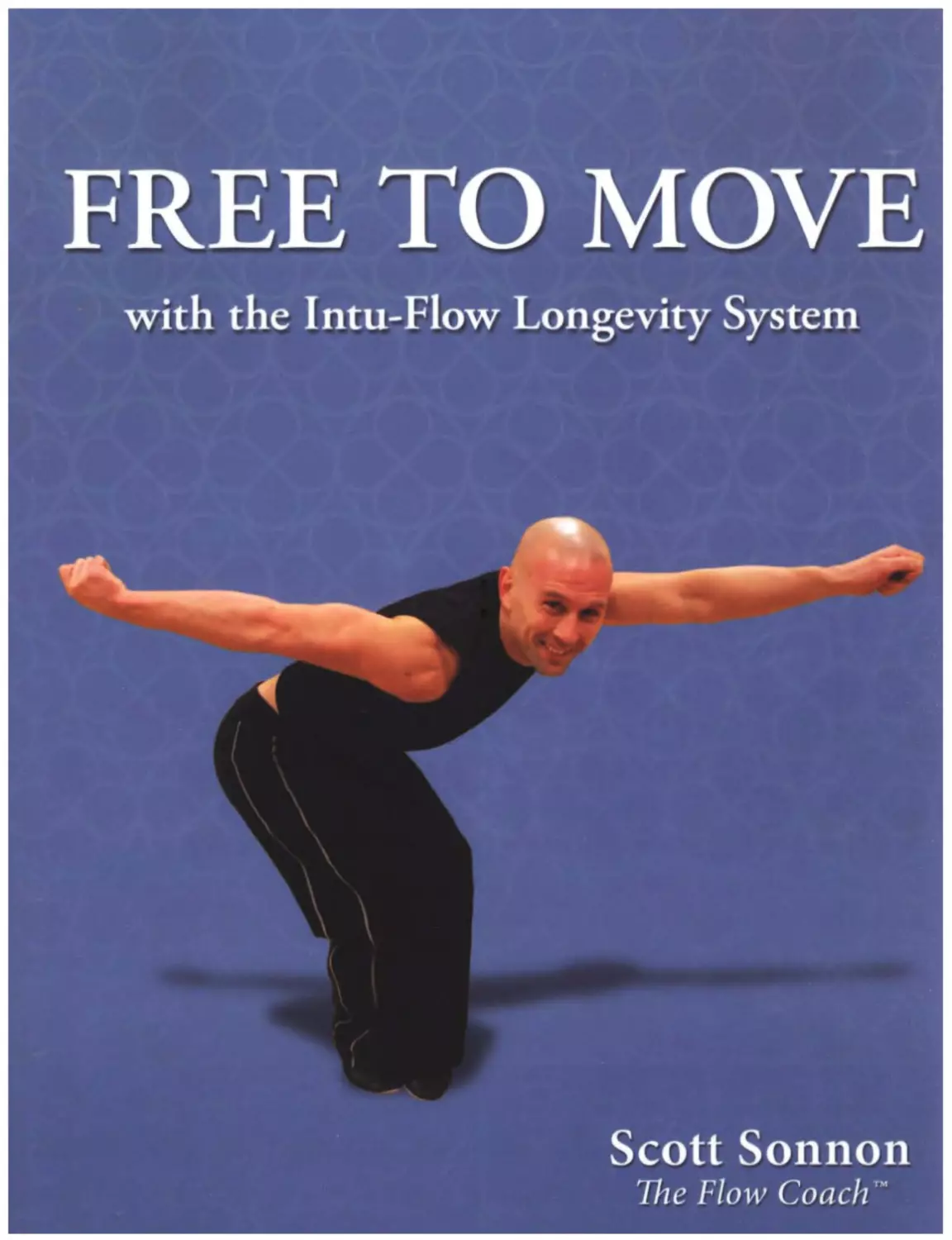
                    Scott Sonnon
The Flow Coach™

Free To Move

Copyright ©2008 by RMAX.tv Productions
All rights reserved. No part of this work may be reproduced or utilized in any form or
by any means, electronic or mechanical, including photocopying, recording, or by any
information storage and retrieval system, without the prior written permission of the
publisher.
For information on Scott Sonnon and RMAX.tv Productions, please contact:
RMAX.tv Productions
P.O. Box 501388
Atlanta, GA 31150
Website: www.rmaxinternational.com
Comments and questions should be sent to: info@rmaxinternational.com
Intu-Flow" and Circular Strength Training"' are registered trademarks of
RMAX.tv Productions.
Printed and bound in the United States of America.
ISBN-13: 978-0-9794275-6-5
ISBN-lO: 0-9794275-6-8

Credits
Editing: Amy Norcross
Design and Layout: Wade Munson • www.wadeincreativity.com
Photography: John Meloy • www.johnnydanger.net
Contributing Authors: }arlo llano, L.P.T. and Kathryn Woodall, D.C.

Disclaimer
None of the information contained in this book is intended to be taken as medical advice.
Should you have any condition that requires professional medical attention, please always
consult a doctor before you begin any exercises presented in this book or any other source.
Albeit the information and advice in this book are believed to be accurate, neither the
publisher nor the author will be held liable for any injury, damages, losses, claims, actions,
proceedings, expenses, or costs (including legal) that result from using instructions, advice,
or exercises in this book.

ii

Free To Move
Introduction. . . . . . . . . . . . . . . . . . . . . . . . . . . . . . . . . . . . . . . . . . . . . . .. 1
Ancient Discipline Turned Modern Science! ...................... 3
The Key to a Stress-Free, Blissful Life? .......................... 4
The Secret Sequence: The Fountain of Youth ..................... 5
Vibrance: The Return of Nutrition, Lubrication,
and Shock Absorption to Your Joints ........................... 6
The "Ultimate Challenge" . . . . . . . . . . . . . . . . . . . . . . . . . . . . . . . . . . . 7
You Don't Need to Be Athletic! .............................. 12
The Only Impossibility with Intu-Flow Is Failure! You Only Win! .... 12
Spirit Matters ............................................... 15
Movement and Stillness. . . . . . . . . . . . . . . . . . . . . . . . . . . . . . . . . . . . .. 19
Flow Beyond Thought . . . . . . . . . . . . . . . . . . . . . . . . . .
The Early Years . . . . . . . . . . . . . . . . . . . . . . . . . . . . .
Ancient Discipline to Modern Science . . . . . . . . . . . .
Soviet Peak Performance . . . . . . . . . . . . . . . . . . . . . .

. . . . . . . . . . . ..
.............
.............
.............

21
23
24
26

The Perfect Fight: Zero Resistance. . . . . . . . . . . . . . . . . . . . . . . . . . . . . . 29
Know F.L.O.W. . . . . . . . . . . . . . . . . . . . . . . . . . . . . . . . . . . . . . . . . . . ..
Let Go. Let God.. . . . . . . . . . . . . . . . . . . . . . . . . . . . . . . . . . . . . . . . .
Backing Up What I Believe In ...............................
The Mantle of Emotion . . . . . . . . . . . . . . . . . . . . . . . . . . . . . . . . . . . .
Healing Inside Out; Moving Outside In. . . . . . . . . . . . . . . . . . . . . . . .

33
34
34
35
36

Grace and Disgrace . . . . . . . . . . . . . . . . . . . . . . . . . . . . . . . . . . . . . . . . . 39
All Tonicity Is Conscious ..................................... 43
Higher Vibration Through Martial Art ........ " ................. 47
Higher Vibration Through Athletics . . . . . . . . . . . . . . . . . . . . . . . . . . . . 49
Linkage Versus Leakage ..................................... 51
Fear to Flow. . . . . . . . . . . . . . . . . . . . . . . . . . . . . . . . . . . . . . . . . . . . . .. 55
Going Fetal . . . . . . . . . . . . . . . . . . . . . . . . . . . . . . . . . . . . . . . . . . . . . 56
Fit to Flow. . . . . . . . . . . . . . . . . . . . . . . . . . . . . . . . . . . . . . . . . . . . . . .. 59
Fitness as a Vehicle to Flow . . . . . . . . . . . . . . . . . . . . . . . . . . . . . . . .. 61
Moving with More Energy or Less. . . . . . . . . . . . . . . . . . . . . . . . . . . . 62

Free To Move
Complex Does Not Mean Complicated! ......................... 65
Making the Mistakes of a Master. . . . . . . . . . . . . . . . . . . . . . . . . . . .. 67
Degrees of Freedom. . . . . . . . . . . . . . . . . . . . . . . . . . . . . . . . . . . . . . . .. 71
Finding Harmony . . . . . . . . . . . . . . . . . . . . . . . . . . . . . . . . . . . . . . . . . . 77
Mobility Expresses the Heart. ................................. 81
Owning Your Movement ..................................... 85
Loving Your Immobility ..................................... 89
Needing No Handout ..................................... 92
The Problem with Stretching .................................. 95
Debunking the Stretching Myth ............................. 96
Does It Stretch Back!? . . . . . . . . . . . . . . . . . . . . . . . . . . . . . . . . . . . . . 97
Rubber Band Man ....................................... 97
The Stretch Reflex ........................................ 98
Flexibility Is Speed Specific . . . . . . . . . . . . . . . . . . . . . . . . . . . . . . . . . 99
Plastic Changes ......................................... 100
Health Risks of Static Stretching ............................. 101
Short-Range Stiffness ...................................... 101
The Essence of Synergy: Range of Motion ...................... 101
Mobility Practice. . . . . . . . . . . . . . . . . . . . . . . . . . . . . . . . . . . . . . .. 102
The Myofascial Matrix ...................................... 105
Snags in the Sweater . . . . . . . . . . . . . . . . . . . . . . . . . . . . . . . . . . . .. 106
The Fascial Layers ......................................... 107
Biotensegrity . . . . . . . . . . . . . . . . . . . . . . . . . . . . . . . . . . . . . . . . . . . .. 109
The "Double Bag" .......................................... 113
Adaptation and Restriction ................................. 114
Overcompensation ................................ ....... 115
Crown Down and Heart Apart ................................ 119
"Wash the Inner Bag" ...................................... 121
The Progression of Physical Vibrance ......................... 122
Intuitive Training. . . . . . . . . . . . . . . . . . . . . . . . . . . . . . . . . . . . . . . .. 125

iv

Understanding Pain. . . . . . . . . . . . . . . . . . . . . . . . . . . . . . . . . . . . . . .. 127
Understanding Snap, Crackle, Pop! ............................ 139
Prehab, Rehab, Posthab ...................................... 145
Aging: The Process of Losing Complexity ........................ 149
The Nervous System Craves Complexity! ....................... 150
Combined Movements: Lessons from Physiotherapy. . . ............ 151
Exercises ................................................. 155
Jaw - Head - Face .......................................... 157
Neck .................................................... 173
Shoulders ................................................. 195
Elbows .................................................. 225
Wrists - Hands - Fingers. . . . . . . . . . . . . . . . . . . . . . . . . . . . . . . . . . .. 245
Mid Back. . . . . . . . . . . . . . . . . . . . . . . . . . . . . . . . . . . . . . . . . . . . . . .. 267
Lower Back .............................................. 285
Pelvis - Hips . . . . . . . . . . . . . . . . . . . . . . . . . . . . . . . . . . . . . . . . . . . . . 303
Hips ..................................................... 321
Knees - Legs ............................................. 343
Ankles - Feet - Toes . . . . . . . . . . . . . . . . . . . . . . . . . . . . . . . . . . . . . .. 367
Final Word. . . . . . . . . . . . . . . . . . . . . . . . . . . . . . . . . . . . . . . . . . . . . .. 387
What Is Your Primary Fitness Attribute? . . . . . . . . . . . . . . . . . . . . . . 387
Mobility Is Your Very Existence. . . . . . . . . . . . . . . . . . . . . . . . . . . . . 388

v

Free To Move

Vi

Free To Move

Introduction
,

Lfllow me to present the
"-.,/J.. .(gngevity System.

(C~ountain

of Youth ':. 7he Intu- ~low®

Are you Free to Move?!
End your concerns of poor health, illness, aging, and even death! Gratefully
live a full century (or more!) of healthy, vibrant years through my Fountain
of Youth - the Intu-Flow Longevity System - so simple to learn most
everyone instantly feels the surge of potent vitality and crystal-clear
awareness.
No matter how old you are, by moving each of your joints in a secret
sequence for just eight minutes a day, you will be able to:
•
•
•
•
•
•
•
•
•
•

Be pain-free without any strain
"Turn back the clock" to reverse aging
Gain graceful poise and effortless carriage
Experience a perfect balance of mobility and stability
Reclaim child-like vitality
Bathe yourself in unlimited healing energy
Enjoy true lifetime fitness without injuries
Amplify your mental acuity and awareness
Empower yourself rather than feel powerless
Be your own gym without costly machines

1

Free To Move
Dear Student,
We're bombarded daily by one emotionally disemboweling message: As we
age, we can expect nothing but disease and disrepair, incompetence, and
invalidity. But you can be free from this self-fulfilling propaganda! How?
I shall reveal to you what I uncovered during my years studying an ancient
health system literally turned space-age science. In the former Soviet Union's
scientific think tank of Olympic coaches, special operation trainers, and
medical scientists, I was honored as the first Westerner to "mind share"
their technologies. These individuals had transformed millennia-old health
traditions into cutting-edge longevity science for their space program to
guarantee cosmonauts long, healthy lives, even when faced with the ravages
of zero gravity (where all life rapidly accelerates the process of dying).
One of the men I studied with was a silver-haired monk
nicknamed Porfiri. Though of an obviously seasoned
age, he boasted of being 104 years old. Porfiri's seniority
didn't prevent him from displaying extraordinary feats
of strength, such as twirling a 140-pound tree
around his torso!
Porfiri taught a Russian monastic
practice very similar to the traditional
yoga and Sufism I was taught - in
its design to energetically align
you with grace through specific
postures, deliberate movement, and
unique breathing exercises - referring to
his ancient library called the Philokalia, meaning
"to love beauty."

Free To Move
ANCIENT DISCIPLINE TURNED MODERN SCIENCE!
My Russian mentors delved into what has worked for thousands of
years and distilled the universal principles. For weeks on end, I would
be rigorously tested with exotic recording devices, which would bleep
and blip as I performed the various movements I had mastered while
training six hours per day. Soviet scientist and physician Alexander
Bogomoletz said wisely, "You are as old as your connective tissue!"
In the United States I had improved the size and strength of my
muscles, but in Russia I was taught the more subtle power of the tissue
that surrounds the muscles, the joints, the bones, and even the organs.
Though I was a world-class fighter when I arrived in Russia, I was
regularly outperformed by individuals in their 60s and 70s - a reality
hard-swallowed, but gratefully learned!
Numerous research protocols were still classified so I was not allowed
to film many events, but one device recorded everyone of the drills:
my nervous system. I was forever changed by being required to master
the exercises. And because of the learning disabilities and physical
impairments I experienced as a child, I developed an acute sensitivity
for movement, position, and force. If I did a movement once, I never
forgot it. It was the blessing that resulted from enduring the "defects"
that had dismayed teachers of my youth.
So, what were these exercises that guaranteed a long life of highquality, pain-free movement? Whether you take my word or not, the
basic movements were nothing more than learning how to move each
joint individually!
My teacher, Russian general Alexander Ivanovich Retuinskih, sat
me down on the very first day. Because of our language barrier, he
sketched out how these movements were strung together in a sequence,
and demonstrated each illustration. Through this game of charades,
General Retuinskih explained that there are six patterns of movement
that when done in proper sequence will spring your Fountain of Youth.

Free To Move
And if you merely take each joint in proper sequence and go through
its basic ranges, you will be amazed at how energized you feel by the
end of just one session performed with the right intention.
General Retuinskih would select a joint, press a particular point,
and produce pain. He would then show me a movement and have
me perform it. When he returned to the same pressure application as
before, I would experience less discomfort. With each more advanced
movement he taught me, the pain diminished until it was completely
gone. And then something else happened.
When the "noise" of pain disappeared, a sudden whoosh of energy
flooded into the local area; it then started to leech into the next adjacent
joint and so on. By the end of this session, I felt like a superhero ready
to take off!
Everyone of those wintry, dark mornings, I climbed out of my rack
in my skivvies to run outside and perform my breathing exercises,
my postures, and my movements. And each morning more and more
energy started to uncork, like a sluice gate was being opened higher
and higher within me.

THE KEY TO A STRESS-FREE, BLISSFUL LIFE?
During deeper sessions with General Retuinskih, and my other Russian
teachers, I came to understand the real key to this movement: Every
joint carries a specific emotional component, so restoring the mobility
in that area discharged the biochemical emotion-blocking energy.
Each movement is accompanied by greater psychological clarity and
stronger emotional power.
Movement is life. Without mobility, we are literally enslaved. So I
moved the area of my back that had suffered a disc herniation. I moved
it for several repetitions and then performed several squats to check
my pain level and range of motion.
4

Free To Move
I stood dumbfounded. No pain. None. Full range of motion. Butt to
floor.
Awesome. Completely awesome.
General Retuinskih smiled at the expression on my face. And then he
rapped on his illustration to highlight that he had shown me only the
basic movement at that point.
I laughed as he went on to share how the movements progress in a very
specific sequence, which relates to the way we develop neurologically,
to the way our spine and our brain evolve from infancy. Scientists call
it the cephalocaudal-proximodistal trend. But the knowledge of how
to take advantage of the energetic development of that secret sequence
had remained buried in the indigenous Russian health discipline that
I was given the privilege of studying from its masters.

THE SECRET SEQUENCE: THE FOUNTAIN OF YOUTH
The second secret to Intu-Flow involves a movement sophistication
pattern unique to the Russian people. None of these exercises are
performed on the ground; all are done while standing. And each
movement unlocks a new valve of nutritive flow in your body.
Because Russia sits in the middle of the world, you will see movements
that look like yoga, some like martial art, some like dance. However,
it's the scientific, systematic recipe that sequences the opening of those
energetic valves to restore nutritive flow to every cell in your body:
head to toe, core to fingers, bones to skin.

5

Free To Move

VIBRANCE: THE RETURN OF NUTRITION,
LUBRICATION, AND SHOCK ABSORPTION TO
YOUR JOINTS
The third secret to Intu-Flow involves the progression of the movement
patterns from the simple to the complex, but in a way that you're
never, ever confused as to the path to take. As you move a joint, you
decompress the "stuck" areas, allowing the very fluid that provides
lubrication and nutrition to reach these areas. You see, what the
scientists showed me is that without movement, you are in a process
of daily suicide. The only way a joint can get nutrition is through
mobility, so if you don't move each joint through its entire range of
motion, you are starving that tissue. No matter how good your diet
is, the nutrients are not being shipped to the areas that need them ...
without bathing the joint in healing movement.
Literally, immobility is the aging process, which means that Intu-Flow
is the Fountain of Youth!
You won't find one Intu-Flow exercise to be difficult or overcomplex.
Within less than a minute you'll learn each movement, and when you
perform it for five repetitions you will feel fantastic instantly. No, I'm
not kidding. I've experienced this firsthand, and so have thousands of
my students worldwide. The only people who don't benefit from IntuFlow are the ones who have become so jaded by actual gimmicks that
they walk on by the "real McCoy" and miss out on the instant, lifetransforming results of this turn-back-the-clock energy-enhancement
mobility system.
No matter how tired you are when you wake up in the morning,
these exercises will open your valves faster than anything you've ever
experienced before.
Say goodbye to your espresso machine! Through my easy-to-Iearn
movements you'll be more energized than if you had a triple shot,
without crashing!

6

Due to the fact that these movements are so simple to do, they compose
the ideal "sustainable exercise" routine for individuals who are part
of the boomer and post-boomer generations (like me). My Intu-Flow
Longevity System is really a "retirement plan" because you can start
doing it now in just a few minutes a day, and the interest you gain pays
huge dividends for your quality of life as you age - and continue to
age without early interruption!
If you're an "extreme athlete" looking for a kick-ass workout, you
probably won't be enamored with the sustainability of the movements.
I hear you on needing trials by fire to increase your conditioning.
But just like when I work with world-champion professional athletes
such as Ultimate Fighting Championship fighters, your recuperative
abilities are more important than your work because, without recovery,
you're training is like a wound that can't heal. And the energy that
you'll gain by performing the Intu-Flow program, even if only for 14
minutes per week, will give you the ability to train harder, longer, and
more safely.

THE "ULTIMATE CHALLENGE"
Over the years, I accepted a few more high-profile private clients and
designed and contributed my programs to professional fighters in
mixed martial arts competition, including winners of the Ultimate
Fighting Championship, such as Elvis Sinosic, Jorge Rivera, and
Alberto Crane.
Teaching these extreme athletes is really the final word on practical
effectiveness because they absolutely crave being tortured by nearsadistic levels of strength conditioning.
However, do you think that the best fighters on the planet would be
interested in something that wasn't created to increase their muscle
size? Well the response is a resounding and heartfelt, to put it in their
actual words, "Hell yeah!"

7

Free To Move
Read what the following health care professionals have had to say
about my Intu-Flow Longevity System:
"The way that Scott Sonnon has interwoven and tied it all together is pure
genius. As a chiropractor and medical doctor specializing in rehabilitation,
it was very refreshing and inspiring to discover a system so firmly based
upon good biomechanics and modern sports science. Seeing Scott move is
pure magic, and his philosophy and approach to martial arts training are
simply revolutionary. I have been practicing the Intu-Flow program daily
for two months, and a problem I was having with chronic neck pain and
daily tension headaches has all but resolved. I was somewhat surprised that
as a physician specializing in such things I had underestimated the value of
something as simple as working the basic ranges of motion on a consistent
basis. The more I learn about Scott's approach, the more I am rethinking
some of the things I have taken for granted in my career!"
- Keith P. Myers, M.D.
Texas, USA
"Intu-Flow has been a gift to my patients as a tool that is far superior, easily
learned in small settings, and requires no tools. The type of neurological
training that this system offers allows me as a physician to get positive
results quickly, and even reluctant patients are won over by their own
quick response to treatment. Intu-Flow explores your own mobility at
the beginning of movement, your mind. The entire system of training is
done in the spirit of healing. You do not work into pain as this initiates
the panic/fight/flight reflex, dumping large amounts of hormones into the
system. You are taken through your own body's movement patterns in a
slow and safe manner, allowing you to pay attention to the small/medium/
large problem areas. It is like going through the ABCs of your body. Once
you master the simple basics you begin to add those ABCs together to form
words, complicating your new movements incrementally, slowly speeding
up, smoothing out the corners to mastery."
- Kevin Teagle, D.C.
Oregon, USA

Free To Move
"Intu-Flow has been a delight for me personally and professionally. I come
almost purely from a health care point of view. Regardless of where someone
is at with her health, Intu-Flow meets a person exactly where she needs to be
and then lets her grow as far as she would like. It can be fun, done in as little
as 30 minutes a day, performed in the privacy of your home or with a group,
and allows people to progress so that enthusiasm stays up and they continue
being active. The possible benefits to their neuromuscular system are vast,
but the positive benefits of regular practice are certainly not limited to that
aspect of the body. Intu-Flow empowers people to grow up and to grow old
with grace and agility. Who wouldn't want that? Thanks for making such a
great product available and affordable for most people."
Kathryn Woodall, D.C.
Kansas, USA
"I love this stuff! Scott's movement approach has brought excitement back into
my workouts. I literally jump out of bed in the morning, ready to GO!"
Mitch Simon, D.C.
Missouri, USA
Cofounder-at-Iarge, Resistance Training
Specialist Certification Program
''As a physician dealing with pain for the last 20 years, most of my practice
failed to see the importance of proper sequential movement as a very
important therapy for patients with pain until I came across Scott Sonnon.
I have been wondering for years about the lacking ingredient that will make
my patients pain-free for longer periods of time if not totally eliminate it.
The breakthrough for me came from Intu-Flow!
By regularly incorporating Intu-Flow into my practice, even my personal
knee pains and stiff back muscles got better. This gave me the confidence to
incorporate selective movements for my patients in pain, which gave good
results! Many more have benefited since then. The latest: a myotherapist in
our clinic with a very bad back because of a long history of lifting weights;
three months after Intu-Flow, he swore about the big difference in his
flexibility and his pain had dissipated!

Free To Move
N ow, all of my patients are given Intu-Flow before they leave the clinic,
which will give them a better quality of life in the long run. Thank you,
Scott and your Intu-Flow, for filling another piece of the puzzle for better
and pain-free living."

Edwin Falconi, M.D.
Philippines
"I have been doing Intu-Flow for a few months now three times each week.
I don't feel exhausted and beat up when I'm finished, and actually have
more energy when I'm done! As a practicing chiropractor, adjusting patients
all day can be a little hard on my body, so I frequently stop for a couple
of minutes and perform some of Scott's movements, and it takes much of
the stress off my joints. The movements are biomechanically sound, with
nothing potentially harmful, and it's obvious to me that they were designed
with that in mind.
Intu-Flow is the most rational and sensible approach to fitness and wellness
that is currently available, because it restores joint ranges of motion first. By
focusing on restoring and then maintaining normal joint ranges of motion
and allowing your body to move more efficiently and gracefully, you'll be
doing something that will very likely have the effect of healing many old,
nagging injuries and preventing the onset of any new ones.
I look around at many elderly people who are hunched over, have a hard
time walking, have joint pain, and have restricted mobility in their joints,
and I feel determined to make sure that I never end up like that. Intu-Flow
allows me to reach that goal, so I'll never stop using Scott's program."

Joe Myers, D.C.
Maryland, USA
"I am 63 years old, and have been working out since I was 15. Over the
years I have managed to injure my back, neck, shoulders, knees, and various
other assorted body parts as a result of bad technique, no technique, or
what has been considered good technique by trainers, but isn't. I've trained

in martial arts since 1962, and have again dinged myself, many times,
following the conventional training methods of the various arts that I've
practiced.
I am a physician, praCtICIng dermatology, but I have had fellowships
in physical medicine, and follow the trends as they come and go. I was
introduced to lntu-Flow a couple of years ago by a patient with rheumatoid
arthritis. He was thrilled by the resulting decrease in pain, increased
mobility, and dramatic reduction in the need for arthritis medication.
I purchased the DVD, and two weeks later my neck, which had hurt for
seven years following a grappling injury, was pain-free.
I explored CST's many aspects, and concluded that I needed Scott Sonnon's
teaching about 40 years ago. Well, better late than never. I am now a
CST instructor, teaching a weekly class, plus a self-defense class using
the techniques of lntu-Flow and other components of CST for attribute
development.
I have seen in myself and my students, who range in age from 13 to the late
80s, dramatic improvement in mobility, balance, and grace in activities of
daily living, as well as self-defense training.
With 48 years of training behind me, I find Intu-Flow the most rational,
effective, and enjoyable form of training I've ever experienced, and I
continue to explore the constantly evolving new programs available from
Coach Sonnon.
Thank you to all the coaches I've worked with and plan to continue to
work with, as long as I'm above ground."

James H. Auerbach, M.D.
New Mexico, USA

Free To Move
YOU DON'T NEED TO BE ATHLETIC!
What is the most surprising for a lot of people is that the Intu-Flow
Longevity System doesn't require you to be athletic in order to perform the
movements. Sure, with its help you can become supremely athletic. But
unlike anything else I have ever experienced, you don't need anything to
start. When you experience the incredible surge of energy from one of the
exercises, you will discover this for yourself.
And of course, you have only one piece of equipment you have to carry
with you: you! You are never "gymless" because wherever you are, whatever
you're doing, even if you are bound to a wheel chair, you can start these
movements. When I was speaking in Santa Fe, New Mexico, at an obesity
recovery camp, nearly the entire audience broke out into tears because they
just didn't realize that they could be Free to Move, if only they knew how!

THE ONLY IMPOSSIBILITY WITH INTU-FLOWIS
FAILURE! YOU ONLY WIN!
And I have to admit that the most exciting feature of this system is that
you cannot fail, you cannot do the movements "wrong," and you cannot
hurt yourself if you follow the easy-to-understand instructions. Grace,
poise, and the power that comes from them are your birthright, and these
movements will help you reclaim them in most cases instantly, but in all
cases you will be forever improving.
Even with just eight minutes of practice, you will feel like a human dynamo,
pain-free, unfettered, tuned up, and revving like you're a six-year-old at the
amusement park!
Despite feeling supercharged and pain-free, the biggest shock you'll
experience with the Intu-Flow Longevity System is still coming. But of
course, some people have no desire to "go for it" - we all have encountered
those people who just feel complacent with low-quality living. It pains me
to accept that some cannot risk losing their misery for the chance at this

12

Free To Move
"bubbling bliss-itude." Regardless of whether this course may have given
them a vibrant, long life, some just can't accept help.
It is likely that you aren't one of those people, so, mi amigo, I'm going
to talk with you privately just a moment, since you've made it here and
have had the intelligence to keep exploring your potential. Because you are
reading this, I must assume that you're one of the progressive "longevitypreneurs" who wouldn't turn down a precious opportunity to gain exciting,
life-altering results.

My 45-year-old Siberian shaman friend Vanya looks like he's 19 years young!
Watching my teachers in Russia move with the spry deftness of teenagers
and yet knowing that they were 35 and 45 years older than me (and I'm 38)
was overshadowed only by how youthful they looked - not just in their
movement, but in their physical bodies! My Siberian shaman friend looked
like he was still a teenager, so much so that when he took me on tours of
the palaces to show me the rich history of his country, young girls would
flirt with him. He would just wink at my dumbfounded expression.
That vitality directly relates to the regulation of stress chemicals through
the breathing, postures, and motions in the Intu-Flow Longevity System.
Following my program will immediately start pulling back that old hand
of time, and start infusing your every movement with wellness.
Join me in the dream of you living past your century mark in optimal
vitality!

Free To Move

14

Free To Move

Spirit 0Vfatters
"Spirit without matter is expressionless,·
matter without spirit is motionless. "
Dr. John Demartini

I

Lf1 a strategy meeting on our global initiatives, I was asked what was

~ my ultimate mission, the underlying motivation for bringing my
books and courses to more and more people. So I let loose . ..

We're at a war around the world and within ourselves between love and
apathy. This One Energy, and the degree of its absence, has plagued
the world with violence throughout history.

It is impossible to remain apathetic and increase one's Bow; as our
bodies become more immobilized, we devolve and become more
apathetic. As we restore Bow in each area, we release love back into
our lives, and to those around us.
Physicists will explain that all things in the universe are composed
of light, or energy. And all light is a frequency, a wave; each wave is a
particular vibration. Everything in the universe is vibrating. Entities,
including ourselves, are not solid, but consist of molecules vibrating at
different frequencies, depending on the combinations of material from
which they are formed. Vibrating molecules produce a frequency that

15

Free To Move
can be measured or converted into cycles per second (CPS), or hertz
(Hz). The human ear can hear between 20 and 22,000 CPS (Hz), so
most of the frequencies of the objects in the world around us are either
below (too dense) or above (too fine) our range of hearing. But this
doesn't mean they can't be sensed. The very muscular tension in your
body, each contraction, holds a frequency. Every movement sends a
particular vibration out into the world and "sings" with it.
Different areas of the body all sing different notes, which, when blended
together, produce a symphony as unique as a fingerprint. Idyllically,
we would all be in harmony, but due to the constant bombardment of
external and internal factors, we become fearful and brace and resist
the natural flow. This immobile stagnation pulls us "out of tune" with
our true song, fostering disease.
So, the goal of physical flow is to release our bound flow and restore
ourselves to harmony by elevating our vibrance: The higher our
vibratory aptitude, the greater our quality of movement, the greater
the abundance of love in our lives.
You are not meant to toil the earth. You are not meant to trudge from
one task to the next. You are not meant to be encased in pain. You
are not meant to feel ugly. These are all examples of low vibrational
experiences that muddy how we see the world.
Think of when you last had a migraine, or a head flu. Do you
remember how it made everything seem lackluster and colorless, how
you felt grumpy and snippy, if not irascible? The lack of higher-order
movement, or absence of higher vibrational experiences, makes us feel
that way to a much greater degree.
N ow imagine when you were first in love, that first kiss on that first
date, the first time you held hands in public, or even the first time your
eyes met and you both acknowledged the harmony between the two
of you. Remember how that made the world feel like a symphony and

16

Free To Move
everything around you a gallery of beauty? The higher our quality of
flow, the greater the vibrance with which we experience everything in
our lives.
You are meant to move with regal grace. You are perfectly powerful
always and already. You don't need to become beautiful. You must
only share your beauty, share your vibration with the harmony of the
world ... through movement.
Flow is physical wealth. And you deserve to express your innate gifts
of receiving and expressing your physical abundance, vibrance, and
energy. When you allow flow in anyone aspect of your life, it surges
into all aspects. Open the sluice gates and flood the drought-ravaged
fields.
There is a direct relationship between your physical vibrance and
your ability to fulfill your dreams in the other areas of life - as I
have described them in my DVD Threshold Training the triune of
vocational, tribal, and physical, or as Dr. John Demartini expands
as the vocational, financial, social, familial, spiritual, mental, and
physical.
In this book, I will share with you exercises that restore mobility
into your life. But these cannot be restricted to merely a "physical"
experience, for truly there is no such thing as a distinction between the
body and the mind and the spirit. These are all artificial conventions
we use to discuss things that transcend language.
Flow is what we already and always are. When we are Free to Move,
we gain the ability to step out of our own way, and allow flow to rush
love unimpeded throughout our lives.

17

Free To Move

12

Free To Move

cMov~ment and

Stillness
"Music is the space between the notes."
Claude Debussy
Lfll things in the universe move. Stillness is an illusion, a fabrication.
\......,/:.l. c..JVfovement is progress, and resistance to movement is regress. 'lhink
of the "movers and shakers" of the world. 'lheir motion shakes up, wakes up,
the world.
I

Movement is life. The absence of movement is death. It's a law of the
universe that aliveness is defined as movement, and death as stillness.
From an emotional standpoint, and a physical reality, mobility equals
freedom, and immobility equals slavery. What do we do to those
convicted of crimes? We imprison them. We remove their freedom
with bars, shackles, and straightjackets.
As I will discuss, we knowingly or unknowingly incarcerate ourselves
with fatness. The tissue acts as emotional insulation thickening the
walls of our prison. It requires enormous courage to begin the process
of removing those bars. If it were not for the loving guidance of my
teachers, I would never have become free of the walls of my childhood
obesity.
In this book, I will share with you the mental, emotional, and physical
tools with which you can emancipate yourself from imprisonment you

feel, whether that be fat or pain or motor amnesia forgotten how to move!

even if you have

We will reclaim our liberty one degree at a time with a cumulative
effect, which one of my teachers, Dr. Bernstein, named "freedom
by degree." We will slowly thaw our graceful efficiency not by doing
more, but by doing less. We can think of the opposite of stillness as
noise, rather than flow. Removing erratic motion allows us to move
with more fluidity.
Stillness exists, but we must reframe it. We must look at stillness as the
absence of resistance rather than the absence of movement. Stillness is
the goal, but stillness in motion. Through what my clients have called
the "Sonnon Method," you can become like the eye of a storm: No
matter how much things appear to be blowing down around you, you
can keep your center, continue to move, and remain in flow.
Some have asked how I managed to develop this method and
accomplish so much in my life in the face of such intense physical and
mental disabilities and social and familial trauma. Reflecting upon
the journey to the time of writing this book, I understand that it looks
very logically sequential, but it certainly never felt that way. It only
seemed like a pinhole of hope, an impossibly small escape hatch that
was an incredibly long way from me. But really, what else can you do
but climb? I tried giving up. You just sit there. Then what? Climb. Cry
along the way, for sure, slip, fall, and start over. But really, there's only
one option: Climb.
I feel blessed to have the opportunity to share this journey. The challenges
I have faced are all compliments, because we're never thrown anything
we can't catch. And all of those challenges were preparation; they gave
me the chance to learn the lessons that others take for granted: how to
see, how to move, how to think, how to feel, how to flow.
Mobility in its pure form is flow.
20

Free To Move

'Flow 'Beyond 7hought
"Exhalation is not the expulsion ofair but the
expulsion ofego in the form ofair.
In exhalation you become humble, whereas pride
comes in inhalation. To learn this is to understand the
movement from attachment to non-attachment."
B. K. S. Iyengar, The Tree of Yoga
n 200 13C Patanjali compiled the Yoga Sutras, the ((bible" that discusses
1V!Ja yoga, the discipline ofharmonizing the body and mind often referred
to as LAShtanga yoga. In the Sutras, Patanjali details the eighth limb ofyoga,
called Samadhi. Samadhi is the state of consciousness in which the subject
(you) and the object (the world) become indistinguishable.

I

Samadhi is said to be the state of being aware of one's existence without
thinking - a state of undifferentiated beingness. Patanjali names
it the only stable unchanging reality; all else is ever changing and
does not bring everlasting peace or happiness. In this flow-state, the
mind has become quiet and given up its desires and attendant. Some
teachers describe it as complete absorption into the object of one's
pure, unmotivated love of God.
In his book Autobiography of a Yogi, Paramahansa Yogananda gives
this stirring description of Samadhi: ''An oceanic joy broke upon
calm endless shores of my soul. A swelling glory within me began to
21

Free To Move
envelop towns, continents, the earth, solar and stellar systems, tenuous
nebulae, and floating universes. The entire cosmos, gently luminous,
like a city seen afar at night, glimmered within the infinitude of my
being. Irradiating splendor issued from my nucleus to every part of the
universal structure. Blissful amrita, the nectar of immortality, pulsed
through me with a quicksilverlike fluidity. The creative voice of God I
heard resounding as Aum, the vibration of the Cosmic Motor."
When my students practice yoga, it is this state that we concentrate
upon, the physical techniques of which I discuss in my book Prasara
Yoga. Prasara is a Sanskrit term meaning "to flow without thought."
In traditional Japanese martial arts as I was taught, mushin, or, more
properly, mushin no shin, translates to mean "mind of no mind." The
expression draws from Zen Buddhism, referring to a mind not fixed or
occupied by thought or emotion, and thus open to everything. Mushin
happens when the martial artist feels no anger, no fear, no ego during
combat. The distinct absence of discursive thought allows the martial
artist to act totally free and without hesitation, relying upon not what
s/he thinks should happen, but what s/he feels is happening.
Zen master Takuan Soho wrote, "The mind must always be in the
state of flowing, for when it stops anywhere it means the flow is
interrupted. It is this interruption which is injurious to the well-being
of consciousness. In the case of the martial artist, it means death.
When the swordsman stands against his opponent, he does not think
of the opponent, nor of himself, nor of his enemy's blade. He just
stands there with his sword, forgetful of all technique, ready to follow
only the dictates of the flow. The martial artist effaces himself as the
wielder. When he strikes, it is not the man, but the blade in the hands
of flow, which strikes." (Soho, Takuan. 1he Unfettered Mind. Trans.
William Scott Wilson. Tokyo: Kodansha International Ltd., 1986.)

22

Free To Move

THE EARLY YEARS
I spent my youth subjected to violence, perhaps due to my mental
disabilities and childhood obesity. The physical abuse wasn't nearly
as traumatic as the emotional terrorization. Long days and longer
nights dreading the inevitable beating acquainted me all too well with
fixation. My obsessive expectation of the next pernicious attack was far
more injurious than even the worst multiple-assailant "boot party."
You learn fast that fighting back only gets you beaten harder. Running
away only gets you chased down. And "taking it like a man" only
causes the attackers to keep going until you are unconscious. Your
only recourse is to "roll with the punches" - make it look like it hurts
more while minimizing damage. Years of this "school of hard knocks"
forged in me an internal change, most likely a coping skill to shut off
the external violence in the same way that your nervous system shuts
off pain to an area for an extenqed period of time.
When my concern for the violence turned off, the beatings became, for
lack of a better term, less effortful. I won't say effortless. But they didn't
seem as bad, and the emotional expectation evaporated. Less and less
I catastrophized about what may come around the next corner. I don't
know if I can qualify it as a flow experience, because I am reflecting
upon it only decades later. I knew even in those darkest moments of
my past, sobbing with bruises, throbbing with sorrow, that one day
I would do great things. And it was that hope that pointed me in a
direction leading to university.
There, I majored in philosophy with concentrations inAsian philosophy
and German existentialism. This study happened at the same university
where I earned a spot on my first martial arts team. The university
team took me across the world, where I competed with great fighters.
And it was the synergy between the object of my study and the subject
of my experience fighting that allowed me to tap flow as a blissful
event. Until that time, I had never truly experienced flow in fighting.
But it set the stage for what I would later make the mission of my life.

23

Free To Move
I began to study the modern science of flow psychology, and the works
of its progenitors.

ANCIENT DISCIPLINE TO MODERN SCIENCE
In his book Flow: The Psychology of Optimal Experience, psychologist
Mihaly Csikszentmihalyi describes flow as the mental state of
operation in which the person is fully immersed in what he or she is
doing, characterized by a feeling of energized focus, full involvement,
and success in the process of the activity. He identifies the following
characteristics as accompanying an experience of flow:
• Clear goals (Expectations and rules are discernible and
goals are attainable and align appropriately with one's skill
set and abilities.)
• Concentrating and focusing, a high degree of
concentration on a limited field of attention (A person
engaged in the activity will have the opportunity to focus
and to delve deeply into it.)
• A loss of the feeling of self-consciousness, the merging of
action and awareness
• Distorted sense of time (One's subjective experience of
time is altered.)
• Direct and immediate feedback (Successes and failures in
the course of the activity are apparent, so behavior can be
adjusted as needed.)
• Balance between ability level and challenge (The activity
is neither too easy nor too difficult.)
• A sense of personal control over the situation or activity
• The activity is intrinsically rewarding, so there is an
effortlessness of action.
• Action awareness merging (People become absorbed in
their activity, and the focus of awareness is narrowed
down to the activity itself)

Free To Move
Csikszentmihalyi also notes that not all characteristics are needed for
flow to be experienced. (Csikszentmihalyi, Mihaly. Flow: 1he Psychology
of Optimal Experience. New York: Harper and Row. 1990.)
The concept of "being in the zone" during an athletic endeavor is
another example of the flow experience. Theories and applications
of being in the zone and its relationship with athletic competitive
advantage were the primary topics of my study in the former Soviet
Union, when 1 had the honor of training with the nation's Olympic and
national coaches in sport psychology. My Russian teacher, Alexander
Ivanovich Retuinskih, suggested that "turning on the machine"
improves coordination due to its efficient integration of the conscious
and subconscious functions. Many athletes describe the effortless
nature of their performance whilst achieving personal bests.
The legendary soccer player Pele described his experience of being in
the zone as follows: "I felt a strange calmness ... a kind of euphoria. 1
felt 1 could run all day without tiring, that 1 could dribble through any
of their team or all of them, that 1 could almost pass through them
physically."
Formula 1 driver Ayrton Senna, who during qualifying for the 1988
Monaco Grand Prix felt like driving the car beyond his limits, said
this: "I was already on pole, and 1 just kept going. Suddenly 1 was
nearly two seconds faster than anybody else, including my teammate
with the same car. And suddenly 1 realised that 1 was no longer driving
the car consciously. 1 was driving it by a kind of instinct, only 1 was
in a different dimension. It was like 1 was in a tunnel. Not only the
tunnel under the hotel but the whole circuit was a tunnel. 1 was just
going and going, more and more and more and more. 1 was way over
the limit but still able to find even more."

25

Free To Move

SOVIET PEAK PERFORMANCE
My study of peak-performance flow led me to Soviet Olympic coach
Dr. Grigori Raiport and his out-of-print masterpiece Red Gold: Peak

Performance Techniques o/the Russian and East German Olympic Victors.
Dr. Raiport, who earned his medical degree and Ph.D. in psychiatry
from Rostov State Medical Institute, was associated with the prestigious
National Research Institute of Physical Culture in Moscow. There he
said, "We developed champions in every sport for world competitions
and for future USSR Olympic teams; it was there that my mental
training techniques of sports psychology were first used by Russian
athletes." Suggesting that 800/0 of all athletic competition is mental
and only 200/0 is physical, Dr. Raiport asserted that his techniques gave
Russian athletes the competitive edge that earned them "a reputation
of super achievers."
When I stumbled into my university wrestling room to find the school's
Sambo {the Russian national martial art and wrestling style} team
training for the upcoming national championship, I realized that my
path led behind the Iron Curtain. I threw myself headlong into the
sport and devoured all materials I could, spending four hours a day
practicing in addition to completing my university studies.
After winning several championships, I earned a spot on the U.S.
National Team to compete at the Universiad {also known as World
University Games, the Olympics for university students}. As I traveled
to international competitions such as the Universiad, I made more
contacts, and began petitioning to be allowed as the first Westerner to
train in the former Soviet Union.
I refused to be discouraged by the impossibility of the Russians
accepting a foreigner, and by the unlikelihood that they would accept
someone of my genetic challenges. Thankfully, that tenacity led to my
admission several years later with an email I will never forget.

Free To Move
In Russia, I fell into a massive think tank of research. Because sport
was a political platform for the country, government funding created
a flood of discoveries, tools, and techniques. The nation's special
forces operators were its elite athletes and its national coaches. This
fascinating collage of redundant talent brilliantly pooled the nation's
empirical knowledge to validate and stimulate further research.
One particular KGB intelligence training director taught us the
techniques for turning on the machine - a metaphor the Russians used
for the emotionally detached, peak-performance attitude that brought
them success on the fields of sport and combat. I quietly acknowledged
the political programming that manipulates the sons and daughters of
all nations to inhuman deeds, and by doing so allowed myself to study
these techniques used to enter the "zone of optimal experience," which
we better know as flow.

Free To Move

" - - - - - - - - -- - - - -

28

Free To Move

"Where there is love, there is no effort."
Amma

I

've spent my life cultivating what I call the perfect fight. Imagine it much
like the perfect wave for a surfer or the perfect climb for a mountain climber.
'lhe perfect fight is where the ego never pops up on the radar. ~ doubts,
hesitations, fears, concerns; no attention paid to the lights, audience, or noise;
no distractions; no superfluous tension; no inhibition. 'lhe ego is all of these
things.

The perfect fight involves zero resistance. You exist inextricably
intertwined with your opponent. The excellence that the two of you
engage betters each other. You cannot improve without him, nor he
without you, nor both of you without the event. Loving your opponent
enough to give him no quarter and to give him 100% of yourself for
your mutual development is the perfect fight.
I've touched it throughout my fighting career. Every martial artist does,
but few realize it because they're on the receiving end of manipulation
for the first 10 or 20 years. It seems so much like a physical event, when
martial art is primarily an emotional and mental discipline by means of
the physical. When you're "psyched out" by your opponent, he's created
patterns of tension within you, dropping you out of perfection, bringing
your ego - your fear, doubts, hesitations, insecurities - into you.

Free To Move
This may sound like a battle, and it is, but it's also a blessing. The best
gift your opponent could give you is an opportunity to learn where
your "hot buttons" are that can throw you out of your game. That's
the benefit.
You'd never know where these hot buttons were without him. You'd
never even know the difference between you and your ego. Many
people live their lives that way. They live their lives as passengers while
their egos drive the bus. They react only with anger, frustration, rage,
sorrow, et cetera. They don't have the opportunity to know that they
are not those patterns.
Martial art is a seething cauldron, with a temperature not for everyone.
Like my teacher Sri MataAmritanandamayi Devi, or Amma, has taught
me, not everyone has the same yoga. For me, though, it's fighting. The
threat of physical harm demands that the ego be suspended. And once
you develop the skills to protect yourself, you begin to learn how to
step beyond self-defense. The fight is only the means to an end. The
goal of martial art isn't the product (self-defensibility); it's the process:
to suspend the ego.
After you've developed your skills, you stop worrying about collecting
techniques, and you start working on betterment. You start to get
glimpses during your sparring. Your ego just suddenly evaporates in
the most intense exchange. You respond only just enough to evade,
not enough to fear - missed by an inch, missed by a mile, as the
saying goes.
And those brilliantly quiescent seconds stretch out like years. They were
among the most serene events of my life. Nothing wrong; everything
perfect. It feels as if you stand snugly in the eye of a storm raging
around you, though it kisses the surface of your body as it passes intimately dose, but impossibly harmless.

30

Free To Move
Those moments set the stage for the rest of my life. They were like a
spiritual blink at the divine order: a micro of the macro. Those delicate
moments of what sport psychologists describe as the "zone of optimal
experience," and others still as "peak performance," launched my
mission to bring that opportunity to others who were not "fighters"
- to bring the process of martial art to everyone.

It required meeting an "earth worker" named Jo while presenting an
Intu-Flow seminar in Australia for me to realize how widely accessible
this state is. After having a late dinner together in Sydney discussing
the "perfect fight," we saw each other the next day at my seminar.
With twinkling eyes, Jo exclaimed how she had just had the perfect
fight with her employer.
Her employer had been devaluing her contribution to the corporation
because he didn't realize her efficiency level. To complete her tasks, Jo
required a fraction of the time and energy that others did to complete
the same tasks. Her employer had been fixated on the low number of
her actual hours rather than the incredible efficiency with which she
accomplished her objectives.
After our discussion of the perfect fight, J 0 decided that she was going
to go straight into the storm rather than skirt it and allow it to slowly
erode her sense of fulfillment with her job. While Jo was in the midst
of a meeting, her employer called her, demanding that she immediately
conclude and report to his office. J 0 could have easily allowed herself
to be psyched out by this situation, but she realized that no matter
what he threw at her, the best resolution would result. That's the thing
about the perfect fight: No matter what happens, the conclusion will
be the perfect solution.
J 0 marched over to her employer's office and found him about to enter
the building. Rather than waiting for him to settle into his comfort
zone, she smiled and approached him, and they rode the lift together.
When the two actually got to the boardroom, J 0 opened her arms
31

Free To Move
and asked the employer what he thought was the best solution to the
issue.
He mustered his anger and threw an onslaught at her. But Jo remained
emotionally detached. She maintained control of the situation in her
posture, breathing, and movement in spatial relationship to him ...
and resolved the situation to her satisfaction. Most important to her, J 0
knows how she can reproduce the strategy by orienting on the perfect
fight.

Free To Move

1VJow RL.O.W
describe flow as an acronym: Following Lovingly Ordered Wisdom. I have
/ an unabashedly romantic relationship with the state, as I consider it the
central focus of all physical disciplines. 'Flow doesn't distinguish between the
head, the heart, and the hand. ~ither should we. It is a unified experience in
which our thoughts, feelings, and actions are one.
When we "go with the flow," life becomes vibrant, effortless, and
brilliant. When we allow flow to intuitively guide us, although we
could never have extrapolated our trajectory by following the current,
when we arrive at anyone point, the divine order of things is obvious.
Certainly it can feel eerie, but its wisdom remains undeniable. I use the
term lovingly because we cannot force flow. We cannot even create it.
We can only allow it to erupt from within us and surge through us.
After not speaking to a former student of mine for six years, an athlete
who had moved 3,000 miles away, I saw her walk by me during a
Christmas Eve church service I had attended following an invitation
from a friend's family. Compelled by some internal drive, I hurriedly
excused myself and ran after her to speak with her. She was nowhere
to be found. Three months later, I packed all of my belongings into
my car and relocated the 3,000-mile distance to where she had moved.
Four months after that, we moved in together. And a year and a half
after that, we were married. If I had not followed lovingly the ordered
wisdom of those crazy events, the woman of my dreams may have

Free To Move
slipped through my fingers, and I would not have become the man I
am today because of her.

LET GO. LET GOD.
When you allow flow into your life, when you start to trust your
intuition, magical events unfold. However, these moments of flow
require faith, involve risk, and include discomfort. You may not
know why you feel compelled to mention to the stranger standing
next to you that you love her necklace, but when you surrender to the
impulse, a wonderful conversation leading to a new job opportunity
opens up. Perhaps you can't explain why you felt like breaking routine
and running to the left path instead of the right only to discover on
the news the following day that a mugger had struck again in the park
through which you jog.
This same intuition lies within you. You may not be able to articulate
why you feel like walking on the beach rather than going to the gym
today, but submitting to the urge will result in greater energy. You may
not understand why you prefer to perform twisting chair pose rather
than triangle pose in your yoga, but listening to the little subliminal
messages will always lead to increased health.

BACKING UP WHAT I BELIEVE IN
After a month of practicing martial arts with the Russian special
operations military trainers, six hours of grueling conditioning and
fighting per day, we were scheduled to put on a demonstration for the
Russian government, in particular for the Russian Minister of Sport.
To prepare, we rehearsed for many long hours after our mandatory
training. While weight training one night late after practice, I felt
something in my lower back pop. Nothing else happened, just that
popping sound. No other incident occurred for the next three days
before the presentation.

Our performance was met with roaring applause, and my teacher,
Alexander Ivanovich Retuinskih, was awarded the country's highest
sport distinction, Distinguished Coach of Russia, by the Minister of
Sport himsel£ We returned to our rooms to bathe and dress for a
formal dinner with the dignitaries and press for media appearances
and interviews. A U.S. citizen training with their special forces was a
major event, as I was the first Westerner given that honor.
I lay down for a nap and awoke in a corset of agony around my lower
back. The slightest movement caused contortioned spasms throughout
my body. Sasha, the Russian Olympic track and field physical therapist,
rushed to my room to evaluate my condition, as did the federation's
sports doctor, a Siberian shaman named Vanya. Sasha and Vanya put
me through several highly unusual energy tests, and explained to
me that either I could have surgery for the ruptured discs or I could
address the emotional issues I was facing. Either/or? I thought. They
said regardless, I wouldn't be able to walk for several weeks if not
months. But my return flight was scheduled to depart in three days.

THE MANTLE OF EMOTION
I came to discover that facing the emotional issues was much more
difficult than the surgery would have been, but thankfully I opted to
brave the process. My insecurities had led to a structural and motoric
instability in my lower back. Overtraining for eight intense hours per
day led to the rupture in the weakest link.
I had been trying to prove to myself that I had the "backing" to
withstand the toughest training on the planet. I wanted to show that
I had the strong back needed to endure the long, difficult hours with
the world's deadliest fighters. And I succeeded, at a dear price. The
universe allowed me to complete the entire month-long event, but then
required that I stop, lie down, and consider the long-term implications
of my actions.

Free To Move
Thank God for the injury. It changed my life forever. The pain was
the most excruciating I had ever experienced; and I knew pain rather
well from my childhood. But lying there in that bed, I realized that I
had to heal, not just physically, but mentally and emotionally. I had
to allow myself to be fully mobile, and cease my desperate attempts to
prove that I could handle any torture and not give up. In effect, I had
institutionalized within myself the pattern of victim and victimizer,
feeling that if I beat myself harder and still survived I was stronger
because of it.

HEALING INSIDE OUT; MOVING OUTSIDE IN
I couldn't move my lower back locally at all. The slightest budge struck
lightning into my nerves. But I had to move. Only movement can
pick up the inflammation. But the inflammation was there to act as a
splint to protect the herniated discs. And only movement could help
the discs move back into place.
So I began with my fingers. Slow circles ... no pain. I moved my
wrists ... slight discomfort but nothing acute. I started to perform
circles with my elbows, and the pain spiked. Back to the wrists with
movement, circling until the discomfort vanished. Then returning to
the elbows; the discomfort dropped under dangerous levels (about a
3 on a scale of 1-10; 10 being the worst). Following the same format
with my toes, ankles, and knees, I would move closer to my lower back
until the pain spiked about a 3 and then back away until it dropped
under that threshold. Closer and closer to my lower back, to the neck
and shoulders, to the hips, to the mid back, I stealthily crept in with
mobility. Staying underneath the radar of the agony, the inflammation
reabsorbed, I finally reached my lower back, naked of the splint it
created to protect the vulnerable discs.
Chiropractors, physical therapists, bodyworkers, and energy workers
all understand the emotional, if not spiritual, component of healing.
Without any artificial distinctions between body, mind, and spirit, we

Free To Move
must heal the entire being. Local issues in our body are metaphors.
The lower back represented how I felt I needed to "back up" what I
believed in, that I could "watch my own back" without anyone's help.
The challenges I manifested in my childhood and the holograms I
projected into my adulthood involved the very lesson I had not yet
learned. I had not learned to love that greatness within me, and I
overcompensated for my fears by "breaking my back" in the process.
The injury was a blessing that allowed me to see the story that I had
been writing all my life, and many lifetimes before it.
Moving my lower back, I began the process of restoring flow physically, mentally, and emotionally - into the area. The Indians
called this energetic area (the genital/sacral area) Svadhisthana, meaning
"dwelling place of the self." The emotion associated with the second
chakra is passion. If you grew up in an environment where emotions
were repressed or denied, as I did, this chakra may be deficient. Signs
of deficiency include fear of pleasure or self-worth, being out of touch
with one's feelings, and resistance to change. Resolving second chakra
issues lessens our "control issues," allows us to find a balance in our
lives, and teaches us to recognize that acceptance and rejection are not
the only options in our relationships. The process of making changes
in our life stream through our personal choices is a product of second
chakra energy.
As I will discuss later, physical injuries metaphorically call our attention
to emotional constipation and mental stagnation. I had realized
my lower back represented something far deeper than the stupidity
of overtraining. And as I began the healing process of mobility,
sending soothing lubrication and nutrition throughout the area with
the movement techniques I had learned, I also meditated upon the
miracle of my injury. That divine gift not only gave me the prospects
to develop unique tools for healing and health, but it also allowed me
to embrace my own strong back. I realized that I was not "spineless"
and I had the courage to not "back up" when faced with challenges
no matter how lethal or impossible. And because of that realization, I

Free To Move
no longer needed to encounter that particular lesson again and again
in my life, or across any future lives. It was done. I was healed. My
stunned comrades watched me walk painlessly to my plane while my
shaman and doctor smirked with knowing appreciation.
You cannot force flow, like I attempted to force courage by facing
ridiculous risks. We must only acknowledge its presence, like the
current tugging at our feet while we stand in the waves. Flow feels
more like boat sailing than car driving. You can influence your course
direction, but ultimately you travel where the winds blow you. The
clearer that your intentions are and the more that you define your
mission and passions, the more you will find that your sails are being
filled strongly and sending you in the direction you need to go.

38

Free To Move

grace and 'Disgrace
"Thro' many dangers, toils and snares, I have already come;
'Tis grace has brought me safe thus for,
And grace will lead me home. "
John Newton, Olney Hymns
(London; W. Oliver, 1779)

came to realize in my quest for the perfect fight that my moments ofgrace
appeared when I felt the most 'Free to c.5J1ove, light on my feet, like mercury
across the mat. Equally, my moments of disgrace - when I fell from grace
- happened when I felt backed into the corner, or up against the ropes.

l

Martial art for me was a way of reflecting this discovery from the
controlled environment into the chaos of everyday life. It took many
years of fighting to realize this. But our nervous system cannot
differentiate between a true physical threat and an emotional, symbolic,
or egoic one. We become aroused and defensive the same way as if we
were in a real fight.
My best coaches, teachers, and mentors all explained one similar
lesson: Perception is everything. One of my most brilliant teachers,
Alexander Ivanovich Retuinskih, once took me for a walk along the
rocky beaches of the Black Sea in southern Russia. As he pointed out
the health benefits from reflexology that we gained by walking barefoot
across the beach shoals, he asked me why I wanted to fight again. I

Free To Move
told him of my quest for the perfect fight. Alexander Ivanovich nodded
and said, "That's a good reason to fight. However, perfection doesn't
happen in the fight, but before. You only fight if you've already won."
Throughout the next month that I trained with Alexander Ivanovich
and his fighters, he seemed to appear in and disappear from my
attention. He would blip on my radar, smile, and say, "Graceful," and
then disappear. Or he would appear over top of me, chuckling, and
say, "You have again fallen from grace."

Flow isn't merely about physical vibrance but about
awakening consciousness.
The repetition of these attentional signposts allowed me to notice what
I was experiencing internally whenever I was performing gracefully or
disgracefully. When I performed gracefully, I was always exhaling or
not yet inhaling (called the "controlled pause" in Prasara yoga). I was
moving lightly, relaxed and fluidly, and I was having fun even if the
intensity was extreme. When I performed disgracefully, I was inhaling
or holding my breath. I was heavy-footed, tight, and jerky, and I was
frustrated, angry, overwhelmed, or anxious. Alexander Ivanovich's
coaching tool allowed me to see what I was experiencing internally
and how that manifested externally.

Grace is a state ofmind; ego is a physical event.
As long as I held my focus on the perfect fight, I performed with
surgical accuracy and beautiful efficiency. But as soon as my attention
waned, and I began to catastrophize on how much better skilled my
opponent was or how poorly I felt, my ego would enter my body and
shanghai my performance. I'd tighten up, inhale, brace, and expect
the worst.
Falling from grace is a very specific transition from loving to move,
to wanting to move, to having to move, to believing you cannot. It

becomes very easy to pervert our movement into something grotesque.
We usher apathy into our lives through immobility by becoming
disgraceful. When you don't feel like moving, consider the downward
spiral of it. I know how hard it is, especially when you feel the physical
pain of arthritis or the emotional pain of depression. But if we don't
move, eventually we won't be able to. And if we do move, if we allow
ourselves the opportunity to twirl in the exuberant dance of life, we
release grace back into our lives, and into everyone around us.
Releasing grace into your life as a result requires a shift in consciousness.
Since there is no distinction between your mind and body, you can
do this through mentally reframing your perspective on a situation, or
you can do this physically through mobility and breathing.
An exhale is an example of a shift in consciousness. As you exhale, you
change to a more relaxed state; you slow your heart rate, lower your
blood pressure, and release tension throughout your body. However,
remembering to exhale and relax tension in the face of a crisis or
emotionally arousing event requires daily practice of mobility. You can
be as serene as you want in your morning meditation class, but spend
the rest of the day with a couple of squabbling, crabby, sniffiy, hungry,
and tired two-year-old children, and remembering to exhale and not
get emotionally aroused nears saintliness.
Reading this book is an exercise in shifting consciousness. After
completing this book, and the exercises in it, you will have already
implemented change in your life. It's like having a friend who is a
chiropractor or yoga instructor walk into your room and start talking
to you about posture, or a therapist talking about relaxing through
breath control. Suddenly, you regain an antigravitational posture and
begin exhaling again. Reading this book, however, gives you a much
greater granularity of awareness, down to the minutest abiding place
of tension, so that you can release the sluice gates on your grace long
before they become dammed up.

41

Free To Move

42

Free To Move

iliff fFoniclty
Is (pn$c.ifJ'/)fs
"Your mind should be nowhere in particular. "
Takuan Soho

O

ne of the lessons I learned from a respected colleague of mine at RMAX
International, Jarlo llano, one ofthe best physical therapists I have been
treated by, is that all tonicity is conscious. Ifyou are holding tension in your
body somewhere, you are doing so deliberately, andyou can release it consciously
just as well.

All tension in your body is resistance: resistance to gravity, resistance
to pressure, or resistance to force. If we didn't have tension, we would
fall into a puddle of goo. My colleague, Dr. Stephen Levin, the
father of biotensegrity, once described the human body as a "sea of
continuous tension pulling inward fascially, with a scaffolding of bony
compressive struts pushing outward." If we didn't have the animating
force of tension, our very heart would fail to deliver our vital flow
throughout our body.
But we can equally hold unnecessary tension. We can encase ourselves
in a rusty suit of armor. And we do so consciously. We create it
consciously, and we release it consciously. All tension is ego. We need
ego to exist. And as one of my best friends Michael Gannon said to me
once, "There was never a namby-pamby milquetoast guru; you need a
hell of a strong ego to defeat the ego."

Free To Move
If you're holding tension, it's because your ego perceives a threat, real
or imagined. If grace and disgrace are states of mind, and all tension
is ego, then to have the perfect fight you must suspend the ego. You
must release all unnecessary tension. You must flow.
I came to realize martial art is just a physical trick to convince the
mind to adopt a higher vibratory frequency: to be more graceful,
and less disgraceful. The immediate and traumatic feedback of being
hit, thrown, or joint-locked tells you precisely where you're holding
tension. It shows you where your ego abides within you, when your
mind should have no abiding place. Wherever you stop mentally, you
amplify emotionally, and brace physically.
Becoming mobile again, regaining flow throughout your movement,
is only a choice when you remember how to move. Sometimes you
need help to coach you through the movement, to teach you where and
what to move. Thomas Hanna coined the term sensory-motor amnesia
in his magnum opus Somatics to refer to the phenomenon that we can
temporarily forget how to move a particular way because the cobwebs
have become so overgrown from disuse - though as I will discuss, even
athletes can cause this amnesia through overuse and misuse as well.
There are also more embedded issues. The longer you remain in a state
of disgrace, the harder it becomes to move again. I spent most of my
childhood disgraced. My physical and mental disabilities felt like an
avalanche of incompetence. My posture slowly eroded as I hunched
forward, my head dropping down, my shoulders rolling forward, my
tail tucking between my knees. That, coupled with the physical and
emotional abuse from those who didn't understand my conditions,
caused my fall from grace at an early age. And I spent the better part of
a decade clawing my way back up to release grace back into my life.
Along the way, I've had to develop very specific, highly remedial
techniques for enabling flow in my life. My genetic hurdles, and the

Free To Move
diseases I've faced, enabled me to create programs that allow others
facing my degree of challenges to release grace back into their lives.
Martial art, yoga, and physical exercise are three prominent methods
for consciously realizing patterns of tension throughout your body.
By bringing these patterns to a conscious level, you gain the ability to
release the blockages and restore flow back into your life.

Free To Move

46

Free To Move

Hlgher Vibration
7hrough lMartiall.Art
I

n martial art, you learn techniques to defend yourself 'But you always start
with too much tension; you overreact and become emotionally attached to
each attack. lAS you progress, you start to use less tension to accomplish the
same goal, you begin to respond more proportionally to the force ofthe opponent,
and you start to feel less emotional about being popped on the nose. c5Wasters of
martial art appear completely at ease, with the sangfroid demeanor ofa monk
despite the ubiquity of violent volleys flying around their head.
The internal event of martial art holds all of the secrets, while the
external expression demonstrates the success of your development.
The breathing techniques, the relaxation drills, and the movement
sophistication teach you how to release ego when it abides somewhere
in particular. When tension parks itself somewhere in your body, your
teacher gives you tools to clear out the unwanted tenant, and light up
the vacancy sign again.
Wherever there is unnecessary tension, there is a fulcrum of resistance.
Like a stiff neck will get you knocked out if you are hit on the chin,
tension creates the opportunity for force to be transferred into your
body. If tension exists only where it needs to be, to fold around force,
and absorb and discharge it, then you remain virtually impervious to
an opponent.
However, it never gets easier in martial art, despite how confident
the masters may appear, because as you continue your path of

47

Free To Move
development, you face deeper and broader challenges. It's as simple as
having higher-quality opponents. But more important than that, what
happens in martial art is that to improve as a fighter, you must apply
the lessons learned in it throughout your life. You can't be stressed
out, unproductive, and undisciplined in your daily life and expect to
become a great fighter. You can't compartmentalize efficiency. I have
some of the world's best fighters on my team; all are extraordinary
individuals in their personal lives who have used martial art as a vehicle
for personal transformation.
Martial art tricks you into moving more efficiently and becoming more
centered and composed, not just within the fight but throughout your
entire life. You learn to move with grace in all things, not just in the
little laboratory of fighting.
Mastering martial art comes in understanding it's just a path for
that grace to erupt within you. It's not for all people. You can just as
effectively use exercise or yoga.

,

,

48

Free To Move

Hlghe
7hrough

ration

thletics

P

hysical conditioning - stamina, strength, endurance - like martial
art is another trick to convince the mind that it can manifest its dreams.
Ifyou're unfit for a particular task, your body tries to tell your mind that it's
incapable. l./fnd as a result you feel incompetent, of less worth, and useless.
1fowever, if you're fit for a task, then you feel competent, worthwhile, and
useful.
1 conducted a private session for a world-champion professional athlete
named Alberto at a beautiful park in Los Angeles. Before we began
the conditioning, we discussed how tight and painful his neck and
shoulders felt. 1 asked him what was weighing him down. He replied
that preparing for his next competition was causing him significant
financial concerns because he had moved into a new home with his
wife and newborn child. His meal ticket was this fight. That caused
considerable tension, a reflexive burden carried on the shoulders
because he's sticking his neck out with the risk.
After coaching Alberto through the movements necessary to keep the
area mobile, flushed with lubrication and nutrition, and taking him
through the specific breathing exercises to recover from the effects of
when ego parks itself on his shoulders and neck, he remarked with fire
in his eyes, "I feel juiced up! Like ready to go right now!" 1 advised
him to use the techniques judiciously because they can just as easily
cause superfluous tension in a different direction. Grace is the goal, the
process, and the way. As long as Alberto felt Free to Move, the weight

(

Free To Move

"l~bc»<:>---~:'::""":::=-':':::::::"'~----~---~---

from his shoulders lifted emotionally and he didn't feel as though he
was sticking his neck out.
I will discuss this idea in a much more in-depth way later in the book
- how our emotions use metaphor to point out physical issues, and
how to resolve those issues by listening and acting upon them. I use
the example here to demonstrate that falling from grace is a conscious
act. And just as consciously, you can choose to remain graceful. Like
my friend Michael said, a strong ego (consciousness) is required to
defeat the ego (tension.)

Power and the ability to express power
distinguish themselves by quality ofmovement.
Although weight lifting has been used as a form of developing power,
the conventional methods use techniques from powerlifting (strength
gain) and bodybuilding (size gain). Like a tiger felled by a swarm offire
ants, strength and size do not necessarily mean the ability to express
power. Power, or vibratory level, is the higher-order movement that
allows the small to overcome the large -like the sharp frequency that
shatters the solidity of crystal.
The expression of power initially attracted me to martial art because
early on I had learned the ineffectiveness of the appearance of power,
and the dangers it presented. Continually beset with violent attacks,
I couldn't care less about looking as if I could defend myself I didn't
even find techniques useful unless they were effective and virtually
invisible, since flashy, ostentatious techniques only increased how
visible I was to those who meant me harm.
The moves that I found useful were the subtle ones: a small joint twist
here, a slight positional adjustment there. Regardless ofwhether I trained
with the Russian national boxing team or with Soviet champions in
wrestling, Sambo, or Judo, the subtle techniques distinguished the
good from the great.

Free To Move
When I first studied with the world-record holder and champion
kettlebelllifter Valery Fedorenko, I realized this was true of weight
lifting as well. Valery coached me on very miniscule technical
perfections secret points of leverage rather than monstrous
generation of effort.
The national wrestling team from Tajikistan demonstrated the
same micro mastery as they deftly tossed all competitors at world
championships when we were in Kaunas, Lithuania.
Regardless of sport or discipline, what distinguished the masses from
the masters was higher-order movement - greater vibratory aptitudes
that we know as flow.

LINKAGE VERSUS LEAKAGE
In addition to the subtle micro movements, what allows flow to be
expressed is the sequencing of movement. Many clients I train literally
leak power because they have not linked each joint in proper sequence.
A slight structural shift, through mobilizing an unlinked area, enables
enormous energy reserves, much like plugging holes in a fire hose
increases the stream power exploding from the nozzle.
When a joint lacks mobility, that area loses the ability to move.
Basically, you lube it or you lose it. The lubrication squeezes out of
the area and loses its shock absorption ability. Without that fluid, we
lose our ability to sense (movement, position, and force). And worst
of all, that fluid in the capsule between our joints, and under the
(periosteum) cover over our bones, holds our nutrition. When you
don't mobilize each joint daily, no matter how good your diet is, your
connective tissue is literally starving because the nutrition you ingest
is not being parsed out to the areas that desperately need it. You are in
a process of daily suicide.

Free To Move
Each immobilized area leaks force because it cannot contribute to the
summation of forces. Imagine a kink in a whip. The kink not only
remains immobile, but it prevents the entire whip from generating any
crack.
I once worked with a singer who felt her power was draining, as if she
was losing the ability to "dig deep" into the octaves she needed for a
new album she had been recording. She asked if I could help her, and
indicated that she didn't know where to turn. Listening to her describe
how much pressure she felt in making this comeback album, I noticed
that she mentioned she felt like she had been "shouldering too much
responsibility" for the recording, that she felt "weighed down" by how
important this album was for her ability to bounce back with her
career. I asked her a few questions about how she was rehearsing and
recording, and discovered that for this current album and the prior
album she had been sitting on a stool and somewhat leaning over to
the microphone.
We went through some mobility exercises for her shoulders, and then
to the adjacent areas where the immobility had been spreading: her
neck and mid back. I also suggested that she ditch the stool, and make
adjustments to have the microphone slightly above mouth level while she
stood (to keep her slightly uplifted in her gaze and posture). A few weeks
later I heard from her in an email thanking me for the Sonnon Method.
She said that she had belted out the album with power she hadn't had in
her voice since she was singing gospel in choir as a little girl.
Another client, an archer on the Olympic team, suddenly lost a
significant degree of accuracy and came to me for help. As we went
through the Sonnon Method together, she began to describe the new
coach overseeing her performance. She described his style of coaching
as tyrannical. I asked her how that made her feel. She responded that
she felt like she was always forced to "bow down" to his demands, and
that he wasn't happy unless the team was "groveling on their knees"
for his approval.

Free To Move
We went through her technique, and looking at the position, I asked
her if she had been having any problem with her rear knee. She said,
"Not really other than feeling a little wobbly recently from sprints."
She came to realize that the onset of her knee wobbliness matched
the timing of the appearance of the new assistant coach. So we went
through some mobility exercises for her hips and ankles, and reviewed
her running gait so that it wouldn't deteriorate during conditioning.
She called me from her dorm room a couple months later to say that
not only had she reclaimed the surgical precision that had made her a
champion, but she had approached the coach in private and explained
how she had been feeling. The coach admitted that he felt intimidated
being the rookie on staff and had been probably overcompensating by
micromanaging the team's performance.
Although it may seem simple to see the issues objectively, some things can
be entirely invisible without objective reflection: where you're leaking
and where you're linking power. Because of my physical and mental
disabilities, I had no choice but to meticulously dissect movement and
reassemble it for optimal linkage. I didn't have the genetic gifts of most
athletes, and my learning disabilities made mimicry nearly impossible.
I had to consciously learn movement joint by joint. What I discovered
through that process is that each joint holds a particular emotional and
mental component. Only by religiously following my daily journal was
I able to objectify my feelings and thoughts and see how the verbiage
framed particular skill acquisition problems I had been experiencing.
Three decades later, the Sonnon Method became very systematic. This
book provides you with the tools to start experiencing it for yourself.
The next time you feel powerless, or not powerful, consider whether
you are leaking or linking. How is your posture? Does it feel powerful?
Do you feel rooted, uplifted, and ready to pounce? Consider each joint
from your head to your toes, from your core to your fingers.

Free To Move

54

Free To Move

~ear to ~low
, '7f Jany people hemorrhagepower because ofthe tendency to overstabilize,
' - / Y.l which is a fear-based reflex. We inherit this biological gift to
prevent us from additional injury when facing a crisis. J-fowever, this reflex
assumes that we develop no survival skills.
Our nervous system cannot differentiate between a true physical threat
and an emotional or symbolic one, so regardless of whether you're
being chased down a dark alley by a would-be mugger or staring in the
face of a belligerent employer who has obviously decided that his bad
day is your problem, you become internally aroused for survival in the
same way. Fear doesn't differentiate. It only knows on or off.
Something surprises you, some unexpected change in the plan, or you
make some perceived mistake, and you feel the "whoosh" inside your
gut. Your heart rate spikes, draining blood flow from your limbs and
face and shipping it to your torso, core and legs ready to fight or flee. As
a result, you may stumble, fumble, or otherwise lose fine motor control.
Your pupils dilate to let in more light, which allows you to see much more,
potentially dangerous, movement. Your breathing becomes shallow and
rapid even if you conceal it well. This triggers your nervous system to tell
certain chemicals to be released, which signals your endocrine system to
dump jet fuel and pain killers into your bloodstream.
The hormones released into your system, although great if you had no
survival skills to fight off or flee from an attacker, are a severe liability

55

Free To Move
for operating in the modern world, for driving a car, for performing
a sport, for negotiating a business deal, for public speaking, even
for dating. From an athletic standpoint, you may have developed an
amazing array of physical skills in your sport, but ifyou feel intimidated
by your opponent, suddenly you shift from using your forebrain to
using your hindbrain and stem. In an instant you lose all access to
those higher-order movements as your central nervous system hijacks
your performance and· downshifts to reflexive movement.

GOING FETAL
Your shoulders elevate and your neck slides forward, your fists clench,
and your knees shake; you may have to pee or vomit as your system
tries to evacuate all nonessential baggage. You adopt the "primal
forward flexion" as you hunch forward. This low-quality "gross" motor
movement yanks down the vibratory level, and inhibits your access to
refined skills. You just don't have access to them, unless you know how
to flip the off switch on this survival reflex.
This survival arousal syndrome (SAS), as it's known in psychophysiology,
is a hardwired reflex. But it's specific to a particular degree of intensity
of surprise or perceived danger. You set off this internal heightenedalarm system by being exposed to an unfamiliar threat level. So you
can become desensitized to a coworker's bravado and practical jokes,
but if your employer starts yelling to find out who's accountable for
the latest foible, you feel fear. Fear is a difficult term for some to
accept, but it comes in many forms: You may experience it as rage,
frustration, contempt, sorrow, indignance, or any other variation. But
your hormones have the same effect upon you: arousal.
SAS is distinguished from fear-reactivity, which is the myofascial
(muscular and connective tissue) pattern of movement/tension that
becomes conditioned through repeated bracing, flinching, clenching,
and flailing. If you do become desensitized to a particular sound or
motion, that doesn't mean it hasn't affected you. For example, one of

Free To Move
the most common issues facing the many police officers I work with
is neck immobility; the perpetually lifted shoulders overdevelop both
the superficial and deep musculature attaching to the neck, limiting
its ability to glide laterally and, in many cases, eventually causing it to
lose the ability to twist and tilt.
The more that you allow specific patterns of fear-reactivity to be
repeated, the stronger they become, the faster they are elicited, and
the harder they are to recover from. Fear-reactivity also lingers after
the danger/surprise passes. The more that you allow those patterns to
be conditioned, the more permanent they become, encasing you in an
armored echo of fear.
But as I discuss in my book Prasara Yoga: Flow Beyond Thought, this
fear-reactivity causes more than mere physical binding of your flow.
These hormones and chemicals create a pool of feelings. The mental
thoughts that bubble to the surface from this emotional fermentation
distort how we view ourselves and the world. Even though these
thoughts and feelings are purely chemical, we identify with them
and form our self-image based upon them. This insidious chemistry
creates an identity crisis as we struggle with our own ancient biology
to remain in flow.
As a child and young adult, I swam in a sea of chemical fear. I had no
tools or teaching on how to differentiate myself from my basal protective
reflexes. Like so many others suffering traumatic stress disorders, I felt
smothered in the cloak of my anxieties. It took an enormity of love,
compassion, and patience from my teachers, my wife, and my friends
to help me peel back the onion layers of my fear and reveal my essential
self. Now I realize what a blessing that time had been for me, as I can
divide my life into two personalities: the illusionary chemical one of fear
and the actual self, which lives in bliss. Having such a dual existence
has permitted me to see the shell of fear in people, acknowledge it, and
then speak to the essential self instead.

Free To Move
Clay, a drummer, was dealing with some obvious fear issues in his
neck, having lost 700/0 of its mobility. That immobility slowly eroded
one joint after another, from his neck to his shoulders to his elbows
and, finally, to his wrists. The erosion now threatened to rob him of
the primary joy in his life: drumming. Sometimes, we must work from
the outside inward, and in Clay's case, we began with restoring flow
to his wrists, hands, and fingers. With his passion restored to him at
the site of his impediment, Clay felt he had the confidence to address
the deeper issues, closer to the source. I would run into Clay every few
weeks to see him smile, and he would tell me how wonderful he had
been feeling in his drumming sessions. Each time he'd recount how he
felt, he'd demonstrate how much more mobile he was. And each time
he moved with greater mobility closer to that source: his neck.
Fear spreads, and like a blanket we sometimes must pull it away slowly
and carefully, because going too fast, too close to the source issue is
too difficult. But we can shave away at it, one layer at a time, and stay
under the radar of that fear-reactivity until we have carved away all of
the immobility.
Mobility, breath, and conscious recovery skills re-harmonize us at higher
vibratory levels. We're able to thaw the frozen flow, like spring melting an
ice-covered river; the current still runs strong. We must re-identify with
that deep flow within us, and not be confused by the surface rigidity.

Free To Move

"Only those who can see the invisible
can accomplish the impossible. "
Patrick Snow

,

('jJ Jany organizations and people have attempted to define fitness.

\..../ Y.l

1fowever, there is a history to the evolution of the industry of
physical culture - from old-time strongman stunts, to Olympic lifting, to
powerlifting, to bodybuilding, to aerobics and endurance sports, to crosstraining, to functional training. Each discipline's advocates have attempted to
define fitness by their own discipline's goals:
• At the beginning of the 20th century, strongmen defined
fitness as the ability to perform stunts.

• In the 1930s, Olympic lifters defined fitness as the ability
to

move greater weight explosively.

• In the 1950s, powerlifters defined fitness as the ability to
move greater weight no matter how slowly.

• In the 1960 and 1970s, bodybuilders defined fitness as the
size of the muscle's cross-section.

Free To Move
• In the 1980s, aerobics/endurance sport enthusiasts defined
fitness as the ability to sustain a particular activity over
distance or volume.
• In the 1990s, cross-trainers defined fitness as the ability to
perform an array of exercises over time.
• At the beginning of the 21st century, functional trainers
defined fitness as the ability to rapidly acquire and
perform new skills well.
There is an obvious evolution of intention here, but in each instance,
fitness is defined by its own techniques. Each definition has its own
"benchmarks" (the term taken from the "bench press" exercise). These
circular definitions have created what appears to the outside to be an
industry. The definitions all still exist, but now they're either competing
with one another or at least attempting to be housed under one roo£
I've been involved in fitness nearly my entire life. Initially, my physical
and mental challenges dismissed me from conventional options. I
just couldn't perform physical skills the same way as other children
could. So I had to seek out alternative definitions, and as a result I
often found myself investigating unorthodox approaches. Fitting in
with mainstream definitions of fitness wasn't my goal. I was concerned
only with what made me better, rather than with what made me more
socially acceptable.
My journey took me across the planet. I studied with shamans and
soldiers, the brain damaged and mentally ill, ancient yogis and newage energy workers, elite athletes and underprivileged children,
professional fighters and obese seniors. The cross-section of teachers
I was given the privilege of learning from gave someone of even my
genetic challenges the opportunity to progress and achieve what few
athletes dare dream possible. But athletic achievement was never my
goal; it was only the means to an end.

Free To Move
For me, there had to be some way to experience continuously that Bow
I touched in athletics. I sought how to use physical fitness as a way to
allow Bow into all aspects of my life, not just the physical but also the
mental, spiritual, social, familial, vocational, and even financial- the
seven areas of Bow as described by Dr. John Demartini.

FITNESS AS A VEHICLE TO FLOW
To give Bow entrance into all arenas of your life through the physical,
you need to define fitness as a vehicle to Bow. Some people must exercise
to survive their situation, like the soldier preparing for battle. Being
fit to work a job is a necessity, and many people make that the focus
of their exercise. Some choose the lifestyle of recreation and leisure,
such as the surfing culture, and any exercise they do is intended to
extend the length of that lifestyle. And then there are the all-too-rare
few who have courageously dedicated themselves to their cause, be it a
discipline, a team, their community, or the world in general.
Much like Thomas Jefferson said, "We will be soldiers so that our
children may be farmers, so that their children may be artists," the
following list shows the progression of defining fitness with ever
higher energy centers and intentions - from survival to work to play
to Bow:
• You can be fit to survive - to endure, recreate: The
base level of fitness is much like the bottom of Maslow's
pyramid of needs. Fitness is defined as the ability to
continue living and reproducing. This type of fitness
relates purely to your ability to survive a crisis and keep
the species propagated. It's directly related to the first two
chakras.
• You can be fit to work - to perform, produce: The
next higher level of fitness is defined by its ability to
function effectively and sufficiently. So you become fit for

Free To Move
performing your job better, and as a result you become
a more productive worker. Most people here concern
themselves with the bare necessities and practicality
of fitness. This level is related to the third and fourth
chakras.
• You can be fit to play - to express, enjoy: Of the upper
levels of fitness, we consider being fit in much more
mature definitions, such as the ability to fully appreciate
life and explore the world, as well as our ability to express
our creativity through art such as dance and theater.
Generally, people don't worry about their fitness here
because they're too busy enjoying it. This level connects to
the fifth and sixth chakras.
• You can be fit to flow - to serve: The highest level of
fitness is that optimal human experience, its highest
vibrational level. I say fit to serve because in flow the
object and the subject disappear, like the Zen Buddhist
monk who ordered his first hot dog, asking for "one with
everything." To "serve" the experience, you cannot be in
your own way, like the athlete must bracket her ego in
order to interweave herself with the game's execution.

MOVING WITH MORE ENERGY OR LESS
I found that exercise programs didn't "fit" me because they didn't
consider someone of my challenges. And even when I managed to fake
my way through a program, I left feeling less energy rather than more.
I tried my best to walk among my fellow gym zombies, but because of
my physical and mental disabilities, I was blessed with the inability to
sustain those activities. Coming from poverty and from my mental,
visual, and physical challenges, I felt that it was impossible to ever flow
with the grace I saw in those inspirational figures I looked to for hope

62

Free To Move
as a child. However, because that intention of flow is the most elegant
goal of all human potential, I accidentally aimed directly toward it.
I had no choice but to find alternatives that would generate energy,
increase health, and lead to improved performance. I was forced to
define fitness not by its basal levels of vibration but by its highest: that
mercurial quality of poise that psychologists describe as the optimal
human experience. I've written Free to Move because I felt a moral
obligation to share what I've discovered.
So many clients approach me specifically because they feel absolutely
withered after "working out." They devote all of their disposable energy
to exercise, and some even dip into the energy needed for basic life
support. The following example demonstrates a very typical sentiment
I've found around the world.
An 81-year-young man named Paul and his beautiful wife, Patti,
would always come over to visit me; and we would engage in some
of the most wonderful conversations of my week. Paul and Patti had
that sparkle in their eyes that only a full, blissful life can give. But
they were physically damaged from years of overuse and misuse of
their joints. Their doctor gave them the solution of becoming "more
fit" and sent them to the gym. Paul and Patti were given the typical
recommendations: cardio on the treadmill and incumbent bike, free
weights, and machine cable resistance training. Paul would pull me
aside with a smile and say, "Scott, let me tell you something. I spend
about two or three hours every afternoon here talking to my friends."
Paul disclosed to me that he really didn't like the exercises because
they hurt him, and he often felt more tired all day long, rather than
more energized.
The three of us worked together for an hour using the Sonnon Method
to determine what was manifesting for them physically and how to
reorient their "exercise" to empower the healing of those issues. Now,
every time I see Paul, he grabs the nearest person within reach like
only a gentleman of his seasoning can do and insists, "You need to

Free To Move
listen to this man! Before Scott, I wasn't able to do this." And he
lifts his arm overhead, swinging it about like he's a lassoing cowboy.
Then he points to Patti and says, ''And Patti couldn't do this," as she
wiggles her formerly frozen fingers with the cutest impish grin. Paul
and Patti still spend two to three hours a day at their gym talking with
their friends, but now they do it while performing their personalized
movements. And every time they leave, they bound up the stairs with
toothy grins, anxious for the rest of their day.
When you define your goal as a physical being to be in flow, you refuse
to settle for anything less. The bland, tasteless fodder that you are
served by conventional approaches no longer satisfies your ravenous
hunger for flow. Fitness for flow demands that you accept no less than
beautiful physical vivacity. By birthright, you deserve to have increased
energy reserve through higher-order movement rather than depletion
through lower-level vibratory activities.

Free To Move

Complex ?Joes 1\(gt
lMean Complicated!
O

ne ofthe most influential teachers in my study in the former Soviet Union
was one ofthe fathers ofmodern biomechanics, 'J.licholai lAlexandrovich
Bernstein, author of Dexterity and Its Development. 'Based on his early
insights, a significantly unique outlook on the movement control "problem"
emerged. In the past, research focused primarily on simple movements, believing
that complex movements were inaccessible to most people. 'This is why we see
the glut of ultrabasic «boot camp" calisthenics, isolating movements in weight
lifting, and the pose-centric "yin "yoga in the West. Complex movements were
thought to be too complicated for most people to learn.

In my study, I discovered that complex movements are not complicated;
only the method of teaching them can be complicated. The nervous
system doesn't know the difference between simple and complex.

Dr. Bernstein created the primary goal of movement study in context.
What's the goal you want to accomplish? Let's say that you want to
hold a door closed. To "keep it simple, stupid" you would exercise
with a basic movement such as a push-up. But the body as a whole,
and the even the arm alone, doesn't merely extend and hold. It is
spiral in its nature as a three-dimensional animate being. If you study
human movement, like I've been required to due to my challenges,
you see that the body is capable of so much more if you allow more
complex patterns to develop. For instance, instead of just the push-up's
elbow extension and flexion, add forearm rotation and you create the

65

Free To Move
"screwing push-up," one of the signature techniques that have made
my Method famous.
If we allow ourselves to "keep it simple, stupid," we'll soon find that
we're stuck in simplistic stupidity. Either we move it or we lose it. And
when we lose range of motion, we not only lose potential and options,
we lose energy. If you get stuck in the belief that you're only capable of
simple movements, you'll become right. If you enable the reality that
you're capable of the most complex movements available to aU human
beings, you'll be right too.
What Dr. Bernstein proved in his research is that controlling multiple
degrees offreedom (a term he created, which basically means "movement
options") is no more difficult than controlling movements with only
a few degrees of freedom. In other words, complex movement can
be taught just as easily as can simple movement. Unfortunately, even
simple movement can be made difficult and complicated due to poor
coaching.
This is why I had to develop my Method. I found that most people
learned in spite of the coaching, not because of it. Because most
movement is taught to the 150/0 of people who could learn it in spite of
the teacher, 850/0 must struggle to develop on their own accord.
When I was working with a neurobehavioral clinic teaching movement
to brain-damaged and mentally ill children, I had the privilege of
working with one particular boy named David, who suffered from
Asperger's Disorder, which is a variant of autism. David's only
connection to reality was through long-standing relationships, such as
with his mother, and through "entertainment wrestling." He watched
"pro wrestling" throughout the day on video, knew every wrestler's
name, and could recount every move and match.
Due to David's large size, no one ever bothered to move with him; they
considered his lack of motor control to be a hazard. The psychologist

Free To Move
with whom I collaborated theorized that increasing his motor control
rather than immobilizing it through avoidance would be much healthier
and beneficial to David. So we decided that David and I would act out
matches he'd watched after he learned basic techniques, including and
primarily how to fall and how to pretend to throw. David understood
that it was entertainment and not actual wrestling.
In the first session, I was impressed by David's enthusiasm because he
was mostly disconnected socially. I worked with him on how to exhale
when he fell. I taught him how to move his body so that I could fall
over him and we could make it look to the "audience" like he threw
me very high into the air. His movements were very jerky when we
began, but over several months they became very fluid. David was
frustrated at times, and there were moments when he used too much
force, but my background allowed me to help him become calm and
learn how to use "just enough" force for the task.
If you're familiar with autism, you'll know how monumental David's
development was. When we began, David extended his hand upon
his mother's request, and I shook his disengaged grip while he looked
up and away. After several months of moving together, when we said
goodbye for the final time, David looked me in the eyes, smiled, and
squeezed my hand when he shook it. If you understand the disorder,
this story will bring tears to your eyes as it did me and the doctor.

MAKING THE MISTAKES OF A MASTER
Dr. Bernstein explained that when we encounter an unfamiliar task
we "freeze" the amount of movement required to accomplish the goal.
In other words, our nervous system removes potential (degrees of)
freedom so that there are fewer options to err. You can think of this
like a hotel freezing a certain amount on your credit card when you
reserve a room. It's still your money, but you can't use it right away.

Free To Move
Your nervous system looks at a complex skill and removes the
unnecessary movement that could cause you to fail to perform the
skill; your nervous system makes the complex skill into a simple one.
After repetition though, you "thaw" that frozen movement potential
and regain all of those potential degrees of freedom because you're in
less danger of movement error. With practice, your nervous system
doesn't worry about greater potential for error because the skill is very
familiar to you.
Remember when you first learned a new skill and you were all fumbly
and jumbly? Like when you first learned to ride a bike, you used way
to much muscle, grew way too tired, and felt like a bull in a china shop
crashing into everything within reach. But once you mastered riding
a bike, you took your hands off the handlebars and steered with your
knees, and even with just your hips. You could whistle a tune and even
hold a bag of groceries while riding.
Imagine a young child watching us riding a bike like this. She looks
at you and thinks, Wow! I want to be able to do all of those tricks! But
she jumps on the bike and crashes right over the other side when she
tries to lift one hand off the handlebar. There's nothing wrong with
her mistakes. We all make those beginner mistakes. Failure is 99% of
success. Unfortunately, in a society where everyone must be a winner,
there is no room for failures. As a result, kids and adults are terrified
to make mistakes, and thus there is a very slow process, if not a dead
halt, imposed on learning new skills or even refining current ones.

The problem that the little girl had wasn't that she
made the mistakes ofa beginner, but rather
that she tried to make the mistakes ofa master.
It would be impossible for you to carry a bag of groceries in one hand,
peddle a bicycle, and wave to your neighbor with your other hand
when you first learned to ride. All of that extraneous movement had
been frozen so that the actual skill was simple for the nervous system to

68

Free To Move
learn. That's why you feel so rigid and gross when learning a new skill:
Your nervous system has removed all of the superfluous movement
so that you can concentrate on what matters. You become fumbly
and jumbly because it helps you make fewer unnecessary errors so
you can focus on the beneficial, mandatory mistakes - those of the
beginner.
However, once you mastered the skill of riding a bike, all of that extra
movement "thawed" and you were able to hold the bag, wave to your
friend, and pay little attention to riding the bike. The beginner can't
make the mistakes of a master because the movement isn't available;
the account is still frozen.
Practice thaws frozen freedom. And perfect practice melts it much
more rapidly. Repetition of new skills makes you feel like you're gaining
more movement, because you are.
I once had the opportunity to perform at the Bolshoy Theater under the
tutelage of the famous Cossack dancer and coach Alexander Medved.
"Sasha" moved like an acrobatic gazelle, effortlessly and powerfully.
For weeks he tried to teach me a particular basic hand-balancing stunt.
And every session, all I could think about was the advanced version
he performed, which looked like a one-handed lateral planche - and
appeared to defy all the laws of physics. Whenever we'd practice, I'd
work on the advanced version with abysmal results.
Sasha finally spied my lack of attention to the basic technique and
came over, chuckling. He asked me what I was hoping to accomplish.
Sheepishly, I admitted that I wanted to learn the advanced variation
rather than the basic stunt. Ever ready with a poignant retort,
Sasha responded that "the advanced is within the basic - a deeper
understanding of it, not a different technique at all."
Years and years of practicing the basics gave him the timing and rhythm
to pull off the advanced variation. The extensive practice thawed the

Free To Move
degrees of freedom so that he could make the mistakes of a master,
which in martial art is known as "transcending the basics."
Sasha then spelled this out for me in movement by demonstrating the
motor progression of the basic to the advanced.
Like a glacier, my flow had remained encased in rigidity because I did
not thaw the ice through practicing the basics.
Months later, after our performance at the Bolshoy Theater, Sasha gave
me what was considered high praise: He invited me to banya with him
and the other coaches. There, he joked with me about how I needed to
practice the basics of vodka drinking since it was such a staple of their
health and dance.
The illusion of shortcuts comes from having new movement thaw after
extensive practice and the mandatory failures. Once you acquire the
new skill, all of that new movement allows you to increase your reaction
speed and decrease your movement time. But no one ever learned a
skill masterfully from the get-go. The mistakes of a master happen
only through daily practice. Over time, with practice, patience, and
determination, you will thaw your movement, and restore flow to the
formerly frozen river.

Free To Move

'Degrees oj 'Freedom
''Pro blems are messages "
Shakti Gawain

"""' r. 'Bernstein's notion ofdegrees offreedom left an indelible mark upon
.1J me. 'Because of my dyslexia, comprehending movement in the planes
was difficult. It was cognitive based; you had to think of which plane you
traveled through. With 7Jr. 'Bernstein's model, you needed to know only
your movement. %is kinesthetic basis for movement allowed me to excel and
overcome the mental disabilities I had been formally assigned.
It allowed me to surpass even genetically "fully able" athletes because
my mental wiring wasn't restricted in the conventional directional
sense of right/left, front/back, top/bottom. But only when I started
speaking internationally did I feel its full impact.
Years ago in Gothenburg, I presented a workshop to a group of
Norwegians, Danes, Finns, and Swedes on my Method. They all spoke
English, so we didn't have a language barrier. However, 80% of all
communication is nonverbal, and the apparent silence of their body
language screamed volumes.
Each culture expresses itself with particular patterns of movement. For
example, males in the United States have little to no hip mobility, as
represented in some of the endemic dances: line and square dancing.

71

Free To Move
Compare this with the fluid hip mobility of males in Latin America,
where salsa and mamba dominate the indigenous movement. However,
these men have limited shoulder mobility due to the dances' required
firmness. Every country/region I presented in had its own uniqueness,
and Northern Europe was no exception.
As the participants practiced the exercises, the language of movement
began to weave its tale. Human movement potential, flow, is universal.
The desperation lifted from the eyes of the military operators in
between missions, and they began to work through the movements
with greater ease. The seriousness faded from those whose livelihood
depended upon increased job performance, and they started to have
fun with the drills. And then there were some for whom even the
enjoyment melted into a pure state of flow, where object and subject
became indecipherable.
After several years of working with Scandinavian clients, I understand
better the subtleties of their body language, as contrasted with the
much louder gesticulations of people in the United States. But that
week I learned the direct relationship between improved quality of
movement and the elevation of vibrational level - from survival to
work to play to flow.
Thawing degrees of freedom releases your energetic currency.
With greater movement potential, you have more energy not only
physiologically but emotionally and mentally as well. Think of the last
time you experienced intense pain, fear, or anxiety - how it drained
you of your emotional reserves and mental stamina. Now, remember
what you felt like when that pain, fear, or anxiety lifted. You felt more
than physical reprieve. You felt elation; you felt as if you had been
lifted up. You felt "good vibrations."
This is one of the primary problems with conventional exercise
approaches. If you allow yourself to move at lower levels of vibration,
you reinforce and/or condition yourself to remain at those lower

Free To Move
vibratory levels. This is why a good yoga, tai chi, Alexander, Qigong,
or Feldenkrais session can make you feel more energy than when you
started, even though you exerted yourself quite thoroughly. It's also
why a bodybuilding, powerlifting, or aerobics class often makes you
feel drained, listless, and even angry; it robs you of energy.
From a scientific standpoint, conventional fitness approaches wrench
out the precious life fluid from between your joints and around your
bones and muscles. Without the nutrition and lubrication within
your joints and around your bones, each step, each movement, lacks
the ability to absorb shock. And as a result it transfers cumulative
microtrauma to your body. The compression causes your vertebral
discs to eventually become dry and brittle, and causes your joints to
eventually become wracked with arthritic pain. The postural distortions
lead to impingement of nerve clusters and crush the organs when they
should be floating in an effortless nest of connective tissue.
These are only the negatives, however. It is not the absence of their
pathologies that creates flow. These examples represent only the lowquality life of pain, injury, and disease that results from immobility.
Mobility involves so much more than the absence of pathology. It
enables the high-energy exuberance that you see in all too few people
who just radiate with effervescence. When you remove obstructions,
the restored flow channels a sum total energy reserve enormously
greater than that obtained from merely the removal of pain or the
healing of injuries and disease.
You become a human dynamo, spinning faster and faster with higher
and higher frequencies and throwing wave after wave of energy
upon everyone in your wake. A great Sufi master named Mushtaq
once taught me the hidden meanings behind the "Five Tibetans," an
ancient rejuvenation technique that has long been credited with giving
individuals the ability to maintain youthfulness and vitality and to
reverse the aging process. Its five movements correspond to each of

Free To Move
the five chakras in Tibetan philosophy, and stimulate the energy flow
within and throughout each. But Mushtaq pointed out that it wasn't
the movements but the conscious intent of increasing mobility in
stagnated areas that held unlimited energetic potential.
At a workshop I conducted in San Francisco, Mushtaq advised me by
observing my presentation. During exercises, he encouraged me to look
at the movements I was teaching from an energetic standpoint rather
than merely a motoric one, much like the Siberian shaman Vanya
taught me in Saint Petersburg, Russia, years prior. And in looking at
the patterns of immobility, I saw patterns of energy vortices appear.
Throughout my childhood I had intuited viscous points of sluggishness
in my movement, which limited my ability to acquire a new skill.
Unknowingly, my exploration into "vibration technology" in the
former Soviet Union, and "vibration exercise" in disciplines such as
Zdorovye (the indigenous Slavic health discipline), Indian Hatha yoga,
and the Five Tibetans, helped me decongest those areas of immobility
within myself
Whenever I helped clients, I just" knew" their areas of immobility by
listening to them speak, watching them gesticulate, and feeling them
move. The genetic challenges I faced forced me to develop my intuition
because I couldn't learn skills in the same way that normal people take
for granted. The disciplines I learned gave me a movement palette with
which to unlock a particular stagnation point. All of that background
congealed for me, like a crystallization point, when I studied Dr.
Bernstein's notion of degrees of freedom. This direct emotional and
mental energy relationship with increased physical mobility formed
the basis of the Sonnon Method.
David is a world-famous fiddler, a national-champion martial artist,
and a law student in Scotland. After a workshop I taught in Glasgow,
David asked me what I thought he should be concentrating his Circular
Strength Training (CST) practice on. We discussed his background

Free To Move
and current situation. He had been feeling incredible pressure from
one of his teachers, an unethical individual who surrounded David in
a web of guilt and deceit. David felt isolated, stifled, and depressed.
This emotional turmoil manifested in him as a mid-back, shoulder, and
neck fixation. Using my Method, David worked on several movements
to "release his heart and open his throat." I received an email from David
two months later that updated me on his progress. During a meeting
with his teacher, David told him that he was moving on because he
felt limited. Despite threats, David remained centered and was able to
express his joyful solidarity and leave. Even across an email message., I
could feel the incredibly generative release, the empowered confidence
that he experienced by reclaiming his independent soulfulness. David's
mobility enabled his courage, which affirmed a higher vibratory state,
and he became invisible to the aggressions of his former teacher.

Free To Move

76

Free To Move

'Finding lfarmony
'.Its I have said, the first thing is to be honest with yourself
You can never have an impact on society ifyou have not
changed yourself ... Great peacemakers are all people of
integrity, ofhonesty, but humility. Ifyou want to make
peace with your enemy, you have to work with your enemy.
Then he becomes your partner. "
Nelson Mandela
,

(jJ Jany cultures, such as Indian and 7ibetan, believe that certain

'-./' Y.1

sounds, such as the cosmic cA"um, retune the mind, body, and
spirit. Sounds, or chants, are used to correct imbalances on all levels of being
using a method known as ((sympathetic resonance and entrainment." ~or
example, ifyou took two tuning forks of the same note, held them close to each
other, and struck one of them, the other would begin to ring! %e sound waves
from the struck tuningfork travel through the air and activate the other tuning
fork, resulting in a sympathetic resonance.
Movement is no different, though its frequency is one most people
cannot hear with their ears. As a result of being legally blind and
suffering Thygeson's disease, I have been forced to listen rather than
look. What a blessing it has been because those challenges allowed me
to listen to the chorus of movement around me. It allowed me to hear
the discord in my opponent's motion, and instead of fighting it with

77

Free To Move
greater "noise" I blended with it, creating harmony out of what would
have been combat.
When you're immobile, understanding the symphony of movement
is as difficult as comprehending how tastes "can look like a painting
masterpiece; certain strokes with certain colors just pop," as one awardwinning chef in Portland named Sara described them to me. But you
can feel this immediately, when you inadvertently perform the right
movement. You don't even need to know the underlying reason that
preceded the immobility. If you practice it, you will "resonate" with
certain movements at certain moments in your life. The movements
will just pop!
Every muscular action is a frequency, which when balanced is
harmonious. But when imbalanced the compensatory pair creates a
discord: One frequency compensates by being too dense and the other
being compensated is too fine. They lack harmony. Like tightening the
mast of a sailboat, if you tighten one wire too much, you overstretch the
opposite wire. These small imbalances accumulate into a cacophony
of noise that causes you aches and pain, and the cascade of emotions
that accompanies it.
For example, there is a direct relationship between the piriformis muscle
and the psoas muscle: When one is loose, the other is tight. When the
psoas is too tight, you feel "doubled over" because you are constantly
having to "lift everyone up or do everything yoursel£" The result is a
loose piriformis. When the piriformis is too tight, you feel like you're
always "playing catch-up" and "turning the wrong direction." The
result is a loose psoas.
Conventional approaches would attempt to tighten the slackened, or
"weak," muscles. An alternative used by ancient cultural folk wisdom
from many countries is to bathe the tightness in mobility. A tight psoas
could be addressed with pelvic circles in modified camel pose; whereas
a tight piriformis could be addressed with hip circles in modified spinal

Free To Move
twisting pose. Each motion slowly shaves off the tension, one onion
layer at a time.
In the early stages of reclaiming your bodily flow, you may be
experiencing so much noise that you feel overwhelmed by where to
start. Start anywhere; there are no "parts" to the body. The body may
seem like a collection of different noises, but when you "tune in" you'll
find that you have a choir singing; each voice you bring into tune makes
the music that much more beautiful. My lntu-Flow system also allows
you to tune up in a very systematic manner called the cephalocaudalproximaldistal trend, the way your body most intuitively reclaims
grace; hence the name lntu[itive] Flow®.
Conventional fitness approaches address imbalances by tightening
the slack, the areas that are compensated. This belief derives from
the pathological perspective that the body is broken and needs to
be fixed with exercise. But you are not broken and do not need to
be fixed. Tightening the slack is counterproductive because this just
means that you're growing denser and more compressed, causing
greater and stronger compensations, until the entire instrument, like
overtightening violin strings, rips.
You are perfect right now, and I'll explain why. You can release the
compensating tissues through mobility. You can discharge the stagnant,
compressed areas through movement. But you can do so only by
embracing the brilliance of your condition, by becoming thankful for
your bodily intelligence.

Free To Move

80

Free To Move

cMobility Expresses
the Heart
"The love of our neighbor in all its fullness simply means
being able to say to him, 'What are you going through?'"
Simone Wei!

c-r-he body speaks metaphorically, and the mind describes literally. When
you feel like you've been sticking your neck out, you are. When you feel
like you've been punched in the gut, kicked in the groin, slapped on the face,
shouldering the responsibility, endlessly ribbed, like you have no footing, like
someone is a pain in the neck, your body is reflecting it.

1

We are hardwired to communicate the truth. I've spent many years working
with a dear colleague who has served as a body-language specialist for his
government. When we review video, we analyze the physical ticks in
response to particular comments and questions by the interviewer. Only
the psychopaths communicate no truth alarms, for as the saying goes,
neurotics build castles in the sky, but psychopaths live in them. It takes
extensive deprogramming to be able to speak an untruth convincingly,
and even then, it's only because the selected test failed to reveal it, not
because the subject wasn't manifesting the truth somewhere.
Most anxiety causes you to fidget and squirm, to wring your hands
with guilt, to cover your mouth to avoid blurting out the falsehood,
to wipe your forehead with stress, to scratch your head in confusion
as to the deception, to cross your arms to cover up the truth. All of
81

Free To Move
these ticks are fairly common, though anxiety can also be seen in the
dilation of the pupils, the flicker in the rhythm of the heart, and the
perspiration coming to the surface of the skin.
However, movement also communicates to us what we've been
concealing from ourselves. What we fear facing, avoid confronting,
and wish to deny. We cannot flee from an issue without running right
into it. Unresolved trauma, and the fear-reactivity that results from it,
is another example of emotions expressing themselves physically.
When I used to volunteer at a rape survivor clinic, many of the men
and women held so much tension in their bodies that most movement
caused physical pain. One wonderful woman named Rachel survived
a rape by a man she had once been in a relationship with (at the time
of the incident). Although she had been a professional dancer for 13
years, her entire posture had changed as a result of the attack and the
violation of her trust. She had her "tail tucked between her legs," and
her chest caved backward "with heartache."
She endured agony in her mid back and weakness in her knees. Her
physician suggested an exercise program because she hadn't suffered
any physical trauma, referring her to a personal trainer. The trainer
advised squats to strengthen her weak thighs and cable pull-downs
and rows to strengthen her shoulders to roll back. Rachel confided
in me that she felt hopeless because these exercises only made her feel
more pain, both physical and emotional.
Rachel and I discussed the violation she felt because the attacker was,
at the time, her boyfriend. She said she felt "stabbed in the back and
heartbroken" and upset that she had to flee her apartment without all
of her belongings. Because we met at her dance studio, I asked Rachel
if she would look in the mirror, and then I reflected back to her the
description of her feelings she used.

Free To Move
I discussed how delicately certain movements would need to be
approached because they were both physical and emotional. For many
rape survivors, feeling the stability and safety to stand tall as well as
the courage to lift the heart takes time. We discussed the movements
that she could practice, and how to create a safe place at her new home
for practicing them.
I hadn't heard from Rachel in many years. Actually during the writing
of this book, I received a surprise email from her. She admitted that the
exercises were too emotional for her at first, so she ignored them and
decided to return to her dance as therapy. She wrote about her difficulty
with certain techniques and her inability to fully express herself with
her dance, until she realized that the limitations she faced involved the
very micro movements we had discussed in our session together.
Two years after our meeting, Rachel began practicing those movements.
She explained that she felt the entire incident return to her in a flood
of emotion, as if those movements were a tape recorder of the event.
But she mustered the courage and practiced the movements safely in
her home. She relied upon her close girlfriends and family to express
how she had been feeling, and as a result she was able to distribute the
charge of the experience throughout her support network.
Now Rachel feels confident in her "floor" with a sturdy "foundation."
She shared with me how her dance now lets her "heart sing up to the
heavens." She even said that she started to date again, a nurse by the
name of John.
The amazing virtue of mobility is that we don't even need to know
what the source issue is in order to receive 1000/0 of its healing effects.
Movement heals, just like music sooths, books inspire, and paintings
awe, whether or not you understand why.
But you can also hasten the effect of healing movement, when you
realize your inherent, perpetual perfection.

Free To Move

84

Free To Move

Owning Your
cMovement
O

ne day, after several meetings with my international affiliates, cMichael
contacted me for a consultation. cMichael was very upset because he
had been experiencing extreme dissonance between his religious life and his
physical life. Comingfrom an orthodox faith, and a family history ofobesity, he
expressed his disconnection with his physical body over the years.
His story isn't unique, unfortunately. Most of us know the kind of
disconnect Michael's talking about, where we don't feel plugged into
who we are in our physical life because we start to believe that our
physical body is just a broken vessel that we will eventually dispose of
I know I felt this coming from a family whose traditional background
was Seventh-Day Adventist; my mother wasn't allowed to dance or
sing outside church functions.
Michael and I engaged in a private consultation where we went through
my Sonnon Method of discussing the specific areas of discomfort he
had been feeling in his movement, the areas that made him most selfconscious. These are the areas that restrict us most and congest our
energy, making us feel bloated, stagnant, and thick.
By targeting these particular areas, Michael then started to reveal
how there are certain movements such as sprawls and hula hoops that
made him feel most embarrassed, particularly because of their implied
sexuality. This is not unusual for most men, and it can be the same for
women as well.

85

Free To Move
I asked Michael to name the advantages that his orthodoxy background
brought to his physical life, and he looked at me as if I were crazy.
"There aren't any," he first replied. But through a process I've learned
from Dr. John Demartini, I kept on him. Michael made his first point
on how his faith allowed him to not be egotistical about his physicality,
to not be fixated on his appearance, to not place an overemphasis on
his physique. This allowed him to concentrate on his health.
The list of advantages grew longer and longer as Michael expanded on
how his physical life became crucial for him to be of greater service in
his religious community and gave him greater stamina for ceremonies,
greater mental acuity for studying his texts, greater relaxation so that he
would not be disturbed by aches and pains, and increased energy so that
he could be more enthusiastic and motivational in his presentations to
his gatherings. And I could see the transformation happening as Michael
scribbled out one bullet point after another. When he filled a second
page, he stopped and looked up with a grin, saying, '1 had no idea."
We returned to the individual movements, and with a smirk on his
face, Michael started to "own his movement." We designed a program
for him that would concentrate on these areas - mobility, yoga, and
athletic conditioning - all three wings of CST. But slapping a large
hand on my back and gesturing to his body, Michael said, "I have to
thank you, Scott. I knew that your private consultations were a big
investment, but I felt like I didn't have anywhere else to turn. I was
skeptical because I never thought that I would be able to see the bridge
between my religious life and my physical one. But now I do feel like
I own my movement. "
Breakthrough moments such as Michael's really make my vocation
such a privilege. Michael embodied his beliefs, and in all of the years
of success I've seen prosper with my Method, I expect that he will
continue to feel greater ownership of his movement as his practice
deepens.

86.;

Free To Move
We can each learn from Michael's leadership. If we embrace our
movement - the familial, social, financial, vocational, mental,
and spiritual - each of the other aspects of our life will develop
simultaneously and synergistically.

Free To Move

88

Free To Move

,(gving Your Immobility
"Whatever you feel uncomfortable about,
and don't love, is stopping you."
Dr. John Demartini

"'YOu can regain balance, or re-harmonize, by Following Lovingly Ordered
1 Wisdom. Your body expresses what you're neglecting to pay attention
to. It perfectly manifests precisely what it needs to communicate; the more you
ignore its requests, the more obstreperous it becomes as it tries to regain your
love, support, and attention.
Conventional health approaches aren't healthy at all. They don't regard
health improvement, but focus on "fixing disease." This perspective
views issues within the body as pathologies. But to allow flow into
your life, and express it physically, reframe what you're experiencing
within you as a positive. This isn't idealistic optimism but practical
reality. Whatever obstacle we're stumbling over is something within
we haven't yet learned how to love.
I had a difficult childhood, harder than some but not all. Because of
my challenges, I learned to rely upon persistence and determination.
An authority telling me that my "defects" would prevent me from
doing something motivated me to "find a way or make one," as
Hannibal said.

89

Free To Move
Somewhere along my growth, that coping skill started to operate
unchecked. Whenever I saw anything that looked beyond my abilities,
I feverishly threw myself into it until I could do it. I didn't do this
intelligently though, and would often pursue multiple extremely
challenging tasks simultaneously. One day I set several personal records
in different physical disciplines. I awoke the next day with about 200/0
strength in my left arm and severe pain in my neck. I could barely
press myself off the ground in a push-up without falling face-first.
Calling upon my health care team, I received treatment from three
chiropractors, two physical therapists, two kinesiologists, and a massage
therapist. Each gave some relief, but no "cure" resulted. However, I
was able to identify the specific muscle, my levator scapuli, as the
compensating culprit. Mobility restored me to approximately 85% of
my natural strength, but complete relief eluded me. I met with a Reiki
master in Australia who pointed out that it was the one area I couldn't
"reach" with my hands. Years of mobility training have allowed me
to know the attachment points and to persuade muscular tension to
release by touch. But I couldn't get to this issue.
The Reiki master indicated that I should consider the fact that I
deliberately created an issue I couldn't "get my hands on." With a
twinkle in her eye she shoved me, because someone of my experience
would not realize the intentionality behind such a genius safety valve.
If I couldn't reach the area to heal it, then I would be forced to stop.
Once I was compelled to sit still, all of my concurrent overtraining
and competitiveness came into full clarity.
I manifested this wonderful control mechanism to govern my own
ability to injure myself Whenever I approached injuring myself, or
burning out, I would turn off this muscle and as a result become
incapable of continuing potentially dangerous levels of activity. What
an amazing blessing!

Free To Move
As a very pragmatic person who requires empirical evidence to accept
most things, I am not prone to believe in the placebo effect. This idea,
however, made complete sense to me, and I accepted it at face value.
I blessed my intelligently designed safety valve, practiced my yoga on
the beach that morning, and then let it go. The next day, the soreness
throughout my upper back caused me to chuckle, as it felt as if I
had just left the Rolfing table. Any bound flow just decided to release
overnight. I returned to full strength in just 24 hours.
I feel thankful, however, that I still have that safety valve in place.
Even though the Reiki master prepared me with some energetic
techniques to normalize the sudden whoosh I still feel when I encounter
something that I cannot yet do, or worse, when someone challenges
me by claiming I am incapable of some task, I still need that help. And
those techniques still weave their magic, preventing me from diving
into the nearest breach.
When you face an issue, ask yourself, In what way is it protecting you?
How is the issue you're experiencing of benefit to you? I learned from
Dr. John Demartini that sitting down and writing an advantages and
disadvantages list for each issue allows you to see objectively what it is
that you have not yet learned to love.
Once you realize that a particular issue is protecting you from harm,
you learn to love it. Take, for example, a herniated disc. The tendency
to stretch the neck chin to chest releases the tight muscles, but it causes
the disc to "squirt" out even more. The tightness acts as a temporary
splint until you can experience recovery in the bulging disc. Specific
mobility exercises will help you do that, once you stop fighting the
issue and start loving it for its protective nature.

Free To Move

NEEDING NO HANDOUT
I'd like to share one last truly inspirational story with you. For many
years I taught martial arts. Some students were world champions, but
one man in particular honored me with the highlight of my coaching
career.
Joseph was born without arms or legs. He had stumps that allowed
him to manipulate objects, but he accepted anything but immobility.
When Joseph began training with me, he was already a black belt in
one style of martial art, a beautiful artist whose drawings would take
your breath away.
He never complained, and he always found humor in what he joked
were his "shortcomings." Every camp that he participated in found
each participant training harder, laughing often, and developing more
than he or she would have without the gift of Joseph's enlightening
presence.
Obviously, Joseph and I had to modify each exercise to meet his
needs. But he equally had a learning advantage because he didn't
have to learn how to not think with his hands and feet, which most
people do. Most of our cerebral matter is dedicated to our hands and
feet, and with those absent from Joseph, all of that brain power went
to the interior joints of the hips, shoulders, and spine. His sensitivity
dazzled everyone.
At one of my camps, Joseph and his partner were having difficulties
with a particular drill. I unwittingly asked, "Can I give you a hand?"
The words escaped my mouth before I realized what I had said. Joseph
replied, ''I'll take two, Scott!" This remark left all of us in stitches from
laughter. Joseph would ask for help, but he never once begrudged his
condition. He learned at an incredible rate, because he couldn't afford
to have ego in the way of his mobility.

Joseph and I met for dinner one evening and discussed his condition.
At one point he leaned forward and extended his arm toward me to
shake. As I clasped his arm and shook it with my hand, he smiled
and said some of the most indelibly etched words in my memory:
"Scott, thanks for not coddling me. Even though the modifications we
created were necessary, you never patronized me. I'm just as mobile as
everyone else. I just have less to do. So thanks for creating drills which
could challenge me."
Joseph "got it." He felt blessed by his situation because it allowed
him to experience the world with integrity. He couldn't pretend to
perform the exercises and fake his way through training. In each drill,
he earned it through sweat and blood. Where others fully "capable"
would complain about the challenges and whine about the hardships,
Joseph treasured them. Although Joseph honored me by allowing me
to teach him, I feel as if I learned so much more from his presence in
my life.
Mobility is a state of mind. It's how we consciously interact and perceive
the world to be. We can view life as a prison or a playground, and the
choice is our own to make. There is a path to opening the prison
door and returning to the playground of life. It can be done through
movement.

93

Free To Move

94

Free To Move

%e Problem
with Stretching
W

e have all been told to stretch out our muscles before and after exercising.
'This suggestion, however, is based on what a small percentage of the
population can handle without injury. c5'vfost people find little benefit from
this stretching myth.

When you stretch you take a muscle and force it to lengthen until
it changes shape and stays longer. Think of taking a rubber band,
lengthening it, tacking it down, and, over time, watching how the
rubber band loses its elasticity and adopts the new length.
Your joints need elasticity in order to protect themselves, to keep
everything packed tightly. Dancers, gymnasts, and contortionists
- the most flexible people in the world - suffer debilitating injuries
in later life due to permanent changes in tissue length. The lax, loose
connective tissue doesn't protect them from injury.
Flexibility measures the increased range of motion due to an improved
strength/surrender ratio. You never "use" flexibility in real life because
it's merely a measurement, just like the direct distance between two
cities doesn't help you travel along the winding roads, the congested
traffic, and the delays with stoplights, construction work, and adverse
weather conditions.
Flexibility is like using the bench press (which is where the term
benchmark originated for determining fitness) as a measure of one's
95

Free To Move
ability to function in daily life. Think of your scale at home. How
much you weigh has no direct relationship to how healthy and fit you
are. As a matter of fact, as you become fitter, you'll gain muscle, and
weigh more! The same is true of your joints. As you become healthier
in lax joints, your joints will become tighter, and as a result safer, more
reliable, and stronger.

DEBUNKING THE STRETCHING MYTH
When you're given the opportunity, knowledge, and experience to
question whether stretching is health and longevity virtue, you'll
discover that stretching is not a high-premium activity. Due to my
genetic challenges, stretching wasn't an option, so luckily, I sought out
the world's best authorities on the topic and absorbed the wisdom of
their research.
Here are some of the main insights of the best of the best around the
world, from the men and women who have pioneered the fields of
biomechanics and biotensegrity:
• Flexibility is not a primary characteristic of health and
performance.
• Flexibility is not a form of injury prevention.
• Injury does not result from insufficient stretching.
• Injury does not necessarily mean that the tissue was
maximally stretched.
• Static stretching is not safe and productive.
• Dynamic stretching (mobility drills) is not unsafe and
unproductive.
• Daily stretching is not mandatory for flexibility
maintenance.
• Flexibility is not last to arrive and first to go. (Pain is.)
• Flexibility does not require deforming the tissue length.

Free To Move
DOES IT STRETCH BACK!?
Flexibility measures specific direction. Static stretching suggests that to
increase the flexibility, one needs to pull the tissue in an isolated range
of motion until the stress causes permanent deformation, and the tissue
becomes incapable of returning to its original state. But deforming your
tissue creates a high risk of hazards for mobile security and joint health.
Conventional thought assumes that stretching after activity can
prevent the muscle from healing at a shorter length. However, even if
the stretching were to prevent shortening, connective tissue will stiffen
regardless due to the process of healing and aging.
Over the years of any activity (even sitting on the couch), you cause
microtrauma to your connective tissue. You heal, but only when scar
tissue forms. The scar mends the wound by pulling and shortening the
tissue. From stretching, you endure an irreversible process ofincreasing
collagen (scar tissue) and decreasing elastin (your elasticity).
Elasticity is the ability to return to the original state following
deformation. To increase the elasticity of a tissue, you apply positive
stress (not strain) through a range of motion. You remove the stress after
the initial stiffness stops but before the tissue permanently deforms so
the tissue returns to its original state. This stress increases the capacity
for storage of "elastic energy."

RUBBER BAND MAN
The ability to generate stored elastic energy (SEE) relates to the strength
of the tissue, or its "tensile strength" - the maximum stress you can
withstand before you break. Your" ductility" (how malleable you are)
decreases as you get closer to your breaking point. On the other end
of the spectrum, your elasticity increases as you get closer to your
breaking point. Like pulling the string of a bow, the farther you pull
back the string, the harder it becomes to pull. But the farther the
arrow will fly.

Free To Move
My teachers called this concept "viscosity" - the degree to which an
object stays at rest when acted upon by an outside force. Your body
constricts, congeals, and thickens when acted upon by stresses from
within and without. Like stirring a bowl of honey, your viscosity is
your resistance to force; the greater the viscosity, the greater the force
and time required to cause deformation.
To understand this concept, pull a rubber band in two opposite
directions. The farther you pull, the harder you must pull. Pull the
rubber band one inch, it gains 5 units of elastic energy. Pull a second
inch, and it produces 10 additional units of elastic energy (15 total).
Pull a third inch, and you produce 20 more units (35 total). As you
continue to pull the rubber band, the force grows exponentially.
This means that you adapt to both the intensity and the duration of
stress, and two things can occur: In the rubber band example, too
much stress can cause the rubber band to snap, or the rubber band
can begin to deform permanently. Unfortunately, conventional static
stretching causes one or both of these health risks. Let's talk about the
"snap.
'"

THE STRETCH REFLEX
All of us have slipped on ice at some point in our lives. As you slip
on the ice, your body goes off balance. Reflexively, you try to "right
yourself" to regain your equilibrium. So what's going on inside you
physiologically during this involuntary event to keep from falling? The
tissue stretched when you slipped - say your hamstring or groin contracts to the original position fast and hard. Suddenly you tear, due
to the stretch reflex: A muscle stretched by an external force too far or
too fast contracts to oppose the stretch even at its own expense.
Tissue does not have to be maximally stretched to be torn. Tears result
from a combination of sudden stretch and muscular contraction.

Free To Move

-------~------~------¢OcxJ(

Let's return to our rubber band. Imagine the rubber band has a
maximum of 50 units of elastic potential. You pulled it three inches
and produced 35 units of elastic energy. If you pull the rubber band
one final inch, you will produce 40 more units of elastic energy for a
total of75. But because this exceeds the tensile strength of the rubber
band, the rubber band ruptures during the pull (when you hit 50
total units, its maximum strength). Static stretching is like this, and
the type of dangerous flexibility it produces makes tearing connective
tissue or rupturing a joint much more likely.
Some misunderstand this to mean that injuries occur when a muscle
is stretched beyond its limit. As a result they wrongly assume that you
prevent injuries by elongating the muscles of the connective tissues.
But this is like thinking that you can stop drunk-driving accidents by
making the roads wider.
Tears do not happen because tissues have been maximally lengthened
but due to the special combination of sudden stretch and contraction
called the stretch reflex.

FLEXIBILITY IS SPEED SPECIFIC
If you slowly pull the rubber band and hold it at a certain length, it will
begin to deform permanently, and lose its elasticity. My teachers called
this "viscoelasticity" - the combination of viscosity and elasticity.
What this basically means is that your tissue adapts to not only the
distance you pull it, but also how long you pull it. The longer you
stretch, even with the same intensity, the more the tissue will start to
permanently deform.
Heat also affects this process. Long-distance stretches for long duration
under high temperature cause permanent changes in tissue length.
Remember, that's not necessarily healthy because these deformations
may seem like you're becoming more flexible, but you're really exposing
yourself to harm. Just because under high heat, for long duration, at a

Free To Move
low intensity you have a measure of flexibility doesn't mean that when
you're not hot and you suddenly have a high-intensity contraction (like
when you slip on the ice) you'll have the flexibility. It's speed specific.
When your body needs to recover, stabilize, or function, it contracts.
And if you haven't developed the range of motion with real-world
speed, you will tear. You can't increase your mobility - your essential
coordination - through static stretches.
Your stretch reflex engages whenever a muscle is stretched suddenly or
dramatically, or both. The muscle spindles - the two special receptors
- that control the stretch reflex are sensitive to stretch magnitude and
to speed. Static stretch mayor may not reset the first receptor, but it
is completely ineffective for the latter. As a result, flexibility is speed
specific.

PLASTIC CHANGES
Some tissues are less injury prone when stressed rapidly. For instance,
ligaments are composed of wavy collagen fibers. Uncoiled, the fibers
become susceptible to injury. If taken too far, a ligament tears. Slow
loading causes uncoiling through taking the slack out of the fibers;
quick loading does not allow sufficient time for a ligament to recover.
Cartilage is equally less injury prone when quickly loaded. Cartilage
decreases the stress in a joint by decreasing the friction between bones
and by distributing the load over the surface of the joint. Cartilage is
composed of 20-400/0 collagen and 60-800/0 water, and as a result it
behaves like a sponge. When compressed, it decreases the protection
between bones. However, with rapid loading the fluid does not have
sufficient time to be squeezed out and it can better absorb shock.

100

Free To Move
HEALTH RISKS OF STATIC STRETCHING
The practice of increasing flexibility through static stretching is a serious
health danger. With wear and tear, the collagen/elastin ratio changes
in favor of collagen. So as we grow older, with decreased elasticity,
connective tissue becomes more likely to snap.
In our youth, dropping into a straddle split seemed like a desirable
ability, but it has nothing to do with health, and even less to do with
longevity. As you grow older, you discover that it's not how far you
can stretch that's important but how gracefully you can recover from
any sudden changes. That gracefulness is also the essence of physical
mastery in all sports.
As a result, we must become flexible in dynamic motion at the speed
of life.

SHORT-RANGE STIFFNESS
Most people tend to feel better after they've gone through a stretching
routine. They are likely to feel loose and more relaxed. This is healthy
but should be properly understood. Physiologically, when inactive we
experience short-range stiffness. After surpassing this initial resistance,
we feel a substantial reduction in the stiffness. This is a temporary, not
permanent. Concentrate on overcoming the stiffness, but don't exceed
it or hold it for a long duration.

THE ESSENCE OF SYNERGY: RANGE OF MOTION
Range of motion, or the ability to move through, about, and around
a joint's full potential, applies directly to daily life. My teachers in
biomechanics called this "essential synergy" to represent the idea that
the whole of a joint's movement cannot reasonably be quantified. Just
like you can't measure the infinity in basic mathematics, your mobility
is both a quantity and quality of life.

Free To Move
Soviet scientist and physician Alexander Bogomoletz said wisely, "Man
is as old as his connective tissues." The corollary to this statement is
expressed in the tide to Editha Hearn's 1967 book You Are as Young as
Your Spine. Basically, if we rely on tissue elasticity for flexibility, we'll
lose it. Your coordination determines your age.
Range of motion can be used to describe the mobility remaining in
a joint. For example, if a cyclist rides 100 miles or more per week but
doesn't move his or her hips through their full range regularly, he or
she might experience limited mobility at the hip joint. The term range
of motion could be used to refer to this measurement of the mobility
remaining after limitation.
Have you ever sat at the computer all day? Doing so probably made
the front of your shoulders tighten and overstretched muscles in the
upper back and neck. This imbalance in muscle tone limits the range
of motion of the shoulder. Although most people feel apt to rub their
painful necks, standing and performing overhead shoulder circles will
help much more quickly and fully.
Range of motion is expressed in degrees of joint angle or circumference
(depending upon what type of joint is being measured). Each joint has
an established normal range, based on what that joint does and where
the two bones that compose it can move no more. In other words, the
normal range of movement is determined by the architecture of the
bones and the soft tissues that surround the joint to hold it together.
Range of motion is very related to flexibility.

MOBILITY PRACTICE
Mobility practice is more important for not only athletic performance
but also anti-aging. Mobility can be used for an energetic supercharge
as well as a warm-up for more strenuous activities. You can also use
mobility practice for active recovery when you don't want to train
strenuously.
102

Free To Move
Unlike static stretching, mobility means movement (not position)
into the full natural range of motion of each joint through voluntary
control. Unlike static stretching, in mobility practice don't try to hold
an extreme position. Pass through it slowly and smoothly without
forcing the tissues to deform, and by allowing the muscles to relax
voluntarily.

103

Free To Move

104

Free To Move

,
Lflthough for the past several decades bodybuilding has reduced the
~ focus of athleticism to a theory of isolated muscular action, the
musculoskeletal system is an irreducible matrix. Even one small stressor in the
myofoscia impacts the entire matrix.
Sheets of fibrous myofascial adhesion can form anywhere and block
normal, healthy function. Too often, fascia has been considered by
the medical world as merely packing material, simply a connective
tissue between areas of function. The contemporary notion of the
musculoskeletal system developed only about 250 years ago, when
the knife in hunting and the scalpel in dissection served to "cut out
the parts" of the human organism. Unfortunately, what was cut apart
and what drained out are the very animating structure that lends us
the antigravitational potential we have. The mobility, elasticity, and
slipperiness of living fascia can never be appreciated by dissecting
embalmed cadavers in medical school. (Leahy and Mock, 1992.)
This is not meant as an exhaustive overview, but rather just a cursory
introduction to the myofascial matrix. This intro leads seamlessly
into the conscious design of the Circular Strength Training System to
address the myofascial matrix as a whole matrix.

Free To Move
SNAGS IN THE SWEATER
Myofascia has an appearance similar to a very densely woven spider's
web or wool sweater, and lines and covers nearly everything in the
body. It surrounds every muscle bone, nerve, artery, and vein as well as
all of our internal organs, including the heart, lungs, brain, and spinal
cord. The most interesting aspect about the myofascial matrix is that
it is actually one single fascial sheath that essentially has pockets, one
for each structure. In other words, we are one muscle with hundreds
of insertion points. Every aspect of the body is interwoven with every
other, like yarn in a sweater.
Myofascia is a connective tissue that forms a three-dimensional web
surrounding and supporting the muscular, skeletal, and visceral
(organs) components of the body. Fascial restrictions bind down and
exert pressure and stress on the body and its soft tissue structures,
causing pain and dysfunction. Like a pull in the yarn of a sweater,
fascial restrictions can affect your whole body. For athletics, this leads
to severe and systemwide "leaking" of power, potential, and practice.

Free To Move

%e
T e following is a cursory look at some ofthe forms that fascia takes.

Superficial fascia is attached to the underside of your skin. Capillary
channels and lymph vessels run through this layer, and so do many
nerves. Subcutaneous fat is attached to it. In healthy superficial fascia,
skin moves fluidly over the surface of muscles. In most people, especially
athletes due to bodybuilding, it is often stuck. In the superficial fascia,
there is a great potential to store excess fluid and metabolites, which
are the breakdown products of informational substances and other
chemicals in your body.
Deep fascia is much tougher and denser material that separates large
sections of the body, such as the abdominal cavity. Deep fascia covers
some areas like huge sheets to protect them and shape them. Deep
fascia also separates muscles and organs. The bag-like covering around
the heart (the pericardium), the lining of the chest cavity (the pleura),
and the area between external genitals and anus (the perineum) are all
made up of specialized deep fascia.
Subserous fascia is the loose tissue that covers internal organs and holds
the rich network of blood and lymph vessels that keeps them moist.
Even cells have a type of cytoskeleton connected to the fascia network,
which is what gives cells shape and allows them to function.

Free To Move
The dural tube surrounds and protects the spinal cord and contains the
cerebrospinal fluid. This tube connects to the membranes surrounding
your brain. Together, they hold and protect the craniosacral system.
Fascia is also the material that forms adhesions and scar tissue. When
healthy, ground substance has a gelatinous consistency (like gelfoam
medical packing, or like sprayed-on Styrofoam insulation) so that it
can absorb the forces that are created during movement, contraction,
or trauma. It can change from liquid to gel to solid form - hardening
and losing elasticity and becoming like a glue or cement poured into
fascial gaps, which tightens myofascia. It cannot reverse this state and
return to liquid form without intervention (e.g., tactical manipulation,
mobility drills, and decompression exercise such as yoga).
The ground substance transfers nutrients from where they break down
into usable materials to where they will be used and removes waste
products from these areas of use. This exchange and transport through
diffusion takes part in the ground substance. Without it the tissue
starves and becomes brittle and toxic.
Another important job for your ground substance is to maintain the
distance between connective tissue fibers. This prevents adhesions
from forming, and keeps tissue supple and elastic. When critical
distance is not maintained, fibers become cross-linked by newly
synthesized collagen, which is also part of the fascia. Collagen crosslinks are arranged haphazardly, unlike healthy linkages, and are hard
to break up.

Free To Move

V

arious manifestations of residual tension, sensory motor amnesia, fearreactivity, and myofoscial density usually result from compensatory
tension created as a reaction to a source injury; hence our adherence to the
maxim ((the site is not the source. "
After the acute phase of the injury, our nervous system adapts to the
background "noise" of the issue. At the end of the acute phase there are
no longer any symptoms of the source issue. But as soon as the source
stops manifesting symptoms, elsewhere in the body sites of symptoms
may begin to erupt. And the chase begins.
Mobility addresses the source issues of tension in the myofascial matrix:
our spidery ubiquity of connective tissue and electric goo, which we
call muscle. By chasing issues (through particular exercise selection
and sequence) to the source, we release the sites from the ongoing
compensatory strain while eventually liberating the source tension to
allow it to heal through the body's natural healing process. It's how
we, in concert with the aid of our health care team, "get out of our
own way" of healing. As a result, yoga can produce immediate if not
eventual global reorganization, cheering the body into its innate painfree carriage.
Buckminster Fuller and Dr. Stephen Levin's biotensegrity model
offers a clear underlying structure of organic tissue. The biotensegrity

Free To Move
model explains the nebulous interdependence of the body's structural
components. It goes far beyond the conventional model of muscletendon-ligament reaction to injury by including the entire structure of
the organism as a potential home for referred dysfunction.
"The word 'tensegrity' is an invention: a contraction of 'tensional
integrity.' Tensegrity describes a structural-relationship principle
in which structural shape is guaranteed by the finitely closed,
comprehensively continuous, tensional behaviors of the system and
not by the discontinuous and exclusively local compression member
behaviors. Tensegrity provides the ability to yield increasingly without
ultimately breaking or coming asunder." (Fuller, Buckminster.
Synergetics, MacMillan, New York, 1975.)
In an incredibly instructionally dense DVD on his biotensegrity work,
Dr. Levin explains that bodily tissues involve interwoven tension
icosahedra. These complex triangular trusses balance stability and
mobility by creating a myofascial sea of continuous tension pulling
inward while the compressive struts of the hard bones push outward.
Biotensegrity serves to provide explanations that remain elusive to
observers viewing bodily phenomena through the lens of the Newtonian
mechanical model of human structure. An understanding of the
biotensegrity model allows great clarification of the ways in which the
body's gravitational support system responds to stress, strain, trauma,
and fear.
Simply stated, when the tissues become overwhelmed by stress
(mechanical, physiological, or emotional/biochemical), they lose their
resilient ability to adapt and compensate. As a result, the myofascial
matrix responds by altering the stored tension and elastic potential
of the tissues, pulling in one place and creating a strain somewhere
down the track. Our normal, neutral, and responsive bodily structure
mutates into a highly strained, linearly stiffened, highly charged form.
This latter transformation explains how the slightest poor form, meager
110

Free To Move
stress, or emotional arousal can result in instant and even acute injury
anywhere along the bound chains of tension.
Unfortunately, most people live in this pre-tense state, and over time
adapt to it - or worse, progress upon it -like with any conditioning.
The unknowing, innocent public is bombarded by exercise gurus and
companies that advise high-tension breath holding, which not only
reinforces this pre-tense condition but also can make it snap anywhere
along the tension chain!
If we experience pain, tightness, weakness, and so on, we can assume
we have a movement problem, which can often be detected via the
process of mobilizing an area and thereby discovering uncomfortable
tension and breath holding. Regardless of whether the problem at hand
is a site symptom or the source issue, the structural dysfunction can be
addressed through movement and breath work, employed to re-educate
the body to move without pain, and exhaling through the discomfort.
This is the role of individual as ana as a personal diagnostic.
All movement expresses at the joints. With only a few exceptions, if we
move, we move the joints. So if we have a global movement problem,
we must by definition have a local movement problem. Before one
can address the disintegration (global movement problems), one must
address the local movement problems.
How do we address local movement problems? We must recover the
local movement quality. We move the joint while the rest of the body
remains in a neutral, static position. A helpful metaphor is replacing a
broken cog in a machine. As soon as the teeth of the new cog sync up
with the others (breath, movement, and structure integrating), then
the machine instantly runs well again.

111

Free To Move

112

Free To Move

,

(jJ Jobility impacts the "double-bag system" of the musculoskeletal

' - / Y.l

system. c5Wyofascia (musclelfascia) is fascia that is related to
musculoskeletal tissue.
The "inner bag" that cling wraps like cellophane is called periosteum,
and where it holds two or more bones together is called the joint capsule.
The hard substances within (bone and cartilage) are cushioned by
synovial fluid within the capsule, and bathed when healthy by ground
substance throughout.
The "outer bag" is called fascial tissue and contains an electric goo
called muscle tissue. Where the outer bag is tacked down to the inner
bag is called the attachment or insertion point. The cellular membranes
in these attachment areas can become extremely convoluted, which
increases the surface area and changes the angle of force. This increases
the potential for things to get stuck together, and causes the tissue there
to become more easily torn. (Simons, Travell, and Simons, 1999.)
The myofascial matrix plays an essential role in the support and structure
of our bodies. It surrounds and attaches to all of the structures within
the body, functioning like the guide wires used to hold up the mast of
a ship. The bones are actually passive structures, like compressive struts
pushing outwards. They would not be able to provide the stability that
they do without the sea of continuous tension that is being pulled
back inward by the fascia net. Think of bones as the mast of the ship

Free To Move
and the fascia as the guide wires that maintain the appropriate degree
of tension that allows the body to remain upright with the proper
equilibrium, to propel itself through various physical tasks within the
six degrees of freedom, and to withstand the buffeting of forces it
experiences within the gravitational field and when in collision with
other objects and subjects.
This delicate balance was named biotensegrity by Dr. Steven Levin,
and relates to the engineering concept of tensegrity developed by
Buckminster Fuller. Dr. Levin explains how the compressive struts push
outward while floating in a sea of continuous tension pulling inward
for optimal balance and propulsion through the field of gravity.

ADAPTATION AND RESTRICTION
A healthy myofascial web remains relaxed and wavy with the ability
to stretch like a rubber band, moving fluidly without restriction
and returning back to its original shape when the muscular action
diminishes.
When we experience physical trauma, myofascia loses pliability. It
becomes tight, restricted, and a source of tension to the rest of the
body, like a constant snag in a sweater or an overly tight guide wire on
the mast of a ship threatening to snap the mast should another adverse
wind suddenly fill the sails.
This adaptation from collision, surgery, or habitual poor form/structure
has a cumulative effect over time on the skeletal structure. These effects
begin during infancy and progress throughout life with trauma, but
also with all stresses placed upon our highly adaptive organism.
Unbalanced, unresolved, or unregulated adaptation negatively impacts
flexibility, agility, coordination, strength, power, and stamina. To
return to the metaphor of the snagged sweater or the overtaut mast
wires, myofascial adaptation is a determining factor in the ability to

Free To Move
withstand stress and strain during strenuous activity, such as athletics,
as well as during normal everyday activities.
To understand how the myofascial matrix may impact a seemingly
unrelated part of our body, imagine the fascia as a wool sweater. If you
were to attach a hook to the sweater at the hip and pull in a downward
direction away from the body, you would feel the effect of the pull at
the opposite shoulder.

OVERCOMPENSATION
An imbalanced matrix means that some muscles pull too tightly while
others are too loose. These chains of tension form snags in the sweater
we call compensations. In a compensation pattern, one or more
myofascial bands remain in an inhibited state and need continuous
assistance from other myofascial bands in order for the body to
continue functioning. These chains of tension, called residual tension
chains, run the length of the body.
Myofascial bands define structures of contiguous tissue that perform
a related action or maintain structural integrity along one side of an
entire limb, or even along the entire body. Within these structures are
many separate, unique muscle bellies. Thus, myofascial bands cross
multiple joints in performing their function, named "anatomy trains"
by Thomas Myers in his book of the same name.
Myofascial bands coalesce primarily into a longitudinal axis along one
side of a limb or along the entire body. This is where we find the "grain"
of the related muscles all running in one general direction. Therefore,
while the fascia weaves itself through a muscle belly, it continues on as
an insertion tendon, then blends itself into the periosteum and joint
capsule ligaments. Nearby, one or more origin tendons arise, and the
fascia extends into the next one down the line.

Free To Move
One myofascial band compensates for one or more others because the
motor center thinks it is the best one for the job. The motor center
knows, via proprioceptive feedback, that others are not working
efficiently. The motor center also knows that some are always there,
working every time it requires them for a task.
If you were the boss of some workers who were lazy and others who
were completely dependable and you absolutely had to get a project
done immediately, whom would you call upon to do it? Neurologically,
the answer is based upon the principle of facilitation: The most active,
dependable muscles will be recruited first when compensation is
required.
Myofascial chains may be weak (compensated) and/or tight
(compensating) and they are highly injury prone. A tight band is
compensating for other weak or loose bands. Whereas a strong band
can handle the stress of tension internal or external, a weak band is
unable to do so. The muscle, already compromised by compensation,
is unable to rise to the challenge. Eventually, it will either tear in the
belly or, most likely, begin to fray at the insertion point.
Compensation should not be viewed as pathology. It is an evolutionarily
stable survival mechanism, without which we would fall down every
time we took one step with a weak psoas, for example. Without
compensation, every trauma to the musculoskeletal system could be
debilitating. Presumably, our ancestors would have been unable to get
away from a saber-toothed tiger just because of weakness in a couple
of leg muscles. The myofascial matrix recruits whatever it needs to
accomplish the task set forth by the central nervous system.
However, without resolving the compensation, the tension chains then
progress, like all adaptation, to internal muscular resistance.
Over time, myofascia hardens into thick, leathery straps in order to
maintain the imbalanced structure called myofascial density. The
116 .

Free To Move
hardening leads to loss of neuromuscular firing potential, and as a
result the brain can no longer send the request for movement. This
condition was named sensory motor amnesia by Thomas Hanna in
his book Somatics: Reawakening the Mind's Control of Movement,
Flexibility, and Health. When moved into an inhibited, restricted,
or amnesic range of motion, the myofascial matrix then defensively
braces with spasm called fear-reactivity.
Once the motor center begins using it for one compensation pattern, it
is more likely to go to it in future situations that require compensation.
Through your mobility practice, Circular Strength Training locates
these tight bands and reprograms their motor function to delete this
tension from the motor programs so that optimal function is restored.

117

Free To Move

1....-_ _ _ _ _ __ _ _ _

-

118

Free To Move

Crown \f)own and

Heart (Apart
~e theory of becoming 'Free to c.5'v1ove is based on Intu-'Flow (the

.1

joint mobility "wing" of the Circular Strength 'Training System). '!his
motor development principle works from head to toe, core to periphery, bones
to skin.
The first two principles relate to how we are genetically programmed
due to the organized pattern of physical growth and motor control
development called the cephalocaudal-proximodistal trend, which can
be understood as moving from head to toe, core to periphery.
Normal neurophysiologic growth and development of infants follow
two principles. According to the cephalocaudal principle, development
spreads over the body from head to foot. This means that improvement
in structure and function comes first in the head region, then in the
trunk, and last in the leg region.
According to the proximodistal principle, development proceeds from
near to far - outward from the central axis of the body toward the
extremities. In the fetus, the head and trunk are fairly well developed
before the rudimentary limb buds appear. Gradually the arm buds
lengthen and develop into hands and fingers. Functionally, babies can
use their arms before their hands and can use their hands as a unit
before they can control the movements of the fingers.

119

Free To Move
However, these principles do not "switch off" genetically after
infancy. They remain "highways" for neurophysiologic growth and
development in teenagers, adults, and seniors. (Vincent, E. L., and P.
C. Martin. Human Psychological Development. Ronald, 1961.) These
principles have guided motor skill acquisition curricula for prominent
educational institutions such as the St. Petersburg Institute of Physical
Culture (Russia), the Imperial Society for Teachers of Dancing (United
Kingdom), and the Classic Homeopathic Research Center (India).

Matching skill acquisition training with the genetic process
for improving the smoothness and accuracy ofmovements
allows for rapid, precise skill acquisition.

Free To Move

W

hen myofascia is pulling too tightly or is too loose, the joint it acts
upon can become dysfunctional as well. In order to begin training,
we must completely reprogram movement involving that joint first locally and
then integrate it globally.
In a state of dysfunctional motor coordination, one of the most
common responses of the motor control center is to collapse the
space between the joint. The smooth working of a joint requires the
synergistic interaction of both the inner bag and the outer bag. If the
outer bag is dysfunctional, it cannot properly support the inner bag,
and it may collapse as a result. This closing of the joint spacing then
becomes a part of the dysfunctional pattern that must be addressed
first and foremost in any athletic program.
If each joint is not decompressed and mobilized (in a specific sequence),
the joints will not receive the nutrition and lubrication critical for
healthy performance. They will not be able to ship out toxins. Joint
salts can progress to calcifications. Adhesions can form, restricting
range of motion and power. This degeneration of the connective tissue
accelerates the aging process, resulting in dry, brittle joint surfaces,
and significantly increases the risk of sudden, acute injury.
During every action involving resistance (including propulsion through
gravity), a shock wave travels up from the point of contact throughout
the body. When working efficiently, each joint individually and

Free To Move
collectively behaves as a shock absorber. The shock wave will cause a
slight, temporary compression but then automatically decompress like
a spring. In contrast, a dysfunctional joint compresses as the shock
wave hits it but cannot spring back to the proper spacing. This results
in extra pressure on the tissues in the joint capsule. Such additional
pressure leads to a host ofcommon athletic injuries, such as epicondylitis;
bursitis; knee, ankle, and hip strain; rotator cuff impingement; and
spinal disc bulging and herniation, as well as an array of referred
painful conditions such as neck stingers, radiculopathy, and sciatica.
Adding athletic resistance over a compressed joint results in greater joint
dysfunction and communicates further dysfunction to both proximal
and distal joints adjacent to it as well as far from the local site.
Your mobility practice in Circular Strength Training decompresses
the joint capsule of each joint as well as washes the inner bag with
ground substance to return its natural resilience, elasticity, and shockabsorbent quality.

THE PROGRESSION OF PHYSICAL VIBRANCE
Your Circular Strength Training practice of mobility takes you through
a specific process to:
• Recover basic ranges of motion (cardinal ranges and
circles)
• Coordinate greater sophistication in mobility (infinities
and diagonal infinities)
• Refine motor development in highly sophisticated
movement (clovers and waves)

Free To Move
Below is a diagram for tracking the quadrants of movement up to
clovers.

123

Free To Move

124

Free To Move

c-r-his ongoing process allows you to have 100% ofthe benefits from mobility
because it's governed by your subjective experience of movement. '!his
protocol I developed due to a need to protect my genetically challenged connective
tissue from harm is called Intuitive Training.

-.1.

Intuitive Training is very simple, but can feel challenging because of
the many social, psychological, and energetic disconnects from your
body. We can't move what we don't love.
Intuitive Training develops the ability to differentiate form, exertion,
and discomfort subjectively, and then uses that knowledge as the
determinant factor in progressive resistance:

• Rate of perceived exertion (RPE): The subjective
evaluation of one's effort level based upon a scale of 1-10;
10 being the hardest one has ever worked
• Rate of perceived discomfort (RPD): The subjective
evaluation of one's pain level based on a scale of 1-10; 10
being the worst pain one has ever experienced
• Rate of perceived technique (RPT): The subjective
evaluation of one's mechanical performance based on a
scale of 1-10; 10 being the best possible form

Free To Move
Technique is a bowl. Discomfort is a crack in the bowl. Effort is the
water coming out of the faucet. If your technique is high enough
(greater than or equal to 8) and your discomfort is low enough (less
than or equal to 3), you can hold even an RPE of 10 for as long as your
stamina, strength, and endurance allow.
First your stamina, strength, and endurance will diminish as the body
protects itself from injury by the mechanism we call fatigue. As fatigue
engages, technique diminishes. As technique diminishes, we no longer
have the bowl to hold the fluid force of our effort, and discomfort
increases. As discomfort increases, the potential for injury amplifies
- since the degree of "poor" technique is actually a technique itself but
unknown, unpredictable, unrepeatable, and potentially hazardous.
We always leak effort. In other words, when creating sufficient
adaptation stress, we never have a technique of 10 and a discomfort
of o. There is always a degree of water rushing out of the faucet,
splashing out of the bowl, slipping through the cracks. We playa game
of maximizing what we can catch, minimizing what we lose. With an
RPT >= 8 and an RPD <= 3, we can sufficiently hold an RPE of 6+.
When we can sustain an RPT >=
8, RPD <= 3, and RPE >= 6 over
the course of three sessions, it
is time to increase a variable
in the protocol: frequency,
intensity, speed, density,
volume, complexity, and
so on.

low

high

low

TECHNIQUE
126

Free To Move

Contributed by Kathryn Woodall, D.C.
"Pain is important; how we evade it, how we succumb to it,
how we deal with it, how we transcend it. "
Audre Lorde
'1)ain is a form of communication between our body and our awareness.
1- 'Too often we foil to see it as such and instead of listening to what it
is saying, we do all that we can to ignore it or to get it to shut up. Can you
imagine what would happen if any other loved ones were talking to us and
we chose to ignore them or asked them to shut up? If ignored regularly perhaps
they would nag at us. Or thinking that we hadn't heard, perhaps they would
become more ofa pain about trying to get our attention. If we told them to shut
up they might recruit others to talk to us in order to prove their point. {'The
shoulder pain went away, but now the elbow hurts.} However, even when we
do listen, sometimes we misunderstand what is being said.
A question that is often presented to me is, "How do I know when
to give an injury or pain time to see if it heals by itself, and how do
I know when I need to see my health care team about it?" I'd like
to offer some basic information about pain that you may use as a
guideline. The information provided is not so that you can make a
self-diagnosis because that can be a very dangerous and slippery road
to travel upon. But having at least a faint idea of how to interpret the
possible things being said when your body sends you a pain signal can

m7 _________
~

---l

I

Free To Move

,
!

'I\t,·

be useful. If you hear it when it is whispering instead of ignore it until
it is screaming, you might be able to avoid the injury or illness that can
come from delayed attention.
There are two main types of pain: acute and chronic. Acute pain is
predictable and within the range of what is considered appropriate
for the injury or illness that is present. While it describes the sharp
and sudden pain due to a broken arm, acute pain can also be used to
describe the tooth that is aching now but that was fine only a couple
of days ago. Chronic pain falls outside of the range of what is typically
predictable and common for an injury or illness. An example would
be a sprained ankle that still hurts three months later or a headache
that has been occurring once a month for the last six months.
The two types of pain can be approached differently. Let's look at
acute pain first.
Acute pain that occurs without a known cause is something that you
should always visit your doctor about. Infections, cancers, blood clots,
heart attacks, bleeding ulcers, and other serious conditions may be the
source of unknown acute pain, and waiting around to see if "maybe it
will just go away" is a bad idea for this type of pain.
Acute pain that you know the source of is more common, and while
sometimes it will require the help of your doctor, at other times it may
not. There are obvious things that should land you in the emergency
room as soon as possible, such as a bone sticking through skin, skin
deformity (the bone isn't sticking through the skin but is causing a
bulge or a cavity where normally one does not exist), inability to move
an arm or a leg, loss of consciousness, or a cut that won't stop bleeding.
For things not as obvious, the following two lists can serve as a guide.
They are by no means all inclusive and if there is ever any doubt
whether medical attention is needed, it is always best to seek it.

128,

Free To Move
May be a minor injury that will heal on its own:
• A cut that stops bleeding and is superficial [The delayed
development of pus or heat at the site of the cut may
indicate an infection, and medical attention should then
be sought.]
• Light swelling at a point of impact
• A "tweaked joint" with the only symptom present being
pain that settles at or below a 6 or a 7 (on a scale of 1-10,
with 10 being the most pain you have ever felt and 1
being mild discomfort) quickly after the initial tweak [If
the pain stays at a 6 or a 7 for more than 24 hours, it then
becomes an injury that may need medical attention.]
• A surface abrasion such as a skinned knee or elbow
• Mild bruising at the location of pain with either very
minor or no swelling
• A "turned/sprained ankle" only when there is mild to no
swelling, no pops or clicks were felt or heard, no bruising
is present, and the ankle is not more or less movable than
prior to the "turn"
• A charley horse or other spasm that subsides with
massage, rest, or stretching [If this is a one-time event it
can be considered minor. However, if it is repeated over
the course of days or weeks, seeking a cause with the help
of your health care team is advised.]

Definitely needs medical attention:
• A pop or snap followed by pain, swelling, or both
[Depending upon the area of the body, this might indicate
a torn meniscus, torn ligament, torn tendon, herniated
disc, or broken bone.]
• On a scale of 1-10 (10 being the most pain you have ever
felt and 1 being mild discomfort), pain staying at or above
an 8 for more than a few seconds to minutes

I

Free To Move

f,

II
i

• On the above 1-10 scale, pain at a level of 6-7 for longer
than 24 hours
• Pain that increases instead of decreases after 24 hours
• Pain accompanied by heat at or beside the area
• Bruising occurring after very light or no impact
• Excessive swelling (so much that joint motion is altered)
• A grinding sound is produced on use of the injured area
[If grinding occurs, stop moving the area immediately
because a broken bone may be present.]
• Pain accompanied by vomiting, diarrhea, profuse
sweating, or loss of bowel/bladder function [This could
indicate damage to an internal organ, internal bleeding,
or pressure upon the spinal cord.]
• A cut that is deep enough to show fatty tissue, muscle,
tendon, nerve, or bone
• An inability to move an otherwise movable body part
• An otherwise immovable body part displaying motion
• Pain that radiates down an arm or leg, around the rib
cage, or up or down the spine
• Swelling that "pits" (when you push your finger into it, the
indentation remains for longer than a few seconds) [This
can indicate cardiovascular problems.]
• Numbness [Think of numbness as your body giving you
the silent treatment. Just like in any other conversation,
at the point that the other party is so fed up that it won't
talk to you, things are in a serious state.]
• Any of the "minor injury" list that persists for longer than
expected or has increased symptoms [Swelling should
be mostly gone within 1-3 days, cuts should heal in 1-2
weeks, a lightly sprained ankle should be fully functional
and discomfort free in about 2 weeks, bruises should be
gone in about 2 weeks.]

Free To Move
Then there is the acute pain where you aren't positive about the cause
but feel like it might have been something you did. An example would
be waking up with neck discomfort and wondering if you "just
slept wrong." The rule of thumb in order for this type of pain to be
considered minor is that it should go away within 3 days at the most,
the pain or discomfort should not increase, the pain goes away when
you stop doing the activity you believe caused it (and that activity
isn't something that you have always done but suddenly suspect as a
culprit), other symptoms should not appear, and it should not continue
to come and go over the course of the following weeks or months. If
any of that rule of thumb is not true, then it is time to consult your
health care team because the pain you are experiencing falls into the
"unknown cause" category and needs to be investigated immediately.
Chronic pain is a slightly different story, and determining when to
see your doctor and when not to is a bit more difficult. If you don't
know the cause of the chronic pain, then it is definitely time to see
your health care team to find out the cause. If you have a diagnosis
and understand your condition, then you should ask your doctor what
signs and symptoms warrant another visit. If you have been diagnosed
with a condition that is associated with chronic pain, it might also be
useful to obtain a second, third, or even fourth opinion to confirm the
diagnosis. Doctors are human, and there is so much to know and learn
about the human body that no one person will ever fully grasp all of
it. Just because the person (or possibly specialty) you are currently
seeing doesn't have an answer for you it doesn't mean that someone
else (or another specialty) won't. Things are being discovered and new
treatments are being tried all the time. Ask your health care team what
you can do to minimize the progression of your condition, what you
can do to improve your health as much as possible, if there are things
you definitely should not do, and if there are things you definitely
should do, and take this book to them to see if it is safe for you to
implement the techniques discussed.

II

Free To Move
While pain often occurs at the sight of injury or illness, it can also
radiate along the course of a nerve. If there is a herniated disc in the
neck, a person may experience a dull ache in the neck while she feels
like her entire arm is on fire. The arm itself is basically fine except that
the nerve that serves it is highly inflamed. An overly tight muscle, a
bony protrusion, or a tumor placing pressure on the soft tissue around
a nerve can cause the same type of problem as a herniated disc. If
you are experiencing radiating pain you should see your health care
provider so that you can get started with a therapy program that is
appropriate for your diagnosis.
Referred pain is pain that is unexpectedly experienced at a site
away from its source. One form of this occurs when one joint is not
functioning well (from injury or fatigue) but it is the neighboring joint
that experiences the pain. An example would be if a person started
having knee pain but an examination and X-ray didn't find anything
wrong with the knee. The doctor might then continue with her exam
and find that a previously sprained ankle wasn't fully rehabilitated,
and although it isn't hurting, the ankle's altered motion is causing the
pain at the knee. Trigger points (hyperirritable spots in taut bands
of muscle) in one muscle have also been shown to cause pain in a
different muscle.
Another form of referred pain occurs when an injured or diseased
organ causes pain in a muscle at a distance from the organ. The most
well-known example is a heart attack referring pain to the chest and
left arm. While there are a few theories as to why this sometimes
occurs, the most common is that the organ and the muscular area it
refers pain to are linked neurologically. This is called viscerosomatic
convergence.
Regardless of cause, people experiencing referred pain almost always
think it is a problem with the muscle or joint where they feel the pain
and don't realize that another organ is at play. Because the quality of
pain can range from a dull ache to a sharp, stabbing pain, the quality

Free To Move
of pain alone will not hint at the source. The muscles in the area where
pain is showing up can be tight and tender, and can even restrict joint
motion and function. Sometimes there will be tenderness if the area
where the other organ sits is touched, and sometimes there will not.
So how do you know if it is referred pain from some other organ or if
there is a problem with the muscles in the area where you are feeling
pain? Usually you don't without an examination from a qualified health
care practitioner. However, there is a slight problem with that too.
There are lots of people who go to see their doctor and are diagnosed
with a musculoskeletal problem but told to come back if the problem
continues. The problem does continue but patients don't go back
because what the doctor recommended didn't help them after the first·
visit. Therefore the doctor couldn't do further testing to rule out other
problems and find the actual cause. I'm adding the following list of
common referral patterns not as a way for you to diagnose yourself but
so that you can be aware that the patterns exist and that they need to
be considered if you are not responding to treatment as expected. The
following is not an all-inclusive list but does cover the most common
patterns seen:

Adrenal glands
• Lower rib cage

Aorta (the large artery that leaves the heart and runs down through
the abdomen)
•
•
•
•
•
•

Between the shoulder blades
Chest
Neck
Midline abdominal region
Lower back
The most common reason for referred pain from the aorta
is an aneurysm (a ballooned-out section of the artery,
which can burst) or a dissection after trauma (the artery is
torn and blood is leaking out).

Free To Move
Appendix
• Typically refers to the umbilical area (belly button)
• Occasionally refers to the right shoulder
• Lower back
• Pelvis
Diaphragm (This is a muscle that is being included because it can be
inflamed by a number of organs.)
• Either or both shoulders
• Neck
Ears
• Jaw
Esophagus
• Chest
• Throat
• Neck (especially with acid reflux)
Eyes (including visual problems)
• Back of the head (may cause headaches affecting more
than just the back of the head)
• Upper neck
Gallbladder
• Right shoulder
• Right scapular region (shoulder blade area)
• Midline abdominal region
Heart
• Left shoulder
• Chest (While it is common for men to experience chest
pain before and during a heart attack, women may not
have any chest pain before or during a heart attack [1])
• Less commonly the right shoulder
134

Free To Move
• Between the shoulder blades (more common in females
than the chest or shoulder)
• Neck (more common in females than in males)

Kidneys
• Lower rib cage
• Pain into the lower back and pelvis if one or more ureters
are involved (such as with passing a kidney stone)
• May refer pain to the midline abdominal region
• Hips via inflammation of the psoas muscle and its
innervation (and possibly achy knees via hip function)
Large intestine
• Often it refers pain to the midline abdominal region
• Lower back
• Lower rib cage
• Pelvis
Liver
• Right shoulder
• Right side of the mid back
• The neck via inflammation of the diaphragm the right side of the neck
• Midline abdominal region

usually

Lungs
• Either shoulder
• Neck
• Between the shoulder blades
Pancreas
• Lower aspect of the mid back
• The left shoulder via inflammation of the diaphragm
• The neck via inflammation of the diaphragm - usually
the left side of the neck

Free To Move
• Midline abdominal region

Reproductive organs (ovaries, testes, uterus, prostrate)
• Lower back
• Pelvis
• Thighs

Small intestine
• Typically pain would be felt midline in the abdominal
region
• Occasionally there is referral to the chest (An ulcer will
sometimes refer pain to the chest.)
• Pain may be referred to the lower back

Spleen
•
•
•
•

Left shoulder
Left scapular area (shoulder blade)
Left mid back
Midline abdominal region

Stomach
•
•
•
•

Mid back
Chest
The left shoulder via inflammation of the diaphragm
Midline abdominal region

Teeth
• Jaw
• Neck
• Face

Thyroid gland
• Neck
• Throat

Free To Move
• Can inflame the surrounding tissues enough to cause
radiating pain down either arm

Urinary bladder
• Pelvis
Pain is not a bad thing, and it is not your body betraying you. It is a
warning system and a form of communication attempting to tell you
that something is not right and needs attention. With the exception
of direct trauma, pain is often the last thing to show up in an injury
or disease process and the first thing to go once treatment has begun.
Your body is extremely adept at compensating for a problem, and
typically it will have tried every compensation it can before it tries to
get your attention via discomfort or pain. Love your pain. It is a gift
trying to teach you something about yourself that you were unaware
of until it spoke up.
[1] Vaccarino, V., Parson, L., Every, N.R., Barron, H., et al. Sex-Based
Differences in Early Mortality After Myocardial Infarction, New England
Journal of Medicine 341, no. 4 (1999): 217-25

137

Free To Move

138

Free To Move

Contributed by Jarlo llano, L.P.T.

,

('jf Jany types of sounds are generated from our bodies in the various

\.../ V1

motions we perform, whether as part of specific exercise or simply
when getting up in the morning. rnepending upon who you talk to, these sounds
are either to be avoided like the plague, glossed over, or sought after like the
1foly grail.

The distinct nature of the sounds, in general, also gives some insight
into their physiological underpinnings. What exactly is happening
when you hear a click, pop, snap, clunk, or grind?
In truth, it can be quite difficult to say with great accuracy what is
occurring, though we can make quality inferences - especially with
a good amount of experience in the examination and assessment of
a variety of individuals. Needless to say, the accuracy significantly
diminishes if the health care provider is not present to both hear and
feel the sounds as they are happening.
The following essay is a general exposition regarding the phenomenon
of the varying noises drawn forth from the musculoskeletal system.
These noises are distinct from the more obvious sounds that often
accompany trauma, such as the tearing of a ligament or tendon, as
in the expression "I blew my knee out," or the very loud sound of an
Achilles tendon rupturing, or the cracking sound of a broken bone.

139

Free To Move
These are accompanied by significant pain and should of course be
followed by immediate medical attention. Rather, this essay is meant
to give insight into what is really happening as we hear the everyday
sounds of these snaps, crackles, and pops!
The pop you sometimes hear when you move your body and stretch
your back or "crack" your knuckles is from the fluid in your joints
transforming into gas. This synovial fluid is located within the soft
tissue that surrounds the movable joints in our body. The tissue is
called a joint capsule; it is a closed system filled with fluid, so any
deformation causes a change in pressure. As the joint capsule distends
and increases in volume, the pressure decreases and bubbles form in the
liquid to eventually burst and turn into gas. This is called cavitation.
''A radiographic negative shadow appears within the joint with the
density of nitrogen ... The cavitation phenomenon suggests that the
synovial fluid changes from a liquid to a gaseous state." (Greenman,
1996.)
This is why you cannot crack your knuckles again immediately after
you have just cracked them. It's been found that it takes approximately
20 minutes for the pressure to normalize and the gas to absorb back
into the fluid. For those sounds that emanate repeatedly with a certain
motion, it would appear that they are not a result of this mechanism.
As for other sounds? This is where we can go awry. Debate from many
perspectives can be very difficult to wade through; however, here are
some of my interpretations. Repetitive clicks could be connective tissue
out of its proper alignment or cartilaginous tissue damage such as torn
meniscal flaps or other impairment. Crepitus, or crunching, is most
likely tissue damage on the surface of your joints. This chondral tissue
damage is what doctors are referring to when they advise arthritic
patients that their knees are "bone on bone." The normally protective
tissue is often worn down with age and misuse of the joints. Another
sound, more like a "rip," can often be heard or felt as well. This is
commonly scar tissue, which builds up like a callous after irritation

Free To Move
or damage. Depending on the situation, it can be beneficial or
problematic.
The "clunk" is an interesting phenomenon. Often accompanying a
feeling of a "shift" in the joints, it mayor may not accompany the louder
pop. This occurrence is generally acknowledged as a distinct entity. It
may be a true subluxation, in which the joint is offaxis (normal position)
and a particular movement shifts it back on axis. This is a relatively
controversial topic, but I think there is merit for this, particularly in
the wrists, ankle, sacrum, and low lumbar spine. These sounds occur in
what I would classify as hypermobile joints and the ones most in need
of stabilization through neurological retraining of the surrounding
musculature. The joint has also been termed compressed in that as it
is off its anatomical axis, its motion is abnormally curtailed; thus the
feeling that it is not moving freely. This compressed joint can also be
from high muscular tone around the structure.
When a joint is stretched or manipulated, the joint capsule is distended
and the stretch on the capsule stimulates Type IIIjoint mechanoreceptors,
which cause a neuroreflexive inhibition of surrounding muscles. In
other words, the muscles around a joint that has been popped decrease
in tone and become less tight. This appears to be the most suitable
explanation for the relaxation and ease that we feel. Another theory
is that various chemicals are released after a joint is stretched. These
have been called endogenous opiates; thus the good feeling many people
experience after a high-velocity thrust manipulation as employed by
chiropractors, physical therapists, and other health care providers. As
you can imagine, this can be quite addictive!
A relevant debate is whether these manipulations should be repeated, or
even performed at all. Many people are advised that repeated cracking of
the joints can lead to arthritis and other joint damage. Yet there are no
definitive studies that prove damage from repeated popping ofyour joints.
In fact, a study by Castellanos and Axelrod (1990) found that in their
study group of 300 people, 74 who were described as "habitual knuckle

Free To Move
crackers" had no significant differences in the amount of joint damage.
However, the researchers did find increased hand swelling and decreased
grip strength, and advised against consistent knuckle cracking.
Can this study be applied to all joints in our body? Perhaps repetitive
stimulation of the joint mechanoreceptors, discussed above, can lead to
improper joint movement patterns, as the surrounding musculature is
continually inhibited. Essentially, you become too relaxed. Also, it has been
shown the chronic inflammation decreases tissue stability. And it is well
known that repetitive overstretching can bring about inflammation.
Does this mean that we can do too much mobility training? Can the
range of motion training we do have effects similar to those from
overstretching or continually cracking our joints? What about those
pops and clunks that happen not just when we quickly twist our backs
but also when we exercise smoothly and slowly?

It is my opinion that the passive popping and cracking that occur in
a normal range of motion (not a fast, jerky twitch or a twisting of our
joints) are because of the higher muscular and fascial tension that often
turns up in our tired and stressed bodies. Some days we move our arms
in a circle and there is no sound, and other days after a hard day at work
we stretch out and hear a pop. The tension is higher than normal and
can pull upon the joint capsule more than usual and result in the noise.
I believe this is sort of a natural "reset" that occurs to discharge some
of the built-up tension. If you are moving smoothly and deliberately in
your exercise and noise occurs, it is generally nothing to worry about.
Another common phenomenon is for a noise to change over time. It
can become louder, more frequent, or less frequent; be accompanied
by pain; or suddenly become pain-free. This is because the angles of
pull and axes of motion can change with increased or decreased muscle
strength and flexibility, and with other changes in soft tissue. It is not
uncommon to observe the noises appearing and disappearing during
the course of an exercise regimen as your body adapts and changes.

142

Free To Move
As to the issue of too much mobility training, I used to think that
you could not do too much as long as you were engaging in painfree smooth and steady exercise. However, Scott Sonnon wrote of the
training effect that happens when practice moves beyond a certain
threshold. It is no longer a joint mobility recovery and maintenance
exercise but instead turns into a conditioning exercise that can reinforce
the wrong adaptations. This isn't necessarily felt right away, but is
often felt as delayed soreness the following morning or with decreased
performance in the next exercise session. We should be aware of the fine
line between practice and training. Five to 10 repetitions of exercises
daily in a program such as Intu-Flow are most likely just fine; however,
twice-daily sessions of a yoga and mobility program such as Ageless
Mobility may be right on the edge of too much. As always, it is relative
to individuals and their current status in their physical regimen.
I would suggest that you monitor your daily condition and exercises
using the CST Intuitive Protocol and assess your ratings of discomfort
as you continue your daily practice. And if you hear pops or a clunk,
as long as you are not in pain, simply continue your active range-ofmotion exercises.
Dynamic range of motion such as presented in Intu-Flow and other
therapeutic exercise will serve to prevent joint compression and enhance
muscular strength (both neurological and structural) and flexibility.
So with intelligent and consistent daily practice, rather than experience
the sounds as a goal, hindrance, or bane, you will understand they are
just a normal part of regaining your freedom of movement.
Greenman, Philip. Principles ofManual Medicine, 2nd ed., Lippincott
Williams & Wilkins, 1996, p.100.
Castellanos J., and D. Axelrod. "Effect of Habitual Knuckle Cracking
on Hand Function," Annals of the Rheumatic Diseases, 49(5):308-9,
1990.

Free To Move

144

Free To Move

Contributed by Jarlo llano, L.P.T.

P

rehab, or "prehabilitation, " is a term first coined 20 years ago by 'Tom
1fouse, a well-known pitching coach who was disturbed by how many of
his athletes were sidelined by rotator cuffproblems. J-fe felt that many of these
injuries could be prevented, and suggested exercises to strengthen his pitchers'
weak areas. 'The term soon spread and has been applied in many other sports
and training regimens, with the common goal of injury prevention.

Circular Strength Training's particular brand of prehab is intertwined
throughout the system. The flagship Intu-Flow program was designed
to systematically engage every active joint in your body to promote
full musculoskeletal health. Full freedom of movement is a key step
to proper prehabilitation. Yet rather than ending there, the concept
of prehab is consistent in the training regimen even as the intensity
increases and the work changes toward more specific goals. Inherent
in each biomechanical exercise are components for joint health and
prevention of injury. Because CST is a "health first" system, each
segment of a particular training protocol includes compensations and
awareness of total body health.
Rehabilitation is the prescribed course of care in the health care process
as directed by your physician and physical therapist. Dependent upon a
patient's particular condition and his or her individual response, rehab
programs draw upon the significant knowledge base and experience

Free To Move

D::JC)O---------------------

of a team of health care providers. Your health care team has detailed
knowledge about your diagnosis and the standard plan of care for
that diagnosis. Also, they have the skill to change and adapt the rehab
program as necessary. Rehabilitation should be the domain of welleducated, licensed health care professionals.
Posthab refers to the physical training you undergo after you are cleared
from the rehabilitation process by your health care providers. After you
meet distinct goals and following a proper assessment of your current
status, your physician or therapist often prescribes a home exercise
program, or directs you to a particular physical training regimen.
It is not uncommon for physicians to recommend yoga or strength
training to their patients, either as a transition to the patient's choice
of recreational activity or simply as a healthy physical practice that
encourages full recovery. It is at this point that many people engage
the services of a fitness professional to help them toward further goals.
Clients should feel comfortable that their trainer is aware of their
posthab status and can appropriately individualize their program.
The distinction between prehab, rehab, and posthab may be difficult
to see since many of the exercises and activities appear to be similar.
The exercises may be quite alike, but often the intent, sequencing,
and intensity of the movement activities are specific to the patient's
status and condition. The primary distinction is whether or not
your health care provider is involved. When he is, he is responsible
for your total condition and, as such, is (along with yourself) the
primary decision maker for your course of exercise, especially if you
are recovering from a surgical intervention. A personal trainer has no
business recommending any program that differs from your surgeon's
postoperative instructions.
An enlightening example contrasts the use of the foam rollers by
personal trainers and by health care providers. Foam rollers are
cylindrical, dense foam devices that are used in many gyms and fitness
centers. The various exercises and methods of use were taken from

Free To Move
techniques originally employed by health care providers. In recent
years they seem to have trickled down to personal trainers, who are
employing them with clients. This is not automatically a bad thing, as
many people would swear to have experienced great benefit.
However, the concern is that personal trainers are not adequately
trained in the full scope of these techniques, especially as they are to
be integrated in a rehabilitation regimen. Very often the trainers pick
a few exercises of the overall method and apply them to every client.
Their training is of course not as extensive as a health care provider's.
If it were, then they would be licensed rehabilitation professionals as
well!
I have used foam rollers extensively for many years in my physical
therapy practice. They are a great tool. They can be used for soft tissue
release (as many personal trainers seem to use them for), but also for joint
manipulation, proprioceptive training, and specific breathing exercise.
Foam rollers, Swiss balls, and balance discs were originally employed by
pediatric physical therapists in the treatment of children with delayed
developmental disorders. And there are many contraindications, both
absolute and conditional, that need to be known before they are used
in a person's rehabilitation program. With this in mind, does it seem
likely that a personal trainer is as qualified as a health care provider to
use this tool?

It may seem harmless, as we see their use in the gym, but it can be
an example of the line being crossed by some personal trainers. Many
attempt to dip into the tools of rehab for new and exotic ways to impress
their clients. Rather than tread into this possibly risky water, trainers
should do their best within their particular scope of knowledge. There
are more than enough variations of exercise in the fitness field to keep
clients and trainers busy for a long time.
Circular Strength Training instructors are trained in the CST system
not to be rehabilitation professionals, but to be fitness professionals.

Free To Move
They are well versed in providing programs for clients to improve their
freedom of movement. Whereas a health care provider may properly
indicate a diagnosis of bicipital tendonitis (inflammation of the biceps
tendon), CST instructors should not presume to do the same. Instead,
these instructors should work within the framework of their training
in a way that is consistent with CST principles, and within the context
that clients have been cleared by their health care providers. For
example, an instructor may choose to have the client work on a variety
of upper-back and shoulder circles along with different biomechanical
exercises to strengthen particular areas.
The distinctions between prehab, rehab, and posthab are important
not just for the sake of proper terminology, but because of the necessity
to place our health first. Every activity we engage in either promotes
or hinders our health, and we should place a high premium on our
personal health and well being. This, of course, includes a sound daily
physical fitness regimen. Along with that, it also requires us to be
thoughtful and intelligent about the process. We need to be aware of
when it is necessary to consult health care professionals and engage in
the plan of care that they prescribe. The differences separating prehab,
rehab, and posthab are part of the careful and smart attitude we should
all have when taking care of ourselves.

Free To Move

<.Aging: the Process of
{qsing Complexity
LfS we age,

we strive to make life simpler and simpler in an attempt
~ to reduce it to its most essential characteristics. Unfortunately, doing
so accelerates the aging process. Professor Clvfario /(yriazis, medical adviser
to the ~ritish .(qngevity Society, explains: "Ifyou want to live a long and
healthy life, quite the worst thing you can do is to avoid stress to either
mind or body. Aging is due to the loss of complexity in our system, and
the way to boost complexity is to challenge the system. Ifyou want to live
long and healthily, don't settle into routines." (~onsor, Sacha. "Bad stress,
good stress: Coping with pressure can be a challenge with both physical and
psychological benefits." '!he 7'imes Online. September 20, 2005)
I

Aging this gradual loss of complexity results from the
deterioration of an organism caused by strain (an over-abundance
or under-abundance of stress), and eventually ends with loss of the
animating force: an event we call death. (Mark P. Mattson, Wenzhen
Duan, Ruqian Wan, Zhihong Guo. "Activation of Neuroprotective
Stress Response Pathways by Dietary and Behavioral Manipulations."
NeuroRx. 2004 January; 1(1): 111-116. )
Albert Einstein wrote, ('Life should be simple, and no simpler." And
yet, we are inundated with products and systems which proclaim
themselves to be "the ultimate in simplicity". That hyperbole plays
into our impulse to make things easier to understand, catering only
to what we already know and do. This doesn't aid your fitness, and by
definition it accelerates the aging process.

149

Free To Move
Think of it this way:
• The simpler the movement, the less movement you must do.
• The more you repeat the simple movement, the more
conditioned that simple movement becomes.
• The more conditioned that simple movement becomes, the
more you repeat it.
• The more that simple movements are repeated, the less
that complex movements are attempted.
• The less complex movements attempted, the less
stimulation of growth.
• The less stimulation of growth, the faster you age.

THE NERVOUS SYSTEM CRAVES COMPLEXITY!
We all feel the compulsion to prefer simplicity in our routines. We
prefer mindlessness because the complexity of our lives is compounded
by stress, children, work, projects, and the endless sea of daily surprises
that life throws our way. Who wouldn't want to make the sanctuary of
exercise as simple as possible?
We should. But we should take care to make it as Einstein suggested:
simple, but no simpler. As you can see with the Intu-Flow Longevity
System, exercise can be incredibly simple. However, an intelligent
design allows you to improve your complexity as you master it.
We need to keep challenging our nervous system. We need to keep
improving our complexity. We need to attempt new skills where we
are not expert, where we are again only beginners. We must return

Free To Move
again and again to that stumbling, bumbling chuckle of incompetence
which is the hallmark of the rapid learning curve of children.
This isn't to say that children learn better than adults. That notion goes
against everything logical about complex systems. It's just that, when
we hit a critical threshold we have a tendency to try to make life as
simple as possible, and we often drift too far into over-simplification.
Bruce Lee wrote that before formal training a punch is just a punch.
When training begins, and for the first few years, a punch is much
more than a punch. After substantial experience, a punch becomes
just a punch again.
It's a great thing to master a subject, but once mastered it's time to move
on to another subject, or to a deeper, more complex aspect of the same
subject. To avoid accelerating the aging process, we must forever thrust
ourselves again and again into beginner's mode, and we must discover
how much more there is to a subject before it becomes simple again.
The Intu-Flow Longevity System, presented in this book, offers a simple
template which allows you to improve in complexity with practice.

COMBINED MOVEMENTS:
LESSONS FROM PHYSIOTHERAPY
Part of my Russian experience involved learning a method of active
self-physiotherapy where the body was taken through different ranges
of motion to determine dysfunction - or "hitches" in movement where limitations were found.
We don't feel this loss of complexity in basic ranges of movement,
because we use them every day. However, when we increase the
sophistication of movement by combining different actions together
{such as flexion with rotation, or the multiple actions of one joint with

Free To Move

C]O<::::X>ooo--~~:'::-~~::=~'------~-~-~"

.--

-..~""--

that of another joint) we can experience hidden restrictions in our
movement and crepitus (snaps, cracks and pops) in our joints.
By increasing our movement sophistication we send lubrication and
nutrition to the joint, and we have the potential to "scour" the joint
and restore free mobility.
Motor sophistication in the Intu-Flow Longevity System happens
through the following process:

1.

Ranges: i.e. moving from front to rear, or from right to
left.

2.

Circles: i.e. continuing from front to right, to rear, to
left, and back to the front once again.

3.

(Cardinal) Infinities: dividing the basic circles in half
(front and rear; right and left), we now have "figure
eight" movements; i.e. moving left, front, right, left, rear,
right, left.

4.

Diagonal Infinities: dividing the basic circle into four
quadrants (front left, front right, rear right, rear left), we
now have "figure eight" movements diagonally across the
quadrants; i.e. moving left, front, rear, right, left.

5.

Clovers: we can now move through each quadrant in
sequence; i.e. front, left, right, front, rear, right, left,
rear, front.

6.

Waves: movement between multiple joints fluidly; i.e.
shoulder lifts, then elbow, then wrists, then fingers, like
a rolling wave of the ocean.

Free To Move
If you follow these diagrams, you will gain a basic understanding of
how we cultivate this innate grace through Intu-Flow.

Ranges

Circles

Infinities

Diagonal Infinities

Clovers

Waves

fS3

J - -_ _ _ _ _ _ _ _ _ __

~

----.J

Free To Move

154

Free To Move

Free To Move

156

Free To Move

157

When not Free to Move from lack of prehabilitative movement due to
stress, trauma, fear, overuse, underuse, or misuse, the following issues
may result:
•
•
•
•
•
•

Temporomandibular disorders
Prognathism
Face pain
Bruxism
Dislocated jaw
Osteoarthritis

Common mental and emotional issues faced as a result of the area not
being Free to Move:
• Anger
• Resentment - wanting to speak up but holding
your tongue
• Desire for revenge
• Feeling you are biting off more than you can chew
Common organ referral affecting sensory-motor function of the area:
• The ear can refer pain to and affect the function of
the jaw.
• The eyes (including visual problems) can refer pain to the
back of the head and cause neck tightness.
• Dental problems can refer pain to the jaw, face, and neck.
• Dental problems can also alter function of the jaw
and neck.

158

Free To Move
Several exercises will help you become Free to Move again:
1.

Ranges
a. Open
b. Closed
c. Right
d. Left

2.

Circles
a. Open - right - closed - left
b. Open - left - closed - right

3.

Infinities
a. Left - open - right - left - closed - right
b. Right - open - left - right - closed - left
c. Open - right - closed - open - left - closed
d. Closed - right - open - closed - left - open

4.

Diagonal infinities
a. Open - right - left - closed b. Closed - left - right - open c. Open - left - right - closed d. Closed - right - left - open -

5.

open
closed
open
closed

Clovers
a. Open - right - left - open - closed - left right - closed
b. Closed - right - left - closed - open - left right - open

159

Free To Move
RANGES

Open

Closed

Right

Left

160

Free To Move

CIRCLES
Open - right - closed - left

161

Free To Move

CIRCLES
Open - left - closed - right

162

Free To Move
INFINITIES
Left - open - right - left - closed - right

Ib3

Free To Move

INFINITIES
Right - open - left - right - closed - left

164

Free To Move

INFINITIES
Open - right - closed - open - left - closed

165

Free To Move
INFINITIES
Closed - right - open - closed - left - open

166

Free To Move

DIAGONAL INFINITIES
Open - right - left - closed - open

1>7

Free To Move
DIAGONAL INFINITIES
Closed - left - right - open - closed

~--------------------

168

Free To Move

DIAGONAL INFINITIES
Open - left - right - closed - open

169

Free To Move
DIAGONAL INFINITIES
Closed - right - left - open - closed

Free To Move

CLOVERS
Open - right - left - open - closed - left - right - closed

Free To Move

CLOVERS
Closed - right - left - closed - open - left - right - open

172

Free To Move

1'7>3

-

When not Free to Move from lack of prehabilitative movement due to
stress, trauma, fear, overuse, underuse, or misuse, the following issues
may result:
•
•
•
•
•
•
•
•

Spasms
Tight and tender
Muscle strain
Whiplash
Neck stingers
Torticollis
Herniated disc
Osteoarthritis

Common mental and emotional issues faced as a result of the area not
being Free to Move:
•
•
•
•
•
•
•

Not wanting to see others' points of view
Trying to fix others
Feeling like you've stuck your neck out
Feeling like such and such is a pain in the neck
Feeling like you want to wring his/her neck
Feeling suffocated or strangled
Fearing that you'll choke

Common organ referral affecting sensory-motor function of the area:
• The eyes (including visual problems) can refer pain to the
back of the head and cause neck tightness.
• The thyroid gland can enlarge and alter motion of the neck.
• A dysfunctioning thyroid gland can also cause lower neck
discomfort.
• Esophageal spasm (from something such as acid reflux)
may cause some neck symptoms.
• Difficulty breathing may affect the lower muscles of the
neck.
174

Free To Move
Neck mobility that will help you become Free to Move again:
1.

Ranges
a. Forward Glide
b. Backward Glide
c. Lateral Right
d. Lateral Left
e. Tilt Left
f. Tilt Right
g. Twist Left
h. Twist Right
i. Tilt Up
j. Tilt Down

2.

Circles
a. Forward - right - backward - left
b. Forward -left - backward - right

3.

Infinities
a. Left - forward - right - left - backward - right
b. Right - forward - left - right - backward - left
c. Forward - right - backward - forward - left backward
d. Backward - right - forward - backward - left
- forward

4.

Diagonal infinities
a. Forward - right - left - backward b. Backward - left - right - forward c. Forward - left - right - backward d. Backward - right - left - forward -

l75

forward
backward
forward
backward

Clovers
a. Forward - right - left - forward - backward - left
- right - backward
b. Backward - right - left - backward - forward - left
- right - forward
6.

Waves
a. Jut chin - jaw right - tuck chin - jaw left
b. Jut chin - jaw left - tuck chin - jaw right
c. Drop atlas - tilt left - drop chin - tilt right
d. Drop atlas - tilt right - drop chin - tilt left
e. Tilt left - twist right - chin down - tilt right
- twist left - chin down
f. Tilt left - twist left - atlas back - tilt right
- twist right - atlas back

176

Free To Move

RANGES

Backward Glide

Forward Glide

Lateral Left

Lateral Right

Tilt Left

Tilt Right
177

Free To Move
RANGES

Twist Left

Twist Right

Tilt Down

Tilt Up

178

Free To Move

CIRCLES
Forward - right - backward - left
Forward - left - backward - right

179

Free To Move

INFINITIES
Left - forward - right - left - backward - right

180

Free To Move

INFINITIES
Right - forward - left - right - backward - left

181

Free To Move
INFINITIES
Forward - right - backward - forward - left - backward

' - - - - - - - - - - -- - - -

182

Free To Move

INFINITIES
Backward - right - forward - backward - left - forward

183

Free To Move
DIAGONAL INFINITIES
Forward - right - left - backward - forward

Free To Move

DIAGONAL INFINITIES
Backward - left - right - forward - backward

185

Free To Move

DIAGONAL INFINITIES
Forward -left - right - backward - forward

' - - - - - -- - - - - - - -

180

Free To Move

---(::x:xXOCI

DIAGONAL INFINITIES
Backward - right -left - forward - backward

187

Free To Move

CLOVERS
Forward - right - left - forward - backward - left - right - backward

188

Free To Move
CLOVERS
Backward - right -left - backward - forward -left - right - forward

189

Free To Move
WAVES
Jut chin - jaw right - tuck chin - jaw left
Jut chin - jaw left - tuck chin - jaw right

190

Free To Move
WAVES
Drop atlas - tilt left - drop chin - tilt right
Drop atlas - tilt right - drop chin - tilt left

191

Free To Move
WAVES
Tilt left - twist right - chin down - tilt right - twist left - chin down

'----------- -- -

192

Free To Move

WAVES
Tilt left - twist left - atlas back - tilt right - twist right - atlas back

Free To Move

194

Free To Move

Free To Move
When not Free to Move from lack of prehabilitative movement due to
stress, trauma, fear, overuse, underuse, or misuse, the following issues
may result:
•
•
•
•
•
•
•

Rotator cuff impingement
Tendonitis
Sternoclavicular joint dislocation
Acromioclavicular joint separation
Dislocation and subluxation
Osteoarthritis
Bursitis

Common mental and emotional issues faced as a result of area not
being Free to Move:
•
•
•
•

We carry our experiences and their emotions here
Feeling that life is a heavy burden
Sometimes shouldering too much responsibility is possible
Feeling that we don't have a shoulder to cry on

Common organ referral affecting sensory-motor function of the area:
• The heart can refer pain most commonly to the left shoulder,
but in some instances the right shoulder is also involved.
• The liver can refer pain to the right shoulder.
• The diaphragm can refer to either shoulder.
• If there is pancreatic inflammation or disease, pain or
discomfort can be referred to the left shoulder indirectly
through irritation of the left diaphragm.
• The gallbladder can refer pain to the right scapular
(shoulder blade) region.
• Sometimes the lungs refer pain to the shoulders.
• While it is not technically organ referral, sometimes a
neck problem (such as a herniated disc in the neck or a
nerve entrapment syndrome) can cause shoulder pain.
196

Free To Move
Shoulder mobility that will help you become Free

to

7.

Ranges
a. Steeple
b. Handcuff
c. Rear Trigger
d. Overhead Trigger
e. Arm Screw

8.

Circles
a. Overhead Clockwise (CW)
b. Overhead Counter-Clockwise (CCW)
c. Outside Clockwise
d. Outside Counter-Clockwise
e. Inside Clockwise
f. Inside Counter-Clockwise
g. Bottom Clockwise
h. Bottom Counter-Clockwise
1. Front Clockwise
J. Front Counter-Clockwise
k. Back Clockwise
1. Back Counter-Clockwise
m. Camshaft Rear
n. Camshaft Front

9.

Infinities
a. Inside - Outside
b. Outside - Inside
c. Top - Bottom
d. Bottom - Top
e. Front - Back
f. Back - Front

197

Move again:

Free To Move
Clovers
a. Front - inside - outside - top - bottom - back

Waves
a. Alternating Double Infinities Dropping (Hammers)
b. Alternating Double Infinities Swimming

198

Free To Move

RANGES

Handcuff

Steeple

Rear Trigger

Overhead Trigger

199

Free To Move
-

RANGES

Arm Screw

200

-----------

Free To Move
RANGES

Arm Screw
(continued)

201

Free To Move

CIRCLES
Overhead Clockwise

202

Free To Move

CIRCLES
Overhead Counter-Clockwise

203

Free To Move

CIRCLES
Outside Backward

204

Free To Move
CIRCLES
Outside Forward

205

Free To Move
CIRCLES
Inside Clockwise

206

Free To Move
CIRCLES
Inside Counter-Clockwise

207

Free To Move

CIRCLES
Bottom Clockwise

208

Free To Move
CIRCLES
Bottom Counter-Clockwise

209

Free To Move

CIRCLES
Front Clockwise

\

210

Free To Move

CIRCLES
Front Counter-Clockwise

211

Free To Move
CIRCLES

Back Clockwise

Back Counter-Clockwise

212

Free To Move
CIRCLES
Camshaft Rear

213

Free To Move

JDOCo--- - -

-- -

CIRCLES
Camshaft Front

2 14

Free To Move

--- ------

INFINITIES
Inside - Outside

215

Free To Move

INFINITIES
Outside - Inside

216

Free To Move

INFINITIES
Top - Bottom

-

217

Free To Move

INFINITIES
Bottom- Top

218

Free To Move

INFINITIES
Front- Back

219

Free To Move

INFINITIES
Back- Front

220

Free To Move

CLOVERS
Front - inside - outside - top - bottom - back

221

Free To Move

~~~OC~------~

------------

WAVES
Alternating Double Infinities Dropping Hammers

222

Free To Move
WAVES
Alternating Double Infinities Swimming

223

Free To Move
-----------------------

~<X~-----

224

Free To Move

225

Free To Move
When not Free to Move from lack of prehabilitative movement due to
stress, trauma, fear, overuse, underuse, or misuse, the following issues
may result:
• Lateral epicondylitis, also referred to as tennis elbow
• Medial epicondylitis, also referred to as golfer's elbow
• Osteoarthritis
Common mental and emotional issues faced as a result of area not
being Free to Move:
•
•
•
•

We are clutching too much, too strongly for too long.
We are pushing too hard.
We can feel that we can't hold on to life.
We can experience the intense monotony of repeating the
same thing everyday.

Common organ referral affecting sensory-motor function of the area:
• There are no organs that refer pain directly to the elbow.
• While it is not technically organ referral, sometimes a
neck problem (such as a herniated disc in the neck or a
nerve entrapment syndrome) can cause elbow pain.

Free To Move
Elbow mobility that will help you become Free to Move again:
12. Ranges
a. Flag
b. Steeple
c. Hitch Hiker
d. Thumbs Down
13. Circles
a. Hitch Hiker
b. Butter Churn
c. Outside
d. Speed Bag

14. Infinity
a.
b.
c.
d.
e.
f.

Top - Bottom
Bottom - Top
Front - Back
Back - Front
Right - Left
Left - Right

15. Clovers
a. Top - bottom - right - left

16. Waves
a.
b.
c.
d.

Elbow Cam Inside
Elbow Cam Outside
Shoulder - elbow - wrist
Wrist - elbow - shoulder

Free To Move
RANGES

Steeple

Flag

Hitch Hiker

Thumbs Down

228

Free To Move

CIRCLES
Hitch Hiker Outside

229

Free .To Move
CIRCLES
Hitch Hiker Inside

230

Free To Move

-----------------------

~-----oOCXJ()<JlJ

CIRCLES
Butter Churn Counter-Clockwise

231

Free To Move

CIRCLES
Butter Churn Clockwise

232

Free To Move
CIRCLES
Speed Bag Backward

233

Free To Move

CIRCLES
Speed Bag Forward

234

Free To Move
INFINITIES
Top-Bottom

235

Free To Move

INFINITIES
Bottom-Top

236

Free To Move

INFINITIES
Right- Left/Left- Right

237

Free To Move
CLOVERS
Top - bottom - right - left

238

Free To Move

CLOVERS
Top - bottom - right -left

239

Free To Move

X)oc<>----

WAVES
Elbow Cam Inside

240

Free To Move

WAVES
Elbow Cam Outside

241

Free To Move

WAVES
Shoulder - elbow - wrist

1.....-_ _ _

-~

-

---

-

242

Free To Move

WAVES
Wrist - elbow - shoulder

243

Free To Move

244

Free To Move

245

Free To Move
When not Free to Move from lack of prehabilitative movement due to
stress, trauma, fear, overuse, underuse, or misuse, the following issues
may result:
•
•
•
•
•

Sprained and strained wrist
Tendonitis
Carpal tunnel syndrome
Osteoarthritis
Finger fracture

Common mental and emotional issues faced as a result of area not
being Free to Move:
•
•
•
•

Not being able to grasp or let go of the situation
Feeling like you're not being given a hand
Feeling like your hand has been slapped
Difficulty handling experiences

Common organ referral affecting sensory-motor function of the area:
• There are no organs that refer pain directly to the wrist,
hand, and fingers.
• While it is not technically organ referral, sometimes a
neck problem (such as a herniated disc in the neck or a
nerve entrapment syndrome) can cause wrist, hand, and
finger pain.

246

Free To Move
Wrist, hand, and finger mobility that will help you become Free to
Move again:

17. Ranges
a. Chopper
b. Palm Strike
c. Wrench Inside
d. Wrench Outside
18. Circles
a. Wrist: Top - right - bottom -left
b. Wrist: Top -left - bottom - right
c. Fingers: Each Clockwise and Counter-Clockwise
19. Infinities
a. Left - top - right - left - bottom - right
b. Right - top -left - right - bottom -left
c. Top - right - bottom - top - left - bottom
d. Bottom - right - top - bottom - left - top
20. Diagonal infinities
a. Top - right - left - bottom b. Bottom - left - right - top c. Top - left - right - bottom d. Bottom - right - left - top -

top
bottom
top
bottom

21. Clovers
a. Top - right - left - top - bottom - left - right
- bottom
b. Bottom - right - left - bottom - top - left - right
- top

247

Waves
a. Jellyfish: Wrist lift - first knuckle up - second
knuckle up - third knuckle up/wrist down
h. Gloving: Finger pad - second knuckle - first knuckle
c. Okay - finger splay - ice cream cone

248

Free To Move

RANGES

Palm Strike

Chopper

249

Free To Move

~cx~--------

CIRCLES
Wrist: Top - right - bottom - left

250

-------

Free To Move
------------------

--~~JC~

CIRCLES
Wrist: Top -left - bottom - right

25J

Free To Move
CIRCLES
Fingers: Each Clockwise and Counter-Clockwise

Thumb

Index

Middle

Ring

Pinky

252

Free To Move

INFINITIES
Left - top - right - left - bottom - right

253

Free To Move

~K)CX~o-----~

INFINITIES
Right - top - left - right - bottom - left

254

Free To Move

INFINITIES
Top - right - bottom - top - left - bottom

255

Free To Move
INFINITIES
Bottom - right - top - bottom - left - top

256

Free To Move

DIAGONAL INFINITIES
Top - right - bottom - top - left - bottom

257

Free To Move
-------------------

~cxxr-------

DIAGONAL INFINITIES
Bottom -left - right - top - bottom

258

-----------------

Free To Move

----ooO<X~~

DIAGONAL INFINITIES
Top - left - right - bottom - top

259

Free To Move
DIAGONAL INFINITIES
Bottom - right - left - top - bottom

260

Free To Move

CLOVERS
Top - right - left - top - bottom - left - right - bottom

261

Free To Move
CLOVERS
Bottom - right - left - bottom - top - left - right - top

262

Free To Move

WAVES
Jellyfish: Wrist lift - first knuckle up - second knuckle up
- third knuckle up/wrist down

263

Free To Move
WAVES
Gloving: Finger pad - second knuckle - first knuckle

'--------

--

264

Free To Move

WAVES
Okay - finger splay - ice cream cone

265

Free To Move

DOX)OO-----...::..::....=

266

Free To Move

267

Free To Move
When not Free to Move from lack of prehabilitative movement due to
stress, trauma, fear, overuse, underuse, or misuse, the following issues
may result:
•
•
•
•
•
•

Osteoarthritis
Costochondritis
Inflammation or injury involving the chest muscles
Scoliosis
Hyperkyphosis
Hyperlordosis

Common mental and emotional issues faced as a result of area not
being Free to Move:
•
•
•
•
•

Feeling like you're vulnerable
Feeling heartache
Feeling stabbed in the back
Feeling rage
Mood swings between sorrow and anger

Common organ referral affecting sensory-motor function of the area:
• The gallbladder can refer pain to the right scapular
(shoulder blade) region.
• The liver can refer pain or discomfort to the right side of
the mid back.
• The stomach can refer pain or discomfort to the mid back
and chest.
• The esophagus can refer pain or discomfort to the mid
back and chest.
• The heart and large blood vessels can refer pain to the mid
back and chest. (Heart attacks and aortic aneurysms are
examples.)
• The lungs can refer pain to this area.

268

• The pancreas can also refer pain to the lower aspect of the
mid back.
• The kidneys can refer pain to the lower aspect of the rib
cage as well as to the lower back.
• The adrenal glands can refer pain to the lower mid back.
Thoracic mobility that will help you become Free to Move again:

23. Ranges
a. Front
b. Back
c. Right
d. Left
e. Tai Chi Twist Left
f. T ai Chi Twist Right
24. Circles
a. Forward - right - backward -left
b. Forward -left - backward - right
25. Infinities
a. Left - forward - right - left - backward - right
b. Right - forward - left - right - backward - left
c. Forward - right - backward - forward - left backward
d. Backward - right - forward - backward - left
- forward
26. Diagonal infinities
a. Forward - right - left - backward b. Backward - left - right - forward c. Forward - left - right - backward d. Backward - right - left - forward -

269

forward
backward
forward
backward

Clovers
a. Forward - right - left - forward - backward - left
- right - backward
b. Backward - right - left - backward - forward - left
- right - forward

270

Free To Move
---~oorxy
RANGES

Front

Right

Back

Tai Chi
Twist Left

Tai Chi
Twist Right

271

Left

Free To Move
CIRCLES
Forward - right - backward - left

272

Free To Move
CIRCLES
Forward - left - backward - right

273

Free To Move
INFINITIES
Left - forward - right - left - backward - right

274

Free To Move
INFINITIES
Right - forward - left - right - backward - left

275

Free To Move
INFINITIES
Forward - right - backward - forward -left - backward

276

Free To Move

INFINITIES
Backward - right - forward - backward -left - forward

277

Free To Move

~~jCoo--~~~

DIAGONAL INFINITIES
Forward - right -left - backward - forward

278

Free To Move

DIAGONAL INFINITIES
Backward - left - right - forward - backward

279

Free To Move

DIAGONAL INFINITIES
Forward - left - right - backward - forward

280

Free To Move
DIAGONAL INFINITIES
Backward - right -left - forward - backward

281

Free To Move

CLOVERS
Forward - right -left - forward - backward -left - right - backward

282

Free To Move

CLOVERS
Backward - right -left - backward -:- forward -left - right - forward

283

Free To Move

284

Free To Move

18:5

./

Free To Move
When not Free to Move from lack of prehabilitative movement due to
stress, trauma, fear, overuse, underuse, or misuse, the following issues
may result:
•
•
•
•
•
•

Osteoarthritis
Sciatica
Lower back pain
Scoliosis
Hyperkyphosis
Hyperlordosis

Common mental and emotional issues faced as a result of area not
being Free to Move:
•
•
•
•

Feeling unsupported
Feeling insecure
Lacking stability
Lacking community development

Common organ referral affecting sensory-motor function of the area:
• The kidneys can refer pain to the lower aspect of the rib
cage as well as to the lower back.
• The ureters (tubes running from your kidneys to your
bladder) can refer pain to the lower back.
• The small and large colon can refer pain to the lower
back.
• The appendix can refer pain to the lower back and pelvis.
• The ovaries, uterus, prostate, and bladder can also refer to
the lower back and pelvis.
• Aortic aneurysms can cause pain in the lower back.

286

Free To Move
Lumbar mobility that will help you become Free to Move again:
28. Ranges
a. Fold Forward
b. Fold Backward
c. Lean Right
d. Lean Left
29. Circles
a. Forward - right - backward -left
b. Forward - left - backward - right
30. Infinities
a. Left - forward - right - left - backward - right
b. Right - forward - left - right - backward - left
c. Forward - right - backward - forward - left backward
d. Backward - right - forward - backward - left
- forward
31. Diagonal infinities
a. Forward - right - left - backward b. Backward - left - right - forward c. Forward - left - right - backward d. Backward - right - left - forward -

forward
backward
forward
backward

32. Clovers
a. Forward - right - left - forward - backward - left
- right - backward
b. Backward - right - left - backward - forward - left
- right - forward
33. Waves
a. Down and Back: Shoulders - chest - hips lock - hips tilt
b. Up and Forward: Hips tilt - hips lock - chest - shoulders
287

Free To Move
RANGES

Fold Forward

Fold Backward

288

Free To Move
CIRCLES
Forward - right - backward - left

289

Free To Move

CIRCLES
Forward -left - backward - right

290

Free To Move

INFINITIES
Left - forward - right - left - backward - right

291

Free To Move
INFINITIES
Right - forward - left - right - backward - left

1--___________

292

Free To Move

INFINITIES
Forward - right - backward - forward -left - backward

Free To Move
INFINITIES
Backward - right - forward - backward -left - forward

' - - - - - - -- - - - - - -

294

Free To Move

DIAGONAL INFINITIES
Forward - right - left - backward - forward

Free To Move
DIAGONAL INFINITIES
Backward - left - right - forward - backward

L . . -_ _ _ _ _ _ _ _ _ _---.;

296

Free To Move

DIAGONAL INFINITIES
Forward - left - right - backward - forward

297

Free To Move
DIAGONAL INFINITIES
Backward - right - left - forward - backward

298

Free To Move

CLOVERS
Forward - right -left - forward - backward -left - right - backward

299

Free To Move

CLOVERS
Backward - right - left - backward - forward -left - right - forward

300

Free To Move
WAVES
Down and Back: Shoulders - chest - hips lock - hips tilt

301

---- -

Free To Move
WAVES
Up and Forward: Hips tilt - hips lock - chest - shoulders

302

Free To Move

303

Free To Move
When not Free to Move from lack of prehabilitative movement due to
stress, trauma, fear, overuse, underuse, or misuse, the following issues
may result:
•
•
•
•

Osteoarthritis
Acute pelvic pain
Chronic pelvic pain such as dysmenorrhea
Hip pointer injury

Common mental and emotional issues faced as a result of area not
being Free to Move:
•
•
•
•

Feeling powerless
Not wanting to let go of old anger or pain
Feeling out of balance with yourself
Blaming yourself for things out of your control

Common organ referral affecting sensory-motor function of the area:
• The rectum (an example would be hemorrhoids) can refer
pain to this region.
• The appendix can refer pain to the lower back and pelvis.
• The ovaries, uterus, prostate, and bladder can also refer to
the lower back and pelvis.
• The bladder refers pain to the pelvis, especially with
infection or inflammation.
• The colon can also refer pain to the pelvis.
• The large blood vessels can refer pain to the pelvis.
(Aneurysms are an example.)

· 364

Free To Move
Pelvic mobility that will help you become Free to Move again:
34. Ranges
a. Tilt Forward
b. Tilt Backward
c. Tilt Right
d. Tilt Left
35. Circles
a. Forward - right - backward - left
b. Forward - left - backward - right
36. Infinities
a. Left - forward - right - left - backward - right
b. Right - forward - left - right - backward - left
c. Forward - right - backward - forward - left backward
d. Backward - right - forward - backward - left
- forward
37. Diagonal infinities
a. Forward - right - left - backward b. Backward - left - right - forward c. Forward - left - right - backward d. Backward - right - left - forward -

forward
backward
forward
backward

38. Clovers
a. Forward - right - left - forward - backward - left
- right - backward
b. Backward - right - left - backward - forward - left
- right - forward
39. Waves
a. Mambo Backward and Forward

Free To Move
RANGES

Tilt Forward

Tilt Right
' - - - - - - - - - - - - - - 306

Tilt Backward

Tilt Left

Free To Move
CIRCLES
Forward - right - backward - left

307 r-----------------------~

Free To Move
CIRCLES
Forward -left - backward - right

Free To Move

INFINITIES
Left - forward - right - left - backward - right

3~

---------------------~

Free To Move
INFINITIES
Right - forward - left - right - backward - left

310

Free To Move
INFINITIES
Forward - right - backward - forward -left - backward

311

Free To Move
INFINITIES
Backward - right - forward - backward -left - forward

312

Free To Move

DIAGONAL INFINITIES
Forward - right -left - backward - forward

313

Free To Move

DIAGONAL INFINITIES
Backward - left - right - forward - backward

314

Free To Move

DIAGONAL INFINITIES
Forward - left - right - backward - forward

3>t5 "----_ _ _ _ _ _ __ _ _--1

Free To Move

DIAGONAL INFINITIES
Backward - right -left - forward - backward

316

Free To Move
CLOVERS
Forward - right -left - forward - backward -left - right - backward

Free To Move

CLOVERS
Backward - right -left - backward - forward -left - right - forward

318

Free To Move

WAVES
Mambo Backward

319

Free To Move

WAVES
Mambo Forward

320

Free To Move

321

---

Free To Move
When not Free to Move from lack of prehabilitative movement due to
stress, trauma, fear, overuse, underuse, or misuse, the following issues
may result:
• Osteoarthritis
• Iliopsoas syndrome
• Piriformis syndrome
Common mental and emotional issues faced as a result of area not
being Free to Move:
• Fear of moving forward with major decisions
• Fear that there is nothing to move forward to
Common organ referral affecting sensory-motor function of the area:
• Though it is not common, the ovaries, testicles, uterus,
and prostate can refer pain to the hip region.
• While it is not technically organ referral, sometimes a
lower back or pelvic problem (such as a herniated disc in
the lower back or a nerve entrapment syndrome) can cause
hip pain.

Free To Move
Hip mobility that will help you become Free to Move again:
40. Ranges
a. Upward Dog
b. Sleeping Warrior
c. Spinal Twist
d. Straddle Bent-Knee
41. Circles
a. Front Clockwise and Counter-Clockwise
b. Back Clockwise and Counter-Clockwise
c. Inside Clockwise and Counter-Clockwise
d. Outside Clockwise and Counter-Clockwise
42. Infinities
a. Front - Back
b. Back - Front
c. Inside - Outside
d. Outside - Inside

Free To Move
RANGES

Sleeping Warrior

Spinal Twist

324

Free To Move
RANGES

Straddle Bent-Knee Forward

Straddle Bent-Knee Middle

Straddle Bent-Knee Back

325

Free To Move
CIRCLES
Front Clockwise

326

Free To Move

CIRCLES
Front Counter-Clockwise

327

Free To Move
CIRCLES
Back Clockwise

3)8

Free To Move

CIRCLES
Back Counter-Clockwise

329

Free To Move

CIRCLES
Inside Clockwise

330

Free To Move

CIRCLES
Inside Counter-Clockwise

Free To Move

CIRCLES
Outside Clockwise

332

Free To Move

CIRCLES
Outside Counter-Clockwise

~ 3

~

3.., _ _ _ __ _ _ _ _ _ _ _--.J

Free To Move

INFINITIES
Front-Back

334

Free To Move

INFINITIES
Front- Back

335

Free To Move
INFINITIES
Back- Front

336

Free To Move

INFINITIES
Back- Front

337

Free To Move
INFINITIES
Inside - Outside

'-------~--

--

338

Free To Move

INFINITIES
Inside - Outside

Free To Move

INFINITIES
Outside - Inside

340

Free To Move

INFINITIES
Outside - Inside

Free To Move

342

Free To Move

3'43

- - - - -- - -- - - - - - "

Free To Move

~--------------------~ 344

Free To Move
When not Free to Move from lack of prehabilitative movement due to
stress, trauma, fear, overuse, underuse, or misuse, the following issues
may result:
•
•
•
•
•
•
•
•
•
•

Osteoarthritis
Knee pain
Iliotibial (IT) band friction syndrome
Hamstring injuries
Patellofemoral pain syndrome
Plica syndrome
Chondromalacia
Meniscal injury
Chronic compartment syndrome
Shin splints

Common mental and emotional issues faced as a result of area not
being Free to Move:
•
•
•
•
•

Pride and ego can be too great
Fear of failure over moving forward with life
Feeling like you have to kneel down in subjugation
Feeling a lack of foundation
Feeling like your legs are giving out

Common organ referral affecting sensory-motor function of the area:
• There are no organs that refer pain directly to the knees;
however, patients with kidney issues will sometimes report
achy knees.
• While it is not technically organ referral, sometimes a
lower back or pelvic problem (such as a herniated disc in
the lower back or a nerve entrapment syndrome) can cause
knee pain.

345

Free To Move
Knee/leg mobility that will help you become Free to Move again:
43. Ranges
a. Forward Bend
b. Standing King Dancer
c. Shinbox
d. Pigeon
44. Circles
a. Front Clockwise and Counter-Clockwise
b. Back Clockwise and Counter-Clockwise

45. Infinities
a. Forward - Backward
b. Backward - Forward
c. Bottom - Top
d. Top - Bottom
e. Side Clockwise and Counter-Clockwise
f. Rear Clockwise and Counter-Clockwise
46. Clovers
a. Inside - outside - top - bottom - front - back

Free To Move
RANGES

Forward Bend

Standing King Dancer

Shinbox

Pigeon

Free To Move

CIRCLES
Front Clockwise

348

Free To Move
CIRCLES
Front Counter-Clockwise

349

Free To Move

CIRCLES
Back Clockwise

350

Free To Move

CIRCLES
Back Counter-Clockwise

351

Free To Move
INFINITIES
Forward - Backward

352

Free To Move

INFINITIES
Forward - Backward

353

-

_ _ _ __ _ _ _---..l

Free To Move
INFINITIES
Backward - Forward

---i

35,.4

-

Free To Move

INFINITIES
Backward - Forward

Free To Move
INFINITIES
Bottom- Top

356

Free To Move

INFINITIES
Top- Bottom

357

Free To Move
INFINITIES
Side Clockwise

' - - - - - - - - - - - - - - 1 358

Free To Move
------------------ooo<X

INFINITIES
Side Clockwise

-

3$9

Free To Move
INFINITIES
Side Counter-Clockwise

360

Free To Move

INFINITIES
Side Counter-Clockwise

361

Free To Move
INFINITIES
Rear Clockwise

362

Free To Move

INFINITIES
Rear Counter-Clockwise

363

_ _ _ _ _ _ _ _ _ _ _--1

Free To Move
CLOVERS
Inside - outside - top - bottom - front - back

" - - - - - - - - - - - - - - 364

Free To Move
CLOVERS
Inside - outside - top - bottom - front - back

365

Free To Move

L--___________

366

Free To Move

367

Free To Move
When not Free to Move from lack of prehabilitative movement due to
stress, trauma, fear, overuse, underuse, or misuse, the following issues
may result:
•
•
•
•
•
•

Osteoarthritis
Achilles tendonitis
Plantar fasciitis
Heel spur
Stress fracture
Turf toe

Common mental and emotional issues faced as a result of area not
being Free to Move:
•
•
•
•
•

Guilt
Fear of the future
Not wanting to step forward in life
Letting minor details prevent you from moving forward
Feeling like you don't have the footing, a foot to stand on

Common organ referral affecting sensory-motor function of the area:
• There are no organs that refer pain directly to the ankles,
feet, or toes.
• While it is not technically organ referral, sometimes a
lower back or pelvic problem (such as a herniated disc in
the lower back or nerve entrapment syndrome) can cause
pain in the ankles, feet, and toes.

368

Free To Move
Mobility that will help you become Free to Move again:

47. Ranges
a. Toe Point
b. Pull Toes to Shin
c. Tilt Inside
d. Tilt Outside
48. Circles
a. Point - inside - pull - outside
b. Point - outside - pull - inside
c. Foot Curl
d. Foot Roll
49. Infinities
a. Outside - point - inside - outside - pull - inside
b. Inside - point - outside - inside - pull - outside
c. Point - inside - pull - point - outside - pull
d. Pull - inside - point - pull - outside - point
50. Diagonal infinities
a. Point - inside - outside - pull b. Pull - outside - inside - point c. Point - outside - inside - pull d. Pull - inside - outside - point -

point
pull
point
pull

51. Clovers
a. Point - inside - outside - point - pull - outside
- inside - pull
b. Pull - inside - outside - pull - point - outside
- inside - point

Free To Move
RANGES

Toe Point

Pull Toes to Shin

-

370

Free To Move
RANGES

Tilt Inside

Tilt Outside

371

Free To Move
CIRCLES
Point - inside - pull - outside

372

Free To Move

CIRCLES
Point - outside - pull - inside

373

- -

----------------~

Free To Move

CIRCLES
Foot Curl

Free To Move

CIRCLES
Foot Roll

375

Free To Move

INFINITIES
Outside - point - inside - outside - pull - inside

376

Free To Move

INFINITIES
Inside - point - outside - inside - pull - outside

377

Free To Move

INFINITIES
Point - inside - pull - point - outside - pull

378

Free To Move

INFINITIES
Pull - inside - point - pull - outside - point

379

Free To Move
DIAGONAL INFINITIES
Point - inside - outside - pull - point

380

Free To Move

DIAGONAL INFINITIES
Pull - outside - inside - point - pull

381

Free To Move
DIAGONAL INFINITIES
Point - outside - inside - pull - point

382

Free To Move

DIAGONAL INFINITIES
Pull - inside - outside - point - pull

3$3 ·----------------------~

Free To Move

CLOVERS
Point - inside - outside - point - pull - outside - inside - pull

384

Free To Move

CLOVERS
Pull - inside - outside - pull - point - outside - inside - point

385

Free To Move

386

Free To Move

-----------------------------------------~~~

'Final Word
WHAT IS YOUR PRIMARY FITNESS ATTRIBUTE?
The conventional strength and conditioning community defines the
array of foundational fitness attributes as follows:

1.

Cardiovascular/Respiratory Endurance - The ability
of the body's systems to gather process and deliver
oxygen.

2.

Stamina - The ability of the body's systems to process,
deliver, store and use energy.

3.

Strength - The ability of a muscular unit or
combination of muscular units to apply force.

4.

Flexibility - The ability to maximize the range of
motion at a given joint.

5.

Power - The ability of a muscular unit or combination
of muscular units to apply maximum force in minimum
time.

6.

Speed - The ability to minimize the time cycle of a
repeated movement.

387

Free To Move
Coordination - The ability to combine several distinct
movement patterns into a singular distinct movement.
Agility - The ability to minimize transition time from
one movement pattern to another.
9.

Balance -The ability to control the placement of the
body's center of gravity in relation to its support base.

10. Accuracy -The ability to control movement in a given
direction or at a given intensity
Each of these 10 attributes requires one essential characteristic in order
to function. None of these attributes mean anything without this most
a priori virtue of fitness: mobility.

MOBILITY IS YOUR VERY EXISTENCE
• Mobility is the prime requisite of strength and power.
Without mobility, the muscle cannot maximally contract.
(Even "isometric" strength training is internal movement
against an immovable external resistance.)
• Mobility is the foundation of sports and athletic
performance. It enables speed, agility, coordination and
accuracy. The less mobile you are, the slower, less agile,
less coordinated, and less accurate you will be.
• Mobility defines range of motion and flexibility. You
cannot have range or flexibility without it.
• Without Mobility you cannot acquire or refine new skills.

,388

Free To Move
• Diminish mobility and you increase pain! The body
despises immobility, and it sends you persistent messages in
the form of discomfort or pain when you refuse to move.
• Without mobility, your lungs cannot breathe, your
heart cannot pump, and your blood cannot circulate
effectively. Without mobility you cannot lubricate nor
deliver nutrition to your connective tissue. You are literally
committing daily suicide without mobility!
• Decrease your mobility and you accelerate the aging
process. Remember, we are as young as our mobility!
Twelve years ago I coined the terms "joint mobility" and "circular
strength" to refer to this most critical attribute of fitness upon which
all others are built. Over the course of those twelve years, while I've
been traveling the world speaking to strength and conditioning, fitness,
yoga, wellness, academic and clinical organizations, I've finally seen
Mobility elevated to its rightful place in the hierarchy of fundamental
fitness attributes.
To regain and refine your mobility, to become "Free to Move," start
practicing the exercises within these pages. If you need a threedimensional visualization of the movements, go to www.lntu-Flow.com
and get the Intu-Flow Longevity System DVDs - the original, most
comprehensive and most effective joint mobility program ever created.
The benefits are astronomical! Mobility is life!

MOVE IT OR LOSE IT!

389·

Free To Move

390