/





Text
                    Jacqueline Kasun
i i
jD
^ n,
Th Econ mics •» , ,
ndhe : „. ;_/"J *
o •
• p ti
on r I
IGNATIUS

THE WAR AGAINST POPULATION

JACQUELINE KASUN
THE WAR
AGAINST POPULATION
The Economics and Ideology of
World Population Control
REVISED EDITION
IGNATIUS PRESS SAN FRANCISCO

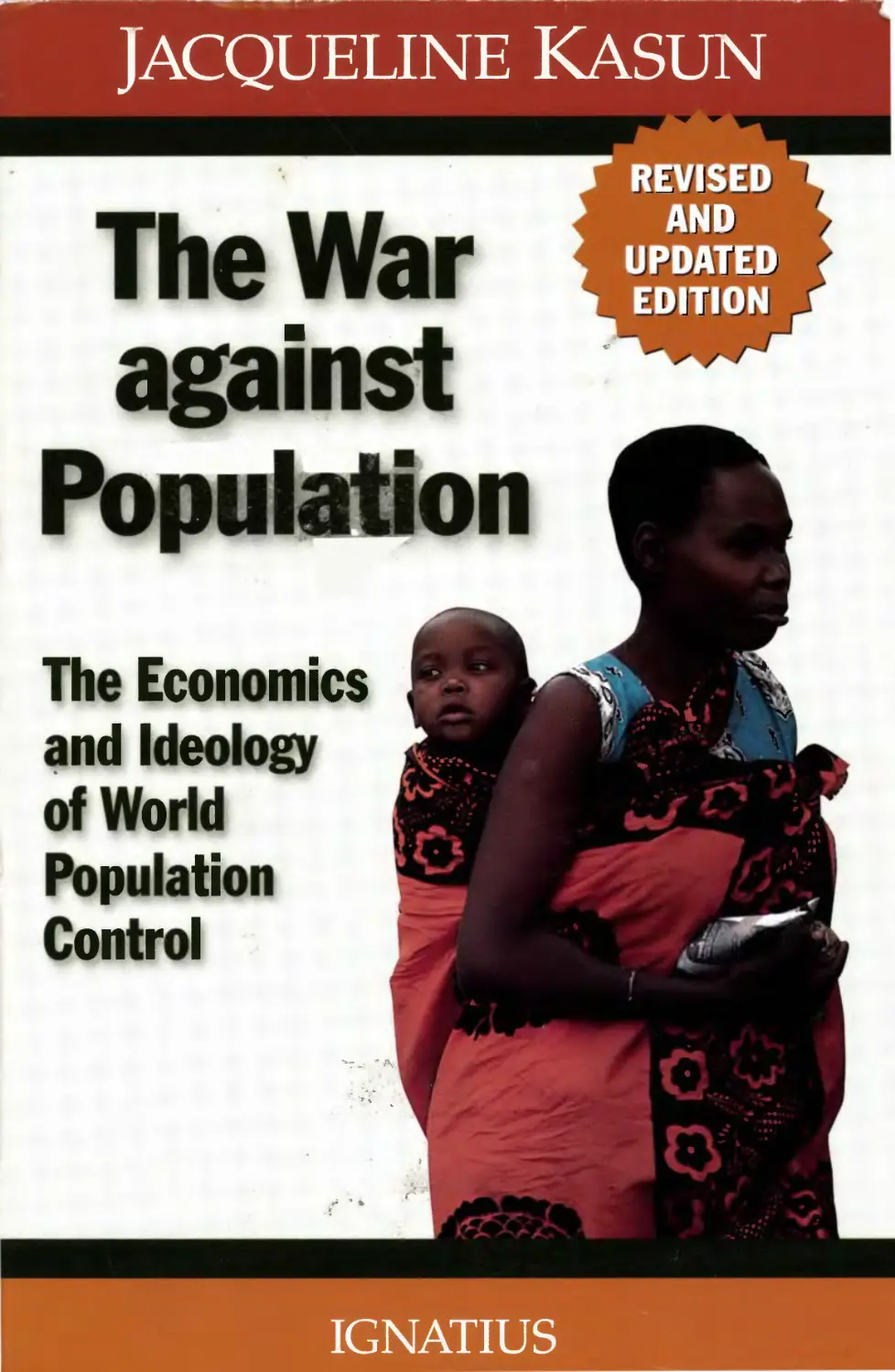
Cover photograph by Jerry Martin/ AMWEST
Mother and child, Kenya, Africa
Cover design by Roxanne Mei Lum
Second edition © 1999, Ignatius Press, San Francisco
First edition © 1988 Ignatius Press, San Francisco
All rights reserved
ISBN 0-89870-712^9
Library of Congress catalogue number 99-73013
Printed in the United States of America ©

For the sake of the children
who are like arrows
in the quiver of a mighty man
and speak for us in the gate.

CONTENTS
Foreword by Julian L. Simon
Preface to the Second Edition
Preface to the First Edition
Acknowledgments
i. "Overpopulation": The Unexamined Dogma
Government-funded "population education"
The dispute among scholars regarding "overpopulation"
Are traditional problem-solving methods inadequate?
Does individual decision-making lead to chaos?
Is central planning necessary?
The spaceship metaphor
The implications of planning
—The incentives of administrators
Changing the criteria for decision-making
—The good of the species vs. the good of individuals
Does government have a necessary role in reproductive decision-
2. Scarcity or Lifeboat Economics: Which Is Right?
Scarcity defined in economics
The lifeboat metaphor
Trends in world food production
World agricultural resources
—Land
—Fertilizer
—Energy
—Water
Potential agricultural productivity
Industrial resources
—Trends in availability of metals and energy
Environmental pollution
—Trends in indices of pollution
—The relationship between population and pollution
—Prospects for control
7

THE WAR AGAINST POPULATION
Environmental impacts of government activities
The relationship between population growth and economic growth
—Theoretical models
—Empirical studies
The relationship between population and investment
Political effects of population growth
Plan vs. Market in Population Control
Trends in population growth and distribution
Theories regarding the determinants of population growth
Rational thinking infertility decisions
—Empirical evidence
The costs of children
—In less-developed societies
—In more-developed societies
The external costs of children
The external benefits of children
The ability of families to predict
The ability of government planners to predict
Does population growth prevent investment and cause unemployment?
—Alternative explanations of development problems
The restraints of the price system
The nature of planning
United States Foreign Aid and Population Control
The view of the Department of State on "population planning"
U.S. contributions to world population control programs
The International Development and Food Assistance Act of1978
—Section 104(d)
—Section 102
Official U.S. statements on the need for population control
Strategies of the Agency for International Development
Foreign resistance to U.S. population control programs
The "village system "
—The Indonesian example
—The importance of group incentives
Other examples of "motivation"
—India
—Taiwan
—Singapore
—Thailand
—Iran

CONTENTS
The International Conference on Population, IQ84
The International Conference on Population and Development, IQQ4
Promoting the New Philosophy: The Sex Education
Movement 1
The need to promulgate the philosophy of population control
The stated goals of the sex educators
—The emphasis on combating "overpopulation "
Organizations promoting sex education
—Planned Parenthood
—Agency for International Development
—World Bank
Nature of sex-education programs: affective learning and values clarification:
excerpts from typical programs
—Emphasis on smaller families
—Provision of confidential birth control
—Explicit sex information
—Emphasis on alternative life-styles
—Emphasis on change as the new reality
—Sex roles
The new orthodoxy of sex education
—Combating dissent
—Coalition-building
Government funding of sex education
Adolescent Pregnancy: Government Family Planning
on the Home Front 1
Federal adolescent pregnancy legislation
—Background
—Purposes
Trends in childbearing among women under twenty
—Fertility rates
—Numbers of births
—Births out of wedlock
—International comparisons
—Common distortions of the facts
Alleged problems of adolescent pregnancy and facts
—Dropping out of school
—Maternal mortality
—Toxemia
—Prematurity
—Suicide rates

10
THE WAR AGAINST POPULATION
—Infant mortality
—Child abuse
—Welfare dependency
Eugenic concerns
Whether government can "solve" teenage pregnancy
—The correspondence between government expenditures and adolescent
pregnancy rates
—Sexual activity among teenagers
—The effects of abortion: results of studies
—Sterilization among teenagers
7. The Movement, Its History, and Its Leaders 212
The ideas ofMalthus
The influence of Darwin
Spencer, Sumner, Galton, and Pearson
Social Darwinism: its ideas of competition compared with those of Adam Smith
The Congresses of Eugenics
Margaret Sanger
Guy Irving Burch and post-war eugenics
The Campaign to Check the Population Explosion
The first federa I fa m ily-pla n n ing gra n ts
The Commission on Population Growth and the American Future
Title X and other legislation
Influencing the United Nations
—World Population Year
The International Conference on Population, 1984
The International Conference on Population and Development, 1994
Influential organizations: their activities and sources of funding
Advocates for Youth
The Alan Guttmacher Institute
American Association for the Advancement of Science
American Home Economics Association
The American Humanist Association
The American Public Health Association
AVSC International
Care
Carolina Population Center
Centre for Development and Population Activities
Center for Population and Family Health
Church World Service
East—West Center
Family Health International

CONTENTS
II
Family Planning International Assistance
The Ford Foundation
International Projects Assistance Services
International Union for the Conservation of Nature—The World
Conservation Union
Johns Hopkins Program for International Education in Reproductive Health
National Abortion and Reproductive Rights Action League
National Academy of Sciences
National Alliance for Optional Parenthood
National Family Planning and Reproductive Health Association
Pathfinder International
Planned Parenthood
—Planned Parenthood Federation of America
—International Planned Parenthood Federation
—International Planned Parenthood/Western Hemisphere
Population Action International
The Population Council
The Population Institute
Population Reference Bureau
Population Services International
The Rockefeller Foundation
The Sierra Club
Trilateral Commission
World Resources Institute
Worldwatch Institute
World Wildlife Fund
Zero Population Growth
Other
—UN Population Fund
Government Family Planning Now and in the Future 279
The justifications of government family planning
The goals of reducing numbers and improving "quality"
Summary of the findings of the preceding chapters
The assumption that government can correct for private "errors"
Salient characteristics of government planning and control
The role of "change agents"
The probable future of government family planning
297

FOREWORD
Surprise is the measure of information content, and scientific work is
important in proportion to how surprising its results are, assuming that the
facts and theory are sound. Professor Jacqueline Kasun's book The War
against Population is very surprising, even to someone like me who has for
many years been following the literature she draws from. Furthermore, her
facts seem to be correct and relevant, and her point of view makes good
theoretical sense.
Some examples: (i) Kasun's description of the literature used for sex
education and the motivations involved came as an unpleasant shock to me;
I had thought that the sex education movement was more benign and less
insidious. (2) Many of the materials that she has unearthed from official
files about the population activities of the U.S. State Department's Agency
for International Development in India, Thailand, and elsewhere
document scandalous and illegal policies that have heretofore only been the
subject of rumor. (3) The data she presents on trends in teenage
pregnancies came as a big surprise; like everyone else, I get brainwashed by the
population establishment's huge flow of literature, and by reports about it
in the newspapers. Furthermore, her critical analyses of fallacious
statements made on the basis of misinterpretation of these data are devastating
and exceedingly valuable.
The hard work Kasun spent collecting information about the dozens of
organizations that make up the population establishment in the United
States is a great service to the public. The material she presents is invaluable
for reference as well as an eye-opener for those interested in the field. It is
sure that I, along with many others, will draw frequently upon these
chapters for quotations, as well as for data on the money-flows among these
organizations and the U.S. government.
The first three theoretical chapters about the economic consequences of
population growth and about the results of planned versus "spontaneous"
market economic policies should come as no surprise in 1987, because by
now there has grown up a substantial literature underpinning the ideas that
she presents there. It is therefore regrettable that these ideas and data will
nevertheless be so surprising to most people in Western countries that they
will be unable to believe that Kasun is presenting a truthful and sound
13

H
THE WAR AGAINST POPULATION
analysis—which she is. All the more important, then, that the book
provides this material in an accessible and readable form.
We should all be grateful to Jacqueline Kasun for having the diligence,
skill, and courage to write this book.
JULIAN L. SIMON

PREFACE TO THE SECOND EDITION
In the first half of this century, when Margaret Sanger was creating the
birth control movement in New York and Europe, I was a child in Watts,
living among the people, the poor people, who were the particular concern
of Mrs. Sanger and her highly placed friends. After I grew up and read her
books, I could only wonder at a person who could see such a grotesque
caricature of the complex, rich, interesting, dramatic lives that I saw. I can
only believe it was because she never really saw them, or saw them only
through a glass darkly—darkly shadowed by an idee fixe of her own.
Watts brimmed with life—children playing, old people walking with
canes, young women with babies, men in work clothes, white faces, brown
faces, black faces, print shops and second-hand stores, grocery stores and
shoe shops, yards with flowers, and junk yards. Few people had cars, and
the streets were full of interesting people. Families were small; people could
not feed many children. As an only child (my mother had died shortly after
my birth), I learned early about what economists call the "spillover
benefits" of other people's children. They were my playmates, and their new
babies were my joy.
It was the Depression, and times were hard and jobs hard to get.
Children came to school without shoes or breakfast, and the principal made
spaghetti for them in the kindergarten kitchen. At the turn of the century,
my mother's father had come to America and started a small family
business that prospered in the free economy of the time. But now everything
was different. My father and uncle talked into the night about the "money
supply". (I learned later that the government and the central bank had let
the money supply collapse.) We gathered together around a neighbor's
radio to listen to President Roosevelt. He was very encouraging and had a
lot of plans, but no jobs appeared.
Men and women and children peddled thread, shoelaces, and donuts
from door to door. A child with a grotesquely burned face sold newspapers
on the corner. A jobless lawyer mowed my grandmother's lawn for twenty-
five cents. The carpenter next door had no work; he had a stroke and spent
the nights shouting about "the damn union". My grandmother put bags of
groceries on his front porch. The poor box at the Catholic Church helped
many, but some people lied to get the money and then drank it up. The
15

\6
THE WAR AGAINST POPULATION
Okies built a shack-town in a big vacant lot, and the police burned them
out.
Since this was all I knew, I had no clear idea that anything was very
wrong with this picture. Unlike Margaret and her friends, I had no
diagnosis and no remedy for what I saw in Watts. This was the way the world was.
I was sorry when my father lost his commercial art business, but other men
were losing their jobs and businesses, too. What struck me even as a child
was that the world seemed to be full of gifted, capable people who were
ready and willing to be productive but could find no way to do it. If
someone had told me then that some people were saying there were simply
too many of us, I would have been astonished and disbelieving.
Since my grandfather kept his job as a schoolteacher, we were able to
spend our summers in the forests of northern California where my aunt
had a little store for the miners and Indians and homesteaders. I learned to
swim in the Feather River, and I learned to love the mountains and the
trees. If someone had told me then, as people tell children now, that my
human presence was destroying this natural beauty, I would have been
distressed.
We moved away from Watts when I was fourteen. It has changed since
then. Most of the little businesses are gone, and jobs are even harder to
find. But there are birth-control and abortion clinics nearby. I grew up and
went to the university and became an economist and then married and
became the mother of three. And then it seemed that the whole world was
telling me that I was threatening the world food supply with my unbridled
procreation. And so I began to study it and think about it, always with the
one question: Are there really too many of us? Am I part of the "surplus
population"? (Growing up in Watts, I think, does not encourage the belief
that other people are surplus.) Or is it that the larger economic society is
making it difficult or impossible for some of us to make our contributions
and to receive our reward? After a lifetime studying economics, I think I
know the answer now. And that is why I wrote this book.
A second edition of this book became necessary not only because more
recent statistical data have become available but because important new
players have appeared on the stage. The United Nations has burgeoned and
has created mammoth new environmental and population bureaucracies
with field offices throughout the world. A series of United Nations
conferences have produced a battery of plans—population plans, land use plans,
consumption plans, energy reduction plans, and on and on—for the
"sustainable society" of the future.
The Clinton administration will have eight years in which to implement
those plans in the United States and to cement its population and
environmental convictions into law and practice. Under the soft rains of govern-

PREFACE TO THE SECOND EDITION
17
ment grants, the supportive "non-governmental organizations" are
bursting into growth and flower, while the media reverently report on their
"research" and their pronouncements. This new edition discusses these
events.
I am indebted to the same people who helped with the first edition. And
now there are others as well who have given me information,
encouragement, and the benefit of their expertise, especially Joseph Fessio, S.J.,
Philip Lawler, Robert Sassone, Matthew Habiger, O.S.B., Paul Marx,
O.S.B., Vernon Kirby, Steven W. Mosher, David Tennessen, William
Grigg, Pat Riehle, Jean Guilfoyle, Judith Reisman, Henry Lamb,
Marguerite Peeters, Dr. S. D. Ravenel, Dr. Joseph Stanton, Judie Brown,
Donald Bishop, John D. Hartigan, Jim Sedlak, Betty Arras, Dr. Joe
Mcllhaney, Jr., James Schall, S.J., Dr. Stanley K. Monteith, and Suzanne
Bodoh. To these and many others I owe thanks. The mistakes, of course,
are all my own.

PREFACE TO THE FIRST EDITION
To write about any continuing phenomenon inevitably raises the problem
of omitting events that occur after the book is finished. The drama
pictured in the ensuing pages did not come to an end in the last chapter when
the manuscript went to the printer but has continued to unfold. There
have been new campaigns and new fronts and new fighting on old fronts in
the war against population.
One of the chief combatants, the United Nations Population Fund, lost
its major source of funding, the United States, in 1986 and 1987 because of
the Fund's continued support of coercive population control in China.
There were heated denials of the charges and vows to secure a reversal of
the decision. Congress also denied funding to the London-based
International Planned Parenthood Federation because that organization supports
abortion as a method of family planning. This did not, however, mean any
reduction in the millions of dollars going to local Planned Parenthood
clinics in the United States or abroad, since these organizations receive
their U.S. grants independently of the international federation.
A battle erupted in the U.S. Health and Human Services bureaucracy in
1987 over whether to continue grants to local Planned Parenthood clinics
in the United States in view of the law prohibiting grants to "programs
where abortion is a method of family planning". The upshot was the
issuance of regulations which, if enforced, were expected to reduce
Planned Parenthood's government grants by tens of millions of dollars
annually. The organization promptly launched a media blitz to "protect
reproductive rights". Planned Parenthood also took a leadership role in the
drive against confirmation of Judge Robert Bork to the Supreme Court,
on grounds that Bork could not be relied upon to uphold the "right to
privacy", the linchpin in the abortion rights cases as well as in right-to-die
jurisprudence.
There was a setback in the Philippines, which since 1973 had been one
of the laboratories and training grounds for the network of international
organizations devoted to population control. The new constitution
proposed by the Aquino government and overwhelmingly ratified by the
populace deleted the clause in the 1973 constitution that had mandated
government population control. It also included a clause requiring the state
19

20
THE WAR AGAINST POPULATION
to "protect the life of the mother and the life of the unborn from
conception".
The setbacks were tentative, however, and were by no means certain to
be sustained by succeeding administrations and governments. On another
front, the trend toward complete population planning moved strongly
forward, as predicted in Chapter 8. Court decisions allowing the removal
of food and water from patients increased in number and in broadness of
coverage in the United States. From aged nursing-home patients to young
people incapacitated by accidents, the scope of the new rulings made death
control a reality just as birth control had been brought about in an earlier
period.
There were some signs of weakening on the philosophical front. A 1986
report by the National Academy of Sciences retreated somewhat from its
earlier demand for "real population control", described in Chapter 7, and
acknowledged that population growth may not cause resource exhaustion
and slower population growth may not cause economic improvement. It
nevertheless decided that more economic progress would be likely to occur
if population growth were slower. At the same time some voices called
attention to the possibly undesirable consequences of low or negative rates
of population growth. Ben Wattenberg's book The Birth Dearth (Pharos,
1987) predicted a loss of economic strength and international stature as a
result of low birth rates in the West.
These divergences were exceptional, however. "Overpopulation"
alarmism continued to prevail as in the past. Decrying the "unprecedented
human and economic devastation resulting from rapid global population
growth", the Population Institute organized thirty-nine U.S. governors to
proclaim World Population Awareness Week in April 1987, "as a part of the
emerging national consensus on the world population crisis" . The
Institute also organized forty-five heads of state to announce their intention to
"stop population growth within the near future", adopting "the necessary
policies and programs to do so". The U.S. government-funded Population
Reference Bureau continued to distribute school materials likening
"human overcrowding" to the multiplication of fruit flies in bottles.
The U.S. government continued to appropriate hundreds of millions of
dollars annually for domestic and foreign birth control, as described in
Chapter 7. And when certain recipients, such as the UN and International
Planned Parenthood, were denied U.S. grants, increased amounts were
given to other recipients. The U.S. Agency for International
Development, undaunted by misgivings about coercive population control,
continued its programs as described in Chapter 4.
On the teenage pregnancy front, activity was especially intense. The
movement to install clinics to dispense birth control in schools gathered

PREFACE TO THE FIRST EDITION
21
steam, with the number of such clinics multiplying rapidly in 1986 and
1987. A National Organization on Adolescent Pregnancy and Parenting—
a coalition of Planned Parenthood, the Center for Population Options, and
other groups discussed in Chapters 5, 6, and 7—held a series of regional
conferences to discuss strategies for mandating the kinds of "family life
education" described in Chapter 5, establishing school clinics, "greatly"
reducing adolescent pregnancy, and achieving "zero population growth",
among other lofty purposes.
In a word, the more things changed, the more they stayed the same. And
the U.S. government-funded Association for Voluntary Sterilization,
operator of a worldwide network of sterilization clinics and lobbyists to
governments, changed its name to the Association for Voluntary Surgical
Contraception.
October 1987

ACKNOWLEDGMENTS
The idea for this book grew from an article that I wrote on the foreign
population programs of the United States and which the Heritage
Foundation published in the winter 1981 issue of its journal, Policy Review. Chapter
6 draws on work that I did in writing a chapter on adolescent pregnancy for
Economics and the Family, edited by Stephen J. Bahr and published by
Lexington in 1980; it also incorporates material that appears in my chapter
in The American Family and the State, edited by Joseph R. Peden and Fred R.
Glahe, published by the Pacific Institute in 1986. The chapter on sex
education grew out of an article of mine that The Public Interest published in
spring 1979.
A number of people have read the manuscript and given helpful
suggestions. I am especially indebted to Professor Julian Simon for his comments
on an early draft of the manuscript.
I am grateful to Humboldt State University for giving me time to write;
to my colleagues in the economics department and my students for
friendship and inspiration; to the staff of the Humboldt State University Library,
especially to Mr. Erich F. Schimps, for unfailingly efficient and courteous
assistance; to my daughter Audrey Kasun Moruza for sharing with me her
expertise in demography, the results of her research, and her insights; to my
son Walter Joseph Kasun and to Danny Ihara for helping with the statistics;
to my daughter Christine Kasun Moruza and all of my children for, in the
words of Psalm 127, speaking for me in the gate; to my husband, Joseph, for
his assistance in my research and his unfailing encouragement; to a most
talented editor, Mrs. Patricia B. Bozell, and a conscientious and efficient
typist, Mrs. Diane Eklund.
Finally, I owe an inestimable debt to many friends who, knowing my
interests, send me news items, articles, book notices, and other materials.
This book owes its inspiration to them and could not have been written
without their help. Among these, I am especially grateful to Mrs. Judie
Brown.
23

CHAPTER ONE
"OVERPOPULATION": THE UNEXAMINED DOGMA
It was a traveling exhibit for schoolchildren. Titled "Population: The
Problem Is Us", it toured the country at government expense in the mid-1970s.
It consisted of a set of illustrated panels with an accompanying script that
stated:
. . . there are too many people in the world. We are running out of
space. We are running out of energy. We are running out of food.
And, although too few people seem to realize it, we are running
out of time.1
It told the children that "the birth rate must decrease and/or the death rate
must increase" since resources were all but exhausted and mass starvation
loomed. It warned that, "driven by starvation, people have been known to
eat dogs, cats, bird droppings, and even their own children",2 and it
featured a picture of a dead rat on a dinner plate as an example of future "food
sources".3 Overpopulation, it threatened, would lead not only to starvation
and cannibalism but to civil violence and nuclear war.
The exhibit was created at the Smithsonian Institution, the national
museum of the U.S. government, using federal funds provided by the
National Science Foundation, an agency of the U.S. government.
Concurrently, other American schoolchildren were also being treated to
federally funded "population education", instructing them on "the
growing pressures on global resources, food, jobs, and political stability".4 They
read Paul Ehrlich's book The Population Bomb. They were taught, falsely,
that "world population is increasing at a rate of 2 percent per year whereas
the food supply is increasing at a rate of 1 percent per year"5 and, equally
falsely, that "population growth and rising affluence have reduced reserves
1 Project book for the exhibition "Population: The Problem Is Us": A Book of
Suggestions for Implementing the Exhibition in Your Own Institution (Washington, D.C.: The
Smithsonian Institution, undated, circulated in late 1970s), p. 9.
2 Ibid., pp. 20, 23.
3 Ibid., p. 51.
4 Interchange, Population Education Newsletter published by the Population
Reference Bureau, vol. 9, no. 2 (September 1980): 1.
5 John J. Burt and Linda Brower Meeks, Education for Sexuality: Concepts and
Programs for Teaching (Philadelphia: W. B. Saunders, 1975), p. 408.
25

26
THE WAR AGAINST POPULATION
of the world's minerals."6 They viewed slides of the "biological
catastrophes" that would result from overpopulation7 and held class discussions on
"what responsible individuals in a 'crowded world' should or can do about
population growth".8 They learned that the world is like a spaceship9 or a
crowded lifeboat,10 to deduce the fate of mankind, which faces a
"population crisis".11 And then, closer to home, they learned that families who
have children are adding to the problems of overpopulation,12 and besides,
children are a costly burden who "need attention ... 24 hours a day" and
spoil marriages by making their fathers "jealous" and rendering their
mothers "depleted".13 They were told to "say good-bye" to numerous
wildlife species doomed to extinction as a result of the human population
explosion.14
This propaganda campaign in the public schools, which indoctrinated a
generation of children, was federally funded, despite the fact that no law
had committed the United States to this policy. Nor, indeed, had
agreement been reached among informed groups that the problem of
"overpopulation" even existed. To the contrary, during the same period the
government drive against population was gaining momentum, contrary
evidence was proliferating. One of the world's most prominent economic
demographers, Colin Clark of Oxford University, published a book titled
Population Growth: The Advantages;15 and economists Peter Bauer and Basil
Yamey of the London School of Economics discovered that the population
scare "relies on misleading statistics. . . misunderstands the determinants
6 Elaine M. Murphy, "Population and Resources: What about Tomorrow?"
(Washington, D.C.: Population Reference Bureau, undated, distributed for classroom
use in mid-1970s).
7 Ibid.
8 Interchange 8, no. 3 (October 1979): 1.
9 Isaac Asimov, Earth, Our Crowded Spaceship (New York: John Day, 1974).
10 Garrett Hardin, "Living on a Lifeboat", BioScience, October 1974, reprinted in
The Convolution Quarterly, summer 1975, pp. 16—23.
11 Sue Titus Reid and David L. Lyon, eds., Population Crisis: An Interdisciplinary
Perspective (Glenview: Scott Foresman, 1972).
12 Areata School District Family Life/Sex Education Curriculum Guide (Areata, Calif.,
June 1976).
13 Ferndale Elementary School District and Ferndale Union High School District,
Family Life/Sex Education Curriculum Guide: Kindergarten—Twelfth Grade (Ferndale,
Calif, July 1978), p. 322; Planned Parenthood—Santa Cruz County, Sex Education:
Teacher's Guide and Resource Manual (Santa Cruz, 1979), p. 149.
14 Say Goodbye (Wilmette, 111.: Films, Inc., 1972), film recommended for classroom
use by the Population Reference Bureau, Population Education: Sources and Resources,
May 1979, p. 23.
15 Colin Clark, Population Growth: The Advantages (Santa Ana, Calif: R. L. Sassone,
1972).

"overpopulation": the unexamined dogma 27
of economic progress . . . misinterprets the causalities in changes in fertility
and changes in income" and "envisages children exclusively as burdens".16
Moreover, in his major study of The Economics of Population Growth, Julian
Simon found that population growth was economically beneficial.17 Other
economists joined in differing from the official antinatalist position.18
Commenting on this body of economic findings, Paul Ehrlich, the
biologist-author of The Population Bomb, charged that economists
"continue to whisper in the ears of politicians all kinds of nonsense".19 If not on
the side of the angels, Ehrlich certainly found himself on the side of the
U.S. government, which since the mid-1960s has become increasingly
committed to a worldwide drive to reduce the growth of population. It has
absorbed rapidly increasing amounts of public money as well as the
energies of a growing number of public agencies and publicly subsidized private
organizations.
The spirit of the propaganda has permeated American life at all levels,
from the highest reaches of the federal bureaucracy to the chronic
reporting of overpopulation problems by the media and the population education
being pushed in public schools. It has become so much a part of daily
American life that its presuppositions and implications are scarcely
examined; though volumes are regularly published on the subject, they rarely do
more than restate the assumptions as a prelude to proposing even "better"
methods of population planning.
But even more alarming are some neglected features inherent in the
proposed needs and the probable results of population planning. The
factual errors are egregious, true, and the alarmists err when they claim that
world food output per person and world mineral reserves are decreasing—
that, indeed, the human economic prospect has been growing worse rather
than more secure and prosperous by all available objective standards. But
these are not the most significant claims made by the advocates of
government population planning. The most fundamental, which is often tacit
rather than explicit, is that the world faces an unprecedented problem of
"crisis" proportions that defies all familiar methods of solution.
16 Peter T. Bauer and Basil S. Yamey, "The Third World and the West: An
Economic Perspective", in W. Scott Thompson, ed., The Third World: Premises of U.S.
Policy (San Francisco: Institute for Contemporary Studies, 1978), p. 108.
17 Julian L. Simon, The Economics of Population Growth (Princeton: Princeton
University Press, 1977).
18 See, for example, Mark Perlman, "Population and Economic Change in Developing
Countries: A Review Article", The Journal of Economic Literature 19, no. 1 (March 1981):
74-82; Richard A. Easterlin, "Population", in Neil W. Chamberlain, ed.,
Contemporary Economic Issues (Homewood, N.J.: Richard D. Irwin, Inc., 1973), pp. 301-52.
19 Christian Science Monitor, July 30, 1980, p. B7.

28
THE WAR AGAINST POPULATION
Specifically, it is implied that the familiar human response to scarcity—
that of economizing—is inadequate under the "new" conditions. Thus the
economist's traditional reliance on the individual's ability to choose in
impersonal markets is disqualified. Occasionally it is posited that the
market mechanism will fail due to "externalities",20 but it is more often said
that mankind is entering by a quantum leap into a new age in which all
traditional methods and values are inapplicable.21 Sometimes it is implied
that the uniqueness of this new age inheres in its new technology, and at
other times that human nature itself is changing in fundamental respects.
Whatever the cause of this leap into an unmapped future, the widely
held conclusion is that since all familiar human institutions are failing and
will continue to fail in the "new" circumstances, they must be abandoned
and replaced. First among these supposedly failing institutions is the
market mechanism, that congeries of institutions and activities by which
individuals and groups carry out production and make decisions about the
allocation of resources and the distribution of income. Not only the
market, but democratic political institutions and national loyalties as well are
held to be manifestly unsuitable for the "new" circumstances. Even the
traditional family is labeled for extinction because of its inability to adapt
to the evolving situation. The new school family life and sex education
programs, for example, stress the supposed decline of the traditional
family—heterosexual marriage, blood or adoptive relationships—and its
replacement by new, "optional" forms, such as communes and homosexual
partnerships.22 Unsurprisingly, traditional moral and ethical teachings
must be abandoned.23
The decision to repudiate the market is of interest not only to
economists but to all those who have seen how impersonal markets can mediate
the innate conflict between consumer desires and resource scarcity. The
most elegant models of socialism have incorporated the market mechanism
into their fundamental design.24 Adam Smith's "invisible hand" leads men
20 J. J. Spengler, Origins of Economic Thought and Justice (Southern Illinois Univ.
Press, 1980), p. 144.
21 Robert L. Heilbroner, An Inquiry into the Human Prospect (New York: W. W.
Norton and Co., 1980).
22 Mary S. Calderone and Eric W. Johnson, The Family Book about Sexuality (New
York: Harper and Row, 1981), pp. 132-35; California State Department of Education,
Education for Human Sexuality: A Resource Book and Instructional Guide to Sex Education
for Kindergarten through Grade Twelve (Sacramento, Calif., 1979), pp. 27-28.
23 California State Department of Education, Education for Human Sexuality, pp. 28,
80, 81; Mary S. Calderone, "Sex Education and the Roles of School and Church", The
Annals of the American Academy of Political and Social Science 376 (March 1968): 53—60.
24 See, for example, Oskar Lange and Fred M. Taylor, On the Economic Theory of
Socialism (New York: McGraw-Hill, 1964).

"overpopulation": the unexamined dogma 29
to serve one another and to economize in their use of resources as they
pursue their own self-interest. John Maurice Clark called it "our main
safeguard against exploitation" because it performs "the simple miracle
whereby each one increases his gains by increasing his services rather than
by reducing them",25 and Walter Eucken said it protects individuals by
breaking up the great concentrations of economic power.26 The common
element here is, of course, the realization that individual decision-making
leads not to chaos but to social harmony.
This view is denied by the population planners, and it is here that the
debate is, or should be, joined. Why are the advocates of government
population planning so sure that the market mechanism cannot handle
population growth? Why are they so sure that the market will not respond
as it has in the past to resource scarcities—by raising prices so as to
induce consumers to economize and producers to provide substitutes? Why
can individual families not be trusted to adjust the number of their
children to their incomes and thus to the given availability of resources? Why
do the advocates of government population control assume that human
beings must "overbreed", both to their own detriment and to that of
society?
It is occasionally averred that the reason for this hypothetical failure is
that individuals do not bear the full costs of their childbearing decisions but
transfer a large part to society and therefore tend to have "too many"
children. This is a dubious claim, for it overlooks the fact that individual
families do not receive all the benefits generated by their childbearing. The
lifetime productivity and social contribution of children flow largely to
persons other than their parents, which, it might be argued, leads families
to have fewer children than would be in the best interests of society. Which
of these "externalities" is the more important, or whether they balance one
another, is a question that waits not merely for an answer but for a reasoned
study.
Another reason commonly given for the alleged failure of personal
decisions is that individuals do not know how to control the size of their
families. But a deeper look makes it abundantly clear that the underlying
reason is that the population planners do not believe that individuals, even
if fully informed, can be relied upon to make the proper choice. The
emphasis on "outreach" and the incentives that pervade the United States'
domestic and foreign population efforts testify to this, as will be shown in
more depth shortly.
25John Maurice Clark, Alternative to Serfdom (New York: Alfred A. Knopf, 1948),
p. 62.
26 Walter Eucken, The Foundations of Economics (Edinburgh: Hodge, 1950).

30
THE WAR AGAINST POPULATION
More important than these arguments, however, is the claim that new
advances in technology are not amenable to control by market forces—a
traditional argument in favor of socialism. From the time of Saint-Simon to
that of Veblen and on to our own age, the argument has been advanced
that the market forces of supply and demand are incapable of controlling
the vast powers of modern technology. At the dawn of the nineteenth
century Saint-Simon called for the redesigning of human society to cope
with the new forces being unleashed by science. Only planned
organization and control would suffice, he claimed. "Men of business" and the
market forces which they represented would have to be replaced by
planning "experts".27 In the middle of the nineteenth century Marx created a
theoretical model of the capitalist market that purported to prove that the
new technological developments would burst asunder the forms of private
property and capitalist markets. Three-quarters of a century later Veblen
spoke for the planning mentality when he wrote in 1921:
The material welfare of the community is unreservedly bound up
with the due working of this industrial system, and therefore with
its unreserved control by the engineers, who alone are competent
to manage it. To do their work as it should be done these men of
the industrial general staff must have a free hand, unhampered by
commercial considerations . . .28
In our own time, Heilbroner expresses a similar but even more
profound distrust of market forces:
. . . the external challenge of the human prospect, with its threats
of runaway populations, obliterative war, and potential
environmental collapse, can be seen as an extended and growing crisis
induced by the advent of a command over natural processes and
forces that far exceeds the reach of our present mechanisms of
social control.29
Heilbroner's position is uniquely modern in its pessimism. Unlike Marx
and Veblen, who believed that the profit-seeking aspects of supply and
demand unduly restricted the new technology from fulfilling its beneficent
potential, Heilbroner sees the market as incapable of controlling an
essentially destructive technology. Technology, in Heilbroner's view, brings
27 See Keith Taylor, trans, and ed., Henri Saint-Simon (1760-1823): Selected Writings
on Science, Industry and Social Organization (New York: Holmes and Meier, 1975).
28 Thorstein Veblen, "The Captains of Finance and the Engineers", in Wesley C.
Mitchell, ed., What Veblen Taught: Selected Writings of Thorstein Veblen (New York:
Viking Press, 1947), p. 432.
29 Heilbroner, Inquiry, p. 57.

"overpopulation": the unexamined dogma 31
nuclear arms, industrial pollution, and the reduction in death rates that is
responsible for the population "explosion"; all of these stubbornly resist
control by the market or by benign technological advance. Heilbroner has
little hope that pollution-control technology, for example, will be able to
offset the bad effects of industrial pollution.
An additional argument is that mankind is rapidly approaching, or has
reached, the "limits to growth" or the "carrying capacity" of an earth with
"finite" resources. Far from being a new position, it dates back to Thomas
Malthus' Essay on the Principle of Population (1798), which held that the
growth of population must inevitably outrun the growth of food supply. It
must be one of the curiosities of our age that though Malthus' forecast has
proved mistaken—that, in fact, the living standards of the average person
have reached a level probably unsurpassed in history—doom is still
pervasively forecast. The modern literature of "limits" is voluminous, including
such works as the much-criticized Limits to Growth, published by the Club
of Rome,30 and the Carter administration's Global 2000}x In common,
these works predict an impending exhaustion of various world economic
resources which are assumed to be absolutely fixed in quantity and for
which no substitutes can be found. The world is likened to a "spaceship", as
in Boulding's32 and Asimov's33 writings; or, even more pessimistically, an
overloaded "lifeboat", as in Garrett Hardin's articles.34
Now, in the first place, as for the common assumption in this literature
that the limits are fixed and known (or, as Garrett Hardin puts it, each
country's "lifeboat" carries a sign that indicates its "capacity"),35 no such
knowledge does in fact exist—for the earth, or for any individual country,
or with regard to any resource. No one knows how much petroleum
exists on earth or how many people can earn their living in Illinois. What
is known is that the types and quantities of economic resources are
continually changing, as is the ability of given areas to support life. In the
same territories in which earlier men struggled and starved, much larger
30 Donella H. Meadows, Dennis L. Meadows, et al., The Limits to Growth: A Report
for the Club of Rome's Project on the Predicament of Mankind (New York: Universe Books,
1972).
31 The Global 2000 Report to the President, A Report Prepared by the Council on
Environmental Quality and the U.S. Department of State (Washington, D.C.: U.S.
Government Printing Office, 1980).
32 Kenneth E. Boulding, "The Economies of the Coming Spaceship Earth", in
Henry Jarrett, ed., Environmental Quality in a Growing Economy (Baltimore: Johns
Hopkins, 1966), pp. 3-14.
33 Asimov, Earth.
34 Hardin, "Lifeboat"; see also Harold Hayes, "A Conversation with Garrett
Hardin", The Atlantic Monthly, 247, no. 5 (May 1981): 60-70.
35 Hayes, "Hardin".

32
THE WAR AGAINST POPULATION
populations today support themselves in comfort. The difference, of
course, lies in the knowledge that human beings bring to the task of
discovering and managing resources.
But then, secondly, the literature of limits rules out all such increasing
knowledge. Indeed, in adopting the lifeboat or spaceship metaphor, the
apostles of limits rule out not only all new knowledge, but the discovery of
new resources, and, in fact, virtually all production. Clearly, if the world is
really a spaceship or a lifeboat, then both technology and resources are
absolutely fixed, and beyond a low limit, population growth would be
disastrous. Adherents of the view insist that that limit is either being rapidly
approached or has been passed, about which more later. Important here is
that even this extreme view of the human situation does not rule out the
potential of market forces. Most of mankind throughout history has lived
under conditions that would be regarded today as extreme, even desperate,
deprivation. And over the millennia private decisions and private
transactions have played an important, often a dominant, role in economic life.
The historical record clearly shows that human beings can act and
cooperate on their own in the best interests of survival, even under very difficult
conditions.
But history notwithstanding, the claims that emergencies of one kind or
another require the centralized direction of economic and social life have
been recurrent, especially during this century, which, ironically, has been
the most economically prosperous. Today's advocates of coercion—the
proponents of population control—posit the imminent approach of
resource exhaustion and environmental collapse, wherein human beings will
abandon all semblance of rational and civilized behavior. Global warming,
rising sea levels, coastal flooding, tidal waves, ozone depletion,
desertification, deforestation, and massive disappearance of species loom ahead,
according to these prophets, as mankind faces this last chance to save the
planet. This last chance, of course, consists of surrendering to the
enlightened leadership of the population-controlling environmental elite. Vice
President Al Gore warns us not to be distracted by the scientists who
dissent from the environmental scares; swift action without questioning,
not reflection, is what is needed.36
To ward off their "emergency", the proponents of population control
call for the adoption of measures that they admit would not be normally
admissible. Some call for limiting births by license.37 The Chinese govern-
36 Al Gore, Earth in the Balance (Boston: Houghton Mifflin, 1992), pp. 39-40.
37 Herman E. Daly and John B. Cobb, Jr., For the Common Good: Redirecting the
Economy toward Community, the Environment, and a Sustainable Future (London: Merlin
Press [Green Print], 1990).

"overpopulation": the unexamined dogma 33
ment uses this method, with severe punishments for disobedience. Recent
United Nations documents call for governments to create profound and
far-reaching attitude changes among people in order to achieve
"population stabilization" and "sustainable development".38 Such actions and
proposals surely deserve thoughtful and thorough examination.
Social and economic planning require an administrative bureaucracy
with powers of enforcement. Modern economic analysis clearly shows that
there are no impersonal, automatic mechanisms in the public sector that
can simply and perfectly compensate for private market "failure".39 The
public alternative is fraught with inequity and inefficiency, which can be
substantial and exceedingly important. Although the theory of
bureaucratic behavior has received less attention than that of private consumer
choice, public administrators have also proved subject to greed, which
hardly leads to social harmony. Government employees and contractors
have the same incentives to avoid competition and form monopolies as
private firms.40 They can increase their incomes by padding their costs and
bloating their projects and excuse their actions by exaggerating the need for
their services and discrediting alternative solutions.
Managers of government projects have no market test to meet since they
give away their products, even force them on an unwilling public, while
collecting the necessary funds by force through the tax system. They can
use their government grants to lobby for still more grants and to finance
legal action to increase their power. They can bribe other bureaucrats and
grant recipients to back their projects with the promise of reciprocal
services. Through intergovernmental grants and "subventions" they can
arrange their financial affairs so that apparently no one is accountable for any
given decision or program. In short, the record of bureaucratic behavior
confirms the statement of the great socialist scholar Oskar Lange, that "the
real danger of socialism is that of a bureaucratization of economic life".41
The danger may well be more serious than we realize—it could be nothing
less than totalitarianism.
Finally, proponents of the "population crisis" believe that not only must
the agencies and methods of control be changed under the "new"
circumstances but also the criteria for choice. Since, they argue, the technological and
38 See especially the Programme of Action of the United Nations International Conference
on Population and Development, Cairo, 1994, as well as the documents of the Fourth
World Conference on Women, Beijing, 1995.
39 Richard B. McKenzie and Gordon Tullock, Modern Political Economy (New York:
McGraw-Hill, 1978), pp. 385-421.
40 Ibid.; Charles Wolf, Jr., "A Theory of Non-market Failures", Public Interest, no.
55 (spring 1979): 114-33.
41 Lange and Taylor, Socialism, p. 109.

34
THE WAR AGAINST POPULATION
demographic developments of the modern age render all traditional
standards of value and goodness either obsolete or questionable, these must be
revised—under the leadership, of course, of those who understand the
implications of the new developments.
Above all, they hold that the traditional concept of the value and dignity
of the individual human being must be overhauled.42 The good of the
species—that is, all species, with no special preference for the human species43—as
understood fully only by the advocates of the new views, must in all cases
supersede the good as perceived and sought after by human individuals.
Clearly, in the late twentieth century a world view has emerged that calls
into question not only the presuppositions of much of economics, but
some basic political and philosophical thought as well. The history of our
age may be determined by the outcome of the confrontation between these
views.
It must be emphasized that the essential issue is not birth control or
family planning. People have throughout history used various means to
determine the size of their families, generating a great deal of discussion
and debate. But the critical issue raised by recent history, especially in the
United States and at the United Nations, is whether government has the
right or duty to preside over the reproductive process . . . for what reasons,
to what extent?
Recent official action in the United States and the United Nations has
proceeded as if the question had already been answered. The fact is,
however, that it has been neither explicitly asked nor discussed, even as we rush
toward a future shaped by its affirmative answer. It is this question that
must be examined.
42 Hayes, "Hardin".
43 See Bill Devall and George Sessions, Deep Ecology: Living As If Nature Mattered
(Salt Lake City: Peregrine Smith, 1985).

CHAPTER TWO
SCARCITY OR LIFEBOAT ECONOMICS:
WHICH IS RIGHT?
The fact of scarcity is the fundamental concern of economics. As one
leading textbook puts it in its opening pages, "wants exceed what is
available".1 It pertains to the rich as well as to the poor, since scarcity is not the
same thing as poverty. As another text tells students, "higher production
levels seem to bring in their train ever-higher consumption standards.
Scarcity remains." 2
Yet another explains,
The reality of life on our planet is that. . . resources used to
produce goods ... are limited. Therefore, goods and services are also
limited. In contrast, the desires of human beings are virtually
unlimited. These facts confront us with the two basic ingredients
of an economic topic—scarcity and choice.3
That scarcity is no less real in affluent societies than in poor ones is
explained in more general terms by other economists who stress the need
to make choices whenever alternatives exist. In the words of McKenzie and
Tullock,
the individual makes choices from among an array of alternative
options... in each choice situation, a person must always forgo
doing one or more things when doing something else. Since cost is
the most highly valued alternative forgone, all rational behavior
involves a cost.4
Clearly, the affluent person or society faces a large list of highly valued
alternatives and is likely to have a difficult choice to make—to be more
1 Armen A. Alchian and William R. Allen, University Economics, 3d ed. (Belmont:
Wadsworth Publishing Co., 1972), p. 7.
2 Paul A. Samuelson, Economics, nth ed. (New York: McGraw-Hill, 1980), p. 17.
3James D. Gwartney and Richard L. Stroup, Microeconomics: Private and Public
Choice, 6th ed. (New York: Harcourt Brace Jovanovich, 1992), p. 4.
4 Richard B. McKenzie and Gordon Tullock, Modern Political Economy (New York:
McGraw-Hill, 1978), p. 18.
35

36
THE WAR AGAINST POPULATION
acutely aware of the scarcity and the need to give up one thing in order to
have another. It follows that scarcity does not lessen with affluence but is
more likely to increase.
Simply put, economists understand scarcity as the inescapable fact that
candy bars and ice cream cannot be made out of the same milk and
chocolate. A choice must be made, regardless of how much milk and chocolate
there is. And the decision to produce milk and chocolate rather than cheese
and coffee is another inescapable choice. And so the list continues,
endlessly, constituting the core of economics. How to choose what to produce,
for whom, and how, is the very stuff of economics.
It is important to notice how different these traditional economic
concepts of scarcity and choice are from the notions of "lifeboat economics".
In Garrett Hardin's metaphor,5 the lifeboat's capacity is written on its side.
The doomsday literature of limits is shot through with the conceit of
absolute capacity, which is alien to economics. Not the least of the
differences is that in economics humanity is viewed not only as the raison d'etre of
other forms of wealth but as one of the sources of wealth; human labor and
ingenuity are resources, means for creating wealth. In the lifeboat, human
beings are pure burdens, straining the capacity of the boat. Which of these
views is closer to reality?
Is the earth rapidly approaching or has it surpassed its capacity to support
human life? But before delving into the existence and nature of limits, keep
in mind that the notion of a limited carrying capacity is not the only
argument for population control. The view of people, or at least of more
people, as simply a curse or affliction has its adherents. Thus Kingsley Davis
writes of the "population plague",6 and Paul Ehrlich speaks with obvious
repugnance of "people, people, people, people".7 Other writers, both old
and new, attribute, if not a negative, at least a zero value to people. Thus
John D. Rockefeller III, submitting the final report of the Commission on
Population Growth and the American Future, wrote:
in the long run, no substantial benefits will result from further
growth of the Nation's population, rather . . . the gradual
stabilization of our population would contribute significantly to the
Nation's ability to solve its problems. We have looked for, and
have not found, any convincing economic argument for continued
5 Harold Hayes, "A Conversation with Garrett Hardin", The Atlantic Monthly 247,
no. 5 (May 1981): 60-70.
6 Kingsley Davis, "The Climax of Population Growth", California Medicine 113
(November 1970): 33-39.
7 Paul R. Ehrlich, The Population Bomb (New York: Balantine Books, 1968), p. 15.

SCARCITY OR LIFEBOAT ECONOMICS: WHICH IS RIGHT? 37
population growth. The health of our country does not depend on
it, nor does the vitality of business nor the welfare of the average
person.8
The notion embodied in this statement—that, to validate its claim to
existence, a human life should justify itself by contributing to such things as
the "vitality of business"—is a perfect example of the utilitarian ethic.
Though economics has skirted utilitarianism at times, it was never in this
sense, but rather in its belief that human beings could be rational in making
choices. Economics has been content to value all things in terms of what
they mean to individual human beings; it has never valued human beings in
terms of supposedly higher values.
The idea that the earth is incapable of continuing to support human life
suffuses United States government publications. The House Select
Committee on Population reported in 1978 that
the four major biological systems that humanity depends upon for
food and raw materials-ocean fisheries, grasslands, forests, and
croplands—are being strained by rapid population growth to the
point where, in some cases, they are actually losing productive
capacity.9
The Carter administration's Global 2000 report, which was much criticized
by research experts,10 predicted:
With the persistence of human poverty and misery, the staggering
growth of human population, and ever increasing human
demands, the possibilities of further stress and permanent damage to
the planet's resource base are very real.11
In 1992, Senator (soon-to-be Vice President) Al Gore wrote about the
approach of an "environmental holocaust without precedent",12 which he
8 John D. Rockefeller III, Letter to the President and Congress, transmitting the
Final Report of the Commission on Population Growth and the American Future,
dated March 27, 1972.
9 House Select Committee on Population, Report, World Population: Myths and
Realities, 95th Cong., 2d sess. (Washington, D.C.: U.S. Government Printing Office,
1978), p. 5.
,0Julian L. Simon, "Global Confusion, 1980: A Hard Look at the Global 2000
Report", The Public Interest 62 (winter 1981): 3-20.
11 The Global 2000 Report to the President: Global Future: Time to Act, prepared by the
Council on Environmental Quality and the U.S. Department of State (Washington,
D.C.: U.S. Government Printing Office, January 1981), p. ix.
12 Al Gore, Earth in the Balance: Ecology and the Human Spirit (Boston: Houghton
Mifflin, 1992), p. 177.

38
THE WAR AGAINST POPULATION
likened to a "black hole"13 caused by "expansion beyond the
environment's carrying capacity".14 To stave off this catastrophe, "The first
strategic goal should be the stabilizing of world population. . . ."15
Gore's great friend and the Clinton administration's Under Secretary of
State for "Global Affairs", Timothy Wirth, said,
Resource scarcities are a root cause of. . . violent conflicts. . . .
These conflicts could intensify and widen as ever-growing
populations compete for an ever-dwindling supply of land, fuel, and
water. Our biological systems are under. . . stress. . . . Two
trends tell the tale. First, is the exponential growth of the human
population . . . we are getting ourselves into a terrible fix—the
globe's population is growing at a rate that is matched or
exceeded only by our growing capacity to consume resources and
produce wastes. . . . Unchecked, the spiral of population growth
will dim every hope for economic progress . . . and . . . every
environmental endeavor. . . .16
Luckily for the world, however, according to Mr. Wirth, the Clinton
administration has restored "American leadership ... in international
population policy and we have helped create a plan for Cairo [the
International Conference on Population and Development of 1994] that
will launch a . . . comprehensive approach to . . . rapid demographic
change." 17
Alarmist statements regarding "resource scarcities" and population
growth have been duly broadcast by the media despite the facts, which tell
a quite different story.
In the first place, world food production has increased considerably
faster than population in recent decades. In preparation for the World Food
Summit in Rome in November of 1996, the United Nations Food and
Agriculture Organization reported:
Globally food supplies have more than doubled in the last 40
years . . . between 1962 and 1991 average daily per caput food
supplies increased more than 15 percent. . . .18
13 Ibid., p. 49.
14 Ibid., p. 78.
15 Ibid., p. 177.
16 Timothy Wirth, text of speech to National Press Club, July 12, 1994.
17 Ibid.
18 "Food Requirements and Population Growth", World Food Summit Technical
Background Documents 1-05, vol. 1 (FAO, 1996), p. 6.

SCARCITY OR LIFEBOAT ECONOMICS: WHICH IS RIGHT? 39
... at a global level, there is probably no obstacle to food
production rising to meet demand.19
Population growth is expected to stabilize after 2050.20
Some of the most dramatic increases have occurred in the poorest
countries, those designated for "triage" by the apostles of doom. For
example, rice and wheat production in India in 1995 was almost four times
as great as in the early 1950s. This was considerably more than the
percentage increase in the population of India in the same period.21
Also in preparation for the 1996 World Food Summit, the FAO reported
the following great improvements in food availability:22
Calories per person per day: 1969-1971 1990-1992
World 2,440 2,720
Developed countries 3,190 3,350
Developing countries 2,140 2,520
The increase in food availability amounted to 5 percent in the developed
countries and almost 18 percent in the developing lands!23 Caloric
requirements depend on age and climate, among other things. The populations of
Africa and Latin America, which have high proportions of children, should
eat about 2,150 calories per person per day, according to the FAO, while
North Americans need almost 2,400 on average.24 Clearly, world food
supplies exceed requirements in all areas, amounting to a surplus
approaching 50 percent in 1990 in the developed countries and 17 percent in the
developing regions!25 The very high calorie supply in the developed world
meant that obesity had become a major health problem.
The FAO also reported that in 1990—1992 less than a third as many
people had fewer than 2,100 calories per person per day as had been the case
in 1969—1971.26
The recurrent famines in Africa may seem to belie these optimistic
findings. Africa, however, is a continent torn by war; farmers cannot
cultivate and reap in battle zones, and enemy troops often seize or burn
19 Ibid., p. 17.
20 Ibid., p. 2.
21 Based on figures appearing in U.S. Bureau of the Census, Statistical Abstract of the
United States, 1957 and 1997 eds., presenting UN and FAO data.
22 WFS 96/Tech 1 Executive Summary (FAO, 1996).
23 Ibid.
24 Ibid., vol. 1, "Food Requirements and Population Growth", p. 8.
25 Ibid., pp. 8-9.
26 Ibid., Executive Summary.

4o
THE WAR AGAINST POPULATION
crops. Collectivist governments, also endemic in Africa, often seize crops
and farm animals without regard for farmers' needs. War and socialism are
two great destroyers of the food supply in Africa, as they have been in other
continents.
Nevertheless, despite its own evidence of burgeoning world food
supplies, the "Plan for Action" of the World Food Summit called for delegates
to sign on to "early stabilization of the world population", "reproductive
health services" (contraception, abortion, sterilization), the "gender
perspective" (less motherhood and more careers for women), and more
"international assistance". It warned that unless these things are done, the
world will face "acute shortages of food".27
The impressive increases in food production that have occurred in
recent decades have barely scratched the surface of the available food-
raising resources, according to the best authorities. Farmers use less than
half of the earth's arable land and only a minute part of the water available
for irrigation. Indeed, three-fourths of the world's available cropland
requires no irrigation.28
How large a population could the world's agricultural resources support
using presently known methods of farming? Colin Clark, former director
of the Agricultural Economic Institute at Oxford University, classified
world land-types by their food-raising capabilities and found that if all
farmers were to use the best methods, enough food could be raised to
provide an American-type diet for 35.1 billion people, more than six times
the present population.29 Since the American diet is a very rich one, Clark
found that it would be possible to feed three times as many again, or
eighteen times as many as now exist, at a Japanese standard of food intake.
Clark's estimate assumed that nearly half of the earth's land area would
remain in conservation areas, for recreation and the preservation of
wildlife.30
Roger Revelle, former director of the Harvard Center for Population
Studies, estimated that world agricultural resources are capable of
providing an adequate diet (2,500 kilocalories per day), as well as fiber, rubber,
tobacco, and beverages, for forty billion people, or seven times the present
number.31 This, he thought, would require the use of less than one-
fourth—compared with one-ninth today—of the earth's ice-free land
27 Rome Declaration on World Food Security and WFS Plan of Action, 1996.
28 Roger Revelle, "The Resources Available for Agriculture", Scientific American
235, no. 3 (September 1976): 168; see also FAO Production Yearbook 48 (1994).
29 Colin Clark, Population Growth: The Advantages (Santa Ana, Calif.: R. L. Sassone,
1972), p. 44-
30 Ibid., p. 48.
31 Revelle, "Resources", p. 177.

SCARCITY OR LIFEBOAT ECONOMICS: WHICH IS RIGHT? 41
area.32 He presumed that average yields would be about one-half those
presently produced in the United States Midwest.33 Clearly, better yields
and/or the use of a larger share of the land area would support more than
forty billion persons.
Revelle estimated that the less-developed continents, those whose
present food supplies are most precarious, are capable of feeding eighteen
billion people, or four times their present population.34 He estimated that
the continent of Africa alone is capable of feeding ten billion people, which
is almost twice the amount of the present world population and thirteen
times the estimated 1998 population of Africa.35 He saw "no known
physical or biological reason" why agricultural yields in Asia should not be
greatly increased.36 In a similar vein, the Indian economist Raj Krishna has
written that
. . . the amount of land in India that can be brought under
irrigation can still be doubled. . . . Even in Punjab, the Indian state
where agriculture is most advanced, the yield of wheat can be
doubled. In other states it can be raised three to seven times. Rice
yields in the monsoon season can be raised two to 13 times, rice
yields in the dry season two to three-and-a-half times, jowar
(Indian millet) yields two to 11 times, maize yields two to 10 times,
groundnut yields three-and-a-half to five-and-a-half times and
potato yields one-and-a-half to five-and-a-half times.37
What Mr. Krishna is, in fact, saying is that Indian agriculture is
potentially capable of feeding not only the people of India but the entire
population of the world!
In 1993 two senior economists at the World Bank produced a document
called The World Food Outlook. It concluded:
. . . crop yields continue to increase faster than population.38
32 Ibid., pp. 174-75.
33 Ibid., p. 177.
34 Roger Revelle, "The World Supply of Agricultural Land", in Julian L. Simon
and Herman Kahn, eds., The Resourceful Earth: A Response to Global 2000 (Oxford,
England: Basil Blackwell, 1984), p. 186.
35 Ibid., p. 190.
36 Ibid., p. 193.
37 Raj Krishna, "The Economic Development of India", Scientific American 243,
no. 3 (September 1980): 173-74.
38 Donald O. Mitchell and Merlinda D. Ingco, The World Food Outlook
(Washington, D.C.: The World Bank, International Economics Department, November 1993),
p. 226.

42
THE WAR AGAINST POPULATION
. . . This does not mean that all people have adequate diets but
that the diets for most. . . have improved dramatically in recent
years and . . . should continue to improve.39
Population growth rates are slowing. . . .40
. . . food . . . prices fell by 78 percent from 1950 to 1992 in
constant [terms].41
They further noted that although "Africa remains vulnerable to . . .
famine", the problem "may not be as serious as portrayed", since the food
reports are based on government purchases and many African farmers have
learned to avoid the official underpayments by selling their crops privately
or consuming them personally.
Much of the material in The World Food Outlook is, of course, contrary to
the "overpopulation is the chief cause of poverty" line of the World Bank.
This may be why, on an introductory page, the Bank warned that "The
findings. . . expressed in this paper are entirely those of the authors and
should not be attributed in any manner to the World Bank" and "The
World Bank does not guarantee the accuracy of the data ... in this
publication and accepts no responsibility... for any consequences of their use."
Moreover, the Bank does not distribute the report but requires people who
want it to write to the authors.42
In 1994 another agricultural expert addressed head-on the
environmental impact of feeding the world's people. Responding to the fears of
cropping "every inch of soil", chopping down every tree, using every drop of
water, and filling the waterways with fertilizer and pesticide runoff, Paul E.
Waggoner of the Connecticut Agricultural Experiment Station wrote How
Much Land Can Ten Billion People Spare for Nature? Based on careful study of
resources and trends, he concluded that farmers can "raise more crop per
plot" and thus actually feed ten billion people by using less cropland and
producing less silt and pesticide runoff than at present, thus leaving more
land for Nature.43 He thought ten billion was a "reasonable" forecast for
world population in 2050 but that it might actually be lower. A more recent
UN forecast is for nine billion in 2050.44 Steven Mosher comments that,
39 Ibid.
40 Ibid.
41 Ibid., p. 227.
42 Write to Donald O. Mitchell, Senior Economist, Commodity and Policy
Analysis Unit, International Economics Department, The World Bank, 1818 H St.,
Washington, D.C. 20433.
43 Paul E. Waggoner, How Much Land Can Ten Billion People Spare for Nature? (Ames,
Iowa: Council for Agricultural Science and Technology, February 1994).
44 United Nations Department for Economic and Social Information and Policy
Analysis, Population Division, World Population Prospects: The igg6 Revision (New
York: United Nations, 1996).

SCARCITY OR LIFEBOAT ECONOMICS: WHICH IS RIGHT? 43
since seventy-nine countries, with 40 percent of the world's population,
now have fertility rates too low to prevent population decline, this total is
not likely to be achieved.45
Revelle sums up his conclusions and those of other experts by quoting
Dr. David Hopper, another well-known authority on agriculture:
The world's food problem does not arise from any physical
limitation on potential output or any danger of unduly stressing the
environment. The limitations on abundance are to be found in the
social and political structures of nations and in the economic
relations among them. The unexploited global food resource is
there, between Cancer and Capricorn. The successful husbandry
of that resource depends on the will and actions of men.46
Obviously, expansions of output would require larger inputs of
fertilizer, energy, and human labor, as Revelle puts it: "Most of the required
capital facilities can be constructed in densely populated poor countries by
human labor, with little modern machinery: in the process much rural
unemployment and under-employment can be alleviated."47 In other
words, as Clark has noted, future generations can and will build their own
farms and houses, just as in the past.
With regard to fertilizer, Clark has pointed out that the world supply of
the basic ingredients, potash and sulphates, is adequate for several
centuries, while the third major ingredient, nitrogen, is freely available in the
atmosphere, though requiring energy for extraction. Since the world's coal
supply is adequate for some two thousand years, this should pose no great
problem.48 Revelle states that
in principle . . . most—perhaps all—of the energy needed in
modern high-yielding agriculture could be provided by the
farmers themselves. For every ton of cereal grain there are one to two
tons of humanly inedible crop residues with an energy content
considerably greater than the food energy in the grain.49
Surprisingly, in view of the recurrent alarms about desertification, urban
encroachment, and other forces supposedly reducing the amount of world
45 Steven W. Mosher, "Too Many People? Not by a Long Shot!" Population Research
Institute Review 7, no. 2 (March-April, 1997): 3.
46 Revelle, "World Supply", p. 184, quoting W. David Hopper, "The Development
of Agriculture in Developing Countries", Scientific American, September 1976, pp.
197-205.
47 Revelle, "Resources", p. 172.
48 Clark, Population Growth, pp. 8, 10, 17.
49 Revelle, "Resources", p. 168.

44
THE WAR AGAINST POPULATION
agricultural land, it is barely changing.50 In the United States in the 1990s
the federal government was paying farmers not to use one-fifth of the
nation's cropland.51
Dennis T. Avery reports:
Argentina is pasturing cattle on 75 million acres of prime cropland,
which could be shifted to grain within two years. . . .U.S. grain
yields have been rising rapidly. . . . Corn yields have soared from
25 bushels per acre to the recent record of 130 bushels. . . .
Scientists say corn yields can top 400 bushels. . . . High yields are
currently saving 10 million square miles of wildlife habitat from being
plowed down for low-yielding crops. That's equal to the land area
of North America.52
But Alex Avery warns:
The [UN Food and Agriculture Organization] . . . recommends
minimal fertilizer and input use. . . . This is called low-input
sustainable agriculture (LISA). But LISA is not only low input, it's
also lower output. Insufficient fertilizer use is one of the main
reasons for. . . lower than potential yields. . . . On agricultural
research . . . the FAO was virtually absent from the Green
Revolution.. . . Instead of joining in the research, the FAO
organized . . . government monopolies which would have raised . . .
food prices for the world's poorest consumers . . . the U.N.'s
principal solution to all the world's problems rests in having fewer
people . . . the FAO established a Population Program Service in
1995. . . . Why is the FAO wasting valuable resources... on
population control? Is it because they know that the U.N.'s
development agenda is intent on destroying the most productive
agricultural systems in human history? . . . they are aggressively
pushing radical organic and ultra-low input farming systems.
They call these systems "sustainable agriculture", but. . .
[fjarming must first sustain people if it is to be sustainable.53
Simon notes that
50 FAO Production Yearbook 48 (1994).
51 Waggoner, How Much Land, p. 9.
52 Dennis T. Avery, "Plenty of Food to Go Around—and More on the Way",
Hudson Policy Bulletin, no. 18 (January 1996): 1.
53 Alex Avery, "Meeting World Food Needs—Positive Change, or Empty
Rhetoric", The Rome Notebook: Reports from the U.N. Food Summit (Front Royal, Va.: Global
Family News Network, Human Life International, 1996).

SCARCITY OR LIFEBOAT ECONOMICS: WHICH IS RIGHT? 45
there are a total of 2.3 billion acres in the United States. Urban
areas plus highways, nonagricultural roads, railroads, and airports
total 61 million acres—-just 2.7 percent of the total. Clearly, there
is little competition between agriculture and cities and roads.54
Simon's point is significant: a very small share of the total land area is
used for urban purposes—less than 3 percent in the United States. This is
probably a high percentage by world standards since the United States has a
peculiarly sprawling type of development. Doxiadis and Papaioannou have
estimated that only three-tenths of 1 percent of the land surface of the earth
is used for "human settlements".55 More recently, Waggoner estimated that
the conversion of land to urban and built-up uses over the next several
decades to accommodate a larger population will absorb less than 2 percent
of the world's land and "is not likely to seriously diminish the supply of
land for agricultural production."56
The biologist Francis P. Felice has shown that all the people in the world
could be put into the state of Texas, forming one giant city with a
population density less than that of many existing cities, and leaving the rest of the
world empty.57 Each man, woman, and child in the 1995 world population
could be given 1,300 square feet of land space in such a city (the average
home in the United States ranges between 1,400 and 1,800 square feet). If
one-third of the space of this city were devoted to parks and one-third to
industry, each family could still occupy a single-story dwelling of average
U.S. size.58
Evidently, if the people of the world are floating in a lifeboat, it is a
mammoth one quite capable of carrying many times its present passengers.
An observer, in fact, would get the impression that he was looking at an
empty boat, since the present occupants take up no more than 1 to 3
percent of the boat's space and use less than one-ninth of its ice-free land
area to raise their food and other agricultural products. The feeling of the
typical air passenger that he is looking down on a mostly empty earth is
correct.
And it is likely to remain that way. Although world population is still
growing, it is doing so at a diminishing rate because of rapidly declining
54 Julian L. Simon, "Worldwide, Land for Agriculture Is Increasing, Actually", New
York Times, October 7, 1980, p. 23.
55 C. A. Doxiadis and G. Papaioannou, Ecumenopolis, the Inevitable City of the Future
(New York: W. W. Norton and Co., 1974), p. 179.
56 Waggoner, How Much Land, p. 11.
57 Francis P. Felice, "Population Growth", The Compass, 1974.
58 A world population of 5.7 billion divided by 262,000 square miles of land in Texas
equals fewer than 22,000 persons per square mile or 1,300 square feet per person.

46
THE WAR AGAINST POPULATION
human fertility in both the developed and the developing worlds, and, if
present trends continue, it will stabilize at perhaps twice its present size, or
less, well before the end of the next century.59 By that time European
nations will have several million fewer people than at present. The typical
Spanish woman now has 1.3 children during her lifetime. The typical
Italian woman has 1.2. In the developing world it is fewer than 4.60
Yet despite the optimism for human life in agriculture, and although
most of the people in the less-developed world are still engaged in such
work, we do live in the industrial age. Among the roughly one-fourth of
the people who live in developed countries, only a small proportion are
farmers. In the United States, for example, fewer than one out of thirty
people in the labor force is a farmer.
Even the most superficial view of the industrial economy shows how
vastly it differs from the economy of agriculture. It uses a high proportion
of fossil fuels and metal inputs; it is relatively independent of climate and
seasons; a high proportion of its waste products are "non-biodegradable";
and it requires clustering rather than dispersal of its productive units, which
encourages urbanization. While depending on agriculture for much of its
resources, including its initial stock of capital, it has contributed greatly to
the productivity and security of agriculture by providing energy, labor-
saving machinery, and chemical fertilizers. Above all, perhaps, it has
provided agriculture with cheap, fast transportation, so that local crop failures
no longer mean famine.
It is generally agreed that industrialization has been important in
reducing mortality and hence increasing population. And concerns regarding
the limits of industry match those over the capacity of agriculture. How far
can we go with the industrial process before we run out of the minerals and
energy that are essential to it? How much "disruption" of nature does the
industrial system create, and how much can the earth and its inhabitants
endure?
It is quite evident that, with few exceptions, intellectuals have never
much liked the industrial process. Its noise, smoke—its obliteration of
natural beauty—have never endeared it to the more genteel classes, or
perhaps to anybody. But where its unattractive characteristics were once
regarded as an unavoidable cost, given the benefits for human beings, now
there is a growing conviction—especially among environmentalists—that
these costs are unendurable and could be avoided by simply dispensing
with part of the population. This is a simple choice from a set of complex
59 United Nations, World Population Prospects: The igg6 Revision.
60 Ibid.

SCARCITY OR LIFEBOAT ECONOMICS: WHICH IS RIGHT? 47
alternatives, which raises much more far-reaching questions than whether
we are simply "running out of everything".
First, though, the question: Are we running out of everything? If we are,
the industrialization process, as well as all the benefits and problems it
creates, will soon be at an end. (For those who dislike industry this should
be good news indeed, though they shy away from the argument.)
On this score, the signs are clear. There is very little probability of
running out of anything essential to the industrial process at any time in the
foreseeable future. Over the past decades there have been recurrent
predictions of the imminent exhaustion of all energy and basic metals, none of
which has come about. And properly so, because it is a familiar chemical
principle that nothing is ever "used up". Materials are merely changed into
other forms. Some of these forms make subsequent recycling easier, others
less so. It is cheaper to retrieve usable metals from the city dump than from
their original ore, but once gasoline has been burned it cannot be reused as
gasoline. Economists gauge the availability of basic materials by measuring
their price-changes over time. A material whose price has risen over time
(allowing for changes in the average value of money) is becoming more
scarce, while one whose price has fallen is becoming more abundant,
relative to the demand for it. Two major economic studies of the
availability of basic metals and fuels found no evidence of increasing scarcity over
the period 1870-1972.61 And in 1984 a group of distinguished resource
experts reported that the cost trends of nonfuel minerals for the period
1950-1980 "fail to support the increasing scarcity hypothesis".62
Julian Simon noted the trend of decreasing scarcity for all raw materials:
An hour's work in the United States has bought increasingly more
of copper, wheat, and oil (representative and important raw
materials) from 1800 to the present. And the same trend has almost
surely held throughout human history. Calculations of
expenditures for raw materials as a proportion of total family budgets make
the same point even more strongly. These trends imply that the
raw materials have been getting increasingly available and less
scarce relative to the most important and most fundamental
61 H.J. Barnett and C. Morse, Scarcity and Growth: The Economics of Natural Resource
Availability (Baltimore: Johns Hopkins Press, 1963); V. Kerry Smith, "Re-Examination
of the Trends in the Prices of Natural Resource Commodities, 1870-1972",
distributed at the Eighty-Seventh Annual Meeting of the American Economic Association,
San Francisco, December 1974.
62 Harold J. Barnett, Gerard M. Van Muiswinkel, Mordecai Schechter, and John G.
Myers, "Global Trends in Non-Fuel Minerals", in Simon and Kahn, Resourceful Earth,
p. 321.

48
THE WAR AGAINST POPULATION
element of life, human work-time. The prices of raw materials
have even been falling relative to consumer goods and the
Consumer Price Index. All the items in the Consumer Price Index
have been produced with increasing efficiency in terms of labor
and capital over the years, but the decrease in cost of raw materials
has been even greater than that of other goods, a very strong
demonstration of progressively decreasing scarcity and increasing
availability of raw materials.63
Simon also noted that the real price of electricity had fallen at the end of
the 1970s to about one-third its level in the 1920s.64
Even the Carter administration's gloomy Global 2000 report admitted
that "the real price of most mineral commodities has been constant or
declining for many years",65 indicating less scarcity. Yet the report, in the
face of all the evidence of a historical decline in industrial resource scarcity,
trumpeted an imminent reversal of the trend and an abrupt increase in the
prices and scarcity of raw materials.
Other analysts disagree. As Ansley Coale points out, metals exist in
tremendous quantities at lower concentrations. Geologists know that
going from a concentration of 6 percent to 5 percent multiplies the available
quantities by factors often to a thousand, depending on the metal.66
Ridker and Cecelski of Resources for the Future are equally reassuring,
concluding, "in the long run, most of our metal needs can be supplied by
iron, aluminum, and magnesium, all of which are extractable from
essentially inexhaustible sources." 67
Even should scarcities of such materials develop, the economic impact
would be small:
metals... are only a small fraction of the cost of finished goods.
The same is true with energy. ... In the United States, for
example, non-fuel minerals account for less than one-half of one
percent of the total output of goods and services, and energy costs
comprise less than one percent.68
63 Simon, "Global Confusion", p. 11.
64 Ibid., p. 13.
65 The Global 2000 Report to the President, vol. 2, The Technical Report, prepared by the
Council on Environmental Quality and the U.S. Department of State (Washington,
D.C.: U.S. Government Printing Office, 1980), p. 213.
66 Ansley J. Coale, "Too Many People?" Challenge 17, no. 4 (September-
October 1974): 32.
67 Ronald G. Ridker and Elizabeth W. Cecelski, "Resources, Environment, and
Population: The Nature of Future Limits", Population Bulletin 34, no. 3 (August 1979): 29.
68 Ibid., p. 28.

SCARCITY OR LIFEBOAT ECONOMICS: WHICH IS RIGHT? 49
In 1995 Stephen Moore summed up the increasing abundance of raw
materials: "Today, natural resources are about half as expensive relative to
wages as they were in 1980 . . . and roughly eight times less costly than they
were in 1900." 69
In the case of fuels, large reserves of petroleum remain and are being
discovered in many parts of the world. Extremely large deposits of coal
remain in the United States and throughout the world, enough for a
thousand years, possibly more than twice that, at foreseeable rates of
increase in demand.70
Indeed, by the 1990s the doomsayers had shifted their attack. They no
longer warned of the imminent exhaustion of energy and other industrial
resources. The collapse of the Texas oil boom had disappointed investors
who had bet on oil running out; it obviously was not running out, prices
fell, and jobs and fortunes evaporated. But the alarmists didn't miss a step.
The problem, they now said, was that people were using too much energy
and were causing Global Warming. Obviously, the imminent exhaustion
of fossil fuels would solve this problem and could therefore no longer be
claimed. If one threat does not work, try another.
The message is clear. The boat is extremely well stocked. The industrial
system will not grind to a halt for lack of supplies.
But what about the disruption (an obscure term, and so all the more
dreaded) supposedly created by population growth and/or
industrialization? As Heilbroner puts it: "The sheer scale of our intervention into the
fragile biosphere is now so great that we are forced to proceed with great
caution lest we inadvertently bring about environmental damage of an
intolerable sort." 71
Man has, of course, been intervening in the biosphere for thousands of
years. Perhaps the most massive human intervention was the invention of
agriculture. It is not certain that modern industry, which is confined to
much smaller areas, is having even an equal effect. Both humanity and the
rest of the biosphere have apparently survived the agricultural intervention
rather well; in fact, well enough so that our present anxiety is whether too
many of us have survived.
"Too many for what?" springs to mind. The fact that more people are
now living longer, healthier, better-fed, and more comfortable lives, and
have been for many decades, rather suggests that the interventions
have been the very opposite of intolerable. According to a number of
69 Stephen Moore, "The Coming Age of Abundance", in Ronald Bailey, ed., The
True State of the Planet (New York: Free Press, 1995).
70 Clark, Population Growth, p. 10; Ridker and Cecelski, "Future Limits", p. 26.
71 Robert L. Heilbroner, An Inquiry into the Human Prospect (New York: W. W.
Norton and Co., 1980), p. 73.

50
THE WAR AGAINST POPULATION
authorities, the best overall index of environmental quality is life
expectancy, which has been increasing throughout the world during this
century.72 It is precisely because of this increase that population has grown
even though birth rates have fallen. It is possible, of course, that what the
population alarmists really mean is that there are too many other people for
their taste, or for those who prefer solitude, which is quite another thing.
Once again, as in the case of food and other resources, those who cry
"overpopulation" will admit, when (and only when) pressed, that
ecological disaster is not quite upon us, but is imminent. Perhaps the most
frightening threat is Global Warming.
The Clinton administration assiduously trains its foreign service officers
in the perils of global climate change, promising that "negotiations on this
issue will affect all areas of American foreign policy." 73 One speaker told
his State Department audience that computer models show that global
warming will cause seas to rise and submerge low-lying areas (for example,
17 percent of Bangladesh). Other horrors will include huge increases in
disease, massive declines in crop yields in southern countries, growing
malnutrition, and threats to one-third of the world's forests.74 But the news
is not all bad. The Clinton State Department has launched a major new
initiative to "help American business gain the lion's share of the $400
billion worldwide market for environmental products." 75
Experts agree and measurements clearly indicate that the carbon dioxide
content of the air has increased since the last century from 280 parts per
million by volume to 360 parts per million by volume.76 Our air consists
mostly of oxygen and nitrogen; carbon dioxide makes up a tiny fraction of
the total volume; "360 parts per million" means, of course, 360 parts of
carbon dioxide in a million parts of air, which is a very small amount, but
the change may matter, although we cannot be sure. Idso comments that
Although current and predicted atmospheric C02 concentrations
are . . . extremely small, this tiny component of the air is
absolutely essential to almost all life on earth; for C02 is the primary
raw material used by plants to produce food by the process of
72 Simon, "Global Confusion", pp. 9-10; see also UN Development Programme,
Human Development Report, annual.
73 Timothy Wirth, Under Secretary of State for Global Issues, introducing panel on
"Global Climate Change", U.S. State Department, Washington, D.C., October 4,
1996.
74 Michael Oppenheimer, panel on "Global Climate Change".
75 Ninety-six State 32577, State Department Cable, October 4, 1996.
76 H. E. Landsberg, "Global Climatic Trends", in Simon and Kahn, Resourceful
Earth, p. 290; Keith Idso, "Rising C02: A Breath of New Life for the Biosphere",
World Climate Review 3, no. 3 (spring 1995): 8-15.

SCARCITY OR LIFEBOAT ECONOMICS: WHICH IS RIGHT? 51
photosynthesis, food that is essential to all animal life and ... all
humanity. . . [I]t is imperative that we determine what the rising
C02 content of earth's atmosphere portends for the planet's food
supply . . . lest. . . we rush . . . into enacting C02 emission
controls that may be tantamount to "biting the hand that feeds us." 77
Some scientists predict that this increase in carbon dioxide will cause
global warming because of the reduction in the outgoing radiation from
earth to space. On the other hand, it is also generally acknowledged that
the radiation from the carbon dioxide will cool the stratosphere.78
Scientists in the 1970s worried about a coming ice age.79 There are many
unknown factors in the carbon-cycle, not the least of which are the effects of
the oceans, which cover more than 70 percent of the surface of the earth.
In this "cascade of uncertainty", as it has been called by two scientists,80
it is possible to arrive at almost any conclusion, depending on the
assumptions one programs into the computer model. The U.S. Environmental
Protection Agency resolutely plunged through this sea of unknowns in a
1988 report to Congress; it simply assumed that the earth's temperature will
increase by 5 to 9 degrees F,81 which was significantly higher than the 2.7—
8.1 degree range of estimates by most other groups at the time.82
Actual measurements of temperature have shown modest change or
none. James Hansen reported in 1987 that the globe had warmed by one-
half of a degree to seven-tenths of a degree centigrade over the past
century.83 A group of scientists at the National Oceanic and Atmospheric
Administration studied temperature and rainfall records at six thousand
stations in the United States for the past century. They found a great deal of
year-to-year variability but no trend upward or downward.84 Scientists at
77 Idso, "Rising C02".
78 Landsberg, "Global Climatic Trends".
79 Lowell Ponte, The Cooling (Englewood Cliffs, N J.: Prentice Hall, 1976), noted in
Michael Sanera and Jane S. Shaw, Facts Not Fear: A Parent's Guide to Teaching Children
about the Environment (Washington, D.C.: Regnery Publishing, 1996).
80 Landsberg, "Global Climatic Trends", pp. 290—91.
81 U.S. Environmental Protection Agency, "The Potential Effects of Global
Climate Change on the United States: Draft Report to Congress", October 1988.
82 Landsberg, "Global Climatic Trends", pp. 292-93.
83 J. Hansen and S. Lebedeff, "Global Trends of Measured Surface Air
Temperature", Journal of Geophysics Research 92, no. 13 (1987): 345-413.
84 Kirby Hanson, George A. Maul, and Thomas R. Karl, "Are Atmospheric
'Greenhouse* Effects Apparent in the Climatic Record of the Contiguous U.S. (1895—
1987)?" manuscript, copyright 1988 by the American Geophysical Union; see also
Richard S. Lindzen, "Some Coolness concerning Global Warming", Bulletin of the
American Meteorological Society 71, no. 3 (March 1990): 288-99.

52
THE WAR AGAINST POPULATION
Massachusetts Institute of Technology studied records of ocean
temperatures since the mid-nineteenth century and reported "no appreciable
difference between 1856 and 1986".85
The National Aeronautics and Space Administration has collected
precise satellite measurements of earth's temperature only since 1979. Chart
2-1 presents the data as they appear on NASA's website, plotted as
"anomalies", or departures, from the estimated 1951—1980 mean. They
show much variability but no warming or cooling trend (as noted by
Robert C. Balling, director of the Office of Climatology at Arizona State
University)86 until the 1998 "spike" created by the "El Nino"
phenomenon, which was subsiding later in the year. Indeed, when the extremely
cool January 1997 temperature is taken as the end point, the data show a
slight cooling trend.87
Atmospheric scientists such as Hugh Ellsaesser, who worked at the
Lawrence Livermore National Laboratory, say that the specter of global
warming has little substance.88 The 1995 Leipzig Declaration on Global
Climate Change, signed by seventy-nine world-recognized scientists,
agrees.89
Richard S. Lindzen, professor of meteorology at Massachusetts Institute
of Technology, says, "The data provide no evidence of human-induced
global warming"90 and "... the global warming debate is not. . . about
science . . . [it] is... a matter of spin control and intentional
misrepresentation."91
A major dispute over the matter erupted in 1996, with a former president
of the U.S. National Academy of Sciences claiming that someone "rewrote
basic technical material. . . with the result that scientific doubts about man-
made global warming were suppressed" in the report of the Intergovern-
85 Reginald E. Newell, Jane Hsiung, Wu Zhongxiang, et al., Global Ocean Surface
Temperature Atlas, Massachusetts Institute of Technology Press, reported in Technology
Review, November-December 1989.
86 Robert C. Balling, Jr., "Global Warming: The Gore Vision Versus Climate
Reality", in John A. Baden, Environmental Gore: A Constructive Response to Earth in the
Balance (San Francisco: Pacific Research Institute for Public Policy, 1994), pp. 109—
22; also see Sanera and Shaw, Facts Not Fear, p. 153.
87 Robert C. Balling, quoted in eco* logic, March-April 1997, p. 5.
88 Hugh W. Ellsaesser, "The Threat of Global Warming Is Maintained by Ignoring
Much of What We Know", testimony before the California Energy Commission, July
30-31, 1990, Los Angeles.
89 Leipzig Declaration based on the International Symposium on the Greenhouse
Controversy, Leipzig, Germany, November 1995, reprinted in ecoAogic, July-August
1996, p. 15.
90 Richard S. Lindzen, "Global Warming: The Origin and Nature of Alleged
Scientific Consensus", in Baden, Environmental Gore, p. 124.
91 Ibid.

SCARCITY OR LIFEBOAT ECONOMICS: WHICH IS RIGHT? 53
Chart 2-1
Global Surface Air Temperature
u
s
o
a
<
U
2
Oh
£
-0.2
1988 1990
Year
1998
Source: NASA Goddard Institute for Space Studies, November 18, 1998, at
http://www.giss.gov/data/GISTEMP/GLB.gif.
mental Panel on Climate Change.92 Another scientist charged that the
disputed report "totally ignores global temperature data gathered by weather
satellites, which contradict the results of models used to predict a
substantial future warming" and "politicians and activists striving for international
controls on energy use ... are anxious to stipulate the science is settled and
trying to marginalize the growing number of scientific critics." 93
The disputed report was prepared for the 1996 Geneva meeting on
the Global Climate Treaty, which had become controversial. The less-
developed countries demurred at the Clinton administration's insistence
that they promise to battle carbon dioxide.94 The issue was still unresolved
as the 1997 and 1998 meetings on the Global Climate Treaty convened.
92 Frederick Seitz, "A Major Deception on Global Warming", The Wall Street
Journal, June 12, 1996.
93 S. Fred Singer, Letter to the Editor, The Wall Street Journal, July 11, 1996.
94 Associated Press, April 7, 1995; Bill Clinton, "Remarks from Port Douglas,
Australia", November 21, 1996, reported in ecoAogic, November-December 1996, p. 9.

54
THE WAR AGAINST POPULATION
And by mid-1998 fifteen thousand scientists, including Frederick Seitz,
former president of the National Academy of Sciences, had signed an Anti-
Global Warming Petition, which said, in part, that there "is no convincing
scientific evidence that human release of carbon dioxide, methane, or
other greenhouse gasses is causing or will, in the foreseeable future, cause
catastrophic heating of the Earth's atmosphere and disruption of the Earth's
climate." The petition and its signatories appeared on the Petition Project
website at "sitewave.net/pproject/s33p427.htm".
A number of scientists have noted that the increases in carbon dioxide
encourage plant growth and may be a factor in rising crop yields, indeed
bringing "a breath of new life for the biosphere".95 H. E. Landsberg, former
president of the American Geophysical Union, recommended continued
observation and measurement along with tree planting as the best response
to the carbon dioxide question.96 Trees transform the carbon dioxide into
oxygen and also cool the air. Idso sums it up:
No environmental crisis evokes more fright and despair than
global warming. Melting ice caps, coastal flooding, mega-hurricanes.
Drought, disease, famine. The predicted consequences read like
malevolent mileposts on the road to Armageddon, which is
exactly the route its proponents would have us think we are
traveling. So what is their program for saving the planet? Would you
believe reducing emissions of an innocuous gas that provides the
basis for almost all life on earth? 97
The alleged depletion of ozone is another calamity looming ahead,
according to the doomsayers. According to S. Fred Singer, an atmospheric
and space physicist who participated in the earliest ozone measurements in
the upper atmosphere, "The hole is a genuine phenomenon, a temporary
thinning of the [ozone] layer every October, during the Antarctic spring.
The thinning lasts for several weeks, and then the layer recovers. The exact
mechanism is not understood. . . ."98 The models which have been created
to try to explain the occurrence do not account for half the ozone occur-
95 Idso, "Rising C02"; Sherwood B. Idso and Bruce A. Kimball, "Tree Growth in
Carbon Dioxide Enriched Air and Its Implications for Global Carbon Cycling and
Maximum Levels of Atmospheric C02", Global Biogeochemical Cycles 7, no. 3
(September 1993): 537-55-
96 Landsberg, "Global Climatic Trends".
97 Idso, "Rising C02".
98 S. Fred Singer, "Science: Use, Misuse, and Abuse", lecture given at Saint
Vincent College, Latrobe, Pa., February 1, 1995, reprinted in eco'logic, September-
October 1995.

SCARCITY OR LIFEBOAT ECONOMICS: WHICH IS RIGHT? 55
ring in the stratosphere." We don't know whether man-made chlorofluo-
rocarbons or natural sources of chlorine, such as volcanoes, are the cause.
We don't know whether the reductions in the use of chlorofluorocarbons
(CFC's) agreed in the Montreal Protocol of 1987 will reduce the so-called
"hole". CFC's are used in refrigeration equipment; a ban on them will be
especially burdensome to the developing countries, which are beginning to
use refrigeration.
The danger, if any, in the loss of ozone is that greater amounts of solar
ultraviolet radiation could reach the earth, causing somewhat higher rates
of skin cancer among fair-skinned people, who could, however, avert this
danger by wearing sun hats. However, research in 1993 showed that ozone
does not screen out the ultraviolet rays that cause melanoma, the deadly
form of skin cancer.100 Moreover, measurements in the United States
between 1974 and 1985 showed an actual decrease in ultraviolet radiation, the
exact opposite of what should be expected if ozone were being depleted.101
Subsequent research has shown no increase.102 In other words, the
Montreal Protocol banning CFC's was irrelevant. The big developing
nations, China and India, didn't sign it, but it will cost Americans a lot of
money to convert their refrigerators and air conditioners. Developing
nations that want to refrigerate their vaccines may have difficulties.
It has been suggested that one reason the ozone hole became such a
popular cause was that the existing patents on chlorofluorocarbons were
expiring and their manufacturers hoped to establish new patent
monopolies on the substitutes which they were creating. They could do this more
easily if the old CFC's were banned.103 Singer has called the ozone scare
"an egregious example of the misuse of science . . . based on fear and
emotion, rather than on sound data."104
Responding to the puncture of the ozone scare, Dr. Michael Oppen-
heimer of the Environmental Defense Fund said, "If [skeptical scientists]
can get the public to believe that ozone wasn't worth acting on, . . . then
there is no reason for the public to believe anything about any
environmental issue."105 To which Singer replied: "Given the miserable record of
99 T. G. Slanger et al., "A New Laboratory Source of Ozone and Its Potential
Atmospheric Implications", Science 241, no. 4868 (August 1988): 945.
100 Richard Setlow et al. in Proceedings of the National Academy of Sciences, July
1993, cited by Singer, "Science".
101 Joseph Scotto et al., "Biologically Effective Ultraviolet Radiation: Surface
Measurements in the United States, 1974 to 1985", Science 239 (February 1988): 762-64.
102 Singer, "Science".
103 George Melloan, "Is Science, or Private Gain, Driving Ozone Policy?" The Wall
Street Journal, October 24, 1989, p. A19.
104 Singer, "Science".
105 ABC News "Nightline", February 1994, cited by Singer, "Science".

56
THE WAR AGAINST POPULATION
unfounded scares promoted by environmental activist groups, working
hand-in-glove with a catastrophe-hunting news media and a power-
hungry international bureaucracy, I can only hope he is right!"106
Nevertheless, the Clinton administration was plunging ahead with its
bans on chlorofluorocarbons. Asthma inhalers for children came under the
axe in 1997, even though they account for only 1.5 percent of total CFC
emissions worldwide and the Montreal agreement did not require such a
ban. Robert M. Goldberg, senior research fellow at the Center of Neuro-
science, Medical Progress and Society of George Washington University,
protested against this "elimination of a medicine that's essential to keeping
kids alive".107
A great deal of questionable material has appeared about the evil impact
of population growth on forest resources and land management. The Carter
administration's Global 2000 report arrived at a gloomy—even desperate—
forecast of the world forest situation in 2000—by assuming, quite arbitrarily,
that "deforestation" over the next two decades would occur at a rate almost
twice as high as the highest estimate of current rates. They proceeded to
apply this fictitious rate from 1973 (not 1980) forward to the year 2000.
Statistical manipulations can, of course, guarantee any results sought.108
Population Action International, pressing for more U.S. government
funds for "population assistance", claims that "The world's forests are
retreating rapidly in response to the expansion of human activities, driven
in large part by population growth."109 The U.S. Agency for International
Development published claims that the world's tropical forests are
"disappearing" and could be "gone entirely by the end of the next century" ,110
The claims accompanied a traveling exhibition prepared by the
government's Smithsonian Institution. Al Gore threatened that, "At the current
rate of deforestation, virtually all of the tropical rain forests will be gone
partway through the next century."in
In fact, the estimates of the UN Food and Agriculture Organization
show that the world forested area amounts to four billion hectares, covering
30 percent of the land surface of the earth, which is the same as the figures
for the 1950s.112
106 Singer, "Science".
107 Robert M. Goldberg, "EPA to Asthmatic Kids: Hold Your Breath", The Wall
Street Journal, September 19, 1997.
108 The Global 2000 Report 2: 318.
109 Population Action International, Why Population Matters (Washington, D.C.,
1996), p. 37-
110 US AID Highlights, winter 1989, p. 1.
111 Gore, Earth in the Balance, p. 119.
112 UN Food and Agriculture Organization, Production Yearbook, issues for 1950
through 1994.

SCARCITY OR LIFEBOAT ECONOMICS: WHICH IS RIGHT? 57
Someone has claimed, with horrified alarm, that a tropical forested area
twice the size of Belgium is now being logged worldwide each year, but
Belgium could fit into the world's tropical forests five hundred times113,
and, in the meantime, the rest of the trees—99.6 percent of them—are
continuing to grow.
There have been many frightening stories about deforestation in Brazil.
In fact, Brazil, one of the least densely populated countries on earth, covers
an area almost as large as the United States and is mostly covered with
forest. It is not surprising that Brazil might want to use some of these trees
for timber. The London Economist fretted that Brazil logged an area the size
of Switzerland in one year. But Switzerland would fit into the forested area
of Brazil 138 times; that is, Brazil cut a fraction of 1 percent of its forested
area in that year.
Throughout the United States vast forests cover a third of the land.114
This is the same acreage as in 1920, but annual forest growth today is more
than 3.5 times what it was in 1920.115 In California forests and woodlands
cover almost 40 percent of the state,116 and this does not include the many
small forest acreages surrounding private homes. Trees are growing faster
than they are being cut, by 33 percent in the nation and 14 percent in the
Pacific Coast region, where environmental disputes engulf the timber
industry.117
About 47 million acres of forest land in the United States are in
wilderness and parks where they will never be cut;118 this is an area equal to the
states of Maine, New Hampshire, Vermont, Massachusetts, RJiode Island,
Connecticut—that is, all of New England—plus New Jersey. The
National Wilderness Preservation System is more than twice as large as this,
having grown from nine million acres to 104 million between 1964 and
1994.119 Conservation restrictions applied to 271 million acres of federal
land in 1993,120 and the National Wildlife Refuge System had grown to
more than 92 million acres by 1997.121
1,3 Ibid.
114 U.S. Department of Agriculture, Forest Service, Forest Resources of the United
States, 1992.
1.5 Ibid.
1.6 Ibid.
1.7 Ibid.
118 Ibid.
119 Alston Chase, In a Dark Wood: The Fight over Forests and the Rising Tyranny of
Ecology (Boston: Houghton Mifflin, 1995), pp. 1-2, based on figures from the General
Accounting Office and the U.S. Forest Service; "National Wilderness Preservation
System: Fact Sheet", 1994, nps.gov/partner/nwpsacre.html.
120 Chase, In a Dark Wood.
121 House, Hearings on H.R. 1420, 105th Congress, January 7, 1997.

58
THE WAR AGAINST POPULATION
But this is not enough for the environmentalists of The Wildlands
Project: with the financial and moral support of the Clinton
administration, they hope to put fully half of the 2.3 billion acres of the United States
in such wilderness areas ruled by the federal government or the United
Nations with "most of the other 50 percent managed intelligently as buffer
zone". The areas are to be "off limits to human exploitation"and devoted to
the preservation of "large predators" such as "Grizzly Bear, Gray Wolf,
Wolverine", and "Puma [mountain lion]".122
One fact never mentioned by those who promote the deforestation
panic is that trees grow. A California redwood tree, for example, will re-
grow up to six feet a year out of its own stump after it is cut. It grows
especially rapidly when it is young. Private owners of timberlands augment
this natural re-growth by replanting areas that they log because it is
profitable to do so, in order to have timber to cut in future years. They also plant
trees for aesthetic reasons.123
Summing up the world forest situation for parents teaching their
children about the environment, Sanera and Shaw rightly concluded, "The
world is not running out of wood or trees." 124
When it became obvious that California was not about to run out of
redwoods, that, indeed, there were two million acres of rapidly growing
redwoods with hundreds of thousands of acres locked up in parks, and with
lumber companies planting millions of seedlings each year,125 an obscure
bird came to the rescue of the embattled tree-savers. The spotted owl, it
was claimed, was losing habitat and therefore tree-cutting must stop.
Biologists argued through a succession of court cases that failed to determine
whether the bird was endangered, but logging fell to a fraction of its former
rate. The price of timber and company profits soared as the supply shrank,
but jobs disappeared and the cost of home-building rose,126 thus
discouraging population growth. Small growers found they couldn't afford the high
cost of permits and sold out to the big companies.
According to Population Action International, the spotted owl is not
alone; indeed "an average of 27,000 species may be disappearing each
122 Reed F. Noss, "The Wildlands Project", Wild Earth, special issue, 1992, p. 15;
Dave Foreman, "The Wildlands Project", Patagonia, fall-winter 1995; V. H. Heywood
and R. T. Watson, Global Biodiversity Assessment (Cambridge: Cambridge Univ. Press,
1995), for the UN Environment Programme, p. 993.
123 Based on the personal experience of the author with ten acres of private
redwood forest in the Pacific Northwest.
124 Sanera and Shaw, Facts Not Fear, p. 106.
125 Chase, In a Dark Wood, p. 415; American Forest Council et al., State of the
Redwoods Today ( Portland, no date, probably 1989).
126 Chase, In a Dark Wood.

SCARCITY OR LIFEBOAT ECONOMICS: WHICH IS RIGHT? 59
year."127 This colossal destruction is the result of "human population
expansion", bringing in its wake "deforestation", "economic
development", and "the human tendency to convert wilderness into agricultural
land".128 Although grown-ups may find such material incredible, young
people nurtured on it throughout their school years often accept it and act
upon it. But there is no evidence to support it. University of Chicago
paleontologist David Jablonski, who believes massive extinction will occur,
nevertheless admits, "We have no idea how many species are out there and
how many are dying."129 Some observers now believe the spotted owl is
more numerous than was previously reported.130 Blue whales are reported
to be more numerous than was once believed.131 The black-footed ferret
has been twice declared extinct only to be found anew in another place.132
Sanera and Shaw have shown that puffery and lies have created other
panics—acid rain, alar, and the garbage crisis, among others.133 This is not
to argue that there are no environmental problems. Cities throughout the
world suffer from pollution and traffic congestion. Millions of people live
in extreme poverty in filthy surroundings.134 Politicizing the environment
and making "birth control devices and techniques . . . ubiquitously
available", as urged by Al Gore,135 has done remarkably little to solve these real
problems but is increasing the power and wealth of an international
bureaucracy at the expense of the poor.
Economic theory posits no simple relationship between population
growth and environmental impact. The common assumption is that the
larger the population, the more "pressure" on land and other resources.
But, in fact, it is usually the most densely settled areas that tend to practice
the most careful land management. Economic theory suggests the reason.
When the population is small relative to the land resource, as with our
frontier and now in much of Africa and South America, land management
and forest practices that would be intolerable if the population were larger
127 Population Action International, Why Population Matters, p. 41.
128 Ibid.
129 "Species Loss; Crisis or False Alarm?" New York Times, Science Times, August 20,
1991.
130 "Group Wants Owls Removed from List", The Times Standard, Eureka, Calif.,
October 8, 1993.
131 "Blue Whale Population May Be Increasing off California", Science 260, no. 5106
(April 16, 1993).
132 Roland Lamberson, Scholar of the Year Lecture on mathematical modeling,
Humboldt State Univ., May 1994.
133 Sanera and Shaw, Facts Not Fear.
134 See Greg Easterbrook, A Moment on the Earth: The Coming Age of Environmental
Optimism (New York: Penguin Books, 1995), chap. 31, "The Third World".
135 Gore, Earth in the Balance, p. 314.

6o
THE WAR AGAINST POPULATION
can, and even should, be used. The long periods of rotations permit natural
recovery, and the "external" effects, such as erosion, affect relatively few
other people, if any.
History validates the theory. Germany is twelve times as densely settled
as Brazil. Western Europe is nine times as densely populated as South
America, while the forest resources per capita of South America are
sixteen times as large as those of Western Europe. The land management and
forest practices that are followed in Brazil would be intolerable in
Germany, just as the farming and logging practices of our homesteading
greatgrandfathers would be intolerable today in the United States. Though
environmentalists insist that controls will come too late, economic history
shows that they come as they are needed, through the swings of the
relative prices of land, labor, and other productive resources.
Similarly, the external costs—those, such as erosion, that are transferred
to persons other than those who incur them—also bring about social
controls when they begin to impinge on enough people. There are
numerous examples, from the strict social controls on land and forest
management found throughout Europe to the antismoking regulations in many
parts of the United States. The dramatic improvements in the quality of the
air in London136 and the water in the Ruhr Basin137 and the Great Lakes138
are cases in point. In the United States, air pollution by carbon monoxide
has fallen by 37 percent since 1984, lead by 89 percent, nitrogen dioxide by
12 percent, and ozone by 12 percent.139 Even in Los Angeles, home of
fabled air pollution due to motor vehicles, air quality has improved.140 For
example, in 1979 there were seventy-one days on which ozone
concentrations exceeded .20 ppm in Azusa, one of the smoggiest cities in Los Angeles
County. In 1995 there were only three.141
The theory also applies to "common property" resources, such as the
salmon in northern California and the firewood-producing land of some
less-developed countries. Free public access to these resources invites
overexploitation, but if a larger population increases the exploitation, the
point comes where the negative impact is felt and controls are brought to
bear. Thus the restrictions on salmon fishing in California are increasing,
136 Newsweek, November 16, 1970, p. 67.
137 Allen V. Kneese, "Water Quality Management by Regional Authorities in the
Ruhr Area", in Marshall I. Goldman, ed., Controlling Pollution: The Economics of a
Cleaner America (Englewood Cliffs, N.J.: Prentice-Hall, 1967), pp. 109-29.
138 Simon, "Global Confusion", pp. 8-9.
139 U.S. Environmental Protection Agency, National Air Quality and Emissions Trends
Report, IQQ3.
140 Sanera and Shaw, Facts Not Fear, pp. 142-45.
141 California Air Resources Board, California Air Quality Data, annual summaries
for 1979 and 1995.

SCARCITY OR LIFEBOAT ECONOMICS: WHICH IS RIGHT? 6l
and some less-developed countries are assigning private property rights to
wood lots, which gives the owners an incentive to manage the lots for
sustained yield. Economists have noted that people generally respond to
such incentives and bring about environmental improvement, as in the
Florida Everglades, where farmers reduced their polluted runoff in
response to tax relief.142 The runoff did not result from "overpopulation" but
from the use of technology that the farmers were able to control when they
had a reason to do so.
There is no necessary relationship between environmental disruption
and the size and rate of growth of population. The fault lies with behavior
and technology, as Barry Commoner showed in the 1970s.143 And the only
hope for cleaning up the environment lies in a direct attack—economists
favor pollution charges—on the polluting engines, the indiscriminate
dumping of wastes into the common air and water supplies, and the other
behavior responsible for environmental degradation. The principle is
simple: the users of all resources must pay their full costs, since there is no
such thing as a "free lunch".
It is sometimes claimed that very poor people can't afford to clean up
pollution and that "overpopulation" causes poverty. In fact, there is no
evidence that "overpopulation" causes poverty (more on this later) or that
poor people like filth any more than rich people do or that they respond to
incentives any differently from the rich. Unfortunately the poor often live
in circumstances where they can't be clean. The remedy for this is not to
eliminate the poor but to allow them to provide for themselves in the
freedom and security of an open economy.
Another myth of the antinatalists has it that population growth
diminishes the aesthetic qualities of the human condition. Yet some of the
world's most beautiful and most livable cities are the most densely settled.
Assorted problems, such as traffic congestion and crime, have also been
attributed to overpopulation, and with equal lack of evidence. Quite to the
contrary, some urban problems become easier to solve as populations
grow and become more densely settled. Traffic congestion, for example,
tends to be more severe in sparsely settled cities like Los Angeles, which
rely primarily on personal automobiles for transportation, than in more
densely inhabited cities where walking, bicycles, and public transport are
common.144
142 "Incentives Outpace Bureaucracy", The Wall Street Journal, May 15, 1997, p. A22.
143 Barry Commoner, "The Environmental Costs of Economic Growth", in Robert
Dorfman and Nancy S. Dorfman, eds., Economics of the Environment: Selected Readings
(New York: W. W. Norton, 1972), pp. 261-83.
144 Jacqueline R. Kasun, "The Love Affair Was a Forced Marriage", America 129, no.
18 (December 1, 1973): 418-21. As this article shows, modern traffic jams greatly

62
THE WAR AGAINST POPULATION
Experience suggests that it is not population growth or the behavior of
private business that poses the big threat to environmental quality. It is the
government, with its bottomless tax funds and its incentives to enlarge its
activities no matter the benefit-cost relationships; witness the many dams
and freeways in the United States. And because foreign aid programs so
often finance public projects of this nature, enabling foreign governments
to ignore the market signals that restrain the private sector, they are open to
destructive environmental effects. The contrast between the centrally
planned and the market-oriented economies is instructive on this point.
The International Monetary Fund reported that levels of industrial
pollution in the former Soviet Union were ten to one hundred times greater
than in the West.145 But this region has one of the lowest birth rates and
one of the smallest populations relative to its land area in the world.
Similarly East Germany was far less densely populated but far more
polluted than West Germany. Pollution in the industrial areas of Poland was
legendary, but Poland was less than half as densely populated as West
Germany. In all of these cases, the government-operated economy was able
to rise "above" the restraints of the market and pollute at will.
But perhaps the main reason why people find it easy to believe in
overpopulation is that most of mankind now live, as in ages past, under
crowded conditions. Human beings crowd together not because of lack of
space on the planet but because of the need to work together, to buy
and sell, to give and receive services from one another, to exchange goods
and services. Our cities and towns have always thronged with people and
traffic—horses, donkeys, and camels in ages past, motor vehicles today.
It accounts for the recurring theme throughout history of
overpopulation. Plato and Aristotle worried about it half a millennium before
Christ;146 Athens was a great center of commerce and culture, and a very
crowded city. Chinese cities were crowded centers for the exchange of
products and ideas; and Confucius and other Chinese thinkers worried
about "excessive" population growth.147 Tertullian, writing in crowded
Carthage in the second century after Christ, said,
enhance the perception of crowding and apparent "overpopulation" but in fact are
more reflective of public policy than of the size or rate of growth of the human
population.
145 International Monetary Fund, The World Bank, et al., The Economy of the USSR:
Summary and Recommendations (1990), p. 37.
146 Plato, Laws, and Aristotle, Politica, cited in the Population Division, United
Nations, "History of Population Theories", in Joseph J. Spengler and Otis Dudley
Duncan, eds., Population Theory and Policy: Selected Readings (Glencoe, 111.: The Free
Press, 1956), pp. 6-7.
147 Population Division, United Nations, "Population Theories", p. 6.

SCARCITY OR LIFEBOAT ECONOMICS: WHICH IS RIGHT? 63
What most frequently meets our view (and occasions complaint),
is our teeming population. Our numbers are burdensome to the
world, which can hardly support us. . . .In very deed, pestilence,
and famine, and wars, and earthquakes have to be regarded as a
remedy for nations, as the means of pruning the luxuriance of the
human race.148
Saint Jerome in the fourth century wrote that "the world is already full, and
the population is too large for the soil." Monasteries, he believed, might
solve the problem.149
None of these earlier city-dwelling philosophers could soar over the
earth and see that outside of their immediate view there were almost no
people at all. And so it is with us. We spend our daily lives amid crowds of
people and vehicles, thronging together to conduct our mutual affairs, to
trade goods and ideas, and to reap the benefits of specialization and
exchange. Given the immediate impact, common to the human condition in
all ages, it is easy to suppose, along with Tertullian, that "our numbers are
burdensome to the world."
Granted, at last, that the boat has ample supplies and can speed ahead in
a healthy way when the will exists, could it still be that slower rates of
population growth would help? When pressed, the more rational
opponents of population growth admit that resources and environmental
problems are not as acute as their more ardent brethren charge but that other
kinds of problems are exacerbated by people. For example, the House
Select Committee on Population claimed that
by impeding social and economic progress in an era of rising
expectations, further rapid population growth may undermine the
internal stability of some developing countries. Internal instability
in these countries may, in turn, provide a catalyst for the rejection
of established social, economic and political systems, leading to
increasing domestic unrest and upheavals and unstable
international conditions.150
Does population growth really impede "social and economic progress"?
From the mid-1960s to 1984, U.S. official statements and policy were based
on the assumption that the answer to this question was yes. Not until the
1984 International Conference on Population did this country, in an
148 Tertullian, De Anima: A Treatise on the Soul, cited in Jacob Viner, Religious
Thought and Economic Society (Durham, N.C.: Duke Univ. Press, 1978), p. 34.
149 Jerome, The Principal Works, cited in Viner, Religious Thought, pp. 33-34.
150 Select Committee on Population, "World Population", pp. 5-6.

64
THE WAR AGAINST POPULATION
official statement, admit the possibility that population growth may not
retard economic growth. The Clinton administration reversed this
position and at the International Conference on Population and Development
in Cairo in 1994 again insisted that population growth is a major barrier to
development. The antinatalist argument was, and is, simple: the more
mouths there are to feed, the less food for each mouth. For those who
suggest that extra mouths come with extra hands to produce food, the
argument proceeds to a slightly higher level of sophistication: rapid
population growth limits investment and thus acts as a drag on per capita income
growth. As Nancy Birdsall, author of antinatalist materials for the World
Bank and other organizations, put it,
The idea that rapid population growth slows per capita income
growth rests chiefly on two assumptions. First, it is assumed that
with rapid increases in the number of workers, each worker
produces less in relation to the land and capital each has to work
with. . . . Second, as the number of dependent children per
worker increases, it is assumed that a country's total savings will
go down, restricting the money available for investments in
education and in physical capital like housing, roads, and factories.151
Notice that Miss Birdsall, in using the word "assumed", meant it quite
literally. The astonishing fact is that these assumptions were neither
verified nor questioned by official policymakers; they were simply taken on
faith, with no resort to the means for testing them, which were and are
readily available.
One would suppose that a major policy of the United States and the
international lending agencies, such as the World Bank—a policy
extending over many years, costing billions of dollars, and involving significant
risks in terms of economic welfare and international good will—would be
based on thorough investigation of the relevant facts. Population policy,
however, has not. It has, as Miss Birdsall makes clear, been based on
assumptions—an astonishing fact, not only because the data exist for
testing these assumptions, but because the agencies involved spend millions of
dollars annually on research. Why then did they not delve into these
questions?
More to the point, what does the available evidence show about the
relationship between population growth and economic growth? Though
the official agencies and their subsidized researchers have remained
resolutely silent on this point, economists have been studying the question for
151 Nancy Birdsall, "Population Growth and Poverty in the Developing World",
Population Bulletin 35, no. 5 (December 1980): 14.

SCARCITY OR LIFEBOAT ECONOMICS: WHICH IS RIGHT? 65
years. Their results are both clear and surprising, in view of all that has been
said and done on the assumption that population growth is harmful: the
economic studies have failed to demonstrate that population growth has bad economic
effects. Even more startling, the statistical evidence indicates that among
developing countries more rapid population growth may be associated with
more rapid growth of per capita output.
In an exhaustive study of many countries, Goran Ohlin, a distinguished
economic demographer of the University of Uppsala, failed to find any
significant relationship between rates of population growth and rates of
economic growth. He concluded that "the more rigorous the analysis
and the more scrupulous the examination of the evidence, the smaller is
the role attributed to population as an independent source of economic
problems."152
Similarly, in a major review of statistical studies by many scholars,
Richard Franke found that the rate of population growth is not a critical factor
in economic growth.153
Chart 2-2 (page 66) shows the relationship between the average annual
rate of growth of population and the average annual rate of growth in per
capita real gross national product for 106 countries in both the developed
and less-developed world for the period i960-1982. The belief pressed by
the proponents of population control, including the U.S. foreign aid
establishment, would lead us to expect a strong negative relationship in these
data, with high rates of population growth associated with low, or
negative, rates of output growth. In fact, nothing of the kind is evident—there
is hardly any relationship at all. Many countries with high rates of
population growth have high rates of per capita output growth, while the
converse is also true. World Bank data on GNP growth for 1985-1995 show a
similar pattern. Countries that prospered had both low and high rates of
population growth, while countries whose economies languished or
declined also had both low and high population growth. Chart 2-3 (page 67)
presents the data. No significant statistical relationship appears in these
figures. The chart shows, however, that a larger number of countries
experienced negative output growth during this later period than had been
the case earlier. More on this later.
When the investigation is confined to the developing countries, a
clearer relationship emerges from some studies, but it is the opposite of the
one posited by proponents of population control. Colin Clark, former
152 Goran Ohlin, "Economic Theory Confronts Population Growth", in Ansley J.
Coale, ed., Economic Factors in Population Growth (New York: John Wiley, 1976), p. 1.
153 Richard Franke, "Critical Factors in the Post-War Economic Growth of
Nations," in E. Pusic, ed., Participation and Self-Management (Zagreb: The Institute for
Social Research, 1973), vol- 5-

66
THE WAR AGAINST POPULATION
Chart 2-2
Relationship between Rates of Growth in Population
and Real GNP per Capita, 1960-1982
0
\
D
J 10.0%-
t
<
J
3 8.0%-
2
§ 6.096-
<
n
D
3 4.096-
d 2.096-
Li
3
u
<
2 0 -
<
D
z,
z
<
< -2.0%-
•
•
••
• •
•
• •
•
•
••
• •
• •
•
•
• •
•
1—
•
J
•
•
•
•
••
•
•
•
•
•
•
• • •
•
• • • •■ •
• • •
• •
•
• • •
• •
•
• •
• • •
• ••
• •
•
•
•
—I 1—
• *
•
•
•
•
•
» •
•
•
1 1 M
g 0 1.0% 2.0% 3.0% 4.0% 5.0% 6.0%
AVERAGE ANNUAL RATE OF POPULATION GROWTH, I960-I982
Source: Based on data appearing in World Bank, World Development Report, 1984.
director of the Agricultural Economic Institute at Oxford University,
studied a large number of developing countries during the 1950-1969 period
and found that in general those with the highest rates of population growth
had the highest rates of growth in product per person.154 Clark, along with
other economists, points out that the costs per head to society for a modern
154 Clark, Population Growth, p. 84.

SCARCITY OR LIFEBOAT ECONOMICS: WHICH IS RIGHT? 67
Chart 2-3
Relationship between Rates of Growth in Population
and Real GNP per Capita, 1985-1995
v>
0\
0\
Vi
0\
«-10.096-
h
£
<
«
w
g 5.0%-
D
Q
AL PRO
2
irt
0
tt
0 -596-
<
(4
tt
£
h
^ .«
0 -10%-
0
0
(4
h
<
3 "15%"
2
2
<
(4
O
2 -20% J
•
—i-
•
• •
•• •
•
• •
• •
•
•
• •
#
w •
•
•
•
•
•
1 1—
• •
•• • •
•
• •
• • •
• •
»
1
•
•
• •
• •
•
•
•
•
-i 1-
•
£ -2% -1% 0% 1% 2% 3% 4% 5%
AVERAGE ANNUAL RATE OF POPULATION GROWTH, I985-I995
Source: Based on data appearing in World Bank, World Development Report, 1997,
and United Nations, World Population Prospects: The igg6 Revision.
infrastructure of transportation and other facilities declines as population
grows, thus facilitating an increase in net income per person155—the
familiar business principle of "spreading the overhead".
155 Ibid.; also Colin Clark, Conditions of Economic Progress (New York: Macmillan,
1957); Julian L. Simon, The Economics of Population Growth (Princeton: Princeton Univ.
Press, 1977), chap. 12.

68
THE WAR AGAINST POPULATION
The same relationship appeared in developing country data for 1960-
1982.156 Between 1985 and 1994, however, the relationship became less
clear. Of eighty low-income countries, more than half experienced negative
output growth, despite, or perhaps because of, higher-than-ever foreign
aid. War engulfed many. How to pay, or not to pay, the foreign loans
became an engrossing topic at the international conferences. The countries
of the former Soviet bloc reported large declines in output.
Nevertheless, no evidence showed that "overpopulation" caused any of
these problems. Of the seven most rapidly growing economies during the
period, the majority reported their population growth rates at more than 2
percent (the world average was 1.6 percent).157 Among the thirty-nine low-
income countries reporting output declines, sixteen had population
growth rates below or equal to the 1.6 world average and, of these, four had
declining population.158 There is no evidence in these data that population
growth is a barrier to economic growth or a cause of economic decline.
Other studies have similarly failed to substantiate the antipopulation
thesis. In a 1981 study conducted for the U.S. Department of State, Nick
Eberstadt found no significant statistical correlation between demographic
and economic growth in low-income countries and industrial market
economies and only a slight negative correlation in middle-income
countries. He concluded that "the economic case against rapid population
growth . . . [is] . . . seriously flawed."159 In a study directed by Richard
Franke in 1981, Antonio Celia and Henry Mandelbaum found insignificant
or positive relationships between population growth and economic growth
in twenty Latin American countries for the decades since 1950.160 Also
directed by Franke, Da-hai Ding in 1982 studied the statistical correlation
between population growth and industrial growth per capita in twenty-
nine provinces of China, obtaining results that indicated no clear
relationship.161
In 1992 Julian L. Simon and Roy Gobin summarized the relationship
between the population growth rate and economic growth observed in a
156 Jacqueline Kasun, The War against Population: The Economics and Ideology of
Population Control (San Francisco: Ignatius Press, 1988), pp. 50-51.
157 United Nations, World Population Prospects: The 1996 Revision.
158 Ibid.
159 Nick Eberstadt, " 'Population Control* and the Wealth of Nations: The
Implications for American Policy", prepared for the Under Secretary of State for Security
Assistance, Science and Technology, Washington, D.C., November 24, 1981, p. 21.
160 Antonio Celia and Henry Mandelbaum, "Economic Growth in 20 Latin
American Countries", submitted to the faculty of Worcester Polytechnic Institute,
Worcester, Mass., March 31, 1981.
161 Da-hai Ding, "Economic Development and Population Control in China",
submitted to Worcester Polytechnic Institute, Worcester, Mass., May 21, 1982.

SCARCITY OR LIFEBOAT ECONOMICS: WHICH IS RIGHT? 69
Table 2-1
Population Density and Per Capita GNP, Selected Countries, 1997
Country
Bangladesh
India
China
Republic of Korea
Taiwan
United Kingdom
The Netherlands
Hong Kong
Singapore
Germany
Japan
Population
Per Square
Mile, 1997
2,424
843
339
1,212
1,739
628
IJ95
16,794
H,369
622
825
GNP
Per Capita
1997
$ 270
390
860
10,550
12,390*
20,710
25,820
22,990
32,940
28,260
37,850
Source: Population figures from Statistical Abstract of the United States, 1997; GNP
figures from World Bank, World Development Report, 1998-1999, except where noted.
* 1995, from Statistical Abstract of the United States, 1997.
number of studies of less-developed countries. They concluded, "No
relationship was found between the population growth rate and economic
growth. This confirms a long series of previous studies using other samples
and other periods." But they noted, ". . .in the long run population
growth has a positive effect on per-capita income."162
There is no evidence that more densely settled populations tend to have
lower levels of per capita income and output, despite what antinatalists
claim. Some of the most densely settled countries in the world—such as
former West Germany, the Netherlands, and Japan—have very high levels
of per capita income and output. In Asia, the most densely settled
regions—-Japan, Singapore, Hong Kong, and Taiwan—have the highest
output per capita, as Table 2-1 indicates. (Troubled Bangladesh is an
exception.) China and India, on the other hand, with much lower
population densities (similar to those of Pennsylvania and the United Kingdom,
respectively) also have much lower levels of per capita output. Taiwan,
with a population density five times as great as China's, produces many
162 Julian L. Simon and Roy Gobin, "The Relationship between Population and
Economic Growth in LDCs", in Julian L. Simon, Population and Development in Poor
Countries: Selected Essays (Princeton: Princeton Univ. Press, 1992), p. 191.

70
THE WAR AGAINST POPULATION
</%
3
ONTJ
ON
►H
*
+J
a
<U
s
<*>
nve
HH
u
esti
£
0
Q
OSS
}-l
0
t-i
^
o
+J
V5
s
0
Q
c«
CM
Gro
^w
0
c
rce
t\\
a a
c/i
C*
Chart 2-4
Relationship between Gross Domestic Investment, 1995,
as a Share of Gross Domestic Product and
Rates of Population Growth, 1900-1995
100%,
80%
60%
40%
20%
0%
• •••••• #* • • A 1
• • • • .•
_L
_l_
_l_
J_
_L
_L
_c_
J_
J_
_L
_L
JL
-5% -4% -3% -2% -1% 0% 1% 2% 3% 4% 5% 6% 7% 8%
Average Annual Rate of Population Growth, 1990-1995
Source: World Bank, World Development Report, 1997.
times as much per capita. The Republic of Korea, with a population
density 3.6 times as great as China's, has a per capita output twelve times as
great.
On the other hand, low population density (as is found in the United
States, which has only seventy-five persons per square mile) need not be a
barrier to high income. Within all countries, however, the most densely
settled areas—the cities—have the highest levels of per capita output and
income. Economists have long explained these relationships on the
grounds mentioned above—the more densely settled populations make
better use of their transportation and communications systems as well as
other parts of their economic infrastructure. They also have more
opportunities for the face-to-face contacts that encourage innovation and
productivity.

SCARCITY OR LIFEBOAT ECONOMICS: WHICH IS RIGHT? 71
Nor is there evidence to support the population controllers' assumption
that population growth inhibits investment. If this were true, countries
with rapidly growing populations would show lower proportions of their
total output devoted to investment. But this is not the case, as shown in
Chart 2-4, which shows that high rates of investment are just as likely to be
achieved in countries with high rates of population growth as in countries
with low rates. During the 1980s the less-developed countries with rapidly
growing populations invested a higher share of their gross domestic
product (GDP) than did the industrialized economies of North America and
Western Europe, with stable or slowly growing populations. Malaysia, for
example, with a population growing at a 2.3 percent per year clip
(compared with 1 percent for the United States) achieved investment in 1985
amounting to 28 percent of its gross domestic product, compared with 19
percent for the United States. In 1994, with its population still growing
more than twice as fast as the United States', Malaysia devoted 39 percent of
its GNP to investment, compared with 16 percent for the United States.163
Other countries with relatively high rates of population growth also had
high rates of investment, such as Tanzania, Lesotho, and Costa Rica.
The economic reasoning here is straightforward—voluntary investment
depends primarily on expected profitability, which is a function of the
efficiency of resource use, not the birth rate. Economics shows that
industries and countries that allow investors opportunities to make gains from
the efficient use of resources will attract investment capital either at home
or from abroad regardless of their rate of population growth or their
domestic wealth. The birth rate is simply irrelevant to these considerations.
Other economists have similarly noted the lack of evidence that population
growth inhibits investment.164
Thus speaks the statistical evidence. But what about the theoretical
reasoning, the computer models? In their case the results depend on the
assumptions programmed into the computerized calculations. A computer
model often quoted by devotees of population control—the famous Coale-
Hoover model165—incorporates the assumptions that economic growth
depends on the rate of investment and that investment cannot keep up with
population growth. Given its built-in assumptions, it necessarily
demonstrates that population growth inhibits economic growth, and never mind
that its assumptions are not in accord with the observed facts.
163 World Bank, World Development Report, igg6.
164 Simon, Economics of Population Growth, chaps. 4, 10; Julian L. Simon, The Ultimate
Resource (Princeton: Princeton Univ. Press, 1981), chap. 13; Eberstadt, " 'Population
Control'", pp. 22-23.
165 Ansley J. Coale and Edgar M. Hoover, Population Growth and Economic
Development in Low-Income Countries (Princeton: Princeton Univ. Press, 1958).

72
THE WAR AGAINST POPULATION
The much-reported Global 2000 computer model, developed under the
Carter administration, achieved its gloomy forecast by simply assuming,
without any basis in fact, that the earth is rapidly running out of essential
resources. Why bother to run such material through computers? Using
similar assumptions, Chicken Little arrived at similar conclusions. But
computers are mesmerizing modern audiences.
On the other hand, Julian Simon's sophisticated computer model is
properly used. It incorporates reasonable assumptions based on observed
economic facts, and it demonstrates the long-run benefits of population
growth in both developing and developed countries.166 This model
incorporates not only the assumption that additional people "dilute" the capital
stock (i.e., reduce the ratio of tools to workers), as assumed in the Coale-
Hoover model, but also the counteracting observed facts that larger
populations acquire and use the economic "infrastructure" with greater
ease and efficiency and that larger numbers of workers generate a faster
rate of technological improvement because of their creative interaction
with each other. For the less-developed countries Simon's model also
incorporates the observed facts that the demands of a larger population
stimulate investment, people devote more hours to work as their family
size increases, and labor shifts from agriculture to industry as development
proceeds.
Summing up what economists know about the relationship between
population and economic growth, Mark Perlman of the University of
Pittsburgh put it bluntly in 1975: "If we use antinatalist programs, we do so for
reasons other than those simply offered by what we as economists now
know."*67
In the article, which reviewed the history of the antinatalist position,
Perlman pointed out that Malthus himself retreated significantly from his
earlier opinion of the bad effects of population growth; in Perlman's words,
"in a nutshell, Malthus was at the end a somewhat dubious Malthusian." 168
(In a 1981 review of recent demographic research, Perlman reiterated his
earlier position.)169
The well-known development economist P. T. Bauer trenchantly
criticized the view that population growth retards economic growth. Finding
that "rapid population growth has not been an obstacle to sustained eco-
166 Simon, Economics of Population Growth, chaps. 6 and 13.
167 Mark Perlman, "Some Economic Growth Problems and the Part Population
Policy Plays", Quarterly Journal of Economics 89, no. 2 (May 1975): 247-56.
168 Ibid., p. 249-
169 Mark Perlman, "Population and Economic Change in Developing Countries: A
Review Article", The Journal of Economic Literature 19, no. 1 (March 1981): 74-82.

SCARCITY OR LIFEBOAT ECONOMICS: WHICH IS RIGHT? 73
nomic advance either in the Third World or in the West",170 he
documented his conclusion with a wealth of case studies and statistical evidence
gathered from all continents.
In i960 the distinguished economist Simon Kuznets stressed the
advantages of population growth to economic development in a complex
analysis. It emphasized that large numbers of people mean larger numbers of able
and talented people who, by interacting with each other, discover and
disseminate improvements in technology.171
Other economists have criticized the assumption that population
growth retards economic growth. Easterlin of the University of
Pennsylvania has written: "There is little evidence of any significant association,
positive or negative, between the income and population growth rates."172
Fred R. Glahe of the University of Colorado, commenting on the evidence
that the developing nations with the highest population growth rates have
achieved the highest economic growth, has said, "It should be pointed out
that there is no law of diminishing returns with respect to technology." 173
Julian Simon and Karl Zinsmeister reiterated in 1995:
Studies comparing rates of population growth with rates of
economic growth . . . have shown that per capita income has been
growing as fast or faster in less developed countries as in developed
countries, despite the fact that population has grown faster in the
less developed countries.174
They also noted:
The . . . reader may wonder whether population density might be
more important than population growth . . . the data show that
higher density is generally associated with better rather than
poorer economic results.175
170 P. T. Bauer, Equality, the Third World, and Economic Delusion (Cambridge, Mass.:
Harvard Univ. Press, 1981), p. 43. See his entire chap. 3 on "The Population
Explosion: Myths and Realities".
171 Simon Kuznets, "Population Change and Aggregate Output", in Demographic
and Economic Change in Developing Countries: A Conference of the Universities (Princeton:
Princeton Univ. Press for the National Bureau of Economic Research, i960), pp.
324-40.
172 Richard A. Easterlin, "Population", in Neil W. Chamberlain, ed., Contemporary
Economic Issues (Homewood, 111.: Richard D. Irwin, 1973), pp. 337—47.
173 Fred R. Glahe and Dwight R. Lee, Microeconomics: Theory and Applications (New
York: Harcourt Brace Jovanovich, i98i),p. 189.
174Julian Simon and Karl Zinsmeister, "Population Growth and Progress", in
Michael Cromartie, ed., The 9 Lives of Population Control (Grand Rapids, Mich.:
William B. Eerdmans, 1995), p. 68.
175 Ibid.

74
THE WAR AGAINST POPULATION
These and other economists have spelled out the case against the
assumptions and teachings of the population-bombers: population growth
permits the easier acquisition as well as the more efficient use of the
economic infrastructure—the modern transportation and
communications systems, and the education, electrification, irrigation, and waste
disposal systems. Population growth encourages agricultural investment
—clearing and draining land, building barns and fences, improving the
water supply. Population growth increases the size of the market,
encouraging producers to specialize and use cost-saving methods of large-scale
production. Population growth encourages governments, as well as
parents, philanthropists, and taxpayers, to devote more resources to education.
If wisely directed, these efforts can result in higher levels of competence in
the labor force. Larger populations not only inspire more ideas but more
exchanges, or improvements, of ideas among people, in a ratio that is
necessarily more than proportional to the number of additional people. (For
example, if one person joins an existing couple, the possible number of
exchanges does not increase by one-third but triples.) One of the
advantages of cities, as well as of large universities, is that they are mentally
stimulating, that they foster creativity.
The arguments and evidence that population growth does not lead to
resource exhaustion, starvation, and environmental catastrophe fail to
persuade the true believers in the population bomb. They have, after all, other
rationalizations for their fears of doom. Another recurring theme of the
doomsdayers is, in the words of a public affairs statement by the U.S.
Department of State, that population growth increases the size of the
"politically volatile age group—those 15—24 years",176 which contributes to
political unrest. Ambassador Richard Elliot Benedick, coordinator of
population affairs in the U.S. State Department, spelled out the concern for
the Senate Foreign Relations Committee in 1980:
Rapid population growth . . . creates a large proportion of youth
in the population. Recent experience, in Iran and other countries,
shows that this younger age group—frequently unemployed and
crowded into urban slums—is particularly susceptible to
extremism, terrorism, and violence as outlets for frustration.177
The ambassador went on to enumerate a long list of countries of economic
and strategic importance for the United States where, he claimed, popula-
176 U.S. Department of State, Bureau of Public Affairs, "World Population
Problem", Gist, April 1978.
177 Richard Elliot Benedick, Statement before the Senate Foreign Relations
Committee, April 29, 1980, reprinted in Department of State Bulletin 80, no. 2042 (September
1980): 58.

SCARCITY OR LIFEBOAT ECONOMICS: WHICH IS RIGHT? 75
tion growth was encouraging "political instability". The list included
Turkey, Egypt, Iran, Pakistan, Indonesia, Mexico, Venezuela, Nigeria, Bolivia,
Brazil, Morocco, the Philippines, Zimbabwe, and Thailand—countries of
special importance to the United States because of their "strategic location,
provision of military bases or support, and supply of oil or other critical raw
materials".178 While he admitted that it is "difficult to be analytically
precise in pinpointing exact causes of a given historical breakdown in domestic
or international order", he nevertheless insisted that "unprecedented
demographic pressures" were of great significance.179
No results of scientific research support Benedick's belief; it is simply
another one of those unverified assumptions that advocates of population
control rely upon to make their case. It may be, of course, that Ambassador
Benedick is right: that the young tend to be more revolutionary and that
public bureaucracies who want to stay in power would be wise to
encourage the aging of the population through lower birth rates. As public
bureaucracies increase their power in this age of growth of government, we
may see an increasing manipulation of the population so as to ensure an
older and more docile citizenry. However, putting aside the ethical
implications and the welfare of society, and speaking only of the self-interest of
the ruling bureaucracy, the risks are obvious. Such policy could arouse a
deep antagonism among those on the checklist, especially if they are the
citizens of countries who perceive the policy as a tool of outside
interference in their most intimate national affairs.
War and mayhem in Africa and elsewhere are commonly blamed on
"overpopulation", but Africa has only one-fifth the population density of
Europe and has an unexploited food-raising potential that could feed twice
the present population of the world.180 Africa has beaten its ploughshares
into swords and has also been given a great many swords by the industrial
countries with big arms industries and an interest in Africa's natural
wealth. African governments have discouraged peaceful production and
trade among their people, but whoever takes up arms knows that he may
win a share in the flow of foreign aid.181
The question, then, is resolved in favor of the economic notion of
scarcity rather than the lifeboat model of absolute limits being the more
nearly correct. While resources are always scarce relative to the demands
that human beings place upon them, there is no indication of imminent,
178 Ibid.
179 Ibid.
180 Revelle, "World Supply".
181 Jacqueline R. Kasun, "Does Overpopulation Cause War? An Economist's
View", 1995 Symposium, The William Edgar Borah Outlawry of War Foundation,
Univ. of Idaho, April 12-13, 1995.

76
THE WAR AGAINST POPULATION
absolute limits. The limits are so far beyond the levels of our present use of
resources as to be nearly invisible, and are actually receding as new
knowledge develops. Ironically, though, the perception of economic scarcity may
increase along with increasing wealth and income. There is no evidence
whatsoever that slower rates of population growth encourage economic
growth or economic welfare. It may, of course, be in the interests of a
ruling bureaucracy to rid itself of those people it finds troublesome, but the
policy can hardly promote the general welfare, and it would prove very
costly, even to the ruling elites.
In a word, events showed that Ehrlich, McNamara, Birdsall, and
Benedick were wrong. Population growth did not retard human
betterment. And, therefore, the successors to Ehrlich, McNamara, Birdsall, and
Benedick have shifted the terms of the debate. The goal is no longer
economic development but "sustainable development", whatever that may
mean.
The United Nations Development Programme admits that
The record of human development... is unprecedented, with the
developing countries setting a pace three times faster than the
industrial countries did a century ago. Rasing life expectancy,
falling infant mortality, increasing educational attainment and
much improved nutrition are a few of the heartening indicators.182
Nevertheless, "reduced population growth" is one of "our key objectives",
along with "human rights . . . environmental protection . . . [and] social
integration".183 Notice that "reduced population growth" is no longer a
means to an end, but an end in itself, an ultimate human good. Social
planners no longer need to justify their programs of control; they can forge
ahead in the secure knowledge that they are "doing good".
In the new paradigm, "sustainable development" is the essential
element in achieving all the goals of mankind:
. . . sustainable human development. . . gives the highest priority
to poverty reduction, productive employment, social integration
and environmental regeneration. It brings human numbers into
balance with the coping capacities of societies and the carrying
capacities of nature.184
Once again (and again and again throughout the UNDP report), we see
the emphasis on reducing fertility.
182 James Gustave Speth, foreword to UN Development Programme, Human
Development Report igg4 (New York: Oxford Univ. Press, 1994), p. iii.
183 Ibid.
184 Ibid., p. 4.

SCARCITY OR LIFEBOAT ECONOMICS: WHICH IS RIGHT? 77
Despite the admitted progress, and in the teeth of all the evidence to the
contrary, "the resource base for sustainable agriculture is eroding",185
"fossil fuels threaten climatic stability",186 and the "destruction of the world's
forests and the loss of biological wealth and diversity continue
relentlessly".187 It therefore follows as night the day that "the United Nations
must be strengthened significantly"; it must have enhanced powers and its
own tax base.188 Thus the United Nations bureaucracy, oblivious to
everything but its own predetermined agenda, prepared for the task ahead.
185 Ibid., p. 2.
186 Ibid.
187 Ibid.
188 Ibid., pp. iii, 3, 6, 10-11, 69-89.

CHAPTER THREE
PLAN VS. MARKET IN POPULATION CONTROL
Two facts stand out with regard to the world population today: it is
becoming more urbanized, and it is growing more slowly than it was a decade or
so ago. How large it is relative to a century or a millennium ago can only be
conjectured since there are no firm facts available. The best population
estimates focus on the developed and industrialized countries, which hold
only about a fourth of the world's people. And in these, zero population
growth is either already at hand or rapidly approaching.
In the less-developed world, population is probably growing, but less
rapidly than in the recent past. Although birth rates have declined, the
reduction of major diseases has resulted in death rates that are lower than
birth rates. Estimates of the size, distribution, and rates of growth of world
population appear in Table 3-1. The table shows that Africa was the only
continent in which the rate of population growth did not decline between
1965 and 1995. However, population estimates for Africa are highly
unreliable. In 1991, for example, the most careful census ever carried out in
Nigeria found fewer than ninety million people, compared with the more
than 122 million previously estimated by Western population "experts".1
Table 3-2 (p. 80) shows the dramatic declines in fertility throughout the
world.
Worldwide declines in the death rate mean that people everywhere are
living longer, healthier lives. And, as Table 3-3 (p. 81) shows, output has
grown remarkably more rapidly than population since 1965, so that average
world income levels have risen significantly; Table 3-3 shows that per capita
output has grown more rapidly in the developing regions than in the world
in general since 1965, and that since 1985 per capita output has grown most
rapidly in the low- and middle-income economies of Asia. The high-
income economies have grown more slowly, while economic declines have
occurred in sub-Saharan Africa and in the former communist economies,
where population is declining.
Economists and other social scientists have been interested in the
determinants of population growth for a long time. The last chapter explored
the question of whether population growth threatens to swamp economic
1 Population Reference Bureau, Population Today, May 1992, p. 10.
78

PLAN VS. MARKET IN POPULATION CONTROL
79
Table 3-1
Estimated Population and Population Growth Rates
in the World and Selected Regions and Countries
World
North America
United States
Europe
Western Europe
France
Germany
Northern Europe
United Kingdom
Eastern Europe
Estimated
Popu
1995
(Millions)
5,687
297
267
728
181
58
82
93
58
3ii
Russian Federation 148
Southern Europe
Asia
India
P. R. China
Japan
Africa
Latin America and
Caribbean
143
3,438
929
1,220
125
719
477
ation
1998
(Millions)
5,90i
305
729
3,585
720
524
Estimated
Annual Rate of
Population Growth
1965-70
2.04
1.06
1.01
0.66
0.63
0.81
0.44
0.56
0.47
0.68
0.57
0.72
2.44
2.28
2.61
1.07
2.56
2.58
1990-95 1998
1.48 1.33
1.01
1.00
0.16
0.56
0.48
0.55
0.19
0.18
-0.02
0.02
0.04
i-53
1.76
1.09
0.25
2.68
1.70 ...
Source: United Nations, World Population Prospects: The igg6 Revision, October
24, 1996; United Nations, lggS Revision World Population Estimates and Projections,
popin.org/pop 1998.
growth, as Malthus (at least in his earlier career) and others feared. The
answer was that the limits of resource capacity are so far beyond the levels
of present use that they can barely be perceived. But in theory, at least, high
rates of population growth can increase absolute numbers by large amounts
in a relatively short time. What, then, are the determinants of these
increases, and what is the probability that they will outrun the capacity of the
earth to support them?
Economists and others have advanced a number of theories to explain
the different rates of population growth that have occurred in different
regions at various times. But do these theories and the historical record
reflect rational and socially harmonious behavior on the part of people? Do

8o
THE WAR AGAINST POPULATION
Table 3-2
Average Number of Children per Woman,
World and Various Regions, 1960-1965 and 1998
1960-1965 1998
World 4.95 2.7
Africa 6.76 5.1
Asia 5.62 2.6
Latin America and the Caribbean 5.97 2.7
Source: United Nations, World Population Prospects: The 1996 Revision and Revision
of the World Population Estimates and Projections, 1998.
families act sensibly in adjusting their childbearing to available resources?
And do these personal decisions harmonize with the good of the whole, or
do families, as the population alarmists charge, selfishly go "too far", repro-
ductively speaking?
Many studies from various times and places throughout the world have
found that families in both developed and developing countries do limit
their procreation in accordance with their wealth and income. Typical of
the literature is this excerpt from the summary of an article on the choice of
family size in Africa:
The majority of respondents stressed the financial strain of raising
a large number of children, especially of educating them, as their
reason for limiting family size.2
In a study of rural India, Djurfeldt and Lindberg found that
family size is less a result of blind sexual urges than most neo-
Malthusians tend to think, and more a result of planning and
foresight. Thaiyur families are, as a matter of fact, to a large extent
"planned". . . . The poor have less children. . . .3
Another study of family size in Africa concluded that "the great majority of
women (87 percent) were keenly aware of the economic disadvantages of a
large family, especially the difficulty of meeting school fees."4
2 John C. Caldwell and Pat Caldwell, "The Achieved Small Family: Early Fertility
Transition in an African City", Studies in Family Planning 9, no. 1 (January 1978): 1.
3 Goran Djurfeldt and Staffan Lindberg, "Family Planning in a Tamil Village", in
Lars Bondestam and Staffan Bergstrom, eds., Poverty and Population Control (London:
Academic Press, 1980), p. 108.
4 Thomas E. Dow, Jr., and Linda H. Werner, "Family Size and Family Planning in
Kenya: Continuity and Change in Metropolitan and Rural Attitudes", Studies in Family
Planning 12, nos. 6-7 (June—July 1981): 273.

PLAN VS. MARKET IN POPULATION CONTROL
81
Table 3-3
Annual Rate of Growth:
Gross National Product per Capita, 1965-1997
World
All Developing Countries
Low- and middle-income
economies
Sub-Saharan Africa
East Asia and Pacific
South Asia
Europe and Central Asia
Middle East and N. Africa
1965-80
2.0
3-2
Latin America and Caribbean
High-income economies
1980-93
0.9
2.0
1985-95
0.8
0.4
—1.1
7-2
2.9
-3.5
-0.3
0.3
1.9
1996-97
1.8
3-3
1.2
5.6
2.9
2.7
2.2
Source: United Nations Development Programme, Human Development Report,
1997; World Bank, World Development Report, 1997 edition and 1998/1999 edition.
A study of rural Guatemala discovered that local attitudes toward family
size were "based on economic motives. . . ."5
Other studies have found the same limiting of family size to fit income
and wealth constraints in such diverse times and places as rural Ireland,
southern Italy, eighteenth-century Sweden, Polynesia, the United States,
tropical Africa, and elsewhere.6
To the extent that families do make mistakes in forecasting the future,
there is no reason to suppose they always lead to having "too many"
children. Common sense and the law of probability point to mistakes being
made equally on the side of having "too few" children, when viewed
retrospectively.
Families have understood and used methods of birth regulation for
thousands of years;7 and these traditional methods, as well as the more
5 Jane T. Bertrand et al., "Ethnic Differences in Family Planning Acceptance in Rural
Guatemala", Studies in Family Planning 10, nos. 8—9 (August-September 1979): 243.
6 Julian L. Simon, The Economics of Population Growth (Princeton: Princeton Univ.
Press, 1977), chap. 14; Julian L. Simon, The Ultimate Resource 2 (Princeton, N.J.:
Princeton Univ. Press, 1996), pp. 342-56.
7 John T. Noonan, Jr., Contraception: A History of Its Treatment by the Catholic
Theologians and Canonists (Cambridge, Mass.: Harvard Univ. Press, 1965), pp. 9-29, 200—231,
387-94.

82
THE WAR AGAINST POPULATION
modern variety, are in wide use today in such far-flung places as India,8 the
South Pacific,9 Latin America,10 and Africa.11 A United Nations survey of
abortion and birth control policies throughout the world found that high
proportions of women were familiar with and were using "traditional"
methods of limiting births.12
The simple reason why people in the less-developed countries have
larger families than people in the more-developed world is that they want
them, for excellent social and economic reasons. A study in rural
Bangladesh found that 82 percent of the women hoped for a family of five
to seven;13 at the time this study was published the typical Bangladeshi
woman was having seven children during her lifetime; since then the
number has fallen to 3.4.14 Among women surveyed in one Nigerian
study, more than three-fourths wanted at least six children.15 At the time
of this study the typical Nigerian woman bore six children during her
lifetime; the number was the same in 1990—95.16 The major fertility
problem of a very large number of people in less-developed countries, at least
in the past, was that they did not have as many children as they would have
liked.17
There is no good evidence that people in any country are having
significantly more children than they want. The widely reported studies of
"unwanted" births are defective because they fail to distinguish between
the terms "unwanted" and "unplanned". Most births are probably un-
8 Djurfeldt and Lindberg, "Family Planning", p. 107.
9 David Lucas and Helen Ware, "Fertility and Family Planning in the South Pacific",
Studies in Family Planning 12, nos. 8—9 (August-September 1981): 303-15.
10 Michele Goldzieber Shedlin and Paula E. Hollerbach, "Modern and Traditional
Fertility Regulation in a Mexican Community: The Process of Decision Making",
Studies in Family Planning 12, nos. 6-7 (June-July 1981): 278—96.
11 Eugene Weiss and A. A. Udo, "The Calabar Rural Maternal and Child
Health/Family Planning Project", Studies in Family Planning 12, no. 2 (February 1981):
47-57-
12 United Nations Population Division, Abortion Policies: A Global Review (New
York: United Nations, 1995).
13 Nilufer R. Ahmed, "Family Size and Sex Preferences among Women in Rural
Bangladesh", Studies in Family Planning 12, no. 3 (March 1981): 100—109.
14 United Nations Department for Economic and Social Information and Policy
Analysis, Population Division, World Population Prospects: The igg6 Revision (New York:
United Nations, 1996).
15 Weiss and Udo, "Calabar".
16 United Nations, World Population Prospects: The igg6 Revision.
17Joseph A. McFalls, Jr., "Frustrated Fertility: A Population Paradox", Population
Bulletin 34, no. 2 (May 1979); Anne Bamisaiye et al., "Developing a Clinic Strategy
Appropriate to Community Family Planning Needs and Practices: An Experience in
Lagos, Nigeria", Studies in Family Planning 9, nos. 2-3 (February-March 1978): 47.

PLAN VS. MARKET IN POPULATION CONTROL
83
planned.18 But if the precise timing of births is not easily managed, the size
of the family is, and the evidence indicates that families in all countries have
no more children than they want.19 There has been much talk of the
"unmet need" for birth control, but the news from the less-developed
world is that surplus condoms and birth control pills fill warehouses and
women flee the birth control workers and beg to have their implants and
IUD's removed.20
Our very willingness to believe in "the-problem-of-overpopulation"
may be evidence of our paired belief that too many children cause poverty.
From this we fall into the logical error of supposing that people who are
poor must have too many children. But it is not necessarily true. Even
though too many children can cause poverty, poverty can have many other
causes as well. There is no evidence that poverty is usually the result of too
many children. As we learn in elementary logic, the fact that a implies b
does not necessarily mean that b implies a. The very keenness with which
people view the possible dangers of having too many children and our
attempts to guard against the danger suggests that this is not the real threat.
Real threats come mostly from dangers that are unperceived and
uncontrolled.
It is common knowledge that population growth tends to slow down as
the modern economy develops. In the initial stage of development,
however, population growth may accelerate, because the increases in income
and security make it easier for more children to survive.21 But as the process
continues, higher levels of family income mean higher levels of education
for women. These in turn mean higher earnings for women and higher
losses of family earnings when the wife leaves the paid labor force to bear
and raise children. So it happens that children become progressively more
costly in the industrialized urban society.22
18 For a discussion of these problems, see Jacqueline R. Kasun, "Adolescent
Pregnancy in the United States: An Evaluation of Recent Federal Action", in Stephen J.
Bahr, ed., Economics and the Family (Lexington, Mass.: Lexington Books, 1980), p. 132;
James Ford, M.D., testimony before Senate Committee on Labor and Human
Resources, March 31, 1981, pt. 2, p. 5.
,9Elise F. Jones et al., "Contraceptive Efficacy: The Significance of Method and
Motivation", Studies in Family Planning 11, no. 2 (February 1980): 39-50; N. K. Nair and
L. P. Chow, "Fertility Intentions and Behavior: Some Findings from Taiwan", Studies
in Family Planning 11, nos. 7-8 (July-August 1980): 255-63.
20 "Pills for the Godown", The Bangladesh Observer, December 2, 1996; Population
Research Institute, Review, March-April 1997, pp. 4-6; Ubinig et al., Declaration of
People's Perspectives on "Population" Symposium, Comilla, Bangladesh, December 12-15,
1993-
21 Simon, Economics of Population Growth, pp. 362-63.
22 Ibid., p. 351; Mark Perlman, "Population and Economic Change in Developing
Countries: A Re view Article", The Journal of Economic Literature 19, no. 1 (March 1981): 74-82.

84
THE WAR AGAINST POPULATION
If children are beloved in all societies, as they are, the economic
circumstances surrounding them vary greatly. In societies where children begin to
work at a young age, where their mothers do not work outside the home,
and where they do not receive long, expensive educations, big families cost
relatively little. Large families even add to the welfare of the whole.
Economies of scale, familiar enough in industry, apply equally to families. And, in
the absence of public social security systems, larger numbers of children
can take care of their aging parents with less individual sacrifice.
But in the developed, urbanized, industrial society all this changes.
Children do not work; they require long, expensive education; bearing and
raising them means large losses of earnings by their mothers; and social security
retirement income depends on the parents' earnings, not on their children.
The costs of children rise disproportionately to the increases in income that
development brings; and the average family size falls. Unsurprisingly, in the
industrialized countries population growth rates are now below
replacement levels, and population is declining in several of them.23
Summed up, it is clear that there are constraints on population growth
and that families do respond rationally to these constraints. But two further
questions spring up: Do initial increases in income stimulate too great an
increase in population before the constraints begin to operate; and do
families transfer enough of the costs of their children to society as to lead
them to have more children than they "should" have?
In response, recall that output has quite remarkably outstripped
population growth during the period for which these data are available, even in
the regions where population has grown most rapidly. In the period from
i960 to 1982, among 106 countries enumerated by the World Bank, there
were only twelve in which population growth exceeded output growth.
Two of these—oil-rich Kuwait and the United Arab Emirates—had the
highest per capita incomes in the world. All of the other ten experienced
that most serious disruption of economic life—external and/or civil
conflict—during the period. In 1997 the World Bank published figures
showing that between 1985 and 1995 most countries again experienced growth
in output per person. The exceptions were again those at war. Also, the so-
called "transition" economies of the former Soviet bloc showed declines,
except for Poland, which had positive economic growth. Among the
majority of other countries, economic growth prevailed.24 The evidence for
the past three and a half decades, therefore, does not support the notion
that people have been producing "too many" children relative to their
ability to provide for them.
23 United Nations, World Population Prospects: The 1996 Revision.
24 World Bank, World Development Report, 1997.

PLAN VS. MARKET IN POPULATION CONTROL
85
Regarding the "external costs" of childbearing, these are most
important in economies where high levels of "free" public health care, "free"
education, and other public services are provided. Few such services,
however, are provided in the less-developed countries where population
growth rates are highest—high levels of these services characterize the rich
countries where population growth rates are generally below replacement
levels. In other words, the opportunity to transfer part of the costs of
children is not available to encourage childbearing in the less-developed
countries; and, where it is available in the developed economies, it is not
offsetting the high cost of children to the families.
Keep in mind too that the so-called free services for children are paid for
with taxes. Since public agencies, in their own self-interest, have an
incentive to provide more services at a higher cost than consumers would
voluntarily buy, the "free" services reduce the real income of the family
and its ability to support children—and the inclination to have them.
Citizens of countries such as Sweden, where as much as half of the Gross
Domestic Product (and a higher proportion of family income) goes to the
government for comprehensive old-age and disability pensions,
unemployment benefits, child care, family leave, medical care, education, and so on,
obviously have less capability or incentive to provide these protections for
their own members. The compulsory contributions by employers to these
programs increase their costs of employing workers and lead to
unemployment. And the bureaucratic costs of transferring funds from families to the
government and back to families reduces the amount that is available for
the services.25 It is not surprising, therefore, that Sweden is the only one of
the high-income Western countries where per capita output actually fell
between 1985 and 1995, according to World Bank figures. Sweden is
sparsely settled and has very low population growth. In a word, "free"
public services, far from transferring part of the costs of unproductive
children to society, actually transfer the costs of unproductive bureaucrats
to families.
Furthermore, if children put "external costs" on society, they extend
external benefits as well. Each child born will not only consume public
services, such as education, public health care, and military defense, but
will also contribute to the support of these services. In the United States,
for example, each child born in 1996 is expected to spend forty-seven years
in the labor force, earn about a million dollars over his lifetime, and pay
more than $400,000 in taxes. The discounted net present value in 1996 of
the typical child's future earnings, over and above the cost of his own
25 Assar Lindbeck, "Hazardous Welfare State Dynamics", The American Economic
Review: Papers and Proceedings, May 1995, pp. 9-15.

86
THE WAR AGAINST POPULATION
maintenance, amounted to about $i00,000.26 This sum would be available
to support public services and add to society's capital. It is precisely because
children who have been born have also grown and contributed so much
more than their own costs that the social wealth and income have increased
so greatly.
It does not appear, therefore, that families are led to have "too many"
children by reason of any ability to transfer net real costs to society. On the
contrary, because the large social benefits created by children do not bless
their own families, externalities must often lead families to have fewer
children—to the detriment of society.
It may be argued that if population is not outrunning economic growth
it is due to the vigor of international population control programs in recent
decades. The programs have most certainly been forceful and may have
reduced fertility. But it is not at all certain whether their net effect was to
increase or reduce per capita income in the countries where they were
implemented. Though U.S. aid programmers such as R. T. Ravenholt are
certain that "resources divided by population equals well-being" and
reducing population always and everywhere increases per capita income,27
economists are not so certain. The size of the population determines not
only the number of consumers but also the number of producers and
therefore affects total output, the "top" of the ratio the population planners
aspire to improve. Adding to the complexity, the rate of population growth
also affects the rates of saving, investment, and new technological
improvements, again with complex effects on the "top" of the ratio. And, largely
ignored, forceful methods of population control can affect morale, with
consequences for the level of output. It all means that the effects of recent
forceful methods of fertility control on per capita output cannot be known.
What is known, based on reason and worldwide observation, is that
families do adjust their procreation to their resources.
Still another argument has it that, while families may adjust their
procreation to their resources, they lack the foreknowledge to make good
decisions. True, no one has perfect, or even very good, foreknowledge. All
human decisions, whether made by private individuals or by professional
planners, involve risk. Actual events are usually better or worse than
expected. But in forecasting the future, as well as in coping with the present,
the family has more reason to make a correct decision than professional
planners because it has far less opportunity to transfer the cost of its
mistakes to third parties. If the family's decisions turn out to be wrong, the
26 Based on average earnings, average life expectancy, and average cost of living. See
discussion in chap. 6.
27 St. Louis Dispatch, April 22, 1977.

PLAN VS. MARKET IN POPULATION CONTROL
87
family will suffer. Planners neither use nor risk the loss of their own
resources but those of others.
But surely planners have better information about the future than
families? Information, perhaps. But facts must lead somewhere. And while all
kinds of planners, forecasters, fortune tellers, and soothsayers need to
impress their publics with their powers, the record of their actual forecasts is
dreary. History is littered with the wreckage of sophisticated economic
forecasts gone wrong. What is astonishing is that anyone still listens. The
only reason we do, of course, is that we cannot avoid making decisions, we
have to try to forecast the unknowable future, and we keep looking to the
self-proclaimed prophets.
George Gilder has written about the dismal track record of the forecasts
made by experts:
In the fifteenth century the longbow—with its unlimited supplies
of ammunition, its rapid-firing capacity (twelve shots per minute),
and its long range of some two hundred yards—was regarded as
the ultimate weapon. Leading seventeenth-century intellectuals
imagined that all the available inventions were already behind us.
In the eighteenth century even Adam Smith himself envisaged the
eventual decline of capitalism into a stationary state. Sismondi
thought economic development was all over in 1815 and John
Stuart Mill supposed that we had reached the end of the line in
1830. In 1843 the U.S. Commissioner of Patents thought that the
onrush of inventions might "presage [a time] when human
improvement must end". Alvin Hansen and scores of other
economists predicted socialist stagnation as the likely human prospect
after World War II. Even Thomas Edison believed that the major
inventions had all been accomplished during his own lifetime.28
It goes on. Consider a few recent forecasts made by experts. In 1949 the
United Nations Scientific Conference on the Conservation and
Utilization of Resources estimated world reserves of important metals and fuels.
As Colin Clark has pointed out, at the rates of use of these estimated
reserves in the 1950s and 1960s, the world should have run out of lead,
chromium, zinc, and copper by 1975.29 Not only did nothing of the kind
occur, but their reserves increased enormously, despite unprecedented
(and unpredicted) rates of use. The reason, of course, is that companies do
not and cannot know the size or location of all mineral deposits; they only
28 George Gilder, Wealth and Poverty (New York: Basic Books, 1981), p. 256.
29 Colin Clark, Population Growth: The Advantages (Santa Ana, Calif.: R. L. Sassone,
1972), pp. 8-9.

88
THE WAR AGAINST POPULATION
explore what is economically optimal, in view of their rate of extraction,
which for many minerals is a ten to thirty years supply.
In 1968 well-known biologist Paul Ehrlich forecast that, "In the 1970s
the world will undergo famines—hundreds of millions of people are going
to starve to death."30 Nothing of the sort happened. In 1972 Dennis L.
Meadows in his famous The Limits to Growth predicted that if current
consumption trends continued, reserves of copper, gold, lead, petroleum,
silver, tin, zinc, and mercury would be exhausted within the next two
decades.31 Now, more than twenty-five years later, exhaustion is about as
imminent as when Meadows spoke his warning.
Why are the experts so pessimistic in their forecasts of everything except
the future good of their own policies? Gilder suggests: "Because human
beings become exhausted and decline as they grow older, they are inclined
to believe that societies do as well."32 But he thinks the problem goes
deeper, amounting to a "profound incomprehension of the human
situation" with its inherent risks and opportunities.33 And surely pride plays a
part: the experts' unshakable belief that they have the prevision, the
wisdom—and therefore the right—to manage other people's affairs.
To have a child always means to accept a risk—the risk of unforeseeable
future disasters. The fact that per capita income, wealth, and security have
risen in recent decades throughout the world is fair proof that families have
been more right in accepting the risks than the counselors of despair who
were clamoring to deter them.
Then what about the charge made by people like Robert S. McNamara,
former director of the World Bank, that population growth, by nurturing
children, "drains away" resources that might "better" be invested in
industry? 34 The answer is simple—Mr. McNamara has his preferences and the
world's families have acted upon theirs. Mr. McNamara defended himself
by claiming that "excessive" births—children—in the underdeveloped
countries block investments from creating jobs to prevent
unemployment.35 But as the last chapter shows, government family planners simply
assume, with no evidence at all, that high birth rates discourage investment.
Countries with high birth rates do in fact achieve just as high levels of
30 Paul R. Ehrlich, The Population Bomb (New York: Ballantine Books, 1968),
prologue.
31 Donella H. Meadows, Dennis L. Meadows et al., The Limits to Growth: A Report for
the Club of Rome's Project on the Predicament of Mankind (New York: Universe Books,
1972), pp. 56-59.
32 Gilder, Wealth and Poverty, p. 256.
33 Ibid.
34 Christian Science Monitor, July 5, 1977, pp. 20—21.
35 Ibid.

PLAN VS. MARKET IN POPULATION CONTROL 89
savings and investment as countries with low birth rates. It is nevertheless
also a fact that many of the developing economies do have unacceptably
high levels of unemployment. This has an explanation that is quite different
from the one offered by Mr. McNamara and other proponents of
government population control. Many development economists believe that the
government-sponsored strategies for development themselves create
unemployment by taxing agriculture and subsidizing a highly automated,
capital-intensive industrial development that requires little labor.36 The
effect of these plans, which have been encouraged by Mr. McNamara's own
World Bank, has been to reduce relative incomes in agriculture and
increase them in urban industry, but only for a privileged few, and at the
expense of those who remain in agriculture. The result is to label relatively
large segments of the population as "surplus" in the modern economy. The
next small step is to get rid of such "surplus" people, to cry
"overpopulation".
If Mr. McNamara were correct in his belief that unemployment springs
from underinvestment, we would surely find the scarce industrial
equipment in full use in the less-developed countries, even overly used. But this
is not the case. Industrial equipment in many of the less-developed
countries is often used at only a fraction of its capacity, suggesting not too little
investment but too much, in excess of the economies' abilities to provide
other inputs and markets for industrial products.37 The problem, as White
explains, is that
the relative prices of capital and labor are frequently badly out of
line with their true social worth: A wide variety of government
policies have made capital artificially cheap in capital-short
economies, while labor has been made artificially expensive in many of
these same economies. Capital is made cheaper through
government-subsidized low-interest loans, favorable exchange rates or
low tariffs for imported capital goods, tax holidays on new
investments, and accelerated depreciation on capital goods. . . . Labor in
urban manufacturing has been made more expensive through
minimum wage legislation, mandated fringe benefits, restrictions
on the ability to lay off workers, and government-encouraged
union pressures. These labor provisions are most likely to be
enforced in the government sector, in large firms and in MNCs
36 See Derek T. Healey, "Development Policy: New Thinking about an
Interpretation", Journal of Economic Literature 10, no. 3 (September 1972): 757—97.
37 Ibid.; Lawrence J. White, "The Evidence on Appropriate Factor Proportions for
Manufacturing in Less Developed Countries: A Survey", Economic Development and
Cultural Change 27, no. 1 (October 1978): 27-59.

90
THE WAR AGAINST POPULATION
[multi-national corporations] . . . they are a major factor in
encouraging high urban unemployment. Real urban wages are
frequently two or more times rural wages.38
White's analysis sheds light not only on the high unemployment but on the
much-decried migration to urban areas in the less-developed countries.
The problems exist, but they have been created not by overpopulation or
lack of capital but by the policies of the development planners themselves.
In addition to inappropriate prices for capital and labor, White faults
"the strong tendency for entrepreneurs and especially engineers to think in
terms of developed-country mechanized technology as the ideal", the
"confusion between high labor productivity and efficiency", and "badly
conceived, capital-intensive public projects", all of which lead to excessive
investment and mechanization and the underuse of labor.39 These
problems, White notes, become progressively more severe whenever
decisionmakers are able to escape the constraints imposed by free market
competition.40
The economic mistakes of the development planners have ranged from
the ludicrous to the tragic. The U.S. Peace Corps poured money into
rabbit production in the Philippines, where rabbit meat is regarded as
unclean, and the rabbits ended up in speculative breeding.41 During the
Great Leap Forward, Chinese development planners compelled the people
to build water projects and tackle new methods of cultivation, which
reduced the quality of the land; they forced a misallocation of industrial
resources that idled a significant part of their industrial capacity and
overworked the rest.42 The result of this debacle was starvation for millions.43
In the Philippines the government protects monopolies which buy
farmers' output at artificially low prices and sell them inputs at artificially
high prices. This enriches the politically powerful monopolies and
impoverishes the farmers. The government blames the poor for polluting the
water supplies and relies on foreign aid to reduce fertility.44
38 White, "Factor Proportions", pp. 47-48.
39 Ibid., pp. 49-50-
40 Ibid.
41 Personal letter to Jacqueline Kasun.
42 Arthur G. Ashbrook, "Main Lines of Chinese Communist Economic Policy", in
An Economic Profile of Mainland China, Studies Prepared for the Joint Economic
Committee, Congress of the United States (Washington, D.C: U.S. Government Printing
Office, 1967), pp. 15-44.
43 Senate Committee on the Judiciary, Subcommittee to Investigate the
Administration of the Internal Security Act, Report, The Human Cost of Communism in China, 92d
Cong., istsess., i97i,pp. 13-16.
44 Secretary of Health of the Philippines, Press Conference, UN Conference on
Population and Development, Cairo, September 7, 1994.

PLAN VS. MARKET IN POPULATION CONTROL
91
In Ethiopia, the Marxist government set out to "socialize" the farming
sector, which had supported the Ethiopian population and provided food
for export for centuries. Traditionally, private traders had bought the farm
surpluses in good years, stored them, transported them by donkey trains,
and sold them in years of drought. The government seized the traders'
stores of grain and exported them in exchange for arms. The government
also seized the traders' animals, which then perished because no one was
interested in caring for a socialized donkey. When the inevitable drought
arrived and crops failed, there were no buffer stocks to feed the hungry and
no means for carrying and distributing the food aid that came from abroad.
The civil war added to the horrors.45
In many countries, not only in Africa but also Mexico, India, and
China, governments appointed themselves as the chief buyers of food,
paying less than cost in order to subsidize political constituencies in the
cities. Unable to afford to plant, farmers sank into poverty and farm output
fell. Farmers trekked to the city, where they swelled the ranks of the
unemployed. When governments increased payments to farmers, planting
and food output increased.
Shortly before the 1994 UN Conference on Population and
Development in Cairo, the International Monetary Fund placed the blame for
African economic problems: excessive government spending, high taxes
on farmers, inflation, restrictions on trade, too much government
ownership, over-regulation of private economic activity, and government
creation of "powerful vested interests" that block economic opportunity for
ordinary people.46 There was no mention of "overpopulation".
In Bangladesh, where fertility has fallen by half since 1975, the people
have suffered the consequences of government mismanagement of the
economy for many years. In 1974—1975, ostensibly to protect the poor, the
government set a maximum price for rice that was less than the amount
that exporters could get for it abroad. As a result, they sent it out of the
country. This added to the effects of the decline in the harvest, and the
result was famine, one of the worst in modern history.
The government of Bangladesh dominates the buying and processing of
jute, the major cash crop, so that farmers receive less for their efforts than
they would in a free market. Impoverished farmers flee to the city but find
great hardship there. The government owns 40 percent of industry and
regulates the rest by means of price controls, high taxes, and unpublished
45 Yonas Deressa, "The Politics of Famine", Biblical Economics Today 8 (April-May
1985).
46 Christine Jones and Miguel A. Kiguel, "Africa's Quest for Prosperity: Has
Adjustment Helped?" Finance and Development, June 1994, pp. 2-5.

92
THE WAR AGAINST POPULATION
rules administered by a huge, corrupt, foreign-aid dependent bureaucracy.
Jobs are hard to find, and poverty is rampant.47
Variations on the same theme appear, with some bright exceptions, in
the recent economic experience of the entire developing world. Hence
their inability to pay off their development loans, as shown so vividly in the
banking and financial crises in Mexico and Asia in the 1990s.
The common thread that runs through these assorted horrors is that
the mistakes were not borne by their makers. No matter their intent
—they knew from the outset that they would not be responsible for the
costs. This cannot help but encourage experimentation and innovation, as
it is admiringly called. The much-criticized reluctance of small farmers and
businessmen in the less-developed countries to "innovate" stems from
their knowledge that they cannot escape from their mistakes. Families have
the same excellent reason to manage their affairs prudently, including their
reproductive affairs. All of them—farmers, small businessmen, families—
not only bear the costs of their own mistakes but also those made by their
planners, a further and powerful restraint against any rash action.
In other words, it is not families, but development planners, who behave
irrationally with respect to economic constraints, being largely free from
them. They can command, through taxation and intergovernmental
grants, resources that would not have come to them voluntarily. They can
dispose of resources without meeting the market tests that restrain families
and private businesses. And they can use their tax-supported power over
the media to propagandize the world into believing that it is
overpopulation and not their own misuse of economic resources that threatens world
prosperity and peace.
This state of affairs could come about only in a milieu of planning. It
could not occur in a market economy in which the users of resources have
to pay the full cost, bidding against other users and recovering those costs
by offering, in competition with others, goods and services that the public
wants to buy. The development planners, like all governmental
bureaucracies, can dispense with the voluntarism of the market.
Economic theory shows that, under these circumstances, planners have
both the incentive and the opportunity to maximize their own welfare by
maximizing their projects in complete disregard of market tests. They
exaggerate the "need" for their projects and the "benefits" that will result,
and they understate the direct costs and the harmful side-effects. They also
47 American Embassy, Dhaka, Bangladesh: Country Commercial Guide igg6\ Kim R.
Holmes et al., eds., igg7 Index of Economic Freedom (The Heritage Foundation and The
Wall Street Journal, 1997), pp. 80-82; "Poverty Pushes Poor from Villages to Cities", The
Morning Sun, Dhaka, September 18, 1996.

PLAN VS. MARKET IN POPULATION CONTROL 93
form mutually beneficial alliances with private businesses and with
bureaucrats in other public agencies to promote their plans.
Obviously, these plans do not harmonize with those of other groups in
the economy. Unlike the market economy, in which all participants are
both restrained and motivated by each other's preferences, planning is by
its nature autarchic. Sellers in the market economy must please or lose
their customers. Buyers cannot command resources but must compete for
them.
Market prices mediate between buyers and sellers, simultaneously
reflecting the preferences of customers and the scarcity of resources in all
related markets throughout the economy. And all free markets are related
to one another by virtue of the relationships between inputs and outputs,
substitutes and complementary goods.
This kinship imposes a natural harmony on the prices that send
economic messages to the market-oriented economic society. For example,
any difficulty in obtaining a given resource—say, oil—raises the price of
the resource, which induces consumers to economize in its use and
rewards businesses that create substitutes. Smaller cars, the coal boom, the
wood-stove industry, fireplace converters, heavier sweaters and winter
underwear, and high demand for wool blankets and down comforters are
only some of the more visible of the waves and ripples radiating infinitely
outward from the change in the price of oil.
Not only do free market prices act as signals which lead millions of
persons who don't even know each other nevertheless to serve one another,
but the carefully defined and protected property rights of the free economy
protect the poor in their homes and farms and small businesses from the
abuses of the powerful. Thus they promote economic justice. One of the
most flagrant abuses in some parts of the developing world is that the poor
have so little protection of their small properties but are instead continually
threatened with eviction or "redistribution".
Clearly defined property rights also protect the environment. Just as the
Good Shepherd was not the hireling but the One who owned the sheep, it
is not usually the private owners of animals and land and forests who abuse
them but those who use them as "common property" with nothing to gain
or lose from good or bad use.
In the 1990s scholars at the Heritage Foundation rated the various
governments of the world as to their protection of essential economic
freedoms—the right to trade, work, and own property. Not surprisingly,
they found that the countries which protected these rights most carefully
were the most prosperous.48 Governments that distort the signalling activi-
Holmes, 1997 Index of Economic Freedom.

94
THE WAR AGAINST POPULATION
ties of the market—either by direct price-fixing or by excessive regulations
or taxation or inflation or by failing to respect property rights—destroy the
very nerves and sinews of their economies.
There are no forces to bring a natural social harmony out of the activities
of public planners. These plans are by definition arbitrary, substituting the
force of authority for the freedom of the market. Though the remaining
free markets will try to fit their actions to those of the planners, their
adjustments will probably be as unacceptable to the planners as the original
situation they felt constrained to "correct". And they will feel obliged to
intervene still further. A case in point is the attempt by the U.S.
government to raise agricultural prices that stimulated a series of further
interventions, ranging from selling surpluses on foreign markets to pulling farmland
out of production.
Far from surprising, it should be expected that public planners produce
economic dislocations—unemployment, inflation, poverty, and more. The
remedy in the view of the development planners is not, of course, to
abandon planning but to intensify it. And so, inevitably, population planning,
which is population control, becomes an integral part of development
planning. The planners need to know and control the size, composition, rate of
growth, location, skills, and level of consumption of the population.
Otherwise, comprehensive economic planning is impossible because too many of
the variables are out of the planners' control.
For its part, the market economy provides restraints on its participants—
restraints that prevent them from overpopulating or overinvesting or any
excessive behavior detrimental to society. Public central planning becomes
comprehensive planning that results in population control—not because
people overbreed but because planners have to expand their activities.
The performance of planned economies has been one of the chief
failures of our century. They have been riddled by flagrant waste, misallo-
cation of resources, environmental destruction, and economic injustice.
The recent economic history of China is a case in point. Though
commonly described as "overpopulated", China has in fact about the same
population density as Pennsylvania or New York, as Table 3-4 indicates.
Nevertheless, after decades of economic mismanagement by their
central planners, the Chinese people have attained one of the lowest standards
of living on earth. Though they have vast industrial and agricultural
resources and are an industrious and intelligent people, their output in 1985
amounted to only $300 per person, barely enough for survival. The belated
experiments with some free market incentives in the late 1980s and 1990s
set off a vigorous growth that improved living standards but still left China
behind the far more densely populated nations in the rest of Asia. Taiwan,
with a population density five times as great as China's, produces many

PLAN VS. MARKET IN POPULATION CONTROL
95
Taiwan
Republic of Korea
Japan
Germany
India
United Kingdom
Switzerland
China
France
United States
Pennsylvania
Maryland
New York
i,739
1,212
825
622
843
628
472
339
278
76
269**
519**
385**
Table 3-4
How Bad Is the So-Called "Population Problem" in China?
Many countries are more crowded than China, but few produce as
little per person, as the following table shows:
Population GNP
Per Square Per Capita
Country or State Mile, 1997 1997
$ 12,390*
10,550
37,850
28,260
390
20,710
44,320
860
26,050
28,740
24,668***
27,221***
28,782***
Source: Population figures from Statistical Abstract of the United States, 1997; GNP
figures from World Bank, World Development Report, 1998-1999, except where
noted.
* 1995, from Statistical Abstract of the United States, 1997.
** 1996, from Statistical Abstract of the United States, 1997.
*** 1996 personal income per capita from Statistical Abstract of the United States, 1997.
times as much per capita.49 The Republic of Korea, with a population
density 3.6 times as great as China's, has a per capita output twelve times as
great.50
The fact that China is now successfully experimenting with some free-
enterprise incentives is testimony to the superior efficiency of the market
economy with its free-price system. The contrast between free market
West Germany and government-run East Germany after World War II is
another case in point.51 More evidence exists in the successful development
experience of South Korea (as compared to North Korea).52 Similarly, the
49 See Table 3-4.
50 Ibid.
51 Julian L. Simon, Population and Development in Poor Countries (Princeton, N.J.,
Princeton Univ. Press, 1992), pp. 366-70.
52 Ibid.

96
THE WAR AGAINST POPULATION
rapid recovery and development during 1921-1928 of the Soviet economy
under Lenin's New Economic Policy, which relied on market principles,
can be compared with the economic and human devastation created by the
ensuing Five-Year Plans.53
Such examples do not, of course, settle all questions as to the precise role
of government in the economy, but they do clearly show that it must be
strictly limited and that central planning is an economic and human
disaster. That governments so often resort to central planning during war
indicates, not that planning achieves greater efficiency or justice, but that it
gives the rulers the control they want, regardless of the cost to the
populace. The planned economy is, in fact, as Lange observed of the Soviet
system, "sui generis a wartime economy".54 It is the economic posture of a
government at war, either with an external enemy or, as is so often the case,
with its own people.
Nor is it true, as some authoritarian government officials claim, that the
market economy requires a higher level of economic development than
pertains in most third-world countries. The propensity to "truck, barter,
and exchange" is, as Adam Smith observed,55 deeply rooted in human
nature—as any American parent who observes his children exchanging
their Trick-or-Treat loot can testify. Trade and traders appear throughout
ancient literature. Throughout history, rulers have devoted great energies
to controlling in their own interests the markets and trade by which their
subjects increased their economic welfare. Modern development
economists have written fascinating descriptions of the "penny capitalism" found
in the less-industrialized economies.56
Recent experience has also shown that planning, once begun,
perpetuates and extends itself. Though the Soviet Union has broken up politically
and approached the brink of chaos, "reform" of the petrified economy,
begun before 1965, has been extremely slow and painful. Yugoslavia, once
the darling of the market socialists, has exploded into civil war, as has
Albania. The common thread among the "transition economies" is that
they are having enormous difficulties making the transition from
government domination to economic freedom.57
53 See Howard J. Sherman, The Soviet Economy (Boston: Little, Brown and Company,
1969), chaps. 3, 4.
54 Oskar Lange, The Political Economy of Socialism (Warsaw, 1957), p. 16.
55 Adam Smith, An Inquiry into the Nature and Causes of the Wealth of Nations, 5th ed.
(London, 1789; reprint ed., New York: Modern Library, 1937), p. 13.
56 Peter T. Bauer and Basil S. Yamey, The Economics of Under-developed Countries
(Chicago: Univ. of Chicago Press, 1957), pp. 38-40.
"Jeffrey D. Sachs, "The Transition at Mid Decade", The American Economic Review
86, no. 2 (May 1996): 128-33.

PLAN VS. MARKET IN POPULATION CONTROL
97
It could be argued that the former Soviet Union is not a good example of
economic planning burgeoning into population control since, in keeping
with Marxist dogma, it never explicitly espoused an antinatalist policy and
has even criticized the capitalist countries for their Malthusian leanings.58
But the Soviet antinatalist policy never had to be explicit because it was
built into the foundations of Soviet planning, with its low wages and
consumption, and restricted housing. More blatantly, free abortion played
its part in the population controls operated by the Soviet government. The
controls were themselves controlled, adjusted from time to time in
furtherance of the planners' goals, as when abortion was restricted from 1936
to 1955 when it appeared that manpower shortages might hamper industry
and the armed services.59 On the whole, the manipulation was efficient.
The comprehensive internal and external passport system, compulsory
military service, and the restraints on civilian labor gave the government
direct command over the location of the population and indirect control
over its rate of growth.
This spotlights the paradox—that the most fervent antinatalism is
voiced in the United States, which is, or claims to be, the world
headquarters of free enterprise. If it is true that the free market imposes natural
constraints so that people tend not to overdo anything, then the free-
market society should militate against antinatalism.
There are several possible explanations for this apparent contradiction.
First, the United States not only espouses free-market economics but also
the free market in ideas; and the ideas of socialist planning have been widely
taught in the country, leading inexorably to population planning.
Secondly, largely as a result of the Great Depression, the belief has grown that
the free market can operate well only under the aegis of government. Hand
in hand with this idea is the notion that "experts" can help—are in fact
necessary—in the affairs of all human institutions, including the family.
The very success and wealth of the free-market economy make it possible
for a large part of the labor force to indulge in these expert-oriented
activities rather than in the production of food and other basics of
consumption.
A further reason is that participants in the free-market economy do not
necessarily enjoy or support its constraints, especially as they apply to
themselves. From the time of Adam Smith businessmen have spent great
energy sidestepping the rigors of competition, trying to insulate themselves
58 Audrey Kasun, "The Orthodox Soviet View of Demographic Policy as Compared
to the Policies in Hungary, Romania, and Bulgaria", unpublished manuscript written
at the Univ. of California at Berkeley, March 1979.
59 Ibid., pp. n-12.

98
THE WAR AGAINST POPULATION
from the test of the market. Efforts to monopolize markets, erect walls of
tariff protection, obtain government subsidies, and transfer costs to third
parties are perennial. To the extent that these efforts have succeeded, it is
inaccurate to speak of the United States as a free-market economy, despite
all the rhetoric.
Total government receipts in the United States grew from 34 percent of
the national income in i960 to 40 percent in 1995,60 which is a higher
fraction than in some avowedly socialist countries. The logical extension of
the drive toward central planning, which has been so prominent a feature
of our recent economic life, could account for the antinatalism of the
country. It is striking that in the mid-1960s the federal government began
its family planning program along with its War on Poverty, the
comprehensive federal plan to abolish not only poverty but all manner of social
problems.
Congressman Richard L. Ottinger justified his bill to control the
growth of the population of the United States on the grounds that it is
necessary for "the Federal Government [to have] the capacity to more
accurately forecast and effectively respond to short-term and long-term
trends in the relationships between population, resources, and the
environment, both at home and abroad. . . ." 61 Obviously, such power is only
necessary to a government that plans to control its people's economic
destiny rather than allow them to work it out for themselves.
The issue of population control is an inescapable part of the dispute over
planning versus free markets. The free-market economy, with its system of
built-in restraints and incentives, does not need population control. The
planned economy, which views such control as an integral part of its
administrative controls, does. The planners can no more allow population
to take care of itself than they can allow investment to take care of itself.
They may not need to articulate any particular population policy—they
may even articulate one they do not follow—but they must control the
growth, location, and major attributes of the population.
As the central government expands its economic role by taxing and
borrowing to increase its share of total spending, the appetites of special
interests also grow. Government grants for "family planning" serve as an
incentive for special-interest groups to work to increase the size of those
grants and the economic and political power of their recipients. The
growth of government feeds on itself, as does the influence of special-
interest groups, such as the antinatalists.
60 Based on U.S. Department of Commerce figures reproduced in Economic Report of
the President igg6 (Washington, D.C.: U.S. Government Printing Office, 1996).
61 Congressional Record 127, no. 9 (January 19, 1981).

PLAN VS. MARKET IN POPULATION CONTROL 99
There are reasons too why the United States has been more aggressively
antinatalist in its foreign policy rather than at home. In the first place,
although there is no doubt that the policy has aroused antagonism in
foreign countries, it has been promoted as a condition for receiving foreign
aid, which tends to quiet objections. In return for large flows of American
aid, pragmatic foreign rulers consider the demands a small price to pay,
especially if democratic elections are not an important factor in their
politics. A policy that would arouse instant outrage and serious political
repercussions in the United States is, through a form of blackmail, made
possible in a foreign country. Americans, themselves, are willing to tolerate
foreign policy schemes that they would spurn if applied to themselves. The
rationale is that "as long as we're feeding them, we should have something
to say." The fact is, of course, that U.S. aid does not feed the people of any
country and adds only a relatively small share to the self-support of any
people. But the amounts are large enough to induce the foreign ruling
elites who receive them to accept U.S. meddling (perhaps because the elites
get the aid and other persons experience the meddling) and to persuade
Americans that they should "have something to say".
In addition, the aid program calls for plans to allocate and use the funds:
though the United States sometimes tries in marginal ways to encourage
free-market activities, the very nature of the aid program means that
resources are being plied by governments in nonmarket ways. The foreign aid
program requires central planning and its logical extension, population
planning and control. Congressman Ottinger, in calling for a domestic
policy of population control, rightly stated, "we are not asking for anything
which we do not already advocate to the less-developed nations of the
world."62
In a like vein, Timothy Wirth, the Clinton Administration's
Ambassador for "Global Affairs", warned that the growth of the U.S. population
will "strain . . . our ability to increase prosperity, educate our young, clean
up pollution, decongest our freeways, manage sprawl and reduce . . .
consumption." But "fortunately," he added,
we can stabilize our population by applying the Action Plan of
Cairo to ourselves. . . . [Our] legacy depends ... on our ability to
. . . react to . . . new global challenges. . . most especially. . .
population. The future habitability and stability of the world is in
the balance.63
62 Congressional Record, Extensions of Remarks, August 2, 1979.
63 Timothy E. Wirth, "Soap Summit" Speech, September 7, 1996, cabled to all
diplomatic and consular posts by U.S. Secretary of State.

100
THE WAR AGAINST POPULATION
Thus the foreign population control programs serve as "models" for
domestic policy, and vice versa.
One of the grounds most commonly offered for economic and social
planning is that justice requires it—that the profit motive in the market
economy results in such gross inequities that only large-scale public
intervention can correct them. Similarly, one of the perennial arguments for
publicly supported family planning is that otherwise the poor would not be
able to afford it.
To which there is a twofold answer. In the first place, there is no
evidence at all that the planned economies achieve a higher degree of
economic justice than does the free market. Even if we assume that there is
a consensus on the need to redistribute purchasing power, it can be done
without destroying the freedom of choice and efficiency of the market
economy. Those who want the poor to have more birth control could
voluntarily support the services on a private charitable basis without
destroying anyone's freedom of choice. Alternatively, the poor might be
given money that was donated by the more well-to-do. Those who think
the poor are too poor can offer them birth control services or money that
the poor themselves can spend on birth control or something else they
might choose. But those who espouse any kind of planning in the interests
of justice and fairness to the poor never favor voluntary solutions to the
problems they perceive in the distribution of income or property. When
given the opportunity, the public-planning advocates have invariably
accumulated as much power as possible over income and property. Stripped of
their masks, what they really want is not justice but control over other
people's lives.
To conclude: the dynamics of the market as compared with those of the
planned economy show that the market imposes constraints on its
participants so that they have strong incentives not to do anything to excess. As a
result, in the free-market economy, there is no need for public efforts to
restrain, or encourage, reproduction.
Economic interventions by public planners are not in any case self-
limiting; they produce conditions that inspire or require still further
interventions, leading almost inevitably to the control of reproduction. It
follows that the drive for population control in our time is a natural
outgrowth of the trend toward governmental economic and social
planning, which has been so prominent a feature of twentieth-century history
here and in many other countries.
The collapse of the government-planned economies has not fazed the
population planners. Armed with their threats of "global environmental
crisis", they forge ahead in one world "summit" after another to impose
not merely national but international controls on human behavior, espe-

PLAN VS. MARKET IN POPULATION CONTROL IOI
dally reproductive behavior. From Agenda 21 of Rio de Janeiro in 1992 to
the World Food Summit in Rome in 1996, they have enlarged their
bureaucracy, their incomes, and their influence. Tirelessly working for
"global governance" and the "sustainable society", they seek automatic
and independent funding of their activities from such sources as an
"international transactions tax". They insist that their hand-picked
"nongovernmental organizations", which are answerable to no electorate, be
given recognition and power in international fora. The next chapter will
explore these matters.

CHAPTER FOUR
UNITED STATES FOREIGN AID AND
POPULATION CONTROL
There is no question but that the United States' antinatalism has, for a
number of reasons, been projected more frankly in foreign than in
domestic policy. No one who follows the congressional hearings on foreign aid
can fail to be startled by the depth of the official U.S. commitment to
population control abroad. Paul Ehrlich's "population bomb" and Kingsley
Davis's "population plague"x have seduced official aid circles.
In his 1978 testimony on foreign aid, Secretary of State Cyrus Vance
ranked "population planning" the "second major focus of AID [U.S.
Agency for International Development] funding", second only to "global
problems of hunger and malnutrition",2 and he linked the latter so closely
to "population pressure" as to give them equal importance in the design
of U.S. aid programs, a view amply reinforced by other features of the
program.
Between 1965 and 1985 the United States contributed more to foreign
population-control programs than all other countries combined and
pressured other countries and international agencies to back the programs.3
Since then Japan and several countries of western Europe have become big
givers, but the United States remains the major player. Timothy Wirth, the
Clinton administration's Under Secretary for "Global Affairs", has said that
Japan's cooperation in population control has been encouraged in trade
negotiations with the United States.4 A bit of arm-twisting can work
wonders. In addition to billions of dollars in explicit AID "population
1 Kingsley Davis, "The Climax of Population Growth", California Medicine 113, no. 5
(November 1970): 33-39.
2 House Committee on International Relations, Hearings on Foreign Assistance
Legislation for Fiscal Year 1979, pt. 1, pp. 13-14.
3 Based on Population Reference Bureau, World Population Growth and Response:
1963-1973—A Decade of Global Action (Washington, D.C.: The Population Reference
Bureau, April 1976), pp. 226-27; Agency for International Development, Rationale for
AID Support of Population Programs, January 1982, p. 24; and World Bank, World
Development Report 1984, pp.148,180—81.
4 State Department press briefing, April 1994, reported in Population Research Institute
Review, November/December 1996.
102

UNITED STATES FOREIGN AID AND POPULATION CONTROL 103
assistance" appropriations to various countries and international
organizations such as the United Nations Fund for Population Activities, the
United States has made donations to the World Bank and to United
Nations organizations—including the World Health Organization, the
Food and Agriculture Organization, UNESCO, UNICEF, and the
International Labor Organization—that have been used for population control,
with a degree of enthusiasm and dedication equal to that of the AID
bureaucracy.
Early in the 1970s the United States' foreign aid bureaucracy spelled out
its plan to bring world population growth to a halt. In a classified document
prepared in 1974 and not declassified until 1980, the aid planners voiced
their intent to bring about "a two-child family on the average" throughout
the world by the year 2000.5 The plan called for the announcement, "after
suitable preparation", of a goal of "near stability" for the U.S. population.6
As for the world, it envisioned a "far larger, high-level effort" to "bring
population growth under control"7 and named the countries where the
planners would concentrate their efforts—India, Bangladesh, Pakistan,
Ethiopia, Mexico, Indonesia, Brazil, the Philippines, Thailand, Egypt,
Turkey, Nigeria, and Colombia.8 It suggested specific measures to persuade
people to have smaller families and warned that "mandatory population
control measures" might be necessary.9
As a step toward the realization of their plan, AID officials initiated and
Congress enacted Section 104(d) of the International Development and
Food Assistance Act of 1978, which provides that American foreign aid
"shall be administered so as to give particular attention to . . . the impact of
all programs, projects, and activities on population growth. All. . .
activities proposed for financing. . . shall be designed to build motivation for
smaller families ... in programs such as education . . . nutrition, disease
control, maternal and child health services, improvements in the status and
employment of women, agricultural production, rural development, and
assistance to the urban poor.10
In its Section 102 on "Development Assistance Policy", the 1978 act said
that U.S. aid would be "concentrated" in countries that demonstrate their
"commitment and progress" by their "control of population growth",
5 U.S. Government Document, NSSM 200, "Implications of Worldwide Population
Growth for U.S. Security and Overseas Interests", December 10, 1974, declassified
December 31, 1980, p. 14.
6 Ibid., p. 19.
7 Ibid., p. 194.
8 Ibid., p. 15.
9 Ibid., pp. 118-94.
10 22 U.S. Code, sec. 2151-1; 22 U.S. Code, sec. 2151(b).

104
THE WAR AGAINST POPULATION
along with other indications of serious intent.11 An explanatory footnote in
the Report on Population and Development Assistance by the House
Select Committee on Population states that "the whole of AID's
development assistance effort" was intended to be included within the population-
control provisions of Section 104.12
The World Bank also imposes population control conditions on its
lending.13 The press in less-developed countries reports on this.14
Following the example of the World Bank, the Asian Development Bank, which
also receives U.S. government funds, "integrates" population concerns
into its lending to developing countries, stressing "incentives and
disincentives".15
Thus, although (or perhaps because) U.S. birth-controllers had met
with a disappointing "absence of widespread public demand"16 and a lack
of "clear and vigorous support" 17 by foreign governments for population
control, and an "underutilization of. . . outreach",18 not to mention the
fact that "attitudes of men are still anti-vasectory",19 the machinery was
stepped up. Statements by the foreign aid bureaucracy show the zeal of
their commitment. For example, Dr. Reimert T. Ravenholt, director of
AID's Office of Population since its formation, was quoted in a 1977
interview with the St. Louis Post-Dispatch as demanding the sterilization of
one-quarter of the fertile women of the world to meet U.S. goals of
population control and to maintain "the normal operation of U.S.
commercial interests around the world".20 Dr. Ravenholt was reported to
believe that only such extreme measures could counteract the "population
explosion" that would otherwise so reduce living standards that foreign
rebellions would spring up "against the strong U.S. commercial presence".
(A scholar described Dr. Ravenholt's behavior at a dinner for population
11 Ibid.
12 House Select Committee on Population, Report, Population and Development
Assistance", 95th Cong., 2d sess. (Washington, D.C.: U.S. Government Printing Office,
1978), p. in.
13 Fred T. Sai and Lauren A. Chester, "The Role of the World Bank in Shaping
Third World Population Policy", in Godfrey Roberts, ed., Population Policy:
Contemporary Issues (New York: Praeger, 1990).
14 "WB [World Bank] Conditions Aid to Population Control", The New Nation,
Dhaka, September 7, 1994, p. 1.
15 Asian Development Bank, Population Policy: Framework for Bank Assistance to the
Population Sector, 1994.
16 House Select Committee, Population and Development Assistance, p. 55.
17 Ibid., p. 59.
18 Ibid.
19 Ibid., p. 55.
20 St. Louis Post-Dispatch, April 22, 1977, p. 1.

UNITED STATES FOREIGN AID AND POPULATION CONTROL 105
researchers: for the amusement and edification of the guests, Dr.
Ravenholt strolled around the room gesturing as if he were operating a
hand vacuum abortion pump.)21
In the same vein, Robert S. McNamara, as executive director of the
World Bank, which channels a major portion of U.S. aid to foreign
countries, predicted that continued population growth would result in
"poverty, hunger, stress, crowding, and frustration", which would threaten
social, economic, and military stability. Declaring that this would not be "a
world that anyone wants" in an interview published by the Christian Science
Monitor on July 5, 1977, Mr. McNamara warned that if present methods of
population control "fail, and population pressures become too great,
nations will be driven to more coercive methods". Mr. McNamara visited
India at the height of the compulsory sterilization campaign in 1976 to
congratulate the government for its "political will and determination" in
the campaign.22
John J. Gilligan, administrator of AID, described in 1978 congressional
hearings how the agency was "stressing the importance of population
impact" in its programs.23 He reported to the House Select Committee on
Population that "Country Development Strategy Statements" were being
prepared for each country to incorporate American population concerns
into the plans for economic development. And he spoke of his hope that
development projects in Pakistan, El Salvador, the Sahel, Morocco, Nepal,
Nicaragua, Indonesia, India, and Tanzania would either reduce fertility
directly, as by educating and employing women, or would discover the
"determinants of fertility".24
Months before Congress enacted Section 104 (d), with its comprehensive
design for foreign population control, into U.S. foreign aid law, impatient
officials at AID were taking steps to implement the law with little regard for
the congressional stamp of approval. An AID cable to its foreign missions
in early 1977 described how the agency intended to encourage "female
education" and "female employment", support "laws ... to increase the
age of marriage", bolster "integrated health, nutrition, and family planning
services", and encourage "cohesive village organization linked to federal
structures (e.g., in Indonesia), which has plainly encouraged family
planning", by "reducing parental reliance on children for old-age support" and
21 Personal conversation with the author.
22 Peter T. Bauer and Basil S. Yamey, "The Third World and the West: An
Economic Perspective", in W. Scott Thompson, ed., The Third World: Premises of U.S.
Policy (San Francisco: Institute for Contemporary Studies, 1978), p. 302.
23 House Committee, Hearings on Foreign Assistance, p. 210.
24 House Select Committee on Population, Report, pp. 119-20.

io6
THE WAR AGAINST POPULATION
by offering "direct rewards for smaller families", including "rewards for
communities or individuals who limit fertility. . . ."25
The list was startling not only for the degree of American interference
in the national and personal affairs of foreign citizens, but for the
appended statement averring that already "most missions include such
projects among their total mix of projects". Then "why", the agency asked
itself in its cable, "has the agency initiated [Section 104 (d)] now?" Why
indeed, since such legislative enactments are apparently unnecessary for
the operations of the agency? AID answered its own question: "to
demonstrate . . . that the agency puts very high priority on reducing population
growth".26
Subsequent Carter administration foreign policy statements only
reaffirmed the determination to control foreign population, despite
acknowledged "resistance" in some countries. The Department of State
Bulletin for March 1980, for example, noted the opposition in Africa to
population control programs;27 but countered with an admonition by
Secretary of State Cyrus Vance on the "tension between spiraling global
population growth and finite resources"28 and a promise from Thomas
Ehrlich, director of the newly created U.S. International Development
Cooperation Agency, that the United States would direct an "accelerated
attack" on the population-control front.29 In May 1980, the new Secretary
of State Edmund S. Muskie, known for his espousal of the "Club of
Rome, zero-growth, Malthusian perspective",30 promised to make what
he called the "environmental arm" of the state department even "more
visible".31
In his January 14, 1981, Farewell Address, President Jimmy Carter re-
emphasized the overriding importance his administration had attached to
the problem of "overpopulation". He called for "courage and foresight" to
meet this grave problem.32 And on April 1, 1981, Mr. Peter McPherson,
administrator of AID, appeared before the Senate Foreign Relations
Committee to request on behalf of the Reagan administration $253 million for
"Population Planning programs" for fiscal year 1982, a 33 percent increase
over the amount spent in 1981. In making his request Mr. McPherson
25 Ibid., pp. 112-20.
26 Ibid., p. 118.
27 Department of State Bulletin 80, no. 2036 (March 1980): 13.
28 Ibid., p. 40.
29 Ibid., p. 54.
30 Department of State Bulletin 80, no. 2039 (June 1980): D.
31 Ibid.
32 Jimmy Carter, "Farewell Address: Major Issues Facing the Nation", Vital Speeches
of the Day 47, no. 8 (February 1, 1981): 227.

UNITED STATES FOREIGN AID AND POPULATION CONTROL 107
reiterated the same concerns that had animated the preceding
administration: "Rapid population growth in the developing countries is one of the
primary obstacles to the expansion of food production, reduction and [sic]
malnutrition and chronic disease, and conservation of dwindling
nonrenewable resources."33
Congress gave McPherson less than he asked for that year, and the
following year the Reagan administration initially suggested that no
money be given for population assistance. It was quickly shouted down,
however, by members of the population lobby within the administration
and Congress.34
Although the Bush administration professed support for international
"family planning", its enthusiasm was less than consuming and budgets fell.
President Clinton and Vice President Gore, both dedicated supporters,
infused the program with new zeal. Upon taking office, the President
immediately rescinded the Mexico City policy of prohibiting U.S. funds to
organizations providing abortions. He resumed donations to the United
Nations Population Fund and International Planned Parenthood, which
had been cut off because of their participation in the coercive program in
China, and he sought more money for population control. He ordered
U.S. military hospitals to perform abortions, and he ordered military
chaplains not to encourage protests against abortion.
At the International Conference on Population and Development in
1994 Gore announced the "new urgency to tackle world population
questions" and called for "population stabilization".
Timothy Wirth, Under Secretary for "Global Affairs", proclaimed the
administration's determination to "stabilize global population" and to
"build these new issues into the mainstream of our foreign policy" and "to
demonstrate that yes, indeed, . . . 'real diplomats' not only can do
population, but they must. Unless we engage the best and brightest of our foreign
service professionals, we will be unable to get the job done around the
world."35 At the time of Ambassador Wirth's speech, fertility and the
population growth rate were already in steep decline throughout the world,
but never mind, the Clinton administration had put its shoulder to the
wheel anyway.
Flanked by his Planned Parenthood supporters, Wirth headed the U.S.
delegation to the UN Conference on Population and Development in
1994 in Cairo. He urged the delegates to reject the "polar extremes" on
33 Statement of Honorable M. Peter McPherson, Administrator, Agency for
International Development before the Senate Foreign Relations Committee, April 1, 1981.
34 The Population Crisis Committee/Draper Fund, Report of Activities ig8o-8i, p. 6.
35 Timothy E. Wirth, text of speech to "Soap Summit II", New York City,
September 7, 1996.

io8
THE WAR AGAINST POPULATION
population which had caused so much dissension at previous conferences
and instead to accept the "consensus-building middle"—i.e., "population
growth is part of a constellation of factors which cause environmental
degradation." He promised that the Clinton Administration would take a
"leadership role on global population and environment issues", as indeed
it did.36
President Clinton had the loyal and enthusiastic support of his wife. In
1997 Hillary Rodham Clinton accompanied her husband to a state meeting
in Mexico where she watched a program on birth control by Mexfam, the
Mexican affiliate of Planned Parenthood. She congratulated family-
planning advocates for success in pushing down the population growth
rate. Police hustled several protesters away.37
Descriptions of AID projects embodying the strategies enumerated
above appear throughout the development literature. The conviction
prevails that, as AID put it in its 1976 policy paper on "U.S. Population
Related Assistance", family planning by itself "may not suffice" to bring
world birth rates down to two children per woman. Or, as the National
Security Council, which has gotten into the population-control act, stated
in its first Annual Report in 1976, "... family planning services and
information alone will not bring birth rates down to ... an average family of
slightly more than two children." 38
It is not enough, in the prevailing wisdom, to provide a setting within
which people can choose voluntarily the number of children they wish to
have in the light of the costs and benefits. The official view decrees that the
U.S. government has the right and the duty to set a worldwide target of an
average of two children per family and, in the explicit words of U.S. law, to
funnel its aid to foreign countries so as to "build motivation for smaller
families through modification of economic and social conditions
supportive of the desire for large families. . . ." 39
The 1988 contract with Costa Rica is an example of the approach. The
U.S. Agency for International Development provided $12 million to that
country in return for promises that Costa Rica would (1) reach a
"contraceptive prevalence rate of 70 percent [of couples] by 1992"; (2) achieve a
"reduction in crude birth rate from 32 per 1000 to 28 per 1000"; (3) ensure
that "family planning [is] included in curricula of medical and nursing
36 Timothy E. Wirth, "Beyond the Numbers", in U.S. Information Agency,
Population, Development, and the Role of Women: In Search of Consensus (Washington, D.C.: U.S.
Information Agency, 1994).
37 Bill Cormier for Associated Press, May 7, 1997.
38 House Select Committee, Population and Development Assistance, p. 100.
39 International Development and Food Assistance Act of 1978, Section 104(d); 22
U.S. Code.

UNITED STATES FOREIGN AID AND POPULATION CONTROL 109
schools"; and (4) ensure that "sex education [is] taught in the schools . . .
[and] disseminated to the non-enrolled school-age population." 40
Aware of the hostility engendered by such activities, the Clinton
administration has publicly renounced "targets" for population control, but the
commitment to "stabilizing population" is there more strongly than ever,
as shown above.
The change in language but not substance appears in the federal budgets
prepared by the Clinton administration. Funds for "population assistance"
no longer appear in the budgets. Instead, the Agency for International
Development lists "sustainable development assistance". The fine print
explains that "the sustainable development assistance program . . .
promotes broad-based, self-sustaining economic growth, supports initiatives
intended to: stabilize population, protect the environment and foster
increased democratic participation in developing countries" (emphasis
added).41 This covers all the bases—population control, the environment,
and the feminists' goal of "democratic participation". There is even a
"sustainable development assistance program" for Ireland.42
Whether the funds are given for "population assistance" or "sustainable
development", government financing of birth control is inherently in
conflict with free choice. Family planning workers must be paid, as other
workers are, for their productivity. And the measure of their productivity
can only be the number of persons they convince to accept and use birth
control. They have an incentive to maximize the number of acceptors by
whatever means possible. In addition to this built-in incentive, there is the
avowed intention of the international aid bureaucracy to achieve
"population stabilization".
The situation, therefore, is very different from what it would be if
governments were merely to allow their citizens to plan their families in
accordance with their own preferences. If free choice were really to be
preserved, it would probably be necessary for the government not to
promote and finance birth control but to make sure that providers not
deceive their clients in marketing their wares and not ignore the rights of
others affected by the decision. As matters stand, it is not surprising that
there are so many reports of "abuses".
In its campaign to change the hearts and minds of mankind and to limit
the family size of the world to suit U.S. foreign affairs officials, the foreign
aid bureaucracy has relied on the "village system" of population control.
40 Contract no. 515-0168.02, Family Planning Self-Reliance/Human Reproduction, signed
May 27, 1988, by Edgar Mohs Villalta, Ministro de Salud, Guido Miranda Gutierrez,
Presidente Ejecutivo, CCSS for Costa Rica, and Carl H. Leonard, Director, USAID.
41 Budget of the U.S. Government, FY 1996.
42 Ibid.

no
THE WAR AGAINST POPULATION
Much touted by former U.S. Ambassador for Population Affairs Marshall
Green and other officials,43 this system combines all known fertility-
reducing strategies that impinge most intimately on the lives of villagers, or
roughly one-half or so of mankind. When, as AID cable 017208 said, the
village is linked to a demanding "federal structure" or central government,
the results can be amazingly effective.
AID was instrumental in developing the system in Indonesia, where
the central government supported a network of some 30,000 village
"family planning" units.44 The local units extracted and transmitted
information on the contraceptive habits of village couples, as in the
province of Bali, where, according to a World Bank report, the monthly village
council meeting "begins with a roll call; each man responds by saying
whether he and his wife are using contraceptives. Replies are plotted on a
village map—prominently displayed."45 Local fieldworkers received
bonuses for "recruiting" citizens for contraceptive services, and the
central government set "targets" for the number of "new acceptors" of
contraception and launched special recruitment "drives".46 The
government provided group rewards to villages that reached the targets. These
rewards consisted of increased food supplements, health services, and
other benefits.47
In general, the foreign aid establishment prefers group incentives
because they avoid the appearance of paying individuals to use birth control
or to have themselves sterilized (which, though listed among the options
of AID's cable 017208 and actually in use, attracts criticism); and in any
case, they embody the even stronger goad of group pressure. The woman
who volunteers for IUD insertion in Indonesia will not only enjoy the
village's food bonus but will earn her neighbors' gratitude for their share in
the booty. Conversely, those who refuse this service will be depriving their
neighbors as well as themselves of food.48 The Indonesian program points
up the significance of the emphasis given by aid planners to "integration"
43 Ambassador Marshall Green, Coordinator of Population Affairs, U.S. Department
of State, speech, "United States Perspectives on World Population Issues", to the
Conference Board's Conference on Population Trends and Implications, Dallas, Tex.,
March 30, 1977.
44 The Population Council, Studies in Family Planning 9, no. 9 (September 1978):
235-37.
45 The World Bank, World Development Report 1980 (Washington, D.C, 1980), p. 80.
46 The Population Council, Studies in Family Planning 5, no. 5 (May 1974): 148-51,
and 7, no. 7 (July 1976): 188-96.
47 The Population Council, Studies in Family Planning, September 1978; House Select
Committee, Population and Development Assistance, p. 70.
48 See Robert M. Veatch, "Governmental Population Incentives: Ethical Issues at
Stake", Studies in Family Planning 8, no. 4 (April 1977): 100-108.

UNITED STATES FOREIGN AID AND POPULATION CONTROL III
of family planning with food programs and other services. Such
integration does a thorough job of building the proper "motivation for smaller
families".
Enthusiasm abounded over the success of the program in Indonesia
that made the country "a textbook illustration of what can be done
through enlightened and vigorous government programs", in the glowing
words of John J. Gilligan, administrator of AID in the Carter
administration.49 Noting the 15 percent fertility drop in the area during the 1965-
1976 period, the House Select Committee on Population reported with
unconscious irony that somehow these "improvements occurred in the
absence of significant gains in the social and economic conditions of the
vast majority of Indonesians".50 But that concern—whether things will
ever improve for the Indonesians—did not seem to ruffle the committee.
The primary object was, after all, being achieved; population growth was
shrinking. In an emotional speech to the committee, Dr. Haryono
Suyono, Deputy Chairman Number Three of the Indonesian National
Family Planning Coordinating Board, expressed his government's
gratitude to AID for its "spiritual and moral support for our efforts to which
we cannot attach a price tag".51 More recently, Indonesian family planners
are reported to have inserted IUD's "at gunpoint".52
AID and its companion organizations have extended this same spiritual
and moral support to other programs to induce population control. In
one case, villagers in India were offered cash payments on condition that
75 percent of all men in the village submit to vasectomy;53 and in another
Indian village, "100 percent of the eligible couples" accepted family
planning, mostly vasectomy, in exchange for a new village well.54 Though the
next step, the compulsory sterilization campaign, gave Indian family
planning a rather bad press, with three million sterilized within six months in
1976 over the protests of numerous killed or wounded,55 the principle of
"motivation" stands unchallenged in foreign aid circles. In 1994, a team of
observers reported in detail on large-scale sterilizations, under filthy
conditions and poor light, of Indian women in Kerala who had been
49 House Committee, Hearings on Foreign Assistance, p. 238.
50 House Select Committee, Population and Development Assistance, p. 68.
51 Ibid., p. 71.
52 Inside Indonesia, March 1992, quoted in Population Research Institute Review,
November/December 1996, p. 11; see also Betsy Hartmann, Reproductive Rights and
Wrongs: The Global Politics of Population Control (Boston: South End Press, 1995),
p. 79-
53 Veatch, "Incentives".
54 Ibid.
55 Population Reference Bureau, Intercom 4, no. 12 (December 1976): 3.

112
THE WAR AGAINST POPULATION
promised payments. The team found the Kerala conditions "appalling"
but "not as bad as elsewhere in the country".56
In Singapore, the government charged higher hospital delivery fees for
each additional child, abolished paid maternity leave, abolished the priority
for large families in the allocation of subsidized housing, and abolished the
income tax relief for the fourth child and subsequent children in a family.57
By 1986, spurred by rapid economic development as well as government
population control, fertility had fallen to just 1.4 children per woman.
Alarmed by the prospect of a rapidly aging and disappearing population,
the government quickly shifted gears and announced a "three-child family
norm". It offered $20,000 tax rebates for second, third, and fourth children
and set up a dating service to encourage young people to meet and marry.58
The Singapore government distributed a booklet at the Cairo conference
with a cover showing a happy couple with three children. In 1996, the UN
Population Division reported that, although fertility had fallen from more
than six children per woman to fewer than two between 1950 and the 1980s
in Singapore, it had risen only slightly and remained well below
replacement in 1995, suggesting that it may be easier to reduce fertility than to
raise it again.
Similarly, in South Korea during the 1960s the government, together
with the international family planning network—including the U.S.
Agency for International Development, UNFPA, the World Health
Organization, UNESCO, UNICEF, International Planned Parenthood,
Oxfam, the Population Council, the Rockefeller Foundation, the Ford
Foundation, and on and on—began a thorough program of what the
government called "population control". The program included payments
to poor people consenting to sterilization.
Childbearing did, indeed, decline. By the late 1980s, the average Korean
woman was having 1.6 children in her lifetime, not enough, obviously, to
replace the existing population. In addition, what the government calls
"the burgeoning elderly population" has become a pressing concern.
Worse yet, "a shortage of manual laborers" has developed so that "Korea
will have to import manual laborers."59
56 M. Ramanathan et al., "Quality of Care in Laparoscopic Sterilisation Camps:
Observations from Kerala, India", Reproductive Health Matters, no. 6 (November 1995):
84—93, reported in James A. Miller, "The Disassembly Lines", Population Research
Institute Review, July/August, 1997.
57 The Population Council, Studies in Family Planning 7, no. 1 (January 1976): 31.
58 Ministry of Health, Population and Development Issues: National Report for the
International Conference on Population and Development, Cairo, 1994, Singapore.
59 Republic of Korea, Country Report on Population for the International Conference on
Population and Development, 1994.

UNITED STATES FOREIGN AID AND POPULATION CONTROL 113
In response, Korea has slashed its government expenditures on birth
control, creating a new problem of unemployment in the family planning
industry. To deal with these problems, Korea promised in its report to the
Cairo conference that it would prepare a new "comprehensive plan" in the
future.60
In Bangladesh, one of the countries designated by the NSSM document
for special attention, between 1972 and 1995 a vigorous population control
program supported by foreign aid reduced fertility from 6.4 children per
woman to 3.4. The Bangladesh press says foreign birth controllers credit
this achievement to "tenacious resolve".61 The economy showed little
improvement, if any, during the period, giving the lie to promises that
slower population growth improves the economy.
Courtesy of the usual foreign donors, Bangladesh employs 53,000 family
planning workers, many of them going door to door to promote and
provide birth control.62 Even so, the supply of imported contraceptives
greatly exceeds the demand, and pills "worth crores of Taka" pile up and
expire in storage as women complain about the side effects.63
To stimulate demand for birth control, the Agency for International
Development encourages "integrating" it with mother and child health
services.64 Actually, this is nothing new. As early as 1984 an AID project
in Bangladesh was linking birth control with oral rehydration
treatment for children with diarrhea.65 What better incentive could there
be for the anguished mother of a desperately ill child to accept birth
control?
The press reported that the World Bank is "worried about the sharp
reduction in . . . sterilisation and . . . IUD insertions" in Bangladesh and
anticipated that "the pressure on Bangladesh to expand sterilisation and
longer-term contraception ... is likely to mount." 66 It would seem that
60 Ibid.
61 Linda B. Boiido, "What Can't Happen Happens in Bangladesh", The Bangladesh
Observer, Dhaka, June 5, 1994.
62 Syed Naquib Muslim, "Training for Population Control", The Independent,
Bangladesh, November 2, 1996.
63 "Pills for the Godown", The Bangladesh Observer, December 2, 1996.
64 U.S. Ambassador David N. Merrill, speech reported in The Independent, December
11,1996.
65 James F. Phillips et al., "Integrating Health Service Components into a
Comprehensive Family Planning and Basic MCH Programme: Lessons from the MATLAB
Family Planning Health Services Project", presented at the National Council for
International Health Conference on International Health and Family Planning,
Washington, D.C,June 10—13, 1984.
66 Sabir Mustafa, "Countdown to Budget", The Financial Express, Bangladesh, June 6,
1994.

H4
THE WAR AGAINST POPULATION
the government was making a stout effort, however, since in every year
between 1986 and 1994 the budget for family planning exceeded that for
health by millions of local currency units, while the general health of the
population declined.67
The government pays people who accept long-term contraception and
sterilization as well as those who sterilize them and those who recruit them
for the operation. Sterilization shoots up in the month before the rice
harvest, when food is most scarce. People accepting birth control reported
"coercion, blackmail, abuse of payment provisions". These reports "were
acknowledged to be problems by the health secretary".68 The local press
reports that some clinics use quinacrine, which resulted in death in
laboratory monkeys, for sterilization although the World Health Organization
has recommended against it.69
Prime Minister Zia, preparing to depart for the International
Conference on Population and Development in Cairo in 1994, cancelled her plans
when her citizens staged a protest rally in the capital.70
Farida Akhter, a Bangladesh feminist, appeared in "The Human
Laboratory", a British television documentary, with a number of badly disabled
women claiming to have been refused removal of contraceptive devices
which had injured them.71 She attended the Cairo conference and
distributed a pamphlet claiming that "Population control policies are
continuation of war in disguise . . . designed ... to curtail the number of black,
indigenous, disabled and poor white peoples" and "indigenous peoples in
various countries ... are subjected to coercive methods of fertility control
in order to appropriate their land . . . [and] their resources"; "we reject the
term 'carrying capacity'. . . "; "we reject the . . . notion that
'overpopulation' [causes] . . . environmental degradation."72
A prominent businessman said that population was not a problem for
the nation. Salman F. Rahman, president of the Federation of Bangladesh
Chambers of Commerce and Industry, said "Human resources are the
major resources" and that if the people were given training the nation
67 Ibid.
68 Sabir Mustafa, "The Corruption of Incentives", The Financial Express, Bangladesh,
October 21, 1994.
69 «Qp for Sterilization", The New Nation, Bangladesh, September 18, 1994.
70 "Participation in Cairo Conference Protested", The Bangladesh Observer,
September 6, 1994; "Dhaka Team Attends Conference", The Daily Star, September 6,
1994-
71 "The Human Laboratory", BBC Horizon, November 1995, described in Human
Events, May 16, 1997, p. 6.
72 Declaration of People's Perspectives on "Population" Symposium, Ubinig and Resistance
Network, Bangladesh, December 1993.

UNITED STATES FOREIGN AID AND POPULATION CONTROL 115
could prosper. He stressed the need for governmental "transparency",73 a
commodity in notably short supply in Bangladesh.
Despite all this, the U.S. Agency for International Development, with
the help of Johns Hopkins University, mounted a major offensive in the fall
of 1996 to "create demand" for birth control in Bangladesh. Featuring
floats, banners, music, and speeches by the U.S. Ambassador and other
dignitaries, the event sought to stir up local enthusiasm for birth control
and friendship toward the United States.74
India has long been a laboratory for experiments in population control,
in which AID is heavily involved. According to Joseph Califano, President
Johnson, "an ardent proponent of birth control at home and abroad",
. . . repeatedly rejected the unanimous pleas of his advisors from
Secretary of State Dean Rusk to National Security Advisor Walt
Rostow to ship wheat to the starving Indians during their 1966
famine. He demanded that the Indian government first agree to
mount a massive birth control program. The Indians finally
moved and Johnson released the wheat over a sufficiently
extended period to make certain the birth control program was off
the ground.75
In his book How to Kill Population, Edward Pohlman describes the incentive
payoffs for vasectomies performed in public places such as railroad stations,
often in filthy surroundings, with up to twenty sterilizations an hour.76
Based on his experience as a U.S.-supported "population expert" in India,
Pohlman has thought up new ways of improving population control. Since
"India has a terrible unemployment problem", Pohlman suggests that
"bright, educated, unemployed Indians" be trained as vasectomy
specialists.77 He admits, though, that despite the pressure, the incentives, and
the efficiency of the program, "people are somewhat reluctant to have the
operation".78 Unfazed, Pohlman relates that in many parts of India
men have been promised, falsely, that vasectomy is "easily and certainly
reversible".79
73 "Population Is No Hurdle to Progress", The Independent, Bangladesh, December 8,
1996.
74 The Bangladesh Times, September 25, 1996, front page.
75 Joseph Califano, Governing America (New York: Simon and Schuster, 1981), p. 52.
76 Edward Pohlman, How to Kill Population (Philadelphia: The Westminster Press,
i97i),p. 114.
77 Ibid., p. 115.
78 Ibid., p. 116.
79 Ibid., p. 138.

n6
THE WAR AGAINST POPULATION
Pohlman also mentions the "terrible problems" created by IUDs in
India: how Indian women go to the village midwives who "rip out the
IUD for i or 2 rupees".80 Not surprisingly, he reports that in India "there is
some anger with an America that can interfere with Indian affairs because
of financial power".81 In fact, he confesses that some Indians regard this
foreign control of their population as a form of "genocide".82 And he does
not hesitate to admit that local people often go along with the programs,
not because they believe in them, but because they provide income and
numerous local jobs (as they do in the United States).83 He suggests that
nonmonetary incentives—food, health care, and education—may be more
effective than money and have "great public relations value".84
One of Pohlman's major arguments in favor of incentive payments to
people who consent to sterilization is eugenic—because money is more
valuable to poor people, "incentives may have their greatest impact on
birth rates in the lower classes." 85 Society, he proclaims, has the "right to
force family size limits";86 it is "only a matter of time until massive
incentives become accepted as a necessity in population control".87
Pohlman's ringing conclusion is a call for "a war against population",88
financed by "massive programs of foreign aid for population control
incentives"89 and by the assurance that U.S. AID specialists are now (1971)
"studying the economic angles" involved.90 He was right: incentive
programs have increasingly consumed the energies of U.S. planners in the
years since.
One of the most enthusiastic supporters of incentives is Ambassador
Richard Elliot Benedick, coordinator of Population Affairs in the
Department of State in both the Carter and Reagan administrations. Ambassador
80 Ibid., p. 118.
81 Ibid., p. 135.
82 Ibid., p. 161.
83 Ibid., p. 137.
84 Ibid., p. 148. Whether such "public relations value" is positive or negative for the
United States is open to question. Dr. Marie Mignon Mascarenhas, a World Health
Organization investigator in Bangalore, India, reports that a U.S.-sponsored offer of a
nutrition program in her hospital for women who would consent to undergo abortion
or sterilization created bitterness. See Marie Mignon Mascarenhas, "Aid for an
Alternative Strategy to Population Control in India", address sponsored by American Family
Institute, Washington, D.C., July 3, 1981.
85 Edward Pohlman, Incentives and Compensations in Birth Planning (Chapel Hill:
Carolina Population Center, monograph 11, 1971), p. 5.
86 Ibid., p. 7.
87 Ibid.
88 Pohlman, How to Kill Population, p. 134.
89 Ibid., p. 132.
90 Ibid., p. 134.

UNITED STATES FOREIGN AID AND POPULATION CONTROL 117
Benedick, who believes that "insistence on the 'right' to multiply
indiscriminately represents a misplaced morality",91 has said that while "it
would be inappropriate for the U.S. to appear in a position of attempting to
coerce other governments into limiting their populations ... [I] would
wholeheartedly endorse all means short of an inflexible aid linkage."92
Appropriate incentives can also, of course, be used to motivate reluctant
governments. In Thailand, for example, a World Bank mission in 1958-
1959 impressed on the government the "adverse effects" of population
growth. The Thais were unpersuaded but permitted the Population
Council, a private American organization created by John D. Rockefeller III, to
enter the country with $1.5 million in 1963 to drum up support for
population control among the country's leadership. By 1968 the Thai
government was committed to "family planning" and received $3.5
million from AID for this purpose. The World Bank followed up with an
increase in loans—more than $700 million for the years 1969-1977—and
Thailand began to receive about $100 million a year in U.S. economic and
military assistance, far larger than the amounts prior to 1969.93
The Thai government in its turn has not only behaved, it has become a
model of cooperation. It has operated programs to train, not only midwives
and other health workers, but even teachers and border patrol police in
techniques of family planning.94 According to the Population Council, a
number of creative methods have been used to popularize birth control in
Thailand, including "special motivational and educational efforts" in the
labor rooms of hospitals "with all hospital staff taking part in these efforts".
The results have been remarkable: 43 percent of all obstetrical patients at
one hospital accepted sterilization,95 and between 1965 and 1975 the crude
birth rate fell 23 percent. In September 1978 the Thai government reported
its "increasing program emphasis on sterilization" as an indication of its
"concern for providing the most efficient means of achieving a significant
impact on the nation's growth rate". This particular motivation resulted in
an "encouraging response to vasectomy" that prompted a revision of the
"demographic achievements targets" to even lower levels of population
growth than had been thought possible.96 By the 1990s, fertility in Thailand
91 Prepared Statement of Ambassador Richard Elliot Benedick before the House
Subcommittee on International Economic Policy and Trade Committee on Foreign
Affairs, February 29, 1980.
92 Ibid.
93 The Population Council, Studies in Family Planning 4, no. 9 (September 1973); The
Population Council, "Thailand", Country Profiles, March 1972; World Bank, Annual
Reports; Statistical Abstract of the United States, 1975, p. 319.
94 The Population Council, Studies in Family Planning 9, no. 9 (September 1978): 251.
95 Population Council, "Thailand", pp. 10-11.
96 The Population Council, Studies in Family Planning, September 1978, pp. 251-52.

n8
THE WAR AGAINST POPULATION
had fallen to 1.94 children per woman, less than enough to replace the
existing population.97
Thailand has been helped in its family planning program not only by
AID and the World Bank, but by almost all of the leading lights of
international population control-UNICEF, UNFPA (the United Nations
Population Fund), the Population Council, the International Planned
Parenthood Federation, the University of North Carolina, the Rockefeller
Foundation, the Ford Foundation, World Education, Inc., the Pathfinder
Fund, and Church World Service.98 And these organizations receive solid
amounts, in some cases most or all, of their support from AID.99 According
to the House Select Committee on Population, the advantages of
nongovernmental organizations is in their "flexibility", their ability to "provide a
wide range of services".100 Some critics have charged that such agencies
violate congressional restrictions on the funding of coercive population
control measures and abortions. Lending some credibility to the charge,
Dr. Daniel Weintraub, director of Family Planning International
Assistance (one of the international arms of Planned Parenthood and an
"intermediary" funded almost exclusively by AID to give subgrants to like-
minded organizations), reported to the House Select Committee on
Population that if his subgrantees were subjected to U.S. government audit, "we
would lose our . . . ability to operate effectively." 101
For those who might be tempted to believe that family planning
somehow wins friends for the United States or forestalls "social unrest", as
claimed by its promoters, consider the case of Iran. With the support of the
control system—AID, International Planned Parenthood, the Pathfinder
Fund, the Universities of North Carolina and Chicago, and the Ford
Foundation—the Shah and his sister became enthusiastic proponents of
family planning, urging other less-developed countries to follow their lead.
Per capita public expenditures on birth control were among the highest in
the developing world in Iran, and the government trained thousands of
highly paid health corps workers to serve as physicians, nurses, and
motivators. The ministries of health and education redesigned the school
curriculum, rewrote the textbooks, and retrained thousands of teachers to
emphasize "population education" and sex education.102
97 United Nations Department for Economic and Social Information and Policy
Analysis, Population Division, World Population Prospects: The igg6 Revision (New York:
United Nations, 1996).
98 Population Council, "Thailand", pp. 16-17.
99 House Select Committee, Population and Development Assistance, p. 22; Population
Reference Bureau, World Population Growth and Response, p. 228.
100 House Select Committee, Population and Development Assistance, p. 23.
101 Ibid., p. 24.
102 The Population Council, "Iran", Country Profiles, October 1972.

UNITED STATES FOREIGN AID AND POPULATION CONTROL 119
The "Isfahan Model Family Planning Project" attracted worldwide
attention for its mobilization of "educational and recruiting activities . . .
mass media, mobile units, and doctors".103 All methods of reducing births
were legalized, including abortion and sterilization.
Upon seizing power, the new government threw out the family
planning apparatus, threw out the law allowing abortion and sterilization, and,
in short order, threw out the United States.104 (Interestingly, the Iranian
birth rate, one of the highest in the world, showed little decline during the
family planning years.)105
Subsequently the Iranian government again began to discourage high
fertility, but abortion remains forbidden.106 The Iranian representative at
the Cairo population conference sided with the majority who refused to
support easier access to abortion as a method of family planning. He said
"The rights of an unborn child [should] . . . not [be] compromised by
abortion." He also denounced another plank of the Draft Program of the
conference: he said that giving sex education to children and teenagers
"will lead to many unbearable social problems" .107 Prime Minister Benazir
Bhutto of Pakistan put it in plainer terms, saying, "The outcome of the
Conference must not be viewed as a universal charter that imposes sex
education and abortion on cultures that oppose such policies." 108
Nor is Iran an isolated case. Antagonism toward the U.S. concept of
population control has surfaced in numerous countries.109 Ambassador
Richard Benedick, a staunch supporter of foreign population control, has
reported frankly to Congress on the "sensitivity" of the programs,110 the
"lack of. . .commitment"111 and "opposition"112 to them by foreign
103 The Population Council, Studies in Family Planning 7, no. 11 (November 1976):
308-21.
104 Population Reference Bureau, Intercom 7, no. 3 (March 1979): 13.
105 The Population Council, Studies in Family Planning 9, no. 4 (April 1978): 77.
106 United Nations, Department for Economic and Social Information and Policy
Analysis, Abortion Policies: A Global Review (New York, 1993).
107 International Conference on Population and Development, Cairo, Plenary 7th
Meeting, September 8, 1994.
108 Ibid., Plenary 1st Meeting, September 5, 1994.
109 See, for example, John C Caldwell, "The Containment of World Population
Growth", Studies in Family Planning 6, no. 12 (December 1975): 429-36; also see Paul
Singer, text of address, World Population Conference, Bucharest, 1974, reported in
Studies in Family Planning 5, no. 12 (December 1974): 368-69; see also the National
Reports of P.L.A.N.—Protect Life in All Nations, Inc., available from the American
Life Lobby, Washington, D.C
1.0 Prepared Statement of Ambassador Richard Elliot Benedick before the House
Subcommittee on International Economic Policy and Trade.
1.1 Ibid.
1.2 Ibid.

120
THE WAR AGAINST POPULATION
peoples. The Agency for International Development has admitted that the
"sensitivity of population programs" is so great in foreign countries that "it
has been more acceptable to many countries to receive support through
multilateral agencies such as the UNFPA [United Nations Population
Fund] or the large private and voluntary organizations" that are supported
by AID rather than from AID directly, and most programs are financed and
conducted in this manner.113 (One of the first acts of the Sandinista
government in Nicaragua was to close the AID-financed birth-control clinics.)114
An AID memorandum of 1982 strongly implied that all support for foreign
population-control programs would collapse if the United States stopped
financing them and making them a condition for receiving American
foreign aid.115
The inescapable conclusion is that AID's population control programs
create antagonism where the United States needs friendship and increase
the costs of achieving the nation's legitimate foreign policy objectives.
Needless to say, as long as the United States is willing to supply hundreds of
millions of dollars for foreign population control there will be no lack of
eager applicants to furnish AID with the "requests for population
assistance" that AID then uses to justify its budgets.
As the seventies turned into the eighties there were increasing reports of
"incentives" as well as outright coercion being used in foreign population
control programs. There was, of course, the one-child-family program of
forced abortion, sterilization, and infanticide in the People's Republic of
China. The Agency for International Development disclaimed direct
involvement in the program, although it was a major contributor to the
International Planned Parenthood Federation and the UN Fund for
Population Activities, both of which supplied funds to the Chinese program.116
China and the United States also exchanged researchers to study
population policy.117
China was indeed a rich field for study. Christopher Wren reported in
the New York Times that thousands of Chinese women were being
"rounded up and forced to have abortions". He described women "locked
in detention cells or hauled before mass rallies and harangued into
consenting to abortions". He told of "vigilantes [who] abducted pregnant women
1,3 AID Briefing Paper on Population for the Administrator's Retreat, June 20, 1981,
PP. 3-4-
114 Population Reference Bureau, Intercom, March 1980, p. 5.
1.5 Agency for International Development, "Rationale for AID Support of
Population Programs", January 1982.
1.6 International Planned Parenthood Federation, Report to Donors, 1980, p. 40; UN
Fund for Population Activities, Reports for 1980, 1981, 1982, 1983.
1.7 Population Reference Bureau, Intercom, July 1980, p. 4.

UNITED STATES FOREIGN AID AND POPULATION CONTROL 121
on the streets and hauled them off, sometimes handcuffed or trussed, to
abortion clinics", and of "aborted babies which were . . . crying when they
were born".118 Michele Vink wrote in the Wall Street Journal of women who
were "handcuffed, tied with ropes or placed in pig's baskets" for their
forced trips to the abortion clinics.119 According to Steven Mosher, a
firsthand observer, the People's Republic Press was openly speaking of the
"butchering, drowning, and leaving to die of female infants and the
maltreating of women who have given birth to girls".120
In its Country Reports on Human Rights Practices for 1983, 1991, and 1992,
the U.S. Department of State reported that forced abortions and
sterilizations occur in China. Though hotly denied by Chinese and foreign family
planners, Chinese law provides for compulsory abortion.121 Pregnant
Chinese women seeking refuge abroad tell about the "granny police" who
hound women about reproduction, the huge fines, the loss of jobs and
homes, and the physical force used in the official effort to reduce child-
bearing. Steven Mosher, an American social scientist studying in China,
photographed and wrote about the events.122 Illustrating the far-reaching
influence of the population-control movement, Stanford University in
California refused Mosher the academic degree for which he had done the
Chinese research. And the Clinton administration kept the refugee women
in jail for three years after they arrived.123
Especially ghastly is The Dying Rooms, a television documentary produced
by Britain's Channel Four of orphanages that operate as death camps for
abandoned baby girls. (If a Chinese family is forcibly limited to one child, it
would prefer a son, since he can work on the farm as well as take care of
his parents in their old age. Girls serve their in-laws when they marry.) The
effects show up in the population estimates for China. In most countries
females, because of their greater lifespans, outnumber males; in South
America, for example, there are three million more females than males.124 In
1.8 Christopher Wren, "Chinese Region Showing Resistance to National Goals for
Birth Control", New York Times, May 16, 1982.
1.9 Michele Vink, "Abortion and Birth Control in Canton, China", Wall Street
Journal, November 30, 1981.
120 Steven W. Mosher, "Why Are Baby Girls Being Killed in China?" Wall Street
Journal, July 25, 1983; also see Steven W. Mosher, Broken Earth: The Rural Chinese (New
York: The Free Press, 1983); A Mother's Ordeal: One Woman's Fight against China's One-
Child Policy (New York: Harcourt Brace, 1993).
121 The Law of the People's Republic of China on the Protection of Rights and Interests of
Women, chap. 7, art. 42.
122 See the works by Mosher cited in n. 120 above.
123 Population Research Institute Review, November/December 1996, p. 9.
124 United Nations, World Population Prospects: The igg6 Revision.

122
THE WAR AGAINST POPULATION
China, however, there were thirty-seven million more males than females
in 1995.125
The Chinese affiliate of International Planned Parenthood is a main
player in the one-child program. IPPF has reported that its affiliate
"organize[s] . . . the family planning group which will formulate the birth
plans",126 and its "volunteers sometimes collect the occasional fine when
a couple breaks the birthplan rules."127 The IPPF affiliate itself, the
China Family Planning Association, proudly reported at the Cairo
conference that its local activists "monitored the formation and
implementation of local population projects, participated and supervised that the
awarding and punishing policies relating to family planning were properly
executed".128
Throughout the horrors of the birth-control campaign, the Chinese
government and the China Family Planning Association have enjoyed the
most cordial relations with the major nations of the world and the
international organizations. Commended by the World Bank and awarded a prize
by the United Nations and another by the Better World Society of
Washington, D.C., for its population programs, China was chosen as the site for
the UN Fourth World Conference on Women in 1995. China has received
more than $22 billion in World Bank loans129 as well as millions of dollars
annually from the United Nations Population Fund and from International
Planned Parenthood,130 all at the expense of unsuspecting taxpayers in
industrialized nations.
There were disturbing reports from some countries where the U.S.
foreign aid bureaucracy was directly involved. An AID-financed
sterilization drive in El Salvador was reported as using a quota system to achieve
more than 20,000 sterilizations a year without adequate provisions for
voluntary consent.131
The Catholic bishops of the Philippines protested that the one-child-
family sterilization drive in that country relied on "pressure" to achieve
125 Ibid.; see also Hartmann, Reproduction Rights, pp. 157-70.
126 International Planned Parenthood Federation, IPPF in Action (London:
Typographic Press, 1982), p. 20.
127 People 16, no. 1 (1989): 7.
128 '93 China Family Planning Association, prepared by China Family Planning
Association and distributed at the International Conference on Population and Development,
Cairo, September 1994, p. 20.
129 Bryan T.Johnson, "The World Bank and Economic Growth: 50 Years of Failure"
(Washington, D.C.: The Heritage Foundation, May 16, 1996), based on World Bank
figures.
130 Based on annual reports of both organizations.
131 Chris Hedges, "U.S. Is Key Player in Controversial Birth Control Plan", Christian
Science Monitor, January 13, 1984, p. 8.

UNITED STATES FOREIGN AID AND POPULATION CONTROL 123
its goals.132 The new Aquino constitution, overwhelmingly approved by
the electorate in 1987, deleted the clause in the former constitution that
mandated government (AID supported) family planning.133 The successor
government of President Ramos, however, shifted course. It reported
enthusiastically to the Cairo conference on its dedication to "sustainable
development" and "reduction of population growth".134 In 1996 the
Philippine Medical Association reported the results of a study showing that
antitetanus vaccine given to women contained an abortifacient drug.135 Under
the auspices of the World Health Organization, the same vaccine had also
been given to women of reproductive age in Mexico and Nicaragua.136
A citizens' group in Mexico charged that the International Monetary
Fund had required the promise of a drastic reduction in births in return for
loans to the Mexican government and that, as a consequence, the Mexican
government was promoting a massive birth control campaign with
"immovable determination".137 Early in 1997 several Mexican women appeared
at a press conference in Washington, D.C., to report their experiences.
Maria Graciela Hilario said a doctor had inserted an intra-uterine device in
her against her will after the birth of her child and had told her that the
insertion was "authorized by law". Cecelia Bram said an IUD had been
inserted against her will during labor at Social Security Clinic No. 76 in
Uruapan, Michoacan State. A woman using an assumed name said she was
a Mexican hospital worker and that she had seen "coerced IUD insertion"
and extreme pressure on women in labor to accept sterilization. She told of
women being "refused medical treatment unless they allow themselves to
be sterilized". She reported that she herself had removed the IUD of a
woman having pain and heavy bleeding after a doctor refused to do so or
even to examine her. She said that doctors who do not cooperate with the
population-control program are dismissed.138
A major scandal erupted in Peru in 1997 over the Fujimori government's
quota system for coerced sterilizations, which resulted in a number of
132 The Episcopal Commission on Family Life, "The Philippine Population Control
Program", July 20, 1984.
133 On the Philippines program, see Population Reference Bureau, World Population
Growth and Response, pp. 96-98.
134 Commission on Population, Population Management toward Philippines 2000,
presented to the International Conference on Population and Development, Cairo, 1994.
135 Letter from the Philippine Medical Association to Philippine Secretary of Health,
September 16, 1996, reported in Population Research Institute Review,
November/December 1996.
136James Miller, "Baby Killing Vaccine: Is It Being Stealth Tested?" Human Life
International Reports, June /July 1995.
137 Statement of Comite Nacional Pro-Vida, A. C, September 15, 1983.
138 Population Research Institute Review, March/April 1997.

124
THE WAR AGAINST POPULATION
deaths among women. The abuses became so blatant that the U.S. Agency
for International Development, under pressure from Congress, announced
that it was withdrawing its financial support. The Peruvian government,
however, vowed to continue, but modify, the program.139
The head of a Washington auditing firm presented evidence in 1984 that
AID was contributing, through the International Planned Parenthood
Federation, to programs in India and Korea that were imposing penalties
for exceeding birth quotas and to programs in Sri Lanka, Bangladesh,
Nepal, and Korea that were paying people to be sterilized. He also
presented evidence that AID was flouting the law by financing abortion.140
Simultaneously, the U.S.-funded population-control establishment was
more openly supporting overt government action to reduce fertility,
discarding its earlier pose of helping people achieve their own desired family
size. The World Bank's Development Report 1984 featured a lengthy
discussion of "incentives and disincentives", noting that such measures were
indispensable" in those cases where "a private-social gap still exists"—i.e.,
the people want more children than their government thinks they should
have.141 The bank, which receives a major part of its funds from the United
States, reported that programs using incentives and disincentives existed in
more than thirty countries in 1984.142 It insisted that "voluntary"
incentives "need be no more objectionable than any other taxes or subsidies",143
and it described the Chinese program in detail.144 Other members of the
population-control establishment commended the Chinese program for its
"exceptionally high implementation rate",145 its "high commitment",146
and its excellent design.147
To make matters even clearer, the bank enumerated the successive
"policy steps" by which countries move from the collection of census data
and the provision of family planning through voluntary private agencies, to
government commitment and programs, which in turn progress from
139 David Morrison, "Cutting the Poor: Peruvian Sterilization Program Targets
Society's Weakest", Population Research Institute Review, March/April 1998; Alejandro
Bermudez, "Sterilization without Consent", The Catholic World Report, March 1998.
140 William M. O'Reilly, "U.S. Agency for International Development Funding of
Abortion and Sterilization", draft, April 14, 1984.
141 The World Bank, World Development Report 1984, p. 160.
142 Ibid., p. 123.
143 Ibid., p. 161.
144 Ibid., pp. 124, 160.
145 UN Fund for Population Activities, 1981 Report, p. 52.
146 Ibid.
147 Population Reference Bureau, Intercom, March/April 1983, p. 7; Lester Brown,
Worldwatch Paper #53; International Planned Parenthood Federation, People 10, no. 1
(1983): 24.

UNITED STATES FOREIGN AID AND POPULATION CONTROL 125
services to "outreach", to incentives and disincentives, and finally to birth
quotas.148 On this scale the bank assigned grades to various countries for
their degree of commitment to population control, with China, Colombia,
Mexico, Sri Lanka, the Republic of Korea, Indonesia, and Malaysia given a
"very strong index" or a "strong index", and other countries ranked as
"moderate" or "weak".149 Apparently, at the time of writing, the report's
authors had not yet received word that in 1984 the government of Malaysia
decided to abandon its eighteen-year program of population control.150
There ensued remarkable economic growth as Malaysia adopted free
market reforms. Fertility fell to 3.6 children per woman. The government
reported to the 1994 Cairo conference that "an educated public can make
its own choices about family size", that "Malaysia can support a much
larger population at a good standard of living", and that "a larger
population would provide a bigger consumer base with increasing purchasing
power". Rather than trying to reduce population growth, the government
now aims at "improving the quality of life".151
Within the Reagan administration, 1984 heralded a softening on the
population control front. In August the administration delivered a message
to the International Conference on Population in Mexico City saying that,
far from being the cause of all economic and social problems, population
growth is "of itself a neutral phenomenon. It is not necessarily good or ill."
The recent growth in world population, it maintained, had resulted from
the spread of life-saving advances in health care and food production, which
demonstrated "not poor planning . . . but human progress". It further
maintained that there had been an "over-reaction by some" to population,
but that the real cause of poverty was "governmental control of economies,
a development which effectively constrained economic growth". It blamed
the low levels of development on government price-fixing, confiscatory
taxation, and the disruption of economic incentives by government
planners, and said that for the past three years the administration had been
trying to reverse the policy of "demographic over-reaction".152
Averring that "attempts to use abortion, involuntary sterilization,
or other coercive measures in family planning must be shunned", it stated
that the United States would "no longer contribute to separate
nongovernmental organizations which perform or actively promote abortion
148 World Bank, World Development, pp. 155-62.
149 Ibid., p. 156.
150 The Wall Street Journal, April 10, 1984.
151 National Population and Family Development Board, National Report on
Population and Development of Malaysia, Cairo, September 1994.
152 Policy Statement of the United States of America at the United Nations International
Conference on Population (2d sess.), Mexico, D.E, August 6-13, 1984.

126
THE WAR AGAINST POPULATION
as a method of family planning in other nations". The message was carried
to the conference by the former senator from New York, James L. Buckley,
known as a firm supporter of the declared views.153
The announcement provoked instant fury among advocates of
population control. Congressman James Scheuer said, "We do not accept this
radical departure from long-established, bipartisan policy." 154
Representative Patricia Schroeder decided that the administration had "gone off the
cliff",155 and former senators Robert Taft, Jr., and Joseph D. Tydings
believed the statement "represents the adoption of a 'fundamentalist,
know-nothing' political philosophy".156 The New York Times called it
"ignorant" and "dangerous",157 while the Christian Science Monitor wrote that it
"falls far short of a comprehensive overview of the challenge" 158 and
dedicated a featured series of special articles on the "tidal wave of
humanity" 159 with its resulting "overcrowding" 160 and problems of "people,
people, people".161
There were howls of protest from the population agencies funded
directly or indirectly by the U.S. government. Peters Willson of the Alan
Guttmacher Institute, the U.S. government-funded "research" arm of
Planned Parenthood, warned that it "seeks to pre-empt Congress",162 and
Werner Fornos of the Population Institute called it "election year rhetoric
on the backs of poor women around the world"163 and gave a luncheon for
the delegates from the People's Republic of China and sympathetic
members of Congress.164
There were more howls of protest in 1986 and 1987 when the Reagan
administration, responding to the Kemp/Kasten Amendment prohibiting
U.S. government funding for coercive population control programs,
redirected the $25 million annual UN Fund for Population Activities grant
to other population agencies because of UNFPA's support of the Chinese
program.
153 National Review, August 10, 1984, pp. 15-16.
154 "Delegates Slam Reagan's Abortion Funds Policy", Rocky Mountain News, August
12, 1984.
155 "Schroeder Fighting Administration Rule on Family Planning", Rocky Mountain
News, August 12, 1984.
156 Robert Taft, Jr., and Joseph D. Tydings, Joint Statement, June 6, 1984.
157 The New York Times, June 21, 1984.
158 August 9, 1984, p. 17.
159 Christian Science Monitor, August 6, 1984.
160 Christian Science Monitor, August 8, 1984.
161 Christian Science Monitor, August 7, 1984.
162 Congressional Record—Senate, June 18, 1984.
163 Washington Times, August 3, 1984.
164 Washington Times, August 10, 1984.

UNITED STATES FOREIGN AID AND POPULATION CONTROL 127
The election of Bill Clinton as U.S. president in 1992 reversed the
Reagan-Bush drift. By 1994, in time for the Cairo conference, the
population lobby seemed to have everything going its way—an eagerly
sympathetic president and vice-president, a lavishly funded worldwide network
of international agencies and non-governmental organizations, years of
experience in manipulating public opinion, a solid alliance with the
powerful and popular environmental movement, another with the equally
powerful feminists, a press eager to promote the message, and even a
network of supportive religious organizations (on this, more later).
In a series of "prep corns" the network prepared a "Draft Programme of
Action" for the conference. There was immediate dissent. If the
population lobby had organized, so had others, from New York and Washington
to Dhaka and Cairo, from the Polish Federation of Pro-Life Movements to
Ubinig and Al-Azhar. Undaunted, the Clinton administration sent out a
cable to its embassies announcing the "renewed U.S. leadership on
international population policy" and the president's belief that "we simply must
slow the world's explosive growth in population." It described population
growth and "unintended pregnancy" as "threats to development and
health . . . burdening. . . overstressed ecosystems. . . ."It committed the
United States to the cause of global "population stabilization". It stressed
and repeated the need for "access to high quality family planning. . .
including safe abortion". And it promised hundreds of millions of dollars to
support the effort throughout the world.165
The multi-million-dollar extravaganza opened in Cairo in the glass
palace and stadiums built by foreign aid, surrounded by an army of snappy,
white-uniformed Egyptian police. Several Islamic countries boycotted the
event. Dr. Nafis Sadik, executive director of the UN Population Fund,
adopted a conciliatory tone. She did not mention the "explosive growth
of population" or "pregnancy termination", which had proved to be
sensitive topics in the prep corns. The goals, she said tactfully, were to reduce
mortality among women and children and to achieve "universal primary
education, especially for girls; and universal access to family planning".
She told the delegates that they were expected to adopt the Draft
Programme "by consensus" and that "additional financial resources"—that is,
more foreign aid, lots and lots of it—was a principal concern of the
conference.166
Dissent surfaced immediately. At a Planned Parenthood presentation,
Dr. Margaret Ogola, a Kenyan pediatrician, disputed the claim of "unmet
need" for family planning. She said that foreign aid givers have lavished
165 U.S. State Department cable 329332 2820312, October 1993.
166 Plenary, September 5, 1994.

128
THE WAR AGAINST POPULATION
pills, condoms, and IUDs on hospitals and clinics in Kenya but that
simple medicines for common diseases such as malaria and pneumonia
are unavailable. She also complained that the ubiquitous birth control
pills were inflaming women's genital tracts, making them susceptible to
AIDS.
His Eminence the Grand Imam Sheikh of Al-Azhar University in Cairo
provided conference goers with a booklet, prepared by his International
Islamic Center for Population Studies, saying that the Draft Programme of
the Conference was "inconsistent with the beliefs and policies" of the
Muslims. The booklet said that "Islam categorically condemns
abortion . . . except. . . to . . . preserve the mother's life." Moreover, "marriage
between man and woman . . . constitutes the only means of making a
family" rather than "the plurality of forms" in the Draft.167
In addition, "the resources created by God in this universe are not
depletable" was the Al-Azhar response to the Draft's claim that "basic
resources on which future generations will depend ... are being depleted."
On this point, of course, Al-Azhar showed more understanding of basic
chemistry than did the writers of the Draft Programme.168
Furthermore, "Islam can by no means agree to give young generations
full freedom to do what they like", a swipe at the Draft's call for more sex
education and "sexual health care" for adolescents without their parents'
supervision or knowledge. Al-Azhar found that the Draft was "full of
undefined expressions, phraseology and coined terms. . . ." 169
In a similar vein, the representative of Slovakia said the Draft was
written in "Newspeak", referring to its frequent undefined references to
"reproductive health" and other phrases dear to the hearts of the
international family planners.170
Several country representatives worried about population declines in
their countries. Almost all reported that their birth rates were falling and
their populations were aging, with some finding it helpful to import labor
from abroad. The Vice Prime Minister of Ukraine spoke about the "acute
demographic crisis" in his country with the birth rate at its lowest level in
history. Hungary expressed concern about its very low birth rate and
population decline. Slovenia had similar concerns.171
Hoda Bodran, Chairman of the Committee on the Rights of the Child,
167 Al-Azhar Views on the Draft Programme of Action of the International Conference for
Population and Development (Cairo: International Islamic Center for Population Studies
and Research, Al Azhar Univ., 1994).
168 Ibid.
169 Ibid.
170 Plenary, September 9, 1994.
171 Plenary, September 7, 1994.

UNITED STATES FOREIGN AID AND POPULATION CONTROL 129
gave what was probably the most chilling report of the conference, saying
that "Children ... are exploited in organ transplants." 172
Many countries expressed their unwillingness to provide easier access to
abortion; these included not only the Latin and Muslim countries but
Switzerland, France, Germany, and Poland as well. Several countries were
not persuaded that population control would solve their economic
problems. The vice-president of Kenya said, "A cut in the rate of population
growth is not a sufficient condition, nor indeed a necessary one, for
development to occur in the less developed countries." The spokesman for
Eritrea said "the appalling poverty and deprivation that stalks the continent
is not certainly due to overpopulation, and it will not be eradicated [by]
family planning." The First Lady of Ghana correctly pointed out that
"Africa, as a whole, is not overpopulated." (Its population density is 57
persons per square mile, compared with 266 for Europe.)
Some countries, including Ecuador, Uruguay, Bulgaria, and Saint
Vincent and the Grenadines, expressed disappointment that they had
achieved the demographic changes called for in the Draft Programme but
still had deteriorating economies and high rates of unemployment.173
A number of Africans expressed disappointment that the Draft
Programme said so much about "overpopulation" and so little about
development. Indeed, the Draft said so much about "sustainable development"
and "global climate change" and "resource depletion" that it conveyed the
impression that economic development might not be all that welcome.
Zambia commented that "Trade barriers by developed countries cost
developing countries ten times as much in lost trade as they receive in
development assistance." 174
The First Lady of Ghana said, "Our people have become highly
suspicious of the birth control crusades . . . they feel they are guinea pigs for
new drugs." 175
There were heated exchanges over the Draft's references to "the sexual
and reproductive rights . . . of all couples and individuals." Egypt wanted
"individuals" deleted. Benin and Libya agreed because "in order to have
children there has to be a couple", and Islam does not countenance unions
outside of marriage. The acting chairman, Nicholaas Biegman of the
Netherlands, lost patience; he swore that "this language is central to
the whole population effort of the last 20 years" and it would not be
changed! The Dominican Republic worried that giving sexual and
reproductive rights to "individuals" would result in more fatherless
172 Ibid.
173 Plenary, September 9, 1994.
174 Plenary, September 8, 1994.
175 Plenary, September 7, 1994.

130
THE WAR AGAINST POPULATION
children. Other delegates agreed, but the language remained in the final
document.176
The major environmental groups—including the Audubon Society, the
Sierra Club, and others—helped plan the conference and distributed
literature. (No one reported how many acres of forest had gone into the paper
for the event.) The Sierra Club said that it is working for a "rapid end to
population growth" and for "reducing the consumption patterns of U.S.
citizens". According to the statement, Sierra Club members are working
on their estimates of local "carrying capacity" for each U.S. community
which will be used to determine the "carrying capacity" for the nation so
that "our country [can] adopt a policy for a sustainable population . . .
within the carrying capacity. . . ." The Club suggested strenuous further
restrictions on logging, mining, industry, and agriculture.177
The matter of funding for all of these initiatives and their growing
network of international agencies came up repeatedly. The "Commission
on Global Governance" gave a presentation and distributed a paper on
"Our Global Neighborhood". Established in 1992 with money from the
Ford Foundation, the Carnegie Corporation, the Scandinavian
governments, and other groups, it stressed that it is not promoting world
government. But its statements do suggest that world government would smell no
less sweet. Mr. I. G. Patel, who acquired a deep understanding of foreign
aid as a Governor of the Reserve Bank of India, wrote in the Commission's
paper, "Something has to be done to provide an element of automaticity
in . . . the funding of the UN." He suggested "a surcharge on airtickets,
. . . [and] on maritime transport, . . . parking fees for geostationary
satellites, charges for the use of the electromagnetic spectrum . . . , etc." 178
Mr. Patel described the noble aim of Global Governance and the taxes it
would require to support the activities and life-style of persons like himself:
not productivity and prosperity for all, but "Levelling", forcing the well-off
to be less so, whether or not this helps the poor.179 He did not, of course,
acknowledge that his India is poor because people like himself have
strangled its productivity for generations, blaming the wretched results on
"overpopulation" and appealing for foreign aid.
176 Main Committee, September 9, 1994.
177 Sierra Club, Population and Consumption: The Sierra Club Has a Vision for Both,
distributed at the International Conference on Population and Development, Cairo,
1994.
178 Commission on Global Governance, "Our Global Neighborhood", distributed at
press conference, International Conference on Population and Development, Cairo,
September 7, 1994; see also Commission on Global Governance, Our Global
Neighborhood (Oxford Univ. Press, 1994).
179 Ibid.

UNITED STATES FOREIGN AID AND POPULATION CONTROL I31
A majority of the delegates joined in the "consensus", with the
understanding that their countries are free to adopt, or not adopt, any part of the
program. The final draft said, "In no case should abortion be promoted as a
method of family planning." Even so, a large proportion of countries
expressed formal "reservations". But the Clinton administration and its
allies in the population/environmental/feminist bloc did get a statement,
committing the signatories to "intensified efforts . . . in . . . population and
development activities, bearing in mind the crucial contribution that early
stabilization of the world population would make towards . . . sustainable
development."
These efforts would prevent "environmental degradation", provide
"empowerment" for women, protect "reproductive health" (defined as "a
state of complete physical, mental and social well-being" so that "people
are able to have a satisfying and safe sex life") and "reproductive rights"
(including the "rights of adolescents to privacy"), provide "education
about population issues . . . through all levels of formal and non-formal
education", promote "partnership between . . . Government and
nongovernmental organizations", and give billions and billions of dollars in
additional foreign aid for these purposes.180
Thus laced with promises of money and sex, the document gave a
detailed prescription for official intrusions into the most intimate human
affairs. Subsequent international conferences in Copenhagen, Beijing,
Istanbul, Rome, and elsewhere would repeat its themes. The population
lobby didn't get everything it wanted in Cairo. But as long as U.S. law
requires countries receiving American aid to control population growth
and as long as the American president can tie trade with the mighty U.S.
economy to population control, the movement will be able to carry on.
Nor will the blessings of population control flow only to the recipients
of U.S. aid. They are for Americans, as well. As Congressman Richard
Ottinger said in 1979 when he introduced his bill for zero population
growth in the United States, "We are not asking for anything which we do
not already advocate to the less developed nations. . . ."181 And, as Timothy
Wirth said in 1996, as he enumerated the enormous problems caused by
population growth in the United States and the wonderful educational
help that could be provided by appropriately designed soap operas,
"Fortunately, we can stabilize our population by applying the Action Plan of
Cairo to ourselves. . . ." 182
180 Programme of Action of the United Nations International Conference on Population and
Development, Cairo, 1994.
181 Hon. Richard L. Ottinger, Congressional Record, August 2, 1979.
182 Timothy Wirth, speech, "Soap Summit II", New York, September 7, 1996, State
Department cable 201454.

CHAPTER FIVE
PROMOTING THE NEW PHILOSOPHY:
THE SEX EDUCATION MOVEMENT
As William Ball revealed in his classic 1968 study of population control,1
the adoption of such a sweeping policy demands a method of promulgating
what is no less than a new philosophy. People must be made to believe in
the obligation to limit population in order to bow to the restrictions
and the invasions of their privacy. To this end, as Ball points out, shortly
after the U.S. government initiated its family planning program in 1965,
the Department of Health, Education, and Welfare issued a report calling
for sex education in the schools.2 Although President Johnson expressly
asked for a program that would only ensure that "all families have access to
information and services that will allow freedom to choose the number and
spacing of their children within the dictates of individual conscience",3 the
department made it clear that its sights went far beyond mere "access".
Young people, through federally funded sex education, must perceive their
"responsibilities" in the area of birth control.4
The revelation by the department, as Ball notes, had been preceded by
congressional hearings5 and numerous population assemblies held
throughout the country to spread the message that the population crisis
was of such catastrophic proportions that mere access to information would
prove trivial. Speakers at the gatherings urged the need for motivation, and
possibly coercion.6 Since then the federally funded drive for sex education
to overturn the old values has, with minor setbacks, plunged ahead.
1 William B. Ball, Population Control (Export, Penn.: U.S. Coalition for Life,
reprinted from Donald A. Grannella, ed., Religion and the Public Order, no. 4, Cornell
Univ. Press, 1968).
2 HEW Indicators, Family Planning: One Aspect of Freedom to Choose, June 1966.
3 Quoted in Population Reference Bureau, World Population Growth and Response:
ig6s-i975—A Decade of Global Action (Washington, D.C.: The Population Reference
Bureau, April 1976), p. 184.
4 HEW Indicators, Family Planning.
5 Senate Committee on Government Operations, Subcommittee on Foreign
Expenditures, Hearings on S. 1676, 89th Cong., ist sess., pts. 1-5 (1965), 2d sess., pts. 1-5A
(1966) (Washington, D.C.: U.S. Government Printing Office).
6 Ball, Population Control.
132

PROMOTING THE NEW PHILOSOPHY
133
In 1968, three years after the initiation of the federal family planning
program, Mary Steichen Calderone, founder of the Sex Information and
Education Council of the United States and former medical director of
Planned Parenthood, wrote:
If man as he is, is obsolescent, then what kind do we want to
produce in his place and how do we design the production line?—
that is the real question facing . . . sex education.7
She went on to stipulate that this production process would be
"consciously engineered" by society's "best minds"8 and would provide the
"conditioning" of attitudes and behavior as deemed desirable by, of course,
the leaders of her movement.9
But just what attitudes and behavior would be inculcated was left
somewhat vague in this article. It threw out some stock nebulous phrases: the
new program would "eliminate fears and anxieties" and "develop objective
and understanding attitudes toward sex" so that people could "utilize
sexuality effectively".10
But Calderone was far more specific in the preface to her Manual of
Family Planning and Contraceptive Practice:
family planning practice and contraceptive practice as they are being
developed can now only be applied with total effectiveness in the
service of population practice . . . the stark necessity emerges for a
population policy explicitly developed and stated by our
government and by every government on behalf of its own nation as soon
as possible [emphasis in original].
. . . control of population growth in both developing and
developed countries is crucial to socioeconomic evolution and stability
and therefore to world welfare and world peace.11
Calderone's doleful predictions appear again in The Family Book about
Sexuality, in which she and Eric Johnson insist that, "if human
reproduction is not soon drastically reduced, our earth will contain more people
than its space and resources can possibly support. . . . Human fertility must
somehow be reduced. If it is not, disaster is inevitable. . . ."12 We have
7 Mary Steichen Calderone, "Sex Education and the Roles of School and Church",
The Annals of the American Academy of Political and Social Science 376 (March 1968): 57.
8 Ibid., p. 59.
9 Ibid., p. 61.
10 Ibid.
11 Mary Steichen Calderone, ed., Manual of Family Planning and Contraceptive Practice,
2d ed. (Baltimore: The Williams and Wilkins Co., 1970), preface, pp. vii-viii.
12 Mary Steichen Calderone and Eric W. Johnson, The Family Book about Sexuality
(New York: Harper and Row, 1981), p. 106.

134
THE WAR AGAINST POPULATION
adequate birth control methods, the authors say, "to keep the world's birth
rate, the population of the world, and the number of children in any family,
community, or group within desired limits". But the problem is "to get
that knowledge to people who need to use these methods in such a way that
they will be motivated to use them consistently".13
Other prominent sex educators, similarly obsessed with overpopulation,
embrace the propaganda methods in the government sex programs. In
their widely used textbook, Education for Human Sexuality, Burt and Meeks
told their readers that "the population explosion" is the "greatest problem
in the world today", which, if not brought under control, will result in mass
starvation by the year 2000.H And in its Implementing DHEW Policy on
Family Planning the Department of Health, Education, and Welfare touted
its sex education projects to reduce fertility, especially among minorities.15
Lester Kirkendall, one of the founders of the Sex Information and
Education Council, wrote in the Humanist magazine in 1965 that "sex
education is . . . clearly tied in a socially significant way to family planning
and population limitation and policy" and spoke candidly of the special
treatment needed for "lower class families" because of their "ineffective"
contraceptive practices.16
Local curriculum guides for sex education were riddled with the horrors
of overpopulation. A typical program for seventh and eighth graders did a
thorough job of linking its population and family planning objectives:
CONTRACEPTION AND POPULATION STABILIZATION
A. The student will develop a knowledge, awareness, and understanding
of the need for mature and responsible decisions regarding
population stabilization through the use of contraception.
1. discuss the effects of overpopulation—short and long range.
a. threat to life—jobs, crowded housing, lack of farmland.
b. long range—famine and eventual death.
2. consider future generations and need for wanted child—film and
discussion.
3. contraception—the purpose is to be able to decide the best time
to have a child.
13 Ibid., p. 83.
14 John J. Burt and Linda Brower Meeks, Education for Sexuality: Concepts and Programs
for Teaching (Philadelphia: W. B. Saunders, 1975), pp. 408-9.
15 Dr. Oscar Harkavy, Implementing DHEW Policy on Family Planning and Population
(Washington, D.C.: Department of Health, Education, and Welfare, 1967), p. 16a,
attachment B.
16 Lester Kirkendall, "Sex Education: A Reappraisal", Humanist 25 (spring 1965): 78.

PROMOTING THE NEW PHILOSOPHY
135
a. explain and discuss the menstrual cycle and ovulation by using
charts, stress the importance of pelvic exam, breast check, and
pap smear.
b. tell students resources where family planning is available.
c. discuss birth control methods—pill, IUD, diaphragm, jelly,
condom, foam, douching, withdrawal, rhythm by showing a
film and showing a kit with the methods present.
d. discuss the permanent methods of birth control—vasectomy
and tubal ligation.17
For years, leading promoters of government population control
programs, such as Planned Parenthood and the American Public Health
Association, have understood that sex education is vital to their goals. In its
five-year plan for 1976-1980, the Planned Parenthood Federation of
America, Inc., called for a "zero rate of natural population increase"18
hand-in-hand with the requisite sex education to "raise the level of
awareness among all persons of family planning, human sexuality, population
growth, and health in general".19 The federation pressed its affiliates to
"assert leadership in developing and promoting educational programs in
human sexuality in clinics, in local schools, and other organizations".20
In its Federation Declaration of Principles & Purposes: A Planning Document for
igyg-ig8if Planned Parenthood called for
Education and training [to] foster, through population education
initiatives, the idea that there is an urgent need to slow population
growth and conserve resources worldwide, and that these
considerations should be a part of the process of personal choice
regarding one's fertility.21
And for
Advocacy and public information [to] raise the level of awareness,
both at home and abroad, about the magnitude of the population
problem, the role that the United States must play in meeting it,
17 Reproduced directly from Areata School District Family Life/Sex Education Curriculum
Guide (Areata, Calif., June 1976).
18 Planned Parenthood Federation of America, A Five Year Plan: 1976-1980 for the
Planned Parenthood Federation of America, Inc., approved by the PPFA membership,
October 22, 1975, Seattle, Wash., p. 3.
19 Ibid., p. 9.
20 Ibid.
21 Planned Parenthood Federation of America, Federation Declaration of Principles &
Purposes: A Planning Document for 1979-1981, p. 13.

136
THE WAR AGAINST POPULATION
the relationship between population growth and the role of
women, and the need for increased support for these programs.22
The same proclamation was sounded in the organization's planning
document 'Til Victory Is Won: An Action Agenda for ig82-84.
In 1977 Planned Parenthood and other like groups joined with Zero
Population Growth to hammer out a detailed proposal for massive federal
grants under the Public Health Services Act, the Social Security Act, and
the Elementary and Secondary Education Act to finance "fertility
control".23 Subsequently financed by Congress, it provided for "school-based
education programs" and "training of faculty"24 and a spate of other
educational ploys "to be undertaken ... by health agencies, community
groups and the media".25
Sex education is vital to the population control programs financed by
the Agency for International Development. As, for instance, the model
program, already mentioned, that was designed for Iran and implemented
by the Shah and the Ministries of Health and Education, which redesigned
the school curriculum, rewrote the textbooks, and retrained thousands of
teachers to emphasize population and sex education.26 The contract
between Costa Rica and the U.S. Agency for International Development
required that country to provide sex education in its schools, as shown in
the last chapter.
The World Bank, the leading whip of government population control,
understands the potential of education in instilling a "modern" outlook
toward family planning,27 as does the Population Reference Bureau in
describing its effectiveness throughout the world.28 By 1978 there were so
many sex education programs for youth in developing countries that the
Center for Population Options created a special "clearinghouse" in
Washington, D.C., to keep track of them.29 In 1983 this agency published a list of
102 such programs, of which only eleven were operated by the govern-
22 Ibid.
23 Planned Parenthood Federation of America, Planned Births, the Future of the Family
and the Quality of American Life (Planned Parenthood et al., June 1977), pp. 2-3.
24 Ibid., table 1, "Proposed 1979-1981 Program for Improving Fertility Regulation".
25 Ibid., p. 26.
26 The Population Council, "Iran", Country Profiles, October 1972, p. 12.
27 World Development Report, ig8o (Washington, D.C.: The World Bank, August
1980), p. 47.
28 Population Reference Bureau, World Population Growth and Response, pp. 201,
203-23.
29 International Clearinghouse on Adolescent Fertility/Center for Population
Options, "An Analysis of the Nature and Level of Adolescent Fertility Programming in
Developing Countries", revised October 1983.

PROMOTING THE NEW PHILOSOPHY
137
ments of the countries in which they were located,30 suggesting, once
again, the antagonism that the countries targeted by the population
planners have against population control. The International Planned
Parenthood Federation, the world's leading promoter of sex education, operated
the largest number of programs.31
The insistence of the United States that sex education be made available
in schools throughout the world was one of the sticking points at the UN
Conference on Population and Development in Cairo in 1994. It especially
aroused the ire of the Islamic countries, as shown in the last chapter. Also,
shortly after the Conference, India, the second most populous nation on
earth, "slammed a proposal to introduce sex education in schools",
according to an Asian press report. The issue had been "hotly debated across the
country" and much discussed in the "agony columns in newspapers and
magazines" (as it had been in the United States when the movement was
gathering steam), but the Education Secretary, Mr. S. V. Giri, said, "The
academic community feels it is not advisable. . . ." This, regardless of the
pressure that had been applied in Cairo and the foreign aid that would be
forthcoming for it.32
Quite unscrupulously, if understandably, sex education is seldom
explicitly promoted to the general public as a measure for population control.
More commonly, it is concealed behind lofty sounding phrases such as
"total physical, mental, and social well-being",33 or "a spiral of learning
experience to establish sexuality as an entity within healthy interpersonal
relationships",34 or even as a way to create the ideal human beings of the
future—"not. . . furtive, exploitive, leering, guilt-ridden, apathetic,
compulsive, joyless . . . not like ourselves", but "eager, passionate, caring,
unafraid, open, responsible, exultant".35
Since the mid-1970s in the United States, the blame on "sexual
ignorance" for the supposedly high rates of adolescent pregnancy has made
good copy for the sale of the new sex programs.36 The promotional pitch
30 Ibid.
31 Ibid.
32 "India Drops Sex Education Plan", The New Nation, Dhaka, September 23, 1994.
33 Ferndale Elementary School District and Ferndale Union High School District,
Family Life/Sex Education Curriculum Guide: Kindergarten—Twelfth Grade (Ferndale, Calif.,
July 1978), p. 2.
34 Ibid.; the identical language is found also in the "Overall Objectives", Areata School
District Family Life/Sex Education Curriculum Guide.
35 Mary Steichen Calderone, "The Challenge Ahead: In Search of Healthy
Sexuality", in Herbert A. Otto, ed., The New Sex Education: The Sex Educator's Resource Book
(Chicago: Follett Publishing Company, 1978), p. 358.
36 International Clearinghouse on Adolescent Fertility, "Adolescent Fertility
Programming"; California State Department of Education, Education for Human Sexuality:

i38
THE WAR AGAINST POPULATION
was thought to have such wide public appeal that the Alan Guttmacher
Institute, the "research" arm of Planned Parenthood, published two widely
disseminated booklets on the so-called teenage pregnancy "epidemic" and
launched a media blitz based on the slogan: "i million teenagers are getting
pregnant."37 Statistical studies showed not only that virtually all teenagers
coming for pregnancy counseling were already familiar with contraception,
but that adolescent pregnancy actually increased when the new sex
programs were introduced, and mostly in the areas receiving the most lavish
expenditures.38 Nevertheless, the sex education programs were off and
running throughout the nation as the 1970s turned into the 1980s. More
recently, the AIDS outbreak has served to justify sex education, again
without factual support.
But the failure of the avowed purposes notwithstanding, the carefully
designed programs continued relentlessly toward the real demographic
goal. By an unremitting insistence on "values clarification" they strove to
inculcate "affective learning" (as opposed to "cognitive learning"),39 a
method that was essential to their success. The desirability of small families,
for both individual and social reasons, was constantly stressed. A typical
curriculum guide asked children to discuss "the problems that would be
eliminated if I were the only child"40 and to analyze "hostilities" between
brothers and sisters, and family "conflicts".41 The guide asked children to
decide whether they were "parent material"42 and offered a list of "reasons
A Resource Book and Instructional Guide to Sex Education for Kindergarten through Grade
Twelve (Sacramento, 1979), p. 1. The Department of Education distributed this manual
to several thousand local classroom teachers in training sessions held throughout the
state in 1979-1980. A major public outcry resulted, and outraged citizens filed multiple
lawsuits against the department over the use of the manual. Sex education became an
issue in the 1982 election of the State Superintendent of Public Instruction. The
incumbent, Wilson Riles, was defeated and replaced by Bill Honig, who pledged to
establish higher standards for public education.
37 Alan Guttmacher Institute, 11 Million Teenagers: What Can Be Done about the
Epidemic of Adolescent Pregnancies in the United States (New York: Planned Parenthood
Federation of America, 1976); Teenage Pregnancy: The Problem That Hasn't Gone Away
(New York: The Alan Guttmacher Institute, 1981).
38 See testimony of Susan Roylance, James H. Ford, and Jacqueline Kasun before the
Senate Committee on Labor and Human Resources, March 31, 1981.
39 California State Department of Education, Education for Human Sexuality, pp. 2-7.
That education should be regarded primarily as a conditioning process, rather than an
effort to instill knowledge and discernment, has been made perfectly clear by Planned
Parenthood: "Public education may be defined as the dissemination of specific
information designed for target audiences with the objective of modifying attitudes,
behavior change and or skills."—A Five Year Plan, p. 9.
40 Ferndale Elementary School District, Family Life, p. 69.
41 Ibid., pp. 68-69.
42 Ibid., p. 290.

PROMOTING THE NEW PHILOSOPHY
139
for having children", among them: "to prove your femininity or
masculinity (I can do it!)"; "to make up for your own unhappy childhood"; "to get
back at your parents";43 and other motives, all suggesting that persons
who want children must, at the least, be socially inadequate, and, more
probably, psychologically deranged. The language was not unique; it
appeared in a number of local guides. Though ostensibly prepared locally and
financed under separate state and federal grants, the local curriculum
guides duplicated large parts of each other's contents, with entire sections
photocopied from a common source.
The programs concentrated on how difficult it is to raise children and
how unattractive they really are. "Babies are not sweet little things. They
wet and dirty themselves, they get sick, they're very expensive to take care
of", advised one Planned Parenthood pamphlet.44 And in the same vein,
other guides warned that "it is estimated that it takes $70,000 to $100,000
(not including mother's loss of income) to raise a child these days" and that
"babies need attention and care 24 hours a day" and often spoil marriages
by making their fathers "jealous" and their mothers "depleted".45 "Babies
are loud, smelly, and expensive. Unless you want one", said a Planned
Parenthood newspaper advertisement.46
The "values clarification strategies" used so extensively in modern sex
classes carried out the themes. The following exercise appears in Sidney
Simon's widely used Meeting Yourself Halfway: 31 Values Clarification Strategies
for Daily Living:
The population problem is very serious and involves every
country on this planet. What steps would you encourage to help resolve
the problem?
. . . volunteer to organize birth-control information centers
throughout the country
. . . join a pro-abortion lobbying group
. . . encourage the limitation of two children per family and
have the parents sterilized to prevent future births47
43 Ibid., p. 321; this page is apparently a photocopy of an identical page in Planned
Parenthood—Santa Cruz County, Sex Education: Teacher's Guide and Resource Manual
(Santa Cruz, Calif., 1979), p. 148.
44 Rocky Mountain Planned Parenthood, The Perils of Puberty (Denver, 1974), p. 15,
recommended in California State Department of Education, Education for Human
Sexuality, p. 97.
45 Ferndale Elementary School District, Family Life, pp. 321-22; also in Planned
Parenthood—Santa Cruz County, Sex Education, p. 149.
46 Burnsville/Lakeville Sun Current, Minnesota, October 16, 1996.
47 Sidney B. Simon, Meeting Yourself Halfway: Thirty-One Values Clarification Strategies
for Daily Living (Niles, 111.: Argus Communications, 1974), p. 47, recommended in

140
THE WAR AGAINST POPULATION
The programs provided for classroom visits, lectures, and distribution of
literature by antinatalist groups—Planned Parenthood,48 Zero Population
Growth,49 and the National Alliance for Optional Parenthood,50 formerly
known as the National Organization of Non-Parents. The sex programs
instructed children in all methods of blocking fertility—contraception,
sterilization, and abortion. They made children learn the telephone
numbers of birth control and abortion clinics and the bus routes to them.51
They taught children that all services to arrest fertility are freely available
on a "confidential" basis—i.e., no one will tell their parents52—and
enlightened them on how to become legally "emancipated" from their
parents.53 Children were required to choose among the various options in the
event of an unplanned pregnancy,54 to decide whether it is better to have an
abortion or to give birth to an unwanted child.55 They took care of one of
these options by teaching Sol Gordon's commandment: "No one has the
right to bring an unwanted child into the world."56
Children age twelve took field trips to drugstores, where they checked
out the availability of contraceptive products,57 and went through a birth-
control clinic "from beginning to end", filling out a patient's form.58 On
these trips they might be invited to participate in a group examination of
each other's genital organs in order to demonstrate the insertion of a
diaphragm.59 Parents and students protested when a pediatrician
performed a genital examination on sixth-grade girls in Pennsylvania's East
Stroudsburg Area School District in 1996.60
California State Department of Education, Education for Human Sexuality, pp. 47, 82,
141.
48 California State Department of Education, Education for Human Sexuality, p. 133.
49 Ibid., p. 63.
50 Ibid., p. 61.
51 Ibid., pp. 125, 135.
52 Ibid.
53 Ibid.
54 Ibid., p. 143.
55 Kathy McCoy and Charles Wibbelsman, The Teenage Body Book (New York:
Simon and Schuster, 1978), pp. 190—96, recommended in California State Department
of Education, Education for Human Sexuality, p. 77.
56 Sol Gordon, You (New York: Times Books, 1978), p. 79, quoted in California
State Department of Education, Education for Human Sexuality, p. 80.
57 California State Department of Education, Education for Human Sexuality, p. 123.
58 Ibid., p. 135.
59 Ruth Bell et al., Changing Bodies, Changing Lives (New York: Random House,
1980), p. 175. This is an account of such a field trip to the Feminist Women's Health
Center in Los Angeles.
60 National Monitor of Education, May 1996.

PROMOTING THE NEW PHILOSOPHY
141
The school programs also expounded on other aspects of the population
control agenda. They discussed, in considerable depth, genetic screening
and the selective abortion of babies suspected of having Down's syndrome
or the like.61 Though euthanasia was not as yet directly espoused, the
California program drew the students' attention to the "aging process" by
presenting this tableau for discussion: "Sometimes Grandfather is fine; at
other times he takes off his clothes, defecates on the floor—what are you
going to do with Grandfather . . . ? " 62
The sex educators insinuated themselves into the lives of children at
early ages, no later than kindergarten and, if possible, at the age of three,
either through day nurseries or their own parents (properly trained, of
course, in modern "parenting" classes). The goal of these early efforts was
to accustom children to "open" and explicit discussions of sex and to bend
their attitudes regarding family life, sex—for pleasure rather than for
procreation—and their gender identity.63
Starting with a "bathroom tour" for a mixed group in kindergarten or
nursery school, the process of desensitization began by naming and
explaining the male and female genital parts and sexual intercourse.64 The
process continued through childhood and adolescence. By the time
children were in the seventh grade, they had mastered ovulation, intercourse,
fertilization, anatomy (including ovaries, Fallopian tubes, uterus, vagina,
hymen, labia, clitoris, scrotum, penis, testes, prostate, Cowper's glands),
erection, ejaculation, orgasm, genetics, embryonic development, the stages
of birth, breastfeeding, bottlefeeding, and birth control.65
In case the sheer intensity of the program seems startling, remember
that sex educators regard the sexual self as the total self. As the "SIECUS/
New York University Principles Basic to Education for Sexuality" put it,
"The SIECUS concept of sexuality refers to the totality of being a
person ... as a function of the total personality it is concerned with the
biological, psychological, sociological, spiritual, and cultural variables of
life which, by their effects on personality development and interpersonal
relations can in turn affect social structure." 66
61 McCoy and Wibbelsman, Teenage Body Book, p. 197.
62 California State Department of Education, Education for Human Sexuality, p. 115.
63 Calderone and Johnson, Family Book, chap. 1.
64 California State Department of Education, Education for Human Sexuality, pp. 93,
94, 99; see also the website of Planned Parenthood Federation of America, http://
www.igc.apc.org/ppfa/kids-pub.html, June 1997.
65 Areata School District Family Life/Sex Education, Curriculum Guide; Burt and Meeks,
Education for Sexuality, pp. 337-403.
66 "The SIECUS/New York University Principles Basic to Education for Sexuality",
reprinted in The Journal of School Health 51, no. 4 (April 1981): 315.

142
THE WAR AGAINST POPULATION
A typical local curriculum guide said it more simply: "Human Sexuality
is everything a person sees as HIMSELF." 67 If the human being is the
proper domain of the sex educators, as they insist, the rest follows as the
night the day.
In high school the instruction becomes even more personally
engrossing. Students worked as boy-girl pairs on "physiology definition sheets" in
which they defined "foreplay", "erection , ejaculation", and similar
privacies.68 They discussed whether they were satisfied with their "size of sex
organs" 69 and took part in mixed-group "body-drawing", in which they
drew and labeled the penis, testicles, scrotum, vagina, clitoris, vulva, labia,
and so forth.70 They filled out questionnaires on the frequency with which
they engaged in heavy petting, masturbation, and sexual intercourse.71
They "role played" the parts of young people who had been having
intercourse with each other "for a long time".72 They practiced fitting condoms
on cucumbers.73
College students viewed pictures of naked male and female homosexuals
achieving orgasm.74 A female sociology professor set up an all-male "focus
group" in which students discussed the problems of using a condom on a
"one-night stand".75 In 1998 Mindi Johnson, an instructor in "human
sexuality" at Humboldt State University in Areata, California, operated an
erotic goods shop in Areata. According to the campus newspaper, her shop
offered "dual stimulation" vibrators, "erotic games", and "other items
designed to enhance sex".76
What was the reason for the unremitting invasion of students' personal
privacy? Sometimes they spoke of building "trust and sharing", as in the
67 Ferndale Elementary School District, Family Life, p. 44.
68 Ibid., pp. 286, 303.
69 Ibid., p. 293; this classroom exercise also appears in Planned Parenthood—Santa
Cruz County, Sex Education, p. 135.
70 Ferndale Elementary School District, Family Life, pp. 285-86; Joan Helmich and
Jan Loreen, Sexuality Education and Training: Theory, Techniques, and Resources, 2d ed.
(Planned Parenthood of Seattle/King County), p. 102; Planned Parenthood—Santa
Cruz County, Sex Education, p. 206.
71 Douglas Kirby, Judith Alter, and Peter Scales, An Analysis of Sex Education Programs
and Evaluation Methods: Questionnaire Kit, HEW Contract no. 200-78-0804, July 1979.
72 Planned Parenthood—Santa Cruz County, Sex Education, p. 256.
73 Richard P. Barth, Enhancing Skills to Prevent Pregnancy (Santa Cruz: ETR
Associates, 1988), draft, p. 95.
74 William H. Gotwald, Jr., and Gale Holtz Golden, Sexuality: The Human Experience
(New York: Macmillan, 1981), pp. 411, 415.
75 Janet Lever, "Bringing the Fundamentals of Gender Studies into Safer-Sex
Education", Family Planning Perspectives 27, no. 4 (July/August 1995): 172-74.
76Jenna Gold, "Sexuality Instructor Offers Erotic Goods", The Lumberjack, April 15,
1998.

PROMOTING THE NEW PHILOSOPHY
143
case of the body drawing exercise.77 Or, among other exalted purposes,
they cited the intent to "eliminate fears and anxieties"78 and to "enlighten
a dark antisex dogma based on factual errors and conditions of life that no
longer exist".79 Whatever the aims, one result is certain: if the programs
work, they must break down all personal reserve on sexual matters. The
authorities no longer have to worry about a populace that regards sexual
activities as private. They no longer lack information touching citizens
sexual behavior; and they are no longer barred from citizens' personal
counsels. As one article put it, the sex educators want nothing less than to
become "the best friends in the adult world that many of these students
have ever had".80 The obvious convenience for purposes of population
planning is heady incitement for power-seekers.
In some cases, in response to strong parental pressure, the promoters of
classroom sex education have modified their programs, going so far as to
include sexual abstinence as a method of preventing pregnancy.81 The stress
on abstinence increased when Congress in 1996 authorized $50 million a
year for the ensuing five years to teach abstinence. However, the sex
education establishment adamantly opposes abstinence-based programs
that do not teach young people to use contraceptives. When the state of
Florida passed a law that established abstinence as the "expected standard"
to be taught in public schools, Duval County Schools in Jacksonville
adopted an abstinence-based curriculum produced by Teen Aid of
Spokane, Washington. The legal arm of Planned Parenthood Federation of
America sued the school board; local Planned Parenthood people
electioneered for liberal school board candidates and against conservatives; the
assault lasted four years. Finally, in 1996, PPFA announced an "outstanding
end" to the struggle: the new school board had adopted an "accurate,
comprehensive sexuality education program for grades K-12" that was
acceptable to Planned Parenthood.82
Encouraged by this success, Planned Parenthood and People for the
American Way launched a similar attack on the school district of Hemet,
California. Again the charge was that the school district was using an
77 Ferndale Elementary School District, Family Life, p. 286.
78 Calderone, "Sex Education", p. 60.
79 Calderone and Johnson, Family Book, p. 172.
80 Edward A. Brann et al., "Strategies for the Prevention of Pregnancy in
Adolescents", reprinted by the U.S. Department of Health, Education, and Welfare, Public
Health Service, from Advances in Planned Parenthood 14, no. 2 (1979): 75.
81 Areata Union, October 25, 1984; Six Rivers Planned Parenthood, Family Life/Sex
Education: Curriculum Guide, revised October 1984.
82 Planned Parenthood Federation of America, Inc., igg$—g6 Annual Report, p. 23;
National Monitor of Education, February 1996, p. 5.

144
THE WAR AGAINST POPULATION
abstinence-based sex education program and was guilty of "censorship" in
not teaching children how to contracept.83 The thrust remains:
"overpopulation" is engulfing the planet and "responsible" young people can respond
to this threat by becoming more "open" about their sexuality and by
obtaining free and confidential birth control services, which are
demonstrated in class, from their nearby Planned Parenthood clinic, whose
address they learn in class.84 The typical local Planned Parenthood clinic
advertises its "community education programs", including instruction in
"world population" in its "college and young adult programs" and other
educational venues.85
Despite the advertising, however, children still do not flock to the
clinics. And teachers still balk at teaching sex. To this the promoters
respond with several ploys. One is to offer to teach the classes themselves
with their own charts and brochures and games. Thus it is that the typical
Planned Parenthood clinic has its own staff of "professional sex educators"
who fan out to the schools and earn a large part of the government grants
flowing to the clinic. This not only brings money to the clinic but also lets
the teachers off the hook and gives them free time to grade papers and
prepare their other classes. In its Annual Report, Planned Parenthood
Federation of America lists "sexuality education" as one of its major
activities.
Another strategy is to distribute condoms and other contraceptives at
the school itself, either through the nurse's office or through a school
"health clinic". Hundreds of these clinics have now been in existence for
years in cities throughout the United States. The New York City Board
of Education in 1991 undertook to distribute condoms through the high
schools to minor students whose parents did not want them to have the
service. The action provoked a lawsuit, and the opponents amassed
evidence from other cities showing that school distribution of
contraceptives has not reduced pregnancy.86 The court decided that the schools
would have to give parents the option of forbidding this service to their
children.87
Such school clinics have proliferated in the state of Arkansas, where the
colorful Dr. Jocelyn Elders served as Director of Health under then-
governor Bill Clinton. Dr. Elders was quoted as saying, "I tell every girl
83 Ibid.
84 Six Rivers Planned Parenthood, Family Life.
85 Six Rivers Planned Parenthood, "Speaking of Sexuality: Community Education
Programs", brochure, distributed in 1997.
86 Jacqueline R. Kasun, Affidavit submitted to the Supreme Court of the State of
New York, January 1992.
87 National Monitor ofEducation, February 1994.

PROMOTING THE NEW PHILOSOPHY
145
that when she goes out on a date—put a condom in her purse."88 Under
her leadership the state of Arkansas became a star in the sex education
movement and the teenage birth rate, one of the highest among the
states, increased 7 percent.89 President Clinton appointed Elders as his
Surgeon General, in which post she continued to speak out, supporting
the legalization of drugs among other things. Her remarks kept her in the
news, embarrassing even the Clinton administration, which eventually
dismissed her.
Views on family life are a second major preoccupation of sex educators.
Like Mark Twain's death, the demise of the traditional family is greatly
exaggerated. Calderone and Johnson, for example, present a table showing
that the so-called nuclear family has virtually disappeared. They document
it by the simple expedient of categorizing married couples whose children
have left home and families with resident grandparents and other relatives
as "non-nuclear", more similar to "experimental arrangements" than to
traditional forms.90 Other programs, with similar punctiliousness, teach
that the traditional family is disappearing.91 The key to the methodology is
easy: ignore facts that fail to support your theses and create others that do.
The fact, for example, that more than two-thirds of all American children
live with both parents is never mentioned.92 While this is an alarming
decrease from the 85 percent of 1970, it is clear that the norm is still for
children to live with both parents.93 Having established that the traditional
family is a relic of history, the educators lead children to discuss their own
choices among various life-styles—"intentional communities, the
extended family, communes, group marriage, couples living together w/o
marriage, single parenthood. . . ." 94 The insistence of the United States
on a variety of forms to be regarded as families was a bone of contention
at the Cairo conference on population, as shown in the last chapter. The
Sheikh of Al-Azhar said, "[M]arriage between man and woman with all
its requirements and norms constitutes the only means of making a
family."95
88 Focus on the Family letter, January 1994, quoting National Review.
89 Data from Arkansas Department of Health.
90 Calderone and Johnson, Family Book, p. 133.
91 California State Department of Education, Education for Human Sexuality, pp.
23-32.
92 Statistical Abstract of the United States, 1996, table 81.
93 Ibid.
94 California State Department of Education, Education for Human Sexuality, pp.
27—28.
95 Al-Azhar Views on the Draft Programme of Action of the International Conference for
Population and Development (Cairo: International Islamic Center for Population Studies
and Research, Al Azhar University, 1994), p. 15.

146
THE WAR AGAINST POPULATION
Not only do the sex programs encourage students to opt for life-styles
opposed to the traditional monogamous marriage with children, but they
discredit the students' own parents' wisdom and authority. Claiming to
"improve communication between parents and children",96 they
encourage children to report their family problems, even asking children as young
as age six if their parents molest them or are alcoholic.97 Young children
and adolescents must divulge their grievances and feelings toward their
families to their sex classes.98
The determined assault on the family serves the double purpose of
lessening its attractiveness and discrediting its moral authority. The
problem with families, really, is that they produce and nurture children. As
Kingsley Davis puts it, "the parent-child bond is peculiarly close" and "in
having children an individual is not only creating new human beings but is
also creating new and durable bonds for himself." 99
The most effective way to limit the inconvenient desire of families for
what Davis regards as an excessive number of children is to "lessen . . . the
identity of children with parents, or lessen . . . the likelihood that this
identity will be satisfying". And he taps one of the best ways to accomplish
this—"the school system, one of the main functions of which appears to be
to alienate offspring from their parents".100 He also suggests that child-
bearing would be discouraged "if males were relieved of responsibility for
children and denied identification with them; for, without the daily
assistance of a man, few women seem likely to bear and rear two or more
children".101
Other impediments to births, according to Davis, are "very high divorce
rates, homosexuality, pornography, and free sexual unions. ..." 1()2 Davis
sees additional hope in "the child welfare services, which have increasingly
tended to displace the father as a necessary member of the family, and the
health services which have increasingly flouted parental authority with
respect to contraception and abortion". And he notes that these public
services have the peculiarity of lessening the cost of children to their
parents at the same time as they "interpose other authorities between the
parent and the child and thus dilute the parent—child identity".103
96 California State Department of Education, Education for Human Sexuality, Teacher
Resource Kit, Goal 4, Concept 4 (no page number).
97 Ibid., pp. 138-39.
98 Ibid., Teacher Resource Kit, Goal 6, Concept 6, pp. 20, 22, 26, 146.
99 Kingsley Davis, "Population Policy and the Theory of Reproductive Motivation",
Economic Development and Cultural Change, 25, supplement (1977): 176.
100 Ibid., p. 174.
101 Ibid., p. 178.
102 Ibid.
103 Ibid., p. 174.

PROMOTING THE NEW PHILOSOPHY
147
Clearly, to weaken or destroy the traditional family, which not only
produces children but rivals the modern behemoth state as a source of
support and authority for individuals, is to strengthen government
population control. Calderone and Johnson can hopefully announce that because
of the decline of the family, "we may be evolving into an age in which the
individual will more and more replace the family as the basic unit of
society." 104
The thought invigorates the new sex educators in their unremitting
efforts to stress the individual rather than the interpersonal nature of sexual
activity. Burt and Meeks, for example, describe coitus briefly but dwell for
pages on the "four phases of sexual response" of the separate individuals.
They liken sexual response to a person "jumping off a diving board" and
suggest that junior high school teachers discuss in depth "the person's"
(singular)—not "the persons' " (plural)—feelings about sexual excitement
and orgasm.105
In keeping with the focus on the isolated individual, masturbation is a
highly recommended form of sexual expression. Most obviously, of course,
as the sex educators readily admit, pregnancy is impossible.106 But
masturbation has other benefits as well. "Sex is too important to glop up with
sentiment", a Planned Parenthood pamphlet for teenagers advises. "If you
feel sexy, for heaven's sake admit it to yourself. If the feeling and tension
bother you, you can masturbate. Masturbation'cannot hurt you and it will
make you feel more relaxed." 107 The prominent sex educator Peter Scales
agrees: "If we were a little more positive about masturbation, we would
be helping a lot of people relieve sexual tension and get them away from
going into sexual experiences that they really don't want to have and are
not ready to handle." 108 Not to be outdone, Calderone and Johnson teach
that "masturbation for release of tension and to experience pleasure occurs
throughout the lives of most people with only positive effects—unless they
are made to feel anxious or guilty about it." 109 They recommend it for
babies,110 children, young people, and adults "well into old age"; and
104 Calderone and Johnson, Family Book, p. 161.
105 Burt and Meeks, Education for Sexuality, pp. 352-56.
106 Eric W. Johnson, Love and Sex in Plain Language, 3d ed. (New York: Bantam
Books, 1979), p. 66, recommended in California State Department of Education,
Education/or Human Sexuality, p. 79.
107 Rocky Mountain Planned Parenthood, Perils of Puberty, see also the website of
Planned Parenthood Federation of America, 1997.
108 Peter Scales, Speech, "Adolescent Sexuality Is More than Sex", sponsored by The
Greater Pittsburgh Sexuality Council in cooperation with the Family Planning Council
of Western Pennsylvania, Inc., December 7-8, 1979.
109 Calderone and Johnson, Family Book, p. 21.
1,0 Ibid.

148
THE WAR AGAINST POPULATION
"sometimes in painful situations such as illness of the partner or separation
by. . . travel, death, or divorce, but usually as a part of ordinary life".111
And, most emphatically, it is of great importance "in developing a strong
sense of the self".112
Since sex educators believe that little girls are less likely than little boys
to discover their "organs of pleasure" spontaneously, they give special
attention to little girls in locating the clitoris and castigate parents who
withhold this essential information from their daughters.113
The stress on the self is carried out in the prevalent "values
clarification" exercises. "Who Are All Those Others? And What Are
They Doing in My Life?" queries Sidney Simon in his Meeting Yourself
Halfway: Thirty-One Values Clarification Strategies for Daily Living. A diagram
portrays "Me" at the center of the page, surrounded by "parent-guardian",
"peer leader", "important teacher", and others (but no brothers or
sisters).114 The importance of "healthy self-concepts", "self-esteem", and
"self-acceptance" rules supreme.115
The self as the locus of "decision-making skills" receives concentrated
attention. Children are taught that they must choose not only their own
behavior but their own values, under the direction, of course, of their sex
teachers. They encourage them at early ages to criticize their parents'
standards as well as those taught by organized religion.116
The educators hammer away at standards of truth and goodness,
insisting they are not constant and enduring but must be revised by those who
are "up-to-date on important facts science has discovered".117 Calderone
quotes Mesthene as saying, "Change is the new reality. . . the
unchanging ... is unreal, constraining, a false goal." Children must "become
familiar with change, feel comfortable with it, understand it, master it, and
control it".118 Human standards—the human material itself—must be
altered to accord with the changes in technology created by science, and it
1.1 Ibid., p. 26.
1.2 Ibid.
1.3 Workshop in "Teenage Sexuality", given by Humboldt County Health
Department to teachers of Areata High School, California, March-April 1978.
114 Sidney Simon, Meeting Yourself Halfway, p. 87.
1.5 See California State Department of Education, Education for Human Sexuality, pp.
38-50; also Sylvia S. Hacker, "It Isn't Sex Education Unless . . .", The Journal of School
Health 51, no. 4 (April 1981): 208.
1.6 California State Department of Education, Education for Human Sexuality, pp. 19,
33. 39. 45. 141-42; Sidney B. Simon et al., Values Clarification: A Handbook of Practical
Strategies for Teachers and Students (New York: Hart Publishing, 1972), pp. 43, 51;
Johnson, Love and Sex, pp. 65-66.
117 Calderone and Johnson, Family Book, p. 1.
1,8 Calderone, "Sex Education", Family Book, p. 57.

PROMOTING THE NEW PHILOSOPHY
149
is the high duty and privilege of the scientifically trained sex educators, as
representatives of society's "best minds", to provide children and their
parents with whatever up-to-date information they need to adjust their
standards and values.119
A smooth transition in logic leads to the ordination of the sex educators
as the new high priests of the new orthodoxy. No appeal to a higher law is
possible for the masses; for there is no higher law than the most up-to-date
facts announced by science. If today's announced facts differ from
yesterday's, so much the worse for yesterday. Change is the only reality.
Truth is what Calderone and Johnson say it is: "Where religious laws or
rules about sex were made on the basis of ignorance of facts now known,
laws and rules need to be reexamined and recast to be consonant with these
facts."120
And no one but those empowered to determine the latest facts
will control this constant flux of change, regardless of Mesthene's
optimistic statement. Neither children nor their parents will have control;
their duty is to comply with a canon over which they have no say
whatsoever.
The valuing process, with its elements of "freely choosing", is in
consequence not only allowed, but insisted upon by the new elite.121 The
participants, armed with the appropriate "facts" and a list of selected choices by
their leaders, can be trusted to arrive at the "clear wisdom of the group" 122
as predesigned by the authorities. And to make doubly sure there are no
slip-ups, the values-clarifying procedure makes its participants "publicly
affirm" their beliefs and opinions, without secret ballot,123 in full view of
their peers and leaders.
The denigration of traditional religion is of paramount importance in
the plans of the new sex-education/population-control establishment. All
rival loyalties and authorities must be destroyed if the individual is to be
liberated for his new role vis-a-vis the state and its ruling elites. One
avenue of attack is to charge religion with fostering sexual "dysfunction".124
The instructional materials ridicule Christian practices and ethics,
portraying Christians as stupid, ignorant, bigoted, and, of all things, of wearing
1,9 Ibid., pp. 57-59.
120 Calderone and Johnson, Family Book, p. 171.
121 Simon, Values Clarification.
122 Calderone and Johnson, Family Book, p. 213.
123 Simon, Values Clarification, pp. 18-20.
124 William H. Masters and Virginia E. Johnson, "The Role of Religion in Sexual
Dysfunction", in Mary S. Calderone, ed., Sexuality and Human Values: The Personal
Dimension of Sexual Experience (New York: Association Press, a SIECUS Book, 1974),
pp. 86-96.

150
THE WAR AGAINST POPULATION
funny shoes.125 Some far-sighted people, they are happy to report, no
longer blindly follow the antediluvian teachings of the Catholic Church,
but instead "decide to follow their own consciences without asking the
Church what to do".126 Children exposed to the values-clarification
exercises are asked if they would really want to "go to heaven if it meant playing
a harp all day",127 and, "how many of you would be upset if organized
religion disappeared? " 128 They implant doubts by suggesting that religious
ethics are riddled with insincerity: "A man cheats on his income tax each
year, but donates all the money ... to his church." 129
But they make exceptions. Those clerics and other churchmen who
swim in apologies for the past repressive influence of the churches and join
sex educators in their demands for "reform" are eagerly embraced and
publicized by the movement.130 Their deathless sayings are reverently
quoted; they become advisors and consultants to the entire network
promoting sex education.131
Preoccupation with "sex roles" is the final most significant feature of the
programs. To undermine or destroy the traditional family and replace it
with a "sense of self"—a ploy to reduce birth rates and increase the
influence of the state—boys and girls have to learn to reject their roles as
future fathers and mothers. To this end, the programs urge young children
to question their gender and to balk at the "pressures" and "expectations"
placed upon them to fulfill their "sex roles".132 They tell stories and show
films about people who find supreme happiness in reversing their sex roles
and extol famous people in history who have been homosexuals.133
The instruction stresses the normality of homosexuality and the abnor-
125 Judy Blume, Are You There, God? It's Me, Margaret (New York: Dell, 1970), pp.
128-34, recommended in California State Department of Education, Education for
Human Sexuality, p. 77.
,2f> Johnson, Love and Sex, p. 83.
127 Simon, Values Clarification, p. 43.
128 Ibid., p. 51.
129 Ibid., p. 101.
130 Calderone, "Sex Education", pp. 54-60; William H. Genne, "The Churches and
Sexuality", SIECUS Newsletter 2, no. 3 (fall 1966).
131 Advocates for Youth, Annual Report, igg$-igg6, p. 6; McCoy and Wibbelsman,
Teenage Body Book, p. 152.
132 California State Department of Education, Education for Human Sexuality, pp.
73,75-
133J. Katz, Gay American History—Lesbians and Gay Men in the U.S.A. (New York:
Avon Books, 1976), recommended in Sol Gordon, Sex Education and the Library: A Basic
Bibliography for the General Public with Special Resources for the Librarian, ERIC
Clearinghouse on Information Resources, Syracuse Univ., December 1979, prepared under
NIE-HEW Contract no. NIE-400-77-0015; see also California State Department of
Education, Education for Human Sexuality, Teacher Resource Kit, Goal 3, Concept 3.

PROMOTING THE NEW PHILOSOPHY
151
mality of those who disapprove of it, dubbing them as having
"homophobia".134 The sex educators teach children the techniques of homosexual
intercourse and how to "come out" if they suspect that they are
homosexual.135 They emphasize that even in heterosexual marriage, roles are
changing136—women choose careers, and men become homemakers—and
some people delay, or entirely forego, childbearing.137
In spite of all these efforts, an assessment of sex education in the 1990s
concluded that, "Unfortunately, . . . heterosexual mechanics is most often
presented. . . ." 138 In rebuttal, a reviewer said, "Certainly there are Planned
Parenthood affiliates with a narrow view . . . , but there are many who lead
educational efforts aimed at reducing homophobia. . . ." 139
There are, indeed, many, and there are many others active in the effort.
The Bay Area Network of Gay and Lesbian Educators held a conference in
1996 at James Logan High School, a public high school in Union City,
California, to discuss the homosexual agenda for the schools. The keynote
speaker was Delaine Eastin, State Superintendent of Instruction, who
stressed the need to "support" homosexual students, praised the "support
services for gay/lesbian youth" in San Francisco, and urged her listeners to
do the same in their own schools.140
The president of the Alameda County Board of Supervisors, Gayle
Steele, denounced the "prejudice" and "explosive rage" against
homosexuals and the need for "breaking down the barriers". The Conference
presented an award to the Alameda County School Board for urging local
schools to hold staff development workshops to address the needs of
homosexual, lesbian, bisexual, and transgender students and staff. The
Conference presented another award to the Catholic Diocese of Oakland because
two diocesan schools have established Gay-Straight alliances.141
Workshops discussed the "problems and pleasures of cross dressing";
the differences and similarities between transvestites, transsexuals, and
134 Calderone and Johnson, Family Book, pp. 113-19; Johnson, Love and Sex, pp. 63-
64; The Boston Women's Health Book Collective, Our Bodies, Ourselves: A Book by and
for Women, 2d ed. (New York: Simon and Schuster, 1976), recommended by California
State Department of Education, Education for Human Sexuality, p. 104.
135 Boston Women's Health Book Collective, Our Bodies, chap. 5; Bell, Changing
Bodies, pp. 117-22; McCoy and Wibbelsman, Teenage Body Book, pp. 150—53.
136 Calderone and Johnson, Family Book, pp. 134-35.
137 Ibid., p. 12.
138 James T. Sears, Sexuality and the Curriculum: The Politics and Practices of Sexuality
Education (New York: Teachers College Press, 1992).
139 Pamela M. Wilson, "Challenging the Status Quo in Sexuality Education", Family
Planning Perspectives, January/February 1993, pp. 41-42.
140 National Monitor of Education, December 1996.
141 Ibid.

152
THE WAR AGAINST POPULATION
transgenders; how some teachers at San Leandro High School marched
in the San Francisco "Gay Pride Parade" and how you, too, can "create
change".142
Teachers sympathetic to the cause diagnose children as young as age nine
as "homosexual" and offer them "support" as such.143 A video features
interviews with "gay, lesbian and bisexual teens, their parents and
professional outreach workers"—ah, yes, those outreach workers—the "sexual
harrassment" they endure, and their stress in "coming out".144 The
movement reaches beyond San Francisco and New York to farming areas such as
Modesto, California, where the school board, under pressure from the
Gay, Lesbian, Straight Teachers' Alliance (GLSTA), adopted a "tolerance-
school safety program" ostensibly to protect homosexual students and
teachers from "harrassment". The school board sent teachers to the Union
City conference and approved a video narrated by the director of GLSTA
which discusses the "prejudice/bigotry against gay and lesbian people" and
says "Do you ask your parents or family for help? In many cases, not if
you're a smart kid." 145
The Sex Information and Education Council of the United States, one
of the principal promoters of school sex education, has a special place on its
website for "Sexual Orientation and Identity" in which it proclaims that
"an individual's sexual orientation—whether bisexual, homosexual, or
heterosexual—is an essential part of sexual health and personality" and
defends "the right of each individual to accept, acknowledge, and live in
accordance with his or her orientation." It denounces "homophobia" as an
"irrational hatred and fear".146
In its statement about "Human Sexuality: What Children Should
Know. . ." Planned Parenthood Federation of America insists that
children of age six to nine should be "aware that sexual identity includes sexual
orientation: lesbian, gay, straight, or bisexual".147 "Encourage increased
homosexuality" is one of the "measures to reduce U.S. fertility"
recognized by Planned Parenthood since at least 1970, when it appeared on a list
published by the organization.148
142 Ibid.
143 Workshop on "The Challenge to Public Education by Religious Extremists",
California Teachers Association/National Education Association, February 1, 1997,
reported by National Monitor of Education, May 1997.
144 £TR Associates, lggy Comprehensive Health Catalog, p. 63.
145 Gay, Lesbian, Straight Teacher's Alliance, "Teaching Respect for All", video,
discussed in National Monitor of Education, May 1997.
146 http://www.noah.cuny.edu:8o8o/sexuality/siecus/fact3.html.
147 pppA website, June 1997.
148 Family Planning Perspectives, special supplement, vol. 2, no. 4 (October 1970 fF.): 24.

PROMOTING THE NEW PHILOSOPHY
153
With true zeal the new teaching proceeds with its messianic task of
remaking the human material. By a steady, relentless process of
interrogating, informing, and repeating, using all the techniques of group pressure
known to modern psychology, the modern sex educators pursue their goal.
Obviously, the few minutes it would take to explain sexual reproduction
alone are out of the question. For its ends, the program must be
"mandated",149 must extend from "kindergarten throughout a person's entire
educational career".150
Ever seeking the captive audience, the sex educators launched one of
their earliest drives on the youngsters in the custody of the state. The
California Youth Authority, responsible for imprisoned juveniles,
developed a "Family Life Education Program" in 1972.151 It featured
coeducational discussions of love-making, "slang terminology", birth control,
abortion, masturbation, homosexuality, and prostitution. It discussed
"multiple orgasms in women" and the "male's erectile endurance limits"
and "the importance of regularity... in active sexual expression". It
included a section on the problem of impotence. And it provided a
background paper urging "acceptance" of homosexuality.
In reviewing their government-funded experiences both at home and
abroad, the promoters of sex education admit that young people will not
voluntarily come to birth control clinics for information or services.152
Promotion is necessary, and sex education in the classroom is an obvious
method of "outreach". Another common technique is "peer education"
and "peer counseling", in which young people are engaged and trained to
recruit their peers for sex education and birth control.153 They will also
offer youth a "range of activities", including sex education and birth
control, through "multi-service centers", which are padded with other
services such as vocational training, recreation, arts and crafts instruction, and
entertainment. The model for this approach, which is now being
duplicated in foreign countries, is The Door in New York City.154 In the
149 Joseph S. Darden, Jr., "Mandated Family Life Education: A Rose Is a Rose Is a
Rose Is a Rose", The Journal of School Health 51, no. 4 (April 1981): 292-94.
150 Hacker, "It Isn't Sex Education Unless", p. 210.
151 Ruth Glick et al., "Family Life Education Program" (San Francisco: California
Youth Authority, 1972).
152 International Clearinghouse on Adolescent Fertility, Adolescent Fertility
Programming.
153 Ibid., p. 5; The Center for Population Options, Peer Education Programs
(Washington, D.C., 1983); Malcolm Goldsmith and Sherri T. Reynolds, "Step by Step to Peer
Health Education Programs", in ETR Associates, lggy Comprehensive Health Catalog,
p. 16.
154 International Clearinghouse on Adolescent Fertility, Adolescent Fertility
Programming, p. 6.

154
THE WAR AGAINST POPULATION
opinion of the proponents of "adolescent fertility management", such
multi-service centers offer a "discrete [sic] and confidential alternative" to
ordinary birth control clinics, which teenagers avoid.155
Sex education promoters in the United States and abroad lure young
people through enticing entertainments and amusements, such as
"condom blowing competitions", "youth contests on family planning themes
(poster making, slogan writing, essay competition) . . . skits, plays, musical
productions", as well as "letter columns in community newspapers, mobile
shows, television and radio programming".156 "Teens Only" newspaper
columns provided by Planned Parenthood in the United States have
explained "French" kissing,157 "what happens if you forget to take your birth
control pills for three or four days",158 and "why. . . parents think sex is
dirty".159 The International Clearinghouse on Adolescent Fertility
reported on the "positive impact on the adolescent population of a current
disco hit about condom usage".160
The same agency has also reported that in some countries where "legal
constraints" prevent birth controllers from openly distributing
contraceptives to minors, they skirt the law by advertising their activities as
"educational efforts only".161 And in many places in the United States, sex
educators distribute contraceptives in the schools.162 It is hardly surprising
that parents in the United States have objected to the programs, in some
cases bringing lawsuits against them, and that citizens of foreign countries
have complained that the sex educators are corrupting their youth.163
In promoting their program, the sex educators have shown they are
masters of the system familiar to development planners. The initial public
grants to sex education were used to create a demand for still more. Then,
too, the new instruction required teachers, and teachers needed special
training in special classes in colleges and universities. This in turn created a
155 Ibid., p. 8.
156 Ibid., p. 7.
157 Times Standard, Eureka, Calif., March 26, 1978.
158 Times Standard, Eureka, Calif., May 14, 1978.
159 Times Standard, Eureka, Calif., February 26, 1978.
160 International Clearinghouse on Adolescent Fertility, Adolescent Fertility
Programming, p. 9.
161 Ibid., p. 6.
162 Edward A. Brann et al., "Strategies for the Prevention of Pregnancy in
Adolescents", reprinted by the U.S. Department of Health, Education, and Welfare, Public
Health Service, from Advances in Planned Parenthood 14, no. 2 (1979); Ted Koppel, ABC
Nightline, November 4, 1982, on the Johns Hopkins Univ. program of distributing
contraceptives in a Baltimore school.
163 Statement by Comite Nacional Pro-Vida, A.C, Mexico, no date (probably
1984).

PROMOTING THE NEW PHILOSOPHY
155
demand for textbooks, films, and other instructional materials, in addition
to the books, pamphlets, and films prepared for children.
The sex educators have also mastered the art of "coalition-building",
establishing friendly relations and cooperative projects with a slew of
groups—the PTA, the Girl Scouts, Campfire, the YWCA, 4-H Clubs,
the American Medical Association, the National Education Association,
numerous church groups, and others. Their professional government-paid
staff members provide information, publish bulletins, and offer workshops
on how to build support, get government grants, and neutralize any
opposition.164 The strategy is always to make it appear that local parents
are "demanding family life education" in the schools for their children. In
its pamphlet Creating a Climate of Support for Sex Education, Planned
Parenthood of Alameda-San Francisco summarized the strategy: "Pack
the board room with your supporters . . . avoid a public encounter. . .
with the opposition." Special programs for parents, using teachers of their
same ethnic background, can also help to create a "climate of support".165
The result of this careful, publicly funded planning and formation of
alliances is, as in any war, to win control before the opposition can
organize a defense.
The groups advocating sex education have maintained steady pressure
on elementary and high school teachers, as well as the leaders of secular
and religious youth groups, to take "sexuality" training, offering college
credits for their courses. In 1980, a new state law required students at the
California State Universities and Colleges to finish a course in "human
integration" before graduation, and a course in sex would fulfill the
requirement.166 Years before this, colleges and universities had begun
housing their students in co-educational dormitories, had dismissed their house
mothers and chaperones, and had abolished curfew. They did this on their
own initiative, without the request of students or their parents. Student
health insurance covered abortion, student protests and lawsuits not
u>4 See the Network Report, published twice a year at the offices of Planned
Parenthood—Santa Cruz County, using funds supplied by the State of California Office of
Family Planning. In 1981 the latter agency was offering to pay school districts to
introduce or augment their sex instruction through a promotional program operated by
ETR Associates of Santa Cruz under the auspices of San Diego State Univ.
Foundation. Also see Preventing Adolescent Pregnancy: The Role of the Youth Serving Agency, report
of a conference cosponsored by the Center for Population Options and the Center for
Population and Family Health, March 1982.
165 The Center for Population Options, Sexuality Education Strategy and Resource
Guide: Programs for Parents (Washington, D.C., 1983).
166 California Administrative Code, Title V, Sec. 40405.2(e); Office of the
Chancellor, The California State University and Colleges, Executive Order 338, November 1,
1980.

156
THE WAR AGAINST POPULATION
availing. In the 1980s and 1990s some students were wondering whether the
"old days" hadn't been better.167
A 1976 law in California stimulated demand by requiring all persons
applying for licenses as clinical social workers, marriage counselors, and
trainees in related fields to take training in "human sexuality".168
Throughout the nation, new job classifications have come into being to staff the
government-funded sex industry. In addition to the high-level
"sexologists", who publish each other's articles in their proliferating sex journals,
speak at each other's conferences, and recommend each other for honorary
advanced degrees,169 there were by 1980 many thousands of "health
educators" who worked in the schools and abortion clinics and campaigned for
sympathetic candidates for public office. This created members for new
professional organizations and lobbying groups, such as the American
Association of Sex Educators, Counselors and Therapists (AASECT).
Once in operation, the new sex programs called for "evaluation", which
provided the occasion for still more millions in public grants. The evalua-
tors in turn found that a principal effect of the programs is to "produce
attitudinal change" and "to increase the students' tolerance of the sexual
practices of others".170 Such changes in "knowledge and attitudes" should,
they thought, "facilitate a more positive and fulfilling sexuality".171 A Falls
Church evaluation found that after sex education more students regarded
sex before marriage as "easy".172 Two studies published by the Guttmacher
Institute in 1986 found that youngsters who had received sex education had
an elevated probability of engaging in premarital sex activity at an early
age.173 None of the evaluations has found that sex education reduces
adolescent pregnancy, though several report that where the school program
includes ready access to abortion, teenagers have fewer babies.174 Almost all
167 Based on The Lumberjack, student newspaper at Humboldt State Univ., various
issues, 1980s and 1990s, and the author's personal conversations with students.
168 California Business and Professions Code 22 (25).
169 See Childhood and Sexuality: Proceedings of the International Symposium, Etudes
Vivantes 6700, Chemin Cote de Liesse, Saint-Laurent (Quebec), 1979.
170 Douglas Kirby et al., "An Analysis of U.S. Sex Education Programs and
Evaluation Methods", for the U.S. Department of Health, Education, and Welfare, Report
no. CDC-202i-79-DK-FR,July 1979, p. 7.
171 Ibid., p. 18.
172 Susan Gustavus Philliber and Mary Lee Tatum, "The Impact of Sex Education
on Students, Parents, and Faculty: A Report from Falls Church", November 1979,
P' "'
173 William Marsiglio and Frank L. Mott, "The Impact of Sex Education on Sexual
Activity . . .", and Deborah Anne Dawson, "The Effects of Sex Education on
Adolescent Behavior", Family Planning Perspectives 18, no. 4 (July/August 1986).
174 Brann, "Strategies".

PROMOTING THE NEW PHILOSOPHY
157
studies, of course, have discovered a great need for more government funds
for further research.
Since the accounting is extremely loose, it is not clear how much of the
hundreds of millions of dollars annually spent by the U.S. government on
domestic family planning is routed to sex education. The House Select
Committee on Population reported in 1978 that "instead of being
earmarked for family life and sex education, funds are usually included among
those for multi-service programs in health, welfare, social services,
education, and maternal and infant care". The committee went on to state that
federal sex education grants are provided by the Health Service
Administration's Bureau of Community Health Services, the National
Institute of Education, and the Bureau of Health Education within the Centers
for Disease Control. Another ganglia of agencies that "may be devoting
unspecified funds to sex education" include the National Institute of
Mental Health, the Office of Child Development, the Bureau of
Education for the Handicapped (sex education for the handicapped is now a
thriving, federally supported business), and the Bureau of Indian Health
Services.175 Since this report, the federal Office of Adolescent Pregnancy
has joined the list.
Additional sums are contributed by the states and private foundations.
And drug companies, all too eager to sell their contraceptives and abortion
supplies, have added muscle to the movement by advertising in its journals
and making direct contributions.176
The operations of the new sex education have been justified by
quantities of "research" into the most intimate aspects of human sexual behavior.
The most famous center of such research is the Kinsey Institute for
Research on Sex, Gender, Reproduction, Inc., at Indiana University. The
founder of the institute, Alfred Kinsey, became famous for his minutely
detailed descriptions of the sexual behavior of men, women, and children.
Kinsey and his co-authors, including Wardell Pomeroy (author of sex
books for children), portrayed hundreds of reactions of young children,
some of them less than a year old, undergoing a variety of sexual
stimulation. Kinsey reported that many of these children, subjected to "prolonged
and varied and repeated stimulation" for as long as twenty-four hours in
some instances, struggled, wept, and went into convulsions. The
experiments continued until Kinsey and his co-authors had amassed enough
material to publish four statistical tables describing the detailed sexual
responses of young children to stimulation—by adults, by older boys, and
175 House Select Committee on Population, Report, Fertility and Contraception in the
United States, 95th Cong., 2d sess. (Washington, D.C.: U.S. Government Printing
Office, 1978), pp. 76-77.
176 Calderone, "Sex Education", p. 56.

158
THE WAR AGAINST POPULATION
by themselves.177 Dr. Judith Reisman of American University subsequently
investigated the manner of the research and published a book about it. The
conclusion of Reisman and her co-author was that
No man in modern times has shaped public attitudes to . . .
human sexuality more than the late Alfred C. Kinsey . . . the
foundation for some key Kinsey conclusions still accepted today as
scientific fact is research conducted on human subjects illegally
and against their will. . . ." 178
They dedicated their book to "the several hundred children who suffered
inhumanely in the illegal sex experiments that constitute the basis for a
significant portion of Dr. Alfred Kinsey's book Sexual Behavior in the
Human Male".
The family-planning/sex-education industry now boasts thousands of
employees dependent, one way or another, on government funding. For
economic as well as ideological reasons, the industry is outraged by
suggestions it should be weaned from public support. In the words of veteran sex
grants recipient Peter Scales, those who oppose the new school sex
education are "A Powerful Threat to a Democratic Society"—they seek to
impose "censorship in the public schools" and threaten "our First
Amendment freedoms, the freedom of speech and the freedom of and from
religion". He saw great danger in the attempts of some groups to "remove
. . . state and federal regulation over private schools" and was shocked that
his critics were permitted to buy television time to bring their case before
the public.179
In 1996 Planned Parenthood denounced the "electoral takeover of the
104th Congress by the shortsighted mean-spirited ideology of the far
right"180 and the "religious political extremists" associated with it.181 It
fought Congressional funding for "abstinence-only sexuality programs".182
It launched a "national voter participation project".183 And, of course, it
continued "promoting smaller families".184
177 Alfred C. Kinsey, Wardell B. Pomeroy, and Clyde E. Martin, Sexual Behavior in
the Human Male (Philadelphia: W. B. Saunders Company, 1948), pp. 161, 176-81, tables
31 to 34.
178 Dr. Judith A. Reisman and Edward W. Eichel, Kinsey, Sex and Fraud (Lafayette,
La.: Lochinvar, 1990), p. 1.
179 Peter Scales, "The New Opposition to Sex Education: A Powerful Threat to a
Democratic Society", The Journal of School Health 51, no. 4 (April 1981): 300-303.
180 Planned Parenthood Federation of America, igg^—igg6 Annual Report, p. 18.
181 Ibid., p. 1.
182 Ibid., p. 19.
183 Ibid., p. 21.
184 Ibid., p. 11.

PROMOTING THE NEW PHILOSOPHY
159
As we have seen, the world population bureaucracy has promoted sex
education in the programs of the international conferences in Cairo and
elsewhere. Undeterred by the consternation which this has aroused, the
World Health Organization and other groups plunged ahead to form an
"alliance" in October 1996 to promulgate sex education worldwide. WHO
announced that it was working together with the UN Economic and Social
Council (UNESCO), UN AIDS (yet another UN bureaucracy with a
mission indicated by its name), and Education International, an
international umbrella teachers' union. The intent is to use the world's schools to
provide "effective sex education". For this, teachers' unions will need to
provide "sexuality training", baited with "financial incentives ... to school
personnel", employing "awareness training", "role play and drama", and on
and on in the usual jargon of the sex educators.185
A UNESCO brochure gives several reasons for the organization's
passionate interest in sex education: not only to prevent AIDS, but to promote
sustainable development and to build "responsibility" in pupils so that they
do not overpopulate the world. It will require "unceasing effort" and "real
determination on the part of governments". Using "clarification of values",
it will overcome the "traditional stereotypes of male and female". Echoing
the phrases of the sex materials that have been in use in the United States in
recent decades, the brochure emphasizes that this new "population
education" will permeate all school subject matter. It will "change mental habits
and attitudes", and children will become the educators of their parents,
passing on what they have learned in school.186
UNESCO is in an excellent position to accomplish its mission, with
sixty offices throughout the world from Moscow to Pretoria and Kinshasa
to Phnom Penh, as well as a host of powerful allies.
Thus the forces of population control/sex education are massed at the
gates of every school and every home on earth, to ensure that the world's
children are inculcated, nay steeped, in the spirit of the age.
185 Marguerite A. Peeters, Internet, Interactive Information Services, Report 60,
January 24, 1997.
186 UN Economic and Social Council, The Teacher's Role in Implementing the
Programme of Action of the International Conference on Population and Development, October
1996, reported in Marguerite A. Peeters, Interactive Information Services, Report 61,
January 31, 1997.

CHAPTER SIX
ADOLESCENT PREGNANCY: GOVERNMENT FAMILY
PLANNING ON THE HOME FRONT
In 1978 the birth rate among U.S. teenagers was at its lowest level in almost
forty years. Nevertheless, well-advertised concern over the so-called
"teenage pregnancy epidemic" had increased throughout the preceding
decade, culminating in special federal legislation to combat the problem.
In the "Health Services and Centers Amendments of 1978" (Public Law
95-626, Titles VI, VII, VIII), the Congress found that "pregnancy and
childbirth among adolescents . . . often results in severe adverse health,
social, and economic consequences" and that therefore "federal policy . . .
should encourage the development of. . . health, educational, and social
services ... in order to prevent unwanted early and repeat
pregnancies. . . ." The act authorized $190 million to be spent over a three-year
period on pregnancy testing, maternity counseling, "referral services",
"family planning", "educational services in sexuality", and related services
to pregnant and nonpregnant "adolescents".
For these services, the act provided a national network of "public or
nonprofit private" agencies "in easily accessible locations" to be supported
by federal grants. The sums authorized constituted a net addition to the
several hundred millions of dollars already authorized for the support of
existing family planning services available to all age groups, including
adolescents.
The act embodied the fruition of years of labor by such groups as
Planned Parenthood, Zero Population Growth, the Population Council,
and the Population Reference Bureau, as well as the Department of
Health, Education, and Welfare, to gain official recognition of the unique
"epidemic". A torrent of pamphlets, articles, and press releases had poured
from these organizations in the preceding years in a replay of the publicity
expended on the "population explosion" a decade earlier. In the spring of
1978 the newly created Select Committee on Population held hearings and
issued reports on "World Population: Myths and Realities", "Population
and Development Assistance", "Legal and Illegal Immigration to the
United States", and "Fertility and Contraception in America", giving three
days of attention to "Adolescent and Pre-Adolescent Pregnancy". The
160

ADOLESCENT PREGNANCY: GOVERNMENT FAMILY PLANNING l6l
committee's report found adolescent pregnancy so "alarming" that it called
for strenuous federal action.
Adolescent pregnancy had received official scrutiny as early as 1969,
when President Nixon's Commission on Population Growth and the
American Future sponsored several Research Reports on the topic.1 The
reports discussed statistical trends, "medical aspects", "illegitimacy",
"unwanted" pregnancies, and "genetic implications", but failed to discover any
special problems for teenage parenthood beyond low income. In fact,
where no income differences existed, teenage mothers proved to have a
lower proportion of low-birth-weight infants than mothers over twenty.2
One of the most interesting features in the reports was the discovery that
public birth control programs do not reduce illegitimacy.3
But the Research Reports had a more pressing object than merely reducing
illegitimacy or the number of low-birth-weight infants. As they themselves
were quick to point out, the size of the population could be significantly reduced
by eliminating all teenage births.4 Accordingly, the commission udeplore[d] the
various consequences of teenage pregnancy" and recommended free
"birth control information and services" and public sex education for
teenagers5 and proposed the elimination of all restrictions on voluntary
sterilization6 and that "abortions ... be performed on request at public
expense.7
The idea of reducing the size of the population by blocking teenage
births reappeared in 1974 in a major study written by Dorothy Nortman
and published by the Population Council.8 The introduction states that the
concept had come from Bernard Berelson, then president of the
Population Council, who devoted his Annual Report of 1971 to the topic "18-35
in place of 15-45?"; and in her final paragraphs Nortman discusses
Berelson's seminal idea—the "Demographic Implications of Eliminating
Births at Ages of Reproductive Inefficiency". She asks, "Suppose, then,
1 Commission on Population Growth and the American Future, Research Reports,
vol. 1 (Washington, D.C.: U.S. Government Printing Office, 1972).
2 Jane A. Menken, "Teenage Childbearing: Its Medical Aspects and Implications for
the United States Population", Commission on Population Growth, Research Reports,
P- 349-
3 Commission on Population Growth, Research Reports, pp. 419-21.
4 Ibid., p. 350.
5 Population and the American Future: The Report of the Commission on Population Growth
and the American Future (New York: New American Library, 1972), pp. 189-90.
6 Ibid., p. 171.
7 Ibid., p. 178.
8 Dorothy Nortman, "Parental Age as a Factor in Pregnancy Outcome and Child
Development", Reports on Population/Family Planning, no. 16 (New York: The
Population Council, August 1974).

162
THE WAR AGAINST POPULATION
that women were to reproduce only during the fifteen-year period from
age 20 through age 34", rather than during the normal thirty-year period
(15—44) of female fertility. Using estimates from various countries of the
number of births by age of mother, she calculates that shortening the
childbearing period by fifteen years would reduce the annual world
population growth rate from its 1970 level of twenty per thousand population to
about thirteen per thousand. "The impact of this", she says, "can be seen in
the fact that, at a growth rate of 20 per thousand per year, the population
doubles in 35 years compared with 53 years at a rate of 13 per thousand per
year."9 She concludes by saying that "the means by which to restrict
fertility to ages 20—34 are beyond the scope of this paper" but that a
successful program of this type "would . . . bring relief to a world coping
with growth rates that retard economic development and threaten nature's
ecological balance".10
Two years after the publication of the Nortman study, the Alan
Guttmacher Institute, which is the "Research and Development Division"
of the Planned Parenthood Federation of America, launched its media
campaign against the "teenage pregnancy epidemic". The barrage began
with the publication of the Institute's pamphlet 11 Million Teenagers: What
Can Be Done about the Epidemic of Adolescent Pregnancies in the United States.n
The pamphlet, which sensationalized the epidemic, was spread nationwide
and was quoted by leaders in Congress, by the media, by parent-teachers
organizations, churches, youth organizations, and other creators of public
opinion. Its message is reproduced in toto in the Hearings of the House
Select Committee on Population.12 Many of its claims and colorful
headlines were quoted not only in the final Report of the Select Committee but
in countless letters-to-the-editor and reports to community groups
throughout the country—"U.S. Teenage Childbearing Rates Are among
the World's Highest", "11 Million Teenagers Are Sexually Active", "One
Million Teenagers Become Pregnant Each Year", and more of the same
stripe.
By the following year, the Guttmacher Institute was ready to publish its
plan for action, Planned Births, the Future of the Family and the Quality of
American Life: Towards a Comprehensive National Policy and Program. Sponsors
9 Ibid., p. 49.
10 Ibid.
11 Alan Guttmacher Institute, 11 Million Teenagers: What Can Be Done about the
Epidemic of Adolescent Pregnancies in the United States (New York: Planned Parenthood
Federation of America, Inc., 1976).
12 House Select Committee on Population, Hearings on Fertility and Contraception in
America: Adolescent and Pre-Adolescent Pregnancy, 95th Cong., 2d sess., vol. 11
(Washington, D.C.: U.S. Government Printing Office, 1978), pp. 553-613.

ADOLESCENT PREGNANCY: GOVERNMENT FAMILY PLANNING 163
of the plan included not only Planned Parenthood itself but also Zero
Population Growth, the Population Section of the American Public
Health Association, and other "family planning" organizations. It
demanded "a high priority national program of services, education, and
research related to fertility, and a shift in public policy to one which supports the
regulation of fertility as a universal service, with government prepared to
intervene to assist those who are disadvantaged for any reason in obtaining the
services they need and want. . ." (emphasis added).13
The plan broke new ground, calling for a more intrusive public
approach to "fertility regulation";14 and it did not contain this "universal
service" to voluntary recipients. The plan expressed particular concerns
regarding pregnancy among "women younger than age 20", based on its
own assertion that these pregnancies are largely "unintended".15 To
"reduce . . . the number of unintended pregnancies and births among
teenagers",16 it called for "new initiatives"—the creation of a "national
network for early detection of pregnancy", "school-based education
programs", "community information and outreach programs", and programs
to "encourage hospitals to provide abortion services".17 In order to launch
this assault on "unintended fertility",18 it demanded "immediate attention
from the Administration and Congressional leadership"19 and federal
spending in 1979 of $410 million on domestic "family planning", to be
increased to $783 million by 1981.20
"Immediate attention" was, indeed, forthcoming from a compliant
administration and Congress. The president of the Guttmacher Institute was
a featured witness before the Select Committee on Population,21 but other
witnesses also called for a national network of "pregnancy detection
centers"22 to prevent not only first births, but "recidivism"23 (i.e., additional
births) among women under twenty.
The demographic leanings of the Select Committee are suggested in its
questions, "Is the right of parents to determine the number of children
they will have an absolute one? Is it unethical to restrict population size
13 Planned Parenthood, Planned Births, the Future of the Family and the Quality of
American Life (June 1977), p. 2.
14 Ibid., pp. 10-17.
15 Ibid., p. 8.
16 Ibid., p. 3.
17 Ibid., table i,pp. 18-19.
18 Ibid., p. 8.
19 Ibid., p. 30.
20 Ibid., pp. 26-28.
21 House Select Committee, Hearings on Fertility, pp. 170—77.
22 Ibid., p. 169.
23 Ibid., p. 163.

164
THE WAR AGAINST POPULATION
through legislative action? What is compulsion?"24 Several witnesses had
reached beyond concerns about demographic size to eugenic purity in
their statements on adolescent pregnancy. Mr. Sargent Shriver, for
example, spoke of "this Committee's interest in improving the quality of life
and enhancing the biological product of this society, rather than just
controlling or limiting births".25
Granted, in its Letter of Transmittal to the Speaker of the House, the
committee professed that its report on fertility and contraception merely
"reviews the methods, means, and services available to help American men
and women achieve their family size goals".26 But the report proceeded to
list a series of measures in support of the committee's belief that the
government had the responsibility to influence those "family size goals" in
major ways—by distributing "public service messages concerning . . .
family planning and its medical and socioeconomic advantages",27 by
"measures ... to increase the acceptability of. . . contraceptives",28 by
"further research on motivation",29 by "further effort... to investigate
more acceptable . . . fertility regulation for adolescent males and females
. . . and for women over 35",30 by devoting more resources to the "urgent
need for contraceptive services among rural women",31 by supporting
"outreach activities to attract males to these [contraceptive] services",32 and
by evaluating "sterilization regulations to protect individuals from
undergoing this procedure without careful consideration, with the goal of
ensuring that these regulations do not hinder voluntary and informed access to
this procedure",33 and more.
In short, the committee felt it was the obligation of the government to
intervene in and regulate the fertility of the individual. The committee
obviously intended that the weight of U.S. policy should land against
childbearing. It was a startling reversal of the traditional deference to
personal choice.
24 House Select Committee on Population, Report, World Population: Myths and
Realities, 95th Cong., 2d sess. (Washington, D.C: U.S. Government Printing Office,
1978). p. 7.
25 House Select Committee, Hearings on Fertility, p. 178.
26 House Select Committee on Population, Report, Fertility and Contraception in the
United States, 95th Cong., 2d sess. (Washington, D.C: U.S. Government Printing
Office, 1978), p. iii.
27 Ibid., p. 11.
28 Ibid., p. 17.
29 Ibid.
30 Ibid., pp. 16-17.
31 Ibid., p. 11.
32 Ibid.
33 Ibid.

ADOLESCENT PREGNANCY! GOVERNMENT FAMILY PLANNING 165
The outcry has continued and has spread throughout the world. The
Program of Action of the United Nations Conference on Population and
Development in Cairo in 1994 decreed that the "risk of maternal death"
and the "higher levels of. . .mortality" among the children of young
mothers and the curtailment of "educational and employment
opportunities" dictate the objective: to "substantially reduce all adolescent
pregnancies".34 The 1995 Beijing conference on women sounded the same
themes.35 Following up on its commitments in Beijing, the Clinton
administration pledged "a new initiative to reduce teen pregnancy".36
Given the unabated outcry regarding adolescent pregnancy, the statistics
come as a surprise. There is, first, the very large decline (prior to the uproar)
in fertility among this age group, as shown in Chart 6-1 (page 166). The
decline of 47 percent in teenage fertility during the 1957-1985 period was
the same as the decline among women of all ages. After 1985 teenage
fertility did increase relatively more than among all women, but the control
programs had been operating for years. Chart 6-2 (page 168) show the
downward trend in fertility among U.S. women of all ages since 1920. Since 1972
the rate has been below replacement—that is, too low to replace the
existing population in the absence of immigration. Table 6-1 (page 167) also
shows the large decline in teenage fertility until 1985 and the increase
thereafter, coinciding with the increasing intensity of the public programs
described in the last chapter and also with more generous government benefits
for poor mothers. Since 1991, as the chart shows, there has been another
decline, coinciding (perhaps accidentally, perhaps not) with the increasing
parental insistence on abstinence teaching. The table also shows that births
to teenagers are heavily concentrated among women over eighteen. Fewer
than four out of a hundred girls aged fifteen to seventeen (and about one
out of a thousand girls under age fifteen) give birth in a typical year.
Not only birth rates but numbers of births to women under twenty have
been falling—there was a decline of more than 150,000 births between 1970
and 1996.
Although young mothers are having fewer babies, they are having a
larger proportion outside of marriage, as shown in Table 6-2 (page 169).37
The birthrate among unmarried teenagers increased from two out of a
34 Programme of Action of the United Nations International Conference on Population and
Development, Cairo, 1994, 7.41, 7.44(b).
35 Draft of the Platform for Action, April 17, 1995, par. 75.
36 The President's Interagency Council on Women, U.S. Follow-up to the U.N. Fourth
World Conference on Women, May 1996, p. 11.
37 The figures are official estimates, not counts, since several states, including
California and New York, do not require the mother's marital status to be reported on the
birth certificate.

166 THE WAR AGAINST POPULATION
Chart 6-1
Births per 1,000 Women Aged 15-19,1960-1996
0 I I I I I I I I I I 1 I I I I I I I I I 1 I I I I I I I I I I I I I I I I
1960 1970 1980 1990 1996
Year
Source: National Center for Health Statistics, Vital Statistics of the United States,
annual, and Monthly Vital Statistics.
hundred girls in 1970 to four in 1995. This was similar to the increase
among women of all ages, and neither gives cause for elation. Even more
dramatically, the proportion of all teenage births that occurred out of
wedlock rose from less than 30 percent in 1970 to more than 75 percent in 1996.
This also paralleled the trend among women of all ages, but the
proportions among women of all ages are much smaller than for teenagers. It is not
true, however, that most unwed births occur among teenagers; 70 percent
of unwed births are to women over twenty.
These trends not only reflect the decline of the shotgun marriage but
the decline of marriage in general. Rising proportions of both sexes of all
ages have never married. The proportion of the total population who had
"never married" rose from 14 percent in 1970 to 23 percent in 1996.38 The
Statistical Abstract of the United States, 1996 and 1997, table 58.

ADOLESCENT PREGNANCY! GOVERNMENT FAMILY PLANNING 167
Table 6-1
Birth Rates, by Age of Mother, and Numbers of Births
to Women Aged 15-19,1966 to 1996
Year
1966
1970
1985
1995
1996
(1)
Births per
1000 Women
15-19
70.6
68.3
5i.3
56.8
54-4
(2)
Number of
Births to
Women
15-19
621,426
644,708
467,485
499,873
491,577
(3)
Births per
1000 Women
18-19
121.2
114.7
80.8
89.1
86.0
(4)
Births per
1000 Girls
15-17
35.8
38.8
31.1
36.0
33.8
(5)
Births per
1000 Girls
under 15
0.9
1.2
1.2
1.3
1.2
Percent
Change
1966-85 -27.3% -24.8% -33.3% -13.1% +33-3%
Percent
Change
1985-96 +6.0% +5.2% +6.4% +8.7% +0.0%
Percent
Change
1966-96
-22.9%
-20.9%
-29.0%
-5.6%
^3.3%
Sources: Derived from National Center for Health Statistics, Monthly Vital
Statistics Report and Vital Statistics of the United States.
change is more striking among the young: For example, in i960, 76 percent
of all eighteen-year-old females had never been married; by 1996, the
proportion had risen to 92.39 Concurrently, the number of unmarried
couples living together has grown six times over since 1970, more than a
third of them with children under age fifteen. The number of married
couples, however, still outnumbers the unmarried by 14 to i.40
Another symptom of the dread epidemic of teenage pregnancy,
repeated over and over, has been its supposed prevalence in the United
States compared with other countries. The allegation appeared in the
39 Statistical Abstract of the United States, 1985 and 1997 editions.
40 Statistical Abstract of the United States, 1996 and 1997, tables 61 and 62.

168
THE WAR AGAINST POPULATION
Chart 6-2
Number of Births and Fertility Rates, United States, 1920-1996
1920 1930 1940 1950 1960 1970 1980 1990 1996
Source: National Center for Health Statistics, Monthly Vital Statistics Report, issues
for 1993, 1997, and 1998.
Guttmacher Institute-Planned Parenthood booklet, 11 Million Teenagers,
repeated as fact, and even submitted in testimony to Congress. The
statement was based on a graph41 comparing births to women under twenty in
several countries, most of which had higher rates than the United States.
There was, however, a slight omission. The Planned Parenthood
statisticians simply left out all but three of the more than thirty countries with
rates higher than the United States! In fact, on a scale of all adolescent
birth rates for which United Nations estimates were available at the time,
the United States stood in the lower one-third.42 In response to well-
earned criticism, the Guttmacher Institute added a few countries to its
graph and reran it in its 1981 publication, Teenage Pregnancy: The Problem
That Hasn't Gone Away. And once again, by making comparisons with
countries carefully selected for their low fertility, the chart erroneously
showed that the United States had one of the world's highest rates of
teenage childbearing. In fact, at that time, the rate of childbearing among
white American teenagers was at the midpoint on the scale for Europe.
41 Alan Guttmacher Institute, 11 Million Teenagers, p. 7; also House Select
Committee, Hearings on Fertility, p. 556.
42 Based on data appearing in the United Nations Demographic Yearbook issues for 1975
and 1981.

ADOLESCENT PREGNANCY: GOVERNMENT FAMILY PLANNING 169
Table 6-2
Estimated Live Births Out-of-Wedlock
per Thousand Unmarried Women
and as a Proportion of All Births to Women of Age 15-19 and 15-44:
1970,1985,1995, and 1996
1970
1985
1995
1996
Estimated Live Births
Out-of-Wedlock
per
Thousand
Unmarried
1
15-19
22.4
31.6
44.4
42.9
Women
15-44
26.4
32.8
45.i
44.8
Estimated Live Births
Out-of-Wedlock
as a Percent of
All Births
to
Women
15-19
29.5%
58.0%
75.2%
75.9%
15-44
11.0%
22.0%
32.2%
32.4%
Source: Derived from National Center for Health Statistics, Monthly Vital Statistics
Reports.
However, by the time of publication of the 1994 Demographic Yearbook of
the United Nations, after almost three decades of social engineering by the
adolescent sex and pregnancy specialists, the rate of childbearing by women
under twenty in the United States did indeed exceed that of most
other countries for which data were available. In Europe, only Bulgaria,
Moldova, and the Ukraine had rates higher than that among white
American women under twenty. Rates were reported for only nine countries in
Africa. Of these, only Mali had a higher rate than that of black women
under twenty in the United States.43 The evidence suggests that, whether
or not adolescent childbearing is a threat to civilization, government
programs do nothing to reduce it.
The whole Planned Parenthood performance concerning "high"
adolescent fertility points up what William Ball has called the essential
"standardlessness" of the population control effort.44 The would-be
controllers have never defined "high" other than to tell us that ours is "too
high". Obviously, with "high" left dangling, it will be impossible ever
to decide a priori when determined national action will have lowered
43 United Nations Demographic Yearbook, 1994.
44 William B. Ball, Population Control (Export, Penn.: U.S. Coalition for Life,
reprinted from Donald A. Grannella, ed., Religion and the Public Order, no. 4, Cornell
Univ. Press, 1968).

170
THE WAR AGAINST POPULATION
childbearing levels to less than "too high". Without objective standards, we
can only continue to rely, as we are being urged to do, on the solomonic
judgment of the public planning advocates.
The proponents of government family planning have made their case for
reduced teenage fertility to the public and to Congress on a number of
grounds, ably assisted by their selective presentation of statistics. For
instance, writing in the New England Journal of Medicine, in August 1980, the
physicians Hollingsworth and Kreutner reported:
Teenage pregnancy has become a common occurrence in
American society. Although there has been a decline in the total national
birth rate, the proportion of deliveries by adolescents (age 11 to 18
years old) increased from 17 per cent in 1966 to 19 per cent in 1975.
Today, one in five births is to a woman 18 years of age or
younger.45
The reader is deluded into believing that teenage pregnancy and fertility
have increased. Careful perusal reveals that this is not quite what the
authors have said but quite clearly what they wanted to impart. To create
the desired dismay, they stressed the increasing proportion of teenage
births. But the increase was smaller than they indicated and had an
explanation they failed to mention. As a proportion of all births, those to women
fifteen to nineteen increased from 14 percent in i960 to 19 percent in 1972—
1975 and then declined to 13 percent in 1994. But, as mentioned, the
decline in fertility for this group was as great as the average decline for all
women. The explanation of the shifting proportions is that much greater
than average declines were occurring during the 1960s and 1970s among
older women and among those having three, four, or more children. The
period saw the virtual disappearance of the larger family. The declining
proportion of births of three and more children means, of course, that the
proportion of first and second births, those born to younger women, must
increase, even though the fertility of the younger group was declining.
Charts 6-3 and 6-4 illustrate these changes.
It is possible, of course, that such errors and distortions as appear in the
Hollingsworth-Kreutner article and others are due to carelessness or lack of
familiarity with statistical analysis. But if so, the question occurs—why do
all the errors exaggerate the problem? Surely random errors would be
rather evenly distributed between minimizing and overstating the case. But
the errors run consistently high in the case of adolescent pregnancy.
45 Dorothy Reycroft Hollingsworth, M.D., and A. Karen Kessler Kreutner, M.D.,
"Teenage Pregnancy: Solutions Are Evolving", The New England Journal of Medicine 303,
no. 9 (August 28, 1980): 516-18.

ADOLESCENT PREGNANCY: GOVERNMENT FAMILY PLANNING 171
Chart 6-3
Birth Rates by Age of Mother: United States, 1955-1996
3 I I 1 1 1 I I I I 1 I 1 1 i 1 i I I 1 1 1 I I I I 1 I 1 I I I I 1 I I I I 1 I I I I
1955 1960 1965 1970 1975 1980 1985 1990 1995
Source: National Center for Health Statistics, Monthly Vital Statistics Report, issues
for 1993, 1997, and 1998.
The Hollingsworth-Kreutner article also exemplifies the government
family planners' tendency to use shifting definitions of adolescence to
cement their case. The term is capable of elastic definition, depending on
the purposes in hand. Webster defines "adolescence" as the "time of life
between puberty and maturity" and an "adolescent" as a "person in his
teens". Legally, individuals in our society reach maturity at different ages
for different purposes, and physically, they mature at widely differing ages.
Recent literature has broadened "adolescent pregnancy" to refer to that
of women under twenty. The term is relatively new, to fit the new
concern. A generation or so ago, a young married woman aged seventeen,
eighteen, or nineteen starting her family was not regarded as a cause for
public consternation. Four out of ten births to women under twenty
were occurring in this older, married category at the time the uproar
started but were now reported with dismay as part of a teenage epidemic.
And in discussing the fancied problems, the focus was put on the younger

172 THE WAR AGAINST POPULATION
Chart 6-4
Birth Rates by Live-Birth Order: United States, 1955-1996
0.21 1 1 1 '' 1 1 1 1 ! 11 i 1 : 1 i 1 1 : 1 1 1 1 : 1 1 1 i 1 1 1 1 1 : 1 1 1 1 : 1
1955 1960 1965 1970 1975 1980 1985 1990 1995
Source: National Center for Health Statistics, Monthly Vital Statistics Report, issues
for 1993, 1997, and 1998.
members of the group, girls aged eleven to fifteen, without mentioning
that only 2 percent of teenage births occurred in this category.46 By the
1990s, however, after decades of government-funded nostrums, although
four-fifths of births among women under twenty were still occurring to
those over seventeen, most of these, even the nineteen-year-olds, were
unmarried.47
By toying with definitions, antinatalists bend the truth to accommodate
their ends—teenage pregnancy is portrayed as abounding and portending
great physical, social, and emotional risks rather than being what it is, a
natural, though declining, phenomenon among young women arriving at
physical maturity.
46 Hollingsworth and Kreutner, "Teenage Pregnancy".
47 National Center for Health Statistics, Monthly Vital Statistics Report 44, no. 11
supplement (June 24, 1996).

ADOLESCENT PREGNANCY: GOVERNMENT FAMILY PLANNING 173
Federal and state governments show the same tendency to shift
definitions for different purposes. On the one hand, the courts have held that no
girl is too young to obtain an abortion without her parents' permission or
knowledge.48 Nor is any child too young to be given sex information or to
procure contraceptives, again without parental consent or knowledge.49
Yet on the other hand, while the Health Services Centers and
Amendments of 1978 did not include "adolescent" in its six paragraphs of
"definitions" (although the stated purpose of the act was to provide them
with a wide range of new "services"), the act did define an "adolescent
parent" to mean a "parent under the age of 21". Thus federal law now holds
that persons who are parents do not mature until they are twenty-one,
putting them in a unique category, since it is years later than the date of
legal maturity for other purposes.
It is probably unnecessary to point out that the term "adolescence" may,
whenever convenient, be redefined to suit the policymakers' choice. Once
again, the standardlessness of the government family-planning movement
is appallingly apparent.
Promoters of the epidemic describe the ravages of teenage maternity in
painful detail. The House Select Committee on Population, for example,
in its indictment of young motherhood reiterated the standard statement
that "pregnancy is the single most common cause of school drop-out
among young girls."50 Now obviously, that type of conclusion depends on
how the "causes of school drop-out" are listed and categorized. Pregnancy
will loom as a more-or-less important cause to the degree that other causes
are listed in more-or-less detail. In cold fact, the committee had received
testimony that two-thirds of girls leave school for reasons other than
pregnancy.51 To give it credit, the committee did the best it could with what it
had at hand.
In the same spirit, it is commonly alleged that teenagers have higher
maternal mortality rates than older mothers. For example, the California
Department of Education announced in the introduction to its new sex
curriculum that "the mortality rates for mothers under twenty years of age
are 30 percent higher than for those in the next higher age group (twenty to
twenty-four)."52
48 Planned Parenthood v. Danforth, 428 U.S. 52, 1976; Belotti v. Baird, 47 LW 4969, July
2, 1979-
49 Kathy McCoy and Charles Wibbelsman, M.D., The Teenage Body Book (New
York: Simon and Schuster, 1978), p. 173.
50 House Select Committee on Population, Report, Fertility and Contraception, p. 63.
51 House Select Committee, Hearings on Fertility, p. 34.
52 California State Department of Education, Education for Human Sexuality: A
Resource Book and Instructional Guide to Sex Education for Kindergarten through Grade Twelve,
1979, p- i-

174
THE WAR AGAINST POPULATION
Table 6-3
Maternal Mortality Rates,*
By Age, United States, 1979,1983,1992, and 1996
Age Group 1979 Rate* 1983 Rate* 1992 Rate* 1996 Rate*
Total 9.6 8.0 7.8 7.6
Under 20 Years 6.2 5.4 7.1 ...
20-24 Years 7-5 7-5 6.9
25-29 Years 7.6 6.6 4.8
30—34 Years 12.8 9.1 9.2
35—39 Years 33.3 20.0 15.1 ...
40—44 Years 65.2 27.0 15.1 ...
45 Years and Over 414.9** n. a. n. a. ...
Source: National Center for Health Statistics, Vital Statistics of the United States; by
1996 there were only 294 maternal deaths, and no data on age were given.
* Maternal death rates per 100,000 live births in specified group.
** Rate computed by relating deaths to women 45 years and over to live births to women
aged 45-49 years.
But Table 6-3, which presents the most recent official statistics available
in 1998, shows that these assertions were not true, for maternal mortality
was not only lower among teenagers, it rose steeply as women aged.
The California Department of Education had several other strings to its
bow. "Toxemia deaths for teenage mothers are 50 percent higher", it
charged.53 Also not true, either at that time or more recently.54
In another twist of the truth, the department claimed that "children
born to mothers aged fifteen to nineteen are 36 percent more likely to be
premature (as measured by birth weight) than to [sic] children born to
mothers over nineteen. . . .,,:>5 But, as mentioned previously, Menken
found that birth-weight differences are affected by income differences, and
where such differences do not exist, teenage mothers deliver fewer low-
birth-weight infants than mothers over twenty.56 The National Center for
Health Statistics reported that, in 1996, 9 percent of all babies born to
women aged fifteen to nineteen in the United States fell within its
definition of low birth-weight in that they weighed less than s1^ pounds.
This compares with 7 percent of the babies born to women aged twenty to
twenty-four, which is the same as the percentage for all women. Of the
53 Ibid.
54 National Center for Health Statistics, Vital Statistics of the United States.
55 California State Department of Education, Education for Human Sexuality.
56 Menken, "Teenage Childbearing", p. 349.

ADOLESCENT PREGNANCY! GOVERNMENT FAMILY PLANNING 175
low-birth-weight babies born to teenagers, the great majority—more than
60 percent—weighed more than 4 pounds 7 ounces.57
Even more damaging to the thesis that teenagers bear a higher
proportion of babies with low birth-weight and associated medical problems, a
major study of 11,000 teenage mothers and 28,000 older mothers found that
"teenage mothers tend to be of small stature and weight. . . . The small size
of their infants is in proportion to their smaller size and not to their early
age at conception."58
Moreover, by age seven the children of teenage mothers were no smaller
than those of older mothers.59 In addition,
undesirable pregnancy outcomes are not necessarily more
common in teenage pregnancies or in the younger teenage
pregnancies . . . some undesirable pregnancy outcomes are actually less
frequent in the progeny of teenage mothers.60
The Great Teenage Pregnancy Suicide Scare is another example of the
methods used to stampede the public into supporting more and more
handouts to the birth controllers. Introducing its racy new sex education
program, the California Department of Education reported that
"adolescent mothers have a suicide rate many times higher than the general
population",61 without giving a source. National suicide statistics have no
separate information for "adolescent mothers". F. Ivan Nye, writing for the
Cooperative Extension Service of Washington State University, said that
"the number of teenage mothers who attempt suicide is seven times the
rate for teenage girls without children",62 citing articles by Braen et al. and
Gabrielson et al.
In their turn Braen et al. claimed the rate was ten times as high and cited
Gabrielson and Otto.63 Gabrielson et al. reported that they had studied
105—just 105—pregnant teenagers and fourteen of them had made "self-
destructive attempts or threats" (emphasis added). That's all. No suicides.
57 National Center for Health Statistics, Monthly Vital Statistics Report, Advance Report,
Final Natality Statistics, 1996, June 30, 1998.
58 Stanley M. Gam and Audrey S. Petzold, "Characteristics of the Mother and
Child in Teenage Pregnancy", American Journal of Diseases of Children 137 (April 1983):
365-68.
59 Ibid.
60 Ibid.
61 California State Department of Education, Education for Human Sexuality, p. 1.
62 Extension Bulletin 667, Family Research Institute, Washington State Univ., no
date.
63 Bernard P. Braen and Janet Bell Forbush, "School Age Parenthood: A National
Overview", The Journal of School Health 45, no. 5 (May 1975): 256-62.

176
THE WAR AGAINST POPULATION
No comparisons with other groups.64 For his part, Otto reported that in
195 5-1959 he studied a group of Swedish women under the age of twenty-
one who had attempted suicide and found that 6 percent of them were
pregnant.65 This was about the same proportion as would be expected to be
pregnant in that age group in Sweden at that time.66 And here the trail
ends, with no substantiation whatever for the wild claims about suicides
among pregnant teenagers. The proponents of the scare have never
retracted their baseless claims. And, as if the groundless assertions were
known facts, current discussions of adolescent problems on the worldwide
web show "teenage pregnancy; suicide" together.
In the real world, on the other hand, practicing physicians tell stories
about the efforts women, including pregnant teenagers, make to protect
their developing children. One study found that urban teenagers
eliminated or cut down on their smoking, drinking, and even their drug use
during and after pregnancy.67
There was also the Teenage Pregnancy Infant Mortality Panic. The
California Department of Education claimed that "a 30 percent higher risk
of infant mortality exists among children born to adolescent mothers than
those born to mothers twenty to twenty-four." 68 Here again no regularly
published national data exist. The charge probably stemmed from the
previously mentioned 1974 Nortman study, which compared infant
mortality by age of mother for groups of different size in a number of places.
Nortman calculated the median, or middle, ratio between infant mortality
among babies born to mothers under twenty and those of older mothers for
all of these different groups. The median ratio was 128 percent, but there
were big differences among the groups. Among Arizona Indians in 1967,
teenagers' babies were only half as likely to die as the babies of older
mothers. Also in Denmark, infants born to teenage mothers had lower
mortality rates than those born to older mothers. In New York, teenagers'
babies had higher mortality. The differences were probably related to
differing availability of health care.
Denouncers of teenage pregnancy are also fond of claiming that younger
mothers are child abusers. In fact, there are very few data about child abuse
64 Ira W. Gabrielson et al., "Suicide Attempts in a Population Pregnant as
Teenagers", A merican Journal of Public Health 60, no. 12 (December 1970) 2289—301.
65 U. Otto, "Suicidal Attempts Made by Pregnant Women under 21 Years", Acta
Paedopsychiatrica 32 (1965): 276-88.
66 Based on Swedish births by age in 1958, appearing in Demographic Yearbook of the
United Nations, i960.
67 L. D. Gilchrist et al., "Drug Use among Adolescent Mothers: Prepregnancy to 18
Months Postpartum" Journal of Adolescent Health 19 (1996): 337-44.
68 California State Department of Education, Education for Human Sexuality, p. 1.

ADOLESCENT PREGNANCY! GOVERNMENT FAMILY PLANNING 177
or even clear definitions of it. Data from previous studies have shown that
confirmed cases of abuse are only a fraction as likely in families headed by a
natural mother and father as in other arrangements.69 Recent legislation
has increased the likelihood of reporting suspected cases and the associated
likelihood of false arrests in some cases. A highly publicized study analyzed
Illinois records on child abuse and neglect for the period 1982 to 1988. It
concluded that about five children out of a hundred born to mothers of all
ages were the subject of abuse or neglect during the first five years of life. It
reported higher rates for younger mothers—ten out of a hundred for
mothers eighteen or nineteen years of age and twelve out of a hundred for
mothers under eighteen. It did not study the relationship between abuse
and marital status.70
If these statistics mean anything—and statistics have only a limited
ability to convey reality—it is that nine out of ten children of mothers
under twenty are being raised about as well as 95 percent of all children on
the average.
Contrary to claims by the alarmists, studies of the mental and social
development of the children of teenage mothers have discovered no real
differences between them and other children. A major study of 375,000
children in the United States found that the former showed somewhat less
academic aptitude in high school than other children but that the disparity
tended to disappear when children of similar family background—that is,
matched in respect to living with both parents and so on—were compared.
The study followed the same children up to age thirty, by which time,
although they had had less formal education, they were earning as much
income as those born to older parents.71 The author, summing up, found
"much smaller consequences for the future lives of the children involved"
than previous studies with their forebodings about the "enormous impact"
of teenage childbearing.72 It should be added, however, that although there
is little evidence of problems specifically caused by teenage pregnancy, a
great deal of literature shows that children raised in single-parent
households have more social and academic problems than other children.73 And a
high and rising proportion of teenage mothers are single.
69 Morbidity and Mortality Weekly Report, Center for Disease Control, January 26, 1979.
70 R. M. George and B.J. Lee, "Abuse and Neglect of Children", in R. A. Maynard,
ed., Kids Having Kids: Economic Costs and Social Consequences of Teen Pregnancy
(Washington, D.C: The Urban Institute Press, 1997), pp. 205-30.
71Josefina J. Card, "Long-Term Consequences for Children of Teenage Parents",
Demography 18, no. 2 (May 1981): 137-56.
72 Ibid., p. 154.
73 See various issues of The Family in America: New Research, published by the Rock-
ford Institute.

i78
THE WAR AGAINST POPULATION
Strong evidence that it is not so much teenage pregnancy but single
parenthood which handicaps children comes from a study by Furstenberg
and Hughes. They found that teenage mothers' children who grew up with
their biological fathers in the home were more than eight times as likely to
graduate from high school as those growing up in single-parent
households. They were also four times as likely to find jobs as young adults. The
authors concluded, "The presence of the biological father is strongly
linked to the socioeconomic outcomes." 74 Unfortunately, public policies
in recent decades have hindered two-parent families.
But the essence of the case against teenage childbearing, publicized in
numerous articles and studies, is that it causes "soaring welfare costs".
Sensational descriptions of the astronomical public welfare costs caused by
teenage pregnancy have swamped the nation. In fact, Aid to Families with
Dependent Children (AFDC), the public program principally affected by
dependency among teenage mothers, is a relatively small public cash
transfer program that has actually fallen as a share of total government
expenditures from 2 percent in the 1980s to 1 percent in the 1990s. The
in-kind transfers, however, especially Medicaid, have climbed. Adding
together the cash payments, Medicaid, and food and housing assistance,
all of the costs of the AFDC parents and their children amounted to
between 3 and 4 percent of total government expenditures in 1994—that
is, between three and four cents out of the average tax dollar.75 This is the
same share, or a bit smaller, than the estimate given in the first edition of
this book.
This is the estimate for all AFDC recipients. Only about 5 percent of all
AFDC mothers are teenagers, however. If they receive 5 percent of AFDC
expenditures, they must get between $3 and $4 billion a year, which
amounts to considerably less than a half of a cent out of the average tax
dollar. On the other hand, since half of all AFDC mothers began child-
bearing while they were under age twenty, we could say, as some have
done, that teenage childbearing "causes" half of AFDC costs. In this case,
74 Frank F. Furstenberg, Jr., and Mary Elizabeth Hughes, "Social Capital and
Successful Development", Journal of Marriage and the Family 57 (1995): 580—92, cited in The
Family in America: New Research, January 1996.
75 Twenty-three billion dollars in cash payments, $31 billion in Medicaid, between
$9 billion and $16 billion in food assistance, and between $7 billion and $13 billion in
housing costs. Since there are no published data on food and housing assistance to
AFDC families, this estimate assigns them on two bases: (1) the low assumption, that
they account for the same share of the total as in the case of Medicaid, and (2) the high
assumption, that they account for the same share of the total as the numbers getting
food stamps. Based on data in Social Security Bulletin, Annual Statistical Supplement, 1996:
Bureau of the Census, Statistical Brief, March 1995, August 1995; Statistical Abstract of the
United States, 1996.

ADOLESCENT PREGNANCY: GOVERNMENT FAMILY PLANNING 179
Table 6-4
AFDC Mothers as a Percent of All Mothers by Age, 1993
AFDC Mothers as a Percent
of All Mothers in
Age in Years Same Age Group
15-44 10
15-19 26
20—24 25
25-29 15
30-34 11
35-39 7
40-44 4
Source: Based on Bureau of the Census, Statistical Brief, March 1995.
they cost the public between one-and-a-half to two cents of the average tax
dollar.
About three-fourths of all teenage mothers do not receive AFDC, as
shown in Table 6-4. The proportion receiving AFDC falls rapidly with age,
as the table shows. The youngest AFDC mothers have 1.4 children on the
average.76 The average number of children for all AFDC parents is two.77
Recent data are not available, but studies from the 1980s found that the
average length of stay on the AFDC program was about two years.78 These
rather mundane facts contrast sharply with the widespread, lurid accounts
of the colossal burden posed by welfare and by teenage motherhood in
particular. Since about 12 percent of all families in the United States fall
below the statistically defined poverty level, it is hardly astonishing that 10
percent of all mothers participate in the poverty program designed to help
them.
A ten-year study of welfare dependency conducted by the Institute for
Social Research at the University of Michigan found that half of all
recipients were on the welfare rolls for no more than two years, and only one in
twelve was heavily dependent for more than seven years.79
Another common claim is that the children of teenage parents "repeat
the cycle" of poverty and welfare dependence. But the Card study noted
above found that by the age of thirty the children of teenage parents are
76 Bureau of the Census, Statistical Brief, March 1995.
77 Social Security Bulletin, Annual Statistical Supplement, 1996.
78 Greg J. Duncan, Years of Poverty, Years of Plenty (Ann Arbor: Univ. of Michigan,
Institute for Social Research, 1984), pp. 77, 90.
79 Ibid.

i8o
THE WAR AGAINST POPULATION
earning just as high incomes as those of older parents.80 This suggests that
they have no higher probability of being dependent on public assistance
than any other group. Strengthening this conclusion, research at the
University of Michigan Survey Research Center found that persons whose
parents have received public aid are not much more likely to become
dependent than any other group.81 The authors proceeded to refute a
number of other spurious claims regarding the bad effects of teenage
pregnancy:
Our results do not support the intergenerational arguments of the
culture-of-poverty, underclass, and welfare-dependence theories.
We observe a great deal of income mobility from one generation
to the next, even among the poorest households. Links between
parents' and children's economic circumstances do exist.
However, long-term welfare dependency as a child does not cause
long-term welfare dependency as an adult, at least among blacks.
Parental attitudes and values had little effect on children's later
economic outcomes and welfare dependence.82
Recent research, however, has reported some evidence that persons
whose parents received public assistance are more likely to receive it
themselves. Although Rank and Cheng found that most persons receiving
welfare did not have welfare-dependent parents, they found that 16 percent
of those whose parents had "frequently" used welfare had themselves used
it during the past year. This compared with less than 4 percent of those
whose parents had never used it.83 This, nevertheless, is a far cry from the
popular media image of generation after generation on welfare. It is more
resonant of people who are poor using it sometimes.
Another in the series of reports on the calamitous costs of teenage
pregnancy, this one from the Robin Hood Foundation, has actually
uncovered some rather encouraging information: teenage mothers close the
education gap between themselves and mothers of age twenty to twenty-
one by earning high school equivalent certificates; teenage mothers work
and earn one-third of their income during their first thirteen years of
parenthood; 11 percent (not 100 percent!) of their income comes from
80 Card, "Long-Term Consequences".
81 Martha S. Hill et al., "Motivation and Economic Mobility of the Poor" (Ann
Arbor: Univ. of Michigan Survey Research Center, August 3, 1983).
82 Martha S. Hill and Michael Ponza, "Poverty and Welfare Dependence across
Generations", Economic Outlook USA (Ann Arbor: Univ. of Michigan Survey Research
Center) 10, no. 3 (summer 1983): 64.
83 Mark R. Rank and Li-Chen Cheng, "Welfare Use across Generations: How
Important Are the Ties That Bind", Journal of Marriage and the Family sj (1995): 673-84.

ADOLESCENT PREGNANCY: GOVERNMENT FAMILY PLANNING l8l
welfare and food stamps; another 8 percent consists of medical assistance;
their families supply the rest of their income.84 A commonplace fact that
has been lost in the hoopla over the teenage pregnancy "epidemic" is that
families do support their members. Economists have shown that large
proportions of young mothers live with their parents and that aid from
parents outweighs government aid.85
But the bottom line in the view of the Robin Hood editor is that these
women end up having too many children—2.6 on the average—and they
and their children work at low-skill jobs. This points less to the inadequacy
of these young mothers and more to the invincible ignorance and
arrogance of the social planners. Would they grow any wiser if they succeeded
in eliminating the "low-skill" workers and were obliged to clean their
offices and conference rooms themselves?
The lamenters of the "costs of teenage pregnancy" prefer never to
mention any benefits generated by the children born to young mothers,
who, like other children, grow up to be productive members of society.
Though it is impossible for any one human being to determine the true
worth of any other, a smaller question is relatively easy to answer—
whether the public economic costs of these children are greater or smaller than
their public economic benefits. These children do grow up and do become
income-producers and taxpayers. The average baby born in the United
States in 1996 will spend about forty-seven years in the labor force, will earn
about a million dollars in his lifetime, and will pay 400,000 dollars in taxes.86
The plain figures show that these tax payments will greatly exceed the
cost of public assistance. Table 6-5 (page 182) shows the comparison
between the public costs of the baby of a typical teenage AFDC mother who
spends two years on public assistance and the expected future taxes to be
paid by that child during his adult life. (Since 1996, federal law has limited
assistance to two years, which is about equal to the average length of stay
prior to the law.) The figures are for 1994, the latest year for which public
assistance data are available. The discounted present value of the future
taxes is 3.7 times the welfare costs. This shows that the amounts spent on
these children are not merely a safety net but a highly productive public
investment in human capital. In general, any public investment having a
benefit-to-cost ratio greater than one is regarded as acceptable, since the
returns will fully pay for the costs. In this case, the returns pay 3.7 times
84 Rebecca A. Maynard, ed., Kids Having Kids, Robin Hood Foundation (1996?).
85 M. R. Rosenzweig and K. I. Wolpin, "Parental and Public Transfers to Young
Women and Their Children", The American Economic Review 84, no. 5 (December
1994): 1195-212.
86 Based on average earnings for 1996 reported in Monthly Labor Review, February
1997-

182
THE WAR AGAINST POPULATION
Table 6-5
Public Benefit-Cost Calculation
for a Baby of a Teenage AFDC Mother, 1994
Expected Public Benefits
Expected Public Costs
Expected average annual tax
payment during adulthood $ 8,033
Total expected taxes to be paid
during lifetime $378,000
Present discounted value* in
1994 of total taxes $ 83,440
Annual public assistance costs,
1994, for mother and child:
AFDC cash payment $ 3,200
Food assistance 1,900
Medical costs, incl. delivery 4,360
Housing assistance 2,000
Total annual costs $ 11,460
Present discounted value* of
costs of delivery and annual
public assistance for 2 years $22,480
Benefit D . _ Present value of taxes to be paid _ $83,400
—7^ rv^atlO — — - rz T-r: : — — = 3*7
Cost Present value of public assistance costs $22,480
* Discounted at 4 percent real rate.
Source: Based on information reported in Statistical Abstract of the United States,
1996, Social Security Bulletin, Annual Statistical Supplement, 1996, Monthly Labor
Review, February 1997, Economic Report of the President, 1996.
over for the costs. Not many investments, public or private, promise such
high returns. Money in the bank earns far less than this.
It must be acknowledged that, as with all investments, there are some
risks involved. The child may die or be disabled or spend time unemployed
or in prison. In fact, less than 1 percent of the population of working age is
in prison. Three percent are disabled. Between 5 and 6 percent of the labor
force are unemployed.87 These factors may reduce the expected returns by
10 percent. As a result, the benefit-cost ratio falls to 3.3, which is still a very
good payout indeed. Even if the child is one of the small proportion who
spends eight or nine years heavily dependent on welfare, his future tax
payments will cover it. Even if we assume that he is unemployed a third of
the time and in prison three times as long as the average, as suggested in
some of the gloomy forecasts,88 he is still a good investment, paying more
than two-to-one.
This is not to argue that public assistance is ideal either for the recipients
Based on Statistical Abstract of the U.S., 1996.
Maynard, Kids Having Kids.

ADOLESCENT PREGNANCY: GOVERNMENT FAMILY PLANNING 183
or for the tax-paying public. As it operated until the reform efforts of 1996
and 1997, it would give poor women food, shelter, and cash, provided they
did not marry or earn or save money. Given these incentives, it is
remarkable that any of the poor managed to live reasonably normal lives. Current
efforts at welfare reform, even if not always well-designed, recognize a real
problem.
There is, however, a deeper problem that is seldom discussed and that is
that the economic and social policies of recent decades have ushered
millions of adult men out of the labor force altogether, so that they are unable
to support their families. In 1970 the majority of black children were
growing up in households with both parents present; by 1995 only one-
third were living with both parents. During this same period the
proportion of black births occurring out of wedlock rose from 38 percent in 1970
to 70 percent in 1995. And during this same period the proportion of black
men over age twenty who had jobs fell from 77 percent in 1970 to 66
percent in 1995. More than a third of adult black men were not working in
a year of "prosperity"! The same trends, though less pronounced, occurred
among the entire population.
What lay behind these changes were profound shifts in the employment
opportunities for adult men. Affirmative action was encouraging the
employment of women, who replaced men in a number of jobs. There were
declines in the demand for less-skilled workers. Rising taxes on payrolls
increased the cost of employing workers while decreasing their take-home
pay; this discouraged employers from hiring and reduced workers'
incentives to accept jobs. Investment tax credits reduced the cost of
mechanization relative to the rising cost of labor. Environmental agitation devastated
the western timber industry. Rising minimum wages prevented many
young men from getting a first chance in the labor market.
It went on. Many businesses moved to the cheap, low-tax land of the
suburbs, leaving the inner city labor force jobless. The decline of public
transportation isolated inner city residents from the jobs in the suburbs.
Some city and state governments behaved like third-world countries,
burdening businesses and the self-employed with myriad regulations, taxes,
and license requirements so that self-support, except "off the books" or by
means of crime, became impossible for many. The federal Davis-Bacon act
required such high wages on government contracts that employers couldn't
afford to hire less-skilled workers. This prevented young men from learning
a trade.
And there is more. In previous generations many industrious poor
people moved into the middle-income group by building inexpensive
housing to rent to their neighbors. Government housing, rent control, and
restrictive building codes have constrained this option.

184
THE WAR AGAINST POPULATION
If these things had been deliberately intended to destroy families and
reduce fertility they couldn't have been more adroitly designed. The press
has trumpeted the "low" unemployment rate of 1997, although it is still
higher than it was in 1970. This is misleading because the "unemployment
rate" is the ratio between those who are actively seeking work and the total
labor force consisting of the employed and those seeking work. It does not
take account of the millions who are neither at work or seeking work
because they know there are no jobs for them. On the other hand, the
employed proportion o£ the population (rather than merely the labor force)
does reflect this, and its long decline among adult men is not a good omen
for families. And the factors responsible for this are still very much present.
Until public policy addresses some of these issues, the problems of single-
parent families will persist.
It is often claimed or implied that abortion is the "economical solution"
to teenage pregnancy. In an especially crass article, a group of Guttmacher
Institute authors purported to show that, for every tax dollar spent on
abortions, the public saves two to nine dollars.89 To overlook the potential
benefits of the lives destroyed, and calculate only the costs "saved" by
eliminating the living is, if logically pursued, a good reason to abolish all human
life, and patently foolish. They even fail on their own grounds, in their
attempts to put a monetary value on human life. For if we subtract from the
typical child's future earnings90 his cost-of-living over his lifetime,91 and
express future dollars at their present value, using a 4 percent real rate of
discount, the net present value of the life of a new baby in 1996 amounts to
about $100,000. This represents the value in dollars of 1996 purchasing
power of the lifelong contribution the child will make to society's wealth. It
is a broader measurement than just the taxes he will pay, because it includes
all his productivity minus his own maintenance—the value of his taxes
together with his personal additions to his family's and the nation's wealth. It
is the net present value of the financial loss caused by an abortion. It can be
multiplied by the 1.4 million abortions performed each year to arrive at a
staggering annual dollar loss. This, however true, is not the whole picture
and not the real point of this financial exercise. The real point is that society
does not gain through efforts to reduce or eliminate the coming generation.
This formerly obvious fact has been obscured in our time.
89 Aida Torres et al., "Public Benefits and Costs of Government Funding for
Abortion", Family Planning Perspectives, May/June 1986.
90 Assuming average weekly earnings as in 1996. Since this forecast does not take into
account probable future increases in average worker productivity, it is probably an
underestimate of both future earnings and future taxes paid.
91 Based on income thresholds estimated in Statistical Abstract of the U.S., 1996, table
473.

ADOLESCENT PREGNANCY: GOVERNMENT FAMILY PLANNING 185
As for the effect of abortion on the size of the population, people do
make choices about the size of their completed families. If they prevent a
birth by abortion or contraception before they have reached their desired
family size, they will try for another birth later. That is to say, the number
of abortions is not an accurate measure of the effect of this practice on the
size of the population. Nevertheless, proponents of abortion frankly claim
that the practice is necessary to control the size of the population. It is
also true that a birth "delayed" may be a birth forever lost for at least two
reasons: women's fertility declines rapidly with age, and significant
research testifies that abortion reduces subsequent fertility and has adverse
effects on subsequent childbearing, on which more later.
The publicists of the adolescent pregnancy epidemic splice their case for
government intervention with a mixture of careful selection, arrangement,
and presentation of assumptions and data. A good part of their case has
rested on obstetrical behavior according to age, long familiar to experts in
the field. Older obstetrics books have routinely noted, for example, that
maternal mortality rises with the age of the mother,92 as does the risk of
Down's syndrome in the baby,93 though the risks are still surprisingly low
at any age, despite the recent fuss. As shown in Table 6-3 (page 174, above),
the maternal mortality rate in 1992 for women aged thirty-five to thirty-
nine was twice as high as for women under twenty. The risk of Down's
syndrome was more than four times as high among babies of thirty- to
thirty-four-year-old mothers as among those with mothers under twenty
in 1995.94 It is also well known that the incidence of breast cancer is lowest
among women who have had a first child while under the age of twenty.95
Far from showing greatly elevated risks for younger mothers, the data
showed the converse. As Nortman noted, ". . . by age 18 or 19, the human
female may be at or close to her prime physical condition for
reproduction."96 She nevertheless speculated—she never, of course, proved
—that risks were higher for women under eighteen. Other investigators
differ. The physicians Semmens and Lamers studied a large number of
teenage pregnancies and found that "complications are rare" and that the
incidence of prenatal death of the baby was only a fraction as high as in the
general population.97 The Rochester Adolescent Maternity Project studied
92 Louis M. Hellman et al., Williams Obstetrics, 14th ed. (New York: Appleton-
Century-Crofts, 1971), p. 5.
93 Ibid., p. 1064.
94 Monthly Vital Statistics Report 45, no. 1 i(s) (June 10, 1997).
95 W. P. D. Logan, "Cancer of the Female Breast—International Mortality Trends",
World Health Statistics Report 28:232-251, World Health Organization, 1975.
96 Nortman, "Parental Age", p. 4.
97 James P. Semmens, M.D., and William M. Lamers, Jr., M.D., Teen-Age Pregnancy
(Springfield, 111.: Charles C. Thomas, 1968), pp. 93, 86.

186
THE WAR AGAINST POPULATION
predominantly black, inner-city teenagers averaging sixteen at delivery—
that is, a group, according to the new teaching, that would be expected to
have a high rate of multiple problems. But they found no greater obstetric
or neonatal risks among them than among women in their twenties.98 A
Johns Hopkins study, as reported in Ob. Gyn. News, found that "with
optimal care, the outcome of an adolescent pregnancy can be as successful
as the outcome of a nonadolescent pregnancy."99
Several investigators believe economic difficulties and limited access to
health care have been primarily responsible for past maternal problems. As
Hollingsworth noted, "The single most important factor determining a
favorable or unfavorable pregnancy outcome is the economic level of the
patient and her family.'' 10°
Undeterred, the spokesmen for the epidemic have not only continued
their efforts but have apparently, in a number of cases, been carried away by
their own managed news. Dr. Jane Hodgson, in a discussion of adolescent
pregnancy at a conference of the National Abortion Federation in
Washington, D.C., in 1980, actually called for compulsory abortion for young
pregnant teenagers.101 Planned Parenthood Federation of America
presented Dr. Hodgson with a Margaret Sanger award in 1995, praising her as
a "pioneering Minnesota physician [who] helped make abortions
accessible to American women even before abortions were legal" and who
brought the first lawsuit against a state102 for requiring parental consent for
minors' abortions.103
The eugenic concerns of the antinatalists are never far beneath the
surface. Sargent Shriver's call for "improving the quality of life and
enhancing the biological product of this society" is a case in point.104 Once again,
the standardlessness of the population control movement leaps into view.
What is "enhancement"? How can the "quality of life" be "improved"?
Shriver's emphasis on "enhancing the biological product" is revealing and
98 Elizabeth R. McAnarney, M.D., et al., "Obstetric, Neonatal and Psychosocial
Outcome of Pregnant Adolescents", prepublication manuscript presented in part at the
American Public Health Association meetings, Miami, Florida, October 21, 1976.
99 "Pregnant Teens Needn't Bear Low Birth-Weight Infants", Ob. Gyn. News 14,
no. 24 (December 15, 1979).
100 A. Karen Kessler Kreutner, M.D., and Dorothy Reycroft Hollingsworth, M.D.,
eds., Adolescent Obstetrics and Gynecology (Chicago: Yearbook Medical Publishers, Inc.,
1978), p. 121.
101 MCCLNews, June 1980.
102 Hodgson v. Minnesota (1990).
103 Planned Parenthood Federation of America, Annual Report iggs~igg6, p. 25.
104 Statement of Hon. Sargent Shriver, Chairman, International Advisory Board,
Joseph and Rose Kennedy Institute for the Study of Human Reproduction and Bioethics,
Georgetown University, in House Select Committee, Hearings on Fertility, p. 178.

ADOLESCENT PREGNANCY: GOVERNMENT FAMILY PLANNING 187
typical of the movement. Men of other ages believed that moral or spiritual
excellence was the desired good, but the evangelical zeal of the government
family planning leaders has been fired by the quest for physical perfection,
however vaguely defined. All things being equal, no one wants more one-
armed children to be born, but the quest for physical perfection carries its
own perils, not the least of which are the problems of definition and
permissible action. Planned Parenthood emphasizes the crucial importance
of "genetic screening", "amniocentesis and prenatal diagnosis", and, of
course, abortion in its "Program for Improving Fertility Regulation".105
The object of these activities, they say, is to "reduce incidence of
retardation and of disability among infants".106 But the organization fails to define
either "retardation" or "disability", although it demands huge public funds
to search out and destroy the targeted infants.
The opposing moral view holds that these infants cannot be destroyed,
being members of the human race with the full rights accorded to all
persons. But the eugenic views of such groups as Planned Parenthood
insist that human beings meet some standards of quality, pass a test, before
they can claim their human rights. The traditional view expressed in our
country by Jefferson in the Declaration of Independence is that human
beings are endowed with rights by virtue of their humanity alone, not by
reason of the captious standards of others. These rights are the unalienable
gift of a divine Creator who holds all men to be of equal and inestimable
value. That is, the value of a human being is intrinsic, not conditional; his
entitlement to human rights does not depend on the eugenic norms of
any man.
Once, however, the doctrine that we should "improve our biological
product" by regulating fertility and destroying human beings with
"disabilities" is adopted, enormous problems, even of a practical nature,
emerge. What is the test? Who makes it up? Who decides what constitutes
a passing grade? When customary ethics are attacked and destroyed,
someone must and will impose a new orthodoxy. If in the name of "progress" or
"freedom" traditional values are abandoned, new values will fill the void
and, as history attests, they are usually more harshly enforced.
The eugenic energies of the family planners are, unfortunately, not
consumed by their quest for physical perfection. The literature on adolescent
pregnancy bristles with concern over the fertility of the "lower" classes107
105 Planned Parenthood, Planned Births, table 1.
106 Ibid.
107 Frank F. Furstenberg, Jr., "The Social Consequences of Teenage Parenthood", in
Catherine S. Chilman, Adolescent Pregnancy and Childbearing: Findings from Research, U.S.
Department of Health and Human Services, NIH Publication no. 81-2077 (December
1980), pp. 269, 275.

i88
THE WAR AGAINST POPULATION
and the "low socio-economic" groups.108 The slick magazines and booklets
abound with photographs of dark-skinned young women, obviously poor,
and just as obviously pregnant.
Frederick S. Jaffe and Joy G. Dryfoos of the Guttmacher Institute put it
this way: "With the overall decline in fertility in the United States, concern
has shifted from numbers of births to insuring that those children being
born have fewer physical, social, and economic handicaps."1()9 Jaffe and
Dryfoos offer no definition of these "handicaps", but are content to refer
vaguely to the "adverse health, economic, social, and emotional outcomes"
of adolescent pregnancy.110 They are ambiguous as to whether a
"handicap" is an undefined something more likely to increase by being born to a
mother under twenty, or whether being born to a mother under twenty is
by definition a handicap. The authors also comment on the "low-income
attitudes and practices toward fertility control and . . . black attitudes
toward abortion" in that have perennially disconcerted the government
family planners. Obscurity again overcomes the authors: do they believe these
conditions increase the likelihood of handicap? Are they themselves the
handicap? These are hardly quibbles—they go to the very heart of what can
be tolerated as our country's public policy.
It makes a profound difference whether the official position holds that
the young, the poor, and the black are prone to be disadvantaged, or that
youth, and blackness, are themselves the disadvantage—are, in themselves,
an inferiority. A policy of helping young women with the difficulties of
motherhood is utterly distinct from a policy to stamp out the children of
young women. A policy to help overcome the handicaps associated with
being poor or black is a far cry from a policy to exterminate births among
the poor and the black.
Jaffe and Dryfoos, in common with government family planners
generally, claim that the object of their programs is to prevent "unintended"
pregnancies by providing suitable "access" to fertility control. Here again
the troubling problem of definitions arises. What is an "unintended"
pregnancy? Throughout the population discussions, the words "unwanted",
"unplanned", "unintended", "born out of wedlock", and even "conceived
out of wedlock" have for years been used interchangeably, without
definition, and in the face of repeated protests.112 An unintended preg-
108 Alan Guttmacher Institute, Teenage Pregnancy: The Problem That Hasn't Gone Away
(New York: Alan Guttmacher Institute, 1981), p. 30.
109 Frederick S. Jaffe and Joy C. Dryfoos, "Fertility Control Services for Adolescents:
Access and Utilization", in Chilman, Adolescent Pregnancy, p. 129.
110 Ibid.
111 Ibid., p. 148.
112 Juan Ryan, statement given before the House Committee on Interstate and
Foreign Commerce, Subcommittee on Public Health and Welfare, Hearing on Family

ADOLESCENT PREGNANCY: GOVERNMENT FAMILY PLANNING 189
nancy rarely results in an unwanted child, nor does a pregnancy conceived
out of wedlock. The fact that at present an estimated 98 percent of unwed
mothers keep their children, despite the demand for adoptable babies,
surely suggests that few babies are unwanted.
There has, moreover, been a dismal failure to find the dread effects
stemming from these "unwanted" or "unintended" pregnancies, as
admitted by Pohlman113 and noted by Ford.114 The norm is otherwise—most
births always have resulted from unintended pregnancies.115
The question of "access" to fertility control is also equivocal. As already
pointed out, the present literature and the practice of government family
planning do away with any pretense that making the means of birth control
available is, if it ever was, adequate. "Motivation" is the new operative
word, and it denotes further largesse by the government. The new sex
programs, on top of telling young people where they can get their
preventive appliances and services, pursue the young pregnant to "find them
where they are" with "intensive, one-on-one" counseling. These
programs have served their purpose—fertility has succumbed to high levels of
abortion.116 William Ball made plain more than a decade ago that the public
programs of family planning contained no guarantees against coercion,117
and as actions since attest, it was not idle oversight but the result of design.
Can government "solve" teenage pregnancy? The common thread
running through almost all of the recent adolescent-pregnancy debates has
been the bland assumption that government has the responsibility
somehow to solve or alleviate what a coterie has chosen to consider a
malignancy. Even when the disputable nature of the statistics is recognized, there
are those who insist that the problem of "children . . . having children"
(whatever that means) is such that "it would be irresponsible to ignore
teenage pregnancy" and, therefore, that government action is justifiable.118
One essential question is not only unanswered but unasked—whether,
Planning Services, 91st Cong., 2d sess., serial no. 91-70 (Washington, D.C: U.S.
Government Printing Office, 1970), pp. 448-53.
113 E. H. Pohlman, Psychology of Birth Planning (Cambridge, Mass.: Schenkman
Publishing, 1969), p. 332.
114 James Ford, M.D., testimony before the Senate Committee on Labor and Human
Resources, March 31, 1981.
115 Ford, testimony, part 2, p. 5.
116 Edward A. Brann et al., "Strategies for the Prevention of Pregnancy in
Adolescents", reprinted by the U.S. Department of Health, Education, and Welfare, Public
Health Service, from Advances in Planned Parenthood 14, no. 2 (1979).
117 Ball, Population Control.
1,8 Gilbert Y. Steiner, The Futility of Family Policy (Washington, D.C: The
Brookings Institution, 1981), pp. 71-88.

190
THE WAR AGAINST POPULATION
even if you grant that adolescent pregnancy is a problem, government can
improve matters.
The record is far from reassuring. During the period between the late
1960s and the early 1980s, the government-subsidized family-planning/sex-
education effort expanded at an unprecedented rate. The Guttmacher
Institute, whose figures on federal spending are often more accurate than
those of the government (perhaps because it receives so much of it), reports
that expenditures swelled from $13.5 million in 1968 to $279 million in one
decade, a nineteen-fold increase. In response, the enrollment of teenagers
in family-planning clinics grew by seven times between 1970 and 1979.119
Frederick Jaffe, president of the Institute, estimated in 1978 that of eleven
million nonvirgin teenagers in the United States only two million, or fewer
than one-fifth, lacked "access" to family planning services.120 Since
contraceptives were by this time available in drug stores, markets, and public
restrooms, and given the enormous expansion in the school sex education
programs, it is hard to believe that any teenager could possibly lack
"access".
Despite this evidence of market saturation, the programs and the outlays
for them went on growing and growing with the unstoppable momentum
of a government entitlement. By the 1990s hundreds of schools throughout
the nation, twenty-four of them in Arkansas alone, were dispensing
condoms and other contraceptives. Sex education had become so pervasive
that it was impossible to compare the outcomes among those who had it
with "others" who had not had it—there were no "others".
By 1981, state and federal outlays for contraceptives amounted to $377.5
million;121 by 1994 they had bloated to more than $700 million, or almost a
billion dollars when public spending for sterilizations and abortions is
included.122 The dollar outlays doubled between 1980 and 1994, and, when
corrected for price changes, the real increase amounted to 14 percent. This,
during the collapse of the "baby boom", when the targeted population,
those between fifteen and twenty-four years of age, actually^// by 6.5
million, or 15 percent! For fiscal year 1998 Congress appropriated another
increase of 35 percent over the 1994 level in the Title X part of the program.
The expanding programs targeted the unmarried young. Two-thirds of
the clients of the public clinics were single; more than 60 percent were
between the ages of fifteen and twenty-four—that is, they were of high
119 Family Planning Perspectives 13, no. 3 (May/June 1981): 108.
120 Frederick S. Jaffe, testimony before the House Select Committee, Hearings on
Fertility, pp. 537~50.
121 Alan Guttmacher Institute, Informing Social Change (New York: Alan Guttmacher
Institute, 1980), p. 7; Family Planning Perspectives 14, no. 4 (July/August 1982): 200.
122 Family Planning Perspectives 28, no. 4 (July/August 1996): 166-73.

ADOLESCENT PREGNANCY: GOVERNMENT FAMILY PLANNING 191
school and college age; almost three-fourths were white.123 Thirty percent
were under age twenty.124 The contraceptive and abortion services were
"confidential"—i.e., no one would tell their parents. A young person
qualified for free services if she depended on her parents for support, no
matter how well off her parents might be. The clinics advertised in school
or operated on school property. Could anything more have been done to
encourage the young to experiment in sex?
And what was the result of this unprecedented expansion of public
birth-control services to teenagers? Disturbing signs appeared early on. As
mentioned, and whether for good or bad, fertility among women under
twenty had been declining since 1957. But unambiguous signs revealed that
all was not well. Surveys divulged sharp increases in sexual activity among
unwed young people. Zelnik and Kantner reported:
The proportion of U.S. teenage women residing in metropolitan
areas who have had premarital sexual experience rose from 30
percent in 1971 to 43 percent in 1976 and to 50 percent in 1979. . . .
The proportion of all teenage women who have ever been
premaritally pregnant rose from nine percent in 1971 to 13 percent
in 1976 and to 16 percent in 1979. . . .125
They reported more grim news—though the use of contraceptives, as well
as abortion, was increasing, the premarital pregnancy rate was increasing
even faster than the rising level of premarital sex activity, and there was
even "a rise between 1976 and 1979 in the proportion of premarital
pregnancies occurring among those who reported that they had always used a
contraceptive method. . . ."126 This, of course, was precisely the sort of
thing that government promotion of family planning was supposed to
correct. The trend continued. In a survey of 10,904 high school students in
1995, the Centers for Disease Control found that more than 66 percent of
twelfth graders had had intercourse.127
Chart 6-5 (page 192) shows the increase in teenage pregnancy and
abortion rates along with the decline in birth rates during the 1970s. There
123 J. D. Forrest and S. Singh, "Public Sector Savings Resulting from Expenditures
for Contraceptive Services", Family Planning Perspectives, January/February 1990, pp.
6-15.
124 Family Planning Perspectives, January/February 1997, p. 8.
125 Melvin Zelnik and John E. Kantner, "Sexual Activity, Contraceptive Use and
Pregnancy among Metropolitan-Area Teenagers: 1971-1979", Family Planning
Perspectives 12, no. 5 (September/October 1980): 230.
126 Ibid.
127 "CDC, Youth Risk Behavior Surveillance—United States, 1995", Morbidity and
Mortality Weekly Report 45, no. SS-4 (1996): 1-86.

192
THE WAR AGAINST POPULATION
Chart 6-5
Birth, Abortion, and Pregnancy Rates,
U.S. Women Aged 15-19,1960-1995
Pregnancies;
per 1,000
Worrien, 15-19
Births per 1,000 V^omen
15-19 i
I ! I I
1960 1965 1970 1975 1980 1985 1990 1995
Source: Based on data published by the National Center for Health Statistics and
the Alan Guttmacher Institute (abortion and pregnancy rates available only to 1992).

ADOLESCENT PREGNANCY! GOVERNMENT FAMILY PLANNING 193
was, moreover, as previously noted, a sharp increase in the proportion of
out-of-wedlock births to teenage mothers. The rising trends in
pregnancies and abortions were charted by the Guttmacher Institute in its booklet
Teenage Pregnancy: The Problem That Hasn't Gone Away, which was prepared
in time for the 1981 congressional hearings on federal funding for family
planning and was supplied not only to members of Congress but to every
school board in the nation and various other key people.128 The headline
over the Guttmacher chart proclaimed, quite misleadingly, that "Better
Use of Contraceptives Brings Teen Pregnancy Down".129 Since teen
pregnancy was rising tangibly, how could the authors claim the opposite, with a
second chart in support? The strategy was to express total pregnancies,
both marital and premarital, as a rate per the number of women estimated
to be sexually active. Thus by dividing the rising number of teen pregnancies by the
rising numbers of teenage women estimated to be sexually active, Planned
Parenthood manufactured the appearance of a success!
At the same congressional hearings, Susan Roylance presented other
and disturbing statistics. Her figures showed that the adolescent-pregnancy
rate in the United States, calculated as the sum of the birth rate and the
abortion rate for this age group, had increased by 36 percent during the
decade of the 1970s, moving upward closely behind the annual federal
expenditures on family planning.130 Although Mrs. Roylance did not make
this calculation, her chart and figures indicated that, in the late 1970s, every
additional million dollars granted to the family planners by the federal
government was followed in two years by another two thousand adolescent
pregnancies.
Even more damaging to the programs was another Roylance
demonstration: in fifteen states with similar social-demographic characteristics
and rates of teenage pregnancy in 1970, those with the highest expenditures
on family planning showed the largest increases in abortions and
illegitimate births among teenagers between 1970 and 1979.131
At the same committee hearings, other testimony corroborated Roy-
lance's findings. The adolescent pregnancy rate—that is, the rate of births
plus the rate of abortions—had declined between 1957 and 1971, at which
time the new federally funded sex programs began to expand in earnest,
and at which time there began a step-by-step increase in adolescent
pregnancy. Although fertility—that is, live births per thousand women of age
fifteen to nineteen—continued downward, the pregnancy rate—that is,
128 Alan Guttmacher Institute, Teenage Pregnancy, pp. 18-19.
129 Ibid., p. 19.
130 Susan Roylance, testimony before the Senate Committee on Labor and Human
Resources, March 31, 1981.
131 Ibid.

194
THE WAR AGAINST POPULATION
births plus abortions per thousand women—began to increase.132 The
reason, of course, that the increasing pregnancies did not result in higher
fertility was that the teenage abortion rate increased explosively after 1972, so
that by the end of the decade 45 percent of all pregnancies among teenagers
were being aborted. And as Chart 6-5 shows, even these high levels of
abortion barely counteracted the upward surge in teen pregnancies so that after
1976, despite massive increases in government spending, there was little
further decline in teenage fertility; in fact, it increased sharply after ig86. After five
years of increase, there was another decline after 1991, which left the rate at
the same level in 1993 as it had been in 1974, before the uproar began.
The birth rates in Chart 6-5 come from official vital statistics and
therefore give a true picture of teenage fertility. The abortion rates,
however, are estimates which come from the National Center for Health
Statistics and the Guttmacher Institute. In deference to the abortion
industry, there is no legal requirement for reporting the number of abortions.
(And there are no estimates of abortion rates among teenagers since 1992.)
Therefore, although the estimates show a decline in the abortion rate since
1985, whether such a decline actually occurred is not certain. It may have
occurred. A growing number of states require parental notification for
minors' abortions; the decline may reflect this. It may be the result of the
growing use of long-term contraceptive implants and "emergency
contraception" instead of surgical abortion. The pregnancy rate is the sum of the
birth rate and the estimated abortion rate.133
It is certain, however, as Chart 6-5 clearly shows, that adolescent fertility
in 1995, after years of government efforts to reduce it, was higher than it
had been twenty years before. And the estimated rate of adolescent
pregnancy was higher than it had been twenty years before. A dispassionate
observer would be hard-pressed to build a case for government adolescent
pregnancy programs on this evidence. True believers, however, find here a
case for more effort and, above all, more government money. Practical
people may find this hard to swallow.
Not only did teenage pregnancy increase when the government
intervened to control it, but it was subsequently discovered that teenage
pregnancy decreased when visits to the government-funded family-planning
clinics declined. In 1980 the state of Utah passed a law requiring parental
132 Jacqueline R. Kasun, testimony before the Senate Committee on Labor and
Human Resources, March 31, 1981.
133 The Alan Guttmacher Institute makes an allowance for miscarriages when
estimating pregnancy rates. This raises their estimate of the pregnancy rate by 13 to 15
percent above the levels shown in Chart 6-5. It also lowers their estimate of the
abortion ratio, the proportion of pregnancies that end in abortion. Since there are no official
data on miscarriages, this book does not follow this practice.

ADOLESCENT PREGNANCY: GOVERNMENT FAMILY PLANNING 195
consent for contraceptives given to minors. In the following year there was
a decline in clinic attendance by teenagers, and the pregnancy rate—which
had been increasing among girls of age fifteen to seventeen—declined for
the age group, as did abortion and birth rates.134
There is more evidence that, while ready "access" to government family
planning tends to increase the very problems it proposes to correct,
restrictions on such access do work. The reasoning is straightforward: human
beings do respond to incentives; if youngsters are treated to prolonged,
intense discussions of sex and are assured that their condoms and pills make
them "safe", some of them will take sexual risks that they would otherwise
avoid. If, on the other hand, they do not have such encouragement, if they
do not have ready "access" to birth control and abortion, most of them will
behave in more circumspect ways.
The evidence is abundant. Lundberg and Plotnick found that the
likelihood of a first premarital birth on the part of young white women is higher
in states that provide more liberal access to contraceptives, abortion, and
AFDC benefits.135 Singh found that states that provided easy access to
abortion had higher levels of dependence on public assistance.136
When the states of Ohio and Georgia stopped paying for abortions in
1977, not only abortions but births and pregnancies declined among Med-
icaid-eligible women.137
Marsiglio and Mott found that young people who had received
contraceptive education had a higher propensity to engage in sex activity at an
early age than those who had not received the instruction.138 Dawson
reported similar findings.139
There were exuberant claims of success for the school clinics that dispensed
birth control, but more sober analyses showed that the clinics either had
no effect or had actually increased teenage fertility. Douglas Kirby and
134 Press release by United Families of America, March 8, 1983, quoting figures from
Utah Department of Health.
135 S. Lundberg and R. D. Plotnick, "Effects of State Welfare, Abortion and Family
Planning Policies on Premarital Childbearing among White Adolescents", Family
Planning Perspectives, November/December 1990, pp. 246-51, 275.
136 S. Singh, "Adolescent Pregnancy in the United States: An Interstate Analysis",
Family Planning Perspectives, September/October 1986, pp. 210-20.
137 Jacqueline R. Kasun, "Cutoff of Abortion Funds Doesn't Deliver Welfare
Babies", Wall Street Journal, December 30, 1986, based on data published by the Alan
Guttmacher Institute.
138 W. Marsiglio and F. L. Mott, "The Impact of Sex Education on Sexual Activity,
Contraceptive Use and Premarital Pregnancy", Family Planning Perspectives, July/August
1986, pp.151-62.
139 D. A. Dawson, "The Effects of Sex Education on Adolescent Behavior", Family
Planning Perspectives, July/August 1986, pp. 162-70.

196
THE WAR AGAINST POPULATION
co-researchers studied six clinics in Texas, California, Indiana, Michigan,
Mississippi, and Florida and found that they did not reduce pregnancy.140
Kirby also studied the famous St. Paul clinics, which had been touted for their
"successful" handling of teenage fertility. He found that a significant increase
in the average birthrate had occurred during the operation of the clinics.141
Television and newspaper coverage of the Baltimore school clinic
program enthusiastically reported on its spectacular "success" in preventing
sex activity and pregnancy. However, the clinic operators reported on the
results among only 96 of the 1033 girls originally surveyed for the program.
They omitted the twelfth grade from some of their calculations on grounds
that these young women were not sufficiently "motivated" or "advanced",
whatever that might mean. They published figures showing that sex
activity increased during the operation of the program, but then denied that this
was what the figures meant.142
Between 1987 and 1991, during Dr. Jocelyn Elders' vigorous condom
and clinic promotion as Director of Public Health in Arkansas, the teenage
birthrate rose 14 percent.143 A survey of seven published studies of birth
control given to youngsters in schools found that none gave valid evidence
of reductions in pregnancy; some gave evidence of increases in pregnancy;
six of the seven gave evidence of increases in sex activity.144 Barbara Dafoe
Whitehead wrote at length about "The Failure of Sex Education" in The
Atlantic Monthly in October 1994.
S. DuBose Ravenal, a pediatrician in North Carolina, has exhaustively
studied the promotion and performance of school-based clinics. He notes
the large role played by the Robert Wood Johnson foundation in
promoting the clinics and the strategies employed to conceal their birth control
activities as well as the fabrication of "proof" of their success. He
concludes that the clinics "may contribute to increased sexual involvement
among teens, while pregnancy rates have been unaffected or increased
among users of clinics".145
140 D. Kirby et al., "Six School-Based Clinics: Their Reproductive Health Services
and Impact on Sexual Behavior", Family Planning Perspectives, January/February 1991,
pp. 6-16.
141 D. Kirby et al., "The Effects of School-Based Health Clinics in St. Paul on School-
Wide Birthrates", Family Planning Perspectives, January/February 1993, pp. 12-16.
142 Laurie S. Zabin et al., "Adolescent Pregnancy-Prevention Program: A Model for
Research and Evaluation", Journal of Adolescent Health Care, March 1986, pp. 77-87.
143 Based on data published by the Arkansas Department of Health.
144 Jacqueline R. Kasun, Affidavit submitted to the Supreme Court of the State of
New York, January 2, 1992.
145 S. D. Ravenal, "School-Based Clinics: An Analysis", manuscript, February 22,
1997; S. D. Ravenal, "Studies Indicate Sex Ed Failure", High Point Enterprise, December
5, 1994-

ADOLESCENT PREGNANCY: GOVERNMENT FAMILY PLANNING 197
A study of the fifty states during the 1980s found that states that
provided free abortions had higher rates of teenage pregnancy, and states that
spent larger amounts per capita on birth control had higher rates of teenage
pregnancy, a higher ratio of unwed births, and higher rates of dependency
on public assistance. It also found that states with high rates of male
unemployment had higher rates of dependency, once again suggesting the
importance of labor markets in the problems of dependency.146
A comparison between the United States in the early 1970s and two
regions where family planning was enthusiastically promoted—California
and Humboldt County—is enlightening. Between 1970 and 1976 teenage
fertility declined in the nation and in the two regions to the same level of
fifty to fifty-five births per thousand women aged fifteen to nineteen. But
in California, the pregnancy rate among this group rose twenty times as
much as the national rate, and in Humboldt County, forty times as much.
In both areas the excess pregnancies were aborted, at rates almost twice as
high as for the nation, with the result that fertility in 1976 was the same in
all three areas.147
This study cannot be updated because the data on abortions are no
longer published. The evidence suggests that what the government
programs chiefly did was to influence the means by which a reduction in
fertility, which would have occurred in any case, was accomplished. The
government of California, unlike other states, provides free abortions to
teenagers without their parents' knowledge or consent. A 1987 law
required parental notification, but opponents have by repeated lawsuits
prevented its enforcement. This ready access to abortion may have encouraged
sexual risk-taking that would not otherwise have occurred.
Since 1980, a number of states have enacted laws requiring parental
notification or consent for abortions performed on their minor daughters.
In 1981 the state of Minnesota passed a law requiring parents to be notified
of minors' abortions. There ensued dramatic reductions in abortions,
births, and pregnancies among teenagers. The teenage abortion rate fell by
20 percent between 1980 and 1983; the pregnancy rate by 16 percent; and
the fertility rate by 13 percent.148
By 1994 thirty-eight states had passed such laws, but Planned
Parenthood and other stalwarts of the family planning industry brought a rash of
146Jacqueline R. Kasun, "Government Family Planning: Effects and Incentives",
Review of Austrian Economics 10, no. 2 (1997): 47-75.
147 Based on data published by the California Department of Health, the Center for
Disease Control, and the Alan Guttmacher Institute.
148 House Select Committee on Children, Youth, and Families, Report, Teen
Pregnancy: What Is Being Done? A State-by-State Look, 99th Cong., 1st sess. (Washington,
D.C.: U.S. Government Printing Office, 1986), pp. 196—99, 380.

198
THE WAR AGAINST POPULATION
lawsuits against the new requirements so that only twenty-three were
enforced. Some researchers claimed to find that the new laws were only
leading girls to "run out of state"149 or would lead to an increase in
unwanted births.150 A careful count, however, found that rates of birth and
abortion both fell in the states with laws, that there was no change in the
abortion rate in the surrounding states, and that both abortion and birth
rates increased in the states without laws during the 1980—1988 period.151
In a study of the "transition rates" from virgin to non-virgin status
among seventh, eighth, and tenth grade students within one year after
receiving different types of sex education, Stan Weed found that young
people who received no birth-control information were less than half as
likely to engage in sex as those who received "much".152
Reports of the effects of sex education programs that stress abstinence—
such as Sex Respect153 and Teen Aid154—have been encouraging.155 It turns
out that many young people want to learn ways of refusing sexual advances
"without hurting the other person's feelings". Even the producers of some
of the most engrossing sex manuals have begun to sell abstinence
materials.156 Congress encouraged this movement in 1996 with an appropriation
for abstinence-based sex education. The stalwarts of sex education—
Planned Parenthood and the Sex Information and Education Council of
the U.S.—have continued to insist that abortion is safe and legal and
should be available to children without their parents' consent and that
children must be taught to contracept.157
The failure of the birth-control programs to reduce either adolescent
pregnancy or birth rates cannot be blamed on a lack of willingness to use
vigorous action. How far proponents were willing to go appeared in an
article by Jacqueline Forrest and John Ross, in which they described the
149 V. G. Cartoof and L. V. Klerman, "Parental Consent for Abortion: Impact of the
Massachusetts Law", American Journal of Public Health, April 1986, pp. 394-400.
150 R. L. Ohsfeldt and S. F. Gohmann, "Do Parental Involvement Laws Reduce
Adolescent Abortion Rates?" Contemporary Economic Policy, April 1994, pp. 65-76.
151 Kasun, "Government Family Planning".
152 Stan E. Weed et al., "Predicting and Changing Teen Sexual Activity Rates: A
Comparison of Three Title XX Programs", for the Office of Adolescent Pregnancy
Programs, Department of Health and Human Services, Washington, D.C, and Utah
Department of Education, December 1992.
153 Produced by Respect, Inc., P.O. Box 349, Bradley, IL 60915.
154 Produced by Teen-Aid, Inc., N. 1330 Calispel, Spokane, WA 99201.
155 See, for example, Weed, "Predicting"; see also Dinah Richard, Has Sex Education
Failed Our Teenagers? A Research Report (Colorado Springs: Focus on the Family, 1990).
156 See ETR Associates, Sex Can Wait (Santa Cruz, Calif., 1994).
157 Sexuality Information and Education Council of the United States, Guidelines for
Comprehensive Sexuality Education, 2d ed. (New York, 1996); also see Planned Parent-
hood's website http://www.igc.apc.org/ppfa.

ADOLESCENT PREGNANCY! GOVERNMENT FAMILY PLANNING 199
effects of such strategies as giving or withholding food and jobs as
incentives for abiding by the officially prescribed quota of children.158
In the same vein, the previously mentioned article by Hollingsworth
and Kreutner spoke favorably of the public programs that provide
"intensive, one-to-one, 'find-them-where-they-are'" counseling for young
pregnant women as an effective solution to fertility. They described the one
in St. Paul, Minnesota, and one in San Bernardino, California, where the
health department gave "one-to-one counseling sessions for adolescents
who came to the department for pregnancy tests". The "easy access to
abortion" combined with "active worker involvement"—read, the
aggressive promotion of abortion—did the job.159 A local outfit applied for a
grant to send social workers out in their cars to corral young pregnant
women for intensive "counseling"160—again, abortion.
An article by Brann et al. in 1979 described the methods used in various
"model" programs, such as (again) the one in St. Paul, where a federally
funded family planning and abortion referral clinic had since 1973 operated
within the Mechanic Arts Junior-Senior High School and other high
schools. The article reported that "students who miss appointments are
called to the clinic" and that "members of the staff. . . reach most students
in the classrooms during the year." The article claimed that a remarkable
reduction in births had occurred.161 As noted above, however, Douglas
Kirby and co-researchers showed that an increase in births had occurred at
Mechanic Arts as well as at the other schools.162
The Brann article also approved of the San Bernardino program, where
"four full-time social workers . . . conduct one-to-one, in-school follow-
up counseling sessions with adolescent women who come to the health
department for a pregnancy test." The methods are termed "activist"—i.e.,
"within one week of their health department visit, students are contacted
at their school by what appears to classmates to be a routine call to visit the
nurse or guidance personnel." Almost none of the girls so "contacted" has
refused to "participate", most especially since the social workers make an
average of "three to four visits per student".163 In Hackensack, New Jersey,
Planned Parenthood and other family planners boasted a 74 percent rate of
158Jacqueline Darroch Forrest and John A. Ross, "Fertility Effects of Family
Planning Programs: A Methodological Review", Social Biology 25 (summer 1978): 145—
63.
159 Hollingsworth and Kreutner, "Teenage Pregnancy".
160 Humboldt-Del Norte Health Department, grant application for "Adolescent
Parenting Project", no. 13.975, March 11, 1980, pp. 2, 16, 18, 58.
161 Brann, "Strategies".
162 Kirby, "Effects of School-Based Health Clinics".
163 Brann, "Strategies".

200
THE WAR AGAINST POPULATION
abortions on pregnant teenagers. This remarkable federally funded
Operation Cleansweep was executed, according to the Brann article, by means of
an extremely energetic "outreach" program that coordinated the pressures
of the schools, the health department, and several family planning and
abortion clinics.164
The methods of the controllers are obviously "activist". The pregnant
teenager, faced with repeated summons from the school authorities and
counseling sessions with public health department officials, is at the least
intimidated, if not coerced. Even young married women have been
subjected to intense pressure to choose abortion.165 But since the methods are
deemed "successful", their dubious ethics are swept aside.
This claim of "success", of course, appears increasingly dubious in the
light of recent evidence. The decline since i960 in fertility among women
under twenty was probably the result of the same factors that account for
later marriage. That this decline has slowed while the control programs
were in full operation does not testify convincingly to their "success". But
it does provide, at least in the view of government birth control enthusiasts,
a demonstration of the "need" for more tax money.
The advocates of government family planning insist that, from their
early years, children should receive explicit, comprehensive sex education,
and that by puberty, they should have complete birth-control and abortion
information, including the information that their parents can be kept from
knowing about their use of the services.166 The sex educators know—they
admit it in writing—that such explicit instruction is arousing.167 They
must also know—though they do not admit—that the natural outcome is
an increase in sex activity, which they duly report so as to propose that they
neutralize it by contraception, sterilization, and abortion.
There is no proof, then, nor even any strong indication, that
government infusions of money cause a decline in adolescent fertility. The chief
effects of the government programs may have been to encourage abortions
to terminate the pregnancies resulting from the higher levels of sex activity
incited by the programs themselves. It is certain that government birth
control increases the sale of contraceptives and abortions as well as
employment opportunities in these industries. And this may be one of its major
purposes, along with the intent to reduce fertility. Every study has shown
that young people who are given instruction in the use of birth-control
164 Ibid., p. 75.
165 Personal interviews with the author.
166 Alan Guttmacher Institute, Teenage Pregnancy, pp. 64-68.
167 Robert Crooks and Karla Baur, Our Sexuality (Menlo Park, Calif.: The Benjamin/
Cummings Publishing Co., 1980), pp. 204-6.

ADOLESCENT PREGNANCY! GOVERNMENT FAMILY PLANNING 201
devices do use more of them.168 But young people do not use birth control
very effectively, and condoms and other devices can fail. The birth
controllers themselves acknowledge that condoms fail 16 percent of the time.169
Abortion takes care of these contingencies.
In 1973, the first year of legalized abortion-on-demand in the United
States, less than 28 percent of adolescent pregnancies were aborted. By 1980
the ratio had risen to 45 percent. The ratio was almost 60 percent in
California, where the government pays for abortions.170 There had been no
change in these ratios by 1988. But by 1992 the estimates had fallen, as
noted above and shown in Chart 6-5, but were still well above what they
had been before 1976.
Though the adolescent pregnancy controllers have reported
exhaustively on the spurious dangers of youthful motherhood, they have been
remarkably sanguine regarding the effects of abortion. They do not, in
fact, hesitate to proclaim frequently that abortion is safer than
motherhood,171 even though there is a large body of statistical data and medical
literature charging abortion with some serious and lasting physical and
psychological effects, perhaps especially on younger women. These begin
with the injuries or even deaths during the abortion itself. A leading
California abortionist was ingenuously open about the risks when he
appeared at a state legislative hearing to testify on a proposed change in the
state payment for abortions. Dr. Kenneth Wright, operator of several
large-scale abortion facilities, enumerated the hazards of "perforation of
the uterus, laceration of the cervix, the injury to the bowel, injury to the
bladder, the hemorrhage, the infection . . . those things you're all aware
of". He continued,
The other thing you may not be aware of is the cervix has to be
handled with delicacy and care because while a woman may be
receiving a therapeutic abortion at the time and be well, her
subsequent child-bearing capabilities may be impaired by micro-
lacerations. ... If that cervix is injured, there may be problems
168 See, for example, Marsiglio and Mott, "Impact".
169 W. D. Mosher and Christine A. Bachrach, "Understanding U.S. Fertility:
Continuity and Change in the National Survey of Family Growth, 1988-1995", Family
Planning Perspectives, January/February 1996, p. 6.
170 Alan Guttmacher Institute, Teenage Pregnancy, factbook, p. 31. As noted above, the
Guttmacher Institute includes an estimate of miscarriages in its pregnancy rates; this has
the effect of lowering abortions as a proportion of pregnancies. This book, however,
estimates pregnancy as the simple sum of births and abortions.
171 See, for example, Planned Parenthood's website (http://www.igc.apc.org/ppfa/
aborpbo6.html) in 1997.

202
THE WAR AGAINST POPULATION
encountered in future childbearing. She may have repeated
spontaneous abortions due to incompetent cervical os.172
He went on to describe the procedure performed on young girls: ". . . the
cervix is infantile in many cases. It's very snug. It is not meant
physiologically for dilation." He stated that abortions after the sixteenth week of
gestation of the baby are especially difficult:
Some of it is distasteful, but the facts are that the parts are now
large and they are hard. . . . There are large grasping instruments
which must be used to remove parts. . . . Again, we don't even
know yet whether we are causing in these women a situation
which might exist for them to have repeated spontaneous
miscarriages.173
He noted that the saline solution procedure, which is used in late
abortions, is "hazardous and potentially lethal". Dr. Wright's testimony, based
on what he referred to as his professional experience with "literally
hundreds of thousands of women", is, as we shall see, at variance with the
findings emerging from the government-funded research of the family-
planning statistical experts. But more of that later.
At the same hearing Alison Lohnberg also appeared, identifying herself
as the administrator of an abortion clinic. She too mentioned the "risk of
puncture of the uterus, bowel injury, and possible hemorrhage", especially
during abortions performed in the second trimester. She added that among
women having abortions, "guilt, depression, anger, and fear are all
common reactions . . . which, without counseling, stands [sic] a good chance of
never being resolved. A woman could conceivably be scarred for the rest of
her life. . . ."174 Along with Dr. Wright, Mrs. Lohnberg seems to have been
too busy with a large clinical practice to keep up with the absolutions
granted by the federally funded statisticians.
Lending credence to Wright's and Lohnberg's testimony, Christopher
Tietze of the Population Council estimated that in the early 1970s in the
United States over 12 percent of all abortion patients had complications.
The rates varied from less than 10 percent of women having abortions in
the first trimester to more than a third of those who aborted later in
pregnancy. About 6.5 percent of the women having complications had
major difficulties—cardiac arrest, convulsions, endotoxic shock, hemor-
172 Dr. Kenneth Wright, testimony, Official Transcript of Public Hearing on
Regulations, California State Department of Health Services, March 25, 1980, pp. 31-35.
173 Ibid.
174 Alison Lohnberg, testimony, Official Transcript of Public Hearing on
Regulations, California State Department of Health Services, March 25, 1980, pp. 110-15.

ADOLESCENT PREGNANCY: GOVERNMENT FAMILY PLANNING 203
rhage, injury to the bladder, ureter or intestines, pulmonary embolism,
thrombophlebitis, death.175
The grisly partial-birth abortion method became an issue in the 1990s.
In it, the abortionist pulls the living baby feet-first through the birth canal,
inserts scissors at the base of the skull, sucks out the brains, and discards the
now-dead child. It has been a method of choice for later-term babies who
are too large for suction abortions. It was legal because the child's head was
still inside the mother's body during the killing. Two doctors—Martin
Haskell and James McMahon—became well known for the practice.176
Congress voted to ban the method in 1996 and again in 1997, and
President Clinton vetoed the ban in both years. Following the abortion
industry, the media almost never discussed it, referring to it as a "rarely
used procedure" reserved for "medical emergencies". It came to national
attention when Ron Fitzsimmons of the National Coalition of Abortion
Providers admitted on the Nightline television show in February 1997 that
thousands of such operations occur each year, on healthy mothers and
babies, and that he had previously "lied through my teeth" about the
extent of the practice.177 When Congress mobilized again in 1997 to ban
the method, the American Medical Association supported the ban, several
states banned the method, and Planned Parenthood bitterly denounced the
machinations of the "far right".
The long-run effects of abortion have been extensively documented.
Women who have had abortions have been found to have an elevated
probability of delivering subsequent babies prematurely.178 In various study
groups, the proportion of babies delivered prematurely varied between 40
percent higher to almost three times as high among mothers who had
previously had induced abortions as compared with those who had not.179
The results threatened the shibboleth that massive abortions performed on
175 Christopher Tietze, Induced Abortion: i97g, 3d ed. (New York: The Population
Council, 1979), pp. 79-81.
176 National Right to Life News, issues for October 9, 1996, March 24, 1997, May 23,
1997.
177 Ibid.
178 Leslie Iffy, M.D., et al., "Perinatal Statistics: The Effect Internationally of
Liberalized Abortion", in Thomas W. Hilgers, M.D., et al., New Perspectives on Human Abortion
(Frederick, Md.: University Publications of America, 1981), pp. 92-127; S. Harlap and
A. M. Davies, "Late Sequelae of Induced Abortion: Complications and Outcome of
Pregnancy and Labor", American Journal of Epidemiology 102, no. 3 (September 1975):
217-24.
179 Iffy, "Perinatal Statistics"; John A. Richardson and Geoffrey Dixon, "Effects of
Legal Termination on Subsequent Pregnancy", British Medical Journal, 1976, 1, pp.
1303-4; Hungarian Central Statistical Office, "The Effect of the Number of Abortions
on Premature Births and Perinatal Mortality in Hungary" (Budapest, 1972); Marriage
and Family Newsletter 4, nos. 2, 3, 4 (February, March, April 1973).

204
THE WAR AGAINST POPULATION
teenagers will improve the "biological product". Premature birth (usually
measured by low birth-weight) is known to be significantly associated with
mental retardation and other health problems180 and is, in fact, one of the
most common arguments against adolescent motherhood.181 The higher
occurrence of premature babies to women who have undergone abortions
should, for material reasons alone, undermine the position that abortion is
a practical treatment for adolescent pregnancy.
Not surprisingly, the statistics involved, although reported in numerous
studies, have been disputed. Chung and Steinhoff reported that they found
no tendency in women who had aborted to deliver subsequent babies
prematurely.182 Daling and Emanuel, reporting on the results of their
federally funded research at the University of Washington, contended that
there were no higher levels of prematurity among babies born to women
who had had abortions than among babies of other women. In fact, their
research led them to "suggest the possibility" that, for women under
twenty, "abortion has a less deleterious effect than the natural completion
of the first pregnancy." 183
By way of repudiation, and in a larger study, using the method of
multiple regression to control for demographic and health factors that
might influence the outcome, Harlap and Davies found low birth-weight
to be significantly associated with previous induced abortion.184
Similarly, one of the largest investigations into the effects of induced
abortion, a six-year follow-up study of 20,000 New York women who
underwent abortion in 1970-1971, showed that these women subsequently
delivered a notably higher percentage of premature infants—61 percent
higher—than a matched control group of women whose first babies were
born live.185 The study went on to discover other baneful consequences of
abortion. The women who had abortions had rates of complications
during subsequent pregnancies several times as high as those who did not.186
180 Alan Guttmacher Institute, Teenage Pregnancy, p. 29.
181 Ibid.
182 Chin Sik Chung, Patricia G. SteinhofFet al., "The Effects of Induced Abortion on
Subsequent Reproductive Function and Pregnancy Outcome: Hawaii", paper no. 86
(Honolulu: The East West Population Institute, June 1983) .
183 Janet R. Daling and Irvin Emanuel, "Induced Abortion and Subsequent
Outcome of Pregnancy in a Series of American Women", The New England Journal of
Medicine 297, no. 23 (December 8, 1977): 1241-45.
184 Harlap and Davies, "Late Sequelae".
185 Vito M. Logrillo et al., Effect of Induced Abortion on Subsequent Reproductive Function,
Final Report, New York State Department of Health, Office of Biostatistics, April 18,
1980, Contract no. N01-HD-6-2802, National Institute of Child Health and Human
Development, table 43. The data cited are for white women. Separate computations for
nonwhites were not statistically significant because of the small number of observations.
186 Ibid., table 49.

ADOLESCENT PREGNANCY! GOVERNMENT FAMILY PLANNING 205
There was a 53 percent greater incidence of fetal death within the group
who had had abortions.187 There was a 25 percent higher incidence of
neonatal mortality among their babies and a 26 percent higher incidence of
congenital malformations, although the authors did not view the latter
results as statistically significant.188
The large study of Harlap and Davies also found that prior abortions
were associated not only with significantly elevated prematurity rates, but
with abnormally high neonatal deaths and malformations in children born
subsequently. Other studies have similarly noted problems associated with
a history of abortion.189 A study published in 1998 in the American Journal of
Public Health found a 50 percent increased risk of ectopic pregnancy among
women who have undergone abortion. Ectopic (or tubal) pregnancy is the
leading cause of maternal death during the first trimester.190
Nevertheless, the adolescent-pregnancy controllers doggedly insist that
abortion is better for women than childbirth. One Planned Parenthood
physician actually said that "since abortion is so much safer than childbirth,
from a strict medical standpoint, every pregnancy should be aborted."191
True to the new orthodoxy, school sex programs stress that abortion
is "a relatively safe, uncomplicated procedure",192 whereas childbirth
entails the "risk of death" or of bearing a child who is mentally retarded
or afflicted with cerebral palsy, epilepsy, or an assortment of other "dire"
maladies.193
One of the most indefatigable supporters of the doctrine was Willard
Cates, Jr., former chief of the abortion surveillance branch at the U.S.
Center for Disease Control. Dr. Cates reported that mortality among
teenagers giving birth is five times as high as among those having
abortions.194 This was countered by a careful statistical study of comparative
mortality among women who have abortions at various stages of pregnancy
187 Ibid., table 58.
188 Ibid., table 52 and table 61.
189 See, for example, Ann Aschengrau Levin et al., "Association of Induced Abortion
with Subsequent Pregnancy Loss" Journal of the American Medical Association 243, no. 24
(June 27, 1980): 2495-99; also Richardson and Dixon, "Effects".
190 q Tharaux-Deneux, "Risk of Ectopic Pregnancy and Previous Induced
Abortion", American Journal of Public Health, March 1998, pp. 401-5, cited in National Right to
Life News, April 14, 1998.
191 Dr. Lise Fortier, address before Association of Planned Parenthood Physicians,
1980, reported in Ob. Gyn News, December 1, 1980.
192 Planned Parenthood—Santa Cruz County, Family Life Education: Teacher's Guide,
1979, developed under contract with the U.S. Department of Health, Education, and
Welfare, grant no. 09-H-00260-08-0 FT-H70, p. 163.
193 Ibid., p. 167.
194 Reported in Family Practice News 10, no. 2.

206
THE WAR AGAINST POPULATION
and women who deliver babies, in which Thomas Hilgers and Dennis
O'Hare concluded that natural pregnancy is safer than abortion in every
stage of pregnancy.195 A later study by James Miller arrived at similar
conclusions. Miller found that the Center for Disease Control, the federal
agency responsible for estimating abortion deaths, omitted numerous
known occurrences, in some cases attributing them to other causes.196
And there is the weekly horror show, almost never reported by the
mainstream media. A Manhattan abortionist, Young Ho Kwon, who had
no training in obstetrics or gynecology, performed abortions on women
who were not pregnant, used unsterilized instruments in a filthy operating
room, and administered anaesthesia without trained assistants.197 Scott
Barrett, a Missouri abortionist, lost his medical license after one woman
died in his clinic when he injected her with several times the normal
dosage of anaesthetic. Three others were seriously injured. One woman
suffered a 2V2- to 3-inch tear in her uterus.198 Abu Hayat, a New York City
abortionist, attempted an abortion on a young woman late in pregnancy
but succeeded only in tearing off the right arm of her baby girl, who was
born alive. When the story was aired on the Donahue television show, the
Kansas City ABC affiliate refused to show it until indignant citizens
picketed the station.199 Fred H. Pulver, Planned Parenthood medical director
and abortionist of Schenectady, New York, attempted to abort a 27-week
unborn baby. After he sent the woman home she delivered a three-pound
boy alive.200
A study of 29,000 women in Iowa found that those who had had induced
abortions were 2.5 times as likely to develop cancer of the womb lining.201
On one point there is virtually complete agreement—women who have
had induced abortions bear fewer children after the fact than other women.
The Guttmacher Institute reported in 1981 that only 10 percent of
teenagers whose first pregnancies ended in abortion were pregnant again within a
year, as compared with 17.5 percent of those whose first pregnancies
resulted in a live birth.202 The institute attributed this "at least in part" to the
195 Thomas W. Hilgers, M.D., and Dennis O'Hare, "Abortion Related Maternal
Mortality: An In-Depth Analysis", in Hilgers, New Perspectives, pp. 69-91.
196 James A. Miller, "Legal Abortion Deaths: Unreported, Misreported and Covered
Up", HLI Reports, October 1995.
197 National Right to Life News, June 21, 1994, P- i°-
198 National Right to Life News, August 25, 1992, p. 20.
199 National Right to Life News, February 4, 1992, p. 7.
200 Ibid.
201 C. P. McPherson et al., "Reproductive Factors and Risk of Endometrial Cancer:
The Iowa Women's Health Study", American Journal of Epidemiology 143 (1996): 1195-
1202.
202 The Alan Guttmacher Institute, Teenage Pregnancy, p. 21.

ADOLESCENT PREGNANCY: GOVERNMENT FAMILY PLANNING 207
easy availability of contraceptives to those who had aborted.203 But for
years, investigators in many countries have reported on the comparative
infertility of women who have had abortions.204
In line with this is the discovery that, as compared with women as a
whole, several times as high a proportion of women being treated for
infertility have had induced abortions.205 The large New York study
previously mentioned found that women who had aborted had 37 percent fewer
pregnancies and less than half as many live births in the six following years
than women who had not.206 Further suggesting the consequences of rising
abortion rates among teenagers, the National Survey of Family Growth
conducted by the National Center for Health Statistics found that the rate
of infertility among American wives aged twenty to twenty-four almost
tripled between 1965 and 1982 and that infertility rose most markedly
among young black wives.207 These proportions had not changed much by
1988.208 For the proponents of overpopulation, the benefits are real:
abortion is a two-pronged weapon—it not only reduces fertility directly, but it
promises an adverse impact on subsequent fertility. Little wonder that
Planned Parenthood and its companion, the Guttmacher Institute, demand
that government give free access to abortions-on-demand.209
The link between abortion and breast cancer became an issue in the
1990s. In 1996 the British Medical Association published an analysis of
twenty-three worldwide studies showing a 30 percent increase in breast
cancer risk attributable to induced abortion.210 A Netherlands study found
a 90 percent risk increase among women who had had induced
abortions.211 Daling et al. found a 50 percent increase in risk of breast cancer
among women who had had induced abortions.212
203 Ibid.
204 Christopher Tietze and Marjorie Cooper Murstein, Induced Abortion: ig75 Factbook
(New York: Population Council, 1975), p. 50.
205 D. Trichopoulos et al., "Induced Abortion and Secondary Infertility", British
Journal of Obstetrics and Gynecology 83 (August 1976): 645-50.
206 Logrillo, Effect of Induced Abortion, p. 10.
207 William F. Pratt et al., "Understanding U.S. Fertility: Findings from the National
Survey of Family Growth, Cycle III", Population Bulletin 39, no. 5 (December 1984): 27-
28, published by the Population Reference Bureau. The survey defines infertility as the
inability to conceive after a year of intercourse without contraception.
208 Family Planning Perspectives, July/August 1991.
209 Alan Guttmacher Institute, Teenage Pregnancy, pp. 64-71.
210Joel Brind et al., "Induced Abortion as an Independent Risk Factor for Breast
Cancer: A Comprehensive Review and Meta-Analysis", Journal of Epidemiology and
Community Health, 1996, pp. 481-96.
211 Journal of the National Cancer Institute, December 1996.
212 Janet Daling, Journal of the National Cancer Institute 86: 1584-92.

208
THE WAR AGAINST POPULATION
It might be thought that this weight of evidence would seal the case, but
not so fast. The National Cancer Institute downplayed these findings213
and the New England Journal of Medicine published a Danish study
purporting to find no link between abortion and breast cancer.214 The Danish
study, however, omitted all women—there were 60,000 of them—who had
had abortions before 1973. But abortion became legal in Denmark in 1939.
The Danish study also included more than 350,000 women under the age
of twenty-five who had had abortions but had not yet had time to develop
this disease. The study also adjusted its figures to "correct" for the general
increase in the incidence of breast cancer which has accompanied the
general increase in abortions.215 Planned Parenthood's website continued
to insist "abortion is about twice as safe as having your tonsils out."
Not only abortion but pills and injectable contraceptives have been
found to be associated with higher risks of breast cancer.216
A Hungarian study found that women who had a baby with abnormal
limbs were 70 percent more likely to have used oral contraceptives within
two months before conception than other mothers.217
The "use of oral contraceptives may increase a woman's chance of
developing some form of cervical cancer", according to P. Donovan and M.
Klitsch, writing in Family Planning Perspectives. A Los Angeles study found
that the use of oral contraceptives doubles the risk of cervical cancer; a
Quebec study and the World Health Organization reached similar
conclusions. The risk was most pronounced among long-term users.218 Oral
contraceptives are "universally available" at all publicly funded family
planning agencies.219
2,3 Joel Brind, "Abortion and Breast Cancer", National Right to Life News, May 23,
1997-
214 M. Melbye et al., "Induced Abortion and the Risk of Breast Cancer", New
England Journal of Medicine 336 (1997): 81-85.
215 Brind, "Abortion and Breast Cancer"; see also the Abortion-Breast Cancer Quarterly
Update, P.O. Box 33127, Poughkeepsie, NY 12603.
216 L. A. Brinton et al., "Oral Contraceptives and Breast Cancer Risk among
Younger Women", Journal of the National Cancer Institute 87 (1995): 827-35; D. C. G.
Skegg et al., "Depot Medroxylprogesterone Acetate and Breast Cancer: A Pooled
Analysis of the World Health Organization and New Zealand Studies", Journal of the
American Medical Association 273 (1995): 799-804.
217 A. E. Czeizel and I. Kodaj, "A Changing Pattern in the Association of Oral
Contraceptives and the Different Groups of Congenital Limb Deficiencies",
Contraception 51 (1995): 19-24, reported in Family Planning Perspectives, May/June 1995,
p. 98.
218 Family Planning Perspectives, May/June 1995, reporting on articles in Lancet 344
(1994), American Journal of Epidemiology 140 (1994), and International Journal of Epidemiology
24(1995).
2,9 Family Planning Perspectives, January/February 1997, p. 8.

ADOLESCENT PREGNANCY! GOVERNMENT FAMILY PLANNING 209
In its advertising, Planned Parenthood acknowledges that "the pill"
increases the risk of high blood pressure, blood clots, heart attack, and
stroke.220
Rising levels of extramarital sex activity have fostered the transmission
of sexual diseases. The Center for Disease Control, ever upbeat about the
consequences of sexual permissiveness, reports that cases of gonorrhea and
syphilis have declined since 1970 and that even AIDS cases, although nine
times as high as in 1985, have declined since 1993.221 This, however, is not
the whole picture. A Guttmacher author reported in 1997 on the "hidden
epidemic,, of sexually transmitted diseases. Although her remarks, which
were based on a report by a Washington, D.C., "Institute of Medicine",
may have reflected her hopes for "increased public and private funding" to
combat the epidemic, they raised serious questions. She said,
An estimated 12 million Americans acquire a sexually transmitted
disease (STD) every year. . . . More than 5 5 million . . . Americans
are believed to be infected with an incurable viral disease such as
genital herpes or human papillomavirus (HPV). Once infected,
individuals are forever at risk of transmitting these diseases to their
sexual partners.
Women are more likely than men to become infected. . . .
Cervical cancer. . . which is linked to some strains of HPV, kills
more than 4,500 women each year. At least one million women per
year experience . . . pelvic inflammatory disease (PID), a
complication of undetected chlamydia or gonorrhea that can give rise to
infertility or a life-threatening ectopic pregnancy. In addition,
many STDs can be transmitted to a child during pregnancy or
birth. . . . Three million teenagers acquire an STD every year . . .
many of the serious health consequences of STDs that appear in
adults... are the result of. . . behavior begun during adolescence
or young adulthood. . . .222
Since this disaster has occurred during the full blossoming of the
government sex education/family planning programs, one might expect the
author to suggest at least some cooling off of the fervor. But no. The
problem is, she says, that Americans suffer from "a reluctance to discuss
sexual issues. . . ." (Have we talked about anything else for the past thirty
220 "Smoking or the Pill", Brochure, Planned Parenthood Federation of America,
1994.
221 Statistical Abstract of the United States, 1996, table 215.
222 Patricia Donovan, "Confronting a Hidden Epidemic: The Institute of Medicine's
Report on Sexually Transmitted Diseases", Family Planning Perspectives, March/April
1997, PP- 87-89.

210
THE WAR AGAINST POPULATION
years?) And the solution is, of course, to spend more money, conduct more
surveys, provide even more "health education", "promote condom use",
including condom distribution through school clinics without parental
consent, and, as if it were an afterthought, we could even mention that
"postponing the initiation of sexual intercourse" might help.
Though contraception and free abortion are most openly favored by
government family planners, sterilization is the most widely used method
of birth control, the choice of 39 percent of all birth-control users.223 State
laws permit the sterilization of teenagers and provide for compulsory
sterilization in some cases.224 In California, as well as other states, young people
can legally consent to their own sterilizations as early as age eighteen.225 Sex
education programs laud its advantages in elementary school,226 and free
public vasectomy and tubal ligation services are heavily advertised in
communities with high concentrations of young people.227
Federal and state governments spent $148 million on sterilizations for
the poor in 1994. (Family planners define young people who are
dependent on their parents for support as "poor", no matter how well off their
parents may be.)228 Federal regulations restrict federal funding for
sterilization to patients who are at least twenty-one years old who have given
informed consent, but violators of these restrictions, if they are detected,
have only to return the federal funds. A consumer advocacy group
reported in 1979 that seven out often hospitals surveyed were violating the
federal guidelines—sterilizing persons under twenty-one and without
their informed consent—and even wresting "consent" from women in
labor and under false pretenses.229
An audit of federally funded sterilizations performed in nine states in
1979—1980 discovered numerous cases where the federal law was being
223 Daniel Daley and Rachel Benson Gold, "Public Funding for Contraceptive,
Sterilization and Abortion Services", Fiscal Year 1992, Family Planning Perspectives,
November/December 1993, p. 249.
224 Christian S. White IV, Situation Report: Sterilization in the United States (Stafford,
Va.: The American Life Lobby, 1981).
225 California Civil Code 25.1, 34.5.
226 Areata School District Family Life/Sex Education Curriculum Guide (Areata, Calif.,
June 1976); Guidelines for Comprehensive Sexuality Education, 2d ed. (Sexuality
Information and Education Council of the U.S., 1996).
227 "How Men Can Help with Birth Control", brochure distributed by Everyman's
Center to students at Humboldt State University; "Planned Parenthood's Tubal
Ligation and Vasectomy Services", brochure, Six Rivers Planned Parenthood, Eureka,
Calif., distributed in 1997.
228 Terry Sollom et al., "Public Funding for Contraceptive, Sterilization and
Abortion Services, 1994", Family Planning Perspectives, July/August 1996, p. 171.
229 Family Planning Perspectives 11, no. 6 (November/December 1979): 366-67.

ADOLESCENT PREGNANCY! GOVERNMENT FAMILY PLANNING 211
broken, and the nine states were asked to return nearly $i million to the
federal treasury.230
Looking back, it's hard to think of what more the older generation
could have done to encourage reckless behavior by the young. It was a
generation of parents and teachers, eager to show themselves "open-
minded", manipulated by a government-funded information machine
under the command of a cabal determined to reduce the population and
"improve" its quality. The goal was to eliminate the 15 percent or so of
births that occurred to women under twenty. The campaign was to convert
the public image of pregnancy among women under twenty from a natural
phenomenon into a plague.
With the aid of millions of federal dollars, a politicized research
establishment operating within the hallowed halls of leading universities
amassed and publicized spurious evidence condemning "teenage
pregnancy" as a scourge. In panic, Congress established a publicly funded sex
industry to educate the young, form their values, and deal with the fruits of
their sexual lives.
Focusing on the young was essential to the aims of the movement. In
order to foster a public belief in the need for the government to limit
population and a tolerance for whatever methods this entails, the efficient
way is to begin with children in the formative years, whose attitudes and
reproductive lives can be molded and who can transmit the new orthodoxy
to coming, though shrinking, generations. Public education became the
handmaid of the new indoctrination.
It is not a heartening picture—the sheer waste of government-funded
programs to correct the problems created by the programs themselves; the
government of a free society devoting itself to manipulating the hearts and
minds and bodies of its people in a direction dictated by special interest
groups.
The harvest has been bitter. More single parenthood, more abortions,
an epidemic of venereal diseases, rising rates of breast cancer, young
women having strokes and heart attacks as a result of taking the pill.
Perhaps most bitter is the knowledge that it need not have happened.
When finally asked, the young people themselves often said that what they
chiefly wanted to know was "how to say no". Perhaps we should have asked
sooner!
230 U.S. Department of Health and Human Services, State Assessment Guide: Abortion,
Sterilization, and Family Planning, 1979 and 1980.

CHAPTER SEVEN
THE MOVEMENT, ITS HISTORY, AND ITS LEADERS
When in 1900 the firm of Krupps sponsored a prize-essay competition on
Social Darwinism, scholars joined in an outpouring of thought on the
scientific discoveries of the nineteenth century and their implications for
organizing society. Basing their ideas on the theories of Darwin, Spencer,
Sumner, Galton, Pearson, and others, they postulated that progress was the
central theme of history.
This view holds that man and society are continually evolving toward a
better future by a natural process that, however, requires optimal
conditions to operate beneficially. The problem with the modern state, the
thinkers agreed, is that it clings to outmoded ideas that give precedence to
the innate rights of the individual over his usefulness to society. Unless
society is to be hopelessly burdened, even crippled, by caring for the poor,
it must shed the socially inept, reimpose the equivalent of the process of
natural selection, and ensure that its "biological product" is improved, not
debased, by its social legislation.1
The nineteenth century had witnessed a revolution in social and
scientific thought, with inevitable reverberations in the concept of population.
Thomas Robert Malthus (1766-1834) first broached the subject with his
notion that the size of the population must press against the limits of the
food supply because of the breeding habits of the "lower classes of society".
But Malthus stopped well short of the notion that government should
adopt an antinatalist policy: "Leave every man to his own free choice and
responsible only to God for the evil which he does in either way; this is all
I contend for; I would on no account do more. . . ."2 He believed that by
denying the poor all charity, public or private, they would experience fully
both the costs and benefits of their reproductive decisions and conform
their marriages and childbearing with their earning abilities.3 Before the
end of his life, Malthus modified his opinions, but what has endured is the
1 Helmut Krausnick, "Social Darwinism", in Helmut Krausnick et al., Anatomy of the
SS State (New York: Walker and Co., 1968), pp. 10-19.
2 Thomas Robert Malthus, An Essay on the Principle of Population, in Leonard Dal ton
Abbott, ed., Masterworks of Economies, 3 vols. (New York: McGraw-Hill, 1973), 1: 228.
3 Ibid.
212

THE MOVEMENT, ITS HISTORY, AND ITS LEADERS 213
influence of his earlier work, especially his fear of excessive population
growth.
Charles Darwin (1809—1882) acknowledged that he had been inspired by
Malthus4 in his own study of the "struggle for existence" and the process by
which "favorable variations . . . tend to be preserved and unfavorable ones
to be destroyed."5 But he did not apply his biological theories to the social
and political life of man and appeared not to understand those who did. He
wrote to one of the German Social Darwinists that it had not occurred to
him that his biological theories were applicable to social matters.6 Others
nevertheless proceeded to find in Darwin's theories what they were
disposed to find, often with apparently contradictory results. Not only did
supporters of unregulated business competition admire him but so did Marx,
who proposed to dedicate the English translation of his Das Kapital to
Darwin. (Darwin refused the honor.) Himmelfarb suggested that what these
diverse admirers had in common was an affinity for the idea of struggle,
unmitigated by the strictures of traditional ethics and religion, leading to
human progress.7 This apparent justification for throwing off time-honored
religious and ethical restraints has appealed to many—not only aspiring
business magnates, but revolutionary socialists, scientists yearning for more
freedom to experiment, and assorted social planners as well.
It fell to Herbert Spencer (1820—1903) to coin the phrase "survival of the
fittest"8 and, in his Social Statics, to describe the process of competition by
which optimal development occurs in social systems. The benefits derived
from the competitive process, i.e., weeding out the unfit, led him to
oppose any government interference that might frustrate the process.9
Spencer and his ideas greatly inspired the business magnates of his time,
such as John D. Rockefeller, Sr.10
William Graham Sumner (1840-1910), author of Folkways and other
works,11 had ideas similar to Spencer's regarding the benefits of
competition. Both men illustrate the radical departure of Social Darwinism from
Adam Smith's concept of competition. Smith held that competition is good
4 Abbott, Masterworks, p. 185.
5 Ibid.
6 Gertrude Himmelfarb, Darwin and the Darwinian Revolution (New York: Doubleday
Anchor Books, 1959), p. 390.
7 Ibid., chap. 19.
8 Herbert Spencer, The Man versus the State, in The Works of Herbert Spencer (Osna-
bruck: Otto Zeller, 1966), vol. 11.
9 Herbert Spencer, Social Statics, in The Works, vol. 11.
10 Allan Chase, The Legacy of Malthus: The Social Costs of the New Scientific Racism
(New York: Alfred A. Knopf, 1977), p. 8.
1' William Graham Sumner, Folkways: A Study of the Sociological Importance of Usages,
Manners, Customs, Mores, and Morals (Boston: Ginn and Co., 1906).

214
THE WAR AGAINST POPULATION
because it leads men to serve one another no matter their intent; whereas Spencer
and Sumner considered competition good because it eliminates the
"unfit", and with full intent. The Social Darwinist theory was embraced by
the emerging private business monopolies that wanted to avoid
government regulation, though not government subsidies. The vision of Smith
was less benign toward big business, most especially toward the marriage of
big government and big business, perceiving that large combinations of
public and private power posed a threat to the social interest.
Crucial to the Social Darwinists' theory was their view of individual
human beings—not as creatures of innate worth and dignity, regardless of their
earthly condition, but as factors on a scale of social value. Without
hesitation or embarrassment, the Social Darwinists determined the scale itself and
undertook to measure other men by it. Not surprisingly, those who shared
the social and economic attributes of the movement's leaders rated highest.
The idea of natural selection encouraged the study of heredity and the
statistical laws of probability that governed it. The statistician Sir Francis
Galton (1822-1911) was the founder of the study of eugenics, or "good
birth". As Chase recounts in his monumental history of scientific racism,
Galton hoped by his research to give the "more suitable races or strains of
blood a better chance of prevailing speedily over the less suitable".12 He
believed that blacks were genetically inferior,13 that Jews were
"parasitical",14 and that poverty was transmitted in the genes.15
Karl Pearson (1857—1936), another statistician and a disciple of Galton,
discussed "the sterilization of those sections of the community of small
civic worth".16
The notion that progress is achieved by the eugenic process of weeding
out the unfit quickly took hold, and in 1907, as Chase recounts, Indiana
passed the world's first compulsory sterilization law, aimed at "confirmed
criminals, idiots, rapists, and imbeciles". Thirty states and Puerto Rico
followed suit, drawing heavily from a Model Eugenical Law written by
Harry Laughlin,17 and have been charged with having inspired the Nazi
compulsory sterilization laws.18
12 Francis Galton, Inquiries into Human Faculty (London: Macmillan, 1883), pp. 24-25,
quoted in Chase, Malthus, p. 13.
13 Francis Galton, Hereditary Genius: An Inquiry into Its Laws and Consequences (New
York: Horizon Press, 1952), pp. 326-28.
14 Karl Pearson, Life, Letters and Labours of Francis Galton, 4 vols. (Cambridge,
England: Cambridge Univ. Press, 1914-1940), 2:209, quoted in Chase, Malthus, p. 14.
15 Chase, Malthus, pp. 100-104.
16 Pearson, Galton, 3:218-20, quoted in Chase, Malthus, p. 15.
17 Chase, Malthus, pp. 15-16.
18 Elasah Drogin, "Margaret Sanger: Founder of Modern Society", repr. from
International Review of Natural Family Planning 3, no. 2 (summer 1979).

THE MOVEMENT, ITS HISTORY, AND ITS LEADERS 215
In 1912 the First International Congress of Eugenics was held at the
University of London. Its vice-presidents included Winston Churchill,
Charles Eliot (president emeritus of Harvard), David Starr Jordan
(president of Stanford University), and other notables. Its goal: the "prevention
of the propagation of the unfit".19
Subsequent congresses were held in 1921 and 1932, again attracting
many of the luminaries of the time. The third congress, in 1932, featured
a call for the sterilization of fourteen million Americans with low
intelligence-test scores.20
One of the most energetic and enthusiastic eugenicists of the time was
Margaret Sanger (1883-1966), founder of Planned Parenthood. Reputedly
called by H. G. Wells "the greatest woman in the world",21 Sanger imbibed
deeply of the prevailing views on the importance of "a good birth". Early in
her career of spreading birth control information and services to the poor,
Sanger concluded that their greatest handicap was their biological
inheritance, as Drogin documents in her careful biography.
In 1919 Sanger wrote in her magazine, Birth Control Review, "More
children from the fit, less from the unfit—that is the chief issue of birth
control."22 In 1922 she zeroed in on the target—free maternity care for the
poor forces "the healthier and more normal sections of the world to
shoulder . . . the unthinking and indiscriminate fecundity of others; which
brings with it... a dead weight of human waste. . . ."23 Planned Parent-
hood's present prejudice against helping adolescent mothers and its
preference for abortions and contraceptives is dutiful to the traditions.24
In later statements Mrs. Sanger clarified her point with rigor. In 1932
her Birth Control Review carried her injunction for "a stern and rigid policy
of sterilization and segregation" of those persons "already tainted" by their
heredity. Such people, she contended, should be offered pensions in return
for their consent to be sterilized, but if they refused, they should be
segregated from the general population so that their "tainted" inheritance
would not infect future generations. The afflicted would be relegated, for
life, to designated "farm lands and homesteads", where "they would be
19 Chase, Malthus, p. 19.
20 Ibid., p. 20.
21 Miriam Allen de Ford, "The Woman Rebel", Humanist, special issue, spring 1965,
P- 96.
22 Birth Control Review, May 1919, quoted in Chase, Malthus, p. 55.
23 Margaret Sanger, Pivot of Civilization (New York: Brentano's, 1922), p. 177, quoted
in Drogin, "Sanger".
24 See Frederick S. Jaffe, testimony before the House Select Committee on
Population, Hearings on Fertility and Contraception in America: Adolescent and Pre-Adolescent
Pregnancy, 95th Cong., 2d sess., vol. 11 (Washington, D.C.: U.S. Government Printing
Office, 1978), pp. 538-50.

2l6
THE WAR AGAINST POPULATION
taught to work under competent instructors",25 and she sentenced "fifteen
or twenty million of our population"26 to this exile.
In 1933 her Birth Control Review delved deeply into eugenic sterilization.
In a featured article, "Eugenic Sterilization: An Urgent Need", Professor
Dr. Ernst Rudin, curator of the Kaiser Wilhelm Institute for
Anthropology, Human Genetics, and Eugenics, demanded rousing action to "prevent
the multiplication of bad stocks" and "increase the birth-rate of the sound
average population".27
Sanger herself devised the cost-benefit justification for selective birth
control that has been promulgated by Planned Parenthood. She urged her
disciples to "ask the government to . . . take the burden of the insane and
feebleminded from your back. Sterilization for these is the solution."28
And she decried the democratic process, in which "a moron's vote [is] as
good as the vote of a genius"29 and "funds that should be used to raise the
standard of our civilization are diverted to maintenance of those who never
should have been born."30
Sanger corresponded with Clarence Gamble, another early leader of the
population-control movement and founder of the influential Pathfinder
Fund, and told him of her plan to persuade American blacks to practice birth
control. Her strategy was to use black ministers "with engaging
personalities" to spearhead the movement and thus neutralize black opposition.31
Sanger was an intimate friend of Havelock Ellis, the great sexologist,
who is credited with converting her from her original emphasis on
quantity, in her birth-control pursuits, to eugenics.32 Sanger was one of the most
influential people of her time and counted among her friends and associates
many of the richest and most powerful of the age. In 1916 she organized her
first birth-control clinic under the auspices of her National Birth Control
League and, in 1921, founded the American Birth Control League, which
in 1939 became the Birth Control Federation, the parent of today's
Planned Parenthood.33
25 Birth Control Review 16, no. 4 (April 1932): 107, quoted in Drogin, "Sanger".
26 Ibid.
27 Birth Control Review 17, no. 4 (April 1933): 102, quoted in Drogin, "Sanger".
28 Birth Control Review, October 1926, quoted in Drogin, "Sanger".
29 Birth Control Review, April 1925, quoted in Drogin, "Sanger".
30 Sanger, Pivot of Civilization, p. 279, quoted in Drogin, "Sanger".
31 Linda Gordon, Woman's Body, Woman's Right: A Social History of Birth Control
(New York: Grossman Publishing Co., 1976), pp. 332-33, quoted in Drogin, "Sanger".
32 Chase, Malthas, p. 294.
33 Alan E. Guttmacher, "The Planned Parenthood Federation of America, Inc.,
General Program", in Mary Steichen Calderone, ed., Manual of Family Planning and
Contraceptive Practice, 2d ed. (Baltimore: Williams and Wilkins, 1970), pp. 91-96; and
Encyclopaedia Britannica, 1953 ed.

THE MOVEMENT, ITS HISTORY, AND ITS LEADERS 217
During World War II and for some years after, the birth
control-eugenics furor subsided in the Allied Countries in response to the pall the Nazi
experiments in scientific racism cast on eugenic dabblings—the attempts
to improve the biological product. But voices were not entirely stilled. In
1945, for example, eugenicist Guy Irving Burch, founder of the Population
Reference Bureau, published a book, Population Roads to Peace or War,
which he offered as a guide to the peace negotiations. The book counseled
compulsory sterilization of "all persons who are inadequate, either
biologically or socially", and asked the peace negotiators to "recommend" such
laws for "all nations", but to insist on them in the conquered countries.34
Unless such laws were passed, Burch warned, endless disasters would ensue
and the new peace would be "as transitory as were the results of the
Versailles Treaty".35
Burch and his compatriots worked throughout the fifties, regrouping,
renaming their organizations, forming new ones, and, above all, burrowing
into the councils of power. In the early 1960s the movement reemerged as a
Campaign to Check the Population Explosion and, sounding the alarm
regarding the "population bomb", it captured the imagination of the mass
media.
Playing up fear of the bomb, according to historians of the movement,
was largely the work of one man. Elizabeth Moore and Lawrence Lader
recount that Hugh Moore of the Dixie Cup fortune was persuaded of
the threat of overpopulation by a 1948 book by William Vogt, a former
official of Planned Parenthood. From then on, Moore devoted much of
his fortune and energies to publicizing the "bomb" and enlisting support.
In 1954 he sent his pamphlet The Population Bomb to one thousand leaders
in business and the professions,36 and subsequently to another million-
and-a-half, and gave Paul Ehrlich permission to use the title for his 1968
book.
As chairman of the Population Reference Bureau, Moore labored to
commit the federal government to population control abroad. His
friendship with like-minded General William Draper, Jr., bore fruit in 1958
when President Eisenhower appointed Draper chairman of a committee
to investigate the impact of foreign aid on economic growth in foreign
countries. Draper made sure that Moore's population materials,
published by the Population Reference Bureau and the Hugh Moore Fund,
deluged the committee, which responded by issuing the 1959 Draper
34 Guy Irving Burch and Elmer Pendell, Population Roads to Peace or War
(Washington, D.C.: Population Reference Bureau, 1945), p. 103.
35 Ibid., p. 130.
36 Elizabeth Moore, "How American Big Business Sold Us the Population Bomb",
The Uncertified Human, August 1978, pp. 3-6.

218
THE WAR AGAINST POPULATION
Report, the "first official government report to take a stand on birth
control".37
In i960 Moore began the World Population Emergency Campaign,
which raised enormous sums of money and merged with the International
Planned Parenthood Federation in 1961 to form Planned Parenthood-
World Population.38
In 1961 the Hugh Moore Fund began its full-page advertising campaign
in the New York Times, the Washington Post, the Wall Street Journal, and Time
magazine. Droves of influential people signed the advertisements—Thur-
man Arnold, Frank Abrams, Joseph Wood Krutch, Reinhold Niebuhr,
Mark Van Doren, Jonas Salk, Draper and Moore themselves, and many
others.39 Moore served as president of the Association for Voluntary
Sterilization, and he founded the Population Crisis Committee, enlisting the
rich, the powerful, and the ambitious to lobby in Washington. He was
tireless. He created the Campaign to Check the Population Explosion to
involve people in public relations and advertising and, in 1970, brought the
full force of his capabilities to bear on "Earth Day", distributing some
300,000 flyers on his population bomb to the demonstrators and a free tape
of Paul Ehrlich and environmentalist David Brower to radio stations.
College newspapers ran his free cartoons, and his newspaper ads proclaimed
that pollution was primarily caused by too many people.40
But by the time in 1970 that Hugh Moore captured the fancy of young
nature lovers on Earth Day with his slogan that "people pollute", he and his
band had already conquered the U.S. government. Back in the mid-1960s,
in response to heavy pressure, Congress voted to provide birth control
services both at home and abroad. In his 1966 message on health and
education, President Johnson stated that "it is essential that all families have
access to information and services that will allow freedom to choose the
number and spacing of their children within the dictates of individual
conscience."41
In the preceding year, as part of the War on Poverty, the Office of
Economic Opportunity had begun to make family-planning grants to
community action agencies.42 In 1967 Congress amended the Social
Security Act to provide funds for family planning in maternal and child health
37 Ibid.
38 Ibid.
39 For reproductions of some of these advertisements, see Chase, Malthus, pp. 384-85.
40 Moore, "How American Big Business".
41 Quoted in Population Reference Bureau, World Population Growth and Response:
ig6s~i975—A Decade of Global Action (Washington, D.C.: The Population Reference
Bureau, April 1976), p. 184.
42 Ibid.

THE MOVEMENT, ITS HISTORY, AND ITS LEADERS 219
programs; Title V, Title XIX and Title XX of the act became major
vehicles for federal funding of family planning. That same year Congress
amended the Foreign Assistance Act to finance family planning and
population programs in countries receiving U.S. foreign aid; Title X of the act
was the vehicle in this case.
The steamroller bore on. In 1968 President Johnson appointed a
Committee on Population and Family Planning, and, as expected, it
recommended further doses of domestic and foreign expenditures on birth
control and a major public program of biomedical and behavioral research
to undergird the federal designs for birth control.43
Pichard Nixon was the first president to send a message directly to
Congress calling for even greater funding of the population programs,44
and in 1970 he struck new ground by appointing the now-famous
Commission on Population Growth and the American Future, under the
chairmanship ofjohn D. Rockefeller III, founder of the Population Council and
a dedicated member of the antinatalist movement. The commission,
whose membership and staff were substantially of the same die, threw its
weight behind a host of population deterrents—free abortion-on-demand,
sex education, easier voluntary sterilization, and public solicitation of
teenagers to adopt contraceptives.45 In his letter transmitting the commission's
Report to Congress, Rockefeller ordained that since further population
growth would not advance such essential national interests as "the vitality
of business", it had better stop.46
President Nixon received the report with what the Guttmacher
Institute described as "reserve". The President in fact restated his opposition to
abortion and to the provision of contraceptives to minors and ignored its
other recommendations.47
But in the same year, 1970, without waiting for the commission's
Report, an impatient Congress passed the Family Planning Services and
Population Research Act, amending Title X of the Public Health Services
Act and authorizing $382 million for a three-year program. It has become
the vehicle for the largest continuing federal funding of birth control.
43 Ibid., p. 185.
44 Ibid.
45 Population and the American Future: The Report of the Commission on Population Growth
and the American Future (New York: New American Library, 1972), pp. 137, 171, 178,
189-90.
46John D. Rockefeller III, Letter to the President and Congress, transmitting the
Final Report of the Commission on Population Growth and the American Future, dated March
27, 1972.
47 Alan Guttmacher Institute, Informing Social Change (New York: Alan Guttmacher
Institute, 1980), p. 19.

220
THE WAR AGAINST POPULATION
Through its battery of legislation, Congress provided for the world's
largest program of publicly financed birth control, both at home and
abroad, and undertook 90 percent of the worldwide research on population
and family planning.48
The muscle for the legislation, together with the supporting speeches,
was based on materials supplied to the President and the Congress by
Planned Parenthood and its research arm, the Alan Guttmacher Institute.49
Though the domestic program was slated to be administered by an Office
of Population Affairs in the Department of Health, Education, and
Welfare, with a corresponding office for the foreign programs in the
Department of State, these programs have grown so large and so complex, and are
scattered through so many parts of the federal bureaucracy, that no agency
seems to know what is going on or how much money is involved. One
estimate showed that in 1994 federal, state, and local governments in the
United States spent $953 million for domestic contraceptives,
sterilizations, and abortions (see Table 7-1). This did not include the amounts
spent on population research or population education or sex education or
population control abroad.50
Whatever the size of the expenditures, the program reaches into a
morass of public agencies and has a pervasive impact. Since so many other
government expenditures carry conditions—submission one way or the
other to family planning—the force of the movement outweighs the
money involved. Federal law, for example, requires that all persons who
receive federally funded public assistance, "including minors who can be
considered to be sexually active", must be offered family planning
services.51 Personal statements by aid recipients indicate that many believe
they must practice birth control in order to receive public aid, even though
federal law states that acceptance shall be "voluntary . . . and . . . not... a
prerequisite to eligibility for . . . any other service".52
In addition to this battery of legislation, federal law requires health
maintenance organizations to provide family planning services, and state
laws are pitted with family planning projects, varying from sex education in
the schools to sterilization, abortion, and "genetic screening".
The Population Reference Bureau reports that by 1974 the purposes of
federally assisted family planning as originally stated by President Johnson
48 Population Reference Bureau, World Population Growth and Response, p. 187.
49 Alan Guttmacher Institute, Informing Social Change, p. 17.
50 Terry Sollom et al., "Public Funding for Contraceptive, Sterilization and
Abortion Services, 1994", Family Planning Perspectives 28, no. 4 (July-August 1996):
166-73.
51 42 U.S. Code, sec. 602(a).
52 Ibid.

THE MOVEMENT, ITS HISTORY, AND ITS LEADERS 221
:i8
94
46
17
53
50*
^**
1
67
^1
133
137
40
23
64
60
4
66
527
151
332
36
34
162
144
4
90
953
Table 7-1
U.S. Public Expenditures on Some Types of
Population Control and Population Research, 1982,1985, and 1994
(millions of dollars)
1982 1985 1994
Federal government expenditures on contraceptives
Title X, Public Health Services Act
Title XIX, Medicaid
Social services block grant and other federal exp.
Maternal and child health block grant
State government expenditures on contraceptives
Federal government expenditures on sterilizations
State government expenditures on sterilizations
Federal government expenditures on abortions
State government expenditures on abortions
Total for domestic population control
Federal expenditures for population research 150 198 n.a.
U.S. Agency for International Development:
expenditures on foreign population control
and "related" spending 211 290 1,205***
Total for domestic and foreign population control
and research 812 1,015 2,158
Sources: Expenditures on contraceptives, sterilizations, and abortions from Family
Planning Perspectives, issues for May/June 1984, November/December 1986, and July/
August 1996; research expenditures from U.S. Department of Health and Human
Services, National Institutes of Health, Inventory and Analysis of Federal Population
Research, fiscal years 1983 and 1985; AID expenditures from Budget of the U.S. Government,
fiscal years 1984 and 1987, and "U.S. International Population Policy and Programs",
November 18, 1996, http://www.state.gov.
* Medicaid.
* * Public expenditures other than Medicaid.
* ** May not be strictly comparable with figures for earlier years. Includes $474.3 million for
"population", $40 million for the UN Population Fund, and $690.5 million for "other
related funds", making a total of $1,205 million in "population and related development
funding". The figure rose to $1,295 million in 1995.

222
THE WAR AGAINST POPULATION
had been substantially achieved. By that year, 95 percent of all counties in
the United States had publicly funded family-planning services; the
remaining 5 percent of counties were sparsely settled and had few low-
income women.53
But Congress, again reacting to persistent antinatalist pressures,
continued its expansion and funding, especially during the Carter administration.
Free access to birth control was now not enough, the government had
actually to "prevent unwanted early and repeat pregnancies. . . ." In the
Adolescent Pregnancy Act of 1978,54 in words inspired by the Guttmacher
Institute, Congress found that "pregnancy and childbirth among
adolescents . . . often results in severe adverse health, social, and economic
consequences" and that federal policy must gear up to prevent such
pregnancies. Well beyond mere "family planning clinics", the act dictated the
use "to the maximum extent feasible" of "health care centers . . . children
and youth centers, maternal and infant health centers, regional rural health
facilities, school and other educational programs, nutrition programs,
recreation programs . . ."—in short, the mobilization of the entire
educational, health, welfare, and recreation structure of the nation to prevent
adolescent pregnancy.
Still not satisfied, in the same year Congress passed the Population
Education Act,55 authorizing federal funds for the development and
provision of population education in elementary and secondary schools.
Population education was to be injected into "a broad array of subject fields such
as geography, history, science, biology, social studies, and home
economics". Further grants were authorized for curriculum development, teacher
training, and a national "clearinghouse" of population education in the
National Institute of Education.56 It gave additional thrust to the push by
organizations such as the Population Reference Bureau to implant their
overpopulation ideology in the schools. The Bureau was now in the happy
position of receiving grants to produce materials that schools would be paid
to use.
The foreign population-control programs operated by the United States
are even more frankly antinatalist than their domestic counterparts. Under
the terms of Sections 102 and 104(d) of the International Development and
Food Assistance Act of 1978, the entire foreign aid program must be geared
to encourage smaller families in all countries receiving U.S. aid.57 U.S.
53 Population Reference Bureau, World Population Growth and Response, p. 188.
54 PL 95-626, 42 U.S. Code, sec. 30oa-2i to 3003-41.
55 PL 89-10, 20 U.S. Code, sec. 3061 to 3062.
56 Ibid.
57 22 U.S. Code, sec. 2151-51; 22 U.S. Code, sec. 2151(b).

THE MOVEMENT, ITS HISTORY, AND ITS LEADERS 223
appropriations explicitly designated for foreign population assistance
amounted to $185 million in fiscal 1980, $290 million in 1985, and $575
million in 1995, with another $745.2 million going to "related" uses, for a
total of $1.3 billion.58 In 1996 and 1997 Congress attempted to prevent the
Clinton administration from giving money for abortions or coercive
programs by restricting some of the spending. Despite the restrictions, $420
million was still available in 1997 for direct population spending, not
including the "related" programs.59 Implicitly, of course, the full amount
spent on international affairs—$15 billion in 199760—is tainted by the
antinatalist ideology.
In tandem with their success in the United States during the 1960s and
1970s, the American antipopulation activists made strides in the United
Nations and the World Bank. The United Nations Fund for Population
Activities (now calling itself the United Nations Population Fund), the
United Nations Children's Fund (UNICEF), the Food and Agriculture
Organization, and the World Health Organization combined forces to
reduce world fertility, focusing on the less-developed nations.61 The World
Bank, under the direction of Robert S. McNamara, became fervently
committed to the cause of governmental population control. Altogether
the agencies spent hundreds of millions of dollars, mainly supplied by the
U.S. government, to shrink the population.
In 1973 the United Nations announced its plans for "World Population
Year 1974". The multimillion dollar gala media event was galvanized by
countless country conferences. A flood of news releases and World
Population Year Bulletins heralded the special events paving the road to the great
occasion—films and pamphlets, an "Encounter for Journalists",62 and
splashy posters proclaiming "a small family is a happy family." 63 An Ad
Hoc Advisory Group on Youth was convened to discuss population,64 and
an essay contest for young people65 and a drawing contest for children were
organized.66 There were special exhibits on "Spaceship Earth" 67 and a
58 "U.S. International Population Policy and Programs", Fact Sheet, U.S. State
Department, November 18, 1996.
59 Statement by Congressman Mark Edward Souder, Congressional Digest, April 1997,
pp. 117-19.
60 Economic Report of the President, 1997, p. 392.
61 Population Reference Bureau, World Population Growth and Response, pp. 197-202.
62 United Nations Centre for Economic and Social Information, OPI/CESI NOTE
POP/32/Rev. 1, July 22, 1974.
63 United Nations Population Task Force, CESI-WPY-i 1, 73-14555.
64 WPYBulletin, no. 5 (September 1973).
65 WPY Bulletin, no. 11 (March-April 1974).
66 WPY Bulletin, no. 13 (June 1974).
67 WPY Bulletin, no. 7 (November 1973).

224
THE WAR AGAINST POPULATION
specially written article entitled "Stop at Two!" 68 And, in a dreary
appendage, a No Pregnancy Year Campaign was launched in the Republic of
Korea.69
The stars of the American population movement gave their best to the
production of the conference and to the promotion of world acceptance of
its Draft Plan, prepared well in advance. Publications, conferences, and
more were produced by, among others, Planned Parenthood, the
Population Council, the Population Reference Bureau—even the Girl Scouts.70
The dean of the American activists, John D. Rockefeller III, addressed the
assembled delegates to stress that "population planning" should be
incorporated into all plans for economic development. "Population planning",
to quote him, "must be a fundamental and integral part of any modern
development program, recognized as such by national leadership and
supported fully."71
Rockefeller's star status was acknowledged by the World Population
Year Bulletin, which gave front-page headlines to his speech:
"If anyone else had said it, it would have been a fairly ordinary
speech. But he is a bellwether of population opinion. . . ." "He" is
John D. Rockefeller 3rd, and the speaker was one of his audience
at the Population Tribune in Bucharest. . . .72
Though the conference, after an often acrimonious debate, deleted all
mention of world "targets" from the antinatalist Draft Plan, the "World
Population Plan of Action", which was formally adopted, had something
for everyone. It left population policy to the discretion of national
governments, who might wish to "affect fertility",73 while, simultaneously,
governments were to "respect. . . the right of persons to determine . . . the
number and spacing of their children".74 The plan made no effort to resolve
the paradoxical recommendations.
One of the most interesting outcomes of the conference was the light
shed on the profound difference between the U.S. delegation's enthusiasm
for government control of fertility and the resentment it engendered in the
68 Alastair Matheson, "Stop at Two! Mauritius Takes Family Planning Action" (UN
Children's Fund, World Population Year 1974).
69 WPYBulletin, no. 13 (June 1974).
70 WPY Bulletin, no. 6 (October 1973).
71 The Population Council, Studies in Family Planning 5, no. 12 (December 1974), "A
Report on Bucharest", p. 369.
72 WPYBulletin, no. 16 (September-October 1974).
73 World Population Plan of Action, (c)(i)(c)(3i), reproduced in Population Council,
"Report on Bucharest".
7< Ibid., (c)(i)(c)(29)(a).

THE MOVEMENT, ITS HISTORY, AND ITS LEADERS 225
other countries.75 The Rockefeller-created Population Council blamed it
on a failure in advance planning: "The organizers. . . did not anticipate the
political problems. . . . They consulted scientific and technical experts in
preparation of the Draft Plan, but failed to . . . identify possible sources of
political controversy."76
The Bucharest Conference, however, was by no means a setback for the
antinatalists, for it had put its population ideology internationally on center
stage. And it resulted in a World Plan of Action, dedicated to the
"improvement of the quality of life", which translated into impressing upon
countries various methods for reducing population growth—putting more
women to work, adjusting the legal age of marriage, and offering
"incentive and disincentive schemes".77
Again in 1984, at the International Conference on Population in Mexico
City, there were marked differences between the positions of the United
States and the other delegations. This time, however, there were no
slipups in advance planning. After two decades of heavy public funding and
intergovernmental arm-twisting, especially on the part of the U.S. Agency
for International Development, the world population network was
superbly organized, with rank upon rank of government agencies, United
Nations organizations, publicly supported private agencies, and private
foundations active in the cause of worldwide population control. The
advance preparations began two-and-a-half years before the conference.
There were preparatory meetings, international conferences, expert
reports, consultations with International Planned Parenthood and other
"NGOs" (nongovernmental organizations), publications, posters, and a
specially produced film. The conference itself attracted more than one
thousand official delegates from 136 countries, 367 representatives of
nongovernmental organizations, and, reflecting their great importance in
spreading the population message, eight hundred media representatives.
The event cost more than $2 million, not including the cost of the
preparatory proceedings.78
Some weeks before the conference, however, there were rumblings that
the U.S. delegation might not represent the same antinatalist views as in
the past. Senator Jeremiah Denton inserted in the Congressional Record of
June 18 the so-called White House Draft Statement, together with two
rival proposed statements—one prepared by the U.S. Agency for
International Development, the other by the State Department—and a critique of
75 The Population Council, "Report on Bucharest".
76 Ibid., p. 379-
77 World Population Plan of Action, (c)(1)(c).
78 Rafael M. Salas, "Report on the International Conference on Population", Speech
Series No. 117, UN Fund for Population Activities, October 30, 1984.

226
THE WAR AGAINST POPULATION
the White House statement by the Alan Guttmacher Institute, the
"research" arm of Planned Parenthood. Though pledging continued support
for population programs abroad, the White House draft contained
statements that were sure to raise the hackles of the population network:
"population growth", it said, "is... a neutral phenomenon . . . not
necessarily good or ill. . . . More people do not necessarily mean less growth."
And it stated that there had been an "over-reaction by some" to the fact of
population growth. Adding insult to injury, it claimed that "government
control of economies" had "impaired" or even "crippled" economic
growth, and blamed "government price fixing" and "confiscatory taxes"
for destroying the incentives for production and growth—"agriculture was
devastated" and job creation in industry was "hampered" by these wrong-
headed policies. Moreover, "too many governments pursued population
control measures . . . rather than sound economic policies that create the
rise in living standards historically associated with declines in fertility. . . ."
As if this were not enough, it denounced abortion and said that U.S. funds
would not be used for it or for involuntary sterilization or for "population
activities involving coercion".
The response was immediate and furious. Former senators and
longtime population activists Robert Taft, Jr., and Joseph Tydings issued a
formal statement saying that the White House draft represented "a 180-
degree reversal. . . of U.S. population policy developed over a 20-year
period" and was "a potential foreign policy embarrassment of serious
proportions". They were especially irate over the antiabortion statements.
The New York Times denounced the administration's "ignorant new policy
on population control",79 and was echoed by the Los Angeles Times, which
called it an "irresponsible crusade".80 The Population Crisis Committee
forecast that it would "cripple U.S. assistance efforts";81 the House
Subcommittee on Census and Population held hearings; delegations
representing the conflicting points of view descended upon the White House;
and Evans and Novak reported that Richard Benedick, the State
Department's coordinator of population affairs, was packing the delegation
with antinatalists.82
In the end, however, the White House statement, with only slight
modifications, went to Mexico City. Former Senator James Buckley,
known to be in sympathy with the sentiments of the statement, headed the
U.S. delegation, which was composed predominantly of persons with
79 "Free Market as Contraceptive", New York Times, June 21, 1984, p. A22.
80 "An Irresponsible Crusade", Los Angeles Times, July 17, 1984.
81 "End Urged to Aiding Population Control", Washington Post, June 14, 1984.
82 "The Population Policy Battle", Washington Post, June 13, 1984.

THE MOVEMENT, ITS HISTORY, AND ITS LEADERS 227
views similar to Buckley's.83 The indignation increased: Mr. Benedick, not
selected as a delegate, asked for and was granted reassignment;84 six angry
antinatalist congressmen decided to attend the conference to contradict the
official U.S. message;85 A. W. Clausen, current president of the World
Bank, delivered a passionate warning that population growth could
"plunge countries into chaos";86 Robert McNamara, former head of the
World Bank, predicted that the United States would be "laughed out of the
conference";87 Werner Fornos of the Population Institute called it
"rhetoric which conflicts with U.S. law and which Congress will not carry out";88
the Washington Post speculated that International Planned Parenthood
could lose up to $12 million in U.S. support as a result of the ban on
abortion funding,89 and conference delegates from the Soviet Union,90 the
United Kingdom,91 Australia,92 and China93 criticized the U.S. statement.
The rage on the part of the population planners and agencies receiving
U.S. money for population control did not subside even when Mr. Buckley
assured them that U.S. support for foreign population programs would
continue and increase.94 Sharon Camp of the Population Crisis Committee
called the U.S. position "voo-doo demographics".95
But, be it noted, delegates to the conference did not laugh at the United
States. In fact, they voted to urge governments "to take appropriate steps to
help women avoid abortion".96 They even went so far as to recommend
83 The Population Reference Bureau, Population Today, October 1984, p. 2.
84 Ibid.
85 "Politics Crowds in on Population Talks", Christian Science Monitor, August 13,
1984.
86 Associated Press, Times Standard (Eureka), August 11, 1984.
87 "U.S. Population Control Stance Called Laughable", Rocky Mountain News,
August 6, 1984.
88 David K. Willis, "People vs. Resources", Christian Science Monitor, August 8, 1984.
89 "U.S. Flips Policy on Population", Washington Post, August 5, 1984.
90 "U.S. Policy on Population Causes Outcry at Mexico Conference", Times
(London), August 10, 1984.
91 Ibid.
92 "U.S. Abortion Fund Cuts Attacked", Guardian (Manchester), August 8, 1984.
93 "Delegates to U.N. Population Talks Defend Family-Planning Programs",
International Herald Tribune (France), August 11, 1984.
94 "Population Conference Hears New U.S. Policy Banning Abortion Funds",
Washington Times, August 10, 1984.
95 "U.S. Stands Firm on Population Control", Guardian (Manchester), August 10,
1984.
96 International Conference on Population, "Recommendations for the Further
Implementation of the World Population Plan of Action", Recommendation 18(e), in
Report of the International Conference on Population, 1Q84 (New York: United Nations,
1984).

228
THE WAR AGAINST POPULATION
that countries "encourage . . . wherever appropriate, entrepreneurial
initiatives",97 albeit at the end of a long list of development strategies that
government planners might employ. The United States, however, did not
succeed in getting the conference to acknowledge that
government-planning mistakes rather than "overpopulation" might be at the root of some
problems. As James Buckley later wrote, "To have succeeded would have
required that a significant number of delegations acknowledge the
responsibility of their own governments for much of the misery experienced by
their people."98 Once again, the importance of overpopulation as an alibi
for government-planning mistakes leaps into view.
The conference also affirmed "the basic human right of all couples and
individuals to decide freely and responsibly the number and spacing of
their children".99 Conference delegates spelled this out by saying that
"couples and individuals in the exercise of this right should take into
account the needs of their living and future children and their
responsibilities towards the community",100 that "governments should . . . make
universally available ... all medically approved and appropriate methods of
family planning",101 that "governments should provide more money for
family planning",102 that governments might use "incentives and
disincentives" to achieve population goals but these must not be "coercive" or
"discriminatory",103 and that governments should ensure that all
adolescents receive sex education.104
Thus, as before, there was something for everyone in the final
recommendations. In addition, the Population Institute's Popline reported with
satisfaction that Rafael Salas, head of the UN Fund for Population
Activities, had called for stabilization of global population at fertility levels no
higher than 2.1 children per woman "within the shortest period possible
before the end of the century".105 The conference did not go this far
officially, although the assumption underlying most of its
recommendations, as had been true of the 1974 statement, was clear: population growth
is bad.
Besides the U.S. delegation with its iconoclastic statement, there were
at the conference a few other dissenters from the dominant antinatalist
97 Ibid., Recommendation 3.
98 James L. Buckley, "All Alone at the U.N.", National Review 36, no. 24 (December
14, 1984): 25-28.
99 International Conference on Population, "Recommendations", Section 3 (25).
100 Ibid., Recommendation 30.
101 Ibid., Recommendation 25.
102 Ibid., Recommendations 27 and 82.
103 Ibid., Recommendation 31.
104 Ibid., Recommendation 29.
105 The Population Institute, Popline 6, no. 8 (August 1984): 1.

THE MOVEMENT, ITS HISTORY, AND ITS LEADERS 229
ideology. Some nations—including Kuwait, Costa Rica, Bolivia, Bhutan,
Chile, Iran, the Central African Republic, the League of Arab Nations,
and others—saw population growth as good and necessary for economic
development.106 And thousands of women demonstrated against abortion
outside the conference halls.107
Nevertheless, despite the stance of the Reagan administration and the
perennial reluctance of the poor to be sterilized, the lay of the land had
shifted in favor of the birth controllers. Not only had the network of
United Nations organizations burgeoned but the ranks of the
"nongovernmental organizations", many of them government-financed, had
also swollen, and they had formed strategic alliances. In 1981 a powerful
group of environmental organizations had formally allied themselves with
the population control movement. Led by the National Audubon Society
and prominently including the Sierra Club, fifty-nine environmental and
population control groups joined together to call for a public policy of
"coordinated planning toward the goal of population stabilization". They
demanded hearings on a proposed federal law to declare a national goal of
population stabilization.108
A busy decade followed, with the environmental groups playing an
increasingly prominent role in national politics and United Nations
conferences. Herman Daly, an economist at the World Bank and a long-time
advocate of birth licenses to control overpopulation, published a design for
the new sustainable development paradise in 1990. With his co-author,
John Cobb, a theologian, he demanded complete population control with
births limited by government licensing to levels consistent with a
stationary or, better yet, declining population.109
He called for the abolition of private land ownership,110 government
controls to reduce output to "sustainable biophysical limits",111 a
conversion of "half or more" of the land area of the United States to unsettled
wilderness inhabited by wild animals,112 a massive resettlement of
people,113 the abolition of most elections,114 a giant forced reduction in
106 Ibid.; Report of the International Conference on Population, p. 54, paragraph 56.
107 "Population Conference Divided",Times (London), August 13, 1984.
108 Intercom 9, no. 2 (February 1981).
109 Herman E. Daly and John B. Cobb, Jr., For the Common Good: Redirecting the
Economy toward Community, the Environment, and a Sustainable Future (London: Merlin
Press [Green Print], 1990), pp. 244, 246.
110 Ibid., pp. 246-59.
1.1 Ibid., p. 143.
1.2 Ibid., p. 255.
1.3 Ibid., pp. 264, 3".
1.4 Ibid., p. 177.

230
THE WAR AGAINST POPULATION
trade, and a change to self-sufficiency at both national and local levels.115 To
bring about this necessary reduction in the "human niche", Daly and Cobb
advised that people should be taught to adopt the "biospheric vision"116 in
the spirit of "deep ecology", which sees the need for a "substantial decrease
in the human population" to promote "the flourishing of nonhuman
life".117
According to Daly, religion based on "ancient religious texts" (such as
the Bible) would have to be abandoned.118 The new ecological and feminist
movements would help readjust religious attitudes.119 Identifying logical
reasoning, especially in economics, as their arch-enemy, Daly and his
coauthor called for "a conscious shift" away from it.120 Like other leaders of
mass movements, they realized that independent reasoning enables
ordinary humans to discern the truth or falsehood of their leaders' claims and
threatens the power of elites. If Daly and his many sympathizers have their
way, human beings will be much less numerous, desperately poor, and
deprived even of the philosophical basis for calling their rulers mad.
The environmental population controllers hit the big time at the UN
Conference on Environment and Development, commonly known as the
Earth Summit, directed by the indefatigable Maurice Strong in 1992 in Rio
de Janeiro. Strong, a multi-millionaire industrialist, not only directed the
Earth Summit but also headed the UN Environment Programme and later
became assistant head of the United Nations. The Summit produced a
"Framework Convention on Climate Change", binding nations to "reduce
. . . emissions of greenhouse gases", and a "Declaration" and a
"Convention on Biodiversity", as well as the famous "Agenda 21", which the UN
Environment Programme calls its "framework for activity into the 21st
century".121
Agenda 21 contributed forty voluminous chapters to the avalanche of
paper flowing from the Rio Summit, stripping untold acres of forest.
Sounding the call for "sustainable development", never defined but
repeated a thousand times, the Agenda stipulated that "the growth of world
population" is a cause of "increasingly severe stress on the life-supporting
capacities of our planet". It called for "measures to bring about
demographic transition"—i.e., reduce births. It called for the "empowerment of
women" as an essential part of "population/environment programmes",
1.5 Ibid., pp. 229-35, 269-72.
1.6 Ibid., p. 376.
1.7 Ibid., p. 377.
1.8 Ibid., p. 250.
1.9 Ibid., p. 377.
120 Ibid., p. 359.
121 United Nations Environment Programme, "About Agenda 21", vvrww.unep.org.

THE MOVEMENT, ITS HISTORY, AND ITS LEADERS 23 I
thus recognizing yet another ally, radical feminism, in the war against
babies.122 The focus, of course, was on women's unfortunate tendency to
produce too many offspring and their need for government help to quash
this proclivity.
Recognizing the strategic significance of the radical feminist movement,
at the Summit Maurice Strong gave a prominent place to Bella Abzug's
Women's Environment and Development Organization (WEDO). WEDO
boisterously promoted "reproductive health" (i.e., unlimited
contraception, abortion, and sex education) and the other UN strategies to reduce
births not only in Rio but in the UN conferences that followed.123
Joining the environmentalists and the feminists in the assault on
population were the green religionists, the worshipers of Gaia. Harking back to
the ancient nature-worshipping goddess religions, Gaia is the Greek name
for the goddess of nature. She is planet earth, "a living organism ... a
system made up of all the living things and their environment", according
to James Lovelock, who wrote the first Gaia book, which was produced by
the Commonwealth Fund Book Program of Memorial Sloan-Kettering
Cancer Center.124 Lovelock says he was raised to believe in witches and the
"power of the occult".125 The occult, strictly forbidden to Jews and
Christians,126 plays an important role in environmental circles.127
One of the less attractive features of the ancient nature religions was
human sacrifice.128 Both nature worship and human sacrifice were
forbidden to the Jews,129 who were, however, expected to care for the earth and
"keep" it and to be kind to animals.130 The ancient Jewish love (but not
worship) of nature is clearly visible in the Psalms. Some see a re-play of
ancient pagan practices in the modern marriage of ecology and abortion.
The Earth (or Gaia) Mass is celebrated at the Episcopal Cathedral of
St. John the Divine in New York City, where Lovelock joins in the
122 Agenda 21, chap. 5.
123 "Maurice Strong: The New Guy in Your Future!" eco-logic, January-February
1997, PP- 4-7.
124 James Lovelock, The Ages of Gaia: A Biography of Our Living Earth (New York: W.
W. Norton and Co., 1988), p. 40.
125 Ibid., p. 204.
126 Lev 20:6, 27; Deut 18:10-12; Rev 21:8.
127 Samantha Smith, Goddess Earth: Exposing the Pagan Agenda of the Environmental
Movement (Lafayette, La.: Huntington House Publishers, 1994); Berit Kjos, Under the
Spell of Mother Earth (Victor Books, 1992).
128 Deut 18:9-12; 2 Kings 16:2-4; Samantha Smith and Brenda Scott, Trojan Horse:
How the New Age Movement Infiltrates the Church (Lafayette, La.: Huntington House
Publishers, 1993), pp. 50-54.
129 Ex 20:3-6; Deut 17:2-5; Job 21:36; Gen 22:10-13.
130 Gen 2:15; Deut 25:4.

232
THE WAR AGAINST POPULATION
celebration, and in other churches across the nation. The Joint Appeal by
Religion and Science for the Environment, created by Vice President Al
Gore and Ambassador Tim Wirth with others, has its headquarters in
the Cathedral; it receives financing from the great foundations and
sends its appeal to follow its lead to 53,000 churches. It recommends
books by Herman Daly, Paul Ehrlich, and other promoters of stern limits
on births.
The Cathedral also houses the Lindesfarne Association and the Temple
of Understanding, major New Age religious organizations.131 Vice
President Al Gore has participated in the green celebrations at the Cathedral.132
One fends off an eerie feeling of having been here before. Chase describes
the long, somber shadow of Nazi environmentalism—the nature worship,
the ruralization, the ecological mysticism. He resists calling modern "deep
ecology" fascistic but says "the Nazi-ecology connection is profoundly
disturbing." 133
In the same year as the Earth Summit, 1992, the
environmental-feminist-religious axis issued its "Priority Statement on Population", claiming
that "the increase in population and in resource consumption are basic
causes of human suffering and environmental degradation" and demanding
"a new commitment to population programs". Zero Population Growth
disseminated the Statement, and the dozens of signers included not only
the Sierra Club, the National Audubon Society, the Environmental
Defense Fund, the Natural Resources Defense Council, the National Wildlife
Federation, the World Wildlife Fund, Planned Parenthood, and other
well-known groups, but also the California Green Party, the Federation for
American Immigration Reform, Molly Yard of the National Organization
for Women, Friends of Animals, the Fund for the Feminist Majority,
Reverend Jay Lintner of the United Church of Christ, the National
Council of Jewish Women, Bishop Jack M. Tuell of the United Methodist
Church, and Abigail Van Buren.134
Still further expanding his great influence in world environmental
affairs, Maurice Strong himself owns a huge cult mecca for New Age
devotees in Colorado. He and former Soviet premier Mikhail Gorbachev,
131 See Smith and Scott, Trojan Horse, pp. 97-98; Berit Kjos, "Istanbul: Habitat II—
Final Report", eco-logic, July-August 1996, pp. 24-28; Joint Appeal by Religion and
Science for the Environment, A Directory of Environmental Activities and Resources in the
North American Religious Community (Kutztown, Pa.: Kutztown Publishing, 1992).
132 Smith, Goddess Earth, p. 192.
133 Alston Chase, In a Dark Wood: The Fight over Forests and the Rising Tyranny of
Ecology (Boston: Houghton Mifflin, 1995), p. 125, chap. 10.
134 "Priority Statement on Population", August 1992, distributed by Zero Population
Growth.

THE MOVEMENT, ITS HISTORY, AND ITS LEADERS 233
co-founder of the Green Cross, one of the new environmental/religious
groups, have recently issued an "Earth Charter", which gives a religious
basis to environmentalism and calls for "sustainable . . . reproduction" and
"sexual and reproductive health", familiar code words of population
control.135
By the time of the UN Conference on Population and Development in
Cairo in 1994, everything had come up roses for the
population/environment axis. The Clinton—Gore administration was in power in Washington,
dispensing money, jobs, and freedom of action to population controllers
and environmental planners. The United Nations was fervently promoting
population control and Agenda 21. Ted Turner, billionaire media mogul
and father of five, opened the spigots on a flood of televised promotion of
the simple life, sensitivity to nature, and fewer births.136
The multi-million-dollar extravaganza given by the UN Population
Fund (UNFPA, oddly) pulled out all the stops. There were hundreds of
people meeting in the great hall of the glass palace that is the conference
center—ah, the wonders of foreign aid!—and hundreds more in other
kingly chambers. There were press conferences, committee meetings,
plenary sessions, hundreds of exhibits, rooms full of printed materials
(produced at the cost of more untold acreages of devastated forest), snappy
Egyptian police and UN guards everywhere, rank upon rank of sleek buses
shuttling the delegates to and from their five-star hotels.137
"Stabilizing the world's population" was the conference goal asked for
by the Clinton administration, along with "access to safe abortion". But,
although U.S. Ambassador Tim Wirth, flanked by his Planned Parenthood
comrades-in-arms, fought the good fight, and Bella Abzug and WEDO
were loudly insistent, and Nafis Sadik and Nicholaas Biegmann of the UN
were openly sympathetic, promising billions of dollars in additional foreign
aid to cooperating countries, dissent broke out all over. Some national
delegates denounced the "immorality" of the conference document; some
reported that they had reduced population growth without economic
benefit; some expressed resentment at Western interference in their
internal affairs.138 In the end the document stipulated that, "In no case should
abortion be promoted as a method of family planning", and countries were
free to adopt, or not adopt, any part of the program.
135 "The Earth Charter", Benchmark Draft, March 18, 1997, reproduced in eco-logic,
May-June 1997, p. 11.
136 Robert Vandervoort, "One Donor's Intent: Ted Turner and the Turner
Foundation", Foundation Watch 2, no. 6 (June 1977), Capital Research Center, pp. 1-6.
137 Jacqueline R. Kasun, "Cairo: A Second Opinion", Culture Wars, May 1995, pp.
23-41.
138 Ibid.

234
THE WAR AGAINST POPULATION
Subsequent UN conferences for ostensibly different purposes—the
"Social Summit" in Copenhagen in 1995, the women's conference in 1995
in Beijing (of all places), the 1996 conference on "Habitat" in Istanbul, and
the World Food Conference in Rome in 1996, as well as endless
preparatory and "follow-up" conferences to all of these events—have kept the
international jet set on the move, stimulated the luxury hotel business, and
sounded the same themes. Throughout the documents the call is for
"reproductive health"—that is, government programs of contraception,
sterilization, abortion, and sex education to reduce population growth.
The United States government has contributed millions of dollars to the
growth of the environmental organizations, as it had to population control
groups for many years before.139 Direct and indirect beneficiaries of federal
largesse have included not only the well-known environmental
organizations but the Episcopal Cathedral of St. John the Divine and the Gaia
Leadership Project, famous for the worship of "Mother Earth".140
The power structure of population control has become massive and far-
flung. United States government transfusions of money, recently
augmented by Europe and Japan, pump the lifeblood of the worldwide
network. Foundation money has paved the way. The "non-governmental
organizations"—government-supported, "private" only in that they answer
to no electorate, many of them created by government agencies—press the
agenda in Congress, at the United Nations (where they make up what the
UN calls its supportive "civil society"), with political candidates and public
office-holders. They prod and plead, immerse Congress, the media, and
the public in statistics at politically strategic moments. The most active of
these private groups are briefly discussed in alphabetical order:
Advocates for Youth (formerly the Center for Population Options), 1025
Vermont Avenue N.W., Washington, DC 20005.
Established in 1980 to promote sex education and full access to all types
of birth control for teenagers, especially through the schools, this agency
conducts conferences and training sessions for leaders of "youth-serving
agencies", such as the Salvation Army, Camp Fire, Girl Scouts, Big
Brothers/Big Sisters, the Children's Defense Fund, Y.W.C.A., and the
churches, to demonstrate the benefits of including sex education and birth-
control counseling in their programs.141 The agency instructs key leaders in
139 "Following the Money (Again)", eco-logic, September-October 1995, pp. 21-22.
140 Ibid.
141 The Center for Population Options, Annual Report 1Q83-1Q84; Preventing Adolescent
Pregnancy: The Role of the Youth Serving Agency, Report of a conference co-sponsored by
the Center for Population Options and the Center for Population and Family Health,
College of Physicians and Surgeons, Columbia Univ., March 2, 1982.

THE MOVEMENT, ITS HISTORY, AND ITS LEADERS 235
"facing the opposition", both national and local, to such sex information
and services.142
Insisting that "it is never too early to talk with children about sexuality",
the organization calls for "comprehensive sexuality education from
kindergarten through college".143 The agency takes credit for successfully
"mobilizing" the Girls Clubs of America, the United Church of Christ,
and other youth-serving agencies to oppose the requirement that federally
financed agencies notify the parents of teenagers to whom they supply
contraceptives.144 It worked to force television and radio stations to accept
"tasteful, accurate contraceptive ads" to "increase adolescent awareness of
the need for practicing contraception",145 and it operates its own Media
Project in Los Angeles to foster its aims.146
It operates a Support Center for school birth-control clinics and
numbers President Clinton among its supporters.147 Its annual income of almost
$3 million comes from the federal government, the Los Angeles County
government, the Ford, Hewlett, Kellogg, MacArthur, and other
foundations, and others. Its Leadership Council includes Jane Fonda, the
remarkable Dr. Jocelyn Elders, Nafis Sadik of the UN Population Fund, and other
luminaries.148
The Alan Guttmacher Institute (AGI), 120 Wall Street, New York, NY 10005;
1120 Connecticut Avenue N.W., Suite 460, Washington, DC 20036;
http://www.agi-usa.org.
The institute came into existence as an arm of Planned Parenthood in
1968, when it received Office of Economic Opportunity funds to search all
3,072 counties in the United States for their "poor, fecund, sexually active
women not seeking pregnancy who needed subsidized family planning
services".149 Repeated periodically since then, most recently in 1990, the
county studies, according to the institute, became "the principal program-
planning and priority-setting guide for federal, state, and local public and
private agencies".150 The institute publishes the widely disseminated Family
142 preventing Adolescent Pregnancy, p. 3.
143 Advocates for Youth, Annual Report 1993—96, p. 3.
144 CPO, Annual Report 1983-1984, p. 8.
145 Ibid., p. 9.
146 Advocates for Youth, Annual Report 1993-96, p. 14.
147 Ibid., p. 6.
148 Ibid., pp. 15-17.
149 Alan Guttmacher Institute, Informing Social Change, p. 13.
150 Ibid.; see Stanley K. Henshaw and Jaqueline Darroch Forrest, Women at Risk of
Unintended Pregnancy, 1990 Estimates: The Need for Family Planning Services, Each State and
County (Alan Guttmacher Institute, 1993).

236
THE WAR AGAINST POPULATION
Planning Perspectives to publicize the agency's research, promote its views on
politics, and serve as a trade journal for drug companies advertising birth-
control technology.
The Guttmacher Institute's biweekly Washington Memo "keeps its finger
on the political pulse in Washington", reporting to its nationwide
constituency on "who takes what position on which issues" and "how individual
congressmen act on each question" in the birth-control population area.151
State Reproductive Health Monitor does the same for the states.
The institute takes credit for being a "major source of the material
incorporated into President Nixon's 1969 message to Congress on
population" and "a source of inspiration" for the landmark Family Planning
Services and Population Research Act of 1970 that followed. By its own
account, "key legislators" funneled AGI material into the 1970 legislation,
and expert witnesses relied on AGI sources for their testimony on the
proposed law, which was passed overwhelmingly by Congress.152 The
institute masterminded the six major planning documents—submitted to
Congress in the form of "reports" by the Secretary of the Department of
Health, Education, and Welfare—on which congressional family planning
appropriations during the ensuing decade were based. They formed what
the institute called a "national blueprint for the orderly expansion of
services. . . ." 153 The institute also prepared the much-quoted "cost-benefit"
studies that purport to show the great tax savings achieved by the federal
family-planning grants and that have been so effective in increasing the
flow of congressional appropriations.154 The AGI publications employ
questionable statistical methods and reasoning that would justify the
elimination of almost all births in most countries.
The institute prepared "need and service studies" for each of the fifty
states as guides for their public birth-control plans, as well as instruction
manuals for establishing family-planning services.
AGI has worked tirelessly for legalized, publicly financed abortion-on-
demand.155 It has "proved", to its disciples at least, that abortion is safe and
enlisted the president of the Rockefeller Foundation to demand its routine
provision in public hospitals.156 It insists that "restrictions on abortions
pose risks to women and to public health." 157
151 Ibid., p. 22.
152 Ibid., p. 15.
153 Ibid., p. 17.
154 Ibid., p. 19.
155 Ibid., pp. 23-29.
156 Ibid., p. 23.
157 AGI 1997 publications brochure advertising Rachel Benson Gold, Abortion and
Women's Health: A Turning Point for America? (1990).

THE MOVEMENT, ITS HISTORY, AND ITS LEADERS 237
The institute created the two booklets, 11 Million Teenagers: What Can Be
Done about the Epidemic of Adolescent Pregnancies in the United States (1976) and
Teenage Pregnancy: The Problem That Hasn't Gone Away (1981), which fueled
and oiled the federal drive to stamp out adolescent pregnancy. And AGI
materials served as major sources for the House Select Committee on
Population, which reproduced 11 Million Teenagers in its entirety in its
committee hearings.158
As both "expert" and advocate, the institute has relentlessly promoted
compulsory sex education in the public schools, complete with free
contraceptives and abortions for minors without parental consent.159 Alarmed
and angered by the growing number of states passing requirements for
parental involvement in minors' abortions, the institute published a
booklet warning that "state laws mandating parental involvement might
actually serve to increase the health risks for teenage women" and
reiterating that "childbirth is considerably more dangerous than
abortion." 16° The institute, along with working tirelessly to set up a "citizens'
coalition" of "parents, religious leaders, health and social service
professionals and the young" to press for its objectives,161 has never ceased to
demand that the public and private sectors pump funds into reproductive
"research".162
The Guttmacher Institute has masterminded the public manipulation of
reproduction in the United States, promoting abortion, sterilization,
amniocentesis, and genetic screening, as well as foreign population control.163
In 1981, alarmed by the strength of the opposition to the encroachments of
government, the institute mounted a strenuous campaign to "mobilize
opposition" to the pro-lifers. With forty allied organizations, it distributed
legislative alerts to thousands in key positions, held countless conferences,
and testified to Congress. The institute managed to save Title X of the
Public Health Services Act from being combined with other health block
grants, despite the Reagan administration's request.164 Although in 1992
the institute enjoyed the blessings of the Clinton administration, two years
later it found that the "positive and promising agenda" developed by the
Cairo population conference and the Beijing conference on women was
"not in friendly hands" in the United States Congress. This, of course,
158 House Committee, Hearings on Fertility, pp. 553-613.
159 Alan Guttmacher Institute, Informing Social Change, pp. 23, 33.
160 Patricia Donovan, Our Daughters' Decisions: The Conflict in State Law on Abortion
and Other Issues (Alan Guttmacher Institute, 1992), p. 20.
161 Alan Guttmacher Institute, Informing Social Change, p. 33.
162 Ibid., p. 35.
163 Ibid., pp. 41-43.
164 Alan Guttmacher Institute, Annual Report ig8i.

238
THE WAR AGAINST POPULATION
required the institute to "redouble its efforts" to bring the blessings of
"reproductive health" to the people of the world.165
A tax-exempt organization, the institute's annual income doubled
between 1982 and 1995 to $6 million, derived from the World Bank, the
United States government, Planned Parenthood (also supported by the
United States government), a host of foundations—Ford, Rockefeller,
Turner, Kaiser, Pew, Hewlett, Mott, Packard, Mellon, among others—and
assorted private donors.166 Jeannie Rosoff was its president in 1996. Its
board of directors included the well-known socialite Robin Chandler
Duke, who has served as president and fundraiser for the National
Abortion Rights Action League and consultant on population for the Carter
administration to the United Nations and is now head of Population
Action International. Also on the board is Kenneth C. Edelin, who was
convicted of homicide in 1975 for killing a baby after an attempted
abortion.167 Other stars studded the board—Malcolm Potts, author of
numerous works justifying abortion as essential to world population control, and
Fred T. Sai, former population adviser to the World Bank, president of
International Planned Parenthood, and chairman of the Cairo population
conference.
American Association for the Advancement of Science (AAAS), 1200 New York
Avenue N.W., Washington, DC 20005.
This professional association has published several of its own studies on
population and works closely with the National Academy of Sciences. It
publishes the magazine Science, which has featured articles on "excessive
population growth" and the solutions thereof—birth licenses, taxes levied
on families whose children outnumber the legal limit, compulsory
sterilization, and fertility control agents in water supplies.168 In preparation for
World Population Year 1974, the AAAS received a $1.2 million federal
contract "to provide policymakers with information on consequences of
rapid population growth" and to help administrators "identify and modify
cultural factors associated with expansion and improvement of family
planning delivery systems". The product, Culture and Population Change,
concluded, falsely, that "population is outrunning the immediately available
165 The Alan Guttmacher Institute Annual Report, 1996, p. 3.
166 Ibid., pp. 8-14.
167 Seth Mydans, "When Is an Abortion Not an Abortion?" The Atlantic Monthly,
May 1975.
168 Bernard Berelson, "Beyond Family Planning", Science 163 (February 7, 1969):
533—43; see also Priscilla Reining and Irene Tinker, eds., Population: Dynamics, Ethics,
and Policy (Washington, D.C.: American Association for the Advancement of Science,
1975).

THE MOVEMENT, ITS HISTORY, AND ITS LEADERS 239
resources" 169 and that, to rectify this, an "assumption which needs to be
discarded is that population regulation is a new thing".170 It reported on the
past usage of abortion, infanticide, and contraception171 and advised that
governments "reward villages or other groups for reduced fertility",172 a
proposal that was in short order enthusiastically adopted by the U.S.
Agency for International Development.
In 1996 its International Directorate held "a momentous meeting with
China's Premier Li Peng",173 and its Program on Population and
Sustainable Development was studying "how to conserve animal and plant life in
national parks and other sites with ecological treasures".174 Its income in
that year amounted to more than $50 million from both government and
private sources.175
American Home Economics Association (AHEA), 1555 King Street,
Alexandria, VA 22314.
The association began to receive federal grants for its family planning
activities in 1971. It conducted workshops and conferences of women
throughout the world to sharpen their awareness of overpopulation and
their rights and their "roles" as women. Integration of birth control
instruction into home economics education at all school levels also
preoccupied the association, which cooperated with other population groups in
this endeavor.
AHEA was in the forefront of those seeking to redefine the family to
include the new "optional" forms not necessarily based on heterosexual
marriage, blood or adoption.176 With an annual budget of less than $500,000,
the association is no longer a major player on the population front.177
169 Irene Tinker et al., Culture and Population Change: A Document from the Office of
International Science, AAAS, Prepared under the Direction of Its Advisory Committee on
Cultural Factors in Population Programs (Washington, D.C., 1974), p. 6.
170 Ibid., p. 8.
171 Ibid., section IV.
172 Ibid., p. 9.
173 American Association for the Advancement of Science, iqq6 Annual Report, p. 12.
174 Ibid., p. 13.
175 Ibid., pp. 31-40.
176 Population Reference Bureau, World Population Growth and Response, pp. 231-33;
Onalee McGraw, The Family, Feminism and the Therapeutic State (Washington, D.C.:
The Heritage Foundation, 1980), p. 5. The definition of family that is rejected by the
American Home Economics Association is the one used by the U.S. Bureau of the
Census: "a group of two or more persons related by blood, marriage, or adoption and
residing together in a household" (see Statistical Abstract of the United States, 1980, p. 3,
also 1997, p. 6).
177 Population Action International, "Nongovernmental Organizations in
International Population and Family Planning", distributed 1997.

240
THE WAR AGAINST POPULATION
The American Humanist Association, 7 Harwood Drive, Amherst, NY 14226.
The American Humanist Association promotes the view that "excessive
population growth must be checked by international concord." 178 Highly
influential, the association counts among the signatories to its three
"manifestos" well-known authors (such as Isaac Asimov), professors (such as B. F.
Skinner), and political leaders. It is dedicated to the dogma that "belief in
the existence of a supernatural... is either meaningless or irrelevant to the
question of survival and fulfillment of the human race."179 It pleads for
"cooperative planning concerning the use of rapidly depleting resources"
(emphasis in the original), "deplore [s] the division of humankind on
nationalistic grounds",180 and advocates "situational" ethics, abortion, suicide,
euthanasia, and all forms of sexual behavior between consenting adults.181
It works to thrust sex education on the entire spectrum of society. Its
views are disseminated through The Humanist, a magazine frequently found
in university libraries, which is filled with antinatalist manifestos calling for
"commitment" to governmental population control and ringing calls that
the United States "overcome" the Roman Catholic Church.182 The
association heralded Carl Sagan as its "Humanist of the Year" in 1981 in
recognition of his crusades against overpopulation, global warming, and
depletion of the ozone layer and on behalf of "abortion rights".183 Dr. Jack
Kevorkian, convicted of murder in March 1999 for assisting in suicides,
received the association's 1994 "Humanist Hero Award".184
The American Public Health Association (APHA), 1015 15th Street N.W.,
Washington, DC 20005.
Founded in 1872, the association was one of the first organizations
outside the strictly population-oriented field to espouse antinatalism. In
1959 it came out officially for "public health organizations at all levels of
government [to] give increased attention to the impact of population
change on health". The statement said that "scientific research" on the
determinants of fertility should be "greatly expanded", that "all population
groups" should have "full freedom" of access to "methods for the
regulation of family size", and that "public and private programs concerned with
178 Humanist Manifesto II, 1973, published in The Humanist, September-October 1973.
179 Ibid.
180 Ibid.
181 Ibid.; Lester A. Kirkendall, "A New Bill of Sexual Rights and Responsibilities",
The Humanist, January-February 1976, on the AHA website in 1997.
182 See The Humanist, various issues, especially Steven Mumford, "Population
Growth and Global Security: Toward an American Strategic Commitment", The
Humanist 41, no. 1 (January-February 1981): 6-25.
183 http://infidels.org/org/aha/.
184 Ibid.

THE MOVEMENT, ITS HISTORY, AND ITS LEADERS 241
population growth and family size should be integral parts of the health
program. . . ." 185 In pursuance of all this, it created a Maternal and Child
Health Section Committee on Population Control, later renamed the
Committee on Family and Population Planning. In 1967 the Ford
Foundation financed a family planning staff for APHA.186 The U.S. Agency for
International Development hired the American Public Health Association
to audit the activities of Family Planning International Assistance, the
international arm of Planned Parenthood. At least for a time, APHA
discovered that Planned Parenthood deserved government funding, and in
1982 $4 million in government grants and contracts provided most of the
health association's income.187
By the 1990s, however, APHA was no longer a major recipient of
government population handouts; its annual budget was less than
$5oo,ooo.188
AVSC International, Access to Voluntary and Safe Contraception (formerly
Association for Voluntary Sterilization), 79 Madison Avenue, New York, NY
10016.
Incorporated in 1943 to promote worldwide male and female
sterilization, the association received U.S. Agency for International Development
funds in 1972 to organize its International Project. It spent $15 million, 91
percent of which came directly from the U.S. government, in 198 5-1986 to
promote sterilization and to train health workers for the purpose in some
sixty countries. Between 1972 and 1983 the association received $69 million
from the Agency for International Development.189 By 1995, AVSC had an
annual budget of more than $24 million, almost entirely derived from the
U.S. Agency for International Development, and had offices in
Bangladesh, India, Egypt, the Philippines, Mexico, and elsewhere throughout the
developing world, as well as in Russia. Money also came to it from the UN
Population Fund, the Turner Foundation, the Sierra Club Foundation,
and other givers.190
185 Donald Harting and Leslie Corsa, "American Public Health Association", in
Calderone, Manual of Family Planning, pp. 87-88.
186 Ibid., p. 88.
187 The Population Crisis Committee, "Private Organizations in the Population
Field", Population, no. 10 (September 1979): 1; U.S. Agency for International
Development, Activity Data Sheet, FY 84; Form 990, Return of Organization Exempt from
Income Tax, American Public Health Association, 1982.
188 Population Action International, "Nongovernmental Organizations".
189 Population Crisis Committee, "Private Organizations", p. 2; Association for
Voluntary Sterilization, IQ83 Annual Report; Agency for International Development,
Activity Data Sheet, FY 84.
190 AVSC International, Inc., Annual Report, igg4—g$.

242
THE WAR AGAINST POPULATION
In its IQ83 Annual Report AVS described its usefulness to the population-
control aims of the U.S. Agency for International Development:
In many places voluntary sterilization is still controversial, and
established family planning organizations are reluctant to risk their
hard-won gains by advancing sterilization. AVS and the groups it
collaborates with have nothing to lose and are able to take the
heat.191
Care, 151 Ellis Street N.E., Atlanta, GA 30303
From an organization that distributed food packages to starving
Europeans after World War II, Care has evolved into a worldwide agency that
provides "access to family planning" as one of its "major programs". It now
sees food distribution as merely a "short-term response" to war, genocide,
and mass migration, but "people are poor because of population growth;
dwindling natural resources" (i.e., "rainforest destruction" and "global
warming/ozone depletion") and, farther down on the list, "bad
government"; "inadequate health care" (i.e., "120 million women" without
"access to family planning"), inadequate education; and "discrimination based
on race, ethnicity and gender".192 The list reads as if it had been composed
by Vice President Gore or Ambassador Tim Wirth.
Naturally, the agency feels obliged to address these long-term problems
and therefore provides birth control services to 1.2 million people
annually.193 This policy of saying and doing what is politically correct in
Washington has paid off handsomely for Care: it receives more than $200
million a year from the U.S. government and $12 million from the United
Nations.194 These sums finance its $85 million dollar annual payroll plus
$11 million a year in "professional fees",195 enabling the agency to
distribute birth control services, food, and other commodities to people in sixty-
three countries.196
Carolina Population Center, The University of North Carolina at Chapel
Hill, 123 West Franklin Street, Chapel Hill, NC 27516.
During the seminal decade, 1965—1975, when the federal government
was nourishing the population infrastructure in the private sector, the U.S.
191 Association for Voluntary Sterilization, 1983 Annual Report, p. 11.
192 Care, New Challenges, New Directions: Annual Report, 1996, pp. 4—14.
193 Ibid., p. 52.
194 Ibid., pp. 42-43.
195 Ibid., note 11.
196 Ibid., pp. 52-53.

THE MOVEMENT, ITS HISTORY, AND ITS LEADERS 243
Agency for International Development paid almost $100 million to
universities for population projects.197 The Carolina Population Center at Chapel
Hill received an estimated $11 million, with the remainder parceled out to
some thirty-four other universities, such as Johns Hopkins, George
Washington, the University of California, the University of Michigan, and
Columbia University.198
In addition to AID, research grants flowed from other federal agencies—
most notably the Department of Health and Human Services—and by
1985, had expanded to an annual level of $198 million.199 The flood of
money engenders a cozy relationship between the federal populationists
and the intellectual community, whose scholars embrace the list of
"Research Problem Areas" published by the federal Interagency Committee on
Population Research. Those who defy the prescribed wisdom—the threat
of world population—are denied support,200 allowing the prevailing views
to reign unchallenged.
The Carolina Population Center spearheaded the research on the
"needs" of the poor to limit their families. It probed their "beliefs and
attitudes",201 the "socioeconomic consequences of planned fertility
reduction",202 and the "implementation of family planning policy by public
welfare".203 Along with backing the "management of teenage pregnancy"
(free abortion),204 it sponsored Edward Pohlman's research on paying
people to be sterilized205 and his book, How to Kill Population.206
In 1996, the Center was still going strong, with U.S. government grants
ensuring "support. . . into the next century". It enjoyed its memories of
"the heady days of the sixties and seventies" and its director, who was "a
197 Population Reference Bureau, World Population Growth and Response, p. 228.
198 Pro Life Reporter, 5, no. 14 (summer 1977): 11-12.
199 U.S. Department of Health and Human Services, NIH, PHS, Inventory and
Analysis of Federal Population Research, FY 1985.
200 Julian L. Simon, The Economics of Population Growth (Princeton: Princeton Univ.
Press, 1977), p. xxvi.
201 Robert R. Blake et al., Beliefs and Attitudes about Contraception among the Poor,
monograph 5, Carolina Population Center.
202 A. S. David and R. S. S. Sarma, Potential Socioeconomic Consequences of Planned
Fertility Reduction: North Carolina—Case Study, monograph 10, Carolina Population
Center.
203 Patricia B. Gustaveson, Implementation of Family Planning Policy by Public Welfare,
monograph 8, Carolina Population Center.
204 James E. Allen with Deborah Bender, Managing Teenage Pregnancy: Access to
Abortion, Contraception, and Sex Education (New York: Praeger, 1980).
205 Edward Pohlman, Incentives and Compensations in Birth Planning, monograph 11,
Carolina Population Center, 1971.
206 Edward Pohlman, How to Kill Population (Philadelphia: Westminster Press,
1971).

244
THE WAR AGAINST POPULATION
regular consultant to foundations, US AID, the World Bank and
International agencies", and the condom jokes he used to tell.207 It had forty-eight
faculty fellows and dozens of students and visiting scholars. It listed no
current and recent research projects funded by the U.S. Agency for
International Development, the National Science Foundation of the U.S.
government, other U.S. government agencies, the World Bank, the Asian
Development Bank, the United Nations Population Fund, the Rockefeller
Foundation, and on and on.
Centre for Development and Population Activities, 1717 Massachusetts Avenue
N.W., Washington, DC 20036.
The U.S. Agency for International Development uses this organization
to train operators of family planning programs in developing countries. It is
registered as a "Private Voluntary Organization (PVO) with the Office of
Private and Voluntary Cooperation of the United States Agency for
International Development".208 Its annual budget in the early 1980s amounted to
$1 to $2 million, largely from U.S. government sources.209 Its expenditures
swelled to more than $10 million in 1995, again coming from US AID, as
well as the World Bank, UNICEF, the UN Population Fund, the
ubiquitous Turner, Rockefeller, and Mac Arthur Foundations, the National
Wildlife Federation, and the Christian Children's Fund, among others.210
In its "mission of empowering women", stressing "training in gender and
development", it worked with Advocates for Youth, the Boys' and Girls'
Club of Greater Washington, the National Abortion and Reproductive
Rights Action League, the National Organization for Women, and
others.211
Center for Population and Family Health, Columbia University, 60 Haven
Avenue, New York, NY 10032.
This is yet another of the numerous great federally supported university
centers for research, teaching, and practice in population and sexuality.
With a grant from the Ford Foundation, the center was originally
established in 1966 as the International Institute for the Study of Human
Reproduction. Reorganized in 1975, it now carries on international research,
provides, through the Presbyterian Hospital, "sexual health care" for
207 Carolina Population Center Review 1996, pp. 1-2.
208 The Centre for Development and Population Activities, Building for Impact:
Annual Report 1995, p. 17.
209 Population Crisis Committee, "Private Organizations", p. 2; Centre for
Development and Population Activities, Annual Reports for 1980, 1982, 1983, 1986.
210 Population Crisis Committee, "Private Organizations", pp. 13-17.
211 Ibid., pp. 1,2,5.

THE MOVEMENT, ITS HISTORY, AND ITS LEADERS 245
women in the New York City area, conducts research on adolescent
sexuality, and offers master's and doctoral degrees in Population and Family
Health. Under the directorship of Allan Rosenfield, M.D., a well-known
population activist, the center's goal is to "contribute to solutions" for the
"alarming and unprecedented rate" of population growth in "a world
whose limited resources are being threatened [and] where the majority
of people go to bed hungry. . . ,"212 The center specializes in innovative
"outreach" programs that pay teenagers to search for young people in
"parks, pools and recreational centers" for "peer counseling" in birth
control.213
The center's annual budget amounted to $8 million in 1986-1987 and
$10 million in the 1990s, much of it derived from U.S. government
sources—including the Agency for International Development, as well as
the Department of Health and Human Services, and the National
Institutes of Health. It received contributions also from agencies funded by the
U.S. government—the UN Population Fund, the World Bank, and the
Pathfinder Fund—as well as the Mellon, Ford, Kaiser, Noyes, and Scher-
man Foundations and the Population Crisis Committee. Between 1976
and 1982 the center shared with several other population agencies $26
million provided by AID "to initiate and test the cost-effectiveness of
family planning and basic health delivery systems".214
The Center for Population Options (CPO): see Advocates for Youth.
Church World Service, 475 Riverside Drive, New York, NY 10115.
According to the Population Reference Bureau and the Population
Crisis Committee (now calling itself Population Action International),
Church World Service began its family-planning activities in 1965,
distributing contraceptives and sustaining family-planning clinics in developing
countries, stressing "multidisciplinary" programs—family planning
interjected into services such as maternal and child health programs. According
to these organizations, Church World Service worked closely with Family
Planning International Assistance, the international division of Planned
Parenthood, to use religious hospitals in a successful stratagem to overcome
local "opposition to family planning". Such church-based programs,
212 Center for Population and Family Health, IQ77—78 Annual Report.
213 Center for Population and Family Health, "Reaching Out to a Teenager in
Washington Heights", reprint from the Journal of the College of Physicians and
Surgeons, undated.
214 U.S. Agency for International Development, Activity Data Sheet, FY 1984;
Center for Population and Family Health, Annual Report, ig86-8y\ Population Action
International, "Nongovernmental Organizations".

246
THE WAR AGAINST POPULATION
backed with U.S. government funds, have had persuasive effects in India,
Brazil, the Philippines, Indonesia, Egypt, and other countries.215
By the 1990s, however, Church World Service no longer appeared on
the list of "Nongovernmental Organizations in International Population
and Family Planning" published by Population Action International. The
organization made no mention of family planning in its Annual Report for
1995, and in 1997 its telephone spokesman said, in response to an inquiry,
that Church World Service does not provide family planning.
East-West Center, 1601 East-West Road, Honolulu, HI 96848-1601.
The U.S. Congress created this agency in i960 "to foster mutual
understanding and cooperation among the governments and peoples of the Asia-
Pacific region" and provides its funding through the U.S. Agency for
International Development. Though established and supported by the
U.S. government, it is a "private, non-profit agency" which also receives
support from Asian governments as well as private contributions. Its
Program on Population conducts research and training, offers workshops and
publishes numerous "analyses" of the usual topics—family planning,
adolescent sexuality, environmental issues, and so on.
An article distributed by the Center in 1994 asked, "Do Population
Programs Violate Women's Human Rights?" The answer was that, yes,
indeed, some programs use "targets and group pressures to get couples to
limit family size". The article acknowledged that in Indonesia "the
contraceptive method being used by each couple and the date of the wife's last
menstruation are listed on a large billboard posted in the banjar hall" and
that "to Western eyes, banjars can indeed be coercive. ..." But not to
worry, Indonesians are used to this sort of thing and it's all in a good
cause—"slowing the growth of. . .population". And the implants and
injections that make so many women sick are much safer than childbirth
anyway. "Specific features that are subject to human rights abuses . . .
should be questioned" (not stopped, but questioned).216
At last report the Program on Population at EWC was dispensing
more than $4 million a year to its staff, research fellows, interns, and
others.217
215 Population Reference Bureau, World Population Growth and Response, p. 238;
Population Crisis Committee, "Private Organizations", p. 2.
216 Karen Oppenheim Mason, "Do Population Programs Violate Women's Human
Rights?" Asia Pacific Issues, Analysis from the East-West Center, no. 15, August 1994.
217 Population Action International, "Nongovernmental Organizations".

THE MOVEMENT, ITS HISTORY, AND ITS LEADERS 247
Family Health International (formerly "International Fertility Research
Program"), Research Triangle Park, NC 27709.
Another of the great North Carolina grouping of population
organizations, it has published a vast quantity of research based on its clinical
experience in forty-seven countries. Its long-time director was Malcolm
Potts, formerly medical director for International Planned Parenthood
Federation.218 Potts was well known in population circles for his authorship
of numerous works justifying abortion as essential to world population
control. In Potts' own words, "There is a sense in which both the
unwanted pregnancy and gonorrhea can be regarded, like the common cold,
as 'sexually transmitted diseases'."219 He was engrossed with the "erosive
effects of population growth"220 and envisioned "the hypothetical situation
where a global abortion service is designed to bring the world population
to zero growth rate".221 Studies done by Potts' agency have concluded that
it is safe for "fieldworkers with only a few days of training" and "with
minimal medical supervision" to dispense birth-control pills and other
contraceptives, as is often done in population-control programs in less-
developed countries.222 Family Health International tests contraceptive and
sterilization devices by trying them out on people in less-developed
countries.223 Women complain that, when the devices make them sick, the
researchers refuse to remove them.224
The U.S. Agency for International Development provides almost all of
the income of Family Health International and has lavished millions upon
millions on it since 1971. By 1995 FHI was receiving $63 million annually
from US AID. Other, smaller amounts came from the National Institutes of
Health, the World Bank, the Asian Development Bank, UNICEF, the UN
Population Fund, the World Health Organization, and many foundations
and pharmaceutical companies.225
Family Planning International Assistance (FPIA), 810 Seventh Avenue, New
York, NY 10019.
Established in 1971, this division of the Planned Parenthood Federation
of America, though housed alongside its parent organization and also
218 Family Health International Corporate Report, 1996, p. 18.
219 Malcolm Potts et al., Abortion (Cambridge, England: Cambridge Univ. Press,
1977), P- 530.
220 Ibid., p. 547-
221 Ibid., p. 530.
222 Family Health International, Annual Report, 1983, p. 9.
223 FHI Corporate Report, pp. 4-17.
224 "Tne Human Laboratory", BBC Horizon television documentary, November
1995, described in Human Events, May 16, 1997, p. 6.
225 FHI, Annual Report, 1983; FHI Corporate Report, pp. 21-24.

248
THE WAR AGAINST POPULATION
supported by the U.S. government, receives separate federal grants. It
provides the usual birth-control products and assistance to family planning
programs in developing countries, with a commitment to "outreach" and
"motivation" to use birth control and a special focus on abortion and the
promotion of abortion "rights". By subgranting its U.S. funds to local
agencies in foreign countries, FPIA avoids disclosing some of the activities
it finances. Its outlays of some $18 million per year during the 1980s were
virtually entirely gifted by the U.S. Agency for International
Development. On the occasions when FPIA has been audited, AID has arranged
that it be conducted by enthusiastic boosters—AID itself and the
American Public Health Association.226 Because of its heavy involvement in
abortion, FPIA lost some of its government money after 1984 when the
Reagan Administration's "Mexico City policy" denied funds to agencies
providing or promoting abortion. AID contracts, however, are written for
years at a time and, therefore, FPIA didn't really feel the pinch until 1990.
And in 1993 the Clinton administration resumed payments to abortion
organizations.227
The Ford Foundation, 320 East 43rd Street, New York, NY 10017.
Many of the great American foundations played pivotal roles in labeling
"overpopulation" as a peculiarly twentieth-century malady that must be
stamped out by governments. The roster includes the Ford Foundation,
the Rockefeller Foundation, the Airlie Foundation, the Kellogg
Foundation, the General Service Foundation, the Andrew Mellon Foundation,
the Sunnen Foundation, the Tinker Foundation, and more.228 Though less
bountiful than the U.S. government, the private foundations have struck
new paths and adopted activities that lacked public support. The Ford
Foundation can claim star status in the population field. Active since 1952,
its name appears prominently among the sponsoring organizations in the
population-control literature.229 The Ford and other foundations provided
most of the 1982 income of Catholics for a Free Choice, a group agitating
for Catholic approval of abortion.230 Other foundations have contributed
heavily to the Religious Coalition for Abortion Rights, which lobbies for
226 U.S. Agency for International Development, Activity Data Sheet, FY 1984; FPIA,
Annual Report, November 1982; House Select Committee on Population, Report,
Population and Development Assistance, 95th Cong., 2d sess. (Washington, D.C.: U.S.
Government Printing Office, 1978), p. 24.
227 http://www.ppfa.org/ppfa/fpia.
228 Population Reference Bureau, World Population Growth and Response, pp. 231-63.
229 The Ford Foundation, Annual Report 1980 and Annual Report 1981; Population
Crisis Committee, "Private Organizations", p. 3.
230 Mary Meehan, "Funding the Abortion Pros", National Catholic Register, special
report, pt. 2, 1984.

THE MOVEMENT, ITS HISTORY, AND ITS LEADERS 249
unrestricted abortion at public expense.231 In 1995 the Ford Foundation
gave $21 million for "reproductive health and population" projects,
including grants to Catholics for a Free Choice, the Sexuality Information and
Education Council of the U.S., Gender Consultants of Zimbabwe, and the
American Civil Liberties Union Foundation.232
International Projects Assistance Services (IPAS), P.O. Box ioo, Carrboro, NC
27510.
The promoting arm of the abortion and sterilization activities of the
North Carolina population complex, IPAS sponsors clinics in developing
countries and trains local health workers in these procedures. In the 1990s it
was teaching local people to perform abortions by hand-operated vacuum
pumps.233 In 1984 IPAS reported that it had helped five million women to
obtain abortions in 120 countries during the preceding ten years, and spoke
of "nine distinguished private foundations" that contribute to IPAS.
(Never mind that abortion was illegal in most countries during this
period.) Gifts to IPAS are tax deductible.234
International Union for the Conservation of Nature—The World Conservation
Union, IUCN, Rue Mauverney 28, CH-i 196 Gland, Geneva, Switzerland.
This is one of the most influential "non-governmental organizations" in
the world, holding "consultative" status with the United Nations, as well
as "accreditation" with six UN organizations. Its membership includes 53
other international "NGOs", 550 national NGOs, 100 government
agencies, and 68 sovereign nations. It is credited as the source of "Agenda 21",
the Action Plan adopted in 1982 at the UN Conference on Environment
and Development at Rio de Janeiro, under the leadership of Maurice
Strong.235 As noted above, Agenda 21 contained a strong population
component. It called for "full integration of population concerns into national
planning, policy and decision-making",236 "assessment... of national
population carrying capacity in the context of. . . sustainable
development",237 "measures to bring about demographic transition",238 "[njational
231 Ibid.
232 The Ford Foundation, Annual Report 1995.
233 Population Action International, "Nongovernmental Organizations".
234 International Projects Assistance Service Annual Report 1984.
235 "How NGOs Are Changing the World", eco-logic, January-February 1997,
pp. 13-15; Henry Lamb, "Global Organizational Structure", eco-logic, March-April
1996.
236 Agenda 21, 5.17.
237 Ibid., 5.23.
238 Ibid., 5.16.

250
THE WAR AGAINST POPULATION
population policy. . . consistent with . . . plans for sustainability" ,239 and
on and on.
IUCN labors assiduously to bring about "global governance" supported
by global taxation.240 It works closely with the World Resources Institute
and the World Wildlife Fund, discussed below. It receives multi-million-
dollar grants from the United Nations and the United States.241
Johns Hopkins Program for International Education in Reproductive Health,
JHPIEGO (formerly "for Education in Gynecology and Obstetrics"),
Brown's Wharf, 1615 Thames Street, Suite 200, Baltimore, MD 21231.
Yet another of the prestigious university population programs, it trains
and equips local people to promote and provide birth control, to insert
Norplant and IUD's, and to provide what it calls "post-abortion care" for
complications of "incomplete, spontaneous or septic abortions".242 Most of
its money comes from the U.S. Agency for International Development.243
Under the ingenious leadership of U.S. Agency for International
Development Director Brian Atwood, Johns Hopkins has launched "lessons
without borders", in which it uses the Morehouse School of Medicine, a black
American institution, to train Africans to provide "reproductive health".244
JHPIEGO spent $16 million on its activities in 1995. It reported much
progress despite "continuing political sensitivity" in countries such as
Guatemala.245
In its inexhaustible zeal to reduce world births at the expense of U.S.
taxpayers, Johns Hopkins University operates other programs as well. Its
Center for Communication Programs helped in Bangladesh with the
1996 gala opening of the Green Umbrella campaign, in which thousands
of government workers paraded with floats and banners and music to
promote birth control, while the U.S. ambassador gave his enthusiastic
encouragement.246 The University also has an active Department of
Population Dynamics.
239 Ibid., 5.31.
240 "How NGOs".
241 Lamb, "Global Organizational Structure".
242JHPIEGO Annual Report, 1995.
243 Population Action International, "Nongovernmental Organizations".
244JHPIEGO Annual Report, 1995, p. 30.
245 Ibid.
246 The Bangladesh Times, September 25, 1996, front page.

THE MOVEMENT, ITS HISTORY, AND ITS LEADERS 251
National Abortion and Reproductive Rights Action League (NARAL), formerly
the National Abortion Rights Action League, 1156 15th Street N.W., Suite
700, Washington, DC 20005.
NARAL has since 1969 worked to promote and maintain freedom of
access to abortion. Under the leadership of its president, Kate Michelman,
it has been ranked one of the three most effective lobbying groups on
Capitol Hill.247 Its Political Action Committee provides money and
get-out-the-vote efforts to elect pro-abortion candidates and defeat anti-
abortion office-seekers. Its Foundation mounts "public education
campaigns". It joins together with other litigation activists, such as the
National Abortion Federation of abortion providers and the Center for
Reproductive Law and Policy, to fight laws and policies that restrict
abortion.
NARAL claims to have been "a major force" behind President
Clinton's orders to eliminate the ban on funding overseas abortion
organizations and the ban on the use of fetal tissue in research and the ban on
abortions in military hospitals.248
National Academy of Sciences, 2101 Constitution Avenue N.W., Washington,
DC 20418.
The National Academy of Sciences has been disseminating publications
about the alleged population crisis since 1965. It has published books and
pamphlets on population growth, legalized abortion, and other topics
relevant to population policy. In 1969 its book Resources and Man, written by its
Committee on Resources and Man, recommended that "efforts to limit
population increase in the nation and the world be intensified by whatever
means are practicable, working toward a goal of zero rate of growth by the
end of the century".249 The book went so far as to call for "real population
control both in North America and throughout the world" (emphasis in the
original), saying that "ultimately this implies that the community and
society as a whole, and not only the parents, must have a say about the
number of children a couple may have." 250
During the 1990s NAS has busied itself with the trendy concerns—
"sustainable development", "unintended pregnancy", "education and
fertility in developing countries", "resource consumption", "endangered
species". While somewhat less strident than the Academy's earlier rhetoric
247 http://www.naral.org.
248 Ibid.
249 Committee on Resources and Man of the Division of Earth Sciences, National
Academy of Sciences-National Research Council, Resources and Man (San Francisco:
W. H. Freeman and Co., 1969), p. 11.
250 Ibid.

252
THE WAR AGAINST POPULATION
and even acknowledging a "global demographic transition now
underway", recent statements have nevertheless stressed the dangers posed by
"unbridled physical growth in human populations", etc.251
Like most of the other organizations on this list, the National Academy
of Sciences is a private organization that is heavily dependent on
government funding. It has received millions of dollars from the U.S. Agency for
International Development for the specific purpose of developing
"government policies and programs . . . that will encourage lower fertility".252
The hard question, of course, is, can government grants avoid politicizing
science? What would be the consequences for real science if government
grants were reduced or eliminated?
National Alliance for Optional Parenthood (NAOP), 2010 Massachusetts
Avenue N.W., Washington, DC 20036.
Prior to its disbandment in 1982, the aim of the organization was to "call
attention to the pressures. . . encouraging people to become parents" and
to counter them with "better opportunities... to make informed
choices".253 It published numerous tracts, including the well-known "Am I
Parent Material?", which has been widely distributed in public schools and
depicts the great disadvantages of having children. As part of its
"educational" outreach, Planned Parenthood distributed many of the NAOP
tracts, including "Pronatalism: A 'Hidden Persuader' Limits Personal
Fights", which criticized Gloria for getting pregnant on the "All in the
Family" television show, castigated the Gerber baby food ads and the
women's magazines for showing babies and mothers in a favorable light,
and denounced families for putting "pressures" on young people who
would prefer to remain "child-free".
NAOP, formerly called the National Organization of Non-Parents, also
operated a speakers' bureau, conducted "research" and a "media relations
effort", and distributed quantities of materials for "clinical" counseling.
Because of the widespread distribution of its output, NAOP's influence far
outweighed its short life-span. Its board of directors and advisory council
included such population activists as Paul Ehrlich, Stewart R. Mott,
millionaire benefactor of the antinatalist movement, and Edward Pohlman,
author of How to Kill Population.254
251 http://www2.nas.edu/bsd/2192.html.
252 U.S. AID, Activity Data Sheet, FY 1984.
253 National Alliance for Optional Parenthood, "Dear Friend" letter, undated,
distributed in 1981.
254 Ibid.; Population Crisis Committee, "Private Organizations", p. 4.

THE MOVEMENT, ITS HISTORY, AND ITS LEADERS 253
National Family Planning and Reproductive Health Association, 122 C Street
N.W., Washington, DC 20001.
This is one of the family-planning advocacy groups funded by the U.S.
government. It monitors legislative and public administrative action
concerning birth control and reports to its members (private and public
family planning agencies) so they can more effectively lobby for their
programs.255
Pathfinder International, 9 Galen Street, Watertown, MA 02172.
The Pathfinder Fund was founded in 1957 by the wealthy activist
Clarence Gamble, whose history as a worker to promote birth control
among the poor stemmed back to 1929. Gamble's gift to the North
Carolina Department of Health made it the world's first government-operated
birth-control program.256 The Procter and Gamble Company has carried
on the family interest in birth control; in 1998 its China branch gave
$843,000 to a nationwide program of sex education beginning in the fifth
grade for children in China.257
Pathfinder International is one of the most militant, well-financed, and
pervasive organizations, focusing on the developing world, with programs
of population limitation in more than twenty countries in Africa, Latin
America, Asia, and the Near East. An advocacy group, it acts as a "prodder
and facilitator... to develop local concern for population issues" 258 and
finds that "adolescent populations are advantageous groups with whom to
work because their attitudes have not been so strongly shaped. . . ."259 It
provides funds for contraceptives and sterilizations, trains workers for these
purposes, and has even operated its own village programs in Indonesia,
where the village system exerts powerful peer pressure.260 Prominently
involved in the aggressive and controversial program in Iran, and in
Nicaragua before the revolution,261 it has aggressively promoted programs in Africa
despite the admitted "resistance" in the continent.262 In 1967 the Pathfinder
Fund began to receive federal grants, and by 1983 the government was
255 Population Crisis Committee, "Private Organizations", p. 5; Population Action
International, "Nongovernmental Organizations".
256 Population Reference Bureau, World Population Growth and Response, p. 251.
257 Zhu Baoxia, "Programme Set to Help Youths Enter Pubescence", China Daily,
April 14, 1998, p. 3.
258 The Pathfinder Fund, Annual Report, FY 1980, p. 6.
259 Ibid., p. 5.
260 Ibid., p. 97; The Pathfinder Fund, official organization brochure, 1980;
Pathfinder, Return of Organization Exempt from Income Tax for years 1974 to 1978.
261 Population Reference Bureau, World Population Growth and Response, pp. 170, 151.
262 The Pathfinder Fund, Annual Report, FY 1980, p. 26.

254
THE WAR AGAINST POPULATION
financing 90 percent of its activities.263 Because of the Pathfinder's close
association with AID, it seems likely that many foreign citizens and
governments regard it as an agency of the U.S. government. Like other population
agencies, Pathfinder combines birth control, which encounters indifference
or resistance, with other services such as infant care and inoculations, which
are in short supply in less-developed countries. Since the offerings in
combination attract more clients, and thus enhance the acceptance of birth
control, critics charge that such practices are likely to amount to subtle (or
not so subtle) coercion.264
"By the end of fiscal year 1996," reports the organization on its website,
"Pathfinder had an annual budget of nearly $52 million, 95 percent of
which came from USAID."265 This is more than four times as much as it
was getting in the 1967—1983 period and suggests that the agency has been
able to satisfy the Mexico City restrictions on abortion, which was
previously one of the "services" provided by Pathfinder. The agency comments,
however, on the "increasing . . . complexity" of AID grants but says that its
grants from foundations and individuals give it "flexibility". Pathfinder is
also on the gift list of the World Bank, the European Union, and the UN
Population Fund.
Planned Parenthood.
The oldest and largest of the population control organizations, it has
several groupings and headquarters, including Family Planning
International Assistance (see above).
Planned Parenthood Federation of America (PPFA), 810 Seventh Avenue,
New York, New York 10019.
PPFA succeeded the National Birth Control League, under which
Margaret Sanger organized her first birth-control clinic in 1916,266
and itself spawned the Alan Guttmacher Institute, discussed above.
Now a national federation of local "affiliates" operating almost a
thousand clinics throughout the United States, it provides services
and acts as an advocacy group.
Planned Parenthood clinics provide contraceptives, abortions,
sterilizations, and training for physicians and others in these
activities. But its primary goal has been promotion by the public health-
263 U.S. Agency for International Development, Activity Data Sheet FY 1984; The
Pathfinder Fund, Annual Report, FY 1983.
264 Robert G. Marshall, "AID's Carrot Is a Big Stick", A.L.L. About Issues,
September 1984, pp. 6—9.
265 http://www.pathfind.org.
266 Guttmacher, "Planned Parenthood Federation".

THE MOVEMENT, ITS HISTORY, AND ITS LEADERS 2$$
and-welfare organizations at all levels of government. In keeping
with its tradition, the organization's main interest is in the "low-
income" groups, the young, and those it picks for genetic
counseling" and "genetic screening".267
The organization has pledged to "sustain the long-term trend in
the nation's birthrate towards a zero rate of natural population
increase" and, to this end, to act "as the nation's foremost agent of
social change in the area of reproductive health".268 It is one of the
major birth-control and abortion advocates funded by the
government and takes pride in its "ability to command authority in the
councils where national decisions are made",269 maintaining
"hotlines" for political information and employing numerous
professional political lobbyists.
The organization has taken the lead in securing government-
funded birth control for schoolchildren, abortion-on-demand
without spousal or parental knowledge, and free access to sterilization, in
pursuit of which it uses political lobbying, public relations, and
frequent litigation. It piloted the court battles in 1982 and 1983 to
prevent the government from requiring federally funded clinics to
notify parents after giving prescription contraceptives to minors.270
Planned Parenthood policy holds that breaking the law is an
appropriate and effective way of inducing the kinds of social change
which the organization desires. As a recent policy statement by the
organization has put it,
Family planning associations and other non-governmental
organizations should not use the absence of law or the
existence of an unfavourable law as an excuse for inaction; action
outside the law, and even in violation of it, is part of the
process of stimulating change.271
267 Planned Parenthood, Planned Births, the Future of the Family and the Quality of
American Life (June 1977), table 1, "Proposed 1979—1981 Program for Improving
Fertility Regulation".
268 Planned Parenthood, A Five Year Plan: 1976-1980 for the Planned Parenthood
Federation of America, Inc., approved by the PPFA membership, October 22, 1975, Seattle,
Wash, (reprinted by U.S. Coalition for Life), pp. 3, 4.
269 Ibid., p. 4.
270 Planned Parenthood Federation of America, Federation Declaration of Principles &
Purposes: A Planning Document for 1979—1981; Planned Parenthood v. Danforth, 428 U.S. 52,
1976; Planned Parenthood Association of Utah v. Schweiker, no. 82-2334, slip op. (D.C. Cir.,
February 18, 1983), among others.
271 The Human Right to Family Planning, Report of the Working Group on the
Promotion of Family Planning as a Basic Human Right to the Members Assembly and the

256
THE WAR AGAINST POPULATION
Over the years the organization's leaders have become masters of
the art of "coalition building" in promoting public fertility
regulation.272 For example, between 1954 and 1964, Planned Parenthood's
National Medical Committee, under the direction of Mary S.
Calderone (later founder and director of the Sex Information and
Education Council of the U.S., Inc.), applied steady pressure on the
American Medical Association (AMA) to adopt a policy on
population control. Though there was "little interest" shown by the AMA
membership, Calderone persuaded the AMA Board to appoint a
"Committee on Human Reproduction", with herself as a member,
which brought in the "Policy on Population Control" that was
accepted by the AMA House of Delegates at its 1964 convention. The
policy stated that "an intelligent recognition of the problems that
relate to human reproduction, including the need for population
control, is more than a matter of responsible parenthood; it is a
matter of responsible medical practice." 273
For years, one of the most dedicated officers of Planned
Parenthood was Frederick S. Jaffe, who appeared regularly before
congressional committees to plead for government family planning. In 1970
Family Planning Perspectives published JafFe's list of thirty-three
"Proposed Measures to Reduce U.S. Fertility", among them—"fertility
control agents in water supply", measures to "encourage increased
homosexuality", a "substantial marriage tax", "discouragement of
private home ownership", "permits for children", "compulsory
abortion", and "compulsory sterilization of all who have two
children".274
Planned Parenthood avidly champions sex education in the public
schools and openly looks on the schools as referral agents for its
clinics.275 With school children as their aim, they turn out explicit sex
Central Council of the International Planned Parenthood Federation (IPPF, 1984), pp.
28-29.
272 Planned Parenthood, A Five Year Plan, p. 9.
273 Mary S. Calderone, "The National Medical Committee in the Decade 1954 to
1964", in Calderone, Manual of Family Planning, pp. 96-106.
274 Family Planning Perpectives, Special Supplement—U.S. Population Growth and
Family Planning: A Review of the Literature, 2, no. 4 (October 1970): 24.
275 See contract for the preparation of California State Department of Education,
Education for Human Sexuality: A Resource Book and Instructional Guide to Sex Education for
Kindergarten through Grade Twelve, Contract no. 9968, Agreement no. 8853, dated
September 1, 1979, between the Los Angeles Regional Family Planning Council and the
State Department of Education. This contract specified that a major purpose of school
sex instruction was to encourage "appropriate referral processes" to establish "linkages"

THE MOVEMENT, ITS HISTORY, AND ITS LEADERS 257
books, films—About Sex features nude intercourse—and
pamphlets—Abortion Eve pictures a pregnant Virgin Mary with the face of
Alfred E. Newman saying, "What, Me Worry?"276
The organization urges the practice of picking teenagers to act as
"outreach" agents and employing them as public relation agents
and sex counselors in the schools.277 It litigates tirelessly against
abstinence-only sex education programs and state requirements for
parental notice for minors' abortions.278
Critics of the organization are quickly stigmatized as "zealots" in
pursuit of an "unholy alliance of religion and politics" with an eye to
a religious dictatorship", dooming the country to a return of "the
Dark Ages . . . the Inquisition".279
Stung by the Republican victory in 1994, the agency denounced
"the electoral takeover of the 104th Congress by the shortsighted,
mean-spirited ideology of the far right".280
A small army of Planned Parenthood delegates swarmed over the
Cairo population conference in 1994, holding meetings and press
conferences, helping Ambassador Wirth with his press conferences,
and generally assisting the cause. Again at the UN conferences in
Copenhagen, Beijing, and Istanbul, and at all the prep corns and
follow-ups, Planned Parenthood stood shoulder-to-shoulder with
the other government-financed "women's groups" struggling on
behalf of the women of the world.
The federation's income in 1995-1996 amounted to more than
$500 million, up from $200 million in 1983, most of it from
government grants and clinic income (much of which comes from
government health subsidies to low-income people).281 Over the
between the schools and "health" (i.e., birth-control) programs and agencies. The
resulting curriculum provided for close cooperation between the schools and local
Planned Parenthood clinics, as shown in chapter 5. The Los Angeles Regional Family
Planning Council is an umbrella agency for Planned Parenthood and other birth-
control providers.
276 Planned Parenthood Federation of America, Inc., "Getting It Together: On Stage
Teen Counseling," vol. 8, no. 1 (October 1977); Senate Committee on Labor and
Human Relations, Hearings on March 31, 1981; Planned Parenthood—Santa Cruz
County, Sex Education: Teacher's Guide and Resource Manual, 1979.
277 Planned Parenthood Federation of America, Inc., "Getting It Together".
278 Planned Parenthood Federation of America, Annual Report 1995—1996, pp. 20, 23.
279 Planned Parenthood Federation of America, Inc., fundraising letter signed by
Faye Wattleton, president, undated, mailed in 1981.
280 Planned Parenthood Federation of America, One Vision, Many Voices: Annual
Report 1993-1996, p. 18.
281 Planned Parenthood Federation of America, Annual Report 1995—1996.

258
THE WAR AGAINST POPULATION
years it has also benefited from the munificence of a number of
financial angels. Stewart R. Mott, heir to the General Motors
fortune, a lavish donor, has given millions of dollars to Planned
Parenthood, the Population Council, the Population Crisis Committee,
the Population Reference Bureau, and other groups,282 and has been
a director of some of them, including Planned Parenthood. The
Turner Foundation, endowed by Ted Turner and his wife, Jane
Fonda, has given hundreds of thousands of dollars to Planned
Parenthood and its sister organizations, the Guttmacher Institute and
International Planned Parenthood.283 Planned Parenthood also has the
privilege of being one of the agencies permitted by the U.S. Office of
Personnel Management to solicit on-the-job contributions from
U.S. federal employees and military personnel.284
International Planned Parenthood Federation (IPPF), Regent's College,
Inner Circle, Regent's Park, London, NWi 4NS, England.
As its name indicates, it is the international federation of Planned
Parenthood and other birth-control organizations in some 150
countries. Created in 1952, the federation specializes in population control
at the village level, employing villagers as local recruiters and
distributors. Governments provide the bulk of IPPF income, with the
United States as chief donor until 1985, when the government
withdrew its support from some IPPF affiliates because of their abortion
activities. Some IPPF affiliates promised to abide by the Reagan-
Bush policy and continued to receive U.S. aid. In 1993 the Clinton
administration reversed the policy.285 IPPF income in 1986 was $53
million;286 and in 1996 it amounted to $106 million, with Japan ($21
million) in first place, followed by Denmark and Sweden ($ 11 million
each), the United Kingdom ($9 million), Germany ($6 million), and
the United States ($5 million).287 Since 1980 the organization has
been giving money to China for its strenuous population-control
282 Washington Post, August 10, 1975.
283 Vandervoort, "One Donor's Intent".
284 Planned Parenthood Federation of America, Inc., Strengthening America through
Individual Choice: Financial Information, igSo.
285 '"-pne International 'Gag Rule' ", on the website of Planned Parenthood
Federation of America, http://www.ppfa.org/ppfa/intlgag.html.
286 The Population Crisis Committee, "Private Organizations", p. 3; International
Planned Parenthood Federation, Report to Donors: ig8o: Programme Development and
Financial Statements, igyg-ig8i (London: October 1980), pp. 30-64; International Planned
Parenthood Federation, Annual Report, 1986.
287 International Planned Parenthood Federation, Annual Report, igg6—iggy, p. 30.

THE MOVEMENT, ITS HISTORY, AND ITS LEADERS 259
program,288 which includes forced abortions.289 As shown in Chapter
4, the China Family Planning Federation, an affiliate of IPPF, is the
big mover and shaker in Chinese population control.
International Planned Parenthood Federation/Western Hemisphere Regional
Office, 120 Wall Street, 9th Floor, New York, NY 10005.
The Western Hemisphere arm of Planned Parenthood, it was
established in 1953, with generous help from Hugh Moore, to
promote population control in Latin America and the Caribbean and has
outposts in more than forty countries.290 Three-fourths of its $10
million income in 1986 came from the U.S. Agency for International
Development.291 In 1992 the U.S. Agency for International
Development gave IPPF/WHR $68 million.292
IPPF has other regional headquarters in Africa, the Middle East,
and South Asia.293
Population Action International (formerly the Population Crisis Committee
and the Draper Fund), 1120 19th Street N.W., Washington, DC 20036.
Established in 1965 by Hugh Moore and General William Draper, this
organization is one of the major population-control advocacy groups and
has succeeded in incorporating population control into development aid
programs operated by the United States and United Nations throughout
the world. Its lavish advertising campaigns, featuring prominent citizens,
broadcast the population-crisis message in the 1960s and won over the
support of the major media. Friendly, intimate contacts with influential
diplomats and high-level policymakers, in the UN and in many of its
member nations, have furthered its objectives, which it protects by
monitoring legislation and policy.
A measure of its influence can be gleaned from a PCC report in 1982
that speaks of
higher-level personal contacts between PCC leaders and top
Administration officials—contacts which included in 1980 and 1981
288 Ibid.
289 Department of State, Country Reports on Human Rights Practices for 1983, report
submitted to House Committee on Foreign Affairs and Senate Committee on Foreign
Relations, 98th Cong., 2d sess., Joint Committee Print (February 1984), p. 746.
290 International Planned Parenthood Federation—Western Hemisphere Region,
Inc., Annual Report 1983.
291 International Planned Parenthood Federation, Annual Report, 1986.
292 ippf/WHR, Annual Report, 1995.
293 Population Organizations: Finder's Guide, November 21, 1996, gopher://
cde2.ssc.wisc.edu:7o/oo/addazlis.

26o
THE WAR AGAINST POPULATION
the Vice President [George Bush], senior Presidential aides, the
Secretaries of State and Defense and their key advisors, the
Director of the Central Intelligence Agency, the National Security
Advisor and a host of lesser Presidential appointees in a position to
influence the new [Reagan] Administration's attitudes toward
international population programs.294
The report continued with a description of its successful attack on the
Reagan administration's effort to eliminate funding for population control:
The importance of these contacts was illustrated in December
1981, when a surprise OMB proposal to eliminate population
assistance funds from the 1983 federal budget (encouraged by a few
individuals in the White House and State Department) met with
united and active opposition from most senior Administration
officials, including the Vice President. PCC mobilized population
supporters across the country. . . but Administration insiders
credit the intervention of top White House and State Department
officials with the reversal of a potentially disastrous proposal.295
The organization has continued and stepped up its drive toward its stated
goal—"stabilization of the world's population at a level in balance with the
earth's finite natural resources".296 (This aim, which appears frequently in
the population control statements of the 1990s, is, of course, flexible enough
to mean zero growth or even major negative growth, depending on the
controllers' assessment of those "finite natural resources".) Under its
fervently dedicated leader, prominent socialite Robin Chandler Duke, PAI
churns out torrents of materials on the crises allegedly caused by population
growth—"water stress" and "water scarcity",297 "the decline of fisheries",298
"tropical forest loss",299 "competition for scarce jobs",300 "migration
pressures",301 "the buildup of greenhouse gases",302 "species . . . disappearing",
"wild habitats . . . giving way",303 in an endless litany.
294 The Population Crisis Committee—Draper Fund, Report of Activities 1980-81, p. 6.
295 Ibid.
296 Population Action International, 1995 Annual Report.
297 PAI, Sustaining Water: Population and the Future of Renewable Water Supplies, 1993;
Sustaining Water: An Update, 1995.
298 PAI, Catching the Limit: Population and the Decline of Fisheries, 1995.
299 PAI, Challenging the Planet; Connections between Population and the Environment,
1993-
300 PAI, 1993 Annual Report, p. 6.
301 Ibid.
302 Ibid., p. 7.
303 Ibid.

THE MOVEMENT, ITS HISTORY, AND ITS LEADERS 261
It spent $3.2 million on its activities in 1995.304 Among its leaders have
been former directors of the World Bank, senators, leaders of other
population control groups, and other rich and famous people in a position to
wield influence in the councils of power.305
The Population Council, One Dag Hammarskjold Plaza, New York, NY
10017.
Established in 1952 by John D. Rockefeller III, a dedicated population
activist, the Population Council has played a leading role in the history of
the movement. It has figured prominently in establishing population
control programs in virtually all countries where they exist.306 A number of the
programs, for example, the ones in India and Indonesia, are famous for the
force of their operations. Some—such as those in Iran and Nicaragua—
became so controversial as to suggest they may have been factors in the
nations' subsequent anti-U.S. fervor.307
The Population Council abundantly finances university research and
publishes books, pamphlets, and journals, such as Studies in Family Planning
and Population and Development Review, which deal with experiments in
population control throughout the world. The council has for years led the
research on the effects of incentives in population control. A grant from the
U.S. Agency for International Development for the period 1979-1988
financed its research "leading to the development of government policies
and programs . . . that will encourage lower fertility".308
The Population Council has long been active in such countries as
Bangladesh, where people receive payments for sterilization.309 A local
observer reports, "Sterilization shoots up during . . . October [the month
before the harvest] . . . when there is no food."310 In an oblique reference
to the targets and incentives used in India, where it has long been involved,
the Council reported in 1995 that it was working with the Indian
government to "reformulate" population policy.311 Despite its new commitment
to a "gender sensitive approach that focuses on meeting the reproductive
health needs of clients",312 the Council is still convinced of the need to
304 Ibid.
305 Ibid.; Population Crisis Committee—Draper World Population Fund, Form 990,
Return of Organization Exempt from Income Tax, 1982.
306 Population Reference Bureau, World Population Growth and Response.
307 See discussion in chapter 4. Also see Intercom 8, no. 3 (March 1980): 5.
308 U.S. Agency for International Development, Activity Data Sheet FY 1984.
309 Population Council, 199$ Annual Report, p. 23.
310 Sabir Mustafa, "The Corruption of Incentives", The Financial Express
(Bangladesh), October 21, 1994.
311 Population Council, 1993 Annual Report, p. 22.
3,2 Ibid.

262
THE WAR AGAINST POPULATION
"slow population growth"313 and as determined as ever to achieve that
goal. It is working to perfect abortifacients (RU-486, mifepristone, was one
of its projects), intrauterine devices, antifertility vaccines, subdermal
implants for men and women, vaginal rings, and on and on.314
Major funding for the Population Council has for decades come from
the U.S. government. In 1995, half of its $47.2 million income came
directly from that source, with another 8 percent coming from
international organizations, many of which are supported by the U.S.
government. Non-governmental organizations supported by the U.S. also
contributed.315
The Population Institute, 107 Second Street N.E., Washington, DC 20002.
The Population Institute has aggressively propagandized the notion that
"overpopulation is a time bomb that threatens everyone's future" and that
the world's leaders and people must be persuaded by the "most
sophisticated educational, motivational mass communications" to "defuse the
human explosion".316 It promulgates its message through television, radio,
direct mail, speaking tours and op-ed pieces by Werner Fornos (its
president), its newspaper Popline, and numerous pamphlets. It lobbies
vigorously for more government spending on foreign population programs. The
Population Institute has pledged to "create an environment in which men
and women perceive their traditional roles differently".317 It has produced
an "Educators Who Care Program", which solicits classroom teachers to
join in "working together to solve the world population crisis", to "include
discussions of world overpopulation in your classroom material", to
"motivate your students to do research on world overpopulation", to lobby
congressmen, write "Letters to the Editor", and urge others "to become
involved" in the struggle.318 The materials it distributes to "Educators
Who Care" are supplied by the Population Reference Bureau, substantially
financed by the U.S. government.319
In preparation for the 1984 International Conference on Population in
Mexico, the Population Institute participated in all of the preparatory
meetings, briefed five thousand "media leaders" on the dangers of
"overpopulation", and trained thirty-five journalism students to "report on
3.3 Ibid., p. 17.
3.4 Ibid., p. 4.
315 Ibid., pp. 62-63.
316 The Population Institute, "Decade of Hope", report for 1981, pp. 1-2.
317 Ibid., introduction.
318 Population Action Council, "The Educators Who Care Program", 1981.
319 Intercom, March 1982.

THE MOVEMENT, ITS HISTORY, AND ITS LEADERS 263
population issues".320 It presented awards for "Excellence in Population
Reporting" to the Los Angeles Times, the Christian Science Monitor, the
Chicago Tribune, and other newspapers.321 Its director, Werner Fornos, bitterly
protested the Reagan administration's policy statement to the conference,
and the institute gave a $963 luncheon in honor of the Chinese delegates to
the conference. Guests at the luncheon reported that the Chinese discussed
their methods of enforcing the one-child-per-family rule.322
Fornos has had a long, friendly relationship with the Chinese
population controllers. Before joining the Population Institute, he worked on
population projects in the People's Republic of China, as well as in
Bangladesh, Mexico, the Philippines, and other countries, and also served
as a consultant to the U.S. Agency for International Development.323
Fornos and his Institute again went all-out for the 1994 population
conference in Cairo, sending 160 members of a "study team", including
ten student winners of the Institute's Scholastic Journalism Competition,
to the event. The purpose of this contest for young journalists, according to
the Institute, was to "motivate . . . the future leadership of our country
to become activists about the population crisis".324 Forget the news, be an
activist.
Fornos himself was one of only five heads of non-governmental
organizations to address the plenary session of the conference.325 His awards to
professional journalists had by now become "Global Media Awards" and
were presented at a ceremony in Cairo presided over by the prime minister
of Egypt. The awards went to journalists "who have contributed to
creating awareness of population problems".326 The Washington Post got a prize,
and so did Turner Broadcasting.
The Population Institute organizes an annual World Population
Awareness Week, with proclamations by Congress and many state governors.
Co-sponsors have included the League of Women Voters, the Christian
Children's Fund, the World Wildlife Federation, Sierra Club, the United
Methodist Church, the National Audubon Society, and, of course,
Planned Parenthood.327 It gives Legislator of the Month awards, which
320 "The Cutting Edge", The Population Institute Annual Report, 1983-1984; The
Population Institute, "Dear Friend" letter, undated, 1984.
321 Population Institute, "Cutting Edge", pp. 10-11.
322 "Pro Choice?" The Washington Times, August 10, 1984; representative John E.
Porter, letter to the editor, The Washington Times, August 23, 1984.
323 The Population Institute, Global Population: Gaining People, Losing Ground,
brochure, distributed 1990.
324 The Population Institute, Renewing Our Commitment: 1994 Annual Report.
325 Ibid.
326 Ibid.
327 Ibid.

264
THE WAR AGAINST POPULATION
have gone to Senators Alan K. Simpson and Jeff Bingaman, among
others.328
To finance its apostolate to the media and public opinion, The
Population Institute had an income of $1.6 million in 1994. It is a perennial, tax-
exempt recipient of U.S. government and United Nations hand-outs.329
In common with other population-control groups, the institute makes
its appeals to and through prominent persons. Its advisors have included
such notables as Isaac Asimov, Norman Borlaug, Paul Ehrlich, John
Galbraith, Robert S. McNamara, Gunnar Myrdal, Linus Pauling, and
Rafael Salas (former director of the UN Fund for Population Activities),
among others.330
Population Reference Bureau, 777 14th Street N.W., Washington, DC 20005.
Established by Guy Irving Burch in 1929, the bureau is one of the oldest
population agencies. Burch, the son of a wealthy rancher, became
passionately concerned in his youth about overpopulation by the poor. Devoting
his life to the antinatalist cause, Burch was one of the early and most fervent
participants in the eugenics movement. He believed and taught and wrote
that the world needed "a vital revolution, a change in attitudes concerning
the quantity and quality of people themselves".331 A tireless worker and
prolific author, he wrote a column for Eugenics and contributed to
Margaret Sanger's Birth Control Review and other journals.332 Among his
numerous activities was a study, undertaken with Clarence Gamble, of the
fertility of college graduates, out of concern "that educated people were
not replacing themselves".333
Even during the Depression, when low birthrates harbingered
"depopulation", Burch warned about "population pressures".334 During this
period, due to financial difficulties, he found work as a paid lobbyist for the
predecessor to Planned Parenthood.335 During the World War II peace
negotiations, Burch submitted his plan to solve all world problems through
compulsory sterilization of "all persons who are inadequate, either
biologically or socially". His bureau has received U.S. government support from
328 Ibid.
329 Ibid.; UN Fund for Population Activities, iq8i Report and Summary of Allocations,
1984; Population Institute, "Decade of Hope", report for 1981, pp. 1-2.
330 Population Institute, "Cutting Edge".
331 Population Reference Bureau, Inc., Annual Report for the Year Ended December 31,
*97*> p. 3-
332 Ibid., p. 9.
333 Ibid., p. 3.
334 Ibid., p. 9.
335 Ibid.

THE MOVEMENT, ITS HISTORY, AND ITS LEADERS 265
the start, with office space provided by the Library of Congress in the
1930s.336 Today the bureau advertises its "stance of non-advocacy", but
takes credit for coining the term "population explosion".337 It publishes the
Population Bulletin, 2. bimonthly report; Population Today (formerly Intercom),
a monthly newsletter; an annual World Population Data Sheet, with data for
countries and regions of the world; and other materials. It gives workshops
for schoolteachers and provides them with appealing library materials on
the urgency of the population problem.
Bureau school materials sound the usual tocsins—"pressures put on
food production by population",338 the "reduced reserves of the world's
minerals",339 and the "insults" to the planet that stem from all those people
in the world.340 Together with the Population Institute, it has dreamed up a
game for schoolchildren in which they simulate physically the
"overcrowding" and lack of food produced by "exponential growth" of population.341
It makes sure that children understand that "environmental degradation
and poverty" are "population-related issues".342
Ambassador Timothy Wirth, population point man for the Clinton
administration, sent accolades to the Bureau over its packet of information
on "global population", showing "the links between population,
development, and the environment" and "how governments and grassroots
groups ... are responding to rapid population growth" and how
"environment . . . and religious communities in the United States view it all".343
Leaving no stone unturned in its government-funded drive on the
schools, in the 1990s the Bureau was targeting high school teachers of
economics, a growing field in secondary education, and the university
instructors of student teachers to receive its materials and workshops.344
The bureau actively works for continued federal funding of "population
education" in elementary and secondary schools, which funding, of
course, stimulates demand for its materials. If a generation of
schoolchildren in the United States have been indoctrinated with the belief that the
336 Ibid.
337 Ibid., pp. 3,11.
338 Population Reference Bureau, "Population and Resources: What about
Tomorrow?" undated, distributed late 1970s.
339 Ibid.
340 Population Reference Bureau, Interchange 9, no. 1 (May 1980).
341 Carol C. Fletcher, "Food for Thought", reprinted from the July 1976 edition of
Intercom, published by the Population Reference Bureau. "Food for Thought" was
jointly produced by PRJ3 and the Population Institute.
342 Joseph A. McFalls, Jr., Population: A Lively Introduction, rev. ed., Population
Reference Bureau, 1995.
343 PRJ3, Publications Catalog, spring-summer 1997, p. 3.
344 pRB 1993 Annual Report, p. 7.

266
THE WAR AGAINST POPULATION
world and all of nature are on the skids because of population growth, the
"unbiased" (as it calls itself) Population Reference Bureau deserves no
small part of the credit.
The Bureau's International Programs department, financed by the U.S.
Agency for International Development, provides policy-makers and
journalists in developing countries with its population and family planning
materials. In preparation for the population conference in Cairo, it sent
mailings to 15,000 groups in developing countries.345
In 1993 the Bureau's income amounted to $3.3 million, with almost half
coming directly from the U.S. government.346
Population Services International, 1120 19th Street N.W., Washington, DC
20036.
The publications of the population control establishment bristle with
references to "underuse" of the services which they try to provide to the
poor souls in the developing lands. The condoms and pills pile up in
warehouses, women avoid the clinics, and teenagers stay away in droves from the
"youth centers" provided for them.347 And so the much-discussed "unmet
need"—that is, the difference between the birth control people actually use
and what the birth controllers think they ought to use—continues.
Population Services International is USAID's most rapidly growing
response to this problem. It is a "private", government-financed marketing
agency, which, by means of inventive promotional strategies aimed at low-
income people, tries to stimulate both demand and supply in the birth
control market. On the supply side, it offers condoms, pills, intra-uterine
devices, "and other services" at prices far below cost to small, local sellers,
pharmacists, distributors, wholesalers, and clinics. It also offers items in
great demand—oral rehydration kits for children dying of diarrhea and
insecticide-treated mosquito nets for people threatened by the resurgence
of malaria in the wake of the ban on DDT. It practices what it calls "cross-
subsidization"—although the agency doesn't say, in ordinary business
parlance, this means you throw in the condoms when the customer buys the
mosquito netting. PSI makes a special appeal to would-be owners of small,
private businesses.348
On the demand side, it stages soccer games—its Annual Report features
photographs of soccer players looking rather unhappy in their condom-
345 PRB, 1993 Annual Report, pp. 8-9.
346 Ibid., p. 18.
347 Population Services International, 1995/1996 Annual Report, p. 6; The Population
Council, 1995 Annual Report, pp. 21-22, 32; International Planned Parenthood
Federation, Annual Report 1996—1997, p. 15.
348 Population Services International, 1995/1996 Annual Report.

THE MOVEMENT, ITS HISTORY, AND ITS LEADERS 267
logo jerseys—rallies, musical events, mobile video trucks, puppet shows,
bicycle sales teams, traveling storytellers, elephant rides, soap operas, and
on and on. All of this generates income for local people (and they probably
get the condoms thrown in).
PSI says it sells vast quantities of birth control devices—for example, 161
million condoms and 13.5 million cycles of pills in 1995 in Bangladesh,
where the papers reported pills worth "crores of Taka" were expiring in
warehouses.349
Although the agency claims to be "selling" birth control to eager
customers, its financial report makes no mention of sales revenue. Its $33.4
million income (up from $3 million in 1983) 35° comes almost entirely from
the U.S. Agency for International Development, foreign governments, the
United Nations, and foundations. The annual report for 1995-1996 does
mention $67,000 in "other revenue"—that is, 0.2 percent of its total
income—which may be sales (of mosquito netting?).
The Rockefeller Foundation, 1133 Avenue of the Americas, New York, NY
10036.
One of the greatest of the private foundations active in the population
field, it reflects the devotion of the Rockefeller family to the worldwide
movement and its obsession with the question "Why do the poor have so
many children?"351
Giving millions of dollars annually to the cause, it has financed
research, publications, and birth control services in universities and
"nongovernmental" organizations throughout the world. It supports research
in contraceptive technology, reproductive biology, and on the
socioeconomic factors that influence human reproduction. It contributes to
Family Health International, known for its experiments on third-wo rid
women.352 It gives money to the China Population Information and
Research Center in Beijing.353 It contributed to Dr. Alfred Kinsey's Institute
for Sex Research, which conducted sex experiments on small children,
described in Chapter 5.354
The Rockefeller Foundation helps to support the Alan Guttmacher
349 "pius for the Godown", The Bangladesh Observer, December 2, 1996.
350 PSI, 1993/1996 Annual Report; PSI, Annual Report—Charitable Organization, to
New York Department of State, year ended 1983.
351 RF Illustrated 2, no. 2 (March 1975).
352 Family Health International, Corporate Report, 1996.
353 The Foundation Grants Index 1997.
354 Dr. Judith A. Reisman and Edward W. Eichel, Kinsey, Sex and Fraud (Lafayette,
La.: Lochinvar 1990), p. 82; Rene A. Wormser, Foundations: Their Power and Influence
(Sevierville, Tenn.: Covenant House Books, 1993), p. 100.

268
THE WAR AGAINST POPULATION
Institute, the Population Reference Bureau, Population Action Council,
the Population Council, and the Earth Times Foundation (publisher of
The Earth Times newspaper for the population conference in Cairo), among
many others. It has become engrossed in "gender studies", "lesbian and gay
studies", "environmental education", and "sustainable development", the
new wave of population control concerns. It supports efforts to transform
the curricula of schools and colleges to emphasize these politically correct
concerns.355
The Sierra Club, 730 Polk Street, San Francisco, CA 94109.
Along with other environmental organizations, the Sierra Club has for
years urged a public antinatalist policy on the public and Congress. The
club's Bulletin regularly stresses the population problem; and it works with
the Population Reference Bureau to bring population education to the
schools, replete with workshops for teachers and simulation games for
children on the problems of "overcrowding" and world hunger.356
In January 1981, under the leadership of the National Audubon Society,
the Sierra Club joined with fifty-nine other groups—most of the
environmental and some of the population organizations—to call for a public
policy of "coordinated planning toward the goal of population
stabilization" and for hearings on Richard L. Ottinger's bill H.R. 907, previously
introduced as H.R. 5062, to declare a national policy goal of population
stabilization.357 The participants included Environmental Action, the
Environmental Fund, the National Parks and Conservation Association, the
National Wildlife Federation, the Natural Resources Defense Council, the
National Audubon Society, Defenders of Wildlife, the Izaak Walton
League, Zero Population Growth, the Population Crisis Committee (now
Population Action International), the Population Reference Bureau, the
American Public Health Association, the Los Angeles Regional Family
Planning Council, the National Alliance for Optional Parenthood, the
National Family Planning and Reproductive Health Association, and on
and on.
At the Cairo population conference, the Sierra Club set forth its
"vision" for population and consumption—less of both. It stipulated that "a
rapid end to population growth ... is an essential part of any effort to
protect the environment." It announced that "local Club activists" are at
work in the United States to determine "local carrying capacities"—that is,
355 The Foundation Grants Index 1997; Evan Gahr, "Paymasters of the PC Brigades",
The Wall Street Journal, January 27, 1995.
356 Sierra Club, "Dear Teacher" letter dated April 13, 1977, and enclosures.
357 Intercom 9, no. 2 (February 1981); Zero Population Growth, "Action Alert", July
31, 1980, and February 2, 1981.

THE MOVEMENT, ITS HISTORY, AND ITS LEADERS 269
"thresholds for combined population and consumption impact on the local
ecoregion and economy". It didn't specify what those local activists would
do if they discovered that their communities were exceeding their
"carrying capacity", but it called for "reducing the consumption patterns of U.S.
citizens". This would include less energy use, "waste reduction", less
logging, "zero discharge" of pollutants (don't spit in the bay), and other
"personal lifestyle changes".358
A foretaste of what all this would mean had already come in the vast,
rapidly growing forests of the Pacific Northwest, where the Sierra Club
was a major player in the devastation of the timber industry.359
Revealing the Club's attitude toward human activities, not only did it
oppose cutting trees but it even tried to prevent the Little League from
using a piece of pastureland as a ballpark in Humboldt County in northern
California.
The Sierra Club published Paul Ehrlich's famous doomsday forecast The
Population Bomb.360
Putting its money where its mouth is, the Sierra Club Foundation
donates to AVSC International, as noted above, to provide sterilizations to
people throughout the world. By means of its spotted owl lawsuits, the
Sierra Club Legal Defense Fund has derived millions of dollars from
government sources.361 The Club is not alone. Other environmental groups
have also tapped into million-dollar flows from the U.S. Treasury.362
Trilateral Commission, 345 East 46th Street, New York, NY 10017.
The Trilateral Commission was organized by David Rockefeller in 1973
to analyze the problems facing North America, Western Europe, and
Japan. Past and present membership on the commission includes President
Bill Clinton, Health and Human Services Secretary Donna Shalala,
Senator Dianne Feinstein, former President Jimmy Carter and many in his
administration—Vice President Walter Mondale, Secretary of State
Cyrus Vance, Secretary of Defense Harold Brown, Presidential Assistant
Zbigniew Brzezinski, Deputy Secretary of State Warren Christopher—
among others.
Commission reports have taken the position that "the economic
officials of. . . the largest countries must begin to think in terms of managing a
358 Sierra Club, "Population and Consumption: The Sierra Club Has a Vision for
Both", brochure distributed at International Conference on Population and
Development, Cairo 1994.
359 Chase, In a Dark Wood.
360 Paul R. Ehrlich, The Population Bomb (San Francisco: Sierra Club Books, 1968).
361 Chase, In a Dark Wood, pp. 288^89.
362 "Following the Money (Again)", eco-logic, September-October 1995, p. 21.

270
THE WAR AGAINST POPULATION
single world economy, in addition to managing international economic
relations among countries"363 (emphasis in the original). In view of its
predilection toward centralized management, it is not surprising that it also
believes that "population planning should be an integral part of social and
economic development".364 The commission has been vexed by the
problems attributed to the "rapidly growing population" and has called on the
developed countries to increase their aid "substantially", including, of
course, "family planning", to the less-developed countries.365 The
commission has suggested that "grants can properly be subject to conditions to
achieve their stated objectives" and "recipient countries whose sense of
national sovereignty is offended by such conditions can decline the foreign
assistance."366 These conditions, as we have seen, have already been
imposed in Sections 102 and 104(d) of the U.S. International Development
and Food Assistance Act—i.e., countries receiving American aid must take
steps to curb their population growth. The message at meetings has been
that the problems posed by "rapid population growth of population" are
"intractable".367 (Then why discuss them?)
World Resources Institute, 1709 New York Avenue N.W., Washington, DC
20006.
Leaders of the International Union for the Conservation of Nature
(IUCN) and the World Wildlife Fund (WWF) created this organization in
1982. WRJ produces a flood of research material showing that the world
needs the global drive for environmental and population controls presently
occurring under United Nations auspices. Widely quoted in the media and
by groups such as the Population Reference Bureau, WRJ sounds the usual
tocsins—growing populations, disappearing forests and species, global
climate change, mounting pollution. It warns that "Rapid population growth
places enormous pressure on natural resources, urban infrastructure and
services, and governments at all levels."368
363 The Reform of International Institutions: A Report of the Trilateral Task Force on
International Institutions to the Trilateral Commission (New York: The Trilateral Commission,
1976), p. 22.
364 Reducing Malnutrition in Developing Countries: Increasing Rice Production in South and
Southeast Asia: Report of the Trilateral North-South Food Task Force to the Trilateral
Commission (New York: Trilateral Commission, 1978), p. xi.
365 Towards a Renovated International System: A Report of the Trilateral Integrators Task
Force to the Trilateral Commission (New York: Trilateral Commission, 1977), p. 28.
366 Ibid.
367 Toshio Komoto, speaking before the Trilateral Commission meeting, Tokyo,
April 4-6, 1982.
368 World Resources Institute et al., World Resources 1QQ6—97, Executive Summary.

THE MOVEMENT, ITS HISTORY, AND ITS LEADERS 271
WRI, together with its sister organizations, IUCN and WWF, wields
enormous international influence and channels that influence to its
chosen objectives. Maurice Strong, Under Secretary General of the United
Nations and Senior Advisor to the World Bank, is the chairman of the
WRI board. James Gustave Speth, Administrator of the United Nations
Development Programme, is a member of the board. The organization
does not disclose its finances but employs four accountants and eleven
other persons to manage them. The money comes from the U.S. Agency
for International Development, the U.S. Environmental Protection
Agency, and other U.S. government agencies; the World Bank; five
United Nations agencies, including the UN Environment Programme
and the UN Development Programme; almost seventy foundations,
including the Gaia Fund as well as the ubiquitous Rockefeller, Ford, and
Kellogg Foundations; numerous corporations; and a host of others,
including the National Geographic Society and the National Fish and
Wildlife Foundation.369
WRI has published seven volumes of its World Resources Report
series. World Resources 1996—97 appeared under the auspices of WRI, the
World Bank, the UN Environment Programme, and the UN
Development Programme.
Worldwatch Institute, 1776 Massachusetts Avenue N.W., Washington, DC
20036.
The institute was created by the Rockefeller Brothers Fund to "alert
policymakers and the general public to emerging global trends in the
availability and management of resources—both human and natural".370
Under the leadership of the prominent activist Lester R. Brown, World-
watch focuses the attention of the press on the population "crisis" through
the annual publication often to twelve Worldwatch Papers and one or two
books announcing the imminence of various population-induced
calamities. The "research" has been supported by the United Nations, the
Rockefeller Brothers Fund, the Rockefeller Foundation, the Ford
Foundation, and other agencies.371
In 1997 the Institute's publications were warning that "food scarcity is
emerging as the defining issue of this era"372 and that the losing battle to
feed China "could be the wake-up call that warns us we are . . . colliding
369 According to the WRI website: http://www.wri.org.
370 Worldwatch Institute, informational brochure, distributed 1981.
371 Ibid.; Population Crisis Committee, "Private Organizations", p. 8.
372 Worldwatch Publications, 1997, advertising Tough Choices: Facing the Challenge of Food
Scarcity.

272
THE WAR AGAINST POPULATION
with the earth's capacity to feed us."373 This at a time when UN data were
showing that China's food output per person had increased by more than
40 percent since 1979-81 and amounted to more than 2700 calories per
capita,374 as did world food output, as shown in Chapter 2. The
discouraging thing about this is not so much that Lester Brown and Worldwatch
would publish misleading propaganda but that prestigious news providers
throughout the world would re-publish it with straight faces.
World Wildlife Fund (WWF), CH-i 196 Gland, Switzerland.
Headed by the Duke of Edinburgh, WWF, also known as the
Worldwide Fund for Nature, is one of the three leading environmental
organizations working with the UN Environment Programme to bring about the
"sustainable community" throughout the world. The others are the
International Union for the Conservation of Nature (IUCN) and the World
Resources Institute (WRI), discussed above. The task of these
organizations is to implement "Agenda 21", produced by the Earth Summit in Rio
de Janeiro, with its design for complete control of land use and human
economic and social activity. Financed by governments, individuals, the
United Nations, and foundation money and supported by the President's
Council on Sustainable Development in the United States, they work with
local activist groups to develop plans and support for "sustainable
development".375 WWF has organizations or representatives in more than fifty
countries throughout the world.
The WWF took part in the United Nations conference on population
in Cairo in 1994 and warmly supported its Draft Plan for Action but
objected to the phrase in the draft which said "People are the most
important and valuable resources. . . ." Refuting this, WWF said, "All species are
important and saying people are the most important. . . gets into a
philosophical debate which is not appropriate. . . ." (The Fund did not get its
way on this one but will, no doubt, keep on trying.) The Fund gave
examples of how it was already "incorporating] population factors into
sustainable development" in, for example, Madagascar by means of "a
locally appropriate population component to WWF's conservation
work . . . with the assistance of a local healthcare provider". Fund activists
had also been busy in Kenya, where they encountered "local sensitivities
to the population issue", and in the Solomon Islands.376
373 Worldwatch Publications, 1997, advertising Who Will Feed China? Wake-up Call for a
Small Planet.
374 UN Development Programme, Human Development Report, 1995, table 9.
375 "How NGOs", pp. 13-15.
376 WWF, "Suggested Changes and Comments to the Draft Final Document", UN
International Conference on Population and Development, Cairo 1994.

THE MOVEMENT, ITS HISTORY, AND ITS LEADERS 273
The World Wildlife Fund and its companion organizations, IUCN and
WRJ, were reported to have administered hundreds of millions of dollars
in global warming grants in 1996.377 Between 1993 and 1995 WWF received
$260,000 from the U.S. Department of the Interior.378 It reported a 1996
income of $72 million.379
Zero Population Growth (ZPG), 1400 16th Street N.W., Suite 320,
Washington, DC 20036.
ZPG is a registered lobbying organization committed to halting
population growth in the United States and worldwide by implementing
comprehensive government policy. Its tax-deductible ZPG Foundation has
the job of infiltrating "educational" materials for population control into
the schools from kindergarten through college. It offers attractive,
inexpensive films, books, teaching kits with classroom activities, "population
math activities", computer software, even a "Spanish language activity
packet", and teacher workshops to convey the gravity of "global
overpopulation".380 It insists that the earth faces environmental catastrophe—
energy exhaustion, pollution, ozone depletion, deforestation, loss of
species, etc., etc.—because of population growth. The organization
proposes correctives—contraception, abortion, sterilization, sex education,
and "the removal of all incentives . . . for . . . procreation".381
ZPG works with Planned Parenthood and environmental groups for
population stabilization policies and funding at both the national and United
Nations levels.382 Its meetings discuss not only the desperate state of the
biosphere but religion and population, as well. The Clinton administration
appointed the president of ZPG to the President's Council on Sustainable
Development, which recommended stabilizing the U.S. population.383
Honorary president of ZPG in 1996 was Paul Ehrlich, who, along with
his other pronouncements, has called for world population to be reduced
to "perhaps" one fifth its present size.384 The organization reported a
membership of 49,000 and a $3,000,000 income derived from foundations
and memberships.
377 "How NGOs".
378 "Following the Money (Again)", eco-logic, September-October 1995, p. 21.
379 http://www.wwf.org.
380 The ZPG Catalog of Population Teaching Materials, distributed 1997.
381 Zero Population Growth, "Statement of Policy", November 11, 1990.
382 Population Crisis Committee, "Private Organizations", p. 8; Planned
Parenthood, Planned Births; The ZPG Reporter, July-August 1996.
383 The ZPG Reporter.
384 Paul R. Ehrlich, "Our Earth Is Past the Point of No Return", Newsday, February
6, 1989.

274
THE WAR AGAINST POPULATION
Not only is there ZPG, there is also NPG—Negative Population
Growth, founded in 1972 by leaders of Zero Population Growth, the Sierra
Club, Friends of the Earth, and the Association for Voluntary Sterilization.
It boasts 17,000 members and an annual income of almost $1,000,000. It
insists that "all efforts to preserve the environment. . . [will] ultimately fail
unless US and world population growth . . . [is] . . . not only halted, but
reversed." It says, "One of our . . . most important. . . programs is to
persuade environmental organizations to adopt more explicit population
policies . . . simply urging an end to population growth is not enough. We
challenge environmental organizations to take the heat and articulate
specific proposals regarding fertility and immigration. . . ." NPG's new
office in Washington, D.C., makes it "more effective in working with
legislators".385
The NPG's logo is a curving lower-case n, "representing the population
curve we advocate."386 It shows a decline of about four-fifths. (An
inescapable thought arises: In a sane world would such people be holding
conferences, publishing articles, and advising heads of state? Or would they be in
straitjackets?) One of NPG's founding advisors was Julian Huxley, British
biologist, who also created the International Union for the Conservation of
Nature (IUCN), now calling itself the World Conservation Union, which
holds "consultative" status with the United Nations and receives
$1,000,000 a year from the U.S. State Department.387
Endless as this list may appear, it is by no means complete. The
Finder's Guide of the University of Wisconsin-Madison's Center for
Demography and Ecology listed ninety-nine pages, at about eight to the
page, of population organizations in 1997, including those listed here and
many others as well.388 Thirty-two foundations support just one of
these—the Population Council.389 The Finder's Guide also lists eighteen
agencies of the United States government and thirty-five United Nations
agencies. Table 7-1 (page 221) lists some, but by no means all, categories
of government spending for population control in the United States for
the years 1982, 1985, and 1994. The table excludes some important
categories of spending, such as the amounts spent on population education
and sex education, for which no estimates are available.
Among the international agencies promoting population control, none
is more important than the United Nations Population Fund (UNFPA),
385 NPG, Inc., 210 The Plaza, Teaneck, NJ 07666, 1666 Connecticut Avenue N.W.
Suite 420, Washington, DC 20009, Annual Report for 1995.
386 NPG, Inc., Annual Report for 1995, p. 3.
387 Lamb, "Global Organizational Structure".
388 gopher://ccle2.ssc.wisc.edu:7o/oo/addazlis.
389 The Population Council, 1993 Annual Report.

THE MOVEMENT, ITS HISTORY, AND ITS LEADERS 275
formerly known as the UN Fund for Population Activities, under its
dedicated director, Nafis Sadik, who once called the savage program in
China "totally voluntary".390 The long-classified document NSSM 200
discloses that the U.S. Department of State and its Agency for
International Development "played an important role in establishing the United
Nations Fund for Population Activities (UNFPA) to spearhead a
multilateral effort in population as a complement to the bilateral actions of AID and
other donor countries".391 Created in 1967, the fund grew steadily. With
expenditures of $122.7 million in 1983, the UNFPA program was second
only to AID itself392 With one-fourth of its funds coming directly from the
United States, and much of the rest in response to American pressure on
other countries, according to AID statements,393 UNFPA was assisting
almost two thousand projects designed to curb population growth in all
continents. By 1995 UNFPA had an income of $312.6 million.394
Since 1979 UNFPA has assisted a virulent program of population control
in China. By the end of 1984 UNFPA had poured $54 million into the
Chinese program, not including the Chinese share of UNFPA's regional
projects in Asia.395 While vivid accounts were seeping out on the harsh
realities of the new one-child-per-family program—compulsory abortion and
infanticide396—UNFPA's ig8i Report glowed with high praise:
"exceptionally high implementation rate", "high commitment, remarkably efficient
financial reporting".397 The friendly approval was in general echoed by the
population network: Patricia Harris, Health and Human Services
Administration secretary for the Carter administration, signed a cooperative
390 John S. Aird, "Family Planning, Human Rights, and the Population
Establishment", Population Research Institute Review, September-October 1993.
391 U.S. Government Document NSSM 200, "Implications of Worldwide
Population Growth for U.S. Security and Overseas Interests", December 10, 1974, declassified
on December 31, 1980, p. 121.
392 UN Fund for Population Activities, 1983 Report.
393 Agency for International Development, "Rationale for AID Support of
Population Programs", January 1982, p. 24.
394 UN Fund for Population Activities, Report 1995.
395 UN Fund for Population Activities, Reports for 1980, 1981, 1982, 1983, and
Summary of Allocations, 1984.
396 Christopher S. Wren, "Chinese Region Showing Resistance to National Goals
for Birth Control", New York Times, May 16, 1982, p. 29; Michele Vink, "Abortion
and Birth Control in Canton, China", Wall Street Journal, November 30, 1981; Henry
P. David, "China's Population Policy: Glimpses and a 'Minisurvey'", Intercom,
September-October 1982, pp. 3-4. The U.S. Department of State officially confirmed
the reports of forced abortions in late pregnancy on page 743 of its Country Reports on
Human Rights Practices for 1983, submitted to the House Committee on Foreign Affairs
and the Senate Committee on Foreign Relations, February 1984.
397 UN Fund for Population Activities, 1981 Report, p. 52.

276
THE WAR AGAINST POPULATION
research agreement in family planning with representatives of the Chinese
government;398 the Population Reference Bureau listed the Chinese
program as an example of "well-designed family planning programs";399 Lester
Brown of Worldwatch found it a promising model in "Population Policies
for a New Economic Era";400 International Planned Parenthood wondered
if it could serve as a "Third World Model";401 and the Planned Parenthood
Federation of Korea launched its own one-child-per-family drive.402
Finally, however, the United States withdrew its support of UNFPA in 1986
and 1987, but the Clinton administration resumed support and in 1995
contributed $35 million.403 In 1995 UNFPA designated China a "priority
country" and contributed $8 million to Chinese population control.404
The UN Fund for Population Activities excellently illustrates the
labyrinthine financial connections of the world population network. Deriving
its income from governments, it provides support to numerous
"nongovernmental organizations", including the Population Council, the
Population Institute, the Alan Guttmacher Institute, The World Conservation
Union (IUCN, the big international environmental NGO), and others.405
These organizations in turn make grants to each other and to still other
organizations.
The UN Population Fund also works closely on population projects
with other United Nations organizations—the World Health
Organization, the Food and Agriculture Organization, the UN Statistical Office,
and the International Labour Organization.406 (Feeling surrounded,
anyone?) In 1997 UNPFA and WHO were seeking funds to bring abortion to
women in refugee camps, not only for those who had been raped but for
any who might have had "unplanned" sex. Never mind the lack of
sanitation or penicillin or doctors, or even food and water. First things first. The
documents stipulated that "Training in the provision of abortion should
be . . . obligatory" for persons dispensing health care not only in the camps
but in all "primary health centers" for the poor, whether or not abortion is
legal in the countries concerned.407
398 Reported in Intercom y July 1980, p. 4.
399 Intercom, March-April 1983, p. 7.
400 Lester Brown, Worldwatch Paper no. 53.
401 International Planned Parenthood Federation, People 10, no. 1 (1983): 24.
402 Ibid., no. 2 (1983): 28.
403 \jN puncl for Population Activities, Report igg$.
404 Ibid.
405 Ibid.
406 Ibid.
407 Statement of the Hon. Christopher Smith, Chairman, House Subcommittee on
International Operations and Human Rights, September 29, 1997, reported in Dave's
Digest igg7, no. 16, 102375.2017@compuserve.com.

THE MOVEMENT, ITS HISTORY, AND ITS LEADERS 277
The intense involvement of the World Bank and its imposition of
population control conditions on its lending has been pointed out in
previous chapters. The Bank reported that it had spent $2 billion directly
on population activities between 1970 and 1996. Given the conditions
which the bank imposes on its lending, the entire $20 billion of its annual
disbursements408 is properly regarded as part of the world population
control effort.
How much the world is spending altogether on population control is
not an easy figure to come by. The Cairo documents didn't say but called
for $5.7 billion to come from "donor countries" in the year 2000, with
twice this much again provided by the developing countries for a total of
$17 billion.409 This is to increase to $21.7 billion in 2015, and unspecified
additional amounts will be "needed" for the "empowerment of women",
"environmental concerns, including unsustainable patterns of production
and consumption", "emergency obstetrical care" (abortion?), "balanced
distributions of population" (resettlement, as in Herman Daly's plan and
Cambodia?), and on and on.410 This all-encompassing vision describes
what the true believers are already doing for humanity and what they hope
to do (in spades) in the future. UNFPA presents a chart showing the $5.7
billion "needed from donor countries" in the year 2000 and larger amounts
thereafter compared with $1.3 billion in 1995. But this latter figure is surely
too small because the United States alone gives more than $ 1 billion a year,
as shown in Table 7-1. Since Japan and Europe have become big population
donors, it seems likely that the world total amounts to at least $2.5 billion.
But this is only a small part of the picture. The United States, Europe,
and Japan not only give "population assistance"; they also give foreign aid
and they dominate world trade. They are in a position to influence
domestic policy in many countries. The tremendous influence of the government
birth controllers in American domestic politics and in the U.S. State
Department ensures that their views are reflected in trade and aid policy.
This shows up most clearly in the laws, discussed in previous pages,
requiring countries receiving U.S. aid to encourage lower birth rates. Certainly
the ordinary citizens of Mexico, Costa Rica, Burkina Faso, and China have
not begged their governments for population control. But their
governments have perceived enormous economic benefits in maintaining cordial
relations with the developed nations. In other words, the controllers have
got themselves into the happy position of exerting leverage.
408 World Bank Annual Report 1997, http://gopher.worldbank.org.
409 Programme of Action of the United Nations International Conference on Population and
Development, 1994, par. 13.15—13.20.
4,0 Ibid.

278
THE WAR AGAINST POPULATION
Prodded by payments for their "productivity" and sometimes, as in
China and elsewhere, punished for their "failures", the government birth
controllers at the neighborhood level have lured, bribed, pushed, and
forced their clients to comply.
Nor is even this all. The population planners have made it plain that they
have not only set their sights on the developing world. The United States is
still a target, as it has been for years. Europe and Japan are already on the
verge of decline and even in the United States fertility is below the
replacement level. But this is not enough in the view of spokesmen for planned
pregnancies only, the biospheric vision, and the Clinton administration, as
previous pages have noted. Ambassador Tim Wirth has said that population
growth "is an issue" in the United States and will "place even greater strain
on our ability to increase prosperity, educate our young, clean up
pollution, decongest our freeways, manage sprawl and reduce our overall
consumption of resources." He continued, "Fortunately, we can stabilize our
population by applying the Action Plan of Cairo to ourselves."411
Characteristically, Mr. Wirth did not specify at what level the American
population should be "stabilized" but made it clear that a great deal more
effort would be needed on that front.
The story of the population control movement—its history and
organization and leaders—is a story of the growth and deployment of great
power. Massive amounts of money and powerful political influence are
involved. Since 1990 it has become more highly organized than ever,
working through a plethora of United Nations agencies, supported by a
multitude of "nongovernmental organizations" which are, in fact,
government-financed unelected private pressure groups, egged on by the
population research industry with its thousands of university-level
workers. With a goal of "global governance", dedicated to "sustainable
development", they work through international "programmes" and "agreements"
and treaties to force their ideology and impose their will on the world's
people, as much in the developed as in the developing countries, without
ever standing for election.
411 Timothy E. Wirth, text of speech to "Soap Summit II", New York, September 7,
1996.

CHAPTER EIGHT
GOVERNMENT FAMILY PLANNING
NOW AND IN THE FUTURE
When President Carter, in his farewell speech, called on the nation to
continue to "tackle . . . with courage and foresight" the problem of
"overpopulation",1 he was only echoing a conviction that had dominated U.S.
policy for the preceding decade and a half, especially during his
administration. After a hiatus, Carter had a worthy successor. Brimming with zeal,
the Clinton administration would carry the torch toward the turn of the
century.
The government's encroachment in the reproductive process, a most
intimate area of private choice, has gone far indeed. If this summary were
to stand alone, without the evidence and documentation of the foregoing
pages, the reader would find it hard to believe.
But the reality remains: the government's family-planning roots have
dug deep, with a tangle of branches entwined in public programs. The
intricate complex of power and money, fed by an annual flow of hundreds
of millions of dollars in federal grants, not only supports the population
programs, but finances the political pressures that ensure their
continuance. A host of new research, itself the result of pressure, drums into the
public a steady beat for grants, and more grants, and still more grants.
President Johnson's original request—that all families have "access" to
birth control to inform their free decisions—has long since been
superseded by a "motivation" agenda for fewer children, a euphemism for
psychological and economic pressures so heavy as to amount to coercion. The
word is harsh, unpalatable to democratic ears, yet it is the honest word to
describe the "village system" embraced by the U.S. Agency for
International Development; it is the honest word to portray the school sex
education and adolescent pregnancy programs adopted by the Department of
Health and Human Services for use in the United States.
The justification for the extent of government involvement in
reproductive decisions rests on the contention that the severity of
overpopulation in an overcrowded earth demands that people, especially poor people,
1 Jimmy Carter, "Farewell Address: Major Issues Facing the Nation", Vital Speeches of
the Day 47, no. 8 (February 1, 1981): 227.
279

280
THE WAR AGAINST POPULATION
be educated to control their fertility. The teaching speaks metaphorically of
the earth as a "spaceship", or "lifeboat". We are, the tale continues, spilling
over the edges, and an accretion of more people will sink us all. Put only
slightly less dramatically, but as apocryphally, unless the government moves
in, human attempts to achieve peace, prosperity, and justice will be
doomed.
The advocates of government family planning have their own set of
justifications, thinly disguised to avoid arousing resistance to population
control. Sex education, for instance, will overcome "ignorance" and "fears
and anxieties", and the adolescent pregnancy programs will in turn "reduce
teenage pregnancy and prevent abortion". Not reported in the headlines,
but frankly admitted in the programs, is the truth: the limitation of
population. Equally absent from the news are the results of the government
programs—no improvement in the psychological or physical health of the
young and no reduction in pregnancy or abortion. Nor, ironically, is there
any proof that they have reduced fertility. What the programs have achieved,
and to a frightening degree, is the power and influence of the clique
advocating government family planning, which it well understands is an
essential intermediate step toward comprehensive population control.2
The population planners begin with the peremptory judgment that
human beings, especially the poor and the minorities, are incapable of
procreating rationally. It follows, then, that the administrators of the
government programs assume extraordinary powers. "Outreach" and
"motivation" programs are ideally fit for education in sex and population. They
are adapted, after all, to reach the malleable young, at the most tender ages,
to instruct them to fear something called "overpopulation", and to train
them to find sensual pleasure in nonprocreative ways—delayed marriages,
barren marriages, no marriages. For the adolescents, government-paid
counselors are, in the words of their own literature, "actively involved" in
extending contraception, abortion, and sterilization services with no
regard for spousal or parental feelings, or even informed consent.
The details described in chapters past—the assault of sex teachings, and
life-limiting services on our own people and those abroad—are, according
to influential and highly placed American officials, only a prelude. Even
more coercive measures are likely to be "necessary" in the days to come.
2 A Republican Study Committee Fact Sheet of 1981 reported that the relationship
between federally supported private groups such as Planned Parenthood and the federal
administration had become so intimate that federal administrative agencies were
promoting the private groups' programs by issuing federal family-planning regulations in
direct contravention of laws passed by Congress. See Republican Study Committee
Fact Sheet "Family Planning Reauthorization: Block Grant or Categorical?"
(Washington, D.C.: U.S. House of Representatives, 1981).

GOVERNMENT FAMILY PLANNING NOW AND IN THE FUTURE 28l
As frightening as it is to watch the government assiduously at work
reducing the number of people, the deeper danger lies in the frank, explicit
aspiration to "improve the quality of the biological product". "Genetic
screening" and "genetic counseling", accompanied by selective abortion
and sterilization, are gaining ground, a haunting historical reminder.
As for the economic claims of the population controllers, they (the
lifeboat metaphor among them) disintegrate under examination.
Resources, far from being limited, are abounding. No more than i to 3
percent of the earth's ice-free land area is occupied by human beings, less
than one-ninth is used for agricultural purposes. Eight times, and perhaps
as much as twenty-two times, the world's present population could support
itself at the present standard of living, using present technology; and this
leaves half the earth's land surface open to wildlife and conservation areas.
The ubiquitous and overworked visitor from Mars would be astonished to
discover that the earth planet, with its resources barely touched, its
yawning spaces, and its human fertility rapidly declining, is in the throes of a
panic about overpopulation.
Pollution and environmental degradation, charged to the depredations
of the population, are more properly due to a lack of political will. Almost
a third of the earth's land surface is covered with forest, the same as in 1950
when the UN began publishing estimates. Forests cover a third of the
United States and are growing faster than they are being cut. The National
Wilderness Preservation System grew from nine million acres in 1964 to
104 million in 1994, an area twice as big as all of New England and New
Jersey.3 Yes, trees have been cut, and trees have grown, as they have
throughout the history of the planet.
The "global warming" panic has taken the place of the "coming ice age"
scare and has about the same credit rating among serious scientists. The
ozone hole promises to be a gold mine for the companies making
substitutes for freon. And the politicians who politicize the weather trot out the
rocky horror picture show for the edification of little children to stampede
them and their parents into accepting "global governance".
Yes, the Oakland Bay Bridge and the Ramona Freeway in Los Angeles
are choked with traffic and pollution, thanks to the political pressures
of the automobile industry on the Federal Highway Administration. But
it was not an explosion of people but a much larger, induced explosion
of government construction projects and motor vehicles that brought
3 Alston Chase, In a Dark Wood: The Fight over Forests and the Rising Tyranny of Ecology
(Boston: Houghton Mifflin, 1995), pp. 1-2, based on figures from the General
Accounting Office and the U.S. Forest Service; "National Wilderness Preservation
System: Fact Sheet", 1994, nps.gov/partner/nwpsacre.html.

282
THE WAR AGAINST POPULATION
uglification to California and much of the rest of the world. It is one of life's
ironies that the heirs of those automobile fortunes now devote their
energies to reducing the procreation of their customers.
But the lesson is not that overpopulation causes traffic jams but that
government economic planning, which is always private pressure group
planning, doesn't work. When the government tore up the tracks of the
private trolley system that served Los Angeles in order to build "freeways"
for Fords and Chevrolets, it set in motion a scenario of urban development
that may only be reversed at great cost.
And so we now have the United Nations bureaucracy and Washington
officialdom, which just goes on and on even when it doesn't have a Clinton
administration, to tell us all about our problems and to save us.
Nor have theoretical models and empirical studies produced real
evidence that economic problems are traceable to population growth. Above
all, the cherished notion advanced by the population programmers—of a
hapless humanity, out of control, breeding itself into misery—is a far cry
from the truth. Families throughout the world have balanced their child-
bearing to their fluctuating economic circumstances. They have, after all,
the best of reasons—they must bear the costs of their mistakes.
The claim that the poor lack "access" to family-planning services is
equally vulnerable. If they lack "access" and want more birth control, why
do the government programs exert such tremendous pressure? Why all the
"motivation" and "outreach"? Why the strenuous work to overcome what
the planners themselves describe as "resistance" to the services? Why the
pills piling up in warehouses in Bangladesh?
If, in fact, the real problem had ever been the inability of the poor to buy
family-planning services, an economically efficient voluntary solution was
available. Those who want the poor to have more birth control than they
are willing or able to buy could simply give it to them by supporting birth-
control clinics as private charities. This would preserve everyone's freedom
of choice—those who pay for the services and those who receive them. It
would avoid coercion—on the taxpayer, who is neutral to or repelled by
the programs, or on the recipient, who resists them but is outflanked by his
dependence on public economic assistance.
Those who insist on the intrusions of government have so stubbornly
rejected this free option as to suggest, along with other evidence, that, from
the start, they have set their eyes on a good deal more than "access"—
something vaguely referred to as "needs", which annually swallow
hundreds of millions of public dollars. And their simultaneous insistence on
outreach and motivation suggests that the unmet needs are not those of the
resisting poor for more birth control, but of their own for further control
over the lives of people.

GOVERNMENT FAMILY PLANNING NOW AND IN THE FUTURE 283
The government family planners aspire not only to exert more control
over those whom they ostensibly serve—the young and the poor and
the minorities—but also over those who are forced to support the
programs by taxation. As an example, the largest private operator of
subsidized birth-control clinics, Planned Parenthood, receives little more than
a fifth of its support from private voluntary contributions, and part of
even that comes from government payroll-deduction drives among public
employees and military personnel. Put succinctly, the government
antinatalists have reached the point where they can press their
indoctrination and their services on targeted groups of citizens while taxing them
for the privilege.
Then there is the argument that the needs of the individual are
secondary to those of society, which must be protected from the excessive births
of selected groups. But it falters in face of the facts: society thinks
otherwise—it has been obviously unwilling voluntarily to support the effort.
And if the argument claims that public birth control is properly a public
good, it certainly cannot be made on the usual grounds of economic
theory. Unlike military defense and other activities commonly recognized
as being public goods, birth control is not collectively consumed (at least
not yet, despite a suggestion by one Planned Parenthood official that
fertility control agents be put in the water supply).4 Moreover, it
contradicts another major contention—that birth control is a "private matter"—
which, if so, blows apart the case for its public adoption. The one possible
basis in economics is that private reproduction has external effects on third
parties, a very old argument that has been used variously and at various
times to justify public action to influence private reproductive choice. And
ironically, it has often served the pronatalist policies (or at least policy
statements) of governments who feared a future barren of enough children
to grow and serve the public interest.
It cannot be disputed, certainly not in these pages, that private
reproductive decisions affect third parties, but only if the results are proved to be
negative could they possibly justify an antinatalist public policy. A
considerable body of evidence advises that parents, especially in the modern
industrial society, experience such high economic costs and so few benefits
from raising children that they end up having too few children for the
good of society. The tendency is reinforced by modern social programs,
which ostensibly transfer to society part of the costs of children but in
fact separate children from their parents and load them instead with the
cost of a growing public bureaucracy. The rapid decline of fertility—below
4 Frederick S. Jaffe, Memorandum to Bernard Berelson, Family Planning Perspectives,
special supplement, 2, no. 4 (October 1970): 24.

284
THE WAR AGAINST POPULATION
replacement levels for years in industrialized countries; in the United States
the school-age population fell by 3.7 million children, the equivalent of the
city of Los Angeles, between 1970 and 1995—makes the population scare a
venture in irrationality. The real demographic problem of the twenty-first
century is likely to be the dwindling proportion of young people relative to
the old, which will strain social security systems and cause many other
problems.
The awesome increase in social wealth in the past century indicates that
children have grown up to make a positive, not a negative, contribution to
society. And this, never mind the antinatalist prejudice against them,
includes the offspring of the poor and the minorities. A well-known tenet of
economic theory holds that the productivity of any economic agent is
enhanced by larger quantities of other productive agents, i.e., larger
numbers of ordinary workers enable the specially skilled to produce at higher
levels.
Another pet assumption of the population controllers concerns the costs
of public assistance to the poor. Costs, to begin with, have been
enormously exaggerated, as have the vaunted "savings" of the family-planning
programs. Nor, on net balance and despite all the pressures, is it certain that
the programs have reduced fertility. Fertility had been declining
precipitously for some time and, if contemporary reasoning about such matters is
correct, would have continued to fall as a result of social and economic
forces, regardless of the government birth-control programs.
But the vitalizing inspiration for government birth control is, and always
has been, eugenic. The slick, professional booklets of the likes of Planned
Parenthood and the Guttmacher Institute are profusely illustrated with
pictures of pot-bellied, dusky women surrounded by hordes of children
living in slums here and abroad. To explore the rationale of the eugenics
movement—scientific racism—would fill another volume. In a nutshell,
eugenic policies do not solve social problems, they eliminate people. Both
history and reason reveal that eugenic manipulation—the redefinition of
the social purpose and reallocation of power—are nothing short of
revolutionary. And revolution is precisely the word used by the more articulate
population activists.
The tenor of any eugenics movement, of course, depends on the
background of its leadership. If, say, the poor and the minorities were drawing
up the agenda, who would be targeted? The beguiling speculation
pinpoints the fact that eugenics requires people—the social and political
leadership—to make judgments about the value of other people and, even
more significantly, refuses to invest other people with human rights if they
fall short of man-made qualifications. In a word, eugenics requires
humanity to pass a test. The reigning leaders, picked or self-appointed, make up

GOVERNMENT FAMILY PLANNING NOW AND IN THE FUTURE 285
the test, administer it, and decide who graduates. The view is
fundamentally opposed to the basic documents of the United States, which deem all
human beings of equal value in the eyes of their divine Creator, Who
endows them with rights as His inalienable gift.
The government family-planning programs implicitly, but
fundamentally and necessarily, assume that government can, in its wisdom, correct
the "mistakes" of private actions, a faulty assumption all the way around.
Individual families have always faced real cost restraints on their behavior,
including reproduction, unlike government planners, who do not risk
their own resources in their projects but shift the costs of their mistakes to
others. And the ideology of population control is peculiarly versatile in
alibiing the failures of the economic policy of modern governments. From
urban unemployment to slow growth and environmental degradation,
government planners can lay the blame, not on the failed plans, but on
"overpopulation".
And, even should the plans work, it is in the very nature of economic
planning to expand in scope. Public intervention in the market process, the
natural activity of exchange, changes both prices and the quantities that are
exchanged. These changes in turn affect other, related markets—those that
supply inputs for the one in which the original intervention took place and
those that take its output, as well as those in which complementary goods
and substitute goods are exchanged. The planners, for example, trying to
control an "energy shortage" or an agricultural price, find themselves,
willy-nilly, intervening in an ever-widening network of exchange
relationships connected to the original one, and almost always for the worse. Even
those who intend only limited intrusions find themselves drawn deeper
and deeper into a mesh of controls.
For example: when Congress first enacted the minimum wage it
probably foresaw no further public controls of the market process. But when,
inevitably, there was a surplus of labor due to the artificially high price,
pressures came about to provide public jobs for the unemployed, which
meant new taxes, which in turn reduced consumer purchasing power and
thus demand in other parts of the economy. The resulting unemployment
in these sectors created pressures for still more government jobs financed
by increases in the money stock. Since production and output were not
rising but only shifting from the private to the public sector, the additions
to the money stock generated inflation. The inflation, in turn, stimulated
demands for still further increases in statutory wages—and so on, in endless
repetition. Obviously, many other economic forces were also at work. This
is not to assign sole blame for unemployment and inflation on the
minimum wage, but to show that economic life is an intricately interrelated
complex of human activities, affecting and connecting with one another by

286
THE WAR AGAINST POPULATION
means of synapses, known as prices, including the price of human labor,
known as the wage. (Incidentally, the directors of the comprehensively
planned economies, such as the former Soviet Union, understood these
relationships very well, taking pains to set the price of labor so low as to
generate a labor shortage, which is also inefficient but had certain benefits
for the planners.)
Since the legal practice of holding some wages high enough to generate
unemployment has persisted, so has unemployment, which especially
affects the young minorities in the inner cities. Families who might enjoy a
comfortable income if their teenagers could work are denied it, the
youngsters themselves are denied work experience, young people delay marriage,
and there is an increasing proportion of illegitimate births. Yet again,
pressures mount for public assistance and other social programs, leading
the government into still another realm of interventions, which have
profound effects on work incentives and family stability. Each new attempt at
correcting the results of a previous intervention leads farther into the
quagmire.
Given the frustration over the results of meddling—the continuous
inner-city unemployment—it was hardly surprising to find Carter
administration economists frankly looking forward to the time when there would
be fewer people in those groups most susceptible to the effects of the
minimum wage.5 Birth control is now the final solution to poverty. And
this because of the innate myopia of planners, who cannot see the failures
of their plans; ergo, it must be the fault of the people who are in fact the
victims of those failures. What the planners actually do is to blunder, like
clumsy giants, into the intricately poised and infinitely complex network of
market communications, so that messages become garbled and contact is
broken at essential points. And the awkward attempts at repair only
exacerbate the damage.
Inexorably, the planners will, sooner or later, find population control
"necessary" to correct their mistakes—to reduce the number of young
men idling on the corners of Watts, or to reduce the migrant flood created
by the government's failed farm programs, or to reduce the number of
applicants for the swelling social programs.
Beyond this, it is, of course, to their own interest to maximize the scope
of their programs. It is childish to imagine that government administrators
have no interest in their own incomes, prestige, and advancement. And all
of these are enhanced in proportion to the size of the projects. Planners do
not make profits by reducing costs relative to sales made to voluntary
5 Economic Report of the President, ig8o (Washington, D.C.: U.S. Government Printing
Office, 1980), pp. 134-36.

GOVERNMENT FAMILY PLANNING NOW AND IN THE FUTURE 287
buyers, but receive incomes proportional to the costs they incur in the
process of producing goods, which they then distribute "free" to recipients
whom they select. Since birth control is now within the purview of
government, it is obviously in the best interest of the publicly subsidized
birth-control industry to provide as many contraceptives, sterilizations,
abortions, and "counseling" in favor of these as possible. To expect them to
do otherwise would be to expect them to act against their own economic
interests. And even among those who believe they are acting only out of
"altruistic" motives, it is only human to imagine that whatever we are
doing is important and necessary.
Inevitably then, a government that sets out to do nothing more than to
provide free, voluntary access to family-planning services is only warming
up the motor. The fact that Planned Parenthood clinics receive their public
grants based on the size of their patient load guarantees that they will
maximize the load by every means possible, by seeking entry to the schools
to recruit customers and access to all those who depend on government for
economic assistance—welfare mothers, the disabled, the recipients of
special education—everyone, in a word, who is in a client status relative to the
government social welfare establishment and can therefore be expected to
cooperate. Campaigns accompany the increase in services, promising the
public great tax "savings". The birth-control programs work exactly as
economic theory predicts of a program of cost-plus payments to producers:
they maximize the cost and the volume of output of the services,
irrespective of consumer preferences.
The real problem of government family planning is not one of families
out of control, but of planners out of control.
The population-control movement is informed by a social philosophy
that holds that there is no universal, unchanging standard of goodness,
truth, and justice. Rather, the movement embraces the view that values
must shift to accommodate the changing technology and the changing
"needs" of society. Change, as interpreted by the few disciples who
understand it, is the only reality. In contrast to the philosophical view that
imposes the same, acknowledged, traditional standards of value and
behavior on rulers and ruled alike, protecting the weak against the caprice of the
powerful, the population-control movement grants special privileges to its
elite. Its leaders are the chosen ones who interpret the meaning of
technological and social changes; they are the enlightened few who dictate what
changes in beliefs and behavior are suitable to the new conditions; and they
are the hierarchy who impose the new standards on their subjects. They
are, in the words of Planned Parenthood, the "change agents", the
vanguard of society's trek toward the new future.
The leadership is fundamentally different from that of societies adher-

288
THE WAR AGAINST POPULATION
ing to a belief in eternal standards. In the latter, though the people may or
may not have democratic liberties, they share a commonly understood
standard by which to judge their leaders as just or unjust. But in the new
society, which rejects the very notion of an immutable standard, there can
be no judgment. The people not only lack power, they lack even a
measuring rod by which to condemn the tyranny of their leaders. It is a society
in which only the "best minds" can proclaim the new values and in which
the social engineers devise the conditioning processes to implement them.
Although the people may be invited to participate in the "values
clarification" or the "visioning" process, they have no independent standard
against which to measure its outcome other than those preordained by the
"best minds", a Catch-22 inanity. "Visioning" and "values clarification"
are sops in one respect, but in another they help the conditioning process
by adding peer pressure on the populace to impose the prescribed values
of the elite.
Beginning as the Age of Socialism, the twentieth century has shown in
living color the failure and, indeed, the impossibility of that dream. It is not
that it is wrong or foolish to hope for economic and social justice. It is only
that these eternal hopes cannot be fulfilled by government programs and
interventions into human economic and personal relationships.
Government can protect the lives, liberties, and property, however small, of the
citizens. Thus protected, the people can and will provide for themselves
and their families.
It may be argued that it is unrealistic to expect families to care for
themselves. But this is precisely what families have done throughout the
history of the world. And, under modern big governments, working
families still care for themselves as well as for their ruling bureaucracies and
the selected clients of those bureaucracies. Contrary to the views of
prominent birth controllers, the government does not support the people. The
people necessarily work and pay taxes to support both themselves and the
government.
Characteristically, official data do not reflect the care that families give
their own, and official policy discourages or destroys much of the care that
would be given. As shown in chapter 6, many young mothers live with
their parents, and aid from parents outweighs government aid. Planned
Parenthood defines schoolgirls who are supported by their parents as
"poor" and gives them, without their parents' knowledge, contraceptives
and abortions for which the parents pay in taxes. It goes on. School
children and college students receive educations paid for by their parents in
taxes but with little or no choice by the parents.
The information about "inequality" so dramatically given to the press
does not report that millions of the "rich" are older workers, while the

GOVERNMENT FAMILY PLANNING NOW AND IN THE FUTURE 289
"poor" are younger, and that the "rich" parents share with their "poor"
children and grandchildren.6 Government efforts at "redistribution" insert
a tax-and-spend bureaucracy, always very well paid, between the origins
and destinations of these gifts.
The point is that the governing bureaucracy is growing in power not so
much because hapless humanity needs it as because the bureaucracy knows
a good thing when it sees it. This is not to deny that there are cases of
genuine need which markets and families cannot be expected to fill, but, at
least for the past two thousand years, voluntary charity has performed this
task. But people who must pay heavy taxes to support government social
programs cannot give as much to private, voluntary charity.
The collapse of the socialist societies in the twentieth century has shown
that the government cannot operate the economy. And the government
cannot "do" birth control either, without trampling human rights and
dignity. In both cases the system fails because the planners' incentives
conflict with the needs of the consumers, in contrast to the free market,
where the rewards of producers and sellers depend on their success in
pleasing customers.
But pleasing customers has never been the primary objective of the
population controllers. Their object has always been to limit population. It
is therefore not surprising that they seek to accomplish their agenda
through the United Nations bureaucracy, which is even further removed
from the democratic process than national governments. Avoiding
accountability is the name of the game.
The obvious pollution occurring in many places—worst of all, in the
planned societies—has encouraged the growth of the environmental
movement, which, however, as shown in previous chapters, has an agenda
that goes far beyond clean-up and beautification, far beyond the
stewardship of nature that is commanded by ancient religious tradition. Embracing
the "biospheric vision" in the "spirit of deep ecology", the movement sees
human beings as the chief enemy in the struggle on behalf of a deified
Nature. The environmental movement, therefore, is the perfect vehicle for
population control. It is popular—people do love trees and animals and
beautiful scenery—and it is unequivocal in its devotion to reducing human
numbers. The environmental agencies of the United Nations, with their
chilling blueprints for "demographic transition" and a standardless,
undefined but totally planned and controlled "sustainable development",
combine the fervor of nature worship with the lack of accountability of an
unelected, international bureaucracy.
6 See, for example, Thomas Sowell, "Millions of Workers Are among 'The Rich' ",
Human Events, September 5, 1997.

290
THE WAR AGAINST POPULATION
Terrifying scenarios of global environmental catastrophe emanate
incessantly from official and subsidized private sources. They make the case
for the "sustainable community", to be achieved by "responsible" human
behavior within a suffocating network of national and international
controls. These controls are to be imposed not through the electoral process
but by "consensus", ostensibly at local levels, but in fact through the
concerted action of a mammoth international network of "independent,
voluntary" organizations and national and supra-national agencies.
Ironically, this century, which has illustrated so vividly the failure of government
controls, is ending with a massive drive toward the most comprehensive
controls ever imagined by man.
It would seem that the cause of population control is gathering steam in
a relentless drive on human numbers and all uncontrolled human
activity.
The movement has gained momentum in the centers of power; it has
captured the subsidized and politicized educational and research systems
with its rationalizations; it has its own publishing and advertising outlets;
and it has won prodigious public funding and reciprocal political support.
The idea that matters concerning reproduction are properly within the
public domain has swept throughout the national and international
bureaucracies. In the epitome of doublethink, the public takeover has
brandished the slogan private choice.
Even if abortion were to be acknowledged as a homicidal act, as it was in
the United States before 1973, and therefore restricted, the population-
control movement would barely feel the effects, if at all. The ideology of
public intrusion into the private reproductive choice has been entrenched
too deeply to be uprooted by a single legislative or constitutional act, no
matter the gravity of the issue.
Unless it is prohibited, abortion will become in fact, even if not by law,
increasingly compulsory in numerous cases where the bureaucratic elite
hands down its judgment—too young, too poor, unsuited to carry on
the race. Sterilization will be even more aggressively promoted, especially
if the attempts to limit abortion are successful, and "genetic screening"
will ensure that, together, sterilization and abortion reach the targeted
groups.7 In 1997 the Associated Press published disturbing, hitherto
unknown details on involuntary sterilization in Sweden, Belgium, and
Finland.8
Infanticide, once virtually stamped out in Asia, has now returned and
will continue to seep into the mores of the so-called "advanced" Western
7 "Eugenics", Communique, October 3, 1997, p. 2.
8 Associated Press, "Sterilization Scandal Sweeps Europe", August 27, 1997.

GOVERNMENT FAMILY PLANNING NOW AND IN THE FUTURE 29I
societies as well, not only for conditions such as Down's syndrome and
spina bifida, but also for social and economic reasons.9
In order for population planning to be complete, fully to assuage the
desires of its proponents, the control cannot be limited to numbers or even
quality, but must extend to the age structure. Death control must follow
upon birth control as the night the day. The care of the "terrninally" ill in
hospices and other facilities slips easily from the alleviation of discomfort to
the "merciful" acceleration of the dying process.10
The movement to encourage and assist suicide, already in progress, will
gain momentum,11 and the legalized killing of "imperfect" babies and
disabled adults by withdrawing their food and water, increasingly frequent
in the 1980s and 1990s, will accelerate. Exotic treatments such as organ
transfers to advance medical knowledge (and medical reputations), will be
justified on cost-benefit bases, as abortion is now and with similar biases.
The important—by virtue of their incomes, political connections, or value
to research—will be treated; those who are not—the poor, the politically
undistinguished, the routine medical cases—will be classified as "terminal"
and sent to hospices for expeditious therapy.
In line with its successful strategy in promoting its antinatalist aims, the
bureaucracy will define the language, such as "terminal", to expedite its
plans. Since it is impossible to predict the time of death with accuracy, the
decision to label a patient terminal" is necessarily left to the discretion of
the professional. Current trends toward death instruction and counseling
will accelerate, making these new public "services" as common as birth
control, and with the same official justification—to "dispel the ignorance
and myths"—this time around in respect to death.12
The new and large discretionary powers that must be exercised by the
public bureaucracy are obvious. Not so obvious is that, in the nature of all
systems of social and economic planning, these powers have to be
producer-oriented, unlike the market economy of voluntary exchange, which,
by its nature, is consumer-oriented—sellers must please consumers in
order to make sales and profits. In the publicly planned economy, on the
other hand, the plans seek to ease the flow of production—by guaranteeing
9 Dennis J. Horan et al., Death, Dying, and Euthanasia (Chicago: Americans United
for Life, 1980); Mary Tedeschi, "Infanticide and Its Apologists", Commentary 78, no. 5
(November 1984): 31-35; "Infanticide", Communique, December 20, 1996, p. 2.
10 "Euthanasia", Communique, various issues, especially May 2, 1997.
11 In 1997 the Internet listed ten right-to-die societies in the United States, the best
known of which is the many-chaptered Hemlock Society, founded by Derek
Humphrey, author of two books.
12 "Abortion Scrap Over: Now It's Euthanasia", Hemlock Quarterly, issue 14 (January
1984): 1.

292
THE WAR AGAINST POPULATION
the availability of inputs and by providing for the ready allocation of output.
The producers make their plans with an eye to their own rewards and the
needs of the productive process, as they understand them.
Population control, a concomitant of social and economic planning,
cannot avoid being promulgated from the point of view of the planners,
and as they perceive to be in the best interests of society, about which they
have firm convictions. It is precisely this sense of rightness, this lack of self-
doubt, that makes it virtually impossible for them to conceive of any
position other than their own and cements their governance in oppressive
and rigid rules. The messianic mentality that is determined to better
mankind, no matter the cost to the individual, enforces the most intolerant and
intolerable tyrannies.
In contrast, participants in the market economy have no illusions of self-
righteous unselfishness; they are frankly working to better themselves and
their families. They suffer the besetting attitude, not of self-righteousness,
but of guilt because of their "selfishness". This fuels the view that the
rationalizations of the market economy are uninspiring compared with the
vaunted ideologies of socialism.
But the guilt born of self-seeking, essential to the market economy, has
its benefits—a salutary humility, for one. It discourages the illusions of
grandeur endemic among those who believe they have a mission to act for
the good of others; and it deters them from saddling the populace with the
terrible oppressions of the collectivist regimes hallowed by phrases like "for
the good of society" or "for the good of future generations". The guilty
awareness of selfishness characteristic of participants in the market
economy also breeds charity, a compensatory desire to share, to help the
less fortunate. Collectivist planning, on the other hand, discourages
charity; that, after all, would be to admit that the plans are fallible, the system
itself has failed, which is intolerable. Those who fall short under socialism
are, in the eyes of the planners, not unfortunate or pitiable but
reprehensible: they need to be reformed, not helped. It is no accident that the
government family planners only pay lip service to assisting their clients
toward their personal goals while they set about making them
"responsible".
If this picture of the future seems improbable, recall how much of it has
already come about. The talk of "facts" about the world population
"explosion" is universally accepted. The notion of a duty to "stop at two" or,
better yet, one child or none commands wide respect. The right and duty
of government to intrude in reproductive choice is accepted as a given. All
methods of limiting births—contraception, sterilization, and abortion—
are legal, extensively practiced, and accepted. Infanticide is gaining ground
for the "defective" newborn. Suicide is becoming permissible, at times

GOVERNMENT FAMILY PLANNING NOW AND IN THE FUTURE 293
even encouraged. A nature-worshiping environmentalism that regards
people as a species that has overgrown its "niche" is gaining influence.
Above all, the idea that human life has meaning only insofar as it
contributes to the welfare of society has gained dominance over the eternal
significance of the individual human life, which is essentially religious in its
origin.
In spite of all this, there may be a few clouds on the horizon for the tax-
funded birth controllers. Some feminists have objected strenuously to
population control, as previous chapters have noted.13 The governments of
some developing countries have denounced the interference in their
domestic affairs. Recent United Nations documents have found it wise to
cloak the plans in language about the "empowerment of women",
"sustainable development", "safe motherhood", and "reproductive health",
rather than speaking too plainly about the real agenda. Some states in the
United States have prohibited abortions on minors without their parents'
knowledge. The United States Congress has prohibited spending on
coercive population control and abortion. Significantly, however, the
congressmen backing these restrictions found it advisable to affirm their loyal
support of "family planning". The understanding that government family
planning is by its nature coercive has not yet gone far.
The irony is, as earlier chapters have shown, that the world is on the path
to population stabilization and probable decline quite independently of the
controllers' efforts. The worldwide increases in agricultural productivity
have produced a farm-to-city movement that increases the costs of larger
families. Women who work in factories and offices cannot care for children
as easily as farm women can. The huge international drive to reduce
fertility is an effort to bring about something that is already happening
anyway. And the costs imposed on the men and women sterilized against
their will or because they are hungry, the women made sick by implants,
the women aborted by force, the children corrupted by inappropriate sex
education, and the abandoned baby girls will be obviously unjustifiable
even by the controllers' own criteria.
But those who seek to control other people's lives will not bear these
costs and will continue their efforts to control. Since 1950, in the effort to
promote their agenda, they have produced one portending calamity after
another, one rationalization after another—worldwide famine, resource
exhaustion, climate change, the ozone hole, acid rain, the methane crisis,
the disappearance of trees and species, and on and on. When one loses
credibility, they bring forth others, all duly announced by a subsidized
13 See Betsy Hartmann, Reproductive Rights and Wrongs (Boston: South End Press,
1995).

294
THE WAR AGAINST POPULATION
scientific establishment, purveyed through the schools and the news media
to those who will be least skeptical and least resistant to the controls. Other
assaults on freedom in this terrible century have used similar strategies.
Only a radical repudiation of the philosophy of social planning could
reverse this trend. And the disavowal must be total—encompassing the
religious, political, social, and economic thinking that has ravaged our
traditions and values. It must renounce the nineteenth-century dogmas
that deny to human life its divine creation and divine purpose. It must
challenge the faith that human beings, when duly enlightened and led, can
create paradise on earth either by technological "progress" or by going
"back to Nature". It must reject the modern view of the individual and
society, in which the individual is "meaningful" only insofar as he
"contributes" to the society, as judged by the leaders. It must eradicate the
autocratic presumption that an elite leadership can know an individual's
interests better than he can know them himself. It must overturn the
notion that a selfless bureaucracy is infallible in correcting the "abuses" of
the private sector. And it must renounce the belief that the highest good is
reached in physical perfection and sensual pleasure.
Above all, it must reject the dogma that denies an absolute, unchanging
good, understood and honored by all, and substitutes a progression of
changing values adapted to the "needs" of the day by a social clique. It must
reject the fallacious notion that although there are no fixed standards of
good and bad, an enlightened leadership can discern the way to a better life.
If, as these modern "best minds" insist, there are no fixed standards, then
they have no way of telling what would be "better" or "worse", other than
their own arbitrary preferences. It is this arbitrariness that must be
recognized and rejected as a profound threat to human dignity and freedom. We
must stop the government from subsidizing and the education system from
indoctrinating the people in all of these dogmas, especially the campaign to
foment ecological guilt and terror among the young and the ignorant.
It is a long, hard list of challenges to a new ideology that has caught
humanity in a spiraling movement toward complete social and economic
control. Paramount to its fulfillment is population control, most especially
powerful for being unexamined, uncriticized, and even largely unper-
ceived. Its systematic support by the media, education, and research is so
adroitly managed that the reins are hardly felt, making it all the more
effective.
Those who believe in the desirability of these developments should
rejoice that they have been taking place with such rapidity and with so little
opposition or even awareness. Those who believe that man is now creating
himself, "actualizing" himself, at last freeing himself from ancient
superstitions that no longer apply in the modern technological age, have every

GOVERNMENT FAMILY PLANNING NOW AND IN THE FUTURE 295
reason to rejoice. They are riding the crest of a mighty wave that began
more than a century ago with the ideas of Mai thus, Darwin, Marx,
Spencer, Galton, and Pearson.
Those, however, who believe in the enduring truths need not despair.
They should, like the servant of Elisha, look up to the mountain towering
above their surrounded city. They may see, as he did, that it is full of horses
and chariots of fire.

INDEX
Footnotes are indicated by "«" preceding the footnote number.
Tables are indicated by "f" following the page number.
abortifacient drugs, 123, 262
Abortion Eve (pamphlet), 257
abortions
adolescents and, 184, 186, 191-95, 204
(See also adolescent pregnancy)
coercive, 120—23, 131, 186, 198-200,
259, 290
drugs causing, 123, 262
fertility and, 185, 190—91, 206-7
Mexico City policy on, 63-64, 107-8,
125, 225, 248, 254, 262
not reduced by agency programs,
197—200,280
outside the law, 124, 154, 186, 219,
249,255,276,280
parental notification and, 191, 194-
98,237,255,257
partial-birth, 203
public costs of, 184, 195
rates, 185, 200—201
resistance to, 116-31, 141 (See also
under population control)
risks of, 160-61, 174-75, 185-86, 190-
91, 201—9
selective, 141, 187, 237, 281
sex education and, 156, 191-201 (See
also sex education)
About Sex (film), 257
abstinence-based programs, 143-44,
165, 198, 257
Abzug, Bella, 231, 233
Access to Voluntary and Safe
Contraception (AVSC International), 21,
218, 241-42, 269, 274
adolescence, shifting definitions of,
170-73
adolescent pregnancy
child abuse and, 176-77
fertility rates and, 137-38, 144-45,
160-62, 165, 190-201
public costs of, 29, 169-77, 181-83,
185-86, 221-22, 280, 291
rates of, 137-38, 144-45, 161, 165,
190-201
risks of, 160-61, 174-75, 185-86, 204
statistics on, questionable, 165, 170
suicide and, 175-76
See also adolescents
Adolescent Pregnancy Act (1978), 222
adolescents
abortions and, 184, 186, 191—95
birth rates of (U.S.), 137-38, 144-45,
160—61, 165, 190—201
children of, 176-77
contraception and, 138, 190, 197-200
(See also contraception)
risks associated with births to, 160-
61, 174-75, 185-86, 204 (See also
adolescent pregnancy)
sex education and, 128, 137-38, 143-
45, 156, 165, 190-201, 257 (See also
under sex education)
sexual activity among, 156, 169-77,
190—201,209,211
See also adolescent pregnancy
Advocates for Youth, 234-35
AFDC. See Aid to Families with
Dependent Children (AFDC)
Africa, 39, 42, 75, 78-82, 91, m-12,
127-29
Agency for International Development
(USAID)
on deforestation, 56
expenditures on population research
and control by, 106, 117, 221
funding of other agencies by, 118-20,
241-54, 259-61, 266-67, 271, 275
policy paper (1976) by, 108
on population targets, 108—9, 242
resistance to programs of, 120
297

298
THE WAR AGAINST POPULATION
Agency for International Development
(USAID) (cont)
sex education and, 136
sterilization and, 111-17, 124 (See also
sterilizations)
strategies of, 102-6, 108-16, 120, 136,
225,239
Agenda 21 (document), 230, 233, 249,
272
AGI. See Alan Guttmacher Institute
Agricultural Economic Institute
(Oxford University), 40, 66
agricultural economy, 3 5-46
Aid to Families with Dependent
Children (AFDC), 178-82,179 r, 182 r,
195
Akhter, Farida, 114
Al-Azhar University (Cairo), 127-28,
145
Alan Guttmacher Institute (AGI)
on abortion, 126, 192
on adolescent pregnancies, 138, 162,
168, 188, 190-92, 197-206
on contraception for teenagers, 190,
197-200
overview of, 235-38, 254, 267, 276
Albania, 96
AMA. See American Medical
Association
American Birth Control League, 216
American Home Economics
Association (AHEA), 239-40
American Humanist Association, 134,
240
American Journal for Public Health, 205
American Medical Association (AMA),
155, 203,205,208,256
amniocentesis, 141, 187, 237
antinatalism. See population control
APHA (American Public Health
Association), 240-41
Argentina, 44
Aristotle, 62, 187
Arkansas, 144-45, 190, 194, 196
Arras, Betty, 17
Asimov, Isaac, 26, 31, 240, 264
Association for Voluntary Sterilization,
21, 218, 241-42,269,274
Atwood, Brian, 250
Avery, Alex, 44
Avery, Dennis T., 44
AVSC International. See Access to
Voluntary and Safe Contraception
(AVSC International)
Bachrach, Christine A., 201
Bali, no
Ball, William B., 132, 169, 189
Balling, Robert C, 52
Baltimore, 154, 196
Bangladesh, 50, 69t, 82, 91, 113, 124,
250, 261
basic materials, 43, 47-48, 87-88
Bauer, Peter T., 26-27, 72—73, 96, 105
Belgium, 290
Benedick, Richard Elliot, 74-76, 116-
17, 119, 226-27
Berelson, Bernard, 161, 238, 283
Bhutto, Benazir, 119
Biegman, Nicholaas, 129, 233
Bingaman, Jeff, 264
Birdsall, Nancy, 64
birth control
coercive, 123-24, 220, 278, 283
methods of, 81, 122-24, 135, 201, 290
theory of, 161-62
"unmet need" defined, 83, 127-28,
266,282
See also contraception; sterilizations
Birth Control Federation, 216
Birth Control Review, 215-16, 264
births
after abortions, 206-7
early, and breast cancer, 185
family size and, 80-86, 103, 108, 163-
66, 168t
illegitimate, 161, 165-72, 193
low-weight, 160—61, 174—75, 2°4
premature, 174, 203-5
quotas and penalties for exceeding,
123-24,278
rates of, adolescent, 137-38, 144-45,
160—61, 165—72, 190—201, 264
risks low in adolescent, 160-61, 174-
75, 185-86, 204
Bishop, Donald, 17
black experience, 114, 169, 180, 183,
186, 188, 207, 214,216
Blume, Judy, 150
Bodoh, Suzanne, 17

INDEX
299
Bodran, Hoda, 128
Boulding, Kenneth E., 31
Braen, Bernard P., 175
Brann, Edward A., 143, 154, 156, 189,
199
Brazil, 57, 60
Brower, David, 218
Brown, Judie, 17, 23
Brown, Lester, 124, 271-72, 276
Buckley, James L., 126, 226-28
Bulgaria, 169
Burch, Guy Irving, 217, 264
Burt,JohnJ., 25, 134, 141, 147
Calderone, Mary Steichen
The Challenge Ahead: In Search of
Healthy Sexuality, 137
The Family Book about Sexuality, 28,
133,141,143,145,147-51
Manual of Family Planning and
Contraceptive Practice, 133, 216, 241, 256
Sexuality and Human Values: The
Personal Dimension of Sexual
Experience, 149
Califano, Joseph, 115
California, 137-56, 165, 173-76, 196-
99, 201, 210, 257
Cambodia, 277
Campaign to Check the Population
Explosion, 217-18
cancer, 185, 206—9
carbon dioxide, 50-51
CARE, 242
Carolina Population Center, 242-43
Carter, Jimmy, 106, 269, 279
Cartoof, V. G., 198
Cates, Willard, Jr., 205
Cecelski, Elizabeth W., 48-49
Celia, Antonio, 68
Center for Population and Family
Health, 244-45
Center for Population Options, 136,
234-35
See also Advocates for Youth
Center for Reproductive Law and
Policy, 251
Centre for Development and
Population Activities, 244
Challenge Ahead: In Search of Healthy
Sexuality, The (Calderone), 137
charity, 100, 212, 289, 292
Chase, Allan, 213-14
Chase, Alston, 57-58, 232, 269
Chester, Lauren A., 104
children
abuse of, 129, 157-58, 176-77, 267,
291
benefits of, 85-86, 121
costs of, 83-86, 146, 178-83, 291
development in single-parent
families, 177-78
sex experiments on, 157-58
unplanned, not the same as
unwanted, 188-89
See also adolescents
China, People's Republic of
coercive population control, 107,
120-22,124,126, 253, 259, 263,
275
estimated growth rates, 791
population density, 691, 94, 95 t
productivity, 68, 691, 95 t, 271-72
World Bank and, 122, 124
chlamydia, 209
Christopher, Warren, 269
Chung, Chin Sik, 204
Church World Service, 245-46
Churchill, Winston, 215
Clark, John Maurice, 29
Clinton, Bill, 53, 269
Clinton, Hillary Rodham, 108
Coale-Hoover computer model, 71
Cobb, John B., Jr., 32, 229-30
coercion. See reproductive coercion
Commission on Global Governance,
130
Commission on Population Growth
and the American Future, 36
Committee on the Rights of the
Child, 128
Commoner, Barry, 61
Congress of Eugenics, 215
contraception
parental notification and, 128, 140,
154, 173, 191, 194-95
proposed in water supply, 238, 256,
283
risks of, 208—9
school distribution of, 144-45, 154,
190,234

300
THE WAR AGAINST POPULATION
contraception (cont.)
"unmet need" and, 82-83, 127-28,
266-67, 282
cost-benefit studies, 62, 67, 70-74, 83-
86,177-84,195, 236, 291
Creating a Climate of Support for Sex
Education (Planned Parenthood),
155
cropland availability, 44
cross-subsidization, 266-67
See also reproductive coercion,
"integration" of programs
Culture and Population Change, 238-39
Daling, Janet R., 204, 207
Daly, Herman E., 32, 229—30, 277
Darwin, Charles, 213
Das Kapital (Marx), 213
Davies, A. M., 203-5
Davis, Kingsley, 36, 102, 146
Dawson, D. A., 195
death control, 141, 291
Denmark, 208, 258
Denton, Jeremiah, 225—26
desertification, 43—44
Devall, Bill, 34
Ding, Da-hai, 68
disabled persons, 291
Djurfeldt, Goran, 80, 82
Donovan, Patricia, 209, 237
Door, The, 153
Down's syndrome, 141, 185, 291
Doxiadis, C. A., 45
Draper, William, Jr., 217-18, 259
Drogin, Elasah, 214-16
Dryfoos,Joy C, 188
Duke, Robin Chandler, 238, 260
Dying Rooms, The (television
documentary), 121
Earth Day, 218
Earth Summit, 230, 249, 272
East Germany, 95
East-West Center (EWC), 246
Eastin, Delaine, 151
Eberstadt, Nick, 68, 71
economic productivity, 39, 68-691, 78,
85-86, 95 t, 184, 271-72
economic theory, 36-39, 47-50, 59-61,
84—93,100,284
Economics of Population Growth, The
(Simon), 27, 67, 71-72, 81, 83, 243
economy
agricultural, 35-46
free market, 30, 84, 90-98, 100, 289,
292
industrial, 46-49, 87-88
prices and, 42, 47-48, 86-89, 93
transitional, 96
Edelin, Kenneth C, 238
education. See sex education
Education for Human Sexuality: A
Resource Book and Instructional Guide to
Sex Education for Kindergarten through
Grade Twelve, 137-39
Ehrlich, Paul R., 25, 27, 88, 217-18,
273
Ehrlich, Thomas, 106
Eichel, Edward W., 158, 267
El Salvador, 122
Elders, Jocelyn, 144-45, 196, 235
electricity, 48
11 Million Teenagers (AGI), 138, 162,
168,237
Ellis, Havelock, 216
Ellsaesser, Hugh W., 52
Emanuel, Irvin, 204
endangered species, 58-59
energy, 43,47-49, 88
Environmental Defense Fund, 55
environmental movement
and the occult, 231-32
philosophy of, 50, 293
private land ownership and, 30, 61,
93-94, 229
whether fact-based goals, 35-77
Environmental Protection Agency
(EPA), U.S., 51,60,271
environmental quality
life expectancy as measure of, 50
pollution, 31, 59-62, 99, 218, 273, 281
Eritrea, 129
Essay on the Principle of Population
(Malthus), 31
Ethiopia, 91
eugenics
background theory of, 284-85, 287-
88, 293—94
classism and, 212-17, 264-65
Congress of Eugenics, 215

INDEX
301
genetic screening and, 141, 187, 220,
237» 255,281, 290
Model Eugenical Law, 214
racism and, 134, 164, 186-88, 211,
214-17
sterilizations and, 115, 214
euthanasia, 141, 240, 291
family
assault on, 145-50, 194-200 (See also
parental notification/consent)
definition, 239*1176
size, 80-86, 103, 108, 163-66
Family Book about Sexuality, The
(Calderone and Johnson), 28, 133,
141, 143, 145, 147-51
Family Planning International
Assistance (FPIA), 245, 247-48
family planning programs
connections among, 103, 112, 118—20,
159, 223, 235-78 (See also
individual organizations)
models of, 115, 198-200
objectives of, 108, 134, 137-39, 161-
72
philosophy of, 140—50
Family Planning Services and
Population Research Act (1970), 219—20,
236
FAO. See UN Food and Agriculture
Organization (UNFAO)
farmland availability, 44
Feinstein, Dianne, 269
Felice, Francis P., 45
fertility
abortion and, 185, 190-91, 206-7
among adolescents, 137-38, 144-45,
161, 165, 190—201
contraception and, 123, 238, 256, 283
declining rates of, 42-43, 46, 78, 112,
191, 278,283-84
definition of, 193
determinants of, 79-86, 105, 240
family and, 163-65
in U.S., 165, 168^,278, 284
See also reproductive coercion
fertilizer, 43
Fessio, Joseph, 17
Finland, 290
Fitzsimmons, Ron, 203
Florida, 61, 143, 196
Fonda, Jane, 235, 258
food resources, 25, 38-42, 44
Ford, James H., 83, 138, 189
Ford Foundation, 248—49
foreign aid
coercive, 102-31, 189, 226, 261 (See
also reproductive coercion)
population control and, 102-32
forest resources, 50, 56-60, 269, 281
Fornos, Werner, 126, 227, 262-63
Fortier, Lise, 205
FPA. See UN Population Fund
France, 79 f, 95 f, 129
Franke, Richard, 65, 68
fuels, 43, 47, 49, 88
Gabrielson, Ira W., 175-76
Galton, Sir Francis, 212, 214, 295
Gamble, Clarence, 216, 253, 264
Gay, Lesbian, Straight Teachers'
Alliance (GLSTA), 152
gender roles, challenged, 150-51
See also homosexuality
genetic screening, 141, 187, 220, 237,
255, 281, 290
genital herpes, 209
Germany, 60, 691, 791, 95 t, 129, 258
Ghana, 129
Gilder, George, 87-88
Gilligan,JohnJ., 105, 111
Glahe, Fred R., 23, 73
Global 2000 computer model, 72
Global 2000 Report to the President, 31,
37,41,48, 56
Global Climate Treaty, 53
global warming, 49-54, 281
Gobin, Roy, 68-69
Gold, Rachel Benson, 210, 236
gold reserves, 88
gonorrhea, 209
Gore, Al, 37-38, 56, 232
government
adolescent pregnancy expenditures,
29, 169-77, 181-83, 185-86, 280,
291
mismanagement (See under
population control)
population control expenditures, 220,
2211, 237

302
THE WAR AGAINST POPULATION
government (cont.)
proper role of, 34, 163-65, 279-95
(See also privacy issues)
Grigg, William, 17
Guatemala, 81, 250
Guilfoyle,Jean, 17
Guttmacher, Alan E., 216
Guttmacher Institute. See Alan
Guttmacher Institute
Habiger, Matthew, 17
Hacker, Sylvia S., 148, 153
Hansen, James, 51
Hardin, Garrett, 26, 31, 36
Harkavy, Oscar, 134
Harlap, S., 203-5
Harris, Patricia, 275
Hartigan,John D., 17
Hartmann, Betsy, in, 122, 293
Hayes, Harold, 31, 34, 36
Health and Human Services (HEW),
U.S. Department of, 220, 279
Heilbroner, Robert L., 28, 30, 49
Hemlock Society, 291 ni 1
Hilgers, Thomas W., 203, 206
Himmelfarb, Gertrude, 213
Hodgson, Jane, 186
Hollingsworth, Dorothy Reycroft,
170-72, 186, 199
homosexuality, 28, 142, 146, 149-53,
156,256
Hong Kong, 691
Hoover, Edgar M., 71
Hopper, W. David, 43
How Much Land Can Ten Billion People
Spare for Nature? (Waggoner), 42
How to Kill Population (Pohlman), 115—
16,243,252
Hughes, Mary Elizabeth, 178
human dignity, 184, 186-87, 212-14,
293
human papillomavirus (HPV), 209
Hungary, 128, 208
Huxley, Julian, 274
Idso, Sherwood B., 54
In a Dark Wood: The Fight over Forests
and the Rising Tyranny of Ecology
(Chase), 57-58, 232, 269, 281
India
birth control programs in, 82, 111-12,
115, 124, 261
food production in, 39
government mismanagement as cause
of poverty in, 91
population density in, 691, 95 t
population growth rates in, 791
Indiana, 214
Indonesia, 105-6, 109-12, 246, 261
industrial economy, 46-49, 87-88
infanticide, 120, 290-91
infertility, 206-7, 207H207, 209
International Clearinghouse on
Adolescent Fertility, 154
International Conference on
Population and Development (Cairo,
1994), Draft Plan of Action, 127-31,
137, 145, 165, 224-25, 277-78
International Conference on
Population (Mexico City, 1984), 63-64,
108,125,225-27,262,313
International Development and Food
Assistance Act (1978), 103-4, 222-
23, 270
International Fertility Research
Program, 247
International Islamic Center for
Population Studies, 128
International Monetary Fund, 62, 91, 123
International Planned Parenthood
Federation, 107, 120—22, 258-59
International Projects Assistance
Services (IPAS), 249
International Union for the
Conservation of Nature—the World
Conservation Union (IUCN), 249-50,
270, 274
intrauterine devices (IUDs), 110—11,
114—15, 123,201
investment, 71-72, 86-88
Iran, 118-19, J36, 253, 261
Ireland, 81
Italy, 46, 81
IUDs. See intrauterine devices (IUDs)
Jablonski, David, 59
Japan, 691, 791, 951, 258, 277
Johns Hopkins Program for
International Education in Reproductive
Health (JHPIEGO), 250

INDEX
303
Johnson, Eric W., 28, 133, 141, 143,
145,147-51
Johnson, Lyndon B., 115, 132,218—20,
279
Johnson, Virginia E., 149
Jordan, David Starr, 215
Kantner,JohnE., 191
Kasun, Audrey, 97
Kasun, Jacqueline R.
"Adolescent Pregnancy in the United
States: An Evaluation of Recent
Federal Action", 83
"Cairo: A Second Opinion", 233
"Cutoff of Abortion Funds Doesn't
Deliver Babies", 195
"Does Overpopulation Cause War?
An Economist's View", 75
"Government Family Planning:
Effects and Incentives", 197—98
testimony, 138, 144, 194, 196
"The Love Affair Was a Forced
Marriage", 61
The War against Population: The
Economics and Ideology of Population
Control, 68
Kenya, 127-29, 272
Kerala, 111-12
Kevorkian, Jack, 240
Kinsey, Alfred C, 157-58, 267
Kirby, Douglas, 142, 156, 195—96,
199
Kirby, Vernon, 17
Kirkendall, Lester, 134, 240
Klerman, L. V., 198
Korea. See South Korea
Kuwait, 84, 229
Kuznets, Simon, 73
Lamb, Henry, 249-50, 274
Lange, Oskar, 28, 33, 96
Laughlin, Harry, Model Eugenical Law
by,214
Lawler, Philip, 17
laws
abortion, 121-23, 251
Elementary and Secondary Education
Act, 136
IP AS attitude toward, 249
Kemp/Kasten amendment, 126
outside the, 124, 255, 280 (See also
abortions, outside the law)
Planned Parenthood attitude toward,
255
population stabilization, 268
Public Law 95-626, Titles VI, VII,
VIII, 160
sterilization, 210-11, 214, 217
on teaching abstinence only, 143
Title X, 190, 198, 219, 221, 237
lawsuits, 138, 143-44, i54-56, 186,
197—98, 269
legislation. See laws
Leipzig Declaration on Global Climate
Change, 52
Levin, Ann Aschengrau, 205
lifeboat analogy, 26, 31-32, 36, 75-76,
280-81
Limits to Growth, The (Meadows), 31,
88
Lindberg, Staffan, 80, 82
Lindzen, Richard S., 51-52
LISA (low-input sustainable
agriculture), 44
Logrillo, Vito M., 204, 207
Lohnberg, Alison, 202
Lovelock, James, 231
Lundberg, S., 195
Madagascar, 272
Malaysia, 125
Malthus, Thomas, 31, 72, 79, 97, 106,
212-13
Mandelbaum, Henry, 68
Manual of Family Planning and
Contraceptive Practice (Calderone), 133,216,
241,256
market economy, 30, 78-80, 84, 90-
100,289, 292
marriage
babies as "spoiling", 26, 139
decline of, 28, 145-52, 165-67, 197,
200,280
defined, 128-29, 145, 239
delayed, 105, 200, 225, 280
Marsiglio, William, 156, 195, 201
Marx, Karl, 30, 213
Marx, Paul, 17
Maryland, 95 t
Mason, Karen Oppenheim, 246

304
THE WAR AGAINST POPULATION
Masters, William H., 149
masturbation, 142, 147, 153
Matheson, Alastair, 224
McFalls, Joseph A., Jr., 82, 265
McGraw, Onalee, 239
McIlhaney,Joe, 17
McKenzie, Richard B., 33, 35
McNamara, Robert S., 88-89, 105, 227
McPherson, M. Peter, 106-7
Meadows, Dennis L., 31, 88
Medicaid, 178, 221t
Meeks, Linda Brower, 25, 134, 141, 147
Meeting Yourself Halfway: Thirty-One
Values Clarification Strategies for Daily
Living (Sidney B. Simon), 139—40,
148
Menken, Jane A., 161, 174
Mexfam, 108
Mexico, 91—92, 108, 123, 225
Mexico City policy on abortions, 19,
63-64,108,125, 225,248,254, 262
Michelman, Kate, 251
minerals, 47
minimum wage, 285-86
Minnesota, 185-86, 197, 199
miscarriages, 194n\33, 201 n 170
Mississippi, 196
Mitchell, Donald O., 41-42
Moldova, 169
Monteith, Stanley K., 17
Moore, Hugh, 217-18, 259
Moore, Stephen, 49
mortality rates
infant, 176
maternal, 173—76, 185
Mosher, Steven W., 17, 42-43, 121
Mosher, W. D., 201
Mott, Frank L., 156, 195, 201
Mott, Stewart R., 258
Mustafa, Sabir, 113-14, 261
myths, antinatalist, 61, 83, in, 113, 129
National Abortion and Reproductive
Rights Action League (NARAL),
238,244,251
National Abortion Federation, 186, 251
National Abortion Rights Action
League, 244, 251
National Academy of Sciences, U.S.,
20, 52, 54-55, 238, 251-52
National Aeronautics and Space
Administration (NASA), 52
National Alliance for Optional
Parenthood (NAOP), 252
National Audubon Society, 229, 232
National Birth Control League, 216,
254
National Cancer Institute, 208
National Family Planning and
Reproductive Health Association, 253
National Oceanic and Atmospheric
Administration, 51
National Organization of Non-
Parents, 252
National Security Council (NSC),
108
National Wilderness Preservation
System, 57, 281
natural resources. See resources
nature worship. See environmental
movement
Nazism, 214, 217, 232
Negative Population Growth (NPG),
274
Nepal, 105, 124
Netherlands, The, 691, 207-8
new age organizations, 231—32
New York, 94, 95 r
Nicaragua, 123, 253, 261
Nigeria, 78, 82
Nixon, Richard, 219
No Pregnancy Year Campaign (South
Korea), 224
Nortman, Dorothy, 161-62, 176, 185
NPG, 274
NSSM 200 document, 103, 113,275
Office of Population Affairs, 220
Ogola, Margaret, 127
Ohlin, Goran, 65
Ohsfeldt, R. L., 198
organ transplants, 129, 291
Ottinger, Richard L., 98—99, 131, 268
Otto, U., 175-76
overpopulation, disputed, 25-34, 61-
63, 83, in, 113, 129
ozone depletion, 54-56, 281
Pakistan, 119
Papaioannou, G., 45

INDEX
305
parental notification/consent, 194—98,
200,237,255
See also under abortions; contraception
Patel, I. G., 130
Pathfinder, 216, 253-54
Pearson, Karl, 214
Peden, Joseph R., 23
Peeters, Marguerite A., 17, 159
Pennsylvania, 69, 94, 95 t, 140
People for the American Way, 143
Perlman, Mark, 27, 72, 83
Peru, 123-24
Philippines, 90, 122-23
Planned Parenthood Federation of
America (PPFA), 135, 152, 216,
254-59,283,287
Plato, 62, 187
Plotnick, R.D., 195
Pohlman, Edward H., 115-16, 189,
243,252
Poland, 84, 129
Polynesia, 81
Pomeroy, Wardell B., 157-58
population
density, 60, 69-70, 691, 73, 94—95,
95 t
females, 121-22
growth (See population growth)
politics and, 73-77
pollution and, 31, 59-62, 99, 218, 273,
281, 289
stabilization, 107—9, 161-72, 228-29,
260,268, 273, 278
urban, 26-27,67,70-74,78,183
See also population control
Population Action International (PAI),
56, 58, 245, 259-61
See also Population Crisis Committee
Population Bomb, The (Ehrlich), 25, 27,
36, 88, 217, 269
population control
euphemisms for, 109, 127, 130, 137,
279, 293
foreign, 100—131, 221-23, 226-27,
237, 261—62, 277
mismanagement by experts in, 25-28,
75, 90-95, 98—99, 183-84, 226-28,
280
purposes and limits of, 76, 109, 260,
268,278
resistance to, 75, 143, 224-29, 233,
250, 293 (See also under abortions;
sex education)
theory of, 76, 161-62, 201, 205-6,
210-11, 287-88
See also abortions; contraception;
eugenics; reproductive coercion;
sex education; sterilizations
Population Council, 117, 161-62, 219,
261—62, 274
Population Crisis Committee, 218,
226, 245
See also Population Action
International
Population Education Act (1978), 222
population growth
benefits of, 26-27, 67, 70—74, 78, 183
determinants of growth, 79-86, 105,
240
economic development and, 64-74,
83, 86-88, 229
objectives, 131, 135, 247, 251, 255,
260,284
slowing, 39, 41-42, 78, 83
without teenage pregnancies, 161-62
See also Zero Population Growth
Population Institute, 228, 262-64
Population Reference Bureau, 26,
119—20, 207, 216—17, 222—24, 262,
264-68
definition of family, 239H176
objectives, 132, 136, 220, 222, 276
Population Services International
(PSI), 266-67
Potts, Malcolm, 238, 247
poverty
adolescent pregnancy and, 185-86,
210
low-weight births and, 160—61, 174-
75, 204
"transmitted in the genes", 214
welfare dependence and, 179-80, 195
whether overpopulation a cause of,
61, 83, in, 113, 129, 217, 242
PPF. See Planned Parenthood
Federation of America (PPFA)
PPFA. See Planned Parenthood
Federation of America (PPFA)
prematurity, infant, 174, 203-5
See also births, low-weight

306
THE WAR AGAINST POPULATION
prices, 42, 47-48, 86-89, 93
privacy issues, 19, 32, 100, 142-43, 279-
80, 283-85, 290
See also government, proper role of
property rights, 30, 61, 93—94, 229
public assistance. See welfare programs
Quebec, 208
quinacrine, 114
racism, 134, 164, 214-17, 223, 250, 280—
81
Rahman, Salman F., 114
rape, 276
Ravenel, S. D., 17, 196
Ravenholt, Reimert T., 86, 104-5
raw materials, 48-49
Reisman, Judith, 158, 267
religion, assault on, 128, 148-50, 230
reproductive coercion
abortions and, 119-23, 186, 198-200,
259, 290
contraception as, 123, 238, 256, 283
foreign aid and, 102-31, 189,226,253,
263,277
future of, 163-64, 246, 280, 290
incentives, 110-17, I2o, 124-25, 159,
199, 225, 266-67
"integration" of programs, 102-31,
189,226, 261, 277
rather than "access", 195—99, 220,
222,257-58,266,279
sex education as, 132, 198-200
sterilizations and, 104-6, 117, 122-24,
210—11, 214, 217, 261, 290
resources
agricultural, 35-46
food, 25, 38-42, 44
forest, 50, 56-59, 269, 281
industrial, 47-48, 87-88
whether scarce, 31-32, 35-77, 251,
280-81
Resources and Man (National Acadamy
of Sciences), 251
Revelle, Roger, 40—41
Riehle, Pat, 17
right-to-die societies, 291
Rockefeller, David, 269
Rockefeller, John D., Ill, 36-37, 117,
219, 224
Rockefeller, John D., Sr., 213
Rockefeller Foundation, 267-68
Rome Declaration on World Food
Security (1996), 40
Rosenfield, Allan, 245
RosofF, Jeannie, 238
Ross, John, 198-99
Roylance, Susan, 138, 193
Rudin, Ernst, 216
Russian Federation, 62, 791, 96—97
Sadik, Nafis, 127, 233, 235, 275
Sagan, Carl, 240
Sai, Fred T., 104, 238
Saint-Simon, Henri, 30
Salas, Rafael M., 225, 228, 264
Sanera, Michael, 51, 58, 60
Sanger, Margaret, 186, 214-16, 254, 264
Sassone, Robert, 17
Scales, Peter, 142, 147, 158
scarcity, 28, 35-36, 44-50, 75-76
Schall, James, 17
Scheuer, James, 126
schools
contraceptive distribution in the,
144-45, 154, 190,234
dropouts from, 173
peer counselors in, 257-58
sex education programs in, 25-26,
132-56, 165, 190-201, 256-57,
265-66
Schroeder, Patricia, 126
scientific racism, 217, 284
See also eugenics
Sedlak,Jim, 17
Sessions, George, 34
sex education
abstinence-based, 143-44, 165, 198, 257
"access" to, 132, 188-90, 194-97, 282
adolescents and, 128, 138, 156, 169—
77, 190—201, 211
coercion and, 132, 198-200 {See also
under population control,
euphemisms for)
objectives, 134-37, 156, 255 (See also
Planned Parenthood Federation of
America)
programs in the schools, 25-26, 132-
56, 165, 190—201, 256-57, 265-66
resistance to, 137-38, 154

INDEX
307
"Sex Education and the Roles of
School and Church" (Calderone),
28, 133, H3, H8, 150, 157
Sex Information and Education
Council of the United States (SIECUS),
133, 141-42, 149-50,152,198,249,
256
Sex Respect program, 198
Sexual Behavior in the Human Male
(Kinsey), 158
Sexuality and Human Values: The
Personal Dimension of Sexual Experience
(Calderone), 149
sexually transmitted diseases (STDs),
209
Shalala, Donna, 269
Shaw, Jane S., 51, 58-60
Shriver, Sargent, 164, 186
SIECUS. See Sex Information and
Education Council of the United
States (SIECUS)
Sierra Club, 130, 229, 232, 241, 268-69,
274
silver reserves, 88
Simon, Julian L.
acknowledged, 13-14, 23
critical of Global 2000 Report, 37, 41
on decreasing scarcity, 44-50 (See also
scarcity)
on economics and population, 27,
67-73,81,83,95,243
Simon, Sidney B., 139, 148-50
Simpson, Alan K., 264
Singapore, 691, 112
single parenthood, 177-81
Sismondi, 87
Skinner, B. F., 240
Slovakia, 128
Slovenia, 128
Smith, Adam, 28, 87, 96, 213-14
Social Darwinism, 212—14
social engineering
mismanagement, 25-28, 75, 90-95,
183-84, 226-28, 280
Social Statics (Spencer), 213
socialism, 291—92
Solomon Islands, 272
South America, 44, 57, 60, 123-24
South Korea, 69 f, 95, 112-13, 124, 224,
276
South Pacific, 82
Soviet Union, 62, 79 f, 96-97
spaceship analogy, 26, 31-32, 223,
280
Spain, 46
Spencer, Herbert, 213-14
Speth, James Gustave, 76, 271
Sri Lanka, 124
St. Paul clinics, 196, 199
standards, lack of, 34, 149, 169-74, J86,
287-89, 292—94
See also statistical methods,
questionable
Stanton, Joseph, 17
statistical methods
questionable, 25-27, 168, 170—72, 193,
196, 199-200, 236 (See also
standards, lack of)
Steele, Gayle, 151
SteinhofF, Patricia G., 204
sterilizations, 119, 135
AVSC and, 21, 218, 241-42, 269, 274
coercive (See under reproductive
coercion)
as eugenic, 115, 214
outside the law, 211
USAID and, 111-17, 124
Strong, Maurice, 230-32, 249
suicide
adolescent pregnancy and, 175-76
assisted, 291
Sumner, William Graham, 213-14
sustainable development, 159, 230,
289—90
purposes and limits of, 44, 76, 109,
289—90
Suyono, Haryono, 111
Sweden, 81, 85, 258, 290
Switzerland, 95 t, 129
syphilis, 209
Taft, Robert, Jr., 126, 226
Taiwan, 69 r, 95 r
taxes
cost-benefit analysis, 177-84, 236
as costs transferred, 60, 83-86, 283
payroll, 183
Teen Aid, 143, 198
teen pregnancy. See adolescent
pregnancy

308
THE WAR AGAINST POPULATION
Teenage Pregnancy: The Problem That
Hasn't Gone Away (AGI), 138, 168,
188, 193, 200—201, 204, 206, 237
temperature trends, 51-53
Tennessen, David, 17
Tertullian, 62-63
Texas, 45
Thailand, 104, 117-18, 290
Tharaux-Deneux, C, 205
Tietze, Christopher, 202, 207
'Til Victory Is Won: An Action Agenda for
ig82-ig84 (Planned Parenthood),
136
tin reserves, 88
Tinker, Irene, 238—39, 248
toxemia, 174
transportation, 46, 61-62, 67, 70, 74,
183
Trilateral Commission, 269-70
tubal ligations, 135
See also sterilizations
Tullock, Gordon, 33,35
Turner, Ted, 233, 258
Turner Foundation, 241, 258
Tydings, Joseph D., 126, 226
Ubinig and Resistance Network, 83,
114,127
Udo, A. A.,82
Ukraine, 169
UN Children's Fund (UNICEF), 103,
223-24
UN Conference on Environment and
Development (Earth Summit), 230,
249, 272
UN Development Programme, 50, 76,
81 r, 271
UN Economic and Social Council
(UNESCO), 103, 159
UN Environment Programme, 58,
230—31, 271—72
UN Food and Agriculture
Organization (UNFAO), 38, 44, 56, 103, 223,
275-76
UN Population Fund (UNFPA)
coercive birth control and, 107, 120—
22,275
funding from, 122, 221, 241, 244-45,
247, 254, 274-77
resistance to, 127-28
U.S. funding to, withdrawn, 19, 107,
126
unemployment, 85, 89-90, 129, 182-
84
United Arab Emirates, 84
United Kingdom, 69 f, 79 f, 95 f, 258
United States, 57, 79 f, 81, 951
cost of children, 83-86
donor to population-control
organizations, 258, 277
whether true free-market economy,
97—98, 292
US AID. See Agency for International
Development (USAID)
utilitarianism, 37
values clarification, 138-39, 148-50,
287-89
Van Buren, Abigail, 232
Vance, Cyrus, 102, 106, 269
Vandervoort, Robert, 233, 258
vasectomies, m, 115, 135, 210
See also sterilizations
Veatch, Robert M., 110—11
Veblen, Thorstein, 30
village system, 105-6, 109-12, 117, 239,
257-58, 279
See also reproductive coercion,
incentives
Vink, Michele, 121, 275
wage, minimum, 183
Waggoner, Paul E., 42-45
water supply, fertility control agents in,
238,256,283
WEDO (Women's Environment and
Development Organization), 231,
233
Weed, Stan E., 198
Weintraub, Daniel, 118
Weiss, Eugene, 82
welfare programs
abortion and, 184, 195
adolescent pregnancy and, 29, 169-
77, 181-83, 185-86, 221-22,280,
291
AFDC, 178-82,179 r, 182 r, 195
dependence and, 179-80, 195
Medicaid, 178, 2211
taxes and, 179-83

INDEX
309
welfare reform, 183
Wells, H.G., 215
White, Lawrence J., 89—90
Whitehead, Barbara Dafoe, 196
WHO. See World Health
Organization
Wildlands Project, the, 58
Willson, Peters, 126
Wirth, Timothy E., 38, 50, 99, 102,
107-8, 131,232-33,278
Wolf, Charles, Jr., 33
Women's Environment and
Development Organization (WEDO), 231
World Bank, 104, 122, 124, 136, 223,
277-78
on crop yields increasing faster than
population, 41-42
policy steps, 124-25
World Conservation Union, 249-50,
270, 274
World Food Outlook, The (Mitchell and
Ingco), 41-42
World Food Summit (Rome, 1996),
38-40,234
World Health Organization (WHO)
abortions and, 123, 276
cancer and, 185, 208
on contraceptives and cancer, 208
world income levels, 78, 81
World Plan of Action, 127-31, 145,
165, 224-25, 277-78
World Population Emergency
Campaign, 218
World Population Year, 223-24, 238
World Resources Institute, 270—71
World Wildlife Fund, 232, 250, 270,
272-73
Worldwatch Institute, 271-72
WPY. See World Population Year
Wren, Christopher, 120-21, 275
Wright, Kenneth, 201-2
WWII peace negotiations, 264
Yamey, Basil S., 26-27, 96, 105
Yugoslavia, 96
Zelnik, Melvin, 191
Zero Population Growth (ZPG), 136,
140,160, 163, 232, 268, 273-74
zinc reserves, 87-88
Zinsmeister, Karl, 73
ZPG. See Zero Population Growth

The idea that humanity is multiplying at a terrible and accelerating rate is one of
the false dogmas of our times. From that notion springs the widely held belief that
unless population growth is immediately contained by every governmental and
private method imaginable, mankind faces imminent disaster. These ideas form the
basis for an enormous international population-control industry that involves billions
of dollars of taxes as well as the full time efforts of scores of private philanthropies.
Embodied in their agenda is the sort of social planning that actually mandates dra-
conian control over families, churches and other voluntary institutions around the
globe.
•oint by point, Dr. Kasun shatters the dogmas of the controllers — tenets that
simply fall apart under close scrutiny and comparison with a mountain of data
that the controllers refuse to confront. TJiis is a fascinating book, a tour de force
effort to restore reality to a subject that has become unmoored by ideology.
"An eye-opener. The material Kasun presents is invaluable for reference and it is
provided in an accessible and readable form."
— Julian Simon from the Foreword
"This book urgently needs to be read by citizens in general and by parents in
• articular. It carefully exposes two of the leading frauds of our time — the
"overpopulation" hysteria and the false pretense of "sex education'!
— Thomas Sowell Author, A Conflict of Visions
"One of the best kept secrets in die world is the evil nature of the population control
movement. This is the best and most important book on the subject."
— Charles E. Rice Professor o Law, University of Notre Dame
"Dr. Kasun's book is about much more than the 'overpopulation' myth — for
instance, the bare facts about 'sex ed'. You will be amazed to know what your tax
dollars are actually paying for. Get this book."
— J.P. Mc Fadden Editor, Human Life Review
"Dr. Kasun's well-documented book gives a shocking account of the multi-billion
dollar movement of the population controllers and their efforts to enforce global
population control. It deserves to reach the widest possible audience."
— Tom Bethell Hoover Institution, Stanford University
"An urgently needed book showing Jacqueline Kasun's mastery of both economics
and moral philosophy."
— George Gilder Author, Men and Marriage
Dr. Jacqueline Kasun is a professor of economics at Humboldt State University
in Areata, California. Her writings have appeared in The Wall Street Journaly Public
Interest, The American Spectator, The Christian Science Monitor, and other publications,
as well as in professional journals.