/


Author: Thomson O.
Tags: history historiography history of mankind
ISBN: 978-1-909421-35-6
Year: 2013


Text
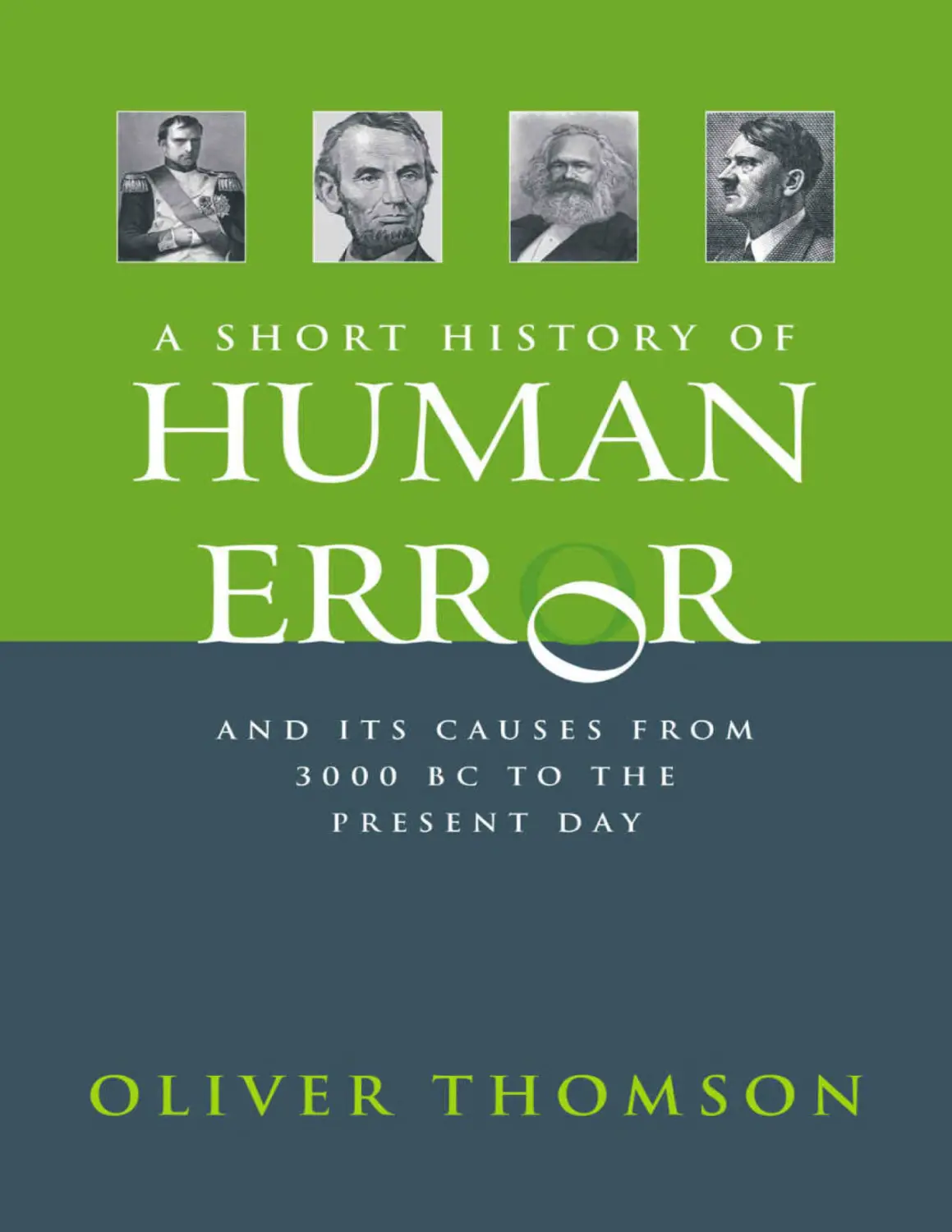
                    A Short History of Human Error
and its causes from 3000 BC to the present day

Oliver Thomson is the author of ten books on historical subjects, also
several guide books and a play. Having won a scholarship in Classics to
Trinity College Cambridge he changed tack to read history and later gained
a PhD at Glasgow University on propaganda history. He spent some 25
years as managing director of two advertising agencies but also continued
writing, lecturing and broadcasting on radio. The primary aim of this book
is to use modern psychological criteria to examine the personality flaws of
political, religious and economic leaders over the last three millennia and
relate them to the many man-made disasters for which they were
responsible.
By the same Author –
Mass Persuasion in History
The History of Sin
Easily Led a History of Propaganda
The Great Feud
The Bloody Heart
The Romanovs Europe’s most obsessive Dynasty

The Rises and Falls of the Royal Stewarts
The Impossible Bourbons
The Other Kaisers

A Short History of Human
Error
And its causes from 3000 BC to
the present day
Oliver Thomson

Arena Books

Copyright © Oliver Thomson 2013
The right of Oliver Thomson to be identified as the author of this work
has been asserted in accordance with the Copyright, Designs and
Patents Act 1988.
First published in 2013 by Arena Books

Arena Books
6 Southgate Green
Bury St. Edmunds
IP33 2BL
www.arenabooks.co.uk
Distributed in America by Ingram International, One Ingram Blvd., PO Box
3006, La Vergne, TN 37086-1985, USA.
All rights reserved. Except for the quotation of short passages for the
purposes of criticism and review, no part of this publication may be
reproduced, stored in a retrieval system, or transmitted, in any form or
by any means, electronic, mechanical, photocopying, recording or
otherwise, without the prior permission of the publisher.

Oliver Thomson
A Short History of Human Error and its causes from 3000 BC to the present day
British Library cataloguing in Publication Data. A Catalogue record for this
book is available from the British Library.

E-book ISBN 978-1-909421-35-6
ISBN-13 978-1-909421-26-4
BIC classifications:- HBTB, JMF, HBG, JMP, HBL.
Printed and bound by Lightning Source UK
Cover design
By Jason Anscomb
Typeset in
Times New Roman

CONTENTS
(Pages below refer to the printed edition of this book.)
Introduction

page -

17
CHAPTER 1
KLEPTOMANIA
Sargon,Thotmes II,Rameses II,Attila the Hun,Bohemond, Philip
the Fair, Genghis Khan,Sir John Hawkins, Cortes, Pizarro,
Napoleon, Leopold II, Hitler, Mao, Suharto, Marcos, Mobutu,
Milosevic, Duvalier, Fujiwara, Noriega
Herd Kleptomania: Athens, Rome, Muslims,Vikings.Ottomans,
Aztecs, Stroganovs, East India Company, Africa, corruption
Commercial and State Kleptomania: Enron, Ponzi,Madoff,
Lehmans,
Dionysius of Syracuse, Caracalla, Philip IV,Frederick IV, James II,
Charles V, Henry VIII,Charles I, Frederick the Great,
George

Washington, Harold Wilson, Robert Mugabe, American and
French
Revolutions, Carnegie,Rockefeller, Berezovsky and other
Russian
oligarchs,Tanaka
page - 19
CHAPTER 2
PARANOID NARCISSISM
Ashur Nasirpah, Periander, Xerxes, Alexander the Great,Qin Shi
Huang, Wu Han,Antiochus, Herod, Hannibal,Tiberius,Caligula,
Nero, Justinian,Theodoric,Al Mansur, Harun al Rashid,
Mohammed of Ghazni, Abdul Hamid, Richard II, Inca Huayna
Capac, Moctezuma II, Qian Long, John Smith, Chong Shen, Nadir
Shah, Louis XIV, Napoleon, Lord Cardigan, General Custer,
Kossuth,
Fernando I, Ludendorff, Hindenburg, Hitler,Franco, Macarthur,
Nixon,Verwoerd, Mao,Chiang kai Chek, Assad,Karadzic, Mobutu,
Suharto, Idi Amin,Duvalier, Habyarimana, Marcos, Charles Taylor,
Laurent Gbagbo, Mohammed Omar, Anders Breivik
Non-psychopathic narcissists: Ah Cacao, Godoy, Metternich,
von Bulow, de Redcliffe, Georges Boulanger
page - 31
CHAPTER 3
VIRAL PARANOIA
Juntas: Thailand,Nigeria,Argentina, Greece ,Chile, Burmah
Paranoid Wives: Lady Macbeth, Hatshepsut, Jezebel, Boudicca,
Zenobia,Wu Zhao, Razia Sultan,Martha Ludendorff,Mira
Milosevic, Bandaranaika, Indira Gandhi
Malignant Narcissism: de Sade,Giles de Rais, Torquemada,
Elizabeth Bathory, Josef Mengele,Shiro Ishii
Viral Sadism: Assyrians, Nazis,Japanese, Hutus and Tutsi
Viral Paranoia: Assyrians, Spartans, Romans, Jacobins,
Germans,
Young Turks, Russians, Japanese, Cultural Revolution, India
Praetorian Guard Syndrome: Rome,Baghdad,Moscow,
Istanbul

Post-mortal Narcissism: Egyptians, Japanese,Chinese
Schizophrenia: Caligula, Caliph Ibrahim,Eric XIV, Al Hakim,
Mad Juana, Sirhan Sirhan, spree killers
page 56
CHAPTER 4
INADEQUACY COMPENSATION
Height: Alexander the Great, Attila,Charles III, Charles I and
Laud,
Napoleon, Sarkozy, Stephen Douglas, Madison, Wilberforce,Lord
John Russell,Nicholas II, Gavrilo Princip, Stalin and Hitler,
Ceausescu, Deng Xiao Ping, Gaddafi, Kim Jong Il, Medvedev,
Pope
Gregory VII
Bastardy or Ancestry Problems:Sargon,Sulla,Constantine,Wu
Zhao, Charles Martel,William the Conqueror,Monmouth,
Berwick,
Mansfeld, Robespierre, Canning, Hindenburg, Lloyd
George,
Shaka,Weygand, Hirohito, Trujillo, Milosevic, Castro, Reagan,
Obama, Lula, Fatimids, Ahmedinejad
Anorexia and Bulimia; Catherine of Siena,Mary of Oignies,Saint
Angela, Saint Veronica, Emperor Claudius
Intellectual Inferiority and Dyslexia :Pol Pot, Ribbentrop,
George
W.Bush,Commodus,Charlemagne, Akbar, Charles I, Frederick
William III, Woodrow Wilson,
Fear of Fear: Genghis Khan, King Stephen, Bismarck, Salisbury
Anhedonia: Monks,Sufis,Fakirs, Julian of Norwich, Mani,
Buddha
Insecurity and Susceptibility: Disciples, Frederick Prince of
Wales, Tsar Alexander I,Henry III, Frederick William IV,
Berchtold,
Heydrich, Eichmann,Tony Blair,Bush, Richard Reid page - 76
CHAPTER 5
SEXUAL SUBLIMATION

Achilles, David and Jonathan, Epaminondas, Alcibiades, Plato,
Agesilaus,Gaozu, Julius Caesar, Hadrian, Elagabalus, William II,
Zen
monks, Richard Lionheart,Tsar PeterIII,Basil II,Bayezit, Edward
II,
Henri III, Frederick the Great,Rudolf II, James VI and I,Orleans,
Vendôme, Wolfe, Queen Kristina, Louis XIII, Karl XII, Gustav III,
Louis XVI, Louis XVIII, Napoleon, Hector Macdonald, Cecil
Rhodes, Kitchener, Krupp, Eulenburg, Ataturk, Röhm, Hitler,
Joan of Arc, Elizabeth I , Pope Alexander VI, Saint Paul, Origen.
Favourites: Jiru,Sejanus,Cleander,Gaveston,
Despenser,Cochrane,
Rizzio, Carr,Buckingham, Abigail Masham,Bentinck, Keppel,
Mignons, Lerma, Olivarez, Menshikov, Potemkin
Oedipus Complex: Alexander the Great,Jahangir, Frederick
Prince
of Wales
page - 102
CHAPTER 6
BIPOLAR DISORDER
Saul,David, St Francis,St Catherine, Luther, Shebetai Zevi, John
Wesley, Joanna Southwood, Joseph Smith, Oliver Cromwell,
Felipe V, Potemkin,Pitt the Elder, Castlereagh, Mazzini, Lincoln,
John Brown, John Wilkes Booth, John
Bellingham,Coolidge,Hayes,
Pierce,Hong Xiuqan, Queen Victoria, Prince Rudolf, Churchill,
Stalin,
Mao, Wilhelm II,Yeltsin,Gaddafi,Hamid Karzai
page - 119
CHAPTER 7
ATTENTION DEFICITY HYPERACTIVITY DISORDER
Genghis Khan, Empress Matilda,King John, Emperor Frederick
II,
Henry V, Louis XI, James II, Pope Alexander VI, Vlad the
Impaler,
Cesare Borgia, Thomas Cromwell, Wallenstein, Peter the Great,

Robert Clive, Murat, Miguel, Dingane, Edward VII,
Rasputin,
Bismarck,Clemenceau, Mussolini, Woodrow Wilson,Colonel
Nasser,
General Patton, the Wright Brothers,Carnegie, Saddam Hussein,
Osama bin Laden, Vladimir Putin
Corporate ADHD: Recreational Violence,Blues and
Greens,Vikings,
Crusaders,Mohocks, Bold Bucks,Teddy Boys, Hells
Angels,Baader
Meinhof,Orsini
page - 135
CHAPTER 8
AILMENTS AND DISABILITIES
Withered arm syndrome: Wilhelm II, Stalin, FD Roosevelt,
Richard III, Timur the Lame,Joan the Lame, Claudius,Talleyrand,
Byron, Goebbels
Porphyria and Lycanthropy:Nebuchadnezzar, Charles VI,Henry
VI,
James V, Mary Tudor, Lady Jane Grey, Arbella Stuart,Mary
Queen
of Scots, George III, Kristian VII, Princess Charlotte, Harald I,
King
Vseslas, Vlad the Impaler, Condé, Giles Garnier,Werewolves
Epilepsy or paroxysmal attacks: Ezekiel,Alexander the Great,
Hannibal, Julius Caesar, Saint Paul, Caligula, Mohammed,
Alfred the
Great, Michael IV, Saint Bridget, Luther, Richelieu, Louis XIII,
Napoleon,Archduke Charles, Peter the Great,Leon Trotski
Speech Problems: Moses, Demosthenes, Claudius,Edward I,
Charles I,
Cotton Mather, Thomas Jefferson, George VI, Aneurin Bevan,
Molotov, Ceausescu,
Prognathism: Habsburgs, Charles V,Maximilian I,Philip
II,Rudolf II,
Carlos II, Leopold the Great, Marie Antoinette

Asthma,Psoriasis,Scabies and Leprosy: William of
Orange,Peter the
Great, Disraeli, Teddy Roosevelt,Woodrow Wilson, Kennedy,
Alfred
the Great, Robert the Bruce, Isabella II, Stalin, Che Guevara,
Marat,
Baldwin of Jerusalem
Graves Disease George H.W.Bush,Barbara Bush,Krupskaya
Eye Problems: Maktum,John of Luxembourg, Vasili II,
Mohammed
of Ghazni, Enrico Dandolo, Eamon de Valera,John of Aragon,
Nelson,
Wahid
page - 149
CHAPTER 9
MORE AIMENTS AND DISEASES
Lupus, Dropsy, Edema: Queen Anne, Marcos, Gaitskell,
Empress
Elizabeth, Charles James Fox, Hadrian
Haemophilia Romanovs, Bourbons, Braganzas
Colitis,Crohns Disease,Addison's: Alfred the Great, Louis XIII,
Wilberforce, Eisenhower, Kennedy, bin Laden
Diabetes: Emperor Pedro II, Tito, Suslov,Andropov, Khrushchev,
Nasser, Sadat, Ho Chi Min,Papa Doc Duvalier,Tanaka
Gout: Alexander the Great, Sultan Bayezit, Kublai Khan,the
Medici,
Pope John XXIII, Charles V, Cromwell, Walpole, the Pitts,
Palmerston,
Chamberlain, Elphinstone
Prostate,Gravel and Stones,Nephritis: Napoleon III,Napoleon,
Nicias, Augustus,James I, Cromwell, Peter the Great, Empress
Anna,
Wolfe, Mitterand , James Pollok, Lyndon Johnson, Indira Gandhi,
Ratko Mladic
Insomnia,Sleep Apnea: Napoleon, Thatcher,Franklin,Roosevelt,
John Paul Jones, Lord Rosebery,Taft,Yeltsin

Obesity: Chinese and Ottoman emperors, Pope Leo X, Edward
IV,
Louis VI, Philip IV of France, President Taft, Henry I, William
III.
Strokes, Heart Apoplexy:Trajan,Edward III,Barbarossa,James I,
Catherine the Great,Lenin, Woodrow Wilson,Harding,Roosevelt
TB,Srofula and Measles: Alexander the Great, Charles IX,
Henry VII, Calvin,Richelieu, Louis XIII, Louis XVII, Napoleon
II,
Bolivar, Monroe
Migraine: Caesar,Marlborough.Napoleon,Grant,Lee, Joan of
Arc,
Jefferson, Marx,St Hildegard
Phimosis:Tsar Peter III,Louis XVI
Scurvy:Crusaders,Explorers,Navies
Onychophagia: Potemkin,Gordon Brown, Jacqueline
Kennedy
Rheumatism and Arthritis: Augustus, Göring, Constantine IX
Nosebleeds,Epistaxis:Attila the Hun,James II, Rommel,Chiang
kai
Chek
Haemorrhoids: King Alfred,St Cuthbert, Fumimaro Konoe
Stomach problems:Mussolini, Khomeini, George Bush
Teeth Problems: Washington,Louis XIV, Hitler,Mao
Inbreeding/Endogamy: Habsburgs,Bourbons, Incas Pharaohs
Page - 170

CHAPTER 10
PLAGUES AND EPIDEMICS
Malaria: Alexander,Titus, Popes, Emperors Otto II and III,Spain,
Genghis,Delhi,Cromwell,Walcheren,Mao,de Gaulle
Yellow Fever:Philadelphia,Barcelona, Alexander Hamilton
Typhus,Typhoid Fever: Athens,Granada, Germany, Russia,
Napoleon's

army, Mahdi, Kosciuzscko,Adhemar, Prince Henry, Albert,Joseph
Smith
Cholera: Bengal,Germany,Spain, Gneisenau, Grand Duke
Constantin
Smallpox/Variola:Antonine Plague, Plague of Cyprian,Aztecs,
Incas,
Tudors, Bourbons, Louis XV, Emperor Joseph I, Luis I of Spain,
Tsar
Peter III
Bubonic Plague: Plague of Justinian,Constantine II,Plague of
Emmaus,
Abu Obeida, Black Death, Great Plague of London,
Vienna,Marseilles,
Seville,Shiro Ishii and germ warfare
Diphtheria: New England,Russia,Hisham,Pope Adrian IV
Meningitis: Emperor Taisho of Japan,Tsarevich Nicholas
Parkinsons Disease: Hobbes, Franco, Mao, Deng Xiao Ping,
Arafat
Cancer: Theodora,Kenneth MacAlpine, Anne of Austria,Mary of
Modena,Kaiser Frederick,General Grant,George V, Bonar Law,
Chamberlain
MS: The Black Prince
Ergotism: St Antony's Fire, Salem Witch Trials, Peter the Great,
the
French Revolution, Assyrian germ warfare
'Flu:Mary I,Spanish,Asian
Some other common and uncommon diseases: Anthrax,Selim
the
Grim,Washington,Angina, Pneumonia, Deep Vane Thrombosis,
Polio,
Puerperal Fever, Motor Neurone Disease
page - 198
CHAPTER 11
OBSESSIVES,CONTROL FREAKS
Obsessive Compulsive Disorder: Samuel Johnson,
Charlemagne,

De Montfort, Huss,Cosimo de Medici, Philip II, Emperor
Ferdinand I,
Tsar Alexei,Joseph II, Franz Josef, Frederick William, Martinet,
Dyer,
Montgomery, Bomber Harris, Stonewall
Jackson,Chadwick,Bismarck,
Hideki Tojo, Hitler, Lavrenti Beria,Himmler, Khomeini, Breivik
Panic Attacks; Millennia, Yellow and Black Perils, Reds under
the
Bed, Bubbles
Competition mania; Arms Races; Fisher and Tirpitz,Mitchell
and
Messerschmidt, Oppenheim and von Braun,Shrapnel,Kalashnikov
Secret Societies: Teutonic
Knights,Assassins,Freemasons,Carbonari,
Sons of Liberty,Black Hundreds,Boxers,Triad, Mau Mau,Muslim
Brotherhood
page - 214

CHAPTER 12
ASCETIC NARCISSISM
The Hair Shirt Syndrome: Moses,Elijah,Ezekiel, John
the
Baptist, Vardamana Mahavira,Buddha, Han Shan,the Spartans
Celibacy: Origen, Saint Anthony, Jerome, castrati, Skoptsi
Masochism: Simeon Stylites, Peter Damian, Saint Bernard,
Francis
of Assisi, Uwais al Qarni, Hassan i Sabah,Saint Dominic,
Flagellants,
Shiites
Puritans: Knox, Tsar Alexei, Matthew Hopkins, George Fox,
Loyola,
Tilly,Thomas Arnold,Charles Taze Russell,Gandhi, Khomeini,
Osama
bin Laden

Crowd Asceticism and the Bed of Nails Syndrome:
Fakirs,Firewalkers
page - 232
CHAPTER 13
DRUGS AND OTHER ADDICTIONS
Alcohol: Ulysses S Grant,Noah, Gin,Roman army,British army,
Cambyses, Bacchae, Alexander the Great, Caliph Yazid, Walid the
Libertine, Hardecanute, the Moguls,Henry VIII,Pitt the
Younger,Joseph
Hooker, John Macdonald, Daniel Webster, Ludwig II, Herbert
Asquith,
Ataturk, Winston Churchill, Yahya Khan,Joseph McCarthy, George
W.
Bush
Gold: Croesus, Rome,Alexander the Great, Caesar, Charlemagne,
Basil I, Pizarro and Cortes
Diamonds: Rhodes, Charles Taylor, Mugabe
Sugar: Venice, Mamluks
Oil: Rockefeller,Yom Kippur, Biafra, Iraq
Narcotics,Stimulants,Halucinogenics:Chinese, Moguls, Clive,
Nelson,
Assassins, Sufis,Berzerk Vikings, Lord Liverpool, Coca and the
Incas,
Qat, Nicholas II, Göring,Eden,Churchill,Kennedy, Pervitine, Opium
Wars,Kamikaze, Ephedra
Hoarding: Bronze Age,Romans, Anglo Saxons,Templars,Collyar,
Fort
Knox, Art Collectors, Bibliomania
Sex: Clinton,Kennedy, Berlusconi, Strauss-Kahn, Rameses II,Henri
IV,
Louis XIV, Augustus the Strong, Moulay Ismail,d'Annunzio, Carol
II,
Messalina, Theodora, Catherine the Great, Isabella II, Pope
Alexander VI,
Monasteries,Virgin Queens
Gun Fetishism:Spree killings

Relics and Graven Images:The True Cross, Mohammed's
Cloak,Antioch,
Iconclasts, Leo III, Zwingli
Pilgrimages: the Hajj,Lourdes,Kyoto, Crusades, Crimean War
Page - 243

CHAPTER 14
SPIRITUAL NARCISSISM
Prophets:Moses, Ezekiel, Zoroaster,Jesus, Paul, Mohammed, Said
Ubaid, Ibn Tumart, Mahdis, Wahhab,Bahai, Mani, Urban
II,Aquinas,
Louis IX, St Francis,Joan of Arc,Saint Teresa of Avila, Luther,
Calvin,
John of Leiden, Loyola, Nanak, Pascal, George Fox, Joseph Smith,
Mary Baker Eddy, Isaiah Shembe, A.J.Balfour, David Moses Berg,
Jim
Jones, David Koresh, Sun Myung Moon, Ron Hubbard,Sai Baba
Holy War
Heaven/Hell Syndrome: Egypt,China , Japan
Human Sacrifice:Iphigenia,China, Aztecs
Imperial Cults: Egypt, China,Alexander, Rome, Diocletian,
Theodora,
Incas, Louis XIV,
Chosenness: Chosen peoples,Men of
Destiny,Fundamentalism
page - 268
CHAPTER 15
INTELLECTUAL NARCISSISM
Pythagoras, Plato,Aristotle, Confucius,Locke, Hobbes,Descartes,
Spinoza, Rousseau, Paine, Robespierre, Adam Smith,Malthus,
Schopenhauer, Darwin, Marx, Nietzsche, Gobineau, Freud, Keynes,
Friedman, Curzon, Milner, Quisling,Harold Macmillan, Climate

page - 288
CHAPTER 16
LUDOMANIA
Gamblers as Politicians and Soldiers: Julius Caesar,Henry IV,
Henry VII, Bolingbroke, Sandwich, Palmerston, Disraeli,
Napoleon, Wellington, Nelson, Mirabeau, Nathan Forrest,
Churchill, Yamamoto, David Stirling,
The Pathology of Speculation:Pitti, Sultan Achmet III,South Sea
Company, John Law, Orleans, Mississippi Company, Bank Crises,
Nick Leeson, Hedge Funds, Sub-prime Mortgages.
Sport:Chariots,horses, football
page - 298
CHAPTER 17
GUILT NARCISSISM
Saint Augustine of Hippo,Rousseau, Tolstoy, The Shiites,
Ashoka,Louis VII, Savonarola, Khlysty,James IV, Alexander I,
Akbar, Gladstone
Viral Suicide: Seppuku, Jihadists,Jasmine Revolution
Viral Martyrdom: Christian Martyrs
Judgemental Disasters; Aztecs
page - 308

CHAPTER 18
POST-TRAUMATIC STRESS ANDOTHER ANXIETY DISORDERS
Peter the Great, Ivan IV, Lenin, Loyola,Machiavelli, Hitler,
Prince Asaka, Deng Xiao Ping, Jang Zemin, Hu Jintao
Xenophobia: Serbs and Croats,Tutsi and Hutu,Jews, Pashtun
Agoraphobia and Claustrophobia Louis XI, Frederick the
Great,
Ludwig II, Abdul Hamid, Joseph of Portugal
Brain Damage: Henry VIII, Robert of Clermont
Eunuchs: Bagoras, Narses,Malik Kafur, Judar Pasha,Zheng Hi,

Mohammed Khan
page - 317
CHAPTER 19
STD's
Gonorrhea and Syphilis: Charles VIII, Henry VIII, Francois I,
Ivan IV, Darnley, Peter the Great, Grigori Orlov,Vendôme,
Napoleon, Nietzsche, Schopenhauer, Lincoln, Randolph Churchill,
Woodrow Wilson, Shumei Okawa, Idi Amin, Robert Mugabe
HIV/AIDS
page - 327
CHAPTER 20
HUNGER
The Great Famines, France, England, Baltic, Russia, China, India
Peasant Revolts
Diets for Aggression
page - 333
CHAPTER 21
GERONTOCRACY AND DEMENTIA
James II, Lord Raglan, Robert II,Edward III, Suleiman II,
Shah Jahan, Bahadur Shah, Frederick the Great, Quianlong, Franz
Josef II, Cardinal Fleury, Pius IX, Woodrow Wilson, Salisbury,
Ramsay MacDonald, Hindenburg, Neville Chamberlain,
Petain,
Churchill,Stalin, de Gaulle, Brezhnev, Harold Wilson, Ronald
Reagan,
Mugabe
page - 340
CONCLUSIONS
349
BIBLIOGRAPHY
page – 351

page -

INDEX
page - 355
(The Index pagination refers to the printed edition of this book.)
I apologise in advance to any medical and psychiatric professionals
who disagree with some of my diagnoses, but as seen recently in the
case of the Norwegian spree- killer Anders Breivik two panels of
experienced psychiatrists disagreed totally on the causes of his
actions. As a mere historian my aim is to assess the effect that various
different personality disorders and ailments have had in altering the
course of history, sometimes for good, more often for bad. Naturally
most of my patients are already dead but the hope is that those with
similar symptoms in the future will be stopped before they go too far.
Note on spelling of names
With a substantial number of people from different cultures,
European, Islamic, far eastern, ancient and modern, I have simply
chosen what I thought were the easiest and most commonly used
forms of spelling, not necessarily the most authentic. In some cases
I have not been consistent as for instance using Kaiser
Wilhelm,because we are used to that but for other German kings
using William. Similarly with Philips,Philipes and Felipes.
ILLUSTRATIONS
(Please note that illustrations are only included in the printed edition of
this book.)
will be found between pages 176 and 177
1. Paranoid Narcissists: (i) Pharaoh Rameses II of Egypt (ii)
Shah Abbas of Persia (iii) General George Armstrong Custer (iv)
Slobodan Milosevic (v) Muammar Gaddafi
2. Bipolar Personalities: (i) Oliver Cromwell (ii)The Elder Pitt
(iii)Abraham Lincoln (iv) Kaiser Willhem II (v) Winston Churchill

3. Compensating for Inadequacies: (i) Julius Caesar: paranoid,bisexual gambler with epileptic problem (ii)Louis XIV: ultimate
narcissist,obsessive with height and other complexes
(iii)Napoleon:self-made paranoid compensating for a cocktail of
underdog neuroses. (iv) Otto von Bismarck; highly strung obsessive
(v) Adolf Hitler: another highly complex cocktail of ethnic, attentiondeficit, post-traumatic and sexual neuroses leading to extreme
psychopathic paranoia.
4. Obsessive Compulsive Disorder: (I) Cardinal Torquemada of
the Inquisition (ii)The Emperor Ferdinand II who provoked the
Thirty Years War (iii) Kaiser Franz Josef (iv) Hideki Tojo,
instigator of Pacific War (iv) Josef Mengele, doctor of
Auschwitz,sado-narcissist.
5.
Attention Deficit Hyperactivity Disorder:(i) Alexander the
Great (ii) Peter the Great (iii) Robert Clive (iv) Horatio Nelson
(v) Osama bin Laden
6. Sexual Sublimation: (1) Sultan Mehmet the Conqueror (ii)King
James
VI&I (iii)Queen Kristina of Sweden (iv) King Karl XII of Sweden
(v)
Frederick the Great of Prussia
7. Spiritual and Intellectual Narcissism: (i) along with with Post
Traumatic Stress: St. Ignatius Loyola (ii) Karl Marx (iii) Jim Jones
of the People's Temple (iv) Ayatollah Khomeini (iv) Jim Jones of
the People's Temple.
(v) Yalta Conference: Bipolar with gambling and alcohol issues
meets
polio sufferer with cardio-vascular problems meets
psychopathic paranoid
with withered arm complex.
8.Hereditary Prognathism – the Habsburgs (I) Emperor Maximilian I

(ii) Rudolf II Kleptomania (iii) Leopold II of Belgium (iv) Predident
Suharto
of Indonesia (v) Papa Doc Duvalier -also diabetic paranoid
(iv) Charles Ponzi, swindler
Acknowledgements
Once again I owe an enormous debt to my wife Jean for putting up
with my numerous human failings whilst I have been writing about
other peoples'.
Also to my challenging adult students in the University of Glasgow
and to James Farrell of Arena Books for his patient assistance.
'An acrimonious humor falling on a single fiber of one man may
prevent or
suspend the misery of nations.'
Edward Gibbon, Decline and Fall of the Roman Empire
referring to
how Sultan Bayezit's gout saved Europe from conquest
'He became motivated to rise above the people who despised him'
Frank McLynn on
Napoleon
'The

study of history is the study of causes'
E.H.Carr What is History?

INTRODUCTION
In trying to analyse the flaws and neuroses of historical
personalities I confess to indulging in some anachronistic jargon,
most of it coined by Sigmund Freud and his followers in the early
20th century, some of it like post-traumatic stress disorder or

ADHD of even more recent invention. But just because the
terminology did not exist does not mean that people in the past
were not prone to these mental ailments, neuroses or obsessions.
What is undeniable is the fact that most of the world's man-made
disasters can be attributed to the character flaws of individual
people whether due to their psychological make-up or some
underlying medical condition.
What follows will not pretend to have the precision of a
doctor's or a psychiatrist's examination of a living patient; all our
evidence is at second hand and most of it dates from long before
psychology or psychiatry were invented. Chroniclers tend to be
shy about mentioning ailments and even with modern leaders their
pyschological or medical condition is often kept secret. So while
there is little doubt that Julius Caesar was epileptic or at least had
paroxysmal fits, there is no such certainty about Saint Paul and
while nobody doubts that the elder Pitt was bipolar there are only
hints that Oliver Cromwell had the same problem. However there
is enough evidence to provide credible observations that
demonstrate the significance of such personality traits in world
history.
I have tried to categorise the significant personality disorders
which have affected the course of history, but retrospective pigeonholing is sometimes hard,for many great men and women suffered
from more than one neurosis or physical problem at the same time.
Attempts at forensic psychology applied to long dead leaders,
even well-documented ones like Napoleon and Hitler, are difficult,
as they displayed a whole spectrum of personality flaws. John F.
Kennedy is variously described as a depressive, an asthmatic
suffering from attention-deficit-hyperactivity disorder, malaria,
diarrhea, prostate problems, colitis and Addison's Disease.
Similarly Tsar Peter the Great was possibly epileptic, certainly had
attention-deficit disorder, post-traumatic stress, malaria, kidney
problems and probably syphilis. Even Colonel Gaddafi has been
variously characterised as paranoid, bipolar and over-sensitive to
his short stature. So many of the people mentioned will for reasons

of comorbidity appear several times in this book, but I have tried to
isolate the trait which I think, rightly or wrongly, was most
significant for their career.
I am not suggesting that to saddle historic personalities with
mental disorders is to exonerate them from blame for
their
misdeeds; that begs the
question of whether such behaviour resulted from an 'illness' or, as
was more commonly believed in previous centuries, some form of
'wickedness'. We should remember that many of the damaging
personality flaws of the men and women we are looking at did not
develop until late in their careers and in many cases may have been
the result of the stresses to which they exposed themselves or the
role models they copied. Most of those later described as 'mad' or
'bad' had simply, as Acton put it so memorably, been corrupted by
power of one kind or another. So pleas
for diminished
responsibility are largely irrelevant and clearly many great socalled heroes of the past would be indicted as war criminals
including at least half a dozen English kings and several heroes of
the Old Testament.
There have been many situations in which a leader's
personality disorder may have benefited, not harmed his or her
contemporaries. For instance it can be argued that bipolar leaders
like Winston Churchill and Abraham Lincoln were actually better
able to cope with extreme crises because of their handicap. Some
of the world's most useful inventions, its finest works of art and
music, have been due to individual obsessions or neuroses. The
suspect visions that came to anorexic saints and sufis have also
provided great comfort for many people throughout the world.
Many leaders have also risen above their physical disabilities to
render great service to their fellow humans.
It must also be said that the mental disorders of leaders
would have mattered much less if their followers had not
themseves also been so subject to feelings of insecurity, prejudice
or envy, otherwise they would never have slavishly accepted such
leaders. As Roland Carlstedt put it 'Between 15% and 30% of any

population or group will have what's known as high-range hypnotic
susceptibility, which makes them inclined to look for outside
answers... and be vulnerable to those giving them simple answers to
what they're striving for.' But for this vulnerability the men with
'the simple answers' would never achieve power or influence
When it comes to the physical ailments that may have led to
poor performance by people in positions of power I have by no
means been all-inclusive. DNA has made paleopathology a slightly
more exact science but diagnoses of long vanished symptoms are
often very sketchy. Nevertheless there are a number of examples of
both the minor and major ailments of leaders having a significant
effect on the course of history, as well as of infections and
epidemics that caused radical shifts in attitude amongst whole
populations.
CHAPTER 1
KLEPTOMANIA
'The effects of a kleptocratic regime or government on a nation
are
typically adverse.' UN Report
In modern parlance kleptomania is commonly defined as 'the
irresistible urge to steal items of trivial value' and was recognised
as a mental disorder in the United States in the 1960's. However in
historical terms it seems more appropriate to describe it as an
addiction brought on by gradually increased doses of petty
thieving until it becomes an obsession. This addiction, classified as
one of the Obsessive Compulsive Disorders, has afflicted political
leaders since the dawn of history, causing huge hardship and
massive loss of life over many centuries. It has also been one of
the inherent flaws of both capitalism and other forms of economic
organisation leading to pernicious inequalities, disruptions and
recessions.

Industrial scale kleptomania clearly goes back to the pharaohs
of ancient Egypt and other empire builders of that era who
developed a compulsion to conquer additional small provinces for
themselves far beyond the point where these could be of any
serious benefit to them or their states. This compulsive thieving
included not just the acquisition of land and gold but also of vast
numbers of human beings who thus became slaves. It also
included the plethora of trinkets that could be shoplifted from the
conquered nation and added to the already vast hoards possessed
by the conqueror. Venice stealing the bronze horses of
Constantinople, Napoleon collecting old masters, Nazi looting of
artwork are all later examples, though the Elgin Marbles and the
Rosetta Stone are slightly more complex.
In picking out a few individual examples of this trait we have
to recognise that most of its worst practitioners were probably also
paranoid narcissists and may have had other psychological
flaws,but the dominant feature historically was multiple conquest
of larger and larger empires which caused death and substantial
hardship for the losers, long-term ethnic disruption and usually a
cataclysmic disintegration to follow.
Seneferu, king of Egypt (2613-2590BC) boasted of bringing
back from his conquests gold, 7000 slaves and 200,000 cattle or
goats. The pyramid builders practised enslavement on a massive
scale to provide cheap labour for their monstrous memorials.
Sargon of Akkad (2270-2215 B.C.) who conquered what are now
Iraq, Iran and Syria was one of the first historically recorded
warlords who practised systematic looting to motivate his troops
and savage intimidation to demotivate his enemies. Like some
other notable figures of this era he was supposedly the child of a
single mother: like Moses he was found amongst the bull rushes
and was a teenage gardener before carving out his empire and
devastating neighbouring states to such an extent that there were
crop-failures and their value to him was very little other than
boosting his ego.

Ancient Egypt continued to thrive on looting goods and
people from its neighbours. Thotmes III of Egypt (c.1479 BC)
who claimed to have conquered 500 nations is revealed by his own
boast as a sadistic megalomaniac who used amputation as one of
his tools for control. Rameses II of Egypt ( 1292-1213BC) was
clearly also a megalomaniac narcissist and one of the first rulers
recorded as using torture and ethnic cleansing on a substantial
scale. The huge size of his statue at Abu Simbl is a clear indication
of megalomania especially when it is noted that he is larger than
the nearby gods (see also next chapter).
When Persia became the next superpower round about 600BC
it too fed its treasury at Susa with looted gold from Egypt and
elsewhere which was in turn stolen by Alexander the Great in 331
BC, probably one of the largest single hauls in history. A century or
so later it was the turn of the Romans, a people whose only route to
progress was by robbery, who began stealing gold from Spain
around 220BC and Julius Caesar bought his way to power by
looting huge quantities of gold from his conquest of Gaul. Then
from 410 AD onwards it was Rome's turn to be looted by the Goths
and Vandals.
Attila the Hun (406-52 AD) a man allegedly of short stature,
known as Flagellum Dei/ Scourge of God, came from a Turkic
nomadic tribe east of the Volga whose natural ethic was to condone
theft from neighbouring peoples as a respectable way of earning a
livelihood. As joint ruler of an expanded group of Hun tribes along
with his brother, Bleda, he organised a succession of invasions of
the eastern Roman Empire and Persia,from which he extorted
massive sums of blackmail before moving on. In 445 he was
alleged to have arranged for the death of Bleda in a hunting
accident so that he became sole ruler and as such conquered Italy.
He died in slightly odd circumstances on the first night of his
umpteenth honeymoon leaving his sons to fight over the spoils (see
also Nose Bleeds).
Mohammed (570-634) a man whose first career had been as a
manager and guard of camel caravans was well used to selfdefence. He came under severe pressure during the period when

he was persecuted by the merchants of Mecca, and turned his
skills to robbing the caravans he had previously protected, a way
of life traditionally blessed by the ethics of the Bedouin as razzia.
When he had eventually won over the people of Mecca by a
mixture of force and compromise he applied the razzia concept to
a much wider area, using the highly motivated mobile army that he
had created to raid the Greek and Persian empires for booty. Thus
looting the cities of infidels became a key component in the rapid
expansion of Islam under his immediate successors and continued
in many areas. For instance the first Islamic invasions of India
were almost entirely geared to picking up rich booty and then
returning to base. Mahmud of Ghazni (971-1030) was one of the
great practitioners, invading India sixteen times and extracting
huge loot:gold,elephants,forts and 50,000 slaves per campaign.
Another Turk, Sultan Tughrul Bey (990-1063) was similarly
rapacious as was Mohammed of Ghor (1162-1206) based in what
is now Afghanistan.
It is probable that a considerable number of crusaders should
be included in the kleptomania category. The Norman adventurer
Bohemond of Otranto (1058-1111) was not untypical in that he had
previously been involved in the Norman attacks on the Byzantine
Empire and saw the 1st Crusade as an opportunity to recruit soldiers
for a further raid in the same area. His objective was to collect
booty and if possible grab some land. He achieved both,
establishing himself as Prince of Antioch. Certainly the looting of
Constantinople by the Norman crusaders in 1204 had no religious
justification.
Three of the most massive examples of theft in history have
been from the Catholic Church or its subsidiaries. The first was the
seizing of the vast wealth of the Templars by King Philip the Fair
of France in 1314. The second was the stealing of East Prussia
from the Teutonic Knights by their own Grand Master Albert of
Hohenzollern in 1525. The third was the confiscation of monastic
wealth by Henry VIII of England in 1536.

The Mongol leader Genghis Khan (1162-1227 see also under
ADHD) was probably the greatest looter of all time who destroyed
most of what he could not steal from his numerous
conquests,delighted in destruction. His grandson Kublai Khan
(1214-94 see also under Gout etc) the conqueror of China was
probably the second greatest all time looter followed closely by
their supposed descendant the half-Turkish Timur the Lame (13361405), an alleged former sheep stealer (see also ADHD ) who took
massive amounts of booty back to Samarkand.
A classic example of escalating kleptomania is found during
the Hundred Years War between Engand and France when neither
government had the money to pay its troops and the habit grew of
living off the land. So unemployed routiers pillaged the French
countryside without mercy. The illiterate English mercenary John
Hawkwood (d.1394) having learned his trade under Edward III
became a freelance captain of the White Company in Italy,
changing allegiances without compunction and taking money from
both sides. His company were guilty of the massacre of Cesena in
1377 during Pope Gregory XI's war against Florence. Even more
notorious were the écorcheurs so-named because they stripped
dead bodies. Led by a Spanish ex-mercenary Rodrigo de
Villandrando (d.1457) they hired themselves out to Charles VII of
France in 1427 and were guilty amongst other atrocities of
massacring the refugee peasants of Saint Romain-le-Puy. At his
peak Villandrando had some 10,000 men extorting blackmail and
terrorising the people of Medoc. War breeds a form of situational
kleptomania partly because the general laws of property tend not to
apply between opposing sides in any conflict.
The two Spanish cousins Hernan Cortes (1485-1547) and
Francisco Pizarro (1471-1541) both rank as amongst the most
successful robbers in history. Cortes had been a pale and sickly
child who became an attention deficit teenager. He abandoned law
school, caused mischief and slept with married women. Having
taken ship to the Indies in 1504 he almost immediately caught
syphilis but recovered and became the extraordinarily successful

conquistador of Mexico, from which he extracted a massive
personal fortune. Though distrusted and neglected by the imperial
authorities he still died a very rich man. His cousin Pizarro had the
disadvantage of being illegitimate but his conquest of Peru was
even more spectacular and he took a massive share of the huge
ransom paid by the Inca Atahualpa who was then treacherously
killed. The kleptomania of these two men led to comprehensive
genocide under their successors.
In the 16th century it was convenient for Queen Elizabeth of
England to legitimise what was in effect piracy,both for the
acquisition of gold and silver and to damage the power of Spain at
sea. Sir John Hawkins (1532-95) and his cousin Francis Drake
were thus motivated to improve the efficiency of the English Navy
for the sake of their own financial gain as well as the defence of the
realm, a policy which proved very useful during the Armada attack
of 1588. Between them the two men led a series of highly
profitable raids on Spanish shipping and colonial outposts in the
Caribbean. Hawkins is also credited with the first imports of
potatoes and tobacco. In 1555 after setting up a syndicate he
captured and sold his first shipload of African slaves thus founding
the British component of the Atlantic slave trade.
An example of an iconic group of heroic robbers was the
Cossack leader Stenka Razin (1630-71) who at the age of twenty
had gone on pilgrimage to the Solovetsky Monastery for the
benefit of his soul. A few years later he formed his band of
robbers, using intimidation tactics to extort money from the
inhabitants of the Volga basin. In 1660 his force was large enough
for him to destroy a naval flotilla and seize the treasure barges of
the patriarch. With a fleet of 35 galleys he went on to capture all
the forts of the lower Volga, set up a state-within-a-state and
launch a hit-and-run invasion of Persia to pick up booty. Then
followed his sacking of Tsaritsyn and massacre of the inhabitants
after which he founded a short-lived Cossack republic in
Astrakhan. A year later he was defeated and captured by the tsar's
forces and tortured to death. Despite his atrocities therefore he

became a cult figure of Russian mythology,an icon of rebellion and
Cossack independence. This post-mortal status mirrors the similar
legends of other folk hero robbers like Robin Hood and Rob Roy.
Napoleon ( 1769-1821 - see also under various other
headings) not only stole entire nations but combed them for
valuable works of art, money, stores and conscripts, turning
plundering into an organised system. This led directly to the death
of around 6 million people, half of them French.
One of the great political examples of unbridled greed was
King Leopold II of Belgium (1835-1909) who developed a private
empire in the Congo where his officials often flogged the native
population to death as they extracted the huge mineral wealth or
worked in his rubber plantations. This genocide ran into millions
and the favouritism between Hutu and Tutsi left lasting scars. It
was just one sample of the wave of European imperialism which
overwhelmed Africa and many parts of Asia during the 19th century
and constituted a period of massive kleptomania.
Hitler ( 1889-1945 see also under ADHD,Paranoia,Sex,PTSD
etc)and the other Nazi leaders were like Napoleon in that they
regarded conquest as an excuse for adding to their personal wealth
and to their huge collections of art. Alfred Rosenberg (1893-1946)
amongst others was responsible for the systematic processing of
pilfered art works from all over Europe.Whilst this thieving was
not the sole motivation for exterminating 6 million Jews it did play
a part.
Mao Tse Tung (1893-1976 see also under Paranoia,ADHD,etc
) during the Cultural Revolution of 1966 exploited the fact that the
teenage members of his Red Guard were invading numerous
middle class homes to encourage them to steal cash, jewellery and
other family heirlooms some of which he used to prop up the
government's ailing finances, but a lot also for the personal wealth
of himself, his wife and a few chosen colleagues.

The word kleptocracy was coined to describe the number of
recent leaders mainly in third world countries who used power as a
means of amassing huge wealth,most of it usually placed in secret
bank accounts in Switzerland. The money was mainly collected by
embezzlement of state funds or accepting bribes from multinational companies and in almost every case caused severe
economic problems and hardship for the states concerned. In most
cases the culprits were self-made men with a background hinting at
attention deficit heading towards adult paranoia or megalomania.
President Suharto of Indonesia (1943-2008) featured at the top of
the UN list of kleptocrats with an estimated $20 billion. Ferdinand
Marcos of the Philippines (1917-89) collected about half as much
whilst Mobutu of Zaire (1930-97) an estimated $5 billion. Sani
Abacha of Nigeria (1943- ), a Muslim trained by the British army
seized power in Nigeria from 1993-8 and amassed over $1 billion
as did one of the two Europeans on this list Slobodan Milosevic of
Serbia, the other being Lazarenko of the Ukraine who took a
modest $200 million. Two others in the top ten were Papa Doc
Duvalier of Haiti with $800 million and Fujiwara of Peru with
$600 million. Subsequently Arab leaders like Mubarak,Yasser
Arafat and Muammar Gaddafi also amassed substantial fortunes,as
did Dr Mahathir Mohammed in Malaysia, Arnoldo Aleman in
Nicaragua, Joseph Estrada in the Philippines, President Zardari of
Pakistan and Nestor Kirchner in Argentina. Similar trends became
obvious in Russia under Putin and China under Hu Jintao,
particularly after the downfall of the multi-millionaire mayor Bo
Xilai in 2012 (see also under PTSD).
A variation on this theme also coined by the Americans was
Narco-kleptocracy, the use of links with the drugs underworld to
enrich a ruler, of which their prime example was Manuel Noriega
of Panama (1934- ) a soldier trained amongst other things in
psychological operations (PSYOPs) by the American CIA; he held
power 1983-9.
Herd Kleptomania

There are a number of examples of nations or states which
have developed a kind of corporate kleptomania without us being
able to blame any individual leader though there must have been
protagonists who set an example. Clearly the resultant condition
would not qualify for clinical excuses but was simply an extension
of individual greed blessed by peer
pressure.
Fifth century Athens presents one of the first examples of a
more or less democratic state developing communal kleptomania in
terms of exploiting or conquering neighbouring states. Though led
by brilliant men like Pericles, no single politician can be blamed
for Athens' aggressive policies, its misuse of the Delian League to
fund huge artistic projects like the building of the Parthenon,its
savage massacre of those who stood in the way like the islanders of
Melos in 417. The behaviour of the Athenians provoked the war
with Sparta that brought about their ruin and the virtual end of
their pioneering experiment in democracy.
Rome was the other great city state of the ancient world
which developed a habit of corporate kleptomania that cannot be
attributed to any single ruler. After all the Roman republic changed
consuls every year and always had two at one time in case a single
one became too greedy or powerful. Thus the creation of the first
Roman Empire which included Greece, Spain and parts of North
Africa was brought about by a corporate culture of aggression long
before the republic was replaced by dictators and emperors.
Certainly the promotion structure of the Roman state encouraged
competitive warmongering so that the ambitious were motivated
thus to climb the political ladder to acquire the purple stripe of a
senator.
As we have seen the Arabs had a great tradition of razzia, a
view that robbing passing caravans was a perfectly moral way of
surviving in the desert,what we might call situational kleptomania.
The ex-caravan manager Mohammed adopted the same ethic and
encouraged its practice on a much wider scale. By the time of his
death the razzia had expanded to take in substantial raids into the

Byzantine Empire which set the pattern for waves of conquest
undertaken by the first caliphs that took Islam westwards as far as
Spain and eastwards to the edge of China. Similarly the Ottoman
Turks had been mountain herdsmen who also regarded raiding
lowland neighbours as a way of life. After their capture of Bursa
they went on to conquer a huge empire stretching from the Danube
to the Euphrates. Their most ingenious trick was to rob the nations
that they had conquered of their young men, taking a quota of
promising youngsters from each town to train as janissaries who
would then help them conquer even more territory.
There is some controversy as to the kleptomaniac tendencies
of the Vikings but certainly during their first period of exploration
in the 8th century it was driven by the desire for loot and only later
did they concentrate on simply stealing land.Yet even in the early
stages they were also pursuing legitimate trade and hiring
themselves as mercenaries.
The Aztecs in about 1430 created a regime at Tenochtitlan in
Mexico that depended for its survival on theft from its neighbours.
Their own water-bound city lacked agricultural land and most other
resources so that their power was based on so intimidating the
small neighbouring sites that they submitted and handed over a
significant proportion of their produce to the Aztec overlords.
Situational kleptomania again.
The Romanov tsars patronised families like the Stroganovs
who in turn made use of ambitious Cossacks to extend the frontiers
of Russia eastwards,first to develop the fur trade, particularly
sable, then the mineral wealth of the Urals and beyond. It was a
protracted piece of organised theft from the original inhabitants of
this vast area.
The British merchant community rather than any British army
was behind the steady expansion of the British Empire from the
Tudor period onwards. Queen Elizabeth invested in Hawkins and
Drake as pioneers of the British slave trade, supplying black labour

to the West Indies and Central America. She also patronised the
first three ships to sail to India in 1591,an expedition that was
rationalised with the creation of what was later called the East
India Company in 1600. This company developed its own colonial
outposts trading in cotton,silk,indigo,saltpetre, tea and later opium
for the benefit of its investors. Similarly in 1606 the Virginia
Company was founded in London to establish settlements and then
plantations in North America at the expense of the native
Americans. This habit of purloining land continued long after
independence.
The most flagrant example of land-grabbing was the so-called
'Scramble for Africa' by competing European powers during the
19th and early 20th centuries. Disquised as a civilizing mission its
motivations were political and economic but left lasting scars many
of which have still not healed.
Whether the widespread practice of bribery and corruption can
be considered as a form of kleptomania in any psychiatric sense is
doubtful, but clearly it is addictive and viral. Baksheesh, sweetheart
deals, kickbacks,greased palms and other forms of bribery remain
extremely common throughout the world but since 1995 have been
monitored by the Corruption Perception Index which recently
ranked such large economies as India as 95th and China
75th.
Commercial and State Kleptomania
In the world of commerce entrepreneurs also tend to persist in
acquiring other people's wealth far beyond the point where it makes
any material difference to their own well-being.
Business tycoons robbing shareholders either to increase their
own wealth or to cover up their mistakes is well exemplified by the
Enron scandal of 2005. This Texas energy company founded in
1985 by Kenneth Lay made use of accounting loopholes, 'special
purpose entities' and other tricks to hide vast debts until the secret

was exposed and the subsequent bankruptcy meant $74 million
losses for its shareholders.The win-win tricks of corporate bamkers
and their extravagant forms of self-remuneration contributed along
with their obsessive gambling (see Ludomania) to the world
recession that followed 2008.
Another rather less sophisticated form of stealing was the
scheme devised by an Italian swindler, Charles Ponzi (1882-1949)
who emigrated to Boston.Working his way up from a dishwasher
he started an investment company which offered 50% returns by
paying out big dividends to old investors using the the money of
new investors. The most successful disciple of Ponzi was Bernie
Madoff (1938-) a New York Jewish stockbroker who defrauded his
investors of $18 million, some of which he used to help him pose
as a major philanthropist.
One of the classic methods for a government to steal from its
subjects is by debasing the coinage. An early historical example
was Dionysius of Syracuse (c.432-387BC), a candidate for our
paranoid list, who in 400BC called in all his state's drachma coins
and had them restamped as 2 drachmas, thus stealing half the
people's cash to save himself from bankruptcy. In the Roman
Empire debasements occurred quite frequently to support its huge
military budget. The Emperor Caracalla (188-217)did it by 25%
thus reducing the wealth or income of his people by a quarter to
help him give a wage increase to the Praetorian Guards and pay for
his new baths. Philip IV of France in 1295 diluted his double
florin or masse d'or with copper, one of the early medieval
examples of bimetallic debasement, a popular method for
governments to rob their subjects. The Burgundians funded their
wars in this way. In 1457 the Habsburg emperor Frederick III
used a drastic debasement to finance his side in a civil war, causing
what became known as the Schinderling crisis. Similarly King
James III of Scotland issued unauthorised copper coinage that
made him extremely unpopular. The Emperor Charles V shored up
his tottering finaces in 1524

by raising the value of gold coins from nine to ten times that of
silver,thus creaming off 10% for himself, then later degraded the
silver ducat from 54 to 35 grains of silver for the same reason.
Henry VIII of England not only robbed the monasteries of their
wealth but devalued the coinage several times to pay for his wars
and other extravagances, starting the Great Debasement of 154251. Kings Philip II, III and IV of Spain were all guilty of devaluing
the real de vellon with copper despite the huge inflationary inflow
of silver from the Potosi mines after 1571. A trebling in the price
of corn and a drop in the value of silver were hugely damaging to
the Spanish economy.
Charles I of Great Britain issued bimetallic farthings in 1636, Frederick the Great of Prussia helped
pay for his expansionist wars by a 41% debasement in 1758.
Russia minted brass-clad steel coins in its post communist crisis of
1992. All these are examples of how governments robbed their
peoples to shore up budgets damaged by extravagance or mistakes,
especially wars.
Sometimes the effects of devaluation can be subtle and not
entirely harmful as with the abandonment of the gold standard by
the United States in 1933 followed by other nations with a view to
reviving a stagnant economy. Harold Wilson however famously
misled his country when arguing that 'the pound in your pocket'
would still have the same value after a devaluation.
The other marginally less obvious method for a government to steal
money is what Alan Greenspan described as 'confiscation through
inflation', simply printing more money or creating more credit.
This essentially reduces the savings of the middle and upper
classes but has a less immediate effect on wage earners unless their
wages fail to keep up with the subsequent inflation or it results in
them losing their jobs. Most inflation is accidental, albeit often due
to bad economic management, but where it is created deliberately it
falls into the category of corporate robbery. It could be that George
Washington and his colleagues in 1776 had no alternative but to
print money since they had no access to taxation, and the means

justified the end, but by 1778 the paper dollar was worth only 16
cents.
A similar example of deliberate inflation in response to a
fiscal crisis was the printing of assignats during the French
Revolution from 1790-6 with the result that the notes lost from 20
to 40% of their face value. The problems of the Weimar republic in
post-World War I Germany were even more acute and the
Reichsbank created hyper-inflation,ending up with 200 quintillion
marks in circulation. During the 1924-8 slump a number of
European currencies were devalued by as much as 75%. By 1924
when the Communists reissued the rouble it was exchanged for 50
billion of the old roubles. Recent examples of deliberate inflation
by printing money include Robert Mugabe in Zimbabwe who in
2009
wiped
several
zeros
off
his

currency's valuation.
Historically one of the significant forms of theft condoned by
governments has been tax-farming, a system invented by the
ancient Egyptians and perfected by the Romans, hence the biblical
association of publicans or tax collectors with sinners. The tax
contractors were in a position to make substantial profits, one of
the means by which Crassus became the richest man in republican
Rome, though his other speciality was to buy burning houses at a
rock bottom price, rebuild and re-sell them. Tax farming was a
feature of France until 1790 and similarly created a class of superrich contractors, as was also the case in Russia till 1862, Ottoman
Turkey, Mogul India and Qing China. Particularly profitable in
regions like Russia were taxes on alcohol or later tobacco where
addiction drove the takings upwards.
Business men exploiting fluctuations in supply and demand to
drive down wages or the costs of raw materials are a natural facet

of capitalism but equally a variant form of kleptomania.
Significantly Andrew Carnegie, John D. Rockefeller and F.W.
Woolworth have all been classified as having suffered from
attention deficit hyperactivity disorder and the same could be said
of Cecil Rhodes or Richard Branson. The first three were examples
of the huge wealth that could be amassed by ruthless individuals in
the unfettered US economy in the late 19th century, the age of the
so-called robber barons. Carnegie (1835-1918) made a vast fortune
by eliminating competitors to corner the market in iron and steel.
Rockefeller (1839-1937) achieved similar control of the oil
industry and Woolworth (1852-1919) a huge share in American
retail. Cecil Rhodes (1853-1902 - see also under Sex) combined
his creation of a hugely profitable diamond monopoly with an
obsession for empire- building. All these men tended to be
generous in giving a portion of their huge wealth to charities, but
did not reduce their level of stealing.
In the Soviet Union one of the classic scams was the socalled 'Cotton Scandal' of Uzbekistan, masterminded by Sharof
Rashidov (1917-83) who falsified cotton production figures for
years so that Moscow cash could be syphoned off to Samarkand.
Rashidov apparently committed suicide when the scheme was
uncovered but was subsequently resurrected as an Uzbek herofigure. In post communist Russia there was an opportunity for a
small number of opportunistic civil servants and managers to buy
previously national enterprises,state oil companies at knock-down
prices by means of bribery or deception and there were again
examples of relatively young men becoming exceptionally rich in a
short time, some of them making their first fortunes in the era of
black market and extortion that followed Perestroika. Boris
Berezovsky (1946-2013) survived gang wars to emerge as a
manipulator of cash-flow from Aeroflot, then a media and oil
tycoon in the Yeltsin era though Vladimir Putin forced him into
exile. Mikhail Khodorkovsky (1963- ) made a vast fortune from
the oil company Yukos till his arrest in 2003 after he had tried to
challenge Putin who in turn reaquired Yukos for the Kremlin elite.
Mikhail Fridman (1964- )controlled banks and other businesses

through his Alfa conglomerate, amassing a fortune of around $12.7
billion.
In the capitalist world generally the stock market has served a
useful purpose but has also been a hunting ground in which the aim
is to buy for less than its worth and sell for more, so that all
operators are doing their best to steal and for many it becomes
addictive. Some of those who succeed follow this by asset stripping
which is an extension of the same technique of robbery by stealth.
Also marginally addictive and extremely widespread is the
greased palm syndrome, particularly evident in emerging
economies and autocratic states where bribery, baksheesh,
sweetheart deals, kickbacks and brown envelopes become an
accepted part of the remuneration structure The most politically
significant exponent was Kakuei Tanaka (1918-93) who served as
prime minister of Japan 1972-4 but remained a significant power
till 1985. From a poor background he had served in the invasion
of China 1937-9 but after being invalided out of the army became
a war profiteer, married the heiress of a large engineering company
and famously cashed in 1.5 billion yens worth of war bonds a few
days before the Japanese surrender in 1945. He was involved in the
Black Mist scandal and as prime minister took 1.8 billion yen in
bribes yet remained surprisingly popular till his final dismissal in
1985.
So whilst shop-lifting has been recognised in some parts of
the world as a facet of mental illness there is still an element of
awe attached to the amassing of monster fortunes or empires by
entrepreneurs and rulers. Sadly we have also seen that kleptomania
is infectious because wealth becomes competitive and since by the
law of diminishing returns large sums of money begin to lose their
intrinsic value to the really wealthy they instead become an index
of status. Only recently has the concept of bank secrecy been
queried and asset-freezing seen as an antidote. In fact, as we have
seen, most serious kleptomaniacs are also paranoid and in almost
every case the double addiction can be attributed not to genetics or

chemical imbalance in the brain but to the fact that the addicts had
worked themselves into a position where they could indulge such
habits with impunity.
Thus overall it can be argued that for the last five millennia the
vast majority of humans have lived under regimes that were to
varying degrees kleptomaniac and have as a result suffered
considerable unnecessary deprivation.
CHAPTER 2
PARANOID NARCISSISM
'Evolution favours the paranoid mind'
Matlin and Stang Polyanna
Principle
There is a case for suggesting that narcissistic personalities with a
paranoid or psychopathic streak are more likely in many situations
to become leaders of their own business,clan,town or nation than
people less vain and less ambitious. Hence the fact that people
with personality flaws often come out on top with disastrous
results for the less ruthless majority. As Andrej Lobaczewski put it
'clinical psychopaths enjoy advantages in non-violent competition
to climb the ranks of social hierarchy.' From a historical standpoint
paranoia blends a strong element of narcissism or megalomania
with an over-sensitive suspicion of all rivals and a ruthlessness in
seeking to eliminate them. It is also a natural feature of paranoids
that they cultivate a degree of charisma as well as egocentricity so
that they develop the capacity to attract acolytes and imitators.
Hence their ability to create new states, empires or religions.
One of the key arguments about paranoid heads of state is
whether they were paranoid before their promotion or whether
paranoia is simply a common consequence of achieving power,
becoming over-sensitive to the unpopularity and potential dangers
that this so often creates. Would-be rulers may be narcissistic

enough to want to claw their way to the top and then become
paranoid as they sense real or imagined threats to their survival
once they get there. This paranoia is relatively common amongst
self-made rulers, but even more so amongst the descendants of
dynasties, especially polygamous dynasties like those in Muslim
and far eastern countries where there was extreme competition
amongst sibling heirs with different mothers. Here and elsewhere
paranoia was passed on by example or perhaps epigenetically from
one generation to the next.
It can be argued that megalomania is just a character flaw
that develops over time, the effect of success on a susceptible
personality. Yet both megalomania and paranoia may also at
times be no more than a useful pose to help intimidate unruly
subjects. The proportion of paranoid rulers who would be classed
as clinically abnormal is probably quite small. Jacob Burckhardt
provides a classic description of self-induced paranoia in the case
of Filippo Visconti,(1412-47) Duke of Milan. 'What a man of
uncommon gifts and high position can be made by the passion of
fear ..he lived in the Citadel of Milan surrounded by magnificent
gardens,arbours and lawns. For years he never set foot in the
city......whoever entered the citadel was watched by a hundred
eyes; it was forbidden to stand at the window lest signs should be
given to those without..all those who were admitted..were
subjected to a series of the strictest examinations..his safety lay in
the fact that none of his servants trusted the others,that his generals
were watched and misled by spies,..his higher officials baffled and
kept apart by artificially nourished jealousies.'
The symptoms of at least superficially psychotic leaders can
be observed from as early as the Bronze Age. The famous Palette
of King Narmer (otherwise known as Menes 3100-2900 BC) was
discovered by archaeologists in 1895 and illustrates this pharaoh,
probably the founder of the 1st Dynasty, standing with his raised
whip or mace over ten headless corpses. Thereafter megalomania
became a normal character trait of Egyptian pharaohs, notably
Rameses II (1279-13 BC) who fathered over a hundred children

and commissioned gigantic statues of himself such as the ones at
Abu Simbl. He perhaps started out with something of a complex as
he was red-haired and thus identified with the red-haired god Seth,
instead of the mainstream gods. Similarly Ashur Nasirpal (883859 BC) the ultra aggressive King of Assyria boasted that he
impaled or mutilated his prisoners of war and burned their children
and cities. Overall there is enough evidence to suggest that the vast
majority of rulers in the early mid-eastern civilizations were to
various degrees paranoid narcissists, made so by nurture not nature,
and
that their behaviour led to numerous unnecessary
wars,extravagant tomb bulding, and mass enslavement.
Early Greece produced several generations of paranoid tyrants.
Periander of Corinth (665-585BC)was a typical second generation
paranoid dictator. His slightly older contemporary Polikrates of
Samos gave him the famous advice to 'lop off the tallest heads' to
eliminate opposition.
Xerxes King of Persia (519-465 BC) comes off badly in
Herodotus,not just because his massive army was eventually
defeated by the much smaller forces of the Greeks, but because his
character is made out to be impulsive and arrogant. Whatever bias
there is in the anecdotes,which portray him as swinging from
generosity to sadism,it is clear from the entire structure of his war
effort that he had a paranoid desire to avenge his father's earlier
defeat by the Greeks at Marathon. He also deeply resented Greek
interference in Asia Minor which he regarded as strictly his own
territory. The huge scale of his war-effort, building massive bridges
over the Hellespont and a special canal near Athos show his
obsession in attempting to conquer a remote and not very valuable
potential colony that would be of little benefit to his already
overstretched empire. He made no effort to conserve manpower and
incurred unnecessarily heavy casualties clearing away a small army
of Spartans from the pass at Thermopylae. Still underestimating
the opposition he risked his fleet hundreds of miles from its own
base in a skirmish with the Athenians in their own home waters off
Salamis. For such a man defeat was a severe humiliation and he

busied himself after the disaster with construction projects until he
was eventually assassinated in his mid fifties by his own
bodyguard. Certainly his character flaws contributed to his defeat
which in turn allowed Greek civilization to develop in the eastern
Mediterranean.
Alexander the Great (356-234 BC)is one of those leaders who
combined genius with numerous personality flaws that are covered
in various parts of this book,but there is no doubt that at least
during the last few years of his short life he became paranoid.
Short and with perhaps a minor spinal deformity he had a difficult
adolescence with his obsessively ambitious mother and a
hyperactive father whom he hated and in whose murder he may
have colluded. Even at this stage he had been persuaded by his
mother of his destiny as a great conqueror and his god-like status
as the son not of his earthly father but of Zeus. At the age of 22 he
began his successful conquest of the Persian Empire and within
eight years had created a massive new superpower stretching from
Egypt to India. During the course of his campaigns he was capable
of mercy to his victims when it suited him but also of committing
atrocities like the massacres at Thebes and Tyre.The slaughter of
the Malli in what is now Pakistan was committed by his troops
when he was unconscious due to a wound but he had long
condoned this form of post-victory indiscipline.
The oracle at Siwa obligingly confirmed that Alexander was a
god, but by this time he and his armies were exhausted,he had been
wounded in battle several times,his temper had become violent,he
was drinking to excess and he was suspecting his closest allies of
disloyalty. His sexuality was ambivalent and the death of his
companion Hephaistos in 324 left him deeply depressed.There are
various causes blamed for his death including malaria and
exhaustion or stroke, but he was just 33,left only a pair of infant
sons, and his empire soon disintegrated. He left behind a thin
scattering of Greek culture but political chaos.

Zheng, the man later known as Qin Shi Huang (259-210
BC)the first Emperor of China was paranoid on a particularly
grand scale. For a start there were question marks about his
paternity. Officially he was the son of the King of Qin and a
concubine or dancing girl but she was also alleged to have been
living with a merchant and political manipulator Lu Buwei. To add
to his early traumas he spent some time as a child hostage before
becoming king on his father's death in 246 when he was thirteen,
so Lu Buwei acted as regent. Qin was at this time a mountainous
state in the west of China, regarded as less civilized than the
eastern states, but well organised and with a tough military code,
holding its own in the period of the Warring States. Qin thus
provided a useful platform from which an ambitious ruler could set
out to conquer its neighbours and unite China under a single ruler.
This was the task set for himself by Zheng who began with a
successful conquest of Han in 230 aided by an opportune
earthquake. A further five kingdoms fell to him over the next
decade, so that Zheng was now able to proclaim himself emperor.
Meanwhile he had been the target of at least three murder plots, the
first in 235 when he was in his mid twenties and the culprit was his
former regent and chief minister,if not his natural father, Buwei. In
its aftermath he executed all the conspirators and their entire
families with intimidatory sadism whilst Buwei committed suicide
and Zheng's mother was imprisoned. Two further plots followed
and there was a fourth after he became emperor. Not surprisingly
he became increasingly paranoid, allegedly had 400 scholars
buried alive, banned Confucian texts and had a massive book
burning. His efforts to protect his new empire resulted in a huge
labour force of 300,000 to 700,000 being conscripted or enslaved
to construct the Great Wall. Similar massive labour forces were
required to build new cities including his new capital, Xianyang
near modern Xian,Zheng demonstrating a personal work ethic that
verged on OCD. Then followed the remarkable 20 mile canalbuilding project that linked the waters of the Yangtse and Pearl
Rivers to create a better route for his armies and their supplies.
Finally as in middle age he became consumed by fear of death and

the conviction that he deserved immortality there was further
massive expenditure on his tomb complex near Xian. The skill and
labour required for his huge terra cotta army and the underground
model city with mercury rivers involved massive commitment of
resources. Yet at the same time he seems to have been poisoning
himself with doses of mercury prescribed by his intimidated
clique of medical advisers, supposedly trying to make him
immortal. Thus he died in his early fifties leaving a dysfunctional
family with sons who fought over his inheritance and made his
empire unsustainable so that it collapsed after only two
generations.
It is hardly surprising that the huge stress of running China
and the vast wealth that it sometimes involved produced a number
of other paranoid narcissists. The Emperor Wu Han (156-87BC)
was the seventh ruler of the Han dynasty and his reign spanned five
decades of war that eventually doubled the size of his empire,
stretching it into what are now Korea, Viet Nam and Kyrgyzstan.
He suffered from the usual oriental problem of quarrelsome
consorts each standing up for their favourite son so that by 119 BC
when he was in his late thirties the stress had begun to get to him
and he resorted to increasing violence and intimidation. Amongst
signs of incipient paranoia were his habit of incessantly inspecting
his troops, his huge expenditure on magicians employed to give
him eternal life and a vast number of extravagant palaces. He drove
his womenfolk to suicide, executed large numbers of ladies-inwaiting, and wasted so much money that his mandarins had to
establish a state monopoly on salt and iron to replenish the
exchequer. At the age of 62 he surprisingly fathered a new son with
one of his concubines, thus provoking a rebellion by his crown
prince that had to be suppressed with great violence.
Similarly Hong Wu (1328-98) founder of the Ming dynasty
after a promising start from humble origins eventually became
sadistically autocratic. From a simple farming background he had
been forced by famine to join a Buddhist monastery, then emerged
to become a successful, self-taught war lord who by the age of forty

had re-united China under his control after a long period of civil
war, famine and plague. He then proved himself an able
administrator and reformer but during three decades of power
steadily became more ruthless. The first world ruler to introduce
paper money he was also the first to stoke inflation on a major
scale. The latter part of his reign was marred by massacres and
enforced suicides of his women whom he had anyway always kept
imprisoned.
Meanwhile the middle east produced two obvious paranoiacs,
Antiochus IV and Herod the Great. Antiochus IV Epiphanes (215163BC)who seized his father's throne in 175, despite the better
claims of his nephew,was described as mad even in his own
lifetime and was the first of the Hellenistic kings to claim to be
God. His paranoia may have been partly due to a period as a
hostage in Rome and to his subsequent fears of a counter-coup. As
a general he was largely successful,twice conquering Egypt and he
substantially expanded the Seleucid Empire, but at the same time
exhausted it, leading to its later demise. His reign was marked by
significant brutality, particularly against the Jews,40,000 of whom
he is alleged to have killed after the rebellion of Jerusalem, and
another 40,000 sent into slavery. When he died leaving an underage heir it was the beginning of the end for the Seleucid dynasty.
The other middle eastern ruler in this category came more than
a century later, Herod the Great (71-4BC), most famous for the
rebuilding of the Second Temple and the so-called Massacre of the
Innocents. An Edomite who converted for political reasons to
Judaism he was promoted to Tetrarch of Galilee by the Romans
during the chaotic period after the murder of Julius Caesar, then
promoted again in 40 BC to take over as king of Judaea. Three
years later he captured Jerusalem for himself and began his massive
building projects: the Temple, his palace at Jericho, his fortresses at
Masada and Herodium. Meanwhile he had some of his family
including one of his wives executed and committed other
brutalities which included the alleged act of infanticide at
Bethlehem which may have been slightly exaggerated in the New

Testament. His bouts of depression may have been caused by
chronic kidney disease and in his last years he suffered seriously
from scabies.
Hannibal of Carthage (248-183BC) is not an easy man to
analyse as most of the evidence comes from his enemies, the
Romans. Without doubt he was one of the ablest and most
charismatic generals in world history, yet by his enemies he was
vilified as a money-grabbing sadist. In addition his native city was
also vilified as a centre for child sacrifice, a rumour which modern
archaeology indicates may have had some foundation since around
20,000 funeral urns for infants have been excavated at Tophet.
Hannibal took over command of the Carthaginian army from his
father and brother at a time when Carthage had begun its fight-back
after its disastrous defeat by Rome in the First Punic War. The city
based in what is now Tunisia had been founded as a colony of Tyre
and its people were mainly of Phoenician descent, Semitic
therefore, dedicated to the pursuit of trade. Carthage had thrived as
a major entrepot for metals, especially tin which was so important
for the production of bronze weapons, but later it also developed as
a centre for textiles and distributor of purple dye from its mother
city in the Levant. As people devoted to commerce the
Carthaginians had built up a maritime empire in the western
Mediterranean which they now saw challenged by Rome. Yet
Hannibal's desperate desire for war went far beyond commercial
rivalry. Along with his two brothers he was brought up by their
father with a deep-seated hatred for the Romans and desire to
reverse the result of the First Punic War. He was also motivated by
the fatalist religion of the Phoenicians, amongst whose gods was
Baal, from whom he had acquired the second half of his name. His
attitude to the Romans must be regarded as racist and paranoid,
since he devoted his entire life to the one objective, their
destruction. This obsession brought about not only the deaths of at
least 15,000 of his own original army, but large numbers of
Spaniards and Romans and ultimately the destruction of his own
state.

Thus in 218 BC at the age of thirty Hannibal deliberately
challenged the Romans by capturing their colony in Spain,
Saguntum. Next came his extraordinary feat of taking his entire
army plus his elephants from New Carthage on the Spanish coast
round to Italy by land, through hostile territory with no guarantee
of food supplies and a crossing of the Alps that involved climbing
up to 6000 feet. Having completed this remarkable journey he then
won a succession of battles against the Romans, humiliating a state
that prided itself on its military prowess, and though he never
captured Rome itself, he defied all efforts to defeat him until he
was at last recalled to Carthage in 203. In the process he resorted to
intimidation and possibly atrocities. When he did not have
sufficient manpower to garrison a captured city he destroyed it and
decanted the population, but such tactics were logistically
unavoidable during a fifteen year campaign carried out entirely
within enemy territory. In military terms he was undoubtedly a
genius and a motivator of the highest order; in human terms he was
a disaster for his own people and for many of his enemies.
Eventually after the surrender of Carthage he was forced to leave
the city when he began once more despite all the disasters to plan
for a new attack on Rome. Obsessive and compulsive to the last he
poisoned himself to avoid capture in his mid fifties.
The Roman Empire generated a whole series of paranoid
rulers,most of them situational but some of them with genuine
psychiatric problems. As the power of the Praetorian Guard grew
so did the vulnerability of emperors to deposition and murder;
hence their susceptibility to paranoia was hardly surprising. The
able Tiberius (42 BC -39 AD) had a long and successful military
career before at last inheriting the post from his step-father
Augustus in 14 AD but in the process had been made to suffer
numerous plots and domestic humiliations. Once in power he was
faced with both real and imagined enemies, came to rely on his
devious police chief Sejanus and was involved in a series of
purges that destabilised both his regime and his own personality.
His successor Caligula (12-41 AD) who could probably be
diagnosed in his youth as ADHD had wheedled his way into the

old man's confidence, was already unstable when he took over at
the age of twenty five and soon became seriously paranoid,
possibly schizoid (see below), indulging in a series of murder
plots and eccentric behaviour that led to his murder within four
years.
Nero (37-68)was a classic case of narcissism and perhaps
several related personality disorders. Adopted in 50 when he was
thirteen as the heir to Claudius he had a love-hate relationship with
his mother Agrippina whose murder he later organised. Multitalented but totally lacking in judgement he succumbed very easily
to the corruption of the imperial court, murdered his rivals and may
well have been guilty of the huge fire that raged through Rome in
64 AD. Certainly he was complicit in the savage execution of
Christians whom he found it convenient to blame for the fire. He
kicked his own pregnant wife to death, executed one potential
fiancée who refused his advances and murdered the husband of
another. Throughout his reign he delighted in public appearances as
poet, musician or charioteer. In the end after other plots like that of
Seneca had failed it was the Praetorian Guards who removed him
and he committed suicide to avoid a more humiliating end.
Numerous subsequent emperors became paranoid as soon as
they took office if not before, particularly Domitian (51-96) who
imposed a reign of terror for fourteen years till he was himself
murdered and Commodus (161-92) who managed an outrageous
twelve years before he was strangled on the orders of his mistress.
Commodus was one of the few emperors who succeeded his own
father in the post and helped worsen the reputation of hereditary
monarchy, an institution which the Romans already distrusted and
avoided on most occasions from this time onwards. The special
case of Hadrian is looked at elsewhere (see Sexual Sublimation) as
are Constantine and Elagabalus.
The eastern Roman Empire was similarly plagued with
paranoia. Even the great Justinian (483-565), a former peasant
from the Balkans who reconquered huge areas round the

Mediterranean and introduced a radical new legal code with farreaching benefits, was a workaholic micro-manager who in later
life became obsessed with plots and famously jealous of his
greatest general Belisarius.(see also under Imperial Cults)
Paranoia also spread like a virus to the new breed of so-called
barbarian kings who conquered the former Roman empire.
Theodoric the Great (455-526) the Ostrogoth born in what is now
Hungary had captured Belgrade at the age of eighteen, then
conquered Italy in 488 and ruled it with great success, but in his
late sixties fell victim to paranoia and started executing his closest
advisers including the philosopher Boethius.
The polygamist courts of the Islamic monarchies were
particular breeding grounds for paranoia as with no clear rules for
succession there tended to be a competing crowd of halfbrothers,each supported by a different harem mother. Even when
one was chosen to succeed he was still faced with real or imagined
plots to replace him. It was the founder of Baghdad the Caliph al
Mansur (r.754-75) who so distrusted his contemporaries that he
began the habit of recruiting Turkish slaves to be his bodyguards.
He also organised the murder of Abu Muslim, the man most
responsible for the elevation of his family to the throne and began
the persecution of the Shiites whose help he had originally
enlisted. Even the able Harun al Rashid (r.786-809)became
unpredictable in his old age and arranged for the murder of the
rebel Idris in Morocco and of a close friend who had dared to
make love to his sister. The caliph al Mutassim (r. 834-42),builder
of the great Mosque of Samarra, recruited the androgynous
ghilman bodyguards and massacred 30,000 supposed rebels. Emir
Abdullah of Cordoba (888-912) was one of the first Muslim
monarchs to murder all his brothers, a custom that later became
almost normal for the Ottoman sultans in Istanbul. Al Hakim (9961021) the Fatimid caliph of Egypt was paranoid to the point
almost of lunacy (perhaps schizoid -see below),using wholesale
amputations to intimidate his people,banning dogs and asserting a
god-like status until he eventually disappeared without trace. In

the same period Tughrul Beg ( 990-1063 ) the sadistic first leader
of the Seljuk Turks encouraged rape and murder by his armies.
Just a few years later Mahmud of Ghazni (998-1030 -see also
under Kleptomania) a sultan descended from slave
warriors,indulged himself with genocidal and kleptomaniac
invasions of India. He also employed fratricide to eliminate
oppositon. As a variation on this theme Balban of Delhi (1266-87)
one of the first ex-slaves to become a sultan soon became a
megalomaniac and insisted that his subjects kiss his feet. He
indulged in mass execution of his imagined enemies. His grandson,
Mohammed bin Tugluk (1300-51) was memorably described by the
Arab traveller Ibn Batuta and chosen by Elias Canetti as a classic
example of a paranoid ruler, who made sure the ante-room to his
palace was filled with the corpses of his most recent victims.
Having probably contrived the death of his father and elder brother
this highly talented and in many ways enlightened man decided to
destroy Delhi and transfer his capital to the unsustainable, almost
waterless new city of Daulatabad, then tried to fend off bankruptcy
by a disastrous devaluation of his coinage, destroyed his kingdom's
agriculture by excessive taxation to fund his wars and lost a vast
army ambushed in the Himalayan passes. To the north Sultan
Sikander of Kashmir (1389-1413) became a fanatical devotee of
sharia law and on several occasions massacred large numbers of
Hindus living in his kingdom. The megalomaniac Sultan Achmed
el Mansur (1578-1603) of Morocco sent an army of 40,000 across
the Sahara to conquer the Songhay and half of them died of thirst
before they arrived. Abbas the Great of Iran (1587-1629), the
paranoid builder of Ispahan, murdered one of his own sons and
blinded two others,thus destabilising his dynasty and leaving his
empire to an incompetent grandson. The Ottomans continued to
produce a high proportion of paranoid sultans right into the 19th
century including Selim the Grim (c 1470-1520 )and Murad III
(1574-95) while Abdul Hamid (1876-1909) known as the Great
Assassin was blamed both for the Bulgarian atrocities and for the
first genocide of Armenia. Overall however the huge majority of
Islamic paranoids were not clinical cases but bred to paranoia by

the conditions they inherited. The result however was that large
numbers of their subjects were killed in unnecessary wars,
persecutions or civil strife and progress was held back over a 1300
year period.
Richard II of England (1367-1400)was intelligent, tall,
athletic and good-looking but stammered and having become king
at a very young age due to the death of his father, the Black
Prince, followed by that of his senile grandfather Edward III, he
quickly began to show signs of insecurity and narcissism.
Passionate about tournaments and exotic displays of chivalry he
became increasingly extravagant, perhaps according to Anthony
Steel even schizoid, so he was deposed and murdered.
The great Dutch historian Johan Huizinga provides a classic
picture of inherited paranoia in the Duchy of Burgundy, how the
'chronic insecurity' of the dukes led to their harsh treatment of their
subjects, quoting George Chastellain 'for princes are men and their
affairs are high and perilous, and their natures are subject to many
passions such as hatred and envy...their hearts are veritable
dwelling places of these because of their pride in ruling.' Duke
Philip the Good (1396-1467) waged a sixteen year vendetta against
his Valois cousins whom he blamed for the murder of his father,
that was in turn just an episode in a seventy year feud, 'an epic of
overweening and heroic pride.' Perhaps more narcissistic than
paranoid he founded the slightly absurd Order of the Golden
Fleece and spent 2% of his nation's entire income on cloth of gold
for the adornment of himself and his retinue. Having sworn an
elaborately staged oath to go on a crusade he never fulfilled it. He
was a major patron of the arts and though neither a king nor an
emperor made sure that he had the highest profile and grandest
image of any contemporary in European royalty.
The same strain of stress and paranoia can be seen in all the
main European monarchies of the middle ages where all but very
strong personalities found it hard to cope, were under pressure to
win wars and produce healthy sons, short of money, preached at to

go on crusades, always on the move, always vulnerable. The result
was substantial unnecessary misery.
Tsar Ivan IV of Russia (1530-84 see also under
Spondylitis,PTSD and STD) appears to be a classic case. Though
his atrocities were possibly exaggerated by German propaganda
and the translation of his nickname as 'Terrible' is misleading, he
certainly was an extremely ruthless renaissance monarch who
intimidated all opposition by the use of extreme violence, was
short-tempered and killed his own eldest son in a fit of rage. The
rebellious tendencies of his fractious boyars made him
understandably paranoid and he culled their ranks mercilessly in
his aim to turn Muscovy into a European nation, but his
overstretching of resources plus the economic damage done by his
oppressive tactics negated many of his positive achievements. An
analysis of his skeleton in 1963 suggested that he suffered from
ankylosing spondylitis, causing serious back pain, so that mercury
taken to alleviate it could have attacked his nervous system as
could his very substantial intake of alcohol.
Inca Huayna Capac of Peru (c.1470-1525) conqueror of what
is now Ecuador and father of the luckless Atahualpa was one of
the most aggressive members of a very aggressive dynasty, most
of whom showed megalomaniac tendencies in their conquests,
their manipulation of huge labour forces to build roads and other
infrastructure in most inhospitable environments. This was a
family in which the leaders married their own sisters to avoid
dilution of the dynasty. Huayna allegedly had 20,000 men
drowned after his victory over the Caranqi and four thousand were
sacrificed for his funeral. His death from smallpox resulted in a
civil war between two of his sons, Atahualpa coming out on top
and massacring the entire family of his rival, before he was
himself outwitted and destroyed by the Spaniards.
Moctezuma II (1466-1520), last Aztec ruler of Mexico is
sometimes portrayed as a paranoid but it is perhaps more
reasonable to describe him as the leader of a paranoid nation who

had some understandable delusions of grandeur that were rudely
shattered by the arrival of Spaniards with guns in 1519. Having
succeeded in 1502 he had by that time shown himself an able
leader who had expanded the Aztec Empire to its largest size. His
name which can be translated as Eternal Almighty Lord of Majestic
Anger would be enough to give any man a sense of importance but
he was also always bedecked in precious jewels,carried on a
palanquin or had carpets spread on any path where he chose to
walk. He was constantly surrounded by an elite 200 bodyguards
and presided over the regular flow of prisoners-of-war required for
the rituals of human sacrifice upon which Aztec self-esteem was
based. As king of an exceptionally superstitious nation obsessed by
fear of climatic disasters he blessed the incessant blood bath
organised by his priests who convinced the entire community that
this was necessary to fend off judgemental disasters. This was all
the more frenetic in Moctezuma's reign because allegedly there had
been a number of portents of impending doom: comets,fires,
strange cries and freak storms. To add to this in the Aztec calendar
this was the end of a 52 year cycle and as with the millennialist
phobias of Europe in 1000 AD there was a widespread feeling that
the end of the world was approaching. This atmosphere of
pessimism explains to some extent the apparent acquiescence of
Moctezuma when faced with a real crisis, the invasion of his land
by Spain. Had he been less fatalistic and more decisive it is
probable that he could have defeated the small Spanish force
despite their advantage in possessing guns . If anything he was less
of a paranoid than his ancestor the warrior king Ahuitzotl (d.1486)
who committed numerous atrocities and collected vast numbers of
prisoners for sacrificial requirements.
Captain John Smith (1580-1631)the pioneering colonist in
New England was seen by some as an arrogant self-publicist who
used violence and intimidation to exploit the native Americans. He
clearly was something of a megalomaniac who thrived on the
usefully romantic legend of Pocahontas, but by his discipline and
writings did encourage new colonists.

Meanwhile not surprisingly China continued from time to time
to produce paranoid emperors, often worn down by the stress of
sibling competition and coping with a system dominated by
eunuchs, corruption and vested interests. Chongshen (1611-44) the
last of the Ming took over in 1627 when he was sixteen and when
it was already probably too late to save his dynasty. However he
made things worse by executing his own most successful general
Yuan Chonghua, who in 1630 had repelled the Manchu. As his
empire imploded he invited his entire family to a banquet and
personally slaughtered them before hanging himself.
The emperor Qian Long/Chien Lang (1711-99 see also under
Dementia) contributed to the incipient decline of the Manchu
dynasty. Reigning for nearly sixty years from 1736 with displays
of petty paranoia, condoning rampant corruption, indulging himself
with extravagant palace-building he failed to tackle reform or
accept modern ideas. His paranoia was particularly directed at
poets and other literary figures, having them beheaded for even the
most minute anti-Manchu innuendo, and condemning one to death
by 'slow slicing.' He organised massive book burnings, particularly
of any works that cast a favourable light on the previous dynasty,
the Ming. Yet when visited by the British envoy George
Macartney in 1791 he was more concerned about the requirement
to kow tow than hearing of any useful ideas that might be gleaned
from Europe. He abdicated in his mid eighties but continued to
keep a stranglehold on power till his death four years later.
Nadir Shah of Persia (1688-1747) was a classic case of a selfmade paranoid ruler, allegedly an ex-slave and leader of a band of
brigands, a brilliant general but a sadist whose trade mark was a
tower of skulls left in each city that he captured. Similarly another
Iranian conqueror Mohammed Khan (r.1742-97 see also under
PTSD/ Eunuchs) blinded 20,000 prisoners at Kerman and had such
a violent temper that one of his intimidated servants stabbed him
because he was afraid of the consequences of tampering with one of
the shah's melons.

Louis XIV (1638-1714) was one of the most narcissistic
monarchs ever to have lived but he was only marginally paranoid.
His narcissism sprang not from any neurosis but was part of a
calculated plan to make himself the most powerful and glorious
ruler in the world -Le Roi Soleil or Sun King or the New Apollo.
Certainly he must have suffered at least some trauma in his youth
for when he was ten there were serious riots in the streets of Paris
during the Fronde and some of his own cousins were on the side of
revolution. There were also suggestions that he was sodomised by
one of Mazarin's nephews. He thus grew up reserved and
secretive,trusting no one and waiting for the moment when he could
assume total power. As soon as he did so in 1661 after the death of
Mazarin he set himself a punishing schedule of work and play. He
was undoubtedly something of a micro-manager in terms of court
protocol as he worked to create for himself a superhuman image as
Apollo, the Sun King, making sure there was a clear gap between
himself and even the most senior aristocrats. He also had a longterm plan for extending the frontiers of France, particularly in the
areas now known as Belgium and Luxembourg, Alsace and
Lorraine.
Less precise was Louis' ambition for his dynasty to take over
the crown of Spain,for even he recognised that for this there needed
to be some level of compromise to appease the other powers. In the
end his ambitions cost five wars, three of them extremely bloody, he
almost bankrupted his nation and caused considerable collateral
suffering. As a result he did achieve some minor extensions of the
French frontier, but by having a grandson take over as King of
Spain in 1700 he brought only marginal benefits either to France or
Spain. Certainly he had avoided being encircled by the Habsburgs,
but then encirclement had always been little more than an imagined
phobia, since the Habsburgs had problems enough controlling what
they had without trying to take over France. So to that extent Louis
was slightly paranoid. He was also responsible for one of the
world's most narcissistic projects, the building of Versailles, a
massively expensive edifice ill-suited to any purpose except
exhibitionism, yet one that spawned imitators all over Europe.

Napoleon Buonaparte (1769-1821 see also under
Kleptomania, Height, Birth, Sex, Epilepsy, Migraine etc) was one
of the most destructive and complex characters in world history, so
he tends to appear under a variety of psychological headings as
writers try not just to assess his character flaws but also the
extraordinary successes that preceded his eventual fall. For a start
he was essentially rootless,born to an Italian Genoese family on the
island of Corsica which had only just been sold by Genoa to the
king of France. Because his family were well off the Italianspeaking boy was sent to a French school at the age of ten to
convert him to a Frenchman,but he retained his Corsican accent,
was laughed at by his fellow pupils and never learned to spell
properly. During his early career he was an anti-French Corsican
nationalist and only changed sides when he saw the career
possibilities as a French army officer. Despite his later claims to be
the embodiment of the French spirit, at heart he perhaps still hated
the French, just used them for the advancement of his power, and
even referred to Europe as 'a rotten old whore.'
The second fashionable area of Napoleon's psyche trawled
for hints about his motivation is his relationship with women,
starting with his highly influential mother Letizia, then his erratic
relationship with Josephine,his short-term affairs and his dynastic
marriage with Marie Louise. Allegations of bi-sexuality,masochism
and general inadequacy abound,but none of them add much to the
picture, not even Tolstoy's memorable description of his sharing a
mistress with the Duc d'Enghien..
Thirdly there is the so-called Napoleon Complex, a syndrome
invented in his memory on the basis that in French measurements
he was 5ft 2ins tall,but as in British terms he was thus 5ft 6 ins he
was of average height for the period and only small when seen
alongside his Imperial Guards. If his own psychology remains
slightly obscure there is nothing doubtful about his capacity to
manipulate that of his fellow men with a mixture of bad-tempered
intimidation and emotion. He exploited a series of artificial panics

to lever himself up the political ladder and used his public relations
skills to exaggerate his military superiority so that he could turn
himself into first a military dictator, then an emperor.
There is no doubt also that he was an addictive gambler (see
under Ludomania) who had a long winning streak until he misread
the odds in Russia in 1812 with disastrous consequences.
Throughout his career he risked large numbers of lives,calculating
precisely the effectiveness and cost of his frontal assaults. In total
he was responsible during wars that lasted most of seventeen years
for some 6 million European lives, half of them French. He also
bankrupted his own nation and caused severe economic dislocation
for many others. There is no doubt that he was also a compulsive
thief who turned plunder into an art form. On the positive side he
was a brilliant manager in both military and civilian terms who
introduced numerous sensible reforms, yet against this could be set
his revival of slavery and the use of forced labour on his capital
projects. He was also directly responsible for a number of war
crimes such as the massacre of Jaffa in 1799 and indirectly
responsible for many more atrocities in different parts of his
empire, particularly Pavia, San Domingo and Spain. Even after his
severe defeats of 1813-14 he still felt justified in attempting his
costly one hundred day come-back. Like a true paranoid he blamed
the luckless Marshal Ney, his greatest subordinate, for his own
failures and even after Waterloo still attributed his losses to bad
luck. In addition to his psychological flaws he features in this book
for insomnia,possible epilepsy, scabies, migraines and kidney
stones.
James Brudenell, Lord Cardigan (1797-1868) was wealthy
enough to buy himself command of the 15th Hussars and then to
spend his own money providing them with impeccable uniforms
which became his obsession. A man of volatile temper and extreme
vanity he escaped punishment for an illegal duel with a fellow
officer, eventually commanding the Light Cavalry at Balaclava and
leading most of them to almost certain death against the Russian
artillery .

Similar in temperament was another cavalry commander,
George Armstrong Custer (1839-76) who was very much below
average as a student at West Point but showed such reckless
courage during the Civil War that he won promotion,showing his
basic narcissism with his trademark curls, his fancy neckerchiefs,
his flamboyant disregard for caution. Hence his humiliating defeat
by the Sioux at Little Bighorn in 1876.
Both the above generals fit into a pattern for narcissist
military men whose characteristics are ostentatious personal
bravery,recklessness with their own troops and a tendency to
excessive violence after victory. Other examples would include
Walter Mauny (1310-72) a favourite of Edward III's who raised the
violence level of the Hundred Years War by killing 3000 Flemings
in 1337,including burning the survivors of Cadzand in their
own church. Another was Gottfried Count of Pappenheim (15941632) a fanatical Bavarian who helped escalate the Thirty Years
War and violently suppressed the German peasant rebellion of
1626.
Amongst the heroes of 19th century liberalism was Lajos
Kossuth (1802-94), the iconic figure of Hungarian nationalism but
his psychological complexities later became a handicap. Ethnically
a Slovak, born to an aristocratic but impoverished family that
regarded itself as Hungarian, he had to rely on the narcissistic
element of the second to combat the inferiority of the first. Having
qualified as a lawyer,he was sacked for alleged financial
irregularities and became a revolutionary journalist, spent five
years as a political prisoner then eventually emerged as leader of
the independence party in the critical years 1848-9. Having
declared independence and briefly held office as governor, then
dictator, of Hungary he was forced into exile as the Austrian
Habsburgs once more seized control. His subsequent arrogance
made it hard for him to remain popular with fellow liberals and the
rest of his life was an anticlimax.

One of the famous villains of the 19th century was King
Ferdinando of the Two Sicilies (1810-59) nicknamed Re Bomba
for his vindictive shelling of Messina for eight hours after the city
had surrendered to his troops. Though he had begun his reign in
1830 as a would-be liberal reformer his behaviour can be described
as paranoid from 1837 onwards, soon after the death of his first
wife the saintly Maria Christina. With each challenge to his
authority he became more devious and more repressive so that by
1849 he had 4000 political prisoners in his dungeons. His
corruption and lax administration of Sicily have been blamed for
the growth of the Mafia in its lemon plantations. The historian
Lord Acton,author of the dictum on the corruption of power, was
born In Naples in 1834.
Erich Ludendorff (1865-1937) was a workaholic,competent
but anti-social German army officer who won substantial victories
in the First World War but was then devastated to end up on the
losing side. He perhaps also felt so guilty that he had secretly
recommended an armistice that he became typically paranoid,. It
was probably he who developed the 'stab in the back' theory
(Dolchstosslegende) for Germany losing the war which so appealed
to Hitler. Influenced by his fanatical wife Mathilde (see below
under Paranoid Wives) and by his birth in what is now Poland he
developed a pathological hatred of Freemasons and Jews. Crucially
thanks to his reputation as a military hero he was able to give
credibility to the rantings of Hitler who might otherwise never have
succeeded in acquiring a
meaningful following. He therefore bears a huge responsibility for
the Second World War and for the genocide that went with it.
By a remarkable coincidence his one-time colleague Paul von
Hindenburg (1847-1934 – se also Inadequacy and Dementia ) was
born in Posnan now also part of Poland,the son of a Prussian
nobleman but deeply ashamed of his mother's less aristocratic
lineage. A long-term career officer he had done all the right things
up to his first retirement in 1910. He famously came out of
retirement to defeat the Russians at Tannenberg but then shared

Ludendorff's bitterness after 1918 albeit they quarrelled over
which one of them was more to blame. Less fanatical but more
weak-willed than Ludendorff he welcomed the 'stab in the back'
theory and crucially helped Hitler gain power in the
Machtergreifung of 1933.
Like Napoleon Adolf Hitler (1889-1945 -see also under
Kleptomania, Birth, PTSD, STD, Sex etc ) combined an almost
impenetrable psychology of his own with an extraordinary ability
to manipulate that of other people. Attention deficit as a youth, an
Oedipus Complex, a sense of ethnic inferiority as an Austrian
German, post traumatic stress after his bruising participation in
World War I which included a brush with mustard gas, a sense of
sexual inadequacy possibly due to monorchism, insomnia, anger
and paranoid hatred of the Jews on whom he blamed all Germany's
disasters can all be observed, yet he was a brilliant manager with
quite extraordinary oratorical powers. He went on to manage the
world's worst act of genocide,numerous other atrocities and
brought about the total defeat and near destruction of his nation by
overambitious plans for conquest. Yet as David Owen has observed
from a medical point of view 'he could not be categorised as
mentally ill.'
Stalin (1879-1953) will be dealt with again in the bipolar and
withered arm syndrome chapters but as one of the three most
destructive paranoids of the 20th century he cannot be left out of
this chapter either. The seeds of his paranoia can be seen
developing during his late twenties when he spent some years up to
1912 as a bank robber to raise funds for the revolution. Ten years
later they received a further stimulus when he was persistently
under-rated amongst the potential successors to Lenin and had to
resort to devious plots to make up for his lack of charisma. A
further decade after that by which time he was approaching his mid
fifties his paranoia emerged in its full maturity as one after another
he turned on his former allies. The unravelling of his horrendously
disastrous agricultural policy and the suicide of his first wife
followed by the assassination of Kirov in late 1934 triggered the

final ripening of his paranoia and significantly with the first of his
major purges the following year he began to distrust even his own
bodyguards. From this point onwards the violence escalated rapidly
and by his destruction of the main Russian officer class he was to
leave Russia acutely vulnerable to German attack. His stubborn
insistence on attacking the peasant farmers, his paranoid distrust of
his own military, his purges and his incompetence cost some 20
million lives.
Francisco Bahamonde or Franco (1892-1975) was not in the
same league as Hitler, Stalin or Mao but he was an oppressive
dictator
(caudillo was the Spanish equivalent of fuhrer)
responsible for numerous acts of violence during the Spanish Civil
War and afterwards. Born to a family that had produced naval
officers for six generations he was reluctantly forced to join the
army due to cut-backs in the Spanish navy in 1910. His fighting
experience was mainly in Morocco where he was badly wounded,
perhaps losing a testicle, in 1916. He became the youngest major
in the army, then its youngest general in 1926. Ten years later
despite an attempt to sideline him by making him governor of the
Canaries he established himself as leader of the anti-Republican
forces. He regarded himself as 'selected by Divine Providence' to
save Spain from the evils of atheism and democracy. Under his
leadership the Falange was guilty of around 120,000 executions
without proper trial and a number of massacres, notably Seville
where 10,000 were killed,Granada 8000 and Malaga 4000. He also
encouraged the policy of intimidation by the bombing of civilian
targets such as Guernica by the Condor Legion in 1937.
Late 19th century Japan produced a large number of paranoid
narcissists and this phenomenon is considered under viral
paranoioa or obsessive compulsive disorder, but a typical example
is Kingoro Hashimoto (1890-1957)who led a group of officers in
the 1930's in planning a series of assassinations of anti-war
politicians. He helped concoct the Mukden Incident as part of the
trickery to provoke war with China and subsequently took part in

the Rape of Nanking in 1937. He was imprisoned for war crimes
but paroled in 1954.
General Douglas Macarthur (1880-1965) showed no early
signs of neurosis despite what was known as 'hazing' at West Point,
but his position as effective ruler of Japan after 1945 and his
general sense of destiny made him somewhat obsessive in his late
seventies, so that he did not quite grasp the consequences of
nuclear war and had to be sacked by President Truman in 1951
before causing another holocaust. He presaged a number of US
military men who became marginally paranoid with regard to the
dangers of Communist attack during the Cold War.
Two remarkable Chinese paranoids fought each other over
nearly two decades for control of the world's largest nation: Chiang
Kai Shek (1887-1975) and Mao Tse Tung (1893-1986). Both came
from fairly humble backgrounds and both suffered from the lack of
infra-structure and revenue sources that bedevilled China's first
republic after the expulsion of the Manchu dynasty in 1912.
Chiang was a career soldier and perhaps acquired the beginnings of
his paranoia habit whilst an officer cadet in Japan where extremism
was part of the military curriculum and deviousness one of the key
tools for imperial expansion as evinced by its annexation of Korea
at this time. Like Mao he also showed early signs of attention
deficit and soon developed the technique of wild rages as a means
of brow-beating his fellows. His teachers described him as having
'two personalities.' He described himself as 'my lowly self is
replete with transgression and evils.' It was his frustration whilst
trying to unite China under a firm republican government that led
to him relying on criminal gangs such as the Green Gang in
Shanghai that sourced its funds from prostitution, opium and
gambling. A major supporter was the gangster Du Yuesheng
(1866-1951) leader of the Tiandihui, a long established Triad
society. From this relationship Chiang graduated to the White
Terror of 1927 when some 5000 communists were massacred.
From this point onwards his efforts both to unite China and to fend
off Japanese encroachments were bedevilled by failure to

reconcile the two opposing parties. Chiang turned himself into a
dictator with all the trimmings of a personality cult and ruthless
purging of opponents while as a general he failed to deal with
either the resurgent Communists or with the Japanese invaders.
Plagued by regular nose bleeds and eye problems he was
eventually driven off the mainland to Taiwan.
The seeds of Mao's paranoia may also be found in his early
attention deficit period with a touch of Oedipous Complex. He
hated his father and was expelled three times from school, forced
to revert to peasant life at 13 and to accept an arranged marriage a
year later. Throughout his life he suffered from real and imagined
ailments,obsessed with constipation and insomnia,work-shy but
gradually emerging as a peasant leader. It was in 1926 in his early
thirties that he first showed signs of paranoia, indulging in what
became his trade-mark ritual humiliation of opponents and rivals.
This was on a small scale in Hunan where he began his persecution
of small land owners, parading them in dunces' hats and he
confessed afterwards to feeling 'a kind of ecstasy.' Four years later
he began his first purge of the Red Army, now in his late thirties
graduating to torture and mass executions. The Long March of
1934 was his defining moment and within a decade came the full
blown personality cult followed by the Yenan Terror. All this was
interrupted by a nervous breakdown in 1945, the paranoid as
bipolar, yet three years later he demonstrated his ruthlessness by
starving the city of Changchun into submission and driving the
Nationalists off the mainland. He could then imitate Stalin with his
mass torture and intimidation. His 1950 terror campaign against
the middle class 'Bandits' cost around 3 million lives but the Great
Leap Forward eight years later ten times as many (for the Cultural
Revolution see below)
Richard M. Nixon (1913-94, president of the USA 1968-74)
was an extremely able all-rounder whose paranoia led him in 1972
to take quite unnecessarily devious precautions to ensure his reelection for a second term, and thus ruined his career. The son of
an abusive father and a severely inhibited Quaker mother Nixon

grew up overcompensating for his unfortunate childhood by
making himself ultra-competitive, desperate for applause, prizes
and personal victories to assuage his narcissism. Having had a
successful career as a lawyer and wartime naval officer he rose
through the ranks to be the youngest ever Vice-President under
Eisenhower, from whom he learned the advantage of alternating a
bullying and emollient stance in politics. Having then endured two
unexpected failures, his loss to Kennedy in the 1960 election and
his loss of California in 1962, he clawed his way back to win the
presidency in 1968.In that role he proved himself an able
reforming administrator who also achieved historic diplomatic
realignments by ending the long feud with China and moderating
the cold war relationship with the Soviet Union. But then came his
paranoid bugging of his colleagues and his notorious break-in at
Watergate followed by his protracted lying and cover-up. His reelection had not been in serious doubt so his unnecessary
indulgence in petty thieving and espionage had been driven by a
paranoid compulsion to win handsomely whatever the cost. In the
end he was caught out by the taping of his conversations and he
was forced to resign. In the intervening period his drinking had
become more excessive and it was suggested that in 1973 after the
outbreak of the Five Day War he was unfit to meet the British
prime minister.
The two architects of apartheid in South Africa, Daniel F.
Malan (1874-1959) and Hendrik Verwoerd (1901-66) might both
be described as mildly paranoid in so far as they were obsessed
with the idea of white racism and fear of being overrun by their
black majority. Both had theological backgrounds, Malan as a
preacher in the Dutch Reformed Church and Verwoerd as one who
moved on from theology to academic psychology. Behind them
was the extreme right wing paramilitary Ossewabrandwag, a love
affair with the romance of the Great Trek to Transvaal and the
Nazi-style Stormjaers. Between them they created the legal system
of discrimination and suppression which even after its removal by
Nelson Mandela still cast a shadow over South Africa.

One of the most complex narcissists of the late 20th century
was Radovan Karadzic (1945- ) himself a qualified psychiatrist
who had specialised in depression. As a young hospital doctor he
made spare cash by issuing fake health notes for workers who
wanted early retirement and was also convicted of embezzlement.
A gifted poet and charismatic orator he became the founding
president of the new Serb republic of Bosnia in 1992 and
masterminded the Srebrenica genocide amongst other war crimes.
Ironically soon after Srebrenica he sacked his chief general Ratko
Mladic (1943- ) who shared the blame for the genocide, describing
him as 'mad', but blaming him not for the massacres but for losing
two towns to the Bosnians. After the war Karadzic fled in disguise
and survived as a New Age healer for thirteen years before being
arrested for war crimes.
At a much lower but nevertheless significant level was the
career of the English public school boy Richard Meintzhagen
(1878-1967) who does not feature in history books but perhaps
illustrates the small-scale individual narcissism that could be
generated amongst a largish number of the officer class in an
imperialist nation. The son of a wealthy banking family he later
blamed his character flaws on the severe beatings at his boarding
school and his mother's indifference, so perhaps he was a case for
ADHD. He had opted out of the family bank to join the army and
whilst serving in the King's African Rifles in Kenya took part in a
massacre of Kikuyu tribesmen, then personally murdered a Nandi
chieftain whilst negotiating under trust. He escaped any
punishment except transfer to India where he killed one of his
personal assistants in a rage but managed to cover it up. Thereafter
despite being a genuinely talented bird artist and map maker he
built up a largely fraudulent image of himself as a master of
espionage, international relations and ornithological research and
was suspected of murdering his second wife because she knew too
much.
Since 1960 the main breeding ground for psychopathic leaders
has been the Third World where training in a European-led army

had often provided the platform for self-promotion. Joseph or Seko
Mobutu (1930-97) is an example for as a teenager though clever
and good at sports he had symptoms of attention deficit disorder
and was punished by his catholic teachers with a spell in the
Belgian Congo army. After a brief stint as a journalist he became
assistant to Patrice Lumumba the first prime minister of an
independent Congo in 1960,and with his background was a natural
to be made chief of staff of the new independent army. In that
capacity he was
in an ideal position to stage a coup which led to the judicial murder
of Lumumba in 1961. In power for over two decades he used mass
intimidation to assert his authority, famously organising public
hangings of his rivals in front of crowds of 50,000. A mixture of
murder, torture and
bribery allowed him to retain power and amass a personal fortune
of around $10 billion.
Thojib Suharto (1921-2008) had many of the classic
symptoms of paranoia and is believed to have garnered a larger
personal fortune (see also Kleptomania) than any other modern
dictator, as well as indulging in the genocide in East Timor. In his
youth he had joined the Dutch, then Japanese, then Indonesian
armies, rising to the rank of general and obsessed by the need to
prevent the spread of communism. When accused of corruption by
his predecessor he staged a coup to avoid a trial and took over from
him.
Idi Amin (1925- 2003 see also STD ) of Uganda was a classic
case of paranoia but is dealt with in the syphilis category since that
was believed at the time to have been the trigger for his mental
decline.
Similarly the notorious Papa Doc Duvalier (1907-71) is dealt
with under the heading diabetes since some at least of his paranoia
may have been attributable to his medical condition (See also
under Kleptomania).

Hafez Assad (1930-2000) was an ambitious fighter pilot
trained in Egypt and Russia before assisting the Baathist coup in
Syria in 1963. Three years later he staged his own coup and
remained president till his death nearly four decades later.As a
member of the minority Alawi sect he had difficulties running a
nation with deep sectarian fault-lines and resorted to the Hama
massacre in 1982 when around 20,000 Sunni rebels were killed by
his army. He thus left a toxic legacy to his insecure son Bashar
(1965-) who felt obliged to persist with repression after the Arab
Spring.
Juvenal Habyarimana (1937-94)led the minority Hutu group
Akazu that seized power in Rwanda in 1973 and held it till his
plane was shot down in 1994. His widow Agathe (see under
Paranoid Wives) was one of those accused of masterminding the
genocide that followed when an estimated 800,000 of the Tutsi
majority were massacred in a short period. The Hutu had been
raised to a frenzy by the racist radio propaganda on RadioTelevision Libres des Milles Collines which described the Tutsi as
cockroaches and urged the use of the machete to exterminate them.
Ferdinand Marcos (1917-89 see also Kleptomania and Lupus)
the Filippino president from 1965-86 had been indicted but
acquitted of murdering a political opponent when he was a twenty
two-year old law student. Though he did undoubtedly serve in the
resistance against the Japanese and was a prisoner at Bataan he
subsequently embellished his war record considerably to help
heighten his political profile and together with his wife Imelda
concocted a mythological family tree for the same purpose. Having
been elected president in 1965 he failed to solve the nation's
economic problems and as resistance to his rule increased he
turned himself into a virtual dictator seven years later, resorting to
severe repression against all opponents and at the same time
syphoning out money into his own bank accounts. He was
implicated in the murder of his rival Benigno Aquino in 1983,
eventually overthrown in 1986 and died in exile.

Charles Taylor (1948- ) who served as an elected president
of Liberia from 1997-2003 had studied at a US university and
trained as a guerrilla fighter in Libya before helping the Doe coup
in 1980. Despite this Doe sacked him three years later for
embezzling $100,000 of public money in his position as head of
purchasing. He fled to the United States, was held in prison there
but escaped and returned to Liberia where he built up a private
army to overthrow Doe. Using a slogan 'He killed my pa, he killed
my ma...' he won the 1997 election, partly because he was
threatening to resume the civil war if he were not elected. He then
became involved in the sale of 'blood diamonds' to help him buy
weapons and involved himself in the rebellion in Sierra Leone.
There he was regarded as jointly responsible for a huge wave of
ethnic violence including trademark amputations and was charged
with war crimes.
Laurent Gbagbo (1945- ) on the other hand had no military
background and was a former history professor at Abidjan
University who nevertheless used death squads, mass murder and
racist propaganda to secure his election as president of the Côte
d'Ivoire, started a civil war in 2002 and for some time ignored the
2008 election which replaced him as president.
One of the most influential paranoids of the late 20th century
was Mohammed Omar (1959) the Pashtun warrior or
Mujahideen who according to his own legend plucked out his eye
and sewed up the socket after being wounded by the Russians at
Jalalabad. In 1990 no longer fit for fighting he became a mullah at
the college in Quetta and at some point met Osama bin Laden.
Soon afterwards he mobilised fifty of his students or taliban and by
1994 he had captured Kandahar from his former colleagues the
Mujahideen. His paranoia is evinced by his extreme adherence to
the more violent tenets of sharia law, his racist attitude to nonPashtuns, his ultra-conservative theology and his long-term support
for Osama bin Laden. His narcissism is evident in his claim to have
had a vision,his donning of the alleged cloak of Mohammed and
his hailing himself as Emir Muammin,Commander of the Faithful.

He set up a dictatorship that was so unpopular with the majority of
Afghans that they rose up against him and he was exiled. Despite
this he continued to defy all attempts by NATO troops to eliminate
him in his Pashtun refuge.
Bin Laden himself and a number of other figures with paranoid
narcissist personalities are dealt with elsewhere in this book
(ADHD,Addison's Disease etc), but at this stage in the argument let
us suggest that few if any of those looked at so far would escape
from blame on grounds of diminished responsibility. If the early
21st century has been dominated by the fear of self-radicalised
Muslims then their mirror image is provided by Anders Breivik,
the small-time Norwegian paranoid who did the Oslo spree
shooting of 2011 and whose trial elicited disgreement amongst
Norwegian psychiatrists as to whether he should be treated as
clinically insane or not – one of the arguments in favour of
diminished responsibility was that he had visions. The central
theme of this book is that the vast majority of paranoid leaders
should be described as self-radicalised or situational paranoids,
their minds affected by the asymmetric threats and opportunities of
power but not mentally ill by any medical definition.
The case of Breivik echoes the trial of the Glasgow wood
turner Daniel McNaughton/M'Naghten(1813-65) which made legal
history as the first time a murderer was declared insane and not
responsible for his own actions: in 1843 in an attempt to kill the
prime minister Robert Peel he had instead killed one of his civil
servants. Described as a highly intelligent man who had run a
successful business he had shown signs of paranoia in believing
that he was persecuted by Tories, but was otherwise quite rational.
Yet the M'Naghten Judgement as it was called became the
benchmark for judging diminished responsibility and McNaughton
spent the next two decades in Bethlem Royal Hospital. He may
have been what was later defined as a paranoid schizophrenic or
just an intelligent man who had become obsessed with a political
grievance.

Non-psychopathic Narcissists
From the earliest times there may have been numerous
dynastic rulers who were wastefully narcissistic but secure enough
and content enough not to be actively paranoid. So without being
deliberately destructive they exploited and sometimes ruined their
subjects through extravagance. Into this category perhaps fell many
of the less well-known pharaohs and other dynasts. One example
was the Mayan ruler Ah Cacao (fl 680-712) who built the exotic
pyramids of Tikal in Guatemala. He was obsessed with astronomy,
his personal relationship with the stars, and erected a massive
image of himself on his huge mausoleum where he was buried with
a magnificent cache of jade.
There are a number of historical figures who were obviously
narcissistic but only marginally paranoid who as a result caused
damage or distress through vanity rather than malignancy. The
Austrian foreign minister Prince Clemens Metternich (1773-1859)
was a typical example, a man obsessive about the cut of his
trousers as well as maintaining absolute monarchy and police
despotism, an opponent of liberals and nationalists during his long
period of influence from 1809 to 1848. A.J.P. Taylor famously
described him as 'silly'.
Another professional diplomat in this category was Stratford
de Redcliffe (1786-1880) a cousin of the later prime minister
Canning and like him of Irish extraction but who unlike him never
succeeded in domestic politics, was arrogant, tactless, given to
violent rages and bore a lasting grudge against Russia after he was
rejected as British ambassador there by Tsar Nicholas I in 1832.
Having then instead become ambassador to Turkey where he was
known as 'The Little Sultan' he played a significant role in urging
the Turks to act belligerently with regard to Russia, thus helping
create the circumstances which led to the Crimean War.

Bernard von Bulow (1849-1929, chancellor of Germany from
1900-1909) had some of the same characteristics, so precious about
his appearence that he was accused of being gay in the scandal of
1907, yet he carelessly condoned the aggressive posturings of his
master the Kaiser and encouraged the expansion that helped foment
the First World War.
A classic example of a political career based on narcissism
was Manuel Godoy (1767-1851 see also Favourites) who came to
Madrid to join the royal bodyguard at the age of seventeen,then on
the basis of charm and good looks took a mere eight years to win
promotion to royal favourite, almost certainly the queen's lover,
field marshal and prime minister. His two periods as prime
minister during the French Revolutionary and Napoleonic Wars
were disastrous for Spain. Yet apart from suggestions that he
bullied his royal mistress and used the threat of publicising their
relationship to hold on to power there is no particular suggestion
of malignancy in his behaviour,only of poor judgement.
Another narcissist close to paranoia was the popular French
general Georges Boulanger (1837-91) who became war minister in
1886 and was
on the verge of staging a right-wing coup in 1889 when he lost his
nerve and two years later committed suicide.
Inevitably many hereditary monarchs fall into the narcissism
with mild paranoia category, most of the Bourbons,Habsburgs,
Hanovers and Romanovs,most of the caliphs in Damascus,
Baghdad and Cairo, mildly paranoid due to their sense of
vulnerability but at the same time epigenetically besotted with
their own images, prone to using angry tantrums to get their way,
surrounding themselves where possible with sycophants and
unhealthily trapped by their own destiny. Even when nonmalignant their inefficiency caused substantial misery though it
would be ridiculous to suggest that in that era other forms of
government would have been any better.Almost compelled to

resort to intimidation they tended as a result to intimidate
themselves. Their palaces spoke narcissism, their castles paranoia.
CHAPTER 3
VIRAL PARANOIA AND OTHER VARIANTS
'.....people who stumble into wickedness' Melvyn
Bragg
Juntas
While individual psychopathic leaders can sometimes be halfadmired for their self-confidence the same is less true of those who
achieve power in twos and threes, a characteristic of the modern
junta, a Spanish term emanating from South America where its use
first became widespread. Such regimes have usually been formed
by small groups of military officers,tend to be corrupt,violently
repressive and situationally rather than clinically paranoid. Classic
examples include the two periods in Thailand 1932-73 during
which Field Marshal Luang Phibunsongkhram (1897-1964) was
one of the key players,surviving first by an alliance with the
Japanese in 1942 and then after the war with the United States
when he became perceived as a bastion against Communism.
Amongst examples of the viral paranoia this regime created was
the massacre of protesters by right wing students in 1976.
Nigeria has had two junta regimes,1966-79 and 1983-95,
both characterised by corruption and violence. The murdering of
around 30,000 of the Ibo/Igbo minority led to the Biafran
attempted breakaway and a brutal civil war that resulted in as many
as 3 million deaths caused mainly by famine and disease due to
military disruption.
Greece had its junta of colonels 1967-74 which used torture
and intimidation to survive.

South America has been the main region for juntas with
Argentina probably the worst culprit. The 1976 coup led by three
military officers resulted in the violent and corrupt regime of
General Jorge Videla (1925- )then Admiral Massera (1925-2010)
who orchestrated the 'disappearance' of 10-30,000 people. As the
junta limped towards extinction General Leopoldo Galtieri (19262003) launched his provocative attack on the Falkland Islands in a
vain attempt to divert attention.
Perhaps equally repressive was the Chilean junta of 1973-90
led by General Augusto Pinochet (1915-2006) who murdered or
executed some 300 opponents and arrested some 27,000 of whom
many were subjected to torture and intimidation. Other unsavoury
South American juntas included Peru 1968-80, Bolivia 1970-1,
1980-82 and El Salvador 1979-82. Whilst the use of violence and
torture by juntas bears all the hallmarks of paranoia it is clear that
the protagonists were not certifiably paranoid but simply
responded to mutual peer pressure, fear and the vulnerable nature
of their self-promotion to pre-empt attacks by their supposed
enemies. The same is perhaps true of some narrow oligarchies
such as that of Venice in the 14th century where the doges were
chosen by a small group of elite families who reacted violently to
any opposition.
Paranoid Wives
For a variety of reasons, most of them now politically
incorrect, women have been less prone to paranoia than men.
However one of the more obvious examples of viral paranoia is the
behaviour of wives with paranoid husbands.A classic portrait of
such a wife is provided by Shakespeare's Lady Macbeth, albeit the
historical model for the part, Queen Gruach of Scotland (c. 101057) may or may not have been quite so aggressive or complex as
her stage reincarnation. The characteristics are however clear: a
wife becomes inextricably involved in the ambitions and neuroses
of her husband. Two other famous examples come from the Bible:
Queen Jezebel, (fl c 850 BC) a princess from Tyre who abetted her

paranoid husband King Ahab and became a hate figure for the
Jews, and Herodias (15BC-39 AD) the wife of King Herod II,
famous for her persecution of John the Baptist and thus a hate
figure for Christians.
In Egyptian history Queen Hatshepsut (1508-1458BC) stands
out as the most desperate of the pharaonic females to justify
keeping power in her own right. As widow and sister of Thotmes II
she acted as regent for his son (but not hers since one of the other
wives was the mother) the future Thotmes III. In claiming divine
status like other pharaohs she felt obliged to outdo them in
achievements, so famously she sent a fleet to develop trade links
with the land of Punt and brought back myrrh/ frankincense trees
as a demonstration of her capacity to work wonders. She held sole
power for around two decades as a very competent pharaoh,
perhaps the only female one in Egypt's history till the Greeks
arrived.The Roman Empire produced a number of paranoid
empresses, not least Livia the scheming consort of Augustus and
Agrippina, mother of Nero.
Over subsequent centuries the paranoid queen syndrome was
most prevalent in polygamous dynasties, Islamic and Chinese
especially, where junior wives had to fight hard for their children
to beat their siblings to the throne. It is evident that strong-willed
wives and mothers played a key role in the promotion of new
khans amongst the Mongols including Genghis Khan himself and
the
next
two
generations
of
world-conquering
khans.
Signs of understandable paranoia are also evident in the
aggressive widow Queen Boudicca of the Iceni (fl 60AD) in
ancient Britain for she and her daughters had suffered atrocities at
the hands of the Romans and she retaliated by massacring some
70,000 of them. Queen Zenobia of Palmyra (fl 267 AD) was
another widow who took on the Romans with eventually disastrous
results.The remarkable ex-concubine Wu Zhao or Zetian (624-705
see also under Ancestry ) almost had to be paranoid to survive so

many obstacles to work her way up to be the only regnant empress
in Chinese history and to survive in power for so long.
In the Islamic world there were plenty of paranoid
concubines pushing the fortunes of their sons in the race for
succession to various sultanates, but few women fought for power
in their own right. Razia Sultan (1205-40) was probably the only
genuine regnant queen in Islamic history, having got rid of her
brothers to take over the Sultanate of Delhi.The descendant of
Turkish slaves she had been brought up to fight like a man and led
her own armies for several years, but she made the mistake of
taking for her partner or husband a black Abyssinian slave which
shattered her already dubious credibility in a male-dominated
society. Undoubtedly devious and probably paranoid was the
elusive al Khaisuran (d.789), mother of the Caliph Harun al Rashid
and supposedly the model for the character Scheherezade in the
1001 Nights. Kidnapped and enslaved in her youth she worked her
way up in the harem to win the throne in Baghdad for two of her
sons. She was so domineering that she fell out with the elder of the
two and was suspected of his murder, having him replaced with
Harun shortly before her own death.
One other Muslim woman stands out in particular as of
enormous influence, Aisha (617-78) the youngest of Mohammed's
widows. She undoubtedly helped the election of her father Abu
Bakr as the first caliph, she later showed hints of paranoia in her
quest for revenge against the murderers of Caliph Othman and led
her own soldiers during the Battle of the Camel, but her greatest
importance lies in her ability to remember the words of her dead
husband, thus ensuring the production of written texts of the Koran
and other sayings. A childless widow for four decades she devoted
her energies to the consolidation of the new religion and state.
Described by Mark Strage as 'the most powerful woman in
16 century Europe' Catherine de Medici (1519-89) the half-Italian
wife of Henri II of France manipulated events after his early death,
and dominated affairs during the reigns of her three sons, notable
th

for her intense dislike of Protestants and her leading role in the
Massacre of Saint Bartholomew.
Another candidate is the mysterious Nur Banu Sultan (149393),widow of the Ottoman Sultan Selim II who hid his body in an
ice-house to allow time for her favourite son Murad III to race
back to Istanbul for the throne. According to some sources she was
a Venetian, possibly Jewish, captured by Turks then became the
sultan's concubine and ran the Ottoman Empire for nine years till
her son came of age in 1483. She used her power to wage war on
the Genoans, the long-term rivals of Venice and was one of a series
of powerful Ottoman wives that led to the 16th century being
called the 'Sultanate of Women'.
Perhaps the most remarkable woman in Europe during the
following century was Peter the Great's half-sister Sophia who
herself never married and who exploited the paranoia of others
rather than suffering from it herself, though her stressful life did
make such feelings quite likely. During the short reign of her
crippled brother Tsar Feodor she had wielded considerable power
in Russia, but on his death when she was in her mid- twenties she
faced the prospect of banishment to a nunnery. Her reaction was to
spread rumours that Feodor had been murdered, that Peter and his
mother were plotting further violence. She contrived with an
impromptu, totally unexpected speech at Feodor's funeral to win
over the musketeers and snatch power from her step-mother's
supporters. It was an extraordinary feat for a woman in Moscow
where no woman had previously held power and she kept it for
seven years,paving the way for the four regnant empresses who
followed. In the end it was the military failures of her chief
minister and probable lover that brought about her downfall and
she spent her last six years in solitary confinement, the fate she had
been so desperate to avoid.
For the 18th century it is tempting to include les tricoteuses,
the knitting ladies of Paris who first appeared in the hunger march
to Versailles in the autumn of 1789. This totally unprecedented

demonstration of corporate female anger created a huge
impression, so that for around four years they became icons of the
revolution and were allowed seats in the Assembly. However their
unpredictability became too uncomfortable for Robespierre and
they were relegated to making up the macabre audiences for the
guillotine.
Florence Nightingale (1829-1910) perhaps belongs more
correctly under the bi-polar heading for she had long periods of
deep depression and heard voices, a common symptom of
bipolarity. She had great importance as a force for change but with
her at times acrimonious commitment to overcome obstacles
showed hints of paranoia. Her fanatical dedication created friction
as well as positive results. She also suffered at times from
anorexia and insomnia as well as several severe illnesses.
More recently we have Mathilde Ludendorff (1877-1966) who
trained as a psychiatrist and took the great general as her third
husband, encouraging his incipient paranoia in the 1920's by
nagging him with her anti-Semitic and anti-religious obsessions. So
she too played a bit part in the rise of the Third Reich.
Two of the most significant paranoid wives of the 20th century
were Elena Ceausescu (1916-89) and Jian Qing (1914-91). Mrs
Ceausescu, a dedicated communist from a young age, became
virtually deputy head of state in Romania and a huge influence on
her husband Nicolai. She honed her own personality cult as Mother
of the Nation and was as paranoid as he was until they were both
executed after indulging in crippling extravagance.
Similarly the ex-actress Jian Qing as Mao's fourth wife and
former secretary managed to seize considerable power for herself
during the Cultural Revolution and in 1976 desperately clung onto
it after Mao's death along with other members of the Gang of Four.
She showed paranoid resentment of her main rival Deng Xiao Ping
until she was ousted in a coup,condemned to death but imprisoned
till she committed suicide fifteen years later.

Mirjana or Mira Milosevic (1942-) was the illegitimate
daughter of a communist guerilla leader. She became a professor of
sociology and perhaps a significant driving force for her husband
Slobodan (see Kleptomania and Ancestry) in his efforts to turn the
former Yugoslavia into an enlarged Serbia at whatever cost in
terms of killing off rival ethnic groups. Known in some circles as
the Red Witch she was even more fanatical than he was and was
later implicated in murder charges.
Of the same vintage and with similar characteristics was
Agathe Habyarimana (1942- ) a fanatical Hutu who after her
husband, the president's death (see under Paranoia) masterminded
many aspects of the genocide in Rwanda. As head of 'Le clan de
madame' she had considerable influence over her husband and her
brother who also played a major part in encouraging ethnic
violence.
Earlier there were two remarkable female heads of state who
succumbed to marginal paranoia as they struggled to stay in power.
Sirimavo Bandaranaike (1916-2000), known as 'the weeping
widow' for her use of tears to get her own way, took over Ceylon
when her husband was assassinated, pursued his socialist and
nationalist policies very vigorously but thus alienated the Tamils
and damaged the economy. She felt obliged to declare a state of
emergency, thus undermining her democratic credentials and clung
to power by playing off her rivals against each other, including her
own children. Her extremely able contemporary in India, Indira
Gandhi (1917-84) fell into the same trap of pursuing aggressive
reforms and then having to manipulate the elections to stay in
power, declaring a state of emergency 1975-7. Later she fell foul of
the Sikhs for storming their temple at Amritsar and was murdered
by one of them.
Some might argue that Margaret Thatcher (1925-2013) was
heading towards paranoid narcissism in her last period as prime

minister but she had too legalistic a mind to flout the constitution
and accepted defeat, albeit reluctantly.
Sadism or Malignant Narcissism
The term malignant narcissism was first used by Erich
Fromm in 1964 but the condition clearly goes back to the earliest
paranoid empire builders of the middle east for whom the
persistent use of intimidation became a self-fulfilling form of
entertainment. Since paranoia by definition implies an element of
fear on the part of the sufferer, such a person takes out his or her
fear on those who stand in the way. Hence as we have seen the
numerous examples of the deliberate infliction of pain by rulers of
states and churches since the dawn of history. This habit-forming
disease, albeit not officially recognised by the DSM-IV
(Diagnostic and Statistical Manual of Mental Disorders 4th ed) is
also dangerously infectious. It spreads downwards to the
executioners, the concentration camp guards, inquisition panellists,
interrogators, rank and file military. It is in the nature of war that
fear and expediency come to justify sadistic tactics such as
scorched earth campaigns, mass intimidation,rape as a reward for
victors and so on. Army training tends to encourage paranoia at
every level from the drill sergeant upwards.
Similarly religious persecutors seek moral justification for
their malignancy by quoting imagined divine sanctions, political
sadists excuse themselves on grounds of public safety or obscure
ideologies. People without this infection are amazed at how some
of their fellow creatures can behave with such brutality, yet
otherwise revert to non-malignant behaviour patterns. It is not
therefore a permanent infection but a situational one brought on by
fear and desire for promotion. Thus very few
if any of the ordinary guards at Auschwitz, Changi, Abu Grahib or
Guantanamo were paranoid in clinical terms, but turned into
malignant sadists because for them it was the easy option. The
fact, as suggested by Gita Sereny, that many Nazis such as Adolf
Eichmann in Hungary and Franz Stangl at Treblinka may have

had loveless childhoods that made their emergence as sadists more
likely may explain a little but does not make any material
difference.
The long record of institutional sadism from the pharaohs of
ancient Egypt to the power-drill torturers of modern Iraq is
unpleasant enough but has to be seen as a bi-product of an
obsessive state or religion. Less important historically are the
examples of criminal sadism by individuals or small groups since
few of them had any significant influence on the general course of
events.
However mention must be made of the eccentric Marquis de
Sade (1740-1814) who despite providing a name for this condition
was not really a sadist on the scale of the Inquisition or the
Gestapo. Educated at a Jesuit school in France he rose to be a
colonel in the army but retired after the Seven Years War to his
château at Lacoste where he all but bankrupted himself by laying
on spectacles in his private theatre. It was his deviant sexual
adventures which earned him the reputation of an uncontrolled
libertine and led to his downfall.
The same could be said of that other archetypal French
villain, Gilles de Rais (1404-40) an even more successful army
officer who fought the English during the Hundred Years War and
rose to the rank of marshal. He too bankrupted himself by laying
on lavish spectacles at his castle of Machecoul, re-enacting with a
large cast the epic siege of Orléans where he had served with
distinction alongside Joan of Arc. To what extent the later charges
of child-abuse and murder which followed were due to his
politically unpopular links with Joan can never be ascertained,but
some at least of them may have been valid and like her he was
executed as a witch.
There can be little doubt that Cardinal Tomas de Torquemada
(1420-98) the Spanish Dominican monk was a malignant sadist,
for while his campaign of ethnic cleansing of Jews and Muslims

from Spain in 1492 merely inflicted misery the Spanish Inquisition
under his control was even more obsessive. The numerous
examples of torture and around 2000 autos da fé involved the
deliberate infliction of extreme pain which he sought to justify on
the grounds of catholic orthodoxy. An estimated 31,000 were
burned alive by the Spanish Inquisition. Pope Gregory IX (11701241) had founded the Inquisition partly to deal with the
Albigensian heretics and had authorised the burning of victims.
Pope Innocent IV went further in legalising the use of torture to
extract confessions.
The best known female accused of malignant narcissism was
the Hungarian countess, Elizabeth Bathory (1560-1614). The
widow of a general in the Hungarian army she had six children by
him, but in middle age seems to have become some kind of sexual
predator and serial killer. She was accused of several hundred
instances of torture, abuse or murder and convicted of at least
eighty, several of her servants being burned at the stake as coconspirators. Two other widows were noted for extreme illtreatment of their underlings: the red-haired Chilean landowner
Catalina de los Rios (1604-65) accused of torturing and killing
hundreds of her tenants and the Russian aristocrat Darya Saltykova
(1730-1801) who died in prison for similar cruelties.These three
women may have had clinical issues but it is equally possible that
they were situational sadists, just doing it because they could.
One of the most psychologically complex narcissists of all
time was Josef Mengele (1911-79) the Nazi doctor and
anthropologist who became notorious for his experiments at
Auschwitz from 1943-5. As a historical person he was of no huge
importance because he was one of many doctors involved in
'medicalised killing' at that time, but he was significant as an
example of the way a highly trained scientist could become so
obsessed by his own research and so influenced by Nazi ideology
that he committed numerous murders and inflicted extreme pain on
very large numbers. A Catholic, an academic elitist and an
obsessive racist his narcissism was noted by many observers in his

immaculate uniforms and his pride in showing off his two Iron
Crosses, won for bravery on the Russian front. Some observers
thought he might have suffered shell-shock, for it was his wounds
that meant he was relegated back from the front to be a camp
doctor at Auschwitz. He was also extremely ambitious, believing
that his research project to breed a master race was unique and of
great
importance.
He
also
showed
some
schizoid
tendencies,charming one moment, apopleptic the next, avuncular to
gypsy children, obsessively collecting twins and dwarfs, a
workaholic scientist who almost by accident had landed what was
for him the perfect job, a laboratory with an unlimited supply of
expendable humans for his experiments. His elitism,his obsession,
his grim experiences on the Eastern Front plus the totally amoral
atmosphere of Auschwitz combined to turn a clinically sane but
extremely vain and devious man into 'The Angel of Death.'
We find a similar pattern in the careers of two Japanese
doctors, Shiro Ishii (1892-1959) and Masaji Kitano (1894-1986)
who ran the germ and chemical warfare Unit 731 at Harbin in
China, were both guilty of live experiments and murder but
avoided trial for war crimes because of the value of their research
to the Americans. Their behaviour must be seen as part of the
overall psychopathic tendency induced over an eighty year period
by the Japanese imperialist clique who developed collective
paranoia in the wake of the Black Ships of 1853 (see below ).
Similar psychopathic tendencies have been evident over the
centuries amongst master/servant relationships where the uneasy
dependency tended to nurture a habit of sadistic punishment.
British sugar planters using black slaves to make them rich perhaps
became marginally paranoid due to their sense of being
outnumbered and treated the slaves abominably as a reaction.
Similar tendencies in plantations, down mines and in dark satanic
mills have been evident in numerous other societies where
sensibilities were blunted and fellow-humans treated as subhuman.

Viral Sadism
As with kleptomania, so with malignant narcissism there
have been occasions when large groups,even whole nations, have
become virally sadistic, sometimes just for short periods, so it is
not a medical condition but a neurotic response to a sense of
insecurity and peer group pressure. Six main examples stand out.
The ancient Assyrians came from tough mountain stock and
used mass impaling and ethnic cleansing to intimidate their
enemies over several centuries, so it was functional not gratuitous,
an extension of their general paranoia. They destroyed cities and
poisoned the agricultural land by spreading salt or diseased grain
as King Ashurbanipal boasted after conquering the Elamites. King
Tiglath Pilaser I (1114-1070 BC) defeated the Phrygians and
Hittites to create a short-lived malignant superpower. It was
revived three centuries later by his namesake Tiglath Pilaser III fl.
(745-722 BC) and ended with the sack of Nineveh by the
Babylonians in 612. Over several centuries the Assyrians were not
clinically insane but collectively self-radicalised and epigenetically
paranoid with an unusually pessimistic religion that made them
despise the more commonly appreciated life-styles of humanity. It
is probable that the ancient Hittites shared similar obsessions.
A similar tendency to mass brutality is evident among a
number of other nations that migrated from hostile environments
to more comfortable regions where they killed or enslaved the
original inhabitants. Examples include the Huns, the Vikings and
the mountain Turks, but after an initial generation of violence they
tended to settle down and adopt the mentality of their
predecessors; so rather than suggest mass paranoia it seems more
sensible to point to the pressures of a nomadic life based on very
restricted resources. This is particularly true of the Mongols, the
most destructive and most successful empire-builders in all history
who massacred vast numbers indiscriminately across a huge area.
They had been driven from their own plains by the desiccation of
their grasslands due to a bout of global warming, and were so

utterly dependent on their horses that they were in a state of
corporate panic close to paranoia. They governed themselves with
fierce brutality -if a section of ten men fled in battle another ninety
were executed – and were even more brutal to their enemies.
The Romans developed a sadistic mentality over several
centuries, using human misery as a spectacle to derive voyeuristic
excitement and at times terrorising their enemies with unpleasant
forms of execution such as crucifixion and burning. They seem to
have borrowed from the Greeks the concept of the tunica molesta a
garment coated with some form of naphtha to create the effect of a
human torch used by Nero for the Christians in 69 AD. Similarly
the Celts had their 'wicker man 'executions, noted by Caesar during
his conquest of Gaul, but at least they were semi-justified as a
deterrent against crime, unlike the Roman addiction to gratuitous
violence. Sadly this survived the arrival of Christianity for Saint
Augustine and others justified the use of extreme punishment for
heretics. Burning became part of the imperial code of Justinian in
529. This was endorsed by the Synod of Verona in 1184 for
opponents of the Catholic Church, then transferred again to the
Protestants for their punishment of witches.
Similarly the practice of human sacrifice on a massive scale
and with gratuitous pain-infliction by the 16th century Aztecs can
be attributed to their corporate sense of doom in a hostile
environment. As we have seen the viability of their society
depended on thieving from their neighbours and they were
obsessed by fear of earthquakes, volcanic eruptions and drought. It
was perhaps fear of starvation that led them to invite neighbouring
states to fight battles with them so that both sides could thus selfcull their populations by slaughtering eachother's prisoners (see
also under Spiritual Narcissism).
In the case of the Third Reich 1933-45 the group sadism of the
Gestapo and other organisations was relatively short-lived and
fairly specific albeit undertaken on an industrial scale that had
previously been impossible. The concept of the master race gave

them their narcissistic motivation. Defeat in the First World War
followed by economic disaster fed their paranoia, the stress-ridden
atmosphere of the Reich blunted their inhibitions and anti-semitism
provided a scapegoat upon which to vent their fury.
Finally in the case of the Japanese over the same period the
malignancy was less specific but equally short-lived. It was based
on their deep-seated feelings of jealousy and perceived injustice
after the shock visit of American gunships in 1853 woke them up
suddenly to a whole new world of military technology. This led to
their frenetic conquests of Taiwan and
Korea, then an
exceptionally brutal war against the Chinese, the Rape of Nanking,
attempted germ warfare and abuse of 'comfort women'.
There were also malignantly sadistic elements in other racist and
sectarian
squabbles: the Serbs and Bosnians,the Hutu and Tutsi, Sunni and
Shiite, Catholic and Protestant during the Thirty Years War. Again
stress created by paranoid propaganda and peer group pressure bred
sadism amongst psychologically more or less normal groups.

On a smaller scale we can see examples of situational sadism on
the sugar
plantations in Jamaica where apparently quite cultured slaveowners like Thomas Thistlewood (1721-86) inflicted sadistic
floggings on their slaves and obscene punishments such as 'Derby's
Dose.' Such was the high death rate and low birth rate that
Jamaican planters had constantly to import more slaves from
Africa. Thistlewood obviously felt no guilt as he recorded all his
actions in a detailed diary. Again perhaps we are talking about a
situational sadist, not a psychologically abnormal one.
Whilst all these examples of group sadism cast doubt on the
human character one example in a way is the most shocking for in
the case of the Romans large-scale sadism was no longer needed
for intimidation purposes but became merely a form of
entertainment and lasted for four centuries,with the public torturing
of slaves, prisoners and situational volunteers in the amphitheatres
all round the empire.
Viral Paranoia
The cultivation of group or viral paranoia as with malignant
narcissism has been a technique used by numerous regimes as a
response to crises or hostile surroundings. It can begin with what
we might call state-sponsored narcissism,the none too subtle
appeal to human vanity by providing medals, fancy uniforms,
exotic titles and other status symbols to help develop a narcissist
personality particularly amongst its potential warriors. Literature
and the visual arts are then employed to create the heroic
benchmarks for narcissism, the role models of Homer, the
Upanishads, the recycled Arthurian legends, the heroes of the
revolutions. It is then just a short step to mix in some paranoia if
the going potentially gets rough.
The city state of ancient Sparta evolved an ethic of paranoid
narcissism, partly motivated by the fact that the small ruling class
of Spartiates had to control a large working class of helots, so there

must never be any sign of weakness. Hence the Spartan habit of
infanticide for weak babies, a breeding and training strategy geared
to producing a dedicated elite of warriors inured to discipline and
committed to death rather than dishonour. Their code was allegedly
worked out by the legendary Lycurgus and was later much admired
by the Victorian British. It was so obsessive and exclusive that it
merits being classified as at least marginally paranoid and
undoubtedly narcissist.
Similarly the Roman Republic evolved with a strict code of
military discipline. Roman citizens were expected to do military
service when required and in due course as they conquered all
other rivals round the Mediterranean came to regard themselves as
having a destiny to rule all other races. The legends of the first
Brutus having his own sons executed for disobedience and of
Mucius Scaevola putting his hand in the fire to prove his courage
fostered a narcissistic elitism. The system produced a number of
individual near psychopaths: Sulla (138-78 BC see also Birth) was
guilty of the ethnic cleansing of the Samnites, Crassus(115-53BC)
the crucifixion of Spartacus and his followers, Julius Caesar ( 10044BC see also under Kleptomania, Epilepsy and Ludomania etc)
himself was guilty of substantial genocide in Gaul as he sought to
further his political ambitions. The sense of destiny was
encapsulated by the poet Virgil and continued when the Republic
was replaced by the Empire. The emphasis however was on
military service as the route to citizenship, so it was never racially
exclusive. From Trajan onwards many of the emperors were selfmade men with no Italian genes. While not on the whole vindictive
or sadistic in warfare the Romans fed the jaded appetites of their
own idle civilians with a diet of voyeuristic cruelties in their statesponsored entertainment venues.
While these two examples mainly refer to state-fostered
paranoia developed over several generations as a tool for empirebuilding there are also examples of viral paranoia amongst socalled democratic societies. In the 5th century BC the Corcyran
feud described by Thucydides is a classic

example of corporate paranoia based on class differentials
escalating into a self-destructive vendetta. The Athenian genocide
of Melos in 416 was the dark moment in the obsession for control
by the world's first more or less democratic state.
In the middle ages several periods of mass paranoia can be
associated with bad harvests in Europe, the hysteria induced by the
preaching of crusades, the fear of the impending millennium and
the desire to blame the Jews for the death of Jesus. Thus came
frequent massacres of Jewish communities and suicidal crusades
like that of Peter the Hermit (see also Panic Attacks) . This was
widespread throughout Europe during the 12th century and again in
the 14th when it spread in the wake of the Black Death. The
Catholic mob violence in Paris in 1572 that developed into the
Massacre of St Bartholomew,causing up to 30,000 deaths was
similar.
The period known in France as the Terror – La Grande
Terreur – from June 1793-July 1794 is another example of a
corporate build-up of paranoia during which the Jacobins in the
Committee of Public Safety supported by the Paris mob became
obsessed with real and imagined attacks on the revolution. It was
masterminded by the obsessive Maximilien Robespierre and a
group of so-called enragés that included the paranoid journalist
Marat (see also under Psoriasis), the radical priest Jacques Roux
and the petty crimnal turned journalist, Jacques Hébert, who
roused the crowds to fever pitch with his inflammatory articles in
Pére Duchesne. The result was that between 16,000 and 40,000
French men and women were guillotined and ironically over 70%
of these were peasants, the original supposed heroes of the
revolution, whereas aristocrats accounted for a mere 8% with
priests and middle class making up the rest.
Moderate politicians like Danton were executed as the bout
of paranoia climaxed in mid 1794 with La Grande Terreur, the
clergy were decimated and the ethnic cleansing in the Vendée
continued with frequent atrocities and an estimated culling of

100-400,000 people. The violence was such that some have argued
that ergotism, the halucinogenic effect of eating diseased grain,
exacerbated the level of paranoia. In the end it came to a halt with
the coup of Thermidor which toppled Robespierre and paved the
way for the dictatorship of Napoleon who cleverly took advantage
of
crowd
paranoia
to
have
himself
appointed
dictator.

The Germans having come late to nationhood in 1871 and
thus having failed up till then to develop an overseas empire
developed a level of corporate paranoia in their last minute search
for 'a place in the sun.' Typical was Karl Peters, an obsessive
coloniser in South Africa in the 1880's, a sadistic racist who was
persistently anxious in case native chieftains laughed at him
behind his back. Similarly psychopathic was General Lothar von
Trotha who masterminded the extermination of the Herrero in
South West Africa in 1902. All this idolisation of an elitist
fatherland helped form the backdrop for the irresponsible
blusterings of the Kaiser that led to war in 1914. This paranoid
imperialism based on old- fashioned Prussian militarism suffered a
huge shock in 1918, so by 1923 Hitler had helped convert it into a
new kind of classless blond aryanism. This fed on deep-seated
anti-semitic prejudice and nourished the extremely dangerous virus
of malignant narcissism that caused the holocaust. The murder of
six million Jews stands out as the worst effect of viral paranoia in
all history.
The spread of crowd paranoia in rural Russia in the early
1900's had borne certain similarities. It originated from the failures
of Tsar Nicholas II and his need to find someone to blame other
than himself, to deflect public anger away from his ramshackle
government and focus on an alternative scapegoat. Propaganda like
the toxic Protocols of the Elders of Zion provided a useful starting

point and the obsessive police chief Vyacheslav Plehve (18461904), one of the first advocates for sending the Russian Jews to
Palestine, condoned if not organised pogroms aimed at the 5
million Jews still stranded in the Pale that stretched from Lithuania
to the Black Sea. The Protocols are thus a classic example of
paranoid literature, the best imagined conspiracy theory of the
century,which was recycled on numerous occasions, not least in
Nazi Germany. In addition the Russians were programmed to
despise the Finns, Poles, Tartars, Armenians and Chinese who
formed part of Russia's scattered multi-ethnic population.
The third example of artificially generated mass paranoia was
like the Russian, the last gasp of a now dysfunctional dynasty, the
Ottomans in Turkey,who had been rapidly losing territory and
credibility ever since the Greeks won independence from them in
1830. By the time that they realised their huge mistake in joining
the Central Powers in 1914 the Turks needed every possible
distraction to conserve what was left of their tattered reputation, so
a genocidal attack on the Armenians provided a useful outlet for
the frustrations of the Young Turks who encouraged viral racist
paranoia in the same way. Prime instigators were Enver Pasha
(1881-1922) a narcissist professional soldier and Talaat Pasha
(1874-1921) an ADHD candidate and ex-petty criminal who
became Interior Minister. When accused of war crimes he claimed
that he was mentally ill but was condemned to death in
absentia.

The psychotic cupidity of the pre-1945 Japanese had a long
build-up caused by centuries during which foreign trade had been
forbidden and foreign colonisation made almost impossible by
lack of modern armaments. If there was any starting point it was
perhaps the ambition of the samurai families in the Satsuma area
who had made themselves a little private empire in Okinawa and
led the hysterical reaction to the threats of the American 'Black
Ships' which sailed into Tokyo Bay in 1853. Thereafter they

bought their own warships and were prime movers in the so-called
Meiji Revolution that toppled the Tokugawa regime. Soon their
paranoia was shared by most of the Japanese upper and middle
classes.
Resorting to devious forms of provocation the Japanese
justified themselves in conquering Taiwan in 1898 and Korea
twelve years later. This was followed by ruthless exploitation and
intimidation as they clawed back the costs of conquest and
rearmament. Then in 1914 they snatched the German colonies in
the Pacific. In the 1930's expansion continued with the invasion of
Manchuria funded by their exploitation of the lucrative opium
trade. The virus of paranoid racism condoned genocide in
China,the huge spread of drug addiction, the enslavement of
women as prostitutes or 'comfort women' for their army, the
atrocities at Nanking, the rejection of the rules of war let alone
peace. Alarmingly its trickle-down effect meant that even the
lowest ranking Japanese soldiers were infected with malignant
narcissism.
The Chinese Cultural Revolution of 1966 is a classic
example of viral paranoia ingeniously spread by Mao Tse Tung
who by this time had been in power for nearly two decades, had
caused numerous disasters including unnecessary famines which
had cost millions of lives. Now in his seventies he was desperate to
cling to power. His ultimate objective was a purge of his closest
allies about whose loyalty he was by this stage paranoidally
suspicious, but this was not clear at the start for it was their
teenage children whom he first recruited to spread the virus. He
began on a very small scale by encouraging the natural antipathy
of school children against unpopular teachers. As a result the
headmistress of one school was brutally murdered by her pupils.
Teenage rebellion blessed by their own unsuspecting parents and
masterminded by Mao rapidly spread to schools throughout China.
The baiting of adults was now directed against university
staff,writers, artists and anyone with middle class pretensions
including many of his own loyal aides. Vandalism against historic

buildings, destruction or theft of artworks and heirlooms,
deliberate humiliation and bouts of frenetic violence characterised
what became known as Red August and some 1,700 people were
legally murdered. Once this outbreak had induced the required
level of intimidation amongst
the new communist middle class including his military
commanders Mao switched his attention from the teenage Red
Guards to an older cadre of assistants and turned his paranoia
against his long term supporters, the parents of the teenage guards
whom they had unwittingly encouraged to begin the rebellion.
Since Mao suspected virtually everyone it was then a question of
sifting through dossiers looking for any sign of disagreement so
that those suspected of any level of disloyalty or criticism could be
weeded out. Thus he re-established his unchallenged position as
leader and was enabled to continue with his disastrous economic
policies
Apart from the obvious examples of elitist narcissism there
are also some of what might be called victim or inverted
narcissism, nations or groups who pride themselves on an
individuality or on differences in behaviour that make them
unpopular with their neighbours and result in their being
persecuted. The Jews stand out in this respect, for their in many
ways admirable adherence to modes of appearance and behaviour
which seem alien combined with a stubborn streak that has made
them almost enjoy their reputation as outsiders had disastrous
results. Similarly the Romani or Gypsies adhered to a nomadic and
apparently sponging way of life that proved irritating to modern
conventionality and resulted in their being treated as an inferior
instead of superior race. The Armenians and later Assyrians have
fallen into the same trap.
The Praetorian Guard Syndrome
There have been a number of examples in history where elite
regiments of soldiers, particularly palace guards, have developed
their own parasitic narcissism, overpaid, pampered, able to wield

political power far in excess of their masters' intentions and to
develop their own standards of brutality. The original Praetorian
Guards were founded by the Emperor Augustus after 27 BC with
4,500 crack troops, but by the time of Augustus' death in 14AD
were used by his successor to help quell mutinies amongst other
regiments. In 41AD they carried out the first of many armed coups
when they deposed and murdered the Emperor Caligula, replacing
him with Claudius. Subsequently they were responsible for
murdering at least another ten emperors so that in effect they had
developed a stranglehold over the empire. As Gibbon put it their
'licentious fury was the first sign and cause of the decline of the
Roman Empire.'
A similar situation arose when the Baghdad caliphs began to
recruit slave bodyguards in the 9th century. These mamluks, usually
Turks, quickly gained huge leverage in terms of deposing and
replacing their so-called masters beginning with the murder of
Caliph Mutawakkil in 861. Even moving the capital from Baghdad
to Samarra was ineffective in reducing the power of the mamluks.
Thereafter a succession of weak caliphs were mere puppets,
removeable at the whim of the mamluks. In at least two former
provinces of the Abbasid empire, Egypt and India, the slave
soldiers eventually took over as sultans themselves.
The Ottoman Turkish sultans thought they were wiser than
the Abbasids and around 1365 introduced a new concept in
imperial guards, the janissaries, young boys snatched mostly from
the Balkans, forbidden to marry and trained as a dedicated military
elite with no other allegiance except to the sultan in Istanbul.
However this system fell prey to exactly the same problem and
until they were disbanded in 1826 the janissaries frequently
deposed, sometimes also murdered, the supposedly all-powerful
sultans and replaced them with more tractable candidates from the
wider pool of males in the Topkapi Cage.
Only a little different were the Streltsi in Russia, a regiment of
part-time marksmen selected from the urban traders and craftsmen

of Moscow and other cities to back up Ivan the Terrible's campaign
against the Tartars in 1552. In the following century they became
less amenable to discipline and started to dictate their own terms to
the Kremlin, famously organising the bloody coup that brought
Sophia to power in 1682. It took her half-brother Peter the Great
till 1698 to break their power.
More recent examples include Mao's short-lived Red Guards
or later the 612889 Special Regiment (previously 8341) in China,
the Iraqi Republican Guards and the Iranian Revolutionary Guards,
in all cases crack troops with a mutual dependency on a paranoid
regime.
Post-mortal Narcissism
One of the by-products of mortal narcissism is the desire to
have the same adulation after death. The obvious examples are the
pyramids of Egypt and the kofun of Japan, monster tombs built to
perpetuate the memory of their builders or the huge imperial
tombs of China manned by terra cotta armies. They show a
paranoid determination to survive death as shown for example by
the hugely elaborate techniques developed by the Egyptians to
deter grave robbers. Apart from leaving the world with some
remarkable monuments the main historical significance of this has
been the expenditure of vast resources which might have been
better employed on some other project, whilst the construction
may have caused huge hardship and in some cases serious
depletion of raw materials such as wood. Particularly damaging
was the deforestation of Nubia as was that of Easter Island for
similar reasons.
The huge expenditure on palaces like Versailles or the Winter
Palace in St Petersburg could also be classified as partly dedicated
to post-mortal narcissism.
Schizophrenia

This term was only coined in 1910 by Eugen Bleuler
supposedly to replace dementia praecox and confusingly is not
used to refer to people with split or multiple personalities as its
Greek derivation would suggest, that condition now being referred
to as Dissociative Identity Disorder DID or Multiple Personality
Disorder MPD. Schizophrenia now mainly applies to those with
disorganised thinking processes who are prone to hallucinations,
delusions and dysfunctional behaviour. They are typically normal
youngsters who develop this condition in early adulthood,
sometimes due to the stresses of dysfunctional urban lifestyles, war
service, traumatic stress or drug addiction, though genetic factors
remain in the background.The Nobel prize-winning mathematician
John Forbes Nash (1928- ) was a high profile example yet it would
seem something of an overstatement to suggest that the creativity
of schizophrenics has played a major role in civilization.The
obsessive ambition of mild paranoids would perhaps be less
misleading.
Some alarmist estimates suggested that there are as many as 2.4
million
schizophrenics in 21st century America, a significant minority of
whom might be violent and not confined in an asylum or other
institution as they might have been previously. Such statistics are
quoted each time there is one of the multiple shootings like the
attack on Congresswoman Giffords by Jared Lee Loughner in
2011 or the Hungerford massacre in England by Robert Ryan in
1987. Earlier William Malmud analysing a group of mentally ill
US soldiers in 1943 pronounced that 33 out of 73 were schizoid,
Goldfarb wrote of the 'psychotic-like regressions of combat
soldiers' and Stephen Fleck observed the mutually murderous
behaviour of
a group of German prisoners from Rommel's army in North Africa.
From these researches there arises the possibility that many of the
atrocities committed by armies both past and present are
attributable to schizophrenics or clinically normal people adapting
to a paranoid environment. The definition of the condition as one
found in previously normal young adults makes it all the more

likely that sufferers could be in positions of authority before their
'illness' became apparent. If this is the case then it is possible that
there were many instances of brutal behaviour by schizophrenics
over the centuries, but in all probability mainly by the foot-soldiers
of paranoid regimes, not certifiable but simply adapting themselves
to an environment of prolonged brutality. The atrocities of the
Thirty Years War would be an example.
However as with the case of John Forbes Nash there is also
the suggestion that schizophrenics can be creative rather than
destructive. Hence the controversy between the psychiatrist
Professor Tim Crow who had researched the pathology of
schizophrenia and depression using brain scans and David
Horobin, a doctor and nutrition pioneer who rather jumped the gun
in advancing a similar theory that attributed all human progress to
the schizophrenic character. Perhaps both of them slightly
exaggerated the role of what might be called the abnormal since it
could be credibly argued that most progress was achieved by
people with mild situational paranoia driven by environmental and
other pressures.
In terms of significant historical figures who could be
classified as schizophrenic rather than just paranoid the number is
quite small and all of them were hereditary monarchs, not selfmade men. King Eric XIV of Sweden (1533-77) the eldest son of
Gustavus Vasa initially just showed the typical symptoms of an
insecure and mildly paranoid heir to the throne worried that all his
courtiers would plot against him, but it was accepted that he was
an intelligent and well educated person for the period. The later
allegation of schizophrenia may have been exaggerated due to the
negative propaganda of his half-brother John who later did in fact
depose him,but is initially supported by his own strange prayer in
which he celebrated his escape from demons in 1568. His
underlying insecurity is also evidenced by his vain pursuit of both
the future Queen Elizabeth of England and Mary Queen of Scots
plus a long list of other princesses before he went to the other
extreme and married his long-term mistress, the daughter of a

private soldier in his army. Meanwhile his reign was marked by
brutality and oppression, aided by his vindictive chief minister
Jöran Persson and directed in particular against his ambitious halfbrother John who was attacked and imprisoned. Soon afterwards
Eric personally killed a member of the highly respected Sture
family and was showing increased signs of instability. A serious
breakdown followed and it was at this point that his schizophrenia
was perhaps most evident for he supposedly announced that he
and his hated half-brother were actually the same person. So
foolishly he released John from prison with the result that soon
afterwards John led an armed coup to depose him. He spent the
next nine years in various prisons but now he in his turn became
the focus for discontent, he represented too much of a danger to be
allowed to survive, so was supposedly poisoned with arsenic.
Amongst other rulers described as mad in their own lifetimes
and possibly exhibiting signs of schizophrenia one obvious
example is the Roman emperor Caligula (12-41 see also Paranoia)
who we know from Suetonius was epileptic as a young man but
may also have suffered from meningitis or encephalitis and
certainly suffered from a disruptive childhood in a corrupt court.
Bisexual, incestuous, and completely unpredictable he survived as
emperor for four years before being murdered by the Praetorian
guard in his late twenties.
Some of the early emperors of Japan showed signs of
psychotic behaviour possibly attributable to the high level of inbreeding as they tried to pick all their wives from the ruling
dynasty. Yuryaku (fl 457-90) for example used his courtiers for
target practice and was apparently fond of amateur surgery.
Another classic example was the Egyptian Caliph Al Hakim
(987-1021) whom we have already included as at least paranoid.
He ostentatiously destroyed the Church of the Holy Sepulcher in
Jerusalem, soon afterwards declared that he was a god and became
the focal point of the new Druze sect which still survives in the
Middle East. Meanwhile he resorted to mass amputations for minor

offences,outlawed dogs, women's shoes, chess and watercress with
increasing eccentricity until he disappeared without trace in his
early thirties.
In Istanbul the 'mad' Sultan Ibrahim (1616-48) was supposed
to have been culled along with all but one of his brothers in the
usual Ottoman way, but survived shut in a cell in the Cage section
of the harem for his first 23 years, then refused to take the throne
when it was offered until shown his surviving brother's corpse. His
madness may have been as much nurture as nature, but certainly
even by Ottoman standards his behaviour was extreme. After
allegedly drowning all but one of his 300 concubines in the
Bosphorus he was deposed and strangled by his janissaries.
Another sultan described by contemporaries as mad was the
unprepossessing Mohammed/Mahmud Hotaki (1697-1725) the
Afghan prince who conquered Persia,causing an estimated 80,000
to die during his siege of Ispahan. Soon afterwards he became
hyper-paranoid, indulged in wholesale executions and was
imprisoned by his own officers, dying or murdered three days later
in his late twenties.
Schizophrenia has also been attributed to Sultan Mahmud II
of Johor (1675-99),but mainly on the grounds that he murdered
any of his wives who became pregnant since he was worried that
any son that he produced would grow up to steal his throne. This is
reminiscent of Herod and the Massacre of the Innocents.
Even less likely is the use of the term schizophrenic to
describe 'Mad' Juana Queen of Castile, the mother of the Emperor
Charles V. She was certainly bipolar as was her grandmother
Isabella of Portugal (1428-96) and as possibly was her son,
CharlesV. She was appallingly treated by both her father and son
but retains her historical significance as the conduit for the
Habsburg takeover of Spain. (See Bipolar.)

Another supposed candidate was the London tea merchant
James Tilly Matthews (1770-1814) who undertook of his own
volition an extraordinary attempt to make peace between Britain
and France in 1793. Suspected as a double-agent the amateur
peace-maker was gaoled for three years by the Jacobin regime in
Paris, but then repatriated on the grounds that he was not so much
a spy as a lunatic. He wrote to the Prime Minister Lord Liverpool
alleging a conspiracy, shouted at him in parliament and was thrust
into Bedlam where he spent most of the last seventeen years of his
life, claiming that he was being tormented by rays from what he
called the Air Loom Gang outside the asylum walls. His delusions
thus yielded research data for doctors and he provided the benchmark for what was eventually defined as paranoid schizophrenia.
Amongst other retrospective diagnoses were Mary Todd
Lincoln, the president's wife and Sirhan Sirhan (1944),the
assassin of Robert Kennedy in 1969. Sirhan was a Californian
stable boy with an abusive father from a Christian /Palestinian
family. He was spared from the gas chamber on grounds of
diminished responsibility and mental deficiency,so schizophrenia
was just one of many labels that could be applied to him.

CHAPTER 4
INADEQUACY COMPENSATION
'Genghis and his grandson Kublai Khan.....I think a
psychoanalyst would say they were both driven by the same deep
sense of insecurity.' John Man
Height
A complex about lack of inches has been frequently blamed by
some for the aggressively ambitious behaviour of a number of
historical figures.

Alexander the Great (356-323 see also ADHD, Gout, Alcohol,
Malaria) was short and perhaps suffered from a scoliotic disorder
that resulted in a twisted neck. He also had a ruddy complexion and
eyes of two different colours. He is sometimes alleged to have been
gay, but it is more likely that he was bisexual. Certainly he was
very fond of his mother and fell out badly with his father. Yet
reacting to all his difficulties he became one of the most
spectacularly successful conquerors of all time, a brilliant general
who took great risks but was almost always successful. He utterly
destroyed the formidable empire of the Persians and even
conquered what is now Pakistan. Admittedly his early death meant
that he had little time to consolidate his empire and it soon split up
into component parts, but his efforts did result in a wider spread of
Greek culture. Worn out by his wounds and constant fighting he
became increasingly paranoid and violent as he approached his mid
thirties. He began drinking heavily and in a drunken brawl killed
one of his most faithful followers. So while regarded by some as
deserving credit for the spread of Greek civilization he also
disrupted the lives of millions of people to create an unsustainable
empire that disintegrated soon after his death.
Attila the Hun (406-53 see also Kleptomania and Nose
Bleeds) is described as extremely short but made up for it with
huge strength of character and energy as did the founding king of
the Carolingian dynasty Pepin le Bref (d.768), King Vladislas
Cubitas I of Poland (fl 1305) and King Charles III the Short of
Naples (1345-86) also King of Jerusalem and Hungary who
created the Order of the Argonauts. All these rulers are sometimes
described as dwarfs yet were in their own way successful generals
and expanders of their kingdoms. Kuchuk Hussein Pasha (fl 178898), the able reforming vizier and general of Selim III of Turkey
was also classified as a dwarf yet led an army of 100,000 in the
Balkan wars.
Phocas (547-610), the self-made emperor of the Eastern
Roman Empire had been a short ('diminutive and deformed'
according to Gibbon)and apparently timid but popular centurion in

the army pushed onto the Byzantine throne in a coup by his fellow
soldiers.
His eight years in power were marred by
corruption,incompetence sadistic treatment of all his supposed
enemies.
Napoleon was for so long identified in this category that the
phrase Napoleon Complex was used to describe it, but it is now
argued that his height was measured in French pre-decimal feet and
inches,which were larger than the British equivalent so that he was
about 5' 6'' and therefore not much below average height for that
period. In the case of Nicholas Sarkozy (1955- ) he was perhaps
an inch shorter than Napoleon in an era when average heights had
risen significantly, so his wearing of shoes with extra heels was not
surprising and his small stature may have contributed to his
significant ambition, as did the fact that he felt abandoned by his
father, was humiliated at school and was occasionally prone to
twitches.
Overall the 'small person syndrome' has become part of
popular culture but perhaps overestimated as a serious driving
force. Nevertheless it is not insignificant that another very
ambitious Frenchman Louis XIV felt his stature at 5'3'' was a bit on
the short side for a sun king and he too wore high-heeled shoes
giving him an extra 4”. Queen Mary Tudor wore high heels for the
same reason.
Two men with a known sensitivity to their short stature played
a key role in causing the English Civil War, and their personal
insecurities may have led to the obsessive obstinacy which brought
about their own downfall and the deaths of many others. Charles I
(1600-49) had a bone problem from childhood and his legs never
grew to normal length.He may have been up to 5'4'' but always
made sure his wife and children were seated during portrait
sessions and contrived other means to hide his short stature from
the public. His key ally Archbishop William Laud (1573-1645)
was also famously embarassed by his lack of inches as well as his
family background in the cloth business. He was stung by the

much publicised grace 'Great praise to God, but little Laud to the
devil,' and jokes about his height were made even at his execution.
His obsessive enforcement of high church dogma, clerical surplices
and religious pomp was accompanied by brutal punishments
which made him extremely unpopular. His stubborn imposition of
his new prayer book in Scotland led to the outbreak of war.
There is no suggestion that James Madison (1751-1836) ever
bothered about his height, although it is believed that he was
around 5'5'', never weighed much more than 7 stone, had always
suffered from poor health, including stress-induced seizures
resembling epilepsy. He had a brilliant brain and even before
becoming president in 1809 had already made his name as 'father
of the constitution'. He did not marry till his early forties and then
to a widow of sixty, who helped him sustain the pressures of a
presidency that included the 1812 war with Britain.
William Wilberforce (1759-1833) at 5'3'' was mocked when he
first entered parliament and suffered from a number of ailments
including colitis but soon impressed with his dogged attacks on the
slave trade which after many years proved successful.This despite
taking opium to offset his pain. Similarly dogged and perhaps even
smaller was the prime minister Spencer Perceval (17621812),frequently because of his size known as Little P.
Lord John Russell (1792-1878- see also Dementia) the Whig
aristocrat and promoter of the Great Reform Bill of 1832 first
became British prime minister in 1846 and was described as
'scarcely five feet', so small that when he married a widowed lady
he was referred to as 'the widow's mite.' However despite some
frustrations such as his failure to control his aggressive foreign
secretary Lord Palmerston and his inability to cope with the Irish
potato famine he was a significant and humane reformer.
The charismatic American senator Stephen Douglas (1813-61)
at 5' 4 ''was nicknamed 'The little Giant' a tribute to his pugnacity
as a rival of Abraham Lincoln and a dominant figure in the US

senate in the 1850's who urged a divisive approach to the slavery
question and owned slaves himself. His actions led to a split in the
Democrats and ultimately the creation of the Republican Party. A
fervent supporter of the Union he died of typhoid at the start of the
Civil War.
One of the most politically disastrous of all examples of a
height inferiority complex was Tsar Nicholas II( 1874-1918) who
at 5'4'' had a profound sense of inadequacy that bedevilled his
decision-making and was a major contributory factor in his failure
to manage a transition to parliamentary government in 1904 as
well as his fatal dithering during the First World War. He was
observed often to stand on tip-toe to try to minimise his height
problem, but it was all made more difficult by the fact that several
of his relations, including his one-time commander-in-chief Grand
Duke Nicholas were over 6'6''.
The precise height of Gavrilo Princip (1894-1918) is not
known but his lack of inches was given as the reason for his twice
being rejected as a potential recruit for the Black Hand and was
also suggested by Vladimir Dedijer as the reason for his
volunteering for the exceptionally dangerous mission at Sarajevo
in 1914. His diminutive height is not surprising since he was one
of nine children of an impoverished Bosnian Serb postman so poor
that he had to send Gavrilo away from home to be brought up by
an elder sibling in Zagreb. The boy was later expelled from school
and failed the entrance test for the Belgrade gymnasium as well as
later twice failing to gain admission to the Black Hand, a branch of
the Young Bosnia movement dedicated to freeing Bosnia from
control by the Austrians.
Nevertheless Gavrilo was allowed to be one of the seven
conspirators assigned to the murder of Arch-Duke Franz
Ferdinand, heir to the Austro-Hungarian Empire, in June 1914.
That it was regarded as a suicide mission is clear from the fact that
cyanide tablets, admittedly ineffective ones, were supplied to each
conspirator including Princip who was clearly desperate to prove

himself worthy of admission to the terrorist group. The fact that he
was in the end the only successful conspirator was mainly due to a
series of accidents after the main plot had failed: the arch-duke's
car taking a wrong turning, the engine stalling and Princip
happening to be in a nearby cafe. Yet his success was the prime
cause of the major crisis that followed and subsequently of a war
that caused some 12 million direct casualties. There were in the
background a number of other obsessive Serb nationalists like
Danilo Ilic and Dragutin Dimitrijevic who helped organise the plot
but it was the diminutive nineteen year old Princip, whose cyanide
pill failed to work, who was too young to receive the death penalty,
who did the deed and survived till 1918.
It must be said that the character flaws of the victim, Franz
Ferdinand also perhaps played a part, for his bumptiousness and
arrogance in Vienna had led to rumours of an assassination plot
against him being ignored by the Austrian generals. His bad
temper and sometimes aggressive ideas had made him unpopular,
so the number of body-guards attached to his visit was kept
minimal. Also his own risk-taking personality, the fact that he was
a compulsive trophy-hunter who kept a diary of the 300,000
animals that he had shot, inclined him to be dismissive of potential
risks and assume he was indestructible.
Admiral David Beatty (1871-1936) the impetuously dashing
commander of British battle-cruisers at Jutland was 5'5'' and his
parents were not married at the time of his birth so he cultivated a
debonairely aggressive image, ready to take great risks but not
necessarily very interested in the mundane details which might
have prevented his ships exploding so suddenly under modest
gunfire. Another World War I commander the 'Little ' Field
Marshal John French (1852-1925) described by Holmes as of
'uninspiring physique', had failed as a naval cadet due to fear of
heights yet became a successful cavalry commander during the
Boer War and one of the 'Donkeys' of 1914. Bad-tempered, jealous
of Kitchener and Haig, he dithered at Mons and Ypres, costing
many thousands of unnecessary deaths due to his intransigence.

Two other key figures with slight complexes were Stalin who
at just over 5'5'' was sensitive about both his height and
appearence, a fact that may have contributed a little to his general
paranoia, and Hitler who at just over 5'8'' wanted vainly to tower
over his followers and tried to hide the fact that having dodged
conscription he had eventually been rejected for military service in
Austria in 1910.
There is no suggestion that the Chinese leader Deng Xiaoping
(1904-97) was sensitive about his height which is understood to
have been fractionally above 5'. Above all he was a survivor who
could adapt to changing circumstances. From a middle class
farming background he went to France in 1919 where his
experience working in factories turned him into a communist, yet
four decades later his experience working in a communist-run
tractor factory converted him back to private enterprise, so that it
was he who laid the foundations of China as an economic
superpower. In between he had been a prominent follower of Mao
from his return to China in 1927 till Mao demoted and disgraced
him in the Cultural revolution of 1966, hence his spell back on a
factory floor and a period nursing his son who was paraplegic after
attempting suicide during Mao's persecution of the family.
Rehabilitated in 1974 he survived the Gang of Four and took over
at last as effective ruler of China from 1980 till his retirement
twelve years later. Tiananmen Square 1989 was seen as a blot on
his image but by this time he was in his mid-eighties.
Nicolai Ceausescu (1918-89 see also Paranoia) the Romanian
communist dictator, was between 5'1''and 5'4'' . There is no
particular suggestion that lack of height for a boy of poor peasant
stock was a driving force,but once in power there is a feeling that
he liked to enhance his status with symbols of power like his regal
sceptre,massive palaces and exotic titles.
The same is perhaps true of Muammar Gaddafi (1942-2011 )
the Libyan leader who also wore high-heeled shoes to compensate

for his brevity – he came from a poor Bedouin family, was teased
at school and styled himself King of Kings whilst amassing a
fortune,creating havoc abroad yet holding on to power for more
than forty years (see also under Bipolar).
Like several of our other examples Kim Jong Il (1941-2011)the
North Korean dictator or Dear Leader was also secretive about his
height measurement which is guessed as anything from 5'1'' to 5'
5'', but there is no doubt about his sensitivity on the matter since he
wore shoes with 3'' heels and favoured a bouffant hair style which
added an extra inch at the top.With huge investment in his armed
forces and nuclear weapons at the expense of a starving and
intimidated population he is credited with sadistic treatment of
dissidents, condoning rampant corruption, building seventeen
palaces for himself and holding back the economic development of
his impoverished nation. There were rumours that as a child he was
at least partly responsible for the drowning of his brother and
amongst his other neuroses his fear of flying meant that his visits to
Russia and China were in an armoured train.(see Phobias)
The height of former Russian president Dmitri Medvedev
(1965-) has also been kept secret but was estimated as around 5'2''
and it has been observed that he wears 2'' heels. From an academic
legal background he was a convenient stand-in president so that
his patron Vladimir Putin, not much more than 5'5'' himself, could
vacate office for the statutory four years before resuming power in
2012. It was noted that Medvedev's PR minders arranged his
photo-shoots in a way to disguise his lack of inches.
Apart from Archbishop Laud some other church figures were
not immune to height sensitivity. The exact height of Hildebrand
or Pope Gregory VII (1020-85) is unknown but even in his own era
he was referred to as a dwarf- homuncio - and his nickname
amongst his enemies was Hildebrandellus. Despite or because of
this disadvantage, an unprepossessing appearance and squeaky
voice, he made up for his deficiencies by being extremely zealous
in his monastic disciplines,became the chief aide of Pope Gregory

VI and in 1073 took over as Pope himself. He proved one of the
most pro-active and aggressive popes in terms of imposing
discipline on the clergy and his fight against the lay authorities
over the question of priestly promotion. Famously he was deposed
by the Emperor Henry IV, retaliated by excommunicating him and
literally brought him to his knees in the snows outside Canossa in
1077. His performance as a reforming pope was outstanding, but
perhaps he overcompensated for his diminutive stature by being
too impatient, so that in the end he was forced out of Rome and
died in exile. Amongst other diminutive ecclesiastics were Gregory
of Tours (538-94) a key figure in Merovingian politics and Albert
le Grand(1193-1280), the pioneering Dominican monk-scientist.
Bastardy or other ancestry problems
Sargon of Akkad (fl 2370BC see Kleptomania) was as we
have already seen of obscure birth,making his rise to power all the
more remarkable. Similar legends were told of the birth of the
Persian emperor Cyrus, of Moses and the twins who founded
Rome, Romulus and Remus. The foundling saga provides an
exciting image for ambitious leaders.
As we have seen Qin Shi Huang (259-210BC – see also
paranoia) the first emperor of China was very sensitive about the
question of his paternity since his mother an ex-dancing girl and
concubine of the King of Qin also had an alleged relationship with
the commoner Lu Buwei.
Lucius Cornelius Sulla (138-78 BC) was not a foundling but
the scion of an aristocratic Roman family which had fallen on hard
times. This resulted in a ruthless and at times unprincipled
ambition that drove him to outmanoeuver his old master the
general Marius by capturing King Jugurtha. As a youngster he had
been a dysfunctional playboy and remained addicted to the high
life throughout his career. A brilliant general he waged a bloody
civil war with his rival Marius before installing himself as what we
would term a right wing dictator in 82 BC. He then executed some

1500 political opponents and arranged the disappearance of
another 9000. His career created the example of military
dictatorship later copied by Julius Caesar which led to the demise
of the Roman Republic.
Flavius Constantinus or the Emperor Constantine (272-337)
born in what is now Serbia was the son of an imperial guards
officer and his concubine Helena. He was patronised by the
Emperor Diocletian and eventually became emperor himself.
Famously out of political expediency he reversed previous policy
to end persecution of the Christian religion in 313. His ruthless
streak was shown amongst other things by his execution of one of
his sons and his wife.
The only woman ever to be the regnant empress of China, Wu
Zhao (624-704 -see also Paranoid Wives ) was the rebellious
daughter of a timber merchant and had been recruited as an
imperial concubine at the age of thirteen. Most such concubines
were dismissed and sent to a Buddhist nunnery when the master
died, but this one was re-recruited for a second emperor, then
succeeded in deviously sidelining both his official wife and his top
consort so that she could take their place before having them both
murdered. She then produced sons for the emperor and
manipulated him into making them his heirs, but after his death she
deposed one of them to make herself regnant empress. By this time
aged sixty and having killed at least one of her own daughters she
was an accomplished tactician and ruled China with paranoid
vigilance for two decades till forced out by a coup when she was
eighty. In addition she bolstered her position by encouraging the
spread of Buddhism, at the same time cunningly presenting herself
as a kind of female Buddha - the huge statues of him that she
commissioned had features remarkably similar to her
own.
Charles Martel (688-741), one of the world's most famous
bastards, was the illegitimate son of Pepin III of Herstal. Chosen as
Duke of the Eastern Franks in 714 he defeated the Western Franks

a year later and became mayor of the palace, effectively running
the Frankish kingdom which he led to an epic victory over the
Arab invaders at Tours in 732 and the establishment of a major
new dynasty,the Carolingian.
William the Conqueror (1027-1085), previously known as
William the Bastard was the product of a brief affair between
Duke Robert of Normandy and Arlette, the tanner's daughter of
Falaise. At the age of twelve when his father died he was accepted
as his heir by the duke's vassals but probably because they
expected him to be too weak to have any control over them. When
predictably they rebelled against him in 1047 he defeated them
with French help, then later turned on the French themselves and
twice defeated his former allies. Having thus consolidated and
expanded his dukedom of Normandy with exemplary ruthlessness
he set about his master-plan for taking over England. There after
Hastings his intimidatory tactics secured almost total
acquiescence.
Cola di Rienzo (1313-64), the great political underdog of
medieval Rome, was the son of a washerwoman and an innkeeper,
but to enhance his image he chose to boast that he was a bastard of
the Emperor Henry VII. Having won some promotion from the
Pope in Avignon he staged a mini-revolution in Rome as a result of
which he became tribune,virtually a populist dictator, dedicated to
reducing the power of the Roman aristocratic families.. However
his rapid elevation fed his latent narcissism so that he began to
offend his papal patrons and his premature ideas of a united Italy
were a step too far. He showed himself cowardly in subsequernt
confrontations and was eventually murdered, a martyr for early
dreams of democracy that appealed to Wagner and many others.
Don John of Austria (1547-78) was the highly
motivated,ambitious and charismatic bastard son of the Emperor
Charles V who masterminded the victory of Lepanto against the
Turks before becoming disillusioned and

dying of typhus. Ernst von Mansfeld (1580-1626) the bastard son
of a German aristocrat earned his living as a ruthless mercenary
general who saw career benefits in encouraging the Thirty Years
War and was guilty of savage depredations. James Duke of
Monmouth (1649-85) bastard son of Charles II nursed a vain
ambition to overcome his handicap but it ended in the bloody
defeat of Sedgemoor, whilst his cousin James Fitzjames, Duke of
Berwick (1670-1734), a bastard son of James King II, clawed his
way to the top of the French army as a brave and brilliant general
who played a major role in fulfilling the extravagant ambitions of
Louis XIV.
Maximilien Robespierre (1758-94) was born less than nine
months after his parents' marriage and the family was obsessed
with its would-be aristocratic status. He was abandoned by his
depressive and perhaps alcoholic father who had added a 'de' to his
name soon after his mother's early death. Nervous,small,suffering
from poor health and soft spoken but eventually capable of
hysterically compelling oratory he came to dominate the French
Revolution by 1791, drove it to extremes of violence and was
executed two years later.
Shaka (1787- 1828) was the illegitimate eldest son of a minor
South African tribal chief. He usurped the chieftainship in 1816,
reorganised his army and conquered all the neighbouring tribes
thus creating a new Zulu nation. A brilliant organiser he soon
developed paranoid habits,intimidating his subjects with sadistic
forms of punishment so that he was murdered by two of his own
half-brothers twelve years later.
Maxime Weygand (1867-1965) the French general
responsible for surrendering France to the Germans in 1940 was
alternately proud and ashamed of being a bastard offspring of some
part of the Belgian royal dynasty. He discarded his Belgian
nationality for French, was prominent in the anti-semitic
campaigns of the Dreyfus era, served mainly behind the lines as a

staff officer during the First World War and in his mid seventies
collaborated with the Nazis.
Bastardy is by no means the only problem that may leave
youngsters insecure and rebellious. John Man argues that both
Genghis Khan and his grandson Kublah were motivated by deepseated insecurity due to sibling uncertainties. Several Islamic
sultans were sons of imported concubines, sometimes
embarassingly dark and sometimes the opposite; Caliph al Mansur
was conscious of his Berber mother and his dark skin, whereas
Abdul Rahman III of Cordoba had red hair and blue eyes from his
Viking concubine mother. One of the most remarkable examples
of foundlings rising to leadership were the mamluks, the slave
soldiers captured as children from the steppes, who after a few
generations rose to become sultans in several Islamic states, most
notably Egypt. Baibars (1223-77) the Mamluk sultan of Egypt was
an example of an utterly ruthless, self-made head of state whose
skill in battle made a real difference in history, firstly with his
share in the defeat of the French crusaders at Damietta, then with
the even more remarkable victory over the Mongols at Ain Jalut,
the first time any army had defeated them.
George Canning (1770-1827) suffered from an early hatred of
aristocrats and later despite his rapid promotion up the ranks of
British politics acute jealousy of aristocratic colleagues, all of
which suggests that he resented his origins from a slightly
dysfunctional Irish family. His father had died young, his mother
was an actress and he had two unsatisfactory step-fathers. Despite
being a brilliant orator and a hard-working, sharp-witted minister
he was insecure, ill-tempered, obsessively jealous and desperate to
avoid personal blame for any political mistake. This particularly
applied to his long-term feud with Viscount Castlereagh (see also
Bipolar ) of whom he was irrationally jealous and whom he plotted
to have sacked so that Castlereagh would shoulder the entire blame
for the Walcheren Expedition. It was as a consequence of this that
Castlereagh challenged him to a duel and the two remained
implacable enemies.

Another example of his obsessive fear of disapproval was
heaping blame for the defeat at Corunna on the unfortunate
General Sir John Moore who had died there and could not defend
himself. Canning did however support the abolition of slavery and
catholic emancipation as well as masterminding the seizure of the
Danish Fleet, a plan which caused real problems for Napoleon. He
served as foreign secretary after the suicide of his old rival
Castlereagh but died almost immediately after becoming prime
minister in 1827.
Paul von Hindenburg (1847-1934) was a typical Prussian
aristocrat embarrassed that his mother was of humbler stock than
his father and thus highly motivated to achieve military success
(see also Paranoia and Dementia) which he did in 1914-15 and
became President of Germany in 1932. Sadly misled by his near
senile vanity he condoned the acquisition of supreme power by
Hitler.
David Lloyd George (1863-1945) on the other hand made a
virtue of his supposed humble birth and it suited his political career
for him to exaggerate his childhood poverty. In fact after his
father's early death followed by that of his mother he was cared for
by a reasonably well-off uncle and later made substantial profits
from investments during the war. His part in the successful
conclusion of the First World War led to overconfidence and highhanded behaviour, including his wish to fight the Turks in 1920.
Similarly Abraham Lincoln made a virtue of his log-cabin
origins and many modern socialist politicians throughout Europe
have exaggerated their humble birth and
working class
credentials.
The Japanese Emperor Meiji (1852-1912) suffered the
imagined handicap of having a concubine rather than an empress
or imperial consort for his mother. It is also suggested that he
suffered from poor health, was mainly interested in poetry as a

child, fainted when he first heard gunfire and that his supposed
prowess in sumo wrestling was a fiction created to boost his
image. Thus he was initially an unlikely figurehead for the
outbreak of xenophobic ranting and frenetic empire-building that
followed his elevation to the throne in 1867. Nevertheless he
worked his way into the role so that his army conquered both
Taiwan and Korea, thus creating a far eastern, highly modernised
superpower. In this way the Yamato dynasty, an institution that had
been sidelined for centuries by the more powerful shoguns,
became the focus for fanatical imperial ambition in Japan right up
to 1945.
His son and heir Taisho (1870-1926 see under Meningitis) was
also the son of a concubine, he too was a delicate child and when
he took over in his early thirties was already showing signs of
eccentricity, later rightly or wrongly diagnosed as a mental
breakdown which justified his ministers removing him from
effective power.
There were some doubts too about the birth of Taisho's son
Hirohito (1900-89) for by this time the Japanese establishment was
becoming paranoid about the inability of its somewhat inbred
imperial dynasty to produce healthy sons with its official
empresses and the consequent dilution of the imperial blood-stock.
Thus there is the suggestion that Taisho tested the fertility of his
future empress before their marriage. This meant that the boy may
have been conceived out of wedlock and some underlying sense of
insecurity was the result. This combined with his shy, unmilitary
bearing and his preference for marine biology made Hirohito an
unlikely figurehead for a frenetically ambitious officer class
obsessed with growing their empire at whatever cost. Many of his
political acolytes were murdered for even hinting at peaceful
intentions, so Hirohito had death as well as deposition to fear if he
tried to modify the fashionable aggressive stance of the war party.
Thus he presided over the vicious attack on China, then Pearl
Harbour and the foolhardy war in the Pacific, condoned murder,
enforced prostitution, deliberate encouragement of opium addiction

and hideous maltreatment of prisoners of war. Yet thanks to his
image of inadequacy and other-worldly inconsequence he eluded
all punishment for war crimes in 1945.
The notorious dictator of Dominica Rafael Trujillo (18911961) had such a deep-seated shame about the fact that his mother
was half Haitian and therefore perhaps half black that he
suppressed the information. His hatred of the neighbouring
Haitians became the driving force of his career and a key
component of his policies climaxing in the massacre of them that
he organised in 1937. As a youth he showed no particular promise
but joined a gang at the age of sixteen. His ability only emerged
when the Americans invaded debt-ridden Dominica in 1916 and
formed a local defence force in which he enrolled, soon rising
swiftly up the ranks to emerge eight years later as its commander.
Taking advantage of subsequent upheavals he staged a fraudulent
presidential election in which he came out the winner and soon
afterwards promoted himself to the rank of generalissimo. He was
now in a position to launch his anti-black campaign or
Antihaitanismo which involved encouraging immigration by white
asylum seekers including many Jews, Spaniards and other
European refugees while at the same time he ethnically cleansed
any black Haitians who had strayed over the border. While his
work-rate could not be faulted most of his other efforts were
directed at amassing a huge personal fortune and he became
increasingly ostentatious, decorating himself with impressive tiers
of newly created medals, building up a wardrobe of 2000 suits and
10,000 ties. A well-scented sexual predator he developed a
preference for buxom young mulatto women in addition to a
succession of wives and despite a series of prostate operations.
Then as paranoia set in he relied more heavily on his secret police,
but in vain for he was murdered in1961.
Fidel Castro (1926- ) suffered from the social stigma of
bastardy till he was seventeen when his father at last married his
long-term mistress, a servant who was Fidel's mother. Up to that
point he had been shunned, brought up amongst the Haitian

workforce on his father's sugar plantation and he reacted against
school discipline. It is impossible to estimate how much this early
sense of rejection contributed to his rebellious stance when he
reached university but he soon aquired a taste for revolution and it
is reasonable to suggest that his early problems helped provide the
drive which led to his successful overthrow of the Battista regime
in 1965 and to some of his intransigence as a head of state.
The extreme violence of Slobodan Milosevic (1941-2006)
former President of Serbia may have been partly the product of the
split between his two disparate parents, a communist mother and
an orthodox priest father who abandoned his family when the boy
was six and committed suicide fifteen years later. After reading
law at Belgrade University where he was known as a fanatical
communist Milosevic had rapid career advancement through state
oil and banking companies till making his name as a politician in
1987 with his virulent attacks on the Albanians for suppressing the
Serb minority in Kosovo. Meanwhile his mother had also
committed suicide, as had an uncle and Milosevic had married his
highly ambitious wife Marjana known as the Red Witch (see
Paranoid Wives). She became the power behind the throne egging
him on to be ever more rabidly racist and create a new Greater
Serbia. His political career flourished on the basis of his ranting
Serb nationalism and he is blamed for starting a succession of
bitter wars against Croatia and Bosnia and for genocidal atrocities
that led to around 230,000 deaths. Forced to make peace by
international intervention he then struggled to maintain his power
base, showing the usual signs of paranoia, organising the murder of
opponents and rigging the elections. He was eventually arrested for
corruption in 2000 and died during his war crimes trial in 2006.
It is clear that a number of well-meaning and successful
politicians have been motivated by a difficult childhood and a
useful dose of narcissism.A number of American presidents fall
into this category: Lincoln, Nixon, Reagan, Clinton and Obama
all had father problems. Reagan showed the obsessive early
ambition,was determined to achieve hero status as a life-guard,

then switched to acting, then politics, making his name as a
firebrand, but finally surprisingly as a peace-maker, the man who
presided over the end of the Cold War.
A number of leaders of the third world nations have risen
from very poor backgrounds, sometimes then succumbing to the
temptations of extreme wealth. Amongst those who rose above
such feelings was Lula da Silva (1945-) the son of an alcoholic
bigamist. He did not learn to read until he was ten but after a
career in trades unions went on to become a radical reforming
president of Brazil in 2002.
In a strange antithesis to the humble birth syndrome is the
reverse situation when a powerful father is to be followed by a less
adequate son who feels intimidated by the situation and is driven
into paranoia. It was said of the Ottoman sultans that each new heir
had to start a war to prove he was worthy of the succession. In a
modern example it was said of Kim Jong Un, the chosen heir of
the Korean dictator Kim Jong Il, that he felt the need to sink a
South Korean corvette in 2009 to prove that he was as macho as
his paranoid father. The same was perhaps true of the once
diffident Bashar Assad when he took over Syriua from his more
aggressive, self-made father, Hafez.
The other variant on this theme is the trick of claiming descent
from a great predecessor, either by staightforward fabrication or
self-delusion. In some cases the extreme version was to claim
descent from a god or gods. It became a common habit for
medieval rulers to boost their image by tracing back their ancestry
to the kings of Troy or David and Solomon.
Nowhere was this concept more politically important than in
the world of Islam where tracing back ancestry to the Prophet
himself was the route to power for a number of self-made dynasts.
It was particularly relevant for the Shiite division of Islam, for they
regarded the right to rule as always belonging to a blood relative of
Mohammed. His grandson Husayn, martyred at the Battle of

Karbala was of course perfectly genuine albeit he was obliterated
by the Damascus caliph, but after that the claims became
increasingly tenuous. The first Abbasid caliphs based their
revolution on their descent from the Prophet's uncle,but once in
power abandoned their Shiite credentials. Yet their first major
dynastic set-back was the loss of Morocco to Idris (c750-791) who
based his claim on descent from Husayn and Mohammed's
daughter Fatima. He set up a new dynasty in Fez that lasted for
over a century. Their second major set-back was the loss of what
is now Tunisia to Said Ubaid ( fl -934) whose claims to be a
genuine descendant or mahdi were much more tenuous. He went
on to found the new Fatimid dynasty and the city of Cairo which
they made their capital once they had added Egypt to their
conquests.Their empire lasted a quarter of a millennium and a
number of its members could be classified as paranoid.
Several other significant Muslim dynasties thus based their
claim on an assumed descent or spiritual reincarnation from
Mohammed as did a number of Mahdis such as the Sudanese sufi
Mohammed Ahmad who led the rebellion against the British
in1881 and captured Khartoum.(see also Spiritual Narcissism )
Significantly perhaps there was at least one hard-line Muslim
leader in the 21st century who claimed descent from the Prophet.
The mother of Mahmood Ahmedinejad (1956- ) president of
Iran,was one of those who could claim at least half-authenticated
descent from the Prophet and her husband changed his surname to
Ahmedinejad (Ahmed was one of Mohammed's names) to reflect
the importance attached to this. Their son was of course a Shiite
and not in the first place overtly ambitious, having qualified as a
civil engineer specialising in transport, but
his ancestry played a significant part in his subsequent rapid rise to
power, his acceptability to the Ayatollahs , his hard-line advocacy
of strict Muslim law, his opposition to the state of Israel and his
xenophobic attitude to all Westerners.
Anorexia and Bulimia

There was a fashion for some Christian women in Southern
Europe to indulge in extreme fasting from about the 12th -14th
centuries which did much to mould the spiritual lives of large
numbers of people. These women achieved such high profiles that
they were able to intervene in politics at the highest level. A prime
example was Saint Catherine of Siena (1347-80), the youngest of
22 children and one of the few in her family to survive the Black
Death. She committed herself to chastity at the age of seven soon
after which she began a life-threatening fast to stop her parents
marrying her off to the widower of one of her dead sisters. She
won her battle and after a vision of St Dominic she joined the
fringes of the Dominican order, staying in the family home, but
beggaring her family by giving away food and clothes to the poor
without asking their permission. With regular self-mortification
including severe fasts she achieved states of ecstasy that enabled
her to see visions which she could then describe to her followers.
Even when she did eat tiny quantities of herbs she forced herself to
be sick in the bulimic fashion. From this she gained international
prestige so that she was in a position to seek audiences at the
highest level and with this power attempted to sort out the
problems of the papacy at this time divided between Rome and
Avignon.
Other examples of anorexic nuns included the Flemish hermit
Marie of Oignies (1177-1213) who also practised self-mutilation,
Columba of Rieti (1248-1309) who cut off her own breasts to
avoid a rape attack, Saint Angela of Foligno (1248-1309)a former
adulteress who after the death of her husband and children had a
vision in 1285, the single mother Margaret of Cortona (1247-97)
and Saint Veronica Giuliani of Urbino (1660-1727). Several of
these not only fasted but chose on occasion to eat scabs or lice and
drank puss. The worse the self-torment the greater the adulation
they received and the more likely they were to have remarkable
visions.
The Jain religion in India had a veneration for those who
starved themselves to death and amongst these allegedly was the

remarkable Emperor Chandragupta Maurya (c 340-298 BC see
also Guilt) who conquered most of India in the aftermath of the
invasions of Alexander the Great and founded the first dynasty to
rule virtually the whole sub-continent. A prince of illegitimate
birth, the son supposedly of a maid servant he was raised by a
family of peacock tamers then groomed for power by the
remarkable Kautilya. Having achieved his first throne by the age of
twenty and then added most of India he abdicated in his early
forties and became a Jain monk at Sravana Bergola.
The same veneration later applied to Mahatma Gandhi who
used hunger strikes as one of his weapons as did several of the
Suffragettes, some Irish republicans in the Maze Prison in 1980
and a number of other political prisoners in different parts of the
world.
Bulimia also has an ancient history.The Greeks and
particularly the Romans practised it mainly for hedonistic
reasons,so that they could enjoy massive binge eating. The villas
of rich Romans contained vomitoria for the purpose and two
emperors were amongst those who indulged this way: Claudius
and Vitellius. Saint Catherine of Siena, as we have seen, is
suggested to have become bulimic for more spiritual reasons and it
is probable that a number of the other anorexic saints followed the
same route.
Intellectual Inferiority
The leader of the Taiping Rebellion in China that cost around
60 million lives was an exam drop-out Hong Xiuqan (1814-64, see
also Spiritual Narcissism) who failed the mandarin exam process
five years in a row and was thus forced to channel his ambitions in
other directions. To some extent his unorthodox mind-set, albeit in
some ways progressive, reflected his alienation from the
bureaucracy he had once been so keen to join. His subsequent
claim to a Jesus-like status and his organisation of a massive
rebellion might well have toppled the imperial dynasty but for the

intervention of foreign troops including a British contingent under
General Gordon. (See also Spiritual Narcissism.)
Much earlier but remarkably similar was the career of another
Chinese rebel leader who had failed the imperial examinations and
became an embittered drop-out. Huang Chou (c 830-84) was a
wealthy salt smuggler who had wanted a respectable career but
having been rejected by the exam system created an army of
disaffected peasants (see also under Hunger ), conquered a new
kingdom for himself at the expense of the Tang dynasty, conducted
several massacres and set in motion both the collapse of the Tang
and the disintegration of China.
Pol Pot (1925- 98 ) or Saloth Sar was from a wealthy family and
regularly attended the royal palace of Cambodia where his sister
was one of the concubines, but he was humiliated by failing three
times to pass the exams for entry into government service. He then
changed tack, rebelling against his previous connections with
royalty and joined the local communist party or Khmer Rouge of
which he eventually became first secretary. As prime minister of
Kampuchea for three years from 1976 he imitated Stalin and Mao
by introducing mass collectivisation of agriculture which involved
forcing reluctant city dwellers to become slave labourers on the
newly created farms. This was presented as 'restarting civilization
ready for Year Zero.' The extremely harsh conditions imposed on
these workers plus the number of those murdered or executed
resulted in a total estimated death toll of between 1.7 and 2.5
million people.
On the other hand Henri Dunant (1828-1910) who was
expelled from the College Calvin for poor exam results in 1849
went on to become one of the world's great humanitarian reformers
by founding the Red Cross and bringing in the Geneva Convention
in 1864.
Joachim Ribbentrop (1893-1946) who added a pseudoaristocratic 'von' to his name in middle life had been dismissed as

bottom of his classes at school, but was clever or good-looking
enough to marry into a champagne business where he proved
himself a very plausible salesman. It was for this ability that he
was picked by Hitler and thus made himself a useful tool for the
Third Reich, acting as its foreign minister from 1938-45.
George W. Bush (1946- see also under Alcohol and ADHD )
succeeded his much more able father in the US presidency. Despite
both Yale and Harvard where he described himself as an average
student he became notorious for elementary howlers of fact and
language, to some extent perhaps the result of his own deliberate
pose as a kind of Texas cowboy to distinguish himself from the
east coast intellectuals whom he saw as his rivals. Similarly his
low scores in pilot aptitude tests and his battle with alcohol, not to
mention the intimidating brilliance of his father's career must have
challenged his self-esteem. Thus his greatest mistakes, the invasion
of Iraq and the failure to halt bank mismanagement, both probably
stemmed from a lack of confidence in handling his supposedly
bright bureaucrats. While observers like Tony Blair averred that he
was far from stupid he lacked the intellectual self-belief to probe
more deeply the opinions of his advisers on topics like Iraqi
weaponry,national debt and sub-prime mortgages. Significantly
also his vice president Dick Cheney was a Yale drop-out.
Other notable failures in exams or college drop-outs include
Winston Churchill who twice failed the entrance to military
college, Newton, Darwin, Edison, Wilbur Wright, Einstein and Bill
Gates.
One variant of perceived intellectual inferiority was that felt by
otherwise great men who had difficulties in learning to read or
write. In recent times this has included to so-called disorders of
dyslexia or dysgraphia. For some this has posed such a challenge
that in overcoming it they have reached exceptional heights.
Amongst inventors or scientists this allegedly includes (since it his
hard to measure, especially supposed sufferers who lived before the
name of the disorder was coined) Einstein, Edison, Alexander

Graham Bell and Louis Pasteur. In the arts it includes Flaubert,
Hans Christian Andersen, Leonardo da Vinci and Richard Strauss.
Going further back in time illiteracy was a less obvious
weakness since it was much more widespread. Candidates for the
retrospective diagnosis of dyslexia include the Roman emperor
Commodus (161-92) the son of a highly literate father, Marcus
Aurelius. He gave vent to his frustration by becoming a
paranoidally violent emperor who in the end was strangled on the
orders of his mistress. Less notorious was the Byzantine emperor
Justin I (450-527 -see also Senility) who had the excuse of missing
out on primary education since he had been born to an Illyrian
peasant family. He seems to have adjusted sensibly to his problem,
delegated document reading to his civil servants and used a stencil
to trace his signature.
The prophet Mohammed (570-632) may or may not have been
illiterate, for either was quite possible in Meccan society, but if he
was it proved no handicap for he had the capacity to memorise
large quantities of text as did many of his followers, especially his
wife Aisha. The Koran was written down by them soon after his
death.
Similarly there can be few quibbles about the supposed
illiteracy of Charlemagne (747-814 see also OCD) since reading
was not yet a common accomplishment amongst Frankish
noblemen, yet there is also the evidence that Charlemagne may
have managed to learn Greek or Latin and have composed poems,
so the suggestion of illiteracy may have just been a slander from
his enemies.
In the case of Genghis Khan the same reasoning applies, since
the Mongols as yet had no written script,but as a world conqueror
he soon appreciated the importance of literacy and introduced
educational reforms, albeit it was too late for him to learn reading
himself.

The case of the Mogul emperor Akbar (1542-1605) is more
puzzling since he was the third generation of a dynasty based in
the sophisticated atmosphere of Delhi, yet if he was a late starter
then the fact that he took over the throne from his father Humayun
at the age of only thirteen may have meant that he had no further
time for study. He was certainly a man of great intelligence and
later had books read aloud to him to expand his knowledge, so
illiteracy was no handicap.
King Charles I of Great Britain (1600-49 see also above re
Height) was undoubtedly a slow learner handicapped by a nervous
stutter and rickets, unable to talk till he was five. Despite the fact
that he caught up with his education he retained a stubborn streak
which was a huge impediment for him trying to cope with a
changing political and religious atmosphere, a flaw that led
inexorably to the Civil War and his own subsequent execution.
King Frederick William II of Prussia (1744-97) may have
been dyslexic or simply lazy as a child but he certainly acquired a
reputation for low intelligence and gullibility. He sought easy
popularity by ill-thought out relaxations of policy, grew obese and
fell an easy prey under the influence first of Freemasons, then
Rosicrucians, leaving the government in the hands of ill-chosen
favourites. He was personally extravagant with a bevvy of
mistresses and also neglected the finances of Prussia. Despite
adding two portions of Poland to his growing kingdom he failed to
modernise his army leaving it vulnerable to destruction by the
Napoleonic legions which attacked Prussia soon after his death.
George Washington (1732-99) may also have been slightly
dyslexic as he never learned to spell properly but in his case it does
not appear to have impeded his abilities as a leader. The same is
possibly true of President Woodrow Wilson ( 1856-1924 )who
undoubtedly had learning difficulties but qualified as a lawyer and
became a consummate politician till he began to fail in his early
sixties (see also under Stroke and Dementia) .

Fear of Fear
Genghis Khan ( 1162-1227 see above and also under ADHD )
one of the great empire-builders of all time was known though tall,
strong and energetic to have been obsessed by his own
consciousness that he was a physical coward. Thus in attempting to
offset this he was driven to be even more frenetically ambitious
and ruthless than might otherwise have been the case. It may also
have contributed to the increasing paranoia that led to him killing
his own brother. As Montaigne put it 'the mother of cruelty is
cowardice.'
Another surprising candidate in this category is Otto von
Bismarck (1815-98 see also under ADHD and OCD) who is
described by A J P Taylor as 'highly strung',given to outbursts of
tears and self-pity. He always dressed in the uniform of a Prussian
officer though he had dodged all forms of military service except
for one year as a defence reservist. A paranoid hypochondriac and
an emotional bully he smothered all opposition with his hysterical
tantrums. Despite or perhaps because of his self-perceived
weakness he went on to mastermind three aggressive wars, though
in each case he made sure that the other party was prodded into
firing the first shots so that he would not get the blame but could
instead adopt a pose of righteous indignation. These wars resulted
in the unification of Germany and the subsequent emergence of the
Second Reich as an imperial power after 1871.
Similar symptoms are also perhaps visible in the career of the
British imperialist prime minister Lord Salisbury (1830-1903) who
had to leave Eton at the age of fifteen because of persistent
bullying when he was a somewhat sickly teenager. He was too
unwell again to sit his exams at Oxford and was allowed a 4th class
degree simply because of his aristocratic lineage. He then went on
a world tour which included South Africa where he developed a

dislike for the aggressive Boers, significant since he was the prime
minister responsible for starting the Second Boer War and won the
Khaki Election of 1900 on the back of the resultant surge in
patriotic fervour.
To some extent most regimes have cultivated mind-sets that
were designed to replace fear of disaster with fear of humiliation.
The Spartan code was for a defeated warrior to return home on his
shield not carrying it. The other classic example was the British
instruction for their admirals to fight whatever the odds, hence the
execution of Admiral Byng 'pour encourager les autres', as Voltaire
put it. Thus fear of fear has been exploited for centuries to motivate
reluctant armies to make war. King Stephen of England (10971154) was prone to stupid recklessness in battle because his father
had been accused of cowardice during the First Crusade. Ottoman
sultans felt a similar pressure as did even the modern Korean
dictator Kim Jong Il.
Anhedonia
Whereas we are mostly concerned with the personality flaws
of great
leaders in both the political and religious fields there is also a
significant
area of historical effect due to the slightly similar
personality flaws of a much larger group of people who mostly had
no aspirations to be leaders of society, in fact wanted to avoid
society altogether.
It is extremely difficult to isolate the temperamental oddities of
people who find conventional life emotionally empty and
unrewarding. There is dysthymia, a form of low-grade depression
that causes low self-esteem, poor connectivity with fellow humans,
general pessimism and lack of enjoyment of the normal appetites:
or cyclothymia, somewhat similar associated with high cortisol
levels: or anhedonia which features a breakdown in the brain's
reward systems for conventional behaviour:
or Pervasive
Development Disorders (PDD's), mildly autistic behaviour which

makes interaction difficult. Or Freudian introversion where people
prefer their internal fantasies to taking part in the so-called real
world. Or Self-defeating Personality Disorder a variation of
masochism, a term coined in 1886 nine years before the death of
its eponymous champion the Austrian novelist Leopold von Sacher
Masoch (1836-95).
As a result of all or some of these symptoms large numbers of
people chose to compensate for their feelings by cutting
themselves off from society. They became hermits, anchorites,
beggars, drop-outs, homeless vagrants, hitch-hikers, buskers, often
creating their own moral standards. Some of them may also have
had a narcissistic trend which made them seek admiration for their
anti-materialistic stance.
Some became revered ascetics like Josef Stawinoga (19202007) who lived in a tent on a Wolverhampton roundabout for
nearly forty years and was much admired by the local Sikhs. This
leads us to speculate about the psychological motives of a vast
number of holy beggars who featured in all of the world's great
religions; the desert hermits of the early Christian church, the
pillar saints, the mendicant monks inspired by St Francis and St
Dominic,the Sadhu of India, the dervishes and fakirs of Islam, the
monks of Tao and Buddhism. Many of these may have become
beggars following the example of a revered saint rather than from
any personal sense of failure, some may have done so as the last
resort for the sake of mere survival, but for many also it was a
matter of choice, a conscious withdrawal from conventional
domesticity as something which did not appeal or a deliberate
abandonment of any normal pattern of bread-winning because of
lack of belief in success.
Since for example there are still an estimated 4 million sadhus in
India, ascetic Hindus or yogas committed to celibacy, absolute
poverty and to reaching the 4th goal of life or moksha, this
represents a significant economic and social factor. They are
neither producers nor consumers except in the most limited sense,

often declared legally dead, taking a morning cold bath and
heading towards Kumbh Mela on the Ganges. One monastic order
of the Jains the Tapa Gaccha had 8000 members.
Statistics are much harder to estimate for the past but it is clear
that in medieval Europe there were very substantial numbers of
mendicant monks or hermits in addition to the more conventional
but similarly celibate monks and nuns living in monasteries. Those
practising extreme self-mortification are dealt with later (see
Ascetic Narcissism).Some achieved fame without this; Julian of
Norwich (1342-1416) did so by writing about her visions. The
Iranian self-styled prophet Mani (216-76) had a vision and
preached a revolutionary creed of anti-materialism and celibacy
which later grew into the anarchic Bogomil heresy of Bulgaria,
then transmorphed into the similar Cathar sect of southern France
leading to persecution and martyrdom on a considerable scale.
After 850 there was a big expansion in the number of lavra or
hermit cells in the eastern Roman Empire to the point where the
emperor became alarmed by the loss of manpower and tax revenue.
However many of the celibate communities and even the lone
hermits did contribute significantly to society in terms of copying
manuscripts, scholarship, medicine and general welfare. The Great
Lavra on Mount Athos accommodated as many as a thousand
monks by 1100 and massive monasteries were widespread in the
Greek and Russian orthodox regions. The Templars at their peak
had between 15,000-20,000 members including not just warriors
but also those who acted as international bankers, an enviable
function that later brought about their downfall. The Cistercian
order alone at its peak had 750 monasteries with an average of
perhaps 300 monks in each giving a Europe-wide total of 150,000
and if we add in estimates for the other orders it could well add up
to around a million in medieval Catholic Europe. In 1350 we know
there were 3500 nuns in England and in recent times there were
60,000 in the United States out of a total of 750,000 worldwide.
Even the Trappist division of the Cistercians, a comparatively
modern order from 1566 had 2000 monks and nuns.

The Persian word dervish means a poor person or beggar but
was largely applied to a whole succession of Muslim ascetics or
sufi monks who took a vow of poverty and celibacy as a means of
teaching themselves humility. Mohammed had himself referred in
the Koran to fakirs, a similar term meaning poor but later applied
to the volunteer poor or mendicant monks, and his comments were
expanded in a book by his grandson Husayn. Again we will review
some of the more extreme orders like the Mevlevi or whirling
dervishes and the Rifai or howling dervishes under the heading of
ascetic narcissism. There were numerous other orders like the
Chishti of Afghanistan, the Senussi who are still strong in Libya,
the Bektashi who were patronised in the Turkish Empire by the
janissaries and so on. From Budapest to Beijing the east has many
thousands of tombs and shrines erected for revered sufi monks,
indicating the very considerable number of these dervishes or
fakirs who over the centuries provided a missionary service for
Islam and a focal point for many Islamic communities throughout
Asia
and
North
Africa.

Buddha (c563-483 BC) himself left his home and family to
spend time as a mendicant monk, but after some years regarded
this as too extreme and settled for the middle way, but many of his
followers chose to follow this earlier stage of his career. Thus there
were considerable numbers of mendicant Buddhist monks in China
and Japan. In Burmah/Myanmar there are an estimated 500,000
Buddhist monks, in China 200,000. The Depeng Monastery in
Tibet in 1580 held 10,000 monks and several of the great Zen
monasteries round Kyoto in Japan between them held 20,000.
Similarly the Jains in India have a long term tradition of
mendicant monks who wander the country barefoot except for the
monsoon season.

While due to poverty there have been and still are millions of
situational or unwilling mendicants throughout the world, people
who seek security and regular meals by joining celibate
communities, there are also many who chose with no such
pressures the less comfortable mendicant solution. The Patarenes
or Ragpickers of Milan in the 11th century were an example of
urban groups who rejected materialism and conventional
domesticity as were the Humiliati of northern Italy and the
Waldensians of Lyon.(see Waldo ).
In Europe particularly after the Reformation a stigma was
applied to beggars, often defined as 'the idle poor'. In 1553
Bridewell was opened as a primitive work-house and some 3-4000
beggars were imprisoned each year in an attempt to turn them into
workers. The same happened in Holland and France. Similarly an
even worse stigma has been applied to the least spiritual of the
mendicant professions, prostitution amongst either sex. Whilst
mendicancy, homelessness,chastity and poverty do not by any
means go always hand in hand there is a connecting theme of
rejecting the
constraints of convention or supposed normality in favour a freer
albeit less comfortable, riskier life style. This has at times been a
breeding ground for anarchic groups which sought to undermine
authority, so this character flaw, if it is a character flaw, has
sometimes led to revolution, sometimes introduced a parasitic
element to the economy, sometimes led to persecution and
suppression as with the Romani in various areas of Europe (see
Xenophobia).
Insecurity and Susceptibility
While we have been mainly concerned with the effect on
history of the personality flaws of leaders it is also important to
remember in many cases that their followers were either similarly
flawed or had inadequacies that made them easily led. But for

large numbers of people who were latently psychopathic and easily
susceptible to a charismatic alpha-psychopath many of the world's
man-made atrocities would have been avoided.The huge damage
inflicted by Hitler would have been infinitely less had his ideas not
appealed to a significant number of key disciples who in turn
brought in large numbers of ordinary Germans. In situations where
we might describe the leadership as psychopathic,as for example
with Hitler, it must then be considered that he had the capacity to
recruit other psychopathic paranoids who would otherwise not
have become prominent or that for the sake of promotion nonpsychopaths were happy to behave in a psychopathic manner. This
applies to the large number of Japanese becoming malignantly
paranoid from about 1890-1945 or Germans from 1933-45 or
young Chinese in 1966. It also applies to the numerous recruits
won over by al Qaeda and other extreme Muslim groups.
Classic examples include several followers of Hitler. Reinhard
Heydrich (1904-42) seems to have been chronically insecure from
the time when he was bullied at school for his high-pitched voice
and hints of Jewish genes in his ancestry. He was dismissed from
the German Navy in 1931 for becoming engaged to two women at
the same time, but transferred to the SS and within three years was
head of the Gestapo which he built up with ruthless dedication,
helping to organise the purging of the SA and the pogrom of 1938
that began the Holocaust. Similarly Adolf Eichmann (1906-62)
too had a very undistinguished career till he joined the SS, but
became extremely efficient at genocide. Significantly at his trial he
was declared 'normal' by a panel of Jewish psychiatrists.
In contrast to the problem of easily led followers there is that
also of easily led leaders. It is one of the great flaws of the
monarchical system that heirs to the throne are brought up in a
pressurized environment of one kind or another, either
overindulged with luxury or made to submit to an oppressive
training regime that encourages paranoia. German dynasties were
notorious for the harsh treatment of male heirs and a tradition of
toxic father/son relationships, as in the case of both Frederick the

Great of Prussia with his father and similarly his uncle George II of
Britain with his son Frederick the Prince of Wales. The sense of
inadequacy felt by hereditary monarchs taking over from
successful fathers provides numerous examples of weak, indecisive
reigns. A classic example was Justin II (520-78) who took over as
Byzantine emperor from his famous uncle Justinian who
bequeathed him a much extended empire and huge prestige but an
empty treasury. Justin was also intimidated by an extremely
ambitious wife, tried to adopt a pose of omnipotence,but failed so
badly that he collapsed under the strain (see also Dyslexia and
Dementia).
Frederick V Elector Palatine of the Rhine (1596-1632) was an
intelligent, amiable but notoriously naïve young ruler who
allowed himself to be manipulated by his advisers into accepting
the throne of Bohemia, thus precipitating the Thirty years War. His
father had drunk himself to death when Frederick was only 12.
One of the most chronically insecure heads of state in
European history was Tsar Alexander I (1777-1825), well known
for adopting the views of the most recent person he had talked to ,
'a shifty Byzantine' according to Napoleon. Having been brought
up by his devious grandmother Catherine the Great and his
paranoid father Tsar Paul, he had a very odd mixture of opinions.
He was easily enough led to condone the plot to murder his father
in 1801,but then suffered guilty after-effects. His subsequent reign
was marred by numerous mood swings and changes of policy. He
revelled in the glory of defeating Napoleon, but won few allies for
his mystical approach to the Holy Alliance. He treated his wife
badly and had nine illegitimate children by various mistresses, yet
claimed to be deeply religious. Typical was his three hour
conversion by the spiritualist Baroness Krudener who dominated
his thinking for the next few years. In his mid forties he grew
paranoid and died suddenly at 48 leaving his two brothers both
unclear as to which of them was his chosen successor.

Amongst English kings Henry III (1207-72) was described as
pathologically indecisive. The son of the deeply unpopular King
John he was hampered by a drooping left eyelid but offended his
peers by his nepotistic largesse to his wife's relations and by his
own initial arrogance. In his mid thirties he became obsessed with
the cult of his long dead predecessor, the celibate Edward the
Confessor, and rebuilt Westminster Abbey as his shrine. At huge
expense he bought a tiny bottle of Jesus's blood. Then in his fifties,
by this time obsessive and unpredictable, he had some kind of
nervous breakdown and reverted briefly to pagan druidism before
being humiliated by a rebellion led by Simon de Montfort. His son
and successor Edward I (1239-1307) was superficially at least
much more confident, but perhaps his notorious foul temper
covered similar self-doubt. Edward inherited the drooping eyelid
(ptosis) which hampered his vision and he suffered from a stammer
but adopted aggressive policies that made him more popular with
his peers, as he brutally hammered the Scots and Welsh into
submission. However he could not cope with his own son the
future Edward II whose early signs of sexual ambivalence drove
him to distraction.
The man who presided over the fall of the Roman Empire,
Honorius (384-423), was famous for his vacillations and arranged
for the murder of his best general, Stilicho, just when he needed
him most to defend Rome against the Goths.
Also notoriously inconsistent was Frederik William III of
Prussia(1770-1840), an introverted and melancholic if not bipolar
young man, pushed as was normal into the Prussian army by his
father but quite unsuited to the role of defending his nation against
Napoleon. He was cajoled into declaring war by his more
aggressive wife Louise but his army was then humiliated. His son
Frederick William IV (1795-1861) was even less stable and after a
stroke or nervous breakdown in 1857 was removed from power.
A politician noted for a lack of confidence that had disastrous
consequences was the Austrian foreign minster Count Leopold

Berchtold (1863-1942) whose diffidence and dithering contributed
to the start of the First World War. From 1912 he was keen to make
war on his obstreperous neighbour Serbia and sought popularity by
helping start such a war in 1914 whilst in a state of denial that such
a war would result in Russian intervention, not to mention bringing
in almost every other European nation into the resultant
Armageddon.
The former British prime minister Tony Blair (1953- )
appeared never to be melancholic yet it is suggested that his
constant smile was to cover up an underlying insecurity perhaps
due to early attention deficit. According to Leo Abse he had ' a
pathological fear of offending' and was therefore indecisive on
many topics during his early career as a leader, always referring to
focus groups so that the ultimate decisions would be the most
popular. But having achieved a dominant position in his party and
tested his ability to win over the populace he then developed a
sense of infallibility and belief in his own 'moral imperatives',
especially after his successful mini-wars in Kosovo and Sierra
Leone. He was particularly delighted by the apparent adulation he
received in America during the Clinton era and was then anxious
to relive this euphoria with George W. Bush. Hence perhaps his
extraordinarily rash decision to give such whole-hearted support to
Bush's ill-fated attack on Iraq and his apparently naïve acceptance
of highly suspect reports of weopens of mass destruction together
with culpable lack of detailed planning for the aftermath of any
invasion. David Owen adds the suggestion that beta-blockers taken
for his irregular heart-beat problem may have exacerbated his
mood swings.
In a similar way President George W. Bush (1946- ) was
trying to retain the approval of his peers, his father and the
American people in general by embarking on what was naively
expected to be a popular and easy war. Above all he was easily
led by the more powerful personalities of his vice president Dick
Cheney and defence secretary Donald Rumsfeld, neither of whom

had any deep understanding of the complexities of Iraq or
Afghanistan nor any direct experience of warfare.
The other side of this coin is well illustrated by the
susceptibility of men like Richard Reid (1973-) the so-called Shoe
Bomber of 2001, a petty criminal in London, the neglected son of a
Jamaican petty criminal. He blamed his misfortunes on racism and
converted to Islam whilst in prison in the belief that Muslim
prisoners got better food. He then fell under the influence of the
warmongering imam Abu Hamza (1955- ) and was trained as a
suicide bomber. A similar pattern is found amongst senior al
Qaeda operators like Khalid Sheikh Mohammed (1964-),one of the
planners of 9/11, who came from a middle class Kuwaiti family of
Pakistani origin and trained as an engineer in North Carolina,
blamed his minor problems there on racism and developed an
extreme hatred of the Americans. Even the al Qaeda deputy chief
Ayman al Zawahiri (1951- )was a well qualified Egyptian surgeon
who became an extreme member of the Muslim Brotherhood.
CHAPTER 5
SEXUAL SUBLIMATION
'In Africa we were all pederasts.' General Lamoriciére
Without any suggestion of homophobia it is obvious that the
pressures of unorthodox sexuality particularly during eras when
it was illegal and incurred very severe punishments, have had a
historically significant effect in a number of areas. The denial or
covering up of sexual orientation has probably been an
underlying motivator for a number of militaristic careers that
damaged vast numbers of human lives, but of course it cannot be
proven. It is however more than mere coincidence that the number
of misogynist if not actively gay men who became aggressive
warriors is beyond dispute. Equally there are a number of political
careers where partner-free dedication has helped a very high work
rate, as perhaps with the Younger Pitt, or where open indulgence

has led to disaster and deposition. The third main area where
sexuality has been an important motivating factor has been in
religious leadership where questions have to be asked about the
effects of organised or self-imposed celibacy. In all these
categories the implication is that it was not the sexual orientation
as such that led to aggressive or otherwise controversial behaviour
but the fear of disapproval which it so often involved.
Achilles and Patroclus were in legend or at least in Homer's
account of the Trojan War the archetypal pairing of warriors
sharing a deep albeit not necessarily physical relationship that
underpinned their fighting spirit. Solon (640-559 BC) was the
allegedly misogynist and liberal reformer of ancient Athens who
laid the foundations of the world's first democracy, while
Harmodius and Aristogeiton the heroic pair of male lovers who
risked their lives together in a suicidal attack on the Athenian
dictator in 510 BC. Most ancient Greeks did not discriminate
against homosexuals.
Another early example was the deep friendship of David and
Jonathan as described in the Old Testament. 'The soul of Jonathan
was knit to the soul of David. ' This may or may not have been a
physical relationship and David may or may not have been
bisexual, but the language of the description is very strong.
Certainly it was David's later heterosexual affairs such as
Bathsheba that caused more problems and cast him in a poorer
light, specially as they occurred during a period when he was also
guilty of at least minor genocides.
The classic example of exploiting homosexual friendship for
military purposes was the Sacred Band of Thebes,a regiment of
150 pairs of male lovers formed by Orgidas in 378 BC and one of
the reasons for the success of Theban armies until their defeat by
the Macedonians in 338. The great Theban general Epaminondas
had set the tone by saving the life of his comrade Pelopidas at huge
personal risk. A parallel example comes from late medieval Japan

with the tradition of pairs of samurai warriors and pairs of fighting
Buddhist monks risking their lives for each other and thus
exacerbating the civil wars and armed conflicts between rival
monasteries that bedevilled Japan at that time.
In 5th century Athens there was general tolerance of
homosexual affairs and one of the most notorious bisexuals was
Alcibiades (450-404 BC) who lost his father at the age of three and
was brought up in the house of Pericles, then taught by the great
philosopher Socrates, but showed numerous signs of attention
deficit hyperactivity disorder as recorded in the life by Plutarch.
Good-looking, vain, narcissistic, unpredictable, his flirtation with
Socrates is implied in the description by another of the great
master's pupils, Plato (428-348 BC) in his Symposium. Alcibiades
married a rich heiress but she soon left him because of his affairs
with courtesans. He was constantly in debt,violent,irresponsible
and outrageous in his behaviour, but in due course used his
oratorical skills to achieve political office and persuaded the
Athenians to mount an invasion of Sicily with himself as chief
general. The start of the expedition was marred by the overnight
multiple castration of the statues of the god Hermes,an act of
vandalism for which Alcibiades was blamed rightly or wrongly.
The rest of his career was marked by endless plotting and several
acts of treachery, the Sicilian expedition was a disaster, and he was
eventually murdered. His career cost many lives in Sicily and
probably contributed to the defeat of Athens in the Peloponesian
War. Of even more significance was the subtle,longer term
recycling of the Athenian contempt for family life as embodied in
Plato's Republic which reappeared in the writings of the early
Christian patriarchs like Augustine of Hippo.
Of some political significance was the affair of the ambitious
Spartan general Lysander and forty year old Prince Agesilaus (444-360
BC) whom he engineered into becoming the next king of Sparta despite
the fact that he had a limp and was of fairly poor physique, not a
popular feature for Spartans, but one that suggested to Lysander that he
would be easily manipulated. Once on the throne Agesilaus proved his

ex-lover wrong and cut short his military career so that he was killed
soon afterwards in a minor skirmish. Agesilaus then proved himself a
brave and effective small-scale commander but had an unhealthy hatred
for the Thebans and lost the key battle of Leuctra, thus
ending the era of Sparta as a significant power in Greece.
The Emperor Gaozu of China (247-195BC) was the first of
nine openly bisexual emperors. The son of a peasant he was
known as lazy and fond of drinking,did not want to be a farmer.
He found work instead as a prison guard but was driven into
becoming an outlaw when half his prisoners escaped. Despite this
setback he eventually led a large rebel army which captured the
Qin capital Xianyang in 206, four years after which he was
acclaimed emperor. He thus founded the Han dynasty and as well
as having a wife had a favourite male servant Jiru (see
favourites)whom he promoted to be his chief minister. This
choosing of a male lover as chief adviser was copied by the next
eight emperors who succeeded him, a relationship later known as
'the passion of the cut sleeve'. He himself grew somewhat paranoid
once in power and was guilty of a number of murders but
generally his rule was benign.
Bisexuality made easy by absolute power and huge wealth
was a feature of the Roman imperial court during the 1st century
AD. Julius Caesar had himself allegedly been promiscuous with
both sexes and it was at least rumoured that fourteen of the first
fifteen emperors indulged themselves in this way. In the case of
Tiberius it went along with his paranoia, whereas Caligula was
possibly schizoid and Nero had his sadistic streak and extreme
narcissism. Undoubtedly the custom at times exacerbated the
tensions of the court, and its increasing dysfunctionalism. The
Emperor Domitian (51-96)was certainly paranoid and paid for it
with his life. The Emperor Hadrian's (76-138) infatuation with a
young Greek boy called Antinous who drowned in the Nile in 130
AD was blamed for at least some aspects of his subsequent
paranoid behaviour. Undoubtedly he was deeply disturbed and it
was at about this time that he outlawed circumcision in Judaea,

adding insult to injury by building a pagan temple in the heart of
Jerusalem. This provoked a Jewish rebellion that was quelled with
genocidal brutality: around 500,000 were massacred. Thereafter
Hadrian hid himself away for four years, becoming increasingly
paranoid, so that since he had no son he had to expend huge bribes
to secure the succession of his adopted heir Antoninus Pius.
The emperor Elagabalus (203-22)is described in terms that
suggest he was a transsexual: he married and divorced five times
before he was eighteen and then acquired a husband, a young
charioteer,before putting on make-up and hiring himself out as a
prostitute. He was murdered soon afterwards. The significance of
his eccentricity is that it not surprisingly accelerated the decline in
stature of the imperial office.
King William II Rufus of England (1056-1100) caused a
succession of scandals which were perhaps slightly exaggerated by
the clergy since his relationship with them was anyway poor. He
had never married and his court was described as licentiously
decadent. In his early forties he was 'accidentally' killed in the
New Forest leaving his kingdom to his ambitious younger brother
Henry I.
King Richard I of England (1157-99) displayed all the signs
of attention deficit disorder in his youth (see under ADHD),
rebelling against his father Henry II, generally proving himself an
impatient and untrustworthy heir. His suspect passion for overseas
soldiering meant that he neglected his kingly duties at home. After
his marriage it was suggested he preferred his brother-in-law or the
musician Blondel, even Philip Augustus of France,to his wife. His
chancellor William Longchamps (-1197) also Bishop of Ely was
accused by some contemporaries of having the same proclivities.
The teenage King Konradin of Sicily and Jerusalem (125268) was supposedly infatuated with Friedrich of Baden and they
were both executed after a failed attempt to restore his kingdom.
His death without issue marked the end of the great Hohenstaufen

dynasty. Had he lived longer he might despite his alleged
proclivities have fathered a child, for dynasts were programmed to
do their duty in this respect.
Other dynasties that ended as a result of homosexuality or
sexual malfunction were the Medicis in Florence whose last
member Giovanne Gastone succeeded in 1725. Other dynasties that
probably in truth became extinct for the similar reasons but chose
to cover up the deficiency include the Romanovs with Peter III
who had phimosis and is generally believed not to have been the
father of Catherine's son Tsar Paul. Similarly the Spanish Bourbons
had a problem with Isabella II whose effete husband Francis was
largely ignored by her and who only with reluctance accepted
paternity of her heir, Alfonso XII. Luckily in his case maternity
was more important than paternity.
The alleged impotence and probable gay leanings of Henry IV
of Castile (1425-74) caused a civil war on his death between his
supposed daughter Joan and his half sister and eventual successor
Isabella I who had married Ferdinand of Aragon.
Several of the Byzantine emperors, Basil II, Constantine VIII and
IX are alleged to have been bisexual. Basil II the Bulgar Slayer
(958-1025) certainly never married but womanised as a young
man,then became a hard-living soldier and a tough but efficient
commander very popular with his own men. In his five decades as
emperor he made no effort to marry or produce an heir. His brother
Constantine VIII who followed him for three years was a married
playboy who was devoted to the races at the Hippodrome. He also
indulged in sadistic punishment of his enemies. Constantine IX
(1000-1055) married three times, including finally to the Empress
Zoe,which brought him to power alongside her. Only with his
middle wife did he have any children, a daughter. He was
ineffective, moody and paranoid (see also under Arthritis).
Two of the most ruthless of the Ottoman sultans were allegedly
bi-sexual. Bayezit (1389-1403) conqueror of the Serbs who was

also something of a drinker had his brothers murdered to prevent
possible coups. Mohammed II the Conqueror (r.1451-81) whose
dramatic capture of Constantinople in 1453 when he was only
twenty one was a turning point in European political and cultural
history built the Topkapi Palace for himself and decorated its
entrance with the heads of traitors. It was designed so that
important visitors after seeing this would be kept waiting for hours,
stared at by motionless guards, and suitably intimidated before
their eventual audience with the sultan.
Amongst other supposedly bisexual or basically homosexual
Islamic heads of state were al Hakim II (961-76) Emir of
Cordoba, his brother Hisham II and their most famous successor
Abdul Rahman III who latterly kept a male harem. The
formidable ex-slave Sebuktigin (877-97) who invaded India and
founded the Ghaznavids was reputedly bisexual as was his son the
ruthless Mahmud of Ghazni (971-1030) who had thirty wives.
Similarly the Mogul emperor Jahangir of Delhi.(1569-1627)
despite the fact that he allegedly had a harem of 800 also sought
alternatives. One of his favourite wives, Noor Jahan, seems to
have ruled the nation with considerable efficiency while he spent a
lot of time under the influence of alcohol or opium. He had shown
early disloyalty by impatiently rebelling against his own father and
considerable ruthlessness in the conquest of Mewar which cost
many lives
Edward II of England's (1284-1327) infatuation with his
favourites Gaveston and the Despensers, his resultant faults in
judgement and his personal extravagance were key factors in his
deposition and murder by his wife's lover Mortimer. Similarly the
sickly and quick-tempered King John of France (1319-64) was
accused of being too fond of his favourite Charles de la Cerda but
repaired some of the damage by his supposed gallantry in the
Battle of Poitiers, though he surrendered to the Black Prince and
died a well-treated prisoner in England.

Henri III of France (1551-89) was portrayed by Protestant
propagandists as besotted with his mignons and though there is no
real evidence to suggest that he was gay, his perceptibly camp
behaviour, his transvestite interludes and his distaste for soldiering
put him in a position where he felt obliged to take brutal action to
assert himself. His mother was the ambitious and somewhat
neglected Catherine de Medici who had been so desperate to
overcome alleged infertility that she drank mule's urine. Under her
tutelage he was a junior member of the royal team that organised
the Massacre of St Bartholomew and was as king subsequently
responsible for some 30,000 deaths before his own assassination
by a Dominican friar in 1589. His elder brother the slightly bipolar
Charles IX (1516-74) had become obsessed with guilt for the
Massacre before his early death from tuberculosis.
Amongst Holy Roman Emperors Frederick II (1194-1250)
had an all round reputation for unorthodox behaviour, especially
amongst the clergy and despite having three wives and twice as
many mistresses attracted accusations of bisexuality of which there
is little real evidence. By simply accusing both Jesus and
Mohammed of having been frauds, by his apparent tolerance of
Muslims and his appreciation of art and pleasure he was damned
as an epicurean and consigned by Dante to the 6th layer of the
Inferno. Nevertheless he is acknowledged as one of the most
astutely intellectual of all hereditary monarchs, an efficient
multilingual and sometimes popular ruler who was an important
patron of science and the arts, much appreciated after his death if
not before.
The Habsburg Rudolf II (1552-1612 see also under
Prognathism) had a very pious but seriously bipolar mother and a
possibly schizoid brother. As emperor from 1576 he was bipolar
and and had affairs with both sexes, possibly caught syphilis and
never married,thus leaving a succession problem. His behaviour
was erratic, including his unexpected attack on the Jesuits in 1593
and by 1600 he was deemed incapable of ruling. It was his ill-

considered war against the Turks that brought about his downfall
and replacement by his more stable brother Matthias.
King James V1 and I of Great Britain (1566-1625) had two
dysfunctional parents: his mother the decidedly emotional if not
bipolar Mary Queen of Scots (see also Porphyria), his father the
sexually ambiguous and politically naïve Lord Darnley who seems
to have caught syphilis quite soon after James's conception. Once
Darnley had been murdered and Mary was a prisoner in England
James had an unhappy childhood followed by a period when he
grew understandably paranoid after a series of kidnappings,
encounters with supposed witches and other misadventures.
Despite an apparently happy marriage with the bubbly Anne of
Denmark he had a series of crushes on male companions which
culminated in his passion for George Villiers, Duke of
Buckingham. His resultant errors or vacillations in foreign policy
and warfare contributed to the problems of the Stuart dynasty
which came to a head under his son Charles I during the English
Civil War. There is little to suggest that the judgement of the able
chancellor Francis Bacon (1561-1626) was affected by his
sexuality. The same might be true of the failed chaplain Titus Oates
(1649-95) who had a brilliant knack of exploiting crowd paranoia
and concocted the conspiracy that nearly cost James II the throne.
There were three daring and brilliant but sexually
unorthodox generals during the War of Spanish Succession: the
future regent of France, Philippe Duke of Orleans (1674-1723 see
also Ludomania), the syphilitic Duke of Vendôme (1654-1712)
also on the French side and the French born exile Eugene of Savoy
(1663-1736) who was rejected by Louis XIVfor the French army
in 1683 because of his effeminate and dissolute behaviour but
moved to Vienna and had a spectacular career fighting the Turks
and French on behalf of the Habsburgs. Little is known of his
subsequent private life though he possibly had a mistress and
never married. Having won a series of brilliant victories, some of
them as an ally of Marlborough, he became physically and
mentally less stable in middle age and died in his early seventies.

Frederick II the Great of Prussia (1712-86) is one of the most
complex personalities of European history but his misogyny is not
in much doubt. Showing early signs of attention deficit disorder
he rebelled against his militaristic father and had a near fatal
teenage crisis when he deserted from the army, an unforgivable
offence in Prussia, along with his close male friend Lieutenant
Catte. Sentenced to death by his father he was only saved by the
intervention of his uncle George II, but was still forced to watch
the execution of his friend Catte which may well have induced
some traumatic stress disorder. He then set about winning back
the respect of his father, devoting himself to hard military
training and even accepting an arranged marriage. Once king he
initiated a series of risky wars which resulted in his doubling the
size of his kingdom and laying the foundations for modern
Germany. He achieved this at substantial cost in terms of
casualties in his own armies,including the death of two of his
brothers-in-law. He was also guilty of ignoring treaties and
deviously breaking agreements to take advantage of his
opponents. At one point also his risk-taking had been such that
he nearly lost everything to the Russians, contemplated suicide
and was only saved by the providential death of his enemy
Elizabeth, Empress of Russia whose successor surprisingly
recalled the victorious Russian troops. He seems to have suffered
at times from vomiting and fits of paralysis possibly linked to
inherited porphyria (see below). In his final years he became
increasingly eccentric and died alone with his dogs in a garbagefilled wing of his palace at Potsdam. Not surprisingly his marriage
was childless and spasmodic.
The Swedish crown was noted for three probably gay
incumbents whose predilections led to political problems. Queen
Kristina (1626-89) may not have been a Lesbian but significantly,
having succeeded her father at the age of six, she was brought up
as if she was a boy and her impetuous rejection of marriage in
1649 paved the way for her ex-fiancée and cousin to take over,
thus ending the Vasa dynasty and introducing instead the

militaristic Wittelsbachs. Amongst her other eccentricities were a
refusal to wash and a love of using foul language. Her subsequent
regrets and thirty five years of plotting to win back a throne were
of less importance than the period of aggression that gripped
Sweden for the next seventy years under her male successors.
King Karl XII of Sweden(1682-1718) known as the Swedish
Thunderbolt was another militaristic misogynist, extreme risk-taker
who became king at the age of fifteen and was a brilliantly
precocious general. At the age of twenty he achieved his
extraordinary victory over the Russians at Narva, displaying his
brilliant tactics and extraordinary willingness to risk his own and
his mens' lives. Not content with an empire that included most of
the Baltic states and the north west part of what is now Russia in
1704 he undertook a bloody invasion of Poland whose king he then
deposed. By this time convinced that he was invincible he made
the same mistake as several of his successors by hugely
underestimating the size and climate of Russia where his invasion
force after initial successes was gradually reduced by casualties
and disease till he was finally defeated by Tsar Peter at Poltava in
1709. He survived as a virtual prisoner in Turkey till he staged a
spectacular escape and once back in Sweden returned to his old
warmongering ways, only to be shot, probably by one of his own
men. He was teetotal, never married and had no recorded affairs
with either sex.
King Gustav III of Sweden (1746-91) is alleged by several
sources to have been homosexual and supposedly required the aid
of Baron Muck on the first night of his marriage. However it may
have been his reactionary politics – he wanted to restore absolute
monarchy at the expense of parliament – and his foolhardy war
against Russia, that induced a group of his nobles to organise his
murder in 1791.
There is no real evidence of the sexuality of General James
Wolfe (1727-59) but he showed no interest in women. Plagued as a
youth with ill-health, he missed several campaigns but

nevertheless emerged as a brilliant risk-taking general famously
described by his rivals as 'mad', yet so effective that George II
responded that he wished more of his generals were mad.
Coincidentally three of the Bourbon kings of France had
sexual problems, Louis XIII and the two brothers, Louis XVI and
Louis XVIII. The extent to which this affected their confidence and
thus their ability to make reforms can only be guessed at, but
certainly in the case of Louis XVI his phimosis may have
contributed to his indecisiveness and lack of confidence so it must
be regarded as historically significant in the run-up to the French
Revolution. In the case of his predecessor the ambivalent,enemaloving Louis XIII he had spent years avoiding his wife and only an
accidental one-night stand resulted in the birth of Louis XIV. Louis
XVIII was forced to marry a princess who subsequently developed
Lesbian tendencies and may never have consummated their
relationship. He grew obese, possibly epileptic and showed little
acumen during his short rule after the fall of Napoleon.
Similarly but for the phimosis of Tsar Peter III (1728-62)
Catherine the Great might have remained a mere consort. His
period of post-marital impotence was eventually cured but too late
to save his marriage to the impatient and ambitious German
princess, one of whose early lovers, Grigori Orlov, was mainly
responsible for Peter's murder and possibly for fathering his official
heir Tsar Paul.
Napoleon (see also under Paranoia, Height, Epilepsy,
Ludomania etc) naturally has been picked on as someone who
must have been overcompensating for sexual inadequacy but there
is little evidence to take this seriously any more than his alleged
height complex, though both may have made a small contribution.
As we have seen more concrete evidence for his motivation comes
from his erratic upbringing as an Italian Corsican
forced to make his career in alien France.

The career stresses of one of his arch opponents Lord
Castlereagh may well have been exacerbated by his then illicit
proclivities and contributed to his suicide (see Bipolar).Other
politicians whose careers were at least marginally affected by
probably baseless scandal relating to at that time illegal sexual
leanings included the Younger Pitt (see also under Alcohol),
Disraeli, Abraham Lincoln, Lord Rosebery and even Edward
Heath.
Hector McDonald (1853-1903)the first soldier in the British
army to rise from the rank of private to be a general was
nicknamed 'Fighting Mac' for his numerous acts of exceptional
bravery in Afghanistan and South Africa, yet in the end he shot
himself in a Paris Hotel in the aftermath of his involvement with
young Singalese boys.
Cecil Rhodes (1853-1902)who suffered from teenage ailments
was notorious for his young men and his obsessive empire
building. Sent to Natal for health reasons he made a fortune by
exploiting a temporary crisis in the Kimberley diamond mines,
created the massive de Beer Company and by his early thirties in
1884 he had added his first new colony, Bechuanaland to the
British Empire. Five years later he annexed the territory later
known as Rhodesia, now divided between Zimbabwe and Zambia.
Despite his temporary disgrace after the failure of the Jameson
Raid in 1896 (his friend Jameson was himself a psychopathic racist
and possibly misogynist) he soon bounced back and worked on his
great project, the Cape to Cairo Railway with a view to absorbing
most of Africa under the British flag.
Field Marshal Herbert Kitchener (1850-1916)associated with
a band of boys including Captain Fitzgerald and was sometimes
linked with the gossip that 'the failing of most Egyptian officers is
a taste for buggery.' After his victory over the Mahdi's 'dervishes' at
Omdurman in 1898 he finished off the Boer War and in 1914
allowed his image to be the rallying point for British volunteers for
the slaughter on the Somme. Again it is hard even to guess at the

overall psychological contribution of such men to the
overconfidence and recklessness of the 1914 government but it has
to be considered as a factor.
Friedrich Krupp (1854-1902) who from 1887 headed one of
the largest arms manufacturers in Europe at a time of significant
rearmament was caught out in a pederastic scandal in 1902 and
committed suicide. The Kaiser refused to believe it and blamed the
scandal on socialist propaganda. Five years later however another
scandal erupted with the exposure of the bisexual Prince of
Eulenburg and the Kaiser's adjutant General Kuno von Moltke in
1907. To some extent it may be considered that compensating for
this then illegal and in the public mind shameful activity led to the
Kaiser and his circle adopting an over-masculine, over-belligerent
stance in August 1914 and Wilhelm himself has been accused of
mild bisexual tendencies in middle age.
The French Foreign Legion like similar forces had a reputation
for encouraging gay relationships, some because its members had
previously headed in that direction during prison sentences, others
simply because of the so-called 'situational homosexuality' of
remote desert outposts. The same was generally applied to a
number of French generals like General Gallieni in Indo-China
whilst General Lamoriciére allegedly commented 'In Africa we
were all pederasts'. The connection between empire building and
male homosexuality had been pointed out by Ronald Hyam in his
Empire and Sexuality and others.
Kemal Ataturk (1881-1938) the founder of modern Turkey
who had been associated with the Young Turks and the Armenian
genocide was subsequently alleged to have been homosexual and
his rather late marriage only lasted two years 1923-5 before being
ended in clouds of secrecy. Yet he loved children and adopted
seven of them before dying of kidney problems possibly related to
heavy consumption of alcohol.

The Turks had for some time had a reputation, deserved or
otherwise,for allowing gay military relationships, as observed by
T. E. Lawrence and others. The Janissaries, a group of regiments
recruited through a compulsory conscription from the Balkan
provinces of the Ottoman Empire, were not allowed to marry, so
that gay relationships could be exploited to aid corporate cohesion
and courage in battle. As we have seen the Sultan Bayezit (13601403) conqueror of Bulgaria was allegedly bisexual as perhaps
was the aggressive young Othman II (1604-21) who was deposed
and strangled by his own janissaries at the age of seventeen.
In the empire building category it is also notable that a number
of the great explorers who opened up the third world in the 19th
century were either running away from then illegal homosexuality
at home or hoping for it in distant climes. H.M. Stanley, Baron
Steuben, Eigil Knuth and Alexander Humboldt all possibly fall
into this category and Richard Burton who translated the gay bits
of the Arabian Nights with more gusto than was approved by his
Victorian contemporaries may well have had similar
motivations.
Prince Felix Yusupov (1887-1967) at one point the richest
man in pre-revolutionary Russia had inherited huge holdings in
the Siberian mines and fur stations. He was a self-confessed
transvestite perhaps because his mother who wanted a daughter
had dressed him up in girls' clothing when he was a child. He
probably also had bisexual leanings. In 1914 in his late twenties he
went to great lengths to avoid military service yet two years later
committed one of the most notoriously violent murders in history,
that of Rasputin in his own Moika Palace. Because of the hugely
damaging effect of Rasputin's influence over the tsar and his
choice of ministers during the Great War it was a murder of
potentially huge importance in Russian politics. As it turned out it
was about a year too late to halt the downward spiral of Nicholas
II.

Hitler (see also under Kleptomania, Paranoia, PTSD etc ) has
endured numerous post-mortal sexual analyses, labelled in one
account an impotent coprophile,in others as asexual or even
latently homosexual. Certainly one of his alleged mistresses
committed suicide,Geli Raubal aged 23 and another attempted
it,Unity Mitford in 1931. Since he delayed marriage it is suggested
that either this was because he had no interest in marriage or
because he wanted to keep himself aloof from Eva Brown and still
be perceived as available by the supposed hoards of women who
allegedly worshipped him from a distance.
There is no doubting the homosexual clique of Ernst Röhm
(1887-1934) joint founder of the Sturmabteilung and from the
1920's onwards a key supporter of Hitler. A career soldier from an
early age he was seriously wounded as an officer in World War I
before founding the Freikorps as a tool for terrorising Jews and
Communists, later developing it into the SA which played a crucial
role in the rise of Nazism. As early as 1931 he was outed as was
his deputy Edmund Heines but Hitler could not afford to dispense
with him for another three years. In 1934 the Gestapo was taken
out of his control and given to Himmler who helped mastermind
the plot to trap him. He was then a victim of the Night of the Long
Knives.
There is some dubiety about the real influence of J Edgar
Hoover (1895-1972) the powerful director from 1924 of what later
became the F.B.I., but persistent rumours that he was homosexual
or transvestite were suppressed and he survived in post till his
death, too powerful to be easily removed and having been long
involved in the harassment of political dissidents.
The denigration of one woman in particular was crucial to
English history and in default of any other legitimate charge she
was tried for witchcraft. Joan of Arc (see also under Spiritual
Narcissism) has regularly been explained away as a creative
psychopath and there are mutterings of endocrine activity at the

age of thirteen,even suggestions of androgyny and manie sans
delire not to mention the usual hints of epilepsy to account for
her visions. However all the English and Burgundian judges really
cared about was that her reputation should be tarnished and the
King of France who owed so much to her for her help in freeing
his country from foreign invaders showed little interest in
countering the accusations.
Conversely the adulation of one other virgin in English
history is also historically important for Elizabeth I (1533-1603)
found in due course that the image of virginity, its implication that
she had sacrificed much for her people,became a key component
in her propaganda. In fact her sacrifice was perhaps quite genuine
for she was clearly a warm-blooded woman with a lot of admirers
yet she had for political reasons to reject all of them, the foreign
ones because they would have led to overseas entanglements and
the English ones as they might have diminished her royal status.
The result of neither marrying any admirers nor totally dispensing
with them was that she exposed herself to some unnecessary
embarassments and potential loss of credibility, particularly in the
cases of Leicester and Essex. While it did not in the end diminish
her achievements her dithering over the succession did mean a
period of insecurity which was a factor in the growing selfassertiveness of parliament as her reign drew to a close. This was
partly offset by her strong image as the Virgin Queen.
The same pattern is clearly true of the Anglo-Saxon King
Edward the Confessor (1003-66) for whom perhaps virginity was
no great hardship but who exploited it to acquire a remarkable
image of royal saintliness that helped boost the status of the
English monarchy. His shrine at Westminster Abbey became a
focal point for his Norman successors and remained significant up
to the Reformation. Malcolm IV the Maiden (1141-65) king of
Scotland had a similar reputation.
The sexual indiscretions of medieval clergy are well
documented and sometimes easy to exaggerate but clearly the

effects on a major international institution like the Papacy have to
be considered. The corruption of several of the Renaissance Popes
helped cause the rebellion of Luther and a deep division within the
Christian Church that led to a number of disastrous wars and years
of cruel persecution. The flagrant womanising of Pope Alexander
VI, his alleged incest with his daughter Lucrezia Borgia and his
probable experiments in same-sex relationships have made him the
obvious example, but Pope Paul II (1417-71) had been an earlier
papal 'nephew' who became Pope in 1464, an effeminate Venetian,
possibly a transsexual, hysterical and paranoid, who according to
one account died in the act of being sodomised by a page boy.
Pope Julius II (1487-1555) a pleasure-loving diplomat, was one of
a number of Popes mentioned by Benvenuto Cellini as seducing
young men and he built for himself the luxurious Villa Giulia in
Rome.
More difficult to assess is the influence and motivation of
some of the early advocates of chastity and celibacy. The
recommendations of Saint Paul had huge influence for many
centuries and may have been partly dictated by his own
personality though he devoted great attention to converting leading
women in the cities where he preached. There were several
supposedly gay early martyrs like Saints Sergius and Bacchus, an
inseparable pair of Roman soldiers who died together for their
faith and were later canonised.
Subsequent strong advocates of celibacy may have included
many for whom the foregoing of heterosexual love was not a
personal sacrifice, yet their advocacy led to the spread of
monasticism and rules of clerical celibacy that proved a huge
hardship for many thousands thereafter for whom it was sadly an
economic necessity. Moreover the imposition of chastity on both
large numbers of monks and nuns for whom there was no
alternative employment resulted in centuries of misery. What is
more the celibate life thus imposed led to numerous forms of
abuse, heterosexual but illicit liaisons amongst the clergy,
homosexual relationships induced perhaps by the absence of

alternatives as for instance became quite common amongst
Buddhist monks in Japan, or worst of all child-abuse. If we look
for culprits there are a number of key figures, Buddha perhaps
being one of the earliest, but he had deserted wife and family
before advocating monkish celibacy. In Asia Minor the priests of
the cult of Cybele practised ecstatic self-castration as did centuries
later the Skoptsi in Russia. Origen (185-254) the pioneering
Egyptian bible scholar was alleged by Eusebius to have castrated
himself after reading Matthew's Gospel and was followed by the
Valesii. Saint Ambrose (339-397 see also under Spiritual
Narcissism) became known as the Apostle of Virginity and wrote
numerous volumes to advocate the cause. The legend of Saint
Hecla was evolved to promote female celibacy and numerous
virgin martyrs were proclaimed saints for the same reason,
although some of them have been identified as paired with each
other like Saints Hilaria and Pelagia. Equally a number of the early
female saints became hermits and wore male clothing like
Uncumber and Pelagia the Penitent of Antioch.
Any attempt to sum up the effects of the worldwide cults of
celibacy by several religions is extremely difficult but the overall
impression has to be that it was spread by minorities who found
heterosexual love unattractive but then imposed by irrational
propaganda or economic necessity on much larger groups for
whom it meant considerable unnecessary misery. It certainly
helped to stem population growth, and provided a quasigovernmental infrastucture for many aspiring nations.
Favourites
Throughout history there have been men and women who
rose to positions of power and influence as a result of their sexual
chemistry or charm rather than ability. They thus made themselves
the targets for jealousy, often influenced policy in a false direction
and sometimes contributed to the fall of their masters. One of the
first examples was Jiru, the male lover of the first Han emperor
Gaozu and his chief minister from 202 BC. As it was he turned out

to be proficient at the job and was followed by several others under
the Han emperors.
Under the Roman emperors similarly there were several
notorious male favourites, not necessarily lovers, who were
promoted from minor roles to great power. Sejanus under Tiberius
and Cleander under Commodus both rose to be in charge of the
Praetorian Guards and used the position with total ruthlessness till
their fall.
In English history the classic examples were the favourites of
Edward II: Piers Gaveston, Roger d'Amory and Hugh Despenser.
Gay relationships were alleged at the time but remain open to
doubt. However there is no doubt that Edward gave them too much
power, showed poor judgement and made both them and himself
so unpopular that he was dethroned. In Scotland similarly James
III was over friendly albeit not sexually,with a number of 'lowborn' favourites like the mason/architect Robert Cochrane which
led to a rebellion and Cochrane's murder in 1482. James V
overpromoted his former cup-bearer, Oliver Sinclair, with
disastrous results while his daughter Mary Queen of Scots caused
havock with her over-friendly treatment of the musician Rizzio,
not to mention other favourites including her last two ill-chosen
husbands.
After the union James VI/I severely damaged his standing by
indulging in a number of relationships which did have sexual
undertones and with men who had an unhealthy influence on his
policies. Robert Carr dominated James from 1606-15 and on one
occasion persuaded him to dissolve parliament. He was succeeded
by George Villiers Duke of Buckingham who exploited the king's
crush on him to dominate affairs for the rest of his life and the first
few years of Charles I's reign with results that contributed
significantly to the decline of the Stuart monarchy.
Queen Anne had her insidious Abigail Masham who
influenced her against the Duke of Marlborough and in favour of

her Tory chief minister Robert Harley. Anne's nephew William of
Orange had a group of male favourites who aroused suspicions of
platonic crushes, such as William Bentinck who as a page boy had
nursed him through smallpox and remained a significant ally till he
was replaced in 1699 by the younger Arnold van Keppel. Both
were able men who contributed to his successes but caused
jealousy. Notably also John Stuart Earl of Bute was tutor of young
George III before his succession and afterwards was made his
prime minster with minimal qualifications. He was unpopular after
the brilliantly war-mongering Pitt, as a peer he could not argue his
policies in the Commons but was surprisingly competent as a
peacemaker.
In France we have Olivier le Dam, barber and favourite of
Louis XI and more famously the fourteen mignons of Henri III
such as Francois d'Espinay who scandalised Paris and damaged
Henri's reputation. The charming Charles de Luynes (1578-1621)
was promoted to Constable of France by Louis XIII, whose
proclivities were marginally suspect.
The Spanish Habsburgs in particular aquired a reputation for
promoting court favourites beyond their abilities, notably the Duke
of Lerma under Philip III and Count Olivarez under Philip IV, both
kings being happy to sit back and delegate. Lerma made himself
enormously rich and amongst other misjudgements ethnically
cleansed the 300,000 Moriscos with dire economic results. In
addition he had his own disastrous favourites. Olivarez was more
energetic than Lerma but notoriously extravagant, a moody but
ambitious imperialist who waged wars the nation could not afford.

The Romanovs too had successions of favourites.
Menshikov's friendship with Peter the Great was certainly deep
and long-lasting but he was very able. Empress Anna had her
unpopular riding master, Biren. Elizabeth had her secret
husband/lover Razumovski. Catherine the Great had a succession
of useful lovers; Saltykov, Poniatovski, Orlov, Potemkin and
Lubov amongst others but always made up her own mind and of
them all Potemkin was the only one given a position of power. But
the favourite system was at its most pernicious with a weak tsar
like Nicholas II who was easily impressed by the blustering
A.M.Bezobrazov to sanction a risky venture in Korean timber.
This provoked the disastrous war with Japan in 1904 that nearly
cost him his throne. Two other malign influences were the Tibetan
quack healer and pedlar of drugs Peter Badmaev and of course
Rasputin whose interference in politics played a key role in the
ultimate collapse of the Romanovs.
Oedipus Complex
Perhaps Freud rather overcomplicated the sexual content of
this topic but tortured relationships between fathers and sons have
often played a major role in dynastic history. One of those that may
have had sexual undertones was that between Alexander the Great
(-326BC) and his father Philip since his mother, the vengeful
Olympias, neglected by her husband clearly played a role and
between them they were probably responsible for Philip's murder.
It is reasonable to suggest that this turbulent start to Alexander's
reign and his own sexual ambiguity contributed to the
extraordinary level of motivation that led to exceptional military
risk-taking and massive conquests.
David Crouch suggests there was a possible oedipal element in
the fractious behaviour of William the Conqueror's eldest son
Robert Curthose (1054-1134) who felt he was short-changed with
the promise just of the Dukedom of Normandy instead of the
English crown. He was his mother's favourite and won his father's

jealous hatred by beating him in battle in 1079, thus destabilising
the Norman regime and wounding the old man's pride. Robert
remained a problem for the reigns of both his younger brothers.
There was perhaps also a small oedipal element in the the
Great Revolt by the three eldest surviving sons of Henry II of
England in 1173, for they were aided in it by their mother Eleanor
of Aquitaine who had been rejected in favour of Henry's
mistresses, Annabel de Balliol and Rosamund Clifford. Henry, the
eldest died of dysentery while the conflict continued and the other
two, Richard and Geoffrey, were later joined by the youngest,
John, all of them also showing signs of ADHD and all
contributing to the violence and instability of the regime.
German royal families were noted for their poor father-son
relationships and this was exacerbated by the Salian lack of strict
primogeniture. Thus when first wives died and were replaced it
sometimes happened that the sons of the new young queen were
given preference to their elder half-brothers. Thus in 936 when
Otto I took over as king from his father Henry the Fowler he had to
defeat and kill his disinherited sibling, Thankmar. This situation
was repeated when Otto himself appeared likely to disinherit his
eldest son Liudolf in favour of the sons of his second marriage:
Liudolf rebelled but died of fever in 953. The dubiety of the
succession process thus created unnecessary violence and
insecurity for the Ottonian dynasty, more significant after Otto
became the Holy Roman Emperor in 962.
Amongst the Hohenzollerns the worst example of father/son
tension was Frederick the Great (1712-86 see above) who was
condemned to death by his irate father Frederick William after his
desertion from army training school accompanied by his close fried
Lieutenant Catte. He was only reprieved by the intervention of his
cousin George II (1683-1760) of Great Britain who himself
ironically had an atrocious relationship with his own eldest son
Frederick Prince of Wales, so bad that Frederick became a rallying
point for the opposition to George's cabinet led by Walpole. The

poor father-son relationship therefore had a direct bearing on the
politics of the period leading up to the War of Jenkins Ear. The
same could be said of the relationship between the aggressive
stance of the future Kaiser Wilhelm II (1859-1944) and his more
cautious father Frederick II. There was perhaps also an oedipal
aspect to the relationship between young Hitler, his brutal father
and his adoring mother.
Bad father-son relationships were also a feature of the Mogul
dynasty in India, where Jahangir (r.1605-27) attempted a coup to
oust his father Akbar (r.1556 1605)only to be himself the victim of
a successful coup by his own son Shah Jahan (r.11592-1666) who
was three decades later deposed in turn by his son Aurangzeb. This
chain of coups was exacerbated by the fact that in each generation
the new heir nearly always had to face insurrection from his
brothers. Overall therefore the habit of inter-family rivalry was to
undermine what was an otherwise very successful dynasty, cost
significant numbers of lives and damaged the economy due to the
bribes required for supporters of each side.
CHAPTER 6
BIPOLAR DISORDER
'His writing habit..was his best protection against 'the black dog.''
Roy Jenkins on Winston Churchill
Signs of Bipolar Disorder formerly known as manic depression or
folie circulaire and before that as melancholy or black bile as the
early Greek doctors described it were visible in many heroic figures
of the past, beginning perhaps with the legendary Assyrian hero
Gilgamesh or the Greek warrior Ajax. Thus bipolars, possibly
clinical depressives are often associated with heroic deeds and have
often become great leaders.
The Old Testament gives a vivid description of the manic
mood swings of Saul, the first King of Israel. 'There troubled him
an evil spirit from the Lord.' Saul may well have suffered acute

stress in his difficult role trying to fend off the all-powerful
Philistines, but his actions were at times irrational, as when he
forbade his for once victorious troops from eating before sunset.
He subsequently showed signs of paranoia and jealousy of David
who himself has been described as bipolar in his later years. The
Letter of James in the New Testament describes a doubter as 'a
double-sided man, unstable in all he does.' Saint John of Patmos
the probable writer of his eponymous Gospel and of Revelations is
another suspect depressive whose writings were a major inspiration
for millennialist phobias and sadly caused a number of massacres
and mass panics.
Medieval Christianity produced a number of other possible
cases of bipolarity, notably Saint Francis of Assisi (1181-1226) and
Saint Catherine of Siena (1147-80), again drawing attention to the
possible connection of depression and mystic visions. Similarly the
Norfolk mother of 14 children Margery Kempe (1373-1438) shows
signs in her remarkably frank descriptions of her visions and
pilgrimages.
Martin Luther is another major religious reformer credited
with severe mood swings possibly related to epilepsy or other
ailments. Generally there are indications that many who
experienced intense religious feeling had bipolar tendencies. As
Michael Argyle put it 'those who were revered as mystics in the
middle ages would be hospitalised today.' Thurston described most
of the medieval women who claimed to have the stigmata of Jesus
as hysterical. There are signs that Saint Augustine of Hippo (see
also under Guilt) was bipolar as probably was the author of
Pilgrim's Progress John Bunyan. Analyses of those experiencing
'religious excitement' in the early 1840's showed the majority could
be classified as manic, depressive or even catatonic. Similar
research on the Welsh revival of 1905 showed how hysterics
tended to become hypomanically excited at revivalist meetings.
Freud himself argued that 'when common religious ideas are
insufficient to solve a person's problems he then constructs a weird
and personal new version, for example that he himself is a

messiah.' Ann Lee (1736-84)a young woman from Manchester
who emigrated to New York to avoid persecution claimed divine
sanction for preaching against the evils of sex, after having herself
been forced into a marriage that resulted in eight prenatal or infant
deaths. She famously encouraged the idea of release through
ecstatic dancing that led to her followers being nicknamed the
Shakers. Bernard Muller (1708-1834) who came to Louisiana from
Germany claimed that he was a biblical prophet, the Lion of Judah,
and preached Harmony. The French Carmelite nun Saint Thérèse
of Lisieux (1873-97) was also evidently bipolar.
While it is impossible to get a clear view of the symptoms of
religious figures in earlier periods there is at least some evidence.
Shabbetai Zevi (d.1676)a Jew living in Smyrna was certainly
bipolar, alternating between extreme depression and periods of
ecstatic visions, declaring himself the Messiah in 1665. He was
encouraged to do so by a rabbi from Gaza who may well also have
been bipolar and also claimed to have had visions. Thus reassured
Shabbetai mounted a major campaign to persuade all Jews that the
end of the world was close and thousands all over the Middle East
did as a result give away their property to prepare themselves for
the next world, causing significant disruption for themselves.
When Shabbetai was arrested by the Ottoman authorities and on
threat of execution instantly reneged on his claims it caused huge
disillusionment.
John Wesley (1703-91) showed signs of bipolarity and
mentions deep depression frequently in his writings. Having been
rescued from a burning rectory at the age of six he imagined that
he had been saved for a special purpose, yet his early ministry in
Savannah Georgia was a disaster exacerbated by his sudden refusal
to marry his ship-board lady-friend Sophia Hopkey who sued him
for breach of promise.This combined with the failure of his later
marriage in his mid forties suggests a difficulty in coping with the
opposite sex and even when his Methodist Church became a major
success he was still plagued with self-doubt. Perhaps he cured his

depression by constant work, travelling huge distances and
delivering vast numbers of sermons.
Joanna Southwood (1750-1814) the Devon farmer's daughter
had visions and dictated rhyming prophesies which led to her
being acclaimed as a Messiah, so that when she died there was
some expectation that she would be resurrected. Similar tendencies
could be attributed to the Port Glasgow woman Margaret
Macdonald (1815-40) who along with her opposite number
Isabella Campbell from the other side of the River Clyde spoke
regularly in tongues.
Other examples of bipolar and inspired religious leaders
include Joseph Smith of the Mormons (see also Spiritual
Narcissism ), his follower Arnold Potter (1804-72 see ditto) and
the extraordinary Ludwig Christian Haeusser (1881-1927) who
gathered huge crowds in Germany during the inter-war years.
Recently amongst those claiming divine guidance were David
Koresh(1959-93) who became leader of the Branch Davidians, an
offshoot of the Seventh day Adventists and who was accused of
polygamy and child abuse before dying in the fire at Waco.
Turning from religious to political leaders we also find a
number of significant bipolars or at least people with a reputation
for depression.
Oliver Cromwell (1599-1658) the most successful general of
the English Civil War and later Lord Protector suffered some form
of severe mental breakdown in his late twenties. A respectable
member of the lower gentry in Huntingdon he had left Cambridge
on his father's death and may briefly have trained as a lawyer. At
the age of twenty-one he married a wealthy girl from a London
Puritan family and they had nine children but during the first
years of his marriage he seems to have been something of a
playboy, gambling possibly and by his own confession 'the chief
of sinners'. According to one source he tried to have one of his
uncles certified insane so that he could acquire his land, but he

was censured and had to wait some years for the uncle's death
before he inherited the property. In the late 1620's he became
embroiled in a long legal battle over the common land allocation
in Huntingdon which seems to have gone badly and he was
described by his local doctor as 'most splenetic'. He had panic
attacks thinking he was about to die and even sought help in
London where he was treated for 'valde melancholicus' by a Dr
Thomas Mayerne, but his cure seems to have taken the form of a
religious conversion. Such was his unpopularity in Huntingdon
and his financial struggle that he was obliged to sell the family
estate and rent a small farm near St Ives, thus suffering a social
demotion in the local squirearchy from land-owner to mere tenant
farmer. Whether he was naturally bipolar or just badly affected by
his perceived disgrace things came right for him again in 1636
when he at last inherited the extra land and his income rose back
to its previous levels.
At about the same time or perhaps just before it Cromwell
underwent some form of religious conversion in which he regarded
himself as saved from sin. This perhaps brought him to the notice
of a group of patrons who helped him become a member of
parliament in 1628 and again in 1640. As such he espoused causes
like the abolition of bishops and when the Civil War broke out in
1642 he recruited a cavalry troop from his own county. Though
now approaching his mid forties and without any military training
he proved a natural leader and was soon promoted to general, in
due course achieving the vital victories over the Royalists that
made him the most powerful man in Britain. But his new vaunted
republic or Commonwealth soon showed signs of fracture which
perhaps brought back some of his depression and impatience. The
soldiers upon whose efforts he had relied to achieve his success
began to mutiny: the various branches of fanatical Puritan sects
quarrelled amongst each other. Unused to this resistance to his will
Cromwell became more dictatorial and paranoid. Then in 1649
came the atrocities after the sieges of Drogheda and Wexford
where he ordered the slaughter of 'the barbarous wretches' who had
dared to stand against him. The old anger management problems

had resurfaced and they left a lasting legacy of hatred in Ireland.
His death at the age of 59 was attributed to various causes
including malaria caught in Ireland (see Malaria ) or his native
fens.
King Felipe V of Spain (1683-1746) the grandson of Louis
XIV suffered from bouts of severe depression which induced him
to abdicate at least once and to try to abdicate on several other
occasions, only prevented from doing so by his ambitious second
wife Elizabeth Farnese who could not let him out of her sight even
when he required the toilet. For some time she kept him out of the
public eye in Seville until his health improved and bribed him to
stay king by threatening not to gratify his apparently somewhat
unorthodox sexual appetites. Overall therefore his performance as
the first Bourbon king of Spain was disappointing and there is the
possibility that the Bourbon genetic inheritance was to blame (see
Porphyria )
Significantly his second son by his first marriage, Ferdinand
VI (1713-59) was even more depressive and had a complete
breakdown in 1758 after the death of his wife. He refused to wash,
cut his hair or change his clothes and died a year later covered in
his own excrement. Luckily he was replaced by his half brother
Carlos III, Felipe's son with Elizabeth, who was much more stable,
though his own eldest son had to be left behind in Naples, locked
up as a mental defective and he himself had a significant phobia
about his own mental health. Yet another possible Bourbon
candidate for bipolarity was the unfortunate Louis XVI but he had
many other problems (See Phimosis).
The successful Russian general and lover of Catherine the
Great, Grigori Potemkin (1739-91 see also under Onychophagia)
came from a family of minor aristocrats and joined the army at
fourteen. As a sergeant in the horse guards he played a key role in
the Orlov coup to dispose of Tsar Peter III in 1761. He was clearly
something of a mystic who famously suffered deep depression in
his mid twenties, perhaps after the loss of an eye due to a jealous

scuffle with the Orlovs. He withdrew to a monastery for several
years, growing his hair long and adopting an ascetic stance quite at
variance with his usual sensual behaviour, perhaps with a view to
attracting attention from the Empress Catherine the Great who was
thus induced to notice that she missed his presence. His
subsequent career as her lover, possibly husband, commander in
chief and effectively co-ruler was marked by numerous other
examples of extreme mood swings sometimes described as
cyclothymia. He would ignore all around him during his depressed
moods often lasting for days and sometimes during crucial
military or diplomatic activity. Often an insomniac like his hated
rival John Paul Jones (see Insomnia ), always a compulsive nailbiter he made the most of his malarial fevers yet was a highly
effective commander who added substantially to Russian territory
round the Black Sea and organised the building of whole new
cities, some allegedly just cardboard facades, to impress the
empress. He died in his early fifties having worn himself out with
frenetic activity.
William Pitt The Elder (1708-78 -see also under Gout) who
was effectively British prime minister 1756-61 and 1766-68 seems
perhaps to have inherited his bipolar tendencies from his mother
who came from the Villiers family known for their neurotic
propensities. However his depression may also have been linked to
the extremely painful gout which he seems to have suffered even as
a schoolboy at Eton and student at Oxford. This was a period
where gout was common due to the popularity of port and the fact
that port absorbed large quantities of lead from the crocks in which
it was bottled.
Pitt had a very brief career in the army, famously as the cornet
much hated by George II. He made his name as a politician by
aggressive attacks on the pacific ministry of Robert Walpole,
goading him for his timidity in failing to attack Spain in revenge
for the wretched Captain Jenkins' loss of an ear. He became the
lead orator of the Patriot Whigs who under Cobham, Lyttleton and
others had orchestrated emotional nationalist propaganda to push

Walpole into a war against Spain which he was doing his best to
avoid. Then once the war began in 1739 Pitt continued to use his
gifts to undermine Walpole as a war minister. He thus made
himself so popular in the cities that he was eventually in a position
to demand the post of prime
minister from a reluctant George II.
Pitt's avowed policy of 'trade made to flourish by war' seems
highly unethical in today's terms but his undoubted skill as a
leader, his encouragement of Wolfe and Clive as commanders in
the field, led to a dramatic expansion in the British Empire which
for large numbers made him a hero. In retrospect the by-products
of his aggression were to be the rise of Prussia and in due course
the loss of the American colonies. In the interim his wars cost
many lives including that of General Wolfe himself and his
expansion in India was to be beset by corruption. The extent to
which he was driven to extremes by pain and depression is
difficult to evaluate, but it is hard not to suggest that his
intermittent brilliance was to some extent a reaction to his illness.
It is possible too that some of his mood problems were passed on
genetically or by ambience to his son the Younger Pitt (see Alcohol
etc)who became an alcoholic during his years as prime minster but
was at times equally brilliant.
At what point Robert Viscount Castlereagh (1769-1822)
became bipolar it is hard to be certain and possibly it was due to
many years of severe stress as a cabinet minster during wartime. It
should also be remembered that he was a sickly child and was ill
for much of his time at university. Certainly it must have been a
severe shock even to share the blame for the Walcheren disaster,
let alone to discover that his colleague George Canning (see
Ancestry) was trying to have him shoulder the entire blame and
engineer his removal from government. It was when he discovered
this plot that he challenged Canning to a duel which he won (he
wounded Canning in the thigh)but which meant that they both had
to resign from the government. He came back to have a prolonged
and difficult period as Foreign Secretary and Leader of the House

of Commons during which he had the stress of the Congress of
Vienna and the unpopularity of putting down the Peterloo rioters.
Certainly he began to show signs of loss of concentration and in
1821 he suffered a severe nervous breakdown. His depression may
have been exacerbated by gout or by the fact that as he apparently
confessed to George IV he was being blackmailed for
homosexuality – he was happily married but had no children. In
the end at the age of 54 he cut his own throat, a man whose
depressive tendencies had helped him cope with huge pressure
over many years. Six years earlier one of his political opponents
Samuel Whitbread(1758-1815) chose the same mode of death,
depressed amongst other things by the fall of Napoleon with
whom he had for a long period advocated peaceful coexistence. He
was also made to feel self-conscious about his middle class
background in brewing.
Guiseppe Mazzini (1805-72)was proclaimed 'the Soul of Italy'
yet it is reasonable to suggest that his remarkable capacity to
rouse the emotions of the Italian people to think of liberty was at
least partly attributable to his bipolar tendencies, shown in
particular by the deep depression he is known to have suffered
after the failure of his attempted rising in Savoy in 1834.
Abraham Lincoln (1809-65) is generally believed to have
suffered at times from clinical depression but this did not impede
and may in fact even have helped to drive his remarkable career as
the man mainly responsible for waging the Civil War, for
persisting with it when most others wanted to accept secession.
Thus he was acclaimed saviour of the Union and took credit for
the abolition of slavery.
Born to a fairly poor Kentucky family of Baptist farmers he
also inherited the condition at one time thought to be Marfan's
Syndrome but now possibly as multiple endocrine neoplasia type
2B exemplified by his elongated bone structure, constipation,
drooping eyelids and depression. He lost his mother at the age of
nine but bonded well with his step-mother despite despising his

father for lack of education. Himself tall, self-educated, strong, and
a competent wrestler he in due course qualified as a lawyer and
went into regional politics. He went through three broken
engagements, the last with the woman whom he later married,
Mary Todd but as he later confessed he had caught syphilis in his
early twenties in 1835. This may have accounted for his own bouts
of depression and if so then he was perhaps partly responsible for
her manic moods too, and even for the premature death of three of
their young children. If he was conscious of this then he may have
been driven in some measure by guilt. However his eventual
abolition of slavery was the outcome of pragmatic politics rather
than any idealism for initially he had advocated ethnic cleansing
of the blacks from the United States as he regarded them as
unsuitable citizens. Similarly he condoned very harsh treatment of
the Sioux. He was assassinated in his early fifties having achieved
his political objectives and become an internationally acclaimed
statesman but his wife lived on to descend into dementia,
eventually consigned to an asylum in 1878
(see under
Schizophrenia).
If Lincoln himself carries both the blame for waging the Civil
War and the praise for winning it then we should consider at least
three other manic personalities who also contributed. One of them,
General Grant is dealt with under the heading of probable
alcoholics. The second, John Brown (1800-59) played a major role
in provoking the war and showed many signs of manic behaviour,
though it remains hard to pinpoint his precise flaws. He had a
variety of initially successful careers in tanning and sheep dealing,
but kept making bad business decisions that led to debt and
bankruptcy exacerbated by the fact that from his two marriages he
had produced twenty children, some of whom died very young.
Possibly stress and trauma made him at least marginally paranoid
and in his mid sixties he became obsessed with the campaign to
abolish slavery, particularly with the Kansas slave hunters. Thus in
1856 he took responsibility for the brutal murder of five of them at
Pottawatomie and later staged his famous raid on Harper's Ferry

which led to his execution and was a pivotal event prior to the
outbreak of war.
The third oddly motivated personality was John Wilkes Booth
(1838-68) who shot Abraham Lincoln. An extremely successful
actor from a well-known theatrical family he showed few obvious
signs of depression but did develop a manic, perhaps paranoid
hatred for the Union government and towards the end of the war,
when the South was about to surrender, he concocted his plot to
kidnap both Lincoln and his senior ministers. The plot collapsed
but he did go ahead with the single-handed assassination of
Lincoln whilst one colleague nearly succeeded in killing Secretary
Seward.
The other notable murderer of a major politician in that
century was John Bellingham (1769-1812) a Liverpool
businessman who blamed the British establishment for his having
to spend five years 1803-8 as a prisoner in Russia and had failed
to win the compensation he thought he deserved. Facing
bankruptcy and having become paranoidally angry he shot the
Prime Minster Spencer Perceval in the House of Commons, thus
precipitating a political crisis at a crucial moment during the
Napoleonic Wars. Bellingham was hanged for murder.
Amongst other American presidents with signs of bipolarity
were Teddy Roosevelt, Calvin Coolidge, Lyndon Johnson and
Richard Nixon. Roosevelt also suffered from asthma, anxiety,
hypomania and diarrhoea, had an atrocious temper but was a
successful president. The workaholic, chain-smoking Lyndon
Johnson (1908-73) was a 6'4'' bullying, slightly paranoid
manipulator yet had two breakdowns and regular bouts of
depression particularly during the Vietnam period when his
behaviour was at times irrational. He had had a heart attack at the
age of 46 and a gall bladder operation in 1965. Richard Nixon (see
also under Paranoia) was already mildly paranoid and drinking
heavily in 1973 when he had to cope with a Cold War crisis and
but for the intervention of Kissinger and Haig could have made a

dangerous situation much worse. Coolidge (1872-1933) suffered
from pathological grief after the death of his teenage son in 1924
soon after as vice president he took over the presidency following
the death of Harding. As a result he spent long hours in bed,
postponed decisions, but appeared successful as he presided over
the boom that preceeded the bust of 1928.
Two other American presidents also showed sign of serious
depression: Franklin Pierce (1804-69) was witness to the horrific
death of his son in a train crash not long before his inauguration in
1853 and may have suffered something akin to post-traumatic
stress, deep depression and resorted to alcohol. As a pro-slavery
president he was responsible for many of the compromises that led
to the Civil War. His efforts to distract attention by grabbing
colonies like Cuba had little result, but his sending of American
warships to Japan did indirectly have huge consequences, the Meiji
Revolution and the subsequent militarisation of Japan right up to
1945.
President Rutherford Hayes (1822-93)was a one-term
president from 1877 having won an extremely close election with
the help of some electoral manipulation. A successful lawyer and
strong abolitionist he had risen to be a general during the Civil War
but as president stuggled with depression. His successor James
Garfield (1831-81) showed similar signs.
It is highly probable that the Chinese rebel leader Hong
Xiuquan (1814-64 see also under Inadeqacy) was bipolar as he
began having mystical visions after a period of deep depression, a
not unusual reaction in the history of such personalities. It is
significant as his consequent career led to an estimated 20 to 30
million fatalities before his own death, possibly by suicide in 1864.
Something of a juvenile prodigy he could recite the Four Classics
by the age of six. He belonged to the Hakka ethnic minority in
China and though he showed great promise as a young student he
failed the entry exams for the Manchu civil service five years in
succession. In his early twenties, perhaps as a result of these set-

backs he became disillusioned in Confucianism and converted to
Christianity. Soon afterwards perhaps for the same reason he
suffered a severe nervous breakdown and began having visions.
These convinced him that he had a mission to purge China of the
demons of Confucianism and Buddhism and by the same token
attack the Manchu establishment. They also convinced him at
some point that he was the brother of Jesus Christ come back to
save the world. In 1843 he gathered round him a group of other
drop-outs from the Manchu exam system and began preaching his
new variant version of Christianity, variant partly at least because
he did not have access to Chinese translations of any authorised
Bible or other mainstream texts. His campaign involved a lot of
idol smashing and he appealed strongly to his fellow Hakkas who
as a slightly persecuted minority had a grudge against the
oppression of the Manchu emperors.
By 1850 Hong Xiuquan had an estimated 10,000-30,000
followers and posed a sufficient threat for the emperor to attempt to
suppress his movement by force of arms. However Hong mustered
a small army and initially won a few skirmishes against the
imperial forces sent to dispose of him. In 1851 this encouraged him
to announce the formation of the Heavenly Kingdom of
Transcendent Peace and the Taiping became a fully fledged
rebellion against the Chinese government. Two years later he
captured Nanking and made it the capital of his idealistic new state
in which private property was confiscated along vaguely
communistic lines, a strict moral code was established and Hong
ruled from his Heavenly Palace.
By this point the stress was beginning to affect Hong's
vulnerable personality and he showed signs of paranoia. He began
to suspect his ablest lieutenant Yang Xiuqing of disloyalty and had
him along with his family murdered. Eventually too the tide of war
began to turn against him as the Manchu made use of European
reinforcements to put down what had become a serious rebellion.
The end result was a series of genocidal massacres of his adherents.
After his death Hong became something of a role model for

subsequent rebels like Sun Yat Sen and Li Hongzhi (1951- )
founder of the Falung Gong.
The depression problems of Queen Victoria (1819-1901) are
hard to analyse since for much of her career she was above
criticism. In the early stages of her marriage she had numerous
bouts of pre-natal depression, hysterics and bad temper and as early
as 1853 Baron Stockmar commented on her 'morbid melancholy'
which invited comparison with her grandfather George III. In 1861
after the death of her mother she suffered what has been described
as a nervous breakdown followed by an even longer period of
depression after the death of Prince Albert. Whilst she was only a
constitutional monarch there can be no doubt that her moods and
strong prejudices had considerable effect on her ministers and her
obsessive interference in the lives of her children contributed to
some of the bad relationships between her grandchildren during the
run-up to 1914.(see also under Porphyria)
To what extent Crown Prince Rudolf (1858-89) of Austria was
genuinely bipolar it is hard to establish, but there is no doubt that
his premature death had considerable consequences during the runup to World War I. As the only son of Kaiser Franz Josef of
Austria-Hungary he was pressurised from the age of six to become
the ideal conservative successor to his father. Though his mother
Elizabeth did her best to make sure that he developed liberal values
she starved him of affection and spent much of her time away from
Vienna. Perhaps as a way of gaining attention he deliberately
annoyed his father by criticising Habsburg policies, but his main
interest was in geology rather than politics. His marriage to a
Belgian princess produced one daughter but soon collapsed and he
had perhaps already started drinking heavily, consorting with
prostitutes and taking morphine. It seems almost certain that he
caught syphilis. His suicide or murder at Mayerling remain an
unsolved mystery, but it is safe to say that his death was probably
due to his erratic behaviour or rash involvement in political issues.
It is also reasonable to suggest that had he lived and been cured of
his problems he might have had a modifying influence on his by

then geriatric father in 1914 and might just have helped halt the
drift to war after the murder of his replacement as the old man's
heir, Franz Ferdinand.
Kaiser Wilhelm/William II (1859-1941) suffered from a
number of disadvantages, not least his withered arm (see also under
Paranoia,Withered Arm, Sex, Porphyria etc) which resulted in low
self-esteem exacerbated by the fact that he was surrounded all his
life by healthy Germanic warriors. From 1878 onwards he suffered
from inner ear problems that caused him sometimes to lose his
balance and sometimes great pain. Whether these discomforts
caused or contributed to his bipolar tendencies cannot be evaluated
and he may even have inherited some porphyria genes that had
plagued both his Hanoverian and Hohenzollern ancestors, but
between 1890 when he dismissed Bismarck and his own apparent
break-down in 1908 he personally ran the German state and did so
with increasingly erratic behaviour. Ministers were aware of some
instability and he certainly suffered from growths and discharges
from his inner ear which may also have affected his mental wellbeing.
Meanwhile he had laid the foundations for the Armageddon of
1914 by encouraging in 1895 the adoption of the Schlieffen Plan
which would mean invading Belgium in order to attack France,
thus involving Britain which was committed to defending Belgian
neurality. He had also irritated the British with his provocative
telegram to Kruger in 1896, he had helped to pass the Navy Act of
1898 which let Tirpitz build his Dreadnoughts and he had upset the
allies generally with his truculent, arrogant behaviour in the China
crisis of 1900 and the Moroccan one of 1905. All this plus the
residual trauma of the Eulenburg homosexual scandal (Röhl
suggests that despite his youthful experiments with prostitutes
William in middle life seems to have preferred male to female
company) combined to destabilise him and cause a severe loss of
confidence that led to some kind of breakdown and his withdrawal
from direct control of the government. The final humiliation was
his foolish remark to the Daily Telegraph in 1908 when he referred

to the British as 'mad March hares' and offended nearly all sides
just after the annexation of Bosnia had exacerbated the volatile
situation in the Balkans. After that he still had bouts of erratic
behaviour, notably in 1914 when he taunted the Austrian emperor
Franz Josef for being so slow to punish the Serbs for the Sarajevo
incident, at the same time proclaiming that the British and French
were 'as weak as negroes' and that the Jews were working on a
world-wide conspiracy. These irresponsible remarks helped light
the blue touch paper for World War 1. Meanwhile for most of the
previous six years he had been leading another fantasy life in his
new holiday palace on Corfu where he became besotted with Greek
dancing whilst Europe was heading for a cataclysm that cost over
30 million casualties, around half of whom died including 2 ½
million from Germany alone.
Winston Churchill (1874-1965) referred to himself several
times in letters to his wife as suffering from 'a black dog', a phrase
used by others to describe bipolar attacks, from which he suffered
on a regular basis. His ambitious father Lord Randolph having
virtually ignored Winston as a boy, had resigned as Chancellor of
the Exchequer in 1886 when Winston was twelve,slipped into
incoherent dementia and died nine years later from syphilis, having
never fulfilled the expectation that he might lead the Tory Party.
Winston's similarly ambitious, beautiful and flirtatious mother the
American Jennie Jerome also largely ignored him but had a huge
influence on him during the somewhat erratic course of his
education at Harrow and Sandhurst. The year that his father died he
joined the Hussars and campaigned in India and the Sudan before
his famous adventures in South Africa. In all three he showed the
daredevil characteristics which seemed to offset his bipolar
tendencies, in a hurry to make a name for himself because he was
convinced he would die young. Whether his bouts of deep
depression were self-starting or brought on by genuine perceived
set-backs in his career is hard to tell. For example he complained of
'the black dog' when home secretary in 1911 when his career was
going well and he was just three years into his marriage with

Clemmie, but certainly he was also deeply depressed when forced
to resign after the Dardanelles disaster.
After a brief period back in the army Churchill bounced back
as munitions minister for Lloyd George and his subsequent career
was marked by both real and emotional ups and downs. It could be
suggested that he battled his depressions by drinking, smoking,
gambling, brick-laying, painting and writing in all of which he
indulged considerably. It is also arguable that his bipolar character
fitted him to cope better than many politicians with the extreme
pressures of an apparently unwinnable war. He was after all also an
addicted risk-taker, politically,financially and militarily, a fatalist
who had always expected an early death. As Anthony Storr
commented 'had he been a stable, equable man he could never have
inspired the nation...in 1940 a leader of sober judgement might well
have concluded we were finished'. Churchill's exuberance,
belligerence, his highs and lows, his eccentricities which might
have blighted his career in normal times actually helped him in a
period when normal talents were no longer enough. Possibly his
personality disorder was comparable to those of Oliver Cromwell
and Abraham Lincoln, whose similar bipolarity was no real
handicap in a period of sustained crisis. It is suggested that
Napoleon who was prone to similar moods showed the same kind
of resilience in the 1812 disaster and at Waterloo.
Joseph Dzugashvili or Stalin (1879-1953 see also under
Paranoia and PTSD) demonstrates a wide gamut of personality
disorders some of which can perhaps be attributed to his
background. Beaten regularly by his drunken father, a failed
cobbler, he became intensely attached to his mother. He evolved as
a teenage rebel at the Tiflis Seminary, was arrested as a Marxist
and sent to Siberia in his early twenties, followed by a series of
further arrests and escapes. Acting as a bank-robber to raise funds,
constantly evading the police he was an outlaw for some seventeen
years, under considerable stress and enduring significant hardship
but totally dedicated to the revolution. It was during this period that
he used various aliases instead of his real name Dzugashvili and

ended up as Stalin. Thus by 1912 he was on the Bolshevik Central
Committee and by 1922 in a position to start the insidious
campaign against his competitors for the succession to leadership
of the Soviet revolution. Thus despite the warnings of Lenin he
was able to take over on the latter's death in 1924 and mastermind
a succession of calamities for nearly three decades. Constantly
underestimated by colleagues because of his Georgian accent, his
crude manners and limited conversation- his nickname was
Comrade Filing Cabinet - he out-plotted all of them to take over
total control of the Soviet
Union.
The vast number of deaths which he caused is attributable to
three main facets of his character. First, perhaps as a result of his
sense of insecurity he was extremely reluctant to pay attention to
any alternative views, obsessively stubborn and so pursued his
collectivisation of agriculture with utter ruthlessness, resulting in
the death by execution, maltreatment or famine of up to 8,000,000
people. Secondly as his bipolar tendencies diversified into adult
paranoia he organised several assassinations and a succession of
purges which eliminated entire cadres of potential leaders in both
military and civilian life who might otherwise have helped the
development of Russia. This included the Polish officers and
middle class taken out at Katyn and elsewhere in 1940 with overall
totals estimated at around 800,000 executions plus over a million
deaths in the gulags and forced labour camps. Thirdly his
deviousness in at first colluding with Hitler to parcel out Poland but
then ruthlessly using his vast but now hopelessly led army as
cannon fodder in the face of German invasion added hugely to the
overall tally of deaths in the Second World War, as did his long bout
of depression during which there was no proper leadership and as
did his revenge on minorities like the Ukrainians. In all over 3
million members of ethnic minority groups were deported to Siberia
and it is estimated that around 25% of these died as a result. In the
course of the war 158,000 of his own soldiers were shot for
desertion.

We have already considered some of the multiple disorders
attributed to Hitler (see under Kleptomania, Paranoia,Sexual issues
and PTSD etc) but it is clear that depression combined with
delusions of grandeur was one of them. As a young man he once
attempted suicide and had a bout of deep depression just at the
climax of his attempted putsch in 1923. Once again we find bipolar
tendencies maturing into megalomania and sadistic paranoia that
led to the elimination of 6 million Jews. Yet Hitler's very bipolarity
perhaps aided him in assuming the sombre, almost mystic
fanaticism that was part of his appeal and to release himself in the
hysterical rantings that could surprisingly win millions of sane
people to his cause. It could also generate the moods of exultation
which helped him lift vast crowds into his own delusional
optimism. It was his massive over-confidence that led him to take
on the whole of Europe and even imitate Napoleon in trying to
tackle the vast mass of Russia.
Benito Mussolini (see mainly under ADHD) had several
serious bouts of depression, particularly in 1942 after his failed
invasion of Greece. Mao Tse Tung (1893-1976 see also under
Paranoia, ADHD etc), another paranoid depressive, is estimated to
have caused the deaths of some 70,000,000 people either due to
warfare or ill-considered economic and agricultural reforms. His
personal habits were somewhat eccentric and despite an alleged
undescended right testicle he indulged in unorthodox affairs some
of which may have caused venereal disease or genital herpes. He
avoided washing when possible and brushing his teeth, never
visited a dentist, and suffered from bad skin. In addition he smoked,
drank and avoided healthy foods. As we have seen he also
understood the means of creating mass paranoia amongst his
followers as in the case of the Cultural Revolution.
Twenty years younger than Mao was the anti-Nazi rebel Willy
Brandt (1913-92) who overcame severe depression attacks to
become a reforming Chancellor of the FDR from 1969-74 and was
a major architect of détente with the Soviet Block.

Boris Yeltsin (1931-2007 also under ADHD and Alcohol)
about whose neurological problems there is still doubt was without
question an impulsive and emotional man with at least some signs
of bipolar affliction. Born in the Urals he had a disturbed childhood
as his father was dragged off to the gulags when he was only three.
As a teenager he lost a finger after stealing some hand grenades
from an arms depot to see how they were made. Having studied
civil engineering at the Ural State University he rose up the ranks
of the local construction business till he was put in charge of
Sverdlovsk in 1976. Having succeeded there he was moved by
Mikhail Gorbachev to Moscow as Mayor and member of the
Politburo in 1985. Two years later despite the fact that it was
Gorbachev who had promoted him and even handed over to him
his holiday dacha, Yeltsin began publicly attacking his mentor,
particularly for letting his wife Raisa meddle in politics. It was
surprising and erratic behaviour for someone who had just received
very rapid promotion. He was demoted but unrepentantly resumed
his attacks on the establishment and was then sacked from the
Politburo. At this time occurred his best known period of deep
depression during which there is good evidence that he attempted
suicide. As he still persisted in criticising the perestroika regime
Gorbachev retaliated by organising a PR campaign to portray him
as a drinker and an unreliable, irresponsible politician, but the
Russian public perhaps sympathised and his reputation improved
instead of declined. Famously despite Gorbachev's opposition he
was elected president of the Russian Federation in 1991. There
soon followed the attempted military coup during which Yeltsin's
impulsive, sometimes bipolar personality came into its own. It is
unlikely that a less manic, more sober politician would have
climbed onto a tank in such circumstances and turned himself into
an instant populist icon, completely outplaying the more rational
Gorbachev.
The coup was defeated but it was also the beginning of the
end for Gorbachev, while Yeltsin became for eight years
undisputed master of Russia. As such he was much less suited
temperamentally for the routine of government. He failed to halt

the spread of corruption and the under-priced disposal of state
assets to a small clique of oligarchs. It has been stated that he had
a neurological balance problem and was taking prescribed drugs
which meant that even small quantities of alcohol made him
appear drunk. If this was true then it still showed lack of selfcontrol as it caused considerable embarassment for himself and
other worldwide leaders. In the end when he resigned to hand over
to Vladimir Putin it was with a humiliating confession of failure
and apology for his performance. He died eight years later.
The diagnosis of Muammar Gaddafi (1942-2011 see also
under Kleptomania, Paranoia and Height) as bipolar or paranoid or
just deviously clever remains uncertain but he was rumoured to
have been treated by an Italian psychiatrist and he certainly gave
ample evidence of violent mood swings, and paranoid ranting. He
also had other classic symptoms like feeling inferior because of his
short stature and having been teased at school because he came
from a poor Bedouin family. Having seized power at the age of 27
with a small group of other junior army officers he abolished the
Libyan monarchy and tried to turn his small state into the leader of
all anti-western regimes. He supported violence abroad, including
according to some the Panam 103 disaster and boasted of his
possession of WMD's and his nuclear programme. He imposed
sharia law with its dire penalties for adultery and drinking,and
waged a long war against Chad. Other eccentricities included his
bodyguard of female virgins, his roaming the streets in disguise,
his lonely retreats to the desert, his passion for astronomy and his
baraka or guardian angel. Despite all this his oppressive regime
survived for more than forty years and he amassed a large personal
fortune.
Hamid Karzai (1957- ) President of Afghanistan from 2002 was
a member of an established political dynasty and belonged to the
Pashtun ethnic group living round Kandahar. He was a fund-raiser for
the Mujahidin during their war against the Russians, then a Taliban
supporter till he fell out with them over their extremist policies. Tainted
with corruption because of his own secret consultancies, his nepotism

towards members of the family, his acceptance of cash gifts and his
manipulation of elections he proved an unreliable partner for the NATO
forces trying to end the civil war in Afghanistan. In his pivotal position
as Afghan president during a crisis which had worldwide repercussions
his severe mood swings were liable to destabilise an already very
fragile situation.
It has become clear that many of the world's greatest and worst
rulers have suffered from depression, in some cases perhaps clinical and
that it was only a partial handicap for them, sometimes the reverse. Of
all the psychotic conditions that we are considering this is perhaps the
only one that is not acquired willingly, virally or by imitation, but has
physical causes beyond the control of the sufferer and sometimes
attributable to chemical deficiencies like lack of Vitamin B12. Nor is
there much evidence that it renders its victims more prone than others to
paranoia, sadism or other forms of anti-social behaviour.
Viral Depression
Whilst there can be no suggestion that bipolarity is contagious it is selfevident that simple depression can go viral and that entire communities may
become afflicted, particularly in periods of economic crisis or readjustment.
The by-products of this can be escapist resort to alcohol or drugs, bad diet,
irrational cults, petty sectarianism, decline in family values, failures in
youth training and general loss of motivation to work. In historical terms
such symptoms can be observed in the decline and fall of many empires,
particularly in earlier times when their populations neglected defence, more
recently with failure to adjust to technological change. Scientists have
coined the term Colony Collapse Disorder (CCD) to help explain the recent
near catastrophic decline in bee populations. Perhaps something similar
should be considered for dysfunctional cities.
'Melancholy is a mere disease in the spirits and imagination though you feel
no sickness'
Richard Baxter (161591)

CHAPTER 7
ATTENTION DEFICIT HYPERACTIVITY DISORDER
'The wildest colts make the best horses.' Plutarch
This again is modern terminology coined in the 1970's and is
mainly applied to children whose tantrums are so extreme that they
are diagnosed as having a disorder. Yet clearly what was once
thought of as the spoiled child syndrome has historical antecedents.
In particular it is clear that it was a common feature amongst the
children of kings, partly because the fathers were too busy, partly
because the fathers often changed wives, partly because of the
unnatural disciplines and temptations of court life. Not surprisingly
this was particularly true of the polygamous courts of the Muslim
world which produced a high proportion of dysfunctional heirs. A
typical example in English history would be the family of King
Henry I who produced at least twenty bastards to compound the
attention deficit of his two legitimate heirs: his son William (110320) a prince described as ' so pampered ..that he was food for the
fire' was drowned after a drunken beach party before he could
become king, whilst his daughter Matilda (1102-67) who
theoretically became the first female head of state in England was
so bad-tempered and arrogant that she alienated her closest
supporters and caused a devastating civil war that lasted eighteen
years.
However what might be seen as the brave, rebellious streak
in ADHD sufferers is sometimes a major asset not just for potential
dictators but also for radical reformers; some of the great
improvements in the human condition have been brought about by
such creative rebels who stood against established habits. As
Plutarch wrote of the Athenian general Cimon 'The wildest colts
make the best horses' and similar traits were noted in his rival
Themistocles (524-459 BC). Unfortunately some of the worst manmade disasters can also be traced back to the same cause as can

what is now referred to as 'recreational violence'. Juvenile ADHD
can mature into adult paranoia.
The Chinese rebel leader An Lushan (703-57) perhaps falls
into this category. Born near what is now Guangzhou to an
immigrant Sogdian family, he had an odd childhood since his
mother was supposedly a sorceress. He became a teenage sheep
stealer and was nearly executed but reprieved at the last moment to
become some kind of soldier/policeman. Despite battling with
obesity he rose up the ranks in the army but remained resistant to
discipline and was sentenced to death a second time for an act of
disobedience that led to his losing a battle in 736. Reprieved yet
again he went on to win great favours from the young concubine
of the elderly Emperor Xuanzong who foolishly entrusted him
with an army of 160,000 men. An Lushan then rebelled and drove
the emperor from his capital, causing a civil war that resulted in as
many as 30 million deaths, many of them due to famines that
followed the devastation of war. It has been described as one of the
worst human disasters up to 1914. An Lushan meanwhile declared
himself emperor of Luoyang but in middle age was plagued with
eye problems and ulcers so that his behaviour grew unpredictable
and paranoid. In the end he was murdered by one of his own sons
who suspected that he was going to have him executed.
Genghis Khan (1162-1227 see Kleptomania) originally known
as Temujin, the ruthless creator of a Mongol superpower is
described in his youth by John Man as a 'down and out cared for
by his widowed mother Hoelun who was rejected by her clan and
reduced to scrabbling for juniper berries'. His father, a minor
Mongol chieftain, was killed when his third son Temujin was
twelve and regarded as too young to be a potential successor. As a
troubled teenager he murdered his own half-brother to eliminate a
rival and survived various escapades before claiming the
chieftainship and then going on to bring other Mongol tribes under
his control. This in turn was the prelude to his brilliant career as the
conqueror of half of China and huge swathes of central Asia during
which he systematically massacred his opponents, their wives and

children. There were allegedly several internal conspiracies against
him which elicited a typical paranoid reaction. In the same way
when whole cities rebelled against his rule his response was
paranoid and he was reputed to have killed 1,000,000 at Herat
alone. Rape, recycling prisoners as human shields, decapitation,
skull-piling, and other horrors were features of his empire-building
and it is estimated that total casualties may have been as high as 18
million.
A few years younger than Genghis was King John of England
(1167-1216 -see also under Oedipus) the youngest of four unruly
sons of Henry II (1133-89) who gained an early reputation for
untrustworthiness. His father had imprisoned his mother when the
boy was only five and the relationships of the brothers with each
other and with their father were volatile for many years. The eldest
brother Henry (1155-83) was charismatic but only interested in
tournaments and died of dysentery whilst campaigning against his
father. John, the youngest of the four at seventeen quarrelled with
his brother Richard over who should inherit Aquitaine and this was
just one of a succession of rows that split the family. John at
eighteen very quickly made himself unpopular when given a
chance to govern Ireland and soon had to be removed. Thereafter
his machinations to replace Richard as king and then his
antagonistic efforts to exploit his
subjects are well documented.
Magna Carta was the unintended result of his less than
competent bullying. He dispensed with his first wife and kidnapped
his second, as well as fathering numerous bastard children with
other women. He was excommunicated by the Pope and lost
Normandy at the Battle of Bouvines.
In Europe a few years later the Emperor Frederick II (11941250) showed all the signs. Crowned king of the Germans at the
age of two he was orphaned a year later and grew up like a street
urchin in Palermo, not far from the place of his birth near Ancona
on the Italian mainland. He developed a for those days remarkable

scepticism about the Bible and enjoyed offending his priestly tutors
by mouthing outrageous blasphemies.Then at the age of fourteen
he was married to a widow ten years his senior and produced his
first child. It was a mixture of precocity and rebelliousness,
combined with high intelligence that made him an unorthodox and
creative ruler, who shocked contemporaries by employing Muslim
bodyguards for himself and avoiding unnecessary slaughter when
he recovered Jerusalem. Bald and short-sighted he was far from
charismatic yet dominated by force of personality. It was typical
that when the patriarch refused to crown him King of Jerusalem he
simply went ahead and crowned himself. Accusations of treason
and heresy were nothing to him, 'Stupor Mundi'. However he was
also guilty of significant genocide in his maintenance of the empire
and his henchman and son-in-law Ezzelino da Romano was alleged
to
have
killed
some
50,000
people
on
his
behalf.
Shakespeare's play Henry V portrays young Henry (13871422) very much as an attention-seeking teenager at odds with his
father, but there are some doubts as to how true this was. Yet there
is no doubt that the ailing Henry IV did have serious political
disagreements with his son and effectively sacked him from his
position as royal stand-in in 1411. Earlier when the boy was eleven
young Henry's father had been exiled by Richard II whilst he
himself was kept a hostage in London. A year later in 1399 Richard
was deposed by Henry IV and the boy became Prince of Wales. In
that role he was undeniably very active, leading an army when he
was barely fifteen and conducting a campaign against the Welsh in
1403 followed by a battle against English rebels led by Hotspur
whom he defeated at Shrewsbury. In this battle he was severely
injured by an arrow in the face and must have suffered excruciating
pain when it was removed. It was in the next seven years that he
began to supplant his ailing father to the point where he went too
far and was removed from office in 1411. There are signs that he
was both moody and impetuous. Two years later his father died
and he at last became king in his mid twenties. He showed his
ruthless side in suppressing the Lollards, then began concocting

excuses for a new war against the French, whose king at the time,
Charles VI (see Porphyria), was seriously unstable and a relatively
easy target. Not content with just one crown Henry wanted to
resurrect the claim of English kings to be rulers also of France.
Henry's campaign against Harfleur is well documented and his
army of around 30,000 was substantially reduced by disease. At
Agincourt he had only about 5000 men and his supply lines were
over-stretched, yet he managed to defeat a much larger army,
killing 5000 during the battle and a significant number of prisoners
of war afterwards. In British histories Henry has tended to be
glorified as a patriot and empire-builder but the cost was
considerable and the ultimate result negligible. Total numbers of
deaths attributable to his ambition are hard to quantify but he
himslf died of dysentery or other causes at Meaux before he was
forty, leaving his half-finished empire to the infant Henry VI (see
Porphyria etc.) who later turned out to have inherited the
psychological problems of his French grandfather Charles VI the
Mad. So it proved unsustainable.
In France the future Louis XI (1423-83) known as 'the
Spider' was a classic example of the unruly royal teenager. He
showed an early contempt for his father Charles VII and seems to
have acquired added resentment when a political marriage with
Margaret of Scotland was forced upon him at the age of thirteen.
Four years later he joined a rebellion against his father's rule known
as the Praguerie but his Bourbon troops proved ineffective and he
had to admit defeat. His father's forgiveness simply confirmed
Louis' view that his parent was a weakling. He then spent some
time leading the infamous écorcheurs against the Swiss, but in his
early twenties he had a further series of quarrels with his father,
was exiled to the Dauphiné, carried on plotting against him and
never spoke to him again. In 1446 now even more frustrated by his
father still being alive he led another rebellion to seize the throne
and was again defeated, this time being exiled to Brittany. He
sought help from the Duke of Burgundy whom he later rewarded
by masterminding his destruction. When at last Charles VII died in

1461 Louis hurried to get himself crowned in Reims in case his
brother Charles got there ahead of him.
Once king Louis behaved much more responsibly, devoting
himself to the strengthening of the Valois monarchy, but this
involved deviousness and aggression at the expense of his brother
and brother-in-law Charles the Bold of Burgundy,whose power it
was his greatest achievement to destroy.
Even Machiavelli who might have been expected to applaud his
ruthlessness was not impressed, for Louis used Swiss mercenaries
rather than native French troops to destroy his enemy at Nancy in
1477. By this time Louis in his fifties was showing signs of
paranoia, becoming almost a recluse and regularly consulting
astrologers. In 1480 he had a series of strokes which left him
paralysed and in 1483 he died.
James II of Scotland (1431-60) nicknamed 'Fiery Face' had a
history of truculence as a teenager, not surprising as he was only
six when his father was murdered, and only three years later he was
made to witness the judicial murder of two of his most powerful
subjects. Moreover he was parted from his mother when she took a
second husband. Thereafter he became unpredictable and a touch
devious, particularly in his plotting to destroy the Black Douglases,
but was killed in an artillery accident before he was thirty, despite
being warned to stand clear of the cannon. Disastrously he left his
kingdom to a young child, one in a succession of Stewart
minorities.
Similar was the character of his great grandson James V
(1510-40 see also under Porphyria), also fatherless from an early
age, effectively motherless also as soon as she remarried, so he was
brought up by a series of unscrupulous guardians whom it suited
for him to pick up the worst possible habits. At the age of twelve he
knifed a porter at Stirling Castle for refusing to open the gate for
him. He grew up to be a self-indulgent, insecure depressive
unwilling to put his trust in competent commanders so that he had
to suffer military humiliations from which he never recovered. His

condition was perhaps aggravated by porphyria which may also
have accounted for the extreme mood swings of his daughter Mary
Queen of Scots, possibly the even more extreme ones of his
descendant George III (see also under Porphyria).
The young Catalan lawyer Rodrigo Borgia later Pope
Alexander VI (1431-1503) had viciously stabbed another boy to
death when he was twelve but soon afterwards was promoted to
senior church positions and given huge wealth by his uncle Pope
Callistus III, becoming the archbishop of Valencia at the age of
only twenty five despite numerous affairs with a succession of
mistresses. As Pope he contributed significantly to the decline in
the reputation of the Vatican that helped provoke the Reformation.
His corruption, intimidation, flagrant philandering, nepotism and
exceptional greed made him stand out as one of the worst holders
of the papal office. In addition he produced children who showed
even more symptoms of attention deficit disorder than he had
himself, particularly his murderous son Cesare, whilst with his
daughter Lucrezia he is credibly alleged to have committed incest
and sired his own grandchild.
An exact contemporary of both James II of Scotland and
Pope Alexander VI was the Romanian prince Vlad III (1431-76see also under Porphyria etc) son of Vlad Dracul of Wallachia. His
ADHD period dates to his becoming a hostage in Edirne, part of
the Ottoman Empire, sent there as a guarantee for the good
behaviour of his father whom the Turks had helped to regain his
kingdom from his Romanian rivals. Vlad found both his exile from
the family home and the strictness of his Turkish tutors so irksome
that he constantly rebelled and was regularly whipped. Whilst his
brother thrived in this environment and went on to have a
successful career in the Ottoman government the rebellious Vlad
emerged with a lasting hatred of the Turks. He succeeded his father
as Voyevod and when threatened with invasion by the Sultan
Mehmet the Conqueror in 1462 he allegedly impaled 20,000 men
in
an
unsuccessful
effort
to
intimidate
him.

In the next generation Thomas Cromwell (1485-1540) the
future chief minister of Henry VIII referred to himself as 'a ruffian
in his young days' and quite what this meant is uncertain, but we do
know that he left home dramatically as a teenager, and soon
afterwards enrolled as a mercenary in the French army, strange
behaviour for the son of a small-time London tradesman. At the
age of eighteen he fought on the losing side in a battle against the
Spaniards near Naples and turns up next working for a Florentine
bank. This erratic, adventurous career gave him remarkable
experience in finance and European politics, so that after his return
to England he was soon promoted by Cardinal Wolsey and
masterminded the dissolution of thirty monasteries before the split
with Rome was even on the horizon. A masterly administrator he
only fell from grace for his part in arranging Henry's fourth
marriage to the unattractive Anne of Cleves.
The Czech general Albrecht von Wallenstein (1583-1634) was
orphaned at the age of twelve and expelled from school for several
episodes of extreme temper and violence during one of which he all
but killed his own servant. From a minor Protestant family he
converted to catholicism to help further his career in the imperial
army and married a rich widow whose fortune he used to build up
massive estates, helped by the fact that the onset of the Thirty Years
War made land-grabbing easy. He then in turn used his money to
raise troops,turned himself into a banker for the Catholic forces and
rose to be a successful general, noted for his utter ruthlessness,
violent rages, as Wedgewood put it 'in the borderland between
genius and insanity'. His greed and arrogance were such that he
began to lose the emperor's trust and he was removed from supreme
command in 1630, recalled during a later crisis, but became
increasingly difficult, having his own men shot for cowardice,
suffering badly from gout and resorting to astrologers till at length
his murder was contrived by the emperor.
One of Wallenstein's main opponents, King Gustav Adolph of
Sweden (1594-1632)shows us an example of a totally different

form of attention seeking, that of a very obedient child seeking the
love of or approval of two very austere and demanding parents,
Karl IX and his wife Kristina. By the age of nine the boy was
forced to preside over court and military ceremonial, by twelve he
could speak six languages, by thirteen he was co-regent and two
years later he was king and commander-in-chief of an army fighting
on three fronts. The ultra-obedient teenager became one of the best
organised army commanders of the century, famous for his mobile
artillery, excellent supply chain and clever mixed formations of
infantry and cavalry. Still seeking the approval of his dead father he
hugely expanded the Swedish Empire, won renown as the Lion of
the North and died leading the charge at Lützen when he was still
only thirty eight.
Peter the Great of Russia (1675-1725) falls into the ADHD
category as an unruly teenager and is also dealt with elsewhere
(see PTSD, Epilepsy and Marfan's Syndrome). As a child he had
been present at the murder of his mother's close relations by the
Streltsi(Musketeers) and then been allowed to run wild in the back
streets of Moscow, mixing with whomever he chose, drinking and
whoring at an early age and indulging his bizarre curiosity, trying
out everything from extracting teeth to mending clocks, recruiting
his own private army and repairing sailing dinghies. As it turned
out his undisciplined dabbling in so many spheres was to be the
foundation of his extraordinary achievement in modernising the
archaic state of Muscovy.
Two of his female successors showed signs of their unhappy
childhood exacerbated by the fact that it was almost impossible to
find suitable husbands for Romanov princesses, so they lived under
the threat of forced entry to a nunnery. Empress Anna, (16931740) the outsize daughter of the imbecillic Ivan V did have a
husband but he died during their drunken honeymoon and when
after years of relative poverty she suddenly became empress in
1730 she made up for lost time by the most flagrant extravagance
and ostentation, gambling at cards and hunting, thus accentuating
the gap between the St Petersburg court and the tax-paying

peasants. The Empress Elizabeth (1709-1762) similarly made up
for her stressful early life by indulging in massive expenditure on
palaces, exotic wines and clothes, further driving the Romanovs
towards unsustainability.
Another classic example of ADHD was Robert Clive (172874), the man most responsible for creating a huge British colony on
the Indian sub-continent. He was the eldest boy out of thirteen
children, and used to hang from the gargoyle of his local church
tower to attract attention, was expelled from three different schools
and as a teenager ran a somewhat unpleasant protection racket. He
became a hero amongst imperialists for his outrageous risk-taking
and remarkable victories against the French and their allies in
India but paved the way for the long-term exploitation of Bengal by
the British, which delivered very questionable benefits. It is not
entirely surprising that he later succumbed to the temptations of
wealth, showed signs of manic depression, took opium and
committed suicide or overdosed before he was fifty.
Joachim Murat (1767-1815) was a teenage rebel who ended
up as one of Napoleon's most dashing generals and as King of
Naples. Having run away from home to escape a career as a priest
he joined the army in 1787 but was forced to resign after an affair.
He rejoined after the revolution but had to resign yet again after a
string of duels, quarrels and absences without leave. Despite all this
his third attempt to make a career in the army was brilliantly
successful for Napoleon was now in charge and he knew how to
make the most of Murat's talents as a fiery, exhibitionist cavalry
commander.
Similar to both Clive and Murat as a rebellious youngster who
succeeded in an unconventional setting was Juan Manuel de Rosas
(1793-1877). The son of rich Buenos Aires parents at the age of
twelve he ran away from home to live amongst the gauchos and
soon afterwards joined the army to fight against the British. Rising
up the ranks during various rebellions and civil wars he became
commander-in-chief and when he failed to win reelection as a

provincial governor he made himself dictator of the Argentine
Confederation in 1835. His regime was oppressive and aggressive,
so that he was eventually defeated by the Brazilians and forced to
resign.
Dingane (1795-1840) who murdered his half-brother Shaka to
sieze the Zulu throne in 1828 was another attention deficit albeit
not initially hyperactive youngster who grew up to be a paranoid
tyrant. One of numerous siblings with a polygamous father he was
described as a reserved and sullen teenager who skipped his duties
and was regularly punished, sulked for days afterwards and was
deeply jealous of his more popular halfbrothers. He was obsessive about personal hygiene and his
appearance but otherwise unambitious until some years later when
his bastard half-brother Shaka (see Paranoia) had seized the throne
and proved himself a murderous tyrant, executing even members of
his own family. After Shaka's removal Dingane now himself
became an energetic paranoid ruler of the expanded Zulu kingdom,
massacred the Boer colonists of Natal but lost to a Boer force in
1838 and was in turn murdered by yet another half-brother.
Prince Miguel of Portugal (1802-66) was probably the
illegitimate son of one of Queen Charlotte's lovers, born at a time
when she was not living with the depressive John V1. Described as
a mischievous child he was spoiled by his mother and despised his
official father, the king, as a weakling. He staged two right wing
coups in 1823-4 aimed at deposing his father, but failed and was
exiled for the rest of his life.
Otto von Bismarck (1815-98 -see also under Inadequacy and
OCD) is a notoriously difficult personality to analyse but it is
generally accepted that he resented his mother's lack of affection
and despised his father for not resisting her dominance, thus
developing the habit of compulsive lying and huge rages to
achieve his own way, full of self-pity and neuroses yet paranoidally
undermining all who tried to thwart him. As one contemporary put
it 'the demonic in him is stronger than in any man I know.'

Little is known of the childhood of Grigori Rasputin (18691916), the Siberian peasant who had such a hold over the Tsar and
Tsarina of Russia that he caused the downfall of ministers and
prevented reform at a crucial point in Russian history. He lost both
a brother and sister early in his life and was reputed to have visions
from an early stage. Then it seems likely he was involved in
teenage theft as a result of which he spent three months in a
monastery and began a career as a wandering holy man or starets.
Though at times ascetic he was also scandalously self-indulgent in
his appetites and continued to display ADHD symptoms at a time
when because of his ability to help the Tsarevich Alexei and
consequential huge influence with the Empress Alexandra he had
become a powerful man at court and was affecting policy and
senior personnel appointments. Thus he exacerbated the
unpopularity of the empress and the contempt for her husband
during the disastrous years of the First World War and contributed
posthumously to the causes of the March 1917 revolution.
The British King Edward VII (1841-1910) showed many
symptoms of ADHD though perhaps the causes were excessive
attention from his over-anxious parents combined with too little
approval or affection. From the age of seven he was subjected to a
rigid programme of education and training as a future king, but
was not good enough at it to please his parents, resented their
preference for his siblings and regularly resorted to screaming
rages. Much to the disgust of Queen Victoria and Albert he
indulged in smoking, drinking and later womanising. In fact the
queen blamed her husband's death in 1861 partly on the shock of
hearing of Edward's first affair. He compensated for his sense of
inferiority by adopting a larger than life character as an
international playboy. In particular his popularity in France and his
antipathy to his German nephew Kaiser Wilhelm helped encourage
the entente which aligned Britain with the French in the
preliminaries before 1914.

The Empress Ci-xi or Tzu-Hsi of China (1835-1908) later
known as 'Old Buddha' suffered neglect as a child and was handed
over at the age of sixteen to be a concubine of the Manchu emperor.
She fought her way up the pecking order to become regent on his
death in 1861 and against all traditions dominated Chinese affairs
for the next four decades, thwarting all efforts at reform, amassing a
huge personal fortune, imprisoning the new emperor Guangxu
(1871-1908), exploiting the Boxer Rebellion and using intrigue and
murder
to
perpetuate
her
dominance.
George 'Tiger' Clemenceau (1841-1929) who became prime
minister of France for the second time in 1917 had shown
numerous signs of ADHD as a young medical student. This was
not entirely surprising as his father, also a doctor, had been a
radical republican implicated in the Orsini murder attempt against
Napoleon III. The rebellious, articulate student matured to be an
aggressive,strong-minded statesman, ideally suited to reviving the
shattered morale of France in 1917, but perhaps too emotional and
vindictive to be a far-sighted contributor to the peace talks at
Versailles two years later. Thus he has been apportioned some of
the blame for imposing such huge penalties on Germany that it was
relatively easy for Hitler to spread paranoia in 1933.
Benito Mussolini (1883-1945 -see also Bipolar) falls into this
category having knifed one of his classmates at school and been
expelled for throwing an ink-pot at a teacher and stones at the
congregation in a local church. Some of the conflict in his
character can be explained by the disagreements between his
anarchist, atheist father and his devout catholic mother. At the age
of nineteen he emigrated to Switzerland to avoid military service
and was imprisoned several times for involvement in violent
strikes. Thereafter he became a highly successful political
journalist
and by 1922 was prime minister of Italy using the gangster
squadristi to get rid of his opponents. Having survived several
assassination attempts he began to show increasing signs of

paranoia and megalomania, now relying on the Blackshirts or
MVSN to intimidate all opposition. This included his first wife and
son whom he virtually murdered by having him put in an asylum
and drugged while he indulged himself with a succession of
mistresses. Then came his invasion of Ethiopia as he began his
great exploit of creating a new Roman empire. His use of mustard
gas and phosgene added to his unsavoury reputation and his
alliance with Hitler proved a disastrous mistake for which he paid
with his life.
It could be argued that attention deficit disorder which it is
estimated can apply to around 4% of the world's population can be
a significant motivator and so it is not surprising if many so called
sufferers rise to the top. This applies to politics, warfare,
business,sport and the arts. It is also reasonable to suggest that the
proclivity for disobedience can release exceptional creativity, but
sometimes simply leads on to misery and paranoia.
Several American presidents are believed to have had these
symptoms including Lincoln,Woodrow Wilson, Roosevelt,
Eisenhower, Kennedy and George W.Bush, all dealt with under
different categories.
Similarly Colonel Nasser and his successor as Egyptian president
Sadat
(see Diabetes ) showed similar tendencies.
General Patton(1885-1945) was the product of a wealthy
Californian family with a long record of service in the American
military which from an early age he wanted to emulate despite
early difficulties that may have included dyslexia. Highly
competitive he was an Olympic pentathlete and soon carved out a
flashy image for himself in the army, earning the nickname
'Bandito' for killing two rebel leaders in Mexico in 1916 and
bringing back their bodies slung over his car like game carcasses.
He carried nickel-plated revolvers,wore flashy boots and had extra
large rank insignia on his jeeps. Undoubtedly brave and

hyperactive he had a very low tolerance of those less brave or less
active and famously slapped a weeping soldier in 1943, thus nearly
ending his career.
One of the Wright brothers, Orville Wright (1871-1948) has
been slotted into the ADHD category, partly because he was
expelled from primary school and dropped out of high school while
Wilbur his elder brother became a withdrawn depressive after a
teenage accident playing ice hockey. Yet their very unorthodoxy
contributed to their remarkable success in pioneering powered
flight, as did their ability to work together as a maverick team with
Wilbur as the leader. Neither of them married and Wilbur died
prematurely of typhoid.
In the world of commerce Andrew Carnegie, Rockefeller and
F.W. Woolworth are all examples of unruly teenagers who later
created massive business empires (see Kleptomania)as perhaps was
the dyslexic Richard Branson in Britain.
Saddam Hussein (1937-2006) the Iraqi dictator lost his father
before he was born and suffered as a child from an abusive stepfather so that he ran away from home at the age of ten to live with
an uncle in Baghdad. There he dropped out of law school aged
twenty and joined the Baath Party in 1957 where he worked his
way up as an enforcer. Two years later he had to abscond to Egypt
because of alleged involvement in the murder of President Kassem
but continued his upward progress by the use of intimidation until
he became de facto dictator of Iraq in1989. Thereafter he developed
into a seriously paranoid ruler who used poison gas to eliminate
rebellious minorities, murder and intimidation to consolidate his
hold on power. Disastrously he started two wars, the first in 1980
against Iran which had been threatening to encourage his Shiite
majority to flex their muscles, the second ten years later to snatch
the wealth of Kuwait. Significantly both his sons were also ADHD
candidates and he himself showed signs of depression and may
have had breakdowns in 1980 and 1990.

Valdimir Putin (1952- ) brought up in a communal apartment
in what was then Leningrad described himself as 'a hooligan' in his
early teens and because of his undisciplined behaviour was one of
the very few in his school that was not welcomed into the
Pioneers. To escape being bullied by those of larger physique he
channelled his energies into martial arts and began to model
himself on the special agents in soviet films. Thus when he
graduated in law in 1975 he became a trainee with the KGB, rising
steadily up the ranks as a specialist in foreign affairs. As president
he continued to cultivate a macho image and showed minimal
tolerance of opposition. Circumventing the eight year time-limit for
presidents by notionally demoting himself to prime minister and
installing his protegée Medvedev as a temporary replacement he
then began manipulating the election process, intimidating
opposition and muzzling the media so that he could resume the
presidency in 2012, by that time showing signs of mild paranoia.
Osama bin Laden (1957-2011) was a typical ADHD,born as
one of at least 55 children produced by his father, a serial
polygamist who dispensed with Osama's mother soon after his birth
and died in a plane crash when the boy was ten. The father had
made a vast fortune in the construction boom created by the Saudi
Arabian oil revenues, so Osama went to an expensive school and
met all the right people, but clearly he had several elder brothers
who would inherit the top jobs in the family business. Having
married for the first time at seventeen he began his rebellion
against the system soon afterwards when he came under the
influence of the radical Palestinian cleric Abdullah Azzam. He then
went on to to mastermind one of the most infamous and complex
terrorist organisations that caused worldwide havock in 2001 and
was killed by US troops ten years later in his Pakistani hideaway.
Ironically George W.Bush (see aso Inadequacy and Alcohol)
also had symptoms of ADHD, notable for a short attention span
and his early problems with alcohol.

Beneath this level there are numerous examples of bit-players
in history who showed minor ADHD symptoms and had short
disruptive careers, men like the two plotters Thomas Babington
(1561-86) whose efforts led to the execution of Mary Queen of
Scots and Guy Fawkes (1570-1605) who attempted the murder of
James I. Both of them lost their mothers young and coped with
step-mothers, both belonged to an oppressed religious grouping,
both became obsessive plotters. Titus Oates (1649-1705) another
plotter was twice sent down from Cambridge and sacked as a naval
chaplain for sodomy. Gavrilo Princip has been already considered
because of his height problem as has Arthur Thistlewood of the
Cato Street conspiracy of 1820 under the illegitimate heading.
More recently there was Lee Harvey Oswald (1939-63) who was a
frequent truant from school, a typical ADHD teenager with a
violent streak who spent three years in the US Marines before
absconding to Russia. His motivation for killing John F. Kennedy
(the Warren Commission confirmed that he had) has never been
clarified but he had certainly self-radicalised himself with a
number of grievances and obsessions. His murderer Jack Ruby
(1911-67) remains even more obscure, but whether the
conspiracies were small scale or larger makes little difference- both
men were sane but embittered misfits looking for a moment of
glory.
Corporate ADHD
Apart from individuals with ADHD there have been many
examples of entire groups developing similar anti-social habits and
indulging in a kind of group psychopathic behaviour or what is now
called 'recreational violence.' The Latin phrase Mobile Vulgus (later
abbreviated in English to mob) applied to crowd violence which
was a feature of Roman life, helped by the large numbers of
unemployed and by heavily subsidised citizens patronising the
amphitheatres and race tracks. A few centuries later a prime
example were the Blues and Greens of Byzantium. These
supporters of rival hippodrome stars began to form street gangs that
terrorised the city and used their crowd power in the hippodrome

itself to shout political demands at the emperor. Famously in the
Nika Revolt in 532 they destroyed half the city after some of their
number had been executed for murder. When the riots were
eventually suppressed an estimated 30,000 had been killed.
Many Vikings had this kind of anti-authoritarian tendency,
inclined to drink heavily and indulge en masse in anti-social
behaviour or aggressive warfare. Similarly the crusading period
saw many instances of spare knights seeking outlets for their
hyperactivity and using the excuse of the crusades to indulge in
gratuitous violence.
This was particularly true of landless, hooligan knights like the
ruthless Reynald de Chatillon (1125-87) who extorted money by
torture from the patriarch of Antioch, acquired the great castle of
Kerak by marriage but then used it to imprison and murder his
enemies, broke truces and ran a pirate fleet on the Red Sea. He was
eventually captured and executed by Saladin.
18th century London was the scene of a number of gangs of
young, mainly upper class males who marauded through the streets.
They included the Mohocks who beat up harmless passers-by, the
Bold Bucks who specialised in attacking women, the Sweaters who
used knives and the Molly who were gay or transvestite groups.
Similar though tending to be from lower socio-economic levels
were the so-called Teddy Boys of the 1950's who indulged in the
mass trashing of cinemas or other public buildings, and sometimes
adopted racist ploys like the Notting Hill riots against West Indian
immigrants in 1958. They were succeeded by the Mods and
Rockers, Hells Angels, Greasers, Raggare in Northern Europe,
hippies, skinheads, each successive group adopting some new
fashion in clothing, music or other style which marked them out
from their fellows and provided them with the corporate self-esteem
sufficient to motivate them to undertake marginally dangerous or
illegal activities. The London riots of 2011 showed similar

tendencies, violent rebellion as a form of entertainment for the
frustrated young.
This was only one remove from seriously dangerous groups
like the Baader Meinhof Gang. Andreas Baader (1943-77) was a
typical ADHD school drop-out turned petty criminal later
described as a narcissistic thrill-seeker who firebombed a Frankfurt
store in 1968 and co-founded the Red Army Faction along with
Ulrike Meinhof (1934-71) in 1970, to oppose nuclear warfare and
the Vietnam War using whatever violence was required. Similar
was Mario Moreti (1946-58) of the Italian Red Brigade, a drop-out
from a middle class family who kidnapped and murdered the
Italian president Aldo Mori in 1978. Further back in time these
militants could be compared with men like Felice Orsini (1819-58)
who attempted the assassination of Napoleon III, the two Russian
students Nikolai Rysakov (1861-81) and Ignaty Gryniewiecksky
(1856-81) of the Peoples Will who murdered Tsar Alexander II or
even Gavrilo Princip (see above under Inadquacy/Height) and John
Wilkes Booth (see under Bipolar). Most had at least some element
of idealism but were reacting violently to the slow speed of reform
and were uninhibited by the docile respect for authority amongst
most of their fellows. Others of this type tended to make use of
unpopular causes like globalised capitalism as target practice for
their frustrations.
Recently the Night Wolves, leather-clad gangs of
right-wing Russian motorbikers have appeared at rallies supporting
Vladimir Putin’s revival of the Russian Empire, claiming God is on
their side. It might seem ominous.
CHAPTER 8
SOME AILMENTS AND DISABILITIES
'To be a human means to possess a feeling of inferiority which
constantly presses to its own conquest'
Alfred
Adler

The withered arm syndrome
Perhaps one of the most famous of all examples of the pressures of
a physical weakness being overcompensated was the withered arm
of Kaiser Wilhelm II (1859-1941) of Germany. The result of some
over-anxious gynaecologists being sent by his grandmother Queen
Victoria to supervise her daughter's pregnancy it was for a wouldbe war-lord the most unlucky accident and he received scant
sympathy from his parents who sent him to endless exercise classes
to try to put it right. For the young kaiser posing in ever more
exotic regimental uniforms, but having to rest his powerless hand
on his sword, it was a perpetual humiliation in a society that made
military prowess the measure of all things. Thus as war approached
in 1914 he felt under massive pressure not to show physical
cowardice or reluctance to fight, an attitude unfortunately shared by
a number of his peer group with disastrous consequences.
The other famous instance of a withered arm was Stalin's (see
also Paranoia, Bipolar etc), although its causes are less certain, for
he himself tended to deny it was a birth defect and blame a variety
of accidents or fights in his youth. Nevertheless he was extremely
sensitive about it from childhood onwards and was rejected for
military service in 1916 as his left arm was 3'' shorter than his
right and he had difficulty bending it at the elbow. It perhaps
hampered him less psychologically than was the case with the
kaiser, but it may well have been a contributory factor in his later
paranoia.
One of history's most remarkable examples of overcoming
disability was Franklin D. Roosevelt (1882-1945) an only son
whose grandfather had made his second fortune in the 1860's
shipping opium for the wounded during the Civil War. By the age
of twenty eight he was a state senator in New York and three years
later Assistant Secretary of the Navy. He ran for Vice President in
1920 but lost heavily. Then while on a sailing holiday at
Campobello a year later he was struck down by what is assumed to

have been poliomyelitis. As a result of this at the age of thirty nine
he was paralysed from the waist down but with huge difficulty
taught himself to walk by twisting his stomach muscles. Thus he
was able to hide his disability from the public and always made
sure that he was upright when photographed. Within nine years of
his disaster he was elected as the Democratic Governor of New
York and this put him in a good position to run for President in
1932. Not only did he cope with an enormously stressful economic
downturn and push through two New Deal programmes but during
his third term he had to react to Pearl Harbour and take the United
States into the Second World War. Sadly he was so accustomed to
hiding his frailties that he sought a fourth term as president in
1944 when he was suffering from serious heart problems and led
the negotiations at Yalta when he was in no fit state to determine
the future of the world with men like Stalin and Churchill.
The nature or cause of the lameness of Timur the
Lame/Tamerlane (1336-1404 see also under Kleptomania ) has
always been a source of controversy as he wore it himself as a
badge of courage, proof of his performance in some early battle,
yet his rivals suggested it was an injury from his sheep-stealing
days. Nor is it easy to judge whether this infirmity drove him to
adopt a more ruthless and sadistic attitude than might otherwise
have been the case. After all he did claim descent from Genghis
Khan and the atrocities that he committed were in the Mongol
tradition. However there is no doubt that he was one of the greatest
perpetrators of deliberate mass cruelty in the whole of human
history and was directly responsible for an estimated 17 million
deaths.
Joan the Lame (1293-1348),wife of King Philip VI (see under
Obesity), was an example of a woman who compensated for her
infirmity by having a strong personality, so it was said that she was
the brains behind her husband, the first Valois king of France and
one of the two men most responsible for starting the Hundred Years
War. Her power was resented however and her enemies put it about

that her misshapen foot was a mark of the devil. She died of the
Black Death.
One of the great examples of a man overcoming disability was
the African king Mansa Sundiata (c.1217-55) who could not walk
as a child and who along with his hunchback mother was expelled
from the Mandinke court. Through sheer will-power he taught
himself to walk while in exile and so impressed the local king that
he was loaned an army to go to the rescue of the Mandinke who
had been conquered in his absence. He defeated the invaders in
1235, then created the new Mali Empire by conquering further
areas of what are now Gambia, Senegal and Ghana.
As we have seen Alexander the Great had a scoliotic back
problem and so perhaps had the able but allegedly 'hunchback'
Richard III (1452-85) though his paranoid tendencies may well
have been exaggerated by Tudor propaganda. Certainly he was
implicated in a number of murders during his rise to the English
throne.
Another unexpectedly successful ruler who overcame
childhood spine problems was Frederick I (1557-1713),the first
Prussian king, third son of the apopleptic Great Elector who had
bullied him mercilessly until his first two sons died and Frederick
became next in line. Despised for being unwarlike in a militaristic
state it was Frederick who established Prussia as an independent
kingdom, crowned himself and added to its territories without
obvious fuss or extravagance.
Charles de Talleyrand-Perigord (1754 -1838), the eldest son
of a French aristocratic family, had a limp from a childhood
accident and as a result was regarded as unfit for military service,
deprived of his inheritance and forced to become a priest. He
reacted by posing as a rake and honing his people skills to such an
extent that he became the master-negotiator of his generation.
President of the Assembly in 1790, foreign minister of France from
1797, he was one of those most responsible for the smoothing of

Napoleon's path to power in 1802-4 and aided in the judicial
murder of the Duc d'Enghien. Not till 1808 did he realise the
enormity of his error in elevating Napoleon and start to plot against
him, but it was too late to prevent the disasters that followed. Yet he
bounced back as chief minister briefly under the Bourbons and did
not retire till 1834 when he was eighty.
A number of notably ambitious men have been born with the
condition known as club foot. They include the Roman emperor
Claudius, the morally rebellious poet Lord Byron (1798-1824) who
helped the Italian revolutionaries and died helping the Greek
independence fighters, the influential US congressman Thaddeus
Steven (1792-1868), and the remarkable German propagandist
Joseph Goebbels (1897-1945) who wore a false shoe to hide it. The
teenage pharaoh Tutankhamun seems also to have had a club foot.
Porphyria and Lycanthropy?
One of the earliest descriptions of dementia in a head of state
comes from the Book of Daniel in the Old Testament where Daniel
describes the Babylonian king Nebuchadnezzar (634-562 BC) who
in a rule of four decades had eliminated the Assyrian Empire and
turned Babylon into a superpower, capturing Jerusalem twice in the
process, first in 597, then again in 587 when he destroyed it and
forcibly moved its population to Babylon. Subsequently
Nebuchadnezzar suffered from nightmares and after failing to find a
cure from his own advisers asked Daniel who told him in effect that
he was heading for a breakdown. Thereafter we have the
description:'He was driven away from human society, ate grass like
oxen and his body was bathed with the dew of heaven until his hair
grew as long as eagles' feathers and his nails became like birds'
claws.' Doctors examining this text as evidence have come up with
various diagnoses,the commonest one being porphyria, a hereditary
ailment noted by the ancient Greek doctor, Hippocrates, and named
after the symptom of purple urine. However porphyria takes various
forms so diagnosis long after the event is unreliable and it affects
women differently from men. The evidence for the Hanoverian

connection emerged when a detailed study of George III's
symptoms was undertaken by Macalpine and Hunter in 1966 and
soon afterwards Prince William of Gloucester (died 1972) was
officially diagnosed, but medical opinion remains sharply divided.
A possible case of hereditary porphyria or at least hereditary
mental problems which may have lasted 600 years was in the line
of Bourbons and was responsible for numerous damaging political
upheavals, a significant reminder of the disadvantages of hereditary
monarchy. Their first royal member Robert of Clermont (12561317) a younger son of Louis IX, allegedly suffered brain damage
during his first attempt at jousting in 1279, but perhaps this was
just a face-saver as he lived into his sixties. A year after his
'accident' he fathered the unstable Louis (1279-1342) first Duke of
Bourbon who in turn fathered the similarly unstable second duke
Peter (1311-56) who was killed at Poitiers.
Peter's son Duke Louis II (1337-1410) was also manic as
even more importantly was his daughter Joanna de Bourbon
(1338-78). She married King Charles V of France and gave birth to
nine children including his successor the seriously manic Charles
VI (1368-1422) who first went berserk in 1392 when having
shown signs of tension and impatience during a military campaign
he lost control, then attacked and killed one of his own men. In
1395 he had to be walled up in his own palace to prevent him
running amok and in 1405 refused to wash or cut his hair for five
months. In 1393 he had staged his Bal des Ardents in which several
courtiers were burned to death after he had organised them to dress
as animals. On numerous occasions he now failed to recognise his
own wife and children and it was the Pope who left a record of his
'glass delusion' a feeling that he was so fragile that he needed extra
clothing to protect him, a condition of which there were other
examples at this time and which may have been linked to the socalled Scholars Melancholy. Overall his periods
of insanity led to political chaos in France and gave Henry V of
England the opportunity he was looking for to invade and conquer

France, resulting in an occupation that was only ended thanks to the
efforts of Joan of Arc.
Ironically Charles had posthumous revenge on the English as
his daughter Catherine married Henry V and their son Henry VI
(1421-71) inherited similar symptoms which caused as much harm
in England as Charles' condition had caused in France. They led
directly to the Wars of the Roses. Henry had intermittent
breakdowns, the first in 1454, and his brief periods of recovery
were insufficient to allow him to hold on to the throne. He was
twice captured by the Yorkists, and too dangerous as a prisoner to
be allowed to survive, so he was murdered in 1471.
If this diagnosis of porphyria is correct it may have passed on
via the Tudors to the Stewarts, then the House of Hanover and
even the Hohenzollerns. After Henry V's death his French widow
Catherine had married Owen Tudor, so she was the grandmother
of Henry VII. Thus her great grandchildren included Henry VIII
and his two sisters, Mary and Margaret. Mary Tudor (1496-1533)
was briefly queen of France and had the characteristic abdominal
pains -'the old disease in her side' and 'red water' are mentioned.
Her granddaughter was Lady Jane Grey (1537-54), very briefly
queen of England and another porphyria suspect. Margaret Tudor
(1489-1541) married James IV of Scotland and their son was
James V (1512-42) who suffered severe bouts of depression and
willed himself to death after a minor defeat by the English in 1543.
His daughter was the impetuous and highly emotional Mary Queen
of Scots (1542-87) and his grandson the marginally paranoid
James VI. To make Mary an even more likely case it happened that
her French grandmother was a Bourbon and as her second husband
Darnley had Tudor blood their son James had three genetic links to
the original Bourbon source.
One of Margaret Tudor's grandaughters was the somewhat
unstable Arbella Stuart (1575-1615) who was a potential
alternative to James VI/I as heir to Queen Elizabeth but was
sidelined as too erratic. She eventually starved herself to death in

the Tower of London. Thus two possible porphyria sufferers, Jane
Grey and Arbella Stuart might have taken over England on a long
term basis and changed the course of history as might also have
been the case if one of Mary Queen of Scots' plots had come to
fruition.
As it was Queen Elizabeth's actual successor James VI/I (see
also under Sexual Sublimation) may himself have been a sufferer
for red urine or 'Alicante wine' is mentioned, but this may have
been his kidney stone problem. Similarly his eldest son Henry died
unexpectedly young and had problems as did his daughter
Elizabeth queen of Bohemia who may have passed the porphyria
genes to the Hohenzollerns for there are hints of similar symptoms
with both Frederick William I (see OCD) and Frederick the Great
(see Sexual Sublimation). Similarly James' granddaughter
Henrietta Anne, the diplomatically active Duchess of Orleans
(1644-70) may have had the abdominal version (her sudden death
was never properly explained) and a generation later the health
problems of Queen Anne (see under Lupus etc) may have had a
connection.
Meanwhile James VI/I's daughter Elizabeth had moved to
Germany and briefly been queen of Bohemia, producing a daughter
who took the Stewart/Stuart genes to Hanover. Three generations
later came the apparent learning difficulties of the eccentric
Frederick Prince of Wales(1707-51), then his son the notoriously
unstable King George III (1738-1820) whose poor choice of
ministers if nothing else was at least partly responsible for the
American War of Independence. George III's cousin Kristian VII
(1749-1808) who became king of Denmark in 1766 after a
turbulent childhood marked by typical Germanic bullying, was also
extremely unpredictable, possibly epileptic, probably impotent and
came under the influence of the manipulative Count Struensee until
the latter was executed as a traitor and he himself was certified
insane in 1784.

The diagnosis of Kristian as a porphyria victim is tentative but
the case is stronger for his wife Caroline Matilda (1751-75) who
was George III's sister. Her erratic behaviour might be explained by
her marriage to a madman and her arrest for an alleged affair with
Struensee, but she made herself notorious by her transvestite
tendencies and she died mysteriously in her early twenties, her
body apparently paralysed.
Three of George III's sons including George IV may have been
marginal sufferers as may the latter's daughter Charlotte whose
early death caused serious problems for the dynasty. One of the
others was the martinet Duke of Kent, father of Queen Victoria
from whom amongst others was descended Kaiser Wilhelm II.
Meanwhile another possible case was Maria the Pious or the
Mad, regnant Queen of Portugal and Brazil(1734-1816) who had a
serious breakdown in 1786, weakened the government of her
country in the years before the Napoleonic invasion, left it for
Brazil in 1807 and never returned. Her son King John VI of
Portugal (1767-1826) may also have inherited the strain. Even more
likely is the case of Princess Charlotte (1860-1919) the sister of
Kaiser Wilhelm II (himself intermittently bipolar): she caused
numerous scandals by her erratic behaviour, unorthodox sex life,
nail-biting and chain smoking, all to the disgust of her grandmother
Queen Victoria. Charlotte's equally unstable and neglected daughter
Foedora committed suicide in 1945 when in her mid sixties. Most
recently some symptoms were noted in Prince William of
Gloucester (1941-72) who was killed in a plane crash.
Returning to the unproven case for porphyria or some other
possibly hereditary manic problem for George III it must be noted
that apart from the Bourbon/ Tudor/Stuart inheritance the Hanover
family had already had its share of psychotics in the shape of
Wilhelm the Mad Duke of Brunswick-Lüneberg (1535-92),
grandfather of George I. In fact the number of cases of manic
behaviour amongst German heads of mini-states at this period was
considerable, partly perhaps due to the epigenetic pressures created

by the Germanic habit of constantly dividing inheritances so that
on occasions there might be four competing Dukes of Bavaria, and
partly perhaps because of the inbreeding used to try to regain the
lost estates. The Hohenzollerns of Prussia had inherited an unstable
streak from the family of Jülich-Cleves and Duke Albert
Frederick 1553-1618 proved incapable. Similarly Duke Eberhard II
of Württemberg (1447-1514) and two of the Wittelsbach Dukes of
Bavaria, Wilhelm IV (1493-1550 and Wilhelm, V (1548-1620)
were at best eccentric.
Amongst the Bourbons the strain had possibly revived with
the seriously bipolar Felipe V of Spain (1683-1746 see above ), his
even less stable second son the suicidal Fernando VI and his
mentally retarded and epileptic grandson Felipe of Naples. Another
grandchild was the unstable Queen Maria of Portugal (see above.)
Alternative diagnoses of Nebuchadnezzar include dementia
brought on by syphilis (now disproved) or clinical lycanthropy, a
condition in which the patient imagines that he is a wolf or some
other animal. Apart from werewolf legends the only other wellknown example of lycanthropy was yet another Bourbon Henri
Jules Prince of Condé (1643-1709),possibly with some porphyria
genes, who despite being mentally unstable was made a general of
the Rhine army by his cousin King Louis XIV in 1673. Short, ugly
and prone to violent rages, he nevertheless married and produced
ten children with his remarkably supportive wife whom he was
rumoured to beat on a regular basis. In his case the disability was
perhaps clinical lycanthropy, a thing of the mind rather than the
body. However there are numerous other legends which possibly
have some basis in fact.
Harald I of Norway (850-933) is described in the sagas
as vowing not to cut his hair until he had united Norway and may
have suffered from the condition of hypertrichosis or excessive hair
which gave rise to a number of supposed werewolf stories. In
addition he had a troop of dedicated soldiers wearing wolf-skins
and behaving with similar mindlessness to the so-called berzerk

warriors (see Addictions). Vlad III the Impaler (1431-76 considered earlier under ADHD) is also recorded, rightly or
wrongly, as having some of the same characteristics which passed
into legend.
Vseslas King of Polotsk (1039-1101) or Vseslas the Sorcerer
in what is now Belarus was also portrayed as wolf-like and
aggressive. He famously pillaged Novgorod in 1066. In a wider
context we have the viral spread of werewolf legends throughout
Europe and to a lesser extent elsewhere. They may just fall into the
category of eccentric but harmless humans, perhaps sufferers from
hypertrichosis or photosensitivity, who were picked on by
communities as scapegoats for the woes of society. Thus in the 16th
century there were numerous werewolf trials which followed the
same fad as contemporary witch trials and in one French province
Boguet condemned 600 of them to burning. Some on the other hand
were genuine criminals like Giles Garnier (d.1573) known as the
Werewolf of Dole in France a serial killer and alleged cannibal who
was tried and burned at the stake. In the case of the Jé-rouges or
Red Eyes of Haiti it is more likely that the exotic werewolf persona
was deliberately cultivated as a tool of intimidation by Papa Doc
Duvalier.
Epilepsy and paroxysmal attacks
It has become a regular habit to suggest often on flimsy
evidence that some of the world's most celebrated people were
epileptics, perhaps to explain their extraordinary behaviour, perhaps
to diminish their status as heroes. At least it is medically recognised
that epilepsy is often connected with paroxysmal brain dysfunction
leading to depression, anxiety, psychosis and sometimes
hallucination.
The Jewish prophet Ezekiel (fl.597 BC) is one of those
identified from study of the Old Testament as suffering from
temporal lobe epilepsy which links in with various other symptoms
like hypergraphia to fit in with Geshwind Syndrome, the state of

mind in which people are more likely to have religious visions. The
whole question over whether important religious texts claimed to
be of divine origin were in fact the result of such conditions is thus
highly controversial.
Alexander the Great (see Kleptomania, Oedipus, Alcohol
etc),and Hannibal (see Paranoia) two of the ancient world's most
brilliant generals have also been on the candidate list for epilepsy
symptoms as more famously is Julius Caesar (see Ludomania etc).
The evidence for Julius Caesar's occasional epileptic fits is fairly
solid though alternatives of hypoglycemia (low blood sugar levels)
or migraine-related fits have been argued. His response to this
weakness was to thrust it aside with a show of bravado. By
coincidence all three of these men are high on the list of history's
most aggressive conquerors along with Napoleon (see below) who
according to Talleyrand may have had the same problem.
Saint Paul (d. 62 AD) the Apostle of the Gentiles has been
widely diagnosed as epileptic mainly because of his three day fit on
the road to Damascus when he also temporarily lost his sight, a
typical feature of epileptic fits, also because in his letters he
regularly refers to a recurring ailment which 'keeps him from
becoming proud'. The huge importance of Paul's condition is in the
extent to which he may have reformatted the teaching of Jesus to
match his own visions or aspirations. Certainly his changing from
active persecution of the first Christians to being their most
important promoter suggests significant mood swings and his
writings were of enormous importance in the development of the
religion; not least his recommendation of clerical celibacy, which
may have been his own inclination, had huge effects throughout the
middle ages and beyond.
Hints that the Prophet Mohammed (570-632) had any such
symptoms are similarly likely to cause considerable offence to
Muslims and were dismissed in the years after his death on the
grounds that Allah would not have allowed his Prophet to suffer
from such an ailment. Yet without question he based his teachings

and the whole text of the Koran on ecstatic visions whose outward
symptoms can appear rather similar to a paroxysmal fit. The visits
of the Archangel Gabriel to his cave outside Mecca are integral to
every word of the Koran and since one of the key messages was to
extend the faith by waging holy war they were a hugely significant
factor in world history not just the beliefs and moral code of his
many millions of followers.
King Alfred the Great of England (847-99)may have been
epileptic. He certainly had childhood health problems including
asthma and eczema yet emerged to become a highly effective,
reforming leader of the English during the period of Norse
invasions (see also under Asthma/Psoriasis).
The Emperor Michael IV of Constantinople (1010-41) came
from a peasant family, but was brought to the court of the Empress
Zoe (978-1050) by his uncle, an important court eunuch. His good
looks captured Zoe's attention and despite being 30 years his senior
she decided to marry him as soon as they could get rid of her
current husband the Emperor Romanos III. Having tried to poison
him they became impatient and drowned him instead. They married
and he became joint emperor with her in 1034, but his epileptic fits
(described in detail and appearing to be tonic-clonic seizures,what
were once called le grand mal) soon became obvious which gave
his rivals the opportunity to mutter that they were divine justice for
his crimes of adultery and murder. An able administrator and
general he scored a major victory against the Bulgars but died very
soon
afterwards
.
St Bridget of Sweden (1303-73) is understood to have had
epileptic fits from an early age. Having married at the age of
thirteen she had eight healthy children and when she was widowed
at forty she founded her own order of nuns at Vadstena. She
became a Europe-wide celebrity due to her visions of the Nativity
which supplied graphic details of Mary and her child and which

were to have considerable influence on the art and beliefs of
medieval Christianity.
Martin Luther (1483-1546 see also under Bipolar) may or
may not have been epileptic, there is little evidence, but he did
have inner ear problems,Meniere's disease and tinnitis, that
affected his balance, his hearing and his mental state. He also
suffered in later life from gout, constipation and piles. As a rebel
against the corrupt practices of the papacy he had undoubtedly
shown great courage, he was a hard-working and highly creative
writer of tracts, translator of the Bible, hymn-writer and preacher.
Yet his later involvement in the suppression of the peasants and
attacks on the Jews shows a less humane side of his character
which may have been exacerbated by his health problems.
Cardinal Richelieu (1588-1643) was widely rumoured to be an
epileptic,but went to great lengths to hide it and certainly achieved
remarkable results on behalf of the Bourbon dynasty in terms of the
enlargement and consolidation of the French state. Later he suffered
from TB.
His master Louis XIII (1601-43) had occasional fits but also
suffered from Crohn's Disease and took very little interest in women,
hence the suggestion by some that he was fundamentally homosexual.
Allegedly he only fathered his famous heir Louis XIV after being
forced by a storm to take shelter for one night in a house where his wife
happened to be staying. He also suffered from or indulged in
klismaphilia, an addiction to enemas. All this may account for his
moodiness and relative lethargy as a ruler and his escape into odd
hobbies like jam-making and fancy dress parties. He also had a
nervous stutter.
Napoleon (see also under Kleptomania, Paranoia, Height,
Ludomnia, Migraine, Sex, Nephritis etc) is credited with numerous
ailments and neuroses, a stutter, dubious suggestions of sexual
inadequacy and the now somewhat discredited idea that he was
obsessed by his lack of height, but Talleyrand specifically noted

him having an epileptic fit in 1805 and there are hints also of
brachycardia (slow heart beat) and hydrocephalus (excess brain
fluid) as well as migraines and kidney problems. Coincidentally
one of his opponents Archduke Charles of Austria (1771-1847)
was certainly an epileptic, though he had a successful career as a
general and actually beat Napoleon at Aspern.
Tsar Peter I the Great (1673-1725 see also Marfan's,ADHD
and PTSD etc) may or may not have been epileptic. Certainly his
half brother Ivan V (1666-96) was severely so and also half blind.
Peter himself suffered substantial childhood traumas which may
have caused psychogenic seizures as a teenager. His exceptional
height of around 6'8''may have indicated Marfan's Syndrome and
may also have led to problems as may his substantial intake of
alcohol. At the age of 21 he had a bad bout of encephalitis,
inflammation of the brain, leading to jerking movements in his
face, arms and sometimes legs, accompanied by fainting fits.
Peter's official but probably not genetic great grandson Tsar
Paul (1754-1801) was accused of madness by the group who
murdered him, and if true this may have had epileptic associations.
Certainly he was erratic and lacked self-control but this may have
been due to his frustrated early life-style, while the fact that his
enemies including his son thought that he was mad to admire
Napoleon do not prove anything.
President James Madison (1751-1836 see also under Height)
suffered if not from epilepsy then paroxysmal attacks yet coped
with a remarkable career that spanned five decades of major
contributions to the founding of the USA including his stressful
period as president during the war of 1812.
One of the most prominent recent political leaders to suffer
from regular fainting fits which were probably epileptic was Leon
Trotsky (1879-1940) the organisational genius, founder of the Red
Army and potential replacement for Lenin in 1924 till he was
outmanoeuvered by the much less able Stalin. Suffering also from

malaria, colitis and gout he appeared a much less stable character,
famous for his 'sickly vanity', egotism and belief
in perpetual revolution yet despite his hypochondriac flaws he
might have been a much less disastrous leader of Russia than his
rival.
Speech problems
The most influential stammerer in world history was almost
certainly Moses (fl 1300BC) and sometimes the sheer effort that
such a person has to make to get the words out helps to lend
gravitas to their pronouncements. Thus his sermons in Sinai formed
the basis for a strict moral code that has survived in three religions
for three millennia. If we accept the Old Testament evidence he
also set a trend in genocide when he ordered the Israelites to
exterminate the people of Og and he advocated harsh forms of
corporal and capital punishment which still survive in some
cultures.
Demosthenes (384-22 BC),regarded as one of the great orators
of the ancient world, overcame a dire speech impediment by
chewing pebbles and became a die-hard albeit eventually
unsuccessful opponent of the Macedonian conquest of Greece.
The Roman Emperor Claudius allegedly exploited his
stammer to make him such an unlikely candidate for the purple that
he would be ignored in the numerous purges of more suitable
potential emperors.
Surprisingly the aggressive King Edward I (1239-1307) of
England had a stammer and lisp which he covered up with an
intimidating temper (see also Apoplexy and Sight). Richard II
(1367-1400 see also Paranoia) was a stammerer, perhaps due to his
early stressful upbringing at the court of Edward III, the long
absences and unexpected last illness of his belligerent father the
Black Prince. His lack of confidence doubtless fuelled his paranoid
narcissism which led to his deposition and death.

One of history's most notable stammerers was King Charles I
of Great Britain (1600-49 see also under Height) the third child of
James I who suffered genuine attention deficit due to his own poor
health and the greater charisma of his two elder siblings Prince
Henry and Princess Elizabeth. As a child he was five before he
could talk and seven before he could walk, perhaps because of
rickets. He developed very low self-esteem and a debilitating
stammer. He remained immature in appearance even at the age of
twenty five when he became king and had to have his portraits
doctored by Van Dyck to give him minimal gravitas. As a teenager
he was prone to fits of rage and jealousy, particularly against his
father's male favourites and once squirted a fountain over the future
Duke of Buckingham.
As king he found it difficult to address parliament and thus
failed to gain the support for his ideas which might otherwise have
been almost practicable. His sense of inadequacy led him to choose
the wrong allies, he treated criticism and reluctance to obey his
instructions as personal insults, so he soon became somewhat
paranoid, too proud to be flexible, too prone to turn minor
disagreements into major confrontations. It was his refusal to offer
any compromise to the Scots Presbyterians that precipitated him
into a war which soon escalated beyond his control and ultimately
led to his destruction.
Cotton Mather (1663-1728) the influential New England
Puritan claimed to have cured his stammer by practice and divine
providence, thus confirming his belief that disease was a
punishment for sin. As a result he became vain, tactless and
intolerant, as shown in his promotion of the notorious Salem witch
trials. Throughout his life he was competing with his famously
domineering father who had blessed the killing of the Pequot
Indians. He himself was hard on women, including his three wives,
heathens, and native Americans who like black slaves he regarded
as inferior beings.

Thomas Jefferson(1743-1826), third President of the United
States and main author of the Declaration of Independence was an
outstanding all-round scholar with a great gift for language but a
speech impediment, a lisp and stutter, that made him reluctant to
speak in public. He had the State of the Union messages read to
Congress by a stand-in. The heir to a rich Virginian family of
planters he had 600 slaves, and though he was against the abolition
of slavery he did help the abolition of the slave trade. In his
personal life he got deeply into debt in his mid twenties because of
his extravagant building project at Monticello, and remained in
money difficulties for the rest of his career despite inheriting
additional properties through his wife. Though a great advocate of
liberty and the Republic, he was against strong federal powers and
pioneered the Indian Removal Plan, a concept of ethnic cleansing
which was to drive all native Americans west of the Mississippi.
He was deeply depressed by the death of his sister in 1765, then by
that of his wife in 1782, but was alleged to have had at least one
child with one of the female slaves on his estate. Strangely
Jefferson's successor was president James Madison, who came
from a similar plantation background also had problems with
speaking and as we have seen as a youth suffered from seizures
similar to epilepsy.
Louis II the Stammerer (846-79) was the rebellious second son
of Charles the Bald who fought his way to become King of France
but only held the throne for two years before his premature death in
his early thirties. Described as 'sweet and gentle' he had just begun
a campaign against the Vikings.
Aneurin Bevan (1897-1960) one of thirteen children from a
mining family, himself later leader of the Welsh miners, overcame
his stammer by acquiring a whole vocabulary of words that were
easy to say, thus turning himself into one of the finest
parliamentary orators of his day. As minister of health in the postwar Labour government he was architect of Britain's National
Health Scheme.

Vyacheslav Molotov (1890-1986) was described by Trotsky as
'mediocrity personified' but this teetotal vegetarian had a huge
grasp of detail and remained near the top of Soviet politics for four
decades, a close associate but never rival of Stalin who helped
implement the genocidal agrarian reforms of the 1930's. He
acquired an international reputation as a keen negotiator who
sometimes used his stutter to dramatic effect.
King George VI(1895-1952) made valiant efforts to conquer
his stammer and won considerable respect and affection for his
persistence during the difficult years of World War II.
Nicolai Ceausescu (1918-89) who became effectively
dictator of Romania in 1965 was the short (see under Height and
Paranoid Wives), stammering child of an alcoholic and violent
father. He started work at the age of eleven and from 1936 became
a communist agitator, several times being sent to prison. At just
over 5 feet he was an insignificant-looking person and was further
hampered by a severe speech impediment and lack of basic
education. Nevertheless after the communist take-over and his
marriage to his ambitious wife Elena he became minister of
agriculture in 1947 and by 1965 was first secretary of the party.
His two decades in power witnessed increasing megalomania: he
organised a somewhat erratic personality cult that labelled him the
Genius of the Carpathians and he gave himself the title Conducator,
carrying a sceptre as if he were a king. His crude economic policies
made him unpopular so he had to resort to suppression to survive
and gave top positions to members of his family. It all ended when
he was deposed,tried and executed along with his wife in
1989.
Prognathism
This hereditary malformation of the jaws, which makes it very
hard for the sufferer to chew food, is particularly associated with
the Habsburg dynasty, members of which showed symptoms for
over 500 years, some of them serious. Since this family at various

times ruled vast territories their genetic weakness in this respect
has had serious consequences. What is more they exacerbated their
own problems by marrying each other to an almost incestuous
degree.
Charles V (1500-55)who took the dynasty to its peak as both
Holy Roman Emperor and King of Spain at the same time, as well
as ruling Burgundy, the Netherlands and most of the Americas was
an acute sufferer who as a result of his eating difficulties and his
perhaps psychotic inheritance from his manic mother Juana of
Castile (see Bipolar) had numerous other ailments: dyspepsia,
arthritis, gout and violent mood swings. To all this can possibly be
attributed his vicious sack of Rome in 1527, his callous attempted
subjugation of the German protestants, particularly his massacres in
Saxony and Hesse in 1548 and his extremely harsh treatment of the
Dutch of whom he is estimated to have executed up to 50,000. He
also produced a new legal code which blessed most forms of torture
and sadistic punishment. He abdicated worn out in his early fifties.
Genetically his condition has traditionally been traced back to
the imposing Polish princess Cymburgis (1394-1429) who married
a Habsburg in 1412. Similar symptoms were evident in Charles V's
father Philip the Fair who died young, his grandfather the Emperor
Maximilian I (1459-1529) who showed signs of megalomania, with
his extraordinarily elaborate propaganda tableaux and most
certainly in his son King Philip II (1527-98) of Spain who as well
as sending the Armada against the English committed genocide in
the Netherlands, burned the Jews and witches, persecuted the
Moors and grew increasingly paranoid in middle age.
Philip's cousin and protegée the future emperor Rudolf II
(1552-1612 see also under Bipolar) whose mother was very pious
but seriously bipolar and one of whose brothers was schizoid was
himself probably bisexual and certainly bipolar, possibly as a result
of syphilis and after a disastrous so-called crusade against the
Turks he was deprived of power leaving Germany in conditions
that contributed substantially to the later Thirty Years War. In

addition he had a bastard son Don Julius of Austria (1584-1612)
who after an ADHD childhood became a murderous and sadistic
alcoholic, an embarassment to the dynasty.
Two more kings of Spain, Philip III (1578-1621) and Philip
IV (1605-65) had lesser versions of the Habsburg jaw and while
both were ineffectual there is no sign that their prognathism made
them any worse than otherwise might have been the case. However
in the next generation Carlos II (1661-1700), the sad product of a
series of near incestuous marriages, combined it with other mental
and physical problems and, though it is unfair to blame him
personally, his inability to have children, and the general absence of
other male heirs led to the savage battles of the War of Spanish
Succession.
Roughly contemporary with him was his cousin the Emperor
Leopold the Great (1640-1705) who also had severe jaw problems.
He was an awkward, uncharismatic leader who spent much of his
fifty year reign managing wars from his desk in Vienna. Some of
them like his expulsion of the Turks from Hungary have been seen
in a favourable light, as has his confrontation with his rival Louis
XIV of France, but many of the others were simply geared to
justifying his soubriquet of Great.
Ironically Louis XIV's much neglected wife Maria Theresa
(1638-83) was a Spanish Habsburg with hints of prognathism and
the Bourbons had already had a touch of the inheritance from the
half-Habsburg Marie de Medici, mother of Louis XIII. Marie
Antoinette (1755-1793) Leopold's grand daughter was another mild
sufferer as much later was his descendant the unfortunate King
Alfonso XIII of Spain (1886-1941).
The problems of in-breeding continued and probably
accounted for the very limited abilities of Kaiser Ferdinand I
(1793-1875) of Austria whose parents were double first cousins
and who was removed from power in the crisis of 1848. His
epilepsy was so severe that he had up to twenty seizures a day,

including five on the first night of his honeymoon, at the same time
suffering from hydrocephalus and speech problems. Remarkably he
was allowed to rule for thirteen years with the help of a council that
included Metternich but became a useful scapegoat for the
revolution of 1848 and was replaced by his teenage nephew Franz
Josef. Perhaps also inbreeding accounted for the bipolarity of Franz
Josef's son the suicidal Crown Prince Rudolf (see also under
Bipolar).
The prognathism genes had now also spread to the
Portuguese royals including the conscientious but ultimately
ineffectual Emperor Pedro II the Magnanimous of Brazil (1825-91)
and the last king of Portugal, Manuel (1889-1932) who was
deposed in 1910.
Asthma,Psoriasis, Scabies and Leprosy
Asthma is one of those ailments often associated with stress
and eczema, so it is not surprising that it has affected a number of
prominent figures and may also have acted as a stimulus to their
ambition.
William III of Orange (1650-1702) was notoriously asthmatic,
perhaps partly due to an extremely stressful childhood and he
suffered an attack before the crucial Battle of the Boyne which
might well have led to a different outcome. It was because of his
breathing problems that he built a new palace for himself outside
London in Kensington. However he emerges from history as an
extremely determined and resourceful leader who on occasion was
not averse to taking serious risks, as with his invasion of Britain in
1688.
Peter the Great of Russia (1672-1725 see also ADHD, PTSD,
Marfans etc) who by any standards had a peculiar constitution also
suffered from asthma.

Benjamin Disraeli (1804-81 see also under Ludomania ) who
had some kind of nervous breakdown in his early years suffered
from bronchial asthma and Bright's disease, for which he consulted
a homeopath. He summoned his favourite practitioner to Berlin in
1878 to help prepare him for his important meeting there with
Bismarck which resulted in seriously important decisions about the
future of Europe.
At least four American presidents were asthmatics, including
Teddy Roosevelt (1858-1919 )who was also prone to epilepsy and
extremely short-sighted yet always posed as a rough rider ready to
shoot. The others were Calvin Coolidge (1872-1933),Woodrow
Wilson (1856-1924 see also under Dementia) and John F. Kennedy
(1917-63 - see also under Addictions, Sex, Colitis and Addison's ).
Another surprising American asthmatic was general William
Sherman (1820-91) who after a period in the army found that
civilian life caused him stress-related asthma in 1853. Eleven years
later and back in the army he led the brutal march to Atlanta
burning
civilian
targets
and
condoning
atrocities.
Sometimes linked to asthma as a disorder caused by stress is
eczema. Notable sufferers include King Herod the Great (74-4BC),
of Judaea , Alfred the Great of England (849-99)and Robert the
Bruce (1274-1329) of Scotland who has been diagnosed with
psoriasis or even leprosy. These were all three kings who had very
long periods of stress and had to overcome huge difficulties, so
their health perhaps reflects the toll taken on their physique. In the
case of Bruce his skin problems, now virtually proved to have
included leprosy,contributed to his early death at a time when his
son was too young to take over and his kingdom was left to a series
of regents who squandered the effects of his victories
The multi-talented Benjamin Franklin (1706-90) suffered
bouts of serious psoriasis but overcame them and severe pain from
kidney stones in his dual career as scientist and politician.

One of the rulers whose eczema may have helped contribute to
her downfall was Queen Isabella II of Spain (1830-1904) whose
stress problems may well have motivated her to escape into a
succession of unsatisfactory love affairs with unsuitable men. As
the child of an almost incestuous marriage – her father the obese
and unreliable King Fernando had married his own niece after
failing to produce any living children with his first three wives –
she not surprisingly showed symptoms of attention deficit and early
obesity. Even her husband Francisco was reputedly gay so the
paternity of her children remained a matter of doubt and her own
credibility seriously undermined.. The very fact that she was a
woman had provoked the second Carlist insurrection. Her
chronically unstable reign was marked by forty changes of
government, including twenty military coups.
As a child Che Guevara (1928-67) was described by his
father, a half-Irish Argentinian called Lynch, as 'restless' because of
his Irish ancestry. Despite suffering from severe bouts of asthma he
was an aggressive rugby player nicknamed Chancho or the Pig and
then undertook long solitary motor cycle trips while he was a
medical student. In 1953 he qualified as a doctor and three years
later joined the Castro uprising in Cuba, swiftly changing from his
role as camp doctor to an active militant, who in death became an
iconic hero figure for several generations.
Joseph Stalin was also a sufferer from psoriasis as was his
brutal police chief Nikolai Yezhov (1895-1940) who masterminded
much of the so-called Great Purge. One of the victims in 1938 was
Stalin's former doctor whose lysates treatment had after initial
success been blamed for a painful recurrence.
Abimael Guzman (1934- ) leader of the Marxist terrorist
group in Peru, the Shining Path, was a psoriasis sufferer, an
obsessive academic who shifted from philosophy to guerilla
warfare and acts of sadism till he was imprisoned in 1992. Like
some other revolutionaries he was of illegitimate birth, described as
an obsessive and ascetic student.

Scabies or the Seven Year Itch was a skin problem caused by
water- born parasites, so usually connected with the unhygienic
conditions of the poor and mentioned in many early sources
including the Book of Leviticus. Napoleon was perhaps unfairly
accused of being a victim as was Herod the Great and King Henri
III of France was described as taking cold swims to get rid of it in
1578. Similalry King Henry IV of England (1367-1413) had some
very serious skin complaint, possibly leprosy, possibly
psoriasis,that was blamed on his usurping the crown of Richard II.
One of the most remarkable cases of a severe skin complaint
was the French revolutionary firebrand Jean-Paul Marat (1743-93).
The son of an Italian living in what was then a province of Prussia
he became a highly successful though largely self-taught doctor
who made money from aristocratic patients until he saw the
opening for a political career in 1788. Short, emaciated and
allegedly ill-favoured he may already have had a grudge against
society. He soon made a name for himself as a fanatical,
workaholic foe of the former ruling class and as a key advocate of
The Terror but at the same time developed an unpleasant skin
complaint, possibly dermatitis herpetiformis which made life a
misery for him and led to his spending so much time in his bath.
He was murdered at the age of fifty and became a republican
martyr.
Leprosy has for many centuries been a seriously unpleasant
condition for vast numbers of people but mainly amongst the
poorest for whom overcrowding may have contributed though the
germ is believed to be passed on mainly through the breath. Larger
outbreaks appear to have been associated with migrations or troop
movements as when Alexander the Great's armies brought it back
from India and Pompey's legions brought it to Rome from the
Middle East. By the 13th century Matthew Paris estimated there
were 19,000 leper hospitals thoughout Europe and despite modern
drugs there were still over 2 million lepers in the world in 1995.

Apart from the case of King Robert the Bruce of Scotland
there have been at least two other cases of royal lepers. King
Baldwin IV of Jerusalem (1161-85) was found to be a leper at the
age of thirteen when he succeeded his father on the throne. He
coped with his disability for fourteen years, learning to use his
sword with his left hand since the right one was damaged. He
amazed his contemporaries when at the age of sixteen in 1177 he
defeated a larger force under Saladin at the Battle of Montgizard
near Ramla. He remained an effective ruler in an extremely
hazardous environment, though sadly since inevitably he had no
direct heir he had to
leave his kingdom to a nephew who was still only a child and this
further weakened an already vulnerable regime.
The other leper king was Henry II of Sicily, sometimes
referred to as Henry VII of Germany (1211-42) the son of
Frederick II, Stupor Mundi. His skeleton was analysed in1998 and
showed that when he died he was in the advanced stages of leprosy,
though his death was caused by a fall from his horse which some
interpreted as suicide. He was the only son of the Emperor and his
first wife, a Spanish princess, was slightly lame and strong but
short, only 5'4'' tall. He loved poetry and composed minnesang.
As heir to the Holy Roman Empire he was crowned King of
Germany in 1222 but in his early twenties began to fall out with his
manipulative father. In 1232 he rashly interfered with the work of
the sadistic papal Inquisitor Conrad of Marburg who was murdered
by German knights a year later. Frederick who for purely political
reasons wanted to keep on the right side of the Pope was so
annoyed that he had Henry outlawed. When Henry attempted to
resist this and tried an armed insurrection he was defeated,
dethroned and replaced by his younger half-brother, Conrad.
Perhaps by this time Frederick simply felt that he could no longer
trust his son, or found Conrad more to his taste and easier to
manipulate or perhaps had even found out that Henry was a leper.
His arranged marriage to Margaret of Bohemia had produced two
sons but both of them died young.

In addition there is the dubious but powerful legend that the
Roman Emperor Constantine (274-337) showed his gratitude for
Pope Sylvester I curing his leprosy, by extending the powers of the
papacy, a legend fully exploited by the Vatican over many
centuries.
In 1321 occurred the Leper Scare in France where a rumour
was started that Jews organised by Muslims had poisoned the wells
with leper germs. It provided good propaganda for crusades and an
excuse to rob Jewish bankers.
Graves Disease, Hypothyroidism, Hyperthyroidism
Graves Disease is a condition in the autoimmune category
associated with an overactive thyroid which may lead to minor
psychological problems. The best known sufferers were George
Bush senior and his wife Barbara. President Bush (1924- )was
diagnosed in 1991 shortly after undertaking the First Gulf War so
there are possible questions about health affecting his judgement.
His irregular heartbeat was attributable to hyperthyroidism and he
showed signs of loss of concentration. Another case was Lenin's
wife the workaholic Krupskaya who worked so hard to diseminate
his propaganda and thus played a major role in the spread of
Bolshevism.
Others on this list include Boris Yeltsin (see Bipolar and
Alcohol) who certainly had thyroid problems, the British prime
minister Edward Heath (1916-2005) whose judgement in tackling
the miners head-on in 1974 may have been marginally affected and
Helmud Schmidt (1918- ) who was German chancellor from 197482.
Harder to assess is the able and hard-working second
president, John Adams (1735-1826) a Harvard trained lawyer who
seems to have combined life-long hypochondria with an
exceptional work rate and brilliant political judgement. As a leader
of the anti-Stamp Act campaign which culminated in the Boston

Tea Party he had to withdraw in 1771 with life-threatening
thyrotoxicosis yet bounced back to play a major roll in the
promotion of Washington and the establishment of the new
Republic. Meanwhile in addition to his Graves he had regular bouts
of depression, memory loss, gum disease, insomnia and hot sweats.
Eye Problems
The Roman emperor Nero was famously myopic and used an
emerald magnifying glass. Similarly the Holy Roman Emperor
Frederick II was bald and had poor eyesight. Both King Henry III
of England and his son Edward I had drooping eyelid problems.
Glasses were invented in Europe around 1286 but possibly earlier
in China and Benjamin Franklin developed bifocals to help solve
his own sight problems. George Washington kept his glasses a
secret for many years whilst President Teddy Roosevelt blamed his
obvious extreme myopia on an early injury.
There have been several examples of major figures who
overcame sight problems. One of the earliest was Abdullah ibn
Umm Maktum, a blind cousin of Mohammed's first wife Khedija
who was one of the earliest converts to Islam, acted as governor of
Medina and fought numerous battles as the standard bearer, a
symbol because of his blindness of the impossibility of retreat by a
Muslim army. The same was said of John of Luxembourg (12951346), the blind King of Bohemia who died fighting the English at
the Battle of Crecy having lost his sight ten years earlier. Other
blind leaders included the Emperor Louis the Blind (880-928) who
lost his sight in battle in 905 and Mohammed the Blind Sultan of
Ghazni (-1040). Vasili II Grand Duke of Moscow (1415-62) blinded
one of his rivals in 1435 but was in turn himself blinded and
deposed by another rival four years later. It took him seven years to
regain his throne but during the final sixteen years of his reign
despite his handicap he coped well with consolidating the state of
Muscovy.

King John of Aragon (1397-1479) alternately known as the
Faithless and the Great was blinded by cataracts but cured in a
double operation by his favourite Jewish astrologer and doctor.
Without doubt the most significant part played in history by a
blind man was the extraordinary career of the Venetian leader Doge
Enrico Dandolo (1107?-1205 -see also Gerontocracy) who
singlehandedly perverted the purposes of the Fourth Crusade. The
cause of his blindness may have been a blow to the head for which
he blamed one of his visits to Constantinople where he was a
regular envoy trying to sort out the perceived injuries inflicted on
Venice by the Byzantine emperors. From this he seems to have
derived a deep, lifelong hatred for the Greeks, so when the
Crusaders were stranded in Venice without cash to pay for their
voyage to the Holy Land he offered them a free passage in return
for recapturing one of Venice's colonies in Croatia. Despite his
blindness and the fact that he was at least over eighty he
accompanied the crusaders on their voyage eastwards and
manipulated them to achieve vengeance for him from the
Byzantines. They captured and looted the great city of
Constantinople, inflicting lasting damage on the reputation of the
crusades, drastically weakening the structure of the Eastern Roman
Empire and creating a new Latin Empire which lasted ninety years
for the benefit of the Venetian economy. He died in Constantinople
soon afterwards allegedly in his nineties.
Nelson lost the use of his right eye at the siege of Calvi in
1794 when he was 36 yet still performed extraordinary feats of
naval
strategy.

Eamon de Valera (1882-1975) the founder of Fianna Fail and
architect of Irish independence had severe sight problems in 1954
and resigned as Taoiseach five years later to become president.

David Blunkett (1947- ) rose to become British Home Secretary
despite his handicap.
Abdurrahman Wahid (1940-2009) was the first
democratically elected president of Indonesia 1999-2001, latterly a
diabetic and blind. He had made a brave effort to reconcile
religious and tribal differences. The Egyptian terrorist and
convicted plotter Omar abdel Rahman (1938- ) known as the Blind
Sheikh was blind from an early age, also due to diabetes, but still
managed an extremely active life recuiting trainee
terrorists.
CHAPTER 9

SOME MORE AILMENTS AND DISEASES
' We are so fond of one another because our ailments are the same.'
Jonathan
Swift
Lupus,Dropsy,Edema
Queen Anne, ( 1665-1714) the last ruler from the Stuart dynasty
had two daughters who died of smallpox, a seriously unhealthy son
who died at the age of twelve and around a dozen other
pregnancies that resulted in miscarriage or still-birth. In retrospect
her symptoms of obesity from the age of thirty, flying gout, dropsy,
face rashes and eye problems have been linked to Lupus (a group
of autoimmune diseases) and there are hints of porphyria. Her
failure to leave a direct heir plus the fact that her half-brother
refused to renounce his Catholic faith resulted in the change to the
Hanoverian dynasty when she died in 1714 of Lupus or Erysipelas
which also cost the life of George III's daughter Amelia.
Ferdinand Marcos (1917-89 see Kleptomania) suffered from
Lupus during his third term and died of it and kidney problems .
Hugh Gaitskell (1907-63) a former chancellor of the
Exchequer and reforming leader of the British Labour Party died
prematurely of lupus just before the 1964 election which would
probably have resulted in him becoming prime minister.
Edema/Dropsy is associated with the deaths of the Empresses
Maria Theresa of Austria and Catherine the Great of Russia but the
first was 63 and the second 67 so their effective careers were all but
over. Very different was the case of Catherine's predecessor the
pleasure-loving Elizabeth (1709-62) whose dropsy and dizzy spells
were evident as early as 1757, the year she launched her attack on
Prussia when she was still only 48. Her death five years later just
after her armies had comprehensively defeated Frederick the Great
had massive repercussions for European history. Her successor, the
half German Peter III threw away her victories and allowed

Frederick and Prussia to survive, so that Frederick himself referred
to her death as a miracle.
Dropsy also caused the death at age 59 of the ebullient British
politician Charles James Fox (1749-1806 see also under
Ludomania). After a long career mostly in opposition he had just
become virtual prime minister following the death of Pitt and was
at long last in a position to pursue his cherished ambition of
making peace with France. Before dying he did have time to
initiate his other objective, the end of the slave trade.
Another possible early case was the depressive Roman
Emperor
Hadrian
(76-138
see
also
under
Sexual
Sublimation).
Haemophilia
Haemophilia, the tendency to bleed without stopping, has a
long history and Jewish rabbis were aware of it in 100 BC since it
presented a problem for circumcision. It has to be presumed that
most haemophiliacs up to the 20th century bled to death before
achieving any positions of power, yet Queen Victoria was for
unknown reasons ( though she had married her own first cousin) a
carrier of the disease and passed it on to three of her children with
disastrous results, most significantly for the Russian and Spanish
royal families. The delicate health of Prince Alexei, heir to the
throne of Russia played a key role in the involvement of his mother
Alexandra with Rasputin, resulting in unfortunate interference in
Russian politics at a time when it was most undesirable, increased
the unpopularity of the tsar's regime and contributed to its downfall
in March 1917, an event which then paved the way for the
Communist coup of October that year.
The haemophilia of two of the sons of King Alfonso XIII of
Spain, both of whom bled to death after car crashes did not make
the Bourbon restoration of Juan Carlos in 1975 any easier.
Colitis,Crohn's Disease, Addison's

One of the earliest leaders to be suspected of Colitis or
Crohn's Disease was King Alfred of England (649-99 see above
Asthma etc ) who also had eczema. The diminutive William
Wilberforce (1759-1833 see also under Height) is believed to have
suffered from ulcerative colitis, an inflammation of the colon, yet
overcame this and a nervous breakdown to persist in his singleminded campaign for the abolition of the slave trade. Queen
Victoria's husband Albert was perhaps also a sufferer. Louis XIII
(1601-43 see also under Epilepsy etc) was probably a sufferer as
much later was President Dwight D. Eisenhower (1890-1969) from
1956 before his second term and a few years later President John F
Kennedy. In the case of Eisenhower he had been suffering from
stomach problems, diarrhoea and blood pressure from 1943 when
he was planning D-Day, was diagnosed with Crohn's in 1949 and
had heart problems from 1953, but as president he was open about
his health and delegated appropriately. Kennedy (1917-63 see also
Addictions, Malaria etc) on the other hand was secretive, having
suffered colitis as a teenager in 1934, an ulcer in 1943 soon after his
PT boat sinking, taking a cocktail of medicines including the steroid
cortisol that produced a range of side-effects. In 1947 Kennedy was
diagnosed with Addison's Disease – a failure to produce steroid
hormones - and used the 25th Amendment to keep the fact secret
before his presidential campaign. As David Owen has pointed out
variations in his condition may have led to his relatively poor
conduct of the Bay of Pigs incident in 1961 compared with his
much more positive performance during the Cuban missile crisis a
year later. His long and at times courageous battles with ill health
were offset by or perhaps help to explain his irresponsible
recklessness in sexual relationships and the use of recreational
drugs.
Colitis aggravated by malaria and gout cast doubts over the
capacity of the brilliant Leon Trotsky when otherwise he was a
serious contender to replace Lenin as Soviet leader rather than the
paranoid Stalin (see also under Epilepsy)

Another possible sufferer from Addison's Disease was Osama
bin Laden (1957-2011 -see also ADHD) the al Qaeda founder and
planner of 9.11,whose diagnosis of low blood pressure, asthenia,
back and stomach pains, his alleged salt craving and reported high
consumption of sulbutiamine all backed up the theory. The
condition may have contributed to his contempt for conventional
existence.
The Carmelite nun Elizabeth of the Trinity (1880-1906) famed
for her hot temper and her spirituality, died of Addisons Disease in
Dijon leaving such a reputation that she was beatified by the Pope
in 1984.
Diabetes
This disease was diagnosed in ancient Egypt and well known
to the Greeks who gave it its name because of the symptom of
excessive urine, but it is in the nature of things that until relatively
modern times few key historical figures would have suffered from
it as they would probably have died too young. The skeleton of a
medieval abbot at Furness Abbey revealed that he had Type 2
Diabetes, probably as a result of obesity and died in his early
forties. However in the modern era there have been a number of
key figures who suffered from the condition. One theory about the
early impotence of Louis XVI relates to the suggestion that he may
have been a diabetic as may have been Henry VIII in his later years
– or syphilitic.
The popular Emperor of Brazil, Pedro II (1825-91) who
earned great
credit for modernising his vast country during a 58 year reign and
paved the way for the abolition of slavery there despite opposition,
began to succumb to diabetes in his fifties, fell asleep at important
meetings, lost his teeth, his vigour, his interest in ruling and much
of his eye-sight so that he was deposed in 1889 with unfortunate
results for Brazil. The Japanese Emperor Meiji (1852-1912) was
diabetic and died of kidney failure at 60.

Josef Broz/Marshal Tito (1892-1982) who as president of
Jugoslavia distanced himself from Soviet Communism yet held
together this ethnically divided nation till his death, suffered in later
years from diabetes which caused circulation problems and led to
the amputation of one of his legs.
Notably four Russian leaders were diabetics: Suslov (190282) the economist and so-called 'red eminence', Yuri Andropov
(1914-84), Nikita Khrushchev (1894-1971 ) and Mikhail
Gorbachev(1931- ) who was diagnosed as type 2 diabetic but
managed it by means of diet and drugs. To what extent the
judgement of Khrushchev was affected by his health is hard to
judge in retrospect but he had a long reputation for erratic,
impulsive behaviour, was notoriously rude and a major political
risk-taker. He could be excused for having post traumatic stress for
as a former illiterate shepherd boy and mining engineer he had led
the frenetic charge to complete the Moscow underground, the task
that made his name with Stalin. He ruthlessly aided Stalin whose
wife he had befriended, in the purges of 1934,organised the
Russian invasion of Poland in 1939, fought a guerilla campaign in
the Ukraine, then when Stalin wanted rid of him had been posted to
rescue Stalingrad in 1942. On top of this his pilot son was killed in
suspect circumstances towards the close of the war.
Having survived Stalin's paranoia and frequent purging of
associates for twenty years Khrushchev at last took over from him
in 1953, then without warning three years later made his famous
Secret Speech condemning the entire career of his former master.
While this did something to soften the dictatorial image of the
Politburo regime it regrettably also gave false encouragement to
the dissident leaders of the satellite nations such as Poland,
Czechoslovakia and Hungary. This resulted in rebellions in 1956
which then had to be ruthlessly suppressed. At the same time he
demoted his three closest rivals, Molotov, Malenkov and his own
former patron, the man responsible for his first rise up the political
ladder, Kaganovich. His relationship with China was volatile and

amongst other rude comments he referred to Mao Tse Tung as 'an
old galosh.' In 1960 came the famous shoe banging incident in the
United Nations at New York and two years later the Cuban missile
crisis where his provocative attempt to site missiles a mere 90
miles from the coast of the United States led to the most dangerous
confrontation in the entire Cold War. Some sources averred that he
was suffering kidney, liver and prostate problems, perhaps partly
due to excess drinking from 1958 onwards,but men like President
Lyndon Johnson who held meetings with him, noticed no real
problems though the drinking level remained quite high. However
it was his erratic behaviour that was used as the reason for the coup
organised by Brezhnev which ended his period of power in 1964.
Andropov, a protegee of Suslov's who masterminded the
invasion of Hungary in 1956 and headed the KGB from 1967 made
his name as a hard-line suppressor of dissident satellites and
succeeded Brezhnev in 1983, but was already in declining health
and died of kidney failure only fifteen months later. In that brief
period he had however shown himself a reformer and paved the
way for his successor Gorbachev, who as final leader of the Soviet
Union 1985-91 controlled his type 2 diabetes with medication.
Among other significant diabetics were five middle eastern
leaders: Colonel Gamal Abdel Nasser (1918-70) and Anwar Sadat
(1918-81) in Egypt, Menachin Begin (1913-83) in Israel, President
Hafiz al Assad (1930-2000) in Syria and King Fahd of Saudi
Arabia (1920-2005).
Nasser was clearly a key figure in modern Islamic history for
he was the first Arab leader openly and successfully to defy the
western powers, had an extremely ambitious plan for Arab
solidarity and was a hero figure throughout the middle east. Born
in Alexandria he lost his mother at the age of eight and as his
father abandoned him to marry another woman he was effectively
orphaned. While not by any means penniless he nevertheless grew
up with a resentment against the Egyptian elite as well as the
British colonial power that controlled Egypt. From 1935 he was

involved in demonstrations against the British but two years later
became a trainee officer in the army which was to provide the
springboard for his political career. The war against Israel in 1948
ended in humiliation and in 1952 along with General Neguib he
masterminded a military coup that ousted King Farouk, soon
afterwards defying the French and British to take over the Suez
Canal. But for US intervention he would probably have been
overwhelmed by the joint French and British attack backed by the
Israelis, but despite losing bits of Sinai his risky action came off.
However his later military campaigns against the Israelis ended in
disaster and he was in relatively poor health- haemochromatosisafter the Six Day War in 1965 and died six years later.
Nasser's long term associate and vice-president Anwar Sadat
succeeded him and surprisingly reversed many of his policies,
purging his government of Nasserites, expelling the Russian
military advisers. He turned himself into a temporary Arab hero by
his initial successes in the surprise attack on Israel in the Yom
Kippur War of 1973 that showed the Israelis were not invincible,
but his image reverted to that of traitor when he signed the Camp
David Peace Accord in 1979. Despite condoning the massacre of
Christians in 1981 he had by then fallen out with several of the
extreme Muslim sects and was murdered by a member of one of
them later that year.
In the case of Russia, the Middle East and North Africa the
rising levels of diabetes reflect more sedentary life-styles and diet
abuses that lead to numerous complications. In 2005 there were an
estimated 26 million diabetics in the last two regions, causing
serious concern in terms of cost and other factors
Ho Chi Minh (1890-1969) born in what was then French
Indonesia became an assistant chef on a cruise liner in 1920 and
held various jobs as a chef until 1921 when he joined the
Communist Party and later went to Moscow for training. His career
was interrupted by a bout of tuberculosis but in 1938 he headed for
China and finally in 1941 back to Saigon. He then led the

nationalist resistance which succeeded in defeating the French at
Dien Bien Phu in 1954, thus enabling the creation of a free
Vietnamese republic in the north which later supported the Viet
Cong in the south via the Ho Chi Minh Trail. One of the features of
his personality cult was his supposed voluntary celibacy, a sign of
his total devotion to the cause, but in reality he seems to have had a
number of carefully hidden relationships. By this time, though
President and a national hero he was a mere figurehead and
suffering from various health problems that included diabetes.
Kakuei Tanaka (1918-93 see also Kleptomania) who was
invalided out of the Japanese army in 1942, made money as an
industrialist during and after the war, had a brilliant but later
scandal-ridden career, was prime minister of Japan 1972-4 but as
well as diabetes suffered from alcoholism and hypertension.
Norodom Sihanouk (1922-2012) had an extraordinary career
as king of Cambodia, was deposed, later returned as prime minister
and was then restored as king. In addition to diabetes he suffered
from hypertension and lymphoma.
Perhaps the most malignant diabetic in recent history was
Papa Doc Duvalier (1907-71 see also Kleptomania etc) who was
ironically a successful and popular doctor who contributed much to
the reduction of typhus and malaria in Haiti. To what extent his
illness may have contributed to his personality change is
impossible to verify, but certainly his worst period came after 1950
when he seems to have taken an insulin overdose that led to a
serious heart attack. Up to that point he had been relatively normal,
a popular health minister in a previous regime, then elected as
president in 1957. Admittedly he had exploited his knowledge of
voodoo to encourage votes and had encouraged an element of
ethnic paranoia by his noirist stance against the mulatto elite, but
soon after coming to power he responded to attempts to unseat him
by purging all opponents and founding a new para-military force
the Tonton Macoutes or Bogeymen to help intimidate the
population. When one of his main opponents managed to evade

capture and Duvalier was told he had changed himself into a black
dog, he ordered the extermination of all the black dogs in Haiti.
Meanwhile in an impoverished country he amassed before his
death a private fortune of around $800 million and had killed an
estimated 30,000 people.
Gout
Gout, the disease of kings, or the 'Patrician Malady' has for
long been a largely avoidable ailment causing huge pain in the
hands and feet. It is caused by overtaxing the kidney’s capacity to
get rid of purine acids absorbed due to drinking alcohol or eating
too many purine-rich foods such as kidneys and liver. In many
cases the disease seems to have exacerbated bi-polar conditions, as
famously in the case of the Elder Pitt, in others contributed to bad
temper and incipient paranoia.
Alexander the Great's gout was probably caused by excessive
drinking but could also have brought on some of his nasty mood
swings. During the Roman Empire gout was common amongst
leading figures and its prevalence has been attributed not just to diet
but also possibly lead poisoning resulting from the use of lead
vessels in wine-making. The Emperor Trajan (-117) was a sufferer
as was the self-made emperor Septimius Severus (146-211) and in
both cases their performance may have been inhibited by pain.
It is perhaps no coincidence that another Roman, the
reforming Pope Gregory the Great (540-604)also suffered from
chronic gout and regarded it as a divine punishment for his sins.
At least two Holy Roman Emperors had severe gout, Charles
IV,formerly Wenceslas of Bohemia (1316-78) and the chronically
unhealthy Charles V (1500-58 see also Prognathism, Bipolar,
Arthritis etc ).
Kublai Khan (1215-94) conqueror and Emperor of China was
a notable early sufferer due to his excess eating of offal and from as
early as 1267 was noted as having swollen feet and hands which

must have been acutely painful, almost preventing him from taking
command in battle. Given his record as a ruthlessly violent
commander and the creator of a new Chinese dynasty who also
came close to conquering Japan his resultant mood swings are
historically significant, particularly during his depressed period
after the death of his favourite wife in 1281. His biographer John
Man refers to him as chronically insecure, eating and drinking to
excess as he grew obese in his sixties. His infirmity may well have
helped save Japan from conquest though the divine winds or
kamikaze also played their part by destroying Kublai's fleet and
malaria may have reduced the strength of his army.
In fact gout seems to have afflicted a number of Mongol
khans including Kublai's cousin Batu (1207-55) the conqueror of
Russia and founder of the Golden Horde. Kublai's descendant Altan
Khan (1507-82) ruler of Tümed and regular invader of China was
another sufferer.
Similarly a number of the Ottoman sultans seem to have
suffered from gout, including their founder Osman Gazi to whose
death in 1326 it may have contributed. It is asserted by Gibbon in
his Decline and Fall that but for a severe attack of gout the Sultan
Bayezit would have conquered all the Eastern Roman Empire after
his victory over the Christians at Nicopolis in 1396 -'an
acrimonious humour falling on a single fiber of a man may prevent
or suspend the misery of nations'- so the fall had to wait another
two generations till Mehmet II took Constantinople in 1453. Gout
also hastened the premature death of the alcoholic Murad IV in
1640, resulting in the succession of the mentally unstable Ibrahim
(see Schizophrenia).
The great Italian condottiere Francesco Sforza (1401-66), the
self-made Duke of Milan suffered from both gout and latterly
dropsy or edema. Similarly gout seems to have been an ongoing
problem for the Medici dynasty of bankers and politicians in
Florence, as has been proven by a remarkable study in
paleopathology using samples from their tombs. From Cosimo de

Medici (1389-1404), his grandson Piero the Gouty ( -1469) and
Lorenzo the Magnificent (1449-92) through to the Grand Dukes of
Tuscany Cosimo I (1519-74) and Ferdinand I (1549-1609) gout
was a constant torment caused probably by the high red meat
content in their diet. In the same period Erasmus, Nostradamus
and Henry VIII were all similarly afflicted.
Other sufferers included Oliver Cromwell,the Elder Pitt and
Theodore Roosevelt who are all dealt with under other headings
(Bipolar, Asthma etc).
Sir Robert Walpole (1676-1745) was effectively prime
minister of Great Britain from 1721-42 but as early as 1705 had
suffered fevers associated with the family illness of urinary stone,
the ailment which eventually caused his death. As he aged he
became seriously overweight and suffered from gout as well as
repeated serious bouts of fever, for example in 1723,1726 and
1731. Some of these bouts have been attributed to exhaustion after
periods of political crisis. What remains remarkable is the courage
of a man who for more than two decades despite an unpleasant
recurring ailment and the psychological effect this must have had,
still managed to rule his nation virtually unchallenged until he was
forced into the unfortunate war with Spain in 1739. His great
achievement was to maintain peace for longer than any other
British prime minister. He was eventually forced to resign after the
defeat at Cartagena when his health was deteriorating badly and he
died a year later.
Apart from the two Pitts and Walpole other British prime
ministers suffering from gout included Derby, Disraeli, Melbourne,
Canning, Palmerston and Neville Chamberlain who was in bed
with it during the opening of parliament in 1937 and chaired the
crucial cabinet in November 1939 wearing a huge flannel boot.
One significant British military debacle made worse by gout
was the Afghan disaster of 1842 when the gout-ridden general in
charge William Elphinstone (1782-1842) was too preoccupied with

his ailment and had such a disturbed mentality that he mismanaged
the retreat from Kabul with dire consequences for himself and the
Kabul garrison.
Prostates,Gravel,Stones and Bright's Disease/Nephritis
It may well have been urological problems, prostate or a
kidney stone that so distracted Napoleon III (1808-73) that he
foolishly tried to humiliate Bismarck in 1870, thus playing into his
hands. For the normally intelligent Napoleon quite unnecessarily to
demand additional concessions after Bismarck had conceded on the
German candidacy for the throne of Spain, was a stupid fit of
arrogance from a man who was so ill that when his bluff
was called he had no choice but to accept war and he could not even
climb on to his own horse unaided. He had worked hard at his
career, constantly trying to reinvent the image of his famous uncle,
using every propaganda ploy to wheedle his way to first the
presidency, then the imperial throne of France. With his deep-seated
sense of inferiority he had also played hard, was a chain smoker
verging on obesity, had at least eight publicly obvious mistresses
and he had been diagnosed as early as 1850 with nervous
exhaustion. Then with a succession of errors of judgement he
precipitated the disastrous war of 1870 which led to his own
deposition, the horrors of the Paris Commune, and the creation of a
united Germany.
Perhaps coincidentally his uncle Napoleon I (see also
Paranoia, Height, Migraine etc) is reported to have had a painful
kidney stone during his disastrous Russian campaign of 1812,
which may explain his unusual failure to follow-up his marginal
victory over Kutuzov at Borodino, thus possibly missing an
opportunity to so devastate the Russian armies that he might have
avoided some of the consequences of his retreat from Moscow. He
was also alleged to have been discomfited by haemorrhoids on the
eve of Waterloo but the evidence is unreliable..

Francois Mitterand (1916-96) who was president of France
1981-95 also features in the list of those whose judgement may
have at times been affected by prostate problems. Having served as
a young infantry sergeant in World War Two, been captured and
escaped, he became a minor official in the Vichy government, a
role which caused some subsequent controversy. He was regularly
in senior government positions as a socialist from 1954 onwards
and won the presidency at the third attempt in 1981 by which time
he had been diagnosed with prostate cancer, but had the news kept
secret. Thereafter his presidency was marred by a series of scandals
including the Urba corruption case of 1989, the revelations about
his illegitimate daughter Mazarine, his establishment of a personal
anti-terror unit with wire-tapping powers in 1982 and his order for
the sinking of the Rainbow Warrior when it threatened French
nuclear tests in the Pacific in 1985.
Other prostate sufferers have included crisis-hit Harold
Macmillan in 1963, Ronald Reagan in 1985 and James Callaghan
just before he became prime minster in 1976.
Kidney stones have featured in history from the days of
ancient Egypt, for one was found in a mummy of 2800 BC They
have been a problem for a number of historical figures. The
indecision of the Athenian general Nicias
(470-413) was partially blamed on this ailment, thus the failure of
the Sicilian campaign and a major blow for Athens as well as the
disgrace leading to his own subsequent execution. The first Roman
emperor Emperor Augustus (65 BC-14AD) perhaps had typhoid in
23 BC then kidney stones. Markward, the brutal German
campaigner against the papacy died in 1202 after an botched
operation to remove them. Martin Luther was a sufferer as were his
great patron Frederick III Elector of Saxony (1463-1525), King
James VI and I, Oliver Cromwell, Peter the Great in 1723, and the
Empress Anna (1693-1740) died at the age of 47 from them .
Cardinal Mazarin 1602-60) chief minister of France during the
early reign of Louis XIV suffered from kidney stones during the

last two years of his life as did his successor Colbert (1619-83).
Louis XIV himself was also a sufferer, though in a mild form.
Benjamin Franklin suffered acutely and took opium for relief.
General James Wolfe (see also Sexual Sublimation )seems to
have had an attack on the eve of his battle at Quebec, yet it did not
deter him and may even have inspired him with the need for quick
action.
The obese King George IV (1762-1830) suffered stone or
bladder problems late in life as did his more charismatic son-in-law
Leopold I of Belgium (1790-1865) but in neither case was it
politically significant.
The often under-rated US president James Polk (1795-1849)
went through a kidney stone operation with no other anaesthetic but
brandy when he was seventeen and went on to be an effective
president but sadly the operation left him sterile which may have
motivated him to leave a political legacy. He died of cholera in his
fifties. Lyndon Johnson (1908-73 see also Bipolar) was a
domestically successful president albeit tarnished by his failure to
end the war in Vietnam. Famously he displayed the scars of his gall
bladder and kidney stone operations in 1965.
Mary Baker Eddy (1821-1910 –see also Spiritual Narcissism)
the fanatical and highly persuasive founder of Christian Science
suffered so much pain from kidney stones that even she resorted to
the unwelcome attentions of a doctor in 1903.
The massive and ultra-conservative Tsar Alexander III (184594) died of nephritis in his late forties leaving Russia to his
immature heir Nicholas II, but his health may have been damaged
by the rescue work he did in the Borki train crash.
The Indian premier Indira Gandhi (1917-84 -see also Paranoid
Wives) had a severe attack in 1959 shortly before the death of her
husband and seven years before she first became prime minister of

India. As the second member of the Nehru dynasty she achieved
much during her two terms in office (1966-77 and 80-84) in
reducing poverty levels and improving education, but her second
term was marred by accusations of electoral corruption, her
autocratic rule and the excessive influence of her pet yogic guru
Dhirendra Brahachari who also ran an arms factory.
Ratko Mladic (1942- ), the genocidal Serbian commander
had a kidney stone removed in 1995, a year after the massacre at
Srebrenica, but was already a sadistic paranoid whose own
daughter had apparently committed suicide as a protest against his
behaviour.
Insomnia, Sleep Apnea
It is hardly surprising that many very able and creative people
have suffered from insomnia, perhaps usually more often caused by
an over-active brain or the stress of great events. As is so often the
case with historic ailments the real evidence is very scant.
Napoleon is alleged to have usually slept for no more than 4 hours
a night, a similar pattern to Margaret Thatcher. Benjamin Franklin
was a notorious insomniac whilst two American presidents,
Lincoln and Theodore Roosevelt had the same problem. King
Carlos III of Spain regularly paced the corridors of his palace at
night, but this was after the early loss of his wife and partly
provoked by his fear of the strain of insanity that had afflicted his
father, Felipe V, and his half-brother. Less clear is the supposed
insomnia of Catherine the Great for her original routine was to rise
for work at 7 am and retire at 10.30; however this pattern was
disrupted in her later life. Queen Elizabeth I also latterly seems to
have suffered sleep problems.
Winston Churchill was also something of an insomniac but this
could be explained by his habit of napping after lunch and perhaps
alcoholic intake.

Amongst early insomniacs was the workaholic Byzantine
Emperor Justinian (482-565 see also OCD and Dementia) who
obsessed over detail or read religious texts during the night. It does
not seem to have damaged his impressive work-rate but it perhaps
contributed to his later paranoia.
One of history's unluckiest sufferers from sleep disorders was
Gaspar de Guzman, Count of Olivares (1587-1645) who was the
royal favourite and chief minster of Spain for two stressful decades
1621-43. Olivares was obsessed with preserving the Spanish
Empire not just in the Americas but its European territories in Italy,
Portugal and the Netherlands. Famous for his saying 'God is
Spanish' he was paranoid about the dangers of encirclement by
other powers and spent his whole period in power directing
expensive wars that gained little but caused severe economic
disruption and misery at home. His workaholic, pleasureless lifestyle led to his sleep problems, deep depressions, bad temper and
probable nervous break-downs which may have been exacerbated
by severe blood-letting and purging. As the ill-effects of his
policies were felt he was removed from power in 1641 and died
close to madness two years later.
The enigmatic character of John Paul Jones (1747-92)
founder of the United States Navy is perhaps at least partly
explained by his avowed long-term insomnia. The son of a poor
family from the Galloway coast of Scotland John Paul went to sea
at an early age and rapidly worked his way up to captain, gaining
his first command when he alone of his ship's officers proved
immune to yellow fever. He taught himself French and Spanish,
made money in the slave trade and so ingratiated himself with a
Virginia planter called Jones that he made him his heir on condition
of his adding Jones to his name. Meanwhile he had twice been
accused of brutality or murder in putting down mutinies. Once
ashore in America he transformed himself into a New England
gentleman, dressing immaculately, mixing with the colonial elite,
but apparently taking no serious interest in the opposite sex. In
1776 he used his charm to acquire the plans of a French warship

and offered his services to Washington to build a new navy.
Despite serious eye problems and other ill-health, perhaps due to
his years as a slave trader, he then had spectacular success as a selftaught naval captain famously raiding the British coast and
capturing the British frigate HMS Serapis against considerable
odds.
Hailed as a hero in America and France Jones enjoyed his
celebrity status yet showed many signs of bipolarity and irritated
his colleagues by his self-glorifying narcissism, remained
hyperactive, seeking glory in the Russian navy when he was no
longer required in America. He was rumoured to be a womaniser
and have mistresses, but most if not all of these relationships seem
to have been platonic. In Russia he was accused of sexual
misconduct with a juvenile butter-seller, but this may have been
due to the jealousy of Potemkin. Still seeking some new naval
command he was by 1789 deteriorating in health and according to
his much later autopsy he died in Paris of a kidney infection,
nephritis, exacerbated by pneumonia when he was still in his mid
forties.
Perhaps the most politically serious example of insomnia was
Archibald Primrose, Lord Rosebery (1847-1929) who succeeded
Gladstone briefly as Liberal prime minister in 1894. He had
previously served twice as foreign secretary. He suffered from
prolonged severe bouts of insomnia causing or compounded by
depression which led his biographer James to suggest that he had a
'temperamental disability' for the post of prime minister. In 1895 a
bout of flu was followed by a serious nervous breakdown despite
the fact that this was the year when his stable produced the second
of his three Derby winners. This same year he lost the general
election and a year later resigned as Liberal leader as his
imperialist stance was at odds with colleagues like Campbell
Bannerman.
Amongst possible sufferers from sleep apnea, a breathing
condition often associated with obese, thick-necked people who

develop odd sleeping habits were Napoleon, Queen Victoria,
Presidents Roosevelt (both),Taft and Cleveland,Winston Churchill
and Boris Yeltsin.
Obesity
For many centuries during which for the vast majority of
people food supplies were at best erratic it was something of a
status symbol to be able to put on weight. Rulers of nations were
exposed to even greater temptation to overindulge in food, drink
and other expensive luxuries, hence the number of obese heads of
state. The first written account of an obese monarch was of King
Eglon of Moab ' a very fat man' who invaded Israel but was then
stabbed to death by Ehud (Judges 3.21).
A study conducted in the University of Ankara by Dagdelen
and Erbas on the metabolic syndrome of the Ottoman sultans
showed that out of 39 sultans 29 ruling 1258-1926 could be
classified from their portraits as obese and 19 suffered myocardiac
infraction. This was attributed to the sedentary lifestyle in Tokapi
Palace in Istanbul, particularly once the sultans gave up
commanding their own armies. In addition numbers of them
suffered associated symptoms such as gout, sleep apnea, diabetes
and hypertension. The fact that they felt listless, demotivated and
tired meant that they were more likely to make errors of judgement
and accounts for the number of them that were deposed by the
janissaries. Those who had been walled up in the so-called Cage or
Kafe of the seraglio were particularly prone to this problem. So that
whilst overall the Ottoman dynasty survived nearly seven centuries
and its empire functioned most of that time with remarkable
efficiency its strength at the top was seriously diminished by the
obesity problem and by Tuberculosis.
A similar analysis of Chinese emperors examined the limited
evidence of life-styles of 240 emperors. Their average age at death
was only 41 compared with the 67 average achieved by Buddhist
monks in the same period. Admittedly 68 of the 240 were

murdered and 5 committed suicide but of the 88 whose life-style
can be assessed 82 were considered to have been overindulgent in
food,drink or sex and their average age of death was under 40.
There can be little doubt that this life style made them less
energetic and less efficient as well as curtailing the length of their
reigns. One particular example was the Emperor Wan Li (15631620) who took over at the age of nine and as a young adult was
quite effective but later succumbed to obesity, suffered dizzy spells
and was short tempered. His loss of energy therefore contributed
significantly to the decline of the Ming dynasty which was finally
ousted by the Manchu two decades after his death in 1644.
Similarly Kublai Khan (see also under Gout) became seriously
obese in middle age.
Other obese rulers have included the Emperor Justin II
(d.578), Charles the Fat (839-88)and Louis VI of France (10811137) one of the ablest and most energetic of the Capet dynasty
who helped consolidate France but for the last ten years of his reign
could not mount his horse due to what Abbot Suger called 'the
perpetual obstacle of his swollen body' resulting from his fondness
for food. Many years later in 1814 Louis XVIII had the same
problem and thus did the restored Bourbons no favours. The once
energetic William the Conqueror was seriously obese by the time of
his death in 1087 and there was great difficulty in squeezing him
into a coffin. Henry VIII of England (1491-1547 see also PTSD and
STD etc ) had a 58'' waist in his later years, partly due to fluid
retention. King Augustus the Strong of Poland (1670-1733- see also
Sex) and his successor Frederick Augustus were both simply selfindulgent and failed to work at their newly won kingdom.
Particularly significant was the obesity of Philip VI of France
(1293-1350), a man who perhaps ate to compensate for his
domestic problems and whose slow decision making and slightly
pompous attitudes gave Edward III the excuses he needed to
provoke what turned into the Hundred Years War.
It is not surprising that the pressures of power often led to
comfort eating. The Roman emperor Vitellius was notorious for his

gluttony and was murdered soon after achieving the purple in
69AD. Henry I (1068-1135) of England was passionate about
lamprey pie, William III of Orange was nicknamed Caliban for his
gluttony and Frederick the Great who was
credited with
introducing the potato to Germany was a considerable eater of
highly spiced foods. His grandfather William I of Prussia was
latterly obese as was his nephew Frederick William II (1744-97)
known as the 'Thick Bastard'. Both the empresses Maria Theresa in
Vienna and Catherine the Great in St Petersburg were latterly obese
as was George IV in London.
The Benedictine order of monks were famed for their lax
approach to fasting laws and frequently became first obese, then
arthritic. Not surprisingly on occasions the sedentary life of some
of the popes led to a similar problem, notably in the case of Leo X
(1475-1521) who was also severely myopic and probably
homosexual. As a Medici he had been brought up in great luxury
and was a cardinal at the age of thirteen. By the time of his election
he had to be carried on a stretcher and had chronic ulcers on his
bottom. The 65 course dinners given by Cardinal Cornaro did not
help and he responded with similar extravagance, serving peacocks'
tongues and pies from which jumped little boys. He was also a
passionate hunter which led to overt neglect of his ceremonial
duties. The costs of his entertainments, his gambling and his
extravagant plans for the rebuilding of St Peter's Basilica meant
that the normal fund-raising through brothel rents and the selling of
offices had to be accelerated. He totally underestimated the rising
unpopularity of his tactics, particularly in Germany where Luther
was able to exploit the situation by launching his reform
programme at Wittenberg, two years before Leo's death. It could
also be argued that Leo's fairly cavalier treatment of Albert of
Hohenzollern, Grand Master of the Teutonic Knights, contributed
to Albert's decision to dissolve his own order and take over Prussia
as his personal fiefdom. More than any other pope Leo must take
the
blame
for
the
success
of
the
Reformation.

Only one American president has been clinically obese,
William Howard Taft (1857-1930- see also Insomnia) who at 22
stone served for one term from 1909. As a Yale-trained lawyer he
was solicitor general from 1890, then governor of the Philippines
and secretary for war before winning the Republican nomination in
1908. Taft also suffered from sleep apnea and was considered
lethargic compared with his predecessor, Teddy Roosevelt.
However he did pass two key amendments, the 16th for federal
taxation and the 17th for direct voting for the senate.
Another possible significant example of obesity was the
sudden death of King Edward IV of England (1442-83). He had
had a very successful military career, crushing the remnants of the
Lancastrian dynasty and bringing the Wars of the Roses to a virtual
end. He had reorganised the government and produced two sons to
ensure the continuance of his own new Yorkist dynasty. But having
led an extremely vigorous life-style he put on weight rapidly once
the wars were over, succumbed to what may have been pneumonia
or typhoid and left his sons too young to withstand a coup by his
ambitious brother Richard III (1452-85) who probably had them
murdered before seizing the throne. Other warrior kings who
became overwight include three from the Crusades, Richard I
Coeur de Lion, Amalric I of Jerusalem (d 1174) who in his thirties
'had breasts like a woman' and Shirkuh, the Kurdish sultan of
Egypt who died young in 1169.
Stroke, Apoplexy, Hypertension
It is in the nature of strokes or apopleptic attacks as they were
once known that they were sudden, usually fatal and usually
occurred to people who were middle-aged or older and probably
long term sufferers from hypertension. Their significance in history
therefore is usually a case where a leader died or was disabled
unexpectedly leaving an unsatisfactory transition or if he remained
in power made poor decisions.

An early example was the Emperor Cheng of China (51-7 BC)
whose somewhat unsatisfactory reign accelerated the decline of the
Han dynasty and whose death from stroke leaving no direct heir
when he was still in his mid forties simply made matters worse.
Several Roman emperors died from strokes. Nerva was nearly
seventy so his death in 98 was hardly surprising but that of his heir
Trajan in 117 was unexpected. The same is true of Lucius the
brother of Marcus Aurelius in 169. Valentinian 1 (321-75) fits the
pattern of bad-tempered, middle aged men having apoplexy and his
death in his mid fifties marked the last real attempt to retain control
of the empire from a single capital. A successful if brutal general
he had a notorious temper but left the empire to his much less able
brother and sons.
Kao Tsung of China (-683) survived a disabling stroke in 660
and left the empire in the hands of his manipulative concubine Wu
Zhao or Zetian who was thus able to turn herself into the only
female regnant empress till his death in 683 (see Paranoid Wives
and Birth).
The Carolingian pretender Arnulf (850-99) died of a stroke
only three years after his coronation as Holy Roman Emperor in
896. Several kings of Serbia suffered strokes including Stefan in
1228.Similarly several Byzantine emperors also suffered strokes:
Phocas, Manuel IX and Michael XII. Famously the Emperor
Frederick Barbarossa (1123-90) had a heart attack and drowned at a
crucial stage in the Third Crusade. Sultan Nasr of Granada (12871322) builder of some of the finest buildings in the Alhambra died
of stroke after his deposition.
At least two Ottoman sultans had strokes; Murad II in 1451
leaving his throne to his nineteen year old son who soon afterwards
captured Constantinople and Suleiman the Magnificent (14941566) who despite his age was still campaigning in Hungary.

The second member of the Manchu dynasty and the man
mainly responsible for the Manchu conquest of China and Korea,
the able Hong Taiji (1592-1643) probably died of stroke in his early
fifties just before the capture of Beijing when his heir was only
three.
Of English kings Edward III (1300-77)was 77 and senile when
he had his final stroke. James VI and I of Great Britain was 58
when he suffered his fatal stroke. His grandson Charles II was only
54 and left the kingdom in the hands of his somewhat obsessive
brother James II. George I (1680-1727) was in his late sixties and
had
his
stroke
back
in
his
old
home
of
Hanover.
The death of the Holy Roman Emperor Francis from a stroke
in 1765 weakened the reign of his wife the empress Maria Theresa.
His son Leopold II also died of a stroke in 1790. Frederick William
IV of Prussia (1795-1861)had a serious stroke and mental
breakdown in 1857 leaving his brother to become the first Kaiser
of Germany.
Catherine the Great of Russia (1729-96)was 67 and might if
she had lived longer have skipped the generation of her eccentric
son Paul to pass Russia on to her grandson Alexander.
However by far the most important stroke victim in Russian
history was the non-smoking, non-drinking Lenin (1870—1924)
the workaholic revolutionary who suffered three strokes in 1923/4.
After his first he returned to work but wrote his Testament which
criticised both Stalin and Trotsky as potential successors and might
if implemented have prevented many of the disasters that followed.
His second stroke caused paralysis and allowed Stalin time to start
manipulating himself into a position to snatch power. His third
stroke in March 1923 deprived him of speech,and Stalin contrived
to discredit the Testament and Lenin's wife Krupskaya. When
Lenin died in 1924 Stalin had the succession tied up with

disastrous consequences. Ironically he too suffered from high blood
pressure.
Strokes have bedevilled the careers of several American
presidents. Woodrow Wilson (1856-1924) had stroke
problems,headaches and asthma in 1919 during the Versailles
peace negotiations and this spoiled his attempts to get Congress to
back his proposals. His successor Warren G. Harding (1865-1923)
who developed his career as a newspaper proprietor in Ohio was
soon involved in scandals as he paid off his debts to those who had
helped him, had adulterous affairs, condoned illegal boot-leg
liquor and drank it. His dislike of the League of Nations had lasting
political repercussions in the 1930s. He died half way through his
first term leaving the White House to Calvin Coolidge his vice
president.
Franklin Roosevelt also suffered not just from polio but
hypertension,high blood pressure, gastro-intestinal problems and
according to some melanoma. His health problems were kept secret
and despite them he stood as president for a fourth term. In this
condition he attended the fateful Yalta conference along with Stalin
and Churchill who both also had blood pressure problems,but not
nearly as bad as Roosevelt. Thus three ailing old men decided the
fate of the world for the next few decades.
Apoplectic rages were a common feature of many royal
dynasties, for kings could get away with such tantrums and perhaps
found them so effective in cowing opposition that they cultivated
the habit. German families such as the Prussian and Hanover royals
were particularly known for their rages and for the consequent
terrible relationships between fathers and sons which often had
serious political consequences. (see also under Oedipus ).
In the earlier period Henry II of England (1133-89) was
frequently seen to froth at the mouth with rage: he too had a
damagingly bad relationship with all four sons and his wife who
staged a major rebellion against him. He died in his mid fifties

during one of these episodes and famously also paid dearly for his
angry spat with Thomas of Canterbury. His great grandson Edward
I (1239-1307) was similarly famous for his apopleptic temper
which amongst other things once allegedly caused the Dean of St
Pauls to drop dead of a heart attack.
Heart diseases have clearly been a common cause of death
since the dawn of history. The Egyptians,Greeks and Romans were
all well aware of angina but little could be done until the heart was
better understood after William Harvey's discoveries in 1628 and
the medicinal properties of digitalis/ foxglove were not appreciated
until the 18th century. Symptoms of Deep Vein Thrombosis (DVT)
have been observed in a young Frenchman who died in 1271. High
blood pressure or hypertension was known in ancient times and
referred to as the hard pulse disease for which the standard
treatment for many centuries was blood-letting, the era of the leech.
It contributed to the death of Martin Luther amongst many others.

TB, Scrofula and Measles
Consumption,Tuberculosis or the White Plague was an
incurable killer for many centuries but a group of remarkable men
rose above it to achieve their career objectives before they died.
Evidence of the bacteria has been discovered worldwide from sites
as early as the Stone Age, probably as a result of mutations from
domestic animals. The mummies of Pharaoh Akenhaten and his
wife Nefertiti suggest that they were both victims. Herodotus
recorded that the Persian invasion of Greece in 480BC was
hampered by an outbreak of something akin to TB and the Old
Testament Jews regarded it as a judgement on those who skimped
on their observances. It is even mooted as one of the possible
reasons along with malaria and general over-exertion for the early
death of Alexander the Great. The Vikings too suffered from TB.

King Henry VII (1457-1509) had laid the foundations of the
Tudor dynasty, had resolved the conflicts of the Wars of the Roses
and had radically reformed the English government before he died
of tuberculosis at the age of fifty-six leaving his throne to eighteen
year old Henry VIII. It is possible that his elder son Arthur had also
died of tuberculosis in 1502,though alternative suggestions have
been diabetes or the sweating sickness that arrived in England in
1485 and has been linked with the more recently identified
hantavirus which has a rodent connection and led to an outbreak
during the Korean War. Whatever the cause of Arthur's death it had
serious consequences, the dispute over his young widow Catherine
of Aragon's virginal or non-virginal state and subsequent row with
the Papacy, precursor of the later row when Henry sought to divorce
her on the grounds that as Arthur's widow she should never have
been allowed to be his bride. Thus Arthur's death contributed to
England becoming a Protestant country.
Jean Calvin (1509-64) became ill in his mid forties but made a
huge effort to complete his Institutions during his last eight years
and by the time he died at the age of fifty four he had consolidated
the rules and character of his form of Protestantism. Similarly
Cardinal Richelieu (1585-1642) who died of TB at the age of fifty
seven had held power for long enough to fulfil his plans to
strengthen the French monarchy and diminish the threat of
Habsburg encirclement. His master Louis XIII probably died of the
same cause as had Charles IX (1550-74) who blamed himself for
the Massacre of Bartholomew. The two young heirs Louis XVII
(1785-95) and Napoleon II (1811-32) both died of it before they
had any prospect of power during the period round the end of the
18th early 19th century when TB is believed to have reached its peak.
Simon Bolivar (1783-1830) died of TB in his late forties after
an in some ways erratic career but nevertheless had done the
groundwork for independence in South America. At this time TB
acquired a certain romantic cachet associated with sufferers like
Chopin and Keats or semi-fictional heroines like La dame aux
camelias/ Traviata who died before their time. Spiritual icons like

Bernadette of Lourdes (1844-79) acquired additional respect for
the same reason.
President James Monroe (1758-1831) managed two successful
terms in the White House before succumbing to TB six years after
his retiral.
During the 19th century four Ottoman sultans, including the
able reformer Mahmud II (1785-1839) who had at last succeeded
in abolishing the janissaries, died of tuberculosis which has been
described by Izzetin Baris as one of the main causes for the
decline of the Ottoman Empire. Insanitary conditions in the close
quarters of the harem have been blamed. Mahmud's son Abdul
Mecid I died at the age of 38 in 1861 and nine of his eighteen
consorts also had TB. The paranoid reactionary Abdulhamid II
known as The Great Assassin who presided over the rapid
diminution of the Ottoman Empire died of it after being deposed in
1909 and the last of the sultans Mehmet VI, dethroned in 1922, had
made his TB even worse by being a heavy smoker. The debilitating
effect of TB over several generations thus made the dynasty even
less capable of adapting to the modern world than might otherwise
have been the case.
Ali Jinnah (1876-1948) the former Bombay lawyer was the
successful advocate of Muslim independence in the Indian
subcontinent and survived to become the first governor general of
Pakistan in 1947 just before he died of TB in his early seventies as
did the Vietnamese leader Ho Chi-Minh in 1969.
One possible case of tuberculosis that was of great historical
significance was the premature death of Edward VI of England
(1537-53) who despite some suggestions that he was of weak
constitution seems to have been perfectly fit till the last six months
of his life when he caught measles,then began going down hill,
spitting blood and died at the age of sixteeen, leaving the country
to the mercies of his strongly Catholic half-sister, Mary. The
measles/tuberculosis combination was not unusual.

One other politically serious example of a measles/TB
epidemic was the one that caused 500 deaths in Paris in 1712
including those of the Dauphin and his wife leaving a sickly two
year old, the future Louis XV, as the heir to his great grandfather,
Louis XIV, who died three years later. Young Louis aged six had
been dragged in to visit his ten year old elder brother who was
dying of TB and may well have been infected, but he survived,
albeit with regular bouts of depression sometimes attributed to the
disease or to the trauma of losing both his parents in a single week.
It was to mean another long minority for the Ancien Regime and
Louis's subsequent mood swings were at least a factor in its decline
as was the fact that yet another dauphin died of TB, Louis XV's son
who was only 36 followed by his grandson aged only ten in 1761,
leaving the throne to the next grandson, the luckless Louis XVI,
whose own son, the last dauphin also died of TB. The elegant but
ineffectual
chimneys
of
Versailles
had
not
helped.
Scrofula, a condition linked to the TB bacteria was a
particularly visible affliction which acquired a special place in the
history of European monarchy for from the 11th century the kings of
France claimed to have the power to cure it. This act of royal
'touching of the King's evil' soon spread to England and in both
countries it became part of the mystique of monarchy, a key
ingredient in the so-called divine right of kings till it lost credibility
in the 18th century.
Migraine
There is evidence of the symptoms of migraine, extremely
severe headaches, going back to ancient Babylon in 3000 BC, to
Egypt in 1550 BC and there is a description of it in the Ebers
Papyrus. Similarly Hippocrates described it in 400 BC and even
gods like Zeus allegedly suffered from migraines.

The first major figure to suffer, as described by Plutarch, was
Julius Caesar, where it may have been linked to his supposed
epilepsy. On such occasions Caesar withdrew for a few hours at
least from front line fighting, but was so well-prepared that his
armies did not suffer any resultant defeats. The same is perhaps
true of Napoleon who like Caesar has been linked with many odd
symptoms, so that sometimes migraine becomes associated in
public perception with genius, creativity or hypertension caused by
extreme stress. This could corroborate the odd coincidence of the
two great generals of the American Civil War,Ulysses S. Grant (see
also Alcohol) and Robert E. Lee who both had symptoms of
migraine. The brilliant general of the War of Spanish Succession
John Churchill, Duke of Marlborough (1650-1722) also suffered
from severe headaches.
Amongst politicians the best-known migraine sufferer was
Thomas Jefferson (1743-1826) the Virginia lawyer and third
president of the USA who had regular bouts often accompanied by
diarrhoea.
One of the other possible categories for migraine in the past
has been amongst religious figures who experienced what are
termed migraine auras as a prelude to visions. Two candidates for
this theory are the Christian mystic St Hildegard of Bingen(10981174) who regularly had visions from an early age and Joan of Arc.
A third possibly relevant category are sedentary thinkers where
the candidates include John Calvin, Friedrich Nietzsche, Charles
Darwin and Karl Marx, all of whom had migraine symptoms.
Phimosis
Peter III of Russia and Louis XVI of France both had to have
minor operations before they could consummate their marriages:
for Peter the delay spelled doom (see under Catherine the Great)
and the paternity of his official son Tsar Paul was always in doubt.

Louis' marriage survived due to the patience of Marie Antoinette
but it cannot have helped his general self-esteem.
Another sufferer was Charles Guiteau (1841-82) the
dysfunctional would-be lawyer and politician who murdered
President James Garfield. Bullied by his father, he was an academic
drop-out who was three times rejected by the Oneida sect before
deciding that God had commanded him to kill the president.
Garfield had only been in office for 200 days.
Scurvy
This unpleasant condition caused by lack of citrus fruit or
fresh meat was first evident for obvious reasons amongst the 13th
century crusaders but became more widespread with the advent of
long sea voyages in the late 15th. Richard Hawkins noted that he
had lost 10,000 sailors to scurvy during two decades of
transatlantic voyages. It is probable that at least three noted
explorers died from it: the Dutchman Willem Barentz in 1597, the
Dane Vitus Bering in 1741 and the British Admiral Franklin in
1847 after failing to find the North West Passage. Overall it is
estimated to have cost a possible 2 million lives amongst seafarers
between 1500-1800. It decimated the crews of da Gama and
Magellan whilst 134,000 British sailors died of this and other
diseases during the Seven Years War. It remained a serious problem
for naval manning until Admiral Vernon's introduction of limes on
naval ships was generally accepted by the authorities.
It also seems to have been a problem in Russia, even amongst
the wealthy for Tsar Alexis may have been a sufferer - he died in
his mid forties - and at least two of his sons seem to have had the
same complaint. Tsar Feodor (1661-82) was disfigured and weak
from birth and though he showed some promise as a reforming
ruler died at the age of 21 leaving turmoil. Another son born
eighteen years later, Ivan V (1666-96), had similar symptoms as
well as poor eyesight and ruled in name only alongside his halfbrother, Peter the Great who had different health issues (see

ADHD, PTSD, Epilepsy, Kidneys etc). An early French visitor to
Moscow noted the significant number of scurvy sufferers and
attributed this to the prevaling diet in which sour cabbage soup –
shchi - was the only vegetable component. Scurvy was also a
problem during the building of St Petersburg and plagued the golddiggers of Alaska.
Onychophagia
Nail biting comes into the class now described as Body
Focussed Repetitive Disorders (BFRD) and perhaps appears too
trivial to consider from a historical point of view. Besides it was
probably something too delicate or commonplace for ancient
chroniclers to mention or even for more recent biographers to
include in their personality assessments. Nevertheless it is one of
those common quirks of behaviour which do perhaps reflect signs
of extreme ambition or stress. One notable case was the bipolar
Russian general, Potemkin, the lover of Catherine the Great and a
lesser but perhaps significant one Charlotte the unstable sister of
Kaiser Wilhem II whose habits hugely irritated her grandmother
Queen Victoria. Two recent examples were British prime minister
Gordon Brown and former US first lady Jacqueline Kennedy.
Rheumatism and Arthritis
It appears to have been an attack of rheumatism in the damp
trenches of Flanders that was the excuse needed for Hermann
Göring to sneak his way into pilot training, a dramatic change of
career that enabled him to enjoy the status of a fighter ace, an
image which he successfully exploited to impress Hitler and others
until early 1945. He had also by then been badly injured during the
attempted coup of 1923 and it was in an Austrian hospital that he
became addicted to morphine as a pain-killer. Latterly he grew
obese and suffered from dermatitis but overall his skill as an
administrator had greatly helped the development of the Luftwaffe
and he shared responsibility for the Reich's crimes against
humanity.

There is some controversy over the origins of rheumatoid
arthritis since evidence of it has been discovered in prehistoric
North America but there are very few if any examples in Europe
before 1492; hence the possibility that it may have come back over
the Atlantic with the early explorers and traders. Christopher
Columbus himself became crippled with arthritis in middle age.The
painter Peter Paul Rubens lent credence to this theory by painting
himself with apparently arthritic hands in the 1630's.
This controversy has been made worse by the confusion
between rheumatoid arthritis, osteoarthritis and gout which was
certainly common in the Old World before 1492. There is evidence
of osteoarthritis from the Stone Age and the mummified remains of
Pharaoh Rameses II show that he was crippled by the condition,
perhaps due to war wounds or just old age.
Archaeology has also proved the early existence of ankylosing
spondylitis and the ancient Greeks differentiated it from arthritis.
The best -known sufferer from this extremely painful condition
was Ivan IV the Terrible (see under Paranoia, PTSD, STD etc)
some of whose tantrums were possibly attributable to the disease
or to the mercury treatment prescribed by his Anglo-German doctor
whom he later condemned to death for his failure to alleviate the
symptoms.
Medieval Constantinople seems to have been a breeding
ground for arthritis and gout both of which at the time were blamed
on diet and drinking. There were fourteen examples of Greek
emperors who suffered from arthritic joints, including Constans the
brother of the founder, both Justin I and his nephew Justinian,
Maurice (540-602) who was crippled with sciatica, Phocas his
successor, the obese Constantine VIII and Constantine IX (c 10001055) whose symptoms were accurately described by his
biographer Michael Psellus. The supposedly bisexual Constantine
IX achieved the purple by marrying the sixty two year old Empress
Zoe in 1042 but within a year began suffering rheumatic distortions

in his feet and hands. It may have been this decline in his strength
that led to him being a highly unsatisfactory leader of the
Byzantine Empire and he was not even faithful to the wife who had
given him power, reacting paranoidally to any hints of rebellion. He
reduced the army to save money and thus contributed to the
military disasters which followed his reign.
With regard to the controversy over the disease's migration
this case does not necessarily disprove it for instead of coming east
over the Atlantic it might have come west from India to
Constantinople.
In more recent times rheumatoid arthritis has become
distressingly common and during the First World War 93,000
United States soldiers were diagnosed with it.There is less
controversy over osteoarthritis since evidence of it has been found
in Egyptian mummies and elsewhere from the earliest times. The
Roman emperor Diocletian actually gave tax relief to arthritis
sufferers.
Amongst other notable arthritis sufferers was Mary Queen of
Scots (see also under Bipolar and Porphyria) in whose case it has
been connected with her possible inheritance of Marfan's
Syndrome, a genetic condition often indicated by a person being
unusually tall or with elongated limbs like Peter the Great or
Abraham Lincoln, though there are now some doubts in the latter
case whilst in Mary's case it could be attributed to a long period in
various prisons.
Epistaxis -Nose bleeds
There have been at least four occasions when nose bleeds
played a significant role in history. The first was with the death of
Attila the Hun in 453 when he was in his mid forties and at the
height of his career as a conqueror and empire builder. His sudden
death led to a succession struggle and the disintegration of the Hun
empire.

The second significant nose bleeding was that of James II
(1633-1701) in 1688 when he was faced with the invasion of his
kingdom by William of Orange. His poor health led to unusual
depression and indecision so that he retreated and made no real
effort to save his throne. The consequence of this was not only an
almost bloodless change of dynasty but because James
subsequently recovered and regretted his own poor performance he
attempted a come-back in Ireland where there was a series of
battles climaxing in the Boyne that caused unnecessary bloodshed
and left a scar on the Irish psyche.
The third historic nose problem was that of Field Marshal
Erwin Rommel (1891-1944) whose nose discharges, probably due
to nasal diphtheria caused him to be sent frequently back to a Berlin
clinic during his North African campaign and subsequently when
he was preparing to prevent the allied landings in France. Whether
his health problems made any long-term difference to the outcome
of either campaign is open to question as is whether he might
otherwise have contributed more actively to the fall of Hitler, but
certainly a very able man was prevented by them from playing as
full a role as might otherwise have been the case.
The fourth nose bleeding case did have a definite effect on
events for Chiang Kai-Shek (1887-1975 see also under Paranoid
etc) was distracted by persistent nose bleeeds when in the middle of
his war against Mao and the Communists in 1948. Perhaps his
defeat in the end was inevitable but his forced withdrawal to
Taiwan and the resultant setting up of Taiwan as White China, a
separate nation, has remained a source of world tension ever since.
Epistaxis has numerous causes but it is probable that in the
case of both Attila and James II a combination of hypertension,
high alcohol intake and near sex addition played a part.

Stomach Ulcers
Peptic ulcers have an ancient history and were certainly known
to Hippocrates. There remains some dubiety over whether
Napoleon was a sufferer as this was one of the alleged causes of his
death but the diagnosis of Mussolini is much more certain.
During his years of defeat he was in constant pain and on a
very restricted diet. Other sufferers include Ayatollah Khomeini,
George Bush Senior and Pope John Paul II.
Haemorrhoids/Piles
Inevitably with such an embarassing condition information
about historical sufferers is scanty but certainly the ancient
Egyptians were well aware of it and as usual the Greek doctor
Hippocrates described the symptoms. Alleged sufferers include
Saint Cuthbert and King Alfred both of whom regarded them as
divine punishment, Kings Henry V of England and Philip II of
Spain, then as usual Napoleon. They were credibly cited as a
'contributory cause' of Tsar Peter III's death when he was murdered
by the
Orlov brothers . The most significant recent victim apart from
President Jimmy Carter was Prince Fumimaro Konoye (1891-1945)
who famously had a bad attack just after his first resignation as
prime minister of Japan in January 1939. He had originally come
into office in 1937 in the belief that he might restrain the Japanese
army in its invasion of China but had failed to do so, presiding
inadvertently over the Marco Polo Incident and the notorious
Nanjing massacres. As prime minister again from July 1940October 1941 he had again tried to halt the drift to war, this time
with the United States, but failed again and was replaced just
before Pearl Harbour by his war minister Hideki Tojo. He made a
third unavailing attempt to stop the war in February 1945,
contributed to the fall of Tojo, but was still accused of war crimes
and committed suicide.

Bad Teeth
Dental problems go back to the dawn of history and must on
numerous occasions have influenced the behaviour of leaders
though we have little evidence. Inevitably if people lived a long
time their teeth deteriorated but of those who suffered at a younger
age we know of the Roman Emperor Augustus, Attila the Hun and
Queen Elizabeth I whose reign coincided with the early popularity
of sugar. Queen Henrietta Maria, wife of Charles I had severe
toothache. William III of Orange had bad teeth. Louis XIV was
notorious for his bad teeth: he had lost most of them before he was
forty perhaps due to too many sweet foods. He endured several
painful operations including a mouth cauterization without
anaesthetic. Louis XV's teeth were not much better and Napoleon's
first wife the Empress Josephine also had a problem as did Admiral
Lord Nelson. George Washington had similar difficulties and was
fully dentured by the time he became president. More recently
Hitler, Mao Tse Tung and Nikita Khrushchev had bad teeth, Hitler
with mouth ulcers, Mao perhaps because allegedly he refused to
brush them and Khrushchev probably because he was diabetic. The
one common factor in all the above cases is that they seem to have
been self-conscious and reticent about their dental deficiencies.
There is no evidence that on their own they had any serious
political repercussions but they must have played a part in shaping
their personalities.
Inbreeding Endogamy
Inbreeding is not of course a disease but in several of the cases
mentioned above, for example porphyria, bipolarity, prognathism,
and haemophilia attention has been drawn to it because for as long
as five millennia of human history dynastic families have been
prone to keep their genes to themselves with sometimes disastrous
consequences. Incestuous marriage was normal for this reason
amongst the pharaohs whose power officially descended through
the females and may at least partly account for the fact that few of
the dynasties lasted for more than three or four generations. When

Egypt was conquered by the Greeks the Ptolemaic dynasty which
took over imitated the native royal families with three centuries of
inbreeding that produced a number of unstable characters. Similarly
in Peru the Incas practised brother-sister marriages and their
endogamy habit may have accounted for the dysfunctional Inca
Huascar (1491-1533) who was dethroned by his brother Atahualpa
after a bloody struggle which left their civilization an easy prey for
the Spaniards.
We have seen the level of first and second cousin marriages of
the Bourbon/Lancaster/Tudor/Stuart/Hanover succession which
may have accentuated the chances of hereditary porphyria or
bipolar disorder. Even more obvious was the level of endogamy
amongst the Habsburgs with their hereditary jaw problem but also
other abnormalities developing that could have been due to
inbreeding: Carlos II whose inability to produce an heir
precipitated the War of Spanish Succession and Ferdinand I who
was the product of a double first cousin marriage and whose
hydrocephalus left the Austrian Empire in a vulnerable state in
1848. So far as the haemophilia strain that emanated from but was
probably not caused by the first cousin marriage of Victoria and
Albert some doubts remain, but there were other signs of hereditary
problems passed on including again perhaps porphyria. We have
also seen similar problems amongst the numerous other petty
dynasties that divided up amongst them the different regions of
Germany, particularly the Wittelsbachs in Bavaria.
Generally it is accepted that inbreeding leads to homozygosity
and inbreeding depression with other unpleasant after-effects. As
well as the historic problems with endogamous dynasties there
have been similar problems for isolated ethnic or sectarian groups
which insisted on arranged or restricted mariages, such as the
Mormons in Utah, Romani, Ashkenazi Jews, Pakistani immigrants
to Europe and other self-isolated communities.
CHAPTER 10

PLAGUES, EPIDEMICS AND MORE DISEASES
'From plague,pestilence and famine,from battle and murder..Good
Lord deliver us.'
Book of Common
Prayer
Malaria
Malaria or the ague seems to have emerged from Africa round
about 3000BC when humans gave up hunter-gathering and began
to live together in agricultural villages near ponds or other sources
of water that provided good breeding conditions for mosquitos and
their parasites. Egyptian mummies have revealed evidence of
enlarged spleens, there are hints of malaria symptoms in ancient
Babylon and descriptions of it in China from 2500BC. By around
500 BC malaria had arrived in the Mediterranean region and it may
have been the epidemic that hit the area round Rome in both 494
and 433 BC. It may also have been the illness which weakened the
Athenian army besieging Syracuse in 416BC. Meanwhile it
travelled round the world with migrating peoples, merchants,
invading armies and the slave trade from Africa to America. It was
to become one of the world's major long-term killers, though the
African strain of P. Falciparum was much more likely to be fatal
than the European P.Vivax. Its historical impact was mainly in the
area of military campaigns where on a number of occasions
invading armies were decimated by malaria and forced to retreat.
There is a possible argument that Alexander the Great died of
malaria in 323 BC in Babylon, and if he did then it was an event of
huge importance, but it is more likely that the first major political
casualty was the Emperor Titus who died prematurely in 81 AD
soon after completing the Colosseum in Rome and left his empire
to his even more paranoid brother Domitian. It also probably also
killed another emperor Marcus Aurelius in 180 AD and David
Sorens' investigation using DNA samples from Lugnano outside
Rome has confirmed that malaria was a serious problem in the later

Roman Empire. Also historically significant was the premature
demise of Alaric the Goth (370-410) who died almost certainly of
malaria at Cosenza in Italy very soon after his epic siege and
capture of Rome. Again his premature death was hugely significant
as it cut short his empire-building progress.
As it happened Rome in the summer was to be a regular venue
for malaria outbreaks resulting in the deaths of several popes
including Gregory V in 999, Damasus II in 1048, Innocent III in
1216, the Medici Pope Leo X in 1521 and the great Franciscan
reformer Pope Sixtus V in 1590. It also made Rome a dangerous
place for invading armies and led to the defeat of several attempts
to capture the city. The first was by Belisarius in 556 which resulted
in the great general's own death. The Holy Roman Emperor Otto I
lost much of his army when he attacked Rome in 964 and his son
Otto II (955-83) lost not only most of his army to malaria whilst
fighting the Saracens in Apulia but also his own life (possibly with
smallpox as a complication) in 983 when he was only 28. His
successor Otto III (980-1002) probably also succumbed to malaria
caught in the marshes round Ravenna. Thus the attempts of the
German Holy Roman Emperors to conquer Italy led to a serious
weakening of the dynasty through early death. Similarly malaria
brought disaster to the armies of Frederick Barbarossa, Henry II and
Henry IV, all due to the mosquito ridden swamps near the city.
Barbarossa's son Henry VI (1165-97) died of malaria at Messina in
Sicily whilst preparing for a crusade. Cesare Borgia also lost his
chance to conquer Italy when he nearly died of malaria at the
crucial moment. The remainder of the French invading force of
1496 in Italy was also decimated by malaria, the year when it was
probably first given this name,'bad air'.
Spain also had its share of malaria casualties and there were
attempts to restrict the use of rice paddy fields for this reason as
early as the 11th century. There was an outbreak amongst
Columbus's crews whilst he was in the West Indies. Of Spanish
kings Philips II,IV and V and Carlos II were all believed to have
suffered serious bouts of malaria.

In the middle east one of the best authenticated victims was
the Byzantine Emperor Andronicus III Palaiologus (1297-1341)
who seems to have suffered from chronic malaria for the last
twenty years of his life and died in a resultant coma when he was
44. As a youth he had shown many signs of ADHD, had
accidentally murdered his own brother, been disowned by his
grandfather, then rebelled and deposed him so that he could take
over the crown in 1328. Though perhaps over-addicted to hunting
he was nevertheless an energetic and able ruler who tried hard to
restore the Byzantine Empire after the humiliations of the 4th
Crusade. However he could not prevent a succession of military
defeats which led to the loss of Serbia in the west and much of
what is now Turkey to the Ottoman Turks. His early death made
the situation even worse in so far as his successor became
embroiled in a civil war.
Another possible malaria death in the Middle East was the first
caliph and successor of Mohammed in charge of the new Islamic
state, Abu Bakr, in 634, but he was in his late sixties. Further east
Genghis Khan was perhaps the most prominent victim in 1227 and
malaria probably caused the delay in the Mongol conquest of
China.
A prominent casualty in 1351 was Mohammed bin Tughluk
(1300-51) the liberal and learned Sultan of Delhi who unwisely
moved his capital and caused economic chaos by an ill-judged
reform of the currency. Similarly Sultan Husayn Bayqara (14381506), a descendant of the Mongol conqueror Timur the Lame
based in Herat had a 'shaking palsy', almost certainly malarial
which weakened his performance for the last two decades of his
reign
In Russia Potemkin was probably a sufferer, having
campaigned in the Volga marshes and the victory of Peter the
Great over the Swedes in 1709 at Poltava in the Ukraine was made

easier by malaria,typhus and other diseases that affected the
Swedish army.
In British history malaria may have caused the death of the
Black Prince in 1376 and that of Edward IV in 1483. The disease
reached its peak in England in the 17th century following a
European pandemic in the previous century. James I and Charles II
both had attacks, Charles' recovery being attributed to the Peruvian
bark quina-quina, and Oliver Cromwell almost certainly died of
malaria and various other ailments in 1658, having probably been
infected in his native Fens or while campaigning in the wetlands of
Ireland. Famously he refused quinine because of its Jesuit
connections.
Malaria, perhaps deliberately encouraged by Napoleon's
flooding of the Dutch hinterland, was a major cause of death
amongst the British troops during the disastrous Walcheren
expedition of 1809 and remained a problem for British armies in
Africa and India during the 19th century.
The British army in North America suffered severely from
malaria during the American War of Independence and the disease
was blamed by some for the surrender at Yorktown in 1781. George
Washington himself had several bad attacks as did a number of
other US presidents including Andrew Jackson, Lincoln, Grant,
Garfield, Teddy Roosevelt and John F Kennedy. There were also
10,000 malaria deaths during the American Civil War.
One of the world's worst malaria epidemics of the last century
was in Russia 1922-3 after a dry summer in the Volga basin and
resulted in an estimated two million deaths.
The French invasion of Madagascar in 1895 was thwarted by
malaria and a French army of 120,000 men serving in Macedonia
during World War I suffered 80% hospitalisation. The US army in
Korea in 1951 had 3000 malaria cases and in Vietnam from 1962
40,000. Even in Afghanistan in 2001 malaria was a problem.

Mao Tse Tung (1893-1976) had cerebral malaria in 1934
which may have contributed to his later bipolar and sadistic
tendencies. He died of motor neurone or Lou Gehrig's Disease.
Charles de Gaulle (1890-1970) also had a bout of malaria which
was blamed for his later depression and the violent mood swings
which provoked Anthony Eden into suggesting he might be
unstable.
Yellow Fever
This viral disease sometimes known as the American Plague
also spread by mosquitoes seems to have originated in Africa,
spread to the Americas with the slave trade in the 16th century, then
from America to Europe, but has not caused problems in Asia. It
was a serious problem for European sailors in the Caribbean and
there have been a number of serious epidemics such as the one in
Philadelphia which drove away George Washington in 1793, the
1821 Barcelona outbreak and New Orleans in 1905. The most
notable victim in the Philadelphia outbreak was Alexander
Hamilton (1757-1804) Washington's aide-de- camp and later
financial secretary who survived to die in a duel ten years later.
Amongst other casualties were the founder of Louisiana, the
French Canadian Pierre le Moyne d'Iberville in 1702, the Italian
explorer Henri de Tonti in Old Mobile in 1704, the French explorer
of the Minnesota River Pierre le Sueur in 1704, the Polish general
Jablonowski fighting in Haiti in 1802, the pioneer of Mexican
independence Melchior de Talamantes at Vera Cruz in 1809 and the
British admiral Charles Paget in the Caribbean in 1839. The loss of
25,000 French troops due to Yellow Fever in San Domingo
persuaded Napoleon that he could not sustain an empire across the
Atlantic and in the aftermath he decided to sell Louisiana to the
United States. In the late 20th century it had been eliminated in
most regions by vaccination and mosquito control but there were
still around 20,000 deaths per annum, the vast majority in Africa.

Typhus and Typhoid Fever
Typhus or Camp Fever or Jail Fever is a bacterial disease
spread by lice and thrives on overcrowded conditions. It aquired its
name from the 'fogginess' of the brain which was an obvious
symptom. The first possible example of an epidemic was the
plague that hit ancient Athens during the siege in 430BC, killing
many of its population including its great leader Pericles and thus
contributing to the defeat and fall of the world's first democracy.
However other possible diagnoses have been suggested.
The next half-reliable description of typhus – a fever, loss of
brain-power and red spots comes from an Italian monastery in 1083
and the first confirmed example of an epidemic was during the
Spanish campaign against the Moors of Granada in 1489.
Thereafter it became a fairly regular visitation on armies living in
overcrowded conditions and amongst civilian populations in the
wake of wars. Charles V had to give up the siege of Metz in 1552
when typhus decimated his army. It attacked England during the
Civil War of the 1640's and in the same period during the Thirty
Years War is estimated to have caused up to 5 million deaths in
Germany. One major casualty at this time was the pious Ottoman
Sultan Achmed (1590-1617). Augsburg was the centre of a major
outbreak
in
1703
during
the
War
of
Spanish
Succession.
Napoleon's disruption of Europe resulted in another major
epidemic with a severe attack in Germany in 1805 and up to
600,000 dying 1813-14 during and after the retreat from Moscow,
half of them civilians. Typhus outbreaks remained a regular feature
in Russia.
It is believed that the Mahdi (1844-85) died of typhus just after
his capture of Khartoum.

Similarly the periods of Irish famine, in 1816, the 1830's and
1846-9 were followed by outbreaks of typhus.
Again the First World War resulted a possible three million
typhus deaths mainly in Russia, Poland and Romania, with about
the same numbers during the Russian Civil War of the 1920's.
Meanwhile even after vaccination was introduced in the 1930's
typhus was a regular in jails and concentration camps including
Auschwitz.
Typhoid Fever is quite different from Typhus though the
symptoms are similar, hence the confusion that lasted until the 19th
century. Thus it too is
a candidate for the plague that hit Athens in 430BC, possibly for
the death of the Emperor Augustus in 14AD and possibly also for
the fatalities of the early American colonists in Jamestown 160724. There was a major epidemic in Antioch in 1098 and the
Norman crusader Tancred Prince of Galilee died of this or Typhus
in 1124 at Antioch where a previous outbreak had killed many
during the First Crusdade, including one of its leader Bishop
Adhemar in 1098. Significantly Henry Prince of Wales, who might,
had he lived, have become a more sensible king than his brother
Charles I died of what was probably typhoid in 1612.
Most of the cases however come from the 19th century and
were due to contaminated water supplies or rotten food-salmonella.
Famous casualties included Tadeusz Kosciuszko (1746-1817) hero
of the Polish nationalist movement, Prince Albert (1819-61)
husband of Queen Victoria whose eldest son the future Edward VII
survived a bout in 1871. Joseph Smith (1805-44), the founder of
the Mormons also survived a childhood bout but with severely
impaired health. It was responsible for around 80,000 deaths in the
American Civil War (out of total casualties at 620,000) and for the
death of Stephen Douglas, the presidential opponent of Abraham
Lincoln just before it in 1860. The bigoted heir to the AustroHungarian throne Archduke Karl Ludwig died of it in 1896 the
year before the first vaccinations began in 1897 and left his

inheritance to his luckless son Franz Ferdinand. Despite the new
vaccinations many more British soldiers were killed by typhoid
than by bullets during the Boer War.
Cholera
Cholera is similarly a disease associated with drinking dirty
water and was restricted mainly to India until the early 19th century
when it was carried into Europe by the Russians. A pandemic in
Bengal in 1816 spread to Russia a year later and by the 1830's it
was killing substantial numbers in Germany and France, including
the exiled King Charles X in 1836. In the Berlin outbreak of 1831
two of the victims were generals, Gneisenau and Clausewitz plus
the philosopher Hegel.
The most significant victim in that same year was the
enigmatic Grand Duke Constantin (1779-1831), who in theory at
least had been tsar of Russia for a fortnight in 1825. As the middle
son of the maverick Tsar Paul, whom he closely resembled, he had
shown signs of ADHD under the strict governance of his
grandmother, Catherine the Great who forced him into an unhappy
marriage at the age of sixteen. He then had an extremely erratic
career in the army, taking the blame for the lost battle at
Bassignano, showing great personal courage but total lack of
discipline, so that he was twice dismissed from the service . In
1815 after the fall of Napoleon he was put in charge of Poland and
five years later married a Polish countess, a wife regarded as totally
unsuitable by his elder brother Tsar Alexander, so he agreed to
renounce his right to the Russian throne. Unfortunately this was
kept secret, even from his younger brother Nicholas, so that when
Alexander died in 1825 Constantin was proclaimed tsar and it took
a fortnight for news of his abdication to reach St Petersburg, thus
creating the opportunity for an attempted revolution. Having fallen
out with his elder brother he now did so with his younger one, the
new Tsar Nicholas I, for his rule of Poland was typically erratic,
one moment severe repression of the nationalist movement there,
the next appearing to sympathise with the compatriots of his wife.

Thus in 1830 he refused unexpectedly to use Russian troops to
suppress the rebellion and was decamping back to Russia when
struck down by cholera. In retrospect the three Romanov brothers
had all emerged with different hang-ups from the loveless
education imposed by their grandmother Catherine: Alexander I
(see Susceptibility) indecisive and lacking self-esteem, Constantin
irresponsible and self-indulgent, Nicholas I (see OCD)vain and
stubborn. Perhaps it resulted from the contempt she had acquired
for men generally ever since her unsatisfactory marriage to Peter
III (see Phimosis ).
In the USA cholera killed two successive presidents, James
Polk in 1849 and Zachary Taylor in 1850. In Spain alone it killed
around 250,000 in 1854-5. King Alfonso XII died soon after
visiting cholera victims in Aranjuez in 1885. Since 1816 there have
been seven further pandemics. The total tally of deaths during the
19th century was over 10 million and in the Great War it killed at
least two generals in the Middle East, Frederick Maude (18641917) just after capturing Baghdad and Gustav von Oppen a year
later in the same area.
One of those who survived cholera was Bernadette
Soubirous (1844-79) the daughter of an impoverished peasant
family who had the disease as a child but subsequently suffered
from asthma and had her famous vision at Lourdes in 1858 when
she was fourteen. She was beatified in 1925 after dying of
TB.
Smallpox/Variola
This disease referred to sometimes as the Red Plague was
identified in China in 1122 BC and evidence of it has been found in
Egyptian mummies including that of Pharaoh Rameses V who
probably died of it in 1156 BC. And it may like other plagues have
started from domestic animals. It may have been the so-called
Antonine Plague that swept the Roman Empire from 165-80 during
a period of global warming, seems to have been brought back from

the middle east by returning troops and may have caused the
deaths of two emperors, Lucius Verus in 169 and Marcus Aurelius
in 180. It may also have been the so-called Cyprian Plague which
hit Rome from 250-70 causing a huge manpower shortage in the
army, the death of Claudius II (213-70) conqueror of the Goths and
a further stage in the decline and fall of the Roman Empire. The
migratory Huns are blamed for spreading smallpox both east to
China around 250BC and west to France 700 years later in 450AD.
Similarly a Chinese force sent to suppress rebels in Hunan in 48AD
was decimated by smallpox.
Instead of long distance armies spreading the disease it was
Buddhist monks who were blamed for transmitting smallpox from
India and China to Japan in the late 6th century when two emperors
Bidatsu (d.585) and his successor Yomei (d.587) the first officially
Buddhist emperor both seem to have succumbed to the disease,
creating a major succession problem and a cause of religious
conflict. A major epidemic was probably the reason for the 30%
population loss in Japan in 735-7 and the Emperor Shomu built
numerous extra pagodas to appease the gods. The death from
smallpox in 770 of the scandal ridden Empress Koken /Shotoku
whose second reign was marred by her friendship with a Buddhist
monk caused few regrets but that of the Emperor Komei in 1867
following a series of disastrous epidemics was one of the reasons
for the collapse of the Tokugawa shoguns who took the blame.
Meanwhile smallpox like malaria has been credited along with the
hurricane-force kamikazes with halting the Mongol conquest of
Japan under Kublai Khan. The Yuan dynasty which he founded was
weakened by smallpox outbreaks and fell in 1362. Subsequently
China suffered numerous epidemics including the one that killed
Emperor Shunzhi (1638-61) when at the age of 23 he had just
completed the annexation of all China by the new Qing dynasty but
was also distressed by the death of his wife. The other notable
imperial victim was the teenage Emperor Tongzhi in 1878 which
left the now dysfunctional nation to the mercies of his eccentric
mother 'Old Buddha' (see Paranoid Wives)

In 754 it is suggested that smallpox killed the first Abbasid
Caliph, As Saffah, leaving his new Iraqi-based empire to his
paranoid brother al Mansur, the founder of Baghdad. By the 15th
century around 400,000 Europeans were dying of it every year.
Amongst Tudor royalty Henry VIII
and both his daughters Mary and Elizabeth I all suffered bouts as
did his great niece Mary Queen of Scots. It killed Queen Mary II in
1694, the Emperor Josef I of Austria in 1711, King Luis I of Spain
in 1724, Tsar Peter II of Russia, the only grandson of Peter the
Great, in 1730 when he was sixteen, King Louis XV of France in
1774, each death in different ways altering the course of history. It
also killed a number of other Bourbons,relations of Louis XIV for
whom the Versailles doctors did more harm than good. The most
serious casualty was the Dauphin Louis at the age of 49. Overall it
has been calculated that there were around 60 million deaths from
smallpox in 18th century Eurtope.
The transmission of smallpox from Spain to Central and
South America by the Spaniards after 1492 had devastating
consequences. It is estimated to have wiped out around 25% of the
Aztec population in Mexico and similar proportions elsewhere,
killing the Inca Huayna Capac in Peru in 1527 and the Aztec leader
Cuitlahuac in 1520. Michael Oldstone argues that it was a smallpox
outbreak that led to the the defeat of Moctezuma's army by the tiny
force of Spaniards who had built up immunity to the virus.
George Washington notably survived an attack of smallpox
but inoculation against the disease proved to be an important factor
in the success of his troops against the British by 1782. On the
other hand smallpox has been blamed for the failure of the colonial
forces to conquer Canada from the British in 1775.
The disease worldwide is estimated to have cost around 400
million
lives
during
the
20th
century.
Bubonic Plague

Now unidentifiable plagues such as the one that swept
through Egypt around 1650 BC ocurred very early in history but
the description of symptoms is too vague to be specific. Dengue
Fever is recorded in China from 265 AD and may have occurred
much earlier. As we have seen the Plague of Athens in 430 BC
may have been typhus, typhoid or possibly Bubonic – a third of the
population died of it. Soon afterwards came the Carthaginian
Plague in Sicily in 396BC.
The so-called Plague of Justinian which hit the Byzantine
Empire in 541 may have been bubonic and brought from Egypt in
grain ships but has also been linked to climate change. It recurred
several times over the next two centuries and caused the death in
775 of the Emperor Constantine V known as Kopronymous or
Faeces for his fanatical campaign against icons.
It was probably the same strain that caused the Plague of
Emmaus in Syria in 639, an outbreak with political consequences
as Emmaus had just become a major garrison city for the invading
Muslim troops sent west in the first wave of conquest after the
death of Mohammed. It killed several of his most able followers
including Abu Obeida and Yazid as well as 25000 troops, thus
leading to the appointment of Yazid's brother Muawiyya as the
governor of Syria. It was Muawiyya who was thus able to set up
the hereditary caliphate of Damascus which ruled the Arab world
for the next eighty years during which it conquered North Africa,
Spain and most of Western Asia as far as the Chinese border while
at the same time suppressing the Shiites.
The year 664 was noted for an eclipse of the sun in Britain
and Ireland that was followed by an outbreak of plague, in some
areas referred to as the Yellow Plague, which devastated large areas
and in Ireland was seen as punishment for paganism or some other
sins.

The Black Death or Yersinia Pestis arrived in 1346 on lice (
the direct role of rats is now less fashionable) from China brought
by merchants along the Silk Road or by sea from the far east and
caused around 75 million deaths throughout Europe, reaching its
peak 1348-50. Amongst other incidents in its transmission
westwards was the siege of in 1346 of Caffa, the Genoese colony
on the Black Sea, by the Mongols who catapulted the corpses of
dead victims into the town in an early example of germ warfare.
The Plague led to considerable economic upheaval throughout
Europe due to the ensuing reduction in the agricultural labour force
with a consequential temporary improvement in the bargaining
position of the European peasants and other workers. There were
two additional variations on Yersinia Pestis, septicemic which hit
Florence and Venice very badly and pneumonic which hit Paris as
recently as 1903. It revived frequently, often during periods of bad
harvests due to weather or marauding armies. It often reappeared
roughly at ten year intervals, for example in London in 1625,1636
and most famously in 1665 as the Great Plague which killed around
100,000 people. Similarly the Spanish outbreak of 1596 which cost
half a million lives was followed by the so-called Seville Plague
fifty years later that caused similar losses. Moscow had its worst
plague after its wars in 1654. The epidemic starting in Ottoman
Turkey hit Vienna in 1679 causing 75,000 deaths in that city alone
followed by comparable numbers throughout Germany. Italy was
badly hit with a possible million deaths in the 17th century and
Sweden suffered after the Great Northern War of 1621. Similarly
there were several outbreaks in France culminating in the Plague of
Marseilles in 1720. A few years later in 1738-9 there was a serious
outbreak amongst Russian soldiers after the siege of Onchakov
with subsequent loss of a large proportion of the army there.
The Japanese bacteriologist Shiro Ishii (1892-1939 - see
Malignant Sadism) developed a plague virus for germ warfare
purposes which was dropped in flea bombs on Ningbo in China
1940, causing around 100 deaths.
Diphtheria

Once known as the Strangling Disease of Children diphtheria
was first categorised in 1826 and like typhoid and cholera tended to
be caused by poor water supplies. However there are much earlier
descriptions of similar symptoms including the Egyptian or Syrian
Ulcer noted in 2nd century AD and even earlier references by the
Greeks. It has been blamed for the death of Caliph Hisham, one of
the abler Damascus caliphs who was in his early fifties in
743.Quinsy or peritonsillar abscesses caused the deaths of Pope
Adrian IV, the only British Pope in 1159 and of the all-conquering
Sultan Aladdin Tekesh in 1200. Outbreaks of something similar in
15th century Spain are referred to as garrotillo.
There was a serious outbreak in New England in 1735 and a
major one in New York in the 1880's. One of Queen Victoria's
German grandchildren died of it.Vaccination reduced its prevalence
in the 20th century and drugs have reduced the fatality levels, but
after the break-up of the Soviet Union in the 1990's there was a
revival of the disease there due to lower vaccination levels. Field
Marshal Erwin Rommel was treated for nose diphtheria (see under
Nose Bleeds)
Meningitis
The Greeks seem to have been aware of it and it has been
suggested as possible cause of the extreme neuroses and
eccentricities of the near schizoid Roman emperor Caligula which
ended with his murder in 41AD when he was not yet thirty. In the
18th century it was known as dropsy of the brain but as an
infectious disease its first known outbreak was in 1805.
Rightly or wrongly the cerebral meningitis which he caught as
a baby has been blamed for the alleged instability of the Japanese
Emperor Taisho
(1879-1926) who for that reason was removed from the throne in
1918 and replaced by his son the timid Hirohito. Famously he was
supposed to have rolled up his government-written speech into a

telescope and stared through it at the Japanese parliament. This and
other examples of undignified behaviour were used as the pretexts
for side-lining him eight years before his death, but perhaps the
real reason was that his character did not fulfil the image
requirements of a Japanese imperial warlord in a period of frenetic
empire-building.
`
A significant royal heir who died of meningitis was Nicholas
(1843-65) eldest son of Alexander II of Russia who might have
made a more progressive tsar than his brother Alexander III.
Oscar Wilde died of it as did Prince Maurits of the
Netherlands at the age of six in 1850 after his father had refused to
seek a second medical opinion and as in 1954 did the young
Spanish trainee-priest Santos Franco Sanchez who saw visions
during his illness and was considered for beatification.
Parkinson's Disease
The Shaking Palsy was known long before it was first
clinically identified by James Parkinson in 1817. It is is more or
less described in ancient Indian medicine as Kampavata. King
Nestor in the Iliad shows the symptoms and there is a similar
description of a woman by Luke in the New Testament (13.11). The
first sufferers of note were the three philosophers:Peter Abelard
(1079-1142), Thomas Hobbes (1588-1679) and Wilhelm von
Humboldt (1767-1835). Abelard, one of the star theologians of the
middle ages may have had scurvy and due to the mutilation he
suffered at the hands of the church because of his liberal approach
he might well also have suffered from PTSD. It is a condition that
has blighted the final years of a number of the world's leaders:
Hitler (1889-1945), Franco (1892-1975), Mao Tse Tung (18931976), Deng Xiao Ping (1904-97), Pierre Trudeau (1919-2000),
Yasser Arafat (1929-2004) and Pope John Paul II (1920-2005).
There seems to have been some kind of link between
Parkinson's and the strange world-wide epidemic of Encephalitis

Lethargica or Sleepy Sickness first noted in Vienna in 1917.
Causing inflammation of the brain and complete debilitation it
lasted about a decade, cost over 500,000 lives and has sometimes,
like Spanish Flu, been blamed on wartime troop movements and
general disruption. By about 1926 it had virtually
disappeared.
Cancer
The designation cancer or carcinoma was coined by the
ancient Greek doctor Hippocrates because to his eyes the tumours
had the shape of crabs. Cancer is recorded in Egypt as far back as
1600 BC where the symptoms are described in the Edwin Smith
papyrus and evidence from mummies shows it from around
700BC, about the same date as a royal skeleton found in Southern
Siberia which had indications of prostate cancer. Tumours are also
mentioned in the Book of Samuel.
Amongst prominent early victims may have been the
Empress Theodora (500-548), the ex-actress/prostitute wife of
Justinian I and a royal Viking woman, perhaps Queen Asa (d.834)
buried with the Oseberg ship in Norway. Kenneth Macalpine (-859)
the supposed first king of a united Scotland died of a tumour. Both
King Edward I and Henry V may also have died of cancer though
the first was in his seventies and the second also had dysentery.
Queen Mary I (1516-58) died at the age of 42, probably of
cancer exacerbated by flu, thus cutting short the persecution of
Protestants on which she had been engaged and leaving Philip II of
Spain a childless widower.
Anne of Austria (1601-66), the mother of Louis XIV and
somewhat neglected wife of Louis XIII acted as regent and died of
breast cancer in her mid sixties.
Mary of Modena (1658-1718), the second wife of James II
was a cancer victim. She was the mother of James the Old
Pretender, whose birth in 1688 after a surprisingly long gap caused

rumours of a bed pan substitution and was a major provocation for
the Whigs in the lead-up to the Glorious Revolution that same year.
The most politically significant death from smoking-related
cancer was probably that of the Kaiser Frederick (1831-88) of
Germany who was significantly less belligerent than both his father
William I and his son Wilhelm II, so that it is possible that had he
not been misdiagnosed and died of throat cancer in his mid fifties
he might have steered Germany in a slightly less aggressive
direction or at least given Wilhelm longer to mature before he took
over.
Other smoking related casualties were President Ulysses S.
Grant (see also Alcohol), Kings George V and George VI of
Britain. Amongst those whose political careers were damaged or
cut short by cancer were British prime ministers Bonar Law (throat
1922) and Neville Chamberlain (bowel 1940), and the French
President Pompidou of France (bone marrow 1974).
Multiple Sclerosis
This disease of the nervous system may have existed from
very early times but the first semi-reliable descriptions were not
recorded till the 14th century. One possible early example of
multiple sclerosis was the premature death of the Black Prince
(1330-76) the previously extremely active and aggressive heir to
Edward III of England who had campaigned vigorously against the
French during the Hundred Years War and won the notable victory
of Poitiers but was also guilty of atrocities such as the massacre at
Limoges. An alternative theory is that he died from dropsy or
malaria. Another possible case of MS was the Dutch nun St
Lidwina (1380-1433) and even more certain a grandson of George
III's, Augustus d'Este (1794-1848).
Ergotism

Toxins produced by this fungus on cereal crops resulted in a
number of outbreaks of mass poisoning, the first recorded instance
being in 857 in the Rhine Valley, where it was known as the Sacer
Ignis or Holy Fire. This refers to the gangrenous version of the
disease, the most unpleasant but there was also the convulsive
variant which tended to cause hallucinations or other psychological
disturbance. There is some evidence from surviving prehistoric
corpses like the Tollund Man that ergot germs may have been used
deliberately on ritual victims and there is also the theory that the
Assyrians deliberately poisoned the lands of their enemies with
ergot in the 6th century BC, an early form of germ warfare.
Certainly they also used salt for the same purpose.
After a serious outbreak in France in 1039 the disease's name
was changed to St Anthony's Fire and in the century that followed
it or its convulsive variant seem to have contributed to the
hysterical aura of the crusades, of the expected millennium and
possibly outbreaks of anti-semitism. In 1067 it is alleged to have
caused the death of young King Magnus II of Norway. It may have
been the cause of the so-called Dancing Plague which began in
Strasbourg in 1518. Ironically the very prevalence of such
disruptions caused loss of agricultural production and could in turn
lead to a greater likelihood of bad flour and further outbreaks of
ergotism.
Historically also ergotism has been blamed for the unexpected
defeat of Peter the Great's army in the Volga delta in 1722, for the
peculiar behaviour of people during the Salem witch craze, the
hallucination-prone period of the Great Awakening in New England
after 1741 and the general health panic during the early stages of
the French Revolution in 1789. Pre-revolutionary Russia was
particularly prone to ergotism because of its heavy reliance on rye
and its cold climate, until the diet was varied with potatoes.
Less certain is the possible role of ergotism in the
extraordinary outbreaks of compulsive dancing that afflicted
Europe from the early middle ages, notably the outbreak at Aachen

in 1374. These viral disorders often led to heart attacks or injuries
and persisted under the name of St Vitus' Dance for several
centuries.

'Flu
There is evidence of influenza during the middle ages and it
was given its name of Influence by the Italians in 1357 since they
blamed the stars. More recently the blame has fallen on horses,pigs
and birds as different variants spread with startling rapidity across
frontiers and with erratic provenances. The first recognised
pandemic was the one that hit Tudor England in 1485 with a
sweating sickness, then came 'gasping oppression' of 1510
followed by another major outbreak in 1557 that hastened the death
of Queen Mary the following year and another in 1580. It may have
been linked with the so-called Sudor Anglicus from the same
period. An earlier example of an unpleasant sweating sickness is
the disease referred to in chronicles as Arnoldia which afflicted
both Richard the Lionheart and his close friend King Philip II
Augustus of France when they were on the Third Crusade.Its
symptoms included peeling skin, diarrhoea, hair-loss and broken
nails. It may have been linked to scurvy.
In The 17th century there were few signs of flu apart
from the equine variety but in the 18th there were at least three
pandemics,1729,1732 and 1781-2. A relatively mild
one
apparently originating in China came in 1830, then a more virulent
strain causing widespread mortality in 1836, a new avian one in
1878 and Russian Flu a decade later in 1889. More recently the
worldwide pandemic of 1918-19, so-called Spanish Flu that cost an
estimated 7 million lives was traced back to a pig in Fort Riley,
Kansas. Other noteable strains have been the Asian Flu of 1957 and
the Hong Kong Flu of 1968.
Probable victims in positions of power include President
Martin van Buren in 1862 and Juan Peron in 1974. Otherwise flu
seems to cull the young and the old.
Some other diseases,common and uncommon

Anthrax has a long history albeit regarded for the early period
as an occupational hazard for cowherds, shepherds and tanners.
However it became much more widespread during the industrial
revolution when animal hairs were processed in large factories.
One notable casualty was the Ottoman sultan Selim the Grim
(1470-1520) but an alternative diagnosis in his case was skin
cancer. Whatever the cause his death came just in time to prevent
him from conquering Austria and Hungary which had been the
targets set by him after his successful campaign in Egypt in 1517.
A notable survivor was George Washington who had a
tumour removed from his thigh without anaesthetic in 1789, the
same year he first became president. He also had terrible dental
problems and as we have seen had bouts of both smallpox and
malaria.
Another notable American politician with a strange mixture of
ailments was the Confederate leader Jefferson Davis (1808-89) who
in addition to regular bouts of malaria and an eye problem which
meant he could not stand bright light also suffered from the
extremely painful condition of trigeminal neuralgia. This perhaps
contributed to his reluctance to delegate, his tendency to micromanage and failure to keep a good relationship with colleagues. Yet
like his opponent Abraham Lincoln he overcame huge personal
obstacles to persist in fighting for a lost cause.
Pneumonia has an ancient history as one of the most common
natural ways of death, often as the last stage of some other
underlying illness. Examples include the Emperor Charlemagne in
814, Cardinal Richelieu who had TB, in 1643, Otto von Bismarck
in 1898, Tsar Nicholas I who perhaps courted it by deliberately
under-dressing whilst depressed by his army's performance in the
Crimean War in 1855 and Presidents William Harrison in 1841
and Herbert Hoover in 1964 when he was ninety. More recently in
2003 there was an epidemic of SARS (Severe Acute Respiratory
Syndrome) in Asia that caused a worldwide panic.

There are a few other diseases which have long histories but
did not have any particular role in history, mainly perhaps because
the sufferers were too damaged to contribute. Poliomyelitis for
example seems to have existed even in ancient Egypt but no serious
epidemics are noted till after 1900 and Franklin D.Roosevelt is the
best known example. Motor Neurone Disease or ALS was noted in
1824 and the best known victim was probably Mao Tse Tung in his
old age.
Apart from malaria there have been the cocktails of other
tropical and sub-tropical diseases that held back the population
growth and progress of Africa in particular. Evidence of Bilharzia
or schistosomiasis has been found in 1200 BC Egyptian mummies
and John Reader suggests that it may have accounted for the ease
with which the pharaohs controlled their peoples spending their
lives 'paddling in bilharzia-infected waters'. Similarly the tsetse fly
and sleeping sickness or trypanosomiasis sapped the stamina of
countless generations over a wide area.
Other diseases in the temperate regions became more obvious
due to large numbers of people living at close quarters or the
development of towns with bad water supplies, as we have noted
with cholera, typhus and typhoid. Puerperal fever was more
common after 1646 when women were brought together in
maternity hospitals. As we have seen crowded palaces were no
safer than slums.
Overall it is clear that many of the worst plagues to spread
over wide areas were aided by the movement of armies and the
crowded,insanitary conditions created by warfare. In turn it is
evident that the outcomes of many wars were dictated by the
consequential health of the troops involved. However perhaps the
three greatest calamities of disease transfer were probably due to
trade; Bubonic Plague came to Europe around 1340 with
merchandise from the East while the transfer of smallpox and other
diseases from Europe to the Americas was caused by the spice
trade, the transfer of Yellow Fever from Africa to the Indies was

due to sugar planting and the slave trade, the possible transfer of
syphilis from the Americas to Europe due to the search for gold.
The spread of Cholera westwards in the 19th century was due to a
the business-driven imperialism of the Russians and British.
CHAPTER 11
OBSESSIVES AND CONTROL FREAKS
'Obsessions occur when nonsensical words, ideas or phrases
repeatedly
come into the mind and are difficult to get rid of.' Tabassum
Malik
Obsessive Compulsive Disorder
There is no reason to suppose that OCD only came into existence
when it was given a name, but there is little direct evidence of it
pre-20th Century other than the usual 'possessed by devils' or
'lunatics'. The usual modern symptoms of obsessive cleanliness or
tidiness and touch phobia hardly register. However there are
numerous hints of mild OCD, much of it perhaps situational in the
lives of both political and religious leaders from the earliest times.
The Roman historian Plutarch blames anxiety symptoms similar to
OCD on superstition and describes them as very damaging to the
sufferer. The Parisian scholar John Gerson (1363-1429) coined the
term 'scrupulosity' to describe similar symptoms of compulsive
indecision and anxiety as 'a great trouble of mind proceding from
little motive'. Similarly the London bishop Jeremy Taylor (161367) wrote about the 'scruples' illness with sympathy citing an
obsessive medieval monk,William of Oseney, as an example. Saint
Ignatius Loyola described himself as never satisfied with his
confessions, despite doing them over and over again, symptoms
typical of OCD.
It is one of the problems of some dominant historical figures
not only that they were convinced of their own rightness but
extremely intolerant of those who disagreed. In many cases this was
perhaps due not so much to any psychological disorder as to an

education that encouraged narrow-mindedness or a habit-forming
sense of infallibility. However the same characteristics cover those
with an acute sense of detail who managed every aspect of affairs
and did not delegate decisions. Obsessive Compulsive Disorder or
OCD is sometimes associated with asthma and diabetes or even
with Aspergers Syndrome or in turn with the so-called Tourette's
Syndrome – TS - with its tic symptoms. This latter has been
applied to Samuel Johnson the great lexicographer thanks to the
detailed descriptions of his behaviour provided by his biographer
James Boswell. Something similar has been suggested with less
evidence for Mozart along with his coprolalia or compulsive use of
foul language, an affliction which also seems to have affected John
Bunyan. However the most common breeding grounds for OCD
must be either the parade ground or the religious seminary,where
repetitive habit-forming drills and rites create unreasoning
addictions to particular practices and a conservative approach to the
tiniest details.
A significant early micro-manager was Qin Shi Huang, first
emperor of China (see also Paranoia and Ancestry Problems) who
devoted great care to the detail of government, dividing his empire
into first 40 regions which were in turn subdivided into districts,
then counties and finally 100 family units. All weights and
measures were standardized as were the coinage and official
writing script. Even cart axles had to have a prescribed width to fit
his new road system. But then he foreshortened his own reign by
trying to make himself immortal.
One of the great micro-managers of history was the
workaholic Emperor Justinian (482-565) the son of a Slavonic
peasant family in what is now Macedonia who frequently did
without sleep or food to concentrate on his work as ruler of the
Roman Empire based in Constantinople. He had inherited the post
from his uncle the self-made Justin I and held it for nearly four
decades during which he not only reorganised the Empire but
supervised in detail the codification of Roman Law, a project of
huge influence on the development of European law thereafter.

However Gibbon describes his efforts as 'minute and preposterous
diligence' for he grew somewhat paranoid if not senile in old age,
sacked his best generals, overtaxed and overstretched the Empire
and left an unsustainable legacy to his successors.
Charles the Great or Charlemagne (742-814) was another of
the great micro-managers of history which was why he was taken
as a model by Napoleon and many other subsequent rulers. He
planned all of his fifty military campaigns with great precision,
specifying the equipment of each man, the load of each wagon.
This helped him move his armies with great speed and enabled him
to surprise and outfight his enemies. The result was that he
conquered huge swathes of Europe in 30 years of aggressive
campaigning, with only one defeat, the ambush by the Basques at
Roncevalles when he was returning from an aborted campaign
against the Muslims in Spain. He also showed a high degree of
ruthlessness, callously divorcing two of his wives, snatching the
kingdom of Lombardy and allegedly executing 4,500 Saxon
chieftains en-masse so that he could replace them with Franks who
would make sure the Saxons converted to Christianity. He
conquered Bavaria in 788, then the area now known as Hungary in
790, on each occasion ravaging the harvests and returning with
substantial booty. He emphasised his superior status by making
ordinary kings and princes kneel before him and famously
promoted himself to the rank of emperor in 800, thus founding the
Holy Roman Empire. Yet his final years in power were bedevilled
by high fevers – it was said by his doctors that he ate too much red
meat – he had a bad leg, perhaps gout, was depressed and
indecisive. Despite the fact that he had in the Salic way to share his
kingdom with his brother Carloman for the first three years of his
reign, he made no effort to change the system by which kingdoms
were divided amongst all the sons, so that in subsequent years his
empire splintered and was unsustainable.
Amongst well-known obsessives in the later middle ages was
the Anglo-French knight Simon IV de Montfort (1160-1218). He
took to heart the ideas of St Dominic and the papal inquisition to

command the so-called crusade which accomplished the genocidal
destruction of the Albigensian heretics or Cathars in the south of
France. He burned 140 of them in a church at Minerve, massacred
and maimed around 10,000 in Bézieres and throughout his
campaigns employed death and mutilation to intimidate his
opponents. It could be argued that his obsessive response had been
to some extent triggered by the obsessive behaviour of the
Albigensians themselves, otherwise known as Bulgars or Buggers.
They had persisted despite the persuasions of St Dominic with a
fanatical adherence to a variant form of Christianity in which the
material world was regarded as irredeemably evil, marriage and
sex were both equally wicked (hence their quite unjustified
reputation for sodomy) as were all forms of killing.
Amongst anti-papal obsessives the Bohemian general Jan
Ziska (1360-1424) stands out as one committed to very tight
discipline amongst his followers, a very puritanical life-style and a
ruthless streak of violence against all opponents. The Taborites or
people of Tabor had learned a hatred for the Roman Catholic
governance from the reformer Jan Hus (1369-1415) who had in
turn acquired many of his ideas from the English anti-clerical
reformer John Wycliffe (1320-84). All three men had extraordinary
confidence in the correctness of their ideas and inspired similar
fanaticism amongst their followers. Thus Wycliffe was not only
blamed for inspiring the ill-starred Peasants Revolt of 1381 but
also left followers behind him, known as the Lollards, led by
barefoot priests, who suffered persecution including burning at the
stake. Wycliffe himself died of natural causes but Hus in Prague
was burned at the stake whilst one-eyed Ziska waged a succession
of brutal wars pioneering the use of pistols, gunpowder and some
original tactical formations to achieve remarkable but bloody
victories during one of which he lost his other eye. He eventually
died of the plague.
Amongst oriental obsessives Ahmad Fanakati (c.1220-82)
stands out as a corrupt financial genius who ran China for Kublai
Khan and bullied the Chinese into paying for his master's wars.

Kidnapped by the Mongols at an early age from what is now
Uzbekistan he worked his way up to total control of the Chinese
government, hating all interference, eliminating rivals and creating
ingenious fund-raising ploys like a salt monopoly and a new
currency that impoverished the Chinese in order to pay for wars
and his own extravagances. Latterly he was reputed to have 40
wives and 400 concubines, took massive bribes and had 700 of his
relatives in highly paid positions. Kublai could see no fault in him
till he was murdered, after which the truth began to emerge.
One of Europe's most influential and versatile micromanagers was Cosimo de Medici (1389-1464), a dour Florentine
workaholic who successfully coped with three careers at the same
time. Following his father as capo of the family bank he expanded
it with great efficiency, exploiting the new technique of doubleentry book-keeping, making shrewd appointments of managers at
his 27 branch offices and earning huge profits from his biggest
client, the Vatican. He and his father had backed the alleged pirate
Baldassare Cossa to become Pope John XXIII in 1410, securing
him as a client thereafter with important tax-farming contracts and
control of the alum mines to follow. Without neglecting his huge
multi-national business Cosimo next embarked on a political
career, using his financial leverage to win support, and managing to
rule Florence without holding any official office. Amongst his
political successes was the realignment of the city's foreign policy
to support the Sforzas in Milan. The result was that his family not
only dominated European finance but ruled Florence for two
centuries, provided two popes and two queens of France. His third
and perhaps most important career was as the catalyst for the
Renaissance. From his dealings with the Vatican he was well aware
of the obscurantism of the Catholic hierarchy while at the same
time his contacts with the Eastern Roman Empire and
Constantinople alerted him to the valuable heritage of classical
learning and culture which would be at risk if the Turks should, as
seemed likely, eventually capture the eastern capital. By spending
money on Greek books, founding his own library and encouraging
Greek scholars to come west to help his new Platonic Academy he

masterminded an intellectual revolution in Western Europe. At the
same time he employed great artists such as Donatello and
Brunelleschi to create a stunning visual backdrop for his own
power-play and used his vast wealth to encourage a whole new
generation of artists who made Florence the epicentre of the artistic
side of the Renaissance. His one problem was severe gout which he
shared with his heir Piero the Gouty and his disgraced ally Pope
John XXIII (see also Gout).
Ferdinand of Aragon (1452-1516) and his grandson Philip
II of Spain (see also Prognathism) have also both been classified as
compulsive micro-managers with an obsession for religious
conformity. Ferdinand's method of suppressing banditry was to
form a sacred brotherhood, the Santa Hermandad, and in 1478 he
established the Spanish Inquisition. He was responsible for the
ethnic cleansing of Muslims and Jews from Spain in 1492. His
daughter known later as Mad Juana whose inheritance from her
mother, Queen Isabella of Castile, was more significant than his
own,was seriously bipolar and became catatonic after the
premature death of her playboy husband the Habsburg heir Philip
of Burgundy.
Duke Ferdinand of Styria (1578-1637) a Habsburg born in Graz
became King of Bohemia in 1617 and Holy Roman Emperor two years
later. After a childhood in the austere Jesuitical court at Graz he had
been educated by more Jesuits in Ingolstadt, made the pilgrimage to
Loretto and emerged a brain-washed hater of Protestantism. He had
been programmed to rid his future domains of heresy and his only other
interest apart from his family was in hunting, a sport in which he
indulged three times a week without fail. According to some sources he
was not highly intelligent, but certainly he was efficient, single-minded
and ruthless towards his enemies. As regent or duke of Styria from
1595 at the age of seventeen he set about methodically weeding out all
Protestants and soon won a reputation for ruthless efficiency in this
respect. Thus when the Protestants of Bohemia heard in 1617 that he
had been elected as their king they rashly set about deposing him, and
famously threw his emissaries from the windows of Prague, a

humiliation which simply exacerbated the temper of Ferdinand who
had been forced to wait till his early forties before achieving power.
With overwhelming force he demolished the Bohemian army and
ejected the substitute Protestant king, Count Frederick of the Palatine
along with his British queen, Elizabeth Stuart.
This brutal conquest set in motion one of the most devastating
and atrocity-ridden civil wars in world history, the Thirty Years
War (1618-48) during which Ferdinand condoned rape, pillage and
the massacre of Magdeburg despite being in domestic life a loving
husband and father of seven children. The war he had started
escalated out of control as the French and Swedes joined in.
Germany was so devastated by the criss-crossing of armies that
famine was soon followed by plague and there were vast numbers
of secondary casualties. Even after Ferdinand's death it took a
further eleven years of exhausting warfare before his son could
achieve a peace formula and virtually none of Ferdinand's
objectives had been achieved. The only beneficiary was
Richelieu's France which had snatched territory along the Rhine
frontier.
Another Habsburg micro-manager was Josef II (1741-90)
who as Holy Roman Emperor from 1765 was well-intentioned but
too obsessed with detail to achieve realistic reforms. Convinced
that he was both a brilliant general and a king of superior
intelligence he did not trust his underlings enough to delegate,
forced through his intended reforms without consulting anyone
about their practicality and wasted his energies on the small print.
As he said himself he was 'the first clerk of the state' and though he
abolished serfdom and radically cut back the size of the Catholic
Church in his empire he failed to mollify the significant racial
minorities under his control. As de Ligne commented 'he governed
too much and did not reign enough.' He worked compulsively
every day, perpetually inspecting troops, building-sites or factories,
but neglected the aristocrats or upper class which provided him
with his only practicable infrastructure. So reforms like abolishing
wooden coffins to save wood were not appreciated. He prided

himself on reading nothing but state documents and on consorting
with prostitutes to avoid temptation at a higher level. As Catherine
the Great commented he was his own greatest enemy.
Yet another Habsburg micro-manager was the obsessive and
humourless Kaiser Franz Josef (1830-1916) who was hand-picked
for the job in the crisis year of 1848. He famously bad farewell to
his youth and dedicated his existence to the preservation and
centralization of his dysfunctional multi-ethnic empire. Obsessed
with paperwork and detail he lost wars to both the Italians and
Germans before making his penultimate error in 1908 by absorbing
Bosnia. Six years later his final massive mistake was his overreaction to the murder of his nephew Franz Ferdinand and his
punitive invasion of Serbia in 1914, thus throwing the whole world
into turmoil and causing the total destruction of Habsburg power
four years later.
Further north in Prussia King Frederick William I (16881740) known as Soldatenkönig had set a new fashion for kings to
spend days at a time supervising the drill routines of their troops,
in particular becoming obsessed with recruiting as many extra-tall
guards as he could find from all over Europe. Micro-management
of uniforms and drill formations became a viral obsession which
was copied by numerous other monarchs in succeeding years,
particularly the blinkered Tsar Peter III who offended his bride
Catherine on their honeymoon by bringing out his toy soldiers. His
son Tsar Paul was equally besotted with the parade ground as was
his grandson Tsar Nicholas I who was so mortified when his
impeccable troops started to fall apart once exposed to the mud and
ice of the Crimea in 1856 that he virtually committed suicide by
wearing only his dress uniform during a snow storm. The
inspection obsession survived to modern times with the
compulsion for visiting heads of states mindlessly to strut past
guards of honour and at times obligingly commend the smartness
of their uniforms.

In France the ultimate obsessive was Colonel Jean Martinet,
(d.1672) an over-diligent officer in the armies of Louis XIV and
compulsive drill-master who was eventually killed in a friendly fire
incident. He was one of the pioneers in the use of the bayonet.
However far more influential and more effective in the long term
was Lazare Carnot (1753-1823) a gangly passed-over artillery
officer turned politician who totally revolutionised modern warfare
by not only inventing the idea of mass-conscription but by micromanaging all the detail that made it work. From leather supplies to
ammunition factories and designs for forts the workaholic Carnot
supervised every aspect of mobilizing larger and better equipped
armies than had ever previously been known thus creating the force
that enabled Napoleon to conquer Europe and providing the
example followed by Germany in 1914 and 1939.
One of Carnot's rivals in the service of Napoleon was the
even-more obsessive Joseph Fouché (1759-1820) who advocated
what he called 'the salutary terror' of 1793 and masterminded a
succession of atrocities before turning on Robespierre. During an
unsavoury career as chief of police he changed sides with amazing
frequency, making himself unpleasantly useful to one regime after
another.
In British history examples of minor obsessives would be
Lord Cardigan of the Light Brigade (see also Paranoia), Captain
Bligh of the Bounty (1754-1817) and the punctillious General
Reginald Dyer (1864-1929). An officer of Irish descent born in
the Punjab General Dyer was so obsessed with protocol that he
ordered his men to fire on the crowds at Amritsar with minimal
provocation, resulting in 400 deaths and a huge scandal. On a
grander scale Arthur 'Bomber' Harris (1892-1984) the obsessive
pioneer of urban bombing and the ultra-professional Bernard
Montgomery (1887-1976) victor of El Alamein had some of the
same characteristics.
In Russia it could be argued that the battle between the
Patriarch Nikon and the Old Believers in the 1660's was an

example of both sides being obsessed with what appear to be the
tiniest details of religious protocol, like the question of whether to
use two fingers (Old Believers) or three fingers (new Greek style)
for the blessing. This and other minor changes led to large numbers
being executed and others burning themselves to death (see below).
Even Tsar Alexis (1629-76) had been famous for going into
apopleptic rages with priests who made the slightest mistakes or
deviations during services.
Similar obsessions with the minutiae of religious observance
were features of some of the world's most bitter and protracted
confrontations: Protestant versus Catholic, Iconoclasts versus
Iconophiles, Sunni versus Shiite, these schisms have caused
numerous wars and massive violence. They cannot simply be
explained by a clash of vested interests, though those did make a
contribution, nor just by ethnic or other community differences, but
are more often due to obsessive conservatism with regard to
apparently trivial variations of rites. Even the selection of a sabbath,
Sunday for Christians, Saturday for Jews, Friday for Muslims,
Thursday for the Druzes became a fetish. Technical differences in
interpretation of scriptures or laws or rituals become immoveable
barriers which seem senseless to all but those directly involved.
Perhaps no concept illustrates the idea of obsessive compulsion
more than the notion of priestly infallibility which the Catholic
Christians and the Shiite Muslims have in common.
A not untypical example was St Cyril the Patriarch of
Alexandria (376-444) who used his office to create what was
almost a regional dictatorship, persecuting with extreme violence
alleged Christian heretics, the Egyptian Jews and adherents of
Greek philosophy like the female scholar Hypatia who was tortured
to death.
There have been a number of what we might call specialist
obsessives to whom humanity owes a great debt. Edwin Chadwick
(1800-90) was described in his lifetime as a fanatic, an obsessive
bore and a prig, yet achieved more than many by his conscientious

labours in the area of urban poverty and hygiene. A follower of
Jeremy Bentham he devoted his life to mundane topics like sewers
and the Poor Law. Not dissimilar was his contemporary Baron
Georges-Eugene Haussmann (1809-91) who ruthlessly demolished
huge areas of Paris to replace slums with boulevards, fine public
buildings and magnificent sewers.
In the United States one of those retrospectively diagnosed
with Obsessive Compulsive Disorder was General Thomas
Stonewall Jackson (1824-63). Orphaned at a fairly early age he
suffered at the hands of abusive guardians, ran away,became
secretive and obsessively worried by the fact that one of his arms
was longer than the other. After a slow start at West Point he
eventually became an outstanding military officer, first in the
Mexican wars of 1846, then the Civil War during which he
performed brilliantly under Lee. Obsessed about detail and
discipline though far from impeccably turned-out himself he was
nevertheless a creative strategist whose tragic death due to a
friendly fire accident at Chancellorsville deprived the Confederates
of one of their most able commanders.
More recently General Curtis Le May (1906-90) known as
'Old Iron Pants' for his obsession with training ordered the use of
napalm for fire-bombing civilian targets round Tokyo in 1944,
killing an estimated 500,000 civilians. Later during the Cold War
he became similarly obsessed with the idea of using nuclear
missiles in preemptive strikes, even in Viet Nam.
Otto von Bismarck (1815-94 - see also under Inadequacy) the
creator of modern Germany provided the template for all
subsequent right-wing dictators yet was himself never officially
head of state. As a highly complex obsessive he manipulated his
master King, later Kaiser, Wilhelm by playing on his insecurities,
frequently threatening resignation and resorting to wild fits of
temper that intimidated any who tried to disagree with his policies.
According to Steinberg he was deprived of maternal love as a child,
despised his hen-pecked father, resented deeply all the strong-

willed women in the Prussian court, ruthlessly plotting the wars
required to create the new expanded Germany despite the fact that
he had dodged military service in his own youth. Suffering from
insomnia, hot sweats and general hypochondria he constantly
fretted about plots, savagely belittled his contemporaries,
particularly women, Catholics and Jews, yet masterminded the
reshaping of Europe with a mixture of intellect and tantrums. A
compulsive lier from childhood onwards he deserted his friends and
supporters without compunction yet could turn on the charm
whenever it suited him. As Gooch put it 'he cemented the servility
of the German people', a legacy that lasted with disastrous
consequences till 1945.
General Hideki Tojo (1884-1948) was nicknamed 'The Razor'
for his obsession with legalistic detail and his stubborn, narrowminded approach. Son of a lieutenant general he was a fanatical
militarist dedicated to the expansion of the Japanese Empire by fair
means or foul. He became chief of the secret police in Manchuria
in 1935 then chief of staff of the Kwantung Army 1937-8 before
returning to Tokyo as vice-minister, then minister of war, finally
prime minister 1941-4. As the man responsible for the attacks on
mainland China, for provoking the enmity of the United States and
then for launching the surprise attack on Pearl Harbour, he
accepted massive responsibility for most of the horrors of the
Pacific War,
for the enslavement of comfort women, for brutal treatment of
prisoners and for several massacres. He was hanged as a war
criminal.
This perhaps suggests that amongst all nations the Japanese
have often shown themselves obsessives about detail, for example
in the tea ceremony where a fairly simple task is ritualised into an
elaborate event demanding huge precision and accurate timing.
Similarly seppuku, ritual suicide, had strict rules of procedure that
had to be followed. A great promoter of these concepts was the
self-made general Toyotomi Hideyoshi (1536-98) who as a young
man of peasant stock was referred to as 'Little Monkey' or 'Bald

Rat.' He began his career as a lowly servant, on one occasion
robbed his master, but then started climbing up the ranks of the
army until he was ruler of almost all Japan. At the peak of his
career he proposed to invade China but ran into problems during
the first stage of this, his conquest of Korea. His sense of microcontrol is shown in his rigid new stratification of the classes from
samurai downwards, his obsession with legalistic detail and his
special devotion to the tea ceremony. So that he could show off his
skill in this department he had built a portable gold-leafed tea room
with red gossamer interior and he followed the new tea ceremony
fashions developed by the famous tea-master Rikyu, one of his
closest adherents until they fell out and Hideyoshi ordered his
former friend to commit ritual
suicide.
Adolf Hitler (1889-1945) tends to crop up under numerous
psychological headings, his relationship with his mother and other
women, his sense of inferior Germanic status because he was an
Austrian, his post-traumatic state after his war wounds in 1918, his
undoubted paranoia with regard to the World Jewish Conspiracy,
his
rationalisation of the stab-in-the-back philosophy of
Ludendorff, his megalomaniac posturing. Yet the fact remains that
he was such an obsessive and compulsive orator that he persuaded
millions of sane people to adopt his ideas and masterminded one of
the greatest examples of national self-destruction in the whole of
history as well as one of the worst acts of genocide. He was
however for a time a remarkably effective micro-manager.
Lavrenti Beria (1899-1953) was a Georgian secret policeman
who headed the local Cheka by 1920, then OGPU from 1924, and
earned promotion to Moscow by executing some 10,000 fellow
communists by 1934. He then became involved at national level in
the Great Purge under Stalin,in 1940 organising the execution of
his own immediate superior Nikolai Yezhov so that he took over as
head of NKVD. He masterminded the development of the gulags,
then the Katyn massacre and the liquidation of 21,000 Polish
officers as well as the deportation of other Poles and other ethnic

minorities like the Chechen. At the same time he conducted another
purge of Red Army officers. During the Second World War he used
the occupants of his gulags as forced labour for clothing and
munitions production. After the war he used his spy network to
extract the secrets of nuclear warfare from the United States and
himself coordinated the production of Russia's first atomic bomb.
As Solzhenitsyn put it 'their branch of service does not require
them to think logically – and they do not - only to carry out orders
and be impervious to suffering.' In 1953 after the death of Stalin he
was taken completely by surprise when Khrushchev organised his
arrest and execution. Amongst other charges he was convicted as
an insatiable sexual predator.
Heinrich Himmler (1900-45) Reichsfuhrer and head of the SS
was a middle-class Catholic boy from Munich whose father, the
headmaster of a school used him to spy on his fellow pupils and
referred to him, perhaps jokingly as 'a born criminal'. He was
probably suffering from attention deficit disorder, introverted and
nerdish. Neither very intelligent nor fit he developed an obsession
with racial superiority and an apocalyptic vision of duty to the
fatherland, so he was desperately disappointed by his failure to
win a commission in the latter stages of the First World War.
Having failed as a poultry farmer he joined the Nazis in 1923 and
was head of the SS within six years. He organised the murder of
Roehm and other Brown Shirts in 1934, then went on to develop
the Gestapo and the network of concentration camps dedicated to
the systematic liquidation of around six million Jews. Always ill at
ease in female company he was a dedicated homophobic who
regarded it as vital for racial purity that not only Jews but also
gays, child abusers, gypsies, mental defectives and persistent
criminals should be eliminated or at least prevented from breeding.
At each stage he convinced himself that what he was doing was his
moral duty and was surprised to be treated as a criminal. He
committed suicide by cyanide in 1945.
Rudolf Hoess (1900-47)was another lonely, middle-class
Catholic who won the Iron Cross for courage in the First World
War, renounced his faith in 1922, rose through the ranks to become

the commandant of Auschwitz and was directly responsible for the
liquidation of around a million Jews.
The Ayatollah Ruhollah Khomeini (1902-89) was notorious for
his obsessive punctuality and rigorously disciplined behaviour,
never acknowledging his students, never gossiping with colleagues
or smiling, obsessively punctilious in his eating, sleeping and
washing habits, austere and ascetic so that by his very remoteness
he did acquire a certain charisma. Having spent most of his first
fifty years as a student or lecturer in Islam and Islamic law he
eventually rose up the ranks to be Ayatollah. He was faced almost
immediately with the Shah's so-called White Revolution, a
programme of reform which he regarded quite correctly as liberal
modernisation along western lines. He attacked it with great vigour
and was forced into exile for fifteen years. From Paris he continued
his vitriolic attacks referring to the Shah as 'the Jewish agent and
American serpent whose head must be smashed with a stone.'
When he returned as a hero and helped to drive the Shah from
power he stepped into the subsequent vacuum and headed a
government which conformed to his academic model of a
theocratic state in which Islam dictated all policies.
From this stemmed the rigid enforcement of strict Muslim
dress codes for both sexes, the end of mixed bathing, the banning
of all music on radio except religious or martial tunes, strict
adherence to sharia law and a clamp-down on all western luxuries.
He then turned his attention to his fellow Shiites in Iraq, urging
them to rebel against the Sunni backed dictatorship of Saddam
Hussein. This provoked Saddam into a counter-attack against Iran
which cost 500,000 Iranian lives, many of them due to the fact that
when a truce was offered he demanded a continuation of the war
aimed at finally ousting Saddam. By encouraging Muslim
militancy throughout the Middle East and a strong anti-semitic
strain he contributed to the long term destabilization of the area and
the development of terrorist organisations. Basically his rigidly
academic approach to government and religion caused very
substantial suffering.

Khomeini was succeeded as supreme leader by another
unelected theocrat who asserted similar levels of absolutism,
Ayatollah Khameini (1939- ) exhibiting paranoid dislike of
America and Israel and dabbling in nuclear weapons whilst
obsessing about the details of sharia law, fussing over the details of
female attire.
Amongst the minor characters of history there have been a
number of examples of compulsive loners who self-radicalised
themselves into extreme positions and were briefly famous for
exploiting paranoid weaknesses amongst their contemporaries.
Titus Oates has already been referred to, but similar were Lord
Gordon (1742-94) who collected a mob of 60,000 anti-catholics in
1780 and Arthur Thistlewood (1770-1820) with his Cato Street
plot. Into this category falls the Norwegian amateur bomb-maker
Anders Breivik with his Oslo massacres of 2011.
Panic Attacks and Corporate OCD
Panic attacks were recognised as a form of anxiety disorder in
the United States in the 1980's and tend to be described as short
episodes of intense fear which may be preceded by anticipation
anxiety. Symptoms include a sense of dying or having a heart attack
or going mad, palpitations and hyperventilation. They seem to be
connected with obsessive compulsive behaviour and though as a
treatable condition they are very modern it seems reasonable to
suppose that like most other conditions they existed in earlier times
under a different name.
There are three areas where the symptoms may be observed.
Firstly the millennial or apocalyptic cults of the middle ages were
obsessed with the potential end of the world and flurries of viral
panic attacks spread across Europe on numerous occasions at
supposed millennial dates, during the Crusades and after the Black
Death. These mass panics often involved attacks on the Jews,
flagellation and other extreme behaviour.

The second area of viral panic patterns is associated similarly
with fears of famine and other disasters, population growth or
threats from alien races, even alien planets. The Yellow Peril of
Kaiser Wilhelm was followed by the Ku Klux Klan nightmare of
future black supremacy. A classic example was the Great Game of
1813-1907, to some extent the brainchild of the British intelligence
officer Arthur Conolly (1807-41) who set a fashion for plots and
counter-plots between the British and Russians in the Afghan
frontier area. Dressed as an Afghan and subtly respelling his name
as Khan Ali he was executed as a spy in his early thirties. At
around the same time the first versions of The Protocols of the
Elders of Zion, the worldwide Jewish conspiracy, were taking
shape to justify pogroms and divert attention from the failures of
struggling autocracies. Similarly the Red Scare of the 1950's, the
fear of world-wide communism that obsessed the Americans, led
to the policy of mutually assured destruction and the panic
building of fall-out shelters. Even the late 20th century worry about
global warming had some elements of the same formula. Again
such panic attacks may see abnormal violence, hoarding of food or
treasure, panic buying of supplies leading to price inflation and
shortages, the building of monster forts or underground shelters.
The third area for mass panics has been in finance, where viral
panics have been common at least since the days of the South Sea
Bubble in 1720, and have caused vast unnecessary hardship by
leading to artificial financial collapses due to loss of confidence.
The financial crisis of 2008-9 was a classic example, albeit the
severe loss of confidence and resultant panic were partly brought on
by previous over-confidence and stupid risk-taking (see also under
Ludomania).
The extension of such examples of mass hysteria to a form of
corporate OCD is clear. Self-isolated communities that become
obsessed by the addictive properties of ritual and routine show
signs of viral and epigenetic OCD, sometimes become selfdestructively conservative or anti-socially aggressive. The classic

long-term example are the Jews who have maintained the minutiae
of their ethnic individuality for most of three thousand years,
despite a succession of diasporas and despite almost endless
persecutions.
Similarly the Japanese of the samurai era made a fetish of
many of their routines, most famously their tea ceremonies and
their mode of suicide, but also numerous habits of military and
religious life including the highly stylized cult of their imperial
dynasty. These obsessive compulsions were to resurrect after the
so-called Meiji Revolution and create the foundations for the
nationalistic fanaticism that climaxed in 1942 (see also Viral
Paranoia).
Less long-term there are plenty of examples of mass OCD
amongst religious sects; the Cathars in Languedoc, the English
Puritans, the Amish in Pennsylvania, the Ulster Orangemen, the
Iranian Shiites, the Afghan Taliban. The same addiction to fetishes
can be found amongst the military, sports fanatics and numerous
other groupings.
Competition Mania
Competition of course featured in the Darwinian system of
survival of the fittest but in human history at times becomes
obsessive with dangerous consequences. The classic example here
is the arms race which is often not so much the result of warfare as
one of its major causes. In the pre-1914 period the two main
culprits were Admiral Jack Fisher (1841-1929) and Alfred von
Tirpitz (1849-1930). Both of them were aggressive and obsessive
men who conducted a hugely expensive arms competition that
would probably never have occurred but for their existence. Fisher
was an argumentative and highly energetic career naval officer,
short, stocky and yellow-skinned as a result of malaria and
dysentery contracted during service in the Middle East. Without his
determination the campaign to build Dreadnoughts which he first
conceived in 1892 might never have gone ahead and in so far as his

concept was 'instant readiness for war' his success in having six of
the monster battleships ready by 1905 was an additional
provocation for the Germans to strike first and by the same token
an insinuous boost to the confidence of the British contemplating
entry to the war in 1914.
Similarly von Tirpitz who after a mediocre education had
joined the Prussian Navy in 1865 soon found it transformed into
the the German Imperial Navy and became obsessed with new
weapons. He devoted several years to the development of torpedo
warfare before embarking on his battleship plan at about the same
time as Fisher. Like Fisher he had to use all his powers as a
persuader and lobbyist to browbeat a reluctant civilian government
into increasing its defence budget for such hugely expensive ships.
In addition von Tirpitz took it upon himself to find supply bases
for his ships in the Pacific and provocatively developed the
German naval harbour at Tsingtao/Qingdao on the Chinese
mainland. Also because of the size of his ships the Kiel Canal had
to be widened and its date of readiness turned out to be one of the
trigger
points
for
the
Armageddon
of
1914.
The next generation similarly produced several obsessives who
pioneered new competitive weapon systems. R.J. Mitchell (18951937) was obsessed with speed and designed a remarkable 24 new
aircraft between 1920-36, spurred on partly by the desire to win the
Schneider Trophy. His triumph came with the Supermarine Spitfire
shortly before he died of rectal cancer in his early forties. Equally
obsessive were his contemporaries Willy Messerschmidt (18981978), designer amongst others of the Bf 109 in 1934 and Jiro
Honkoshi (1903-89) designer of the Mitsubishi Zero.
Only slightly younger than this group were the two prime
instigators of the nuclear arms race of 1943 onwards followed by
the Space race of 1957-75, J. Robert Oppenheimer (1904-67) and
Werner von Braun (1912-77). As leader of the Manhattan Project
Oppenheimer was a theoretical physicist obsessed with problem-

solving though he dreaded the human consequences of the weapon
he was helping to develop. Von Braun born in Posen was obsessed
from an early age with astronomy, fast cars and rocket propulsion.
He coped quite easily with a change of masters from Berlin to
Washington in 1945 and his work resulted both in rockets like the
V2 which provided the last great break-through for the Third Reich
but also the intercontinental ballistic missiles of the Cold War. The
ultimate stupidity of this arms race produced the so-called Red
Queen Effect in which neither side could afford to use its missiles
for fear of self-destruction.
Other obsessives linked to arms development include parade
gound fanatics like Frederick William I of Prussia (1699-1740 - see
above ) and Major Henry Shrapnel (1761-1842) who worked
assiduously for twenty years to overcome government opposition
to his new anti-personnel shells which at last came into use in
1804. In the field of mechanised guns three obsessives stand out:
Richard T. Gatling a versatile all-round compulsive inventor who
produced his version in 1861, Hiram Maxim (1840-1916) a similar
character just a few years later, Mikhail Kalashnikov (1919- ) his
AK 47 in 1947. Cesar-Mansuete Desperetz (1798-1863) invented
his mustard gas which was first used by the Germans in 1917 and
perhaps last by the Iraqis in 1988.
Another area where obsessives often recently known as nerds
or anoraks have hugely changed the world in the last few decades
has been in the field of information technology. Alan Turing (191254) was a classic example of a brilliant but slightly flawed
personality who laid the foundations of many aspects of computer
science and data transfer, yet fell foul of the laws against
homosexuality still prevalent in the 1950's. John Atanasoff (190395) and Konrad Zuse (1910-95) were obsessive developers of the
computer. Julian Assange (1971) born to a somewhat
dysfunctional Australian family first became an obsessive
computer hacker at the age of sixteen in 1987 and was prosecuted
for this novel form of electronic crime. In 2006 he was one of the

founders of Wikileaks, whose function was described as 'to change
regime behaviour'
Apart from arms and technology races there have also been
notably extravagant competitions in the field of architecture from
the paranoid obsession behind the Egyptian pyramids to the
competitive towers of San Gimignano in Tuscany. When Louis
XIV finished his absurdly impractical palace at Versailles it was
imitated at huge cost in almost every European nation or
principality. Similarly since Woolworths built their tower in
Manhattan it has been followed by a succession of megalomaniac
towers not just in New York but famously also the Petronas Towers
in Kuala Lumpur, the Khalifa in Dubai and the Shard in London.
Amongst hyper-competitive people who could never bear to
lose a card game or come second in anything the sailor from
Genoa, Christopher Columbus (1457-1506) stands out. Queen
Isabella had promised a prize for the first of his crew to spot land
on the other side of the Atlantic and according to most accounts
Columbus famously cheated a junior crew member out of this prize
by claiming to have spotted the land before him during the night.
Even if untrue the anecdote illustrates the attitude of
contemporaries towards this obsessive, compulsive man with his
apocalyptic vision of a new world, a tyrannical captain who once
ashore in the West Indies did not hesitate to use torture and
enslavement to intimidate the aboriginal inhabitants who were to
be virtually wiped out within a few years of his death as a result of
the diseases and work expectations that he had brought there. Yet
without his driving obsession the discovery might have been
delayed for several years and accomplished by some other nation
than Spain. By 1499 in his mid forties he was plagued by arthritis
and eye problems which exacerbated his already volatile temper.
His incompetent brothers had failed to thrive in the positions he
had given them and his numerous enemies were closing in around
him.
Secret Societies

By their nature secret societies tend to attract obsessive
compulsives, dedicated to extreme rearguard actions or revolution.
They frequently also attract paranoid xenophobes or obsessive
traditionalists who seek numbers and secrecy in order to pursue
their objectives. To lend themselves credibility they are prone to
indulge in esoteric rites, obscure symbolism and often a religious
justification. On this basis they can organise clandestine subversive
activity with less risk of retaliation.
There were elements of this in some of the crusading orders,
the use of initiation rituals, the concept of brotherhoods. The
Teutonic Knights founded as a crusading order in Acre in 1192
transformed themselves into a political force by conquering Prussia
and turning it into a private state.
The Assassins were formed originally around 1100 by the
fanatical Shiite Hassan I Sabbah (see also under Spiritual
Narcissism and Drugs) to counteract the Sunni majority in the
Muslim world and later turned their attention to Christian
interlopers. They pioneered the indoctrination of suicide missions
targetted at high profile victims for maximum effect.
One of history's most successful secret societies was the White
Lotus Society in China, a Buddhist offshoot seeking consolation
for the oppressive rule of the Mongols by believing that Buddha
would shortly return to earth to save the native Chinese. Despite
being banned by the Mongols it started a rebellion in 1352 which
was joined and soon led by a young monk of humble origins, Zhu
Yuanzheng (1328-98). He raised an army and within ten years had
conquered all China, ousted the Mongol dynasty and taken over as
the first of the Ming Empeors, renamed Hong Wu. He reigned with
great ability for thirty years though latterly even he succumbed to
paranoia.The size and complexity of China was such that the only
way to attempt to govern it was by intimidating the mandarin class
with utter ruthlessness.

The Freemasons officially founded in 1717 but with roots
going back to the Middle Ages became a breeding ground for
liberal ideas although they avoided direct political intervention.
Because of their very exclusivity however they have often taken the
blame for unpopular middle class policies as for example when
they formed part of the excuse for the massacres of liberals during
the Spanish Civil War as 'instruments of a Jewish-BolshevikMasonic Conspiracy.' The Bavarian Illuminati founded in 1776 are
sometimes associated with the French Revolution which in turn
produced much more effective societies like the Jacobins and
Cordelliers founded in 1789.
The Carbonari in Italy founded around 1814 adopted an
initiation ritual based on carbon selling, hence their name, but
became the focal group for Italian liberty. The Mafia whose origins
were not dissimilar, in the lemon groves of Sicily, made no political
contribution but instead took the route to organised crime.
The United States has been prolific with secret societies. The
Sons of Liberty included Paul Revere, the Knights of the Golden
Circle had John Wilkes Booth and plotted the annexation of
Mexico.The Ku Klux Klan fought against racial equality. The
Skull and Bones at Yale University counted the two Bush
presidents as members and was typical of small elitist groups
forming long-term alliances for political self-promotion. The same
was true of the Bullingdon Club at Oxford.
In Russia the Black Hundreds appeared after 1905 to use
extreme violence to defend the Tsar while the Serbian Black Hand
was dedicated to murder as a means of national assertion, famously
organising the incident at Sarajevo in 1914 that sparked the First
World War. The Sturmabteilung or Brown Shirts,disaffected
survivors of crack war units in 1918 were similar, as were
Mussolini's Black Shirts or Squadristi.
In China the Triad originated like the White Lotus as a
revolutionary group dedicated to deposing the alien Manchu

dynasty in the 1760's. Its Three Harmonies Society developed the
triangle icon that inspired its later name under which it diverted
more into organised crime. The group known as the Righteous and
Harmonious Fists, or colloqially as the Boxers, emerged in 1896 as
a xenophobic society alarmed in particular by German incursions
in Shandong, then resorted to violence in the rebellion of 1900.
In Japan a group of ex-Samurai warriors developed the
Koyosha Society in the 1860's as an ultra-nationalist, xenophobic
group with mining interests in Manchuria. This developed into
the notorious Genyosha or Dark Ocean Society and the Black
Dragon which masterminded violent 'incidents' in Korea,
Formosa and Manchuria to create excuses for government
intervention that would lead to the expansion of the Japanese
Empire. From this later sprang the Yakuza crime syndicates.
The Mau Mau began as a secret society formed by Kikuyu
tribesmen driven to seek work in Nairobi due to deprivation of
their tribal lands. It blessed traditional customs like female
circumcision and provided a focus for rebellion against British rule
in Kenya in 1952.
The Muslim Brotherhood founded as a conservative Sunni
group in Egypt in 1928 spread to 70 Muslim countries with the
objective of a return to strict Sharia law. Hamas, Hezbollah, the
Taliban and Al Qaeda followed a similar model but with even more
obsessive objectives.
Obsessive Conservatism
Extreme reluctance to change is a facet of OCD connected to
anxiety, low self-esteem and irrational nostalgia.Significant mass
movements of this kind have included the Salafi sect of Muslims
which included Osama bin Laden, atavastic Christian groups like
the Orange Orders, racists like the Ku Klux Klan plus large
numbers belonging to a threatened intellectual or commercial
middle class afraid of its own extinction.

CHAPTER 12
ASCETIC NARCISSISM
'Socrates's ..asceticism is of a moderate and gentlemanly sort.'
Bertrand Russell
The hairshirt Syndrome
Let us start with a slightly risky generalisation. There is an
observable trait in those who practice deliberate self-denial to
frown on what they regard as the excessive comfort of their less
ascetic fellows, to be less sympathetic and sometimes to feel
justified in inflicting harsh punishments, in fact to feel superior. For
example it was mainly Puritans who persecuted witches in Britain
and strict Dominican friars who did so in Germany, resulting in the
burning of many thousands of innocent men and women.
Throughout history there have been those who seek attention
by self-denial or self-inflicted pain. It becomes a form of
exhibitionism. Whether it was fasting, fire-walking, flagellation,
self mortification or vows of silence -hesychasm, each act of selfdenial helped to concentrate the mind of the practitioner and
sometimes gain attention from the non-enlightened.
In Judaism there was a long tradition of prophets establishing
their credibility by periods of self-mortification and this went along
with the tenets of a minority race surviving against the odds in a
frequently hostile environment, as it often also did with the
justification of extreme violence against religious or ethnic
enemies. Moses (fl.c.1400BC see also Stutter) himself fasted for
forty days and his moral code has had huge influence on human
behaviour ever since. Elijah (fl 900 BC) repeated the forty day fast
and ordered the killing of 400 priests of Baal. Isaiah (fl.c.760-700
BC see also Spiritual Narcissism) supposedly went naked for three
years. Ezekiel (fl.597 BC see also Epilepsy) went even further by
lying on his side and eating nothing but bread for 390 days. Samuel

( c 1080) had Agag hacked to pieces. Samson was believed to be a
member of the original Nazirite sect which disapproved of all forms
of alcohol and regarded hair-cutting as a vanity. So also probably
was John the Baptist (d. 32 AD) who lived for many years in the
desert on a diet of locusts and honey. Similar too were the Essenes
who led an austere, often celibate life.
In India also the ascetic life was admired from very early
times with the Shramana concept of voluntary poverty appearing
in the 6th century BC. Amongst the Hindus many devotees took to
the life of wandering beggars seeking enlightenment through lack
of worldly pleasures and meditation.
Vardamana Mahavira (599-527 BC) was one of the most
influential ascetics of the ancient world. Having grown up as a
prince and married a princess in what is now Bihar he gave it all
up at the age of thirty and spent twelve years as a mendicant, much
of it in silent contemplation, conquering his desires and looking for
the truth. He frequently fasted for long periods and had an
abhorrence for destroying life, both animals and plants. In due
course he set up his own sect which still survives as Jainism with
its influential contempt for sensual pleasure. The monks and nuns
of his order had to swear an oath of non-violence and chastity
amongst other commitments. In 13 AD a Shramana apostle referred
to as Sarmano came to Europe and set himself on fire in Athens as
a demonstration of his faith.
Siddhartha Buddha (563-483BC) similarly began life as a
prince in what is now Nepal and similarly walked out on his wife,
children and riches at the age of thirty. He then like Mahavira spent
a number of years as a mendicant practising extreme selfmortification and fasting so drastically that he nearly died. After
eight years he became as disillusioned in extreme austerity as he
had been in extreme luxury and began preaching his compromise
solution, the Middle Way. However whilst not negating his other
achievements it must be said that he was responsible for vast
numbers of people across the far east taking vows of chastity

during the years that followed: the Zen mountain ascetics like Han
Shan or the extreme austerities of the Tibetan Buddhists.
The Spartans from around 600BC were pioneers of a form of
state-controlled asceticism that had nothing to do with religion. The
code of Lycurgus, designed to make the minority upper class of
Sparta so fit and dedicated that it could control the much larger
community of enslaved peasants, required dedication to exercise,
high pain thresholds both physical and emotional, infanticide, cold
baths and no unnecessary luxuries. In Greece generally this
tradition without its military purpose was to some extent revived
by the Stoic philosophers who recommended a similar contempt
for sensual pleasures.
In Christianity the tradition of self-mortification seen in the
Old Testament soon reappeared and led to a vast number of men
and women committing themselves at an early age to vows of
chastity and other forms of deprivation. Of course it can be argued
that for some this heterosexual chastity was no great sacrifice and
the vows were later often broken. However one key aspect of the
deliberate self-deprivation of food, comfort and companionship
was that many of the practitioners had what they called visions,
which had significant influence over substantial numbers of their
followers. The combination of visions with the apparent credibility
of a preacher who submitted to life-long deprivation of sensual
pleasures led to emotive preaching that won large numbers of
adherents (see also Anorexia). Some of these visionary
experiences could encourage violence, against the Jews, against
heretics or so-called witches and against Muslims. In 1097 Peter
Bartholomew claimed to have visions of Saint Andrew that led
him to find 'the Holy Lance', thus so inspiring fellow crusaders
that they captured Antioch. But for this the First Crusade might
have disintegrated, so despite the fact that many regarded him as a
fraud, his performance was of great historical significance. In a
vain effort to boost his credibility he endured ordeal by fire and
died as a consequence in 1097.

Celibacy
Origen (185-254) and his act of self-castration harked back to
the same kind of behaviour in the temples of Cybele in Asia Minor
and Greece where ritual self-castration was the climax of frenzied
worship of the goddess and was to be revived again by the Skoptsi
in Russia (see below).
As the great pioneer of chastity St Ambrose (340-97) may
have been partly guilty along with Augustine for the fact that vast
numbers of men and women were infected with an abhorrence of
sex or fear of reproduction that spread over southern Europe and
condemned many to a celibacy which in the end they did not really
want and which caused substantial misery for many centuries with
the possibility of situational homosexuality and child abuse as
secondary consequences.
St Anthony (251-356) was not the first of the hermit saints
but he was the best publicised. Born to a well-off family in Egypt
he was in his mid thirties and living in comfort with his sister
before he decided on a dramatic change in his life-style. She was
sent to a nunnery and he set off into the Western Desert, Wadi el
Natrum, where for thirteen years he forced himself to endure
extremely hostile conditions. Later he shut himself up in a tomb,
was fed with scraps brought to its door by local villagers, then
moved to an abandoned fort in the desert for a further twenty years,
fighting off visions of women and other pleasures, again enduring
the most extreme privations. A short visit to Alexandria to put
himself in the way of persecutors, brought him useful publicity and
he soon became the role model for a larger number of desert
hermits.
Masochism
St Simeon Stylites (387-459) was one of a group of ascetic
monks who took their self mortification to extreme forms. The best
known of the so-called pillar saints he lived on a tiny pedestal at

the top of a pillar for twenty years, attracting large crowds of
admirers whilst he suffered unbelievable torment.
St Peter Damian (988-1072) was an orphan in Ravenna, badly
treated by his elder brother, but eventually sent to university by an
uncle and emerged as a respected lecturer. At the age of 28 he
withdrew to the hermitage of Fonte Avellana where he became
well-known and damaged his health by his constant extremes of
self-mortification. As prior he introduced flagellation - disciplina –
and further extreme forms of penitence before starting to attack
normal clergy for corruption and laxity.
Peter the Hermit (1050-1115) the priest of Amiens was a
brilliant preacher who advertised his ascetic stance by riding
everywhere on an ass. He lured vast numbers into joining his
disorganised, incompetently led crusade in 1097 that led to the
deaths of most of the 20,000 peasants whom he had recruited as
well as numerous small massacres by the would-be crusaders
before they reached the middle east.
St Bernard (1090-1153) was the third of six sons of a noble
Burgundian family, an able scholar who enrolled as a Benedictine
monk at the age of nineteen after the death of his mother. Six years
later he founded his own abbey at Clairvaux where he practised
such severe austerities and self-mortification that he became ill and
had to be persuaded to modify his regime and that of his
colleagues. He made a substantial contribution to the new
emotional cult of the Virgin Mary and in 1128 devised the rules
later adopted by the Knights Templar, thus creating a new
justification for holy war. Having tried to stop the liberal
theologian Abelard (see also PTSD) from teaching what he
regarded as heretical doctrine he reported him to the authorities
resulting in his sadistic punishment. In 1146 he used his undoubted
skills as a preacher and his reputation for saintly austerity to launch
a recruitment drive for the Second Crusade. Not only was he
justifying war against what he regarded as pagans but as a

hysterical by-product of his oratory he caused a number of
massacres of European Jews.
The crusades themselves produced a wave of viral ascetic
fashions including the knightly orders such as the Templars and
Hospitallers who as celibate warriors made substantial sacrifices at
least in the early days. The Peoples' Crusade inspired by Peter the
Hermit was just one of a series of popular epidemics in which
masses of people caught the crusading virus, abandoned homes and
family to head off to the middle east, most of them enslaved or
killed long before they reached their destination. The so-called
Children's Crusade in 1212 was probably two separate disorganised
groups, one of them led by a twelve year old shepherd. One of the
small groups that survived the Peoples' Crusade, the Tafurs became
filthy and ragged fighters, who massacred and raped their way into
Muslim cities and allegedly when hungry resorted to cannibalism.
The masochistic tendencies of the monastic orders are blamed
by Lecky for the increasingly ruthless persecution of heretics from
the 12th century onwards, particularly after the Synod of Verona
called in 1184 by Pope Lucius III officially blessed the use of
burning followed by the authorisation of the Inquisition by Gregory
IX in 1234.
St Francis of Assisi (1181-1226) came from a wealthy family
of cloth merchants and enjoyed the good life till he was in his early
twenties, leading the gangs of rich local tearaways. At twenty he
had joined a military expedition and ended up spending a year as a
prisoner of war but this did not seem to deter him. Then three years
later he had a deep bout of depression accompanied by an
unspecified but perhaps psychological illness followed by visions
after which he began devoting himself to helping lepers, started
giving away his money and leading the life of a mendicant monk.
In 1209 he finally took the plunge and headed to Rome to obtain
the Pope's agreement for the setting up of a new brotherhood.

Islam also produced a wide variety of ascetic cults. Uwais al
Qarani (d. 657) was a Yemeni Arab living during the lifetime of
Mohammed. He was an early convert but never met him.
Mohammed himself had often fasted and of course introduced
Ramadan. Al Qarani went further and began the tradition of regular
self-deprivation which later mainly came under the label of sufi,
supposedly from the woollen shirt worn by most Muslim hermits.
The movement soon produced its heroes like Mansur al Hallaj who
was crucified in Baghdad in 922.
Hassan I Sabbah (1056-1124 see also Addictions)founder of
the so-called Assassin Brotherhood was without question himself
devoutly ascetic, trained in the school of the Ismaili Shiites, yet he
made it his mission to organise the assassination of prominent
Sunnis before also turning his attention to European crusaders. His
Assassin cult based in the mountain fortress of Alamut combined
earthly asceticism with the promise of a luxuriously exotic after-life
to encourage his acolytes to take on suicide missions throughout
the Arab world.
Ahmad ar Rifa (d.1187) was a sufi who indulged in extreme
self-mortification, even eating broken glass. He founded the order
of Rifaiyah, now commonly called Howling Dervishes, who gained
a feeling of ecstasy after periods of deprivation. Similarly the
Persian poet Jalaladdin Mohammed Rumi (1207-73) laid down
guide-lines formulated after his death for the founding of the
Mevlevi order of sufi monks known as the Whirling Dervishes,
who used dance to achieve the same sense of ecstasy. The sufis of
Muslim Seville are described as wearing rags,filthy and begging in
the streets, but then once they had survived their novitiates felt free
to indulge in all forms of sexual licence. So ascetisism had its
compensations.
Islam has also produced a number of political movements
which based their reputations on an ascetic stance. The Almoravid
dynasty (1040-1147) sprang from a fanatical Berber tribe living in
the tough environment of the Atlas Mountains but then carved out

an empire for themselves that covered much of North Africa and
Spain, founding Marrakesh as their new capital in the process. They
were deposed after just over a century by the Almohads, a tribal
group remarkably similar to what they had themselves been like
before achieving power,. The Almohad founder Ibn Tumart (10801128) was an extreme ascetic who imitated Mohammed by retiring
to a cave, in due course announced that he was descended from the
Prophet and was a Mahdi. He and his successors created a new
Moroccan/Spanish empire based in Seville and held on to power for
140 years till 1269. The Taliban of Afghanistan had the same initial
philosophy.
Peter Waldo (1140-1218) a Lyons cloth merchant was one of
the founders around 1180 of a movement for voluntary poverty in
reaction to both the ostentation of the catholic establishment and its
doctrinaire intolerance. This spread as the Waldensian heresy
linked to the Cathars of Languedoc and the Bogomils of Bulgaria,
all emphasising the unhealthy wealth of the church and all soon
persecuted as heretics.
In retaliation St Dominic of Osma (1170-1221) founded a
new ascetic order of monks which devoted itself to the extirpation
of heretics. St Dominic himself tried peaceful means to reconvert
the Cathars of Toulouse in 1208, failed and resigned himself to the
use of violence. Thereafter there is no doubt about the contribution
of members of the Dominican order to the development of the
Inquisition in both Spain and Italy. Peter the Martyr, the pioneering
Dominican friar who was killed hunting down heretics near Lake
Como became the hero figure of the Inquisition and Bernard Guy
his successor. The vindictively ambitious Heinrich Kramer and
Jacob Sprenger wrote the Malleus Maleficarum in 1486 creating a
whole new branch of criminology by defining the alleged
symptoms of witchcraft. Once more asceticism had a link with
sadistic persecution and the consequences across Europe were
significant.

Pope Paul IV (1476-1559) previously Cardinal Carafa was
similarly an ascetic turned inquisitor, a persecutor of Protestants
and an anti-Semite who founded the Roman ghetto.
The ambitious Charles the Bold (1433-77) Duke of Burgundy
ostentatiously announced his contempt for pleasure yet committed a
serious massacre at Granson and provided prostitutes for his
soldiers on the basis of one for every four men, the concept of
'comfort women' later adopted by the Japanese. In his final years he
became increasingly irrational, fought on too many fronts at the
same time and was killed in battle, disastrously leaving no male
heir for his duchy which was absorbed by the Habsburgs.
Puritans
John Knox (1513-72, the pioneering Scottish Protestant
typified the austere ethic which he brought back to Scotland from
Geneva in 1555, hard on both himself and others, obsessed by sin,
an advocate of severe punishment just as his mentor John Calvin
had been, though he did not hesitate to acquire a replacement
second wife.
Matthew Hopkins (1620-47) the notorious Witchfinder
General of East Anglia was the son of a Puritan priest and a Puritan
himself, yet devoted himself to hunting down and torturing
eccentric old women, then if he could prove his case having them
executed. Oliver Cromwell (see under Bipolar, Malaria etc) who
shared many of the ideas of his Puritan colleagues was guilty in
1649 of the massacre of around 3500 soldiers and civilians after the
capture of Drogheda.
George Fox (1624-91), the son of a prosperous Leicestershire
weaver was obsessed with purity and simplicity from an early age,
even more so than the Puritans amongst whom he grew up. Looking
for an even greater degree of humility he left for London in 1643
where he fought against temptations and heard an inner voice
telling him to be dissatisfied with the established church and to

strike out on his own. This he did and as a result had several spells
in prison as he built up the Society of Friends or Quakers which
proved a sustainable sect for the following centuries and retained its
almost unique abhorrence for warfare.
St Ignatius Loyola (1491-1556) after a hard military career
and severe wounds that might have resulted in post traumatic stress
(see PTSD) underwent a dramatic conversion and became a nurse in
a Manresa hospital for the poor. His self-sacrificial, workaholic
behaviour made him so conspicuous that he felt obliged to retreat to
a cave where he practised even more severe austerities and made
himself ill. After a series of pilgrimages and university courses in
1534 he co-founded the Society of Jesus, yet another ascetic order
of monks who risked their own lives and endured great hardships
but were also willing to be utterly ruthless with the lives of all who
dabbled in heresy or condoned it.
Peter Canisius (1521-97)was the Dutch Jesuit who spread
Jesuit training establishments in Germany as the foundation for the
counter reformation against Protestantism. He had huge influence
in the court of the Habsburg Emperor Ferdinand I whose grandson
(see OCD's) trained at the Jesuit seminary of Ingolstadt, later
persecuted the Protestants of Austria and Bohemia, so igniting the
Thirty Years War. Peter was also from 1580 the specialist in witch
hunting, a role the Jesuits at this time took over from the
Dominicans.
Count Tilly (1559-1632) the Jesuit general from Flanders was
described as 'a monk in armour' who won a series of victories
against the Protestants during the Thirty Years War but had to share
overall responsibility for the atrocities committed after the siege of
Magdeburg in 1631.
Tsar Alexis of Russia (1629-76 see under OCD) became tsar
at the somewhat immature age of sixteen when he was a selfrighteously pious and abstemious young man who rose at 4 am
every day to attend to the Orthodox liturgy and spent many hours in

prayer . If any priest made a minor mistake in the order of service
the tsar would fly into a violent rage. He would stand for as long as
five hours at a time for the sacraments and do 1000 obeisances.
Driven by this Spartan routine he wanted to impose a similarly
joyless lifestyle on his subjects. Disobedient serfs were to be
condemned to death or beaten with the knout. All the so-called
'games of the devil' were banned: card-playing, juggling, smoking
tobacco, dancing, bear-baiting and all music apart from psalms.
Meanwhile his inefficient efforts at warfare accompanied by
consequential famines and plagues cost an estimated 700,000 lives.
It was not till Alexis married his second wife Natalia when he was
in his early forties in 1671 that his attitude began to change; he
started to enjoy normal life and was less harsh on his subjects when
they did the same. Meanwhile large numbers of Old Believers
opposed to the changes in liturgy organised by Patriarch Nikon
chose death rather than acceptance (see below under Martyrdom ).
Russia in the 18th century was also the scene of the birth of a
new millennialist sect the Skoptsi, so obsessed with the evils of sex
that they recommended castration for men and mastectomy for
women. The peasant Andrei Ivanov in the Oryol region persuaded
thirteen other peasants to castrate themselves and his successor
Kondrati Selivanov (1732-1832) proclaimed himself the Son of
God, King of Kings and the reincarnation of Tsar Peter III. He was
imprisoned several times but eventually died at the age of a
hundred in the monastery of Suzdal leaving a surprisingly large
number of converts : there were over 5000 in 1874 of whom
around 700 men had castrated themselves.
Thomas Arnold (1795-1842) was the great developer of
ethical schooling for the ruling class of an empire, slightly
masochistic games like rugby to improve character and smother the
self, replacing lust with clean living and self-mastery. The same is
true of Charles Kingsley (1819-75) the pioneer of “Muscular
Christianity,” a similar concept of subduing the body to create a
better soldier or civil servant for the empire. Whether John Ruskin
(1819-1900) was a genuine ascetic is now hard to unravel for his

notorious revulsion at his wife's body on their honeymoon was
clearly self-interest not self-deprivation. However his ideas did
help build the foundations of Christian Socialism. All these men
helped create the stoical, potentially self-sacrificial ethic of the late
Victorian British Empire, where men led largely celibate lives in
faraway barracks or other outposts of empire. While beneficial in
many ways it also sadly contributed to the masochistic, gloryseeking, sometimes misogynistic ethos that laid the foundations for
the First World War.
Charles Taze Russell (1852-1916), founder of the Bible
Student Movement later known as the Jehovah's Witnesses took a
vow of perpetual celibacy with his wife who subsequently divorced
him on grounds of mental cruelty and the suggestion of an affair
with another woman. They had also had disagreements over the
editing of their publication Zion's Watchtower. Having been in his
youth a manager in the family haberdashery business he was
despotic in his general approach, but having been converted in 1870
to the idea of a second coming due in 1874 he then for many years
had the credibility problem of picking a new date each time the
saviour failed to reappear. Nevertheless the sect made many
converts.
Another who arranged for a celibacy pact with his wife was
Mahatma Gandhi (1869-1948) whose charisma as a leader of the
Indian independence movement was undoubtedly enhanced by his
general ascetic stance. Much of this had been instilled by his
ambitious mother, a follower of the Jain religion who made him
take the oath to abstain from meat, alcohol and promiscuity before
he set out to study law in London in 1888. There was also a touch
of guilt narcissism in this young man given such privileges as
training for the bar in London but who then failed in business when
he returned to Bombay. It was perhaps the alien atmosphere of
South Africa that helped remove his inhibitions so that he began to
defy the authorities there over racial segregation. From 1922
onwards his civil disobedience programme regularly involved him
in jail sentences, prolonged fasts, long marches and numerous

other ordeals. His rejection of luxuries, meat and machines was
part of his campaign to maintain craft industries while his hunger
strikes were moves to blackmail the British into acceding to his
demands.
The Ayatollah Ruhollah Khomeini (1900-89 see also OCD)
built up his image as an ascetic imam by sleeping on the floor.
Similarly Osama bin Laden (see under ADHD and Addison's
Disease) despite being one of the heirs to a large building
conglomerate made a point of ostentatiously attacking all luxuries
and honing his image as an outcast, living like a hermit in a cave.
Even Muammar Gaddafi ( 1942-2011 see also Klepto-mania and
Bipolar etc ), the Libyan leader maintained his pose as a born-again
Bedouin living in a tent.
Crowd Asceticism and the Bed of Nails
Syndrome
The spread of viral asceticism came in the wake of many of
the individuals we have looked at, but some such movements
sprang from the habits of nameless practitioners. It could be
suggested that a number of specialist forms of asceticism are
geared to creating the maximum effect on audiences and thus
giving enhanced credibility to the performers. We have already
seen the great popularity and admiration achieved by the pillar
saints of Asia Minor such as Simeon Stylites.
Fire-walking for example can be dated back to around 1000
BC and seems to have developed quite separately in Europe, Asia
and South America. Typically at the Buddhist temple on the island
of Miyajima near Hiroshima, Japan, there is still an annual firewalking festival where thousands prove their spirituality by
walking unscathed over hot ash. In India similarly fire-walking was
a
proof
of
purity
for
Hindus.

A variation on this theme is the Japanese concept of doing
penance by bathing in ice-cold water, often under waterfalls, as at
the Shinshoji Temple at Narita.
Another example is the bed-of-nails syndrome which has
elements of trickery since a well-made bed of nails causes the fakir
very little discomfort. More extreme is the burial alive ritual which
requires extremely clever breathing techniques.
Also in Japan on Mount Enryakuji were substantial numbers
of monks including the remarkable Marathon Monks some of
whom committed themselves to running up to fifty miles a day for a
thousand days,feats which must have involved an element of
attention-seeking exhibitionism.
In more recent history there has been a worldwide revival in
the concept of voluntary poverty, albeit amongst only a minority in
each region and with only marginally ascetic credentials, for it is
embraced only by those for whom poverty is not compulsory. At
least two triggers for this movement are apparent, both reminiscent
of earlier millennialist groups: the fear of nuclear disaster caused
either by weapons or power plants and the fear of a similar world
catastrophe caused by global warming. These have in turn led to
anti-consumerism, anti-globalisation, anti-nuclear, anti-genetic
modification, anti-motor car groupings, the development of Green
Parties, advocacy of slow living, degrowth, artisan production and
corporate poverty, all movements with an element personal selfassertion and often competitive exhibitionism.
CHAPTER 13
ALCOHOL, DRUGS AND OTHER ADDICTIONS
'It was the drink in particular that undermined him'
John Man on Kublai Khan
Alcohol

Addiction to alcohol amongst whole groups or nations has been
noted at various times throughout history and sometimes it may
have been responsible for above average violence, recklessness or
poor decision making. It was also a not uncommon fault amongst
leaders for their positions were so stressful that there was a strong
temptation to seek escape in alcohol or other intoxicants.
One classic example was General, later President Ulysses S.
Grant (1822-85) who fought in the Mexican Wars with some
distinction despite disapproving of what he saw as their purpose,
the extension of slavery. Soon afterwards he was forced to resign
from the army at the age of thirty two after an incident apparently
involving off-duty drunkenness and only returned to service as a
volunteer seven years later in 1861 after the outbreak of the Civil
War. Having rejoined as a mere captain in a training battalion he
was rapidly promoted to colonel then general and won a series of
battles for the northern side, thus becoming a national hero. Jealous
rivals tried to resurrect his reputation as a heavy drinker, but
Lincoln stood by him as 'a general that fights.'
Though he was sometimes referred to as 'a butcher' there is
no hint that alcohol was allowed to hamper Grant's judgement
during the war, but when he became president in 1868 he showed a
tendency to favour a close coterie of friends and ex-army
colleagues whom he promoted beyond their abilities and then
failed to control. This was particularly evident during his second
term when he failed to dismiss incompetent or corrupt ministers,
so that his reputation was tarnished by a succession of scandals
including the Whiskey Ring and the disastrous gold speculation
crisis of Black Friday 1868. It is even suggested that the much
frequented lobby of the Willard Hotel was the origin of a new
meaning for the word lobby. There is no evidence that he was an
alcoholic in the clinical sense, but he enjoyed leisure drinking and
smoked twelve cigars a day, so there is the slight hint that his illadvised political cronyism may have been an aspect of his social
drinking habit. Even after completing his two terms his judgement

was called into question when as a result of investing his savings
with a corrupt crony he was made bankrupt and only salvaged the
family finances by publishing his best-selling memoirs shortly
before his death from throat cancer.
Going back in time the first recorded abuses of alcohol were
by Noah after the Flood and Lot after Sodom, in both cases with
implications of sexual misconduct. The widespread drinking of
beer began in China around 5000 BC, was known in Babylon from
around 2,700 BC and continued for many centuries to be safer than
water in most countries. The ancient Egyptians knew of 17
different types of ale and 24 types of wine. It was the Romans who
introduced beer to northern Europe and in Palestine as part of their
empire it is suggested that the average adult drank one litre of wine
per day. Beer and wine were both perceived as safer alternatives to
water in many parts of the world. Medieval monks were allowed to
drink beer for nourishment even when they were fasting and in the
14th century at Westminster Abbey were allocated up to 8 pints per
day or a half pint of wine. In 16th century Valladolid it was
estimated that the average consumption of wine was 100 litres per
annum whereas Polish peasants drank up to 3 litres of beer per day.
The introduction of distilled drinks like aquavit, brandy and
whisky in the 12th century altered the picture considerably and they
were seen as having medicinal properties during the Black Death.
At the height of the gin drinking era in Britain in 1743 18 million
gallons of cheep gin were being produced with disastrous social
consequences.
However perhaps the main political importance of alcohol was
its use to motivate armies and the resultant speculation that many
wars were started or kept going by the use of alcohol's addictive
properties to gain troop obedience and its desensitising properties
to encourage risk-taking in battle. Roman soldiers drank posca or
diluted vinegar, wine or sometimes beer. In the British military the
allowance of a gallon of beer per day to sailors and 2/3 gallon to
soldiers helped the defeat of Napoleon.

The first alleged alcoholic in a position of power was Zhou the
last king of the Shang dynasty in China who to please his
concubine Daji had his bathing pool filled with wine but lost a
battle soon afterwards and committed suicide in 1046 BC. The
second was probably Cambyses, the king of a Persia (r.530-522
BC) about whom Herodotus quotes various sources with regard to
his drinking. The rest of his career is somewhat obscure, but he
seems to have faced competition for his throne both before and
after his accession, so there are hints of stress. His conquest of
Egypt was a natural extension of his empire but there is the legend
of his killing of the Bull of Apis on which all his subsequent
misfortunes were blamed. He killed his own brother and was
allegedly responsible for sending an army of 50,000 into the desert
where all perished in a sandstorm. After eight years he was
deposed in a coup, perhaps master-minded by his successor Darius
and was either murdered, committed suicide or accidentally
stabbed himself. Apart from the earlier references in the Old
Testament to drinkers like Noah and Lot, the alleged child-abuser,
there are several to inebriate kings: Ammo, Elak of Israel and Ben
Hadd of Syria.
The ancient Greeks made religion an excuse for binge drinking
and this was particularly associated with female worshippers of
Dionysus, the Bacchae, who released their pent-up emotions by
indulging in drunken orgies as part of their worship. There is a
remarkable description of the behaviour of the Maenads in
Euripides' play The Bacchae which describes their ritual murder of
the prudish King of Thebes. Surprisingly a number of the kings of
Sparta appear to have become alcoholics, including Cleomenes I
(-490BC), half-brother of the heroic Leonidas, and Cleomenes III
who also committed suicide in 322 BC.
Similarly we have the allegations of heavy drinking by
Alexander the Great against the background of substantial alcoholic
intake amongst the entire Macedonian people. Given that he and his
armies created a massive ancient superpower, albeit one that soon

split up after his death into several fragments, their drinking levels
are of historical importance. However as we have seen Alexander is
credited with so many other neuroses and physical ailments it is
hard to know how much of his risk-taking and unruly behaviour to
attribute to alcohol. Nevertheless his killing of Cleitos and his
subsequent rapid deterioration do suggest that alcohol abuse may
have played a part in his early death and thus been responsible in
part for the disintegration of his empire. Certainly he has been
identified as one of the early cases of gout which would have
caused severe pain and might have caused him to lose his temper.
Famously one of his soldiers, Promachos, died of alcohol poisoning
in 324 BC after drinking 13 litres of wine to win a drinking
competition amongst the garrison at Susa in Persia. Supposedly
another forty soldiers died soon after this same competition.
Amongst the Romans indulgence in wine was restrained
during the republican period but the Roman imperial period was
much less temperate and Edward Gibbon ascribes alcohol levels as
one of the causes of the decline and fall. Mark Antony almost made
a virtue out of his heavy drinking and gout was common.
Alcohol abuse was particularly noticeable amongst a number
of Islamic leaders since it was strictly against the tenets of the
Koran. One of the early culprits was the Caliph Yazid (r.680-3) the
Damascus-based ruler responsible for the defeat and massacre of
the little army led by Mohammed's grandson Husayn at Karbala
and therefore the prime villain in the eyes of the Shiites. Not that
his drinking probably in any way affected the outcome of the battle,
but his apparent decadence contrasted with the supposed
righteousness of Husayn and led to the increasing contempt felt by
Shiites for the Damascus caliphs followed by the long- term split in
the ranks of Islam which still persisted in the 21st century. Other
heavy drinking Islamic rulers include al Walid II the Libertine,
(r.743) one of the last of the Damascus caliphs, al Hakim the emir
of Andalucia (796-822) the man responsible for the mass
executions at Toledo, Mohammed Emir (d.856) of Ifriqa and Sicily,
Sultan Mahmud (d.1194), and Sultan Mohammed of Gulburga

(1358-73) who massacred 400,000 Hindus in a single year 1367.
Even the holy warrior Saladin (1137-93) seems to have kicked a
drinking habit when he came to power. Ironically Shah Hussayn of
Persia (1668-1726) who imposed strict sharia law was lured into
alcoholism by his aunt, deposed and was the last of his dynasty.
The Ottoman dynasty produced a fair quota of heavy drinkers.
Sultan Selim the Sot (1566-74) presided over the massacre of
30,000 in Nicosia and died after a drunken fall in his own
bathhouse. His grandson Mehmet III (1566-1603) was too ill from
overindulgence in food and alcohol to take charge of his armies
and famously had all nineteen of his brothers and half-brothers
strangled to avoid coups. In turn Mehmet's grandson Sultan Murad
IV (1623-40) the Warrior, a man renowned for great physical
strength executed 30,000 prisoners of war after the capture of
Baghdad. Having decreed the death penalty for any of his subjects
taking alcohol or tobacco he drank himself to death at the age of
27, dying of cirrhosis of the liver and gout. He was succeeded by
his paranoid brother Ibrahim the Mad (see Schizophrenia) whose
execution he had ordered but not lived long enough to make sure it
was carried out.
The Islamic people of Sennar who had to face up to Ottoman
and European intervention in their remote Sudanese enclave in the
late 19th century were found to be listless heavy drinkers and
smokers who made little effort to defend themselves.
The Vikings again are put forward as above average consumers
of alcohol, both beer and mead. The aggressive King Hardecanute
of England (d 1042) was accused of heavy drinking and died after
binging at a wedding whilst still in his early twenties. Some
observers noted that Harold's army at Hastings in 1086 had been
drinking, perhaps understandably after a forced march from
Stamford Bridge.
Meanwhile though the Chinese over the millennia seem
generally to have been relatively prudent in their drinking levels

there had been at least two disastrous reigns by overindulging
emperors. An of Han (94-125) died in his early thirties having
delegated all his duties to corrupt eunuchs and six centuries later
Muzong (795-824) precipitated the collapse of the Tang dynasty
by neglecting his armies and carelessly losing territory.
The Mongols were a particularly hard-drinking race for the
consumption of fermented mare's milk or airig was blessed by their
religion and encouraged in communal drinking contests. Genghis
Khan himself condemned alcoholism but several of his sons and
grandsons became serious addicts. His successor as supreme Khan
of a vast new empire Ogedei (1186-1241) who was a jovial
charismatic character but responsible for a number of massacres
during his long military career which included invasions of Persia,
Georgia, Armenia and Korea, became addicted to wine and drank
himself to death in his mid forties leaving the succession in chaos.
His nephew Mongke 1209-59) the conqueror of Hungary and
southern Russia was elected Khan in 1250, a good administrator
but extremely heavy drinker who died of cholera or dysentery.
Another nephew Batu (1207-55) , founder of the Golden Horde
conquered the rest of Russia and annihilated Ryazan in 1236. He
suffered from gout as did his cousin Kublai Khan, founder of the
new Mongol dynasty in China, and famously had a drunken row
with Ogedei's hard-drinking son Guyuk (1206-48) over the spoils
of conquest. Alcohol certainly did not slow down the Mongols'
extraordinary feats of conquest but it did add to the
dysfunctionality of the Genghis dynasty and may have helped blunt
their sensibilities to extreme violence.
One of the other dynasties most prone to dipsomania were the
Moguls in India, who of course were descendants of Mongols, and
it clearly at times undermined the stability of their empire. Babur
the Conqueror (1483-1530) their founder boasted of all-day
drinking orgies in Kabul, was allegedly fond of majun, a
concoction of opium and rosewater which he drank three days a
week,leaving the other four for wine. Perhaps partly as a result of
his poor diet he suffered severely from boils, sciatica and other

ailments which helped bring on his relatively early death before he
was fifty, thus imperilling the survival of his empire.
The three sons of his grandson Akbar (1542-1605 see
Dyslexia) were all heavy drinkers, and the middle one Murad had
to be sacked from his army command and died soon afterwards in
1599 of delirium tremens. Salim (1569-1627)the eldest of the
brothers was only slightly better and widely regarded as debauched
so that his father seriously considered depriving him of the
succession and passing it to his grandson instead. Salim responded
by trying to oust his father but failed, so he had to wait five tense
years until he was enthroned as Jahangir.
Thereafter he murdered his own eldest son and most of his
other male relatives in a paranoid effort to eliminate rivals. As
emperor he was a compulsive builder but unwisely persecuted the
Sikhs and his behaviour with his father set the pattern for his
successors, nearly all of whom rebelled against their fathers: Shah
Jahan, the alcoholic and sex addicted builder of the Taj Mahal was
famously deposed by his son Aurangzeb and imprisoned in the fort
at Agra from which in the distance he could just see his wife's
superb monument.
Henry VIII was undoubtedly a considerable drinker but is dealt
with under the heading of trauma (see Kleptomania, PTSD and
STD). Similarly that other great drinker Ivan the Terrible comes
under the category of ADHD, PTSD and Spondylitis. The
asthmatic William of Orange was a hard drinker as was Frederick
the Great of Prussia. Bonnie Prince Charlie (1720-88) certainly
became an alcoholic after the '45 and had always been a narcissist
but his political importance by that time was negligible.
William Pitt the Younger (1759-1806) who became prime
minister at the early age of 24 had suffered 'billiousness' and
perhaps hereditary gout as a youth, both perhaps due to his famous
father. Allegedly he was advised by his doctor to drink a bottle of
port a day, so that however the alcohol content may have affected

him the lead content of the bottles may well have exacerbated his
saturnine gout. Having been educated at home he went to
Cambridge at 14 where he showed some brilliance but opted out of
the exam system perhaps because of nerves. After a short time in
parliament he was singled out for promotion and served as prime
minister for a total of eighteen years during a period of great stress,
caused partly by the nervous British reaction to the French
revolution and partly by the wars that followed it. Initially he
proved himself an able reforming prime minister who rectified a
number of flaws as the political role of the monarchy was gradually
diminished. He himself had been a strong opponent of going to war
for regime change reasons against France, but in the end in 1792
accepted its inevitability for the usual reasons of treaty
commitments to protect the low countries. This war undertaken
reluctantly to defend the Scheldt had the unexpected consequence
of creating a massive career opportunity for young Napoleon who
had just been dismissed from his regiment for being absent without
leave and would otherwise probably have ended up as a failed
Corsican nationalist. Subsequently Pitt has been criticised by
historians like A.J.P.Taylor as a bad war minister, was at times
indecisive and depressed. Latterly he was described as a 'six bottle
man' and was perhaps also a closet gay who died a bachelor in his
mid forties most probably of renal failure or cirrhosis. There is no
evidence that drinking seriously impaired his judgement despite his
long stressful period as a wartime prime minister, but he suffered
badly from headaches and periods of exhaustion. His near
contemporaries Charles James Fox (See also Ludomania) and Tom
Paine boasted similar alcoholic intakes but had fewer real
responsibilities.
Pitt's successor as prime minster in 1801 Henry Sidmouth,
Lord Addington (1757-1844) also had problems in coping with the
stress of office and was referred to as 'taking twelve glasses a day'
in 1803 whilst the multi-tasking Irish playwright James Brinsley
Sheridan (1751-1816) who held varous foreign office appointments
and was treasurer of the navy from 1806 was referred to at this time
as regularly 'bosky' due to his high intake.

During the Napoleonic wars alcohol was a feature ensuring
obedience from the ordinary soldiers and sailors but it was also a
period of hard-drinking officers addicted to their 'bumpers.' In the
American Civil War not only was General Grant known as a heavy
drinker there were also Joseph Hooker (1814-79) sometimes
blamed for his eponymous ladies and the hot- headed Alexander
Hays. In more recent times Admiral Ernest J King was a noted
drinker as possibly was General McChrystal who was removed
from his command in Afghanistan by President Obama after
unguarded criticism of the White House. Amongst British generals
the most obvious candidate is General Redvers Buller V.C. (18391908) famous for his taste in Champagne: he lost several battles
against The Boers, on one occasion forbidding his men to crawl in
case they got mud on their uniforms.
One of the most successful near alcoholic national leaders was
John Macdonald (1815-97), the first prime minister and architect of
a united Canada whose career was sadly tarnished by a corruption
scandal in 1873 and other allegations of profiteering and cronyism.
However his achievements including the crucial completion of the
Canadian Pacific Railway were substantial.
Daniel Webster (1782-1852) the prominent American Whig
leader and contender for the presidency was a serious drinker who
died of a fall and cirrhosis of the liver at the age of seventy.
Ludwig II of Bavaria ( 1845-86) became something of an
opium addict, perhaps partly in the first place to assuage constant
toothache, but doubtless thereafter as a leisure drug.Apart from his
subsidisation of Wagner and his legacy of exotic castles he had
little historical importance, was deposed on grounds of mental
instability
for
extravagance
and
incompetence.
Herbert Asquith (1852-1828) the great Liberal reforming
prime minister from 1908-16 was clearly a man of outstanding

ability who nevertheless allowed himself certain significant
indulgences. The son of a reasonably prosperous Yorkshire wool
merchant he was a brilliant scholar at Balliol, president of the
Oxford Union, made a fellow and then as a working barrister soon
became a QC. All this and his subsequent rise through the ranks of
the Liberal Party seemed almost effortless. In addition he fathered
seven children with his two wives. Yet as a politician he was at
times ridiculed for his considerable intake of brandy, hence the
coining of the nickname 'Squiffy'. In 1916 Field Marshall Haig
entertained him on a visit to the Western Front to see the latest
developments in tanks and noted in his diary that Asquith had at
least four large brandies and was unsteady on his feet but still well
able to study a map and discuss strategy. There were similar
comments about his performances in parliament, that he was
noticeably unsteady but still in full command of his faculties. Yet
this was also the man who was eventually forced to resign for 'lack
of vigour' in the prosecution of the war. What is more in addition to
his drinking he was known to write letters to his lady friends
during cabinet meetings, particularly to young Venetia Stanley with
whom he seems to have become besotted for three years from 1912
onwards, a particularly critical period when the Home Rule Bill
and Female Suffrage were in the balance and Europe teetering on
the edge of war.
Asquith's former Home Secretary Winston Churchill (18741965 see Bipolar, Ludomania etc) was also a self-confessed lover
of alcohol who took 36 bottles of wine on campaign in South
Africa in 1899 and made a regular habit of drinking champagne
and brandy both at lunchtime and with his evening meal throughout
most of his career. It may have helped him survive horrendous
stress levels, may have helped the making of ruthless decisions, but
there is no particular evidence that he made any wrong decisions as
a result of drinking. Roy Jenkins describes him as 'a sipper not a
guzzler' but the same could not be said of his son Randolph or his
friend the brilliant orator Lord Birkenhead (1872-1930) both of
whom were alcoholics. However Churchill was also something of
an addictive gambler and is looked at in that connection.

Stalin was also a substantial drinker but is dealt with under
paranoia and other headings (see Paranoia, Bipolar, ADHD,
Withered Arm etc ). Alcoholism was a chronic problem in Russia
from the time when Ivan IV encouraged the provision of kabaks as
a source of state revenue in the 1540's with the result that by 1860
vodka duty accounted for 60% of the state's revenue. In addition it
exacerbated poverty levels and damaged commerce. Other Russian
leaders, particularly Leonid Brezhnev and Boris Yeltsin, were noted
drinkers, but both Gorbachev and Medvedev attempted to reduce
drinking levels by price hikes and other means.
Kemal Ataturk (1881-1938) the founder of modern Turkey
had a reputation as a drinker with a volatile temper though his
death from cirrhosis of the liver has been blamed on other causes.
Senator Joseph McCarthy (1909-57) who orchestrated a
paranoid witch- hunt for communist sympathisers during the early
stages of the cold war was an alcoholic and died of cirrhosis in
1957. Richard Nixon (see Paranoia ) and Ted Kennedy (1932-2009)
both drank heavily and Kennedy never fully recovered from his
flawed behaviour at Chappaquiddick.
In Britain George Brown (1914-85) might but for his heavy
drinking have been elected leader of the Labour Party and Prime
Minister. Even Tony Blair admitted to using alcohol as 'a prop.'
One of the more noted heavy drinkers in the 20th century far
east was Pakistani president Yahya Khan (1917-1980) who
allegedly gave the order to execute 3 million Bangladeshi Hindus in
1971 in his efforts to squash Bengali aspirations for independence.
The exact number of his victims may never be known but may have
been at least half the number he had suggested. His close confidante
and possibly his mistress was the brothel owner Akleem Akhtar.
His favourite tipple was whisky.

George W Bush (1942- ) displayed many of the characteristics
of attention deficit disorder combined with alcohol abuse in his
early years. Arrested for disorderly conduct when he was twenty
and for drink driving ten years later in 1972 when he also had a
serious near-fight with his father
he admitted to excess drinking, though never being an alcoholic, in
what were called his 'nomadic forties' before he had a change of
faith and finally gave up in 1986. Remarkably despite a trail of
business failures he was elected President in 2002 and subsequently
allowed himself to be bullied into waging an incompetent war
against Saddam Hussein. One of the bullies was his vice president,
Dick Cheney (1941- ) who had a similar record of DWI offences in
the 1960's and despite his later role as an anti-Iraq hawk had
successfully avoided war service in Vietnam by arranging
deferment for six years in a row.
Gold
Gold first became a sclerotic human obsession about 4000
BC because of its rarity and beauty and has remained one ever
since with various ups and downs. Discoveries of large quantities
of gold in Nubia in 1500 BC made the Egyptians rich and the
shekel became the first gold coin. Then followed the big gold rush
in Lydia under Croesus in 560 BC which motivated the Persians to
conquer Lydia and execute Croesus. Similarly Alexander the Great
was partly motivated by desire for gold when he invaded Persia in
344 BC and aquired huge quantities. The Romans had their first
real taste of gold when they conquered part of Spain which had
gold deposits in 218 BC albeit buried so deep that mining caused
huge environmental damage. Then Julius Caesar brought back vast
hoards of gold from his conquest of Gaul in 54 BC, enough to give
each of his old soldiers 200 gold coins.
In 814 AD Charlemagne acquired enough gold from his
defeat of the Avars to fund his entire new empire. The Emperor
Justinian used 12 tons of gold for his Santa Sofia cathedral, built in
6 years by 100,000 workers, so that he could claim in 532 to have

surpassed Solomon. The bachelor Emperor Basil II Bulgaroktonus
(958-1025), conqueror of Bulgaria amassed 200,000 pounds of gold
by his death, leaving it to be squandered by his successors. In 1284
the Venetians minted their first gold ducats.
In 1324 King Musa I of Mali came through Egypt on his way
to Mecca with 80 mules all carrying large loads of gold dust and
was so liberal with it that the value of gold fell in his wake.
Duke Philip the Good of Burgundy (1396-1467 see also
Paranoia) nearly bankrupted his nation by his expenditure on cloth
of gold which reached the peak of extravagance at the so-called
Field of Cloth of Gold in 1520 when Henry VIII and Francois I
competed with each other using the hugely expensive material not
just for royal garments but also tents, horse-coats and other items.
In 1511 King Ferdinand of Spain launched his massive hunt
for gold across the Atlantic that resulted in the murderous
expeditions of Cortes and Pizarro (who was himself murdered for
the sake of his own stockpile), followed by a massive flow of gold
from the Americas into Spain causing Europe-wide inflation. It also
caused a whole series of subsequent attempts to find Eldorados by
men like Walter Raleigh and also expeditions to steal gold from the
Spaniards.
In their usual maverick way the Aztecs who had been
conquered by the Spaniards loved gold but not nearly as much as
they loved jade which for them had magical properties.
Heshen, the corrupt Manchu bureaurcrat (1746-99) amassed a
huge fortune including 1.1 million taels of silver while Osman Ali
Khan the last Nizam of Hyderabad (1866-1967) stock-piled $1
billion dollars' worth of gold.
There were gold rushes in Brazil in 1700, in the United States
from 1799, California in 1848,Australia in 1850, South Africa 1868
and Klondike Alaska 1898. The problems of gold coin metallic

content and gold standards have bedevilled economic performance
for centuries and had to be abandoned in the 1933 slump. The last
major politician to be obsessed with his gold reserve was Charles
de Gaulle, as President of France and gold standards perhaps
finally became unfashionable in the 1980's albeit President Reagan
never went ahead with his plan for its abolition in 1981. Yet even in
the 21st century modern capitalism retained its illogical obsession
with
the
value
of
gold
in
an
inconstant
world.
Diamonds
Diamonds, particularly large prestigeous ones, feature
frequently in the mutual lootings of far eastern dynasties. The
massive Koh-i-Noor was first looted from Delhi in 1320, restolen
by various succeeding Indian rulers till snatched by the Persian
conqueror Nadir Shah in 1739 after whose murder it went to
Afghanistan, then back to India till the British grabbed it in 1849. It
and other outsize diamonds were status symbols for ambitious
monarchies and thus politically significant.
The obsession with diamonds, a raw material of little intrinsic
value except as a cutting tool, had been pioneered in Antwerp and
Amsterdam but was cunningly developed by Cecil Rhodes and the
De Beer company after the 1860's so that diamonds became a
necessary expression of affection for females or a symbol of
wealth. The Kimberley bonanza was one of the developments
which sparked the Boer War in 1899 when the town was besieged
and the British built a concentration camp nearby to house Boer
prisoners. More recently illicit trading in diamonds has helped pay
for wars in Angola, Congo, Sierra Leone, Liberia and the Ivory
Coast that have cost an estimated 4 million lives. The former
president of Liberia Charles Taylor was accused in his war crimes
trial of using $2 billion worth of diamonds from Sierra Leone to
foster its civil war. The near bankrupt regime of Robert Mugabe in
Zimbabwe (see also Kleptomania, Dementia and STD ) had been
forced to accept a power-sharing agreement with the opposition

leader Morgan Tsvangirai until diamonds were unexpectedly
discovered at Marange and the resultant increase in revenue
enabled Mugabe to reassert his dictatorship and virtually dispense
with Tsvangirai.
Sugar
Sugar was first cultivated in India around 500 AD and was
brought back westwards by Arab invaders, then into Europe by the
Crusaders. The first tastings of sugar in Europe led to a viral
spread of the sweet tooth, a huge increase in demand for this
product that required substantial heavy labour in hot climates. The
Venetians revived the slave trade in 1300 to provide labour for
sugar growing in Cyprus, the Spaniards did the same in the
Canaries but this was not enough. So sugar seeds were taken to the
West Indies where the work proved too arduous for the indigenous
peoples and this led to the rapid development of the African slave
trade and a genocidal level of exploitation over several centuries.
The owners of plantations formed a super-rich lobby in London
while the exploitation of slave labour became ever-more
devastating and the behaviour of the planters more inhumane.
The later Egyptian Mamluks' obsession with cornering the
sugar and pepper markets made them both rich, corrupt and
unpopular with the result that Berber revolts led to the trashing of
irrigation canals which in turn led to reduced harvests, famine and
an estimated 60% drop in the Egyptian population. More recently
sugar addiction has been blamed for almost worldwide juvenile
obesity in the 21st century.
Oil
Oil first emerged as a serious industry in the 1850's. I859 saw
the first successful well in the United States and four years later
Rockefeller opened
his first refinery. As kerosene was cheaper than whale oil for
lighting it soon dominated the market, but with the arrival of the
internal combustion engine the industry began a rapid expansion as
oil became the driving force of transport on land, at sea and in the

air. It was a vital military commodity and in due course virtually all
aspects of human life became dependent upon it. The discovery of
vast reserves in the middle east and the fact that demand began to
outstrip supply in USA led to an acute sense of vulnerability,
especially as westerners saw that the main exporters tended to
belong to different cultures, Islamic or communist. Perhap the oilgrabbing incident with the most dangerous long-term effects was
the 1953 regime change inflicted on Iran by Britain and the USA, as
it left the Iranians with deep-seated resentment that lasted over six
decades till Iran became determined to have nuclear weapons.
There were the two great oil crises of 1973 (Yom Kippur War) and
1979 which made the West paranoid. The physical vulnerability of
oil supplies by pipe or tanker, the advent of oil black-mail all
contributed.
The Biafran war in Nigeria had an oil element as well as
ethnic paranoia as surely did both the Iraq wars. The worldwide
petty narcissism of car ownership has fed the demand for oil which
has remained a sinister underlying influence in diplomacy and war.
Stimulants, Narcotics, Halucinogenics
Accusations of drug-taking are frequently based on tenuous
evidence or distortion, like the suggestion that presidents
Washington and Jefferson took marijuana, simply because they
grew hemp on their farms, a crop in those days vital for paper and
rope making in the American colonies. Similarly takers of
medicinal laudanum are described as opium smokers. It is therefore
quite difficult to separate fact from fiction in this area.
Generally we are not so much talking of individual personality
flaws due to addiction, as about personality changes engineered by
the mass encouragement of stimulants or performance enhancers
both as part of religious indoctrination and military motivation.
Visions, perhaps often induced by some form of halucinogenic have
played a considerable part in the growth of numerous sects and
many armies have not only marched, as Napoleon put it, on their

stomachs but also on stimulants or inebriants that made them braver
and sometimes more ruthless.
The properties of opium were appreciated as early as 3000
BC in Sumeria where it was known as 'the joy plant' but we have
no particular knowledge of addiction, mainly because the quantities
consumed were probably too small to be addictive.The Minoan
Cretans were using it as early as 1700 BC. Theophrastos mentions
poppy juice in 300 BC. The Chinese were making widespread use
of opium by 1000 AD as an anaesthetic and for pain relief. The
Roman Emperor Marcus Aurelius seems to have taken it in small
quantities. The Mogul emperors including Babur were partial to
mixtures of opium and rosewater and other concoctions but there is
no evidence of their judgement being adversely affected. Similarly
the 16th century Turks drank 'black water' a recreational mixture of
opium.
Laudanum was first produced as a medicinal form of opium in
1525 and from 1762 was cheeper than gin as a recreational drug.
Dovers Powder, an opium extract, became a popular antidote to
gout and was used by many British politicians. Perhaps slightly
more sinister was the consumption of opium or large doses of
laudanum by the British general Robert Clive (see under ADHD)
who had helped found the British Empire in India and died from a
suspected overdose. He may have taken it to ease the pain of his
gallstones and there were suggestions of suicide. Admiral Horatio
Nelson (1758-1805) was reputed to have taken medicinal opium for
the last few years of his life. No one is suggesting that the
judgement of Cardinal Richelieu or William Wilberforce was
impaired by their taking laudanum as a pain killer, nor Florence
Nightingale,nor William Gladstone who laced his coffee with it
before speeches in the Commons.
It was the introduction to China of tobacco smoking along
with opium (madak) that first created widespread problems of
addiction there in the 17th century, thus creating an extremely
lucrative market for British entre-preneurs based in India. Men like

the Edinburgh doctor William Jardine (1784-1843) and his partner
James Matheson, perhaps conveniently unaware of the real damage
they were doing, made fortunes by feeding the drug habit of some
12 million Chinese, creating a drain on the Chinese economy and a
blight for Chinese efficiency in government and business that led to
serious problems, including the First Opium War of 1840. The
superiority of European armies meant that the Chinese could not
solve their problem which was further exploited by the Japanese
when they conquered first Taiwan, then Korea then Manchuria,
using the huge profits of the opium trade to fund their armies. In the
same way the demands of the opium trade played a role in the
various Afghan wars from 1980 onwards.
Meanwhile cannabis had a long history, perhaps occasionally
assisting the spread of early religions, particularly with its capacity
to encourage visions. It was popular amongst the Scythians
according to Herodotus and is mentioned in the Old Testament as
calamus, so it may have been used by some of the early prophets.
Similarly it is heard of amongst practitioners of Tao in ancient
China. It is generally believed to have been used by the leaders of
the Assassin cult at Alamut as a partial inducement for recruits to
go on suicide missions and in the 1220's is mentioned as part of the
recruitment drive of the Sufi saint Haydar in Persia when he
founded a new order of mendicant dervishes who practised celibacy
and self-mortification. Other use by sufi monks is also suspected.
Thus overall there is some circumstantial evidence that it played a
part in the early spread of some religious cults. It was first brought
into western Europe by Napoleon's soldiers returning from Egypt
and thereafter became a recreational drug with the possible
exception of the Rastafarian cult of the 20th century.
Fly Agaric mushrooms – amanita muscaria - also have a
somewhat obscure history in terms of both religious and military
motivation. Their ability to help visions as entheogens is
undisputed and was exploited by the shamans in early Siberia and
elsewhere, but any use in early Christianity is highly problematic.
They are on the candidate list for identification as the haoma or

soma referred to in Indian and Persian literature as a halucinogenic
used for religious purposes, but just as possible is some variant of
hashish/cannabis or ephedra. Fly Agaric is also considered a
possible explanation for the extraordinary 'Berzerk' behaviour of
Viking warriors who could thus put themselves into a trance of
suicidal bravery, perhaps helped by some self-hypnosis, rhythmic
drumming and dancing such a the so-called Gothic dances of the
Varangian Guards in Constantinople.
Robert Jenkinson, Lord Liverpool (1770-1828) who became
British prime minister in 1812 was apparently partial to ether, an
alternative to alcohol, which became popular in eastern Europe in
the 1920's but to what extent it affected his performance, any more
then Asquith's more conventional tipples it is hard to judge.
The chewing of coca in South America was widespread but
not addictive in the same way as its more recent derivative, cocaine.
It was primarily a stimulant, a hunger and fatigue retardant that was
made sacred by the Incas as one of their tools of man management
both for military and religious purposes. The Spanish invaders
copied this by using it to get more work out of miners and
plantation workers, probably thus shortening their lives by
malnutrition and overwork. President Ulysses S.Grant is said to
have used it as a pain-killer for his throat cancer in his final years. It
was branded as a 'Forced March' product and provided to the
Antarctic expeditions of Scott and Shackleton. The Germans
considered providing it to their troops but dropped the idea. Even
Queen Victoria grew very fond of Mariani, a wine fortified by
soaking coca leaves in it, during her period of mourning for Prince
Albert. Her contemporary Pope Leo XIII was also partial to this
tipple. In 1886 minute quantities of it were included in the new
recipe for Coca Cola. Sadly cocaine became a widespread addictive
drug and trafficking became a major factor in the economies of
Central and South America with drastic political and military sideeffects.

Much the same effect as that of coca was achieved by betel
chewing in south eastern Asia and by chewing Qat in the Persian
Gulf area. In a similar way cola nuts were the herbal stimulant of
choice in West Africa and when the French conquered some of this
region they copied its use and found that they could get their
soldiers to march faster and longer as a result.
Tsar Nicholas II is believed to have made use of both opium
and cocaine to escape from his troubles. Morphine became the drug
of choice for German soldiers during their invasion of France in
1870. Heroin, a supposedly non-addictive substitute for opium was
first produced in Germany in 1898. Herman Goering (see Arthritis)
was reputedly addicted to morphine/opium and also occasionally
took cocaine as perhaps did Hitler.
The use of ephedra as a stimulant or performance enhancer
was first adopted by the Chinese as early as 3000 BC and in excess
was noted as being halucinogenic and producing a paranoid
reaction. In the same way ephedrine-based drugs like dextro
amphetamine or Purple Hearts given to US soldiers have been
blamed for some instances of anger and sadistic behaviour in
various war zones including Iraq. Amphetamine from this source
was developed in 1887 and methamphetamine followed in
1938.The German brand Pervitin was served to Nazi soldiers
through the early part of world War II as a performance booster and
confidence builder for troops till it was noted that after the high the
soldiers took too long to recover, so it was then restricted to
emergencies like the siege of Stalingrad. It was commonly
prescribed for bomber pilots and on the British side it was
commented that the Battle of Britain was won by Methedrine.
Amongst Luftwaffe pilots methamphetamine was added to
chocolate to becom Fliegerschokolade or Panzerschokolade.The
Japanese gave it to Kamikaze pilots as it helped keep them alert
and gave them the illusion that they could survive. Child soldiers in
Sierra Leone were given it plus sometimes cocaine for the same
purpose. Russian soldiers were given vodka and cocaine in similar
circumstances. Iraqi soldiers in the early 21st century found that

Artane, a drug intended for sufferers from Parkinsons Disease took
away their fear and gave them a sense of artificial euphoria.
Hitler took amphetamines as well as possibly cocaine while
Churchill was kept going with barbiturates. Churchill's successor as
prime minister Anthony Eden (1897-1977) had a brilliant career as
Foreign Secretary from 1935-8,1940-45 and 1951-5 but by the
time of his promotion in 1955 he was suffering from inflammation
of the bile duct and during the Suez crisis had to rely on heavy
doses of benzedrine to keep him going. This may have accounted
for the lapse of judgement that led to him declaring war on Egypt
without consulting the United States. This in turn led to severe
pressure on Britain from the US, the withdrawal of troops and an
opportunity for the Israeli state to expand at the expense of Arabs
and Palestinians.
J.F. Kennedy was reputed amongst other things to have an
ongoing adrenalin insufficiency due to Addison's Disease and his
sometimes puffed up face confirmed that he was on steroids whilst
amphetamines may have reduced his attention span. Apart from
medical drugs he seems to have dabbled in marijuana, LSD and
cocaine.
Significantly Sigmund Freud, the analyst of so many psychotic
conditions resorted to cocaine to fight his own depression and
eventually took his own life with an overdose, partly because his
oral cancer was attributed to cigarette smoking.
Tobacco has superficially seemed the most psychologically
harmless of the addictive drugs but in the 1920's it was identified
by the Germans as a prime cause of cancer. Yet in the year 2000
there were still an estimated 1.2 billion smokers world-wide. Like
so many drugs it had been a major source of revenue, both public
and private, since the first successful farming by British colonists in
Virginia in 1612.
Hoarding

Compulsive hoarding is usually seen as the consequence of
ungratified needs during childhood or a sense of insecurity in later
life common during periods of political turmoil. Thus there was a
lot of hoarding of precious metal objects in the late Bronze Age as
for example at the Danebury hill fort in England where an Iron
Age fort was built on top of the Bronze Age hoard. Sometimes
hoards were buried in the sea so that they might never be found,
perhaps in an effort to propitiate the gods. Similarly towards the
collapse of the Roman Empire hoards of coins were buried in
unlikely places and never rediscovered until the age of metal
detectors. The so-called Staffordshire hoard of 1500 Anglo-Saxon
gold objects was discovered in 2009, perhaps again a sign of
political insecurity. The Bactrian Hoard of 20,000 gold objects
found in 1978 in Northern Afghanistan was believed to have been
the loot acquired by bandits raiding the Silk Road caravans and
must have caused considerable harm for the legitimate traders and
the local economies yet was in the end of little real value to the
robbers.
In certain cases gold hoarding has provided a tempting target
for invaders. The gold memorabilia buried with the Pharaohs
instead of being as intended an asset for the dead were a liability
since they encouraged tomb robbers. The huge gold collections of
the Incas made them a prime target for the Conquistadors, and the
50 ton gold hoard ( including some Russian gold from 1917) held
by Norway was one of the prime reasons for Hitler's attack on
Norway in 1940. Gold held in English monasteries was a
considerable attraction to the Vikings just as the gold reserves of
the Templars in France made them a target for attack by King
Philip IV who arrested and tortured their grand master Jacques de
Molay in 1307 as a preliminary to taking over all their assets and
writing off their loans to him. Other compulsive gold hoarders
have included Pope Boniface VIII, Kings Henri IV and Louis XIV
of France, Joachim II the elector of Brandenburg and the Holy
Roman Emperor Maximilian.

Such hoards often represent a waste of resources. By
restricting supply they increase the price of precious metals and by
lying idle they mean lack of investment. The owners of the socalled Mid-West Megahoard of 7.6 tons of gold discovered in 1988
achieved nothing as did hoarders in more recent times like Homer
L. Collyar (1881-1947) and his brother who became compulsive
hoarders in 20th century Manhattan, eventually succumbing to what
is sometimes known as the Diogenes Syndrome where the hoarders
become so compulsive that they neglect all normal habits of
cleanliness, cut themselves off from other human contact and live
in senile squalor.
This then leads to question marks over the hoarding of gold by
modern nations with the USA at times holding over 8000 tons,
mainly in Fort Knox, followed by Germany nearly 3,400 tons and
the International Monetary Fund 2.800, with numerous other
nations especially China trying to keep pace. The use of gold as a
standard or a form of reserve seems an archaic mechanism, given
the fact that gold itself is a volatile commodity
with little intrinsic value. Marginally less eccentric is the
compulsive hoarding or collecting of works of art, jewels or
memorabilia as by King Charles I of Britain or Hermann Goering
in Germany. Henry VIII of England had a mania for collecting
palaces; he built over fifty of them. In peace time such compulsions
drive up the price of collectable objects or properties, they are
symptoms of conspicuous consumption.
Bibliomania is yet another recently diagnosed if rare
condition, the prime example being Sir Thomas Philips (17921872) the illegitimate son of a wealthy English textile magnate
who made his family almost bankrupt several times by
compulsively collecting huge numbers of vellum manuscripts, a
hoard which in the end took a century to disperse. Sadly these
compulsions provide an incentive for organised crime.
Sex

Sex addiction is one of those new psychological disorders
previously defined as immorality, hedonism or irresponsible selfindulgence, but now considered a psychiatric ailment capable of
cure. The heterosexual male version was sometimes called the Don
Juan Syndrome, the female nymphomania. Now it is a condition
that may afflict (or be enjoyed?) by up to 8% of all adults and of
this 8% some 60% are estimated to have suffered abusive or
emotionally sterile childhoods. It is defined as 'a consistent and
escalating
pattern of sexual behaviour despite negative
consequences for the self and others.' In some cases it appears that
the 'patients' may have suffered attention deficit and are still
hyperactively making up for their supposed loss. In historical
terms, as with all other newly researched disorders, it is hard to
disentangle those figures who were simply taking advantage of an
extravagant and permissive life-style made possible by their wealth
and power from those who may have had a genuine psychological
problem. It is also hard to evaluate the effect if any on history that
such proclivities or indulgences may have had.
The last two British Liberal prime ministers thanks to
media caution during the crisis period of World War I both
managed to avoid scandals, Herbert Asquith because of what would
now be regarded as sexual harassment and David Lloyd George,
‘the Welsh Goat,’ for what Roy Hattersley describes as ‘his
abnormal sex drive.’
However two recent example stand out of where one man's
character flaw of this kind did have international repercussions,
President Bill Clinton's (1946- ) affair with Monica Lewinsky in
1995-6 and the DSK scandal of 2011. The Lewinski affair and the
fact that Clinton lied about it severely damaged his credibility as a
president and given the extremely narrow margin in the subsequent
presidential elections may well have resulted in George W. Bush
rather than Al Gore taking over as president. The rape charge
against Dominique Strauss-Kahn, head of the International
Monetary Fund came at a time when the IMF's credibility as an
agent for economic rescue was of vital importance. In addition

since he was a potential candidate for the French presidency his
own reputation was damaged if not by the rape allegations then his
apparent belief that he was above normal laws.
The case of John F. Kennedy is harder to evaluate, but clearly
he did have a similar flaw, perhaps also resulting from a turbulent
childhood, albeit a much more comfortable one than Clinton's. Had
Kennedy not been assassinated it is possible that his affairs might
also have in due course led to a loss of credibility, particularly if
there were, as alleged, underground connections amongst his string
of mistresses.
One modern politician who lived long enough for his sexual
proclivities to make him look pathetic was Silvio Berlusconi
(1936- ) prime minister of Italy whose personal narcissism and
attempts to prolong his adulterous lifestyle into old age turned him
into an object of ridicule. Only the absence of serious competitors
and his own massive fortune enabled him to survive for so long in
power.
Going further back into history it can be seen that a number of
hereditary monarchs caused unnecessary civil wars and other
political disturbances by producing bastard sons who wanted a
share in the inheritance. This was undoubtedly true of Henri IV and
Louis XIV in France, both of whom had this flaw in their
characters. It was also true to some extent of the two Stuart
brothers Charles II and James II who both produced a string of
bastards but were much less responsible when it came to producing
legitimate heirs. Louis XV (1710-74) to some extent further
demeaned the royal image in France by allowing his aging mistress
Madame de Pompadour to procure a succession of young women
or girls to keep him amused.

Many western monarchs and aristocrats used their wealth and
power to take prolific advantage of women at their courts, but
perhaps one stands out as particularly excessive, King Augustus II
the Strong of Poland (1670-1733) who showed off his herculean
physique by bending horseshoes with his bare hands or tossing
foxes with one finger. According to various unreliable but
reasonably credible sources he had over 300 bastard children with a
succession of different mistresses of various races and colours.
However his work-rate as a serious dynasty builder was much less
impressive for having as mere Elector of Saxony won election as
King of Poland in 1697 he involved his new nation in a series of
unpopular and unsuccessful wars against the Swedes which led to
him being deposed from 1706-9. Even after his restoration he did
little to endear his family to the Poles, still less did he encourage his
son Frederick Augustus to do so. Thus having failed to cultivate the
Poles for two generations in a row the alien house of Saxony was
ejected and the unfortunate Polish kingdom was divided up
amongst the rulers of Prussia, Russia and Austria. In so far as the
political lethargy of the two men cost Poland its independence it
also in the long term removed the buffer between Russia and
Germany with disastrous consequences.
When it comes to oriental monarchies the situation is rather
different. Certainly there were substantial numbers of civil wars
due to excess production of sons by polygamous rulers, but it is
impossible to tell whether it was just the harem system providing
the opportunity or sex addiction amongst the incumbents that led to
this over-breeding. In the case of the Ottoman Turks the problem
was often solved by having the spare sons murdered or imprisoned
for life. The Moguls in India on the other hand were much less
ruthless and suffered numerous bloody fraternal wars as a result. In
almost all cases the fact that there was nearly always a pool of
spare heirs made these monarchies very vulnerable to palace coups.
In the case of the Abbasid caliphs it became easy for their slave
bodyguards to murder an incumbent and replace him with a more
pliable or generous successor and then repeat the process a few
years later. This often led to corrupt and incompetent regimes that

caused substantial misery for the unfortunate subjects. Amongst
many Muslim monarchs who indulged themselves in huge harems
Moulay Ismail of Morocco (1634-1727) stands out, as he kept a
harem of 500 all aged under thirty and was alleged to have fathered
888 children.
Amongst other recent figures whose careers have been
marred by overindulgence in sex was Gabriele d'Annunzio (18631938) the aviator, poet and the pioneer of fascism in Italy who was
in the end outmanoeuvered by Mussolini, unfortunately perhaps
since he opposed the idea of Italy joining in the war on the German
side.
Another who allowed passion to overrule reason was King
Carol II of Romania (1893-1953) whose love affairs and erratic
behaviour destabilised Romanian politics in the period before the
communist coup of 1948. The same was true of Edward VIII of
Great Britain who abdicated so that he could marry Mrs Simpson,
albeit the political conseqences were negligible. So far as women
are concerned three alleged nymphomaniacs stand out. Messalina
(25-48 AD) the third wife of the emperor Claudius in Rome, was
notorious for her affairs, her greed and cruelty, but whether she was
a sex addict is impossible to tell, for she was the product of a highly
permissive society and clearly her ambitions for power and money
were just as strong if not stronger than her sex drive. In addition
since she was a mere consort her influence on the course of history
was minimal.
This is less true of the Empress Theodora (500-48) the alleged
prostitute and exotic dancer who became the mistress then wife of
Justinian. Spiteful commentators alleged that she remained
something of a nymphomaniac but this may have just been
resentment over the undoubted influence she had over her husband
and her self-identification with the Virgin Mary (see Emperor
Worship). On the whole her contribution to Justinian's legal codes
seems to have been benign, including new rules to punish rape and
other safeguards for women.

Catherine II the Great of Russia (1729-96) had a marginally
difficult childhood in Stettin and Zerbst and had suffered an
arranged marriage to an initially (for several years) impotent and
obsessive young husband Peter III. She clearly used sex as a means
of recruiting allies like the Orlovs to help her become pregnant and
to get rid of her husband, so this enabled her to arrange a
remarkable palace coup in which from being a small-time German
princess she managed to emerge as a full-blown Romanov empress
despite having no trace of Romanov blood in her veins. Thereafter
she showed that she needed or wanted a succession of young male
lovers even when she was in more prolonged relationships with
regulars like Grigori Potemkin. Yet there is no evidence to suggest
that this character flaw or self-indulgence caused any loss of
credibility or had any serious political repercussions, good or bad
apart from the original deposition of Peter III.
The case of Queen Isabella II of Spain (1830-1904) is quite
different, for she lived in a much less permissive age and her
unfortunate preference for low-born studs exposed her to
blackmailing by rival political parties. Thus though not unpopular
with her subjects as a whole she did undermine the credibility of
the Bourbon dynasty in Spain and exposed her country to a
frequent succession of military coups which prevented reform and
led to economic stagnation. She also lent some credibility to the
pro-male Carlist pretenders. She was deposed in 1868 and forced
to abdicate two years later. Meanwhile Spain became a somewhat
unsatisfactory republic till 1874 when her unhealthy son Alfonso
XII was restored as king.
Finally we turn to the vexed question of sex addiction amongst
the celibate clergy. Again it is impossible to tell whether selfindulgence allied with opportunity provided the reasons for
numerous examples of abuse, or whether addiction was a cause or
an effect of such instances. Clearly Pope Alexander VI is a
candidate for either category since he had at least ten illegitimate
children, took a mistress aged fifteen when he was himself fifty

eight and allegedly committed incest with his own daughter
Lucrezia. His son Cesare Borgia also indulged his own deep sense
of insecurity by raping and discarding a number of
women.
Bishop Henry of Liége who was deposed by Pope Gregory VI
in 1274 had a long list of concubines including several nuns and he
had fathered 65 children. There were examples of priests using the
confessional as a recruitment mechanism for sado-masochistic
orgies, as with the priest of Yepes and nine sisters of a Bernardine
convent.
Beyond this lies the murky history of child abuse which was
also known to occur in the Buddhist monasteries of Japan. The
human misery caused is unfathomable, but in historical terms what
is remarkable is not so much the loss of respect for the Catholic
Church or the Zen Buddhists, but the fact these institutions
survived and learned little from the scandals they had caused.
There were also numerous examples in some of the more decadent
courts of Istanbul, Baghdad and Marrakech.The cases of mass rape
and murder attributed to Giles de Raiz and Elizabeth Bathory have
been dealt with under malignant paranoia.
Gun Fetishism
A passion for collecting or keeping guns or knives perhaps
goes back to the hunter-gatherer mentality, the search for identity
and emotional security by the otherwise insecure in a world where
neither hunting nor self-defence are strictly necessary. In the
United States it is partly blamed on the frontier mentality and the
cowboy/ gangster tradition lionised by Hollywood together with
the residual feeling that the individual in a democracy may need
the capacity to defend himself against any conceivable threats. In
Australia gun culture is perhaps the same whereas in Sicily or other
crime-ridden societies it is in the tribal warfare gangland tradition.
Apparently motiveless spree killings became an international
phenomenon from about the 1980's: 57 deaths in the South Korean

massacre of 1982, 16 at Hungerford, Britain in 1987, 35 in the
Australian spree of 1996, 35 in Virginia Tech in 2007. Industrial
scale murder by Islamic extremists was balanced somewhat by the
anti-immigrant spree shooting and bombing in Oslo 2011 by the
paranoid narcissist loner Anders Breivik (see Paranoia) .
On a corporate scale there were numerous leaders who were
gun fetishists on a grand scale with huge stockpiles of weapons
built up to guard against non-existent enemies, usually obsolete
before they could be used in anger (see OCD Arms Races).
Relics and Graven Images
Whether it was fragments of the True Cross or bits of wool
from Mohammed's cloak holy relics often of dubious provenance
have been at once a source of reassurance in a troubled world, a
comfort blanket in times of stress, a focus for renewed loyalty and
a quick route to power and/or wealth for those who have exploited
them. It could be argued that the whole new Kingdom of Antioch
owed its existence to the surprise discovery of the so-called Holy
Lance by Peter Bartholomew in 1098, for this made the difference
between defeat and victory(see also Ascetic Narcissism). Thus
veneration for a dubious relic changed the lives of thousands for
over a century.
Great monasteries, mosques, temples and cathedrals,
sometimes whole new cities have been built to house such precious
symbols. Santiago de Compostella is a classic example of a city
that owed almost its entire development to the supposed discovery
of some bones of St James in about 800, and their authenticity
being decreed by Charlemagne and the Pope.At about the same
time the Venetians stole the supposed bones of St Mark from
Alexandria and thus hugely boosted the significance of their
growing city. Similarly Louis IX spent massive sums to aquire
alleged pieces of the true cross and the crown of thorns for Paris in
1239. The founding of St Andrews in Scotland dates back perhaps
to about 732 when allegedly some of his bones appeared there as

part of a political plan to wean Scotland away from the Celtic
Church and establish control from Rome.
Mullah Omar (see Spiritual Narcissism) set up his new
Taliban emirate of Afghanistan round a fragment of Mohammed's
Cloak housed in the mosque at Kandahar. Numerous shrines of Sufi
holy men are dotted all over central Asia.
The alternatives to relics were icons or graven images which
have frequently provoked major controversies and sometimes
violence. The obsessive destruction of images has often been one
of the tools by which a new religion or a reforming sect has
eliminated its opponents, as with the
campaigns of Moses and Hezekiah against Baalism in ancient
Israel. In the same way early Christians destroyed the images of
pagan Rome in the 4th century and Mohammed destroyed those of
pagan Mecca in 620. However the longest, most violent and least
comprehensible clash between those for and against images began
in Byzantium with the Emperor Leo III (685-741) in 726 and lasted
for more than a century. Its origins are obscure except that Leo was
a self-made reforming emperor who was trying to revitalise a
scattered empire under attack from several sides. One of these was
from the Caliphs of Damascus who in the Muslim tradition
disapproved of icons, so it is possible that Leo thought that a return
to Old Testament values would help Eastern Christianity withstand
the pressures of the new upstart religion. It is significant that his
decision to smash images appealed to the Asiatic parts of his
territories but not the European, hence the fact that he had to
suppress rebellions in Greece and Italy. In the end he had to
abandon his province based round Ravenna and violent clashes
continued on and off till 843.
The second longest clash over graven images was just one
part of a more general reaction against the Catholic Church and
began in Zurich with the preaching of Huldreich Zwingli (14841531). It then became a regular feature of civil wars during the 16th
and 17th centuries.

In a different way iconoclasm has been a feature of Muslim
invasions of both Hindu and Buddhist territories, most recently the
destruction of the great Buddhas in Afghanistan by the Taliban,
who in the Sunni tradition also disapproved of Shiite images of Ali
and Husayn.. Similarly it was a feature of Communism suppressing
Christianity in Russia or Buddhism in China.
Addiction to Pilgrimages
The passion for pilgrimage is common to most of the great
religions and reflects a widespread need for humans who are above
subsistence level to seek some form of spiritual reward by an often
arduous, often expensive journey. Even before Christianity Jews
went on pilgrimage to places like Shiloh and the ancient Greeks
visited the shrines of heroes.
The great routes of pilgrimage like the networks that lead to
Santiago de Compostella, Canterbury, Jerusalem, Mecca, Kyoto,
Amritsar and Varanasi/Benares were of considerable economic
importance, a significant encouragement to trade and industry as
well as supporting the hospitality and travel infrastructure of
substantial catchment areas. On two major occasions control of
Christian pilgrimage routes has been at least the excuse for wars
and to some extent the real cause. In 1089 the blocking of
Christians reaching Jerusalem was the pretext for the 1st Crusade.
Squabbling over control of the Holy Land sites by Russia was the
reason for the invasion of the Crimea by the French and British in
1855.
The Hajj, the once-in-a-lifetime pilgrimage to Mecca and the
Fifth Pillar of Islam, was a key instruction left by Mohammed and
has remained ever since as some form of unifying factor for the
otherwise sometimes fractured world of Islam. It was also a great
stimulator of trade,improved communications and the spread of
ideas but also at times of disease.

Sometimes the Hajj was a major inspiration for the founding
of a new regime as with the Almoravids in Morocco or the
pilgrimage of Mansa Musa (fl 1312-37) in 1324 after which he
developed the sub-Saharan Empire of Mali. Mecca's role as the
symbol of Muslim orthodoxy led to its near destruction in 930
when a millennialist sect based in Bahrain under the fanatical Abu
Tahir looted the city and massacred the pilgrims. Both Mecca and
Jerusalem changed hands regularly as different empires fought to
possess them over the centuries.
The Kii peninsula in Japan is criss-crossed by pilgrim routes to
Kyoto and Nara. More modern pilgrimages include Lourdes,
Fatima, Loreto, Cochabamba, Medjugorje, Knock and many
others. Psychologically the whole concept of pilgrimage should
perhaps be seen as part of the individual's search for self-esteem
just as perhaps the addiction to relics is part of the search for
unfulfilled love. Overall both have been significant economic
motivators and at times useful political props over many centuries.
CHAPTER 14
SPIRITUAL NARCISSISM
'Saint Anthony in the desert asked how you could differentiate
between
angels who came to him humble and devils who came in rich
disguise.'
Andrew
Solomon
Most of the great spiritual obsessions that have haunted the world
seem to have been originated by groups not individuals and similar
obsessions developed in different parts of the world along
remarkably similar lines. In common was a belief in an after-life
usually segmented into two types, pleasant and unpleasant, an allpowerful god or gods, divine punishment and the need to keep the
god or gods happy with gifts or sacrifices. Yet clearly there were
amongst these groups of people men or women with such a strong

personal obsession that they persuaded their contemporaries to
obey them. Such people had massive confidence in their own
essentially subjective ideas and as such can be labelled spiritual
narcissists.
They may also have had what is referred to as Geschwind
Syndrome, a condition identified by the New York psychologist
Norman Geschwind (1926-84) to indicate medical reasons why
some people had religious visions that changed their lives,
conditions like depression, epilepsy or hyposexuality that might
lead to an intensified mental life.
Clearly it is offensive to many people to attribute their chosen
religious paradigms to someone with a minor personality disorder,
yet when we review all the many religions and sects which have
been based on a supposed vision it is clear since they vary so much
that they cannot all be true. But then if the majority are phoney how
do we single out the truth? It is dangerous ground here because
such a charge could be levelled at great figures such as Buddha, St
Paul, St Francis, Mohammed, Joan of Arc or Ignatius Loyola. What
is common about them is that they all had some kind of lifechanging vision which they then propagated with significant
historical consequences. The variable is that the communication
from above takes three different forms: a direct communication
from God or a theophany as happens frequently in the Old
Testament from Abraham onwards, a visit by an intermediary from
God such as an angel, which is more common from the New
Testament onwards and in Islam or some form of dream or vision
as is more often the case in later times.
Prehistory is littered with countless nameless prophets all
round the world who developed new superstitions and cosmologies
perhaps over several generations, demonstrating both an
extraordinary confidence in their own spiritual concoctions and an
even more extraodinary ability to persuade their fellows not just to
accept them at face value but to make huge sacrifices on the
strength of their preachings.

While there is of course no written evidence of their thought
processes there is enough archaeological proof to show the
obsessive quality of their convictions and the price they exacted
from their gullible followers. Monster chamber tombs, dolmens by
the thousand, huge structures like Stonehenge with 40 ton
megaliths dragged more than twenty miles by hordes of workmen
show the extreme capacity for spiritual narcissism even in 3000BC
and the extravagant demands made on primitive societies purely on
the strength of subjective imaginings by ambitious shamans.
On the edge of history, depending on the extent to which the
Old Testament and similar writings can be taken as history. there
were prophets like Zoroaster (c 1500BC though this is disputed)
who according to his own records had a vision of Ahura Mazda
when he was fetching water aged thirty. From this vision of a dual
system of good versus evil, a single good with an evil alter ego,
developed Zoroastrianism which became the basic religion of the
Persian empires for around 2000 years till the appearance of
Mohammed.
Moses (c.1370-1290- see Stutter and Ascetic), the stuttering
foundling according to the Old Testament, had similar massive
confidence in his own judgement about the existence of a single
god and the wickedness of graven images, as well as a strict
behavioural code to control the well-being of a nomadic tribe
crossing a hostile environment. His extraordinary self-will had
massive consequences for the Jewish people and later for many
millions of others in both the Christian and Muslim worlds. It is a
classic example of the way one human being could, with or without
any extra-terrestrial instruction, turn essentially subjective concepts
into irrefutable regulations for human conduct. Thus was passed on
the death penalty for adultery for several millennia, dire
punishments for homosexuality and idolatry. Some of Moses' laws
were based on a logical assessment of the needs for hygiene in a
nomadic desert tribe but others on prejudice or emotion or what he
believed were communications from Jehovah.

We know little of the personality of the prophet Isaiah (c.780696) but we do know that he was a royal prince of Judaea and a
close adviser of the king during a prolonged period of crisis due to
the threats from Babylon and Assyria. He was also a brilliant
literary figure who for five decades produced a series of ranting,
poetic prophesies based on visions, so he either actually had visions
or convinced himself that he had them. One of his visions
instructed him to spend three years naked, but most were
condemnations of the laxity of the Jews and the need for them to
stand up to the Assyrian warlords. Either way his 66 chapters have
had huge continuing influence as promoted by all three religious
traditions, Jewish, Christian and Muslim.
Ezekiel (c.622-565BC see also Epilepsy) was a young Jewish
priest who amongst 3000 others was forcibly expatriated to
Babylon. A few years later his wife died and at the age of thirty
after seeing a vision of God in a 4-wheeled chariot he began to
style himself a prophet, foretelling the destruction of Jerusalem and
its temple. This prophesy was fulfilled five years later and when he
was fifty he had another major vision from which he foretold the
founding of a new temple. As we have seen he has on the basis of
biblical description, hypergraphia and mutism, been diagnosed as
having temporal lobe epilepsy, which may or may not be valid, the
same being possibly true of Jeremiah. What is certain is the huge
influence wielded by a succession of Jewish prophets whose words
still have significant credibility 2500 years later.
So far as the claims of Jesus are concerned it has to be said
that as recorded in the Gospels - promotional documents mainly
written a generation or so after his death- almost all of the
asssertions that he was the Messiah came from other people not
himself. The only significant vision was the appearance of the
Archangel Gabriel to his mother Mary, the same divine messenger
coincidentally that dictated the Koran to Mohammed. He himself
made no major recorded pronouncements based on visions nor
extravagant claims,nor introduced any new rules of conduct. His

miracles and his assertions of paternity were attributed to him by
writers who wrote their accounts several decades after his death.
None of his teachings justified the complex dogmas concocted on
his behalf in later centuries, let alone the intolerance and violence
with which they were often enforced.
Since the death of Jesus there have been a number of new
Messiahs, some Christian and some Jewish. In 1261 a renegade
monk called Jacob styled himself the Master of Hungary and
claimed during a vision to have received a letter from the Virgin
Mary. It told him to gather together all the shepherds, since
shepherds had attended the birth of Jesus: he did so and with a mob
of several thousands first began living off the land and later took to
looting monasteries. Similarly in the 1350's after the Black Death
Konrad Schmidt proclaimed himself the Messiah in southern
Germany.
Meanwhile the
uncertainties in early Christianity compounded by the complexities
and contradictions in the Jewish Old Testament encouraged further
variations on the theme by a succession of self-appointed apologists
such as Saints Paul, Matthew and the slightly paranoid John of
Patmos (c.5-85AD) whose Revelation is described as 'a toxic book'
by Karen Armstrong and was directly responsible for a whole series
of millennialist misadventures. Its obscurity and the ambiguities in
so many other apostolic writings provided material for industrial
scale exegesis which occupied many thousands of scholars for the
next two millennia, each of them in each generation claiming to
have found the correct interpretation. The Koran and the sayings of
Buddha stimulated similar unproductive industries in the middle
and far east.
One of the most influential Jewish Christians was Mani or
Manichaeus (216-76) who was born in what is now Iraq and
rebelled against his parents' small Christian sect after a vision in
which he claimed to have been visited by his spiritual twin brother.
After travelling throughout the East he set up what became one of
the most serious rivals of Christianity for the next few hundred
years, Manichaeism. He incorporated what he thought were the

best ideas from Christianity, Buddhism and Zoroastrianism to
create a popular new faith that spread rapidly. He was himself
eventually imprisoned by the Persian king and died in his cell, but
his followers rewrote this as a crucifixion. From 300AD onwards
their religion was persecuted by both pagan and Christian regimes,
declining by the 7th century but resurfacing in the Cathar and
Bogomil heresies of the later middle ages.
An early follower of Manichaeism was the future Saint
Augustine (see also under Guilt ) who later in life became a
virulent opponent. He had massive confidence in his spiritual
judgement as well as being a very able communicator, so he
succeeded in burdening Christianity with a number of potentially
harmful or divisive doctrines such as original sin and
predestination. These were piled on top of other complex ideas
such as the trinity and the immaculate conception which were
voted on at various councils of learned patriarchs equally confident
in their own spiritual insight and equally condemnatory of those
who disagreed.
Amongst the many later Christian would-be Messiahs was
Arnold Potter (1804-72), an early Mormon missionary born near
New York who became convinced that he was Jesus whilst on a
missionary trip to Australia. He produced a book which had been
dictated to him by angels before moving to Independence Missouri
which was believed to be the new Zion. He died attempting to fly to
heaven when he rode a donkey off the edge of a cliff.
We have hesitantly considered Mohammed (570-632) in
connection with his possible epilepsy but whatever the truth of that
suggestion there is no doubt that he had considerable confidence
in his own visions, his visitations from the Archangel Gabriel,
albeit he sought the reassurance of his wife Khadija that he had not
just been dreaming. Thus with her support and later with that of
one of his other wives, Aisha, he was able to convince significant
numbers of his fellows. His teachings both had indisputable

influence for good but also caused wars that cost the lives of
millions of people due to his proposals for Jihad.
In the aftermath of Mohammed not only did a number of
supposed descendants claim to be his successor but several
convinced both themselves and others that they were genuine
mahdis or redeemers, hereditary imams and spiritual heads of state.
One of the most important of these was Said Ubaid (r.905-34) who
founded the Fatimid dynasty which ruled Egypt for centuries and
claimed descent from the Prophet's daughter Fatima. Thus a
number of violent regime changes, particularly in North Africa
have occurred in the context of claimed descent from Mohammed.
Another well known mahdi from a later period was Ibn
Tumart (1080-1130 see also under Ascetics), a mendicant preacher
from the Atlas mountains who in 1125 laid the foundations of the
Almohad dynasty that made Seville the capital of an empire
stretching from Spain and Portugal across Morocco and Algeria.
Thirdly there was Mohammed Achmed who declared himself the
Mahdi in the Sudan in 1881 and orchestrated the capture of
Khartoum from General Gordon.
In addition to such examples of fanatical self-conviction there
are further variations of the theme: for example the followers of
Mohammed ibn abd al Wahhab (fl c. 1720- 60 ) a preacher from
Basrah who laid down the strict ethos for what later became Saudi
Arabia. Equally confident in their own infallibility were the militant
Shiite Imams of modern Iran who exhibited intolerance of all
alternatives. So too the Afghan priest Mullah Mohammed Omar
(1959- ), a Pashtun from near Kandahar, who adapted the ideas of
Wahhab and taught them to a small group of his students, the
Taliban.
Amongst Shiites who claimed to be Mahdis was the young
Persian merchant Bab (1819-50) from Shiraz. He followed in the
footsteps of Shayk Ahmad (1753-1826) who had announced the
impending arrival of a

new Mahdi. The quiet, delicate, introverted Bab persuaded his
followers that he was a direct descendant of the Prophet's grandson
Husayn, therefore also the new Mahdi. At the age of thirty he was
shot by a Persian imperial firing squad after which one of his
followers Bahai-ullah (1817-92), a thirty year old from Tehran was
arrested and tortured. Whilst in prison he had a vision himself in
which he was visited by a maiden from God, as a result of which
when released he went on to found a new religion mixing Shiism
and Christianity, Bahaism.This is therefore an example of a
succession of minds each perhaps indulging in some elements of
visionary narcissism, but together building up a conviction in the
truth their own ideas.
Buddha and his followers claimed neither to have visions nor
hear voices but in a way sought to gain credibility for their
pronouncements by adopting a not dissimilar technique, prolonged
meditation, pioneered by Buddha himself. In particular there was
the method of breath mediation (anapanasati), counting the breaths
in and out in groups of ten till the person was almost in a hypnotic
trance at which point he/she achieved a state of serenity and had the
solution to the problems of humanity. This process endorsed the
almost geometric patterns of Buddhism, the middle way, the wheel,
the cycle of reincarnation, the Five Aggregates and the Four Ways.
One of the most politically significant acts of spiritual
narcissism in the middle ages was the announcement by Pope
Urban II at Claremont in 1089 that God had instructed him to send
armies to free Jerusalem from the Muslims. Deus Vult or 'God wills
it' became the slogan of the Crusades which led to millions of
deaths. The right of Christians to make war on infidels was
endorsed by both St Bernard (1090-1155) who promoted the
Second Crusade and the influential Italian scholar St Thomas
Aquinas (1225-74). The prestige of the papal office meant that it
presented temptations to spiritual narcissism amongst its
incumbents long before Pius IX introduced papal infallibility. One
example was Gregory IX (1170-1241) deciding that cats were a
symbol of evil and should be exterminated. He was thus later

blamed for the large number of rats in Rome which resulted in the
rapid spread of the Black Death.
Louis IX of France (1214-70) also known as St Louis, perhaps
under the influence of his strong-willed mother Blanche of Castile,
was obsessed with his mission as a crusading king. Tall, thin and
prone to illness he became king on his father's death in 1226 when
he was only twelve. His mother became regent, stayed on as chief
adviser when he came of age, and stood in for him during his
absences abroad. In 1239 he spent a very substantial sum of money
buying a so-called piece of the True Cross along with a bit of the
Crown of Thorns from the Emperor Baldwin in Constantinople,
then built the exquisite Sainte Chapelle to house them. He did some
useful work sorting out government finance but his main ambitions
lay in Palestine, so he needed funds to pay for his Crusade. This
involved seizing the assets of all Jewish money lenders in France
and he burned 12,000 copies of the Talmud to set the tone.
Similarly he confiscated the property of many of the now defeated
Cathar heretics in the south of France and expanded the role of the
Inquisition. This at the time enabled him along with his reputation
for prayer and alms-giving to polish his reputation as the Most
Christian King and style himself the 'Lieutenant of God on Earth.'
His leading of the 7th Crusade in Egypt in 1248 led to the deaths of
a high percentage of the 40,000 strong army that he took to
Damietta, his defeat and capture by the Mamluks, after which he
spent four years honing his image in the Holy Land, spending huge
sums on new fortifications for Acre. In his mid fifties he led the 8th
Crusade to Tunisia and died there of plague or dysentery.
St Francis (1181-1226) the former pleasure-seeking velvet
salesman had a taste of both war and imprisonment at the age of
twenty, then four years later after a serious illness had a vision
which totally changed his attitudes. Having spent some time
nursing lepers he started preaching without a license or formal
training, a course which could quite easily have resulted in his
being executed as a heretic, especially since he railed against all
forms of property. Instead he was successful in having his radical

new style of mendicant friars accepted by the pope and the
Franciscan order soon spread rapidly.
One of history's most remarkable self-styled prophets was
Michele de Nostredame or Nostradamus as he later branded
himself (1503-66), a largely self-taught herbalist of Jewish descent
from Provence who was expelled from university in Avignon for
not being a genuine medical student. He then became a fashionable
apothecary who invented a rose pill to cure the plague, but it was as
a publisher of almanacs that he became a celebrity figure,
patronised by amongst others Queen Catherine de Medici. His
prophesies of major disasters like 'battles in the sky' were made in
such vague and colourful language that later adherents were able to
claim that they had been fulfilled, so he became postmortally a
useful supporter of numerous doomsday cults. He suffered from
gout and edema, dying in his early sixties.
Blaise Pascal (1623-62) was a child prodigy mathematician
who amongst numerous precocious discoveries invented the
world's first mechanical calculator. As both a mathematician and
philosopher he rapidly won considerable fame, so his sudden and
unexpected defence of Catholic Christianity had significant
influence. Yet his personal conversion was based mainly on a
'vision' in 1654 that followed his involvement in a serious coach
accident and most of his fairly short adult life was punctuated by
ailments, migraines and emotional reactions to events such as the
apparent 'miracle cure' of his niece in 1657. He died of TB or
stomach cancer before he was forty.
Suryavarman II (c1090-1145),the belligerent ruler of the
Khmer Empire had seized the throne after a series of brutal battles
but then devoted his energies to one of the most extravagant
temple-building projects in all history, including the massive
temple of Angkor Wat which was dedicated not just to his favourite
god Shiva but to the projection of his own megalomaniac image as
a self-appointed god. The combined effect of his huge expenditure

on wars and buildings seriously weakened his empire which
subsequently went into steep decline.
Jean-Antoine Boullan (1824-93) developed a paranoid hatred
of the Catholic Church and its priests before announcing that he
was himself 'The Sword of God' and founded a new sect that
offered unlimited sexual promiscuity and attracted around 500,000
followers
The Guru Nanak (1469-1539) the founder of Sikhism was
born in the area of Lahore that centuries earlier had been conquered
by the Muslims. The son of a bureaucrat working for the Muslim
overlords he was a bright student with an early fascination with
religion. At the age of thirty he mysteriously disappeared for three
days, presumed drowned since his clothes had been found by the
banks of the Kali Bein River, but he reappeared announcing that he
had seen a vision of a cup of nectar with a message from God. His
basic tenet was that all religions had the same God, there was
neither Hindu nor Musulman, and he set out on a long series of
missionary visits including Mecca, Nepal, Tibet and Bengal. The
revelatory element of his teachings was produced in verse.
Amongst politicians of the modern era who have shown signs
of spiritual narcissism A.J. Balfour (1848-1930) is something of an
enigma. The nephew of his predecessor as prime minister of
Britain, Lord Robert Salisbury – hence the saying 'Bob's your
uncle' to refer to his ease of accession – he had supposedly lost the
love of his life when he was 27 and having already dabbled in
psychic research at Cambridge he became deeply involved in
communicating with her on 'the other side'. This is given as the
rationale for his lifelong rejection of marriage and his only other
female relationship seems to have been platonic. He thus became a
dedicated spiritualist and in this connection had at least something
in common with the new Zionist movement which during the Great
War began to envisage the possibility of an Israeli state. The fact
that prophesies were encouraged which pronounced that the
Messiah would not return till the Jews were back in the Holy Land,

the need for financial support from major Jewish-owned banks
once the USA entered the war, and the extra impetus needed to
encourage the second front against Ottoman Turkey all came
together to create a receptive climate for the Zionists. All of this
must be seen as the backdrop for the otherwise slightly impetuous
promise of Balfour's Declaration sent to Lord Rothschild in
November 1917 which potentially gave away a large portion of
Palestine to European Jews without consulting the Palestinians.
The consequences of this promise and Balfour's slightly suspect
spiritualism were still causing unresolved problems 90 years later
and even gave some credibility to conspiracy theories.
The most politically important female visionary of the middle
ages was without question Joan of Arc (1412-31) who came from
Domremy which was significantly outside the official French
borders at that time in part of Burgundy, now Lorraine. At the age
of twelve she began having what psychologists refer to as auditory
hallucinations urging her to ask Charles VII of France to let her
help him drive the English out of France and the Burgundians out
of Rheims so that he could be crowned there. Soon afterwards her
dreams became visual as well as auditory, messages from Saint
Michael, Catherine and Margaret, after which she thrust her way
past a succession of contacts until she at last had an audience with
Charles. Her assertion of virgin status and assumption of male
clothing both added to her potential charisma and later to her
vulnerability to accusations of heresy and witchcraft.
Apart from Joan of Arc and the group of anorexic saints we
have already discussed (see Anorexia) a number of other women
achieved fame after claiming to have visions. Hildegard of Bingen
(1098-1179) in Germany was the tenth child in her family and
suffered from ill health including migraines (see Bipolar) all her
life yet lived to the for that period remarkable age of eighty. At
the age of three she saw 'The Shade of Living Light' and from the
age of eight she committed herself to be shut away with a single
companion, thereafter achieving celebrity status by her continuing
visions.

Similarly influential was Saint Teresa of Avila (1515-82) in
central Spain, reformer of the Carmelites. She ran away from
home with her brother at the age of seven to try to become a martyr
amongst the Moors, but was stopped before she got very far, then
after regular bouts of illness, perhaps self-inflicted, she achieved a
state of ecstasy during which she saw visions. With her Third
Spiritual Alphabet she developed the skill of achieving visions by
deliberate self-mortification or deprivation, fearing 'the awful terror
of sin' and thus acquiring international fame and respect.
Other would-be prophets or messiahs had a more political
motive. In the wake of the Black Death Konrad Schmidt had the
vision in 1348 that empowered him to demand obedience from the
people of Thuringia, insisting on self-flagellation in preparation for
the day of judgement which he announced was shortly to arrive.
Having claimed the title of King of Thuringia he won numerous
adherents and was probably one of those burned at the stake at
Nordhausen in 1368. Hans Böhm (fl 1476) a shepherd and amateur
musician claimed to have a vision of the Virgin Mary in the
German town of Niklashausen and became a messianic prophet
urging repentance before the impending God-sent catastrophe.
Martin Luther (1483-1546 ) as we have seen has been
portrayed as an epileptic but there is no proof of this, only the
evidence that he suffered from a number of inner ear problems.
Luther was certainly an original thinker with great creative flare as
a translator, poet and musician, but while he had a vocation to
reform the church he made no claim to even quasi-divine status,
only to having very frequent visits from the Devil.
Ignatius of Loyola (1491 -1556) who is dealt with under other
headings (see PTSD and Ascetics)was equally convinced of his
own mission to support the Roman Catholic Church against
reformers like Luther.

Jean Calvin (1509-64) the son of a lawyer from Picardy
though a much less outgoing character than Luther clearly also
regarded himself as having received his instructions direct from
God; in his own words round about 1532 'God subdued my soul by
a sudden conversion'. By this time he had attended three
universities studying both theology and law, was well aware of the
corruption of the Catholic Church and had escaped from France to
avoid persecution as a heretic. However he believed in persecution
for those whom he regarded as heretics and famously had Servetus
burned at the stake.
John Bockelson or John of Leiden (1509-36) was the bastard
son of a Dutch town mayor and had an impoverished childhood,
eventually training
as a tailor's apprentice. In 1533 he visited nearby Münster where he
was hugely impressed with the millennialist preaching of John
Mathys who supported adult baptism as a prelude to the soonexpected end of the world. He became a travelling apostle of the
new Anabaptist creed and when Mathys, who styled himself the
new Gideon, was killed he took over as leader in 1534. After an
internal coup he set himself up as King of Münster, which he called
Zion or the New Jerusalem with himself as the new David. No
longer expecting the end of the world he changed the city to a
polygamous theocracy and his delusions of grandeur soon emerged
as he strutted around in quasi-royal robes and took sixteen wives
for himself,one of whom he is alleged to have had beheaded for
disobedience. Remarkably he held out against the bishop's army till
1535 when he was captured, tortured and executed.
George Fox (1624-91 see also Ascetics) the son of a country
weaver grew up in a period of great political and religious
upheaval during the English Civil War. Though virtually selftaught he set off as a wandering preacher in 1643 but soon became
infected with a deep spiritual crisis which saw him shut himself in
his room for four days on end, in deep depression which suggests
some bipolar tendencies, but all the time working out his own
solution to the world's problems. By 1649 in his mid twenties he

had created the framework of a new cult, the Society of Friends or
Quakers which was to win worldwide recognition. It was too
radical for the Anglian establishment so he spent several periods in
prison. Fundamentally he was anti-war and anti-clerical to the
extent that he ridiculed established churches as 'steeple houses',and
obviated the need for professional clergy.
What is remarkable is that visionaries continued to appear in
the 19th and 20th centuries, many of whom were successful not by
adapting to new levels of education and rationality, but by the
reverse, appealing to the irrational. Joseph Smith (1805-44) was on
the surface one of the least credible in that his vision and his highly
unlikely discovery of the famous gold tablets nevertheless created
the foundations of a major cult, the Church of Latter Day Saints or
Mormons which still has a significant world-wide following. Yet
this unhealthy young man crippled by bone infections came from a
family that all had regular visions, so to them it was no surprise.
The combination of his reaction to his own difficulties and his
response to an atmosphere where visions were commonplace, was
to create his own daring new cult which eventually, despite his
early death,was to affect the lives of millions.
Mary Baker Eddy (1821-1910) suffered numerous chronic
illnesses, some perhaps psychosomatic, from an early age. She
was frequently ill after the birth of her only son following rapidly
after the death of her first husband so the boy was raised by another
family. Her second husband, a dentist, refused to take the boy in
and frequently deserted her for other women.
From the age of eight she had heard voices and took a keen
interest in practical healing, but she was in her early forties before
she began her intense study of the scriptures and in due course
founded her new sect which rejected conventional medicine.
Unfortunately she later had kidney problems which caused her to
bypass her own convictions.

The Zulu preacher Isaiah Shembe (1870-1935) had visions
which gave him the confidence to claim that he was a prophet, but
his followers went one step further and declared him the Messiah,
as it turned out one of a number of Zulu messiahs who appeared in
early 20th century South Africa.
David Moses Berg (1919- ) convinced others if not himself
that he had heard voices commanding him to set up the Children of
God, an obscure cult that favoured promiscuity and ritual
prostitution.
Jim Jones (1931-78) was a lonely child, the son supposedly of
a Ku Klux member in Indiana who also boasted, probably
untruthfully that he was descended from Cherokee Indians.
Obsessed with death from an early age he held funerals for small
animals and supposedly even killed a cat for this purpose. At the
age of twenty he joined the Communist Party, suffered some
harassment from the FBI and allegedly became a Communist mole
in the local Methodist church. From this base he founded his own
church, later known as the People's Temple targeting drop-outs and
drug addicts, preaching the dangers of nuclear war while at the
same time he sold pet monkeys to raise funds. By 1971 he had 2000
adherents and two years later reverted to his childhood obsession
with funerals, this time preaching the benefits of mass suicide as an
escape from the world. Having lured many of his followers to
move to Guiana he eventually persuaded over 900 of them to take
cyanide in 1978.
David Koresh (1960-93) founded another small millennialist
cult that ended in fire and massacre at Waco in 1993. The product
of a dysfunctional family he claimed to have been gang-raped at
the age of eight, was probably dyslexic and a school drop-out nicknamed Mister Retardo. He seems to have have had a proclivity
towards under-age girls but after being 'born again' claimed at the
age of twenty three to have had a vision assuring him that he was a
prophet.

One of the most remarkable men to have a vision in the 20th
century was Sun Myung Moon (1920-2012) a Korean electrical
engineer with a Pentecontalist background who at the age of
sixteen dreamed that he would be the successor of Jesus Christ and
finally cure the world of sin. Only the faithful would survive the
holocaust to live in a new world free from evil. Working in
Japanese post-war factories he absorbed the lessons of communal
fitness regimes along with Japanese marketing and management
skills, but then by contrast on his return to Korea suffered the
indignity of being interned in a Communist gulag. Thereafter he
combined his undoubted preaching skills with his flare for making
money to promote his new millennialist church, the Holy Spirit
Association for the Unification of World Christianity. His
campaigns soon recruited the disillusioned youngsters of South
Korea and he ran profitable gun factories on the side, so that by
1959 he could afford to send missionaries to the United States.
There his aggressive conversion techniques and highly trained
disciples, his propaganda, his mass rallies and his multiple
weddings won him some 70,000 converts, the Moonies, who
became notoriously difficult to de-programme. By 1978 the
movement had peaked, but it remained a substantial financial
empire with considerable promotion budgets.
Another even more irrational cult that was successfully
promoted in the 20th century was Scientology. Ron Hubbard (191186) born in Nebraska, failed at university and was invalided out of
the US Marines with psychiatric problems. As a writer of science
fiction for radio and pulp magazines he honed his ability to create a
fantasy world that mixed Freudian jargon and ran an electronics
publishing empire, the Dianetics Foundation that offered a
dramatic alternative to orthodox religions. This attracted a
substantial following and earned large amounts of money. By 1950
he had branches in five cities and when he was banned from the
UK in 1971 he was able to carry on by buying six ships as floating
bases for his acolytes.

The Indian guru known as Sai Baba (1926-2011) adopted
this name when he claimed at the age of fourteen to be the
reincarnation of an earlier guru Sai Baba of Shiridi (1835-1918).
His mother claimed that his birth was miraculous and after a
scorpion sting he began to have visions. Doctors diagnosed
hysteria but he became adept at performing what appeared to be
miracles, making holy ash out of nothing, levitation, changing
water to wine, relieving the pain of followers. In 1948 he founded
his first ashram and it developed into a substantial mini-empire of
hospitals, universities, water supply projects, house-building, most
of it very useful. In 1963 after an apparent string of heart attacks he
anounced that he had been reborn again and the funds of his
conglomerate continued to grow to an estimated $10-40 billion.
Scandals about sex-abuse, a solid gold cricket cup and his
extravagant palaces were swept aside.
Equally eccentric was another Indian philosopher Osho
Rajneesh (1931-90) who seems to have had touches of ADHD as a
youth for he was rebellious at school, expelled from university as
disruptive and sacked from his first job as a lecturer for
indiscipline. Having had 'a mystical experience under a tree' he
developed controversial views attacking Gandhi and socialism,
advocating freer sex and capitalism, all of which together with his
charismatic personality attracted followers to his ashram at Poonah
from 1974. From 1980-85 he was based in Oregon where he
foretold global catastrophe and allowed his female assistant to run
affairs whilst he paraded daily in one of his 93 Rolls Royces. When
she was arrested for a terrorist attack using salmonella he resumed
control and dictated three books while under the influence of
laughing gas before being expelled from the United States.
The irrationality of a cult has rarely stood in the way of its
acceptance so long as the emotional content was persuasive
enough.The ability of charismatic leaders to create mass hysteria,
collective effervescence or conversion disorder (one of Freud's new
terms) is widely documented and we have already seen a number of
examples.

Recent examples include the Ugandan extremist Joseph Kony
(1961)who claimed to be the spokesman of God and combined the
tribal separatism of his local Acholi region with a mixture of
millennialist ideas to found the Lord's Resistance Army in 1987.
An altar boy till the age of fifteen, the son of a Catholic father and
Protestant mother, he showed signs of ADHD tantrums as a
youngster and went on to extreme violence as an adult, brutally
'purifying' members of his own tribe, abducting over 60,000
children as boy soldiers or slaves and long eluding capture as a war
criminal.
While many of the examples we have considered involved
some kind of vision experience which the recipients at least
believed was genuine there were also clearly many occasions when
it was convenient to invent a vision to justify a point of view. A
classic example of this was probably the one cited by St Ambrose
(339-97) when as bishop of Milan he took the huge risk of
excommunicating the Emperor Theodosius I for authorising the
massacre at Thessalonica in 390. For a bishop to insist on public
penance from a head of state clearly took great courage and
understandably
Ambrose shifted some of the responsibility onto divine
intervention. It was a particularly unsavoury episode for it had
begun with a public riot over the arrest of a popular charioteer
because of a homosexual affair. In the ensuing mob violence against
the city authorities Theodosius impetuously ordered the execution
of an entire stadium audience of some 7000 people. Ambrose got
his way and the emperor did penance.
Holy War
Of all the examples of spiritual narcissism the most
damaging has been the imagined instruction from on high to wage
holy wars. One of the earliest well-defined instances was the
concept of herem in the Old Testament, the Jewish justification as
pronounced by Samuel and others for the slaughter of all non-

believers like the Amalekites. For the Greeks and Romans war was
often decreed by destiny or oracles but was not religious in any
other sense until the Emperor Constantine's sudden championship
of Christianity against the pagans in 323 AD. However they did
have a god of war and when Christianity took over the military
role was transferred to mystic figures like St George and Michael,
leader of the heavenly host.
In China in 142 AD Zhang Daolin had a vision of Laozi in
which he felt ordered to wage holy war for the Tao in Sichuan, what
became the War of 5 pecks of Rice against the Han.
In 624 Mohammed waged his first jihad after which came a
whole series of Islamic holy wars, followed by Christian
retaliations, the Reconquista in Spain and the iustum bellum or just
war preached by Pope Urban II in 1095, the beginning of the
Crusades, which were themselves accompanied on several
occasions by massacres of the Jews against whom religion was also
responsible for prescribing genocidal attacks. The slogan 'deus vult
-God wills it' may or may not have been coined by Urban (1035-99)
who was a strong reforming Pope from an aristocratic family in
Champagne, but the promise of forgiveness of sins and eternal lfe
for the fallen had lasting repercussions. In addition the movement
was fed by men like Peter the Hermit who claimed to have received
a letter from Jesus authorising the Crusade and the German baron
Emich of Leisingen who boasted of having the stigmata but then
used his small force to massacre Jews rather than head for
Palestine.
The next great example was the series of religious wars
engulfing Europe for 120 years 1524-1648, all of them between
Protestant groups and Catholics or High Church denominations.
They included the Eighty Years
War in the Low Countries, the Thirty Years War in Germany and
the War of Three Nations in Britain and Ireland. At a slightly lower
level many of the imperial wars of Europeans against the
indigenous peoples in potential colonies had a religious undertone.

After the Indian Mutiny it was seen by officers like General James
Neill as a God-given justification to take cruel revenge on the
Hindus, threatening them with the lash to lick up bloodstains in
Cawnpore and committing numerous other atrocities.
The concept of holy war revived with the particularly brutal
Sino-Japanese War of 1937-45 which was packaged as seisen or
holy war and part of an imperialist theme named 'The eight corners
of the world under one roof' . We then have the holy wars of the
late 20th century, most of them initially inspired by the ejection of
Palestinians due to the mass immigration of Jews to Israel after
1918. They include the Second Sudanese Civil War 1983-2005 and
the Lebanese Civil War 1975-90.
The Heaven/Hell Syndrome
If we examine the fear of death and the world-wide invention
of various forms of after-life we cannot single out any one person
or group that developed it, but clearly its origins lie in wishful
thinking and/or the desire to manipulate fellow humans. Egypt was
one of the first areas where it was taken very seriously and huge
investments made in its implementation. The whole concept of
mummification, pyramid building, absurdly elaborate security
systems to protect the dead and the sacrifice of precious objects
buried with their former owner all depended for its funding on
conquest, intimidation and ruthless exploitation of the subject
population. We also see over several centuries the development of
an ever more exaggerated heaven/hell alternative which was
exploited by successive generations of priests to blackmail the
populace into orthodox behaviour and providing material support
for the priesthood.
In Egypt massive labour forces of slaves or virtual slaves
were required backed up by a dedicated food chain provided by a
further group of exploitable peasants. In various forms this idea
was maintained for nearly three thousand years. It did not
necessarily add to the sum of human misery as it perhaps created a

form of full employment and it certainly left behind a remarkable
artistic heritage, but nevertheless it was an example of an irrational
obsession being allowed to affect millions of lives.
The same is true for a much shorter period of the world's
second largest tomb culture, that of the early Japanese whose
kofuns or vast key-hole shaped burial mounds involved slave
labour forces of up to 20,000 working for several years, similar
burial of precious objects and decoration with thousands of terra
cotta models.
What was more sinister about early burial customs was the
habit of killing a selection of a ruler's servants to accompany him to
the after-life. This was common in China and Confucius in the 6th
century BC made the daring suggestion that instead of real humans
terra cotta models should be buried alongside their masters. That
not all took his advice is shown by the tomb of King Zhao Mo
dated 122 BC and discovered in 1983 where the king's body in a
jade suit was found with fifteen of his servants who had been
buried alive at his side.
It is not yet known if there were any real humans buried along
with the first Emperor of China, but certainly there were around
8000 terra cotta soldiers with all their accoutrements and this
represented a massive investment in labour on behalf of a ruler who
had without question grown paranoid and was apparently trying to
prolong his life by imbibing mercury(see Paranoia and Ancestry).
During the middle ages in particular the fear of hell and the
promise of heaven were developed into a motivation system that
spanned both the Christian and Muslim worlds. Its most worrying
modern facet has been its exploitation by Islamic extremists to
justify suicide bombing. Similarly millennialist fantasies, the
expectation of the world's imminent destruction, have motivated
large numbers of people to make irrational decisions about lifestyle.

Human Sacrifice
No single person that we know of seems to have come up
with the bizarre idea of human sacrifice and there is evidence of it
amongst a wide variety of peoples who it is extremely unlikely had
any communication with each other. So perhaps we should
attribute its prevalence in early history to some underlying
intellectual weakness common to many groups. This delusional
obsession however resulted in the pointless death of hundreds of
thousands of victims mainly between 4000 BC and 1500 AD.
Excavations at Luhansk in the Ukraine show evidence of human
sacrifice in the bronze age from around 4000 BC.
The legends of King Agamemnon of Mycenae sacrificing his
daughter Iphigenia to help him win the Trojan war and of Abraham
very nearly sacrificing his son Isaac demonstrate the existence and
awareness of such activities in two totally distinct civilizations. The
nameless instigators of the whole idea of human sacrifice illustrate
the prevalence of spiritual narcissism, the self-belief of particular
humans who were so confident in their own obsessions that they
took it upon themselves to convince their fellows to place
thousands of victims on the sacrificial altar. Nowhere was
this more prevalent than in South and Central America, particularly
amongst the Aztecs in Mexico.
The special obsession with human sacrifice in Mexico perhaps
points to the reasons for its prevalence elsewhere. The fact that
Mexico was prone to floods, droughts, earthquakes and sudden
climatic variations meant that in the pre-Columban period the
people were ruled by fear of disaster, starvation and premature
death. The person most responsible seems to have been a royal
prince Tlacaellel (1397-1487) who was a chief adviser or 'Snake
Woman' through three reigns but never king himself. Alarmed by
food shortages due to climatic changes he even advocated
prearranged wars with neighbouring states so that both sides could
collect enough prisoners to meet the huge targets he had set for
human sacrifice. Such was the level of brain-washing that one

famous Aztec warrior volunteered to kill 28 other warriors before
providing himself as the 29th victim. It is possible therefore that the
frustrated obsessions of one man, Tiacaelel, and his belief in
judgemental gods, led to a massive escalation in human sacrifice,
50,000 for one single temple inauguration.
The idea of sacrifice is born from a semi-rational response to
fear. Fear generated paranoia and the obsession with sacrifice
backed by spiritual narcissism, the illusion that one human being
could receive instructions from a divine source that gave him or her
the right to impose their views on others. This delusion has
certainly been responsible for the infliction of huge amounts of
pain, misery and consequential intimidation.
Imperial Cults
One of the most extreme forms of regal narcissism over the
centuries has been the claim of divine descent albeit we should
perhaps recognise that many of the claimants did not believe it
themselves, at least initially, but just exploited it as a means of
bolstering their authority. The earliest and one of the most common
methods was to suggest divine paternity as was the case with the
Egyptian pharaohs who at an early stage claimed to be
reincarnations of the god Horus and sons of Hattor the sun god, or
later Isis, later still Nat.
Early Chinese emperors adopted a similar ploy,claiming
descent from the mythical Yellow Emperor, one of the reputed
inventors of Taoism and thus asserting that they were 'Sons of
Heaven.' As we have seen the first emperor of a united China was
so convinced of his right to immortality that he shortened his life by
consuming mercury. Similarly the Ming emperor Jia Jing (1507-67)
bullied his alchemists to concoct elixirs of eternal life that as usual
included mercury. He was so obsessed with this that in a reign noted
for worse than average paranoia he fatally neglected defence and
left his empire vulnerable to conquest. This notion of divine
emperors went through various phases and fashions but was

conveniently revived in 1644 by the Qing dynasty who as
Manchurian invaders felt the need to bolster their credibility by
whatever means.
A similar revival was staged in Japan under the Emperor Meiji
in 1867 after a long period during which the Yamato dynasty
despite claiming descent from the sun god had been relegated to a
position of impotence. Significantly the divine status of Meiji and
his grandson Hirohito played a key role in the motivation of the
Japanese to become paranoid conquerors till Hirohito finally
abandoned his divine claims in 1946.
The first major European rulers to claim divine status were the
Macedonians, a habit begun by King Philip but very much
developed by his son Alexander the Great who had himself
portrayed as Apollo or Pan, claimed Zeus as his father and was
hailed as a divine pharaoh when he visited the desert shrine of
Simla. When he made Babylon his new capital to the disgust of his
Greek subjects he introduced the unpopular Persian habit of
proskynesis or prostration as the required obeissance for visiting
dignitaries.
Even ancient Rome had a vague history of divine kingship, the
descent of Romulus from Quirinus, the undefeated god, but it was
not till the fall of the republic that it reemerged as the cult of the
Caesars. The Emperor Augustus at least claimed to ignore it but he
was declared a god immediately after his death so that his
successors could easily claim divine status. Diocletian (245-313)
took it one stage further by insisting on proskynesis as for a living
god, and though this was abandoned by Constantine when he made
the empire Christian, it was revived yet again by Justinian and his
empress, the former 'actress' Theodora who had herself depicted as
the Virgin Mary, Mother of God while her husband showed himself
flanked by twelve apostles.
Divine monarchs were also prevalent in Mayan Central
America and Inca Peru where as in many primitive societies kings

had a magic role in controlling the weather, particularly rainfall. As
already discussed several new Mulsim dynasties claimed descent
from the Prophet or to be hereditary mahdis. The Dalai Lama's
succession is still based on a concept of reincarnation. Louis XIV
was perhaps the last European monarch to hint at divinity when he
styled himself Apollo and the Roi Soleil. The leader of the Chinese
Taiping rebellion as we have seen puported to be the brother of
Jesus.The Emperor Haile Selassie was revered as a divine after his
death but not by himself.
Chosenness
One of the most common forms of spiritual narcissism is the
assumption of being a man of destiny, one of the elect, the chosen
people. The Jews set a trend in this as one of the original chosen
peoples but variations on the theme developed in the two religions
that derived from Judaism, Christianity and Islam, with further
variations in their various sects. St Augustine developed the
concept of predestination or the unconditional elect who alone were
guaranteed salvation. At the Reformation this idea was taken up
very strongly by Calvin, slightly less so by Luther. More recently it
has found favour with the Quakers, Mormons, Rastafarians and
Unification Church or Moonies. Amongst Muslims it is more
popular with Sunni than Shiites. Whether it has done any huge
damage to the human race is questionable but it does obviously
have a strong bearing on the balance between moral behaviour and
diligent membership of a particular sect.
Much more damage has been done throughout history by
individuals who convinced themselves that they were men of
destiny. This certainly includes Alexander the Great, Napoleon and
Hitler but there are many less obvious examples such as George W.
Bush who assumed such a mantle after the 9/11 attacks and rushed
into the Second Gulf War without due diligence in evaluating its
consequences.

To some extent it is a form of spiritual narcissism to promote
the concept of judgemental disasters, to make a connection between
some natural phenomenon and alleged bad behaviour as with
Noah's flood or the Aztec climatic problems. A classic relatively
modern example was the Solar Eclipse in London in 1652 when the
Roundhead General Harrison and others welcomed it as the
inauguration of the Fifth Monarchy while on the same day William
Lilly, a Leicestershsire astrologer pronounced it was the death-knell
of Scottish Presbyterianism.
As with so many forms of narcissism it is the naïve or cynical
credulousness of those who accept the pronouncements of their
leaders without question that cause the real damage. Thus
fundamental obsessions based on the literal truth of the Bible, the
Koran, the Communist Manifesto or any other text can lead to
significant conflict, doctrinaire intolerance and mass misery.
A classic example of deliberate obscurantism was the
Baghdad scholar Ahmad ibn Hanbal (780-855) son of an Abbasid
army officer; he forbade the use of reason in any interpretation of
the Koran or other texts. Also as we have seen there is a remarkable
degree of self-assurance about those who are convinced that their
dreams are unique messages sent to them alone from an extraterrestrial source.
CHAPTER 15
INTELLECTUAL NARCISSISM
'What good did their great erudition do for Varro and Aristotle?'
Montaigne
It takes a mixture of genuine ability and arrogance to promote
radical new ideas about how humans should conduct themselves.
We have already considered a number of people who did this on the
basis of a spiritual or emotional insight and now turn to those who
did it on the basis of intellect and reason, a remarkable number of
them mathematicians. In fact one of the earliest examples was the

Greek Pythagoras (fl c 532BC) who pronounced that 'all things are
numbers', invented his famous theorem but then went on to found a
somewhat eccentric religion that forbad the eating of beans, and
turned the new geometry into a thing of mystical significance with
himself as half divine.
Several generations of Greek philosophers then began to play
with language in a way that enabled them to prove almost anything.
Heracleitus was an uncompromising right-winger who advocated
war for purifying the soul and argued that fire was the essence of all
life. Apart from Plato's failed effort to educate the Sicilian tyrant
Dionysius II in geometry and Aristotle's only marginally more
successful efforts to humanise Alexander the Great there are few
early examples of intellectual narcissism, particularly the suspect
practice of logic, being applied in practical politics. Nevertheless
the thinking of Plato (428-348) and Aristotle (384-322) did
undoubtedly provide a background for many subsequent ideas and it
may or may not be significant that Plato was an elitist, probably gay
or bisexual, whilst Aristotle was married, kept a mistress but was
allegedly something of a pederast. Both had considerable influence
on medieval thought as a result of their remarkable, perhaps
excessive intellectual self-confidence based on verbal dexterity and
logic, yet both suffered from subjective prejudices. Plato was
undoubtedly a snob whose Utopia allowed the upper class to be
work-free and advocated the abolition of the family. Aristotle was a
racist who urged Alexander to conquer the Persians whom he
referred to as 'beasts' and by the same token he justified slavery.
Also influential were the conflicting concepts of the Stoics
and the Epicureans all based on Greek logic rather than wider
analysis of the human condition. Over the long medieval period
however the greatest influence was wielded not by intellectuals but
by those who claimed to have had spiritual revelations. It was not
until the so-called Age of Reason that intellectual narcissism came
once more into its own.

The Chinese philosopher Confucius (551-479BC) however
does stand out as an essentially non-religious intellectual who also
had a background in practical politics for he had been a not entirely
successful bureaucrat in Chung Tu. Born to an aristocratic general
and one of his concubines his early life had been a mixture of
poverty and privilege but he was a conscientious student who
gradually built up a set of convictions about morals and government
which were on the whole much more practical than anything from
ancient Greece. As he put it himself:
'At forty I had no more perplexities
At fifty I knew the will of heaven.'
Thus his teachings had more practical value and fewer
unfortunate by-products than those of most ancient philosophers or
religious thinkers. Several Chinese dynasties attempted to follow his
principles during a long period when Europe was in the grip of
irrational thinking. There were even signs of a revival of his ideas in
late Communist China.
That most rational of renaissance theologians Desiderius
Erasmus (1461-1536) was the illegitimate son of a Rotterdam
couple who both died of the plague when he was fourteen, but had
ensured the quality of his early education. He added to that by
making himself learn both Latin and Greek before accepting
priestly ordination as the only way he could earn a living. A
passionate advocate of reforming but not abandoning the Catholic
Church he became the star scholar of his generation but his personal
life was unconventional. He had a perhaps unconsummated
homosexual affair in his youth followed by a series of mistresses
and his famous comment that anyone who had not had syphilis was
just a country bumpkin led many to assume that he had himself
been a victim, a conclusion confirmed by exhumation of some
bones from his tomb. These showed also signs of gout and arthritis.
Of the early pioneers of reason René Descartes (1596-1650),
yet another brilliant mathematician, announced his new approach to
political philosophy after allegedly having three visions in 'a stove-

heated room' during a stay in Bavaria just after the start of the
Thirty Years War when he was serving as a volunteer soldier.
Coincidentally, as we have seen, the other great French
philosopher of this period, Pascal, was also a mathematician and
also had some kind of vision. A third scholar who found
mathematics the key to life was the Englishman Thomas Hobbes
(1588-1679) for whom it meant that life 'was nasty,brutish and
short' and that humans therefore needed autocrats to keep them in
control. Similarly Baruch Spinoza (1632-77) the Dutch lensegrinder argued that geometry dictated what was right for the human
species and Gottfried Leibniz (1646-1716) the Leipzig polymath
used a wide range of mathematical disciplines, including his own
first version of quantum mechanics, to prove the existence of God
and that good should always triumph in 'the best of all possible
worlds.' As Bertrand Russell put it 'he was one of the supreme
intellects of all time but as a human being he was not admirable.'
He advocated a united Europe and a reunited Christianity but was
shy about democracy.
John Locke (1632-1704),described as 'the father of liberalism'
did not base his theories on mathematics. He suffered severely from
asthma though he served briefly as a cavalry officer in Cromwell's
army and subsequently as a doctor. A pioneer of both economic and
political theory he acted as assistant to the Whig leader the Earl of
Shaftesbury and was the theorist for the 1688 Glorious Revolution
as well as an inspiration later for the American and French
Revolutions.
Jean Jacques Rousseau (1712-1802 see also under Guilt) had a
somewhat dysfunctional background. He lost his mother soon after
his birth and his father went off with another woman ten years later
leaving him virtually an orphan. So this somewhat undermined his
self-esteem as a scion of the middle class of the Genevan republic
and the snobbery of a Swiss watchmaker. He failed in two
apprenticeships and ran away at fifteen when he was patronised by a
French woman a dozen years his senior who gave him some tuition

and eventually took him as a lover. Nevertheless despite signs of
paranoia his thinking was straightforward and convincing without
trying to be too clever. Though revolutionary in his own time his
theories were far from extravagant.
His near contemporary the German polymath Immanuel Kant
(1724-1804) was again both brilliant and influential but in his own
life an obsessive compulsive bachelor who worked out the
problems of the world without ever leaving the outskirts of
Königsberg (now Kaliningrad in Russia)
Tom Paine (1737-1809 see also Alcohol) was similarly a
somewhat dysfunctional human being. As a teenager he briefly ran
away to sea but returned after a brief spell as a privateer. Under his
father's guidance he passed his apprenticeship tests as a staymaker
but twice failed in business and later was twice sacked as a customs
official. His first wife died in childbirth just before his first business
failure and he split up with his second at the time of his second
sacking. Despite this Benjamin Franklin spotted his hitherto hidden
talents and masterminded his emigration in 1774 to become
a Pennsylvania newspaper editor on the eve of the War of
Independence. From that moment on he produced a succession of
brilliant pamphlets including Common Sense and The Rights of Man
which captured the mood first of the American Revolution, then of
the French. Yet he remained a man more capable of stirring the
emotions on paper than of practical activity.
Not entirely different was Adam Smith (1723-90) who was
hugely influential in the development of industrial society and the
ethics that accompanied it; so his background character is of some
significance. He was a hypochondriac, an eccentric bachelor with a
twitch and a stutter who lived most of his life in the comfort of
academia. Yet he contributed hugely to the development of the
laissez faire attitude, a somewhat heartless rationale of survival of
the fittest in the working environment, as well as the basis for the
capitalist ethic that drove up production and provided the
opportunity for reducing mass poverty. If guilty at all of intellectual

arrogance it was in trying to create a new branch of knowledge,
economics, which he endowed with rules like those of a science
which were only superficially valid.
Similarly eccentric and equally creative was the former child
prodigy Jeremy Bentham (1748-1832), pioneer of numerous ideas
from animal rights to humane prisons, from utilitarian ethics to the
welfare state. Having graduated from Oxford at the age of fiteen he
never had to work for a living, never married, but devoted all his
time to intellectual activity. The potential adoption of his ideas for a
Polish constitution in 1814 nearly upset the Vienna peace talks.
Another child prodigy of this period John Stuart Mill (1806-73)
studied Greek from the age of three but suffered a breakdown in his
early twenties. Nevertheless he continued the pursuit of intellectual
excellence as the answer to the world's problems that was popular in
Britain's imperial heyday.
Also hugely influential was Thomas Malthus (1766-1824)
who was acutely conscious of a cleft palate and hare lip, so that he
was most reluctant for his portrait to be painted. Nevertheless as a
professor employed by the East India Company he had influence on
the concept of population growth and food supplies as well as the
action to be taken during slumps, hence his popularity later with
Keynes. However like Adam Smith his attitude to the victims of
excess population growth was callous in the extreme.
Another extremely influential British intellectual in this period,
Charles Darwin (1809-82) was also a hypochondriac who suffered
from various neuroses such as panic attacks and agoraphobia plus
possibly Menière's
Disease. His version of laissez faire was the theory of natural
selection which was again very hard on the species that fell by the
wayside. The woman-hating pessimist Arthur Schopenhauer (17881860) born in Danzig was so vain about his philosophical
researches that he even claimed that some of them had been dictated
to him by the Holy Ghost (see also under STD).

Karl Marx (1818-83) was perhaps the most influential of all
supposedly rational thinkers, albeit with traces of mysticism based
on what he saw as the lessons of history. Born in Trier of Jewish
middle class parents who converted to Lutheranism to escape
persecution he was expelled from school at seventeen, then studied
law first at Bonn where he mixed with what was regarded as the
wrong crowd, then Berlin University for six years, completing a
doctoral dissertation on Greek philosophy. Meanwhile against the
advice of his conscientious parents he drank and smoked too much,
ate badly, exercised little. Having met idealists like Hegel in Berlin
he did not practice law but instead became a journalist in Cologne
until his anti-government newspaper was suppressed. He moved to
Paris as a freelance journalist contributing to the New York Daily
Tribune but at the same time worked on his major attack against the
vices of capitalism. In Paris he met his later patron Friedrich Engels
who moved with him to Brussels in 1845 and collaborated on a
number of works including the Communist Manifesto which
appeared in 1848, the year of revolutions. Marx briefly returned to
his old job in Cologne but once more his paper was suppressed and
he fled with his family to London. Apart from intermittent
journalism for the rest of his life he was supported by Engels who
owned a substantial family business in Manchester.
From 1850 when his children started dying Marx suffered
frequent bouts of bad health caused by his life style and stress.
Haemorrhoids kept him off his studies at the London Library for a
whole month, he had frequent boils, on one occasion taking opium
to relieve the pain, his liver problems interfered with the writing of
Das Kapital in 1867, and as he grew older he became plagued with
hidradenitis suppurativa, an unpleasant attack of carbuncles in the
groin, for which the only consolation for Marx was that it was
regarded as a proletarian disease. For a man who wrote so much
about alienation it could be suggested that some of his self-inflicted
ailments affected his ideas. Certainly the life of a revolutionary
exile made him experience at first hand the sufferings of poverty.
His wife died of cancer in her late thirties, but the deaths of his
children were at least partly due to poor diet and living conditions

caused by his choice of career and failure to earn money from a
system which he chose to despise. Without question he had set
himself up in the tradition of millennialists as a prophet of doom,
perhaps exaggerating as such prophets do, and inspiring a hysterical
attack on capitalism that in retrospect turned out to be at least
partially counter-productive for the human race. If his largely selfimposed poverty and hardships contributed to a fanatical, obsessive
mind-set that was then transmitted through his writings to practical
revolutionaries, then it could be argued that his minor personality
disorder was indirectly responsible for considerable improvements
in the lives of many, but also for suffering on a massive scale in
Russia and China. Many of his ideas may have been perfectly
sound but he endowed them with such messianic fervour that there
was no room for manoeuvre.
A near contemporary of Karl Marx and almost as influential
was the self-styled Arthur Count of Gobineau (1816-82), author of
the Essay on the Inequality of Races, a book that failed to have any
impact during his own lifetime but was seized on by Kaiser
Wilhelm II in 1890 and remained the key text for the master race till
1945. As the pioneer of the idea of Aryan superiority Gobineau had
no scientific or anthropological training but for some years had
earned a living as a hack novellist and sensationalist newspaperman
whose background had left him with numerous hang-ups. While his
father was a diehard royalist army officer from a minor aristocratic
family fallen on hard times his mother was a tempestuous Creole
who soon left home with her lover and her children, later being
several times arrested for fraud. Arthur had an erratic schooling in
Switzerland that left him with a lasting admiration for the Germans
and he failed the entrance exams for military academy. For some
years he earned a meagre living by casual labour and writing but the
1848 revolution created new openings and for some years he was a
reasonably successful diplomat. He copied his father in marrying a
beautiful Creole woman who later deserted him. Meanwhile
success did not drive away his prickly paranoia and in 1853-5 he
produced his manic Essay deploring the pollution of the Aryan race
by yellow and black infiltrators. Surprisingly it was not anti-semitic

but that did not prevent later readers from extracting an anti-semitic
message from some of the darker corners of his long-winded text.
Thus his rantings based on a literal interpretation of the Old
Testament became one of the key inspirations for 20th century
fascism.
Friedrich Nietzsche (1844-90) born in a small town near
Leipzig was a precocious and brilliant scholar who became a
professor of classical philology in Basel at the age of 24. By this
time he had already abandoned Christianity and soon afterwards he
also renounced his Prussian citizenship, becoming officially
stateless. His questioning of all preconceived ideas gave him a
revolutionary appeal whilst the assertion of individuality and the
power of the übermensch made him popular with German
militarists during the run-up to 1914. This and his association with
Wagner and Hitler made him more influential after his death than he
had ever been in life. His almost mystical style gave his maverick
ideas a credibility they did not deserve. It is impossible to tell the
state of his mental health at the peak of his writing career, but in his
mid forties he suffered a total mental breakdown which may have
been caused by syphilis. He died a year later, paralysed after two
strokes.
Later pernicious theorists of the German superpower included
the surprisingly influential racist writer
Houston Stewart
Chamberlain (1855-1927) and Alfred Rosenberg (1893-1946) an
architect born in what is now Estonia who became a key figue in
the development of Nazi policies including anti-semitism and
rejection of the Versailles Treaty.
George Curzon (1859-1925) is not untypical of the generation
of British politicians who claimed intellectual elitism on the
strength of first class honours in Greats at Oxford. To survive
homo-erotic bullying at Eton, then master the technicalities of Latin
and Ancient Greek qualified such men to rule an empire. Curzon as
Viceroy of India became a notorious bully towards all his juniors
and a paranoid opponent of all who stood in his way. He failed to

prevent the death of over 6 million Indians from famine but
wallowed in his paranoia about the Russians and the Great Game.
He rashly split Bengal and ultimately his arrogance was his
downfall.
Similar was Alfred Milner (1854-1925), another star Oxford
scholar who on the strength of his academic record became so
certain of the superiority of the Anglo-Saxon brain that when he
was sent out as governor to the Cape Colony in 1897 he was
convinced that a war was needed to put the Boers in their place.
In some respects both men echoed the attitudes of an earlier
workaholic scholar Thomas Macaulay (1800-59) who also served
the British Empire in India and in London and who pioneered the
intellectual concept of progress as embodied in the British way of
civilizing the world. This encouragement of corporate narcissism
was resurrected by Francis Fukuyama with The End of History
which suggested somewhat naively that there would be no more
history once every nation had adoped a democratic constitution, the
last chapter in progress.
Sigmund Freud (1856-1939) the pioneer of psychoanalysis was
an extremely talented student who switched from law to medicine
and in due course developed a whole range of new theories, some
of which have survived better than others. However it is clear that
his most creative period came in the mid nineties when he went
through periods of deep depression and minor heart problems which
he greatly exaggerated in his own mind. It is arguable therefore that
when he analysed his own dreams, developing a retrospective hatred
for his father and memories of physical attraction to his mother he
was creating his own memories in a way not dissimilar to the
visions of some of the prophets.Thus the importance which he
attached to infantile sex and guilt may have been distorted.
John Maynard Keynes (1863-1946) was one of the most
influential academics of the 20th century. After winning scholarships
to Eton followed by Cambridge he joined the India Office but was

soon bored and returned to Cambridge to research probability
theory. Clever but lacking much sense of purpose he had had affairs
with both sexes as a teenager but came into his own when
summoned by Lloyd George to work at the Treasury in 1914.
Having advised the government on fiscal policy during the war he
made his famous intervention at Versailles, foreseeing the
calamitous effect on the European economy if the reparations
demanded from Germany were set too high. His advice was not
accepted and his forecast proved correct when the collapse of the
German economy became a factor in the rise of Nazism. His
somewhat revolutionary contention that the effects of recessions
should be mitigated by fiscal actions, even creating non-existent
money to prime the pump, ran counter to the current belief that free
market forces would always sort out things of their own accord. He
had pronounced some of the flaws of capitalism but his cure was
controversial. Thereafter his views became popular and Roosevelt's
New Deal was a fine example of his ideas in practice, but since then
support for his policies has ebbed and flowed, attacked by Milton
Friedman (1912-2006) a Chicago economist who abandoned
Keynes and reverted more to laissez faire, the quasi-scientific
concept that there was a natural rate of unemployment. This suited
the Thatcher/Reagan era but Keynes came back into fashion with
the Bush/ Obama bail-outs of the banks in 2008/9.
In Keynes' favour it must be said that if his advice had been
taken in 1919 the Second World War might have been avoided. It
must also be acknowledged that he saw the irrationality of his own
chosen discipline and realised its short-comings.
Vidkun Quisling (1887-1945) the puppet Fascist prime
minister of Norway had been a shy youngster at school sometimes
bullied by his classmates, but then began a rapid ascent up the ranks
of the army albeit for a country that was neutral during World War
One. Having spent some time as diplomat in Russia he came to
believe he could solve the problems of the world with his big new
idea, Universism, and showed signs of chosenness, the belief that
destiny had chosen him for some great role. However in practice he

only achieved power by organising an abject surrender to Germany,
grew increasingly paranoid when faced by any form of opposition
and was executed as a traitor in 1945.
Harold Macmillan (1894-1986) typifies the British obsession
with educational elitism as a qualification for power. At the age of
six he was made to start learning ancient Greek and Latin by his
ambitious American mother. Proof of the pressure he felt is
evidenced by his frequent bouts of illness as a schoolboy, but his
mother found crammers to prevent him falling behind and after
Eton he managed a first in Oxford Mods. Despite an attack of
appendicitis he joined the elite Grenadier Guards and was as
conscientious as an officer as he had been a scholar, three times
wounded, on one occasion famously reading Greek poetry in the
original as he lay bleeding in the trenches. After four years of
hospital treatment he entered parliament as a left-wing conservative
but it was sixteen years before he won a government post. Perhaps
it was his almost robotic seriousness that put off colleagues and
also his wife who undermined his confidence by flagrant adultery
and may have caused his nervous breakdown in 1931. Having lost
office in 1945 he famously described his feelings about the Labour
Party taking over: 'I hated uneducated people having power'. Thus
when he eventually became prime minister in 1957 he not
surprisingly packed his cabinet with old Etonians. He proved a
more than competent prime minister who tackled the
dismemberment of the British Empire, but his academic aloofness
which had perhaps contributed to the behaviour of his wife also
caused an element of naiveté that led to him failing to recognise the
infidelities and corruption of colleagues. So he resigned soon after
the Profumo scandal in 1963. He was far from a failure but his
cramshop background does exemplify some of the weaknesses of
the exam obsession that had for example also stultified the
mandarin system in China and also caused unnecessary pressures
and misery in 20th century Japan.
It may not be totally unfair to class Barack Obama
(1961-) in the overconfident academic category, a magna cum laude

graduate of the Harvard Law School who taught there for twelve
years polishing his speaking skills to the point where they perhaps
became his Achilles heel. For example his memorable promise not
to deal with Bashar Assad if Syria ‘crossed the red line’ was a
promise he was unlikey to be able to fulfil.
In looking at both spiritual and intellectual narcissism it must
be acknowledged that if thinkers took no risks then there would
have been very little progress in science or any other branch of
knowledge, but clearly misguided over-confidence or deliberate
fabrication has held it back.
One of the more damaging excamples is when intellectual
narcissism supercedes spiritual narcissism in the maturing stages of
a religion. For instance Christianity in the 4th century when it
became part of the establishment found its inspirational texts being
analysed by scholastic groups who then evolved fudged concepts
like the trinity, predestination or transubstantiation to resolve
inconsistencies. Thus the hierarchy could create manageable
conformity and justify persecution of those who disagreed. The
same was true of Islam and Buddhism.
History is littered with pseudo-sciences, many of which
hindered sensible decision making. Astrology and divination were
used to help make decisions on peace and war right up to the
Renaissance in Europe. Alchemy, the search for artificial gold,
wasted time and resources for several centuries. Many so-called
disciplines such as philosophy, medicine, theology and economics
are strewn with misleading, sometimes pernicious ideas, pedalled
by over-confident practitioners for the sake of their own prestige or
financial rewards, often extravagantly expanded into industrial scale
enterprises that absorbed substantial resources. A classic recent
example has been the counter-claiming by opposing experts on
climate change, where both sides are adamant that they are right.
CHAPTER 16

LUDOMANIA
'Monetary reward in a gambling-like experiment produces
brain
activation very similar to that observed in a cocaine addict.'
Hans Breiter, Massachussets General
Hospital
'Whose game was empires and whose stakes were thrones,
Whose table earth, whose dice were human bones..'
Lord Byron
Gamblers as Politicians and Soldiers
Addictive gambling on horses or cards has for some time been
recognised as a psychological affliction for which there is no easy
cure. Yet less attention has been given to the massive effects on
human history of men addicted to gambling for high stakes in
politics, warfare and economics, an addiction that in some cases
was encouraged by their gambling hobbies. For example if we take
one classic case, the Roman dictator Julius Caesar (see also
Epilepsy, Sex, Migraine etc) was one of the great gamblers of all
time and he admitted it himself with his famous dictum when he
crossed the Rubicon,the dice is thrown, alea iacta est. The
descendant of an aristocratic family that had fallen on hard times he
was from early on in his career a persistent risk-taker. Dabbling in
corruption, adulterous affairs and hair-brained conspiracies he was
making poor headway as a politician and close to bankruptcy due to
gambling and other extravagance until he staked all on his chances
as the potential conqueror of Gaul. Thereafter by balancing the odds
he took constant risks with the lives of his own men for ten years,
committed outrageous genocide to enhance his suspect image at
home and then won his four famous victories against Pompey the
Great. Having thus established himself as a supreme autocrat of the
Roman Empire, he continued taking risks, posturing outrageously
and offending his own allies so much that he triggered the plot that
led to his murder. He was addicted to risk,ignoring the sufferings of

his victims and apparently relishing the danger to which he also
exposed himself.
Caesar's best known protegée Mark Antony (83-30) also had a
serious gambling habit in his youth, for Plutarch comments that by
the age of twenty he owed 250 talents which would be around
$200,000. As a teenager he had shown ADHD tendencies,
wandering the streets with a gang of similar aristocratic tearaways.
However by his mid twenties he was showing himself to be a
daring cavalry commander, was selected for staff posts by Caesar
and won the battle of Philippi against Caesar's murderers. He scored
several other victories in the middle east but his reckless streak
persisted and infatuation with Cleopatra affected his judgement.
Other noted Roman politicians with a gambling habit included
the joint emperor Lucius Verus (130-69) who allegedly played dice
all night whilst on campaign in Syria and Iraq. He had already
suffered a mild stroke due perhaps to overeating and died of
smallpox or the so-called Antonine Plague before he was forty
Gambling was a prime source of entertainment during the
middle ages, despite numerous efforts to ban 'the damned and
damnable sin of dice and cards' which often led to violent or
generally anti-social behaviour. Whilst dice and backgammon were
known in England before the crusades they became much more
popular after them and it was during a siege in 1125 that William of
Tyre supposedly first picked up the Saracen game of Hazard which
became extremely popular with the bored soldiery. Richard I had to
outlaw such games for soldiers under the rank of knight, as some of
them were gambling away their bounty payments and deserting.
Chrétien de Troyes described knights playing 'hazart' and in 1375
John of Gaunt gambled the then considerable sum of £45 in one
evening (he could afford to as his income was the then enormous
£8000). Hazart was particularly popular with the military when
away from home for long stretches and part of the culture of
recklessness that made wars tolerable.

The contribution of gambling experience to military and
political risk-taking is hard to quantify but is perhaps no
coincidence that three of the English kings who staged armed coups
to achieve that position were keen gamblers: Henry IV, Edward IV
and Henry VII. Henry IV aquired the gambling habit during his
travels round Europe whilst exiled by Richard II. Edward's
favourite game was Cocks and Geese and he was so concerned
about the evils of gambling that he banned the import of cards in
1463. Henry VII, a man renowned for fiscal prudence lost the then
considerable sum of £40 on a single night in 1492. His son Henry
VIII, a man according to Ronald Hutton who never quite recovered
from 'his early sense of inadequacy' lost the huge sum of £3250 at
cards over two years and was a regular better at cock fights. Both
Queen Mary I and Elizabeth I were keen card players for modest
stakes. Amongst well-known Elizabethan gamblers was George
Clifton, Earl of Cumberland (1558-1605) a top jouster and follower
of horse racing whose losses motivated him to become a privateer
in the Caribbean where in 1586 he briefly captured one of the
Spanish forts near Puerto Rico. His attacks on the Spanish were
described as ' an extension of his gambling operation to a new and
larger sphere' but even if on a small scale they could still have been
a part of the provocation for the Armada two years later. Queen
Elizabeth and Francis Drake were both keen on bocce, a primitive
form of bowls, which was briefly banned in Venice because of its
reputation for gambling. Meanwhile King Francois I of France was
realistic enough to introduce lotteries as a means of funding his
wars.
There is no doubt that Oliver Cromwell (see also Bipolar,
Malaria etc) was a gambler in his youth and that subsequently he
proved himself a natural commander despite no formal military
training, though he stopped gambling after his marriage and it was
of course at variance with the Puritan ethic.
Amongst British politicians in the 18th century heavy gambling
was standard entertainment. Peers had an average income of over
£7000 a year, huge if translated into modern values, and many of

them had the same reckless attitude to their losses at cards as they
did to political decisions. Philip Stanhope, Earl of Chesterfield
(1674-1773) was a noted gambler, and a gifted politician but often
frivolous in his decisions. Henry St John, Viscount Bolingbroke
(1678-1751) was a feckless but brilliant rake who was made
Secretary of War in his mid twenties and joint chief minister at
thirty, but gambled away his career in 1714 by dealing secretly with
both Hanoverians and Jacobites at the same time, so that he then
had to spend more than three decades in frustrated opposition.
Similarly Charles James Fox (1740-1806) at one time leader of the
rakish Macaroni gang in London and a compulsive gambler was
twice bankrupted as a result of his addictive attendance at
Newmarket and Brooks, a gambling club which became the virtual
headquarters of the Whig party. Despite losing an estimated £30
million in modern terms he served three times as foreign secretary
and was one of the most influential Whigs of his era. Though he
held strong views favouring both the American and to some extent
French revolutionaries he treated politics almost as if it too were a
game of chance, competing erratically with his long term Tory rival
the alcoholic Younger Pitt. Other serious gamblers at this period
included the Marquis of Rockingham (1730-82) who had two short
periods as prime minister and the Earl of Sandwich (1718-92) who
spent fourteen somewhat slap-dash years in charge of the British
admiralty.Similalry the notorious gambler Sir Francis Dashwood
(1708-81) of the Hell Fire Club and the Monks of Medmenham
was Chancellor of the Exchequer 1761-3 but resigned after an
unpopular and not very competent budget. Another former friend of
both Sandwich and Dashwood was John Wilkes (1727-97) who was
cured of gambling as a young man but retained the addiction to risk
as a daring pioneer of free speech and advocate of American
independence. In the next generation Arthur Thistlewood (17741820-see OCD etc) a former junior officer in the army became a
compulsive gambler and fled abroad to escape his creditors, then
took to revolutionary politics and attempted an armed coup to
murder the entire British cabinet, the Cato Street Conspiracy. It
failed and he was executed as a traitor. His near contemporary the

Prince Regent,later George IV, had gambling debts of nearly
£1,000.000 before he was twenty one.
Benjamin Disraeli (1804-81- see also Asthma and Brights)
was not an addict but he was undoubtedly a gambler, a member of
Crockford's Club, perhaps because as a Jew he thought it would add
to his credibility as a gentleman. When he gave up law at the age of
twenty his next career-move in 1824-5 was a get-rich-quick scheme
of speculation in South American mines that resulted in collapse
and personal ruin, yet drove him to claw back his fortune by
becoming a popular novelist. He was not entirely cured for he took
significant risks in his political career as an empire builder,
particularly with the purchase of the Suez Canal shares and his
imperialist adventures in Africa.
Perhaps less obvious was Henry Temple, Lord Palmerston
(1784-1865),a lover of horse racing at Newmarket, hunting and
bare-knuckle boxing, an aristocrat who took his Oxford finals even
though his rank meant he would be given his degree without sitting
them, an arrogant but workaholic bully much hated by his
underlings, a lifelong womaniser who eventually married his
mistress when in his mid fifties. Like Wellington and Castlereagh he
was a member of the gambling club Almacks. In his long ministerial
career his trademark behaviour was aggressive risk-taking that
allowed him to pose as a popular hero yet led to four unnecessary
wars in his own lifetime, not to mention his contribution to
Armageddon 1914 by organising the British guarantee of Belgian
neutrality back in 1830. He superficially supported liberal
movements abroad, but at home opposed the abolition of flogging
and the extension of the suffrage. His image was thus as a kind of
political sportsman playing what was later called 'The Great Game'.
His short-term appeal to the jingoist electorate was offset by his lack
of real principle, his sheer love of a form of gambling that was his
own main obsession and he had what is sometimes called a
'gambler's conceit.'

Similar characteristics are found in Winston Churchill (18741965 -see also Bipolar etc)who had a serious gambling habit which
together with other extravagances like his house at Chartwell
frequently took him to the edge of bankruptcy. Calculated risktaking was therefore a mere extension of this habit and whilst his
great gamble at Gallipoli was a failure many of his unorthodox
initiatives in World War Two were successful, like his promotion of
the unlikely Percy Hobart to develop unorthodox tank warfare and
of the eccentric General Wingate to command in Burmah.
Perhaps typical of the link between gambling and military
risk-taking is the career of Colonel David Stirling (1915-90) an
addicted gambler before and after World War Two who pioneered
extreme high-risk military tactics when he founded the Special Air
Services in 1941.
Elsewhere in Europe high stake gambling increasingly had
provided an escape mechanism for idle aristocracies. Nor did it
sometimes just ruin the gamblers themselves but also tradesmen
and tenant farmers. In France it added to the instability of the
ancien regime where noted gamblers included Louis XVI's wife
Marie Antoinette, his feckless brother the Count d'Artois and
Honore Requeti Count of Mirabeau (1749-91) a short-tempered,
irresponsible risk-taker in his love-life, card playing and the stock
exchange, who if he had not ruined his own health might have
stabilised the French Revolution before it fell into the hands of
extremists like Robespierre.
Amongst military men the most obvious example of a massive
risk-taker was Napoleon (see also Paranoia, Birth, Sex, Migraine,
Nephritis etc) who regularly wagered 100,000 lives against the
possibility of another conquest but ended his long winning streak in
the snows of Russia in 1812. Even after that he gambled one last
throw at Waterloo when to any sane man the odds looked very
short. In total his avoidable risk-taking cost the lives of 3 million of
his own countrymen.

Perhaps it is not entirely a coincidence that Napoleon's
nemesis the Duke of Wellington (1769-1852)was also a gambler
and like Disraeli a member of Crockfords. He had been a lonely
boarder at Eton College which he hated, was referred to by his
mother as her 'awkward son Arthur' and as a young army officer
was so badly in debt due to gambling that he was rejected by the
Pakenham family as a suitor for their daughter. Later he learned
more prudence.
Similarly it is clear that throughout his career Admiral Horatio
Nelson (1758-1805) took spectacular risks with the men and ships
under his command, regularly ignoring official instructions and
avoiding reprimands only because of his high success rate. An
adult attention deficit sufferer he had a deeply insecure and
narcissist personality, prone to mood swings and
craving adulation, the all-or-nothing approach. Though rumoured to
play faro in the Emma Hamilton set, he probably hardly ever did so,
but having been ill and injured several times in his career was
convinced that he would not have real success unless he took great
risks, so to that extent he was a serious gambler. Had he lost
Trafalgar and survived he might have been courtmartialled for
flagrantly ignoring admiralty instructions. As it was by relying on
sheer close-quarter fire power he achieved three spectacular
victories albeit at considerable cost in terms of both lives and
finance.
Similar was the other maverick admiral Thomas
Cochrane(1775-1860), liberator of Chile and Peru, who took
massive gambles at sea but also on the London Stock Exchange.
A third gambling admiral was Isoruku Yamamoto ( 18841943) a brilliant naval officer who consistently opposed the
Japanese policy of aggression against China in 1931 and having
attended Harvard was most reluctant to take on the American navy.
However once the Japanese army had forced his hand he planned
the pre-emptive strike against Pearl Harbour as the only chance
Japan had of obtaining a quick victory before her oil supplies ran

out. He was a lifelong gambler with poker, mah jong and other
games.
A classic example of the gambler turned politician and
general was Lopez Santa Anna (1794-1876) who was in and out of
office as president or dictator of Mexico for more than two
decades. Notorious for switching allegiances he helped defeat
Spain in 1824 to create an independent Mexico, styled himself the
Napoleon of the west and clawed his way to power only to lose it
again. He remained such an addicted gambler that he embezzled
state funds and raised extra taxes to fund his habit, won and lost
wars, won and lost office, with ever-increasing abandon.
However perhaps the most politically significant event
attributable to a group of addicted gamblers was the 1762 coup by
which the German princess Sophia of Zerbst aka Catherine the
Great, herself a high stakes faro player, was turned from the mere
spouse of a hereditary tsar into a successful Russian autocrat. The
huge risk she took in encouraging the Orlov brothers, all obsessive
gamblers, and their young assistant Potemkin, another all-night
faro player, to dethrone and dispose of her husband Peter III had a
considerable effect on the course not just of Russian history but all
Europe and the middle east. Her subsequent high-risk strategies
adopted with the encouragement of the still faro-addicted,
financially irresponsible Potemkin greatly increased the extent of
the Russian Empire and destabilised the world order for more than
two hundred years.
Perhaps less obvious is to place in this category General
Nathan Bedford Forrest (1821-77) first Grand Wizzard of the Ku
Klux Klan. Clearly his importance to history is as a psychotic racist,
but his temperament was that of a gambler. One of twelve children
from a poor Tennessee family he worked his way up to buy a
plantation, own slaves and be a part-time slave-trader by 1858. He
added to his fortune by speculation, then took to serious gambling
and captained a Mississippi riverboat catering for gamblers. In 1861
despite his huge wealth he enlisted as a private in the Confederate

Army but was soon promoted and gambled with his life as he had
with his money, earning a reputation as a dare-devil cavalry officer
with a two-edged sabre, the hero of several engagements. After
being shot in the spine he had the bullet removed without
anaesthetic. His recklessness continued with his responsibility for
the massacre of black Union troops at Fort Pillow in 1864, after
which he was accused of war crimes. He was thus a natural
candidate for the Ku Klux Klan when it was formed in 1865. He
died of diabetes twelve years later.
The most outrageous gambler turned politician was
undoubtedly Wei Zhongxian (1568-1627). After a losing streak he
was on the run from creditors and escaped by having himself
castrated to qualify for a post at the Ming court in Beijing. There he
first cultivated the imperial wet nurse, then the young emperor
Tianqi so that by 1624 he had made himself the virtual dictator of
China, spent the next three years opposing reforms that might have
saved the Ming dynasty and executing all his opponents. He even
commissioned god-like statues of himself and referred to himself as
9000 years old. He was forced to commit suicide as soon as Tianqi
died in 1627, but the damage done to the Ming dynasty was by this
time beyond repair.
The Pathology of Speculators
As we are all aware the whole concept of capitalism is based
on what is regarded as sensible risk-taking, but from time to time
the entire system is bedevilled by compulsive gamblers. John
Coates has conducted research on the physical changes observed
when traders ratchet up their risk-taking - 'our biology can overreact
and our risk taking becomes pathological.' In ancient times there
were instances of hoarding of foodstuffs after poor harvests by
speculators gambling on an increased price. An early example was
the tulip mania of 1637 when speculators had been offering absurd
prices for bulbs of exotic colours. The Ottoman Sultan Achmet III
(r.1703-30) became obsessed with exotic tulips and his resultant
extravagance was one of the reasons why he was deposed. But the

most damaging speculative crises have usually been associated with
the introduction of new technologies whose subtleties had not yet
been properly absorbed.
One of the first successful professional gamblers in history
was the Florentine merchant Buonaccorso Pitti (c 1360-1430) who
made a fortune from playing cards whilst an exile in France during
the Hundred Years War, lent money to both sides and used his
contacts as a diplomat and later as effective head of state in
Florence. His career coincided with the first invention of card
games such as Frussi or Primera. His son built the Palazzo Pitti in
Florence. Not only did many Florentines become addictive
gamblers at this time, remember Caravaggio's Card Sharps of 1594,
but they provided Europe's leading banks and pioneered new
developments in
business funding.
Significantly financial risk-taking became fashionable again
soon after the invention of another card game, faro, in 1688 which
was followed by a number of popular books including John
Arbuthnot's Laws of Chance in 1693. Gambling was encouraged
under Louis XIV as a substitute for reality and Versailles became
known as 'ce tripot'. The Count of Dangeau made a fortune whilst
others lost it. The outstanding professional gambler of this period
was the Scotsman John Law (1671-1729) who also proved himself
a pioneer advocate of paper money. In both capacities he impressed
Philippe Duc d'Orléans, who had become regent of France after the
death of Louis XIV whose wars had left the French treasury short
of both gold and silver. Orléans also happened to be a keen card
player and noted gambler. Between them the two men founded the
Banque Générale Privée in 1716 and introduced some useful fiscal
reforms, but then moved on to the riskier task of the proposed
colony to be called New Orleans. Unfortunately speculation in the
shares of the Mississippi Company got out of hand, the company
failed to make good returns and there was a subsequent run on the
bank which halved the value of the new paper money, so the bubble
burst in 1720.

At almost the same time the South Sea Company in London
had similarly become a vehicle for extending the government's
credit and similarly became a victim of fevered speculation,
followed quickly by loss of confidence and collapse. The two
bubbles were early examples of what was later termed
neuroeconomics or behavioural finance, in other words the
gambling element inherent in capitalism taken to irrational
extremes.
Further examples of major financial crises were the Ayr bank
crash of 1772, the New York crisis of 1792, the land bubble of 1796
– William Duer and Alexander Macomb- and the US crisis of 1819.
Then came the spectacular collapse of 70 British banks following
the South American crash of 1825 which threatened the Bank of
England. It had been caused by the truth emerging about Poyais, a
totally fictitious country in South America invented by a swindler
called MacGregor (1786-1845). The London banking system was
only saved by an infusion of gold from the Banque de France.
There followed the 1837 speculative fever in the USA, the bursting
of the British railway boom in the same year, the Ohio railway
crisis of 1857, the Overend Gurney of 1866, the 1873 Vienna crisis,
the 1884 panic, the commodities collapse and Barings Bank crisis
of 1890 and the Shanghai rubber collapse of 1910. Morgan Chase
caused huge financial alarm when they lost £2 billion on risky
hedge funds in 2012.
In recent times the development of computers and e-mails has
encouraged waves of last minute gambling on stocks, commodities
and currency movements. In London Black Wednesday of 1992
was a classic example of betting on a currency decline with
disastrous consequences for the host nation, precipitating a run on
the pound. The same happened with Mexico in 1994. On a smaller
scale came the collapse of Barings Bank due to the speculations of
Nick Leeson (1967- ), a derivatives broker working in Singapore
who had lost £200 million by 1994, but still risked all by two final
gambles on the Japanese Stock Exchange which due to the Kobe
earthquake only served to make him double his losses.

The concept of the hedge fund was developed in 1949 by an
Australian Alfred Winslow Jones (1900-89) who emigrated to the
United States. Such funds are essentially instruments for even more
aggressive gambling than traditional stocks and shares,for they
involve guessing the trend in future commodity and other prices,
derivatives like rice futures, and can therefore make profits out of
falls as well as rises. Significantly Jimmy Cayne (1934-) one of the
leading hedge fund managers in New York and one of those
responsible for the 2008 worldwide financial crisis had been a
professional card player for some years, was reputed to smoke
marijuana and was at a bridge tournament when two of his Bear
Sterns funds collapsed disastrously in 2007.
Sadly since the so-called science of economics is dependent
for its raw data on the fickle psychology of the masses, the
governments charged with trying to cure such epidemics have to
gamble themselves, as they must guess the effect of any measures
they undertake. Hence the problems of Roosevelt and his doubledip recession of 1937, echoed by the same scenario facing Bush and
Obama after the bank crisis of 2008.
The other area of gambling addiction lies in the patronage of
sport, for even without actual betting there is a huge wagering of
the soul as people passionately take one side or another. The
watching of competitions becomes addictive. The main political
consequence is to provide a distraction and divert the
dissatisfactions of subjects at least briefly away from the
incompetences or iniquities of their rulers. Also at times sporting
loyalties provide a focus for racial or sectarian antipathies which
may or may not fullfil a cathartic function. Roman gladiatorial
combat was the extreme example founded around 264 BC for the
funeral of Junius Brutus Pera. Under Augustus some 10,000
gladiators fought in five games and such shows became usefully
addictive to keep the citizens minds off their loss of a meaningful
vote. Chariot racing in Byzantium as we have seen led to violent

clashes between the huge violent mobs of Blues and Greens but was
also a distraction from thoughts of political activism.
The other extension of extreme gambling lies in the area of
Russian Roulette, called that because the Russians had a particular
reputation for betting their lives as an antidote to boredom. John
Hinckley, the man who attempted to murder Ronald Reagan in 1981
apparently indulged in this as did the civil rights activist Malcolm
X. In the end this was just an extreme version of the adrenaline rush
that motivated a number of risk-addicted military leaders to wager
their own and many other peoples' lives and risk-addicted financiers
to risk their own and other peoples' money with huge consequential
suffering in both cases.
It can also be argued that even without money changing hands
extreme sports have played a part in preparing people to take risks
in both peace and war. In the middle ages recreational jousting was
a key marker for warrior excellence just as the obsession with
hunting wild animals was a sign of royal status for numerous great
dynasties like the Bourbons. There is no doubt that daredevil foxhunting was extremely close to cavalry training and cultivated the
same ethos just as rugby was ideal preparation for trench warfare,
and the legend that Waterloo was won on the playing fields of Eton.
Addictive risk-taking and sportsfield narcissism have played their
part in creating the atmosphere that led to irresponsible warfare and
unnecessary economic collapse.
CHAPTER 17
GUILT NARCISSISM
'Mea culpa,mea maxima culpa' 16th century prayer
'We are all guilty.' William Wilberforce
Pervasive shame is one of those disorders which can make its
sufferers dysfunctional or even suicidal. There are a number of
examples of both individuals and groups who cultivated their guilt

to an obsessional degree and thus affected the lives of other people
to a significant extent. St Augustine of Hippo (354-430), one of the
great figures of the early church undoubtedly enjoyed his guilt. The
role of the reformed play-boy who thus knew all about sin gave
him the confidence to be intolerant towards so-called heretics and
his writing had a huge influence, advocating the concept of original
sin that dominated thinking in the western world for several
centuries. His Confessions of his experiments with depravity show
how he exploited his subsequent revulsion to instil a somewhat
abrasive new moral attitude for many generations after his death.
His aggressive support for the concept of original sin was one of
the driving forces of Roman Catholicism and the whole edifice of
penances that helped to fund it. This resulted in huge misery for
vast numbers of women in an age when neonatal death was very
common and the official doctrine derived from Augustine and
others was that even infants would suffer everlasting hellfire unless
they had been baptised. Similarly as a guilt-ridden ex-heretic
himself Augustine laid the foundations for centuries of savage
punishment of heretics with burning as the preferred method since
it was believed to prevent the survival of the body in the
afterworld. This was made official in the Code of Justinian a
century or so after Augustine's death and subsequently endorsed by
the Synod of Verona in 1184.
The other great thinker who thoroughly enjoyed his guilt was
Jean-Jacques Rousseau (1712-78) whose autobiographical
Confessions contain a remarkably frank, sometimes perhaps
exaggerated, account of his own deceitful behaviour, his desertion
of his five bastard children, his incrimination of maid servants for
petty thefts which he had committed himself, his general cheating
of women. Like Augustine he was hugely influential, but guilt
played a much smaller part in his message which was on the need
for equality and freedom rather than obsession with sin and
orthodoxy. His personal sense of inadequacy was sightly at odds
with his preaching of equality and his paranoid dysfunctionality at
odds with his demand for a say in government. One of Rousseau's

great admirers was the extremely influential Leo Tolstoy (18281910) who was similarly obsessed
with guilt because of his juvenile whoring and gambling addictions.
The Shiites present the classic example of corporate guilt that
has sustained them for 1300 years. It dates back to their failure to
come out of Kufa and Basra to fight in his hour of need for their
imam or spiritual leader Husayn, the grandson of Mohammed.
Husayn and his entire family were massacred in the unequal battle
of Karbala by the caliph of Damascus' army in 680 and though his
followers made several subsequent attempts to reverse the result of
the battle in forlorn rebellions, it was too late and they simply
allowed themselves to be slaughtered to no avail. Thus to expiate
the corporate guilt they took periodically to mass mourning and
self-flagellation which became the focus of their identity as a
distinct albeit rebellious minority within the Islamic world. This
guilt still plays a significant part in differentiating them from the
Sunni majority.
Self-flagellation was not a new invention of the Shiites for it
had been a custom of the worshippers of Isis in Egypt much
earlier,of the Greeks with their cult of Dionysus and amongst
Roman women during the Lupercalia. In the west like other forms
of self-mortification it was revived by the Umbrian monk
Domenicus Loricatus (995-1060) who famously lashed himself
300,000 times in six days to atone for the sins of the world.
Thereafter there were spasmodic outbreaks such as the one at
Perugia in 1259. They were often associated with poor harvests or
plagues as was the case with the Black Death in 1349 and 1399.
Such hysterical outbreaks of mass-masochism were seen as forms
of penance, but also often accompanied by violence, particularly
against Jews and priests who opposed the habit. Heinrich Suso
(1300-66) a mystic living in Ulm became a dedicated flagellant
convinced of his shameful guilt until he had a vision and after two
decades of self-mortification received a divine command to throw
away his whip, abandon his fasts and vigils, but instead give

himself over to food, wine and possibly even women. The same
viral reaction was evident in several ascetic groups including the
Beguines some of whom joined the Adam cult, or the so called
Blood friends of Thuringia, advocating nudism like Adam and Eve
before the invention of original sin, abandoning restrictions on
freedom such as marriage vows and presenting free love as a new
kind of sacrament. The problem for many extreme ascetics was that
if disillusionment set in then they often swung the other way
towards complete self-indulgence.
King Louis VII of France (1120-80) was noted for his piety
and was a close friend of the great reformer Abbot Suger of St
Denis. He became king at the age of seventeen, when it was
commented that he was more suited to
a career as a priest and the same year married the flirtatious Eleanor
of Aquitaine who herself commented that she had married a monk.
They managed to produce two children and he later had another
two wives and five more children, but clearly the attitudes of Louis
and Eleanor to marriage were very different and their union was
later dissolved, a disaster for France since Aquitaine, her dowry,
thus passed to her replacement husband Henry II of England.
Meanwhile in 1144 Louis was involved in putting down a revolt in
Champagne and was personally responsible of the burning of Vitryle-François, where some 1300 died trapped in the local church. He
was consumed with a kind of post-traumatic guilt and the incident
made him even more determined to go on a crusade which he did in
1147, thus causing a dangerous absence from France and also
proving the last straw for his marriage and the Aquitaine
inheritance which then disastrously passed to England.
Another French king severely plagued by guilt seems to have
been the unstable Charles IX (1550-74) -perhaps the porphyria
strain again, perhaps post-traumatic - who somewhat unfairly
blamed himself for the Massacre of St Bartholomew which was in
fact much more the brainchild of his mother Catherine de Medici.

Girolamo Savonarola (1452-98) was a not untypical
Dominican friar so obsessed with guilt that he wrote his Downfall of
the World at the age of only twenty. He was initially an
uncharismatic and ungainly preacher but he came into his own
during his second assignment to Florence in the 1490's when Italy
was terrorised by an invading French army, the ruling Medici family
were expelled from the city and a new disease - syphilis - known
there as French Pox seemed to augur dire things to come. This plus
a sense that with the year 1500 approaching it would mean the End
of the World helped Savonarola to develop a fiery new style of
preaching that made him the new leader of Florence. Suddenly he
was receiving messages direct from God and having prophetic
visions of the terrible punishments awaiting all sinners. In this mood
he organised the famous Bonfires of Vanities: mirrors, fancy
clothing, offensive paintings including a few Botticellis, naked
statues and pornographic books. The whole phenomenon of
communal guilt lasted barely a year before the reaction set in.
Savonarola had risked all by criticising the corruption and moral
laxity of the papacy under Alexander VI. He was challenged to
ordeal by fire and refused. The crowds began to desert him, he was
arrested on papal orders, tortured for several weeks till he
confessed, then burned to death in the public square.
There have remained hints of a guilt-driven element to Roman
Catholicism and guilt feelings are regularly exploited to encourage
most forms of religion as well as many other areas of fund-raising
for disaster relief or changed behaviour patterns for issues like
global warming. The use of penance as a fund-raising ploy for the
medieval church was extremely effective as was the whole industry
of repentance.
The Khlysty of Russia, were a derivative of the Dukhobors, a
Quaker-like sect founded by Danilo Filipov a Volga hermit in the
17th century. They were reputed to be flagellants and their historical
relevance is mainly the effect of their suppression and the brief
flirtation with them that was imputed to Grigori Rasputin.

King James IV (1473-1513) of Scotland was obsessed with
guilt for his part in the defeat and subsequent murder of his father
James III. He reputedly wore an iron belt next to his skin as a
reminder. This may have contributed in a small way to his
recklessness before the Battle of Flodden, when he led his army to
disastrous defeat at the hands of the English and died in the midst of
the battle.
Similarly obsessed with the guilt of parricide was Tsar
Alexander I of Russia (1777-1825 see also Susceptibility) who in
his mid twenties had condoned the plot to murder his father Tsar
Paul in 1801. This plus an insecure childhood resulted in a chronic
lack of self-esteem that made him dither between his preferred
course of reform and his underlying admiration for military
autocracy. He became unhappy in his marriage, and prone to the
mystic visions of the dubious Madame Krudener who found him
depressed and took only a few hours to convince him that he had a
mystic mission to pursue the Holy Alliance. His ambivalent
posturing ended in mental and physical collapse in his later forties,
followed by his death from fever in Taganrog. Thanks to his
obsession with secrecy he left a chaotic transfer of power since each
of his two brothers thought that the other was supposed to become
the new tsar.
The Mogul Emperor Akbar (1542-1605 see also Dyslexia etc)
appears to have suffered a revulsion from the horrors of war after
his capture of Chittor when 30,000 of the male defenders were
massacred by his troops or committed suicide and the females
jumped to their deaths in the flames that followed. His resultant
sense of guilt prompted a change of policy in which he gave up
further conquests and instead encouraged a new policy of religious
and ethnic toleration. Tolerant both to fellow Muslims and Hindus
he also encouraged the Sikhs as a potential bridge between the two.
Some eight centuries earlier the pioneering Emperor
Chandragupta Maurya (340-298 BC- see also Asceticism) seems to
have undergone similar post-war remorse after his remarkable

defeats of the Nanda and the generals left behind by Alexander the
Great. As we have seen he is alleged to have abdicated and starved
himself to death. His grandson the Emperor Ashoka (304-232 BC)
one of the great early unifiers of India allegedly had a similar attack
of guilt or chose to display one after his war against the Kalinga in
about 264 BC when 100,000 of them had been slaughtered and the
scene of carnage the following morning supposedly prompted him
to convert to Buddhism. He renounced violence, mothballed his
notorious torture chamber and devoted himself to the pacification
and welfare of his vast empire. He was an example of a ruler who
began his career as a paranoiac, a ruthless younger son who
murdered his brothers to attain power, used a torture chamber to
intimidate all opposition and waged war on his neighbours, yet in
later years grew benign, a competent paternalistic despot.
The British prime minister William Gladstone (1809-98) was
driven by a profound sense of guilt, perhaps starting from his
moment of self-revulsion when he felt attracted to a fellow student
Arthur Hallam in 1827 and dramatically broke off the friendship 'to
avoid temptation'. During his subsequent career he regularly risked
his reputation by stopping on his nightly walk home from
parliament to offer help to prostitutes and indulged in selfflagellation to deter lustful thoughts. Thereafter his feelings of guilt
about Ireland, Bulgaria and Armenia were issues that at various
times dominated his political thinking.
Significant numbers of other politicians have been strongly
motivated by guilt; William Wilberforce (1759-1833-see also
Height, Colitis) in his campaign against the slave trade, Anthony
Earl of Shaftesbury (1801-85) in his efforts to stop the abuse of
child labour and Samuel Plimsoll (1824-98) in his to prevent the
needless deaths of seafarers.
Less worthily, as we have seen, Ludendorff's guilt (see also
under Paranoia) about his participation in the German surrender of
1918 played a major part in his development of the 'stab-in-the-

back ' philosophy which provided the platform for Hitler becoming
Chancellor in 1933.
Corporate shame has also been a traditional feature of the
Japanese psyche and this played a part in the mass reaction (see also
Viral Paranoia) to the humiliation inflicted by the 'Black Ships' of
America in 1853, the revelation that the Japanese had allowed
themselves to become so backward in arms technology that they
had no power to defend themselves. This shame element remained
with them as the motivation for Pearl Harbour and beyond.
Since for many analysts guilt forms the basis of the so-called
reciprocal altruism that makes society function it can also, as we
have seen, be exploited by leaders, particularly religious leaders to
encourage loyalty and fund raising. This also applies to aspects of
habit-changing, for example guilt about global warming or
starvation in the Third World. The Copenhagen Treaty of 2009 was
built on communal guilt.
If communal guilt is a feature of Christianity so is its corollary
the attribution of communal guilt to others, the classic instance of
which is anti-semitism, the blaming of all Jews for the death of
Jesus. This was certainly the excuse for massacering many
thousands of Jews during the middle ages though not for the
holocaust under the Nazis.
Viral Suicide
If self-punishment is a feature of obsessive guilt then perhaps
it is reasonable to suggest that so also is mass suicide. Sometimes
of course individual suicide results from bipolar despair, alcoholism
or drugs, but in the case of suicide pacts or mass suicide shame
seems to play a more significant role, and shame is related to guilt.
One of the earliest known examples of mass suicide was in
133 BC when most of the garrison of the city of Numantia in Spain
chose to commit suicide rather than surrender to the Romans. About

thirty years later came a second example from a quite unrelated
group, the Teutons who were defeated by the Roman general Marius
near Aix-en-Provence and their wives strangled their own children
and each other rather than surrender.
Famously in AD 73 another besieged garrison committed
mass suicide,that of the all but impregnable fortress of Massada
above the Dead Sea in Israel where 960 members of the Sicarii sect
took their own lives rather than submit to Rome.
A similar scenario is found on three occasions when the city of
Chittor in Rajput India was faced with capture by Muslim invaders.
In 1301,1535 and 1568 the besieged inhabitants all committed
suicide, a ritual act called Jauhar reminiscent of the custom of sati
or self-immolation practised by widows of defeated warriors.
The origins of Sati are obscure but at least to some extent
derive from the prehistoric practice of burying wives and servants
to accompany dead chiefs and kings in the afterworld. In India this
survived intermittently as a voluntary act by widows to free their
dead husbands from guilt in the after-life. Alexander the Great's
biographer noted an instance in Taxila around 330 BC but it
became more common from around 400AD and survived being
banned by the Muslim conquerors of India.

Yet another parallel example comes from Lithuania where the
garrison of 4000 men and their families besieged in Pilenai
committed suicide rather than surrender to the allegedly crusading
army of the Teutonic Knights in 1336. At Souli in Greece shortly
before the war of liberation against the Ottomans in 1827 the
females went up Mount Zalongo with their children to kill both
themselves and their children. In Bali from 1906-8 there were
outbreaks of mass suicide or puputan during the independence
campaigns against the Dutch.
Japan as we have seen had a long history of shame culture that
drove many to commit suicide rather than accept defeat or
dishonour. The Japanese government in 1945 ordered many of its
people to commit suicide rather than surrender, warning them
without any justification of a worse fate if they surrendered to
Americans. At Saipan there were mass suicides from the cliffs as a
result. It was to some extent an extension of the campaign in favour
of various types of suicide bomb including the kamikaze. It also
reflected the long tradition of seppuku, ritual disembowelment by
traditional samurai warriors facing the shame of defeat or failure.
Even in Germany there was at least one example of mass
suicide when a thousand people in Demmin committed suicide as
they awaited the approach of the Red Army in 1945.
Apart from the shame of military defeat the other common
feature of mass suicides is the expectation of the millennium, what
tend to be known as Doomsday cults. In Russia when Patriarch
Nikon began changing detailed aspects of the Orthodox liturgy
many so-called 'Old Believers' or Raskolniks chose to die rather
than accept even these minor changes – three fingers instead of two
for the blessing – and the entire population of several villages
burned themselves to death in protest. In 1963 a number of Buddhist
monks set a new trend by burning themselves to death in protest
against the religious policy of the South Vietnam government. In
1978 Jim Jones ( see also Spiritual Narcissism) orchestrated the
mass poisoning at the Peoples' Temple in Guiana and in 2000 in

Uganda the Movement for the Restoration of the
Commandments persuaded 778 people to kill themselves.

Ten

There are also numerous examples of suicide contagion or
copycat suicide, by groups of people such as 1500 debt-burdened
farmers in India, native Americans in reservations, Inuit,
policemen, Russians, specially Belo-russians in the 1990's.
The concept of functional suicide as a last resort weapon in
warfare dates back at least to the 300 Spartans at Thermopylae but
resurfaced dramatically with the Assassin sect at Alamut in about
1100 (see Ascetic and Addictions) with its elaborate training
schemes and motivational procedures. It is seen again with the
British concept of the 'Forlorn Hope' during the Peninsula Wars of
the Napoleonic period where young officers without much hope of
promotion would take extraordinary, virtually suicidal risks. Then
came its infamous resurrection in Japan with the kamikaze, again
marked by well-organised rituals and motivation sessions.
This same characteristic was evident in the most elaborate of
all mass-suicide plans,that organised by Osama bin Laden and Al
Qaeda for the attacks on the World Trade Centre in New York and
the Pentagon in 2001. This involved not just motivational brainwashing but elaborate forward planning and expense as candidates
had to gain a pilot's licence and learn at least the basics of flying a
large commercial airliner. This example in turn spawned a whole
new generation of Muslim suicide bombers of both sexes trained by
a variety of terrorist organisations like Hamas or al Qaeda offshoots to plan complex multiple disasters in which the chief
operator was almost certain to die.
By far the most significant suicide of the early 21st century
was that of Mohammed Bouazzi the young Tunisian who burned
himself to death in January 2011 leaving a Facebook message to his
mother. His action sparked off the so-called Jasmine Revolution in
his own country which in turn spread to Egypt, Libya, Syria and the

Yemen with many copy-cat suicides which aided the viral spread of
revolutionary action throughout much of the Arab world.
Viral Martyrdom
There have been occasions when mass martyrdom has come
close to mass suicide but is perhaps more subtle, an extreme form
of spiritual narcissism that has on occasions had massive effects on
history. The obvious example is the reaction of Christians to
persecution in the Roman Empire between the reigns of Nero and
Diocletian. The large numbers courting well-publicised martyrdom
added momentum to the spread of the religion. There can be no
doubt that the response played a major role in convincing large
proportions of the population to convert just as the martyrdom of
Jesus has remained a focal point for Christianity ever since.
An odd variant on this theme were the Donatists of North
Africa, a Christian sect which could not forgive those who had
briefly recanted their faith during the persecutions. A group of
Berber fanatics, they became first violent, then so obsessed with
martyrdom that they deliberately attacked the authorities in the
hope of being executed. This syndrome was later categorised as
'suicide by cop' or 'victim precipitated homicide,' dysfunctional
people courting suicide but wanting someone else to help them, so
using spree killings or other means to ensure a violent end for
themselves. The Malayan concept of 'amok' had a similar
background.
Another example was set by Protestant martyrs in the 16th
century who were transformed into the iconic heroes of Foxe's Book
of Martyrs. The mass martyrdom of Japanese Christians under the
Tokugawa shoguns had less long term significance. Once a
maryrdom cult took root it was very hard to dislodge since the
practitioners had so little to lose. In the 20th century self-immolation
became a regular feature of last resort rebellion as amongst exiled
Tibetan monks protesting against Chinese oppression or Muslim
suicide bombers.

Judgemental Disasters
Another strange aspect of guilt is the assumption that a sin
has been committed because no other reason could be imagined for
major natural disasters except the displeasure of God with some
aspect of human behaviour. The obvious example is Noah's flood
in the Old Testament after which God introduced the rainbow as a
sign that this was a one-off punishment that would not be repeated.
Other ancient cultures also remembered floods and treated them
similarly as signs of divine displeasure, but in the case of the
Babylonians just putting it down to the general malevolence of
their gods, not their own misdemeanours. Even the Cretan
civilisation after surviving the devastations due to the eruption of
Thera seems to have been affected by a guilt-ridden strain in its
religion that may have led to ritual cannibalism. Similarly as we
have seen the Aztecs were obsessed with dissuading their gods
from inflicting earthquakes and other disasters by bribing them
with mass human sacrifice. Possibly the Carthaginians had the
same reason for bulk infanticide.
CHAPTER 18
POST TRAUMATIC STRESS DISORDER
'On the 14th October 1918 he (Hitler) collapsed and temporarily
blinded
was put into a hospital train and sent back to a military hospital in
Pomerania.'
Alan Bullock
'An insane response to an insane situation is sane behaviour.'
R.D.Lang
This condition was only acknowledged after the brutal wars of the
late 20th century and replaced the previously suspect but
fashionable diagnosis of shell-shock or Combat Stress Reaction
which emerged during the 1914-18 War or the condition known in

the 19th century as 'Railway Spine', the after-effect of train crashes.
Even as early as the American Civil War it was being described as
Soldier's Heart. However it is patently obvious that if the modern
diagnoses are remotely valid then the condition must have a much
longer history going back far earlier than the trenches of the
Somme. The Greek historian Herodotus noted a case of hysterical
blindness in an otherwise uninjured soldier after the Battle of
Marathon in 490 BC. So far as ordinary soldiers, the cannon fodder
of the 17th or 18th centuries are concerned we have no real evidence,
but where the topic does become relevant is in the behaviour of a
number of political and religious leaders who had undeniably
traumatic experiences and subsequently showed signs of
personality disorders which may have affected their judgement.
One classic example is Peter the Great of Russia (see also
ADHD, Epilepsy, Marfans and STD) who in 1682 at the age of ten
witnessed the horrific massacre of his relations by the Moscow
musketeers or streltsi who tossed some of his mother's allies from
the Kremlin walls onto the pikes of those waiting below,
slaughtered her ministers and knouted their own officers. Sixteen
years later in 1698 Peter had his revenge and had around 1000 of
the streltsi tortured to death. His sadistic behaviour as a ruler on
this and other occasions, particularly the whipping of his own son to
death, could be equally well explained as the typical paranoia
commonly found amongst absolute rulers, yet it seems only
common sense to suggest that the trauma he suffered as a child
contributed to the harshness of his behaviour in later life. Equally it
can be argued that Peter's resultant use of intimidation played a
major part in his successful transformation of the state of Moscow
into a genuinely Russian nation, capable of holding its own with
other comparable European nations of this period, furnished with a
new capital city, St Petersburg, new modernised industries, its first
navy and a vastly improved administrative system.
Another example from Russian history also stands out, that of
the first tsar, Ivan IV the Terrible or Awesome,(see also
Paranoia,ADHD, Spondylitis and STD) was another palpably

paranoid autocrat who used vicious intimidation and gratuitous
violence to enforce his will and expand the Muscovite state. His
childhood tantrums could be explained as attention deficit disorder,
but certainly at the age of eight he was nearby when his mother and
her lover Prince Obolensky were murdered and in the subsequent
period had to endure the constant threats and bullying of the
perpetrators, the ruling boyars.
Lenin as a teenager suffered huge trauma from the arrest and
execution of his brother Alexander in 1887. He also seems to have
been obsessed by an accident when he was knocked off his bicycle
by an aristocrat's luxury car in 1910. Similarly Hitler was
undoubtedly traumatised by his experiences in World War I
including his contact with mustard gas. Serious changes in his
behaviour were noted after his period of blindness, now credibly
identified as hysterical, a conversion disorder.
There is a remarkably good description of post-traumatic
stress by Shakespeare in his Henry IV written in 1597 using an
account of the Percy family by John Harding as his source. The
PTSD sufferer was Harry Percy known as Hotspur (1363-1403)
who fought in a series of wars both for and against the king.
Subsequently he suffered from regular nightmares, and even when
awake is described in the play by his wife as 'thick-eyed and
nursing a cursed melancholy,' typical PTSD behaviour. King Henry
himself had a bad skin condition, probably psoriasis and was
possibly epileptic.
A pioneering religious leader who showed understandable
signs of post traumatic stress was Inigo Lopez de Ricalde, the
future St Ignatius Loyola (1491-1556) who received horrific cannon
shot injuries to both legs in the siege of Pamplona of 1521. He was
hospitalised for nine months,enduring unpleasant surgery without
anaesthetics and having one of his legs re-broken because it had set
wrongly. In addition he retained a disfiguring lump on one leg.
Having served as a courtier and professional officer for a dozen
years this part of his life was characterised it seems by the usual

play-boy activities, but after Pamplona he began a long process of
change. He spent several months as a hermit in a cave and in this
deprived state had a number of visions. He studied theology and
became involved with the alumbrados, a group of intensely spiritual
men and women, whose hysterical rantings attracted the
unfavourable attention of the Inquisition. Eventually he settled on a
slightly more conventional stance and took his famous oath along
with six acolytes in 1534. However the use of sensory deprivation
and self denial remained a key component of his Exercises and
provided the driving force of his new Jesuit movement aimed at
reviving the missionary zeal of the Catholic Church in response to
the attacks of the Protestants.
Another possible example of PTSD was Niccolo Machiavelli
(1469-1527) the hugely influential political theorist who suffered
torture when suspected of a plot against the Medici in Florence in
1513. Having served as a successful senior civil servant for the
previous regime he had been sacked as soon as the Medici regained
power. He then had to endure the strappado, more recently known
as 'Palestinian Hanging', six times, meaning he was hauled up by a
rope tied round his wrists behind his back, then dropped suddenly
from a height so that his arms would be wrenched out of their
sockets. Six times was enough, though he had nothing to confess,
but he wrote a poem to the Medici about the size of lice in his cell
and was released. That very year he produced his most influential
book The Prince which instead of condemning torture actually
recommended it as a useful tool for autocrats. It became a favoured
text for admirers like Henry VIII, Emperor Charles V and the
dowager Queen of France,Catherine de Medici, planner of the St
Bartholomew Massacre.
As already indicated there are also numerous hints of posttraumatic stress in many later paranoid rulers such as Hitler, Lenin
and Stalin all of whom suffered wounds or were exposed to
extreme danger for significant periods.

One possible 20th century example was the behaviour of the
Japanese general Prince Asaka (1887-1981) who was badly injured
in a car crash which killed one of his close friends in France in
1923. He made a slow recovery and walked with a limp for the rest
of his life. Fourteen years later he was the officer responsible for
the Nanjing Massacre of 1937 when his troops killed an estimated
250,000 civilians, mass raped the female population and all but
destroyed the city. The behaviour of the troops may have been
related to the stress of a prolonged and unexpectedly difficult siege
as well as traditional Japanese contempt for the Chinese victims.
Asaka's conduct was later approved by the emperor, he managed to
avoid war crimes charges from the Americans and spent the last
thirty years of his long life playing golf. His apparent condoning of
the atrocities committed by his troops and the atrocities themselves
reflect the neuroses built up over several decades and the descent at
certain times of normal humans into a sub-bestial state. His own
conduct was significantly worse than most of his contemporaries,
although several came close. The bad behaviour of victorious
troops after long engagements has been a feature of numerous wars
from the earliest times, particularly the Hundred Years War and the
Thirty Years War when stress levels were high and violence
indiscriminate. Even in the 21st century it was noted amongst
occupying forces in the stressful atmospheres of Iraq and
Afghanistan.
If there is even a slight suspicion that the perpetrators of
atrocities were affected by PTSD or other variants of disorder and
paranoia there can be little doubt that it also affected the victims.
This is suggested for the survivors of Nanjing and also for those of
German concentration camps who were diagnosed with KZ
Syndrome (Konzentratsion Lager).
Post-traumatic stress can take various forms and it is possible
that four of the most recent leaders of China were in different ways
deeply affected by the sheer terror of Chairman Mao during the socalled Cultural Revolution. Firstly Deng Xiaoping (1904-97), later
the paramount leader, was not only denounced, removed from

office in 1966 and forced to work in a factory but made aware of the
torturing of his son who was then forced through a window and
made a lifelong cripple. His successor Jiang Zemin (1926-) escaped
quite lightly but nevertheless had to suffer ritual humiliation,
confessing to personal vanity and incompetence and used every
trick to avoid revealing his suspect youth as a student in the
Japanese-held city of Nanjing. The next supreme leader Hu Jintao
(1942) similarly suffered mental stress during the Cultural
Revolution when his father, a middle class tea-trader was
denounced at a time when he was himself trying to build a career as
a hydraulic engineer. Then in turn Hu's successor Xi Jinping (1953) was fifteen and a member of the Communist Youth when his
father, a former vice premier, was similarly purged in 1968. Thus
all four of Mao's successors had endured at best a nasty shock to
their systems, fear for their careers if not for their lives, and were
thus to some extent programmed to clamp down on political unrest,
particularly the rebelliousness of the younger generation, and to
strive for economic rather than political improvement during the
four decades after 1978. In addition the disgraced potential leader
Bo Xilai (1950- ) had not only seen his father denounced and
purged in 1966 but himself as a member of the Red Guard may well
have contributed to the denouncement. Thus he too was highly
motivated to protect his career and cynically exploit the system for
personal benefit.
Xenophobia
The term xenophobia was coined as recently as 1903 and
much more
recently identified clinically as an anxiety syndrome perhaps related
to post-traumatic stress. It seems more reasonable to suggest that it
is a fairly natural animal antipathy between peoples whose colour,
facial character-istics or general habits are so different that they feel
they belong to different species. So perhaps the psychological
definition of its being irrational is not quite accurate. We have seen
how this can develop into paranoia or be exploited by paranoid
leaders of both states and churches. Persecution, genocide,

pogroms, segregation policies, discrimination, gay-bashing are the
derivatives.
Of all the long term examples of xenophobia the most virulent
has been the widespread unpopularity of the Jews, with the
Armenians and the Romani
some way behind. Yet this
unpopularity can be partly attributed to the xenophobic stance
adopted by such ethnic minorities themselves, jealously protecting
their treasured life-styles and differential behaviour patterns.
Recent vicious examples have included the Serbs/Croats,
Tutu/Hutsi and Pashtun/Iranian. In the comparable sectarian scene
the Catholic/Protestant and Sunni/Shiite antipathies remain virulent.
Sadly xenophobia is one of the world's most widespread personality
disorders and one of the hardest to cure. It is also one of the ones
easiest for governments to exploit, classic examples being the
distraction sought by the struggling Tsarist government by picking
on the Jews or the similar distraction sought by the Ottoman Turks
by picking on the Armenians. In the same way Cixi the dowager
empress of China (see Paranoid Wives and Ancestry) took
advantage of the xenophobic Boxer movement to try to rid China of
foreigners in 1898 with the real aim of protecting her own position.
In historical terms one of the key long-term examples of
corporate xenophobia was the extreme rejection of all foreigners by
the Japanese shoguns until 1866, important because of the dramatic
reversal of attitudes during the Meiji Revolution that led to the
obsessive nationalism that climaxed in Pearl Harbour in 1942. A
similar rejection of Europeans and their technology was evident in
Manchu China which had a similar effect in holding back the
Chinese economy and delaying the modernisation of the Chinese
military leading to the humilations suffered by China from western
interventions from the 1840's onwards. Xenophobic resistance to
aspects of western modernisation has also been a feature of 21st
century Islam particularly in Iran and amongst groups like the
Taliban.

Apart from the Jews one of the world's other long-lasting
examples of xenophobia has been the almost universal antipathy to
the Romani or gypsies, perhaps because like the Jews they resisted
assimilation whenever they migrated into new territories from their
original homeland, probably in India. They seem to have reached
the Black Sea area about 1000 AD, perhaps driven west by the
depredations of Mahmud of Ghazni and began settling in Europe
around 1360. They kept their own language, their oriental purity
laws and their anti-social nomadic lifestyle wherever they went and
for some time became slave labour in the Byzantine Empire and
Bulgaria. When they moved further west into Germany in 1498
they were seen as Turkish spies. Both Spain in 1619 and Austria in
1744 tried enforced assimilation and forbad caravans but in vain.
The USA banned Romani immigration in 1896, then in 1935 the
Germans went one stage further with a mini-genocide and in 1973
the Czechs began sterilisation of Romani women. There was a
further outbreak of antiziganism in Italy in 2008. With a possible 9
million Romani scattered over Europe they tended everywhere to
remain outsiders, perceived as unsavoury nomads who refused to
conform.
In the same way as the reluctance of Jews and Romani to be
assimilated tended to cause friction so too at times did the life-styles
of gays; hence regular ourbreaks of homophobia. Public attitudes
have oscillated regularly though the condemnation by both Judaic
and Islamic Law has regularly fuelled discrimination. In 1922 Lenin
decriminalised homesexuality in Russia only for Stalin to reverse
the policy ten years later. The so-called Lavender Scare in 1950's
USA was an extension the Reds Under the Bed syndrome. However
the biggest single example of homophobic persecution remains the
Nazi imprisonment of around 50,000 of whom around 10% died as
a result.
Agoraphobia, Claustrophobia
Agoraphobia was first identified by Carl Westphal in 1872,
then designated a phobic anxiety disorder in the 1960's, but clearly

has a much older history. If a significant proportion of modern
populations are believed to suffer from it there is no reason to
suppose that this was not the case in previous eras. It is sometimes
referred to as Avoidant Personality Disorder (AvPD) and may
include those who were once described as recluses, hermits,
'parasite singles'( adult children who never leave the family home –
Nesthocker in German) or the Japanese term hikikomori- people
driven into repression by the competitive system- of whom there
were at times as many as a million. In terms of historical impact
there is little to be said since obviously by definition such people
did not naturally become leaders of society. However there is the
lesser form of the condition now known as Social Anxiety Disorder,
nervousness about public appearences, which was surprisingly
attributed to two US presidential candidates, Al Gore and Bob Dole,
and may have afflicted some who became presidents such as
Madison and Lincoln.
Among other politicians with hints of agoraphobia was the
reclusive Friedrich von Holstein (1837-1909) a protegée of
Bismarck's who increased the chances of war in 1914 by his
devious machinations in Berlin, including the development of
Germany's colonial outposts and naval bases in China, a huge
provocation to the British. He suffered from frequent illnesses,
hated mixing and was superficially lacking confidence despite
driving ambition.
There were hints of agoraphobic behaviour also in Sir Robert
Peel, (1822-95) an extremely competent prime minister who
nevertheless found social interaction difficult, totally lacked warmth
and treated conversations like public speeches.
There is additionally a noted tendency for some leaders to
become recluses in middle or old age, perhaps as they lose
confidence in their own charisma or fear reprisals. Examples have
included King Louis XI of France (1423-83) who hid himself for
his last few years after suffering a stroke. Even Frederick the Great
of Prussia (1712-86) became a lonely recluse at Sans Souci, living

in a messy room alone with his dogs. Less surprisingly the eccentric
Ludwig II of Bavaria (1845-86) shut himself away in his various
castles till his death/suicide/murder. The wretched Ottoman Sultan
Abdul Hamid II (1876-1909) sometimes known as the Great
Assassin or the Red Sultan was so agoraphobic that he had a replica
street cafe built for himself in his Yildiz palace so that he could
pretend that he was in a public place without the risk of leaving the
palace.
There is at least one example of a monarch suffering from the
reverse affliction, claustrophobia, a condition officially identifed in
1879. King Joseph I of Portugal (1714-77) became understandably
allergic to confined spaces after his palace was demolished by the
Great Lisbon Earthquake of 1755 in which 100,000 of his subjects
were killed. He insisted on spending the rest of his reign in a tent at
Ajila and left the government increasingly in the hands of his
favourite, Pombal. His daughter and successor Queen Maria who
was twenty at the time of the earthquake may as we have seen
have suffered from porphyria or was bipolar or even she may have
had some residual trauma from the disaster.
Fear of flying or pteromerhanophobia has afflicted at least two
heads of state,Kim Jong Il (1941-2011) and his father Kim-il Sung
who between them ruled Korea for four decades. As a result when
visiting
their allies in Russia or China they had to use
their private armoured train.
Brain Damage
In the case of Henry VIII ( 1491-1547-see also Paranoia,
Obesity, STD etc) it is widely accepted that two jousting accidents
marked the beginning in a steady worsening of his attitudes. The
first when he was in his early thirties in 1524 was followed by
regular migraines, soon afterwards he had a bout of malaria and
from the age of 36 began suffering from varicose veins. Then in his
mid forties he had the second jousting accident in which his fully

armoured horse fell on top of him and he was unconscious for two
hours. There may or may not have been brain damage, but as he
had to give up most forms of exercise, his ulcerated legs became
worse and he grew obese, weighing an estimated 28 stone when he
died in his mid fifties. The deterioration of his personality was
observed particularly after 1536 when he began to display signs of
paranoia. According to Holinshed he had 72,000 people executed
during the latter part of his reign and encouraged the introduction
of sophisticated new gadgets for torturing witnesses, using them
amongst other things to incriminate three of his wives.
Other significant jousting accidents include Robert the sixth
son of Louis IX who was the conduit for the Bourbons gaining the
throne of France; he was so badly injured in 1278 that he was
virtually brain-dead for the rest of his long life, though this may
have been the incipient strain of porphyria that seems to have come
into the Bourbon family at this time. The other casualty was Henri
II who was killed in a jousting accident in 1559, leaving his throne
to an unhealthy teenager Francois II, husband of Mary Queen of
Scots.
Eunuchs
It is hardly surprising that eunuchs have often shown signs of
trauma and personality disorder. This cruel practice went back at
least to the 5th century BC when we hear of Asspamistres the
bodyguard of King Xerxes of Persia. For at least two thousand years
there was a preference in many courts for having eunuch servants
who became reliable ministers, often totally loyal to their masters,
and supposedly no risk to the harem. From this grew up the popular
conception of eunuchs as unscrupulous schemers exploiting their
contacts with the harem to add to their powers. This may often have
been true but many also made a useful contribution to government
and rose to be heads of state.
Amongst early examples was Bagoas (the Persian word for
eunuch) a eunuch employed and allegedly loved by Alexander the

Great over whom he had some influence in encouraging the policy
of racial harmony and integration. Other eunuchs included another
slightly earlier Bagoas (-336 BC) who was chief minister of the
Persian king Artaxerxes III, staged a coup and murdered him,
replacing him eventually with Darius III who repaid him by
enforcing his suicide.
Philetairos (343-263 BC) was an extremely able Greek eunuch
who exploited the power vacuum left by Alexander's death to
found a new dynasty in Pergamum where he built the acropolis and
handed it over to his nephew forty years later. Ganymedes (d
47BC) was the tutor and supporter of Cleopatra's sister Arsinoe on
whose behalf he organised attacks on Julius Caesar and the failed
attempt to replace Cleopatra as queen of Egypt. He lost a naval
battle to the Romans and was killed soon afterwards.
Chrysaphius (d.c 450 AD) was the chief adviser of the
Emperor Theodosius II during his campaigns against the Huns
around 440 and virtually ran the empire on his behalf. His basic
policy was to buy off the Huns and he kept a good percentage of the
blackmail cash for himself. He was executed soon after the
emperor's death.
Ignatius of Constantinople (799-877) was a bishop and the first
eunuch Christian saint. As the son of an ex-emperor he was
castrated as a teenager to eliminate him from the succession but was
made patriarch of Constant-inople and became a champion of icons.
There were several successful eunuch generals like the
Armenian Narses (475-573) Hammer of the Goths who rose to high
command in Constantinople under the Emperor Justinian. Similarly
Ly Thuong Kiet (1019-1105) became the national hero of Vietnam.
Malik Kafur (1296-1316) was originally castrated by the Sultan
Aladdin Khilji because of his feminine appearance but won
victories that built up the Delhi sultanate, bringing back 241 tons of
gold as booty along with the Kohinoor diamond. There was even

the remarkable transsexual general Le Van Duyet (1764-1832)in
Viet Nam who was both eccentric and at times violent.
Judar Pasha (c 1560-1606) a Spanish born eunuch led the
massive trans-Saharan expedition in which Morocco defeated the
Songhai empire round Timbuktu despite losing half of his 40,000
force during the desert crossing. He was later executed for
challenging the sultan.
China produced a number of remarkable eunuchs. They began
often as court servants and in that role aquired the special trust of
young potential emperors so that they were in a position to
influence decisions at the highest level. This sometimes resulted in
them turning their masters into mere puppets just as the mamluk
slaves did to the caliphs or the Praetorian Guards to Roman
Emperors. At their peak there were an estimated 70,000 eunuchs
administering China, a high proportion based in Beijing so that they
were able to form a power block. Thus in 124 AD the eunuchs
staged a coup and replaced the emperor with their own pliable
young candidate. Then in 159 eunuchs played a major role in
another palace coup and purged the non-eunuch courtiers to
strengthen their own position. The eunuch Zhang Rang (d 189)
dominated the Han emperor Lingdi but was forced to commit
suicide under his successor. Similarly Gao Lishi (684-762) played a
major role with the Tang emperor Xuanzong. Between 820-35 the
eunuchs were given command of the army and like the Baghdad
mamluks dethroned or murdered one puppet emperor after another,
executing 1000 of their non-eunuch competitors. This was followed
by a disastrous civil war and the fragmentation of China into about
ten separate states.
Another period of eunuch supremacy came with the Ming
dynasty, particularly under the work-shy Emperor Wan Li (r.15731620). Zheng He (1371-1435) the great Chinese admiral was a
Muslim who had been captured and castrated by fellow Muslims.
He masterminded the coup for the Emperor Yong Lo, was put in
charge of Nanjing and let a remarkable naval expedition westwards

to Aden and Mogadishu. The two most corrupt of all senior
Chinese eunuchs were probably Liu Jin (-1510) and the addictive
gambler Wei Zhongxian (1568-1627) who as we have seen
(Ludomania ) made the emperor Tian Qi his puppet until his own
downfall and suicide in 1627. Under the last dynasty, the Qing, the
role of eunuchs was restricted mostly to their original function as
palace servants.
One other eunuch Mohammed Khan (1742-97)actually made
himself king and founded the Qajar dynasty of Persia in 1794,
though obviously he could not have a son to succeed him. He had
been castrated at the age if six by a clan rival and later endured
sixteen years as a hostage in Shiraz before escaping in 1779 to
begin a rebellion that led to his conquering and reuniting the whole
of Persia. Not surprisingly he had a bitter streak and used murder
and torture to intimidate his enemies. He massacred the entire
Christian population of Tbilisi during an invasion of Georgia. In the
end his
servants were so afraid of his temper that one of them who had
bitten one of
the Shah's melons murdered him to avoid the expected punishment.
He was succeeded by a nephew and his dynasty survived till 1925.
One of the more bizarre eunuchs was the American Boston
Corbett (1832-94) who allegedly castrated himself to avoid the
temptation of prostitutes and murdered John Wilkes Booth, the
murderer of Abraham Lincoln.
CHAPTER 19
S.T.D's
'Pon my soul, Wilkes. I don't know whether you'll die on the gallows
or of the pox.'
Attributed to the Earl of Sandwich addressing John Wilkes.
Gonnorhea and Syphilis

For many centuries respectable historians were far too polite to
mention such diseases, let alone consider the role they had in
shaping events, but by their very nature S.T.D.'s have often targeted
the privileged classes who could afford the luxury of promiscuous
living. Like gout they have almost been royal ailments. It is thus
also very hard to be sure of diagnoses for often the mention of
syphilis was used by propagandists to discredit enemies, as by the
Catholics in the case of Luther and as by Protestants with some of
the popes. This category may include the strange accusation against
Cardinal Wolsey in 1529 that he had infected Henry VIII by
breathing on him, but the evidence for both Wolsey and Henry is
unreliable.
Sexually transmitted diseases go back at least to the time of
Moses, for symptoms suggesting gonorrhea, the claps or chlamydia
are mentioned in the Book of Leviticus. Similarly there is evidence
of it in ancient Assyria and China. The English parliament passed a
law on it in 1161, there was an outbreak amongst the crusaders
besieging Acre and Louis IX of France issued a decree about it in
1456. It was not normally fatal and a number of cures including
mercury were popular. There is the usual controversy over whether
Hitler caught it or syphilis, partly because his photographer
Heinrich Hoffman certainly did and recommended his doctor to
him. There was anecdotal evidence of a Jewish prostitute in Vienna
in 1908 and Hitler lent some credence to this by referring to
syphilis as 'the Jewish disease.' There are also suggestions of
gonorrhea or syphilis for both Napoleon and Mussolini who like
Hitler had gastric problems that are associated with this condition.
There have been numerous unsubstantiated claims that
syphilis was to blame for the erratic behaviour of many tyrannical
leaders from Henry VIII and Peter the Great to Idi Amin and Robert
Mugabe. It has for long been thought that the infection first came
to Europe from America with the sailors of Columbus, one of the
first casualties being one of his captains Martin Pinzon in 1493, but
archaeological evidence from Pompeii and elsewhere suggests it

may have come to Europe earlier, albeit much more common after
1492.
The so-called Mal de Naples was first noted after the invasion
of Italy by the French king Charles VIII who himself died in
slightly suspicious circumstances, supposedly after hitting his head
on a lintel, in 1498, but quite probably after contracting syphilis
which may well have contributed to the early death of all four of his
children, thus ending the Valois dynasty. Certainly his army of
vagrant mercenaries was blamed for the epidemic that hit France.
Pope Julius II (1443-1513) may well have picked up a dose whilst
in exile in France whilst his predecessor Alexander VI had a
lifestyle making such a thing quite probable. François I (14941547) the impetuously arrogant French king who fell into a trap at
the battle of Pavia in 1525 died of a urinary infection, perhaps
gonorrhea- or syphilis-related in his early fifties, not long after
ordering the massacre of the heretic Vaudois.
Perhaps the greatest of the Italian condottieri Francesco
Gonzaga of Mantua, one of Lucrezia Borgia's many lovers and
victor over the French at Fornovo, died of syphilis in 1519 as did
Lorenzo de Medici the ruler of Florence and father of the queen of
France in that same year. Cesare Borgia himself had suspect ulcers.
Syphilis dogged other members of the Medici family including
perhaps the dysfunctional children of Eleanor of Toledo and was
probably the cause of the dynasty's demise since the Grand Prince
Ferdinando (1663-1713) died of it without being able to father
heirs.
Further north where the disease was known as the French Evil
or Morbus Gallicus, Ulrich von Hutten (1488-1523) a prominent
supporter of the Reformation in Germany was almost certainly a
victim and two of Mary Queen of Scots' husbands may have caught
it, Lord Darnley who certainly had some form of pox and the Earl
of Bothwell (1537-78) who died insane perhaps as a consequence.
In the case of Henry VIII the suggestion is based upon his leg ulcers
and if correct undoubtedly did something at least to exacerbate his

paranoia and general vindictiveness in later life. Queen Elizabeth's
favourite the Earl of Essex (1566-1601) is another suspect as is
James I's favourite the Duke of Buckingham (1592-1628), both of
them dangerously aggressive politicians who used attacks on Spain
to further their careers. Inevitably there is the suggestion that the
connection of this disease with sex contributed to the growth of
Puritanism in Britain during the decades that followed.
Ivan IV the Terrible of Russia (1530-84 – see PTSD,
Spondylitis etc) showed many signs of erratic behaviour that might
have been caused by syphilis which certainly came to Russia at
about this time, it was known there as the Polish Disease, and when
his bones were exhumed large quantities of mercury were
discovered which could indicate that he was being treated for the
disease or just poisoned by his enemies. It is therefore suggested
that his son Tsar Feodor could have been born with learning
difficulties due to his father's infection, with the consequence that
Russia was plunged into civil war for the next few decades.
Since Peter the Great (see also under ADHD, PTSD, Marfans
etc ) of Russia was notoriously promiscuous it is suggested that
syphilis caused damage to his spinal cord, so some of his erratic
behaviour could also be attributed to it. The case for Catherine the
Great (see also Sex and Strokes) is less clear: she was undoubtedly
promiscuous but had all her lovers checked out for symptoms and
had an éprouveuse to test-bed them, so it is the puggish face of her
son Paul that provides the main evidence. Perhaps connected with
this is the fact that her third known lover Grigori Orlov (1734-83)
died insane. Orlov and his brother Alexei, both guards officers, had
played a crucial role in the virtual reformulation of the Romanov
dynasty by organising the coup in 1762 that removed Peter III,
killing him and then putting his widow, the German princess Sophia
of Zerbst/Empress Catherine firmly in place as the undisputed
autocrat of Russia. As a result instead of a narrow-minded
militaristically obsessive male Russia had a highly intelligent and
vaguely reform-minded woman who masterminded a significant
expansion of the Russian Empire. It was Orlov's sexual appeal to

Catherine, his physical courage and impetuous risk-taking
personality that changed Russian history, but equally this same
careless personality that resulted in him being obese by 1776,
allegedly raping a fifteen year old cousin and suffering from 'the
palsy', almost certainly a sign of the syphilis that finally killed him
seven years later.
Meanwhile the disease had rapidly spread into Ottoman
territories where it was naturally devastating in the harems and
other crowded communities. Radu III (1436-75) pasha of Romania
and brother of the infamous Vlad Dracul was supposedly a victim
of some form and it has been speculated that even the elderly
Suleiman the Great (-1566 see also Senility) and the mad Sultan
Ibrahim (1524-74 - see also Schizophrenia) may have been
infected.
By 1498 it was in India and by 1504 in China, though
probably not for the first time and by 1569 reached Japan. During
the same period it crossed over to Africa with the Jews and
Muslims driven out of Spain by Ferdinand and Isabella. The most
prominent Chinese victim was probably the Emperor Tongzhi
(1856-75) who might otherwise have achieved some reforms.
Back in Europe the Duc de Vendôme (1654-1712 see also
Sexual Sublimation) whose name conveniently rhymed with Sodom
was a great grandson of Henri IV's bastard son César and a distant
cousin of Louis XIV in whose army he served with some
distinction. Known for unflappable bravery he won some victories
in Spain but famously lost Malplaquet to Marlborough. He also
had a reputation for promiscuity with both sexes, had caught
syphilis and had been suspected of the murder of his mistress's
husband. He rather typified the scandalous mood of the court at
Versailles until Madame de Maintenon lured Louis into a less
tolerant frame of mind. Another victim at this time was another
brilliant general François Prince of Conti (1664-1709), who was
offered the throne of Poland but died of a combination of syphilis
and gout (see also under Porphyria).

The Holy Roman Emperor Josef I (1678-1711) was unusually
irresponsible for a Habsburg in contracting what was probably
syphilis during one of his numerous affairs and is believed to have
made his unfortunate wife sterile as a result, thus causing huge
problems for the Empire since Salic law forbad female inheritance
and it was the accession of Maria Theresa that gave Frederick the
Great the opportunity to expand Prussia.
Napoleon as usual appears in this category, rightly or wrongly
as he does on almost every list of personal idiosyncracies.
Amongst influential thinkers there is no doubt that Friedrich
Nietzsche (1844-1900 see also Intellectual Narcissism) had syphilis
and became psychotic at the age of 45. Artur Schopenahuer (17881860) was extremely worried that he might have a similar loss of
brain-power and took the mercury treatment. Some have argued that
his bouts with syphilis contributed to his pessimism, his promotion
of a godless society in which peoples' desires would never be
satisfied. Despite or because of his promiscuity and cynicism he
never married but spent the last 27 years of his life as a recluse. The
extent to which his personal attitudes added a subjective tinge to his
supposedly rational philosophy is worth remembering and also the
fact that he believed some parts of his work had been dictated to
him by God, a touch of Geschwind.
The resignation and early death of Randolph Churchill (184895) a Tory chancellor of the Exchequer and potential prime minister
are attributed to his rapid decline in health due to syphilis. It was
suggested in 2004 that neurosyphilis contributed to the death of
Lenin but this is questionable.
Other examples have been two American presidents, Abraham
Lincoln supposedly as a young man in 1835 and possibly Woodrow
Wilson but in neither case did it seriously affect their health as
presidents..

Shumei Okawa (1886-1957) was one of the primary
intellectual advocates of Japanese imperialism in the 1930's and the
use of murder and conspiracy to achieve it. He was implicated in
the murder of at least one of the Japanese prime minsters who were
regarded as too soft and the planning of some of the so-called
incidents, including Mukden that led up to the Nanjing massacre
and the attacks on Shanghai and Beijing. A paranoid racist and
translator of Shakespeare's sonnets into Japanese he also wrote
numerous manuals for undercover operators and ran a training
camp funded by the Manchurian drug trade. One of his attempted
coups was planned at an Osaka geisha house and at some point he
caught syphilis which resulted in bouts of mental instability, one of
which he exploited to have himself discharged as a war criminal
after 1945.
Idi Amin (1925-2003) the former sergeant in the British army
who became president of Uganda was by 1974 indulging in random
killings of his supposed enemies and was possibly diagnosed with
dementia paralytica, a mental state frequently but probably not in
his case brought on by by tertiary syphilis. In 1977 he fled to Saudi
Arabia where he died of kidney failure in 2003.
Robert Mugabe (1924- see also Senility) who became the first
prime minister of Zimbabwe in 1980 was widely rumoured to be
suffering from tertiary syphilis and throat cancer, to which might be
attributed some of his erratic and self-destructive policies as he
desperately tried to cling on to power in his old age. He had spent
some time as a teacher in Ghana from 1942, was in prison for ten
years in Rhodesia 1964-74, then in exile in Mozambique 1974-80
before taking power on independence as leader of ZANU the
Zimbabwe African National Union which he used as a platform to
turn the new nation into a one-party state increasingly requiring
violence and intimidation as its economy was ruined by his
policies.
On the wider scale epidemics of syphilis have remained a
regular occurrence in most parts of the world, particularly

associated with dysfunctional periods such as wars or crises, lack of
regulation of prostitutes and poor education. During the siege of
Nuremberg in the Thirty Years War there were 15,000 camp
followers in Wallenstein's army. In 1793 Carnot observed that there
were more causalties in the French army from syphilis than gunfire.
During World War II there were over a million cases in the US
army. In 2001 there were 197,000 deaths worldwide from syphilis
and 11.000 from gonorrhea and chlamydia. However it is believed
that the long term deaths from STD's have been considerably
understated due to the secondary or tertiary infections that
frequently led to the actual death. Syphilis can lead to heart and
genetic problems as well as sterility, chlamydia to arthritis and
premature senility. In addition some of the historic cures such as
mercury may well have led to poisoning.

HIV/AIDS
The HIV virus which attacks the immune sytem is believed to
have transferred from non-human primates in sub-Saharan Africa
late in the 19th century. Its spread was perhaps acclerated by the
social disruption following the end of colonial rule after the
1950's,factors that included prostitution, using unsterilised needles
for small pox vaccination and recreational drug use. It was
medically categorised in 1981 with AIDS or Aquired Immune
Deficiency Syndrome as its lethal partner and had spread to Europe
and America where gay communities proved particularly
vulnerable. Up to 2006 it was estimated to have caused around 25
million deaths but diminished as a threat in most continents except
Africa which latterly accounted for 70% of deaths and 90% of new
cases.
Clearly in the first decade of the 21st century its main impact
was on the social and economic life of sub-Saharan Africa and
there were an estimated 33 million sufferers.One of the key
problems was the so-called 'AIDS denialism' by which politicians

like Thabo Mbeki in South Africa refused to accept the medical
connection between HIV and AIDS, thus holding back educational
campaigns for safe sex.
'O what can ail thee knight at arms
Alone and palely loitering...'
John Keats, La belle dame sans merci

CHAPTER 20
HUNGER
'Fear and hunger that urges to wrongdoing..' Virgil, Aeneid
Famines caused by natural disasters, human depredations,
mismanagement or a mixture of all three have recurred regularly
over the centuries to help slow down the growth of the world's
population with Malthusian efficiency. This seemed to apply
specially to the great river-based civilisations on Egypt, India and
China where population growth encouraged in good years tended to
succumb in bad. Of the basically climatic famines amongst the
earliest identifiable was the drought around 2200 BC which led to
the collapse of the Middle Kingdom in Egypt. From the first
recorded famines in China in 108 BC there was one almost every
year in some part of China until 1911, either due to floods or
droughts, though earthquakes disrupting irrigation also contributed,
as did locusts. Later came the Central American famine due to
drought after 800 which caused the collapse of the Maya, the
Byzantine Empire famine of 927 due to exceptional frosts, the
French famines due to cold summers and warm winters between
987-1059, the big Egyptian famines of 967 and 1201 that cost half
a million lives, the English famines of 1005-16 which made Britain
so uncomfortable that the Danes abandoned their efforts at
conquest, the series of Indian famines 1022-52, the Mexican
famines of 1051-1450, the Kanji famine of Japan in 1229 due to
volcanic ash and the Great European Famine of 1315. Famines in

northern countries due to exceptional frost include those that hit
Finland, Sweden and the other Baltic states from 1695.
Of the major famines attributable to human disruption of the
food chain early examples were the one that followed the fall of
the Roman Empire in 410, the Arabic famine following the wars of
Mohammed in 639, the famine caused by the crusade in 1097, the
famine following the devastation of the Middle East by Timur the
Lame in 1387, the famine following the chaos in Russia in 1601
which killed 100,000 in Moscow alone and cost half the population
of Estonia, the German famine during the Thirty Years War and the
French famine during the wars of Louis XIV. Without question the
two worst famines caused by human mismanagement were the two
that followed the drastic collectivisation of agriculture first by
Stalin in Russia, then by Mao in China. On a smaller scale was the
similarly caused famine in North Korea during the early 21st
century. Human interference can also be blamed for the Great
Famine in North East Africa from 1888 partly due to desert locusts
and partly war and in the same area when Italian colonists brought
in horses from India infected with rinderpest it led to the
destruction of livestock and disruption of the ox-plough system.
What concerns us here is not just the huge and sometimes
avoidable death toll nor the human misery resulting from famines
but the psychological reaction, the political and religious effects.
One general rule seems to be that whereas the major famines
tended to result in death and inertia it was the less severe ones that
tended to provoke angry reactions or disruption of the status quo. A
classic example would be the Mexican famine known as One
Rabbit in 1454 to which the Aztec leadership responded by hugely
increasing the number of human sacrificial victims to appease the
anger of the gods. Similar was the behaviour of the Viking leaders
who made huge offerings of gold to their gods after the 535 famine
caused by volcanic ash from the resumed eruption of Mount
Krakatoa. This same disaster may well have caused the famine that
led to the decline of Teotihuacan in Mexico and the Plague of
Justinian in Constantinople.

The 875 famine in China seems to have triggered the peasant
revolt led by Huang Chao (c 830-84 -see also under Intellectual
Inferiority), a salt smuggler, who raised a considerable army and
captured Guangzhou where it massacred a large number of foreign
merchants. He then established an independent government in
Changan where he ruled as a paranoid tyrant till his death in 884.
He had thus expedited the demise of the previously all-powerful
Tang dynasty which was accomplished in 907 by one of his
followers and caused the fragmentation of China for five difficult
decades.
More complex were the reactions to the Great Famine of 131617 in Europe which followed the extremely bad spring of 1315,
flooding and the crop failures of 1316-7. The immediate
consequences were a threefold rise in the price of grain, people
resorting to eating roots, nuts and grass, cannibalism and infanticide.
The shortages were compounded by panic eating of seed grain and
draft animals. Then came the onset of disease, tuberculosis and
bronchitis which in turn weakened the resistance of the people to the
Black Death when it swept in from the east thirty years later.
Famously King Edward II could find no bread for himself in 1315
and Louis X the Quarrelsome's invasion of Flanders was a failure
because his troops could find nothing to eat there. He himself died
soon afterwards of pleurisy after drinking too much wine following
a long tennis match - he was the pioneer of real tennis.
The longer term psychological effects of this famine and the
plague which followed were a significant disillusionment in the
Catholic Church whose priests had failed to persuade their God to
make things better. Amongst other bi-products there was the new
flagellant movement, a spontaneous viral reaction to hardship
which interpreted famine and disease as the dawn of the new
millennium and punishment for the sins of the established church. It
was fertile ground for would-be prophets. On numerous occasions
local famines were an excuse to massacre the nearby Jews. There
was a breakdown in law and order as people resorted to crime to

feed themselves and their families. Similarly the concept of
chivalrous war took a pounding, inhibitions about death and cruelty
were reduced so that in the Hundred Years War battles were more
often fought to the death.
The Mexican famines had the effect not of reducing faith in
religion but the opposite, particularly amongst the Aztecs who
became ever more obsessive about human sacrifice in response to
each natural disaster.
There is an argument that the final collapse of the Byzantine
Empire in 1453 after more than a millennium was aided by the deep
depression of the people of Constantinople due to the darkness,
floods and poor harvests caused by volcanic ash spewed up off the
Indonesian coast by a submarine caldera, called Kuwae. This same
eruption led to crop failure and famine in Sweden with late snow
and ruined crops in China
Bad harvests in Europe with consequential food shortages
and outbreaks of plague were noted in 1502, 1520 and 1538. It was
difficult to cope with localised famines due to the inadequate state
of roads for bulk transport of grain and the fact that it was not
economic for farmers. The English famine of 1586 led to the first
attempt at a welfare state, the Poor Laws.
There had been a much worse famine in France in 1709-10
due to the wars of Louis XIV but the bad harvest in 1788 turned
out to be one of the most important in world history since its
resultant food shortages peaked in the spring of 1789 when the
Estates General were due to meet. Thus the sporadic bread riots
which broke out soon acquired a focal point. There were plenty of
opinion-formers to create useful myths - the grain barges on the
canals were interpreted as a sign that speculators were making
money from the famine by exporting much needed grain to make
profits for themselves and the aristocracy. As the rural unemployed
fled into the cities pressure mounted and they provided the raw
material for the revolution.

In India the Bengal famine of 1770 which cost up to 10 million
lives was caused by a drought but the East India Company officials
had done little to prepare for it and were blamed for hoarding food,
for encouraging the growing of opium poppies instead of food and
for general incompetence. British rule in India was marred by a
succession of famines, mostly attributable to the vagaries of El
Nino and each of them costing about 10 million lives: the Chalisa
famine of 1783, the Doji Bara of 1791, and the slightly smaller
Orissa of 1866.
'The Year without a Summer' -1816- is now believed to have
resulted from the eruption of Mt Tambora in Indonesia, the worst
eruption for 1600 years, leading to the effect of a volcanic winter
thoughout Asia, Europe and North America. It is estimated that it
led to 200,000 deaths in Europe with another 100,000 from the
subsequent spread of typhus in Ireland.The Rhine flooded and there
was brown snow in Hungary. In Europe there were food riots,
while in the United States as a bi-product of the crisis there was
increased migration from the east to the half-inhabited west, a
primitive form of bicycle was invented to make up for the dearth of
horses and new forms of fertiliser were pioneered.
The succession of famines that hit Egypt after 1784, caused by
a mixture of dry weather and human depredations and followed by
plagues, so weakened the country that it suggested itself as an easy
target to Napoleon in 1798. The weather problems themselves have
been linked to the 1783 eruption of a volcano in Iceland.
The Portuguese famine of 1846 provoked a peasant rebellion
known as Maria da Fonte. At the same time came the Irish Famine
due to potato blight, the fact that the population had grown overdependent on one staple crop and lack of care or investment in the
land. It caused around a million deaths forced more than a million
people to emigrate to the United States and led to the repeal of the
Corn laws by prime minister Robert Peel in Britain.

The massive Chinese famine of 1866 costing around 60
million lives was blamed on a political event, the aftermath of the
Taiping rebellion, whereas the ENSO (El Nino Southern
Oscillation) of 1896 was one of the causes of a rebellion, the
Boxers (see Xenophobia).
The Grande Seca or Great Drought in the cotton growing
north east of Brazil in 1877 cost around 500,000 lives, led to
significant migration into towns and contributed to the drive to
abolish slavery which came seven years later.
The famines in northern Japan in the 1880's led to liberal
unrest and a consequent hardening of attitudes by the Meiji elite
who shifted attention to
plans for imperial expansion and the conquest of Taiwan. The
Russian famine of 1891-2 in the Volga and Urals area triggered
further dissatisfaction with the Tsarist regime and is suggested as a
turning point for the conversion of Lenin and others to a Marxist
solution. Bread shortages were a key factor also in the revolutions
of both 1904 and 1917.
The Ethiopian famine of 1972 cost around 60,000 deaths but
also led to the fall of Haile Selassie and the end of a longestablished Christian monarchy which was replaced by a Muslim
dictatorship.
The North Korea famine of 1996 was caused by a combination
of drought and economic mismanagement and may have cost as
many as 3 million lives but led its one-party regime to try to distract
its subjects by grandiose projects for nuclear weapons.
Peasants' Revolts
As already indicated the majority of peasants' revolts over the
past two millennia have been triggered not by famine which tends
to render the peasants too preoccupied with survival to fight, too
poor to have arms, but by a variety of grievances plus the presence

of a non-peasant leader capable of providing the required
organisational skills. What all have in common tends to be the
resentment felt by the food-producing part of the population for
maltreatment by the the non-producers. However the outcome
sadly was almost always the same: initial success followed by
confrontation with a professional army followed by slaughter and
dispersal.
Chinese history is naturally littered with such rebellions, some
of which though bringing little benefit to the peasants did contribute
to regime change. The Chimei and Lulin revolts of 17 AD did
follow a famine and flooding of the Yellow River and led to the fall
of the Xin dynasty. The Yellow Turban and Five Pecks of Rice
Revolts of 184 and 206 both had a strong Taoist element and
contributed to the demise of the Han dynasty. The An Shi revolt of
756 AD was not caused by famine but led to one with a resultant
death toll of possibly 30 millions. The Li Zicheng peasant revolt of
1620, then the so-called 'little ice age' of 1627, followed in turn by
the floods, droughts, locust swarms and plagues of 1639 between
them led to a widespread breakdown of law and order, hastened the
collapse of the Ming dynasty and its replacement in 1644 by the
fresher but even more oppressive Qing. The White Lotus of 1796
was different from other peasant rebellions in that it was partly
inspired by the rumour that a reincarnated Buddha was about to
appear.
Japan's Ikko Ikki peasant revolts against their samurai
landowners from 1457-1564 also had Buddhist inspiration since
they were initially led by the abbot Renviyo and aided by monks,
causing substantial disruption until eventually defeated by the
shogun in 1564.
In India peasant revolts occurred more under British rule,
particularly due to the enforced cultivation of indigo for export
which poisoned the ground for food crops, This happened in 1859
and 1866 and helped trigger the Indian Mutiny. There were also

major outbreaks in pre-partition India, the Tebhaga in Bengal and
the Telangana further west.
In Europe there were three slave uprisings under ancient
Rome, two in Sicily the first of which was inspired by the miracleworking slave prophet Eunus in 132-5 BC, the second three decades
later. The third was on the mainland led by the charismatic
Spartacus and put down with savage brutality in 73 BC. The later
Roman Empire was beset by sporadic peasant revolts in Spain and
Gaul known as the Bagaudae in 284-6 AD. Similarly the Holy
Roman Empire had the Stellinga revolt in Saxony 841-5.
The Ivaylo peasant uprising in Bulgaria of 1277 provoked by
Mongol blackmail actually brought about a brief regime change.
The Flanders uprising due to heavy taxation was put down by a
French army in 1323. It coincided with the period known as the
Great Hunger from 1315 for three decades before the Black Death.
The Jacquerie in France which was triggered 1358 by a grain crisis
and other disruption due to the English invasions. The Croat serfs
rebelled in 1373. Three decades later in the aftermath of the Great
Plague came the Peasants' Revolt of England in 1381 and the
Harelle round Rouen in France a year later. Over the same period
there were a succession of peasant uprisings in different parts of
Germany. This was repeated in Germany from 1493 with the
Bundschuh followed quickly by the Great Peasants' War of 1524
which involved some 300,000 peasants around a third of whom
were killed. At around the same time came the Dozsa peasant
uprising in Hungary after which around 70,000 of them were
estimated to have suffered torture and after which it was much
easier for the Turks to conquer Hungary. All these uprisings
contributed to the reduced prestige of two major European
institutions, the Holy Roman Empire and the Catholic Church.
The contribution of peasants other than prosperous ones to the
French Revolution in 1789 has often been exaggerated, for the
initial impetus had come from dissatisfied upper and middle-class
backed by mobs of former peasants who had migrated to the cities

for work and not found enough of it. However it did coincide with
bad harvests and a scarcity of food.
Later peasant uprisings included the Saxon one of 1790
provoked by plague and the lack of game due to excessive hunting
by the nobles,the Netherlands one of 1798 against oppression by the
nobles and the Polish anti-serfdom one of 1846 put down by the
Austrians.
The pattern in Russia was not dissimilar in that the majority of
serfs were too preoccupied with mere survival to rebel but it was the
more adventurous Cossacks, mostly descended from runaway serfs
or artisans who had fled south into the Ukraine that caused the
trouble. To their general dissatisfaction was added a preference for
the Old Believers style of orthodoxy. Thus the Opryshki of 1529
were followed by the Bolotnikov during the troubles of 1606, then
the Khmelnytsky of 1648 which resulted in the transfer of the
Ukraine from Poland to Muscovy with very little benefit. A
generation later in 1670 came the Stenka Razin rising (see
Kleptomania) then the Bulavin of 1707 and Pugachev in 1774 who
adopted the popular gambit of being a supposedly dead tsar.
Diets
The historical importance of some diets is as yet little
researched but it is obvious that many of the world's great conquests
were made possible by very high energy levels attibutable to diet.
The Romans for example maintained remarkably high energy levels
for several centuries with a high protein diet, not much meat and
watered down wine. The extraordinary energy levels of the early
Muslim conquerors could be attributed to a lightish diet of milk,
dates,some vegetables and barley porridge.The Vikings on the other
hand were great meat and fish eaters with mainly rye bread. The
huge distances covered by the Mongol armies of Genghis Khan and
his successors were based according to Marco Polo on a diet of
mare's milk, sometimes fermented or dehydrated and wild game,
and they often kept going for weeks on end with just horses' blood.

Similarly the Ottoman janissaries seem to have maintained high
energy levels with just barley and water as their campaign staples.
The combination of simple diets and exercise helped create high
energy, aggressive societies such as these whereas heavy eating and
obesity led to lethargic less warlike civilizations. By contrast the
working class diet in Britain in 1899 was so poor that a large
proportion of army recruits for the Boer War were rejected as unfit
for service,yet this was an Empire near its peak.
CHAPTER 21
GERONTOCRACY OR SENILE DEMENTIA
'All wars are planned by old men
In council rooms apart.'
Grantland Rice
It is in the nature of all leaders, both political and religious, elected
and hereditary, that they tend to wish to hold onto power for longer
than is sensible. This means inevitably that from time to time
important decisions may be taken by people suffering from
dementia praecox or the condition known since 1906 as Alzheimers
following its identification by Alois Alzheimer. In historical terms
the earliest suggested example was the Egyptian pharaoh Rameses
II (c 1303-1213 BC) whose performance was noticably poorer in
old age, a theory backed up by signs of severe arthritis noted in his
mummy.
A classic case of possible Alzheimers before Alzheimer was
Lord Raglan (1788-1855) who at the age of sixty six was appointed
commander in chief of the British forces in the Crimea in1854. A
veteran of Waterloo where he lost an arm he was regularly heard
referring to the enemy as the French instead of the Russians. He
won the battle of Alma but failed to organise the follow-up and he
gave the slightly confusing orders at Balaclava that led to the
disastrous charge of the Light Brigade. Similar was General

William Erskine (1748-1813)who was sixty five and half blind
when he lost a battle in 1811, committing suicide two years later.
Another general who undertook his first major wartime
command at the age of sixty six was Helmuth von Moltke (18481916) who has been blamed by some for the failure of the German
offensive in 1914. There is no suggestion of serious dementia but as
early as 1904 when first promoted to take over from Schlieffen he
was referred to as 'a religious dreamer' by the Chief of General Staff
and his elevation owed much to his friendship with the Kaiser. The
problem had begun when his wife Eliza had enrolled in the Esoteric
School of Rudolf Steiner. He was much influenced by both of them,
became fascinated with faith-healing and spiritualism. Yet this was
the man in charge of one of the most massive and sophisticated
invasion plans that the world had so far known. From the point of
view of his western offensive he detached too many of his troops to
help his colleagues on the Eastern Front, so that he was himself
disastrously held up at the River Marne. Whether his health was
already fragile or whether it was the weight of supreme command
he was soon too ill to carry on and was replaced in October 1914.
He died in 1916 having continued his correspondence with Rudolf
Steiner who claimed to reach him on 'the other side' thereafter.
There are quite a few other generals who played a major role
quite late in life but where there was no obvious sign of decline in
their powers. Gerhard von Blücher (1742-1819) was seventy three
when he took command of the Prussian army at Waterloo and one
of his successors August von Gneisenau was commanding in Berlin
when he died of cholera aged seventy one. The two great Russian
generals of this era Suvorov (1729-1800) who crossed the Alps
with his army aged seventy and Kutozov (1745-1813) was sixty
seven when he led the campaign of 1812.
Similarly the American General Winfield Scott (17661860)affectionately known as 'Old Furs and Feathers', a veteran of
1812 and the Mexican wars, was in his seventies when he led the
Union Army at the start of the American Civil War. Well over 6'

tall, seriously obese, unable to mount a horse to inspect his troops
and suffering from both gout and dropsy he nevertheless contrived
the Anaconda Plan, the idea of squeezing the Confederacy like a
snake, which was eventually successful.
Field Marshall Frederick Roberts (1832-1914) was sixty seven
when he won the Battle of Paardeberg in South Africa and
instigated his policy of concentration camps and scorched earth,
still acting as commander in chief when he was seventy two.
Herbert Kitchener (1850-1916) was still war minister in charge of
the whole British war effort when he was drowned at the age of
sixty six whilst his naval opposite number Lord Fisher ( 1841-1940
-see also under OCD) was seventy four when he resigned as First
Sea Lord after failing to cope with Churchill's risk-taking over the
Dardanelles campaign. General Douglas Macarthur (1880-1964)
was seventy one when he was dismissed by President Truman for
advocating nuclear attacks during the Korean War in 1951.
The immensely able Lord Salisbury (1830-1902) was prime
minister for the third time in his early seventies and with failing
eyesight well beyond his peak, having been accused of senility by
his enemies at least ten years earlier. The diminutive Lord John
Russell(1792-1878 – see also Height) was briefly prime minister for
the second time when he was seventy three but persisted in politics
for another twelve years when his powers had definitely waned. It
is a not unnatural feature of politicians that they sometimes try to
cling to power beyond the point when it can be beneficial.
Amongst key examples of possible vascular dementia were the
performances of Woodrow Wilson (see also Stroke, STD and
Dementia) during the Versailles negotiations and Roosevelt at Yalta.
As David Owen has pointed out Wilson had suffered from
hypertension for a number of years, retinal changes were noted as
early as 1906 and in 1919 the breaking of a cerebral artery left him
paralysed with speech impairment, hemi-attention and anosognosiaa refusal to accept that he was not fit. His wife and doctor both tried
to cover this up to avoid him having to stand down and as a result

he was not in a position to achieve the ratification by Congress of
the League of Nations treaty, a failure which was to have drastic
effects during the diplomatic crises caused by Italian and Japanese
aggression in 1933.
In 1920 the newly elected French president Paul Deschanel
(1855-1922) was persuaded to resign with dementia only a month
after taking office. He had received one of the ambassadors in the
nude and may have been suffering also from Elpenor's Syndrome,
an extreme form of hangover.
The Labour politician Ramsay MacDonald( 1866-1937) was
showing signs of dementia during his final years as prime minister
of the National Government. Even in 1931 when he was still sixty
five there were signs of mental deterioration and by 1933 these
were pronounced, yet he carried on as prime minister till handing
over to Baldwin in 1935 during a period of very serious economic
depression and diplomatic problems relating to the rise of Hitler
and Mussolini.. He had also suffered from glaucoma. Stanley
Baldwin (1867-1947) himself was increasingly deaf, arthritic,
depressed and close to seventy when he had to cope with the
abdication crisis and the pressing need to rearm against Hitler.
A few years later the previously strong-minded Neville
Chamberlain (1869-1940 see also under Gout) who had been
against appeasement before 1939 showed clear signs of diminished
will and was diagnosed with cancer at the time of the Munich
agreement having already been plagued for some years by severe
gout. Meanwhile in Germany the near senile President Hindenburg
was for the sake of his own geriatric vanity allowing Hitler to take
over control of Germany.
Both Winston Churchill and Stalin showed some signs of poststroke dementia towards the ends of their careers. President Ronald
Reagan was toiling during the last year of his presidency in 1989,
perhaps after a riding accident, but had previously in 1985 been

diagnosed with colon cancer and shortly developed Alzheimers.
Harold Wilson as prime minister of the UK
seems to have been aware of his own cognitive malfunctioning and
wisely resigned in 1976 when he was already showing signs of
paranoia about subversion from his own intelligence service.
Philippe Petain (1856-1951) was a brilliant but not very
popular army officer who was expecting early retirement when war
broke out in 1914. Restored to active service he made himself a
national hero at Verdun at the age of sixty but on the strength of that
held power in his old age by which time his judgement was suspect.
In 1934 in his late seventies he became French defence minister and
focussed on the Maginot Line at the expense of any other effort to
improve France's defence capability against the Nazi build-up.
Subsequently in his eighties he became a puppet fascist leader of the
truncated Vichy Republic in 1940 and condoned the application of
the German holocaust to French Jews. By the time of his post-war
trial if not before he was suffering from senile dementia and thus
evaded execution for treason.
In previous eras the evidence is much less clear but a number
of once great or at least able and competent leaders showed signs of
sharp decline in old age.This is particularly true for hereditary
monarchs who with the exception of the Japanese emperors who
had their own devious reasons for early abdication. The Roman
Emperor Augustus (60BC-14AD) was not strictly speaking a
hereditary monarch though that was his underlying intention and he
was the 'heir' of Julius Caesar, but having governed a massive
empire for over forty years till he was approaching his mid seventies
he was rheumatic and distraught at the recent loss of three legions in
Germany. It is suggested by David Shotter that he was reluctant to
name his step-son Tiberius as his successor and as he grew
'increasingly senile' was manipulated to do so by his wife Livia,
mother of Tiberius.
Another long-serving Roman emperor who showed some
signs of premature senility was Constantine (272-337) who after a

period of prolonged fighting and his famous acceptance of
Christianity settled in his new capital in his mid fifties. As if
enjoying the respite he took to wearing exotic silks and as Gibbon
put it 'false hair of various colours laboriously arranged by the
skilful artists of the times.' As so often with elderly rulers he fell
under the influence of 'favourites' whose advice was unreliable.
Having promoted his eldest son, Crispus, as prospective heir he
became jealous of his popularity and had him executed. Then he
turned on his wife Fausta who in his paranoidally senile state he
believed was having an affair with a slave or had wanted one with
Crispus and had her steamed to death in her bath. His remaining
dysfunctional family soon plunged the empire into chaos.
Among other Byzantine emperors who grew senile in office
was the self-made Justin I (450-527)who was put in power by the
army when in his late sixties and still ruling when he was seventy
seven. Luckily by then he had handed over most of his powers to
his nephew Justinian (482-565 – see also OCD) who came from the
same tough peasant stock but also showed signs of senility as an
insomniac octogenerian trying to supervise every detail of a
massive empire. The impression of early senility with the able
Emperor Heraclius (575-641) is perhaps attributable to the fact that
years of frenetic rebuilding of the empire were in vain when all his
gains were lost to the Muslims and by the fact that in his late forties
he took his own neice as a second wife with consequentially inbred
offspring and resultant dysfunctionality in the palace.
King Edward III of England ( 1312-77) seems to have grown
senile from about the age of sixty, perhaps after a stroke and was
overtly besotted with his mistress Anne Perrers. King Robert II of
Scotland (1316-90) was virtually deposed by his sons when he
became senile in his sixties and his descendant James VI and I may
also have been suffering from dementia in his final years. The same
is true of the obese and probably syphilitic Henry VIII.
The Ottoman Sultan Suleiman the Magnificent (r,1521-66 -see
also STD's etc) who was still on the throne in his seventies after

more than four decades of vigorous rule, was in his later years
using heavy make-up to hide his ravaged features and was so
besotted with a young concubine called Roxelana that he unwisely
made her son his heir.
The Mogul sultan Shah Jahan (1592-1666) now most famous
as the builder of the Taj Mahal as a tomb for his wife Mumtaz fell
ill at the age of sixty six and this led to a struggle for power
between his four sons from which Aurangzeb emerged as the
winner. Jahan recovered from his illness but was confined to the
Red Fort at Agra for the next seven years during which senility set
in and he had prostate problems. Even more unfortunate was the
last of the Moguls, Bahadur Shah II (1775-1862) who was eighty
two and of dubious mental health when he made the fatal decision
to back the Indian Mutiny in 1857,an act that led to the end of his
dynasty, the death of most of his family and the final annexation of
India by Great Britain.
Frederick the Great of Prussia ( 1712-86 see also under
ADHD,Sex, OCD etc) seems to have gone into steep decline in his
final years after a vigorous and stressful reign. He shut himself
away in a corner of his Sanssouci Palace with no company except
his pet dogs.
Qian Long (1711-99) the sixth Manchu emperor of China had
stubbornly rejected western ideas that might have made possible the
modernisation of his empire which was at this time still protected
by bows and arrows, famously saying to the British envoy Lord
Macartney in 1793 'We possess all things..I set no value on objects
strange or ingenious and have no use for your country's
manufactures.' By this stage the workaholic, paranoid, increasingly
senile emperor had become besotted with a greedy young
bodyguard whom he promoted well beyond his abilities and he only
abdicated in his mid eighties shortly before he died. He thus left a
legacy of corruption and a state that was totally unprepared for the
Opium Wars four decades later.

Similarly the penultimate Austrian emperor Franz Josef II
(1830-1916- see also OCD) was eighty three when he presided
over his country's disastrous decision to declare war on Serbia in
1914, the move which triggered the First World War. There is
contradictory evidence as to whether he was senile or not though a
story circulated that when he read the document about the Serbs he
said 'Not those damn Prussians again.' He may have been misled by
ministers like Berchtold or pressurised into signing the declaration.
Either way he was at an age when it was inadvisable for him to be
in a position to make the final decision that unleashed
Armageddon.
It is less surprising if Cardinal Fleury (1653-1743) began to be
less effective during his final few years as chief minister in France
for he had been over seventy when he first achieved power in 1726
and was close to ninety when he succumbed to peer pressure to let
France go to war over the succession in Austria.
In the case of William Gladstone (1809-98) there is no serious
hint of dementia but when he became prime minister for the fourth
time in 1892 he was over eighty and Queen Victoria was talking of
the dangers of entrusting the empire to 'the shaking hand of an old,
wild incomprehensible man of eighty two.' He did have hearing and
sight problems but remained in his own way highly articulate.
However his failure to get his Home Rule Bill through the Lords
and his subsequent disagreements with his own colleagues about
the expense of naval rearmament disillusioned him and he resigned
in 1894.
Since it is the custom of popes not to retire it is not surprising
that some of them have been approaching senility in their final
years. Pius IX (1792-1878) held office for 31 years and was
responsible for a number of vital reforms including the
controversial doctrine of papal infallibility agreed in 1870, but
during his last ten years he suffered severely from facial erysipelas
and sores on his legs which must have made life very difficult. He
died of the effects of an epileptic fit at the age of 86.

Pius XII (1876-1958) was pope throughout the difficult
wartime period when he had to cope with being enclosed by
Mussolini's Italy whilst it imitated Hitler's anti-semitic policies
which he could only oppose in an embarassingly limited fashion.
Some of his decisions were therefore controversial and for the last
four years of his pontificate he was ill, seeming incapable of
making firm decisions. Subsequently both Pope John Paul II and
his successor were open to accusations of senile decision-making
on controversial issues and the general extreme conservatism of the
Catholic Church has often been set against the extreme age of
Vatican incumbents when they dictated important policies that
affected millions of Catholics.
Similarly Iranian Ayatollahs have been accustomed to retain
office well into their seventies. This echoes the fact that from the
death of Mohammed onwards Islamic regimes have often favoured
the old. Thus the first three caliphs, all very able men, had been
Mohammed's companions and were at least middle-aged before
they took over. Their average age at election was 57 and at death 68
despite the fact that two of them were murdered. Ruling for 24
years between them they presided over a massive expansion of
Islam stretching from Spain to Afghanistan and they were
responsible for developing an infrastructure that could cope not just
with an expanding empire but an expanding religion. Yet Othman
(579-656) the last of the three and the oldest when he was murdered
at the age of seventy seven had allowed his nephew to build up a
separate power-base in Damascus which was to mean the end of
Mecca as an imperial capital and the beginning of a hereditary
monarchy which was far from the intentions of Mohammed.
One of history's sharpest geriatrics was Yusuf ibn Tashfin
(c.1010-1106) a hard-living, pious soldier from the Atlas
mountains, co-founder of Marrakech, who helped conquer Morocco
and Algeria before invading Spain supposedly at the age of 75. He
had married the wealthy divorcee Zaynab and fathered two of her
children when well-past middle age, defeated the Christians under

Alfonso VI outside Toledo and again in 1097 when he was in his
mid eighties. Though he despised the luxuries of life in Andalusia
he consolidated his conquests and handed over his new Almoravid
Empire to his son when he was in his late nineties if not, as some
sources suggest, as a centenarian.
Both the papacy, the early caliphs and the Iranian Ayatollahs
fit into the pattern of gerontocracy, a situation when old men are in
charge not just by accident, but by choice. A classic lay example of
this were the doges of the Serene Republic of Venice which lasted
as a republic from 697-1797. Given the record-breaking longevity
of this regime it is reasonable to suggest that the custom of voting
for elderly doges served it quite well most of the time, perhaps
because most of them had served in both military, commercial and
diplomatic roles for many years before their promotion. As we have
seen the blind Enrico Dandolo (see under Sight)was about ninety
when he sailed with the Fourth Crusade and presided over the
capture of Constantinople in 1204. Antonio Griman (1434-1523)
had been in charge of the fleet before being elected in his eighties.
Another former admiral, Sebastian Vernier (1496-1578) who had
helped win the battle of Lepanto when he was a mere 75 became
doge six years later. Most new doges were over 70, many over 80
and it only occasionally went wrong. Francesco Molin (1575-1655)
was disabled by gout and Marino Faliero (1285-1355) attempted a
monarchist coup but was deposed and beheaded. What is
remarkable is the extraordinary health and vigour of so many of
these doges running a maritime state that was frequently at war.
Amongst elderly female rulers there is scant evidence of
senility, perhaps due to the tact of chroniclers, but there is one clear
example, Queen Melisande of Jerusalem (1105-61) who after some
three hectic decades either as queen regnant or regent of the then
crusader city showed signs of severe memory loss in her mid
fifties. A case for reduced capacity could perhaps be made for at
least two elderly Chinese empresses, the irrepressible Wu Zetian
(625-705) and Cixi (1835-1905).

Towards the end of the 20th century, perhaps aided by medical
science, there was a tendency for geriatric rulers to cling to power,
particularly in the Communist block. Notably Leonid Brezhnev
(1906-82) was 73 when he made the unwise decision to invade
Afghanistan, a move that ultimately helped to destroy the Soviet
Union. He had a heart attack two years later and could barely speak
during his final weeks in power. Yuri Andropov (1914-84) was 68
and suffering from renal failure when he replaced Brezhnev.
Konstantin Chernenko (1911-85) was over 70 and suffering from
emphysema when he briefly took over. It was a feature of the
communist states that young revolutionaries often lived on to be
decrepit old politicians. Between 1952 and 1980 the average age of
the Politburo members rose from 55 to 70.
The same was true of the satellites where Husak of
Czechoslovakia retired at 76, Honiker of East Germany at 77 and
Kadar of Hungary at 75. It was also true of China where Mao set an
example of late retirement and of the so-called Eight Immortals
Deng Xiaoping retired at 88. Similarly Tito of Jugoslavia died in
office at 87, Fidel Castro retired at 85 and Kim Il Sung of North
Korea died at 82. It could be suggested that in many of these cases
some preemptive reform by younger leaders might have been
beneficial.
President Charles de Gaulle (1890-1970) who had suffered
from depression and malaria was 78 in 1968 when he failed to cope
with the student rebellions of 1968 and Jacques Chirac (1932- ) was
74 in 2007 when he rashly talked about nuclear retaliation against
Iran.
This tendency became even more evident during the following
decades in the Third World, particularly Africa where a number of
long-entrenched leaders clung to power in old age: Robert Mugabe
(1927- ) in Zimbabwe in his late eighties, General Gnassingbe
Eyadema (1935-2005) in Togo, General Lasana Conte (1934-2008)
in Guinea and Paul Biya in Cameroon (1933- ) all showed signs of
dangerous incapacity, some of them incipient senility.

CONCLUSIONS
As we have seen it is immensely difficult to disentangle those
personality flaws which can be described as medical or psychiatric
from those which are self-induced, situational or viral. However at
least amongst political leaders our conclusion could well be that the
vast majority of paranoid and/or narcissist personalities were due to
nurture not nature. The stress of achieving and retaining power bred
paranoia. Narcissism was a temptation that became self-fulfilling,
viral and competitive. Kleptomania was similarly habit-forming as
in some cases was sadism. In other words we have almost come full
circle to Acton's dictum that 'power corrupts and absolute power
corrupts absolutely.' Beyond that it is frequently the case that
decision-making power has become degraded due to excesses of
stress, work or pleasure. Similarly we have seen that extreme risktaking could become addictive ludomania.
We can however suggest that some people are more prone than
others to the numerous potential addictions associated with power,
political,religious or economic, and some of these predelictions
may have had a physical component. This is particularly true of
hereditary monarchies where the eccentricities of the founder may
be enhanced in his successors by imitation or even epigenetically.
This was particularly likely amongst those dynasties that became
seriously inbred: the pharaohs, the Incas, the Habsburgs, Bourbons,
the Hanover/ Hohenzollerns and Japanese Yamatos.
In the case of religious leaders the case is rather stronger for at
least a small medical element.There are so many instances of new
faiths or sects being based on 'visions' and so many examples of
minor medical or psychological problems being found amongst
those who had visions which were not only life-changing for
themselves but for vast numbers of others who accepted these
visions literally as gospel. In addition we have seen many examples

of obsessional behaviour, absurd and sometimes cruel fanaticism
based on intellectual or spiritual narcissism.
Of the genuinely psychiatric problems only bipolarity seems to
have been fairly common amongst political and religious leaders
and as we have seen has often been as much an advantage as a
disadvantage. Dementia on the other hand has definitley been a
disadvantage but not usually a prolonged one, though the modern
world has shown signs of a resurgence in gerontocracy. Addiction
to drugs or alcohol, if it deserves to be in this category, was usually
only marginal amongst the leaders we have discussed and tends to
fall more into the area of self-indulgent, situational affliction,
except for its exploitation by leaders to induce Dutch courage in
wartime.
Of the common medical complaints epilepsy has played a
perhaps subtle and unquantifiable role with both political and
religious leaders, not necessarily causing harm. One man's gout has
been several times responsible for starting or stopping wars.
Migraine and conditions like diabetes have perhaps led to illtempered decision-making at the top. Shortness of stature, limps and
withered arms, have played a part but an indefinable one in the
motivation of several prominent leaders, as have childhood feelings
of neglect or inferiority. Asthma and skin problems have perhaps
often been a symptom of the stress of leaders rather than its cause.
Sexual orientation or more often the compulsion to hide it,
disguise it or sublimate it, has been a significant factor in
motivating leaders particularly in the context of unnecessary miltary
aggression designed to offset the image or distract attention.
Given that over the past four millennia hereditary monarchy
has been by far the most prevalent form of regime, its medical
shortcomings are historically significant, particularly amongst the
dynasties which encouraged marriage to close relatives, such as
those of Egypt, Peru and Japan. Even the more modern European
dynasties fell into this trap as we have seen with the prognathism

and in-breeding of the Habsburgs, the porphyria which may have
afflicted the Lancastrians, theTudors, the Stuarts, the Bourbons and
the Hohenzollerns, even the haemophilia which damaged the
Spanish Bourbons and the Romanovs.
Infectious diseases like malaria, bubonic plague and smallpox
at times decimated not just ordinary people but whole dynasties as
well. They also thrived particulalry on warfare and helped
considerably to increase the number of its victims.
Thus both political and religious life throughout the world
have for centuries been bedevilled by the weaknesses of even the
ablest and most ambitious amongst us, those who won power or
influence and came to believe in their own infallibility.
Nevertheless though the last 300 pages have been devoted to the
tendency of most humans to succumb to the temptations of vanity
the moment they find themselves leaders of a pack, we should also
remember the many who work, create, build relationships, care and
plod on with minimal attention to improve the lives of themselves
and their fellows. Not all is vanity.
'The normal are not detectably sane'
D.L.
Rosenbaum,1973

BIBLIOGRAPHY
It is in the nature of this book that it extracts small fragments and
personal details from the biographies of numerous historical
figures which otherwise concentrate on their achievements or
failures, not their personality traits. Therefore I have only listed
here those of the many hundreds consulted which are particularly
relevant or from which I have taken quotations.

American Psychiatric Association, Diagnostic and Statistical
Manual of Mental Disorders,4th Edition,2000.
Argyle, Michael, The Psychology of Religious
Behaviour,London,1997.
Armstrong, Karen,The Bible- the biography, London ,2007.
Arrian, Alexander the Great, trans. A. de Selincourt, London 1958.
Aufderheide,Arthur C., and Rodriguez-Martin,C.,eds, The
Cambridge Encyclopedia of Paleopathology, Cambridge,1998.
Bluell,Augustus, Paul Jones, New York,1905.
Burckhardt,Jacob, Trans., The Renaissance in Italy, Oxford, 1981.
Callaghan, Clinton, Directing the Power of Conscious Feeling, New
York, 2010.
Canetti, Elias, Crowds and Power,London,1962.
Carlstedt, Roland, Handbook of Integrative Clinical
Psychology,Psychiatry and Behavioural Science,New York,2009.
Chastellain,Georges,Chronique, Brussels,1863.
Coates, John,The Hour betweeen the Dog and the Wolf. Risktaking,Gut Feelings and the Biology of Boom and Bust,
London,2012.
Cobban,Alfred,A History of Modern France,London,1965.
Cohen, Stanley, Folk Devils and Modern Panics,London,1972.
Cohn, Norman, Pursuit of the Millennium,London,1957.
Crouch, David, The Normans, London,2002.
Crow, Tim, Molecular Pathology of Schizophrenia,
BMJ280/6207,1980.
Dormandy,T., The White Death: a History of
Tuberculosis,London,1999
Dubois,R. and J. The White Plague;Tuberculosis,Man and Society,
London 1953
Fernandez-Armesto, Felipe, Civilizations, London,2000
Flynn, John T. The Roosevelt Myth, New York,1959.
Fraser,Antonia, Cromwell, London,1973.
Gay,Peter,The Cultivation of Hatred,London,1994.
Gray, Richard, ed., Key Studies in Psychology, London,2008.
Grossman, Dave, On Killing:the Psychological Cost of Learning to
kill in War and Society, New York,1995.

Hirst,Lindsay, Porphyria Revisited,Medical History
26,Cambridge,1982.
Holmes, Frederick,The Sickly Stuarts, London,2003.
Hopkins, Donald R.,The Greatest Killer: Smallpox in
History,Chicago,2002.
Horobin, David, The Madness of Adam and Eve- How Schizoids
shaped the World, London, 2001.
Huizinga, J., The Waning of the Middle Ages,London 1924.
Hyam, Ronald, Empire and Sexuality,London,1990.
James, Robert R., Rosebery, London,1963.
Jenkins, Roy, Asquith, London,1964.
Jenkins, Roy, Churchill, London,2001.
Katz, Friedrich, The Ancient American Civilizations, trans.,
London. 1972.
Kiple,K., ed.,Cambridge World History of Human Diseases,
Cambridge,1993.
Kohn, George C., Plague and Pestilence from Ancient Times to the
Present, New York,2001.
Lascaratos,John,Arthritis in Byzantium,Annals of Rheumatic
Diseases,1995-54.
Lecky, W.E.H., The Rise and Influence of Rationalism in
Europe,London,1910.
Lobaczewski Andrew, Political Ponerology: a Science of the Nature
of Evil adjusted for Political Purposes, New York, 2008.
Macalpine,Ida and Hunter,R., George III and the Mad Business,
London, 1991.
MacLaurin, C., Mere Mortals, New York,1925.
McLynn, Frank, Napoleon, London,2007.
Madariaga,Isabel de, Ivan the Terrible, Yale,2006.
Man, John, Kublai Khan, London,2006.
Midelfort,Erik, The Mad Princes of Renaissance
Germany,Virginia,1994.
Montefiore,Simon Sebag, Catherine the Great and
Potemkin,London,2000.
Oldstone,Michael,Viruses,Plagues and History,Oxford,1998.

Oman, Carola, Nelson, London,1947.
Ortner,D.J. and Aufderheide, A.C.,Human Paleopathology, New
York, 1991.
Overy, Richard, The Dictators, London,2004.
Owen, David, In Sickness and in Power- Illness in Heads of
Governments during the last 100 years, London,2008.
Patrick, Christopher C., Handbook of Psychopathy, New York,2006
Peters,T., George III: a new diagnosis,History Today,London,2004.
Porter,Roy, A Social History of Madness, London,1987.
Reader,John,Africa: a biography of a continent, London,1998.
Roberts, Charlotte and Manchester,Keith, The Archaeology of
Disease, Cornell,1995.
Rosenbaum,D.L., The Normal, Science 179,1973.
Rushton,Alan, Royal Maladies, London 2011.

Russell,Bertrand, History of Western Philosophy,London,1961.
Sereny,Gitta, Into that Darkness: the life of Franz Stangl,
London,1974
Shorter, Edward, A History of Psychiatry from the Era of the
Asylum to the Age of Prozac, New York,1997.
Shotter, David, Tiberius Caesar, Lancaster,2004.
Solomon, Andrew, The Noonday Demon: an Anatomy of
Depression, London,2001.
Steinberg, Jonathan, Bismarck: a life, Oxford, 2011.
Storr, Anthony, Human Destructiveness, London,1972.
Storr, Anthony, Churchill's Black Dog and other Phenomena of the
Human Mind, London, 1989.
Strage, Mark, Women of Power:the life and times of Catherine de
Medici, London,1976.
Suetonius, The Twelve Caesars,trans. Robert Graves, London
,1957.
Sugden,John, Nelson: a Dream of Glory,London,2004
Taylor,A.J.P., Europe: Grandeur and Decline,London,1950.
Thomson,Oliver, The Rises and Falls of the Royal
Stewarts,Stroud,2000.

Thomson, Oliver, The Impossible Bourbons, Stroud,2009.
Thomson, Oliver, The Romanovs, Stroud,2007.
Thomson,Oliver, The Other Kaisers, Stroud,2010.
Thurston,Robert, The Witch Hunts,Harlow,2007.
Vandereycken,W., From Fasting Saints to Anorexic Girls, New
York,1994.
Watts, Sheldon, Epidemics and History, London,1997.
Woodward, Bob, State of Denial, New York,2006.
World Health Organisation,International Statistical Classification of
Diseases, New
York,1949.

INDEX OF NAMES
(Please note that the Index pagination refers to the printed edition of this
book.)
A
Abacha,Sani ,8
Abbas the Great,Shah, 24
Abdul Hamid II,Sultan,25,182,320
Abdullah of Cordoba, Emir,24
Abdullah ibn Umm Maktum,160
Abdul Mecid, Sultan,182
Abdul Rahman III, Caliph,71,94
Abdurrahman Wahid,,161
Abelard,Peter,202,230
Abu Bakr,Caliph,192
Abu Hamza,89
Achilles,90
Achmed al Mansur, 24
Achmed I, Sultan,195,
Achmet III.Sultan,301
Ahmad ar Rifa,232
Ahmad Fanakati,182
Ahmed ibn Habal,284
Adam, John,President,160
Addington, Lord,244
Adrian IV,Pope,201
Agamemnon,280
Agesilaus ,91
Ah Cacao,40
Ahmedinejad, Mahmood,76
Ahuitzotl,27
Aisha,44,258
Akbar,80,243,308
Akenhaten,Pharaoh,181
Alaric the Goth,193
Albert, Prince,196

Albert of Hohenzollern,5
Aladdin Tekesh,95?
Alcibiades,91
Aleman,A.,8
Alexander the Great 4,18,63,106,141, 148, 191,240,282,322
Alexander I, Tsar,87,308
Alexander III,Tsar,172,202
Alexander VI, Pope,102,129,260,307
Alexis, Tsar,185,215,234
Alexei,Tsarevich,163
Alfred, King,,148,156,163,188
Alfonso XIII,163,197
Ali Jinnah,182
Al Mansur,Caliph,23
Altan, Khan,169
Alzheimer,Alois,340
Amalric of Jerusalem,178
Ambrose, Saint,,103,277
Amin,Idi,37,325
Andronicus III, Emperor,159
Andropov,140
Angela,St,66An Lushan,107
An Lushan,108
Anna, Empress,105,131
Anne, Queen, 105,162
Anne of Austria,203
An of Han,242
Anthony,Saint,229,264
Antiochus IV, 20
Aquinas, Thomas,269
Arafat, Yasser,8,202
Arbuthnot, John,297
Aristotle,285
Arnold, Thomas,235
Asa ,Queen,203
Asaka, Prince,316
Ashoka, Emperor,308

Ashur Nasirpal,17,50
Asquith,Herbert,245
Assad,Hafez,37,166
As Saffah,Caliph,198
Assange,Julian,223
Atahualpa,26,51
Ataturk, Kemal,100,246
Attila the Hun, 4,63,187,189
Augustine, Saint,51,108,276,303
Augustus,Emperor,122,172,176,189, 193, 283,339
Augustus the Strong of Poland,176,257
Aurangzeb, Emperor,243
B
Baader,A.,139
Bab,268
Babur, Sultan,242
Bagoas,322
Babington, Thomas,137
Bacon, Frasncis,96
Bahahadur Shah,342
Bahai, Ullah,269
Baibars,Sultan,72
Balban of Delhi,21,
Baldwin of Jerusalem,158
Baldwin II,181
Baldwin,Stanley,342
Balfour, A.J.,271
Bandaranaike,Soramavo,46
Barentz,184
Bartholemew,Peter,229,261
Basil II, Emperor 93
Bathory, Elizabeth,49
Batu,Khan,169,242
Bayezit, Sultan,94,100,169
Beatty, Admiral David,66
Begin,M.,164

Bellingham, John,115
Bentham, Jeremy,288
Bentinck, William, 105
Berchtold,Leopold,88
Berezovsky,B. 14,
Berg,Moses,275
Beria,Lavrenti,217
Bering,184
Berlusconi,Silvio,256
Bernadette, Saint,197
Bernard, Saint,230,269
Berwick, James Duke of,70
Bevan, Aneurin,153
Bezobrazov,106
Bidatsu, Emperor,198
Bin Laden,Osama,39,136,144,236,312
Birkenhead,Lord,246
Bismarck, Otto von,82,133,144,236, 312
Blair, Tony,79,88
Bligh, Captain,214
Blucher,340
Bohemond,5
Bohm, Hans,273
Bolingbroke, Viscount,297
Bolivar, Simon,182
Boniface VIII, Pope,255
Booth,John Wilkes,115,
Borgia, Cesare,192
Bouazzi, M., 312
Boudicca, 44
Boullan,J..A.,271
Boulanger, George,41
Bourbon, Dukes of,143
Bo Xilai,273
Brandt, Willi,122
Braun,Werner von,222
Breivik, Anders,39,219

Brezhnev,Leonid,345
Bridget, Saint,149
Brown,George,246
Brown, Gordon,185,
Brown, John,115
Bruce, Robert,1156-7
Buckingham, George Villiers Duke of, 105,326.
Buddha,85,228,269
Bulow, von., Chancellor,40
Bunyan,John, 108,208
Bush, George,159,188,225
Bush, George W.79,89,135,225,246, 283, 292
Byron, Lord,142
C
Caesar, Julius,,1,4,53,92,183,295
Caligula, Emperor,22,57,61,92,201
Callaghan,171
Calvin, Jean,181,184,273,283
Cambyses,239
Canning,George,72,113,170
Caracalla, Emperor,11
Cardigan, Lord, 30,213
Carnegie, Andrew,13,136
Carnot, L.,214
Carol II of Roumania,258
Castlereagh, Lord,72,99,113
Castro, Fidel,74
Catherine de Medici, 44
Catherine the Great,105,112,162,173, 179, 259,327
Catherine of Siena,Saint,77,108
Ceausescu, Elena,46
Ceausescu, Nikolai,46,153
Chadwick, Edwin,215
Charlemagne, Emperor,80,206,209, 247,261
Chamberlain, Neville,170,760,340

Chandragupta Maurya, 77,304
Charles Martel,70
Charles the Fat,176
Charles the Bold,233
Charles I ,King,12,64,105,151,256
Charles II, King,256
Charles III of Naples,63
Charles/Carlos II of Spain,155,
Charles/Carlos III of Spain.111,173
Charles IV, of Spain,155
Charles IV, Emperor,168
Charles V,Emperor,11,62,70,154, 163,195
Charles VI of France,128,143
Charles VII of France,128
Charles VIII of France,326
Charles IX of France,182,307
Charles X of France,196
Charlotte of Hohenzollern,144
Chatillon R. de,138
Cheney, Dick,89,247
Cheng,Emperor,,178
Chesterfield, Earl of,297
Chiang kai Shek,34,186
Chirac, Jaques,345
Chongshen, Emperor,27
Churchill,Randolf,328
Churchill,Winston,2,80,119,173-5,245-8,254,340
Cimon of Athens,125
Ci Xi, Empress of China,134,318
Claudius, Emperor,57,142,151
Claudius II,198
Clemenceau,134
Cleomenes of Sparta,240
Clifton,George,296
Clinton, Bill,75,256
Clive, Robert1132,251
Cochrane, Thomas, Admiral,300

Columbus,,Christopher,186,192,223
Commodus,Emperor,38,80
Condés,146
Confucius,280,286
Connoly,Arthur,220
Constantin, Grand Duke,196
Constantine I, Emperor,69,158,278, 282, 341
Constantine V,149
Constantine VIII,93
Constantine IX, 93,186
Coolidge,Calvin,115,156
Cortes,6,248
Crassus,11,53
Cromwell,Oliver,2,110,170,297
Cromwell, Thomas,130
Crow, Tim,60
Curzon, Lord,291
Custer,General George, 20
Cuthbert,Saint,189
Cyril, Saint,215
D
D'Annunzio,G.,258
Dandolo, Doge,161,345
Danton,54
Darwin, Charles,80,184,288
Dashwood, Francis,297
Da Silva, Lula,75
David, King of Israel, 90
De Gaulle, Charles,248,345
De Montfort,Simon,210
Demosthenes,151
Deng Xiaoping,67,202,317
De Rais,Giles,49
De Sade,49
Descartes,Renee,286

Deschanel.Paul,340
Despensers,94
De Valera,161
D'Iberville,Pierre,194
Dingane, King of Zulus,132
Diocletian,Emperor,187,282,313
Dionysius,11
Disraeli, Benjamin,99,156,170,
Domenicus Loricatus,306
Dominic, Saint,83,210,232
Domitian,Emperor,23,92,191,
Don John of Austria,70
Douglas, Stephen,65,196
Drake, Francis,10
Dunant, Henri,79
Duvalier,Papa Doc,8,34,147,168
Du Yuesheng,34
Dyer, General,214
E
Eddy, Mary Baker,172,274
Eden, Anthony,254
Edward the Confessor,King,102
Edward I,88,151,180,203
Edward II,94,104,332
Edward III, 25,179,342
Edward the Black Prince,193,204
Edward IV,177,193,296
Edward VI,182
Edward VII,133
Edward VIII,258
Eglon, King,175
Eichman, Adolf,48,86
Eisenhower, Dwight,135,163
Elagabalus, Emperor,92
Elizabeth I,Queen,6,10,60,102,199, 246,326

Elizabeth,Empress of Russia,105,131, 162
Elijah,227
Elphinstone, William,170
Emich of Leisingen,278
Enver Pasha,55
Epaminondas,.90
Eric XIV,King of Sweden,60
Essex, Earl of,326
Estrada,J.,8
Eugene of Savoy,96
Eulenburg, Prince,108
Eunus,336
Ezekiel,147,266
F
Fahd, King,166
Fanakati,Ahmad,210
Fatima,76
Fawkes, Guy,137
Ferdinand II, Holy Roman Emperor,212
Ferdinand VI,of Spain,111
Ferdinand of Aragon,212,248
Ferdinand I, Kaiser of Austria,155
Ferdinand,of Two Sicilies,31
Filipov.Daniel,308
Fisher, Admiral,221
Fleury, Cardinal,343
Forrest, General Nathan B.300
Fouché, J.,214
Fox, Charles James,162,244,297
Fox, George,233,274
Francis,Saint,83,108,231,270
Francis, Emperor,179
Franco,Bahamonde,33,202
François II of France,321
Franklin, Benjamin,157,173,287

Franklin, Admiral,184
Franz Ferdinand, Arch Duke,66
Franz Josef, Emperor, 118,155,213,343
Frederick Barbarossa, Emperor,178,191
Frederick II Emperor,,95,127,159
Frederick III,11
Frederick I,of Prussia,142
Frederick II of Prussia, 1,12,96,107, 145, 177,320,342
Frederick of Palatine,,87
Frederick William I,97,145,213,223
Fredrick William II,81,177
Frederick William III,88
Frederick William IV,179
Frederick, Kaiser,203
Frederick, Prince of Wales,107.145
French,General John,67
Freud, Sigmund,254,292
Fridman,14
Friedman,Milton.,293
Fujiwara,8
Fuminaro Konoe,189

G
Gaddafi, Muammar,2,8,67,123,236
Gaitskell,Hugh,162
Gandhi,Indira, 47,78,173
Gandhi, Mahatma,236
Galtieri,Leopoldo, 42
Ganymedes,322
Gaozu, Emperor,92,104
Garfield, President,116,193
Garnier, Giles,147
Gaveston, Piers,,94
Gbagbo,L., 39

Genghis Khan,5,43,71,80,126,192
George I,King,174
George II, King,107,112
George III, 117,143,145
George IV,145,172,298
George V,203
George VI,153,203
Gladstone, William,309,343
Gneisenau,196
Gobineau,290
Godoy,Manuel,40
Goebbels, Josef,142
Goering,185.221
Gonzaga,F.,326
Gorbachev, Mikhail,121,165
Gordon ,Lord,219
Gore,Al,256
Grant, Ulysses S.,115,183,193,203, 238,252
Greenspan, Alan,12
Gregory of Tours,68
Gregory the Great, Pope,168
GregoryV, Pope,191
Gregory VII,Pope,68,
Gregory IX,Pope,48,269
Grey, Lady Jane,143
Griman.A., Doge,345
Gruach, Queen,43
Guevara,Che,157
Guang xu,134
Gustav Adolf King of Sweden,131
Gustav III of Sweden,98
Guzman,Abimael,157
H
Habyarimana, Agathe,37 46
Habyarimana,37

Hadrian, Emperor,23,92,163
Hakim, al, Caliph,24,61
Hakim II, al,Emir,94,241
Hakim III,al,240
Hamilton, Alexander,194
Hannibal,21,
Harald, King,147
Harding,Warren, President,180
Harris, Bomber,,Arthur,214
Harun al Rashid,Caliph,24
Hassan I Sabbah,224,231
Hatshepsut, Pharaoh,43
Haussman,215
Hawkins,John,6,10
Hawkwood,John,6
Hayes, Rutherford, President,116
Heath, Edward,99
Hebert, Jacques,54
Hegel,196
Henry I Kingof England,125.176
Henry II of England,106,16,180.
Henry III of England,87
Henry IV of England,127,296
Henry V of England,127,144,203
Henry VI of England,141,296
Henry VII of England,144,181
Henry VIII of England,12,176,243,247, 256,296,321,325
Henry, Prince of Wales,196
Henry II of France,321
Henry III of France,95,105,158
Henry IV of Castille,93
Henry IV of France,255
Henry II of Sicily,157
Henry IV, Emperor,192
Henry VI Emperor,192
Heraclius, Emperor,331
Herod,20,156,

Heshen,248
Heydrich,R,86
Hideyoshi,T.,217
Hildegard, Saint,184
Himmler,218
Hindenburg,Paul von,32,339
Hirohito, Emperor,73,282
Hisham, Caliph,201
Hitler, Adolf,7,32,121,189,203,217, 254,283,316,325
Hobbes, Thomas,202.286
Ho Chi Min,167
Hoess,R., 208
Holstein, F. von,320
Hong Taiji, Emperor,179
Hong Wu, Emperor,20,224
Hong Xiuqan,16
Honiker,345
Hon koshi.222
Honorius, Emperor,88
Hood, Robin,6
Hooker,Gen.,244
Hoover, President,206
Hoover,J.Edgar,,101
Hopkins,Matthew,232
Hotspur,315
Huang Chou,78,332
Huasca, Inca,190
Huayna Capac, Inca,26,199
Hubbard, Ron,276
Hu Jintao,8,317
Husayn,76,241,306
Hus, Jan,210
Hussayn, Shah,241
Hussayn Bayqara, Sultan,192
Hussein, Saddam, 136,219
Hutten, Ulrich von,326

I
Ibrahim, Sultan,61,327
Ibn Tumart,232,268
Idris, Caliph, 76
Ignatius, Saint, see Loyola
Innocent III,Pope,181
Innocent IV, Pope,76
Isabella II, Queen,157,259
Isaiah,227,266
Isaiah Shembe.275
Ishii,Shiro, Dr,42,50,201
Ivan IV the Terrible, Tsar,26,186, 315,326
Ivan V,Tsar,185
J
Jackson,President Andrew,193
Jackson, Stonewall,215
Jahangir,107,243
James II of Scotland,129
James III of Scotland,11
James IV of Scotland,308
James V of Scotland,121,144
James VI and I, King, 95,104,144,179
James II,187,340
Jardine Matheson,251
Jefferson, Thomas,152,184,
Jesus Christ,266
Jezebel,43
Jia Jing, Emperor,282
Jian Qing,Mrs Mao,46
Joachim II of Prussia,255
Joan of Arc,102,184,272
Joan the Lame, Queen,142
Joanna of Bourbon,142
John the Baptist,266

John, King of England,106,126
John, King of France,94
John of Aragon.168
John of Leiden,273
John of Luxembourg,160
John of Gaunt,296
John,Saint of Patmos,267
John XXIII,Pope,182
John Paul II, Pope,187,202
Johnson,Lyndon B.,115,172
Johnson, Samuel,208
Jones, Jim,275
Jones, John Paul, Admiral,112,174
Josef I, Emperor,228
Josef II,Emperor,213
Joseph of Portugal,320
Juana the Mad,62,154
Judar Pasha,322
Julian of Norwich,84
Julius II, Pope,103,326
Justin I, Emperor,80,186,342
Justin II,Emperor,87,176
Justinian,Emperor,23,51,173,186,199, 209,282,331
K
Kalashnikov,M.,223
Kao Tsung, Emperor,178
Karadzic,Radovan,36
Karl XII, Charles, King of Sweden,97
Karl Ludwig,196
Karzai, Hamed,,123
Kempe, Marjory,108
Kennedy,John.F.,1,135156,163,193,254
Kenneth MacAlpine, King,203
Keynes, J.M.,292
Khaisuran,,44

Khalid Sheik Mohammed,89
Khameini.Ayatollah, 219
Khodorkovsky,14
Khomeini.Ayatollah,1188,218,236
Khrushchev,Nikita,165,339
Kim Jong Il ,68,76,82,321
Kim Jong Un,76
Kingoro Hashimoto,33
Kirchner,8
Kitchener, Herbert,,99,339
Knox, John,233
Kony, Joseph,277
Konradin, King,93
Koresh,David,95,275
Kosciuszko, Tadeus,1186
Kossuth, Layos,31
Kramer,233
Kristian VII,King of Denmark,145
Kristina, Queen of Sweden,97
Krupp,Friedrich,,99
Khrushchev,Nikita,143,163
Kublai Khan,45,71,159,176,210,242
Kuchuk, Hussein,53
Kutuzov,Marshal,339
L
Lamoriciere, General,100
Laud, William, Archbishop,64
Law, Bonar,204
Law, John,302
Lay, Kenneth, 11
Lazarenko,6
Lee,Ann,109
Lee, General Robert E.,184
Leeson, Nick,303
Leibniz, Gottfried,287

Le May,Curtis,216
Lenin,179,315
Leo III,Emperor,263
Leo XIII,253
Leo X,Pope,177,191
Leopold I, Emperor,155
Leopold II of Belgium7,134
Le Sueur,194
Lincoln, Abraham,262,73,99,114,135, 186,193,
Lincoln, Mary,,62
Liverpool, Lord,252
Lloyd George, David,72.120
Locke, John,287
Louis the Blind, Emperor,160
Louis II, King of France,153
Louis VI of France,176
Louis VII,306
Louis IX,143,269,321
Louis X,332
Louis XI of France,105,128,320
Louis XIII,98,149,163,181
Louis XIV,28,54,98,183,189,199, 223, 255,282,302,331
Louis XV,183,257
Louis XVI,98,112,154,183-4,
Louis XVII,156
Louis XVIII,98,136
Loyola, Saint Ignatius,208,234,273,315
Lucius Verus, Emperor,296
Lucius III,Pope,,231
Ludendorff,31,309
Ludendorff ,Mathilde,31,46
Ludwig II of Bavaria,320,345,
Luis, King of Spain,146
Luther, Martin,108,148,272,283
Lycurgus, 53
M

Macarthur, General Douglas,33,339
Macaulay Thomas,291
McCarthy,Joseph,Senator,246
McChrystal, General,244
McDonald, Hector,100
Macdonald, John,244
Macdonald, Margaret,110
MacDonald,Ramsay,340
Machiavelli,Nicolo,129,316
Macmillan, Harold,171,293
Macnaughton /M'naghtenCase,37
Madison, James, President,64,150
Madoff,B.,11
Magellan,F.,185
Magnus, King,204
Mahavira, Vardamana,228
Mahmud of Ghazni,5,24,319
Mahmud II,Sultan,162,241
Mahmud II of Johor,62
Malan,D.,35
Malcolm IV,the Maiden,102
Malthus, Thomas,288
Mani/Manichaeus,267
Mansa Musa,247,253
Mansa Sundiata,,141
Mansfeld, Ernst von,71
Mansur, al, caliph,23,71
Manuel of Portugal,155
Mao Tse Tung,7,34,56,67,122,189,193, 202,207,317,331
Marat,Jean-Paul,54,157
Mark Antony,240295
Marcos, Ferdinand,8,38,162
Marcus Aurelius, Emperor,197,198,250
Margaret of Cortona, Saint,77
Maria the Mad,145
Marie d'Oignies, Saint,77

Maria Theresa, Empress,162
Marlborough, John Duke of,184
Martinet, Jean,214
Marx, Karl,184,289,335
Mary I, Queen,205,296
MaryII,199
Mary Tudor,145
Mary Queen of Scots,60,95,144,186, 199,326
Mary of Modena,203
Masoch/Masochism,86
Mather,Cotton,152
Matilda, Queen/Empress,125
Matthews, James,62
Mauny, Walter,30
Maurice, Emperor,188
Maximilian I,134,255
Mazarin, Cardinal,172
Mazzini,Guiseppe,114
Medicis,93,169,211,326
Medvedev,D,President,68
Mehmet IV,the Conqueror94
Mehmet VI 182
Mehul III,241
Meiji, Emperor,73,252,318,334
Meinhof,139
Meinzhagen,R.,36
Mengele, Josef,47
Messalina,258
Messerschmidt,222
Metternich, 40
Mevlevi, 85
Michael IV Emperor,148
Miguel, Prince of Portugal,133
Mill, J..S.,288
Milner, Arthur,291
Milosevic,Slobodan,8,46,75
Milosevic,Myra,46,75

Mirabeau, Count,299
Mitchell,R.,222
Mitterand, Francois, President,171
Mladic, Ratko,33,173
Mobutu,8,36
Moctezuma II,26
Mohammed,4,9,44,78,80,148,261,268,278,306,331,344
Mohammed Ahmad,76,268
Mohammed bin Tugluk,24,323
Mohammed Hotaki,62
Mohammed Khan,323
Mohammed ibn abd al Wahhab.268
Mohammed Mahathir,6
Mohammed of Ghor,5
Mohammed Omar,Mullah,38,261,268
Mohammed Rumi,232
Mohammed the Blind,160
Molotov,V.,153
Moltke, Gen H.von,338
Moltke Gen K. von,100
Monmouth,James Duke of, 70
Monroe, James, President,182
Montgomery, Bernard,214
Moon,Sun Myung,276
Moses,151,227,266
Moulay Ismail,258
Mozart,208
Muawiyya, Caliph,200
Mubarak, Hosne,8
Mugabe,8,249,325,346
Muller, Bernard,109
Murad II,Sultan,179
Murad III, Sultan,25
Murad IV, Sultan,169,241
Murat,Joachim,134
Musa,Mansa, 214
Mussolini, Benito,121,134

Mutassim,al, Caliph,24
Mutawakkil,al, Caliph,58
Muzong, Emperor,242
N
Nadir Shah,25
Nanak, Guru,271
Napoleon,3,29,54,64,98,150,158,173, 188,193,283,299,328
Napoleon III,170
Narmer/Menes,Pharaoh,,17
Narses,322
Nash, John,59
Nasr of Granada,179
Nasser, Gamel,Colonel,1135,166
Nebuchadnezzar,142,146
Nelson, Horatio,161,189,251,299
Nero, Emperor.22,51,313
Nerva, Emperor,178
Nicholas I Tsar,206,213
Nicholas II, Tsar,65,105,253
Nicias,171
Nietzsche,F.,184,290,328
Nightingale, Florence,45
Nikon, Patriarch,214,311
Nixon, Richard, 35,115
Noriega,8
Nostradamus,270
Nur Banu,Sultan,45
O
Oates. Titus,96,137,219
Obama. Barak,75,292
Ogedei, Khan,242
Okawa, Shumei,328
Olivarez,105,174

Oppenheimer,Robert,222
Origen, 103
Orleans, Philippe Duke of,96,302
Orlov, Grigori,98,327
Orsini,Felice,120
Osama bin Laden, see Bin Laden
Osho Rajneesh,2277
Osman Ali Khan,248
Osman Ghazi,169
Oswald,Lee Harvey,137
Othman, Caliph,344
Othman II, Sultan,100,
Otto I,Holy Roman Emperor,107,191
Otto II,191
Otto III,191

P
Paget,Aadmiral,194
Paine, Tom,287
Palmerston,Lord,170,298
Pappenheim,Gottfried von ,31
Pascal, Blaise,270,286
Patton, General,135
Paul, Saint,2,148
Paul, Tsar,150,213
Paul II, Pope,103
Paul IV,233
Pedro II,of Brazil156,164
Peel, Sir Robert,320
Pepin le Bref,63
Perceval, Spenser,67
Periander,16
Pericles,14,195
Peron,Juan,206
Petain, Marshal,339

Peter Canisius,234
Peter Damian, Saint,230
Peter the Great,9,45,97,105,131,150, 156,186,199,205,314,325
Peter II,Tsar,199
Peter III, Tsar, 98,154,189,203,259
Peter the Hermit,54,230,278
Phibunsongkhram,42
Philetairos,322
Philip 11 Augustus of France,83,205
Philip IV of France,the Fair,5,11,220
Philip VI of France,176
Philip the Good,25,247
Philip II of Spain,12,154,192
Philip III of Spain,12105,155
Philip IV of Spain,12,105,155,192
Philip /FelipeV of Spain,92,111,146
Phocas,63
Pierce,Franklin,President,,116
Pinochet, Augusto,42
Pitt,William, Elder,2,112,170
Pitt,William, the Younger,99,170,243
Pitti,Buonacorso,301
Pius IX,Pope,343
Pius X11,Pope,343
Pizarro,6,248
Plato, 91,285
Plehve,55
Plimsoll, Samuel,309
Pol Pot,78
Policrates,17
Polk, James, President,172
Pompidou, President,204
Ponzi,11
Potemkin, Gregori,105,112,185,193
Potter, Arnold,267
Princip, Gavrilo,65,
Putin, Vladimir,President,8,14,68, 123,136

Pythagoras,285
Q
Qarni,Uwais al,231
Qin Shi Huang,Emperor 18,69,209
Qian Long Emperor,27,342
Quisling,V.,292
R
Raglan, Lord,338
Rais, Giles de,48
Rameses II ,Pharaoh,4,186
Rameses V,Pharaoh,198
Rashidov,13
Rasputin, Gregori,101,133,163
Razia, Sultan,44Razin, Stenka, 7,337
Reagan, Ronald,74,171,340
Redcliffe, Stratford de 40
Reid, Richard,89
Rhodes, Cecil, 13,99
Ribbentrop,Joachim von,79
Richard I ,King of England,93,106,126, 205,296
Richard II,25
Richard III,141,178,206
Richelieu, Cardinal,149,186,
Rienzo,Cola di,70
Robert II, King of Scotland,339
Robert Curthose,106
Robert of Clermont,143,321
Roberts, Field Marshal,339
Robespierre, Maximilien,54,71
Rockefeller,13,136
Rockingham,Lord,297
Roehm, Ernst,101
Rommel,Erwin,188,
Roosevelt, Teddy, Pres.,115,156, 173, 193

Roosevelt,F.D., Pres.,115,140,180,207, 292, 303, 339
Rosas,Manuel de,132
Rosebery, Lord,99,175
Rosenburg,Alfred,291
Rousseau,Jean Jacques,287,303
Ruby, Jack,137
Rudolf II, Emperor,,95
Rudolf, Crown Prince,113,155
Rumsfeld,D.,89
Ruskin, John,235
Russell, Charles Taze,235
Russell, Lord John,66,339
Ryan, Robert,59
Rysakov,139
S
Sadat,Anwar,135,166
Sade, Marquis de,49
Sai Baba,276
Said Ubaid,Sultan,76,268
Salisbury, Lord,82,339
Sandwich,Earl of, 297
Santa Anna,Lopez, General,297
Sargon of Akkad,3,69
Sarkozy, Nicholas,President,65
Saul,King,108
Savonarola,307
Schmidt, Helmut, Chancellor,160
Schopenhauer,A, 289
Sebuktigin,,94
Selim I the Grim,Sultan,25,45,206
Selim II,the Sot,Sultan,241
Sekim III,Sultan,63
Seneferu, Pharaoh,3
Severus, Septimius, Emperor,186
Sforza, Frederico, 169

Shaftesbury, Earl of,309
Shah Jahan,107,243
Shaka, King of Zulus,71,132
Shotoku, Empress,198
Shrapnel,H.,223
Shunzhi, Emperor,198
Sihanouk, Norodom,167
Sikander of Kashmir,,24
Silva.Lula da, 75
Simeon Stylites, 230,236
Simon de Montfort,210
Sirhan Sirhan,62
Sixtus V, Pope,192
Smith, Adam,288
Smith, John,27
Smith,Joseph,196,274
Solon,96
Sophia, Tsarevna,45
Southwood,Joanna,109
Spartacus,336
Spinoza,286
Stalin,32,121,157,165,179,246,331,340
Stanley,Henry,100
Stephen, King 82
Stirling, David,299
Strauss-Kahn,Dominic,256
Stroganovs,10
Stuart,Arbella,144
Suharto,8,37
Suleiman,Sultan,179,327,342
Sulla,53,69
Sun Yat Sen,117
Suryvarman II,271,283
Suslov,166
Suso,Heinrich,306
Suvurov, Marshal,339

T
Taft, Howard, President,177
Taisho, Emperor,7,210
Talaat Pasha,55
Talleyrand,1142
Tanaka,K.,14,157
Tancred,196
Taylor, Charles,37,249
Taylor,Jeremy,208
Taylor,Zachary, President,197
Teresa,Saint,272
Thatcher, Margaret,47,173
Themistocles,125
Theodora, Empress,203,259,282
Theodoric the Great,23
Theodosius,Emperor,277
Therese,Saint,of Lisieux,109
Thistlewood, Arthur,219,298
Thistlewood, Thomas,52
Thotmes III, Pharaoh,4,43
Tianqi, Emperor,323
Tiberius, Emperor,22,92
Tiglath Pilaser,50
Tilly,234
Timur the Lame,5,141,331
Tirpitz, Admiral Alfred von,119,221
Tito, President,165,345
Titus, Emperor,191
Tliacellel,281
Tojo,Hideki,216
Tongzhi,Emperor,198
Torquemada, Cardinal de,48
Trajan, Emperor,178
Trotsky,Leon,164,305
Trujillo,Rafael,74
Tsung Kao, Emperor,178

Tughrul Bey,5,23
Turing,Alan,223
U
Urban II, Pope,269,278
Uwari al Qarni,231
V
Van Buren, President,206
Vardamana, Mahavira,228
Valentinian, Emperor,178
Vasilii II,Grand Prince,160
Vendome, Duc de,83,282
Veronica, Saint,77
Verwoerd,35
Victoria, Queen,1117,134,145,175, 253,343
Videla,Jorge, 42
Villandrando,6
Visconti,Filippo,16
Vitellius, Emperor,176
Vlad the Impaler,130,147,
Vladislas I of Poland,63
Vseslas the Sorcerer,147
W
Wahhab, Mohammed,268
Waldo, Peter,232
Walid II, al,Caliph,241
Wallenstein,1130,330
Walpole, Robert,170
Wan Li Emperor,176,323
Washington, George, Pres.,12,81,189, 193,206
Webster,D.,245
Wei Zhonxian,301,323

Wellington,Duke of,299
Wesley,John,109
Weygand,Maxim,71
Whitbread, Samuel,113
Wilberforce, William,65,163,309
Wilkes, John,297
Wilhelm II, (William) Kaiser,188,118,
Wilhelm the Mad,146 140, 146,220

William I, King of England,70,176
William II Rufus, King,93
William III, of Orange,156,176,189
William,Prince,125
William, Prince of Gloucester,143-6
Wilson, Harold,12,340
Wilson,Woodrow,135,156,180,339
Wolfe,General,99,113,172
Wolsey, Cardinal,130,325
Woolworth, F.W., 123,136
Wright Brothers,80,135
Wu Han,Emperor,19
Wu Zhao,Emperor/Empress,45,69,178
Wycliffe,J.,210
X
Xerxes, King of Persia,17,322
Xi Jinping,317
Xilai,Bo,7,317
Xuan Long,126323
Y
Yahya Khan,246
Yamamoto, Admiral I.,300
Yazid, Caliph,241
Yeltsin, Boris,122,160,175
Yomei, Emperor,198
Yong Lo, Emperor,323
Yuryaku,Emperor of Japan,61
Yusuf ibn Tashfin,344
Yusupov,Felix,101
Z
Zardari,Presidernt,8
Zawahiri,Ayman al,89

Zemin,Jiang,317
Zenobia,46
Zevi,Shabbetai,109
Zhang Daolin,278
Zhang Rang, Eunuch,322
Zhenh He, Admiral,322
Zhou Yuanzheng,224
Ziska, Jan,210
Zoe, Empress,86,94,149
Zoroaster,265
Zwingli,H., 262