/













































Text
PROMISCUOUS MEDIA
Studies of the Weatherhead East Asian Institute, Columbia University
The Studies of the Weatherhead East Asian Institute of Columbia University w
ere inaugurated in 1962 to bring to a wider public the results of significant new research on modern
and contemporary East Asia.
PROMISCUOUS
MEDIA
Film and Visual Culture in
Imperial Japan, 1926–1945
Hikari Hori
CORNELL UNIVERSITY PRESS ITHACA AND LONDON
Cornell University Press and the author express appreciation to the Schoff Fund at
the University Seminars at Columbia University for their help in publication.
Material in this work was presented to the University Seminar: Modern Japan. The
ideas presented in this book have benefited from discussions in the University
Seminar on Modern Japan.
Copyright © 2017 by Cornell University
All rights reserved. Except for brief quotations in a review, this book, or parts
thereof, must not be reproduced in any form without permission in writing from
the publisher. For information, address Cornell University Press, Sage House,
512 East State Street, Ithaca, New York 14850.
First published 2017 by Cornell University Press
Printed in the United States of America
Library of Congress Cataloging-in-Publication Data
Names: Hori, Hikari, author.
Title: Promiscuous media : film and visual culture in imperial Japan, 1926–1945 /
Hikari Hori.
Description: Ithaca : Cornell University Press, 2017. | Series: Studies of the
Weatherhead East Asian Institute, Columbia University | Includes
bibliographical references and index.
Identifiers: LCCN 2017029168 (print) | LCCN 2017030101 (ebook) |
ISBN 9781501709524 (pdf) | ISBN 9781501712166 (epub/mobi) |
ISBN 9781501714542 (cloth : alk. paper)
Subjects: LCSH: Motion pictures—Japan—History—20th century. | Motion
pictures—Political aspects—Japan—History—20th century. | Mass media and
nationalism—Japan—History—20th century. | Nationalism and the arts—
Japan—History—20th century. | Japan—History—1926–1945.
Classification: LCC PN1993.5.J3 (ebook) | LCC PN1993.5.J3 H67 2017 (print) |
DDC 791.430952—dc23
LC record available at https://lccn.loc.gov/2017029168
Cornell University Press strives to use environmentally responsible suppliers and
materials to the fullest extent possible in the publishing of its books. Such materials
include vegetable-based, low-VOC inks and acid-free papers that are recycled,
totally chlorine-free, or partly composed of nonwood fibers. For further
information, visit our website at cornellpress.cornell.edu.
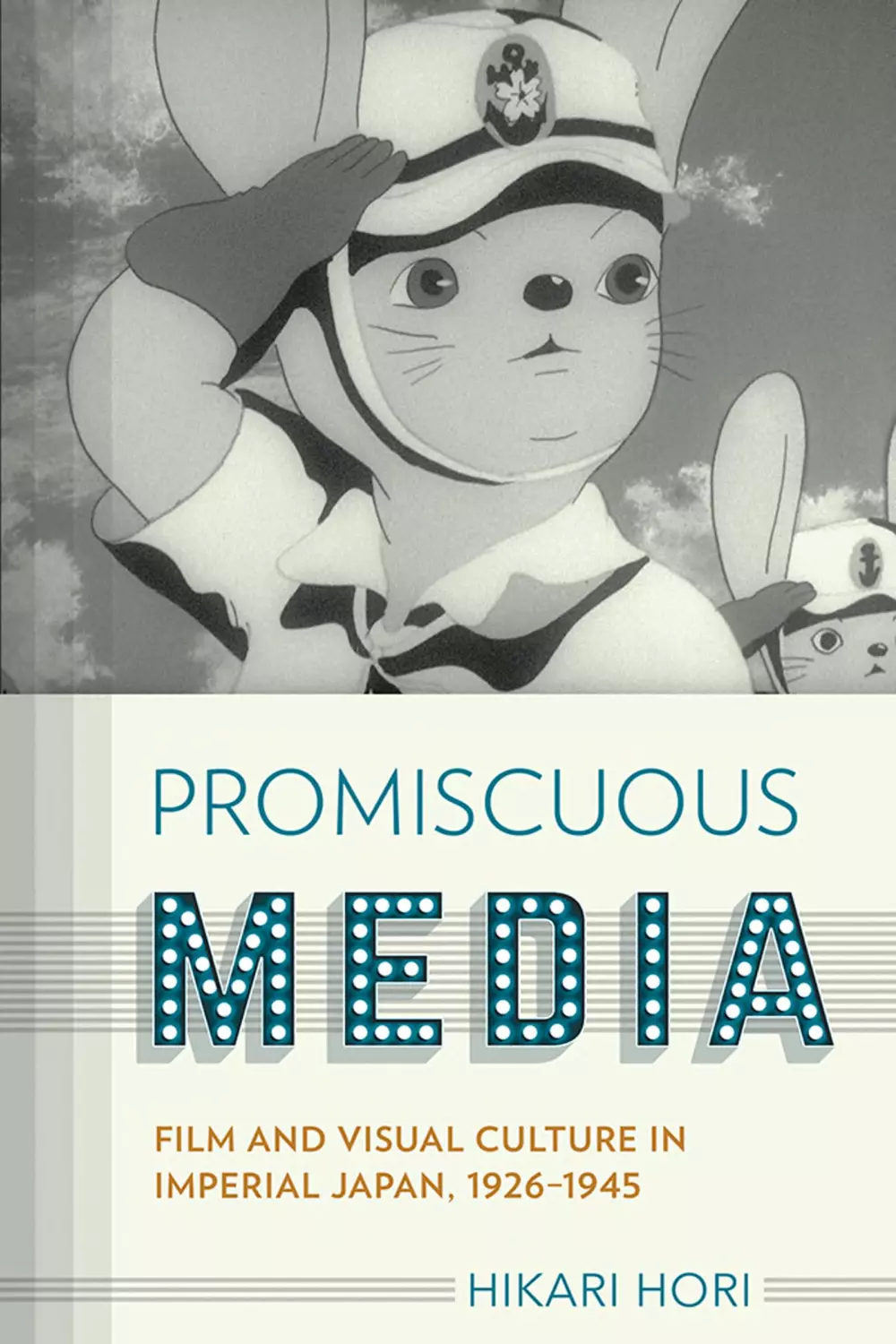
Jacket illustration: From “Momotaro, Sacred Sailors” © 1945/2016 Shochiku Co.,
Ltd. Used by permission.
Contents
List of Illustrations
Preface and Acknowledgments
vii
ix
Introduction
Film and Visual Culture: The Early Showa Era, Historical Contexts,
and Narrative Frameworks
1. Photography’s Aura:
1
22
The Modern Emperor and Mass Media
2. Contested Motherhood and Entertainment Film
70
3. The Politics of Japanese Documentary Film
114
4. The Dream of Japanese National Animation
155
Epilogue
204
Notes
Bibliography
Index
217
261
279
Illustrations
Figure 0.1. Opening shot of Hanako (Hanako san, 1943)
Figure 1.1. Crown Prince Hirohito (postcard)
17
26
Figure 1.2. Extant building of hōanden (shrine that specifically preserves “the
Photograph”) 37
Figure 1.3. Front page of Osaka Asahi shinbun (January 1, 1937)
Figure 1.4. Inter-title of Nippon News, vol. 1 (June 11, 1940)
58
61
Figure 1.5. The imperial couple at the ceremony of the Empire’s 2,600th Anniversary in Nippon News, vol. 23-2 (November 13, 1940) 63
Figure 2.1. Actress Takasugi Sanae in her Kokufu apron (postcard) 78
Figure 2.2. Kōzō played by Uehara Ken in 1940 digest version of The Love-Troth
Tree (Aizen katsura, 1940) 90
Figure 2.3. Waka, played by Tanaka Kinuyo, and her son in The Army (Rikugun, 1944) 99
Figure 2.4. Military women, played by Hara Setsuko and Takamine Hideko in
Three Women in the North (Kita no sannin, 1945) 110
Figure 3.1. Atsugi Taka
115
Figure 3.2. The opening pages of the Film Law, with Hirohito’s signature 128
Figure 3.3. Record of a Daycare Center Teacher (Aru hobo no kiroku) film advertisement in Eiga junpō (January 1, 1942) 139
Figure 3.4. Young w
oman at sewing machine in This Is How Hard We Are
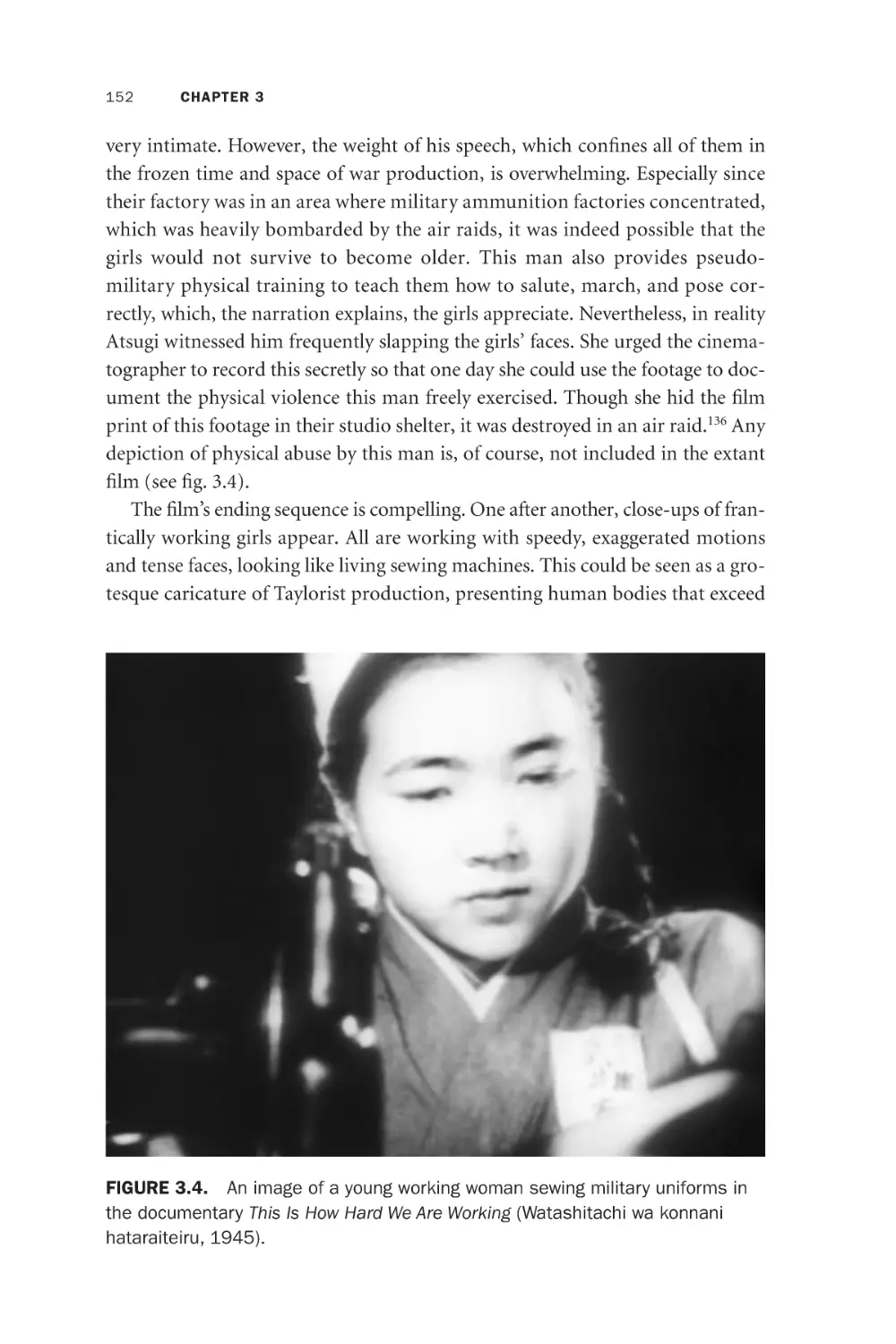
Working (Watashitachi wa konnani hataraiteiru, 1945) 152
Figure 4.1. Perō, the Chimney Sweeper (Entotsuya Perō, 1930)
Figure 4.2. Suppression of the Tengu (Tengu taiji, 1934)
162
165
Figure 4.3. Momotaro’s Sea Eagle (Momotaro no umiwashi, 1943)
Figure 4.4. Front page of Tokyo Asahi shinbun (January 1, 1942)
172
174
Figure 4.5. Divine Warriors Descend to Kota Palembang (Shinpei parenban ni kōka
su, 1942, postcard) 179
Figure 4.6. Princess Iron Fan (Tie shan gong zhu/Tessen kōshu) advertisement in
Eiga junpō (September 21, 1942) 187
vii
viii
Illustrations
Figure 4.7. Dandelion scene in Momotaro, Sacred Sailors (Momotaro, Umi no
shinpei, 1945) 197
Figure 4.8. Paratroopers in USSR in Construction (December 1935)
199
Figure 4.9. Rabbit soldier in Momotaro, Sacred Sailors (Momotaro, Umi no shinpei, 1945) 200
Preface and Acknowle dgments
I first became interested in researching film by coincidence when I was a gradu
ate student in art history in Japan. Through a casual introduction by a friend,
I assisted (in minor ways) the documentary filmmaker Barbara Hammer when
she was in Tokyo working on Devotion: A Film about Ogawa Productions (2000),
a film about the “father” of the Japanese documentary, Ogawa Shinsuke, and his
production company. It was an unforgettable experience. I was fascinated by
filmmaking practices (doing research, interviewing, shooting, editing, and
carrying a heavy camera—even though it was digital, still heavy enough—and a
microphone). I admired Barbara’s stamina as director and instincts as creator,
and learned so much from her perspectives as a veteran feminist and lesbian activist. My dissertation was motivated by my desire to answer her question: Who
are the pioneering Japanese women directors? This book, however, travelled
much further in terms of the geography I worked on and lived in, as well as the
questions I wanted to raise.
My research turns to the wartime era and to films within and beyond Japan.
When I did research on the female pioneer Atsugi Taka, who joined film productions in the 1930s, I was drawn to the time period. I met Tokieda Toshie and
Kishi Fumiko, who shared with me invaluable stories and insights into film production during the wartime and immediate postwar eras. Documentary director
Tokieda was extremely generous about sharing recorded interviews between
herself and Atsugi, historical documents, and her own experiences of directing. I
was fascinated by these glimpses of Tokieda’s c areer, which began by joining in
documentary filmmaking on May Day in 1950 and being trained as an assistant
director at Iwanami studio the following year. Later she became a very unusual
Japanese film director, filming the beginning of the Cultural Revolution in
China. Kishi was very kind and wonderful, too. She was a remarkable person,
who worked mostly in dramatic feature film production as a film editor. One of
her earliest jobs was working on New Earth (Atarashiki tsuchi; directed by Itami
Mansaku, 1937). She learned a lot about new techniques of editing from a German female editor who came to Japan with Arnold Fanck to do the German version of the film, titled The Daughter of Samurai. After this film, she moved to
Manchuria to work for the Manchurian Film Association (Manshū eiga kyōkai),
where she also collaborated with Sakane Tazuko, the Japanese female director.
ix
x
Preface and Acknowle dgments
She stayed in China for several years a fter the war to work in film production,
and then came back to Japan to continue her c areer.
These three practitioners—Barbara, Tokieda-san, and Kishi-san (four, including Atsugi, whom I did not get to know in person)—inspired and encouraged
me to think about war; the relations between local and global film cultures; the
cross-cultural circulation of texts, ideas, and art forms; artists’ passion for creativity regardless of their political, social, and historical conditions; gender and
film; and Japanese imperialism. T
hese topics generated fundamental questions
for this book.
My biggest challenge was to craft my questions and exposition to effectively
address both Anglophone and Japanese readers. I hope that this book w
ill be like
my own approach to film and visual culture: transnational, linking two separate
but overlapped fields with nationally defined disciplinary boundaries. I believe
that national boundaries do exist in the academy when a discipline is being
formed—I became keenly aware of the point when I moved to the United States
after my graduate work. Such boundaries are determined by the urgent and immediate social conditions in which researchers are institutionally, psychologically, and linguistically situated. But I hope that this book becomes a link across
geographical boundaries, following paths paved by earlier scholars but tying together these separate fields.
eedless to say, I am deeply indebted to numerous friends, colleagues, and instiN
tutions that helped me conceive and materialize this project. I am especially grateful to Paul Anderer, Theodore Hughes, Eugenia Lean, Haruo Shirane, and Tomi
Suzuki in the Department of East Asian Languages and Cultures at Columbia
University for their support and encouragement for this project. At Columbia,
librarians and archivists w
ere also immensely helpful: Karen Green at Butler
Library, who is also a renowned comic critic; Sachie Noguchi, Jim Cheng, and
Tsuyoshi Harada at Starr East Asian Library; and archivists Miki Masuda and Beth
Katzoff at the Makino Mamoru Collection on the History of East Asian Film.
In addition to the members of Modern Japan Seminar and Junior Faculty
Writing Workshop at Columbia, Marnie Anderson, Michael Baskett, Hyaeweol
Choi, Janis Mimura, Ken Ruoff, and Mitsuyo Wada-Marciano read and commented on chapter drafts and conference papers despite their busy schedules,
for which I cannot be thankful enough. In addition, Kim Brandt, Jane Gaines,
and Greg Pflugfelder w
ere not only wonderful friends and colleagues but also
inspiring, knowledgeable, fun to talk with, and keen readers of chapters. However, I am saddened that I am not able to present this book to my dissertation
adviser, the late Kaori Chino, and to my mentor, the late Wakakuwa Midori. My
Preface and Acknowle dgments
xi
very earliest ideas about war, film, nationalism, and gender as research topics were
nurtured and encouraged by them.
Generous funds were provided to support my research by the Graduate
School of Gakushuin University, the Tokyo W
omen’s Foundation, the T
oyota
Foundation, the Ford Associateship of Five College W
omen’s Studies Research
Center, and the Weatherhead East Asian Institute at Columbia. I also express appreciation to the Schoff Fund at the University Seminars at Columbia University
for their help in publication. The ideas presented have benefited from discussions in the University Seminar on Modern Japan.
Friends and colleagues who provided me with comments, feedback, encouragement, practical advice, and refreshing intellectual conversation must be noted
here. In addition to numerous other friends—I cannot list all—the following
have been sources of inspiration and energy: Julia Bullock, Rich Calichman, Yuri
Furuhata, Hishinuma Misue, Ikeda Yoshiko, Ayako Kano, Kim Kono, Fumiko
Nazikian, Sharalyn Orbaugh, Otsuka Eiji, Marc Steinberg, Karen Turner, Insil
Yang, and Toshiko, Ron, and Christine Yamamoto. When I was at the Five
College W
omen’s Studies Research Center as a Ford Associate in 2006, I met
Neloufer de Mel and Banu Subramaniam, who helped me see various cases of
nationalism and experiences of modernity, film production, and feminist discourses beyond East Asia. My friends from the Image and Gender Study Group
(Imēji ando jendā kenkyūkai) have been supportive regardless of our different
physical locations: Kitahara Megumi, Mori Rie, and Yamasaki Akiko. I am also
grateful to the students of my seminars and film classes, with whom I shared
films, snacks, and my crude ideas for this project.
I would like to thank two reviewers whose suggestions w
ere immensely helpful and insightful as I revised the manuscript. Also, Ross Yelsey of the Weatherhead East Asian Institute and my editor Roger M. Haydon have done so much to
see this project materialize; I was extremely fortunate to have them on my side.
Their enthusiasm and professionalism have been inspiring and have sustained
my writing. Ikegawa Reiko and Tomita Mika have been indispensable friends
and film consultants. I was always able to turn to them to discuss any films,
ranging from the most obscure Japanese movies to Bollywood hits, and they sent
me DVDs and documents without which my research would have been impossible. Ishihara Ikuko, Tsukamoto Yasuyo, and Mizoguchi Akiko have been there
from the very beginning of this project.
I owe an immense debt of gratitude to my parents, Yukiko and Hiroshi Hori,
to David Lurie for his support of this project, and to my daughter Chiyo for
everything. She suggested that I should consult a list of useful connecting words
for writing that she got from her teacher, generously packed snacks for me from
her Halloween bucket, and had faith in me continually.
PROMISCUOUS MEDIA
Introduction
FILM AND VISUAL CULTURE: THE
EARLY SHOWA ERA, HISTORICAL
CONTEXTS, AND NARRATIVE
FRAMEWORKS
This book reveals and analyzes contradictions in the discourse of national identity of film and visual culture during the early Showa era in mainland Japan
(naichi). The desire to construct a distinct national identity, which has been cross-
culturally documented in every modern nation-state, becomes even more urgent during war. It manifests as a constant forging of nationalized idioms, as seen
in ideologues’ writings and in legislation but also in popular culture. Examining
such manifestations, I point out the futility and ultimate impurity of such discourses of nationalistically defined and exclusive cultural forms and idioms. In
contrast, I deploy the word “promiscuity” to characterize the era’s film and visual culture, a term intended to address the complexity and interpermeability
of that culture: intermediality (intersection and interaction between film and
painting, between live-action film and animation, and among film, photography,
painting, and radio); cross-genre fluidity (between documentary and dramatic
films); and the transnational learning and sharing of visual styles and film theories regardless of the political ideologies of their country of origin. Nationally or
nationalistically constructed discourse reveals, paradoxically, the failure of attempts to establish national identity as well as the inherent bricolage of political
and formalistic manifestations of any such identity.
The early Showa era spans the two decades from Emperor Hirohito’s accession to the throne in 1926 to the end of the war in 1945; this first part of Hirohito’s reign (1926–1989) mostly overlaps with the fifteen years of the Asia Pacific
War (1931–1945).1 Conventional scholarship on Japanese film studies and cultural history tends to treat the cultural products of this era as straightforward
1
2
INTRODUCTION
reflections of nationalist political ideologies that led to the defeat and catastrophic
destruction of the country in World War II. In contrast to this approach, I focus
on the complexity of the era. I elucidate the competing claims of nationalist discourses and the transnational medium of film; reveal contradictions between state
political ideology and the identity formation of imperial subjects; and demonstrate how the period saw the reconfiguration of female and male gender identities as well as the “self” and “other” of ethnic relations. Study of the era’s film and
visual culture illustrates that these were complex decades rather than a time of
linear, teleological downfall.
Exploring wartime Japanese film and visual culture, this book builds on impor
tant work by other researchers. Scholars have provided accounts of the era’s film
productions and theoretical debates, of the changing and often contradictory
demands placed by government cultural policies on productions, of imperialist
filmmaking practices, and of the aesthetic dimensions of film texts.2 On the other
hand, research on the period demonstrates a tendency, especially in Japanese-
language scholarship, to polarize wartime films into two groups: the vast majority of films, often categorized as “national policy film,” or kokusaku eiga, are
treated as outright state propaganda and tools of indoctrination produced under
a totalitarian regime, while a handful of other films are seen as “resistance” b
ecause
they are humanistic or entertaining and not overtly political. Such claims for “re
sistance” are highly impressionistic, but the central problem with this dichotomy lies in the meaning and use of the term kokusaku eiga. To summarize very
briefly, the term as currently deployed in film scholarship can be used to refer to
any films produced during the wartime. Kokusaku eiga delineates an antagonistic, polarized relation between the state and filmmaking practices, on the one
hand, and between state-censored film texts and their viewers, on the other. The
presuppositions are that the state controlled the contents of films through regulations and censorship and that viewers were helplessly exposed to the state policies propagated by the films. I avoid the term in this book b
ecause I find this
usage misleading and problematic. First, it implies that films are necessarily faithful reflections of state ideologies of militarism, colonialism, racism, and so on.
Second, it obscures the term’s own historical shifts and discursive implications
and establishes a monolithic genre. (I elaborate further on issues of the “national
policy film” later.)
To question a monolithic understanding of wartime film and to focus on the
complexities and contradictions of national identity formation, my approach differs from existing scholarship in two ways. First, I am interested in interactions
and intersections between film and other media. By “other media,” for which I
often interchangeably use the term “visual culture,” I mean the visual presenta
Film and Visual Culture
3
tions of postcards, photographs, paintings, magazine illustrations, and even activism on the street. These resonate with and affect both film-viewing experiences
and filmmaking practices, and are thus essential to examining the era’s cultural
landscape. In this sense, I attempt to draw attention to the relationality of differ
ent media and various genres of cultural texts. Second, I set out to provide a narrative of Japanese cultural practices that places them in the broader picture of
relations between Japan and other countries. This is a narrative of the national
history of Japanese film, but here nationality is understood as relational, as a part
of global film culture, and the medium is located in a geographic ally broader mediascape. The exploration of cultural texts around and beyond film, within and
beyond Japan, enriches our understanding of Japanese film culture, but it also
allows us to uncover unexpected connections among different media, activities,
and creative works—and it is a fruitful and effective way to examine dominant
political and cultural discourses that attempt to construct solid identities of culture, film, and nation.3
The Japan ese Film Industr y in the Early
Showa Era, 1926–1945
The early Showa era, the period covered in this book, is an emperor-centered
period, in accordance with the modern reign-name system. Because in these two
decades the democratic direction of Japanese society was interrupted and state
thought control intensified during a series of wars, they are frequently termed a
“dark valley” (kurai tanima). Indeed, any survey of economic, political, and social incidents reveals this to be a very grim period: the amendment of the Peace
Preservation Law (1928), adding the death penalty for the violation of the national
polity (the emperor’s sovereignty); the Showa economic depression (1930); the
Manchurian Incident (1931); a large-scale scheme of assassinations attempted by
the right-wing terrorist group Blood Brotherhood (Ketsumei dan) (1932); naval
officers’ assassination of Prime Minister Inukai Tsuyoshi (1932); Japan’s withdrawal from the League of Nations (1933); an attempted military coup in the February 26 Incident (1936); and then the outbreak of the Second Sino-Japanese
War (1937–1945) and the Pacific War (1941–1945). However, as historian Kenneth
Ruoff argues, it is necessary to consider these years as a mixture or symbiosis of
“light” and “dark,” rather than unquestioningly relying on the “dark valley” model
for understanding the era.4
In particular, examination of Japanese film production complicates the general teleological understanding of the era as downfall leading to devastation. For
4
INTRODUCTION
instance, it is noteworthy that, as pointed out by film historian Ginoza Naomi,
the society represented in 1930s Japanese film “looks peaceful” (heiwa ni mieru)
if one were to attempt to understand the period solely judging from its repre
sentation in contemporary cinema.5 Ginoza shows that, without any outside
knowledge of political history, it is difficult to detect signs of traumatic events
or premonitions of the expansion of war to other Asian and Pacific regions on
the film screen.6 Of course Ginoza is not saying that the decade was peaceful.
Rather, her argument is an important reminder that films do not directly mirror
historical incidents and official political ideologies. Furthermore, she suggests
that the minimal reference in 1930s films to ongoing warfare is actually a sign of
general endorsement by Japanese citizens of their country’s colonialist aggression in China. Disturbing historical incidents and moments and war atrocities
were one side of the coin but, for many Japanese people, their dreams and strug
gles for success in everyday lives were the other.
To see the “light” sides of the era, it is also important to note that early Showa is
marked by the expansion of the Japanese film industry. Tokyo-based studios were
recovering from the 1923 Great Kanto earthquake, which damaged the film businesses there and forced them to temporarily relocate production to Kyoto. To
compete with the financially sound entertainment combine Shōchiku, the Nikkatsu
studio purchased the Tamagawa studios from a recently failed independent film
production company and secured electricity from a suburban railway; and PCL
(which later merged with Tōhō) solidified its financial base by combining multiple
sponsors, ranging from a wireless company to a beer manufacturer. The period also
saw the birth of the Tōhō studio, originally a Kansai-based company that created
the all-female Takarazuka revue troupe before entering the Tokyo film business.7
Since then, Tōhō and Shōchiku (founded in 1920) have been the leading studios of
the Japanese film industry. Technologically speaking, the 1930s was the decade in
which sound film was introduced and movie theaters were modernized—for example, with air-conditioning. For urban dwellers, filmgoing became a casual leisure
activity, replacing film’s prior image as a chaotic, disorderly pastime for low-income
audiences in sordid areas.
During that decade, film-related regulations were gradually centralized. Impor
tant to note is that the film industry was now large enough to become an object
of the wartime controlled economy. In the mid-1930s, as with other countries
including the United States, the Japanese economy was steadily recovering from
the Depression. In this context, records show that the Japanese film industry
matched, or potentially even exceeded, Hollywood in terms of the number of film
productions. Hollywood produced 527 feature films in 1939, while the number
of overall national film productions in Japan in that year was 582.8 The Japanese
film industry in the 1930s was one of the most vigorous in the world.
Film and Visual Culture
5
Japan was also a country of large-scale film importation. As cultural historian
Miriam Silverberg once illustrated through the example of the persistent popularity of Charlie Chaplin before and after 1945, Hollywood was hegemonic.
American films were screened right up until the day of the Pearl Harbor attack.9
However, I need to stress the wide range of European films, including German
and French films, that w
ere also available and very popular in Japan. Films w
ere
imported not only from the United States but also from Austria, Czechoslova
kia, England, France, and Germany, in response to public demand. Among
many titles, the era’s film fans enjoyed, for example, the leftist satire À Nous la
Liberté (directed by René Clair, 1931; shown in Japan in 1932), the German
operetta film Bombs over Monte Carlo (starring Hans Albers and directed by
Hanns Schwarz, 1931; shown in 1934), the monster film The Golem (directed by
Julien Duvivier, 1936; shown in 1937), and the British romantic drama Wings of
the Morning (directed by Harold D. Schuster, 1937; shown in 1938).10 The auteur director Ozu Yasujiro’s Only Son (Hitori musuko, 1936) even included a
few sequences of the British-Austrian musical film Gently My Songs Entreat (directed by Willi Forst, 1933; shown in 1935), which was a hit in Japan. (As part
of a scene in which the protagonist takes his mother to show her typical Tokyoite artsy culture, Ozu cut sequences from the British-Austrian original and embedded them seamlessly in his film.) It is noteworthy, nevertheless, that
because of harsh anticommunist censorship and in spite of their dominant presence in contemporary global film culture, only a few Russian films were imported
to Japan. For example, one of the most influential films in history, The Battleship Potemkin (directed by Sergei Eisenstein, 1925), was not shown in Japan
until 1967.
Though film was the object of regulation from its early days by the Ministry
of Welfare—along with public baths and barbers—many sections of the government came to see the medium’s potential for education and propagation of public
policies; it was used to advertise postal savings, public hygiene, electoral campaigns, and so on. But the medium was also a commercial product deeply engaged
with the everyday life of Japanese imperial citizens from the 1930s through the early
1940s.11 These audiences negotiated their desires, predicaments, and anxieties about
their lives through film consumption. Film was a leisure activity primarily for city
dwellers, and one should not assume a nationwide, unitary experience of the medium, but I argue that studying it in the context of the wider visual culture provides unparalleled insight into gender relations, ethnic and class identities, public
policies and their effects, and the mediascape of society.12 Film and visual culture
served as an important arena for negotiations of national identity formation, for
enactment of citizens’ desire and pleasure, and for dialogue between Japanese
practices and global cultures.
6
INTRODUCTION
“National Policy Film” (Kokusaku eiga)
Reconsidered
Despite this large, globally informed heterogeneous Japanese film culture, current scholars tend to categorize wartime films as “national policy film,” which
covers a range from crude early documentaries commissioned by the military to
high-profile entertainment war films to government films promoting savings to
opportunistic melodramatic romances. The term entered film historical narratives in the 1980s as a means of critically acknowledging Japan’s wartime imperialism, but it originated in the wartime era.
Historically, the term “national policy film” first emerged in the mid-1930s,
when Home Ministry officials were formulating plans to control the film industry. The term derives from the Proposal to Establish National Policies of Film (Eiga
kokusaku juritsu ni kansuru kengi), which was accepted by the lower house of
the Japanese parliament in 1933. The usage was initially “national policies of film”
(eiga kokusaku, implying state intervention in the film industry), rather than
“national policy film” (kokusaku eiga, films reflecting and promoting national
policies). The proposal, made by parliament member Iwase Ryō, was the first
public statement that urged the state to intervene in film production and guide
the industry to produce appropriate national representations. While travelling
in Germany, Iwase had been disturbed to see a film produced by “a westerner”
about half-naked Japanese women dancing; he found it an offense to the country’s dignity and a degradation of Japan’s international position.13
Film’s potential contribution to the image-making of the Japanese state was
continually and increasingly debated among film critics, filmmakers, and government bureaucrats in the years leading up to the promulgation of the 1939 Film
Law (Eiga hō), which was the first national-level legislation on film. By the time
the Home, Education, and Welfare Ministries put together the bill of the Film Law
and submitted it to parliament in 1939, they had already been working together
since 1933 on film policies. Many film professionals expected that the Film Law
would be an opportunity to raise the social status of filmmaking, and some expected that the state would protect the industry. The film historian Peter High
locates the emerging discourse of national policy film in the formative years of
the Film Law, when concerned ministries, studio representatives, and filmmakers discussed how state intervention might promote film production and raise its
social status. In addition, as High points out, this discussion of national film
policy prompted the participants to speculate about and attempt to define the
nationality of the medium: “Japanese film” (nippon eiga).14
The Film Law was specifically designed to regulate the film industry, and its
first article states that it aims “to serve the progress of national culture [kokumin
Film and Visual Culture
7
bunka].”15 In response, film critics and filmmakers attempted to forge the language of the Japanese “national” film. They were driven by the following questions: What national characteristics should such a film have? What are the
aesthetics and the ethos that manifest unique Japaneseness? Which film genres
best articulate the national traits: dramatic or documentary, or stories of history,
biography, or war? Most such speculations also provided prescriptions of the
way a Japanese film should be.
According to High’s examination, one of the most notable concepts deployed
in this context was spiritism, or seishin shugi, articulated and promoted by cultural critic Hasegawa Jozekan, film critic and scriptwriter Sawamura Tsutomu,
and film director Kumagaya Hisatora.16 This abstract notion was proclaimed by
Sawamura when he was writing primarily on the role of the documentary film:
the filmmaker “must dedicate his w
hole being to the awakening possibilities of
our new State. If he does that, works of great strength and beauty are sure to arise
from within him and come forth.”17 Sawamura and Kumagaya attempted to materialize spiritism in their film productions, such as the period film Abe Clan (Abe
ichizoku, 1938), the combat film Naval Brigade of Shanghai (Shanhai rikusentai,
1939), and the biographical story Navy (Kaigun, 1943). In all t hese films, they were
committed to representing historical fictions and characters’ manifestation of
“Japanese spirit.” With their strong desire to define the nationality of cinema, they
arrived at a spirituality that was not visible or figurative. At stake in debates over
how films contribute to politics during total war was the definition of Japaneseness;
the repeated terms for discussion were the nation (nippon), its nationals (kokumin), and authentic, irreducible Japaneseness.
The term “national policy film,” or kokusaku eiga, was revived by postwar revisionist scholars such as Satō Tadao in the 1980s as a means of indicating their
political stance and criticism of Japan’s wartime imperialism. Contrary to the war
time connotation, the term was chosen out of a sense of ethical commitment to
addressing Japan’s war responsibility. Canonical Japanese-language film history
surveys by Satō and Tanaka Jun’ichirō often deploy the term, and Anglophone
scholarship also maintains the framework that it entails.18 Especially in the 1980s
and 1990s, the wartime era was reconceptualized in historical studies, which influenced other disciplines; scholars questioned the existing emphasis on Japanese
citizens’ victimhood in the war against the Allied powers and shifted their emphasis to critique of Japan’s war accountability and its own colonial aggression in
Asia. The term “national policy film” was thus often used along with the term
“Fifteen Year War,” which indicated a longer time span of wars and conflicts, in
place of “Pacific War,” which referred specifically to the war against the United
States and thereby obscured the broader historical context and geography of the
conflict.
8
INTRODUCTION
During the new millennium, on the other hand, there emerged a strong trend
for the implications of the term kokusaku eiga to become diluted and generalized,
and it quickly became a casual category for any films produced in Japan in the
1930s and early 1940s. It is this depoliticization of the term that leads me to
refrain from using it. In response to this vague and widespread usage, historian
Furukawa Takahisa attempted to redefine the term in his Wartime Japanese Cinema: Did P
eople Really Watch National Policy Films? (Senjika no nihon eiga: Hito
wa kokusaku eiga o mitaka?, 2003). Furukawa questions broad, inclusive definitions of the term and proposes to rigidly define “national policy films” as those
that were exempt from censorship fees. Such exemptions were granted to t hose
films whose content was explicitly approved by the state.19
According to Furukawa’s new categorization, dramatic films would be divided
into three categories: national policy films, films for the general public (ippan yō
eiga) and films not for minors (hi ippan yō eiga; children age thirteen and below
were not allowed to see this category). By establishing t hese new categories, Furukawa goes on to argue that audiences did not actually go to see movies that were
permeated by state ideology. He points to the discrepancy between the poor box
office receipts of censorship fee–exempted “national policy films” and the commercially successful “not-for-minor” films, and concludes that “national policy
films” were what people saw the least during the wartime era.20 His argument
offers a new perspective on wartime film studies, as he illustrates the conflict between state ideology and the spectatorship of general audiences. It is also impor
tant to note that he is one of the first scholars to address the pleasure of film
viewing and the popularity of entertainment film in Japan.
Though I much appreciate Furukawa’s emphasis on spectatorship and the importance of entertainment films as objects of research, I must point out that his
notion of resisting spectatorship ironically reinforces the existing dichotomized
understanding of wartime films: an opposition between films infiltrated by state
doctrines versus films free of ideology. I argue that while we should do away with
the overgeneralized model of all films of the period as “national policy films,” we
still must explore examples of complicity (unintended or otherwise) between state
policies and film audiences, negotiations between state policies and film productions, and unpredictable interactions between film texts and their audiences. Before providing an example to elucidate this point, I briefly discuss a compelling
critique of Furukawa’s arguments.
In The Total Mobilization System and Film (Sōdōin taisei to eiga), a monograph
on policies for domestic and overseas film production and distribution, film historian Katō Atsuko notes, “A problem remains regarding who decides a film is a
‘national policy film.’ ” In other words, t here are twists. While a filmmaker may
not intend to make a work a national policy film, the studio or ministries may
Film and Visual Culture
9
decide that it is one and promote it as such. Or, audiences may find a film to be
a “national policy film” when ministries strongly disapprove of it as one.21
Katō makes the excellent point that the state itself is not a stable actor and that
censors are also spectators.22 She questions the conventional understanding of
state policies as monolithic and examines the shifts, complexities, ambiguities,
and failures of implementation of a series of Japanese film policies in mainland
Japan, Korea, Taiwan, Manchuria, and China. Her historical accounts reveal the
state’s strong efforts to indoctrinate national subjects and the struggles and frustration of government officials and their dissatisfaction with the outcome of their
interventions. She also highlights how the entertainment industry’s priority was
always to launch products that would cater to spectators’ unpredictable preferences and expectations, thereby maximizing revenue; this was never a m
atter of
intense control by the state from above with consequent subjugation of the industry. To emphasize this point, Katō draws attention to a statement made by
Kido Shirō, president of Shōchiku studio, who testified as a war criminal in the
International Military Tribunal for the Far East that the state’s intervention was
not always effective or imposing.23 This means that the studio saw state instructions and censorship as negotiable. Katō confirms that state regulations and policymaking concerning film production and exhibition should be understood as
in flux and in a process of constant negotiation.
While Katō correctly cautions against seeing the state as a monolithic, oppressive entity, I add to this critique by arguing that it is important to situate spectatorship in specific historical and political contexts. Here the dramatic feature
China Nights (Shina no yoru; directed by Fushimi Osamu, 1940) serves as a compelling example. This not-for-minors film did not receive the censorship fee exemption, and therefore, Furukawa argues, it is not a “national policy film.” He
emphasizes that it was hated and despised by major progovernment film critics
and barely passed censorship.24 However, the film narrative was not detached from
the state’s political agenda but in fact promoted it. The film would not have been
conceived or consumed without the political and historical context of Japan’s occupation of Shanghai as a part of the ongoing war with China. The story is a romance between a Japanese sailor and a Chinese w
oman, and the romance changes
her from anti-Japanese patriotism to a pro-Japanese stance. It must be noted that
it is having her face slapped by the Japanese man, an act of violence that “awakens” the “goodness” of this rebellious Chinese w
oman and makes her fall in love
with him.
The narrative obviously resonates with contemporary Japanese aggression, in
that the heterosexual “romance” translates the colonial and ethnicized relationship between the two countries. The gender relation of the narrative traces a hierarchical, colonizer/colonized ethnic tie established by violence, so that one
10
INTRODUCTION
might even assume that Japanese ideologues could have written the scenario.
Yet the film was neither promoted nor sponsored by the state. Categorically
speaking, the film would not be a “national policy film” if we accept Furukawa’s
redefinition, but nevertheless the film narrative strongly resonates with con
temporary Japanese state policy. Its representation of colonial relations of gender
and ethnicity asserts the Japanese state’s imperialist desire, and it provokes Japa
nese viewers to fantasize, through the metaphor of the Japanese man obtaining
the Chinese woman’s love and trust, about the wealth—acquisition of w
omen,
land, luxurious materials—that would be brought about by victory in war.
Furukawa’s restrictive definition of “national policy film” thus proves unsettling in the sphere of viewers’ textual engagements. Although his shift of focus
from production to spectatorship, with attention to popular entertainment film,
is crucial, it still brackets the discourse of the wartime state’s colonial and imperialist aggression, which film texts were able to mobilize. To determine whether
or not a film text is complicit with state policies also requires examination of the
ways its meanings, implications, and connotations are acknowledged and produced by viewers in social contexts. Spectators’ positions w
ere s haped by and w
ere
in turn shaping multiple f actors, such as social norms, offscreen discourse of politics, and genre expectations.
Inhibition and Pleas ure of
Nationalist Cinemas
Attempting to provide a narrative framework that maintains the critique of Japa
nese imperialism originally intended in the deployment of the term “national
film policy” by scholars such as Satō Tadao, I find recent scholarship on German
and Italian films during the Nazi and fascist eras quite illuminating. In particu
lar, film historical scholarship on the Third Reich is suggestive for reexamining
Japanese films of the early Showa era, in part b
ecause the German and Japanese
fields of film studies are similarly constructed in the context of their postwar
societies’ approach to war guilt.25 Both are deeply embedded in each country’s
postwar discourses of war crimes, massacres, memory, and compensation programs, making the visual pleasures of wartime entertainment films extremely
difficult to articulate since, unlike in the former Allied nations, the very notion
of wartime pleasure had been condemned by the ethical imperative to acknowledge war crimes. Among well-known works of German film criticism, Siegfried
Kracauer’s From Caligari to Hitler: A Psychological History of the German Film
(1947) best exemplifies a typical historical narrative that reads Nazi films as evidence of deviation from modernity, symptoms of fanaticism and atrocity, and
Film and Visual Culture
11
reflections of oppressive state doxa. This pattern of condemnation can also be
found in the dominant narrative in Japanese film studies.
On the other hand, post–Cold War scholarship on cinema of the 1930s and
early 1940s departs from such a restrictive narrative and often draws attention to
dynamic interactions with hegemonic films from elsewhere, often Hollywood.
Works by Linda Schulte-Sasse, Eric Rentschler, and Lutz Koepnick on German
cinema, and by Stephen Ricci, Stephen Gundle, and Ruth Ben-Ghiat on Italian
cinema, delineate national cinemas’ internal tensions and antagonisms in the
process of indigenization and reveal responses to hegemonic Hollywood as t hese
cinemas promoted mostly nationalist sentiments.26 In essence, they demonstrate the ambivalent national identities of the film medium. Additionally, not
only in German and Italian film studies but also in British film studies, scholars
such as Andrew Higson and Annette Kuhn provide compelling transnational and
comparative perspectives on 1930s and 1940s films.27
This scholarship is illuminating because it complicates notions of nationalistically defined cinemas and of clear boundaries among ideologically segregated nations. For example, in an article titled “Visual Pleasure Inhibited,” German film
scholar Karsten Witte shows how 1930s Third Reich revue films adapted Hollywood musicals.28 Witte connects the choreography of German musicals, which also
resonates with Leni Riefenstahl’s aesthetics, to Hollywood, thereby pointing to the
promiscuous and transnational nature of filmmaking practices. He also shows how,
by restraining themselves from fully adapting the Hollywood genre’s sheer cele
bration of physicality and gender norms, producers of t hese musicals attempted to
create indigenous idioms in accord with their own social imperatives. Not only does
Witte successfully contextualize the Third Reich films in the circulation of global
film culture, but his highlighting of the entertainment film is a challenge to the conventions of film studies, which has predominantly limited consideration of Euro
pean films to auteurism, avant-garde movements, and experimental art h
ouse filmmaking.29 (Such customary distinctions between Hollywood and other national
cinemas in film studies are familiar in studies of Japanese cinema, too.) Witte’s emphasis on German entertainment film, which was deeply embedded in the political
situations of the wartime era, is highly suggestive in its departure from conventional
approaches that have located non-Hollywood cinemas as sites of alterity.
Given my interest in wartime Japanese film, I find Witte’s use of the word “inhibition” in his title especially telling. This can be read as a reference to the limiting
stoicism of his own social and political context of German film studies, which is
comparable with Japanese scholarship, in which war guilt is also an important
issue. Witte successfully critiques Nazi ideologies, but he also points to the cinematic pleasure of the era, in both production and consumption. In the same vein,
in my discussion of the complexities of Japanese film history in the early Showa
12
INTRODUCTION
period, I hope to balance ideological critique with acknowledgement of the pleasures provided by the medium. Only by d
oing so is it possible to grasp the promiscuity and complexity of the reception of cultural production. Informed in this
way by studies of other national cinemas, this book discusses Japanese wartime
film as a vernacular cinema located amid the global circulation of films and
film theories, draws attention to popular works rather than those by canonical
directors, and locates cinematic representations in convergence with other
contemporary visual experiences.30
Relational and Transnational
Film History
To locate Japanese cinema as a part of global film culture and to stress the relationality of film as a medium, I now turn to Alan Tansman’s notion of “fascist
aesthetics,” which has been influential in studies of the cultural history of war
time Japan over the past decade.31 Tansman’s study is exceptional for its close
linkage of a variety of cross-genre, cross-media cultural texts whose relations are
established within a framework of aesthetics. The introduction of the transcultural notion of fascist aesthetics also liberates Japanese cultural production from
the confining narrative mode of national history and makes it comparable and
coeval with other fascist cultures, in a manner similar to the work of historian
Harry Harootunian in his discussion of interwar Japanese intellectual history.32
Nonetheless, I have reservations—in particular for the medium of film—about the
project of finding an overarching specific aesthetic, shared among the Axis nations, that permeates Japanese visual culture of the early Showa era.
A review of the historiography of the term “fascist” shows that postwar Japa
nese Marxist historians had long used it to describe the wartime Japanese state,
although the term was broadly and often vaguely applied and was frequently interchangeable with “oppressive to citizens” or Hannah Arendt’s “totalitarianism.”33
In essence, the term “fascist” was widely deployed as a readily available adjective in
Japanese scholarship to refer to any negative elements of wartime Japanese society.
It functioned as a strong critique of state war crimes, but it can also be seen as portraying the state and its citizens as monolithic, oppositional entities. However,
there were challenges to this overarching notion. On one hand, some 1980s Anglophone historians of modern Japan were already skeptical of the notion of fascism
applied to Japan. According to them, a charismatic dictator, a one-party-ruled
parliamentary system, particular styles of mass mobilization and motivation, and
discontinuity of political institutions and elites between the pre-and post-fascist
regimes are among the particularities that the Japanese state lacked, in comparison
Film and Visual Culture
13
with Germany and Italy.34 Furthermore, a single overarching notion of what constituted “fascism” was also questioned by historians in the 1990s, who engaged
with postmodernist thought and attempted to understand wartime Japanese society through a wider variety of analytical categories, such as nation-state formation,
gender and ethnicity, and historical continuities before and a fter 1945.
I do not intend to address the questions of w
hether Japan was a fascist state
with regard to its political system, the economy, or the military. Instead, I focus
in particul ar on whether the notion of “fascist aesthetics” is useful specifically for
studies of film and visual culture. Tansman uses the term to indicate emotionally
and politically charged cultural artifacts and high-modernist writings, especially
in the 1930s. He explains the core of this aesthetic as follows: “Through appeals
to a cultural sublime—to a feeling of reverence for one’s incomparable, immea
surable, timeless heritage—the state promoted self-sacrifice in the name of devotion and duty.” Tansman argues that various cultural texts, ranging from elite
writings to government publications to popular films and songs to novels, all beautify the state’s ideologies of nationalism, xenophobia, violence, and imperialism.
Based on examination of these texts, he characterizes the aesthetics of Japanese
fascism as beautification with “a melancholy tonality,” which he defines in contrast with the German fascist aesthetics of “sublime grandeur,” a coinage by the
renowned critic Susan Sontag.35
As a response to this idea of Japanese melancholy tonality imbuing fascist aesthetics, I argue, first, that it is difficult to locate such a unitary character in films
of the 1930s and 1940s, in particul ar in entertainment genres. One example is the
musical comedy Sun Wukong (Songokū; directed by Yamamoto Kajirō, 1940), one
of the best-attended popular films of the era—a huge box office hit embraced by
both adults and c hildren. This is a free-spirited adaptation of the Chinese classic
vernacular novel The Journey to the West into a nonsensical musical comedy, in
which popular comedian Enoken (Enomoto Ken’ichirō) poses as the Monkey
King and characters dance and sing operatic songs. (The story itself had been introduced to Japan in the eighteenth century and had been familiar and popular
among Japanese since then.)36 In this film, the demons of the original novel are
transformed into mad scientists who build a high-tech laboratory and use a surveillance TV monitor and robots. Twice, Disneyesque dwarves appear and sing
and march with the “Heigh-Ho” song of the animated film Snow White and the
Seven Dwarfs (1937). Contemporaneous filmmakers and critics who attempted
to define the films of authentic Japaneseness in fact dismissed Sun Wukong out of
hand. The cinematic text of the film is pleasurable, referring to a Disney film, to
sci-fi robot films of late 1930s Hollywood, and to the genre of musical films, while
incorporating Enoken’s repertoire of slapstick comedy. Works such as Sun Wukong
demonstrates the variety of film and its heterogeneous aesthetics.
14
INTRODUCTION
Second, there are problems with the notion of shared aesthetics among fascist
nations. Although the term “fascism” suggests commonalities of culture among
the Axis countries as well as a stark distinction between them and the liberal demo
cratic Allied countries, I argue that it is difficult to establish such strong parallels
among the film cultures of Germany, Italy, and Japan while maintaining a decisive divide with the other half of a dichotomized world. The structures and scales
of the Axis film industries differed from each other greatly. As mentioned briefly
above, Japanese film production was far more vigorous than that of Germany or
Italy. In 1939, for example, Germany produced 107 feature films and Italy made
77 films in total (50 of them features), whereas Japan produced 582. Already in
1933, the numbers of feature productions was 472 in Japan versus 114 in Germany; the overall national production in Italy that year was 26.37
To promote domestic film production, both Germany and Italy protected their
film industries. Germany set a quota on Hollywood imports and banned press
criticism of domestic productions to protect its own film industry, which resulted
in an increase of German productions. Hollywood imports were finally banned
in 1940. Interestingly, French film production blossomed under the German occupation because of this trade sanction.38 As for Italian protective measures, a state
monopoly of the distribution system, and the 1937 foundation of the film studio
Cinecittà with state subsidies to increase domestic production, forced the Hollywood majors out of the country by the end of 1938, which dramatically increased
national production and the box office receipts of Italian cinema.39 There was a
complex history of bans on foreign films in Japan during this period, but the
crucial point is that none of the bans w
ere ever aimed at protecting Japanese
domestic studios from Hollywood films or any other imports; unlike Germany
and Italy, Japan’s film industry was not threatened by foreign competition.
There are some commonalities, however. For example, in terms of international distribution, Germany distributed its national cinema widely in its own
allied and occupied nations, and Japan made similar attempts beyond its mainland in the early 1940s. Such practices w
ere not limited to the Axis states, however, but were pioneered by England.40 The most important commonality among
the Axis countries is that their national cinemas formed their local industries and
vernacular film languages in competition with the hegemonic film cultures.
Filmmakers and critics admired Russian filmmaking and its film theories of the
1920s, which was a hegemonic film culture at that time, and all Axis national cinemas also constructed their national identities in part through their encounters
with Hollywood films. Indeed, Hollywood western, noir, and musical genre films
were enjoyed and adapted by German, Italian, and Japanese local productions,
despite the fact that the Axis countries greatly differed from each other in regard
to the scale and structure of their industries and their domestic genre conven-
Film and Visual Culture
15
tions.41 This suggests that all Axis national cinemas’ production can be examined in terms of their relations to hegemonic film cultures. However, it must be
also noted that such interactions and antagonisms between hegemonic cinemas
and local production were quite diverse.
It is indeed hard to determine whether any distinct, communally defined aesthetics of filmmaking practices are shared among Axis film cultures. In this connection, the film historian Michael Baskett’s work is compelling, as it reveals some
intra-Axis sharing of film policies, film market blocs, censorial codes, and interests in colonial film productions. Significantly, however, he describes the failure
of a German-Japanese coproduction caused by conflicting aesthetics.42 In this
film, New Earth (directed by Arnold Fanck and Itami Mansaku, 1937), the directors from the two nations collided with each other regarding the represen
tation of Japan. Their discord resulted in the production of two versions of the
film—Die Töchter des Samurai (Samurai’s Daughter) and Atarashiki tsuchi
(New Earth)—instead of a single film. The former explores orientalist exoticism
of Japanese culture, nature, and women, while the latter highlights colonial
expansionism in Manchuria and escapes the Western gaze. Thus, the Axis national
film cultures failed to create a collective fascist aesthetic identity.
However I do believe that ties among different national cinemas are impor
tant to note and that they should be explored. In this connection, I turn to the
same Sontag essay in which she provides a catalog of fascist art that is not confined to “fascist nations.” Her discussion of Leni Riefenstahl’s documentary films
on a Nazi party assembly and the Olympic Games provides a very well-known
characterization of fascist aesthetics:
The relations of domination and enslavement take the form of a characteristic pageantry: the massing of groups of p
eople; the turning of
people into things; the multiplication of things and grouping of people/
things around an all-powerful, hypnotic leader figure or force. . . .
Its choreography alternates between ceaseless motion and a congealed,
static, “virile” posing. Fascist art glorifies surrender; it exalts mindlessness: it glamorizes death.43
In the context of evaluating how to think about relations between early Showa Japa
nese film and other film cultures, however, the following lines from right after that
passage are even more suggestive: “Such art is hardly confined to works labeled as
fascist or produced u
nder fascist governments. (To keep to films only, Walt Disney’s
Fantasia, Busby Berkeley’s The Gang’s All Here, and Kubrick’s 2001 can also be seen
as illustrating certain of the formal structures, and themes, of fascist art.)”44
Sontag’s inclusive usage of fascist aesthetics is important. Though she did not
elaborate further beyond these two sentences on the fascistic nature of films by Dis-
16
INTRODUCTION
ney, Berkeley, or Kubrick, the connection is highly provocative. Exploration at a
textual level supports these connections. Her inclusion of Fantasia reminds us of
contemporary critics’ uneasiness about the emphasized visual sensation of the
film’s animation, which could override music.45 Such skepticism might have
stemmed from reservations about the popularization of artistic form, that is, classical music, as well as oversimplified visual narratives that provide new, concrete, and
animated interpretation of existing highbrow music. Visual sensation, simplified
narratives, and emotional—not logical—mobilization of the senses are often associated with fascism, but here we see them in experimental work by Disney as well.
We can also locate the visual aesthetic that Riefenstahl shares with Berkeley’s
choreography, not only in colonialist fantasy scenes of The Gang’s All Here (directed
by Busby Berkeley, 1943), but also in his 42nd Street (directed by Lloyd Bacon,
1933) or Gold Diggers of 1937 (directed by Lloyd Bacon, 1936). In t hese films too we
see manipulated representation of the masses, celebration of the physical beauty of
human bodies, emphasis on powerful leadership, and camerawork and film editing
techniques calculated to enhance the visual manifestation of integrity, physicality,
and collectivity. Berkeley’s films create spectacles with human bodies and organic
collective, militant, and orderly movement, and they privilege visuality and sensory
appeal over narrativity. This reminds us, as Karsten Witte did in his aforementioned
article, that Riefenstahl was not isolated from Hollywood filmmaking practices.
Also, and importantly, she herself was a dancer who appreciated and understood
the manifestation of physicality as expressed through choreographed motion.
Though I suspect Sontag’s overarching concept of “fascist” aesthetics is too
broad to serve as an analytic frame, her observation is provocative. For she is in
essence arguing that particular art forms can transcend the ideological divides
between fascist and liberal-democratic states, in particular in the 1930s and the
1940s.46 Though film studies accounts have conventionally divided film cultures
of this period according to different political ideologies, examination of Berkeley’s films along the lines Sontag suggests would place American, British, German,
and Japanese film cultures in dialogue and establish their relations with regard to
the global circulation of the genre.47 While Berkeley films inspired many British
and German films in the mid-1930s, one Japanese example is found as late as 1943:
the opening of the musical film Hanako (Hanako-san; directed by Makino
Masahiro) imitates Busby Berkeley’s signature camera work with a kaleidoscopic
vertical shot of dancing w
omen (see fig. 0.1). Just as British musicals and German revue films responded to Berkeley films in their own way, Hanako adopted
them at a time both countries were at war.
While many Berkeley films embrace consumption and leisure in the New Deal
era, the musical film Hanako describes a total war society with a controlled economy, where men have been drafted into military serv ice and saving is imperative
Film and Visual Culture
17
on the home front as part of the war effort. Yet, it also presents desire for consumer goods: a newlywed bride wants to have a nice h
ouse in the suburbs, and
the protagonist fusses over choosing nice clothes and eating out on special occasions. The consumerist imagination that the film projects is not so much a critique of capitalist consumption as a critique of its lack, as caused by the total war
economy. Ultimately, this opening shot is a reminder that wartime Japanese film
production partook of globally circulated visual and narrative elements of the
1930s and early 1940s, and that it should be understood in terms of promiscuous, heterotopic, and heterogeneous practices, rather than as a medium permeated by a distinctive unified aesthetic. Therefore, I agree with film historian Aaron
Gerow’s remark on “fascist aesthetics” and Japanese film when he notes, “I deny
neither the pertinence of the concept of fascism to wartime Japanese cinema nor
the reality of the nation, in effect deconstructing both into oblivion.”48
One limitation of this book is that, with a few exceptions, it does not address Japa
nese film distribution, production, and reception in colonial and occupied territories. My focus is on the forcibly constructed wartime discourse of national
FIGURE 0.1. Opening shot of Hanako (Hanako san; directed by Makino
Masahiro, 1943). The shot mirrors typical Berkeley choreography.
18
INTRODUCTION
unity (which has lingering power even today), which stressed the identity and purity of cultural production in Japan proper (naichi). I choose to focus primarily
on the culture of mainland Japan in order to illustrate the contradictions that
ironically dominated and sustained the center of the empire. The core of my argument is the paradoxical transnationality and promiscuity of even the most
nationally defined cultural texts; in itself this goes to show how imperial Japan cannot be understood as a monolithic entity, and how that empire was constantly
being forged. I must note, nevertheless, that I am deeply indebted to and informed
by recent scholarship on imperial Japanese colonial film production. Although it
has not been possible to incorporate the depth and breadth of such scholarship
in this study, it has eloquently revealed intricate and tangled power relationships
between colonizer and colonized, formations of national and ethnic identities of
both filmmakers and audiences, and interactions among contemporary international, hegemonic, and local film cultures in colonial contexts.49 The perspectives
offered by such scholarship are also essential to unpacking the discourses that constructed imperial Japan.
Approaches to Film and Visual
Culture in Imperial Japan
Early Showa simultaneously saw the expansion of mass media, including the film
industry; the buttressing of the monarchy; and the Asia Pacific War. Because mass
media gradually became subject to state control leading up to the early 1940s, war
time media is in general understood as a powerful tool to indoctrinate imperial
citizens with national(ist) ideology and identity. However, examination of the film
and visual culture of the era demonstrates that the promotion and construction
of docile, ideal imperial subjects and a homogeneous society were not easy undertakings. Indeed, the various elements that are taken to characterize society in
this period, such as the emperor system, discourses of nationalism, pronatalist
ideology, and policies of total war mobilization, did not only configure subjecthood: they were also themselves constantly reconfigured at the point of reception when they were put into practice. This book aims to illustrate this dynamic
through analyses of cultural production and reception.
Four areas of exploration represent both purportedly indoctrinating social
norms and also the contradictions that prevented nationalistic and unifying identification of imperial citizens with dominant ideologies and discourses: the emperor’s photograph portrait (goshin’ei); “woman’s film” (josei eiga); documentary
film (bunka eiga); and animation (manga eiga). All four have frequently been characterized as ultranationalist propaganda by scholars who portray them as part
Film and Visual Culture
19
of an evil and manipulating monolithic entity, and also as lowbrow products
heavily affected by fanatical ideologues. There is also a tendency to set up oppositions between the state and filmmakers, or between cultural products and their
recipients, in ways that suggest that the targets of political and cultural texts were
often innocents prone to powerful indoctrination. This book complicates such
perspectives while providing a fuller account of each of these four topics, none of
which has received sufficient scholarly attention.
I open in chapter 1 with the introduction of nationwide visual protocols for
treating the emperor’s images in mass media. Practices of making and viewing
images of the emperor were one of the most crucial constituents of visual experience in Japan from the 1920s through 1945. Accordingly, it is impossible to understand the mediascape of the early Showa era without grasping the implications
of the representation of the emperor as well as the effects of state-led and voluntary self-censorship on its production and reception. The emperor’s portrait
photograph (goshin’ei) was created to match those of European monarchs, out
of diplomatic necessity, in the 1880s. Then viewing protocols w
ere introduced to
venerate the portrait without gazing upon it. The imperial portrait was preserved
with extreme care in public institutions such as schools, battleships, government
offices, and regional military headquarters, and it was crucial for citizens to learn
the sacredness of the emperor as well as his portrait through educational, everyday physical and psychological discipline and state censorship. On the other
hand, Hirohito was the first emperor whose public appearances were covered by
multiple mass media, ranging from personalized collectible postcards to the nationwide radio broadcasting network to facsimile photographs. Mass-produced
images of the emperor in newspapers, magazines, and films w
ere readily available for scrutiny. These contradictory viewing practices, one prohibited and the
other accessible, disrupted the emperor-centered disciplined and nationalized
imperial citizens.
Chapter 2 discusses “woman’s film,” or josei eiga, by which I mean a loose genre
of films that have protagonists who are women and that are intended for a female audience. Exploration of this genre is crucial because it reveals that norms
of femininity and womanhood can become a stumbling block for nationalism’s
promise of putative classless, ethnicity-less, genderless horizontal unity. On one
hand, along with the infamous wartime pronatalist policies that permeated society through slogans, novels, magazine articles, films, and so on, w
omen had to
be biologically reproductive and confined to the home. On the other hand, the
same pronatalist discourses provided a space for w
omen to negotiate and gain
social visibility and agency, becoming publicly acknowledged members of society by means of participating in the war effort as mothers. In this way, the
relation between total war and w
omen’s entrance into public space is compli-
20
INTRODUCTION
cated rather than straightforward. It is imperative to read representations of
women—from ultra-rightist activism to nationalist mothers’ melodramas—
against the grain; such representations are not simply reflections of state public
policies on women. In this regard, the woman’s entertainment film is particularly
revealing, as it illustrates a space of intricate relations among state gender ideologies, studio marketing strategies, and the agency of female spectators.
In chapters 3 and 4, I turn to documentary and animation. Antistate female
documentarian Atsugi Taka (1907–1998) and pro-state animator Seo Mitsuyo
(1911–2010) serve as guides to the formation and development of t hese genres.
Their career paths and work demonstrate the development of these media and
show how practitioners worked within and around official ideologies and the restrictive mediascape. Their works reveal their curiosity about foreign theories
and film texts; their artistic creativity; the collisions between abstract ideologies
and actual filmmaking practices; and the failure of attempts at circumvention
of, as well as unintentional deviation from, nationalist norms.
Chapter 3 shows how documentary film in the late 1930s was a rich and chaotic site for nationalist, imperialist, and anti-imperialist experimentation. Atsugi
is well known for her translation of the theoretical treatise Documentary Film
(1935) by British producer and theorist Paul Rotha. The book attracted an unexpectedly wide audience in Japan, regardless of political ideology, and introduced
the term “dokyumetarī” (Japanese phonetic transcription of “documentary”). It
inspired filmmakers of the newly emerging documentary genre who attempted
to define realism, dramatization, and directing in the midst of total war. It also
motivated Atsugi herself to materialize Rotha’s arguments in her own production
of films in the early 1940s. Her work came from a tangled, complicated site of
production where she navigated the gender politics of filmmaking and everyday
life, state suppression of socialist and proletarian movements, and the problems
of adapting theory to actual filmmaking.
In chapter 4, I turn to animated film, because study of the medium reveals the
various transnational inspirations in its formative years in Japan. Moreover, study
of animation also emphasizes the transmedia recursivity of painting, photography, live action film, and animation during total war. By recursivity I mean that
several distinct visual motifs, national historical incidents, and narrative molds
were repeatedly used in different media in the early 1940s, which sustained the
sense of national affiliation of imperial citizens, forged shared emotions and sensitivity, and privileged specific myths, ideas, and aesthetics.
In this book, Asian names appear in the main text with the surname (family
name) first and, following convention, with the first name first for bibliographic
references in the notes. Most of the films discussed in the book are available on
Film and Visual Culture
21
DVD. I indicate the name of archives for films that are viewable only in their
premises.
The goal of this book is to understand the medium of film transnationally and
relationally. The medium is promiscuous. It is at once transnational and national,
an insight that recurs throughout, providing a point of departure for analyses of
other visual materials, including photography, painting, illustrated postcards, and
even public activism, which I view as a manifestation of visual culture. All these
are closely tied to the era’s film production, and collectively they constitute an
important mediascape of the early Showa era. Thus this is an interdisciplinary
project that places film studies in conversation with the narratives of gender studies, visual studies, and the cultural history of imperial Japan.
1
PHOTOGRAPHY’S AURA
The Modern Emperor and Mass Media
Understanding the distribution, reception, and transformations of representations
of Emperor Hirohito (1901–1989, r. 1926–1989) is key to understanding the constellation of mass media in early twentieth-century Japan. The institution of the
emperor played a leading role in the accelerated development of a nationwide information network, determining modes of production and reception of mass
media, but it also provided an ambiguous, conflicted space where the identity of
imperial, national(ist) subjects was at once constructed and contested.
One of the most important representations of the emperor was his portrait
photograph, or goshin’ei, hereafter referred to as “the Photograph.” The Photo
graph was preserved at schools, in a separate Shinto shrine on the premises or in
a special box made of paulownia kept in a safe place, and also in battleships, in
military division headquarters, in local government offices, and at Japanese overseas embassies. People were not allowed to gaze upon it when it was exhibited at
a ceremony, and they had to bow to the place or the Shinto shrine that preserved
the Photograph every time they passed by. The emperor’s visual image was not
to be gazed at when it was worshipped in this way, and by 1940 the other media,
such as radio, newspaper photographs, magazine illustrations, and film, w
ere
contained or strongly affected by t hese veneration practices, in terms of both
production and reception. A set of rituals and protocols required a copy of a
photograph—a sheet of paper—to be treated as if it were the sacred body of
the emperor. As a result, starting from the implementation of these veneration rituals in the 1890s, there were cases in which p
eople died to protect the
Photograph.
22
Photography’s Aura
23
During the very last year of the Asia Pacific War, at least nine school teachers
and principals died in attempts to protect the Photograph between April and August 1945.1 One case was a school principal’s death during air raids in Himeji
City, Hyōgo Prefecture, which was recorded in an account by a teacher:
In the next moment, I found myself in the m
iddle of a sea of fire and my
whole body was on fire. . . . When I ran to the principal, Ah, what a
dreadful sight! He had received one of the enemy’s bullets in his abdomen and another in his chest. I called, “Can you hear me?” and when I
tried to raise his body in my arms, I saw that his intestines were exposed
and the blood was gushing out. Quickly I provided emergency care, and
kept calling his name at the top of my lungs, “Hang on, sir!” Gasping
for air, he groaned and whispered to me, “Take care of the Photograph.”
As soon as I heard this, I untied [the box that contained] the Photograph
from his back, and put it on mine.2
The story describes a patriotic, heroic school principal who died in an air raid
while attempting to rescue the Photograph, from the perspective of one of his
teachers. As portrayed h
ere, the principal’s priority was to revere the emperor. But
there must also have been social pressures, so that he would have wanted to avoid
a situation in which he would survive and face accusations surrounding the loss
of the Photograph.3
Another account is by navy sailor Watanabe Kiyoshi (1925–1981), who joined
the navy at age sixteen and survived the sinking of the battleship Musashi in 1944.4
In his autobiography, The End of the Battleship Musashi, he described the Photo
graph in the battleship. The Musashi was damaged, and inside the sinking ship
sailors were smashed and mutilated by collapsing walls and heavy loose metal
equipment. In the battleship’s final moments, when Watanabe was struggling to
escape on a floor slippery with blood, he heard a voice: “Here is the Photograph!
The Photograph! Move it!” Turning, he saw,
Two petty officers, who had huge picture frames wrapped by bleached
cotton cloth on their backs and tied across their bodies, w
ere coming in
my direction u
nder the leaning mast, guarded by several officers and led
by junior and senior sentries who were shouting. It looked like they were
“the Photographs” [goshin’ei].
“The Photographs” were originally preserved in the Commander-in-
chief ’s office on the upper starboard deck of the Musashi when it was
the flag ship. . . . However, they w
ere moved to inside the controlling
room of the main battery, as any damage would be an offense to His and
Her Majesties. The room was protected with thick armor and was the
24 CHAPTER 1
safest place in the ship. Now, they were being removed from below at
the captain’s order. . . . Though those two petty officers would jump [into
the sea to escape] with the heavy glassed-over frames on their backs, in
accordance with orders, they would not be able to swim well. Lives which
could be saved might not be b
ecause of these pieces of paper. So, I did
not feel like bowing [to the Photographs].5
Both accounts reveal the extreme practices in which subjects were situated to prove
their loyalty under the modern emperor system. The tragic irony was that it is
the nature of photography to be mass-produced, with exhibition value but no cult
value, to borrow Walter Benjamin’s terms. The Photograph thus went against the
specificities of its own medium in being bestowed with such an aura.
This chapter examines the mediascape of the modern emperor system, which
attempted to exercise peculiar uses of media. Historically, the emperor system became essential for the new, modernized government established in the 1860s to
replace the old Tokugawa regime of the previous three hundred years. In the new
government, the emperor’s assigned role was to serve as the cultural and political
center of the state, and, in turn, the everyday experiences of imperial citizens were
mediated by images of the emperor with regard to their national(ist) identity
formation, consumption and leisure, education, soldierhood, and norms of
gender, ethnicity, and religion. In scholarship on modern Japanese history, the
emperor system has also been one of the most important topics for studies of
politics, international relations, censorship, social norms, and p
eople’s everyday
lives. Many cultural historians understand Emperor Hirohito as one of the most
compelling driving forces for imperialism, colonialism, nationalism, and social
oppression, in ways that match the preceding episode of death on the Musashi.6
Yet I argue that the relationship between Hirohito and imperial citizens was
not as linear—oppressor versus oppressed, or state ideology versus subservient
recipients—as scholars have often assumed.7
The following questions have often been examined: What were the emperors
like as people? How did the notion of lèse-majesté affect cultural production and
suppress free speech? Was Hirohito accountable for Japanese military aggression?
Parliamentary documents, political leaders’ diaries and testimonies, the emperor’s
public and private statements, laws and contemporary publications, and ordinary
citizens’ oral histories have been examined to demonstrate how central the
emperor system was for modern Japanese history. Nevertheless, one area that has
not been fully explored is the relationship between the emperors and mass media.8
In this regard, sociologist Yoshimi Shunya provides an insightful remark, arguing that the modern emperor system should be grasped as a system of reception
and consumption of hegemonic discourses that converged on the body of the
Photography’s Aura
25
emperor. In other words, the emperor was an institution of the mass media
rather than a person: “The modern emperor system is nothing other than the configuration of various media in which the effects of interpretations of the emperor’s body, w
hether or not it is present, converge at the level of the nation (in the
nation state). Therefore, the emperor system has no essence outside the nationwide reception of media.” 9
Yoshimi begins his discussion with the construction of an infrastructure for
electrical telegraphy in Japan, which occurred in areas that w
ere to receive visits
by the Meiji Emperor Mutsuhito (b. 1852, r. 1867–1912). T
hese transmission
lines, which w
ere constructed for imperial visits in the late 1870s through
1880s, w
ere called Lines for His Majesty’s Visit (Go jun’kō sen).10 The emperor’s images w
ere the content of media, but at the same time the emperor, as an
institution, was a driving force in the introduction and construction of a technological network.
The political and cultural centrality of the modern emperor was constructed
and reinforced both by everyday practices and by the geographic and technological expansion of information networks. Soldiers had to memorize and recite
the Imperial Rescript to Soldiers (Gunjin chokuyu, 1882), and students had to listen to school principals reading aloud the Imperial Rescript on Education (Kyōiku
chokugo, 1890). In addition, a variety of media circulated widely, including school
textbooks, postal stamps, postcards, newspapers, magazines, radio programs, film,
rumors, and graffiti, which ostensibly formed a unifying, nationalized experience
mediated by educational, cultural, and political institutions such as the military,
schools, and organized local activities. To ensure the circulation of these media, the construction of the infrastructure of the nation, including the railroad,
electrical transmission lines, and simultaneous radio broadcasting networks,
was accelerated. The process of developing infrastructure configured and
confirmed the dichotomized relations between metropolitan and periphery,
mainland (naichi) and external territories (gaichi), ethnic Japanese and colonial subjects, male and female, and healthy and disabled. Examination of Hirohito’s representation must be situated in this dynamic, since exploration of its
mediality reveals imperial citizens’ everyday experiences of the modern emperor
system, development and consumption of mass media, and national identity formation.
With a focus on Hirohito, this chapter examines the media representation of
emperors as one of the fundamental issues of the early twentieth-century mediascape. Hirohito was born in 1901, ascended to crown regent in 1921 and to
the throne in 1926, and reigned through 1989. His early life in the first half of the
twentieth century, in particular, paralleled the unprecedented expansion of media
technologies, from the halftone printing technology of newspaper photographs to
FIGURE 1.1. A postcard of Hirohito, date unknown, but most likely when he
was the prince regent in the early 1920s.
Photography’s Aura
27
the introduction of radio broadcasting (first for domestic, then international,
transmissions) to the expanding production of film to the invention of telev ision
and to the introduction of facsimile transmission. Hirohito was a media celebrity. The possible cancellation of his engagement was reported as a scandal in
newspapers, and high school girls collected postcard reproductions of his portrait
(see fig. 1.1).
His 1921 visit to Europe was covered by newsreels that were enthusiastically
received. When the films were sent from Europe to Japan, e very possible combination of routes was examined and explored, by airplanes, Siberian and transcontinental railroads, transatlantic ships, or all together. News about him
prompted the deployment of private airplanes for transportation of films, funded
by newspaper companies that competed to screen their newsreels faster than their
rivals. Newsreels were in high demand in the 1920s and 1930s. The film news covered the Great Kanto earthquake in 1923, the airship Graf Zeppelin’s arrival in
Kasumigaura (Northern Kanto) in 1929, the Olympic Games in Los Angeles in
1932, and many other events and incidents. Images and conceptions of world geography w
ere drastically changing, not only for the viewers of these newsreels
but also in the way the film itself was transported.
During these same decades, however, the Japanese emperor’s media presenta
tion underwent reconfiguration to prioritize the political dogma of the national
polity, or kokutai, which designated the emperor as absolute sovereign, eventually to the degree that even citizens’ suicidal deaths for the Photograph became
prescriptive in the mid-1940s. This shift contradicted the ongoing expansion of
media technologies and cultures. This chapter explores how this conflict between
two modes of presentation of the emperor, the venerated Photograph and the increasingly available mass media, illustrates the interactions of the emperor system, the mediascape, and the lives of imperial citizens in early twentieth-century
Japan.
The State of the Field
From the 1950s to the present, many popular publications and TV programs on
the imperial family, including Emperor Hirohito, have been produced to cater
to a variety of audiences. The publications vary from gossip journalism to right-
wing tributes to glossy photographic journals to memoirs and personal essays
about the imperial household written by its former staff members or by journalists specializing in the imperial family. Such stories of the imperial family are
an important part of the contemporary Japanese media, both online and in
print or broadcast, since imperial family members are celebrities.11 The difference
28 CHAPTER 1
between the imperial family and other media personalities, though, is that the
former are regarded as representatives of the nation. To name a few specific
cases, in addition to the well-known funeral of Hirohito in 1989, in the following
years candidates for crown princess fed gossip journalism; the imperial wedding
of Crown Prince Naruhito and Owada Masako in 1993 was widely covered and
celebrated as its predecessor had been in 1959; more recently, there was heated
debate over the patrilineal succession of the throne and the possibility of introducing a female emperor; and the 2013 visit by the Heisei emperor and empress
to tsunami-devastated areas in Tōhoku was much appreciated by many residents.12
Contrary to this popular attention, Japanese-language historical scholarship
on the modern emperor system has very often been critical of the institution.
Many have pointed out Hirohito’s war accountability, for both Japanese and non-
Japanese, within and beyond Japan. Scholarship on the cultural dimensions of
the emperor system has also examined its various aspects, ranging from thought
control to the educational system. The emperor system relied on and at the same
time continually constructed the notion of the sacred imperial lineage, ideals of
gendered imperial subjecthood (women as mothers and men as soldiers), and
social stratification of class and ethnicity. The notion of the sacredness of the emperor was reiterated and reinforced in the everyday life of Japanese through language, ranging from using honorific expressions to describe anything related to
imperial family members that people referred to in conversation, writings, or public speech; to ceremonial protocols and laws including the treatment of the imperial portrait photographs; and to the recital and memorization of the Imperial
Rescript to Soldiers. Such mechanisms have been thoroughly criticized in partic
ular by the generation of Japanese historians who experienced the wartime era as
children. They have regarded ideological constructions as sources of social and
political oppression, such as the dogma of the emperor’s body as absolutely inviolable (zettai fukashin), as provisioned in the Constitution of the Empire of
Japan or the notion of arahitogami, or godly emperor, which was explicated, for
example, in the widely distributed publication Cardinal Principles of National
Polity (Kokutai no hongi, 1937).
Hirohito survived the US-led political restructuring of the Japanese state during the Occupation period (1945–1952) and remained on the throne u
ntil his
death in 1989. To examine his reign, scholarship generally maintains a disjunction between pre-and post-1945, emphasizing the contrast between the wartime
cult of the emperor and the postwar emperor system, described as the symbolic
emperor system (shōchō tennō sei), in which he was no longer a political actor.
However, there are two serious problems with this emphasis on discontinuity.
First, it occludes the history of changing presentations of the emperor prior to
Photography’s Aura
29
the mid-1930s. Second, it often relies on a rigid reflection model in which the
media faithfully reflect political ideologies that are then accepted by susceptible
media consumers. Thus, I have reservations about the idea of decisive historical discontinuity itself in understanding the emperor system.13
Though I agree that the wartime cult of the emperor was a compelling, oppressive force, I also argue that the representation of the emperor must be historicized. Historical examination reveals that the emperor’s representation was not
uniform, but highly disrupted from the 1920s through the early 1940s, as media
history records a continual reconfiguration of the representation of emperors
rather than a single drastic change.14 Representation was a source of oppression,
but at the same time it induced complicit endorsement of the emperor system by
imperial citizens. Furthermore, Hirohito’s representation was also situated in a
precarious space of reception in which the state’s forcible demands w
ere met by
disjointed responses from imperial subjects.
In this chapter I explore how the emperor’s image was formed and how he
was represented in the ever-expanding mass media in the early twentieth
century. By “image,” I do not mean an exclusively visual sign, but rather a complex configuration of visual, written, and acoustic signs. The historian Yasumaru Yoshio’s intellectual-historical analysis provides helpful methodological
hints in this regard.15 To answer his own question, “What exists between Hirohito as an individual and as an iconic image of authority?,” Yasumaru argues
that Hirohito’s image is “a m
atter of problems that lie in the processing of fantasies held by a wide variety of people, independent of what he is.”16 Accordingly, my question is not what Hirohito was but what he was thought to be by
imperial citizens.
What I should stipulate first in the discussion of the emperor’s image is that
there was no single concrete, decisive, representative image or portrait of Hirohito from the 1930s through 1945. On one hand, his visual image was vague and
ambivalent in Japan. On the other hand, Hirohito was presented as a fanatic, evil
dictator in US media, as illustrated in the front cover, color illustration of the
weekly news magazine Time (May 21, 1945), though this would be one of the
mildest versions of his images. The illustration presents a close-up of Hirohito’s
face; he is in a military uniform heavily decorated with gold braids. His eyes do
not meet the beholders, which gives a sinister look to his face. The sun and sunbeams are placed in the bright yellow background. A small figure of an oriental
deity, naked with headdress, holding a sword, is elegantly descending from the
sky. Its sash is fluttering upward. The deity’s face is close to Hirohito’s ear, as if it
is whispering to him and he is listening to the divine instructions. The illustration eloquently characterizes Hirohito as a mad, militarist dictator inspired by
an oriental, pagan god. He is also similarly introduced as a dictatorial leader on
30 CHAPTER 1
a white horse reviewing his troops in Frank Capra’s film Know Your Enemy—Japan
(1945).
However, such US depictions do not correspond with the images of Emperor Hirohito in the contemporary Japanese media. It is not b
ecause US
depictions framed him from an enemy viewpoint. The fundamental difference
between American and Japanese images was that there was no iconic, visual pre
sentation of Hirohito in Japan, because people were not supposed to see him or
look at him directly. The circulation of Hirohito’s visual presentation in popular
media gradually lessened and became limited and highly stylized from the end of
the 1930s through 1945. It is in this connection that any dramatization of the emperor was strictly prohibited in film. Therefore, there were no dramatic films depicting the imperial h
ousehold u
ntil the 1957 Emperor Meiji and the Great Russo-
Japanese War (Meiji tennō to nichiro sensō; directed by Watanabe Kunio).17 There
was a saying that one’s eyes would be blinded if one saw Hirohito directly. He was
meant to be an invisible, unviewable figure for ordinary Japanese imperial citizens. Thus, for Japanese, the image of Emperor Hirohito was not always visually
enhanced and made appealing; it was something at once familiar, ritualistic, and
taboo. Since this ambiguity is due in part to the wartime mediascape, which required the imperial citizens to venerate his portrait photograph without looking at
it, I first introduce the institutionalized veneration of the emperor’s portrait photo
graph (the Photograph, or goshin’ei), which was first implemented in the 1870s. A
historical overview of this veneration practice is essential, as its prohibition of visual scrutiny of the emperor’s body was eventually extended to other public media,
such as radio, newspaper photographs, and film.
Second, I focus on the early media exposure of Hirohito as crown prince in
the 1920s, which completely contradicted the ongoing non-v iewing rituals of the
imperial portrait. His appearance was widely appreciated and highly demanded,
in part because the veneration practices were still in the process of reaching out
nationwide, and also because Hirohito was still the crown prince and not yet the
emperor. Prince Hirohito drew fervent attention from imperial citizens, and his
appearance in newsreels guaranteed a great turnout. Hirohito’s images were also
in ephemeral media such as collectible postcards, much in the way that the images of film stars were treated. They were collected by many middle-class women,
who romantically admired him. Such practices of consuming the image of the
imperial family have not been fully examined in existing scholarship, where they
are overshadowed by a conventional view of a monolithic, authoritative image of
the emperor extending to the mid-1940s.18
Third, I move on to the era when non-v iewing veneration was extended to the
new medium of radio broadcasting. Radio programs of imperial events in 1928
ritualized veneration of the emperor, similar to the way that veneration of the
Photography’s Aura
31
Photograph was ritualized. That is, listeners w
ere placed in a position to listen to
the description of imperial events but not to the a ctual voice of the emperor. The
corporeality of the emperor was denied, as in the veneration of the Photograph.
It was around the late 1930s that the information network was finally fully orga
nized in accordance with Photograph veneration. As for film, where viewing
conditions allowed the audience much more freedom than the coerced mode of
reception of the Photograph at schools or military division headquarters, pre
sentation of the emperor becomes “Photographic” in the early 1940s, so to
speak, in the sense that presentation of footage of the emperor is aligned with that
of the Photograph. Filmic representation and newspaper photographs were not
completely contained by the protocol of Photograph veneration, but their modes
of production and exhibition were strongly affected by it.
Finally, I explore the disruptive forces that arose from contradictions between
the political ideologies of the emperor system and the mediascape. Questions,
doubts, and opposition regarding the Photograph veneration rituals arose not
only in colonial and occupied territories but also in mainland Japan, precisely
because of the contradiction of simultaneously not looking at the Photograph
and viewing photographs of the emperor in film, magazines, and newspapers.
The dual system of Photograph veneration and the mass media presentation
of the emperor, however rigid and regulated the latter was to ensure his godly
presence, undermined the construction of a unifying, seamless experience of
subjecthood for imperial citizens.
The Photog raph (Goshin’ei): The Creation
of the Imperial Portrait Photog raph
The veneration of the Photograph, or goshin’ei (literally, “true image”), was an
institutionalized practice conceived and implemented at the end of the nineteenth
century. Copies of the emperor’s portrait photograph were distributed nationwide, primarily to educational institutions, and by 1940 there were some areas in
mainland Japan, such as in Osaka and Kyoto Cities and in Nagano Prefecture, in
which 97 to 100 percent of elementary schools had received the Photograph.19
The distribution of the Photograph began by extending from elite institutions in
large cities to provincial areas, primarily in mainland Japan.20
From the 1890s, the set of protocols to preserve the Photograph properly, established by the Ministry of Education, even led to deaths of both c hildren and
adults who attempted to protect it out of loyalty and unspoken social pressure.
Veneration of the Photograph was an essential part of the Japanese education
system to the end of the war, and it served as a driving force to interweave the
32 CHAPTER 1
emperor system into people’s daily lives, particularly those of younger generations, and to reinforce a sense of national identity, militarism, and patriotism.
Historians, including Satō Hideo, Kagotani Jirō, Iwamoto Tsutomu, Kobayashi
Teruyuki, and Ono Masaaki, have examined the veneration rituals, the related laws,
the number of recipient schools, and the actual experiences of c hildren and adults
in the era of the Photograph.21 My approach, building on their research but
departing from its emphasis on the oppressiveness of the system, turns to explore cross-media relations and the resulting disruption of such rituals in the era
of rapidly expanding mass media.
In modern Japan, strictly speaking, the Photograph, or goshin’ei, refers to portraits of the emperor, the empress, or the crown prince, although the term originally referred broadly to portraits of nobility or prominent Buddhist priests.22
Though goshin’ei is the best-known and most widely used term, the official designation used by the Ministry of the Imperial Household was o-shashin (the photo
graph). To examine the rituals as well as the ruptures of the veneration system, I
begin by providing an overview of its structure and historical development. To
briefly state my conclusions in advance, Photograph veneration was a powerful
practice that nurtured loyal imperial subjects, especially youth, so that they would
ardently believe in the Japanese Empire’s superiority and legitimacy through the
narrative of the imperial h
ouse’s unbroken lineage, as well as the sacredness of
the emperor. But, remarkably, the veneration of the Photograph was expanded
and elaborated at precisely the time when the mass media and its presentation of
Hirohito were increasingly accessible. Consumption and reception of images of
the emperor in Japanese media in the first half of the twentieth c entury w
ere therefore quite complicated.
The first attempts by government officials to create and distribute the emperor’s portrait w
ere for the Meiji Emperor Mutsuhito. It is likely that they w
ere
inspired by Japanese diplomats who had experienced the popularity of cartes de
visite and widespread photographs of royalty in Europe. By 1860, a variety of
photographs of royalty, individually or with f amily, including Queen Victoria,
Wilhelm I, and Napoleon III, w
ere increasingly available for purchase as collectible
souvenirs.23 In contrast with European royal portraits, the sale of the Photograph
was banned, but it often came as a supplement (furoku) included in newspapers
and magazines. The format was different: the pictures of the emperor and the
empress in Japan w
ere taken separately and exhibited next each other.
Copies of the imperial portrait photograph w
ere initially given to subjects who
were close to the emperor, including Itō Hirobumi in 1872.24 These copies were
actual photographs taken that year, which present the emperor in traditional attire. Other photographs taken in the same year present the young emperor in
Western military attire. All the prefectural government offices had received cop-
Photography’s Aura
33
ies of the emperor’s photograph already by 1873. In these early years, visits to the
prefectural government office to see the photograph were celebratory occasions,
followed by wining and dining.25 Some scholars argue that the distribution of
the photograph supplemented or in part replaced a ctual visits by the emperor to
various areas in Japan, which took place continually from 1872 to 1911, the year
before his death.26
There were several versions of portrait photographs of young Mutsuhito.
One, taken in 1872, shows him standing in Japanese traditional court attire, and
others, taken in 1873, show him sitting on a chair in Western military attire.27
The best-circulated version is a photographic reproduction of a Conté drawing
that portrays a dignified, mature, and confident monarch. This was commissioned
in 1888 from the Italian engraver Edoardo Chiossone (1833–1898), who also produced portraits of politicians such as Saigō Takamori and Ōkubo Toshimichi. Chiossone quickly sketched Mutsuhito without being noticed by him and created the
Conté drawing portrait, which was then photographed for distribution.28 This
portrait photograph was produced in 1888, the year before the promulgation of
the Constitution of the Empire of Japan, which established Mutsuhito as ruler of a
modern state.
In this portrait photograph, the Meiji Emperor Mutsuhito is presented in a
Western military uniform, sitting with a straight back but somehow comfortably,
and gazing directly at the viewer. The medium of drawing allowed maximum idealization of the ruler. The setting is a Western interior. An embroidered drapery
covers the table on which his right arm and his feathered hat rest. His sofa is wide,
with cushioned back and decorative wooden frames. His left hand holds a Western
sword whose design is s imple but beautiful. White gloves create a graceful contrast
with his military uniform, which is ornamented with numerous emblems, medals, and a sash. Resorting to the strong visual language of the Western genre of
portrait painting, the portrait highlights a sharp break from the premodern portrait conventions of shoguns, who were portrayed sitting in a rigid posture, and
it thereby crystallized a vernacular notion of modernity, involving a monarch of
Western-style militarism and virility.29
Selecting the photograph of the Conté crayon drawing of the Meiji Emperor
for wide distribution was significant. This could have been simply out of conve
nience, since Mutsuhito disliked being photographed. However, the philosopher
Taki Kōji argued that the government chose the medium of drawing instead of
straightforward photography for distribution since the former most efficiently
forged an idealized ruler. Whereas a drawing presents a categorical, timeless, idealized image of the ruler, a photograph would document the corporeality of the
emperor’s body and a specific moment of his life. It was important to distribute
the transcendental drawing widely.30 The drawing was the visual manifestation
34 CHAPTER 1
of the newly established government that had replaced the three-hundred-year
Tokugawa shogunate.
The Photograph was continually distributed, and a set of protocols for its veneration w
ere implemented by the Fourth Ordinance of Ministry of Education
(Monbushōrei dai yon gō) in 1891. The ordinance changed the initial way people
viewed the Photograph in open space at prefectural government offices by introducing protocols of public viewing. The ordinance mandated that all primary
schools should perform a ceremony on national holidays, consisting of exhibiting the Photograph, bowing to it, performing banzai cheers, and reciting the Imperial Rescript on Education, in addition to a speech about the emperor by the
school principal, all of which was concluded by singing a song.31 One of the provisions of the ordinance detailed the location where the Photograph should be
placed at the gathering. It also required that the audience members bow at a
ninety-degree angle (saikeirei) to the Photograph.
The Imperial Rescript on Education is a short text of 315 characters that confirms the unbroken, historical lineage of the imperial family and expounds the morals that “good, loyal imperial subjects” must observe and exercise. The language
stresses the importance of the subject’s filial piety, education and self-cultivation,
and serv ice to the state.32 Thus, the ceremony includes (non)visual and written
accounts to establish the central myth of the emperor system.33 The schools were
required to keep the copies of the Imperial Rescript on Education and of the
Photograph(s) in a safe place on the premises, and p
eople had to bow when passing the place of preservation. Some school held regular ceremonies or assemblies
in front of the school shrine (hōanden).
Walter Benjamin, in discussing the disappearance of the aura in reproducible
media, once noted, “It might be stated as a general formula that the technology
of reproduction detaches the reproduced object from the sphere of traditions. . . .
It is no accident that the portrait is central to early photography. In the cult of
remembrance of dead or absent loved ones, the cult value of the image finds its
last refuge. In the fleeting expression of a h
uman face, the aura beckons from early
photographs for the last time.”34 Benjamin also acknowledges that religious cults
create and preserve the aura, for example, of a painting shown in a dimly lit chapel of the Christian church.35 The Japanese imperial portrait photograph involves
a strange example of Benjamin’s aura. In Mutsuhito’s case, the aura of a drawing was preserved in photography. And, for Hirohito, an aura was created for
the photograph by ever-intensifying, non-v iewing veneration. Similar to an
image placed in a dimly lit chapel—in which case, Benjamin notes, the aura is
maintained—the Japanese emperor’s photograph was exhibited at ceremonies but
was not intended to be gazed upon.
Photography’s Aura
35
Copies of the emperor’s portrait photograph were given to overseas embassies, central government bureaus, prefectural government offices, military division headquarters, and battleships, and also to important politicians, military
officers, and foreigners whose works w
ere acknowledged by the Japanese state.
As for schools, the Photograph was initially given only to state-run higher educational institutions, such as the Kaisei School, or Kaisei gakko (later the Imperial
University of Tokyo), which received it in 1874. The schools that received visits
from the emperor w
ere in a good position to become recipients. Eligible recipients gradually expanded to state-run secondary educational institutions in the
1880s, and then in 1910 selected private schools became eligible recipients as
well. In 1919 special schools for blind and deaf students became also eligible if
they fulfilled official scholastic and infrastructural standards. Select overseas
Japanese schools and schools in colonial territories began receiving the portrait
photograph as early as 1892. However, it was early in the reign of Emperor Hirohito when all educational institutions, including preschools, became eligible to receive the Photograph, which resulted in a dramatic increase of recipient schools.36
Organi zing the Nation by Bestowing
the Photog raph
The portrait photographs were not given out automatically by the government.
A “spontaneous” request was required from each desiring potential recipient. In
the case of the school system, a local school would request that the municipal chief
appeal to the mayor, and the request would then travel from the mayor to the prefectural governor, from the governor to the minister of education, and finally
from the minister of education to the minister of the imperial h
ousehold. This
progress of the request symbolized the hierarchies among the political institutions,
prefectures, and schools. In particular, by placing schools in competition with
each other, the system of granting the Photograph constructed a sense of national
unity and affiliation even in rural areas that had never had a sense of being a part
of the state. It served to reinforce the central government and, at the same time, it
provided an opportunity for the smallest unit of the state to act as an integral,
important part of the whole nation. The system was an important channel to affirm hierarchical verticality, but it also provided each small administrative unit
with an opportunity to be acknowledged as a part of the geographical horizontality
of the wholeness of the nation state and to participate as an actor in the empire.
Once the request was accepted and the portrait photograph was granted,
the copy of the portrait had to be delivered to the destination with the utmost
36 CHAPTER 1
care, as if the Photograph were the emperor himself. It was delivered via special
transportation arrangements and greeted at the railroad station and on the road
to the school. When the Photograph arrived at the school, a special ritual took
place, installing it in a small shrine specifically designed and built for the purpose,
called a hōanden. For example, one of the schools, Toyooka kōtō shogakkō, in
Hyōgo Prefecture, organized a celebratory event when it was granted the Photo
graph in 1890. The principal received the Photograph at the municipal office and
brought it to the school, where it was greeted by seven hundred students singing
the national anthem, cued by a gun salute. The Photograph was securely placed
in a “throne” built at the corner of the school playground. Just over 1,100 students from other schools participated, and 280 honored guests, village assembly
members, the village mayor, and two thousand members of the general public
came to the ceremony. A
fter the ceremony, a field day was organized. All the
houses in town hung a lantern and a national flag, and fireworks w
ere set off that
night. The following day, the general public was allowed to venerate the Photo
graph. The total number who came to venerate it came to four thousand.37
In reality, the means of preserving the Photographs varied according to the
budget and size of schools. The portrait was not to be permanently exhibited in
school assembly halls, and it was usually placed in a special box and kept in the
principal’s office, if not in a dedicated shrine-style building. The Photograph was
often wrapped with a cloth and placed in a wooden box, and then the box was
placed in a shrine, or elsewhere at school. For example, the novel Nijūshi no hitomi (written by Tsuboi Sakae and originally published in 1952) introduces an
anecdote, set in 1928, about a rambunctious boy named Nita in an impoverished
small village in the Seto Inland Sea. He insists that the emperor presides not in
the Imperial Palace in Tokyo, but in a locked built-in cabinet, or oshiire.38 The
reason for this, of course, is that that is where his modest school kept the Photo
graph (see fig. 1.2).
On the other hand, for example, Nara Women’s Higher Teacher’s College (Nara
joshi kōto shihan gakkō, founded in 1908; currently Nara W
omen’s University),
a prestigious state-run higher education institution for w
omen, built an exhibiting
panel in their auditorium in addition to a separate shrine at the main gate. The
panel was designed to serve as a throne in the front of the assembly hall and
was placed on an elevated podium. The art deco–style wooden frame was built
into the wall, and the panel surface was lined with silk, on which the Photographs
were hung. A curtain also covered the Photographs. The framed Photographs of
the three generations of imperial c ouples w
ere hung on this silk-lined panel during
the ceremonies, after being transferred from the hōanden shrine, the separate building on the premises near the gate. As an additional note, anyone who passed by the
shrine at the school had to bow to it, and teachers had to take turns guarding it by
Photography’s Aura
37
FIGURE 1.2. Extant building of hōanden (the shrine that specifically preserves
“the Photograph”) at Nara W
omen’s University, Japan. Photographed by the author.
staying overnight at the school. Manga artist Mizuki Shigeru (1922–2015), who was
also a war veteran, recalls that he was once made to stand in front of the principal’s
office as a punishment when he forgot to bow to the shrine on his way to class.39
The initial purpose for granting the portrait was to widely inform the Japa
nese p
eople about the new polity that had replaced the Tokugawa shogunate in
38 CHAPTER 1
the mid-nineteenth c entury. The construction of the visual image of a new ruler
was a crucial method of confirming and visualizing this new Meiji polity. As historian Takashi Fujitani noted, “it was just as necessary to construct an image of
him (Emperor Meiji) as a h
uman being.”40 While such efforts w
ere also reinforced
by organizing public events such as pageants and imperial progresses, the 1891
ordinance was crucial, as it marked a turn in state treatment of the image of
the emperor. The newly implemented guidelines for ceremonial proceedings
prevented the audience from admiring or scrutinizing the emperor’s image and
aimed to discipline the bodies of imperial subjects and to propagate the centrality,
historical lineage, and mythical affirmation of the emperor system.
Despite the a ctual cultural hybridity of the Japanese modern emperor system,
which is modeled after the Prussian and British monarchies, with a ritual format
inspired by the Christian Mass, the system claims authentic Japaneseness, cultural
originality, and historicity.41 This should be understood as an “invented tradition,”
as articulated by Eric Hobsbawm.42 Photograph veneration was a newly invented
ritual that gradually permeated society. Initially t here were debates about w
hether
or not one should venerate, and risk one’s life for, a copy of a photograph, but by
around 1940 the idea of treating the Photograph as equivalent to the emperor himself had become an unquestionable norm.
Veneration of the Photog raph versus
Mass Media Photography
The very first patriotic death in an attempt to protect the Photograph took place
during a tsunami on the Sanriku Coast in 1896, when elementary school teacher
Tochinai Taikichi died trying to save the Photograph. At the time of the tsunami,
he helped his family escape from their house, and then went to the school to retrieve the Photograph. He tied it on his back and tried to escape but was engulfed
by the wave. The following morning he was discovered barely alive, half-buried
among the debris, but even after being rescued he refused to let go of the Photo
graph. He died the following day. While most news coverage praised his acts as
spiritual and spontaneously loyal, the Kokumin shinbun newspaper founded by
the liberal Tokutomi Sohō published an anonymous criticism. The writer pointed
out that a human life was not resurrected once it was lost, so it was regrettable
that one died because of a reproducible item. However, this essay was met by
strong opposition that advocated for Tochinai’s death as an exemplary, sincere
act of true imperial subjecthood.43 Another early case was Kume Yoshitarō, a
proud former samurai who served as a school principal. He committed suicide
by hara-kiri, or seppuku, because he was deeply ashamed by the destruction of
Photography’s Aura
39
the Photograph when his school burned down in a fire in 1898. The case was
described by his son, the novelist Kume Masao, in an autobiographical essay
published in 1916.44
When the first death-out-of-loyalty for the Photograph took place, the medium
of photography was not yet available for the masses. Though photography was
introduced to Japan in the mid-nineteenth c entury, it was not until the outbreak
of the Russo-Japanese War in 1904 that newspapers began running photographs
in their main pages.45 The first newspaper photographs in Japan were included
in a supplement (furoku) of the Tokyo Asahi shinbun in June 1894: a series of four
photographs that captured views of the Korean Peninsula just before the outbreak
of the First Sino-Japanese War. Ten years later, to introduce the Russo-Japanese
War visually, newspaper companies competed over the photographs they included: a photograph of the Russian military base in Vladivostok was printed in
the Yomiuri, Japanese soldiers in the Siege of Port Arthur in Tokyo Asahi shinbun, and Japanese soldiers’ portraits in Tokyo Nichinichi shinbun.46
When a newspaper ran photographs of the imperial couple in 1913, such practices were obviously connected with the presentation of celebrities, not with the
veneration rituals. A sneak shot of the Taisho Emperor Yoshihito (b. 1879, r. 1912–
1926) and the Empress Sadako (1884–1951), who w
ere visiting the tomb of Meiji
Emperor Mutsuhito, Yoshihito’s father, in Kyoto, was published in the newspapers Osaka Asahi shinbun (October 21, 1913) and Tokyo Asahi shinbun (October 22, 1913). A reporter of the Osaka Asahi posed as an official of the Ministry
of Imperial Household and entered the area where the emperor’s carriage was
parked. From there, he took a picture of the royal couple. At this point, the notion of lèse-majesté occurred to neither the reporter nor the newspaper publishers. However, Prime Minister Hara Takashi, himself once a newspaper reporter
and the head of the Osaka Mainichi shinbun newspaper, was gravely concerned
that to take photographs freely for newspaper publication was an act of lèse-
majesté that should not happen again. He mentioned this to Taisho Emperor
Yoshihito, who was amused and said, “The Home Minister will be in trouble.”47
Hara’s concern suggests that he understood the medium of photography to be
different than previous visual media such as colored wood block prints (nishiki-e)
and lithographs.
A large number of Mutsuhito’s images were produced as woodcuts and
lithographs in the late Meiji era; both media freely executed and circulated repre
sentations of the emperor, his imperial processions and pageants, current affairs,
political events, and the imperial family.48 Interestingly, the presentation of the
emperor in both prints and lithographs was never seriously regulated by the state,
whereas the reproduction and sales of photographs were strictly prohibited.49
Though it was important for the newly established government that the presence
40 CHAPTER 1
of the emperor be widely known at the end of the nineteenth c entury, photographic reproduction was not welcomed. This is possibly because the state officials sensed the different nature of this new medium.
The philosopher Taki Kōji pointed out that colored prints and lithographs presented the fictional, fantastical world of the new regime. The woodcuts depicted
the experiences, objects, and incidents of the new world one after another, serving as a visual newspaper. When depicting the imperial progress (gyōkō), for
example, the woodcuts deploy premodern pictorial traditions of decentralized
space and arrangement of objects and present a long, unbroken procession that
penetrates the pictorial space. The newly established modern emperor system was,
thus, initially introduced in the language of an old and familiar medium. Because
of the pictorial tradition of this medium, when the Emperor Mutsuhito, f ather of
Yoshihito, was introduced in prints, he was an indistinguishable part of the imperial progress. Or, he was presented as a remarkable person who had to be known
in the same way that kabuki actors were apprehended in Edo prints. In this case,
Mutsuhito is depicted at the center of events as the superstar of a drama, but e ither
way this medium was not capable of presenting him as an authoritative, almost
intimidating modern ruler.50
Roland Barthes’s discussion of the press photograph is illuminating in this
connection. He notes that a photograph can be understood only when it is
given meaning, context, and emotion by the accompanying text in “The Photographic Message.” He explains that, historically, image illustrated words,
that is, the image directly communicated its content to viewers. But for the
press photographs, it is the accompanying text that constitutes a message to
connote the image: “The text loads the image, burdening it with a culture, a
moral, an imagination.”51 Barthes’s discussions are suggestive for understanding
the transition forced by the government, from historical images of nishiki-e pre
sentations of the emperor to the imperial portrait photograph. The new politi
cal system required a brand new visual culture, as expressed through departure
from the images of a resurrected shogun or a kabuki-actor-like secular superstar
and transition to a figure that embodied modernity as well as spiritual power of
the new polity.
To break with nishiki-e pictorial conventions, the mindset of which was
shogunate, the new Meiji government officially created the image of Mutsuhito
according to the Western art tradition of portraiture. Also, it provided new “texts”
to guide viewers to understand the emperor who had replaced the shogun. The
most immediate “text” was the Imperial Rescript on Education, which stressed
the unbroken imperial lineage and required loyalty from subjects. The 1891 Ordinance of the Ministry of Education was another text. As it demonstrates, a cue
of “Bow!” to the Photograph and recital of the Imperial Rescript on Education,
Photography’s Aura
41
school principals’ speeches, and songs w
ere as necessary as viewing rituals to confirm the centrality and inviolability of the emperor in the nation-state and to
construct the aura of the Photograph. Furthermore, an abundant glossary was created to sustain the ritualistic veneration of the Photograph. Numerous verbs and
nouns with the prefix of hō indicate the most honorific address to the emperor
himself. To receive or to be granted upon a copy of the Photograph was “to receive in awe” (hō-tai), to protect or guard it was hō-go, to exhibit it was hō-kei,
and to store it securely was hō-an. It is in this context that Prime Minister Hara
became concerned about sneak shots of the emperor in the newspaper. He might
have felt it necessary to provide more substantial and solid textual infiltration for
a wide audience and to load the image of the emperor with the “correct” meanings of the national polity.
The first case of newspaper distribution of the imperial portrait was the first
issue of the Tokyo Asahi shinbun supplement in July 1888. The portrait was a
woodblock print that copied Mutsuhito’s 1873 portrait photograph in military
uniform. The supplement was highly demanded, and cheap pirate copies circulated widely. The image of the emperor proved an extremely successful means
of gaining new subscribers and sponsors, and other newspapers immediately
followed this example.52 In the 1900s and 1910s, magazines also started to run
photographs of imperial family members and aristocrats. It is notable that, in addition to high-end magazines such as Taiyō and Kōshitsu gahō, women’s magazines in particular, for example, Fujin sekai, extensively included photographs of
the nobility. It is also noteworthy that imperial family members’ photographs were
not necessarily treated with care at this point. For example, in the newspaper Kokumin in 1910, the Meiji Empress Haruko’s portrait casually appeared as one of
the persons who were born in the year of the dog, together with sumo wrestlers
and actors.53 In addition, in the 1910s, affordable cameras were making photography increasingly accessible to urban residents such as white-collar workers, shop
clerks, and students, to the extent that they formed amateur clubs. This had become possible because of the advanced development of cameras.54
Historian Hara Takeshi also notes that around 1908, when Yoshihito as crown
prince visited the Tōhoku area, several sets of postcards of him w
ere officially sold,
along with nonofficial versions. It was the first time that an imperial family member had appeared in a postcard, which is a commercial and collectible item, at
large scale.55 Therefore, Yoshihito’s sneak shot should be also located in the extension of his popularized and commercialized appearance in mass media. This
demonstrates how the media presentation of the emperor was increasingly contradictory, since the development of mass media commercialized the imperial image even when the first death for the Photograph had already taken place (in
1896, as mentioned above) and its distribution was gradually expanding.
42 CHAPTER 1
Hirohito’s Stardom in Mass Media
The 1920s in particular saw contradictory modes of representation of the imperial
family. On one hand, then Crown Prince Hirohito was an extremely appealing
young ruler-to-be and emerging media celebrity. On the other hand, veneration
rituals steadily expanded to stress the sacredness of the emperor. For example,
the Nagano shinbun newspaper reports that an elementary school principal died
to protect the Photograph in 1921 in Nagano Prefecture. He rushed into a burning school building to retrieve the Photograph from the second floor, ignoring
opposition by bystanders, and was burned to death. This tragedy led to heated
debates in the newspaper and a special issue of the local magazine Shinshū, with
contributions by teachers, principals, administrators of the Ministry of Education, military officers, bankers, and college professors. The opinions split between
praise of and objection to such a death. Those who attempted to maintain a neutral position did so by suggesting that the Photograph should have been preserved
in a separate building. While those who praised the principal’s action saw it as in
the true spirit of protection of national polity, courage, and patriotism, those who
opposed it insisted that a sheet of paper was not the emperor himself. Though the
publication of opposing views confirms that there was still room for debate about
the nature of the Photograph, the volume of patriotic comments demonstrates
how its veneration was steadily infiltrating 1920s Japan.56 In another example,
cases of teachers who died to protect the Photograph at a school in a fire caused by
the Great Kanto earthquake of 1923 were reported in newspapers and praised.57
Since the notion of national polity was extremely complicated and broadly defined, as philosopher Masao Maruyama states, it “operates as the clear, forcible
power” against those who are opposed to national polity but it “does not easily
betray its own core ideology.”58 As an example, Origuchi Shinobu’s articulation
of divine, superhuman rituals of imperial succession can be seen as an esoteric
text on the notion of national polity, while veneration of the Photograph was a
simpler way to propagate ideology by disciplining citizens’ bodies, spotting
antinational political actions, and dissuading citizens from such behavior through
penalties.59 Thus, government officials’ efforts to promote “the national polity” can
be seen in the intensification of regulations. In 1921 lèse-majesté was for the first
time deployed to regulate religious organizations that did not worship the imperial
ancestors, in the case of Ōmoto kyō.60 Also, amendments of the Peace Preservation
Law intensified the punishment for violation of the national polity, to the death
penalty, in 1928.61
In this political climate, a fascinatingly contradictory development was the cultural phenomenon of Prince Hirohito’s stardom. He was treated as a celebrity by
mass media. This corresponds with historian Sandra Wilson’s analysis of the 1920s
Photography’s Aura
43
as a decade in which the Japanese public’s participation in official state ideology
was “fragmented and contradictory.” Wilson suggests that p
eople’s participation
in imperial events was also motivated by a desire for consumption and leisure.62
Along with Hirohito’s media exposure, other imperial family members’ images
were also not concealed from the public. Art historian Kitahara Megumi demonstrates that the 1920s witnessed the appearance of the imperial family in the
mass media. According to her, it was in 1922 that newspapers started to run
photographs of the imperial family in their New Year’s Day special issues.63 In this
context, it is an emerging and expanding middle class and its aspirations that propelled consumption of imperial portraits.
Historian Andrew Gordon’s discussion of this emerging middle class, its consumer culture, and aspirations in relation to media images is useful:
Mass media were particularly important in opening to growing numbers the gray zone of vicarious participation in m
iddle class life through
consuming words and images if not goods; by the 1920s, the goods and
practices that defined this life w
ere widely recognized and desired, but
the gap was large between the 10% and 20% of the population that might
fully partake of its pleasures, and the rest of the p
eople in Japan and its
empire, for whom it remained a world of dreams, desires, and no more
than occasional participation, however real it was in their cultural imagination.64
Hirohito’s stardom manifested dazzling modernity, mobility, wealth, and a f uture
tied to the image of middle-class life rather than to sacred unattainability, and
people who dreamed of this life experienced consumption of his image as partial
participation in it.
One of the most widely publicized and important public events of the period
was Hirohito’s visit to Europe from March to September 1921. He first sailed to
Shuri in Okinawa, and then stopped at Hong Kong, Singapore, Colombo, Suez,
Malta, and Gibraltar before arriving in E
ngland. After leaving England, he visited France, Belgium, and Italy.65 Two cinematographers from Nikkatsu studio
filmed the entire trip and their edited film was shown in Japan that fall. It is noteworthy that the newly emerging film studio sent crews on this trip. For the film
industry in the 1920s, the studio system was developing, replacing numerous in
dependent micro production companies. Nikkatsu, which later became one of
the major studios, began organizing the production, exhibition, and distribution
of films, aiming at larger, nationwide audiences. Newspaper companies also competed to cover the prince’s visit to Europe, although they saw the films as a promotional tool to sell newspapers. This is the time when Hirohito was introduced
to the film screen and became a star.
44 CHAPTER 1
The Tokyo Nichinichi shinbun newspaper commissioned the Gaumont Film
Company, a prominent French studio, to film Hirohito’s trip, and later pioneered
public screening by showing their film of the trip in Hibiya Park, near the Imperial Palace. After the crew filmed Hirohito’s arrival at England on May 8 and 9,
they sent the film to Japan via Canada. It arrived in the port of Yokohama on
June 6, one week earlier than other companies who sent their film via the United
States. The film was developed and edited on that day, shown first to Emperor
Yoshihito and Empress Sadako on June 7 and then screened for free to the public
on the night of June 8. The June 9 morning paper of Tokyo Nichinichi carries a
large photograph of the crowded park with the screen, with a caption that reads
“Storm of cheers, the great success of our company’s film screening last night; the
image on the curtain [screen] is the scene of His Highness landing at the military
port of Portsmouth.” The newspaper article narrates the event: “The film image
was very clear. Following the scene of the Crown Prince’s departure from Japan, as
soon as the film began showing ‘His Highness in London’ citizens were shouting
with joy. They applauded e very time His Highness made a gracious appearance,
cheered banzai every time He smiled. Their loud cheering together with shouts
of ‘don’t push!’ reverberated in the night sky of Hibiya.”66
Tokyo Nichinichi’s very first screening at Hibiya attracted 130,000 attendants.
For this company’s newsreels alone, the total viewers of the film series of Hirohito’s trip were approximately 4,880,000.67 People applauded with banzai cheers
at the sight of Hirohito’s appearance in a top hat together with a British prince,
possibly Prince Edward, in a parade, and they sang the national anthem spontaneously. However, as some newspaper articles betray, the “spontaneity” of banzai
cheers and national anthem singing seemed to be guided, at least at certain screenings. The hosts of these events cued banzai cheers, and the lyrics of the national
anthem appeared on the screen. The newspaper company ran screenings in Tokyo,
and then its screening units travelled to other areas of mainland Japan as well as to
Korea and part of China.68 The reported number of spectators is probably exaggerated, but even so, the film was undoubtedly quite popular. Such film screenings
by newspaper companies w
ere free events aimed to raise visibility and increase
subscribers.
Hirohito’s trip became widely known to Japanese not only through films but
also through postcards and magazine supplements. The postcards, ranging from
black-and-white photographs to tinted photographs and to reproductions of colored paintings, portrayed the battleship that accompanied Hirohito, the parade
in England, his portrait in frock coat and top hat, and him with British politicians and the royal f amily. Legal scholar Nakamura Akira recollects that he found
tinted photographs of Hirohito’s trip to Europe beautiful, which he saw on sale
at a stationary store. He emphasizes that this was not out of a sense of patriotism
Photography’s Aura
45
or nationalism, but rather because he found t hese photographs dazzling for their
materiality and visuality.69 The European landscapes and cities, the British royal
family and their appearance, dresses, and clothes, and the world beyond Japan—
these dazzling images unfolded to viewers as Hirohito served as a guide to the
West and its modernity.
The wedding of Hirohito in 1924 also became an important celebratory event.70
Film studios such as Nikkatsu and Shochiku as well as newspapers such as Osaka
Asahi and Osaka Mainichi competed to cover it, joined by foreign news cameramen. In particular, there was a scandal in the early 1921 when it was suggested by
one of the oligarchs (genrō), Yamagata Aritomo, that Nagako, the crown-princess-
to-be, should withdraw from the engagement. Though the engagement had been
officially announced in 1918, it had just been discovered that Nagako might carry
into the imperial lineage potential hereditary color blindness, which posed a serious problem. The political decision making about the potential cancellation of
the royal engagement was covered by the newspapers. Politicians, imperial and
aristocratic families, and the general public w
ere split over w
hether it was legitimate to breach the promise, and eventually the engagement was maintained.71
This scandal invoked the romantic imagination of newspaper readers, naturally
enhancing the celebration of the marriage, as if the readers w
ere watching the
happy ending of a film story.
The newspaper companies Asahi and Mainichi competitions to screen newsreels earlier than each other was very intense, and they relied on fast airplane
transportation of film from Tokyo to Osaka. The entertainment value of the marriage was intensified both by the c ouple’s long, dramatic engagement and by the
major newspapers’ colorful competition for earlier release of newsreels. The
subsequent media celebration of the marriage even showed a picture of the newlyweds holding hands and walking together (Tokyo Nichinichi, evening edition,
August 10, 1924), and once again postcards—in which the couple was posed almost
as a Modern Boy and a Modern Girl—were widely circulated.
Romantic attraction to Hirohito is also recorded by novelists. The proletarian novelist Nakano Shigeharu depicted the following episode: “The Regent-
Crown Prince (Hirohito) was somehow popular. . . . The postcard shops sold his
photograph-postcards, and young female students bought them a lot. . . . Once a
couple told me a story like this: ‘The prince’s postcards sold so well. Girls bought
them one a fter another. It was as if girls have treated him as a movie star, which
alerted the educators.’ ”72
Another autobiographical account is provided by novelist Kōda Aya:
When His Majesty (Hirohito) was still young, I remember that he was
quite popular. . . . His eyebrows were thick, his eye glasses, t hose without
46 CHAPTER 1
frames in my recollection, w
ere stylish, his cheeks w
ere firm, and he
was very good looking. When girls high school students were made to
line up in front of the school gate to greet His Majesty passing, there was
a girl who flushed really red and felt so shy as soon as she caught a glimpse
of the first bodyguard preceding His Majesty. She was determined to
marry a man who resembled His Majesty and quit school to marry him
despite her family’s strong opposition. Such is one of the amusing stories those days. His Majesty was quite appealing.73
It is noteworthy that in both episodes Hirohito was admired predominantly
by young schoolgirls and women.74 In regard to this gendered audience, the
queer film theorist Richard Dyer provides an illuminating analysis. He points
out that intense star/audience relationships occur among adolescents, w
omen,
and gay men as “these groups all share a peculiarly intense degree of role/identity conflicts and pressure, and an albeit partial exclusion from the dominant
articulacy of, respectively, adult, male, heterosexual culture.”75 This is very suggestive, since Japanese women at the time were secondary citizens without suffrage, and their social role was limited to the biological reproduction of the next
generation. The desire to gain power as consumers and the unrealistic dream for
non-aristocratic women to marry a prince were projected onto the stardom of
Hirohito.76
Crown Prince Hirohito’s trip to European countries, his engagement and wedding, and other occasions served to create and reinforce ties between the future
ruler and his subjects. In this regard, the media served to facilitate national identity formation of imperial subjecthood. But Hirohito also served as a prompt for
imperial citizens’ experience of new mass media, leisure, and consumption. Urban workers in metropolitan cities rushed to the exclusive screenings to enjoy a
special outing and a new type of leisure: film viewing. Middle-class women bought
and collected postcards of Hirohito. In contrast with “dutiful consumption,”
coined by historian Kenneth Ruoff to refer to consumption motivated by patriotic and nationalist sentiments around the time of the 2,600th-year anniversary
in 1940, the 1920 consumption of images of Hirohito was fragmented and sporadic nationalism.77 Film viewing, newspaper reading, or radio listening in the
1920s offered imperial citizens a new realm of daily life experience of information technology and fuelled them with the distraction of fantasies of upward mobility. In the 1920s, the state attempted to increase the mythical and religious
dimension of the emperor system by promoting veneration rituals for the Photo
graph, but the same period saw ever-increasing media exposure of Hirohito as a
celebrity. This illustrates how the late nineteenth-century implementation of
monarchy in Japan met a new era of mass media technologies.
Photography’s Aura
47
The European monarchies emphasized secrecy, arcane rituals, and connections
to the divine to produce a feeling of awe in the public. They produced portraits
and organized processions and festivities, all of which the Meiji state also deployed
to establish its modern emperor system. Japanese policymakers and ideologues
invented Mutsuhito’s portrait and various rituals of the imperial h
ouse, drafted a
myth of unbroken imperial lineage, and forged associations between Japanese
mythological emperors and Mutsuhito. By the m
iddle of the nineteenth c entury,
however, the European monarchies were already undergoing demystification, individuation, and “humanization,” that is, greater accessibility of the royal icon
in the rise of consumer cultures. Mass-produced busts, memorabilia portraits, and
photographs of monarchs became commercial, collectible items and souvenirs.
In the case of Queen Victoria, photographs of her and her royal f amily were for
the first time released as a publication, the Royal Album, which was a phenomenal success, though her images had already circulated in popular publications.
Wilhelm I even complained about the ubiquity of his photographs and pictures
everywhere in restaurants, hotels, and bars.78 In Europe, by the end of World War
I in 1918, the royal houses of Romanov, Austrian Habsburg, and Prussian Hohenzollern had failed. France oscillated between the polities of the republic and
the empire during the nineteenth c entury, but the Third Republic was established
from 1870 through 1940. Among the surviving monarchies, Japan chose the British monarchy as a model, which was highlighted by the crown prince’s visit to
England.
In many regards, the path of the modern Japanese emperor system traced the
models, patterns, and developments of European examples, which initially emphasized divine power but then moved toward secularization, or “humanization,”
which is the coinage historian Eva Giloi uses to describe the Hohenzollern House.79
Coincidently, the term “humanization” is precisely what is used to describe the
Japanese emperor in the postwar era, when the institution was demystified. A
distinctive characteristic of the Japanese monarchy, however, is that its mystification process was led by pro-state ideologues at the same time that demystification was happening, along with expansion of the accessibility of the emperor’s
mass media image.
Historian Takashi Fujitani’s articulation of the formative politics of the gaze
between Meiji Emperor Mutsuhito and his subjects in the late nineteenth
century provides a compelling means of elucidating this historical development
in Japan. In his examinations of publicized events, national pageants, and imperial progresses, Fujitani coins the term, “Japan’s emperor-centered society for
surveillance.” Informed by the Foucauldian notion of surveillance, but modifying
it, Fujitani argues that “in Japan what Foucault called ‘monarchical power’ and
‘disciplinary power’ came together in the same historical moment. Power was not
48 CHAPTER 1
anonymous but centered on the figure of the Meiji emperor. The construction of
the emperor as the Observer and the unprecedented visibility of the p
eople to
power coincided exactly with the new visibility of the modern monarch.”80
The duality of “monarchical power” and “disciplinary power” can be located
in the short film Historical Drama: The Farewell Scenes of Kusunoki Masashige and
His Son (Shigeki Nankō ketsubetsu), starring Onoe Matsunosuke (1875–1926).
The medieval source text narrates the retainer Kusunoki’s loyalty to the emperor,
and it was revived in the Meiji era precisely for its political value. It opens with
footage of Hirohito visiting the Exhibition of Motion Pictures at the Tokyo Museum, which is an extension of the newsreel, Actual Story of His Highness the Prince
Regent’s Inspection of the Motion Picture Exhibition (Sesshōnomiya denka katsudō
shashin tenrankai gotairan jikkyō, 1921).81 Onoe’s performance is introduced as
a part of Hirohito’s inspection in December 1921. Hirohito’s inspection confirms
the dual monarchical and disciplinary powers he exercises. For monarchical
power, he presides over the location shooting of a film depicting loyalty to the
imperial house, and for disciplinary power, his presence as the inspector disciplines imperial citizens, including actors and offscreen viewers, so that they
perform loyally to him.
Film historian Fujiki Hideaki points out that “the star image and the image of
the Imperial Household had a mutually advantageous relationship” in this film,
as Onoe and Hirohito promoted each other.82 I would elaborate on this point by
arguing that by conflating t hese two stars, Onoe and Hirohito, the film symbolically points to the rising film industry as well as to the expansion of film spectatorship. On one hand, Onoe was a superstar, who appeared in numerous films as
a samurai, gentleman thief, and superhero who transformed himself into differ
ent creatures, as in Super Hero Jiraiya (Gōketsu Jiraiya, directed by Makino Shōzō,
1921). He was beloved by children and working-class moviegoers. On the other
hand, Hirohito achieved the status of media celebrity by the end of 1921, especially for the m
iddle class, as a window to the vast world beyond Japan; as the embodiment of Western knowledge, science, and wealth; and as the future of the
nation. Hirohito is characterized as a star who introduces Japanese viewers to the
West and an able young ruler-to-be rubbing shoulders with European nobility
and politicians. In the conflation of their star images, lower-working-class fans
of Onoe and educated middle-and upper-class fans of Hirohito w
ere drawn together into the same cinematic space, not necessarily physically but socially.
As a final note on Hirohito’s stardom, it is important to return to film theorist Richard Dyer’s arguments. He states that star images function crucially in
relation to contradictions within and between ideologies, which they seek variously to “manage” or resolve.83 The consumption of Hirohito’s image managed
anxieties and frustration stemming from Japan’s ever more intense involvements
Photography’s Aura
49
with international politics, for example, through the 1922 Washington Naval
Treaty that forced Japan to reduce its battleships and was felt by many Japanese
as a humiliation. Other key incidents include the G
reat Kanto earthquake of 1923,
which shuttered metropolitan Tokyo and affected the national economy; the Peace
Preservation Law of 1925, promulgated in fear of communism; and increasing
labor disputes. Hirohito’s dazzling image of youth and energy would have seemed
a bright promise in contrast to the a ctual political and economic developments
of the time.
The two modes of the production and reception of the emperor—non-viewing
veneration of the Photograph and consumption of Hirohito’s images—also
attest to the complexity of building the nation-state. They reveal disrupted experiences of imperial subjects rather than seamlessly unifying identity formation.
These two vectors of treatments of photography pose a contradiction. Would it
be possible to resolve this contradiction between the communal and political roles
of photography? From the mid-to late 1930s through 1945, the state did attempt
to dissolve the contradiction by constraining the modes of production and
reception of other mass media in alignment with veneration rituals for the
Photograph.
Radio Broadcasting as Contained Space
of the Photog raph Veneration
The infrastructure of the medium of radio broadcasting was expanded nationwide, ensuring coverage of the series of Hirohito’s enthronement events. What
should be noted for this medium is that, first, its development was state-led,
unlike other mass media such as newspaper, film, and photography, and that,
second, its representation of the emperor operated in a very similar manner to
Photograph veneration, which prevented recipients from having a sense of his
corporeality. In this section, I discuss the medium’s early development and its relationship with veneration of the Photograph, demonstrating that it served as a
forerunner for the reconfiguration and containment of medium specificities in
adapting the non-v iewing rituals of the Photograph.
Radio broadcasting was founded by civil operations in 1925 in Tokyo, Nagoya,
and Osaka, in accordance with the standards of the Communications Ministry,
or Teishin shō.84 For example, the Tokyo hōsō kyoku, or Tokyo Broadcasting
Station, was founded with board members who w
ere from newspaper companies,
wireless agencies, wireless device manufacturers, and stock exchange companies.
The president of the board was Gotō Shinpei, a prominent politician who served
as governor-general of Taiwan, communications minister, mayor of Tokyo City,
50 CHAPTER 1
and director of the Tokyo Earthquake Recovery Office (Teito fukkō in).85 In
September 1925, the Tokyo radio program started at 9:00 a.m. with a weather
forecast and ended at 9:30 p.m. with a preview of upcoming programming.
The running time was six and a half hours per day, with interruptions. The content
included stock market news, cooking, music, news, English classes, and lectures.
Five-or ten-minute stock market reports were on the air eight times a day on the
Tokyo station, and even more frequently in Osaka and Nagoya. In terms of the
content, reports (news, time signal, weather forecast, stock markets) accounted
for 20 percent, while education (lecture, classes, c hildren’s program, cooking) and
entertainment (theater, other performances, Japanese and Western m
usic) ac86
counted for 40 percent each.
Though the three stations started operations separately, the Communications
Ministry merged them, in summer 1926, to create a wider network: Nihon hōsō
kyōkai, currently known as NHK.87 The state’s plan to make Japan a space unified by an information network coincidentally gained traction in December of
the same year because of Emperor Yoshihito’s illness and subsequent death. Indeed, it was Yoshihito’s illness and death in 1926 that accelerated the development
of radio as a powerful competitor of the newspapers to deliver news. Though
initially the radio news simply read aloud newspaper reports on the emperor’s
condition, in mid-December radio became independent from the newspapers,
receiving information directly from the Imperial Household Ministry, and broadcasts of news of Yoshihito’s deteriorating health increased.88 This meant that
the state recognized the strength of radio for speedy and almost simultaneous
coverage, though at that point radio news reached only the Tokyo area, as transmission was not powerful, and, in any case, receivers w
ere owned by only a limited
wealthy few.
Though Benedict Anderson, in his Imagined Communities, used the newspaper and the novel as examples to illustrate Walter Benjamin’s coinage, “homogeneous, empty time,” the radio would be even more appropriate to highlight empty
time, “in which simultaneity is, as it w
ere, transverse, cross-time, marked not by
prefiguring and fulfillment, but by temporal coincidence, and measured by clock
and calendar.”89 Since the introduction of the radio time signal to Japan in 1925,
radio broadcasts of Yoshihito’s death, Hirohito’s enthronement ceremonies, the
announcement of the Pearl Harbor attack, and Hirohito’s speech on the termination of the war were always marked with precise times, which demonstrated
that the listeners psychologically and physically belonged to and moved with homogeneous time.90 Thus, Anderson’s discussion of the consumption of the daily
newspaper as an act of imagining as mass ceremony applies quite appropriately
to the radio broadcast of the enthronement as a unifying experience of nationalism: “Each communicant is well aware that the ceremony he performs is being
Photography’s Aura
51
replicated simultaneously by thousands (or millions) of others of whose existence
he is confident, yet of whose identity he has not the slightest notion.” 91 This communal participation in ceremony and sense of national affiliation are also parallel to the veneration rituals of the Photograph in imperial Japan.
Radio programs about Yoshihito’s deteriorating health, death, and funeral
were extremely well-received by listeners, though their numbers were limited.
Yet radio subscribers continued to increase rapidly. T
here were already 222,194
subscribers in August 1926, at the point of the merger of the three stations.92 Subscribers in particular skyrocketed from 361,066 (3 percent of the population) as
of February 1927, at the time of Yoshihito’s funeral, to 564,603 (4.7 percent of
the population) at the time of Hirohito’s enthronement.93 The rapid geographi
cal and numerical expansion of listeners was triggered partially by advertising promoting enthronement-related broadcasting. The subsequent rapid expansion of
radio subscriptions in the early 1930s in connection with the “war fever” following the Manchurian Incident, was, thus, already prepared for in the late 1920s.
While the newspapers had been competing with each other over speed in
covering events, it was the new medium of radio that won the competition by
delivering frequent updates on Yoshihito’s deteriorating condition and being the
earliest to announce his death, in the very early morning of December 25—right
after the event, at a time when even extras of the newspaper could not be distributed.94 Broadcast coverage of the subsequent funeral procession in February 1927
raised the visibility of the new medium even further. In this context, the enthronement ceremony provided a chance to further test the medium’s potential for the
state.
A series of enthronement ceremonies (sokui no tairei) consisting of thirty-one
rituals, Hirohito’s travel from Tokyo to Kyoto, and related events, such as special
military reviews, were broadcast widely. It was precisely for this goal that simultaneous radio broadcasting was made possible u
nder the supervision of and with
pressure from the Communications Ministry. The construction of transmission
cables to connect major stations, resorting even to borrowing existing telephone cables from the ministry, was finally completed on November 5, 1928, the
day before the start of the series of the enthronement ceremonies. It was the first
time in Japan that any event was simultaneously broadcast in different cities,
including Tokyo, Nagoya, Kyoto, Osaka, Sendai, Hiroshima, Fukuoka, and Kumamoto. Additionally, Sapporo was connected by wireless transmission.95
These radio programs on the enthronement were successfully broadcast and
received enthusiastically. Over a little more than one month, there were a total of
twenty-one nationwide so-called live reports, or jikkyō, of the ceremonies.96 The
“live” broadcasting covered the imperial couple’s departure from the Imperial Palace, their departure from Tokyo Station, their imperial train’s arrival in Kyoto,
52 CHAPTER 1
their move to the Kyoto Imperial Palace, the enthronement ceremony, and
their trip from Kyoto Palace to Kyoto station to Tokyo station and, finally,
back to the Tokyo Imperial Palace. Though it was called “live,” the narrator’s
manuscripts were, in reality, fully drafted in advance, carefully using imperial
honorific vocabulary and prepared with the aid of the Imperial Household Ministry. They were read aloud in the news presenters’ rooms in Tokyo and Kyoto. In
addition, microphones were set to pick up sound in various designated areas, from
which signals were sent to the studios as a cue for the presenter to “describe” the
activities.97 The presenter spoke as if he was witnessing the events, and in this way
radio created a sense of urgency and simultaneity for listeners. The narration
forged a strong sense of spontaneity with this combination of narrated scripts and
deployment of the sounds of military marching, cannon salutes, processions,
and the noise of spectators on the streets, which impressed the listeners greatly.
The narrations of t hese “live” reports w
ere pressed on phonograph records to
celebrate this historical event, and the record disc was later sold to the public.
These record discs w
ere also occasionally used to accompany newsreels of the
enthronement ceremony.98
As for Hirohito’s radio broadcasting, his announcement of the termination of
the Greater East Asia War (Dai tōa sensō) at noon on August 15, 1945, is well
known as the moment his actual voice was heard for the first time. His Imperial
Rescript of Termination of War was recorded on phonograph discs the day before, then played on the radio on August 15.99 It is noteworthy, however, that before this historic broadcast, Hirohito’s voice had once been broadcast live by
accident.100 But at any rate, for the seventeen years from 1928 to 1945, lack of the
emperor’s corporeality was characteristic of the presentation and reception of radio broadcasting of public events. This non-presentation of the emperor’s voice
is found in an account of the ceremony of the purported 2,600th anniversary of
Japan in 1940.101 Broadcasting of the ceremony was muted during his recitation
of the imperial rescript, which a second grader wrote about: “After the speech by
Konoe san [the Prime Minister Konoe Fumimaro], I heard, ‘Now we receive His
Majesty’s Imperial Rescript,’ then the program stopped. I thought that it would
be so gracious if we could hear His Majesty’s voice. A
fter a while, the program
102
restarted.”
To return to Hirohito’s enthronement in 1928, various accounts demonstrate
how radio listeners appreciated the broadcasting of the enthronement ceremonies. One of them reads,
On the day of the enthronement, all my family got together in one room
as soon as the afternoon broadcasting began and we listened to the gracious proceeding of the ceremony in awe. At three o
’clock in the after
Photography’s Aura
53
noon Prime Minister Tanaka’s strong voice of banzai cheers was powerfully broadcast, followed by hundreds of officials’ banzai cheers, which
were also delivered on air. Unintentionally, cheers of banzai! banzai!
came out of all of our mouths and we joined them.103
This mode of reception is similar to the rituals of Photograph veneration, in which
viewers join the gathering, sing the national anthem together, and see each o
thers’
disciplined bodies bowing toward the Photograph without looking at it.
The listeners were encouraged to imagine the emperor’s authority and glory
through the anchor’s narration and description of ritualistic scenes accompanied
by acoustic effects, including h
orse carriage, footsteps of the accompanying officers, politicians and imperial family member, military parades, banzai cheers,
the national anthem, and cannon salutes. Thus, all the ceremonial sounds and
rituals represented and replaced Hirohito’s voice. Japanese listeners understood
the presence of the emperor by the silence of the radio receiver, not by any sense
of corporeality, which contrasted with King George V’s regular radio broadcasting in England.
This parallel in the position of the spectators/listeners between Photograph
veneration and radio listening demonstrates radio’s containment by the former
medium. The audience was drawn to radio programs without viewing the events
and imagined other fellow listeners, and also the new emperor Hirohito—and,
without hearing it, his voice. The radio program, in this case, reveals even more
powerful moments of imagining a uniform community for the nation-state. Radio’s containment by Photograph veneration was made possible by the late introduction of the former medium to Japanese society, which made radio more
susceptible to the prescriptive modes and norms of presentation and reception
for the emperor’s image. The newborn medium was thus nurtured by the emperor system from its inception.
What P
eople Knew about the National
Polity (Kokutai)
The non-viewing and non-listening policies of the emperor’s media presentation
minimized the sense of corporeality of his body, in association with the ideology
that he was the descendant of gods, or arahitogami. But how was this myth taught,
and how much of it was understood in the way the state intended? It is noteworthy that in the mid-1930s a number of youths casually expressed indifference to
and ignorance of the official ideology of the national polity. A test conducted by
an educator revealed that this ideology did not persist in the minds of those it
54 CHAPTER 1
targeted. Historian Migita Hiroki draws attention to a 1938 research paper written by an educational psychologist, Narazaki Asatarō, who gravely lamented the
results of a test given to a total of 3,474 students. They w
ere fourth and fifth graders in public middle school and fourth graders in girls’ high school in Nagano
Prefecture. In either case, the students had finished primary education. The test,
which was conducted in 1934, first defined national polity, or kokutai, as “the state
of Japan is ruled by the emperors who have an unbroken line in history” and then
asked questions: for example, “Describe your thoughts if you have had an experience when you were grateful for the national polity.” Seventy p
ercent of the
students answered by checking e ither “no such experience” or left the question
blank. Also, for the question “Did you learn the graciousness of the national
polity at school?” those who answered yes were, for fifth graders, 4.4 percent; for
fourth graders, 3.8 percent; and for the girls’ high school, 15.2 percent. Less than
1 percent of students agreed that the veneration of the Photograph and the photo
graphs of the imperial family taught them the importance of the national polity.104 Overall, the students were unable to articulate the national polity and at a
loss when questioned about it. Migita concludes that this shows the state ideology failed to penetrate the population. It is also likely that, in my view, the students felt able to be honest about their indifference in the mid-1930s, which is
unimaginable in the early 1940s.
Imperial citizens’ knowledge about the national polity can be also glimpsed in
the Ministry of Education’s Survey on the Education of Adult Males, or Sōtei
kyōiku chōsa, a set of written exams given as a part of military draft examinations of Japanese male youths at the age of twenty. It is a ten-minute test with ten
questions. Created around 1900, the test was given nationwide from 1905, and
became standardized at the nationwide level in 1931.105 One of three sections of
this test was dedicated to “moral education and social studies” (shūshin and
kōmin); it examines knowledge of the emperor system, geography, and science.
The 1934 test provides two questions regarding the emperor system. One question asks the imperial year (kōki) of 1934 (“Which imperial year is it this year since
Emperor Jinmu’s enthronement? Choose one: 1594, 1934, 2594, 2934”), and another tests the draftees’ knowledge of the wording of the Imperial Rescript on Education. The questions w
ere answered correctly by 67.4 percent and 70.6 percent
of the draftees, respectively. The percentages of correct answers were lower among
those who had completed only primary education and higher among t hose who
had completed secondary education.106
An overview of the questions on the emperor system reveals that three questions were repeated: the wording of the Imperial Rescript on Education, the name
of the first emperor, and the imperial year. Practical knowledge of festivities of
the imperial year, for example, ties them to test takers’ everyday lives, through
Photography’s Aura
55
collective, nationalized activities of special meals, putting on clean and fine outfits, cleaning one’s house, decorating the gate with the national flag, and so on.
The focus on the duty of imperial subjects to serve the emperor’s military as stated
in the Imperial Rescript on Education is also appropriate for draftees. These questions suggest the national polity was not a philosophy to learn. Instead, one experienced it through radio-listening, veneration of the Photograph, bowing to the
shrine of the Photograph and in the direction of the Imperial Palace, and daily
practices connected to celebrations of imperial events.
The following account by a fourth grader boy elucidates the product of “Japan’s emperor-centered society for surveillance,” as coined by Fujitani. The boy
writes about Hirohito’s visit to Hokkaido, from September 24 to October 12 in
1936. The emperor’s train passed Shiranuka station, twenty-five kilometers from
where the boy lived, but Hirohito did not visit his village.
My father left for Shiranuka town at three in the morning to venerate
His Majesty when it was still dark. I really, really wanted to go with him,
but gave it up. . . . All of my family stopped working and came back
home early from the fields around noon. We cleaned both inside and
outside our house, and put on special clothes. . . . Big s ister said, “The
Emperor’s train will pass in three minutes.” With her cue, we prayed facing to the direction of Shiranuka town. Grandmother loudly chanted,
“namu amida butsu, namu amida butsu” (Hail Amida Buddha, hail
Amida Buddha) and we bowed deeply. The image of a picture [e in Japa
nese] that depicted the Emperor’s train with the chrysanthemum’s emblem and His Majesty’s gracious figure came to my mind. (emphasis
added)107
As this account reveals, the framework for p
eople’s experience of the imperial
visit was provided by Photograph veneration practices. The boy’s f amily bows
without seeing the actual emperor and imagines him in his train.108 The timetable of Hirohito’s train was made available so that people actually went to bow to
the passing train at the station, or they bowed in the direction where it was running.
Also, this account reveals interesting generational differences in receiving the
imperial progress. For the boy’s grandmother, as her Buddhist chanting suggests,
the emperor is conflated with indigenous and Buddhist deities. For a younger generation, including the boy and his siblings who bowed, the veneration confirms
membership in the modernized state, constructed by nationwide networks of
transportation punctually operating minute by minute, and of information that
reached out via mass media even to t hose who lived in marginal locations of the
empire. For both generations, the principle of non-v iewing belief operates, but
for the latter it is firmly embedded in the networks of the imperial rule.
56 CHAPTER 1
What should be also noted is the recursivity of the way various media reverberate and resonate with each other to reinforce non-v iewing veneration practices of the emperor. It was a “picture,” the boy wrote—neither a newspaper
photograph nor the goshin’ei itself—that gave him a concrete image of the emperor and his special train. In this context, it is very likely that the picture the boy
refers to was a reproduction of a painting (often based on the photograph) of the
emperor and his train, which appeared as a supplement of a newspaper or a
magazine such as King (Kingu) for adults, or Boy’s Club (Shōnen kurabu) for boys,
or also possibly on a postcard. Such circulating, widely available images facilitated the imperial citizen’s imagination.
Changes and Contradictions of Newspaper
Photog raphs and Nonfiction Films
The emperor’s photographs in mass media and film, which were arranged to
emulate the conventions of Photograph exhibition, still contradicted the convention of non-v iewing veneration. Unlike radio, these were “old” media that
had already established themselves and that had served to promote the earlier
images of Hirohito as a celebrity in the 1920s. In this context, the change of the
presentational mode of Hirohito from star to god-emperor was gradual, with a
shift taking place around the mid-1930s.109
An immediate impetus to intensify veneration of the emperor was most likely
the 1935 debate on the emperor-as-organ theory (tennō kikan setsu). The legal
scholar and statesman Minobe Tatsukichi (1873–1948) was denounced for his
concept of constitutional monarchy, in which he held that the state was sovereign and the emperor exercised his authority as the state’s highest constitutional
organ. His opponents, who contended that the emperor himself was the sovereign, saw his works as lèse-majesté and violations of the emperor’s divinity. Minobe resigned from parliament, and his books w
ere banned. Among the measures
and guidelines the Ministry of Education implemented in response to this politi
cal incident was the compilation of Cardinal Principles of National Polity (Kokutai
no hongi). The ministry also intensified the guidelines to preserve the Photograph.
They advised schools that the shrine should be built of concrete to make it fireproof. Occasional airings were suggested b
ecause of the humidity retained by
concrete. The guidelines also provided tips on how to prevent bugs from eating
the Photograph.110
It is also noteworthy that the publication of Booklet of the Memorial Tower of
Education (Kyōiku tō shi) in 1937, edited by the Imperial Education Association
(Teikoku kyōiku kai, established in 1896), commemorated a list of educators who
Photography’s Aura
57
died to protect the Photograph.111 The booklet was published as a part of a construction project for a memorial tower, to commemorate students and teachers
who were killed in the 1934 Muroto hurricane. However, notably, the booklet honored not only those who were killed by the hurricane, but also included a short
history of deaths to protect the Photograph. According to the booklet, twenty-
eight deaths had been caused by attempts to protect the Photograph since 1872.
The episodes include various cases: a school principal of a Japanese school in Seoul
rushed into a burning building to move the Photograph and died in a fire in 1918;
a young female teacher died in front of a school shrine in a fire caused by the G
reat
Kanto earthquake in 1923, shouting “The Photograph! The Photograph!”; and
many others. The booklet praised these as honorable deaths, out of loyalty for the
emperor (junshoku; literally meaning “death to honor one’s calling”).112 (See
fig. 1.3.)
Furthermore, the presentation of imperial f amily members in the newspapers
also became standardized around 1937. Instead of alluding to celebrity photos,
the layout of the imperial f amily portrait was reorganized so that newspaper
photographs paralleled the exhibiting arrangement of the Photograph. The newspaper used the official Photograph, goshin’ei, of the imperial couple of 1928 and
laid it out so that the emperor’s photograph was on the left-hand side of the viewer
and the empress’s photograph on the right; these same photographs were used
every year, whereas the c hildren’s photographs were updated.113 The emperor and
the empress are shown in individual frames separately, similar to the way their
portrait photographs were exhibited at school ceremonies. Their children, too,
are individually framed, with few exceptions. This arrangement does not give a
sense of an intimate bond or collectivity with the f amily, but imitates the exhibition of their photographs at public institutions.
The layout of newspaper photographs was arranged so that they mirrored the
protocol of Photograph veneration in order to encourage the readers to respond to
them accordingly, although newspaper readership was more or less a private practice that could not have functioned like Photograph veneration, which was conducted in public space. Again, the recursiveness of the veneration rituals in this
mass media environment should be noted. An episode offered by historian Iwamoto Tsutomu is suggestive for understanding how newspaper photographs of the
emperor had now come to be treated with care. His mother, who was the wife of a
schoolteacher, clipped newspaper photographs of the emperor and the empress
and saved them in an envelope before she disposed of the papers.114 Not everyone
would have been this meticulous, but her careful act was not unusual e ither, and it
documents the prescriptive treatment of the newspaper photographs.
Similarly to the newspaper photograph, film presentation of Hirohito underwent changes to adopt the Photograph veneration conventions, albeit with
FIGURE 1.3. Front page of Osaka Asahi shinbun January 1, 1937.
Photography’s Aura
59
difficult contradictions. On the 1928 enthronement of Hirohito, cinematographer Fujinami Takeaki recollects that he was determined to get a close-up of
Hirohito because, in his view, it had entertainment value. He notes, “I believed
that the genre of newsreels should capture His Majesty’s face as large as possible
and His presence in full.”115 There are also several films in which Hirohito is
shown as an energetic, friendly, and intimate young emperor, up u
ntil around
1930. For example, he is dressed in regular clothes, even with an umbrella in his
hand, during his visit to the Kansai region in 1929 (Tennō heika kansai gyōko;
1929, 24 minutes, owned by National Film Center, Tokyo). His pale-colored tie
shows from his coat collar, and he has knickerbockers and a fedora on. He takes
his hands in and out of his pockets while walking. In March 1930, when he inspected the most recent developments of the reconstruction of Tokyo, which was
recovering from the 1923 Greater Kanto earthquake, he briskly gets in and out of
his car and looks around, shown in medium bust shot. Then, he walks smiling
toward the camera in the Sumida Park (Kagayaku dai Tokyo; 1930, 15 minutes,
owned by National Film Center, Tokyo). The presentation of such a casual, intimate, engaging, and energetic monarch was quite common in early 1930s films.
Among extant films of the emperor, the number of military review films
increases over time, especially since the 1931 Manchurian Incident. Yet, even in
such footage of military reviews, his activities are captured by cinematographers
from a relatively close shooting position; he is shown in a medium bust shot, for
example, at a graduation ceremony for the Imperial Japanese Army Academy in
a newsreel (Yomiuri shinbun hassei nyūsu No. 7, 1937, owned by National Film
Center, Tokyo). He is shown as the ruler, but is not yet a godly presence at this
point. The decisive change finally took place in film around 1940, when newsreel
productions w
ere merged and rationalized by the state.
To provide a very brief overview, Japanese newsreel production had been an
unstable and precarious business since the genre emerged in the early 1930s. It
was mainly newspaper companies that made an effort to provide newsreels regularly, since the newsreels were a venue to promote the visibility of newspapers
and increase their subscribers, although the production costs w
ere burdensome.116
The war with China in 1937 triggered a newsreel boom, but it was short-lived.
The productions were costly not only because of the overseas transportation of the
prints, negatives, and staff cameramen but also because censorship on various
issues, including military classified information and information about the imperial household, made prompt and regular distribution difficult. Therefore, the
state’s intervention into the business to force companies to merge, establishing
the production company Nihon eiga sha to distribute the newsreel Nippon News
(Nippon nyūsu), seemed a reasonable solution that would guarantee regular
distribution.
60 CHAPTER 1
Nippon News began weekly distribution as the sole wartime newsreel, beginning in June 1940.117 Typical issues ran for about seven or eight minutes. According to the 1939 Film Law, screening of this newsreel was mandatory, right before
presentation of dramatic feature-length films in movie theaters. The run of
the Nippon News newsreel from 1940 to 1945 best illustrates how veneration
of the Photograph was finally extended to film production and viewing. By
then, the Photograph was widespread, as it had increasingly been ever since distribution began at the end of the nineteenth century. At schools, on national
holidays, depending on their size and budget, the principal, wearing white gloves,
took the Photographs out from their shrine, brought them to the ceremonial
hall, and placed them in the front of the hall. The attendants bowed 90 degrees to
worship them and made sure to cast their gaze downward and not to look at the
Photographs during the ceremony. The Photographs w
ere approximately ten
by twelve inches (254 × 305 mm) each, and it must have been hard to see them
clearly in a large assembly hall, even if one tried.118 Key points to keep in mind
are that the Photographs w
ere placed at a distance from the attendants and that
they showed frontal shots of the emperor and the empress.
It was Nippon News that standardized the filmic format to present Hirohito.
In these newsreels, the national anthem and an inter-title ordering viewers to take
off their hats invariably precede news of the emperor, whereas t hese devices w
ere
used only sporadically in the other, earlier newsreels of the late 1930s. The first
installment of Nippon News, filled with reports on b
attles in China and Europe,
begins with an entry on an Imperial Progress by Hirohito. The headline of the
first episode reads, “Take off your hats, Emperor’s Visit to the Kansai region (Tokyo, Kyoto)” (Datsubō, Tennō heika kansai gojunkō [Tokyo, Kyoto]; Nippon
News No. 1, June 11, 1940).119 Entries featuring the emperor were always introduced at the beginning of the newsreel, preceded by an inter-title that commands,
“Take off your hats” (Datsubō).120 Extant prints of Nippon News also show that
extra blank frames followed the inter-title, which were presumably intended to
allow the audience time to prepare for the emperor’s image on screen by straightening their backs and making an appropriate posture.121 This ritualized film
viewing was initiated by the “Take off your hats” command, which corresponds
to and reiterates the daily practices of imperial citizens, at least in public space.
For example, when the emperor was addressed in conversation or speech, both
the speaker and the audience, which would needless to say already be standing at
attention, had to straighten their backs.122 (See fig. 1.4.)
Elements of Photograph veneration even extended into the mode of production of newsreels. In the first issue of Nippon News, accompanied by the national
anthem, the imperial car leaves the Palace for Tokyo Station, where Hirohito
boards the imperial train to set out for the Kansai region. People on the street,
Photography’s Aura
61
including members of a patriotic women’s organization, bow to his car at 90
degrees as instructed by protocol. A cannon celebrates this imperial event. The
footage ends with the moving train of the emperor accompanied by audacious
symphony music. This short footage shows that the emperor is the center of the
public space, and that his movement should be understood as expansion of
the empire. Most remarkably, in this newsreel, what the viewer sees is a car, not
the emperor himself, but still the viewer believes or is supposed to understand
that the unseen emperor rides within it, as it is indicated by the news title, the
announcement of the news presenter, the way people bow to it, and the cannon
salute. But he does not even greet imperial citizens from the car, and for that
matter the viewer cannot see if he is really inside it.
In this way the non-v iewing principle of Photograph veneration was now
adapted for presentation in newsreels. Similar to this first Nippon News report
about the emperor are numerous entries where his presence is suggested but
not shown. Even when Hirohito does appear on screen, early 1940s footage mostly
presents his body in a rigid manner, very often frontally, with stylized posture
and limited movements. He is no longer a vigorous and energetic figure, as he was
in 1920s and early 1930s films. The camera employs long shots, which create a
sense of distance between the viewers and the emperor and also place him against
FIGURE 1.4. The inter-title of newsreel Nippon News, vol. 1 (June 11, 1940),
mandates the viewers to take off their hats by noting “Datsubō.”
62 CHAPTER 1
the background. No close-up of the emperor was used, and even bust shots were
almost nonexistent.123 Overall, rigid frontality as well as static imagery of Hirohito’s body were emphasized. The cause of this presentation of the emperor
through such remote, diminished images has been technically attributed by scholars to censorship and restricted freedom of cinematographers, but the anticipated effect was to create a filmic version of Photograph veneration (see fig. 1.5).
Technically speaking, Hirohito’s wartime films could have, instead, dramatized
his action, presented him fully in motion, and shown his face in close-up by employing various shooting and editing techniques used by dramatic films. Such
techniques w
ere widely used to present contemporary rulers or religious leaders
in a lively, engaging manner in a variety of contemporary examples, such as Hitler in Leni Riefenstahl’s Triumph of the W
ill (1934), or news footage of F
ather
Charles Coughlin, or Franklin D. Roosevelt in The March of Time (1935–1936).
Also, Japanese news could have continued to portray Hirohito in a respectful
manner as an intimate and casual ruler, as they had earlier, similar to foreign examples such as George VI in the British Movietone newsreels.124 These examples
reveal various ways that the film medium presented leadership at the time: leaders gave passionate, vigorous speeches, conversed with the general public in an
engaging manner, or presented themselves assertively to viewers. This contrast
with the static and “photographic” portrayal of the Japanese emperor in the early
1940s is highlighted by a closer look at two non-Japanese filmic presentations using film editing techniques and cinematography to present leadership and kingship. One is Riefenstahl’s Triumph of the Will (shown in Japan in 1942) and the
other is an episode (December 16, 1937) of the Movietone newsreel.
Triumph of the Will was skillfully and aesthetically edited to emphasize the leader’s charm, strength, passion, intelligence, and empathy. The shooting was well
planned and prepared, with freedom of cinematography and generous funding
given to the production team. In this documentary of the 1934 Party Assembly,
Hitler’s body and face are captured from different directions and angles, from the
bottom to the top, and from the back to the front, to visualize “charisma” in Max
Weber’s sense.125 Logistics, shooting, and editing w
ere all maximized to create cinematic appeal. On the other hand, the 1937 episode of the British Movietone newsreel successfully establishes the intimate image of the democratic constitutional
monarch. To celebrate King George VI’s birthday, the short news begins with a
cannon salute, followed by cuts of him accepting salutes. The last shots show the
king walking in casual clothes with citizens and conversing with them. The news
presenter solemnly states that he is “the king of the p
eople, for the p
eople, with the
people.” This slogan twists words from Abraham Lincoln’s Gettysburg Address
(“government of the p
eople, by the p
eople, for the p
eople”), which is probably
meant to give a touch of democracy and liberalism to monarchy.
Photography’s Aura
63
FIGURE 1.5. The presentation of the imperial couple at the ceremony of the
Japanese Empire’s 2,600th anniversary in newsreel Nippon News, vol. 23-2
(November 13, 1940).
In contrast with such presentations of glorified or engaging leadership, Japa
nese film minimized Hirohito’s corporeality, dynamic movement, and sense of
interactivity as a screen character. Early 1940s film presentation of Hirohito is
“photographic,” that is, very much like the goshin’ei. In other words, it is not the
compelling visuality of charisma, but remoteness and unattainability that are emphasized. Ironically, this goshin’ei presentation meant that the camera and the
film audience had to struggle even to differentiate the emperor from the rest of
the people in the frame. Whereas Triumph of the Will fully mobilized film editing
and shooting techniques to aestheticize the Führer, Nippon News went against the
medium’s capability to create dramatic moments and dynamism. As a result, for
example, when the emperor reviews troops with high-ranking officers, it is hard
to single out his body from a distance u
nless t here is a visual cue for the viewer.
One such cue is his white h
orse.
Japanese film presentations avoided building any concrete images of Hirohito.
This is highlighted when the presentations are contrasted with Frank Capra’s
nonfiction film Know Your Enemy—Japan (1945), a compilation of confiscated
Japanese dramatic feature film and newsreel footage that was reedited with a new
narration. It explained that Hirohito has the power of the president of the United
64 CHAPTER 1
States, the prime minister of G
reat Britain, or the premier of the Soviet Union as
well as the powers of religious leaders such as the pope, the archbishop of the Canterbury, and the head of the Russian Orthodox Church. In the film, Capra deployed Nippon News footage of Hirohito’s military review, in which he accepts
salutes while mounted on his white horse. By rearranging the footage and providing his own narration, Capra successfully portrayed Hirohito as a corporeal,
powerful monarch in this film.
On the contrary, Hirohito in Japanese newsreels is shown as a remote presence, in much the same way his small photograph was exhibited at school assemblies for veneration. For example in his military review in Nippon News, vol. 241
(January 11, 1945), he is shown at a distance, and the marching troops that pass
by in front of the camera also make it difficult for the spectators to see him. Scholars have argued that such presentations w
ere caused by the particular way that
military censors required crews to set up their cameras. The cameramen were assigned several shooting spots in advance and not allowed to move around as they
wished.126 This meant, it is argued, that both the director and the cinematographer did not have mobility and flexibility to materialize a three-dimensional filmic
vision. Yet, just as the goshin’ei photograph was not meant to be viewed but to be
venerated, so it is with Hirohito’s films. This treatment of his body was closely
related to, and defined by, extension of the ritualized space for venerating imperial portraits (see fig. 1.5).
When the emperor began regularly appearing in newsreels in 1940, organized
distribution and veneration rituals of the imperial portrait w
ere already stabilized
in mainland Japan. The viewers were expected to respond to Hirohito on the
screen with awe in association with veneration of the Photograph, even when the
emperor was only seen in the distant background, when only his car was shown,
or when marching troops disrupted the view. The mode of filmic presentation of
Hirohito was, thus, an extension of the veneration of the Photograph. However,
these were expectations and protocols, whereas the mode of reception of newspaper photographs and films is another matter entirely.
Disruptions and Integration
To conclude this chapter, I discuss resistant reactions from imperial citizens, and
then briefly touch on the question of the efficacy of the Shinto Directives immediately after the end of the war. As I have demonstrated, the mediascape of Japa
nese society in the twentieth century, in particular from the late 1930s to the early
1940s, was a conflicted one. The rituals of Photograph veneration at schools and
other public institutions prohibited viewers from looking at the imperial portrait
Photography’s Aura
65
photograph, a protocol that contained or was extended to other mass media.
The radio manipulated the transmission and did not broadcast the emperor’s
voice. The presentation of newspaper photographs and films was reorganized
in the late 1930s to become an extension of Photograph veneration, though the
viewing practices and experiences of these media were not regulated with the
same intensity as t hose in public institutions. T
here was room for taking liberties, for readers and audiences to look at the emperor’s image with a scrutinizing
gaze. Nevertheless, even with this kind of leeway, protocols and rituals to ensure
the emperor’s sacredness penetrated society during mobilization for total war.
The everyday life of imperial citizens, which was situated in this media environment of recursive images and protocols, is well illustrated by the following
veteran’s memoir. The navy sailor Watanabe, whose autobiographical account I
introduced in the beginning of this chapter, recollected in his memoir Shattered
God (Kudakareta kami) his feelings when he actually saw the emperor. When
Watanabe served as a ceremonial guard in the year 1943 on the Musashi, Hirohito
came to inspect the battleship: “I trembled from an extreme sense of honor and
excitement to have a chance to be near to His Majesty’s Jeweled Body, and I thought
‘Now that (I have seen him), I am ready to die anytime without any regret.’ ”127
He describes the excitement and deep emotion of an ideal imperial soldier responding to the emperor’s presence. In the year 1943 ardent, patriotic, and selfless actions to protect the Photograph had already become prescriptive and were
no longer challenged, at least officially speaking. However, the rest of Watanabe’s
account is even more illuminating, as it shows the ambiguity of the imperial citizens’ understanding of the emperor. He continues, “The facial features of the emperor w
ere very different from what I imagined from the imperial portrait. . . .
His face resembled that of my village’s municipal accountant, Mr. Tanaka.”128
Watanabe was overwhelmed by excitement but at the same time, his mind rec
ords his observation of the resemblance between the emperor and another, lowly,
human. Such conflicted, chaotic, and heterogeneous reception of different mass
media constituted the everydayness of wartime imperial citizens. It could be said
that, given such responses, it was the imperial subjects who had dual bodies, or
even multiple bodies, in their identity formation. This contrasts with the duality
of the emperor’s body, which was explained as at once godly and h
uman.
As demonstrated above, the veneration rituals of the imperial photograph
were expanded to different media, reconfiguring their modes of production and
reception of the emperor’s image. On one hand, they served to reinforce the
formative space of national unity, the subjects’ loyalty to the emperor, and their
docile bodies, as existing scholarship has emphasized. On the other hand, a unifying experience of imperial subjecthood was constantly undermined and challenged by at least the following three channels: First, the generational memory of
66 CHAPTER 1
Hirohito in the 1920s as an intimate, attractive star. Second, newspaper photo
graphs and films of the emperor were consumed personally or in a dark movie
theater, so that they w
ere viewable for scrutiny, even though state protocols expected the audience to view them according to the rituals of the Photograph.
Finally, imperial citizens who resisted and reacted against the state’s protocols
for venerating the Photograph.
Though the role of the Photograph in colonized and occupied territories has
not been studied fully, a few documents from Korea record such resistance. A
Japanese military staff officer, Kanda Masatane, recollects that the condition of
school ceremonies around 1931 in K
orea was very hostile: “As a matter of fact,
people’s hatred of Japan was persistent and Anti-Japan and Pro-America thought
was rapidly spreading, . . . fierce graffiti in the school restroom read ‘we await the
outbreak of war between Japan and the US.’ At the school ceremony of Three Major Holidays teachers had to stand amidst the students to prevent incidents of
lèse-majesté, and as soon as we finished singing the national anthem we ended
the ceremony.”129 Given how quickly this school ceremony had to be wrapped up,
under the circumstances described by Kanda it would have been difficult even
to keep the Photograph safe during the ceremony and it is doubtful that the
students bowed to it.130 There are insufficient documents to extrapolate from
this description to the general conditions of public schools for Koreans, or to
investigate how circumstances changed l ater, but nonetheless this testimony is
suggestive.131
In Japan proper, u
nder the category of lèse-majesté cases, the Special
Police Monthly Records (Tokkō geppō) record various doubts, resisting voices,
and straightforward responses to Photograph veneration. For example, a remark made by a thirty-six-year-old man in Amagasaki city who was arrested
for lèse-majesté in 1943 was noted: “Since the newspapers carry many of the
emperor’s photographs, it is a futile effort to preserve the imperial portrait photo
graph. In fact, the imperial family does not rely on rationed rice as we do. We are
struggling. There is no need to preserve the imperial photograph.”132 The man’s
remark reveals his frustration about the emperor’s privileges, but more importantly it also demonstrates his awareness of the contradictory nature of the
Photograph vis-à-v is newspaper photographs. The cases that the special thought
police dealt with varied from graffiti by anonymous writers to free-spirited remarks by young students to antiwar remarks by an ordinary old farmwoman.
The contents also varied from s imple, obscene slanders of the imperial c ouple to
gossip to elaborate compositions filled with leftist language sent to a government
office by an anonymous writer and to casual, frank remarks of doubts about current affairs.
Photography’s Aura
67
There were also entries on film-related graffiti in 1943:
On the 3rd of July, in Hiroshima city, two lèse-majesté graffiti (fukei
rakugakki) w
ere found: “The Empress Nagako . . .” [what followed was
not described in the Record, possibly it was a sexual slander.] One of
them was on the mud wall of men’s bathroom, Tōhō movie theater, and
another on the wall of the smoking room of the movie theater Tenshi
kan.133
A twenty year old male postal delivery man, while seeing Nippon
News says on June 27th, “Her Majesty (The Empress) is not pretty, is
she?” [and other comments] (Kōgō heika beppin de naide naika
[un’nun]) in a Tōhō movie theater, Tokushima City. He was arrested
for lèse-majesté on July 7th.134
Such film-related entries reveal aspects of the reception of the emperor and the
empress that w
ere not in accordance with Photograph veneration at public institutions, to say the least.135
There is also a description of an anonymous letter sent to the Osaka prefectural governor in 1941 with a clipping of a newspaper photograph from Osaka
Mainichi shinbun. The clipping was of a photograph of Hirohito’s visit to the
Yasukuni Shrine, and the letter read as follows:
Look at this face. I d
on’t know which kind of rice ration tickets he gets,
A [kō] class tickets or B [otsu]. Judging from his appearance, fat like a
pig, he is surely not eating and drinking only what is rationed. He totally doesn’t look like those who eat Nanking rice or oats like us. This is
the face of one who drinks the national citizens’ blood and eats their
flesh. Instead of making this kind of pretentious visit [to the Shrine],
stop the war and stop fighting in China right now. Then our taxes w
ill
decrease and we can eat as much as we like. My son who was killed in
the war w
ill not be brought back by this bastard visiting and venerating
the Yasukuni Shrine.136
It is significant that the newspaper photograph provided a space for criticism in
this case.
The rituals to venerate the imperial portrait photograph, goshin’ei, were designed to reinforce and imprint the divinity, authority, and dual god/human nature (arahitogami) of the emperor on the imperial citizen’s mind. Its veneration
constructed and intensified a sense of the unity of Japanese imperial subjects and
their loyalty to the emperor. However, it is also the case that the contradictory
modes of presentation of the imperial portrait could be disruptive and open a
68 CHAPTER 1
space of criticism. On one hand, society was saturated with protocols and rituals. On the other hand, the conflicting media environment could undermine the
reinforcement of monarchical divinity and power. In particular, distortion of the
specific nature of media is a key to understanding the ambiguities of the construction of the integral views of the emperor. By distortion I mean that the Photograph
was treated as if it was the emperor himself, despite the fact it was mass-produced
and that filmmaking gave up dynamic filming and editing techniques and ended
up producing static “photographic” films.
The conflicting modes of presentation and reception of the media w
ere dissolved at once when the Shinto Directives w
ere issued to ban the state religion of
Shinto, including goshin’ei veneration, in December 1945, a few months after the
termination of war. The efficacy of the directives was that it liberated mass media, which was now able to pursue medium-specific presentational techniques and
approaches. Thus, the directives freed the mass media to depict the emperor in
any way that would enhance his persona in postwar Japanese society.137 This eventually made possible the advent of the postwar “People’s Emperor,” to borrow
the coinage of Kenneth Ruoff. As a follow-up to the Shinto Directives, Hirohito
declared that he was not a god in his Rescript of Humanity Declaration (Ningen
sengen) issued on January 1, 1946. This statement was visualized by changes in
his public appearance such as wearing a suit instead of the uniform of the supreme
military commander, highlighting his casual manner to people on the street, and
depicting him in his role as an ordinary, though still imperial, male family member. Whereas the mid-nineteenth-century “humanization” of European monarchs had been propelled by the increasing accessibility of popular print media
as well as commercial objects featuring monarchs, the postwar Japanese monarchy was “humanized” by the Occupation government and subsequent changes
of media presentation of Hirohito. During the Occupation period, the mass
media was saturated with images of the emperor in a suit, visiting—instead of
inspecting—numerous areas and cities to see his p
eople, and being a family
member.
The abolishment of the Photograph amounted to a tremendous boon to the
establishment of a new representational strategy of the emperor, b
ecause it
resolved three sets of ongoing conflicts: first, between the ritualized/invisible
(Photograph veneration since the end of the nineteenth century) and the popu
larized/visible (celebrity in mass media from the 1920s to the early 1930s); second,
between ritualized/invisible (Photograph veneration) versus ritualized/visible
representations (newspaper photographs and films of the emperor from the mid
1930s through 1945); and, finally, between the film medium’s dynamic creation
of mobile, three-dimensional body and compelling visual narratives versus the
denial of this media-specific power from the 1930s through 1945.
Photography’s Aura
69
In newsreels, the most drastic change a fter the termination of war is in the
mode of presentation. The command for ritualized viewing was eliminated. Both
the order to “Take off your hat” and the national anthem were gone, and newsreel entries featuring the emperor no longer appeared first. The introduction of
close-ups of the f aces of the emperor and the empress must have been quite striking for viewers, and even for cinematographers themselves, who w
ere accustomed to the format of earlier Nippon News. For example, Emperor Hirohito and
Empress Nagako were shown in bust shots in postwar Nippon News, vol. 174
(May 10, 1949), celebrating the new constitution of the Japanese state. In Nippon
News, vol. 176 (May 24, 1949), when they visited an exhibit in Yokohama, they
were shown in the middle of a crowd, and their heads among the crowd are looked
down upon from above. Such close-ups and high-angle shots, showing them
among ordinary p
eople, would not have been used during the war. Editing techniques of alternating long shots and close-ups to enhance the actuality of their
presence and to establish the gaze of spectators foreshadow the advent of the postwar, televisual “popular emperor system” (taishū tennō sei).
Nevertheless, a close look at the above 1949 newsreel reveals that, though the
mode of filmic presentation changed, the emperor was not deprived of authority. In the news of the celebration of the new, democratic constitution, which was
a symbolic event for the new polity of Japan, the emperor and the empress stood
on the highest stage in front of Japanese citizens, even higher than Prime Minister Yoshida Shigeru. The news presenter used honorific language to describe the
imperial couple, and the attendants also all loudly cheered banzai.
2
CONTESTED MOTHERHOOD AND
ENTERTAINMENT FILM
As the film historian Peter High puts it, “one of the strong points of Japanese
cinema had been its rich tradition of variegated and vivid portrayals of femininity. In the late thirties, especially, the screen had featured an ever-expanding repertoire of female ‘types.’ ” He also notes that “portrayals of women in Japanese
cinema teemed with vitality.”1 In spite of the richness of portrayals of women in
films of the era, gender-focused examination of popular films has been absent
from scholarship until very recently. This late development of gendered analysis
of wartime entertainment films can be attributed to three primary factors. First,
in the broadest context, as the film historian Patrice Petro points out, non-
Hollywood national cinemas have often been characterized as “alternative” to
American entertainment films, and it is the genres of artistic or experimental films
and auteur films that scholars have focused on.2 This has often prevented film critics and scholars, in particular those outside Japan, from looking into Japanese
entertainment films. Second, wartime films of the Axis powers have long been
treated by both domestic and international scholars as monolithic expressions of
fanaticism lacking in complexity and therefore unworthy of research.3 Third, the
examination of gender in Japanese film studies has focused predominantly on the
representation of women in auteur films, and attention has very often been paid
to the Modern Girl, or moga (modan gāru): a media discourse of images of sexually deviant, Westernized women who embrace materialism and consumerism in
the 1920s.
Though the wartime entertainment film has been understudied, and gender
construction in cinematic texts has been neglected in Japanese film studies, these
70
Contested Motherhood and Entertainment Film
71
are important topics. First of all, women in the wartime era is a crucial topic, as
the film historian Antonia Lant points out, b
ecause “the war machine required
images and narratives of total mobilization, in which the word ‘total’ was a euphemism for, above all, the inclusion of women.”4 The norms of gender drastically changed from the late 1930s to the early 1940s, contrary to the general view
that wartime Japanese women were simply expected to bear and rear c hildren
for the state, to follow such ideological constructs, and to mobilize for war work.
As a few feminist historians have pointed out, on the contrary, state public policies
on women oscillated between pronatalist ideology and the demands for w
omen’s
labor mobilization, as observed in other wartime nations. It is the genre of
“woman’s film” (josei eiga) that, through its representation of femininities, most
articulates the ambivalence and contradictory visions of the state. In this chapter,
by “woman’s film,” I mean inclusively and broadly films that center on female
protagonists.5
Popular entertainment films around the time of the 1937 Second Sino-Japanese
War portray a bright picture of modern life, romance, and upward mobility, in
which female characters carefully and shrewdly situate themselves, their onscreen
fantasy roles balanced with the ongoing reconfiguration of public policies, laws,
and gender norms of womanhood. Various heroines in 1930s films, particularly
those produced by Shōchiku, one of the major studios, witness and record an era
of change and complexity. These heroines range from an elderly mother in love
with the father of her daughter-in-law, in Mother’s Love Letter (Haha no koibumi;
directed by Nomura Hiromasa, 1935) to a young w
oman with a glamorous
wealthy upper-class life in A Lady’s Confession (Aru shukujo no kokuhaku; directed by Hara Kenkichi, 1938) to an extremely independent and able car saleswoman in Woman in Tokyo (Tokyo no josei; directed by Fushimi Osamu, 1939)
to a heroine sent to Paris on business in Queen of the Wind (Kaze no joō; directed
by Sasaki Yasushi, 1938) to a woman lawyer in New Dialogue on Woman (Shin
josei mondō; directed by Sasaki Yasushi, 1939) to a struggling ordinary woman
from the countryside working in a city in Spring Thunder (Shunrai; directed by
Sasaki Keisuke, 1939). The entertainment film had an inexhaustible list of female
characters, who provided multiple points of identification for female viewers.
Romance between men and women was also celebrated in films such as Warm
Currents (Danryū; directed by Yoshimura Kōzaburō, 1938), Beautiful Neighbor
(Utsukushiki rinjin; directed by Ōba Hideo, 1940), and Let’s Sing Together (Kimi
yo tomoni utawan; directed by Hirukawa Iseo, 1941), though screenplays also
began incorporating motifs of current events, such as Manchurian settlers (kaitaku dan), raising military horses, and increasing labor shortages in farming
areas and the transportation industry. The diversity of entertainment film, however, dwindles in the last stage of the war.
72 CHAPTER 2
In my exploration of the dramatic films of this period, I focus on films that
center on mothers since the visual and cinematic discourses of motherhood effectively and efficiently illustrate the process of gender constructions and norms.
They also reveal the contexts of both production and spectatorship, concepts that
I do not limit to film production or to viewers of specific films, but use to include wider groups of cultural references and media recipients of the era, all of
which are implicated in the representation of mothers on screen.
In this chapter, I begin, first, by introducing the visual cultural discourses of
motherhood that the state, suffragists, and patriotic w
omen activists participated
in and developed during the 1930s based on their own interests. It is necessary to
provide a picture of how the discourse of motherhood was accepted and contested
in the broader public space to which film culture belongs. Again, Lant’s methodology is illuminating in her examination of postcards, posters, magazine illustrations, films, laws, and the rhetoric of total mobilization in England during World
War II: “Wartime spectators are mobilized through a host of media and events
besides that of cinema going; the experience of screen narrative and image is not
isolated from experience around and beyond the cinema. This is always the case,
but the extreme conditions of war now make it visible.”6 The examination of
cross-media intertextuality establishes discursive and visual contexts of film culture and confirms that the notion of motherhood was an arena of negotiation, of
conflicts and clashes between state control and women’s agency and between prescriptive gender norms and visual and narrative pleasures.
Second, I examine two hits of the late 1930s, both of which have mothers as
protagonists: A Mother’s Music (Haha no kyoku; directed by Yamamoto Satsuo,
1937) and The Love-Troth Tree (Aizen katsura; directed by Nomura Hiromasa,
1938). Both films assert women’s agency as mothers, along with emphasis on the
representation of the “modern life” (modan seikatsu) of 1930s consumer culture,
as the film historian Ginoza Naomi shows.7 While the newly emerging modernized
lifestyle in the late 1920s, including Western-style residences, expensive order-
made Western clothes, tennis, radio, and the gramophone, had been available to
limited numbers of the wealthy class only, in the mid-1930s a diluted version with
downscaled luxury became accessible to a broader group of urban dwellers because
of economic and industrial development.8
The 1930s modern life retained a touch of Western culture, but it became localized, modified, and relatively affordable for consumers. The image of the Modern Girl, or moga, of the 1920s, who was an icon of the sexualized, aggressive
consumer, had by the mid-1930s lost its threatening and dynamic character and
become fused with women’s urban consumer culture.9 It is in this context that A
Mother’s Music denies the class mobility of the mother, and that The Love-Troth
Tree affirms upward mobility. In both narratives, however, w
omen are connected
Contested Motherhood and Entertainment Film
73
to more comfortable materialist lifestyles. By examining t hese hit films, I explore
the relationship among norms of motherhood, the economic boom, imperialism,
and the representation of gender.
Third, I turn to a group of films from the early 1940s whose protagonists are
again mothers, including The Army (Rikugun; directed by Kinoshita Keisuke,
1944). The central issue of motherhood in t hese films is duty to the state, which
is part of a new femininity departing from late 1930s gender norms. The early
1940s films stress the state’s acknowledgement of w
omen’s nationalist serv ices,
since mothers are now public actors in t hese films. To refer to t hese films and their
presentation of a new femininity, I deploy the term “mother film.”
In film studies, mention of films about m
others immediately evokes the
“maternal melodrama” genre. In Hollywood, this genre developed based on the
influential narrative mold presented by Madame X (directed by Lionel Barrymore, 1929), which highlights the m
other’s self-sacrifice in order to secure her
child’s success and financial stability. The genre spans the period from the 1930s
through the 1950s. To elaborate on the definition of “maternal melodrama” that
Viviani deployed in his analysis of 1930s films, the film scholar Mary Ann Doane
defines the term: “Maternal melodramas are scenarios of separation, of separation and return, or of threatened separation—dramas which play out all the permutations of the mother/child relation.” Relying on this definition, I could refer
to all the films about mothers I discuss in this chapter as “maternal melodrama,”
but I refer to such early 1940s Japanese films as “mother films” instead.10 The
reason for this choice is that the conventional usage of the term “maternal melodrama” in Japanese film history strongly evokes the haha mono (the literal translation is “mother genre”), whose representative works, Japanese variations of
Madame X or Stella Dallas, were largely produced by a single studio, Daiei, during the postwar era.11 Thus, by using the term “mother film,” I attempt to avoid
conflation of the wartime films on m
others discussed here with the postwar
“mother genre.”
Finally, I discuss the representation of working women in the last stage of total war in 1944 and 1945 by examining the auteur director Kurosawa’s Most Beautiful (Ichiban utsukushiku, 1944) and the film Three W
omen in the North (Kita
no sannin; directed by Saeki Kiyoshi, 1945), in which the state’s pronatalist agenda
is overshadowed by the image of women’s serv ice in the public sphere.
In my discussion, Mary Ann Doane’s theorization of the 1940s Hollywood maternal melodrama in her Desire to Desire is instrumental for analysis of represen
tations of Japanese mothers, and British feminist works such as Antonia Lant’s
Blackout and the edited volumes by Gledhil and Swanson, Reinventing Women for
Wartime British Cinema and Nationalising Femininity, provide compelling insights
in studying Japanese films.12 I believe that the reverse is also true: that is, that
74 CHAPTER 2
Japanese sources also provide insight into aspects of other national film traditions. To discuss Japanese wartime films along with studies on Hollywood and
British films might seem odd, since it is conventional that one looks at the cultural products of the Axis and Allied countries separately to establish their differences.13 Nevertheless, comparison between so-called fascist and liberal demo
cratic states is quite fruitful, b
ecause the similar constellations of gender
discourses among different regimes highlights how the relation of gender to
modernity—that is, discourses of the inclusion and exclusion of women in the
modern nation-state—is shared by very different nation-states. In this chapter
I stress the common social interests of different nations, Japan and Britain in par
ticular, in terms of the reconfiguration of norms of femininity within modern
nation-states.
In addition to the perspectives provided by studies such as those mentioned
above, another inspiration for this chapter is a now classic work by the art historian Wakakuwa Midori. Her Sensō ga tsukuru josei zō (The representation of
women as framed by war) was one of the first works to analyze Japanese wartime
visual culture with an emphasis on gender and cross-cultural comparison.14
Public Discourse and Visual Culture
in the 1930s
Motherhood is a key role assigned to women in the process of including them
into and deploying them for nation building. Although the role originated from
the earlier ideology of “good wife and wise mother” (ryōsai kenbo), which was
principally targeted at upper-and middle-class w
omen in the late nineteenth
century, the notion of motherhood promoted by the state from the 1930s through
1945 shifted emphasis to a classless vision of biological reproductivity as an
crucial element of membership in the nation.15 A remarkable example is a legal
measure for population planning, the Outline Policy for Establishing Population
Growth (Jinkō seisaku kakuritsu yōkō) of 1941. The outline set numerical objectives to increase the population to ten million in ten years and to lower the average age at marriage by three years. It also promoted an ideal of five children per
couple and emphasized childbearing and rearing as the central issues for girls’
education.16 Already in 1939 the Ministry of Education had begun honoring
couples with ten children and above.
State emphasis on w
omen’s fertility, in a shift from educating w
omen to be
“wise mothers,” is elucidated very well by the sociologists Nira Yuval-Davis and
Floya Anthias in an examination of gender construction as common denominator
of various nation-states. They summarize women’s roles as biological reproduc-
Contested Motherhood and Entertainment Film
75
ers of ethnic collectivities, maintainers of the boundaries of ethnic groups, participants in the ideological reproduction of culture, and participants in political
processes.17 In this sense, Japanese motherhood discourse can be understood as
a variant of the mechanism of the modern nation-state.
The idea of the exemplary Japanese mother had been promoted since the turn
of the c entury. The Mother of a Sailor (Suihei no haha), among the best-known
stories of such mothers, was initially introduced in 1904 in the First Nationally
Compiled Textbook (Dai ikki kokutei kyōkasho) for national language, or kokugo,
for higher elementary school. It continued to appear in both elementary and
higher elementary school textbooks until the fifth edition of 1941, which was used
through 1945. The story, set during the First Sino-Japanese War (1894–1895), is
about a letter to a sailor from his m
other, who is a fisherwoman. She writes of her
frustration and disappointment that he has not done anything much in the war
and suggests that he must give up his life to repay the emperor’s benevolence. The
letter not only moved the sailor but also deeply impressed his superior officer.18
The mother’s willingness to surrender her son to the emperor as well as women’s
role in childbearing and rearing w
ere strongly emphasized, and it is likely that
the Ministry of Education kept reprinting the story for girls’ education b
ecause
19
of this presentation of an exemplary mother.
According to the historian Kano Masanao, already in the early 1930s t here was
increasing emphasis on the role of the mother, both by the state and in popular
culture. He points to one official campaign that established “mother’s day” on
March 6, 1931, the birthday of Empress Nagako (1903–2000; r. 1926–1989). The
weeks before and after this day were filled with public events. He also refers to
the term Mother under the Eyelids (Mabuta no haha), which became a popular
coinage in the early 1930s b
ecause of the popularity of a story written by novelist
and playwright Hasegawa Shin (1884–1963). It was also adapted into a film of
the same title, directed by Inagaki Hiroshi (1905–1980) in 1931. Inagaki is known
for his exploration of modern-day concerns set in the genre of period film, or
jidaigeki.
Set in premodern society, in the subgenre of the “travelling gambler,” or
matatabi mono, the film depicts the wandering protagonist Chūtarō searching for
his mother, from whom he was separated when he was very young. Every time he
meets a woman of the right age, he suspects that she could be his m
other. When
he finally finds her, she is a successful business owner with a daughter from her
second marriage, and she doubts Chūtarō’s identity and intentions. Through his
stepsister’s mediation, Chūtarō and his mother are finally reunited in the end.
Kano argues that such cinematic and popular cultural texts express nostalgia for
the dissolving ie system (a traditional h
ousehold system with extended families led
by a patriarch who secures the f amily’s property), in contrast with contemporary
76 CHAPTER 2
highbrow literature, which illustrates the oppression and conflict produced by
this system.20 If so, Chūtarō seems to embody the anxiety of the emerging nuclear family in metropolitan areas as well as the alienation of urban workers. Yet
I argue that it is more important that the mother must respond to her outlaw
son’s needs and attend to his yearning, trauma, and quest for resolution, even at
the risk of destroying what she has built up.21 The film makes it clear that it is a
mother’s duty to be self-sacrificial, and that she is single-handedly responsible
for her children.
The discourse of motherhood was also deployed by female political actors.
From their own political interests, feminists w
ere interested in elaborating on and
deploying the notion of motherhood as a stepping-stone to gain women’s suffrage and l egal protections of w
omen’s health and economic rights. Despite concerted lobbying, w
omen were denied the vote when universal male suffrage was
established in 1925, but feminist activists continued to work to better w
omen’s
lives through a wide range of efforts, from the introduction of birth control to
the improvement of the condition of female workers. One of their activities was
to raise the visibility of m
others, emphasizing that w
omen provide the most
important contribution to the state by bearing and rearing c hildren. For example, Yamataka Shigeri (1899–1977) who was an ardent suffragist, journalist, and
activist, organized in 1934 the Alliance for the Promotion of a M
other and Child
Protection Act (Bosei hogo hō seitei sokushin fujin renmei, which changed its
name to Bosei hogo renmei in 1935). It lobbied the state to provide financial assistance to impoverished households of women with children, in response to a
rise in mother-children double suicides caused by poverty that had been worsened by the Depression. The organization chose the second Sunday of May as
a Day of Motherhood Protection (Bosei hogo dē), holding an annual meeting
and launching slogans such as “Protect Mothers” (Haha o mamore) and “Praise
Mothers” (Haha o tataeyo), which were printed on badges and towels for distribution. The emphasis on w
omen’s roles as mothers by these suffragists conformed
with the government’s promotion of w
omen’s biological reproductivity.22
Such w
omen’s activism was an important constituent of the visual culture of
the era and should be regarded as a form of media, in the classic sense of Marshall McLuhan’s application of this notion to anything from film to clothing.
Street activism interacts with and intervenes in the existing public space and
challenges and reconfigures it. Gregory Pflugfelder’s arguments are also helpful
in this regard. He analyzes political activism, for instance in the case of prewar
suffragists’ activities, as cultural representation. Departing from conventional historical analysis of written documents to determine the meanings, roles, and goals
of activism, he suggests that the new visibility of women who spoke on politics in
public, distributed political flyers on the street, and vocally expressed their views in
Contested Motherhood and Entertainment Film
77
their own gatherings should be examined as a force that changed masculinist public space.23
Unsettling Patriotism of Women
As another example of women’s activism, the Greater Japan National Women’s
Defense Group (Dainippon kokubō fujinkai, hereafter the Kokufu) was one of the
most important examples of 1930s visual culture created by women to promote
motherhood as a venue to access the public sphere. The activities of large nationwide women’s organizations w
ere crucial to the publicization and visualization
of motherhood in the 1930s.
Kokufu was founded in Osaka in 1932 by Yasuda Sei (1887–1952), a middle-
aged, childless h
ousewife, and dissolved in 1942 when it was assimilated into an
immense state-led women’s organization, the Greater Japan Women’s Organ
ization (Dai nippon fujinkai). Kokufu rapidly expanded nationwide in the 1930s,
and its activities peaked around 1937 with the Second Sino-Japanese War. Before
it was disbanded in 1942, the Kokufu’s membership had risen to nine million,
often publicly announced as ten million, and the branches kept increasing not
only in mainland Japan but also in China.24
The Kokufu’s appeal was its emphasis on classlessness. The admission fee was
set very low in comparison with other women’s organizations, and Kokufu members wore a white smock (kappōgi) and a sash (tasuki) during their activities.
This was not only an icon of womanly care and domesticity, but also a uniform
that concealed the expensive or inexpensive kimono worn underneath. A wide
variety of women joined, ranging from geisha and café waitresses to middle-class
housewives in metropolitan cities to farm women in rural areas. The organization
emphasized maternal care and love as principal virtues in slogans like “Deep is a
mother’s love, strong is a mother’s power.”25 Especially in the late 1930s, the
Kokufu uniform of a white smock with a sash became an icon that penetrated
the media presentation of the wartime landscape on the street, in newsreels and
feature films, and even in photographs of actresses. The white smock was, in
borrowing McLuhan, a “nonverbal manifesto of political upset” that marked a
strong sense of agency and consolidated and reconfigured dominant discourses
on womanhood in feminism, public policy, print publications, and popular
films.26 Kokufu women were ordinary women and mothers, but they were always
seen with military servicemen and units, as if they were auxiliary units. The white
smock saturated the streets, train stations, and ports. In addition, Kokufu actively
deployed photographs and films to enhance their visibility. The group’s branches
customarily produced their own collective portrait photographs and a lbums to
78 CHAPTER 2
share with each other, and the group’s headquarters even produced documentary
films to record their activities.
This iconic femininity infiltrated the film industry. One hundred and fifty actresses of Shōchiku studio joined the organization and set up a branch in Ofuna
in 1937. Stars such as Tanaka Kinuyo, Kuwano Michiyo, and Kawasaki Hiroko
were leading members of the branch and wore the smock to pose for photo
graphs.27 (See fig. 2.1.) Kokufu activities w
ere incorporated into dramatic films,
too. The protagonist’s mother is introduced to the narrative in the Kokufu uniform and sash in The Promise of the Sisters (Shimai no yakusoku; directed by
Yamamoto Satsuo, 1940), which was an adaptation of Little Women by Louisa
May Alcott. Groups of women in white smocks see off newly drafted soldiers in
Beautiful Neighbors (Utsukushiki Rinjin; directed by Oba Hideo, 1940), Mother
Never Dies (Haha wa shinazu; directed by Naruse Mikio, 1942), and The Army
(Rikugun; directed by Kinoshita Keisuke, 1944). Kokufu was a key actor in establishing the visual icon of nationalized motherhood in 1930s visual culture.
FIGURE 2.1. Shōchiku
studio actress Takasugi
Sanae poses in Kokufu
apron with sash. Date
unknown. Postcard.
Contested Motherhood and Entertainment Film
79
Though Kokufu’s slogans and manifestos declared its dedication to Japanese
womanhood and its virtuous and womanly commitment to the country, their activities did occasionally liberate its members from their household chores, which
some found refreshing and empowering.28 In her autobiography, the prominent
suffragist Ichikawa Fusae records the assembly of a Kokufu branch in her native
village on an August morning in 1937:
The invitation was for my mother, but I decided to go as this seemed to
be a good chance for me to see their meeting. From 15-or 16-year-old
girls to 60-to 70-year-old aged w
omen, all w
ere waiting outside the
building in their own small groups, each consisting of several women. I
heard whispers such as “I have never been to something like this since
my umbilical cord was cut.” “I look like a spectacle.” “Do I look a little
prettier in a smock with a sash?” [spoken with a strong local accent].
All of them looked shy but also excited. From the village of about 1,000
families, approximately 700 or 800 w
omen came and overflowed the auditorium. This must have been the first such scene the village had witnessed since it was formed.29
The Kokufu’s activities also gave many of the members opportunities to
interact with military officers, local politicians, and business o
wners, and provided
them training for leadership and skills of social and political communication and
logistics. The motivation for these women’s activities seemed connected to the
pleasure of restructuring their own social positions under the name of patriotism.
This speculation is backed up by the criticism that was targeted at Kokufu activities by male critics and government officials in the late 1930s. They felt that these
women went out and worked in public too often, when their primary duty was
to be at home.30 The notion of patriotism and female gender identity were closely
connected with the white smock, which was a visual sign of their h
ousehold work
as primary and presented a purportedly harmonious relationship between nationalism and feminine membership in the community. However, what the Kokufu’s activism reveals is that female agency was somewhat in discord with the
notion of nationalism. In fact, motherhood discourse became an arena where the
appropriation and reappropriation of gender roles took place in a sort of strug
gle between the state and the w
omen who w
ere actors and participants in the
discourse.
The emergence of the discourse on motherhood in the 1930s points to the ongoing process by which the Japanese nation-state reorganized social stratification under the principles of inclusion and exclusion of minority groups, so that
the chain of discrimination was always maintained and reinforced. It secured
stratification so as to keep provoking desires for upward mobility: male over
80 CHAPTER 2
female, the healthy over the disabled, the ethnic Japanese over colonial subjects,
colonial male subjects over female ones. In this context, the visibility of Japanese
women’s social position was raised when their fundamental public service was defined to be that of biological reproducers of the nation. Yet the motherhood discourse of the state was, as I noted above, also being reinterpreted and recreated
by feminists of the privileged classes and by patriotic Kokufu w
omen. Their unsettling effect on motherhood discourse should be emphasized vis-à-v is state
ideologies and policies.
A Japan ese Version of Stella Dallas:
A M other’s M usic (Haha no Kyoku)
The unsettling tensions between women’s agency and gender norms with regard
to the definition and efficacy of motherhood are well illustrated by two hit films
of the late 1930s. In these hits, A Mother’s Music and The Love-Troth Tree, compelling types of mothers are presented; both are unconventionally assertive in their
own ways.
Mothers are customarily depicted as sitting in a Japanese-style living room with
tatami mats, or by the fire in the protagonist’s natal h
ouse, a symbolic space for
home and domesticity. They are usually conversing with or about family members, as seen in I Was Born, But . . . (Umarertewa mitakeredo; directed by Ozu
Yasujiro, 1932), The Only Son (Hitori musuko; directed by Ozu Yasujiro, 1936),
Spring Thunder, and Beautiful Neighbors. Some of these mothers are workers, not
just middle-class housewives, yet they are always static figures. This kind of role
is most concisely summarized by a male protagonist’s remark in The Love Song
of Riverside Area (Suigō jōka; directed by Munemoto Hideo, 1937), in which he
says that his hometown is a place for which he feels a strong sense of nostalgia,
like that he feels for his mother (“okāsan mitai ni natsukashii”). Many cinematic
mothers serve as an emotionally charged, nostalgic location without much
character development. A typical m
other presides at home to provide material
comfort for family members: meals, massages, mended clothes, attention to the
sick, reception of phone calls and visitors, or financial support. At most, she serves
as an intermediary between her son and her husband who attempts to help them
reconcile, or she expresses frustration about her c hildren’s marriage, as seen in
New Family (Atarashiki kazoku; directed by Shibuya Minoru, 1939). Thus, many
mothers are represented as a nostalgic location or as part of the mise-en-scène of
the home rather than as dynamic public actors.
The two hits under discussion depict unsettling mothers, contrary to the typical static, comforting mothers in many other popular films. One is A Mother’s
Contested Motherhood and Entertainment Film
81
Music, by Tōhō studio, a Japanese adaptation stemming ultimately from Stella
Dallas, a 1923 novel about a mother’s self-sacrifice for her daughter’s future by
US writer Olive Higgins Prouty. The other is The Love-Troth Tree, which was an
unprecedented hit that appealed to a predominantly female audience. Released
by Tōhō’s rival studio Shōchiku as a two-part film, The Love-Troth Tree depicts
the unconsummated romance of a working single mother. The story was remade
several times in film and telev ision versions from the late 1940s through the mid1970s because of its long-term popularity.
Although these films have not received much scholarly attention, they were
highly popular and seen by large audiences.31 They placed their viewers, many of
whom were w
omen, in a space where they negotiated their desires, fantasies, and
social norms through the characters on screen. T
hese films illustrate two impor
tant points. First, they provide pictures of how “modern life,” or consumers’ lifestyle, was desired and understood by contemporary viewers. A strong desire for
a better life and upward mobility is inscribed in these hit films, while they do not
explicitly refer to the ongoing war against China, which had broken out in the
summer of 1937. I agree with Ginoza, who argues that their indifference to the
war suggests the audience’s expectation and endorsement of the redistribution of
wealth that the war promised.32 Second, motherhood in t hese films is almost indifferent to the state’s pronatalist policies, and asserts a strong sense of women’s
agency. Similar to the case of Kokufu activism, the discord between state gender
norms and cinematic mothers’ agency is a stumbling block for nationalist unity.
The film A Mother’s Music is based on a best-selling novel with the same title
written by the popular novelist Yoshiya Nobuko (1896–1973), which was serialized in the women’s magazine Lady’s Club (Fujin kurabu, March 1936–June 1937).
Yoshiya’s novel was an adaptation of the novel Stella Dallas that re-narrated the
story with Japanese settings, names, characterizations, and cultural milieu, although Yoshiya’sending is different from Prouty’s Stella Dallas: she employed the
conclusion of the s ilent film version of Stella Dallas (directed by Henry King, 1925;
released in Japan in 1926).33 Prouty’s version ends when Stella watches her d
aughter
Laurel through a window from the street when she has been proposed to at a tea
party, and then walking away, while the film shows Laurel’s wedding, which Stella
watches from the window and then leaves. Thus, the endings of both Yoshiya’s
novel and the film A Mother’s Music repeated, with some modifications, that of
the silent film Stella Dallas.34 The serialized novel A Mother’s Music was extremely
popular, to the degree that it was said that e very single member of a f amily could
enjoy it. The film, too, appealed to a wide variety of viewers, not just w
omen.35
In the film, Oine, a former factory woman with a lower-class background, marries Jun’ji, who later becomes a successful medical professor and researcher.
They have a daughter, Keiko. As Jun’ji succeeds and their lifestyle becomes that
82 CHAPTER 2
of the upper class, Oine’s class difference becomes an obstacle for Keiko’s education and potential marriage. As a former factory w
oman, Oine is uneducated and
almost illiterate, though she is hardworking, willing to learn, and makes an effort
to improve herself. The extant film, which is a digest version instead of the original release, begins when Jun’ji comes back from a long-term research stay in
Berlin and Oine is humiliated by the pompous upper-class m
others at Keiko’s
school. Jun’ji runs into his ex-fiancé, Kaoru, now a professional pianist who is
back in Tokyo after studying in Paris, by coincidence in a resort h
otel. However,
he intends to stay faithful to Oine out of gratitude for how she supported him
when he was young. A
fter several incidents, Oine finally decides to leave her
daughter to Kaoru’s care so that she could be properly educated and eventually
married off to an appropriate person, and Kaoru promises Oine that she w
ill see
that Keiko becomes a professional pianist and will take good care of her. At the
end of the film, Oine secretly comes to the building where Keiko’s wedding takes
place. B
ecause Kaoru has arranged matters to make it possible, Oine can see her
daughter unnoticed; she is overjoyed and cries in the rain. Her tears express her
triumph, celebrating her own determination to remove herself from Keiko, but
also acknowledging the deep sorrow caused by their separation.36
The characters correspond between the American and Japanese versions:
Stella-Oine, Laurel-Keiko, Mrs. Morrison-Kaoru Fujinami, Stephen-Jun’ji, and
Ed-Ryūsaku, although their characterizations differ slightly. Comparison between
Yoshiya’s novel and the Japanese film shows some differences. Yoshiya’s novel
refers to imperialist cosmopolitanism, by bringing in references to a Catholic girls’
secondary school in Seoul, a Medical College in Mukden, and study in Berlin,
Paris, and Tokyo, but this reference is minimized in the extant version of the
Japanese film. Also, in contrast to the depiction of Stella’s sexualized class background in the original novel, the American silent film, and Yoshiya’s novel, the
Japanese film instead emphasized puritan views t oward the working-class women
and men who are represented by Oine and Ryūsaku. Despite some differences,
however, A Mother’s Music is a “maternal melodrama” that parallels what Christian Viviani identifies as the 1930s Hollywood genre. Its narrative formula is tied
with the 1920s prototypes Madame X and Stella Dallas: the child often stands for
social progress, which is contradicted by the mother’s social class and status. The
price to be paid for the child’s success is the negation of the mother’s identity and
her unseen, unrecognized suffering.37
Ginoza adequately delineates a discrepancy between the film’s celebration of
the consumerist lifestyle, including luxuries such as a huge birthday cake, motorboat riding, resort h
otels, and classical music concerts, and the rising anxiety
and international tensions epitomized by the Anti-Comintern Pact between Germany and Japan in 1936, as well as the outbreak of the Second Sino-Japanese
Contested Motherhood and Entertainment Film
83
War. She argues that the deletion of such political tensions from the narrative
demonstrates the audience’s endorsement of war and their expectation that it
would bring wealth and a better life.38 I argue that we can take this interpretation
even further: imperialism is also presented as an essential part of Japanese modernity and modern life. In keeping with the uneven formations of modernity,
Japanese imperialism is shown by the film, as elite Japanese characters are trained
as students in a European metropole and then relocated as teachers to extraterritorial spaces such as Mukden. In other words, modernity is something Japan
has to learn from the West. Interestingly, the actress Hara Setsuko, who played
Keiko in A Mother’s Music, had starred in the German and Japanese coproduction film New Earth (Atarashiki tsuchi; Die Töchter der Samurai; directed by
Arnold Fanck and Itami Mansaku), released earlier in the year.39 At the end
of New Earth, Hara’s character migrates from Japan to Manchuria as a settler
with her husband. She represents the Japanese nation in that she was often
conflated with nationalized aesthetics and the country’s natural beauty and
landscape. Also, her cultural and spatial mobility affirms the importance of the
colonialist endeavor of the Japanese Empire. Viewers of A Mother’s Music might
have been indirectly reminded of the changing international relations and Japan’s
colonial expansionism via memories of Hara’s role as an actress in this other recent film.
The display of luxurious goods and serv ices in A Mother’s Music was not
independent from actual economic conditions: a temporary economic b
ubble
had been triggered by the Sino-Japanese War of 1937. The film industry also
benefited from this economic boom. Even in small cities, such as Yonago in
Shimane Prefecture, where military industries were concentrated, movie theaters were newly being built to respond to increasing numbers of moviegoers
in 1939. The number of movie theaters peaked in 1941 (2,472 theaters) and the
total number of admissions peaked in 1942, at 510,090,000 viewers. Indeed,
the number of admissions had kept increasing from 1931 (164,710,000) to 1937
(245,610,000) to 1941 (438,330,000).40 The numbers suggest that moviegoing
was an everyday leisure activity for urban dwellers through 1942.
In this bubble economy, Oine’s motherhood is allowed to be individualistic
and indifferent to the state’s prescriptive expectations that motherhood be domestic, fertile, and patriotic. Oine’s ultimate resolution is to secure the upward
mobility of her daughter. A
fter the separation of mother and daughter, there is a
scene of a piano performance by Keiko being broadcast on the radio. In it, closeup shots of Oine and Keiko, both superimposed on a Yamaha piano, alternate on
the screen. This visually expresses the daughter’s yearning for her mother and
mother’s for the daughter, but it also establishes Oine’s identification with her
daughter: her daughter’s success is hers.
84 CHAPTER 2
As the historian Sandra Wilson argues, a concern of the state in wartime is that
if women are too invested in their own families, it conflicts with the state’s interests. Thus, their dedication to their own family had to be shaped so that it served
the state, for example, by raising their sons to become good, loyal soldiers.41 However, A Mother’s Music encourages mothers’ indulgence of children’s material
comfort and happiness, not the benefits of the state. In contrast with the female
Japanese settler that Hara Setsuko played in New Earth, Keiko in A Mother’s Music
does little that could be seen as a contribution to the state. She debuts as a professional pianist, in conjunction with her personal dream, and in keeping with
Kaoru’s promise to Oine.
Oine embodies the desire for upward mobility and the anxiety of class conflict, as she herself changes classes both upward and downward. Finally, though,
class stasis is secured, since characters return to where they “belong.” This is
emphasized toward the end of film, when e very character praises Oine’s self-
imposed ostracism. The compliments offered by Jun’ji and a lawyer friend of his
in particular conform to what the film scholar Anna Siomopoulos called “liberal
empathy” when she described the sympathy shown by Mrs. Morrison in Vidor’s
Stella Dallas (directed by King Vidor, 1937), a gesture of admiration without any
social or political commitment or action to change society.42 Thus, with the affirmation of class stratification intensified by the addition of liberal empathy, the
film narrative confirms the status quo of society and suggests that the working
class cannot benefit from the wealth and success that the film unfolds in front of
them.
Outraged Critics: The Love-Troth Tree
(Aizen Katsura) and the Discourse of the
Shōchiku Woman’s Film
The Love-Troth Tree was the best-selling film from the late 1930s and an impor
tant example of unsettling motherhood, though it has escaped careful examination by scholars. The film is a melodrama of romance, released in two parts in
September 1938. The original story was written by Kawaguchi Matsutarō and
serialized in the women’s magazine Lady’s Club (Fujin kurabu, January 1937–
May 1938), the same journal that serialized A Mother’s Music. Because of the
extreme commercial success of the first two-part installment of the film, two sequels were immediately produced. The second installment, “The Love-Troth Tree
2” (Zoku Aizen katsura), was released in May 1939, and the third, “The Love-Troth
Tree: Conclusion” (Aizen katsura Kanketsu hen), in November of the same year.43
Then, finally, the studio released an edited version, put together primarily from
Contested Motherhood and Entertainment Film
85
the first and second installments, The Love-Troth Tree: The Re-edited Version (Aizen katsura Kaishū hen), in summer 1940. It is from this version that the extant
eighty-eight-minute “complete version” (sōshū hen) must have been edited.44 My
analysis of shots from the film below refers to this extant “complete version,” since
it is the only available print.
The protagonist of the film, Takaishi Katsue, is a working single mother with
a five-year-old daughter. Katsue works as a nurse in a large hospital while her older
sister takes care of her daughter, whom Katsue had with her deceased husband.
She meets the son of the hospital owner, a young, successful pediatrician named
Tsumura Kōzō, and they fall in love. One day, Kōzō asks Katsue to vow to a tree,
as there is a legend that lovers who do so will never part; it is this tree’s name that
the film title refers to. However, the class difference between the couple is a major obstacle for their romance. Kōzō’s young sister treats nurses as if they were
her servants. In fact, the nurses could even be seen as maids, since the narrative
does not address their medical professionalism and sharply delineates the class
difference between them and upper-middle-class young w
omen. Nevertheless,
because of Katsue’s class mobility, the story depicts a strangely classless world.
Late in the first installment, a musical composition by Katsue, Mother’s Love (Haha
no ai), wins a record company competition, and she debuts as the singer of her
own song. Obtaining fame and wealth, she improves her social and financial conditions. However, she sings in her white nurse’s uniform at her debut concert,
proudly exhibiting solidarity with her former colleagues.45
The film portrays Katsue as a very strong, independent young woman. Her
identity as a m
other is clever camouflage for her success, class mobility, strong-
willed character, and romantic feeling for Kōzō, in ways that are reminiscent of
the Kokufu members’ agency in white apron and mobility u
nder the guise of
motherhood. She composes and sings a song that expresses maternal affection for
children, and playing this ideal gender role justifies her egalitarian dream of marrying up and her newly acquired material comfort. Consumer goods and leisure
activities are displayed in the film, first as objects for the viewer’s aspiration and
Katsue’s acquisition, including chocolate as a treat for kids on a picnic, glamorous Western dresses, a trip to Kyoto, a resort hotel with golf courses in Atami,
and study abroad (one character is a wealthy young woman who comes back to
Japan on vacation from studies at Princeton University).
The unprecedented success of the film soon led to it being targeted for criticism by both censors and male critics. On July 20, 1939, the evening edition of
the newspaper Tokyo Asahi shinbun ran an article titled “Censorial Body Is on
the Alert! Films Are Forgetting the State of Emergency,” (Ken’etsu tōkyoku no me
wa hikaru! Jikyoku o wasureta eiga), which includes a Home Ministry censor’s
warning. The censor notes that he expects more educational content in film and
86 CHAPTER 2
criticizes the dominance of too many frivolous and silly female characters in recent romance-centered films. Despite such public warnings, Shōchiku studio kept
releasing sequels. The third installment of the film also sold well and infuriated
critics again. In this installment, Katsue travels in China as a singer to look for
Kōzo, who works as a military propagandist. After some more obstacles, eventually they get married, and there were no more sequels. The setting of the third
installment was possibly a flirtatious alibi by which the studio attempted to mitigate
conflict with state expectations. It was in the following year, in October 1940, that
the Film Law was promulgated, one of the intentions of which was to promote
the “proper content” of film.
The studio released the reedited version (kaishū hen) in July 1940, right before the law’s promulgation. In spite of the inclusion of China as an important
setting in the third installment, however, the 1940 reedited version was compiled
from the first and second installment, according to advertisements for it. It is noteworthy that the studio’s marketing strategy to make the digest version appealing
excluded the scenes in China and made the film’s setting very domestic, except
for references to the United States as an icon of wealth, knowledge, and cultural
refinement. This decision most likely drew on understanding of viewers’ responses
to the earlier installments.
All three installments proved to be extreme commercial successes, and
Shōchiku’s revenue for 1939 was 50 percent more than that of the previous year.46
The films enthralled primarily female viewers, both in Tokyo and in other, smaller,
cities. One description of a scene in a Fukuoka theater reported that “seventy
percent of the seats were occupied by cheerful women who cried, laughed, and
sighed in response to the screen. This movie is r eally a monster!”47 One article
notes that police officers had to be mobilized for three days to organize the crowds
who came to see the film in the Kokusai gekijō theater in Asakusa, Tokyo, which
had 4,059 seats.48
The film appealed especially to female moviegoers. One theater in Ginza, Tokyo, reports, “The theater is filled with a peculiar intensity accompanied by the
odor of make up powder and perfume.”49 The film text offered a dominant female gaze, showcased w
omen’s mobility and solidarity, displayed various objects
of desire, and presented a fantasy world where one might have a concrete turn
for a different, better life. What has to be noted is that the film’s huge success enraged the majority of male critics, who called it “a tear-jerking film” (sairui eiga)
and “outrageously stupid” (do o koeta guretsu sa).50 Such a hysterical reaction by
male critics to the unprecedented popularity of this particular film deserves attention, especially since they did not respond in this way to other tear-jerking films
such as A Mother’s Music. What r eally upset them is very likely the powerful sexualizing gaze of both the heroine and the film audience, the film’s strong sense of
Contested Motherhood and Entertainment Film
87
female mobility and agency, and the success and happiness the heroine attains with
the support of women’s community and sheer luck.
Scholars vaguely and conventionally agree that Shōchiku was the studio of
“woman’s film,” or josei ega, but neither the history of the studio’s production of
this genre, nor the definition of the genre itself, have been fully examined in existing scholarship.51 Indeed, Shōchiku’s rival Tōhō made the aforementioned maternal melodrama hit A Mother’s Music and a number of other films that feature
female protagonists, but Tōhō was never associated with the genre. I argue that
it is Shōchiku studio’s success with The Love-Troth Tree, as well as self-promotion
by the studio president, that established, from around 1939 through 1941, the
strong association between this studio and the genre in the discourse of Japanese
film history.
Interestingly it was in the Occupation era that Shōchiku’s association with
“woman’s film” was publicly acknowledged. The studio was commissioned by the
US Occupation government during the immediate postwar period (1945–1952)
to produce promotional dramatic films about gender equality (danjo dōken). As
one of the Occupation government policies was to improve women’s social status in Japan, this suggests Occupation censors believed that Shōchiku was good
at women’s themes.52 The 1956 autobiography by Shōchiku President Kido Shirō
(1894–1977) further confirmed this Occupation film policy, that is, the studio’s
corporate identity as josei eiga maker. It is highly likely that Kido’s claims were
motivated by two considerations: one to distinguish the studio’s own history of
the genre from the Daiei studio’s huge box office success with maternal melodramas at that time, and another to remind readers that another hit Shōchiku melodrama, What Is Your Name? (Kimi no na wa; directed by Ōba Hideo, 1953), was
part of the studio tradition.53
Such postwar developments have led to scholarship and film criticism assuming that the genre actually was a studio tradition since its inception in the 1920s.
In his autobiography, Kido notes his three strategic views as a pioneer producer
of this genre, which he called “films for a female audience” (josei muki no eiga).
First, it is important to praise women’s and, in particular, mothers’ virtues (since
this appeals to women). Second, women, unlike men, are dominated by emotions,
and films should appeal to this aspect of their nature (to maximize the admissions). And, third, w
omen go to movies with siblings or friends, never alone, and
additionally encourage others to go, which also helps increase the admissions.54
It is particularly important that t hese claims are in fact a recap of wartime essays
Kido wrote to respond to the harsh dismissal of The Love-Troth Tree by major
critics. Kido’s two essays, “The Most Important Mission of Film Is the Nation’s
Entertainment” (1939) and “Do Not Forget Female Audience!” (1941) are impor
tant in this regard.55 In t hese essays, he defends his studio’s hit films, but stresses
88 CHAPTER 2
that the first and second installment of The Love-Troth Tree are about praiseworthy motherhood, which serves the audience as a model for good womanhood. He
contends that the absolute support from the viewers (women) demonstrates that
critics’ dismissive views are irrelevant. He even implies that the value of film is
determined by the box office sales. It is clear that his memoir of 1956 rephrased
his wartime advocacy of The Love-Troth Tree, and in so d
oing it originated the
association between the studio and the genre in Japanese film history.
Importantly, Kido’s promotion of “woman’s film” was a business effort to
understand and cultivate women as potential consumers, where the film industry
found potential for expansion. It is hard to get a sense of the gender proportions
of film audiences in this period. The historian Furukawa suggests that a quarter
of movie admissions was minors under fourteen years old in the mid-1930s, and
the majority was youths in their twenties.56 Statistics for gendered moviegoers is
scarce, but one report of 1941 demonstrates that if 40 to 45 percent of a film’s
viewers w
ere w
omen, it was considered to be popular among w
omen.57 This suggests that w
omen viewers made up, very roughly speaking, on average one-third
or less of movie admissions. The immediate postwar statistics do show that more
men saw movies than women in the late 1940s and early 1950s. The majority of
women who went to see films at this time w
ere students and single working
women, most likely because they had more free time and available funds.58 Thus,
it is safe to assume that women viewers were in the minority throughout these
decades.
The Love-Troth Tree series was obviously an exception. It also seems that many
women saw the film two or three times, judging from the wording of some film
advertisements. Though I have thus far emphasized that the film appealed to
women, it is noteworthy that the studio targeted an even broader viewership.
Some critics noted that it appealed to the masses, or taishū, suggesting that an
unexpected number of men were attracted to the film, too. The newspaper advertisements of the reedited version in July 1940 point out that “This is an unrated
film [ippan eiga]. [Therefore,] the whole family should come and enjoy!” “Children
welcome!” and emphasize that the theaters are air-conditioned for those who want
to escape from the heat.59
In The Love-Troth Tree, Katsue, the heroine, shows how a woman can acquire
wealth, comfort, and romantic love without being socially punished. If she is not
born into such circumstances, she achieves them through luck. Katsue’s musical
talent seems, in fact, extremely convenient for the plot, but then luck might visit
anyone. Katsue does not aggressively pursue material and monetary comfort. She
follows, conveniently for the plot, where her emotions and affections go. Yet, she
does not express materialist desires as a Modern Girl, or moga might, for example, in auteur Mizoguchi Kenji’s Sisters of Gion (Gion no kyōdai, 1936) or Naniwa
Contested Motherhood and Entertainment Film
89
Elegy (Naniwa erejī, 1936). In Mizoguchi’s films, which won recognition and
praise from critics but did not reach wide audiences, the young w
omen Omocha
and Ayako are clearly descendants of the images of the 1920s moga, whose promiscuous sexuality and threatening materialism w
ere hyped by media discourse. Omocha does not hesitate to trick, lie, and beguile men out of money
and goods. Ayako found it easier to get money by becoming her boss’s mistress
than by diligently working as a clerk. They are punished at the end of the films
because of their naked desires for the material and financial comforts typically
associated with moga. One is badly injured and confined to bed, and the other is
forced out of her comfortable life and into the streets. However, it must be noted
again that Mizoguchi’s condemnation films w
ere appreciated by critics, who
were predominantly male, but not by female viewers.
Along with a variety of objects of consumer desire displayed in The Love-Troth
Tree, what is most objectified and commodified is Katsue’s love interest, Kōzō.
This is reinforced by the Shōchiku star system, by which an emerging, sweet-
looking young male star Uehara Ken (1909–1991), as Kōzō, was paired with the
veteran actress Tanaka Kinuyo (1909–1977) as Katsue. While Uehara had become
popular after a recent appearance in the box office success Three Young Men Who
Are Engaged (Kon’yaku sanba garasu; directed by Shimazu Yasujirō, 1937), Tanaka
Kinuyo, who had debuted in 1924, was already one of the most established Japanese
actresses and had been cast as a wide range of characters. Tanaka’s established
stardom empowers the character of Katsue to assert her agency and to become
the subject of gaze directed at Kōzō/Uehara, who is presented to Katsue, and to
female film viewers, as a desirable and accessible “object.” (See fig. 2.2.)
One shot in particular establishes Kōzō as an object of desire in a sequence
when the two lovers see each other a fter a separation. Katsue’s desiring gaze, that is,
her subject shot, depicts him with a soft-focused medium bust shot. This shot is
introduced when she has finished her first successful concert and has come back
into her dressing room with huge flower bouquets in her arms. She raises her eyes
and unexpectedly finds him there. She is shown in a slightly off-centered medium
shot, which is followed by a frontal bust shot of Kōzo, who slightly leans against
the dressing table with one hand resting on the back of a chair. The frame includes
neatly arranged and decorated ornaments and objects in the dressing room
together with him. This establishing shot of Kōzo places him as the object of a
sexualizing gaze among the comfortable, luxurious goods and setting. In turn,
Katsue asserts herself as a desiring subject in this scene.
The casting of Tanaka Kinuyo in this role was significant. The Japanese characteristics which w
ere associated with her star persona and appearance, such as a
somewhat small figure with round shoulders, w
ere a stabilizing f actor to raise the
credibility that such a romance could happen to any Japanese female viewers and
90 CHAPTER 2
FIGURE 2.2 The protagonist’s love interest Kōzō (played by Uehara Ken) in the
digest version of The Love-Troth Tree (Aizen katsura; sōshuhen, 1940).
to confirm the character’s ordinariness as a good woman, and her modest social
class. Also, as the literary scholar Carole Cavanaugh points out in her discussion
of a different film that starred Tanaka, part of female spectators’ pleasure lay in
their temporary identification with the fantasized performance of multiple roles
that actresses offer on the screen, when women were in reality offered only very
limited and prescriptive roles by society.60 Because Tanaka was already known for
the various types of women she had played, the multiplicity of her star persona
made it easier for viewers to accept Katsue’s sudden transformation from nurse
to popular singer, and the viewer’s identification with the actress made it easier
to fantasize about the parallel world that the film unfolds.
In sum, the woman’s film The Love-Troth Tree drew a huge number of female
viewers whose presence changed the movie theater from a male-dominated to a
female-dominated space. This space, foregrounded by the enraged male mainstream critics’ ridicule and harsh dismissal, was enabling, as it secured women’s
visual pleasure and the female gaze at on-screen objects of desire. This space was
not limited to the physical movie theater alone, but included fandom and shared
conversation about the film, as Kido noticed, wherein conventional visual and
narrative space was questioned, problematized, or overturned.
Contested Motherhood and Entertainment Film
91
Of course, this space, nevertheless, was also a compelling force for the formation of national identity, as seen in its demonstration of indifference to the warfare that the state of Japan had imposed on China. The film advertisement I quoted
above also included a reference to an accompanying music event to celebrate the
third anniversary of the Second Sino-Japanese War. In spite of such reminders,
the viewers and fictional characters travel freely for romantic pursuits in China,
where in reality Japanese aggression was killing soldiers and local residents. Katsue’s
femininity and motherhood deviate from the dominant norms of Japanese society and her class and physical mobility were liberating for women, but her identity was also shaped by the war-related economic boom as well as the carefree
incorporation of China, fictionally and sociopolitically, as an extension of Japan.
The M other Film: Militarist and Nationalist
Motherhood in the Early 1940s
Doane points out how the narratives of Hollywood maternal melodrama changed
in the 1940s. Because of the wartime reorganization of gender roles and the introduction of ambivalence about mothering when w
omen were also mobilized
for traditionally men’s work, the 1940s American maternal melodramas witnessed
a number of aberrations and lost integrity as a genre. According to Doane, while
mother and child remain together as a demonstration of the unity of the home
front, the mother’s obligation to surrender the son is merged with anti-isolationist
politics. Thus, “[a] careful balancing of closeness and distance within the nuclear
family is crucial to the maintenance of democratic nationalistic ideologies” (italics added).61 This formulation is also quite valuable for understanding the repre
sentation of mothers in early 1940s Japanese film.
A large number of films centered on mothers appeared around 1942. This must
have stood out, since this was a moment when Japanese film production was declining. The number of film productions had once even matched the level of
Hollywood, in the mid-1930s, but it finally began to decline in 1941. Supplies of
film stock came under state control that year—a section director of the Information Bureau threatened that t here would be “not one foot of raw film for the private sector”—but the studios managed to keep producing entertaining films in
spite of material and censorial restrictions. Nonetheless, production dropped from
500 to 250 films in 1941, and kept decreasing.62
Unlike Oine in A Mother’s Music, mothers in early 1940s films are highly motivated by nationalist and militarist causes, and their primary concern is to raise
their children, especially sons who will serve the state as soldiers. The role of a
woman is clearly defined as bearing and raising as many children as possible, but
92 CHAPTER 2
not only that: she also should be hardworking and willing to teach her children
how to properly serve the emperor and the state. I will refer to this group of films
as “mother films.” They can be seen as part of the broadly and inclusively defined
genre of “maternal melodrama,” but in the m
other film, the m
others’ separation
from their sons is a norm instead of virtuous choice, in contrast to the melodramatic formula of works like Madame X, Stella Dallas, and A Mother’s Music. The
melodramatic moments of the mother film are, instead, condensed and emphasized in the bond between, rather than the separation of, m
other and son.
As the historian Ikegawa Reiko points out, the emergence of mother films was
very likely triggered by a literary group’s project to run a series of essays about
praiseworthy m
others for newspaper readers.63 The members of the Greater Japan Patriotic Literary Organization (Dai nihon bungaku hōkoku kai; established
in June 1942) decided to produce a series of essays titled Mothers of Japan (Nihon
no haha) as their first collective project. The group selected forty-nine unsung
mothers from Sakhalin to Okinawa, and member novelists and poets visited them
to collect stories. One by one the essays appeared in the newspaper Yomiuri
shinbun, from September to October 1942, and were then reprinted as a book
the following year.64 The writers included Sato Haruo, Kawabata Yasunari, Takamura Kōtarō, Tsuboi Sakae, and Okada Teiko. Many mothers featured in the
essays were hardworking widow-farmers raising c hildren on their own. Their
children, mostly male, joined the military. T
hese mothers calmly accepted the
deaths of their husbands and sons and were proud that these men had proved their
loyalty to the country. T
hese serialized essays promoted an image of a redefined
“wise mother” and effectively narrativized the concepts of the emperor system,
women’s gendered duty of childbearing and rearing, and nationally unified war
effort.
This promotion of unsung mothers seems related to the newly implemented
state pronatalist policy, titled the Outline Policy for Establishing Population
Growth (Jinkō seisaku kakuritsu yōkō) and promulgated in 1942. Already by November 1940, mothers with more than ten children (of which 65 percent were
from farm families) were rewarded for their contribution to the state as a part of
various government-sponsored promotional events in conjunction with the policy that was eventually expressed in the outline. The policy was also introduced
in various media and slogans, such as “Propagate and multiply” (Ume yo fuyase
yo) or “Children are treasures and having them is serv ice to state” (Kodakara
hōkoku).65
Evaluating the emerging theme of nationalist m
others in film, High states that
this presentation of wartime mothers is monotonous a fter the rich variety of
womanhood depicted in 1930s Japanese cinema.66 In contemporary film scholarship, this is a common judgment. However, I argue in response that this repre
Contested Motherhood and Entertainment Film
93
sentation of a new femininity was not simply a product of ever-increasing censorship codes and a cinematic reflection of the state ideologies. It also contains
ambivalence and complexity as a site of newly forged idioms of nationalized and
militarized w
omen. The ambiguities in the representation and characterization of mothers in these films are tied to the contradictory forces that emerged
in engendering the notion of national(ist) identity.
As existing scholarship on gender history establishes, the wartime Japanese
state did not aggressively recruit w
omen as a replacement for the male labor
67
force or for military services. Historian Thomas R. H. Haven concludes that the
state elected to sanctify motherhood (affecting not only a ctual m
others but also
married w
omen who might have c hildren and w
omen of marriageable age),
and avoided fully mobilizing the labor of w
omen. He points out that between
1940 and 1944, factories continued to prefer male labor: 75 percent of workers in
manufacturing and construction w
ere male in 1930 and 76 percent in 1944.
Women constituted 35 percent of nonmilitary workers in 1930, 39 percent in 1940,
and 42 percent in the census of 1944. This can be contrasted with the dramatic
deployment of women in wartime production in other countries. Even with labor
conscription, the statistics show that the female workforce increased by less than
10 percent from 1940 to 1944, which was far less than in Britain, Germany, or the
United States.68
The state of Japan was ready to acknowledge w
omen’s contribution to the
total war society in their capacity of biological reproduction. Conversely, bearing
boys for military service was the very limited channel through which w
omen could
serve the state and gain public recognition. Thus, motherhood was, from a
woman’s viewpoint, a means to demand public and social acknowledgement in
wartime Japan. As Lant argues in her analysis of various British cultural repre
sentations of women’s wartime mobilization in posters, magazine illustrations,
women’s conscription, and cinema, w
omen went “from being inessential to
national identity, to being central to it, to threatening it.”69 This coincides with my
earlier analysis of the patriotic women’s organization Kokufu, and also my interpretation of the rise of the mother film. The promotion of motherhood expresses
different desires depending on who is involved; for the state it was a means of
confining women to secondary citizenship, while for women it was a way to claim
public recognition as a potential path to full citizenship. It is in this context that
the large number of mother films should be examined.
A glance at early 1940s film titles reveals that m
others are important characters in their mission to bear and rear men useful for the state, especially for films
from Shōchiku studio, such as Mother Never Dies, The M
other of Japan (Nihon
no haha; directed by Hara Kenkichi, 1942), Mother’s Map (Haha no chizu; directed by Shimazu Yasujirō, 1942), and Mother’s Wedding Anniversary (Haha no
94 CHAPTER 2
kinenbi; directed by Sasaki Yasushi, 1943). T
here are also other films, such as
Our Planes Fly South (Aiki minami e tobu; directed by Sasaki Yasushi, 1943) and
The Army, whose content stresses mothers’ presence. This, in turn, gives a strong
sense of agency to determined, able, and wise mothers, which is in stark contrast
with the subdued, forgiving, and static mothers in earlier 1930s films. Though
High describes militarist mothers as “stereotypical mannequins who mouth
the appropriate phrases and apparently actually feel the officially prescribed
emotions,” which is a generally accepted view, the presentation of emotions of
militarist and nationalist mothers in these films is actually far more complicated.70
The content of what these mothers say to their children in these films can be as
predictable as High suggests. However, how the mothers are presented and how
the cinematic narratives construct mother-son relationships must be more fully
examined. First, the narrative device of separation between m
other and child(ren),
an important component of the genre of maternal melodrama, is replaced by
emphasis on the mutual affection and inseparable bond between mothers and
sons in the wartime m
other films, when the voluntary surrender of sons to
the state was a norm. Second, the settings and characterization of the stories bestow
social power on women in public and professional positions. In some cases, this
depiction of women even extends to portraying gender-bending, masculinized
mothers.
Arguments made by the literary scholar Sharalyn Orbaugh on the mother-son
relationship in the paper theater (kami shibai) production The Unsung Mother
(Mumei no haha, undated) are illuminating in this regard. Emerging in the 1930s,
the paper theater was an entertainment targeted at urban children. A man set up
a boxlike miniature theater, which he carried around on a bicycle from one open
space to another, and narrated stories accompanied by sets of illustrated cards.
Money was made by selling candy to the c hildren who gathered to hear (and view)
the stories. The medium has a strong connection with film. Some kami shibai men
were formerly benshi, oral narrators for s ilent films, who became unemployed
after the introduction of sound. Many films were adapted and abbreviated for
kami shibai, and some film scriptwriters wrote original stories specifically for the
paper theater medium.71
Hayashida Oito, the Unsung Mother of the paper theater story, is an uneducated but hardworking widow in a small town. She joins her daughter to work in
an aircraft factory a fter closing her own store. She is resolved to help her son, now
stationed as a soldier in the South Pacific, by working hard in the factory, and her
resolution even more deeply moves him, though he already admired her for her
hard work raising him. In the end, even after being informed of her son’s death,
she returns to the factory to continue working. Judging from the references to
the South Seas, demand for aircraft, and female workers in an aircraft factory, the
Contested Motherhood and Entertainment Film
95
work presumably dates from around 1943 to 1944. Orbaugh makes the excellent
point that this story, like many other wartime mother stories, confirms that the
mother knows that she has her son’s love, that she is the most precious presence
to him. In other words, nationalist/militarist motherhood is driven by “intensely
personal and familial” motives.72 The genre guarantees that the mother’s love is
not self-sacrificing but rewarded. It is returned by her son without failure, which
provides a strong contrast to the unacknowledged sacrifice in the formula exemplified by A Mother’s Music.
This promise of the son’s love and affection for his mother is repeated in
dramatic films. In The Navy (Kaigun; directed by Tasaka Tomotaka, 1943), the
protagonist, an officer in the Pearl Harbor attack, dwells on his memories of
his mother with great appreciation and fondness. He is from a family of a mother
and two siblings, which barely makes ends meet. For him, even g oing to military
school required support from his other siblings to make up for the loss of his income. According to him, when he broke his shoulder as a child, his m
other said,
“I cannot regret it enough if I allow him to become disabled, as he is a precious
child entrusted to me by the Emperor.” This praise for his m
other’s exemplary
remark in the fictional film is obviously scripted according to the political ideology
of the emperor system; it resonates with the textbook story Sailor’s Mother. However, it is noteworthy that the film presents the relationship between this officer
and his mother as very intimate and affectionate.
At home, since his childhood, the protagonist has always put extra rice in his
mother’s bowl, making sure that she gets a lot. The widow mother and son have
a joke about her extra scoop of rice, which they constantly remind each other of
even after he leaves home for military school, and when he is back the son
continues the ritual, which amuses his mother. An additional episode skillfully
emphasizes their strong emotional bond. It is a scene when he comes home in
uniform during a vacation from military school. He is now much taller than
his mother. When he enters their house, the mother admires her son. Then, instead of looking down on her from his height, he lowers himself to her level and
gazes into her eyes for a moment. She is overwhelmed with emotion and bursts
into tears. This mutual exchange of love is highly choreographed and contrasts
with the scripted lines of an exemplary m
other sacrificing her son that are spoken in the film.
Again, to borrow Orbaugh’s words, it is an “intensely personal and familial”
exchange that characterizes the mother-son relationship of the m
other film. In
addition, the mutuality of intense emotion between the nationalist/militarist
mother and her son could be a consoling promise for sons as well. Boys became
eligible to enter military preparatory school at the age of fourteen, and by late
1944 many of them were on duty after an abbreviated training period. Also, all
96 CHAPTER 2
youth at schools were mobilized for war production by Mobilization of Students
(Gakuto kinrō dōin) of 1944. As a youth the novelist Yamanaka Hisashi was an
ardent reader of the original novel The Navy, which was serialized in the Asahi
shinbun newspaper with phonetic transcriptions (rubi) accompanying all Chinese
characters so that children could read and enjoy the episodes.73
Some films depict mothers who persistently support their husbands and sons
and guide their lives so that they w ill serve the country, as in Mother’s Map or
Mother Never Dies. The former is about a mother who never gives up supporting
her eldest son, who eventually succeeds in Manchuria, a fter many failures that
drive the rest of family into poverty. At the end of the film, she decides to join her
son in Manchuria. Earlier she gave up the family’s luxurious residence in Nagano
to move to a small apartment in Tokyo, and now she is leaving Tokyo for Manchuria, which she knows only from a map. The latter film is about a father who
attempts to raise his son properly. His wife killed herself to avoid burdening
her husband and their small son when she found that she had cancer. She left a
letter to her husband in which she asks him to raise the son properly, and the
father does so in accord with his wife’s moral code.74 She is presented as the female embodiment of traditional Japanese spirit and values as a descendant of
warrior (bushi) class.
Mothers in the early 1940s films are no longer a metaphor for the home or a
nostalgic location. Instead, they are often in charge of a fatherless household, as
seen in Mother’s Wedding Anniversary. This film foregrounds a mother’s dedication and contributions to the state as both a m
other of five c hildren and a medical doctor. The wife of a pioneering explorer who settled in Java thirty years
earlier, she returned to mainland Japan without her husband to educate her five
children there. She then studied to become a doctor of obstetrics and pediatrics
and now works in a hospital. She is hoping to practice in Java eventually, to help
both local people and Japanese settlers in the region. Professionalism, spatial mobility, and leadership are now important constituents of the new femininity of
imperial subjecthood. Each of her children illustrates aspects of the expansionist
Japanese Empire. Her eldest son is a bilingual radio anchor in Tokyo who broadcasts Javanese-language propaganda about the invincible Japanese military and
the ideals of the Greater East Asian Co-Prosperity Sphere. Her other sons are
an aspiring pilot and a settler trainee preparing to go to Manchuria, while her
daughter marries a disabled engineer who works in armament development. The
plot revolves around her relation with a prodigal son, her second, who now hopes
she w
ill accept him back, which she does a fter he begins working as a decent factory laborer.
Interestingly, the m
other’s superhuman abilities as both a professional doctor
and a wise m
other of five c hildren prevent the film from establishing paternal au-
Contested Motherhood and Entertainment Film
97
thority. Her husband is still alive, and they are simply separated as a temporary
arrangement, but she dominates the household. Here the home front is a completely self-sufficient effeminized space, to the extent that her presence is “threatening,” as Lant notes, to the idealized family hierarchy and the conventional
male lineage. This threatening presence of the mother at the command post, so
to speak, demonstrates the united home front as an autonomous, effeminized
space and shows how wartime gender roles were changing.
As a final example, I discuss The Army, which has often attracted attention
from film scholars. As High notes, the final sequence, in which the mother runs
next to a marching military unit to see off her older son, is “among the most celebrated in Japanese film history.”75 Conventionally, postwar critics and scholars
have interpreted the scene as a rare expression of antistate sentiment, reading it
as a confrontation between a mother unwilling to separate from her son and the
state that has drafted him.76 Such a reading is possible, but I argue that it was not
simply the mother’s suffering that is presented in the scene. The focus is on the
exchange of affection between mother and son in a forceful melodramatic mode,
manifested similarly as such scenes in paper theater The Unsung M
other and film
The Navy.
The original story of The Army was a novel by Hino Ashihei (1907–1960) serialized in the Asahi shinbun newspaper. Directed by Kinoshita Keisuke (1912–
1998), who debuted in 1943, the film centers on three generations of the Takagi
family, whose male members had served in the emperor’s military since 1868, in
the Boshin War, the civil war in which the Meiji government established its sovereignty by suppressing the forces of the previous Tokugawa shogunate. Tomohiko, the second-generation patriarch, was not healthy enough to serve in the front
lines and had to leave the army at the time of the Russo-Japanese War (1904–1905),
which he remains bitter about for the rest of his life. His wife Waka, an intelligent and determined woman who was formerly a servant of the family, assures
him that she will make sure their sons become good soldiers, which they believe
is the most honorable calling for a man. This f amily saga is crammed with affirmations of the historical significance of the emperor system and references to
the rising tensions in international politics and foreign affairs that led Japan to
warfare.
Though the story is ostensibly about the father’s dream of making his son(s)
serve in the army and its realization, the theme is the wartime good wife and wise
mother, whose character is almost overwhelming in her superhuman abilities and
resilience. According to a review published during the film’s production, “The
script is very good; I must say that it is a masterpiece of recent years. . . . The most
important role is Waka, the m
other. . . . I believe that the film completely pres
ents the exemplary mother of Japan.”77 In the film, Waka, the “mother of Japan,”
98 CHAPTER 2
disciplines her elder son Shintarō strictly, forcing him to be brave, competent,
well-mannered, and physically fit. While supporting her husband, who tends to
be introverted and antisocial, she also helps run the family business, attends to
household chores, educates her sons, and occasionally intervenes in conflicts between f ather and son. When Shintarō passes the physical exam for military conscription, she is pleased: “I am relieved. I feel that a load has been lifted from my
shoulders. I wouldn’t have known what to do if he had failed, after I worked so
hard to raise him properly for the past twenty years. Boys are entrusted by the
Emperor.” As seen in these lines, she is portrayed as a dedicated and determined
woman who represents official political ideologies, but she is always shown as caring and nurturing, not dogmatic.
After training at military school, Shintarō is scheduled to be sent to the front
line at the outbreak of the Shanghai Incident in 1932. In the last scene of the film,
his unit marches to the train station. On the morning of their departure, Waka
initially thinks of staying at home and explains to her neighbor that she would
cry and her nose would redden, which would embarrass her son (as it did in an
earlier farewell). By this line, the viewer is informed that she cried before and will
cry again when she sees her son off: she is an emotional, caring mother. However, when she hears the marching trumpets from home, she suddenly runs out
into the street to see Shintarō off. A long shot follows her and shows that she is
anxious and gradually becoming frantic, in the midst of other p
eople who are hurrying to see the troops. She runs to the main street where her son’s unit is marching out to the station. Pushing through many o
thers who are there to see them
off, Waka seeks her son amid the marchers. Her dark-colored plain kimono contrasts with the white smocks of Kokufu women cheering for the soldiers at the
side of the street. A combination of crane shots, long shots, and tracking shots
repeatedly stresses the long line of Kokufu women, waving their flags and shouting at the soldiers, emphasizing the patriotic excitement of people on the street.
Historically speaking, the Kokufu had not yet been founded at the beginning of
1932. Therefore, the portrayal of the organization in this last scene is the director’s anachronistic creation. A lengthy tracking shot also fixes on Waka in the
center, anxious to find her son and r unning alongside the rows of marching
soldiers. The overwhelming emotional charge of this scene was noted by the scriptwriter Inomata Katsuhito (1911–1979), who retrospectively noted that “I would
not have liked being smothered with her pestering, motherly love.”78 However,
this does not bother Shintarō, who understands and appreciates her affection
(see fig. 2.3).
When Waka finally finds her son, their eyes meet and he smiles at her. She nods
to him, and he says something inaudible and nods back to her. The shot/reverse
shot repeats to show their faces alternately to the viewers, which intensifies the
Contested Motherhood and Entertainment Film
99
FIGURE 2.3. Waka (played by Tanaka Kinuyo) bids farewell to her son, and he
smiles back to her in The Army (Rikugun, 1944).
exchange of their farewell. Tears run down the mother’s cheeks while she runs
alongside her son’s marching unit, and her son turns his pleasant smile to her.
Again and again, they exchange smiles and nods. The long tracking shot, in which
the camera never lets go of Waka, alternates with a bust shot of her son, u
ntil fi
79
nally she falls and loses sight of him. Writing after the war, Shimizu Akira, who
had been a film magazine editor and critic since the late 1930s, recollected the
film and praised it as rebellious to wartime state ideology:
The Army centers on the sorrow of the mother who accompanies her son
on his way to the frontline. The last scene, with the long moving shot
conveying their reluctance to part, appears in the scenario in just one
line: “The m
other accompanies him to the station.” The scenario passed
the censorship before shooting, but at the time of the shooting, this line
became a scene full of emotion in the typical style of the director
Kinoshita Keisuke; it almost gives rise to anti-war feelings.80
As if endorsing Shimizu’s postwar recollection, High introduces a rumor that an
army officer was outraged by the film in the premier viewing for military personnel.81 In fact one contemporary film review complains that “the figure of the
100 CHAPTER 2
other, ecstatic, half crazy when seeing her son off, was in its exaggeration and
m
lack of common sense a highly deplorable and unnecessary stain on an otherwise
fine film.” The review points to the mother’s actions unfavorably and sees them
as deviant from the proper behavior of the good imperial subject-mother.82
The novelist Yasuoka Shōtarō (1920–2013), who himself served in China
briefly, watched the film much later, in the late 1990s and stated, “The presenta
tion of the mother was too moving, and I suppose that the military had to let it
go. I was stunned by the superb skill of the director and drawn to the scene.”83
The scene is indeed composed with superb skill, making it fruitless to attempt to
definitively determine whether or not it is an antistate rebellion. It is inherently
ambiguous. A
fter Waka falls and loses sight of her son, she stands up and prays
toward the camera with her head down. She might be praying for her son’s survival, which could be seen as antistate resistance, or she might be worshiping the
soldiers as gods-to-be with appreciation, which might be read as a pro-state gesture. In fact, High also acknowledges, a fter his previously quoted comment, that
there was a critic who praised the scene for its “stirring propaganda effect.”84
What I find more intriguing, however, is the scene just before this famous last
sequence. It deserves exploration as it elucidates the tangled relationship between
Waka’s wartime national(ist) and gendered identities. In this scene, Waka recites
the Imperial Rescript to Soldiers (Gunjin chokuyu), which was promulgated by
the Meiji Emperor and memorized by imperial soldiers. Early 1940s films very
often show imperial soldiers reciting it, for example in The Flaming Sky (Moyuru
ōzora; directed by Abe Yutaka, 1940) or Kato Falcon Fighters (Kato hayabusa sentō
tai; directed by Yamamoto Kajirō, 1944). The recital of the Rescript in these films
serves as an expression of intense loyalty to the emperor, or as a sign of spiritism
(seishin shugi), which High defines as a kind of philosophy of self-cultivation and
nurturing of the interior strength of each individual soldier.85 Interestingly and
uniquely, Waka, too, recites it from memory, as if she herself w
ere a soldier. This
is a masculinized image of womanhood, even more so than that of the m
other of
Mother’s Wedding Anniversary who leads the household by replacing her husband.
In the penultimate scene, she is attending to h
ousehold chores when she feels
suddenly dizzy and sits down. Then, she starts to recite the Rescript in an almost
inaudible murmur. Her face is captured in a frontal close-up that reveals her
intense emotion. The automatic, spontaneous recital of the Rescript presents the
woman’s aspiration to become a soldier, a full member of society, more than just
her identification with her son. Thus, the close-up reinforces the extremity of Waka’s psychology, which exceeds socially assigned domesticity and motherhood.
However, this gender-bending moment is disrupted and reappropriated by the
marching scene that follows, which relocates her as a woman who watches the
real, actual male soldiers. This reappropriation is further reinforced by the shots
Contested Motherhood and Entertainment Film
101
in which the son’s calm smile is received by that of the emotional mother, which
reestablish Waka as a soldier’s mother and not a soldier herself.
The Army reveals women’s unsettled positions within the nation-state. Total
war reconfigures the existing hierarchy of citizens, secondary citizens, and noncitizens, and the deployment of women for the war effort was, as in the other countries, central to this reconstruction of society. But through the encouragement of
women’s public contributions to the wartime nation-state, conflicts arise: If
soldier-hood is an honor associated with full citizenship, can w
omen, too, deserve it? If women serve in the military, can they bear many children? What distinguishes the border between the home front and the front line if w
omen are in
the front line? If a narrative grants spiritual and moral supremacy to w
omen over
men and has a w
oman running a h
ousehold, what do men do for the state?
Women’s military service, real and i magined, and wartime production work w
ere
major changes in the total war societies. Indeed, Waka’s momentary identification with soldier-hood is materialized within a year in the film Three Women in the
North (Kita no sannin; directed by Saeki Kiyoshi, 1945), which I discuss below.
In early 1940s m
other films, class difference and social hierarchy are minimized
in the narratives. The mother’s class often changes, either downward or upward, for
example in Mother’s Map and The Army, respectively. Women’s resilience and
competency are highly praised. Even though the state repeated its public policy
principle that women should be “staying-at-home-mothers” (kyotaku shugi), the
cinematic mothers were unconfined to their homes in their willingness and ability to serve the state.86 In this sense, the wartime m
other film was threatening to
the existing social order, as it complicated the modes of women’s identification
with public space and disrupted the state’s indoctrination of gendered imperial
subject-hood. The genre’s narratives occasionally aspire to a horizon of w
omen’s
expectations different from the one the state prepared for them.
Thus, the 1930s cinema characterization of the m
other as a nostalgic location,
a comforting static figure, or at most an intermediary between male characters
was reconfigured by the early 1940s so that women became active participants in
the nation-state by occupying the social position of mother. It is not a coincidence
that Doane’s analysis of the 1940s American maternal melodrama is helpful in
elucidating its Japanese counterpart. This is precisely the historical moment of
total war for both countries. Doane describes the way Hollywood maternal melodrama loses force when identification of the country with “the ideal wife and
mother allows a political discourse to expropriate an entire constellation of
connotations associated with the maternal—comfort, nurturance, home, containment/stasis, community, closeness, affect—in the serv ice of a nationalistic
cause.”87 This can be observed in the Japanese case as well, where women are sites
of great ambivalence and mobility.
102 CHAPTER 2
Women’s Work in Public Space
In the last sections of this chapter I analyze two films that focus on the mobilization of w
omen for total war: Most Beautiful (Ichiban utsukushiku; directed by
Kurosawa Akira, 1944) and Three Women in the North (Kita no sannin; directed
by Saeki Kiyoshi, 1945). These films illustrate a newer femininity: that is, masculinized gender norms of w
omen’s mobilization for the workforce during the very
late stage of the war. The former film depicts female factory workers; the latter,
female soldiers whose mission was not fully materialized in reality but presented
as a suggestive fiction.
Most Beautiful, directed by auteur director Kurosawa, has been regarded as a
straightforward “propaganda” film, a term that connotes a lowbrow film of poor
quality. Kurosawa’s directorial debut was Sanshirō in 1943, in which a youth seeks
mastery of jūdō, representative of Japanese martial arts. A box office hit, it was
followed by his second film, Most Beautiful, a dramatic film about members of
the Women’s Volunteer L
abor Corps (Joshi kinrō teishin tai) at a factory for optical lenses for armaments. It depicts a group of young women who struggle to overcome various hardships—including fatigue, loss of friends, and loss of Japanese
military in the front lines and to sickness—to achieve production increases under
the kind and patient guidance of their dorm matron and male factory supervisors. In the end the moral and psychological strength of the individual women
and their collective efforts enable the production increases. The film deserves examination in connection with two points. First, it is noteworthy that it bears a
strong sense of realism characteristic of documentary film, which suggests the
transformation of the dramatic film during total war. Second, it presents a new
femininity in which girls are no longer forced into motherhood or the norm of
childbearing. While the film continues to emphasize the m
other’s role to guide
youth (in this case, girls) to serve the state, girls themselves are appreciated for
their work rather than for domestic contributions. In this process, female gender
identity is reframed as oscillating between conventional and new gender norms.
The girls in the corps are led by an able, responsible woman, Watanabe Tsuru, who is referred to as taichō (squad leader), a title associated with military
rank. To respond to the Production Increase Period, the members of the corps
have decided that they want to try to achieve at least a two-thirds increase, over
and above the originally assigned 50 percent increase for women. Because men
were supposed to double their production, they want to prove that w
omen are
competent, too. By foregrounding the w
omen’s camaraderie and commitment to
work, the film presents the female workforce as a community that stands in for
the conventional family. Under guidance by male factory supervisors and their
dorm matron, the factory and the dorm become surrogate homes for the women.
Contested Motherhood and Entertainment Film
103
The release of the film was clearly connected with changing state labor policies of drafting women for war production. The Women’s Volunteer Labor Corps
was conceived to place women in factories to solve the problem of labor shortages caused by male conscription. In 1937, 3 percent of the nation’s male population had been sent to the front, and by 1941 this figure had swelled to 7 percent
(2,390,000) and continued to grow.88 To respond, a series of measures were implemented to deploy women in industrial serv ice, starting with the 1941 Ordinance for Cooperation of the National L
abor Patriotic Corps (Kokumin kinrō
hōkoku kyōryoku rei), which made it possible for the state to draft women to do
thirty days of factory work a year. Then, the Announcement on W
oman’s L
abor
Mobilization (Joshi kinrō dōin ni kansuru ken) of September 1943 urged women
to form volunteer labor corps. However, t hese measures were not seriously enforced, and they were not responded to well by most women. For example, by
April 1944, only 5,023 w
omen had responded to a voluntary conscription letter
that was sent to 69,838 w
omen.89 At this point, when Most Beautiful was made
and released, the state had not yet succeeded in organizing w
omen, because the
draft was on a voluntary basis. The film therefore aims to promote the idea of
the corps rather than to record its actual activities.90
Nonetheless, Most Beautiful creates a strong sense of realism and documentation. Although it is a scripted drama performed by actors and actresses, critics
have associated this film with documentary filming technique. The contemporary
film critic Iijima Tadashi noted, “The only way to make a film like this is to make
it like a Culture Film [bunka eiga; documentary].” The postwar critic Donald
Richie also states in his monograph on the director that “Kurosawa wanted to
make a ‘documentary’ and that is precisely what the film is.” He calls the film “Japan’s best documentary.” On the other hand, High is correct when he states that
“the film’s pathetically upbeat conclusion fails to mask the desperation overtaking
the real home-front situation.” 91 It is the case that hunger, fatigue, illness,
physical abuse, and harassment permeated women’s workplaces in late 1944 factories. Though these aspects of the factory experience were not fully addressed in
the film, my concern here is not to focus on the issue of such “facts” that the film
could or should have recorded, but rather to question its easy association with
the documentary genre.
As Iijima and Richie suggest, t here were elements of the project that one would
typically find in documentary filmmaking. The shooting took place in an a ctual
factory, and a ctual workers appear in the film. A
ctual posters, flyers, and announcements of the production objectives of the time were on the walls of the
canteen. Even the Japanese military’s actual losses are reported in the story. When
the corps members learn of a Japanese military defeat in the South Seas by reading the news on a bulletin board, the soundtrack plays “If You Go to the Sea” (Umi
104 CHAPTER 2
yukaba). This song customarily accompanied such news in radio broadcasting at
the time, and the resulting sense of the gravity of death makes the film seem realistic.
Lant’s discussion of British cinema during World War II is illuminating in this
connection. She points out an “intermarriage of style and address” of the genres
of documentary and dramatic films: “War blurred the distinction between documentary and feature filmmaking in an economic as well as an aesthetic sense. . . .
The war also caused film’s entertainment and information roles to merge. Many
feature films as well as documentaries contained instruction on how to ‘carry on,’
and emphasized the need for increased effort and sacrifices.” 92 This applies very
well to Most Beautiful, which can be better understood by delving more deeply
into the arguments of the two critics quoted above. Iijima Tadashi, writing at the
time of the film’s release, felt that he himself could not have envisioned presenting the work’s theme in any other way than by documentary filmmaking. The
film’s narrative seemed to him descriptive and faithful to reality. It is set in Hiratsuka, a city connected with Tokyo through a trunk road and dense with military
factories of ammunition, aircraft, and other armaments. A
fter the release of this
film, the city was in fact bombarded several times, and 80 percent of it was destroyed by air raids in July 1945.
In the film, the young w
omen in the factory are conscripted from different regions of Japan, placed together in the factory, and housed in a common dorm, so
that their collectivity portrays national unity. They also symbolize cross-class unification, as suggested by the different outfits they wear. For example, one of the
women in the film always wears a school uniform (with a design reminiscent of
a sailor’s uniform) as a top, which indicates that she must have joined the corps
in the middle of her education, while the clothing and characterization of other
young women suggests they had not continued their schooling beyond compulsory education and were already factory workers when they were integrated into
the corps.
Kurosawa initially wrote a scenario titled The Gate Opens Wide (Mon wa mune
o hirogeteiru) on a similar topic: women’s work at an armament factory around
late 1943. This scenario was about class confrontations between “female students
and female factory workers.” 93 The idea of confrontations between two social
groups of women is interesting and quite plausible, and if this scenario had been
materialized in the film, it would have added another layer of reality. However, it
was merely hinted at in Most Beautiful.
In contrast to Iijima, Donald Richie explores the stylistic elements of documentary in the film and draws attention to the global film culture that was addressed and integrated into Kurosawa’s oeuvre. Richie suggests the influence of
German and Russian techniques in the film: scenes backlit in the German man-
Contested Motherhood and Entertainment Film
105
ner and analytical montage in a volleyball scene, in which close-ups of girls’ faces
are juxtaposed in a series of shots to create a dynamic portrayal of youth, intense
movement, and energy. He cites Berlin: The Symphony of the G
reat City (1927),
by Walter Ruttmann, and the Russian film Arsenal (1928) by Alexander Dovzhenko
(though this is not a documentary). He also suggests influence from Triumph of
the Will (1934) by Leni Riefenstahl, pointing to Kurosawa’s long shots of still images of p
eople or objects that stop the flow of a particular sequence or heighten
its effects. The montages of workers, machines, and p
eople’s faces in the factory
and canteen do indeed suggest strong affinity with the Russian avant-garde pre
sentation of the communal spaces of labor and industry.
This kind of conflation between dramatic and documentary films also stood
out in the contemporary filmmaking in liberal nations.94 In particular, the British film Millions Like Us (directed by Sidney Gilliat and Frank Launder, 1943)
makes an illuminating comparison with Most Beautiful: both are women’s total
war mobilization films set in a factory, and unexpectedly, given their disparate
origins, they are similar in many ways.95 These films share multiple thematic ele
ments: deployment of women in factories; reconfiguration of female gender
norms; class issues; and w
omen’s resilient patriotic spirit. They also have numerous motifs in common: singing a song together to reinforce a sense of unity and
nationalist spirit; flyers stating war production objectives posted on the canteen
wall; and discouraging and disheartening losses by their own militaries. In addition, technically they both evoke documentary films. I am not suggesting that
Kurosawa directly learned from the British film. Instead, their various affinities
suggest the common effects of total war on gender construction, illustrating
the tensions and conflicts between w
omen’s lives and state policies regardless of
different political ideologies.
Celia, the protagonist of Millions Like Us, is a young woman deployed to an
aircraft factory who leaves her home to live in a factory dormitory, where she
meets a variety of women: college-educated Gwen, wealthy upper-middle-class
Jennifer, and so on. When Celia initially reports to the office of the Ministry of
Labor and National Service, she is extremely disappointed to be placed in an aircraft factory since she hoped to join the W
omen’s Auxiliary Air Force (WAAF).96
Instead of the military uniform of the WAAF that affirms women’s national ser
vice, Celia must wear a huge apron on top of her civilian clothes. At the factory
she meets Fred, a radio operator in the Royal Air Force, and they get married, but
he is killed during a mission over Germany before they settle into their own apartment. Though devastated by the news, Celia continues to work. The film closes
with her singing the popular song “Waiting at the Church” together with other
women in the factory canteen, while RAF aircraft are flying over the factory
on their way toward Germany. As she sings, Celia’s facial expression betrays an
106 CHAPTER 2
intense but benumbed state of mind. She might be nostalgically remembering
Fred, or she may be determined to avenge his death by turning her attention to
the victory of her country.
Both Most Beautiful and Millions Like Us introduce changing societies where
women leave home for war-related work and join a classless community, marked
by value of their competency, concern over the death toll of the ongoing conflict,
and showcasing of songs and m
usic that unite w
omen. Most importantly, both
films stress the redefinition of w
omen’s work and life and gender norms as a crucial aspect of the total war society, increased production, and accompanying
shifts in morality.97
To elaborate on Lant’s aforementioned remark, that total war entertainment
films contain information and instructions about how to carry on, it is not only
with entertainment films such as Millions Like Us that genre distinctions are
blurred by the inclusion of documentary footage. The British documentary film
of the era also gradually developed the genre of “story-documentary,” which increased the degree of dramatization typically associated with documentary techniques of montage construction, location shooting, and the use of nonprofessional
actors.98 For example, They Also Serve (directed by Ruby Grierson, 1940) is dedicated to “the Housewives of Britain” and shows a day of a “Mother” in wartime
Britain. Her duties are attending h
ousehold chores, taking care of a young neighbor whose husband is away on the front line, and looking a fter her husband and
her daughter who is deployed for war work. She also offers tea and refreshments
for those who lost their houses in an air raid. Such a depiction of a middle-class
mother at work would be easily transferrable to Japanese screens. Also, Night Shift
(directed by J. D. Chambers, 1942), said to serve as the basis for Millions Like Us,
portrays female armaments factory workers who are “as good as” men at what
they do. Such film narratives are dramatizations of exemplary attitudes about the
war and also compilations of information about the war effort. Amateur acting
and prepared scripts in documentaries w
ere also deployed to realize their film99
makers’ visions and goals.
In Kurosawa’s Most Beautiful, genre fluidity is reinforced by the deployment
of military songs that the characters are constantly singing, since some of these
songs are from contemporary hit films, both military documentaries and dramatic features.100 In fact, the film characters sing individually and collectively so
often that one might propose the term “song film” (kayō eiga) as a genre that introduces and foregrounds numerous songs. The favorite song in Most Beautiful
is the Meiji military song “Mongol Invasions of Japan” (Genkō), which is associated with the First Sino-Japanese War of 1894. The young w
omen play the song
together in a band and sing it constantly, collectively and individually, in their
dorm and their workplace.
Contested Motherhood and Entertainment Film
107
Singing of popular military songs ties the fictional characters to offscreen
viewers and renders the film more realistic, but that is not all. I argue that the
presentation of girls singing military songs also emphasizes the gender-bending
by these working women, since the first-person narrator of military songs is
explicitly male, such as “the brave Kamakura warriors” (Kamakura danji) of
their favorite. By singing these songs, women assume a cross-gender identity.
Young women constantly manifest their gender identity as male through retelling and identifying with war stories and warriors’ emotions in the form of these
incessantly repeated military songs. This melding of w
omen’s lives and work to
those of military serv icemen resists attempts by paternalistic male factory supervisors to code them as feminine and, therefore, psychologically and physically vulnerable.
Despite the young w
omen’s orchestration of masculinized identity, the cinematic text re-centers their femininity by emphasizing Watanabe’s vulnerability.
The last scene of the film stresses her identity as female. She learns that her mother
is on her deathbed, but refuses to go home, explaining that “Mother said, I must
never shirk my duty to go home, no m
atter what.” She returns to her desk and
keeps working at a microscope she is using to calibrate a lens. The lens w ill be
used to shoot down the enemy airplanes. It is her job to check the lens through
the microscope, but her tears make it impossible for her to see anything. The entire
scene is shown in one scene-one shot, in a relatively long take of about ninety
seconds, with the camera fixed on a close-up of Watanabe, who cannot look into
the microscope because her tears keep flowing, and she keeps wiping her eyes and
cheeks with her hands. This shooting technique stresses her vulnerability in a way
unlikely to be tolerated for a male character.101
This scene is accompanied by the very soft, consoling tones of a song celebrating the season of spring, “New Leaves” (Wakaba, composed in 1942). This very
last song in the film presents a stark contrast to all the other songs, which are military: its lyrics address nothing but growing young leaves, and its melody has no
marching beats. The new life and the beauty of nature that are celebrated in this
song point to Watanabe’s youth and resilience and at once resonate with her deeply
personal and uncontrollable emotions for her mother. The film is a rare example
of the portrayal of a mother-daughter relationship, since the dominant represen
tation of parent-child(ren) relationships during total war is that of mother and
son. While mother-daughter relationships are unitary and continuous, as both
of them belong to private space and are expected to bear and raise children, the
mother-son stories are about their separation and, paradoxically, their psychological unity, as seen in The Army. In this sense, even the mother-daughter relation in Most Beautiful seems standardized and touched by the dominant total war
narrative formula.
108 CHAPTER 2
What should be noted further is that Watanabe’s ambivalent gender identity
serves her as a dual strength—in both the masculine sense of responsibility and
commitment to work and the feminine sense of nurturing spirituality shown to
her peers and juniors—that is greatly valued in the film. She does not go home to
replace her mother, but she stays in the factory and keeps sitting at her work desk.
She cultivates caring and nurturing attitudes toward the other female workers,
but this is a necessary part of her leadership.
The Motherless World of Military Women
and the End of the War
Most Beautiful is probably the best dramatic film about wartime women’s work.
It articulates the strength of state interest in a female labor force, suggesting a
new direction for femininity regardless of reluctance about the deployment of
women for work and the lack of effective mobilization strategies for them. It also
reveals the nature of the cinematic text as multilayered, with cross-genre references to non-Japanese documentary film traditions and with acoustic ties to
offscreen spectators through popular songs and contemporary cultural practices
and events.
On the other hand, Three Women in the North (Kita no sannin; directed by
Saeki Kiyoshi, 1945) embodies an intriguing futuristic vision that transcends even
Watanabe’s gender ambiguity. It was the last dramatic film produced in wartime
Japan, opening on August 5, 1945, ten days before Hirohito’s radio announcement of the termination of war.102 It is ironic that the Soviet Union declared war
on Japan only three days after the film’s release, because the “north” of the title
refers to Japan’s defense of its northern borders with the Soviet Union.
I call it futuristic because the film narrative envisions the instantiation of
women’s military conscription, which historians generally agree was not actually
put in place by the state of Japan before the end of the war. An Ordinance of
the People’s Patriotic Volunteer Corps (Kokumin giyūheieki hō) was issued in
June 1945, aiming to conscript w
omen between ages seventeen and forty, but it
exempted “women pivotal to the home.”103 Given the domestic role played by the
majority of women in this demographic, this exemption in reality amounts to a
failure to actually institute female conscription. Contrary to this reality, Three
Women in the North presents female telecommunication operators as well as female members of an antiaircraft unit who have the honor of dying on their military mission. It is true that total war had forced the state of Japan to increasingly
deploy women as part of the workforce, but this was in smaller proportions than
Contested Motherhood and Entertainment Film
109
in the United States and Britain, and the film’s presentation of w
omen becoming
a vital part of Japanese imperial military significantly exceeds the a ctual circumstances at the time. In this sense, the film is comparable with the Allied counterpart films on women’s military serv ices, including Gentle Sex (directed by Leslie
Howard, 1943, E
ngland), So Proudly We Hail! (directed by Mark Sandrich, 1943,
United States), Here Comes the WAVES (directed by Mark Sandrich, 1944, United
States), and Keep Your Powder Dry (directed by Edward Buzzell, 1945, United
States).
Three Women in the North was completed during a time when increasing air
raids were destroying Japanese cities, which makes it difficult to speculate about
its viewership. It was nearly impossible for the film to reach audiences in the major cities, and at this stage of the war, it is not clear how active state-sponsored
travelling film screeners w
ere in rural areas. Yet the film manifests its own vision
of a near future of women’s military serv ice; a future that did not actually materialize in Japan until 1968, almost a quarter-century later.104
The story features three female wireless communication operators who assist in the operation of military transport aircraft, both on board the planes
and on the ground in northern Japan. They trained together but are now stationed
separately in airbases in Aomori, Hokkai (currently Iturup, Kuril Islands), and
Chishima (currently Shumushu, Kuril Islands). They work together with male
soldiers, wearing uniforms of a jacket and trousers. Ueno, who once ended a
relationship with a man because she did not want to leave her job, is a competent
communications operator stationed in Aomori. As a proud pioneer woman in
this profession, she wants to prove that female operators are competent and able
to fully serve the state. Matsumoto, Ueno’s former classmate (dōki), is now on
her way to Hokkai on an urgent mission and stops over in Aomori b
ecause her
plane has mechanical problems. Though she was not originally assigned to work
on this aircraft, she took over the mission when the male radio operator fell ill
and is determined to finish it successfully. Matsumoto passionately declares to
her friend Ueno, “I w
ill do it! I w
ill hang in t here even if it costs my life! D
on’t
you think that it is our duty to complete this mission? Remember, American
women operators are working together with the male crews in the B29 bombers
that are now bombing our land!”
Whether or not US women were in fact assigned to such missions does not
matter much in the narrative. The focus is on the importance of Japanese women
participating on the front lines to fight in the war. Matsumoto’s male superior
accepts her with l ittle hesitation; he even tells a male pilot that “anyone who doubts
the ability of female radio operators is simply ignorant [ninshiki busoku].” (See
fig. 2.4.)
110 CHAPTER 2
Gotō, the radio operator at the Hokkai base, also trained together with Ueno
and Matsumoto. In spite of unexpected midair combat between fighter airplanes
above the base, accompanied by bombing, Gotō remains in the communication
center to guide her former classmate Matsumoto’s aircraft in. Matsumoto’s plane
lands successfully on the half-destroyed base, and an injured Goto receives and
congratulates her. The end of Three Women in the North shows Matsumoto working at wireless devices in an aircraft as one of the onboard crew members, sitting
behind the pilot. The story is about the professional competency, commitment,
and military comradeship of the female radio operators. Although the male supervisors in Most Beautiful hovered around and evaluated the young women as if
they were their guardians, in this film the women operators are independent. They
are appreciated as highly competent—albeit less experienced—colleagues. The
film could be said to depict a near future scenario of conditions if the war had
continued beyond August 1945.
The young women of the antiaircraft task force sing a military song, as in Most
Beautiful. This time it is one of the best-known such songs, “Cherry Blossoms
from the Same Class” (Dōki no sakura; here “the same class” refers to classmates
FIGURE 2.4. Women in military uniform (played by Hara Setsuko and Takamine
Hideko) who serve the nation in Three Women in the North (Kita no sannin, 1945).
Contested Motherhood and Entertainment Film
111
from the same military school who become comrades in the same airborne unit).
The song famously begins, “You and I are cherry blossoms from the same trunk”
(kisama to ore to wa dōki no sakura), using the explicitly masculine pronouns
kisama (you) and ore (I). It is unsettling to hear it sung by young girls who are
stationed on a mountain to watch for approaching e nemy aircraft. Nonetheless,
the “you and I” of this military song effectively communicates that the film is about
the female version of the homosocial bond between soldiers who face death together on active duty.
Female wireless telecommunication operators did actually exist in Japan during the war. The W
omen’s Legion of Wireless Communication Operators (Joshi
tsūshintai), founded in 1943, was a rare example of Japanese auxiliary military
work assigned to w
omen. These operators w
ere dressed in a uniform of a white
shirt, double-breasted jacket, and pleated skirt, with laced boots. (It is noteworthy, however, that in the film the female radio operators wear more practical and
mobile pants.) The insignia on the chest of this uniform was an eagle on a globe
bearing the character “protection” (or “defense”), and another insignia on the arm
shows a cherry blossom surrounded by two leafy branches. The military headquarters of the Eastern Region (Tōbu gun) deployed around 400 women, the Central Region (Tōkai gun) 300, and the North Region (Hokubu gun) 262.105 Their
training was shown in a newsreel, Nippon News, vol. 154 (May 18, 1943), with
footage showing them swearing an oath of serv ice, working, and marching. Their
uniform is depicted in g reat detail, with a close-up of the insignia on the chest,
another shot of the insignia on the arm, and then a slow pan from laced-up boots
to box-pleated skirt to jacket and to female face. The emphasis on the uniform is
important since, except for nurses, women rarely were given uniforms, which separated them from volunteer workers and acknowledged their contribution to the
state. The Kokufu women wore white aprons over their casual kimono, and in
Most Beautiful women wore civilian clothes while male workers wore uniforms.
To conclude the (black-and-white) newsreel, the voice-over narrator describes the
color of the uniform as the “color of national defense,” or kokubō shoku, that is
khaki, which was used for the uniforms of the military and of conscripted male
civilian laborers.106 Women drilling with bamboo spears are the best-known
image associated with this last stage of total war mobilization, but they bear no
resemblance to the military servicewomen depicted in Three Women in the North,
whose professional abilities and national services are fully acknowledged by the
state through their military uniforms.107
If Most Beautiful suggests a new femininity of 1944 in the cross-gender identity of young female workers who sing military songs to assert their resolution to
catch up with their male counterparts, then Three Women in the North develops
an even newer femininity for 1945. The narrative confirms that romance is not
112 CHAPTER 2
to be consummated, and marriage is neither a duty nor a priority. Ueno already
broke up with her boyfriend to continue her military duties, and although Gotō
has a subtle romantic moment with a male meteorologist, there is no sign
that they w
ill pursue a relationship. The film completely departs from the
contemporary ideologies of female gender roles of reproductiveness and domesticity. The female operators risk death on their missions just like their male
colleagues. As Ikegawa suggests, it epitomizes an emerging, newer femininity that
women are granted the honor of being killed on a military mission.108 I would
extend her analysis by pointing out that they are no longer expected to become
mothers either. Three Women in the North leaves far behind the pronatalist policies that prevented the state from rigorous deployment of women and wholehearted
female military conscription, even in 1945. W
hether or not honorable death as a
soldier is a desirable goal of gender equality for women is debatable, but it can be
seen as one of the egalitarian opportunities for women that the modern state
might offer. The type of gender equality the film depicts provides a kind of conclusion to the varying gender norms that the film industry deployed during the
war, ranging from women as nostalgic location to agents of consumer culture to
masculinized mothers.
Three Women in the North makes an interesting contrast with the Shōchiku
film Flames of Passion (Jōen; directed by Shibuya Minoru, 1947), which was produced to promote the idea of gender equality during the US occupation after the
end of the war. Replacing the imperial constitution, the new Japanese constitution became effective in 1947. The Occupation government assigned three major
studios, Tōhō, Daiei, and Shōchiku, to produce a film each to promote a key concept of this new constitution: respectively, democracy, civil rights, and w
omen’s
liberation. According to the synopsis of Flames of Passion, it is about a couple who
feel their marriage is a failure but decide to stay married at the end, after the husband realizes his wife’s dedication to his parents and himself and appreciates her
anew.109 Ironically, this diminished vision is intended to articulate a notion of
“women’s liberation” for the era in which women actually were first granted suffrage.
Over the period discussed in this chapter, the representation of femininity
shifts from its 1930s association with consumption to nationalist motherhood and
then to the even newer femininity of war production and military serv ice. These
films depict visions and fantasies of w
omen’s position in society, which involve
issues that are still debated today. Film articulates, deflects, and reconfigures
contemporary political ideologies, incidents, and economic conditions. As my
examination of wartime “woman’s films” reveals, one can read in these works
negotiations, agreements, and disagreements between the film industry and state
Contested Motherhood and Entertainment Film
113
attempts to enforce its own agenda, as well as tensions between the producers and
consumers of media. To conclude, Japanese wartime films w
ere not simply a
unitary discourse. Their representation of gender varied. They w
ere open to cross-
genre stylistic experiment and narrative ambiguity, and offered unexpected
pleasures and points of identification for female audiences.
3
THE POLITICS OF JAPAN ESE
DOCUMENTARY FILM
Wartime nonfiction films such as newsreels and documentary films are often
treated as direct reflections of state policies and ideologies. They are frequently
used as visuals to illustrate historical narratives, but with few exceptions they are
not themselves closely examined. However, I believe that documentary filmmaking in wartime Japan contradicts stereotypical characterizations of the genre and
reveals most effectively the complexity of an era in which ideas and ideals of liberal democracy, communism, and fascism chaotically fused in cinematic texts and
discourses.
To illustrate this point, this chapter looks at documentary filmmaking practices from the 1930s through 1945, which were supported by a generation of Japa
nese filmmakers. They experienced the rise of democracy and Marxism in the
1920s, continued to live and make films while they witnessed the subsequent suppression of free speech, and changed their views or adjusted their modes of expression to survive the wartime regime. In particular, this chapter highlights works
by Atsugi Taka (1907–1998), a female “scenario writer” and film critic, as examples that illustrate the historical trajectory of documentary filmmaking: from the
emergence of the Proletarian Film League of Japan, or Prokino (Nihon puroretaria eiga dōmei, abbreviated as “Purokino” in Japanese) at the end of the 1920s,
to the rise of the culture film, or bunka eiga (documentaries produced by small
and medium-size studios in the late 1930s, especially after the 1937 beginning of
the Sino-Japanese War), to the expansion of the state-dominated genre at the stage
of total mobilization in the early 1940s.1 This attention to Atsugi also brings forward questions of gender and filmmaking in wartime Japan (see fig. 3.1).
114
The Politics of Japan ese Documentary Film
115
FIGURE 3.1. Atsugi Taka, date unknown. Courtesy of Hishinuma Misue.
The era is conventionally referred to as the “dark valley” in historical narratives, as it was between the two different experiences of democracy by citizens of the prewar and postwar eras. The 1928 amendment of the Public Peace
Preservation Law was an early and very powerful measure that eliminated diverse political views and reduced civil rights in Japanese society.2 It was in this
context that Prokino was founded and began publishing its periodicals, Newly
Emerging Film (Shinkō eiga) and then Proletarian Film (Puroretaria eiga).3
Prokino was an independent film production group—one of various cultural
umbrella organizations of the Japanese Communist Party—that nurtured film
theorists and filmmakers, many of whom survived the war and became influential in the early postwar era in Japan. Greatly inspired by Soviet film theories
and films, as was common globally at that time, the organization presented
ideas of the elimination of class difference, celebration of the working class,
promotion of women’s labor, modernization of agriculture and rural areas,
116 CHAPTER 3
and attention to the struggles of colonized Koreans. Atsugi Taka was a supporting member in the last phase of Prokino, before it was disbanded in 1934.
The state’s crackdown on communist intellectuals and activists was gradually
and steadily intensifying in the early 1930s. For example, Prokino member and
film critic Iwasaki Akira recollects several periods of imprisonment during his
Prokino years, and similar experiences were abundant among leftist (meaning
communist and sympathizer) filmmakers, students, and intellectuals.4 Yet the
“dark valley” did not necessarily mean an absolute before-and-after discontinuity of thoughts, intellectual activities, and filmmaking. A limited number of Marxist publications were available u
ntil the late 1930s, for example the Materialism
Study Society (Yuibutsuron kenkyūkai), led by Tosaka Jun, was organizing meetings and publishing journals and translations until 1938. Therefore, the ideological struggles of leftist filmmakers and reverberations of the Marxism that had
been popularized earlier as a cultural trend were still occasionally visible in film
discourse even at the end of the 1930s and the beginning of the 1940s.
In this chapter I begin by briefly introducing the life of Atsugi Taka. Then I
discuss wartime documentary filmmaking by highlighting the Proletarian Film
League’s activities around 1930, the publication of Atsugi’s translation of Paul
Rotha’s Documentary Film in 1938, and her wartime works, with an emphasis on
her 1942 film Record of a Daycare Center Teacher. These historical moments, revolving around important works of Atsugi, uncover the global circulation of
Russian filmmaking practices that Japanese attempted to participate in, the popularity of British documentary film theories in Japan, and the contested space
for gendered filmmaking during wartime total mobilization.
Atsugi Taka (1907–1998): Translator,
Practitioner, and Activist
As is the case with many other w
omen film professionals, Atsugi Taka has been
scarcely discussed in the mainstream narrative of Japanese film history.5 Most
often her name is mentioned as the translator of the British filmmaker and producer Paul Rotha’s book Documentary Film (1935). Though Atsugi has been discussed primarily in this connection in the existing scholarship, she was also a
practitioner who was committed to issues of women’s labor throughout her career
as a filmmaker, producer, scenario writer, and critic.
Atsugi’s career as a film professional began when she joined the communist
filmmaking movement Proletarian Film League of Japan in 1931. The name Atsugi
Taka was, in fact, a pseudonym that she came up with on the spot when she was
interrogated by police on the street a fter attending the first Proletarian Film Night
The Politics of Japan ese Documentary Film
117
(Puro kino eiga no yūbe) in 1930. It was a common practice for leftists to use
several pseudonyms for underground publications or other endeavors, at a time
when such political activities were officially suppressed. Remembering her colleague’s advice to tell the police a pseudonym, she created this name and ended
up continuing to use it for the rest of her life. She explained, “[the name] had no
meaning whatsoever, which was good.”6 Her act of naming herself is noteworthy. Unlike many other women of that era, and even today, her name was not
affected by her two marriages nor other familial arrangements.
Atsugi was born in 1907 in Isesaki, Gunma Prefecture, to the Okada f amily and
given the name Matsue. She was adopted by her mother’s childless cousins and
raised under their family name, Fukamachi, in the Tokyo and Yokohama areas.
After graduating from the English Department of Japan Women’s University, she
taught English at a w
omen’s high school affiliated with the university to support
her m
other and herself, as her father had passed away while she was in college.
She minimized her involvement in political activities, despite her strong interest
in Prokino, because she was afraid these pursuits could cost her job and trouble
her mother at the end of her life. She was the breadwinner of the h
ousehold. After
her mother’s death in 1930, she married Mori Kōichi, a member of the Materialism Study Society, and also became an active member of the Tokyo office of
Prokino in 1931. One of her tasks was fund-raising, which was often assigned to
young women.7 She favorably recollected that Kobayashi Takiji (1903–1933), a
novelist who was later tragically killed by the police, donated the large sum of
twenty yen to the organization.8
After Prokino was wiped out by the government in 1934, Atsugi, through a
connection with the novelist and entrepreneur Kikuchi Kan (1888–1848), gained
entry to PCL (Photo Chemical Laboratory); a forerunner of Tōhō, which later
became one of the three major Japanese studios, where she worked as a screenwriter for dramatic films. The Japanese translation of Rotha’s 1935 Documentary
Film by Atsugi was titled Bunka eiga ron (Treatises on Culture Film) and published by the Kyoto-based publisher Daiichi geibun sha in 1938. The publisher
suggested that the title should be “culture film” or bunka eiga, which was one of
the better-known terms for nonfiction films in Japan.9 However, despite the title
of the book, Atsugi persistently used the word “dokyumentarī” (the Japanese-
language phonetic transcription of the English term, “documentary”) in the main
text, showing, I suggest, that she distinguished Rotha’s ideas about documentary
filmmaking from the popularized term of bunka eiga. It was via her translation of
Rotha that the term “dokyumentarī” spread widely in Japan.10 In 1939, Atsugi
moved to GES (Geijutsu eiga sha), an independent studio known for high-quality,
artistic documentary films. There she worked as a scenario writer on the productions of three or four films with the theme of working women. One of her films,
118 CHAPTER 3
Record of a Daycare Center Teacher (Aru hobo no kiroku, 1942) was critically
acclaimed for its innovative, spontaneous style.
After the end of war, Atsugi became one of the founding members of the
Women’s Democratic Club (Fujin minshu kurabu) along with the novelist Miyamoto Yuriko (1899–1951) and other women. This organization was founded with
the support of Lieutenant Ethel B. Weed, US information officer of the Occupation government. Atsugi also served as an organizer of the woman’s section of a
labor union and continued to be active in filmmaking u
ntil her last production,
the 1975 We Are Watching: Yokosuka, the Nuclear Base (Ware ware wa kanshi
suru, kaku kichi yokosuka). Through journalistic research and persistent surveillance, she managed to record on film that US aircraft carriers regularly brought
nuclear weapons to Japan despite the Three No-Nuclear Principles (Hikaku san
gensoku; a parliamentary agreement that Japan would neither possess nor manufacture nuclear weapons, nor permit them to be brought into Japanese territory).
She worked on more than twenty films throughout her c areer (at least seven of
them are extant), during an era when t here were very few w
omen in the film
industry.
Atsugi’s primary interest was always in the genre of documentary film, for
which she wrote scenarios, did research, produced, and codirected. As her writings reveal, her sources of inspiration ranged from the Russian film director
Vsevolod Illarianovich Pudovkin (1893–1953) to the German socialist August
Bebel (1840–1913) to Simone de Beauvoir (1908–1986).11 Close friends who influenced and interacted with her life and work included Kikuchi Kan, the philos
opher Miki Kiyoshi (1897–1945), and the communist novelists Miyamoto Yuriko
and Sata Ineko (1904–1998). She was strongly committed to filmmaking, labor
issues, feminism, and peace activism.
It is not only the discipline of film studies that has been unable to find her a
solid location in Japanese film history. Interestingly, she summarized her own life
history as disjointed (hikisakareta jibun shi). She explained that she felt torn among
different kinds of activities and social identities, such as a filmmaker, leftist, and
feminist activity organizer, in addition to being a wife and a w
oman.12 It might
have been a disjointed life in her view, but I believe it was a rich one. It indicates how w
omen’s position in society can involve detours, a sense of dislocation, and struggles, instead of linear development. The variety of works Atsugi
created throughout her career consistently depicted working women with active lives, and she continued to explore the daily life and experience of working women. However, this chapter is limited to discussion of only a few of her
earlier works.
The Politics of Japan ese Documentary Film
119
The Prokino (Proletarian Film League
of Japan) in Japan ese Film History
Prokino was an independent film production group that was unique and impor
tant in Japanese film history for numerous reasons: its political activism; its
mobility in covering current affairs, made possible by the Pathé Baby small camera;
and its organization of film screenings and travelling film exhibits. The organ
ization was formed in 1929 and forced by the state to dissolve in 1934 after a
series of arrests of its members.13 The film activism of Prokino was originally conceived and initiated by Sasa Genjū, who filmed a May Day march in 1927 on
9.5 mm small-gauge film with a Pathé Baby camera. Indeed, such film activism
became possible at the specific moment that such small-gauge film became widely
available. The Pathé Baby camera was mobile and handy, and, in addition, development and projection w
ere easier than with conventional devices. Amateur
filmmaking clubs were formed in Japan by as early as 1926, for example, and
guidebooks for amateurs w
ere published in the 1930s. The popularity of amateur
filmmaking is captured best in Ozu Yasujiro’s dramatic film I Was Born, But . . .
(Umaretewa mitakeredo, 1932), when the employer of the protagonists’ father
has a party at home to screen his own films.14
Sasa was convinced that the film medium was extremely useful for activism:
to inform a wide audience of labor disputes, to raise workers’ consciousness of
economic rights, to draw attention to colonialism, and to introduce scenes of
demonstrations.15 The goal of Prokino was to appeal to workers and farmers
through revolutionary films of class struggle, which meant that its members
looked up to Soviet models for their filmmaking. The impact of Soviet avant-garde
filmmaking practices in the 1920s and early 1930s was not limited to Europe, but
affected Japan as well. Furthermore, in this period, the notion and technique of
montage w
ere vigorously introduced to Japanese filmmakers regardless of their
genres of filmmaking or political beliefs. Iwasaki Akira notes that his translation
of Semyon Timoshenko was the first introduction of Soviet montage theory to
Japan.16 Soon, translations of Pudovkin and Eisenstein were published there as
well. Thus, as in other countries, by the early 1930s Japanese filmmakers in general, including director Kinugasa Teinosuke, were fascinated by and learning
from the editing theories of Timoshenko, Lev Kuleshov, Pudovkin, and Eisenstein.
Though their availability was limited, and imported films w
ere censored and
often greatly reedited, some Russian films and other documentary films were
shown in Japan. Kitagawa Tetsuo (1907–1992), a film critic who was one of the
founders of Prokino, recollected that they were inspired by some Kinoks films:
according to Kitagawa and other former Prokino members, Soviet avant-garde
films shown in Japan included Man with a Movie Camera (directed by Dziga
120 CHAPTER 3
Vertov, 1929), General Line (directed by Sergei Eisenstein, 1929), and Mother
(directed by Pudovkin, 1926).17 Storm over Asia (directed by Pudovkin, 1928)
was shown in 1930,18 Turksib (directed by Victor A. Turin, 1929) in 1932,19 and
Earth (directed by Alexander Dovzhenko, 1930) in 1931.20 In addition, Road to
Life (directed by Nikolai Ekk, 1931), In Spring (directed by Mikhail Kaufman,
1929), A Simple Case (directed by Pudovkin, 1932), and Sniper (directed by
Timoshenko, 1932) were also screened in Japan, though the screening years are
not known.21
Former Prokino member Takahashi Nobuhiko recalls that when he was arrested
and taken to his prison cell, he imitated the gesture of a boy from Storm over Asia,
which was immediately understood as taken from the film by other communist
inmates.22 It is a g reat irony that the rhetoric of liberating Asian people from the
West that was romanticized and promoted by this Pudovkin film coincidentally
resonates with the Japanese imperialist ideology of the Greater East Asia Co-
Prosperity Sphere, which dominated later Japanese political ideology. Despite
the variety of such films that were seen in this period, it should be noted h
ere that
Sergei Eisenstein’s very famous Battleship Potemkin was not screened in Japan until
spring 1959.23
Prokino members were interested in producing newsreels and animated film.
These choices reflect the emerging interests of the broader film industry, but they
were also a little ahead of their time in their rigorous practices. According to
Kitagawa, one of the members, Prokino’s interest in the medium of newsreel was
inspired by Dziga Vertov.24 The group released their newsreel Prokino News (Purokino nyūsu) from 1931 to 1932. One of their short documentaries was General
Line (Zensen, 1931), which called all workers of the Tokyo City Transportation
Union for a general strike. To see the broader context of newsreel production, it
was only in 1930 that Shōchiku, one of the major studios, had just begun a weekly
newsreel, Shōchiku News (Shōchiku nyūsu).25 Conventionally, the film genre that
covered events of the time was called “current affairs” (dekigoto) or “filming the
actual events” (jissha); such films were produced by major newspapers and inde
pendent production companies, instead of major film studios. For the newspaper companies in the 1920s, their news films were “viewable newspapers” (me de
miru shinbun) that were shown free of admission to raise the companies’ visibility and increase the number of newspaper subscribers.
Another genre of production that Prokino took an interest in was animated
film (which I discuss in chapter 4). The late 1920s and the early 1930s witnessed
the emergence of experimental works by various animators, but on a very small
scale. Animation was deployed for commercial advertisements, and sometimes
for educational purposes, in the 1920s, mostly in the form of shorts of a few minutes that were screened primarily at schools. In this context, Prokino’s interest in
The Politics of Japan ese Documentary Film
121
the medium for education and promotion of their beliefs was in tune with the
time.
To Atsugi Taka, public Prokino screenings were truly inspirational. Though
she was already interested in working with film somehow, it was such a screening
that made her determine to join the organization. She recalled that she saw a poster
for the first Proletarian Film Night at a bookstore where she bought Vsevolod
Pudovkin’s Treatise on Film Directors and Scenarios (Eiga kantoku to kyakuhon
ron), translated by film critic Sasaki Norio and published in 1930.26 A glance at
other translations by Sasaki reveals some of the other works of European film
theory that were available to Japanese critics and filmmakers in the early 1930s.
They include Sergei Eisenstein, Dialectics of Film (Eiga no benshōhō, a collection
of essays translated into Japanese and published in 1932); Rudolf Arnheim, Film
as Art (original in 1932; Geijutsu to shite no eiga, translated in Japanese in 1933);
and Raymond Spottiswoode (1913–1970, British documentary producer), A
Grammar of the Film: An Analysis of Film Technique (1935; Eiga no bunpō: Eiga
gikō no bunseki, published in Japan in 1936). Sasaki later wrote on German cultural policy and translated such works as Joseph Goebbels, Diary of Victory (Shōri
no nikki, 1941). Such works were translated one after another from English,
French, and German quite rapidly, generally with a time lag of only a year or so
after the original publication.27
The first Proletarian Film Night was held in 1930 at the Yomiuri Hall, Tokyo,
showing three original films by Prokino in addition to two others. The former
Prokino member Namiki Shinsaku noted that the production expenses of their
films were barely covered by donations from a variety of supporters, not limited
to leftist intellectuals but also including directors of dramatic film such as Itō
Daisuke, Mizoguchi Kenji, and Ushihara Kiyohiko, the Shōchiku screenplay writer
Noda Kōgo, and Shōchiku stars Suzuki Denmei and Okada Tokihiko.28 Such wide
support should be understood in the context of the popularity of “tendency
films” (keikō eiga), a group of works that, while not necessarily subscribing to
Marxism, depicted the predicaments of protagonists suffering the problems of
poverty, triggered by the commercial success of the dramatic film What Made Her
Do It? (Nani ga kanojo o sōsasetaka; directed by Suzuki Shigeyoshi, 1930).29
The hall for the Proletarian Film Night event was capable of accommodating
450 viewers, but the police limited attendance to only 225; they also searched all
attendees at the entrance. The works by Prokino w
ere three s ilent nonfiction films:
Sumida River (Sumida gawa; directed by Sasa Genjū), Children (Kodomo; directed
by Takita Izuru), and The Eleventh May Day (Dai jūikkai mēdē; directed by Iwasaki Akira).30 Additionally, two other films w
ere also shown. One was a feature-
length American comedy set in World War I, titled Behind the Front (directed by
A. Edward Sutherland, 1926; Japanese title Yajikita jūgunki), whose inclusion was
122 CHAPTER 3
later heavily criticized for its “bourgeois” contents, and another was the antiwar
animation Perō the Chimney Sweeper.31 Because of the police’s prohibition of any
oral explanation at the Prokino screenings, the exhibitors played records of German labor songs to replace the narration by oral performers, or benshi, that generally accompanied screenings of s ilent films. In spite of this arrangement, the
viewers were excited, which led them to engage in a large, spontaneous demonstration on the streets of Ginza afterward. At the end of the screening, before
intervention by the police, the exhibitor replayed the May Day film, which was
met by the attendees’ singing of the Japanese “May Day Song” (Mēdē ka) and the
“Internationale.”32
With the enormous success of the first event, the second Proletarian Film Night
was held in mid-June 1930 in Hōchi Hall (Hōchi kōdō), with eight hundred seats.
It was a full h
ouse.33 For this second event, the first issue of the newsreel Prokino
News (Purokino nyūsu) and Sergei Eisenstein’s Conquest of Hollywood (Hariuddo
seibatsu; original title unknown) were added to the previous program. It seems
that the latter was a short film that depicted e ither the acting for or a screening of
another film titled The Conquest of Hollywood. A certain Higo Hiroshi attended
an international independent film conference held in La Sarraz, Switzerland, in
1929, where Eisenstein, Balázs Béla, and Ruttmann improvised a story in which
an army of anticommercial film fought against mediocre American commercial
films. The Conquest, filmed by Eduard Tisse, jokingly showed Sergei Eisenstein
riding on a spear to liberate a muse of film from Hollywood commercialism. Higo
used his Cine-Kodak to film either the acting of such scenes, or a projection of
the Tisse film itself, and brought this footage back to Japan.34
The Prokino screenings increased their followers within a short period. The
third Proletarian Film Night was held in November for six days in the Tsukiji
Small Theater (Tsukiji shō gekijō), Tokyo, and attracted more than two thousand
viewers in total. Prokino screenings w
ere additionally held in various cities in the
Tōhoku area, and in Sapporo, Hakodate, Chiba, Saitama, Kyoto, Osaka, and other
locations. Screenings were run by local organizers, to whom the Tokyo office sent
the projector and films. In rural areas where people were not used to motion
pictures, they were enthusiastically welcomed as katsudōya, or movie exhibitors,
rather than as communist organizers. However, by 1932 such screenings were
banned by police and became illegal activities.35
The leftist novelist Matsuda Tokiko recalls her own Prokino viewing experience. Around 1932, two women in their mid-twenties who were Prokino members rented a room in an area with many factories. They hung a white curtain as
a screen, onto which they projected films. The films w
ere in poor condition and
ran for about twenty minutes. The organizers invited c hildren and women with
children to the screening. Joining the screening with her own child, Matsuda was
The Politics of Japan ese Documentary Film
123
very much moved by the films. She never asked the names of the women, not even
their pseudonyms, according to a rule of activists intended to prevent revelation
of such names to police under torture.36
Prokino was responding to a strong sense of anxiety and desire for change in
Japanese society at a time of political upheavals. Its activity initially focused on
publishing the film journal Shinkō eiga, in 1929, then it was expanded to include
new forms of film production and viewing experience.37 Their film screenings
were a useful means to reach out to a wide audience to mobilize them for public
protests, although it was only for a few years that they consistently organized such
screenings. The significance of Prokino in Japanese film history is marked not only
by its deployment of film to connect with citizens who shared the same political
concerns and hope for social changes; the organization also nurtured film professionals who later worked not only in documentary but also more widely in the
film industry, during both wartime and postwar periods. Prominent members
include Atsugi Taka, Iwasaki Akira (film critic), Matsuzaki Keiji (producer of
Tōhō Studio, then the Japan-China cosponsored China Film Company, or Chūka
den’ei), Okada Sōzō (Yamanouchi Hikaru, actor and producer), Seo Mitsuyo (animator), and Ueno Kōzō (film critic, filmmaker).
The Rise of Culture Film (Bunka Eiga)
and Newsreels
While Atsugi was working with Prokino, she still kept her daytime job of teaching. By early 1934, when she could finally look forward to leaving her job and
joining the organization full time, Prokino’s activities were no longer possible
because of suppression by police and the arrests of many members. At the advice
of Kikuchi Kan, who also provided a reference letter, Atsugi started work at PCL,
as one of several former Prokino members hired by that studio. PCL started as a
laboratory to provide sound film equipment, but became a film studio in 1933.
It recruited a number of prominent figures: Kimura Sotoji, a former Prokino
director who later moved to the Manchurian Film Association in 1941; the comedian Enomoto Ken’ichirō; Yamamoto Kajirō, a director from Nikkatsu who
later produced a series of navy aviation films in the 1940s for Tōhō; and Naruse
Mikio, a director at Shōchiku.38 The director Kamei Fumio, who studied in the
Soviet Union from 1928 to 1931, also joined PCL in 1933.39
The studio merged in 1937 with the Kyoto-based studio J.O. and other firms
and became the Tōhō studio, led by Kobayashi Ichizō, founder of the Hankyū
Railroad and the Takarazuka Revue. Before the merger, PCL had already begun
establishing sponsorship from the Ministry of Education, the Governor-General’s
124 CHAPTER 3
Office of K
orea, the Manchurian Railroad, Meiji Confectionery (known as a
manufacturer of chocolate), Dai Nippon Beer, and other companies in the mid1930s. After the merger, PCL became the Culture Film Department of Tōhō and
produced high-quality films, both as independent works and as sponsored films.
Among them, Through the Raging Waves (Dotō o kette; PCL, 1937), directed by
Culture Film Department member Kamei Fumio, was a huge commercial success. This eight-reel feature-length film presented the navy battleship Ashigara’s
journey to England and Germany and return to Japan. As the battleship received
the news of the outbreak of the Sino-Japanese War en route, the film’s release at
the Nihon gekijō theater in central Tokyo was quite timely and attracted a large
crowd.40
The “culture film” (bunka eiga) is a nonfiction film genre that explored specific themes with a medium or feature-length r unning time. It emerged in the
early 1930s, at a time when production was propelled by military sponsorship,
according to film historian Tanaka Jun’ichiro. Tanaka sets this development even
earlier than the 1937 outbreak of the Sino-Japanese War.41 Departing from s imple
coverage of current affairs, films like Yokohama shinema studio’s The Lifeline of
the Ocean (Umi no seimei sen, 1933) and Japan’s Advance to the North (Hokushin
nihon, 1934), both sponsored by the navy, drew favorable attention from critics.
Both provided narrative integrity and attractive scenery as a result of long-term
shooting on location. The former film introduces the South Pacific islands, and
the latter shows northern Sakhalin and the Kuril Islands. An animated map effectively introduces viewers to unfamiliar geography, and compelling narration
asserts the important relationship between t hese regions and Japan’s national defense strategies. The films were praised for being aesthetically appealing as well
as informative. In addition to the military, the South Manchurian Railroad was
also an important sponsor and producer of the “culture film” genre.
In 1935 a film distributor of imported feature films, Tōwa, founded a “department of culture film” (bunka eiga bu) to import and distribute foreign documentaries, but the demand was still very small: a single film travelled to only five
or six theaters per year.42 Tōwa had been importing European films since 1929,
including Fritz Lang’s Metropolis and Spione, Josef Von Sternberg’s The Blue Angel, and Leontine Sagan’s Madchen in Uniform. At the creation of its “department
of culture film,” Tōwa showed the British documentary Man of Aran (directed
by Robert Flaherty, 1934) in Japan in 1935. The distributor matched the timing
of the film screening with the publication of shooting documents translated by
the prominent film critic Iijima Tadashi, a marketing strategy targeted at the intellectuals and students that was successful for a two-week exhibition of the film.43
At this point, the documentary film was not for wide theatrical distribution, but
for more targeted screenings, unlike dramatic entertainment films.
The Politics of Japan ese Documentary Film
125
The distribution system, as well as film viewing practices, was gradually
changing in the mid-1930s. One representative development is the emergence
of specialized “newsreel theaters,” such as The First Basement Theater (Daiichi
chika gekijō) in Tokyo. This was a converted basement space in Japan Theater
(Nihon gekijō) that served as a multifunctional theater with a fifty sen admission fee. What should be noted is that the Daiichi chika gekijō, as film historian Fujioka Atsuhiro illustrates, aimed to show not just newsreels but also
short films in general. Indeed, the programs of these new “newsreel theaters”
included imported animation such as Popeye, Betty Boop, and Mickey Mouse,
and some short documentary films, such as Marvelous Skills in Skiing or The
Past and Present of Italy, in addition to newsreels.44 Unlike programming at
conventional movie theaters, which usually ran for three to four hours and consisted of a double feature of full-length films together with shorts, the newsreel
theaters limited the program duration to about one hour, and tickets were much
cheaper—ten to twenty sen—which made moviegoing a very casual, convenient
leisure for urban dwellers, similar to going to a coffee shop.45 Film culture in the
mid-1930s gradually became more accessible for urban dwellers and workers
through this type of new venue, though the number of such theaters remained
limited.
What made the nonfiction film become a more familiar and accessible medium for the general public was the dramatic surge in popularity of newsreels
triggered by coverage of the Sino-Japanese War from its outbreak in summer 1937.
Newsreels were not only informational updates about the war, but also served as
spectacles that provided a communal and nationalized viewing experience. Media historian Takeyama Akiko highlights newsreels’ role as an attraction accompanied by lectures or independent events sponsored by various firms. Organizers
and sponsors varied, from a patriotic w
omen’s organization collecting donations
for the military to a cosmetics manufacturer to a railroad company.46
The Osaka Asahi Shinbun newspaper reported on July 19, 1937, that Hanshin
Densha, a local railroad company, set up a huge screen in the Kōshien baseball
stadium on the previous night: “After sunset, the event began. The world’s largest screen was dragged on a rail that was set up in advance between the outfield
and the infield bleachers, reaching a position between the second and home bases.
The screen surface was fifty square feet; instead of cloth it was made of pieces of
thin iron plate. The appearance of this gigantic screen, set up with the support of
a thirteen-ton iron structure placed on sixteen wheels, greatly impressed [dogimo
o nuku] the viewers.”47 The heightened, fervent demand for newsreels in this period, as seen at such large-scale events, helped depoliticize the atrocity of warfare. The surging demand for newsreels demonstrated that nonfiction film could
be entertaining and expanded the number of viewers of the nonfiction genre.
126 CHAPTER 3
The resulting expansion of nonfiction film production was further supported
by subsequently promulgated state legislation that mandated the screening of
culture films. The late-1930s culture film departed from the simple filming practices of existing news coverage and explored the presentation of thematically
unified subjects. The expansion of nonfiction filmmaking also led filmmakers to
seek for appropriate methodology. It is at this moment that Atsugi’s translation
of Paul Rotha, who was a British documentary film producer and director, was
introduced to Japan in September 1938.
After the disbanding of Prokino and her hiring by PCL, Atsugi actively published film criticism, her own screenplays, and her translations of articles from
overseas trade magazines—including the World Film News of the documentary’s
founding figure John Grierson—in the film journal Eiga sōzō in 1936 and 1937.
In Tōhō, Atsugi was assigned to the screenplay department. This is when Tōhō
producer Kondaibō Gorō suggested that she should translate Paul Rotha’s Documentary Film. He told Atsugi that the Tōhō Kyoto branch staff needed some kind
of theoretical guidance and wanted to use the translation for a study group.48 It
is highly likely that Kondaibō saw documentary film as a genre that had g reat
commercial potential. As Iwasaki Akira notes, at the time there was fervent promotion of the genre in the film industry.49
Documentary Film reviewed Soviet avant-garde films, German and Italian documentaries, and the British documentary film movement, and discussed aspects
of productions: directorship, sound, visuals. While German UFA kulturfilm was
welcomed in Japan, due in part to the Nazi connection, the book helped Japanese
readers get a broader picture of documentary filmmaking in connection with social reform and class issues, and in contrast and association with theories of conventional dramatic films. Film critic Tsumura Hideo recounts an episode that
shows how wide the book’s appeal was, even among non-film professionals.50 According to him, an old friend who was a m
iddle school teacher deep in the countryside, two hours by train from Sendai City, was extremely impressed by the
book. It astonished Tsumura that the reputation and influence of such a specialized translated book could reach so far.51
What Is Bunka Eiga?
Before discussing the implications and impact of the Rotha translation, it is
necessary to briefly clarify the term bunka eiga. In addition to using the literal
meaning of the term, “culture film,” in this chapter I also tentatively translate it as
“documentary” or “nonfiction film,” treating these as more or less interchangeable. The term bunka eiga has been understood in the existing scholarship as con-
The Politics of Japan ese Documentary Film
127
nected with the contemporary German nonfiction genre called kulturfilm. But
the Japanese term was variously defined and broadly inclusive. To begin with,
bunka (culture) was casually and randomly used as prefix to refer to something
new and unconventional, especially in the 1920s and 1930s. For example, bunka
jūtaku were h
ouses that combined Western-style rooms and rooms with conventional Japanese tatami mats. In this case, the connotation is that the h
ouse is Westernized but retains original Japanese elements. But the novelty did not have to be
Western if the item was innovative in its own way; there were bunka donburi (rice
dish), bunka sarumata (men’s underwear), and so on.
The term “culture film,” or bunka eiga, became popularized around the time
of the outbreak of the 1937 Sino-Japanese War. One such example is the naming
of Tōhō studio’s newly established department of culture film. The term was
spread even further by the title of Atsugi’s translation of Rotha’s Documentary
Film: Bunka eiga ron (Treatise on Culture Film). However, the definition of the
term was in flux and continually debated among film critics of different political
beliefs. Film critic Iwasaki Akira was perceptive when he stated, in 1939, “The first
question raised in any discussion of bunka eiga, is always ‘What is bunka eiga?’ ”52
(See fig. 3.2.)
The urge to clarify the nature of the genre was presumably heightened by the
introduction of the Film Law, the outline of which was first published in newspapers in December 1938, nearly a year before it became effective in October 1939.
This was the first national-level legislation that regulated the exhibition and
distribution of the film industry. It required film professionals to pass an official
test and to register according to their job title, limited the number of foreign films
that could be exhibited, and, importantly for this chapter, mandated the screening of bunka eiga to accompany dramatic feature films.53 In this law, bunka eiga
was defined as follows: “specific kind of films which are beneficial for national
education” (Article 15; kokumin kyōiku jō yūeki naru tokutei shurui no eiga). The
term is elaborated on, but again vaguely, as “films that cultivate the national spirit
and nurture the national intelligence, excluding dramatic feature films” (Article
35 of the detailed enforcement regulations; kokumin seishin no kanyō matawa kokumin chinō no keibai ni shisuru eiga, gekieiga o nozoku). The legal definitions are
prescriptive rather than descriptive.
To expound the new law at the time it went into effect, a guidebook titled Quick
Guide to Film Law (Hayawakari eigahō kaisetsu) was published for the film industry. It notes that bunka eiga excludes newsreels, has to be nondramatic, and
must be useful to enlighten and cultivate the national intelligence in such fields
as military affairs, industry, education, science, and so on.54 To elaborate on the
legal definition, the film critic Imamura Taihei states that culture film (bunka eiga)
is a subgenre of documentary (kiroku eiga), and it provides “the description of
128 CHAPTER 3
FIGURE 3.2. The opening pages of the Film Law with Hirohito’s signature.
National Archives of Japan Digital Archive.
natural and social sciences in the style of documentary film [kiroku eiga].”55 For
examples, he explains that the UFA production documentary Green Drifters (directed by Wolfram Junghans, 1933), which depicts the spread of dandelion seeds,
and the Japanese film A Village without a Doctor (Isha no inai mura, directed by
Itō Sueo, 1940) are culture films. In his view, however, the following films should
be regarded not as culture films but as artistic documentary films (geijutsu eiga
toshite no kiroku eiga): Flaherty’s Man of Aran (1934, shown in Japan in 1935),
Kamei Fumio’s Shanghai, and Leni Riefenstahl’s Olympia (1938, shown in Japan in
1940), since they do not provide narratives of natural or social sciences.56
Yet, his genre definition was not widely adopted when the bunka eiga genre
was dramatically expanding and could include any nonfiction films. To understand this, a description by another critic, Tsumura, of the disorderly employment
of the term, is useful. According to him, “It [bunka eiga] includes tourist film,
educational film, scientific film, documentary film [kiroku eiga] and government
promotional film.”57 My understanding is that the term bunka eiga invoked a
loose, inclusive film genre that was not limited to German UFA kulturfilms. It
excludes feature films and periodically distributed newsreels, and it was treated
and received under this label within the contemporary distribution and exhibition system. Thus, I deploy various translations of the term bunka eiga to maintain its ambiguity rather than proposing a more restrictive definition.
The Politics of Japan ese Documentary Film
129
The Impact of the Translation of Paul
Rotha’s Documentar y Film in Japan
Paul Rotha’s primary argument is efficiently summarized by the two quotes he
used as epigraphs: “Art cannot be non-political,” by the Soviet theater actor, director, and producer Vsevolod Meyerhold; and “I look upon cinema as a pulpit,
and use it as a propagandist; and this I put unashamedly b
ecause, in the still
unshaven philosophies of cinema, broad distinctions are necessary,” by the Scottish
filmmaker and producer John Grierson, who coined the term “documentary.”58
In writing, Rotha repeatedly emphasizes the social and political causes that film
should pursue. In this connection, it is noteworthy that he remarked, “I came
nearest to becoming a Socialist in my Documentary Book.”59
Documentary Film introduces a wide variety of “propaganda” film. By “propaganda,” Rotha means a strong message of social critique and reform, and he
identifies himself as a propagandist, educating and informing about social prob
lems. His examples of such propaganda films are Eisenstein’s Battleship Potemkin (1925) and G. W. Pabst’s Comradeship (1931), which is interesting since, while
both strongly raised social issues, they should be categorized as dramatic features.60
He criticized Flaherty’s Man of Aran (1934) for its indulgence in the drama of
family members and of b
attles between h
uman beings and nature. For Rotha, the
idyllic stance of this film is devoid of social analysis and understanding that “the
success of science and machine-controlled industry has resulted in an unequal
distribution of the amenities of existence under the relationships of the present
economic system. Side by side with leisure and well-being there is also unemployment, poverty and wide social unrest.” While acknowledging the director’s editorial skills, Rotha was also skeptical about Walter Ruttmann’s Berlin: Symphony of a
Great City (1927), as it does not examine the problem of man’s place in society.61
Atsugi’s translation of the book was influential for a wide range of readers, and
the book sold very well for its type of publication.62 It was a rare comprehensive
book that discussed the documentary in broad social, geographical, and historical contexts. The essence of its appeal is most concisely addressed in a remark by
Akimoto Ken, who had left the major studio Shōchiku after working there for
seven years and was now at Tōhō. He said the translation was “the best map we
have; no one has provided a better guide for us”; the remark was part of a roundtable discussion on “Japanese Culture Film from Early Times to T
oday” (Nihon
bunka eiga shoki kara kon’nichi o kataru zadankai) published in 1940 in the film
journal Bunka eiga kenkyū (Studies of Culture Film).63 This roundtable shows how
Atsugi’s translation of Rotha’s Documentary Film was an important topic for
leading directors of culture films, including roundtable participants Akimoto,
Tanaka Yoshitsugu, Ueno Kōzō, Ishimoto Tōkichi, and Kamei Fumio.
130 CHAPTER 3
Akimoto Ken introduced himself by saying that he was always interested in
filmmaking as a means of expressing his own views of nature and society. Tanaka
Yoshitsugu was an amateur of small-gauge film and a former animator of Dōeisha
who had had a strong personal connection with Prokino. He had also worked
closely with the German director Arnold Fanck and was greatly influenced by
Fanck’s observation of natural and human life. Ueno Kōzō was a former Prokino
member, and Ishimoto Tōkichi was trained in dramatic features as an assistant
director to prominent auteur directors Ito Daisuke and Mizoguchi Kenji. A
fter
directing some of his own dramatic films, he joined the newly established film
production company GES. By the time the roundtable was published, he had completed the critically acclaimed documentary Snow Country (Yukiguni, 1939). He
also had produced his own personal translation of Rotha’s book, which he shared
with the critic Iwasaki Akira.64
The wide variety of the participants’ backgrounds, training, political beliefs,
and filmmaking experience suggests how the genre appealed to and attracted
a range of filmmakers. Indeed, their profiles resonate with Rotha’s description
of mid-1930s British documentary filmmakers, whose backgrounds also varied
widely.65 These Japanese participants were members of a small coterie of filmmakers who w
ere committed to the formation of the genre at a time when a large
number of self-proclaimed culture film producers had sprung up, aiming to profit
from the demand the Film Law created by requiring their screening. Thus, the
1940 roundtable illustrates that Japanese documentary filmmakers were intensely
seeking theoretical and technical languages to articulate the genre, and looking
to reexamine their own approaches and themes in comparison with other countries’ practices.66
In this roundtable, Kamei was respected by the o
thers as an early bunka eiga
filmmaker. In keeping with Erik Barnouw’s notion of “parallel developments,”
Kamei, who had studied in the Soviet Union, understood that the genre of
documentary film was simultaneously emerging globally.67 Learning how the
documentary was growing simultaneously in Britain and other countries outside
Japan gave him, he remarked, a sense of assurance about his own filmmaking,
which he would otherwise have felt to be a solitary practice. All of the roundtable
participants w
ere very much appreciative of Rotha’s book. The strong sense of
identity as filmmakers of an emerging genre that Kamei and other filmmakers
repeatedly express at the 1940 roundtable can be seen in the way they claim a tie
between Rotha and themselves as practitioners.
When Kamei stressed that there was currently no other theoretical book on
documentary available and that it was more important to learn from Rotha rather
than to criticize him, this was most likely a response to contemporary criticism
The Politics of Japan ese Documentary Film
131
of Rotha, and of Japanese filmmakers who attempted to materialize Rotha’s methodologies, by the prominent film critics Tsumura Hideo and Iwasaki Akira.68
Though both focused on the term “creative dramatization of actuality” (genjitsu
no sōzō teki gekika), which was the most discussed and explored notion of Rotha’s book in Japan, their ideological and aesthetic standpoints w
ere different. The
pro-state Tsumura, in “Criticism of Paul Rotha’s Treatise on Film” (Pōru rūta no
eigaron hihan), criticized Rotha’s rejection of conventional narrative modes of
dramatic film and illusionism, as well as his advocacy for social messages. On
the other hand, Iwasaki, a former Prokino member, argued in “Treatise on Culture Film” (Bunka eiga ron) that the Japanese reception of Rotha’s notion of
“creative dramatization of actuality” was problematic and superficial.69
Tsumura strongly argues that “dramatization of actuality” is fully materialized only in the cinematic illusionism of fictional films, for example, Maria Chapdelaine (directed by Julien Duvivier, 1934) and Grand Illusion (directed by Jean
Renoir, 1937).70 He openly voices his contempt for the reflexivity of dramatized
documentary filmmaking because “such techniques fully disclose to the viewers
the backstage and the mechanism of a trick and totally destroy the illusion. . . .
Propaganda is worthless if the populace realizes that is what it is.”71 Tsumura’s
disapproval of some documentaries’ filming and editing styles is nevertheless fundamentally related to Rotha’s political views about the mission of documentary
film. His disagreement is due to Rotha’s documentary method being itself “tinted”
by socialism. In Tsumura’s view, film should not and cannot become social policy. But what he r eally disapproved of was socialist policy, since he himself was
one of the planners of film policy in wartime Japan. He promoted “national films”
(kokumin eiga), which the Film Law prescribed, and wrote books titled Film
Policy (Eiga seisaku ron, 1943) and Film War (Eigasen, 1944), in which he made
suggestions for, expounded on, and discussed Japanese government film policies.
On the other hand, in Iwasaki’s view, Rotha’s term “creative dramatization of
actuality” was repeatedly deployed to justify the simplistic fictional construction
of realistic scenes in Japanese culture films. He discusses several British documentary films that did not necessarily resort to dramatization. They presented very
little acting of characters to construct scenes and messages, an element that some
Japanese filmmakers believed that Rotha encouraged.72 Iwasaki heavily criticized
a part of Kamei’s Fighting Soldier (Tatakau heitai, 1939) in which a commander
at his post and his subordinates in the front line played themselves in a dramatic
reconstruction of a b
attle scene.73 He is critical of what he saw as a trend in which
many filmmakers abused “dramatization” (a term that had become almost a
“slogan”), freely deployed acting, and claimed the method as “the new school of
culture film” or “the spirit of documentary.”
132 CHAPTER 3
Iwasaki attempted to bring to the reader’s attention the distinction, in understanding the term “dramatization,” between the British documentary movement
and its Japanese counterpart.74 On dramatization, Rotha in fact discusses the importance of actors in threading together the multiple elements and topics of documentary by noting,
Documentary’s task . . . is the dramatisation and bending to special purpose of actuality, a method that demands time for thought and time for
selection.75 . . . There must be establishment and development of character. . . . Your individuals must be of the audience. They must be familiar in type and character. They themselves must think and convey their
thoughts of the audience, because only in that way w ill documentary
succeed in its sociological or other propagandist purpose. Documentary
must be the voice of the p
eople speaking from the homes and factories
and fields of the people.76
Despite his criticisms, Iwasaki also stresses that the purpose of dramatization is
to introduce voices of p
eople and social issues.
Iwasaki furthermore argues that culture film has to advance to become “argumentative” (shuchōsei) and “ideological” (shisōsei) by departing from merely
filming and recording its subject matter. Beyond just reporting information, it
has to grow to a level of “argument film” (giron eiga) and “thought film [shisō
eiga] which make the audience think and persuade them.” To Iwasaki, “actual
social themes include urban housing reform problems, the improvement of life
and culture in rural farming areas, and the promotion of public hygiene. They
are questions regarding how we should construct better lives and create a better
society, and they are waiting to be treated by culture film.”77 Thus, Iwasaki’s primary argument was to direct the readers’ attention to “socialist” aspects of the
book, borrowing Rotha’s own word, which Atsugi, the translator, would have
agreed with in principle.
Atsugi’s translation of Documentary Film triggered responses from various
groups: cinephile general readers, filmmakers, former Prokino film professionals, and pro-state film policy advisors. The translation enthralled ordinary readers
who w
ere interested in film cultures beyond Japan. It provided Japanese filmmakers a comprehensive survey of methods of European and Russian filmmaking
practices. For critics and theorists, it offered a space to discuss questions regarding the role, message, and meaning of documentary films in society. Also, the
discussion around the book illustrates a moment when the discursive arena of po
litical beliefs had become increasingly and steadily exclusive b
ecause of intensifying state thought control.
The Politics of Japan ese Documentary Film
133
Ind ep end ent Documentar y Studio GES
(Geijutsu Eiga Sha)
Atsugi left Tōhō and joined GES in January 1939 at the invitation of a member
of the studio a while a fter her publication of Rotha’s translation. The GES studio
was founded in 1935 by Ōmura Einosuke, a former Communist Party member
who had been arrested several times before briefly working for PCL.78 A number
of former Prokino members joined GES, including animator Seo Mitsuyo, cinematographer Lee Byoung-woo (a.k.a. I noue Kan), and Atsugi Taka. Around the
time Atsugi joined, GES was a successful emerging independent studio that had
produced critically acclaimed films one a fter another, including Snow Country
(Yukiguni), Young Flying Corps (Sora no shōnen hei), and the animated film Ant
(Ari chan).
The documentary Snow Country (directed by Ishimoto Tōkichi, 1939) introduced snowy regions of northern Japan such as Hokkaidō, Tōhoku, and Hokuriku,
which the film claims occupied “half the land of Japan.” In cooperation with the
Japan Folk Crafts Association (Nihon mingei kyōkai) and a branch of the Ministry
of Agriculture and Forestry, the film depicts people’s struggle with snow, technologies that they came up with to deal with it, the very short and intense farming seasons, and slices of everyday life effectively depicted in the ordinariness and
intimacy of private spheres of c hildren and family. A vague but strong sense of
regionalism is created by this image of snowy lands, but it is used to construct a
sense of the oneness of the nation. The constitutive emphasis on peripheral rural
areas vis-à-vis affirmation of the center and urbanity as one of the themes of documentary film is articulated well by film critic Tsumura:
The implications and influence of China War are multiple and serious,
but what should not be overlooked in particular is the nation’s interest in “rural areas” and “people of rural areas.” For the system of total
war and the state of highly advanced national defense, everything inevitably points to issues of how to deal with rural characteristics, how
to develop them in a way pertinent to the course of destiny of the
entire state, and how to ensure their organic relationship with urban
society.79
Such rhetoric of depicting idiosyncratic rural areas or regional particularities in
Ishimoto’s Snow Country is paralleled with other countries’ total mobilization
films, such as the British documentary Midsummer Day’s Work (directed by
Alberto Cavalcanti, 1939) and Triumph of the Will (directed by Leni Riefenstahl,
1934).80 In each case, the presentation of rural areas is implicitly tied to reference
to the center, to which the former is subjugated.
134 CHAPTER 3
Another major success by GES around the time of Atsugi’s arrival was Young
Flying Corps (cinematographer and editor, Lee Byoung-woo, 1941). Selected as
the best of the top ten films of the year in the film magazine Kinema junpō, Young
Flying Corps was shot and edited by a Korean cinematographer who had worked
also as one of the cinematographers of Ishimoto’s Snow Country. The film introduces a navy aviation preparatory school where training is undergone by young
students whose age varies from fifteen to nineteen.81 Editing is skillful, and inter-
titles and voice-over narration are minimized. For example, in scenes in which
students are allowed to fly an actual airplane a fter about three years of training,
and when they finally fly alone, the editing effectively communicates to the viewers, without voice-over narration, the attachment, anxiety, pride, excitement, and
seriousness of the boys and their teachers. The camera carefully depicts the faces
of the youths by showing them individually in close-ups that betray tension, intensity, and a sense of achievement. Nevertheless, the film also efficiently and cinematically connects the training with actual warfare. For instance, one sequence
consists of a double exposed transition from boys running with a rugby ball to
them running with a gun with a long barrel.
The cinematography excels in creating affect, not in an overdramatized approach but while recording objects and landscapes. A sequence shows that a pi
lot who was allowed to fly solo relishes the flight and takes delight in it. From a
subject shot from the sky, the pilot sees a schoolyard full of p
eople far down below and a running, long locomotive, which his aircraft easily passes, then his eye
catches a glimpse of another, fellow aircraft b
ehind his. The sense of control, superiority, and solidarity is shared with his fellow young pilots, who are also in the
sky in different aircraft. T
hese sights that only pilots had been able to see are now
shared with and experienced by the viewer. Not surprisingly, this film indeed
motivated many school boys to apply to the navy aviation preparatory schools.82
The narrative culminates at the very end of the film when it shows the trainees’
aircraft firing at a target in the air and then bombs dropping. The last bombing
shots taken from midair are reminiscent of familiar newsreel footage of actual
bombing to Chongqing, China, and thus a ctual warfare is conflated with training, at which point the words “the end” appear on screen. These GES documentaries are aesthetically and stylistically superior in comparison with many other
contemporary films.
Gender and Filmmaking
Now I would like to draw attention to an interesting remark Atsugi made regarding her choice of career, which was that she thought she would be able to get a
The Politics of Japan ese Documentary Film
135
job in Prokino despite being a w
oman.83 Though communist activism was not
necessarily egalitarian in gender terms, it tended to accommodate women better
than other public spaces. To contextualize Atsugi historically in the Japanese film
industry, I would like to explore the relationship between female professionals
and the industry. This perspective on gender and filmmaking is especially crucial
because Atsugi’s films centered on women’s issues throughout her c areer.84
Currents of Motion Picture “Film” Censorship (Katsudōshashin ‘fuirumu’
ken’etsu jihō), a publication compiled by the Police Department of the Home
Ministry, includes statistical research on studios and their employees from 1935
to 1942. This data lists job titles, such as actor, director, cinematographer, finisher (shiage kakari), tool person (dōgu), and office worker. It also records the
gender ratio of these jobs. The accuracy of these figures might be questioned to
some extent, but they provide at least a rough overview of the female workforce
in the industry. The gender ratio of directors is not specified from 1935 to 1938.
From 1939 to 1942, the number of w
oman directors is recorded as zero.85 (The
categories of statistics w
ere modified according to the 1939 Film Law.) The number of script writers was 7 women versus 189 men in 1939, and 2 women and 69
men in 1942; as for editors, 62 women and 213 men in 1939, and 120 women
and 187 men in 1942. Actors are 489 women versus 1,011 men in 1935, and 680
women and 902 men in 1940. Except for scriptwriters, the number of female
workers increased during this time, whereas the number of men decreased, presumably b
ecause of military conscription. Also, actresses outnumbered all the
other female film professionals, with editor coming in second place as the largest
population of women in the studios.
Another source that shows aspects of the industry from the perspective of
women is a special feature in the magazine Film People (Eigajin) in 1939, in which
three essays w
ere contributed by female scenario writers.86 The first essay, by
Moriyama Noriko (Shōchiku studio; later career and life unknown), points out
the dilemma of a female creator who is born and located in a world where female
gender is an entity to overcome: “A woman is required to be a ‘woman’ before
she is a writer. And the lives of a ‘woman’ and a writer, more or less, conflict each
other.” She discusses how female gender is the object of gaze on-screen but is not
regarded as a subject of artistic creativity. The dilemma Moriyama repeatedly described in her essay illustrates the difficulty of being a female professional. It was
already not easy for women to enter the industry, and women writers were seen
as inferior to the men. Her statement is significant, as it conveys a sense of strug
gle and confusion that would be seen only in women writers.
To approach such conflicts as a writer’s gender identity, the arguments of the
feminist art historian Griselda Pollock are illuminating. Pollock points out that
the system of assessment and aesthetics in art relies on standards based on the
136 CHAPTER 3
assumption that creators are all male. She proposes, therefore, that the existing
evaluation system as well as aesthetics have to be overturned.87 Moriyama, instead
of taking such a deconstructive perspective, concluded that she should attempt
to be a “true w
oman writer,” to overcome femaleness, and then to learn femininity by abandoning it. This means, in my reading of her essay, that she believed
that there are experiences that only w
omen writers could express. However, she
also believed in a universally acceptable artistic or literary quality that was not
female gendered. To achieve the level of true artistic skill, she should be able to
write as true (male) writers would. Moriyama’s contradictory statements are
strongly reminiscent of what film theorist Teresa de Lauretis once called “a twofold pressure, a simultaneous pull in opposite directions” on women’s cinema,
its politics, and its language. De Lauretis’s argument centered on feminist theory
in 1970s and 1980s Anglophone academia, a world far from that of Moriyama.
Despite this difference, however, t here are shared contradictions constitutive of
women’s practices of cultural production.88
The second writer, Suzuki Noriko, is much more straightforward. She was the
writer of the hit entertainment film Chocolate and Soldiers (Chokorēto to heitai;
Tōhō studio, 1938).89 Suzuki stated, “Even though female scenario writers are
identical to men in making contracts with studios in the same way and in writing scenarios, some excellent and some terrible, I wonder why it is that there are
always only one or two of them in the entire film industry. The reason seems to
be the vague feudal atmosphere that saturates the studios.” 90 Suzuki provides the
reader with a humorous portrayal of male executives’ resistance to investing in
women’s talent. She writes that she hopes t here will be at least four or five female
scriptwriters in each studio in the f uture, and that they w
ill create works that only
women can.
The third essay writer in this special issue was Atsugi Taka. Unlike the other
two women, who worked for major studios, she was from an independent documentary film studio. She points out that a sense of inferiority, restriction, and
limitation is sometimes internalized by w
omen themselves in the deepest part of
their minds. W
omen struggle not only against the norms of society, but also against
their own internalized thoughts, which cause suffering. In order to illustrate the
point, she quotes communist writer Nakano Shigeharu’s novel In the Train (Kisha
no naka; originally published in the magazine Kaizō, October 1939). The following
dialogue is between a man and his pregnant wife. The wife speaks,
“There are several points in an individual’s development when the person grows very much, aren’t there? Leaping moments. W
omen
cannot leap at these points as men do. Men simply advance one step
forward. It is very natural to them. I wish I were a man! There are
The Politics of Japan ese Documentary Film
137
occasions when w
omen wish so. Would this happen to men? I wish
I were a man! I am so frustrated b
ecause women are unable to do this!
Do you have such moments?”
“Umm. I d
on’t think so.”
“See? W
omen have these moments you never have. I want a baby boy
and that’s why.”
“I see . . .” I replied that I understood, but there was nothing I could do.
I guessed that we have to re-organize society.91
In this era, women had to face various obstacles and institutional demerits, including no suffrage, no equal status in marriage and in the household registration, or koseki, system, and of course lower wages. T
hese made some w
omen feel
envious of men and frustrated with themselves. The wife in the novel acutely feels
that such frustration permeates the female gender, and her husband wonders
whether society would have to become totally different to respond to her deep
disappointment.
And yet, in the essay in which she quoted this passage, Atsugi claimed that
there was no gender discrimination in the lively working environment at her
studio, GES, which was devoted to the newly emerging film genre of bunka
eiga, and stated that her male coworkers w
ere “gentlemen with healthy, new
ideas.” In fact, when she joined Prokino at the beginning of the 1930s, she
thought, “Only with the Prokino, if I am physically fit and able, I should be
able to learn the skills of filmmaking even though I am a w
oman.” 92 Her experience with Prokino and GES suggests that it was in marginalized filmmaking
environments that it was possible for women to work with more freedom. Thus,
her argument about internalized gender norms that torment w
omen might seem
to be her observation of others, rather than a description of her own struggle.
However, twenty years later, in 1959, an interview with Atsugi was run in a
special feature titled “Postwar Experience in Documentary Filmmaking” (Kiroku
eiga no sengo taiken) in a film magazine. T
here she specifically discussed women’s
issues:
ntil the end of the war, I feel that I attempted to escape from my “beU
ing a w
oman” [onna de aru koto] and tried not to think about it. . . . I
dove into and grappled with this inescapable issue after the war, and
determined to create my own work in the middle of this struggle.
“Women’s Issues” are tied to the deepest root of t oday’s social problems.
I have decided to connect the issue of my own subjectivity with them
and locate myself [amidst these problems]. . . . In particular as a member of w
omen’s organizations, I am among women who experience suffering that men haven’t yet understood. This made me motivated to
138 CHAPTER 3
work together along with them. This is my postwar life and where I stand.
I am going to make films in this context.93
Underlying these comments was the reality that the film industry did not open
up to hiring female professionals during the early postwar era.94
Though Atsugi says in the 1959 interview that she became conscious of gender issues in the postwar period, the primary theme of her work was always working women, even during the war: the 1942 Record of a Daycare Center Teacher
(Aru hobo no kiroku); a film on wartime farmer women (date not known); Transformed Factory (Tenkan kōjō, 1944); and This Is How Hard We Are Working
(Watashi tachi wa konnani hataraiteiru, 1945).95 After the end of war, she worked
on Women of Tomorrow (Asu no fujintachi; made during the Occupation era,
details unknown); Statements of Young Women (Shōjo tachi no hatsugen, 1949);
Mothers’ Bus Trip (Ofukuro no basu ryokō, 1957); Grandmothers’ Class (Obāsan
gakkyū, 1959); and Hopes of Sayo and Others (Sayo tachi no negai, 1960). Her filmography is not complete due to the loss of prints and records, but a glance at any
list of her films clearly indicates that she focused on women’s issues throughout
her career. The topics vary from farm w
omen who took over men’s work during
war to young female workers at a wartime military uniform manufacturing factory to w
omen’s liberation to the postwar women’s labor movement to middle-
aged and aging working mothers.
Reco rd of a Daycare Center Teacher (Aru
Hobo no Kiroku)
While observing work on various GES productions such as Snow Country and
Young Flying Corps, Atsugi set out to work on her own project, which was about
a daycare center. Unlike Snow Country, Young Flying Corps, and Ant, Atsugi’s 1942
film Record of a Daycare Center Teacher was not a commissioned film. It was
funded and sponsored by the studio rather than by any governmental bodies,
which means that the studio had confidence in the content and creativity of the
film (see fig. 3.3).
Among Atsugi’s films, Record of a Daycare Center Teacher was highly praised
by her contemporaries. It garnered a g reat deal of attention, and ticket sales w
ere
96
good. Among film magazines, Nippon eiga devoted a section of reviews to it,
Bunka eiga ran several articles about it, and Eiga junpō published reviews in two
separate issues. The reviews were quite favorable. They described the film as “viewable with pleasure,” “filled with so many jewel-like beautiful scenes,” and “making us burst into laughter because of c hildren’s innocent behaviors and faces.” 97
The Politics of Japan ese Documentary Film
139
FIGURE 3.3. Advertisement for documentary film Record of a Daycare Center
Teacher (Aru hobo no kiroku, 1942) in the film magazine Eiga junpō (January 1,
1942).
The film reviews praised the beauty of scenes, the liveliness of the children, and
the celebration of beautiful moments of everyday life.
The voice-over narration, provided by one of the Togoshi daycare teachers,
introduces daily life at the center, which was located in Kawasaki, a city near
Tokyo, in an area where factories and small businesses concentrated. Unlike the
Ministry of Education–supervised kindergartens, or yōchien, where middle-class
children were sent for a privileged early childhood education, daycare centers,
or hoikusho, were under the supervision of the Ministry of Health and Welfare
and were often safety nets or charities for the children of low-income families.98
The Togoshi daycare center was attended by c hildren whose parents both worked
in the area. It was opened in April 1939 by Ōmura Suzuko with the support of
the Society for Childcare Studies (Hoiku mondai kenkyūkai), an organization
stemming from the Proletarian Childcare Movement (Musansha takuji undō) of
the early 1930s. The society incorporated progressive childhood education methods of the Soviet Union as well as US kindergarten curriculums into their child-
care practices, and its meetings were attended by teachers of both kindergartens
and daycare centers. It was finally forced to disband by the state in 1943 as a result of the arrests of several members for violations of the Peace and Security Law.99
140 CHAPTER 3
Atsugi was credited as “scenario writer” (kyakuhonka) in the advertisements
and film reviews, though it was unusual for a writer’s name to be listed in this
manner. By the time the film was released, she was already very well known for
her translation of Paul Rotha’s Documentary Film and for her published articles
and other translations in film magazines. Thus, the film was often regarded as her
work and as an application of Rotha’s theories.100 It should also be noted that by
then she had already acquired a fair amount of experience in filmmaking, through
her participation in Prokino activism and her training in screenwriting for dramatic features at Tōhō, where she was assigned to write scenarios for novels by
popular novelists Kikuchi Kan and Yoshiya Nobuko.101 Her reading and translating left her well informed on current trends of European filmmaking practices,
and in addition, she belonged to a relatively fortunate generation that was still
able to see a wide variety of American and European films, before the import of
foreign films was dramatically reduced in 1938 and again in 1940.
Her task as a scenario writer included preliminary research, building a trusting relationship with the subjects of the film—in this case, daycare center teachers, c hildren, and m
others—giving an overall structure to organize episodes, and
writing up a detailed scenario that had to be submitted to censors. The director
Mizuki Sōya explained Atsugi’s role as follows: “The scenario writer did not simply write the scenario, but was on location as a member of the production throughout the filmmaking. It is generally held that the participation of the writer on
location is not necessary, but I think that is essential.”102 In my examination of
Record of a Daycare Center Teacher, I first summarize the film and then examine
its methodological approach to the theme of child care and emphasis on the relationships between teachers and m
others. Key issues include its connections with
Rotha’s treatise and resonance with the 1935 British documentary film Housing
Problems, and the problem of to what degree it incorporated antistate resistance.
Atsugi began gathering materials for the project in the spring of 1940. Her scenario, titled Daycare Center Teacher (Hobo), which anticipated a seven-reel film,
was published in October of that year in the film magazine Culture Film Studies
(Bunka eiga kenyū); the crew began shooting that month. The film was completed
in the fall of 1941 and released in early 1942 with the new title Record of a Daycare Center Teacher (Aru hobo no kiroku).103 As the Film Law that went into
effect in October 1939 mandated the submission of film scenarios for preproduction censorship, film productions were censored in both pre-and postproduction.
This required production companies to prepare documentary scenarios for
submission in advance. However, Atsugi’s scenario was obviously prepared not
only to fulfill censorship, but also to manifest studio GES’s new, independent, and
experimental film production. Ishimoto, the GES director of Snow Country, made
a statement at the aforementioned 1940 roundtable discussion on documentary
The Politics of Japan ese Documentary Film
141
film, which can be read as a preview for A Daycare Center Teacher and a rationale
for Atsugi’s involvement in the production: “This year’s new trends show that to
create a scenario for a documentary film is impossible without actually travelling
to the location and having direct contact with and experience of the place. This
is called scenario scouting [shinario hantingu, literally “script scouting”; possibly
the coinage refers to “location scouting”].”104
Unfortunately, the film is extant only as a shortened version. While the original film was about fifty-three minutes, according to contemporary reviews, the
extant version is only a little over thirty minutes.105 The reediting was done a fter
the war, possibly during the Occupation era to meet the new censorial standards
of the Occupation government.106 The extant film opens with the beginning of
a day in the Togoshi area. The street is getting busy in the morning. Children are
taken to daycare one a fter another. The first one is with a m
other, then another
arrives on a father’s bicycle. One m
other with a child on her back comes to inquire w
hether or not there is an opening at the center, but is reminded that her
child has to be at least three years old. The passing of a year is suggested by a sequence in the garden, where a teacher and a group of c hildren are planting flower
seeds, and c hildren are looking forward to their blooming in fall. Inside the building, one group of children at a table is drawing pictures and cutting a piece of
paper with scissors, and another group is sitting on little chairs in a circle and
singing a song. At mealtime, they clumsily eat rice and side dishes with good appetites. In the afternoon, they run around in the playground, and the younger ones
take a nap. By showing different age groups and their activities, the film also rec
ords children growing up. At night, teachers occasionally visit children at home
after-hours, speak with their mothers, and get a sense of their daily lives. There
are also scenes in which m
others gather to mimeograph a newsletter at the daycare center, attend a study group with a researcher and teachers, and enjoy themselves with children on a field day (undōkai).
The highlight of the film is toward the end, when it depicts the field day.
Children show off performances of movement under a decoration of international
flags and compete with each other in a race in a small field. A child who has stumbled in a race has a temper tantrum and refuses to get up, sitting on the ground
stubbornly crying. Unlike the typical wartime portrayal of hardworking, obedient, cheerful attitudes of youth, this stubborn child’s behavior reads as very natu
ral and endearing. A mother is shown smiling and showing to the camera a large
daikon radish, the first prize from an obstacle race. The ending scene shows families going home. Altogether the film is a lively portrayal of a busy daycare center,
of the activities of children, and of the everyday lives of their families.
The director’s filmmaking method was widely admired and called the “snap
shot method” (sunappu shugi). Some spontaneous and natural-seeming scenes
142 CHAPTER 3
ere, nevertheless, a reconstruction taken from the scenario, based on something
w
that had actually happened in the past but was acted out for the film. For example, the mother who came to inquire about the vacancy was actually playing herself. While acting, she started to remember many rejections she met with and
spoke energetically, almost as if in the hope of actually finding a space for her
baby so that she could go to work.107 As discussed above, such deployment of
amateur actors, originally understood in Japan as promoted by Soviet directors
such as Pudovkin and Eisenstein, was practiced as part of Rotha’s reception. In
the end, the mixture of amateur acting and recorded spontaneity invested the
portrayal of everyday life at the daycare center with a great sense of reality and
pleasure in the eyes of enthusiastic film critics.
It is noteworthy that Atsugi remarks in her essays on Record of a Daycare Center Teacher that “the daycare center teachers replace the camera.” The idea of a
masculinist “camera eye” promoted by avant-garde filmmakers such as Dziga Vertov is reversed here. The women’s eyes as a camera for film recording were the
crucial concept of her scenario. According to her, the film was about the close tie
among working w
omen: teachers, m
others, and herself; between the teachers and
mothers; and between the mothers. Thus, the film was permeated by “women’s
eyes” (onna no me).108
In this connection, one of the most important sequences, whose removal from
the original film Atsugi was poignantly aware of, was precisely one that, in her
view, eloquently presented these women’s solidarity and their “eyes.” It is a scene
in which mothers are working at sewing machines on the second story of the
daycare center, chatting with the teachers, and both occasionally look down to
children who are playing at being a train and marching in the courtyard with a
musical accompaniment.109 The m
usic was by the British composer Edward Elgar, known for his patriotic “Land of Hope and Glory.” Since the sequence was
not included in the scenario, it must have been filmed on location spontaneously.110 Atsugi also recalls that the daycare center owned three sewing machines,
which mothers used to mend clothes for their convenience when dropping off
and picking up their c hildren. This was also a time when w
omen chatted about
their jobs, children’s health, and so on.111
The extant film emphasizes the cuteness and f ree spirits of very young c hildren
and it looks very peaceful, devoid of any implication of war. This gives viewers
a strong impression that the film is about children, their sweetness and adorable
mischief, but in fact, when the extant film was reedited after the war, some
important scenes and elements w
ere removed. Although I do not suggest that
the content of her scenario was completely reflected in the final product released
during the wartime era, I believe that the original scenario gives a sense of the
removed shots and episodes, which Atsugi initially found crucial.
The Politics of Japan ese Documentary Film
143
One aspect of t hese missing elements was attention to working-class issues
such as unemployment, unhygienic living quarters, poor working conditions,
low wages, and lack of balanced nutrition. A glance at Atsugi’s original scenario
reveals these Prokino-oriented motifs. She notes shots of factories, workers entering them, and a job announcement flyer on a lamp post. Her scenario also
emphasizes the living environment of the c hildren: they frequent a paper theater performance where they buy cheap candy, and put their hands into a street
drain while playing. There was little sense of hygiene, knowledge of contagious
diseases, or ability to deal with pests like bed bugs, which could easily spread to
the whole community. Atsugi makes special notes in her scenario that shots of
the many smoking chimneys and roadside gutters in the neighborhood should
be included.112
Another element stressed in her scenario but absent from the extant, truncated
version of the film is the agency of m
others as workers and individuals, as in the
case of the sewing machine sequence. The original, published scenario includes
multiples scenes where m
others are presented as active participants of the community, all of which were removed from the extant film. Mothers speak to each
other and to the daycare teachers. For example, one of them tells the teachers about
her wet and cold experiences working in an ice cream factory. One proudly tells
a teacher that she has finally started to earn twenty yen bimonthly.113 In fact there
are numerous conversations about money, including how much c hildren spend
on candy and an extra ten sen (0.1 yen) the mothers have decided to collect in
addition their mothers’ meeting membership fee, to acquire presents for the
children on special occasions at the center. This talk about money efficiently portrays the working and living conditions of mothers and children, including the
kind of housing they can afford, eating and shopping, and their sense of nutrition. In the scenario, mothers also actively participate in an organized lecture by
a male scholar, making straightforward comments and asking questions freely,
although in the extant film they are only shown obediently listening to him.
Interestingly, the awareness of social and class issues in urban settings that
Atsugi displayed in her scenario resonates with a famous 1935 British documentary, Housing Problems (directed by Arthur Elton and Edgar Anstey). In this
now-canonical fifteen-minute film, the dreadful conditions of slum housing are
introduced by residents themselves, who speak directly to the camera. The similarities are probably coincidental, since Atsugi never saw Housing Problems, although the film is mentioned several times in Rotha’s book. On the surface t hese
works do not have much in common. One was produced u
nder a totalitarian
Axis regime and the other in a liberal, Allied country. One presents a daycare
center and progressive, liberal experiments in child care, and the other focuses
on the topic of slum clearance. While Atsugi’s film was financed by the studio
144 CHAPTER 3
itself, Housing Problems was funded by the British Commercial Gas Association.
However, the technical and thematic commonalities are striking, in a way that
further confirms Barnouw’s notion of the global “parallel development” of documentary film.114
First, voice-over narrations are provided by authority figures in both films. In
Atsugi’s case, by a teacher who was presumably well educated, with a middle-class
background, and in Housing Problems by Councillor Lauder and an anonymous
man speaking with the received pronunciation. Second, nevertheless, the speakers, mothers and slum dwellers, provide authenticity and an urgent sense of real
ity within the films as they play the role of themselves and speak about their own
views in their own manner. Also, their speech provides a strong sense of the ordinariness of their lives. In A Daycare Center Teacher, mothers seek a vacancy in
the center and explain a child’s health to a doctor. In acting to reconstruct their
own experiences, they become genuinely animated and engaged in their action
and speech. A mother at the annual checkup says to the doctor, “This kid occasionally and all year round catches colds!” The illogicality of this remark was
spontaneous.115 In Housing Problem, when a woman narrates the size of rats and
roaches and the problems they cause, her animated description, rehearsed or not,
presents a lively and horrifying picture for viewers.
In this connection, Elizabeth Cowie provides an illuminating account of the
meaning of the films’ emphasis on ordinary people’s speech, though she specifically refers to Housing Problems and not to its Japanese counterpart: “The films
record and observe but also enable a sense of the social actors, allowing them to
have their say as well as to speak to us through their gestures and actions and by
the intonations and characteristics of their speech. In this, the films engage us with
people not as ‘victims’ but just as ordinary, yet also in its presentation in each
film, it is an ordinariness that touches us poetically.”116 The p
eople in these two
documentaries are indeed portrayed as straightforward and ordinary citizens.
They are dignified and, as Cowie suggests, they are not presented victims of social and economic conditions. This may be another reason that Atsugi’s film was
embraced so widely.
Third, as an additional note, women played an important role behind the
scenes in both films. Atsugi conducted preliminary research at the daycare center for six months before shooting began, and conceived the film. Therefore, when
she returned to the center with the film crew, the c hildren were used to her and
she facilitated communication between the crew and the locals. In the British documentary, it was Ruby Grierson’s ability to “win people’s confidence” that “gave
a spontaneity and an honesty to the ‘interviews.’ ” Her name was not credited in
the opening title, but nevertheless she was an indispensable staff member, according to Rotha in a later version of Documentary Film.117
The Politics of Japan ese Documentary Film
145
Cross-cultural commonalities of documentary filmmaking in Japan and Britain, such as a commitment to address problematic social conditions, might be
explained by Rotha’s influence on Atsugi. However, I argue that both of them also
shared the global form of the documentary, which was informed by the circulation of Soviet films, theories of amateur acting, voice-over narration, and newly
emerging works by Robert Flaherty. Termed “film of advocacy” by Barnouw, such
works were concerned with social problems.118
At the time of preproduction censorship, a censor complained to Atsugi, “Your
scenario is not of the slightest use for educating about wartime childcare,” and
she was instructed to add scenes of children giving thanks to soldiers and of
teachers encouraging children to become glorious soldiers who would serve the
emperor, as was common practice in many kindergartens and daycare centers.119
Although she d
idn’t intend to send overt militarist messages, she did ensure that
her scenario would pass the censors by adding a shot of children rejoicing at the
sight of the Japanese flag. This scene was actually taken of children who were
merely excited by the energetic flapping of the flag, possibly when the venue for
the field day was decorated with multinational flags (even including an American
one). The insertion of this scene (which does not remain in the extant version)
was something that Atsugi intensely regretted.120 Another scene in the extant
film, in which all the children stood in rows and stretched both arms to mimic
airplanes, might also be seen as a touch of military education.
When interviewed by the documentary female filmmaker Tokieda Toshie in
1986, Atsugi recalled ambiguous, conflicting feelings as a filmmaker whose choices
were limited by working under the pressure of the censors.
Even at companies like GES, we had to make films with military
content. . . . In those cases, as much as possible, we did the absolute
minimum of what the military wanted, all the while avoiding attacks from
them. . . . You see, we were working with the attitude that we would make
films on our own terms, thinking that even if we w
ere terribly poor it
would be an honorable poverty. We worked with a sense of commitment,
but great nervousness as well. . . . Clearly indicating that we ourselves
didn’t want to make such movies and somehow going at it in our own
way while convincing the censors to let us through—at the very least,
we made something ambiguous that could be taken in a variety of ways;
this was what a lot of people w
ere thinking about doing. But living
conditions were terrible, and, well, it was very hard. . . .
You send the movie out with the hope that the viewers will understand what you are doing. And that was, well, I wonder how much force
for resistance there was in that. . . . As much as possible, in Record of a
146 CHAPTER 3
Daycare Center Teacher, we refused to let them bring swords and sabres
and such into the daycare center.121
Atsugi was particularly proud of the soundtrack for a sequence that cuts from a
scene of c hildren taking a nap at the daycare to shots of their mothers working in
a small factory and a store. It was from Shostakovich’s Fifth Symphony, music from
a communist country. Atsugi laughed, “I figured that both the police and the military police knew nothing of music, so I thought I would amuse myself and put
it in.” She got away with it.122 Was the filmmakers’ resistance successful? To put it
differently, how should we think about such resistance?
To understand conflicts between the dominant state discourse and Atsugi’s moments of resistance, we can turn to published blurbs for the film. On one hand,
some versions of the film advertisements are phrased to emphasize the useful role
of the daycare center for the wartime total mobilization. For instance, “Properly
raise the next generation of our nation” (Dai ni no kokumin o tadashiku sodateyo) was a phrase used in one of the advertisements. After all, the Ministry of Education rated it as “recommended.”123 A short promotional film review that was
part of an advertisement notes, “The meaningfulness and sincerity this film possesses is very respectable from the viewpoints of the state and the individual
national subject.”124 These phrases responded to the timing of the film’s release,
right after the Pearl Harbor attack, and to the nationalist goals promoted by the
Film Law. In t hese same advertisements, however, Atsugi repeatedly and loudly
raised class issues, resonating in typical leftist language, as a message from the
scenario writer: “Working people form the foundational class of the nation”
(Eiga junpō, September 1, 1941) and “Children at T daycare center are full of a
brightness that is characteristic of working class people” (Eiga junpō, January 1,
1942). These disjointed promotional blurbs illustrate an ideological b
attle even
between the studio’s promotional appeals to state ideology and Atsugi’s own
beliefs.
In the 1986 interview, Atsugi retrospectively reconsidered her wartime strategy of making her political claims somewhat ambiguous, for example by adding
pro-state shots.
Well, at the time, I was proud to be ambiguous, and I carefully appealed
to the general audience with that ambiguity. I avoided getting in trou
ble and, well, it was probably better than not having made anything at
all . . . but, it was a kind of r unning away. And the t hing about ambiguity is that it can be found out by the authorities, as with works like t hose
by Kamei Fumio. For t hose reasons, I think that the next time I encounter that kind of prohibition of forbidden phrases, I shouldn’t be happy
to keep myself safe by being ambiguous.125
The Politics of Japan ese Documentary Film
147
This is very stoic self-criticism, as the promotional blurbs phrased with typical
wartime mobilization language demonstrate the overwhelming power of the dominant discourse to co-opt opposing views and voices. The cinematic text of Rec
ord of a Daycare Center Teacher could have been read and understood within the
wartime state ideology, which attempted to mobilize every single individual. That
is, it could be taken as claiming that even children from low-income families w
ill
become useful to the state in the end if they are raised properly. This powerful,
overwhelming inclusiveness of state discourse is further illustrated by Atsugi’s 1945
film This Is How Hard We Are Working, which I discuss later.
Yet, I argue that there is still a strong element of insubordination in the
representation of women in Record of a Daycare Center Teacher, which is unique
in its quiet but persistent questioning of the wartime gender norms promoted by
public policy and official discourse. Located in the context of the contemporary
mediascape, Atsugi’s depiction of women contradicts dominant images promoted
by the state in three ways. First, the film does not embody state-promoted middle-
class housewife motherhood, whose primary role is childbearing and rearing.
Second, the film never addresses the state gender norm of female reproductivity.
Third, w
omen’s work in the film is not due to the deployment of w
omen as a
temporary workforce mobilized for the total war. The film is about working-class
women, not about the highly publicized promotion of middle-class women’s war
efforts.
The prevailing and prescriptive gender norms from the 1930s to the early 1940s
are closely tied to middle-class motherhood: w
omen who stay at home for their
family. Prime Minister Tōjo Hideki once commented that “the most beautiful aspect of the Japanese family system” is the mother who stays at home who rises
early to run h
ousehold chores and take care of her family. This kyotaku shugi
(women-at-home ideology), however, contradicted the reality of the majority of
women. Publicized feminine norms w
ere extremely unrealistic for working
women, who were a little more than 50 percent of the Japanese female population at the time.126
As for female reproductivity, it was already being emphasized and praised by
the state in the late 1930s. The intensity increased with the objectives of the 1941
public policy document, the Outline for Establishing Population Growth Policy
(Jinkō seisaku kakuritsu yōkō, promulgated in 1942) which stated that the state
aimed to increase the total population of seventy million to one hundred million
in the mainland by 1960; marriageable age should be lowered by three years; the
number of c hildren should be at least five per c ouple; and measures to decrease
the infant mortality rate should be implemented. To increase the population in
order to expand both the military and the workforce, according to the state policy planners, the major target for improvement was women’s decreasing birthrate
148 CHAPTER 3
and higher age of marriage. Among other promotional films, a short newsreel
entry titled Internship of Childcare (Ikuji jisshū; Nippon News, vol. 78, December 1941) is illustrative of the outline. A male narrator explains that “these days,
female students are taking internships at daycare centers or newborn wards of
hospitals in Tokyo to learn to care for babies and raise c hildren as preparation
for their future duty for the state to become mothers [kodakara hōkoku]. Leaving
classrooms and seeking real life textbooks, students are working full of energy and
with hearts full of expectation and joy to experience the day of becoming a
mother.” In contrast, the issue of womanhood is very differently handled by Atsugi’s film. The film mentions no childbearing but examines the science of child
care; it introduces the schedule and daily activities of daycare, the importance of
socialized childrearing, including regular medical check-ups for children and
teachers’ communication with the guardians, and a study group consisting of researchers, daycare teachers, and working mothers. And obviously, child care is
provided by daycare in the film, contrary to the idealized image of stay-at-home
motherhood.
The image of working women was not a popular theme in wartime visual culture. As for productions of nonfiction films, t here is only one film on w
omen in
127
fisheries, and three on nurses, between 1941 to 1943. This number of women-
centered titles is very small, given that at least two hundred nonfiction films w
ere
produced from 1942 to 1943. The media did not report on the reality of deteriorating working conditions for workers in general, nor on the predicament of
extended hours of labor by middle-aged or aging female workers and minors. Instead, what the media usually portrayed was mobilized temporary young female
workers and their earnest, cheerful war effort. The most publicized images w
ere
those of female students who were mobilized to work in factories for wartime production. In this line, the newsreels around 1943 to 1944 provided some entries
on the Female Youth Volunteer Corps (Joshi teishintai), who were mobilized to
replace male workers. As sociologist Ueno Chizuko pointed out, the Japanese
state’s public policies did not conscript women for soldiering and maintained gender segregation of work, restricting w
omen to the home front u
ntil the very last
stage of the Asia Pacific War.128
In this context, Atsugi’s choice to portray working-class women is noteworthy.
Her film Record of a Daycare Center Teacher is about working-class women, who
had been working since the prewar era and would continue to do so after the war,
so therefore their work was not mobilized for recent war effort. The theme of
working-class w
omen was not only a unique theme for media of the wartime era,
but it served also as a reminder of the sexism within communist activism itself.
The above-mentioned sequence using Shostakovich is a scene in which w
omen
(mothers) are engaged in their own wage work. One is shown in a small shoe fac-
The Politics of Japan ese Documentary Film
149
tory, another is cooking in a food processing store. Furthermore, as Atsugi states,
the film examined the profession of daycare teacher, or hobo, in particular those
with a philosophy that stemmed from the proletarian movement.
Thus, Atsugi’s portrayal of w
omen resisted the dominant state ideology of
motherhood and wartime deployment of a female workforce. Atsugi presented
unconventional images of w
omen that deemphasized the reproductivity of
women’s body and celebrated working-class w
omen with the implication of a quietly continuing proletarian movement. The original title of the film was Hobo
(the literal translation is just “daycare center teacher”). As the final film title too
suggests, the daycare teacher’s role is important. They were activists and provided
narration that embraced various issues the film presented: the science of child
care, affection for children, and the community of w
omen.
Women’s War t ime L abor in This Is How
Hard We Are Working (Watashitachi Wa
Konnani Hataraiteiru)
In March 1945, five months before the war ended, Atsugi completed a film, This
Is How Hard We Are Working, that introduced young workers of the Female Volunteer Corps (Joshi teishintai) at a naval uniform manufacturer in Tsujidō, Fujisawa City. The navy officially commissioned the film, perhaps partly in response
to an incident in which female volunteer corps workers at the factory who had
just heard of the fall of Saipan in July 1944 cried out in vexation, “Why w
ere all
the Japanese soldiers killed on Saipan Island when we are working so hard?”129
Although it was not necessarily understood by the general public, the fall of Saipan
marked the last stage of the war, since the island provided US bombers with an
air base in range of the Japanese main islands. Consequently two Imperial Rescripts of labor conscription w
ere promulgated and went into effect in late August. One was to conscript students for labor, which replaced academic subjects
of the educational system (Gakuto kinrō rei), and another conscripted women
for labor (Joshi kinrō teishin rei). For the former, the youngest targeted group
was students of the upper division of elementary school and middle school, who
were mobilized for the war effort for up to one year. With the latter, women from
ages twelve to forty became targeted for labor conscription. For the first time, punishments were applied to any female objector. At this stage, total mobilization
had reached youths and redefined childhood.
At the navy’s request, Atsugi and other crews from Asahi Film Production (Asahi eigasha) went to the naval uniform manufacturer in Tsujidō. By then,
because of the state-led rationalization of the film industry, GES had been
150 CHAPTER 3
dissolved and Atsugi had joined Asahi. Atsugi recollects that they began shooting the film in fall 1944.130 Upon entering the premises, the air raid siren roared,
and they jumped into bomb shelters. After that, the crews worked under occasional
air raids, which had begun with the US occupation of Saipan. It is possible that a
short newsreel entry of working girls in that same factory was one of the f actors
that inspired navy officers to commission a film about the Female Volunteer
Corps and this uniform manufacturer. The entry was in the wartime newsreel
Nippon News (vol. 212, June 22, 1944): its presentation was extremely similar,
not only in its intensity but also in its editing technique, to the completed version of Atsugi’s film. The Military Department’s interest in producing this sort of
promotional film was also a response to the promulgation of the aforementioned
Imperial Rescript of Female Volunteer Work Force (Joshi kinrō teishin rei) of
August 1944.
Atsugi wrote a scenario for the film and assisted shooting. Her attention was
immediately drawn to the outrageous working conditions at the factory, which
she described as “wartime insanity.” The needles of the sewing machines were
moving incredibly fast, and rows of long t ables for cutting the cloth occupied a
huge room. Atsugi stated that the young female workers’ desperate question hung
over the frenzied room, “Why are we losing the b
attles when we are working so
hard?”131 The film opens with a young girl running back and forth from one edge
to another edge of the long table to make layers of cloth, with girls at the both
sides of the table straightening it out. Other girls are running on different tables,
too. Then they start to cut the layers of cloth according to patterns drawn on them,
using a heavy electric cutter. The female voice-over narration explains that these
are girls who once cried when Japan lost Saipan, and says that they no longer
whine, since “this is a b
attle field given to us.” The sewing machines are their
weapons now, and they are fighting their own battles. While Kurosawa Akira’s
dramatic feature film on the Female Volunteer Corps, Most Beautiful (1944), emphasized women’s spiritual and psychological intensity, what permeates this documentary film is the physical strength and frenetic activity required of them. The
film historian Ikegawa Reiko correctly calls the film “a powerful action film.”132 It
is physical action that dominates the film: girls running on the tables, sports during break time, and frantic sewing. For example, women at sewing machines are
shown in faster motion, with an image that looks fast-forwarded, achieved by
shooting with a reduced number of frames per second. It is at an incredible speed
that they are sewing straight and curved, pulling the cloth forward and backward.
The exaggeration is clever and skillfully contrasted with other tasks of cutting cloth
or collecting the finished uniforms, which are shown in normal speed. Only the
women who are at sewing machines are shown in faster motion, thereby implying superhuman intensity and machinelike productivity in their work. At least
The Politics of Japan ese Documentary Film
151
one-third of this eighteen-minute film is devoted to showing w
omen at sewing
machines in this manner, recreating the frenzy that Atsugi had witnessed.
The original title the film crew gave to the film was Although We Are Working
So Hard (Watashi tachi wa konnani hataraiteiru noni), a quote of a worker’s desperate remark upon hearing Japan’s loss of Saipan. However, the censorship altered the title to This Is How Hard We Are Working (Watashi tachi wa konnani
hataraiteiru) and the original thirty-minute footage was shortened to about eigh
teen minutes after the omission of censored footage. This drastic reformatting
caused by censorship required that the crew replace the sound completely. The
film had to be completed in order for the studio to be paid by the Navy Department, but director Mizuki Sōya abandoned the job by removing himself from the
film, and the assistant director was drafted on the morning of the recording. Atsugi
supervised the completion of rerecording and reediting on her own and was fully
responsible for the finished product. The film crew refused to include credit titles, as the film had been completely altered by censors from its initial form.133
The film narrative of the finished version is very smooth, and the editing is
skillful, which made it a superb “propaganda” film, whatever the intention of the
filmmakers was. The reediting procedure was conducted at the time when
Japanese cities w
ere heavily bombarded by the United States, and at the night
of recording, Tokyo was again attacked by air raids.134 The female narrator’s
voice, which replaced the original voice-over narration, is sometimes teary, frail,
and high-pitched in an innocent, feminine manner. It matches the high-spirited,
action-oriented depiction of wartime total mobilization. T
oward the end of the
film, in the last stage of making uniforms, the young women sew buttons by hand,
not by machine, as if they tried to pour their souls into each uniform. Both the
makers and the wearers of these uniform were very young, often minors.135 The
woman’s narration establishes the affinity of these girls’ workplace with the front
line by referring to “roars of sewing machines whose sound is like machine guns”
and young w
omen who never waste a second “in their own battlefield.” They cut
the cloth, sew, repair sewing machines, attach buttons, and collect finished uniforms. During the break they play jump rope, tennis, and ride on a swing, but as
soon as they hear the bell they dash back to their work room with diligence and
obedience similar to that of a military unit r unning to a designated location. Their
footsteps entering the factory sound like marching military boots, and soon their
steps are replaced by roaring sewing machines. The film is saturated with action
and sound of activities and machines.
The women are guided by a middle-aged paternal figure who jokes in a speech
in the canteen that “the year 1945 does not have a calendar. So, you don’t age. You
don’t become twenty year olds who will get married, so please make all efforts to
keep up production.” What he says makes the girls laugh, and the atmosphere is
152 CHAPTER 3
very intimate. However, the weight of his speech, which confines all of them in
the frozen time and space of war production, is overwhelming. Especially since
their factory was in an area where military ammunition factories concentrated,
which was heavily bombarded by the air raids, it was indeed possible that the
girls would not survive to become older. This man also provides pseudo-
military physical training to teach them how to salute, march, and pose correctly, which, the narration explains, the girls appreciate. Nevertheless, in reality
Atsugi witnessed him frequently slapping the girls’ f aces. She urged the cinematographer to record this secretly so that one day she could use the footage to document the physical violence this man freely exercised. Though she hid the film
print of this footage in their studio shelter, it was destroyed in an air raid.136 Any
depiction of physical abuse by this man is, of course, not included in the extant
film (see fig. 3.4).
The film’s ending sequence is compelling. One after another, close-ups of frantically working girls appear. All are working with speedy, exaggerated motions
and tense faces, looking like living sewing machines. This could be seen as a grotesque caricature of Taylorist production, presenting h
uman bodies that exceed
FIGURE 3.4. An image of a young working woman sewing military uniforms in
the documentary This Is How Hard We Are Working (Watashitachi wa konnani
hataraiteiru, 1945).
The Politics of Japan ese Documentary Film
153
even mechanical precision and power. Atsugi recollects in her autobiography that
this was precisely the way she wanted to record the atrocity of the total war mobilization. However, it is an irony that this film also served as a military promotional film lauding admirable w
omen’s wartime serv ices to the state.
omen’s Vision as the Kino-E ye
W
of Japan ese Documentar y Film
As I have shown, despite the widespread image of wartime documentary films as
a tool to propagate state ideology, examination reveals that documentary filmmaking theories and practices provided a complex site of struggles between
communist activism and state suppression, between socialist and totalitarian
political ideologies, and between the state’s prescriptive gender norms and their
insubordination. Furthermore, examination of film texts themselves and of discourses of documentary film complicates the idea that films can be categorized
according to political ideologies. On the one hand, advocacy for improvement
of working and living conditions could be called communist, judging from the
political theories that the filmmakers adhered to. However, as Atsugi’s Daycare
Center demonstrated, leftist intentions of social critique at the production of the
work could be reconfigured by the dominant reading and viewing practices of
the society to cater to the policies of the wartime Japanese regime. Atsugi’s textual
strategy through making films of, by, and for working-class p
eople was to some
extent appropriated, reinterpreted, and re-presented by the wartime anticommunist state. On the other hand, the theme and the methodology of filming and
editing in totalitarian Japan could easily coincide with those of the 1930s British
Documentary Movement, with its idealization of liberal democracy. Thus, I argue that documentary filmmaking was a chaotic arena where competing claims
collided, both politically and formally, with one another. As the interests of
both filmmakers and the state came into contact, leftist political ideology was
appropriated, and yet the dominant state discourse was also questioned.
In sum, the trajectory of Atsugi Taka’s works is crucial b
ecause it highlights,
and is intertwined with, important moments in the history of Japanese documentary film. She discovered film activism through Prokino, which she joined; she
worked for PCL, whose culture film production was expanding, and then for
Tōhō, where she was trained in dramatic screenwriting; she introduced the
representative book of the British documentary film movement, which became
influential in Japanese film discourse regardless of its advocates’ political beliefs;
and she joined GES to work on one of the most celebrated wartime documentaries,
the 1942 Record of a Daycare Center Teacher. Although existing scholarship has
154 CHAPTER 3
emphasized state control of the film industry and its artistic creativity during
the wartime era, by incorporating Atsugi’s oral history and writings as well as
contemporary film discourse, I have illustrated how her works w
ere situated in a
much more complicated arena of filmmaking and discourse.
Among the multifaceted activities and achievements of Atsugi Taka, I stress
that her sense of resistance was always tied to her cinematic representation of
women. Her presentation of women was unconventional in the context of the
state-promoted idealized and politicized images of motherhood and womanhood.
Her gender politics went against prevailing social norms, including t hose of her
own activist community. The insubordination of her images of w
omen, which
was inherent in feminist consciousness, and her persistent examination of the
gender inequality of society—these are what Atsugi brought, not only to wartime
visual culture, but also more generally to social perceptions of gender and class.
Atsugi’s interest in women’s work and working women never ceased, as can be
seen from her postwar endeavors. To her, gendered identity was tightly intertwined with working experience and cultural production. She maintained the
identity of a working person, specifically a female-gendered one. And it was always from this perspective that she approached political activism, w
omen’s issues,
wartime total mobilization, and filmmaking.
4
THE DREAM OF JAPAN ESE
NATIONAL ANIMATION
Japanese filmmaking underwent an intense struggle to forge a national style of
animation during the Pacific War (1941–1945). Since the emergence of the medium in the 1910s in Japan, Japanese animators developed their techniques by
encountering and studying European animation and American cartoon films.
Support by the military fueled and expanded Japanese animation-making in the
1940s, which made it possible to secure new exhibition venues and to employ
larger crews of animators. This in turn enabled the introduction of division of
labor in producing animated films, a departure from the conventional business
model of the medium, which had been an atelier-style craftsmanship. At the same
time, the medium was given a political position, with the mission of embodying
the nation of Japan. With the ongoing wars against the United States and other
nations in Asia, animated films not only had to present nationalistic content but
also had to become a culturally distinctive Japanese cinema. This obviously posed
a challenge to animators, in particular to Seo Mitsuyo (1911–2010), who had
shaped his work under heavy influence by American cartoon films.1 He was commissioned by the navy to produce a film to celebrate its operations, and in so
doing he sought to create a truly Japanese form and style of animation.
At a roundtable discussion, including film producers, critics, and animators,
titled “The Rise of Japanese Animated Film” (Nihon manga eiga no kōryū) and
published in the May 1943 issue of the film journal Eiga hyōron, Seo stated that
“the form of American cartoon film—the cartoon film genre established in the
U.S.—has ceased being imported to Japan. This provides a g reat opportunity for
animation film-makers. I believe that the time has come for us to establish the
155
156 CHAPTER 4
form of Japanese animation. A time like the present is when we all should get together and work to establish [Japanese] animated film.”2
When this roundtable discussion was published, Seo’s first feature-length animated film, Momotaro’s Sea Eagle (Momotaro no umiwashi, 1943, 37 minutes),
had already been released two months earlier. It was a huge hit, especially among
children, and attracted film critics’ attention. Also, at the time of publication, Seo
was about to leave GES (Geijutsu eiga sha), a middle-sized, independent documentary studio, to join one of the major studios, Shōchiku. He was commissioned
by Shōchiku and the navy to make another animated film, which was even longer
than the previous one: Momotaro, Sacred Sailors (Momotaro, Umi no shinpei,
1945, 74 minutes).3 This departure meant that his work unit, which had previously consisted of only a few crew members at GES, acquired access to a larger
budget, more equipment, and greater manpower, approaching the model of the
Disney production system.
As his statement reveals, Seo was seeking a representative form of Japanese national animation by breaking f ree from the world’s standard language of American animation filmmaking. Was he successful in this endeavor? In the end, he was
unable to break away completely from the form of American cartoons. Sacred Sailors (1945), the production he began a fter he made the above statement, reveals
how he struggled to conceive a nationalized language of animation. He attempted
to blur the boundaries of two genres—dramatic entertainment film and a newly
emerging documentary genre, culture film (bunka eiga)—to create an appealing
animation that provided a sense of historical reality, evoked the heroism of
the model soldier, and extolled the ideals of the Greater East Asia Co-Prosperity
Sphere (Daitōa kyōeiken). However, examination of Seo’s purported new, nationalized language of animation reveals, ironically, its interaction with and incorporation of various non-Japanese cross-media cultural products. Seo’s putatively
Japanese national animation thus proves to be an excellent example of animated
film as a heterogeneous, transnational cultural production.
Probl ems of the Recently Emerging
Discourse on the “Pacifism” of Momotaro,
Sacred Sailors (Momotaro, Umi no Shinpei)
I will begin by briefly discussing a recent, problematic discourse in Japan that involves arguing that Momotaro, Sacred Sailors is pacifist. Although such a cinematic text is of course open to revisionist readings, it should be historicized in
the context of its genre conventions, other contemporary texts, and the norms of
cultural expression of the time. Sacred Sailors portrays a successful operation of
The Dream of Japan ese National Animation
157
the Imperial Japanese Navy in Sulawesi (formerly Celebes) of the Dutch East Indies in January 1942, featuring an attack by paratroopers. The film was targeted
at adults as well as children, but most of the characters were presented as animals, a genre convention of many animated films not only in Japan but also in
the United States. Sponsored by the Navy Ministry and produced by one of the
major studios, Shōchiku, the film may have been intended for viewers in Southeast Asia as well as in Japan. It was completed in December 1944 and released on
April 12, 1945, four months before the end of the war. Because of ever-deteriorating
living conditions and intensifying US air raids, which led to relocation of c hildren
to rural areas and decreasing numbers of movie theaters, it is likely that the film
did not reach the wide audience for which it was originally intended. The print
was believed to have been lost, but the negative was rediscovered in a studio ware
house in 1982. Since its rediscovery, Sacred Sailors is probably the most frequently discussed wartime animated film, as it is often cited in narratives of film
history, animation, and popular culture as a technical masterwork of Japanese
animation in that period.4
Responding to this rediscovered film, the prominent manga artist and animator Tezuka Osamu (1928–1989) claimed, already in the mid-1980s, that it included
“antiwar” elements. He openly acknowledged his admiration for Seo’s Sacred Sailors and stated that it had inspired him to become an animator when he saw it in
a movie theater as a youth during the war.5 Tezuka’s remark was specifically in
response to an episode of censorship, in which a sequence depicting a soldier’s
memorial serv ice had been edited out. (Seo had mentioned this in a roundtable
discussion in 1984.) Tezuka suggested that Seo’s original inclusion of the sequence
could be read as a critique of warfare. Given Tezuka’s fame and prominent cultural role as the founder of postwar manga and anime, his suggestion has been
influential.6
A similar claim was presented again in 2000, this time by film and manga critic
Ono Kōsei (b. 1939) appearing in a TV documentary on Sacred Sailors. Ono argued that contempt for war was unmistakably presented by the animators in the
film. According to him, the animators were dedicated to creation of an unprece
dented, high-quality artistic expression. They w
ere driven merely by creativity but
not motivated by the war effort. He lauded their extremely painstaking effort and
remarkable skills, for example in a depiction of cards falling from a table, which
took three months as animators studied the movements of actual cards and
worked out how to re-create them realistically. Ono insisted passionately that the
animators must have been fed up with war and simply wanted to make good animation.7 His remarks overlap in part with the view offered by John Dower, who
noted that “the film itself was highly romantic; and such obliviousness to the
actual war situation at the time it was produced conveys a sense of men who were
158 CHAPTER 4
now truly living in a world of fables and fantasy.”8 This portrayal of the animators as a group of romantic, self-absorbed artists isolated from the real world reflects a modernist notion of the artist who transcends the actuality of life and
society.
I do not deny that there must have been moments of sheer excitement, plea
sure at creative work, and fascination with the medium’s possibilities in which
the animators immersed themselves. Nevertheless, in reality, the number of animators Seo supervised, trained, and worked with was diminishing as they were
steadily drafted and left the studio. His unit started with seventy to eighty staff
members in 1943, but by December 1944 only three or four male members out
of fifty w
ere left, and fifteen out of thirty female members w
ere still working with
him. The men were drafted and the women were conscripted for factory work,
and Seo himself escaped from the draft only b
ecause of the navy’s support of his
work, much as was the case with Disney animators in the United States.9 The film
was completed at the end of 1944 in spite of t hese hardships of staffing, as well as
shortages of materials and resources. The studio’s animation department was
burned down by air raids right before the end of war. The artists might have been
immersed in their creative work, but they w
ere also deeply situated in the deteriorating conditions of the war in ways that they could not have ignored.
It seems futile to argue about w
hether or not the animators w
ere pacifist. I believe that it is crucial to emphasize that Sacred Sailors was strongly marked by the
wartime aggression of the Japanese state, even if the animators were not entirely
happy with their mission to support it. The film production aligned with the con
temporary Japanese state ideology of imperialism and colonialism, as both film
critics and scholars have demonstrated within and outside Japan. My primary
concern is not to dichotomize wartime cultural production between dogmatic propaganda and a secret message of pacifism.10 In the study of cultural production, it is
not unusual that the label of “propaganda” allows texts to escape in-depth analysis.
Indeed, existing scholarship has often failed to provide textual and historical
examinations of Japanese wartime animation.11 Therefore, this chapter closely
analyzes the “world of fables and fantasy” that the animators created and projected
onto the screen, and unpacks the discourse of nationality of cultural production
by locating the film in the context of the history of early Japanese animation,
contemporary global film culture, and the early 1940s Japanese mediascape. To
discuss the conflated discourse of the national(ist) and the artistic, the following
questions guide this chapter: Does a Japanese war film necessarily embody national Japanese traits? What textual elements affirm and constitute the national
identity of animation? By examining the historicity of the medium’s production,
I reveal the constructedness of national identity in Seo’s animated films and
demonstrate its incompleteness or impurity.
The Dream of Japan ese National Animation
159
I begin with an overview of the development of Japanese animated film prior
to the 1940s, and then focus on works by Seo Mitsuyo, specifically Momotaro’s
Sea Eagle (1943) and Sacred Sailors (1945). T
hese two are important not only
because at the time they were the longest feature-length animated films yet made
in Japan. Whether labeled as militarist and ultranationalist or excused as secretly
pacifist, they have largely escaped analysis, but I argue that they are compelling
examples for understanding Japanese animated film in the 1930s through the early
1940s in terms of transnational visual cultural history. Examination of these
works also reveals that they embody responses to, translation of, and allusion to
Chinese animation, American cartoon films, and the contemporary Japanese
painting and photography. By discussing the relationship of Seo’s works with
the Chinese animated film Princess Iron Fan (Tie shan gongzhu; directed by Wan
brothers, 1941) and Fantasia (produced by Walt Disney, 1940), I argue that his
animation-making was deeply situated within cross-cultural, cross-genre, and
cross-media interconnections. Close reading of t hese cinematic texts as well as
exploration of contemporary visual and film culture elucidates the aesthetic bricolage in which the animated film was engaged. Though animators, critics, and
state officials sought for and imagined a pure Japanese identity—especially for
Sacred Sailors—it is crucial to recognize that such efforts at identity construction
are constantly contravened by and interconnected with otherness. In the context
of the making of Sacred Sailors in particular, by otherness I mean the voices of
the colonized, the signifying system of the e nemy country—the United States—
and also other genres of media.
Early Animation in Japan
Histories of animation in Japan typically list three animators active in the late
1910s as Japanese pioneers.12 Shimokawa Ōten (1892–1973) and Kōuchi Jun’ichi
(1886–1970) were initially manga artists, while Kitayama Seitarō (1888–1945) was
a producer of inter-titles. Animation filmmaking was initially not a profession
that one might earn a living from, but rather a venue for artistic experiments. The
distribution of early European and American animation in the 1910s seems to
have served as incentives for these first Japanese animators to create their own
works in the new visual form. In the early years, only a small number of animated
films were produced per year, and each was one reel, r unning around five minutes at most.13 Animated film was called by various names: dekobō shingachō (“new
picture book of a boy with big forehead,” a reference to a popular character of
the early French animator Émile Cohl), manga (comic or cartoon), or senga (line
picture).14 The term dekobō shingachō disappeared later, but senga came to refer
160 CHAPTER 4
specifically to graphs and charts inserted into films, with manga referring to
animated cartoon films.15 Manga eiga was the term used during war to refer to
dramatic animation.
It is noteworthy that animated film attracted attention in both commercial and
public sectors as a useful promotional and educational tool from its inception.
Already in the 1920s, the topics of animated films varied from education about
contagious diseases to pharmaceutical company ads to promotion of politicians
and parties, although works in the medium w
ere generally positioned as trivial
16
supplements to feature-length films. The titles of animated films in the 1920s
show the range of topics, although the films themselves are not extant. For example, Kitayama, who founded Japan’s first animation atelier in 1921, produced
a wide range of works, from stories based on folktales, including Momotaro (1918);
to science films such as The Earth (Chikyū no maki, 1922) or Physiology and
Ecology of Plants (Shokubutsu seiri seitai no maki, 1922); to the governmental
promotional film What to Do with Your Savings (Chokin no susume, 1917),
commissioned by the Ministry of Communications; to an advertisement for a detergent manufacturer, Oral Hygiene (Kōkū eisei, 1922).17
On the other hand, the existing titles of Kōuchi’s works show that he received
commissions primarily from political parties. For example, one such title, Gotō
Shinpei, the Center of Popularity (1924), is obviously a promotion of the ubiquitous politician Gotō Shinpei (1857–1929), who was a central figure in Tokyo city
planning after the 1923 Great Kanto earthquake and also became the president
of the first radio broadcaster, Tokyo Broadcasting Company (Tokyo hōsō kyoku),
in 1924. Kōuchi’s works also include Voters, Wake Up! (Sameyo yūkensha, 1925),
Bringing Ethics to Politics (Seiji no rinrika, 1927), and Animated History of
Universal Suffrage: The Special Session of the Parliament (Fusen manshi tokubetsu
gikai, 1928; fusen manshi is the abbreviation of futsū senkyo manga shi).18 The
titles suggest that the implementation of universal male suffrage in 1925 was the
occasion for t hese commissions.
It was not only the state that saw the medium’s potential for political education and mobilization. The Proletarian Film League (Prokino), an art organization
led by Marxist activists, also engaged in animated filmmaking for a short period
in the beginning of the 1930s.19 The Prokino’s animation filmmaking is especially
relevant for two reasons. First, its investment in animation shows that otherwise
oppositional political entities, namely the state and antistate leftists, both agreed
that animation was a powerful medium for disseminating political knowledge and
ideas. Second, because Seo Mitsuyo, the director of Momotaro’s Sea Eagle and
Sacred Sailors was one of Prokino’s animators.
A native of Himeji city, Seo first studied painting in Tokyo. While painting a
billboard for movie theaters in Asakusa to earn extra money, he saw a toy store
The Dream of Japan ese National Animation
161
that was selling manual projectors for toy film (omocha eiga) along with toy films
of animation. Toy films, sold in the 1920s and 1930s for home use, w
ere very short
35 mm films, running from twenty seconds to a few minutes, shown on small projectors. The diverse toy film repertoire included foreign and Japanese films, live-
action films, animation including Disney or Fleischer b
rothers’ cartoons, dramatic
films, and newsreels. Many of them were pirated versions of popular films.20 Seo
saw some animated toy films and started to make his own cutout animated versions of Japanese stories for the medium, which sold very well. In order to continue making animation films, he joined Prokino. In 1932, after its dissolution
was caused by official suppression, he fled to Kyoto and apprenticed at a workshop run there by Masaoka Kenzō (1898–1988). A
fter studying celluloid animation and talkie technology at Masaoka’s workshop, Seo moved back to Tokyo to
set up his own studio at the end of 1933.21
Prokino saw animation as appealing to a wide audience for the promotion of
workers’ rights, class struggle, resistance to the capitalist social system, and anti-
imperialism. Their representative animated film is the silhouette animation Perō
the Chimney Sweeper (Entotsuya Perō), which was shown at Prokino’s first Proletarian Film Night screening in Tokyo in 1930. In spite of its attribution to
Prokino, the film was produced by an amateur animated filmmaking group based
in Kyoto, Dōeisha, one of whose members knew someone in Prokino, through
whom the film was included in the screening.22 Founded in 1929 and dissolved in
1932, Dōeisha consisted of about ten members who w
ere also members of Kyoto
Baby Cinema Club (Kyōto bebī shinema kyōkai), an amateur club of filmmaking and showing of small-gauge film, or kogata eiga. This new medium of small-
gauge film came to be used by amateurs in the 1920s because of its handiness for
filming and projection.23
The 1920s witnessed, on one hand, the formation of the studio system in the
Japanese film industry, which secured large capital and infrastructure, organized
a nationwide distribution and exhibition system, and built a star system. On the
other hand, at the same time the emergence and availability of media such as toy
film and small-gauge film provided new opportunities and experiences for
private film viewing and low-cost independent filmmaking. The technical development of the medium became accessible for amateurs. This meant that
filmmaking expanded into a middle-class leisure pursuit, but it was also adopted
by groups of activists, such as Dōeisha and Prokino—although these two groups
had different goals and visions. This was the decade in which the medium of film
gradually became intimate for p
eople both as viewers and makers.
Perō the Chimney Sweeper, which was Dōeisha’s third film, runs twenty-one
minutes and ends with a strong antiwar message. It was immensely popular among
children, the targeted audience. One of Dōeisha’s screenings for c hildren recorded
162 CHAPTER 4
1,350 attendants.24 The members of the group had no previous experience in animated filmmaking, but they had heard about silhouette animation and decided
to try it for themselves. The film that inspired them is very likely to have been
The Adventures of Prince Ackhmed (German; directed by Lotte Reiniger, 1923–
1926), which was shown in Japan in 1929.25 The musical accompaniment for
screenings of the animation was usually Amaryllis, a seventeenth-century air
composed by Louis XIII of France, but it concluded with the “Internationale”
of the Soviet Union.26 This selection of music strongly suggests a demand for
or celebration of political change, from monarchy to communism. At any
rate, if the audience knew the songs, this would likely be their interpretation
(see fig. 4.1).
Prokino soon discovered, by observing the general audience fascination with
Perō at their screenings, that animation was not only a medium for c hildren but
was also appealing for adults.27 This discovery propelled the group to produce
their own animated films, such as Ajita and Purokichi: Story of a Consumer’s Union
(Ajita Purokichi shōhi kumiai no maki; directed by Nakajima Shin) adapted from
a cartoon in the Proletarian Newspaper (Musansha shinbun). In the newspaper
cartoon, two male activist workers, Ajita and Purokichi, print and put up fliers
FIGURE 4.1. Silhouette animation from Perō, the Chimney Sweeper (Entotsuya
Perō, 1930; produced by Dōeisha).
The Dream of Japan ese National Animation
163
on walls, on the street, and even on the back of a policeman; join in demonstrations; and remind readers of the March 1 Korean Independence movement as well
as the other anti-imperialist messages. The names Ajita and Purokichi stem from
the Japanese transcription of the term “agitprop,” or agitation and propaganda,
which was also made into the verb aji-puro suru. (Use of the word is found in
writings by proletarian writers from the end of the 1920s to the early 1930s, such
as novelist Miyamoto Yuriko [1899–1951].)
Prokino members had no previous training in the medium and w
ere self-
taught, but they made at least three other animated films: Slaves’ War (Dorei
sensō), Ajita and Purokichi, A Story of Unemployment (Ajita Purokichi shitsugyō
no maki), and Sankichi’s Flight (Sankichi no kūchū hiko), although none of
these prints are extant. Seo assisted in making both Slaves’ War and Sankichi’s
Flight. Slaves’ War was a historical narrative of revolution in China, presented
in the mixed media of drawing, live action, and cartoon, much like early
Fleischer brothers films.28 It is not known w
hether Seo was interested in the
particular political beliefs advocated for by Prokino, or if he was just looking
for a place to pursue his artistic interests. At the time it was not unusual for
youth to subscribe to Marxism, which was very trendy in 1920s Japan and
elsewhere.
Around the time of Prokino’s disbanding in 1933, as in many other countries,
exhibitions of animated film in Japan were dominated by American talkie films
such as Fleischer b
rothers and Disney films, which w
ere enthusiastically received.
Betty Boop and Mickey Mouse became the names of cafés. Betty Boop appeared
on a children’s coloring book wearing a kimono whose pattern combined the
swastika, the emblem of Italian National Fascist Party, and the Japanese flag to
suggest the Axis pact. Mickey Mouse was printed on New Year’s greeting cards in
1936, which was a year of the mouse in the traditional zodiacal calendar.29 These
characters were also incorporated into Japanese animated films. For example,
Mickey Mouse and Betty Boop w
ere included among the applauding crowd, when
the boy protagonist Mābō, won races in the Olympic games, in the one-and-a-
half-minute animated short Mābō’s Big Race (Mābō no daikyōsō, 1936).
This does not mean, however, that non-American animation or other genres of
animation were not also appreciated in Japan. German silhouette animation
attracted audiences and inspired artists. For example, Kalif Storch (directed by E.
M. Schumacher, 1923) opened in 1924 in Japan, and the aforementioned The
Adventures of Prince Achmed (directed by Lotte Reiniger, 1923–1926) was shown
in 1929. Oskar Fischinger’s Studies series was also screened in Japan, in addition to
Russian puppet animation by Ladislas Starevich (1882–1965).30 These European
animations undoubtedly inspired Japanese. But the American animated sound
films w
ere the most popular, and they were shown up until the outbreak of the Pa-
164 CHAPTER 4
cific War in 1941. While contemporary American films were already talkies and in
color by the late 1930s, Japanese animated films w
ere still silent and in black and
white.
Emerging Japanese animators were caught between financial instability and
the desire to create something fancier in the mid-1930s. Their struggle was expressed, for example, by Seo, who bitterly insisted in 1936 that “we can never make
good animated films,” since it is not a profitable business at all.31 The roundtable
discussion he participated in reveals the conditions of early animation production.
If Japanese animation workshops hoped to produce a film for regular movie
theaters, the cost of celluloid and sound recording were too expensive for them.
Their primary exhibitors were elementary schools, which were not equipped to
show a sound film and asked for silent 16 mm film. Therefore, if the workshops
wanted to show a sound film in regular movie theaters with a sound system, they
would have to prepare two sets of one film, one for schools and another for regular movie theaters, which would have been even more costly and increased their
rental fees. Regular movie theaters would rather pay for Mickey Mouse films
because they were in fact cheaper than Japanese animated films. The workshops
could make money only through rental fees and had to take the risk of bearing
the production cost. They also did not have the means for effective advertisement
or distribution. All the workshops w
ere run by small crews, and each animator
had his own technique that he was reluctant to share with o
thers. Such atelier-
style business practices did not provide a financially stable structure to fund
productions and exhibitions or to allow occasional production of experimental,
high-profile works.
Though the earlier business model was thus quite limited, nonetheless the mid1930s witnessed the increasing production of remarkably humorous and entertaining animated masterpieces.32 Among many examples of work from the 1930s,
Suppression of the Tengu (Tengu taiji, 1934) by Ōfuji Noburō (1900–1961) is an
interesting example that reveals the heterotopic practices of Japanese animation of
the time, embracing and freely playing with different cultural references. Ōfuji is
well known for his 1920s technique of cutout animation made by decorated paper,
or chiyogami eiga, in which he cut body parts of characters out of patterned and
colored paper and arranged them to present movement by shooting frame by
frame. He placed the body parts to make them look as if a character were in action.
While the genre creates a graceful appearance for characters and adds an elegant
and soft touch to its settings, it lacks spatial depth and dynamic movement. However, Ōfuji also a dopted the dominant technique of celluloid animation-making in
the 1930s.33 (See fig. 4.2).
Suppression of the Tengu is a story about a samurai who fights against tengu,
half-human, half-bird demons who have killed his uncle and abducted his cousin,
The Dream of Japan ese National Animation
165
FIGURE 4.2. Suppression of the Tengu (Tengu taiji, 1934; directed by Ōfuji
Noburō).
a young woman. The face of the samurai resembles that of Betty Boop in its square
shape, eyes, and eyelashes. A STOP sign, in English, is hung from his h
ouse. His
uncle is killed by tengu demons and flattened on the ground. Unlike typical cartoon film characters, the uncle does not revive and resume his shape but stays
flat like a piece of paper. When the tengu demons abduct the protagonist’s cousin
and run away, he takes out a gun from his kimono sleeve, instead of his sword
(the expected weapon of the samurai) and shoots at them as if he is in a Hollywood noir film. He vows to the now paper-flat, dead body of his uncle to avenge
him and picks up his body, folding it into a hat, or kabuto, as if making origami
paper craft. After he puts the hat on his head, he poses like a Kabuki actor to acknowledge the audience before moving to the right to make his exit. The setting
of this mise-en-scène is indeed staged as in traditional Kabuki theater, as a little
dog character creates a cracking sound with wooden clappers typical of the genre.
The mixture of references to American cartoon films—the flattened human body,
guns, English signs, and Betty Boop—together with the parodied Japaneseness
of the Kabuki theater, folktale character tengu demons, and typical revenge story
plot, is vividly presented by the free-spirited animator and brings laughter and
excitement to the screen.
166 CHAPTER 4
The list of titles of 1930s animated film also reveals a subgenre of war and
military-related stories, such as Norakuro the Second Private (Norakuro nitōhei;
directed by Murata Yasuji, 1933), Monkey Sankichi: The Attack Unit (Osaru Sankichi totsugekitai no maki; directed by Seo Mitsuyo, 1934), and Mābō, the Youth
Airborne Pilot (Mābō no shōnen kokūhei; directed by Sato Ginjirō, 1936). Another
Norakuro film, titled Second Lieutenant Norakuro: Sunday Magic (Norakuro shōi,
Nichiyōbi no kaijiken; director and production year unknown), deserves particu
lar attention. Norakuro is the name of the protagonist, a dog whose name would
be literally translated as “stray Blackie.” The story was based on a very popular
comic (manga) of the same title by the manga artist Tagawa Suihō (1899–1989),
serialized in the boy’s magazine Shōnen kurabu from 1931 to 1941. Over this de
cade, Norakuro joined the military, starting as a second private, and was eventually
promoted to captain. In the one-and-a-half minute short film Sunday Magic, he
chases after spies who have stolen Dr. Dekoboko’s military invention, a “Magical
Ball” that can be transformed into anything, from a huge magnet to a cannon to
missiles to a smoke screen. The fast-paced narrative development, nonsensical
gags, and magical transformation of objects provide the typical visual pleasures
that the animation medium offers to audiences.
On one hand, the undying, flexible, and anarchic bodies of characters are those
of American animation counterparts. On the other hand, some scenes include
speech b
ubbles in addition to conventional inter-titles to guide the viewer. It is
likely that the animator decided to insert the b
ubbles since the original medium
of the story was manga, and it was natural and effective to keep them, both for
the animators and the viewers. This arrangement shows, first, the close tie between
these two media and their interdependent consumption, and second, the mixture
of the standard animation language and manga’s particular mode of presentation,
which was defined by the intertextuality of contemporary popular culture.
Both Suppression of the Tengu and Sunday Magic are compelling examples of
late 1930s Japanese animation that demonstrate the adaptation of an American
cartoon language. The works consist of simple narratives, and the characters’
bodies are elastic, easily smashed but resuming their shapes, and freely move in
midair. But these works also deploy local traditional arts and popular cultural
texts, including revenge plots, kabuki setting, origami, and manga, which points
to the medium’s cultural hybridity.
The Dream of Japan ese National Animation
167
Seo’s Works at GES (Geijutsu eiga sha):
From Duck’s Army Troop (Ahiru Rikusentai)
to Momotaro’s Sea Eag le (Momotaro no
Umiwashi)
Seo and his animators joined the midsize Tokyo-based documentary film
studio GES (Geijutsu eiga sha) around October 1940.34 The studio had been
founded in 1935 by Ōmura Einosuke, the son of a powerful politician who had
been a communist activist in college, and it was well known for its experimental, award-winning documentary films. That Seo’s animation workshop was
accommodated within a documentary film studio is not surprising, as both documentary and animated films were relatively new media in the film industry and
were often shown in newsreel theaters or venues such as schools or temples. Practically speaking, documentary films sometimes needed to include maps, graphs,
or charts, which were provided by animators. As an additional note, it is possible
that Seo was taken in by the studio through his connection with the Proletarian
Film League, as GES was known for hiring former Prokino members.
Seo and his animators worked on creating illustrations of weapons or strategic maps as a part of military training films the studio was commissioned to produce. Apart from such work, at GES Seo produced at least two films intended for
children and commissioned by the Ministry of Education. One is Duck’s Army
Troop (Ahiru rikusentai, 1940, 13 minutes) and another is Ant (Ari chan, 1941,
11 minutes). The former is a story about a fight between ducklings and frogs. In
the battle they deploy machine guns, cannons, and a battleship, much like boys
playing soldiers. However, the vivid depiction of various weapons and the intensity of the conflict between the two sides are not entirely innocent, and the vio
lence of the film is striking. Yet, the drawing is relatively rough, the voice acting
is awkward, the m
usic is not synchronized throughout the narrative, and the depth
of space is not well articulated when the camera zooms in or shows a character’s
movement from the foreground into the background.
Contrastingly, Ant is a far more refined work. Seo deployed a four-level multi-
plane camera for making Ant in 1941.35 The multi-plane camera was introduced
by Disney, in such films as The Old Mill (1937) and Snow White and the Seven
Dwarfs (1937; not shown in Japan until 1950) to enhance the cinematic illusion
of space. It employs a structure with several shelves on which animation cells are
placed, creating spatial depth with a sense of background, m
iddle ground, and
foreground: landscapes, objects such as houses, trees, and vegetation, and characters are arranged in layers and shot frame by frame. This camera also creates
smooth and convincing movements of the characters in space. Since the introduction of this invention by Disney, the technology had been admired and studied
168 CHAPTER 4
by Japanese animators.36 Seo was notably ready to experiment with and adapt
new technologies.
Seo’s Ant narrates the adventurous day of an ant. Though the gender of the
protagonist is unclear, I w
ill tentatively treat the ant as female, b
ecause there are
elements of the film that suggest it is portrayed as an innocent girl. While Duck’s
Army Troop clearly marks its intended audience as male in its presentation of an
intensified version of boys playing soldiers, Ant depicts a relatively domestic world.
The ant takes a violin from the garden of a violinist’s house without knowing what
it is. A
fter carrying it around for a while, she learns it is a musical instrument.
But it is not u
ntil she encounters a group of musicians with string instruments
led by a conductor that she finally realized that she cannot play the instrument
without a bow and should return it to the owner. In the end, after returning it,
she goes home and is tightly hugged by her mother, who was anxiously awaiting
her return. The story is a one-day adventure of the ant, showing how she unintentionally causes a series of incidents, with a happy ending. The film portrays the
beauty of classical music, a child’s adventurous day, and a peaceful world (with
the implication, however, that this peace is volatile, as it could be v iolated and
destroyed any moment by a h
uman child). What the film reveals is not only the
enhanced spatial effects made possible by the multi-plane camera, but the director’s interest in developing coordination between m
usic and animation. The film
effectively presents the interplay between music and on-screen action, which
points to Seo’s keen interest in and aspiration to match Disney’s advanced coordination of m
usic, animated motion, and storytelling.
The director’s major breakthrough was the animated film Momotaro’s Sea Ea
gle, which was commissioned from GES by the navy sometime in 1942 and released in March 1943. This was a thirty-seven-minute film—the longest dramatic
animation to date in Japan—and it was an unprecedented box office success that
was enthusiastically received by c hildren. But Seo l ater noted that his working conditions at GES had been extremely difficult and unsatisfying, since only a few
staff animators had to cover all the work of production: script writing, directing,
drawing, and photographing.37 He was given six months to complete the work
and, because of the insufficient number of trained animators, the style of drawing was inconsistent, much to his dismay.38 The story is straightforward, but the
character action is entertaining, and some scenes are remarkably nuanced and
beautifully depicted.
Momotaro is the name of a popular folklore hero whose archetype already
existed in the premodern era, but the best-known version of the story became
widely known in the modern era through elementary school textbooks and picture books from the end of the nineteenth c entury.39 The folktale begins when an
old w
oman goes to the river and finds a big peach floating toward her. She picks
The Dream of Japan ese National Animation
169
it up and brings it home to share with her husband. When they are about to cut
the peach open, a baby boy springs out of it. He is named Momotaro, the literal
translation of which would be “peach boy,” and is raised by the elderly, childless
couple. When he grows up, he decides to fight against ogres who regularly assault
his village, in order to repay his parents’ care and love. Momotaro recruits a
monkey, a dog, and a pheasant as followers in exchange for millet dumplings, and
they travel to suppress the ogres, who live on Ogre Island. The theme of the youth
who suppresses enemies to save his old parents and fellow villagers was recurrent
in propagandist visual images and storytelling during the war, which historian
John Dower calls the “Momotarō paradigm.”40 A song version, “Momotaro,” was
also taught and sung in territories occupied by Japan in the early 1940s.41
Some extant animated films reveal an interesting change around 1930, when
Momotaro becomes associated with war. One of the earliest examples of animation of the story is Momotaro, the Best of Japan (Nippon ichi Momotaro; animation by Yamamoto Sanae, 1928), which faithfully renders the traditional story
of Momotaro from his birth to his conquest of Ogre Island, including a scene
of Momotaro’s elderly foster mother making him millet dumplings. In this
film, some architectural motifs of the ogres’ palace suggest that they could be
Chinese, but otherw ise there are no signs of updating. However, soon a fter the
protagonist becomes a war hero in Momotaro of the Sky (Sora no Momotaro;
animation by Murata Yasuji, 1931) and Momotaro of the Sea (Umi no Momotaro; animation by Murata Yasuji, 1932), which show international tension and
present the logistics of modern warfare, with the e nemy as the United States or
the West in general.
In Seo’s Momotaro’s Sea Eagle (1943), Momotaro is a captain and his subordinates are dogs, monkeys, and pheasants. The story is about the successful attack
by Momotaro’s airborne troop on Ogre Island, which is a retelling of the Japanese
Imperial Navy’s attack on Pearl Harbor. The difference with preceding Momotarō
films was first and foremost that Sea Eagle presents a specific military operation
rather than a typified or abstract portrayal of war, as seen in the two aforementioned Momotaro films and Seo’s own Duck’s Army Troop. Also, the film was an
animated counterpart of the live-action dramatic film Sea Battles of Hawaii and
Malaya (Hawai marē oki kaisen; directed by Yamamoto Kajirō, 1942), which also
retold and commemorated the attack and was released to celebrate its anniversary
in December 1942.42 As mentioned earlier, Seo’s Sea Eagle was a huge success: it is
recorded as the second-best-selling film of the year 1943. The first was Sea Battles
of Hawaii and Malaya.43
Sea Eagle opens with clouds moving from left to right and a strong sound of
wind, indicating potential difficulties for completing the mission. Out of the
clouds, wind, and waves, an aircraft carrier appears. On board, Momotaro is
170 CHAPTER 4
shown as leader of the troops, who instructs his subordinates to attack Ogre Island. Momotaro, whose voice actor was a boy, is the only character who speaks;
the rest of the characters are all animals (rabbits, dogs, monkeys, pheasants, birds)
who do not speak but make sounds. The map of the island he shows to his soldiers is that of O‘ahu. He concludes his speech with a remark, “I, the Captain,
w ill wait for your return.” As this remark promises, the film concludes with a
happy ending in which three fliers in a missing airplane are revealed to be safely
on their way back to the carrier, while in reality the Japanese forces that attacked
Pearl Harbor had fifty-six casualties and one captured.
What is immediately apparent is the film’s homage to the Fleischer brothers’
Popeye the Sailor series. A soldier (a nameless monkey) in an airplane eats millet
dumplings and flexes his arm muscle, just as Popeye does when he eats canned
spinach. A US sailor who looks like Bluto whines in unintelligible English and
desperately climbs up the mast of a sinking ship. This version of Bluto is totally
opposite to the original characterization of him as obnoxious and aggressive and
serves as a parody. In addition to t hese obvious references to the animated film
Popeye the Sailor, the overall visual language of Sea Eagle was undoubtedly distinctly American. By visual language I mean that h
uman or animal forms freely
expand, shrink, and flatten; they do not die; machines and objects are personified while living creatures are shown as mechanical forms; and various emotions
(surprise, excitement, despair, and happiness), gags, walking movements, and gestures are stylized to the degree that a system of codes has been established. The
film was executed in the style many Japanese artists already saw as the default
language of animation, which they had learned by watching movies of Popeye,
Betty Boop, and Mickey Mouse.44 In particular, it presents the characters’ undying bodies and anarchic physicality.
For example, soldiers (monkeys) descend from and ascend to their Japanese
fighter airplane without parachutes. They land on O‘ahu by using a ladder made
of their own bodies hanging from a transport airplane. One by one, a monkey
descends on top of the other, their tails straightened horizontally so that the other
monkeys grab them to go lower. For returning to the plane in the air, they repeat
to make a ladder again in the opposite direction from the ground. In another
scene, one monkey chases a fter a torpedo by transforming himself into a watercraft, using his own arms as propellers, then rides on the torpedo to navigate it
to attack a battleship. Upon the explosion of the torpedo, his body flies into the
air and neatly lands in his own airplane. Also, a monkey is shown jumping from
one plane to another by moving in midair. Lines or smoke are drawn b
ehind to
stress characters’ speed and intense movement, which is also very typical of cartoon film language.
The Dream of Japan ese National Animation
171
Thus this commercially successful first feature-length Japanese animation was
heavily informed by the visual language of American cartoon film. This was very
ironic, as one of the advertisements for the movie declared “Destroy American
animation film!” (Meriken sei manga eiga gekimetsu!), depicting Popeye, Betty
Boop, and o
thers drowning in the sea together with sinking US battleships. Actually, it is tempting to think that the box office success of Sea Eagle was due to
its combination of American form with the content of Japanese victory. A remark
by the film critic Hazumi Tsuneo aptly shows how American cartoon films were
overwhelming for Japanese audiences and film professionals. A
fter seeing a screening of Disney’s Snow White and the Seven Dwarfs in Shanghai, he proclaimed, “I
cannot hate the dreams of Snow White even though I hate the violent country of
America” (Bōgyaku amerika o nikundemo, “Shirayukihime” no yume wa nikumi
kirenai) in a 1942 film magazine.45 This remark effectively captures the impact of
American animated filmmaking in Japan from the late 1920s and its continued
influence even after the outbreak of the war.
The Template Created by Sea B attles
of Hawaii and Malaya (Hawai Marē
Oki Kaisen)
Sea Eagle relies on memories of a recent victory.46 By the time the animated film
opened, a sense of doubt about the war was rising, especially after Japan’s loss in
the Battle of Midway (June 1942), although that defeat was never accurately reported in the media. Therefore, emphasis on Pearl Harbor, a victorious battle in
the near past, was useful for the state to carry on the war. In examination of Seo’s
Sea Eagle and its follow-up, Sacred Sailors, it is crucial to consider the live action
dramatic film Sea Battles of Hawaii and Malaya (Hawai marē oki kaisen; directed
by Yamamoto Kajiro, 1943) because it provided a template for the depiction of
the Pearl Harbor attack that permeated Japanese wartime visual culture. For example, Sea Eagle provides a detailed, realistic depiction of the aerial view of Pearl
Harbor, whose outline suddenly becomes visible in the midst of clearing clouds
(see fig. 4.3). It is quite scenic and dramatic. In subsequent scenes, several US battleships are anchored in a row of side-by-side pairs in the port. These scenes of
Pearl Harbor stand out, as their refined drawing is at odds with other scenes that
have a more typically cartoonish presentation. In contrast with this elaborate, pictorial presentation of Pearl Harbor from the air, the US air force base that the
monkey soldiers later land on and set fire to is very schematic and drawn with
very s imple lines. It is highly likely that Seo was familiar with, and potentially even
172 CHAPTER 4
FIGURE 4.3. Pearl Harbor attack in Momotaro’s Sea Eagle (Momotaro no
umiwashi; directed by Seo Mitsuyo, 1943).
traced over, the live-action dramatic narrative sequence of the attack from Sea
Battles of Hawaii and Malaya.
Because of its importance as a visual source for films and other media, at this
point I turn to a brief analysis of Sea Battles. It was commissioned by the navy to
commemorate the successful attacks and was released to celebrate their first anniversary. The first half of the film revolves around the story of an aspiring youth
who is trained in the navy preparatory school to become a pilot, and the second
half is dedicated to a reconstruction of the Japanese military’s attacks on Hawai‘i
and on a British battleship at Malaya, presented with advanced special effects. The
film has almost no narrative or character development, and only a rudimentary
plot. Its appeal is largely thanks to the special-effect-enhanced spectacle of the
attack sequences. The miniature reconstructions of fighter planes, ships, and Pearl
Harbor itself were produced by the special effects specialist Tsuburaya Eiji (1901–
1970). His reputation is often tied to the work he did on the postwar monster
film Godzilla (Gojira; directed by Honda Ishirō, 1954), but his career was already
well under way by the late 1930s, and his characteristic techniques w
ere manifested in wartime works.
The Dream of Japan ese National Animation
173
The impact of Sea Battles of Hawaii and Malaya was related to the reception
of the attack on Pearl Harbor a fter its occurrence in December 1941. Importantly, no visual information about the attack was available to ordinary Japanese
citizens for almost three weeks. Newspaper photographs as well as documentary
footage taken by navy officers from a bomber w
ere publicly released for the first
time to intensify the celebratory reception of the attacks on January 1, 1942, an
auspicious New Year’s Day. In other words, for quite some time a fter the first announcement of the attack, by radio broadcasting at 7 a.m. on December 8, information about it was largely provided by written newspaper reports and radio
broadcasting.47 Thus, initial popular understanding was shaped by narrated and
written accounts and was not visual. The first images of the operation w
ere, therefore, much anticipated, but they had already been framed by narratives of victory,
glory, and excitement. For example, two large photographs were released on the
first page of the Tokyo Asahi shinbun newspaper, January 1, 1942 (see fig. 4.4).
One is looking from midair straight down on US battleships lined up in a row,
and the other is an overview shot of the harbor taken from an approaching
aircraft. Smoke is rising from one of the US ships. These images were transferred
to cinematic rendition in Sea Eagle and Sacred Sailors.
At the same time, though, film recordings of the attack were quite unsuccessful.
As a counterpart of newspaper extras, a special report, “Great Attack at Hawaii,”
(Hawai dai kūshū) of the newsreel Nippon News (vol. 84) also opened to eager
audiences simultaneously in nationwide theaters on January 1, 1942, at the same
time as the release of the still photographs in the papers. This newsreel drew a huge
number of viewers.48 It begins by introducing sailors and pilots on a carrier on their
way to Hawai‘i, who look cheerful and proud. Then it shows very brief footage of
the actual attack, followed by detailed description of what it achieved, deploying
still photographs, drawings, inter-titles, and voice-over description. The narration
basically confirmed information that was previously reported in other media.
Remarkably, the actual film of the operation itself was pathetic. It was extremely
short, about thirty seconds, and shot by the shaky hand of an amateur cameraman.
It momentarily captures the bombarding of the harbor, and then the camera
turns upside down, shaken and out of focus, affected by the aircraft’s motion. It
is an unintelligible and bewildering image for a viewer without detailed prior
knowledge of the attack. There was no professional cinematographer on the mission, and the only extant moving images w
ere taken by a navy communications
officer.49 Thus, it is likely that the navy’s later commissioning of a dramatic film
to commemorate and reconstruct this operation was triggered by the fact that it
had missed the chance to produce spectacular moving images that satisfactorily
recorded the actual attack.
FIGURE 4.4. The front page of Asahi shinbun (January 1, 1942) reports the
Pearl Harbor attack.
The Dream of Japan ese National Animation
175
The Pearl Harbor sequence in Sea B
attles of Hawaii and Malaya shows a formation of bombers leaving a carrier and flying in bad weather. However, when
they approach O‘ahu, all of a sudden the clouds clear above the harbor and the
pilots are able to see the port looming in front of them. The formation is depicted
first flying by a mountain. Since, geographically, there was no mountain of such
size, it is likely that h
ere the cinematography follows genre conventions of aviation films such as Night Flight (directed by Clarence Brown, 1933; shown in Japan in 1934) or Miracle of Flight (directed by Paul Heinz, 1935, Germany). The
bombers approach the harbor and begin bombarding the US battleships. The
water splashes with bombs, and one a fter another the ships burst into flames, explode, and sink.
The live-action film Sea Battles opened on December 3, 1942, to celebrate the
anniversary of the attack, and this dramatization and visual reconstruction of the
operation replaced the meager newsreel images as the historical truth. The special effects of Sea Battles impressed the audience and cemented a strong sense of
historical documentation.50 Yamamoto Kajirō, the director of the film, recollected,
however, that the navy was totally uncooperative for fear of letting out any classified information. Because of their secretiveness, this most celebrated special
effects scene in Japanese film history was based on the very brief, almost unviewable footage from the newsreel, some still photographs of the attack, and visuals
from the US magazine Life. As the navy did not allow the production to study or
photograph their fighter planes or the carriers, one of Yamamoto’s staff finally dug
up three recent editions of Life magazine that including pictures of the interiors
and exterior details of aircraft carriers. Yamamoto had to reconstruct a Japanese
carrier based on these pictures, which depicted the US carriers Saratoga and Lexington.51 This wrong nationality of the carrier was, though, noticed on the day of
viewing by the Navy Censorship Board by a department head of the Information
Bureau: “A voice rang out in the darkened basement screening room. ‘What’s this?
It’s an American carrier, isn’t it? Burn this disgraceful film!’ ”52 Despite this angry
response, the film passed the censors, was widely shown, and became a huge hit.
Now I would like to return to Seo’s animated film Sea Eagle. I emphasize that
the realistic presentation of Pearl Harbor in the animation is almost certainly a
faithful reconstruction of Sea Battles’ representation of the b
attle. This borrowing by Sea Eagle was not unusual. As film historian Peter High points out, the
image of the attack of Pearl Harbor in Sea Battles was repeatedly deployed and
referred in wartime films. Direct references or adaptations are found also in Navy
(Kaigun; directed by Tasaka Tomotaka, 1943), Malay War Record (Marē senki;
edited by Iida Shinbi and Miki Shigeru, 1942), Katō Falcon Fighters (Katō hayabusa sentōtai; directed by Yamamoto Kajirō, 1944), and Momotaro, Sacred
Sailors (Seo Mitsuyo’s follow-up to Sea Eagle, 1945).53
176 CHAPTER 4
The impact of the special effects was not limited to filmmaking. A painting
titled Pearl Harbor on 8 December 1941 by Fujita Tsuguharu (1886–1968), which
was exhibited in 1942 at the Greater East Asia War Art Exhibition (Dai tōa sensō
bijutsu ten; the first exhibition was organized to commemorate the anniversary of
outbreak of war on December 8), was also impossible for the artist to complete
without relying on the film’s reconstruction.54 The composition of the painting
is based on a newspaper photograph, but director Yamamoto Kajirō recollects
that Fujita religiously came to the film studio to study the miniature set of Sea
Battles. The film set was created on the premises of Tōhō studio, Tokyo, and
took six months to build; shooting the attack scene took four months. Dragonflies, which were close to the size of the models of Japanese bombers, were flying
around the set and laying eggs in the pool where two-meter US battleships were
anchored.55 Fujita’s painterly creativity was greatly enriched and supplemented
by this miniature film set.
The Pearl Harbor attack was the very first and one of the few victories during
the war, and its cinematic commemoration was crucial for creating the foundational image and narrative of a holy war. The dramatic film was widely screened
not only for regular moviegoers but also for organized school trips and groups of
factory workers.56 In sum, the importance of Sea Battles is that, first, it forged a
definite visual narrative of the attack that other films and media relied on. Second, this film production is an example of how the theme of warfare forced filmmakers to envision a film that integrated the documentary and dramatic film
genres. This mission of the visual inter-articulation and merging of the genres of
fiction and nonfiction challenged writers, artists, and filmmakers during the war
time era of total mobilization.
Initially, the navy instructed the studio producer to make “a documentary film
faithful to historical facts,” but the Tōhō producer said to Yamamoto, “Let’s make
an extravagant dramatic film!” Yamamoto was challenged by the idea of creating
a film that accommodated the putatively polarized genres of fiction and documentary.57 This task was shared by the animation director, Seo, as well. In his
writings, Yamamoto did not elucidate exactly what he did to merge these two
genres, but the minimal h
uman drama and interaction among characters, strong
reference to newsreel narrative and editing styles, and the “truthful” but imaginative reconstruction of the attack by special effects were his answers to the problem.
Now, before moving on to examine how Seo grappled with a similar task in Sacred
Sailors, his follow-up to Sea Eagle, I discuss how a few specific visual images permeated the culture during the years of the Pacific War in Japan.
The Dream of Japan ese National Animation
177
The Circulation of Three Images
in Photography, Film, and Painting
In the early 1940s, renditions in visual media closely referenced each other by deploying the same historical incidents, narrative patterns, and visual motifs and
compositions. In addition to the Pearl Harbor attack, two other images were repeatedly depicted as decisive historical moments across different media. One is
an attack by paratroopers on Indonesia and another is the conference between
General Yamashita Tomoyuki and Lieutenant-General Arthur Percival at the
fall of Singapore, both of which took place in early 1942. As was the case with
the Pearl Harbor attack, different media shared these images to nurture communal affect, to consolidate memories of specific historical moments, and to
affirm a sense of timelessness. All of these images w
ere incorporated into Sacred
Sailors.
Painters such as Fujita Tsuguharu, Tsuruta Gorō (1890–1969), and Miyamoto
Saburō (1905–1974) devoted themselves to depicting war themes, varying from
battlefields to the home front, in a genre called “campaign documentary paintings,” or sakusen kiroku ga.58 Artists accompanied soldiers on the front lines, but
not all the paintings w
ere based on sketches drawn from a ctual battlefields. Similar to the aforementioned example of Fujita’s Pearl Harbor painting, it is likely
that many of these works were greatly informed by photographs and films. The
general public would see successive similar images of the same events in different
media, beginning with newsreel and newspaper photographs, then documentary
films and paintings, and finally dramatic live-action and animated films.
An oil painting titled Divine Warriors Descend to Kota Palembang (Shinpei
parenban ni kōka su, 1942) by Tsuruta Gorō demonstrates the painter’s awareness and even competition with other media.59 The theme of the painting was a
landing by Japanese Army paratroopers on Kota Palembang in Sumatra in February 1942. The painting was exhibited in the First Greater East Asian War Art
Exhibition in December 1942 at Tokyo Prefectural Museum, along with Fujita’s
Pearl Harbor painting. Tsuruta’s remark on his conceptualization of the painting is illuminating.
[When I arrived there in May, three months later that the operation,]
no paratrooper was there. No equipment was left for me to study. I had
one parachute which I found discarded on the ground and picked up for
myself. No doubt it was difficult to produce a pictorial record under
these circumstances, with scarce materials of the operation remaining.
However, now that I had come to see the landscape of Kota Palembang,
which I had to imagine in my mind when I was in mainland Japan, and
178 CHAPTER 4
now that I heard [about the troops] in precisely this location, that is most
important for me. Based on this, I came to envision one clear composition [massugu no hitotsu no kōsei] in my mind.60
As film director Yamamoto did, Tsuruta also f aces the question of documenting
the war without firsthand knowledge of it. What was this “one clear composition,”
and how did it come to his mind as if it were a divine revelation, even though he
did not see even traces of the operation? He was confident that his belated but
actual visit to Kota Palembang was sufficient for him to “record” the operation.
In reality, though, even without seeing the actual military operation or even its
immediate impact, he had already gained some sense of it through newsreels and
newspaper photographs.
The “one clear composition” Tsuruta envisioned was almost certainly informed by newsreels, specifically, Surprise Attack on Celebes: First Time Operation by Paratroopers (Serebesu kishū sakusen rakkasan butai hatsu shutsudō) in
Nippon News (vol. 88), released on February 9, 1942, and Army Paratroopers in
Action! (Rikugun rakkasan butai shutsudō!) in Nippon News (vol. 89), released
on February 17, 1942. Among various reports on operations in Southeast Asia in
early 1942, these two newsreels specifically introduced paratroopers, whose
activities had been classified u
ntil the attack. The first introduced navy paratroopers who landed on Celebes, an operation l ater portrayed in Seo’s animation
Sacred Sailors. The narrator of the newsreel stressed that the film was shot by the
newsreel production company’s cameraman, who had joined the naval operation.
Unlike the Pearl Harbor attack, these visuals were taken by a professional and
portrayed the event successfully.61
In Tsuruta’s painting, three soldiers are placed in the extreme foreground,
so that their presence is almost invading space conflated with that of the viewers (see fig. 4.5). The soldiers are in profile, and all of them face the left of the
frame, the direction of the undepicted enemy. One is placed in the lower left
corner of the canvas, pointing a gun to the left. His body shows he is in motion, advancing. The second soldier, a little closer to the viewer, holds a hand
grenade in the stylized pose of a shot-put thrower, reminiscent of the athlete’s
posture in Leni Riefenstahl’s documentary film Olympia (1938; shown in Japan
in 1940). His right knee is down, and his left leg is thrown forward but firmly
rooted on the ground, with his upper body and head bent slightly backward
as he prepares to throw the grenade. The third soldier is placed even closer to
the viewer, in the extreme foreground. Occupying the lower right register of
the canvas, he is crouching with his left hand and right knee on the ground,
holding a gun in his outstretched right hand, steadied by balancing it against
his body.
The Dream of Japan ese National Animation
179
FIGURE 4.5. The oil painting Divine Warriors Descend to Kota Palembang
(Shinpei parenban ni kōka su, 1942) by Tsuruta Gorō was also available and
circulated as a postcard.
here is no one in the middle ground. In the background, numerous parachutes
T
are descending, one after another. The white color of parachutes is striking against
the brightness of blue sky and resonates with off-white clouds. The numerous,
fully opened parachutes are filling the sky, which conveys a strange sense of temporality. One would expect, if it had been a snapshot by a camera, that t here would
have been opening and semi-opened parachutes in the upper sky, and then fully
opened ones would have been recorded in the lower register of the painting. However, the painting presents almost all parachutes fully opened, steadily descending in midair. This pictorial arrangement of confused temporality stresses their
conquest of the sky and the absolute success of their landing. The temporal confusion is also found in the intense depiction of soldiers in the foreground. Seemingly, these soldiers have already landed while the rest of the troop continues to
land. However, t hese soldiers could also be t hose who are descending in the parachutes. If so, their consecutive actions of landing and fighting are condensed
within the one plane of the painting.
At a glance, the painting seems to crystallize a definitive moment of the military operation. However, as a painting, the medium could accommodate the dif
ferent temporalities of paratroopers’ descent and their post-landing actions. This
painter’s experiment with temporality was motivated by his interest in cinematic
presentation of time, which is confirmed by another of Tsuruta’s remarks about
180 CHAPTER 4
this painting: “For my ‘Kota Palembang,’ I had a problem with it. The scenes when
paratroopers jump from the aircraft, the parachutes open, they land, they go into
combat—I wanted all of these. Unlike a film, all cannot be accommodated within
one plane of a painting.”62
The painter discusses the film’s medium-specificity, which captures a sequence
of movement with transitions in actual time, and then he speculates about how
the cinematic temporality might be transferred and condensed onto a canvas. Indeed, his painting seems as if it were a painterly imitation of film editing. Rather
than presenting a photographic snapshot, Tsuruta’s painting attempts to convey
analysis of temporal arrangement, implying multiple spatial and temporal perspectives so as to highlight the action of the soldiers and the dominance of the
Japanese forces. It aims to organize a pictorial plane in a way that conflates
spatiality and temporality and compresses filmic time. Total war provided an
opportunity for high art such as painting to be exposed to a wider and larger
audience, probably for the first time, which urged painters to compete with mass
media. This painting demonstrates their pursuit of pictorial expression to document a definitive historical moment vis-à-v is film.63
While Tsuruta’s Palembang painting shows his competition with the film
medium, nevertheless, he had other sources of inspiration. As art historians
Bert Winther-Tamaki and Kuraya Mika argue, many of the campaign record
painters carefully studied the European art tradition. For example, Winther-
Tamaki points out that the pictorial composition of Attack on Nanyuan (1941)
by Miyamoto Saburō (1905–1974) is informed by Eugène Delacroix’s Liberty
Leading the P
eople (1830), in the way in which Miyamoto’s soldier in the
center is raising his left arm and leading his fellow soldiers. The genre of history painting was studied by wartime Japanese painters because of its authoritative, solid composition and dramatic presentation of events. Kuraya also
draws attention to writings by the art critic Yanagi Ryō, who studied in 1930s
Paris and actively published in leading art journals in Japan. Yanagi discussed
formal compositions and techniques desirable for Japanese war paintings by
pointing to powerful compositions by Andrea Mategna, Georges Seurat, and
Delacroix. Kuraya suggests that Yanagi’s writing was influential as a guide to con
temporary painters, including Tsuruta. In this sense as well, the painterly commemoration of nationalist glories was affected by the transnational learning of
Japanese artists.64
The third repeated image is of the Yamashita-Percival conference as the climactic moment of the fall of Singapore. The conference was held between General Yamashita Tomoyuki and Lieutenant-General Arthur Percival to confirm the
latter’s surrender. Photographs of this meeting were released in the newspapers,
in newsreels, and in a best-selling documentary film.65 Later, Miyamoto Saburō
The Dream of Japan ese National Animation
181
also painted the conference, based on a photograph. His painting was exhibited
in the same art exhibition with Fujita and Tsuruta in December 1942, won awards,
and was considered a masterpiece of the wartime era.66 The anecdote, whether
truth or fiction, that General Yamashita urged Percival to surrender, saying “Yes,
or No? Please make it clear!” was widely enjoyed in Japan.
These three decisive moments of late 1941 and early 1942—the attack on Pearl
Harbor, paratroopers over Indonesia, and the Yamashita-Percival conference—
were circulated and reiterated until the end of the war, and even beyond it.67 In
each case, radio and newspaper extras announced the news first, followed by
visuals such as newspaper photographs and newsreels. Those moments w
ere
continually commemorated in different media such as popular songs, postcards,
illustrations and photographs in magazines, feature-length and animated films,
paper theater productions (kami shibai), and paintings. This reiteration promoted
a sense of documentation and authenticity of t hese events for a variety of recipients
in mainland Japan, regardless of age, gender, social class, or geographical location.
Visual representations and cross-media circulation of such moments by repetition
in different media established historical memories and evoked in viewers a
compelling sense of shared affiliation and unitary community.
What Is National Animation?
hese recurrent and timeless images of victory from January and February 1942—
T
the paratroopers, Pearl Harbor, and the Yamashita-Percival conference—
converge in one film, Seo Mitsuyo’s Sacred Sailors (1945). The incorporation of
all three images suggests that Seo’s intention to “record historical facts” was similar to that of other cultural producers. As noted earlier, the film retells the navy
paratroopers’ successful landing on the Dutch East Indies, Menado, Celebes. At
Shōchiku studio, Seo’s film received a budget of 270,000 yen, and seventy animators were hired to work on this lavish project, which was the most high-profile
animation production to date.68 Seo, together with painter Miyamoto Saburō,
who was also commissioned to produce Navy Paratrooper’s Surprise Attack to
Menado (Kaigun rakkasan butai menado kishū, 1943), persuaded the secretive,
uncooperative navy to allow them to join training for one week to conceive the
script.69 Completed in December 1944, the animated film was released shortly before the conclusion of the war. As Seo’s statement at the roundtable discussion in
1943 shows, the film was conceived u
nder cultural pressure to create a national
form of Japanese animation. In fact, this cultural pressure was linked to the grim
outlook of conditions of warfare that year, as the Japanese Army lost the Battle of
Guadalcanal in February, and Admiral Yamamoto Isoroku was killed in April. The
182 CHAPTER 4
excitement of the early victories the previous year was overshadowed, and therefore the film needed to inspire and encourage the nation.
The creation of a new style necessitated departure from the visual language of
Disney and the Fleischer b
rothers, in addition to catering to the navy’s demands
about desirable narratives, state ideologies, and censorship. How does Sacred Sailors materialize the quest to create national identity as a film form? How should
the novelty, experiments, and tensions of identity construction be understood in
this context? Is the film actually a documentary film, as the critic Otsuka Eiji
contends, based on its editing style?70 If so, what defines documentary film in the
early 1940s? To illustrate the director’s filmmaking practices, I locate them in
the dynamics of transnational cultural production, showing the constructedness
of nationally defined cultural products. In this connection, I also examine the
film in the context of the reception of Disney’s Snow White and the Seven Dwarfs
(1937) and Fantasia (1940) in East Asia, specifically in China and Japan.
The extant version of Sacred Sailors is a dramatic feature-length film of seventy-
four minutes. It was the longest animated film produced to date in Japan, and
the pre-censored version was even longer. It required fifty thousand cells.71 Though
Seo was well provided for by the studio, working conditions deteriorated steadily
from the fall of 1943 through the end of 1944. B
ecause of military and civil conscription, animators left one by one. Male animators were replaced with women.
Fifty male animators were reduced to three or four, and thirty female animators
decreased to fifteen.72 To sustain a seventy-four-minute animated film, which was
more than twice as long as Seo’s previous Sea Eagle, a very different level of logistics and workload was demanded for the production. The team was required to
create a solid scenario, produce a large number of cells, create sound effects,
coordinate with music composers and singers, work with voice actors, and edit
smoothly. In many senses this new project was unprecedented in the history of
animation in Japan.
The film consists of five loosely associated parts. It opens with a scene in which
four soldiers on leave come home to the countryside. They are a monkey, a dog, a
pheasant, and a bear. Throughout the film, the only human figure is Momotaro,
the unit leader, as was the case in the earlier Momotaro’s Sea Eagle. The highlight
of this hometown scene is that a little monkey, Santa, is rescued from drowning
by the concerted effort of Monkey, Dog, and the young animal children of the
village. The second part of the film is set on a nameless southern island, where
Japanese soldiers (rabbits) supervise local animals constructing a base. Momotaro’s unit arrives and descends from an aircraft. Relying on photographs taken
and brought to the base by their surveillance aircraft, Momotaro’s unit leaves for
Ogre Island, which represents Menado, Celebes. The third part opens with a sequence of silhouette animation that introduces the history of the colonization of
The Dream of Japan ese National Animation
183
Indonesia and ends with a prophesy that Japan would be its liberator. This scene
alone is accompanied by a voice-over narration and shown in the silhouette animation style. It is followed by the fourth part, which begins with the Momotaro
troop’s departure from the island, seen off by the local animals, and proceeds to
their successful landing on Menado, Celebes. When the transport airplane approaches Menado, the film presents again the Pearl Harbor landscape revealed
by clearing clouds. After suppressing the British Army, this part ends with a conference between Momotaro and a British general at a table, which is the familiar
image of General Yamashita and Lieutenant-General Percival. The fifth, concluding, part returns the viewer to the countryside again, where the little monkey,
Santa, is determined to become a brave soldier and conquer the United States.
The opening inter-title of the film Sacred Sailors claims that the narrative is
based on stories told by the soldiers who participated in the attack on Menado.
This firmly positions the film as a documentation of the operation grounded in
oral testimony. It avoids creating strongly individualized characters. The unit
leader Momotaro does not exercise leadership, and his role is rather symbolic.
The characters’ personalities are generic. The Monkey could be the stand-in for
those who provided oral testimonies of the operation, since he appears in many
scenes and also witnesses the conference of the British surrender, but he does not
stand out as a hero. The film narrative does not have much plot development,
either. In contrast with Sea Eagle, which included comprehensible, dramatic development despite its simplicity and limitations, as well as an exciting climax and
narrative catharsis, this film does not present a single, integrated storyline.
Another immediate and obvious change in Sacred Sailors in comparison with
Sea Eagle is, with rare exceptions, the disappearance of the visual language of
stylized, cartoonish gags, movements, and actions of the characters. As discussed
above, in Sea Eagle, the characters’ bodies are immortal and anarchic, to enhance
the comical action. They freely fly in the air and float on the water, and they are
cute animals who do not speak and who behave as animals rather than as soldiers:
monkeys run on four legs, a dog licks its own body. Contrastingly, in Sacred Sailors, although they are in the guise of animal forms, the characters’ humanness
and ordinariness are emphasized. They are mortal and are shown deep in thought,
speaking, teaching, rescuing others, and attempting to communicate with other
characters and with the viewers through their unspoken words or engaging
gazes. The characters are also designed quite differently. A certain degree of individuality is given to the four main characters of Monkey, Dog, Pheasant, and Bear;
and, in turn, the anonymity of other characters is an indicator of lower military
and social rank.73 Whereas all the animal soldiers in Sea Eagle are identical, Sacred
Sailors establishes hierarchies among the animal characters. Rabbits in uniform
who are stationed in the southern island Japanese military base are lower-ranking
184 CHAPTER 4
soldiers, and a variety of tropical animals who represent indigenous people are
depicted as naïve and uneducated.
The Translocal Intervention: Wan
Brothers’ Princess Iron Fan (Tie Shan
Gong Zhu/Tessen Kōshu)
Sacred Sailors is characterized by the elimination of the hegemonic visual language
of anarchic bodies, gags, and narrative closure, which Sea Eagle heavily relied on.
This departure was presumably prompted by competition with the Chinese animated film Princess Iron Fan (Tie shan gong zhu, in Chinese; Tessen kōshu, in
Japanese; directed by Wan b
rothers, 1941). The attempt to create a national style
of animated film vis-à-v is American cartoon film was not unique to Japan. As
the film historian Sano Akiko has shown, the importance of Princess Iron Fan has
escaped attention in scholarship on Japanese animation history. She argues that
the Chinese animated film provided an alternative model for Japanese film professionals who were seeking for their own national animation. Princess Iron Fan
presents self-orientalizing efforts to create a distinctively Chinese story by the incorporation of a story from the Chinese classic novel The Journey to the West, the
choreography of Beijing Opera, and the artwork of ink painting.74 The Wan
brothers demonstrated their own approach to creating a Chinese national animation, while also ardently studying and admiring Disney and Fleischer brothers’
films. Thus, in the quest for an original language of animation, Seo was in indirect
dialogue with Wan Laiming (1899–1997) and his twin brother Guchan (1899–
1995). However, Seo’s response to the cinematic text of Princess Iron Fan was not
to adopt its approach. Except for an image of Mount Fuji, which was also the
Shōchiku studio’s logo, few traditional motifs of stereotypical Japaneseness are
employed in Sacred Sailors. But before exploring Seo’s response in more detail, I
discuss the Wan brothers and their work.
Wan Laiming and Guchan were raised in Nanking and studied and worked in
Shanghai; they began animation filmmaking in 1925.75 Their commercial shorts
for Chinese typewriter and soda companies were shown as accompaniments to
dramatic features in movie theaters. Their 1926 Commotions in a Studio, which
presented the interaction of real life and cartoon characters, was inspired by
the Fleischer brothers’ Out of the Inkwell series. In 1932 they started to work
for the Lihua studio to produce anti-Japanese animated short films, in response
to the 1931 Manchurian Incident that marked the outbreak of increased Japanese
aggression in China. In the following year, they joined the Mingxing studio and
created films on various themes, from education about hygiene to anti-Japanese
The Dream of Japan ese National Animation
185
productions to adaptations of Aesop’s fables; most of these combine animated
and live-action characters. This combination, as well as their deployment of a
bouncing ball to teach audiences how to sing the words of a song in a film,
suggests their fascination with Fleischer films.76
Their first talkie animation, The Camel Dance, was made in 1935. It was based
on one of Aesop’s fables and included recordings of m
usic and audience laughter
as a sound track.77 In 1936, while working for the Mingxing studio, they published
an essay indicative of their sources of artistic inspiration and their filmmaking philosophy. They acknowledge being influenced by Felix the Cat and Mickey Mouse
and Fleischer films, and refer to the high quality of German and Russian films,
but they argue that, in a Chinese film, “one o
ught to have a story based purely on
real Chinese traditions and stories, consistent with our sensibility and sense of
humor.”78 This notion of a nationalized animation film was already being formed
and gradually materialized in their works.
After the outbreak of the Second Sino-Japanese War in 1937, Wan Laiming,
Guchan, and their third brother, Chaochen (1906–1992), continued animation
filmmaking while the youngest b
rother, Dihuan (b. 1906/1907?), ran a photo studio. The three older brothers then joined the animation section of the Nationalist Party organization in Wuhan. There they worked on a series of animated films
that aimed to teach viewers songs of resistance. For example, one of them, An
Old Chinese War Tale (Man chiang hung), was based on a poem by the famous
twelfth-century patriotic general Yue Fei (of the Song dynasty). The English title
appears beneath the Chinese title in the opening credits. (The literal translation
of the original title is “the river is red with blood.”) In the story, Yue Fei confronts
a Japanese warrior with whom he swordfights. The hero wins back China from
Japan, and the shaded area of a map of China, which indicates an occupied area,
is scraped away to show the original terrain. For the resistance song, a white bouncing ball jumps from word to word of the lyrics at the bottom of screen to guide
the viewers so that they can sing the song together. According to the film scholar
Ono Kōsei, the background artwork incorporates a touch of Chinese ink painting as well as some Western and exotic Middle Eastern motifs. Based on his own
interview with Wan Laiming, Ono argues that the b
rothers built on this film to
create their later Princess Iron Fan, which was thematically and stylistically intended to be a national animation of China.79 They worked for the Nationalist
Party until 1939, when they returned to Shanghai.
There Wan Laiming and Guchan joined the Xinhua United China studio to
found its animation department, where they started work on a feature-length animated film in 1940.80 The studio was located in the French Concession, which
was sheltered from Japanese military attack because of extraterritoriality until
Pearl Harbor. Surrounded by both the Japanese navy and army, the Shanghai
186 CHAPTER 4
foreign concessions were similar to islands, where anti-Japanese activism flourished and people had access to a wide variety of information and media. In addition
to ten different Chinese-language newspapers, British, American, French, German, and Russian papers were also available. Weekly and monthly periodicals and
radio broadcasts disseminated opinions critical of Japan. B
ecause of the presence
of US studio representatives in Shanghai, most Hollywood films were imported
and screened in the foreign concessions, including Gone with the Wind (1939),
Waterloo Bridge (1940), The Grapes of Wrath (1940), and Citizen Kane (1941). A
small number of French and German films w
ere also screened, and several Russian
films w
ere shown annually.81
Disney’s first Technicolor feature, Snow White and the Seven Dwarfs (1937),
opened in Shanghai in early 1940 and was an unprecedented hit.82 Inspired by
the film and also encouraged by investors, the Wan brothers decided to make their
own feature-length film.83 They selected a story from the Chinese classic The
Journey to the West, following Walt Disney’s choice of a German folktale with a
vaguely premodern European setting. Instead of naming the film The Journey to
the West, they gave it the title Tie shan gong zhu (Princess Iron Fan) to resonate
with Bai xue gong zhu (Princess Snow White). The brothers began working in
June 1940 and completed a nine-reel work in November 1941. The film was first
screened in Shanghai on November 19, 1941, and then in Chongqing, Singapore,
and in Indonesia.84 The film critic Hazumi Tsuneo and film director Uchida Tomu
saw it together in Shanghai. Fascinated, they visited the Wan brothers and enjoyed
the meeting, which Hazumi reported on in a Japanese film journal.85
The film also opened in Japan, on September 10, 1942 (see fig. 4.6). Princess
Iron Fan was the third Chinese film that was imported and publicly shown in Japan. The other two were Camille (Cha hua nu; directed by Bu Wancang, 1938),
distributed by Tōhō studio and shown in Tokyo in 1938, and Mulan Joins the Army
(Hua Mulan; directed by Ma Chucheng, 1939), distributed by Kawakita Nagamasa’s China Film Company in Japan in 1942.86
Princess Iron Fan was dubbed by Japanese voice actors including the benshi film
narrator Tokugawa Musei and shown as a double bill with the documentary film
Divine Warriors of the Sky (Sorano no shinpei; directed by Watanabe Yoshimi,
1942) in October 1942. The double bill was arranged according to the Film Law
promulgated in 1939, which mandated that a dramatic film had to be accompanied with a documentary film, or bunka eiga. The accompanying documentary
film became well known for its song, which was mentioned earlier in connection
with Tsuruta’s painting of the army paratroopers’ descent to Kota Palembang. Box
office sales were the fifth highest in the first half of the fiscal year.87
The animated film Princess Iron Fan narrates a well-known episode from the
sixteenth-century vernacular novel The Journey to the West. Tripitaka (Xuanzang)
FIGURE 4.6. Advertisement for Princess Iron Fan (Tie shan gong zhu/Tessen
kōshu) in the film magazine Eiga junpō (September 21, 1942). The film was
dubbed, and one of the voice actors was the famous benshi Tokugawa Musei.
188 CHAPTER 4
and his three disciples, the Monkey King (Sun Wukong), Pigsy (Zhu Bajie), and
Sandy (Sha Wujing), encounter flaming mountains in a village and find that they
can pass only if they subdue the fire with the magical fan of Princess Iron Fan.
After being defeated by her in a fight, Monkey transforms himself into a little
bug, enters her stomach in her tea, and threatens her to get the fan. The transformation of his appearance is comical. First he becomes tiny, widens and enlarges
his stomach, elongates his limbs, and changes his face. Such transformation of
characters’ body parts frequently adds humor to the narrative, for instance when
Pigsy’s protruding nose is often dented into his face and he has to pull it back
out, or when the face of the Bull Daemon King’s lover turns from a fox to a Betty
Boop–like coquettish w
oman. In the end, with the help of villagers, the three
disciples capture the Bull Daemon King and obtain the fan.88
The film portrays an action-oriented adventure and was faithful to the code
of standard Disney/Fleischer animation, which stresses anarchic bodies of characters and nonsensical gags. In addition to characters’ transformations, Monkey
flies like the wind in midair, and when Sandy is flattened and killed, he is resurrected by his body being inflated with Pigsy’s breath like a balloon. The occasional
graceful movements of characters created by rotoscope, the technique deployed
in Disney’s Snow White, accentuate more cartoonish motions and add another
layer of visual pleasure to the film.
The film was advertised in summer 1942 in Japanese film magazines. The advertisements introduced the character designs, the synopsis, photographs of the
Wan brothers, and their process of animation-making. An advertisement in the
July 11 issue of the film journal Eiga junpō claimed, “Genius b
rothers have appeared from the film industry of the Asia Co-Prosperity Sphere! The Wan Brothers
have materialized their dream of The Journey to the West by spending three years
and mobilizing two hundred painters [gaka].” A film review stated that, according to the producers, two years and a half w
ere spent and two hundred animators
(mangaka) w
ere mobilized, and that three hundred background illustrations,
nine thousand sketches, and 150,000 sheets of human figures were created.89 It
was indeed an eighty-five-minute large-scale production, the first feature-length
animated film in Asia.
The film was a commercial success in Japan, and it also impressed Japanese
film critics. For example, the film critic Imamura Taihei says, “Its achievement
makes the faces of Japanese film industry people pale.” 90 Some Japanese writers
criticized the overall awkwardness of the motion in this film, as well as the too-
obvious influence of Fleischer b
rothers’ drawing lines, while some praised it for
“skilful narrative development” that was lacking in Japanese film in general.91
Some also favorably praised its “Chineseness.” A film critic notes, “Though the
work is in fact influenced by American animation, some concepts and movements
The Dream of Japan ese National Animation
189
are quite typically Chinese. More than anything else, it manifests cinematic dynamism and offers the spectators superb cinematic pleasure in contrast with
Japanese films based on the same material—though it is not fair to discuss a live
action film in comparison with an animated film.” 92 The author does not explain
what he means by “concepts and movements,” but Sano points to another film
review by Imamura Taihei that helps elaborate on this review.93
Pigsy takes out his rake and crosses the screen by d
oing somersaults.
These stylized movements are quite beautiful, typically reminiscent of
Chinese theater. Also, the way he walks while waving his long sleeves is
also a masterpiece, a typical Chinese humorous way of carrying oneself.
This tells us that animated pictures, because of the medium’s artificiality, are able to present movements inherent to each nation much more
clearly than in photographs. It is quite exciting to imagine the future of
animation film in the East Asian Co-Prosperity Sphere.94
Critics praised the Wan b
rothers’ intentional, conscious effort of constructing
cultural identity of Chineseness. The body movements of characters in some
scenes were drawn by studying actors of the Beijing Opera. The background art
is painted with delicately shaded tones of gray, reminiscent of ink painting.
Needless to say, the story is based on a Chinese classic. However, such praise
cannot be taken at face value. Both the blurb of the above advertisement and Imamura’s remark clearly indicate that the praise is conditional. Ironically, the self-
orientalizing, self-proclaimed Chinese cultural specificity was appropriated by
Japanese film discourse conveniently to reinforce the ideologies of the Greater East
Asia Co-Prosperity Sphere, the notion of a multicultural empire led by Japan.95
Yet Princess Iron Fan was also impressive to many film professionals. One of
its strengths was that it demonstrated a skillful storytelling technique, as seen in
the “cinematic dynamism” and “pleasure” admired by the critic. Sano correctly
points out how the editing of the climactic scene is well structured. Cross-cutting
between two parties’ actions—the villagers’ concerted effort to tear a huge tree
open and hold its parts apart to make a trap, and Monkey chasing the Bull Daemon King—creates increasing tension and intensifies the spectators’ expectation
of dramatic closure. Then, finally, the Bull Daemon King is chased into the villa
gers’ trap, which concludes the chase with the spectators’ catharsis. The editing
successfully presented a climactic moment and intensified action, and created a
strong sense of three-dimensional space in which characters freely move up and
down with great speed.96
While it is deities who suppress the Bull Daemon King in the original story,
The Journey to the West, in the film it is the villagers and Tripitaka’s disciples who
finally get rid of the monster. In particular, emphasis is placed on the villagers’
190 CHAPTER 4
concerted effort and collectivity by the cross-cutting editing of the climax. The
villagers split into two groups, possibly referring to the Second United Front of
Nationalist Party and Communist Party Alliance, to hold the tree to trap the monster. Instead of being depicted as individuals, the villagers are drawn as a collective, especially when they line up like one strong rope and are together pulling
hard on the tree branches. The suppressed Bull Daemon King alludes to the state
of Japan, and the villagers’ victory can be taken to be that of the Chinese. Wan
Laiming later stated that he had to edit out Pigsy’s song, “People Rise and Fight
until Victory” and had to remove an inter-title at the ending that said “Win the
ultimate victory of resistance.” 97 A further suggestion of the film’s anti-Japanese
sentiment is provided by Ono, who introduces an episode in which the production staff making a Japanese-language version of the film noticed a white circle
on the Bull Daemon King’s chest armor and saw it as the symbol of the sun of the
Japanese national flag, which made the film strongly anti-Japanese in his eyes.98
The introduction of Princess Iron Fan informed Japanese film professionals of
an attempt by Chinese filmmakers to create their own national style of animation, which paralleled their Japanese counterparts’ similar efforts. Both Chinese
and Japanese animators demonstrate their responses to, translation of, and
departure from the hegemonic American style of animation. In the case of the
Chinese animators, the effort was twofold: to produce a film resisting Japan’s
colonialist aggression and to forge an idiom for Chinese national animation.
Whether or not this double resistance was successful, this tangled relationship
was also shared by Seo’s Sacred Sailors. Seo’s mission was to produce a non-
American visual language of animation, in particul ar since that country was now
the enemy of his own.
Disney Formula for Japan ese
National Animation
Japanese film critics and animators might have been dismayed that it was Chinese filmmakers who first advanced in their effort to forge a form of national animation, whereas the ideological expectation was that they w
ere to be guided by
the Japanese as subordinate members of the Co-Prosperity Sphere. But the dif
ferent approaches to national animation between Princess Iron Fan and the Momotaro films must be noted. Though Seo no doubt saw Princess Iron Fan in the
early stages of his production of Sea Eagle (1943), self-orientalizing signs are scarce
in the latter, except for some obvious icons such as a rising sun on the soldier’s
headband in the film.99 Both Sea Eagle and Sacred Sailors deploy the folktale character Momotaro, but he is not a central figure in e ither.
The Dream of Japan ese National Animation
191
It was a fter the release of Sea Eagle that Seo spoke of his intention to create a
form of Japanese national animation. In September 1944, while it was still in production, Seo introduced his new film Sacred Sailors: “To an extent, the film is
going to incorporate the sense of documentation [jisshōsei] of documentary film
[bunka eiga]. However, if it greatly lacks entertainment elements it loses the essence of animated film. The skillful fusion of elements of entertainment and documentary films mediated by artistry should, I hope, yield a new type [of film].”100
He also noted that Disney had shifted from folktale-based stories, such as Gulliver’s Travels, Snow White, and Pinocchio, to different types of narratives, such as
Dumbo and Bambi.101 It is very unlikely that he saw the latter two films, but it is
notable that he was keeping up with the trends of the Disney Studio and, ironically, trying to follow them. Avoiding the deployment of dramatic folktale stories
was one of his responses to the Wan brothers’ film. Seo continues, “Film advances
together with war, and it intermittently creates a new direction by war.”102 For
him, “the new direction” was to create an entertainment-documentary film.
The differences between Princess Iron Fan and Sacred Sailors are quite indicative of the different directions that Chinese and Japanese artists took to create their
own vernacular cinemas. Princess Iron Fan re-created Chinese traditions of art and
literature, whereas Sacred Sailors sought the form of entertainment-documentary
film. Indeed, Seo must have been aware that both Princess Iron Fan and Sea Eagle
were deeply sustained by American cartoons’ representative syntax of anarchic
bodies and nonsensical gags, though they presented indigenous themes on the surface. Nevertheless, despite Seo’s intended departure, I argue that Sacred Sailors as
well is still clearly imprinted with the Disney formulae.
The most Disneyesque scenes in Sacred Sailors are also the most notorious
scenes, which have never escaped attention in film reviews and scholarship. Set
on an anonymous southern island in the Dutch East Indies, they strongly suggest
the ideological construct of the Greater East Asia Co-Prosperity Sphere and the
forced Japanese-language education of the period as a part of imperial education
(kōminka kyōiku). In particular the following two sequences are illustrative: one
shows how local islanders (animals such as rhino, leopard, elephant, leopard,
squirrel, deer, and so on) cheerfully construct a Japanese military base and welcome
Momotaro’s arrival, and another presents a Japanese soldier (a dog) teaching
islanders the Japanese alphabet.
The first infamous sequence of Sacred Sailors begins by showing various local
animals under the supervision of Japanese soldiers (rabbits) cutting trees, carry
ing them, and constructing a Japanese military base with the accompaniment of
a song about the pleasure of labor. When the base is completed, Momotaro’s airborne unit of the Japanese Navy arrives at the island, and he and his unit appear
from one of the bombers. The local monkey, orangutan, and baboon observe him
192 CHAPTER 4
and sing. These three are the only local animals who speak, who are capable of
expressing themselves verbally, and, therefore, they represent colonial elites. They
sing, “Here they come! Who are they? They are very strange and foreign.” When
Momotaro, the unit leader, descends from the plane with his subordinates, the
song continues, “A distinguished man has come. How mysterious and marvelous!
Their faces even resemble ours a little bit.” The song points to the physiognomical
resemblance between them and the Japanese, which emphasizes the friendly reception of the latter b
ecause of ethnic affinity. Nevertheless, a hierarchy is clearly established between the locals and Japanese. Whereas the locals are reduced to signs
of primitiveness, natural resources, and docility, the signs of civilization, such as
technology, clothing, linguistic skills, and disciplined body movements, are all associated with the Japanese, who in turn “naturally” subjugate the locals. The song
scene effectively summarizes the Japanese ideological metaphor of kinship between Japan and other Asian countries as a part of a discourse in which Japan
emancipates them from Western colonialism as their awaited leader.
The sequence of Japanese-language instruction takes place a l ittle later. In this
scene, Dog stands in front of the blackboard in a clearing, teaching the Japanese
alphabet through singing to make it easy for the locals to learn the signs. The local students cannot even speak, but groan and howl, freely move around their
desks, and cannot sit still. But with the help of the Japanese alphabet (a-i-u-e-o)
song and accompanying music, they began learning. The letters appear on-screen
one by one with music, as if they are to be memorized by singing the song, both
by the islanders in the film and by viewers outside Japan.103 The Japanese language,
representative of teaching Japanese culture and spirit in a broader sense, shapes
a disciplined imperial subjecthood in the film. Indeed, songs such as the folk song
of Momotaro and “Patriotic March” (Aikoku kōshin kyoku) w
ere deployed as a
part of Japanese culture and language instructions, or kōminka kyōiku, in occupied areas in Southeast Asia.104
The variety of local characters, including the hamadryas baboon, rhino, tiger,
leopard, kangaroo, elephant, deer, and squirrel, is a showcase of exotic animals
that animators fantasize as tropical inhabitants. However, elephants, deer, squirrels, and little birds are Disneyesque characters rather than exotic inhabitants. As
Susan Napier correctly points out, “all cute animals” in Seo’s Momotaro films are
“clearly influenced by Disney’s fantasy iconography.”105 The exoticism of the South
Seas can also be traced back to stereotypical representations, for example in The
Adventures of Dankichi (Bōken Dankichi), serialized illustrated stories by Shimada
Keizō (1900–1973) in the boys’ magazine Shōnen kurabu from 1933 to 1939.106
These stories are about a Japanese boy who drifts to Barbarian Island in the South
Seas and becomes a king of the natives. The story was adapted for short animated
film. According to the literary critic Kawamura Minato, the South Seas were a sign
The Dream of Japan ese National Animation
193
of savagery that became an essential oppositional counterpart for Japan to form
its national identity as civilized.107 Thus, Dankichi’s island is a vessel filled by Japa
nese imagination and fantasies about their own superiority and the vast primitive terrain available for them to conquer.
However, the representation of southern islands in Sacred Sailors, in particu
lar in the silhouette animation sequence, conveys a far more realistic touch than
in Dankichi. A map of the Dutch East Indies is shown when the silhouette animation sequence narrates the European colonial dominance in the region. By the
time of the production of Sacred Sailors, the name of Menado was already more
or less known to the general public as an actual place through various reports of
the Japanese paratroopers’ successful attack in 1942.108 In fact, the silhouette animation sequence provides a specific geographical and historical account of Eu
ropean colonialism in Gowa, Celebes. A departure from the Dankichi narratives
is clear. While Dankichi stories vaguely construct the southern islands as exotic
savage tropics, Sacred Sailors attempts to produce knowledge about a specific region and propagate Japanese colonial discourse as the liberator of Asia to both
Japanese nationals and residents of the Southeast Asia.
The film was explicitly intended for export to Southeast Asia as well as the domestic market. A roundtable discussion in a 1942 film journal, which consisted
of both film industry people and government officials, portrays the industry’s interest in film exports to Southeast Asia:
Imamura: I believe that newsreels and animated films should be the first
genres that are introduced to the South.
Chikushi: I agree.
Imamura: Also, I hear that Southern people like music.
Inada: Mr. Ōfuji Noburō is proposing that we should export silhouette
animation instead of regular animated film. As film The Record of
Visiting Dutch East Indies [Ran’in tanbō ki; Kaida Yasukazu, 1941]
shows, for example, Javanese have performed shadow puppet theater
from olden times. Ōfuji believes that silhouette animation is the best
for the South. So, he seems to be working on it.
Murakami: It seems effective for regions including Java, Burma and
India.
Mitsuhashi: . . . With that kind of animated film, it would be r eally
great to enlighten and propagate, targeting at not only young citizens
[shō kokumin] in Japan but also different people of the East Asian Co-
Prosperity Sphere.109
Later, in 1944, Seo confirmed, “With the goal to entertain and educate the
young citizens in our country first, then to contribute the Southern film world,
194 CHAPTER 4
we are currently working on Momotaro, Sacred Sailors (Momotaro, Umi no shinpei).”110 Both the earlier roundtable discussion of 1942 and this remark explain
the inclusion of the genre of silhouette animation sequence in Sacred Sailors.
(Strictly speaking, the sequence is not cutout animation but was drawn on the
cells.) Also, Imamura’s reference to music as an attractive element for viewers is
important. Sacred Sailors’ songs of working animals and language instruction can
be understood in this context, too.
On the other hand, the infamous musical and song scenes could not have been
designed simply to make the film a better export. Skillful coordination of animation and music had long been one of Seo’s strong interests, as demonstrated in
his earlier attempts in Ant as well as Sea Eagle. He must have agreed with
Imamura, who elsewhere spoke of his great admiration of Disney’s successful
integration of music, which he regarded as the essence of the studio’s powerful,
seductive films. Imamura even argued that all animation films should be musicals.111 In this connection, and due to other strong affinities, I suggest that Seo
turned to Disney’s Fantasia (1940) to create the musical and song scenes in Sacred
Sailors. Fantasia was not distributed in Japan until the 1950s but it was shown to
animators and other film and media professionals, including Seo, by a section of
the Japanese Army General Staff Office in Tokyo, possibly in late 1943.112
In Fantasia, Walt Disney aimed to provide viewers with the experience of
“seeing music and hearing pictures.”113 Released in 1940, the film presents eight
pieces of classical m
usic accompanied by animated images. The film is a combination of live action and animation. It begins by showing members of an orchestra coming to the stage and getting ready for the concert, and then the w
hole film
is introduced by Deems Taylor, a popular musicologist and radio personality, who
also reappears before each segment. The reels w
ere designed to be somewhat interchangeable, which suggests that the film is conceived of as a collection of in
dependent segments rather than as an integrated story.114 Whereas Snow White
(1937) was earning box office revenues that would make it the highest-grossing
film in history (though later surpassed by Gone with the Wind [1940]), Fantasia
was a flop and produced a loss for the studio.115 Although it was Snow White that
the Wan brothers responded to in forging their vernacular idiom, it was Fantasia
that Seo studied to create his form of Japanese national animation. I argue that
Seo turned to Fantasia, a very different creation from Snow White in terms of
Disney’s artistic ambitions, in order to compete with the Chinese animation
Princess Iron Fan.
The southern island sequence in Seo’s Sacred Sailors, which previous scholarship has emphasized as manifesting the state’s imperialist and colonialist ideology, bears an especially strong affinity with elements of Fantasia. At least three
stylistic and technical elements link these two films: the Disneyesque characters,
The Dream of Japan ese National Animation
195
their racial typification, and the pre-scoring filming technique. First, as noted
above, the overall design of animal characters in a tropical island is informed by
Disney iconography. Second, the racialized animals on the southern island resemble the stereotyping mode of the Chinese dance scene from the Nut Cracker in
Fantasia. The Chinese characters were mushrooms in Fantasia: huge caps allude
to Asian hats, a sign of the Far East; thin lines in the face are Asian eyes; and awkward bowing and a funny way of walking are also stereotypical ways Asians carry
themselves. The mushroom dancers are also all identical, according to the cliché
that Asian p
eople all look alike. This mode of representation of racial otherness
in Fantasia resonates with Sacred Sailors’ tropical animals, ranging from those who
provide physical labor and study the Japanese language to those who represent
colonial elites and already understand Japanese. Finally, as Seo himself stressed
as an important technique of Sacred Sailors, the images were drawn according to
existing music, which is the pre-scoring technique (puresuko in Japanese) that was
a crucial part of Fantasia.116 In that film, except for a single Mickey Mouse segment, the animation was created entirely according to well-known pieces of classic music.
Moreover, there are three other similarities between Fantasia and Sacred Sailors. First, they share a similar format, consisting of loosely associated segments.
Second, both present a self-referential history of the medium. The opening
orchestra scene in Fantasia shows the orchestra members in silhouette lighting, in
a way reminiscent of early silhouette animation. Then the film presents European
nonrepresentational animation by German artist Oskar Fischinger, and a self-
referential Mickey Mouse sequence. Similarly, Sacred Sailors includes silhouette
animation in the narration of Western colonialism, and also typical cartoon language (otherwise avoided in the film) in the rescue scene of a drowning monkey,
in which characters’ bodies are interchangeable with machines and free from
natural laws. Third, both US and Japanese directors shared a quest for an “artistic”
animated film. Film scholar Moya Luckett argues that, judging from publicity and
marketing, the Disney Studio was trying to raise the social status of animation to
that of an elite work of high art.117 Even with the success of Snow White, animated
films still attracted predominantly children, and short animated works were treated
as light entertainment that accompanied dramatic features. In particular, the last
segment of Fantasia attempts to demonstrate the medium’s ability to present
profound emotional and spiritual depth by animating the Biblical world with
Schubert’s Ave Maria as background music. The Greek mythological segment
also tries to give the medium of animation a sense of cultural authenticity as it
inserts itself into Western literary, cultural, and religious history. Disney chose to
animate classic music and attempted to prove that animation is an art, as capable
of presenting transcendental, sensorial experiences as classical m
usic is.
196 CHAPTER 4
Seo’s quest for artistic expression involved an approach different from Disney’s. As mentioned above, for Seo the “artistic” (geijutsusei) seems a mode of expression and technical engagement that has a particular function to serve as an
intermediary between entertainment and documentary elements. To locate the
“artistic” in Sacred Sailors, I turn to two particular scenes. One is the part of the
hometown sequence in which Monkey admires floating dandelion fluff, and
another is the sequence right before and during the moment of the paratroopers’
descent to Menado. These two scenes suspend the narrative with subdued beauty
and lyricism, despite the fact that their connotations are closely tied to gruesome
warfare. They also provide nonverbal articulation of intense internal reflection.
Such reflection, however, does not ask ontological questions but dwells on moments of anxiety, tension, excitement, and attachment. T
hese are moments of
emotion, but not of speculation.
Both scenes are an extension and elaboration of a few scenes from Sea Eagle
that were praised by critic Imamura, such as a scene of a quietly moving w
ater
surface, water’s reflection sparkling on the iron surface of a battleship, and then
seagulls that look up as they become aware of the attack of Momotaro’s airborne
unit.118 The natural objects and birds’ movements are depicted without particu
lar messages, but their presentation creates an affect, encouraging viewers to identify with ephemerality. Such sequences do not paraphrase or clarify the textual
intention. While they are transitional sequences, from an editing perspective, they
heighten the narrative’s emotive moments and mediate between the moments of
drama, the actuality of historical incidents, and characters’ actions.
The first scene is the one in which Monkey is looking at the dandelions. This
is when he and his little brother Santa take a walk in a field. The multi-plane camera effectively introduces a tracking shot, with an indication of the spatial depth of
the field of flowers and grasses, which represents the idealized peace and beauty
of the countryside. While Santa is chasing a hat blown by the wind and running
around with childish excitement, Monkey notices that wind-blown dandelion fluff
is floating in the air, and he admires it. A shot of the ascending dandelions, which is
the object of his gaze, is followed by an extreme close-up of his face from a low
angle. His face follows the movement of the fluff. When the film cuts back from
dandelion to Monkey, his eyes are gradually closing. At this moment of his sheer
pleasure in admiring nature, a beeping noise rings sharply in his mind, and Monkey’s captain Momotaro’s voice is heard signalling paratroopers to jump from
their aircraft. The close-up and slow motion asserts the intensity of Monkey’s appreciation of ephemeral beauty and also his commitment to his mission. In the
following scene, the viewers are shown the dandelion seeds filling the screen and
quietly descending. The sequence ends without returning to Monkey’s face, and
the screen remains filled with elegantly descending dandelion fluff.
The Dream of Japan ese National Animation
197
The role of the Monkey h
ere is to prepare connections for movie spectators
between the dandelions and the paratroopers’ descent that appears later in the
film. The presentation of the dandelion fluff emphasizes an idyllic moment of life
by crystallizing the beauty of its delicate, soft movements. The aesthetics overwhelms the individualized thought of the characters and their personhood,
though this moment of indulgence is disrupted by the captain’s voice, a reminder
of warfare. Moreover, the momentary introspection is very brief. It is almost impossible to detect any kind of private thoughts or emotions of Monkey in this
brief sequence, and the scene cuts quickly from him to the dandelion fluff. The
viewer is, therefore, invited to gaze into the air filled with dandelion seeds with a
mountain in the background (see fig. 4.7). Since the camera does not return to
Monkey, his soldier-hood, patriotism, and loyalty are implied but not verbally or
visually asserted. The overwhelming visuals suggest the ambivalent ordinariness
and everydayness of the scene.
The second scene is a relatively long sequence of the paratroopers sitting in
the transport aircraft and then finally jumping from it to descend to Menado. Instead of stressing the efficacy of the attack, the film spends quite a long time showing the paratroopers’ bodies negotiating their nervousness, tension, and eagerness
FIGURE 4.7. Dandelion scene in Momotaro, Sacred Sailors (Momotaro, Umi no
shinpei, 1945).
198 CHAPTER 4
in the transport. A paratrooper (a bear) opens and closes his hands a few times.
It is as if he is overwhelmed by his willingness to go into battle, but it is also a
moment of intense tension. One by one the paratroopers get ready for the jump
by hanging the hooks of their static lines from the bar at the door of the transport
aircraft. Then, they jump, and the initial movement of descent suspends all the
turbulent emotions of the characters and viewers—and the descending parachutes are beautiful, elegant, and vulnerable, just like the dandelion fluff in the
early scene. After a brief silence, music begins at the point when the paratroopers
have jumped and are descending in midair. It is slow, soft, and pastoral music,
the same as that used in the earlier hometown dandelion scene. This is a skillful
device to fuse the paratroopers’ actual descent to Menado with the earlier lyricism
of the dandelion fluff. The film viewers are placed in the position that Monkey
held earlier in the film, as admirer of the dandelions, and are visually captivated
by the slowly descending paratroopers accompanied by pastoral m
usic.
The popular culture critic Otsuka Eiji argues that the overall visual aesthetics
of Sacred Sailors are informed by early 1930s Soviet avant-garde photographs from
the graphic journal USSR in Construction, as well as its Japanese counterpart,
FRONT, which was heavily influenced by it.119 He points out that distorted perspectives, overemphasis of the foreground, and repeated deployment of low-angle
shots in the film resonate with the visual composition of Russian photographers,
including Alexander Rodchenko (1891–1956). Whether the film was in direct conversation with globally circulating Russian avant-garde photography or whether
the influence was via its Japanese counterparts is not easy to determine, although
this is another example of cross-media sharing of visual themes and arrangements.
On one hand, borrowing from Russian photography or its imitation by animated
film confirms the transnationality of the medium. On the other hand, such a phenomenon stresses the intensifying dominance of particular aesthetics in popular
cultural production (see fig. 4.8).
FRONT (1942–1945) was a large-sized graphic journal produced by Tōhō-sha,
funded and supported by the Army General Staff Office.120 The staff members included leading figures in photography, design, and documentary film. A leading
photographer of the time, Kimura Ihei (1901–1974), served as the head of the Photography Department and documentary filmmaker Kamei Fumio (1908–1987)
and documentary film cinematographer Miki Shigeru (1905–1978) wrote scenarios as external editorial staff. In the seventh volume of FRONT in 1943, dedicated to paratroopers in particular, one of the photographs, portraying a shot of
numerous white dots of paratroopers in blue sky viewed from the ground, is obviously inspired by USSR in Construction. In fact, Sacred Sailors presents similar
shots in the scenes of the dandelion and the paratroopers’ descent. However, the
“artistic” quality of the scenes of the animated film is conceived differently from
The Dream of Japan ese National Animation
199
FIGURE 4.8. Paratrooper’s special issue of USSR in Construction, English
edition (December 1935).
the aesthetics of force in these photographs. Seo chose an everyday weed, the dandelion, instead of frequently used metaphors of gorgeous flowers and white roses
(dairin no hana and shiro bara), and replaced Wagner with pastoral m
usic.121 It is
pathos that Sacred Sailors emphasizes.
In addition to the scenes of Monkey’s admiration for dandelion fluff and the
descent of the paratroops, other emotive moments in the film provide a sense of
disjunction to the narrative through their intensity and pathos. One example is a
scene of mourning and loss acutely felt by two pilots whose fellow pilot was killed
during their reconnaissance flight mission. A
fter their report to the captain, the
pilots are standing next each other. They are contained in the same frame and
shown frontally by medium shot. They exchange glances and turn back to the
camera, and then the shot cuts to the damaged plane in close-up, from which oil
is still dripping, as if alluding to their tears or their fellow pilot’s blood.
This exploration of characters’ interiority is very different from what the film
historian Peter High summarized as a “new spiritism” of Japanese wartime film
in the early 1940s. High explains the psychological framework of most dramatic
films, including The Sea B
attles of Hawaii and Malaya (Hawai marē oki kaisen),
Decisive Battle in the Sky (Ōzora no kessen e; directed by Watanabe Kunio, 1943),
200 CHAPTER 4
or Army (Rikugun; directed by Kinoshita Keisuke, 1944): “War is a spiritual exercise in which the only true enemy resides within oneself, as the doubter, the desirer
of physical comforts, the weakener of one’s fighting spirit.”122 The spirit carried by
a pleasant, energetic youth in other live-action films is not found in Sacred Sailors.
In Sacred Sailors, the well-choreographed, emotive moments operate to emphasize the inaccessibility of characters’ individual psychology, personal associations, or introspection, in contrast with patriotic pleasantness of “spiritism” in
live-action films. As if they attempted to conceal the vacancy of complicated
thoughts or heroic spiritism, the scenes of the animated film are heavily invested
with sets of painstaking and time-consuming drawings. As mentioned above, a
paratrooper opens and closes his fists repeatedly in an attempt to release his tension in the transportation aircraft, or a pilot (who is l ater killed) removes his right
glove first by tugging with his mouth and then pulling with his left hand, and then
lets his pet bird perch on his right hand, showing his g reat tenderness. All the
rabbit soldiers salute to Momotaro, and their f aces follow his movement in unison. These motions are carefully created in full animation, which is an extremely
labor-intensive production process for animators. As they are drawn with g reat
care and attention, these depictions of smooth, elaborate motion enhance the
FIGURE 4.9. A rabbit soldier salutes to Momotaro in Momotaro, Sacred Sailors
(Momotaro, Umi no shinpei, 1945).
The Dream of Japan ese National Animation
201
humanness and ordinariness of characters. These moments of the film operate
as “artistic,” removing any socialized or personalized introspection from individual characters to the degree that they become aesthetic, and also linking
everydayness with warfare (see fig. 4.9).
The Emergence of Animation
Filmmaking as an Industry
The quest for “Japanese” national animation film and its conception proved to
be paradoxical from its inception. Japanese animation filmmaking had been inspired by the hegemonic American cartoon film since the early years. As historian Victoria de Grazia pointed out, Hollywood’s hegemonic power is based in
part on “the industry’s capacity to create a transnational taste culture much in
the way it had created an all-American movie culture.”123 Tested and marketed
for a vast domestic market stratified by class, ethnicity, religion, gender, and
other factors, American films were shaped as a powerful transnational export.124
This is the product, in particular as produced by Disney and the Fleischer
brothers, that Japanese animators w
ere attracted to and struggled to depart
from. It was primarily the outbreak of the Pacific War (1941–1945) that forced
animators like Seo, who had heavily deployed the American visual language, to
seek a new direction and to engage with the identity politics of the medium.
Seo’s attempt to depart from American cartoons was redirected in part by his
competition with, reference to, and rejection of the Chinese animation Princess
Iron Fan. The Wan b
rothers attempted to ethnicize and nationalize their animation by foregrounding their own cultural heritage of literature, performing
arts, and painting vis-à-v is American cartoon film by the Fleisher brothers and
Disney. Such efforts, and the eventual reception of their film, w
ere also entangled
with Chinese anti-Japan discourse, as well as, ironically, Japan’s promotion of the
multicultural imperial ideology of the Greater East Asia Co-Prosperity Sphere.
Seo, who was fully aware of this Chinese counterpart, approached the nationalization of his work differently. Though the text of Sea Eagle resorted to the code
of Disney/Fleischer cartoons that also sustained the narrative of Princess Iron Fan,
it was the sequel that materialized the Japanese animator’s experiments. In Sacred Sailors, Seo sought a new mode of narrative that was neither as dramatic as
Princess Iron Fan nor as nonsensical and comic as his own Sea Eagle. He attempted
to create an entertaining and artistic documentary film, deeply interwoven with
cross-references to the Japanese wartime mediascape, including photography,
newsreels, and paintings. Nevertheless, and most ironically, this purportedly
national form of Japanese animation strongly shows a fascination with Disney’s
202 CHAPTER 4
Fantasia. This director’s quest for purely and essentially Japanese national animation
actually demonstrated that national identity construction is inevitably a promiscuous, heterogeneous process. The project of creating a Japanese national style
of animation was conceptually impossible, a conclusion I believe would apply to
any attempt to create a pure national cinema.
Princess Iron Fan, Sea Eagle, and Sacred Sailors are examples of transnational
reception of and vernacular responses to hegemonic American cartoons by Chinese and Japanese filmmakers. Both Chinese and Japanese cinematic texts reclaim
local conventions of visuality and literature vis-à-vis American animation. In addition, Chinese and Japanese vernacular forms were in translocal conversation
with each other in their similar efforts to revolt against the hegemonic form and
within the political and social conditions of war. Their translocal and transnational relationships were even more complicated when Japan entered in the war
with the United States and, therefore, the hegemonic form became the form of
the enemy, something that had to be excluded from Japanese local culture.
Though the creation of a form of national animation failed, the wartime state’s
support of the medium laid a solid foundation for the postwar Japanese animation industry. As Seo lamented in the film journal, his first feature-length
film, Sea Eagle, was made by only a few animators because of Japanese business
conventions, and the studio was initially planning to screen it only in rural areas,
as it did not have any distribution network for regular movie theaters. Then, the
navy decided to fund a hundred prints of the film and secured distribution to
regular movie theaters. This was unprecedented: it was the most support a Japa
nese animated film had ever received.125
Funding and manpower for the sequel, Sacred Sailors, was even more generously provided. With the support of the navy, at the major studio Shōchiku the
film was initially provided with seventy staff members (though thirty of them
didn’t have prior experience in animation filmmaking). Additionally, twenty to
thirty coloring staff members w
ere relocated from the other department of the
126
studio. This made Seo’s animation production system somewhat closer to the
division of labor of the Disney Studio, which Japanese animators and film critics
had looked on as an invincible business model since the 1930s.127 In other words,
the wartime state’s investment in animated film made it possible to establish a
large-scale production system in Japan as a business model; to establish division of
labor in animated filmmaking (animators, tweeners, and director of animation),
replacing conventional small ateliers; and to train a large number of animators.
The navy and army ministries both began to fund animation filmmaking
around the same time, and sponsored ten animated films between 1942 and 1945.
These films, together with other short animated films released during t hese years,
meant that the early 1940s witnessed dramatic expansion and increasing public
The Dream of Japan ese National Animation
203
recognition of the medium.128 In the mid-1930s, the venues of Japanese animated
films were limited to either outdoor screenings or school assembly halls at best,
while foreign animated films were shown in movie theaters. Therefore, the war
time change of exhibition practices was also satisfying for animators and improved
the status of animation in the film industry.
Finally, the state’s support provided an opportunity to train a large number of
animators, also in the genre of the military education film. This is hardly surprising: during wartime, Disney also followed a similar path and increased its production dramatically by catering to military educational films.129 According to
film historian Yukimura Mayumi, the Japanese military’s attention was directed
at producing a large number of animated films for military training purposes,
such as the operation of machineries and weapons and instructions on how to
drop bombs and navigate aircraft, ships, and submarines, and so on. Two animation production units w
ere expanded for this purpose: one was a section of
Tōhō studio that employed a staff of three hundred, and another was a department of the Navy Ministry with around sixty workers. Such work required the
artists to primarily draw lines, instead of creating characters. Nevertheless it is undeniable that it produced a large number of trained animators, who continued
to work in the industry after the war.130 One such case is animator Yamamoto
Sanae, who already owned his own workshop in the early 1930s and who Seo had
once hoped to apprentice with (but was turned down). Yamamoto was also hired
by the Navy Ministry department of animation during the war.131 In this way the
military’s investment in animation filmmaking streamlined independent small
ateliers, which w
ere not competitive business entities, and absorbed them into a
Taylorist-militarist business model. A
fter the end of the war, Yamamoto visited the
Motion Pictures section of the Occupation government and obtained the US
Occupation government’s support for a newly created animation film production
company. This time his goal was to propagate US democracy.132 Upon approval,
he placed a classified ad in December 1945 and recruited about a hundred animators to start the New Japanese Animation Studio (Shin nihon dōga sha), many of
whose animators eventually joined Tōei Animation (Tōei dōga), which remains
one of Japan’s most established animation studios even t oday.133
EPILOGUE
This book located dynamic and powerful forces that formed discourses of national
identity, unity, and authenticity in the early Showa era, from the 1920s through
1945. Cultural texts such as film and other visual materials, which such discourses
revolve around, implicitly or explicitly, are illustrative of everyday experiences of
and reactions to laws and public policies, economic planning, and state political
ideologies. They are illustrative, but they are not simple reflections, and so
examination of cultural production and consumption is crucial, as it reveals pro
cesses of identity formation that are forceful but, at the same time, impure. Although the works considered h
ere are often—in contemporaneous discourse or in
existing scholarship—conceived of as pure, essential, singular, and authentic, they
are a heterogeneous and heterotopic bricolage of various discourses and texts, a
condition I describe as being promiscuous. In discussing the portrait Photograph
of the emperor (goshin’ei), woman’s film, the documentary, and animated film, I
placed them in the social, cultural, and historical contexts of media’s expansion,
of drastically changing gender norms during the total war, and of global film
cultures and cross-media references. Throughout I emphasize the intermediality,
transnationality, and intertextuality of cultural production.
I briefly describe the fate of t hese media and film genres in the early postwar
era. To begin with, the genre of woman’s film most visually recorded the termination of war as a sense of backlash. Women’s public and social serv ices, and
women’s importance for the state as workers and soldiers, which w
ere promoted
in 1944 and early 1945, quickly became minimized. In reality, the legal status of
women was improved by newly granted suffrage and by the new civil law. Accord204
Epilogue
205
ingly, the theme of w
omen’s liberation was promoted by the Occupation government, and can indeed be found in various films in the immediate postwar period.
For instance, a remark by a character played by actress Hara Setsuko in a scene
in Early Summer (Bakushū; directed by Ozu Yasujiro, 1951) is telling. When her
older b
rother complains that w
omen have become impertinent a fter the war, she
immediately c ounters him by saying, “That is nonsense. At last t hings are the way
they should be. Men have been too impudent to w
omen.” A series of maternal
melodramas by Daiei studio, around 1950, were phenomenal hits, as was a film
by Shochiku on an unconsummated romance, What Is Your Name? (Kimi no na
wa; directed by Ōba Hideo, 1953); both of t hese deserve feminist analysis. But it
is doubtful that the postwar Japanese cinema ever became empowering for female
spectators in the sense that it guaranteed egalitarian social, emotional, or politi
cal positions for them in subsequent decades.
Atsugi Taka continued her work on documentary films and involvement in
issues of working w
omen. The genre of documentary was more accommodating
to women than dramatic feature filmmaking, and nurtured female directors such
as Tokieda Toshie (1929–2012), Haneda Sumiko (b. 1926), and o
thers from the
1950s on. But the gendered structure of the industry did not change rapidly, and
female directors were continually assigned more feminized themes, such as child
care, care for the elderly, or women’s involvement in local politics, while male directors received commissions for larger budget documentary works for corporations about dam construction, steel manufacture, national railroad workers, and
so on.
Seo Mitsuyo mostly withdrew from the industry a fter the war, but its wartime
restructuring had laid a foundation for the postwar expansion of the medium.
The wartime era offered various stylistic and artistic innovations and elaboration
of animation drawing and storytelling. A well-known anecdote is that Tezuka
Osamu, who was fascinated and inspired both by Princess Iron Fan (1943) and
Momotaro, Sacred Sailors (1945) as a young viewer in movie theaters during the
war, went on to become the “father” of manga and animation in postwar Japan.
But wartime also led to streamlined business practices, shifting from small atelier
craftsmanship to a division of labor of animation-making, with more centralized
capital and a secured distribution network. T
hese changes made possible the postwar animation industry in Japan.
Discourses forming nationalist and imperialist identity might no longer be
manifest in these genres and media in the early postwar era, but they did not dissolve with the termination of war in 1945. For instance, the image of the emperor
continued—and indeed continues today—to serve as one of the most important
constituents of nation and nationalism in postwar Japanese culture. It is highly
suggestive, in this connection, that the iconoclast avant-garde film director
206 Epilogue
Oshima Nagisa (1932–2013) presented the Photograph (goshin’ei) in a scene of
his The Ceremony (Gishiki, 1971) as one of the representative ceremonial objects
and practices that carried atrocious wartime legacies and therefore begged
destruction.
To conclude this book I briefly examine the case of Hirohito’s immediate postwar media representation, as it confirms this historical continuity, particularly
with regard to the persistence of the monarchical and disciplinary power of the
emperor. In other words, examining this later moment of representation demonstrates how cultural practices of the 1930s and early 1940s were reconfigured
and survived in postwar society. For this purpose, I choose the famous double portrait photograph of Emperor Hirohito with General Douglas MacArthur.
Scholars have often treated the Hirohito-MacArthur double portrait as a manifestation of historical discontinuity, but I argue, on the contrary, that the make
over of the emperor at the end of the war should not be regarded as a sign of the
fundamental change of his role in the society. The Hirohito-MacArthur photo
graph was published on September 29, 1945, in major Japanese newspapers. It
was taken by photographer Gaetano Faillace on September 27, as originally ordered by MacArthur.1 At this point, ordinary Japanese had very vague ideas about
MacArthur’s political, social, and cultural roles as the supreme commander for
the Allied powers in the General Headquarters of the Occupation (SCAP/GHQ),
and did not know what to expect of the coming years. In the photograph, the emperor stands next to the US general. The emperor is short, and the American is
tall. The American is relaxed, casually posed in a military uniform unbuttoned
at the neck, whereas Hirohito is, in contrast, formally dressed in an immaculate
suit, but not in his usual supreme commander’s uniform. He is unarmed, and
awkwardly rigid in his posture. Because of the scarcity of good quality paper and
other printing needs, the actual image of the photograph as seen at the time was
much less clear than its numerous later reproductions in books and scholarly
articles.
While I agree that the double portrait photograph was indeed symbolic of the
beginning of a new era, confirming Japan’s defeat, I also argue that it did not fully
depart from the conventions of the Photograph, or goshin’ei, in the way in which
it was presented and received in 1945. Before exploring this issue further, I briefly
introduce arguments about periodization and historical continuity involving the
notion of the “transwar,” which are relevant to my discussion. As an argument
for historical continuity before and a fter 1945, the book Total War and “Modernization,” edited by Yasushi Yamanouchi, J. Victor Koschmann, and Ryūichi Narita, presents an illuminating discussion of how the mobilization for total war in
the 1930s and the 1940s laid the foundation for the political and economic organ
ization of postwar society.2 The notion of transwar-ness—continuity in the
Epilogue
207
structure of society in pre-and postwar Japan—has been further articulated by
historians such as Andrew Gordon and Nakamura Masanori.
Gordon identifies the 1920s through the 1960s as the “transwar” era in his
study of the rise of mass-consumer society, the development of the m
iddle class,
and the spread of commercialized leisure:3 “The transwar structure of difference
is one in which only a minority, although a growing one, claims even a foothold
in the material world of the modern m
iddle class. The majority shares only in the
cultural imagination of modern consumer life and leisure. . . . The dynamic of
change across the transwar era is one in which the gap closes, fueled in part by
the process of coping with depression and mobilizing for war, and then recovering from war.”4 He sees the 1960s as the moment of transition from “transwar”
to “postwar” Japan, when social structures of difference and discrimination w
ere
fundamentally transformed. It was at that point that the majority incorporated
their lives the daily routines of modern middle-class consumers.
On the other hand, Nakamura proposes that the notion of transwar-ness illuminates a series of reconfigurations and rearticulations of the war memories of
Japanese nationals as well as of o
thers in post-1945 Japanese society. Contrary to
some who see the Japanese postwar era ending by the mid-1970s or with the end
of the Cold War, he argues that unfinished compensation for former “comfort
women” symbolically confirms that Japan is still in the “postwar” era, in the sense
that the state is still accountable for its war crimes. I understand the sense of his
use of the term “postwar” as meaning something other than that Japan overcame
the wartime era and entered into peacetime. Instead, this “post-” is a counterpart of postcolonialism, in the sense that postcolonialism discusses the effects and
legacies of colonialism. Thus, Japanese postwar society must be continuously
situated to deal with war memory and wartime legacies in its domestic and international relations. To Nakamura, transwar-ness is not a time frame but a perspective that enables historians to examine Japanese contemporary society with
regard to world history after the termination of wars in 1945.5
I find these arguments by Gordon and Nakamura compelling, and equally useful for me h
ere, as I argue for the importance of the emperor’s image a fter the
end of war, since that image has served to reconstruct and reinforce a sense of
national unity and national belonging. To me, Gordon’s transwar time frame is
instrumental, since it overlaps with the expanding accessibility of mass media and
the public’s contact with representations of the imperial family. Gordon sees the
1960s as culminating with the availability of middle-class consumer culture to
the majority, but this also corresponds with the nationwide expansion of mass
media, exemplified by the golden era of Japanese cinema as well as the introduction of telev ision as a new popular media in the 1950s. The 1959 wedding of
Crown Prince Akihito, Hirohito’s son, was particularly crucial in this regard.
208 Epilogue
This new-generation imperial couple was covered by gossip magazines and tele
vision programs, which reached an unprecedented number of p
eople simulta
neously. According to the sociologist Yoshimi Shunya, the televised wedding was
one of the strongest impetuses to reorganize hitherto localized telev ision broadcasts into a newly established national network.6 This is a close parallel to the way
in which Hirohito’s enthronement events made it possible to organize nationwide
radio broadcasting in the late 1920s.
Although she had a wealthy, privileged background, the new crown princess
was not from an aristocratic lineage. Her introduction as an “ordinary” young
woman, so to speak, implied a democratized monarchy, which was new for
Japanese citizens. The marriage was covered in the mass media as an exemplary
middle-class union rather than as an event in the privileged and luxurious life of
the imperial household. Curiously, the overall media coverage of this imperial
event was reminiscent of 1920s representations of the imperial household—in par
ticular, of the newlywed Hirohito and Nagako, who appeared in stylish Western
clothes as celebrities and icons of a dreamed-of desirable lifestyle. In 1959, the
images of their son’s marriage w
ere this time designed to fuse with the lifestyle
of, rather than be aspired to by, the middle-class majority.
Nakamura’s perspective on transwar-ness is equally important for examination of Hirohito’s media presentation and its relation with narratives of war memory. The end of the war is typically narrated through stories of people listening to
Hirohito’s radio broadcast of the Imperial Rescript of Termination of War (Shūsen
no shōchoku), or gyokuon hōsō on August 15, 1945. Instead of the official date of
termination of war, which is September 2 (when Foreign Minister Shigemitsu Mamoru signed the Japanese Instrument of Surrender on the USS Missouri), it is
August 15, the date marked by the broadcast, that has been commemorated in
Japan, down to the present day.7 Postwar society is thus remembered to have begun with the emperor’s voice, as if it w
ere an act of his benevolence to end the
citizen’s sufferings.
In the context of the postwar mediascape in Japan, the Hirohito-MacArthur
double portrait is a variation of goshin’ei. Curiously, no concrete historical documents explain how the double portrait of Hirohito and MacArthur reached
the major newspapers Asahi, Mainichi, and Yomiuri. This could suggest that the
photograph was not seen as problematic for publication by the Japanese newspapers, if they w
ere not ordered to publish by the Occupation government. T
here
were three shots of the double portrait: one with Hirohito’s mouth half-open and
another with his mouth closed; the third shot, with MacArthur’s eyes closed, was
not circulated. The one with the emperor’s mouth closed was published in the
Japanese newspapers in 1945, but both versions (mouth opened and mouth
closed) have been published in both the United States and Japan since then.8
Epilogue
209
As mentioned above, the portrait is very often used by historians to illustrate
what is seen as a decisive change in the Japanese polity. For example, Herbert Bix
states, “The emperor in the photograph was not a living god but a mortal h
uman
being beside a much older human to whom he was now subservient. He perfectly
exemplified the defeated nation, while MacArthur’s relaxed pose projected the
confidence that comes from victory. With that one photograph a small first step
was taken in displacing the emperor from the center of the Japanese collective
identity and freeing the nation from the restrictions of the past.” 9
The sense of historical discontinuity seen h
ere is often accompanied by the belief that this “wedding” photo of Hirohito and MacArthur greatly shocked Japa
nese citizens.10 Indeed, some contemporary accounts suggest that intellectuals
were especially shocked or appalled by the photograph. For example, the novelist
Takami Jun (1907–1965) noted in an entry in his diary, “The newspaper ran a
photograph that showed His Majesty standing together with General MacArthur.
Such a photograph is historically unprecedented. . . . This is unimaginable from
what had been ‘common sense’ up u
ntil now. All the p
eople of Japan must have
11
been taken by surprise.” Poet and psychiatrist Saitō Mokichi (1882–1953) also
noted with indignation in his diary, “The paper ran a photograph that was taken
when His Majesty visited MacArthur. That rotten MacArthur!”12 The impact
of such anecdotes has been reinforced by a widely cited story that the Cabinet
Information Bureau (Naikaku jōhō kyoku) banned the circulation of the
newspaper issues because of the lèse-majesté of the photograph, which was quickly
overturned by SCAP advocating for free speech. At this point, in late September
1945, the Cabinet Information Bureau still controlled the police and practiced
prepublication censorship, in cooperation with the Home Ministry.
I argue, however, that it is important not to exaggerate the impact of the
photograph at the time of its release. To begin with, the media historian Ariyama
Teruo has undermined the story of the Cabinet Information Bureau’s reaction to
the photograph. He points out that the bureau’s ban was not targeted at the photo
graph itself, but at the emperor’s remarks quoted in an interview with a US correspondent that was published right next to the double portrait. Ariyama points to
documents of the Home Ministry that recorded that their target was an interview
of Hirohito by Frank L. Kluckhohn of the New York Times. This was a translation
of Kluckhohn’s report, sent via wireless to the New York Times and published in
the late edition of the September 25 paper; the headline reads, “Hirohito in Interview Puts Blame on Tōjō in Sneak Raid; Says He Now Opposes War.”13
Within the Japanese government at the time, some—for example, Foreign
Minister Shigemitsu Mamoru—were strongly opposed to the emperor blaming
former Prime Minister Tōjō Hideki as the person primarily responsible for the
Pearl Harbor attack. Shigemitsu was gravely concerned that this could arouse
210 Epilogue
severe criticism of Hirohito by Japanese citizens. However, the Imperial House
hold Ministry believed that such an appeal to US readers and policymakers was
crucial to protect the throne. Shigemitsu resigned as of September 15, and the
new foreign minister, Yoshida Shigeru, and others prepared answers that Kluckhohn received and published. However, the ministers felt that the content of the
interview should not be released in Japan. As a result, the bureau allowed Japa
nese papers to report only that the interview took place on September 25.14
Nevertheless, Japanese newspapers had prepared to publish a full report, based
on a translation of the New York Times article, when they received the content of
this interview from foreign news agencies. This made the bureau ban the circulation of the newspapers, though the banning was swiftly lifted by SCAP. Actually, a case can be made that it could even have been beneficial for the bureau if
citizens’ attention was overwhelmed and distracted by the photograph. Otherwise,
Hirohito’s blame of Tōjō in Kluckhohn’s report would have stood out more, suggesting that the emperor was now betraying his loyal subordinate, who had even
attempted suicide two weeks earlier, at the time of his arrest.
To further question scholars’ overemphasis of the photograph as an icon of
change, Ariyama points out that the bureau allowed the same photograph to be
published in the Nihon sangyō keizai newspaper on September 29, when the district police agency of Chiba Prefecture discussed it with the Home Ministry as a
part of the prepublication censorship process. A memo written by Chiba police attached to the official communication between the ministry and Chiba
police agency noted: “[According to the ministry, the bureau] executed the banning of Asahi, Yomiuri, and Tokyo newspapers because they combined the photo
graph and the report, or b
ecause the photograph they used was blurry. Yet, [the
ministry] replied to us that although it was not the case that there was no problem
with publishing the photograph by itself, they would overlook the Nihon sangyō
keizai newspaper’s publication of it.15
Although one reason given for the banning of the circulation of Tokyo shinbun newspaper was the quality of the photograph, this Chiba memorandum reveals that although the Home Ministry was not happy with the photograph in the
Nihon sangyō keizai, it did not attempt to stop its circulation at all.16 In other
words, the iconography of this double portrait was tolerable for the ministry. In
addition, the memo indicates that the combination of the photograph and the report was a problem. It is possible that the Home Ministry was afraid that the
photograph would be framed by Kluckhohn’s report and that, as a result, it would
look as if the emperor had sold out his loyal subject.
What is most interesting about this incident of bureau censorship is that its
action has been almost univocally interpreted as showing its strong concern for
the photograph’s lèse-majesté in the existing scholarship. The shock of the dou-
Epilogue
211
ble portrait has been repeatedly stressed in connection with the bureau’s censorship in historical studies. I do not mean to suggest that the photograph had no
impact, but the aforementioned shocked response described by Takami and Saitō
was not necessarily typical in Japan at the time of its release. For example, according to Tottori Prefectural Special Police reports on the general public’s reaction
to the emperor’s visit to General MacArthur, “the majority sympathized with His
Majesty’s gracious intention and they w
ere deeply moved.”17 It is likely that reactions differed between city-dwellers and people in the countryside, and depended
also on citizen’s political ideologies and educational backgrounds.
It is true that an immediate sense of awe that citizens were supposed to feel in
reaction to the emperor’s newspaper photograph was what Japanese visual culture had been attempting to evoke among viewers since the mid-1930s. Standing
next to the victorious US general, the image of the emperor became approachable
and identifiable as a ruler, rather than detached and mystified as in the previous
official photographs. But a closer look at the overall context reveals unexpected
continuities with the imperial portrait photograph (goshin’ei).
As John Dower notes in his discussion of nationwide imperial tours from 1946
to 1954, Emperor Hirohito “became an intimate symbol of the suffering and victimization of his p
eople.”18 People’s sympathy for the emperor’s endurance and
his cooperation with the Occupation government can be located as an extension
of their reactions to the double portrait photograph. In this connection, it is
important to remember the intermediality and intertextuality between the
Hirohito-MacArthur portrait newspaper photograph and the radio broadcast of
August 15, 1945, on the one hand, and between the Hirohito-MacArthur photo
graph and the conventions of the Photograph, on the other.
Hirohito’s radio broadcast of the Imperial Rescript of Termination of War, or
gyokuon hōsō, which took place on August 15, already began staging him as a symbol of endurance, marking a decisive transition from war to peace. This surrender broadcast aired within and beyond the Japanese mainland, “from tropical
jungles in South East Asia to rural settlements in Manchuria, from the colonies
of Korea and Taiwan to metropolises in occupied China,” to borrow Daqing Yang’s
eloquent description.19 What made this broadcast possible was the expansion of
the radio network, which had been propelled by a series of imperial events. To
start with, as discussed in chapter 1, broadcasts of Hirohito’s enthronement ceremonies in 1928 w
ere crucial. Dalian Radio Station (JQAK) was already established in 1925, but the openings of Seoul Radio Station (JODK) in 1927 and
Taipei Radio Station (JFAK) in 1928 w
ere prompted by pressure to broadcast the
enthronement events. These new stations enabled radio programs to be relayed
from Japan to Manchuria, Korea, and Taiwan.20 In the 1930s, the overseas radio
communication network expanded in due course with Japanese colonialist
212 Epilogue
expansion in Asia, but also as a part of the medium’s global expansion. For example, the 1936 Berlin Olympic Games made Japanese listeners sleep-deprived,
because they were listening to live reports aired from Germany regardless of the
time difference.21
The 2,600th anniversary of the purported foundation of the nation, in 1940,
was also important. The simultaneous live broadcast of the celebration reached
105 million imperial subjects throughout the empire, including the Korean Peninsula, Taiwan, and Manchuria.22 The Prime Minister Konoe Fumimaro gave the
banzai cheer, “Long live His Majesty,” at 11:25 a.m. on November 10, in front of
the emperor and the empress in a ceremony that took place in a huge space adjacent to the Imperial Palace, the Kȳujōmae hiroba (approximately 465,000 square
meters/115 acres). It was heard through radio broadcast, at the same time, outside mainland Japan.23 Cheering was joined in by about fifty thousand guests of
honor who w
ere actually gathered there, and the ceremony also included those
who were not physically present but connected by the broadcast. The gradual but
steady technological development and distribution of radio receivers and transmitters, which was accelerated by the series of imperial events and warfare, eventually created the conditions that made the 1945 broadcast widely accessible. And
it is b
ecause of this broadcast that August 15 has been remembered in Japan since
then to commemorate the end of war, suffering, starvation, and air raids.
I agree with Dower’s observation that Hirohito’s radio broadcast was “in effect, a stage cue that set in motion a grandly choreographed strategy by court and
government to ‘preserve the national polity.’ ”24 In particular, I connect this “stage
cue” with the Hirohito-MacArthur photograph, because of the way it provided
Japanese citizens a point of empathy with the emperor. It was also a cue to reestablish the relationship between citizens and the Photograph (goshin’ei). But what
exactly ties goshin’ei conventions with the double portrait photograph of Hirohito and MacArthur?
The historian Ono Masaaki provides important historical research on the Imperial Household’s plan to continue the distribution of the Photograph after the
end of the war, a plan that was approved by SCAP. To summarize Ono’s research,
the existing photographs at schools were collected and sent to each prefectural
government headquarters by order of the Ministry of Education in December 1945. The rituals to send off the Photograph when it was removed from
schools were conducted in a solemn manner, similar to the way the schools had
originally received the Photograph, and its transportation was occasionally accompanied by police officers to ensure a safe trip. Once the Photographs were collected in each prefectural government office, they w
ere carefully burned. In some
schools, teachers burned the Photographs even before the ministry’s order, out
of fear that Americans might vandalize them.25
Epilogue
213
For the Japanese government, this retrieval was the first step in replacing the
existing Photograph with a new version. The conceptualization of this new
version was assisted by the British citizen and professor of literature Reginald
Horace Blyth (1898–1964), of Gakushuin University, who served as a liaison between the imperial court and the Civil Information and Educational Section (CIE)
of SCAP. The Imperial Household Ministry issued new guidelines for the Photo
graph in April 1946: they stated that the emperor in his portrait photograph
should be revered as the loving father of the nation. SCAP agreed to the re
distribution of the imperial portrait photograph as long as the veneration rituals
were abolished and the portrait was exhibited in an intimate, approachable setting for citizens. In the new goshin’ei photograph, Hirohito wore a morning coat
instead of a military uniform. Though full nationwide redistribution of this
Photograph did not materialize, according to Ono, t here were several cases of public institutions requesting a copy of it in the late 1940s. Also, there was a case in
1952 when a private school in Akita Prefecture became the first school to request
and receive it in the postwar era after the end of the Occupation. Their motive
was to obtain the photograph of the pacifist emperor as a symbol of the school’s
peace education.26
I argue that the double portrait was actually the first postwar goshin’ei: it
was created by MacArthur but quickly found to be useful by Japanese government officials. As I discussed in chapter 1, the wartime Photograph demanded
a twisted viewership from citizens. On one hand, the viewers w
ere strictly prohibited from gazing upon the emperor himself as well as his portrait photograph.
The 1930s laws and protocols ensured the prohibition of the citizen’s gaze, the
ritualized veneration of the Photograph, and the mystification of the emperor:
they attempted to create an aura for photography. And such viewing protocols
were even imposed on production and reception of the filmic representation of
the emperor.
On the other hand, because of the expansion of mass media, it was inevitable
that people would see the emperor in mass-produced newspaper photographs and
newsreels without public rituals. Yet the production of these media was heavily
challenged by the non-viewing protocols of the Photograph. In newspaper photo
graphs, the emperor was often in frontal view in a detached manner, as an icon
for veneration, or shown with stylized poses in a static manner. Contrary to its
own medium-specific strength of creating dynamism of personhood, movement,
and enhanced visual narratives, film did not present him fully in motion, show
his facial expressions, or employ various shooting and editing techniques to assert his lively, engaging presence as an individual. Both mass media were deprived
of their expressiveness and identificatory appeal to viewers b
ecause of the restricted mode of presentation.
214 Epilogue
However, the Hirohito-MacArthur double portrait photograph was the first
postwar goshin’ei, which freed the emperor’s image from these previous limiting
protocols for image-making. The emperor was still shown in frontal shot, and he
still maintained the rigidity and stasis of the Photograph. Yet, he was in a suit instead of a military uniform, and, as the emperor, was presented in relation with
another person. The newspapers soon began introducing a series of photographs
of the emperor, starting from one in which he was shown spending time with his
family, in a relaxed pose, on January 1, 1946. This repeated the prewar and war
time convention that the emperor’s photograph was released in newspapers on
every New Year’s Day.27 As for filmic presentation, the emperor had previously
been presented in wartime newsreels according to the Photograph protocols,
in which film editing technique was not allowed to enhance the dynamism,
emotion, and power of his image. However, departing from these restrictions
imposed on filmmaking, newsreels now began showing him in close-up, from
above, and with o
thers. Thus, beginning with the introduction of the double
portrait photograph, representational techniques and strategies for Hirohito
were freed from the restrictions of goshin’ei veneration. He became an intimate,
approachable ruler harking back to his 1920s stardom; a man who walked with
his daughter, spent time with his family in their living room, and travelled to see
his people. The renewed editing techniques served to reestablish his rulership for
the new era.
In contrasting, the nation had not been freed from the restrictions of monarchy and the state’s surveillance. One example is the fate of the documentary film
Japan’s Tragedy (Nihon no higeki, 1946), directed by Kamei Fumio and produced
by communist film critic and former Prokino member Iwasaki Akira. By deploying a compilation of footage, the film examines the atrocity of war as the nation’s
tragedy, triggered by a group of militarists and greedy capitalist conglomerates,
or zaibatsu. The most controversial scene was when Hirohito was explicitly
illustrated as the most responsible of the war criminals. He was shown in a series of
dissolving shots transitioning from the authoritative ruler in military attire into
a man in an ordinary suit. The editing suggested that he was transforming himself, evading war accountability, and trying to pretend to be an ordinary citizen.
The scene greatly offended Prime Minister Yoshida Shigeru, and he requested that
SCAP officials reconsider their approval of the film’s distribution. Kamei and
Iwasaki conceived the film together with David Conde, a leftist censor of the Civil
Information and Educational Section, who passed the film. Then, for the next
step of the two-part censorship process, the film was examined and passed by
censors of the Civil Censorship Detachment (CCD) in June 1946 with some
mandatory revisions. The film opened in some independent theaters in July. However, it was then banned in August by the CCD, who cancelled their initial
Epilogue
215
approval. They decided that the problematic editing of Hirohito’s image could
upset the social order.28
The visual and cultural image of the emperor continues to be a crucial issue,
and it has remained both a taboo and an icon of national unity in Japan even a fter
the Occupation period was over in 1952. His presentation in newspapers, TV programs, magazines, gossip journalism, and artworks has been handled with extreme care and self-imposed censorship, down to the present. Such inhibition has
frequently collided with and suppressed the notion of free speech. Numerous incidents have occurred in which literary, artistic, and political messages have been
forced to be withdrawn from publication b
ecause they v iolated imperial taboos
in postwar society. In 1960, when the magazine Chūō kōron published a Fukazawa Shichirō novel that depicted the beheading of the crown prince and princess, an ultra-rightist minor attempted to kill the president of the publishing
house, and did kill one of his domestic employees. In another case, an exhibition
catalog of the Toyama Prefectural Art Museum that included a series of photo
collages of Hirohito by the artist Ōura Nobuyuki was burned by the museum in
the 1980s when the images w
ere criticized by a Liberal Democratic Party member. T
here are numerous other similar cases.29
The double portrait photograph of Hirohito and MacArthur serves as one of
the best examples of historical continuity in the field of visual culture, showing
how 1930s and early 1940s practices survived the end of the war, reestablished
the monarchy, and renewed the emperor’s representational politics for post-1945
society. Whether or not the iconography was as shocking as some claim, Hirohito represented the state and society and, for many citizens, themselves as Japa
nese nationals, when the double portrait was released. Later, the double portrait
became an icon of the end of the war and the beginning of the postwar era in historical and popular discourse. To conclude, the force of national(ist) identity
formation is thus observed not only in wartime society and culture during the
early Showa era. It operates also in the postwar, peacetime era, sustaining a nation-
state whose membership requires imagining of a shared national language, a
strong sense of national affiliation, and a communal memory, along with unequal
treatment of citizens.
Notes
INTRODUCTION
1. In recent scholarship, the term “Asia Pacific War” (Ajia taiehiyō sensō) has begun to
replace the earlier “Fifteen Year War” (Jūgonen sensō) to cover the time from 1931 to 1945.
The “Fifteen Year War” refers to the period starting from the Manchurian Incident in 1931
and ending with the termination of war in 1945. This terminology was originally suggested
by the philosopher Tsurumi Shunsuke (1922–2015) in 1956; he l ater elaborated it further
in 1982. He contended that these fifteen years should be understood as a series of wars
triggered by Japanese colonialist aggression in China, followed by Japan’s war against the
US and Allied powers and expansionism in Southeast Asia. See Shunsuke Tsurumi, “Chishikijin no sensō sekinin,” Chūō kōron (January 1956): 57–63; Shunsuke Tsurumi, Senjiki
nihon no seishinshi, 1931–1945 nen (Tokyo: Iwanami shoten, 1982) (English translation:
An Intellectual History of Wartime Japan, 1931–1945 [London: KPI, 1986]). The term “Asia
Pacific War” stresses the Japanese state’s aggression in Asia during these fifteen years, but
it also aims to expand analysis to the impact and aftermath of war in post-1945 Asian socie
ties, whereas the term “Fifteen Year War” implies a sense of discontinuity and termination
of anything war-related in 1945. The economic historian Mori Takemaro argues, with reference to work by historian Yamanouchi Yasushi, that the political and economic system
established during the total war era affected and was carried over into the postwar era, in
both Japan and its colonized and occupied territories. See Takemaro Mori, Ajia taheiyō
sensō (Tokyo: Shūeisha, 1993), 13–16; Yasushi Yamanouchi, “Senjidōin taisei no hikakuteki
kōsatsu,” Sekai (April 1988): 81–100; Takemaro Mori, “Sōryokusen, fashizumu, sengokaikaku,” in Naze, ima, ajia, taiheiyō sensō ka, ed. Ryūichi Narita and Yutaka Yoshida et al.
(Tokyo: Iwanami shoten, 2005), 125–160. However, the time frame of the “Asia Pacific
War” is not unanimously agreed upon. While Narita replaces “Fifteen Year War” with
the new term, Yoshida dates the “Asia Pacific War” from December 1941 to September 1945. See Ryūichi Narita and Yutaka Yoshida et al., eds. Naze, ima, ajia taiheiyō sensō
ka (Tokyo: Iwanami shoten, 2005); Yutaka Yoshida, Ajia taiheiyō sensō (Tokyo: Iwanami
shoten, 2007).
2. In addition to Tadao Satō’s numerous monographs, including Kinema to hōsei: Nicchū
eiga zenshi (Tokyo: Iwanami shoten, 2004), and the edited volumes by Kenji Iwamoto, Eiga
to dai tōa kyōeiken (Tokyo: Shinwasha, 2004) and Nihon eiga to nashonarizumu, 1931–1945
(Tokyo: Shinwasha, 2004), I am indebted to the following Anglophone works: High’s Imperial Screen provides a comprehensive, nuanced overview of film history during the war
time era. Davis identifies a “monumental style” in historical films, or jidaigeki, which
emerged from the end of 1930s through 1945. He examines auteur director Mizoguchi
Kenji’s works in particular and argues that the monumental style stages the narrative of
the traditional f amily system and social values that provoke nationalist discourse, and that
it also “resisted classical Hollywood technique at the level of form for the crucial wartime
purpose of renewing the audience’s perception of the Japanese cultural heritage.” Norness,
in his historical survey of documentary film, highlights genre formation, film theoretical
debates, and filmmakers’ negotiations with state censorship. See Peter High, The Imperial
Screen: Japanese Film Culture in the Fifteen Years’ War, 1931–1945 (Madison: University of
Wisconsin Press, 2003); Darrell William Davis, Picturing Japaneseness: Monumental Style,
217
218 NOTES TO PAGES 3–5
National Identity, Japanese Film (New York: Columbia University Press, 1996); Abé Mark
Nornes, Japanese Documentary Film: The Meiji Era through Hiroshima (Minneapolis:
University of Minnesota Press, 2003).
3. For this interdisciplinary approach, I am particularly informed by Patrice Petro,
Joyless Streets: Women and Melodramatic Representation in Weimar Germany (Princeton,
N.J.: Princeton University Press, 1989), and Antonia Lant, Blackout: Reinventing Women
for Wartime British Cinema (Princeton, N.J.: Princeton University Press, 1991). To understand the cross-media textuality of the era, the consumption of novels and reading practices
are also very important, since reading was the leading leisure activity for the majority of the
population. On this topic, see Takahisa Furukawa, Senjika no nihon eiga: Hitobito wa kokusaku eiga o mita ka (Tokyo: Yoshikawa kōbunkan, 2003), 199–200; Sarah Frederick, “Novels to See/Movies to Read: Photographic Fiction in Japanese Women’s Magazines,” positions
18, no. 3 (Winter 2010): 727–769.
4. Kenneth Ruoff, Imperial Japan at Its Zenith: The Wartime Celebration of the Empire’s
2,600th Anniversary (Ithaca, N.Y.: Cornell University Press, 2010), 12.
5. Naomi Ginoza, Modan raifu to sensō (Tokyo: Yoshikawa kōbunkan, 2013), 5.
6. I agree that some films do look peaceful in the late 1930s, at the beginning of total
war. However, the emergence of a body of B films on war from around 1931 through the
early 1940s should be also noted. The war against China was narrativized and presented
on-screen from the time of the Manchurian Incident. Some such films were serious
dramas or glorified tragedies of war and some were comedies, according to records. For
example, numerous versions of an episode of three soldiers’ suicidal mission were produced, such as Three H
uman Bomb Patriots (Nikudan sanyūshi) in 1932. See, Tadao Satō,
Nihon eiga shi, vol. 1 (Tokyo: Iwanami shoten, 1995), 426–430.
7. Joseph L. Anderson and Donald Richie, The Japanese Film: Art and Industry (Prince
ton, N.J.: Princeton University Press, 1982), 72–125.
8. The numbers of national production are compiled from the following sources:
Victoria De Grazia, Irresistible Empire: America’s Advance through 20th C
entury Europe
(Cambridge, Mass.: Harvard University Press, 2005), 326; Furukawa, Senjika no nihon
eiga, 20–21; David Welch, Propaganda and German Cinema, 1933–1945 (London: I.B.
Tauris, 2001), 160; Steven Ricci, Cinema and Fascism (Berkeley: University of California
Press, 2008), 70, 127. On European film industries and their struggle to protect their
domestic markets, see, De Grazia, Irresistible Empire, 322–324, 329. I should note that,
unlike American or German counterparts, Japanese film was not distributed widely
beyond its national boundaries until the early 1940s.
9. See, Miriam Silverberg, “Remembering Pearl Harbor, Forgetting Charlie Chaplin,
and the Case of the Disappearing Western Woman: A Picture Story,” positions 1, no. 1
(1993): 24–76. On the reception of Hollywood, there is a confusion in existing scholarship that I would like to clarify briefly at this point. Some note that Hollywood film was
banned in Japan in 1938, similar to Germany and Italy, but this is a misunderstanding that
presumably arose from the temporary banning of foreign film imports in 1937. In July 1937,
the Ministry of Finance announced that it banned the import of foreign films by applying
the Foreign Exchange Control Act. A year and a half later, in 1939, the ministry set a quota
and permitted imports to resume. In July 1941, the Japanese state froze US assets in Japan, including sales offices of Hollywood majors, and then the outbreak of war caused a
complete ban on screening of Hollywood pictures. See, Jun’ichirō Tanaka, Nihon eiga hattatsu shi, vol. 2 (Tokyo: Chūō kōronsha, 1980), 358, and Nihon eiga hattatsu shi, vol. 3
(Tokyo: Chūō kōronsha, 1980), 69, 77–78.
10. Tōwa no 40-nen henshūshitsu, ed., “Tōwa no 40-nen,” in Tōwa no 40-nen 1928–
1968 (Tokyo: Tōwa kabushiki gaisha, 1968), 1–4.
NOTES TO PAGES 5–8
219
11. The Japanese film production gradually decreases: ninety-six films in 1942, sixty-
three in 1943, forty-six in 1944, and thirty-five in 1945. Furukawa, Senjika no nihon eiga, 20.
12. State-sponsored travelling film programs started to reach an increasing number of
rural residents in 1943, in the late stage of the war. The Travelling Film Association (Idō
eisha renmei), founded by the state in summer 1943, was still showing films to one million viewers per month in early 1945 and was particularly active in rural areas. However,
in principle, film was part of urban consumer culture. Half of all Japanese theaters w
ere
concentrated in the seven prefectures where major urban centers w
ere located. Furukawa,
Senjika no nihon eiga, 21, 210.
13. Yasuhiro Okudaira, “Eiga no kokka tōsei,” in Kōza nihon eiga, vol. 4: Sensō to nihon eiga (Tokyo: Iwanami shoten, 1986), 238–255; Kenji Iwamoto, “Nashonarizumu to
kokusaku eiga,” in Nihon eiga to nashonarizumu (Tokyo: Shinwasha, 2004), 7–27.
14. Peter B. High, “Japanese Film Theory and the National Policy Film Debate: 1937–
1941,” Kokusai kankei gaku kiyō 2 (1986): 133–149; Okudaira, “Eiga no kokka tōsei,”
238–255.
15. The law required the industry to request approval for production and distribution,
mandated workers to pass evaluations and register according to their job titles, elaborated
the censorship process, and reduced foreign film programs. On the Film Law, see Gregory J. Kasza, The State and the Mass Media in Japan, 1918–1945 (Berkeley: University of
California Press, 1988), 234–240; Nornes, Japanese Documentary Film, 61–66; High,
Imperial Screen, 70–91.
16. High, “Japanese Film Theory,” 140–148.
17. Quoted by High, “Japanese Film Theory,” 138.
18. It is important to note the strong tie between Marxist and film historians of the
era, who share similar perspectives. One of the most influential and prominent film historians, Satō Tadao (b. 1930) was an editor of the radical, influential, cross-disciplinary
magazine Science of Thought (Shisō no kagaku), which was established in 1946 (and
continued to 1996) by intellectuals including Maruyama Masao (1914–1996) and the
philosopher Tsurumi Shunsuke (1922–2015). Satō emphasizes state control of overall
film production u
nder the Film Law by positing a genre of “film controlled by the state.”
See, Tadao Satō, “Kokka ni kanri sareta eiga,” in Kōza nihon eiga 4: Sensō to nihon eiga, ed.
Imamura Shōhei et al. (Tokyo: Iwanami shoten, 1986). In addition, the term “national
policy film” is casually employed in the canonical film history survey book by Jun’ichirō
Tanaka, Nihon eiga hattatsu shi, vols. 2 and 3 (Tokyo: Chūō kōronsha, 1980). In a similar
vein, Davis (1996), High (2013), and Nornes (2003) also stress the prevailing power of the
state over the film industry.
19. Conventionally, educational films and government promotional films were exempt,
but the 1937 revision of film censorial codes expanded the eligibility for exemption to
include the genres of documentary and dramatic films. Thus, documentary films w
ere
mostly exempted from fees if the film content was “worthy to contribute to the promotion
of the notion of national polity, or kokutai, the establishment of national morality, the
correction of understanding of current affairs within and outside the state of Japan, the
promotion of various government administrations such as military, industries, education, anti-disaster, and hygienics, and tending to increase the public interest.” Under the
revision, dramatic feature films became eligible for exemption when they were produced
with ministerial sponsorship and guidance, or with a recommendation from the Police
Department of the Home Ministry (Naimushō keiho kyoku). Censorial code quoted by
Furukawa, Senjika no nihon eiga, 5.
20. Furukawa points out that many wartime hits w
ere not-for-minors films (hi ippan)
despised by film critics as vulgar and ridiculous, such as the period drama A Man Who
220 NOTES TO PAGES 9–12
Waited (Matteita otoko; directed by Makino Masahiro, 1942) or the travelling gambler
genre film Kantarō of Ina (Ina no kantarō; directed by Takizawa Eisuke, 1943). Furukawa,
Senjika no nihon eiga, 146–149, 170–171, 185–188.
21. Atsuko Katō, Sōdōin taisei to eiga (Tokyo: Shin’yōsha, 2003), 6.
22. As an additional note, Aaron Gerow’s article discusses film critics as spectators. See
his “Tatakau kankyaku,” Gendai shisō 30, no. 9 (2007): 136–149.
23. Katō, Sōdōin taisei to eiga, 269–270; Shirō Kido, Nihon eiga den (Tokyo: Bungei
shunjū shinsha, 1956), 216–217.
24. Furukawa, Senjika no nihon eiga, 125–132.
25. On the Germany-Japan comparison, see, Carol Gluck, “The ‘Long Postwar’: Japan
and Germany in Common and in Contrast,” in Legacies and Ambiguities: Postwar Fiction
and Culture in West Germany and Japan, ed. Ernestine Schlant and J. Thomas Rimer (Washington, D.C.: Woodrow Wilson Center Press; Baltimore, Md.: Johns Hopkins University
Press, 1991), 63–78.
26. Eric Rentschler, “Mountains and Modernity: Relocating the Bergfilm,” New
German Critique 51 (1990): 137–161; Linda Schulte-Sasse, Entertaining the Third
Reich: Illusions of Wholeness in Nazi Cinema (Durham, N.C.: Duke University Press, 1996);
Eric Rentschler, The Ministry of Illusion: Nazi Cinema and Its Afterlife (Cambridge, Mass.:
Harvard University Press, 1996); Lutz Koepnick, The Dark Mirror: German Cinema
between Hitler and Hollywood (Berkeley: University of California Press, 2002); Lutz P.
Koepnick, “Siegfried Rides Again: Westerns, Technology, and the Third Reich,” Cultural
Studies 11, no. 3 (1997): 418–442; De Grazia, “The Star System” in Irresistible Empire,
284–335; Ricci, Cinema and Fascism; Stephen Gundle, Mussolini’s Dream Factory: Film
Stardom in Fascist Italy (New York: Berghahn, 2013); Ruth Ben-Ghiat, Italian Fascism’s
Empire Cinema (Bloomington: Indiana University Press, 2015).
27. Andrew Higson, Waving the Flag: Constructing a National Cinema in Britain
(Oxford: Oxford University Press, 1995), especially chapter 4, on British and Hollywood
musical films; Annette Kuhn, Dreaming of Fred and Ginger: Cinema and Cultural Memory
(New York: New York University Press, 2002).
28. Karsten Witte, “Visual Pleasure Inhibited: Aspects of the German Revue Film,” New
German Critique 24/25 (1981/82): 238–263.
29. Patrice Petro, “Nazi Cinema at the Intersection of the Classical and the Popular,”
New German Critique 74 (1998): 41–55.
30. The term “vernacular cinema” is a coinage of the film theorist Miriam Hansen, who
proposed a heuristic narrative framework for transnational film history. Modeled on the
linguistic term, “vernacular cinema” refers to a non-hegemonic national cinema that competes with, aspires to, or attempts to negate a hegemonic film culture, such as that of
Hollywood. The term also emphasizes the national cinema’s autonomy, locality, and its
own conventions, which are mobilized to form its indigenous film idioms.
In her comparison of Chinese and Japanese film of the 1930s, Hansen locates similar patterns and motifs of femininities shared by these two national cinemas, and points out that
their similar gender representations articulated the common anxieties and predicaments
brought to these societies by modernity and modernization, in spite of the fact that t hese nations w
ere politically and commercially divided by war. See, Miriam Hansen, “Vernacular
Modernism: Tracking Cinema on a Global Scale,” in World Cinemas, Transnational Perspective, ed. Nataša Ďurovičová and Kathleen Newman (New York: Routledge, 2010), 287–314.
31. Alan Tansman, ed. The Culture of Japanese Fascism (Durham, N.C.: Duke University Press, 2009); Alan Tansman, The Aesthetics of Japanese Fascism (Berkeley: University
of California Press, 2009).
32. The historian Harry Harootunian criticizes the location of belatedness, imitation,
and alterity as characteristics of non-Western nations’ modernity and emphasizes their con-
NOTES TO PAGES 12–16
221
temporaneity with differences. To highlight modernities’ coexistence and coevalness, he
examines the writings of Japanese intellectuals vis-à-v is Western writers to show affinities,
common sentiments, and similar articulations. Harry Harootunian, Overcome by Modernity:
History, Culture, and Community in Interwar Japan (Princeton, N.J.: Princeton University
Press, 2000), xvi–xvii.
33. One of the most influential advocates for the notion of Japan as a fascist state was
Masao Maruyama, whose essays are translated into English as Thought and Behavior in
Modern Japanese Politics, ed. Ivan Morris (London: Oxford University Press, 1969).
34. Peter Duus and Daniel I. Okimoto, “Comment: Fascism and the History of
Pre-War Japan: The Failure of a Concept,” Journal of Asian Studies 39, no. 1 (1979): 65–
76; Gavan McCormack, “Nineteen-Thirties Japan: Fascism?” Bulletin of Concerned Asian
Scholars 14, no. 2 (1982): 20–33. The notion of fascism involves numerous debates in the
spheres of political theory, economics, and intellectual history: whether or not fascism is
a variant of or a deviation from modernity; what the criteria are to determine that Japan
was a fascist state similar to Germany, Italy, or Spain; the question of the degree to which
Germany and Italy (and o
thers) were equally fascist. Relevant though they are, t hese questions are beyond the scope of this book.
35. Tansman, Aesthetics of Japanese Fascism, 12, 15; Susan Sontag, “Fascinating Fascism,” New York Review of Books, February 6, 1975, http://www.nybooks.com/articles
/1975/02/06/fascinating-fascism/, accessed January 7, 2017. Her essay was primarily a critique of Leni Riefenstahl’s contemporary photography.
36. On Japanese reception of the novel, see Ruan Yi, “Nihon jin to saiyūki,” Nihongo
nihon bungaku 23 (2013): 29–46.
37. The numbers of national production are compiled in the following sources: De
Grazia, Irresistible Empire, 326; Furukawa, Senjika no nihon eiga, 20–21; Welch, Propaganda and German Cinema, 1933–1945, 160; Ricci, Cinema and Fascism, 70, 127.
38. On European film industries, see, De Grazia, Irresistible Empire, 322–324, 329.
39. On Italy, De Grazia, Irresistible Empire, 319; Ricci, Cinema and Facsism, 70.
40. For the German Third Reich film distribution in Europe, see, Roel Vande Winkel
and David Welch, ed., Cinema and the Swastika: The International Expansion of Third Reich
Cinema (Basingstoke, UK: Palgrave Macmillan, 2007). Also, see, Aboubakar Sanogo, “Colonialism, Visuality and the Cinema: Revisitng the Bantu Educational Kinema Experiment,” in Empire and Film, ed. Lee Grieveson and Colin MacCabe (London: British Film
Institute, 2011), 227–245.
41. Koepnick, “Siegfried Rides Again,” 418–442; Lutz P. Koepnick, “Unsettling
Americ a: German Westerns and Modernity,” Modernism/Modernity 2, no. 3 (1995): 1–22;
Ben-Ghiat, Italian Fascism’s Empire Cinema, xix.
42. Michael Baskett, “All Beautiful Fascists?: Axis Film Culture in Imperial Japan,” in
The Culture of Japanese Fascism, ed. Alan Tansman (Durham, N.C.: Duke University Press,
2009), 212–234. On New Earth, also see, NHK shuzai han, ed., “ ‘Atarashiki tsuchi’ no oshieta mono,” Puropaganda eiga no tadotta michi (Tokyo: Kadokawa shoten, 1995), 136–
158; Janine Hansen, “Celluloid Competition: German-Japanese Film Relations 1929–45,”
in Cinema and the Swastika: The International Expansion of Third Reich Cinema, ed. Roel
Vande Winkel and David Welch (Basingstoke, UKPalgrave Macmillan, 2007), 187–197.
43. Sontag, “Fascinating Fascism.”
44. Ibid.
45. Moya Luckett, “Fantasia: Cultural Construction of Disney’s ‘Masterpiece,’ ” in Disney Discourse, ed. Eric Smoodin (London: Routledge, 1994), 214–236, especially 222.
46. Yamanouchi Yasushi questions the modern historical narrative of confrontation between fascism and the New Deal and argues that the differences between the two o
ught to
be considered as an internal issue subordinate to the social reorganization brought about
222 NOTES TO PAGES 16–24
nder total war systems. Yasushi Yamanouchi, “Total War and System Integration: A Methu
odological Introduction,” in Total War and “Modernization,” ed. Yasushi Yamanouchi,
J. Victor Koschmann, and Ryūichi Narita (Ithaca, N.Y.: Cornell University, 1998), 2.
47. The following works discuss wartime Japanese musical films and argue for their relation and shared aesthetics with Hollywood musicals: Hana Washitani, “The Opium War
and the Cinema Wars: A Hollywood in the Greater East Asian Co-prosperity Sphere,” Inter-
Asia Cultural Studies 4, no. 1 (2003): 63–76; Makiko Kamiya, “ ‘Hanako san’ (1943,
Makino Masahiro) no ryōgisei: ‘Meirō’ na sensō puropaganda eiga,” Bigaku 63, no. 1
(2012): 109–120.
48. Aaron Gerow, “Narrating the Nation-ality of Cinema,” in The Culture of Japanese
Fascism, ed. Alan Tansman (Durham, N.C.: Duke University Press, 2009), 205.
49. To note selected examples, see Freda Freiberg, “Genre and Gender in World War II
Japanese Feature Film: ‘China Night’ (1940),” Historical Journal of Film, Radio and Televi
sion 12, no. 3 (1992): 245–252; Kwang Woo Noh, “Formation of Korean Film Industry
under Japanese Occupation,” Asian Cinema 12, no. 2 (2001): 20–31; Michael Baskett, The
Attractive Empire: Transnational Film Culture in Imperial Japan (Honolulu: University of
Hawai‘i Press, 2008); Dong Hoon Kim, “Segregated Cinemas, Intertwined Histories: The
Ethnically Segregated Film Cultures in 1920s Korea u
nder Japanese Colonial Rule,” Journal of Japanese and Korean Cinema 1, no. 1 (2009): 7–25; Kinnia Yau Shuk-ting, Japanese
and Hong Kong Film Industries: Understanding the Origins of East Asian Film Networks
(London: Routledge, 2010); Takashi Fujitani, “The Colonial and National Politics of Gender,
Sex, and Family,” in Race for Empire: Koreans as Japanese and Japanese as Americans during World War II (Berkeley: University of California Press, 2011); Kuei-Fen Chiu, “The
Question of Translation in Taiwanese Colonial Cinematic Space,” Journal of Asian Studies
70, no. 1 (2011): 77–97; Takashi Fujitani and Nayoung Aimee Kwon, eds., “Transcolonial
Film Coproductions in the Japanese Empire: Antinomies in the Colonial Archive” (special
issue), Cross-Currents: East Asian History and Culture Review 2, no. 1 (2013); Jie Li, “Phantasmagoric Manchukuo: Documentaries Produced by the South Manchurian Railway
Company, 1932–1940,” positions 22, no. 2 (2014): 329–369.
1. PHOTOGRAPHY’S AURA
1. Tsutomu Iwamoto, ‘Goshin’ei’ ni junjita kyōshi tachi (Tokyo: Ōtsuki shoten, 1989),
253.
2. Quoted by Iwamoto, ‘Goshin’ei’ ni junjita kyōshi tachi, 255.
3. Historical documents also show that a number of children were killed in their duties
to guard the Photograph shrines during air raids or their work related to construction of
the shrines. Hideo Satō, ed., Kyōiku: Goshin’ei to kyōiku chokugo, vol. 1 (Zoku gendaishi
shiryō, vol. 8) (Tokyo: Misuzu shobō, 1994), 349.
4. John W. Dower introduces Kiyoshi Watanabe and his other biographical account,
Shattered God (Kudakareta kami) in Embracing Defeat (New York: W. W. Norton, 1999),
339–345.
5. Kiyoshi Watanabe, Senkan musashi no saigo (Tokyo: Asahi shinbunsha, 1971),
282–283. The abbreviated version is available on The Japan P.E.N. Club Digital Library
(Nihon pen kurabu denshi bungei kan), from which the quotes are taken. http://bungeikan
.jp/domestic/detail/846/, accessed on December 30, 2016.
6. On Hirohito’s biography, see Stephen S. Large, Emperor Hirohito and Shōwa Japan:
A Political Biography (London: Routledge, 1992); Herbert P. Bix, Hirohito and the Making
of Modern Japan (New York: HarperCollins, 2000). Also, the following references are helpful for understanding the modern emperor system: Takashi Fujitani, Splendid Monarchy
(Berkeley: University of California Press, 1996); Kenneth J. Ruoff, The People’s Emperor:
Democracy and the Japanese Monarchy, 1945–1995 (Cambridge, Mass.: Harvard Univer-
NOTES TO PAGES 24–31
223
sity Asia Center, 2001); Ben-Ami Shillony, Enigma of the Emperors: Sacred Subservience in
Japanese History (Kent, UK: Global Oriental, 2005); Ben-Ami Shillony, ed., The Emperors
of Modern Japan (Leiden: Brill, 2008).
7. There are a few exceptions. For example, John W. Dower examined rumors and graffiti in the last stage of war that revealed doubts and criticism from the citizens against the
state. In this case, rumors and graffiti should also be understood as media, but created by
nonstate actors. See, Dower, Japan in War and Peace: Selected Essays (New York: W. W.
Norton, 1993), 130–138.
8. Two exceptions are the following works: Morris Low, Japan on Display: Photography
and the Emperor (London: Routledge, 2006); David C. Earhart, Certain Victory: Images of
World War II in the Japanese Media (Armonk, N.Y.: M.E. Sharpe, 2008).
9. Shunya Yoshimi, Karuchuraru tān, bunka no seijigaku e (Kyoto: Jinbun shoin, 2003),
239.
10. Yoshimi, Karuchuraru tān, 235–236.
11. Ruoff, The People’s Emperor, especially chapter 6, “The Monarchy for the Masses,”
202–253.
12. On these topics, see Takashi Fujitani, “Electronic Pageantry and Japan’s ‘Symbolic
Emperor,’ ” Journal of Asian Studies 51, no. 4 (1992): 824–850; Jan Bardsley, “Japanese Feminism, Nationalism and the Royal Wedding of Summer ’93,” Journal of Popular Culture
31, no. 2 (1997): 189–205; Jan Bardsley, “Fashioning the P
eople’s Princess: Women’s
Magazines, Shoda Michiko, and the Royal Wedding of 1959,” US-Japan Women’s Journal,
English Supplement 23 (2002): 57–91; Jan Bardsley, “Women, Marriage, and the State in
Modern Japan: Introduction,” Women’s Studies 33, no. 4 (2004): 353–359.
13. Case studies on the historical continuity of society during and a fter the war are found
in Yasushi Yamanouchi, J. Victor Koschmann, and Ryūichi Narita, eds., Total War and
“Modernization” (Ithaca, N.Y.: East Asia Program, Cornell University, 1998). On the continuity of the imperial household as celebrities, see Hiroki Migita, “Masu media no nakano teishitsu: Senzenki ‘taishū tennō sei’ no keiseiktei ni kansuru rekishishakaigaku teki
kōsatsu” (PhD diss., Kyoto University, 2006).
14. See, Hikari Hori, “Film Censorship and the Emperor: The Case of the Shōwa Emperor in Nippon News,” in Censorship, Media and Literary Culture in Japan (bilingual
edition), ed. Tomi Suzuki, Hirokazu Toeda, Hikari Hori, and Kazushige Munakata (Tokyo:
Shinyōsha, 2012), 153–160.
15. Yoshio Yasumaru, Kindai tennō zō no keisei (Tokyo: Iwanami shoten, 1992).
16. His book focuses on the late nineteenth century, the Meiji era, and the founding of
the modern emperor system, but it is applicable to an examination of Hirohito. See Yasumaru, Kindai tennō zō no keisei, 10–11.
17. On restrictions on filmic representation, see Gregory J. Kasza, The State and the
Mass Media in Japan, 1918–1945 (Berkeley: University of California Press, 1988), 64. For
the first cinematic dramatization of an emperor, see Kenji Iwamoto, “Emperor Meiji and
the Great Russo-Japanese War: Nostalgia and Restoration in Ōkura Mitsugu’s ‘Emperor
Film,’ ” trans. Dariko Kuroda-Baskett, Review of Japanese Culture and Society 21 (2009):
33–49.
18. The exception is a series of works by Migita Hiroki. For example, besides his dissertation, see Hiroki Migita, “Senzenki ‘taishū tennō sei’ no keisei katei,” Soshioroji 47,
no. 2 (2002): 37–53.
19. Jirō Kagotani, “Goshin’ei,” Iwanami tennō, kōshitsu jiten, ed. Takeshi Hara and
Yutaka Yoshida (Tokyo: Iwanami shoten, 2005), 139.
20. Information about Photograph veneration in Korea, Taiwan, Sakhalin, a part of
Manchuria, and the South Sea Islands is provided in Teruyuki Kobayashi, “Kyū nihon shokuminchika shōgakkō eno ‘goshin’ei’ kafu (I),” Shinshū daigaku kyōiku gakubu kiyō 66
224 NOTES TO PAGES 32–34
(1989): 59–68, and “Kyū nihon shokuminchika shōgakkō eno ‘goshin’ei’ kafu (II),” Shinshū
daigaku kyōiku gakubu kiyō 67 (1989): 109–117.
21. Numerous articles and book chapters have been written on the Photographs, or
goshin’ei, from which I select the following representative works: Jirō Kagotani, “Wagakuni
gakkō ni okeru ‘goshin’ei’ ni tsuite (jō),” Nihonshi kenkyū 159 (1975): 1–32, and “Wagakuni
gakkō ni okeru ‘goshin’ei’ ni tsuite (ge),” Nihonshi kenkyū 160 (1975): 66–80; Iwamoto,
‘Goshin’ei’ ni junjita kyōshi tachi; Hideo Satō, ed., Kyōiku: Goshin’ei to kyōiku chokugo, vols.
1–3 (Zoku gendaishi shiryō 8–10); Masaaki Ono, Goshin’ei to gakkō: ‘Hōgo’ no hen’yō
(Tokyo: Tokyo daigaku shuppankai, 2014). I am very grateful to Professor Ono Masaaki,
who generously shared an early draft of his book manuscript with me.
22. One of the significant novelties of the Photograph was that it presented the empress as a monogamous, significant partner of the emperor. The emperor’s photograph
was always hung next to that of the empress’s, and they were preserved together. However,
memoirs and oral history accounts often associate goshin’ei solely with the emperor’s photo
graph, and the loyal deaths are exclusively tied with the emperor. The empress’s image
served as an icon of the exemplary m
other and wife, and it was feminine domestic duties
that primarily determined her position, instead of the divinity assigned to the emperor.
23. See, Eva Giloi, Monarchy, Myth, and Material Culture in Germany 1750–1950 (Cambridge: Cambridge University Press, 2011), 242–251.
24. Kagotani, “Goshin’ei,” 137.
25. Taki points out that the early celebratory reception of the emperor’s processions
and the veneration of the portrait photograph should be understood as occasions when
people experienced the presence of the ruler, who was traditionally not active or visib
le beyond the imperial palace. Kōji Taki, Tennō no shōzō (Tokyo: Iwanami shoten, 1988), 122–125.
26. For the imperial visits, see Takeshi Hara, Kashika sareta teikoku (Tokyo: Misuzu
shobō, 2001), 28, 189.
27. See, Suguru Sasaki, Bakumatsu no tennō, Meiji no tennō (Tokyo: Kōdansha, 2005),
149–151.
28. Sasaki points out that Chiossone first had his own portrait photograph taken as he
posed in the emperor’s military uniform. Therefore, in the portrait of Mutsuhito, the face
is that of the emperor but the body is that of Chiossone. According to the Western tradition of portrait painting of royalty, it was common to use a model who had similar physical constitution with the sitter and wore the same clothes, so the portraits would r eally
depict just the face of the sitter. See, Sasaki, Bakumatsu no tennō, Meiji no tennō, 257–263.
29. Giloi argues that the portrait of Wilhelm I of Prussia in military uniform suggests
a historical change of representation of the monarch. The departure from lavish and impractical court dress to a military uniform indicates that the monarch’s position is now
the working head of the nation-state. See, Giloi, Monarchy, Myth, and Material Culture, 17.
30. Taki argues that the Chiossone portrait successfully conveyed an image of an established, dignified monarch since the painter was familiar with the Western tradition of
portrait painting. Most important was Chiossone’s ability to produce an abstract image.
In contrast, the emperor poses differently, revealing the vulnerable physicality of his body,
which failed to create the transcendental qualities of the ruler in the earlier photographs
taken of him by Japanese photographer Uchida Kuichi. See, Taki, Tennō no shōzō, 152, 167,
183–184.
31. The ordinance was issued in accordance with the promulgation of the Imperial Rescript on Education in 1891. At this point, the song was not the national anthem. The
ordinance is reprinted in Satō, Kyōiku, vol. 1, 67–68. The singing was added to the proceeding in 1900. Satō, “Kaisetsu,” in Kyōiku, vol. 1, 32–36.
32. The text of the Imperial Rescript on Education is included in Satō, Kyōiku, vol. 1,
25. Also, a phonograph record of the Imperial Rescript was sold so that the school princi-
NOTES TO PAGES 34–39
225
pals would be able to read the text properly. Chinese, English, French, and German translations became available in 1909. See, Satō, Kyōiku, vol. 1, 460–468. Already in 1891,
Uchimura Kanzō, a Christian, refused to venerate the copy of the Rescript at the elite secondary educational institution in Tokyo (Daiichi kotō chūgakkō) where he worked as a
teacher. He was fired for lèse-majesté. See, Satō, Kyōiku, vol. 1, 129–170.
33. Historian Satō Hideo suggests that it was Mori Arinori (1847–1889), minister of
education, who initially conceived this format, inspired by Christian church serv ices. The
introduction of a song as a part of the ritual was very new to existing Japanese ritual practices. Satō, “Kaisetsu,” in Kyōiku, vol. 1, 33–34.
34. Walter Benjamin, “The Work of Art in the Age of Its Reproducibility,” Selected Writings, vol. 3 (Cambridge, Mass.: Harvard University Press, 2002), 104, 108.
35. Benjamin, “The Work of Art,” 106.
36. Kagotani, “Goshin’ei,” 137–140.
37. Nobuyoshi Yamamoto and Toshihiko Konno, Kindai kyōiku no tennōsei ideorogī
(Tokyo: Shinsensha, 1973), 72–73.
38. I am grateful to Kitamura Yuika, who drew my attention to this description. Sakae
Tsuboi, Nijūshi no hitomi (Tokyo: Popura sha, 1979 [1952]), 41–42.
39. Shigeru Mizuki, “Sensō rakugo ‘Tennō heika banzai,’ ” in Tennō hyakuwa, vol. 1,
ed. Shunsuke Tsurumi and Roppei Nakagawa (Tokyo: Chikuma shobō, 1989), 605.
40. Fujitani, Splendid Monarchy, 161.
41. Satō, “Kaisetsu,” in Kyōiku, vol. 1, 33–35.
42. Eric Hobsbawm, “Introduction: Inventing Traditions,” in Invention of Tradition,
ed. Eric Hobsbawm and Terrence Ranger (Cambridge: Cambridge University Press, 1983),
1–2. Yet, t hese creations are not completely devoid of indigenous traditional elements. For
example, the preservation of the emperor’s portrait might be inspired by the way in which
Buddhist religious relics were preserved and venerated. The emperor’s procession and pageants w
ere also extended from Tokugawa shogunate processions of retainers. The term
goshin’ei itself also has its own tradition prior to the modern emperor system, as aforementioned, when it could refer to portraits of Buddhist priests.
43. Iwamoto, ‘Goshin’ei’ ni junjita kyōshi tachi, especially 20–33.
44. Iwamoto suspects the motive of his suicide was not the destruction of the Photo
graph. Historical documents suggest, according to Iwamoto, there was no connection between Kume Yoshitarō’s suicide and the fire, since the Photograph was not destroyed. However, the story of his suicide was repeated both in wartime and postwar literary circles and
became widely known, down to the present. Iwamoto, ‘Goshin’ei’ ni junjita kyōshi tachi, 54.
45. Itsuya Matsumoto, “Shinbun no sensō shashin,” in Shashin Meiji no sensō, ed. Kenji
Ozawa (Tokyo: Chikuma shobō, 2001), 120–122.
46. The printing of the photographs was made possible by the technological innovation of the halftone photograph, which was first introduced in 1880 in the New York Daily
Graphic. The technique was introduced to Japan by Ogawa Isshin, who was trained in the
United States and created halftone screens for Tokyo Asahi shinbun. Matsumoto, “Shinbun no sensō shashin,” 120–121.
47. Keiichirō Hara, ed. Hara Takashi Nikki, vol. 3 (Tokyo: Fukumura shuppan, 1981),
350.
48. The colored woodblock prints, or nishiki-e, present a variety of aspects of modernization to inform people of new social, technological, and political developments: new
Western buildings, railroads, social incidents, wars, and the emperor’s activities. The circulation of nishiki-e in the first thirty years of the Meiji era equals the total circulation of
prints over two centuries during the Edo period. Hiroshi Higuchi, ed. Bakumatsu Meiji no
ukiyoe shūsei, expanded and revised edition (Tokyo: Mitō shooku, 1962), quoted by Taki,
Tennō no shōzō, 92–93.
226 NOTES TO PAGES 39–44
49. Already in 1874, even before the goshin’ei veneration was established, the Tokyo prefectural governor banned the sale of reproductions of the emperor’s photograph. Taki,
Tennō no shōzō, 106–107.
50. Taki, Tennō no shōzō, 99.
51. Roland Barthes, Image M
usic Text (New York: Hill and Wang, 1977), 25–26.
52. Migita, “Masu media no nakano teishitsu,” 18.
53. Migita proposes the term “Prewar Popularized Emperor System” (senzen taishū
tennō sei), borrowing the coinage by Matsushita Keiichi, “Popularized Emperor System,”
or taishū tennō sei (1959) of the postwar emperor system. According to Matsushita, the
latter was sustained by media commercialism as it was seen in the late 1950s popularization of the imperial family, which culminated in the coverage of Crown Prince Akihito’s
marriage. Building on Matsushita’s discussion, Migita’s argument is that such commercialized and popularized consumption of the imperial family is located even in the prewar
era, contrary to the general belief that the prewar emperor system was monolithic, authoritative, and straightforwardly oppressive. See, Hiroki Migita, “ ‘Kōshitsu gurabia’ to
‘goshin’ei’ senzenki shinbun zasshi ni okeru kōshitu shashin no tūijiteki bunseki,” Kyoto
shakaigaku nenpō 9 (2001): 91–101.
54. Kerry Ross, “ ‘Little Works of Art’: Photography, Camera Clubs and Democratizing
Everyday Life in Early Twentieth-Century Japan,” Japan Forum 25, no. 4 (2013): 425.
55. Takeshi Hara, Taishō ten’nō (Tokyo: Asahi shinbunsha, 2000), 147–148.
56. Satō, Kyōiku, vol. 1, 352–371.
57. Iwamoto examined the case and uncovered that the teacher’s cause of death was
not determined at that time. However, because the Photograph was burned and destroyed,
the school forged the honorable story to escape accusations of negligence. Iwamoto,
‘Goshin’ei’ ni junjita kyōshi tachi, 127–152.
58. Masao Maruyama, Nihon no shisō (Tokyo: Iwanami shoten, 1961), 33.
59. For a very concise reference to Origuchi Shinobu in this connection, see Fujitani,
Splendid Monarchy, 157–158.
60. For the Ministry of Education policies to promote the notion of national polity,
see Nobuyoshi Yamamoto and Toshihiko Konno, Taishō shōwa kyōiku no tennōsei ideogogī
(Tokyo: Shinsensha, 1976), 456–464; Terumichi Morikawa, Kindai tennōsei to kyōiku
(Matsudo, Chiba: Azusa shuppansha, 1987), 22–23. For the case of the lèse-majesté on
Ōmotokyō, see Shigeyoshi Murakami, Tennōsei kokka to shūkyō (Tokyo: Nihon hyōronsha,
1986), 254.
61. Yasuhiro Okudaira, Chian ijihō shōshi (Tokyo: Chikuma shobō, 1977), 101.
62. Sandra Wilson, “Enthroning Hirohito: Culture and Nation in 1920s Japan,” Journal of Japanese Studies 37, no. 2 (2011): 323.
63. Kitahara, in an important study of the imperial photograph in the newspapers,
pointed out that the New Year’s Day photograph continued to appear u
ntil 1945. Megumi
Kitahara, “Shōgatsu shinbun ni miru ‘ten’nō goikka’ zō keisei to hyōshō,” Gendai shisō
29, no. 6 (2001): 230–254, and “Gantan shimen ni miru tennō ikka zō no keisei,” ed. Miho
Ogino, “Sei” no bunkatsusen (Tokyo: Seikyū sha, 2009), 21–55.
64. Andrew Gordon, “Consumption, Leisure and the M
iddle Class in Transwar Japan”
Social Science Japan Journal 10, no. 1 (2007): 2.
65. Masaru Hatano, Hirohito kōtaishi yōroppa gaiyū ki (Tokyo: Sōshisha, 1998), 64–144.
66. The film was also shown to six thousand invited guests in Osaka on the same night.
Tokyo Nichinichi shinbun, June 6, 1921; Akiko Takeyama, “Media ibento to shiteno nyūsu
eiga,” 75.
67. A Lüshun City screening is reported in newspaper Tokyo Nichinichi shinbun, July 3,
1921. For the Tokyo Nichinichi newsreels, twenty-seven screenings were held in Osaka,
which attracted 700,000 viewers. A total of at least 919 travelling screenings were held, and
NOTES TO PAGES 44–50
227
total viewers came to 4,876,750. See, Mainichi shinbun 130-nen shi kankō iinkai, “Mainichi”
no 3-seiki: Shinbun ga mitsumeta gekiryū 130-nen (Tokyo: Mainichi shinbunsha, 2002),
404–405.
68. Jun’ichirō Tanaka, Nihon kyōiku eiga hattatsu shi (Tokyo: Kagyūsha, 1979), 44; For
banzai cheers, Osaka Mainichi shinbun, June 12, 1921, and for the karaoke singing, Tokyo
Nichinichi shinbun, July 3, 1921.
69. Akira Nakamura, “Tennōsei no ketten,” Ryūdo 3, no. 10 (1971): 256, quoted by
Migita, “Mass media no nakano teishitsu,” 67. Giloi, Monarchy, Myth, and Material Culture, 251–253.
70. Hirohito also appeared, inspecting the disaster, in nonfiction films of the Kanto
earthquake (1923), though his appearance was not central, since the gravity of the disaster itself was, so to speak, the appeal of these films.
71. See Bix, Hirohito, 96–99.
72. Shigeharu Nakano, “Sono mi ni tsuki matou,” in Teihon Nakano Shigeharu zenshū,
vol. 3 (Tokyo: Chikuma shobō, 1996), 200–201.
73. Aya Kōda, “Yoki goshuppatsu,” Kōda Aya zenshū, vol. 11 (Tokyo: Iwanami shoten,
1995), 169.
74. Hirohito and the imperial family w
ere often popular topics of gossip among women
of different classes. See, Robert John Smith and Ella Lury Wiswell, The Women of Suye Mura
(Chicago: Univeristy of Chicago Press, 1982), 11–15; Seiko Tanabe, “Naniwa kara mita
tennō san,” Bungei shunjū 67, no. 3 (1989): 128–134.
75. Richard Dyer, Stars, new edition (London: British Film Institute, 1998), 32.
76. Even the death and the funeral procession of Hirohito’s father, the Taisho Emperor Yoshihito, was covered fervently in 1927. The route of the procession, the timetable, the illustration of the procession, and the participants’ titles, as well as suggested
places where the general public should stay, were publicized by newspapers in advance.
The Tokyo Asahi newspaper had held a screening of film of the procession as early as the
afternoon of the following day, February 8. Tokyo Asahi shinbun, February 9, 1927,
quoted by Akiko Takeyama, “Media ibento to shiteno nyūsu eiga,” in Senjiki Nihon no
media ibento, ed. Toshihiro Tsuganesawa and Teruo Ariyama (Kyoto: Sekai shisōsha,
1998), 77. Tokyo Asahi shinbun (February 7) also reports that forty thousand passengers
were arriving from northern parts of Japan at Ueno Station for this event, and groups
and people totaling another forty thousand from southern Japan arrived at Tokyo Station on February 6.
77. Kenneth J. Ruoff, Imperial Japan at Its Zenith: The Wartime Celebration of the Empire’s 2,600th Anniversary (Ithaca, N.Y.: Cornell University Press, 2010), 79–81.
78. John Plunkett, Queen Victoria: First Media Monarch (Oxford: Oxford University
Press, 2003), 144; Giloi, Monarchy, Myth, and Material Culture, 245.
79. Giloi, Monarchy, Myth and Material Culture, 17.
80. Fujitani, Splendid Monarchy, 145
81. Abé Mark Nornes, Japanese Documentary Film: The Meiji Era through Hiroshima
(Minneapolis: University of Minnesota, 2003), 13–14.
82. Hideaki Fujiki, Making Persona: Transnational Film Stardom in Modern Japan (Cambridge, Mass.: Harvard University Press, 2013), 81–86.
83. Dyer, Stars, 34.
84. The Communications Ministry outlined some guidelines, including no commercial broadcasting and restricted entertainment programs, as well as preproduction censorship from the inception. Kasza, State and the Mass Media, 73–79.
85. Akiko Takeyama, Rajio no jidai (Kyoto: Sekai Shisōsha, 2002), 31.
86. Nihon hōsō kyōkai, ed., Nihon hōsō shi, vol. 1 (Tokyo: Nippon hōsō shuppan kyōkai,
1965), 82–83.
228 NOTES TO PAGES 50–56
87. For the prehistory of regular radio broadcasting, such as amateur wireless transmission and various exhibitions and demonstrations of radio broadcasting, see Shunya
Yoshimi, “Koe” no shihonshugi (Tokyo: Kōdansha, 1995), 200–210.
88. Tokyo Asahi shinbun, December 14, 1926.
89. Benedict Anderson, Imagined Communities (London: Verso, 2006), 24.
90. Takeyama, Rajio no jidai, 46.
91. Anderson, Imagined Communities, 35.
92. Nihon hōsō kyōkai, ed., Nihon hōsō shi, vol. 1, 117.
93. “Gyōmu tōkei yōran,” in Nihon hōsō shi, vol. 1, ed. Nihon hōsō kyōkai (Tokyo: Nippon hōsō shuppan kyōkai, 1965), np.
94. Takeyama, Rajio no jidai, 76.
95. Ibid., 119–120.
96. Ibid., 123–126.
97. Nihon hōsō shi, vol.1, 234–236.
98. Takeyama, Rajio no jidai, 130, 138.
99. Though August 15 has been commemorated as the date of the end of the war, strictly
speaking, the termination of the conflict was formalized on September 2, when the Instrument of Surrender was signed by Japanese representatives. The commemoration of
August 15 points to the impact of the announcement made by Hirohito at the time. Also, for
the phonograph recording, see Sōichi Ōya, trans., Japan’s Longest Day (Tokyo: Kodansha
International, 1968).
100. The voice of the new emperor, reading aloud an imperial rescript, was accidentally
broadcasted during one of the ceremonial events. Despite the excitement of listeners, the
broadcasting of his voice was banned, and it never happened again u
ntil 1945. A
fter the accident, the microphones w
ere carefully turned off at the time of the emperor’s recital of
imperial rescripts. See, Yomiuri shinbun, December 4,1928.
101. For the program of the 2,600th anniversary celebrations, see Ruoff, Imperial
Japan at Its Zenith, 15–18.
102. “Kigen nisen roppyaku nen hōshuku kinen bunshū: teigakunen,” edited by Tokyo
shi seishi jinjō shōgakkō, 1940, quoted by Takeyama, Rajio no jidai, 154.
103. Tokyo chūō hōsō kyoku, “On tairei hōsō no kansō” (Nihon hōsō kyōkai kantō
shibu, 1929), 28, quoted by Takeyama, Rajio no jidai, 132–133.
104. Quoted by Migita, “Masu media no nakano teishitsu,” 144–145.
105. Previously, the Ministry of Education provided the tests but not all the prefectures
deployed them until 1931. Yoshizō Kubo, “Kaisetsu,” in Sōtei kyōiku chōsa gaikyō, reprint,
vol. 1, ed. Ken’ichi Matsumura (Tokyo: Senbundō shoten, 1973), 1–4. For example, to understand the matrix of the test takers, I note that the populations of twenty-year-old
males in Japan w
ere 634,759 (in the year of 1932), 654,283 (1934), 633,576 (1937), and
664,680 (1941). “Shōwa 16 nen do sōtei kyōiku chōsa gaikyō,” in Sōtei kyōiku chōsa gaikyō,
reprint, vol. 4, ed. Ken’ichi Matsumura (Tokyo: Senbundō shoten, 1973), 14.
106. “Shōwa 9 nen do sōtei kyōiku chōsa gaikyō,” in Sōtei kyōiku chōsa gaikyō, reprint,
vol. 2, ed. Ken’ichi Matsumura (Tokyo: Senbundō shoten, 1973), 39, 49.
107. Shin Kushiroshi shi, vol. 3 (Kushiro: Kushiro-shi, 1972), 916–917.
108. Historian Hara Takeshi argues that the emperor’s numerous inspections and visits were essential for nation-state building in Japan, and critiques Anderson’s notion of
imagination. However, this boy’s account highlights the importance of imagination even
accompanying actual visits, since interactions of the emperor with imperial citizens w
ere
highly limited, and it was as a passing train, if at all, that many p
eople experienced contact
with the emperor. See, Hara, Kashika sareta teikoku.
109. Though one might argue that the increasing divine and mystical dimension of the
emperor system was triggered by Hirohito’s ascension to emperor in 1926 from the status
NOTES TO PAGES 56–60
229
of regent-crown prince, I agree with Sandra Wilson, who questions the notion that Hirohito’s ascension to emperor was the direct seed of the ensuing militarization and colonial
aggression of the state of Japan, epitomized by the 1931 Manchurian Incident. See Wilson, “Enthroning Hirohito,” 289–323. Migita further emphasizes the relative indifference
of citizens’ understanding and commitment to the political ideology of national polity and
other ideologies by providing various examples. Hiroki Migita, “Reconsideration of Con
temporary Meanings in Souvenirs of Modern Japan’s Imperial Festivals Viewed through
People’s Experiences,” Shakai keizaishi gaku 79, no. 1 (2013): 101–116.
110. Masaaki Ono, “1930 nen’dai no goshin’ei kanri genkakuka to gakkō gishiki,”
Kyōikugaku kenkyū 74, no. 4 (2007): 116–126.
111. Kyōikutō o kangaeru kai, ed., Kyōiku no “Yasukuni” (Tokyo: Kinohanasha, 1998),
19.
112. Historian Iwamoto Tsutomu points out that some cases were rather distorted to
create such honorable stories. Tsutomu Iwamoto, “ ‘Junshoku’ kyōshi to kyōiku tō,” in
Kyōiku no “Yasukuni,” ed. Kyōikutō o kangaeru kai (Tokyo: Kinohanasha, 1998), 147–199.
113. Kitahara Megumi argues that this annual presentation of the imperial family was
a device for affirming the family state ideology, in which the relations between the emperor and the imperial subjects are that of the f amily, and the c hildren should act with filial
piety toward the emperor. Megumi Kitahara, “Gantan shimen ni miru tennō ikka zō no
keisei,” 35–41.
114. Iwamoto, ‘Goshin’ei’ ni junjita kyōshi tachi, 8–9. Scholar and writer Tsurumi Yoshiyuki also notes that people w
ere not supposed to use the newspapers including emperor’s photographs as wrapping or for other daily uses. See, Yoshiyuki Tsurumi, “Goshin’ei
kara ningen tennō e,” Chūō kōron 73, no. 7 (1958): 220.
115. Takeaki Fujinami, Nyūsu kameraman: gekidō no Shōwa shi o toru (Tokyo: Chūō
kōronsha, 1980), 66.
116. For the history of newsreels, see, Jun’ichirō Tanaka, Nihon kyōiku eiga hattatsu shi
(Tokyo: Kagyūsha, 1979); Roger W. Purdy, “Nationalism and News: ‘Information Imperialism’ and Japan, 1910–1936,” Journal of American-East Asian Relations 1, no. 3 (1992):
295–325; Roger W. Purdy, “Hakkō Ichiu: Projecting ‘Greater East Asia,’ ” Impressions 30
(2009): 106–113.
117. The newsreels are now accessible on the Internet: http://cgi2.nhk.or.jp
/shogenarchives/jpnews/list.cgi. Nippon News was produced from June 11, 1940, through
December 27, 1951. See, Jun’ichirō Tanaka, Nihon kyōiku eiga hattatsu shi, 197. Also, see,
Motoo Ogasawara et al., eds., Bessatsu ichiokunin no shōwashi, Nippon nyūsu eigashi
(Mainichi shinbunsha, 1980). The primary three categories of items related to the emperor
in the wartime Nippon News include visits to military schools, military reviews, and visits
to Yasukuni Shrine. In other words, he is often shown as the subject of leading, viewing,
and praying.
118. According to Oshashin roku (The Record of the Photograph) of the Ministry of
Imperial Household, documents on requests for the imperial portrait photograph, from
the Taisho period (1912–1926) the size was yotsu giri, which is 254 × 305 mm.
119. The other entries of the first installment are “Glamorous Festival of Youth: The
East Asian Games,” “Crossing the Han River: Rapid Advance and Fighting in Central
China,” “Germany’s Victory in Battle: Fierce Attack on a British Fleet,” and “Fierce Aerial
and Naval Great Battles in the North Sea.”
120. It is an order directed to the audience, and it began sporadically appearing in newsreels around 1937, for example in Asahi Sekai News No. 185 (Asahi sekai nyūsu; owned by
National Film Center, Tokyo), when it introduces Hirohito at a special parliament assembly.
121. It was common practice that whenever someone mentioned the emperor in conversations, speeches, or o
rders, she or he would say, first, “osore ōkumo” (we are in deep
230 NOTES TO PAGES 60–66
awe) and then continue “tennō heika” (His Majesty). Therefore, upon hearing “osore
ōkumo,” the listeners have to stand at attention and wait for “tennō heika.” Thus, the emperor’s presence, sovereignty, and authority is repeatedly experienced through the imperial subjects’ disciplined bodies. See, Mizuki, “Sensō rakugo,” 605.
122. In an interview with documentary filmmaker Tokieda Toshie (1929–2012) in summer 2011, she recollected that commuter trains slowed down when passing the Imperial
Palace. Also, according to documentary filmmaker Tsuchimoto Noriaki, whose elementary
school was near the Imperial Palace, he often saw the emperor on the side of street. Since he
had to bow deeply, he never saw the emperor’s face. Quoted by Toshifumi Fujiwara, “Ten’no/
Nichirin/Kagami, soshite eiga,” in Eiga no nakano tennō, ed. Kenji Iwamoto (Tokyo:
Shinwasha, 2007), 294.
123. One exceptional close-up is noted by Iwamoto Kenji in a documentary of the
2,600th anniversary celebration. See, Kenji Iwamoto, “Fuzai to sūhai no hazama de,” in
Eiga no nakano tennō, ed. Iwamoto Kenji (Tokyo: Shinwasha, 2007), 31–32.
124. The entries of British Movietone are accessible on http://www.aparchive.com/.
125.S. N. Eisenstadt, ed. Max Weber on Charisma and Institution Building: Selected
Papers (Chicago: University of Chicago Press, 1968).
126. For the restrictions posed on cinematographers, see Hiroshi Inagaki, Hige to chonmage (Tokyo: Chuōkōron sha, 1981), 53–54; Shigeru Shirai, Kamera to jinsei (Tokyo:
Yuni tsūshinsha, 1983), 104.
127. Kiyoshi Watanabe, Kudakareta kami: Aru fukuinhei no shuki (Tokyo: Iwanami shoten, 2004 [1977]), 41.
128. Watanabe, Kudakareta kami, 41.
129. Masatane Kanda, Military Staff Officer of Korean Military, “Ōryokukō” (Yalu
River) written in 1950 in Sugamo Prison, reprinted in Gendaishi shiryō 7 Manshū jihen,
ed. Kobayashi Tatsuo and Shimada Toshihiko (Tokyo: Misuzu shobō, 1964), 465.
130. Whereas the majority of mainland Japanese schools were granted the Photograph
by 1940, in colonial K
orea only 1.1 percent of primary schools for Koreans (28 out of 2,509
schools) had received it by 1937. The schools in K
orea w
ere mostly segregated by ethnicity between Japanese and Koreans during Japan’s colonial rule (1910–1945). The number
of Photograph recipients is larger for middle schools for Koreans: 66.7 percent (eighteen
out of twenty-seven) in 1937. The number of granted Photographs peaked in Korea in 1937.
Though statistics for the 1940s are not available, it is hard to assume that the slogan “Japan and Korea as One,” or Naisen ittai, was fully materialized in the distribution of the
imperial portrait photograph to primary schools for Koreans. See, Kobayashi, “Kyū nihon shokuminchi ka shōgakkō e no ‘goshin’ei’ kafu (II),” 109–117.
131. The underlying dilemma is connected to ideologues’ struggle to reconceptualize
the political and spiritual position of the emperor outlined in the Imperial Rescript on Education. The need to explicate the emperor system to nonethnic Japanese and to transplant
it to colonial territories was urgently felt, generating debate among ideologues. Instead of
emphasis on linear, historical genealogy (bansei ikkei) as the source of the authority of the
imperial family, for example, the philosopher Inoue Tetsujirō proposed in 1919 to shift
emphasis to the benevolence that historical emperors maintained as rulers. In his view,
the introduction of this Confucian notion of benevolence would make the Japanese emperor system more accessible for Koreans. His proposal was indeed to create a different
version of the Imperial Rescript on Education to provide the colonial subjects, with a
reformatted notion of an emperor whose unbroken political power was sustained and
justified by his benevolence, rather than by the mythological lineage. He thought the reformatted version would be more rational, or gōriteki. However, this proposal was not
accepted. See, Takeshi Komagome, Shokuminchi teikoku nihon no bunka tōgō (Tokyo:
Iwanami shoten, 1996), 199–207.
NOTES TO PAGES 66–71
231
132. Naimushō keiho kyoku hoanka, Tokkō geppō, August 1943, 27.
133. “Nagako kōgō heika un’nun.” What was written is not recorded, however, it is pos
sible it was sexual. Tokkō geppō, July 1943, 31.
134. Tokkō geppō, July 1943, 31.
135. The slurs targeted at Empress Nagako were often sexual, while those aimed at
Hirohito were mostly about doubts about the imperial family’s ethnic origin, war accountability, and privileges, according to entries of Tokkō geppō. This very strong sense of
misogyny in the citizen’s treatment of the empress deserves discussion elsewhere.
136. Tokkō geppō, May 1941, 29–30.
137. It is noteworthy that some citizens’ minds w
ere not as quick to change as the shifts
in media representation of Hirohito. For example, there were official plans to distribute a
new version of the Photograph as of January 1946. See, Masaaki Ono, “Goshin’ei shinkaku
ka no katei,” Nihon no kyōikushi gaku 34 (1991): 78. Also, Prime Minister Yoshida Shigeru
tried to maintain the provisions for lèse-majesté in the revised criminal code in December 1946. See, Ruoff, The People’s Emperor, 55.
2. CONTESTED MOTHERHOOD AND ENTERTAINMENT FILM
1. Peter High, The Imperial Screen: Japanese Film Culture in the Fifteen Years’ War, 1931–
1945 (Madison: University of Wisconsin Press, 2003), 252.
2. Patrice Petro, “Nazi Cinema at the Intersection of the Classical and the Popular,”
New German Critique 74 (Spring-Summer, 1998): 44.
3. In addition, Japanese-language scholarship often polarizes wartime films in terms
of propaganda versus resistance, without close analysis of cinematic texts and filmmaking
practices, although exceptions can be found in High’s work (which was originally published
in Japanese in 1995) and also that of Makiko Kamiya: “ ‘Meirō’ jidaigeki no poritikkusu:
‘Oshidori utagassen (1939, Makino Masahiro) o chūshin ni,” Engeki eizōgaku 2011 1 (2012):
129–145. In contrast, Anglophone scholars have been more attentive to textual analysis
instead of dichotomized evaluation. For example, Davis examines the styles of period films,
or jidaigeki, around 1940 to locate the totalitarian aesthetics that permeated the Japanese
Empire, which he calls the “monumental style.” However, in an examination of Naruse
Mikio’s works, Russell argues that this monumental style has more to do with particular
directorial styles than with wartime aesthetics in general. See Darrell William Davis, Picturing Japaneseness: Monumental Style, National Identity, Japanese Film (New York: Columbia University Press, 1996); Catherine Russell, The Cinema of Naruse Mikio: Women
and Japanese Modernity (Durham, N.C.: Duke University Press, 2008).
4. See Antonia Lant, Blackout: Reinventing Women for Wartime British Cinema (Prince
ton, N.J.: Princeton University Press, 1991), 63. The greater inclusion indicated by “total”
is not limited to w
omen but extended to marginalized social groups, in the case of Japan,
such as burakumin (outcast people) and ethnic groups of the Ainu and the Okinawans,
and to colonial subjects, as well as people in occupied territories. This term “inclusion” is
strongly ironic b
ecause categorical boundaries and differences are actually maintained in
the process of inclusion in the war effort.
5. I am aware that “woman’s film” has been the term of vigorous debates in feminist
film studies. It is often regarded as a patriarchal genre that Hollywood produced especially
in the 1940s to target female audiences (according to Mary Ann Doane, for example), and
is contrasted with “women’s cinema,” which refers to films directed by women with feminist visions. On the other hand, Judith Mayne proposes using the term “women’s cinema”
to refer to both, to maintain open boundaries between production and consumption, and
between directors and other members of film crews. Though I am aware of these theoretical debates, I tentatively deploy the term “woman’s film” in parallel with Doane’s delineation of a group of 1940s Hollywood films as a historically specified product. See, Mary
232 NOTES TO PAGES 72–74
Ann Doane, The Desire to Desire: The Woman’s Film of the 1940s (Bloomington: Indiana
University Press, 1987); Claire Johnston, “Women’s Cinema as Counter Cinema,” in Feminism and Film, ed. E. Ann Kaplan (London: Oxford University Press, 2000 [1973]), 22–
33; Judith Mayne, “The W
oman at the Keyhole: W
omen’s Cinema and Feminist Criticism,”
in Re-vision: Essays in Feminist Film Criticism, ed. Mary Ann Doane et al. (Los Angeles:
American Film Institute, 1984), 49–66.
6. Lant, Blackout, 11.
7. Naomi Ginoza, Modan raifu to sensō (Tokyo: Yoshikawa kōbunkan, 2013), 3–7,
67–68.
8. Hiroshi Minami, ed. Shōwa bunka: 1925–1945 (Tokyo: Keisō shobō, 1987), especially
54–72; Miriam Silverberg, Erotic Grotesque Nonsense: The Mass Culture of Japanese Modern Times (Berkeley: University of California Press, 2006), especially 12–24. Incidentally,
this mid-1930s economic recovery was due to large military expenditures according to
Minami, Shōwa bunka, 71. This was typical of economic recovery in the United States, too,
which provided the background for the popularity of Hollywood maternal melodramas.
John A. Garraty, “The New Deal, National Socialism, and the G
reat Depression,” American
Historical Review 78, no. 4 (1973): 907–944.
9. For early 1930s contrasting representation of moga in film, see Mitsuyo Wada Marciano, Nippon Modern (Honolulu: University of Hawai‘i Press, 2008).
10. Christian Viviani, “Who Is Without Sin: The Maternal Melodrama in American
Film, 1930–39,” in Imitations of Life: A Reader on Film and Television Melodrama, ed. Marcia Landy (Detroit: Wayne State University Press, 1991), 168–182; Doane, The Desire to
Desire, 73.
11. The most well-known genre of maternal melodrama in Japan is a group of thirty-
one works starring actress Mimasu Aiko that w
ere released by Daiei Studio from 1948
through 1958, during the immediate postwar years. Most of them depict a m
other’s sacrificial actions for the sake of her child’s future, which is reminiscent of A Mother’s Music.
Other studios also released films with similar motifs, hoping to emulate the unprecedented
box office receipts of the Daiei productions. Kiseko Minaguchi, Eiga no bosei: Mimasu Aiko
o meguru hahaoyazō no nichibei hikaku (Tokyo: Sairyūsha, 2005), 30–31, 62.
12. Doane, The Desire to Desire; Lant, Blackout; Christine Gledhill and Gillian Swanson, eds., Nationalising Femininity: Culture, Sexuality and British Cinema in the Second
World War (Manchester, UK: Manchester University Press, 1996).
13. I do not disagree that there are commonalities among the Axis countries. For
example, overt pronatalist policies are one of their strong similarities. See Claudia
Koonz, Mothers in the Fatherland: W
omen, the F
amily, and Nazi Politics (New York:
St. Martin’s, 1987); Victoria de Grazia, How Fascism Ruled Women: Italy, 1922–1945
(Berkeley: University of California Press, 1992).
14. On theoretical articulations of the relation between gender and nation state, see Sylvia Walby, “Woman and Nation,” in Mapping the Nation, ed. Gopal Balakrishnan (London: Verso, 1996), 235–254; Yūko Nishikawa, “Japan’s Entry into War and the Support of
Women,” US-Japan Women’s Journal English Supplement 12 (1996): 48–83; Nira Yuval-
Davis, Gender and Nation (London: Sage, 1997). For the comparative frameworks of gender and nation, see Midori Wakakuwa, Sensō ga tsukuru joseizō: Dainiji sekaitaisen ka no
nihon josei dōin no shikakuteki puropaganda (Tokyo: Chikuma shobō, 1995); Ida Bloom,
“Gender and Nation in International Comparison,” in Gendered Nations: Nationalism and
Gender Order in the Long Nineteenth Century, ed. Ida Bloom et al. (Oxford: Berg, 2000), 3–26;
Jacqueline A. Atkins, ed., Wearing Propaganda: Textiles on the Home Front in Japan, Britain
and in the United States, 1931–1945 (New Haven, Conn.: Yale University Press, 2005).
15. See Shizuko Koyama, “Domestic Roles and the Incorporation of Women into the
Nation-State: The Emergence and Development of the ‘Good Wife, Wise Mother’ Ideol-
NOTES TO PAGES 74–79
233
ogy,” in Gender, Nation and State in Modern Japan, ed. Andrea Germer, Vera Mackie, and
Ulrike Wöhr (Abingdon, UK: Routledge, 2014), 85–100. This does not mean that all w
omen
were treated equally regardless of their class. Labor laws were not particularly protective
for working w
omen’s health conditions through the end of war. Also, the laws reveal that
upper-and middle-class women w
ere exempt from war production. Sachiko Hori,
“Jūgonen sensōka no joshi rōdō,” Rekishi hyōron 407 (1984): 14–29; Yūko Suzuki, Shinban feminizumu to sensō (Tokyo: Marujusha, 1997), especially, 209.
16. Yoshiko Miyake, “Doubling Expectations: Motherhood and Women’s Factory Work
under State Management in Japan in the 1930s and 1940s,” in Recreating Japanese Women,
ed. Gail Lee Bernstein (Berkeley: University of California Press, 1991), 279–280.
17. Nira Yuval-Davis and Floya Anthias, eds. Woman, Nation, State (Houndmills, UK:
Macmillan, 1989), 7.
18. Another well-known story of this genre was Hello-o, Ichitarō (Ichitarō yāi), though
it appeared only in the third compilation of the national textbook (1918–1932) and was
not used again. During the Russo-Japanese War, an elderly mother shouts to her son
aboard a ship that is leaving the port, “Do not worry about the family. Serve His Majesty
well!” See, Toshio Nakauchi, Gunkoku bidan to kyōkasho (Tokyo: Iwanami shoten, 1988),
64–72.
19. Nakauchi, Gunkoku bidan to kyōkasho, 63–64.
20. Masanao Kano, Senzen, “ie” no shisō (Tokyo: Sōbunsha, 1983), 178–203.
21. Alan Tansman reads the film as a manifestation of fascist aesthetics. See, “Sentimental Fascism on Screen: M
other u
nder the Eyelids,” in Aesthetics of Japanese Fascism
(Berkeley: University of California Press, 2009), 169–193.
22. See, Shigeri Yamataka, Boshi fukushi yonjū nen (Tokyo: Nihon tosho sentā, 2001),
34, 45; Vera C. Mackie, Feminism in Modern Japan: Citizenship, Embodiment, and Sexuality (Cambridge: Cambridge University Press, 2003), 105.
23. Gregory Pflugfelder, “Fujin sanseiken saikō,” in Kakudai suru modanitī, ed. Shunʾya
Yoshimi et al. (Tokyo: Iwanami shoten, 2002), 75–76.
24. On Kokufu, see Tadatoshi Fujii, Kokubō fujinkai: Hinomaru to kappōgi (Tokyo:
Iwanami shoten, 1985); Sandra Wilson, “Mobilizing W
omen in Inter-War Japan: The National Defense W
omen’s Association and the Manchurian Crisis,” Gender and History 7,
no. 2 (1995): 295–314. A Manchurian branch was established in 1938, according to Dai
nippon kokubō fujinkai sōhonbu, ed. Dainippon kokubō fujinkai jūnenshi (Tokyo: Dainippon kokubō fujinkai, 1943), 524–540. The following articles are among the very rare
studies on this branch: Jinghui Liu, “ ‘Manshūkoku’ ni okeru fujin dantai,” in Shokuminchi to sensō sekinin, ed. Hayakawa Noriyo (Yoshikawa kōbunkan, 2005), 101–113; Masanao
Kuranashi, “Sensō chū no shinbun nado kara mieru sensō to kurashi: Chūgoku sensen ni
okeru kokubō fujinkai, josei no sensō kyōryoku,” Peace Aichi Mail Magazine, vol. 30
(May 26, 2012), http://www.peace-aichi.com/piace_aichi/201205/vol_30-9.html, accessed
August 14, 2015; Masanao Kuranashi, “Sensō chū no shinbun nado kara mieru sensō to
kurashi: Kokubō fujinkai in nyūkaishita baishunfu tachi,” Peace Aichi Mail Magazine, vol.
31 (June 25, 2012), http://www.peace-aichi.com/piace_aichi/201206/vol_31-9.html#top,
accessed August 14, 2015.
25. Quoted by Kano, Senzen “ie” no shisō, 102.
26. Marshall McLuhan, “Clothing,” in Understanding Media: The Extensions of Man
(Cambridge, Mass.: MIT Press, 1994), 121.
27. See the evening edition of Asahi shinbun, July 15, 1937. Shōchiku theater actresses
also formed their own branch in Kyoto in 1937. Kokuritsu gekijō chōsa yōseibu, Kindai
kabuki nenpyō: Kyōto hen, vol. 10 (Tokyo: Yagi shoten, 2004), 209.
28. Numerous oral histories on Kokufu activities reveal that many members enjoyed
and were proud of their new experiences of leadership, interactions with public figures
234 NOTES TO PAGES 79–84
and military personnel, and strong sense of achievement. See, Mikiko Kōjiya, Sensō o ikita
onna tachi: Shōgen Kokubō fujinkai (Tokyo: Mineruva shobō, 1985); Sōka gakkai fujin heiwa
iinkai, Kappōgi no jūgo (Tokyo: Daisan bunmeisha, 1987).
29. Ichikawa also notes that the group’s gathering could be seen as an embodiment of
women’s liberation (fujin kaihō). See Fusae Ichikawa, Ichikawa Fusae jiden: Senzen (Tokyo:
Shinjuku shobō, 1974), 435.
30. Fujii, Kokubō fujinkai, 130–132, 204.
31. The historian Furukawa Takashisa provides rare research and analysis that is most
informative for understanding these hits. See Takahisa Furukawa, Senjika no nihon eiga:
Hitobito wa kokusaku eiga o mitaka (Tokyo: Yoshikawa kōbunkan, 2003), 86–94.
32. Ginoza, Modan raifu to sensō, 220.
33. The original novel was already translated into Japanese in 1928 by Mori Iwao, who
becomes a Tōhō producer of A Mother’s Music. See Iwao Mori, ed. Sutera darasu/ra boēmu
(Tokyo: Kaizōsha, 1928).
34. It is unlikely that the filmmaking of A Mother’s Music has much to do with the con
temporary Hollywood hit Stella Dallas (directed by King Vidor, starring Barbara Stanwyck,
1937), since the Japanese film was released in December 1937 but Vidor’s version was not
released in Japan until 1938.
35. Takeda discusses readers’ enthusiasm based on analysis of the letters to the magazine. See Shiho Takeda, “Sannin no musume to rokunin no haha: ‘Sutera darasu’ to ‘Haha
no kyoku,’ ” Gakushūin daigaku nihongo nihon bungaku 8 (2012): 55–56. Also, director
Yamamoto recollects that he saw people who came to see the film surrounding the building of the four-thousand-seat Nihon gekijō theater in three rows. He also recalls that while
he was occasionally interrogated by the special thought police b
ecause of his communist
political inclinations, the officer immediately treated him differently as soon as he found
out that Yamamoto was the director of this film. This interrogator told him that he couldn’t
help crying and had already been to see the film twice. Satsuo Yamamoto, Watashi no eiga
jinsei (Tokyo: Shin nihon shuppansha, 1984), 63–65.
36. In contrast with somewhat harsh descriptions of Oine’s sloppiness and accent by
Yoshiya, in alignment with the original novel, Oine in the film is depicted as a demure,
vulnerable woman. As for the m
usic referered to in the title of the novel and the film, Oine’s
music is popular songs or naniwabushi, in contrast with the classical music of Kaoru and
Keiko in Yoshiya’s novel. However, the m
usic (kyoku) of the film title also clearly refers to
Felix Mendelssohn’s “Venetianisches Gondellied,” which Keiko plays and Oine appreciates and recognizes.
37. Viviani, “Who Is Without Sin,” 176–177.
38. Ginoza, Mondan raifu to sensō, 146–155.
39. For the film, see, Janine Hansen, “Celluloid Competition: German-Japanese Film
Relations 1929–1945,” in Cinema and the Swastika: The International Expansion of Third
Reich Cinema, ed. Roel Vande Winkel and David Welch (London: Palgrave Macmillan,
2007), 187–197; Michael Baskett, The Attractive Empire: Transnational Film Culture in
Imperial Japan (Honolulu: University of Hawai‘i Press, 2008), 126–131.
40. Furukawa, Senjika no nihon eiga, 20, 86.
41. Sandra Wilson, “Family or State? Nation, Wars and Gender in Japan, 1937–45,” Critical Asian Studies 38, no. 2 (2006): 209–238.
42. Anna Siomopoulos, Hollywood Melodrama and the New Deal: Public Daydreams
(New York: Routledge, 2012), 62.
43. Though the first installment was based on a popular novel serialized in a woman’s
magazine, the script for the second installment was written by Shōchiku staff writers so
that the sequel was made quicker. Shirō Kido, Nihon eiga den (Tokyo: Bungei shunjū shinsha, 1956), 174.
NOTES TO PAGES 85–92
235
44. According to an advertisement in the newspaper Asahi shinbun (July 4, 1940), the
kaishūhen ran 2.5 hours.
45. The studio director Kido recollects that the uniform was modeled after the one in
St. Luke’s International Hospital (Seiruka kokusai byōin) in Tokyo, which was seen favorably by the viewers. Kido, Nihon eiga den, 172. The film exploits and fetishizes the nurse’s
uniform, but it also vaguely brings into it an image of a Westernized, desirable outfit for a
working person, especially for women, by introducing this particular hospital.
46. Furukawa, Senjika no nihon eiga, 94.
47. “Eigakan keikyō chōsa,” Kinema junpō, December 21, 1939, 88.
48. “Eigakan keikyō chōsa,” Kinema junpō, May 21, 1939, 95. On Kokusai gekijō,
Takeomi Nagayama, ed., Shōchiku hyaku nen shi, honshi (Tokyo: Shōchiku kabushiki
gaisha, 1996), 226.
49. “Eigakan keikyō chōsa,” Kinema junpō, June 21, 1939, 95.
50. Hideo Tsumura, “Shōchiku eiga ron,” Kinema junpō, May 10, 1939, 10–11;
“Eigahyō,” Kokumin shinbun, November 18, 1939, quoted by Furukawa, Senjika no nihon
eiga, 93.
51. For the further elaboration on the term’s history, see Hikari Hori, “Gender and Sexuality,” in Japanese Cinema Book, ed. Hideaki Fujiki and Philip Alastair (London: British
Film Institute, forthcoming).
52. Kyoko Hirano, Mr. Smith Goes to Tokyo: The Japanese Cinema under the American
Occupation, 1945–1952 (Washington, D.C.: Smithsonian Institute, 1992), 170.
53. Kido, Nihon eiga den.
54. Kido, Nihon eiga den, 53–54.
55. Shirō Kido, “Eiga no saidai shimei wa kokumin goraku,” Kinema junpō, September 1, 1939, 8–9; Shirō Kido, “Fujin kyaku o wasureruna,” Eiga junpō, January 1, 1941,
30–31.
56. Furukawa, Senjika no nihon eiga, 21.
57. A poll taken in Tokyo at theaters in Shibuya and Ginza for a certain Shōchiku film
shows the female viewer’s percentage of the audience as 41.1 percent and 45.67 percent, respectively. The analysis states, “The peculiar tendency of this exhibition is the definite predominance of female viewers” (kono kōgyō ni mirareta tokushuna keikō wa fujin kankyaku
no danzen yūsei). See “Kankyaku dōtai chōsa,” Eiga junpō, December 1, 1941, 54–56.
58. See, Hikari Hori, “Eiga o mirukoto to katarukoto: Mizoguchi Kenji ‘Yoru no onna
tachi’ (1948) o meguru hihyō, jendā, kankyaku,” Eizōgaku 68 (2002): 55.
59. For example, Asahi shinbun July 4, 1940, evening edition.
60. Carole Cavanaugh, “Unwriting the Female Persona in Osaka Elegy and The Life of
Oharu,” in Mizoguchi the Master, ed. Gerald O’Grady (Toronto: Cinematheque Ontario,
1996), 64–65. In the context of Hollywood film, Jackie Stacey’s examination of female
audiences’ fascination with actresses is illuminating and resonates with Cavanaugh’s arguments. See “Feminine Fascinations: Forms of Identification in Star-Audience Relations,” in Feminist Film Theory: A Reader, ed. Sue Thornham (New York: New York University Press, 1999), 196–209.
61. Doane, The Desire to Desire, 78–81.
62. The number of film productions kept decreasing from 500 (1941) to 250 (1941),
then 96 (1942), 63 (1943), 46(1944), 35 (1945), and 67 (1946). The numbers of film attendances were also decreasing, from 510,090,000 (1942), to 342,260,000 (1943) and to
315,070,000 (1944). See Furukawa, Senjika no nihon eiga, 20.
63. Reiko Ikegawa, “ ‘Seisen’ ronri no kōchiku,” in Hito wa naze chibusa o motomerunoka, ed. Akiko Yamasaki et al. (Tokyo: Seikyūsha, 2012), 104.
64. Nihon bungaku hōkokukai hen, “Kaisetsu,” in Nihon no haha (Tokyo: Yumani
shobō, 2005 [1943]), 4.
236 NOTES TO PAGES 92–97
65. See, Miyake, “Doubling Expectations,” 277–281. The population policy is also elucidated in nonfiction film genres. For example, The Song of Marriage March (Kekkon shingun fu; produced by Dentsū eiga seisakusho, 1943, preserved in Tokyo National Film
Center) gives a concise view of the state policy. The film opens with a map of East Asia
and scenes of military aircraft. It introduces marriage counseling serv ices and encourage
simple, economized wedding ceremonies. The film speaks to both genders, and the female
director of a marriage counseling serv ice tells a couple in the film, “It is not [a] good idea
to get married late. . . . We are fighting a war. . . . It is a citizen’s duty to get married even
if it is not convenient for you.” The film ends with a shot of a m
other pig whose numerous
piglets are suckling at her breasts, accompanied by the narration, “It is the path of serv ice
to the state to bear five children.”
66. High, Imperial Screen, 251.
67. Thomas R. H. Havens, “Women and War in Japan, 1937–45,” American Historical
Review 80, no. 4 (1975): 913–934; Ueno suggests that France, Germany, Italy, and Japan
shared efforts to segregate w
omen from the workforce and military serv ices for the state
pronatalist interests during World War II. See Chizuko Ueno, Nashonaraizumu to jendā,
new edition (Tokyo: Seidosha, 1998), 57–67.
68. The total number of working w
omen r ose by 50 percent in the United States. The
women in the civilian workforce rose from 38 percent in 1940 to 53 percent in 1942 in the
Soviet Union, and from 37.4 percent in 1939 to 52.5 percent in 1944 in Germany. The most
systematic labor conscription of Britain made w
omen between twenty and fifty years old
liable for civilian war serv ice, and 2.2 million of the 2.8 million new British workers during the war were w
omen. Thomas R. H. Havens, “Women and War in Japan,” 917–918.
69. Lant, Blackout, 11.
70. High, Imperial Screen, 252.
71. On the paper theater, also see Taketoshi Yamamoto, Kamishibai: Machikado no media (Tokyo: Yoshikawa kōbunkan, 2000); Kōji Kata, Kamishibai Shōwa shi (Tokyo: Iwanami shoten, 2004); Eric P. Nash, Manga Kamishibai: The Art of Japanese Paper Theater (New
York: Abrams, 2009); Sharalyn Orbaugh, Propaganda Performed: Kamishibai in Japan’s
Fifteen Year War (Leiden: Brill, 2015).
72. Sharalyn Orbaugh, Japanese Fiction of the Allied Occupation: Vision, Embodiment,
Identity (Leiden: Brill, 2007), 266–271.
73. Hisashi Yamanaka, “Kaigun shikan e no akogare: Iwata Toyoo ‘Kaigun’,” in Kachinuku bokura shōkokumin: Shōnen gunji aikoku shōsetsu no sekai, ed. Hisashi Yamanaka and
Akira Yamamoto (Kyoto: Sekai shisō sha, 1985), 209. Takano Etsuko (1929–2013), one of
the founders of Tokyo W
omen’s Film Festival (1985–2012), also recalls that she was led to
aspire to serve the country as a soldier by reading a novel. She memorized the Imperial
Rescript to Soldiers (gunjin chokuyu) and hoped to enter military training school. Etsuko
Takano, Watashi no shinema raifu (Tokyo: Bungei shunjū, 1987), 36.
74. In this connection, father films, so to speak, such as There Was a Father (Chichi
ariki; directed by Ozu Yasujiro, 1942) and Mother Never Dies, are examples of a gender-
bending variation of the mother film in which fathers raise their sons properly as a single
parent. I am grateful to Ikegawa Reiko for drawing my attention to this twist.
75. High, Imperial Screen, 402.
76. Freda Freiberg, “Genre and Gender in World War II Japanese Feature Film: ‘China
Night’ (1940),” Historical Journal of Film, Radio and Television 12, no. 3 (1992): 247–248;
Akira Shimizu, “War and Cinema in Japan” in Japan/America Film Wars: World War II
Propaganda and Its Cultural Contexts, ed. Abé Mark Nornes and Yukio Fukushima (Chur,
Switzerland: Harwood Academic, 1994), 47; Shōtarō Yasuoka, Watashi no 20-seiki (Tokyo:
Asahi shinbunsha, 1999), 152; Mackie, Feminism in Modern Japan, 99.
77. “Gekieiga kikaku shōkai,” Nihon eiga, October 15, 1944, 463.
NOTES TO PAGES 98–105
237
78. The depiction of difficult parting from Waka’s side resonates with mother’s sacrifice and suffering that are conventions of the genre, but the scene is structured so that the
pathos was not central to the ending. Katsuhito Inomata, Nihon eiga meisaku zenshi,
vol. 2 (Tokyo: Shakai shisōsha, 1974), 159.
79. The colonial Korean film Straits of Chosun (directed by Park Ki-chae, 1943) created a similar sequence, in this case with marching Korean soldiers. Though it is hard to
establish the interaction between this film and Kinoshita’s directorship, it is worth noting
the striking parallel. Park’s film aims to promote the draft of Korean males into the Japa
nese military by deploying a family melodrama. A prodigal son of a Korean respectable
family marries a w
oman of lower social rank, but he decides to prove himself by joining
the Japanese military. When the protagonist marches to leave for the station to be sent to
the front line, his wife sees him off holding her baby in her arms and tries to walk alongside the march on the crowded street without being noticed by him.
80. Shimizu, “War and Cinema in Japan,” 47. Though both Shimizu and director
Kinoshita recollect that the original scenario written by Ikeda Tadao was one sentence and
the director created a nine-minute sequence, the scenario describes the scene with more
details in two pages. See, Hideo Osabe, Tensai kantoku Kinoshita Keisuke (Tokyo: Shinchō
sha, 2005), 160–161.
81. High, Imperial Screen, 402.
82. Nihon eiga, quoted by Shimizu, “War and Cinema in Japan,” 47.
83. Yasuoka, Watashi no 20-seiki, 152.
84. “Saikin eiga hyō,” Nihon eiga, January 1945, 8; quoted by High, Imperial Screen, 402.
85. High, Imperial Screen, 393.
86. Kano, Senzen “ie” no shisō, 199.
87. Doane, The Desire to Desire, 79.
88. Kentarō Awaya, Jūgonen sensōki no seiji to shakai (Tokyo: Ōtsuki shoten, 1995), 158.
89. Nobuhiko Murakami, Nihon no fujin mondai (Tokyo: Iwanami shoten, 1978), 176–
177; 7 percent in May 1944, see Miyake, “Doubling Expectations,” 289, n. 50.
90. Due to the ineffectiveness of the 1943 ordinance, the Ordinance of the Women’s
Volunteer Corps (Joshi teishintai rei) was introduced in August 1944. The new ordinance
implemented penalties for those who refused to join the corps and targeted women from
ages twelve to forty. However, the ambiguous exemption of w
omen who are “pivotal to
the home” (katei seikatsu no konjiku) remained in effect through the end of the war. Yōko
Sasaki, Sōryokusen to josei heishi (Tokyo: Seikyū sha, 2001), 39.
91. Tadashi Iijima, Senchū eiga shi, shiki (Tokyo: MG Shuppan, 1984), 292. Though the
notion of “culture film” (bunka eiga) is complicated, I will tentatively use “documentary
film” as a translation for it in this context. For further discussion on the term, see chapter 3 of this book. Also see, Donald Richie, The Films of Akira Kurosawa (Berkeley: University of California Press, 1996), 26; High, Imperial Screen, 421.
92. Lant, Blackout, 34.
93. Iijima, Senchū eiga shi, shiki, 275.
94. Other examples include Gentle Sex (directed by Leslie Howard, 1943, UK), on Auxiliary Territorial Serv ice in E
ngland; Keep Your Powder Dry (directed by Edward Buzzell,
1945, USA), on the W
omen’s Army Corps; Stage Door Canteen Stage (directed by Frank
Borage, 1943, USA), shot in the famed New York City restaurant and nightclub for US and
Allied serv icemen.
95. Although in terms of the box office it was not a huge commercial success, the film
was received favorably, according to Andrew Higson, Waving the Flag: Constructing a
National Cinema in Britain (Oxford: Oxford University Press, 1995), 223–224.
96. Contrary to the poorly organized w
omen’s corps in Japan, these British auxiliary
forces w
ere structured according to the existing organization of the military. The female
238 NOTES TO PAGES 106–114
officer’s uniforms of the Wrens, for example, w
ere based on t hose worn by their male officer equivalents. They had a total of ninety ratings and fifty officer levels, and at the peak
seventy-five thousand women served by the late 1940s. Carol Harris, Women at War: In
Uniform, 1939–1945 (Stroud, UK: Sutton, 2001), 94.
97. To add a note, there are also similarities between wartime England and Japan socie
ties to make the comparison of their films compelling. For instance, the British royal and
Japanese imperial families serve as symbols of the unity of the state. The participation of
female royalty in war efforts encourages and honors the work of women in England. An
oral history records how the members of the Auxiliary Territorial Serv ice were encouraged and felt proud of their work when Princess Elizabeth joined the serv ice. See, Harris,
Women at War, 45–50. In Japan, princesses often served as honorary presidents of w
omen’s
national organizations, for example, Princess Higashikuni served as the Greater Japan
Federated W
omen’s Association (Nippu). On the other hand, a key difference is that
England is known for its early and efficient deployment of w
omen during World War II,
enabled by the precedent of women’s voluntary military work during World War I.
98. Higson, Waving the Flag, 204.
99. A similar conflation of the genres is also noted by Ruth Ben-Ghiat, Italian Fascism’s
Empire Cinema (Bloomington: Indiana University Press, 2015), 76.
100. One of the songs is “Young Eagle’s Song” (Wakawashi no uta) from the 1943 film
Toward the Decisive Battle in the Sky, which topped the charts. Yoshihiro Kurata, Nihon
rekōdo bunkashi (Tokyo: Iwanami shoten, 2006), 249.
101. To balance off the masculinization of female characters, US and British mobilization films deploy romance between women and male soldiers. By the emphasis on heteronormative relations in the narrative, conventional (domestic and subservient) femininities
are ensured.
102. Reiko Ikegawa, “ ‘Kita no sannin’ kō,” Jinbun shakaigaku kenkyū nenpō (Keiwa
gakuen daigaku) 10 (2012): 47–59.
103. Sasaki, Sōryokusen to josei heishi, 38–39.
104. The National Police Reserve (Keisatsu yobitai), which was the predecessor of
Japan Self Defense Forces (Jieitai), employed w
omen as nurses already in 1950. Female
officers were introduced in 1968. Fumika Satō, Gunji soshiki to jendā: jieitai no joseitachi
(Tokyo: Keiō gijuku daigaku shuppankai, 2004), 104–106, 121.
105. Ikegawa, “ ‘Kita no sannin’ kō,” 57.
106. “Women Communication Operators in Action” (Katsuyaku suru joshi tsūshintai
in) in newsreel Nippon News, vol. 154 (May 18, 1943).
107. It was not u
ntil 1945 that the Japanese state conceived of w
omen as combatants,
as materialized in the People’s Patriotic Volunteer Corps (Kokumin giyu heiho, June 1945).
This was targeted at women ages seventeen to forty, but no arms or food rations or
uniforms were provided, except for a six-by-seven-centimeter white cloth with the letter
“war,” which was meant to be worn on civilian clothes. This absolute minimalism showed
the desperation attendant on the presumed forthcoming US landing on mainland Japan.
Sasaki, Sōryokusen to joseiheishi, 139; Ikegawa, “ ‘Kita no sannin’ kō,” 56–57.
108. Ikegawa, “ ‘Kita no sannin’ kō,” 56–57.
109. A plot summary is included in Hirano, Mr. Smith Goes to Tokyo, 170–171.
3. THE POLITICS OF JAPAN ESE DOCUMENTARY FILM
1. The term “scenario writer” is an English literal transcription of shinario raitā, the
title adopted in Japanese filmmaking to refer to a screenplay writer in both dramatic entertainment film and documentary film. For the case of Atsugi, the job includes conceiving a documentary film, scriptwriting, researching on the topic of the film, and assisting
NOTES TO PAGES 115–119
239
location shooting. Although the Japanese abbreviated name by which the Proletarian Film
League was known is correctly “Purokino,” to be consistent with established usage in
Anglophone scholarship it is rendered h
ere and below as “Prokino.”
2. For the importance of the law and the impact of amendments to it, see Yasuhiro
Okudaira, Chian ijihō shōshi (Tokyo: Chikuma shobō, 1977).
3. Shinkō eiga introduced a variety of issues, from reviews of European and American
films to discussions of “Women and Soviet Film” and censorship to reviews of what was
called “tendency film” (keikō eiga).
4. Akira Iwasaki, Nihon eiga shishi (Tokyo: Asahi shinbunsha, 1977), 2.
5. It is Kamei Fumio who is canonized as the representative Japanese documentary filmmaker of the era. Atsugi is briefly mentioned in surveys of Japanese documentary film history: Jun’ichirō Tanaka, Nihon kyōiku eiga hattatsu shi (Tokyo: Kagyūsha, 1979); Shinkichi
Noda, Nihon dokyumentarī eiga zenshi (Tokyo: Shakai shisōsha, 1984); Tadao Sāto, Nihon
eiga shi, vol. 2 (Tokyo: Iwanami shoten, 1995); Peter B. High, Imperial Screen: Japanese Film
Culture in the Fifteen Years’ War, 1931–1945 (Madison: University of Wisconsin Press, 2003);
Abé Mark Nornes, Japanese Documentary Film: The Meiji Era through Hiroshima (Minneapolis: University of Minnesota Press, 2003). Atsugi’s works are examined extensively in the
following: Hikari Hori, “Atsugi Taka to Aru hobo no kiroku: Senjikano ‘hataraku josei’ tachi
to teikō no hyōgen o megutte,” Eizōgaku 66 (2001): 23–39; Ronald Loftus, “Depicting
Women: The Memoirs and Documentary Films of Atsugi Taka,” Intersections: Gender, History and Culture in the Asian Context 7 (March 2002), http://intersections.anu.edu.au/issue7
/loftus.html, accessed January 19, 2017; Hikari Hori, “Karada de kaita shinario,” ed. Ayako
Saitō and Inuhiko Yomota, Eiga to shintai/sei (Tokyo: Shinwasha, 2006), 111–135.
6. Taka Atsugi, Josei dokyumentaristo no kaisō (Tokyo: Domesu shuppan, 1991), 9–12.
7. Atsugi Taka was interviewed by documentary filmmaker Tokieda Toshie in August
and September 1986. I am grateful to the late Tokieda Toshie, who kindly shared with me
the recorded tapes and allowed me to transcribe them. The entire transcription is included
as an appendix to my dissertation, “Engendering Japanese Film History: Women’s Activism, Expression, and Resistance from the 1930s to the 1990s” (PhD diss., Gakushuin
University, 2004).
8. Atsugi, Josei dokyumentaristo, 97.
9. According to the Atsugi/Tokieda interview, the title was given by publisher Daiichi
geibunsha. It published numerous film-related books. For the transcription of the Atsugi/
Tokieda interview, see Hori, appendix of “Engendering Japanese Film History,” 55–131.
10. Atsugi, Josei dokyumentaristo, 1991, 143.
11. For Atsugi’s discussion of women and work, see Soredemo nao watashi wa hataraku (Tokyo: Meijitosho shuppan, 1966).
12. Atsugi, Josei dokyumentaristo, 244.
13. For a detailed account of Prokino and its organizational structure, see Nornes, Japa
nese Documentary Film, 19–47.
14. On the small-gauge film, see, Mika Tomita, “Aspects of Small-Gauge Film in Interwar Japan” (in English), in Kyoto imēji: Bunka shigen to kyoto bunka, ed. Tomita Mika et al.
(Kyoto: Nakanishiya shuppan, 2012), 223–239.
15. Though the complete Prokino films are not extant, a collection of archival footage,
Purokino sakuhin shū (DVD), is available with commentaries by Abé Markus Nornes et al.
from Rikka shuppan, 2013. Tadao Sāto also introduces the topics of Prokino News
(Purokino nyūsu), vol.7 in Nihon eiga shi, vol. 1 (Tokyo: Iwanami shoten, 1995), 307–308.
16. The Japanese translation was based on the German translation of the original. Iwasaki’s translation appeared first in the film magazine Kinema junpō, and then was published
together with other works in his Eiga geijutsu shi (Tokyo: Geibunshoin, 1930).
240 NOTES TO PAGES 120–121
17. Man with a Movie Camera was shown in the 1930s, according to Taihei Imamura,
Sensō to eiga, reprint (Tokyo: Yumani shobō, 1991), 156 (originally published in Kyoto:
Daiichi geibunsha, 1942).
18. Shinsaku Namiki, Nihon puroretaria eiga dōmei (purokino) zenshi (Tokyo: Gōdō
shuppan, 1986), 67. Also an announcement of the film was run on the back cover of the
September, October, and November/December 1930 issues of the periodical Puroretaria
eiga.
19. Namiki, Nihon puroretaria eiga dōmei (purokino) zenshi, 151. Turksib was also
advertised in the October 1930 issue of Puroretaria eiga.
20. Hisaji Sawa, “Kōshūkai deno deai,” in Shōwa shoki sayoku eiga zasshi bekkan, ed.
Purokino o kiroku suru kai (Tokyo: Heibonsha, 1981), 53; Namiki, Nihon puroretaria eiga
dōmei (purokino) zenshi, 150.
21. Atsugi’s translation suggests that A Simple Case was shown in Japan, as the film was
introduced with a Japanese title as Ningen banzai (See, Taka Atsugi, trans., Paul Rotha,
Bunka eiga ron, [Kyoto: Daiichi geibunsha, 1938], 139). One of the former Prokino members, Kataoka, notes that he organized screenings of Soviet films in Kōchi Prefecture, such
as Storm over Asia, Turksib, and In Spring. See Kaoru Kataoka, “Kōchi no purokino,” in
Shōwa shoki sayoku eiga zasshi bekkan, ed. Purokino o kiroku suru kai (Tokyo: Senki fukkokuban kankōkai, 1981), 43. Sōshichi Tomita also notes that he saw Potemkin, Ekk’s Road
to Life and Kaufman’s In Spring. See “Korekara no koto,” in Shōwa shoki sayoku eiga zasshi
bekkan, ed. Purokino o kiroku suru kai (Tokyo: Senki fukkokuban kankōkai, 1981), 60.
However, Potemkin was not screened in Japan until 1959, so I suspect that Tomita’s memory
is not correct regarding this film. For Sniper, it was shown and popular in Japan according
to Iwasaki. See Iwasaki, Nihon eiga shishi, 55.
22. One of the former members Takahashi was also supposed to translate the inter-
titles for Earth (directed by Alexander Dovzhenko, 1930), as he had studied Russian in
college. However, he found out at the last minute that the print they had received was
in Ukrainian, so he made up his own inter-titles. Anyway, the film was heavily reedited
by censors. Nobuhiko Takahashi, “Purokino no omoide,” in Shōwa shoki sayoku eiga
zasshi bekkan, ed. Purokino o kiroku suru kai (Tokyo: Senki fukkokuban kankōkai,
1981), 56.
23. See Kazuo Yamada, “Kankyaku undō toshiteno ‘Senkan pochomukin’ jōei undō,”
Kiroku eiga (October 1959): 26–29.
24. Taka Atsugi et al., “Zadan kai purokino no katsudō,” Kikan gendai to shisō 19 (1975):
99–100.
25. Tanaka, Nihon kyōiku eiga hattatsu shi,71–72.
26. Atsugi, Josei dokyumentarisuto, 89. In two of his books, Film Technique (1933) and
Film Acting (1935), written for Soviet film classes and initially published outside the Soviet Union in 1929, Pudovkin explained his principles of screenplay writing, directing, acting, and editing. Kitagawa recalls that Pudovkin’s theory was very influential among the
Prokino members. See Atsugi et al., “Zadan kai purokino no katsudō,” 99.
27. Additionally, European and American trade magazines and film journals and general magazines were subscribed to and circulated in Japan. Atsugi recalled that she and her
friends from her college summarized a variety of American women’s magazines for Kikuchi Kan. See Atsugi, Josei dokyumentarisuto, 78–79. Kitagawa subscribed to the following
periodicals: from the United States, the communist The New Masses and Experimental Film
(this might be Experimental Cinema: A Monthly Projecting Important International Film
Manifestations, Philadelphia, Penn.); from Germany, Film und Folk (unknown), Arbeiterbühne und Film, and the German edition of USSR Neue Russland (unknown). He added
to the list another communist publication, Jugend International (unknown), from which
Kitagawa remembered one of the writers proposing the deployment of small-gauge cam-
NOTES TO PAGES 121–124
241
eras, at a time when Prokino already used them. See, Tetsuo Kitagawa, “Kokusai rentai no
koto nado,” in Shōwa shoki sayoku eiga zasshi bekkan, ed. Purokino o kiroku suru kai (Tokyo: Senki fukkokuban kankōkai, 1981), 45. As another example, film critic and Asahi
shinbun journalist Tsumura Hideo demonstrates his reading of the US trade paper Motion Picture Herald. See Hideo Tsumura, Zoku eiga to hihyō (Tokyo: Koyama shoten,
1940), 147.
28. Namiki, Nihon puroretaria eiga dōmei (purokino) zenshi, 80.
29. Tendency films such as Mizoguchi’s Metropolitan Symphony (Tokai kōkyōgaku,
1929) and What Made Her Do It? (Nani ga kanojo o sō saseta ka) are reviewed in the
Prokino journal as follows: Fusao Hayashi et al., “Tokai kōkyōgaku,” Shinkō eiga (January 1930): 112–127; Tomoyoshi Murayama et al. “Gappyō Kanojo,” Shinkō eiga
(March 1930): 134–143.
30. Sumida River portrayed p
eople who lived on the river in the time of economic
depression, and Children captured working-class c hildren’s play time. Namiki, Nihon
puroretaria eiga dōmei (purokino) zenshi, 81, 84.
31. Various memoirs of this event interestingly omit the Hollywood film, excepting
Namiki. Namiki, Nihon puroretaria eiga dōmei (purokino) zenshi, 87–88. On the animation, see Tomofumi Yoshimi, “Kage’e animēshon ‘Entotsuya Perō’ to purokino: 1930 nendai no jishuseisaku animēshon no ichi kōsatsu,” Ritsumeikan gengo bunka kenkyū 23, no. 3
(2012): 32, n. 20.
32. Namiki, Nihon puroretaria eiga dōmei (purokino) zenshi, 87. As the additional note,
the “May Day” song’s lyric was famous for the opening phrase, “Listen, workers of the
world” (Kike bankoku no rōdōsha), created by labor union member Oba Isamu. However, it was ironically sung in the melody of an existing military song. Nobuo Komoda,
Nihon ryūkōka shi (Tokyo: Shakaishisōsha, 1970), 51, 247.
33. Namiki, Nihon puroretaria eiga dōmei (purokino) zenshi, 88.
34. Hikaru Yamanouchi, “ ‘Hariuddo seibatsu’ no sunappu shotto ni tsuite,” Shinkō eiga
(June 1930): 27–78; Namiki, Nihon puroretaria eiga dōmei (purokino) zenshi, 88–89; Tetsuo
Kitagawa, “Kokusai rentai no koto nado,” 46.
35. See, Namiki, Nihon puroretaria eiga dōmei (purokino) zenshi, 115; Sāto, Nihon eiga
shi, vol. 1, 306–307.
36. Tokiko Matsuda, Kaisō no mori (Tokyo: Shin nihon shuppansha, 1979), 162–163,
170–171.
37. The Prokino members studied Soviet film theory, along with information from
Okada Sōzō (a.k.a. Yamanouchi Hikaru) and film director Kinugasa Teinosuke, who travelled to Russia and became familiar with directors such as Eisenstein and Pudovkin and
their works. They nurtured an ideal for their own work inspired by the USSR directors.
Teinosuke Kinugasa, Waga eiga no seishun: Nihon eigashi no ichi sokumen (Tokyo: Chūō
kōronsha, 1977), 101–116.
38. Sāto, Nihon eiga shi, vol. 1, 379–394.
39. Fumio Kamei, Tatakau eiga: Dokyumentarisuto no Shōwa shi (Tokyo: Iwanami shoten, 1989), 11–20. Atsugi was impressed by him, but judging from her memoir she d
idn’t
work closely with him. On Kamei, see also Nornes, Japanese Documentary Film, 148–182.
40. Tanaka, Nihon kyōiku eiga hattatsu shi, 106–107.
41. Tanaka, Nihon kyōiku eiga hattatsu shi, 77–79.
42. Tōwa shōji gōshi gaisha shashi, Tōwa shōji gōshi gaisha, 1942, 12, quoted by Jinshi
Fujii, “Bunka suru eiga: Shōwa jūnendai ni okeru bunka eiga no gensetsu bunseki,”
Eizōgaku 66 (2001): 6.
43. “Tōwa haikyū sakuhin risuto, 1928–1968,” in Tōwa no 40-nen, 1928–68, ed. Tōwa
no 40-nen henshūshitsu (Tokyo: Tōwa kabushiki gaisha, 1968), 4–18; Tōwa shōji gōshi gaisha shashi, 61–62, quoted by Fujii, “Bunka suru eiga,” 20, n. 5.
242 NOTES TO PAGES 125–129
44. Atsuhiro Fujioka, “Nyūsu eiga kan ‘tanjōki’ no kōgyō to sono kinō,” Eizōgaku 68
(2002): 30, 34–35; Tanaka, Nihon kyōiku eiga hattatsu shi, 135; Akimitsu Yoshimoto,
“Hokushin jihen to rajio to shinbun to tōkī nyūsu,” Kaizō (September 1937): 113–121.
45. Fujioka, “Nyūsu eiga kan,” 44, n. 10. Also, a popular hit song of 1937 sung by Fujiyama Ichirō and composed by Koga Masao includes a phrase, “when we have tea or see
the news(reel)” (ocha o nondemo, nyūsu o mitemo), which treats these pastime activities in
parallel.
46. Akiko Takeyama, “Media ibento to shiteno nyūsu eiga,” in Senjiki nihon no media
ibento, ed. Toshihiro Tsuganesawa and Teruo Ariyama (Kyoto: Sekai shisō sha, 1998), 84–87.
47. Quoted by Takeyama, “Media ibento to shiteno nyūsu eiga,” 86.
48. Atsugi, Josei dokyumentarisuto, 103.
49. Iwasaki, Eiga to genjitsu (Tokyo: Shun’yōdo shoten, 1939), 29–30.
50. Tsumura was in charge of an Asahi shinbun film column under the pen name of Q.
In addition to publishing numerous film reviews and essays, he was also one of the participants in the famous roundtable on “overcoming modernity” (kindai no chōkoku) and
a pro-state critic.
51. Tsumura, Zoku eiga to hihyō, 110.
52. Iwasaki, Eiga to genjitsu, 33. Abé Mark Nornes points out that the term appeared as
early as 1933. See, Abé Mark Nornes, “Pōru Rūta/Paul Rotha and the Politics of Translation,” Cinema Journal 38, no. 3 (1999): 92. Film scholar Fujii Jinshi also presents the discursive constellation of the deployment of the word. Fujii, “Bunka suru eiga,” 5–22.
53. Atsuko Katō, Sōdoin taisei to eiga (Shin’yōsha, 2003), 50–52.
54. According to the guidebook, if a film’s structure requires the deployment of actors
and dramatic performance in part, the production company could still identify it with the
category of bunka eiga. See, Tōka Kuwano, Hayawakari eigahō kaisetsu (Tokyo: Dōmei
engei tsūshinsha, 1939), 91.
55. Taihei Imamura, Kiroku eiga ron (Tokyo: Yumani shobō, 1991), 62–63 (originally
published in Kyoto: Daiichi geibunsha, 1940); Tsumura, Zoku eiga to hihyō, 121. Both agree
that “documentary film” can be translated as kiroku eiga (recording film), rather than as
bunka eiga.
56. Imamura, Kiroku eiga ron, 53, 55, 73, 86; “Tōwa haikyū sakuhin risto, 1928–68,” in
Tōwa no 40-nen, 10, 17.
57. Tsumura, Zoku eiga to hihyō, 121.
58. Paul Rotha, Documentary Film (New York: W. W. Norton, 1939), no pagination.
Since I was not able to access the 1935 edition of the book, I consulted the 1939 edition.
59. Rotha’s letter to Erik Knight, November 8, 1938, quoted by Nornes, “Pōru Rūta/
Paul Rotha,” 101.
60. Pabst’s Comradeship was screened in Japan in 1932. On the screening of the film in
the context of Prokino production, see, Kōmei Amemiya, “Kaigai tankō eiga kara no shiten:
Kameradeschaft ron,” Ritsumeikan gengo bunka kenkyū 22, no. 2 (2010): 46, n. 1. The conflation of the genre identities of documentary and dramatic films by Rotha is telling, as
wartime British documentary films incorporated dramatization with acting. Examples include Night Shift (directed by J. D. Chambers, 1942), produced by Rotha, and They Also
Serve (directed by Ruby Grierson, 1940). According to Higson, this conflation of genres
was intentional and was explicitly promoted by Rotha in wartime Britain. See, Andrew
Higson, Waving the Flag: Constructing a National Cinema in Britain (Oxford: Oxford University Press, 1995), 218.
61. Rotha, Documentary Film, 1939, 117–119, 124.
62. As a former Prokino member and a student of Marxism, Atsugi had to pilot her
works so that she would not invite intervention from the special police, as she was already
under surveillance due to her own political stance and that of her close friends, such as
NOTES TO PAGES 129–131
243
novelists Miyamoto Yuriko and Sata Ineko. See Atsugi, Josei dokyumentaristo, 105–110.
Nornes provides a careful and insightful examination of various translations of Rotha’s
book, which appealed to people of very different political inclinations, from the leftist
Atsugi to Sekino Yoshio of the Tokyo city government. In particular, the different wordings of the Atsugi and Sekino translations reveal their different social and ideological standpoints. See, Abé Mark Nornes, “Pōru Rūta/Paul Rotha,” 91–108.
63. Kamei et al., “Nihon bunka eiga no shoki kara kyō o kataru zadankai,” Bunka eiga
kenkyū (February 1940): 20.
64. Kamei et al., “Nihon bunka eiga no shoki kara kyō o kataru zadankai,” 17–18. Also,
see Iwasaki, Eiga to genjitsu, 41. Though they were not included in the roundtable, there
were other documentary filmmakers whose names should be noted, even though they are
not necessarily associated with readership of Rotha: Akutagawa Kōzō, who directed films
for Manchurian Railroad Company, was a writer and amateur filmmaker; Shimomura
Kanefumi, who directed One Day in a Tideland (Aruhi no higata, Riken studio, 1940), was
a photographer, and Sakane Tazuko was director of the dramatic film New Clothing (Hatsu
sugata, Daiichi eiga, 1936) and the nonfiction Fellow Patriots of North (Kitano dōhō, Riken
studio, 1942). See Sāto, Nihon eiga shi, vol. 2, 89–90.
65. Rotha, Documentary Film, 1939, 195; Atsugi, trans., Bunka eiga, 223.
66. Kamei’s “cameraman-v iewfinder debate” (kyameraman rūpe ronsō) with cinematographer Miki Shigeru is an example of filmmakers’ quest to establish the genre
and its theories and practices. In the roundtable, Kamei agreed with Rotha’s claim (Rotha, Documentary Film, 1939, 154–155/Atsugi, trans., Bunka eiga, 174–175) that the
director is responsible to produce the final product by taking up the task of editing and
finishing a film, and stressed the importance of directors over cinematographers. Documentary filmmaking conventions in the late 1930s did not necessarily require the director’s presence for location shooting, especially when overseas. The outline of film was
planned in advance in the studio, a rough scenario was written, and the cameraman was
supposed to collect footage by following instructions. However, this practice was rapidly
changing around the time that Kamei participated the above-mentioned roundtable. Not
only directors, but scenario writers as well were sent on location overseas, such as in Manchuria or Taiwan. It is under these circumstances that Kamei advocated for the director as
the ultimate creator of film production and argued against Miki’s emphasis on the importance of the cinematographer. See, Kamei et al., “Nihon bunka eiga no shoki kara kyō o
kataru zadankai,” 24. On the “cameraman-v iewfinder debate,” see High, “The ‘Kamei
Fumio Case,’ ” in Imperial Screen, 100–114; and the chapter on Kamei Fumio in Nornes,
Japanese Documentary Film, 148–182.
67. Erik Barnouw, Documentary: A History of the Non-Fiction Film, 2nd. revised edition
(Oxford: Oxford University Press, 1993), 131; Kamei et al., “Nihon bunka eiga no shoki
kara kyō o kataru zadankai,” 16–17.
68. Kamei et al., “Nihon bunka eiga no shoki kara kyō o kataru zadankai,” 19.
69. Iwasaki, Eiga to genjistu, 29–45; Tsumura, Zoku eiga to hihyō, 107–168.
70. Tsumura, Zoku eiga to hihyō, 151.
71. Tsumura, Zoku eiga to hihyō, 150–151.
72. Iwasaki’s comments were based on his viewing of six titles: Under the City (directed
by Arthur Elton, 1934), Weather Forecast (directed by Evelyn Spice, 1934), London on
Parade (directed by Marion Grierson, 1935), Key to Scotland (directed by Marion Grierson, 1935), Beside the Seaside (directed by Marion Grierson, 1936), and The English Navy
(directed by Stuart Legg, 1939). The films w
ere screened at the British embassy in Japan in
1939, and Atsugi and others (not including Tsumura) were also invited. Under the City,
Weather Forecast, and Key to Scotland were briefly mentioned in Rotha’s book, but the embassy’s screening did not include the heavily discussed BBC: The Voice of Britain (directed
244 NOTES TO PAGES 131–135
by Stuart Legg, 1935), for example. Nor did it include representative works such as Drifters
(directed by John Grierson, 1929), Housing Problems (directed by Arthur Elton, 1935), or
Shipyard (directed by Paul Rotha, 1935). Iwasaki found the screened films quite mediocre,
though he was aware that they w
ere not representative of the British documentary film
movement, and the other attendees felt the same way. The selection of the six films was presumably made by the embassy to provide a general introduction to present-day London
and sightseeing spots in Britain. Four out of the six films w
ere works by w
omen directors,
such as Marion Grierson and Evelyn Spice. It is hard to believe that the presence of w
omen
filmmakers went unnoticed by Atsugi, who, as mentioned, was also invited to the embassy
screening. Reviews of these films were published in film journal Bunka eiga kenkyū, and
among the six, Evelyn Spice’s Weather Forecast was most appreciated. One of the anonymous reviewers comments that, despite the technical immaturity of the filmmaking, it successfully presents the job of weather forecaster and its importance for different workers on
the sea from a humanist perspective—a comment I cannot help imagining could have come
from Atsugi. The other anonymous reviewer was impressed by the sound recording and
its cinematic effects in the film, noting that Alberto Cavalcanti was in charge. Iwasaki, Eiga
to genjitsu, 40–41; Taka Atsugi et al., “1934–6 nendai no eikoku bunka eiga,” Bunka eiga
kenkyū (July 1939): 270–272; Tsumura, Zoku eiga to hihyō, 112.
73. Iwasaki, Eiga to genjitsu, 39. He was generally critical of Kamei for his Nanking and
Fighting Soldier. However, Kamei in the 1940 roundtable denied Rotha’s influence on t hese
films, which he directed before he had read the translation. Kamei et al., “Nihon bunka
eiga no shoki kara kon’nichi o kataru zadankai,” 19.
74. Iwasaki, Eiga to genjitsu, 39.
75. Rotha, Documentary Film, 1939, 91.
76. Rotha, Documentary Film, 1939, 128; Atsugi, trans., Bunka eiga, 142–143.
77. Iwasaki, Eiga to genjitsu, 41–44.
78. It is possible that GES received commissions from governmental bodies, even though
the founder was a former communist, because of the connections of his father, Ōmura
Takuichi, who was the former president of the Manchurian Railway Company. See, Sachiko Iwai, “Atsugi Taka san ni kiku: Senji ka no dokyumentarī,” Kikan joshi kyōiku mondai 17 (1983): 64; Fujii, “Bunka suru eiga,” 14.
79. Tsumura, Eiga to kanshō, 21–22
80. Similar examples of early 1930 Italian dramatic films are discussed in Ruth Ben-Ghiat,
Fascist Modernities, Italy, 1922–45 (Berkeley: University of California Press, 2001), 80–81.
81. Lee is credited for satsuei and henshū (cinematographer and editor) in the opening
credits, in which no director is credited. I am very grateful for Insil Yang, who shared her
insights and discoveries about Lee with me.
82. The trainees w
ere called “Kaigun hikō yoka renshūsei,” abbreviated as Yokaren. I
would like to stress that most of these trainee pilots were minors, in that they were under
twenty years old, the age of military conscription. That is why they were called shōnen hei
(literally translated as “boy soldier”), though the idea was that they would be twenty by
the time they finished their training. In 1943 military recruitment dramatically increased,
and the training period was shortened. Eventually many young pilots were sent on suicide
missions.
83. Atsugi, Josei dokyumentarisuto, 98.
84. Though there are some writings by and about directors and oral histories concerning them, scholarly publication on women’s filmmaking in Japan has been scarce; exceptions include Hikari Hori, “Atsugi Taka to Aru hobo no kiroku” (mentioned above); Hikari
Hori, “Migration and Transgression: Female Pioneers’ Documentary Filmmaking in Japan,” Asian Cinema Journal 11 (2005): 89–97; Reiko Ikegawa and Julian Ward, “Japanese
Women Filmmakers in World War II: A Study of Sakane Tazuko, Suzuki Noriko and Atsugi
NOTES TO PAGES 135–138
245
Taka” in Japanese W
omen: Emerging from Subservience, 1868–1945, ed. Gordon Daniels and
Hiroko Tomida (Kent, UK: Global Oriental, 2005), 258–277; Hikari Hori, “Karada de kaita
shinario” (above-mentioned); Reiko Ikegawa, “Senjika nihon eiga no joseizo: Chokorēto
to heitai saikentō,” Rekishi hyōron 708 (2009): 46–60; Reiko Ikegawa, Teikoku no eiga
kantoku Sakane Tazuko: Kaitaku no hanayome, 1943, Man’ei (Tokyo: Yoshikawa kōbunkan,
2011). I am indebted to the following works for the example of the narrative and theoretical frameworks they use to discuss female directors from the perspectives of sexuality, gender, political ideologies, class, and war: Judith Mayne, Directed by Dorothy Arzner
(Indianapolis: Indiana University Press, 1994); Karen Turner, “War’s People: Through a
Woman’s Lens,” in Even the W
omen Must Fight (New York: John Wiley and Sons, 1998),
39–50; and Karen Turner, “Shadowboxing with Censors: A Vietnamese Woman Directs
the War Story,” in Cinema, Law and the State in Asia, ed. Corey Creekmur and Mark Sidel
(New York: Palgrave, 2007), 101–120; Yau Ching, Filming Margins Tang Shu Shuen: A Forgotten Hong Kong Woman Director (Hong Kong: Hong Kong University Press, 2004).
85. This is in fact strange, as Sakane Tazuko (1904–1975) was registered as a director
in 1939, according to Emiko Ono, “Eiga zukuri yonjūnen,” in Kikigaki onna tachi no kiroku
(Kyoto: Seizansha, 1999), 66. Sakane was a former assistant director to prominent dramatic feature film director Mizoguchi Kenji, and became a director at the documentary
film studio Riken from 1940 to 1941 in Japan and at the Manchurian Film Association, or
Man’ei, in China from 1942 to 1945. See, Ikegawa, Teikoku no eiga kantoku Sakane Tazuko,
for Sakane’s directorship.
86. Taka Atsugi et al., “Nyonin shinsei,” Eigajin, October 15, 1939, 9–10. I must point out
that a copy of this issue was discovered among the possessions of the late Sakane Tazuko, the
pioneer female film director of the 1930s and 1940s. I am grateful for Ikegawa Reiko who
discovered it and shared this information with me.
87. Griselda Pollock, Vision and Difference: Feminism, Femininity and Histories of Art
(London: Routledge, 1988).
88. Teresa de Lauretis, “Rethinking Women’s Cinema: Aesthetics and Feminist Theory,” in Multiple Voices in Feminist Film Criticism, ed. Diane Carson et al. (Minneapolis:
Minnesota University Press, 1994), 140.
89. The film is about a caring f ather who collects chocolate wrapping papers in the front
line for his son. His son is collecting them because the chocolate company w
ill send back
a package of chocolates bars in exchange for a sufficient number of them. The boy receives
the gift from the company at the same time he hears of his father’s death. The film was
highly praised in Japan, and was studied, for example, by the anthropologist Ruth Benedict as a means of understanding the e nemy’s psychology and culture. Suzuki was also a
scriptwriter for kamishibai (paper theater) during the war. Reiko Ikegawa, “Senjika nihon
eiga no naka no joseizō,” 46–60.
90. Atsugi et al., “Nyonin shinsei,” 9.
91. See, Shigeharu Nakano, “Kisha no naka,” in Nakano Shigeharu zenshū, vol. 2 (Tokyo:
Chikuma shobō, 1977), 402.
92. Atsugi et al., “Nyonin shinsei,” 9; Atsugi, Josei dokyumentarisuto, 98.
93. Taka Atsugi, “Hitotsu no kansō,” Kiroku eiga 2, no. 8 (1959): 14–15.
94. During the immediate postwar period, the prominent actress Tanaka Kinuyo (1909–
1977) did direct six dramatic feature films. But on the other hand, the veteran director of
Manchurian Film Association (Manshū eiga kyōkai), Sakane Tazuko, was rejected by
Shōchiku, one of the most prestigious studios, when she sought a position there after the
war. The newly established documentary film studio Iwanami eiga seisakusho hired Tokieda Toshie (1929–2012) as the first female film director of this genre in the postwar era,
and then it also offered directorship to Haneda Sumiko (b. 1926), who was working in
the publishing department of the company. Since then, there have been more female
246 NOTES TO PAGES 138–140
directors than in the prewar and wartime eras, but most of them have been in documentary filmmaking. One of the reasons for the employment of w
omen as documentary
directors could be that the genre is generally regarded as second rate compared with
high-profile dramatic filmmaking; its production budgets are also generally modest. The
marginality of the genre and its directorship might make it easier for women to obtain a
position. “Tokieda Toshie, Interviewed by Imaizumi Ayako,” (Documentarists of Japan,
#19) Documentary Box 21 (Tokyo: Yamagata International Documentary Film Festival
Organ
izing Committee, 2003); http://www.y idff.jp/docbox/21/box21-1-1-e.html, accessed on October 20, 2015.
95. As for the film on wartime female farmers, the title and the details of the production are not known. It was about farm women in Tochigi Prefecture whose workload was
doubled after men w
ere drafted. They took up cultivation using cows and horses. Conventionally, this was a two-person job: one directed the cow or h
orse from the front and
another made sure the plough properly worked in the soil and slid forward. However, this
became primarily a job for individual young women. Atsugi recalled that she tried to help
with the plough and c ouldn’t because of its weight and the difficulty of maneuvering it in
the soil. See Atsugi, Josei dokyumentarisuto,131–132. As for Transformed Factory (Tenkan
kōjō), it was about the wartime transformation of a silk-reeling factory into an optical devices manufacturer and the female workers of the factory. See “Bunka eiga no kessen
taisei: Tenkan kōjō,” Nihon eiga, April 15, 1944, 19.
96. Under the Film Law, the documentary film (bunka eiga) was, most of the time,
paired with a dramatic feature film in theaters. Still, some theaters noticed that Atsugi’s
film itself was positively accepted. One theater in Nagoya reports, “For a culture film, it is
an excellent film as the unique examination of the object creates dramatic effects. . . . Such
strong factors made it sell very well.” The other, in Osaka, comments, “More than expected,
[the film is] attracting movie goers.” See, “Kōgyō gaikyō,” Eiga junpō, March 1, 1942, 40–46;
and “Fūkiri eiga kōgyō kachi,” Eiga junpō, March 11, 1942, 56–61.
97. Nobuo Ishimori, “Nerai dokoro no yosa,” Nippon eiga (October 1941): 59; Akira
Shimizu, “Hobo,” Eiga junpō, October 21, 1941, 39; Yūichi Take, “Aru hobo no kiroku,”
Eiga junpō, February 21, 1942, 49.
98. The Ministry of Health and Welfare (Kōseishō) was then newly established in
1938, based on the reorganization as an independent ministry of the Hygiene and Social
Serv ices Departments of the Home Ministry. See, Taigakai, ed., Naimushō shi, vol. 3 (Tokyo: Chihō zaimu kyōkai, 1971), 223–224; Kōseishō kōshū eiseikyoku, ed., Ken’eki
seido hyakunen shi (Tokyo: Gyōsei, 1980), 64.
99. Iwai, “Atsugi Taka san ni kiku,” 64; Taka Atsugi, “Kiroku eiga ‘Hobo’,” Bunka eiga
kenkyū (October 1940): 552; Tokyo hoiku mondai kenkyūkai, ed., Hoiku no genba kara
(Tokyo: Keisō shobō, 1980), 16.
100. Atsugi, Josei dokyumentarisuto, 119.
101. Her role was to assist and learn from veteran scenario writers. She worked for
Kikuchi Kan’s Shojo hanazono, whose scenario was written by Tanaka Chikao. Atsugi’s
name is credited as Fukamachi Matsue. For Yoshiya Nobuko’s Haha nareba koso (directed
by Kimura Sotoji, 1936), it was Miyoshi Jūro who wrote the scenario. See, Atsugi, Josei
dokyumentarisuto, 102; Agency for Cultural Affairs of Japan, Nihon eiga jōhō shisutem
(Japanese Cinema Database), https://www.japanese-cinema-db.jp/Details?id=23560,
accessed on November 18, 2014.
102. Sōya Mizuki, “Seisaku hōkoku Hobo,” Bunka eiga (August 1941): 62. On an
additional note, attempts to decentralize the politics of filmmaking took place not
only between the director and the screenplay writer but also between crew members and
the purported subjects of the filming, including the teachers, children, mothers, and center janitors. The teachers participated in the creation of the scenario, too. See, Atsugi, Josei
NOTES TO PAGES 140–146
247
dokyumentaristo, 114; and Taka Atsugi, “Tokushū kaisetsu Hobo shinario yodan,” Bunka
eiga (August 1941): 57.
103. Taka Atsugi, “ ‘Hobo’ no seisaku ni tsuite,” Nihon eiga (October 1941): 53–54.
104. Kamei et al., “Nihon bunka eiga no shoki kara kon’nichi o kataru zadankai,” 24.
105. Take, “Aru hobo no kiroku,” 49; “Bunka eiga shōkai, Hobo,” Eiga junpō, October 1, 1941, 93.
106. The reediting was done without the consent of original film crew members, including Atsugi. Iwai, “Atsugi Taka san ni kiku,” 65; Atsugi, Josei dokyumentarisuto, 1991, 212.
107. “Sakka hyōden Mizuki Sōya,” Bunka eiga (November/December 1941): 65; Atsugi,
“ ‘Hobo’ no seisaku ni tsuite,” 56.
108. Atsugi, “Kiroku eiga Hobo,” 540; Atsugi, “ ‘Hobo’ no seisaku ni tsuite,” 54; Atsugi,
Josei dokyumentarisuto, 119.
109. Examination of contemporary reviews indicates some other important scenes are
missing, including a sequence where a camera crew visited a tailor’s family. “Bunka eiga
shōkai, Hobo,” Eiga junpō, October 1, 1941, 93; Yuriko Miyamoto, “ ‘Hobo’ no inshō,”
Nihon eiga (October 1941): 63; Atsugi, Josei dokyumentarisuto, 120.
110. The m
usic was played by record, according to the description of one of the reviews. “Bunka eiga shōkai, Hobo,” Eiga junpō, October 1, 1941, 93. The song was titled
Kikansha (the Locomotive), according to Atsugi. It is noteworthy that the British music
passed the censorship unnoticed, which must have amused Atsugi greatly. But also it is
possible, particularly b
ecause of the c hildren marching with enhancing m
usic, that the
scene was removed in the postwar reediting to meet the Occupation censorship requirements to remove anything reminiscent of wartime militarism. The British music could be
interpreted as an anti-Axis gesture in Atsugi’s mind, but it could also serve as a vehicle of
Japanese militarism.
111. Atsugi, Josei dokyumentarisuto, 120.
112. Atsugi, “Kiroku eiga Hobo,” 543, 550, 553–555.
113. Forty yen per month is not much when compared with Atsugi’s monthly salary,
which was fifty yen when she started work as a high school teacher in 1929, eleven years
before this scenario was written. See, Atsugi, Josei dokyumentarisuto, 81.
114. Barnouw, Documentary, 131.
115. When producer Ōmura viewed the rushes, he responded to this spontaneity resulting from mothers acting as themselves by jokingly telling Atsugi, “No scenario writer
would be able to write such a good line.” See, Atsugi, “ ‘Hobo’ no seisaku ni tsuite,” 56.
116. Elizabeth Cowie, Recording Reality, Desiring the Real (Minneapolis: University of
Minnesota Press, 2011), 84.
117. Paul Rotha, Documentary Film (London: Faber, 1952), 195.
118. Barnouw, Documentary, 131.
119. Taka Atsugi, “Kiroku eiga, Kyōiku eiga ni okeru ‘kurai tanima’ no omoide,” Kiroku
eiga (December 1958): 9; and Atsugi, Josei dokyumentaristo, 111. With the 1939 Film Law,
which aimed to “improve quality of film and assure the development of a healthy film
industry in order to contribute to the progress of national culture,” the studio had to
submit the scenario for preproduction censorship under the supervision of the Home
Ministry. After its approval and the a ctual film’s completion, the finished film was again
censored by several censorial bodies, according to its content, from the Home Ministry to
the Military and Ministry of Education.
120. See Atsugi, September 1986 interview by Tokieda. See, Hori, Appendix, in “Engendering Japanese Film History,” 91.
121. Atsugi, September 1986 Interview by Tokieda. See, Hori, appendix in “Engendering Japanese Film History,” 102.
122. Iwai, “Atsugi Taka san ni kiku senjika no dokyumentarī,” 63.
248 NOTES TO PAGES 146–156
123. It was the fifth ministry-recommended film for GES. The other four are Snow
Country, Economy in South China (Nanshi keizai), Young Flying Corps (Sora no shōnenhei),
and Locomotive C 57 (Kikansha C57). See, also an advertisement for Hobo, Eiga junpō,
October 1, 1941, no pagination.
124. Hisatoshi Kikuta, no title, advertisement, Eiga junpō, October 1, 1941, no pagination.
125. Atsugi, August 1986 interview by Tokieda. See, Hori, appendix in “Engendering
Japanese Film History,” 80.
126. Tōjo quoted by Yūko Suzuki, Shinban feminizumu to sensō (Tokyo: Marujusha,
1997), 151. The wording of kyotaku shugi was used by a committee member in the House
of Commons, quoted by Masanao Kano, Senzen “ie” no shisō (Tokyo: Sōbunsha, 1983),
199. For the statistics, Asao Mizuno, “Joshi rōdōryokuritsu no chōki hendō (1890–1980),”
in Keizia sofutoka jidai no josei rōdō (Tokyo: Yūhikaku, 1984), 4.
127. These titles are from the list of released works in the wartime film magazine
Eiga junpō. Many of the films are lost, and it is very difficult to have accurate data of
the films of that era. Still, it is safe to say that film titles devoted to w
omen’s issues were
quite rare.
128. Chizuko Ueno, Nashonarizumu to jendā (Tokyo: Seidosha, 1998), 68–69.
129. Atsugi, Josei dokyumentarisuto, 137.
130. Ibid., 137–139.
131. Ibid., 138–139.
132. Ikegawa and Ward, “Japanese Women Film-Makers,” 271.
133. Atsugi, Josei dokyumentaristo, 140.
134. Ibid., 141.
135. The narration emphasizes that the girls’ hands and hearts are devoted to finishing
up the uniform for young navy trainees, or yokaren boys.
136. Atsugi, Josei dokyumentaristo, 139–140.
4. THE DREAM OF JAPAN ESE NATIONAL ANIMATION
1. It is not my intention to present Seo as the most typical or representative of wartime
Japanese animators. Other important animators w
ere also active and had different career
paths during war, including Ōfuji Noburō (1900–1961), Mochinaga Tadahito (1919–1999),
and others. I choose to focus on Seo b
ecause of the large circulation of his films—far more
than any other animators’ works—as a result of the capital and cultural investment they
received. Early Japanese animated film became widely accessible b
ecause of the release
of the following DVDs: Nihon āto animēshon eiga senshū (Tokyo: Kinokuniya shoten,
2004); Japanese anime classic collection (Taiwan: Digital Meme, 2007); The Roots of Japanese
Anime u
ntil the End of WWII (Hamden, Conn.: Zakka Films, 2008); Momotaro, Umi no
shinpei (Tokyo: Shōchiku, 2014).
2. For Seo’s statement, see Kenzō Masaoka et al., “Zandankai Nihon manga eiga no
kōryū,” Eiga hyōron (May 1943): 19. I translate manga eiga and manga as “animated film” or
“animation” depending on the context, and manga sakka as “animators.” In this journal
article, the roundtable presenters mixed Japanese and English words; for instance, Disney
animation is referred as “Dizunī manga” (19) and manga sakka as “animētā” (13). The
meaning and deployment of the term manga and its connotations beg exploration and
historicization in the context of the history of animated film, but this is beyond the scope
of this chapter.
3. Though the film has customarily been called Momotaro, Sacred Sailors (Momotaro,
Umi no shinpei) since contemporary newspaper advertisements in 1945 through its
release on VHS in 1999 and recently on DVD in 2014, the title in the opening credits is
simply Sacred Sailors (Umi no shinpei), without “Momotaro.”
NOTES TO PAGES 157–159
249
4. References to this film are found in the following, arranged chronologically: John W.
Dower, War without Mercy (New York: Pantheon Books, 1986), 253–255; Scott Nygren,
“The Pacific War: Reading, Contradiction and Denial,” Wide Angle 9, no. 2 (1987): 63;
Hajime Komatsuzawa, “Momotaro’s Sea Eagle,” in The Japan/America Film Wars: World
War II Propaganda and its Cultural Contexts, ed. Abé Mark Nornes and Yukio Fukushima
(Chur, Switzerland: Harwood Academic, 1994), 191–195; Peter High, The Imperial Screen:
Japanese Film Culture in the Fifteen Years’ War (Madison: University of Wisconsin
Press, 2003), 472–474; Fred Patten, Watching Anime, Reading Manga: 25 Years of Essays
and Reviews (Berkeley, Calif.: Stone Bridge Press, 2004), 269; Jonathan Clements and Helen
McCarthy, ed. “Momotaro’s Divine Sea Warriors,” in The Anime Encyclopedia: A Guide to
Japanese Animation since 1917 (Berkeley, Calif.: Stone Bridge Press, 2001), 259–260; Minato
Kawamura, “ ‘Kichiku beiei’ ron,” in Iwanami kōza ajia taiheiyō sensō 3, ed. Aiko Kurasawa
et al. (Tokyo: Iwanami shoten, 2006), 301–306; Tomoya Kimura, “Animēshon eiga ‘Umi no
shinpei’ ga egaita mono,” in Sensō no aru kurashi, ed. Yoshiko Inui (Tokyo: Suiseisha, 2008),
131–158; Tze-Yue G. Hu, Frames of Anime: Culture and Image-Building (Hong Kong: Hong
Kong University Press, 2010), 73–75; Thomas Lamarre, “Speciesism, Part II: Tezuka Osamu
and the Multispecies Ideal,” Mechademia 5 (2010): 57; Jonathan Clements, Anime: A History (London: British Film Institute, 2013), 64–67.
5. Contemporary reviews of the rediscovered film were not necessarily favorable. For
example, Nygren is skeptical and suggests that the theatrical release and the promotion of
film by the studio could be seen as part of historical amnesia of war accountability. See,
Nygren, “The Pacific War,” 63.
6. See, Mitsuyo Seo et al., “Zadankai: Maboroshi no nihon hatsu no chōhen animēshon
“Momotaro no umi no shinpei”o kataru,” FILM 1/24 32 (1984): 78. Film historian Kimura
Tomoya argued against Tezuka’s suggestion by pointing out that t here were sufficient examples of war films of the time including the death and mourning of fellow soldiers that
were nevertheless being accepted by censors. Kimura, “Animēshon eiga ‘Umi no shinpei’
ga egaita mono,” 140–142.
7. NHK documentary TV program, “Sonotoki rekishi ga ugoita,” broadcast on June 28,
2000.
8. John Dower, War without Mercy, 254.
9. Richard Shale, Donald Duck Joins Up: The Walt Disney Studio during World War II
(Ann Arbor: UMI Research Press, 1982), 36; Mituyo Seo, “Yonjūnen me no saikai,” in
Yume o tsumugu, ed. Hotsuki Ozaki (Tokyo: Mitsumura tosho, 1986), 224.
10. As surveys of Japanese animation history, two books are most comprehensive: in
Japanese, Katsunori Yamaguchi and Yasushi Watanabe, Nihon animēshon eiga shi (Osaka:
Yūbunsha, 1977); and in Anglophone scholarship, Jonathan Clements, Anime.
11. The exceptions include works by Kimura, “Animēshon eiga ‘Umi no shinpei’ ga
egaita mono,” 131–158; Eiji Otsuka, “An Unholy Alliance of Eisenstein and Disney: The
Fascist Origins of Otaku Culture,” Mechademia 8 (2013): 251–277; Eiji Otsuka, Mikkī no
shoshiki: Sengo manga no senjika kigen (Tokyo: Kadokawa shoten, 2013).
12. Yamaguchi and Watanabe, Nihon animēshon eiga shi, 9–10. See, also Nobuyuki
Tsugata, “Research on the Achievements of the Japanese First Three Animators,” Asian
Cinema 14, no. 1 (2003): 13–27; Nobuyuki Tsugata, Nihon hatsu no animēshon sakka,
Kitayama Seitarō (Kyoto: Rinsen Shoten, 2007).
13. Mayumi Yukimura, “Sensō to animēshon: Shokugyō toshiteno animētā no tanjō
purosesu nitsuiteno kōsatsukara,” Soshioroji 52, no. 1 (2007): 88.
14. One of the earliest examples of the deployment of the term manga is associated with
satirical and comical sketches produced by the early nineteenth-century woodblock print
illustrator Katsushika Hokusai. Ibaragi suggests that at the turn of the century Kitazawa
Rakuten began using the term as a translation of the English “comics,” which spread widely.
250 NOTES TO PAGES 160–164
See Masaharu Ibaragi, Media no naka no manga: Shinbun hitokoma manga no sekai (Kyoto:
Rinsen shoten, 2007), 57–58.
15. Tsugata, Nihon hatsu no animēshon sakka, 58–61.
16. Akiko Sano, “1928–45 nen ni okeru animēshon no gensetsu chōsa oyobi bunseki”
(Tokuma kinen animēshon bunkazaidan, Heisei 16 nendo josei kenkyū; project report,
2004), 11.
17. Nobuyuki Tsugata, “Research on the Achievements of the Japanese First Three
Animators.” Asian Cinema 14, no.1 (2003): 19–21.
18. Tsugata, “Research on the Achievements,” 16–18; Yamaguchi and Watanabe, Nihon
animēshon eiga shi, 15.
19. For Prokino, see Mark Nornes’s pioneering work on it in chapter 2 of his Japanese
Documentary Film: The Meiji Era through Hiroshima (Minneapolis: University of Minnesota Press, 2003).
20. See the Toy Film Project of the Osaka University of Arts, http://osaka-geidai-tv.jp
/toy/, accessed on May 19, 2015.
21. See Seo, “Yonjūnen me no saikai,” 216–218. Masaoka was an art student who was
briefly trained by painter Kuroda Seiki (1866–1824) and then became interested in animation filmmaking. He set up his own studio, Masaoka Film Production (Masaoka eiga
seisakujo), in Kyoto and obtained commissions for producing talkie animation from
Shōchiku studio in 1932. Similar to dramatic feature filmmaking of the time, animation
was heading in the direction of the new sound technology. Yamaguchi and Watanabe,
Nihon animēshon eiga shi, 28–30.
22. Tomofumi Yoshimi, “Kage’e animēshon ‘Entotsuya Perō’ to purokino: 1930 nendai no jishuseisaku animēshon no ichi kōsatsu,” Ritsumeikan gengo bunka kenkyū 23, no. 3
(2012): 23.
23. The most widely available example is Fashizumu to bunka shinbun “Doyōbi” no jidai: Sen-kyuhyaku-sanjū nendai Nose Katsuo eizō sakuhinshū (Tokyo: Rikka Shuppan, 2012;
DVDs and a brochure).
24. Yoshimi, “Kage’e animēshon ‘Entotsuya Perō’ to purokino,” 21–33, especially,
31–32, n. 18.
25. Tōwa no 40-nen henshū shitu, ed. “Tōwa haikyū sakuhin risuto 1928–68,” Tōwa
no 40-nen, 1928–1968 (Tokyo: Tōwa kabushiki gaisha, 1968), 4.
26. Yoshimi, “Kage’e animēshon ‘Entotsuya Perō’ to purokino,” 24.
27. One Dōeisha member recollects his amazement at the stark contrast between
their own screenings of the animation and that of Prokino. Unlike their own screenings for children, who genuinely enjoyed the dramas of the film, Prokino screenings w
ere
under surveillance by the police and had an atmosphere of contained excitement by
viewers. When the “Internationale” was played, it was soon joined by workers’ whistles
and, subsequently, by the police officers shouting “Stop the screening!” (Jōei chūshi!). In
addition, Prokino added their own inter-titles of fierce antiwar phrases to the original
animation. See, Yoshimi, “Kage’e animēshon ‘Entotsuya Perō’ to purokino,” 26–27.
28. Shinsaku Namiki, Nihon puroretaria eiga dōmei (purokino) zenshi (Tokyo:
Gōdō shuppan, 1986), 143–144, 221–222; Yamaguchi and Watanabe, Nihon animēshon
eiga shi, 29.
29. Tatsushiko Shigeno, “Shirī shimufonī,” Eiga hyōron (April 1933): 91; Eric P. Nash,
Manga Kamishibai: The Art of Japanese Paper Theater (New York: Abrams, 2009), 187; Yamaguchi and Watanabe, Nihon animēshon eiga shi, 23–24, 34–37.
30. Sano, “1928–45 nen ni okeru animēshon no gensetsu chōsa oyobi bunseki,” 12, 20–22.
31. Tatsuo Inada et al., “Manga eiga zadankai (zoku),” Eiga kyōiku December (1936):
21. The 1936 roundtable consisted of elementary school teachers, animators, and a member of the board of education of Tokyo City.
NOTES TO PAGES 164–173
251
32. For the technological development and other works of the 1930s, see Clements,
Anime, 35–52.
33. See, Sano, “1928–45 nen ni okeru animēshon no gensetsu chōsa oyobi bunseki,”
26–27.
34. Yamaguchi and Watanabe, Nihon animēshon eiga shi, 38.
35. Yamaguchi and Watanabe, Nihon animēshon eiga shi, 226. For the experiments to
deploy multi-plane cameras prior to and for this film, see Clements, Anime, 62–64.
36. Already in 1938 the technique was introduced in a film journal. Kiyohiko Shimazaki, “Shirayuki hime to maruti puren kyamera,” Eiga to gijutsu (August 1938), quoted in
Yamaguchi and Watanabe, Nihon animēshon eiga shi, 63.
37. Kenzō Masaoka et al., “Manga eiga hatten no tameno shomondai,” Eiga hyōron
(September 1944): 38.
38. Masaoka et al., “Zadankai nihon manga eiga no kōryū,” 12.
39. The story was introduced in elementary school textbooks from 1887 to 1945. See,
Shin Torigoe, Momotaro no unmei (Tokyo: Nihon hōsō shuppan kyōkai, 1983), 3.
40. Dower, War without Mercy, 251. Torigoe pointed out that the story was one of the
most published folktales for c hildren in Japan u
ntil 1945. He discusses the history of how
Momotaro was adapted for different ideological constructs, varying from proletarian
movement to militarist regime and postwar society. Torigoe, Momotaro no unmei, 4.
41. Hiroyuki Miyawaki, “Maraya, Shingapōru no kōminka kyōiku to nihongo kyōiku,”
in Iwanami kōza kindai nihon to shokuminchi Vol. 7: Bunka no nakano shokuminchi,
edited by Minato Kawamura et al. (Tokyo: Iwanami shoten, 1993), 198.
42. Mitsuyo Seo, “Momotaro’s Sea Eagle,” in The Japan/America Film Wars: World War
II Propaganda and Its Cultural Contexts, edited by Abé Mark Nornes and Fukushima Yukio
(Langhorne, Pa.: Harwood Academic, 1994), 193–194.
43. The total box office receipt of Sea Battles was 620,000 yen; for Sea Eagle it was
570,000 yen. The admission for children, who were the majority of the viewers of Sea Ea
gle, was half the adult charge, so the total number of people who saw Seo’s animated film
was larger. See Yamaguchi and Watanabe, Nihon animēshon eiga shi, 40; Seo, “Yonjūnen
me no saikai,” 220.
44. These titles w
ere imported to Japan between 1933 and 1938. See, Sekai eigashi
kenkyūkai, ed., Hakurai kinema sakuhin jiten: Nihon de senzen ni joei sareta gaikoku eiga
ichiran, vols. 1–4 (Tokyo: Kagaku shoin, 2011). A telling anecdote of Japanese animators’
fascination with American cartoon films is recollected by an animator of the Yokohama
Cinema Studio (Yokohama shinema shōkai): he and his colleagues obtained a print of I
Never Change My Attitude and closely examined it frame by frame. Sano, “Manga eiga no
jidai: Tōkī ikōki kara taisenki ni okeru nihon animēshon,” in Shinema stadīzu no bōken,
ed. Mikirō Katō (Tokyo: Jinbun shoin, 2006), 110. Also, the voice of “Bluto,” who is r unning
around after the attack, was taken from Bluto’s voice in this Popeye print, according to Seo.
Seo, “Momotaro’s Sea Eagle,” 194.
45. Tsuneo Hazumi, “Shanhai eiga nikki,” Shin eiga (May 1942): 42.
46. The movie advertisements of Sea Eagle repeatedly emphasized in their headlines that
the story was a retelling of the Pearl Harbor attack: for example, “Big attack on the Ogre Island by Momotaro’s unit in the Showa Era, Ogre Island is Hawaii! Red ogres! Blue ogres are
Americans and Britons!” (Showa no Momotaro butai/Onigashima daibakugeki/Onigashima
wa Hawai da! Aka oni! Ao oni wa bei’ei da). See Kazufumi Suzuki, “Ajia taiheiyō sensōki
nihon no sensō suikō ni taisuru gōikeiseino yōsō—animēshon eiga ‘Momotaro no umiwashi’ to ‘Momotaro, Umi no shinpei’ no kōsatsu,” in Hyōsho, teikoku, gender (Project Report of School of Humanities and Social Science, Chiba University, 2008), vol. 175: 56–58.
47. Nihon hōsō kyōkai, ed. Nihon hōsō shi, vol. 1 (Tokyo: Nippon hōsō shuppan kyōkai,
1965), 521–522.
252 NOTES TO PAGES 173–180
48. “Kōgyō seiseki kessan,” Eiga junpō, February 1, 1943, 31
49. Akira Shimizu, “War and Cinema in Japan,” in The Japan/America Film Wars, ed.
Abé Mark Nornes and Yukio Fukushima (Chur, Switzerland: Harwood Academic,
1994), 46.
50. For example, novelist Kobayashi Nobuhiko recollects he enjoyed the viewing in Kobayashi, Ichi shōnen no mita “seisen” (Tokyo: Chikuma shobō, 1998), 62–64. While major
film critics praised the film, there were dissenting views too. For example, Murano Ryōichi,
who was a local postmaster of Hachiōji city, went to see the film twice, once with his colleagues and the second time with his d
aughter and son. He thought the documentary Divine Warriors of the Sky (Sora no shinpei) was better, as he felt the “tricks” diminished the
urgency of the documentary film. See “Murano Ryōichi nikki.”
51. Kajirō Yamamoto, Katsudōya suiro (Tokyo: Chikuma shobō, 1965), 214, 217.
52. Yamamoto, Katsudōya suiro, 223.
53. High, Imperial Screen, 367.
54. After he lived in France, Fujita returned to Japan in the 1930s and produced numerous paintings as a government propaganda artist through the end of war. On his wartime
works, see Bert Winther-Tamaki, “Embodiment/Disembodiment: Japanese Painting during
the Fifteen-Year War,” Monumenta Nipponica 52, no. 2 (1997): 145–180; Mark H. Sandler,
“A Painter of the ‘Holy War’: Fujita Tsuguji and the Japanese Military,” in War, Occupation,
Creativity: Japan and East Asia, 1920–1960, ed. Marlene Mayo et al. (Honolulu: University
of Hawai‘i Press, 2001), 188–211.
55. Yamamoto, Katsudōya suiro, 223–224; Tsuburaya Eiji tokusatsu sekai (Tokyo: Keibunsha, 2001), 18–19.
56. The box office receipts were three times as much as for a usual hit, though the morning screenings w
ere reserved for organized groups with discount rates. See “Kōgyō zatsudan,” Eiga junpō, January 1, 1943, 75–77. The film was also shown to approximately one
million viewers in Korea. The contemporary article suggests that these viewings were mandatory and free. See “Chōsen ni okeru ‘Hawai marē oki kaisen’ ‘Marē senki’ kankyaku
dōinsū,” Eiga junpō July 11, 1943, no pagination.
57. Yamamoto, Katsudōya suiro, 199.
58. On this genre, see Winther-Tamaki, “Embodiment/Disembodiment,” 145–180; Akihisa Kawata, “ ‘Sakusen kirokuga’ shōshi, 1937–45,” in Sensō to bijutsu, 1937–1945, ed.
Hariu Ichirō et al. (Tokyo: Kokusho kankōkai, 2007), 153–162; Akihisa Kawata, “Sensō
bijutsu to sono jidai, 1931–1977,” in Gaka tachi no sensō, ed. Jirō Kōsaka et al. (Tokyo:
Shinchōsha, 2010), 92–109.
59. The first paratrooper operation was that of the navy in January, in Celebes, but the
oil field of Kota Palembang was later occupied by army paratroops. Fujita Tsuguharu and
Miyamoto Saburō also painted the same theme in 1942. These paintings were also widely
available as postcards.
60. Gorō Tsuruta, “Rakkasan butai kōka genchi,” Shinbijutsu, February 1943 issue,
quoted by Mika Kuraya “Senjika no yōroppa bijutsu kenkyū,” in Sensō to bijutsu 1937–
1945, ed. Hariu Ichirō et al. (Tokyo: Kokusho kankōkai, 2007), 170.
61. For the army paratroopers, news focused more on training. On the other hand, the
newsreel of the navy’s landing on Celebes was mostly aerial shots from one of the aircraft,
which was accompanied by Wagner’s Ride of the Valkyries. The parachutes are described
by the narrator as gorgeous flowers. The Kota Palembang operation was also included in
the live-action dramatic feature Kato Falcon Fighters (Katō hayabusa sentōtai; directed by
Yamamoto Kajirō, 1944).
62. “Rikugun haken gaka nanpō sensen zadankai,” Nanpō gashin, Rikugun bijutsuka
kyōkai, 1942, quoted by Kuraya, “Senjika no yōroppa bijutsu kenkyū,” 171.
NOTES TO PAGES 180–184
253
63. As an additional note, Tsuruta’s bright color scheme of white and blue corresponds
with the lyrics of the theme song, a hit popular military song, or gunka, of the documentary film The Divine Troop of the Sky (Sora no shinpei) in its crystallization of the image
of parachutes as the beautiful, large, full-bloomed flower. The film introduced the training of army paratroopers and was released in September 1942. Art historian Tanaka Hisao
recalls that in his boyhood the song had a strong association with Tsuruta’s painting in his
mind. See, Hisao Tanaka, Nihon no sensōga: Sono keifu to tokushitsu (Tokyo: Perikansha,
1985), 164–165. The lyrics begin, “Vast sky bluer than indigo blue, hundreds and thousands immediately opening, flower patterns of snowy white r oses.”
64. Winther-Tamaki, “Embodiment/Disembodiment,” 153. Kuraya, “Senjika no yōroppa
bijutsu kenkyū,” 172.
65. For example, a large photograph of the conference ran on the first page of Asahi
shinbun, February 20, 1942. The news was also covered by and shown in newsreel Nippon
News, vol. 90, February 23. The documentary film, Malay War Record (Marē senki; edited
by Iida Shinbi, 1942) also included this very famous conference footage. It was one of the
most commercially successful films of the year. The film gained the second-highest box
office reciepts during the year 1942 (from the first week of April to the third week of December 1942). The highest-grossing film was Sea Battles of Hawaii and Malaya. See,
“Sakuhin betsu zenkoku fūkiri seiseki jun ichiranhyō,” Eiga junpō, February 1, 1943, 33.
66. Keizō Sawada, “Miyamoto Saburō, Yamashita Pāshibaru ryōshirei kaikenzu,” in
Sensō to bijutsu 1937–1945, edited by Ichirō Hariu et al. (Tokyo: Kokusho kankōkai, 2007),
210–211.
67. For example, Tsuburaya reused the Pearl Harbor attack scene in his postwar war
film Eagle of the Pacific Ocean (Taiheiyō no washi; directed by Honda Ishirō, 1953).
68. Seo recalled that the GES provided “[horrible working] conditions beyond imagination in the light of the film industry’s work model.” Masaoka et al., “Manga eiga hatten
no tameno shomondai,” 38. He left GES and joined Shōchiku studio in the summer of
1943 on an invitation from his former teacher, Masaoka. Shōchiku founded the animation department in May 1941, with twenty-four staff members, and recruited Masaoka as
the head of the department. Importantly, this made it possible for animated films to be
distributed through the studio’s exhibition network of movie theaters. Yamaguchi and
Watanabe, Nihon animēshon eiga shi, 39, 42–43, n. 87; Dower, War without Mercy, 422.
69. Seo, “Yonjūnen me no saikai,” 221.
70. See, Otsuka, “An Unholy Alliance,” 272; Eiji Otsuka, Mikkī no shoshiki, 244. He also
sees the defining factor of documentary as the introduction of realism, though I have reservations about this. As I have pointed out, painters and dramatic film directors, too, introduced a sense of realism in their own way into their works. The question of realism
should be, therefore, discussed in connection with the entirety of wartime cultural production and the recursivity of specific images in the mediascape.
71. Seo, “Yonjūnen me no saikai,” 227. Seo et al., “Zadankai,” 78.
72. Seo, “Yonjūnen me no saikai,” 212, 224.
73. Cultural critic Ueno Toshiya argues that the narrative presents the three tiers of the
social hierarchy in which the emperor was represented by Momotaro, the imperial subjects by the animal soldiers and the tropical animals, and otherness by Westerners with
horns. The three tiers also suggest a racial hierarchy of ethnic Japanese, the colonized, and
the enemy. Either way, Momotaro serves as an iconic figure to sustain the authenticity and
unity of Japan as a nation-state. Toshiya Ueno, “The Other and the Machine,” in The Japan/
America Film Wars: World War II Propaganda and Its Cultural Contexts, edited by Abé Mark
Nornes and Fukushima Yukio (Chur, Switzerland: Harwood Academic, 1994), 86–88.
74. Sano, “1928–45 nen ni okeru animēshon no gensetsu chōsa oyobi bunseki,” 33.
254 NOTES TO PAGES 184–189
75. For biographical information on the Wan b
rothers, see Kōsei Ono, Chūgoku no
animēshon: Chūgoku bijutsu den’ei hattenshi (Tokyo: Heibonsha, 1987), 10–16. Ono bases
his introduction on Wan Laiming’s autobiography, dictated to his son, titled “I and Sun
Wukong,” which was distributed to the participants (Ono himself was one of them) at the
sixtieth-anniversary celebration of the founding of Wan B
rothers Animation, which took
place in 1986 in the Shanghai Animation Studio. See also Marie-Claire Quiquemelle, “The
Wan Brothers and Sixty Years of Animated Film in China,” in Perspectives on Chinese
Cinema, ed. Chris Berry, Cornell University East Asian Papers No. 39 (1985), 47–96.
76. The Wan b
rothers closely examined Fleischer prints, which they borrowed from
theaters. Disney prints were more protected and harder for them to borrow. See, Ono,
Chūgoku no animēshon, 37.
77. Ono, Chūgoku no animēshon, 18–20.
78. Quoted by Quiquemelle, “The Wan Brothers,” 51.
79. For the description of the film, see Ono, Chūgoku no animēshon, 22–25.
80. Quiquemelle, “The Wan Brothers,” 52. Zhang Shankun registered the company as a
US corporation in 1940 to avoid Japanese interference. Zhang was a competent businessperson who produced a number of anti-Japan dramatic films in the late 1930s, including Mulan
Joins the Army. He also agreed to export Princess Iron Fan to Japan. The Japanese distributor
was Kawakita Nagamasa, the director of China Film Company (Chūka den’ei funko yūgen
kōshi), which was established in 1939 primarily as a distributor of Chinese film within occupied territories in China and in Japan. It was later merged in 1943 into a company that
dealt with production, distribution, and exhibition. See, Hisakazu Tsuji, Chūka den’ei shiwa:
Ichi heisotsu no nitchū eiga kaisōki: 1939–1945 (Tokyo: Gaifūsha, 1998), 145.
81. Quiquemelle, “The Wan Brothers,” 52; Tsuji, Chūka den’ei shiwa, 65–66, 72–76,
95, 148–149.
82. Tsuji, who was a communication officer, recalls that when he accompanied a documentary film shooting unit in Hankou, now a part of Wuhan, he went to see Snow White
every day for several days in the fall of 1941. Tsuji, Chūka den’ei shiwa, 149.
83. Quiquemelle, “The Wan Brothers,” 52.
84. Ono, Chūgoku no animēshon, 27–29.
85. Hazumi Tsuneo kankōkai, ed. Hazumi Tsuneo (Tokyo: Hazumi Tsuneo kankōkai,
1959), 194.
86. Tsuji, Chūka den’ei shiwa, 55, 79–88.
87. Akiko Sano, “Manga eiga no jidai,” 112. The existing print of the Japanese-language
version, preserved by the Tokyo Film Center, is about twenty minutes shorter than the original, which suggests a large portion was edited out.
88. This film greatly inspired Tezuka Osamu, who produced a feature-length animation, The Journey to the West (Saiyūki, 1960). See Ono, Chūgoku no animēshon, 40.
89. Minoru Sawada, “Chūgoku saisho no chōhen manga eiga ‘tessen kōshu’ o megutte,”
Eiga hyōron (April 1942): 96; Ono, opposing the exaggerated advertisement, pointed out
that the number of staff members was eighty-five or so, and it took one and a half years,
instead of three years. See Ono, Chūgoku no animēshon, 30.
90. Taihei Imamura, “Manga eiga hyō,” Eiga junpō, October 1, 1942, 39.
91. Kōzō Ueno, “Manga ‘Saiyūki’ gappyō: Seo Mitsuyo shi o kakonde,” Eiga gijutsu (October 1942): 65–66, quoted by Sano, “Manga eiga no jidai,” 125.
92. Kyoichi Otsuka, quoted in Sano, “Manga eiga no jidai,” 113. I believe that the Japa
nese live-action film this article refers to must be Sun Wukong (Songokū) directed by Yamamoto Kajirō in 1940. It is a very free-spirited musical comedy adaptation and parody
of The Journey to the West, starring the popular comedian Enomoto Ken’ichirō, or Enoken.
As an example, to show how free an adaption it was, one of the episodes was science-
fictional. Monkey and Pigsy are captured by brothers of a monster who runs a science labo-
NOTES TO PAGES 189–192
255
ratory where robots work and a surveillance camera operates. With magical smoke, they
transform Monkey and Pigsy into opera singers. The film was an enormous hit but infuriated major film critics, who found it absurd. See Takahisa Furukawa, Senjika no nihon eiga
(Tokyo: Yoshikawa kobunkan, 2003), 146.
93. Sano, “Manga eiga no jidai,” 114.
94. Taihei Imamura, “Manga eiga hyō,” 39.
95. Tze-Yue G. Hu translates a letter by the Wan b
rothers addressed to Japanese film
critic Shimizu Akira, which is currently preserved in the archives of the Kadokawa Culture Promotion Foundation. The letter emphasizes the animators’ belief that “the Eastern
art of filmmaking should embody Eastern color and taste, and it should not imitate and
follow wholly the style of Hollywood. Thus, based on this creative aspiration, as seen from
the characteristics of Princess Iron Fan, in the areas of make-up, fashion, action and line-
drawing, they all yield originally to traditional Chinese art.” Quoted and translated by Tze-
Yue G. Hu, appendix in Frames of Anime, 171. See also, Tze-Yue G. Hu, “Reflections on
the Wan B
rothers’ Letter to Japan,” in Japanese Animation: East Asian Perspectives, ed. Masao
Yokota and Tze-Yue G. Hu (Jackson: University Press of Mississippi, 2014), 34–48.
96. Sano, “Manga eiga no jidai,” 116–117.
97. Quoted by Quiquemelle, “The Wan B
rothers,” 52. See, also Ono, Chūgoku no
animēshon, 29.
98. Ono, Chūgoku no animēshon, 34.
99. Sea Eagle opened on March 24, 1943. As it took six months to complete, according
to Seo, he must have begun the production of Sea Eagle around the time when Princess
Iron Fan opened in Japan, on October 18, 1942. See, Masaoka et al., “Zadankai Nihon
manga eiga no kōryū,” 12, 14.
100. Masaoka et al., “Manga eiga hatten no tameno shomondai,” 39.
101. The print of Gulliver’s Travels was imported and a film review was published.
However, due to the outbreak of the Pacific War, the film was not actually shown during
the war. See Jun’ichirō Tanaka, Nihon eiga hattatsu shi, vol. 3 (Tokyo: Chūō kōronsha,
1980), 78; and Ono, Chūgoku no animēshon, 35. In July 1937, the Ministry of Finance announced that it had banned the import of foreign film by the application of the Foreign
Exchange Control Act. One and a half years later, in 1939, the ministry set a quota and
permitted imports to resume. In July 1941, the Japanese state froze US assets in Japan,
including sales offices of Hollywood majors, and then the outbreak of war caused a complete ban on screening Hollywood pictures. See Jun’ichirō Tanaka, Nihon eiga hattatsu
shi, vol. 2 (Tokyo: Chūō kōronsha, 1980), 358, and vol. 3 (Tokyo: Chūō kōronsha, 1980),
69, 77–78.
102. Masaoka et al., “Manga eiga hatten no tameno shomondai,” 39.
103. A newsreel introduced that this song was used in instruction in some places in
China and Southeast Asia, which Seo saw and incorporated into his film. Seo, “Yonjūnen
me no saikai,” 228.
104. As a part of the1937 National Spirit Mobilization Movement (Kokumin seishin
sōdō in undō), the state called for lyrics for a national song (kokumin kayō). Among many
entries, “Patriotic March” (Aikoku kōshin kyoku) was selected and music was composed
for it, with the intention that all Japanese would sing it together. Hiroyuki Miyawaki, “Maraya shingapōru no kōminka to nihongo kyōiku,” 198.
105. Susan Napier, “Manga and Anime: Entertainment, Big Business, and Art in
Japan,” in Routledge Handbook of Japanese Culture and Society, ed. Victoria Lyon Bester,
Theodore C. Bestor, and Akiko Yamagata (New York: Routledge, 2011), 227.
106. Excerpts from The Adventures of Dankichi are translated by Helen J. S. Lee in
Michele M. Mason and Helen J. S. Lee, eds., Reading Colonial Japan: Text, Context, and
Critique (Stanford, Calif.: Stanford University Press, 2012), 245–270. See, also Robert
256 NOTES TO PAGES 193–194
Tierney, Topics of Savagery: The Culture of Japanese Empire in Comparative Framework
(Berkeley: University of California Press, 2010), 295.
107. Kawamura Minato points out that Dankichi illustrates well that Japanese
participated in the circulation of the European discourse of forging otherness. Minato
Kawamura, “Popular Orientalism and Japanese Views of Asia,” in Reading Colonial Japan:
Text, Context, and Critique, ed. Michele M. Mason and Helen J. S. Lee (Stanford, Calif.:
Stanford University Press, 2012), 271–298.
108. Some films about Japanese military operations in Southeast Asia became hits, including two versions of Malaya War Records ([Marē senki]; Shōnan’tō tanjō, directed by
Miki Shigeru, and Shingeki no kiroku, edited by Iida Shinbi, 1942); Sea Eagle (Umiwashi;
directed by Lee Byoung-woo, a.k.a. Inoue Kan, 1942), on the airborne unit of the Navy;
and Divine Warriors of the Sky (Sora no shinpei; directed by Watanabe Yoshimi, 1942) on
the training of army paratroopers.
109. Taihei Imamura et al., “Manga, kage-e, hōmu gurafu, sumō eiga o kataru,” Eiga
junpō, July 21, 1942, 295. The members are film critic Imamura Taihei; censor of the Home
Ministry, Chikushi Yoshio; affiliate of Tōnichi newsreel studio, Inada Tatsushi; social
eduation officer of the Ministry of Education, Mitsuhashi Hōkichi; and animator Ōfuji
Noburō. The Record of Visiting Dutch East Indies (Ran’in tanbōki, 1941) is a documentary
film by Tōhō studio. Film historian Michael Baskett also points out the contemporary film
discourse on m
usic in film as a vital component to transcending national boundaries, suitable for Japanese exports to the South Seas as well as Manchuria. See Michael Baskett, The
Attractive Empire: Transnational Film Culture in Imperial Japan (Honolulu: University of
Hawai‘i Press, 2008), 52. The navy also commissioned animator Ōfuji Noburō to produce
The Sea Battle of Malaya (Mare oki kaisen). This three-reel silhouette animation opened
in 1943. Unlike Sea Eagle, the film did not deploy animal characters and provided realistic
description of military personnel such as Yamamoto Isoroku, according to Yamaguchi and
Watanabe, Nihon animēshon eiga shi, 230.
110. Masaoka et al., “Manga eiga hatten no tameno shomondai,” 39.
111. Imamura et al., “Manga, kage-e, hōmu gurafu, sumō eiga o kataru,” 294. Imamura’s writings have been translated into English: Taihei Imamura, “A Theory of the Animated Sound Film,” and “A Theory of Documentary Film,” trans. Michael Baskett, both
in “Decentering Theory: Reconsidering the History of Japanese Film Theory,” special
issue of The Review of Japanese Culture and Society 22 (2010): 44–51, 52–59; Taihei
Imamura, “Japanese Cartoon Films,” trans. Thomas Lamarre, Mechademia 9 (2014):
107–124.
112. Seo regarded Fantasia as one of the best Disney films. See, Seo et al., “Zadankai,”
80–81. As for Fantasia, in a well-known episode, auteur-director Ozu Yasujiro also had a
chance to see confiscated Hollywood films, including Fantasia, in 1943 when he was drafted
and relocated to Singapore. He notes, “While I was watching Fantasia, I thought, ‘It is bad,
this is not a good adversary. Japan has picked a fight against a giant.” See, Yasujiro Ozu,
“Jisaksu o kataru,” Kinema junpō, December 10, 1960, quoted by Nobuo Chiba, Ozu
Yasujirō to 20-seiki (Tokyo: Kokusho Kankōkai, 2003), 217–218. Tagawa Seiichi, FRONT
art designer, recollects that the editorial staff of the magazine FRONT borrowed the prints
of Fantasia and Gone with the Wind from Section Eight of the Imperial Japanese Army General Staff Office for viewing. He states that the prints were confiscated in Singapore, so it
is likely that the prints are what Ozu saw in Singapore. See, Seiichi Tagawa, Yake ato no
gurafizumu (Tokyo: Heibonsha, 2005), 49. For the screening of Fantasia, see Sōji Ushio,
Tezuka Osamu to boku (Tokyo: Sōshisha, 2007), 193–195. As an additional note, the story
and visuals of Fantasia were introduced in the film magazine Eiga hyōron in a format of
serialized essays from June to September 1941. See Hikaru Shimizu, “ ‘Fantajia’ shōkai,”
Eiga hyōron (January 1941): 38–42; Dīmusu Tairā, “Uoruto dizunī no fantajia,” trans. Ōta
NOTES TO PAGES 194–202
257
Kunio, Eiga hyōron (June 1941): 48–56;(July 1941): 32–42; (August 1941): 48–58; (September 1941): 98–105.
113. The quote is from the Fantasia Souvenir Booklet, quoted by Moya Luckett, “Fantasia: Cultural Constructions of Disney’s ‘Masterpiece,’ ” in Disney Discourse, ed. Eric
Smoodin (London: Routledge, 1994), 223.
114. The film’s Souvenir Booklet states, “From time to time the order and selection of
compositions on this program may be changed”; quoted by Luckett, “Fantasia,” 229.
115. John Culhane, Walt Disney’s Fantasia (New York: H.N. Abrams, 1983), 11.
116. Seo, “Yonjūnen me no saikai,” 226.
117. Luckett, “Fantasia,” 226.
118. According to Imamura, “This animated film stands out, since the directing is well
thought out in a way that is unprecedented in Japanese animated films, and it is notable
that a nuanced mood is being created.” What Imamura describes as “nuanced mood” was
novel in comparison with the majority of the contemporary Japanese animated film, whose
narratives emphasized movements with a s imple story line. One of the film’s innovations
is the emotive presentation of objects, fleeting attentions of characters, and skillful technique to capture reflection of light. See, Taihei Imamura, “Saikin no manga eiga,” Eiga
junpō, February 28, 1943, 26–27.
119. Otsuka, “An Unholy Alliance,” 309–310.
120. FRONT was A3 sized, with color front cover, and the first volume was published
in fifteen languages, including Chinese, English, and Russian. A total of ten volumes w
ere
published from 1942 to 1945, aimed at non-Japanese nationals. At least sixty-nine thousand copies of the initial volume, “The Navy,” w
ere printed, but the method and quantity
of the journals’ distribution are unknown. Some anecdotes suggest copies were available
in China and Russia. See, Kenko Kawasaki and Kenʾichi Harada, Okada Sōzō eizō no seiki:
Gurafizumu, puropaganda, kagaku eiga (Tokyo: Heibonsha, 2002); Seiichi Tagawa, “FRONT
no seisaku genba,” in “Kaisetsu III” section, in FRONT, reprint (Tokyo: Heibonsha, 1990),
8–12. With regard to the emphasis on photography and its aesthetics, FRONT is the counterpart of German Signal and US Life magazine. See, Andrea Germer, “Adapting Russian
Constructivism and Socialist Realism: The Japanese Overseas Photo Magazine FRONT
(1942–1945),” Zeithistorische Forschungen, no. 2 (2015), http://www.zeithistorische
-forschungen.de/2-2015/id%3D5224, accessed on December 17, 2016. The similar promotional photographic journal NIPPON (1934–1944) is better known in existing Anglophone
scholarship.
121. As aforementioned, paratroopers w
ere introduced with Wagner’s m
usic in a newsreel, and its dynamism and powerfulnesss was depicted as gorgeous flowers in previous
documentaries.
122. High, Imperial Screen, 391.
123. Victoria De Grazia, Irresistible Empire: America’s Advance through Twentieth-
Century Europe (Cambridge, Mass.: Harvard University Press, 2005), 300.
124. A comparison of the numbers of movie theaters strongly suggests the huge domestic market of the United States, whose marketing strategies and distribution system,
along with large capital investments, nurtured powerful film production: in 1930, the
United States had 18,000 movie houses, compared with 2,400 in France, 3,730 in Germany,
about 3,000 in Great Britan, and 1,449 (in 1931) in Japan. See De Grazia, Irresistible Empire, 305; Furukawa, Senjika no nihon eiga, 20.
125. Seo, “Yonjūnen me no saikai,” 220; Komatsuzawa, “Momotaro’s Sea Eagle,” 193.
126. Seo et al., “Zadankai,” 74.
127. On Imamura’s other reference to Disney production style, Taihei Imamura, “Saikin
no manga eiga,” 26; Masaoka et al., ‘Zandankai Nihon manga eiga no kōryū,’ 12–14;
Masaoka et al., “Manga eiga hatten no tame no shomondai,” 40.
258 NOTES TO PAGES 203–208
128. The navy funded at least eight animation titles: Momotaro’s Sea Eagle (1943), Sea
attles of Malaya (Mare oki kaisen; directed by Ōfuji Noburo, 1943), Banzai to Japan (NipB
pon Banzai; Yoneyama Tadao, 1943), Monkey Sankichi’s Fighting Submarine (Osaru Sankichi tatakau sensuikan; Kataoka Yoshitaro, 1943), Mabo’s Paratrooper’s Unit (Mabo no
rakkasan butai; Satō Ginjirō with Yoneyama Tadao, 1943), Little Fuku’s Submarine (Fuku
chan no sensuikan; Maeda Hajime, 1944) and We Are the Navy Volunteer Soldiers (Bokura
wa kaigun shiganhei; Seo Mitsuyo, 1944); the army funded two titles: Potatoes and Soldiers
(Imo to heitai; Kataoka Yoshitaro 1942) and Absent-Minded Doctor (Uwano sora hakase;
Asano Kei, 1944). See, Yamaguchi and Watanabe, Nihon animēshon eiga shi, 226–233.
129. Shale, Donald Duck Joins Up, 67–77.
130. Yukimura, “Sensō to animēshon,” 87–89; Clements and Ip provide an informative
examinatiaon of military educational film production department of Tōhō studio. See, Jonathan Clements and Barry Ip, “The Shadow Staff: Japanese Animators in the Tōhō Aviation
Education Materials Production Office 1939–1945,” Animation 7, no. 2 (2012): 189–204.
131. Yukimura, “Sensō to animēshon,” 96–97.
132. Sanae Yamamoto, Manga eiga to tomo ni (Tokyo: Anidou, 1982), quoted by
Yukimura, “Sensō to animēshon,” 98.
133. In the context of the expansion of postwar Japanese animation as an industry, the
legacy of Princess Iron Fan should also be noted. Tezuka Osamu, the so-called founder of
Japanese manga and TV animation, who was inspired by Momotaro, Sacred Sailors, was also
deeply impressed by the Wan brother’s animation and later created the film The Journey to
the West (Saiyūki; directed by Tezuka Osamu, 1960) and the manga My Sun Wukong (Boku
no songokū, 1977).
EPILOGUE
1. Dower notes that it was MacArthur’s idea to have their photograph taken. See John
Dower, Embracing Defeat: Japan in the Wake of World War II (New York: W. W. Norton/
New Press, 1999), 293.
2. Yasushi Yamanouchi, J. Victor Koschmann, and Ryūichi Narita, ed., Total War and
“Modernization” (Ithaca, N.Y.: East Asia Program, Cornell University, 1998).
3. Andrew Gordon, “Consumption, Leisure and the Middle Class in Transwar Japan,”
Social Science Japan Journal 10, no. 1 (2007): 1–21. His work on the distribution of the
sewing machine in Japan also highlights this historical periodization. See Andrew Gordon, Fabricating Consumers: The Sewing Machine in Modern Japan (Berkeley: University
of California Press, 2012).
4. Gordon, “Consumption, Leisure and the Middle Class,” 18.
5. Masanao Nakamura, Sengoshi (Tokyo: Iwanami shoten, 2005), 280–286.
6. The wedding of the future Heisei Emperor Akihito (b. 1933; r. 1989 to the present),
at the time the crown prince, took place in 1959, and its media coverage, readership, and
TV viewership coincide with the transition from transwar to postwar Japan in Gordon’s
sense. Emperor Meiji and the G
reat Russo-Japanese War (Meiji tennō to nichiro daisensō;
directed by Watanabe Kunio, 1957), the first cinematic dramatization of an emperor in
Japanese film history and a legendary box office success, had already been produced in
1957 and serialized because of its immense popularity. It was also in 1959 that one of the
longest-lasting TV programs in Japan, The Album of the Imperial F
amily (Kōshitsu
arubamu), began airing. Introducing the activities and daily lives of the imperial f amily, it
continues to be produced and broadcast today. The phenomenon of the embrace of the
emperor system by the masses was dubbed “taishū tennō sei” by the political theorist Keiichi Matsushita, in his “Taishū tennō sei ron,” Chūō kōron 74, no. 4 (1959): 30–47. See
also, Kenji Iwamoto, “Emperor Meiji and the Great Russo-Japanese War: Nostalgia and
NOTES TO PAGES 208–212
259
Restoration in Ōkura Mitsugu’s ‘Emperor Film,’ ” trans. Dariko Kuroda-Baskett, Review
of Japanese Culture and Society 21 (2009): 33–49; Jan Bardsley, “Fashioning the People’s
Princess: Women’s Magazines, Shoda Michiko, and the Royal Wedding of 1959,” US-
Japan Women’s Journal English Supplement 23 (2002): 57–91; Shunya Yoshimi, “Media
toshite no tennō sei: Senryō kara kōdo seichō e,” in Tennō to ōken o kangaeru 10: Ō o
meguru shisen, ed. Yoshihiko Amino et al. (Tokyo: Iwanami shoten, 2002), 183–221;
Shunya Yoshimi, “Media ibento to shiteno goseikon,” in Sengo nihon no media ibento
1945–1960, ed. Toshihiro Tsuganezawa (Kyoto: Sekai shisōsha, 2002), 267–287.
7. Media historian Satō Takumi illustrates the repeatedly reinforced commemoration
of August 15, since that day to the present. Takumi Sāto, Hachigatsu jūgonichi no shinwa:
Shūsen kinenbi no media-gaku (Tokyo: Chikuma shobō, 2005).
8. On various examples of such publications, see Megumi Kitahara, “Hyōshō no
torauma—tennō/makkāsā kaiken shashin no zuzōgaku,” in Torauma no hyōshō to shutai,
ed. Shigeyuki Mori (Tokyo: Shinyōsha, 2003), 99–105.
9. Herbert Bix, “Inventing the ‘Symbol Monarchy’ in Japan 1945–52,” Journal of Japa
nese Studies 21, no. 2 (1995): 324.
10. The description of the photograph as a “bourgeois wedding” photo is Harry
Harootunian’s, “Hirohito Redux,” Critical Asian Studies 33, no.4 (2001): 621.
11. Jun Takami, Takami Jun nikki, vol. 5 (Tokyo: Keisō shobō, 1965), 338.
12. Mokichi Saitō, Saitō Mokichi zenshū, vol. 50 (Tokyo: Iwanami shoten, 1955), 362.
13. The documents of the Home Ministry specifically point to the interviews between
Emperor Hirohito and US correspondents: quoted in Teruo Ariyama, Senryōki media shi
kenkyū (Tokyo: Kashiwa shobō, 1996), 181–182. This point is in fact confirmed and stated
in Yomiuri and Mainichi newspapers on the following day. The New York Times (September 29, 1945) also confirms, “The Supreme Allied Commander took his forceful action
within a few hours a fter the Home Ministry has seized all copies of newspapers publishing accounts by American correspondents of interviews with Emperor Hirohito.”
14. The preparation of Hirohito’s answers was also approved by SCAP. See, Ariyama,
Senryōki media shi kenkyū, 173, 175, 177–182.
15. A part of the memorandum is reprinted. See, Kentarō Awaya, ed., “Shiryō 105,
Tennnō kankei kiji hakkin rei (1945.9.27-9.30)” in Shiryō nihon gendaishi, Vol. 2: Haisen
chokugo no seiji to shakai (Tokyo: Ōtsuki shoten, 1980), 370.
16. The bureau banned the Tokyo shinbun newspaper that carried the photograph in
their evening edition the previous day, September 28, due to the poor quality of the photo
graph, as noted in Ariyama, Senryōki media shi kenkyū, 180–181. This can be interpreted
as the bureau’s interest in preventing lèse-majesté. However, it is noteworthy that the purportedly “shocking” iconography of the Hirohito-MacArthur photograph was not perceived as such by many readers.
17. Kentarō Awaya, ed., “Shiryō 73 Heika no Ma gensui gohōmon ni kansuru ippan
no hankyō Tottoriken tokkōka (1945.10.1)” in Shiryō nihon gendaishi, Vol. 2: Haisen
chokugo no seiji to shakai (Tokyo: Ōtsuki shoten, 1980), 296. Kitahara quotes police reports that p
eople felt grateful to the emperor in the photograph for his decision to end the
war and introduce a new era. See, Kitahara,“Hyōshō no torauma,” 110–111, and n. 28.
18. Dower, Embracing Defeat, 331.
19. Daqing Yang, Technology of Empire: Telecommunications and Japanese Expansion in
Asia, 1883–1945 (Cambridge, Mass.: Harvard University Press, 2010), 2.
20. Jun Satō, “Higashi ajia rajio kanren nenpyō,” in Sensō, rajio, kioku, ed. Toshihiko
Kishi et al. (Tokyo: Bensei shuppan, 2006), 318–320.
21. The radio stations in Manchuria, including Changchun, Mukden, Harbin, and Dalian, became subject to the newly established Manchurian Telegraph and Telephone
Company (Manshū denshin denwa) in 1933, which was funded by both Manchuria and
260 NOTES TO PAGES 212–215
Japan. See, Nihon hōsō kyōkai, ed., Nihon hōsō shi, vol.1 (Tokyo: Nippon hōsō shuppan
kyōkai, 1965), 404–412; Satō, “Higashi ajia rajio kan’ren nenpyō,” 320. On the Berlin
Olympic Games, see Nihon hōsō kyōkai, ed., Nihon hōsō shi, vol.1, 298–299.
22. Kenneth J. Ruoff, Imperial Japan at Its Zenith: The Wartime Celebration of the Empire’s 2,600th Anniversary (Ithaca, N.Y.: Cornell University Press, 2010), 15, 17. As of the
fiscal year 1940 (April 1940–March 1941), multilingual radio programs were created and
transmitted from Japan to overseas cities and territories including London, Paris, Berlin,
Rome, New York, Chicago, San Francisco, Hawai‘i, Beijing, Nanking, Guangdong, Sydney,
Singapore, Saigon, Bangkok, Langoon, and Java. See Nihon hōsō kyōkai, ed. Rajio nenkan
Showa 17 nen ban, reprint (Tokyo: Ōzorasha, 1989), 188–196.
23. Takeshi Hara, Kōkyo mae hiroba (Tokyo: Chikuma shobō, 2007), 9.
24. Dower, Embracing Defeat, 287.
25. Masaaki Ono, Goshin’ei to gakkō: “Hōgo” no hen’yō (Tokyo: Tokyo daigaku shuppankai, 2014), 319–326.
26. Ono, Goshin’ei to gakkō, 344–356.
27. See, Megumi Kitahara, “Shōgatsu shinbun ni miru ‘Tennō goikka’ zō no keisei to
hyōshō,” Gendai shisō 29, no. 6 (2001): 240–245.
28. Hirano provides a comprehensive and compelling account of the censorship and
intervention by SCAP into this film. See chapter 3 “The Depiction of the Emperor” in
Kyoko Hirano, Mr. Smith Goes to Tokyo: The Japanese Cinema under the American Occupation, 1945–1952 (Washington, D.C.: Smithsonian Institution, 1992), 105–145; See
also, Abé Mark Nornes, Japanese Documentary Film: The Meiji Era through Hiroshima
(Minneapolis: University of Minnesota Press, 2003), 184–190.
29. On censorship in literature, see John Whittier Treat, “Beheaded Emperors and the
Absent Figure in Contemporary Japanese Literature,” PMLA 109, no. 1 (1994): 100–115.
On art, E. Patricia Tsurumi, “Censored in Japan: Taboo Art,” Bulletin of Concerned Asian
Scholars 26, no. 3 (1994): 66–70; Nancy Shalala, “Censorship Silences Japanese Artists,”
Asian Art News (September-October 1994): 62–67; Toyama kenritsu kindai bijutsukan
mondai o kangaeru kai, ed. Toyama kenritsu kindai bijutsukan mondai zenkiroku: Sabakareta tennō korāju (Toyama-shi: Katsura shobō, 2001).
Bibliography
Agency for Cultural Affairs of Japan, ed. Nihon eiga jōhō shisutemu (Japanese Cinema
Database). https://www.japanese-cinema-db.jp/.
Amemiya, Kōmei. “Kaigai tankō eiga kara no shiten: Kameradeschaft ron.” Ritsumeikan
gengo bunka kenkyū 22, no. 2 (2010): 39–48.
Amino, Yoshihiko, et al., eds. Tennō to ōken o kangaeru 10: Ō o meguru shisen. Tokyo:
Iwanami shoten, 2002.
Anderson, Benedict. Imagined Communities. London: Verso, 2006.
Anderson, Joseph L., and Donald Richie. The Japanese Film: Art and Industry. Princeton,
N.J.: Princeton University Press, 1982.
Ariyama, Teruo. Senryōki media shi kenkyū. Tokyo: Kashiwa shobō, 1996.
Atkins, Jacqueline A., ed. Wearing Propaganda: Textiles on the Home Front in Japan, Britain
and in the United States, 1931–1945. New Haven, Conn.: Yale University Press, 2005.
Atsugi, Taka, trans. Paul Rotha. Bunka eiga ron. Kyoto: Daiichi geibunsha, 1938.
Atsugi, Taka. “Hitotsu no kansō.” Kiroku eiga 2, no. 8 (1959): 14–15.
——. “ ‘Hobo’ no seisaku ni tsuite.” Nihon eiga (October 1941): 53–56.
——. Josei dokyumentaristo no kaisō. Tokyo: Domesu shuppan, 1991.
——. “Kiroku eiga Hobo.” Bunka eiga kenkyū (October 1940): 540–562.
——. “Kiroku eiga, Kyōiku eiga ni okeru ‘kurai tanima’ no omoide.” Kiroku eiga (December 1958): 9.
——. Soredemo nao watashi wa hataraku. Tokyo: Meijitosho shuppan, 1966.
——. “Tokushū kaisetsu Hobo shinario yodan.” Bunka eiga (August 1941): 56–57.
Atsugi, Taka, Akira Iwasaki, Taro Iwasaki, Tetsuo Kitagawa, Setsuo Noto, and Mamoru
Makino. “Zadan kai purokino no katsudō.” Kikan gendai to shisō 19 (1975): 86–117.
Atsugi, Taka, Shun Koide, Kenji Kubo, Tōkichi Ishimoto, and Jinpei Yagi. “1934–6 nendai no eikoku bunka eiga.” Bunka eiga kenkyū (July 1939): 270–272.
Atsugi, Taka, Noriko Moriyama, and Noriko Suzuki. “Nyonin shinsei.” Eigajin, October 15,
1939, 9–10.
Awaya, Kentarō. Jūgonen sensōki no seiji to shakai. Tokyo: Ōtsuki shoten, 1995.
——, ed. Shiryō nihon gendaishi, Vol. 2: Haisen chokugo no seiji to shakai. Tokyo: Ōtsuki
shoten, 1980.
Bardsley, Jan. “Fashioning the People’s Princess: Women’s Magazines, Shoda Michiko, and
the Royal Wedding of 1959.” US-Japan W
omen’s Journal English Supplement 23
(2002): 57–91.
——. “Japanese Feminism, Nationalism and the Royal Wedding of Summer ’93.” Journal
of Popular Culture 31, no. 2 (1997): 189–205.
——. “Women, Marriage, and the State in Modern Japan: Introduction.” Women’s Studies
33, no. 4 (2004): 353–359.
Barnouw, Erik. Documentary: A History of the Non-Fiction Film. 2nd rev. ed. Oxford:
Oxford University Press, 1993.
Barthes, Roland. Image Music Text. New York: Hill and Wang, 1977.
Baskett, Michael. “All Beautiful Fascists?: Axis Film Culture in Imperial Japan.” In The Culture of Japanese Fascism. Edited by Alan Tansman. Durham, N.C.: Duke University
Press, 2009.
261
262
Bibliography
——. The Attractive Empire: Transnational Film Culture in Imperial Japan. Honolulu: University of Hawai‘i Press, 2008.
Ben-Ghiat, Ruth. Fascist Modernities, Italy, 1922–45. Berkeley: University of California
Press, 2001.
——. Italian Fascism’s Empire Cinema. Bloomington: Indiana University Press, 2015.
Benjamin, Walter. Selected Writings. Vols. 1–4. Translated by Rodney Livingstone and
others and edited by Michael W. Jennings, Howard Eiland, and Gary Smith. Cambridge, Mass.: Harvard University Press, 2005.
——. “The Work of Art in the Age of Its Reproducibility.” In Selected Writings, vol. 3.
Translated by Rodney Livingstone and o
thers and edited by Michael W. Jennings,
Howard Eiland, and Gary Smith. Cambridge, Mass.: Harvard University Press,
2002.
Bernstein, Gail Lee. Recreating Japanese Women. Berkeley: University of California Press,
1991.
Berry, Chris. Perspectives on Chinese Cinema. Ithaca, N.Y.: Cornell University East Asian
Papers No. 39, 1985.
Bester, Victoria Lyon, Theodore C. Bestor, and Akiko Yamagata, eds. Routledge Handbook
of Japanese Culture and Society. New York: Routledge, 2011.
Bix, Herbert P. Hirohito and the Making of Modern Japan. New York: HarperCollins, 2000.
——. “Inventing the ‘Symbol Monarchy’ in Japan 1945–52.” Journal of Japanese Studies
21, no. 2 (1995): 319–363.
Bloom, Ida. “Gender and Nation in International Comparison.” In Gendered Nations: Nationalism and Gender Order in the Long Nineteenth C
entury. Edited by Ida Blom,
Karen Hagemann, and Catherine Hall. Oxford: Berg, 2000.
“Bunka eiga no kessen taisei: Tenkan kōjō.” Nihon eiga, April 15, 1944, 19.
“Bunka eiga shōkai, Hobo.” Eiga junpō, October 1, 1941, 93.
Cavanaugh, Carole. “Unwriting the Female Persona in Osaka Elegy and The Life of Oharu.”
In Mizoguchi the Master. Edited by Gerald O’Grady. Toronto: Cinematheque Ontario, 1996.
Chiba, Nobuo. Ozu Yasujirō to 20-seiki. Tokyo: Kokusho kankōkai, 2003.
Ching, Yau. Filming Margins Tang Shu Shuen: A Forgotten Hong Kong Woman Director.
Hong Kong: Hong Kong University Press, 2004.
Chiu, Kuei-Fen. “The Question of Translation in Taiwanese Colonial Cinematic Space.”
Journal of Asian Studies 70, no. 1 (2011): 77–97.
Chizuko, Ueno. Nashonaraizumu to jendā. New ed. Tokyo: Iwanami shoten, 2012.
“Chōsen ni okeru ‘Hawai marē oki kaisen’ ‘Marē senki’ kankyaku dōinsū.” Eiga junpō,
July 11, 1943, np.
Clements, Jonathan. Anime: A History. London: British Film Institute, 2013.
Clements, Jonathan, and Barry Ip. “The Shadow Staff: Japanese Animators in the Tōhō
Aviation Education Materials Production Office, 1939–1945.” Animation 7, no. 2
(2012): 189–204.
Clements, Jonathan, and Helen McCarthy, ed. “Momotarō’s Divine Sea Warriors.” In The
Anime Encyclopedia: A Guide to Japanese Animation since 1917. Berkeley, Calif.:
Stone Bridge Press, 2001.
Cowie, Elizabeth. Recording Reality, Desiring the Real. Minneapolis: University of Minnesota Press, 2011.
Culhane, John. Walt Disney’s Fantasia. New York: H. N. Abrams, 1983.
Dai nippon kokubō fujinkai sōhonbu, ed. Dainippon kokubō fujinkai jūnenshi. Tokyo: Dainippon kokubō fujinkai, 1943.
Davis, Darrell William. Picturing Japaneseness: Monumental Style, National Identity, Japa
nese Film. New York: Columbia University Press, 1996.
Bibliography
263
De Grazia, Victoria. How Fascism Ruled W
omen: Italy, 1922–1945. Berkeley: University of
California Press, 1992.
——. Irresistible Empire: America’s Advance through Twentieth-Century Europe. Cambridge,
Mass.: Harvard University Press, 2005.
De Lauretis, Teresa. “Rethinking Women’s Cinema: Aesthetics and Feminist Theory.” In
Multiple Voices in Feminist Film Criticism. Edited by Diane Carson, Linda Dittmar,
and Janice R. Welsch. Minneapolis: Minnesota University Press, 1994.
Doane, Mary Ann. The Desire to Desire: The W
oman’s Film to the 1940s. Bloomington: Indiana University Press, 1987.
Doane, Mary Ann, Patricia Mellencamp, and Linda Williams, eds. Re-vision: Essays in Feminist Film Criticism. Los Angeles, Calif.: American Film Institute, 1984.
Dower, John W. Embracing Defeat: Japan in the Wake of World War II. New York: W. W.
Norton/New Press, 1999.
——. Japan in War and Peace: Selected Essays. New York: W. W. Norton, 1993.
——. War without Mercy. New York: Pantheon, 1986.
Duus, Peter, and Daniel I. Okimoto. “Comment: Fascism and the History of Pre-War
Japan: The Failure of a Concept.” Journal of Asian Studies 39, no. 1 (1979): 65–76.
Dyer, Richard. Stars. New ed. London: British Film Institute, 1998.
Earhart, David C. Certain Victory: Images of World War II in the Japanese Media. Armonk,
N.Y.: M. E. Sharpe, 2008.
“Eigakan keikyō chōsa.” Kinema junpō, May 21, 1939, 95.
“Eigakan keikyō chōsa.” Kinema junpō, June 21, 1939, 95.
“Eigakan keikyō chōsa.” Kinema junpō, December 21, 1939, 88.
Eisenstadt, S. N., ed. Max Weber on Charisma and Institution Building: Selected Papers.
Chicago: University of Chicago Press, 1968.
Frederick, Sarah. “Novels to See/Movies to Read: Photographic Fiction in Japanese Women’s
Magazines.” positions 18, no. 3 (Winter 2010): 727–769.
Freiberg, Freda. “Genre and Gender in World War II Japanese Feature Film: ‘China Night’
(1940).” Historical Journal of Film, Radio and Television 12, no. 3 (1992): 245–252.
Fujii, Jinshi. “Bunka suru eiga: Shōwa jūnendai ni okeru bunka eiga no genstsu bunseki.”
Eizōgaku 66 (2001): 5–22.
Fujii, Tadatoshi. Kokubō fujinkai: Hinomaru to kappōgi. Tokyo: Iwanami shoten, 1985.
Fujiki, Hideaki. Making Persona: Transnational Film Stardom in Modern Japan. Cambridge,
Mass.: Harvard University Press, 2013.
Fujinami, Takeaki. Nyūsu kameraman: Gekidō no Shōwa shi o toru. Tokyo: Chūō kōronsha,
1980.
Fujioka, Atsuhiro. “Nyūsu eiga kan ‘tanjōki’ no kōgyō to sono kinō.” Eizōgaku 68 (2002):
28–46.
Fujitani, Takashi. “Electronic Pageantry and Japan’s ‘Symbolic Emperor.’ ” Journal of Asian
Studies 51, no. 4 (1992): 824–850.
——. Race for Empire: Koreans as Japanese and Japanese as Americans during World War
II. Berkeley: University of California Press, 2011.
——. Splendid Monarchy. Berkeley: University of California Press, 1996.
Fujitani, Takashi, and Nayoung Aimee Kwon, eds. “Transcolonial Film Coproductions in
the Japanese Empire: Antinomies in the Colonial Archive.” Cross-Currents: East
Asian History and Culture Review 2, no. 1 (2013). Special issue.
Fujiwara, Akira, et al., eds. Shiryō nihon gendaishi. Vols. 1–7. Tokyo: Ōtsuki shoten, 1980–
1981.
Fujiwara, Toshifumi. “Tenno/Nichirin/Kagami, soshite eiga.” In Eiga no nakano tennō.
Edited by Kenji Iwamoto. Tokyo: Shinwasha, 2007.
“Fūkiri eiga kōgyō kachi.” Eiga junpō, March 11, 1942, 56–61.
264
Bibliography
Furukawa, Takahisa. Senjika no nihon eiga: Hitobito wa kokusaku eiga o mitaka. Tokyo:
Yoshikawa kōbunkan, 2003.
Garraty, John A. “The New Deal, National Socialism, and the Great Depression.” American Historical Review 78, no. 4 (1973): 907–944.
“Gekieiga kikaku shōkai.” Nihon eiga, October 15, 1944, 463.
Germer, Andrea. “Adapting Russian Constructivism and Socialist Realism: The Japanese
Overseas Photo Magazine FRONT (1942–1945).” Zeithistorische Forschungen. Issue
2 (2015). http://www.zeithistorische-forschungen.de/2-2015/id%3D5224.
Germer, Andrea, Vera Mackie, and Ulrike Wöhr, eds. Gender, Nation and State in Modern
Japan. Abingdon, UK: Routledge, 2014.
Gerow, Aaron. “Narrating the Nation-ality of Cinema.” In The Culture of Japanese Fascism. Edited by Alan Tansman. Durham, N.C.: Duke University Press, 2009.
——. “Tatakau kankyaku.” Gendai shisō 30, no. 9 (2007): 136–149.
Giloi, Eva. Monarchy, Myth, and Material Culture in Germany 1750–1950. Cambridge:
Cambridge University Press, 2011.
Ginoza, Naomi. Modan raifu to sensō. Tokyo: Yoshikawa kōbunkan, 2013.
Gledhill, Christine, and Gillian Swanson, eds. Nationalising Femininity: Culture, Sexuality
and British Cinema in the Second World War. Manchester, UK: Manchester University Press, 1996.
Gluck, Carol. “The ‘Long Postwar’: Japan and Germany in Common and in Contrast.” In
Legacies and Ambiguities: Postwar Fiction and Culture in West Germany and Japan.
Edited by Ernestine Schlant and J. Thomas Rimer. Washington, D.C.: Woodrow
Wilson Center Press, 1991.
Gordon, Andrew. “Consumption, Leisure and the M
iddle Class in Transwar Japan.”
Social Science Japan Journal 10, no. 1 (2007): 1–21.
——. Fabricating Consumers: The Sewing Machine in Modern Japan. Berkeley: University
of California Press, 2012.
Grieveson, Lee, and Colin MacCabe, eds. Empire and Film. London: British Film Institute,
2011.
Gundle, Stephen. Mussolini’s Dream Factory: Film Stardom in Fascist Italy. New York:
Berghahn, 2013.
“Gyōmu tōkei yōran.” In Nihon hōsō shi. Vol. 1, edited by Nihon hōsō kyōkai. Tokyo: Nippon hōsō shuppan kyōkai, 1965, np.
Hansen, Janine. “Celluloid Competition: German-Japanese Film Relations 1929–1945.” In
Cinema and the Swastika: The International Expansion of Third Reich Cinema. Edited by Roel Vande Winkel and David Welch. Basingstoke, UK: Palgrave Macmillan, 2007.
Hansen, Miriam. “Vernacular Modernism: Tracking Cinema on a Global Scale.” In World
Cinemas, Transnational Perspective. Edited by Nataša Ďurovičová and Kathleen
Newman. New York: Routledge, 2010.
Hara, Keiichirō, ed. Hara Takashi Nikki. Vols. 1–6. Tokyo: Fukumura shuppan, 1981.
Hara, Takeshi. Kashika sareta teikoku. Tokyo: Misuzu shobō, 2001.
——. Kōkyo mae hiroba. Tokyo: Chikuma shobō, 2007.
——. Taishō tennō. Tokyo: Asahi shinbunsha, 2000.
Hara, Takeshi, and Yutaka Yoshida, eds. Iwanami tennō, kōshitsu jiten. Tokyo: Iwanami shoten, 2005.
Hariu, Ichirō, Noi Sawaragi, Mika Kuraya, Akihisa Kawada, et al., ed. Sensō to bijutsu, 1937–
1945. Tokyo: Kokusho kankōkai, 2007.
Harootunian, Harry. “Hirohito Redux.” Critical Asian Studies 33, no. 4 (2001): 609–636.
——. Overcome by Modernity: History, Culture, and Community in Interwar Japan. Prince
ton, N.J.: Princeton University Press, 2000.
Bibliography
265
Harris, Carol. Women at War: In Uniform, 1939–1945. Stroud, UK: Sutton, 2001.
Hatano, Masaru. Hirohito kōtaishi yōroppa gaiyū ki. Tokyo: Sōshisha, 1998.
Havens, Thomas R. H. “Women and War in Japan, 1937–45.” American Historical Review
80, no. 4 (1975): 913–934.
Hayakawa, Noriyo, ed. Shokuminchi to sensō sekinin. Yoshikawa kōbunkan, 2005.
Hayashi, Fusao, et al. “Tokai kōkyōgaku.” Shinkō eiga (January 1930): 112–127.
Hazumi, Tsuneo. “Shanhai eiga nikki.” Shin eiga (May 1942): 42.
Hazumi Tsuneo Kankōkai, ed. Hazumi Tsuneo. Tokyo: Hazumi Tsuneo Kankōkai, 1959.
High, Peter B. The Imperial Screen: Japanese Film Culture in the Fifteen Years’ War, 1931–
1945. Madison: University of Wisconsin Press, 2003.
——. “Japanese Film Theory and the National Policy Film Debate: 1937–1941,” Kokusai
kankei gaku kiyō 2 (1986): 133–149.
Higson, Andrew. Waving the Flag: Constructing a National Cinema in Britain. Oxford:
Oxford University Press, 1995.
Hirano, Kyoko. Mr. Smith Goes to Tokyo: The Japanese Cinema u
nder the American
Occupation, 1945–1952. Washington, D.C.: Smithsonian Institution, 1992.
Hobsbawm, Eric. “Introduction: Inventing Traditions.” In Invention of Tradition. Edited
by Eric Hobsbawm and Terrence Ranger. Cambridge: Cambridge University Press,
1983.
Hobsbawm, Eric, and Terrence Ranger, eds. Invention of Tradition. Cambridge: Cambridge
University Press, 1983.
Hori, Hikari. “Atsugi Taka to Aru hobo no kiroku: Senjikano ‘hataraku josei’ tachi to teikō
no hyōgen o megutte.” Eizōgaku 66 (2001): 23–39.
——. “Eiga o mirukoto to katarukoto: Mizoguchi Kenji ‘Yoru no onna tachi’ (1948) o meguru hihyō, jendā, kankyaku.” Eizōgaku 68 (2002): 47–66.
——. “Engendering Japanese Film History: Women’s Activism, Expression, and Resistance
from the 1930s to the 1990s.” PhD diss., Gakushuin University, 2004.
——. “Film Censorship and the Emperor: The Case of the Shōwa Emperor in Nippon
News.” In Censorship, Media and Literary Culture in Japan (bilingual edition).
Edited by Tomi Suzuki, Hirokazu Toeda, Hikari Hori, and Kazushige Munakata.
Tokyo: Shinyōsha, 2012.
——. “Gender and Sexuality.” In Japanese Cinema Book. Edited by Hideaki Fujiki and
Philip Alastair. London: British Film Institute (forthcoming).
——. “Karada de kaita shinario.” In Eiga to shintai/sei. Edited by Ayako Saitō and Inuhiko
Yomota. Tokyo: Shinwasha, 2006.
——. “Migration and Transgression: Female Pioneers’ Documentary Filmmaking in
Japan.” Asian Cinema Journal 11 (2005): 89–97.
Hori, Sachiko. “Jūgonen sensōka no joshi rōdō.” Rekishi hyōron 407 (1984): 14–29.
Hu, Tze-Yue G. Frames of Anime: Culture and Image-Building. Hong Kong: Hong Kong
University Press, 2010.
——. “Reflections on the Wan B
rothers’ Letter to Japan.” In Japanese Animation: East Asian
Perspectives. Edited by Masao Yokota and Tze-Yue G. Hu. Jackson: University Press
of Mississippi, 2014.
Ibaragi, Masaharu. Media no naka no manga: Shinbun hitokoma manga no sekai. Kyoto:
Rinsen shoten, 2007.
Ichikawa, Fusae. Ichikawa Fusae jiden: Senzen. Tokyo: Shinjuku shobō, 1974.
Iijima, Tadashi, Senchū eiga shi, shiki. Tokyo: MG Shuppan, 1984.
Ikegawa, Reiko. “ ‘Kita no sannin’ kō.” Jinbun shakaigaku kenkyū nenpō (Keiwa gakuen
daigaku) 10 (2012): 47–59.
——. “ ‘Seisen’ ronri no kōchiku.” In Hito wa naze chibusa o motomerunoka. Edited by
Akiko Yamasaki et al. Tokyo: Seikyūsha, 2012.
266
Bibliography
——. “Senjika nihon eiga no joseizo: Chokorēto to heitai saikentō.” Rekishi hyōron 708
(2009): 46–60.
——. Teikoku no eiga kantoku Sakane Tazuko: Kaitaku no hanayome, 1943, Man’ei. Tokyo:
Yoshikawa kōbunkan, 2011.
Ikegawa, Reiko, and Julian Ward. “Japanese Women Film-Makers in the Second World
War: A Study of Sakane Tazuko, Suzuki Noriko and Atsugi Taka.” In Japanese
Women: Emerging from Subservience, 1868–1945. Edited by Hiroko Tomida and Gordon Daniels. Kent, UK: Global Oriental, 2005.
Imamura, Shōhei, et al., ed. Kōza nihon eiga Vol. 4: Sensō to nihon eiga. Tokyo: Iwanami
shoten, 1986.
Imamura, Taihei. “Japanese Cartoon Films.” Translated by Thomas Lamarre. Mechademia
9 (2014): 107–124.
——. Kiroku eiga ron. Tokyo: Yumani shobō, 1991. [Kyoto: Daiichi geibunsha, 1940].
——. “Manga eiga hyō.” Eiga junpō, October 1, 1942, 39.
——. “Saikin no manga eiga.” Eiga junpō, February 28, 1943, 26–27.
——. Sensō to eiga. Tokyo: Yumani shobō, 1991. [Kyoto: Daiichi geibunsha, 1942].
——. “A Theory of the Animated Sound Film.” Translated by Michael Baskett. In “Decentering Theory: Reconsidering the History of Japanese Film Theory,” Review of
Japanese Culture and Society 22 (2010) Special issue: 44–51.
——. “A Theory of Documentary Film.” Translated by Michael Baskett. In “Decentering
Theory: Reconsidering the History of Japanese Film Theory, Review of Japanese Culture and Society 22 (2010) Special issue: 52–59.
Imamura, Taihei, Aikichi Mihashi, Yoshio Chikushi, Tatsuo Inada, and Itoji Sekiya. “Manga,
kage-e, hōmu gurafu, sumō eiga o kataru.” Eiga junpō, July 21, 1942, 18–22.
Inada, Tatsuo, et al. “Manga eiga zadankai (zoku).” Eiga kyōiku (December 1936):
12–23.
Inagaki, Hiroshi. Hige to chonmage. Tokyo: Chuōkōron sha, 1981.
Inomata, Katsuhito. Nihon eiga meisaku zenshi. Vol. 2. Tokyo: Shakai shisōsha, 1974.
Inui, Yoshiko, ed. Sensō no aru kurashi. Tokyo: Suiseisha, 2008.
Ishimori, Nobuo. “Nerai dokoro no yosa.” Nippon Eiga (October 1941): 59–61.
Iwai, Sachiko. “Atsugi Taka san ni kiku: Senji ka no dokyumentarī.” Kikan joshi kyōiku
mondai 17 (1983): 59–68.
Iwamoto, Kenji. Eiga to dai tōa kyōeiken. Tokyo: Shinwasha, 2004.
——. “Emperor Meiji and the G
reat Russo-Japanese War—Nostalgia and Restoration in
Ōkura Mitsugu’s ‘Emperor Film.’ ” Translated by Dariko Kuroda-Baskett. Review
of Japanese Culture and Society 21 (2009): 33–49.
——. “Fuzai to sūhai no hazama de.” In Eiga no nakano tennō. Edited by Kenji Iwamoto.
Tokyo: Shinwasha, 2007.
——. “Nashonarizumu to kokusaku eiga.” In Nihon eiga to nashonarizumu, Edited by Kenji
Iwamoto. Tokyo: Shinwasha, 2004.
——. Nihon eiga to nashonarizumu, 1931–1945. Tokyo: Shinwasha, 2004.
Iwamoto, Tsutomu. ‘Goshin’ei’ ni junjita kyōshi tachi. Tokyo: Ōtsuki shoten, 1989.
——. “ ‘Junshoku’ kyōshi to kyōiku tō.” In Kyōiku no “Yasukuni.” Edited by Kyōikutō o
kangaeru kai. Tokyo: Kinohanasha, 1998.
Iwasaki, Akira. Eiga geijutsu shi. Tokyo: Geibunshoin, 1930.
——. Eiga to genjitsu. Tokyo: Shun’yōdo shoten, 1939.
——. Nihon eiga shishi. Tokyo: Asahi shinbunsha, 1977.
Johnston, Claire. “Women’s Cinema as Counter Cinema.” In Feminism and Film. Edited
by E. Ann Kaplan. London: Oxford University Press, 2000 [1973].
Kagotani, Jirō. “Goshin’ei.” In Iwanami tennō, kōshitsu jiten. Edited by Takeshi Hara and
Yutaka Yoshida. Tokyo: Iwanami shoten, 2005.
Bibliography
267
——. “Wagakuni gakkō ni okeru ‘goshin’ei’ ni tsuite (ge).” Nihonshi kenkyū 160 (1975):
66–80.
——. “Wagakuni gakkō ni okeru ‘goshin’ei’ ni tsuite (jō).” Nihonshi kenkyū 159 (1975):
1–32.
Kamei, Fumio. Tatakau eiga: Dokyumentarisuto no Shōwa shi. Tokyo: Iwanami shoten,
1989.
Kamei, Fumio, Ken Akimoto, Yoshitsugu Tanaka, Kōzō Ueno, and Tōkichi Ueno. “Nihon bunka eiga no shoki kara konnichi o kataru zadankai.” Bunka eiga kenkyū (February 1940): 16–27.
Kamiya, Makiko. “ ‘Hanako san’ (1943, Makino Masahiro) no ryōgisei: ‘Meirō’ na sensō
puropaganda eiga.” Bigaku 63, no. 1 (2012): 109–120.
——. “ ‘Meirō’ jidaigeki no poritikkusu: ‘Oshidori utagassen (1939, Makino Masahiro) o
chūshin ni.” In Engeki eizōgaku 2011 1 (2012): 129–145.
Kanda, Masatane. “Ōryokukō.” In Gendaishi shiryō 7 Manshū jihen. Edited by Tatsuo Kobayashi and Toshihiko Shimada. Tokyo: Misuzu shobō, 1964. Originally written in
1950.
Kano, Masanao. Senzen “ie” no shisō. Tokyo: Sōbunsha, 1983.
Kaplan, E. Ann, ed. Feminism and Film. London: Oxford University Press, 2000.
Kasza, Gregory J. The State and the Mass Media in Japan, 1918–1945. Berkeley: University
of California Press, 1988.
Kata, Kōji. Kamishibai Shōwa shi. Tokyo: Iwanami shoten, 2004.
Kataoka, Kaoru “Kōchi no purokino.” In Shōwa shoki sayoku eiga zasshi bekkan. Edited by
Purokino o kiroku suru kai. Tokyo: Senki fukkokuban kankōkai, 1981.
Katō, Atsuko. Sōdōin taisei to eiga. Tokyo: Shin’yōsha, 2003.
Katō, Mikirō. Shinema stadīzu no bōken. Tokyo: Jinbun shoin, 2006.
Kawamura, Minato. “ ‘Kichiku beiei’ ron.” In Iwanami kōza ajia taiheiyō sensō 3. Edited
by Aiko Kurasawa et al. Tokyo: Iwanami shoten, 2006.
——. “Popular Orientalism and Japanese Views of Asia.” In Reading Colonial Japan: Text,
Context, and Critique. Edited by Michele M. Mason and Helen J. S. Lee. Stanford,
Calif.: Stanford University Press, 2012.
Kawasaki, Kenko, and Kenʾichi Harada. Okada Sōzō eizō no seiki: Gurafizumu, puropaganda, kagaku eiga. Tokyo: Heibonsha, 2002.
Kawata, Akihisa, “ ‘Sakusen kirokuga’ shōshi, 1937–45.” In Sensō to bijutsu, 1937–1945.
Edited by Hariu Ichirō et al. Tokyo: Kokusho Kankōkai, 2007.
——. “Sensō bijutsu to sono jidai, 1931–1977.” In Gaka tachi no “sensō.” Edited by Jirō
Kosaka et al. Tokyo: Shinchōsha, 2010.
Kenneth J. Ruoff. Imperial Japan at Its Zenith: The Wartime Celebration of the Empire’s
2,600th Anniversary. Ithaca, N.Y.: Cornell University Press, 2010.
Kido, Shirō. “Eiga no saidai shimei wa kokumin goraku.” Kinema junpō September 1, 1939,
8–9.
——. “Fujin kyaku o wasureruna.” Eiga junpō (January 1941): 30–31.
——. Nihon eiga den. Tokyo: Bungei shunjū shinsha, 1956.
Kikuta, Hisatoshi. No title (advertisement). Eiga junpō. October 1, 1941, no pagination.
Kim, Dong Hoon. “Segregated Cinemas, Intertwined Histories: The Ethnically Segregated
Film Cultures in 1920s Korea under Japanese Colonial Rule,” Journal of Japanese
and Korean Cinema 1, no. 1 (2009): 7–25.
Kimura, Tomoya. “Animēshon eiga ‘Umi no shinpei’ ga egaita mono.” In Sensō no aru
kurashi. Edited by Yoshiko Inui. Tokyo: Suiseisha, 2008.
Kinugasa, Teinosuke. Waga eiga no seishun: Nihon eigashi no ichi sokumen. Tokyo: Chūō
kōronsha, 1977.
Kishi, Toshihiko, et al., ed. Sensō, rajio, kioku. Tokyo: Bensei shuppan, 2006.
268
Bibliography
Kitagawa, Tetsuo. “Kokusai rentai no koto nado.” In Shōwa shoki sayoku eiga zasshi bekkan. Edited by Purokino o kiroku suru kai. Tokyo: Senki fukkokuban kankōkai,
1981.
Kitahara, Megumi. “Gantan shimen ni miru tennō ikka zō no keisei.” In“Sei” no bunkatsusen. Edited by Miho Ogino. Tokyo: Seikyū sha, 2009.
——. “Hyōshō no torauma—tennō/makkāsā kaiken shashin no zuzōgaku.” In Torauma
no hyōshō to shutai. Edited by Shigeyuki Mori. Tokyo: Shinyōsha, 2003.
——. “Shōgatsu shinbun ni miru ‘Tennō goikka’ zō no keisei to hyōshō.” Gendai shisō 29,
no. 6 (2001): 240–245.
Kobayashi, Nobuhiko. Ichi shōnen no mita “seisen.” Tokyo: Chikuma shobō, 1998.
Kobayashi, Tatsuo, and Toshihiko Shimada, ed. Gendaishi shiryō Vol. 7 Manshū jihen. Tokyo: Misuzu shobō, 1964.
Kobayashi, Teruyuki. “Kyū nihon shokuminchika shōgakkō eno ‘goshin’ei’ kafu (I).”
Shinshū daigaku kyōiku gakubu kiyō 66 (1989): 59–68.
——. “Kyū nihon shokuminchika shōgakkō eno ‘goshin’ei’ kafu (II).” Shinshū daigaku
kyōiku gakubu kiyō 67 (1989): 109–117.
Kōda, Aya. “Yoki goshuppatsu.” In Kōda Aya zenshū. Vol. 11. Tokyo: Iwanami shoten, 1995.
Koepnick, Lutz. The Dark Mirror: German Cinema between Hitler and Hollywood. Berkeley: University of California Press, 2002.
——. “Siegfried Rides Again: Westerns, Technology, and the Third Reich.” Cultural Studies 11, no. 3 (1997): 418–442.
——. “Unsettling America: German Westerns and Modernity.” Modernism/Modernity 2,
no. 3 (1995): 1–22.
“Kōgyō gaikyō.” Eiga junpō, March 1, 1942, 40–46.
“Kōgyō seiseki kessan.” Eiga junpō, February 1, 1943, 31.
“Kōgyō zatsudan.” Eiga junpō, January 1, 1943, 75–77.
Kōjiya, Mikiko. Sensō o ikita onna tachi: Shōgen Kokubō fujinkai. Tokyo: Mineruva shobō,
1985.
Kokuritu gekijō chōsa yōseibu, Kindai kabuki nenpyō: Kyoto hen. Vol. 10. Tokyo: Yagi
shoten, 2004.
Komagome, Takeshi. Shokuminchi teikoku nihon no bunka tōgō. Tokyo: Iwanami shoten,
1996.
Komatsuzawa, Hajime. “Momotarō’s Sea Eagle.” In The Japan/America Film Wars: World
War II Propaganda and Its Cultural Contexts. Edited by Abé Mark Nornes and Fukushima Yukio. Chur, Switzerland: Harwood Academic, 1994.
Komoda, Nobuo. Nihon ryūkōka shi. Tokyo: Shakaishisōsha, 1970.
Koonz, Claudia. Mothers in the Fatherland: Women, the Family, and Nazi Politics. New York:
St. Martin’s, 1987.
Kōseishō kōshū eiseikyoku, ed. Ken’eki seido hyakunen shi. Tokyo: Gyōsei, 1980.
Koyama, Shizuko. “Domestic Roles and the Incorporation of Women into the Nation-State:
The Emergence and Development of the ‘Good Wife, Wise Mother’ Ideology.” In
Gender, Nation and State in Modern Japan. Edited by Andrea Germer, Vera Mackie,
and Ulrike Wöhr. Abingdon, UK: Routledge, 2014.
Kubo, Yoshizō. “Kaisetsu.” In Sōtei kyōiku chōsa gaikyō. Reprint. Vol. 1. Tokyo: Senbundō
shoten, 1973.
Kuhn, Annette. Dreaming of Fred and Ginger: Cinema and Cultural Memory. New York:
New York University Press, 2002.
Kuranashi, Masanao. “Sensō chū no shinbun nado kara mieru sesnsō to kurashi: Chūgoku
sensen ni okeru kokubō fujinkai, josei no sensō kyōryoku.” Peace Aichi Mail Magazine. Vol. 30 (May 26, 2012). http://www.peace-aichi.com/piace_aichi/201205/vol
_30-9.html.
Bibliography
269
———. “Sensō chū no shinbun nado kara mieru sesnsō to kurashi: Kokubō fujinkai in
nyūkaishita baishunfu tachi.” Peace Aichi Mail Magazine. Vol. 31 (June 25, 2012).
http://www.peace-aichi.com/piace_aichi/201206/vol_31-9.html.
Kurata, Yoshihiro. Nihon rekōdo bunkashi. Tokyo: Iwanami shoten, 2006.
Kuraya, Mika. “Senjika no yōroppa bijutsu kenkyū.” In Sensō to bijutsu 1937–1945.
Edited by Hariu Ichirō et al. Tokyo: Kokusho kankōkai, 2007.
Kuwano, Tōka. Hayawakari eigahō kaisetsu. Tokyo: Dōmei engei tsūshinsha, 1939.
Kyōikutō o kangaeru kai, ed. Kyōiku no “Yasukuni.” Tokyo: Kinohanasha, 1998.
Lamarre, Thomas. “Speciesism, Part II: Tezuka Osamu and the Multispecies Ideal.” In
Mechademia 5 (2010): 51–86.
Landy, Marcia, ed. Imitations of Life: A Reader on Film and Television Melodrama. Detroit:
Wayne State University Press, 1991.
Lant, Antonia. Blackout: Reinventing Women for Wartime British Cinema. Princeton, N.J.:
Princeton University Press, 1991.
Large, Stephen S. Emperor Hirohito and Shōwa Japan: A Political Biography. London: Routledge, 1992.
Li, Jie. “Phantasmagoric Manchukuo: Documentaries Produced by the South Manchurian
Railway Company, 1932–1940.” positions 22, no. 2 (2014): 329–369.
Liu, Jinghui. “ ‘Manshūkoku’ ni okeru fujin dantai.” In Shokuminchi to sensō sekinin.
Edited by Hayakawa Noriyo. Tokyo: Yoshikawa kōbunkan, 2005.
Loftus, Ronald. “Depicting W
omen: The Memoirs and Documentary Films of Atsugi Taka.”
In Intersections: Gender, History and Culture in the Asian Context 7 (March 2002).
http://intersections.anu.edu.au/issue7/loftus.html.
Low, Morris. Japan on Display: Photography and the Emperor. London: Routledge, 2006.
Luckett, Moya. “Fantasia: Cultural Constructions of Disney’s ‘Masterpiece.’ ” In Disney
Discourse. Edited by Eric Smoodin. London: Routledge, 1994.
Mackie, Vera C. Feminism in Modern Japan: Citizenship, Embodiment, and Sexuality. Cambridge: Cambridge University Press, 2003
Mainichi shinbun 130-nen shi kankō iinkai. “Mainichi” no 3-seiki: Shinbun ga mitsumeta
gekiryū 130-nen. Tokyo: Mainichi shinbunsha, 2002.
Maruyama, Masao. Thought and Behavior in Modern Japanese Politics. Edited by Ivan Morris. London: Oxford University Press, 1969.
——. Nihon no shisō. Tokyo: Iwanami shoten, 1961.
Masaoka, Kenzō, Mitsuyo Seo, Kazugoro Arai, Kiichirō Kumaki, Taihei Imamura,
Hisamitsu Noguchi, and Tatsuhiko Shigeno. “Zadankai Nihon manga eiga no
kōryū.” Eiga hyōron (May 1943): 12–19.
Masaoka, Ken0o, Mituyo Seo, and Hajime Maeda. “Manga eiga hatten no tameno shomondai.” Eiga hyōron (September 1944): 37–41.
Mason, Michele M., and Helen J. S. Lee, eds. Reading Colonial Japan: Text, Context, and
Critique. Stanford: Stanford University Press, 2012.
Matsuda, Tokiko. Kaisō no mori. Tokyo: Shin nihon shuppansha, 1979.
Matsumoto, Itsuya. “Shinbun no sensō shashin.” In Shashin Meiji no sensō. Edited by Kenji
Ozawa. Tokyo: Chikuma shobō, 2001.
Matsumura, Ken’ichi, ed. Sōtei kyōiku chōsa gaikyō. Vols. 1–5 (Kindai Nihon kyōiku shiryō
sōsho. Shiryōhen 4). Tokyo: Senbundō shoten, 1973.
Matsushita, Keiichi. “Taishū tennō sei ron.” Chūō kōron 74, no. 4 (1959): 30–47.
Mayne, Judith. Directed by Dorothy Arzner. Indianapolis: Indiana University Press,
1994.
——. “The Woman at the Keyhole: Women’s Cinema and Feminist Criticism.” In Re-vision:
Essays in Feminist Film Criticism. Edited by Mary Ann Doane, Patricia Mellencamp,
and Linda Williams. Los Angeles, Calif.: American Film Institute, 1984.
270
Bibliography
McCormack, Gavan. “Nineteen-Thirties Japan: Fascism?” Bulletin of Concerned Asian
Scholars 14, no. 2 (1982): 20–33.
McLuhan, Marshal. Understanding Media: The Extensions of Man. Cambridge, Mass.: MIT
Press, 1994
Migita, Hiroki. “ ‘Kōshitsu gurabia’ to ‘goshin’ei’ senzenki shinbun zasshi ni okeru kōshitu
shashin no tūijiteki bunseki.” Kyoto shakaigaku nenpō 9 (2001): 91–101.
——. “Masu media no nakano teishitsu: Senzenki ‘taishū tennō sei’ no keiseiktei ni
kansuru rekishishakaigaku teki kōsatsu.” PhD diss., Kyoto University, 2006.
——. “Reconsideration of Contemporary Meanings in Souvenirs of Modern Japan’s Imperial Festivals Viewed through People’s Experiences.” Shakai keizaishi gaku 79, no. 1
(2013): 101–116.
——. “Senzenki ‘taishū tennō sei’ no keisei katei.” Soshioroji 47, no. 2 (2002): 37–53.
Minaguchi, Kiseko. Eiga no bosei: Mimasu Aiko o meguru hahaoyazō no nichibei hikaku.
Tokyo: Sairyūsha, 2005.
Minami, Hiroshi, ed. Shōwa bunka: 1925–1945. Tokyo: Keisō shobō, 1987.
Miyake, Yoshiko. “Doubling Expectations: Motherhood and Women’s Factory Work under
State Management in Japan in the 1930s and 1940s.” In Recreating Japanese Women.
Edited by Gail Lee Bernstein. Berkeley: University of California Press, 1991.
Miyamoto, Yuriko. “ ‘Hobo’ no inshō.” Nihon eiga (October 1941): 62–64.
Miyawaki, Hiroyuki. “Maraya, Shingapōru no kōminka kyōiku to nihongo kyōiku.” In
Iwanami kōza kindai nihon to shokuminchi Vol. 7: Bunka no nakano shokuminchi.
Edited by Minato Kawamura et al. Tokyo: Iwanami shoten, 1993.
Mizuki, Shigeru. “Sensō rakugo ‘Tennō heika banzai.’ ” In Tennō hyakuwa, vol. 1. Edited
by Shunsuke Tsurumi and Roppei Nakagawa. Tokyo: Chikuma shobō, 1989.
Mizuki, Sōya. “Seisaku hōkoku Hobo.” Bunka eiga (August 1941): 62.
Mizuno, Asao. Keizia sofutoka jidai no josei rōdō. Tokyo: Yūhikaku, 1984.
Monbushō. Kokutai no hongi. Tokyo: Monbushō, 1937.
Mori, Iwao, ed. Sutera darasu/ra boēmu. Tokyo: Kaizōsha, 1928.
Mori, Shigeyuki, ed. Torauma no hyōshō to shutai. Tokyo: Shinyōsha, 2003.
Mori, Takemaro. Ajia taheiyō sensō. Tokyo: Shūeisha, 1993.
——.“Sōryokusen, fashizumu, sengokaikaku.” In Naze, ima, ajia, taiheiyō sensō ka.
Edited by Ryūichi Narita, Yutaka Yoshida, et al. Tokyo: Iwanami shoten, 2005.
Morikawa, Terumichi. Kindai tennōsei to kyōiku. Chiba: Azusa shuppansha, 1987.
Murakami, Nobuhiko. Nihon no fujin mondai. Tokyo: Iwanami shoten, 1978.
Murakami, Shigeyoshi. Tennōsei kokka to shūkyō. Tokyo: Nihon Hyōronsha, 1986.
Murano, Ryōichi. “Murano Ryōichi nikki.” In Hachiōjishi no kūshū to sensai no kiroku:
Shimin no kiroku hen. Edited by Hachiōjishi kyōdo shiryōkan. Hachiōji: Hachiōjishi
kyōiku iinkai, 1985.
Murayama, Tomoyoshi, et al. “Gappyō Kanojo.” Shinkō eiga (March 1930): 134–143.
Nagayama, Takeomi, ed. Shōchiku hyaku nen shi, honshi. Tokyo: Shōchiku kabushiki gaisha, 1996.
Naimushō keiho kyoku hoanka, ed. Tokkō geppō. Tokyo: Naimushō keiho kyoku hoanka,
August 1938–October 1944.
Nakamura, Masanao. Sengoshi. Tokyo: Iwanami shoten, 2005.
Nakano, Shigeharu. “Kisha no naka.” In Nakano Shigeharu zenshū, vol. 2. Tokyo: Chikuma
shobō, 1977.
——. “Sono mi ni tsuki matou.” In Teihon Nakano Shigeharu zenshū, vol. 3. Tokyo: Chikuma shobō, 1996.
Nakauchi, Toshio. Gunkoku bidan to kyōkasho. Tokyo: Iwanami shoten, 1988.
Namiki, Shinsaku. Nihon puroretaria eiga dōmei (purokino) zenshi. Tokyo: Gōdō shuppan,
1986.
Bibliography
271
Napier, Susan. “Manga and Anime: Entertainment, Big Business, and Art in Japan.” In
Routledge Handbook of Japanese Culture and Society. Edited by Victoria Lyon Bester,
Theodore C. Bestor, and Akiko Yamagata. New York: Routledge, 2011.
Narita, Ryūichi, Yutaka Yoshida, et al., eds. Naze, ima, ajia taiheiyō sensō ka. Tokyo: Iwanami shoten, 2005.
Nash, Eric P. Manga Kamishibai: The Art of Japanese Paper Theater. New York: Abrams,
2009.
NHK shuzai han, ed. “ ‘Atarashiki tsuchi’ no oshieta mono.” Puropaganda eiga no tadotta
michi. Tokyo: Kadokawa shoten, 1995.
Nihon bungaku hōkokukai, ed. “Kaisetsu.” In Nihon no haha. Reprint. Tokyo: Yumani
shobō, 2005 [1943].
Nihon hōsō kyōkai, ed. Nihon hōsō shi. Vols. 1–3. Tokyo: Nippon hōsō shuppan kyōkai,
1965.
——, ed. Rajio nenkan Showa 17 nen ban. Reprint. Tokyo: Ōzorasha, 1989.
Nishikawa, Yūko. “Japan’s Entry into War and the Support of W
omen.” US-Japan Women’s
Journal English Supplement 12 (1996): 48–83.
Noda, Shinkichi. Nihon dokyumentarī eiga zenshi. Tokyo: Shakai shisōsha, 1984.
Noh, Kwang Woo. “Formation of Korean Film Industry u
nder Japanese Occupation.”
Asian Cinema 12, no. 2 (2001): 20–31.
Nornes, Abé Mark. Japanese Documentary Film: The Meiji Era through Hiroshima. Minneapolis: University of Minnesota Press, 2003.
——. “Pōru Rūta/Paul Rotha and the Politics of Translation.” Cinema Journal 38, no. 3
(1999): 91–108.
Nornes, Abé Mark, and Fukushima Yukio, ed. Japan/America Film Wars: World War II Propaganda and Its Cultural Contexts. Chur, Switzerland: Harwood Academic, 1994.
Nygren, Scott. “The Pacific War: Reading, Contradiction and Denial.” Wide Angle 9, no. 2
(1987): 60–71.
Ogasawara, Motoo, et al., eds. Bessatsu ichiokunin no shōwashi: Nippon nyūsu eigashi.
Tokyo: Mainichi shinbunsha, 1980.
O’Grady, Gerald, ed. Mizoguchi the Master. Toronto: Cinematheque Ontario, 1996.
Okudaira, Yasuhiro. Chian ijihō shōshi. Tokyo: Chikuma shobō, 1977.
——. “Eiga no kokka tōsei.” In Kōza nihon eiga Vol. 4: Sensō to nihon eiga, edited by Shōhei
Imamura. Tokyo: Iwanami shoten, 1986.
Ono, Emiko. Kikigaki onna tachi no kiroku. Kyoto: Seizansha, 1999.
Ono, Kōsei. Chūgoku no animēshon: Chūgoku bijutsu den’ei hattenshi. Tokyo: Heibonsha,
1987.
Ono, Masaaki. “Goshin’ei shinkaku ka no katei.” Nihon no kyōikushi gaku 34 (1991):
66–81.
——. Goshin’ei to gakkō: “Hōgo” no hen’yō. Tokyo: Tokyo daigaku shuppankai, 2014.
——. “1930 nen’dai no goshin’ei kanri genkakuka to gakkō gishiki.” Kyōikugaku kenkyū
74, no. 4 (2007): 116–126.
Orbaugh, Sharalyn. Japanese Fiction of the Allied Occupation: Vision, Embodiment, Identity. Leiden: Brill, 2007.
——. Propaganda Performed: Kamishibai in Japan’s Fifteen Year War. Leiden: Brill,
2015.
Osabe, Hideo. Tensai kantoku Kinoshita Keisuke. Tokyo: Shinchō sha, 2005.
Otsuka, Eiji. “An Unholy Alliance of Eisenstein and Disney: The Fascist Origins of Otaku
Culture.” Mechademia 8 (2013): 251–277.
——. Mikkī no shoshiki: Sengo manga no senjika kigen. Tokyo: Kadokawa shoten, 2013.
Ōya, Sōichi. Japan’s Longest Day. Tokyo: Kodansha International, 1968.
Ozawa, Kenji, ed. Shashin Meiji no sensō. Tokyo: Chikuma shobō, 2001.
272
Bibliography
Patten, Fred. Watching Anime, Reading Manga: 25 Years of Essays and Reviews. Berkeley,
Calif.: Stone Bridge Press, 2004.
Petro, Patrice. Joyless Streets: Women and Melodramatic Representation in Weimar Germany.
Princeton, N.J.: Princeton University Press, 1989.
——. “Nazi Cinema at the Intersection of the Classical and the Popular.” New German Critique 74 (1998): 41–55.
Pflugfelder, Gregory. “Fujin sanseiken saikō.” In Kakudai suru modanitī, edited by Shun’ya
Yoshimi et al. Tokyo: Iwanami shoten, 2002.
Plunkett, John. Queen Victoria: First Media Monarch. Oxford: Oxford University Press,
2003.
Pollock, Griselda. Vision and Difference: Feminism, Femininity and Histories of Art. London: Routledge, 1988.
Purdy, Roger W. “Hakkō Ichiu: Projecting ‘Greater East Asia.’ ” Impressions 30 (2009):
106–113.
——. “Nationalism and News: ‘Information Imperialism’ and Japan, 1910–1936.” Journal of American-East Asian Relations 1, no. 3 (1992): 295–325.
Purokino o kiroku suru kai, ed. Shōwa shoki sayoku eiga zasshi bekkan. Tokyo: Senki
fukkokuban kankōkai, 1981.
Quiquemelle, Marie-Claire. “The Wan Brothers and Sixty Years of Animated Film in
China.” In Perspectives on Chinese Cinema, edited by Chris Berry. Ithaca, N.Y.: Cornell University East Asian Papers No. 39, 1985.
Rentschler, Eric. The Ministry of Illusion: Nazi Cinema and Its Afterlife. Cambridge, Mass.:
Harvard University Press, 1996.
——. “Mountains and Modernity: Relocating the Bergfilm.” New German Critique 51
(1990): 137–161.
Ricci, Steven. Cinema and Fascism: Italian Film and Society, 1922–1943. Berkeley: University of California Press, 2008.
Richie, Donald. The Films of Akira Kurosawa. Berkeley: University of California Press, 1996.
Ross, Kerry. “ ‘Little Works of Art’: Photography, Camera Clubs and Democratizing
Everyday Life in Early Twentieth-Century Japan.” Japan Forum 25, no. 4 (2013):
425–457.
Rotha, Paul. Documentary Film. New York: W. W. Norton, 1939.
——. Documentary Film. London: Faber, 1952.
Ruoff, Kenneth. Imperial Japan at Its Zenith: The Wartime Celebration of the Empire’s 2,600th
Anniversary. Ithaca, N.Y.: Cornell University Press, 2010.
——. The People’s Emperor: Democracy and the Japanese Monarchy, 1945–1995. Cambridge,
Mass.: Harvard University Asia Center, 2001.
Russell, Catherine. The Cinema of Naruse Mikio: Women and Japanese Modernity. Durham,
N.C.: Duke University Press, 2008.
Saitō, Mokichi. Saitō Mokichi zenshū. Vol. 50. Tokyo: Iwanami shoten, 1955.
“Sakka hyōden Mizuki Sōya.” Bunka eiga (November/December 1941): 65.
“Sakuhin betsu zenkoku fūkiri seiseki jun ichiranhyō.” Eiga junpō, February 1, 1943, 33.
Sandler, Mark H. “A Painter of the ‘Holy War’: Fujita Tsuguji and the Japanese Military.”
In War, Occupation, Creativity: Japan and East Asia, 1920–1960, edited by Marlene J.
Mayo, J. Thomas Rimer, and H. Eleanor Kerkham. Honolulu: University of Hawai‘i
Press, 2001.
Sano, Akiko. “Manga eiga no jidai: Tōkī ikōki kara taisenki ni okeru nihon animēshon.”
In Shinema stadīzu no bōken, edited by Mikirō Katō. Tokyo: Jinbun shoin, 2006.
——. “1928–45 nen ni okeru animēshon no gensetsu chōsa oyobi bunseki” (Tokuma kinen
animēshon bunkazaidan, Heisei 16 nendo josei kenkyū). Project report, 2004.
Bibliography
273
Sanogo, Aboubakar. “Colonialism, Visuality and the Cinema: Revisiting the Bantu
Educational Kinema Experiment.” In Empire and Film, edited by Lee Grieveson and
Colin MacCabe. London: British Film Institute, 2011.
Sasaki, Suguru. Bakumatsu no tennō, Meiji no tennō. Tokyo: Kōdansha, 2005.
Sasaki, Yōko. Sōryokusen to josei heishi. Tokyo: Seikyū sha, 2001.
Satō, Fumika. Gunji soshiki to jendā: Jieitai no joseitachi. Tokyo: Keiō gijuku daigaku shuppankai, 2004.
Satō, Hideo. “Kaisetsu.” In Kyōiku: Goshin’ei to kyōiku chokugo. Vol. 1 (Zoku gendaishi
shiryō Vol. 8), edited by Hideo Satō. Tokyo: Misuzu shobō, 1994.
Satō, Hideo, ed. Kyōiku: Goshin’ei to kyōiku chokugo. Vols. 1–3 (Zoku gendaishi shiryō Vols.
8–10). Tokyo: Misuzu shobō, 1994–1996.
Satō, Jun. “Higashi ajia rajio kanren nenpyō.” In Sensō, rajio, kioku, edited by Toshihiko
Kishi et al. Tokyo: Bensei shuppan, 2006.
Satō, Tadao. Kinema to hōsei: Nicchū eiga zenshi. Tokyo: Iwanami shoten, 2004.
——. “Kokka ni kanri sareta eiga.” In Kōza nihon eiga 4: Sensō to nihon eiga, edited by
Imamura Shōhei, et al. Tokyo: Iwanami shoten, 1986.
——. Nihon eiga shi. Vols. 1–4. Tokyo: Iwanami shoten, 1995.
Satō, Takumi. Hachigatsu jūgonichi no shinwa: Shūsen kinenbi no media-gaku. Tokyo:
Chikuma Shobō, 2005.
Sawa, Hisaji. “Kōshūkai deno deai.” In Shōwa shoki sayoku eiga zasshi bekkan, edited by
Purokino o kiroku suru kai. Tokyo: Heibonsha, 1981.
Sawada, Keizō. “Miyamoto Saburō, Yamashita Pāshibaru ryōshirei kaikenzu.” In Sensō
to bijutsu, 1937–1945, edited by Ichirō Hariu, et al. Tokyo: Kokusho kankōkai,
2007.
Sawada, Minoru. “Chūgoku saisho no chōhen manga eiga ‘tessen kōshu’ o megutte.” Eiga
hyōron (April 1942): 96–99.
Schlant, Ernestine, and J. Thomas Rimer. Legacies and Ambiguities: Postwar Fiction and
Culture in West Germany and Japan. Washington, D.C.: Woodrow Wilson Center
Press, 1991.
Schulte-Sasse, Linda. Entertaining the Third Reich: Illusions of Wholeness in Nazi Cinema.
Durham, N.C.: Duke University Press, 1996.
Sekai eigashi kenkyūkai, ed. Hakurai kinema sakuhin jiten: Nihon de senzen ni joei sareta
gaikou eiga ichiran. Vols. 1–4. Tokyo: Kagaku shoin, 2011.
Seo, Mitsuyo. “Momotarō’s Sea Eagle.” In The Japan/America Film Wars: World War II Propaganda and Its Cultural Contexts, edited by Abé Mark Nornes and Fukushima
Yukio. Langhorne, Pa.: Harwood Academic, 1994.
——. “Yonjūnen me no saikai.” In Yume o tsumugu, edited by Hotsuki Ozaki. Tokyo: Mitsumura tosho, 1986.
Seo, Mitsuyo, Osamu Tezuka, Takuya Mori, Emiko Okada, Goro Sugimoto, and Tatsuya
Nagahara. “Zadankai: Maboroshi no nihon hatsu no chōhen animēshon ‘Momotarō
no umi no shinpei’o kataru.” FILM 1/24 32 (1984): 74–85.
Shalala, Nancy. “Censorship Silences Japanese Artists.” Asian Art News (September–
October 1994): 62–67.
Shale, Richard. Donald Duck Joins Up: The Walt Disney Studio during World War II. Ann
Arbor: UMI Research Press, 1982.
Shigeno, Tatsushiko. “Shirī shimufonī.” Eiga hyōron (April 1933): 91.
Shillony, Ben-Ami. Enigma of the Emperors: Sacred Subservience in Japanese History. Kent,
UK: Global Oriental, 2005.
——. ed. The Emperors of Modern Japan. Leiden: Brill, 2008.
Shimizu, Akira. “Hobo.” Eiga junpō, October 21, 1941, 39.
274
Bibliography
——. “War and Cinema in Japan.” In Japan/America Film Wars: World War II Propaganda
and Its Cultural Contexts, edited by Abé Mark Nornes and Yukio Fukushima. Chur,
Switzerland: Harwood Academic, 1994.
Shimizu, Hikaru. “ ‘Fantajia’ shōkai.” Eiga hyōron (January 1941): 38–42.
Shin Kushiroshi shi. Vols. 1–3. Kushiro: Kushiro–shi, 1972–1974.
Shirai, Shigeru. Kamera to jinsei. Tokyo: Yuni tsūshinsha, 1983.
“Shiryō 105, Tennnō kankei kiji hakkin rei (1945.9.27-9.30).” In Shiryō nihon gendaishi
Vol. 2: Haisen chokugo no seiji to shakai, edited by Kentarō Awaya. Tokyo: Ōtsuki
shoten, 1980.
“Shiryō 73 Heika no Ma gensui gohōmon ni kansuru ippan no hankyō Tottoriken tokkōka
(1945.10.1).” In Shiryō nihon gendaishi Vol. 2 Haisen chokugo no seiji to shakai.
Tokyo: Ōtsuki shoten, 1980.
“Shōwa 9 nen do sōtei kyōiku chōsa gaikyō.” In Sōtei kyōiku chōsa gaikyō, vol. 2, edited by
Ken’ichi Matsumura. Tokyo: Senbundō shoten, 1973.
“Shōwa 16 nen do sōtei kyōiku chōsa gaikyō.” In Sōtei kyōiku chōsa gaikyō, vol. 4, edited
by Ken’ichi Matsumura. Tokyo: Senbundō shoten, 1973.
Shuk-ting, Kinnia Yau. Japanese and Hong Kong Film Industries: Understanding the Origins of East Asian Film Networks. London: Routledge, 2010.
Silverberg, Miriam. Erotic Grotesque Nonsense: The Mass Culture of Japanese Modern Times.
Berkeley: University of California Press, 2006.
——. “Remembering Pearl Harbor, Forgetting Charlie Chaplin, and the Case of the Disappearing Western Woman: A Picture Story.” positions 1, no. 1 (1993): 24–76.
Siomopoulos, Anna. Hollywood Melodrama and the New Deal: Public Daydreams. New
York: Routledge, 2012
Smith, Robert John, and Ella Lury Wiswell. The Women of Suye Mura. Chicago: University of Chicago Press, 1982.
Smoodin, Eric, ed. Disney Discourse. London: Routledge, 1994.
Sōka gakkai fujin heiwa iinkai, ed. Kappōgi no jūgo. Tokyo: Daisan bunmeisha, 1987.
Sontag, Susan. “Fascinating Fascism,” New York Review of Books, February 6, 1975.
Stacey, Jackie. “Feminine Fascinations: Forms of Identification in Star-Audience Relations.”
In Feminist Film Theory: A Reader, edited by Sue Thornham. New York: New York
University Press, 1999.
Suzuki, Kazufumi. “Ajia taiheiyō sensōki nihon no sensō suikō ni taisuru gōikeiseino
yōsōo—animēshon eiga ‘Momotarō no umiwashi’ to ‘Momotarō, Umi no shinpei’
no kōsatsu.” In Hyōsho, teikoku, gender (Project Report of School of Humanities
and Social Science, Chiba University, vol. 175), 2008.
Suzuki, Yūko. Shinban feminizumu to sensō. New ed. Tokyo: Marujusha, 1997.
Tagawa, Seiichi. “FRONT no seisaku genba.” Kaisetsu III section. In FRONT (reprint).
Tokyo: Heibonsha, 1990.
——. Yake ato no gurafizumu. Tokyo: Heibonsha, 2005.
Taigakai, ed. Naimushō shi. Vols. 1–3. Tokyo: Chihō zaimu kyōkai, 1970–1971.
Tairā, Dīmusu. “Uoruto dizunī no fantajia.” Translated by Ōta Kunio. Eiga hyōron
(June 1941): 48–56; (July 1941): 32–42; (August 1941): 48–58; (September 1941):
98–105.
Takahashi, Nobuhiko. “Purokino no omoide.” In Shōwa shoki sayoku eiga zasshi bekkan,
edited by Purokino o kiroku suru kai. Tokyo: Senki fukkokuban kankōkai, 1981.
Takami, Jun. Takami Jun nikki. Vol. 5. Tokyo: Keisō shobō, 1965.
Takano, Etsuko. Watashi no shinema raifu. Tokyo: Bungei shunjū, 1987.
Take, Yūichi. “Aru hobo no kiroku.” Eiga junpō, February 21, 1942, 49.
Takeda, Shiho. “Sannin no musume to rokunin no haha: ‘Sutera darasu’ to ‘Haha no
kyoku.’ ” Gakushūin daigaku nihongo nihon bungaku 8 (2012): 44–57.
Bibliography
275
Takeyama, Akiko. “Media ibento to shiteno nyūsu eiga.” In Senjiki Nihon no media ibento,
edited by Toshihiro Tsuganesawa and Teruo Ariyama. Kyoto: Sekai Shisōsha,
1998.
——. Rajio no jidai. Kyoto: Sekai shisōsha, 2002.
Taki, Kōji. Tennō no shōzō. Tokyo: Iwanami shoten, 1988.
Tanabe, Seiko. “Naniwa kara mita tennō san.” Bungei shunjū 67, no. 3 (1989): 128–134.
Tanaka, Hisao. Nihon no sensōga: Sono keifu to tokushitsu. Tokyo: Perikansha, 1985.
Tanaka, Jun’ichirō. Nihon eiga hattatsu shi. Vols. 1–5. Tokyo: Chūō kōronsha, 1980.
——. Nihon kyōiku eiga hattatsu shi. Tokyo: Kagyūsha, 1979.
Tansman, Alan. The Aesthetics of Japanese Fascism. Berkeley: University of California Press,
2009.
——, ed. The Culture of Japanese Fascism. Durham, N.C.: Duke University Press, 2009.
Thornham, Sue, ed. Feminist Film Theory: A Reader. New York: New York University Press,
1999.
Tierney, Robert. Topics of Savagery: The Culture of Japanese Empire in Comparative Framework. Berkeley: University of California Press, 2010.
“Tokieda Toshie: Interviewed by Imaizumi Ayako.” Documentarists of Japan, #19. In Documentary Box 21. Tokyo: Yamagata International Documentary Film Festival
Organizing Committee, 2003. http://www.y idff.jp/docbox/21/box21-1-1-e.html.
Tokyo hoiku mondai kenkyūkai, ed. Hoiku no genba kara. Tokyo: Keisō shobō, 1980.
Tomita, Mika. “Aspects of Small-Gauge Film in Interwar Japan” (in English). In Kyoto
Imēji: Bunka shigen to kyoto bunka, edited by Mika Tomita, Matsumoto Ikuyo, Takao
Sugihashi, and Masaaki Kidachi. Kyoto: Nakanishiya shuppan, 2012.
Tomita, Sōshichi. “Korekara no koto.” In Shōwa shoki sayoku eiga zasshi bekkan, edited by
Purokino o kiroku suru kai. Tokyo: Senki fukkokuban kankōkai, 1981.
Torigoe, Shin. Momotaro no unmei. Tokyo: Nihon hōsō shuppan kyōkai, 1983.
“Tōwa haikyū sakuhin risto, 1928–68.” In Tōwa no 40-nen 1928–1968, edited by Tōwa
no 40-nen henshūshitsu. Tokyo: Tōwa kabushiki gaisha, 1968.
“Toy Film Project of the Osaka University of Arts.” http://osaka-geidai-tv.jp/toy/.
Toyama kenritsu kindai bijutsukan mondai o kangaeru kai, ed. Toyama kenritsu kindai bijutsukan mondai zenkiroku: Sabakareta tennō korāju. Toyama-shi: Katsura shobō,
2001.
Treat, John Whittier. “Beheaded Emperors and the Absent Figure in Contemporary Japa
nese Literature.” PMLA 109, no. 1 (1994): 100–115.
Tsuboi, Sakae. Nijūshi no hitomi. Tokyo: Popura sha, 1979 [1952].
Tsuburaya Eiji tokusatsu sekai. Tokyo: Keibunsha, 2001.
Tsugata, Nobuyuki. Nihon hatsu no animēshon sakka, Kitayama Seitarō. Kyoto: Rinsen
Shoten, 2007.
——. “Research on the Achievements of the Japanese First Three Animators.” Asian
Cinema 14, no. 1 (2003): 13–27.
Tsuji, Hisakazu. Chūka den’ei shiwa: Ichi heisotsu no Nitchū eiga kaisōki: 1939–1945. Tokyo:
Gaifūsha, 1998.
Tsumura, Hideo. “Shōchiku eiga ron.” Kinema junpō, May 10, 1939, 10–11.
——. Zoku eiga to hihyō. Tokyo: Koyama shoten, 1940.
Tsurumi, E. Patricia. “Censored in Japan: Taboo Art.” Bulletin of Concerned Asian Scholars 26, no. 3 (1994): 66–70.
Tsurumi, Shunsuke. “Chishikijin no sensō sekinin.” Chūō kōron (January 1956): 57–63.
——. An Intellectual History of Wartime Japan, 1931–1945. London: KPI, 1986.
——. Senjiki nihon no seishinshi, 1931–1945-nen. Tokyo: Iwanami shoten, 1982.
Tsurumi, Shunsuke, and Roppei Nakagawa, eds. Tennō hyakuwa. Vols. 1–2. Tokyo: Chikuma shobō, 1989.
276
Bibliography
Tsurumi, Yoshiyuki. “Goshin’ei kara ningen tennō e.” Chūō kōron 73, no. 7 (1958): 214–225.
Turner, Karen. Even the Women Must Fight. New York: John Wiley and Sons, 1998.
——. “Shadowboxing with Censors: A Vietnamese Woman Directs the War Story.” In Cinema, Law and the State in Asia, edited by Corey Creekmur and Mark Sidel. New
York: Palgrave, 2007.
Tōwa no 40-nen henshūshitsu, ed. Tōwa no 40-nen 1928–1968. Tokyo: Tōwa kabushiki
gaisha, 1968.
Tōwa shōji gōshi gaisha. Tōwa shōji gōshi gaisha shashi. Tokyo: Tōwa shōji gōshi gaisha,
1942.
Ueno, Chizuko. Nashonarizumu to jendā. Tokyo: Seidosha, 1998.
Ueno, Toshiya. “The Other and the Machine.” In The Japan/America Film Wars: World War
II Propaganda and Its Cultural Contexts, edited by Abé Mark Nornes and Fukushima
Yukio. Chur, Switzerland: Harwood Academic, 1994.
Ushio, Sōji. Tezuka Osamu to boku. Tokyo: Sōshisha, 2007.
Viviani, Christian. “Who Is Without Sin: The Maternal Melodrama in American Film,
1930–39.” In Imitations of Life: A Reader on Film and Television Melodrama, edited
by Marcia Landy. Detroit: Wayne State University Press, 1991.
Wada Marciano, Mitsuyo. Nippon Modern. Honolulu: University of Hawai‘i Press, 2008.
Wakakuwa, Midori. Sensō ga tsukuru joseizō: Dainiji sekaitaisen ka no nihon josei dōin no
shikakuteki puropaganda. Tokyo: Chikuma shobō, 1995.
Walby, Sylvia. “Woman and Nation.” In Mapping the Nation, edited by Gopal Balakrishnan. London: Verso, 1996.
Washitani, Hana. “The Opium War and the Cinema Wars: A Hollywood in the Greater East
Asian Co-Prosperity Sphere.” Inter-Asia Cultural Studies 4, no. 1 (2003): 63–76.
Watanabe, Kiyoshi. Kudakareta kami: Aru fukuinhei no shuki. Tokyo: Iwanami shoten, 2004
[1977].
——. Senkan musashi no saigo. Tokyo: Asahi shinbunsha, 1971. The abbreviated version
is available on The Japan P.E.N. Club Digital Library (Nihon pen kurabu denshi
bungei kan). http://bungeikan.jp/domestic/detail/846/.
Welch, David. Propaganda and German Cinema 1933–1945. London: I.B. Tauris, 2001.
Wilson, Sandra. “Enthroning Hirohito: Culture and Nation in 1920s Japan.” Journal of
Japanese Studies 37, no. 2 (2011): 289–323.
——. “Family or State? Nation, Wars and Gender in Japan, 1937–45.” Critical Asian Studies 38, no. 2 (2006): 209–238.
——. “Mobilizing Women in Inter-War Japan: The National Defense Women’s Association and the Manchurian Crisis.” Gender and History 7, no. 2 (1995): 295–314.
Winkel, Roel Vande, and David Welch, eds. Cinema and the Swastika: The International
Expansion of Third Reich Cinema. Basingstoke, UK: Palgrave Macmillan, 2007.
Winther-Tamaki, Bert. “Embodiment/Disembodiment: Japanese Painting during the
Fifteen-Year War.” Monumenta Nipponica 52, no. 2 (1997): 145–180.
Witte, Karsten. “Visual Pleasure Inhibited; Aspects of the German Revue Film.” New German Critique 24/25 (1981/82): 238–263.
Yamada, Kazuo. “Kankyaku undō toshiteno ‘Senkan pochomukin’ jōei undō.” Kiroku eiga
2, no. 10 (1959): 26–29.
Yamaguchi, Katsunori, and Yasushi Watanabe. Nihon animēshon eiga shi. Osaka: Yūbunsha,
1977.
Yamamoto, Kajirō. Katsudōya suiro. Tokyo: Chikuma shobō, 1965.
Yamamoto, Nobuyoshi, and Toshihiko Konno. Kindai kyōiku no tennōsei ideorogī. Tokyo:
Shinsensha, 1973.
Yamamoto, Nobuyoshi, and Toshihiko Konno. Taishō shōwa kyōiku no tennōsei ideogogī.
Tokyo: Shinsensha, 1976.
Bibliography
277
Yamamoto, Satsuo. Watashi no eiga jinsei. Tokyo: Shin nihon shuppansha, 1984.
Yamamoto, Taketoshi. Kamishibai: Machikado no media. Tokyo: Yoshikawa kōbunkan,
2000.
Yamanaka, Hisashi. “Kaigun shikan e no akogare: Iwata Toyoo ‘Kaigun’.” In Kachinuku
bokura shōkokumin: Shōnen gunji aikoku shōsetsu no sekai, edited by Hisashi
Yamanaka and Akira Yamamoto. Kyoto: Sekai shisō sha, 1985.
Yamanaka, Hisashi, and Akira Yamamoto, ed. Kachinuku bokura shōkokumin: Shōnen gunji
aikoku shōsetsu no sekai. Kyoto: Sekai shisō sha, 1985.
Yamanouchi, Hikaru. “ ‘Hariuddo seibatsu’ no sunappu shotto nit tsuite.” Shinkō eiga
(June 1930): 27–28.
Yamanouchi, Yasushi. “Senjidōin taisei no hikakuteki kōsatsu.” Sekai (April 1988): 81–100.
——. “Total War and System Integration: A Methodological Introduction.” In Total War
and “Modernization,” ed. Yasushi Yamanouchi, J. Victor Koschmann, and Ryūichi
Narita. Ithaca, N.Y.: East Asia Program, Cornell University, 1998.
Yamanouchi, Yasushi, J. Victor Koschmann, and Ryūichi Narita, eds. Total War and “Modernization.” Ithaca, N.Y.: Cornell University, 1998.
Yamasaki, Akiko, et al., ed. Hito wa naze chibusa o motomerunoka. Tokyo: Seikyūsha, 2012.
Yamataka, Shigeri. Boshi fukushi yonjū nen. Reprint. Tokyo: Nihon tosho sentā, 2001.
Yang, Daqing. Technology of Empire: Telecommunications and Japanese Expansion in Asia,
1883–1945. Cambridge, Mass.: Harvard University Press, 2010.
Yasumaru, Yoshio. Kindai tennōzō no keisei. Tokyo: Iwanami shoten, 1992.
Yasuoka, Shōtarō. Watashi no 20-seiki. Tokyo: Asahi shinbunsha, 1999.
Yi, Ruan. “Nihon jin to saiyūki.” Nihongo nihon bungaku 23 (2013): 29–46.
Yokota, Masao, and Tze-Yue G. Hu, eds. Japanese Animation: East Asian Perspectives. Jackson: University Press of Mississippi, 2014.
Yoshida, Yutaka. Ajia Taiheiyō Sensō. Tokyo: Iwanami shoten, 2007.
Yoshimi, Shunya. Karuchuraru tān, bunka no seijigaku e. Kyoto: Jinbun shoin, 2003.
——. “Koe” no shihonshugi. Tokyo: Kōdansha, 1995.
——. “Media ibento to shiteno goseikon.” In Sengo nihon no media ibento 1945–1960,
edited by Tshihiro Tsuganezawa. Kyoto: Sekai shisōsha, 2002.
——. “Media toshite no tennō sei: Senryō kara kōdo seichō e.” In Tennō to ōken o kangaeru 10: Ō o meguru shisen, edited by Yoshihiko Amino et al. Tokyo: Iwanami
shoten, 2002.
Yoshimi, Tomofumi, “Kage’e animēshon ‘Entotsuya Perō’ to purokino: 1930 nendai no
jishuseisaku animēshon no ichi kōsatsu.” Ritsumeikan gengo bunka kenkyū 23, no. 3
(2012): 21–33.
Yoshimoto, Akimitsu. “Hokushin jihen to rajio to shinbun to tōkī nyūsu.” Kaizō (September 1937): 113–121.
Yukimura, Mayumi. “Sensō to animēshon: Shokugyō toshiteno animētā no tanjō purosesu nitsuiteno kōsatsukara.” Soshioroji 52, no. 1 (2007): 87–102.
Yuval-Davis, Nira. Gender and Nation. London: Sage, 1997.
Yuval-Davis, Nira, and Floya Anthias, eds. Woman, Nation, State. Houndmills, UK:
Macmillan, 1989.
Index
Note: Italic page numbers refer to illustrations.
Abe, Yutaka, 100
Abe Clan (Abe ichizoku, 1938), 7
Actual Story of His Highness the Prince Regent’s
Inspection of the Motion Picture Exhibition
(Sesshōnomiya denka katsudō shashin
tenrankai gotairan jikkyō, 1921), 48
The Adventures of Dankichi (Bōken Dankichi),
192–193, 256n107
The Adventures of Prince Ackhmed (1923–1926),
162, 163
Ajita and Purokichi, A Story of Unemployment
(Ajita Purokichi shitsugyō no maki), 163
Ajita and Purokichi: Story of a Consumer’s Union
(Ajita Purokichi shōhi kumiai no maki),
162–163
Akihito, Crown Prince, 207–208, 226n53,
258n6
Akimoto, Ken, 129–130
Akutagawa, Kōzō, 243n64
Albers, Hans, 5
Alcott, Louisa May, Little Women, 78
Alliance for the Promotion of a Mother and
Child Protection Act (Bosei hogo renmei), 76
amateur filmmaking, 106, 119, 130, 142, 145,
161, 173
American film industry: and animation, 159,
163–164, 166, 170, 171, 184, 188, 191, 201;
distribution beyond national boundaries, 5,
186, 218n8; domestic market of, 201,
257n124; and films as transnational export,
201; and women’s military serv ices, 109.
See also Hollywood film industry
Anderson, Benedict, 50, 228n108
animation (manga eiga): and aesthetic
bricolage, 159; context of, 204; distribution
of, 203; early animation in Japan, 159–166;
emergence as industry, 201–203, 205; as
heterogeneous, transnational cultural
production, 156, 202, 204; and indoctrination of social norms, 18–19; and Japanese use
of multi-plane camera, 168, 251n36; national
style of, 155, 158, 181–184, 190–202; and
newsreel theaters, 125, 167; in postwar
period, 202–203, 205, 258n133; and Prokino,
120–121, 160, 161, 162–163, 250n27; and
sound film, 164; topics of animated films,
160; and toy films, 161; transmedia
recursivity of, 20
Announcement on Woman’s Labor Mobilization (Joshi kinrō dōin ni kansuru ken), 103
À Nous la Liberté (1931), 5
Anstey, Edgar, 143
Ant (Ari chan, 1941), 133, 138, 167, 168, 194
Anthias, Floya, 74–75
Anti-Comintern Pact, 82
anticommunism, 5, 49, 116, 153
Arendt, Hannah, 12
Ariyama, Teruo, 209–210, 227n76
The Army (Rikugun, 1944): High on, 200;
Kokufu in, 78, 98; mother as protagonist of,
73, 94, 97–101, 99, 107, 237nn78, 79
Army Paratroopers in Action! (Rikugun
rakkasan butai shutsudō!), 178
Arnheim, Rudolf, 121
Asahi Film Production (Asahi eigasha),
149–150
Asia Pacific War (1931–1945): complexity of
era, 1–2; and expansion of mass media, 18;
Fifteen Year War terminology compared to,
217n1; and Hirohito’s reign, 1; and
protection of emperor’s portrait photograph,
23; women’s role in, 148
Atarashiki tsuchi (New Earth, or Die Töchter des
Samaurai), 15, 83–84
Atsugi, Taka: on American women’s magazines,
240n27; on career choice, 134; and
documentary film, 20, 114, 116, 118,
137–138, 205, 239n5; family background of,
117; as filmmaker, 135, 136–138, 154,
246n96; and fund-raising, 117; and GES, 117,
133, 134, 137, 138, 140, 145, 149–150, 153;
Grandmothers’ Class, 138; Hopes of Sayo and
Others, 138; Mothers’ Bus Trip, 138;
photograph of, 115; and Prokino, 114,
116–117, 121, 123, 126, 135, 137, 140, 143,
153, 239n1; Record of a Daycare Center
279
280
INDEX
Atsugi, Taka (continued)
Teacher, 116, 118, 138–149, 139, 153, 246n96,
247nn106, 109, 110, 115; resistance of, 146,
154; as scenario writer, 114, 117–118,
140–141, 143, 150, 238–239n1, 247n115;
Statements of Young Women, 138; This Is How
Hard We Are Working, 138, 147, 149–153,
152, 246n95, 248n135; Transformed Factory,
138, 246n95; translation of Rotha’s
Documentary Film, 20, 116, 117, 126, 127,
129, 132, 133, 140, 145, 153, 240n21,
242–243n62; Women of Tomorrow, 138; on
working women, 118, 135, 137–138, 142,
147, 148–153, 154, 205, 246n95
Austrian films, 5
Bacon, Lloyd, 16
Bambi, 191
Barnouw, Erik, 130, 144–145
Barrymore, Lionel, 73
Barthes, Roland, 40
Baskett, Michael, 15, 256n109
Battle of Guadalcanal, 181
Battle of Midway, 171
The Battleship Potemkin (1925), 5, 120, 129
Beautiful Neighbors (Utsukushiki rinjin, 1940),
71, 78, 80
Beauvoir, Simone de, 118
Bebel, August, 118
Behind the Front (1926), 121–122, 241n31
Beijing Opera, 184, 189
Béla, Balázs, 122
Benedict, Ruth, 245n89
Ben-Ghiat, Ruth, 11, 238n99
Benjamin, Walter, 24, 34, 50
Berkeley, Busby: choreography of, 15–16, 17;
The Gang’s All Here, 15, 16
Berlin (1927), 129
Berlin Olympic Games (1936), 212
Betty Boop, 125, 163, 165, 170, 171, 188
Bix, Herbert, 209
Blood Brotherhood (Ketsumei dan), 3
Blyth, Reginald Horace, 213
Bombs over Monte Carlo (1931), 5
Booklet of the Memorial Tower of Education
(Kyōiku tō shi), 56–57
Borage, Frank, 237n94
Britain: auxiliary forces in, 105–106, 109,
237–238n96; film industry of, 14, 16,
257n124; rhetoric of total mobilization in,
72; royal family of, 238n97; and total war
mobilization, 109; working w
omen in, 93,
236n68, 238n97
British films: and genres of documentary and
dramatic films, 104–105, 106, 131, 132, 133,
237n94; and idealization of liberal democracy, 153; Japanese importation of, 5; and
motherhood, 73; and romance, 238n101;
scholarship on, 11
British Movietone News, 62
Brown, Clarence, 175
Bu, Wancang, 186
bunka eiga (documentary film): and Atsugi, 20,
114, 116, 118, 137–138, 205, 239n5;
clarification of term, 126–128; context of,
204; cross-genre fluidity with dramatic films,
1, 102, 103, 104–105, 106, 108, 113, 237n91;
defining of, 182, 253n70; distribution of,
124–125; experimentation in, 20; and Film
Law, 127, 130, 131; and gender relations, 137,
205, 245–246n94; and indoctrination of
social norms, 18–19; integration with
dramatic films, 176; Iwasaki on, 126, 127,
131–132, 243–244n72; and Momotaro, Sacred
Sailors, 176, 182, 191, 196, 201; and Most
Beautiful, 102, 103, 104–105, 106, 108,
237n91; and national policy films, 6, 7;
paired with dramatic films, 186, 246n96; rise
of, 114, 123–126; Rotha on, 20, 116, 117, 126,
127, 129–132, 133, 140, 142, 143–145, 153,
242n60, 242–243n62, 243n66, 243–244n72;
and state censorship, 140, 145–146, 151,
219n19, 247n119; and state ideologies, 114;
Tsumura on, 128, 131, 133
burakumin (outcast people), 231n4
Buzzell, Edward, 109, 237n94
Cabinet Information Bureau (Naikaku jōhō
kyoku), 209
The Camel Dance (1935), 185
Camille (Cha hua nu, 1938), 186
campaign documentary paintings (sakusen
kiroku ga), 177
Capra, Frank, 30, 63–64
Cardinal Principles of National Polity (Kokutai
no hongi, 1937), 28, 56
Cavalcanti, Alberto, 133, 244n72
Cavanaugh, Carole, 90, 235n60
censorship. See state censorship
The Ceremony (Gishiki, 1971), 206
Chambers, J. D., 106, 242n60
Chaplin, Charlie, 5
Chikushi, Yoshio, 193, 256n109
Children (Kodomo), 121, 241n30
China, 9–10, 201
China Film Company, 186
INDEX
China Nights (Shina no yoru, 1940), 9–10
Chinese animation, 159, 184–190, 191, 201
Chinese films, 220n30
Chiossone, Edoardo, 33, 224nn28, 30
chiyogami eiga, 164
Chocolate and Soldiers (Chokorēto to heitai,
1938), 136, 245n89
Cinecittà studio, 14
Civil Censorship Detachment (CCD), 214–215
Clair, René, 5
Clements, Jonathan, 258n130
Cohl, Émile, 159
comfort women, 207
Commotions in a Studio (1926), 184
Communications Ministry, 49–50, 51, 227n84
compensation programs, 10
Comradeship (1931), 129, 242n60
Conde, David, 214
Constitution of the Empire of Japan, 28, 33
consumerism: in Japanese film culture, 17, 72,
81, 85, 89; and mass media, 46, 49; of
middle class, 43, 207; in urban areas, 5, 125,
219n12
Conté, 33
Coughlin, Charles, 62
Cowie, Elizabeth, 144
Currents of Motion Picture “Film” Censorship
(Katsudoshashin ‘fuirumu’ ken’etsu jihō),
135
Czechoslovakian films, Japanese importation
of, 5
Daiei Studio: and maternal melodramas, 73, 87,
205, 232n11; and Occupation period, 112
“dark valley” (kurai tanima), 3
Davis, Darrell William, 217n2, 219n18, 231n3
Decisive Battle in the Sky (Ōzora no kessen e,
1943), 199
de Grazia, Victoria, 201
dekobō shingachō, as term, 159
Delacroix, Eugène, Liberty Leading the People,
180
de Lauretis, Teresa, 136
Depression, 4
Disney, Walt: Bambi, 191; coordination of
music, animated motion, and storytelling,
168, 191; Dumbo, 191; Fantasia, 15, 16, 159,
182, 194–195, 201–202, 256n112; and fascist
aesthetics, 15–16; Gulliver’s Travels, 191,
255n101; multi-plane camera introduced by,
167–168; Pinocchio, 191; Snow White and the
Seven Dwarfs, 13, 167, 171, 182, 186, 188,
191, 194, 195
281
Disney animation: in China, 184; as “Dizunī
manga,” 248n2; in Japan, 163, 201; and
military educational films, 203; production
system of, 156, 158, 203; and toy films, 161;
visual language of, 182, 191–202; and Wan
brothers, 188
Disney Studio, 191, 195, 202
Divine Warriors Descend to Kota Palembang
(Shinpei parenban ni kōka su, 1942),
177–180, 179, 186, 253n63
Divine Warriors of the Sky (Sora no shinpei),
186, 252n50, 256n108
Doane, Mary Ann, 73, 91, 101, 231n5
documentary film. See bunka eiga
(documentary film)
Dōeisha, 161–162, 250n27
Dovzhenko, Alexander, 105, 120
Dower, John W., 157–158, 169, 211–212, 223n7
dramatic films: and Atsugi, 140; cross-genre
fluidity with documentary film, 1, 102, 103,
104–105, 106, 108, 113, 237n91; documentary
film paired with, 186, 246n96; Furukawa’s
categories of, 8; imperial household not
depicted in, 30; integration with documentary
film, 176; Kokufu activities represented in, 78;
and toy films, 161; women working on, 138,
245–246n94
Duck’s Army Troop (Ahiru rikusentai, 1940),
167, 168, 169
Dumbo, 191
Duvivier, Julien, 5, 131
Dyer, Richard, 46, 48
Eagle of the Pacific Ocean (Taiheiyō no washi,
1953), 253n67
Early Summer (Bakushū, 1951), 205
Earth (1930), 120, 240n22
educational films, 5, 219n19
Education Ministry: on exemplary mothers, 75;
and film regulation, 6; films commissioned
by, 167; kindergarten’s supervised by, 139;
and national polity, 54, 56; and population
planning, 74; protocols for preserving
emperor’s portrait photograph, 31, 34, 42,
212; and Record of a Daycare Center Teacher,
146, 248n123
Eisenstein, Sergei, 5, 119–122, 129, 142,
241n37
Ekk, Nikolai, 120
The Eleventh May Day (Dai jūikkai mēdē), 121
Elgar, Edward, 142
Elton, Arthur, 143
emperor-as-organ theory (tennō kikan setsu), 56
282
INDEX
Emperor Meiji and the Great Russo-Japanese
War (Meiji tennō to nichiro sensō, 1957), 30
emperor’s portrait photograph (goshin’ei): abolishment of, 68; in battleships, 22, 23–24, 35;
ceremonial protocols for, 28, 34, 36–38, 55;
children killed in guarding of, 31, 222n3;
context of, 204; and contradictory viewing
practices, 19; deaths in protection of, 22, 23,
31, 38–39, 41, 42, 56–57, 58, 222n3, 225n44,
226n57, 229n112; dimensions of, 60,
229n118; distribution of, 31, 32–33, 35–38,
41, 64; in educational institutions, 22, 23,
31–32, 34, 35, 36, 38, 42, 64, 212, 213; and
emperor system, 27, 32; and empress’s image,
224n22; and facsimile photographs, 19; in
government offices, 22, 35; and Hirohito-
MacArthur double photograph, 206,
208–209, 211, 212–214; hōanden at Nara
Women’s University, Japan, 36–37, 37; and
indoctrination of social norms, 18–19; in
Japanese overseas embassies, 22, 35; in
military division headquarters, 22, 31, 35;
and Mutsuhito, 32, 33–34, 40–41, 47; and
national unity, 207; non-v iewing veneration,
30–31, 34, 49, 53, 55, 56, 60–61, 64–65, 213;
and personalized collectible postcards, 19; in
postwar film, 205–206; preservation in
hōanden shrines, 22, 36, 37, 56, 225n42; and
singing, 34, 224n31, 225n33; veneration
practices for, 22, 28, 30, 31–35, 36, 38–41, 42,
46, 49, 51, 53, 55–57, 59–68, 69, 213, 224n25,
225n32, 229n120, 229–230n121; visual
protocols for, 19, 22, 57, 226n49
emperor system: central myth of, 34, 38, 46, 47,
53; cultural dimensions of, 18, 28, 38, 97,
225n42; and expansion of information
networks, 25, 46; and historical discontinuity, 28, 29; history of, 24, 226n53; and
imperial citizens, 24, 25, 27, 29, 31, 53–56;
and interpretations of emperor’s body, 25;
and mass media, 24–25, 27, 31, 46;
monarchical and disciplinary powers, 47–48;
and motherhood discourse, 92; political
ideologies of, 31, 95; popular emperor
system, 69; and radio broadcasting, 53; and
sacred imperial lineage, 28, 32, 38, 42, 46, 47,
53, 65, 228–229n109; symbolic emperor
system, 28; and wood block prints, 40
Enoken (Enomoto Ken’ichirō), 13, 123, 254n92
entertainment war films: gendered analysis of,
70–71; and Japanese imperialism, 83; and
motherhood, 80–84; and national policy film,
6; popularity of, 8; romance between men
and women in, 71, 84–91; and war crimes,
10; women in, 70–71
ethnic identities: in colonized and occupied
territories, 230n130; and emperor system, 28;
and Japanese film industry, 5, 9–10; in
Momotaro, Sacred Sailors, 191–192, 253n73;
and total war mobilization, 231n4
European animation, 155, 163
European monarchies, 47, 68
European royal portraits, 32, 47, 224n28
Faillace, Gaetano, 206
Fanck, Arnold, 15, 83, 130
Fantasia (1940), 15, 16, 159, 182, 194–195,
201–202, 256n112
fascism: comparison with New Deal,
221–222n46; conceptions of, 12–13, 14,
221n34; and gender discourses, 74; of
Japanese state, 12, 13, 221n33
fascist aesthetics: in Japanese film production,
16–17, 233n21; and Japanese melancholy
tonality, 13; of Riefenstahl, 15; Sontag on,
15–16; transcultural notion of, 12–13, 14,
16
February 26 Incident (1936), 3
Felix the Cat, 185
Female Youth Volunteer Corps (Joshi
teishintai), 148, 149, 150
feminism, 76, 154
feminist theory, 136, 205
Fifteen Year War (1931–1945), 7, 217n1
Fighting Soldier (Tatakau heitai, 1939), 131,
244n73
film critics: on The Army, 99; and defining of
Japanese film, 7; on The Love-Troth Tree,
85–87; on Mizoguchi’s films, 89; on
Momotaro, Sacred Sailors, 182, 191, 249n5;
on Momotaro’s Sea Eagle, 196; on Most
Beautiful, 103–104; on A Mother’s Music, 86;
and national policy film, 9; on Princess Iron
Fan, 188–189; on Record of a Daycare Center
Teacher, 138–139, 246n96, 247nn109, 110;
on Sea B
attles of Hawaii and Malaya, 252n50;
on Seo’s animation, 156
Film Law (Eiga hō) of 1939: and categories of
statistics, 135; and documentary film, 127,
130, 131; and documentary film paired with
dramatic films, 186, 246n96; nationalist goals
promoted by, 146; and newsreels, 60;
opening pages of, 128; and preproduction
censorship, 140, 145, 219n15, 247n119; and
“proper content” of film, 86; regulation of
film industry, 6–7, 219n18
INDEX
Finance Ministry, temporary banning of
foreign film imports, 218n9, 255n101
First Greater East Asian War Art Exhibition
(December 1942, Tokyo Prefectural
Museum), 177
First Nationally Compiled Textbook (Dai ikki
kokutei kyōkasho), 75
First Sino-Japanese War (1894–1895), 75, 106
Fischinger, Oskar, 163, 195
Flaherty, Robert, 124, 128, 129, 145
Flames of Passion (Jōen, 1947), 112
The Flaming Sky (Moyuru ōzora, 1940), 100
Fleischer brothers, 161, 163, 170, 182, 184, 185,
188, 201
Foreign Exchange Control Act, 218n9, 255n101
Forst, Willi, 5
42nd Street (1933), 16
Foucault, Michel, 47
Fourth Ordinance of Ministry of Education
(Monbushōrei dai yon gō), 34, 40, 224n31
French Concession, 185–186
French film industry, 5, 14, 186, 257n124
FRONT, 198, 256n112, 257n120
Fujiki, Hideaki, 48
Fujinami, Takeaki, 59
Fujioka, Atsuhiro, 125
Fujita, Tsuguharu, 176, 177, 181, 252nn54, 59;
Pearl Harbor on 8 December 1941, 176, 177
Fujitani, Takashi, 38, 47, 55
Fukamachi, Matsue, 246n101
Fukazawa, Shichirō, 215
Furukawa, Takahisa, 8–10, 88, 219–220n20,
234n31
Fushimi, Osamu, 9–10, 71
The Gang’s All Here (1943), 15, 16
Gaumont Film Company, 44
gender equality: and communist activism, 135,
148–149, 153; and dramatic films, 87; as
obstacle for women, 137; and Three Women
in the North, 112
gender norms: and duty to state, 73; in
Hollywood film industry, 11; and motherhood, 73, 147; and pronatalist policies, 19,
71, 73, 112; and Record of a Daycare Center
Teacher, 147; and romance, 238n101;
wartime reorganization of, 91, 97, 102, 204;
and women’s agency, 80; and working
women, 102–108, 135, 137–138
General Line (Zensen, 1931), 120
Gently My Songs Entreat (1933), 5
George V (king of England), 53
George VI (king of England), 62
283
German film industry: adaptation of Hollywood genre films, 14–15; distribution
beyond national boundaries, 14, 186, 218n8;
domestic market of, 257n124; and Japanese
coproduction, 15; production capacity of, 14;
quotas on Hollywood imports, 14
German films: choreography of musicals, 11;
entertainment films, 11; kulturfilms, 126, 127,
128; popularity in Japan, 5; scholarship on,
10, 11; and Wan brothers, 185
Germany: banning of foreign film imports,
218n9; as fascist regime, 13, 221n34; film
culture of, 14; working women in, 93,
236n68
Gerow, Aaron, 17
GES (Geijutsu eiga sha): and Atsugi, 117, 133,
134, 137, 138, 140, 145, 149–150, 153;
commissions from government bodies, 168,
244n78, 248n123; and documentary film,
133–134, 167; and Seo, 133, 156, 167–171,
253n68
Gilliat, Sidney, 105
Giloi, Eva, 47, 224n29
Ginoza, Naomi, 4, 72, 81–83
Gledhill, Christine, 73
Godzilla (Gojira, 1954), 172
Goebbels, Joseph, 121
Gold Diggers of 1937 (1936), 16
The Golem (1936), 5
Gone with the Wind (1940), 194, 256n112
Gordon, Andrew, 43, 207, 258n3
Gotō, Shinpei, 49–50, 160
government promotional films, 5, 219n19
Graf Zeppelin, newsreel coverage of, 27
Grandmothers’ Class (Obāsan gakkyū, 1959),
138
“Great Attack at Hawaii” (Hawai dai kūshū),
173
Greater East Asia Co-Prosperity Sphere (Daitōa
kyōeiken), 96, 120, 156, 188, 189, 190, 191,
201
Greater East Asia War (Dai tōa sensō), 52
Greater East Asia War Art Exhibition (Dai tōa
sensō bijutsu ten), 176–177
Greater Japan Patriotic Literary Organization
(Dai nihon bungaku hōkoku kai), 92
Greater Japan Women’s Organization (Dai
nippon fujinkai), 77
Great Kanto earthquake (1923), 4, 42, 49, 57,
59, 160, 227n70
Grierson, John, 126, 129
Grierson, Marion, 244n72
Grierson, Ruby, 106, 144, 242n60
284
INDEX
Gulliver’s Travels, 191, 255n101
Gundle, Stephen, 11
Hanako (Hanako-san, 1943), 16–17, 17
Haneda, Sumiko, 205, 245n94
Hansen, Miriam, 220n30
Hara, Kenkichi, 71, 93
Hara, Setsuko, 83–84, 110, 205
Hara, Takashi, 39, 41, 228n108
Harootunian, Harry, 12, 220–221n32, 259n10
Haruko (empress of Japan), 41
Hasegawa, Jozekan, 7
Hasegawa, Shin, 75
Haven, Thomas R. H., 93
Hazumi, Tsuneo, 171, 186
Health and Welfare Ministry, 139, 246n98
Heinz, Paul, 175
Heisei emperor and empress, 28
Hello-o, Ichitarō (Ichitarō yāi), 233n18
Higashikuni, Princess, 238n97
High, Peter: on documentary film, 103; on
national policy film, 6, 7, 219n18; on
portrayals of femininity, 70; on Sea B
attles of
Hawaii and Malaya, 175, 199; on spiritism,
199–200; on wartime Japanese film history,
217n2, 231n3; on wartime m
others, 92, 94,
97, 99–100
Higo, Hiroshi, 122
Higson, Andrew, 11, 237n95, 242n60
Hino, Ashihei, 97
Hirohito (emperor of Japan): as crown prince,
26, 27, 30, 41, 43–44, 46; double portrait
photograph with Douglas MacArthur, 206,
208–215; enthronement ceremonies of, 50–53,
59, 208, 211; European visit of 1921, 43–44,
46, 226n66; film representations of, 31, 57,
59–64, 68, 69, 214, 229n117, 230n123; funeral
of, 28; imperial tours of, 211; mass media
coverage of public appearances, 19, 27, 32,
42–49, 56, 66, 226–227n67, 227n70;
newspaper photographs of, 31; postcard
reproductions of portrait, 26, 27; public’s
romantic attraction to, 45–46; reign of, 1, 25,
28; relationship with imperial citizens, 24, 29,
30, 55, 60–61, 65–66, 223n7, 228n108,
229n113; representations of, 22, 25, 27–31,
206, 214, 215; role of, 24, 206; speech on
termination of war, 50; as unviewable figure,
30, 34; US correspondents’ interviews with,
209, 259n13; and US-led political restructuring of Japanese state, 28; war accountability of,
28; wedding of, 45. See also emperor’s portrait
photograph (goshin’ei); emperor system
Hirukawa, Iseo, 71
Historical Drama: The Farewell Scenes of
Kusunoki Masashige and His Son (Shigeki
Nankō ketsubetsu), 48
Hitler, Adolph, 62, 63
Hobsbawm, Eric, 38
Hollywood film industry: distribution of, 186;
gender norms of, 11; genre films of, 14–15;
Germany’s quotas and bans on imports, 14;
hegemonic film culture of, 11, 220n30;
Japanese film industry’s production capacity
compared to, 4, 91; Japan’s complete ban on
screening of Hollywood films, 5, 14, 218n9;
and Japan’s temporary banning of foreign
film imports, 5, 140, 218n9; maternal
melodramas of, 73, 82, 91, 101, 232n8; and
nationalist cinemas, 11; and romance,
238n101; and “woman’s film,” 231n5; and
women as spectators, 235n60
Home Ministry: and national policy film, 6;
recommendations on film production,
219n19; reorganization of, 246n98; and
state censorship, 85, 209, 210, 247n119,
259n13
Honda, Ishirō, 173, 253n67
Hopes of Sayo and Others (Sayo tachi no negai,
1960), 138
Housing Problems (1935), 140, 143–144
Howard, Leslie, 109, 237n94
Hu, Tze-Yue G., 255n95
Ibaragi, Masaharu, 249–250n14
Ichikawa, Fusae, 79, 234n29
Iida, Shinbi, 175, 253n65, 256n108
Iijima, Tadashi, 103–104, 124
Ikeda, Tadao, 237n80
Ikegawa, Reiko, 92, 112, 150
Imamura, Taihei, 127–128, 188, 189, 193–194,
196, 240n17, 256nn109, 118
imperial citizens: and emperor’s portrait
photograph, 38, 42; and emperor system, 24,
25, 27, 29, 31, 53–56; gendered imperial
subjecthood, 28; ideal imperial subjects, 18,
19; identity construction and contestation,
22; identity formation of, 2, 24, 25, 46, 49,
65; and Japanese-language education, 192;
national affiliation of, 20; and national polity
knowledge, 53–56, 229n109; relationship
with Hirohito, 24, 29, 30, 55, 60–61, 65–66,
223n7, 228n108, 229n113, 229–230n121;
resistant reactions from, 64–69
imperial education (kōminka kyōiku), 191,
192
INDEX
Imperial Education Association (Teikoku
kyōiku kai), 56
imperial f amily: in mass media, 27–31, 208,
258n6; photographs in newspapers, 39, 43,
57, 226n63, 229nn113, 114; postcards of, 41;
practices of consuming image of, 30; as
symbol of unity of state, 238n98
Imperial Household Ministry, 32, 39, 50, 52,
210, 212, 213, 229n118
Imperial Rescript of Female Volunteer Work
Force (Joshi kinrō teishin rei), 149, 150
Imperial Rescript of Termination of War
(Shūsen no shōchoku), 52, 208, 211,
228nn99, 100
Imperial Rescript on Education (Kyōiku
chokugo), 25, 34, 40, 54–55, 224n31,
224–225n32, 230n131
Imperial Rescript to Soldiers (Gunjin chokuyu),
25, 28, 100, 236n73
Imperial University of Tokyo, 35
Inada, Tatsushi, 193, 256n109
Inagaki, Hiroshi, 75
Indonesia, attack by paratroopers, 177–178,
181, 252n59
Information Bureau, 91, 175
Inomata, Katsuhito, 98
Inoue, Kan (a.k.a. Lee, Byoung-woo), 133, 134,
244n81, 256n108
Inoue, Tetsujirō, 230n131
In Spring (1929), 120
Instrument of Surrender, 208, 228n99
International Military Tribunal for the Far
East, 9
Internship of Childcare (Ikuji jisshū, December 1941), 148
In the Train (Kisha no naka, October 1939),
136–137
Inukai, Tsuyoshi, 3
Ip, Barry, 258n130
Ishimoto, Tōkichi, 129–130, 133, 134, 140–141
Italian film industry, 10, 11, 14–15
Italy: banning of foreign film imports, 14,
218n9; as fascist regime, 13, 221n34
Itami, Mansaku, 15, 83
Itō, Daisuke, 121, 130
Itō, Hirobumi, 32
Itō, Sueo, 128
Iwamoto, Tsutomu, 32, 57, 225n44, 226n57,
229n112, 230n123
Iwanami eiga seisakusho, 245n94
Iwasaki, Akira: on documentary film, 126, 127,
131–132, 243–244n72; The Eleventh May
Day, 121; Japan’s Tragedy, 214; on montage
285
theory, 119, 239n16; and Prokino, 116, 123;
on Soviet films, 240n21
I Was Born, But . . . (Umarertewa mitakeredo,
1932), 80, 119
Iwase, Ryō, 6
Japanese Army General Staff Office, 194, 198
Japanese citizens, 4, 5, 18, 19, 20. See also
imperial citizens
Japanese Communist Party, 115, 133
“Japanese film” (nippon eiga), defining of, 6–7
Japanese film industry: adaptation of
Hollywood genre films, 14–15; centralized
regulation of, 4; colonial contexts of, 18;
and decentralization of politics of
filmmaking, 246n102; decrease in wartime
production, 91, 219n11, 235n62; distribution beyond national boundaries, 14, 17,
218n8; domestic market of, 257n124; in
early Showa era, 3–5, 10; educational films,
5, 219n19; emergence of B films on war,
218n6; expansion of, 4, 18, 48; gender
representation in, 19–20, 70, 220n30; and
German coproduction, 15; government
promotional films, 5, 219n19; and
Hirohito’s European trip of 1921, 43; and
national policy film, 6–10; regulation of, 5,
6–7, 9, 219n15; state rationalization of,
149–150, 154; studio system in, 161; women
working in, 135–138, 245–246n94
Japanese film studies, 10, 11–12
Japanese imperialism: and entertainment war
films, 83; and Japanese film production, 18;
and national policy film, 6, 7, 9–10; and
Prokino, 162–163; state ideology of, 158
Japanese-language education, 191, 192,
255n103
Japanese movie theaters, 4, 83, 219n12
Japaneseness, 7, 13
Japan Folk Crafts Association (Nihon mingei
kyōkai), 133
Japan Self Defense Forces (Jieitai), 238n104
Japan’s Tragedy (Nihon no higeki, 1946),
214–215
J.O. studio, 123
The Journey to the West (Chinese novel), 184,
186, 188, 189, 254–255n92
Junghans, Wolfram, 128
Kabuki theater, 165
Kagotani, Jirō, 32
Kaida, Yasukazu, 193
Kalif Storch (1923), 163
286
INDEX
Kamei, Fumio: and documentary film, 130,
146, 198, 239n5; Fighting Soldier, 131; Japan’s
Tragedy, 214–215; Nanking, 131; and PCL,
123, 124; and Rotha’s Documentary Film,
129–131, 243n66, 244n73; Shanghai, 128
Kamiya, Makiko, 231n3
Kanda, Masatane, 66
Kano, Masanao, 75–76
Kantarō of Ina (Ina no kantarō, 1943), 220n20
Katō, Atsuko, 8–9
Katō Falcon Fighters (Katō hayabusa sentōtai,
1944), 100, 175, 252n61
Katsushika, Hokusai, 249n14
Kaufman, Mikhail, 120
Kawabata, Yasunari, 92
Kawaguchi, Matsutarō, 84
Kawakita, Nagamasa, 186, 254n80
Kawamura, Minato, 192–193, 256n107
Kawasaki, Hiroko, 78
Kido, Shirō, 9, 87–88, 90, 235n45
Kikuchi, Kan, 117, 118, 123, 140, 246n101
Kimura, Ihei, 198
Kimura, Sotoji, 123, 246n101
Kimura, Tomoya, 249n6
King, Henry, 81
Kinoshita, Keisuke, 73, 78, 97, 99, 200,
237nn79, 80
Kinugasa, Teinosuke, 119, 241n37
Kitagawa, Tetsuo, 119–120, 240n26, 240–241n27
Kitahara, Megumi, 43, 226n63, 229n113,
259n17
Kitayama, Seitarō, 159, 160
Kitazawa, Rakuten, 249n14
Kluckhohn, Frank L., 209–210
Know Your Enemy–Japan (1945), 30, 63–64
Kobayashi, Ichizō, 123
Kobayashi, Nobuhiko, 252n50
Kobayashi, Takiji, 117
Kobayashi, Teruyuki, 32
Kōda, Aya, 45–46
Koepnick, Lutz, 11
Kokufu (Greater Japan National Women’s
Defense Group): in The Army, 78, 98; and
Shōchiku theater actresses, 233n27; and
social class, 77, 80; white aprons of, 77–78,
78, 79, 85, 111; and women’s agency, 77–79,
81, 85, 93, 233–234n28, 234n29
Kokumin shinbun, 38, 41
Kondaibō, Gorō, 126
Konoe, Fumimaro, 52, 212
Korea: March 1 Korean Independence
movement, 163; role of emperor’s portrait
photograph in, 66, 230n130
Koschmann, J. Victor, 206
Kōuchi, Jun’ichi, 159–160
Kracauer, Siegfried, 10–11
Kubrick, Stanley, 15–16
Kuhn, Annette, 11
Kuleshov, Lev, 119
Kumagaya, Hisatora, 7
Kume, Masao, 39
Kume, Yoshitarō, 38–39
Kuraya, Mika, 180
Kuroda, Seiki, 250n21
Kurosawa, Akira, 73, 102–106, 150
Kuwano, Michiyo, 78
Kyoto Baby Cinema Club (Kyōto bebī shinema
kyōkai), 161
Lady’s Club (Fujin kurabu), 81, 84
A Lady’s Confession (Aru shukujo no kokuhaku,
1938), 71
Lang, Fritz, 124
Lant, Antonia, 71, 72, 73, 93, 97, 104, 106
Launder, Frank, 105
League of Nations, 3
Lee, Byoung-woo (a.k.a. I noue, Kan), 133, 134,
244n81, 256n108
lèse-majesté: cases on veneration of emperor’s
portrait photograph, 66–67, 231n137; in
colonized and occupied territories, 66; effects
of, 24, 225n32; and emperor-as-organ
theory, 56; and Hirohito-MacArthur double
photograph, 209, 210–211, 259n16; and
newspaper photographs of imperial couple,
39; and worship of imperial ancestors, 42
Let’s Sing Together (Kimi yo tomoni utawan,
1941), 71
liberal democracies: British idealization of, 153;
fascism compared to, 16, 74; and gender
discourses, 74, 91; rise of, 114
Liberal Democratic Party, 215
Life magazine, 175
Lihua studio, 184
Lincoln, Abraham, 62
lithographs, 39–40
Louis XIII (king of France), 162
The Love Song of Riverside Area (Suigō jōka,
1937), 80
The Love-Troth Tree (Aizen katsura, 1938):
mother as protagonist of, 72, 80, 81, 84–91;
and nurse’s uniform, 85, 235n45; and
romance, 85, 88–91, 90; sequels to, 84–85,
86; and state censorship, 85–86; and upward
mobility, 72, 81, 85
Luckett, Moya, 195
INDEX
Ma, Chucheng, 186
Mābō, the Youth Airborne Pilot (Mābō no
shōnen kokūhei, 1936), 166
Mābō’s Big Race (Mābō no daikyōsō, 1936), 163
MacArthur, Douglas, 206, 208–209, 210,
211–215
McLuhan, Marshall, 76, 77
Madame X (1929), 73, 82, 92
Makino, Masahiro, 16, 220n20
Makino, Shōzō, 48
Malay War Record (Marē senki, 1942), 175,
253n65, 256n108
Manchuria, 233n24
Manchurian Film Association (Manshū eiga
kyōkai), 123, 245nn85, 94
Manchurian Incident (1931): as beginning of
Asia Pacific War, 217n1; effects of, 3, 218n6;
and film representations of Hirohito, 59; and
Hirohito’s ascension to emperor, 229n109;
and radio broadcasting, 51; and Wan
brothers, 184
Manchurian settlers (kaitaku dan), 71
manga (comic or cartoon), and early
animation, 159–160, 166, 205, 258n133
Man of Aran (1934), 128, 129
A Man Who Waited (Matteita otoko, 1942),
219–220n20
Man with a Movie Camera (1929), 119–120,
240n17
March 1 Korean Independence movement, 163
The March of Time (1935–1936), 62
Maruyama, Masao, 42, 219n18, 221n33
Marxism, 114, 116, 121, 160, 163
Marxist historians, 12, 219n18
Masaoka, Kenzō, 161, 250n21, 253n68
Masaoka Film Production, 250n21
mass media: accessibility of, 207; Benjamin on
aura in reproducible media, 34; and
commercialization of imperial image, 41;
coverage of Hirohito’s public appearances,
19, 27, 32, 42–49, 56, 66, 226–227n67,
227n70; and cross-media intertextuality, 72,
211; cross-media relations, 32, 204; and
emperor system, 24–25, 27, 31, 46; expansion
of, 18, 213; and gossip journalism, 27, 28; in
postwar period, 208–209; relationality of, 3;
representation of Hirohito in US media,
29–30; role of rumors and graffiti created by
nonstate actors, 66–67, 223n7; state control
of, 18; and transmedia recursivity, 20, 57, 65,
68, 181; and veneration of emperor’s portrait
photograph, 32, 38–41, 49, 68
Mategna, Andrea, 180
287
Materialism Study Society (Yuibutsuron
kenkyūkai), 116, 117
maternal melodramas, 73, 82, 87, 91, 92, 94,
101, 205, 232nn8, 11
Matsuda, Tokiko, 122–123
Matsushita, Keiichi, 226n53, 258n6
Matsuzaki, Keiji, 123
Mayne, Judith, 231n5
Mendelssohn, Felix, 234n36
Meyerhold, Vsevolod, 129
Mickey Mouse, 125, 163, 164, 170, 185, 195
middle class: and consumption of imperial
portraits, 43; and early childhood education,
138; and Hirohito as media celebrity, 48; and
transwar period, 207
middle-class women: exemption from war
production, 233n15; and “good wife and
wise mother” ideology, 74, 147; and
postcards of Hirohito, 30, 46
Migita, Hiroki, 54, 226n53, 229n109
Miki, Kiyoshi, 118
Miki, Shigeru, 175, 198, 243n66, 256n108
militarism: and “mother films,” 91–101; and
veneration of emperor’s portrait photograph,
32
military educational films, 167, 203, 258n130
Millions Like Us (1943), 105–106, 237n95
Mimasu, Aiko, 232n11
Mingxing studio, 184, 185
Minobe, Tatsukichi, 56
Miracle of Flight (1935), 175
Mitsuhashi, Hōkichi, 193, 256n109
Miyamoto, Saburō, 177, 180–181, 252n59;
Attack on Nanyuan, 180; Navy Paratrooper’s
Surprise Attack to Menado (Kaigun rakkasan
butai menado kishu, 1943), 181
Miyamoto, Yuriko, 118, 163, 243n62
Miyoshi, Jūro, 246n101
Mizoguchi, Kenji: and Modern Girl (moga),
88–89; monumental style of, 217n2; and
Sakane, 245n85
Mizuki, Shigeru, 37
Mizuki, Sōya, 140, 151
Mochinaga, Tadahito, 248n1
Modern Girl (moga), 70, 72, 88–89
modernity and modernization: and emperor’s
portrait photograph, 33; and entertainment
war films, 83; and fascism, 221n34;
Harootunian on, 220–221n32; in Japanese
films, 72, 220n30; and mass media
representations of Hirohito, 43, 45; and
Modern Girl (moga), 70, 72, 88–89; and
transcendence of artists, 158
288
INDEX
Momotaro, Sacred Sailors (Momotaro, Umi no
shinpei, 1945): dandelion scene in, 196–199,
197; and Disney formula, 191–202; as
documentary film, 176, 182, 191, 196, 201;
and ethnic identities, 191–192, 253n73;
Fantasia compared to, 194–196, 201–202;
film critics on, 182, 191, 249n5; and
Japanese-language education, 191, 192,
255n103; Momotaro, Sea Eagle compared to,
183–184, 196, 201; music and song scenes in,
192, 194, 195, 198; and national identity, 159,
181–184, 191–202, 253n73; pacifism of,
156–159; and paratroopers, 177, 178, 181,
183, 196, 197–198, 199; and Pearl Harbor
attack, 175, 177, 181; production of, 157,
158, 182, 202; role of Momotaro as character,
182, 190; and spiritism, 199–200; title of,
248n3; visual aesthetics of, 198, 200–202,
200; and Yamashita-Percival conference, 181
Momotaro, the Best of Japan (Nippon ichi
Momotaro, 1928), 169
Momotaro folktale, 168–169, 190, 251nn39, 40
Momotaro of the Sea (Umi no Momotaro,
1932), 169
Momotaro of the Sky (Sora no Momotaro,
1931), 169
Momotaro’s Sea Eagle (Momotaro no umiwashi,
1943): and American animation, 170, 171,
202; distribution of, 202; Momotaro, Sacred
Sailors as follow-up to, 176; Momotaro, Sacred
Sailors compared to, 183–184, 196, 201;
music in, 168, 194; and national identity, 191;
and Pearl Harbor attack, 169, 170, 171, 172,
175, 251n46; role of Momotaro as character,
168–170, 182, 190; success of, 156, 168, 169,
171, 251n43; and transnational visual culture,
159; visual language of, 170, 171
Monkey Sankichi: The Attack Unit (Osaru
Sankichi totsugekitai no maki, 1934), 166
Mori, Arinori, 225n33
Mori, Iwao, 234n33
Mori, Kōichi, 117
Mori, Takemaro, 217n1
Moriyama, Noriko, 135–136
Most Beautiful (Ichiban utsukushiku, 1944):
and documentary film, 102, 103, 104–105,
106, 108, 237n91; and military songs,
106–107, 110, 111; and pronatalism, 73; and
working women, 102, 103, 104, 105–106,
107, 108, 110, 111, 150–151
mother-children double suicides, 76
“mother films”: and militarist and nationalist
motherhood, 91–101; and new femininity, 73
motherhood: discourse of, 72, 74–77, 79–80,
91–92, 93, 101, 147, 149, 154, 236n65; and
entertainment war films, 80–84; and gender
norms, 73, 147; and maternal melodramas,
73, 82, 92, 94, 232nn8, 11; mothers as
protagonists, 72–73, 80, 80–91, 92, 94, 95,
97–101, 99, 107, 232n11, 237nn78, 79; and
suffragists, 78
Mother Never Dies (Haha wa shinazu, 1942), 78,
93, 96, 236n74
The Mother of a Sailor (Suihei no haha), 75, 95
Mothers’ Bus Trip (Ofukuro no basu ryokō,
1957), 138
Mother’s Love Letter (Haha no koibumi,
1935), 71
Mother’s Map (Haha no chizu, 1942), 93,
96, 101
A Mother’s Music (Haha no kyoku, 1937):
mother as protagonist of, 72, 80–84, 91, 92,
95, 232n11; and upward mobility, 72, 81, 82,
83, 84
Mothers of Japan (Nihon no haha), 92
Mother’s Wedding Anniversary (Haha no
kinenbi, 1943), 93–94, 96–97, 100
Mother under the Eyelids (Mabuta no haha,
1931), 75–76, 233n21
Mulan Joins the Army (Hua Mulan, 1939), 186
Munemoto, Hideo, 80
Murano, Ryōichi, 252n50
Murata, Yasuji, 166, 169
Mutsuhito (emperor of Japan), 25, 32, 33–34,
39–41, 47
Nagako (empress of Japan), 45, 67, 69, 75, 208,
231n135
Nakajima, Shin, 162
Nakamura, Akira, 44–45
Nakamura, Masanori, 207–208
Nakano, Shigeharu, 45, 136
Namiki, Shinsaku, 121, 241n31
Napier, Susan, 192
Napoleon III (emperor of the French), 32
Narazaki, Asatarō, 54
Narita, Ryūichi, 206, 217n1
Naruhito, Crown Prince, 28
Naruse, Mikio, 78, 123, 231n3
national identity: in animation, 155, 158,
181–184, 190–202; bricolage of political and
formalistic manifestations of, 1–2, 7, 204;
and communal memory, 215; film and visual
culture as arena for, 5; mass media’s role in
formation of, 46; and Momotaro, Sacred
Sailors, 159, 181–184, 191–202, 253n73;
INDEX
motifs of, 184; and veneration of emperor’s
portrait photograph, 32
Nationalist Party, 185
National Police Reserve (Keisatsu yobitai),
238n104
national policy film (kokusaku eiga), discourse
of, 2, 6–10
national polity (kokutai): imperial citizens’
knowledge of, 53–56, 229n109; political
dogma of, 27, 42
National Spirit Mobilization Movement
(Kokumin seishin sōdō in undō), 255n104
Naval Brigade of Shanghai (Shanhai rikusentai,
1939), 7
The Navy (Kaigun, 1943), 7, 95–96, 97, 175
Navy Censorship Board, 175
Navy Ministry, 157, 168, 172, 173, 175, 176,
181–182, 202–203, 258n128
Navy Paratrooper’s Surprise Attack to Menado
(Kaigun rakkasan butai menado kishu,
1943), 181
Nazi films, 10–11
New Deal, 16, 221–222n46
New Dialogue on Woman (Shin josei mondō,
1939), 71
New Earth (Atarashiki tsuchi, 1937), 15, 83–84
New Family (Atarashiki kazoku, 1939), 80
New Japanese Animation Studio (Shin nihon
dōga sha), 203
Newly Emerging Film (Shinkō eiga), 115
newspapers: Anderson on communal
participation of, 50–51; on deaths in
protecting emperor’s portrait photograph,
38, 42, 57, 58, 226n57; and Hirohito-
MacArthur double photograph, 206, 208,
209, 210, 211, 259n16; and Hirohito’s
European trip of 1921, 43, 44; and Hirohito’s
interview with US correspondents, 210; and
Hirohito’s wedding, 45; and newsreel
screenings, 45, 51, 59, 120; and Pearl Harbor
attack, 173, 181; photographs introduced in,
39, 40, 225n46; photographs of emperor’s
portrait photograph in, 41; photographs of
imperial f amily in, 39, 43, 57, 226n63,
229nn113, 114; and veneration of emperor’s
portrait photograph, 65, 66, 67; and
Yamashita-Percival conference, 180, 181;
on Yoshihito’s funeral, 227n76
newsreels: and animation, 125, 167, 201; on
Celebes attack, 178, 181; Hirohito as subject
of, 27, 30, 44, 45, 48, 59–60, 63–64, 69, 214,
226–227n67; of Hirohito’s enthronement, 52,
59; on motherhood discourse, 148;
289
newspapers’ competitions for early
screenings, 45, 51, 59, 120; on paratroopers,
178, 252n61, 257n121; and Pearl Harbor
attack, 173, 175, 181; popularity of, 125;
presentation of imperial couple at ceremony
of Japanese Empire’s 2,600th anniversary, 62,
63, 230n123; and Prokino, 120, 122; and
Second Sino-Japanese War, 125, 134; and
state ideologies, 114; state rationalization of,
59–60; and toy films, 161; and veneration of
emperor’s portrait photograph, 60–61, 61,
69, 229n120, 229–230n121; and women’s
military serv ice, 111; and working women,
148, 150
newsreel theaters, 125, 242n45
NHK, 50
Night Flight (1933), 175
Night Shift (1942), 106, 242n60
Nihon sangyō keizai, 210
Nikkatsu studio, 4, 43, 45
NIPPON, 257n120
Nippon eiga, 138
Nippon News (Nippon nyūsu), 59–61, 61, 63,
64, 69, 111, 150, 173, 178, 229n117
Noda, Kōgo, 121
Nomura, Hiromasa, 71, 72
Norakuro the Second Private (Norakuro nitōhei,
1933), 166
Norness, Abé Mark, 217n2, 219n18, 243n62
not-for-minors films (hi ippan eiga), 8, 9,
219–220n20
Nygren, Scott, 249n5
Ōba, Hideo, 71, 78, 87, 205
Occupation period (1945–1952): and
animation production companies, 203;
censorial standards of, 141, 247n110; and
film representations of Hirohito, 214; and
film studios’ subject matter, 112; and
Hirohito-MacArthur double portrait, 206,
208, 209, 210, 212, 213; and representations
of Hirohito, 68; and Shōchiku studio’s
association with “woman’s film,” 87; and
women’s liberation, 112, 205
Ōfuji, Noburō, 164, 193, 248n1, 256n109
Ogawa, Isshin, 225n46
Okada, Sōzō, 123
Okada, Teiko, 92
Okada, Tokihiko, 121
Okinawans, 43, 92, 231n4
Ōkubo, Toshimichi, 33
An Old Chinese War Tale (Man chiang hung), 185
The Old Mill (1937), 167
290
INDEX
Olympia (1938), 128, 178
Olympic Games, Los Angeles (1932), 27
Ōmura, Einosuke, 133, 167
Ōmura, Suzuko, 139, 247n115
Ōmura, Takuichi, 244n78
The Only Son (Hitori musuko, 1936), 5, 80
Ono, Emiko, 245n85
Ono, Kōsei, 157, 185, 190, 254n75, 254n89
Ono, Masaaki, 32, 212–213
Onoe, Matsunosuke, 48
Orbaugh, Sharalyn, 94–95
Ordinance for Cooperation of the National
Labor Patriotic Corps (Kokumin kinrō
hōkoku kyōryoku rei), 103
Ordinance of People’s Patriotic Volunteer
Corps (Kokumin giyūheieki hō), 108,
238n107
Ordinance of the Women’s Volunteer Corps
(Joshi teishintai rei), 237n90
Origuchi, Shinobu, 42
Osaka Asahi shinbun, 39, 45, 58, 125
Osaka Mainichi shinbun, 39, 45, 67
Oshima, Nagisa, 206
Otsuka, Eiji, 182, 198, 253n68
Ōura, Nobuyuki, 215
Our Planes Fly South (Aiki minami e tobu,
1943), 94
Outline Policy for Establishing Population
Growth (Jinkō seisaku kakuritsu yōkō), 74,
92, 147–148
Out of the Inkwell series, 184
Owada, Masako, 28
Ozu, Yasujiro, 5, 80, 119, 205, 256n112
Pabst, G. W., 129, 242n60
Pacific War (1941–1945): and Japanese style of
animation, 155; outbreak of, 3; use of Fifteen
Year War compared to, 7; visual culture of,
176, 177–181, 201
pacifism, of Momotaro, Sacred Sailors, 156–159
paper theater (kami shibai), 94, 143, 181,
245n89
Park, Ki-chae, 237n79
Pathé Baby small cameras, 119
“Patriotic March” (Aikoku kōshin kyoku), 192,
255n104
PCL (Photo Chemical Laboratory) studio, 4,
117, 123–124, 133, 153
Peace Preservation Law, 3, 42, 49, 115
Pearl Harbor attack: and American film
industry, 5; and French Concession, 185; and
Kluckhorn’s interview with Hirohito, 210;
and Momotaro, Sacred Sailors, 175, 177, 181;
and Momotaro’s Sea Eagle, 169, 170, 171, 172,
175, 251n46; quality of film of, 173, 178; and
radio broadcasting, 50, 173, 181; and Record
of a Daycare Center Teacher, 146; and Sea
Battles of Hawaii and Malaya, 169, 171, 172,
173, 175, 176; and Tokyo Asahi shinbun, 173,
174
Pearl Harbor on 8 December 1941 (Fujita), 176,
177
Percival, Arthur, 177, 180–181, 183, 253n65
period films (jidaigeki), 75, 231n3
Perō the Chimney Sweeper (Entotsuya Perō),
122, 161–162, 162
Petro, Patrice, 70
Pflugfelder, Gregory, 76
photography: and affordable cameras, 41;
Barthes on, 40; Benjamin on, 34; communal
and political roles of, 49; halftone photo
graphs, 225n46; as manifestation of visual
culture, 21, 39, 201; as mass-produced, 24;
reproduction of, 39–40; Russian avant-garde
photography, 198; of Yamashita-Percival
conference, 177, 180–181, 183, 253n65.
See also emperor’s portrait photograph
(goshin’ei)
Police Department of the Home Ministry, 135,
219n19
Pollock, Griselda, 135–136
Popeye, 125, 170, 171
Popeye the Sailor series (Fleischer brothers),
170, 251n44
postcards: and emperor’s portrait photograph,
19; of Hirohito’s European trip of 1921,
44–45; of Hirohito’s marriage, 45; of imperial
family members, 41; as manifestation of
visual culture, 21; middle-class women’s
postcards of Hirohito, 30, 46
Princess Iron Fan (Tie shan gong zhu/Tessen
kōshu, 1941), 159, 184–190, 187, 191, 194,
201, 202, 255n95, 258n133
Prokino (Nihon puroretaria eiga dōmei): and
animation, 120–121, 160, 161, 162–163,
250n27; and antiimperialism, 162–163; and
Atsugi, 114, 116–117, 121, 123, 126, 135, 137,
140, 143, 153, 239n1; as independent film
production group, 115, 119–120, 130; and
newsreels, 120, 122; and public screenings,
116–117, 121–123, 161, 241n31; and Seo,
123, 160, 161, 163, 167; and Soviet film
theory, 241n37
Prokino News (Purokino nyūsu), 120, 122
Proletarian Childcare Movement (Musansha
takuji undō), 139
INDEX
Proletarian Film (Puroretaria eiga), 115
Proletarian Film Night, 116–117, 121–123, 161,
241n31
proletarian movements, 20, 149
Proletarian Newspaper (Musansha shinbun),
162
The Promise of the Sisters (Shimai no yakusoku,
1940), 78
pronatalist policies: of Axis nations, 232n13;
and gender norms, 19, 71, 73, 112; and
motherhood, 81, 92; policies of, 18
Proposal to Establish National Policies of Film
(Eiga kokusaku juritsu ni kansuru kengi), 6
Prouty, Olive Higgins, 81
Pudovkin, Vsevolod Illarianovich, 118,
119–120, 121, 142, 240n26, 241n37
Queen of the Wind (Kaze no joō, 1938), 71
Quick Guide to Film Law (Hayawakari eigahō
kaisetsu), 127, 242n54
radio broadcasting: as contained space of
veneration of emperor’s portrait photograph,
49–53; expansion of, 211–212, 259–260n21;
and Hirohito’s enthronement, 50–53, 208,
211; of Imperial Rescript of Termination of
War, 211; introduction of, 27, 49–51, 53; of
Japanese Empire’s 2,600th anniversary, 212,
260n22; and non-presentation of emperor’s
voice, 52–53; and non-v iewing veneration of
emperor, 30–31, 49, 53, 65; and Pearl Harbor
attack, 50, 173, 181; state-led development
of, 49, 53; on Yoshihito, 51
Record of a Daycare Center Teacher (Aru hobo
no kiroku, 1942), 116, 118, 138–149, 139,
153, 246n96, 247nn106, 109, 110, 115
The Record of Visiting Dutch East Indies (Ran’in
tanbō ki, 1941), 193, 256n109
Reiniger, Lotte, 162, 163
Renoir, Jean, 131
Rentschler, Eric, 11
Rescript of Humanity Declaration, 68
Ricci, Stephen, 11
Richie, Donald, 103–105
Riefenstahl, Leni: aesthetics of, 11, 15, 16;
Olympia, 128, 178; Triumph of the Will, 62,
63, 105, 133
Rodchenko, Alexander, 198
Roosevelt, Franklin D., 62
Rotha, Paul, Documentary Film, 20, 116, 117,
126, 127, 129–132, 133, 140, 142, 143–145,
153, 242n60, 242–243n62, 243n66,
243–244n72
291
Ruoff, Kenneth, 3, 46, 68
rural areas, 133, 219n12
Russell, Catherine, 231n3
Russian film industry, 14, 186
Russian films, 5, 116, 119, 185
Russo-Japanese War (1904), 39, 233n18
Ruttmann, Walter, 105, 122, 129
Sadako (empress of Japan), 39, 44
Saeki, Kiyoshi, 73, 101, 102, 108
Sagan, Leontine, 124
Saigō, Takamori, 33
Saipan Island, 149, 150, 151
Saitō, Mokichi, 209, 211
Sakane, Tazuko, 243n64, 245nn85, 86, 94
Sandrich, Mark, 109
Sankichi’s Flight (Sankichi no kūchū hikō),
163
Sano, Akiko, 184, 189
Sasa, Genjū, 119, 121
Sasaki, Keisuke, 71
Sasaki, Norio, 121
Sasaki, Suguru, 224n28
Sasaki, Yasushi, 71, 94
Sata, Ineko, 118, 243n62
Satō, Ginjirō, 166
Satō, Haruo, 92
Satō, Hideo, 32, 225n33
Satō, Jun’ichiro, 7
Satō, Tadao, 7, 10, 217n2, 219n18
Sawamura, Tsutomu, 7
scenario writers, 114, 238–239n1
Schulte-Sasse, Linda, 11
Schumacher, E. M., 163
Schuster, Harold D., 5
Schwarz, Hanns, 5
Science of Thought (Shisō no kagaku), 219n18
The Sea B
attle of Malaya (Mare oki kaisen),
256n109
Sea B
attles of Hawaii and Malaya (Hawai marē
oki kaisen, 1942), 169, 171–176, 178, 199,
251n43, 252nn50, 56, 253n65
Sea Eagle (Umiwashi, 1942), 256n108
Second Lieutenant Norakuro: Sunday Magic
(Norakuro shōi, Nichiyōbi no kaijiken), 166
Second Sino-Japanese War (1937–1945): and
documentary film, 127; and economic
conditions, 83, 91; and entertainment war
films, 71, 82–83, 91, 124; and newsreels, 125,
134; outbreak of, 3, 218n6; and women’s
activism, 77
Sekino, Yoshio, 243n62
senga (line picture), 159–160
292
INDEX
Seo, Mitsuyo: on American cartoon film,
155–156, 201; animation staff of, 158; Ant,
133, 138, 167, 168, 194; artistic development
of, 160–161, 205; circulation of films of,
248n1; on conditions of early animation
production, 164; Duck’s Army Troop, 167,
168, 169; and GES, 133, 156, 167–171,
253n68; on Japanese form and style of
animation, 155–156, 181, 191, 194, 201–202;
Momotaro, Sacred Sailors, 156–159, 175, 176,
177, 178, 181–184, 190, 191, 248n3, 249n5,
253n73; Momotaro’s Sea Eagle, 156, 159,
168–172, 172, 175–176, 182, 183, 184, 190,
191, 201, 251nn43, 46; Monkey Sankichi, 166;
and Prokino, 123, 160, 161, 163, 167; as
pro-state animator, 20; and toy films, 161
Seurat, Georges, 180
Shanghai (1938), 128
Shibuya, Minoru, 80, 112
Shigemitsu, Mamoru, 208–210
Shimada, Keizō, 192
Shimazu, Yasujirō, 89, 93
Shimizu, Akira, 99, 237n80
Shimokawa, Ōten, 159
Shimomura, Kanefumi, 243n64
Shinkō eiga, 123
Shinto Directives, 64, 68
Shōchiku studio: actresses joining Kokufu, 78,
233n27; animation department of, 158,
253n68; and entertainment war films, 71, 86,
234n43; and Hirohito’s wedding, 45; and
Kido on state regulation of film production,
9; as leading studio of industry, 4; and
Masaoka, 250n21; and “mother films,”
93–94; newsreels of, 120; and Occupation
period, 112; production of Momotaro, Sacred
Sailors, 157, 158; and Seo, 156, 158, 181, 182,
202, 253n68; star system of, 89; and
“woman’s film,” 87–88, 205; women working
for, 245n94
shoguns: modern emperor system replacing
Tokugawa shogunate, 24, 34, 37–38, 225n42;
premodern portrait conventions of, 33
Shostakovich, Dmitri, 146, 148
Showa economic depression (1930), effects of,
3, 4
Showa era: conceptions of, 3–4; as emperor-
centered period, 3, 18; expansion of mass
media in, 18; Japanese film industry in, 3–5,
10; promiscuity in film and visual culture of,
1, 12, 17, 18, 204
silhouette animation, 162, 162, 163, 183, 193,
194, 195
Silverberg, Miriam, 5
A Simple Case (1932), 120, 240n21
Singapore, fall of, 177
Siomopoulos, Anna, 84
Slaves’ War (Dorei sensō), 163
small-gauge film (kogata eiga), 130, 161
“snap shot method” (sunappu shugi),
141–142
Sniper (1932), 120, 240n21
Snow Country (Yukiguni, 1939), 130, 133, 138,
140
Snow White and the Seven Dwarfs (1937), 13,
167, 171, 182, 186, 188, 194, 195
Society for Childcare Studies (Hoiku mondai
kenkyūkai), 139
Sontag, Susan, 13, 15–16
Southeast Asia, 178, 192–193, 255n103,
256n108
Soviet films, 119–120, 240n21
Soviet Union, 236n68
Spain, as fascist regime, 221n34
spectatorship: and agency of female spectators,
20, 72, 86–88, 90, 205, 235n57; factors
shaping, 10, 19, 235n62; historical and
political contexts of, 9; and representation
of mothers, 72, 86
Spice, Evelyn, 244n72
spiritism (seishin shugi), 7, 100, 199
Spottiswoode, Raymond, 121
Spring Thunder (Shunrai, 1939), 71, 80
Stacey, Jackie, 235n60
Stanwyck, Barbara, 234n34
Starevich, Ladislas, 163
state censorship: and animation, 157; and
anticommunism, 5; and censors as
spectators, 9; and documentary film, 140,
145–146, 151, 219n19, 247n119; and
emperor’s portrait photograph, 19; and
feature films, 219n19; and Japanese cultural
policies, 85, 217n2, 219n19; and national
policy film (kokusaku eiga), 2, 9; as
negotiable, 9; and Occupation period, 141,
247n110
Statements of Young Women (Shōjo tachi no
hatsugen, 1949), 138
Stella Dallas (film, 1937), 84, 92, 234n34
Stella Dallas (Prouty), 73, 81, 234n33
Stella Dallas (silent film, 1925), 81, 82
Storm over Asia (1928), 120, 240n18
Straits of Chosun (1943), 237n79
suffrage and suffragists: universal male
suffrage, 160; for women, 72, 76–77, 78, 79,
137, 204
INDEX
Sumida River (Sumida gawa), 121, 241n30
Sun Wukong (Songokū, 1940), 13,
254–255n92
Super Hero Jiraiya (Gōketsu Jiraiya, 1921), 48
Suppression of the Tengu (Tengu taiji, 1934),
164–165, 165
Surprise Attack on Celebes: First Time Operation
by Paratroopers (Serebesu kishū sakusen
rakkasan butai hatsu shutsudō), 178
Survey on the Education of Adult Males, 54,
228n105
Sutherland, A. Edward, 121
Suzuki, Denmei, 121
Suzuki, Noriko, 136, 245n89
Suzuki, Shigeyoshi, 121
Swanson, Gillian, 73
Tagawa, Seiichi, 256n112
Tagawa, Suihō, 166
Takahashi, Nobuhiko, 120, 240n22
Takami, Jun, 209, 211
Takamine, Hideko, 110
Takamura, Kōtarō, 92
Takano, Etsuko, 236n73
Takarazuka revue troup, 4
Takasugi, Sanae, 78
Takeda, Shiho, 234n35
Takeyama, Akiko, 125
Taki, Kōji, 33, 40, 224n25
Takita, Izuru, 121
Takizawa, Eisuke, 220n20
Tamagawa studios, 4
Tanaka, Chikao, 246n101
Tanaka, Hisao, 253n63
Tanaka, Jun’ichirō, 7, 124, 219n18
Tanaka, Kakuei, 53
Tanaka, Kinuyo, 78, 89–90, 99, 245n94
Tanaka, Yoshitsugu, 120, 129–130
Tansman, Alan, 12–13, 233n21
Tasaka, Tomotaka, 95, 175
Taylor, Deems, 194
telev ision, 27, 207–208, 258n6
tendency films (keikō eiga), 121, 241n29
Teruo, Ariyama, 209
Tezuka, Osamu, 157, 205, 249n6, 258n133
They Also Serve (1940), 106, 242n60
This Is How Hard We Are Working (Watashi
tachi wa konnani hataraiteiru, 1945), 138,
147, 149–153, 152, 246n95, 248n135
Three Human Bomb Patriots (Nikudan
sanyūshi), 218n6
Three No-Nuclear Principles (Hikaku san
gensoku), 118
293
Three W
omen in the North (Kita no sannin,
1945): and military songs, 110–111; and
women’s military serv ices, 73, 101, 102,
108–113, 110, 238n107
Through the Raging Waves (Dotō o kette, 1937),
124
Time, represention of Hirohito, 29–30
Timoshenko, Semyon, 119–120, 239n16
Tisse, Eduard, 122
Tochinai, Taikichi, 38
Die Töchter des Samurai (Samurai’s Daughter,
1937), 15, 83. See also Atarashiki tsuchi; New
Earth
Tōei Animation (Tōei dōga), 203
Tōhō studio: and Atsugi, 140, 153; distribution
of, 186; and documentary film, 127, 176; as
leading studio of industry, 4; and military
educational films, 203, 258n130; and
Occupation period, 112; and PCL, 117,
123–124; and representation of motherhood,
81, 87
Tōjō, Hideki, 147, 209–210
Tokieda, Toshie, 145–146, 205, 230n122, 239n7,
245n94
Tokugawa, Musei, 186
Tokugawa shogunate, modern emperor system
replacing, 24, 34, 37–38, 225n42
Tokutomi, Sohō, 38
Tokyo Asahi shinbun: distribution of imperial
portrait, 41; halftone photographs introduced in, 225n46; and Pearl Harbor attack,
173, 174; photographs of Russo-Japanese
War in, 39; and state censorship, 85; on
Yoshihito’s funeral, 227n76
Tokyo Broadcasting Station, 49–50
Tokyo Earthquake Recovery Office, 50
Tokyo Film Center, 254n87
Tokyo Nichinichi shinbun, 39, 44, 45,
226–227n67
Tokyo shinbun, 210, 259n16
Tomita, Sōshichi, 240n21
Torigoe, Shin, 251n40
Tosaka, Jun, 116
totalitarianism, 12, 153
Tōwa, 124
Toyama Prefectural Art Museum, 215
toy film (omocha eiga), 161
traditional family system, 217n2
Transformed Factory (Tenkan kōjō, 1944), 138,
246n95
transnational film history: Hansen on, 220n30;
and relationality of film as medium, 12–18,
21, 204
294
INDEX
transnational film theories, 1, 11
transnational visual styles, sharing of, 1, 11, 12,
159, 170, 171, 180, 182, 202, 204
transwar-ness, 206–208
Travelling Film Association (Idō eisha renmei),
219n12
“travelling gambler” (matatabi mono), 75
Treatise on Film Directors and Scenarios (Eiga
kantoku to kyakuhon ron), 121
Triumph of the Will (1934), 62, 63, 105, 133
Tsuboi, Sakae, 36, 92
Tsuburaya, Eiji, 172
Tsuchimoto, Noriaki, 230n122
Tsuganesawa, Toshihiro, 227n76
Tsuji, Hisakazu, 254nn81, 82
Tsumura, Hideo, 126, 128, 131, 133, 242n50
Tsurumi, Shunsuke, 217n1, 219n18
Tsurumi, Yoshiyuki, 229n114
Tsuruta, Gorō, 181, 186; Divine Warriors
Descend to Kota Palembang (Shinpei
parenban ni kōka su, 1942), 177–180, 179,
186, 253n63
Turin, Victor A., 120
Turksib (1929), 120
Uchida, Kuichi, 224n30
Uchida, Tomu, 186
Uchimura, Kanzō, 225n32
Uehara, Ken, 89, 90
Ueno, Chizuko, 148, 236n67
Ueno, Kōzō, 123, 129–130
Ueno, Toshiya, 253n73
United States: and Depression, 4; economic
recovery of mid-1930s, 232n8; and total war
mobilization, 109; working w
omen in, 93,
236n68
The Unsung M
other (Mumei no haha, undated),
94–95, 97
Ushihara, Kiyohiko, 121
USSR in Construction, 198, 199
Vertov, Dziga, 119–120, 142
Victoria (queen of England), 32, 47
Vidor, King, 84, 234n34
visual culture: and discourse of motherhood,
72, 74–77; and gender norms, 74; historical
continuity in, 215; intermediality in, 1, 2–3,
204, 211; and Kokufu, 77–78, 78, 79; of
Pacific War, 176, 177–181, 201; and
transmedia recursivity, 20; transnational
cultural production dynamics, 1, 11, 12, 159,
170, 171, 180, 182, 202, 204; transnational
history of, 159; types of, 2–3, 21, 39; and
woodcuts, 39–40, 225n48; and working
women, 148. See also photography;
postcards; wartime Japanese film and visual
culture
Viviani, Christian, 73, 82
Von Sternberg, Josef, 124
Wagner, Richard, 199, 252n61, 257n121
Wakakuwa, Midori, 74
Wan, Chaochen, 185–186, 188–189, 194, 201
Wan, Dihuan, 185–186, 188–189, 194, 201
Wan, Guchan, 159, 184–186, 188–189, 194, 201
Wan, Laiming, 159, 184–186, 188–190, 194,
201, 254n75
Wan brothers: The Camel Dance, 185;
Commotions in a Studio, 184; An Old Chinese
War Tale (Man chiang hung), 185; Princess
Iron Fan (Tie shan gong zhu/Tessen kōshu,
1941), 159, 184–190, 187, 194, 201, 202,
255n95, 258n133
war crimes: and fascism, 12; postwar discourses
of, 10, 214; and transwar-ness, 207
Warm Currents (Danryū, 1938), 71
war memory, 10, 207–208
wartime Japanese film and visual culture: High
on, 217n2, 231n3; intermediality in, 1, 2–3;
Japanese-language scholarship on, 2; and
mediascape of society, 5; and national unity
discourse, 17–18; promiscuity in, 1, 12, 17,
18; theoretical debates of, 2
Washington Naval Treaty, 49
Watanabe, Kiyoshi, 23–24, 65
Watanabe, Kunio, 30, 199
Watanabe, Yoshimi, 186, 256n108
We Are Watching: Yokosuka, the Nuclear Base
(Ware ware wa kanshi suru, kaku kichi
yokosuka), 118
Weber, Max, 62
Weed, Ethel B., 118
What Is Your Name? (Kimi no na wa, 1953), 87,
205
What Made Her Do It? (Nani ga kanojo o
sōsasetaka, 1930), 121
Wilhelm I of Prussia, 32, 47, 224n29
Wilson, Sandra, 42–43, 84, 229n109
Wings of the Morning (1937), 5
Winther-Tamaki, Bert, 180
Witte, Karsten, 11, 16
Woman in Tokyo (Tokyo no josei, 1939), 71
“woman’s film” (josei eiga): context of, 204;
and female protagonists, 71; and feminist
film studies, 231n5; and indoctrination of
social norms, 18–19; and nationalist
INDEX
maternal melodramas, 20; in postwar era,
204; and Shōchiku studio, 87–88, 205
women: and biological reproductivity, 74–75,
76, 80; comfort women, 207; in dramatic
films, 72; in entertainment war films, 70–71;
and “good wife and wise m
other” ideology,
74; Hirohito’s popularity with, 45–46,
227n74; military serv ices of, 73, 101, 102,
108–113, 110, 238n107; nationalist serv ices
of, 73, 93, 236n67; patriotism of, 77–80; state
emphasis on fertility of, 74–75; suffrage of,
72, 76–77, 78, 79, 137, 204; and total war
mobilization, 71, 73, 93, 101, 102–109,
147–153, 154, 231n4; working women, 73,
93, 102–108, 110, 111, 118, 135, 137–138,
142, 147, 148–153, 154, 204, 205, 233n15,
236n68, 237n90, 238n97, 246n95, 247n113.
See also motherhood
Women of Tomorrow (Asu no fujintachi), 138
“women’s cinema,” 231n5
Women’s Democratic Club (Fujin minshu
kurabu), 118
Women’s Legion of Wireless Communication
Operators (Joshi tsushintai), 111
Women’s liberation, 205, 234n29
Women’s Volunteer L
abor Corps (Joshi kinrō
teishin tai), 102, 103
wood block prints (nishiki-e), 39–40
working class: lower-working-class fans of
films, 48; lower-working-class women,
233n15; and Record of a Daycare Center
Teacher, 143, 146, 147, 148–149, 153
World War I, 47
Xinhua United China studio, 185–186
Yamagata, Aritomo, 45
Yamamoto, Isoroku, 181
295
Yamamoto, Kajirō: Katō Falcon Fighters, 100,
175, 252n61; and PCL, 123; Sea Battles of
Hawaii and Malaya, 169, 171–176, 178,
251n43, 252nn50, 56, 253n65; Sun Wukong
(Songokū), 13, 254–255n92
Yamamoto, Sanae, 169, 203
Yamamoto, Satsuo, 72, 78, 234n35
Yamanaka, Hisashi, 96
Yamanouchi, Hikaru, 123
Yamanouchi, Yasushi, 206, 217n1, 221–222n46
Yamashita, Tomoyuki, 177, 180–181, 183,
253n65
Yamataka, Shigeri, 76
Yanagi, Ryō, 180
Yang, Daqing, 211
Yang, Insil, 244n81
Yasuda, Sei, 77
Yasukuni Shrine, 67
Yasumaru, Yoshio, 29, 223n16
Yasuoka, Shōtarō, 100
Yokohama Cinema Studio (Yokohoam shinema
shōkai), 124, 251n44
Yomiuri shinbun, 92
Yoshida, Shigeru, 69, 210, 214, 231n137
Yoshida, Yutaka, 217n1
Yoshihito (emperor of Japan), 39–40, 41, 44,
50–51, 227n76
Yoshimi, Shunya, 24–25, 208
Yoshimura, Kōzaburō, 71
Yoshiya, Nobuko, 81–82, 140, 234n36,
246n101
Young Flying Corps (Sora no shōnen hei), 133,
134, 138, 244nn81, 82
Yue, Fei, 185
Yukimura, Mayumi, 203
Yuval-Davis, Nira, 74–75
Zhang, Shankun, 254n80
Studies of the Weatherhead
East Asian Institute
Columbia University
Selected Titles
(Complete list at: http://weai.columbia.edu/publications/studies-weai/)
Darwin, Dharma, and the Divine: Evolutionary Theory and Religion in Modern
Japan, by G. Clinton Godart. University of Hawai‘i Press, 2017.
Dictators and their Secret Police: Coercive Institutions and State Violence, by
Sheena Chestnut Greitens. Cambridge University Press, 2016.
The Cultural Revolution on Trial: Mao and the Gang of Four, by Alexander C. Cook.
Cambridge University Press, 2016.
Inheritance of Loss: China, Japan, and the Political Economy of Redemption After
Empire, by Yukiko Koga. University of Chicago Press, 2016.
Homecomings: The Belated Return of Japan’s Lost Soldiers, by Yoshikuni Igarashi.
Columbia University Press, 2016.
The Social Life of Inkstones: Artisans and Scholars in Early Qing China, by Dorothy
Ko. University of Washington Press, 2016.
Samurai to Soldier: Remaking Military Service in Nineteenth-Century Japan, by D.
Colin Jaundrill. Cornell University Press, 2016.
The Red Guard Generation and Political Activism in China, by Guobin Yang.
Columbia University Press, 2016.
Accidental Activists: Victim Movements and Government Accountability in Japan
and South K
orea, by Celeste L. Arrington. Cornell University Press, 2016.
Negotiating Rural Land Ownership in Southwest China: State, Village, Family, by Yi
Wu. University of Hawai‘i Press, 2016.
Ming China and Vietnam: Negotiating Borders in Early Modern Asia, by Kathlene
Baldanza. Cambridge University Press, 2016.
Ethnic Conflict and Protest in Tibet and Xinjiang: Unrest in China’s West, coedited
by Ben Hillman and Gray Tuttle. Columbia University Press, 2016.
One Hundred Million Philosophers: Science of Thought and the Culture of
Democracy in Postwar Japan, by Adam Bronson. University of Hawai‘i Press,
2016.
Conflict and Commerce in Maritime East Asia: The Zheng Family and the Shaping
of the Modern World, c. 1620–1720, by Xing Hang. Cambridge University
Press, 2016.
Chinese Law in Imperial Eyes: Sovereignty, Justice, and Transcultural Politics, by Li
Chen. Columbia University Press, 2016.
Imperial Genus: The Formation and Limits of the Human in Modern K
orea and
Japan, by Travis Workman. University of California Press, 2015.
Yasukuni Shrine: History, Memory, and Japan’s Unending Postwar, by Akiko
Takenaka. University of
Hawai‘i Press, 2015
The Age of Irreverence: A New History of Laughter in China, by Christopher Rea.
University of California Press, 2015
The Knowledge of Nature and the Nature of Knowledge in Early Modern Japan, by
Federico Marcon. University of Chicago Press, 2015
The Fascist Effect: Japan and Italy, 1915–1952, by Reto Hofmann. Cornell
University Press, 2015
The International Minimum: Creativity and Contradiction in Japan’s Global
Engagement, 1933–1964, by Jessamyn R. Abel. University of Hawai‘i Press,
2015
Empires of Coal: Fueling China’s Entry into the Modern World Order, 1860–1920,
by Shellen Xiao Wu. Stanford University Press, 2015
Casualties of History: Wounded Japanese Servicemen and the Second World War,
by Lee K. Pennington. Cornell University Press, 2015
City of Virtues: Nanjing in an Age of Utopian Visions, by Chuck Wooldridge.
University of Washington Press, 2015
The Proletarian Wave: Literature and Leftist Culture in Colonial Korea, 1910–1945,
by Sunyoung Park. Harvard University Asia Center, 2015.
Neither Donkey Nor Horse: Medicine in the Struggle Over China’s Modernity, by
Sean Hsiang-lin Lei. University of Chicago Press, 2014.
When the F
uture Disappears: The Modernist Imagination in Late Colonial K
orea, by
Janet Poole. Columbia University Press, 2014.
Bad Water: Nature, Pollution, & Politics in Japan, 1870–1950, by Robert Stolz.
Duke University Press, 2014.
Rise of a Japanese Chinatown: Yokohama, 1894–1972, by Eric C. Han. Harvard
University Asia Center, 2014.
Beyond the Metropolis: Second Cities and Modern Life in Interwar Japan, by
Louise Young. University of California Press, 2013.
The Nature of the Beasts: Empire and Exhibition at the Tokyo Imperial Zoo, by
Ian J. Miller. University of California Press, 2013.